Postcolonial theory a critical introduction 2nd Edition Leela Gandhi
Postcolonial theory a critical introduction 2nd Edition Leela Gandhi
Postcolonial theory a critical introduction 2nd Edition Leela Gandhi
Postcolonial theory a critical introduction 2nd Edition Leela Gandhi
Postcolonial theory a critical introduction 2nd Edition Leela Gandhi
1.
Postcolonial theory acritical introduction 2nd
Edition Leela Gandhi download pdf
https://ebookfinal.com/download/postcolonial-theory-a-critical-
introduction-2nd-edition-leela-gandhi/
Visit ebookfinal.com today to download the complete set of
ebook or textbook!
2.
Here are somerecommended products that we believe you will be
interested in. You can click the link to download.
International Relations Theory A Critical Introduction 2nd
Edition Cynthia Weber
https://ebookfinal.com/download/international-relations-theory-a-
critical-introduction-2nd-edition-cynthia-weber/
Modern art a critical introduction 2nd Edition Sheldon
https://ebookfinal.com/download/modern-art-a-critical-
introduction-2nd-edition-sheldon/
Foundations of Social Theory A Critical Introduction 1st
Edition Neal Harris
https://ebookfinal.com/download/foundations-of-social-theory-a-
critical-introduction-1st-edition-neal-harris/
Gandhi before India Gandhi
https://ebookfinal.com/download/gandhi-before-india-gandhi/
3.
Critical Tax TheoryAn Introduction 1st Edition Bridget J.
Crawford
https://ebookfinal.com/download/critical-tax-theory-an-
introduction-1st-edition-bridget-j-crawford/
Marxism Postcolonial Theory and the Future of Critique
Critical Engagements with Benita Parry 1st Edition Sharae
Deckard
https://ebookfinal.com/download/marxism-postcolonial-theory-and-the-
future-of-critique-critical-engagements-with-benita-parry-1st-edition-
sharae-deckard/
A Critical Introduction to Phonetics Ken Lodge
https://ebookfinal.com/download/a-critical-introduction-to-phonetics-
ken-lodge/
Routledge Handbook of Gender in South Asia 2nd ed 2nd
Edition Leela Fernandes (Editor)
https://ebookfinal.com/download/routledge-handbook-of-gender-in-south-
asia-2nd-ed-2nd-edition-leela-fernandes-editor/
Gandhi An Impossible Possibility 2nd Edition Sudhir
Chandra
https://ebookfinal.com/download/gandhi-an-impossible-possibility-2nd-
edition-sudhir-chandra/
5.
Postcolonial theory acritical introduction 2nd Edition
Leela Gandhi Digital Instant Download
Author(s): Leela Gandhi
ISBN(s): 9780231178396, 0231178395
Edition: 2
File Details: PDF, 3.84 MB
Year: 2019
Language: english
Interior of Tuncum,Madurai by Edmund David Lyon, Prints and Drawings
Section of the Oriental and India Office Collections, British Library (OIOC
photo 1001 [2975])
v
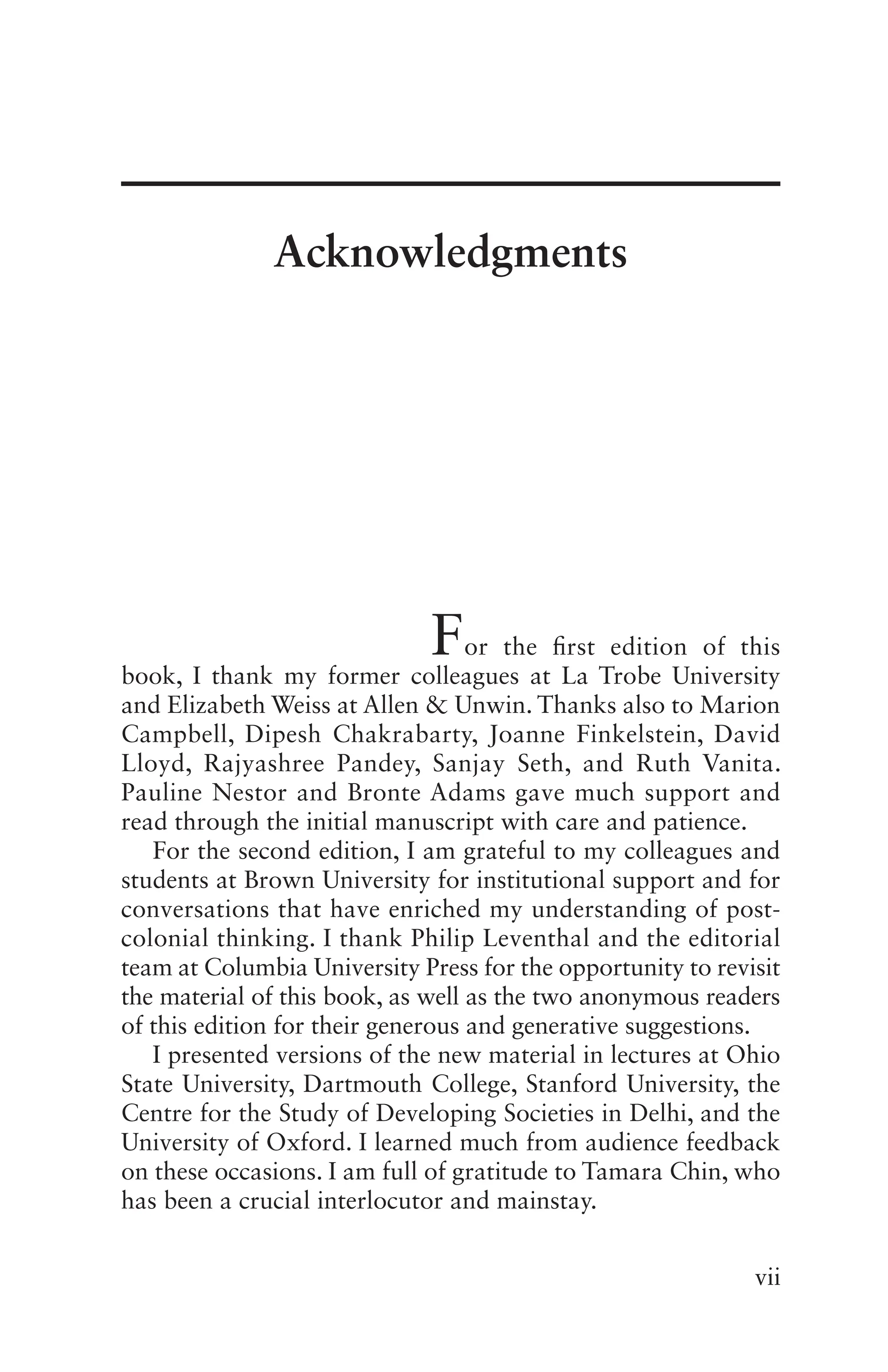
Acknowledgments vii
Preface tothe Second Edition ix
Preface to the First Edition xiii
1. After Colonialism 1
2. Thinking Otherwise: A Brief Intellectual History 23
3. Postcolonialism and the New Humanities 42
4. Edward Said and His Critics 64
5. Postcolonialism and Feminism 81
6. Imagining Community: The Question of Nationalism 102
7. One World: The Vision of Postnationalism 122
8. Postcolonial Literatures 141
9. The Limits of Postcolonial Theory 167
Epilogue: If This Were a Manifesto for Postcolonial Thinking 177
Bibliography 215
Index 255
Contents
13.
vii
For the firstedition of this
book, I thank my former colleagues at La Trobe University
and Elizabeth Weiss at Allen & Unwin. Thanks also to Marion
Campbell, Dipesh Chakrabarty, Joanne Finkelstein, David
Lloyd, Rajyashree Pandey, Sanjay Seth, and Ruth Vanita.
Pauline Nestor and Bronte Adams gave much support and
read through the initial manuscript with care and patience.
For the second edition, I am grateful to my colleagues and
students at Brown University for institutional support and for
conversations that have enriched my understanding of post-
colonial thinking. I thank Philip Leventhal and the editorial
team at Columbia University Press for the opportunity to revisit
the material of this book, as well as the two anonymous readers
of this edition for their generous and generative suggestions.
I presented versions of the new material in lectures at Ohio
State University, Dartmouth College, Stanford University, the
Centre for the Study of Developing Societies in Delhi, and the
University of Oxford. I learned much from audience feedback
on these occasions. I am full of gratitude to Tamara Chin, who
has been a crucial interlocutor and mainstay.
Acknowledgments
15.
ix
In the late1990s, when I began
work on the first edition of this book, postcolonial theory was
the domain of a handful of thinkers. It was very much an emer-
gent field, in Raymond Williams’s sense of emergent, mean-
ing something that is starting to stand apart from the status
quo while being absorbed in the current. Early postcolonial-
ism exposed the limits of academic Eurocentrism, but it did so
as an adjunct to mainstream critical theory. It had a distinct
humanistic idiom and methodology—more value based than
positivist, though always with materialist deference to real
events, people, places, pasts, and so on. Most practicing critics
at the time came out of literature departments (predominantly
comparative and Anglophone) and from conceptual branches
of history and historiography. They used their considerable
skills to speak in speculative rather than practical terms about
the contemporary non-West. Finally, postcolonialism was
party to—indeed, at the helm of—a new philosophical skepti-
cism in some European and American scholarly systems, with
offshoots in counterpart postcolonial settings. This last claim
needs elaboration.
Preface to the Second Edition
16.
POSTCOLONIAL THEORY
x
Traditionally, skepticalsystems maintain that we can never
reliably know the external world and other minds due to the
conditional nature of apperception, in essence. The latter-day
variant to which I refer is taken up with representations of
power relations that influence the way we think, more than
the problem of knowledge in the abstract. It proposes that
axiomatic forms of institutional knowledge—and this covers a
multitude of sins—are especially untrustworthy as they mask
the petty instrumental designs of one or other vested inter-
est. This turns skepticism into a kind of conscientious doubt
about universal truth-claims and also into a hermeneutics of
suspicion, to invoke a term coined by Paul Ricoeur that has
gained traction in literary and cultural studies. In this guise,
skepticism shares crucial properties with critique. Yet, there is
a distinction.
Michel Foucault once described critique as the disposition
to question governing values from the perspective of the pres-
ent. The purpose, he hinted, is not to reject power and the
mode of truth, tout court, but rather to put a limit on these
by making them contingent—that is, answerable to the needs
of this or that moment and, therefore, always dynamic. Cri-
tique may not know the outcomes it wants in advance, but it
is, nonetheless, in pursuit of a more truthful truth, if we fol-
low Foucault. Skepticism suspends this desire, or forgets it
for a while in the space-clearing exercise of incredulity. This
does not mean that skeptical systems lack conviction, merely
that these are inextricable from a logic of uncertainty. They
are experiential rather than epistemological, pluralistic rather
than foundational, and above all, they are relational—that is,
open to the vagaries of encounter.
Such a mood of incredulity was rife in the milieu of early
postcolonial theory. It grew out of contemporary poststruc-
turalism and postmodernism, mainly, and was directed, vari-
ously, against grand narratives, the figures of the subject and
of identity, disciplinary objects such as literature, text, history,
archive, philosophy, canons of all description, nationalisms
(both colonial and postcolonial), class (as the only unit of col-
lective action), reason and rationality, progress and modernity,
17.
PREFACE TO THESECOND EDITION
xi
gender, and the human, to name a few. There were quarrels
along the way on behalf of hard-won belief systems. Marxist
critics, and stakeholders in the considerable merits of antico-
lonial liberation movements, queried the absence of an oppo-
sitional or alternative world view in the new dispensation.
Traditionalists held the ground for existing forms of culture
and coherence. Many of these quarrels are documented in the
first edition of Postcolonial Theory.
Some twenty years since, I want to ask if the radical skepti-
cism of early postcolonialism has passed over into something
more like critique, in Foucault’s sense, without loss of the best
part of its formative iconoclasm. Can we point to an incipient
belief system, or even a set of provisional ameliorative prac-
tices (albeit relational and pluralistic) in the field? And, if so,
what are the conditions that have helped these come into view?
The second edition of Postcolonial Theory has two new
supplements: an epilogue essay and an extended bibliogra-
phy. The epilogue essay takes stock of important field devel-
opments. I revisit some old disciplinary quarrels and review
recent prompts from political and social theory, from post-
secular and postcritical perspectives, and from the ontologi-
cal, environmental, ethical, and affective turns in the changed
landscape of critical theory. I also review newer alliances,
especially with critical race theory and Africanist postcolo-
nialism, in a widened archival frame that includes the trans-
national circuits of non-Marxist socialisms and of many civil
rights movements. My aim is to describe what is enduring
in postcolonial thinking—as a critical perspective within the
academy and as an attitude to the world that extends beyond
the discipline of postcolonial studies.
Unlike in earlier chapters of the book, where abbreviated
citations are incorporated in parentheses in the main body of
the text, in this instance they can be found in the notes with
some additional commentary. These notes are a critical appa-
ratus for associated and further reading, and they take stock
of fields and forms of knowing that have altered postcolonial-
ism’s disciplinary bearings. All full bibliographic details are in
the designated bibliography. For ease of reference, publication
18.
POSTCOLONIAL THEORY
xii
dates referonly to the particular edition that is cited, not to
the original date of publication.
For those who are encountering Postcolonial Theory for
the first time, the epilogue is best read, as placed, at the end of
this book.
19.
xiii
In the lastdecade postcolonial-
ism has taken its place with theories such as poststructuralism,
psychoanalysis and feminism as a major critical discourse in
the humanities. As a consequence of its diverse and interdisci-
plinary usage, this body of thought has generated an enormous
corpus of specialised academic writing. Nevertheless, although
much has been written under its rubric, ‘postcolonialism’
itself remains a diffuse and nebulous term. Unlike Marxism
or deconstruction, for instance, it seems to lack an ‘originary
moment’ or a coherent methodology. This book is an attempt
to ‘name’ postcolonialism—to delineate the academic and cul-
tural conditions under which it first emerged and thereby to
point to its major preoccupations and areas of concern.
There are correspondingly two parts to the book—the first
offers an account of postcolonialism’s academic and intellec-
tual background, and the second elaborates the themes and
issues which have most engaged the attention of postcolo-
nial critics. In the main, the intellectual history of postcolo-
nial theory is marked by a dialectic between Marxism, on the
one hand, and poststructuralism/postmodernism, on the other.
So, too, this theoretical contestation informs the academic
Preface to the First Edition
20.
POSTCOLONIAL THEORY
xiv
content ofpostcolonial analysis, manifesting itself in an ongo-
ing debate between the competing claims of nationalism and
internationalism, strategic essentialism and hybridity, solidar-
ity and dispersal, the politics of structure/totality and the poli-
tics of the fragment.
Critics on both sides of this divide are persuasive in their
claims, and compelling in their critique of theoretical oppo-
nents. Neither the assertions of Marxism nor those of post-
structuralism, however, can exhaustively account for the
meanings and consequences of the colonial encounter. While
the poststructuralist critique of Western epistemology and
theorisation of cultural alterity/difference is indispensable to
postcolonial theory, materialist philosophies, such as Marx-
ism, seem to supply the most compelling basis for postcolo-
nial politics. Thus, the postcolonial critic has to work toward
a synthesis of, or negotiation between, both modes of thought.
In a sense, it is on account of its commitment to this project
of theoretical and political integration that postcolonialism
deserves academic attention.
Finally, there is the question of postcolonialism’s constitu-
ency—the cultural audience for whom its theoretical disquisi-
tions are most meaningful. In my reading of this field, there
is little doubt that in its current mood postcolonial theory
principally addresses the needs of the Western academy. It
attempts to reform the intellectual and epistemological exclu-
sions of this academy, and enables non-Western critics located
in the West to present their cultural inheritance as knowledge.
This is, of course, a worthwhile project and, to an extent, its
efforts have been rewarded. The Anglo-American humanities
academy has gradually stretched its disciplinary boundaries
to include hitherto submerged and occluded voices from the
non-Western world. But, of course, what postcolonialism fails
to recognise is that what counts as ‘marginal’ in relation to
the West has often been central and foundational in the non-
West. Thus, while it may be revolutionary to teach Gandhi as
political theory in the Anglo-American academy, he is, and
has always been, canonical in India. Despite its good inten-
tions, then, postcolonialism continues to render non-Western
21.
PREFACE TO THEFIRST EDITION
xv
knowledge and culture as ‘other’ in relation to the normative
‘self’ of Western epistemology and rationality. Rarely does it
engage with the theoretical self-sufficiency of African, Indian,
Korean, Chinese knowledge systems, or foreground those cul-
tural and historical conversations which circumvent the West-
ern world.
Nowhere is this book motivated by a desire for postcolo-
nial revenge. It does not seek finally to marginalise the West—
to render it an excluded and uneasy eavesdropper to cryptic
exchanges between, for instance, Africa and India. Its mani-
festo, if any, is this: that postcolonialism diversify its mode
of address and learn to speak more adequately to the world
which it speaks for. And, in turn, that it acquire the capacity
to facilitate a democratic colloquium between the antagonistic
inheritors of the colonial aftermath.
1
In 1985 GayatriSpivak threw
a challenge to the race and class blindness of the Western
academy, asking ‘Can the subaltern speak?’ (Spivak 1985). By
‘subaltern’ Spivak meant the oppressed subject, the members
of Antonio Gramsci’s ‘subaltern classes’ (see Gramsci 1978),
or more generally those ‘of inferior rank’, and her question
followed on the work begun in the early 1980s by a collective
of intellectuals now known as the Subaltern Studies group.
The stated objective of this group was ‘to promote a systematic
and informed discussion of subaltern themes in the field
of South Asian studies’ (Guha 1982, p. vii). Further, they
described their project as an attempt to study ‘the general
attribute of subordination in South Asian society whether this
is expressed in terms of class, caste, age, gender and office or
in any other way’ (Guha 1982, p. vii). Fully alert to the
complex ramifications arising from the composition of sub-
ordination, the Subaltern Studies group sketched out its
wide-ranging concern both with the visible ‘history, politics,
economics and sociology of subalternity’ and with the occluded
‘attitudes, ideologies and belief systems—in short, the culture
informing that condition’ (Guha 1982, p. vii). In other words,
1
After Colonialism
CHAPTER IV.
MRS. BEACHAMWRITES A LETTER.
The late post on Monday (the eventful Monday it was—for we have
retrograded twenty-four hours in our story in order to recount what
happened on that Sabbath afternoon at the Paddocks—the eventful Monday
it was which Honor spent with Arthur Vavasour on horseback first, and
afterwards in that feverishly enjoyable Richmond dinner), the second post,
brought no letter from the truant, and John’s brow grew ominously dark as
he turned over his numerous business-like-looking epistles, and amongst
them found no dainty missive in a fair running hand, and adorned with an
entwined H. B. in mingled shades of brown and blue, by way of monogram.
“There now! What did I tell you?” exclaimed his mother triumphantly. “I
was as sure as sure could be, she wouldn’t write. Guilty consciences never
do. And another time, my dear, I hope you’ll attend to your mother, old as
she is, and act accordingly.”
John made no reply to this aggravating little speech. Fortunately for him,
the day was not one of rest, neither was the hour meal-time; so that the
unhappy husband could escape from the irritating attacks of Mrs.
Beacham’s “deadly weapon.” In truth, he was in no mood to listen patiently
to the “I told you so,” and the “You see, I was right,” of the old lady’s
equivocal sympathy. His anger—hard to rouse in downright earnest against
the beautiful girl, young enough, as the poor fellow often told himself, to be
his daughter—had aroused at last to almost boiling-point; and, as is often
the case with self-constrained but naturally passionate men, the change now
lay in the probability that he would visit still more heavily than they
deserved the indiscretions of the culprit, and that in his anger he would not
even remember mercy.
Finding him still silent, Mrs. Beacham, accustomed from long habit to
watch the changes on her son’s countenance, glanced up at it from her
eternal knitting, and was startled, strong-nerved woman though she was, at
its stern rigidity, and at the colour—that of a livid leaden hue—which had
taken place of the usual ruddy brownness of his cheeks.
28.
“John, what isthe matter? My gracious me, boy! you look as if you were
going to faint.”
The old woman had risen hastily from her chair, and, standing before
him, had laid her two hands upon his arms, holding him thus, while with
anxious motherly eyes she peered into the face of him who, being all the
world to her, she loved with such a jealous and exacting devotion. For the
first time in his life, John answered her shortly, and with what his mother,
making scant allowance for the condition of his mind, chafed under as
disrespect.
“Bother!” he said gruffly, putting her aside with one hand, while he
donned his wideawake with the other. “I’m all right. What should be the
matter?” And then, in a more collected voice, and with a more composed
manner, he added, “I shall go to town to-morrow, mother, by the 10.30
train. I’ve no end of business to-day—other people’s business, or I’d let it
all go to Hanover, for what I cared. But for that, I wouldn’t be so many
hours before going up to see what that scoundrel Norcott is after with my
wife; for, by Heaven”—and he struck a blow upon the old oak floor with
his ash-stick that was enough to test the solidity of both—“by Heaven, I
begin to think that there’s more than we know of in his sending for her in
the way he did. That illness of his was all a sham—I’m pretty sure of that
by this time; and then his having Vavasour about her”—and John ground his
strong white teeth together as he said the hateful words—“looks as if there
was something devilish up with the rascal. God knows! I’ve more than once
had a fancy—why, I couldn’t tell you any more than the dead—that all
wasn’t square about Rough Diamond. It was no business of mine to inquire
into it. If young Vavasour’s been stuck, why, I shall be sorry, that is, if—”
He stopped abruptly; for there were circumstances connected with the
possible victim of Colonel Norcott’s rascality that would effectually check
any feelings of pity which John might be inclined to entertain for him.
Could the mother who bore him have looked into the heart of her only child
that day, she would bitterly have repented the stirring-up of the smouldering
fire within which her words—uttered, as so many dangerous words are
uttered, without much thought of future consequences—had effected. It is
easy, terribly easy, to raise the demon of suspicion and jealousy in the
human breast. Were the laying of the same an equally facile task, or one
equally congenial to the unregenerate nature of men and women, there
would be fewer of the crimes consequent on the strength of our worst
29.
passions to record,fewer blighted lives, fewer consciences burdened with
the weight of scarcely bearable remorse. But though the woman, whose
tongue had wagged (without ulterior design, but simply as a consequence of
her own maternal jealousy) to such fell purpose, could not read the heart
she had unconsciously been working up to madness, she yet experienced
something very like uneasiness when John, with the heavy cloud still
lowering over his brow, and with the ruddy brown half-vanished from his
cheeks (so changed was he since the poison of suspicion had suffused itself
through his veins), left her alone to ruminate on the past, and anticipate
darker doings in the future than she had either hoped or calculated on. That
John—the dearly-beloved of her aged heart, the son of whom she was so
justly proud—could prove himself, under provocation, to be of a very
violent and passionate nature, she had not now to learn. He had done his
best to subdue and conquer his constitutional sin; a sin, however, it was that
might and did lie dormant, and indeed half forgotten, within him, from the
simple fact that it required the great occasions that happily are
comparatively rare in all our lives to bring it into notice and action. The
blow struck in a moment of ungovernable rage at Frederick Norcott’s
unprotected head had for a time, as we already know, filled John Beacham’s
breast with remorse and self-reproach. He had been very angry with
himself, very angry and ashamed; but that shame and anger had not, in any
degree, either softened his nature or disposed him to any especial leniency
towards his victim. On the contrary, the soreness produced by self-
condemnation, and by imagined loss of caste, only served to better prepare
the mind of the man for the reception of evil suspicions, and of perilously
active venom; and when John Beacham left the quiet little parlour, and the
tardily-repentant old lady, who, when it was too late, would gladly have
recalled her words, he was in the mood of mind that leads, at down-hill
pace, to crime.
After his departure Mrs. Beacham picked up the ball of gray worsted that
she had in her agitation allowed to roll away upon the carpet, and
recommenced the task of turning the heel of John’s lambswool sock. Click,
click went the knitting-needles, and steadily jerked the bony wrinkled hands
that held the pins; but, contrary to custom, the thoughts of the aged woman
were wandering far away from the work in hand—away with the son whose
fiery passions she had helped to rouse—away with the thoughtless girl
whose “cunning ways” (Mrs. Beacham’s vials of wrath were filled to
30.
overflowing in readinessfor Honor’s devoted head) and artful, “flirty
goings on were hurrying her poor John into his grave.”
Suddenly a novel thought occurred to her, and, laying down her knitting-
needles, the distracted old lady, who was not “good at” doing two things at
a time, set herself to “think it out.” She would write—such was the idea
with which the mother of invention had inspired her—to Honor herself! It
was true that neither caligraphy nor the art of “composition” were among
the gifts which nature and education had bestowed upon the ever-busy
mistress of Pear-tree House, but for all that she would—so she then and
there decided—give “milady” a piece of her mind that would bring back
that “artful faggot”—Mrs. Beacham was angry enough to apply any names,
however opprobrious, to her daughter-in-law—in double quick time to her
husband and her duty.
When a woman—especially one of unrefined mind—sits down under the
influence of wrathful passions to write a letter, the chances are greatly in
favour of her pen running away with her discretion—that is to say, of her
using stronger expressions; and of her doing a good deal more mischief,
than she had intended. The not-over-well-concocted missive, which
occupied the worthy old lady who penned it during two good hours of the
afternoon, and was posted in time for the early morning delivery in
Stanwick-street, proved, as the reader will hereafter learn, no poor
exemplification of the truth of this not very novel remark. There are moods
of mind in which the receipt of even a judiciously-penned letter irritates and
offends the weak vessel that requires both tender and tactful handling. The
missive of autocratic Mrs. Beacham was neither tender nor tactful, and
pretty Honor’s fate and conduct were terribly influenced for evil by what
appeared at first sight to be one of the most every-day occurrences of every-
day life.
31.
CHAPTER V.
HONOR TURNSREBELLIOUS.
It is unfortunate perhaps, and decidedly suggestive, but so it undoubtedly
is, that beauty leads the wisest amongst us terribly astray in our judgment
both of character and motives. What observer, dispassionate or otherwise,
who looked—were such a privilege granted to him—at lovely Honor’s face
and form, lying indolently, lazily if you will, upon her narrow couch (the
iron bedstead in the Stanwick-street lodging), would have been able to
allow, without infinite regret and caution, either that she was wrong, or the
least in the world deserving of punishment? A creamy complexion, slightly
tinged with the most delicate of rose-colours; a tumbled mass of fairest
brown hair—“off the flax and on the golden,” as Miss Pratt would say; blue
eyes, “languid with soft dreams;” and full crimson lips, moist with the
morning dew of youth and health,—composed a sum of attractions very
decidedly calculated to disarm criticism, and to modify the verdict of
“Guilty” with the strongest recommendations to mercy. “Youth” and
“previous good conduct” were pleas which might be safely urged as
extenuating circumstances in the case of poor Honor Beacham’s feminine
sin of truth-suppressing; and as with her fair face slightly flushed, and her
long brown eyelashes sparkling with indignant tears, she read, for the
second time, a letter which Lydia (alias Polly), cross and out of breath with
the labour of mounting the attic stairs, had just deposited on the bed, it was
easy to perceive that the process of retribution had already, in some sort,
commenced.
That letter, as the reader will have no difficulty in guessing, was the one
mentioned in the conclusion of the last chapter as the happy result of old
Mrs. Beacham’s interference with the connubial relations of her children. It
took the well-meaning woman, as we already know, two hours in its
concoction, and ran as follows:
“My dear Honor,—I write this to my great illconvenience, and to tell
you that your conduct is not what it ought to be. John is not at home, but he
was much surprised, as so was I to hear which we did by accident that you
32.
had been seenriding in Hyde Park in the place where I am told the ladies
go, that honest women oughtnt to look at with a gentleman. I may as well
say who Mr. Arthur Vavasour. Knowing the way you useter go on with that
person I am not surprised at this, but John is, and I write to say that I cant
have him vexed nor put out, and that you must come back directly and learn
to behave yourself, and whats more, make yourself useful as you should do.
Of course things wont be pleasant when you do come home, that isnter be
expected, but we must take what Godamighty sends, and I knew when John
married what it would be. I expect you will come back directly you get this,
and I will send Simmons for you with the taxcart to meet the first afternoon
train. John besides being so put about with what youve been doing is too
busy with his horses to think of going himself.”
A pleasant missive this to receive at early morning-time, when the
recipient’s head, a little turned by flattery and excitement, was full of fresh
plans of pleasure, and was sedulously endeavouring to shut out intrusive
thoughts of home, and to ignore the conscience-pricks against which it was
so hard sometimes to kick! It would have been scarcely possible for the
picture of what awaited her in her husband’s dull chez soi, to have been
brought with more unpleasant force before the luxury-loving, indolent-
natured girl, who was becoming hourly more what is called spoilt by the
new life that she was leading. At no time greatly drawn towards her mother-
in-law (could it well, all things considered, have been otherwise?), Honor,
at that inauspicious moment, almost loathed the domineering, hectoring old
autocrat, whose ways were so very far from being her ways, and who had
thus unscrupulously laid bare to her the treatment that she, Honor, might
expect when she should return tardily, and, alas, not over-willingly, to the
sphere of the irritated old lady’s dominion. It may seem to some of my
readers that the thoughts and feelings, the likings and dislikings of Honor,
the married woman, bore but scanty relation to those of the same individual
who, when a laughing, light-hearted, unselfish girl, had found it so easy to
win, not only golden opinions, but, still surer test of worth, the affections of
the small men and women committed to her youthful guardianship. But
while making this objection, it is well to remind the critic of the truth, that
we none of us show what we really are—either for evil or for good—till we
are tried. With youth, and beauty, and good spirits,—petted too and much
indulged, albeit she was “only a governess,”—with the lamp of hope
33.
burning brightly beforeher, and with no shadow darkling over the past,
Honor Blake could have claimed small praise for being cheerful, yielding,
and contented. It was in part, perhaps, owing to that very absence of trial
that might be traced some of the striking changes that had apparently taken
place in her disposition and character. Accustomed to be made much of, and
dearly loving the evidences of being appreciated—well aware that her
beauty was of that high and uncommon order which can be disputed by
none, and that takes the senses, as it were, by storm—Honor, the stay-at-
home wife of a staid and almost middle-aged man, had every chance of
becoming discontented with the lot which at first sight, and before she had
been allowed time to feel its flatness and monotony, had seemed to her all
that was to be desired. That Mrs. Beacham—that the jealous mother-in-law,
whom an angel from heaven would probably, under similar circumstances,
have failed to please—should have had her lines also cast in the pleasant
places of the Paddocks, had proved a real misfortune to Honor. “If she were
anywhere but here!” had been often and often the girl’s inward cry, when
the peace of every moment, and the bright coming of each returning day,
were disturbed and darkened by the small aggravations of John’s crabbed
and exacting mother. It is wonderful, the power that one person possesses to
make or mar the comfort of a household. The constant fears of “something
coming,” the dread of words being taken amiss, the fretful answer, or even
the mute reproach of shrugged-up shoulders, and a peevish sneer, can make
to a sensitive nature the interior of a home that outwardly seems fair enough
a daily, hourly purgatory. Poor Honor! As she lay upon her bed, thinking
how very near the time had come when she must perforce exchange the
delights, mingled though they were with the bitterness of self-reproach, of
her present existence for the uncongenial company, the harsh sarcastic
words, and the contemptuous looks of her unloving mother-in-law, her heart
sank within her with disgust and fear.
“I cannot do it!” she said half aloud. “And John, too! What will he say to
me?” And at the thought of her husband’s displeasure, the wife who had
lacked moral courage to speak the truth began to feel that, rather than face
those two outraged and indignant spirits, she would gladly flee to the
uttermost parts of the earth, and be at rest. To be alone—to work for her
bread—to suffer hardship in every miserable and even degrading fashion—
all this appeared to Honor (she being at the age and of the nature to jump at
conclusions, and to imagine no evil equal to the present ones) infinitely, ay,
34.
a thousand thousandtimes, preferable to putting her pretty neck again under
the yoke of angry Mrs. Beacham’s thrall, and to the endurance, from
morning’s dawn to evening’s light, of that unpleasant old lady’s
disagreeable form of being good and useful.
The idea of obeying her mother-in-law’s behests, and returning with the
least possible delay, did not, after the first shock of reading the letter, either
form any portion of Honor’s thoughts, or tend in any degree to increase her
troubles. Go, till she had fulfilled one or two of her remaining engagements,
she would not. To that conclusion she had come at first, and being one of
those exceptional characters—characters, I suspect, more fanciful than real
—whom a silken thread can lead, but who, like the Celtic animal that shall
be nameless, turn restive when coercion is the order of the day, young Mrs.
Beacham, resenting the old lady’s tone of authority, set herself, with a
determination of which one short year before she never would have
believed herself capable, against that distasteful dose, the swallowing of
which she knew (none better) to be her duty. Perhaps—we do not say it
would have been so—but perhaps had John written to her, even angrily, this
wrong-headed, but still warm-hearted, young woman might have been a
trifle more amenable to reason, and better disposed to bear with patience the
lot that she had drawn; but John, as we well know, did not write to his
young wife at this momentous crisis of her life. He was busy. Epsom was at
hand. Betting, sporting men were daily finding their way by express trains
to the Paddocks, and all John’s interest, time, attention were taken up, so
Honor entirely and half-gladly believed, by other cares and pleasures than
those connected with herself. “He does not trouble himself enough about
me either to write or to mind whether I am here or there,” she said with a
sigh, as, standing before her small mirror, she noted self-complacently each
of the undimmed beauties by which she believed her husband set so little
store. “He does not care enough about me to be displeased if I ride with
Arthur Vavasour. His mother says so—the tiresome old thing!—but I don’t
believe her; and she shall not—no, she shall not—have the satisfaction of
thinking she has frightened me into obedience;” and with that doughty
resolution Honor descended her many flights of stairs to breakfast with her
newly-found and outwardly affectionate relations.
35.
CHAPTER VI.
WHAT, SELLROUGH DIAMOND!
The breakfast meal at No. 13 Stanwick-street, not being either a varied or a
luxurious one, did not occupy much of Colonel Fred Norcott’s valuable
time. It commenced, however, frequently at so late an hour, owing to the
stay-out habits over night of the master of the house, that twelve o’clock
often struck before the table was what Mrs. Norcott called “cleared,” and
the room ready for company.
Which company consisted usually, at the time of Honor’s stay, but of one
visitor—the visitor whom, for reasons best known to himself, Colonel
Norcott was ever on the watch to conciliate and flatter. Arthur Vavasour’s
appearance in Stanwick-street was usually so timed that his host’s horses—
animals chiefly devoted at that period to the use of his daughter—should be
walking up and down before the house in readiness for Mrs. Beacham’s
appearance. On the eventful Tuesday morning—the Tuesday in Epsom
holiday week—which was hereafter to be a strongly marked one in Honor
Beacham’s memory, Colonel Norcott, departing somewhat from his
accustomed habits, was early astir—so early that at a little after eleven he
might have been seen, his cigar between his lips, standing on the steps of
the house he occupied, and evidently waiting for some person whose
coming was longer delayed than the Colonel found altogether agreeable. At
last, walking briskly round a corner, with a very preoccupied expression of
countenance, and swinging in the air a light riding-whip with the manner of
one lost in thought, Arthur Vavasour, the individual expected by Honor’s
impatient parent, appeared in sight.
“By George! you’re late,” Colonel Norcott said, pulling out his watch
and displaying it reproachfully before his friend. “I haven’t more than five
minutes to spare. Five? I haven’t got three! But if you’ve anything you want
particularly to say to me, I—”
“You will wait—you must wait,” Arthur broke in imperiously. “I tell you
what, Colonel Norcott, I can’t stand the bother and the wear and tear of this
any longer; Rough Diamond, as we know, is all right again, and the odds are
—”
36.
“Five to fouron the favourite! We all know that. What then?” and Fred
replaced his cigar between his lips, and smoked away with a nonchalance
which, to an excited man, was not a little provoking.
“What then? Why, simply this: I’d rather sell the horse, upon my soul I
would, than go on in this way. If Rough Diamond loses—”
“Well, if he does?”
“Nonsense, man, what’s the use of asking? you know nearly as much of
my affairs as I do. You know how devilishly I’m dipped, and how
everything depends on my horse winning the Derby to-morrow.”
“Well, and he will win it. Don’t be a fool. I mean don’t be out of heart.
I’m sure if I thought there were the ghost of a chance against him, I should
be pretty considerably down in the mouth too. Why, man, I’ve backed the
favourite with every farthing I’m worth, and—”
“Ah, yes—I know; but my case is different. Only fancy if old Dub was
to find out (which he would be almost sure to do if the horse didn’t win)
that the brute is mine, and has been all along; what a row there would be!
And then there’s that infernal fellow Nathan—it’s ruinous work renewing—
so ruinous that, by Jove, I sometimes think—though of course I couldn’t
decide anything without speaking to you. I sometimes think whether it
wouldn’t be better—you see it would never do for the old fellow to get
wind of these confounded bills—I sometimes think whether it wouldn’t be
the best thing I could do to let Lord Penshanger have Rough Diamond, and
so get out of the infernal bother of the business altogether.”
Fred Norcott, at these words turning a hot and angry face to his
companion, looked by no means at his pleasantest. “What, sell the
favourite!” he said. “By Jove, you must be mad! I couldn’t allow or hear of
such a thing. I must say that—but I beg your pardon, Vavasour; you can
understand that when a man has so much at stake he loses his head, and
hardly knows what he’s talking about. The fact is that Honor—that poor girl
in there” (and he pointed to the house, before which they had been slowly
pacing to and fro) “is deuced miserable with that brute of a farmer fellow
that she married. She’s staying on with me because he and an old mother
that he has bully her so confoundedly between them; and I should be glad to
know if any tricks were to be played on Rough Diamond (and I’ll answer
for nothing if there’s any change made) what would become of that poor
child? I shouldn’t have a home to offer her, and—but, by George, there are
37.
the horses! Honorwill be down in a minute, and I shall be late,” consulting
his watch again, “if I’m not off to Waterloo in double quick time. Not going
down to-day, eh? Well, there’s no accounting for tastes. See you at Opera
to-night, I suppose?” And on receiving an affirmative nod from Arthur, who
already had his foot on the first step of No. 14, Colonel Norcott went his
way towards the station, where almost countless crowds were waiting to be
conveyed to the same goal—namely, the racecourse on Epsom Downs.
“What a lovely morning! I should like to be out of doors the whole entire
day!” exclaimed Honor, as she and Arthur rode along the least frequented
road within the precincts of the Regent’s Park, “and what is more, I long to
be in the country. Lydia had a holiday on Sunday, and she says that all the
beautiful chestnut-trees in Bushy Park are in full blossom, and I should so
like to go there! Have you ever seen the avenue? Mrs. Norcott has not, and
she would like, she says, to drive there this afternoon better than anything.
Mr. Vavasour, couldn’t we do it?” in a pretty tone of beseechment. “I have
so little more time; and”—her cheeks flushing, half with anger and half
with shame at this betrayal of her home secrets,—“I have had such a letter
to-day! so cross—so unfeeling! O, Mr. Vavasour, I am afraid,” looking very
piteous, “that it will be all so dreadful when I go home. What shall I do? I
almost wish that I had never come to London, the Paddocks will seem so
dull, so miserable when I go back!”
“Miserable? Are you quite sure of that?” coming nearer, and resting his
hand on the pommel of his companion’s saddle. “Don’t think me very
selfish, but I should not like you to be too happy, Honor, not too happy
when you are away from me. You sweet, beautiful creature!” gazing
passionately on her downcast eyes, “why did not I see you, know you, in
the lost time gone by, when you might have loved me, Honor? Am I too
bold, too vain, to think, to hope that had we met sooner—met before you
were tied and bound to another man—we two might have been happy?
Speak to me, Honor. How can you be so cold, so quiet, when I—”
He stopped, half afraid, in that public spot, on the well-frequented road,
where the girl’s striking beauty attracted every passer’s eye to gaze upon
her lovely face, of the emotions which his words had so evidently aroused
within her breast. At that moment, judging from outward signs—from the
rapid rise and fall of the bosom, shapely as that of the glorious statue that
entranced the world, and from the changing colour of her rounded cheek—
the accusation of coldness was not altogether warranted by appearances.
38.
And yet fromthose signs and symptoms the inference which Arthur drew
was very decidedly a wrong, or rather an exaggerated, one. Honor was not
in the least what is called “in love” with the man whose own passions and
wild worship of his neighbour’s wife were making such desperate work
within his inner man. Almost utterly reckless had those days of constant
communion with her made him. He had cried havoc and let loose the dogs
of contending passions within his breast; and if he had ever, when the
waves of temptation were beginning to rise and swell, said unto them with
an honest and true heart, “So far shalt thou go, and no farther,” that time
was long since gone and over, and the submission of Cecil Vavasour’s son
to the great enemy of mankind was an accomplished and a melancholy fact.
But partly perhaps because the man who really feels an overpowering
passion has less chance of moving the object of that passion than has the
hypocrite who feigns a devotion which he is far from feeling. Honor
Beacham did not, as I said before, love Arthur Vavasour. Like him she did;
and greatly did she prize his devotion, his delicate compliments, his evident
and irrepressible appreciation of the attractions for which her busy
unsophisticated husband, the man whose affections were not for the
moment, but for Time, appeared to care so strangely little. But although the
eloquent blood that rose to neck and brow had not its source in the inner,
and to Arthur the undiscovered, depths of her affection, although the visible
palpitations of her heart could not with truth be traced to the consciousness
of harbouring one unholy or forbidden thought, still Arthur’s words and
sighs and glances produced upon this child of nature effects precisely
analogous to those which might have been displayed had the love which he
professed and felt been returned tenfold into his bosom.
“I did not mean to be unkind and cold,” she stammered. “Quiet, Nellie!”
(to the mare she rode, and whose mild caracoles her own agitation was
provoking). “It was all my fault for talking about going home; and, Mr.
Vavasour—”
“Call me Arthur,” he broke in impetuously; “even you, who grudge me
every word that is not stiff and formal, even you can see no harm in—when
we are alone together—calling me by my name? Honor, I—”
She put up a warning finger, smiling as she did so after a fashion that
would have turned a steadier head than Arthur Vavasour’s. She did not
mean to be “coquettish;” there was no purpose in her heart to lure him into
folly and madness. Honor’s were very simple, but at the same time very
39.
cowardly, tactics—tactics, however,which have lost ere this more silly
giddy women than even vanity itself. In public glad to please, and feeling,
really feeling pity for the man whose passion she understood without
reciprocating it, Honor would “smile, and smile, and smile,” and seem to
love; whilst in private—but then, to the best of her powers, and with an
ingenuity of which none but a frightened woman could have been capable,
she strove, and with good success, to postpone sine die the evil hour when
she would perforce be brought to book, and when the lover whose
attentions she would be more loth to lose than she the least suspected would
insist on the decided answer which would render further trifling impossible
—in private Honor might almost have been mistaken for a prude.
“How can you want me to call you Arthur,” she said, with the bright
smile that lit up her countenance like a sunbeam, “when you know it would
be wrong—so wrong (and that is the best way to find out what is wrong)
that you would, or I should, be always in a most dreadful fright lest I should
forget myself, and say it when other people were present? O, how I do hate
doing underhand things! I wish now, only it is days and days too late, that I
had written everything I was about to the Paddocks. Then they might have
abused me for being wilful and fond of London, and plays, and amusing
things; but they could not have hated and despised me for being false.”
“But,” said Arthur with a caress in his voice, which Honor, novice
though she was, was at no loss to feel and understand—“but there are so
many things which pass, that one cannot say to everyone—many things
which are not wrong, as you call it, but which people at a distance would
not enter into, and had better therefore know nothing about. And so they
have been worrying you with letters, you poor darling, have they? Wanting
you to go back, and—”
“O, yes,” Honor cried, brimming over with her wrongs, her yearning for
kind sympathy, and with the self-pity which ever exaggerates the
misfortunes which our precious self is called upon to endure—“O, yes, and
Mrs. Beacham—she is so disagreeable; you don’t know half how
disagreeable she can be, orders me to come home, and threatens me with all
sorts of horrid things. I am to be scolded and taught my duty, and,” blushing
beautifully, “someone has told them that I have been riding in the Park with
you, and—Ah, Mr. Vavasour, I feel quite frightened, and I would rather do
anything in the world almost than go back again to the Paddocks!”
40.
“Anything?” he asked,throwing as much meaning into the word as the
human voice was capable of expressing; but Honor, who was far as the
poles from comprehending the evil that was in his thoughts, said eagerly,
“Indeed yes! anything! I would be a governess—you know I was a
governess before—I would go out to service—be a ‘Lydia,’ ” and she
smiled a little bitterly, “if I could only never, never see Mrs. Beacham’s face
again.”
An expression which she took for amusement, but which was in reality
indicative of very unholy triumph, passed over Arthur Vavasour’s dark,
handsome face.
“Don’t laugh at me,” Honor said plaintively. “You can have no idea how
hard it is to live with John’s mother. Nothing I do is right, and—and,” in a
lower voice, “I know she sets him against me. She has written to tell me
that I must go home to-day; but my father says I am to lay our not going
upon him, so here I shall stay! I know I shall be in a dreadful scrape, and
that it is only a case of putting off, and—”
“But why only a case of putting off, as you call it? My darling Honor—
forgive me; the words slipt out unawares—you know I would not offend
you willingly; but the best as well as the worst men are liable to mistakes.
Only tell me why you, so young, so beautiful, so formed for the enjoyment
of everything that is bright and happy, should be condemned to pass your
days in such an existence as the one you describe at the Paddocks? It has
always seemed to me,” he went on, leaning towards her, and looking with
eyes of eager passion into her face—“it has always seemed to me an act of
the most miserable folly for people—married people—who do not suit,
remaining together: both would often be equally glad to part, to go their
respective ways, to live another and a more congenial life; and yet from
some foolish unreasoning scruple, from fear of what the world would say,
or from want of courage to take the first step, they go on through all their
lives, making each other’s existence a burden, ‘when both might separately
have been as happy’ as we are any of us fated to be in this ill-managed
world of ours, where happiness is so rare a thing.”
Honor glanced at him with rather a puzzled look in her blue eyes.
Strange as it may seem, she did not even now comprehend his meaning.
That he was advising her to leave her home was too plain to be mistaken,
but that there was to be sin—sin, that is to say, greater than that which she
41.
could not butfeel would be incurred by deserting her husband and her
duties—never occurred to this poor foolish child of nature. But although
she did not comprehend, and could not fathom, the depths of her false
friend’s guilt, yet her womanly instinct led her to evade the responding to
his suggestion. His last words also, and the tone of sadness in which they
were spoken, riveted her attention, and, catching almost gladly at an excuse
for changing the conversation, she said sympathisingly,
“What do you mean by ill-managed? Surely you can have no reason to
think this world an unhappy one! If there exists one person in it who ought
to be happy, it is you—you and your wife,” she added, with a little sigh
which again misled her companion into a blind and senseless belief in his
own power over her affections. “You have everything, it seems to me, that
human beings can hope for or desire—youth and health and riches, living
where you like, and always seeing and enjoying the beautiful things that
money can buy; and then going abroad, seeing foreign countries, and—and
—”
“And what? Tell me some more of my privileges, my delights; make me
contented, if you can, with my lot. At present it seems dark enough, God
knows; and if—but I am a fool, and worse, to talk to you of these things;
only, if I thought that you—you, who are an angel of purity and love and
peace—would sometimes think of me with pity, why, it would give me
courage, Honor, would make me feel that I have still something to live for,
something to bind me to an existence which I have begun to loathe!”
Honor listened to this outpouring of real or fancied sorrows like one who
is not sure whether she dreams or is awake.
“Mr. Vavasour!” she exclaimed, “what can you mean? At your age, with
a young wife who loves you, and with” (blushing slightly) “the hope of the
dear little child that will so soon be born, it seems so wonderful to hear you
talk in this way! What is it?” warming with pity as she watched the young
worn face prematurely marked with lines of care—“would you like to tell
me?—I am very safe. I have no one” (sadly) “to confide in; and you have
just said that my sympathy would be a comfort to you.”
She laid her little ungloved hand—she had taken off her gauntlet to
caress the arched neck of the pretty thoroughbred screw she rode—upon her
companion’s arm as she spoke, and so fully occupied was she with her
object (namely, that of inducing Arthur to trust her with his sorrows), that
42.
she was scarcelyconscious of the warmth with which he, pressing his hand
upon the caressing fingers, mutely accepted the tribute of her sympathy.
“Ah, then,” she said—the slight soupçon of a brogue, as was often the
case when she was eager or excited, making itself apparent—“ah, then, you
will remember I am your friend, and say what it is that lies so heavy on
your heart?”
For a moment he looked at her doubtingly; and then, as though the
words broke from him as in his own despite, he said in a low husky tone:
“What purpose would it answer, what good would it effect either for you
or me, were you to learn that I am a villain?”
43.
CHAPTER VII.
MEA CULPA.
Avillain! Arthur Vavasour—the “fine,” noble-hearted, brilliant gentleman
to whom this simple-minded Honor had so looked up, and of the loss of
whose friendship she had been so afraid that she had “led him on”—the
silly woman knew she had—to fancy that she loved him better than she did
her husband—was he in very truth a man to be avoided, shunned, and
looked on with contempt? She could not, did not think it possible. He was
accusing himself unjustly, working on her compassion, speaking without
reflection: anything and everything she could believe possible rather than
that her friend should deserve the odious epithet which had just, to her
extreme surprise, smote upon her ears. Before, however, she could give
words to that surprise, Arthur spoke again, and with an impetuosity which
almost seemed to take away his breath poured forth his explanation of the
text.
“Yes, a villain! You may well look astonished; and I expect, when you
know all, that you will turn your back upon me, Honor, as all the world
must; that is, if the world has to be taken into my confidence, which I still
trust it will not be. There are extenuating circumstances though, as the juries
say; and perhaps, if I had been better raised, I shouldn’t have turned out
such an out-and-out bad ’un as I have!”
He stopped for a moment to gulp down a sigh, and then proceeded thus:
“I think I told you once before how awfully I was in debt, and that it was
the burden of debt that drove me into marrying poor little Sophy Duberly—
the best girl in the world; but I did not love her (more shame for me), and
whose affection, poor child, is so much more of a torment than a pleasure to
me. Well, enough of that: the worst is to come; and if you can tell me, after
hearing it, that I am not a villain, why, I am a luckier dog, that’s all, than I
think myself at present!”
Honor, feeling called upon to make some response, muttered at this crisis
a few words which sounded like encouragement; but Arthur, too entirely
engrossed with his mea culpa to heed this somewhat premature absolution,
continued hurriedly to pour forth the history of his sin.
44.
“You would neverbelieve, you who are so young, so ignorant of the
world’s wickedness, what the temptations are which beset a man. Pshaw! I
was a boy when I began life in London, and there were no bounds to my
extravagance, no limits to what you in your unstained purity would call my
guilt. I sometimes think that had my poor father lived, or even if I had
possessed a dear mother whose heart would have been made sore by the
knowledge of my offences, I might (God knows, however; perhaps I was
bad in grain) have sinned less heavily, and have been this day unburdened
by the weight of shame that oppresses me both by night and day. Darling
Honor!—you sweet warm-hearted child! why were there no loving eyes
like yours to fill with tears, in the days gone by, for me? In those days only
guilty women loved, or seemed to love; and not a single good one prayed
for or advised me. And so—God forgive me!—I went on from bad to
worse! For them—for those worthless creatures whose names should not be
even mentioned in your hearing—I expended, weak vain idiot that I was,
thousands upon thousands, which, being under age, I raised from Jews at a
rate so usurious that it could scarcely be believed how they could dare to
ask, or any greenhorn be such a fool and gull as to accept, the terms. And
then, reckless and desperate, afraid to confide in the mother who had never
shown me a mother’s tenderness, I played—I betted on the turf—I—in
short, there is no madness, no insane extravagance, of which, in my
recklessness and almost despair, I have not been guilty. But the worst is yet
to come. You remember that I bought Rough Diamond for a large sum of
your husband. I gave him a bill at six months’ date, renewable, for the
amount; and John—he behaved as well as man could do, I must say that—
promised that it should remain a secret that the colt was mine. Well, some
little time before my marriage—that marriage being a matter to me of
absolute necessity—old Duberly grew anxious and uneasy at my being so
much at the Paddocks. He had an idea, poor dear old fellow, that I could
only be there on account of matters connected in some way with racing. So
he wrote to my mother, of all people in the world, for an explanation, and
she naturally enough referred him to me. Then, Honor, came the moment of
temptation. I could not—I positively could not, with my expectations, my
almost certainty, and John Beacham’s too, of Rough Diamond’s powers—
part with him to any man living. So—it was an atrocious thing to do; I felt it
at the moment, and Heaven knows I have not changed my opinion since—I
45.
allowed Mr. Duberly—allowed!humbug!—I told him that the horse was
not mine, and, liar that I was, that I had nothing to do with the turf!”
“It was very bad,” murmured Honor; “but I suppose that if Mr. Duberly
had thought the contrary, he might have refused his consent to your
marriage, and then his daughter would have been wretched. Still, indeed,
indeed, you had better—don’t you think so now?—have been quite open
with him. If you had said—”
“Yes, yes, I know; but who ever does the right thing at the right time?
And, besides, I could not be sure, as you have just said, and knowing old
Duberly as I do now, that he would have allowed his daughter to be my
wife if he had been told the truth. His horror of what he calls gambling is
stronger than anything you can conceive. I hear him say things sometimes
which convince me that he would rather have given Sophy to a beggar—a
professional one, I mean—than to me; and if he had acted as I feared, what,
in the name of all that is horrible, was to become of me? The tradesmen, the
name of whose ‘little accounts’ is legion, only showed me mercy, the
cormorants! because of the rich marriage which they believed was to come
off; while the Jews, the cent-percent fellows—but what do you know of
bills and renewals, of the misery of feeling that a day of reckoning is
coming round—a horrible day when you must either put the gold for which
those devils would sell their souls into their grasping hands, or by a dash of
your pen plunge deeper and deeper into the gulf of ruin and despair? But
there are other and more oppressive debts even than these, Honor—debts
which I have no hopes of paying, except through one blessed chance, one
interposition of Providence or fate—for I don’t suppose that Providence
troubles itself much with my miserable concerns—in my behalf.”
“And that chance?” put in Honor, imagining that he waited to be
questioned.
“That chance is the winning of the Derby to-morrow by Rough
Diamond. I have no bets, at least nothing but trifling ones, on the race; but
if the horse wins, his value will, as of course you know, rise immeasurably,
and with the money I can sell him for I shall be able, for a time, to set
myself tolerably straight. Your father—whose horse you have, I suppose,
hitherto fancied Rough Diamond to be—has, he tells me, backed him for all
that he is worth. My reason for not doing so has been that I am not up to
making a book, and that the debts of honour I already groan under are
46.
sufficiently burdensome withoutincurring others which I might not be able
to pay.”
“How anxious you must be and unhappy!” Honor said pityingly. “But
there is one thing which puzzles me, and that is, how you could keep all this
a secret from your wife. Surely she would have been silent; surely she
might have softened her father, and made all smooth between you.”
“She might; but I could not risk it. Sophy is very delicate; and then there
has been such entire confidence between her and her father, that it would
have been almost impossible for her to keep anything from him. No; as I
have brewed, so I must bake. I can only hope the best; and that, or the
worst, will very soon be no longer matter for speculation. The devil of it is
—I beg your pardon, I am always saying something inexcusable—but really
the worst of it is, that the fact of my mother’s intention of fighting my
grandfather’s will is no longer a mystery. Old Duberly’s fortune is, as all the
world believes, very large; but at the same time he is known to be what is
called a ‘character,’ and that his eccentricities take the turn of an
extraordinary mixture of penuriousness and liberality has been often the
subject both of comment and reproach with people who have nothing to do
but to talk over the proceedings of their neighbours. In short—for I am sure
you must be dreadfully tired of hearing me talk about myself—the world,
my cursed creditors included, would be pretty well justified in believing
that my worthy father-in-law would flatly refuse to pay a sum of something
very like fourteen thousand pounds for a fellow whose extravagance and
love of play were alone accountable for the debt; one, too, who has nothing
—no, not even a ‘whistle’—to show of all the things that he has paid so
dear for. Disgusting, is it not? And now that you have heard the story,—I
warned you, remember, that it was a vile one,—what comfort have you to
bestow on me? And can you, do you wonder at my calling the world—my
world, that is—a miserable one? and is it surprising that, in spite of outward
prosperity, of apparent riches, and what you call good gifts, I should
sometimes almost wish to exchange my lot with that of the poorest of the
poor, provided that the man in whose shoes I stood had never falsified his
word, or lived as I have done and do, with a skeleton in the cupboard, of
which another—one, too (forgive me, dear, for saying so), whom I not
greatly trust—keeps, and must ever keep, the key?”
Honor paused for a moment ere she answered, and then said, in a gentle
and half-hesitating way (they had turned their horses’ heads some time
47.
before, and hadnearly arrived at Honor’s temporary home), “I almost wish
you had not told me this; but we are neither of us very happy, Mr. Vavasour,
and must learn to pity one another. Perhaps—I don’t know much about such
things—but perhaps I ought to say that you were wrong; only, I am sure of
this, that, tempted as you were, I should have done no better. It must have
been so very difficult—so very, very frightening! In your place I should
never have had courage enough to speak the truth; and I hope—O, how I
hope!—both for your sake and my father’s, that your horse may win! But
am I to say,” she whispered, as with his arms clasped round her slender
waist he lifted her from the saddle, “am I to say to him, to my father, that I
know about Rough Diamond? I should be so sorry, from thoughtlessness, to
repeat anything you might wish unsaid.”
He followed her into the narrow passage, where for a single moment
they were alone, and the craving within him to hold her to his heart was
almost beyond his power to conquer. Perhaps,—we owe so much
sometimes to simple adventitious circumstances,—but for the chance
opening of a door on the landing-place above, Honor would at last have
been awakened to the danger of treating Arthur Vavasour as a friend. She
was very sorry for him; but she would have been more distressed than
gratified had he pressed her to his heart with all the fervour of youthful
passion, and implored her to trust herself entirely to his tender guardianship.
On the contrary, seeing that he simply asked if Mrs. Norcott were at home,
and reminded Honor of her wish to see the famous chestnut avenue, and of
the practicability of realising her wishes, pretty Mrs. John Beacham tripped
upstairs before him with a lightened heart, in search of the chaperone who
was ever so good-naturedly ready to contribute to her pleasures.
48.
CHAPTER VIII.
JOHN BEACHAMMAKES A DISCOVERY.
People, especially imaginative ones, are apt to talk a good deal about
coming shadows and presentiments of evil, becoming especially diffuse on
the subject of the low spirits which they feel or fancy they have felt
previous to any great and dire calamity. In my humble opinion such
warnings lie entirely in the imagination, and, moreover, those who prate
about this gift of second sight are apt to forget the million cases of
unannounced misfortunes to be set against the isolated instances of
anticipated evil. Amongst these million cases we may safely cite that of
Honor Beacham on the afternoon of that famous Tuesday when, with
complaisant Mrs. Norcott for her duenna, she strolled with Arthur Vavasour
under the avenue of arching trees, then in their rich wealth of snowy beauty,
which leads, as all the world well knows, to
“The structure of majestic frame
Which from the neighbouring Hampton takes its name.”
Had Honor either been a few years older, less constitutionally light of
heart, or more experienced in sorrow, she would never have been able so
entirely—as was the case with this giddy young woman—to cast off the
sense and memory of her woes. A reprieve after all is but a reprieve; and the
consciousness that each moment, however blissful, serves only to bring us
nearer to its termination, ought to and does fill the minds of the thoughtful
with very sobering reflections. But, as I have just remarked, Honor’s
constitutionally happy spirits buoyed her up triumphantly on the waters
whose under-swell betokened a coming tempest, and throughout the two
swiftly-passing hours which she spent in the beautiful park with Arthur
Vavasour by her side, she, recklessly setting memory and conscience at
defiance, was far happier than she deserved to be.
The “pale and penitential moon” was rising over the Hyde-Park trees as
the open carriage drove into Stanwick-street, and Honor, half pale and
remorseful too now that the hour was drawing near when she must think,
promised, in answer to Arthur’s whispered entreaty, that no commands, no
49.
fatigue, no dangeroussecond thoughts, should cause her to absent herself
that night from the theatre, where she was to enjoy one of their last
pleasures, he reminded her, together. She ran upstairs—a little tired,
flushed, eager, beautiful. Would there be—she had thought more than once
of that as they drove homewards—would there be any letter for her upon
the table in the little sitting-room where what Mrs. Norcott called a “heavy
tea” was set out for their delectation? Would there—she had no time to
speculate upon chances; for her quick eye soon detected a business-like-
looking missive directed to herself, and lying on the table in front of her
accustomed seat.
With a feeling of desperation—had she delayed to strive for courage the
letter would probably, for that night at least, have remained unread—she
tore it open and perused the following lines, written in her husband’s bold,
hard, rather trade-like writing, and signed by the name of John Beacham:
“Dear Honor,—I suppose you have some excuse to make for yourself,
though I can see none any more than my mother does. You seem to be going
on at a fine rate, and a rate, I can tell you, that won’t suit me. I have been at
the house you lodge at to tell you that I shall take you home with me to-
morrow; so you had better be ready early in the day. My mother thinks you
must have been very badly brought up to deceive us as you have done, and
it will be the last time that I shall allow you to spend a day under your
father’s roof.”
Poor Honor! Poor because, tottering, wavering between good and ill, it
required but a small impetus, given either way, to decide her course. If it be
true (and true indeed it is) that grievous spoken words are wont to stir up
anger, still more certain is it that angry sentences written in moments of
fierce resentment, and read in a spirit of rebellion and hurt pride, are apt to
produce direful consequences. When Honor, with the charm of Arthur
Vavasour’s incense of adulation still bewildering her brain, and with the
distaste which the memory of old Mrs. Beacham’s society inspired her with
strong upon her, read her husband’s terse and unstudied as well as not
particularly refined epistle, the effect produced by its perusal was disastrous
indeed. Dashing the passionate tears from her eyes, and with a wrench
throwing off the dainty little bonnet and the airy mantle in which Arthur
Vavasour had told her she was so exquisitely “got up,” she prepared herself
to meet again at the New Adelphi the man whose influence over her, aided
50.
by the unfortunatecircumstances in which she was placed, had more than
begun to be dangerous. On that night, her last night—but—and here Honor
laid down the brush with which she was smoothing out her rich rippling
tresses—but must it be indeed, she asked herself, the last night that she
would be free? The last night that she might hope to pass away from the
wretched thraldom, the detested daily, hourly worry of her unloved and
unloving mother-in-law? Must she indeed return (and at the unspoken
question her heart beat wildly, half with terror and half with the joyful
flutter of anticipated freedom), must she obey the order—for order it was,
and sternly, harshly given—to place herself once more in Mrs. Beacham’s
power, in the home which that domineering and unkind old woman had
rendered hateful to her?
To do Honor only justice, there was no glimmering, or rather, to use a
more appropriate word, no overshadowing, of guilt (of guilt, that is to say,
as regarded the straying of the thoughts to forbidden pleasures) in her desire
—a desire that was slowly forming itself into an intention—of making a
home for herself elsewhere than at the Paddocks. She had arrived, with the
unreflecting rapidity of impulsive youth, at the decision that John had
ceased to love, and was incapable of appreciating either her beauty or her
intellect. His mother, too—and in this decision Honor was not greatly in the
wrong—wished her anywhere rather than in the house where she had been
accustomed to reign supreme; and this being the case, and seeing also that
poor Honor could expect (for did not those two threatening letters proclaim
the fact?) nothing but unkindness on her return, there remained for her only
the alternative—so at least she almost brought herself to believe—of
separating herself from those with whom she lived in such continued and
very real unhappiness.
During all the time that was employed in tastefully arranging the hair
whose rich luxuriance scarcely needed the foreign aid of ornament, and in
donning the dress fashioned after the décolletée taste of the day, but which
Mrs. Norcott—who entertained an unfortunate fancy, common to bony
women, of displaying her shoulders for the public benefit—assured her was
the de rigueur costume for the theatre,—during all the time that Honor was
occupied in making herself ready for the evening’s dissipation, the idea of
“living alone” haunted and, while it cheered, oppressed her. Of decided and
fixed plans she had none; and whether she would depart on the morrow,
leaving no trace to follow of her whereabouts, or whether she would delay
51.
her purpose tilla few days should have elapsed after her enforced return to
Pear-tree House, were subordinate arrangements which this misguided
young woman told herself that she would postpone for after consideration.
For the moment, the prospect of listening to the most exciting of dramas,
and of seeing (for she was easily pleased) the well-dressed audience of a
popular theatre, bore their full share in causing the future, as it hung before
Honor’s sight, to be confused and misty. The convenient season for thought
was to be after this last of her much-prized pleasures; and when this
bouquet of the ephemeral delights by which her senses had been so
enthralled would be a memory and a vision of the past, the young wife told
herself that the time for serious reflection should begin.
An hour later, in a box on the pit tier, listening with every pulse (for
Honor was too new and fresh not to take an almost painful interest in the
half-tragic and perfectly-acted play) beating responsive to newly-aroused
sensations, the young wife of the Sandyshire farmer attracted a good deal
more attention and admiration than she—entirely engrossed with the scene
and the performance—could, vain daughter of Eve though she was, have
supposed to be possible. Her dress, made of inexpensive materials, but of
pure, fresh white, and unadorned, except with a bunch of pale-blue
convolvulus, matching another of the same flower in the side of her small,
fair head, was a triumph of unpretending simplicity. Alas, however, for the
fashions of these our days! For well would it have been—before one pair of
eyes, gazing on Honor’s attractions from the pit, had rested on her beauty—
could some more efficient covering than the turquoise cross, suspended
from her rounded throat by a black velvet ribbon, have veiled her loveliness
from glance profane! Honor little knew—could she have had the faintest
surmise that so it was, her dismay would have been great indeed—Honor
little knew whose eyes those were that for a short ten minutes—no more—
were riveted, with feelings of surprise and horror which for the moment
almost made his breast a hell, upon the box in which she was seated. John
Beacham—for the individual thus roused to very natural indignation was no
other than that much-aggrieved husband—had learned from chattering
Lydia, on his visit to Stanwick-street, that Mrs. Beacham was on that
evening to betake herself to the New Adelphi with—the name went through
honest John’s heart like a knife—Mr. Vavasour and Mrs. Norcott. They
were gone—“them three,” Miss Lydia said—to “ ’Ampton Court” for the
afternoon; but the Colonel—he was expected back before the others.
52.
Perhaps the gentleman—theparlour-maid was totally ignorant of the
visitor’s right to be interested in Mrs. John Beacham’s movements—
perhaps the gentleman would wait, or it might be more convenient to him to
call again when the Colonel would have come back from the races. She
didn’t believe that Colonel Norcott would go to the theatre. She’d heard
some talk of his going to the club; but if—
John, who had heard with dilated and angry ears the main points of these
disclosures, and who was very far from desiring to come in contact with the
man whom upon earth he most despised and disliked, waited to hear no
more, but, striding hastily away, surrendered himself, not only to the
gloomiest, but to the most bitter and revengeful thoughts. That this man—
unsuspicious though he was by nature, and wonderfully ignorant of the
wicked ways of a most wicked world—should at last be roused to a sense of
the terrible possibility that he was being deceived and wronged was, I think,
under the circumstances, only natural; and in proportion to the man’s
previous security—in proportion to his entire trust, and complete deficiency
of previous susceptibility regarding Honor’s possible shortcomings—was
the amount of almost uncontrolable wrath that burned within his aching
breast. For as he left that door, as he walked swiftly down the street, and
remembered how he had loved—ay, worshipped—in his simple,
inexpressive way, the lovely creature who was no longer, he feared, worthy
either of his respect or tenderness, no judgment seemed too heavy, no
punishment too condign for her who had so outraged his feelings and set at
naught his authority. Full of these angry feelings, and boiling over with a
desire to redress his wrongs, John Beacham repaired to the tavern where he
was in the habit, when chance or business kept him late in London, of
satisfying the cravings of hunger. Alone, at the small table on which was
served to him his frugal meal of beefsteak and ale, John brooded over his
misfortunes, cursing in bitterness of spirit the hour when he first saw Honor
Blake’s bewildering face, and exaggerating—as the moments sped by, and
his blood grew warmed with one or two unaccustomed “tumblers”—the
offences of which she had been guilty.
He was roused from this unpleasant pondering by the clock that ticked
above the tall mantelshelf of the coffee-room sounding forth the hour of
eight. Eight o’clock, and John, who never passed a night if he could help it
in London, had not yet made up his mind where to spend the hours which
must intervene before his morning meeting with his wife. Enter the doors of
53.
Colonel Norcott’s abode—savefor the purpose of carrying away the
headstrong, deceitful girl whom he, John’s enemy, had so meanly entrapped
—the injured husband mentally vowed should be no act of his: not again
would he trust his own powers of self-command by finding himself, if he
knew it, face to face with the object of his hatred. From the hour, and to that
effect he registered a vow—from the hour when he should regain
possession of his wife, all communication of every kind whatsoever should
cease between Honor and the bold bad man in whose very notice there was
contamination and disgrace. From henceforward Honor, so he told himself,
would find a very different, and a far less yielding, husband than the fool
who had shut his eyes to what his mother’s had so plainly seen.
Henceforward the young fop and spendthrift, whom for the boy’s father’s
sake he had encouraged to visit at his house, should find it less easy to
make an idiot of him. Henceforward—but at this point in his cogitation a
sudden idea occurred to him; it was one that would in all probability have
struck him long before, and would certainly have shortened the modest
repast over which he had been lingering, if he had entertained—which
certainly was not yet the case—any doubts and suspicions of a really grave
character relative to Arthur Vavasour’s intimacy with his wife. That she had
deceived him with any design more unpardonable than that of temporarily
amusing herself was a thought that had not hitherto found a resting-place
within the bosom of this unworld-taught husband; though that Honor had so
deceived him was a blow that had fallen very heavily upon him.
Thoroughly truthful in his own nature, and incapable of trickery, he had
been so startled and engrossed by the discovery in Honor’s mental
idiosyncrasy of directly opposite qualities, that for a while he was incapable
of receiving any other and still more painful impression concerning her. To
some men—especially to those unfortunately-constituted ones who see in
“trifles light as air” “consummation strong” of their own jealous fantasies—
it may seem strange that John Beacham should not have sooner taken the
alarm, and vowed hot vengeance against the destroyer of his peace. That he
had not done so was probably owing to a happy peculiarity in his
constitution. He was a man too well aware of his own hasty temperament to
rush without reflection into situations to which I can give no better or more
expressive name than that of scenes. To quarrel with, also, or to offend the
son of Cecil Vavasour would have been a source of infinite pain to the man
whose respect and affection for his dead landlord would end but with his
54.
life; his wish,therefore, that Arthur had been and was no more to Honor
than the companion, in all innocence, of her girlish follies, was the father to
the conjecture as well as to the belief that so it was.
Probably, had John been returning for business purposes that day to the
Paddocks, the idea which did then and there occur to him, of hurrying off to
the New Adelphi, in order to judge for himself—as if in such a case any
man could judge justly!—of Honor’s conduct and proceedings, would never
have entered his head. It was a sore temptation only to look again, sooner
than he had expected, at his wife’s beautiful face; and as, in memory as well
as in anticipation, he dwelt upon it, the strong man’s heart softened towards
the weak child-like creature whom he had sworn to honour as well as to
love, and it would have required but one smile from her lips, one pressure
of her tender arms, to persuade him once again that she was perfect, and
that if fault or folly there had been, the error lay in himself alone.
Perhaps in all that crowded house—amongst that forest of faces that
filled the boxes and gallery to the roof—there was not one, save that honest
countryman, whose attention was not fixed and absorbed that night on one
of the most sensational melodramas that have ever drawn tears from weak
human eyes. At another time and under other circumstances John Beacham
who, strong-bodied and iron-nerved man though he was, could never keep
from what he called making a fool of himself at a dismal play, would not
have seen unmoved the wondrous tragic acting of one of the very best (alas,
that we must speak of him in the past!) of our comic actors: but John
Beacham, on the night in question, was not in the mood to listen with
interest to the divinest display of eloquence that ever burst from human lips.
He was there for another and less exalted purpose: there as a spy upon the
actions of another—there to feast his eyes (for, as I said before, in spite of
all her errors, his heart was very soft towards the one woman whom he
loved) on the wife who had defied his authority, and, possibly, made him an
object of ridicule.
He had not been long in the unconspicuous place he had chosen before,
not far removed from him—in a box, as I before said, on the pit tier—he
descried his unsuspecting wife. Such a start as he gave when first he saw
her! Such a start that, had not his neighbours on the next seat been fully
occupied with the Stage, they must have perceived and wondered at his
agitation. At first he could hardly bring himself to believe—so changed was
she, and so wondrously beautified—that it could in reality be his own
55.
Honor whom hesaw there, radiant in her glorious loveliness, and with that
loveliness—ah, poor, poor John Beacham!—displayed, in a manner which
almost took away his breath, to the gaze of hundreds upon hundreds of
admiring eyes.
Until that moment—the moment when he saw her the admired of all
beholders, in the evening toilet which so enhanced her attractions, it may be
doubted whether John had ever entirely realised the exceeding beauty of the
wife whom he had chosen. In her simple morning-dress, and especially in
the little coquettish hat which he had sometimes seen her wear, the honest
farmer was quite willing to allow that Honor was prettier by far than nine
out of ten of the pretty girls that tread the paths of life; but it was in the
dress, or rather undress, that evening dissipation rendered (according to
Mrs. Norcott’s dictum) necessary that young Mrs. Beacham became—in her
husband’s eyes—not only a marvel and miracle of loveliness, but a source
of such exceeding pain to that inexperienced rustic that in his agony of
jealous susceptibility he clenched his muscular hands together till the blood
well-nigh burst from his finger-ends with the strong though all involuntary
compression of his fingers.
For there was more than the sight of those white shoulders to rouse the
demon of anger in his breast; there was more than the memory of the
woman’s deceit to harden his heart against her; for beside, or rather behind
her, leaning over those same white shoulders in most lover-like and devoted
fashion, stood Arthur Vavasour, the man of whom his mother had in her
rude fashion warned him, the man whose father had been not only his (John
Beacham’s) friend, but his benefactor!
Whispering in her ear, calling the crimson blush to her fair cheek—the
husband saw it all! And ah, how at that moment poor John hated that dark
handsome face—the face of one looking so like a tempter sent to try the
faith and virtue of an angel only too ready, so it seemed, to fall!
Will any of my readers—any, that is to say, who have in their own
persons borne the burden and the heat of human passions—marvel that this
man, spurred by the spectacle before him—the spectacle not of fictitious
crimes and sorrows, for there was a side-scene in which a deeper
melodrama was being enacted for his benefit—should have “lost his head”
under the pressure of such unwonted excitement?
56.
Something—it was notcommon sense or reason, for he was long past
any safeguard they could render him—something retained the man, whose
passions were so rapidly growing to be his master, in the place which,
between two elderly playgoers who were entirely absorbed by the “scene,”
had been assigned to him—retained him, that is to say, till such time as, the
act being over, he could move from his place without causing public
excitement and commotion.
When the curtain fell, and the rushing, rustling sound betokened that the
spectators, over-wrought and excited, were stretching their limbs and
refreshing their brains by a change of scene and posture, John Beacham,
following a sudden and uncontrollable impulse, and with no fixed purpose
within his brain or choice of words upon his lips, staggered like a drunken
man to the box where Honor, breathless with eagerness and her fair face
flushed with excitement, had just—in entire and happy ignorance of her
husband’s proximity—turned her glossy head to talk over the startling
incidents of the play with Arthur Vavasour.
57.
Welcome to ourwebsite – the ideal destination for book lovers and
knowledge seekers. With a mission to inspire endlessly, we offer a
vast collection of books, ranging from classic literary works to
specialized publications, self-development books, and children's
literature. Each book is a new journey of discovery, expanding
knowledge and enriching the soul of the reade
Our website is not just a platform for buying books, but a bridge
connecting readers to the timeless values of culture and wisdom. With
an elegant, user-friendly interface and an intelligent search system,
we are committed to providing a quick and convenient shopping
experience. Additionally, our special promotions and home delivery
services ensure that you save time and fully enjoy the joy of reading.
Let us accompany you on the journey of exploring knowledge and
personal growth!
ebookfinal.com
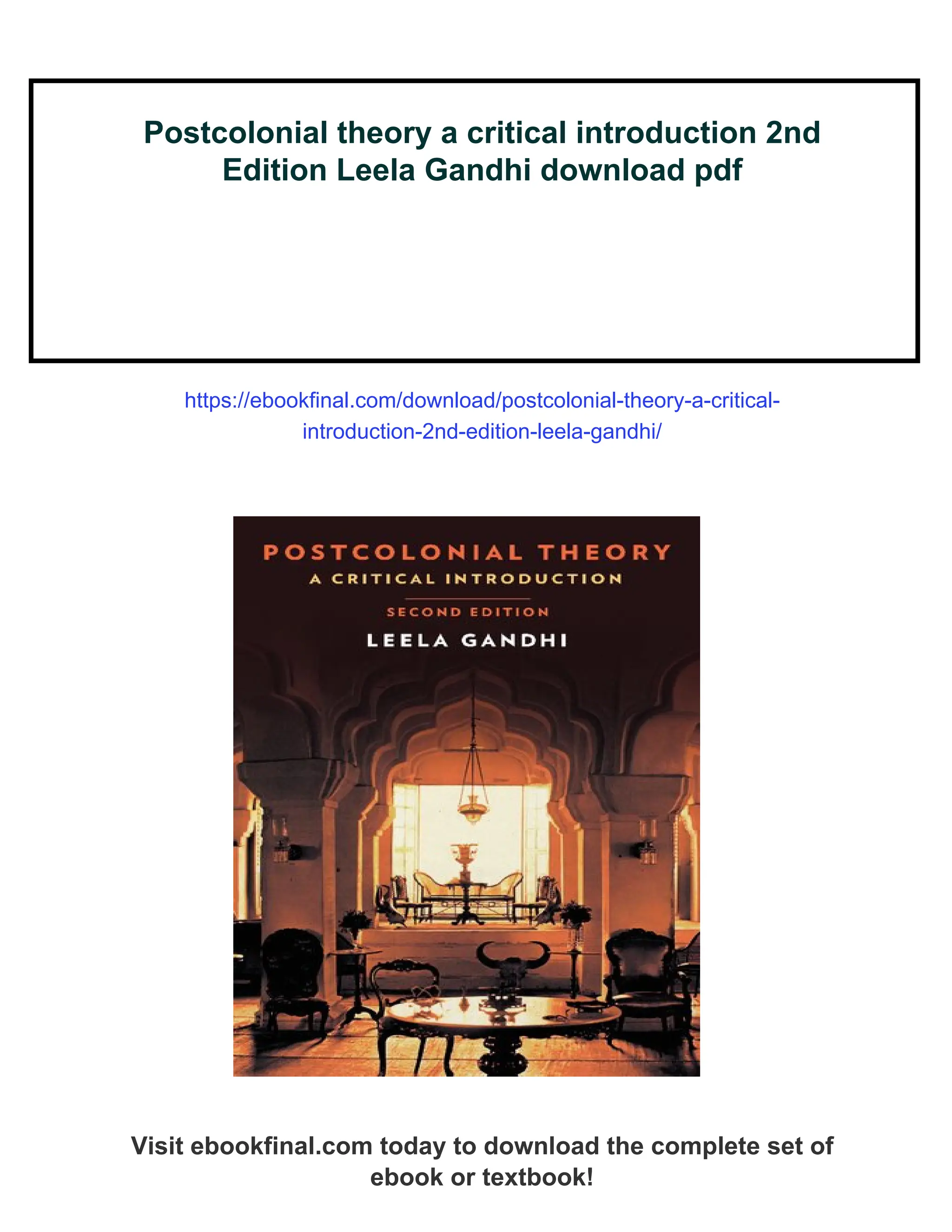


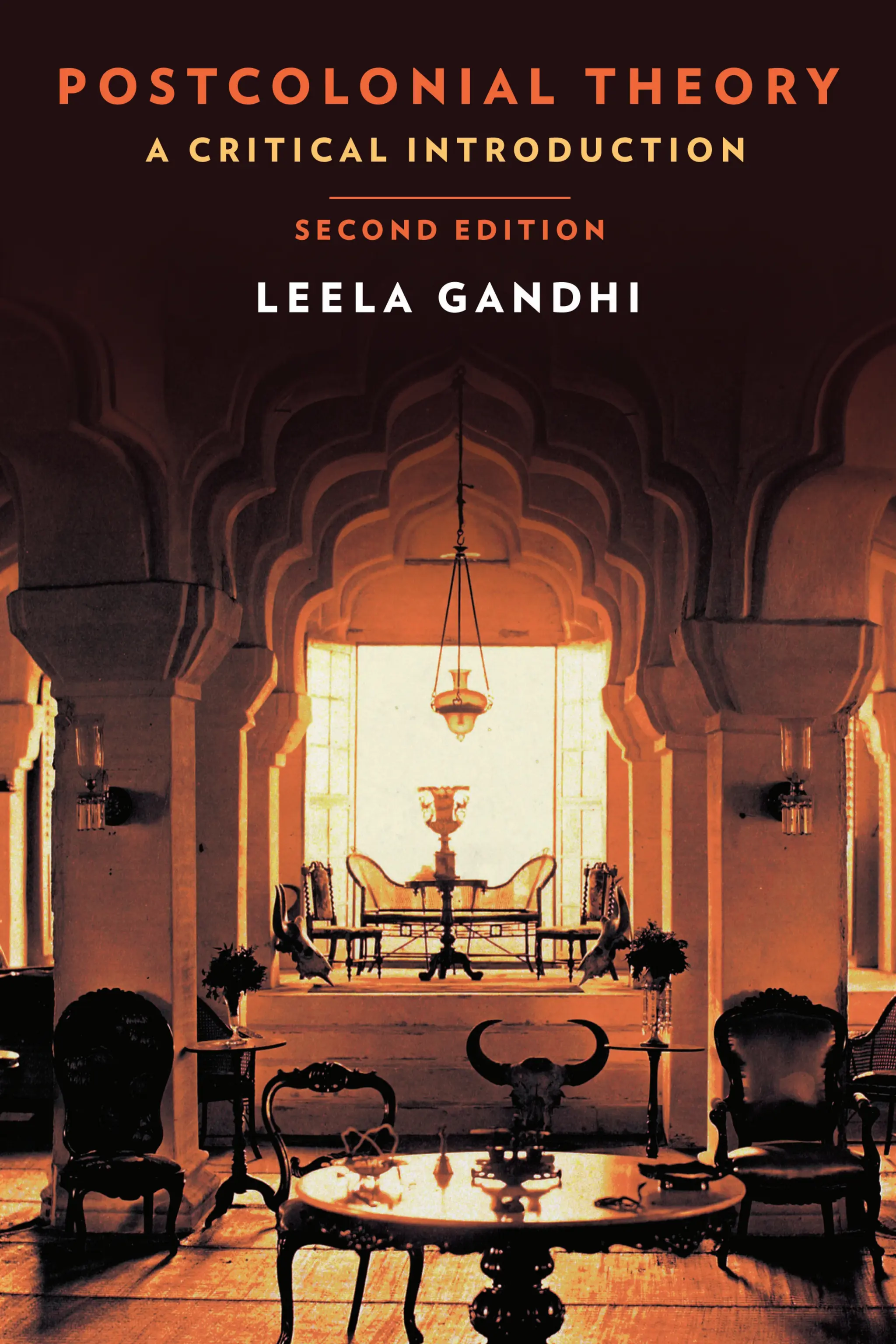
![Interior of Tuncum, Madurai by Edmund David Lyon, Prints and Drawings
Section of the Oriental and India Office Collections, British Library (OIOC
photo 1001 [2975])](https://image.slidesharecdn.com/19555-250627101140-407d9e26/75/Postcolonial-theory-a-critical-introduction-2nd-Edition-Leela-Gandhi-8-2048.jpg)
![Columbia University Press
Publishers Since 1893
New York Chichester, West Sussex
cup.columbia.edu
Copyright © 2019 Columbia University Press
All rights reserved
Library of Congress Cataloging-in-Publication Data
Names: Gandhi, Leela, 1966-
Title: Postcolonial theory : a critical introduction / Leela Gandhi.
Description: Second Edition. |
New York : Columbia University Press, [2018] |
Previous edition: 1998. | Includes bibliographical references and index.
Identifiers: LCCN 2018032553 (print) | LCCN 2018034095 (e-book) |
ISBN 9780231548564 (e-book) | ISBN 9780231178389
(cloth : acid-free paper) | ISBN 9780231178396 (paperback)
Subjects: LCSH: Postcolonialism.
Classification: LCC JV51 (e-book) | LCC JV51 .G36 2018 (print) |
DDC 325/.301—dc23
LC record available at https://lccn.loc.gov/2018032553
Columbia University Press books are printed on permanent
and durable acid-free paper.
Printed in the United States of America
Cover design: Elliott S. Cairns
Cover image: “Madura. The interior of the Tuncum.” Photograph by
Edmund David Lyon, c. 1868. British Library, London, UK / © British
Library Board. All Rights Reserved / Bridgeman Images.](https://image.slidesharecdn.com/19555-250627101140-407d9e26/75/Postcolonial-theory-a-critical-introduction-2nd-Edition-Leela-Gandhi-10-2048.jpg)