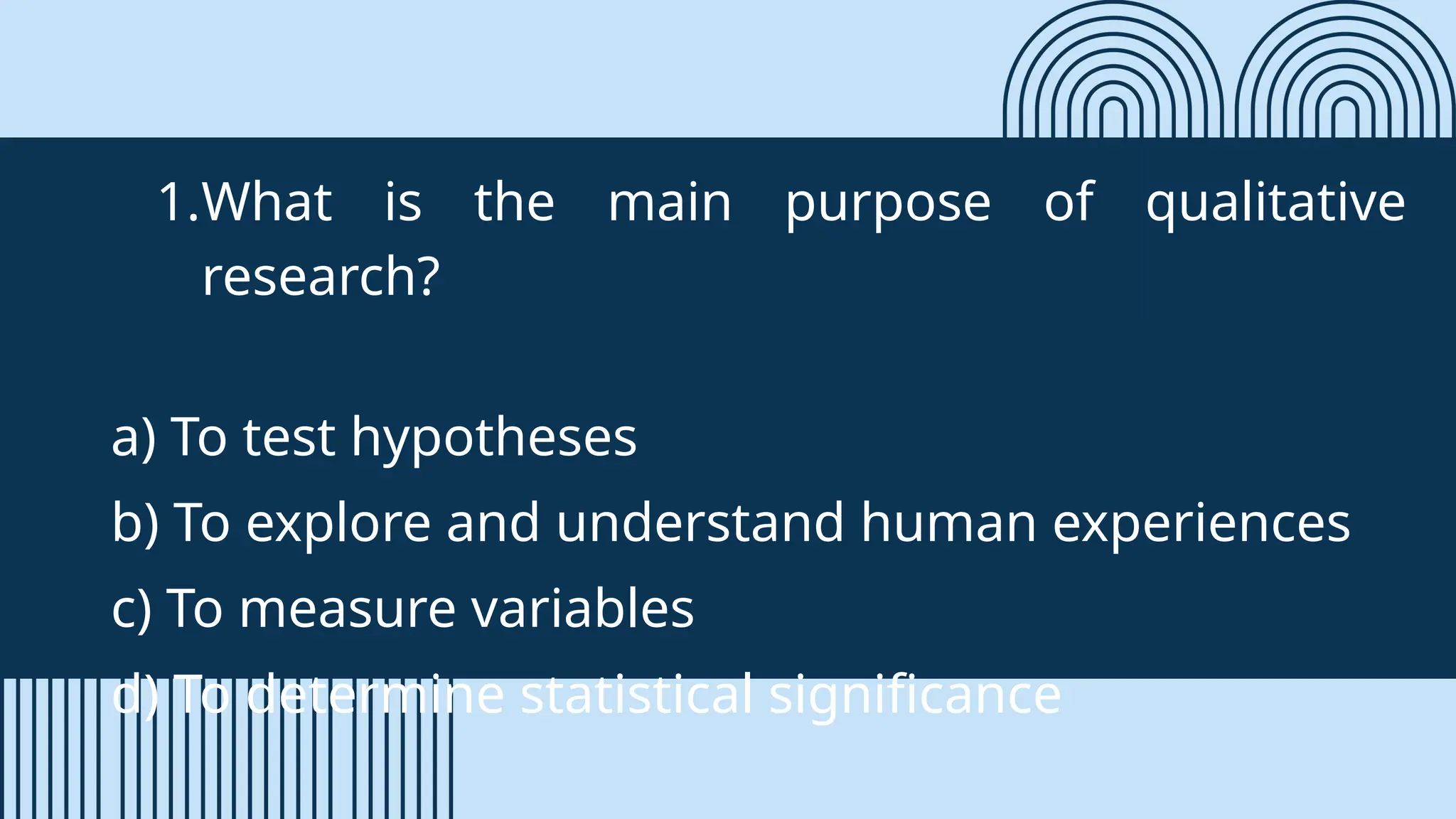
1.What is the main purpose of qualitative
research?
a) To test hypotheses
b) To explore and understand human experiences
c) To measure variables
d) To determine statistical significance
1.What is the main purpose of qualitative
research?
a) To test hypotheses
b) To explore and understand human experiences
c) To measure variables
d) To determine statistical significance
2. Which qualitative research design aims to
understand people's lived experiences?
a) Case study
b) Ethnography
c) Phenomenology
d) Grounded theory
3. In which qualitative research design does the
researcher immerse themselves in a culture?
a) Case study
b) Ethnography
c) Narrative research
d) Grounded theory
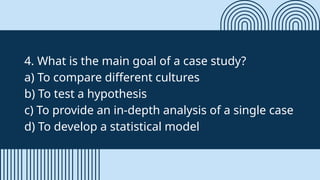
4. What is the main goal of a case study?
a) To compare different cultures
b) To test a hypothesis
c) To provide an in-depth analysis of a single case
d) To develop a statistical model
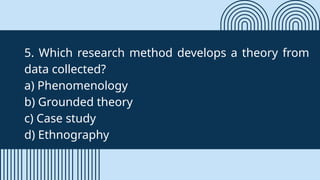
5. Which research method develops a theory from
data collected?
a) Phenomenology
b) Grounded theory
c) Case study
d) Ethnography
6. What type of research collects data through life
stories and experiences?
a) Case study
b) Grounded theory
c) Narrative research
d) Phenomenology
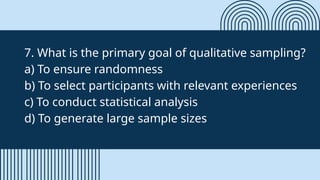
7. What is the primary goal of qualitative sampling?
a) To ensure randomness
b) To select participants with relevant experiences
c) To conduct statistical analysis
d) To generate large sample sizes
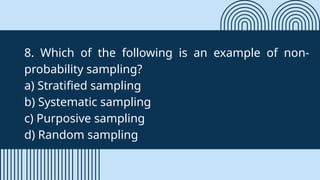
8. Which of the following is an example of non-
probability sampling?
a) Stratified sampling
b) Systematic sampling
c) Purposive sampling
d) Random sampling
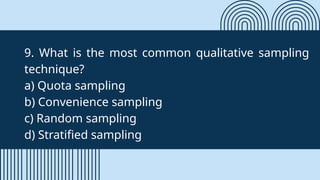
9. What is the most common qualitative sampling
technique?
a) Quota sampling
b) Convenience sampling
c) Random sampling
d) Stratified sampling
10. Why do qualitative researchers prefer natural
settings?
a) To manipulate variables
b) To observe participants in their real-world
context
c) To collect numerical data
d) To compare statistical results
11. Which research design is best suited for
studying a single institution or organization?
a) Ethnography
b) Case study
c) Grounded theory
d) Phenomenology
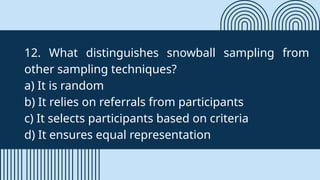
12. What distinguishes snowball sampling from
other sampling techniques?
a) It is random
b) It relies on referrals from participants
c) It selects participants based on criteria
d) It ensures equal representation
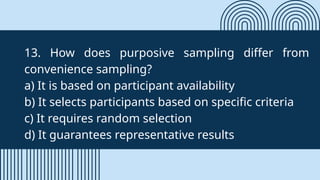
13. How does purposive sampling differ from
convenience sampling?
a) It is based on participant availability
b) It selects participants based on specific criteria
c) It requires random selection
d) It guarantees representative results
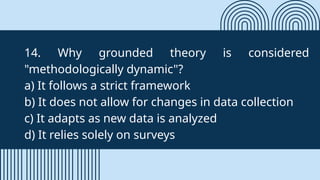
14. Why grounded theory is considered
"methodologically dynamic"?
a) It follows a strict framework
b) It does not allow for changes in data collection
c) It adapts as new data is analyzed
d) It relies solely on surveys
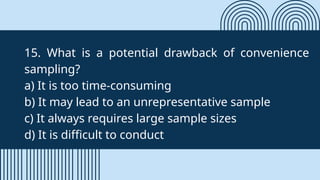
15. What is a potential drawback of convenience
sampling?
a) It is too time-consuming
b) It may lead to an unrepresentative sample
c) It always requires large sample sizes
d) It is difficult to conduct
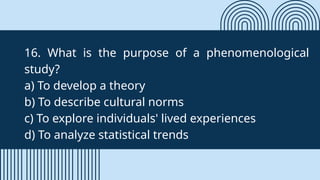
16. What is the purpose of a phenomenological
study?
a) To develop a theory
b) To describe cultural norms
c) To explore individuals' lived experiences
d) To analyze statistical trends
17. Which qualitative research method primarily
focuses on storytelling?
a) Narrative research
b) Grounded theory
c) Ethnography
d) Case study
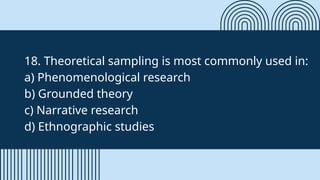
18. Theoretical sampling is most commonly used in:
a) Phenomenological research
b) Grounded theory
c) Narrative research
d) Ethnographic studies
19. A researcher wants to study how a specific
school adapted to online learning during the
pandemic. Which research design should be used?
a) Case study
b) Grounded theory
c) Ethnography
d) Phenomenology
20. A researcher interviews multiple patients to
understand the emotional impact of a rare disease.
Which research design is appropriate?
a) Grounded theory
b) Phenomenology
c) Narrative research
d) Case study
21. A study explores the traditional rituals of an
indigenous community by immersing in their
environment. What research design is most
suitable?
a) Ethnography
b) Narrative research
c) Grounded theory
d) Case study
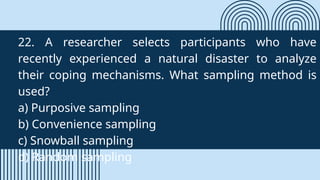
22. A researcher selects participants who have
recently experienced a natural disaster to analyze
their coping mechanisms. What sampling method is
used?
a) Purposive sampling
b) Convenience sampling
c) Snowball sampling
d) Random sampling
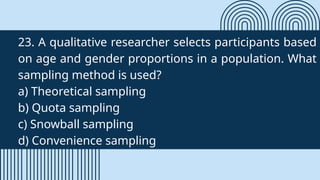
23. A qualitative researcher selects participants based
on age and gender proportions in a population. What
sampling method is used?
a) Theoretical sampling
b) Quota sampling
c) Snowball sampling
d) Convenience sampling
24. A researcher studying gang culture starts with one
participant who then refers others. What sampling
method is used?
a) Snowball sampling
b) Purposive sampling
c) Convenience sampling
d) Quota sampling
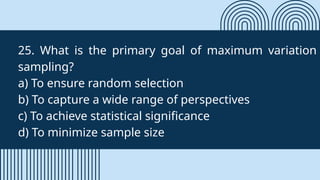
25. What is the primary goal of maximum variation
sampling?
a) To ensure random selection
b) To capture a wide range of perspectives
c) To achieve statistical significance
d) To minimize sample size
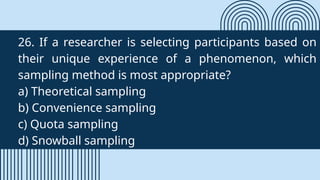
26. If a researcher is selecting participants based on
their unique experience of a phenomenon, which
sampling method is most appropriate?
a) Theoretical sampling
b) Convenience sampling
c) Quota sampling
d) Snowball sampling
27. A researcher analyzes how themes from multiple
interviews contribute to a broader theoretical
framework. What research design is used?
a) Ethnography
b) Grounded theory
c) Case study
d) Narrative research
28. A researcher is studying the mental health impact of
remote learning. Which research design would be best,
and why?
a) Phenomenology, because it explores lived experiences
b) Case study, because it examines one institution
c) Narrative research, because it focuses on storytelling
d) Ethnography, because it observes cultures
29. What is a key ethical issue in qualitative
research?
a) Protecting participant confidentiality
b) Ensuring data is numerical
c) Randomly assigning participants
d) Manipulating variables
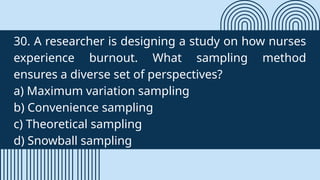
30. A researcher is designing a study on how nurses
experience burnout. What sampling method
ensures a diverse set of perspectives?
a) Maximum variation sampling
b) Convenience sampling
c) Theoretical sampling
d) Snowball sampling

POST-TEST IN RESEARCH DESIGN BSHTGTRD. pptx

  • 1.
    1.What is themain purpose of qualitative research? a) To test hypotheses b) To explore and understand human experiences c) To measure variables d) To determine statistical significance
  • 2.
    1.What is themain purpose of qualitative research? a) To test hypotheses b) To explore and understand human experiences c) To measure variables d) To determine statistical significance
  • 3.
    2. Which qualitativeresearch design aims to understand people's lived experiences? a) Case study b) Ethnography c) Phenomenology d) Grounded theory
  • 4.
    3. In whichqualitative research design does the researcher immerse themselves in a culture? a) Case study b) Ethnography c) Narrative research d) Grounded theory
  • 5.
    4. What isthe main goal of a case study? a) To compare different cultures b) To test a hypothesis c) To provide an in-depth analysis of a single case d) To develop a statistical model
  • 6.
    5. Which researchmethod develops a theory from data collected? a) Phenomenology b) Grounded theory c) Case study d) Ethnography
  • 7.
    6. What typeof research collects data through life stories and experiences? a) Case study b) Grounded theory c) Narrative research d) Phenomenology
  • 8.
    7. What isthe primary goal of qualitative sampling? a) To ensure randomness b) To select participants with relevant experiences c) To conduct statistical analysis d) To generate large sample sizes
  • 9.
    8. Which ofthe following is an example of non- probability sampling? a) Stratified sampling b) Systematic sampling c) Purposive sampling d) Random sampling
  • 10.
    9. What isthe most common qualitative sampling technique? a) Quota sampling b) Convenience sampling c) Random sampling d) Stratified sampling
  • 11.
    10. Why doqualitative researchers prefer natural settings? a) To manipulate variables b) To observe participants in their real-world context c) To collect numerical data d) To compare statistical results
  • 12.
    11. Which researchdesign is best suited for studying a single institution or organization? a) Ethnography b) Case study c) Grounded theory d) Phenomenology
  • 13.
    12. What distinguishessnowball sampling from other sampling techniques? a) It is random b) It relies on referrals from participants c) It selects participants based on criteria d) It ensures equal representation
  • 14.
    13. How doespurposive sampling differ from convenience sampling? a) It is based on participant availability b) It selects participants based on specific criteria c) It requires random selection d) It guarantees representative results
  • 15.
    14. Why groundedtheory is considered "methodologically dynamic"? a) It follows a strict framework b) It does not allow for changes in data collection c) It adapts as new data is analyzed d) It relies solely on surveys
  • 16.
    15. What isa potential drawback of convenience sampling? a) It is too time-consuming b) It may lead to an unrepresentative sample c) It always requires large sample sizes d) It is difficult to conduct
  • 17.
    16. What isthe purpose of a phenomenological study? a) To develop a theory b) To describe cultural norms c) To explore individuals' lived experiences d) To analyze statistical trends
  • 18.
    17. Which qualitativeresearch method primarily focuses on storytelling? a) Narrative research b) Grounded theory c) Ethnography d) Case study
  • 19.
    18. Theoretical samplingis most commonly used in: a) Phenomenological research b) Grounded theory c) Narrative research d) Ethnographic studies
  • 20.
    19. A researcherwants to study how a specific school adapted to online learning during the pandemic. Which research design should be used? a) Case study b) Grounded theory c) Ethnography d) Phenomenology
  • 21.
    20. A researcherinterviews multiple patients to understand the emotional impact of a rare disease. Which research design is appropriate? a) Grounded theory b) Phenomenology c) Narrative research d) Case study
  • 22.
    21. A studyexplores the traditional rituals of an indigenous community by immersing in their environment. What research design is most suitable? a) Ethnography b) Narrative research c) Grounded theory d) Case study
  • 23.
    22. A researcherselects participants who have recently experienced a natural disaster to analyze their coping mechanisms. What sampling method is used? a) Purposive sampling b) Convenience sampling c) Snowball sampling d) Random sampling
  • 24.
    23. A qualitativeresearcher selects participants based on age and gender proportions in a population. What sampling method is used? a) Theoretical sampling b) Quota sampling c) Snowball sampling d) Convenience sampling
  • 25.
    24. A researcherstudying gang culture starts with one participant who then refers others. What sampling method is used? a) Snowball sampling b) Purposive sampling c) Convenience sampling d) Quota sampling
  • 26.
    25. What isthe primary goal of maximum variation sampling? a) To ensure random selection b) To capture a wide range of perspectives c) To achieve statistical significance d) To minimize sample size
  • 27.
    26. If aresearcher is selecting participants based on their unique experience of a phenomenon, which sampling method is most appropriate? a) Theoretical sampling b) Convenience sampling c) Quota sampling d) Snowball sampling
  • 28.
    27. A researcheranalyzes how themes from multiple interviews contribute to a broader theoretical framework. What research design is used? a) Ethnography b) Grounded theory c) Case study d) Narrative research
  • 29.
    28. A researcheris studying the mental health impact of remote learning. Which research design would be best, and why? a) Phenomenology, because it explores lived experiences b) Case study, because it examines one institution c) Narrative research, because it focuses on storytelling d) Ethnography, because it observes cultures
  • 30.
    29. What isa key ethical issue in qualitative research? a) Protecting participant confidentiality b) Ensuring data is numerical c) Randomly assigning participants d) Manipulating variables
  • 31.
    30. A researcheris designing a study on how nurses experience burnout. What sampling method ensures a diverse set of perspectives? a) Maximum variation sampling b) Convenience sampling c) Theoretical sampling d) Snowball sampling