TVM E-Learning
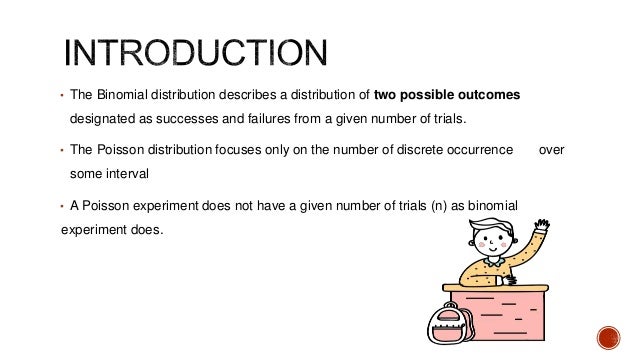
• The Binomial distribution describes a distribution of two possible outcomes
designated as successes and failures from a given number of trials.
• The Poisson distribution focuses only on the number of discrete occurrence over
some interval
• A Poisson experiment does not have a given number of trials (n) as binomial
experiment does.
• For example, whereas a binomial experiment might be used to determine how many
black cars are in a random sample of 50 cars,
• a Poisson experiment might focus on the number of cars randomly arriving at a car wash
during a 20-minute interval
• The Poisson distribution is the discrete probability distribution that applies
to occurrences of some event over a specified interval .
• The random variable x is the number of occurrences of the event in
•an interval
• The interval can be
• time
• Distance
• area
• volume
• Or Some similar unit
•The Poisson distribution is typically used as approximation to true underlying
reality
• the number of car accidents in a day
• the number of dandelions in a square meter plot of land
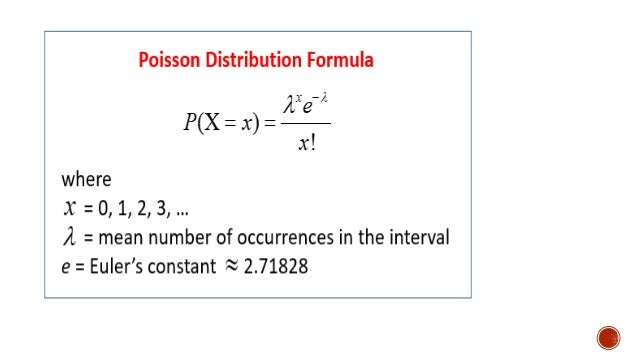
Formula
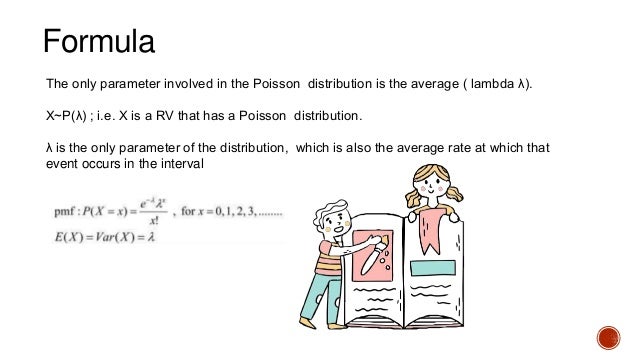
The only parameter involved in the Poisson distribution is the average ( lambda λ).
X~P(λ) ; i.e. X is a RV that has a Poisson distribution.
λ is the only parameter of the distribution, which is also the average rate at which that
event occurs in the interval
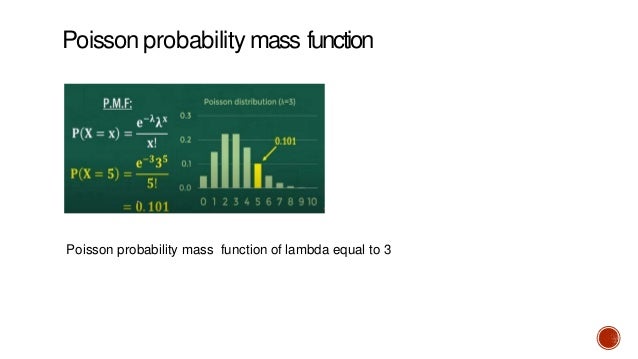
Poisson probability mass function of lambda equal to 3
Poisson probability mass function
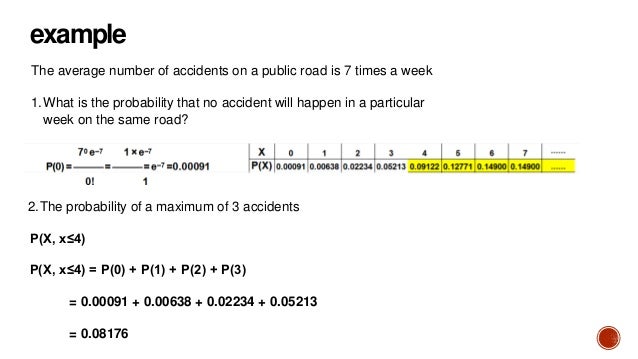
The average number of accidents on a public road is 7 times a week
1.What is the probability that no accident will happen in a particular
week on the same road?
example
2.The probability of a maximum of 3 accidents
P(X, x≤4)
P(X, x≤4) = P(0) + P(1) + P(2) + P(3)
= 0.00091 + 0.00638 + 0.02234 + 0.05213
= 0.08176
3.The possibility of at least 4 accidents
P(X, x≥4)
P(X, x≥4) = 1 – [P(0) + P(1) + P(2) + P(3)]
= 1 – [0.00091 + 0.00638 + 0.02234 + 0.05213]
= 1 – 0.08176
= 0.91824
4.If the average number of accidents in a week is 3, then The possibility of more than two
accidents in two weeks
If 3 Events in a week Then μ = 3 × 2 = 6 in 2 weeks P(X,x>2) = 1 – [P(0) + P(1) +
P(2)]
60 e–6 61 e–6 62 e–6
= 1 – ——— + ——— + ——— 0! 1! 2!
= 1 – (0.0025 + 0.0149 + 0.0446)
= 1 – 0.062
= 0.938
Possion Distribution new slide.pptx

Possion Distribution new slide.pptx

  • 1.
  • 3.
    • The Binomialdistribution describes a distribution of two possible outcomes designated as successes and failures from a given number of trials. • The Poisson distribution focuses only on the number of discrete occurrence over some interval • A Poisson experiment does not have a given number of trials (n) as binomial experiment does.
  • 4.
    • For example,whereas a binomial experiment might be used to determine how many black cars are in a random sample of 50 cars, • a Poisson experiment might focus on the number of cars randomly arriving at a car wash during a 20-minute interval • The Poisson distribution is the discrete probability distribution that applies to occurrences of some event over a specified interval . • The random variable x is the number of occurrences of the event in •an interval
  • 5.
    • The intervalcan be • time • Distance • area • volume • Or Some similar unit •The Poisson distribution is typically used as approximation to true underlying reality • the number of car accidents in a day • the number of dandelions in a square meter plot of land
  • 6.
    Formula The only parameterinvolved in the Poisson distribution is the average ( lambda λ). X~P(λ) ; i.e. X is a RV that has a Poisson distribution. λ is the only parameter of the distribution, which is also the average rate at which that event occurs in the interval
  • 7.
    Poisson probability massfunction of lambda equal to 3 Poisson probability mass function
  • 8.
    The average numberof accidents on a public road is 7 times a week 1.What is the probability that no accident will happen in a particular week on the same road? example 2.The probability of a maximum of 3 accidents P(X, x≤4) P(X, x≤4) = P(0) + P(1) + P(2) + P(3) = 0.00091 + 0.00638 + 0.02234 + 0.05213 = 0.08176
  • 9.
    3.The possibility ofat least 4 accidents P(X, x≥4) P(X, x≥4) = 1 – [P(0) + P(1) + P(2) + P(3)] = 1 – [0.00091 + 0.00638 + 0.02234 + 0.05213] = 1 – 0.08176 = 0.91824 4.If the average number of accidents in a week is 3, then The possibility of more than two accidents in two weeks If 3 Events in a week Then μ = 3 × 2 = 6 in 2 weeks P(X,x>2) = 1 – [P(0) + P(1) + P(2)] 60 e–6 61 e–6 62 e–6 = 1 – ——— + ——— + ——— 0! 1! 2! = 1 – (0.0025 + 0.0149 + 0.0446) = 1 – 0.062 = 0.938