1
Using Portfolio
Management to Improve
Business Investments
By Carolyn Reid, MBA, PMP
Using Portfolio Management to improve Business Investments
2
The Business Issues driving Portfolio Management
Imagine asking your children to oversee the family funds and budget for one
month. You carefully describe the various bills that must be paid, the savings
plan you are working on and you remind them of the concepts of wants vs.
needs (family budget being based mostly on needs). What do you predict
they would spend the money on? Their wants, of course!
Naturally this scenario would not play out in the corporate world. Or is it
possible that some companies still decide what gets done based on (1)
political power, (2) gut feel, or that (3) the idea was presented well? Every
day, ideas that “sound good” proceed to the stage of being funded and
ultimately fail.
All too often, investments are not selected on the basis of adding to
achievement of the high level goals of the organization. Failing projects are
not being stopped before completion. The current business processes don’t
keep up with the pace of the business environment. The bottom line: as
things change in the industry, a business must be ready and flexible to
change.
Corporate leaders increasingly face a confusing, complex, and uncertain
environment. Globalization and technology are sweeping away the market
and industry structures that have historically defined the nature of
competition. The pace of change is accelerating.
What is Portfolio Management?
Portfolio Management is the business process used to ensure that the correct
mix of investment activity is initiated, grouped, funded and managed to
deliver true competitive benefit to the business. Portfolio Management
applied to business was derived from the classical Portfolio Management
concept for financial investment.
3
Portfolio Management techniques allow more organizational direction and
objectivity in terms of the management and prioritization of strategically
important investments. The techniques ensure that the available budget and
resources are employed to achieve the maximum return while aligning with
the organization’s business goals.
There are four basic goals of Portfolio Management:
1. Maximize the value of your portfolio of investments or projects.
2. Seek balance in your portfolio.
3. Ensure Strategic alignment of the Portfolio.
4. Pick the right number of projects (resource management).
The Value of Portfolio Management
Implementation of a well structured, clear Portfolio Management system
creates a common basis for discussion, discipline and consistency of
investments. All work being done is aligned to the major corporate
objectives, maximizing return, productivity, sales and market share.
While only the best projects are funded, projects that are failing can easily be
detected and stopped. Of utmost importance to a Portfolio Management
system, is supplying the highest quality information to ensure the best
decisions are made in a timely manner. Organizations can react quicker to
rapid external and internal environment changes.
Portfolio Management Methodology
A quality Portfolio Management process is well thought out, well defined and
controlled to ensure consistency. Portfolio management establishes a process
for approval and for the progressing of investments. The Portfolio
Management process will define: 1. Investment business case requirements.
2. Selection, ranking and prioritization, 3, Review and approval process, 4.
Go/ no go criteria defined. The business must determine the frequency of
4
portfolio review based on typical frequency of change in the business
environment.
Capacity and Budget Planning
Prioritizing investments aids in resource management. Resources can be
assigned first to the top priorities until all resources are assigned. In a similar
manner, top priorities projects are assigned funding first.
Required for good Portfolio Management Systems:
 Balanced: short and long term, risk vs. reward, risk vs. cost etc.
 Good input data (investment information) and forecasting estimates:
markets, volumes, costs etc.
 Credible financial metrics and tools
 Clear business objectives
 Close alignment between portfolio management activities and general
planning of the business
 Quality business cases
 Good selection process
 Strong link between business objectives and investment selection
 Well thought out project selection criteria, related to work that maximizes
value
 Well defined decision making process
 Go/ no go decision criteria is clear and controlled
 Alternative scenarios examined for each proposed initiative
 Disciplined search, based on familiarity, to discover and create initiatives
that provide disproportionately high rewards for the risks taken
Cross Company Process Relationship
5
Cross Company Process Relationships
Project
Managementand
Operations
Portfolio
Management
Executive
Leadership
Core
Competency
Mission Vision
Strategic
Objectives
Ideas
Business
Case
Approve/
Deny
Prioritization
and Portfolio
Review
Approved
Initiatives
Performance
Measurements
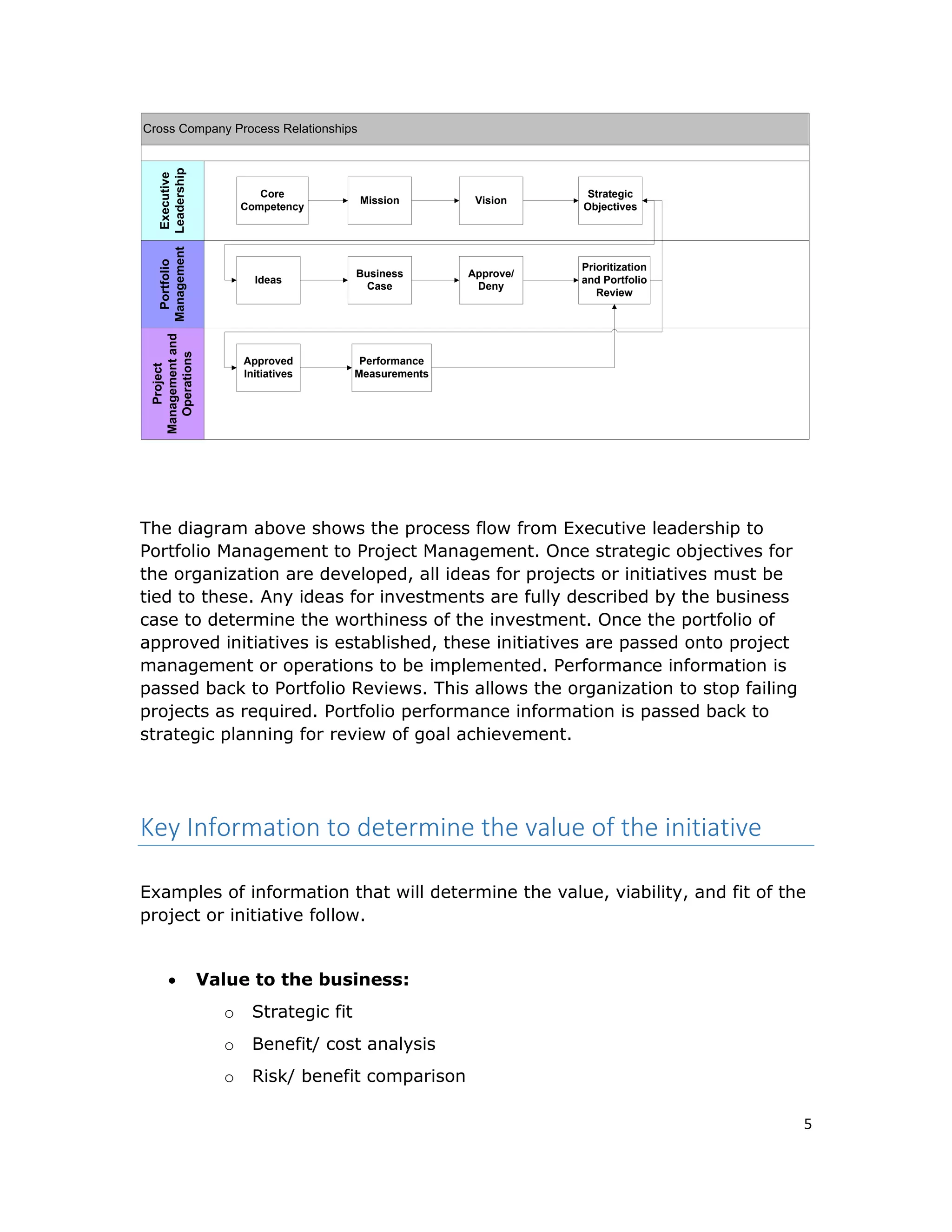
The diagram above shows the process flow from Executive leadership to
Portfolio Management to Project Management. Once strategic objectives for
the organization are developed, all ideas for projects or initiatives must be
tied to these. Any ideas for investments are fully described by the business
case to determine the worthiness of the investment. Once the portfolio of
approved initiatives is established, these initiatives are passed onto project
management or operations to be implemented. Performance information is
passed back to Portfolio Reviews. This allows the organization to stop failing
projects as required. Portfolio performance information is passed back to
strategic planning for review of goal achievement.
Key Information to determine the value of the initiative
Examples of information that will determine the value, viability, and fit of the
project or initiative follow.
 Value to the business:
o Strategic fit
o Benefit/ cost analysis
o Risk/ benefit comparison
6
o Maintain the business, grow the business or transform the
business
o Other factors: regulatory requirement, issue resolution etc.
o Payback
o Cost savings
 Viability of an initiative:
o Initiatives
o Market value potential
o Time to positive cash flow
o Personnel requirements
o Funding requirements
o Technical feasibility
 Fit
o Initiative
o Alignment with core capabilities
o Alignment with other company initiatives
o Fit with organizational structure
o Fit with company culture values
o Ease of technical implementation
 Market value:
o Competitive rationale
o Market attractiveness
o Commercial attractiveness
 Risk Assessment
o Schedule risk
o Organizational risk
o Technological risk
7
o Risk of not doing the project
o Project support costs
 Benefit
o Cross-functional impacts
o Improving internal culture
o Improving external customer services
o Efficiency improvements
o Increased market share
 Portfolio Balance
o Long Term versus short term
o Benefit versus risk
o Benefit versus cost
o Sustain, improve or revolutionize the business
Summary
Portfolio Management provides great value to an organization by maximizing
return from all work done within the organization. The business maintains a
competitive advantage as it is able to respond quickly to changes in the
market. A Portfolio Management system allows the organization to achieve
focus and balance of initiatives, to better communicate priorities vertically
and horizontally, to cancel failing projects in a timely manner and to link all
activity to the corporate strategy.

Using Portfolio Management to Improve Business Investment

  • 1.
    1 Using Portfolio Management toImprove Business Investments By Carolyn Reid, MBA, PMP
  • 2.
    Using Portfolio Managementto improve Business Investments 2 The Business Issues driving Portfolio Management Imagine asking your children to oversee the family funds and budget for one month. You carefully describe the various bills that must be paid, the savings plan you are working on and you remind them of the concepts of wants vs. needs (family budget being based mostly on needs). What do you predict they would spend the money on? Their wants, of course! Naturally this scenario would not play out in the corporate world. Or is it possible that some companies still decide what gets done based on (1) political power, (2) gut feel, or that (3) the idea was presented well? Every day, ideas that “sound good” proceed to the stage of being funded and ultimately fail. All too often, investments are not selected on the basis of adding to achievement of the high level goals of the organization. Failing projects are not being stopped before completion. The current business processes don’t keep up with the pace of the business environment. The bottom line: as things change in the industry, a business must be ready and flexible to change. Corporate leaders increasingly face a confusing, complex, and uncertain environment. Globalization and technology are sweeping away the market and industry structures that have historically defined the nature of competition. The pace of change is accelerating. What is Portfolio Management? Portfolio Management is the business process used to ensure that the correct mix of investment activity is initiated, grouped, funded and managed to deliver true competitive benefit to the business. Portfolio Management applied to business was derived from the classical Portfolio Management concept for financial investment.
  • 3.
    3 Portfolio Management techniquesallow more organizational direction and objectivity in terms of the management and prioritization of strategically important investments. The techniques ensure that the available budget and resources are employed to achieve the maximum return while aligning with the organization’s business goals. There are four basic goals of Portfolio Management: 1. Maximize the value of your portfolio of investments or projects. 2. Seek balance in your portfolio. 3. Ensure Strategic alignment of the Portfolio. 4. Pick the right number of projects (resource management). The Value of Portfolio Management Implementation of a well structured, clear Portfolio Management system creates a common basis for discussion, discipline and consistency of investments. All work being done is aligned to the major corporate objectives, maximizing return, productivity, sales and market share. While only the best projects are funded, projects that are failing can easily be detected and stopped. Of utmost importance to a Portfolio Management system, is supplying the highest quality information to ensure the best decisions are made in a timely manner. Organizations can react quicker to rapid external and internal environment changes. Portfolio Management Methodology A quality Portfolio Management process is well thought out, well defined and controlled to ensure consistency. Portfolio management establishes a process for approval and for the progressing of investments. The Portfolio Management process will define: 1. Investment business case requirements. 2. Selection, ranking and prioritization, 3, Review and approval process, 4. Go/ no go criteria defined. The business must determine the frequency of
  • 4.
    4 portfolio review basedon typical frequency of change in the business environment. Capacity and Budget Planning Prioritizing investments aids in resource management. Resources can be assigned first to the top priorities until all resources are assigned. In a similar manner, top priorities projects are assigned funding first. Required for good Portfolio Management Systems:  Balanced: short and long term, risk vs. reward, risk vs. cost etc.  Good input data (investment information) and forecasting estimates: markets, volumes, costs etc.  Credible financial metrics and tools  Clear business objectives  Close alignment between portfolio management activities and general planning of the business  Quality business cases  Good selection process  Strong link between business objectives and investment selection  Well thought out project selection criteria, related to work that maximizes value  Well defined decision making process  Go/ no go decision criteria is clear and controlled  Alternative scenarios examined for each proposed initiative  Disciplined search, based on familiarity, to discover and create initiatives that provide disproportionately high rewards for the risks taken Cross Company Process Relationship
  • 5.
    5 Cross Company ProcessRelationships Project Managementand Operations Portfolio Management Executive Leadership Core Competency Mission Vision Strategic Objectives Ideas Business Case Approve/ Deny Prioritization and Portfolio Review Approved Initiatives Performance Measurements The diagram above shows the process flow from Executive leadership to Portfolio Management to Project Management. Once strategic objectives for the organization are developed, all ideas for projects or initiatives must be tied to these. Any ideas for investments are fully described by the business case to determine the worthiness of the investment. Once the portfolio of approved initiatives is established, these initiatives are passed onto project management or operations to be implemented. Performance information is passed back to Portfolio Reviews. This allows the organization to stop failing projects as required. Portfolio performance information is passed back to strategic planning for review of goal achievement. Key Information to determine the value of the initiative Examples of information that will determine the value, viability, and fit of the project or initiative follow.  Value to the business: o Strategic fit o Benefit/ cost analysis o Risk/ benefit comparison
  • 6.
    6 o Maintain thebusiness, grow the business or transform the business o Other factors: regulatory requirement, issue resolution etc. o Payback o Cost savings  Viability of an initiative: o Initiatives o Market value potential o Time to positive cash flow o Personnel requirements o Funding requirements o Technical feasibility  Fit o Initiative o Alignment with core capabilities o Alignment with other company initiatives o Fit with organizational structure o Fit with company culture values o Ease of technical implementation  Market value: o Competitive rationale o Market attractiveness o Commercial attractiveness  Risk Assessment o Schedule risk o Organizational risk o Technological risk
  • 7.
    7 o Risk ofnot doing the project o Project support costs  Benefit o Cross-functional impacts o Improving internal culture o Improving external customer services o Efficiency improvements o Increased market share  Portfolio Balance o Long Term versus short term o Benefit versus risk o Benefit versus cost o Sustain, improve or revolutionize the business Summary Portfolio Management provides great value to an organization by maximizing return from all work done within the organization. The business maintains a competitive advantage as it is able to respond quickly to changes in the market. A Portfolio Management system allows the organization to achieve focus and balance of initiatives, to better communicate priorities vertically and horizontally, to cancel failing projects in a timely manner and to link all activity to the corporate strategy.