Object-Oriented Programming
Review
1
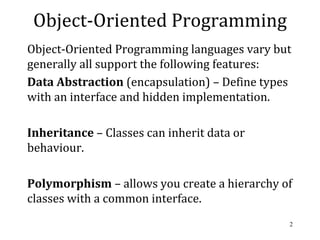
Object-Oriented Programming
Object-Oriented Programming languages vary but
generally all support the following features:
Data Abstraction (encapsulation) – Define types
with an interface and hidden implementation.
Inheritance – Classes can inherit data or
behaviour.
Polymorphism – allows you create a hierarchy of
classes with a common interface.
2
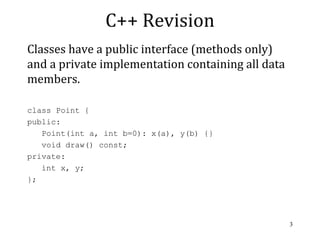
C++ Revision
Classes have a public interface (methods only)
and a private implementation containing all data
members.
class Point {
public:
Point(int a, int b=0): x(a), y(b) {}
void draw() const;
private:
int x, y;
};
3
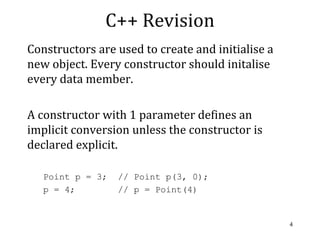
C++ Revision
Constructors are used to create and initialise a
new object. Every constructor should initalise
every data member.
A constructor with 1 parameter defines an
implicit conversion unless the constructor is
declared explicit.
Point p = 3; // Point p(3, 0);
p = 4; // p = Point(4)
4
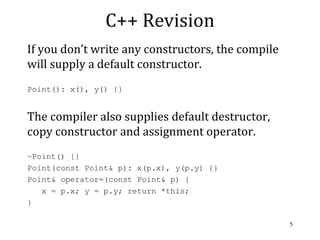
C++ Revision
If you don’t write any constructors, the compile
will supply a default constructor.
Point(): x(), y() {}
The compiler also supplies default destructor,
copy constructor and assignment operator.
~Point() {}
Point(const Point& p): x(p.x), y(p.y) {}
Point& operator=(const Point& p) {
x = p.x; y = p.y; return *this;
}
5
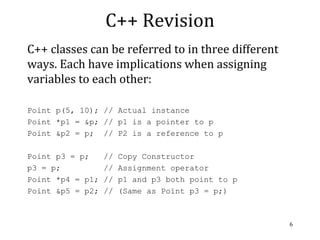
C++ Revision
C++ classes can be referred to in three different
ways. Each have implications when assigning
variables to each other:
Point p(5, 10); // Actual instance
Point *p1 = &p; // p1 is a pointer to p
Point &p2 = p; // P2 is a reference to p
Point p3 = p; // Copy Constructor
p3 = p; // Assignment operator
Point *p4 = p1; // p1 and p3 both point to p
Point &p5 = p2; // (Same as Point p3 = p;)
6
C++ Revision
Methods which are defined in the class are
inline. Functions longer than a few lines should
not be defined here.
If the method has default arguments, they should
only be specified once.
What is the efficiency of passing instances,
references, pointers?
7
C++ Revision
Methods have access to private members of other
objects of the same class.
A function or class can be declared as a friend.
A friend has access to private data members.
8
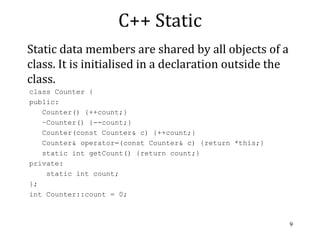
C++ Static
Static data members are shared by all objects of a
class. It is initialised in a declaration outside the
class.
class Counter {
public:
Counter() {++count;}
~Counter() {--count;}
Counter(const Counter& c) {++count;}
Counter& operator=(const Counter& c) {return *this;}
static int getCount() {return count;}
private:
static int count;
};
int Counter::count = 0;
9
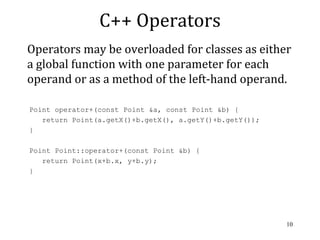
C++ Operators
Operators may be overloaded for classes as either
a global function with one parameter for each
operand or as a method of the left-hand operand.
Point operator+(const Point &a, const Point &b) {
return Point(a.getX()+b.getX(), a.getY()+b.getY());
}
Point Point::operator+(const Point &b) {
return Point(x+b.x, y+b.y);
}
10
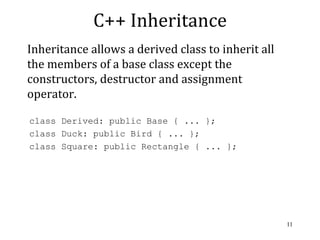
C++ Inheritance
Inheritance allows a derived class to inherit all
the members of a base class except the
constructors, destructor and assignment
operator.
class Derived: public Base { ... };
class Duck: public Bird { ... };
class Square: public Rectangle { ... };
11
C++ Inheritance
Important terms you should know:
• pubic, private, protected base classes.
• Abstract and nonabstract base classes
• Virtual and nonvirtual member functions
12
C++ Polymorphism
Polymorphism class hierarchies consist of an
interface (abstract base class) and a set of derived
implementations.
Typically the base class has no data members or
code and derived classes do not add any new
public methods (except constructors).
13
C++ Overriding Methods
A method overriding a base method must have
the same parameters, return type and const-ness.
An overridden method must be virtual (in base
class) if the correct version is to be called through
a base pointer or reference.
14
C++ Programming
Generally you should not create objects of an
abstract class or interface.
The abstractness of a base class can be enforced
by either using protected constructors or pure
(=0) virtual methods.
A class with overridden methods should have a
public virtual destructor, even if it does nothing.
15
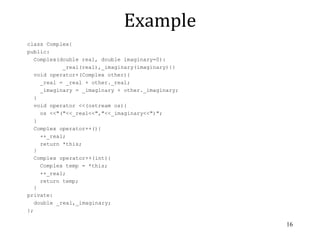
Example
class Complex{
public:
Complex(double real, double imaginary=0):
_real(real),_imaginary(imaginary){}
void operator+(Complex other){
_real = _real + other._real;
_imaginary = _imaginary + other._imaginary;
}
void operator <<(ostream os){
os <<"("<<_real<<","<<_imaginary<<")";
}
Complex operator++(){
++_real;
return *this;
}
Complex operator++(int){
Complex temp = *this;
++_real;
return temp;
}
private:
double _real,_imaginary;
};
16
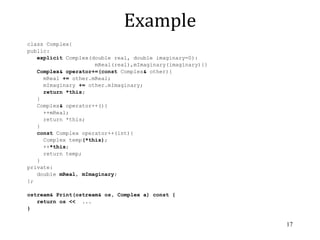
Example
class Complex{
public:
explicit Complex(double real, double imaginary=0):
mReal(real),mImaginary(imaginary){}
Complex& operator+=(const Complex& other){
mReal += other.mReal;
mImaginary += other.mImaginary;
return *this;
}
Complex& operator++(){
++mReal;
return *this;
}
const Complex operator++(int){
Complex temp(*this);
++*this;
return temp;
}
private:
double mReal, mImaginary;
};
ostream& Print(ostream& os, Complex a) const {
return os << ...
}
17

polymorphism.ppt

  • 1.
  • 2.
    Object-Oriented Programming Object-Oriented Programminglanguages vary but generally all support the following features: Data Abstraction (encapsulation) – Define types with an interface and hidden implementation. Inheritance – Classes can inherit data or behaviour. Polymorphism – allows you create a hierarchy of classes with a common interface. 2
  • 3.
    C++ Revision Classes havea public interface (methods only) and a private implementation containing all data members. class Point { public: Point(int a, int b=0): x(a), y(b) {} void draw() const; private: int x, y; }; 3
  • 4.
    C++ Revision Constructors areused to create and initialise a new object. Every constructor should initalise every data member. A constructor with 1 parameter defines an implicit conversion unless the constructor is declared explicit. Point p = 3; // Point p(3, 0); p = 4; // p = Point(4) 4
  • 5.
    C++ Revision If youdon’t write any constructors, the compile will supply a default constructor. Point(): x(), y() {} The compiler also supplies default destructor, copy constructor and assignment operator. ~Point() {} Point(const Point& p): x(p.x), y(p.y) {} Point& operator=(const Point& p) { x = p.x; y = p.y; return *this; } 5
  • 6.
    C++ Revision C++ classescan be referred to in three different ways. Each have implications when assigning variables to each other: Point p(5, 10); // Actual instance Point *p1 = &p; // p1 is a pointer to p Point &p2 = p; // P2 is a reference to p Point p3 = p; // Copy Constructor p3 = p; // Assignment operator Point *p4 = p1; // p1 and p3 both point to p Point &p5 = p2; // (Same as Point p3 = p;) 6
  • 7.
    C++ Revision Methods whichare defined in the class are inline. Functions longer than a few lines should not be defined here. If the method has default arguments, they should only be specified once. What is the efficiency of passing instances, references, pointers? 7
  • 8.
    C++ Revision Methods haveaccess to private members of other objects of the same class. A function or class can be declared as a friend. A friend has access to private data members. 8
  • 9.
    C++ Static Static datamembers are shared by all objects of a class. It is initialised in a declaration outside the class. class Counter { public: Counter() {++count;} ~Counter() {--count;} Counter(const Counter& c) {++count;} Counter& operator=(const Counter& c) {return *this;} static int getCount() {return count;} private: static int count; }; int Counter::count = 0; 9
  • 10.
    C++ Operators Operators maybe overloaded for classes as either a global function with one parameter for each operand or as a method of the left-hand operand. Point operator+(const Point &a, const Point &b) { return Point(a.getX()+b.getX(), a.getY()+b.getY()); } Point Point::operator+(const Point &b) { return Point(x+b.x, y+b.y); } 10
  • 11.
    C++ Inheritance Inheritance allowsa derived class to inherit all the members of a base class except the constructors, destructor and assignment operator. class Derived: public Base { ... }; class Duck: public Bird { ... }; class Square: public Rectangle { ... }; 11
  • 12.
    C++ Inheritance Important termsyou should know: • pubic, private, protected base classes. • Abstract and nonabstract base classes • Virtual and nonvirtual member functions 12
  • 13.
    C++ Polymorphism Polymorphism classhierarchies consist of an interface (abstract base class) and a set of derived implementations. Typically the base class has no data members or code and derived classes do not add any new public methods (except constructors). 13
  • 14.
    C++ Overriding Methods Amethod overriding a base method must have the same parameters, return type and const-ness. An overridden method must be virtual (in base class) if the correct version is to be called through a base pointer or reference. 14
  • 15.
    C++ Programming Generally youshould not create objects of an abstract class or interface. The abstractness of a base class can be enforced by either using protected constructors or pure (=0) virtual methods. A class with overridden methods should have a public virtual destructor, even if it does nothing. 15
  • 16.
    Example class Complex{ public: Complex(double real,double imaginary=0): _real(real),_imaginary(imaginary){} void operator+(Complex other){ _real = _real + other._real; _imaginary = _imaginary + other._imaginary; } void operator <<(ostream os){ os <<"("<<_real<<","<<_imaginary<<")"; } Complex operator++(){ ++_real; return *this; } Complex operator++(int){ Complex temp = *this; ++_real; return temp; } private: double _real,_imaginary; }; 16
  • 17.
    Example class Complex{ public: explicit Complex(doublereal, double imaginary=0): mReal(real),mImaginary(imaginary){} Complex& operator+=(const Complex& other){ mReal += other.mReal; mImaginary += other.mImaginary; return *this; } Complex& operator++(){ ++mReal; return *this; } const Complex operator++(int){ Complex temp(*this); ++*this; return temp; } private: double mReal, mImaginary; }; ostream& Print(ostream& os, Complex a) const { return os << ... } 17