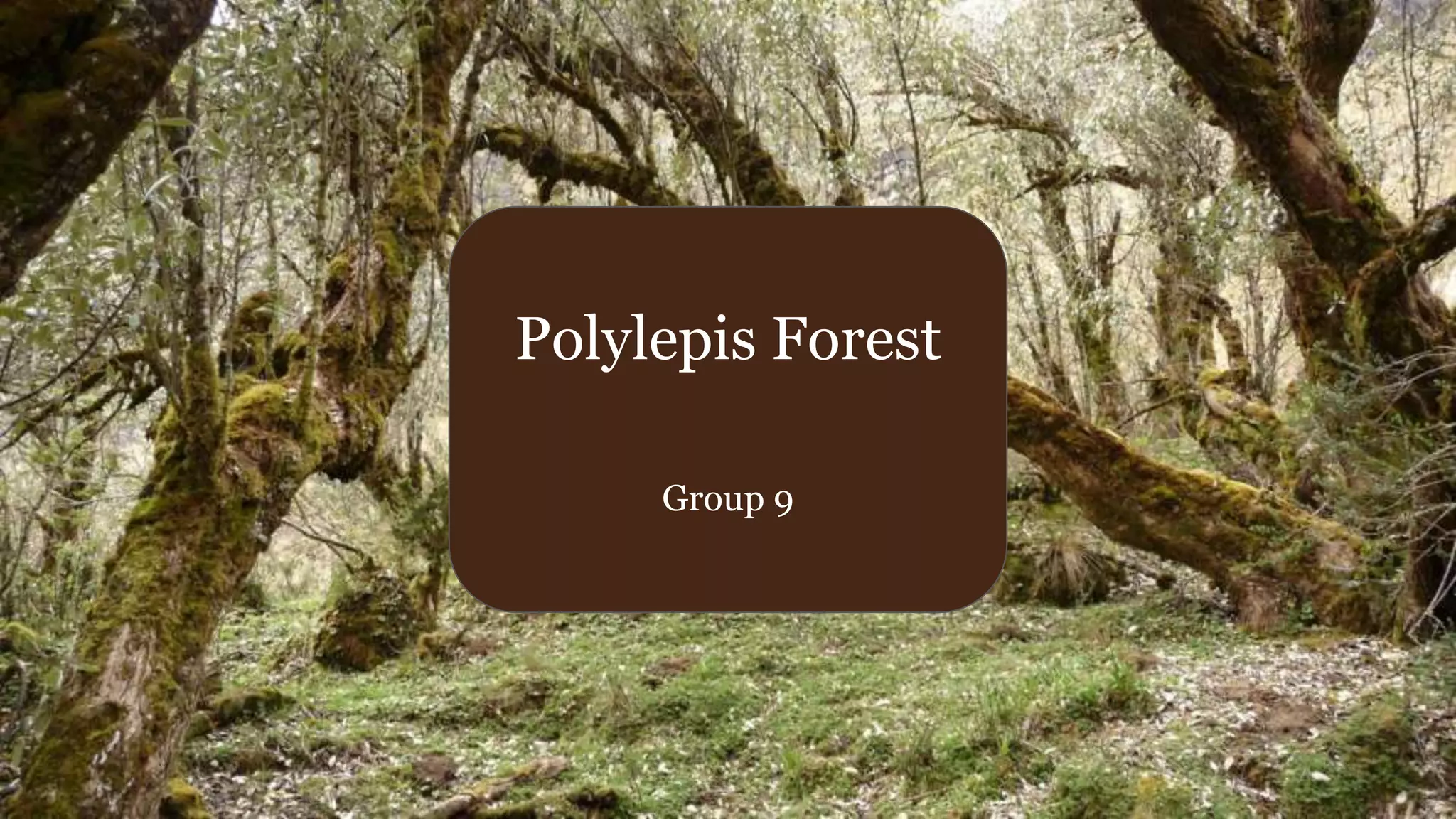
Polylepis Forest
Group 9
Site Layout
● Front page
● Navigation Bar
● Topics
○ Subtopics
Site Overview
Topics
biome description
conservation concerns
relevant links
Case studies
P. australis (plant transplants)
O. fraseri (radio tracking)
References
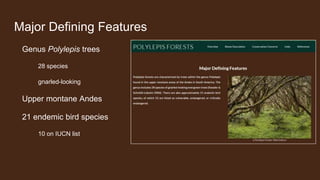
Major Defining Features
Genus Polylepis trees
28 species
gnarled-looking
Upper montane Andes
21 endemic bird species
10 on IUCN list
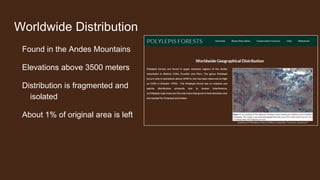
Worldwide Distribution
Found in the Andes Mountains
Elevations above 3500 meters
Distribution is fragmented and
isolated
About 1% of original area is left
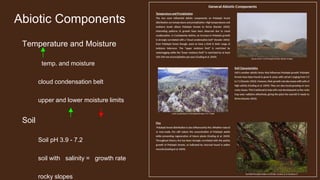
Abiotic Components
Temperature and Moisture
temp. and moisture
cloud condensation belt
upper and lower moisture limits
Soil
Soil pH 3.9 - 7.2
soil with salinity = growth rate
rocky slopes
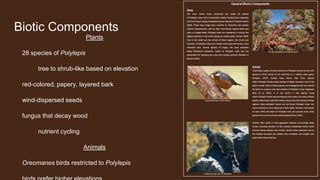
Biotic Components
Plants
28 species of Polylepis
tree to shrub-like based on elevation
red-colored, papery, layered bark
wind-dispersed seeds
fungus that decay wood
nutrient cycling
Animals
Oreomanes birds restricted to Polylepis
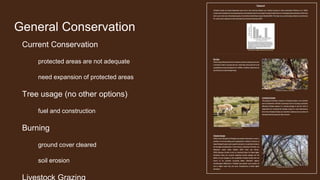
General Conservation
Current Conservation
protected areas are not adequate
need expansion of protected areas
Tree usage (no other options)
fuel and construction
Burning
ground cover cleared
soil erosion
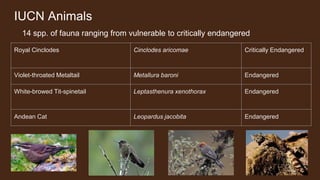
IUCN Animals
14 spp. of fauna ranging from vulnerable to critically endangered
Royal Cinclodes Cinclodes aricomae Critically Endangered
Violet-throated Metaltail Metallura baroni Endangered
White-browed Tit-spinetail Leptasthenura xenothorax Endangered
Andean Cat Leopardus jacobita Endangered
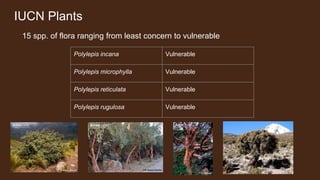
IUCN Plants
15 spp. of flora ranging from least concern to vulnerable
Polylepis incana Vulnerable
Polylepis microphylla Vulnerable
Polylepis reticulata Vulnerable
Polylepis rugulosa Vulnerable
Links
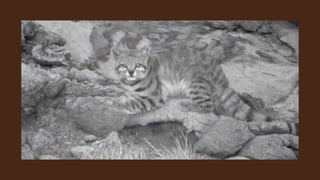
Video (1:50)
Andean Cat Alliance camera trap
Andean mountain cat
Websites
The Mountain Institute
Alianza Gato Andino (AGA)
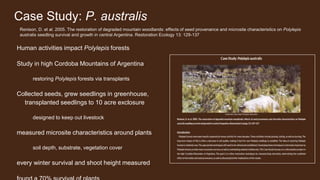
Case Study: P. australis
Human activities impact Polylepis forests
Study in high Cordoba Mountains of Argentina
restoring Polylepis forests via transplants
Collected seeds, grew seedlings in greenhouse,
transplanted seedlings to 10 acre exclosure
designed to keep out livestock
measured microsite characteristics around plants
soil depth, substrate, vegetation cover
every winter survival and shoot height measured
Renison, D. et al. 2005. The restoration of degraded mountain woodlands: effects of seed provenance and microsite characteristics on Polylepis
australis seedling survival and growth in central Argentina. Restoration Ecology 13: 129-137
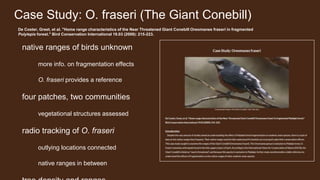
Case Study: O. fraseri (The Giant Conebill)
native ranges of birds unknown
more info. on fragmentation effects
O. fraseri provides a reference
four patches, two communities
vegetational structures assessed
radio tracking of O. fraseri
outlying locations connected
native ranges in between
De Coster, Greet, et al. "Home range characteristics of the Near Threatened Giant Conebill Oreomanes fraseri in fragmented
Polylepis forest." Bird Conservation International 19.03 (2009): 215-223.
Literature Cited & Photo Credits
Thank You

Polylepis Presentation

  • 1.
  • 2.
    Site Layout ● Frontpage ● Navigation Bar ● Topics ○ Subtopics
  • 3.
    Site Overview Topics biome description conservationconcerns relevant links Case studies P. australis (plant transplants) O. fraseri (radio tracking) References
  • 4.
    Major Defining Features GenusPolylepis trees 28 species gnarled-looking Upper montane Andes 21 endemic bird species 10 on IUCN list
  • 5.
    Worldwide Distribution Found inthe Andes Mountains Elevations above 3500 meters Distribution is fragmented and isolated About 1% of original area is left
  • 6.
    Abiotic Components Temperature andMoisture temp. and moisture cloud condensation belt upper and lower moisture limits Soil Soil pH 3.9 - 7.2 soil with salinity = growth rate rocky slopes
  • 7.
    Biotic Components Plants 28 speciesof Polylepis tree to shrub-like based on elevation red-colored, papery, layered bark wind-dispersed seeds fungus that decay wood nutrient cycling Animals Oreomanes birds restricted to Polylepis
  • 8.
    General Conservation Current Conservation protectedareas are not adequate need expansion of protected areas Tree usage (no other options) fuel and construction Burning ground cover cleared soil erosion
  • 9.
    IUCN Animals 14 spp.of fauna ranging from vulnerable to critically endangered Royal Cinclodes Cinclodes aricomae Critically Endangered Violet-throated Metaltail Metallura baroni Endangered White-browed Tit-spinetail Leptasthenura xenothorax Endangered Andean Cat Leopardus jacobita Endangered
  • 10.
    IUCN Plants 15 spp.of flora ranging from least concern to vulnerable Polylepis incana Vulnerable Polylepis microphylla Vulnerable Polylepis reticulata Vulnerable Polylepis rugulosa Vulnerable
  • 11.
    Links Video (1:50) Andean CatAlliance camera trap Andean mountain cat Websites The Mountain Institute Alianza Gato Andino (AGA)
  • 13.
    Case Study: P.australis Human activities impact Polylepis forests Study in high Cordoba Mountains of Argentina restoring Polylepis forests via transplants Collected seeds, grew seedlings in greenhouse, transplanted seedlings to 10 acre exclosure designed to keep out livestock measured microsite characteristics around plants soil depth, substrate, vegetation cover every winter survival and shoot height measured Renison, D. et al. 2005. The restoration of degraded mountain woodlands: effects of seed provenance and microsite characteristics on Polylepis australis seedling survival and growth in central Argentina. Restoration Ecology 13: 129-137
  • 14.
    Case Study: O.fraseri (The Giant Conebill) native ranges of birds unknown more info. on fragmentation effects O. fraseri provides a reference four patches, two communities vegetational structures assessed radio tracking of O. fraseri outlying locations connected native ranges in between De Coster, Greet, et al. "Home range characteristics of the Near Threatened Giant Conebill Oreomanes fraseri in fragmented Polylepis forest." Bird Conservation International 19.03 (2009): 215-223.
  • 15.
    Literature Cited &Photo Credits
  • 16.

Editor's Notes

  • #8 Plants: -28 polylepis trees (tall to short depending on elevation) -shorter trees at higher elevations to combat different climate -all trees have red, papery bark -all trees rely on wind dispersal and have spiny or winged seeds -there is fungus on trees that decays the wood and cycles nutrients Animals: -many birds, most notable is Oreomanes (restricted to Polylepis trees) -birds prefer higher elevations (need to conserve even the smallest fragments if they are in high altitudes) -no pollinator insects in polylepis forests, beetles in the bark of polylepis (oreomanes eat these beetles) -areas in and around polylepis there are camelids (alpacas, llamas, vicunas), cats (andean mountain, cougar), and other mammals (armadillos)
  • #9 Current: -there are protected areas -studies conducted show these areas are not enough -scientists suggest expanding areas and conserving even the smallest areas Polylepis Tree Usage: -done by farmers -survey showed trees were mostly used for fuel or construction Burning: -farmers burn to clear the ground -cleared ground leads to susceptible soil Livestock Grazing: -after burn, soil is uncovered and grazing can destroy seed bank -a destroyed seed bank means polylepis is less resilient to disturbances Climate Change: -trees at higher altitudes are shorter and have smaller trees -climate changes could make these morphological differences a waste of energy
  • #12 Video: -camera trap -done by Andean Cat Alliance -at 1:50 you can see the Andean mountain cat Sites: -mountain institute (mountain ecosystem conservation) -Andean Cat Alliance (conserve the andean cat and it’s habitat)
  • #15 Introduction: -more information on fragmentation and how it affects polylepis birds -no information on native ranges (could be useful for planning conservation plots) -oreomanes is a good reference bird because it is exclusive to polylepis trees Methods: -two different communities, four patches were chosen at random -they assessed the vegetational structures of these communities -caught the birds, attached the devices, released them -outlying locations were connected, native ranges were in the middle Results: -higher tree density, smaller ranges (because there is more resources) -oreomanes found on trees at dusk/dawn and fragment edges (arthropods or thermoregulation?) -study added to conservation considerations (we should consider sunlight exposure)