POLICY ASSIGNMENT
POLICY DECISIONS
MEMBERS
LILIAN MASIBO
BONVENTURE WANYAMA
EVA MURGOR
DAISY KANDIE
JOHN RUTO
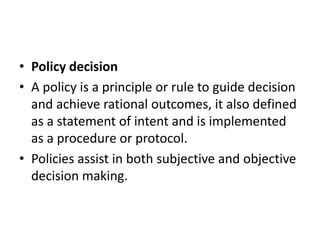
• Policy decision
• A policy is a principle or rule to guide decision
and achieve rational outcomes, it also defined
as a statement of intent and is implemented
as a procedure or protocol.
• Policies assist in both subjective and objective
decision making.
• Importance of policy decisions
• A policy provides guidelines to the members
of an institution or organization for deciding
accurse of action, thus ensuring achiformity of
action.
• Policy provides and explains what a member
would rather than what he is doing, thus
speed up decision at lower level.
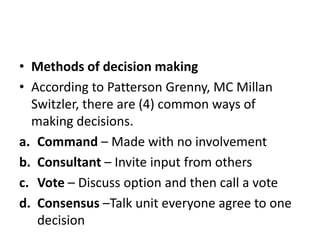
• Methods of decision making
• According to Patterson Grenny, MC Millan
Switzler, there are (4) common ways of
making decisions.
a. Command – Made with no involvement
b. Consultant – Invite input from others
c. Vote – Discuss option and then call a vote
d. Consensus –Talk unit everyone agree to one
decision
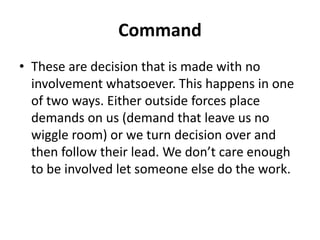
Command
• These are decision that is made with no
involvement whatsoever. This happens in one
of two ways. Either outside forces place
demands on us (demand that leave us no
wiggle room) or we turn decision over and
then follow their lead. We don’t care enough
to be involved let someone else do the work.
Consult
• Consulting is a process whereby decision
makers invite others to influence them before
they make their choice i.e consult with
experts, representative population or even
anyone who wants to offer opinion
Vote
• Voting is the best suited to situations where
efficiency is the highest value and you are
selecting from a number of good options,
voting is a great time saver but should not be
used when team members don't agree to
support whatever decisions are made, in this
cases consensus is required.
Consensus
• Consensus means you talk until everyone
honestly agrees to one decision, this method
can produce the medous unity and high
decision if misapplied, it can also be horrible
waste of times. It should only be used with: -
High stakes and complex issues or Issues
where everyone absolutely must support the
final choice.
players In the process of policy
development
• Constituents
• Lobbyist
• Political parties
• Elected policy makers themselves
• Constituents
• Constituents compose most of Kenyan
population. Their voting powers patterns and
policy concerns. The demands may focus on
job creation, healthcare and foreign policy.
• Lobbyist and special interest groups
• When the constituent’s population does not
directly advocate changes special in policies
regarding those populations, their plight may
be advocated through special interest
organizations this population may be paid
lobbyist. In general these organizations speak
for a portion of the population raising
awareness through the constituent base to
increase their voting power and directly
• Political parties
• Political parties act as a conglomerate
organization to advocate platforms covering
the broad range of issues. They may be
supported by smaller interest groups .Parties
gather and organize groups of individuals to
enact public policy concerns.
•
• The three branches of government
• It involves politicians and policy-makers
themselves who act as a deciding vote for
public policy in parliament, senate, Supreme
Court and executive branch. All these
individuals and organizations impact policy
formulation.
Evaluation of environmental policies
a. Evaluation of the state of environment
(status, human health, ecosystems, the
economy e.e.c).
b. Evaluation of the implementation of policies
and their efficacy.
c. Evaluation of the state or environment allows
an assessment of the situation to be made,

Policy assignment

  • 1.
    POLICY ASSIGNMENT POLICY DECISIONS MEMBERS LILIANMASIBO BONVENTURE WANYAMA EVA MURGOR DAISY KANDIE JOHN RUTO
  • 2.
    • Policy decision •A policy is a principle or rule to guide decision and achieve rational outcomes, it also defined as a statement of intent and is implemented as a procedure or protocol. • Policies assist in both subjective and objective decision making.
  • 3.
    • Importance ofpolicy decisions • A policy provides guidelines to the members of an institution or organization for deciding accurse of action, thus ensuring achiformity of action. • Policy provides and explains what a member would rather than what he is doing, thus speed up decision at lower level.
  • 4.
    • Methods ofdecision making • According to Patterson Grenny, MC Millan Switzler, there are (4) common ways of making decisions. a. Command – Made with no involvement b. Consultant – Invite input from others c. Vote – Discuss option and then call a vote d. Consensus –Talk unit everyone agree to one decision
  • 5.
    Command • These aredecision that is made with no involvement whatsoever. This happens in one of two ways. Either outside forces place demands on us (demand that leave us no wiggle room) or we turn decision over and then follow their lead. We don’t care enough to be involved let someone else do the work.
  • 6.
    Consult • Consulting isa process whereby decision makers invite others to influence them before they make their choice i.e consult with experts, representative population or even anyone who wants to offer opinion
  • 7.
    Vote • Voting isthe best suited to situations where efficiency is the highest value and you are selecting from a number of good options, voting is a great time saver but should not be used when team members don't agree to support whatever decisions are made, in this cases consensus is required.
  • 8.
    Consensus • Consensus meansyou talk until everyone honestly agrees to one decision, this method can produce the medous unity and high decision if misapplied, it can also be horrible waste of times. It should only be used with: - High stakes and complex issues or Issues where everyone absolutely must support the final choice.
  • 9.
    players In theprocess of policy development • Constituents • Lobbyist • Political parties • Elected policy makers themselves
  • 10.
    • Constituents • Constituentscompose most of Kenyan population. Their voting powers patterns and policy concerns. The demands may focus on job creation, healthcare and foreign policy.
  • 11.
    • Lobbyist andspecial interest groups • When the constituent’s population does not directly advocate changes special in policies regarding those populations, their plight may be advocated through special interest organizations this population may be paid lobbyist. In general these organizations speak for a portion of the population raising awareness through the constituent base to increase their voting power and directly
  • 12.
    • Political parties •Political parties act as a conglomerate organization to advocate platforms covering the broad range of issues. They may be supported by smaller interest groups .Parties gather and organize groups of individuals to enact public policy concerns. •
  • 13.
    • The threebranches of government • It involves politicians and policy-makers themselves who act as a deciding vote for public policy in parliament, senate, Supreme Court and executive branch. All these individuals and organizations impact policy formulation.
  • 14.
    Evaluation of environmentalpolicies a. Evaluation of the state of environment (status, human health, ecosystems, the economy e.e.c). b. Evaluation of the implementation of policies and their efficacy. c. Evaluation of the state or environment allows an assessment of the situation to be made,