Patriotism
Austin Eing
P.2
Mrs. Love
A Memorial Day Poem
By C. W. Johnson
We walked among the crosses
Where our fallen soldiers lay.
And listened to the bugle
As TAPS began to play
The Chaplain led a prayer
We stood with heads bowed low
And I thought of fallen comrades
I had known so long ago
They came from every city
Across this fertile land.
That we might live in freedom
They lie here ‘neath the sand.
I felt a little guilty
My sacrifice was small.
I only lost a little time
But these men lost their all.
Now Services are over
For this Memorial Day
To the names upon these crosses
I just wanted to say,
Thanks for what you’ve given
No one could ask for more
May you rest with God in heaven
From now and evermore
This poem is told from a soldier’s perspective about
other soldiers who have died in the line of duty. The
soldier is at a service where fallen soldiers are being
buried. This poem relates to patriotism because the
soldiers in the poem gave their lives for their country.
The poem uses end rhymes at the 2nd and 4th line of
each stanza. The tone of this poem is of respect and
the mood is somber.
The Dying Veteran
By Walt Whitman
Amid these days of order, ease, prosperity,
Amid the current songs of beauty, peace, decorum,
I cast a reminiscence—(likely 't will offend you,
I heard it in my boyhood)—More than a generation since,
A queer old savage man, a fighter under Washington himself
(Large, brave, cleanly, hot-blooded, no talker, rather spiritualistic,
Had fought in the ranks—fought well—had been all through the Revolutionary war),
Lay dying—sons, daughters, church-deacons, lovingly tending him,
Sharping their sense, their ears, towards his murmuring, half-caught words:
"Let me return again to my war-days,
To the sights and scenes—to forming the line of battle,
To the scouts ahead reconnoitering,
To the cannons, the grim artillery,
To the galloping aids, carrying orders,
To the wounded, the fallen, the heat, the suspense,
The perfume strong, the smoke, the deafening noise;
Away with your life of peace!—your joys of peace!
Give me my old wild battle-life again!"
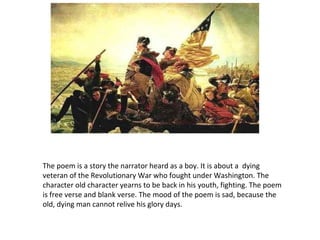
The poem is a story the narrator heard as a boy. It is about a dying
veteran of the Revolutionary War who fought under Washington. The
character old character yearns to be back in his youth, fighting. The poem
is free verse and blank verse. The mood of the poem is sad, because the
old, dying man cannot relive his glory days.
Adieu to a Soldier
By Walt Whitman
Adieu O soldier,
You of the rude campaigning (which we shared),
The rapid march, the life of the camp,
The hot contention of opposing fronts, the long manoeuvre,
Red battles with their slaughter, the stimulus, the strong terrific game,
Spell of all brave and manly hearts, the trains of time through you and like of you all
fill'd,
With war and war's expression.
Adieu dear comrade,
Your mission is fulfill'd—but I, more warlike,
Myself and this contentious soul of mine,
Still on our own campaigning bound,
Through untried roads with ambushes opponents lined,
Through many a sharp defeat and many a crisis, often baffled,
Here marching, ever marching on, a war fight out—aye here,
To fiercer, weightier battles give expression.
The poem is a new soldiers saying goodbye to the soldiers
before him. The soldier is explaining that he his going to
journey, just like those before him. The poem is free verse
and blank verse. The tone of the poem is of anxiousness. The
soldier seems anxious to begin his journey
O Captain! My Captain!
By Walt Whitman
O Captain! my Captain! our fearful trip is done,
The ship has weather'd every rack, the prize we sought is won,
The port is near, the bells I hear, the people all exulting,
While follow eyes the steady keel, the vessel grim and daring;
But O heart! heart! heart!
O the bleeding drops of red,
Where on the deck my Captain lies,
Fallen cold and dead.
O Captain! my Captain! rise up and hear the bells;
Rise up—for you the flag is flung—for you the bugle trills,
For you bouquets and ribbon'd wreaths—for you the shores a-crowding,
For you they call, the swaying mass, their eager faces turning;
Here Captain! dear father!
This arm beneath your head!
It is some dream that on the deck,
You've fallen cold and dead.
My Captain does not answer, his lips are pale and still,
My father does not feel my arm, he has no pulse nor will,
The ship is anchor'd safe and sound, its voyage closed and done,
From fearful trip the victor ship comes in with object won;
Exult O shores, and ring O bells!
But I with mournful tread,
Walk the deck my Captain lies,
Fallen cold and dead.
Dead Poets Society
The poem is about a member of a navy, expressing to his captain
about the journey they have just arrived from. The captain, a
mentor to his crewmen, has died. This poem uses end rhyme. It
also has alliteration and consonance throughout. The mood of the
poem is of glory, but then sadness as the captain is dies.
Old Glory
By Joanna Fuchs
I am the most famous icon on earth,
on display all over the world...
standing guard at majestic official buildings,
in courtrooms, churches,
and even on the moon.
I fly from the houses
of families who revere America,
and snap in the breeze on parade.
I stand for freedom, honor, justice,
service, prosperity and power.
My stars and stripes—my red, white and blue,
evoke respect and admiration from the good,
apprehension and fear from the evil.
Sometimes soiled and tattered,
even bloodstained,
I survived the grinding toil of wars,
urging my weary warriors to fight on.
I lie precisely folded,
held by mothers of fallen soldiers
as their fingertips caress me
for comfort and strength.
I am invincible.
I have been burned, spat upon,
trampled and cursed,
but I overcome all
to unfurl, soar, and inspire again.
I am the Star Spangled Banner;
I am Old Glory;
I am the American Flag,
a symbol of freedom, forever.
This poem follows the American flag through it’s impact in America
and around the world. The flag is a symbol for American tenacity
and pride. The personification in this poem is the flag. It uses
alliteration throughout. The poem is free verse and blank verse.
The American Flag
By Joseph Rodman Drake
When freedom, from her mountain height
Unfurled her standard to the air
She tore the azure robe of night
And set the stars of glory there.
She mingled with its gorgeous dyes
The milky baldric of the skies,
Then from his mansion in the sun
She called her eagle-bearer down
And gave into his mighty hand
The symbol of her chosen land.
This poem is a fictional story about the origins of the
American flag. It personifies freedom as a women who
is creating the flag and gifting it to the country. It uses
imagery to sow what the flag was made out of. The
poem uses an end rhyme scheme. The tone of this
poem is whimsical.
Patriotism
By Sir Walter Scott
BREATHES there the man with soul so dead,
Who never to himself hath said,
'This is my own, my native land!'
Whose heart hath ne'er within him burn'd
As home his footsteps he hath turn'd
From wandering on a foreign strand?
If such there breathe, go, mark him well;
For him no Minstrel raptures swell;
High though his titles, proud his name,
Boundless his wealth as wish can claim;
Despite those titles, power, and pelf,
The wretch, concentred all in self,
Living, shall forfeit fair renown,
And, doubly dying, shall go down
To the vile dust from whence he sprung,
Unwept, unhonour'd, and unsung.
The narrator of this poem was wealthy and
seemed to be successful. He knows, though, that
he will never ne remembered when he is dead
because he was never patriotic to his country.
The poem has an end rhyme, AABCCB pattern.
The poem uses alliteration to emphasize the
narrators point. The mood of the poem is eerie.
Land of Liberty
Anonymous
I love my country's pine-clad hills,
Her thousand bright and gushing rills,
Her sunshine and her storms;
Her rough and rugged rocks, that rear
Their hoary heads high in the air
In wild, fantastic forms.
I love her rivers, deep and wide,
Those mighty streams that seaward glide
To seek the ocean's breast;
Her smiling fields, her pleasant vales,
Her shady dells, her flowery dales,
The haunts of peaceful rest.
I love her forests, dark and lone,
For there the wild bird's merry tone
I hear from morn till night;
And there are lovelier flowers, I ween,
Than e'er in Eastern lands were seen,
In varied colors bright.
Her forests and her valleys fair,
Her flowers that scent the morning air--
All have their charms for me;
But more I love my country's name,
Those words that echo deathless fame,
The Land of Liberty.
This poem is a narrator describing what she loves about
the U.S. America is personified as a women. The end
rhyme pattern is AABCCB. The author uses strong
imagery to show what they love about America.
Red, White, and Blue
By Connie Moore
He Lay Where He Had Fallen.
Enemy Fire Had Brought Him Down.
He Knew His Life Was Over,
As He Lost All Sight and Sound.
He Knew a Peaceful Sleep,
Amidst the Raging Guns of War,
But for Him the Fight Was Over.
He'd Gave His All..And More.
Oh, He Was Not Alone.
Others Have Fallen Too.
And Time Will Not Erase the Fact...
They Fell for Me and You.
We Owe These Men and Women,
For They Never Got Any Older.
We Didn't Even Know Them.
To Most of Us They Were..Unknown Soldiers.
So Rest in Honored Glory,
Each and Every One of You.
You Gave All You Had to Give...
For Freedom and the Red, White and Blue.
The poem is about those soldiers who have given their lives
for the flag. The poem uses end rhyme for the 2nd and 4th
lines of each stanza. The tone of the poem is acceptance.
The mood is of honor.
I Hear America Singing
By Walt Whitman
I hear America singing, the varied carols I hear,
Those of mechanics, each one singing his as it should be blithe and strong,
The carpenter singing his as he measures his plank or beam,
The mason singing his as he makes ready for work, or leaves off work,
The boatman singing what belongs to him in his boat, the deckhand singing on the steamboat deck,
The shoemaker singing as he sits on his bench, the hatter singing as he stands,
The wood-cutter's song, the ploughboy's on his way in the morning, or at noon intermission or at sundown,
The delicious singing of the mother, or of the young wife at work, or of the girl sewing or washing,
Each singing what belongs to him or her and to none else,
The day what belongs to the day—at night the party of young fellows, robust, friendly,
Singing with open mouths their strong melodious songs.
The poem is about America the prosperity of America
during the late 19th
century. The narrator sees many
people working and America becoming stronger. The
uses the metaphor of all of the workers singing. The
poem is free verse. The mood of the poem is of pride
and happiness.
Personal Poetry
I am
Food, Sleep, Reddit
I enjoy jazz and learning about history
Logic is important to me
Empathy is important to me
Anger is bad, but it is good to vent
True equality doesn’t exist
Society is full of hate
Chipotle is absolutely fantastic
I am
I believe in freedom for all
Democracy for all
The idea of religious freedom
The power of sleeping
The right of education
But the act of persecution is absurd
I believe in freedom of speech
I believe in the power of music
I believe in America
And I believe in the equal opportunity
for everyone to lead a fulfilling life
Frustration is black and fire red
It taste like a mouthful of sand
It sounds like nails on a chalkboard
and it smells like burnt plastic
It looks like a pile of burning tires
and it pisses you off!
Just because I’m lazy
Don’t think I don’t care
Don’t give me more to do
Still, let me sleep
Just because I’m lazy
It doesn’t mean I never try
It doesn’t mean I don’t have a passion
It doesn’t mean I am failing classes
Just because I’m lazy-
Don’t motivate me.
This is a Stossel ‘Stache
Stossel ‘Stache lives in southern Sudan, sometimes Sedona on sunny Sundays.
Stossel ‘Stache sucks on sour suckers, stinky salmon, savory steaks, and salty scalpels.
Stossel ‘Stache likes storms, sassy steam silk, stupid Skrillex and secrets.
Stossel ‘Stache steals scenes from Sammy Sosa, spits on students, surrounds seismic snakes, and
sails the seven seas.
Stossel ‘Stache slammed seven small spiders in my sandy, swinging door.

Poetry project Austin Eing

  • 1.
  • 2.
    A Memorial DayPoem By C. W. Johnson We walked among the crosses Where our fallen soldiers lay. And listened to the bugle As TAPS began to play The Chaplain led a prayer We stood with heads bowed low And I thought of fallen comrades I had known so long ago They came from every city Across this fertile land. That we might live in freedom They lie here ‘neath the sand. I felt a little guilty My sacrifice was small. I only lost a little time But these men lost their all. Now Services are over For this Memorial Day To the names upon these crosses I just wanted to say, Thanks for what you’ve given No one could ask for more May you rest with God in heaven From now and evermore
  • 3.
    This poem istold from a soldier’s perspective about other soldiers who have died in the line of duty. The soldier is at a service where fallen soldiers are being buried. This poem relates to patriotism because the soldiers in the poem gave their lives for their country. The poem uses end rhymes at the 2nd and 4th line of each stanza. The tone of this poem is of respect and the mood is somber.
  • 4.
    The Dying Veteran ByWalt Whitman Amid these days of order, ease, prosperity, Amid the current songs of beauty, peace, decorum, I cast a reminiscence—(likely 't will offend you, I heard it in my boyhood)—More than a generation since, A queer old savage man, a fighter under Washington himself (Large, brave, cleanly, hot-blooded, no talker, rather spiritualistic, Had fought in the ranks—fought well—had been all through the Revolutionary war), Lay dying—sons, daughters, church-deacons, lovingly tending him, Sharping their sense, their ears, towards his murmuring, half-caught words: "Let me return again to my war-days, To the sights and scenes—to forming the line of battle, To the scouts ahead reconnoitering, To the cannons, the grim artillery, To the galloping aids, carrying orders, To the wounded, the fallen, the heat, the suspense, The perfume strong, the smoke, the deafening noise; Away with your life of peace!—your joys of peace! Give me my old wild battle-life again!"
  • 5.
    The poem isa story the narrator heard as a boy. It is about a dying veteran of the Revolutionary War who fought under Washington. The character old character yearns to be back in his youth, fighting. The poem is free verse and blank verse. The mood of the poem is sad, because the old, dying man cannot relive his glory days.
  • 6.
    Adieu to aSoldier By Walt Whitman Adieu O soldier, You of the rude campaigning (which we shared), The rapid march, the life of the camp, The hot contention of opposing fronts, the long manoeuvre, Red battles with their slaughter, the stimulus, the strong terrific game, Spell of all brave and manly hearts, the trains of time through you and like of you all fill'd, With war and war's expression. Adieu dear comrade, Your mission is fulfill'd—but I, more warlike, Myself and this contentious soul of mine, Still on our own campaigning bound, Through untried roads with ambushes opponents lined, Through many a sharp defeat and many a crisis, often baffled, Here marching, ever marching on, a war fight out—aye here, To fiercer, weightier battles give expression.
  • 7.
    The poem isa new soldiers saying goodbye to the soldiers before him. The soldier is explaining that he his going to journey, just like those before him. The poem is free verse and blank verse. The tone of the poem is of anxiousness. The soldier seems anxious to begin his journey
  • 8.
    O Captain! MyCaptain! By Walt Whitman O Captain! my Captain! our fearful trip is done, The ship has weather'd every rack, the prize we sought is won, The port is near, the bells I hear, the people all exulting, While follow eyes the steady keel, the vessel grim and daring; But O heart! heart! heart! O the bleeding drops of red, Where on the deck my Captain lies, Fallen cold and dead. O Captain! my Captain! rise up and hear the bells; Rise up—for you the flag is flung—for you the bugle trills, For you bouquets and ribbon'd wreaths—for you the shores a-crowding, For you they call, the swaying mass, their eager faces turning; Here Captain! dear father! This arm beneath your head! It is some dream that on the deck, You've fallen cold and dead. My Captain does not answer, his lips are pale and still, My father does not feel my arm, he has no pulse nor will, The ship is anchor'd safe and sound, its voyage closed and done, From fearful trip the victor ship comes in with object won; Exult O shores, and ring O bells! But I with mournful tread, Walk the deck my Captain lies, Fallen cold and dead.
  • 9.
    Dead Poets Society Thepoem is about a member of a navy, expressing to his captain about the journey they have just arrived from. The captain, a mentor to his crewmen, has died. This poem uses end rhyme. It also has alliteration and consonance throughout. The mood of the poem is of glory, but then sadness as the captain is dies.
  • 10.
    Old Glory By JoannaFuchs I am the most famous icon on earth, on display all over the world... standing guard at majestic official buildings, in courtrooms, churches, and even on the moon. I fly from the houses of families who revere America, and snap in the breeze on parade. I stand for freedom, honor, justice, service, prosperity and power. My stars and stripes—my red, white and blue, evoke respect and admiration from the good, apprehension and fear from the evil. Sometimes soiled and tattered, even bloodstained, I survived the grinding toil of wars, urging my weary warriors to fight on. I lie precisely folded, held by mothers of fallen soldiers as their fingertips caress me for comfort and strength. I am invincible. I have been burned, spat upon, trampled and cursed, but I overcome all to unfurl, soar, and inspire again. I am the Star Spangled Banner; I am Old Glory; I am the American Flag, a symbol of freedom, forever.
  • 11.
    This poem followsthe American flag through it’s impact in America and around the world. The flag is a symbol for American tenacity and pride. The personification in this poem is the flag. It uses alliteration throughout. The poem is free verse and blank verse.
  • 12.
    The American Flag ByJoseph Rodman Drake When freedom, from her mountain height Unfurled her standard to the air She tore the azure robe of night And set the stars of glory there. She mingled with its gorgeous dyes The milky baldric of the skies, Then from his mansion in the sun She called her eagle-bearer down And gave into his mighty hand The symbol of her chosen land.
  • 13.
    This poem isa fictional story about the origins of the American flag. It personifies freedom as a women who is creating the flag and gifting it to the country. It uses imagery to sow what the flag was made out of. The poem uses an end rhyme scheme. The tone of this poem is whimsical.
  • 14.
    Patriotism By Sir WalterScott BREATHES there the man with soul so dead, Who never to himself hath said, 'This is my own, my native land!' Whose heart hath ne'er within him burn'd As home his footsteps he hath turn'd From wandering on a foreign strand? If such there breathe, go, mark him well; For him no Minstrel raptures swell; High though his titles, proud his name, Boundless his wealth as wish can claim; Despite those titles, power, and pelf, The wretch, concentred all in self, Living, shall forfeit fair renown, And, doubly dying, shall go down To the vile dust from whence he sprung, Unwept, unhonour'd, and unsung.
  • 15.
    The narrator ofthis poem was wealthy and seemed to be successful. He knows, though, that he will never ne remembered when he is dead because he was never patriotic to his country. The poem has an end rhyme, AABCCB pattern. The poem uses alliteration to emphasize the narrators point. The mood of the poem is eerie.
  • 16.
    Land of Liberty Anonymous Ilove my country's pine-clad hills, Her thousand bright and gushing rills, Her sunshine and her storms; Her rough and rugged rocks, that rear Their hoary heads high in the air In wild, fantastic forms. I love her rivers, deep and wide, Those mighty streams that seaward glide To seek the ocean's breast; Her smiling fields, her pleasant vales, Her shady dells, her flowery dales, The haunts of peaceful rest. I love her forests, dark and lone, For there the wild bird's merry tone I hear from morn till night; And there are lovelier flowers, I ween, Than e'er in Eastern lands were seen, In varied colors bright. Her forests and her valleys fair, Her flowers that scent the morning air-- All have their charms for me; But more I love my country's name, Those words that echo deathless fame, The Land of Liberty.
  • 17.
    This poem isa narrator describing what she loves about the U.S. America is personified as a women. The end rhyme pattern is AABCCB. The author uses strong imagery to show what they love about America.
  • 18.
    Red, White, andBlue By Connie Moore He Lay Where He Had Fallen. Enemy Fire Had Brought Him Down. He Knew His Life Was Over, As He Lost All Sight and Sound. He Knew a Peaceful Sleep, Amidst the Raging Guns of War, But for Him the Fight Was Over. He'd Gave His All..And More. Oh, He Was Not Alone. Others Have Fallen Too. And Time Will Not Erase the Fact... They Fell for Me and You. We Owe These Men and Women, For They Never Got Any Older. We Didn't Even Know Them. To Most of Us They Were..Unknown Soldiers. So Rest in Honored Glory, Each and Every One of You. You Gave All You Had to Give... For Freedom and the Red, White and Blue.
  • 19.
    The poem isabout those soldiers who have given their lives for the flag. The poem uses end rhyme for the 2nd and 4th lines of each stanza. The tone of the poem is acceptance. The mood is of honor.
  • 20.
    I Hear AmericaSinging By Walt Whitman I hear America singing, the varied carols I hear, Those of mechanics, each one singing his as it should be blithe and strong, The carpenter singing his as he measures his plank or beam, The mason singing his as he makes ready for work, or leaves off work, The boatman singing what belongs to him in his boat, the deckhand singing on the steamboat deck, The shoemaker singing as he sits on his bench, the hatter singing as he stands, The wood-cutter's song, the ploughboy's on his way in the morning, or at noon intermission or at sundown, The delicious singing of the mother, or of the young wife at work, or of the girl sewing or washing, Each singing what belongs to him or her and to none else, The day what belongs to the day—at night the party of young fellows, robust, friendly, Singing with open mouths their strong melodious songs.
  • 21.
    The poem isabout America the prosperity of America during the late 19th century. The narrator sees many people working and America becoming stronger. The uses the metaphor of all of the workers singing. The poem is free verse. The mood of the poem is of pride and happiness.
  • 22.
  • 23.
    I am Food, Sleep,Reddit I enjoy jazz and learning about history Logic is important to me Empathy is important to me Anger is bad, but it is good to vent True equality doesn’t exist Society is full of hate Chipotle is absolutely fantastic I am
  • 24.
    I believe infreedom for all Democracy for all The idea of religious freedom The power of sleeping The right of education But the act of persecution is absurd I believe in freedom of speech I believe in the power of music I believe in America And I believe in the equal opportunity for everyone to lead a fulfilling life
  • 25.
    Frustration is blackand fire red It taste like a mouthful of sand It sounds like nails on a chalkboard and it smells like burnt plastic It looks like a pile of burning tires and it pisses you off!
  • 26.
    Just because I’mlazy Don’t think I don’t care Don’t give me more to do Still, let me sleep Just because I’m lazy It doesn’t mean I never try It doesn’t mean I don’t have a passion It doesn’t mean I am failing classes Just because I’m lazy- Don’t motivate me.
  • 27.
    This is aStossel ‘Stache Stossel ‘Stache lives in southern Sudan, sometimes Sedona on sunny Sundays. Stossel ‘Stache sucks on sour suckers, stinky salmon, savory steaks, and salty scalpels. Stossel ‘Stache likes storms, sassy steam silk, stupid Skrillex and secrets. Stossel ‘Stache steals scenes from Sammy Sosa, spits on students, surrounds seismic snakes, and sails the seven seas. Stossel ‘Stache slammed seven small spiders in my sandy, swinging door.