Pneumatic Handbook,
8th
edition; by Anthony Barber (Editor)
• ISBN: 185617249X
• Pub. Date: December 1997
• Publisher: Elsevier Science & Technology Books
Preface
Elsevier Science present the latest edition of this comprehensive work on all aspects of
compressed air. There have been many advances in hydraulic and electric technology in recent
years, yet compressed air still keeps its place as an important medium for power generation,
transmission, and control. Its versatility makes it the ideal choice for many applications for
which no other form of power is as suitable. As in previous editions, the PNEUMATIC
HANDBOOK covers the whole range of pneumatic engineering in one volume. It starts with
the basic principles and properties of air and includes the theory of air compression, the
principles of air treatment and the design of compressors, tools, machinery, actuators, sensors
and valves. Low pressure and vacuum applications are also covered.
The importance of efficiency in the generation and transmission of compressed air is
emphasised throughout and useful guidance is given on the design of factory installations to
achieve this. The author has made a survey of pneumatic equipment available in the UK,
Europe and elsewhere in the world; the latest signifcant developments, wherever produced,
are described. Legislation introduced by the European Community by way of Technical
Directives in respect of safety in the use ofcompressed air, pressure vessel design, noise control
and environmental control is discussed at length. British, American and ISO Standards are an
important source of design material and reference is made to them throughout the book.
Included is a comprehensive list of Standards, Codes of Practice and Technical Directives.
The book is written with needs of the practical engineer in mind, and only sufficient theory
is included for a proper understanding of the principles involved.
The publishers are grateful for the assistance of manufacturers who have supplied informa-
tion and for the trade associations CETOP, Pneurop, British Compressed Air Society (BCAS)
and the Compressed Air and Gas Institute (CAGI). Acknowledgement is given in the text for
material where it has been used.
Antony Barber
antony.barber@btinternet.com
Acknowledgements
Acknowledgements are due to the following for contributions to particular chapters. When an
illustration ofa proprietory product is used in the text, further acknowledgement is given where
it occurs.
Atlas Copco
British Compressed Air Society (BCAS)
British Fluid Power Association (BFPA)
British Standards Association (BSI)
CETOP
CompAir Broomwade
Compair Holman
CompAir Maxam
Desoutter
Flair
Institution of Mechanical Engineers
International Standards Organisation
Pneurop
ultrafilter international
University of Bath
Willpower Breathing Air
Preface
Elsevier Science present the latest edition of this comprehensive work on all aspects of
compressed air. There have been many advances in hydraulic and electric technology in recent
years, yet compressed air still keeps its place as an important medium for power generation,
transmission, and control. Its versatility makes it the ideal choice for many applications for
which no other form of power is as suitable. As in previous editions, the PNEUMATIC
HANDBOOK covers the whole range of pneumatic engineering in one volume. It starts with
the basic principles and properties of air and includes the theory of air compression, the
principles of air treatment and the design of compressors, tools, machinery, actuators, sensors
and valves. Low pressure and vacuum applications are also covered.
The importance of efficiency in the generation and transmission of compressed air is
emphasised throughout and useful guidance is given on the design of factory installations to
achieve this. The author has made a survey of pneumatic equipment available in the UK,
Europe and elsewhere in the world; the latest signifcant developments, wherever produced,
are described. Legislation introduced by the European Community by way of Technical
Directives in respect of safety in the use ofcompressed air, pressure vessel design, noise control
and environmental control is discussed at length. British, American and ISO Standards are an
important source of design material and reference is made to them throughout the book.
Included is a comprehensive list of Standards, Codes of Practice and Technical Directives.
The book is written with needs of the practical engineer in mind, and only sufficient theory
is included for a proper understanding of the principles involved.
The publishers are grateful for the assistance of manufacturers who have supplied informa-
tion and for the trade associations CETOP, Pneurop, British Compressed Air Society (BCAS)
and the Compressed Air and Gas Institute (CAGI). Acknowledgement is given in the text for
material where it has been used.
Antony Barber
antony.barber@btinternet.com
Acknowledgements
Acknowledgements are due to the following for contributions to particular chapters. When an
illustration ofa proprietory product is used in the text, further acknowledgement is given where
it occurs.
Atlas Copco
British Compressed Air Society (BCAS)
British Fluid Power Association (BFPA)
British Standards Association (BSI)
CETOP
CompAir Broomwade
Compair Holman
CompAir Maxam
Desoutter
Flair
Institution of Mechanical Engineers
International Standards Organisation
Pneurop
ultrafilter international
University of Bath
Willpower Breathing Air
Table of Contents
Sect. 1 Basic Principles
Sect. 2 The Compressor
Sect. 3 Energy and Efficiency
Sect. 4
Compressed Air Transmission and
Treatment
Sect. 5 Applications
Sect. 6 Valves and Sensors
Sect. 7 Actuators
Sect. 8 Seals
Sect. 9 Applied Pneumatics
Sect. 10 Vacuum and Low Pressure
Sect. 11 Engineering Data
Advertisers Buyers Guide
Editorial Index
SECTION 1
Basic Principles
NOMENCLATURE AND UNITS
TERMS AND DEFINITIONS
PROPERTIES OF AIR AND GASES
GAS LAWS AND THERMODYNAMICS
NOMENCLATURE AND UNITS
Nomenclature
Unless otherwise specified in the text, the following symbols are used consistently
throughout this book:
A = cross sectional area (m2)
Cp = specific heat at constant pressure (J/kg K)
c~ = specific heat at constant volume (J/kg K)
C = flow coefficient for orifices and nozzles = discharge coefficient
corrected for velocity of flow = Cd (1-~ 4)
Cd = discharge coefficient for orifices
D = internal diameter of pipe (m)
d = internal diameter of pipe (mm)
f - Darcy-Weisbach friction factor
g = gravitational constant (9.81 m/s 2)
K = coefficient of heat transmission W/(m 2 K)
k = thermal conductivity W/(m K)
L = length of pipe (m)
M = mass(kg)
N~ = Nusselt number = Q1/kA0 m see text
N = rotational speed (r/min)
n = rotational speed (r/s)
P = absolute pressure (N/m 2)
P" = gauge pressure (N/m 2 )
p = absolute pressure (bar)
p
"
Pr =
Q_-
q =
Ro =
gauge pressure (bar)
Prandtl number = (Cpg)/k m see text
heat (J)
flow rate (m3/s)
universal gas constant = 8.314 J/(K mol) = 8314 J/(K kmol)
4 THE PNEUMATIC HANDBOOK
R = individual gas constant (J/kg K) = Ro/M where M = molecular weight of
the gas
Re = Reynolds number = pvl/lx ~ see text
S = stroke length (m)
t = time (s)
T = absolute temperature (K) = temperature in °C + 273
V = volume (m3)
V~ = specific volume (m3/kg)
V = velocity (m/s)
w = mass of gas (kg)
W = work done (kW)
Z = compressibility factor
Greek letters
13 = ratio of small to large diameter in orifices and pipes
3, = ratio of specific heats = cp/c~
A = signifies an increment in a unit
e = absolute roughness of pipes (mm)
v = kinematic viscosity (m2/s)
Ix = dynamic viscosity (Pa s)
p = fluid density (kg/m 3)
t~ = relative humidity
11 = efficiency
rla = isentropic (adiabatic) efficiency
rlv = volumetric efficiency
V = ratio of air consumed to air delivered by compressor
Subscriptsfor diameters and areas
defines smaller
2 defines larger
Subscriptsfor fluidflow, pressures, temperatures and volumes
0 defines base or reservoir conditions
defines initial, inlet or upstream
2 defines final, outlet or downstream
Other subscripts are defined as they occur
Note on units
SI units are used consistently throughout this handbook. Certain conventions within the
SI structure are used generally throughout the European compressed air industry. These
are as follows:
NOMENCLATURE AND UNITS 5
Compressor
capacity:
Specific power
consumption:
Pressure:
Length:
Mass:
Torque:
Rotational speed:
Moisture content:
the traditional unit for compressor capacity is m3/min,
which most manufacturers prefer to quote. Litre/s (l/s) is
however the recommended unit (1 Us = 0.06 m3/min).
kW h/m 3or J/l.
bar is preferred usage for air pressure, although Pascal is
theoretically better (1 bar = 10SPa). MPa is also found.
metre for dimensions greater than 1 metre, millimetre for
dimensions less than 1 metre.
kilogram or tonne.
Newton metre (N m).
rev/min is widely used although rev/s is the preferred unit.
kg/m 3or g/m 3
Conversion factors
For the convenience of those readers more familiar with Imperial units, the following
conversion factors may be used.
The values quoted are adequate for most engineering purposes, ie accurate to at least 3
significant figures:
Acceleration 1 ft/s2 = 0.305 m/s 2
Area 1 ft2 = 0.093 m2
Density 1 lb/ft3 = 16.02 kg/m 3
Energy, work, heat 1 ft lbf = 1.356 J
1 Btu = 1055.06 J
Entropy 1 Btu/°F = 1899 J/K
Force 1 lbf = 4.448 N
1 tonf = 9.964 kN
Length 1 in = 0.0254 m
1 ft = 0.3048 m
Mass 1 lb = 0.4536 kg
1 ton = 1.016 tonne
Moment of inertia 1 lb ft2 = 0.04214 kg m2
Power 1 hp = 0.746 kW
Pressure 1 lbf/in2 = 0.06895 bar = 6895 Pa
Specific capacity 1 (ft3/min)/hp = 0.03797 (m3/min)/kW
Specific energy 1 Btu/ft 3 = 0.01035 kWh/m 3
Temperature 1 °F = 9/5 °C + 32
Torque 1 lbf ft = 1.356 N m
6 THE PNEUMATIC HANDBOOK
Velocity
Volume
Volume flow
Viscosity (dynamic)
Viscosity (kinematic)
1 ft/s = 0.305 m/s
1 ft 3 = 0.0283 m 3
1 fta/s = 0.0283 m3/s
1 lb s/ft2 = 47.88 Pa s
(n.b. 1 centipoise = 10.3 Pa s)
1 ft2/s = 0.0929 m2/s
(n.b. 1 centistoke = 10~ m2/s)
TERMS AND DEFINITIONS
Terms and definitions used in the Compressor Industry (see also BS 1571 and BS 5791):
Adiabatic compression
Aftercooling
Clearance volume
Compressibility factor
Compression ratio
Compressor
Compressor, booster
Compressor, displacement
Compressor, dynamic
Compressor, multistage
Compressor capacity
One in which the compression takes place with no heat
transfer across its enclosure.
(See isentropic.)
Removal of heat from the air after compression is
completed.
The volume remaining inside a compression space at
the end of the compression stroke.
Ratio of the actual volume of a compressed gas to its
volume calculated in accordance with the ideal gas
laws.
Ratio between discharge and final pressure.
A machine which draws in air or gas at one pressure
and delivers it at a higher pressure.
In which the inlet gas has already been compressed.
In which the pressure rise is achieved by allowing
successive volumes of air to be inspired and exhausted
from an enclosed space by displacement of a moving
member, eg piston, screw and sliding vane.
In which the pressure rise is achieved by converting
kinetic energy into pressure energy in its passage
through the machine, eg radial and axial fixed vane.
In which the increase in pressure takes place in two or
more stages.
The volumetric flow rate of the gas as compressed and
delivered, referred to the conditions of temperature and
pressure at the inlet. For air this is referred to as Free
8 THE PNEUMATICHANDBOOK
Condensate
Displacement
Efficiency, adiabatic
Efficiency, isothermal
Efficiency, volumetric
Filter
Free air
Free Air Delivered
Ideal compression
lntercooling
Isentropic process
Isothermal process
Packaged compressor
Polytropic process
Pressure ratio
Pressure regulator
Air Delivered (FAD). When referred to standard
conditions, 1.013 bar and 15°C,this is known as
standard capacity. BS 5791 suggests that this
expression should be replaced by "volume rate of
flow".
Liquid formed by condensation of water vapour.
Actual volume swept by the first (or only) stage of a
displacement compressor.
Ratio of the adiabatic power consumption to the shaft
input power.
Ratio of the isothermal power to the shaft input power.
The ratio of the compressor capacity to its
displacement.
A device for removing contaminants from a fluid.
Atmospheric condition at the inlet point of a
compressor.
See above under Compressor capacity.
Conditions appertaining to the isentropic compression
of an ideal gas.
The cooling of compressed air (or gas) between
compression stages.
A thermodynamic process which takes place at
constant entropy. (AQ/T - constant.) A reversible
adiabatic process is also isentropic, so the two terms
are often used interchangeably in compressor
technology. Isentropic is the preferred usage when
describing a compression cycle.
A thermodynamic process which takes place at
constant temperature. Isothermal compression is not
realisable in practice, since it would have to take place
very slowly. However it is theoretically the most
efficient and is therefore used as the basis of
comparison.
A complete powered compressor unit ready to operate.
Compression or expansion of a gas where the
relationship PV" = constant applies.
Ratio between absolute discharge pressure and
absolute inlet pressure.
A valve or similar device for reducing line pressure to
a lower (constant) pressure.
TERMS AND DEFINITIONS 9
Pulsation damper
Relative clearance volume
Relative humidity
Separator
Specific capacity
Specific energy
Stage pressure ratio
Surge limit
Temperature, absolute
Temperature, ambient
Temperature, inlet
Temperature, discharge
Temperature, total
Vacuum
Vacuum pump
A chamber designed to eliminate pulsations present in
air flow.
Ratio of clearance volume to volume swept by a
compressing element.
Ratio of water vapour actually present in air to the
saturated water vapour content, at a given temperature
and pressure.
A device for removing liquids (eg water and oil) from
compressed air.
Compressor capacity per unit of input power.
Input power per unit of compressor capacity.
Compression ratio for any particular stage in a
multistage compressor.
The flow limit below which operation of a dynamic
compressor becomes unstable.
Temperature above absolute zero in Kelvin.
Temperature of the environment.
Total temperature at the standard inlet point of the
compressor.
Total temperature at the standard discharge point of
the compressor.
Temperature at the stagnation point of an airstream.
Difference between atmospheric and a lower system
pressure.
A machine for generating a pressure below
atmospheric.
11
PROPERTIES OF AIR AND GASES
Clean, dry air is a mechanical mixture of approximately 78% by volume of nitrogen and
21% oxygen, the remaining 1% being made up of minor quantifies of other gases (see
Table 1). The composition of air remains substantially the same between sea level and an
altitude of about 20 kilometres, but its density decreases with increasing altitude, and
varies with pressure and temperature. At sea level, at a pressure of 1bar and a temperature
of 15°C, the density of air is 1.209 kg/m3. Thus 1 kg of air has a volume of 0.827 m3.
At a specific temperature and pressure, the number of molecules in a unit volume is
constant for any gas or mixture of gases. For a temperature of 0°C and a pressure of one
atmosphere, this number is 2.705 x 10¹⁹molecules per cubic centimetre.
At standard temperature and pressure, the mean velocity of gas molecules is of the order
of 500 m/s with a mean free path between intermolecular collision, for air, of the order of
3 x 10-16millimetres. The rate of collision under such conditions is responsible for the
pressure exerted by the air (or any gas) on a surface immersed in it, or on walls containing
the gas. The pressure therefore of any gas depends on its mass density, the number of
molecules present and their mean velocity.
The effect of a change in temperature is to modify the value of the mean velocity. Hence
in the absence of any other change, the resultant pressure will vary with the temperature.
Similarly, any change in volume will effectively modify the mass present and again affect
TABLE 1 - Typical composition of dry air (ISO 2533)
Components Mass % Vol%
Oxygen 02
Nitrogen N2
Argon Ar
Carbon dioxideCO2
23.14
75.52
1.288
0.048
20.947
78.084
0.934
0.031
Hydrogen H2
Neon Ne
Helium He
Krypton Kr
Xenon Xe
0.000 003
0.001 27
0.000 073
0.000 33
0.000 039
0.000
0.001
0.000
0.000
0.000
4
05
818
524
114
008 7
12 THE PNEUMATIC HANDBOOK
the pressure. Thus pressure, temperature and volume are interrelated. This relationship
can be expressed in the following form for a perfect gas (which assumes that the molecules
are perfectly elastic, are negligible in size compared with the length of the mean free path
and exert no force on each other):
PV = wRT
Note that an alternative form of the equation is:
PVs = RT
where Vs = specific volume in m3/kg.
The former is to be preferred.
Temp.
°C 10
-10 0
-5 0
0 1
5 1
10 1
15 2
20 2
25 3
30 4
35 6
40 7
45 10
50 12
20
1
2
2
3
5
6
8
11
15
19
25
TABLE 2 - Vapour pressure of moist air
I
1
1
2
2
4
5
7
10
13
17
22
29
37
(pressure in millibars)
Relative humidity in percent
14o l
2
3
5
7
9
13
17
22
30
38
49
50 I
3
4
6
9
12
16
21
28
37
48
62
6o I
4
5
7
10
14
19
25
34
44
57
74
z01
4
6
9
12
16
22
30
39
52
67
86
80
2
3
5
7
10
14
19
25
34
45
59
77
99
I 01
5
7
11
15
21
29
38
51
66
86
111
100
6
8
12
17
23
32
42
56
74
96
123
2O
10 i"
~."" i~"" II1111111
_,o~D..~;~I" 111111111
~ ;,~;."" i I1111111~
_.,or,.- I II111111!
1 2 3 4 5 10
I
I
I #
.~ "IA~IIV," .II~"
.I .,'llI.b~LV'
,l,':/]i"
,i ,~,i{,ki,
llj~-i/..
.i. l,,
~.,i,~~/"
qp-0.1 0.2 0.3 0.4 0.6 0.8 1.0
IIJ~lll .i" /.r ,, ~,~li
.%NIIIIII.,
r ~,'/" .,,'.,s,1511llll
'" IIIILI~/"L,'".1".,'," IIIIIIII
IIIIIIII
IIIIIIII
IIIIIIII
IIIIIIIi
IIIIIIII
IIIIIIII
IIiIIIII
IIIIIIII
i IiIIIIII
I IIIIIIII
I IIIIIIII
20 30 40 50 100g/re'
FIGURE 1 - Water content of air at different relative humidities.
PROPERTIES OF AIR AND GASES 13
The value of R in SI units is 8314 J/(K kmol), which for air is equivalent to 287 J/(kg
K). For other gases see Table 4.
Atmospheric air
Atmospheric air normally contains water vapour, and the total pressure of the air is the sum
of the partial pressures of the dry air and the water vapour (follows from Dalton's Law of
Partial Pressures). The air is saturated when the partial pressure of the water vapour is
equal to the saturation pressure of the water vapour at that temperature. The saturation
pressure is dependent only upon the temperature (see also Table 2 and Figure 1).
When air is cooled at constant pressure, the dew point is reached when the partial
pressure is equal to the saturation pressure. Any further cooling will then result in water
separating by condensation (see also Table 3).
Water content of moist air
The water vapour content of moist air can be determined from the following equations
derived from the gas law:
PsVt
mw-
RwT
xllT
(P - ~Ps)V 05
mA= X 1
RAT
where:
mw
mA
Ps
Vt
Rw
RA
T
= mass of water vapour in kg
= mass of dry air in kg
= relative humidity
= saturation pressure of water vapour at given temperature (see Table 3)
= total volume of air/water vapour in m3
= gas constant for water vapour = 461.3 J/(kg K)
= gas constant of dry air = 287.1 J/(kg K)
= absolute temperature of air/water vapour mixture (K)
The gas constant of the air/water vapour mixture can also be determined as:
Rm -"
(287.1mA) + (461.3mw)
(mA + mw)
From this the density of the air/water vapour mixture follows as:
Ps
p= x 105
RmT
where p is the density in kg/m3
14 THE PNEUMATIC HANDBOOK
TABLE 3 - Saturation pressure Ps and density Pwof water vapour at saturation.
Values below 0°C refer to saturation above ice
t Ps P., t Ps Pw
°6" mbar g/m2 °C mbar g/m2
,
-40 0.128 0.1 I9 5 8.72 6.80
-38 0.161 0.148 6 9.35 7.26
-36 0.200 0.183 7 10.01 7.75
-34 0.249 0.225 8 10.72 8.27
-32 0.308 0.277 9 11.47 8.82
-30 0.380 0.339 10 12.27 9.40
-29 0.421 0.374 11 13.12 10.01
-28 0.467 0.413 12 14.02 10.66
-27 0.517 0.455 13 14.97 11.35
-26 0.572 0.502 14 15.98 12.07
-25 0.632 0.552 15 17.04 12.83
-24 0.699 0.608 16 18.17 13.63
-23 0.771 0.668 17 19.37 14.48
-22 0.850 0.734 18 20.63 15.37
-21 0.937 0.805 19 21.96 16.31
-20 1.03 0.884 20 23.37 17.30
-19 1.14 0.968 21 24.86 18.34
-18 1.25 1.06 22 26.43 19.43
-17 1.37 1.16 23 28.09 20.58
-16 1.51 1.27 24 29.83 21.78
-15 1.65 1.39 25 31.67 23.05
-14 1.81 1.52 26 33.61 24.38
-13 1.98 1.65 27 35.65 25.78
-12 2.17 1.80 28 37.80 27.24
-11 2.38 1.96 29 40.06 28.78
-10 2.60 2.14 30 42.43 30.38
-9 2.84 2.33 31 44.93 32.07
-8 3.10 2.53 32 47.55 33.83
-7 3.38 2.75 33 50.31 35.68
-6 3.69 2.99 34 53.20 37.61
-5 4.02 3.25 35 56.24 39.63
--4 4.37 3.52 36 59.42 41.75
-3 4.76 3.82 37 62.76 43.96
-2 5.17 4.14 38 66.26 46.26
-1 5.62 4.48 39 69.93 48.67
0 6.11 4.85 40 73.78 51.19
1 6.57 5.19 41 77.80 53.82
2 7.06 5.56 42 82.02 56.56
3 7.58 5.95 43 86.42 59.41
4 8.13 6.36 44 91.03 62.39
PROPERTIES OF AIR AND GASES 15
Condensation of water in compressed air
A common problem in compressed air is the calculation of the amount of water which
condenses out when a compressor takes in air at one temperature and pressure and delivers
it at another. A further equation, which derives from the above, may be used.
The mass of water which can be held in air at a temperature of T2 K and a pressure of
P2 bar per 1000 litres (1 m3) at a temperature ofT2 K and a pressure of P~ bar is given by
1 - ~Psl/PI T~ Pl
mw = p~ x x
1 - Ps2/P2 Tl P2
Ps~ is the vapour pressure at P~ (from Table 3)
Ps2 is the vapour pressure at P2 (from Table 3)
p~ is the density at Pt (also from Table 3)
As an example a compressor takes in 1000 l/s of air at a relative humidity of 80% at 15°C
and 1bar and delivers it at 8 bar. Find the mass of water condensing out when the discharge
air is 30°C.
Mass of water in 1000 litres of saturated air at 15°C from Table 3 = 12.83.
Mass of water at 80% relative humidity = 12.83 x 0.8 = 10.264.
Mass of water at 30°C and 8 bar can be found from the above equation:
m
0.8 x 0.01704
1 303 1
30.38 x x x --- -- 3.962
0.04243 288 8
1-
Therefore the mass of water condensed out per 1000 litre = 10.264 - 3.962 = 6.302 g.
The condensation rate for a compressor of 1000 l/s is 6.302 g/s.
Effects of compressibility
The properties of real gases differ from those of the ideal gas whose behaviour follows
exactly the gas equation PV = wRT.
For most practical purposes this equation is adequate for engineering calculations. It is
sometimes necessary to take into account the effect of compressibility near to the liquid
state of the gas. This is conveniently done by replacing the gas equation by PV = ZwRT.
In this expression, Z is known as the compressibility factor; it is the ratio of the actual
volume of the gas to its value calculated in accordance with the ideal gas law.
Compressibility charts are available for a number of gases. These are derived experi-
mentally and should be used if available. Alternatively a generalised chart can be used;
such a chart is based on the fact that most gases behave in the same way when close to their
16 THE PNEUMATICHANDBOOK
02
019
o
.,
/
~ I ,,,
1 2 3 4 5
Compression Ratio
FIGURE 2- Generalised compressibilityfactorZ.
critical temperature and pressure. Figure 2 shows such a chart. Another way of expressing
this is by saying that nearly all gases behave the same when their reduced pressures and
reduced temperatures are equal. The reduced pressure is the ratio of the actual pressure to
the critical pressure and similarly the reduced temperature is the ratio of the actual
temperature to the critical temperature.
When dealing with a pure gas the procedure is as follows:
a) Look up the critical pressure, Per,and critical temperature Tcr,from Table 4.
b) Calculate PR -- P/Pc~ and TR -- T/Tcr, where P and T are the actual working
pressure and temperature.
c) Read off the value of Z from Figure 2.
When dealing with a mixture of gases such as natural gas, it is necessary first to calculate
thepseudo-critical temperature and thepseudo-criticalpressure of the mixture. If there are
m gases in the mixture:
m
PRM = ~ anPs~
1
m
TRM -- E
1
anTRN
where Pm and TaMare thepseudo-critical pressure and pseudo-critical temperature of the
mixture
PROPERTIES OF AIR AND GASES 17
TABLE 4- Physical data for some gases
Gas Formula
acetylene C2Hs
air
ammonia NHs
argon Ar
benzene C6H6
butane, N- C4H~o
butane, iso- C4H~o
butylene C4H8
carbon dioxide COs
carbon disulfide CSs
carbon monoxide CO
carbon tetrachloride CC14
chlorine C12
cyan (CNh
dichloromethane CH4CIs
ethane CsH6
ethyl chloride CsHsCI
ethylene (ethene) CsH4
Freon 12 CCIsFs
Freon 13 CCIF3
Freon 14 CF4
Freon 22 CHCIFs
helium He
hexane, N- C6H~4
hydrogen Hs
hydrogen bromide HBr
hydrogen chloride HCI
hydrogen cyanide HCN
hydrogen sulphide HsS
hydrogen iodide HI
krypton Kr
methane CH4
methyl ether (CH3)sO
methylene chloride CHsCIs
methyl chloride CH3CI
neon Ne
nitrogen Ns
nitric oxide NO
nitrous oxide NsO
oxygen O2
ozone 03
pentane, N- CsHI2
pentane, iso- C5H,2
propane C3H8
propylene (propene) C3H6
sulphur dioxide SOs
water (superheated) HsO
xenon Xe
Gas P~r
Molecular constant bar To,
mass J/(kg K) (abs) °C
26.04 319.4 62 36
28.96 287.1 38 -141
17.03 488.2 113 132
39.94 208.2 49 -122
78.11 106.5 49 289
58.12 143.1 38 152
58.12 143.1 36 135
56.11 148.3 39 144
44.01 188.9 74 31
76.13 109.2 75 278
28.01 296.6 35 -140
153.84 54.0 44 283
70.91 117.3 77 144
52.04 159.8 61 128
86.95 95.6 103 216
30.07 276.5 49 32
64.51 128.9 53 185
28.05 296.4 51 9
120.92 68.8 39 112
104.46 79.6 39 29
88.01 94.5 37 -46
86.47 96.1 49 96
4.00 2077.2 2 -268
86.17 96.5 30 234
2.02 4124.5 13 -240
80.92 102.8 82 90
36.46 228.0 83 52
27.03 307.6 49 184
34.08 244.0 90 101
127.93 65.0 m 151
83.80 99.3 55 -64
16.04 518.3 46 -83
46.07 180.5 52 127
84.94 97.9 63 238
50.49 164.7 67 143
20.18 412.0 27 -229
28.02 296.8 34 -147
30.01 277.1 65 -94
44.02 188.9 73 37
32.00 259.8 51 -118
48.00 173.2 69 -5
72.14 115.3 34 197
72.14 !15.3 33 187
44.09 188.6 43 97
42.08 197.6 44 92
64.07 129.8 79 158
18.02 461.4 221 374
131.30 63.3 58 17
*) for wet steam: CJCv=l.035 + 0.1 X
where X is the steam content (X>0.4)
for superheated steam (up to 10 bar and 800°C):
ct,lcv= 1.332+0.112 x 10³T
where T is the temperature in °C
Normalboil-
ingpoint
*C
-83
-194
-33
-186
80
-1
-12
-7
-78
46
-191
77
-34
-21
41
-89
-12
-104
-30
-82
-128
-41
-269
69
-253
-68
-85
-89
-59
-36
-153
-162
-23
40
-24
-246
-196
-152
-89
-183
-112
36
28
-42
-48
-10
100
-108
cp
kY/(kg K)
1.659
1.004
2.093
0.522
1.726
1.635
1.620
1.531
0.833
0.657
1.039
0.833
0.498
1.714
1.515
0.611
0.644
0.694
0.646
5.208
1.617
14.270
0.792
0.996
0.249
2.205
0.826
0.826
1.032
1.038
0.990
0.874
0.915
1.624
1.601
1.620
1.521
0.607
1.860
~,=
cJcv
1.26
1.40
1.30
1.67
1.08
1.10
1.10
1.11
1.30
1.20
1.40
1.18
1.35
1.26
1.18
1.19
1.13
1.24
1.13
1.15
1.16
1.20
1.66
1.08
1.41
1.42
1.41
1.27
1.33
1.40
1.68
1.31
1.11
1.18
1.25
1.66
1.40
1.39
1.30
1.40
1.29
1.06
1.06
1.13
1.15
1.25
*)
1.66
18 THE PNEUMATIC HANDBOOK
f(kHz)
1
2
4
8
16
20
0
1
3
10
41
64
TABLE 5- Attenuation of sound in air (dB/km)
Relative humidity (%)
IlOl
12
40
110
200
280
320
20
6
19
68
210
460
550
I 30
4
13
44
150
450
600
40
4
10
32
120
380
540
I 50
4
9
27
92
320
460
[ 60
4
9
23
77
270
400
I
4
8
21
66
230
350
I s°[
3
8
20
60
210
310
90
3
8
19
55
190
280
TABLE 6 - Standard atmosphere according to NASA
Altitude
m
0
100
200
300
400
500
600
800
1000
1200
1400
1600
1800
2000
2200
2400
2600
2800
3000
3200
3400
3600
3800
4000
5000
6000
7000
8000
Pressure
bar
1.013
1.001
0.989
0.978
0.966
0.955
0.943
0.921
0.899
0.877
0.856
0.835
0.815
0.795
0.775
0.756
0.737
0.719
0.701
0.683
0.666
0.649
0.633
0.616
0.540
0.472
0.411
0.356
Temperature
oC
15.0
14.4
13.7
13.1
12.4
11.8
11.1
9.8
8.5
7.2
5.9
4.6
3.3
2.0
0.7
-0.6
-1.9
-3.2
-4.5
-5.8
-7.1
-8.4
-9.7
-11.0
-17.5
-24.0
-30.5
-37.0
Density
kg/m3
1.225
1.213
1.202
1.190
1.179
1.167
1.156
1.134
1.112
1.090
1.060
1.048
1.027
1.007
0.986
0.966
0.947
0.928
0.909
0.891
0.872
0.854
0.837
0.819
0.736
0.660
0.590
0.525
PROPERTIES OF AIR AND GASES 19
an is the proportion of the nth component in the mixture
PRNis the reduced pressure of the nth component
TRNis the reduced temperature of the nth component
The value of Z is found from Figure 2 as before.
The factor Z can then be used to modify the gas equation as above.
The velocity and attenuation of sound in air
For any gas at moderate pressure, the velocity of sound is given by"
c = ~/('tRT/m)
where m is the molecular weight. Thus to a first order, c is proportional to ÷T and is
independent of the pressure. At low frequencies, the velocity of sound Co,at 20°C in dry
air is 331 m/s. The effect of water vapour on the velocity of sound is complex; as water
is added to dry air the velocity at first decreases so that at 14% relative humidity, it is
0.995Co; above 30% relative humidity, the velocity increases linearly with increasing
moisture content such that at 100% relative humidity it is 1.003Co.
The attenuation of sound in air varies with temperature, water vapour content and
frequency. It is usually expressed in dB/km. Table 5 gives some typical values for the
variation in attenuation with frequency and humidity at 20°C and a pressure of 1
atmosphere.
21
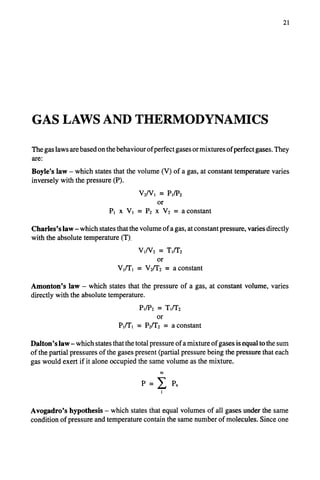
GAS LAWS AND THERMODYNAMICS
The gas laws are based on the behaviour of perfect gases or mixtures of perfect gases. They
are:
Boyle's law- which states that the volume (V) of a gas, at constant temperature varies
inversely with the pressure (P).
V2/VI ~-" PI/P2
or
Pl x Vl = P2 x V2 = a constant
Charles's law- which states that the volume of a gas, at constant pressure, varies directly
with the absolute temperature (T).
VI/V2 "" TI/T2
or
Vl/Tl = V2/T2 -- a constant
Amonton's law- which states that the pressure of a gas, at constant volume, varies
directly with the absolute temperature.
PJP2 = TI/T2
or
PlfI'l = P2fI'2 = a constant
Dalton's law- which states that the total pressure of a mixture of gases is equal to the sum
of the partial pressures of the gases present (partial pressure being the pressure that each
gas would exert if it alone occupied the same volume as the mixture.
m
P=E PH
I
Avogadro's hypothesis - which states that equal volumes of all gases under the same
condition of pressure and temperature contain the same number of molecules. Since one
22 THE PNEUMATIC HANDBOOK
mole of a substance contains the same number of molecules, the molar volume of all gases
is the same. The number of molecules in one mole is 6.02257 x 10²³.
Amagat's law- which states that the volume of a mixture of gases is equal to the partial
volumes which the constituent gases would occupy if each existed alone at the total
pressure and temperature of the mixture.
Poisson's law- which states that for a process without any heat exchange with the
surroundings, the relationship between pressure and volume follows the mathematical
relationship"
Pl Vlv = P2 V2v
where't is the ratio of specific heat at constant pressure to specific heat at constant volume:
~, = c~/c~
The value of the exponent g varies with temperature and pressure (see Figure 1), but for
pressures of less than 1 bar and all temperatures:
1.4 for air and di-atomic gases
1.66 for mono-atomic gases
1.3 for tri-atomic gases
General gas law - resulting from a combination of Boyle's and Charles's laws:
PV = wRT
1.90r
1.80~ bar
1.70~ ~
1.60
1.50
1.40
1.30
- 50 0 50 100 150 200 250°C
temperature
FIGURE 1 - The isentropic exponent for air.
Laws of thermodynamics
1st law - For any system of constant mass, the amount of work done on or by the system
is equal to the amount of energy to or from the system.
GAS LAWS AND THERMODYNAMICS 23
2nd law - Energy exists at various temperature levels but is available for use only if it can
pass from a higher to a lower temperature level.
3rd law - The entropy of a substance approaches zero as its temperature approaches zero.
Air compression
There are four theoretical ways of compressing air as shown in Figure 2. Of these only
isothermal and isentropic need be considered as practical cycles for air compression.
There is in addition a fifth cycle, polytropic, which is commonly used as a basis for
performance estimation; it is intermediate between the isothermal and the isentropic
curves. This takes into account the practical observation that real compression can take
place neither at constant temperature nor without heat exchange to the surroundings. It is
characterised by the value of the polytropic exponent, n, an empirical value which is not
capable of theoretical determination, but which has generally accepted values for various
kinds of compressors.
P
q12
= 2 /
. . . . ~ ___JJ 1
,,
Q.
v2T2 vlT1
Constant pressure (isobar)
P2T2
vl PITt
2
q12
I
i
V 1 --~ V 2
Constant volume (isochore)
I
r
P
Pl ~i:ii:ii:i:!ii:i.ii:i~i!i!~ii.i:i:~iii
1
V2 V1
I
l
t
I
-T 2
tt~~," L Isentropic
~i~ Isotherm
::,i:ii::i::ii~,::Zi:iliiii~ii!i!i~iiiiiiJi!iiii!T
V2 Vl
Isothermal Isentropic
FIGURE 2 - Theoretical ways of compressing air.
Isothermal compression
PmVI = P2 V2 -" constant
This is a hyperbola on the P-V diagram
The work done to compress and to deliver the gas is equal to the shaded area in
Figure 2.
24 THE PNEUMATIC HANDBOOK
V2 V2
"J PdV = "j wRT dV =-wRTIoge(V,/V~)
Q
V
vi vl = PiVllOge(P:/Pl)
In practical units appropriate to a continuously working compressor:
W = 0.1 pl ql loge(P2/Pl)
where p is in bar, q is the flow rate in l/s and W is the power in kW.
In this case, the total work also includes the amount of heat extracted to maintain the
constant temperature.
Isentropiccompression
No heat is extracted in this case and the governing equation is:
PW = constant
The work done in compression and delivery is:
]
Q = VdP = wRT P2 7T'-_ 1
Pl
w
7-1
T--I
P2 S-f
P,V,[(--~-) -1]
As previously stated, the work done in practical units quoted above is given by:
[ ]
W = 0.1 plql - 1
Note that p~ and q~ refer to the inlet conditions of the compressor which is the usual way
of quoting performance.
Polytropiccompression
The equations appropriate to this type of compression are obtained by replacing yby n, the
polytropic exponent. This is more for practical purposes than a concept which has
theoretical justification, n is usually obtained empirically or by reference to the perform-
ance of similar compressors.
In continuous steady-state conditions it is impossible to attain a cycle approaching
isothermal. Most operations are closer to adiabatic. Isothermal represents the theoretical
aim and so the efficiency of a unit is often calculated on that basis.
GAS LAWS AND THERMODYNAMICS 25
Isothermal efficiency, 1"!is --"
isothermal power
actual power
Because a real compressor is usually much closer to isentropic than isothermal, isentropic
efficiency is also used
Isentropic (or adiabatic) efficiency, 'rl a "-"
adiabatic power
actual power
It may sometimes happen in a very efficient compressor that this value exceeds unity. This
occurs when exceptional measures have been taken to achieve internal cooling, as in some
examples of oil injection in screw compressors.
SECTION 2
The Compressor
COMPRESSOR CLASSIFICATION
AND SELECTION
COMPRESSOR PERFORMANCE
COMPRESSOR INSTALLATION
MOBILE COMPRESSORS
ACCEPTANCE TESTS
COMPRESSOR NOISE REDUCTION
COMPRESSOR CONTROLS
AIR RECEIVERS
COMPRESSOR LUBRICATION
HEAT EXCHANGERS AND COOLERS
29
COMPRESSOR CLASSIFICATION
AND SELECTION
Some of the various methods of compressing gas and air are shown in Figure 1. See also
ISO 5390. Reciprocating compressors can be further classified as in Figures 2, 3 and 4
according to the arrangement of the cylinders.
Alternative forms of classification are possible, eg according to the motive power which
drives the compressor - electric motor, diesel or petrol engine; the type of gas to be
compressed; the quality of the compressed medium- the degree of freedom from moisture
and oil (as for example might be required in a food processing plant or for underwater
breathing supplies); the type of cooling - air or water and so on.
In choosing the correct compressor for a given installation, the following factors must
be taken into account:
• Maximum, minimum and mean demand. If there is an intermittent requirement for
air, but a large compressor set is needed to cater for peak requirements, the
Compressors
Dynamic I Dis~lacement
IEjector 1Radial 1Axial
Rotary
Onerotor I
~rLiquid
ing 1
iVane Screw
Reciprocating
Two rotors
1 ] 1 Trunkl Cr°SdS
1~
Lab~
Screw Roots
FIGURE 1 - Basic compressor types.
Diaph-]
rinth ragm
30 THE PNEUMATIC HANDBOOK
In-line
W-type
V-type
Vertical
L-type V-type
Horizontal opposed
FIGURE 2
W-type
s!or
Integral L-type
FIGURE 3
, ~~ ~
ompressor
Integral L-type
Horizontal opposed
(boxer type)
Compressor
Integral W-type
Horizontal with stepped piston
(four-stage)
FIGURE 4
Vertical with stepped piston
(two-stage)
COMPRESSOR CLASSIFICATION AND SELECTION 31
installation can be very uneconomic to operate unless the control system is well
designed. There may be a maximum placed on the power (electricity or gas)
consumption. Depending upon the characteristics of the peak demand (ie whether
it is long or short term), it may be appropriate to consider a large air receiver as an
economic alternative to a larger compressor.
• Ambient conditions-temperature, altitude and humidity. At high altitude, because
of the reduced air density, the compressor efficiency and capacity is reduced. High
humidity can result in large quantities of water which have to be disposed of.
• Methods of cooling available - availability of cooling water or ambient tempera-
ture for air cooling. The possibility of using the waste heat for space heating or for
process heating should be considered.
• Environmental factors- noise and vibration. Special foundations may be required,
particularly with reciprocating compressors.
• Requirements for skilled maintenance personnel.
The actual means chosen for compressing the air is probably less important to the
purchaser of a complete unit than is the purchase price and running costs. For small
10,000
r
1,000
100
0.1
loo 1.ooo lo,ooo loo,ooo loo.ooo
Compressor capacity- I/s
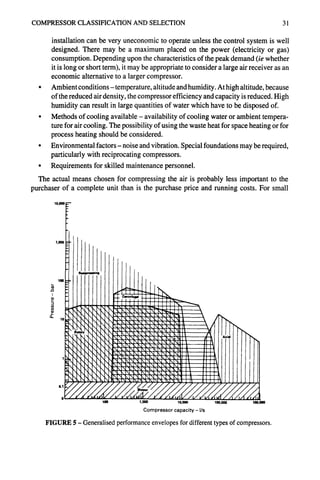
FIGURE 5 - Generalised performance envelopes for different types of compressors.
32 THE PNEUMATIC HANDBOOK
compressors used on construction sites or for intermittent stationary use, initial cost is the
important parameter. For large, permanent, factory installations, running costs (particu-
larly the off-load costs) are more important. The development of sophisticated methods
of control allows almost any kind of compressor to be used efficiently. This means that the
emphasis shifts from the compressorper se to the characteristics of the complete packaged
installation. Figure 5 shows the broad map of application of the various types; there is
much overlap. Table 1 is a broad description of characteristics. It should not be taken to
give clear boundaries between the different types.
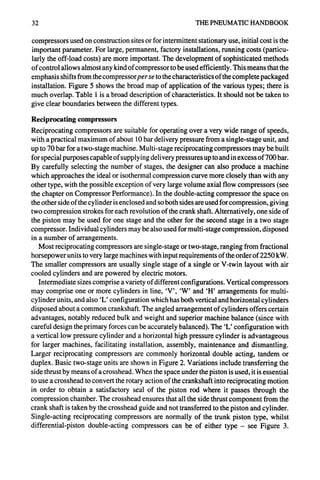
Reciprocating compressors
Reciprocating compressors are suitable for operating over a very wide range of speeds,
with a practical maximum of about 10 bar delivery pressure from a single-stage unit, and
up to 70 bar for a two-stage machine. Multi-stage reciprocating compressors may be built
for special purposes capable of supplying delivery pressures up to and in excess of 700 bar.
By carefully selecting the number of stages, the designer can also produce a machine
which approaches the ideal or isothermal compression curve more closely than with any
other type, with the possible exception of very large volume axial flow compressors (see
the chapter on Compressor Performance). In the double-acting compressor the space on
the other side of the cylinder is enclosed and so both sides are used for compression, giving
two compression strokes for each revolution of the crank shaft. Alternatively, one side of
the piston may be used for one stage and the other for the second stage in a two stage
compressor. Individual cylinders may be also used for multi-stage compression, disposed
in a number of arrangements.
Most reciprocating compressors are single-stage or two-stage, ranging from fractional
horsepower units to very large machines with input requirements of the order of 2250 kW.
The smaller compressors are usually single stage of a single or V-twin layout with air
cooled cylinders and are powered by electric motors.
Intermediate sizes comprise a variety of different configurations. Vertical compressors
may comprise one or more cylinders in line, 'V', 'W' and 'H' arrangements for multi-
cylinder units, and also 'L' configuration which has both vertical and horizontal cylinders
disposed about a common crankshaft. The angled arrangement of cylinders offers certain
advantages, notably reduced bulk and weight and superior machine balance (since with
careful design the primary forces can be accurately balanced). The 'L' configuration with
a vertical low pressure cylinder and a horizontal high pressure cylinder is advantageous
for larger machines, facilitating installation, assembly, maintenance and dismantling.
Larger reciprocating compressors are commonly horizontal double acting, tandem or
duplex. Basic two-stage units are shown in Figure 2. Variations include transferring the
side thrust by means of a crosshead. When the space under the piston is used, it is essential
to use a crosshead to convert the rotary action of the crankshaft into reciprocating motion
in order to obtain a satisfactory seal of the piston rod where it passes through the
compression chamber. The crosshead ensures that all the side thrust component from the
crank shaft is taken by the crosshead guide and not transferred to the piston and cylinder.
Single-acting reciprocating compressors are normally of the trunk piston type, whilst
differential-piston double-acting compressors can be of either type - see Figure 3.
COMPRESSOR CLASSIFICATION AND SELECTION 33
hp
25 50 I00 150 200 300
// D~4 0
- / / / / / , '
8 ~~~WATER'COOLED / / / "120
bar7 ~ ~ ~ ~ ~ . ~ /
~ ~ / Io01bf/in2
~A,.:coottO.",,/.L///// / / / / _
TWO-STAGE, ~/
_..~/ / /
. ~,,.~'~~'~ ~ rF~-~S eO
2'S s'o 7'S I&O s~O 230 2~0
kW
Compressorinputpower
FIGURE 6 - Lubricated air compressors in industrial service - all piston types.
(CompAirBroomWade)
Differential or stepped pistons may also be used as shown in Figure 4. Here one stage of
compression takes place in the annular space between the shoulder of the piston and the
corresponding shoulder in the cylinders.
Figures 2 to 4 also show designs where a compressor piston is connected to the same
crank as the reciprocating engine which drives it. A common arrangement uses three
cylinders of a four-cylinder block to form the engine, whilst the fourth cylinder forms the
compressor cylinder. This is a convenient way of balancing the forces with a single
cylinder compressor.
Figure 6 shows the pattern of reciprocating air compressors in industrial service,
according to a recent survey. This represents most of the industrial units in service. For
special purposes, as mentioned above, compressors are found well outside the range
indicated. The versatility of reciprocating compressors means that they are the most
common of all types. The disadvantages of reciprocating compressors are:
• They require special foundations to cater for the unbalanced inertial forces of the
reciprocating pistons and connecting rods.
• The maintenance they need has to be done by skilled personnel.
• The inlet and delivery valves are prone to failure.
• The discontinuous flow of the compressed medium can cause vibrational reso-
nance in the delivery passages and the distribution system.
In mobile compressors and in the medium range of stationary compressors, reciprocat-
ing compressors tend to have been superseded in recent years by screw and sliding vane
designs in oil flooded and dry versions. They still maintain their dominance for large
stationary (factory) applications
34 THE PNEUMATIC HANDBOOK
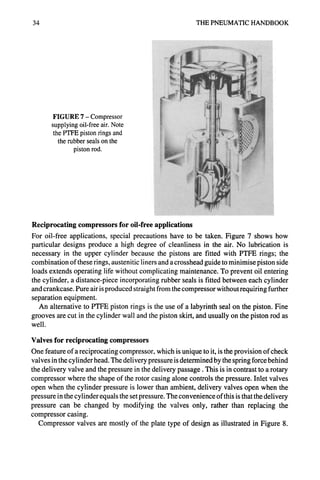
FIGURE 7 - Compressor
supplying oil-freeair. Note
the PTFE piston rings and
the rubber sealson the
piston rod.
Reciprocating compressors for oil-free applications
For oil-free applications, special precautions have to be taken. Figure 7 shows how
particular designs produce a high degree of cleanliness in the air. No lubrication is
necessary in the upper cylinder because the pistons are fitted with PTFE rings; the
combination of these rings, austenitic liners and a crosshead guide to minimise piston side
loads extends operating life without complicating maintenance. To prevent oil entering
the cylinder, a distance-piece incorporating rubber seals is fitted between each cylinder
and crankcase. Pure air is produced straight from the compressor without requiring further
separation equipment.
An alternative to PTFE piston rings is the use of a labyrinth seal on the piston. Fine
grooves are cut in the cylinder wall and the piston skirt, and usually on the piston rod as
well.
Valves for reciprocating compressors
One feature of a reciprocating compressor, which is unique to it, is the provision of check
valves in the cylinder head. The delivery pressure is determined by the spring force behind
the delivery valve and the pressure in the delivery passage. This is in contrast to a rotary
compressor where the shape of the rotor casing alone controls the pressure. Inlet valves
open when the cylinder pressure is lower than ambient, delivery valves open when the
pressure in the cylinder equals the set pressure. The convenience of this is that the delivery
pressure can be changed by modifying the valves only, rather than replacing the
compressor casing.
Compressor valves are mostly of the plate type of design as illustrated in Figure 8.
COMPRESSOR CLASSIFICATION AND SELECTION 35
S.......,o,.. Valve strips flex to fit curve I- -._~
-,,v v,~ .~->~~.~ of valve guard when open .. , z~(~-_~----------~
/.-~ ~~==:~ , ~ . . . . verve spring.~- r ---~
~ - ~ ~ ~ ~t  va,ve guaro Cushion pocket
V a l V , d ~ ~
guar
Valve spring / be~ee n-ch'a°rn%~~j~____--------~-~:::~~~~~=-~ ~ ~ ~
Valve channel and spring when ~.~"~~ U~ ~ ; ~~~-Retainer
verve opens "L "~//~--/~-----~~~-~ ~ ~ ring
Cushion Valve ~-z~---~~j," /','~N~ -
pocket ~ springs" / -~--~---~ ( L~~j~->~.)
)-LT....vatveW~,,,..
Flexiblevalve strips ~ olates
~ ~ t ~ L in closed position ~" "
Valve Vaive
closed open
Valve spring
Valve Reaction plate "~
-~ plates ~ ~ ~!"
"~~~" " Valve ~ -- Valve
~ , guard closed
~ i Shift of support point /
increases spnng Valve
~ t .." stiffness open
FIGURE8-Compressorvalves.
(Mobil Oil Co.)
Detailed designs differ but they mostly consist of one or more flat ring-shaped plates
backed by helical or flat springs. Valve design is a high art, and valves are best obtained
from specialist manufacturers. Valves have to operate very quickly in response to the
pressure difference, so the dynamic mass has to be kept low, there has to be a minimum
of flow losses, and they must be capable of withstanding the impact forces at the end of
the stroke.
Traditionally compressor valves have been made of steel or high grade iron, but there
have recently been developed glass fibre reinforced plastics with a high degree of stability
under the rapid impact conditions and high temperatures experienced in this duty.
Polyetheretherketone (PEEK) has been successfully used for this purpose. This material
retains good physical properties (strength and stability) up to 200 °C and has lower water
absorption properties than other thermoplastics.
Rotary screw compressors
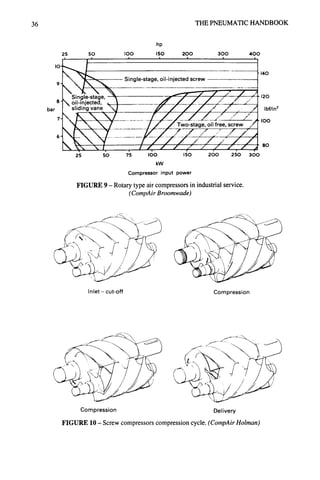
Figure 9 shows the distribution of screw units. It can be compared with Figure 6.
Undoubtedly the most common form of rotary positive displacement compressor is the
helical screw compressor, developed primarily by the Swedish companies SRM and Atlas
36 THE PNEUMATIC HANDBOOK
I0-
8
bar
7
hp
150
25 50 I00 200 300 400
. I I I I I l
~ ~ Single-stage oil-injected screw - - ~ ~
, Single-sta~le, k . J ~ ~ .'-~
oil-injected ~ / _.~__f____l.__ / -'~'._ '" -""
sliding vane .~-.~J ~/r ~--~--~. j ~
, l'~ ~_ ~,L ....... _[..__/__ ./_.J_ /_ ~-" .,,//,
X~'-'~-~ - 7- 7-~'-~":rwo-stage, oil free, screw~ /
25 50 75 IOO ISO 200 250 300
kW
Compressor input power
FIGURE 9 - Rotarytypeair compressorsin industrialservice.
(CompAirBroomwade)
140
- - 120
Ibf/in2
I00
80
Inlet- cut-off Compression
Com press ion Delivery
FIGURE 10- Screw compressors compression cycle. (CompAirHolman)
COMPRESSOR CLASSIFICATION AND SELECTION 37
Copco but now available from a number of manufacturers. The compressive cycle is
illustrated in Figure 10.
Rotary screw compressors employ two intermeshing rotors with helical lobes. As the
rotors revolve, the space between the unmeshing rotors increases, into which inlet air is
admitted. On completion of the filling operation the inlet faces of the two rotors pass the
inlet port and the air is sealed in the casing. With continued rotation the flute volume
between the two rotors decreases, compressing the air. Compression increases with
continued rotation until the built-in pressure ratio is reached and the air is discharged
through the delivery port.
Screw compressors can be either oil-flooded or oil-free. Oil-flooded types rely on a
substantial volume of oil injected into the compression space. This oil serves a number of
purposes: it seals the clearance gaps between the screws and the casing; it lubricates the
drive between the male and female screws; and it assists in extraction of the heat of
compression.
Dry oil-free types cannot permit a drive to take place between the screws so there has
to be external gearing. Some designs incorporate water injection. All-metal screws cannot
be adequately lubricated by water so these types also require external gearing. There is an
interesting new development in water-lubricated screws in which the screws themselves
are made of a ceramic material fastened to a steel shaft. These screws have to be made very
accurately in a special mould because only a limited amount of machining after manufac-
ture is possible. They are finally run together in sacrificial bearings to achieve the final
shape.
Whether the screws are water or oil-flooded, it will be apparent that in order to minimise
leakage losses, the clearance between the screws has to be kept to a minimum at all
rotational positions. The generation of the mathematical forms necessary to produce this
minimum clearance and the subsequent manufacturing techniques are the secrets of
efficient screw compressor technology.
A characteristic of rotary screws is that the power absorbed by the male rotor is about
95% of the total with the remaining 5% absorbed by the female rotor. The female rotors
can be looked upon as being primarily rotary valves. Because of this power distribution
between the rotors, it is customary to connect the male rotor (through gearing if necessary)
to the prime mover. The screws are not designed as driving gears, but 5% is well within
their capacity.
Oil-flooded and dry types each have their own advantages and disadvantages. Dry
screw units can only have a limited pressure increase per stage (a maximum of about 3:1),
otherwise the temperature increase would be excessive. Oil-flooded screws on the other
hand can accommodate a normal pressure ratio of 8:1, and often as high as 13:1.
The total leakage flow path is larger than in a corresponding reciprocating compressor.
In addition to the clearance between the rotors themselves and between the rotors and the
casing, there is also the "blow hole", which is the triangular hole formed at the intersection
of the two rotors and the casing cusp (Figure 11). It is not possible to have anything like
a piston ring to seal the gaps. The leakage flow is the same whatever the operating
frequency (it depends only on the pressure difference) so in order to keep the percentage
loss through leakage to a minimum, the rotational frequency has to be high. This is true
38 THE PNEUMATIC HANDBOOK
J
Male
 ~ ~ J ~ F~al__e_erotor
Mesh seal
FIGURE 11 - Meshing of rotors showing the 'blow hole'. (CompAirHolman)
Unloader
Rotor-female
Inlet casing

Spray-step-up gear 
Roller bearing
Casing-countershaft
drive  ,
Non-return valve
Casing-delivery end
Oil pump
" II Cover delivery end
casing
Ball bearing
Rotor casing
Rotor-male
Roller bearing
Pinion-step-up gear
~ ~ " ,' Gear-step-up
Drive ring Facing-drive Shaft-step-up gear
FIGURE 12- Screw compressors air end. (CompAirHolman)
COMPRESSOR CLASSIFICATION AND SELECTION 39
for both oil-flooded and dry types, but as there is no assistance from the oil in sealing the
dry screw, its optimum frequency has to be much higher. The churning of the oil inside
the compression chamber represents a power loss and a resultant fall in efficiency. There
is an optimum operating speed at which such losses are balanced by losses through
leakage. For oil-flooded units, the optimum linear peripheral speed of the screw is about
30 m/s and for dry screws about 100 m/s. For a typical oil-flooded air-end see Figure 12.
When driven from an internal combustion energy or an electric motor, a step-up gear
drive (of about 3:1 in the smaller sizes of the oil-flooded types and about 10:1 in the dry
types) is required. This is usually separate from the gearing provided to keep the two rotors
apart. The latter has to be very carefully manufactured and set: the backlash in the timing
gears has to be much less than that between the rotors, which itself has to be kept small
to reduce leakage. A technique frequently adopted is to coat the rotors with a thin layer of
plastic (PTFE or similar), so that on initial assembly the rotors are tight; after a careful
running-in period the coating rubs off locally to form a good seal.
Much effort has been put into the careful design of the rotor profile. Originally rotors
were part-circular in shape, but now much more mathematically complex shapes are
favoured. Figure 13 shows a widely adopted shape. Note that the lobes are asymmetrical
~._" /E L HiT
4--- --- "-~'
 ~-- /
Trailing side N.B.Correct port shape
of lobe would exclude dotted area
Lobes of the female rotor
B-A is the extension of the straight line
01-B
B-C is generated by the point H of the
male rotor
C-D is a circular arc with its centre K on
the pitch circle
D-E is a circular arc with its centre L
~llteiH~ th~ hitch r.irr.l~ on thp.
Lobes of the male rotor
F-G is generated by A-B of the female
rotor
G-H is generated by the point B of the
female rotor
H-I is a circular arc with its centre on the
pitch circle
I-J is generated by D-E of the female
r~tnr
FIGURE 13 - Rotor geometry and delivery portshapes. (CompAirHolman)
40 THE PNEUMATIC HANDBOOK
in cross section. This ensures efficient compression with a limited leakage area. Many
attempts have been made over the years to produce more efficient meshing profiles. The
rewards likely to be obtained through the exercise of such ingenuity are likely to be small,
although one of the main motives for producing alternative designs is an attempt to
circumvent the strong existing patents.
One feature of the oil-flooded compressor is the necessity for removing the oil after
compression. This is done by a combination of mechanical impingement and filtration.
The residual oil left in the air after such treatment is very small (of the order of 5 parts
per million) - good for most purposes but not for process equipment or breathing. See
Figure 14 for a typical system. For further information see the chapter on Compressor
Lubrication.
Air intake
valve with
non-return valve
Air intake filter
Aftercooler Oil cooler
Compression
element 1
Minimum pressure
Air/oil 1
separator
vessel
0il reservoir
Oil scavenge line
i:!iZ:iilZii:!!iiiii::ili:!ii.:!ii.i!:iii!
Thermostatic
oil cooler
by-passvalve
t ~
.:.:.:.:.:.:.:.:.:.:+:.:.:.. :.:. :::::-::::: .:
:+:.:.:.:.:...:.:............:.:.: ..............
Oil filter
,t
I Water
separator
with
automatic
drain
Air ~ Air/oil mixture ~ Oil ~ Water
FIGURE 14- Oil systemfor an oil-flooded screw compressor.
(AtlasCopco)
Diaphragm compressors
Diaphragm compressors are positive displacement, oil-free types. They can be driven
mechanically or by hydraulic pressure. Mechanical diaphragm compressors are manufac-
tured in smaller capacities than hydraulically actuated units and consequently overlapping
of the two types occurs only over a limited range.
COMPRESSOR CLASSIFICATION AND SELECTION 41
Corn
seal
Outlet
Inlet
live plate
Com
seal
Ecce
Bearing
FIGURE 15 - Cross-section of a mechanically actuated diaphragm compressor.
FIGURE 16- Diaphragm pump mounted on an electric motor. 17 litre/min at 2.8 bar.
(CharlesAustenPumps)
Mechanical units are less expensive to produce, are very compact and can be used on
applications involving sub-atmospheric pressures (see Figures 15 and 16).
Hydraulically actuated units are able more easily to generate high pressure than are
mechanical units as the latter are usually limited by considerations of bearing loading.
Apart from the fact that the compact form of a diaphragm unit enables it to be directly
42 THE PNEUMATIC HANDBOOK
built into the electric motor or driver (or hydraulic pump in the case of an hydraulically
operated machine, the main advantages offered by diaphragm compressors are:
• Complete gas tightness with only static sealing involved.
• Isolation of the gas being handled and thus the possibility of 100% oil-free
compressed gas supply.
The main limitations of the type are low delivery rates (to a maximum of about 30 l/min
in a single unit) and a limited compression ratio (to about 4.0). The latter limitation applies
particularly to mechanically operated diaphragms where the diaphragm itself is normally
of synthetic rubber. Hydraulically-operated diaphragm compressors may employ metallic
diaphragms and be capable of generating much higher pressures. A further method of
obtaining high pressure is to enclose the compressor and driver within a pressure vessel.
The vessel is pressurised to a level equal to that present in the inlet. The same pressure is
thus present on the underside of the diaphragm, reducing the pressure differential on the
diaphragm when working.
Rotary sliding vane compressor
A well-tried, mechanically simple design, Figures 17 and 18. The rotor and the vanes are
the only moving parts. The rotor is mounted offset in the casing; as can be seen, the
i~_~~o°'
As rotor turns, gas is Gas is gradually com-
trapped in pockets formed pressed as pockets get
by vanes smaller
Discharge
Compressed gas is pushed
out through discharge port
FIGURE ]7 - Working principle of a rotary vanecompressor.
FIGURE 18- Rotary sliding vane compressor.
COMPRESSOR CLASSIFICATION AND SELECTION 43
compression is obtained through this eccentricity. Air is admitted when the crescent-
shaped chamber is increasing in volume and delivered when the design pressure is
reached. As in all other rotary positive displacement types, it has a built-in pressure ratio,
dependent on the position of the delivery port.
The rotor is a simple cylinder, with longitudinal slots machined in it, and the vanes can
be cut from plate material. These are available in three forms- lubricated, oil-free and oil-
flooded.
Lubricated types inject an oil mist into the incoming air stream. Alternatively oil can
be fed from a reservoir through the shaft or directly into the cylinders. Vanes are made of
steel, in which case a floating ring (see below) is required, or of a synthetic fibre material
(newer types). The use of synthetic fibre is advantageous in that the lower mass means a
smaller centrifugal force.
Oil-free types, suitable for process applications require self-lubricating vanes made
from carbon.
Oil-flooded types are similar to screw compressors in that large quantities of oil are
injected into the compression space, which then has to be separated out and cooled. As with
screw compressors, the oil lubricates, cools and seals. The vanes are made of aluminium,
cast-iron or a synthetic fibre material.
The rotational frequency has to be low, otherwise the centrifugal forces on the vanes
would cause frictional failure, so a direct motor drive is customary. Wear of the surface
of the vanes that contacts the stator can be a problem, but because they are free in their slots,
such wear is self-compensatory. Wear on the side of the vanes or on their ends causes a
fall in efficiency, and they should be replaced when such wear exceeds the manufacturer' s
recommendations.
Medium or large capacity vane compressors running at high speeds normally incorpo-
rate a method of avoiding contact between the vanes and casing wall in order to reduce
wear and minimize frictional losses. One method is to fit restraining or floating rings over
the vanes, the internal diameter of these rings being slightly less than the cylinder bore.
The difference is calculated to preserve a minimum clearance between the vane tips and
the casing walls under operating conditions, see Figure 19.
The rings actually rotate with the vanes but the peripheral speed of each vane tip varies
Restraining blades
Restraining ring
Blades
Rotor shaft
FIGURE 19- Vane compressor with sliding rings.
44 THE PNEUMATIC HANDBOOK
FIGURE 20- Principle of the Roots blower.
with the degree of extension. The rings rotate at constant speed. There is some relative
motion between vane and rings, but the contact between rotor and rings is essentially a
rolling motion.
Low pressure blowers
These are meshing rotors suitable for low pressure ratios only. There is no built-in
compression ratio, any increase in pressure being achieved by compressing against the
back pressure in the system. Such a device is inefficient, its real advantage lying in the
simplicity of manufacture. Figures 20 and 21 show an example of this type- the Roots
blower.
Liquid ring compressors
In this design the rotor runs in a ring of liquid which seals and cools the compressed gas.
t ,J
J _L Outboard
bearing
, Oil filling Timing, gears '
' plug ~I'"~"#P---~II Oil
ngers
,~. sli "
!,,.~'~! / =~,! /
Oil cup
~~. Oil ring i
Impell~ ~
IL rrn
Levelcock
FIGURE 21 - Roots blower drive.
COMPRESSOR CLASSIFICATION AND SELECTION 45
1.In this sector, liquid moves
outward - draws gas from
inlet ports into rotor
chamb--.=
Rotating
liquid
com pres~
3.In thi,,
comprc
escapes at discharge ports
2.In this sector, liquid moves Inlet
- compresses gas
inward chambers ~ connections
in rotor 1 -r Body _.~
.... ........ u0u,0
Inlet.= I III il III I Inlet
connections
Type CLschematic
£).~scla8
sectO
.... :ing Body
id
:ssant
let
,rts
____,
Double-lobe schematic.
FIGURE 22 - Type CL schematic (top) and double-lobe schematic. (NashEngineering)
Two types are available - the single-acting, circular stator, and the double-acting, oval
stator. Both are illustrated in Figure 22. They both have a built-in pressure ratio, but the
double-lobe body is more suitable for higher pressures (up to 7 bar). A variety of liquids
can be used; water is a common one, but non-corrosive liquids can also be used according
to application. The presence of a large quantity of liquid means that churning losses are
high, but cooling is very good, so isothermal conditions are approached at the expense of
mechanical efficiency. These units are also useful as vacuum pumps.
Rotary tooth compressors
One type is illustrated in Figures 23 and 24. The rotors are parallel in section and are
externally meshed through timing gears; there is no possibility of one tooth driving the
other as in rotary screws. They are suitable for producing oil-flee air. They are available
as low pressure single-stage blowers up to 2.5 bar and as two stage compressors up to 7
46 THE PNEUMATIC HANDBOOK
1.Suction: air at inlet pressure enters
compression chamber. Outlet ports sealed
off by female rotor hub.
3.End of compression: the entrapped air is
compressed to its maximum. Suction starts
as inlet ports are opened.
2.Compression starts: in- and outlet ports
closed off. Space between both rotors and
housing becomes progressively smaller.
Volume is reduced, pressure increases.
4.Delivery: recess in female hub uncovers
outlet ports and compressed air flows out.
r-] inletport [-7 Intakeair
I Outletport ~ Compressedair
FIGURE 23 (AtlasCopco)
FIGURE 24 (AtlasCopco)
bar. They are claimed to be suitable for pressures up to 10 bar. The rotors are of
comparatively simple construction in that they do not require helical machining so they
can be made from materials that would otherwise be difficult to manufacture, such as
stainless steel.
COMPRESSOR CLASSIFICATION AND SELECTION 47
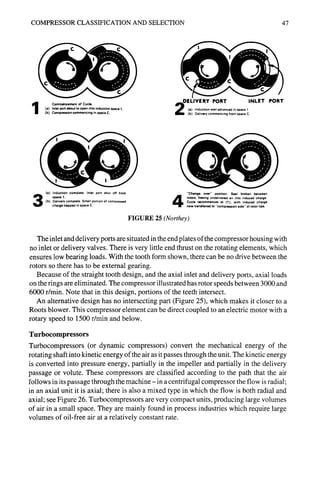
Commencement of Cycle.
(a) Inlet port about to open into induction space 1.
(b) Compression commencing in space C.
DELIVERY PORT INLET PORT
(a) Induction well advanced in space 1.
(b) Dehvery commencing from space C.
(a) Induction complete. Inlet port shut off from
space 1.
(b) Delivery complete. Small port,on of compressed
charge trapped in space C.
"Change over" position. Seal broken between
rotors, freeing undelivered air into induced charge.
Cycle recommences at (I), with induced charge
now transferred to "compression side" of rotor tips.
FIGURE 25 (Northey)
The inlet and delivery ports are situated in the end plates of the compressor housing with
no inlet or delivery valves. There is very little end thrust on the rotating elements, which
ensures low bearing loads. With the tooth form shown, there can be no drive between the
rotors so there has to be external gearing.
Because of the straight tooth design, and the axial inlet and delivery ports, axial loads
on the rings are eliminated. The compressor illustrated has rotor speeds between 3000 and
6000 r/min. Note that in this design, portions of the teeth intersect.
An alternative design has no intersecting part (Figure 25), which makes it closer to a
Roots blower. This compressor element can be direct coupled to an electric motor with a
rotary speed to 1500 r/min and below.
Turbocompressors
Turbocompressors (or dynamic compressors) convert the mechanical energy of the
rotating shaft into kinetic energy of the air as it passes through the unit. The kinetic energy
is converted into pressure energy, partially in the impeller and partially in the delivery
passage or volute. These compressors are classified according to the path that the air
follows in its passage through the machine-in a centrifugal compressor the flow is radial;
in an axial unit it is axial; there is also a mixed type in which the flow is both radial and
axial; see Figure 26. Turbocompressors are very compact units, producing large volumes
of air in a small space. They are mainly found in process industries which require large
volumes of oil-free air at a relatively constant rate.
48 THE PNEUMATIC HANDBOOK
=
A
Principal parts of a turbocompressor.
Volute
Diffuser
Impeller
__ _ -~
Axial impeller.
Centrifugal impeller
FIGURE 26
/
__S

Mixed flow impeller
Inletflange Dischargeflar~e
aphragm
~ I Diffuser Volute
Guidevane~ ~M~~" E~~ I Thrustbalancing
Thrust
beari
-[~-~~ -hf// I /-~ ----ill~~~j~bearing~~
 M~ Shaft Impeller V///,//_~.~
a C°Xupling
UUUd
ih]earing II ' I Seal
Casing ~/f/'~~~~~J
FIGURE 27 - Sectional view of a typical five-stage horizontally-split centrifugal compressor.
COMPRESSOR CLASSIFICATION AND SELECTION 49
.=_~ =
E'-'~
'-- 0 *"
>..Oo i
o g,
.,.-'2" ....
8 ~ ~ .
°~ ~
0 ,- ~
L S,,...
~,E N
o ~®
~,~ &"
L
°-- t-- m
< ..c: =.~ E
E.=- 8
,..~E
~9
-,~c:
~o
~._'0
0
.~1'
,.c
olg
• -- ~ ~..
=a
!
bS~
I
¢q
~o,.
u t~.
-=_ ~ >,
t_
o
t_._ .m
50 THE PNEUMATICHANDBOOK
a
ut/Quantity
,,
I I
, .
[ Quantity delivered / Efficiency
-- envelopes
iL~ Working range --*- Curves for -----'-]-'-.,~ /
Min. Max different speed~/f/~f~
FIGURE 29- Workingrangeof
a dynamiccompressor. Design --. __ 4L-//--~--/~ ) /~
,. value /
Surging //~%~  I~ 
/////
Quantity delivered
FIGURE 30- Efficiencycurvesof a
dynamiccompressor.
As in other types, compression can take place in stages. The pressure ratio which can
be reached in a single stage is limited by the maximum peripheral speed of the impeller.
Centrifugal machines normally generate a pressure ratio per stage of 1.5 to 2.0, although
with improving technology pressure ratios are increasing. A pressure ratio of 6 can
obtained in a 2-stage design. In an axial compressor the compression per stage is limited
to about 1.3;they may have up to 20 stages. Centrifugal units may incorporate intercooling
between stages, axial units rarely do. Single-stage centrifugal units are frequently used as
blowers and exhausters.
Shaft speeds are high- 20 000 r/min is common in industrial units. 100 000 r/min is
found in aircraft engines. At these speeds rolling bearings are unsuitable; plain or tilting
pad bearings are necessary. Figure 28 shows a modern single-stage centrifugal unit. It can
be seen that the actual compressor forms only a small part of the air end; the major part
of the machine is in the step-up gear and the cooler.
COMPRESSOR CLASSIFICATION AND SELECTION 51
Comparison of behaviour of centrifugal and axial compressors
Each type has its own characteristics: axial compressors are suitable for large flow rates
only (20 to 100 m/s); centrifugal units are available supplying from 0.1 to 50 m/s. Axial
compressors have a rather better thermodynamic efficiency, but only at the design point;
they are susceptible to changes in throughput and pressure. Centrifugal units have good
part-load characteristics; the off-load power absorbed is as low as 3%; this makes them
particularly suitable for intermittent use and when needed to supply a range of pressures
and flow rates. The operating speed of axial compressors is considerably higher than for
centrifugal and for this reason combined with the large number of vanes they tend to be
noisier.
Discharge pressure and volume of air delivered are co-related. If at a given speed the
back pressure is reduced, the volume delivered will increase and vice-versa. See Figures
:29 and 30.
If the back pressure increases to a value above that generated by the compressor then
a condition known as 'surge' occurs, and air flow is reversed. If the pressure then drops
the pressure starts to deliver again and if this sequence continues serious damage could
result. Practical operating limits are therefore terminated by a surging limit, see Figure 30.
To avoid surging it is necessary to recycle a part of the compressed volume by means of
a by-pass that opens automatically as soon as the surge point is reached. The anti-surge
system should be independent of the other means of control and is controlled from the flow
rate or the pressure difference. Provision should be made for isolating the compressor from
the mains when operating conditions approach the surge point, and for restoring it when
the surge pressure has fallen. With the latest forms of computer control it is possible to
extend the stable range of both axial and centrifugal types.
Mixed flow units combine some of the advantages of axial and centrifugal units. For a
given flow rate the mixed designs have a smaller diameter. There is less turbulence and
therefore the efficiency is better. They are mainly used for single-stage compression.
53
COMPRESSOR PERFORMANCE
Practical compressors normally work on a polytropic process, ie intermediate between
true isothermal and true isentropic- Figure 1. Isothermal remains the ideal, and much
effort is made by compressor designers to get close to it. A few percentage points reduction
in input power can make a significant difference to the economies of air compression.
Multi-stage compression with intercooling between stages is a widely used technique.
Theoretically the most efficient design of a multi-stage compressor has the same pressure
ratio for each stage. Multi-stage compression increases the volumetric efficiency and
reduces the power consumption, the power input being a minimum if the total work is
divided equally between the stages. When estimating the total power consumption and in
evaluating the overall efficiency the power used in running the intercooling process has
to be taken into account. The curves of Figure 2 demonstrate the argument. The first stage
polytropic is close to the isentropic curve, but at the conclusion of this stage air temperature
is reduced to its original value by intercooling and the volume is reduced. The second stage
polytropic curve originates at the isothermal line and follows its own isentropic line. The
shaded area represents the saving by intercooling. The desirability of multistage operation
is greater with increasing final pressure and required capacity.
Oil or water flooding in a single-stage rotary compressor is another attempt to reduce
the value of the polytropic exponent.
'~~~ Adiabatic
_ ~,,'~ytropic
Isothermal
, i , ,
Volume
FIGURE 1
54 THE PNEUMATIC HANDBOOK
I ',fa/,,,
| ~ ~"~,, Gain with
!  vt~,,,
,,
'~ ~ intercooling
~t_ Isothermal ~ ~.. Polytropic
,
V o l u r n e ~
FIGURE 2
In order to compare the various compression cycles, it is useful to calculate the power
required for the various cycles mentioned above and with a two stage compressor. For a
pressure ratio of 8:1 the theoretical power per l/s of air compressed is 0.208 kW for
isothermal, 0.284 kW for isentropic, 0.248 kW for polytropic (n = 1.2) and 0.242 kW for
a 2-stage compressor. See Figure 3.
Multi-staging is valuable for other reasons than efficiency. It is usually necessary to
limit the temperature to which the components of the compressor are subject and
intercooling achieves that. A large pressure difference in a single stage can reduce the
volumetric efficiency through excessive internal leakage. Mechanical complications
impose a practical limit to the number of stages that are possible in a given application:
mobile compressors, built for cheapness and to have a limited life are more likely to have
a small number of stages than a fixed installation, built for economy in operation and a long
life. Mobile oil-flooded screw compressors commonly have a pressure ratio of 8:1 and
often as high as 13:1, whereas a comparable stationary unit would have two or three stages.
Jll
300
200
100
A
/ lY! •
// ./ i.,I
~F
/L;/
///
O/
1 2 3
._ , L~,
IIIII
5 6 7 8 910
pressureratiopip,
A-single-stage isentropic compression
B-two-stage isentropic compression
C-isothermal compression
FIGURE 3 - Theoretical specific energy requirementcurves for air.
COMPRESSOR PERFORMANCE 55
In estimating the performance of compressors, it is essential to distinguish between the
various types of efficiency, and the sources of power loss. From the designer' s point of
view the internal isentropic efficiency is important in estimating the thermodynamic
efficiency of the design. A practical compressor is burdened with more than the thermo-
dynamic losses. Further possible sources of losses are:
• Leakage past the piston or compression element.
• Heating of the inlet air, resulting in a reduced density and consequent reduction in
capacity.
• Flow losses in the delivery passages due to restrictions in the delivery ports.
• Flow losses in the intake caused by the need for inlet valves, intake filters and
restrictions in the inlet passages. Frequently manufacturers will quote performance
values for the "bare air end", leaving out intake and delivery losses.
• Mechanical drive losses introduced by the gearing or by other drive mechanisms.
• Power absorbed by the cooling fan and by the lubrication pump.
TABLE 1 -Efficiency estimates for typical commercial compressors
Reciprocating single-stage
Reciprocating multi-stage
Rotary screwcompressors
Sliding vane
Single-stage centrifugal
Multi-stage centrifugal
Axial compressors
Turbo blowers
Roots blowers
Reciprocating compressors
Internal
isentropic
0.904).95
0.764).83
0.80-0.86
0.68-0.77
0.85-0.87
Overall
isentropic
0.83-0.94
0.72-0.78
0.804).85
0.704).75
0.77-0.82
0.60--0.80
0.604).65
Reciprocating compressors
As explained in the chapter on Compressor Classification and Selection, reciprocating
compressors can adopt a variety of different configurations and can be single- or multi-
stage. The same method of performance estimation applies to them all.
The capacity can be readily calculated from the product of the total swept volume and
the volumetric efficiency.
The next factor to be determined is the value of the index of compression, the polytropic
exponent. In multistage compressors employing interstage cooling, the overall compres-
sion cycle approaches isothermal, but each individual stage is closer to isentropic, so it is
convenient to analyse each stage separately. For modern high and medium speed
compressors, the polytropic index can be taken as equal to the isentropic index (ie n = 1.4);
56 THE PNEUMATICHANDBOOK
for low speed compressors a value of n = 1.3 is often used. The stage pressure ratio is
determined by the pressure set by the delivery valves.
The stage temperature rise is
n-1
T2 = TI (P-~l) n
The power absorbed by the stage is
W = 0.1plql
See also Figure 3.
n-1
n [( p_.~l
) n ]
n-1 --1
The inlet pressure and temperature of the inlet to the next stage depends on the degree
of interstage cooling. In practice perfect cooling down to the inlet temperature is not
possible. The cooling system necessarily absorbs power either in driving a fan or
circulating the cooling water and this must be taken into account in determining the overall
power required. Ten to 15% of the input power should be allowed for cooling purposes.
Volumetric efficiency
One characteristic of a reciprocating compressor is the clearance volume that remains in
the cylinder at top dead centre after the delivery stage is complete. This is usually
expressed as a proportion of the swept volume and typically has a value of 0.06 to 0.12.
This volume is not discharged but expands until it occupies the cylinder volume. The effect
of this is to modify the shape of the indicator diagram as in Figure 4. Theoretically this
expansion represents no loss of energy if the index of expansion equals the index of
compression (bearing in mind that the compression is isentropic and reversible, so the
energy used is reclaimed).
Pl d b

I
I
I
I 
L , c
~.zS So_ ~= S i
"
._ zS" So S i
FIGURE 4 - Ideal and practical compressiondiagram. Theoretical diagramabdea.
Practical diagramabdfa. Suction period: theoretical Si, practical Si".
Clearance volume: theoretical So,practical So".
COMPRESSOR PERFORMANCE 57
The volumetric efficiency of the compressor is a function of the first stage geometry,
although for design purposes the separate stages can be separately analysed. It is given by
1
[ {(P2) mZI }]
rlv=K l-Vc ~ 7_.2 l
pl and p2 are the intake and delivery pressures in the first stage.
K is a factor depending on valve losses, intake air heating, leakage and pressure ratio. K
can be taken as 0.96 for an initial estimate.
Vc is the relative clearance volume.
Z~ is the compressibility factor at intake.
Z2 is the compressibility factor at discharge.
m is the index of expansion, which as a first approximation is equal to y, the isentropic
index.
The expansion index varies with pressure according to the following:
For the first stage m = 1.20 For the fourth stage m = 1.35
For the second stage m = 1.25 For subsequent stages m = ?
For the third stage m = 1.30
A high volumetric efficiency is not necessarily better than a lower one; its significance lies
in the calculation of the compressor capacity. If, however, the low efficiency is caused by
leakage, then the design is at fault.
Other positive displacement types (screwand vane)
One general feature of these types is that they rely on the position of the delivery port to
determine the built-in pressure ratio. (It would be more correct to refer to a built-in volume
Operation above
design pressure
_Discharge pressure_
•..~Design pressure
"~':'~" •
" ~ ...... ~ ....... '-'.:.~........ .,-i.i.,.,9 ~
Volume
Operation below
design pressure
,~L-i Design pressure
~-
................................
. . . .
r.~,_ Disc~'
1arg
~ ~essure
"'.....
J
Volume
Operation at
design pressure
l l
I; Design pressure
_
..................................
~..~..~scharge)
...
[,
Volume
FIGURE 5- Operation at pressures deviating from the built-in pressure ratio.
58 THE PNEUMATIC HANDBOOK
ratio, but the former is more common.) The position of the port is usually calculated on
an assumed isentropic compression.
Operation at other than the design pressure, as for example when the pressure control
valve in the delivery is set incorrectly, would result in the modified diagram of Figure 5
and wasted power.
Performance of screw compressors
The displacement of a screw compressor is calculated from
V = C D3(L/D) N
L and D are the length and overall diameter of the rotors. If the rotors are of different
diameters, as is sometimes the case, by convention the male rotor is chosen as the
reference.
C is the characteristic flute volume factor for the geometric shape chosen. A value of
0.4 to 0.5 is typical.
The volumetric efficiency can in practice only be determined from tests. It depends on:
• Geometry of the rotors
• Size of the blow hole
• Clearance gaps between rotors
• Volume occupied by the cooling oil
• Inlet restrictions
• Pre-heating of the inlet air
Volumetric
efficiency
0
~ .09 0.05
g
0.02
'o 2'o ~o ~b
Male rotor tip speed m/s
FIGURE 6 - Volumetric efficiency of 100 mm diameter oil-flooded compressor,
for various values of inter-lobe clearance.
COMPRESSOR PERFORMANCE 59
Note that there is no clearance volume as in reciprocating unit. Figure 6 shows a typical
set of volumetric efficiency curves for a modern screw.
The theoretical power can be found, as in the case of a reciprocating compressor, from
n-I
n [( P_~_t2
) n ]
W = O.lpiql n- 1 -1
It might be thought that the injection of massive quantities of oil into the compression
chamber (typically, the ratio of the mass flow of the oil to that of the air is of the order 10:1)
would result in an isentropic index close to unity. In fact, the flow velocity is so great that
the actual heat transfer between air and oil takes place in the relatively static conditions
in the oil reclaimer rather than in the compression chamber. The calculations on power can
best be done by assuming isentropic compression and modifying the index from practical
tests. The isentropic efficiency depends on the particular screw design. Typical curves are
given in Figure 7.
o
o
o ~ ~'-
o
~" ~ e-
~I ~.l .=
i 1 i(
c
..._.-: Design point
i
Flow
FIGURE 7 - Constant efficiency curves for the rotating screw compressor.
Performance of vane compressors
The swept volume of these units is readily calculated from the crescent area between the
vanes.
The same remarks about isentropic efficiency apply as for screw compressors. When
these units are oil flooded, oil churning represents one of the main power losses. There is
little leakage across the outer edge of the vanes, because centrifugal force keeps them in
intimate contact with the cylinder. There is, however, leakage across the ends of the vanes,
which are not well sealed by the oil.
Performance of Roots and similar types
There is no built-in pressure ratio in these units and their efficiency is low, see Figure 8.
Some improvement in efficiency is possible by adjusting the ratio of the volume in the
60 THE PNEUMATIC HANDBOOK
One turn
c b
-/,O, , ",";,',"%, ,
~7. ,,,. . ,; ~ ack pressure
~i; J," ; ";, ; ?"%,~ | / Atmospheric
~,;;~//y,~.,,,- . . ; %.%1 ~ ,/,pressure
'1 a~-..... ~ Pressu-redroP~"
l i / at suction
k_ t ...... '
0° 180° 3600 Cra nk
angle
FIGURE 8 - The workingdiagramof a Roots blower. The compression workis
representedby the areaabdea.The areaacdearepresentsthe workrequiredfor
compression in a pistontype compressor.
95
>" 85
tJ
E
Q)
.L2
75i
E
~ 65
55
1.;
VOt'/O
~("Oj _
°°%
1.3 1.4 1.5 1.6 1.7 1.8 1,9 2.0 2.1 2.2 2.3
Pressure ratio
FIGURE 9- lsentropic efficiency versus pressureratiofor various
duct to lobe volume ratios.
delivery duct (ie the volume between the outlet port and the delivery valve) to the volume
of the compressor lobes. See Figure 9.
Dynamic compressors
Any turbo machine operated at constant speed is capable of delivering a wide range of
volumes with only a small variation in pressure. If the volume is decreased by throttling
on the discharge side, pressure will also decrease. Pressure developed when the discharge
is completely throttled will depend on the machine design and operating speed, but will
be always lower than the maximum pressure. It is thus a characteristic of aerodynamic
machines that dangerously high pressures cannot be built up under any operating
conditions and so relief valves are not necessary in the discharge line. Regulation can be
achieved either by throttling on the discharge side or variation in the impeller speed (or
both).
COMPRESSOR PERFORMANCE 61
speeds ~~

Quantity delivered
FIGURE 10- Dynamiccompressoroperation.
The use of a valve offers the simplest form of control over pressure or capacity but
throttling always represents an unrecoverable power loss. Speed variation is, therefore, a
more economic form of control when the compressor characteristics can be expressed in
the form of a series of curves which may be superimposed on the demand curve to establish
the required operating point, as in Figure 10. In other words, by adjusting the speed, the
compressor characteristics may be matched to any required values of pressure and
capacity within the operating limits of the compressor and its driver. Efficiency will not
necessarily be a maximum, unless this operating point corresponds to the design value for
maximum efficiency.
The variable speed, capacity and adiabatic head can be related in terms of specific speed:
Specific speed (ns) =
Q x r/min
H O.75
where Q = inlet capacity
and H.~= isentropic head per stage
This is a relative value only and has little significance other than as a design specific speed
or value at which a given type of casing shows its maximum efficiency. It then serves as
an index of classification for the form of the impeller in that type of casing. The compressor
may be operated over a range of speeds, capacities and adiabatic heads, and thus a wide
range of specific speeds. These actual or operating speeds are useful only as a basis for
comparing performance relative to the performance obtained at the design specific speed.
The demand load itself will depend on the operating conditions and may involve
working against a constant head or pressure, against frictional resistance, or a combination
of both. In the former case the demand load will be constant and in the other two cases will
vary with capacity - Figure 11. The resultant demand curve may also vary under actual
working conditions due to a change in head or frictional resistance. The working point of
62 THE PNEUMATIC HANDBOOK
Constant head
plus friction
,,
~ Friction
Quantity delivered :
FIGURE 11
the compressor can be changed, eg by means of a butterfly valve installed preferably near
the compressor inlet or near the discharge. Other methods of adjusting the compressor
characteristics, and hence the pressure and capacity, include the use of adjustable diffuser
vanes and adjustable inlet guide vanes.
Estimation of compressor performance with altitude
A number of factors combine to modify the performance of a compressor at altitude.
Performance tests should always be used as the primary source of information. Where the
results of such tests are not available, an estimate based on theoretical considerations can
be made.
Refer to Table 6 in the chapter on Properties of Air and Gases, for details of the standard
atmosphere. Note that the density, temperature and pressure all fall with increasing
altitude. If the compressor is designed to produce a given amount of air at a given pressure
at sea level its performance at altitude will be affected, not only because of the change in
inlet conditions but also because it will no longer be able to operate at its optimum design
efficiency.
There are two ways of looking at the change with altitude: when operating the same
compressor at the same speed and same delivery pressure, the power to run it will be less
at altitude; when it is desired to obtain the same useful output, the power required will be
greater. The actual energy content of the compressed air is measured by the mass flow
rather than the volume flow at inlet conditions, so a calculation of the extra power required
at altitude can be made from an alternative form of the power equation:
W = 0.1 wRT
n-I
n [( P_~12
) n ]
n-I
-1
As an example one can use this equation to compare the power at altitude with the power
at sea level, when delivering air at a constant mass flow and a constant delivery pressure
COMPRESSOR PERFORMANCE 63
Compressor type
Piston type
Medium size, air cooled
Large piston type, water cooled
Screw, oil injected
Large screw, water cooled
TABLE 2
%Reduction for each 1000 m
increase in altitude
Capacity
2.1
1.5
0.6
0.3
Power
consumption
7.0
6.2
5.0
7.0
of 8 bar. It demonstrates that there is a power increase of 5% at 1000 m and 16% at
3000 m.
A further fall in performance will come from the change in volumetric efficiency,
caused either by the clearance volume effect in a reciprocating compressor or from the
change in the built-in pressure ratio in a rotary unit.
Table 2 gives some estimates of the observed reduction in the power and capacity in a
variety of different compressor designs.
These considerations take no account of the reduction in power from the prime mover.
Both electric motors and internal combustion engines give reduced output at altitude.
Electric motors have a reduced performance of about 5% for every 1000 m increase in
altitude through poorer cooling. For internal combustion engines, reliance has to be placed
on the manufacturers' tests. Turbo-charged engines are better in this respect than naturally
aspirated ones.
65
COMPRESSOR INSTALLATION
A compressor installation may be centralised where all the compressors needed are housed
in a single compressor plant; or decentralised where individual compressors are located
near the points of use. A centralised installation can show greater cost-effectiveness as
well as making it easier to optimize intake conditions and silencing. There are a few
situations where decentralised stations are to be preferr6df if there is a requirement for
different working pressures in some parts of the factory; where warm air is required, eg
for pneumatic operation of forging tools; where part of the air is required at a considerable
distance from the main installation and the pressure drop of a long line would be
unacceptable.
Modern practice with centralised installations employs individual compressors with
their associated ancillary equipment as completely separate units. It is then possible to shut
down a single compressor for maintenance and leave the remainder operating. Most
factories have a fluctuating demand for compressed air during the working day, so there
is no need to keep all units running when only aproportion are needed to supply the factory.
Even off-load, a compressor consumes a considerable amount of power so it makes sense
to have the smallest number running at any one time. With modern control equipment
compressors can be brought on stream rapidly when the demand for extra air is sensed. A
decision about the number of compressors to be installed depends primarily on the
importance of continuity of production. If it is acceptable to work with a reduced air supply
in the event of an unscheduled shut down, then two compressors each capable of 50% of
the total requirement may be satisfactory. If a partial shut down is not permissible then a
reserve supply must be available, so that three compressors each capable of 50% must be
installed. Generally the larger the compressor, the more efficient it will be, so the number
of separate units should be kept small, consistent with these considerations.
In assessing the capacity of a compressor installation, attention must be paid to leakage
which is an inescapable feature of practically all pipe runs; 10% should normally be
allowed for unless extra care is taken in the initial design. Further possible increases in
capacity should also be allowed for.
Ideally a compressor should be located where it can induct clean, dry and cool air; this
requires that the air intake should be placed on the shaded side of its building, well away
from its cooling tower; there must be no possibility that the air intake can draw in
66 THE PNEUMATIC HANDBOOK
inflammable vapours for example from paint spraying or petrol fumes. Although an inlet
filter must be incorporated, a site should be chosen where dust particles are not readily
drawn in. There is no need to put a heavier burden on the filter than absolutely necessary.
A filter will only extract a percentage of the dust in the air (although it may be as much
as 98%); the remaining abrasive particles can cause serious damage to the lubrication
system.
Another primary consideration is that a compressor is inherently a noisy machine and
unless specifically designed or treated for noise control, should be located in a 'noisy' area
of the factory or workshop. In the case of a centralised installation it is generally desirable
(and virtually necessary in the case of larger machines) to have the compressor in a
separate well ventilated building room or chamber, inducting the air from outside of the
building. Each compressor should have a separate air intake, and the pressure drop over
the intake system should be kept low.
Basic treatment of the intake system is the fitting of an air intake filter of a suitable type
and size to ensure that air reaching the compressor is clean ; and a separate air intake
silencer to reduce intake noise which is the predominant noise-generator. Further noise
treatment may have to be applied both to the machine itself and the room (egthe provision
of adequate ventilation can establish noise paths which may then require treatment).
Further information can be found in the chapter on Compressor Noise Reduction.
In the case of reciprocating compressors, the intake flow is pulsatory. This can
aggravate noise problems if the intake pipe is of such a length that there is resonance with
the pulsation frequency of the compressor. Apart from the noise problem, the intake flow
can also be adversely affected. As a general rule the chance of resonance occurring is
greatest when the intake pipe length corresponds to one-quarter or three-quarters of the
pressure pulse wavelength (~) which for a single-acting compressor is given by:
Z,= c/n
where ~, = wavelength in metres
c = velocity of sound in air m/s
n = compressor shaft speed r/s
For a double acting compressor
Z,= c/2n
For dry air c = 20 ~/T where T is the absolute temperature in K, which for an inlet
temperature of 15°C equals 340 m/s. For a more accurate value, see the chapter on
Properties of Air and Gases.
The intake lengths to be avoided are 0.17~, to 0.33~, and 0.67~, to 0.83~,.
High speed rotary compressors are comparatively pulsation-free and intake flow
resonance is rarely a problem.
Compressor intake
The intake system must be designed with a low pressure drop in mind, that is with a limit
on the air intake velocities. At the same time, intake flow should be smooth rather than
COMPRESSOR INSTALLATION 67
--l-'•'q
j s
:--_-~
I ~" ".2
"3
I 1.Compressor
2.Silencer with filter
.~ 3.Venturi tube
4.Filter
5.Flexible connection
, 6.Suction pipe
b,.,
.o .o ~ J . .,-. :o-. ; .-.
.1~;1... • ~ , ,-: ~-* 7.Air intake
z : : : : : :
",_ _ 7 • " - ," " ' ---:'-----7,ira--r,-- :-
FIGURE 1 - Arrangement of air intake pipe and venturi silencer.
pulsating, as this will appreciably reduce intake noise and resonance effects.
Low pressure drop is ensured by sizing the intake pipes such that the flow velocity is
no more than:
5 to 6 m/s in the case of single-acting compressors
6 to 7 m/s in the case of double-acting compressors
Combined with a venturi-type intake silencer these intake velocities can be increased
by up to 10%. A typical arrangement is shown in Figure 1.
Proper consideration must be given to the ventilation of the compressor house to
dissipate the heat generated by the compressor and driver. This is particularly important
in air-cooled units. With water-cooled compressors, or air-cooled compressors with
water-cooled intercoolers, the amount of radiant heat to be dissipated is usually negligible
since the majority of the heat is carried away by the cooling water.
Delivery line
Pressure drop in the discharge line does not materially affect the compressor efficiency,
so the gas velocity can be 20 to 25 m/s. Pressure pulsations on the other hand can cause
a considerable increase in compressor power as well as damage to the piping and valves.
There are two ways of dealing with the problem of delivery line pulsations: tuning the pipe
length between compressor delivery valve and the after-cooler; and inserting a pulsation
68 THE PNEUMATIC HANDBOOK
r -~--~ . . . . .
J
. . . . T "~-'i
t,
.'-s--_
FIGURE 2- A typical system for heat recovery from a water-cooled compressor
plant. The cooling water is used partly for showers and washrooms, partly
for heating adjacent premises.
damper in the form of a small air receiver.
Energy recovery
With water-cooled compressors it is possible to recover a high proportion of the intake
energy in the form of hot water which can be used for space heating, feed water for boilers,
etc in a large factory. A typical system for heat recovery is shown in Figure 2. With air-
cooled compressors, the hot air leaving the intercooler and aftercooler can be directed to
an adjacent room for space heating as in Figure 3.
Foundations
Installation is seldom a problem with compressors below a rating of 30 kW. Larger
machines may need special foundations, the size and cost of such foundations increasing
with compressor size, particularly in the case of reciprocating compressors with large out-
of-balance forces.
Some layouts are less likely to generate out of balance forces. 'L', 'V' or 'W'
configurations are better than vertical or horizontal types. Dynamic compressors and
rotary screws seldom require anything extra by way of foundations over the need to
support the compressor and driver.
Large compressors will require the use of lifting or hoisting equipment to erect them and
to dismantle or remove sections for servicing.
In reciprocating compressors the gas pressures are balanced and therefore cause no
COMPRESSOR INSTALLATION 69


FIGURE 3 - Heat
!
. .'o "" .e " ¢ " • -,.. ~'
recovery from an air-cooled compressor installation.
TABLE 1 - Unbalanced inertia force for various compressor crank arrangements
Crank arrangement
Single crank
Two cranks at 180°C ---t d
Cylinders in line - ~
Opposed cylinders
~ ~
Two cylinders on one crank
Cylinders at 90 °
In this
Fz =
F,. =
r =
n =
M =
1 =
d =
Forces
Primary
Without With
counter- !counter-
weights weights
Fi 0.5"Fi
0 0
F2
FI 0
~ Second-
ary
F2
2"F2
1.41F2
Table:
is the primary inertia force in N
is the secondary inertia force in N
is the crank radius in mm
is the shaft-speed in r/min
is the mass of the reciprocating parts in one cylinder in kg
is the length of the connecting rod in mm
is the cylinder centre distance in axial direction in mm
/l~n 2
("~6-') Mr 10-3and
= Fff/l
(the couples are expressed in N-mm)
Couples
Primary Second-
Without With ary
counter-,:ounter-
weights weights
0 0 0
Fl"d 0.5"fl'd 0
fl'd 0.5"Fl'd F2"d
F'd F'd 1.41 "F2'd
70 THE PNEUMATIC HANDBOOK
5
E=3r .~ ..... ~/ //L_-i/G_I/t__-/
:..-. :
:::i~;, L~ ,,4
1.Compressor 6.Inclination towards condensate drainer
2.Aftercooler 7.Branch pipe connections
3.Discharge pulsation damper 8.Outlet valve
4.Air receiver
5.Condensate draining valve
FIGURE 4 - Principles for the construction of a compressed air pipe system.
external forces to be applied to the foundations. Such forces as are present are produced
by the reciprocating masses (pistons, connecting rods, crossheads). With careful design
these forces may be wholly or partially balanced. Analysis of the forces follows the same
method as for internal combustion engines, and specialist publications should be studied
for details of these techniques.
Small compressors (up to about 30 kW) are often single cylinder designs, which are
fundamentally incapable of internal balance; their small size and the magnitude of the
forces usually causes no problem however. For larger sizes, most compressor manufac-
turers provide foundation drawings, which in many cases require no more than a sturdy
concrete floor to which the compressor set is bolted.
The significant forces produced are sinusoidal at first order (compressor shaft speed)
or second order (twice shaft speed). Higher order forces are usually negligible for
foundation design. Both direct forces and couples are in general present. Table 1gives the
out-of-balance forces for a variety of cylinder configurations.
The tendency today is to replace the traditional massive concrete foundations with
flexible mountings. The natural frequency of the compressor mass when supported on its
flexible mounting should be well below the forcing frequency at first or second order,
whichever is appropriate. One main advantage of flexible mounting is the degree of
isolation of vibration and noise that it provides.
Where a tuned delivery pipe is specified, its dimensions are supplied by the compressor
manufacturer and must be strictly adhered to. If this is not practicable, then a pulsation
damper must be installed with the shortest possible delivery pipe between the damper and
the aftercooler.
Ideally, delivery pipes for medium-sized compressors and large stationary compressors
should be welded and provided with flanged connections for fittings. With small
COMPRESSOR INSTALLATION 71
compressors, threaded pipe connections are more commonly used.
A complete compressor installation involves compressor and drive motor, aftercooler,
moisture separator and receiver. The last needs to be located in a cool area and is frequently
positioned outside the compressor house as is shown in Figures 4 and 5. However an
overriding consideration is that the discharge pipe between compressor and receiver
should be kept as short as possible. Where an isolating valve is fitted in the delivery
pipework, the line on the compressor side should be protected by a safety valve of
sufficient capacity to pass the whole of the compressor delivery without the pressure rising
more than 10% above the set blow-off pressure.
Two further installations, typical of good practice are shown in Figures 6 and 7. See also
7 6 5 4 3 2 1
;!'"-:..-
! " l'
1.Compressor 5.Bleed-off valve
2.Motor 6.Delivery pipe
3.Aftercooler 7.Air receiver
4.Safety valve
FIGURE 5 -Compressor with aftercooler and air receiver.
the chapters on Compressed Air Filtration and Compressor Controls.
There is an increasing trend for compressors to be made available as an integrated
package, which incorporates the control system, heat reclamation, drying and filtration
systems to meet the customer' s requirements. They can be craned into a location, with only
a power supply and pipe work required. These packaged units are necessarily limited in
capacity although that too is increasing. For reciprocating and screw units, capacities up
to 1000 l/s are available; dynamic compressors extend the range to about 1700 l/s. The
packaged units are very efficient and are replacing many of the older central compressor
stations. They are more flexible in application and their reliability means that there is little
risk of an unscheduled breakdown disrupting the work of the factory. They can be robust
72 THE PNEUMATIC HANDBOOK
GAUGE
I NTERCOOLER
, d " "~ ",'~.,;" " ~ ""~ ~ ~'
BETWEEN SHUT-OFF ,-- ~ ""
VALVE AND HIGH- /
PRESSURE CYLINDER /
L
FILTER w SEVERAL FEET
FROM GROUND AND
OODED TO PREVENT
ENTRANCE OF
~ R A I N X
INTERCOOLER TUBES
-
~!" ~o~t~,~.~
LONG-RADIUS
J
= ~ ~~ ,2 [ ~ INTAKE PIPE AS SHORT AND
"-- ..... ---, DIRECT AS POSSIBLE
FIGURE 6 - Typical two-stage compressor installation.
3
1.Compressor 4.Drain valve 7.Branch pipe
2.Aftercooler 5.Drain valve 8.Service outlet
3.Air receiver 6.Inclination
FIGURE 7 - Discharge side arrangement.
FIGURE 8 - Electrically driven rotary screw packaged compressor. (h2gersollRand)
COMPRESSOR INSTALLATION 73
enough and weather protected so can be located outside. One example of a packaged rotary
screw is shown in Figure 8; I x w x h = 2.77m x 1.32m x 1.7m; the capacity is up to 450
l/s at 7.5 bar or 383 l/s at 10 bar; the weight is 2600 kg.
75
MOBILE COMPRESSORS
The expression "mobile compressor" refers to a compressor mounted on a chassis and
supplied complete with an engine and all the necessary control systems, requiring only fuel
or some other kind of primary power to generate compressed air. It can be mounted on
wheels or skids. Usually it will also have a canopy to protect the working machinery from
the weather and to reduce noise transmission. Figure 1shows three examples of a two
wheel rotary compressor capable of supplying air for a construction site. The pressure is
up to 13 bar and the delivery up to 2801/s.
The expression "portable compressor", although strictly a misnomer, is also commonly
used; a compressor that can be easily lifted and moved from place to place is called
"transportable". Such compressors can be carried on the back of a truck or mounted inside
a van.
FIGURE 1 - Examples of portable compressor. (CompAirHolman)
76 THE PNEUMATIC HANDBOOK
Mobile compressors are frequently encountered by the roadside or on construction
sites, where they are used to supply air for roadbreaking tools or drills and a wide range
of contractor's tools. When used on the road, the chassis and wheels have to meet the
appropriate legislation for road-going trailers. When used only on construction sites or in
quarries, a simpler and cheaper chassis can be used. For smaller sizes (less than about 80
1/s capacity), a two-wheel chassis is standard; for intermediate sizes up to about 300 l/s
both two- and four-wheel types are available. For large sizes and for rugged sites such as
in quarries four wheel types are standard. A four-wheel chassis can either have turntable
or automotive type steering on the front wheels. Independent torsion-bar suspension may
be fitted for road use. A lifting eye or bale protruding through the canopy roof is fitted as
standard.
Construction-use compressors usually have a storage facility to hold one or more road
breakers and lengths of hose. Depending on the application, a towable compressor may
incorporate the following features"
• A straight tow bar with levelling leg (U.K. use)
• A cranked adjustable towbar with jockey wheel (European models)
• Towing lights and indicators
• Towing eye or ball coupling
• Cable operated parking brakes
• Overrun and pneumatic brakes
• Security features such as a lockable control panel door and the lifting bale
accessible only from within the canopy
• Integral lubricator
• Electric generator
Most canopies are made of steel, with gull-wing or side and front doors to give access
to the controls for starting and for servicing. If silencing is incorporated, the canopy is lined
with sound deadening material. Smaller road-going compressors may have canopies made
of glass fibre reinforced plastic. Portable compressors are also available skid-mounted as
an alternative to a wheeled undercarriage.
Mobile compressor types are frequently used in the dirty environment of a construction
site or quarry, far removed from the comparatively clean atmosphere of a factory, so
special attention has to be paid to intake filtration for both compressor and engine. Cooling
arrangements depend on the type of engine used. Air-cooled engines rely on fan cooling,
water-cooled engines have a conventional automotive type radiator. The oil cooler (in an
oil-flooded compressor) will probably be a conventional shell-and-tube cooler.
There will usually be found safety features such as automatic shut-down when the air
delivery temperature, the engine coolant temperature or engine oil pressure exceeds a safe
maximum. Indicators will give a visual warning when filters need changing.
A fuel tank with a capacity equivalent to one shift continuous operation is standard.
Most of the canopies of portable units are lockable for security reasons.
The exigencies of the equipment hire market, into which many mobile compressors are
sold, leads to their use in very adverse conditions, often with only rudimentary servicing.
MOBILE COMPRESSORS 77
The price is highly competitive, so the extra cost of sophisticated control systems would
be neither necessary nor desirable.
Pressure and capacity of portable compressors
The standard supply pressure of portable compressors is 7 bar, because practically all
construction and hand-held tools are designed to operate at this pressure as a maximum.
Most tools will work adequately (but with a reduced performance) at a pressure varying
between 4 bar and 7 bar. This flexibility makes compressed air a very versatile medium
for use by contractors.
Higher pressures, up to about 20 bar, are also available, intended for such specialist
purposes as the supply of air for high performance quarrying drills.
The capacity of portable compressors varies from 1.5 m3/min up to about 40 m3/min.
Note that the traditional designation for the capacity of portable compressors is ft3/min,
and even the products of European suppliers frequently have a reference designation
which can be traced to the capacity in these units. (Note that 1 m3/min = 16.7 l/s = 35.3
ft3/min).
One frequently comes across the expression one-tool, two-tool up to five-tool compres-
sor. The tool referred to is a concrete breaker or paving breaker with an air requirement
of 1.5 m3/min (25 l/s). Such compressors are capable of running that number of tools
simultaneously.
Mobile compressor noise legislation
The mobile compressor is frequently blamed as one of the noisiest items of construction
plant which affect the environment. In fact the public are probably unable to differentiate
between noise from the compressor and noise from the tool connected to it. The tool is by
far the largest producer of noise, and in a typical roadside site, noise from the tool swamps
that from the compressor. Despite this, there has been much pressure on the legislators to
introduce regulations to limit the permissible noise level of compressors. This has
culminated, in the EC, in regulations forbidding the supply of compressors emitting more
than a prescribed noise.
Similar regulations also prohibit the supply of noisy tools (see the Section dealing with
contractor's tools), but the levels set for tools are much higher than for compressors.
TABLE 1 - Permissible sound levels for portable compressors
Nominal airflow
q in m3/min
<5
5<q< 10
10<q<30
q> 30
Permissible sound
power level
in dB(A)/1 p W
100
100
102
104
The test method is described in EC Council Directive 84/533/EEC. It consists in placing
the compressor on a concrete base in the centre of a hemispherical array of microphones,
78 THE PNEUMATIC HANDBOOK
A
L_wA
m
K.I J
~61_ 7g _ 6
FIGURE 2 - Typical designation plate showing sound power level in dB(A).
then integrating the total sound power over the area of the hemisphere. There is a limited
number of Government Approved test stations capable of carrying out a type test in
accordance with the Directive. Arrangements differ in the various countries of the
Community but a compressor approved in one can be freely imported and sold in any of
the others. Figure 2 shows the designation plate that is attached to an approved compressor.
The value 104 shown on that plate represents the sound power in dB(A) as measured by
the testing station. It may be less than that required in the Directive; it may not, of course,
be greater.
These regulations have no force outside the Community although other Western
countries have similar, if not stricter, rules.
There may be some confusion about the designation of the sound emitted by a
compressor (or any equipment for that matter). The approved method now is to specify the
sound in terms of sound power against a base of 1 pW (10-~2W). This takes into account
that a piece of machinery emits a different amount of noise in different directions, and
therefore the only true assessment of its noisiness is to measure the total noise emitted over
a surface enclosing it. However large the surface is, the total noise is the same. This is the
principle behind the Directive. An alternative way of specifying the sound emitted by a
compressor, which is frequently quoted in manufacturers' literature, is by the use of the
Pneurop/CAGI Test Code. This is a simple method of noise measurement consisting of
taking an average of four readings of sound pressure level at a distance of 7 m from the
side of the compressor (not from its centre as in the EC Code). An approximate method
of converting from sound power to sound pressure at 7 m using the Pneurop/CAGI Code
is to subtract from the former 26 dB for a small compressor (up to 10m 3/min) and 27 dB
for larger ones.
Out of the widespread use of the Pneurop/CAGI Code there arose the description of a
MOBILE COMPRESSORS 79
compressor as standard, silenced or super-silenced. Standard means that no particular
sound proofing has been applied, silenced means that the level of silencing is down to 75
dB(A) at 7 m, super-silenced means that a level of 70 dB(A) has been achieved.
If one wishes to determine how much noise an operator or a member of the public is
exposed to, the local level of sound pressure has to be calculated from the sound power
value and the distance from the centre of the compressor. The required relationship,
ignoring such factors as the presence of reflecting objects and the directivity of the noise
source, is:
where
Lp - Lw- 8.0- 20 log r
Lpis the sound pressure, expressed in dB, at a distance r metres from the
centre of the compressor
Lw is the sound power level, expressed in dB
Methods of reducing the noise level of portable compressors
Most of the noise is generated by the engine, and since the engines used are standard
industrial units with no particular attention paid to silencing for the compressor market,
the burden is on the compressor manufacturer to apply sound reduction techniques to the
canopy enclosure. The following techniques have been found useful:
• Line the canopy with sound-deadening material. The use of such materials as
absorbent foam in the engine/compressor section where there could be
contamination by fuel and oil leading to a fire hazard should be avoided.
Double skinning could be used instead.
• Use flexible engine mounts between engine and chassis.
• Ensure the enclosure is complete. Use undertrays. Any opening doors should be
well sealed. Instruments must be capable of being read from outside without
opening the doors.
• The canopy should be soundly made, reinforced where necessary to prevent
panel drumming and rattle.
• Extra engine exhaust silencing.
• Line the cooling air intake and exhaust passages with sound deadening material.
This is an important point to observe - much noise can escape through the
cooling air passages. Use silenced exhaust valves.
• Compressor intake from inside canopy.
• Mount canopy flexibly on chassis.
Some or all of these methods arc capable of reducing noise level down to the required
level. See chapter on Compressor Noise Suppression for further techniques.
In countries with high ambient temperatures, the incorporation of sound insulation
80 THE PNEUMATIC HANDBOOK
material may have an adverse effect on the cooling of the compressor. Some of the
insulation can be omitted but only for those countries where it is permitted.
Van mounted mobile compressors
Utility companies sometimes require the versatility of a compressor which, in addition to
supplying compressed air to operate roadside equipment such as a road breaker, can also
act as an electric generator for lighting purposes or as a supplier of hydraulic power. Such
a unit can be mounted in a van, taking as its power source the van engine via a power take
off from the main drive shaft. The compressor and generator can be under the floor of the
van leaving the body free for use as a mobile workshop. There are a number of these
available. Figure 3 shows diagrammatically how the various items are connected. A
vehicle such as the one shown in the figure can supply 2.8 m3/min of air at 7 bar pressure
and 6 kVA at a choice of voltages.
ELECTRICAL SOCKETS
AIR COOLER AIR/OIL
DELIVER~~
TAPS X 2
SEPARATOR
IN-LINE
LUBRICATOR
WATER
TRAP
COMPRESSOR
OIL FILTER -
PRESSURE
VESSEL
COMPRESSOR
AIR FILTER
GENERATOR
I
ELECTRICAL
JUNCTION BOX
ENGINE
P.T.O.
GEARBOX
t_.--------------"~[~~~J ' "~ ELECTRONIC
MANAGEMENT
~k, j SYSTEM
FIGURE 3 - Diagram of van mounted compressor. (CompAirHolman)
81
ACCEPTANCE TESTS
British Specifications covering the testing of compressors to verify guaranteed perform-
ance are to be found in BS 1571 in a wholly metric form. Part 1of that standard deals with
type acceptance tests and Part 2 with simplified acceptance tests, calling only for
measurements necessary to verify any guarantee given by the manufacturer to the
purchase, in particular capacity, shaft input power or specific energy consumption and
speed. Following is an outline of the procedure given in Part 2.
Preliminary tests should be taken for the purpose of:
• determining whether the compressor and associated systems are in a suitable
condition for the acceptance tests to be conducted;
• checking of instruments;
• training of personnel.
After a preliminary test has been made, this test may, by agreement, be considered the
acceptance test, provided that all the requirements for anacceptance test have been met.
The governing mechanism must be maintained in its normal working position.
During the test, the lubricant, the adjustment of the lubricating pumps, lubricators or
other lubricating means must comply with the operating instructions. No adjustments
other than those required to maintain the test conditions and those required for normal
operation as given in the instruction manual shall be made.
Before readings begin, the compressor shall be run long enough to assure steady state
conditions are reached so that no systemic changes occur in the instrument readings during
the test.
The test report shall include the following information:
General information
Type of machine
If reciprocating whether
vertical or horizontal,
single- or double-acting,
cylinders are air- or water-cooled,
intercooled or aftercooled,
single- or multi-stage.
82 THE PNEUMATICHANDBOOK
If rotary
the type of rotary elements employed,
if lubricated the type of lubricant used,
the type of filtration elements,
number of stages.
Manufacturer
Name and number.
Date of manufacture.
Type of prime mover.
Name of manufacturer of prime mover and its number if applicable.
Type of speed increasing or reducing gear if fitted.
Name of manufacturer of speed gear and its number.
Type of coupling used during the test.
Guaranteed performance on test and/or performance on type test
Specific intake pressure and temperature.
Capacity (FAD).
Delivery pressure.
Power consumption.
Speed.
Any other requirements of the standard, eg quantity of cooling water or tempera-
ture rise of cooling water.
Test observations
Only those measurements necessary to verify any guarantee given by the manufac-
turer to the purchaser.
Diameter of nozzle (mm).
Speed (r/min).
Barometric pressure (mm Hg).
Pressure at intake, absolute (bar).
Pressure drop across nozzle (mm H20).
Pressure on downstream side of nozzle (mm Hg).
Pressure at delivery, absolute (bar).
Temperature of air at intake (°C).
Temperature of air at nozzle (°C).
Power consumption.
Any other observations that are required to verify a guaranteed quantity of cooling
water, inlet and outlet temperatures of cooling water, etc.
Results derived from observations
Nozzle constant.
Capacity (FAD).
ACCEPTANCE TESTS 83
TABLE 1 - Permissible deviations from guarantee conditions (BS 1571)
Parameter
Speed
Absolute intake pressure
Temperature of cooling water
Pressure ratio
Deviation
+_5%
+_5%
+8%
+1%
TABLE 2 - Tolerance on capacity and specific energy consumption (BS 1571)
Shaft input at
normal load
below 10 kW
10 kW to 100 kW
above 100 kW
Capacity
%
6
5
4
100% Capacity
Specific
energy
consump-
tion Capacity
90% Capacity
Specific
energy
consump-
tion
% %
No load
power
%
20
20
20
Adjustments of results to guaranteed conditions
Corrected capacity (FAD)
= test FAD x guaranteed speed
test speed
If the speed for a specified FAD is not guaranteed, the correction does not apply
provided that the machine gives the specified FAD at a speed which does not affect its
service reliability (see also Table 2).
• Pressure at delivery. For positive displacement compressors no correction is
necessary as it can safely be assumed that the specified delivery pressure can be
obtained with specified intake conditions.
• Pressure at intake. For exhausters no correction is necessary within the permissible
deviation, see Table 1.
• Corrected power consumption
= power consumption x guaranteed absolute inlet pressure
test absolute inlet pressure
x guaranteed speed
test speed
This is the only correction necessary provided that the deviations of test conditions from
guarantee conditions do not exceed the values given in Table 1.
84 THE PNEUMATICHANDBOOK
Acceptance tests to Pneurop/CAGl test codes
Three codes have been published under the joint auspices of Pneurop and the American
Compressed Air and Gas Institute. They define acceptance tests for compressors which
are constructed to specifications determined by the manufacturer and are sold against
performance data published by the manufacturer. The codes are:
• PN2CPTC1 for Bare Displacement Air Compressors
• PN2CPTC2 for Electrically-driven Packaged Displacement Air Compressors
• PN2CPTC3 for I C Engine-driven Packaged Displacement Air Compressors
The publication of these codes enables the user to verify and compare the stated
performance of compressors from different suppliers. In general, because their purpose is
limited, they are less detailed than the national standards.
They specify the permissible variations in test conditions and the acceptable range of
deviations from the manufacturers' claims in respect of flow rate, specific energy
consumption and power consumption at zero flow. The permissible methods of determin-
ing the flow rate, shaft power, torque and electrical power are given.
They give the methods of calculating the correction factors that can be applied to the
measured parameters when the test conditions do not agree with the specified conditions.
These parameters include shaft speed, condensate formation, volume flow rates, power
input and ambient pressure. These codes together form a useful guide to the measurement
and comparison of compressor output.
85
COMPRESSOR NOISE REDUCTION
Noise as a hazard to employees
High levels of noise can produce permanent hearing damage and a conscientious employer
will always bear this in mind when setting up a compressed air facility. Apart from his
moral obligation, there is legislation to obey and codes of practice to which he has to pay
attention. Some of these are:
• Health and Safety at Work Act 1974
• Control of Pollution Act 1974
• Noise at Work Regulations, 1989 SI 1790 (implementing EC Directive
86/188/EEC)
• Guidance to the Noise at Work Regulations. Noise Guides 1 to 8 published by
HSE Books
• Personal Protective Equipment at Work Regulations 1992 S12966
• Guidance to the Personal Protective Equipment Regulations 1992 published by
HSE Books
• EEC Article 100 Noise Directive 1986
Noise as an environmental problem
The manufacturer or the user of noisy equipment has to consider the effect it will have on
persons other than the work force for whom he has primary responsibility. The European
Community has taken the lead in ensuring that only equipment meeting specified
maximum noise levels are acceptable in the countries of the Community. Some of the
relevant legislation and Codes of Practice are:
• Planning Policy Guidance Note (PPG) 24- Planning and Noise (supersedes in
England only DoE Circular 10/73)
• British Standard 5228:1984 Code of practice for Noise Control on Construction
and Demolition Sites
• EC Directives"
84/533/EEC and 85/406/EEC Acoustic power levels admissible for motor
compressors (implemented by Statutory Instrument 1985:1968)
86 THE PNEUMATIC HANDBOOK
Further information may be found in specialist publications, particularly the Handbook
of Noise and Vibration Control (published by Elsevier Science Publishers Ltd) to which
the reader is referred. This chapter is concerned mainly with the problems of noise
reduction in compressed air installations.
The Health and Safety Commission take the view that an exposure equivalent of 90
dB(A) over an 8 hour day is the maximum level to which a worker should be exposed.
Silencing techniques should be directed towards achieving rather better than that (to allow
for deterioration over the life of the compressor). Bear in mind that the noise from a
compressor will add to any other noise sources in the vicinity.
Techniques of noise reduction
The first step to take in noise reduction is to perform a survey of the sources of noise. A
simple spectrum analysis of the noise in octave bands will indicate which frequencies
predominate. This may be followed by a closer frequency analysis to determine the
existence and magnitude of discrete frequencies. This survey should be done for all modes
of operation, eg on-load, off-load and transition; the on-load condition is not necessarily
the noisiest. The environment in which the compressor is placed can influence the noise
levels. It is obvious that other sources of noise could confuse the readings, but what may
be less obvious is that the reflectivity and the absorptive character of the walls or other
structures may distort the spectrum from what would be produced by a compressor
working in a free-field. It may not always be possible to perform the tests in an anechoic
chamber but that would be the ideal.
Having performed the survey, it should be possible to identify the worst noise sources,
which should be tackled in order of intensity.
Intake system
The intake system will include some or all of
• an intake filter
• an intake silencer
• piping and ducting
• control valves
Most compressors will incorporate an intake filter, which will by itself give some noise
attentuation. This may be insufficient, in which case an intake silencer may be needed.
An intake silencer may be reactive or absorbent or both according to the frequency of
the noise. For frequencies above 1:25 Hz, absorptive silencers are required and for
frequencies below 125 Hz, reactive silencers are appropriate. If the 125 Hz band is
straddled, then a combination silencer can be used.
A reactive silencer produces its effect by interference and reflection of the sound waves
(an automobile silencer is reactive). A simple silencer would include an expansion
chamber with a tail pipe, which may be sufficient by itself if one frequency dominates the
spectrum. For multiple frequency suppression the number of chambers has to increase;
design details of the method of analysis can be found in specialist publications. The lower
COMPRESSOR NOISE REDUCTION 87
..~_______
FIGURE 1 - Venturi silencer with two paper filter elements.
the frequency that is to be suppressed, the larger is the vessel required, so if low frequency
noise is suspected at an early stage in the design, provision should be made for a reactive
silencer and space can be set aside for its installation.
An absorptive silencer produces its effect by suppressing internal reflections with a
porous ascoustic material lining the inside of the silencer cavity. When using this type of
silencer, precautions must be taken to ensure that the material does not become contami-
nated by dust, water or oil which will not only reduce its effectiveness but may also be a
place where fires start. Under severe vibration the material may disintegrate, discharging
debris into the intake of the compressor.
Another type of reactive silencer is the venturi tube, which is particularly effective but
expensive. The main advantage of a venturi is that the pressure drop through it is lower
than with other kinds of restrictions, so it is particularly suitable for intake silencers where
intake pressure losses could seriously affect the compressor efficiency. The flow velocity
can be higher than with other silencers. An example of a venturi silencer combined with
a filter is shown in Figure 1.
Inlet ducts
Guidance on the size and velocity of air flow in ducts is given in the chapter on Compressor
Installation. A general rule to follow is: avoid coincidence of mechanical noise and
acoustic frequencies, otherwise resonance of the pipe system can amplify rather than
attenuate the noise.
It sometimes happens that a common intake system may supply more than one
compressor. Such an arrangement should be avoided, as there is always the danger of
amplified noise when pulsations of two compressors are in phase.
88 THE PNEUMATIC HANDBOOK
One should always attempt to design the pipework system so as to avoid undesirable
frequencies. This is difficult, and it may turn out that when the installation is finished, it
is unexpectedly noisy. One may then be faced with having to apply remedial treatment;
this can be done by adding acoustic lagging to the outside of the pipes. Lagging should be
made of a porous material such as glass fibre attached to the pipe, with an outer layer of
dense cladding such as aluminium, steel or leaded plastics.
Intake valves
Compressor control systems that rely on throttling the intake may result in a high
frequency note under part-load, partially throttled conditions. It may be necessary in this
case to try a different valve.
Compressor casings
Casings can be very efficient radiators of noise, particularly if, in an attempt to reduce cost,
the thickness has been reduced to a bare minimum. The thicker the sections and the more
inherent damping there is in the material the better are its acoustic properties. Cast iron is
a very good material in this respect. It is not generally very successful to try the application
of acoustic cladding to a casing after manufacture. It is likely to be expensive and may also
act as a thermal insulator, raising the temperature of the compressor. Water coolingjackets
act as a natural noise barrier and it may be better in some circumstances to use water, rather
than air, cooling.
An acoustic enclosure is likely to be the most effective form of noise barrier. Practically
any required attenuation can be achieved by enclosure. Twenty five dB is perfectly
possible whereas techniques of noise reduction at source will only give about 5 dB. In
designing an enclosure, reference can be made to the Handbook of Noise and Vibration
Control. By far the best enclosure is one made of solid brickwork or some other heavy
material. This is not practical for a compressor which needs to be moved, so the next best
radiator w l If Y If If f y li L • II
a) Baffled duct b) Straight duct with "splitters" c) External baffle giving
l-~] 180°fl°wturn
- - ~
FIGURE 2- Treatment of cooling air passages.
COMPRESSOR NOISE REDUCTION 89
choice is a box made of heavy timber or steel partitions, lined with an absorbent material
with no unsealed openings. It is the mass of the enclosure which is the main factor in
suppressing the radiation of noise, but unless the interior is lined with an absorbent
material, the level inside builds up with the result that the effect of the barrier is less.
Cooling air should only be admitted through well-baffled ducts. The benefit of total
enclosure can be easily vitiated by small openings for the passage of pipes.
lnterstage silencers
These can be very expensive and should only rarely be considered. It is best to make sure
that the interstage pipe is large enough to act as a pulsation damper; it should be a simple
straight connection avoiding bends.
Delivery passages
After delivery, the air is at pressure so any enclosure is a pressure vessel with all the design
limitations that that implies. Whether it be a simple damper to reduce the effect of
compressor pulsation or a larger receiver to store a substantial amount of air to meet a
variable demand, it will act as an acoustic barrier to noise in the delivery passages. To
suppress vibration it may prove necessary to apply treatment to its exterior. Bear in mind
that passages up to the cooler will be at high temperature and the treatment must be
resistant to heat.
Flexible mountings
The compressor and its prime mover should be mounted on flexible supports, preferably
on a massive base also. Certainly the enclosure should be isolated from the machine
proper, otherwise its value as a barrier would be lost. There may be difficulties if the pipe
work is rigidly attached to a compressor free to move on its supports, so flexible hoses or
bellows should be interposed.
There are several types of isolator on the market. Simple composition pads have a small
static deflection but present a high impedance to high frequency energy. Rubber mounts
have a medium degree of static deflection, suitable for lower frequencies. Steel springs,
and in severe cases air springs, can be used for very low frequency isolation.
Blow-off valve and relief valve noise
Blow-off valves should be equipped with their own silencers. Because they may be
intermittent in operation, the noise that they make may not be noticed during a noise survey.
An occasional noise may be more annoying to the neighbours than one continually present.
Safety valves only rarely discharge to the atmosphere. For safety reasons they must not
be fitted with silencers or any form of piping. Indeed it may be desirable that they should
make a noise as a warning. If a safety valve is continually blowing there is a fault in the
control system.
Prime movers
Industrial installations normally have an electric motor to drive the compressor. Noise
may be generated by the cooling fan or from the motor windings. The cooling air will come
90 THE PNEUMATIC HANDBOOK
from inside the enclosure and probably share the same airflow as required for the
compressor. Silencing an internal combustion engine is a study in itself, but the same type
of enclosure as described for the compressor would apply here also. See also the chapter
on Mobile Compressors.
Gear boxes
Step-up gears are needed for screw compressors and for turbines. Some screw compres-
sors supplying dry air also have timing gears. Helical gears are quieter than spur gears and
ground teeth than machine-cut teeth. Gear boxes can radiate noise if they are fabricated
or of thin section. Cast iron is the preferred material of construction.
General
Most compressors are now available as packaged units. If the noise level produced by a
standard package is satisfactory this must be the first choice. Only if particularly rigorous
noise levels are required should one attempt the exercise of making a non-standard
enclosure. As indicated above, the environment in which it is situated may completely
alter the spectrum from that which has been measured on the same compressor in a free
field.
Figure 3 shows an example of a well silenced piston compressor with a noise level of
61 dB(A). It delivers up to 370 l/min 10 bar pressure. The air receiver in this case is
external. The noise reduction is achieved by using a high density sound proof material, an
integral cooling fan and mounting the assembly on anti-vibration pads.
FIGURE 3 - Packaged compressor incorporating silencers. (IngersollRand)
91
COMPRESSOR CONTROLS
Compressor flow rate must be regulated to match the system demand. Usually the dis-
charge pressure is the controlled variable. The type of control depends upon the character-
istics of the compressor, the prime mover and the system. The control may be manual or
automatic; it may be discontinuous (on-off) or continuous through speed variation of the
motor and/or inlet throttling. Unloaded start of the compressor must be provided for if the
torque of the prime mover is not sufficient to turn the compressor under load.
Smaller stationary compressors may be run continuously with only a blow-off (pressure
relief valve) on the delivery side which opens when a specified maximum pressure is
reached to allow compressed air to be blown off to atmosphere instead of being delivered
to the system (Figure 1). This is a wasteful way of operation, since the prime mover is
always working at its full power even though there may be no demand e,'~m the system.
If a receiver is included, a check valve may be used to prevent high pressure being blown
back into the compressor (Figure 2). This is always necessary with valveless compressors
Air intake
filter
Pressure
~l relief
!valve
FIGURE 1 - Basic low pressure power supply
system.
Lubr r Pre,sure Pressure e
) i i
com0res,or
FIGURE 2 - Pressure relief valve adds
basic control capability to simple system.
92 THE PNEUMATIC HANDBOOK
(eg vane or screw compressors) which might otherwise act as motors, driven backwards
by the air in the system, but may not be necessary in piston or diaphragm types which have
their own delivery valves. A check valve may still be used with the latter as a backflow
protective device. A safety valve should also be incorporated in the system to protect
against over-pressure. In this case, the safety valve would be set rather higher than the
system operating pressure (about + 10%).
For continuous duty itmay be desirable to maintain a higher pressure in the receiver than
is required in the supply line. In this case, the receiver is followed by a pressure regulator
(Figure 3).
An alternative method of pressure regulation for constant speed motor driven compres-
sors is by on-off cycling using an electrical pressure switch on the receiver to cut the motor
supply at a predetermined 'high' pressure level, and back on again at a predetermined
'low' level (Figure 4). The receiver pressure is held between these pressures provided that
the demand does not exceed the recharging capacity of the compressor.
Pressure
Pressure ~ relief Pressure
regulator
Air intake gauge valve
filter @ Check
i valve ~ . .._
Air Q
compressor
Compressor
outlet
Tank
FIGURE 3 - Pressure regulator installed downstream of receiver compensated
for built-up pressure higher than desired line pressure.
Safetyvalve
Tank
Pressure
switch
Electric
power
FIGURE 4- A pressure switchcontrols receiver pressure independent of
downstream pressure by on/off cycling of compressor drive motor.
COMPRESSOR CONTROLS 93
lO 8
6
1 5
7 9
1.Unloading cylinder.
2.Unloading piston.
3.Unloading claw (depresses the valve
discs and keeps the suction valve
open during the unloading period).
4.Unloading spring (returns unloading
claw at start of loading).
5.Valve retainer.
6.Seat of suction valve.
7.Suction valve guard.
8.Suction valve cover.
9.Cylinder head.
lO.Compressed air to and from unloading
device.
FIGURE 5 - Unloadingdevicefor pistoncompressors.
Unloading
Larger systems are commonly operated with the compressor running continuously and the
capacity regulated by unloading. One mechanical method used with reciprocating com-
pressors is shown in Figure 5.
Pressure from the receiver is transmitted to the underside of the piston of the device,
which acts against a spring set at a predetermined pressure. When the pressure in the
receiver exceeds this pressure, the spring compresses and allows air to flow to a piston on
top of the suction valves which in turn depresses a claw which holds the suction valves off
their seat, so that compression cannot take place in the cylinder. This is termed suction
valve unloading.
When double-acting compressors are used, by having two air relays set at different
pressures, it is possible to unload each side of the piston in turn, giving full load, half load
and zero load. This is three step unloading.
A variation of this method is to allow the inlet valves to open normally to fill the
cylinders but to keep them open for a timed interval of the compression stroke, after which
compression can begin. This can provide stepless regulation, but is normally used only
with process compressors.
In clearance pocket control, one or more pockets containing added clearance volume are
connected to the first stage cylinder, thereby lowering the volumetric efficiency and the
amount of air delivered. These pockets may be manually or automatically controlled. The
pockets usually have a fixed volume, but may have continuously variable pockets. A
normal method on double acting compressors is to have a combination of clearance pocket
and suction valve unloaders to give 100%-75%-50%-0% unloading.
Reverse flow regulation
A method of stepless control suitable for reciprocating compressors is reverse flow
regulation, by which the intake flow is caused to vary according to requirements, by
94 THE PNEUMATIC HANDBOOK
Pe 1 4"4 ' 4
4//i
//; / J
3 2" 2 2
- - ~ • - . _
~Vmin.-
,II,-- ° V 1
v n . . . .
o
FIGURE 6 - Regulatingdiagram of a reverse flowregulation (theoretical).
delaying the closing of the suction valves. This delayed closing is achieved by means of
special unloaders. These are actuated by the variable pressure of a piston built into the
valve cover (usually a diaphragm piston in a servo-cylinder). A number of unloader
springs are tensioned by means of an unloader plate, which in turn keeps the valve plate
of the regulated suction valve open against the reverse flow of gas during the compression
stroke of the cylinder. Part of this gas flows back into the suction duct and reduces the
output capacity by an equal amount. During the compression stroke, the velocity of the gas
flowing back rises steadily with increasing piston speeds as do the flow forces acting on
the unloader and valve plate in a closing action. These forces vary with piston position and
eventually exceed the hold-open force which has been adjusted to a certain value. This
causes the valve to close (after a delay) and the reverse flow is terminated. The remaining
gas in the piston is compressed and discharged in the usual manner. This permits
adjustment to any desired capacity between 100% and 40% of full load (see Figure 6) and
in certain cases stepless reductions down to 15% or less may be achieved.
A further method of controlling the output is by throttling the intake, but this requires
more power at part load conditions than the methods described above.
Screw compressors
A different form of unloading is adopted in the case of screw compressors. The capacity
is regulated by throttling the air intake and at the same time opening a blow-off valve. The
pressure side is shut off with a non-return valve. Under load, the blow-off valve is closed
and the throttle valve fully open. The unloading device is operated by a spring loaded
automatic air relay of the same type as that used on reciprocating compressor controls. A
complete system is shown in Figure 7.
Slide valve control for screw compressors
This type of control incorporates a third bore in the compressor casing, at the cusp of the
rotor bores. In this bore is positioned a slide valve at the discharge side of the rotors.
COMPRESSOR CONTROLS 95
"i , . ]
A-Throttle valve
B-Low-pressu re stage
C-Intercooler
D-High pressure stage
E-Non-return valve
F-Aftercooler
G-Blow-off valve
H-Blow-off cooler
J-Servo-valve
K-Solenoid valve
L-Temperature switch
M-Regulator
FIGURE 7 - Capacity unloading of screw compressors. (Atlas Copco)
As the compressor is off-loaded, the valve moves progressively opening up ports which
connect the compressed air back into the inlet. This form of control is only suitable when
the compressor is driven by a constant speed device such as an electric motor. Speed
control is usually preferable, as well as being simpler.
Multi-pressure capability for screw compressors
It is sometimes convenient to supply a compressor with different pressure capabilities to
meet the varying demands of the plant hire industry. It is clearly not possible in an
installation with a fixed prime mover to supply a range of pressure capabilities while
delivering the same output. However it is possible in a limited way to exchange delivery
volume and pressure. This can be achieved by what amounts to a shortening of the L/D
ratio of the screw elements. A portion of the inlet length of the screws can be by-passed
through one of a series of passages in the compressor casing, which vent some of the inlet
air according to the desired pressure setting. The operating condition is set initially (which
can be key locked to avoid improper use). Thus, in one particular compressor it is possible
to have the following variations:
Delivery in l/s Gauge pressure in bar
360 6.8
314 8.5
276 10
Unloading and speed control system in an engine driven screw compressor
Compressor air output is controlled by a combination of an unloader valve which regulates
the amount of air entering the compressor and a speed controller which varies the engine
speed. An engine is not, ofcourse, capable of running down to zero speed; typically a diesel
engine can operate down to 50% of its maximum rated speed and still give a useful output,
say from 2000 r/min down to 1000 r/rain. It could still idle at less than 50% but the torque
obtainable would not be sufficient to turn a screw. Usually the engine speed is reduced first
96 THE PNEUMATIC HANDBOOK
4___ ~ 756 .
3
L
i I lO
11 1 6 ~ 17
15~ 1 1 ~
8. UNLOADING
SYSTEMBLEED 20
9. START/RUN
VALVE
10. CONTROLAIR
to UNLOADER
(STARTING)
11. PRESSURE
~q~SSEL
12. SPEED
CONTROLCYUNDER
13. PISTON
14. GUIDE
POST
15. UNLOADER
VALVE
16. PLUNGER
17. SPRING
18. PLUNGER
SPRING
19. SEAL
20. CHAMBER
A. STATIONARY
B. OFF-LOAD
C. FULL
LOAD
C
I
FIGURE 8 - Unloading and speed control system. (CompAirHolman)
down to its minimum and intake throttling then takes over. Figure 8 shows a modern
control system governing an engine driven compressor set at 7 bar pressure. This system
includes a Start/Run valve for the warm up period, a pressure regulator valve set for the
maximum compressor pressure and a blow down valve to release system pressure on shut
down.
COMPRESSOR CONTROLS 97
The unloader valve is situated in the inlet to the compressor. When the compressor is
started the vacuum created in the unloader body causes the valve 15 to move against the
spring 18. Air is then admitted to the compressor which builds up pressure in the pressure
vessel 11. This pressure is piped to the regulator 5 and the Start/Run valve 9. On start up,
pressure passes through this valve and acts on the unloader piston 13 and speed control
cylinder 12. When the pressure reaches 2.75 bar it moves the unloader valve to close off
the air intake and moves the speed control cylinder to reduce engine speed to idling while
the engine warms up. When the engine has reached operating temperature, the Start~un
valve is pressed which cuts off the air passing through it. The unloader valve piston then
admits air to the compressor and the engine speeds up, to deliver air at a maximum of 7
bar. When that pressure is reached, the unloader valve and speed control cylinder move
until air demand is exactly matched.
When the compressor is shut down correctly, the delivery cocks are first closed and the
machine is then in the off-load condition. When the rotors stop, pressure in the vessel is
prevented from getting to the inlet by the closed unloader valve. The remaining pressure
then operates the blow-down valve to release all pressure in the system, which is then ready
for the next start up. The blow-down valve ensures that the compressor cannot start against
system pressure.
Control in multi-compressor installations
There are some advantages in industrial installations in having a number of separate
compressors coupled together and feeding into the same supply line. Apart from the
flexibility of being able to take an individual compressor out of service for maintenance
and repair, there are possibilities inherent in this arrangement for designing a very efficient
control for part-load operation. By adopting such a control system it has become possible
to design rotary sets which approach the off-load efficiency of reciprocating units. In
recent years the availability of cheap electronic control and sensing techniques has
brought this type of approach into every day use.
There are several possibilities for this type of control, which in increasing order of
complexity are:
• Control using system pressure sensed by a pressure switch to switch on or offindiv-
idual compressors in a multi-set installation. Suitable for those installations with
three or more compressors; this can be expensive because each compressor needs
its own control card. The compressors could be switched in cascade or in ring
sequence (to balance compressor use).
• Simple stop/start suitable for small units (up to about 20 kW each) whereby a
system pressure switch activates a timer which stops a compressor if the signal
persists after say one minute.
• Auto-idling where the receiver pressure is vented in response to a signal from the
system pressure switch after a predetermined time. After a further preset time the
set is switched off completely.
• Pulse-width modulation. The principle behind this development ensures that the
98 THE PNEUMATIC HANDBOOK
individual compressor can operate at either full-load or idling. The system pressure
is sensed as in the previous methods and the compression chamber pressure is
switched between system pressure and atmospheric in a series of pulses with
varying time widths. The receiver pressure is maintained at system pressure and
isolated from the compression chamber by an unloader valve. A further modifica-
tion of this system is possible if the cycling time turns out to be too rapid. In this
case the PWM is tempered by operating at intermediate steps of say 66% and 33%
of full load.
Variable speed electric motor controls
Most electrically driven compressor sets use a constant speed motor, relying on intake
throttling for capacity control. There is now coming on to the market an alternative form
of capacity control using a variable speed electric motor drive (VSD). This works
practically in much the same way as the engine speed control described above. The motive
power comes from a variable speed, variable frequency induction motor. This has two
major advantages: it is more efficient in part load operation, when compared with a
compressor where the capacity control relies on modulation or on a basic load/no load
regulation system; and it eliminates the need for a gear train. This form of control includes
a frequency convertor in the compressor package and has other features which are possible
using advanced electronic monitoring and control. The acceleration and deceleration
levels can be controlled, which reduces the mechanical stress on the components of the
Efficient compact block coolers ensure High efficient PWM (Pulse Width Modulated) frequency
convertor using high speed low loss IGBT (Isolated Gate
optimal heat dissipation. They are sized to Bipolar Transistor) for low harmonic distortion and
allow continuous compressor operation.
minimal electrical losses in the motor.
Control panel.
Screw
compressor
element, direct
flexible coupled
to the electric
motor.
FIGURE 9- Variable speed compressor. (AtlasCopco)
A high efficiency,
high speed, air-
cooled IP54 motor,
class F, enhances
low power losses
and low noise,
allowing
substantially
reduced motor
sizing compared to
standard motors.
COMPRESSOR CONTROLS 99
drive. The concept accurately measures system pressure and monitors the frequency
convertor and speed so as to keep the delivery pressure constant within a narrow band.
While the system is more economical in running costs in an application where a
substantial part of the time is at part load conditions, this must be offset against the extra
capital costs. Figure 9 shows a completed packaged unit.
Compressorprotection
Critical parameters which need to be maintained to provide basic protection for a
compressor are coolant water flow or temperature, discharge air temperature and lubricat-
ing oil pressure or level (in the case of lubricated compressors). Typical minimum
parameters, ie danger levels, might be:
• coolant water flow 2/3 of normal flow rate
• discharge air temperature 160°C
• lubricating oil pressure 2 bar
Temperature sensors and pressure sensors can provide cover for these. If temperature
and pressure operated switches are used, they can provide automatic protection either as
alarm devices or control devices, shutting down the system when a critical parameter level
is reached.
Where compressors employ closed-circuit water cooling (either thermo-syphon or
Mains cold water .._. Make up
Strainer
Reverse
acting
temperature
regulator
Overflow
. ,,k~. ,,,p,. . . . . ~
,,,+,.. • ,,....,.+ _=..,_ .=,, ..
.... ~,-..~ .. ~ .
- ti.;+ " + . . . . . "
IThermostat ~-
,.:
..
FIGURE 10 - Temperature regulator controlling introduction of water to
holding tank. (Spirax Sarco)
100 THE PNEUMATIC HANDBOOK
Thermostat
Mains water supply
Bypass if necessary
Sight
check
Reverse acting
temperature regulator
Air trap
draining intercooler
4
FIGURE 11- Temperature regulator controlling mains water cooling of
two-stage compressor. (SpiraxSarco)
forced circulation), additional cooling water can be provided from the main or other cold
water supply via a temperature regulator. This allows cold make-up water to be supplied
to the cooling tank at a controlled rate, hot water being displaced through an overflow. A
typical installation of this type is shown in Figure 10.
Automatic temperature control can be applied to mains water cooling systems, the
purpose in this case being to eliminate wastage of water and to prevent excessive cooling
which could cause condensation within the cylinder. A typical installation applied to a
two-stage compressor is shown in Figure 11. It is important that the temperature regulator
cannot shut off the supply of cooling water completely. This can be guarded against by
incorporating an adjustable bleed in the valve itself (ensuring a small flow when the valve
is shut) or the use of a bypass, the flow through which is controlled by a needle valve.
In the case of larger compressors operating in a closed cycle, cooling is accomplished
by passing the water through a mechanical cooler or cooling tower. Again temperature
control can prove advantageous, particularly to avoid too low a temperature being
developed in the second stage cylinder.
An important consideration in the case of cooling towers is the possibility of freezing,
with the consequent cessation of water circulation calling for the compressor to be shut
down. This possibility can be avoided by using a temperature regulator valve commanding
a supply of steam to a heating coil i n the sump. The regulator can be set to open when the
water temperature falls below, say 2"C, so that no steam is used until near freezing
conditions are approached (Figure 12). To guard against the possibility of the cooling
tower freezing solid, the line from the diversion control valve can be arranged to return
water from the compressor direct to the sump instead of to the top of the tower under low
temperature conditions.
COMPRESSOR CONTROLS 101
Stea
ure
Fron
corn
To compressor draining coil
;team
FIGURE 12 - Temperature regulator controlling
temperature of cooling tower sump. (SpiraxSarco)
Thermq
Air inlet
Water inlet
Strainer Bypass
.... ~', if necessary
~/'~ Sight
k, A~f-~'~l~ check
Reverse acting
temperature
regulator
Pressure
balance
Air trap
 pipe
Air outlet
FIGURE 13- Temperature regulator
controlling aftercooler. (SpiraxSarco)
Temperature regulators can also be used to advantage on water cooled after coolers. The
use of a temperature regulator enables the water consumption to be set to the point of
maximum efficiency and water economy. An example of the use of a temperature
regulator controlling main water supply to an aftercooler is shown in Figure 13.
102 THE PNEUMATIC HANDBOOK
Air
Air trap
Strainer
FIGURE 14- Air blast aftercooler. (SpiraxSarco)
Water cooled aftercoolers are usually the most efficient type; the lower the air
temperature they produce, the better. Air cooling is also widely used, particularly where
cooling water is expensive or not readily available; portable units almost exclusively use
air cooling. An air blast aftercooler is usually the first choice. A motor driven fan directs
a stream of air over a bank of finned tubes, through which the compressed air passes, see
Figure 14.
103
AIR RECEIVERS
A compressor plant normally includes one or more pressure vessels known as air receivers
which provide the following functions:
• Equalisation of pressure variations in the supply lines.
• Storage of compressed air to meet heavy demands in excess of the compressor
capacity.
• A source of additional cooling and a collection point for residual condensate and
oil droplets.
• Prevention of rapid loading and unloading of the compressor in short cycle duties.
The usual form of receiver is illustrated in Figure 1. The detailed design of such a vessel
is covered by a number of standards (see below).
SafetyValve ~ 1
P
r
e
s
s
u
r
e
G
a
u
g
e
~
Strainer
Air Trap
Typical vertical receiver with air trap. Small horizontal receiver with alternative
trapping arrangements.
FIGURE 1
104 THE PNEUMATIC HANDBOOK
Receiver
volume
m 3
TABLE 1 - Useful capacity of air receivers (cubic metres of free air)
Permissible pressure drop bar
0.25 0.5 0.75 I 1.25 1.5 2 2.5
1 0.25 0.5 0.75 1 1.25 1.5 2 2.5
2 0.5 1 1.5 2 2.5 3 4 5
3 0.75 1.5 2.25 3 3.75 4.5 6 7.5
4 1 2 3 4 5 6 8 10
5 1.25 2.5 3.75 5 6.25 7.5 10 12.5
6 1.5 3 4.5 6 7.5 9 12 15
7 1.75 3.5 5.25 7 8.75 10.5 14 17.5
8 2 4 6 8 10 12 16 20
9 2.25 4.5 6.75 9 11.25 13.5 18 22.5
10 2.5 5 7.5 10 12.5 15 20 25
Storage capacity
The useful capacity of a receiver is the volume of free air which can be drawn from it at
its design pressure; this is, of course, different from its actual internal volume. The size of
the air receiver depends on the duty it is required to fulfil. The simplest duty required is
one in which the demand is constant and reasonably close to that of the compressor output.
A rule-of-thumb guide for receiver size in this situation, where the pressure is less than 9
bar, is six times the compressor flow rate per second or 0.1 times the flow rate per minute.
This rule applies only where the control system involves automatic valve unloading, and
where the difference between the loading and reloading of the system is no less than about
0.4 bar. If the pressure is higher than 9 bar, a rather smaller receiver will be acceptable.
If the demand is variable, the calculation of receiver size depends on the acceptable
pressure drop and the number of cycles of loading and unloading that are permissible per
unit time. For a very variable demand, the receiver volume should be about three times that
calculated for uniform demand.
In a situation where the air demand is intermittent, requiring a fairly large volume flow
for a short period of time with no demand at all for the remainder of the time, it is
worthwhile performing a calculation to determine the most economical combination of
compressor and receiver. Take as an example an application in which 60 m3/min at 7 bar
is required to be delivered for 10 minutes every hour. Clearly one solution would be to have
a compressor capable of 60 m3/min working for only those ten minutes. Since the mean
flow is only 60 + 6 = 10 m3/min, another solution would be to have a smaller compressor
working continuously and storing its excess in a large receiver. The smaller compressor
would have a higher pressure rating and the excess flow for 50 minutes would be stored
in the receiver at that pressure.
The fundamental equation relating pressure drop to receiver volume is:
V AP
- ill
VI~ Po
AIR RECEIVERS 105
where VR is the receiver capacity in m 3
V is the air requirement for a given operation in m 3
AP is the pressure drop (bar) experienced in the receiver during the operation
Po is atmospheric pressure in bar
If the operation is identified by a flow rate q in m3/s over a time t, this equation can be
rewritten as:
qt AP
= [2]
VR Po
These equations assume that no air is being added to the receiver during the operation.
If the compressor is simultaneously supplying air at a rate qc m3/s, the latter equation
becomes:
(q-qc)t AP
= [3]
Vl~ P,,
In the above example of intermittent use, the acceptable pressure drop has to be chosen.
Taking two possible choices for the maximum pressure, case (a) 20 bar and case (b) 35 bar,
both from compressors delivering 10 m3/min.
Applying equation [3] to case (a)
(60-10) x10 _ 20-7
Vl~ 1
so VR = 500-- 13 = 38.5 m 3 and the actual volume of the receiver will be 38.5/21 =
1.83 m 3.
Similarly for case (b) V~ = 18 m 3 and the actual volume of the receiver will be
18 + 36 = 0.5 m 3.
In deciding which choice to make the most economical solution is when the total cost
of the compressor, receiver and fuel is a minimum.
Receiver volume calculations in automatic start/stop control
If the control system involves stopping and starting of the motor, then a receiver much
larger than that for automatic unloading is required so as to avoid too rapid a cycling of
the controls. The primary requirement is that the receiver must be sized so that no more
than about ten starts per hour, evenly spread, take place; this is so that damage to the starter
system and the motor windings is avoided. The spread of pressure should be as large as
can be tolerated to further reduce the number of cycles. The compressor manufacturer will
normally calculate the correct receiver size based on the control system used.
Equation [3] can be rewritten as
qc (1 - ~) ~tP,,
VR = [4]
AP
where ~ = q/qc
and, in this instance, t is the time between successive starts of the compressor
is the actual air demand as a fraction of the amount delivered by the compressor. It
106 THE PNEUMATIC HANDBOOK
turns out that the worst condition for frequency of stops and starts is where ~ =0.5, ie when
the demand is half the supply. If the demand is greater or less than a half, the number of
stops is less frequent so this condition is usually taken as the design point. Replacing V by
0.5, equation [4] becomes:
qctPo
VR ~
4AP
For t = 6 minutes and AP = 1, the relationship becomes;
VR = 1.5 qc.
Compare this with the formula for the receiver size quoted above for unloading systems
of control:
VR = 0.1 qc
This comparison between the two values for the volume indicates the importance of
assessing the correct receiver size to meet the requirements of the system.
Air receiver legislation in the U.K.
There is a large legislative framework governing the whole area of receiver design and
certification which needs much study before it can be applied with confidence.
The Health and Safety at Work Act 1974 places a general duty on a number of persons
involved with matters of safety; the duties are shared by designers, manufacturers,
suppliers, importers employers, employees etc. Regulations in specific branches of
industry have been made under the Act. The primary document on pressurised systems (of
which air receivers are usually the most critical element) is The Pressure Systems and
Transportable Gas Containers Regulations 1989 (SI 1989 No 2169), all of which are now
in effect. These Regulations implement EC Directive 76/767/EEC. The Health and Safety
Executive have prepared a Code of Practice- Safety of Pressure Systems- which gives
practical guidance on these Regulations. The British Compressed Air Society have gone
further and have produced a comprehensive set of Guidance and Interpretation Notes
which should be studied alongside the two official documents.
It should be noted that these Regulations repeal much of the Factories Act 1961 insofar
as it related to pressure vessels, however vessels already in use and bearing markings made
in accordance with the Act will not have to be changed unless they are modified
subsequently.
The Regulations do not give detailed design methods (reference must be made to the
appropriate Standards for these) but are concerned with ensuring that pressure systems
falling within their scope are properly made, inspected, maintained and marked so as to
safeguard those persons affected. The intention is to prevent the risk of injury from the
release of the stored energy in a compressed air system. They are in fact wider in scope
than compressed air and encompass steam, gases and mixed liquids and gases. The
complete system includes the pressure vessels, pipework and any protective devices,
where the pressure is in excess of 0.5 bar. If the complete system does not incorporate an
AIR RECEIVERS 107
air receiver, it may not be covered by the Regulations but it would be unwise to assume
that to be the case without expert advice.
In the Regulations a system can be classified as Minor, Intermediate or Major,
depending on the product of the gauge pressure of the system in bar and the internal volume
in litres (ie the product PS.V).
A minor system has a maximum operating pressure below 20 bar (gauge), the largest
pressure vessel in the system has a PS.V less than 2 x 10⁵ bar litres and the operating
temperature between-20°C and 250°C.
An intermediate system is one which either
(a) has a system pressure of 20 bar or above where PS.V is less than 1 x 10⁶ bar litres
or
(b) has a system pressure less than 20 bar and a PS.V greater than 2 x 10⁵but less than
106 bar litres.
A major system is one in which PS.V is greater than 1 x 10⁶ bar litres.
If PS.V is less than 250, certain of the Regulations do not apply (particularly in respect
of marking), although such a vessel may come within the scope of the Simple Pressure
Vessels Regulations, see below.
Most compressed air systems will fall into the Minor category. The Regulations place
a different burden on the organisation responsible for carrying out the inspection and
operation of the system according to the category in which it falls and defines the levels,
qualification and experience of the "competent person" who draws up an examination
scheme.
The Simple Pressure Vessels (Safety) Regulations 1991 (SI 2749) apply to smaller
pressure vessels. These Regulations are the national implementation of EC Directive
87/404/EEC (amended by 90/488/EEC). A simple pressure vessel is defined as one which
is welded and made of non-alloy steel or non-alloy aluminium or non-age hardening
aluminium alloy; the simple construction implies that it is to be cylindrical with convex
ends or hemispherical; it must have a working pressure not greater than 30 bar and the
product of the working pressure and the volume is not to exceed 10 000 bar litres. A
pressure vessel coming under these regulations can be classified as AI, A2, A3 or B,
depending on the product of the gauge working pressure and the internal volume (PS.V):
Classification
AI
A2
A3
B
PS. V (bar litres)
> 3000 < 10 000
> 200 < 3000
> 50 < 200
< 50
Different Regulations apply to the different categories, the main differences being the
type of certification procedure which must be applied.
Meeting the requirements of S12749 may be less onerous than SI 2169, so it is important
to determine into which category and sub-category a particular pressure vessel falls and
establish the inspection and certification procedure accordingly.
108 THE PNEUMATIC HANDBOOK
Most compressed air systems containing a receiver will fall within the scope of the
Simple Pressure Vessels Directive.
Countries other than the U.K.
For members of the European Community other than the U.K., the same EC Directives
apply, which makes for simplicity in design and certification and ensures that a pressure
vessel acceptable in one European country will be equally acceptable to the others. For
other countries general reference should be made to Boilers and 'Pressure Vessels - An
International Survey of Design and Approval Requirements' published by BSI. This is a
comprehensive reference to the national regulations, design codes and approval organi-
sations of a large number of countries. Fortunately European and American Codes are
widely acceptable. In a subject which is constantly changing, the latest edition of this
publication should be studied.
Design of pressure vessels
There are three British Standards to which reference should be made for information about
design, manufacture and inspection - BS 5169:1992, BS 5169:1975, BS 5500:1994 and
BS EN 286.
• BS 5169 gives information specific to fusion welded steel air receivers (excluding
vessels covered by SI 2749).
• BS EN 286 replaces BS 5169:1975 and is for vessels covered by S12749. It is for
simple unfired pressure vessels designed for air or nitrogen.
These two are mutually exclusive.
• BS 5500 is for unfired fusion welded presure vessels.
BS 5500 is a comprehensive work with a wealth of material on all aspects of welded
pressure vessels and should be studied by anyone embarking on the design. This chapter
can only give an outline of the straightforward principles of design of receivers. For more
complex matters such as the design of flanges, reinforcement of access openings, numbers
and location of bolts and welding sizes, the original standards must be referred to.
Computer programmes are available which remove some of the burden of calculations.
Materials for manufacture
A limited range of materials is permissible to meet the requirements of the standards.
Reference should be made therein. Broadly certain steel grades contained in BS 10207 and
BS 10208 are acceptable for plates, strip and bar; material for tubes and forgings are
specified in ISO 2604. For aluminium and aluminium alloys refer to the standard.
Design in accordance with BS 5169
BS 5169 specifies three classes of air receivers:
Class I- No limitation is placed on the design but all welded seams require non-destructive
testing.
AIR RECEIVERS 109
Class II- The design pressure shall not exceed 35 bar and the product of design pressure
and internal diameter shall not exceed 37 000 bar mm.
Class III - The design pressure shall not exceed 17.5 and the product of design pressure
and internal diameter shall not exceed 8800 bar mm.
Wall thicknesses
Simple theory for determining the thickness of a cylinder subject to internal pressure
produces the relationship:
pd
t = [5]
2f-p
where: t is the wall thickness
f is the nominal design stress
p is the internal pressure
d is the internal diameter
This equation is true for any system of consistent units.
The equivalent equation given in BS 5169 states that the thickness of the shell plate shall
not be less than
pd
t = 20fJ-p + 0.75 [6]
where: t is the thickness of the wall in mm
p is the pressure in bar
d is the inside diameter of the shell in mm
f is the design stress in N/mm 2
J is the joint factor, which may vary from 0.4 to 1.0
0.75 is the allowance in mm for corrosion,
providing that in no case shall the thickness be less than 4 mm, or, in the case of Class III
receivers where the internal diameter does not exceed 300, the thickness shall be not less
than 2.5 mm or 0.01 D, whichever is the greater.
Where the ultimate tensile stress (uts) is known, the design stress is
f = uts / 3.5
Design of ends
Ends shall be hemispherical or semi-ellipsoidal and may have manholes or hand holes. In
the case of Class II and Class III receivers, and Class I receivers where the internal diameter
does not exceed 600 mm, flat ends are permitted. If semi-ellipsoidal ends are chosen, the
ratio of the major axis to that of the minor axis shall not be greater than 2.25:1.
For hemispherical ends the thickness of the end plate shall not be less than
pR
+ 0.75 [7]
k. = 20fJ- p
where: R is the radius of the hemisphere
is the thickness of the end
110 THE PNEUMATIC HANDBOOK
oi
i t"
"(" !
L; - . . . . . . .
FIGURE 2 - Pressure vessel end showing a closed end to the right
and a typical opening on the left.
For other concave shapes
pdK
= + 0.75 [8]
20fJ
In both cases J = 1 for endplates made of one piece, and for plates made of more than
one piece J is the appropriate factor obtained from the tables in the Standard. K depends
on the ratio (h + t )/D, where h is the height of the height of the dished end and D is the
outside diameter. K is read from Figure 3. In no case shall the thickness be less than that
of the cylinder.
In some cases it is permissible to have flat ends rather than concave ends for an internal
diameter not greater than 600 mm.
4.0
3.0
K
20
":: :i!t:--~th.:J....1
...........~,,!@=~
[_~." I~ !'!i~[][li:g!~]~;i~!III] -:r,]'.H~,
O.I 015 0.2 025 0.3 0.35 04 045 0.5
/~+te
D
FIGURE 3
AIR RECEIVERS 111
For flat plates welded to the cylinder
te = / pd2
q CS
where:
+ 0.75 [9]
S is the minimum tensile strength of the plates
C = 14.3 for unflanged end plates or = 17.4 for flanged end plates.
Openings in shells and plates
Openings have to be provided in receivers for the purpose of inspection, see Table 2. All
openings have to be ring reinforced to strengthen the vessel in the region of the material
removed. A good design guide is to make the ring from as much material as was removed.
Refer to the standard for details.
TABLE 2 - Examination holes and manholes for air receivers
Vessel
internal
diameter
mm
0 to 300
> 300 to 450
> 450 to 800
>800 to
1500
Over 1500
Length of
cylindrical
section
mm
0 to 1500
0 to 1500
0 to 1500
> 1500 to
2000
Over 2000
0 to 2000
Over 2000
Unlimited
Number of openings (minimum)
Small Large
sight sight Hand Head Man-
hole hole hole hole hole
2 0 0 0 0
0 2 0 0 0
see note 1
0 2or 1 2or 1 0
see note 2 see note 3
0 0 2 or 1 2 or 1
see note 2 see note 3
0 0 see note 4
0 0 2or 1 0
see note 2 see note 3
0 0 see note 4 0
0 0 0 0 1
Note 1:Wherethe lengthis morethan 1500mmadditionalsightholesmaybe provided.
Note2: Inthecaseofa cylindricalbodytheholesshouldeachbesitedneartheends(withinsightofthe longitudinaljoint
and the base)or elsein the centreoftheends.
Note3: A singleheadholeor handholewhichshouldbe situatedin the centralthirdof vessellength.
Note4: The numberof inspectionholesshallbe increasedaccordingly.Fora lengthof lessthan3000mmit is, however,
sufficienttositeaheadholeinthecentreofthecylindricalbody.Onthecylindricalbodythegreatestdistancebetweenthe
headholesshallnotexceed3000mm,andbetweenhandholes2000ram.Thelattershalleachbe locatedeithernearto or
in the ends.
Design in accordance with BS EN 2186
The alternative procedure of this document is confusing to the designer used to the earlier
standards because the notation and the way in which the equations are expressed are
different. Air receivers made in accordance with this standard are of simple construction,
112 THE PNEUMATIC HANDBOOK
primarily welded and serially made. If possible this standard is preferred provided that the
conditions it covers are met.
The normal design stress is the lower value of 0.6 Roy or 0.3 Rm ,where tL,v is the
guaranteed minimum tensile yield strength and Rm is the guaranteed minimum tensile
strength.
The normal thickness (e) takes account of corrosion and tolerance in the specification
of the material thickness.
e _> ec+s+c
where ec is the calculated thickness
s is the corrosion allowance
c is the absolute value of the negative tolerance on the material thickness.
There may also be an extra allowance to cater for thinning in production.
PDo
ec =20f+p Kc [10]
In this relationship,
Do is the outside diameter in mm
P is the design pressure in bar (< PS, the maximum working pressure)
f is the nominal design stress in N/mmz
I~ is a calculation coefficient which depends on the welding process and the
inspection method (varies from 1 to 1.15).
For hemispherical ends
PS Do
ec 40f + PS
For flat ends without openings
e=C DJ PS
10f
[11]
[12]
where: C is a coefficient determined from a consideration of the end design
D = design diameter of the flat ends. For a simple welded end this is the internal
diameter.
The above treatment is only an outline of the general approach to the design of air
receivers. Any serious designer should study the full standards; they contain a great deal
of useful material. A competent person, as defined in the Regulations must demonstrate
a full understanding of the appropriate standards.
113
COMPRESSOR LUBRICATION
Lubrication is an extremely important parameter in compressor performance, its function
being to dissipate frictional heat, reduce wear on sliding surfaces, reduce internal leakage
and protect parts from corrosion. The lubricant can also act to flush away wear products,
contaminants in the air and moisture. There is a tendency with modern compressors to
dispense with oil in the compression chamber so as to avoid having to separate out the oil
carried over with the air into the supply passage. This serves to remove the risk of
contamination at source, which is so important for air needed for processing (food
preparation, for example). Lubrication of the moving parts away from the chamber is
usually necessary.
TABLE 1 - Factors affecting lubrication in the cylinders of reciprocating compressors
Cause
Deposits on valve seats
Deposits in discharge passages
High discharge temperatures
Contamination by hard particles
Contamination by solid particles
on oil-wetted surfaces
Excess oil feed
Moisture and condensation (cylinder
overcooling)
Rust
Water droplets entrained in suction gas
between stages
Oil droplets entrained in suction gas
between stages
High cylinder pressures on
piston rings
Effe ct
Increase in discharge temperature
Increased discharge temperatures and pressures
Increased oil oxidation and deposits
Abraded cylinder surfaces
Interference with valve and piston seating
Deposit build up on discharge valves and
passages
Deposit formation
Displaced oil films on metallic surfaces
Increased wear and oil oxidation
Wash off lubricant high in cylinder
Excessive wear. Rust
Oxidised oil repeatedly exposed to oxidising
conditions causing rapid build up of deposits
Increased rubbing pressure
Ruptured oil films
114 THE PNEUMATIC HANDBOOK
The choice of lubricating system and the lubricant itself are important, particularly as
lubrication requirements differ with different types of compressor and in the case of
reciprocating compressors in different sections of the machine.
Most modern compressors, whether reciprocating or rotary rely on pressure, rather than
splash lubrication (except for small single cylinder units). There is seldom any problem
provided that the manufacturer's recommendations regarding the type of lubricant, the
setting of the pressure relief valve on the pump and the maintenance schedules for oil and
filter changes are observed.
Lubrication systems
Experience has shown that certain lubrication systems are best for specific types of
compressors, although alternative choices are normally available to the designer. The
most common systems are:
• splash lubrication
• flood lubrication (gravity)
• force feed lubrication
• injection lubrication
Reciprocating compressors
In these compressors, the simplest arrangement is splash lubrication, shown in Figure 1,
whereby a projection on the connecting rod dips into oil held in the crankcase, which acts
as an oil reservoir and must be closed with the exception of a small breather hole. Lubricant
is dispersed, mainly in the form of an oil mist reaching the bearings, sliding surfaces and
cylinders. For best control the splash oil should be taken from a trough, or failing that some
FIGURE 1 - Splash lubrication with controlled feed. (AtlasCopco)
COMPRESSOR LUBRICATION 115
provision must be made to keep the crankcase oil at a constant level. Water which collects
at the bottom of the crankcase should be drawn off at the intervals specified by the
manufacturer, either manually or automatically.
Splash lubrication is largely limited to small single-acting reciprocating compressors.
It has a number of disadvantages:
• the lubricant cannot be filtered and its life is limited,
• lubrication at start up may be marginal,
• the bearing film is thin and is not supplied under pressure,
• the level of oil cannot be guaranteed unless strict maintenance schedules are
observed and the compressor kept level.
Flood lubrication is widely used on horizontal compressors for lubricating the bearings
and crosshead. The oil flow is under the pressure of gravity after first being elevated by
a disc, oil ring, chain or collar on the crankshaft which lifts it to a trough with distribution
tubes or to the upper part of the journals (see Figure 2). This provides better control of the
oil flow but the pressure is low and not generally considered sufficient for modern high
speed compressors.
Force feed lubrication utilizing a circulatory system is normally to be preferred; this is
similar to automobile engine lubrication. Feed is taken from an oil reservoir by a plunger
or gear pump. Actual circulation may be by gravity when the oil is pumped to an overhead
reservoir, or may be fed directly from the pump under pressure through pipes to the various
lubrication points. Oil pressure is maintained constant by a spring loaded overflow valve.
For cylinder lubrication of crosshead compressors, piston type lubricators are normally
used.
Sight-feed drip oilers are occasionally used to lubricate small parts. These are similar
to cylinder lubricators and can be regulated within close limits provided they are kept in
7 " '
1.Crankshaft with oil-channels.
2.Crankshaft roller bearing.
3.0il pipe to LP-cylinder.
4.Oil-filter cartridge.
5.0il sieve in crankcase.
6.Plunge-type lubricator for cylinder
lubrication.
7.Gear-type oil pump for connecting
rods and crosshead guides.
8.0il pipe to HP-cylinder.
9.Oil-pressure switch.
FIGURE 2 - Force-feed lubrication. (Atlas Copco)
116
THE
PNEUMATIC
HANDBOOK
0
0
¢)~
0
~
©
0
0
0
-
O
"
o
.~
,
.
.
.
,
-
r~
~
.~.
~
o
0
"
0
0
0
o
""~
~.~
~
.,~1
0
O0
.,-,
.
o
0
"~
0
~
~
"~"
¢~
0
0
~
"~'~
~-~
b
",--~
"~
c~
"o°
-~
<
<
<
:-=
f~
a:
a:x~
~
~
-
-
1
-
-
1
-
-
1
.
-
,
,
,
~
I
8
.
~
"
:
0
~
~,..
4-~
~
•
-'-'
I
.
;>...ID
0
c~
~
0
~
7
~
0
0
~
._,
ctl
0
r,.)
r,~
r.~
°
1,,.,~
.ID
0
0
o,9
~
~
¢~
0
•
~
,
~
"
,
~
-
,
~
,
O
-
~
T
:
~
"
.
=
-
~
-
~
~
o
<
6
=
_
~
o
~
~.
,.~'n
0
0
0
0
0
.~.
-
-
0
~
0
0
~
,
~
.
.
~
r,..j,~
Z
o
E
o
o
•
-
E
~
'
~
>
~
o
~
o
8
F
:
o
£
.
a
u
=
~
COMPRESSOR LUBRICATION 117
good condition. Siphon wick oilers may be used when it is important that there should be
no undue variation in oil level in the container. Grease lubrication may be provided at
certain points (egto lubricate rolling bearings). In this case the lubricating points are either
fitted with grease nipples or screw-down oil cups.
In the case of cylinders, the ideal oil feed is that which will provide efficient and
effective lubrication with a minimum amount of oil and at the same time maintain a good
piston seal - an excess of oil is undesirable because it then has to be removed. A practical
check is to service the discharge valves periodically and examine their appearance. They
should not be dry nor show signs of rust (insufficient oil) or be excessively wet (excess of
oil). They should have a wet appearance and be oily to the touch. Excess of oil can also
be noted by the appearance of pools of oil lying in the cylinders or surplus oil on the
connecting rods.
Figure 2 shows the various lubrication flows for a typical reciprocating compressor.
This is for a compressor supplying industrial air in which a small amount of oil is
acceptable, so the cylinders are lubricated. If oil-free air were required, the cylinder
lubrication would be omitted, but crankcase lubrication would remain. It is customary to
incorporate an externally mounted gear pump with a pressure relief valve which controls
the pressure to the moving parts. Oil is drawn into the pump through a submerged oil
strainer and from the pump passes through a pressure filter with a disposable element. Oil
is fed to the main bearings, through the connecting rods to the small-end bearings and
crosshead and drains back into the crankcase.
In this design, the cylinders are lubricated by a crankshaft-driven force feed lubricator
drawing oil from a separate reservoir. The valves seldom require separate lubrication.
Vane compressors
Two kinds of vane compressors are available, oil-free and oil-flooded. In the former kind,
adequate lubrication is necessary to minimize friction and wear on the vanes and/or wear
ring, and to assist in sealing. Quite high bearing pressures can be generated by the force
of the vanes on the slots, calling for a lubricant forming a tenacious oil film.
Bearing lubrication is normally independent by means of a force-feed lubricator. Oil for
lubricating the vanes may be fed to the casing via the air intake, direct to the casing or
through the shaft. The first method is usually preferred, loading the air with oil from an
atomizer; air at discharge pressure may be used to inject oil into the intake. The other two
methods involve force feeding, either direct to the ends of the rotor or through a hole in
the centre of the shaft. In the latter case, interconnecting radial holes drilled along the
length of the shaft throw out oil under centrifugal force. The vanes in these compressors
are usually made from cast iron which has good self-lubricating properties.
In the second kind of vane compressor, the compression chamber is flooded with oil,
for the purpose of removing the heat of compression. Much more oil is supplied than is
needed for lubrication or for sealing. Vanes in this type of compressor are usually made
of a reinforced resin material, and are much lighter than metallic vanes, reducing the
centrifugal bearing forces.
Rotary compressors of the dry type do not require internal lubrication because the rotors
118 THE PNEUMATIC HANDBOOK
operate with a positive clearance. Only shaft bearings and the timing gears require
lubrication; plain bearings may be lubricated by ring oilers and timing gears by splash
lubrication. When rolling bearings are used, bearings at the timing end may be lubricated
by oil and those at the other end by grease.
Oil-flooded rotary compressors (vane or screw)
Rotary compressors require lubrication of the beatings, the step-up gears and the timing
gears where fitted (although in most rotary screw compressors, the screws drive each other
and no timing gears are necessary). The oil-flooded types use the same oil for both
lubrication and cooling injected into the compression chamber. Usually the oil is
circulated by an externally mounted gear pump, drawing oil from the oil separator. The
oil in the separator is at supply pressure, which is high enough in itself to circulate the oil
without a pump. Some manufacturers dispense with a pump and rely solely on pressure
circulation. This is bound to be a compromise for two reasons: at start-up, when the
pressure is low the circulation flow is lower than desirable; and at varying speeds the oil
flow is constant rather than proportional to speed. For mobile units this seems to work well,
but industrial units usually include a pump. Where the pump is driven off the main drive,
circulation stops when the rotors stop. But where the circulation is done by pressure alone,
oil flow would persist as long as air pressure was present in the reclaimer, with the result
that oil would be discharged back into the compression space. This is clearly undesirable
so this kind of pumpless circulation has to have a non-return oil-stop valve to prevent it;
such a valve is pilot operated from a pressure signal in the delivery casing.
Figure 3 shows a typical oil circulation system.
The heat of compression, absorbed by the oil in the compression chamber has to be
removed by an oil cooler, usually of an air-blast type. The same cooling fan draws air
• k 1.Air/oil receiver.
' ~~e~)(~L~~~ / 3.0ilfilter.
4.Oil pump (main section).
/I/~ ~_~, ~'~ 5.Non-return valve.
6.Air delivery hose.
7.0il strainer and hose.
7s ~ ' ~ - ~ , , ~ ~ -__~/~, 8.0il pump (scavengesection).
FIGURE 3 - Lubrication system.
3 5
4
8
COMPRESSOR LUBRICATION 119
1.Air/oil mixture (from compressor).
2.Receiver casing.
3.Cover.
4.Air delivery pipe.
5.Scavenge tube.
6.Separator element.
7.Baffle.
8.Oil filler cap.
9.Oil feed to cooler.
FIGURE 4- Oil separation and recovery.
through the oil cooler and the air aftercooler (where necessary).
The oil separator is one of the critical items in an oil flooded type of compressor. Its
operation is shown in Figure 4. The method of separation is partly through mechanical
impingement and partly through agglomeration in the filter pack.
Turbocompressors
In a turbocompressor only the bearings and gears require lubrication. The duty is less
severe than for a positive displacement rotary compressor. The oil system may include an
immersion heater as well as a cooler to maintain a stable oil temperature.
Compressor fires
One problem which sometimes occurs both in reciprocating and in oil-flooded units is the
occurrence of internal fires and explosions. This phenomenon is not fully understood, but
appears to be associated either with the use of an incorrect oil, running with a low oil level
or not keeping strictly to the correct maintenance procedure. The presence of rust,
aluminium or magnesium in the system can contribute to the danger. Combustion can start
in the reclaimer vessel of a flooded unit where the oil is present in a finely divided form.
The build-up of carbon deposits appears to serve as a starting point for fires. Regular
cleaning and strict attention to manufacturer' s recommendations will usually prevent this
problem. BS 6244 should be studied for guidance on safety and includes information on
avoiding the potential for fires.
Synthetic lubricants
There has been much interest in recent years in the use of synthetic fire resistant lubricants
based on phosphate ester, di-ester, glycol or silicone, which are used on their own or
120 THE PNEUMATIC HANDBOOK
blended with mineral oils. They reduce the combustible mists and minimize carbonaceous
residues on valves and piping; they are claimed to have a longer life and superior
lubricating properties. One should be wary of changing to the use of such lubricants
without reference to the compressor manufacturer, and certainly one should never attempt
to mix them with each other or with conventional mineral oils, despite any claim that the
two are compatible.
For high output reciprocating compressors, dibasic ester fluids are recommended; for
refrigeration compressors, alkyl benzenes are used, and for rotary compressors poly-
alpha-olefines (PAO) are preferred.
Some of the problems that may arise are
• Incompatibility with metallic components.
• Incompatibility with the elastomers used in the diaphragms or seals.
• Plastics used in sight glasses or separator bowls may be affected.
• Paint used to coat the inside of pressure vessels or delivery passages may be
softened and flake away, causing blockage of the filters.
• The cost will probably be higher (up to five times) than that of mineral oils.
• The lubrication properties may not be as good in the presence of water.
• The change periods may be shorter (although some suppliers claim an extended
life).
• They tend to be more toxic, so precautions should be taken where the air is dis-
charged into working areas.
However they appear to be a good answer to the problem of fire hazards, and should be
considered where this is a problem.
Safety aspects of compressor lubricants
Observation of the following guidelines should guarantee safe use of compressor lubri-
cants:
• Always use the oils recommended by the manufacturer.
• Never attempt to compensate for wear by the use of higher viscosity oil.
• Change all filters at recommended times. If solid particles are present in the filter
element, locate their source. Rust or finely divided metal particles can lead to fires.
• If there is suspicion of inadequate lubrication, the tissue paper test can be used.
Wipe the surface of the internal parts with a thin piece of tissue paper; it should be
evenly stained, not soaked or dry (suitable for non-oil-flooded machines only).
• Keep records of amount of lubricant used and try to identify exceptional consump-
tion.
• Ensure regular cleaning of oil and sludge from separators, reservoirs, aftercoolers
and intercoolers.
• Never clean the inside of compressors with paraffin (kerosene) or carbon tetrachlo-
ride.
• An open flame should never be used to inspect the interior of a compressor or
pressure vessel.
• If overheating is suspected, allow the unit to cool well below the spontaneous
ignition temperature of the oil vapour (about 315°C).
121
HEAT EXCHANGERS AND COOLERS
All practical compressors work under adiabatic conditions with some heat loss. The
amount of heat produced by compression is considerable which may not be an immediate
disadvantage at low compression ratios, except that the air will be saturated with water
vapour, some of which can be removed by aftercooling. Unless the machine specifically
requires aftercooling, a low compression ratio machine may work satisfactorily uncooled
(eg a single-stage centrifugal blower). If the machine does require cooling (eg in a
reciprocating compressor), the necessary cooling may be achieved by finned cylinders
with or without forced circulation. Unless this form of cooling is effective, the incoming
charge of air will be preheated by transfer from the cylinder walls which may seriously
reduce the efficiency of the compression. In general, cooling may be advantageous or
necessary to achieve the following:
• Maintain working clearances on machine components.
• Limit the amount of heating applied to the inducted charge, thus improving the
efficiency of the compression and increasing the volumetric capacity.
• Cool the compressed air between stages to improve compression efficiency of
the second and subsequent stages.
• Cool the delivered air to remove water (aftercooling).
• Reduce the temperature of the air for use when operating hand tools.
Interstage cooling
Where more than one stage of compression is involved, it is desirable from the point of
view of maximum efficiency that each stage does an equal amount of work. This can only
be realized if the temperature of the air into the second stage is similar to that of the air
inducted into the first stage. Cooling by means of a water jacket or finned cylinders will
only remove a proportion of the heat generated by compression, because not all the air
passing through the compressor will come into contact with the cooled surfaces of the
cylinder walls. With an efficient water cooling system applied to a reciprocating compres-
sor cylinder, only about 10 to 15% of the heat generated will be removed. Extra cooling
between stages will be needed to bring the temperature down to an acceptable value. This
will involve a separate heat exchanger.
Aftercoolers
An after cooler is a heat exchanger used to cool compressed air after leaving the com-
122 THE PNEUMATICHANDBOOK
pressor. Cooling reduces the air temperature and precipitates out water droplets which can
be drained off. Aftercoolers incorporate amoisture separator for thispurpose. Aftercooling
reduces the volume of the air, but this presents no power loss (other than that required to
run the heat exchanger).
As a general rule, air-cooled aftercoolers are used with air-cooled compressors, and
water-cooled aftercoolers with water-cooled compressors. Temperature of the discharged
air is normally about 10 to 16°C above the ambient when air cooling is used, and 10°C
above the temperature of the water when water cooling is used. It is, of course, possible
to reduce the temperature of the air to any desired level by refrigeration techniques.
Air cooling
In the case of small single stage compressors, natural air cooling may be sufficient using
finned cylinders. The performance of such a compressor can be expected to vary with
changes in the ambient temperature, as the effectiveness of the cooling varies with the
difference in temperature between the cylinder and the ambient. Forced draft cooling is
to be preferred, generated by an engine driven fan or from a power take-off on the
compressor shaft, as this can provide more effective heat dissipation and more consistent
heat transfer. If the compressor is located in a warm atmosphere it may be advantageous
to draw the cooling air from a lower temperature source, eg through ducting led to the
outside of the building. The amount of cooling required by a compressor is higher than that
considered optimum for an internal combustion engine. The aim is to lower the compres-
sor temperature as far as possible rather than to maintain it at an efficient running
temperature as in the case of an engine.
Forced draft air cooling may be adequate for both small and large compressors,
particularly if the latter are low capacity or multi-stage machines. For the latter, the
increase in temperature per stage is lower than that of a single-stage machine of the same
pressure ratio. Air cooling has its limitations when the compressor has a high capacity and
is run continuously.
Water cooling
Most larger single-stage compressors and many multi-stage compressors are water cooled.
In reciprocating compressors, the principle adopted is basically similar to that of internal
combustion engine cooling, using water jackets for the cylinder barrels and cylinder
heads. They can be either cored into the cylinder casings or added as fabricated jackets.
The temperature of the cooling water should be as low as possible with a high flow rate
so as to keep the compressor temperature low. In a closed system, this will require a further
heat exchanger to cool the circulating water, which can follow automobile practice, ie a
radiator exposed to forced draft cooling from a fan. In larger installations other types of
cooling can be adopted such as cooling towers. Typical water cooling requirements are
shown in Table 1.
Centrifugal compressors are cooled by three possible methods:
• Diaphragm cooling, which implies that the air passages are water jacketed with a
supply of coolant through the jackets. The diaphragm is a stationary element
between the separate stages of a compressor and is kept cool by heat transfer from
TABLE 1 - Typical cooling water requirements (litres per cubic metre free air)
Component Pressure
bar (gauge)
Compressors:
Cylinder jacket:
Single-stage
Two-stage
Intercoolers:
In series with cylinder
jacket
Separate
Aftercoolers:
Single-stage
Two-stage
2.8
4.2
5.6
7.0
5.5 to 8.5
5.5 to 8.5 4.5
5.5 to 8.5
5.5 to 8.5
5.5 to 8.5
16°C
0.8 to 1.0
1.2 to 1.3
1.45 to 1.95
2.0 to 2.4
1.6
5.4
4.0
6.5
4.0
Water temperature
21°C
1.15
1.6
2.1
2.6
1.8
6.5
4.85
7.3
4.85
I oc [
1.3
1.8
2.25
2.75
1.95
5.7
8.5
5.7
HEAT EXCHANGERS AND COOLERS 123
32oC
1.45
1.95
2.4
2.9
2.25
7.3
6.5
9.7
6.5
the water in the jacket. This is not a particularly efficient form of cooling and can
be supplemented by an external intercooler
• Injection cooling involves spraying a suitable liquid into the return channel of the
compressor stage. In the case of a refrigeration compressor, the refrigerant itselfcan
be used. For air compressors, water can be used, providing that the increase in water
vapour can be tolerated.
• Intercooling, which may be placed between any two of the stages (eg between the
third and fourth stage of a six stage machine).
Shell-and-tube coolers
Shell-and-tube heat exchangers can adopt a variety of different forms, as in Figure 1. The
=],|
|
'l
I
l
Shell-and-tubeheatexchanger,1'1,counter-current
t
tl. !
u n
,t',
II[~ll 1:2 shell-and-tubeexchanger
2:4 shell-and-tubeexchanger
Cold
A Cold ---~ 2 _ hot
~ Cross-flow
B hot
FIGURE 1 -- Configurations of shell-and-tube heat exchangers.
124 THE PNEUMATIC HANDBOOK
flow through them is designated as either counter-current, in which the liquid to be cooled
travels counter to that of the coolant; co-current in which it travels in the same direction;
or cross-current in which it travels at right angles. Generally counter-current is more
efficient because the temperature difference between the two fluids is greatest, but
practical heat exchangers often combine all three so as to produce maximum cooling
efficiency in a minimum of space.
If a heat exchanger has one pass of the shell-side fluid and one pass of the tube-side fluid
it is a 1:1 exchanger; if there is one shell-side pass and two tube-side passes it is 1:2 and
SO on.
In studying the theory of heat exchangers the fundamental equation is:
Q/t = K A T
where: Q/t is the rate of heat transfer (W)
K is coefficient of heat transmission W/(m2K)
A is the effective cooling area (m2)
T is the logarithmic mean temperature difference (K)
The logarithmic mean temperature difference (LMTD) needs some explanation. It will be
apparent that in a heat exchanger the temperature difference between the fluid to be cooled
and the coolant varies throughout the device, even under steady flow conditions. The
LMTD is a way of determining an average temperature for use in the above equation.
Figure 2 gives the values for LMTD when the temperature differences between the two
streams at entry and exit are known. Strictly, different curves should be drawn for different
configurations of tube and shell, but Figure 2 drawn for a simple counter-current form is
usually good enough, particularly when the other parameters are not known with any great
accuracy.
10
20 ;8--"J.~ 2
-~~ ~i~;..~"._i;.s~. !..
x'.,vmy,<..A,<..'!>>Iz
,./X ,o %,
M
200 ~ ~ ~1/ 150
1 2 3 4 5 6 7 8 9 10 20 30 40 50 60 70 80 90100
Least terminal temperature d6ference
FIGURE 2
HEAT EXCHANGERS AND COOLERS 125
The value of K is hard to determine theoretically, and it is best when performing
calculations to use test results. A brief explanation of the method of analysis may be
helpful where tests are not available. Reference to a standard work on heat exchanger
theory is recommended if further information is needed.
K is a combination of three factors - the convective coefficients of each fluid and the
conductance of the partition between the two. The equation relating K to the constituent
coefficients is
1 1 1 d
= + +
K hi h2 k
where: h~ and h2 are the convective coefficients of the two fluids in contact with the
heat exchanger partition in W/(m2K)
d is the thickness of the partition wall in m
k is the thermal conductivity of the material of the partition in W/(m K)
If h~ and h2 are very different in magnitude, the larger one has little effect on the value of
K, so it is good practice in efficient coolers to make the two coefficients close in value. One
way of doing this is to make the two flow velocities approximately equal. It will be
apparent that the velocity of the shell-side stream is likely to be smaller than that of the
tube-side. It can be effectively increased by making the fluid follow a tortuous path of
smaller cross-section by the insertion of baffles in the shell, Figure 3.
FIGURE 3 - Cut away view of commercial shell-and-tube
heat exchanger. (Serck)
126 THE PNEUMATIC HANDBOOK
Often the contribution of the term d/k can be neglected, so we then have:
K
h~h2
hi +h2
The computation of the values of h~and h2presents a complex problem in heat transfer
theory. It can be shown from dimensional analysis that the convective coefficient of the
fluid is primarily dependent on the Nusselt number, N,. This is a non-dimensional quantity
which plays a role in heat transfer theory analogous to that played by Reynolds number
in determining the friction flow in pipes. It is given by:
m
QD hD
N. = kT = ....k
!
whre Q is the rate of heat loss per unit area (= Q/(tm2) and D is the significant linear
dimension of the solid.
The Nusselt number has been determined experimentally for a number of cases of
practical interest, and is quoted in a variety of forms according to the geometry of the heat
exchanger. Some relationships, which are commonly quoted for shell-and-tube exchang-
ers experiencing turbulent flow (the usual situation), are
Nu = 0.023 R~°s Pr°'4for flow parallel to the tubes
Nu = 0.26 R~°6 Pr°'3 for flow at right angles to the tubes
where Re is the Reynolds number of the flow regime, and Pr is the Prandtl number for the
fluid. The Prandtl number is easy to determine since it merely depends on the properties
of the fluid.
Pr = c01t = cpp~)
k k
Substance
Air
0C
50 C
100C
Water
OC
50 C
IOOC
Oil
Cornea H68
OC
50C
IOOC
TABLE 2- Prandtl numbers for heat exchangers.
Dynamic
viscosity
Pa s
17.3 x 10-~
19.6 x 10⁻⁶
22.0 x 10⁻⁶
1.79 x 10⁻³
0.55 x 10⁻³
0.28 x 10⁻³
0.876
0.0394
0.0078
Thermal
conductivity
W/(m K)
0.0241
0.0279
0.0317
0.561
0.624
0.686
0.128
0.123
0.119
Specific
heat
J/(kg K)
1009
1009
1009
4217
4180
4215
1821
2009
2198
Prandtl
number
0.72
0.71
0.70
13.4
3.67
1.76
12 462
643
144
HEAT EXCHANGERS AND COOLERS 127
Some values of the Prandtl number for fluids of interest are given in Table 2.
Reynolds number, Re, is discussed in detail in the chapter on Pipe Flow. It is defined as:
vD
Re -
1)
v is the velocity of flow in the pipe
D is the diameter of the pipe
a9is the kinematic viscosity
All the physical constants, with the exception of the velocity, in the Reynolds and Prandtl
numbers are properties either of the construction of the heat exchanger or of the fluids, so
for any given design it is possible to express the value of the Nusselt number as
N, = const x V m
The last step in determining the individual k values is the relationship between h and N,.
Nuk
h=
D
Note that D for the shell is not its overall diameter but rather a dimension obtained by
approximating the space between the tubes to an equivalent diameter. It is calculated as
four times the ratio of the area of flow to the wetted perimeter.
The appropriate value of h is found for both shell- and tube-side flows. These two are
combined with the wall coefficient as in the equation quoted above to give K.
It should be emphasised that the above theoretical treatment can do no more than give
an indication of the principles involved in design and most designs rely on practical
experience. No account has been taken in the theoretical treatment of corrosion or the
presence of layers of oil or scale on the surfaces. Regular cleaning and inspection will
ensure that the heat exchanger is kept at its maximum efficiency.
Fail-safe heat exchangers
The fail-safe heat exchanger is a variation of the tube assembly heat exchanger, Figure 4.
,. " ,. " !Bs-:f~:~:.,s~pa:¢-~e}-/.::"i
. : :: ...................... :i,i:i ..........:: >:tiiii!ii~iiiii~ii,i!i~!!!;ii~!
Wa~e.~
o.:u.~
W at e:r
P ' .... ..... ::ii:::ii!}::i:
:i:(!~?:iii:
FIGURE 4- Fail-safe heat exchanger. (HPCEngineering)
128 THE PNEUMATIC HANDBOOK
One tube is fitted inside another such that a space exists between them, which is filled with
a harmless heat transfer medium and kept at a pressure of at least 0.5 bar by the expansion
tank. In the case of leakage through corrosion or breakage, either the water or the oil mixes
with the heat transfer medium but they cannot mix with each other; contamination is
impossible. This type of heat exchanger can be used in the food or pharmaceutical
industry, or for providing hot drinking water.
Air blast coolers
Portable and other compressors frequently use automobile type radiators. One form of
construction uses corrugated metal sheets, laid together and dip-brazed; another type uses
an aluminium cooling matrix. The designs are based on the principle of providing a large
exposed area in a high conductive material.
Air is forced through by a motor driven fan. Analysis of this type of cooler is best done
by the use of characteristics obtained from tests. Suppliers of coolers have comprehensive
design charts for selecting the appropriate type, and much practical experience in choosing
the ideal design parameters.
SECTION 3
Energy and Efficiency
ENERGY
PIPE FLOW CALCULATIONS
CLOSED LOOP (TWO LEVEL) SYSTEMS
HEAT RECOVERY
131
ENERGY GENERATION AND
DISPERSAL
The power needed to compress air was discussed in the chapter on Compressor Perform-
ance. It is instructive to compare the equivalent power for some alternative energy forms,
in particular for hydraulic and electrical energy.
Energy balance in compressed air systems
Consider as a theoretical concept a system in which it were possible to use the compressed
air at the temperature at which it came out of the delivery port of an isentropic compressor,
with all the pipework thermally well insulated and with all the energy possessed by the air
regainable at the point of use. One would then have a perfectly efficient cycle, which would
need the same power to drive it as would an efficient hydraulic or electric system. This can
be seen to be so by remembering that isentropic compression is, by definition, reversible,
which means that all the energy put into it can be regained. Unfortunately, a practical
pneumatic system falls far short of this ideal and is much worse overall than its hydraulic
equivalent.
In a simple pneumatic system consisting of a compressor directly connected to a power
tool, much of the energy supplied to drive the compressor is rejected as heat into the
cooling system and eventually into the surroundings. Only if one can use this heat for space
or water heating or for processing will it not be wasted.
For most purposes compressed air cannot be used if its temperature is much higher than
ambient. Portable compressors which have a minimum amount of cooling sufficient to
supply usable air will have a discharge temperature about 60°C above ambient (where
ambient has a maximum of 40°C). Stationary compressors will be equipped with the
appropriate size aftercooler to meet the temperature and humidity requirements of its use
in the factory.
At the other end of the power chain, ie at the point of use, there will be a rotary or
percussive power tool, a pneumatic cylinder, a rotary motor, a paint spray gun or one of
the many other ways of using air. If the output device produces a measurable form of
mechanical power, it becomes possible to calculate an overall energy balance. This is an
instructive exercise for demonstrating the overall efficiency of compressed air systems.
132 THE PNEUMATIC HANDBOOK
Consider an isentropic compressor, working under theoretically ideal conditions,
producing air. The energy required has been previously calculated in the chapter on
Compressor Performance and can be obtained from Figure 3 of that chapter. At a pressure
ratio of 7:1, ie at a delivery pressure of 6 bar gauge, the power required is 0.26 kW per 1/
s FAD, or 0.26 x 8 (= 2.08) kW per l/s of compressed air. If an hydraulic pump were able
to produce the same compressed volume flow at the same pressure, the power required
would be 0.6 kW.
This calculation shows that the ratio of hydraulic power to pneumatic power is
0.6/2.08 = 0.288 or 29%.
Output energy available
It could be rightly argued that a calculation of this kind takes no account of the pressure
energy content of the compressed air, but only of its kinetic energy or energy of transport.
The former can be reclaimed only if the output machine is designed to work expansively.
Unfortunately, from the point of view of the energy conservationist, few devices do work
this way or are able to use much of the energy of compression; most tools and other types
of machine work almost as if they were hydraulic machines. The air is discharged at
practically the same pressure as it entered. Some modern tools are designed to allow a
degree of internal expansion, but in most such cases the reason is not so much economy
as the need to reduce the noise caused by a sudden expansion of the air.
There are two reasons why pneumatic machines are designed on an hydraulic basis. The
first and main reason is that they would have to be much larger for the same power output;
the greater the need to maximize the power/weight ratio, the less is the design expansion
ratio. Another reason is that if the air were to expand fully its temperature would fall and
the moisture content in it would freeze, with the likelihood of the flow passages becoming
blocked; this is already a problem for many tools in the region of the exhaust port.
Notes:
TABLE 1 - Power output of pneumatic equipment
Type of equipment
Piston motors
Small vane motors
Large vane motors
Gear motors
High performance percussive drills
Small hand held percussive drills
Road breakers
Pneumatic cylinders, small
Pneumatic cylinders, > 100 mm dia
Theoretical "hydraulic" power
Power produced h~kW per l/s
0.05 -0.055
0.04
0.06
0.055
0.025
0.04-0.045
0.035 -0.045
0.05
0.04
0.06
Performanceis at 6 bar gaugepressure.
Energy outputfor percussivetools is the productof the blowenergyand the frequencyof operation.
Notethatthe outputefficiencyof highperformancedrillsis lowbecausetheyare designedto produce
maximum output in a minimumsizedrill.
ENERGY GENERATION AND DISPERSAL 133
To demonstrate the energy needed by some typical machines, Table 1has been prepared
from published values of power output.
It is instructive to calculate the overall energy usage of a typical compressed air system.
Take as an example a rotary motor, capable of producing 0.05 kW per l/s of air FAD at 6
bar pressure. As determined above, to produce 1 l/s requires 0.26 kW at the compressor.
The overall efficiency is therefore 0.05/0.26 = 0.19 = 19%. This calculation demonstrates
the basic feature of compressed air- its comparative inefficiency. It shows that 81% of the
power of the prime mover is converted into an unusable form of energy, ie heat, and to a
lesser extent into friction and noise; it also indicates the importance of ensuring that the
air is not wasted.
Waste heat usage
If one is designing a compressed air system, it is worthwhile investigating the possibility
of using some part of the 81% for other purposes such as space heating, for hot washing
water or, if the factory can use it, for processing. Paint drying, paper drying and baking
ovens are possible applications that could use some of the waste heat. It is quite possible
to produce hot water at a temperature of 90°C. This subject is discussed in detail later. It
has been calculated that 10% of all electrical power used in industry produces compressed
air; the opportunity of using 80% of that for heating presents a considerable challenge to
the designer.
The subject of Compressor Control has been dealt with previously. Maximum effi-
ciency in the control system will ensure that power is not wasted. A compressor that runs
partially or totally unloaded for any appreciable time may consume up to 75% of its full
load power because of the minimum power needs of the compressor, the lower power
factor and reduced motor efficiency. It is worthwhile incorporating an automatic control
system that stops the compressor when it no longer needs to provide air. For installations
where there are wide fluctuations in demand, the use of several smaller compressors
connected to a multi-set control enables the shutdown of one or more units when demand
for air is low, significantly reducing the power consumption.
Comparison with other energy media
It might be asked why, if compressed air is so inefficient, it is such a widespread form of
energy. There are several reasons for this. One of the main uses of compressed air is the
operation of pneumatic tools and power cylinders for factory automation. Percussive tools
are particularly suitable for being driven by air; and despite the many attempts to develop
equivalent tools working on hydraulic power or electricity, in the main they have not been
successful.
By their nature, percussive tools have a rapidly varying demand for air. They operate
at up to 3000 cycles per minute; during each cycle the demand varies from zero to
maximum, which the compressibility of the medium can accommodate. An hydraulic tool,
working with an incompressible medium has artificially to create compressibility in the
supply line by including gas accumulators in the circuit close to the tool.
Pneumatic tools are cheaper, lighter and easier to handle than electric or hydraulic ones,
and although they may not make such good use of the input power, ergonomic factors
134 THE PNEUMATIC HANDBOOK
outweigh considerations of cost. Provided that reasonable precautions are taken, com-
pressed air is a clean and safe medium. Even when considering cost, the simplicity of
construction of pneumatic tools, their tolerance to misuse and lack of maintenance often
means that a pneumatic system may cost no more overall than its competitors.
Another feature of compressed air as a power medium is that it does not matter if the
output device stalls. A pneumatic motor has a stall torque as large as or larger than its
running torque, and can sustain that with no chance of damage. An electric motor would
soon burn out under these conditions, and an hydraulic motor would blow off at its pressure
relief valve.
Air does not make a mess on the floor when it escapes. A leaking hydraulic system is
soon noticed and remedied but a leak of air will continue to be ignored. Anyone who has
visited a factory after the shift has finished cannot fail to have noticed the hiss of a leaking
air main. The waste that this represents can be easily and cheaply remedied.
Overall advantages of compressed air
The use of compressed air in low cost automation using simple pneumatic cylinders and
valves is widespread. It is possible to introduce quite sophisticated logic using air as both
the control medium and the power medium. The connections are simply made with nylon
tube, so it is easy to experiment on different circuits with a minimum of fuss, in a way that
would not be possible with another medium. Pneumatic logic circuits today make
widespread use of manifolds and sub-bases, which make for compact connections and
reliability. This is discussed elsewhere in the text.
Compressed air easily lends itself to central generation; the transmission pipes are
simple to install, being made of steel, copper, aluminium or ABS.
There are other uses for air, for which no other medium would be acceptable - for
pneumatic conveying, for aeration, for paint spraying, for blast-cleaning and many other
commercial processes.
As well as forming an indispensable part of a factory layout, it is also widely used on
contractors sites and in mines and quarries. For operating a range of equipment from small
tools like road breakers, rock and concrete drills and sump pumps up to large track
mounted quarry drills it has unparalleled advantages. Although for powering high
performance rock drills it has to some extent been superseded by hydraulic power, it will
still form a major energy source for the future.
There is a natural tendency, when first making a choice of a compressor to run an
installation, to go to some trouble to obtain the most efficient one on the market.
Compressor manufacturers spend much of their development effort in seeking a few extra
percent improvement in efficiency, which is an obviously desirable aim. But very often
the extra efficiency in the generation of the air is not matched by a similar effort put in to
economising its transmission and use. It will be found that good housekeeping of the
transmission system and proper use and maintenance of equipment will be amply repaid
in fuel savings.
The remaining chapters of this section will deal in some detail with the matters touched
on above.
135
PIPE FLOW CALCULATIONS
Compressible gas flow
All gases are, by definition, compressible and their flow pattern is governed by very
complex mathematical relationships. The accurate determination of the flow characteris-
tics of such a medium can be extremely difficult. The aerodynamicist is concerned with
the nature of air flow in a completely free medium where the solid boundaries are so far
away as to be irrelevant to the solution of the flow problem; his main interest is in finding
information about the local pressures and the flow velocities. The pneumatic engineer on
the other hand is concerned primarily with the flow behaviour in a pipe. He wants to
determine the average flow velocities and pressure drops in pipes of different sizes and
materials, and the effect of putting in valves and fittings. He is less concerned with the
details of the flow patterns across a pipe diameter or around the complex geometry of a
valve. It is quite sufficient for him to know how much pressure is available to him at the
end of a pipeline to operate a piece of equipment. To secure this limited objective, major
simplifications to the theory are permissible.
This chapter is intended to be of help to the designer in estimating how much air (or other
gas) can be expected to flow through a pipe. The aim is to supply practical answers; so,
where assumptions can be made which produce results accurate enough for engineering
purposes, those assumptions are indicated. The subject is not one which can be relied upon
to give precise answers, so in this, as in many topics in pneumatics, there is no substitute
for carrying out tests on an actual installation. In planning a layout for a factory or other
form of fixed installation, the designer is well advised to work with generous factors of
safety, not only to allow for uncertainties in the analysis but also to cater for future
expansion of the system.
A determination of the pressure drop requires a knowledge of the relationship between
pressure and volume. This is not easily determined in a particular case, but it is usual to
consider two extremes, which are the same two as were considered for compression of air,
namely isothermal and isentropic. Isentropic flow (or more accurately, in this instance,
adiabatic since we are dealing with an irreversible process) applies to short, well insulated
pipes. Isothermal is the more usual assumption, firstly because it is easier to analyse, but
also because it more closely represents the actual situation in pipelines, where the air
quickly reaches the ambient temperature and remains there, even when the pipes are well
136 THE PNEUMATIC HANDBOOK
lagged. The descriptions isothermal and isentropic would have no relevance unless the
fluid were compressible, that is unless it were possible to define a relationship between its
pressure and its volume. It is usual to study first the formula for pressure drop that would
apply to an incompressible fluid because it turns out that this applies equally well to many
important cases of compressible flow. This equation is known as the Darcy formula or the
Darcy-Weisbach formula:
AP= pfLv2 [1]
2D
where the variables have their usual definitions.
Another form of the equation, which is usually found when dealing with the flow of
liquids, is:
fLv2
h=
2g
In this formula h is the loss of head in metres. The concept of a head loss is readily
understood in liquids, where pressure can be equated to the height of a liquid column. In
gases it is not so relevant. The preferred relationship, therefore, is equation [1].
The variable f is known as the Darcy friction factor, which has to be obtained
experimentally. The formula applies whether the flow is laminar or turbulent, but always
with a value of f appropriate to the flow regime. Fortunately, a large number of tests have
been done on pipes of various materials, sizes and internal roughnesses, so it is possible
to look up the value of f on a chart when certain other parameters are known. The main
factor governing the value of f is the Reynolds number for the flow. It does not matter
whether the fluid is a gas or a liquid; if the Reynolds numbers are the same, the value of
f will be the same.
The complete isothermal formula
The equation for compressible flow, which takes into account that the pressure at the end
of a long pipe may be significantly smaller than that at the beginning, is:
AP pfv2 dv
= + pv
L 2D dL
This is the same as the Darcy equation, with an added expression to allow for the drop
in pressure necessary to decelerate the flow. The extra expression is significant for pipes
with a large pressure drop.
The solution of this equation is usually written as"
w: = pA2 P ~- P22 [2]
tL/D+21og~(PI/P2) Pi
w is the mass flow.
This is correct for any consistent set of units. In particular, in conformity with the standard
nomenclature, it applies where L, D and A are expressed in metres, P in N/m2and w in
kg/s.
PIPE FLOW CALCULATIONS 137
This solution is developed on the basis of the following assumptions:
• Isothermal flow
• No mechanical work done on the system
• Steady flow
• The velocity is the average across the section
• The gas obeys perfect gas laws, ie the compressibility factor is unity
• Friction factor is constant
• The pipe is straight and level.
For gas flow it is permissible to add one further assumption:
• Forces due to acceleration of the flow can be neglected.
Equation [2] now becomes:
w2= pDA2 p2_p~ [3]
fl-, Pi
It can be seen that this is equivalent to the incompressible Darcy equation if the pressure
difference between the ends is small. It can also be seen that if the pressure drop is less than
10 % of the inlet pressure and is based on the conditions at either inlet or outlet, the formula
is accurate to about 5 %, which is satisfactory for most purposes. If the pressure drop is
more than 10% and less than 40%, the formula can still be used provided the average value
of p is used. Note that this procedure may involve iteration if the first guess of pressure
drop proves to be inaccurate. For long pipelines, where the pressure drop is greater than
40%, two techniques can be used; one is to divide the pipe into shorter sections and then
by a process of iteration solve for the complete pipe; the other is to use equation [2]. The
latter procedure cannot take into account differences in the value of p along the length. If
a significant pressure drop of this magnitude is found to occur in a normal compressed air
layout, there is quite obviously a fault in the design of the system which should be
remedied.
Equation [3] expressed in the usual units becomes
1
w =316.2 PA2 P(-P2" [41
fL/D p,
where p~ and p2 are in bar, and A, L and D in metres.
Determination of Reynolds number
The friction factor f is primarily dependent on the value of Reynold's number K.. This is
a non-dimensional quantity which governs the flow regime in pipes and heat exchangers
as well as in aerodynamic theory. It is defined as
K. = vDp = vD
g
138 THE PNEUMATIC HANDBOOK
for any consistent set of units. In particular in SI units, v the local velocity of the flow is
in m/s, D the inside diameter of the pipe is in metres, ~ the kinematic viscosity of the gas
is in m2/s, l.t the dynamic viscosity is in Pa s and p the density is in kg/m3. Note that the
value of I.tfor air is 17 x 10.6Pa s at 0°C. It varies with absolute temperature in such a way
that at 200°C it has a value of 26 x 10.6Pa s. Linear interpolation between the two values
is adequate for most purposes; for more accurate values and for other gases, refer to a
standard textbook of physical constants such as Kaye and Laby "Tables of Physical and
Chemical Constants" (published by Longman).
The first important result that comes from the determination of Reynold's number is
whether the flow is laminar or turbulent; indeed Osborne Reynold's (after whom the
number is named) is noted for his experiments on finding the transition point between the
two kinds of flow. If the number is less than 2000, the flow is laminar; if more than 4000
the flow is turbulent. Between the two is a critical region where it may be one or the other,
depending on the roughness of the pipe, changes in section and other destabilising factors.
The uncertainty in this statement rarely leads to practical difficulties in the field of
pneumatics, except when studying the flow in low pressure fluid logic elements. The flow
in pipes is usually well into the turbulent regime.
Determination of the friction factor
For laminar flow the friction factor f is given by
f = 64/P~.
If this value is substituted into equation [1], one obtains the relationship
AP = 32Lvl.t
D2
[5]
This is known as Poiseuille's law (or Hagen-Poiseuille's law) for laminar flow.
For turbulent flow. the position is more complex. Different formulae are used for
different industries, particularly for the analysis of pressure drop in long natural gas
pipelines; two frequently quoted ones are the Weymouth formula and the Panhandle
formula. The flow of liquids through pipes is considered in detail in Valves, Piping and
Pipeline Handbook (published by Elsevier) which also contains a discussion of various
other standard formulae.
For consistency when studying the flow of air and other gases in the short runs typical
of compressed air mains, it is recommended that the values of the friction factor calculated
by Moody are used ("Friction Factors for Pipe Flow", Trans. Amer. Soc. Mech. Engrs.,
Vol 66, Nov. 1944). Figure 1 reproduces the Moody results. The friction factor f can be
obtained when both Reynold's number and the pipe roughness are known. The absolute
roughness is the height of an average surface defect on the inside of the pipe, but the
significant parameter is the relative roughness, ie the ratio of absolute roughness to pipe
diameter.
Moody obtained results for a variety of pipes, some of which are rarely found now, such
as wood and rivetted steel, and for others such as concrete which are of little interest to the
PIPE
FLOW
CALCULATIONS
139
,.i--,
o
o
o
~
.
o
.
~
.
o
.
o
.
,..--,
~
I
.._.,
II
O
•
~,-i
I,-0
...-,c~
o
o
II
'
,
I
II
!,
.a
P,
0,
II
i!
o
o
c
o
.
/
7
i
rA
(=:,
o
1
i
I
1
o
o
O
o
o
II
("'
O
o
o
o
II
II
i,-q
8:::
O
l
O
II
O
8
O
E
O
.
,
.
i
i,,..
e:;=
£
0
£
~
,
=
.,.,.
O
(,.)
O
"t::
m
E
X
140 THE PNEUMATIC HANDBOOK
TABLE 1 - Absolute roughness for various pipes (Hydraulic Research Station, U.K.)
Pipe material
Cast iron, uncoated
Cast iron, coated
Steel, uncoated
Steel, coated
Wrought iron
Drawn pipes, steel, copper, etc
Alkathene, etc
UPVC, cemented joints
UPVC, O-ring joints
Glass fibre
Concrete
Good
0.15
0.06
0.015
0.03
0.03
0.06
Absolute roughness(mm)
[ Normal [
0.3
0.15
0.03
0.06
0.06
0.003
0.003
0.03
0.06
0.06
0.15
Poor
0.6
0.3
0.06
0.15
0.15
0.6
pneumatic designer. The only pipes that the designer is likely to use today are commercial
steel, drawn tubing and rubber and plastic hose. Typical values of the absolute roughness
are given in Table 1. It is important to emphasise that the values presented in that table are
for clean, new pipes. Rust and other deposits will form over a period of time; these cause
an increase in the absolute roughness and in the worst cases will narrow the inside
diameter. Due allowance should be made for these factors at the design stage. About 25%
to 50% should be added to the theoretical friction factor to allow for deterioration.
At very large Reynolds numbers, the friction factor is primarily dependent on the value
of the relative roughness, as can be seen from Figure 1.A condition of complete turbulence
is reached when the friction factor is dependent solely on the roughness and no longer on
the Reynolds number.
Pressure drop through bends and fittings
Pressure losses in a piping system are caused by a number of factors"
• Pipe friction as explained above
• Changes in direction through bends
• Obstructions such as valves
• Cross-section changes, which may be gradual or sudden
There are three common ways of dealing with the last three factors. The first way is to
consider the pressure loss due to inserting a fitting as being equivalent to adding an extra
length of pipe of the same diameter as the fitting. Many suppliers of fittings will provide
pressure drop data in this form. One of the difficulties in this method is that the equivalent
pipe length is related to a particular kind of pipe and unless one uses that pipe, the whole
system has to be analysed on the basis of replacing the actual pipe lengths with a set of
completely artificial pipe lengths, which can cause confusion.
The two other methods start from the Darcy equation, [1] above.
AP = pfLv2 - pKv2
2D 2
PIPE FLOW CALCULATIONS 141
Item
gate valve,fully open
half closed
diaphragm valve
fully open
angle valve,full open
globe valve,fully open
swing checkvalve
fully open
bend R = 2d
bend R = d
mitre bend, 900
run of tee
side outlet tee
reducer
TABLE 2 - Equivalent pipe lengths of valves and bends (Atlas Copco)
Equivalentpipelengthinm
hmerpipediameterinmm
25 40 50 80 !00 125 150 200 250 300 400
0.3 0.5 0.6 1.0 1.3 1.6 i.9 2.6 3.2 3.9 5.2
5 8 10 16 20 25 30 40 50 60 80
1.5 2.5 3.0 4.5 6 8 10 - -
4 6 7 12 15 18 22 30 36
7.5 12 15 24 30 38 45 60 -
2.0 3.2 4.0 6.4 8.0 10 12 16 20 24 32
0.3 0.5 0.6 1.0 1.2 1.5 1.8 2.4 3.0 3.6 4.8
0.4 0.6 0.8 !.3 1.6 2.0 2.4 3.2 4.0 4.8 6.4
1.5 2.4 3.0 4.8 6.0 7.5 9 12 15 18 24
0.5 0.8 1.0 1.6 2.0 2.5 3 4 5 6 8
1.5 2.4 3.0 4.8 6.0 7.5 9 12 15 18 24
0.5 0.7 1.0 2.0 2.5 3.1 3.6 4.8 6.0 7.2 9.6
142 THE PNEUMATIC HANDBOOK
TABLE 3 - Pressure loss through ABS fittings - equivalent pipe lengths (Crane Co)
Equivalent pipe length in metres
Pipe outside diameter
(mm) 16 25 32 50 63 75 90 1I0
90° elbow 0.34 0.5 0.65 1.0 1.26 1.5 1.88 2.58
45° elbow 0.16 0.24 0.32 0.52 0.63 0.75 0.95 1.33
90° bend 0.1 0.16 0.22 0.34 0.44 0.56 0.75 1.00
Tee in line flow 0.123 0.19 0.23 0.36 0.45 0.56 0.69 0.95
Tee in line to branch flow 0.77 1.17 1.47 2.21 2.98 3.68 6.00
Reducer 0.22 0.31 0.37 0.51 0.80 1.11 1.34 1.58
The value K, known as the resistance coefficient, has replaced the expression fL/D.
From tests performed on a range of commercially available fittings, it turns out that K
varies in such a way that L/D stays constant for a given design; so one can identify a
parameter for each type of fitting, which can be used to multiply the friction factor for the
pipe to obtain the appropriate flow coefficient.
As always, in performing this analysis, the best method of finding the coefficient is from
representative tests performed by the manufacturer.
The first method uses information such as that contained in Table 2 or 3 to obtain the
equivalent pipe length.
The second method uses Table 4 and Table 5.
The procedure when using the second method is:
Use Table 4 to find the friction factor f for the equivalent diameter of steel pipe. If
the type of valve is the same as that given in Table 5, the value ofm is read off where
K is of the form K = m f. The correct value for K is the product of f from Table 4
and m from Table 5.
TABLE 4- Pipe friction data for commercial pipes in turbulent zone (Crane Co)
Nominal size Friction
(mm) factory
15
20
25
32
40
50
65,80
I00
125
150
200, 250
300, 400
450, 600
0.027
0.025
0.023
0.022
0.021
0.019
0.018
0.017
0.016
0.015
0.014
0.013
0.012
PIPE FLOW CALCULATIONS 143
TABLE 5 - Friction losses of air through screw pipe fittings (Morgan Gramp&n)
Valves etc. Resistance coefficient
Seat valve K = 340fr
Diaphragm valve K = 60fr
Gate valve K = 8fT
Standard
elbow
90°: K = 30fr 45°: K = 16fr
Bend R/d 1 2 4 8 16
K 20fr 12fT 14fT 24fT 42fT
Standard
T-piece
Flow through run K = 20fr
Flow through branch K = 60fr
Contraction For 0 <45° For 0>45 °
0
K = 0.8 sin ~ (1 - B2) K = 0.5(1 - 62)2
fl= d--L
Enlargement d2 For 0 < 45° For 0 > 45°
0 62)2
K = 2.6 sin ~(1 - K = (1 - 62) 2
The third method uses the value of K as supplied by the manufacturer, without having
to relate it to the pipe in which it is inserted.
If the data came from the same source, the results, using any method, should be identical.
Note that in handling empirical material of this kind, minor discrepancies are to expected.
A comprehensive set of data on a wide range of different valves can be found in "Flow
of Fluids", Technical Paper 410M by Crane Co.
Pressure drop through flexible hoses
Compressed air to operate portable tools is frequently supplied through a flexible hose,
sometimes directly from a portable compressor, at other times from a factory ring main.
If the tools are percussive, the flow required is pulsating, and the pressure pulsations will
be felt as far back in the system as the nearest reservoir of substantial size. The friction
144 THE PNEUMATIC HANDBOOK
factor appropriate to pulsating flow is greater than that calculated on the basis of the
average flow requirement. The general recommendation is to increase the factor by at least
50% to allow for this.
Table 6 can be used to obtain the pressure drop in flexible hoses. This table takes into
account the end fittings and the presence of bends.
Orifice flow
So far, the consideration of pressure drop has been restricted to pipes carrying air at
moderate flow velocities. The analysis adopted would fail at velocities approaching that
of sound. At that velocity the flow becomes choked and any further increase in upstream
pressure would not increase the flow. The velocity of sound is given by:
v~ = ~/(7 RT)
The relationship between the actual flow velocity and the speed of sound is the Mach
number, M, where
M = v/vs
R for air has a value of 320 J/(kg K). At a temperature of 273 K (0°C), vs equals
296 m/s, which is much greater than any likely flow velocity in a pipe. Sonic conditions
are important, however, when considering discharge through an orifice or other small
restriction situated either at the outlet of a chamber, Figure 2 (where the upstream velocity
is zero) or in a pipe (where the upstream velocity has some positive value). The change
in velocity at the restriction is so sudden that there is no time for any heat exchange with
the surroundings, so the behaviour is adiabatic.
Nozzle equations
Reservoir L P
1
Po
To
Vo=O ~ w
, , ,J
FIGURE 2
The exact formula for the mass flow of air through a nozzle is:
(p, f 05
[6]
where: w is the mass flow (kg/s).
This relationship is found written in a variety of ways.
This formula applies only up to the critical pressure ratio, ie when M = 1 and when the
flow velocity is a maximum. The critical pressure ratio is given by:
Pl _ "Y ,
Po + 1
Above that ratio, the formula for mass flow is:
PIPE FLOW CALCULATIONS 145
{
w = APo RT(?+I) ~,+1 [7]
Equations [6] and [7] are unwieldy for practical calculations, so it is usual to adopt
simpler forms, which give very close approximations to the true values
CROP0 { ( P,/P2 - 0.528 )2 i"5
w = 0.0404 4T 1 - 1 - 0.528 [8]
for subcritical flow, and
w = 0.0404 CpAp°
4T [9]
for supercritical flow. The boundary between the two flows is when pl/P0 = 0.528.
A is in m 2and pt and poare in Pascal. The discharge coefficient, CD, has been included
to allow for flow through other than a perfect, well rounded orifice. The formula applies
in this form for air with a value of 7 equal to 1.4.
To obtain the volumetric flow in litre/s of free air, with poin bar and an air temperature
of 15 °C, the equation for supercritical flow is"
V = 0.197 x 10⁶ X CDAPo
Table 7 is based on equations [8] and [9] and gives values of discharge through an
orifice, where the mass flow is converted into FAD in litres/s. This table can only be used
Gauge
pressure
before
orifice
inbar
0.5
1.0
2.0
3.0
4.0
5.0
6.0
7.0
8.0
9.0
10.0
12.0
15.0
20.0
0.5
0.054
0.076
0.114
0.152
0.189
0.227
0.265
0.303
0.341
0.379
0.417
0.493
0.606
0.796
1
0.217
0.303
0.455
0.606
0.758
0.910
1.061
1.213
1.364
1.516
1.667
1.971
2.426
3.183
TABLE 7- Discharge of air through an orifice
Diameter of orifice (mm)
Discharge of air in litres per second at I bar abs, and 15°C
3
1.956
2.729
4.093
5.457
6.821
8.186
9.550
10.91
12.28
13.64
15.01
17.74
21.83
28.65
4
3.477
4.851
7.276
9.702
12.13
14.55
19.98
19.40
21.83
24.25
26.68
31.53
38.81
50.93
5
5.433
7.579
11.37
15.16
18.95
22.73
26.53
30.32
34.11
37.90
41.69
49.27
60.64
79.58
2
0.869
0.213
1.819
2.425
3.032
3.638
4.244
4.851
5.457
6.063
6.670
7.882
9.702
12.73
Table 7 is based on a 100% coefficient of flow.
For well rounded entrance, multiply values by 0.97;
for sharp edged orifice multiply by 0.65, for approximate results.
7
10.65
14.86
22.28
29.71
37.14
44.57
51.99
59.42
66.85
74.28
81.71
96.56
118.8
156.0
10
21.73
30.32
45.48
60.64
75.79
90.59
106.1
121.3
136.4
151.6
166.7
197.1
242.6
318.3
15
48.90
68.21
102.3
136.4
170.5
204.6
238.8
272.9
307.0
341.1
375.2
443.4
545.7
716.3
20
86.83
121.3
181.9
242.5
303.2
363.8
424.4
485.1
545.7
606.3
667.0
788.2
970.2
1273.0
25
135.8
189.5
284.2
379.0
475.7
568.5
663.2
757.9
852.7
947.4
1042.0
1232.0
1516.0
1990.0
146 THE PNEUMATIC HANDBOOK
where the discharge is to atmosphere (1 bar). For other downstream pressures, the formula
must be used.
These equations can be further generalised to"
w =P°C {1-(Pl/P°-b)2}
°51-b
for subcritical flow, and
w=pC
for supercritical flow.
Expressing the flow equations in this form enables C and b to be defined for any other
kind of valve or restriction. They can be experimentally determined (according to the
method described in BS 5793) and used in subsequent analysis. See also ISO 6358.
C
1.20
1.18,
1.16
1.12
1.10
1.08
1.06
1.02
0.98
1I
][
)II
" I[ II;7~
--~-~H~~~
0.%
0.94,/
0.92
4
I 1 l-J,,,4~
I_~--- !1 ~o."
~ .-.. ~ 0.725
11 I
~L
0.675 ~"
~.. 0.65
0.625 E
o.6o ~
0.575 N
N
0.55 o
, 0.50 o
o
-l 1 Jo4o '~
0.20
I [ llll 1
6 8 104 2 4 6 8 105 2 4 6 8 106 2
tC, - Revnolds Number based on d 2
C=
Example: The flow coefficient C for a diameter
ratio 13of 0.60 at a Reynolds number of 20000
(2 x 10⁴)equals 1.03
Cd
%/ 1-[~ 4
Flow
FIGURE 3 - FlowcoefficientC for nozzles.
PIPE FLOW CALCULATIONS 147
c
1.3
1.2
1.0
0.9
0.8
0.7
0.6
0.5
0.4
0.3
34 6 810
II [ I ' i ,
d,
f.~.~:~o% .  _
-I-1 .Ts •/ .11"" "-" "--" ~
= ~ __"~
J
<y;~,~ ~. ~,: ,o.!_///
20 40 60 80 102 2 4 6 8 103 2 4 6 8 104
It', - Reynolds Number based on d 2
C dl/d2 = fl
0.78 1 1 1 I 1 l 1 I
0.76
0.74
0.70
068,~
--.L]
_-T'-f
---.LL
0~L 1 ~ 1
0.62~ , ~
::I I J[IIll ] :
2 4 6 8 104 2
=-.._ _ _
...._
] [
i
l0s 2
(1)
E
t~
o.75
Q,)
0.725~
o
0.70 "~
E
~- 065 ~,
I ._
11 o6o:
I ) °o
:4~5~
6 8 1o6
It', - Reynolds Number based on d2
C= Cd
x/ ]-134
Korifice =
1 -I 32
C213
4
I~~
I~1 /
~,//~ ~!',v / / / / / / / / / / / ~
d,
1
- .. "•: ~ ~_ v/~/z v///~Ir/s,/1./. ~/Ill/IlL 2.25
FIGURE 4 - Flow coefficient C for square-edge orifices.
Flow
148 THE PNEUMATIC HANDBOOK
The above theory is based on the assumption that the flow starts in a reservoir which is
so large that the effect of the upstream velocity can be neglected. This is generally not the
case; most orifices or other restrictions are situated in a pipe carrying gas where the
velocity is appreciable. This effect can be taken care of by modifying the value of the flow
coefficient Co. Figures 3 and 4 can be used, based on the value of the upstream Reynold' s
number. Figure 2 gives the C value for rounded orifices or nozzles and Figure 3 is for sharp
edged orifices. Usually sharp edged orifices are typical for valves, even though actual
section change may have a small radius. Note that the nozzle coefficient, C, can be directly
related to the resistance coefficient discussed earlier in this chapter.
General considerations in determining flow losses
The data presented in this chapter can be used to assess pressure drop in most cases of
interest to the designer of pneumatic systems. As previously emphasised, the subject is one
in which a number of assumptions have to be made to obtain useful results, and the
calculations made at the design stage should be verified by tests on the finished layout. The
following is a check list of items in a layout which can contribute to the overall pressure
drop. The list is, as far as one can generalise, in order of importance:
• Sharp edged orifices
• Changes in section, especially at entry and exit of a pipe or hose run
• Valve insertion losses
• Bends and tees
• Lengths of small bore pipe or hose supplying tools
• Main pipe runs.
For further information on pipe flow and the choice of materials for pipe runs refer to the
chapter on Compressed Air Distribution.
149
CLOSED LOOP (TWO LEVEL)
SYSTEMS
One of the more interesting suggestions made in recent years for improving the efficiency
of compressed air generation is the closed loop or two level system.
The conventional compressed air system generates air at about 7 bar gauge pressure and
when its energy has been extracted exhausts it to the atmosphere. As has previously been
pointed out, much of the energy content of the compressed air is wasted through rejection
of heat to the atmosphere and through the inability of most output devices to use the air
expansively. The new development generates air at a much higher pressure than the
conventional 7 bar and releases it, not to the atmosphere, but to an intermediate pressure,
so that the pressure differential remains at 7 bar. A typical two level system might be one
in which the main operating pressure was 12 bar and the discharge pressure was 5 bar; the
7 bar differential is thereby retained. The 5 bar pressure would then be carried back to the
compressor inlet by a separate line.
It is not immediately obvious why this is better than discharge to atmosphere. The
reason lies in the thermodynamics of the compressor. The ratio of compression in this
example is (12 + 1)/(5 + 1) = 2.2, instead of 8, which makes for a more efficient use of
energy in the compressor. The power needed to drive a compressor is primarily dependent
on the pressure ratio, but the energy available at the point of use is dependent on the
pressure difference between inlet and exhaust. As indicated in the chapter on Energy
Generation, most tools and other output devices work as if they were "hydraulic", ie they
are unable to use the compressive energy of the air. There is an advantage in salvaging
some of that energy and putting it back into the compressor, a principle that is adopted in
the two level system.
The theory of two level systems has been developed by the Fluid Power Centre (FPC)
at Bath University under a contract from the British Compressed Air Society and the
Department of the Environment. So far as is known, no company has yet ventured to install
a practical embodiment of such a system, but because of its theoretical importance for
power savings it is worth discussing it in detail in this volume. The BCAS are anxious to
cooperate with a potential user. Unfortunately, until a company is found willing to invest
in its practical development, it will remain an interesting academic exercise. Much of the
150 THE PNEUMATIC HANDBOOK
theoretical treatment presented here relies on the analysis done by FPC and is necessarily
provisional.
The main reason for considering two level working is its improved efficiency, but there
are other advantages too:
• The absence of discharge to atmosphere reduces noise and eliminates exhaust
pollution.
• In the operation of cylinder actuators, there is increased damping due to the higher
density of the air, and a shorter delay time between operation of the valve and the
start of actuator motion.
• Less heat has to be disposed of by cooling
• The size of the moisture removal and filtration equipment is much reduced.
There are, of course, counterbalancing disadvantages which up to now have put off
potential users:
• Compressors designed to operate in this mode are not yet available, but since the
design is no more difficult than that of the second stage of a conventional
compressor, they could be made available if the demand was there.
• Tools are not available. This is the more fundamental difficulty: there is little
industrial experience in designing tools which operate with a back pressure at the
exhaust. Simple rotary tools would appear to need only minor modifications, but
the limited studies that have been made on percussive tools with a back pressure
(mostly for use underwater at depth) indicate that a radical design change would be
needed for satisfactory operation.
• An extra hose would have to be used to return the exhaust. This would make tools
less easy to handle.
• A double main would have to be installed, to take the exhaust air back to the
compressor inlet and to provide a lower operative pressure for those cases in which
the high pressure would be unsatisfactory, as for example for a blow gun or for
pneumatic transport.
Some of these problems have been tackled by the Fluid Power Centre at Bath, but their
final resolution awaits an order for the equipment.
Theory of two level systems
Some of the concepts in the theory have been advanced by the FPC and are reproduced
here, because they illuminate some of the important features of compressed air operation.
The first concept is that of potential power. Potential power is the useful power available
in a compressed air supply, calculated on the assumption that the only available power is
non-expansive. This assumption gives the relationship:
Wpot "- (P2 - P~) q [1]
where q is the actual volumetric flow rate,
CLOSED LOOP (TWO LEVEL) SYSTEMS 151
P2 is the high pressure and
Pt is the low pressure.
It is more convenient to use the mass flow rate, w, which can be related to the temperature
and the volume flow by:
wRT
q=
P2
Equation [1] can be rewritten as
P!
Wo,,t = (1 - -x--) wRT
1-'2
[2]
T is the temperature of the air at the point of use, which can be any value between
ambient and compressor delivery. If air can be used at high temperature, there is more
potential power available but, as with conventional systems, the temperature normally
falls to the ambient either in the receiver or in its passage along the distribution mains.
The definition of potential efficiency follows from potential power:
potential power
lqpot = .
lsentropic power
Isentropic power has been chosen as the denominator, but any calculation of power can
be used - isothermal if the compressor works on that cycle or polytropic if the index of
compression is known.
Now since isentropic power is given by
7-1
T
w [, , 1]
the potential efficiency becomes:
Pl
7- 1 P2 T
1] - 7 P2 7-I T2 [3]
~ ~' -1
PI
T is normally equal to T2, but the expression indicates that if the air can be used at a
higher temperature than ambient, the efficiency is improved. This is rarely likely to be
possible in practice, but if circumstances are such that it can be used in that way, there are
advantages to be gained. The second conclusion to be drawn from this expression is that
the efficiency is a function of pressure ratio.
152 THE PNEUMATIC HANDBOOK
80
70
60
o~ 50
>.
to
¢.-
._~
•~ 40
W
30
20
10
0
0
I I
Designedpressure
1.7
 ColdworkingT,20°C
Ap5bar
~ ~ ~ . P-otential
efficiency
Ap4bar_____~Ap 6bar
i
1 2 3 4 5 6 7 8
Pressure ratio
FIGURE 1 - Variation of compressor efficiencies with pressure ratio
for two level mode.
A plot of the potential efficiency is given in Figure 1.
On the same figure is a plot of the overall efficiency measured from experiments
performed at FPC on a modified vane compressor. The overall efficiency, taking into
account mechanical losses in the compressor drive, is rather less than the potential
efficiency.
When comparing theoretical efficiency with the overall efficiency, it appears that the
mechanical efficiency alone is of the order of 67%. On the face of it this seems rather lower
than one would expect, but the values are obtained at an early stage in the development
of the concept, and it is likely that they would improve with experience.
Experiments with two level operation
Some of the experiences with various kinds of compressors and output machines are worth
listing as a measure of the achievements so far.
1. There will always be a certain amount of leakage from the system even if all
unnecessary leaks are eliminated. No tool can be perfectly sealed and it is expected
that there will always be some usage of air from the low pressure line. This loss is
taken care of by having a make-up compressor in the low pressure line.
2. Most of the conventional types of displacement compressors have been examined.
With some modifications, it appears that they can all be used. With rotary
displacement machines the built-in pressure ratio would need to be correct for the
CLOSED LOOP (TWO LEVEL) SYSTEMS 153
pressure difference between high and low. Throttling of the inlet would be an
inappropriate method of control, so an onload/offload system seems the obvious
choice.
3. Cylinder actuators present the least problem, provided that the pressure rating is
adequate. In conventional operation, choking the exhaust is used to give speed
stability; it appears that two level systems are equally suitable in this respect.
4. Percussive tools. Redesign is necessary, but tests so far performed on a chipping
hammer indicate that this would present no major problem. Ordinary percussive
tools are very leaky. The air escapes to atmosphere anyway, so there is no
motivation to reduce the leakage rate. In a two level system, leakage would be much
more serious, so FPC have modified their chipping hammer to ensure that leakage
to atmosphere is practically eliminated.
5. Rotary motors show a loss in power through inlet losses, which could be remedied
by increasing port sizes.
6. Circulation of the lubricating oil is inevitable in a closed system. An oil-flooded
compressor would seem to be an appropriate choice, since it could easily cope with
the extra oil. Oil-free compressors would probably need to have an oil separator at
their inlet. FPC claim to have had no problem in this respect.
General conclusions on two level systems
There are problems to be overcome, but none appears to be insuperable. The rewards in
terms of fuel economy are considerable. FPC claim that a reasonable figure for energy
savings is of the order of 40%. There will be capital savings in the compressor, aftercooler
and dryer, only partly offset by the extra cost of running a second high pressure mains line.
The concept is a challenge to an enterprising factory manager who is considering a new
installation. BCAS are willing to give technical assistance to any company who is
interested in pursuing the idea.
155
HEAT RECOVERY
Heat exchangers have been discussed in an earlier chapter. This chapter discusses how
some of the heat generated during compression can be utilised for other purposes so as to
improve the overall economy of the installation.
Many, if not most, of the industrial compressed air systems in use in the U.K. have been
designed with little regard to economy of operation. Initial first cost is often the prime
consideration, with little regard given to the possibilities of integration within the overall
energy needs of the factory. Frequently as the needs of the factory expand, organic growth
of the air system results in a further deterioration of what may have been ill considered at
the outset.
Types of compressor cooling
There are three basic types of compressor cooling:
• external supply;
• air cooled radiators;
• water cooled heat exchangers;
• cooling towers.
External supply
Water from the sea, rivers, wells or the mains water authority are possible external sources
of cooling. It will only rarely be possible to take advantage of these sources and rarer still
will the heat extracted be usable or recoverable, although it is possible to imagine
circumstances where some use can be made of it such as in fish farming or horticulture.
Heating of the incoming mains water can be used to provide a supply of wash water,
although getting the correct balance between supply and demand may be difficult.
Air cooled radiators
Water is recirculated without contamination or loss. If the compressor is oil-flooded there
may be a heat exchanger between the oil and the cooling water circulating through the
radiator. This is a very common form of cooling, the main disadvantage being that extra
power is needed to drive the fan. It is hardly practical to cool the water to below 10°C above
ambient, without extravagant use of fan power and a large radiator.
156 THE PNEUMATIC HANDBOOK
water-cooled
corn pressors
air-cooled
compressors with
water-cooled
intercooler
air-cooled
com pressors
electric motors
air-cooled
aftercoolers
a,r-cooled
pack compressor
units
2 per cent
3 per cent
50 per cent
8 per cent
45 per cent
103 per cent
FIGURE 1 - Energy given off to the room as heat in per cent of shaft power. (AtlasCopco)
If a compressor set is situated on its own room, the heat generated will pass into the air
in the room and has to be removed by a fan. Figure 1shows the heat given offby a selection
of different types of compressor. In a compressor that is cooled by an external water cooler
very little of the heat passes into the room (2% in Figure 1). Note the rather surprising
figure of 103% for a freestanding compressor. This figure takes account of the extra fan
power to drive the aftercooler. The ventilation of the room must be sufficient to ensure that
the heat exchange works correctly and that no damage is done to the other equipment in
the room. Insufficient cooling shortens the life of the electric motor.
To estimate the ventilation flow needed the following relation may be used.
Q
q = pcoAT
where q is the flow of the cooling air (m3/s)
Q is the heat released (W)
AT is the temperature rise above that of the cooling air
p is the density of the cooling air (ambient)
HEAT RECOVERY 157
Total electrical ~Br
power input
1
Heat from
driving motor
(led into
cooling air)
9%
Heat recoverable
through oil cooling
(oil cooler)
72%
Heat recoverable
through compressed air
cooling (aftercooler)
13%
t remaining
~mpressed air
ation
ressor unit
it
Heat available for
heat recovery system
94%
FIGURE 2- Heat balance
in an electrically driven
screw compressor.
(HPCEngineering)
The ventilation flow should be such as to keep the temperature less than 10°C above
ambient. When Cp= 1000 J/(kg K), p = 1.2 kg/m 3and AT = 10°C, the relationship becomes:
q = Q/12 m3/s
In this expression, Q is the heat in kW.
A typical heat flow diagram is presented in Figure 2; the actual heat flow will depend
on the particular circumstances.
Almost all the heat can be passed into heating the air in the adjacent rooms (or even
further away through insulated heating ducts). This heat is only valuable for winter heating
Radiator
Plusair screw
Heat
exchanger
Additional heating
element
Hot water
storage tank
Hinged
vent
Usable
warm a
Air outlet
during summer
Ducting
conduit system
Incoming
fresh air
Plusair =crew
FIGURE 3 - Upper diagram: The system provides a simple and economical method of producing
hot water, using a watercooled oil heatexchanger in series with the oil cooler of a screw compres-
sor. Lower diagram: A ducted warm air system permitsthe redirection of warm air from the
compressor to the work area in cold weather, or to the atmosphere in summer. (HPCEngineering)
158 THE PNEUMATIC HANDBOOK
and has to be rejected to outside in summer, as in Figure 3. A heat recovery unit of this kind
would incorporate thermostatically operated shutters.
Water cooled heat exchangers
A more versatile use of the heat is a combination of water heating and hot air, the
proportions of the two varying according to the factory installation. In Figure 2, which
applies to an oil-flooded screw compressor, a maximum of 72% is recoverable for the
production of hot water and a minimum of 22% for the production of hot air. The hot water
can be produced at 70°C, which can be further boosted by an extra heating coil. It is
unlikely that there will, at all times, be a balance between heat produced and heat used, so
the control system must incorporate a means for diverting the water flow and ensure that
adequate cooling of the compressor is always available. Some of the heat may have to be
rejected to ambient or passed into the hot air.
Central heating is needed during the summer months only so the yearly savings have
to be calculated on 6 to 8 month basis if that is the main use to which the heat is put. As
well as central heating, hot water can be sent to wash rooms or used for product cleaning
and process uses such as galvanising. The heat exchanger can be as simple as the industrial
equivalent of a domestic hot water tank in which case hot water is produced at a maximum
of 55°C. For a rather more efficient package a plate heat exchanger can produce water at
70°C. the temperature quoted should not be taken as other than indicative of the
possibilities. Actual temperatures need to be calculated when the cooling requirements of
the compressor are known.
If any danger of water pollution must be avoided, the use of a safety heat exchanger is
HEAT
RECOVERY ENERGYSAVERPACK
WATER
suPPLY~ ~IGA~E .......................................
- - .~- :::::::::::::::::::::::::::::::::::::::::::::::::::::::::::::::::::::::::
I .... I
L_ AIR DISCHARGE
/
--J
t ~
:
~
:
~
J
!
!
~
!
~
:
~
:
:
~
:
~
:
~
:
~
:
~
:
~
:
~
:
~
:
~
:
~
:
~
:
~
:
~
:
~
:
~
i
~
!
~
i
~
!
~
!
~
!
~
:
~
:
i
~
:
~
:
~
:
~
:
~
:
~
:
~
:
~
:
~
:
~
`
~
:
~
:
~
:
~
:
~
:
i
~
i
i
~
i
~
i
~
:
~
:
~
:
~
I
~ ) •
i
i
i
i
;
i
i
i
i
i
i
1
i
i
i
i
i
i
i
•
i
i
i
i
i
!
;
i
i
i
i
i
i
!
i
i
i
!
i
!
i
!
i
!
i
!
!
!
•
!
i
!
!
!
!
!
i
i
i
•
•
•
i
i
i
•
!
•
•
i
!
i
!
i
i
!
!
!
!
!
i
!
i
!
•
i
!
i
!
•
i
•
!
i
i
•
!
•
i
•
:~::)::)::~::~i~i;i~::~g~::~::~i~::~::~::~::~::)~::~::~i}::i::i::i::i~iiiii!i~i~!~iii~ii!!iiii!!!!!i!!ii
......~.~.~:!:i:~:~:~:i:i:i:i:i:i:i:i:i:i:i:i:i:~:~:~:i:i:~:?:.:.:.:.:.:.:.:.:.:.:.:.:
..........
[-. :::::::::::::::::::::::::::::::::::::::::::::::::::::::::::::::::::::::::::::::::::::::::::::::::::::::::::::::::::::::::::::::::::::::::::::::::::::::
6000 SERIESCOMPRESSOR
FIGURE 4 - These diagrams show the operation of the Energy Saver Pack
as a free standing unit. (Broom Wade)
HEAT RECOVERY 159
recommended. This is a type of exchanger, either tube or plate, incorporating a buffer
space between the two flow elements and draining grooves which allow pollution to flow
to the outside. See chapter on Heat Exchangers and Coolers.
An example of a system of heat reclamation is shown in Figure 4, which illustrates an
Energy Saver Pack (ESP). Using this pack both space heating and water heating are
possible. The Energy Saver Pack is supplied as a stand-alone unit or incorporated into the
compressor housing.
The following calculation is typical of the savings that are possible which the ESP:
Heat recovery
Compressor power 55 kW
Heat rejected to water 45 kW
Water flow 29 1/s
Water temperature leaving ESP, compressor at
full load, ambient temperature 20°C 60°C
Annual heat rejection (3000 hrs operation) 135 MW h
Energy savings per year (£ Sterling)
Electricity 135 MW h at 4.2p/kW h £5670
Heating oil 2640 gals at 63p/gal £1663
Gas 4590 therms at 31p/therm £ 1423
Payback period
Based on the above savings and assuming a typical price for the
ESP 1 unit of £2300, the payback periods are:
Electricity £2300 x 12 5 months
£5670
Heating oil £2300 x 12 17 months
£1663
Gas £2300 x 12 19 months
£1423
There are other unquantified savings such as the space heating and the unused capital
cost of the water heating equipment.
Cooling towers
This is another form of cooling, which can also be used in compressor installations.
Cooling is achieved by spraying hot water over a wet surface while air also passes over
the surface. Hot water enters the top of the cooling tower and comes into contact with
moving air as it passes over the wet surface and falls into the collecting sump.
The major cooling effect is due to evaporation, so the performance depends upon the
cooling load imposed and the wet-bulb temperature of the incoming air. Cooling towers
can cool to within 3°C of the wet bulb temperature. Water is lost through evaporation, drift
and blow-down, as in Table 1.
160 THE PNEUMATIC HANDBOOK
TABLE 1 - Water losses in per cent of water flow
'atwater I OK 20K 30K
evaporation 1.2 2.7 4.0
drift 0.2 0.5 0.8
blow down 1.0 1.0 1.0
total water loss 2.4 4.2 5.8
Two types of cooling towers are available, open and closed. They are illustrated in
Figures 5 and 6.
The open type is prone to contamination as the air and fresh water enters the tower. The
closed type can accept either oil or water in the circuit with no risk of contamination and
is a little more complicated.
It is not possible to reclaim the waste heat from a cooling tower. There are, however,
circumstances in which a cooling tower would form part of a heat reclamation circuit. No
heat recovery unit is so well balanced that the total heat generated in the compressor is
available for use and in this instance the extra heat may be extracted in a tower.
I
6
2
T
>>>>>>>>~
3 >>>>>>>>I
1.hot water in.
2.air discharge.
3.mist eliminators.
4.sprayers.
5.wet deck surface.
6.pump.
7.cold water out.
8.water make-up.
9.sump.
lO.fan.
11.air inlet.
11
FIGURE 5 - Schematic operation of
open system.
(Atlas Copco)
7
I , I
<<<<<<¢,<(<<<~
2~<(<<<<<<<<<<
]
a /
1.air discharge.
2.mist eliminators.
3.water distribution system.
4.cooling coil.
5.hot fluid in.
6.cold fluid out.
7.air inlet.
8.fan.
9.water make-up.
lO.sump.
11.pump.
FIGURE 6- Schematic operation of
closed system. (AtlasCopco)
HEAT RECOVERY 161
Moisture separators
All heat exchangers need to incorporate a means of draining the water which is condensed
out from the cooled air. Most water separators contain an automatic feature which
discharges the condensed liquid. These are discussed in detail in the section on Air
Treatment.
SECTION 4
Compressed Air Transmission
and Treatment
COMPRESSED AIR FILTRATION
BREATHING AIR FILTRATION
STERILE AIR AND GAS FILTERS
AIR DRYERS
COMPRESSED AIR DISTRIBUTION
CONDENSATE TREATMENT AND DRAIN VALVES
PIPE MATERIALS AND FITTINGS
REGULATING VALVES
PRESSURE GAUGES AND INDICATORS
TOOL LUBRICATION
COMMISSIONING AND SAFETY
SYSTEM MAINTENANCE
165
COMPRESSED AIR FILTRATION
The properties of compressed air make it a versatile, secure and economic medium that
is economic to produce and handle. Compressed air is used either as a carrier medium for
the transport of energy to the point of use where its potential and kinetic energies can be
converted into a driving force for pneumatic equipment, or as a process medium itself (eg
breathing air) or for processing purposes (agitating, mixing, packaging, conveying and
pressurising). These applications can be found discussed in other chapters in the book. For
most applications of compressed air, a requirement of air quality exists, expressible as a
permissible level of contaminants.
FIGURE 1 - Compressed air filter with differential pressure gauge and
condensate chain. (ultrafilter)
166 THE PNEUMATICHANDBOOK
The purity demands of high precision complex and fully automated pneumatic systems
and of chemical, biochemical, biomedical, electronic, pharmaceutical and food process-
ing applications increase year by year, requiring a continuously improving level of air
treatment. The degree of treatment of air for tool use is clearly not so critical, so the air
treatment equipment must be regulated to the end use.
Research indicates that contamination to the extent of 190 million dirt particles per
cubic metre (even more in heavily industrialised areas) is commonplace. As much as 80%
of these particles are smaller than 2 microns and pass straight through a compressor intake
filter. This contamination is supplemented by water vapour and unburnt hydrocarbons
from aviation, industrial and domestic heating and vehicle fuels. When this poor quality
of air is compressed, the particle content increases to an excess of 1 billion particles per
cubic metre.
The contaminants likely to be found in compressed air fall into the following categories:
• atmospheric dust, smoke and fumes inducted by the compressor
• atmospheric bacteria and viruses
• water vapour inducted and passed through the compressor
• gas generated in the compressor
• oil carried over from the compressor
• solid contaminants generated within the system
Compressed air quality classes for solids, water and oils are given in Table 1, in
accordance with ISO 8573
TABLE 1
Quality
class
Dirt
particle size (11m)
0.1
1
5
40
m
Water pressure
dewpoint °C
at 7 bar
-70
-40
-20
3
7
10
Oil
mg/m3
0.01
0.1
1
5
25
m
To specify the quality class for a particular application, quote the three classes in turn,
eg Quality class 2.2.2 is dirt l lam, water-40°C, oil 0.1 mg/m3-
Refer to Table 2 for quality recommendations for typical applications.
Particles smaller than one-third of the smallest clearance they will have to pass through
can generally, from purely mechanical considerations, be accepted. For average use in air
lines supplying mechanical equipment, a filtration rating of 40 micron is usually adequate.
The degree of treatment required for removing contaminants from a compressed air
system depends on the application. For general industrial applications, eg compressed air
mains for general factory use, partial water removal by aftercooling followed by filtering
COMPRESSED AIR FILTRATION 167
TABLE 2 - Quality class recommendations for some typical applications
Application
air agitation
air bearings
air gauging
air motors, heavy
air motors, miniature
air turbines
boot and show machines
brick and glass machines
cleaning of machine parts
construction
conveying, granular products
conveying, powder products
fluidics, power circuits
fluidics, sensors
foundry machines
handling of food, beverages
industrial hand tools
machine tools
mining
packaging and textile machines
photographic film processing
pneumatic cylinders
precision pressure regulators
process control instruments
rock drills
sand blasting
spray painting
welding machines
workshop air, general
Solids
Typical quality classes
Water
5
2
3
4-1
3-1
2
2 2-
4
1
4
3
5--4
5-2 5
3
3-2
Oil
5--4
5
5
Note: The abovevaluesare indicativeonly. For certainapplicationsmorethan one class may be
considered. The ambientconditionswill influencethe selection,especiallyas regardsdewpoint.
to remove solid contaminants may be adequate. At the other extreme, two or more stages
of filtration may be required, including oil removal, after which the air may be further
conditioned by drying to provide humidity control.
The relationship between filtration efficiency and number of particles in a cubic metre
of air is illustrated in Figure 2.
168 THE PNEUMATIC HANDBOOK
Filtration Efficiency
carry.-ov~ rate
llllll llllll
.::.... .~!
I 1
i
140 Million Particles per 1 m3
111111 111111
f ~
I I I I
98°1o 99,99°1o 99,9999°/o 99,99999°4
based upon 0.01 microns
FIGURE 2 - Relationship between filtration efficiency and particles/million. (ultrafilter)
Inducted contaminants
Industrial stationary compressors are normally installed in separate rooms away from
factory contaminants, drawing in air from the outside atmosphere as in Figure 3. The level
of dust concentration is likely to be of the order of 10-50 mg/m3.It is standard practice to
fit the compressor with an intake filter, having an efficiency of the order of 99.9%, based
on the dust concentration present in the ambient air (see Tables 3 and 4). The intake filter
can be expected to pass all particles smaller than 5 micron as well as a proportion of the
larger sizes. It will also pass atmospheric water vapour and all gases, bacteria and viruses.
TABLE 3 - Dust Concentration
Dust size (pm) % Total weight
5 12
5 to 10 12
10 to 20 14
20 to 40 23
40 to 80 30
80 to 200 9
COMPRESSED
AIR
FILTRATION
169
1:2.,
o0
c~
°,..~
c~
O
ro
I
o
~
r-
--
,.
E=
.,
i
r"
g
g
O.
m
2
.....
.'~
t~
1
O
O4
°
1
O4
O
C
)
C
)
170 THE PNEUMATIC HANDBOOK
Safety
valve 1 intercoolerAirsi!encer ~] Air intake
Stop "~ / R-li-f ' =' ,__L__ II filter
V I~ ~ ~
alve_ ~ / Pressure wive  /~ ~ /
...."~I~----] J Moisture gauges '*'__"~N),
~. .~~.~ I~J~tJ-LI/
Pressure -]~ .-® I ~1separator ~'~ J I~ I -I V
Aeceiver ~ _I /
0 t o r g a u g
e Aftercooler 1 FY
Automatic Automatic Two-stage
drain valve drain valve double-actingaircompressor
[
FIGURE 3 - A typical compressed air installation.
Types of intake filters
Intake filters (Figure 4) commonly used are:
• Paper filters - with renewable elements used on all types of compressors. Filtering
efficiency is high (over 99%) with a typical pressure drop of 2.5 to 3.5 mbar if
correctly sized. They are not recommended for use with reciprocating compressors
Paper Fabric
, %;@
Labyrinth-type
oil-wetted Inertial
FIGURE 4 - Types of intake filters. (AtlasCopco)
Oil bath
COMPRESSED AIR FILTRATION 171
unless a pulsation chamber is incorporated between the filter and the compressor
intake. They are not suitable for handling air in excess of 80°C.
• Fabric filters - stronger than paper and generally cleanable by back flow of
compressed air and sometimes by washing.
• Oilbath filters- which have a higher solid retention capability than the above, with
a capacity for collecting impurities equal to the mass of the oil. They are not suitable
for use on piston compressors unloaded by closing the air inlet valve, unless
installed with a bypass or check valve to prevent oil being blown back out of the
filter with reversed air flow.
• Labyrinth type oil wetted filters - mostly used on small compressors inducting
relatively clean air. They require periodic cleaning.
• Inertial filters - reverse flow or cyclonic, suitable for coarse filtering of large
volumes of air. They are normally used as pre-filters in conjunction with one of the
other types mentioned above.
The intake filter is normally specified by the compressor manufacturer based on the
operating conditions.
Water vapour
Ambient air always contains water vapour. After it leaves the compressor, it is fully
saturated with water vapour, the actual amount present being directly proportional to
the temperature and inversely proportional to the pressure, see Table 5. The liquid water
is best removed when the temperature of the air is lowest and the pressure is highest,
TABLE 5- Moisture content of saturated compressed air
Water vapour content offully saturated compressed air. Grams of water vapour per cubic
metre (g/m3) of air at standard atmospheric pressure of 1013 re~bar(0 bar gauge) and
saturation conditions and when compressed to the pressure and temperature shown.
Air
temp
°C
0
5
10
15
20
25
30
35
40
45
50
Air pressure in bars
0 0.4 0.63 1.0 1.6 2.5 4.0 6.3 8.0 10.0 12.5 16.0 20.0
4.82 3.45 2.97 2.42 1.87 1.39 0.97 0.67 0.54 0.44 0.36 0.29 0.23
6.88 4.93 4.24 3.46 2.68 1.99 1.39 0.95 0.77 0.63 0.52 0.41 0.33
9.41 6.74 5.80 4.73 3.66 2.72 1.90 1.30 1.06 0.87 0.70 0.56 0.45
12.7 9.08 7.83 6.39 4.94 3.67 2.56 1.76 1.43 1.17 0.95 0.76 0.61
17.4 12.5 10.7 8.75 6.77 5.02 3.51 2.41 1.95 1.60 1.30 1.04 0.84
23.6 16.9 14.6 11.9 9.18 6.82 4.77 3.27 2.65 2.17 1.77 1.40 1.14
30.5 21.8 18.8 15.3 11.9 8.81 6.16 4.22 3.43 2.81 2.29 1.81 1.47
39.0 27.9 24.0 19.6 15.2 11.3 7.87 5.40 4.38 3.59 2.92 2.32 1.88
49.6 35.5 30.6 24.9 19.3 14.3 10.0 6.87 5.57 4.55 3.72 2.95 2.39
63.5 45.5 39.2 31.9 24.7 18.3 12.8 8.79 7.13 5.84 4.76 3.77 3.06
81.0 58.0 49.9 40.7 31.5 23.4 16.4 11.2 9.10 7.45 6.07 4.82 3.90
Example: 1m 3 of air at atmosphericconditionsfullysaturatedat 20°Ccontains 17.4g of watervapour.When
compressedto6.3barand50°Citcanonlyretain11.2gasvapour,therefore6.2g(17.4- 11.2)isreleasedasliquid
water.Ifcooleddownto 25°Ca furtherquantityof7.93g (11.2- 3.27)of waterwillcondenseout.
172 THE PNEUMATIC HANDBOOK
ie immediately after the compressor and its aftercooler. Standard practice is to follow the
compressor element with an after cooler of sufficient capacity to reduce the temperature
to within 10°C of the temperature of the cooling water or air. In the former case,
approximately 20 litres of water will be required for every 2.5 m3of free air being cooled.
Further cooling is possible if a reasonably large receiver is fitted.
Refer to the chapter on Air Receivers to assess the proper volume. It is often quoted that
the size of the receiver should be approximately equal to 30 times the rated free air delivery
of the compressor, for 7 bar applications. A receiver should incorporate a condensate
drain, preferably of an automatic type.
Further cooling is likely to occur in the distribution main, so these should be laid out with
a pitch in the direction of flow so that gravity and air flow will carry the water to drain legs,
located at appropriate intervals. These also should be fitted with automatic drain valves
to prevent them being flooded. Down loops in the distribution main should be avoided
where possible, but if this cannot be avoided, they must incorporate drain legs at the bottom
of the down loop. All take-off points from the distribution main should be located at the
top of the main to prevent water getting into the take-off line.
Humidity control
Removal of water from the compressed air to a level where no new condensation can be
formed in the compressed air system (ie the dew point is made lower than the ambient
temperature) can have advantages in any industry and in some industries is essential.
In pneumatic tools, where the energy is extracted from the air expansively, the drop in
temperature can result in the formation of ice in the expansion passages, which can be so
serious as to choke the exhaust and stop the tool working. Further advantages of the use
of dry compressed air are:
• Air tools can be lubricated more efficiently.
• Lubrication of all pneumatic components is improved when dry compressed air is
used and servicing intervals are increased.
• The use of dry air in spray painting eliminates any risk of damage to paint finish
from water droplets.
• In blast cleaning the reliability of equipment is improved and risks of icing under
outdoor conditions are reduced.
• In a dry compressed air system, there is no corrosion which could lead to leaks and
loss of pressure.
• There is a no need for draining of condensed water.
Air drying is also desirable in conditions of high ambient temperature and local
humidity, where it may be difficult to secure sufficiently low compressed air temperatures
to provide ideal conditions for air line filters. Different dew points are required depending
upon the final use, the ambient temperature and humidity.
Pre-filters
Downstream from the compressor, aflercooler and receiver, a pre-filter can be installed.
Their use is recommended where heavy contamination of oil, water or dirt is expected and
COMPRESSED AIR FILTRATION 173
is the first stage in air purification. Porous filter elements such as sintered bronze, sintered
stainless steel, polythene or polypropylene with pore sizes of 5 to 25 micron will remove
the heaviest contamination and protect the heat exchangers in the dryer. The air flow is
from inside to out, with the coarse particles of dirt and scale retained on the inside of the
filter. Oil, water and the remaining fine particulate matter then pass through the dryer to
a sub-micron filter. The latter has become an essential part of achieving oil-free com-
pressed air.
Theory of coalescing filters
Oil is the most difficult contaminant to remove from a compressed air system. Modern
techniques of oil separation use the principle of coalescing, which is a term used to
describe the action of forcing aerosols to combine into droplets which become large
enough and heavy enough to be drained away by gravity. There are three different
processes occurring in a coalescing filter, depending on the particle size. These are
illustrated in Figure 5.
I. Diffusion
Particles, both solid and aerosols from 0.001 to 0.2 micron follow random motion, moving
erratically within the airstream. When they collide with the filter media fibres, solid
particles adhere strongly by intermolecular attraction, but liquid aerosols which do not
adhere so strongly can migrate with the airstream and are then forced to agglomerate into
larger particles. Diffusion is affected adversely when the particle velocity exceeds the
ideal, which will vary with pressure, temperature and nature of the aerosol.
2. Interception
For particles in the range 0.2 to 2 micron, interception is the dominant mechanism. They
follow the direction of the flow and are intercepted when they pass close to the media fibre
where the inertia forces can be overcome and interception can occur. Provided that a
smooth laminar flow is maintained, interception is not greatly affected by the variables
Diffusion Interception
- ~ ____~
Direct impact
FIGURE 5- Coalescing filter principles.
174 THE PNEUMATIC HANDBOOK
affecting diffusion. Filtration equipment should be designed to operate at air velocities
well below those which could give rise to turbulence.
3. Direct impact
Particles larger than 2 micron have sufficient mass and inertia to leave the airstream as it
deviates around the fibres and can impact directly on the fibres.
Filtration efficiency is measured by the percentage of contaminants of a particular
micron size which are captured by the filter. Efficiency is important because it determines
not only contaminant removal but also filter life. Selection of the appropriate grade of filter
is important, because contaminant removal higher than required for the application results
in higher filter costs. Generally the higher the efficiency the shorter the life. Filtration
efficiency ranges from 90% to better than 99.99999%.
Oil removal
The problem of oil removal is complicated by the fact that oil can exist in three forms:
liquid, oil/water emulsions and oil vapour. Special filters are required to remove oil vapour
and oil aerosol.
Modern oil removal filters are of the coalescing type and commonly use glass fibre
elements. Oil particles impinge on and adhere to the fibres, resulting in a gradual build-
up of coalesced droplets. These droplets are driven to the outside of the material by the
airstream, where the oil is stopped by a porous sock covering the element. It then flows
by force of gravity to the bottom of the sock where it drops to the filter bowl. The oil is
automatically drained from the filter. These filters are capable of removing the oil content
in compressed air down to a level of 0.1 mg/m3or less.
Glass microfibres are considered to be an ideal filter medium for coalescing of liquid
aerosols. This material is neither absorbent or adsorbent and consequently retains its
original properties. It is superior to natural wool which has been used in the past. Glass
microfibres are hydrophobic (water repellent) and so water tends to form on such fibres
in droplet form rather than as a film, a condition which is favourable to filtration efficiency.
Unfortunately, neither glass nor any other material is oleophobic (oil repellent) and oil will
form as a film on glass microfibres, increasing their effective diameter. Allowance for this
increase can be made and the oil film will not appreciably detract from the filtration
efficiency, once the filter medium has been wetted. Glass microfibres in the range 0.5 to
0.75 micron diameter yield the best results as filter coalescing media. The depth of the fibre
bed and the ratio of the void space to fibre space are of critical importance in the proper
operation of this type of filter. The application of coalescing filtration techniques to the
removal of oil aerosols, although relatively new, is overcoming a long standing difficulty
in the use of compressed air as a process and control medium. The coalescing filter has
shown that it is a solution to the growing need for oil-free air.
The mechanical sandwich construction of the two stage filter element, embedded
between stainless steel support sleeves, assures high filtration efficiency even under
changing pressures and flow directions. Due to the coalescing effect of the filter medium,
the elements are self-regenerative in the removal of liquids (oil or water). It is advisable
to fit pre-filters capable of removing dirt particles down to 5 micron or less, otherwise the
COMPRESSED AIR FILTRATION 175
Grade Colour
code
2 Green
4 Yellow
6 White
8 Blue
10 Orange
12 Black
TABLE 6- Media grading system
Coalescing
efficiency
(%)
99.999+
99.995
99.97
98.5
95.0
90.0
Pressure drop
Dry Wet
(bar)
0.1 0.34
0.085 0.24
0.068 0.17
0.034 0.09
0.034 0.05
0.017 0.03
Largest particle passed
Aerosol Solid
(micron)
0.4 0.1
0.6 0.2
0.75 0.3
1 0.4
2 0.7
3 1
Applicationofgrades
Grade 2 Extremely
fineparticulate and coalescer;filtrationof electronicgradegases.
Grade 4 Very highefficiency coalescerfor protectionof instrumentquality systems.
Grade 6 Highefficiencycoalescinggradeforremovalofliquidaerosolsand suspendedfines;protectionof
conveyingand breathing systems.
Grade 8 Good coalescingcombinedwith highflowrate; protectionof valves, cylinders,etc.
Grade 10 Pre-coalesceror pre-filter for grade6 to removegross contamination.
Grade 12 Pre-filterfor heavycontamination; removinglarge amounts of liquid; protection of main-line
It *.,-.
ft.,e,,,.
ISO Class 2.-.4
Pre-filter or pre-coalescer for grade 6 to re-
move large amounts of liquid aerosols and
suspended fines
c
M
P
R
S
O
R Grade 10
ISO Class 1.-.1
Oil free and odour free air. Will not remove
CO/CO2or other toxic fumes.
s
o lO 6 AU
R Grade
ISO Class 1.1.1
Desiccant s
s
0 10 6 3PU,10DS
a
Grade
ISO Class 1.-.1
Micro-filtration for oil free compressed air.
Protection of air gauging, critical air conveying
and breathing air systems.
c
R 10 6
Grade
ISO Class 1.4.1
Refr,gerant
C Dryer
R
S 10 6
o
R Grade
i [ ~ v
s ISO Class 2.-.2
i ~ , ISOCIassl.-.1
6 Grade AU
FIGURE 6 - Typical filter combinations.
coalescing filter may become choked with dirt. High efficiency filters should be installed
downstream of a dryer where used. Note that for some applications it may be necessary
to combine coalescing filters with activated carbon filters to remove the residual oil
vapour.
Table 6 gives some typical filter grades. Manufacturers have their own methods of
designation, and it is wise to consult with them on specific applications. Figure 6 illustrates
176 THE PNEUMATIC HANDBOOK
FIGURE 7 -Coalescing filter showing differential pressure gauge and
automatic drain.
FIGURE 8 -Construction of oil coalescing filters. (ultrafilter)
some combinations. Two typical forms of construction are shown in Figures 7 and 8. Most
filter bodies can incorporate a differential pressure gauge and an external automatic drain
device.
COMPRESSED AIR FILTRATION 177
Oil vapour
Oil-free air will still contain hydrocarbon vapours and odours which in the food, dairy,
pharmaceutical and brewing industries must be removed. Activated carbon filters can be
used for this purpose. These are incorporated downstream of the oil removal filters.
Activated carbon adsorption
Filters based on activated carbon have been used historically to deodorize compressed air
and are particularly effective for the removal of oil vapour contaminants. Activated carbon
is not effective for oxides of carbon, methane, ethylene, ammonia and sulphur compounds
for which chemical or catalytic methods can be used.
Activated carbon is excellent for adsorbing oil vapour and is suitable for purification
of compressed air. The activated carbon must be in a finely granulated form to present as
much surface area as possible for adsorption. This is done in a granulated tube, which has
a large surface area and a deep bed to increase the contact time.
Activated carbon has a selective preference for oil vapour over water vapour, which is
of vital importance for even instrument quality compressed air has more water vapour than
oil vapour. The efficiency of activated carbon filters should be such that there is no trace
of hydrocarbons or odour in the delivered air.
Solid contaminants
Standard air line filters for distribution lines generally remove particles down to about 50
micron. Finer filters can be used for better protection, where required, but it is better to use
these for second stage filtering at individual take-off points. Filters can be placed in four
categories:
• Rough filters for distribution mains, capable of removing particles down to 50
micron.
• Medium efficiency filters in the range 5 to 50 micron.
• Fine filters in the range 1 to 5 micron.
• Ultra-fine in the range down to 0.1 micron.
Fine and ultra-fine should be considered for second and third stage filtering and should be
protected by a coarser filter to protect the finer filter from gross contamination.
Air line filters
A well designed air line filter of the correct size will effectively remove water but cannot
affect the vapour content of the air. If the air is subject to further cooling down stream of
the filter, more water may condense out. If a complete absence of water is required, the
air must be treated so that its dew point is lowered below any temperature reached by the
air in use.
The operation of an airline filter is simple. Air entering the filter passes through louvres
which directs the air in a swirling pattern. Centrifugal force throws the liquid and
particulate matter outward to the inside of the filter bowl, where it falls down to the bottom
of the bowl to be drained away. A baffle prevents the turbulent air from picking up the
178
THE
PNEUMATIC
H
A
N
D
B
O
O
K
E
o
(J
2"
.o
~
~
.-~
.~
i._
_._.,_.___
-i°E
~
~
I
i
~z
~O
E
s.
s.
o
~
~
•
-
~
~
'
~
,
~
®
8
L.~
i
I
.o_
~
~
-
~
.-
~
'
~
o
n
~
n
'
r
L
I
1
~8
r
llll
B
B
o
®
0
~-
~-
~-
~
~
.
u
:
~
r~
rO
rO
r~
{°D
o
&
-
8
.a
._
o
O
c~
¢.)
E
r
J3
O
C~
~D
E
O
O
===t
E
u~
i
COMPRESSED AIR FILTRATION 179
liquid and returning it to the system. As the air leaves the bowl it passes through a filter
element which removes more of the remaining impurities.
Airline filters can be equipped with an automatic drain to save manual operation of the
drain valve. All filters should be mounted vertically, with a 5 mm drain line. A filter of this
kind is often followed by a line lubricator to add the correct lubricant to the air line when
used for tools or circuit elements.
When selecting the appropriate filter for an application, a performance and cost should
be properly balanced. The initial cost may be low, but if the element needs to be replaced
frequently, replacement costs may exceed the initial saving. A filter with a high efficiency
rating may cause an unacceptable pressure drop, which may further increase the operating
costs. Excessive pressure drop may result from incorrect pipe sizes or excessive flow
through the filter. Never select a filter on the basis of the pipe size alone; they should be
chosen on the basis of maximum flow and system pressure.
In order to prevent failures in air operated devices, monitoring of the filter for element
replacement is necessary. Some filters rely on pressure drop through the filter as an
indication of element saturation. Others rely on a visual check of the element, or
observation of a colour change.
Element life
In coalescing filters, element life is determined by pressure drop, in absorption filters,
element life is governed by saturation. It is worthwhile changing the filter elements at
prescribed periods whether or not the pressure drop indicates it to be due. Elements should
be changed at least once a year.
Element life depends on the type of compressor supplying the system. An oil-free rotary
compressor has a minimum of oil carry-over; a reciprocating compressor is next best.
In a rotary flooded compressor, an oil separator is fitted as part of the system to minimize
oil carry-over. The remaining aerosols in the delivery line are of the order of 0.1 to 0.5
micron. A sub-micron filter is necessary to deal with these. If there should be a separator
failure or there is poor maintenance, large quantities of oil can be carried over and cause
immediate failure of the filter element.
Filter testing
There are occasions when it is worthwhile installing a filter test set in order to assess the
efficiency of a filter element. In most cases tests should be performed by the filter
suppliers, but equipment is also available for laboratories who wish to perform their own
tests. Such a test set is illustrated in Figure l0. This can be used for batch testing or for the
checking of an individual element. The unit generates its own aerosol and measures the
subsequent concentration of the test aerosol by a laser photometer.
Check list for compressed air filters
I. Determine the type of compressor lubricant used before selecting a filter. Some
filter components such as gaskets, seals and transparent bowls are not compatible
with certain synthetic compressor lubricants. Deterioration of these components in
contact with such lubricants may cause the filter to burst causing injury.
180 THE PNEUMATIC HANDBOOK
FIGURE 10 - A complete filtertestcentre to measure filtrationefficiency. (ultrafilter)
2. Check that the pressure rating and flow capacity of the filter is greater than the
pressure and flow at the point of installation.
3. Inspect the filter for shipping damage. Replace the whole unit ifdamage is apparent.
4. Install filters down stream of aftercoolers and receivers.
5. On critical lines, where the air supply must not be interrupted, it is good practice
to incorporate a good by-pass system complete with standby filter at the filter
location.
6. If the filter does not incorporate an automatic drain facility, install a drain trap or
drop leg below the filter and drain frequently. This will prevent liquid from
accumulating in the bottom of the filter housing or impairing the efficiency of the
filter element. Do not exceed the flow capacity of the drain system on start-up since
compressed air lines may accumulate large amounts of water while shut down.
7. A compressed air filter is a pressure vessel. While in service, filters must be
depressurised before any maintenance is attempted. Depressurise filters by slowly
opening the drain provided for condensate removal. Failure to do so can result in
equipment damage or injury.
8. Follow the manufacturer's warnings with regard to cleaning the filter, to avoid
damage to filter parts. Since some cleaning solvents attack seals, transparent bowls
or housings, these should be cleaned only with soap and water.
Standards and legislation
The British Compressed Air Society has published the following documents relevant to
the topics discussed in this chapter:
COMPRESSED AIR FILTRATION 181
CA C 9407 Compressed Air Condensate. Guide to the legislative control and legal
obligations relating to the disposal of industrial effluent.
860900 Methods of Test Part 1 - Filters for Compressed Air. Pressure drop and oil mist
removal test procedure for coalescing filters.
860901 Methods of Test Part 2 - Filters for Compressed Air. Absorbent pack filters for
hydrocarbon vapours.
For U.K. legislation on condensate discharge refer to:
The Water Resources Act 1991
The Water Industries Act 1991
The Environmental Protection Regulations 1991
183
BREATHING AIR FILTRATION
The purity requirements for compressed air used for respiration and hygienically critical
applications such as hospital patient recovery and life support in hazardous environments
such as mines, underwater tanks, etc, must be free of toxic or irritating ingredients, odours
dust and solid particles.
Numerous organisations and agencies around the word have established specifications
pertaining to the purity of compressed air for human respiration. Although variations in
requirements exist, mainly due to the method and type of application, it can be seen from
Table 1 that there is substantial agreement between the various standards.
Country
TABLE 1 - Breathing air specifications in various countries
Specification Maximum content of"
Germany
CO
mff m 3
Oil mist
mg/m3
Australia AS 2299-1979 1 10
France Ministr. Trav. 74725
0.3
DIN 3188
BS 4275
BS 4001 (diving std)
NZSS 2190
0.5
ZI80.1 M85
8
30
5
10
10
U.Ko
U.K.
New Zealand
Netherlands
S. Africa
U.S.A.
Law No 487.21980 0.3 10
10
ANSI Z86.1 1973 5 10
1
0.5
Canada
prEN 12021 see note
European
Note
C02
ml/m3
900
1600
1000
500
500
500
300
500
500
500
500
]Waer
1O0 mg/m3
-51 °C dewpoint
-50°C dewpoint
-43°C dewpoint
60 mg/m3
Pressure dewpoint
5°C below lowest
ambient
as above
EuropeanStandardPrEN12021anditsequivalentBSarenotyetissuedandvaluesmaydifferfromthosequoted.TheCOcontent
isundecided,butis likelytobe5ml/m3(partspermillion- ppm)inU.K.and 15ml/m
3inotherEuropeancountries.
Thereshallbenotoxicorirritatingingredients,odour,dustor~lid particles.
184 THE PNEUMATIC HANDBOOK
TABLE 2- Recommended respiration air quality
Contaminants
Solids
Water
Oil mist
Carbon dioxide
Toxic and noxious
gases and
vapours
Inert gases and
methane
Constraits
Not exceeding
amounts specified
for respirable dust
in the LTEL or TLV
No free water
Not exceeding
10% of the LTEL
or TLV
Not exceeding 10%
of permissible
LTEL or TLV
No single
constituent shall
exceed 10% of its
permissible LTEL or
TLV
Total asphyxiants,
shall not exceed
1.5% of the
respirable air
Notes
National
Standards/
Regulations
Dried to suitable
dewpoint
Odourless
National
Standards/
Regulations
National
Standards/
Regulations
Excludes
nitrogen and
noble gases
TLV=ToxicLimitValue
LTEL=LongTermExposureLevel
For the U.K., 10% of the values included in EH40/94 Occupational Exposure Limits,
published by the Health and Safety Executive (HSE Books) would be appropriate as a
guide to recommended maximum contaminants; this is likely to be embodied in the British
version of the proposed new European Standard BS EN 12021. See also Table 2.
The most common method of producing compressed air for human respiration is by the
compression of normal atmospheric air. Compressors may be any of those discussed in
early chapters, although it is preferable to use one which is oil free, if that is the only
purpose for which air is generated. The choice will also depend on the pressure at which
the air has to be used and the volume rate of delivery.
In low pressure industrial systems below 6 bar, the breathing air supply can be tapped
directly off the working main. This puts a higher premium on the quality of the working
main, even though the breathing air will be separately filtered. Figure 1 shows the basic
elements of a system capable of delivering breathable air. A lower level of air preparation
will be unlikely to meet the forthcoming requirements of the revised version of BS 4275
and the proposed EN 12021. With all compressors intended to be used to supply breathing
air, the main requirement is that it shall induct only uncontaminatedair. The flow required
I ATMOSPHERICAIR SOURCE I
IPurity monitoring point (1) I
I COMPRESSOR
I
I AFTERCOOLER
I
~ COMPRESSORSYSTEM
CONTROLSANDALARMS
"4-~STANDBY COMPRESSOR I
-4~ AIR RECEIVER I
WATERANDOIL SEPARATOR I
IPurity monitoring point (2) I
IPurity monitoring point (3) I
-~ ALARMDEVICE )
I
BREATHING AIR FILTRATION 185
iPurity monitoring point (4) I
I COALESCING
FILTER(s) [
I °n I
!
II=°::,'A':Z"
I '
I OAS ,,'T,,C.~ I
!
I °ATA'Y, I
!
[ PARTICLEFILTER ]
I
.OT,O. ! .,.,,.o,....sso.. ~,A-,,. I
PIPLqNORK j
I NON-RETURN
VALVE ]
I
I
! °omo. o.,, I
!
I ~"°" I
I BREATHING APPARATUSI
FIGURE 1 - Basic elements of a system to deliver breathable air. (WillpowerBreathingAir)
must be based on the recommendations of the manufacturer of the air line respiratory
protective equipment.
Contaminants
Table 3 shows the major contaminants that can be present in air lines.
186 THE PNEUMATIC HANDBOOK
Contaminant
TABLE 3- Major contaminants and their source
Source
Particulate
Oil aerosols/vapour
Odour
Water
Gaseous CO, CO2,NO~
Atmospheric pollution
Compress wear
Supply pipework
Atmospheric pollution
Compressor lubricants
Atmospheric pollution
Compressor lubricants
Condensate
Water floodedcompressor
Atmospheric pollution
Lubricant degradation
Oil aerosol, oil vapour
This is present in atmospheric air as airborne effluent from industrial processes and
exhaust emissions. Lubrication in compressor chambers invariably means that there will
be oil aerosols or vapour present in the output of the compressor. Oil vapour content is
dependent mainly upon the discharge temperature and the chemical additives used by the
oil suppliers. Oil vapours may condense to some extent in the downline pipework, but will
almost certainly be present as a gaseous form at the point of application if not removed by
prior adsorption. Ultra high efficiency filters are required for oil mist removal, with an
efficiency in excess of 99.9999% (0.01 micron), followed by activated carbon filters to
remove oil vapour.
Carbon monoxide
This is the most insidious danger faced by compressed air users. As a contaminant of
compressed air, carbon monoxide is usually introduced via the intake port of the
compressor. The compressor power drive itself (exhaust fumes from the internal combus-
tion engine) can be a major source of CO. In addition, thermal decomposition of the
compressor lubricant due to high local temperatures can result in the formation of CO
within the compressor.
The toxicity of carbon monoxide has, by the nature of the CO gas molecule, a 300
times greater affinity for the haemoglobin molecule than does oxygen. At levels of only
2% CO/haemoglobin involvement in the blood stream, disturbances to the psychomotor
functions can occur, but this does not normally become significant until 5% levels are
reached. At elevated pressures, however, absorption may be more rapid and complete, and
any impairment to the higher functions may be disastrous.
A 2% involvement corresponds to about 10ppm of CO so it can be appreciated that the
adherence to air purity standards is absolutely essential.
The difficulty in removing CO from the air is due to its physical and chemical properties.
BREATHING AIR FILTRATION 187
It has a low boiling point and critical temperature and hence is not readily absorbed. It is
almost totally insoluble in most solvents and cannot therefore be removed by absorption.
The first practical method discovered to remove CO effectively at most temperatures
utilised catalysis. Catalysis is the process whereby a chemical reaction is initiated or
accelerated by the presence of a catalyst, which induces a chemical reaction but is itself
unaltered during the reaction. The type of catalyst which has proven to be most successful
for the removal or elimination of carbon monoxide induces the oxidation of CO to the
relatively non-toxic CO2. These catalysts are known as hopcalites. Because catalysts in
general, and hopcalites in particular, are quite sensitive materials, certain precautions must
be observed to assure service performance. The compressed air flow diagram (Figure 2)
shows typical equipment for treating compressed air for removing various contaminants
which can adversely affect the catalytic activity of hopcalite. It is essential that liquid and
solid particulates, as well as vapours be filtered from the airstream prior to the hopcalite
filter. Hopcalites are very susceptible to 'poisoning', the adsorption of inert or inactive
Breathing
Air Out
Separator/ Adsorptio
(~ • Coalescing Filter Filter
Cold m~=
Refrigerant
Hot
Refrigerant
®
Particulate
Filter
1. Warm untreated air enters the purifier from the 6.
compressor/aftercooler.
2. Air-to-refrigerant heat exchanger chills the inlet air and
condenses entrained water and hydrocarbon vapours. 7.
3. This single unit coalesces oil mists, separates liquid oil
and condensate, and discharges contaminants from the
purifier.
4. Adsorption medium removes hydrocarbon vapours, 8.
eliminating objectionable tastes and odours.
5. Air-to-air heat exchanger heats air entering the catalyst, 9.
increasing carbon monoxide conversion efficiency. At
the same time, it cools the purified air, increasing
relative humidity for greater respiratory comfort.
Air-to-refrigerant heat exchanger uses waste heat from
the refrigerant compressor to further heat the air before
it reaches the catalyst.
Catalyst converts carbon monoxide to carbon dioxide at
an efficiency of 95 per cent or higher. Note: The
catalyst must be replaced once a year to assure efficient
conversion.
Filter removes fine particles, protecting sensitive
respirators and related equipment.
Full-capacity purifier delivers 100 per cent of the inlet
air as compressed breathing air.
FIGURE 2 - Block diagram showing a modern packaged air purifier. (Flair)
188 THE PNEUMATICHANDBOOK
components on their active centres. Water vapour in particular exhibits strong poisoning
characteristics for hopcalites. To ensure a reasonable life for the catalyst, compressed air
must be ultra-dried by the use of desiccants. Since the effectiveness of the hopcalite is
actively limited by moisture, it has become common practice to assume that the catalyst
becomes inactive when a certain level of humidity is exceeded. For this reason, some
systems utilising a hopcalite filter include a colour change indicator based on a colour
sensitive material. This type of indicator is a safety device and measures air moisture
content not CO content. Where fitted at the outlet, periodic testing for CO is advised,
because the hopcalite would fail before the indicator changes colour. Modern purifiers
avoid this problem by incorporating the indicator throughout the length of the cartridge,
visible through the transparent walls of the housing. Such a construction warns of the
presence of moisture before it reaches the hopcalite.
Carbon dioxide
This is naturally present in the atmosphere in various concentrations depending on the
environment and may be tolerated at much higher levels than the CO, but will impair
psychomotor functions if the levels are high. It is readily removed by a variety of
desiccants, both adsorptive and absorptive, with the absorptive type predominating. These
materials have a limited capacity and therefore need replacing or reactivating at regular
intervals.
FIGURE 3 - Air purifier, delivery 500 litre/min (3 man supply). (WillpowerBreathingAir)
BREATHING AIR FILTRATION 189
Nitrous oxide and nitrogen oxide
These are present in the air as effluents of industrial processes and by combustion within
the compressor. They irritate the nasal passages and can be detected in very small
concentrations. They can be removed by an appropriate grade of activated carbon or by
molecular sieves.
Odours
These can be a problem, even when the compressor is correctly sized, sited and well
maintained. The presence of odour is to some extent subjective and is therefore unreliable
when used as the only means of monitoring for saturated elements. The most effective and
common approach to odour removal is the use of activated carbon as the absorbent. These
elements, as mentioned above, have a limited life, particularly when the compressed air
has a significant moisture content and need replacement at intervals depending upon the
concentration of vapours which they have to absorb. Compressed air which may contain
trace gaseous elements such as oxides of carbon and nitrogen, methane, ethylene,
ammonia, sulphur compounds, etc, cannot be effectively purified by activated carbon
alone. Chemical, catalytic or selective adsorption means can also be used to eliminate
these impurities.
Packaged systems
Several complete packaged purification systems are available which take untreated
compressed air and purify it to the highest standards. They are available for high and low
pressure use and range from the replacement cartridge type to the automatic self
regenerating type for continuous use.
Whatever system is used, it is fundamental to the safety of the user that the specified
system shall be capable of providing quality air of a consistently high standard under
varying environment conditions. Product integrity, quality assurance and verification are
essential characteristics of any supplier of breathing air equipment. A system should be
calculated on the basis of 180 litre/min (11 m3/hr), based on an inlet pressure of 7 bar and
20°C. For other pressures and temperatures, the purifier should be derated in accordance
with Table 4. Units are available to serve up to 24 masks.
TABLE 4 - Correction factors for packaged units (Flair)
Inlet temperature
°C Factor F,
25 1.0
30 1.0
35 1.0
40 0.74
50 0.56
Inlet pressure
bar Factor F~,
3.5 0.56
4.0 0.65
5.0 0.74
6.0 0.91
7.0 1.0
Note:thecorrectedflowoftheunitisobtainedbymultiplyingthenominal
flowby the two factorsobtainedfromthe table.
190 THE PNEUMATIC HANDBOOK
Breathing apparatus standards
BS 4275, which has already been referred to, includes recommendations for the selection
and maintenance of respiratory protective apparatus. It is currently being revised to bring
it into line with current legislation.
BS 4667 can be studied, particularly Part 3 which deals with compressed air line
breathing apparatus, which is used in industry for paint spraying and for work in hazardous
atmospheres. It is however being superseded by a range of European Standards, in
particular: BSEN 139, BSEN 270, BSEN 271, prEN 1835, prEN 12419
Compressed air apparatus is supplied with clean air through a small diameter hose
which is connected to a pressure reducer attached to the wearer. A larger hose takes air
from the reducer to the face piece. The air supply may be continuous and controlled at a
higher rate than the maximum needed during inhalation or it may be controlled by a
demand valve. Of these there are two types, one which opens only when there is a negative
pressure in the face piece, and one which maintains a slight positive pressure. The exhaust
valve has in both cases to be set to open at a positive pressure at which the inlet or demand
valve closes. Flexible hoses should not be longer than 90 metres and this type of respirator
should not be used in situations where there would be a danger to life if the supply failed,
FIGURE 4 - Complete breathing air unit. (ultrafilter)
BREATHING AIR FILTRATION 191
unless the apparatus includes an emergency breathing facility. The appropriate filters and
drains should be provided in the supply line. Compressed air line breathing apparatus
offers little resistance to breathing, so it can be used for long periods without fatigue. Its
main disadvantage is the restrictions it places on the mobility of the wearer, so it cannot
be used for fire fighting or rescue.
193
STERILE AIR AND GAS FILTERS
The demand for sterile compressed air increases with the adoption of advanced technolo-
gies which were unknown a few years ago. The selection of a sterilization filter for a
compressed air system can be a difficult task. The production of proteins, vaccines,
antibodies, hormones, vitamins and enzymes involves high technology processes which
require aseptic and sterile supplies of gases or liquids throughout the manufacturing cycle.
The production and packaging of many dairy and food products such as beer, yoghurt,
cream and cheese use compressed air or carbon dioxide. The nature of these products
makes them susceptible to contamination by micro-organisms held in the compressed air
or gas.
Any product that can be contaminated by airborne bacteria must be protected. In the case
of food and chemicals produced by fermentation, bacteria would cause serious defects and
rejection of the product.
In the fermentation and pharmaceutical industries, compressed air and other gases are
used through every stage of the production process from the refining of the raw material
to the manufacturing and packaging. Compressed air may be used as a source of energy
in a process or as a biomedical aid. Air motors are used for explosion-free mixing of
powders, instrumentation and cylinders for the batching of materials.
Process air can be used for aeration of liquids, seed fermentation and laboratory
applications. Mixing air into the preparatory chemicals orthe final product means that they
must be as clean and sterile as the material it serves, so there can be no risk of fouling by
solids, liquids or micro-organisms.
Micro-organisms are extremely small and include bacteria, viruses, yeasts, fungus
spores and bacteriophages. Bacteria can be from 0.2 micron to 4 micron, viruses less than
0.3 micron and bacteriophages down to 0.04 micron. The filters that have to cope with
these organisms have to have a performance rather better than these dimensions. The
presence of these living organisms can be a serious problem in process industries, because
they are able to multiply in the right conditions.
When selecting compressed air sterilization filters, the follow conditions must be
satisfied:
• The filter must not allow penetration of any type of micro-organism that could
cause contamination.
194 THE PNEUMATICHANDBOOK
• It must be able to operate reliably for long periods.
• The materials of construction must be inert so as not to support biological growth.
• It must be easy to install and maintain.
• It must be capable of being tested for integrity.
• It must be capable of being steam sterilized repeatedly.
• The filter must be as small as possible consistent with efficiency so as to reduce
problems of installation.
Modern air sterilization filters use pleated hydrophobic binder-free borosilicate
microfibres which have an efficiency of better than 99.9999% at 0.01 micron and remain
in service for up to 12 months. The element has been constructed using an amalgamation
of filter media (Figure 1); the average diameter of the fibre is about 0.5 micron. The
polluted air strikes the outer layer of relatively coarse medium (2 micron). This traps the
dirt particles before it reaches the microfibre. The borosilicate collects the particles down
to 0.01 micron. Any aerosols present are here converted into liquid. In removing micro-
By utilising direct interception, inertial impaction and diffusion,
liquid and solid particles down to 0.01 micron are retained
by the filter.
...First stage SecondStage Third stage
FIGURE 1 - Binder-freemicrofibremedia. (ultrafilter)
~! li! ~' :iiil)!;
:!!::!:ii:i:i;:!i~
:J: 1" DOubleO-ringseal
2. Stainlesssteelendcap
3. Internalstainlesssteelsupport
if!! !iit sleeve
4. Internalsupportingmedium
~ii!;~ ~:!. 5. Pleatedfiltermedium
ii ~ ....
:..:i:. 6. Externalsupportingmedium
:: 7. Externalstainlesssteelsupport
ii[i,
: ~ i.!:..::.,i!. sleeve
" I 8. High-temperatureresistantsilicone
bondingmaterial
FIGURE 2- Constructionof a borosilicatefilterelement. (Zander)
STERILE AIR AND GAS FILTERS 195
organisms, three main mechanisms are present-direct interception, inertial impaction and
Brownian motion. The second layer of 2 micron medium is designed to hold the microfibre
in place. These two media combined hold back the solid particles. In a dry air stream they
will hold back bacteria. As long as the bacteria have no means of multiplying in the
medium, they can be held. A filter medium containing a binder material which could act
as a nutrient would be unsuitable. The complete construction can be seen in Figure 2.
Membrane cartridge filters are extremely flexible and high in tensile strength. Cartridge
construction based on a multi-layer combination of filter media support an irrigation mesh.
Nylon and polypropylene polymers that have previously been used in coarser grades are
now used as membrane filters. Layers of nylon microporous membrane and polypropylene
pre-filter are pleated together and supported by an inner core. The end caps are melt sealed
in polypropylene. The membrane is of thin nylon having a controlled pore size. Its
construction ensures that it cannot release fibres down stream; it can be repeatedly
autoclaved.
Hollow fibre filter
Hollow fibres were originally developed for dialysis and have now been adapted for
compressed air. The filter is arranged with a smaller spread of hole sizes, but with a larger
number of membranes. This gives a greater retention ability. Due to a closer pore
distribution than conventional membrane filters, the number of pores per unit area of filter
is greater, which extends the service life. A closer pore distribution means that the largest
pore size is much reduced. A conventional membrane filter has a pore size at least 0.3
micron larger than a hollow fibre filter.
The development of a membrane filter element with a rated pore size of 0.1 micron and
a reduced pore distribution means the difference between the retention of viruses and
bacteria. The construction of the hollow fibre filter means that it is economical to
manufacture smaller elements for laboratory use.
Housings
Sterile filter cartridges must be fitted into a pressure holding housing. The method of
sealing is by single or double O-ring seals which allow sealing and movement during
steam sterilization or shock loading without breaking the seal. Compressed air steriliza-
tion filter housings need to be designed to protect the filter cartridge from stress. Stainless
steel housings are the usual choice of material; they should be electrolytically polished
inside and out, and have no grooves or corners in which micro-organisms can collect. They
should incorporate an automatic condensate drain. For economy, sterile filters can be
made ofgalvanised steel housings with stainless steel parts in contact with the compressed
air or with a corrosion resistant coating. Aluminium housings with powder coated
protection are also available.
Filter selection
Filters are sized according to the flow rate versus pressure drop information supplied by
the manufacturer. A sterile filter has an initial pressure drop of about 0.1 bar although the
rating can be reduced if necessary to meet the requirements of the process; a pressure drop
196 THE PNEUMATIC HANDBOOK
Oil-lubricated
compressor
0
Microfilte.r,
11
t i
! a i
Adsorption dryer,
activated charcoal
adsorber
e. g. Instrument air
universal filter
Local sterile filter,
directly upstream
from useage point
Oil-free
compressor
universal filter universal filter
Adsorption dryer Sterile filter
FIGURE 3 - Typical circuits for sterile air. (Zander)
I•
41--
Steam filter
v
Process measurement, monitoring
and control systems
Compressed air measuring
instruments
Air storage equipment
Paint-spraying technology
Fluidics
Analysers
Pre-filters for adsorption dryers
Pneumatic conveying systems
Process air
Pharmaceutical industry
Food industry
Breweries
Hospital services
Packaging industry
Breathing air
Galvanics
Film-laboratories
Fluidics circuits
Series X
microfilters
Microfilters
and
activated
charcoal
stage
volLr,
""XA
Residual oil content*
max. up to 0.01 mg/m 3
Removal of fluid and
solid particles down
to 0.01 micron.
Technically oil-free and dry
Pressure dew point
- 40° C
Residual oil content*
max. up to 0.005 mg/m 3
Removal of fluid and
solid particles down
to 0.01 micron;
free of oil-vapor and
odor.
Technically oil free,
odorless, absolutely dry,
pressure dew point
-40 ° C
* Details of residual oil contents are based on a filtration temperature of 20° C at 7 bar
V Pre-filter. Efficiency 99.99% at 3 X Efficiency 99.9999% at 0.01
micron micron. Oil retention 0.01 mg/m3
AD Adsorption dryer A Activated carbon filter for
Z Efficiency 99.99% at 1 micron, removal of oil vapour
Oil retention 0.5 mg/m3
FIGURE 4- Installations lbr a variety of applications. (Zander)
STERILE AIR AND GAS FILTERS 197
of about 0.2 bar is indicative of dirt collecting in the filter and it must be replaced. A pre-
filter should normally be incorporated in the circuit to reduce the load on the sterile filter.
Coalescing type pre-filters can sustain a high pressure drop but it is normal to replace the
element between 0.3 and 0.6 bar.
A complete filter assembly for producing sterile air will contain a number of separate
elements. If the sterile supply is to be taken from a larger system with a variety of
applications, an oil lubricated compressor may be the source of air; in this case an activated
carbon filter will need to be incorporated. If all the air in the process needs to be sterile,
then an oil-free compressor is probably the better choice. Figures 3 and 4 show some of
the possible choices.
A decision has to be made about the criterion for replacement of the filter element. It
is usual to replace the element after the recommended number of sterilization cycles,
unless the pressure drop appears to be excessive. Provided that an adequate level of pre-
filtering is incorporated, pressure drop should not normally be the criterion.
Steam sterilization
Routine sterilization is a requirement for any system using a sterile filter. It is often carried
out between batches or in a continuous process plant at prescribed intervals. In batch
FIGURE 5 - Steam filter for sterilization cycle. (Zander)
operation provided that the filter is kept pressurised and a small air bleed is allowed to flow
continuously, several batches can pass before sterilization is carried out. The steam used
must be saturated and free from additives or contamination, which implies its own sterile
filter, see Figure 5. Steam sterilization is shown in the lower diagram of Figure 3.
A well designed system should last for 12 months before cartridge replacement is
198 THE PNEUMATIC HANDBOOK
TABLE 1 - Steam sterilization
Steam sterilization
cycle
30 min at 115 °C
20 min at 121 °C
20 min at 125 °C
20 min at 130 °C
20 min at 135 °C
20 min at 140 °C
Maximum number of
cycles per element
100
100
80
70
60
50
necessary; this probably means of the order of 100 sterilization cycles (according to the
recommendations of the manufacturer). Typical cycles are shown in Table 1. The cost of
replacement cartridges is small compared with the cost of a failure of the batch due to
contamination, so replacement times should not be extended beyond 12 months.
Validation
Nothing should be left to chance when clean sterile compressed air is required for such
applications as fermentation, genetic engineering, or pharmaceutical production. It is
:i.~ ~i
..... i i:,~i:~ii
~i~ .~:~ ~ii:~:i~-~I
.......::~ i: ~?:~.:i:~.
..... ~. ~.~i~.~:i./~
i
ii/i ~-i:~ :i:
~. ~:~i~.i:.~~!iii~
~'~i~i
!ili,~!~
I~IIL~
'~LI'ILiL~
iiii!~,!~i~~ii!kl
:!::~.i!
i~i!iiii~iki~:i~!iii~
~:~iiii,
i!ii;i
i,~i/i:
~
.:~i~i:i.
i!?:i~ii/iiiii~i~i~i~.
~
i
~
i
~
i
i
!
~
i
i
~
!
i
~
i
i
~
i
~
i
~
i
l
i,?ii~i~i
~
iii~i:iiiii:!i,i~:ii~!~il
~ii~i
~: ,~:ii~ii~'~,~ii~ii~i~:i~i:~:~
~
'~~~J !~'~ ~ iii~ /~iiii~
~ii~!~i!
i 'iili~!iii
iii~i~i~
i~
~iii~i~!i~i!
i~i
~il ii~i~i~i
..............................................................................................
~ ~ ~ ~ i~ fillil
!
~ ~i~/i~
~,~'~
i,!,/i/,i~ii~!i/,~
~,ii~,~i/~ii,~
i~ii~i
i!!~!~i!~
~i~~,~(i,,~? ~~'/~!,i,!~'~'~~-~i'~ii~!i~,!
ii~i!i~~!~i~i
FIGURE 6 - Sterile filters, capacities from 50 to 30 000 m3/hr(Zander)
STERILE
AIR
AND
GAS
FILTERS
199
z
n
t,,,)
j__,
"
~.._,
.
.
.
.
I
~ii!
:
z
m
.__1
u
l
0
-
r
i
l
l
z
0
0
o
+
@
£
I,,la
.
~
"
"
i
t
u
u
_
o
.
_
~
~,
~
~:
E
{
-Q
~
.
,,,,,.~
,,-,,
e
z
z
~
r,#
,-
|
•
j
.~z
&
200 THE PNEUMATIC HANDBOOK
essential that any filter used has been tested for integrity to ensure that it will fulfil its
designed duty. The best way of testing for integrity is by a cloud of test particles in the
critical range 0.1 to 0.3 micron. The test is based on creating an aerosol ofDioctyl Phthalate
(DOP) in the critical particle range, challenging the filter with this and measuring any
penetration with an aerosol photometer, downstream of the filter. DOP has been replaced
by other substances because ofpossible health hazards and so corn oil or other oils are used
giving the same type of particle spread when atomized. This type of validation test is
carried out by the manufacturers and is not normally a procedure used by the end user.
201
AIR DRYERS
Air dryers remove or modify the water content of air. Moisture is a general term applying
to the liquid water aerosol content of air and its water vapour content. No single device can
remove all the moisture but a combination of devices can be used to reduce it to an
acceptably low level. The ability of air to hold water vapour is dependent on temperature,
see Figure 1, so cooling the air allows some of the vapour content to condense, which can
then be removed. For every 11°C rise in temperature the water vapour holding capacity
of the air doubles.
Moisture content in air Vs Temperature
9O
80 . . . .
70
60
50
40
30
20
10
0
-20 -10 0 10 20 30 40 50
Temp ~C
FIGURE 1 (Flair)
Methods used for air drying in industry are varied and many types of equipment have
been used for the purpose (see Figures 2 and 3). The conditions of the application and the
intended service of the air greatly affects the method required to dry it and the choice of
equipment to perform the function.
Air is dried in industry for reasons varying from room air conditioning for comfort and
warehouse air conditioning to prevent corrosion, to compressed air services for pneumatic
tools and instrumentation, where moisture could cause equipment malfunction, product
spoilage and corrosion. Examples of the advantages of dry compressed air are:
• Supply to air tools making it possible to lubricate them more effectively. Risk of
icing in the exhaust is reduced.
202 THE PNEUMATIC HANDBOOK
Air dryers
[
1 Vapour removal
Aerosol removal [ ~
" Thermal devices Sorption devices
Mechanical devices
(momentum transfer) (heat transfer) (mass transfer)
i I i
~i 99%(~ 60tol00°FD~P 1 PSA ~- ~ -j~-,-- "~
"-~"
'" --'~ l " -40
E ciency> / ~ l 2"TSA ~~~-'~ -150°FDP
> 30"W.C. /kP I :ii~: 3. Purge strip ! i i
2 ~t1[~It~'~-" I 4"R°tating ! I ~ I
/
1. Shell & tube I~LII[tIE]IFI I drum ! / /
Plate ~ltfl I 5. Cartridge i ~ t
i Packed bed [t'1:1'[~,~
~,~_ / 6. Pouch / ~l I I ,,!
1. Pleated Coalescing filter , l,:i~;~:~~ Heat Solid ~] ( j
2. Wound j , ,~- -r-- exchanger absorbent'-L_~_~ ~"
f
1. Wire mesh
2. Packing
3. Gravel
4. Sand
5. Baffle
Efficiency > 98%
I
~< I"W.C. /kP
Impingement
separator
1
iciencv >90%
3 W.C. AP
1. Cyclone " / Centrifugal
2. Vane ~ separator
~.. _j
35~to55°FDP ~- l~-~'~40t 80°FDP
"~ ~ 1. Deliquescent ] ~i
~1 2. Rotating drumI
, ~ ~ I S. Non- , t
It I deliquescent I ~
n So,0
system absorbent I ~ ~
J 
'x
-20 to 55°FDP © 20 to 60°FDP
I
1. Glycol solution
i! 2. Brine solution
3. Acid solution
4• Chelates
: /,~ =.o
Liquid~> ~ ~ 1
absorbent
1
.Pc/ever
J
Chiller
system
Expansion/
evaporation
DP = Dewpoint of effluent.
performance values are typical•
-4
7
Cot'a,n.
~,0to 0°F DP
I ( ,, 20 to 6()°FOF
• ~-
1 Cross flow ~--.-~.~<_-~
2. Counier flow~
Membrane " ~
separation
Regenerative ~.
heat exchanger
FIGURE 2 - Types of air driers for aerosol and vapour removal.
AIR DRYERS 203
Compressedair
drying method
Sorption
Adsorption
Solid
drying
I --'1
Mechanism II I Coo,,°°
FIGURE 3 - Methods for drying compressed air.
• Lubrication of pneumatic components is improved when dry air is used and
servicing intervals are extended.
• The use of dry air in paint spraying equipment eliminates risk of damage to the
finish from water droplets.
• In blast cleaning units, the reliability ofthe equipment is improved and risks oficing
under outdoor conditions are eliminated.
• In a dry air system, there is no corrosion which can lead to loss of pressure and leaks.
No need for draining off condensed water.
Air drying is desirable in conditions of high ambient temperatures and low humidity
such as laundries, where it may be otherwise difficult to secure sufficiently low com-
pressed air temperatures to provide ideal conditions for air line filters.
Different degrees of dryness (dewpoint) are required, depending on the use of the
compressed air, the ambient temperatures and the humidity.
Three basic processes are used for the removal of moisture from air; these are:
• Momentum transfer
• Heat transfer
• Mass transfer
Mechanical separation devices based on momentum transfer can only remove the
aerosols; they cannot remove water vapour. Heat exchangers and refrigeration systems
condense and remove the water vapour by heat transfer. Adsorption and absorption
systems use mass transfer to remove the water vapour. The characteristics of each are
shown in Table 1.
The primary types of mechanical separation devices are:
• Coalescing filters
• Impingement separators
• Centrifugal force separators
• Receivers
• Expansion and evaporation devices
204 THE PNEUMATIC HANDBOOK
TABLE 1 - Characteristics of air dryers; the benefits and limitations of each type of
air dryer are unique
Benefits Limitations
Mechanical devices
Coalescing filters
Impingement separators
Receivers
Expansion/evaporation
Thermal devices
Heat exchangers
Refrigeration systems
Chiller systems
Regenerative exchangers
Sorption devices
Aerosol removal.
Highest efficiency.
Low pressure loss, non-
fouling.
Large droplet separation.
Aerosol transformation.
Water vapour removal.
Cool air, reduces vapour
content of air.
High energy efficiency.
Reduce vapour content
of air.
High-efficiency vapour
removal.
Water vapour removal.
Cannot remove water vapour.
High pressure loss.
Low efficiency.
Low efficiency, large size.
Easily overloaded.
Cannot remove water aerosols.
Increase relative humidity,
Limited to 32°F dewpoint.
Require extra transfer loop.
Increased system complexity.
Low aerosol removal.
Adsorption systems
Solid absorbent systems
Liquid absorbent systems
Membrane separation
Highest water vapour
removal.
Bulk vapour removal,
simplicity.
Bulk vapour removal.
Bulk vapour removal only.
Complex valving generally.
High effluent dewpoint,
corrosive drains.
High effluent dewpoint,
corrosive fluids, complexity.
High effluent dewpoint,
high purge consumption
The principle of the coalescing filter is described in the chapter on Compressed Air
Filtration. Coalescing filters are the most efficient aerosol separators, capable of removing
in excess of 99% of the entrained water. Impingement separators are less effective,
removing 98%. Centrifugal separators are least effective with about 90% removal.
Receivers reduce the aerosol content by settling, due to the low velocity of the air
flowing through. They are effective at removing the large droplets.
Expansion and evaporation devices do not actually remove any water, but cause
evaporation of the liquid aerosols after impact on a solid surface.
Thermal devices used for drying are: heat exchangers, refrigeration systems, chillers
and regenerative heat exchangers.
Counter-current heat exchangers reheat cooled, dried air, causing a reduction in its
relative humidity, pre-chilling the incoming air while simultaneously reducing the energy
consumption of the system.
Over-pressure
Over-pressure occurs when air is compressed beyond the required working pressure,
cooled and expanded to the required pressure. Because of the higher pressure, the volume
AIR DRYERS 205
is reduced and as the air is cooled, its ability to hold water is also reduced. On expansion,
the air after the condensate is removed can reach the required dewpoint. The disadvantage
of this system is the high energy usage making it useful only for small air flows, although
the mechanism works naturally in many compressed air systems.
Refrigeration systems
The ability of air to hold water is dependent on temperature. The traditional method of
removing water is by an aftercooler with refrigeration dryers. An aftercooler is a heat
exchanger used to cool compressed air after leaving the compressor. Cooling reduces the
temperature and precipitates the water into droplets which can be drained off. It also
reduces the volume of the air but this represents no power loss (other than that required
to run the cooler). As a general rule, air-cooled aftercoolers are used with air-cooled
compressors and water cooled aftercoolers with water cooled compressors.
Refrigeration dryers use the simplest drying method; the air passes through an
aftercooler but the coolant is maintained at a much lower and constant temperature. The
coolant is produced by a closed refrigeration circuit incorporating a compressor and
condenser, adjusted to cool the air to between 2°C and 5°C; the limitation of this type of
dryer is the freezing point of water, however it is not practical to reduce the temperature
completely down to 0°C.
Cooling is done in two stages; first in a pre-cooler which cools with the cool air leaving
the dryer, followed by the main cooler using refrigerated coolant. If the water condensed
in these coolers is about 2°C, the dryness is adequate for most purposes. In fact drying the
air to a dewpoint about 10°C less than the prevailing ambient temperature is usually
Regrigerant dryers. (Flair)
206 THE PNEUMATIC HANDBOOK
Air in
Y
Pre-cooler/reheater I
Air out
Evaporator
Water
separator
Compressor
| D
I_
TEV
Condenser
FIGURE 4 - Two stage cooler. (Flair)
Evaporator
Water
separator
Compressor Condenser
PV
Sight glass
Filter/Dryer
Liquid
receiver
FIGURE 5 - Single stage cooler with separator. (Flair)
AIR DRYERS 207
sufficient to eliminate risk of water condensate in the system. Figure 4 illustrates the
system. Note that an internal compressor provides the energy to pump refrigerant round
the circuit and represents a small power loss. The thermal expansion valve (TEV) controls
the flow of refrigerant to meet demand. As the cool refrigerant passes through the
evaporator, heat exchange from the warm compressed air evaporates the refrigerant to a
gaseous state, which then re-enters the compressor.
At times of low demand little or no warm air passes through the evaporator, hence the
refrigerant is not warmed and remains in the liquid state. If liquid were allowed to enter
the compressor, damage could occur. To prewent this, the hot gas by-pass valve (HGBV)
is provided which taps warm gas from the outlet of the compressor to evaporate any liquid
droplets remaining. Although this system should be fail-safe, HGBVs are notoriously
unreliable, and a malfunction could be expensive. To overcome this an alternative system
has been developed, as shown in Figure 5.
In this system, at times of low demand, the gas containing liquid is passed directly to
a liquid separator, where the liquid settles at the bottom and the warmer gas is passed to
the compressor. The hot gas leaving the compressor is passed through the separator
housing, evaporating the settled liquid as well as pre-cooling the refrigerant gas prior to
its entering the condenser. The liquid separator has the advantage of simplicity without the
need for extra sensors and valves and reduces the servicing costs.
TABLE 2- Dewpoint recommendation for dryers in variouscompressed air applications
Application
Inside works air
Paint spraying
Instrument air
Air motors
Sand blasting
Pneumatic tools
Packaging
Plastics manufacturing
Pneumatic conveying
Pneumatic powder coating
Optical cleaning
Bullet-proof glass
Pressurised cable
Electronic component drying
Outside works air
Chemical and pharmaceutical
factories
Wind tunnels
Super dry electronic assembly
Infra-red spectrometry
Space research
Drying vessels for nuclear
installations
Recommended dewpoint
°C
10to-10
I0 to -25
10 to 40
10 to 40
5to0
5 to-25
5 to-25
5 to-40
5 to-60
5 to -60
-17 to-33
-18 to-40
-20 to-35
-20 to -40
-20 to -40
-25 to -40
-40 to-65
-40 to - i00
-50 to-65
-65 to -100
-65 to - 100
208 THE PNEUMATIC HANDBOOK
Lower dewpoints than this are required, for example in systems which have pipes
outside in cold weather, for some chemical processes and for instrumentation.
Chillers and regenerative heat exchangers are modifications of the normal refrigeration
process. In a chiller system, a brine or glycol solution is circulated between the refrigerant
evaporator and the air cooler. Because heat transfer is more efficient between the freon of
the refrigerator and the liquid coolant, the evaporator can be made smaller and less
expensive; improved temperature control is also possible in a chiller. In refrigeration
systems with regenerative heat exchangers, the air is cooled below the freezing point of
the condensate, and the heat exchanger is either rotated or cycled to permit removal of the
ice by defrosting. Such systems need complex controls to function properly.
Table 2 gives dewpoint recommendations for dryers for various applications.
Sorption systems
These reduce the water vapour content and the relative humidity. They dry air at constant
temperature, based on the mass transfer of water vapour into or onto absorbents or
adsorbents. They can be either regenerative or non-regenerative. Regenerative systems
can be continuous or alternating. The primary types are;
• Adsorption; non-regenerative adsorbent cartridges and pouches
• Regenerative adsorbent systems
• Thermally regenerative; temperature swing adsorbers (alternating beds)
• Continuous rotating bed
• Heatless regenerative types
• Pressure swing adsorbers (alternating beds)
• Purge stripping
• Solid absorbent types
• Deliquescent
• Non-deliquescent
• Liquid absorbents and membrane separation.
Solid adsorbents remove water vapour by physical forces which attract water molecules
to the solid surface of the adsorbent. Solid adsorbent particles are highly porous on a
microscopic scale, providing a large area for adsorption. The particles are of the order of
1 to 10 mm diameter, to permit high mass transfer rates and allow some aerosol separation
by impingement, but at the air velocities permitted for an air adsorption bed, the aerosol
removal efficiency for droplets smaller than 10 micron is very low. Common adsorbents
used for the removal of water vapour include adsorbent clays, activated aluminium oxide
(A1203), silica gel (SiO2), molecular sieves (Na, AIO2) and natural zeolites. Each type of
desiccant has its own characteristics, but most are able to produce low effluent dewpoints
depending on the adsorbent system and the mode of regeneration.
Adsorptiondryers
The adsorption drier consists of two drying columns filled with desiccant (silica gel or
alumina). The air passes through one column where the desiccant adsorbs the water vapour
in the air until it is saturated. The airflow is then automatically switched to the second
AIR DRYERS 209
column, while the first column is regenerated, by removing the water from it. Two
different methods are used to regenerate the desiccant: in the first method, a separate flow
of dry heated air is blown through it; in the second method, no heat is needed but a
proportion of the already dried air from the active column is passed through it. The
adsorption process is exothermic and the desorption process is endothermic, so it is
advantageous to situate the two processes close together to take advantage of heat transfer
between the two columns. Both methods waste a proportion of the air to satisfy the purge
requirements. The heatless method naturally wastes more, the proportion depending on
the inlet temperature and the required dewpoint; the nominal purge air consumption
(based on say, a dewpoint of-20°C and an inlet temperature of 35°C) will be about 15%
of the rated capacity), but for higher inlet temperatures and a lower required dewpoint, the
proportion may be as much as 25%. With a good control system, the energy loss can be
minimised. The heat regenerated type uses about 1.5% of the expanded dry air, but
requires energy input in the form of heat.
The decision as to which type to choose depends on a calculation of the total energy
input. The heatless type is normally the most expensive in running costs because of the
wasted air. To save energy, some of the heat of compression may be used to supply
regeneration heat if the system can be so designed.
Heatless dryers
An example of the operation of a heatless dryer is shown in Figures 6 and 7. The first stage
in drying the air is the removal of all liquid contaminants, so that the desiccant dryer can
OhiO.,
Dry,rig
SWITCHING
VALVE ASSEMBLY A
Purge
Exhaust ch
7
Regenerltlng
Figure 1
FIGURE 6 - Operation of heatless dryer. (Flair)
210 THE PNEUMATIC HANDBOOK
SWITCHING
VALVE ASSEMBLY A
Purge
Exhaust
CHECK VALVE ASSEMBLY B
D~ng
F~ure 2
FIGURE 7 (Flair)
operate at maximum efficiency by removing the vapour only. In Figure 6, wet incoming
air passes through a switching valve assembly A, and is directed downwards through
chamber 1 where it contacts the desiccant. Air drying takes place by adsorption, which
occurs when the moisture level in the air stream is greater than the moisture level in the
desiccant. Water vapour in the air stream condenses as a film on the desiccant. Adsorption
is an exothermic process, which means that as drying takes place, heat is released and is
stored in the desiccant bed for use in the next cycle. Dry air exits chamber 1 and passes
through check valve assembly B and continues to the application main.
While gas is being dried in chamber 1, the desiccant in chamber 2, which has been
wetted in the previous cycle is being regenerated. At the start of its regeneration, chamber
2 is depressurised from the operating pressure to atmospheric, allowing flow in an upward
direction through valve assembly A; the air goes out through the purge exhaust. A portion
of the dry outlet air from chamber I passes through valve assembly B and upward through
the chamber being regenerated. This dry purge, with the aid of the heat generated during
the previous drying period removes the moisture from the desiccant. The purge carries this
moisture through valve assembly A and through the purge exhaust. The regenerating
purge flow is in the counter direction to that of the drying part of the cycle to ensure
desiccant regeneration.
When the regeneration cycle is complete, the chamber being regenerated is re-
pressurised to full operating pressure by closing the purge exhaust. Purge gas continues
to flow into the chamber until it pressurises to system pressure. Inlet gas is then switched
over to chamber 2 (Figure 7) through valve assembly A for drying. Repressurisation before
AIR DRYERS 211
:i
......~i~!;i~.,
i;iiii~iii!iiii!:i~iii
!i..... !ii!i
::::::::::::::::::::::::
.::~:~
....
" •
....... ~III.S
'~;::~i!:.
~~.
~ii~,~Ai::i!iiii!i!ii',
!~:'
......,]',:~::i,~!i'!~
.....................
...... :~;i!
..... .~'~:;;iiiiiiiiiiP[%i
~!
.......... ::,::::~:~,,:~',~iii~!i
Nii;iii;:: :.....
i
....................................
!iiii!:
.............. ~iii!
Heat regenerated dryer. (ultrafilter)
switch over ensures that the desiccant will not bejolted by the inrushing gas flow. A drying
period of about 3 minutes provides an effluent dewpoint of-40 °C or better. A full three
minutes is used for the drying period. However during the regeneration process, which is
occurring in the offstream chamber simultaneously with drying in the onstream chamber,
212 THE PNEUMATIC HANDBOOK
approximately 30 seconds is allowed for chamber pressurisation before going back on
stream at switch over. Thus a complete cycle consists of two periods of equal length, one
drying, the other depressurisation, regeneration and repressurisation.
Energy efficiency of dryers
The water load on the dryer is determined by the specific flow rate and temperature and
is not usually the same as the water load that is present on a continuous basis. For example
in the winter, the aftercooler water temperature is lower, decreasing the load on the dryer.
Dryers are designed to meet peak conditions. If these peak conditions are not realised, a
less severe load is placed on the dryer and energy is wasted in regenerating a desiccant that
has not been saturated. It is generally accepted that desiccant dryers may only experience
20 to 30 % of the peak design load; since most dryers work on a fixed cycle, 70 to 80%
of the regeneration energy can be wasted, so a system which incorporates the ability to
match regeneration energy to moisture load has the capability of saving significant
amounts of energy with a resultant cost saving.
Moisture measurement devices
The key to an energy efficient dryer is an accurate, reliable and repeatable moisture
measurement device or hygrometer. There are three types of hygrometer for this applica-
tion, Figure 8:
• in-bed temperature sensing,
• outlet moisture sensing, and
• in-bed moisture sensing.
With in-bed temperature sensing a thermo-switch detects the heat front which passes
through the desiccant bed as the heating elements drive off the adsorbed moisture. When
Wet air in
C
Moisture
Content
(In the bed)
Measurement
B
Dewpoint
Measurement
(outlet)
Dry air out
FIGURE 8 - Types of control system the regenerative dryness. (Flair)
AIR DRYERS 213
the heat front meets the thermo-switch, the heating is stopped, with a saving in power. This
method is not the most efficient, because at low moisture levels, 50% of the energy is used
to heat the bed and the chamber and only the remaining 50% is used to drive off water. This
technique can only be used in heat activated dryers and not the heatless dryers described
above.
Outlet moisture sensors require a hygrometer to be placed at the outlet of the drying
chamber to anticipate the breakthrough of the moisture front before it exits the dessiccant.
Three types of hygrometers are used for dryer outlet moisture sensing:
• Chemical cells which exhibit a change in electrical resistance as the moisture
increases. These are easily contaminated requiring regular recalibration and
frequent replacement.
• Plated wire capacitance probes suffer from the same problem of contamination as
the chemical cell.
• Photo-optic sensors incorporate a light source which directs light from a miror on
to a light sensor. Changes in reflected light are caused by condensation on the mirror
surface. A small heater is used to clear the mirror betwen readings. Any contami-
nation by oil or dessiccant will render the device useless.
All these methods of moisture sensing must be able to measure moisture content of the
order of 10 parts per million at -40°C, with very little error.
In-bed moisture sensing employs a capacitance probe embedded in the desiccant and
determines the humidity by measuring the dialectric strength of the desiccant. The
adsorption of water vapour by the desiccant changes its capacitance.
In a heat regenerated dryer, the probe controls the drying portion of the cycle. The probe
senses the moisture front as it passes through the chamber. The air still has to pass through
further desiccant after the probe so good dewpoint performance is assured. It can be
positioned in the bed to sense moisture well before an outlet sensor could and ensures an
accurate and consistent outlet dewpoint of between -45°C and -42°C. Fail-safe operation
of this type of sensor is secured by setting a high limit to the system; the dryer is put into
a fixed cycle when the high limit is exceeded. A capacitance probe suffers from the same
problems of contamination as the other types described above but can be coated with a
contaminant resistant material.
In a heatless dryer, the in-bed probe controls the regeneration portion of the cycle. Due
to the short time cycle of this type of dryer, there is insufficient time for a well defined
moisture front to be formed: a saturated or perfectly dry bed is counter-productive. The
heat of adsorption must be kept within the desiccant bed. This is accomplished by moving
a pocket of moisture up and down the chambers, through drying and regeneration cycles
without allowing any to escape. The probe controls this movement during the regeneration
portion of the cycle, and is the only type which will function in a heatless dryer.
This automatic moisture load control (AMLOC) ensures a reliable measure of the
moisture content in the bed and limits the regeneration energy whether it derives from the
electric heat or purge air. An in-bed capacitance probe measures the order of 200 parts per
million, compared with an outlet probe measuring 5 to 7 parts per million, which makes
it an industrial measuring device rather than a laboratory instrument. The savings in energy
214
THE
PNEUMATIC
HANDBOOK
0
8
~IL~
r.D
I'---
_/.
0
~-
'4
8
~~
t,,.,_
.
_
Q_
(D
~
O
~
,
oo
o
-'~
O3
C
~-
@
>
".,~
.
.
.
.
b
E
c
=
°
~
.~
~
g
z
z
g
~
0
.o
0
I
c
(1)
o)
E
E
>
.
-
-
5
~
~
~e-r-~_z<
AIR DRYERS 215
Hot unsaturated air
used for regeneration
Hot
saturated
air
Dry air cur
FIGURE 10- Air flowthroughdryer section. (AtlasCopco)
will depend on the usage- the lower the flow rate the greater the savings, so in a situation
where the dryer is not fully utilised during a shift, the savings are greater. A modern dryer,
in addition to AMLOC will also incorporate a microprocessor control unit to monitor the
dryer condition to identify cycle times and maintenance requirements.
Rotaryadsorptiondryer
This new development, Figures 9 and 10, is claimed to be particularly efficient in that no
external energy is needed, other than a small amount (0.12 kW in this example) to drive
the rotating drum and the power needed for the aftercooler; nor is there any wasted air. This
dryer is only suitable where the air from the compressor is completely oil-free. It is
currently supplied matched to a range of rotary screw compressors (capacities from 6 to
120 m3/min).
The pressure vessel is divided into two sectors, one for drying and one for regenerating.
Through these sectors, there rotates a glass fibre based corrugated paper drum impreg-
nated with silica gel. Hot air leaving the compressor is divided into two streams before
reaching the aftercooler. The main stream passes through the aftercooler into the drying
sector where the moisture is removed from it through adsorption. The hot air branched
before the aftercooler passes through the regeneration sector where it removes moisture
from the desiccant by evaporation. This air then passes through the regeneration aftercooler.
Moisture separated from the air is collected and drained by means of an automatic drain
system. The cooling can be either by water or by airblast. The pressure dewpoint can be
brought down to -40°C if the temperature of the cooling medium is 10°C.
Absorptiondryers
The drying of air by absorption is a true chemical process in that moisture is absorbed into
the medium which can be either solid or deliquescent. Solid material reacts with the water
vapour without turning it to liquid, whereas in a deliquescent dryer the water vapour is
absorbed into the salt until it liquifies. Regeneration is impractical, so the drying medium
216 THE PNEUMATIC HANDBOOK
must be changed regularly. Unfortunately, the absorption media are usually highly
corrosive. Deliquescent media carry the danger that they become entrained in the air and
carry on down the line. The absorption media also have the characteristic that above a
temperature of 30°C, the crystals bake together which leads to a high pressure drop. A
dewpoint of about 15°C is the best that absorption dryers can achieve.
Non-deliquescent absorbents form solid hydrates when combined with water vapour;
they are not dissolved in the process. These are commonly used in desiccant pouches in
the same way as solid absorbents.
Liquid absorbents include water solutions of glycol, salts, acids and other water
absorbing chemicals, which are cascaded through a mass transfer tower to effect water
vapor absorption from the air. Packing or perforated plates are commonly used in such
towers to enhance the rate of mass transfer. The liquid absorbent is drained from the
bottom of the tower to a reboiler where it is regenerated; it is then recirculated to the top
of the tower.
Solid and liquid absorbents are useful in removing large amounts of water vapor from
air of high humidity, but they are not capable of reducing the vapour contents to low levels
such as can be achieved with refrigerant or adsorption dryers.
Membrane dryers are continuously regenerating absorption devices.
Wet air passes along one side of a membrane, while a dry purge stream is passed along
the other side. Water vapour is absorbed into the semi-permeable membrane and is passed
through it from one absorption site to another, from the high pressure side to the low
pressure side. The effluent quality is dependent upon the permeability of the membrane,
the amount of the membrane surface available for transmission of water vapour and the
amount of purge air. Commercial systems produce effluent dewpoints comparable with
other absorption systems. As with other such systems they are able to remove large
quantities of water but are not suitable for very low dewpoints.
Air heating
A similar effect to drying can be achieved for a limited period of time and for a limited
length of pipe by inserting a heating unit in the line. A heater does not extract moisture,
it merely reduces the relative humidity so that the vapour does not condense out at the point
of use. Because expansion through an orifice causes a drop in temperature, there is a
possibility of condensation if the temperature is low before the orifice. An air dryer helps
to prevent that. It can be used upstream of a paint sprayer to prevent water droplets ruining
the finish and for medical and dental applications where a low temperature would be
uncomfortable.
217
COMPRESSED AIR DISTRIBUTION
Mains systems
Alternatives available are a dead end main or a ring main. A dead end main has the
advantage of distributing the compressed air over the shortest possible run, reducing
pressure drop and economising on pipe cost. Its chief disadvantage is its lack of flexibility,
although the service supplied by a compressor can be extended by the use of a split flow
main, taking two separate mains from the compressor. Typical dead end mains are shown
in Figure 1.
Compressor
Dead-end main
Compressor
Dead-end split-flow main
FIGURE 1 - Types of dead-end main.
A ring main has the advantage that, being in the form of a closed circuit, the velocity
of the air in the main will be reduced and the pressure drop will be less. The ring main itself
may be of appreciable volume and capable of acting as a form of reservoir, to assist in
maintaining pressure at any point when there is a sudden draw-off. Also, if the system is
extended by the addition of a single branch, this branch can draw its supply from both ends
of the main, reducing velocity and minimising pressure drop. A ring main offers maximum
flexibility with functional advantages and is generally the preferred choice, but the longer
length makes it essential to take care over reducing leaks. A typical layout is shown in
Figure 2.
Regardless of the type of main, the most important consideration is that the pipeline
shall be of suitable size to pass the maximum demand without significant pressure drop,
which represents a power loss. A low pressure drop means that the operating range of the
compressor can be reduced.
218 THE PNEUMATIC HANDBOOK
Connecting pipe
Service outlet
Ring main
¢c
Service outlet
~ e c e J v e r I
Compressor units ~1
Ri,,
main
Jl signal wire
_
Directional valve
~A'utomatic shut-off
Pressure regulator
Dewpolnt
+2 C , ~
gerationdryer~,
Oil removalfiltei
. . . . . . - . . . . . . . . . . . . . . . ~ ,
FIGURE 2 - Principle piping layout for compressed air distribution. (AtlasCopco)
Mains sizing
It might be thought that the ideal is to choose the largest possible pipe size, to minimize
the pressure loss. Apart from the extra cost and weight of oversized pipes, they represent
a volume which has to be filled by the compressor and wasted on shut down. A reasonable
compromise has to be found, taking into account the acceptable pressure loss at the point
of use. A variety of empirical rules have been suggested, but the most satisfactory method
of establishing sizes is to calculate the flow rates throughout the system, using the data
provided in the chapter on Pressure Drop Calculations.
The critical condition is when all the items of equipment are functioning simultaneously
and when the correct pressure to operate them is available. In a ring main the flow will
come from two directions. The pressure available at the extremes of the system will vary
according to the demand. If a motor or tool has to generate its maximum power and needs
a certain pressure to do so, that pressure may not be available if all other devices are acting
simultaneously.
Most compressors are capable of generating a pressure at their delivery port greater than
that required to operate standard workshop or construction equipment. Most tools give an
adequate performance at 6 bar, while compressors are available with a delivery pressure
of 8 to 10 bar. A pressure drop along the distribution line of 2 bar might not be noticed by
the operator, since his equipment would function satisfactorily, however such a situation
would be very wasteful of energy.
COMPRESSED AIR DISTRIBUTION 219
Some of the empirical rules suggested for determination of pipe sizes are:
1. Limit the velocity of the air to a prescribed value. 15 m/s is suggested as a limit.
The British Compressed Air Society recommend 6 m/s to avoid carry over of
moisture past the drain legs. A reasonable compromise is 6 m/s for the main lines
and 15 rn/s for branch lines that do not exceed 15 m in length.
A criterion based on applying a velocity limitation results in an equation of the
form:
q = 0.0007854 v (p+l) d2
where q is the flow rate in l/s FAD
v is the prescribed velocity in m/s
p is the gauge pressure in bar
d is the internal diameter in mm
For v = 15 m/s, this becomes
For v = 6 m/s, it becomes
q = (p+l) d2/85
q = (p+ 1) d2/212
Table 1 for steel pipes and Table 2 for ABS pipes are calculated on the 6 m/s
criterion.
TABLE 1 - Maximum recommended flow through main lines
Nominal bore Rate of air-flow at
(mm) 7 bar (litres/second)
6
8
10
15
20
25
32
40
50
65
80
100
125
150
I
3
5
10
17
25
50
65
100
180
240
410
610
900
220 THE PNEUMATIC HANDBOOK
TABLE 2A - Maximum recommended flow through ABS pipes
10 BAR PIPE
Applied
pressure 0.6 bar
Pipe
size
(o.d.)
mm
12 0.60 0.95
16 1.35 2.35
20 1.80 3.3
25 3.25 6
32 5.5 10
50 20 36
63 36 64
75 55 105
90 95 170
110 165 280
Note: Flowin litresper second
1.O bar 1.6 bar 2.5 bar 4.0 bar 6.0 bar 7.0 bar lO.Obar
1.52 2.41 4.02 6.25 7.5 11.1
4.0 6.4 10.9 16.9 19.7 28.8
5.5 8.6 14.0 21.8 25.7 38.5
10.0 16.5 27.5 42.5 50.3 74.5
16.5 27.5 45.5 71.5 85 127.5
60 97 163 250 294 425
107 176 290 450 528 760
175 285 475 750 875 1270
280 455 745 1145 1360 1965
465 740 1240 1930 2280 3310
12.5 BAR PIPE
Applied
pressure 0.6 bar
Pipe
size
(o.d.)
mm
12
16
20
25
32
50
63
75
90
110
TABLE 2B
1.0 bar 1.6 bar 2.5 bar 4.0 bar 6.0 bar 7.0 bar lO.Obar
0.45 0.8 1.30 2.10 3.50 5.55 6.6 9.80
1.05 1.8 2.85 4.65 7.75 12.20 14.6 21.60
1.35 2.3 3.7 6.0 9.95 15.75 18.8 27.85
2.2 4.0 6.8 11.3 19.2 31.0 36.5 54
4.5 9.0 15.5 25.3 41.8 63.5 74.5 107
16.5 27.5 44 71 122 193 229 337
30 50 83 132 229 366 434 646
45 80 137 220 360 565 665 975
75 135 225 350 570 885 1040 1525
135 225 380 600 1000 1570 1870 2710
. Limit the pressure drop to the point of use to a prescribed value, eg 0.1 bar or 0.5
bar or as a proportion of the supply pressure, say 5%. This is a rather better method,
since it takes into account the length of the pipe run and the pressure needed to
COMPRESSED AIR DISTRIBUTION 221
operate the various kinds of equipment. One way of using this method is to take the
pipe friction factor f from the tables in the chapter on Pipe Flow Calculations and
apply the Darcy equation:
AP p0fLv2
P 2D
p0 is the density of free air = 1.2 kg/m3.
The procedure in solving for the correct pipe diameter is:
• Choose a diameter D and obtain a value of f/D from the tables.
• From the calculated maximum flow rate, determine the flow velocity, v.
• Calculate the value of AP/P. If the pressure drop is satisfactory, the chosen value
of D is correct. Otherwise select another value of D and repeat the calculation. The
value of L is to be taken as the effective length of the pipe run, replacing all the bends
and fittings by their equivalent length. This method can be tedious, but with the use
of a suitable computer program, the burden of calculation can be much reduced.
One advantage of this method is that it is able to take account of the benefits of using
smooth bore pipes, such as aluminium or copper, which have a lower pressure loss per unit
length than the more common steel pipes.
A further method which combines the two previous methods is to limit the flow velocity
to 6 m/s in the ring main and then check that the pressure drop is lower than 0.1 bar (or
whatever criterion has been decided), and that the final pressure is high enough to operate
the equipment. The diameter can be increased if necessary.
Basic geometry
Overhead location of an air main is the best choice, whenever this is feasible, particularly
with ring mains. This enables the mains to cover the working area in a direct way. This is
generally cheaper to install, minimizes the number of bends and makes maintenance
easier. In the case of a dead end main there can be a case for a low level main, where each
building is served by its own compressor. The main run is run at a bench height of 0.45m
to 0.6m, carried on floor mounted stanchions at a spacing of 3 to 4m. The airlines should
be marked in accordance with BS 1710 to identify the various services and to distinguish
between high and low pressure.
Mains fall
It is important that an air main shall have a fall in the direction of the airflow with moisture
traps at suitable points along the run. A fall of about 1in 100 or I in 120 is enough to ensure
that water separating out is carried along to a low point. An automatic trap is to be preferred
as these cannot become overfilled and inoperative.
Branch mains or individual take-offpoints should emerge in the form of an upward loop.
This will help to contain any condensate in the main and minimise the carry-over. A filter
and separator should be fitted in the main at a high point between the compressor and first
take-off point, to reduce the amount of moisture entering the main and branch lines.
222 THE PNEUMATIC HANDBOOK
~ --12
2 2 2
3 5a ~ 6a 3 5 6 3 5a 6
~ II l i ' ' /8
°¢ ~
/7 ,.
/ 9
1. ring main
2. service line
3. shut-off valve
4. coupling
5. air filter
5a. air filter regulator
6. oil-mist lubricator
6a. direct oil lubricator
7. coupling
8. air hose
9. quick coupling
10. compression coupling
11. spiral hose
12. balancer
FIGURE 3 - Recommended air supply system for pneumatic tools. (AtlasCopco)
Each branch and take-off point should have its own isolating stop valve and drain or
drain cock at the blind end. Filters, separators and lubricators should be in the individual
lines feeding tools or appliances requiring protection and lubrication. See Figure 3 for
some typical installations.
The choice of these devices will depend on the type of tool or appliance concerned.
Tools normally require a moisture separator and reducing valve in the feed line. For paint
spraying, a moisture separator and reducing valve unit is required, enabling the pressure
to be controlled at the take off point. Blow guns should also be used with a pressure
reducing valve to control the force of the jet.
When the main involves any appreciable length of run, flange connections and
expansion joints should be used throughout the system to make maintenance easier. The
run should be above ground so that leaks can be identified and rectified.
Pressure drop is affected mainly by restrictions in the flow caused by changes in
diameter or direction. The interior of all pipes should be smooth and clean; steel pipes
should be galvanised. Sharp elbows, tees and similar fittings should be avoided in favour
of large sweeps. All fittings should be full bore. Similar considerations apply to valves and
hose connections.
Adequate pipe support is necessary for ring mains. Table 3 can be used for support
spacing.
COMPRESSED AIR DISTRIBUTION 223
Steel pipework
Pipe size
nominal bore
mm
8
10
15
20
25
32
40
50
65
100
150
200
250
300
over 300
TABLE 3- Intervals between pipe supports
ABS pipework
Max. intervals Max. intervals Pipe
for vertical for horizontal outside
runs
m
runs
m
, ,
1.00
1.00
1.25
1.75
1.75
2.50
2.50
2.75
3.00
3.00
3.50
3.50
4.25
4.87
4.87
1.25
1.25
1.75
2.70
2.50
3.00
3.00
3.00
3.50
3.50
4.25
4.50
5.18
5.48
5.48
diameter
into
16
20
25
32
50
63
75
90
110
Support
spacing
at 20°C
m
1.10
1,25
!,50
1,75
2.0
2.3
2.6
2.9
3.2
Foreach10°Ctemperaturerise,reduce
supportspacingby 10%.
Thesesupportcentrescanbedoubledfor
verticalpipes.
Outdoor air lines
Outdoor air lines present special problems, notably the need to protect the outside of pipes
with an anti-corrosive paint or similar treatment and the desirability of burying the lines
at frost-free depth to prevent freezing of the condensate and consequent blocking of the
pipes at low temperature. Underground installations can be costly, particularly as
inspection wells are also necessary to gain access to condensate traps and valves.
Overground installation, with the pipes suspended on posts or supported on plinths, is
generally cheaper and simpler. Quick-coupling pipes are recommended; these have some
expansion/contraction ability to counteract thermal movement and some misalignment.
With overground pipes particular attention must be given to condensate separation, where
there is a risk of freezing. It is also recommended that outdoor pipes shall be of welded steel
construction, hot galvanised and fitted with flange joints for water traps and valves.
Leakage losses
Even a small leakage hole can reduce the efficiency and waste power. Table 4 gives some
examples. The entire system should be checked for leakage at regular intervals. It is
commonly said that 5% of the compressor capacity should be allowed for leakage, but
many systems are worse than that; anyone who has been in a empty workshop at the end
of a shift will be aware of the sound of leaking air lines. The aim of the maintenance
engineer should be no leakage at all. The common leakage points are hose connections,
couplings and valves.
224 THE PNEUMATIC HANDBOOK
TABLE 4- Power wasted through leakage
Hole diameter
(mm)
0.4
1
1.6
3
6
10
Leakage at
(l/s)
0.19
1.18
3.07
10.95
49.1
122.0
Power required
by compressor
(kW)
0.06
0.37
0.97
3.36
15.0
37.0
Two standard methods of determining leakage are:
1. Determine the volume V (litres)oftheairmain downstream ofthe receiver isolating
valve, including all branch and drop lines. Pump up the system to normal operating
pressure Pl, and then shut down the compressor. Close the receiver valve and make
certain that all tools and equipment are isolated. Check the time for the system to
leak to a lower pressure P2,approximately 75% ofP~. P~-P2is the pressure drop. The
leakage in litres per second of free air is given by:
(Pl - P2)
V
t
2. The second method uses a compressor of known capacity as a measuring device.
This machine should be run at full load with all equipment isolated. When the
system is charged to operating pressure, the compressor will unload. Due to air
leaks, the air pressure will fall, causing the compressor to come on load. The
duration of the period in seconds for which the compressor is on load (T) and off
load (t) should be recorded at least four times.
If the compressor capacity is Q litres/s, the air delivered is Q x T litres. The total running
time is T + t, so the average leakage is:
QT litres/s
T+t
Branch lines are of relatively small diameter compared with the mains and usually
supply only a single piece of equipment or a sub-system. The air consumption is usually
more accurately determined than for the mains and often a higher pressure drop can be
tolerated. Recommendations for sizing are given in Table 5 for steel and Table 6 for
smooth bore copper or nylon. Many branch lines terminate in a flexible hose to connect
to hand tools.
Refer to the chapter on Pipe Flow Calculations for advice on hose diameters. Usually
when using portable tools the size of the hose connection will determine the hose size. It
is not advisable to insert a reducing coupling to allow for a smaller bore hose. Heavy duty
reinforced rubber hose is preferred for use on construction sites or in mines, to withstand
rough treatment. Reinforced polymers may be used where there is a modest degree of
C
O
M
P
R
E
S
S
E
D
AIR
D
I
S
T
R
I
B
U
T
I
O
N
225
S
c
~
i
r
~
,...~
,....,
t..q
¢
~
,,~.
i.~
O
e¢3
~
,...,
~
e¢~
tr~
O
O
~
O
~
~
O
tt~
tr~
tr'~
tr~
,---
,
-
,
t"q
e
~
,~-
~
t
'
~
O'~
-
-
,
--.,
t
'
q
t"q
e¢'~
¢'¢~
'~"
~
•
-.~
¢'q
c
q
',~"
tt3
~
e¢'~
~,D
~
t
t
3
¢
'
,
1
0
•
-
-
--.,
C'q
C'q
e¢'~
'~1"
-
-
,
--.,
t,'q
¢-,1
.,~1-
~
~
O
C
q
~,,~
O,~
,
:
:
5
~
5
o
~
5
.
-
-
:
.
-
-
:
t
-
.
.
i
,
-
~
~
,
,
6
t
<
~
"
r
,
i
~
,
.
6
~
~
t
'
'
i
~
'
:
:
5
m
O
E
o
o
e~,
t_..
O
[
'
o
-t---
...-
o
e~
o
E
E
o
o
o
I...,
O
tt~
226
THE
PNEUMATIC
HANDBOOK
o
o
0
0
0
,.l--
n~
o
0
o,-~
o
n
~
n
~
o
0
I
oo
exl
r~
~
o
r
o
~0~
"~
0
0
0
0
0
0
0
0
0
0
0
0
0
0
~'~
o
o
o
o
o
o
o
e
q
e
,
l
o
o
o
o
o
o~
e~
cxl
o
0
o
0
¢xl
0
0
0
.
0
(
'
q
O
0
O
0
O
0
(~,l
-
-
~
,--,
---,
¢
x
l
~
"
~
O
0
-
-
-
o
o
--.
e,,I
¢xl
e
~
,~-
~
o
~
o
~
.
~.
°
,
0
N
e
l
l
t~
0
0
0
0
0
L.
0
0
2
i
N
oO
~
0
e
~
m
|
0
0
N
._=
.=_
0
0
0
0
~
t...
e'L
~
.
,
,
.,-,
0
0
COMPRESSED AIR DISTRIBUTION 227
rough treatment. For fixed and semi-fixed automation applications up to about 7 bar, un-
reinforced nylon may be used. For further information on choice of materials, refer to the
chapter on Pipe Materials and Fittings.
Calculation of air demand for typical installations
At the planning stage of an installation it is worthwhile preparing a list of all the equipment
and its likely frequency of use. This can be used to establish the maximum and likely
demand and will assist in determining the correct choice of compressor and the pipe sizes.
One would expect to design the installation on the basis of average consumption
multiplied by a factor of 1.5, but this will vary with local circumstances. A calculation
should be done on the maximum number of tools that need to be in operation simultane-
ously. The provision of a generously sized air receiver will assist in dealing with variable
demand. If there is a large, intermittent demand at a station distant from the compressor,
a further receiver close to the demand point may be worth considering. Refer to the chapter
on Air Receivers for further information.
229
CONDENSATE TREATMENT
AND DRAIN VALVES
Water droplets coalesce in receivers, aftercoolers and filters and collect in the lowest part
of the system and means must be incorporated to drain off this water. It is far from being
clean water. Usually it is mixed with oil from the lubrication system of the compressor and
other debris. Most compressor oils contain a detergent which produces an emulsified
discharge which does not readily settle out into the constituent parts. This is colloquially
known as "mayonnaise" and has that kind of consistency. Unless removed it may
adversely affect operation of the circuit valves and other equipment.
The environmental consequences of condensate discharge from compressed air sys-
tems is becoming increasingly important, so that instead of merely dealing with the
removal of the contaminants that arise from the compression of air and the lubrication of
equipment, consideration has to be given to the disposal of those contaminants. It was
considered acceptable a few years ago for the contents of the drain traps to be discharged
into the sewers with little more than a simple oil trap. Nowadays increasingly stringent
regulations are being applied by the Water Authorities and the Environmental Agency
(which has taken over the responsibilities of the National Rivers Authority in the U.K.) to
limit the amount of oil that is permissible for discharge.
Fortunately industry has made equipment available which can satisfy the most stringent
requirements.
Controls on discharge into the environment
The discharge of trade effluent, which includes oil, into the public sewers, soakaways and
water courses is governed in the U.K. by:
Public Health Act 1936
The Environmental Protection Act 1990
The Water Resources Act 1991
The Water Industry Act 1991
The Environmental Protection Regulations 1991
In the European Community generally, reference should be made to Directive 76/464/
EEC on pollution caused by dangerous substances discharged into the aquatic environ-
ment.
230 THE PNEUMATIC HANDBOOK
Consent for discharge will depend on its situation and the nature of the discharge. It is
controlled by the Environmental Agency in the U.K. Discharge into the foul sewer finally
ends up at treatment works where it is the responsibility of the water authority. Each
Consent is decided on an ad hoc basis by the appropriate body. Discharge levels can be
between 5 and 500 mg/1 of hydrocarbons (approximately the same as parts per million).
There may be a more general description such as there must be no visible sheen on the
water, which occurs at about 5 mg/1.Most Authorities are at present likely to specify the
maximum permissible hydrocarbon content of water discharge to be about 20 mg/l, with
the possibility that some may require a significantly lower value. It is well within the
capability of modern oil separation techniques to produce a level of 5 mg/l, so that it can
be expected that more and more authorities will insist on that level.
Typically, compressor condensate contains 5000 mg/l, which is unacceptable for direct
discharge. It is not permissible to discharge untreated condensate into surface water
sewers or into the ground.
A useful summary of the issues involved can be found in "Compressed Air Condensate"
published by the British Compressed Air Society.
Bio-degradable lubricants
Synthetic compressor lubricants are increasingly being used and so it may be thought that
as such a lubricant is bio-degradable, it is permissible to discharge it directly into the
sewers.
The view in the U.K. of the Environmental Agency (which has taken over the
environmental protection function of the National Rivers Authority and the water
authorities) is that the discharge of bio-degradable oils is unacceptable into drains,
soakaways and watercourses on the following grounds:
• Oil floats on water, forming a film which can cause environmental damage to
wildlife habitat, and although the film will degrade eventually, damage will be done
during the time delay.
• A bio-degradable substance in the aquatic environment exerts an oxygen demand
on the water reducing the oxygen available for other organisms leading at worst to
anaerobic conditions.
• There is a philosophical objection to the discharge of waste material, when
recycling is a better environmental option.
Some of the modern compressor lubricants are claimed to be particularly environmen-
tally friendly. One recently introduced synthetic lubricant is claimed to be superior to
washing-up liquid in its bio-degradability and therefore permissible for discharge into the
drains. Such a claim should be treated with caution and specific advice taken from the
appropriate discharge authority. There is also the possibility that there may be toxic
elements present in the lubricant which would make it unacceptable for that reason.
Responsibility of the user
It is the duty of the factory operator to ensure that the discharge of compressed air drains
does not cause pollution. It should no longer be acceptable for factory drain traps to
CONDENSATE TREATMENT AND DRAIN VALVES 231
discharge directly into a foul or surface drain. An automatic drain should always be ducted
away to a central station either for separation into its constituents or for industrial disposal,
preferably the former. One still sees condensate traps discharging directly over a concrete
floor, which is presumably expected to absorb the waste. In fact it will find its way into
the underlying soil and eventually into water courses.
It has been estimated that 10% of the air which is wasted in industrial installations is
down to blocked or jammed open condensate drains, so it makes economic as well as
environmental sense to install efficient separators.
Water drain traps
Manual drain taps can be used provided that care is taken regularly to open the tap and not
to leave it open, but a more satisfactory method is the installation of an automatic drain
trap, of which several types are available.
A ball float valve, Figure 1, is one of the simplest and most common types of drain; it
maintains a positive shut-off, opening only when enough water has collected to lift the
float. Another version is shown in Figure 2; the trap must be installed with the inlet (6) at
the top so that the float can rise and fall vertically. After the water has discharged, the float
FIGURE 1 - Ball float type compressed air drain traps. (SpiraxSarco)
6
3
1
2
4
4
FIGURE 2 - Float
type drain valve.
(SpiraxSarco)
232 THE PNEUMATIC HANDBOOK
P r P..~l i rl~
3
.g. ,g.
FIGURE 3 - Fitting a ball float trap. An air lock shown on
the left is cured by fitting a balance pipe.
drops and shuts off the valve, so no air is wasted; a strainer (3) is incorporated for safety;
the drain can (and in most cases should) be piped away. A simple version of this type of
valve can be fitted into the base of a filter bowl of an FRL (filter-regulator-lubricator)
assembly, where it is not likely to have to discharge much water because most of it will
have been previously removed. Where there is the possibility of a large quantity of water
to be discharged from a ball trap, an air lock may occur, which can be cured by fitting a
balance pipe, as shown in Figure 3. It is always safer to include a balance pipe, even if the
volume of water is considered to be small.
When the moisture collects in the form of an emulsion, this can result in sluggish
operation or may block the trap altogether. Regular cleaning out of the trap is essential and
should always be done if it appears to have ceased to function. One way of handling heavily
contaminated water is to use an aerodynamic type of drain, Figure 4. This blasts open when
a specific quantity has collected and this action means it can handle heavily contaminated
FIGURE 4- Aerodynamic
type drain trap.
(SpiraxSarco)
CONDENSATE TREATMENT AND DRAIN VALVES 233
FIGURE 5 - Automatic
electronic drain trap working
to preset timing intervals.
(SpiraxSarco)
water. The disc (3) across which the air passes can be adjusted according to the degree of
contamination; this disc and its seating face require examination and can be serviced by
lapping the mating surfaces. Note the screen (5) which should be inspected and cleaned
regularly. It is usually fitted horizontally in one of the distribution mains. No trap can
handle more than a limited amount of contamination, and so the cause of the contamination
should be sought and remedied before considering the use of one of these traps. It may be
that a trap in an air receiver, for example, is not working correctly.
Another type of drain incorporates an electronic timer which opens the drain for an
adjustable period of time at an adjustable interval. The chosen times can be set by knobs
on the face of the trap, see Figure 5. A disadvantage of this type of drain is that the times
have to be set by experiment; also there is a periodic discharge of air whether or not any
condensate has collected.
t ~
Ball Valve .
FIGURE 6 - Installation of electronic drain trap. (SpiraxSarco)
234
i
~.
~. ~ .,....~-~:.~i..i,-~:~.:;~i" ' ' ~ ....
~~~''~~'::~~
..........
~:'" .~.-.. ....
.:: ~..i~,~..~i~
B
FIGURE 7- Electronically controlled drain trap. (ultrafilter)
THE PNEUMATIC HANDBOOK
ilii!~.ii!.
.ili:;.i;i
Another type of electronically operated drain is illustrated in Figure 7. This incorporates
additional safety features which cater for an occasional malfunction. In operation, the
condensate collects in the drain through the inlet (1) and accumulates in the tank (2). The
diaphragm valve (4) is kept closed by system pressure until the condensate reaches the
upper sensor. The solenoid is energised which pulls up the diaphragm valve venting the
volume above it. The condensate is driven out by the system pressure until the level
reaches the lower sensor, which causes the solenoid to de-energise returning the valve to
the closed position. If the unit malfunctions, such as in freezing conditions, a self
monitoring program identifies the problem on an LED display, while it continues to
function with set timing intervals so as to limit air loss. These units can be equipped with
an optional heater if freezing conditions are likely to be experienced.
Oil/water separators
As indicated above, the Environmental or other Agency will probably require that the
condensate be treated to separate the oil and water so that the water may be discharged in
FIGURE 8 - A selection of condensate drains suitablefor
10m3/minto 1000m3/min.(ultrafilter)
CONDENSATE TREATMENT AND DRAIN VALVES 235
,i:~
~
:~/:~~!:~
:::~:~,~i::~i
i?~::::i~:i~:::i:ii~i
~:
~
I
:
~
I
~
!
~
!
~
:i~:~!~,~/,~i~/~i~
,:~!~
:~iiii!~::
-
................................ i........................ - i.............
.:.:..L~~..:..i:..~
..........
i...................
...........
~k~...
...............
.~:
.......~i
.........
.~
............
,..:...::~.i~.~.~:.~:~
~
.... ::~
FIGURE 9 (Beko Condensate Systems)
the normal way and the oil sent for disposal or recycling. One other option that might be
considered is for the whole of the condensate to be collected by a disposal company (at say
10p per litre), but this is likely to prove more expensive than installing a separator.
Even allowing the condensate to settle for hours in a settling tank does not guarantee that
the water underneath the oil is safe for discharge. This is because modern compressor oils
have a tendency to emulsify and settlement alone is insufficient to produce a liquid free
from contamination.
In these circumstances an oil/water separator, should be installed. All the automatic
condensate drains in the system, from the air receiver, dryers and filter can be ducted to
one separator as shown in the system of Figure 9. Separation is achieved in three stages
as illustrated in Figure 10: the first stage relies on gravity separation; the oil forms a layer
2 .......... •
/
i-I
3-
L
1 Condensate inlet 4 Filterfeed pipe 8 Water outlet
2 Pressure relief and noise 5 Level control 9 Oil overflow
reduction chamber 60leophilic prefilter 10 Sampling valve
3 Dirt collector 7 Adsorption filter
FIGURE 10- Function of oil-water separator. (Beko Condensate Systems)
236 THE PNEUMATIC HANDBOOK
on the surface of the settlement tank to be collected in a separate oil tank; the water beneath
the oil is then filtered to remove solid impurities; and finally passes through an activated
carbon filter to remove traces of oil remaining. It should then be pure enough for discharge
into the main drainage system.
FIGURE 11 - Condensate separator for oil/water mixtures, suitable
for a compressor of 40m3/min capacity. (ultrafilter)
i~ii ~ ........ iJS!~ii~!,~%~i~ i
~ ~L~,~
,
~
I
L
I
~
....L
I
I
~
FIGURE 12 - Automatic condensate separator, capable of handling 64 litres/hour
of oil/water emulsion with membrane regeneration. (ultrafilter)
CONDENSATE TREATMENT AND DRAIN VALVES 237
The oil can be periodically drained off when the container is full, and the filters can be
replaced without shut-down of the system. The oil can be sent for processing.
Different separation techniques apply according to whether the oil is present as an
emulsion or as separable mixture. A convenient way of deciding this is to take a sample
of the condensate in a jar and leave it overnight. If the oil is clearly sitting on top of the
water and the water is comparatively clear, the condensate is separable. If it remains mixed
and there is little separation, it has to be treated as stable emulsion. An emulsion separator
incorporates a membrane filter which has to be replaced at regular service intervals,
although some separators include an automatic back-flushing cycle to extend the service
intervals. The appropriate oil separator should be chosen in consultation with the separator
manufacturer.
Examples of the two types are shown in Figures 11 and 12.
For efficient working the separator must be correctly rated to the compressor capacity
and the moisture content of the air. A higher rated separator is required if a dryer is
installed.
239
PIPE MATERIALS AND FITTINGS
Steel is the most common material for main line pipes; ABS copolymer is also used.
Copper, stainless steel and various kinds of rubber hose and plastic tubing are suitable for
small mains, for branch lines and for connections to tools.
Steel pipes
Steel pipes to BS 1387 are normally specified in the nominal bore sizes given in Table 1.
Finishes can be black or galvanised, the latter being preferred for corrosion resistance.
Steel pipes are normally used with threaded connections. Above 65 mm nominal bore,
welded fittings to BS 1965 are recommended, although cast iron pipes with integral
flanges or steel pipes with welded-on flanges may be used. In sizes smaller than 65 mm
malleable iron fittings conforming to BS 143 and BS 1256 may be used for pressures up
to 10 bar.
Screwed connections, to BS 21, are restricted to metallic tubes with thick walls.
ABS copolymer pipes
The only plastic material recommended as suitable for air mains is ABS copolymer
(Acrylonitrile-Butadiene-Styrene). Provided it is used within its limitations it is a very
convenient alternative to steel.
Nominal size
1/8
1/4
3/8
1/2
3/4
1
1.1/4
1.1/2
2
TABLE 1 - Nominal bore size steel tubes to BS 1387
Actual bore
Medium
in mm
0.226 5.77
0.338 8.59
0.476 12.09
0.623 15.82
0.839 21.31
1.060 26.92
1.401 35.59
1.633 41.48
2.066 52.48
Heavy
in mm
0.178
0.290
0.428
0.575
0.791
0.996
1.337
1.569
2.002
4.52
7.37
10.87
14.60
20.09
25.30
33.96
39.85
50.80
Approximate o.d.
in mm
13/32 10.3
17/32 13.5
11/16 17.5
27/32 21.5
1.1/16 27
1.11/32 34
1.11/16 43
1.29/32 48
2.3/8 60
240 THE PNEUMATIC HANDBOOK
The advantages are:
• Corrosion resistant inside and out. No scale or rust can form, so the loss through
friction remains low and constant.
• Easy to handle. One-eighth of the weight of steel.
• Easy to joint by cold solvent welding. A correctly made joint cannot leak.
• Self-coloured (light blue) for identification. Meets BS 1710 for compressed air
services.
• Non-toxic.
• ABS is available in two pressure ratings NP 10 (up to 10 bar) and NP 12.5 (up to
12.5 bar). The NP 12.5 rating is recommended for airline use.
One limitation on its use is that it softens and loses its strength at increased temperature.
It retains its 12.5 bar rating up to 20°C; it should not be used, without reference to the
manufacturers, above 50°C, at which temperature its pressure rating is reduced to 8 bar.
Installations using ABS must be provided with an aftercooler with a temperature cut-out
to ensure that there is no chance of hot air reaching the plastic. Transient pressures up to
10% over the maximum can be tolerated. In installations where there is some carry-over
of oil from the compressor, the manufacturers of the tubing should be consulted, as there
may be incompatibility between the tube and the oil; synthetic oils should not be used.
Table 2 compares the weight of ABS with alternative steel and copper pipes. Figure 1
shows a selection of fittings used with ABS piping and Figure 2 part of a mains system.
Note that screwed fittings may not be used for direct connection to the pipe; only solvent
welding is permissible.
ABS pipe may be used underground or in overhead installations.
Copper pipe
Copper tubing for air lines should conform to BS 2871 :Part 1. No other earlier standards
should be used. It is almost invariably used with compression fittings to BS 2051: Part 2.
TABLE 2 - Comparison between steel, ABS and copper pipes
ABS (12.5 bar)
Actual o.d
(mm)
16
20
25
32
50
63
75
90
100
Weight
kg/m
0.1
0.13
0.18
0.28
0.69
1.09
1.54
2.23
3.31
Steel to BS 1387
Nominal Light Medium Heavy
bore (in) weight weight weight
(kg/m) (kg/m) (kg/m)
3/8 0.67 0.84 1.02
1]2 0.95 1.21 1.44
3/4 1.38 1.56 1.87
1 1.98 2.41 2.94
1!/2 3.23 3.57 4.38
2 4.08 5.03 6.19
21/2 5.71 6.43 7.93
3 6.72 8.37 10.3
4 9.75 12.2 14.5
Copper to BS 2871
o.d. Weight
(kg/m)
15 0.28
18 0.38
22 0.53
28 0.68
42 1.37
54 1.77
67 2.23
76 3.13
108 4.47
PIPE MATERIALS AND FITTINGS 241
FIGURE 1 - ABS air line fittings. (Durapipe - S+LP, Glynwed Pipe Systems)
...................
!;iJ
!~iJJi
]
FIGURE 2 - ABS air line installation. (Durapipe - S+LP, Glynwed Pipe Systems)
Copper piping is not normally used for air mains, but because of its ease with which it
can be manipulated and joined it is common for branch lines. The cost is higher than steam
barrel or ABS. Care should be taken when forming bends; any of the usual bending
techniques are permissible, but a smooth ripple-free inner surface is essential to minimise
pipe friction.
Steel thin-wall pipes
Thin-wall tubes made of stainless steel or carbon steel are also occasionally used.
Compression fittings in stainless steel or brass are used for joining.
242 THE PNEUMATIC HANDBOOK
o/d (in)
3/16
1/4
5/16
3/8
1/2
TABLE 3A - Bundy tube- inch sizes
i/d (in)
0.131
0.194
0.194
0.319
0.444
Minimum
bend
radius (in)
3/8
1/2
3/4
7/8
1 3/4
Max working
pressure
at 20°C (bar)
340
300
250
195
160
old (mm)
4
6
8
10
12
TABLE 3B - Bundy tube - metric sizes
i/d (mm)
2.6
4.6
6.6
8.6
10.6
Minimum
bend
radius (mm)
10
13
19
22
44
Max working
pressure
at 20°C (bar)
380
300
250
195
160
Bundy tube
Bundy tube is constructed from copper coated steel strip, rolled twice laterally and furnace
brazed to produce a double wall tube with a copper bore and a tinned external surface. It
has a higher working pressure than copper tube (Table 3) and can be joined with standard
compression fittings.
Aluminium tube
This is a recent development, using extruded section anodised aluminium (Figure 3). The
advantage of this material is that its smooth interior results in a low friction factor and
FIGURE 3 - Aluminium extruded pipes. (hzgersoll Rand)
PIPE MATERIALS AND FI'Iq'INGS 243
consequently a low pressure loss compared with steel pipes (it is quoted as carrying up to
50% more air than steel); see Table 7. Its light weight at about one-third that of steel makes
it easier to support. It is non-corrodible by the normal contaminants of an air system. An
installation using this material has to have special connections which can be readily
attached to the fiat side of the extruded section. Because it is only supplied in straight
lengths, changes in direction are sharp, which means that the pressure loss at a right angle
bend is greater than for a steel swept bend.
Nylon tubes
Nylon tubing is commonly used to connect small hand tools to a branch line and for making
up circuits in automation applications. It is available in flexible or semi-rigid forms; and
manufactured from nylon 11 or nylon 12 to BS 5409. It can be used for working
temperatures up to 80°C, or for short periods up to 120°C (after reference to the
manufacturers). It can be obtained in a variety of colours as well as transparent. For use
Outside
dia (mm)
TABLE 4- Nylon tube to BS 5409:Part 1
hlside Max working Bend radius on
dia (mm) pressure at centre line (ram)
4 2.5
5 3.3
6 4.0
8 5.5
10 6.9
12 8.5
14" 11.0
16 11.9
22 16.9
28 21.9
* 14mmtubeisnottoBS5409.
20°(? (bar)
26
24
24
22
22
21
14
18
16
15
25
30
35
45
60
70
80
90
125
160
TABLE 5 - Temperature factors for nylon tube
Working temperature °C Factor
-40 to 20
30
40
50
60
80 (maximum)
1.0
0.83
0.75
0.64
0.57
0.47
Tocalculatetheworkingpressureatthegiventemperature,
multiplyworkingpressureat20°Cbythefactorinthetable.
244 THE PNEUMATIC HANDBOOK
outside or where it is exposed to daylight over a long period, black tube should be specified
as this is ultra-violet stabilised.
Tables 4 and 5 give strength and size information for sizes up to 28 mm o/d, however
for pneumatic circuits 12 mm is the usual maximum. Although only metric sizes are
quoted here, inch sizes are usually also supplied as an alternative.
Two forms of pipe fittings can be used with nylon tubes: compression fittings as for
copper pipes and push-in tube fittings. The latter are available for nylon tubes up to 12 mm
o/d (some manufacturers also supply 14 mm). Connections to push-in type fittings are
easily made and dismantled so they are very suitable for making up complex circuits which
may require to be made and unmade several times. The maximum pressure rating of these
fittings is 10 bar.
Nylon spring coils
Spring coils of nylon are also available. Their use obviates the need for trailing hoses or
in any application involving a large relative movement between components. See Figure
4 and Table 6.
IMPERIAL
6" L.A
METRIC
IS0mm i
'B"
IMPERIAL
6"
-'-t~ METRIC
150mm
9-'-
Nylonspringscoilsare manufacturedfroma specialhardnylon
with goodmechanicalstrengthand chemicalresistance
properties,ensuringsuitabilityfor a widerangeof applications.
Eachspringcoilis suppliedwitha leaderat eachend and will
extendup to a maximumof 5 m (woundanti-clockwise).
FIGURE 4- Nylon spring coils. (Norgren)
TABLE 6 - Data for nylon spring coils
Max working
'B' closed pressure
Tube o/d 'A' bore (mm) length (mm) at 20 °C (bar)
4
5
6
8
l0
12
63
63
63
63
82
82
140
170
205
265
260
305
25
20.6
19.5
19.2
20.6
17.9
PIPE MATERIALS AND FITTINGS 245
Terylene braided PVC hoses
Unreinforced PVC hose is not recommended for use with compressed air but when
reinforced with terylene it makes a satisfactory alternative to nylon. End connections are
usually swaged or made with O-clips. The working pressure is approximately the same as
for nylon tube.
Rubber hose
This is probably the most common material for connecting tools and mobile equipment
to a compressor or to a main airline. Rubber hose for airline use should meet the
requirements of BS 5118, Types 1 to 3. The construction has a two-ply textile reinforce-
ment in which cords of high tensile textile yarn, fully embedded in rubber, are laid spirally
along the hose giving maximum strength and flexibility. For high pressure use, high tensile
steel is used in place of the textile. Rubber hose with an outer thermoplastic cover is also
available with an added resistance to abrasion and improved weathering properties.
Rubber hose has a temperature capability from -30°C to 70°C.
Hose couplings
A variety of different hose couplings are available. For low to medium pressure applica-
tions quick action claw couplings are commonly used, Figure 5. Two types of these are
found: the 'Universal', American Style with NPT threads as standard and the 'Q Type'
European Style with BSP threads as standard.
The Universal Style is also known as 'Air King', 'Chicago Type', 'Lindy' and
'Crowsfoot'. It is interchangeable with the Chicago Pneumatic Type but not the European
Type. The seal is by a captive rubber ring in the coupling. Finger-type safety clamps are
recommended; these have an extended finger which locks over the security collar of the
coupling. With the safety lock pin, the working pressure is 12 bar.
The Q Type meets German standards DIN 3482 and 3483. Twin bolt saddle clamps are
recommended; these must match the hose outer diameter. Sealing is by a rubber ring. The
working pressure is 7 bar. A safer variation of this is the 'Safeloc', incorporating a security
collar and lug extensions, facilitating the use of a safety lock pin; this too has working
pressure of 12 bar.
For high pressure use, ground joint (GJ) safety clamps are used. These are threaded
connections of a knock-on design. The hose stem has a coned end which seats on the coned
face of the spud; the spud has a copper insert giving soft-to-hard metal seating. Finger type
clamps are recommended: the smaller size (up to 19mm) have two bolts; larger sizes have
four bolts. Working pressures vary from 260 bar in the 12mm size to 70 bar in the 50 mm
size.
Swaged and reusable hydraulic type hose couplings are also used, particularly for high
pressure use.
Compression fittings
These fittings are usually manufactured from brass bar to BS 2874 and brass stamped
components to BS 2872, Figure 6. The dimensions should be in accordance with BS
2051:Part 1 and may be used with copper, aluminium alloy, bundy and nylon tubes.
Stainless steel fittings are also available.
246 THE PNEUMATIC HANDBOOK
Hose end
Hose end
Female threaded auaptuf
Mate threaded adaptor
.Y . [ " ~,
Universal finger-type
safety clamp -
Female threaded adaptor
Male threaded adaptor
Twin bolt
saddle clamps
G.J.coned seat
female assembly
with clamp
C
Male assembly
with clamp
FIGURE 5 - Above left: Universal coupling. Above right: Q type coupling.
Below right: High pressure G.J. couplings. (ActionHose Couplings)
PIPE MATERIALS AND FITTINGS 247
Olive Union Nut
Tee Connector
Elbow
Tube to BSP Taper
FIGURE 6 -Compression fittings. (Norgren)
FIGURE 7- Captive seal coupling. (DrallimControls)
Compression fittings are of two kinds: if the tube material is deformable, a brass or
copper collet is used (as in Figure 6); and where deformation of the tube is unacceptable
a captive resilient seal may be used in place of the collet (Figure 7). One advantage of the
resilient seal is the ability to make and remake the joint many times. Deformable collets
can be used for air pressures up to 200 bar, but resilient seals are limited to 10 bar. In order
to prevent collapse of soft plastic tubes tube inserts are available. It will be found that the
use of copper collets will tend to narrow the bore of the tube and restrict the flow as will
the use of inserts, so where possible, if the working pressure is not too high, the use of
resilient seals is recommended. Fittings are available in a wide variety from suppliers of
pneumatic equipment.
As well as brass compression couplings, a range of polyamide (nylon) fittings with
knurled polypropylene union nuts are available in sizes up to 12mm o/d tube for pressures
up to 10 bar and up to 90°C, Figure 8. PTFE (polytetrafluoroethylene) and PVDF
(polyvinylidene fluoride) fittings are also made.
In recent years push-in fittings have become popular for medium pressure (up to 10 bar)
connections, particularly for use with nylon tubes although some types accept copper.
These fittings are very convenient because of their ease of use: no spanners are needed and
248 THE PNEUMATIC HANDBOOK
FIGURE 8 - Knurled plastic compression couplings. (DrallimControls)
Snap-on
cover
!
~ 'I~-1
Grab ring Body
Release slee
Wasl
O-rik,u
Tube connected
with optional
snap-on cover
fitted
FIGURE 9 - Push-in tube fittings. (Norgren)
connections can be made and remade without the need of special tools other than a means
ofcutting the tube. One type, illustrated in Figure 9, has an acetal co-polymer body; it seals
with an O-ring and has a steel grab ring to grip the tube; a special release tool is
recommended for disengaging the tube from the grab ring. Another type, made up as a
manifold, is illustrated in Figure 10; it has a brass body and a sliding collet with gripping
teeth for positive anchorage of the tube. The fitting is disconnected by pulling back the
collet and withdrawing the tube. This particular fitting contains a shut-off valve which is
held closed by a spring, so that only those connections that have a tube inserted can pass
air.
Figure 11 shows another type of push-in fitting, detailing the ease of assembly.
Quick release couplings
These couplings are used for connections which have to be made frequently, eg where a
variety of tools are employed at one location and need to be plugged in alternately.
PIPE MATERIALS AND FITTINGS 249
FIGURE 10 - Push-in tube fittings in a manifold. (Legris)
Method of assembly
1.Select required com-
Brass Collet Tube Tube _a_ , x
r ~ ponent from wide range
collet tooth support stop of push-in fittings.
2.Ensure that end of nylon ¢~-~-~,~.
tube is properly squared
o.
Sii~s!~iy push tube into
until it locates
O-ring. Then pull
4.To dismantle s ~ ~
Lead-in Tube o.d. Nitrile push the tube into the L-v.....f"/~-~-"',,~-'~.
chamfer marked on O-ring fitting, hold down the //%rV (.~A]"~ "~
collet collet and withdraw the,' ~ ~ ~ ~
tube.
FIGURE 11 - Push-in tube fittings with tube support. (Norgren)
Connections can be made and remade under pressure; the ends should be self sealing so
that after disconnection the air cannot leak. Some types incorporate a bleed hole so that
the down stream pressure is vented before disconnection; this eliminates one of the causes
of whipping hoses. Couplings can be single or double cut-off according to whether one or
both ends of the line are needed to be sealed. Most of the quick release couplings have a
swivel action which reduces strain on the connection and thereby increases the life of the
hose. See Figure 12.
They are made from brass, steel or plastic (usually Delrin). Plastic couplings have a
pressure limit of 10 bar. Some of the couplings are supplied with a hose stem with a barbed
250 THE PNEUMATIC HANDBOOK
U N
1~.t.~ glU.
M.B~m
• ~ i~~
?i
I
Ilel~
tmnW
FIGURE 12- Quick release coupling gives easy one-handed connection
of airlines. (HansenCouplings)
tooth, which are claimed to make a safe connection merely by pushing into the end of the
hose. This is not to be recommended, except for diameters below about 6mm. It is
preferred to use a worm hose clip.
If one quick release coupling is to be used it should be fitted at the rigid end or next to
the compressor, rather than at the tool. The reason for this is the danger of damage to the
coupling by the vibration of the tool or merely by handling.
If a self sealing coupling is not used, a shut off valve should be fitted upstream of the
hose connection to allow hoses to be changed.
Excess flow valves
One danger inherent in the use of flexible hoses is "hose-whip" which occurs when there
is an unexpected downstream break in the line; the hose lashes about uncontrollably which
can only be ended by turning off the compressor or isolating the affected part of *,hesystem.
This can be readily cured by fitting an excess flow shut-off valve which safely stops the
main flow. This valve should be employed in all situations where hose rupture due to
mechanical damage is a possibility. Figure 13 shows such a valve. It works by cutting off
most of the flow when the pressure drop at the valve is excessive. The flow that remains
is insufficient to cause hose whip.
~!~i!!!~ ~~~ .................. ~~!:~
FIGURE 13 - Shown is an excess-flow automatic shut-off
valve which stops the main flow of compressed air
if the line is ruptured downstream, It is designed to help
protect personnel and equipment against the hose whip and
uncontrolled escape of air caused by air hose failure. (HansenCouplings)
PIPE MATERIALS AND FITI'INGS 251
TABLE 7 - Aluminium pipe - properties
Bore (mm)
12
25
32
50
63
External
dimension (mm)
14
28 x 49
36 x 50
60 x 60
68 x 74
Weightkgim
0.16
0.906
1.179
1.978
2,946
Working pressure IS 14 bar. Extrusion length 5m.
Maximum temperature 130°C.
253
REGULATING VALVES
An important item in a compressed air layout is a regulating valve which ensures that the
pressure in the system (or a part of the system) is not exceeded. The first important function
of these valves is for safety: the pipes, receiver and other items in the layout have a
maximum operating pressure, which if exceeded could cause damage and eventually, if
the pressure were allowed to increase indefinitely, result in an explosion. The second
function is to provide for a part of the system to operate at a lower pressure than the main
supply, eg for operating a blow gun, for paint spraying, for pneumatic sensing and for
applying a known force to an air cylinder. A well designed valve must maintain a constant
pressure despite changes in the primary pressure and the flow rate.
The compressor will normally incorporate its own unloading system which ensures that
it operates at a condition which maintains the design system pressure. Further control may
be required outside the compressor unit; regulating valves described in this chapter
provide that control.
There are various types of regulating valves. Reference should be made to ISO 4126,
Safety Valves - Control Requirements, for a full set of definitions, from which the
following are derived:
Back pressure regulator. A valve having its inlet port connected to the system so that
by automatic adjustment of its outlet flow, the system pressure remains substan-
tially constant. System pressure must remain higher than the preset opening
pressure of the valve. Under normal operating conditions the valve may be
continuously flowing to waste.
Pressure reducing valve. A valve having its outlet port connected to the system so that
with varying inlet pressure or outlet flow, the outlet pressure remains substantially
constant. Inlet pressure must remain substantially higher than the selected outlet
pressure.
Pressure reliefvalve. A valve having its inlet port connected to the system which limits
the maximum pressure by exhausting fluid when the system pressure exceeds the
preset pressure of the valve. Under normal operating conditions the valve remains
closed, only operating when unusual system conditions prevail.
Safety valve. A name given to a type of pressure relief valve which protects the system
from over-pressurisation in the event of a malfunction of a component forming part
254 THE PNEUMATIC HANDBOOK
of the system. It opens and exhausts fluid when the system pressure exceeds its
design pressure by a selected amount. The valve is required to have a certified flow
capacity sufficient to prevent the system pressure exceeding its design pressure by
more than a stipulated percentage or amount, usually 10% or 0.3 bar, whichever is
the greater. Under normal conditions a safety valve remains closed and in the event
of its functioning, the cause should be established before the system is put back into
operation.
Safety lockup valve. A valve with its inlet port connected to one part of the system so
that should the inlet pressure fall below a preset amount the valve will close to lock
a minimum pressure in that part of the system connected to the outlet port.
Sequence valve. A valve with its inlet port connected to one part of the system and its
outlet port connected to another part of the system and set so that until the inlet
pressure rises above the preset opening pressure the fluid medium is prevented from
flowing to the outlet port.
Types of pressure relief valves
A direct loaded relief valve is one in which the loading due to the fluid pressure is opposed
by direct mechanical loading such as spring; weight loading is rarely found in compressed
air systems. Direct loaded valves can be either poppet valves in which the sealing member
is directly loaded onto a seat by the spring and the system pressure acts directly on the
/ (~.....-- LIFTING GEAR
ELASTOMERIC SEAT
'" "1
FIGURE 1 - Poppet relief valve with
elastomeric seat. (Norgren) ~
FIGURE 2 - Diaphragm relief valve. (Norgren)
REGULATING VALVES 255
seating member (Figure 1), or diaphragm valves in which the spring acts against a
diaphragm exposed to the system pressure (Figure 2).
Poppet valves suffer from serious drawbacks. Their performance is inconsistent due to
"stiction", they are insensitive because of the small seat areas and they have a limited flow
capacity. Diaphragm operated valves eliminate some of the drawbacks of the simple
poppet valves: because pressure is sensed over a larger area (that of the diaphragm) they
are more sensitive and have a larger flow capacity. However direct operated diaphragm
valves still have performance limitations, due to the size of the diaphragm in relation to
the spring loading.
Most modern pressure relief valves, at least in the larger sizes, are pilot valves, of which
there are two varieties. A 'pilot controlled relief valve' is a valve in which the loading
spring is replaced by fluid pressure from a control pilot; the pilot pressure comes from a
pressure regulator which is remote from the relief valve and has its own supply which may
be independent of the main supply, see Figure 3. A 'pilot operated relief valve', usually
a diaphragm type, is one in which a small integral spring-operated valve controls the
opening of the main valve; system pressure normally keeps the main valve closed and no
external supply is needed.
Pilot controlled relief valves have superior characteristics to those of direct spring
systems. Pressure is applied to the control side of the diaphragm from a pilot regulator. A
small bleed is necessary to prevent control variations due to temperature fluctuations.
Relief valves controlled by pilot regulators do have shortcomings when used for system
relief, but they are useful when the control has to come from a separate supply or when the
relief pressure needs to be altered from time to time; a pressure gauge can be incorporated
in the pilot line for pressure setting purposes. Unfortunately regulators are not fail-safe and
if one has to incorporate another relief valve in the pilot line, the whole circuit becomes
very complicated.
The integral pilot operated relief valve is now the one most commonly used. This is
really two valves in one body: the relief pressure is set by the spring load on the pilot relief
CONVENTIONALPILOT FEEDBACKPILOT
I• line
PilotRegulator ~i~pply ~ ' s e
/ Pilotoutput ' ~ Pilotoutput
~ ~ l i n e
line
s.upp~y//~~_ suppl
air ~  "~"-,~",,]_ PilotOperated air PilotOperated
- ~ J Regulator Regulator
~ ~ Outlet Outlet
~ air air
Feedback Pilot Regulatorsgive more sensitive control and quicker reaction to downstream pressurechanges.
FIGURE 3 (Norgren)
256 THE PNEUMATIC HANDBOOK
Operation
The unit has a main valve assembly (A) and
an integral pilot assembly (B). The main
valve assembly (A) incorporates a small
orifice to allow air to reach the pilot
diaphragm (B).
Primary air enters the inlet port, passes
through the restrictor in the main valve
assembly (A) and reaches the pilot
diaphragm (B). If the pressure under the pilot
diaphragm is sufficient to overcome the set
spring pressure, the pilot valve will open and
air will exhaust through the bonnet holes (C).
This will cause the pressure above the main
valve assembly (A) to drop creating a
pressure differential across the diaphragm
of the valve assembly. The main valve will
now open and air will exhaust through the
relief port (D). The desired relief pressure is
set using the adjusting screw (E).
When the excess pressure has been
exhausted, the spring force acting on the
pilot assembly (B) will close the pilot valve.
This will cause the air pressure above the
main valve assembly (A) to build up and this,
in turn, will close the main valve and prevent
further escape of air.
*INLET
EXHAUST FLOW
D
/ RELIEF PORT
OUTLET
A
Regulating Spring 10 bar (150 p.s.i.)
,
8
.o
I
7
LU
n"
U~ 6
LU
n-
o. 5
E3
LU
4
(2.
a.
,¢
J
J
b
3
2
P
k
1 r
o I
0 100 200 300
RELIEF AIR FLOW dm3/s
FIGURE 4- Integral pilot operated relief valve. Above: operation.
Below: operating characteristics. (Norgren)
REGULATING VALVES 257
valve; the spring load is easily changed by adjusting a screw on the pilot valve. It can be
seen from Figure 4 that, over its operating range, the pressure remains practically constant;
such characteristics are greatly superior to a simple directly operated valve.
Installation considerations
Pilot operated relief valves are intended for in-line installation, but can also be used
indirectly mounted, Figure 5. A relief valve must be selected to pass the maximum flow
rate of the compressor or other source of air, but a valve of this calculated size may not
conveniently fit into the main line, which will probably be of a larger bore. To install a
small valve in a larger pipe will introduce an excessive pressure drop, so an indirectly
mounted valve will be appropriate.
A typical example of excess pressure control is where a relief valve is included between
the compressor and receiver to protect the receiver should the control system of the
compressor fail. Sizing such a valve is fairly easily done, because the maximum flow rate
of the compressor is known, but there may be difficulties in determining the size of a relief
valve to install in a branch line. Usually the flow rate required in a branch is a small
proportion of the total possible flow, yet if there is a failure of one of the control valves,
such as a pressure regulator, the whole of the compressor output may try to pass through
the branch. It would be uneconomic either to install a full-flow relief valve at every point
in a system where protection was needed or to make every system component capable of
resisting the maximum pressure.
There are several ways of dealing with this difficulty" one way would be to ensure that
a restriction is inserted in the branch to limit the flow and use the orifice flow to size the
relief valve; another way is determine the failure flow of the pressure regulator and size
the valve to that. A third way, if the failure flow is unknown, is to take an orifice of one
half the supply pipe size of the regulator, double the maximum orifice flow at the supply
pressure and use that to size the relief valve. For example if a Gi/2 regulator is used to
control a supply pressure of 6 bar, the failure flow is taken as twice the flow through a
1/4in orifice at 6 bar, ie 2 x 45 l/s = 90 1/s. The actual failure flow of the Norgren GY2
regulator is 80 l/s, so the rule works in this example. The best method undoubtedly is to
EXHAUST
i
2
CONVENTIONAL
'IN-LINE' APPLICATION
EXHAUST ~
j PLUG
'INDIRECTLY MOUNTED'
APPLICATION
- S h
FIGURE 5 - Installation of relief valves. (Norgren)
258 THE PNEUMATIC HANDBOOK
W
INCOMING ~ ~ REGULATED
AIR ~_ PRESSURE
-4" OIL-FOG "~
"llltl/~ t 1t //It111111 I]t
, II
i
As compressed air passes through the shut-off valve and enters the filter section (A) it
passes through the directional Iouvres (B) forcing it into a whirling flow pattern. Liquid
particles and heavy solids are thrown against the inside wall of the bowl by centrifugal
force. The liquid then runs to the bottom of the bowl where it is either removed by the
automatic drain assembly or by the manual drain. The baffle (C) maintains a 'quiet zone'
in the lower portion of the bowl to prevent air turbulence from picking up the liquid and
returning it to the air stream. The air then passes through the filter element (D) to remove
solid contaminants. The automatic drain assembly dumps the liquid as it collects. As the
liquid builds up in the bowl the float (E) rises, causing the piston type automatic-drain
assembly (F) to open and release the liquid under pressure. The drain mechanism is
protected by a protective screen (H). From the filter, the compressed air goes to the
regulator section.
When no load is applied to the adjusting spring (J), the regulator valve (K) is closed. Asthe
knob (L) is turned, it applies a load to the spring which is transmitted to the valve through
the flexible diaphragm (M) opening the valve. The air pressure side of the diaphragm is
connected to the regulator outlet by syphon tube (N) so that regulated pressure is exerted
against the diaphragm. As the regulated pressure increases, the pressure against the
diaphragm increases, forcing the diaphragm to compress the adjusting spring until the
load exerted by the spring is equal to the load exerted by the regulated pressure. Excess
downstream pressure is vented through relief seat (0). The pressure setting can be locked
with the snap action lock (P).
As the filtered and regulated air enters the lubricator a portion of it flows through the check
valve (Q) to pressurize the bowl. The major portion of the incoming air flows through the
lubricator past the flow sensor (R) which allows the lubricator to automatically maintain
a constant oil density.
The combination of the pressurized oil reservoir and the pressure differentical created at
the flow sensor causes the oil to flow up the syphon tube (S). The drip rate can be set by
adjusting knob (T) as it flows through the sight-feed dome (U). The setting can be locked
with snap action ring (V).
All oil passing through the sight-feed dome to the orifice (W) is converted to constant
density fog and continues downstream to the point of application.
FIGURE 6 (Norgren)
REGULATING VALVES 259
approach the manufacturers who should be able to quote the failure rates of their valves.
If the constructional details are known, it may be possible to determine the equivalent
orifice size by examination.
Care should be taken when siting a relief valve. Although it may not operate often, when
it does it should not discharge a high pressure stream in a direction that may affect
personnel or blow dirt, dust or other objects around; if possible it should be sited at high
level away from personnel, or there should be an exhaust pipe leading the flow away.
Tamper proof covers are available to cover the case of unauthorised adjustment of the
relief setting. Silencers are avfiilable to fit the exhaust port.
Pressure reducing valves
In a complex compressed air system there are likely to be several sub-systems or branch
lines that need to have a pressure limitation, lower than the main pressure, placed on them.
Too high a pressure can result in energy wastage, and many tools and other equipment
either work best (or only) at their design pressure.
A pressure reducing valve (commonly known as a pressure regulator) is used in these
circumstances. It reduces a high variable primary pressure to a lower, constant secondary
pressure; it measures and corrects deviations in pressure. A regulator should also include
a bleed so that if the secondary pressure exceeds the setting of the valve, the excess
pressure can escape. A regulating valve must possess certain characteristics for reliable
operation. The valve must be fitted with a balanced poppet valve otherwise pressure
fluctuations will cause instability. The controlled pressure must be practically constant for
all flow rates up to the rated maximum.
It is customary to install a combined assembly of filter regulator and lubricator (FRL)
to filter out the free water droplets, then control the pressure and finally lubricate the
controlled air. This assembly is used to supply regulated air to a branch of the main supply.
It is usually built up in modular form and available in this form from a number of
manufacturers. Not all elements of the assembly are required in every case. Thus for
example if the air has already been filtered and the moisture removed, there is no need for
an additional filter. A commonly available modular unit is a combined filter and regulator,
the function of which is shown in Figure 6, which also includes a description of a micro-
lubricator. A filter regulator of this kind should also incorporate a pressure gauge to assist
in setting the spring pre-load. The bowls of the filter and lubricator are often made of a
transparent plastic, so that a visual check can be kept on the amount of the moisture and
the lubricant. A metal safety guard can be fitted to enclose the polycarbonate bowl and all-
metal equipment is also available. It is better, if the installation permits it, to have an
automatic drain on the filter bowl, which then allows the fitting of a safer metal bowl.
Electronically-set pressure regulators are available for remote control of the pressure.
261
PRESSURE GAUGES AND
INDICATORS
The SI unit of pressure is the pascal (Pa), which is the special name given to the newton/
m 2 (N/m2). The pascal is only suitable for small pressures so kilopascal (kPa) and
megapascal (MPa) are preferred for higher pressures. The practical unit for pneumatics is
the bar, defined as 0.1 MPa, approximately equal to the atmospheric pressure at sea level.
The millibar is used to express barometric pressures.
The bar is slightly different from the original metric unit of kgf/cm 2, or kp/cm 2, which
is known in Continental Europe as the technical atmosphere, (at)
Summarising the relationships:
1 bar = 1.019716 kgf/cm 2= 14.5038 lbf/in 2
1 at = 1 kgf/cm2 = 1 kp/cm2 = 0.980665 bar = 14.2234 lbf/in 2
The standard atmosphere (atm) is not used as a unit of pressure, but is in general use
as a reference for pressure, equal to 760 mm Hg.
1 atm = 1.01325 bar = 1.033227 at = 14.696 lbf/in 2
In SI units it is not customary to add to the unit a modification to indicate whether
absolute pressure or gauge pressure (ie pressure above atmospheric) is intended, so the
usage has to be determined from the context. In the U.K. it has been customary to use the
abbreviation psi for lbf/in2, and add 'a' or 'g' to give psia or psig. Similarly in Continental
Europe, a modifier can be added to the atmosphere, at, to produce ata or atiJ, for absolute
or gauge pressure.
Pressures expressed as the height of liquid columns
Pressure is often measured in terms of the height of a column of liquid, usually mercury
(Hg) or water (H20). Another unit of pressure is the torr, equal to I mm Hg, usually used
in vacuum technology.
1 mm Hg = 1 torr = 13.5951 mm H20 = 1.33322 mbar =0.01934 lbf/in 2
1 in H20 = 2.49089 mbar
262 THE PNEUMATIC HANDBOOK
Case
e
~ Quadrant
31 ,,~ ~--'-~ Endpiece
(~) ovement
 ~ Connecting
Bezel ~ link
Block
FIGURE 1- Typical arrangement of Bourdon gauge.
Construction of pressure gauges
Compressed air systems normally operate within a pressure range from 1to 10 bar. Where
indication of the static pressure is required, a Bourdon tube gauge, named after the French
inventor Eug~.ne Bourdon, is the usual choice, a typical construction being shown in
Figure 1. They cannot be used for measuring other than slowly changing pressures; for
pulsating pressures, a pressure transducer with electronic instrumentation must be used.
The basic element is a thin walled tube, slightly flattened in section and bent into a 'C'
shape. Under pressure the flattened section tends to become circular and the tube
straightens. One end of the tube is fixed and the free end is sealed and attached to a
mechanical linkage. Application of internal pressure to the tube causes it to straighten by
an amount directly proportional to the internal pressure. The resulting movement of the
free end is transmitted via a mechanical linkage to rotate a pointer associated with a
graduated dial. This mechanical movement involves multiplication so that about 300° of
pointer rotation is achieved over the working pressure range of the gauge.
The accuracy achieved with a Bourdon tube gauge is better than +2.5% of the full scale
deflection. Greatest accuracy is achieved at the upper end of the scale. Thus selection of
a gauge of this kind should be based on a pressure range where the normal reading point
will be near the upper end of the scale; bear in mind that the actual pressure is likely to
exceed the nominal system pressure through the operation of the compressor. The gauge
should always be chosen so that its maximum pressure is in excess of any relief valve in
the system. Consistency of performance is related to the fatigue characteristics of the tube
material and some drift with time is inevitable. Pressure gauges need regular checking and
re-calibration where necessary using a dead weight calibration method.
PRESSURE GAUGES AND INDICATORS 263
PERFORATEDBRASSlNSERT
1/4NI:rTINSTRUMENTCONNECTION
DIAPHRAGM
PROCESS
CONNECTION
3/8-16 --
UNC
FLUSHPLUG
FIGURE 2- Gauge protector. (Bellofram)
Bourdon tube gauges are susceptible to mechanical shock and pressure surges; they
should be protected against both of these.
A simple method of protection against pressure surges is to fit a snubber or restriction
in the feed line. In severe cases, mechanical throttling or a shut off device responding
directly to any sudden increase in pressure may be employed.
Another source of trouble is blocking of the tube by contaminants in the air. This can
be overcome by incorporating a flexible diaphragm in the line to the gauge. The tube can
then be filled with a clean fluid which is separated from the air by the diaphragm (Figure
2). The fluid used must be stable at the operating temperature. Commonly used fluids are
glycerine and ethylene glycol. The principle can be extended by using the diaphragm unit
as a transmitter, separated from the gauge by a length of tubing. The advantage of this is
that the gauge can be some distance from the transmitter without affecting the readings.
Modifications to the simple form of Figure 1 include the use of helical tubes; some
examples are shown in Figure 3.
(a)
A
Sec,,on
A-A l ! )
C-tube (b) Spiral
(c) Helical (d) Twisted
FIGURE 3 - Bourdon tubes.
264 THE PNEUMATICHANDBOOK
The spiral tube is similar to the C-tube, except that its radius of curvature changes along
its length, creating a greater length of tube for a given overall diameter. Because of a
greater active length, the arc length of the stroke is greater for a given pressure change. A
straight line pick-off from this larger angle of sweep results in non-linearity in output
displacement. This may be an advantage in certain circumstances and can be compensated
for in the pressure scale.
The helical tube permits a longer tube length for a given radius of curvature. The tube
may have two to six turns. The movement of the tip is greater than for the simple C-tube
and is more nearly circular. The increase in length of the tube is negligible. The travel of
the tip lies in a plane perpendicular to the centre line of the helix, and is proportional to
the active length of the tube. The tip travel is much the same as a C-tube of the same length.
The twisted tube maintains a straight centre line along the length of the tube but is
twisted about the centre line. Internal pressure causes the tube to unwind about the centre
line, the angle of rotation being proportional to the applied pressure. The change in length
is negligible. Different degrees of twist alter the angular rotation for any given length.
For safety pattern gauges, a solid baffle, forming part of the can structure is interposed
between the element and the dial.
Refer to BS 1780 for information about the accuracy, installation, test methods and
safety requirements of Bourdon tube gauges.
Electronic pressure gauges
These employ a pressure transducer connected to a resistance bridge, followed by an
amplifier. Pressure may be indicated by a meter or a digital readout. The pressure range
FIGURE 4- Digital pressure indicator. (Bellofram)
PRESSURE GAUGES AND INDICATORS 265
of this type can be as high as required. The accuracy depends on the quality of the
transducer element and compares favourably with the Bourdon tube. It is normally within
_+1% of the full scale reading, but can be much more accurate.
A portable instrument which can be used for checking the operation and settings of
valves and switches is shown in Figure 4. This particular instrument has an accuracy of
_+0.2% of full scale reading and a pressure range up to 199.9 lb/in2(14 bar). It can readily
be set to give readings in other units such as heights of water or mercury.
Diaphragm pressure gauges
These are suitable only for the measurement of relatively low pressures up to about 1 bar
and vacuum. They are sensitive devices well suited for the measurement or detection of
small differential pressures applied to each side of the diaphragm. A typical gauge is
shown in Figure 5. The travel of the diaphragm and the stroke available to operate the
pointer depends on the cross section and the diameter. Extreme movement may only be
obtained at the expense of loss of linearity.
The stroke of a single diaphragm can be extended considerably by employing a slack
diaphragm made from a suitable limp material such as nylon or leather. Such a diaphragm
requires biasing with spring pressure which opposes the direction of the applied pressure
and incorporates stops to limit the movement. The advantage of a slack diaphragm is the
large area exposed to pressure, making it sensitive for the measurement of very low
pressures.
Metallic diaphragms offer the possibility of working at higher pressure ratings,
although the movement is dependent on the amount of corrugation. Sensitivity can be
improved by fabricating a series of diaphragms in the form of bellows, although the
contour adopted can have a bearing on the linearity of stoke.
Welded metal diaphragms, based on a bellows shape or series of capsules are mostly
used for pressure measurements within the range 25 mm wg to 0.35 bar. In capsule types,
the capsules form hermetically sealed chambers which may be partially evacuated to
render the element more sensitive as in an aneroid barometer.
11~~ J Link
Pressure
Diaphragm
FIGURE 5
266 THE PNEUMATIC HANDBOOK
Link~
( =. Pressure Pointer '~1
I~ ~ .~~--,----~~Pressure
-_a....... c.d-
-~_ ellows
f
Spring
FIGURE 6
Bellows type elements formed from thin wall tubing have a higher pressure rating and
may be used in several ways. For pressure measurements within the range 0.35 to 2.5 bar
or vacuum pressures down to 1 torr, open ended bellows, enclosed within a chamber are
commonly used. Pressure is applied to the chamber, with mechanical movement taken
from the free end. The basic design can be modified by the incorporation of spring loading
so as to oppose the movement produced by the pressure force. This expands the bellows
when the applied pressure is positive and contracts the bellows in the case of a vacuum.
See Figure 6.
Sensitivity may be improved by the use of additional bellows to apply spring bias. Also
matched bellows may be used each in a separate sealed chamber; the interiors are
connected and filled with a liquid with a high bulk modulus, such as oil. Pressure applied
to one chamber causes a contrary movement in the other due to the displaced liquid, thus
doubling the mechanical movement available from the applied pressure.
Gauge isolator valves
It may sometimes be an advantage to fit a gauge isolator valve, which isolates the gauge
from the air pressure, except when it is required to take a reading. Such a valve may be
single or multi-station. In the off position the gauge is vented; in one of the operative
positions it can select the station to be read. The fitting of such a valve extends the life of
the gauge.
Vacuum gauges
Conventional pressure gauges of the capsule or pressure type may be suitable for
PRESSURE GAUGES AND INDICATORS 267
measurements down to 25 torr. This range is referred to as low vacuum. For high vacuum
(lower absolute pressure), special vacuum gauges are used.
The mercury manometer can be used down to 1 torr. The McLeod gauge is a special
form of mercury manometer with three limbs, one of which is sealed at the top. Pressure
is determined by measurement of the compression of the gas in the sealed limb. This takes
the range of the mercury manometer down to 10-6.It is intended for laboratory use but more
robust forms have been developed for general use.
Medium vacuum can be measured by thermocouple and Pirani gauges. These operate
by measuring the thermal conductivity of the gas, which is proportional to the number of
molecules present (and thus the pressure). The range is from 10-3to 1 torr.
For very high vacuums, down to 10-1°torr, special thermionic gauges are available and
for extremely high vacuum down to 10~2,mass spectrometer analyser techniques are used.
Gauge pressure
Pressure measuring devices normally measure the difference between applied pressure
and atmospheric pressure and thus indicate gauge pressure (or vacuum pressure in the case
of a vacuum gauge). The equivalent absolute pressure is determined by relating the gauge
pressure to zero pressure as a datum- see Figure 7. In the case of positive pressure above
atmosphere, absolute pressure is the sum of the gauge and the atmospheric pressure
(normally assumed to be 1 bar). Since pneumatics are mainly concerned with gauge
pressure less than 10 bar, the difference between absolute and gauge pressure can be
significant.
Absolute
pressu re
~, 
]
Gauge
pressure
Vacuum pressure
Atmospheric pressure
,.////////7/'////'/////
Zero pressure
          
FIGURE 7
269
TOOL LUBRICATION
Unless an oil-free compressor has been used, there will be oil contained in the air in the
form of droplets or as a vapour. Usually this amount is quite small if the compressor is well
maintained and if the oil separation equipment is functioning properly. Unless the air is
required for breathing or for process applications, this oil causes no difficulty, but it is
insufficient in quantity to lubricate those items of equipment that need a supply of oil for
lubrication, and in any case is probably of the wrong type.
All pneumatic tools benefit from having a regular supply of oil fed to them, and the best
way of doing this is to inject into the air stream a continuous mist of oil droplets. The ideal
properties needed by an oil to lubricate a tool are different from those required to lubricate
a compressor. Oil used to lubricate pneumatic tools is, of course, wasted in the exhaust,
so regular topping up of the oil supply reservoir is important- a check should be made at
least every shift.
Mobile compressors, particularly when used on construction sites incorporate little by
way of air treatment. Some suppliers of this kind of compressor supply, as an optional
extra, a lubricator mounted on its chassis, but the competitive nature of the business means
that this option is rarely used.
An air tool works by expansion of the air working against a piston, vane or gear, and this
expansion results in a lowering of the temperature and the condensation of the water
vapour in the air. These two effects mean that the lubricating oil used must be capable of
m
FIGURE 1 - Two types of water separator suitable for site use. (AtlasCopco)
270 THE PNEUMATIC HANDBOOK
functioning at a low temperature and of resisting the washing effect of the condensate. If
the moisture has previously been removed in a filter or separator, the fall in temperature
in a tool is unlikely to cause condensation, but in practice most compressed air systems do
not include a separator, and the problem of water washing has to be dealt with in the tool
itself. It is not necessary with construction site equipment to have an elaborate water
separator; one which is specifically designed to be robust enough for site use is a
worthwhile investment. Two examples are shown in Figure 1. The in-line type is for a
single tool use, with automatic water discharge; the sled mounted type has to be emptied
regularly but has a large holding capacity.
Resistance to water washing is embodied in the lubricant by the introduction of
chemical-type emulsifying and adhesive agents. These agents enable the oil to combine
with the moisture to form emulsions which cling to the lubricated surface and thus act as
a barrier to prevent condensation settling on the internal surfaces. In this way rust cannot
be formed to impair the movement of the working parts. Tools which are used in mines
need special protection, because the water may be highly acidic and corrosion caused by
acidic condensate can be very rapid. If an oil which has no emulsifying properties is used,
the water will wash the film of oil off the working surface, resulting in inadequate
lubrication and excessive wear. Straight high quality mineral oils would need to be used
in excessive quantities to combat water washing, whereas a correctly formulated oil in
minimum quantities would provide adequate protection.
The low temperatures inside a tool demand the use of a lubricant with a low pour point,
so that it will be sufficiently fluid to pass through a lubricator and to reach all parts of a
tool.
In addition to these two characteristics, there are a number of other properties that a
lubricant must possess.
Film strength is a characteristic which determines the ability of an oil to protect the
moving parts under high pressure, particularly on the piston splines of a rock drill and on
the sliding vanes of a motor.
High lubricity ensures the minimum drag as one component slides over another; this
ensures efficient operation.
Correct viscosity in an oil used for piston lubrication is most important. Oils which are
too heavy in body tend to slow up valve action and interfere with the tool operation. The
correct viscosity oil will also ensure a good seal between the piston and cylinder of a tool.
Most tools do not have seals and much air can be wasted through leakage.
Chemical stability is a property which determines an oil's resistance to oxidation and
to the formation of gummy residues. Some percussive tools are prone to "dieselling" (so
called because it is similar to what happens in a compression-ignition engine), when the
impact energy of the piston is not fully absorbed by the drill stem and the excess is absorbed
by compression of the air at the front of the tool, with such a force that auto-ignition takes
place. An oil with a low auto-ignition temperature could exacerbate this danger.
The oil should have chemical properties that are non-irritant and not unpleasant in a
confined location, such as underground, where ventilation may be inadequate.
Tables 1 to 4 give a selection of suitable mineral oils with the required properties. Their
use will considerably extend the life of tools and other equipment. The recommendations
TOOL LUBRICATION 271
TABLE 1 - List of recommended lubricating oils for pneumatic equipment
Light duty tools and cylinders
For the lubrication of high speed pneumatic tools, high speed spindles and other light duty
requirements, it is recommended that lubricating oils be used which have a viscosity below 50 cSt
at 20°C, ie ISO 3448 Grades 10 to 22.
Oil Company Grade of oil ISO 3448
Viscosity
cSt at 20°C
Castrol
B.P.
Shell
Fina
Texaco
Total
Mobil
Esso
Chevron
Gulf
Sovereign
Hyspin
HLP10 (150)
Tellus R 10
Cirkan 10
Spintex oil 10
Azolla VG I0
Almo 525
Nuto H 15
Spindle oil 22
Harmony 22AW
Omega 604
10
10
10
10
10
10
15
15
22
22
18.5
18.9
19.5
21
22.8
23
31.5
33
47.5
51
TABLE 2
Heavy duty tools and cylinders
For heavier duty lubrication it is recommended that oils should be used having viscosities ranging
from 50 cSt at 20°C up to 170 cSt at 20°C, ie ISO 3448 Grades 32 to 68.
Oil Company
Shell
Gulf
B.P.
Total
Chevron
Gulf
Mobil
Fiona
Esso
Castrol
Shell
Gulf
B.P.
Shell
B.P.
Gulf
Sovereign
Grade of oil
Tellus 23 22
Harmony 32AW
HLP32 (150)
Azolla VG32
EP Hydraulic oil 32
Harmony 32
Almo 527
Hydran 32
Nuto H32
Hyspin AWS32
Tellus 37
Harmony 46AW
HLP46 (150)
Regal oil R and 046
HLP68 (150)
Harmony 68AW
Omega 604
ISO 3448
32
32
32
32
32
32
32
32
32
46
46
46
68
68
Viscosity
cSt at 20°(?
60.0
81
75
75
77
82
79
80
80
80
I00
122
113
115
165
193
272 THE PNEUMATIC HANDBOOK
Ambient
temp.
Shell
B.P.
Castrol
Esso
Texaco
Mobil
Gulf
Elf
TABLE 3 - Road breakers and contractors' tools
Below
4°C
Clavus 15
Energol HLP32
Hyspin AWS 10
Zerice 46
Capella 15
DTE 11
Hydrasil 15
Elfrima 46
4°C to
32°C
,
Clavus 32
Energol HLP32
Hyspin AWS32
Zerice 46
Capella 32
Almo 525
Hydrasil 32
Elfrima 46
Above
32°C
Clavus 68
Energol HLP68
Hyspin AWS68
Zerice 68
Capella 68
Almo 527
Hydrasil 68
Elfrima 68
TABLE 4 - Rock drills
Shell Tonna T32 Torcula 100 Tonna T220
Tonna R 100
B.P. Energol GHL32 Energol GHL68 Energol GHL220
Castrol RD 32 RD 100 RD 150
Esso Arox EP 46 Arox EP 46 Arox EP 150
Texaco Rock drill 32 Rock drill 100
Mobil Almo 525 Almo 527 Almo 529
Gulf Rock drill 32 Rock drill 100 Rock drill 320
Gulfstone 32 Gulfstone 100 Gulfstone 320
Elf Perfora 46 Perfora 100 Perfora 320
in the tables are suitable for the purposes indicated, however it should be emphasised that
manufacturer's literature should be referred to for specific information. Suppliers other
than those listed also have suitable formulations.
There are also some synthetic formulations based on glycol, which have been developed
in conjunction with tool manufacturers with the aim of producing a lubricant which
absorbs moisture, has a wide temperature range and decomposes without harm to the
environment; these tend to be more expensive than mineral oils but have the advantage that
because they are able to absorb larger amounts of water, it may be possible to dispense with
the water separator. Care should be taken with the use of these lubricants, making sure that
they are suitable for the application envisaged.
The lubrication requirements for small industrial tools and for cylinders and valves for
automation installations are less severe than for contractor's and mining tools, and for
these and similar applications an industrial lubricant meeting the requirements of ISO
3448 VG 32 will generally be satisfactory. See Table 1 for further recommendations. A
warning should be given about the use of oils other than those recommended by the tool
manufacturer or the supplier of the lubrication equipment. Compounds containing
graphite, soaps or fillers should not be used. Certain compounds are not compatible with
the transparent bowls of lubricators or the O-rings and seals of the equipment. Attention
TOOL LUBRICATION 273
is drawn to BS 6005 - Specification for Moulded Transparent Polycarbonate Bowls used
in Compressed-air Filters and Lubricators.
The problem of moisture condensation is made worse in the exhaust port of a tool, when
the pressure drop is so sudden that the fall in temperature is sufficient to cause freezing of
the water. This collects as ice in the passages and reduces the flow area, severely reducing
the tool's performance and in severe cases stopping it altogether. There are special
formulations of synthetic lubricants which cope with this problem, but they tend to be
more expensive than mineral oils and to some extent they compromise some of the other
desirable properties.
Lubrication methods
There are three methods of lubricating pneumatic tools:
• Integral oil reservoirs and feed devices
• Air-line lubricators
• Manual oiling arrangements
In the chapter on Contractors Tools, the integral type of lubricator is described. The
reservoir has to be topped up every shift and is therefore dependent on the human element,
which is its main drawback; so it is recommended that, in addition to this kind of built-in
lubrication, an air-line lubricator be used.
Manual oil arrangements are seldom satisfactory. They consist of merely pouring oil
into the inlet connection and hoping that a sufficient quantity will find its way to the
working parts. In practice there is either too much at the beginning or too little at the end.
But there is a more fundamental objection to this kind of lubrication. For air lubrication
to be satisfactory, the oil must be present in the form of mist particles, so that it can be
carried along through the pipes and hoses. Particles larger than about 2 l.tm tend not be
carried along as a mist but are left deposited on the inner surfaces of the distribution
system. So an ideal lubricator needs to inject fine droplets in the air stream, which are
carried along with the air rather than deposited on the surfaces.
Irrespective of the method of lubrication chosen, an indication of the correct oil feed can
be obtained by examining the exhaust air. It should be possible to see a faint oil mist at the
exhaust port but no more. On a rock drill or breaker, the exposed portion of the drill steel
should be covered with a thin oil film but no more. If the steel is wet with oil or if the outside
body of the drill is covered, the amount of oil feed should be reduced.
Lubrication equipment
The best place to fit a lubricator is as close as possible to the equipment being served.
Where lubricators are used to provide oil for linear actuators or where the direction of the
air flow is reversed, one rule suggested is that the volume of the pipework between the
lubricator and the cylinder should not exceed 50% of the volume of flee air used by the
cylinder per stroke.
There is a minimum air velocity below which a lubricator will not work satisfactorily,
and if the velocity is too large there will be excessive pressure drop. The latter condition
is hardly likely to occur if the lubricator is fitted into a pipe with the same nominal bore
274 THE PNEUMATIC HANDBOOK
as its thread connections. The size of the lubricator should be matched to the flow rate of
the tool being supplied and should have a volume capacity sufficiently large to contain
enough oil for a complete shift. It must be regularly refilled; some lubricators provide a
visual signal giving a warning when refilling is required; others shut off the air supply
altogether.
Three basic types of lubricator design are available:
• Venturi suction with direct injection. This gives a fairly coarse fog where a
generous supply is needed.
• Venturi suction with indirect injection giving a fine fog which is easily metered in
small doses.
• Pneumatically powered miniature injection pump with a separate line to inject the
oil directly into the inlet port of the tool or cylinder. With this system a central
lubricant can feed several stations.
Figure 2 shows an air line lubricator of the first type, used in conjunction with rock drills
and other mining equipment. It is placed immediately upstream of the tool. The amount
of oil feed is varied by changing the feed valve; other similar types are adjustable by means
of a screw. Another example is shown in Figure 3.
Figure 4 is a centralised lubrication system providing fine droplets of oil mist. The
cabinet houses a filter, pressure regulators, pressure gauges and warning lamps. This
system needs an electric supply, but the Micro-fog lubricator itself can be used as a stand-
alone unit. The operation of the lubricator is shown in Figure 5. Air introduced into the
lubricator pressurises the reservoir and operates a pump supplying oil to liquid level cup;
this ensures that oil is drawn from a constant level, eliminating variations in output caused
by changing levels in the reservoir itself. Air flow causes oil to be drawn from the cup via
1
,. ; 2
8 9
2
6
7
DIRECTION OF AIR FLOW
Key:
1.Filler plug.
2.Casing.
3.Components of
pendulum.
4.Components of
pendulum.
5.Components of
pendulum.
6.Components of
pendulum.
7.Feed tube.
8.Feed valve.
9.Feed valve body.
In this design the air stream passes through the space between the outer casing and oil
container. When the connected tool is in operation there is a pressure drop at the outlet
end. Through a small port live air is admitted into the container, exerting a pressure on the
surface of the oil and forcing the oil past the controlling valve. A choice of feed valves is
made available with each lubricator. Since the valve outlet is situated in the orifice throat,
a venturi effect is induced which also serves to draw oil from the container into the air
stream. The weighted flexible tube permits practically all of the contents of the lubricator
to be used irrespective of its location, whilst the weighted pendulum ensures the
admission of air to the space above the oil without allow a 'leak back' of oil.
FIGURE 2- Typical line lubricator. (CompairHohnan)
TOOL LUBRICATION
~:~:~:~:~:~.......... ::i::
::::i::i::i::i
::i
::i
ii~iii::
i::
i::
iiiii::i::i::i
::i~ii
iiiii::i::i
::i::i
::iiiiiiiiiii::
::iii::i
::::i::iii::iiiii
iiii~ii~iiiiiii~iiiiiii!i::ii::iiii::i::i::~::ii::iii
::iiiiii~
ii::~i::i::i
iiiiiiiiii::::iiii::i
iiiiiii::iii::iiiiiiiiii
iiiiiiiiiiiiiiiiiiiiiiiiiiiiiii
iiiiiiiiiiii
iiiiiiiiiiiiii::
iiiiiiiiiiiiiiiiii~iiii~iii~ilili
iiiiiiiiiiiiiiiiiiiiiii~iiiiiiiiiiiiiiiiiiiiiii
iiii~
iiiiiiiiiiiiiiiiiiiii
........ ~
~!~!iiiiiiiiiii
iiiii##il
::~::::~:i~iiiii
Ni ~ .~,, ~,
FIGURE 3 - Air line lubricator 1.3 litre capacity. (AtlasCopco)
275
FIGURE 4 - Lubrication system for large complex pneumatic installations. (AtlasCopco)
Oil
pump
FIGURE 5 - Micro-Fog lubricator. (AtlasCopco)
276 THE PNEUMATIC HANDBOOK
- 8O*/o
"6
o..
E
o 600/0 '
0
.1¢
•~ 40o/,
,.Q
C
0
•~ 20°/0
z,,.
0
Q.
2
a.
o
0.4
~ p
0.6 0.8 1.0 1.2 1.4 1.6
Diameter of aerosol particles (pm)
FIGURi~ 6 - Particle size distribution of the aerosol. (AtlasCopco)
the syphon tube B into the sight feed dome A, where it can be seen to drip onto the venturi
plug C. The action of the air at the venturi plug causes a fine mist in the upper part of the
reservoir, from where it is delivered to the distribution system. This system produces a
particularly fine oil mist as shown in Figure 6.
Another type of centralised lubrication system is exemplified by the oil injector pump
in Figure 7, which is able to supply oil in pulses direct to the tool. It is actuated by the air
pulse generated when the tool is started. Oil is supplied from the main dispenser, either into
the air line or to a lubrication point in the equipment. This equipment can be installed to
supply oil to a single tool or to an unlimited number of lubrication points; it is suitable for
fixed installations only.
FIGURE 7 - Oil injector pump feeding
an air tool. (AtlasCopco)
TOOL LUBRICATION 277
A
L
~ 2
if)
oJ
0
Danger of icing
above this limit ,.
J
J
./
/
20 40 60 80 100 120 140
FIGURE 8 - Icing limits for adiabatic discharge of air.
Anti-freeze injectors
In winter conditions, ice formation can be a serious problem, although it occurs also when
the ambient temperature is above freezing. Figure 8 shows that, when the exhaust pressure
is high, icing can occur at surprisingly high air temperatures. The incidence of ice
formation seems to be related to the presence of moisture in the air as much as to
temperature. Measures such as injecting glycol with the oil or rinsing out equipment with
alcohol should on no account be used. The best method is the use of dry air but it has to
be admitted that this may not be a practical solution, on cost grounds alone, particularly
if the problem only occurs during winter. If the problem is only in the equipment exhaust,
a moisture trap immediately upstream (where the temperature is likely to be closest to
ambient) should first be tried.
Another technique, where freezing in the distribution system is the problem, is the
installation of an alcohol dispenser immediately downstream of the receiver, where the air
is warm (but not above 40°C). The alcohol evaporates and condenses in the water traps,
preventing the water which is there from freezing. If the amount of alcohol added does not
exceed 4 - 8 drops (0.01 - 0.02 cm per m of free air), then practically no alcohol will get
to the tools where it would wash away the lubricant. A conventional air line lubricator,
adjusted to give the recommended injection rate, should be adequate to provide the
required degree of protection, or a special proprietary injector can be obtained.
Supplier
Demag
Atlas Copco
Kilfrost Ltd
Lubricant
AES 82
AIR-OIL
Kilfrost 400
Remarks
Needs special injector (10 litre
capacity) mounted on compressor
As above (2 -5 litre capacity)
No special lubricator. Use in
standard lubricators.
278 THE PNEUMATIC HANDBOOK
There are also available special anti-frost synthetic lubricants based on glycol with
inhibitors, intended to prevent icing in the tools. The following products are available.
These lubricants give protection down to -60°C. They possess some other desirable
properties, such as being bio-degradable and emulsifying. They are capable of absorbing
up to four times their own weight of water. Particular care should be taken if used in a
confined area with poor ventilation as there may be health hazards with prolonged
exposure. They are more expensive and may not be satisfactory in all circumstances, so
they should only be used after reference to the tool manufacturer.
279
COMMISSIONING AND SAFETY
Pressure testing of the system
After the installation of the main and branch lines and immediately before connection of
the compressor, the whole system should be subjected to a hydraulic test (making sure that
the water has an added anti-corrosion agent) to 1.5 times the working air pressure, and all
leaks remedied. The date of the test should be recorded and attached to the pipe system
where it connects to the air receiver. This test should be repeated, for convenience at the
time the air receiver is similarly checked, and when substantial changes are made to the
layout of the system. After test, the whole system must be thoroughly blown out with low
pressure air.
The reader is referred to the BCAS publication "Guide to the selection and install-
ation of compressed air services" which gives useful information and data. It should be
used to complement the information in this chapter. There are also a number of
publications of the Health and Safety Executive which give information specific to
industries using compressed air. A list of these and other safety publications are given at
the end of the chapter.
General safety guidelines
• Compressed air can be dangerous unless straightforward precautions are taken.
These are mostly common sense, but nonetheless worth listing. In a place where
compressed air is used, consideration should be given to placing these or similar
guidelines in a prominent place.
• Only approved pressure vessels built to the correct standards should be used. Refer
to the chapter on Air Receivers.
• It is essential that a non-return valve and shut-off valve are fitted into the delivery
line when the compressor is to be coupled in parallel with another compressor or
connected to an existing air supply system; in such cases a safety valve must be
provided upstream of the valve, unless one is already fitted to the compressor.
• Distribution pipework and hoses must be of the correct size and be suitable for the
expected maximum working pressure. The tightness of compression fittings must
be checked regularly.
280 THE PNEUMATIC HANDBOOK
• Do not use frayed or deteriorated hoses; always store hoses properly and away from
heat sources or direct sunlight. A hose failure can cause serious injury.
• Use only the correct type and size of hose end fittings and connections; use only
clamps or robust construction made specially for compressed air and rated at the
maximum pressure in the system.
• Use eye protection if using compressed air for cleaning down equipment. Do so
with extreme caution. Take care never to blow dirt at people or into machinery.
Always use a blow gun never an open hose.
• When blowing through a hose or airline, ensure that the open end is held securely;
a free end will whip and cause injury; open the supply cock carefully and ensure that
any ejected particles will be restrained. A blocked hose can become a compressed
air gun.
• Never apply compressed air to the skin or direct it at a person; even air at a pressure
of 1 bar can cause injury. Never use compressed air to clean clothing.
• Do not use air directly from a compressor for breathing purposes, unless the system
has been specifically designed for such a purpose and breathing air filters and
regulators are fitted- see chapter on Breathing Air Filtration.
Precautions duringcommissioning
• Before installing air line filters, pressure regulators and lubricators, low pressure
air should be blown through the system to remove any foreign matter.
• Before removing any blanking flanges and plates from the compressor, it is
important to make sure that the pressure in the compressor is released.
• If an isolating or non-return valve is fitted into the compressor discharge, it is
essential to check that an adequate safety valve is fitted between this valve and the
compressor and that the isolating valve is open.
• Before starting up the compressor plant it is essential to carry out the instructions
issued by the supplier in respect of the initial charge of lubricating oil (if any), the
setting of the lubricator feed (if a force feed lubricator is used), and the cooling
water supply (if applicable).
• Before starting any machinery, all protective guards should be in position and
secure.
• On the initial start, the directions of rotation of the compressor must be checked;
severe damage may be caused if the compressor is allowed to turn in the wrong
direction.
• Before connecting any equipment to an airline lubricator, the pipe or hose should
be allowed to discharge freely to atmosphere until visible traces of lubricant are
obtained; then equipment can be connected and the lubricator adjustment set.
Initially, oil from the lubricator does little more than line the pipes.
• During the first few hours of operation, the performance of the plant should be
monitored carefully, in particular the operation of any automatic drains from the
intercoolers and aftercoolers.
COMMISSIONING AND SAFETY 281
Precautions during running
• It is always good practice to keep a log of oil consumption, temperature and
pressure, interstage and final temperatures and pressures and water inlet and outlet
temperatures, so that any deviation from normal running may be noticed quickly.
When an abnormality is noticed, the compressor must be stopped and the matter
investigated. Power consumption should also be recorded.
• Suppliers' recommendations regarding filters and elements should be observed
during and after the initial running-in period.
• The system should be checked regularly for leaks (see the chapter on Compressed
Air Distribution).
• Never operate any part of a compressed air system - compressor, pipework or
pneumatic appliance- at a higher pressure than for which it was designed or rated.
If any equipment has a design pressure less than the maximum output pressure of
the compressor, it shall be protected by suitable fail-safe means against over
pressure.
• Shut off the adjacent upstream isolating valve and release the air pressure before
disconnecting a hose or line, unless there is an automatic valve to give protection
at the upstream joint.
Precautions during operation
• Keep doors shut on silenced plant. On other plant, check whether it should be run
with doors open or shut.
• Check that all pressures and temperatures are correct; refer to the operating
instructions.
• Stop the plant if warning lights show or if gauges register outside the normal limits;
untrained personnel must not attempt adjustments. Call in a plant fitter to investi-
gate.
• Do not make adjustments inside the canopy when the machine is running, unless
appropriate precautions are taken.
• Do not remove guards.
• Do not use the machine in a fire hazard area unless it is suitably designed; do not
operate in the vicinity of toxic fumes.
• Ensure that all pneumatic control equipment and air line accessories are operated
below the maximum rated pressure and temperature.
Precautions during maintenance and overhaul
• Ensure that all air pressure is completely released from the system and that it is
isolated from any other air systems. In multi-compressor installations, repairs to
any of the compressors shall not be carried out whilst the other compressors are
working, without first closing the isolator valve and venting and disconnecting the
delivery pipe of the compressor to be repaired.
• Ensure that a machine cannot be started inadvertently; isolate the unit and lock the
isolator in the safe position; place warning notices on isolator.
282 THE PNEUMATIC HANDBOOK
• Ensure that any door that opens upwards is securely fastened when open, and that
no door can slam shut.
When working on plant:
• Use correct lifting gear of adequate capacity.
• Examine condition of lifting gear before lifting plant.
• Use correct tools for the job.
• When using a chemical or solvent cleaner, follow the manufacturer's instructions.
Be sure that any fluid used cannot cause any chemical reactions or explosion in
combination with high pressure. Do not use halogenated hydrocarbons on equip-
ment where aluminium or galvanised parts come into contact with solvent or
coating material. Trichloroethane and methylene chloride react violently with such
parts, causing corrosion and very high pressures if entrapped.
• Do not weld or perform any other operation involving heat near the electric or oil
systems. Oil and fuel systems must be purged completely, for example by steam
cleaning before any welding repairs are carried out.
• Do not weld or in any way modify any pressure vessel.
Precautions before clearing the machines for use
• Check that the sump is filled with the correct grade of oil. Before using synthetic
lubricants ensure that they comply with the compressors manufacturer's instruc-
tions and are compatible with all downstream equipment. The long intervals
between oil changes permitted by synthetic lubricant manufacturers may lead to
neglect of essential servicing of compressors, including filter changes, unless the
maintenance schedule is strictly followed.
• On water cooled units check that the coolant is flowing.
• Check direction of rotation.
• Check that the operating pressures, temperatures and speed are correct and that the
controls and shut down devices work correctly.
• Every six months examine the discharge pipe and discharge pulsation damper for
carbon deposits; if excessive, the deposits should be removed.
• Isolating valves which should be ofthe self-exhausting type, should be designed for
locking in the "off" position. When servicing pneumatically-operated machines,
lock the isolating valves so that air pressure cannot be applied inadvertently while
the machine is being worked on.
• Maintain filters in accordance with the supplier's instructions, as a reduction in air
pressure caused by choked filter elements could result in a malfunction.
• Inspect hoses, flexible lines and plastic pressure-containing components at regular
intervals and replace if signs of cracking, crazing, or any form of mechanical
damage are evident. If sight glasses or filter bowls are becoming obscured due to
internal contamination or scratching, these should be cleaned or replaced.
Portable compressor safety
In addition to the general rules listed above, the following apply to portable compressors:
COMMISSIONING AND SAFETY 283
Towing the compressor
• Check the towbar, braking system and coupling. Check that the wheels are secure
that tyres are in good condition and correctly inflated.
• Connect lighting cables to towing vehicle if applicable. Check correct operation of
lights.
• On two-wheel plant, raise propstand and jockey wheel fully and lock.
• Ensure breakaway cable is secured to towing vehicle.
• Release the hand brake.
Before starting the compressor
Check that:
• The machine is secure with brakes applied and level within 15 degrees.
• The machine is clean internally.
• All air pressure is released from the machine.
• All hoses and tubing are in good condition, secure and not rubbing.
• No fuel or coolant leaks.
• All fasteners are tight.
• Oil and coolant levels are correct; top up only with correct oils.
• All electrical leads secure and in good condition.
• Fan belt tension correct.
• All guards in place and secure.
• Engine exhaust system in good condition, and no combustible material lying on or
against it.
• Start and stop procedures must be understood and carried out. Before starting close
the air discharge cocks. Refer to the operating instructions.
During operation
• Do not fill with fuel while the machine is running. Keep fuel away from hot pipes.
• Ensure that the engine exhaust is freely vented to atmosphere.
• Do not remove the oil filler cap or the radiator cap.
• Do no adjustments inside the canopy when the machine is running, other than where
instructed.
• Do not disconnect the battery.
After stopping
• Ensure that all air pressure is released from the system.
• Allow radiator to cool before removing the radiator cap. Allow engine to cool
before adding coolant.
• Remove starting key if fitted and close panel doors.
Maintenance and overhaul
Before starting work on any machine:
284 THE PNEUMATIC HANDBOOK
• Ensure that all air pressure is released from the system.
• Stand the plant on a level ground.
• Apply the brakes. Securely fix propstand and jockey wheel on a two wheeled plant.
• Chock wheels securely if jacking-up or if working on the brakes.
• Support towbar on a two-wheel plant.
• Support axles securely if working underneath or removing a wheel. DO NOT
RELY ON JACKS. Support tow bar on a four-wheel plant.
• Ensure that the machine cannot be started inadvertently.
• Disconnect battery.
When working on the plant:
• Use lifting gear of adequate capacity.
• Examine the condition of the lifting bale before lifting machine by it.
• Use the correct tools for the job.
Maintenance and repair and tools
• Disconnect the machine from the air supply before doing any work on it.
• For dismantling, hold the machine firmly in a vice or fixture.
• Use the correct tools for dismantling and assembling.
• When using a solvent or chemical cleaner, follow the manufacturer's instructions.
• Ensure that any components that require replacement are those recommended by
the manufacturer.
• Before clearing the machine for use, make sure that it has been assembled correctly
with all fasteners correctly tightened.
Use of machines and tools
• Use only approved tools. Make sure that the tool shank is the correct size for the
machine.
• Do not use blunt tools or those which are worn excessively or damaged in any way
on the shank or stem. A TOOL WHICH BREAKS IN USE CAN CAUSE
SEVERE INJURY.
• Do not use frozen tools. In freezing conditions, store tools undercover, preferably
in a warm building. Freezing temperatures cam make hardened steels brittle and
cause breakage.
• Lubricate the machine as instructed. Use an approved lubricant.
• Blow through the air supply hose with compressed air before connecting to the
machine.
• Connect the hose to the machine before turning on the supply. Ensure that the
machine controls are in the "Off' position.
• Position the machine correctly and hold it firmly before operating the controls.
• Persons operating, assisting or working near the machine should position them-
selves so that they will not be struck or lose their balance if the machine slips or if
the drill steel or tool breaks or sticks.
COMMISSIONING AND SAFETY 285
• Do not operate the machine from an insecure footing or staging.
• Where dust is a hazard in rock drilling, use the appropriate dust suppression
methods, either dust collectors in quarrying or wet drilling underground.
° EXPOSURE TO EXCESSIVE NOISE CAN DAMAGE YOUR HEARING.
Wear ear muffs or plugs when operating noisy equipment. The use of silenced
equipment, even to EEC standards is no guarantee that the hearing will not be
damaged with continued use.
• Noise reduced mufflers fitted to machines lessen the health hazard and reduce
environmental noise. Detachable mufflers must be fitted correctly and replaced
when damaged. On no account modify the exhaust ports.
• When using vibrating tools continuously and particularly in cold weather, wear
suitable protective gloves and keep the hands warm.
• Use vibration reduced equipment where available. Avoid holding the tool bit to
guide the work without the use of gloves. Do not start work until the hands are
warm. These precautions will help to reduce the incidence of vibration induced
white fingers (sometimes known as occupational Raynaud's disease).
• Always turn off the compressed air supply and release the air pressure in the supply
hose before changing the tool, removing the oil filler plug or disconnecting the
hose.
• When handling lubricants regularly, wear suitable gloves of impervious material.
Clothing contaminated by lubricants should be changed.
• Should any lubricant be ingested, seek medical advice immediately.
° When using pneumatic tools, ensure that the area is adequately ventilated. Concen-
tration of oil mist in the air can be dangerous.
• Do not operate a machine at full power without the drill rod or breaker steel securely
retrained in the chuck and the steel or bit in contact with the ground.
Safety publications
• For Safety Regulations on the use and manufacture of pressure vessels refer to the
chapter on Air Receivers
The following publications should be referred to for detailed advice on safety:
• The Factories Act 1961. Sections 36 and 37 deal with air receivers and are of
particular interest to users of compressed air equipment.
• Control of Pollution Act 1974. Section 68 deals with noise from plant and
machinery
• Health and Safety at Work Act 1974. Section 6 deals with the general duties of
manufacturers and suppliers of equipment. Under Section 15 of the Act, the
Secretary of State may make Health and Safety Regulations and a number of these
have already been made, in particular:
• Noise at Work Regulations SI 1989/1790
• Control of Substances Hazardous to Health Regulations SI 1994/3246.
• Protecting Hearing at Work, published by CBI.
286 THE PNEUMATIC HANDBOOK
The following books published by Health and Safety Executive and obtainable from HSE
Books contain useful material for those involved in the use of pneumatic equipment:
• Safety in pressure testing GS 4.
• Safety in the use of abrasive wheels HS(G) 17.
• Compressed Air Safety HS(G) 39.
• Noise at work HS(G) 56 Noise Guides 1 to 8.
• Hand Arm Vibration HS(G) 88, gives useful advice on the purchase of equipment
and means of reducing vibration.
• The assessment of pressure vessels operating at low temperature HS(G) 93.
• Control of Noise in Quarries HS(G) 109.
• Noise from pneumatic systems PM 57.
• Occupational exposure limits EH40. To be used with the Control of Substances
Hazardous to Health Regulations. These limits are updated every year and so the
latest issue should be used.
Other miscellaneous publications:
• Compressed Air Safety. Guidelines for the safe use of compressed air in quarries,
published by British Quarrying and Slag Federation.
• BS 4575-2 Code of practice for pneumatic equipment and systems.
• BS 6244 Code of Practice for stationary air compressors.
• Recommendations for the Proper Use of Hand-held or Hand-operated Pneumatic
Tools. Pneurop Publication, available from BCAS.
• A guide to compressor noise reduction BCAS.
287
SYSTEM MAINTENANCE
Maintenance requirements can be considered under three headings
• Tools and appliances.
• Systems.
• Compressors.
They are equally important, but require different maintenance intervals. The life of a
pneumatic tool is likely to be lower than that of a compressor. Often a percussive tool, for
example, will have a commercial life no longer than that of the contract on which it is
intended to be used, perhaps a year or 18 months, whereas a compressor may survive for
many years, passing from contract to contract. This is bound to be reflected in the attention
that is given to planned maintenance. However if it is important that tools should operate
with the minimum of trouble, the proper degree of maintenance must be established for
each of them.
For underground drilling, where maintenance facilities are limited and where drilling
performance in terms of overall cost per metre of drilled tunnel is a crucial factor in mining
costs, the fitter responsible for ensuring that the tools are kept at peak performance is
known as the "drill doctor", which indicates the importance of his work.
Air tools
A programme for air tool maintenance should cover the following points:
• Ensuring that the air supply is maintained at the required pressure with the required
delivery.
• Regular checking and refilling of lubricators to ensure adequate lubrication. This
may require attention more than once per shift, so the operator should be supplied
with equipment and lubricant for this purpose.
• Checking tools for damage.
• Checking that the tools are handled in a proper manner, that they are cleaned and
lubricated after use.
• Checking that the proper tool bit or attachment is kept sharp and in good condition.
The most common cause of early troubles with workshop tools is lack of lubrication.
The next is abuse, such as tools being dropped or dragged around by the hose, or generally
288 THE PNEUMATIC HANDBOOK
Check offault
Dirt of gummy
deposits on motor
High blade wear on
motor
Bearing play
Bearing rough
Governor action
sluggish
Loss of power
TABLE 1 - Air tool maintenance points.
Likely cause
Insufficient or wrong oil;
dirty air
Insufficient oil; normal wear
Excessive load; normal wear
Dirty air
Lack of lubrication
Normal wear
Air leakage
Low air pressure
Air leakage
Governor fault
Action
Check lubricator
Check line filter
Reduce periods between
scheduled maintenance
Check tool capacity for job;
replace bearing
Check filter
Check lubricator
Replace bearing
Check governor bushings
for wear
Check line pressure & filter
Check and rectify
Check governor condition;
adjust action if necessary
Vibration Breakage Replace faulty part(s)
Low air pressure
Air leakage
Governor fault
Loss of speed Check line pressure and filter
Check and rectify
Check
misused. The design of the work area itself and the allocation of racks for holding tools
when not in use can be a form of preventive maintenance. The use of incorrectly sharpened
tool bits in the case of a chipping hammer or drill, or a badly dressed wheel in the case of
a grinder, can result in an unnecessarily severe reaction on the tool and a correspondingly
heavy force having to be applied by the operator; these will reduce the life of the tool.
Scheduled maintenance should preferably be the main responsibility of a nominated
individual or section, with the operator bearing his share of that responsibility; he must be
aware of the necessity for proper lubrication and simple care of the tools in his charge.
Records of each tool should be kept to ensure that they are withdrawn from service at
regular intervals for stripping, inspection and replacement of worn or damaged parts. The
manufacturer's schedules of maintenance should be strictly adhered to, with a copy placed
in every workshop. This applies to all kinds of tool. A record for each tool referenced
against the operator will form a guide as to which individuals are responsible for the greater
damage and misuse, or which operations are badly matched to the task they have to perform.
In the case of major repairs, the tools may require to be returned to the manufacturer.
With good preventive maintenance and efficient scheduled maintenance, a major break-
down is unlikely until the tool nears the end of its natural life. The value of a tool is
represented by its initial cost less the amortisation rate, and if the major repair costs exceed
the value of the tool, it would be better to replace it with a new one. This is particularly
true of workshop tools.
SYSTEM MAINTENANCE 289
Appliance maintenance
Overhaul of air-operated appliances requires the following precautions"
• All air pressures to be completely released from the system.
• It should be impossible to start the appliance inadvertently.
• The correct tools must be available.
• Adequate lifting gear should be available and checked to be in good condition.
After maintenance and before clearing the machine for use, check:
• The operating pressures, speed and working temperature are correct.
• The controls and shut-down devices work correctly.
• That the sump or oil container is filled with the correct grade of oil, where
appropriate.
• That there is a full flow of coolant, where appropriate.
• Condition of exhaust or discharge pipe and pulsation chamber. Clean off any
deposits.
• Clean the outside of the appliance.
• Record the work done and replacement parts.
Air cylinder maintenance
Air cylinders require little in the way of maintenance if properly used, except for periodic
replacement of expendable parts, such as seals, boots and gaiters. The items to be checked
include piston seals, end cover seals, rod seals and bearings.
Fault
Loss of thrust*
Leakage past rod
Loss of cushioning
TABLE 2 - Trouble-shooting- air cylinders.
Cause Action
1. Leaking piston seals
2. Corrosion on bore
3. Dirt trapped in seals
4. Excessive friction
5. Low pressure
Rod seals faulty
1. Cushion valve blocked
2. Cushion seals failed
Replace seals
Refinish bore as necessary to
eliminate wear on seals
Replace seals. Clean cylinder.
Check condition of rod wiper
seal. Fit external gaiter if
necessary for better protection.
Check condition of hose, seals,
wear rings and rod bearing
Check supply pressure at inlet
Replace seals unless compression
type seals are fitted in an
adjustable gland. In that case,
tighten gland.
Remove and clean
Replace cushion seal(s)
* Lossofthrustcan alsoresultfromsubstantiallyincreasingthe speedof workingwithno faultpresent
in the cylinderor system.
290 THE PNEUMATIC HANDBOOK
The servicing interval will depend on the frequency of operation, the total number of
operations and the working conditions. Scraper rings and, in poor environmental condi-
tions, external gaiters together with adequate lubrication can protect the inside of the
cylinder against abrasive atmospheric contaminants; the lubricant must be resistant to
water washing. Modern cylinders are pre-coated during assembly with a lubricating
compound which adheres to the surface for a considerable time. This helps to extend the
servicing period but should not be used as an excuse not to supply lubricant in the air.
Seal wear and seal life depend very largely on the condition of the bore and the rod.
Corrosion, pitting, abrasion or damage to these surfaces can result in high seal wear and
premature failure. Intermittent use, with long periods of idleness during which the seals
may dry out is also damaging. Most seal failures can be traced to bad initial fitting, the
wrong type of seal or the wrong material specification.
Piston seal leak is not always easy to detect, since the first evidence may appear as
leakage past the exhaust ports of the control valve, when a valve seal, rather than a piston
seal may be suspect. A simple check is to disconnect the exhaust lines from the cylinder
to the valve. If there is leakage through that line, the piston seals are faulty; if there is no
leakage, the valve is probably faulty.
Tie rod construction makes cylinder disassembly easy. A point to watch with spring
return cylinders is that one end cover will be under spring load and will require careful
backing off until the spring pressure is relieved. On long stroke spring return cylinders, it
may be advantageous to extend the lengths of the side rods to accommodate the full
uncompressed length of the spring with the cover still on the side rods.
Replacement of the piston seals may not require disassembly of the piston, depending
on the type of seal fitted, and the manner in which they are retained. Precautions should
be taken when refitting seals to make sure that the correct tools are used to avoid stretching,
nicking or otherwise damaging them. Always replace static end seals with new ones when
they are disturbed. A thorough lubrication of the internal surfaces of the cylinder and the
static seals is to be recommended.
System maintenance
Scheduled periods for the inspection of drains, moisture traps and separators should be
based on experience with the components and the environmental conditions and the
efficiency and type of compressor. Manufacturers recommendations should be used as an
initial guide.
Filters and filter separators at individual tool stations must receive regular attention,
particularly if they are of the manual drain type. Where practicable the automatic or semi-
automatic type should be installed; the semi-automatic drain operates when the air supply
is removed. The level of contaminants will normally be visible in the filter bowl if it is a
transparent polycarbonate type or in a sight glass if of metal construction.
A tell-tale operated by pressure drop through the filter operates when the contaminant
level is excessive, but it should be drained well before that.
All types should be cleaned or replaced in accordance with the manufacturer's
instructions. Some can be cleaned by blowing through, others need replacement elements.
If a filter should be damaged during servicing it must be replaced. Note that filter bowls
SYSTEM MAINTENANCE 291
Type of line
Rigid line system
Flexible lines
Possible cause of trouble
TABLE 3 - Maintenance points - pipework.
Action
1. Dead weight of piping
2. Expansion and contraction
3. Internal pressure
4. Leakage
5. Water entrainment
1. Leakage
2. Excessive pressure drop
Support with pipe clips, closer
spaced on horizontal runs
(a) use clips which allow lateral
movement of pipes
(b) incorporate bends to
accommodate movement
where there is a large differ-
ence in ambient temperatures
Provide adequate support as
necessary to prevent movement
and flexing
(a) all pipe joints to be properly
made
(b) replace faulty valves or fittings
(c) if caused by damage, check
environmental conditions;
resite or protect vulnerable
fittings
Check that suitable water traps
are provided and that their loca-
tion is satisfactory. Establish
suitable draining period and
check period for manual traps.
All loop bends should be upward
facing, not downward
(a) check for wear or deteriora-
tion at end couplings
(b) resite or protect hoses sub-
jected to bad environmental
conditions
(c) lay down standard procedure
for manipulation of flexible
hoses
(d) consider possible use of
automatic close-coil flexible
lines
(a)
(b)
check hose for bore condition
check that suitable size of hose
is being used.
made of polycarbonate should only be washed in warm water with a detergent, not with
a solvent.
Clogged filters are the most common reason for pressure drop at the point of use. Air
leaks or constrictions in the flexible lines are less obvious causes of pressure drop; the
former can usually be heard, with the tool connected but switched off. Kinks or damage
292 THE PNEUMATIC HANDBOOK
that has not produced puncturing show in the form of variable performance as the tool
position is changed.
Less obvious sources of pressure drop may occur further back in the system. With
adequate line-sizing and all connections in good condition, the pressure drop between
receiver and tool station should not exceed 0.4 bar. Additional losses at the tool itself
should not exceed a further 0.4 bar. About 10% of the system pressure is acceptable as an
overall pressure loss.
Regardless of the pressure loss as installed and originally worked, any further loss
noticed is a cause for concern and should be immediately attended to. Do not increase the
setting of the regulator pressure to compensate for the pressure loss, otherwise when the
system faults are corrected, the pressure may be too high. Loss of pressure not only reduces
the tool working efficiency, but may be expensive in terms of air wastage if due to a leak.
Leakage may develop at joints, at hose connections or in traps where the valve has been
jammed open by contaminants. Excessive line pressure can be as bad as lack of line
pressure. The latter reduces the working efficiency of the tool, often proportionally more
than just by the pressure reduction, while the former can result in accelerated wear and
over-stressing of parts, with no increase in performance.
Lubricators at tool stations need regular attention to ensure that an adequate supply of
oil is maintained. Only the specified oil should be used, not only because an oil of different
viscosity may affect the lubrication rate, but also because an unapproved oil may not have
the qualifies necessary for a tool lubricant. Refer to the chapter on Lubricants.
Pipe work should require minimum attention, usually only inspection for possible leaks.
Installation faults needing correction are:
• Sagging or displaced pipes requiring proper support.
• Evidence of whipping at bends or vibration due to inadequate support during
pressure surges.
• Distortion of runs caused by expansion or contraction movement, which can be
cured by incorporating bends or expansion joints.
Compressor maintenance
While a general indication can be given of the principles of compressor maintenance (see
Tables 4 to 8), it is better to rely on the manufacturer's schedules where available. Basic
requirements include:
• cleanliness (regular cleaning of intake filters);
• attention to drain points on the compressor, intercooler and receiver;
• ensuring an adequate supply of lubricant;
• correct tensioning of intercooler and main driving belts;
• routine oil changes in accordance with the manufacturer's recommendations;
• cleaning or replacement of intake filters;
• inspection and cleaning of valves on a reciprocating compressor;
• inspection and replacement of vanes on a rotary vane compressor.
Compressor manufacturers normally specify comprehensive maintenance require-
SYSTEM MAINTENANCE 293
ments and run courses for skilled personnel responsible for that work. They will also issue
recommended lists of spares to be carried and have service kits available with installation
instructions. It is always advisable to buy approved components from the same source as
the original purchase.
TABLE 4- Maintenance Points - reciprocating compressors
,, ,,,
Intervalt
Component
Air filter (inlet) Fortnightly Clean as necessary
Cooling system
Lubrication
Bearings
Drains
Valves
Safety valves
Piston rings
Packing glands
Continuous
As necessary
Periodicailyt
Periodicallyt
Hourlyt
Dailyt
Periodicallyt
Periodicallyt
Annually
Periodicallyt
~Suitableintervalscan onlybe establishedby
recommandations
Action
Check water temperatures
Clean water side on water-
cooled systems
1. Check cylinder oil feed rate
2. Check oil levels
3. Change crankcase oil
Check wear. Adjust for wear or
replace as necessary
lntercooler drains
Other drains or all automatic
drains
Check for condition and replace
plates or springs as necessary
Clean and inspect
Inspect for condition and replace
as necessary
Adjust if applicable; otherwise
inspect for condition and replace
if necessary
experienceor on manufacturer's
TABLE 5- Oil Changes - reciprocating compressors
Compressortype
All stationary
,
All portable
Stationery
Portable
Workingconditions
Running in
Running in
Clean atmosphere
Dirty atmosphere
Average
Dirty atmosphere
Very dirty atmosphere
Changeinterval
After 100 hours
After 50 hours
6 months or 2000 hours
3 months or 1000 hourst
1 month or 500 hours
2 weeks or 250 hourst
1 week or 100 hourst
tSuitable intervalscan onlybe establishedby experienceor on manufacturer's
recommendations
294 THE PNEUMATIC HANDBOOK
TABLE
Fault or symptom
'Knocking' or heavy
vibration
Abnormal air
temperature
6- Trouble-shooting - reciprocating compressors
Abnormal air pressure
Possible causes
Drive or coupling elements loose
Unstable oil-relief valve causing
hydraulic hammer
Excessive working clearances
on crosshead or bearings
Cylinder clearance volume too
small
Faulty cooling system
Defective air filter
Excessive cylinder wear
Leakage
Loss of compression efficiency
Seal failure
Action
Defective valve springs
Check and rectify
Check valve springs
(a) Check for wear
(b) Check for misalignment
Check for accumulation or
water, oil or other deposits
Check and clean
Replace
Check and replace
Find and correct leakage
Check cylinder and ring wear
Replace if faulty
Check compression seals
Rumbling noise Air leakage past piston rings Replace
Valve chatter Replace
TABLE 7- Trouble-shooting - rotary compressors
Fault
Compressor fails to
build up pressure
Compressor fails
to offload (safety
valve blows)
Plant operates at
incorrect speed
(portable
compressors)
Air delivery
temperature
too high
Excessive oil con-
sumption (oil
carryover
with air)
Emission of oil
from air inlet after
machine has stopped
Possible cause
Regulator needs adjustment
Unloader valve stuck
Faulty blow down valve
Choked intake cleaner
(indicator shows red)
Unloader/compressorjoint leak
Unloader valve stuck open
Unloader diaphragm punctured
Faulty safety valve
Plant operating at incorrect
pressure
Speed control linkage worn
or needs adjustment
Exterior of oil cooler clogged
Insufficient oil in cooling system
Incorrect grade oil
Oil filter clogged
Faulty thermal bypass valve
Incorrect oil grade
Minimum air pressure too low
Too much oil
Air/oil separator faulty
Oil control valve stuck open
Remedy
Adjust to give normal pressure
Inspect and release
Overhaul or renew
Renew element
Renew
Inspect and release
Renew
Test and adjust
Adjust pressure regulator
Renew or adjust
Clean
Fill to correct level
Drain and refill
Renew
Check temp. in cooler & adjust
Drain and refill
Inspect and adjust minimum
pressure valve
Drain to correct level
Clean or renew
Examine and clean. Check for
lacquer around valve
SYSTEM MAINTENANCE 295
Inspection
Electric motor
Couplings (where
appropriate)
Casing
Journal bearings
TABLE 8 - Maintenance Points - rotary compressors
Component
Clean motor; inspect for wear;
check bearings; check clearances;
check general condition
Clean and examine
Open and examine for corrosion
and wear
Examine for wear
Further action
As necessary
Replace if necessary
Replace, reline, adjust with
shims (as necessary)
Shaft seals Check condition of clearances Replace if necessary
Examine for corrosion, pitting
and wear; check clearances;
check balance , ,
Examine for corrosion and
wear; check damper
Examine for corrosion, erosion
erosion and wear
Clean and inspect; check for
wear; check adjustment
Rotor
Check for operation and correct
reading
Gear case
(where appropriate)
Other parts
Governor/Regulator
Auxiliary drives Check
Instrumentation
As necessary
As necessary
As necessary
Replace worn parts; adjust
for proper operation
Replace worn parts
Recalibrate or adjust as
necessary
SECTION 5
Applications
TOOL CLASSIFICATION AND PERFORMANCE
INDUSTRIAL TOOLS
CONTRACTORS TOOLS
MINING AND QUARRYING EQUIPMENT
AIR MOTORS
APPLICATIONS FOR AIR MOTORS
NOISE FROM PNEUMATIC EQUIPMENT
PAINT SPRAYING
AIR SPRINGS
PNEUMATIC CONVEYING
COMPRESSED AIR IN MARINE APPLICATIONS
AIR FILMS
AIR BUBBLE TECHNIQUES
AIR GAUGING
299
TOOL CLASSIFICATION AND
PERFORMANCE
Tools operated by compressed air can adopt a variety of different forms as in Table 1.They
can be broadly classified according to the method of operation - percussive, rotary or
combination (a combination tool is one in which percussion and rotation is provided
pneumatically in the same tool, as in some rock drills and impact wrenches). A further
broad classification is according to the place of use-the usual distinctions being industrial
(or workshop) tools for factory operations, contractors tools for use on construction sites,
and mining tools for quarry and underground use. Although the general principles of
design are the same, the practical realisation of those principles can be very different
according to the needs of the user.
Industrial tools form part of the total factory environment and as such they may be
automatically operated and controlled. In a factory, tools which rely for their motive power
on compressed air may nevertheless for convenience be controlled electrically.
In other situations, for example in mining and quarrying operations, the percussion
action of a tool may be generated pneumatically whilst the rotary action may be hydraulic.
The optimum configuration uses the ideal properties of each medium.
Performance information
Table 2 provides data for typical air consumption of tools. There is much variation
between manufacturers. Efficiency is always improving, so it is wise to obtain up-to-date
values direct from manufacturers. Air consumption figures are always available but other
performance figures for tools are not so easily obtained.
Torque values for air motors, screwdrivers and nutrunners should be supplied and are
easily checked by a conventional dynamometer, but the energy output of percussive tools
is rarely provided, and for good reason. It is only in recent years that reliable techniques
for the measurement of blow energy in percussive tools have become available, these are
now embodied in BS 5344.
The technique described in that standard requires the use of strain gauges attached to
the drill or chisel bit of the tool. When used with the appropriate analysis equipment, the
energy content of each shock wave can be determined. Before this standard was
300 THE PNEUMATIC HANDBOOK
TABLE 1 - Tool classification
Portable rotary toolsfor removing material
Drill A rotary tool driving an output spindle generally through a
Straight drill
Piston grip drill
Angle drill
Grinder
Straight grinder
Vertical grinder
Angle grinder
Straight die grinder
Angle die grinder
Shear
Nibbler
gear box. The output spindle is normally fitted with a chuck
or Morse taper or other socket, making the tool suitable for
drilling, reaming, tube expanding and for boring metal, wood
and other materials.
A drill with the rotary tool in line with the handle.
A drill where the handle of the tool is at an angle to the motor
and the chuck axis.
A drill with the rotary cutting tool at an angle to the motor
axis.
A rotary tool driving an output spindle adapted to carry an
abrasive device.
A grinder where the handle, motor and spindle are in line.
A grinder where the handle or handles are at right angles to
the motor and spindle axis which are in line or parallel.
A grinder where the output shaft is usually driven through
bevel gears so that the output spindle is at an angle (usually at
a right angle) to the motor axis.
A small straight grinder for use with collets and mounted
points.
A die grinder where the output shaft is driven through bevel
gears so that the output spindle is at an angle (generally 90°)
to the main axis of the tool.
A rotary pneumatic tool having a cutter reciprocating relative
to a fixed cutter and used for cutting sheet metal by means of a
sheafing action.
A pneumatic tool for cutting sheet metal by means of material
removal by reciprocating a punch through a fixed die.
Portable percussive tools
Chipping/caulking hammer
Scaler/scaling hammer
Needle scaler
Bush hammer/scabbler
Stone hammer
Sand rammer
Backfill rammer/tamper
Paving rammer
Tie tamper
A tool for chipping, caulking, trimming or fettling castings,
welds, etc.
A tool for removing rust, scale, paint, etc through one or
several reciprocating work pieces.
A tool fitted with reciprocating metal needles for rust or scale
removal.
A tool for surfacing stone etc.
A tool for carving and working stone for sculpture purposes.
A tool for ramming sand in foundry moulds by means of a butt
attached to an extension of the piston.
A tool for consolidating earth etc.
A tool for levelling paving-stones.
A tool for tamping ballast beneath the sleepers of railway
track using a special ancillary tamping tool.
TOOL CLASSIFICATION AND PERFORMANCE 301
TABLE 1 - Tool classification (continued)
Concrete breaker/pavement
breaker/road breaker
Sheet pile driver
Pile driver
Sheet pile and pile extractor
Spade
Pick hammer/pick
A tool for breaking up concrete, rock, brickwork etc.
A tool for driving sheet piles.
A tool for driving steel or wooden poles.
A tool for extracting piles and sheet piles.
A tool fitted with a spade for digging clay, loam or peat.
A tool for light demolition or mine work.
Percussive tools with rotation
Rock drill
Blower-type rock drill
(blowing rock drill)
Wet type rock drill (with
water flushing head)
Dry suction rock drill
Feed leg/air leg
Sinker or jackhammer
Plug drill
Stoping drill/stoper
A tool for drilling holes in rocks, concrete, etc.
A rock drill fitted with a device for blowing out drilling chips
with compressed air; usually the air passes through a hole
down the centre of the drill steel.
A rock drill fitted with a device for washing out drilling chips
with pressurised water. N.B. Some rock drills may combine
both air blowing and wet flushing.
A rock drill fitted with a device for the removal of drilling
chips by suction.
A telescopic leg on which a rock drill can be mounted
producing the thrust required for penetration and hole drilling.
A hand-held rock drill used to drill vertical holes in rock. Its
prime use is for sinking shafts and for quarry work.
A light hand-held drill for small holes in rock. Used in
conjunction with a plug and feathers for splitting larger pieces
of rock.
A rock drill for drilling holes vertically upwards in a mine
stope. Consists of a drill mounted on the end of a pneumatic
cylinder.
Fixed pneumatic tools (rotary)
Air motor
Drilling unit
Drilling unit with manual feed
Drilling unit with automatic
feed
Tapping unit
Grinding unit
A pneumatic motor for driving.
A pneumatic drilling tool with a feeding (and rectracting)
device to be used as a component of a special machine tool.
A drilling tool with manual feed through a rack or any other
means.
A drilling tool with a feed controlled by a built-in powered
feed device with adjustable stroke.
A tapping tool with a built-in powered device with adjustable
stroke.
A straight or angle drive grinder designed for mounting on
special grinding machine-tools or as a rapid grinding spindle
on lathes.
Supported percussive tools
Pile driver A tool for driving steel or wood piles. Often this is an adaption
of a road breaker.
302 THE PNEUMATIC HANDBOOK
TABLE 1 - Tool classification (continued)
Pile extractor
Rock drill drifter
Carriage rock drill
Down-the-hole hammer
Stone breaker
A tool for extracting piles.
A percussive tool of heavy construction with rotating chuck
for drilling holes in rock, used with a suitable support.
A drifter, slide mounted on a carriage or cradle. The carriage
can be mounted on a wagon drill, crawler, hydraulic boom,
etc. The feed of the drifter along the carriage can be by chain,
screw or cylinder.
A hammer which is placed at the end of a drill rod and entirely
enters the hole as it is being drilled. Rotation is effected by an
independent motor turning the drill rod to which the hammer
is attached.
A heavy percussive machine mounted on a tractor for
breaking stone, concrete, etc.
Pneumatic machines for assembly work
Portable rotary machines
Screwdriver
Straight screwdriver
Pistol grip screwdriver
Stall-type screwdriver
Clutch-type screwdriver
Automatic clutch-type
screwdriver
Automatic clutch-type
screwdriver with air
flow cut-off
Automatic clutch-type
screwdriver with push start
and air flow cut-off
Angle screwdriver
Screwdriver with automatic
feed of fasteners
Studrunner
Nutrunner
Stall type nutrunner
Torque nutrunner
A rotary, reversible or non-reversible tool driving a spindle
fitted with a screwdriver blade.
A screwdriver where the axis of the bit is in line with the
handle.
A screwdriver where the handle of the tool is at an angle to the
motor and bit axis.
A screwdriver without a clutch.
A screwdriver fitted with a clutch which may be adjustable.
A screwdriver fitted with a clutch ensuring drive disengage-
ment as a set torque is reached.
A screwdriver fitted with an automatic clutch which actuates
motor cut-off once a preset torque is reached.
A screwdriver fitted with an automatic clutch with axial push
start by pressure on the bit, and automatic cut-off as a
required torque is reached.
A screwdriver with or without a clutch where the axis of the
output spindle is at an angle to the motor axis.
A screwdriver with automatic feed of the screws etc.
A reversible nutrunner fitted with a special chuck for stud
running.
A rotary reversible or non-reversible machine driving a socket
adapter.
A nutrunner where the only means for setting the tightening
torque is by air pressure regulations.
A nutrunner where the setting of the tightening torque is
achieved by means of a clutch or any other means.
TOOL CLASSIFICATION AND PERFORMANCE 303
Angle drive nutrunner
(wrench)
Two-speed nutrunner
Ratchet wrench
Impact wrench
Straight impact wrench
Angle drive impact wrench
Torque controlled impact
wrench
TABLE 1 - Tool classification (continued)
A rotary machine incorporating a socket adapter, the output
axis of which is offset or at an angle to the rotor axis.
A nutrunner incorporating a speed reduction gear or second
motor, with an automatic tripping device reducing the speed
once the torque has reached a certain value.
An angle drive wrench progressively rotating a socket by
means of a ratchet and pawl coupling.
A rotary machine fitted with a multi-vane or oscillating motor
driving a hammer which periodically strikes an anvil to which
a socket is attached.
An impact wrench with the motor-axis, handle and output
spindle in line.
An impact wrench with the output spindle at an angle to the
motor axis.
An impact wrench in which a device automatically cuts off
the motor when a preset torque is achieved.
Portablepercussive tools
Riveting hammer
One-shot riveter
Yoke riveter
Holder-on
Squeeze (compression)
riveter
Nailer (stapler)
A percussive machine for forming rivet heads.
A riveting hammer which delivers a single blow for every
depression of the throttle actuator.
A combination of a riveting hammer and a holder-on, one on
each side of a yoke.
A hammer or piston acting as a counterset on a rivet, the other
end of which is being riveted.
A linear piston machine without percussion which forms
rivets by squeezing.
A tool for driving nails (staples) with one or more strokes. The
nail (or staple) feed is often automatic.
Pneumatic machines for mechanical handling
Hoist
Winch or capstan
Rotary vibrator
Percussive vibrator
Immersion vibrator
(poker/vibrator)
A device for lifting and lowering loads.
A pulling or hoisting appliance, incorporating a cable drum.
A device with a motor rotating an eccentric mass for vibrating
containers, etc.
A percussive tool designed to generate vibration.
A vibrating tool designed to be immersed in a fluid, usually
concrete.
Miscellaneous pneumatic tools
Sand or shot blasting machine
Paint spraying gun
Air starter
A system for sand or shot blasting where the carrier medium is
compressed air.
A gun by which the paint is atomized.
A pneumatic motor or compressor for starting engines.
304 THE PNEUMATIC HANDBOOK
TABLE 2- Air consumption of pneumatic tools and appliances
i
Litre/s
Description of tool or appliance (6 bar)
Rock drills
Drifter drill (cradle mounted), 75 mm
Drifter drill (cradle mounted), 82 mm
Drifter drill (cradle mounted), 100 mm
Hand hammer drill (jack hammer), 13 kg
Hand hammer drill (jack hammer), 16 kg
Hand hammer drill (jack hammer), 21 kg
Hand hammer drill (jack hammer), 28 kg
Plug drill
Sinker drill, 75 mm
Sinker drill, 82 mm
Stoping drill, light
Stoping drill, heavy
70
82
100
25
30
40
50
15
70
80
40
70
Pneumatic tools (percussive)
Concrete breaker, 35 kg
Concrete breaker, 23 kg
Concrete breaker, 14 kg
Pile driver
Chipping and caulking hammer, light
Chipping and caulking hammer, medium
Chipping and caulking hammer, heavy
(suitable also for 1/2" hot rivets)
Riveting hammer, 20 mm rivets
Riveting hammer, 25 mm rivets
Riveting hammer, 32 mm rivets
Riveting hammer, 35 mm rivets
Auger drill, for coal
Deck planer, for wood decks
Tube cutter, for tubes up to 65 mm
Tube cutter, for tubes up to 60 to 100 mm
Tube expander, for tubes up to 60 mm
Tube expander, for tubes up to 75 mm
Tube expander, for tubes up to 100 mm
35
30
25
35
5 and 7
9
12
12
13
15
17
40
30
25
30
25
30
35
Pneumatic appliances
Wrenches (rotary torque), for nuts 6 mm
Wrenches (rotary torque), for nuts 10 mm
Wrenches (rotary torque), for nuts 12 to 18 mm
Wrenches (rotary torque), for nuts 20 to 25 mm
Impact wrench, for nuts up to 18 mm
Impact wrench, for nuts up to 30 mm
Spray gun, small at 4 bar pressure
Spray gun, medium at 4 bar pressure
Spray gun, large at 4 bar pressure
Air gun or duster
Sump pump, 6 to 201/s
5
10
15
20
15
25
1
4
10
4
20 to 60
TOOL CLASSIFICATION AND PERFORMANCE 305
TABLE 2 - Air consumption of pneumatic tools and appliances (continued)
Description of tool or appliance
Air motors, up to 0.75 kW
Air motors, 0.75 to 4.0 kW
Air motors, over 4.0 kW
Pick, light
Pick, medium
Pick, heavy
Spader, light
Spader, medium
Tie tamper
Rammer, foundry, bench type
Rammer, foundry, floor type, medium
Rammer, foundry, floor type, heavy
Rammer, back fill trench type
Spike driver
Scaling hammer, valveless, for surface work
Scaling hammer, for large boiler tubes
Paint scraper
Stone tool, for lettering and light carving
Stone tool, for medium dressing
Stone tool, for roughing and bushing
Weld flux chipper
Pneumatic tools (rotary)
Drilling machine, for 6 mm holes in steel
Drilling machine, for 9 mm holes in steel
Drilling machine, for 18 mm holes in steel
Drilling machine, for 25 mm holes in steel
Drilling machine, for 30 mm holes in steel
Drilling machine, for 38 mm holes in steel
Drilling machine, for 50 mm holes in steel
Drilling machine, for 75 mm holes in steel
(For wood boring, take next size smaller.
For reaming and tapping in steel, take next size larger).
Comer drills, as above
Grinders, with 18 mm wheels
Grinders, with 50 mm wheels
Grinders, with 100 mm wheels
Grinders, with 150 mm wheels
Grinders, with 200 mm wheels
Saw, 150 mm
Internal vibrator, o.d. 62 mm
Internal vibrator, o.d. 75 mm
Internal vibrator, o.d. 113 mm
Internal vibrator, o.d. 140 mm
Litre/s
(6 bar)
20 (per kW)
18 (per kW)
16 (per kW)
12
13
18
15
20
15
7
10
14
17
30
3
12
4
3
5
7
8
10
12
15
20
25
30
40
50
5
8
20
30
40
15
30
40
50
60
Note: The air consumption of tools and appliances operated by compressed air is expressed in li'ee air per minute - FAD. The above air consum ,tions
should be taken as a guide and are subject to variations in different circumstances, as is the nature of the work. condition of the tools, intermittent
use. The figures given are ba~d upon operation at app~x~ximatcly ~a-lcvcl. For higher altitudes a slightly higher allowance per tta~l is necegsary.
306 THE PNEUMATIC HANDBOOK
developed, the performance of a percussive tool was assessed by such unreliable methods
as measurement of the permanent deformation of a soft pellet when hammered by the tool
bit or by the height of the pressure pulse when the tool output is absorbed by an hydraulic
buffer. These methods are now only used for comparison between similar tools, and
should not be quoted as an absolute measure of tool performance.
Even when the stress energy content of the shock wave is known, it will not necessarily
be helpful to the user of the tool, who is concerned primarily with the amount of material
that can be removed or drilled. Another way of defining the power output of a percussive
tool is to quote, for example, the drilling speed in a specified kind of rock, or the amount
of concrete that can be broken by a concrete breaker in a given time, or the amount of steel
that a chipping hammer can remove. None of these is particularly easy to measure under
controlled conditions. The prospective purchaser should be aware of information pre-
sented in such a way when trying to compare different tools. There is really no alternative
to actually trying out a tool in the circumstances of one's own application.
As a general statement, a tool made by a reputable manufacturer will have a power
output proportional to the its consumption, and that is probably the best guide that can be
given. The weight of the tool is another useful indication of the power, but it should not
be assumed that more actual work will be done by the heavier tool.
A further warning should be given when assessing raw performance data. At first sight
it might be thought desirable to choose the tool with the highest output, paying no regard
to the ease of use. All tools require the operator to apply a feed force and to sustain the
vibration present at the handle. Usually a tool with the highest performance is the hardest
to handle, but some tools are proportionally worse than others in this respect. Many tools
are coming on the market which have been designed for ease of use; feed force, vibration
levels and noise have been reduced, although sometimes at the expense of bulk and
manoeuvrability.
Performance related to air pressure
Table 2 quotes air consumption for a variety of tools at 6 bar gauge pressure. Most
manufacturers use this as a standard at which to measure performance, in spite of 6.3 bar
being the recommended ISO standard; most compressed air systems should be capable of
supplying this pressure as a minimum. The performance at other pressures is not
necessarily proportional to the pressure. Theoretically the power output of percussive
tools varies according to (pressure) ~5,but tools are designed to work ideally over a limited
range of pressures, and they may not work anything like as well at a different pressure.
Some tools, particularly rock drills and down-the-hole machines for quarrying, work at
much higher pressures (up to 20 bar). The reason for these high pressures is the need to
maximise the drilling speed within the restricted space limitations of the tool. The overall
efficiency of power conversion in high pressure tools may be lower than for standard
pressure tools, but efficiency is less important than high performance in these applications.
307
INDUSTRIAL TOOLS
Rotary tools
Most rotary tools employ a vane type motor. This is the simplest and cheapest motor
available and it can be made in a small diameter suitable for hand tools. Vane motors have
a low ine~ia which means that they quickly reach maximum speed. Stationary machinery
such as hoists and winches tend to employ piston and gear motors which are more robust
and can withstand frequent stopping and starting. For high speed die grinders and
increasingly for angle grinders, turbine motors are used.
Rotary tools can be divided into:
• grinders and sanders
• drills, tappers and reamers
• screwdrivers, nut runners
• impact wrenches
• impulse wrenches, impulse screwdrivers
• miscellaneous
Grinders and sanders
Figure 1shows three common kinds of grinder. A die grinder uses a small diameter wheel
for access to awkward corners and the bottom of dies. Each wheel has a maximum
permissible rotary speed which must not be greater than the free speed of the grinder.
Attention must be paid to ensuring that the designated speed on the blotter of the wheel
cannot under any circumstances be exceeded. In the case of a die grinder, the free speed
can be as high as 100 000 r/min, and special precision collets are needed to mount the
grinding points. BS 4390 should be referred to for safety requirements; as well as
information on safe speeds, it gives design parameters for the construction of safety
guards.
The larger sizes of grinders (for wheels greater than about 50 mm diameter) are
equipped with a centrifugal governor, which ensures that the free speed is limited to about
10 000 r/rain. Smaller grinders have to rely on the limitation imposed by the maximum air
308 THE PNEUMATIC HANDBOOK
FIGURE 1 - Three types of pneumatic grinders.
A die grinder, straight grinder and vertical grinder. (Atlas Copco)
. ,~:-.~ i~il.i ~
i ( .....":i:-~~/~::"S~!iii~i!
i~-~. ~,i:;.,~i~.~
•i:i¢i.i:i!i
i
. :..:..::... .......... ...... :.... ..!.:i??.
../..
4 l d ~
I ...
FIGURE 2 - Orbital sander cut away to show turbine motor.
20 000 rev/min. Consumption 0.2m3/min. (Nitto)
INDUSTRIAL TOOLS 309
flow through the inlet passages. Grinders are supplied with safety guards, which must
always be used.
Different shaped wheels are available: cylindrical wheels, cup wheels, depressed centre
wheels and cut-off wheels. A variety of special shaped points and tungsten carbide burrs
are provided for die grinders.
Rotary sanders are essentially the same as vertical grinders but fitted with a sanding disc
in place of a grinding wheel. Orbital sanders driven by a turbine are also available. One
example using sanding paper and suitable for fine finishing is shown in Figure 2.
Theory of grinding
Grinding is a process that involves material removal using a succession of cutting edges.
As the grains penetrate the material being ground they become worn, and the cutting force
increases until they fracture and break out, revealing new and sharp grains. This gives a
degree of self-sharpening which depends on the matching between the composition of the
wheel and the material being ground. The choice of composition and grain size of the
wheel is largely a matter of personal experience and choice. Usually a fine finish is not
required of a hand grinder, in contrast to stationary grinders used in a machine shop, so a
coarse grit for maximum stock removal is to be preferred.
All grinding wheels have a maximum speed which depends on their composition. BS
4390 sets the following limits on speed:
Type of wheel
Reinforced resin-bonded
straight wheels
Reinforced resin-bonded
depressed centre and
cut-off wheels
Resin-bonded (resinoid)
all types
Diameter
(mm)
50- 200
50- 200
Thickness
(mm)
6.5 max
over 6.5
Max. surface
speed (m/s)
90
80
80
48
The power curve of an ungoverned air motor, on which the design of grinding machines
is based, peaks at about half the free speed (refer to the chapter on Air Motors), and this
represents the condition at which maximum metal removal is possible. On a governed tool,
the peak power point varies from 75 to 90% of the free speed. Most operators are able to
judge the best speed fairly accurately with experience. The operator has to press down on
the handles, and this force added to the dead weight should be sufficient to realise the ideal
working speed.
Pneurop have organised extensive tests on hand-held grinders in assessing the vibration
experienced by the operator of the tool ("Investigations on hand-held grinding machines",
obtainable from BCAS). It appears that most of the vibration derives from unbalance in
3i0 THE PNEUMATIC HANDBOOK
Serve-controlled governor and
Turbme motor overspeed shut-off valve
Gear lubricated with oil '~
for longer servic.~ life
V~bration damping
with Auto Balancing "~
Speed marktng
/ _
Throttle handle with soft
rubber for comfortable grip
and temperature insulation
~ Safety lockingdevice
Silencer
j t Wheel guard, easily adjustable
i-
f
Quick release flange for easy change
.J of wheel
FIGURE 3 - Angle grindercut away to show features. (AtlasCopco)
the wheel, rather than the cutting operation. This unbalance comes either from geometric
changes, eg ovality, eccentricity of the centre hole or thickness variation. It may also be
induced by uneven wear, or from uneven density in the composition of the wheel; it is
possible for a wheel that is initially balanced to develop an unbalance and vice versa. It
has been established, contrary to a common belief, that a vibrating tool is not more
effective at removing material than a well balanced one. This reinforces the importance
of regular dressing of the wheel. The exposure of grinding wheel operators to vibration
should be monitored and their time at work restricted.
There are now becoming available hand grinders which incorporate devices which
compensate for wheel unbalance. One example is the vertical (angle) grinder of Figure 3
which has a counterbalance mechanism employing bearing balls.
See the chapter on Noise and Vibration for further information.
Screwdrivers and nut runners
A selection of screwdrivers and nut runners is shown in Figure 4. For access to awkward
places double angle wrenches are available. Wrenches are provided with square drive to
accept standard sockets.
These tools transmit the torque either by direct drive or through a clutch. Direct drive
relies on the operator to assess the applied torque, which can be as much as the stall torque
of the motor or rather more if account is taken of the inertia of the motor. Clutches are of
two broad types - slipping or torque release; the former type slips at the set value of the
torque; the latter cuts off the supply of air to the motor. Magnetic clutches are also
available. See also Figure 5. These tools have to be reversible, but usually the clutch does
not operate when undoing.
INDUSTRIAL TOOLS 311
FIGURE 4 - Angle head nut runner (angle wrench), pistol grip screwdriver and
straight screwdriver with ergonomic grip. (Desoutter)
TORQUE CONTROL
POWER SHUT OFF
Torque is transmitted through two
SPRING TENSION
The clutch faces ride up and slip over
ramped clutch members which need only each other when the preset torque has
the smallest axial movement to been achieved. The spring tension clutch
simultaneously disengage the drive & is a good general purpose clutch.
shut off the motor. This clutch ensures
excellent torque accuracy & minimal
mean-shift on most applications
FRICTION LOW TORQUE
One clutch face is fiat so only friction
between faces has to be overcome.
Excellent clutch for very light duty
applications such as self tapping in
plastics.
t
Similar in operation to the spring tension
POSITIVE
Torque transmitted by the positive dutch
is proportional to axial thrust exerted on
the screwdriver. This feature makes it
ideal for woodworking & self tapping
applications where the torque needs to
be "driven up" to overcome variable
resistances - ieknots.
DIRECT DRIVE
~F
Motor
The direct drive between screwdriver bit
or the one shot clutch, but with the clutch and motor ensures maximum available
face ramp angle reduced, torque from the motor is transmitted.
Variable torque is achieved by varying
tool inlet pressure - stall point.
FIGURE 5 - Types of clutch for screwdriver and nut runners. (Desoutter)
312 THE PNEUMATIC HANDBOOK
Drills, tappers and reamers
These are similar in construction to screw drivers. The larger sizes carry a standard chuck;
the smaller sizes employ a collet to grip the drill bit. Tappers can incorporate a reversing
mechanism which automatically withdraws the tap at double speed when the cutting
operation finishes.
Precision feed drilling
For precision drilling in the aerospace industry and wherever high quality performance is
required, a variety of controlled feed mechanisms are available. The following are typical
examples:
1. The controlled feed drill has an automatic feed/drill/retract cycle, all operated
pneumatically on a hand held tool. The complete cycle is initiated by depressing the
trigger. Hydraulic damping controls the feed rate to minimise burring on break-
through, and the trigger can be locked to allow simultaneous use of more than one unit.
2. The automatic feed drill is similar, but in this case the cycle is initiated by touch of a
button and allows for remote start/stop signals, ideal for robotic or special purpose
machine applications.
3. Variable feed drills combine power feed with manual feed. The manual feed allows
for rapid advance and retraction, and for such applications as swarf clearance when
deep hole drilling.
4. Rack feed drills rely on manual feed and retraction, although automatic stop and start
of the motor is possible at any point in the stroke.
Combination of air and electric motors for special applications are also available - it is
possible to have air feed combined with an electric drill, and also both feed and drilling
performed electrically.
Impact wrenches
These are rotary vane motors with an additional rotary impact mechanism to impart a blow
as the resistance increases (Figure 6). Impact wrenches are available to apply a torque of
up to 100 000 Nm or more with an output drive of 31/2in. The motor first runs freely until
the nut offers resistance to the torque, whereupon the impact mechanism comes into play
to assist further tightening. It is possible to exert high values of torque with small reaction
FIGURE 6 - Impact wrench.
l" socket, 2500 Nm torque.
(CompAir Power Tools)
INDUSTRIAL TOOLS 313
on the operator. Some types have an adjustable torque setting, ensuring that the tension in
the bolt is not exceeded. Although the torque setting is unaffected by changes in air
pressure, unless the available air pressure is 6 bar or greater the maximum setting of the
torque may not be reached.
Various types of torque control are available, according to the manufacturer. Some have
a device which cuts off the air supply when the torque setting is reached; some have a built-
in timer which shuts off the air after a certain time; some have an adjustable restriction
which limits the air supply. The first type is more accurate, but they all need to be calibrated
on the joint to be tightened, which makes them more suitable for production runs than for
the occasional tightening operation. Devices which work by cutting off the supply
pressure rely on an ability to sense the amount of rebound off the tightened nut, followed
by triggering a cut-off valve. With this method, the response depends on the stiffness of
the joint; some tools work better with a stiff joint, some are better for a flexible joint.
For accurate torque settings, torque bars can be used. These are graduated extension
bars, inserted between the wrench and socket, two kinds are available: adjustable and non-
adjustable. They have a calibrated flexibility which is able to trigger a shut-off device
when the torque is reached
Impulse tools
These represent a new development, which for many purposes are replacing impact
wrenches, particularly for smaller sizes of bolt (for a torque range up to about 280 Nm and
a driver size up to 3/4in); see Figure 7. These have a conventional vane motor but instead
FIGURE 7 - Impulse wrenches: Straight case, torque 19Nm.
Pistol grip torque, 17Nm and 245 Nm. Note the torque setting control. (Desouner)
314 THE PNEUMATIC HANDBOOK
of metallic impact, an impulse is applied to the output shaft of the tool through a rotating,
cam operated, hydraulic piston unit. This results in high speed rundown, much quieter
operation, repeatable torque settings and low vibratory reaction on the operator. The
absence of metallic impact in the tool means that the service life is likely to be longer than
for an impact wrench; a factor of 10x has been quoted, but this will depend on the particular
design.
As the impulse unit rotates and the cams engage every 360°, a pulse of energy is
transmitted to the output shaft, increasing the fastener torque each time the cams engage.
The torque is set by a control knob on the body of the tool.
These tools also incorporate a shut off mechanism which acts to divert the energy of the
tool and restrict the supply of air when the resistance of the bolt reaches the torque setting.
Considerations of joint tightness
Although the use of a calibrated torque wrench to control the degree of tightening of a
bolted joint is an advance over relying on the feel of the operator, it is not as reliable as a
method which directly measures the tension in the bolt. Friction is the dominating
influence in trying to correlate the torque with the bolt tension. The coefficient of friction
is not easily determined: it varies with the amount of lubricant present, the condition of the
mating surfaces and variation in the geometry of the joint. A high degree of accuracy in
the applied torque is unlikely to decrease the inherent scatter in the bolt tension values.
Two methods have been developed to overcome this problem.
The first method is known as Angle-controlled Tightening. It is a method of indirect
elongation measurement avoiding the practical difficulties inherent in trying to assess the
total bolt stretch from head to point. Angle-controlled tightening measures the movement
of the nut relative to the clamped component after the mating surfaces are fully seated. The
stretch of the bolt and the tension in it can be calculated from the angular movement of the
nut and the pitch of the thread.
A plot of torque versus deflection would show a distinct knee in the curve, at the point
where the clamping action changed from bringing the surfaces together to stretching the
bolt, and it is from this point that the angular movement is measured.
Practical experience in the use of this method indicates that high precision is obtained
only if the bolt is tightened beyond its yield point, which is satisfactory in many
applications but in others, as for example in joints where the clamping length is short or
where the material is brittle, the bolt may be overloaded. The method is unsuitable when
bolts experience a working tensile load which adds to the pre-load. Bolts which have been
stressed into the plastic region cannot be reused.
A second, more accurate method, known as Gradient-controlled Tightening has been
developed. This method, instead of measuring the angle alone, measures both torque and
angle and calculates the slope of the torque/angle curve. As soon as this slope reaches the
yield point, the air supply is cut off. This technique is only suitable for use on a production
line in conjunction with the appropriate electronic analysis equipment; however for less
sophisticated applications a portable calibrated torque wrench is available which meas-
INDUSTRIAL TOOLS 3!5
ures the gradient and can be used to calibrate a power driven wrench and for quality
control.
Percussive tools
Percussive industrial tools include:
• chipping hammers
• scaling hammers
• rivetters
• sand rammers
Chipping hammers
Chipping hammers are percussive tools used for a wide range of industrial purposes"
• removal of welding slag and rust
• dressing castings
• chamfering steel plate for weld preparation
• bolt and rivet sheafing
Table 1 enables a choice to be made of the correct size of hammer.
Tool weight
kg
1.5
2.5
4.5
6.0
6.5
Frequency
blows/min
3500 - 5000
2000 3500
1500- 2000
1500
1500
TABLE 1
Recommendedduty
Very lightchipping, rust scaling, panel cutting.
Light chipping, weld dressing, bolt and rivet shearing,
driving shackle pins, caulking.
Aluminium and lightcast iron dressing.
Heavy cast iron and light steel dressing.
Heavy steel dressing.
Chipping hammers of a traditional design produce high levels of vibration, and
operators who spend most of their working time using one for foundry fettling or some
other continuous operation should be monitored for signs of vibration injury (see chapter
on Vibration Exposure).
Figure 8 shows an example of a modern vibration reduced chipping hammer. The design
of this tool has succeeded in reducing the vibration level when compared with a
conventional tool (a claimed reduction from a weighted vibration of 10.5 m/s2down to 2.1
m/s2).
Chipping hammer chisels are made in a wide choice of shapes to suit different purposes,
Figure 9. Shanks can be hexagonal or round, according to manufacturer's choice; chisels
are not necessarily interchangeable between manufacturers, although BS 673 specifies
standard dimensions which most manufacturers follow.
Some of the hammers are provided with a boss on the handles for attachment of an
316 THE PNEUMATIC HANDBOOK
!i
~,~i~,
¸~!~ ~i~ ~,~i~i~,~!~iiiiii~ii~iii!iii~ii~
FIGURE 8 - Vibration reduced chipping hammer. (CompAirPowerTools)
Description T
Rivet Cutter
179mm
Flat Chisel
Edging Tool
Double Edge
Punch
Spot Weld
Splitter
Paint Scraper
Shape Description
102mm
Flat Chisel
3-way Silencer
Cutter
25mm
Forked Chisel
Needle Scaler
Shape
I
FIGURE 9 - Tool attachments for chipping hammers. (Desoutter)
.~YI
i!
i~i~ ~i ~?~ ii iiI ;i ii~
~.-~iii
~~
~; ~ .; /, : i~ ; i ;:~i~ ~
..: . ~;. ~. ~ ~i; ~~..-I. • .;~~-~
i :!i~ ~i~i?~i~ii!ii~?~
'
i~:~~ .-5 ~ i:I. ~ " ~ '~ :~!?.:: !i.-~/.:i:
i~ ~i i ;~ ~~i i ~~i~i!I~~~I~I~I
~~
FIGURE 10- Vibration reduced needle scaler. (CompAirPowerTools)
FIGURE 11 - Triple head scaler. (CompAirPower Tools)
INDUSTRIAL TOOLS 317
exhaust hose which can be led away to a silencer. It should be borne in mind, when using
a silencer, that it may make the tool rather more awkward to handle and may not
significantly reduce the noise level, particularly if most of the noise comes from the actual
process (drumming of the panel or ringing of the casting).
Sealers
These are similar to light chipping hammers, Figure 10. They are specially designed to
remove scale and rust, and for surface preparation. They are available either with a
conventional chisel bit or with a bunch of hard spring steel or beryllium copper needles
suitable for negotiating awkward shapes.
Figure 11 illustrates another type of tool designed primarily for surface dressing of stone
and concrete.
319
CONTRACTORS TOOLS
The designation "Contractors Tools" refers to compressed air equipment used on
construction and building sites. There is a degree of common usage between the three
broad site classifications - industrial, contractors and mining. Thus chipping hammers
may be used for metal dressing in a factory and for concrete dressing on a construction site.
The needs of the miner and the construction site worker are also similar; a rock drill can
be used for drilling rock on a road construction contract and for quarrying and mining. So
the distinctions made here are somewhat arbitrary.
Road breakers
A common contractor's tool is the road breaker, paving breaker or concrete breaker. This
is sometimes referred to as a road drill, but this is an incorrect usage; the term "drill" is
restricted to those tools which either incorporate rotation as part of their mechanism or are
separately and externally rotated. A road breaker has no rotation; it is a tool specifically
designed to produce a heavy blow to break up road surfaces, and to perform similar allied
functions. With the addition of various tool bits and chisels, it can also act as a clay spader,
tie tamper, post-hole driver, back-fill rammer and pile driver. See Figure 1.
Modern road breakers are designed with a degree of exhaust muffling to reduce the
possibility of noise damage to the operator. Some tools are available in both standard and
muffled form, although it is unlikely that the standard form would be able to meet the EC
limits for maximum noise level. The standard form may only be sold in those countries
outside the European Union where noise regulations do not apply. Some modem tools are
designed in such a way that they may only be used in the muffled form- the muffler forms
an integral part of the construction which, if removed, would render the tool unusable. A
number of manufacturers make tools of this kind. This has the advantage from environ-
mental considerations that the tool may only be operated in the muffled condition.
Most mufflers make use of rigid polyurethane, a material which has demonstrated its
ability to withstand the rough usage of a construction site. It can be moulded without
expensive equipment, so it can be economically made up in small batches. It is available
in a variety of colours.
Figure 2 shows a modern road breaker. It has many features common to other percussive
320 THE PNEUMATIC HANDBOOK
FIGURE 1 - A selection of accessories for use with road breakers. (Padleyand Venables)
Clockwise from the left: narrow chisel, digger steel (41/4in), tarmac cutter, 'Easibust' steel, axe
blade, digger steel, narrow chisel (41/4in), two moil points (41/4in), wide chisel, clay spade,
narrow chisel, digger steel and moil point.
Accessories have shank sizes to match standard tool chucks. The available shank sizes are:
32 mm (11/4in) hex x 152 mm (6 in) long
28 mm (l'/s in) hex x 152 mm (6 in) long
25 mm (1 in) hex x 108 mm (4~/4in) long
22 mm (7/sin) hex x 82 mm (3~/4in) long
tools such as picks and spaders which incorporate a distribution valve. The method of
operation is as follows:
Air is admitted through the main swivel connection. When the trigger is depressed, the
ball valve opens admitting air to the distribution valve situated at the top of the piston. The
valve in this example is a simple plate valve, although more complex shapes are also found.
It is held on its top or bottom seat by differential pressures on the upper and lower surface:
when the valve is on its bottom seat, air is directed to the under surface of the piston; when
the valve is on its top seat, air passes to the top of the piston. When air is first admitted to
the tool, both piston and valve are at their down position, so air passes into the bottom
chamber of the cylinder forcing the piston up. Towards the end of its upwards travel, the
piston compresses the air in the upper cylinder, which causes the valve to move on to the
CONTRACTORS TOOLS 321
FIGURE 2 - A modern road breaker tool, cut away to show the construction.
The components are held together by long side belts (not shown). Incorporated in the
handle is an oil reservoir. (CompAirHolman)
opposite seat. At the same time the air in the bottom chamber exhausts to atmosphere via
the passages in the muffler. The air then acts on the top of the piston forcing it down. When
the piston impacts the anvil block, its energy passes into the chisel and then into the
concrete to be broken. The air exhausts from the upper cylinder and the fall in pressure
allows the valve to move once more onto its bottom seat. The cycle then repeats at a
frequency, of the order of 1000 to 1500 rev/min, depending on the design and the air
pressure.
The shank of the chisel is of hexagonal cross-section; the latch-type retainer keeps the
chisel held in the front head by the collar on the chisel shank; round shanks are also found
in picks where it is not required to turn the tool. A variety of different retainers are made"
a latch type is illustrated and is the most common, but screw and spring types are also
supplied.
Most tools incorporate an oil reservoir which dispenses a small amount of oil into the
working parts of the tool each time the trigger is pressed. It is important to keep this
reservoir topped up at least once during each shift, but this form of lubrication is not as
322 THE PNEUMATIC HANDBOOK
24 25 26 27 28 29 30
i/,,"
22;2 16--_ 
" ~ i
'/ -"~31
2(3 2'2 15.... I
J
21 --I-
.... 14----
13-~.~
18- . _ _ i
_
17-/"JJ
33....-_
1.Valve chest 12.Pawl 23.Grip
2.Valve 13.Rifle nut 24.Nut
3.Valve chest front end 14.Rifle bar 25.Tumbler handle
4.Piston 15.Ratchet ring 26.Plunger
5.Cylinder 16.Connector 27.Spring
6.Clinder washer 17.Nut 28.Tu mbler
7.Chuck driver 18.Washer 29.Spring
8.Front cover 19.Side rod 30.Backhead
9.Bushing 20.Muffler 31.Air swivel
10.Spring 21.Muffler (rear) 32.Chuck
11.Plunger 22.Bar handle 33.Retainer
FIGURE 3 - Hand-held rock drill. (CompAirHolman)
satisfactory as a separate lubricator inserted in the air line. The use of a specially
formulated oil is recommended for this tool.
This tool also incorporates a vibration suppression device, which can be seen on the
handles. The handles can pivot on a pair of pins and the anti-vibration element consists of
a lateral spring and a rubber cushion. There is an increasing demand for some form of
cushioning to meet health and safety requirements.
A range of contractors' percussive tools is shown in Figure 4.
Rock drills
Figure 3 is a cross-section of a typical modern hand-held rock drill, also illustrated in
Figure 4. Superficially it has many similarities to the road breaker discussed above, but
~!:%?
CONTRACTORS TOOLS 323
FIGURE 4 - A range of contractors' percussion tools. Left to right: 2 road breakers,
a medium duty pick, a light weight rock drill with rotation, a light pick, a light road breaker,
a road breaker with a 'D' handle, two road breakers. Note the numbers 108, 111 on the
bodies, which are the sound power levelsto satisfy EC regulations. (CompAirHolman)
there are some major differences. It has the same type of disc valve and the cycle of
operations is similar except that, in addition to the reciprocation of the piston, the drill bit
is rotated by an internal ratchet mechanism. The piston has an internally rifled bush which
matches a similarly dried bar held in the backhead of the drill; a ratchet mechanism ensures
that the piston rotates only on the upward (or return) stroke. On the power (ie the down)
stroke there is no resistance to the motion of the piston, so that the full pressure is available
to produce impact energy. On the return stroke, the piston rotates along the rifling and
transfers that rotation to the drill steel by means of straight splines on the trunk of the piston
which mesh with similar splines on the chuck.
A rock drill of this kind incorporates a means for flushing out the drilled hole, which
can be done either by air or water. Air flushing is either continuous, when air passes
directly from the exhaust port or is under operator control by selection of the blowing
position on the tumbler handle. In the latter alternative the full flow of the air passes down
through the hole in the drill steel to give full pressure clearance. Water flushing, which is
necessary underground where the dust has to be suppressed, is achieved by passing water
from a separate connection on the backhead down a tube passing through the piston into
the drill steel. The water pressure has to be kept at a minimum of about 1 bar.
This particular drill is capable of drilling a 45 mm diameter hole at a penetration speed
of 180 mm/min in granite; in limestone and softer rocks, the drilling speed can be up to
twice as much.
A rock drill has to stand much harder usage than a breaker. The blow frequency is higher
and the level of energy is higher. The extra complication of the rotation mechanism
324 THE PNEUMATIC HANDBOOK
underlines the need for good lubrication at all times, so a separate line oiler should be
included in the air line feeding the drill, even though some manufacturers offer a drill with
an oil reservoir in the handle for occasional use. The consumption of spare parts is high,
particularly of such items as the chuck, the rotation ratchet and the rifle nut. Typically
during the life of a drill, it will consume two to three times its first cost in spare parts.
One distinction between a drill and a breaker is the magnitude of the energy in each blow
and the shape of the cylinder to produce that energy. A breaker has a long stroke and
smaller bore, typically about 45 mm bore with 150 mm stroke, producing a heavy-hitting
low-frequency blow. The hand-held rock drill described above has a 64 mm bore and a 48
mm stroke. The energy content of the individual blow is not so important as the total energy
per minute, so the drill maximises that energy by increasing the frequency of operation.
Rock drills of this general type incorporating rifle-bar rotation can be as small as a
miniature drill weighing 2 to 3 kg, consuming 12 l/s of air, up to the large rig-mounted drills
weighing 150 kg and consuming 2401/s. Even larger drills, with independent rotation (the
rotation is achieved with a separate motor directly connected to the drill chuck) are
available, weighing 300 kg, consuming 300 l/s. Drills heavier than 30 kg are not suitable
for hand use.
Performance estimation of percussive tools
Estimating the performance of percussive tools is not a particularly easy exercise, when
compared with their hydraulic or pneumatic counterparts. The difficulty stems partly from
an uncertainty about the amount of expansion of the air at the point of use. Modern methods
of analysis rely on computer simulation, for which specialist programs are available. A
description of these methods is outside the scope of this volume and the interested reader
is referred to one of the companies specialising in simulation techniques.
The "broad brush" method of analysis adopted here makes it possible to compare the
performance of one tool with another, and enables the influence of the main tool
parameters, such as bore, stroke and air pressure to be studied.
Powerair inlet
I~'1 A(P°wer area)
s
ro,,es: -',-P
l,ass,I Exhaust
in air • ",Ar(returnarea)
"~ Impactposition
FIGURE 5 - Forces acting on percussive tool.
CONTRACTORS TOOLS 325
Figure 5 shows the forces acting on the piston of a percussive tool. The following
quantities are derived from a consideration of the acceleration of the piston.
Work done on the power (impact) stroke = PAS
Time forpowerstroke = (2MS)%pA
Terminal velocity = (2PAS)'/2M
2MS) I/2
Time for power and return stroke = (1 + k) PA
where k is the ratio of the time spent on the return stroke to the time spent on the
power stroke.
Blow rate =
1 (PA) q2
l + k 2MS
Total work output = Blow rate x work/blow =
PAS (PA)'2
1 + k 2MS
(PA)3'2 (MS-~-)'/2
l+k
These equation are applicable when all units are consistent. In terms of the standard
engineering units which have been used throughout, ie stroke in metre, area in (metre)2,
pressure in bar and mass in kg they become:
Work done on power stroke = 1@ PAS joule
MS ~'/2
Time for power stroke = 0.00447 ~] s
Terminal velocity = 447.0
PAS) '/2
M
m/s
Time for power and return stroke = 0.00447 (1 + k) (M~-~) '/2
Blow rate -
224 ( PA ~'/2
1 + k ~] per s
Total work output = 22.4 x 10³ X
(PA)3/2
l+k
kw
326 THE PNEUMATIC HANDBOOK
These equations give only an indication of the behaviour of a tool and as such are useful
for estimating what is likely to be the result of changing the pressure or the dimensions of
an existing tool. They are less useful when attempting to predict the performance of a tool
off the drawing board. For such purposes, a more complex simulation, involving a
computer analysis is required.
When considering the above expressions note that the pressure P is the mean effective
pressure on the power stroke, which will generally be lower than the applied pressure at
the inlet. Furthermore the mean pressure on the return stroke will be lower than that on the
power stroke. The factor by which the inlet pressure is to be multiplied to get the effective
pressure depends on the detail design of the tool, particularly that of the distributor valve.
P on the power stroke will be about 0.6 times the inlet pressure and P on the return stroke
will be about 0.4 times the inlet pressure. The return pressure and the area below the piston
on which it acts will govern the value of k. Typically k will be 2.0 to 2.5.
The air consumption of a tool of this kind is theoretically equal to the total swept volume
of the power and return stroke per second of the compressed air. In terms of the usual FAD
(free air delivered), the pressure ratio must be taken into account.
Air consumption = 1 + k PAS l/s
This expression should be used with reservation. It takes no account of leakage and
other wastage, which is inevitable because there are no seals on the piston. In practice the
actual air consumption may be as much as 50% in excess of the calculated value.
Another expression may sometimes be useful. This concerns the external reaction force
on the handle or on the support structure of a rig-mounted drill. It is a measure of the force
that must be applied by the operator to use the power generated by the tool.
Reaction force = 105 PA
l+k N
If the tool is held vertically, as for example the case of a road breaker, the operator
applies the difference between this and the dead weight of the tool. Over a sustained period
an operator cannot apply more than 100 N, and for short periods more than his body
weight. It is this reaction force more than any other factor which limits the usable power
of a hand held tool. If a tool were designed with a greater potential power, the operator
would find it impossible to handle.
The reaction force calculated here is the mean static force. There is in addition a
vibratory element, which varies with the tool design. Apart from vibration induced white
fingers, a disease of tool operators, the presence of vibration at the tool handle represents
a fatigue-inducing factor which may be more limiting than the static force.
Rotation systems
Another aspect of percussive tool behaviour, capable of theoretical estimation, is the
torque produced by a rifle-bar rotation mechanism.
CONTRACTORS TOOLS 327
The function of this method of rotation should be understood first. The modem rock drill
derives its action from the traditional method of hand drilling with hammer and chisel. The
old time miners used to drill in teams: two men would wield hammers, and a third would
hold the chisel and rotate it. The rock was broken by chisel action rather than by rotary
cutting, and so it is in a modern rock drill; only in relatively soft rock such as coal and shale
is it possible to drill by rotary action. It is easier to rotate a drill by hand in an anti-clockwise
direction, so that is the direction that a drill turns. Smaller drills that can be used for both
rotary and impact drilling are also fitted with clockwise rotation; and the heavier rock
drills, using coupled rods that have to be screwed together, include a facility for reversing
the direction ofrotation to allow for uncoupling of the rods. Some stoper drills, which serve
the dual purpose of drilling and acting as torque wrench for roof bolting, are also equipped
with a clockwise rotation mechanism.
A rock drill must be forced against the rock by a feed force having the magnitude given
in the equation above. The applied force should be just sufficient to keep the bit in contact
with the rock, but no more. As the bit rebounds after the rock is broken, there is no
resistance to rotation, and so a comparatively small torque is needed just to index the bit
to the next cutting position. Air or water removes the chippings so that the chisel action
is not cushioned by drilling detritus.
It is for this reason that the rotation occurs on the return stroke of the piston. The angle
of the splines on the rifling is just sufficient to index the bit by about 20 to 30 degrees per
blow, so that while the blow frequency may be of the order of 2000 per minute, the
rotational speed will be about 100 per minute. It is usual in English usage to refer to a drill
having a rotation (for example) of 1 in 30, as meaning that the bit rotates by one complete
turn for every 30 inches of travel of the piston - a lead of 30 inches. Common values of
lead are 30, 35, and 40. In SI units, the lead can be expressed in mm.
The shallowness of the angle of the rifle-bar, used to achieve such a slow rotation, means
that friction between the splines and the rifle nut and between the chuck and the piston
absorbs a high proportion of the available energy on the return stroke. It is important that
the sliding parts are well lubricated to minimise the coefficient of friction and to prevent
a common cause of wear- the break-up of the splined surfaces.
An advantage of this form of rotation is the absence of any appreciable reaction torque
to be sustained by the operator.
Estimation of the torque provided by rifle bar rotation
Refer to Figure 3. The relationship between rotational torque and force on the piston is as
follows:
T (r- larl:dl)did2
F 2 (gr [d, + d2] + ~:d~d2- g2nd~)
where T = the torque available for rotation of the bit
F = the force applied by the air pressure to the piston on the return stroke
d~ = mean diameter of the rifled splines
328 THE PNEUMATIC HANDBOOK
d2 = mean diameter of the straight splines on the chuck
= coefficient of friction
r = lead of rifling
This formula is correct for consistent units.
The force F is the product of the area of the piston Ar (Figure 5) and the air pressure Pr.
This formula is accurate for consistent units.
As an example of the use of this formula, take a drill with a bore diameter of 66.7 mm
in which d~ = 19.3 mm, d2 = 34 mm, r = 0.762 m (30 in). Two values of the coefficient of
friction can be taken, Ix = 0 and 0.2.
For la = 0,
T r
= ~ = 121.3mm
F 2n
For ltt = 0.2
T
= 24.3 mm
F
A value of ~ = 0.2 is fairly typical for lubricated steel surfaces. It may be a little less
between the steel rifle bar and the bronze rifle nut.
The return area, At, of the chosen drill is 2303 mm2.The maximum operating pressure
of the drill can be taken as 6 bar; whilst this pressure is not realised in the return chamber
of the drill during normal operation, it is approached under stall conditions (when the
calculation is likely to be of most use).
So the stall torque when ~t = 0 is given by:
T = 121.3 x 6 x 2303 x 10.4 = 168Nm
and when ~t = 0.2,
T = 33.58 N m.
The latter figure has been demonstrated to be experimentally correct for the chosen drill.
The calculated values indicate two important points: the importance of reducing friction
by supplying adequate and correct lubrication, and the torque available for rotating the
drill is comparatively small. Should this value be applied, it will stop the operation of the
drill. This can easily occur if the drill bit is allowed to jam in the hole through an
accumulation of drilling debris. This is the main reason why, in most modem heavy rig-
mounted drills, the rotation mechanism is provided independently of the impact mecha-
nism by a separate motor able to supply much greater torque.
Drilling performance of a percussive rock drill
Figure 6 illustrates the principle of rock drilling. When the piston impacts the end of the
drill stem, its kinetic energy is transformed into elastic energy which then passes down the
rods as a stress wave until the interface between the bit and the rock is met, whereupon the
CONTRACTORS TOOLS 329
cylinder flushing
rotation
piston
~ock '_LV') / ,.
/ Y Z _,Z"-YzZ_Z/ t'.
FIGURE 6 - Principleof percussivedrilling.
rock fractures. The shape of the stress wave (ie the plot of stress magnitude versus time)
is an important element in assessing the effectiveness of the drill in breaking rock. The
shape can be calculated from considerations of the geometry of the piston and the impact
train of drill rod and bit. Its overall magnitude is proportional to the velocity of the piston.
The actual calculation of the stress pattern is a complex and time-consuming exercise,
which is conveniently solved by a graphical method as described for example in "Down-
the-hole drilling using elevated airpressures", M.G. Adamson, QuarryManagers' Journal
August 1967. Computer programs are also available to perform the same calculation
("Digital machine computations of the stress waves produced by striker impact in
percussive drilling machines", R. Simon, Rock Mechanics, ed. by C. Fairhurst, Pergamon
Press).
Figure 7 compares a theoretical calculation with the actual stress pattern measured by
a strain gauge.
8250
8250 I
L
%_
I I j
100 200 300
Time,~sec
800
(o)
- 700
- 600
- 500 "
o~
400 u~
ul
Lu
300 w.
2OO
!O0
0
Time
580
- 500
- 400
ol
.x
- 300 u~
ul
ua
-2oo
- 100
FIGURE 7
330 THE PNEUMATIC HANDBOOK
The total energy of the stress wave is given by"
f
Ac
W = / ~2 dt
E J
where W = energy content of the stress wave (J)
A = cross-section area of the drill rod (m2)
c = velocity of sound in the drill (5000 m/s for steel)
E = modulus of elasticity (2 x 10⁵ MN/m 2for steel)
= stress in the drill rod (N/m 2)
t = time (s)
The energy content of the wave can be used to assess the penetration rate of the drill, but
it is difficult to relate directly the value of W to the drilling speed, because of the variability
of different rocks. Although a number of attempts have been made to define a property of
a rock which allows a calculation of its "drillability", none has been entirely successful.
There is no substitute for drilling trials in the actual rock.
The stress pattern in the drill stem can also be used to assess the maximum stress that
occurs in the elements of the impact train. Most modem drills are limited to an impact
velocity of 10 m/s.
The initial stress caused by impact is given by
G=pcv
where v is the impact velocity of the piston.
If c = 5000 m/s, p = 7.85 x 10³ kg/m 3(for steel), and v = 10 m/s,
= 7.85 x 103 x 5000 x 10 = 393 MN/m:
A stress level of this magnitude will be recognised as a very high one for repeated
applications and calls for a good quality steel.
A number of specialist manufacturers make drill rods and screwed couplings. A wide
variety of different types of thread and couplings are available, the choice is very wide and
reference should be made to the manufacturer for recommendations.
Most modern drill bits use a tungsten carbide insert, which can adopt several different
forms:
• for small diameter holes a single chisel bit;
• for larger diameter holes a cross or X-shaped bit;
• for the largest sizes, button bits.
Button bits have come into widespread use in recent years, mainly because they require
little or no dressing to retain their drilling efficiency, whereas chisel bits require regular
sharpening.
331
MINING AND QUARRYING
EQUIPMENT
Many of the tools described under Contractor's Tools are also employed in mining and
quarrying, although the emphasis in modern mining is towards the removal and processing
of large quantities of rock, for which high powered drilling rigs are required. The principle
of rock drilling is the same, whether a hand-held drill or a multi-head drilling rig is used.
Mining is one area where hydraulic drills are offering a real challenge to the former
superiority of pneumatic drills because, when the emphasis is on maximising drilling
speed, hydraulic power comes into its own. However, a great deal of mining is still done
using compressed air for the drilling process, sometimes combined with hydraulic power
for support of the drills and for applying feed and rotation forces.
Hand-held rock drills
The small sinker drills discussed in the chapter on Contractor's Tools are occasionally
used in mines and quarries, mainly for work such as drilling for secondary blasting. Two
other tools, used in considerable numbersare air-leg drills and stopers. These two drills
were first used as a stage in the development towards the modern powered support; they
take out some of the physical effort that was formerly needed when using a simple sinker
drill.
Air-leg or pusher leg drills
An example of a drill of this kind is shown in Figure 1. The drill as shown is basically a
standard sinker drill, without the handles and supported by a pneumatic cylinder which,
under pressure, is able to support the weight of the rock drill and supply the feed thrust for
drilling. The support leg is hinged to the drill body, so there can be any chosen angle
between the drill axis and the leg. This drill is used primarily for tunnelling and mine
development purposes.
Figure 1 shows the drill in a rather ideal geometric arrangement, where, if the correct
pressure is supplied to the leg, the feed force, weight and leg force are in balance. In
practice, the geometry changes considerably during the drilling of the round, so that for
some of the time the ideal balance cannot be achieved without the operator applying an
332 THE PNEUMATIC HANDBOOK
FIGURE 1 - Air-leg drill. (CompAirHolman)
extra manual load. When the hole has advanced some distance into the rock, the drill rod
itself can give some extra support by bearing against the side of the hole. However, friction
against the sides of the hole slows down the rotation and reduces the drilling speed. This
kind of drilling requires constant attention from the operator, and also requires a great deal
of hard physical effort; in modem, large scale mining and tunnelling it has been largely
superseded by techniques using support rigs.
The drill shown is of integrated design, which means that all the controls for drilling and
for supplying air to the leg are incorporated in the backhead of the drill. Air passes from
the backhead control via passages in the hinge pin to the cylinder. The operator is able to
select feed or retract and adjust the feed force from the one control tumbler.
Note that two hoses supply the drill: the larger is for delivering the compressed air; the
smaller is for the flushing water, which passes down through the centre of the drill and
washes out the rock chippings. Water, rather than air, is universally used for flushing in
underground drilling. It has been found that air flushing causes harmful dust to be released
into the air, which in the past has been responsible for crippling lung diseases such as
silicosis.
Stoper drills
An example of a stoper is shown in Figure 2. This is very similar to the air-leg drill, except
that it is designed for overhead work in a stope (a chamber formed for excavating ore) or
for drilling a raise (a shaft excavated upwards). The support leg is rigidly attached to the
body of the drill and controlled in a similar way to the air-leg drill.
A stoper is also employed for roof bolting (a technique for strengthening a roof in a mine
stope by bolting it back into sound rock with long bolts). A stoper intended for rock bolting
MINING AND QUARRYING EQUIPMENT 333
FIGURE 2 - Stoper drill. (CompAirHolman)
can be supplied with a clockwise rotation, rather than the more usual anti-clockwise
rotation mechanism so that, as well as drilling the hole, it can also tighten the nuts.
Rig mounted drills
Rig mounted pneumatic drills, operating on very much the same principle as the hand-held
drills described above are available for underground and surface work.
In recent years, there has been a tendency to move from pneumatic to hydraulic drilling,
since hydraulic operation is much more efficient in terms of energy consumption.
However, the hydraulic drill is more of a precision tool requiring a higher level of
maintenance and the initial cost is higher. The majority of hard rock drilling is still done
by pneumatic drills.
Figure 3 shows three drills suitable for this kind of work. In this type of drill the rotation
is obtained by a separate rotation motor, which is usually of the meshing gear type. This
makes it possible to generate a much higher torque than with the rifle bar rotation discussed
in the chapter on Contractor's Tools. The rotation may be separately controlled in speed
and direction to meet a variety of drilling conditions. There is also a separate supply of air
or water for flushing the hole.
The drill is capable of drilling 100 mm diameter holes several metres in length. The
drilling speed depends upon the type of rock drilled and to some extent on the length of
334 THE PNEUMATIC HANDBOOK
FIGURE 3 - Three pneumatic drills suitable for mounting on a rig.
The top drill is mainly used for surface drilling, the lower two are for underground use.
Air pressure required is 7 bar maximum, air consumption up to 17 m3/min.(CompAirHolman)
the hole. There is always some drop in performance as the length of the drill rod increases.
Some of the energy is converted into heat in the material of the drill rod and there are losses
at the screwed couplings.
For underground drilling, water flushing is employed to clear out the drill chippings, but
for surface drilling, air flushing is more usual. The flushing medium (air or water) passes
through a flushing tube situated along the centre line of the drill.
Drilling rigs for underground operations
Support rigs can be comparatively simple as shown in Figure 4, which is a small twin-drill
unit on a rubber-tyred base. The motive power is diesel engine, fitted with an exhaust
scrubber. This rig incorporates a degree of automatic control on the hole alignment and
on the drill control stop and start. One man can easily operate two drills, without any great
physical effort.
Large mining operations tend to use multi-drill rigs called jumbos. A jumbo consists of
several pneumatic (or hydraulic) drills mounted on a support structure which allows each
MINING AND QUARRYING EQUIPMENT 335
2160
2810 J_ 2040
v~
4850
9450
FIGURE 4 (CompAirHohnan)
drill to be separately controlled from a single operating position. The feed force and the
mechanism for positioning the drill at the rock face are usually hydraulically powered. The
jumbo itself may be mounted on tyred wheels or on crawler tracks and is self-propelled.
The motive power can come from an electric power unit or from an internal combustion
engine mounted on the jumbo base. Percussion can be pneumatic (although it has to be
admitted that hydraulic is increasingly taking over), with the rotation power coming from
a separate pneumatic or hydraulic motor.
With an increasing trend towards automation, control systems for thesejumbos become
increasingly complex"
• Feed and rotation power can be monitored and separately controlled to maximise the
drilling speed.
• The angular inclination of the holes can be controlled, either for parallel drilling or
for a pre-set angle to the tunnel axis.
• A drilling pattern can be programmed into the control unit so that the drill moves
automatically from hole to hole to give an ideal blasting pattern.
Quarrying equipment
The drilling regime in a quarry or open pit mine is very different from that in an
underground mine, and the drills used reflect that difference. A quarry is required to
produce a high volume of rock, produced in "benches" or steps on the vertical (or slightly
off the vertical) face of the quarry. The height of these benches can be of the order of 20
m or more, and the diameter of the drilled hole is between 75 mm and 150 mm. With
modern equipment it is possible to drill 250 m per man per shift.
In the early quarries, much of the drilling was done with hand-held drills, able to
penetrate no more than about 2 - 3 m. Gradually, with the introduction of more powerful
rig supported machines and the use of coupled drill rods, the hole depth increased; but it
was soon discovered that, when drilling long holes, much of the impact energy was
dissipated during its transmission down the rods and through the screwed couplings.
This led to the placing of the drill down the hole close to the bit so that the wastage of
energy was reduced.
336 THE PNEUMATIC HANDBOOK
' 1
F- i
[ Item Component
1 Tube Adaptor
2 O-Ring
3, 4, 5 Non-return Valve
6 Plug (removed for constant blowing)
7, 8, 9 Control Post components
10 Cylinder Liner
11 Cylinder
12 Piston
13 Cylinder Bush
14 O-Ring
15 Retaining Ring
16 Chuck
17 Bit
Method of Operation
The non-return valve ensures that air is trapped in the
hammer when the tubes are disconnected, so preventing
water and dirt entering via the drill bit.
The bit is locked in by the retaining ring and is released by
unscrewing the chuck.
Air enters the tube adaptor at the top of the hammer,
passes the non-return valve and is directed into the annulus
around the cylinder liner. Air is then directed to each side of
the piston by a series of ports, uncovered as the piston
moves clown the cylinder. Exhaust is controlled by the
control post; the exhaust point is reached when the piston
passes the end of the control post, allowing the air from the
upper chamber to pass through the central hole of the piston
and the bit and emerge at the rock face. The return stroke
exhaust is controlled by a foot valve which is part of the bit;
exhaust point is reached when the striking face of the piston
uncovers the end of the foot valve, allowing air to pass
through the bit as before.
Extra air can be passed continuously through the ham-
mer to improve hole flushing; this is achieved by drilling a
hole in the constant blowing plug, allowing a supply of air to
pass directly to the bit, bypassing the power chambers.
The hole can be flushed by lifting the hammer off the
bottom of the hole, allowing the bit to drop down against the
retaining ring. Air then passes from the return chamber, past
the bit splines, which causes the hammering to stop.
The hammer can be supplied with a shock absorber
between the tube adaptor and the first tube. This helps to
protect the drill tubes and the rotation motor from the
reaction forces of drilling.
FIGURE 5 -Components Ofdown-the-hole hammer. (CompAirHolman)
MINING AND QUARRYINGEQUIPMENT 337
These "down-the-hole" drills are designed to produce maximum impact energy in a
small diameter body. They have a smooth exterior profile, the bit is locked into the front
of the drill, and the rotation is obtained from an external motor connected to the bit by
coupled tubes. Because there is no loss of impact energy there is virtually no limit to the
hole depth (other than that caused by practical limitations such as tube handling). These
drills are universally used for drilling long holes on the surface and, in limited applications,
underground. The tubes that support the drill also act as a passage for the compressed air
which, after use, is exhausted through the drill bit and is then able to flush away the drill
chippings. Such a drill is shown in cross-section in Figure 5.
The drill illustrated is available for bit diameters of 75 to 150 mm and is typical of
modern valveless hammers- valveless because air distribution to power and return
chambers is achieved by piston position rather than by a distributor valve. Both valved and
valveless hammers are available. The valveless type is more favoured for modern drills
for two main reasons: they are less subject to clogging by dirt and they are more efficient
because the air is used expansively. But different drilling situations require different
hammers, so one's choice should be based on a practical drilling trial in the quarry for
which it is intended. It will be apparent that the diameter of the hammer, being less than
the hole size, is the main factor limiting the design. The impact energy is proportional to
piston diameter, stroke length and air pressure; so with the diameter limited, the energy
can only be increased by increasing the pressure. Down-the-hole hammers are designed
to operate on pressures between 10 and 25 bar for which special high pressure portable
compressors are needed.
Support rigs for quarry drills
Choice of a suitable rig for supporting a drill depends on the throughput of the quarry,
particularly the number and size of the blast holes. For a small quarry limited by size and
FIGURE 6 - Wagondrill
using a down-the-hole
hammer. Notethe fixed
rotation, boom movements
and traction are hydraulically
operated, with compressed air
for the hammer.
(CompAirHolman)
338 THE PNEUMATIC HANDBOOK
FIGURE 7- Self-propelled rig for quarry drilling. (CompAirHolman)
environmental considerations, the appropriate hole size will be 75 or 100 mm diameter,
and a small wagon drill (such as shown in Figure 6) might be appropriate. The drill
illustrated is a pneumatic integral rotation drill, with coupled rods. Feed force is supplied
by a pneumatic motor driving a chain feed. This rig can also be used for small down-the-
hole drilling. This support rig can be equipped with an hydraulic boom for elevating the
cradle. Some models can be made self-propelled by mounting a motor on one of the
wheels, otherwise it has to be towed from hole to hole by a tractor. The compressor also
has to be towed into position.
A more advanced kind of rig is shown in Figure 7; this is a self-propelled tracked
vehicle, with the control grouped at a central location. It is shown supporting a down-the-
hole drill.
Hole flushing
Good hole flushing is important for removal of the drilling detritus, and can be done either
by air or water. Water is customary for underground drilling, where the dust has to be
suppressed, but on surface workings where a reliable source of water is not available, dry
flushing with compressed air is usual.
With down-the-hole hammers, the exhaust air plays an important role in hole flushing
and in most cases is sufficient in quantity for complete flushing, but there is a provision
MINING AND QUARRYING EQUIPMENT 339
for adding to the volume by incorporating an extra flushing hole, as shown in Figure 5.
Most manufacturers of drills recommend a compressor with a capacity about 25% higher
than the minimum needed to operate the drill, to allow for extra flushing air. The amount
of air required depends on the size of the hole and the diameter of the hammer and rods.
After the air has lifted the chippings off the drill face, it is fully expanded and then has to
transport the chippings out of the hole. The velocity of the air should be about 30 m/s,
calculated from the known volume per second and the annular area between the rods and
the hole. If the ground is very wet, with water pouring into the hole from fissures in the
rock, the velocity may have to be increased. In good conditions, in hard rock, a lower
velocity may be adequate. Too high a velocity is wasteful of air and accelerates the wear
of the drill and rods through a "sand-blasting" effect; too low a velocity reduces drilling
speed and may cause jamming of the rods.
With water flushing the velocity should be about 1 m/s.
Foam flushing is also used occasionally. It is basically air flushing with the addition of
a foaming agent injected into the air inlet. It assists in suppressing dust and lubricating the
wall of the hole. It can be a useful technique where dust is a problem and where a dust
collector is not suitable.
Dust collectors
A large amount of drilling dust is produced by a high performance drill. Apart from being
a health hazard, it is a nuisance to the drill operator and can reduce site safety. Dust
collectors have a suction hood which is positioned around the drilled hole to suck away
all the dust emitted. The suction is produced either by an air powered ejector or a fan. The
dust is carried away through a large diameter hose to the separation equipment which is
in two stages. The first stage is a cyclone separator to remove the large particles and the
second stage is a filter, which removes the remaining fine dust. Some designs have
automatic filter cleaning which comes into action every time the drilling stops; others have
to be cleaned after every hole, or when necessary.
341
AIR MOTORS
General characteristics
Air motors should not be looked upon as a substitute for hydraulic or electric motors. They
have their own characteristics which make them ideal in certain applications.
They offer a compact and lightweight source of rotary power, reversible and easily
adjustable in speed and torque. They possess characteristics similar to those of d.c. series-
wound electric motors.
Air motors can be stalled indefinitely and start immediately with maximum torque.
They can be designed to produce equal power in either direction of rotation, merely by
reversing the supply and exhaust ports, although maximum efficiency is usually obtain-
able only when the rotation is uni-directional. They can operate at any speed throughout
their design range, and are easily geared to produce maximum power at any required shaft
speed. They can be run from any available compressed gas, eg from natural or a process
gas. They can be run at any attitude.
When comparing pneumatic motors with the alternative using hydraulic or electric
power, the following should be borne in mind"
• There is no heat build-up when continuously stalled. When the load is reduced to
allow the motor to turn, it will resume normal operation. They can tolerate being
driven counter to the applied pressure. The air flow through the motor acts as a self
cooler.
• Maintenance is low compared with hydraulic motors.
• There is no sparking, so they are safe in explosive atmospheres. In wet conditions,
there is no shock hazard.
• When compared with electric motors they have a higher power/weight ratio (for the
same output, the weight is about one-third).
• The moment of inertia is lower than electric and hydraulic motors, so they reach
maximum speed quickly and brake instantly.
• They can be installed and operated in any position from horizontal to vertical.
Performance characteristics
All pneumatic motors of any design possess similar theoretical performance characteris-
tics, illustrated in Figure 1. The torque is a maximum at zero speed, although in practice
342 THE PNEUMATIC HANDBOOK
Torque
power
Mr~axL
imin
Power
ql/2 111
shaft - speed
FIGURE 1 - Relationship between power and shaft-speed of an
unregulated pneumatic motor.
(as shown in Figure 1), there tends to be a fall-off at stall conditions, caused by break-out
friction and by the variable starting position of the vanes or the pistons. Starting torque,
(the torque produced by a stationary motor) is about 75% of the stall torque (the maximum
torque which will stall the motor), although for some designs it can be as little as 50%.
Manufacturers quote minimum and maximum starting torque values, which may differ
considerably, according to the starting position of the shaft. If starting torque is an
installation parameter, the correct value must be taken. For winches and hoists which may
have to start under load, the minimum starting torque is the design criterion; for motors
which start off-load, such as for fan drives, the maximum running torque will dominate
the choice.
When the motor is stalled, the power is zero. As the speed increases, the torque falls
linearly until it reaches zero at its free speed. This linear torque/speed relationship results
in the power being a maximum at a speed equal to one-half the free speed. Each curve of
this kind is valid for one applied pressure. Where motors are suitable for operation at a
variety of inlet pressures, then a family of such curves can be drawn.
One of the important features of air motor behaviour is that maximum power occurs at
half free speed.
It is necessary to know the relationship between power and speed before a rational
selection can be made of a suitable motor. Most manufacturers of air motors offer a
matching range of gear boxes, which allow one motor to be used for a range of speeds.
Figure 2 shows how the same motor can be modified to give different characteristics by
merely changing the gearing.
These curves are, of course, theoretical; an examination of published curves of
commercial motors would show deviations from theory. In particular, most motors are
speed limited by some kind of governor, which progressively throttles the air supply as the
speed increases. One type of governor is the centrifugal type illustrated in Figure 3. A
governor distorts the shape of the high speed end of the power curve, see Figure 4, so as
AIR MOTORS 343
TORQUE, MOTOR NO. 1
I /
i- ~ l / POWER,
MOTOR NO. 1
I ', /
POWER, MOTOR NO. 3
TORQUE,
MOTOR NO. 2
TORQUE,
MOTOR NO. 3
SPEED
FIGURE 2 - Torque and power for three motors with the same power rating.
The curves can be considered to apply to either one motor with different gear ratios
or three different motors.
FIGURE 3 - Operating principle of the centrifugal governor.
Torque
power
Torque
'••• Power
z ~ shaft-speed
FIGURE 4 -Characteristics of a pneumatic motor with a shaft-speed governor.
344 THE PNEUMATIC HANDBOOK
TABLE 1 - Survey of characteristics of the most important types of pneumatic motors (AtlasCopco)
Type
characteristics
Maximum working
pressure, bar
Output range, kW
Maximum shaft-speed,
r/rain
Specific air consumption,
t/kJ = Y(W.s)
Maximum expansion
ratio
Number of cylinders or
working spaces per rev.
Torque variation during
one revolution as per-
centage of mean value
Seal
Lubrication
Maximum internal relative
velocities, m/s
radialpiston
Displacement
piswn link vane gear
100
1.5 to 30
6000
15 to 23
2:1
4to6
30 to 15
Piston/ring
valve
clearance
Sump and/or
air-borne
25
lto6
5000
20 to 25
1.5"1
60 to 40
Piston/ring
valve
clearance
Air-borne
20
0.1 to 18
30000
25 to 50
1.6:1
2to 10
60 to 2
Gap/positive
Air-borne
30
100
0.5 to 50
15000
30 to 50
1:1
10 to 25
20 to 10
Gap/positive
Air-borne
30
Dynamic
turbine
0.01 to 0.2
120 000
30 to 60
Single-stage
Clearance
Only bearing
lubrication
70
to limit the maximum speed; it should not affect the peak power. One basic motor can have
its characteristics changed by altering the governor weights or spring stiffness.
Table 1 shows the most popular types of motors that are available, with their
characteristics.
Vane motors
These motors are similar in concept to vane compressors. Torque is developed by pressure
difference on the vanes. There may be between 3 and 10 vanes per motor, but usually 4
or 6. Vanes are usually radial (the centre line of the vane passes through the axis of the
motor), but some manufacturers prefer to angle the vanes slightly off the vertical. Vane
motors are recommended for high speed operation up to 30 000 r/min. They tend not to
be very effective at low speed, because they rely on centrifugal force to seal the periphery
of the vanes and without this seal, the pressure cannot be sustained. The air pressure is
usually limited to 6 bar in vane motors.
AIR MOTORS 345
INLET
PRESSUREON BLADE
GIVING TORQUE
PRIMARY EXHAUST
SECONDARYE
INLET
DUAL CHAMBER MOTOR
SECONDARY EXHAUST
PRIMARY EXHAUST
PRESSURE ON BLADE
GIVINGTORQUE
I
EXHAUST
FIGURE 5 - Two configurations for a vane motor. (Desoutter)
The more usual vane motor is a single chamber, but it is also possible to make a dual
chamber motor. The two are shown in Figure 5. The advantages of a dual chamber are a
higher torque at lower operating speeds.
The detailed design of an air motor differs according to whether or not it is intended to
be reversible. Reversible operation is achieved by making the inlet port into the exhaust
and vice versa; such a design is bound to be a compromise, so rather better efficiencies are
available in single direction motors.
The vanes are the vulnerable components of a motor. At very high speed the centrifugal
force is so high that frictional forces can cause rapid wear; and at low speed the centrifugal
force is too low to ensure sealing contact at all times. If a motor is continuously operated
at low speed or under conditions of frequent reversals of direction, the vanes tend to
hammer the stator and suffer impact failure. A variety of different materials have been
tried for vane manufacture but it has been found that resin-impregnated, fibre-reinforced
materials are generally best; carbon reinforced materials are used for heavy duties. The
conditions in a motor are quite different from those in a vane compressor, where the speed
range is limited, so the same vane materials will not necessarily do. Good air-mist
lubrication is essential to reduce friction and wear. The air should be filtered to 64 micron
or better. Refer to the manufacturers for recommendations for suitable lubricants. There
may be different lubricants specified for the gear-box, the bearings and the oil mist.
Small vane motors are use for hand tools such as drills, grinders and screwdrivers. They
3 2 1 2 3 4
,,O
346 THE PNEUMATIC HANDBOOK
m
I
5 6 7 8 9
FIGURE 6 - Vane-type air motor.
~r
te
3.Ball bearing
4.Silencer
5.Planetary gear
6.Motor housing
7.Rotor
8.Vane
9.Air inlet to cylinder
FIGURE 7- Reversible vane motor for industrial applications. (FennerFluidPower)
often incorporate a step down gear box in the main casing as in Figure 6. Larger sizes are
used for winches, pump drivers, drive motors on pneumatic drill rigs and general industrial
applications. Figure 7 shows a large foot-mounted industrial vane motor.
Piston motors
Piston motors operate at lower speeds than vane motors, the limiting factor being the
inertia of the reciprocating parts. Free running speed is usually 3000 r/min or less, with the
maximum power being developed at 1000 to 2000 r/min.
The majority of piston motors are multi-cylinder units, which may be in-line, vee, H,
AIR MOTORS 347
FIGURE 8 -Operating principle of an axial piston motor. (AtlasCopco)
flat-four, radial or other variants. In the main, however, the vee is the most popular
configuration, with the radial configuration equally popular for three or more cylinders.
A radial configuration offers the possibility of weight reduction and is frequently adopted
for larger motors. Either an odd or even number of cylinders can used; three-, four-, five-
and six-cylinders are commonly found.
The vee-four motor normally has two cylinder banks at 90° to each other. Drop forged
two-throw crankshafts are normally used with two connecting rods on each crank pin.
Distribution valves may be oscillatory or rotary. Valve timing can be arranged to give
equal power in each direction, or may be biased to provide asymmetrical timing and
increased speed and power in one direction of rotation.
The typical radial motor has all connecting rods mounted on a common crank as in
Figure 8. Power and exhaust strokes are controlled by suitable distribution valves and a
two-stage exhaust is often adopted. In this case the inlet valve opens just after top dead
centre and remains open for 160°; the inlet valve then closes and a large primary exhaust
valve opens quickly to release the air to atmosphere. After a further 40° of rotation, this
valve closes and a smaller exhaust valve opens to continue the evacuation of the air.
Reversal of direction of rotation is obtained by interchanging the inlet and secondary
exhaust connections, which can be done by means of a control valve some distance away
from the motor.
Valve plate
UO0'
Ove
snap mechanism
FIGURE 9- Diaphragm motor. (Dusterloh)
348 THE PNEUMATICHANDBOOK
FIGURE 10- Free piston air motor. Suitable for speedsup to 800 rev/min
and a starting torqueof 13.5Nm. (Dynatork)
Axial piston motors can have 4, 5 or 6 pistons, but are limited to smaller sizes, less than
2.5 kW. They have the advantage of low inertia, high starting torque and so they reach
operating speeds almost instantly. See Figure 9.
Piston motors develop high starting torque, which falls with increasing speed. Both the
torque and power are directly dependent on supply air pressure. The torque characteristics
can be modified to some extent by detailed design such as the valve timing and valve sizes.
They are positive displacement machines, so the air consumption is directly related to
speed, within the limitation of the air passages to supply that air. Power output is of the
order of 5 to l0 kW/litre of cylinder volume.
Running speeds are generally low to moderate, although small machines may be
designed to run at high speeds.
Motors may have output gears to increase the torque and lower the speed.
The overall characteristics of piston motors make them suitable for a wide range of
applications. With modification some standard designs can often work satisfactorily down
to 0.35 bar. Continuous lubrication is essential and the method of lubrication is dependent
upon the design and the need to separate the various lubricants that may be used. A
lubricant containing an emulsifying agent may be desirable in a cylinder to prevent water
washing, but would not be suitable for splash lubrication in a crank case.
Another variation of piston motors employs a free piston acting on an elliptic cam ring
illustrated in Figure 10. The air supply to the cylinder comes from a rotary valve on the
main output shaft. Because the design has no need of a connecting rod, the air supply need
AIR MOTORS 349
not be lubricated, which makes it useful for process industries where the presence of oil
could not be tolerated. This type of motor is available with either a metal or plastic (acetal)
body. It is particularly suitable for low speed applications (up to 800 r/min), and can be
driven through a reduction gear box for slow speed process control applications.
Turbine motors
These are very high speed motors capable of generating a small torque only; in the stalled
condition the torque is practically negligible. The range of speeds is limited in the range
of 50 000 to 80 000 r/min, with the torque a maximum in the mid-range. Applications are
limited to those where high speeds with light loads are suitable-high speed pencil grinders
and dental drills. Like other air motors a turbine motor can be stalled without damage.
Some turbine motors can be fitted with mechanical governors to limit the maximum speed.
Turbine motors operate with clearances throughout, with no sliding or rubbing other
than the bearings. Bearing friction is thus the limiting factor governing free speed.
Turbines can operate well on dry air- no lubrication other than in the bearings which can
be self-lubricating or have their own lubrication system; this can be an advantage in certain
applications.
Impulse turbine motors
Originally developed in small powers up to 2.25 kW, very much larger turbine motors are
now available up to 70 kW. These are normally single-stage impulse turbines coupled to
a planetary gear reduction set. They are competitive with vane and piston motors, being
smaller and lighter for the same size.
Gear type motors
These motors are based on the meshing together of gears. The simplest and most common
type of gear motor is based on a spur gear pair (Figure 11), although other types are
available. Helical gear motors have better sealing characteristics and for that reason are
claimed to be more efficient in the use of air, but they are more expensive. A helical gear
motor having an axial rather than a radial flow path, designed to the same principles as a
screw compressor, is likely to be the most efficient of all, but except for special
applications its cost will be prohibitive.
Roots motors (similar to the Roots compressor, described in the Compressor chapter)
can be included in this category, but they have an inherently high leakage rate and are not
normally competitive as motors.
As can be seen from Figure 11, there is little or no expansion of the air between
admission and exhaust, compared with the vane or piston type, and this limits the power
that can be extracted from the air. In spite of this the spur gear motor is in practice as
efficient as a vane or piston motor and, provided that adequate lubrication is supplied with
the air, is very robust and has a long life. One advantage of a gear motor is that there is very
little variation between minimum and maximum starting torque, which makes it suitable
for such applications as starter motors. It is more compact than the radial piston motor and
has better low-speed performance than the vane motor.
350 THE PNEUMATIC HANDBOOK
w
P1 is the supply pressure,
P2is the exhaust pressure.
Power is generated by P1 acting on the sides
of the teeth.
FIGURE 11 - Mode of operation of gear type motors. The pressure medium enters in the
direction of the arrow.
Motor control systems
The simplest control system is a manual on/off valve. For reversible motors a two way
spool valve is required, which may be operated either by a simple hand control or remotely.
Differential power in forward and reverse directions (as may be required in hoists) can be
achieved in three ways"
• through pressure control valves in the supply lines,
• by a biased power spool valve,
• by a restriction in the lines.
A common requirement on air motors is an automatic brake to prevent creep when the
air is turned off; it is essential for hoists and winches which have to hold the load safely.
Most manufacturers supply the brake as a module, mounted on the output face of the
motor. It consists of two spring-applied shoes pressed against a central hub. When air is
applied to either of the input ports, a shuttle valve sends air to the brake which overcomes
the springs, allowing the motor to turn. See Figure 12.
Gear boxes for air motors
Manufacturers supply gear boxes for industrial motors, either flange or base mounted. One
company, for example, offers gear boxes with ratios from 2.3 : 1 to 85 : 1. Gearing may
• " nection
"~- 1
Circuit
AIR MOTORS 351
FIGURE 12- Air motor brake.
Directional valves
forvariable
speed
O Pipethread
Remote Cord Hand,, ,~1 adaptor
plate
controlledcontrolled ~1!~ ~~~_ ~
conTrollea j
Silencer ~...~~_..."~"-
Brake
Remote Foot I
Panel controllers bracketl~,
mount
Pendent
!
~ Flange
mount
Gearbox
Base
mount
FIGURE 13 - Air motor with a variety of options. Example shows a motor with
hand controller valve, gear box, brake and silencer.
be spur, helical, bevel or worm. Figure 13 shows how a basic motor may be supplied with
a variety of different controls, brakes and gear boxes. An efficiency of about 85% can be
assumed for the gears.
Summary of characteristics of air motors
It will be apparent that air motors are available to meet a variety of applications, and so
performance characteristics should be obtained from the manufacturers. From published
data on power output, the values of Table 2 have been selected.
The rotational speed at which the maximum power is reached depends on the motor
design.
352 THE PNEUMATIC HANDBOOK
TABLE 2 - Typical power/air consumption values for commercial motors
Motor type Power Relative power Manufacturer
(kW) (kW per litre/s)
Vane
Vane
Vane
Radial Piston
Radial Piston
Radial Piston
Free Piston
Gear
Gear
Gear (10 bar)
Gear (10 bar)
i.5
3.0
8.0
2.0
6.0
16.0
0.075
9.0
66.0
6.5
14.0
0.039
0.045
0.057
0.055
0.046
0.053
0.03
0.055
0.059
0.043
0.049
Atlas Copco
Fenner
Fenner
Atlas Copco
Fenner
Fenner
Dynatork
Dusterloh
Dusterloh
Dusterloh
Dusterloh
Motors chosen are a small selection of those available. Pressure 6 bar, except
where quoted.
353
APPLICATIONS FOR AIR MOTORS
Air motors are used in a wide range of applications, such as supplying the motive power
for winches, cranes, pumps, dispensing machines, stirrers and agitators. The are to be
found in drilling rigs (see the chapter on Mining and Quarrying Equipment), on account
of their inherent safety.
They are found in a range of rotary hand tools such as drills, screwdrivers, impact
wrenches and grinders where their light weight makes them ideally suitable for continuous
manual operation.
Hoists and winches
Lifting and hoisting machines can be powered by either air cylinders or air motors.
Pneumatic winches are conventional winching mechanisms powered by air motors,
although some types of winching action are also performed by air cylinders.
Air motors or cylinders can be used to advantage where other types of driver are less
economic to operate or are excluded because of the conditions involved, for example in
high temperatures or in explosive atmospheres. An air motor has the advantage of being
simple to control. Motor hoists are equally suitable for fixed installations or for running
on an elevated rail.
Cylinder hoists
Cylinder hoists have a more limited field of application than motor hoists when working
at extreme or variable heights. Cylinders tend to be more bulky than motors of the same
capacity, and need to be able to accommodate the hoist length in the overall length of the
cylinder unless double or triple extension cylinders or pulley mechanisms are used.
Cylinder hoists are best suited to fixed installations, although they may be trolley
mounted. For particular lifting operations, they have an advantage over air motors in that
they can provide greater load stability and a more rigid system.
Air motor hoists
The advantages provided by motor-powered air hoists include:
• small, light weight compact construction
• low maintenance costs
354 THE PNEUMATIC HANDBOOK
• variable lift speeds
• safe if stalled or overloaded
• continuous operation if required
• suitable for use in explosive atmospheres.
The characteristics of a motor hoist or winch are determined by the type of motor fitted.
A piston motor would be used when a high starting torque is required; heavy duty or
general purpose hoists are usually fitted with piston motors. Vane motors are used where
an economical, compact, light weight unit which does not have frequent stop/start cycles
is appropriate.
The basic hoist unit can be equipped in different ways for lifting- wire roller or link
chain. Control can be by rope or pendant. Rail-mounted units can also incorporate traction
drive to provide traverse motion along a horizontal rail and up gradients. An extension of
this is the mounting of the hoist on a wire rope suspended from a safety booth above the
working area; the hoist runs up and down the wire rope which can also be swung to one
side to provide pick-up over a large area. This form of suspension is limited to smaller
capacity hoists with a lifting capacity up to 100 kg. The all-up weight of an air hoist can
be as low as 1.5% of its lifting capacity.
Table 1 gives some typical performance data for air hoists.
Capacity
tonne
0.25
0.5
1
2.5
5
TABLE 1 - Typical performance data for air hoists
Lifting speed loaded
m/min
18.6
12.6
6.3
3.2
1.6
Air consumption
litres/metre litre/s
120 40
180 40
360 40
750 40
1500 40
The free lifting speed (ie under no load) is approximately twice the speed under load unless governed. The air consumption,
expressed as litres/metre when running free, is about 90% of the consumption under load.
Air winches
The air winch is an efficient device where any force has to be applied by a rope or cable,
such as heavy hauling in mines, workshops, shipyards, ships and construction sites. They
are available for applying a force up to several tonnes in useful speeds up to about 20 m!
min. Winches have either vane or piston motors with a large number of vanes or pistons
to give good slow speed performance, particularly a high break-out torque. Normally a
winch will incorporate a reduction gear box built into the drum and an automatic spring
loaded brake which ensures fail-safe holding when the air control lever is put into the
neutral or if there is no air supply. As with all motors, it is essential that the air supply is
lubricated and filtered. Remote control is usually available as an option.
Figure 2 shows a typical winch.
APPLICATIONS FOR AIR MOTORS 355
" :: :i::!! .:: :ii
.....
: .:. :. ::.
FIGURE 1 - LLA chain hoists. (AtlasCopco)
FIGURE 2 - Rope winch. Note the planetary internal gear and the strap type brake. The rope
is locked to the drum by clamp jaws and load-relieving turns of the rope.
Compressed air starters
Heavy engines, such as ship's diesels, can be started by direct injection of air into the
engine cylinders. The air pressure is usually high (up to 40 bar), so special safety
precautions have to be taken, which makes this type of starting system difficult to apply
to the smaller type of mobile engine. The compressed air for this application is held in a
356 THE PNEUMATIC HANDBOOK
high pressure reservoir and passes via a distributor valve, which is usually mounted on the
engine camshaft, to the correct cylinder. A non-return valve in the cylinder head ensures
that there is no return flow after the cylinder has fired. The engine can be brought up to
speed very quickly and the system is economical in the use of air.
Apart from this specialist application, when compressed air starting is referred to it
means the use of an air motor as an alternative to an electric motor, driving a gear on the
flywheel rim.
Air motor starters
Any type of air motor can be used as a starter motor- vane, piston, gear or turbine. Most
starter motors have been of the vane type, because they are compact units which can be
fitted in the space of an electric starter. Indeed some manufacturers offer a pneumatic
starter unit as a bolt-on replacement for an electric motor. In small engines, the meshing
of the starter pinion is accomplished in the same way as in an electric starter, with a Bendix
drive, ie at the commencement of the turning of the motor, the pinion is pushed by a coarse
thread into engagement with the rim gear. Figure 1 shows a typical arrangement.
FIGURE 3 - Air starters based on gear type motors. Top figure shows a manually operated
starter with an external valve. Bottom figure is an automatic starter with a sensing valve. This
design is capable of generating a starting torque up to 330 Nm. (Dusterloh)
APPLICATIONS FOR AIR MOTORS 357
One disadvantage of the vane motor is that its starting torque is less than its slow-speed
running torque, but starting a diesel engine requires maximum torque at its breakaway
point. Both gear and piston motors have better starting torque characteristics than a vane
motor, and theoretically are more suited to this application.
Air starters have an advantage over electric starters in that the motor can be rotated
slowly by admitting air through a small pilot bleed until the gears can mesh. Instead of a
Bendix drive, the meshing can be accomplished by an air piston and the disengagement
by a spring. The operation can be manually controlled, in which case before the full air
supply is admitted to the motor, a visual (or audible) check is needed to confirm
engagement of the starter gear. Alternatively for standby sets, where it is required that an
engine should start without manual intervention, it can be automatically controlled by
means of a sensing valve which ensures that the main air valve does not open until there
is complete meshing engagement of the pinion.
Air supply for a starter is typically taken from a reservoir charged by the air brake system
on a vehicle or by a separate compressor for shipboard installations. For emergency use,
the reservoir can be refilled from a high pressure gas bottle.
--3 2
/1 T
-J
4 6 8
1.Motor housing
2.Vane
3.Rotor
4.Air inlet
5.Air exhaust
6.Gears
7.Gear box housing
8.Starter pinion
FIGURE 4 - Air starter with vane-type motor drive.
4 3 2
_1
_
] ~
TO be
~ad to IL suitable
point on sides or base
Connection for
electric cables
1.Pneumatic starter
2.Differential pressure oiler
3.Dirt trap (only required
with dirty air
conditions)
4.Pressure-reducing valve
with built-in safety
valve
1
z ,-/z -.- ~'~
FIGURE 5 - Remote-controlled air starter, saddle-mounted and ancillary parts in the
main air supply line.
358 THE PNEUMATIC HANDBOOK
Air starters compared with electric starters
There are instances when it is an advantage to dispense with electricity on a diesel engine
set. There are savings in dispensing with a generator and battery, which are likely to be
more than the cost of the air starter and its control equipment. Particularly when the main
purpose of running the engine is to drive a compressor, or when compressed air is required
for some other purpose, the savings may be considerable.
Air motors are reliable and consistent and generally superior to electric motors in their
power/weight ratio. Battery power is much reduced in cold conditions whereas pneumatic
motors are unaffected by temperature. If a battery is discovered to be flat, there is little that
can be done other than replace it, but an air reservoir can be quickly charged from a source
of compressed air.
359
NOISE FROM PNEUMATIC
EQUIPMENT
The general principles of Noise Reduction in compressors have been outlined in an earlier
chapter; this chapter deals specifically with tools.
All pneumatic machines and tools tend to produce noise, caused in the main by the
discharge of high pressure air from the exhaust port. In addition to the exhaust noise, there
may be mechanical noise, particularly from percussive tools.
There is a growing body of legislation limiting the noise from all types of equipment,
and this places a duty on both the manufacturer and equipment user. The manufacturer is
required to produce a tool which is within the prescribed legal limits, and the employer is
obliged to pay attention to the noise exposure of the tool operator by limiting the working
time or by providing suitable protection.
In considering the noise generated on a building site, it should be remembered that it is
the total noise environment that is important when considering the exposure of the
operator or the other site workers. To demonstrate the comparison between tools and
compressors, Table 1 has been prepared.
TABLE 1
Machine
3.5 m/min compressor at 7 m
unsilenced
silenced
supersilenced
Breaker at 7m
unsilenced
muffled
muffled with steel damping
Breaker at Im
unsilenced
muffled
muffled
Noise level
dB(A)
88
75
70
94
89
88
106
101
100
360 THE PNEUMATIC HANDBOOK
Unsilenced compressors and road breakers are not available today (at least in the
developed world), but the values in the table are useful in indicating the progress of
silencing techniques. It can be seen that the breaker is by far the noisier piece of equipment
and swamps the noise from the compressor. It makes very little sense to pay for an
expensively silenced compressor and use it to operate a noisy breaker. As a general
statement, the noise of a compressor can be reduced to any prescribed level, merely by
adding progressively better treatment to its enclosure. A compressor can be as bulky as
necessary without affecting its functioning; the only drawback is the expense. The same
is not true of a breaker, which has to be both efficient and convenient to use. If a breaker
cannot be handled, it will not find favour with the operator; so however well silenced it
may be, ergonomic considerations will predominate in the choice of a tool.
When trying to reduce the total noise on a site it is clearly desirable to tackle first the
most noisy equipment but there may be a practical limit to the noise reduction possible for
certain kinds of equipment. The limit appears to have been nearly reached by a modern
pneumatic breaker working on a conventional percussion system. Even the use of an
hydraulic or electric breaker will not result in a quieter tool - an hydraulic breaker contrary
to expectations is just as noisy as a pneumatic one, because most of the residual noise
comes from the vibration of the drill bit.
Noise reduction in pneumatic tools
Most tool manufacturers apply some sort of noise reduction treatment to their tools. Figure
1 shows the proportion of noise from the various sources in a road breaker. It can be seen
that the first and largest noise source to tackle is the exhaust noise, followed by the ringing
noise from the steel, and then the internal clatter of the working parts. Fortunately exhaust
noise is reasonably easy to suppress, at least in theory.
The principle to follow is to reduce the velocity of the jet noise from the exhaust port.
The pressure ratio at exhaust is as high as 3 to 1, which implies that the exhaust velocity
is sonic and the noise is produced by turbulent mixing of the high velocity jet. The theory
124
116~:
115"v
105 j
Decibel
scale
-- =111=
Sound Sound
pressure energy Level of basic
100% - - --.- 100% ~ ~ machine
I
I
lli,,,,,,,,,,,,,=
.______

L
=
i Exhaust
noise
Level of silenced
machine
j
.
~. Steel 'ring'
Machine noise
FIGURE 1 -Comparison of the decibel scale with sound pressure
and energy for an experimental silenced rock drill.
NOISE FROM PNEUMATICEQUIPMENT 361
on which the silencing of engine exhausts is based uses the assumption that the pressure
variations are small. Such an assumption is not applicable to pneumatic tools and does not
lead to useful designs. The technique that has proved most successful is diffusion of the
exhaust stream by a gradually increasing cross section of the air passages. It has to be
admitted that much of the design of exhaust mufflers is empirical, and most mufflers have
been developed by trial and error. If the only problem were to reduce the exhaust noise,
the solution would be easy - it would consist of a succession of expansion volumes joined
by restricted passages. However the noise reduction must be achieved without changing
the performance of the tool; so there must be no back pressure to impede the motion of the
piston and no restrictions in the flow passages which could be clogged by ice formation.
Balancing these factors is not easy.
Most manufacturers have found that a flexible plastic such as polyurethane is the most
suitable material for manufacture of a muffler. Solid polyurethane is a very robust material
which is capable of withstanding hard usage, and ideally it should form an integral part of
the tool construction so that it cannot be removed without the tool ceasing to operate. Refer
to the chapter on Contractors Tools for a description of the construction.
The next source of noise, particularly in a road breaker, is the steel "ring". As the impact
stress wave passes down the tool stem, part of the energy will be absorbed by the road
surface, but a proportion of it is reflected back and forth along the length of the tool. The
stem is made of a high quality steel and so has a low internal damping, which ensures that
it acts as an efficient radiator of noise. Although the energy from this source is small, it
occurs at a single frequency and is subjectively very annoying. There have been attempts
to suppress the noise from this source by the addition of damping rings to the stem of the
tool. Such devices suffered from having a short life and have largely gone out of fashion.
The clatter from the internal working of the tool is reduced by the presence of the muffler
itself, particularly if made of a flexible plastic.
The one source of noise which is very difficult to suppress is that produced by vibration
of the material being worked. In the case of a road breaker, noise is produced by the shock
waves in the road surface. In the case of a chipping hammer or a riveter, noise is generated
by vibration of the casting or other component being worked.
Legislation on road breaker noise
Legislation in the European Community limits the sale of pneumatic breakers to those
which meet the prescribed noise levels. The EEC Commission Directives, to which
reference should be made, are 84/537/EEC and 85/409/EEC. In the U.K. these Directives
are implemented by SI 1985"1968 and by the appropriate legislation in other European
countries; they quote the maximum levels of noise and the proper test methods to be used.
It should be noted that the marketing or use of breakers and compressors (as well as certain
other construction equipment) which emit noise in excess of the permitted levels is a
criminal offence. Breakers which satisfy the regulations have to bear an approved mark
specifying the sound power level (refer to the chapter on Contractor's Tools for an
illustration of this). In order to establish conformity with the Directive, the measurements
have to be determined at a Test Station approved by the appropriate authority inside the
Member Country of the Community. A breaker approved in one country can be freely
362 THE PNEUMATIC HANDBOOK
TABLE 2- Approved bodies for pneumatic noise testing
Organisation
A V Technology
Avtech House
Cheadle Heath
Stockport SK3 OXU
Taywood Engineering
345 Ruislip Road
Southall UB1 2QX
Type Examinationfor
Roadbreakers Compressors
× X
X X
imported into another without further inspection. In the U.K., the authority is the
Department of Trade and Industry. The laboratories which are able to perform the tests are
commercial bodies (rather than Government Laboratories, as in some countries of the
Community) and are inspected by NAMAS (National Measurement Accreditation Serv-
ice). At the present time only the bodies listed in Table 2 are approved to perform tests.
They are in commercial competition, so the charge for performing the tests will vary.
It should be understood that the noise level measured according to the Directive is not
necessarily typical of the actual noise that is likely to be experienced by an operator of a
tool or by a passer-by. The test is performed for type approval of the breaker alone, and
so it is devised in such a way that the steel ring and the radiated noise from the concrete
block are suppressed. The quoted value is the sound power level emitted by the breaker,
in the rather artificial test arrangement shown in Figure 2. In order to assess the actual noise
exposure in practice, sound pressure measurements should be taken. The type approval
test is useful in comparing one breaker with another, but should not be used to determine
the noise environment on a particular site.
SILENCED COMPRESSOR SITUATEDSO THAT
NOISE DOES NOT INT=J::~FEREWITH TEST THREE STABILIZINGTIES
I1 AIR RECEIVER WITH I-I ~,
~ J " PRESSURECONTROLLEDTO 6 BARI I " ~,~C
[] ~_,~-lOm FROM TEST MACHINE
20m LENGTHOF HOSE THREE CYUNDERSTO GIVE
PRESCRIBED DOWN FORCE
._e-------- - - i-~--- ------- - _
~ _ _ ~ "
FIGURE 2 - Test arrangement to measure sound power from road breakers
according to EEC Test Code. (CompAirHo/man)
NOISE FROM PNEUMATIC EQUIPMENT 363
Measurement of noise from tools other than road breakers
So far, road breakers and compressors are the only items of pneumatic equipment subject
to legislation. To measure the noise emitted by other items, the only available test
procedure is the CAGI-Pneurop Code, which should be studied for further details. This
code defines the measurement procedure for all kinds of pneumatic equipment. The
readings have to be reported in terms of the sound pressure level. The measurement
distance from the noise source is 1 m for tools and 7 m for compressors and other large
equipment, and the measurement points are situated on the sides of an (assumed) enclosing
parallelepiped. This code is useful for assessment of the actual noise experienced by the
operator or by the public, since it measures the noise from all sources. It has been shown
that when this Code is applied to compressors it gives results (when the sound pressure
readings are converted to sound power) that are as accurate as the EEC method. For the
reasons given above, this is not the case for road breakers.
TABLE 3- Permissible sound levelsfor portable tools
Mass of appliance
m in kg
m<20
20<m<35
m > 35 (and devices with an
internal combustion engine)
i
Permissible sound power level
in dB(a)/l p W
108
111
114
Vibration of pneumatic tools
Another health hazard for the user of a percussive tool is vibration. Almost any power tool
will generate vibration which, if the level is high enough and the exposure is sustained for
long enough, will affect the health of the operator. The main disease caused by vibration
is known by a variety of names - Vibration White Fingers, Raynaud's Disease of
Occupational Origin or Vibration Syndrome. The Health and Safety Executive prefer the
term Hand Arm Vibration Syndrome (HAVS), which includes Vibration White Fingers
(VWF). VWF is characterised by intermittent blanching of one or more of the fingers, due
to impaired circulation, which gets progressively worse with continued exposure to
vibration. There is still much that is unknown about the disease, but the generally accepted
view is that it is caused by vibration damage to the peripheral arteries in the fingers; the
nerves are also affected. For a discussion on the various methods that are available for the
diagnosis of VWF refer to "Hand-Arm Vibration - HS(G)88" published by HSE Books.
These methods are not suitable for routine workplace surveillance. Attacks of White
Finger are often precipitated by cold. They last about an hour and may be associated with
considerable pain as the attack is terminated.
Even if the use of vibrating tools does not result in the disease of White Fingers, the
operator may still be adversely affected by the presence of vibration - he is likely to tire
earlier and be less effective in his work- so it is sensible to take all reasonable steps to
reduce the level of vibration.
364 THE PNEUMATIC HANDBOOK
Protection of operators from vibration damage
Pneumatic tools which are known to have caused White Fingers include road breakers,
riveters, chipping hammers, rock drills and grinders (both hand-held and pedestal). The
damage caused by White Fingers is generally considered to be irreversible, so any worker
who complains of attacks should be removed from use of vibrating tools and placed in an
environment where he is not likely to be subject to cold. Regular checks should be made
on those operators who regularly use these tools. Apart from the use of specially designed
tools with reduced vibration, the following measures are recommended:
• The tool should be held as lightly as possible consistent with proper control.
• Wearing of gloves to keep warm. Note: there is little evidence that gloves, by
themselves, do much to reduce the magnitude of vibration.
• Keep the workshop warm and ensure that operators do not use tools before their
hands are properly warm.
• Chisels should be kept sharp and grinding wheels properly dressed.
• Regular periods of rest allow the hands and arms time to recover and circulation to
be restored.
Note that there is a recent standard ISO 10819 - Hand Arm Vibration - Methods for the
measurement and evaluation of vibration transmission of gloves at the palm of the hand;
this can be used to compare gloves, but this is still at a development stage and should be
applied with caution.
Acceptable levels of vibration
Several attempts have been made in recent years to assess safe levels of vibration. Any
investigation into this subject can only be epidemiological, ie vibration injuries and the
exposure which causes them can only be assessed after they have occurred; there seems
to be no reliable predictive method of determining the chance of an individual sustaining
vibration injury.
There are some standards which have been prepared by the International Standards
Organisation to which reference should be made. The ISO Standard covering the
assessment of human exposure to hand transmitted vibration is ISO 5349 (also BS 6842
and DDENV 25349) which embodies the best current knowledge on vibration exposure.
The method of expressing vibration level is by use of a weighted root mean square
acceleration which takes into account the whole vibration spectrum. Legislation is not yet
in place which specifies maximum vibration levels of a tool, although attention is drawn
to the Machinery Directive 89/392/EEC (amended by 91/368/EEC) implemented in the
U.K. by The Supply of Machinery (Safety) Regulations 1992 (SI 1992:3073). This
Directive requires that the instructions supplied with the tool must state that tests have been
done and either the rms acceleration does not exceed 2.5 m/s2 or if it does, the value
must be stated; the test regime under which these measurements are made must be the
appropriate one for the tool being tested, see below. Most manufacturers now take
2.5 rn/s2as a target for vibration levels of their tools.
Figure 3 gives the recommendations oflSO 5349. It should be noted that the sustainable
NOISE FROM PNEUMATIC EQUIPMENT 365
E
v
E
z
0
iii
_J
111
10000--
100
10
0.1
2
Z 1
lP
I t t
!
-- 0
w,w,
1 10
1 , , . ..=.l • , i , ==**i = , . , ,=**
lO0 lOO0 10000
FREQUENCY, Hz
FIGURE 3 - Third-octave hand-arm vibration exposure limits defined in the ISO Standard
5349. The five curves correspond to the five multiplying factors given in Table 4.
Superimposed is the vibration level of a typical road breaker. Note the maximum response
at the tool operating frequency.
TABLE 4- Multiplying factors for various exposure durations
(as given in the International Standards Organisations Standard 5349)
Exposure time
during 8 hour
daily shift
Up to 30 min
30 min to 1 hour
1 hour to 2 hour
2 hour to 4 hour
4 hour to 8 hour
.....
Not regularly
interrupted
< 10 mirdhr
5
4
3
2
1
Multiplying factors for various minutes of
interruption in vibration exposure per hour
..
!0 to 20
Regularly interrupted
20 to 30
...
] 30 to 40
w
5
4
3
. . . . . . . . . . . . . .
[ ,> 40 min/hr
m
5
5
4
.....
vibration depends on the amount of exposure during a working day and on the frequency
of rest periods. Any recommendations must be provisional in the light of present
knowledge on the subject, but most authorities accept the general validity of the data. The
standard gives much useful information on the precautions which should be taken to
prevent vibration injuries.
366 THE PNEUMATIC HANDBOOK
The operator is
standing on a scale
!--1~
I
FIGURE 4- Arrangements for performing vibration tests on a roadbreaker. Note the energy
of the impact blow is absorbed by a steel tube 60 mm diameter filled with hardened
steel balls of 4 mm diameter.
Standard
accelerometer and Charge amplifier
mechanical filter with
..____. internal filter
FM tape recorder
tOO J
, i
Real time
1/3 octave band
analyser
I
FIGURE 5 - Recommended measurement chain for assessing the vibration
of percussive tools.
NOISE FROM PNEUMATIC EQUIPMENT 367
Measurement of tool vibration
The usefulness of vibration standards necessarily depends on an exact method of
determining the vibration of the tools. Standards for the measurement of handle vibrations
of percussive tools have been issued for chipping hammers, rivetting hammers, rock drills,
rotary hammers, grinding machines, paving breakers, hammers for construction work,
impact drills, impact wrenches and orbital sanders, most of which are operated by
compressed air. These are to be found in ISO 8662 (BSEN 28662).
There are two fundamental problems in the measurement of vibrations in percussive
tools. The first is the establishment of a consistent means of absorbing the energy of the
tool. It is not practical to allow the tool to operate in the same way as it would in practice
because it would be impossible to ensure consistency; in a road breaker, for example, the
variability of the concrete would make comparisons between different testing stations
impossible. It might be thought that the energy absorbing method illustrated in Figure 2
would be satisfactory, but this has not been adopted by ISO. Instead the percussive energy
is absorbed in a steel tube full of hardened steel balls as illustrated in Figure 4. Tests on
this method have shown that the reflected energy from the absorber is of the order of 15
to 20 %, which is typical of a working situation. In ISO 8662-5, detailed dimensions are
given for various sizes of tool. The down force, expressed in newtons, to be applied by the
operator is to be 15 times the value of the mass of the tool in kilograms; this is in addition
to the weight of the tool.
The second problem is the mounting of the accelerometer on the tool handle. Most
modern tool handles are covered in resilient handgrips to reduce high frequency vibra-
tions; the attachment of an accelerometer to these is unreliable, so ISO recommend the use
of a rigid adaptor clamped to the handles. Mainly through the work done by Pneurop, the
correct techniques for vibration measurement have been established and incorporated in
ISO 8662. One feature of the vibration spectrum which has to be borne in mind is the high
level of shock present which, unless precautions are taken, can seriously affect the
accuracy of the readings. Vibration readings of the order of a few metres per second have
to be measured in the presence of"short-period shocks several thousand times higher.
Pneurop found that the only satisfactory measurement technique is as shown in Figures
4 and :5. A piezo-electric accelerometer is mounted on a mechanical filter which isolates
the high shocks (a mechanical filter is a special accelerometer mount, with a rubber insert,
which has a flat response well beyond the measurement frequency). The use of so-called
shock accelerometers has been found to be ineffective in this application; all the shock
accelerometers that have been tried suffer from a phenomenon known as d.c. shift,
resulting in false readings. The analysis equipment must be of high quality; an FM recorder
should be used, and the amplifier must give indication of signal overload. For further
advice on the mounting of accelerometers, refer to ISO :5348 (BS 7129).
The difficulties inherent in the measurement of vibration makes it imperative that any
manufacturer or importer of tools must chose a test laboratory familiar with the technique
described above. Such a laboratory may be an in-house facility or a commercial company
prepared to do the work. There are as yet no laboratories accredited by NAMAS. It appears
368 THE PNEUMATIC HANDBOOK
that the only one currently able to do this work is situated at ISVR Southampton
University, although some manufacturers have their own equipment.
Vibration reduced equipment
Some pneumatic tools have been designed with a degree of vibration isolation and their
use should be encouraged where they are available. Most manufacturers now supply this
kind of equipment.
There are several methods which are used to suppress the vibration of percussive tools;
most of the work has been done on the road breaker. Modern tools have comfortably
shaped handles, usually made of rubber or plastic or they have resilient grips which help
to take out the high frequency "sting". If the grips are removable, they must be regularly
inspected and replaced when worn. A rather more elaborate form of the same idea uses
spring bushes and hinges to support the handles; an example of these can be found in the
chapter on Contractor's Tools.
The predominant low frequency vibration occurs at the operating frequency of the tool
and is the hardest to suppress. One method uses spring/mass isolation of the handles; the
spring can be a metallic helical spring or it can use the compressed air as a spring. The
sprung mass attached to the handles has to be fairly large to give a cut-off frequency at the
operating frequency of the tool (about 16 Hz for a road breaker); another method
incorporates an internal mass which moves in opposition to the piston, so as to neutralise
the external vibration.
These methods can be effective, and a reduction of the order of 90% is realisable, but
a word of warning should be given to anyone considering a purchase. Any artificial
flexibility introduced into the handle is bound to affect the response of the operator, and
while on a test rig the tool may behave very well, it may fail to meet the test of user
acceptance. Because of the extra complexity in construction, the tool may be heavier and
more expensive. Special tool bits may also be required. The assessment of vibration
exposure is a complex matter, depending not only on the magnitude of vibration of the tool
handles, but also on other factors such as the grip force. It would make little sense to reduce
vibration yet at the same time require the operator to apply a greater force to keep the tool
on the work surface.
Other pneumatic tools
Chipping hammers have also been made available with a degree of vibration isolation, see
Figure 6. This tool has a piston on which the air pressure constantly acts on its rear surface,
so the reaction force on the handle is constant; air is alternately admitted to the front of the
piston and exhausted from it; the piston reciprocates under the unbalanced forces. The
force in the front chamber acts only on the tool bit, which is not felt by the operator. Shock
reflections from the chisel are cushioned by the front collet. This tool is claimed to have
a considerable reduction in vibration when compared with a conventional tool.
Hand held grinders also have high vibration levels. As mentioned in the chapter on
Industrial Tools, vibration is produced mainly by imbalance of the wheel so it is important
to keep the grinding wheel regularly dressed and balanced. In the chapter on Industrial
NOISE FROM PNEUMATIC EQUIPMENT 369
FIGURE 6- Chipping hammer designed to haveminimumvibration. (AtlasCopco)
Tools, a grinder is illustrated which incorporates a set of bearing balls which can
compensate for imbalance. Fortunately the measurement of acceleration does not the
involve the same high shock levels as in percussive tools, so the accelerometer mounting
is not as much of a problem.
For further information refer to "Handbook of Noise and Vibration Control" published
by Elsevier.
371
PAINT SPRAYING
There are three basic methods of spray painting: low pressure (the conventional method),
high pressure and electrostatic painting. All three can be used for cold or hot spraying.
They each have their own particular characteristics, and in order to decide which is the
appropriate one for a particular application a number of factors have to be taken into
account, such as economy in the use of paint, finish and capacity. Table 1rates the various
methods for suitability. Compressed air is used in each method, and particular care must
be taken to ensure that the air is supplied dry and oil-free, if high quality work is required.
Air may also be used for preparation of the surface prior to painting. Cleaning off the rust,
old paint etc., is done by blast cleaning using shot, steel sand or some other kind of abrasive
particle.
Low pressure paint spraying
In this technique compressed air is used both for atomizing the paint and for carrying it to
the spray gun. The air pressure used is about 6 bar. Paint is supplied to the gun by one of
the three methods illustrated in Figure 1. The choice of method depends on the type and
quantity of the paint to be used. For low viscosity paint, suction feed is adequate; gravity
and pressure feed are better for higher viscosity paints. The pressure feed method is
suitable for large capacity spraying. With suction or gravity feed, the capacity is up to
0.5 litre/min; pressure feed allows up to 2 litre/min. The air consumption varies from
2 litre/s to 10 litre/s according to capacity.
/ !
FIGURE 1- Different paint feed. Left: gravity feed. Middle: suction feed.
Right: pressure feed.
372
THE
PNEUMATIC
HANDBOOK
°~,~
°~,~
o,,,~
~
-
~
,
t
'
,
l
t',,I
c
q
e
q
e
q
e
q
e
q
'
~
-
t",l
t"4
t
'
q
e
q
c'q
c'4
c'4
C',l
"~1"
'
~
"
"~t"
c'q
c'4
c
q
e
q
c
q
e
q
e
q
e
q
'
~
"
~
c-4
e
q
I
e
q
c
q
c,4
,~1-
~
-
-
,
,
-
-
I
II
"~"
",~1-
~1"
c
q
c
q
c
q
,
~
-
I
¢-,1
a
.=
~
~=~
&,,
8
~
~
~
~
~
~
=
~
o
~
"~
"=
.£
~
-
-
~
~
~
~
E
u.'=-
~
,..,
£
>-,
•
-
.
_
.
.&
o
#
:~
•
,,,-,,
'-'
~
".=
,...'
,
~=
..Q
~=
.=,
--",
e
q
PAINT
SPRAYING
373
o~.~
,I::}
{/}
~
'
~
~
~
'
~
°
8
~
8
o
°~..~
°,..~
I
e
~
{.}
N
~
N
N
N
,
-
i
~
°
m
374 THE PNEUMATIC HANDBOOK
The flow rate and spray pattern is controlled by the needle valve in the spray gun. The
paint is atomized by the air passing through the nozzle with the result that a mist of paint
particles is present in the spray booth, which can be wasteful in the use ofpaint, particularly
when painting open structures such as bicycle frames. The method is used for automobiles,
kitchen machines and furniture.
High pressure paint spraying
This method relies on a high pressure pump to supply the paint to the gun. No air is
employed to atomize the paint nor does any air issue from the gun, so the method is also
known as "airless" spray painting. Air at 6 bar is supplied to the pump which generates a
spray pressure up to 360 bar. The air consumption per litre of paint is lower than with low
pressure painting.
The paint passes through a tungsten carbide nozzle with a small orifice and is atomized
by the high pressure. Because no air is used at the nozzle, there is little or no mist created.
Thick coats of high viscosity paint can be applied, so it is suitable for high capacity
applications on large structures, ships and buildings. Up to 5 litres/min can be applied.
Electrostatic spraying
A drawback of both high and low pressure spraying is the wastage of paint when spraying
open structures and small components. In electrostatic spraying, the method of atomizing
and delivering the paint is the same as with either of the two methods described but, in
addition, an electrostatic field of 50 to 100 kV is created between the paint and the sprayed
object. The paint droplets follow the lines of the charge field, so it is possible to achieve
"wrap-around", as shown in Figure 2, and obtain adequate coverage by spraying from one
side only.
This method is useful for car bodies, bicycles and small objects; the coat thickness is
even and of high quality, which is difficult to achieve on small objects with the other
methods.
It is economical in the use of paint, and there are other savings such as lower cleaning
costs.
The operator, spray equipment and workpiece are earthed and the paint is electrostati-
cally charged in the gun. Safety is important with this method, so all the safety precautions
must be observed; conductive footwear must be worn.
Oj
FIGURE 2- Principle of electrostatic painting.
PAINT SPRAYING 375
//
/
/
?2E3
FIGURE 3 - Designof spraynozzlefor low pressure spraying. On left,conventional nozzle.
On right, improved nozzle showinglow pressure mixingregime. (KompexIndustrialProducts)
Cold or hot spray
Hot spraying allows a paint to be sprayed in a more concentrated form, flows better and
produces a more homogeneous coating; it also results in better economy. Hot spraying is
particularly suited to the application of thicker coats so is often preferred for priming coats.
Low pressure hot spraying is the preferred choice for high quality,gloss finish coats.
Recent developments in the design of spray nozzles has, however, improved the quality
of low pressure spraying so that the quality is claimed to be as good as with high pressure
systems. The nozzles are designed to work with comparatively low pressure (up to 2.5 bar)
and improve the atomization of the paint toproduce not only a better finish but less wastage
and consequently lower emission of fumes. The design of the new nozzle is shown in
Figure 3.
The operating principle for hot spraying is illustrated in Figure 4. Paint is held in a heated
container, using either direct or indirect heating. When spraying is not in progress, it
circulates in a closed circuit through the pump, heater, and spray gun back to the suction
®
®
®
1.Paint heater
2.High pressure pump
3.Spray gun
4.Back pressure regulator
5.From the paint container
or paint circulation system
®
FIGURE 4 - Operating principles for hot high pressure spraying.
376 THE PNEUMATIC HANDBOOK
side of the pump. A back pressure regulator is used to adjust the paint quality returned to
the main circuit.
Paint transport and feed
The paint feed alternatives shown in Figure I can be considered as batch feed systems: the
paint pot has to be refilled when empty, thus the process is discontinuous. A continuous
paint feed system is illustrated in Figure 5. A pressure-operated circulation pump supplies
paint to several guns through a ring main. There can be different spray systems on the same
line, or the main can incorporate a heater.
Lowpressure
spraying station,
circulation up to
the gun
~ Paintreturn regulator used together
with spraying station
0 0 .... 10
Lowpressure .Coldhigh pressure Hot high pressure Pumping statio
deadSprayingendStati°n'to
gun "spraying station / spraying station ~
I
_
, "~.~
FIGURE 5- Various circulation systems.
377
AIR SPRINGS
Pneumatic cylinders as air springs
The air in a closed chamber can be used in much the same way as a metallic spring, i.e.
it can be used to resist deflection by the compression of the air. The air spring has its own
characteristics which differ in some important respects from the metallic spring. It can be
used as an alternative to mechanical springs for suspension and for vibration isolation. The
simplest form of mechanical spring is the closed pneumatic cylinder, Figure 1.
In all applications concerning air compression, the behaviour depends on the nature of
the compression cycle. For very slow speed movements, the compression can be
considered to be isothermal, but for high frequency suspension systems the cycle is
isentropic (no heat transfer to the surroundings). The following analysis is based on an
assumed isentropic cycle, with 7, the index of compression equal to 1.4.
The spring of Figure 1 is assumed to contain an initial air pressure, P~, which acts in the
same way as a pre-load, F~, in a mechanical spring. When the pre-load is taken up, the
~F
j 1
A
' i'
P
1
'l I F
,I p
S
, A
FIGURE 1
= force
= internal pressure
= atmospheric pressure
= deflection
= stroke
- piston area
378 THE PNEUMATIC HANDBOOK
spring then has an elastic spring rate which, because of the nature of the compression, is
non-linear.
Fi = (PI-P0) A
For F greater than F,. the relationship between F and the deflection ~5is given by:
( s P0A
F = PA S-5
and the equivalent spring rate is then given by
S-~ S-8
When a spring is used for vibration isolation (a common application), the natural
frequency is given by
f= 2r~af (M)
where M is the supported mass
The above formulae are correct for consistent units. With F in newtons, p in bar, A, S
and 8 in metres and M in kg, the corresponding relations are:
F = 105(p~- po) A N
F = 10~pA S 5 -poA N
pA
k = 105y S-8 S 5 N/m
J k
f=2~: -~- Hz
In the above analysis, no account has been taken of seal friction, which can modify the
relationships but is practically impossible to analyse. The main limitation to the use of
pneumatic cylinders as vibration isolators is their reliance on elastomer seals, which are
prone to wear and which cause friction. They are, however, useful for applications where
a tension or a double acting spring is required.
The performance of a pneumatic spring can be modified by connecting the cylinders to
a suitable external circuit as shown in Figures 2 and 3.
Gas springs are commercially available (Figure 4). These are primarily used for
supporting horizontally hinged doors, but are also used for machine guards, hood supports
and safety doors. They are filled with high pressure nitrogen rather than air and are heavily
AIR SPRINGS 379
damped by hydraulic means. They are sealed units, factory set for the desired force
characteristics, available for a maximum tbrce up to 20 kN. For design characteristics refer
to the manufacturer.
F F
_l F I F
FIGURE 2 - Spring force diagrams - cylinder with non-return valve (left) and
with relief valve limiting spring force (fight).
F
l
FIGURE 3 - Force diagram with air spring connected to a
large reservoir.
FIGURE 4 - Hydro pneumatic gas springs. (AceControls)
380 THE PNEUMATIC HANDBOOK
Flexible bellows
The advantages of the flexible bellows type of air spring, Figures 5 to 8, make them very
versatile devices, applicable to both actuation and vibration isolation. The standard
bellows has a two-ply construction of reinforced rubber with a maximum working
pressure of 7 bar; four-ply construction is also available with a maximum pressure of 12
bar. A maximum force of 45 kN and stroke capability of 350 mm are possible. Special
formulations of rubber allow low and high temperature operation (from-50°C to 110°C).
As actuators they can usefully replace conventional rams in short-stroke, high-force
compression applications. Advantages include:
• no dynamic seal so no breakout friction,
• ability to stroke through an arc,
• ability to accommodate angular and side loads,
• low maintenance and generally lower cost,
• freedom from fatigue.
The force generated by any air spring depends on the pressure and the effective area.
A cylinder has a constant area, but the effective area of a bellows changes as it extends.
The force is greatest when the spring is collapsed and lessens as it extends; the variation
can be as much as 50%.
As isolators, they have a substantially lower spring rate than a similarly sized rubber or
steel coil item, allowing system natural frequencies as low as 1Hz or lower, if an additional
( ) :J c:
(-- ) cr
' "L"~JnL ln~
FIGURE 5 FIGURE 6
FIGURE 7
q...._._
I I I
iI
FIGURE 8
AIR SPRINGS 381
AIR
SPRING
+
AIR
SPRING
AIR
SPRING
(T) REGULATORS
SUPPLY
© i
AIR ..... CHECK
SPRING VALVES
AIR AIR
SPRINGS SPRINGS
Q'~ SUPPLY
..... CHECK
AIR VALVES
AIR
SPRINGS SPRINGS
LEVELING
VALVE
AIR ~[~ AIR
SPRING SPRING
AIR AIR
SPRING SPRING
AIR AIR
SPRING SPRING :......
~ N ~ LEVELING
VALVE
G SPRING ]
eLEVELING
VALVE
TOAIR
SUPPLY
CHECK
VALVE
FIGURE 9 - Typical circuits for air supply to an air spring isolator.
Note that in each case thereis only a three point control.
reservoir is provided as in Figure 3. They eliminate problems like fatigue and permanent
set found in other isolators. The height of air spring isolators can be accurately controlled
by regulating the air pressure. With a simple feedback device, such as a levelling valve,
the height can be accurately controlled to + 1cm; with precision controllers, the height can
be maintained to + 0.25 mm. The air supply circuit needs careful consideration. If the air
is sealed in the bellows with an inflation valve, there will be some leakage through
permeation over a period of time (a loss of 2 bar a year is typical), so the pressure needs
to be regularly checked. Otherwise a live pressure supply must be provided either to each
spring individually or to groups of springs, as shown in Figure 9. The principle to follow
is that there should be only three points of control on each structure.
Design Techniques when Using Bellows
Bellows are available in a wide range of sizes and configurations. Maximum diameters
vary between 150 mm and 700 ram, in the styles shown in Figures 5 to 8. Up to three
convolutions are available as a single unit which can be extended by bolting several units
together in series with an intermediate steel plate. Suppliers of these units provide curves
which enable the static volume/height and the force/pressure relationships to be deter-
mined for each style. When designing an actuator system, it is better to rely on these curves
than to attempt to work from basic principles.
When used as an isolator, the static curves can be used as the primary information from
which to calculate the dynamic spring rate. As in the case of the cylinder discussed above,
isentropic compression can be assumed (i.e. the use of an index of compression = 1.4),
although a value = 1.38 is recommended by one major manufacturer; the difference is
likely to be small.
382 THE PNEUMATIC HANDBOOK
TABLE 1 - Air bellows - typical application. (Firestone)
GATE VALVE OPERATOR
E,
WEBB TENSIONING DEVICE
Wind-up
ro,, a,
// ~ ~ Airstr°ke/j~X
KNIFE SPRING ACTUATOR
PAPER SIZING PRESS
••////////////////,
Pivot~..J %~ _JJ~; _]. ,
/////////////////, ~"//,
Airlines
".~f///////////////////
• .~,~;,i,).7/~.~5,,,i,~;,~/;,
"
Frame
QUICK LOCK DEVICE
Latch "'e
bar !
t
GLUING PRESS
Spring Twoconvolution
return airstrokeactuators
, I
!
DIE STRIPPER
i~ ~1
'
~jl.J To,~ie JU
QUENCH TANK ACTUATOR
Guide rail Water level
Qui
PICKLING TANK ACTUATOR
Airstroke -~ ~ ~ Airstrokej~'
Acidtank-~ (~ ~-~- Acid
Wire coils
PRESSURE ROLL FOR CALENDER
Pressu ";
Air=,oke___1~~ ~ I /
Adjustable stops-~::~~~ J L
Support
stand --~ " ~
AIR SPRINGS 383
TABLE 2 - Air bellows used as isolators. (Firestone)
DELICATE EQUIPMENT
Delicateequipment
t ~ Patient
-.,,~_.,,~ --.-_-:_- ................. ~
L, ..I
~ Airmount isolators J
CONCRETE FENCE POST/
BLOCK MAKING MACHINE
W
....... ,,,,,,,
||;;;;;;,;; ;;
~'~ ~'~o~]eteinertiabase
Concretefoundation
VIBRATORY SAND PACKER GEOPHYSICAL HYDRAULIC VIBRATOR
[Flask !~ I Flask 1 Truckframe ~Shaker~i ~ ]
o o o ' ~ o i '
~, Airstroke~' Ground
actuators
ELECTROMAGNETIC EXCITER DIESEL ENGINE/GENERATOR SET
i -,.... "~;",]
f!
Electro-magnetic
exciter
Genera
Reboun~l
and ~ Rebound
and
jouncebumpersIMIA jounce
bumpers.
Airmounts
COMPRESSOR ISOLATOR
Compressor
Guide
Airmount LID..
I1"1
: .
• ,!
Floor Stop'i
ViewAA ,j
HYDRAULIC POWER UNIT
A
384 THE PNEUMATIC HANDBOOK
FIGURE 10
In a similar way to a cylinder, the forces can be calculated, but account has to be taken
of the variation in the effective area, as shown in Figure 10.
F = (P~-P0) A
(v,t'
F = PA ~ -PoA
FI is the initial force;
V1 is the initial volume at a pressure of P~;
V is the volume and A the effective area at the pressure P.
The volumes and areas are obtained from the static curves.
In order to calculate the dynamic spring rate (where this value is not given in the
published data), a first force at a height slightly above and a second force at a height slightly
below the working height are calculated (a total height difference of 25 mm can be used);
the spring rate is then calculated as the force difference divided by the height difference.
Using this technique, the spring rate is given by a relationship of the form:
V v V v 1
k={P [A2(-~2)-A' (-~-I)]-P°(A2-A"}"~
L is the height difference (25 mm, if that is the height difference chosen), and in this
instance the suffixes 1 and 2 refer to values respectively above and below the working
height.
The natural frequency can be calculated as before, using the calculated stiffness value.
The relationship between the forcing frequency and the natural frequency should be
chosen to give the required degree of isolation, as determined from Figure 11.
General consideration in the use of air springs as isolators
It is recommended that, when using the air spring as a vibration isolator, the ratio of the
forced frequency to the natural frequency should be about 3:1. This will give an isolation
of about 90% (see Figure 11).
As the system is inherently soft, precautions must be taken to ensure stability. The ideal
arrangement is to locate the springs in the same horizontal plane as the centre of gravity.
Where this is not possible, the guideline to be used is: the narrowest distance between the
mounting points should be at least twice the height of the centre of gravity above the plane
of the springs.
AIR SPRINGS 385
HERTZ CPM
50 3000
41.7 2500 I
I,.!o..I
,+ -
33.2 2000 /
99.9
,~ ,~oo +,+f I W
, •
,~/ ////Y / //
/ , //',~ //;/,¢
/,{ ,,/.~/ ,o
/ /
-:,,, ,ooo / ,/ /
¢~1 15 900
-,~.~ / / // /
. ,oo , ~ / /~,/ ,
/ / , /
0 11.7 700 : [
. /- / / ///,// /
if" 10 600 k / .~
/ / / ./// / //'//./ /
o.",., +o, ,~ ,//'. , S.~ /"/,/#,/ ,+,/
°,,,°°H
- / z/ / +.,"
,.o. / ,4 / /
,., ,, /./.6" / //,//','//
/ ' /
/ /,¢~ ,/
1.7 IOO / /
3o 60 so 60 70 00 90too 150 200 300 ,00 500 600
0.50 0.67 0.63 1.0 1.171.331,51.67 2.50 333 +.00 +.67 +.33 10.0
NATURAL FREQUENCY (fn)
FIGURE 11 - Isolation chart. (Firestone)
800 1000 CPM
13.3 16.7 HERTZ
The air spring should be used at the design height given in the published characteristics,
because that height is the condition of maximum stability. Single and double convoluted
springs can become unstable at a small distance away from the design height. The lateral
stiffness (expressed in N/m) is of the order of 0.2 to 0.3 times the vertical stiffness. Rolling
diaphragm types on the other hand can be designed to have a high lateral stiffness equal
to or greater than the vertical stiffness.
The inherent damping in an air spring is about 0.03 times critical; this is so small that
for most purposes it can be neglected. If damping is required, some external means has to
be provided.
387
PNEUMATIC CONVEYING
Pneumatic conveyance in pipelines
Pneumatic conveying is the transport of bulk materials through a pipeline by air pressure
or vacuum. Materials that can be handled range from asbestos with a bulk density of 100
kg/m3 to crushed stone with a density of 1500 kg/m. The advantages of pneumatic
conveying over mechanical conveying include safer working conditions (clean atmos-
phere and reduced fire hazards), greater flexibility, freedom from contamination and the
ease in which a change of direction can be achieved.
It has to be admitted that the cost of air compression is likely to be higher than that of
pure mechanical transport, particularly when the transported material requires a high
degree of purity in the air. Fragile materials may not be suitable for pneumatic conveying,
but most other materials and some manufactured components lend themselves to this form
of transport.
The following types of pneumatic conveyors are available:
• Vacuum system, similar in principle to a domestic vacuum cleaner.
• Low pressure system, up to I bar.
• Medium pressure system, from 1 bar to 3 bar.
• High pressure system 3 bar to 8 bar.
• Pulse phase system.
• Combination vacuum/pressure systems.
• Air activated gravity conveyor.
The choice of a suitable system will depend primarily on the material to be transported
- its density, particle size, moisture content and abrasiveness. There is a great deal of skill
needed in choosing a suitable conveying method, so anyone contemplating installing a
system would be well advised to approach acompany with a wide experience in the various
techniques. One can do no more here than indicate some of the factors that should be
considered.
Vacuum systems
This uses a high velocity (up to 40 m/s) airstream to suspend the material in the pipe, using
a vacuum up to 400 mbar.
388 THE PNEUMATICHANDBOOK
The materials suitable for vacuum transport are dry, pulverised and crushed granular
with a small particle size and a low density. Under ideal conditions, it is claimed that the
conveying distance can be as much as 500 m, but in practice the maximum distance is
likely to be rather less. Optimum design would require the internal pipe diameter to
increase in steps along its length so as to stabilize the velocity. As in all systems, the
limitation on conveying length is the pressure loss that occurs through pipeline friction.
With a vacuum system the pressure loss can be no more than the vacuum depression, but
with a pressure system, the loss through friction can always be compensated by increasing
the positive pressure. The energy consumption will be between 1.5 and 5 kW hr per tonne
of material, depending on the density and conveying distance. This makes it the most
expensive method in power consumption, but the simplicity of installation and low capital
cost makes it appropriate for many situations.
Vacuum systems are ideal where several pick-up points are required in one line.
Another advantage is the ease with which material can be introduced into the pipeline. The
simplest way is from an open container such as a ship' s hold where the material is admitted
with the air. In this case the material may have to be lifted through a considerable height
and the system is then known as a pneumatic elevator.
When the material is in a hopper, there are several forms of feed device. One such is a
rotary feeder which has a star wheel rotating in a close-fitting housing. For dry materials
which flow easily, a simple on/off valve can be used and the material falls into the pipe
by gravity. A positive low pressure may also be used to fluidize the hopper.
The suction is usually generated by a turbo blower (centrifugal or axial). The same
equipment can be used for both suction and low pressure conveying systems.
Low pressure systems
The distinction between low, medium and high pressure systems is related more to the
means adopted for producing the pressure than to their application to different materials.
Some materials can be conveyed at all pressure regimes, but the main application of low
pressure conveying is for dry, low density materials. Turbo blowers or Roots-type blowers
are commonly used for pressures up to I bar. For pressures up to 0.3 bar a simple fan may
be used. The velocity in the pipe is limited to 20 m/s, so this method is more appropriate
for fragile materials than the vacuum method. The power used is between 0.5 and 3.0 kW
hr per tonne, depending on density and distance.
Because of the positive pressure in the line, special methods have to be used to introduce
the material into the pipeline against the positive internal pressure. Close fitting feed
mechanisms are required for two reasons: that air should not be wasted through leakage;
and when dusty or unpleasant materials are being handled, they are not blown out of the
hopper into the atmosphere. The system is suitable where there is only a single pick-up
point with the option of multiple discharge points.
When using a pressure below about 0.2 bar, it is possible to use a venturi-type pick up,
provided that the material is suitable and is carefully metered; a venturi feed cannot handle
plugs of material or deal with an excess of capacity that would inhibit the venturi effect.
A rotary feeder is the customary form of injecting the material into the pipe, but care must
be taken that the feed mechanism does not damage the material, Figure 1.
PNEUMATIC CONVEYING 389
 Vent
Feed gate
Conveying pipe
Air---- ~ ....
FIGURE 1 - Feed into air stream using a rotary lock to meter powder and
act as a pressure seal.
Medium pressure systems
In this system, the material has to be forced into the line through a feed pump. It is most
successful when dealing with materials which can be fluidised and then behave like
viscous liquids (known as fluid solids); dry and fine powders are most suitable. The most
successful pump for this purpose is a rotating screw, of which several makes are available.
The Mono pump is one type in which a specially shaped rotor gyrates in a casing and
so causes pockets of fluidized powder to be drawn in at the intake and pumped into the
pipeline. Another type is the Fuller-Kinyon pump, which is a rotating screw conveyor
incorporating a non-return valve at the delivery, Figure 2. Any pump used for this purpose
has to be chosen to resist the abrasive or corrosive action of the powder. The pump chosen
has to operate against the pressure in the line and be well sealed to prevent leakage of the
air back into the intake.
Inlet for
aerated powder
I Weighted non-
rn valve
Air
powder
Driving shaft ~ ~
Rotating screw
Compressed air inlet
FIGURE 2 - Fuller-Kinyon pump.
390 THE PNEUMATICHANDBOOK
/ / Vent pipe
~,, ' ,jr' Conveying
Feed valve C ~,,,~~ ~/'N~Safety ~ p=pe
~:~-~/~" V "~ v a l v e ~ ~
, ~ Powde~a:~°mixtu
re
t "")"'~A~ powder
Regulating [ //~, I indicator ,.~ I
valve or 1 I I ~1 (-'l .....
redLcingvalve Lx ~ ./J L-II ...........
at
! r~ll ~-L.__,p_. - LJ for assisting
_ ,_ I ! " . _ '~'- Towater trap j t,.i dischargeof
• - ....... • powder
High pressure A Reducingvalve
air
FIGURE 3 - Air pressure assisted gravity feed unit for powders needing
fluidisation, batch operations.
High pressure systems
When the air pressure is high, the material is transported in a dense phase compared with
medium and low pressure systems which use a dilute phase. Dense phase means that the
fluidized material moves as a compact slug along the pipe. It is suitable both for powders
that may be fluidized and for coarse and wet materials. It may also be used for a range of
materials such as manufactured components and slaughterhouse residue. The material/air
mass ratio is in excess of 50: l, so it is reasonably economical in the use of air. One method
of introducing powdered material into the air is through a blow-tank, Figure 3. The tank
has to be designed as a pressure vessel. The method is essentially a batch (non-continuous)
method, although it is possible to use twin tanks and switch between the two, approximat-
ing to a continuous feed.
Pulse phase systems
This is a type of medium pressure (between 1 and 2 bar) system where the material is
transported in discrete plugs. Material/air ratios in excess of 300:1 have been recorded; the
air consumption is low and so this can be a very economical method. In Figure 4, air is
injected into the vessel to fluidize the material; beyond the discharge valve at the base of
the hopper is an air knife which injects pulses of air into the conveying line, and as a result
the material is divided into plugs. When the full batch of material has been transported,
the vessel is returned to atmospheric conditions, the inlet valve opens and the cycle repeats
automatically.
Combination vacuum/pressure systems
This is a useful system when conveying from several pick-up points to several discharge
PNEUMATIC CONVEYING 391
Material
inlet
.• Air to IToreceivinghoppe~
 ~ . f i / I coo,,o, I A~,. " ,
FIGURE 4 - Pulse phase concept. (Sturtevant)
points. The pick-up region is under vacuum and the delivery region is under pressure. The
same blower can be used for both regions, but this places restrictions on the maximum
positive pressure that can be generated, so it is more common to use both an exhauster and
a blower and keep the two pressure regions separate.
Air-activated conveyor
This method (Figure 5) can be used when the material is to be transported over a distance
with a vertical component. Air is used to fluidize the material which then moves along the
incline under gravity. In normal conditions, a powder runs down an incline only when the
angle of the incline is larger than the angle of repose. If the powder is fluidized, the natural
angle of repose is reduced. As an example, a powder which has an angle of repose of 40°
will require a chute set at an angle of 45°, but when fluidized the powder will flow down
a chute of 2.5°. Even material which cannot be fluidized in the conventional sense may still
benefit from a supply of air to the underside of a porous trough, which reduces the
coefficient of friction.
Air
FIGURE 5
Separation methods
The material has to be separated from the air at the delivery point. Usually, a cyclone is
needed for primary separation, with the outlet filtered. It is desirable to retain all the
392 THE PNEUMATIC HANDBOOK
~!:: i %
FIGURE 6 - Vacuum valve with access door removed. It consists of a steel funnel
and a rubber sleeve. The sleeve is held in a collapsed condition by the vacuum on the
conveying pipe. When the material in the hopper overcomes the vacuum,
the valve opens. (Sturtevant)
material in the line and avoid unpleasant dust, so an efficient filter system has to be
devised. For materials that do not cause problems if a small proportion escapes with the
exhausting air, a fabric bag is satisfactory. The cyclone is connected to a hopper from
which the material is taken by a rotary valve, this is similar to the method shown for
introducing material into the pipe as illustrated in Figure 1. Another useful device which
is suitable for vacuum lines is the vacuum valve, Figure 6.
Calculations on the power absorbed in pneumatic conveying
As indicated above, the design ofcon veying systems depends on practical experience. The
conveying speed for various materials and the most suitable pressure regime cannot
always be predicted without trials. However it may be helpful to indicate some of the
theoretical concepts that can be used to analyse the power required. The treatment below
is applicable to dilute phase systems (pressure or vacuum) only.
The pressure difference from one end of a pipeline to another is due to:
• Acceleration of the powder from rest
• Pipeline friction
• Changes of direction
• Gravitational forces.
The pressure difference required to accelerate the powder from rest is given by
AP - FIV2P
2
PNEUMATIC CONVEYING 393
where AP is the pressure difference, F~is the pick-up factor, V is the air velocity and
p is the density of the powder/air mixture.
Usually, because the weight of the material being conveyed is so much greater than that
of the air, the mixture density is accurately given by"
Mass of material
P = Volume of air at pipeline conditions
For some materials that are commonly conveyed, the value of the saturation is quoted;
this is the reciprocal of the density. The pick-up factor Varies with the feed design method,
but it usually lies between 2 and 3; a value of 2.5 is customarily taken. The actual air
velocity can be used, calculated from volumetric flow and pipe diameter. The ideal
velocity for the common conveyed materials can often be obtained from published data.
Once the material has been picked up, it is conveyed along the pipe at constant velocity.
The pressure drop caused by pipeline friction is calculated in a similar way to that of
turbulent flow of a homogenous fluid.
AP = F2LV2p
2D
F~ is the conveying factor, L the pipeline length, D the internal diameter.
F2 depends on a large number of factors - the size, shape and density of the particles,
but primarily on the velocity of the flow. Figure 7 may be used if test results are unknown,
with a generous factor of about 50% to account for uncertainty.
0-10
In
ii-/~
I ~',r-~, .
N
• • =
. i a
0-001
0 10 20 30 40 50 60 70 80 90 100 110 120 130 140 150
Conveying air speed (ft/s)
FIGURE 7 - Values of the coefficient F2plotted against speed of the conveying air for
a large number of controlled tests. Note the abscissa is in ft/s.
394 THE PNEUMATIC HANDBOOK
Changes in direction result in a pressure loss (for a single right angle bend) of
AP = F3V2p
2
The value of F3 is higher than the usual one for gas flow.
TABLE 1- Recommended values for F3.
Ratio of F3
bend radius/pipe diameter
2 1.5
4 0.75
6 or more 0.5
Pressure loss due to gravitation is applicable to pipelines which have to be elevated
during transport. If the pipeline has a net fall this will help the conveyance, and the pres-
sure loss becomes a pressure gain. The formula for pressure loss is given by
AP = Hgp
where g is the gravitational constant and H is the height.
The totalpressure loss comes from the four sources given above.
v2{ }
AP = p -~ (Fj + LF2/D F3) + Hg
The total power required for conveying is then
riD2
W = AP ---~-V
Note that the above equations are correct with consistent units. In particular with L, D
and H in metres, V in m/s, P in N/m2, W is in watts. If P is required in bar, the correct
conversion factor must be used.
There will be additional power required for feeding material into and extracting it from
the pipeline, to overcome leakage and pressure drop through the separation cyclones at the
end of the conveyance.
Air lift pumps
This is a method of pumping water from the bottom of a well by injecting air at the base
of the pumping tube. The air mixes with the water and produces a mixture which has a
lower mean density than the water alone, so the static head of the water can be used to force
the mixture to a considerable height. This system is less efficient than other forms of
deep-well pumps; usually the compressor power required will be about 2 to 3 times that
of a shaft driven pump. It is however useful for temporary installations and where it has
to deal with a mixture of sand, grit or coarse mud. In this latter role it is commonly used
for silt removal around submerged wrecks or for dredging. The size of solid objects that
can be handled can exceed half the diameter of the pipe.
PNEUMATIC CONVEYING 395
air supply Pil
discharge pq
air-water discharge
to,
$
lift
air-water mix------I-l-ld~l S I L
air injector
water inlet
FIGURE 8 - Air lift pump.
(Atlas Copco)
In Figure 8, the distance H is known as the pumping lift and S is the submergence.
L=H+S
The percentage submergence is defined as
S% = 100 S/L
For low lifts (to about 10 m), a percentage submergence of 80% is possible, but for
higher lifts (up to about 30 m), a percentage submergence of 30% is the limit. In order to
assess the quantity of air required, an empirical formula, developed from a number of tests
can be used"
H
q = C iog~0 [(S + 10) / 10]
q is the ratio of (volume of free air)/(volume of water) and heights are in metres.
C is an empirical constant given in Table 2
TABLE 2 - Values of constant C
Lift H (m)
10 to 20
20 to 60
60 to 150
150 to 200
200 to 250
Constant C
390
370
342
290
247
396 THE PNEUMATIC HANDBOOK
Although extremes of percentage submergence as mentioned above can be employed,
the following recommendations will ensure good efficiency.
TABLE 3 - Recommended submergence
i
Lift H (m) Ratio of submergence/lift
15
23
30
45
60
80
100+
2.5
2.0
1.6
1.5
1.3
1.2
1.0
The size of the rising pipe must be chosen correctly. The velocity should not be so great
that there is too large a friction loss and not so small that the air rises through the water
rather than lifting it. At the point of injection the velocity should be between 2 and 4 m/s
and at discharge between 4 m/s and 14 m/s. The velocity is calculated from the combined
volume of the air and water and the cross-sectional area of the pipe, the volume changing
with pressure. For large lifts, in order to keep the velocity between the above limits, it may
be necessary to increase the pipe diameters in steps towards the surface. The air pressure
must be selected so that it is larger than the local static water pressure at the point of
injection.
Figure 8 shows the most common arrangement of air-lift pumping with the air supply
pipe external to the discharge pipe. This is the most efficient system, but it takes up more
room in the well than the alternative arrangement where the air pipe is enclosed within the
discharge pipe. The latter can accommodate a larger diameter of pipe up to the bore of the
well and so can handle more water for a given well size; if there are variations in water
level, adjustments for efficient operation can be easily made by altering the length of the
air line.
Compressed air for blending and mixing
Powders which can be fluidized, can usually be mixed in the fluidized state more
efficiently than by mechanical means; one example is the blending of sand ground to
different size gradings. Blending by air produces a more uniform mixture than by
mechanical blending.
There are practical limitations when attempting to blend powders with different
densities and particle sizes. One manufacturer claims that mixing can be achieved with a
density ratio of 5:1 and a size range of 10: I. Powders can be mixed:
• By feeding them in the required proportions into the same conveying pipeline.
• In a silo with aeration pads in the base.
• In a silo with air-jet mixers.
Mixing of powders and liquids can be achieved by spraying the liquid in a fine mist over
a fluidized bed.
PNEUMATIC CONVEYING 397
The volume of air required depends on density, particle size and rate of mixing required.
It is best determined by experiment.
Compressed air can also be used for mixing liquids and slurries. This can be simply done
by admitting air through a perforated pipe in the base of the mixing tank. For this
application, recommended air flows are available, depending on the submergence of the
pipe below the surface and the cross-sectional area of the tank. Table 4 can be used for an
initial estimate of the air flow required.
The values of air flow are for moderate agitation. For complete agitation multiply the
table values by 2 and for violent agitation multiply by 4. The holes admitting the air should
be evenly distributed over the base of the tank. The total orifice area can be calculated from
the nozzle equations given in the chapter on Pipe Flow. The back pressure on the nozzle
will be that of the head of water.
TABLE 4- Mixing liquids and slurries
Submergence (m)
0.5
1.0
2.0
3.0
4.0
5.0
6.0
m3offree air per m2of liquid
0.59
0.37
0.24
0.19
0.16
0.141
0.125
399
COMPRESSED AIR IN
MARINE APPLICATIONS
There are several ways in which compressed air finds an application offshore: the supply
of breathing air for divers, for engine starting, for operation of air tools on board ship and
underwater, air lift dredging and for seismic surveys. Engine starting and air lift dredging
are dealt with separately in other chapters.
Breathing air is covered in outline in that chapter. For underwater air supply, the
pressure requirement may be up to 400 bar and special marine sets are available to supply
pressurised and treated air at high pressure, see for example Figure 1.
General use of compressed air for marine work
Many of the tools that have been described in the chapters on contractors and industrial
tools are suitable for general marine work. Shipboard compressors, both stationary and
portable, are supplied by most compressor manufacturers; there may be special regula-
tions which have to be satisfied, e.g. Lloyds or U.S. Coastguard. Stationary compressors
using sea water for cooling are supplied by some manufacturers.
FIGURE 1 - Breathing air centre for shipboard use. 400 bar pressure p to 865 l/min.
Available in electric, petrol or diesel drives. (CompAirReavell)
400 THE PNEUMATIC HANDBOOK
Corrosion in the presence of salt-laden air is a problem which should always be borne
in mind. Provided that the suppliers are made aware of the use to which their equipment
is to be put and any special precautions, particularly in respect of lubrication and
maintenance schedules, are strictly followed, there is no reason why most pneumatic
equipment should not prove as satisfactory at sea as on land. Tools which are used close
to the water line for work on descaling and removal of marine growth are likely to be
frequently immersed in water and may require special cleaning after each shift. A useful
technique consists in immersing the tool in paraffin or diesel oil to wash out the seawater
and then thorough lubrication with oil; for short periods, the tool can be left immersed in
the paraffin.
There are some compressed air applications which are of particular interest in offshore
applications.
Prospecting with compressed air
Oceanographic research undertaken to improve our knowledge of the Earth' s structure can
make use of compressed air. Figure 2 shows how high pressure air (up to 350 bar) is fired
in pulses from special guns at the area being surveyed. The air pulses create shock waves
which echo from the survey area, either land mass or sub-strata. The echos are picked up
by sensitive electronic devices to provide data on the structure and content of the survey
area.
Drill string compensator system
This is a motion compensating system developed to nullify the effects of the heave of the
drilling platform or vessel on the drill string or hook supported equipment. The compen-
Cable drum
pressure hose Cable drum
measured sensor cable
Air Gun Electronic
a Floats Sensors Sea level
,Air Gun
ection
Sea bottom
FIGURE 2 - Sketch showing principle used for firing compressed air in marine
seismic survey applications.
COMPRESSED AIR IN MARINE APPLICATIONS 401
TRAVELLING BLOCK
|l ,i
_ ii
t~ / ~ ,I
,II
II I
J
CONTROL CONSOLE
1 t ".-d
' "5!} .oo~
POWER AIR ]
PRESSURE VESSELS I
6._.1
._1
AIR COMPRESSOR
FIGURE 3 - Drill string compensator for offshore oil rigs.
CHAIN
sator shown in Figure 3 comprises two compression-loaded hydraulic-pneumatic cylin-
ders. The cylinders are supplied with high pressure air which, in the application illustrated,
is 163 bar. As the rig heaves upwards, the compensator cylinders retract and the hook
moves downwards to maintain the selected drilling load. Thus while the drill platform and
compensator move, the hook remains fixed relative to the Earth. Use of these compensa-
tors ensures that drilling can proceed in high heave conditions.
Use of pneumatic tools underwater
In modest depths of water, down to about 10 m, the standard air tool can be used without
any difficulty apart from the worsened visibility caused by the exhausting air. The back
pressure caused by the head of water acting on the exhaust port causes a progressive drop
in performance; this is particularly true of percussive tools, which become completely
ineffective at a depth of 30 m. From tests performed on a medium size percussive drill,
operating at 6 bar, Table 1 has been prepared.
TABLE 1 - Performance of rock drill under back pressure
Depth
(m)
0
7.5
15
30
60
Gaugepressure
(bar)
0
0.8
1.5
3.1
6.2
Performance ratio
(1) ] (2)
1.0 1.0
0.59 0.75
0.22 0.44
0.0 0.20
- 0.0
Note:Theperformanceratioistheproportionoftheoutputenergyofthetoolavailable
at depth.
402 THE PNEUMATIC HANDBOOK
Condition (1) is for a constant 6 bar at the inlet; condition (2) is for a constant 6 bar
pressure drop across the drill, achieved by increasing the inlet pressure.
It can be seen that it is possible to restore some of the lost performance by increasing
the inlet pressure but only to a limited extent. It would be possible to design tools to work
against a back pressure (a similar problem is faced when designing tools to work on a
closed circuit system as discussed in an earlier chapter), but these are likely to remain
theoretical concepts for the present.
In practice the best way of using tools at depth is to provide an exhaust boss which
permits the connection of a hose to take the exhaust air back to the surface where it can
be held bouyant at its open end by floats. Some manufacturers provide tools in this form,
but often only to special order. Figure 4 shows one such modified tool. An exhaust hose
gives the added advantage of improving visibility, but not all the air escapes through the
exhaust port - there is plenty of leakage around the shank of the tool bit and from other
unsealed joints, so ideally extra sealing is required for these regions. The exhaust hose
must be generously sized, otherwise it would cause its own back pressure. Two further
points are to be noted when using a return hose. Firstly, the inlet pressure must be higher
than the local water pressure otherwise the water would leak into the tool. Secondly the
return hose must be sufficiently robust so as not to collapse under external water pressure;
conventional pneumatic hose has been found to be unsatisfactory in this application-
either a wire wound hose (which is heavy and hard to manoeuvre) or a moulded PVC hose
should be satisfactory.
Most modern tools as described in earlier chapters incorporate a noise muffler to meet
onshore noise regulations, which is their main duty. To find a tool of the more traditional
form with an exhaust port, which lends itself to the attachment of an exhaust hose, may
Exhaust chamber with O-ring seals
and clamping means attached at front end.
/ 
,,
Throttle lever and valve
removed. Bypass plug inserted.
1/2in BSP 1/2in BSP
inlet exhaust
FIGURE 4 - Chipping hammer adapted for underwater use. Note the exhaust chamber
seal and control on the exhaust. (CompAirHolman)
COMPRESSED AIR IN MARINE APPLICATIONS 403
not be easy. A special tool may need to be designed and made. The general principles
illustrated in Figure 4 should be followed.
An effective way of keeping a tool free from water, when not being used, is to transfer
the on/off control from the inlet stem to the exhaust port; the tool is then kept continually
under pressure and water is unable to get access to the working parts.
When drilling rock or concrete, high pressure water flushing has proved to be more
efficient than air flushing. All tools require a hold-down force to keep them applied to the
work; this may be difficult under water, so some means of reaction must be available to
the operator, probably by anchoring him to the work surface.
405
AIR FILMS
The use of an air cushion to reduce friction is well known in various applications- air
beatings, the floating of one machine surface over another and moving heavy loads. A
similar analytical approach can be adopted for all these applications.
A thrust bearing can adopt one of the forms shown in Figure 1 - a central recess or an
annular bearing.
The load that such a bearing can support is given by
F=CLAP
F is the load carried, CL is the load coefficient, A is the total pad area (= nr02) and P the
supply pressure (gauge). The value of CLcan be estimated from Figure 2. It can be seen that
for bearings with small pockets, a value of C = 0.25 is a reasonable approximation and this
value is often taken as an initial estimate. The basic principle to be used for calculating the
feed orifice diameter is that it should be smaller than the circumferential leakage area, i.e.
the orifice area must be greater than 2r~r0h. This should ensure that the suspension system
is stable, although if maximum stability is required, unpocketed orifices are preferred.
Central recess
bearing
Annular bearing
I~ v I
r, !
r2 ~ rl
FIGURE 1 - Types of thrust bearings.
406 THE PNEUMATIC HANDBOOK
0.7
0.6
I recess type
E
,¢:_ 0.5
E
~ 0.4
E
E 0.3 Annular type
°
8 0.2
0.1
1 I 1 I 1
1 2 3 4 5 6 7
ro/rl
FIGURE 2
Design should aim at maximum stiffness (K = load/vertical deflection).
For pocketed orifices, K = 1.42 F/h
For unpocketed orifices, K = 0.95 F/h
The value of h is very small when smooth machined surfaces are employed (typically
0.025 mm). When the application is for moving loads over rough surfaces, care should be
taken that h is greater than the roughness.
Bearings for use on precision surfaces
An important application of air bearings is their use for moving heavy components over
surface plates and machine-tool surfaces. Precision surfaces are expensive to produce and
subject to wear in use, resulting in progressive deterioration. Air bearings can be used to
overcome this problem and also to allow for ease of manipulation.
In these bearings, the air thickness is about 0.025 mm with a surface pressure of 1 to 2
bar. The air flow requirements are modest, but the air quality should be good; dry filtered
air is necessary so that there is no chance either of corrosion or dirt affecting the surface.
The air supply for commercially available bearings is taken from shop air. Table 1gives
typical data.
It is not necessary that the surface over which the bearing moves shall be continuous.
If the surface has slots or holes, the bearing will work with a reduced capacity approxi-
mately proportional to the area that remains unvented.
The same principle of using air bearings is adopted in more permanent installations
on rotary tables used for paint spraying, welding fixtures and for work transfer tables.
AIR FILMS 407
Load (kg)
450
900
675
800
1000
1350
1600
1500
2000
1800
2700
TABLE 1 - Capacity of flat air bearings
Dimensions (mm) Airflow m3/min
150 x 150 (or 150 dia)
150 x 300
200 x 150
200 dia
200 x 300
300 x 300 (or 300 dia)
300 x 450
400 dia
450 x 450
500 dia
600 x 600
0.085
0.17
0.127
0.15
0.255
0.34
0.51
0.45
0.85
0.75
1.36
Figure 3 shows a vehicle turntable. The low friction allows for rotation by hand or if
required a power drive can be supplied. The air consumption is low and so for fixed
installations these tables are preferable to the air skates described below.
FIGURE 3 - Air film vehicle turntable. The turntable sits in a shallow pit, 150 mm deep,
allowing up to 20 tonnes to be rotated by hand. (Hovair Systems)
408 THE PNEUMATIC HANDBOOK
Air skates
These are suitable for moving machine tools and other heavy loads over a concrete or other
level floor. The method of operation is shown in Figure 4, and a set of four bearings
supplied ready for installation in Figure 5. Three or more of these skates are required for
stability under load. The air pressure (usually shop air at 5 to 6 bar) inflates the urethane
diaphragm creating a pressure zone which lifts the load until controlled air leakage forms
a thin film between diaphragm and floor. Once floating on its air film, the load is virtually
frictionless and may be moved in any direction with a minimum of effort. The ground
pressure, which varies with the quality of the operating surfaces, is from 1 to 4 bar. The
air consumption also depends on the quality of the surface as in Figure 6. It is really only
practical to use these skates over a reasonably smooth surface. As can be seen from the
Compliant Backplate
diaphragm Air structure Load
lib
~ ~ ~'-kN~NT"
• • ' ..,": :''.i~..-'" "~ :.:"." '; "" - ". '. i.-,~'.? :;:"'" .---
Lubrication Pressure zone
zone
FIGURE 4 - Function of air skates.
TABLE 2 - Capacity of air skates
Loadper skate (kg) Dimensions (ram)
Std duty [Heavyduty Lengthx widthx height
500
1000
2000
3000
5000
7000
9000
15 000
1000
2000
4000
6000
10 000
14 000
18 000
30 000
320 x 320 x 51
425 x 425 x 51
610 x 629 x 51
762 x 768 x 57
914 x 914 x 57
1067 x 1067 x 57
1168x 1168x57
1778 x 1232 x 57
Bearing rise
(mm)
8-14
10-16
12-20
12-20
11-19
11 -21
15-27
12-27
Note that the standard duty rating operates at 1 bar ground pressure and the heavy
duty at 2 bar pressure.
AIR FILMS 409
FIGURE 5 - Air bearing installation. Available from 255 mm diameter to 355 mm
diameters and capacities from 250 kg to 600 kg. (HovairSystems)
u. ~,t
o
g
e
n~ Itlll
o ~
CONCRE rE
METAL SMOO1H& SMOOTH& UNSEALED ROUGH
SEALED ROUGHER
& SEAI.ED uNSEALI
D
APPROXIMATE AIR CONSUMPTION
991
-9
_'7 A
ta.

o
tr
FIGURE 6 - Approximate air consumption of air skates. (HovairSystems)
figure, the air consumption rises rapidly with increasing roughness; a temporary smooth
surface such as a steel sheet may have to be laid where the surface is very rough.
To give some idea of the size and lift of a typical skate, Table 2 gives typical information.
410 THE PNEUMATIC HANDBOOK
FIGURE 7 - Engine supported on an air platform manoeuvred by one man
using an air trigger. (HovairSystems)
Figure 7 shows how a 40 tonne engine, supported on an air film platform can be moved
by an air operated tugger.
Journal and thrust bearings
These are of two types: self-acting and externally pressurised.
Self-acting bearings are similar in principle to liquid hydrodynamic bearings. They are
used in the form of smooth surface cylindrical journals and flat thrust bearings. The main
drawback of air bearings in this form is that they lack the boundary lubrication property
of liquid lubricants so they have high friction at start and stop, limiting their use to about
0.5 bar over the projected bearing area. This is a subject where expert knowledge is
required for design.
Externally pressurised bearings are used in high speed (of the order of 25 000 rev/min),
FIGURE 8 - Air bearing for diamond machining incorporating an air operated chuck.
(Loadpoint)
AIR FILMS 411
low friction applications for such purposes as diamond machining and dicing (precision
machining of semiconductor materials) as illustrated in Figure 8. Factors influencing the
design are: pocketed or non-pocketed feed holes, bearing stiffness to achieve the desired
resonant frequency, available pressure. For very high speed applications, water cooling is
incorporated in the bearings. Charts are available for detailed design purposes, see for
example Tribology Handbook published by Butterworth.
413
AIR BUBBLE TECHNIQUES
Air bubble techniques are based on the bubble barrier produced when compressed air is
fed into a submerged, perforated hose, creating a series of bubble plumes rising from the
holes. The rising bubbles cause a vertical current of air and water to flow to the surface,
in turn generating a flow of water towards the barrier in the lower layer of water and away
from the barrier in the upper layer. This has a mixing function, which can be useful in
aerating a stagnant lake.
Table 1 describes and illustrates various techniques developed by a major manufactur-
ing company.
Application
Ice-prevention
Reduction of salt
intrusion
Underwater
blasting
TABLE 1 - Air bubble techniques (AtlasCopco)
Diagrammatic
ice ice
.... .I [ -
.r.~.."_G~
o°c .'.-i~..'..':
:;." °°c
~4"c:'
., ~,~
./' ',,.
40C ~ 4"C
I1/~ II,;," /1,'~'111:~" /I.'~ II/~ ilI,~'IIt.~ TT/~ !r/~ l/l.~
_.
p,lt~ 0
• ~'~ ~ .'~-~'..
i
Description
The bubble barrier in this case transports
warmer bottom water to the surface,
creating an ice-free area along the barrier.
It has been used successfully to prevent
ice damage in yacht marinas.
Here the bubble barrier stops and reverses
the intrusion of salt water into flowing
fresh water, much of which is then carried
back out to see by the fresh water stream.
This scheme is used in several Dutch
locks.
The bubble barrier can considerably
reduce the effect of shock waves when
underwater blasting by reducing the
maximum amplitude of the shock wave, ie
subduing peak pressures. It cannot,
however, reduce the total energy of the
shock wave.
414 THE PNEUMATIC HANDBOOK
TABLE 1 - Air bubble techniques (continued) (AtlasCopco)
Application
Pneumatic
breakwater
Oil-protection
barriers
Lake restoration
Diagrammatic
~':-:.'.:
wma
o
Oil
h :fd
~},/~ w.,t,,, ~,,e.,
J ~',~.
Description
Provided the generated surface velocity
produced by the bubble barrier is high
enough - ie exceeds 25% of the propaga-
tion velocity of the waves - then steep
waves will break or be reduced in height.
High airflow rates are required. This
system has been used in Japan.
A bubble barrier can prevent the spread of
oil slick from an oil spill by the surface
velocity generated by the barrier. This
system has been shown to work well in
practice, but is still subject to further
development.
Basically, in this case, an air bubble
generator is used to treat polluted lakes by
aeration; also to promote water circulation
in deep lakes. Primarily it can offer a
solution where the main problem is
oxygen deficiency.
,
415
AIR GAUGING
One important application of compressed air is in air gauging. Although recent develop-
ments in electronic gauging have in some applications superseded the use of air systems,
there are situations in which it retains many advantages. It is a non- contact system, is self-
centring and self-cleaning. It is now possible, with the use of an air-to-electronic
transducer, to combine the benefits of the two systems.
Commercially available equipment is, in the main, confined to bore gauging and in this
application it is a very quick and simple technique, capable of identifying taper, ovality
and straightness of a bore.
Principles of operation
if the tube A which terminates in the.jet J (Figure 1) is connected to a source of compressed
air held at constant pressure, air will flow through the jet to atmosphere at a constant rate.
If now the surface S is moved towards the jet, the escape of air will be impeded and the
flow will begin to decrease. Continued advancement of the surface will steadily reduce the
flow until finally with the surface in contact with the jet, the flow ceases. This simple
device is a displacement-flow transducer which permits detection of the movement of the
surface by observing the change in air flow.
In Figure 2, aregulator R maintains the incoming air at a constant pressure and a variable
--'-h l
FIGURE 1
A~
.J
FIGURE 2
416 THE PNEUMATICHANDBOOK
G
R 5
0
FIGURE 3
area flow meter F measures the flow of air through thejet. The flow responds to the change
in flow, rising as the flow increases and falling as it decreases. The flowmeter can be
graduated in units of length to give a scale which can be used to measure the displacement
of the surface S.
It is not, however, essential to measure directly the changes in air flow; these changes
can be converted into changes in air pressure by the method shown in Figure 3. A
restriction O, called the control orifice, is introduced between the regulator and thejet, and
the air pressure between this restriction and the jet is measured by means of a suitable
pressure indicator G. This indicator, shown in Figure 3 in simple diagrammatic form as
a pressure gauge, will register a lower pressure when the air flow through thejet increases
and a higher pressure when it decreases. As before the scale of the instrument can be
graduated in units of length and used for gauging. This arrangement is a displacement-
pressure transducer. Most commercially available systems are of this type.
These are the basic ideas of air gauging and are simple in concept. What is important
is that they can be used to build robust measuring instruments of extremely high accuracy
and stability for use in precision engineering. Their magnification, i.e. the ratio of the
movement of the indicator (the float in Figure 2 or the pointer in Figure 3) to the movement
of the surface which produces it, varies from relatively low (1000) to very high (100 000).
Magnifications of 10 000 or 20 000 are common and permit accurate inspection of close
tolerance components. The true size of the components are obtained and errors of form can
be investigated. The air gauging system thus offers advantages over inspection by limit
gauging and can, when required, be used for selective assembly of mating components
such as glandless spool valves. The gauging jet can be separated from the indicator
(flowmeter or pressure indicator) by a suitable hose connection, so that remote reading can
be arranged.
The open jet never makes contact with the work being gauged and may be described as
a non-contact gauging element; it is suitable for many applications of air gauging. For
others, eg when measuring components which have a rough surface finish or porous
surfaces, it is better to use a contact gauging element, comprising a stylus, obturator and
jet. This may take several forms, but the principle is shown in Figure 4 where it will be seen
how the movement of the stylus, which is in contact with the work being gauged, changes
AIR GAUGING 417
1
1
FIGURE 4
the flow of air through the jet. As in the case of the open jet, the changes of flow can be
measured directly by a flowmeter or pressure indicator.
An air gauging system comprises an air gauge unit and a measuring head. The air gauge
unit contains both the means to display the measured sizes (or to generate signals based
on them), certain other items depending on type; when the variable measured is pressure
it will contain the control orifice. The measuring head may contain a single gauging
element, either contact or non-contact or two or more such elements. The form of the head
and the number of gauging elements used will depend on the type of measurement to be
made: length or thickness, internal diameter, external diameter, straightness, squareness
etc.
The air supply for the gauging system will usually be drawn from the factory air line,
but a local compressor may be employed.
The air gauge must be operated at constant pressure, which requires a pressure
regulator, usually incorporated in the air gauge unit. It is essential that the supply pressure
is significantly larger than the operating pressure. Systems using flow measurement
normally operate at 0.7 bar, whereas systems using pressure measurement are normally
from 3 to 7 bar. The air supplied to the unit must be clean and dry and free from oil vapour.
The air consumption of a single unit is small (typically about 1 m3/hour).
The air gauging principle shown in Figures 2 and 3 provides a means for comparing the
sizes of like objects, ie it acts as a comparator. As with all comparators it requires
standardisation before it can give a true size. Suitable setting standards are therefore
required for use with the instrument and are employed in conjunction with simple controls
for datum setting and fixing the magnification. In some cases, it is convenient to fix the
magnification by using master jets which are substituted for the measuring head.
However precise the instrument used in measuring, it cannot give the correct answer if
a poor inspection technique is employed. Change of temperature alters the size of the
components being measured; difference of form between the standard and the component
or errors in form in the component, may lead to false results.
Typical examples of air gauging
Some of the more direct applications of air gauging are illustrated in Figures 5 and 6, in
which the gauging element is represented by an arrow. Figure 5 illustrates a singlejet, and
Figure 6 multiple jet systems.
One of the features of this system is its flexibility and in consequence its wide field of
operation. It is particularly valuable for the simultaneous inspection of several dimen-
418 THE PNEUMATIC HANDBOOK
(0) (b) (c)
I
= _
(e)
FIGURE 5
I11
+1
(Q) Cb)
.
(c)
t
FIGURE 6
sions, and it can conveniently be employed on a machine tool to give measurement during
production. Signal retainers and signal inverters can be incorporated; measurements can
be converted into electrical signals for automatic control.
Circuit layouts are shown in Figures 7 and 8. Note that the system of Figure 8
incorporates means for regulating the pressure and setting the zero.
A wide range of air plugs are commercially available to measure tapers, ovality, multi-
diameters, straightness and squareness.
AIR GAUGING 419
FIGURE 7 - System using flow indicator.
Work Piece Clearline PressureSensitive Pressure
t Unit Gauge Regulator
,, ~ i
i/
Zero C/ontrol Magnitication Pr~esure
Control Monitor
Air
Ilsupplv
FIGURE 8 - System using a pressure gauge. (MercerBrown & Sharpe)
B,,ndBore ii]
Rough Finish Narrow Land
iJiiiiiljQiJiJjJjJjJjJiJjJ!Jii
FIGURE 9 - Mechanical contact air gauging. The air plug has tungsten
carbide pads mounted on reed springs. (MercerBrown & Sharpe)
For mechanical contact air gauging, the air plug of Figure 9 can be used. This has pads
which contact the measured surface and allows the air to pass through the gap made by the
displaced pad.
420 THE PNEUMATIC HANDBOOK
Air/electronic gauging
The advantages of air gauging can be combined with an electronic display or for further
control purposes. An air/electronic transducer can be incorporated in the system as shown
in Figures 10 and 11. The transducer consists of a diaphragm which is sensitive to
variations of pressure, whose movement is measured by an electronic probe. The signal
can then read by an appropriate display unit, Figure 12.
I~ Demodulator
Small a.c. Signal Large a.c. Signal Direct Current
Transducer
I
.•. 0 [~i~ ~Work Piece
: O00 --Air Plug
Eleclronic I'-'!
Probe I
Air Supply
FIGURE 10- Air/electronic gauging system. (Mercer Brown & Sharpe)
Controlled Pressure
Air Supply Magnification Control
Air
Plu,
~~ I I I I Too.u,,~
- ; Electronic
Probe
I
Work Piece /
Zero Control Transducer
FIGURE 11 - Air/electronic transducer.(Mercer Brown & Sharpe)
ii ¸¸ .....
~iliiiI iiiii!ii~
SECTION 6
Valves and Sensors
CONTROL VALVES
AIR FLOW MEASUREMENT
PROXIMITY SENSORS
VALVE CONSTRUCTION
423
CONTROL VALVES
Types of valves
Pneumatic valves can be divided into three main categories defined by the function they
perform: directional control, flow control and pressure control. They can be further
divided into those valves which control the airflow to carry out a power function and those
which perform a control function. The latter includes a number of specialised valve types
which only perform a logic function in control circuits.
They can be also be classified by the method of construction - seated valves, sliding
spool valves and variable orifice valves.
Directional control valves
Directional control valves are categorised by the number of port openings or ways; a two-
port (two-way) valve either opens or closes a flow path in a single line; a three-port (three-
way) valve either opens or closes alternative flow paths between one or other of two ports
or a third port. Other basic configurations are four-port or five-port.
Such valves can also be described by the number ofpositions provided and also whether
the outlet is open or closed in the non-operated position, ie normally open or normally
closed respectively. Description may be simplified by giving number of ports and
positions as figures separated by a stroke eg a 4/2 valve is a four-port, two-position valve.
Figure 1, for example, shows a three-way, two-position directional control valve in a
simple diagrammatic form.
The three-way two-position valve is thus a logical choice for a single acting cylinder
P ~ A
E×
normally closed
P ~ :~ A
t - ]
II
Ex.
normally open
FIGURE 1
424 THE PNEUMATIC HANDBOOK
A B
FIGURE 2
control circuit control or for any other single circuit where the down stream air has to be
exhausted. It is not necessarily a complete answer to such circuits and there are cases where
the use of two two-way, two-position valves may be preferred.
Increasing the number of ports, and if necessary the number of positions, extends the
switching capability of the valve. The four-way, two-position valve of Figure 2 has two
through-connections. In one position P is connected to A, and B can exhaust downstream
air through E. In the second position, P is connected to B, and A can exhaust downstream
through E. A four-way, two-position valve can therefore be used to operate a double acting
cylinder or any other device requiring alternate pressure and exhaust in two connecting
lines.
While this is a logical control valve choice for a double-acting cylinder there are
instances where the use of two three-way two- position valves may be preferred for close
coupling or the mounting of valves directly on the cylinder ports.
The five-way two-position valve shown in Figure 3 is similar to the four-way valve
except for the provision of an extra exhaust port. Thus when either A or B is switched to
exhaust, it operates through a separate exhaust port; this can have advantages in particular
applications.
The other directional valve is the four-way, three-position valve which can have three
possible modes (Figure 4). In the first (left) the function is similar to a four-way two-
position valve except that an additional position is available with all ports blocked, ie no
A
1
EP
FIGURE 3
, ' i'IXl
ills ,'IXJ II
Blocked centre
FIGURE 4
CONTROL VALVES 425
flow is possible through the valve in either direction; this is the normal position. A typical
application is the control of a double acting cylinder in which a hold facility is available
where air can be trapped on both sides of the piston.
In the second (centre), conventional four-way switching is available from the two
extreme positions, but the mid position shuts off the supply and connects both downstream
lines to exhaust through the valve. This type is used either with double acting cylinders
where it is required to free the piston by exhausting air from both sides of the cylinder, or
with motors which are required to free wheel in the off position.
In the third mode (right), normal switching is available from the two extreme positions,
but the centre position provides pressurised air to both downstream lines, with the exhaust
closed. This provides an alternative hold facility for double acting cylinders with both
sides of the cylinder continuously pressurised. This will not give true hold on a single-rod
cylinder unless the pressure is dropped in the line to the blank side of the piston to
compensate for the loss of effective piston area on the rod side.
Spool valves
Spool valves are the usual choice for directional control, because they can be manufac-
tured to give complicated connections in a simple sliding mechanism. They are straight-
forward to manufacture, although for good sealing a fine surface is required on both the
spool and the barrel with close tolerances to ensure minimum clearances. Glandless spool
valves normally require match grinding or a lapped fit between spool and body. Spools
may be either stainless steel or aluminium; stainless for the glandless type and aluminium
for the sealed type.
Spool valves have two elements: a cylindrical barrel in which slides a plunger. Port
blocking is provided by lands or full diameter sections on the spool, separated by waisted
sections which provide port interconnections through the barrel. This provides multi-way
and multi-position switching. Spool valves have another advantage: the forces on them are
balanced when in one of their selected positions; the forces are not necessarily in balance
when in movement from one position to another
Spool valves with seals are of simple construction and design. Seals, which may be O-
rings or square section, are positioned between the valve spaces, so that there is a seal
between each port and on the outside of the two outer ports (see Figure 5).
The seals may be located in the valve barrel, in which case they are inserted into grooves
2
13 I'
3 1
3-way valve
2 3
..... C) ..... /~ I~
,! I, I5
4 1 5
4-way valve
FIGURE 5
426 THE PNEUMATIC HANDBOOK
machined in the inner surface, or in plastic or metal cages mounted on the inner face of the
barrel. Alternatively the seals may be inserted in grooves in the spool. The disadvantage
of valves with elastomer seals is that they have to move over the port openings in the case
of seals on the spool or by the edge of the spool in the case of seals in the barrel. In either
case they may be subject to cutting action or distortion. Some valves have ports drilled with
a number of fine holes designed to overcome the possibility of seal cutting.
O-rings are manufactured to wide tolerances which can cause problems: either the seal
is loose, which allows leakage, or is tight which increases the static friction (stiction). It
is preferable, in valves which are required to have a long operating life, to use square
section or other special section seals; these are often backed by PTFE rings.
Elastomer bonded spools have also been developed to overcome the difficulties of using
O-rings. These comprise a metal core to which a thin coating of elastomer is vulcanised.
The coating is chemically hardened and ground to a fine tolerance, providing a seal
material with good elasticity and compression properties. They are claimed to have a life
of 20 million cycles compared with more than 100 million cycles for a match ground spool.
Rotary valves
Rotary valves have the advantage that they are adaptable to multi-outlet working. There
are two types of rotary valve. One is a form of selector valve with the moving element
rotating over a fixed plate to open or block ports drilled in the plate. Channels cut in the
rotary plate can provide transverse flow. Sliding plate valves are restricted to two-, three-
or four-way operation, see Figure 6.
An example of a versatile form of rotary valve is shown in Figure 7. This consists of a
square or hexagonal body with four or six peripheral ports, communicating with a central
chamber. An operating spindle passes through this chamber, operating spring-loaded
poppets in individual ports by cam action. By choosing different combinations of spindle
and port spools a variety of different switching combinations are possible. A number of
valves of this type may be ganged together to form a multi-bank valve.
FIGURE 6a- Semi-rotary valve. (Vickers)
CONTROL VALVES 427
2 or 3 position positive

Self-reversing
....._--~


----....
/
/
/
/
Self-centring
pressure release in neutral position

/
 /
Self-centring
pressure held in neutral position
= ,
3 1
FIGURE 6b - Operation of semi-rotary valve.
?/-
1 Main body; 2 Removable port incorporating connector;
3 Spring loaded stem; 4 O-ring seal; 5 Operating spindle;
6 Blanking plug making top portinoperative;
7 Truncated stem for fully open port
FIGURE 7- Interlock valve. (Drallim)
428 THE PNEUMATIC HANDBOOK
Seated valves
These can be either poppet, ball or disc valves with metal to metal seats or metal to
elastomer seats. The latter are preferred for pneumatic use where good sealing is preferred
for conserving air.
Poppet valves require a minimum movement to achieve full opening; they have a low
flow resistance when open and give a good seal when closed. They require a large
operating force because of the inherent pressure unbalance on the poppet, which in
practice limits their use to solenoid or pilot operation.
A simple poppet valve designed for a pressure of 10 bar may require an operative force
as large as 100 N because of its unbalance. Full opening is achieved with only a small travel
giving a rapid flow response to a signal, which can be of advantage in high speed
applications in pilot circuits.
A limitation of a poppet valve is its restricted switching ability. The basic poppet is
capable of only an on-off switching function, so a combination of poppets is needed to
perform a three- or four-way function; spool valves are normally used for such duties.
A B
I
Y R P s z
FIGURE 8 - Pneumatic 5/2-way valve.(FreudenbergSimrit)
Z R P
FIGURE 9 - Pneumatic 3/2-way valve. (FreudenbergSimrit)
CONTROL VALVES 429
Figure 8 shows a pilot operated 5/2 poppet valve. The diaphragms at the two ends are
crucial for operation of this valve. Pilot pressure in ports Y or Z causes the triggering of
the valve, which admits air from P to either A or B. For solenoid operation of this valve,
either a solenoid replaces the pilot (if the operating force is small) orthe pilot pressure itself
can be controlled by a solenoid. An alternative method of operation is shown in Figure 9
where pilot pressure selects triggering in one direction, and a spring return in the other.
Ball valves
These are used as shut-off valves or to direct flow to, or isolate flow from, a circuit. The
construction consists of a spherical ball, located by two resilient sealing rings backed by
O-rings, with a hole through one axis which connects inlet to outlet (Figure 10). Full bore
flow is possible when the hole is aligned with one axis of the valve. A quarter turn is
sufficient to close the valve. A three-way version is also available to port the flow to one
of two lines; this requires a half turn. Bore sizes are available up to 50 mm. With low
friction seals, the torque required to operate them is small" a 50 mm valve of the design
shown in Figure 10, for example, requires only 12 Nm. The self-compensating design
ensures leak free operation with a long life.
For pneumatic circuits it is often desirable to make sure that when the supply is cut off
by means of such a valve, the downstream leg is vented. A venting ball valve has a venting
passage machined into the ball which does this.
I
~-;~
~.....
~~ii~i fill~
i
'
i
~
'
i
'
:
~
:
~
i
~
i
~
i
i
~
i
l
i
- . ~ " , ~ , ~ : . a : : - ~ i . , . , . ~ : ~ , : ~ . , ~ i ~ : : .
.................... .:.:: ..:.
,¢
. . - .:::. -s --:..- .....
FIGURE 10- Ball valve. (Legris)
430 THE PNEUMATIC HANDBOOK
2
lilIl,
$
I
2
,t
I
2/2 valve
312 valve
Standard valve symbols
4 2
II IIXI
3
4/2 valve
1
4 2
1
5/2 valve
..... t ....
Spring return Air actuation
Hand lever
<311
Electrical
actuation
FIGURE 11 - Standard valve symbols.
Knob
Pedal
Symbols used for designating valves on pneumatic circuits are conventionally used in the
form of adjacent squares, each square representing one position of the valve, and this
system is adopted whatever the detailed construction of the valve. A two-position valve
would have two adjoining squares, and a three position valve three adjoining squares.
Interior connections between points in each position are then indicated by an arrow or
arrows within the appropriate square, together with some indication of the unconnected
points. Standard valve symbols are shown in Figure 11. Additional symbols may also be
appended showing the method of operation. A complete set of International Symbols are
give in the chapter on Graphical Symbols.
In addition main ports may also be identified by numbers:
1 = Normal inlet, ie main supply port.
2 = Normal outlet port on 3/2 and 3/3 valves.
2 and 4 = Normal outlet ports on 5/2 and 5/3 valves.
3 = Normal exhaust port on 3/2 and 3/3 valves.
3 and 5 = Normal exhaust ports on 5/2 and 5/3 valves.
Port 1 is the main supply port, other odd numbers denote exhaust ports and even numbers
the outlet ports. Port 3 is always internally connected to port 2 when the valve is in one
position. In the reverse position on a five-port valve, port 5 is always connected to port 4.
Although this numbering is standardised, it is not always used and other numbering
systems may be used for particular applications.
With increasing automation the majority of valves used in factory installations are sub-
base mounted, ie with valve bodies in block form for mounting on a common baseplate
or manifold; all lines are connected to the base. This arrangement is very flexible in use,
because it allows for easy replacement of valves and servicing. For mobile equipment and
for heavy duty applications such as offshore, most valves are of in-line configuration, with
direct connection of inlet, outlet and exhaust lines.
CONTROL VALVES 431
With sub-base or manifold mounting the valve body has no tapped connections. All
internal ports are brought to the base of the valve and connection is completed by mounting
on a matching sub-base or manifold, carrying corresponding ports. Joints are sealed with
gaskets or O-rings.
Shuttle valves
The shuttle valve is an automatic type of control valve with three-way two-position
characteristics. This is based on a simple three-port body with a moving element in the
form of a free spool, a shuttle or a ball (Figure 12).
],," / " .,..
~-jj
FIGURE 12a- Shuttle valve
with ball element.
4
3
FIGURE 12b- Shuttle valve (4)
allowing ports 1or 2 to be connected
to port 3.
A shuttle valve gives an outlet from either one or two pressurised inlets (whichever has
the greater pressure): the higher pressure inlet moves the shuttle to a position where it
blocks the other inlet. It is thus more of a special valve than a true directional control valve
and its main use is for logic OR switching.
Non-return valves
These allow the flow of air in one direction only, the other direction through the valve
being blocked at all times to the airflow. The valves are usually designed so that the check
is pressurised by the downstream pressure and a spring loaded ball or cone.
The simplest type of non-return valve is the check valve, which completely blocks
airflow in one direction and allows flow in the opposite direction, with minimum pressure
drop across the valve.
As soon as the inlet pressure in the free flow direction overcomes the internal spring
force, the check which can be either a ball or poppet is lifted clear of the valve seat.
Alternatively the check may be lifted off the valve seat by some means, as in the case of
a quick connect coupling.
432 THE PNEUMATIC HANDBOOK
Check valves are installed where different components need to be isolated, or restriction
of flow through a component in one direction only is required for safety considerations.
Quick exhaust valves
An exhaust valve (quick relief valve), as shown in Figure 13, is designed to increase the
speed of movement of a cylinder by allowing the exhaust air to vent directly to atmosphere.
Ideally a quick exhaust valve should be screwed directly into the cylinder ports to obtain
maximum effect.
A
R
FIGURE 13 - Pneumatic quick reliefvalve. (FreudenbergSimrit)
Air pressure entering the inlet from a selector valve forces a cup seal against the seat of
the exhaust port and flows into the cylinder port. The exhaust air flowing from the cylinder
port presses against the lips of the seal, forcing it against the inlet port to close it. The
exhaust air then flows from the cylinder directly to atmosphere without having to go
through the selector valve.
Flow control
Air flow is controlled by using throttling devices. The geometry can range from that of a
fixed orifice to an adjustable needle valve or shaped grooves, capable of supplying
progressive throttling. The basic function may be combined with a second function such
as non-return in the opposite direction.
Speed control valves
These valves for pneumatic applications are usually restrictor check valves. The throttling
function is provided by a flow control orifice and the incorporation of a check function also
makes them non-return valves when the orifice is closed. Usually the throttle is adjustable
to permit regulation of the air flow through the valve, with throttling in one direction of
the flow only. In the other direction, free flow is provided through the check valve.
Figure 14 shows a needle exhaust port flow regulator. This type of valve is for use with
a five port fully balanced spool valve for cylinder speed control. The setting of the needle
regulates the rate of flow of air to exhaust through the control valve, regulating the speed
CONTROL VALVES 433
FIGURE 14
of movement of the cylinder. A flow regulator is required in each of the normal exhaust
ports of a five-port valve to control the speed of the cylinder in both directions.
A secondary effect of exhausting air directly to atmosphere from the valve is that it tends
to be noisy. This can be overcome by the fitting of exhaust silencers. Exhaust flow
regulators can be supplied as complete regulator/silencer assemblies comprising the
regulator and silencer element screwed to the regulator (Figure 15).
"¢'1 I !/
FIGURE 15 - Exhaust port regulators with silencer. (Vickers)
The regulator unit can adjust flow from zero to maximum within six or seven turns,
depending upon design.
Speed control
The speed of operation of an air cylinder can be controlled by throttling either the inlet or
outlet or both. The degree of speed control available from such a simple method is suitable
for a wide range of applications, although the actual response time will be variable,
because of the varying compressibility of air against different loads.
434 THE PNEUMATIC HANDBOOK
I[
9,"
i, Needle
valve
,i
1
,1
Rl'l"•esi
sting
force
FIGURE 16
Actual control of speed, however, is often less important than reducing the speed of
operation to a satisfactory level. Excessive speed can result in dangerous inertial loading,
increase cylinder wear and waste air.
Speed control accomplished by metering the inlet air will only produce a constant speed
if the resistive load is constant (Figure 16).Pressure will first build up in the cylinder until
the force available overcomes the static friction and the resistive load, when the piston will
start to move. It will then continue to move at constant speed, so long as the resistive load
is constant, with speed governed by the rate of air admission. Any change in the resistive
load will cause a corresponding change in the speed of movement.
Speed control by metered exhaust (Figure 17) will tend to give an initial rapid
movement followed by a slowing down as air is compressed on the exhaust side of the
(~ "~¢Needle
7 valve
FIGURE 17
Resisting
force
FIGURE 18 v
CONTROL VALVES 435
piston; the movement is likely to be jerky. Much better control is achieved if the modified
circuit ofFigure 18 is used where the piston is held in the retracted position under pressure.
When the control valve is operated, the piston will start to move forward through
pressure applied to the head end before the air has had time to leak away from the rod end.
The result is freedom from initial jerk and smooth movement throughout, whilst any
tendency to jerk forward, should the resisting force be removed, is minimised.
The general recommendation is that speed control should be applied by throttling the
exhaust. A combination of methods may be needed in some circumstances. Often a degree
of trial and error is required.
Provided that the load is reasonably constant and unidirectional, good accuracy can be
obtained by simple methods. With very low piston velocities, friction may become the
most important parameter. To achieve consistent results with speed control it may be
necessary to use cylinders with low friction seals and well-finished bores.
For more precise speed control, and to take care of fluctuations in load and line pressure,
surge damping may be applied to the system. This can be done hydraulically with an
external dashpot or the use of an oversize system with a surge tank in the circuit. More
sophisticated methods may sometimes be required; these include velocity feed back with
servo-valves.
Slow start flow control valves
A slow start (or soft start) valve allows pressure to increase gradually after the system has
been vented for some reason. It ensures that cylinders or other protected devices return
slowly to the end of their stroke after the pressure is restored. Depending on the desired
behaviour of the circuit on restoration, a slow start valve may be mounted next to a single
direction control valve or further back in the circuit where it controls several cylinders. In
the latter case, the cylinders will return to their end-of-stroke position, one after the other
Adjustment by Allen Key
Gold coloured
identification washer
Pressure speed regulator
Spring
Adjustable needle
"1 ~ Valve
t. L
k[l IIL
•
._ i[ It I1
I
FIGURE 19- Soft start valvecontrolling threecylinders. (Vickers)
To cylinder
436 THE PNEUMATIC HANDBOOK
depending on their relative resistance to motion. These valves incorporate a needle valve
which regulates the speed of pressurisation. Once the soft start system has opened fully,
the system works normally, with no restriction to flow. See Figure 19.
This type of valve may also be used to control pressure decay when the system is shut
down.
Time delay valves
This type of valve puts a time delay into the system. It may be used when it is necessary
to ensure that a particular sequence of movements is completed before another sequence
is commenced. The second sequence is protected by a time delay valve. It consists of a
restrictor valve which charges a reservoir in a controllable way until the pressure in the
reservoir has built up to a level where it can trigger a pilot valve (Figure 20); a non-return
valve allows the reservoir to be emptied rapidly for the next timing cycle. The time delay
depends on two factors: the airflow through the restrictor and the volume of the reservoir.
It may be considered to be the pneumatic equivalent of a resistor/capacitor electronic
circuit. These valves normally incorporate a small reservoir in the body of the valve and
rely only on the size of the restrictor to control the time delay, which in a typical
commercial valve is adjustable up to 60 seconds. For longer time delays of several
minutes, the size of the reservoir may have to be increased externally.
OUT
INE'~H
FIGURE 20 - Time delay valve.(SMC)
437
AIR FLOW MEASUREMENT
Choice of methods of flow measurement
There is a variety of different methods of flow measurement, each of which has its own
advantages and characteristics. The choice in any particular circumstances will depend on
a number of factors, eg the pressure, temperature and desired accuracy. For determination
of compressor performance, the method of measurement is prescribed, as in BS 1571 Parts
1 and 2 (also ISO 1217). Refer to the chapter on Compressor Acceptance Tests.
Use of nozzles in measurement
For the most accurate method of measurement of compressor delivery, the method of BS
1571 Part 1 is recommended. Part 2 offers a simplified method. The principle adopted is
that where the pressure drop through an orifice is small, the flow through it is adiabatic,
sub-critical and so is proportional to (pressure drop)°s . The size and shape of the orifice
are chosen so that these conditions are met.
The nozzle can be placed either on the intake or the delivery side of the compressor.
When on the delivery side, the discharge can be to the atmosphere or into a pipeline under
pressure. In order that the flow through the nozzle shall be smooth and free from
pulsations, a smoothing receiver and a perforated plate must be used (Figure 1). Similar
Flange ~ 185 _j
L..~Olt p,tch c,rcle ~) 145 I
I -I,
l
I i e6s , " /
, /
6 4 centres
FIGURE 1 - BS perforated plate
for flow smoothing.
438
THE
PNEUMATIC
HANDBOOK
t
t
~
r
~
t~
N
o
o
o
.
.
.
.
I
t
.
q
k.
C',I
'
~
I
"~
,--,
I"~
~'~
---,
O
O
O
O
O
O
~
O
O
O
-
-
.
,
-
-
--..
O
~
tt'~
t
t
~
•
"
-
-
"
,
-
-
t
~
~
O
O
tt'3
tt3
¢
~
•
-
-
,
-
-
C,I
'~:t
~,O
O'~
O
O
-
"
-..-
t"q
t
'
~
'
~
C
~
t"q
O
t
'
q
~
O
O
I
~
e¢3
•
--,
t
'
q
,--,
t",l
¢'¢'~
t/%
~
t",l
I
~
~
.--,
c,,I
,
-
-
,-.,
.
-
-
c¢~
e¢~
tt-~
t
r
3
0
~
tt~
O
O
~
O
O
O
O
-
-
-
,
-
-
c
q
tt3
tt3
~
tr3
O
~
~
tt"~
~
C',I
t",l
'
~
~,D
O~
tr'~
t
~
l
"--
,.-.-.
t',l
C
~
~
O
tt'3
t¢3
¢
~
t
~
,
"
-
¢',1
E
E
o
.
.
.
,
E
<
AIR FLOW MEASUREMENT 439
noeers +
Thermometer
Length L
Nozzle ~1~(, 3to4D
f 0.
i - ~
' ~ ' I Valve
i Minimum length8D I
t ' Minimum length5D 1
FIGURE 2- Testing on the intake side.
To machine
and receiver
methods can be used for accurate measurements of the flow rate in other applications than
in compressor acceptance tests, but in these cases, simpler methods are preferred. The
arrangement of the test method is given in Figure 2.
A receiver of adequate size must be fitted between the compressor and control valve to
dampen out any pulsations and thus ensure accurate flow measurement.
Where the pressure drop across the control valve is greater than 30% of the upstream
pressure, an adequate capacity receiver is one which would contain, at the receiver
pressure, the output of the compressor or exhauster during 50 complete pulsations.
Where the pressure drop across the control valve is less than 30% of the upstream
pressure or where no control valve is used between the receiver and the nozzle, a larger
receiver may be necessary.
Other damping arrangements may be used provided that it can be shown that no
pulsations exceeding +2% of the differential pressure occur at the nozzle inlet.
The pipe connecting the machine and receiver should be as short as possible to minimise
the risk of false readings due to a resonance effect. Pipe flanges are preferably faced so
that a metal-to-metal joint is made with the nozzle. If jointing material is used between
the flanges and the nozzle, its thickness must not exceed 1.6 mm and the inner diameter
of the joint ring must be not less than the appropriate value of the dimension G given in
Table 1.
Testing with nozzles on the delivery side
The control valve may be either the same nominal size as the nozzle approach pipe or
smaller. The latter may be preferred because of ease of control and it then should be
connected to the nozzle approach pipe by a cone piece. In either case a perforated plate
must be fitted at the inlet flange of the approach pipe to smooth the flow, which leaves the
control valve in a violently turbulent condition. The perforated plate must have an
hexagonal pattern of holes drilled in the central portion, the centres of the holes being
uniformly spaced and located at the corners of equilateral triangles. The number, size and
spacing of the holes, and thickness of the plate are specified in Table 2.
The pressure drop across this perforated plate is about four times the nozzle head, hence
if it is desired to test up to the maximum nozzle head of 1000 mm H20 the minimum
pressure would need to be about 0.5 bar gauge when discharging to atmosphere. If tests
are to be made at lower supply pressures, the nozzle size can be chosen to work at a lower
head.
440 THE PNEUMATIC HANDBOOK
TABLE 2 - Details of perforated plate (BS 1571 • 1975)
Details ofperforated plate
Nominal nozzle Nominal Nmnber Diameter Spacing
diameter pipe bore of holes of holes of holes
7/32
3/8
5/8
1
ll/z
21/2
4
6
10
15
d
in mm
5.56
9.53
15.88
25.4
38.1
63.5
101.6
152.4
254.0
381.0
D
IIIlIZ
25
25
40
65
90
150
250
375
600
900
19
19
61
37
61
217
169
331
217
469
mm
1.6
1.6
1.6
3.2
3.2
3.2
6.4
6.4
12.7
12.7
I1~1"1|
3.2
3.2
3.2
6.4
6.4
6.4
12.7
12.7
25.4
25.4
Thickness
ofplate
inln
3.2
3.2
3.2
3.2
3.2
3.2
6.4
6.4
12.7
12.7
Generally the air pressure on the outlet side of the nozzle is only slightly in excess of
atmospheric, because the exit pipe discharges freely into atmosphere or through an
exhaust silencing system to atmosphere.
Downstream from the perforated plate the approach pipe to the nozzle must be straight
with a length not less than 8 pipe diameters. The pipe bore must not be greater than 2.5 nor
less than 2.25 nozzle diameters, except for the two smallest nozzle sizes in Table 1 where
it must be 25.4 +3.2 mm.
The exit pipeline from the nozzle to atmosphere must be straight for a distance not less
than 4 pipe diameters and of the same diameter as the approach pipe.
The roughness of the internal surface of the pipes need not be reduced below that of
ordinary commercial finish, but there must be no obstructions in the pipelines such as thick
welding ridges.
Testing with nozzles on the intake
When the nozzle is on the intake, the approach pipe to the nozzle must have minimum
straight length of 8 pipe diameters and the exit pipe a minimum straight length of 5 pipe
diameters. If aspiring from atmosphere, the inlet end may be plain, flanged or flared but
must not be restricted. As the control valve is on the downstream side of the nozzle, a
perforated plate is not necessary.
If drawing from another pipe system, special precautions should be taken to avoid swirl
or other flow disturbances eg by using an appropriate perforated plate at the entry to the
straight pipe of 8 pipe diameters length.
Nozzle selection
The following empirical rule can be used to ascertain a size of nozzle suitable for a
particular test, when the pressure at the nozzle is approximately atmospheric. Calculate
0.25 times the maximum expected volume flow in l/s and select a nozzle with a nozzle
AIR FLOW MEASUREMENT 441
Nominal nozzle
diameter
d
in mm
7/32 5.56
3/8 9.53
5/8 15.88
1 25.4
112 38.1
212 63.5
4 101.6
6 152.4
10 254
15 381
TABLE 3- Rounded nozzle:
Nozzle constants and volume flow (BS 1571 • 1975)
Approx.
pipe bore
D
Constant
mm
25
25
40
65
90
150
250
375
600
900
0.1488
0.4432
1.254
3.248
7.377
20.516
52.429
118.41
328.00
737.68
Approximate volumeflow for nozzle
outlet pressure near atmospheric
h=lOmm
1-120
litres/s
14
38
100
220
560
1450
h=lOOmrn
1-120
h=4OOmm
1-120
litres/s litres/s
1
3
8
20
43
125
310
700
1900
4400
2
6
16
40
85
250
620
1400
3900
8700
h=lOOOmm
1-120
,
litres/s
3
8
24
60
140
380
1000
2200
5600
14500
constant, k, next larger than that number. Nozzle constants for BS rounded nozzles
are given in Table 3. For pressures other than atmospheric, the approximate value of k
may be found from the value of Q (see later) using a value of h within the range given in
Table 3.
Observations and measurements
The following observations are necessary to conform to British Standard practice.
(i) Atmospheric pressure
Measured in mm Hg by means of a barometer. If there is no barometer on site,
readings can be obtained from a local recognised weather bureau and corrections
applied to allow for the difference in altitude.
(ii) At the agreed inlet point
The difference in pressure between the agreed inlet point and the local barometer
reading. For the purpose of calculation, the pressure at the inlet point is the
barometer pressure less the depression at the agreed inlet point.
The temperature of the air at the agreed point in °C. The thermometer shall be
so placed that it is not affected by radiant heat from the surroundings.
(iii) At the receiver
The receiver pressure in bar measured by means of a pressure gauge. This is taken
as a record of performance but is not used in the calculation of the flow except
where necessary to allow for any small change occurring during test. Such changes
shall not exceed 2% of the absolute pressure at the receiver.
(iv) At the nozzle
The head across the nozzle, measured as the difference in pressure given by the
reading of a double-leg manometer.
442 THE PNEUMATIC HANDBOOK
The difference in pressure between the downstream side of the nozzle and the
atmosphere. This shall be measured by means of a second manometer connected
as shown in Figure 2.
The temperature in the pipeline, measured by means of a thermometer as shown
in Figure 2. The thermometer shall be placed between three and four pipe
diameters from the mouth of the nozzle and not closer than one pipe diameter to
an open end.
Instruments used for these and other measurements are summarised in Table 4.
Quantity
Temperature
Pressure
(above 2 bar)
Pressure
(below 2 bar)
TABLE 4- Measuring equipment and methods
(as specified in BS 1571 : Part 2)
Instrument(s) Exclusions
Conventional or indus-
trial metal-cased
thermometers
Mercury in glass
thermometers with
etched stems (or other
methods as given in
BS 1041)
Calibrated Bourdon
gauge, dead-weight
gauge, mercury
barometer
Manometer or columns
(or vacuum gauge)
BS nozzle
Tachometer or speed
counter
Electric motor
(BS 5000 : Part 99) or
dynamometer
Diaphragm gauges
Closed mercury
columns for vacuum
measurement
Precautions
Air velocity not to exceed
30 m/s at point of
measurement
Pressure readings to be
between I/4and 3/4full
scale using Bourdon
gauges
Eliminate pulsating flow
(eg with receiver)
Air flow See text
Shaft speed
Power
Instrument should be
checked regularly for
accuracy
Calculation of output
based on average of
increasing and decreasing
loads
Method of calculation (BS 1571 Part 2)
The capacity Q in l/s is calculated from the formula
(w,)J
Q-k ~ h T,
where:
Q is the inlet volume in l/s
h is the pressure drop across the nozzle in mm H20
k is the constant for the nozzle
AIR FLOW MEASUREMENT 443
TI is the absolute temperature at the agreed inlet point
T is the absolute temperature downstream from the nozzle
P1 is the absolute pressure at the agreed inlet point in mm Hg
P2 is the absolute pressure at the downstream side of the nozzle in mm Hg
The absolute pressures are obtained by adding to or subtracting from the atmospheric
pressure, as given by the barometer, the water gauge reading obtained from the appropriate
manometer. The water gauge readings are converted to mm Hg by dividing by 13.6.
Alternative tests
The discharge may have to be made into a pipeline into pressure instead of into the
atmosphere, or it may be desirable to measure the flow at the delivery pressure in order
to reduce the dimensions of the pipe line required. The test layout should be the same as
that shown in Figure 3, with the addition of a second perforated plate across the
downstream pipe at least five pipe diameters away from the nozzle and before the flow
reaches any bends, valves or obstructions. The pressure at the downstream side of the
nozzle is measured by a pressure gauge substituted for the second manometer and the
reading converted to mm Hg.
Perforated plate--
Frommachine ~
and receiver ,.=
v
Valve
Manometers ~ LL
Nozzle Length 5 D ength
0(-o ,,
|!
Minimum length 8 D ~, Minimum length 6 D I
1...-
Thermometer
-"~D ~
i_
2.25d < D< 2.5d
FIGURE 3 - Arrangement for testing with a nozzleon the delivery side.
Bourdon gauges are mounted vertically and must be readable to 0.5% of the full scale
reading. They must be used only between one-quarter and three-quarters of their full scale
reading. They must be calibrated against a dead-weight gauge before and after the test.
Care must be taken to ensure that the high pressure pipeline into which the air is
discharged is free from pulsations.
The calculations are made in the same way as for discharge to atmosphere.
A round-edged orifice is preferable for highest accuracy. With nozzles manufactured
to the dimensions given in BS 1571, the nozzle coefficient is very close to the theoretical
value of unity (in fact, the value is 0.985). A rounded orifice is expensive to manufacture,
so as a cheaper alternative, a sharp- edged orifice plate can be used, using the appropriate
value of the flow coefficient. The pressure loss through an orifice plate can be consider-
able.
444 THE PNEUMATIC HANDBOOK
Selection of the primary device to be used
When determining the flow by measuring pressure difference across a nozzle or orifice,
a number of factors influence the choice of the primary device. Apart from the rounded
nozzle discussed, it is possible to use a simple orifice plate, a classical venturi tube or a
venturi nozzle. A venturi has pressure tappings upstream and at the throat, rather than
upstream and downstream as in the case of the nozzles. All the different methods are
described in BS 1042 Section 1.1, where the flow coefficients and the accuracy of each
method is given.
For each primary device there exists a limiting value of pipe diameter, diameter ratio,
13,and Reynolds number. If the chosen value of differential pressure and flow rate for an
orifice plate exceeds the permissible limit for 13,a nozzle may be used since it allows the
use of a lower 13value.
The pressure loss through an orifice plate or nozzle is 4 to 6 times the loss in a venturi
nozzle or classical venturi tube.
A classical venturi tube requires shorter straight lengths of pipe than the other devices,
but the mounting distance of venturi nozzles and tubes is significantly larger than for
nozzles or orifice plates.
Orifice plates are cheaper and simpler than any of the other devices.
If the flow is pulsating, the accuracy of flow measurement is suspect.
High pressure nozzles
For slightly less accurate determination of the flow rate of compressors, high pressure
nozzles can be used. The recommended technique is the use of a circular arc venturi nozzle
under critical flow conditions. This method is described in BS 1571 Part 1 and uses a
nozzle of the shape given in Figure 4, to the dimensions of Table 5. The accuracy is quoted
0
v
~I ~ Tapertangential
toradius
Internalsurface
FIGURE 4 -Circular arc venturi nozzle.
AIR FLOW MEASUREMENT 445
Flow rate
l/s
12 to 40
24 to 90
50 to 160
100 to 360
180 to 650
280 to 1000
400 to 1500
TABLE 5- Nozzle dimensions
A B
mm mill
16.00 6.350
24.00 9.525
32.00 12.700
48.00 19.050
64.00 25.400
80.00 31.750
95.00 38.100
C
mm
2.40
3.60
4.60
7.10
9.60
12.00
14.20
D
mm
9.96
14.95
19.93
29.89
39.85
49.82
59.38
R
mm
12.70
19.05
25.40
38.10
50.80
63.50
76.20
F
mm
60.5
91.0
121.5
182.0
243.0
303.5
364.0
as + 2.5%. It is recommended as being satisfactory for determining the flow rate of
compressors when subject to EC noise testing, where the only purpose of the flow
measurement is to determine the noise emission category into which the compressor is
placed; but it can be used in other applications where the lower accuracy is adequate. As
with other nozzle methods, a flow straightener is placed upstream of the venturi and both
temperature and pressure are to be taken. Provided that the nozzle size is chosen so that
there is sonic velocity at the throat, only the upstream pressure and temperature need be
taken. The advantage of this method is its simplicity. The expression for the volumetric
flow is given by the expression"
q = 9 x 10⁻³ B2pT°
Po4T
q is the flow rate in l/s at the reference conditions (usually 1.013 bar and 15°C),
B the diameter of the nozzle in mm,
P the upstream pressure in bar,
P0 the reference pressure in bar,
T the upstream temperature in kelvin,
To the reference temperature in kelvin.
For the usual reference conditions, this reduces to
B2p
q = 2.63
Strictly, these formulas apply where the temperature is between 20 °C and 70 °C, and the
pressure between 2 and 8 bar; outside this range, a different multiplying constant can be
found from BS 1571.
Because the flow is in the critical regime, the flow rate is directly proportional to
pressure, rather than to (pressure)°5 as in the case of the other nozzle methods.
Flow measurements using alternatives to nozzles
In many instances it is not practical to adopt the complexities of measurement by nozzles.
A major drawback in their use is the limited range over which a given nozzle can be used.
446 THE PNEUMATIC HANDBOOK
If the flow varies over a wide range, it is not practical to use a nozzle. Also a direct
measurement method is more appropriate for applications such as assessing the flow rate
in various parts of a main circuit, for determining the air consumption of tools and in
process applications. In studying the velocity pattern across large pipe diameters or at the
exit of a compressor impeller, more localised techniques are needed. The direct reading
methods are more suitable when included as part of an overall monitoring facility. Some
of the modem flow measuring methods use electronic instrumentation and so make it
easier to provide a remote readout of the flow. A manometer is not easy to adapt to remote
readout.
Some of the alternative metering methods suitable for air flow determination are:
• Pitottube
• Hot wire anemometer
• Variable area flowmeters (spring loaded or dead weight)
• Multi-blade turbine meters
• Vortex shedding
• Coriolis effect mass meters
Pitot tubes
This measures the dynamic and static head of the flowing gas, Figure 5. The measurements
can be taken by a manometer in the same way as in the previous methods. These are used
for establishing flow patterns in large pipes and in unconfined passages such as wind
tunnels. As with nozzles and venturi meters, the flow velocity is proportional to (pressure
drop)°.5.
. . . . . . . . . . . . . . . . . . . . . IS!a!!.c °P,ening
.
I
I...........
I
Impact
opening
ManometerI'" ~
FIGURE 5 - Pitot tube.
Hot wire anemometer
This determines the flow velocity by measuring the cooling effect of a flowing air stream.
A hot wire is inserted into the stream and the heat convection from the wire produces an
imbalance in a bridge circuit. The relation between the flow velocity and the bridge
potential is not readily determined, so they have to be calibrated against another
measurement method.
AIR FLOW MEASUREMENT 447
=•••__-•Outlet
Rotameter
~~_j~ tube
Inlet
FIGURE 6- Variable area flowmeter.
Variable area flowmeter
There are two common types: the cone and float meter, and the variable orifice spring-
loaded meter.
The cone and float meter, Figure 6, can have either a glass or metal tube. Gas flows
vertically through a conical tube in which a free float or bobbin is located. The float has
a constant weight, so increasing flow requires it to move up the tube to increase the area
of the aperture. They are suitable for measuring over a large flow range, from zero up to
the maximum allowed through the flow area. The use of a glass tube allows the float to be
viewed directly, but in applications where safety is of prime concern, stainless steel or non-
ferrous tubes may be used and the float position determined magnetically. As supplied,
these meters are calibrated at a specified temperature and pressure, typically 7 bar and
20°C. A table of correction factors is usually supplied with the meter, but if these are not
available, the factors can be calculated:
f-
Actual air flow = (indicated air flow) x f
P2 = operating pressure
P~ = calibrated pressure
T2 = operating pressure
T~ = calibrated pressure
The same flowmeter can be used for gases other than air, in which case a further factor
using the specific gravity is introduced. The pressure loss through this device is the weight
of the float divided by its cross-section area; this is likely to be small. The accuracy
depends on the accuracy of manufacture of the tapered tubes; typically it is of the order
of+ 1%.
When using this equipment for the measurement of the air consumption of tools, it is
customary to build a portable test facility (commonly known as a "pig"), consisting of a
448 THE PNEUMATIC HANDBOOK
to
.(.___. m
tl Pl
~~1
-. ~ L' . ~.r-7-_-~.~_______--Pneumatic tool
Ii

Deflector Air receiver 
Flexible hose
FIGURE 7 - Measuring points for performance testing of percussive hand tools.
For rotary tools the pressure of the compressed air is measured at the inlet of the tool.
flowmeter, an air receiver, a pressure gauge and a thermometer as in Figure 7. With a freely
floating bobbin, the damping is practically non-existent, and without a receiver to suppress
the pulsations generated by the varying tool demand, the meter scale would be unreadable.
The size of the receiver is calculated from
A> 7x10 -5 q
P
where q is the maximum free air flow (l/s),
P is the pressure in bar and
A is the cross-section area of the receiver.
It may also be necessary to incorporate a pressure reduction valve to reduce the mains
pressure to the desired test pressure. This valve can sometimes produce its own pulsations,
or there may be pressure variations from other components in the main circuit, in which
case a second air receiver upstream of the flowmeter is required.
Spring loaded variable-area meters work on a similar principle, except that the spring
allows it to be used at any angle, see Figure 8. The pressure loss through this type of meter
is several times that of the float type described above. The accuracy is of the order +5%.
Glass (or more often plastic) tubes allow visual sighting; metal tubes with magnetic
sensors are available, as in the float type.
The spring-loaded meter has greater damping and is less accurate than the float type, so
it is usually employed in less critical measurement situations. Although it may not be
FIGURE 8 - Typical view showing flowmeter operation.
AIR FLOW MEASUREMENT 449
1
. . . . . . . . . . . i ~ --i~ . . . . . .
FIGURE 9 - Orifice plate VA flowmeter function.
worthwhile incorporating a flow straightener, it makes sense to take reasonable precau-
tions to situate such a meter in a place where pulsating flow has minimal effect.
A combination of a variable area and an orifice plate can also be used; this arrangement
is shown in Figure 9. It is suitable for direct reading, with the flow through the float meter
scaled in flow units through the orifice plate. It is useful for insertion in large pipes.
Multi-blade meters
This type of meter is an indirect device in that the flow rate is obtained from the rotation
of a turbine. In Figure 10, the unit consists of a turbine, mounted on low friction bearings
and inserted directly into the pipe. The flow rate is proportional to the rotational frequency
of the turbine. The accuracy is of the order of + 1%. For accuracy of measurement, a flow
straightener fitted into a straight length of pipe is essential as shown in Figure 11. A
turbine, because of its rotational inertia, has an averaging effect in the presence of a
FIGURE 10 - Turbine flowmeter suitable for flow rates up to 80 m3/mm.(Quadrina)
450 THE PNEUMATIC HANDBOOK
ftow straightener
, ',
J i
, ,
~ 3d _1_
f- -1-
lOd minimum
5d minimum
5d minimum
To achieve the maximum performance from a turbine flowmeter it is essential that straight pipe sections
are fitted immediately upstream and downstream of the flowmeter position. For liquid flows the
dimensions indicated should be considered a minimum. For gas flow they should be multiplied by 4.
FIGURE 11 (Quadrina)
pulsating flow, so it may not be apparent that the meter is affected by the pulsations. If
pulsations are known to exist or are suspected, the same kind of air receiver should be
employed as for the variable area type of meter.
The rotational speed of the turbine is measured by an external pickup, of which there
are two types- magnetic and electronic. The magnetic pickup is simple and inexpensive;
however due to magnetic attraction, drag is imposed on the rotor and at low flow rate its
performance is unreliable. It should not normally be used for airflow measurement, except
where an approximate reading is adequate. The alternative electronic pickup uses the
principle of variable reluctance so there is negligible drag on the rotor; a further advantage
is that it produces a high output signal of constant amplitude over the whole of the
operating range of the meter.
The signal from either type of pickup is fed into a counter or a direct reading frequency
panel meter. The flow is proportional to frequency so it is easy, when using a panel meter
for direct read-out, to calibrate the scale in flow units.
A turbine meter can also be used to measure the velocity profile across a large diameter
FIGURE 12- Pelton wheel type flowmeter. (Quadrina)
AIR FLOW MEASUREMENT 451
pipeline. An insertion flowmeter is mounted on the end of an insertion tube, which allows
movement of the measurement head to a point across the diameter of the pipe.
A meter similar to a turbine meter is a pelton wheel meter, in which the flow impinges
on a rotating wheel tangentially. This is suitable for accurate measurement of small
flows. The meter of Figure 12, for example, with a ~/ain fitting has a measuring capacity
of 0.12 l/s.
Vortex shedding meters

f Jh'---rtJ
FIGURE 13- Vortex meter.
Figure 13 shows a section through a vortex flowmeter. The gas flows past a fixed flow
element (a pillar with a delta-shaped cross-section) and generates a succession of vortices
which are formed alternately on opposite flanks of the flow element. The frequency of
vortex shedding is a linear function of velocity. Within the range covered by a given
flowmeter, it is independent of density, viscosity and temperature and is given by:
SV
n -
D
n is the frequency, V is the velocity, is the width of the flow element and S is the Strouhal
number or shape factor. From a knowledge of the velocity and the cross-sectional area, the
total flow can be determined. For the flow to generate vortices, it has to be in the turbulent
regime, which condition is dependent on the Reynolds number.
The velocity and pressure of the gas in contact with the flow element oscillate in time
with the vortex frequency. A variety of different methods of measuring the frequency are
possible according to the manufacturer:
• Differential pressure fluctuations at the shedding element measured by a pressure
sensor.
• Measurement of the twisting of the shedder with a piezo-electric sensor.
• Pressure fluctuations at the shedder causing a disc to oscillate, which is measured
by a magnetic pickup.
452 THE PNEUMATIC HANDBOOK
FIGURE 14- Vortex shedding flow meter. (Schlumberger)
• Temperature sensors measuring the change in velocity at the shedder.
• Ultrasonic measurement of the pressure fluctuations downstream of the shedder.
As with all velocity metering devices, an upstream flow straightener is essential, which
can be a straight length of pipe at least 15 times the internal pipe diameter. The accuracy
is +1%, the measuring range is 10:1 and the pressure drop is 0.01 bar. Determination of
the flow, as in all indirect methods, relies on the accuracy of the manufacturer's
calibration.
Figure 14 shows a vortex shedding flowmeter in which the vortices are measured by
pressure fluctuations at the shedder.
Coriolis effect mass meters
This is one of the few techniques which directly measures mass flow rather than velocity.
Flow
x ~ / F ~ U'ShapedowlFI
m
r
~ ~ ~ ~ ~
Tube~,
Flow
Magnet
Right Position
Detector
FIGURE 15- Coriolis effect mass meter. (Schlumberger)
AIR FLOW MEASUREMENT 453
It is useful where the flow rate is required in conditions of varying temperature and
pressure. A further advantage is the absence of any requirement for upstream flow
straightening. The major applications of this technique are for difficult liquids and slurries,
but it is equally suitable for gas measurements.
Figure 15 shows the principle of operation. One or two U-shaped tubes are vibrated at
their natural frequency by a drive coil. The flowing fluid is forced to take on the vertical
movement of the vibration, increasing as it flows towards the bend and decreasing as it
flows away from the bend. The forces induced by the fluid on the tubes are the Coriolis
forces and although they are very small, they are sufficient to cause the tubes to twist.
When the tube moves upward, during half the vibration cycle, the tube twists in one
direction and when the tube moves downward during the second half of the cycle, the tube
twists in the opposite direction. The twist is proportional to mass flow and is sensed by the
pair of magnetic position detectors. These detectors feed the information into an electronic
processor for subsequent display.
455
PROXIMITY SENSORS
The most common form of pneumatic sensor is the interruptiblejet, the principle of which
is shown in Figure 1. Supply and receiver pipes are aligned axially, separated by a gap. The
intrusion of any solid object into the gap, interrupting the jet, causes the pressure in the
receiver to fall to atmospheric. This change in pressure is used to operate a switching
element controlling an appropriate circuit, for example a counting circuit. The switching
element is normally a transducer giving an electric signal output.
This type of sensor has the advantage that it is not critical on gap dimensions, can change
its state rapidly for counting purposes and is not sensitive to shape or texture. Its main
disadvantage is that atmospheric air is entrained in the receiver and if contaminated, can
interfere with the performance.
The limitation can be overcome by lightly pressurising the receiver in the opposite
direction (Figure 2). The main jet then impinges on the secondary jet, applying back
pressure which increases the receiver pressure. An object interfering with the mainjet cuts
off this back pressure and the receiver pressure falls back to its normal level. Under both
conditions there is always outflow from the receiver which cannot therefore entrain
ambient air.
Sensing
direction t Receiver
Supply ~ ~ ~--_-
Output
signal
...._
.v
FIGURE 1
Supply
Se°'i t.-
direct ion Recei ver
Auxiliary
supply
Output
signal
FIGURE 2
456 THE PNEUMATIC HANDBOOK
Receiver
Supply 1 ~ .....
Sensing ~ !II , m
direction 'ill/
ill Output
I signal
Supply 2
FIGURE 3
Auxil iary
supply
Sensing direction
Supply 1 ~-
Supply 2
Restrictor
Receiver t/
out..s.0._S
FIGURE 4
Both of these types require small nozzle sizes in the supply to achieve laminar flow. The
effective gap length is the distance over which the laminar flow can be maintained.
An alternative shown in Figure 3 uses a third jet placed at right angles to the main supply
jet. The receiver may or may not be pressurised. This works on the principle of a turbulence
amplifier, with the main jet flow, normally laminar, being rendered turbulent by the
impingement of the side jet, reverting to laminar flow when the side jet is interrupted. The
practical measuring gap, which is between the side jet and the main jet can be made much
larger for the same pressure difference in the receiver.
A more practical form of interrupted sensor with back flow from the receiver is shown
in Figure 4, back flow being obtained from the same supply but with pressure reduced by
a restrictor. Sensors of this type can be expected to have a maximum gap of about 20 mm
working off a supply pressure of about 0.1 bar.
The system shown in Figure 5 is capable of working with larger gaps at the same
pressure levels. Here a collector is incorporated to supply a second external gap (the
sensing gap), with output signal derived from the same position as before. This device is
known as an airstream detector.
Back pressure sensors are effective when the object to be sensed can pass close to the
Supply
I
Sensing direction II
I r
Collector III Sensing gap
"~ ll __ __{__
I _ i
Output signal
Suppl y
FIGURE 5
PROXIMITY SENSORS 457
Object
Supply ~ ~ ---- -- ~
~1' directions
Output signal
FIGURE 6
jet. A single jet is used in this case, the presence of an object modulating the flow and
causing a pressure change at the output (Figure 6). It can be used to measure objects
moving towards or away from it as well as across it, with suitable signal amplification.
The conical jet sensor is a further type where thejet emerges from an annular nozzle and
is of divergent conical form. Air inside the cone is entrained, resulting in a region of
reduced pressure, sensed by the output; the depression and therefore the output signal
strength, is modified by the asymmetric distortion of the conical jet resulting from its
impingement on a downstream object. It is rather slower in response than other types of
interruptible jet sensors and requires a higher air flow.
The reverse configuration or cone jet, Figure 7, employs an annular nozzle to produce
a convergent conical jet. When this impinges on an object, pressure is increased within the
Output
signal
/tJ
cone, creating a back pressure through the outlet.
Supply
FIGURE 7
Object
r
Sensing
directions
All single jet devices are free from contamination in conditions of dirty ambient air,
however they do work with small orifice sizes, so the quality of the supply air has to be
good at least with a filtration level of 5 micron.
Bleed sensors
Where contact with the sensed object is possible there are some other forms of pneumatic
sensors as shown in Figure 8" a simple incorporated bleed sensor, a ball roller bleed sensor
relay for
bleedsensor incorporatedballroller I cat'swhisker
bleed bleedsensor
p~ ~l, , ~:'"
S, le~ Lbleedsens°r
~" :=~
FIGURE 8 (Telemecanique)
458 THE PNEUMATIC HANDBOOK
OUTPUT
OUTPUT
RESTRI(
SUPPLY
FIGURE 9- Operation of cat's whisker sensor. (AirLogic)
and a "cat' s whisker" sensor. These are capable of working on moderately high pressures
if the sensed object is heavy enough to tolerate the resulting force. A ball roller requires
a small movement to displace the ball and send a signal, and a cat's whisker distorts a
tightly wound spring which allows pressure to escape (Figure 9).
Moving object
"i~s?Si~"e
px a px
REST STATE OPERATING STATE
Operation.
P
Circuit connections.
L IId-~
a
Operating characteristics.
p mbar
300 - supply pressure
200 6~b,~~ ~.3 d~
100
lm 2m 3m
L = sensor-relay distance
FIGURE 10 (Telemecanique)
PROXIMITY SENSORS 459
£
~j . I amplifierrelay
!': i a('lt°3mb)
s0ee0 . . . . .
P
/ _ ~. I controller p ( O0 mb to 200 mb)
fluidic
proximity
sensor
FIGURE 11 - Fluidic proximity sensor. (Telemecanique)
Fluidic proximity sensor
This type of sensor is shown in Figures 10and 11. These work on low pressures up to about
200 mbar and distances up to 5 mm. The output signal is low (of the order of 2 mbar), so
an amplifier or pneumatic relay is required to produce a workable signal.
Pneumatic amplifier
An amplifier of this type is required to switch a small pneumatic pressure signal, which
may be as low as 2 mbar to a usable pressure of 8 bar, representing a switching ratio of
4000:1. The usual construction of such a device incorporates a diaphragm as illustrated in
Figure 12.
OUTPUT
INPUT SUPPLY OFF INPUT SUPPLY OUTPUT
OFF VACUUM ON ON
FIGURE 12- Operation of pneumatic amplifier. (AirLogic)
When the input signal is below the actuating level, a flat spring holds the pilot
diaphragm away from the opening between the output chamber and the vented chamber.
A jet of supply air passes through the output chamber and the vented chamber, drawing
air with it from the output chamber and causing the output pressure to be slightly negative.
When the input signal is above the actuating level, the diaphragm seals the opening
between the output chamber and the vented chamber. The total supply flow passes to the
output port. A dead-ended load will receive the full supply pressure.
When setting up a sensing system, the designer has to take account of the advantages
and disadvantages of pneumatic sensing versus an alternative electronic sensor. It may be
more effective to use electronics at this stage, and an electronic/pneumatic interface at the
power stage.
460 THE PNEUMATIC HANDBOOK
Non-pneumatic proximity sensors
In any control system it makes sense to use the most appropriate device whatever the
principle of operation, so it is worthwhile dealing with some of the alternative forms of
sensor based on electronics since in some circumstances it may be preferable to use one
of them as part of a primary pneumatic system.
There are three forms of non-contacting sensors - inductive, capacitive and photo-
electric.
Inductive sensors detect ferrous and non-ferrous metals without physical contact; the
detection distance depends on the type of metal; non-ferrous metals have a distance
reduced to about 0.3 times that for steel. Very high switching speeds are possible, up to
5000 Hz. According to type the sensing range for mild steel is between 1mm and 20 mm.
Capacitive sensors are similar to inductive sensors but can also detect non-metallic
materials with reduced sensitivity. They can also detect through other materials, so they
can be mounted externally on non-metallic containers to sense filling levels. The sensing
rate is slower, up to 400 Hz, with a maximum sensing distance of 10 mm.
Photoelectric sensors use a pulsed red or infra-red beam produced by a solid state (LED)
light source; there are three variants of this type- diffuse, universal and through-beam
sensors, Figure 13. The sensing rate is up to 200 Hz.
i -I R
E
C
E
I
V
E
R j~ H
Diffuser sensor
T
A
R
G
E
T
Universal sensor
E
M
,
T
T
E
R T
A
R
G
E
T R
E
C
E
I
V
E
R
Throughbeam sensor
FIGURE 13 - Proximity sensor. (CompAirMaxam)
PROXIMITY SENSORS 461
The diffuse beam sensor gives good sensing reliability under adverse conditions of high
ambient light or dusty and smoky atmospheres; it has the emitter and receiver mounted in
the same housing and relies on light scatter from the object being picked up by the receiver.
The sensing distance is up to 150 mm.
The universal sensor is similar to the diffuse sensor but the optics are focused at a greater
distance. The sensor is normally used with a prismatic reflector and signals when the light
beam is broken. The sensing distance is up to 2.5 m.
In a through beam sensor, the emitter and receiver are separately mounted facing one
another. When an object interrupts the beam a signal is given. A range of up to 10 metres
is possible.
Fibre optic sensors
The photo-electric sensors may be too bulky or awkward for direct mounting. In this case
fibre-optic types can be used, Figure 14; they are capable of sensing object sizes as small
as 0.1 mm, so they can be used for sensing thin wires or threads. The light emitter and
receiver are mounted remotely at a convenient situation.
J
FIGURE 14- Applications of fibre-optic sensors. (Crouzet)
463
VALVE CONSTRUCTION
Valve sizes
Valve sizes are normally designated by the size of the port tappings. This gives a match
between the pipe size and the valve size, so that a 1/4in valve would have ports tapped to
take a 1/4in bore pipe, threaded to take a 1/4in BSP or NTP thread (in the British or American
former designation).
The ISO standard thread specifies a 1/4BSP thread as G~/4for a parallel thread and
RI/4for a taper thread and this has been adopted through Europe. Most suppliers of valves
use the G designation throughout the range of sizes, which are the same as the equivalent
BSP threads.
Most pneumatic valves are tapped with parallel G thread sizes, because aluminium, zinc
alloy and other light weight materials are not strong enough to seal on taper threads,
particularly where connections are being constantly made and remade.
Pneumatic valves are customarily available from G1/8to G 11/4.
Valve configurations
Valves are available in both in-line and sub-base mounted versions. In-line versions have
the ports machined into the body of the valve for direct connection of the inlet, outlet,
exhaust and pilot lines; sub-base mounted valves are made in block form for mounting on
a common baseplate or manifold, and all lines are connected into the base.
With sub-base valves there are normally no tapped connections into the body of the
valve itself; all ports are brought to the valve base and connection is completed by
mounting on a matching sub-base or manifold carrying the corresponding ports. Joints
between the base and the valve are sealed with gaskets or O-rings. Sub-base mounted
valves are designed to accommodate individual valves; manifolds are designed to
accommodate a number of valves on a common mount.
Most bases and port configurations are standardised to ISO specification ISO 5991/1
(BS 7389-1), Figure 1, so that valves of different manufacturers can be interchanged on
the same base. Note that this standard applies to 5 port valves, with pilot connections only.
It does not necessarily follow that the overall dimensions of the valve will be the same, only
that the matching port configurations will be the same, nor does it follow that the flow
characteristics will be identical. A feature of the ISO sub-base is that the slots are designed
4
6
4
T
H
E
P
N
E
U
M
A
T
I
C
H
A
N
D
B
O
O
K
E
LO
~
O~
T
!
T
{}
m
~
0
0
0
u'~
.
¢
x
I
kid
X
O
0
E
Ix_
O
0
0
m
r
-
r---
O
--rE
~
~
r'--
c
~
u~
uq
o
--~
~
~
04
U
oh
0
~-"
_in
E
<
,
t
~
2
~
._m
o
o
o
:
04
v
k.J
O
m
t-~
c--
aa
O
c-"
.~,
t
-
c-
t'~
c
-
.
~
+..,
CL=
.~
__>-
"
O
..-..t-...
m
'
~
"
,A
O
t:::
(D
E
o
,
u
(
D
o0
c
~
o')
©
N
I
r.2.
VALVE CONSTRUCTION 465
ISO number
TABLE 1
Recommended
port sizes
(in)
I/8, I/4
'/4, 3/~
3/~, %.
'h, 3/~
3/4, 1
1, 1~/4, 1~/~
Orifice area
mm ~
79
143
269
438
652
924
so as to allow 50% more flow than the corresponding port size, so that there is no resistance
to the flow in the sub-base. See Table 1. The ISO standard does not cover electrical entry.
Sub-bases allow for side or back connection. It is possible to have stacking sub-bases
and combine two or more ISO bases with a transfer module, Figure 2.
.l ' I~0 2 s:ub base- '...............................
}-
' - .i! :'::~i~,i:,!',!i::
:::i::::~
.... :::!~":.:.:.T-
ii ISO ~ ~ub ba~e .......................................... i....:.. ~.:. " ...:~::::~::~i:~!ii:i:~i:;!~::~
)
FIGURE 2- Sub-base combinations. (Telemechanique)
466 THE PNEUMATIC HANDBOOK
For miniature valves smaller than ISO 5991 size 1, sub-bases are made either to the
manufacturer' s own design or to the German standard VDMA 24563. The latter standard,
where it overlaps the smallest ISO size (ISO 1) has a smaller body. So, for example, ISO
1 has a body width of 43 mm, the VDMA standard has body widths of 18 and 26 mm.
Other sub-base patterns may be found, for example DIN, CNOMO and ANSI as well
as manufacturer's own designs.
Manifold mounting
In-line valves can be mounted together on a manifold for compact installations. The valve
body has to be designed to allow for connection in this form. The inlet and exhaust
connections are in the manifold and the cylinder ports are in the valve body. The number
of valves that can be connected in this way can be large; depending on the manufacturer
there can be 20 or more. One typical type is shown in Figure 3.
':!,ii!ii!
....
!i~i!~i~::~!L~
FIGURE 3 - Multivalve sub-base. (SMC)
Sub-base valves can either have a single sub-base block or more usually be manifolded
together on a manifold block with all the connections in the sub-base.
Manifold valves are usually pilot or solenoid operated (or both in the same block). It is
not usually possible or practical to manifold together manually or mechanically operated
valves.
Valve operation
Movement of a valve element (spool poppet or slide) from one position to another can be
accomplished by any of the following methods:
• Manually by a push button, lever or pedal
• Mechanically by spring, plunger or roller
VALVE CONSTRUCTION 467
• Electrically by a solenoid or electric motor
° By fluid pressure (air or hydraulic operation)
° By self actuation
Standard methods of designating these in a circuit diagram are shown in Figure 4. See
also the chapter on Graphical Symbols.
MANUAL MECHANICAL ELECTRICAL
generalsymbol c~ plunger
• L,
(.I"-'~'--L__pushbutton ~ spring
[~~ solenoid (1 winding)
r'--
~jr ~]__ solenoid (2 windings, opposed)
lever ~ roller
/ L__ I__
/~:~-- pedal
f r---
I// i solenoid(2 windings,progressive)
I I._=._
<•3• uni<lirecti°nal ( ~ ~ electricmotor
roller
FIGURE 4 - Standard symbols for valve control methods.
Manual and mechanical operation are basically similar in that a mechanical force is
applied directly to the moving element. With a lever, the mechanical advantage can be
adjusted to allow for the available force or displacement. It may be necessary to
incorporate a spring detent to hold the moving element in a particular position (either of
the selected positions or neutral). It may also be necessary to incorporate a spring return
so that the valve is held in the selected position only so long as the actuating force is
applied.
Manual and mechanical operation
These valves may have direct or indirect operation of the spool or poppet. In the case of
direct operation, the spool is actuated by a mechanism or by human actuation (hand or
pedal).
Indirectly operated valves are where the spool is moved by the application or removal
of an air supply on the end of a valve spool or on a pilot piston. The thrust exerted by the
air pressure acting over the surface area of the pilot piston overcomes the friction of the
valve and any return spring that may be fitted and causes the spool to move. Valves can
be either dead movement or spring return.
Pedal valves are foot operated, suitable for such purposes as operating machinery or
Safety guards. They can be operated by a cam mechanism that prevents over-travel of the
spool. A compact unit with a small movement gives less operator fatigue during repeated
operations.
Two handed control units are intended to operate a pressure operated spring return valve
468 THE PNEUMATIC HANDBOOK
which controls an air cylinder which may be used directly to move a press or other
machine. The control unit protects the person operating the buttons. If there is a danger of
persons being injured, guards or interlocks are necessary.
Figure 5 shows a two handed control unit which has push buttons built into the end
covers; the positioning of the push buttons is arranged so that they cannot be operated by
one hand nor readily bridged by a tool. The unit should be positioned so that it cannot be
operated by one hand and another part of the body. In addition the push buttons are
shrouded to guard against accidental operation, while it is still possible to wear gloves. The
control unit will supply pilot pressure only if the two buttons are pressed within one second
of each other. No signal will be given if one button is continually depressed or under any
circumstances other than the two buttons being pressed together.
Manual- and mechanically-operated valves can be supplied with a variety of operating
l'~'~Lt) 12 V
I
l, I , I.
..~ II II -.
I-----I~
~m m ~ n j
FIGURE 5 - Two-handed control unit, simplified and detailed circuit symbols.
FIGURE 6 - Pilot valves with a variety of mechanical triggering. (Vickers)
VALVE CONSTRUCTION 469
mechanisms, examples of which are shown in Figure 6. Mechanical operation includes
operation by palm, plunger, roller, trip, foot, push button, switch, key, rotary selector.
Air operation
In the case of air operation, this may be direct, indirect or pilot operated. In a direct air
operated valve, signal pressure is applied directly to a piston formed by an end cap or full
bore section on the ends of the valve spindle. Air operated movement can be in one
direction (with spring return) or in both directions; either method is suitable for two-
position valves.
For three-position valves, a central position can be given by applying signal pressure
to both ends simultaneously, releasing pressure on one side or the other to achieve
movement. Alternatively, the spool can be spring biased towards the central position and
pressure applied to one side or the other with the opposite side vented.
The signal pressure is often substantially less than the line pressure carried by the valve,
so that lower signalling pressures can be used. However if the available signal pressure is
too low, the valve may be operated indirectly by a low pressure signal through a suitable
actuator such as a diaphragm, Figure 7. One-direction or two-direction actuation is
possible by feeding an air signal to one or both sides of the diaphragm simultaneously.
Pilot-operation provides the main valve with a pneumatic actuator capable of moving the
valve when a low pressure signal is applied.
Air-actuated valves can be designed to provide a delay in shifting the valve after
admission of pilot air (timed-in) or cessation of the pilot supply (timed-out). For timed-
in operation, air is admitted slowly so that a few seconds are required for enough air to
accumulate in the head to shift the valve. For timed-out operation the process is reversed,
causing a delay in the exhausting of the pilot air from the head. The valve therefore remains
actuated for a few seconds after the pilot supply air has been turned off. The delay
mechanism can be adjusted to provide variable time delays. This kind of valve introduces
the possibility of having an automatic sequence of operations without the need for operator
FIGURE 7 - Diaphragm operated pilot valve responds to a pressure of 0.24 bar. (Vickers)
470 THE PNEUMATIC HANDBOOK
intervention; pilot air can be supplied by some other operation and the subsequent steps
can be delayed for a preset time.
Solenoid valves
These valves are becoming increasingly important with the extension of computer control
and other electrical control systems for automation and robotics.
When control is to be initiated from an electrical signal, some form of solenoid operation
is required in order to generate the force necessary to operate the valve. A simple solenoid
valve comprises an integrally mounted solenoid with an armature directly linked to the
valve movement. Alternatively (and commonly) in order to minimise the electric power
required, the solenoid may only act as a pilot control, the valve itself then being operated
by the fluid pressure available.
Solenoid poppet valves
By arranging the solenoid armature to work in a sealed tube with the solenoid coil
enveloping it, the sealing glands can be dispensed with, simplifying the construction and
eliminating one source of leakage. The principle is illustrated in Figure 8.
The valve is T-shaped with two ports opposite each other, while the third is at right
angles to them. The plunger of a corrosion-resistant ferrous material is spring-biased so
that when un-energised it closes the lower orifice while leaving the other open.
When energised, the plunger is pulled up so that the lower orifice is opened and the
upper closed. The spring can be arranged to bias the plunger in the opposite direction. The
plunger is provided with plastic valve discs, nylon or synthetic rubber. Because the
plunger is unbalanced, the force due to the pressure must be limited. The size of the orifice
and therefore the flow and pressure drop is related to the power. Sealing is normally bubble
tight, but this is dependent on the cleanliness of the air.
7" I I
FIGURE 8 -Glandless solenoid valve.
Key:
1.Plunger
2.Synthetic seats
3.Sleeve
4.Coil
A.Cylinder
B.Pressure
T.Exhaust
VALVE CONSTRUCTION 471
Glandless valves may be installed in any position and will withstand appreciable shock
loads. Response time to energise or de-energise a miniature valve of this kind is of the order
of 5 ms on 24 V d.c.
The valve as illustrated is an in-line type but sub-base or manifold versions are also
available.
Solenoid pilot valves
An example of this type is shown in Figure 9. The solenoid controls a pilot supply for the
indirect operation of the main spool. When the solenoid is de-energised, the pilot air is
blocked off and the pilot chamber is vented to exhaust by way of axial slots in the armature
of the solenoid. Energising the solenoid applies a pilot air to the pilot piston on the spool.
Thus a small pilot solenoid operates a spool that would otherwise require a large solenoid
with its armature directly connected to the spool. The single solenoid-operated spool valve
is normally supplied with a spring return, although any other mechanism could be fitted
to reset. A second solenoid could be used which would give a latching function from two
independent pulses. By fitting low power valves to a larger pilot operated valve, low
power, high flow valves can be produced.
Single- and double-solenoid valves can be mounted on an ISO 5599 standard sub-base
or on a manifold as described above.
The pilot air can come through a separate port which allows extra flexibility of control
in that both pilot air and an electrical signal have to be present before spool movement is
possible. If that is not required, the pilot air can come from an internal passage in the valve.
)l~, "IF 4"
541 23
FIGURE 9- Solenoid pilot valve. (AscoJoucomatic)
472 THE PNEUMATICHANDBOOK
Functional diagram
Power charging 1
inrush (control) winding
(brown and blue wires) 0
1
0
1
0
1
Power charging
release (return) winding
(black and blue wires)
Electromagnet
2/2 NC 3/2 NC
Connection port
for EV 2/2 - 3/2 NC
(normally closed) ' 0
I
I
I
I I
I I
I I
I I
r'--J- brown brown
ue k b,ue
black
FIGURE 10- Impulse solenoid valve. (AscoJoucomatic)
Impulse solenoid valves
These are a type of solenoid valve which move on the application of an impulse power
signal and therefore consume no power in the steady state. The advantages of these zero-
watt coils are no continuous power consumption, negligible heating effects and safety,
which is realised because the valve is bi-stable, remaining in its last position in the event
of a power failure. This is of particular value in battery operated equipment.
A typical valve is shown in Figure 10. The actuator consists of an epoxy-encapsulated
coil containing windings for pull and throw function. A permanent magnet incorporated
is completely separated from the fluid medium.
The impulse coil for plunger-armature systems works in such a way that switching is
achieved by means of a short power impulse on the electro-magnet. The permanent
magnets enable the valve to retain this position without the need for continuous application
of electrical energy. Only when a second impulse is applied does the valve switch back.
No power is required to maintain the operated position. Consequently the heating effect
of the coil is negligible and the seal materials of the valve are not subjected to any thermal
loading. The advantages of this impulse coil can be appreciated in applications involving
the control of multi-way pneumatic valves.
VALVECONSTRUCTION 473
Valves of traditional design require an electrical control unit for switching pneumatic
cylinders, which have to provide a continuous electrical or pneumatic signal during the
entireperiod of solenoid valve operation. The impulse coil simplifies matters considerably
when used in conjunction with position sensors for the control of pneumatic cylinders.
SECTION 7
Actuators
ACTUATORS
CONSTRUCTION OF PNEUMATIC CYLINDERS
SELECTION AND PERFORMANCE OF CYLINDERS
477
ACTUATORS
Types of actuator
Compressed air can be used to move, clamp or vibrate some sort of output device.
Pneumatic cylinders are the most commonly found actuators, the construction of which
is considered in the next chapter. In this chapter some of the other mechanisms are
discussed.
Diaphragm cylinders or thrusters
A diaphragm cylinder is a large diameter short stroke cylinder fitted with a diaphragm
rather than a piston; it is usually catalogued as a thruster. The construction takes the form
of a pair of shallow convex housings, with a diaphragm sandwiched between them and a
piston rod attached to the diaphragm. They are usually of a single-rod type, either single
acting with spring return or double acting.
They are capable of generating high forces with short strokes, which is what is required
for component clamping. The thrust force is equal to the product of the diaphragm area and
the pressure. The stroke is limited to about one-third of the diameter, within the flexibility
of the diaphragm element.
The thruster body can be made from aluminium castings or steel pressings, clamped or
FIGURE 1 - Function of doubling acting membrane cylinder. (Bellofram)
478 THE PNEUMATIC HANDBOOK
FIGURE 2 - Short stroke,
spring return membrane
cylinder.
Force at 6 bar = 500 N.
(Kuhnke)
bolted together as in Figures 1 and 2. The diaphragm is made of neoprene or fabric-
reinforced nitrile rubber.
The cross-section of the these diaphragm thrusters may be round or assume any other
convenient shape for special purpose clamping as illustrated in Figure 3.
iiii
!ii!!i!iiiiiiiiili{!i!i
!iiiiiiiii
ilfii
ili~!iiiiiiii
fiiiiiiiiiiiil
!!iiiiiiiiiii
il
iii
iiiiiiii{iiiiii
~ii~i~iiii
~!iii~!i!®ii!!!i!!i
iiiifiiiiiiii
iiiil!iiiii!ii
fiiiiiiiiiiii
iii!iiiiii!ii
iiiiiiili!!~i!
~iiii!i!i!i!!!!!!iiii
#i
iiiiiiiiiii
iif
iiiiif!ii
ii!
iii!
!i!i!ii
iiiiiiii
!!iii~!i!i!i!!!!
iii!Imiii
iii
!i!ii#iiii!ii!iiii!iiiiiiiiii~!i
iii!!i!!!i!mi!~i!i!i!i!iiiii!i!i!i!i!i!!!ii
ii!i!ii!i!miiii!iiiiiiiiiili!i!mil
iiiiiiiiil
i!!iiii!
i!Jiiiii!ii
iii~iiiiiiii!i
iii!iiiiiii!!iiiiii!i
~iiiiii
iii
ii~ii
i~!i
!i#iii!ii
~i!i!iiiii
!i~
iiliii
iii
iiiiiif
i!~il!
~iiiii~
~i~!i
ii!ifliiiiiiiiiiiiii#iiiiiiii!#iiiiiii
~
iii~iiilii~!#iiii
iii
~iiiii!
iii
iii
ili!!~i
i~i
iiiii!
iiiiii~i!i
iiiii!
iii
i!iiiii!iiii
iiiiiiiiii
!ii!!~!ii
iii
iiiiiiiiiiiiiii
iii!iiiii
~i!iii!i!
iii!i!iiiiiiiiii
~!iii®ii~iiii~
iiiiiii~iii~!i
iiiii!iiiiiiii
~ii!iil
!~~iiiiiiiiiiiiii
~iJi!~i
ii~
~ii~
~!~i~
fiii!
~iiii
~.~
i~i~"~ ................~]iiii~iii~i~i{if%i~ii!~iiiiiiiiiiiii~ii~iiiii~iii~i~i#iiiifi~#~i~iii~iiiii!iiiiiiiiiiiiiiiiiIiiii~ii~iiii~iii~i~ii~iifiii!i!i#i!fi~iI~ii~ii~fiiiiii!i!i~ii~iiii~ii~#i ............
•"ii~%;:!i~;~!~::~{
~{:]i.,':~'................."...............
~iii~i~i~:iii`~i~i~i~i~!~i~i~i~iiiiii~i!i~:ii~i~iiii~iiiiii`~i~:~:~i~
i~i~ii;;::iii~i':
[-"~-.-":~]!ii'..'."4~i
~ i~iii~{i~i::i~1{
;~{!iii!~!~i.."..'~
~i~~i~iii{i~Ii::i::i!iii~i~li!iiiiii~
!4/i~"
.....................................................................................................................................................................
:................................ ~`~Jii~i~iiii~iii!i~iiiii~i~iii~iiiiii~i~i!iiiii!i!i!i~fii~ii!iiiiiiiii!i~ii~ii~#~ii!iifiiii~i~iiiiiiii!i~i~ii!iiiiiii!i~iiii~fiiiiiii!!iiiiifiiiiiiii~!i~iii{~iiii!~i~#
Exampleof application:
)
FIGURE 3- Selection of diaphragm thrusters. (Festo)
Rodless cylinders
For long strokes, the conventional rod-type cylinder has severe space limitations: it has an
overall length when extended of twice the stroke plus the length of the end caps; the
cylinder rod when extended can flex, resulting in excess wear on the seals and beatings.
ACTUATORS 479
Drive Carriage
........ ~ ~l
............
i~- ,@'1 11
Pulley
Wheel
Cable
......................J
I Piston
I I I
Carriage Mounting Carriage
. . . . .
!
Piston Steel Band Pulley Wheel
FIGURE 4 - Cable and band cylinders.
The first attempt to overcome these problems was a cable cylinder. This consists of a
piston sliding in the cylinder barrel attached to a steel cable instead of a piston rod. Pulley
wheels are mounted on the cylinder ends and the drive carriage is attached to the cable.
This results in a cylinder with an overall length little more than the stroke (Figure 4). It is
possible with some ingenuity to imagine applications where the cable can go round corners
and where a rotary drive can be taken from one of the pulleys. The drawbacks are the
stretch and wear of the cable which necessitates continual lubrication, adjustment and
maintenance; the carriage requires its own supports which can make for a bulky
construction.
A band cylinder is similar to a cable cylinder, except that the cable is replaced by a
stainless steel band. This is more compact but still suffers the same problems of stretch and
need for maintenance.
A magnetic cylinder is intended to overcome some of these difficulties (Figures 5 and
6). In this design the piston contains a series of permanent magnets operating in a non-
magnetic, stainless steel tube; a carriage is mounted on the outside of the tube and houses
a second set of magnets creating a magnetic coupling between the rod and carriage. This
is satisfactory for light, slow moving loads, but the carriage tends to separate under high
inertial loads, and the positional register is lost. For slow moving loads, this turns into an
advantage because when magnetic break-away occurs, addition mechanical protection is
given to the machinery; coupling is only restored when piston and carriage come back into
480 THE PNEUMATICHANDBOOK
FIGURE 5 - Magnetic coupled cylinder- non-guided. (AscoJoucomatic)
f Fittingoftheload
,,~----tH ~ W H
Pressureinlet _ _ T ~ I ~ ~ l 3 Pressure
inlet
drivesl~ _ _,',~___~ drives
mechanism
to mechanism
to
theright I'~ ~- ~ .~. I theleft
Cylinder Cylinder
piston Piston Inside Outside Carrier
sliding Centering Scraper
non-magnetic seals magnets magnetsoverthetube bearing
tube (onpiston) (oncarrier)
FIGURE 6 - Principle of magneticcylinder. (AscoJoucomatic)
alignment. Additional guidance may also be required, particularly if there is a tendency
for the load to rotate. These cylinders are used for special purposes, where a compact
design is important and for such applications as door opening and material handling.
Modern rodless cylinders are based on the band principle, but instead of a continuous
band running over pulleys, there is only one pair of bands running from one end cap to the
other and connected to the carriage through a slot in the wall of the cylinder. The slot is
sealed by the bands made of stainless steel or elastomer. Figure 7 illustrates the
construction. The stroke length is little less than the overall length of the cylinder.
The cylinder is made of aluminium extrusion. The slot in cylinder reduces its torsional
rigidity, which has to be compensated by additional material in the cross section which can
be of a complex form. The piston is also made of aluminium, rigidly coupled to the external
carriage.
ACTUATORS 481
EXTERNAL
PROTECTION
BAND
MOUNTING
directlyon
cylinderorwith
it
footbrackets
ENDCAP
withwiper
INTERNAL element
PROTECTION
BAND
...................
ADJUSTABLE
AIRCUSHIONING
at the end of stroke
AIRSUPPLY
frontor rear
CARRIER/PISTON
CONNECTING
BRACKET
instampedsteel
CARRIER
BRACKET
forcarrying
theload
3L
w,ul~e~Isfordry
or lubricatedair
PERMANENT
MAGNET
mountedon
thecarrier
LIGHTWEIGHT
ANDMODERNLINE
EASY cylinderwithprofiled
ADJUSTMENT tube in anodized
withtwo extrudedaluminium
shoulderbolts i.d. and o.d.
/
MAGNETIC
POSITION
DETECTOR
GUIDERODS REEDor HALL
made of a EFFECT
highlyresistant
self-lubricating
material
FIGURE 7 - Rodless cylinder. (AscoJoucomatic)
Despite the apparent complexity, these rodless cylinders work very well and are of use
where space is at a premium. The absence of apiston rod means that the whole of the piston
area is available for pressure in each direction. The carriage can be supported on guide
rods, as shown in Figure 7, or more usually in the body of the cylinder, and requires no
additional support
A further ingenious development of the rodless cylinder uses a compound cylinder with
two bores each with their own carriage. The two carriages move in opposite directions
along the length of the cylinder. If one carriage is now taken as a fixed point, it can be seen
that the other carriage will move almost twice the length of the cylinder (Figure 8). This
design incorporates a toothed band to obtain the extended motion.
FIGURE 8 - Double extension rodless cylinder. (Norgren)
Rotary actuators
To convert pneumatic pressure into a torque, various devices are available. Continuous
rotary motion, as in a pneumatic rotation motor, is dealt with in other chapters. The name
rotary actuator implies a limited, rather than a continuous, motion with a torque which is
482 THE PNEUMATIC HANDBOOK
calculated on the basis of pressure and area and is maintained as long as the pressure is
applied. It is a quasi-static rather than a dynamic device.
Of the several kinds of rotary actuators, the following are found"
• rotation by a linkage attached to the rod end of a cylinder
• rotation by a pair of cylinders acting in opposition
• a vane actuator, similar to a vane motor but of limited angular movement
• rack and pinion, where the rack is operated by a cylinder
• linear movement of a piston acting on an angled surface, producing limited
rotation of a shaft
• rotary indexing tables with a pawl and ratchet mechanism
• linear/rotary devices with a cam track on the piston of the cylinder.
Vane actuators
A vane actuator can have one or two vanes as illustrated diagrammatically in Figure 9,
which also shows the range of sizes. The single vane type consists of a vaned shaft with
B A B A B A B
A, ..
Vane
FIGURE 9- Vane type rotary actuators showing the operation of single and double vanes.
(CompAir Maxam)
ACTUATORS 483
seal, a shoe (stop) and two barrels. If air enters through port A, it pushes the vane, turns
the shaft and generates a clockwise torque. The air in the opposite chamber is discharged
through port B, until the vane strikes the shoe and stops. If air enters through port B an anti-
clockwise torque is generated. The possible total angular movement for a single vane is
about 270°. The total angular movement is adjusted by means of the stops.
A double vane type has two vanes, two shoes and two barrels. It is capable of generating
approximately twice the torque of the single vane, but the angle of rotation is limited to
about 90°. This particular model is available in a range of sizes which at 10 bar pressure
can produce a torque of up to 200 Nm for a single vane and 400 Nm for a double vane.
Rack and pinion type actuators
There are several designs available, operated by a single acting cylinder with spring return,
a double acting cylinder or twin cylinders. The basic principal is the same in each: the
piston rod of a pneumatic cylinder becomes a rack which rotates the pinion shaft. In a twin
cylinder arrangement it is possible to have a three- or four-position actuator according to
which ports are pressurised, as shown in Figure 10. The angular rotation is limited in
Strokecorresponding
to_~
~- D (~
A
I,
c
O
®
B
,I
o ®
i
c
I,
B
i
®
FIGURE 10 - Twin rack and pinion actuators showing how four-positions are obtained
according to which ports are oressurised. (AscoJoucomatic)
484 THE PNEUMATIC HANDBOOK
principal only by the stroke length of the cylinder, but in practice, standard units rarely
exceed about 360°. Up to 400 Nm is possible with this type of design.
Inclined plane devices
In these the linear movement of two pistons produces via angled surfaces a rotation of the
drive shaft (Figure 11). The maximum rotation is about 90°. These are miniature devices
with a torque capacity of about 2 Nm.
FIGURE 11 - Inclined plane actuator with spring return. (Kuhnke)
WORKING PRINCIPLE
The main components of the Actuator consist of a cylinder and rack-and-pinion type rotary
actuator. Linear motion of the rod (D) is produced when port 1 or 2 is pressurised. Rotary
motion of the rod (D) is produced when port 3 or 4 is pressurised causing pinion gear (A) and
spline bar (B), which are coupled together, to rotate coupled piston (C).
FIGURE 12- Combined rotary and linear actuator. (PHDinc)
ACTUATORS 485
FIGURE 13 - Cam-type actuator. (E and E Enghzeering)
Combined linear/rotary devices
These are of two kinds" in one the linear and rotary motion are independently controlled;
in the other the rotation and linear motion are geometrically related through a cam
mechanism.
In the former, the rotation unit and cylinder are built into one body with separate air
supply to the two units, as illustrated and described in Figure 12. This range is available
to produce a torque of 360 Nm combined with a direct extension force of 4.7 kN.
In the latter, the shape of the cam track has to be chosen to produce exactly the right kind
ofmotion. Two types are shown in Figure 13: linear followed by rotary and rotary followed
by linear. Simultaneous or more complex motions may be created for special purposes.
These are mainly used for clamping purposes.
Air chucks and grippers
These also are intended for clamping and gripping, often used on the end of a robot arm
for manipulating components for machining or processing. A variety of different grippers
are available: parallel, angled, radial and multi-point, Figure 14. They may rely solely on
the force produced by the air or may incorporate a toggle mechanism to hold the
Open
Closed
I
V//A///////,,'/, ,,~,,
Open
Closed
486 THE PNEUMATIC HANDBOOK
Open
---..,.
- Open
Closed
FIGURE 14- Pneumatic grippers showing the operation of parallel,
angled, radial and three-point types. (Festo)
component even if the pressure drops, Figure 15. The short-stroke pneumatic cylinders,
which are at the heart of these grippers, may, as with such cylinders, be either double
acting, spring return (spring close or spring open) or spring assist (spring assist open or
close). The features of these are shown in Figure 16.
iiiiiiii iii!!ii!i
i
ACTUATORS
FIGURE 15- Toggle-type gripper. (SMC)
487
DOUBLEACTING
Without Springs
lot
SECTION A-A TYPICAL
SINGLEACTING
With Spring Closeor Spring Open
mamlP" 111g~
Guardsagainstfailuredueto unforeseen
pneumaticpressureloss.
DOUBLEACTING
With SpringAssist Openor Close
m
l~zmlW" "qaam~
Providesupto fourtimesthe grippingforce
ofconventionalgrippersofthe samesize.
FIGURE 16 - Forms of return mechanism of grippers. (PHD inc)
488 THE PNEUMATIC HANDBOOK
Air bellows
Air bellows are used for short stroke, high thrust applications, available as single, double
or triple convolutions, Figure 17. They have no metal reciprocating parts and so can
provide virtually frictionless thrust compared with a conventional cylinder. They are
single acting only; the return stroke is provide in part by the natural spring action of the
bellows, but more usually by the load itself. The simplicity of construction provides an
extremely long, maintenance free service life under arduous conditions.
Due to the flexible construction, the mounting of bellows is less critical than with
conventional cylinders. They will operate with axial misalignment up to 15° and a
maximum axial misalignment of 10 mm. Since the effective diameter reduces as the
bellows extend, the force is correspondingly reduced, and this should be taken into account
by reference to manufacturers' literature. The end plates are made of plastic (polyamide)
in smaller sizes and steel or aluminium for larger sizes.
In operation, the bellows should not be allowed to bottom out or achieve its maximum
height. Sizes are available (in imperial sizes) from 23/4'' up to 26" and can generate a force
up to 3400 daN per 1 bar pressure. The maximum working pressure can be up to 15 bar.
For further information refer to the chapter on Air Springs.
Single convolution
Double convolution
FIGURE 17 - Air bellows actuators. (Parker)
Tnple convolution
489
CONSTRUCTION OF
PNEUMATIC CYLINDERS
Pneumatic cylinders can be classified in various ways such as single-acting, double-
acting, through-rod, tandem and duplex, cushioned, rotating and miniature. A wide choice
of mountings is available: foot mounting, pin end, neck and flange mounting, hinge
brackets, spherical rod ends, clevises etc. Pneumatic cylinders of these types are manufac-
tured on similar lines to hydraulic cylinders, except for a difference in the materials of
construction and the relative rod sizes due to the lower working pressures of compressed
air. A wide range is available commercially to meet the needs of most users and are readily
made from standard sections, end caps and pistons.
If possible one should adopt a standard design to allow for interchangeability.
The following standards should be referred to for consistent dimensions of cylinders.
• BS ISO 6431 for 32 mm to 320 mm bore (32, 40, 50, 63, 80, 100, 125,160, 200,
250 and 320 mm)
• BS ISO 6432 for 8 mm to 25 mm bore (8, 10, 12, 16, 20, 25 mm)
• BS 5755 (ISO 4393) for recommended stroke lengths
• BS 6331 (ISO 6099) for mounting styles
• BS 5755 (ISO 4395) for piston rod threads
• ISO 6430 for mountings integrated in the main body of the cylinder.
Cylinders made to these standards are usually listed by manufacturers as ISO cylinders.
The former British standard BS 4862 has now been withdrawn.
Other standards such as VDMA 24562, DIN 24335, CNOMO/AFNOR NFE are also
to be found.
When considering interchangeability, the level of standardisation has to be considered.
When replacing ISO cylinders, it is not always possible to change just the cylinder: it may
be necessary to change both cylinder and mountings. With VDMA and CNOMO/
AFNOR, the bare cylinder is interchangeable.
Imperial (inch sizes) are still manufactured, mainly in the U.S.A. but to no particular
standard dimensions.
Various cylinder designs are illustrated in Figures 1 to 5.
490 THE PNEUMATIC HANDBOOK
•
ii!ii!i!iiiiii:i~
Ei~i!~!,!ii~iii~i!ili~!ili~i~i~i~i
~i
~iiiii!iiZ!i!iiiii~iiiilili!i~i~i~i!i!~i
.!~i~@ii~i!i!~i~i~i~!~!i!~i~i!i~i~i~i!@i!ii~i~i:i.i~iiiiiii~i!i!i!iii!ii~iiii~iii~i~i!i!i~i~!ii~i~i~i:iii!iii!i!~iiii!iiii~i
......... ..~.~iii!i!iii~iii~i!i!i!iii!ii~iii~iiiiiii~i~i~i~iii!i~i~iiiiiiii!i!
::~:
.........
:.........~:%Z~
............. ...:::.~:~:~,~,~
~
~,::~
::i
iiii{!
q!i!!!iJ::!ii~','?~
~i~:ii::~:ii:i!:::ii:'$i::
:i~i!iil;::::i:ii~:!<
iii:iliJ~
'~
'~?~'Si~i,,',?,i',i',~',i:ii:iii:ii<"iiii
H!iiiiiii~iiiiiiiii~?,:@i::i~i~iiiiiiiiiiiiii!~!!iiiiili:i,
:!i!iiii!iii~i:i!~iiiiiiii!i!}i::~,i~,i'~ii~,i~ili~iiiii!i~ii
!ii, iiiii:i!i!i:i%i
!'ii!!:!:!i!
i:iiiiii?!i!
!:i
iii:!i(i
:ii:i!iii:i!!i!ii:ii
!i!i!iiiiiii!i!i! ii!i:iiii!i!i ii!i
FIGURE 1 - Single-acting (spring return) cylinder. (AscoJoucomatic)
.............................................................................................................
~.....................................................................
.<....................................................................
~..........................
~::::.::~:~:::.:::.
..........................
~.:.~:~:~
............................
~:~:~:~.~:::~
.................~:::::~:~:~:~:~:i
................:::::::::::::::::::::::::......................
~:~:~,~:~:~:~:~i~-~.-..:~:~:~:::~:~:~:~:i:~.-..%~:;:~:~:
iiiiiiiiiiii®i~iiiii®iiiiiiii®iiiii®iiii~i®i~i~ii~ii~!iii~ii#®iiiiiiiiiii®iiii~iii~ii®iiiiiiiii~iiiiiiiiiii~ii~iii~i~iiiii~]~]~;I@~e~
........ ~ii li
ii®i~ii~{iii®iiiii®~i#iii~ii~®ii~iiiiii!#®!ii~i~ii~i®ii~ii~i~i®i~®®iii~I~i@~
l~:i~'
....... ~ii
FIGURE 2- Double-acting cylinder. (AscoJoucomatic)
FIGURE 3 - Heavy duty cylinder with tie rods to ISO standards. Pressures up to 16 bar.
(Norgren)
...~!
•
..i.: :!'~::i':ii~
~ir!..
. . ,
...
FIGURE 4 - Light duty cylinders to ISO 6431. Cylinder body in aluminium alloy, piston rod
in stainless steel, die cast aluminium end caps. End caps attached by steel screws. (Norgren)
CONSTRUCTION OF PNEUMATIC CYLINDERS 491
FIGURE 5- Features of a double-acting cylinder. (AscoJoucomatic)
Tube materials
Material selection must ensure adequate resistance to wear, corrosion and accidental
damage. Particular attention must be given to the choice of materials in special environ-
ments such as explosive atmospheres where aluminium alloys are not permitted or where
corrosive atmospheres are present. Refer to Tables 1 to 5 for a summary of available
materials. Plastics were introduced for light weight applications but have now practically
disappeared, although for special applications glass- or carbon-fibre reinforced resin is
used.
Light-duty
Plastic
Hard drawn
aluminium tube
Hard drawn brass
tube
TABLE 1 - Cylinder tube materials
Medium-duty Heavy-duty
Hard drawn brass tube
Aluminium castings
Hard drawn brass tube
Hard drawn steel tube
Brass, bronze, iron or
steel castings
Welded steel tubes
TABLE 2 - End cover materials
Light-duty Medium-duty Heavy-duty
Aluminium stock
(fabricated)
Brass stock
(fabricated)
Aluminium castings
Aluminium stock
(fabricated)
Brass stock
(fabricated)
Bronze stock
(fabricated)
Aluminium, brass,
iron, or steel
castings
High tensile castings
492 THE PNEUMATIC HANDBOOK
Light-duty
Aluminium castings
TABLE 3 - Piston materials
Medium-duty
Aluminium castings
Brass (fabricated)
Bronze (fabricated)
Brass, bronze, iron
or steel castings
Heavy-duty
Aluminium forgings
Aluminium castings
Brass (fabricated)
Bronze (fabricated)
Brass, bronze, iron
or steel castings
Material
Mild steel
Stainless steel
TABLE 4- Piston rod materials
Finish
Ground and polished
Hardened, ground and
polished
Chrome-plated
Ground and polished
Remarks
Generally preferred
Less scratch-resistant
than chrome-plated rods
TABLE 5- Mount materials
Light-duty
Aluminium castings
Light alloy
fabrications
Medium-duty
Aluminium, brass and
steel castings
Heavy-duty
High tensile steel
castings
High tensile steel
fabrications
Cylinders can be made in magnetic or non-magnetic versions.
Cylinder tubes are cheaply made from drawn metallic tubing. For light duty, aluminium
is commonly used; for medium duty, although less commonly, brass tubing is used. For
the most robust applications, both stainless and alloy steel tubing is used.
If non-stainless steel is used, attention must be given preventing corrosion. Large size
cylinders may be cast in aluminium or steel. Welded steel tubes are also used.
To ensure low friction and to minimise seal wear, a fine finish in the bore is essential
to 600 ktmor less when elastomeric seals are employed. This may require honing even with
hard drawn seamless tubes. Hard chrome plating, honed and polished is used on alloy
cylinders, and hard anodising on aluminium tubes.
End covers
These may be cast or fabricated from stock, normally in the same material as the tube to
avoid the possibility of electrolytic corrosion. This is an important consideration,
particularly since the air may be saturated with moisture.
The method of attachment of the end covers varies. Covers may be threaded, welded or
mechanically secured. A common construction for medium and heavy duty cylinders is
CONSTRUCTION OF PNEUMATIC CYLINDERS 493
Rod seal (U-packing) Completepiston with bonded sealing lips
-- Wiper Piston damper seal
FIGURE 6 - Double-acting cylinder showing adjustable cushioning and seals.
(FreudenbergShnrit)
the use of tie rods (usually four) made of high tensile steel. Square section tubes allow for
attachment of the end caps by screws threaded into the body of the section.
The end covers incorporate the inlet and outlet ports and the cushion chambers where
fitted. Pneumatic cushioning is required in order to absorb the dynamic forces at each end
of the stroke. The cushioning can be fixed or adjustable by means of a needle valve, as in
Figure 6. Where the additional feature of pneumatic cushioning is not required, a simple
elastomeric washer built into the end cap may suffice.
One or both of the end covers carry the rod bearings and rod seals according to whether
the design is of single rod or through-rod designs. A through-rod cylinder is symmetrical
in end cap design.
Tie rod cylinders
The main requirement of a tie rod construction is that the end covers cannot move when
the cylinder is under pressure. This implies tensioning the rods to a load equivalent to the
maximum pressure in the cylinder. For long cylinders there may be a central tie rod support
ring. Any stripping down of the cylinder must be followed by the correct tightening of the
tie rods to the manufacturer's specification.
Pistons and piston rods
Pistons are usually aluminium alloy stock, castings or forgings. Other materials are steel,
brass or bronze.
They may be of one-piece or multi-piece construction. Cup seals require multi-piece
construction. O-ring or square section seals can be fitted into a one-piece construction.
An additional nylon wear ring (or two rings) may be fitted to provide support for the
assembly. One of the design problems of a long cylinder is its stability under compression,
so the providing of this extra support to the piston is worth incorporating. This is less a
problem with through cylinders where the opposite rod gives the extra stability in
compression.
For operation at high temperature, beyond the range of elastomeric seals, automobile
494 THE PNEUMATIC HANDBOOK
type piston rings may be used as piston seals. The leakage past such seals is much greater
than with pressure-energised elastomer seals and the wear rate is higher.
The usual choice for piston rods is a medium carbon steel ground and polished or
chromium plated or ground and polished stainless steel. Hardened steel rods may be
employed although hard chrome plating is usually sufficient. High finish is necessary to
minimise wear of the rod seals.
The piston rod diameter is chosen with respect to end loading and length - the latter
governing whether the rod behaves as a rigid rod or as a column subject to buckling. The
rod diameter should be chosen so that buckling length is well outside the rod length,
treating the rod as pin-ended at both ends.
Heavy duty cylinders may have larger rod diameters than normal but there may be
manufacturing restrictions if standard cylinder sizes are used.
Long stroke cylinders may present a special problem because of the length of rod
involved. Besides the possibility of buckling under compression, the weight of a long rod
will tend to make it sag when mounted horizontally. Furthermore, long rods tend to vibrate
in a frequency range that may be excited by the operating conditions.
A solution which may cure these problems is to increase the length of the rod bearing,
so that the longer the stroke, the longer becomes the rod bearing.
Piston rod bearings are usually of sintered bronze but may also be of plastic material
inserted in the form of a sleeve in the end cover.
Simple elastomer seals or fabricated rings are satisfactory for the rods of light duty
cylinders. Medium or heavy duty cylinders have multiple seals or seal sets. A second or
wiper seal is usually mounted on the outer end of the bearing to prevent dirt being drawn
into the main seal as the rod retracts. Although this is standard practice, these seals are not
really adequate for dirty or wet conditions and so in these circumstances, consideration
should be given to full protection by enclosing the rod with a sleeve or gaiter (Figure 7).
Such gaiters are a type of bellows to permit the full extension and retraction of the rod, the
number of corrugations depending on the total length. The design must allow for
"breathing" so that they cannot collapse under the action of internal pumping.
FIGURE 7- Gaiter on the pistonrod.
Non-lube cylinders
For use with a non-lubricated air supply, in applications such as the food industry and drug
manufacture, cylinders are made from materials that do not require additional lubrication.
Most modern cylinders are supplied in this form as standard so that they can be used with
or without lubrication. The cylinders may have an internal finish of electro-less nickel and
PTFE, giving a very hard surface with good wear and self lubrication properties. Other
CONSTRUCTION OF PNEUMATIC CYLINDERS 495
finishes involve anodised aluminium and sprayed on coatings. The life of such a cylinder
is very little less than when lubricated. There is no harm done if the non-lube cylinder is
used with lubricated air, but once having used lubrication most manufacturers advise that
it has to be continued.
Cylinder mounts
A wide variety of mounts are available for air cylinders and the choice of the most
appropriate type must be chosen on the basis of the force to be reacted. Mounts can be
broadly categorised as floating and non-floating. A floating mount anchors the cylinder
at one point only, with freedom to move in one plane. This is the preferred type because
it allows the cylinder to compensate automatically for any misalignment without introduc-
ing side or bending loads on the rod. For a fully floating mounting, ball and socket or
universal joint type mounts can be used and fitted to the rear end cover. These are
satisfactory provided the cylinders are short. The main types of mount are shown
diagrammatically in Figure 8.
Fully floating mounts are less satisfactory with long stroke cylinders. A type of
mounting which can be used in such cases is a mid-position flexible mount, with trunnion
pins locating in a ball joint bearing.
Any such mounts must provide for the transmissions of the direct load produced by the
Front flange Rear flange Feet
Rear complete trunnion Centre trunnion Trunnion supports
Female rod clevis Spherical bearing Rear trunnion Rear male trunnion
FIGURE 8 - Standard cylinder fittings. (AscoJoucomatic)
496 THE PNEUMATIC HANDBOOK
pressure in the cylinder without any twisting or bending loads caused by the method of
mounting. End fixings are preferred to central trunnion mounting.
Rigid mountings are used where the cylinder has to have good support. They may be
single or double, the latter being suitable for long stroke cylinders. Foot and centre-line
mounts are normally incorporated in the construction of the cylinder end covers. Single
foot mounts are only used in light duty applications. Pedestal and flange mounts are
attached to the end covers and supplied by the manufacturer.
Rigid mounts can absorb the end thrust on the cylinder centre-line or in a plane parallel
to it but removed from the centre-line. The former is to be preferred where the forces are
heavy, otherwise bending is induced in the mount. The mounting bolts are then only
stressed in tension, provided that there is no misalignment.
Examples of mounts which absorb the forces on the cylinder centre-line are centre-line
lugs, mounting by extension of the side rods, flange mounting and screwed nose mounting.
These mounts may tolerate some misalignment when the piston rod is extended but little
or none when contracted.
End-mounted cylinders may require extra support at the free end of the cylinder. Double
mounts are chosen when a long stroke is overhung. Long cylinders may have an additional
extra support.
Foot mounts which do not absorb forces on the centre-line are unsatisfactory where the
forces are heavy or where shock loads are involved. The mounting bolts are subject to
compound stresses which may be indeterminate, the cylinder itself is subject to bending
or buckling and the platform on which the mounts are attached may distort. A bent cylinder
may require a greater air pressure to operate or the friction inducedmay be such as to
prevent operation altogether.
Rod ends
These are finished in a variety of ways, some of which are shown in Figure 8. These are
standard forms supplied by the manufacturer. A clevis or tongue end or a universal joint
is to be preferred where there is any chance of misalignment. Bending forces on the piston
rod are to be avoided at all cost.
Non-rotating rod cylinders
In the majority of applications for cylinders it is permissible to allow the rod and piston
to rotate freely, any angular orientation being taken care of by the mechanism to which the
cylinder is attached. Where this is not possible, a non-rotating cylinder can be employed.
Such a cylinder maintains the angular orientation of the rod and its end fitting without any
further guide mechanism. A variety of ways are available to achieve this, Figures 9 to 14"
• external guides,
• twin piston rods,
• guide splines in the piston,
• oval pistons,
• non-circular (oval, square or triangular) section piston rods,
• linear ball supporting splines in the piston rod.
CONSTRUCTION OF PNEUMATIC CYLINDERS 497
FIGURE 9 - Cylinder with external guide rods. (Norgren)
FIGURE 10- ~
:
~
i
!
~
~
'
Cylinder with twin iiii~i~i;i;
piston rods. iL~!
(AscoJoucomatic)
.........
.............................................................................................................................
i!!!~:~!~!!ii~!~~::~"~iii~r:i~ii~i
':~:~':~:~;~::'~;II
.....................
FIGURE 11 -Cylinder with twin piston rods. (PttD)
~ii!i!ii!ii!i!i!i!ii!~!i!
i!ii!ii!
~ iili!: !iiiili!
!iiiiii!! iiiiiiiiii?!i?ii!i!!i!liiiiiiiiiiii!!iiiii!ili!i!!i
i:ii~o!!iii~i~o~ii!i~il
i~,i~i!~
:i:i~i!~ri!ii:!iii
il) i!!ii!i~iii!
iiiiiiii¢!i!
i!~!t!i~!!iii!!i!ii!!ii!!!i!i!iiiii!!
!i!ii!i!!!!!!ii
iiiii!!¢i!iiiiiiiiili!ili!i!ilfi¢ii!iiiiliiii
FIGURE 12 - Double-acting cylinders of oval cross section. (Festo)
iiiii i!i
FIGURE 13-
Non-rotating
cylinder with
triangular piston
rod.
498 THE PNEUMATIC HANDBOOK
..:: ~ •
FIGURE 14 - Non-rotating cylinder rising linear ball bearings. (AscoJoucomatic)
External guides are the most usual because they can be designed to take substantial
torque and bending loads, Figure 9. Guide units can be attached to the end caps of standard
cylinders, which is an advantage in standardisation. In addition to the non-rotating
function they are also used where there is an overhung load on the piston roads which
requires extra support.
Mechanisms which are built into the cylinder itself can tolerate only a limited torque and
no extra bending load. The one exception to this is the twin-rod type which can accept
transverse loading in the plane of the axis through the rods. Suppliers of special cylinders
can supply design curves giving the maximum permissible transverse loading and torque
at the various stroke lengths.
Compact (short stroke) cylinders
Where space is limited and the required stroke is short, special compact cylinders, Figure
L1
1
1
1
kii~ii~/j
FIGURE 15 -Compact cylinders, approximately one-third of the length of the
corresponding ISO cylinders, rotating and non-rotating types. (Norgren)
CONSTRUCTION OF PNEUMATIC CYLINDERS 499
15, can be used; their most common use is for clamping purposes. They can show
considerable space savings over the ISO standard cylinder (a reduction in overall length
of up to 80%). They can be machined out of solid, with the end caps integral with the body,
or using drawn tubing the ends can be retained by circlips. Porting is machined into the
body of the cylinder. They can be mounted by through bolts in the body. Non-rotating
versions of compact cylinders are also available.
Composite and special cylinders
By combining cylinders together end-to-end it is possible achieve some special effects.
With two cylinders back to back (Figures 16 and 17) a multi-position cylinder is
stroke 1
Cylinder positions , II ~ l ~ II
I I I I
A B C D
'® I® I
I , , ,I
stroKe 2
,',
I I I I stroke 2
I I I I
FIGURE 16 - Diagram showing how a 3-positionduplex cylinder functions. (Festo)
FIGURE 17 - Specialcylindersthrough-rod, duplex,duplex withcommon piston rod. (Parker)
500 THE PNEUMATIC HANDBOOK
obtained. Usually the cylinders are of equal diameter. If they are of the same stroke length,
a three-position device is produced, if of unequal length a four-position device. A similar
effect is achievable with a common piston rod
A through rod cylinder with a common piston is completely balanced, giving equal
thrust in both directions. This can be used where one end of the rod is inside the machine,
leaving the other end to trip a valve.
Position sensors for cylinders
In automation applications, it is often required for a signal to be generated when the
cylinder piston reaches a particular position along its stroke, so that the control system can
initiate the next phase of the operation. This position may be at either end of the stroke or
some point intermediate between the ends. There are several ways in which this can be
done (Figure 18):
• The piston rod trips a micro-switch or pneumatic valve.
• Pressure threshold sensors respond to a drop in exhaust pressure when the piston
stops moving.
• Magnetic sensors mounted directly on the cylinder barrel sense the magnetic field
created by a permanent magnet incorporated in the piston and trigger a reed switch.
Mechanical sensors fitted to the machine
Pressure sensors mounted on the cylinder
Magnetic sensors mounted on the cylinder
FIGURE 18 - Types of cylinder position sensors. (Telemechanique)
CONSTRUCTION OF PNEUMATIC CYLINDERS 501
• Hall effect sensors (solid state) triggered by a magnetic piston.
• Pneumatic reed valves, triggered by a magnetic piston.
• Miscellaneous such as photoelectric, inductive and capacitive detectors.
Mechanical trip switches are the traditional method for position sensing and are still
widely used and reliable. Pressure threshold sensors respond less to actual position than
to piston velocity, so they are only suitable for detecting the end of the piston travel; they
may work unreliably with slow moving pistons.
Both of these are gradually being superseded by the two types of magnetic sensors.
Most manufacturers can supply pistons incorporating permanent magnets, which are
suitable for the two main types of magnetic sensor. The cylinder has to be made of a non-
magnetic material such as stainless steel, brass, aluminium or plastic. In the reed switch,
the contacts are made mechanically by the presence of the magnet. Some switches
incorporate an LED or warning lamp in the body of the switch as in Figure 19. Hall effect
sensors have no moving part, but the presence of a magnetic field causes a current to flow
in the switch. Reed switches can equally well carry a.c. or d.c., Hall effect switches only
d.c. The main advantage of a Hall effect switch is its long life and so it is more suitable
for rapid switching rates; there is also no possibility of switch bounce.
i N
DETECTOR AT WORK POSITION
 Magnet
FIGURE 19 - Reed switch mounted on a cylinder. (AscoJoucomatic)
These magnetic switches can be clamped to the outside of the cylinder barrel or fitted
into a fastening track (Figure 20). With some types of attachment it is possible to have two
switches located at the same point of the cylinder giving the security of redundancy.
FIGURE 20- Electronic sensor
mounted in special track on
cylinder. (Kuhnke)
502 THE PNEUMATIC HANDBOOK
Pneumatic reed switches are also available. These are triggered by a magnetic piston in
the same way as an electronic switch, but instead of an electric circuit they open a miniature
pneumatic valve.
Cylinderwithpneumaticclamp
This is an extra cylinder, surrounding the piston rod of the main cylinder, Figure 21, which
clamps the rod by spring pressure, ensuring that if air pressure should fail, movement is
impossible because the cylinder is locked in position. When pressure is restored the clamp
is released.
FIGURE 21 -Cylinder showing pneumatic clamp. (Festo)
503
SELECTION AND PERFORMANCE
OF CYLINDERS
The choice of a cylinder appropriate for a particular operation is determined in the main
by the required force to be applied, the available air pressure and the speed of operation.
Choosing the cylinder diameter
The theoretical force generated by a cylinder is readily calculated by taking the product
of the available pressure and the effective area. The extension force is based on the full
piston area and the retracting force on the annular area, ie omitting the area of the piston
rod. In performing practical calculations, one should allow for the friction caused by the
sealing forces on the piston and rod. It is recommended that the efficiency, allowing for
friction, should be 75% or less for the smaller sizes of cylinder and 65% for cylinders larger
than 100 mm diameter. For dynamic applications, where the load has to be accelerated,
a further allowance has to be made.
Spring return (single-acting) cylinders require that the air pressure is sufficient to
overcome the force of the spring as well as friction. The spring is usually pre-loaded, so
that when the cylinder is retracted with the spring fully extended, it still applies a force
which has to be overcome by the air pressure.
Most manufacturers of cylinders supply performance data as part of the specification,
either in their literature or on a computer-readable disc.
Some applications require a long-stroke, lightly loaded cylinder, for example the
closing of sliding doors. The cylinder area as calculated theoretically may result in an
impractically slender design, so a larger cylinder has to be chosen. The consequence of this
is operation with a low air pressure and consequently a very jerky movement. Ways of
controlling this by valves is discussed in the chapter on Control Valves, but it can also be
done hydraulically (see below).
Cylinder strength
The strength of a cylinder can be calculated from the same formula as for air receivers.
Material stress is given by:
f_ PD
2t
where t is the wall thickness and D is the cylinder bore.
504 THE PNEUMATIC HANDBOOK
Commercially available cylinders are designed with a generous safety factor. Cylinders
of conventional design do not have to meet the criteria for pressure vessels as discussed
in the chapter on Air Receivers
Rod strength
It is more likely, when designing a cylinder, that the critical element is the piston rod.
When stressed in tension, the material stress is given by:
f = F/A
where Fis the tensile load and A is the cross-sectional area of the rod.
If the cylinder is used in dynamic applications, a generous factor of safety should be
applied. A factor of 5 or 6 on ultimate tensile strength should be used.
The attachment of the rod to the piston and the sizing of the pin or shackle should also
be checked in tension or shear.
When the cylinder is used as a strut at maximum extension, particularly with a long
stroke length, the piston rod should be checked in buckling. The relationship is:
where:
F = /~2EI
S2f
F is the buckling load,
E the modulus of elasticity,
I the second moment of area,
S the buckling length and f the safety factor. This is correct for consistent
units.
The buckling length S is related to the stroke length of the cylinder. S is the stroke length
x stroke factor obtained from Table 1. Figure 1 can be used to determine the buckling
16 20 25
Piston rod dia (mm)
1000
E
E 800
....,,
600
c
_.o 400
,¢
o
03
200
strength.
2000
;~|~---
IIIIb~
~'qIII
II~I
II||~I
,dlII
3 4 5 6 7891 2 3 4 5 6 7891 2 3 4 5 6 7891
1O0 1000 10,000
Cylinder Force (N)
FIGURE 1 - Buckling chart based on a stroke factor of 2.0.
SELECTION AND PERFORMANCE OF CYLINDERS 505
TABLE 1
Rod End
Connection
Fixed
and
rigidly
guided
Pivoted
and
rigidly
guided
Supported
but
not rigidly
guided
Pivoted
and
rigidly
guided
Pivoted
and
rigidly
guided
Pivoted
and
rigidly
guided
Application
R M i .....
- I i / / /
./f l / / 1 1 1 / /
/ / / / / / / / / 1 1
! I
,'/f I//,
/ / f / / I
IV
VI
Stroke *
Factor
.50
.70
2.00
1.00
1.50
2.00
*Stroke factor should be modified according to the application
If the rod is solid, the second moment of area is given by:
~D 4
I = 64
where D is the outside diameter of the rod.
As before the safety factor should have a minimum value of 5.
If the cylinder rod carries a bending load caused by side forces on the rod end, this must
also be checked. Manufacturers can supply strength data for this purpose.
Cylinder cushioning
Air cylinders are inherently fast acting in the absence of throttling or inertia loading. If
loads are light, the piston will continue to accelerate rapidly until brought to a stop at the
end of the stroke. The travel can be arrested either by reaching the end of the cylinder or
by a mechanical stop built into the operated mechanism.
When the cylinder itself forms the stop, the kinetic energy of the piston and rod is
dissipated in the form of a shock load on the cylinder end cover, which may over-stress
the end attachments or tie rods. This can be avoided by incorporating some means of
decelerating the piston in a uniform manner as it approaches the end of its stroke; this is
known as cushioning. A simple form of cushioning is an elastomer (customarily poly-
506 THE PNEUMATIC HANDBOOK
urethane) washer inserted between end cap and piston. Integral cushioning can be done
pneumatically via a controlled bleed, thus providing an adjustable damping or braking
effect over the last few millimetres of travel. The piston is brought to rest gradually and
the kinetic energy is dissipated in heat. Cylinders without cushioning should only be used
if the stroke limitation is external.
Cushions can be fitted at one or both ends of the cylinder, and most manufacturers can
supply them as an option. The cushion chamber may be incorporated in the end covers or
in the form of a cushion collar. The cushion boss or nose of the piston is usually tapered
to provide smooth entry, but produces a plunger-type seal once it has fully entered the
cushion chamber, trapping the air volume in the chamber which is then compressed by
further motion. The rate of bleed and thus the cushioning effect is adjustable by means of
a needle valve (see the chapter on Construction of Pneumatic Cylinders).
Detail design varies with manufacturer. Originally cushions were of a simple plunger
type with both the cushion chamber bore and the piston nose of metal and this arrangement
is widely used. Metal-plastic combinations may be preferred as being less affected by
corrosion or dirt. Elastomeric seals may also be used in place of plunger seals.
Another type is based on a spring-loaded seal or an arrangement of face seals which
forms its own cushion chamber once the seal is brought into contact with the seating
surface at the end of the cylinder. This eliminates the need for a separate cushion chamber
but requires a needle valve in both the blind end of the cylinder and the piston rod to bleed
off the trapped air. See Figure 2.
The weakest point of all cushioning systems is usually the needle valve or bleed control,
which can be affected by dirt or corrosion with a resulting change to the cushioning action.
A cushioned cylinder also requires some modification to the porting. On a double-
acting cylinder provision must be made to supply air directly to the piston area and not
CUSHIONBLOCKSTYLE
POPPETSTYLE
PORT
CONTROL
/ CUSHION CUSHION
/ PORT
CONTROL
FIGURE 2 - Types of pneumatic cushioning showingcombined portcontrol
and cushioning controlled by needlevalves. (PHDinc)
SELECTION AND PERFORMANCE OF CYLINDERS 507
through the cushion chamber, otherwise the initial thrust available would be too low; this
is a matter of suitable geometry.
With seal-type cushions, the flexibility of the seal can be such that it may collapse when
air pressure is applied from the reverse side, allowing flow to the full piston area. Flow to
the full area may also be encouraged by distribution channels in the end cover or piston
face.
Cushioned cylinders are most suitable for low to moderate speeds, At speeds above 500
mm/s, they are relatively ineffective, the initial shock as the piston reaches the cushion area
being too high unless a long cushion is used with progressive entry. Many automation
applications such as machining operations and pick-and-place units require faster move-
ments up to 1 m/s or greater. In these cases it may be necessary to arrange for some form
of external cushioning, either by use of a buffer cylinder or some form of speed control
which provides retardation over a suitable proportion of the stroke. Hydraulic cushions are
often used for this purpose.
Two further limitations of integral cushioning are- (a) they are effective only if the full
stroke of the piston is used and (b) they are relatively ineffective on pre-exhausted
cylinders or those with quick exhaust valves.
In the former, the piston never enters the cushion area, being brought to rest by external
stops. The use of cylinders with standard stroke lengths makes it unlikely that the exact
length will be suitable for any particular operation.
In the latter, there is only a small amount of air trapped in the cushion and so the
cushioning effect is correspondingly small.
Hydrauliccushioning
One solution to end of stroke cushioning is the use of an hydraulic shock absorber, which
can be mounted directly on the cylinder or on the load. One example is shown in Figure 3,
mounted on a rodless cylinder. These units are rated by the energy to be absorbed (obtained
from the final velocity and the weight being moved) and the cycles per minute. Since shock
FIGURE 3 - Hydraulic shock absorber fitted to a rodless cylinder. (AscoJoucomatic)
508
T
H
E
P
N
E
U
M
A
T
I
C
H
A
N
D
B
O
O
K
I=
,
,
1
o
,
,
1
,
,
1
e
,
I
,
,
,
I
I/I
I,I.
V
ai
l:::
o
e
t--
®
E
t_.._
m
.c:
>
~
o
-
-
C
.
~
0
~
I
'
~
0
0
-
-
•
m
~
-
5
~-
--.=
~
o
~
,-
.~_
•
.
~
_
Id
.
~
,
,
t
E
o
I
SELECTION AND PERFORMANCE OF CYLINDERS 509
• i A B
FIGURE 5 - Pneumatic and hydrauliccylinders coupled together in tandem.
Oil is metered from one side of the piston to the other through a transfer tube. (PHDinc)
absorbers convert the kinetic energy into heat, it is important not to exceed the maximum
permissible cycles per minute for the given energy absorption. Up to 60 cycles per minute
is possible for the smaller sizes and up to 5 m/s maximum velocity. Two types are
available: automatic adjustment to give optimum absorption performance and user
adjustable.
To control the velocity throughout the full stroke of the pneumatic cylinder, it is
necessary to have an hydraulic cylinder working in parallel with it. This can be done by
mounting the hydraulic cylinder on the back of the pneumatic one (Figure 4) or coupled
to it by a common piston rod (Figure 5). In Figure 5, the reservoir is optional and should
be fitted in rapid cycling applications. The whole assembly can occupy a considerable
amount of space and should only be resorted to if other options fail. With this type of speed
control, velocities from about 100 mrn/s virtually down to 0 mm/s can be controlled.
Installation
The installation of standard pneumatic cylinders follows a similar procedure to that of
hydraulic cylinders and depends on the mounting style chosen. This can be decided while
the layout is being arranged.
With special cylinders such as rodless, the machine can be designed to take advantage
of the special features of the cylinders and the manufacturer's instructions should be
followed.
Before fitting and operating the equipment, it is advisable to arrange a flexible air line
complete with a blow gun for test purposes. By this means it is possible to see that the
installation is correct and the cylinders can move freely.
It is important that where cylinders are operating guided slides, linkages and levers the
axis of normal cylinder movement follows that of associated guided components in all
planes. The cylinder axis can be lined up by the use of dial gauges located on the outside
of the cylinder.
When the cylinder has been lined up it should be possible manually to move the load
between the stroke extremities to make sure that the slides move freely. If the mechanical
arrangement is such that manual operation is not possible due to the loading, the blow gun
can be used at appropriate ports to actuate movement. Only when the movement is smooth
and steady will the alignment be satisfactory. This test is not conclusive of free movement
510 THE PNEUMATIC HANDBOOK
under full load, because it takes no account of deflections caused by reactive forces on the
cylinder supports, but it should be done as a first stage, to be followed by a final load check.
For trunnion mountings, it is necessary to ensure that the cylinders are free to oscillate
on their mountings and the cylinder pipe connections must be clear to flex naturally under
normal oscillation.
Finally all trunnions and bearing slides must be lubricated following the manufacturer' s
instructions and a test of the complete system carried out.
SECTION 8
Seals
PNEUMATIC SEALS
513
PNEUMATIC SEALS
Seals for valves and cylinders
Seals for cylinders and valves are required to withstand lower pressures than hydraulic
seals, normally not more than 10 bar. At the same time operating forces are lower and
speeds are higher, which calls for low friction seals. For valves, this implies the use of
O-rings (which may be used in conjunction with harder plastic back-up rings such as
PTFE), T-section or similar simple seals. For cylinder pistons and rods, where diameters
are larger, pressure energised U-ring seals are preferred.
Additionally, in a dirty or abrasive environment, wiper seals can be fitted to piston rods
and may be combined with gaiters. See Figure 1 for the classification of pneumatic seals.
High conformity is required from a seal, because air is more difficult to seal than fluids.
Pneumatic seals are often used at higher temperatures than seals for liquids, so the
permeability of the seal material becomes increasingly important; this may affect the
choice of seal material. At normal temperatures, the permeability of most elastomers is
low and similar to each other in magnitude, with the exception of silicone rubber. There
are however marked differences at elevated temperatures see Table 1. All elastomers have
operating temperature limits above which they become hard and brittle.
Refer to BS 7714 for general guidance on storage, identification and care when fitting
sealing materials.
Seal lubrication
Pneumatic seals are increasingly required to operate in dry (ie with air which is both dry
and oil-free) conditions. Such seals are expected to survive on a one-and-only initial
lubrication. Most elastomers, with the exception of silicone are appreciably less resistant
to 'dry' heat than 'wet' heat. Unless circumstances preclude the use of lubricated air, it is
preferable to install a lubricator in the system, filled with a lubricant chosen to be
compatible with the seal materials. The higher the temperature and the faster the speeds,
the more important it is to lubricate the air. The absence of oil-mist lubrication can make
it difficult to keep a dynamic seal sufficiently well lubricated. There is also the deteriorat-
ing effect of the oxygen in the air. Manufacturers recommend that once equipment has
been used with extra lubrication, this has to be continued.
514 THE PNEUMATIC HANDBOOK
Pneumatic
seals
Cylinder seals Valve seals
Rod seals Piston seals Seating seals
I
sea,s
Damper seal
Static seal
piston J
Damper seal
Static seal
Sliding seals
FIGURE 1 - Classification of pneumatic seals.(FreudenbergSimrit)
In the case of a seal operating dry, the apparent permanent set of an elastomer may
appear much higher (typically twice as high) than the same seal used on oil. This may call
for a greater initial interference when assembling the seal and subsequently higher friction
PNEUMATIC SEALS 515
TABLE 1 - Air permeability of elastomers
(permeability coefficient Q x 108cm2/s/bar)
Temperature °C
Elastomer 40 60 80 1O0 120 140 160 180
Acrylic 5 13 30 38 45 60 75 93
Butyl 0.5 1.8 4.5 10 19 28 40 60
Neoprene (Cr) 2 4.5 10 17 26 38 52 71
Nitrile 2 4.5 8 15 22 31 46 63
SBR 3.5 9 18 30 45 70 100 115
Natural rubber 9.5 20 4.3 56 70 100 110 120
Silicone 290 380 475 580 660 755 900 1000
Fluorocarbon 1 3 9 20 36 60 90 150
Polyurethane 2 4.5 10 19 31 40 52 70
during the running-in period when the permanent set is taken up. Selection of a suitable
interference is more difficult and errors may either cause the seal to continue to bind and
develop high friction and wear, or to run-in to a loose fit with consequent leakage.
A permanently binding seal is more likely than a loose seal, particularly if the seal is
dimensioned as a dry type and subsequently lubricated by oil-mist. Some oil will be
absorbed by the seal and cause it to swell. Consequently a common fault with seals which
operate under oil mist lubrication is a failure to provide for the amount of swell the seal
is likely to undergo during its conditioning period, which may be of several weeks
duration.
Not all seals can be used in the absence of lubrication, so care must be taken when
replacing a seal with another of a different specification that the new seal can be used in
the prevailing conditions.
Seal materials
The most common materials for pneumatic sealing purposes are artificial rubbers
(predominantly nitrile) in a variety of formulations, which may be used with PTFE or other
hard plastics. There are also composite seals using more than one material, such as fabric
reinforcement, PTFE/rubber combinations and seals with metal inserts. Natural rubber is
rarely used because of its temperature limitation (a maximum of about 80°C). Leather was
formerly much used but, despite a variety of tanning processes available, is obsolescent
for pneumatic applications. It does however have good wear and extrusion resistance and
is self-lubricating, so for special applications may still be found.
In choosing which of the seal materials are suitable for a particular application,
consideration must be given to the temperature regime and the rubbing velocity, see
Table 2.
516
THE
PNEUMATIC
HANDBOOK
0
=
~
~
.
~
~
~
.~
~
=
•
"t:I
o
~
.
~
~=
~
~
o
~-~
~D
"a
Vl
Vl
Vl
Vl
Vl
Vl
I
eQ
~Q
0
0
~
~
~
0
¢b
or~
o
o
o
o
o
o
o
I
I
I
,,--
C
~
<
R
I
I
~D
(D
0
.R
~1
¢.1
"1::
t~
¢9
¢9
t~
.R
o
Z
"
~
PNEUMATIC SEALS 517
General principles in design of seals
The modem trend in design of sealing systems is to use simple designs and assemblies.
U-rings are favoured for larger diameter dynamic applications; and O-rings and their
derivatives are used for static and small diameter dynamic applications; the commonest
composite seal is rubber with PTFE. For the large majority of pneumatic sealing duties in
cylinders and valves one of these types will be satisfactory, and should be the first choice
before trying some other type of seal.
O-rings (toroidal sealing rings)
These are ring-shaped seals of circular cross-section, primarily used for static sealing
but also for dynamic seals, both axial and rotating. For low pressure (<100 bar) pneumatic
seals, the hardness should be about 70 Shore A. For higher pressures, about 90 Shore A
hardness should be chosen. If the gap to be sealed is ~eater than about 0.3 mm,
consideration should be given to the use of a backup ring made of PTFE, see Figure 2. The
back-up ring acts solely as an anti-extrusion device and is usually split at an angle. BS 5106
gives the sizes of spiral rings and their housings.
t •
1 1
/ /I
FIGURE 2- Combined O-ring with PTFE anti-extrusion rings.(FreudenbergSimriO
The sealing action of an O-ring under static pressure is illustrated in Figure 3. The initial
pressure on the ring caused by compression of the rubber is increased by the pressure in
the fluid; as the fluid pressure increases, the effectiveness of the seal increases so that very
high pressures can be sealed. It will be seen from Figure 3 that the locating groove must
be large enough both to allow for pressure to act over a large portion of the ring surface
and to cater for any volume increase as the seal absorbs water or oil; at least 25% extra
volume should be allowed. British Standard BS 4518 (BS 1806 for Imperial sizes) gives
518 THE PNEUMATIC HANDBOOK
Seal installed
in the housing
Seal compressed
in a condition
of no pressure
Contact pressure
profile resulting
from the initial
contact pressure
P,
Seal subjected
to pressure
/
Contact pressure Pd "~
profile resulting
from initial contact
pressure and the
pressure to be sealed P
Pd = P + pv
FIGURE 3 - Automatic sealing action withelastomedc seals. (FreudenbergSimrit)
the recommended groove sizes for both hydraulic and pneumatic installations. These or
data supplied by the ring manufacturers should be followed as for example in Table 3. The
radial compression in this table varies from 10% in the larger sections to 25% in the
smaller.
BS 4518 also contains recommendations for the choice of O-ring size according to the
diameter to be sealed.
PNEUMATIC SEALS 519
TABLE 3- O-ring groove sizes for static sealing with radial compression (Freudenberg Simrit)
d2
1.50
1.60
1.78
2.00
2.40
2.50
2.62
3.00
3.50
3.53
4.00
4.50
5.30
5.50
4.00
4.50
5.00
5.33
5.50
5.70
6.00
6.50
6.99
7.00
7.50
8.00
8.40
8.50
9.00
9.50
10.00
10.50
11.00
11.50
12.00
12.50
13.00
13.50
14.00
14.50
15.00
eHll
Groove size
T
1.10
1.20
1.30
1.50
1.8O
1.90
2.00
2.30
2.70
2.75
3.15
3.60
4.30
4.50
3.15
3.60
4.00
4.30
4.50
4.65
4.95
5.40
5.85
5.85
6.30
6.75
7.15
7.25
7.70
8.20
8.65
9.15
9.65
10.10
10.60
11.05
11.55
12.05
12.55
13.00
13.50
1.9
2.1
2.3
2.6
3.1
3.2
3.4
3.9
4.5
4.5
5.2
5.8
6.9
7.1
5.2
5.8
6.5
6.9
7.1
7.4
7.8
8.4
9.1
9./1
9.7
10.4
10.9
11.0
11.7
12.3
13.0
13.6
14.3
15.0
15.6
16.2
16.9
17.5
18.2
18.8
19.5
520 THE PNEUMATIC HANDBOOK
O-rings used in dynamic conditions
O-ring seals are typically used for sealing spool valves and for pistons in pneumatic
cylinders and similar reciprocating applications. Two regimes are possible:
• With radial compression of the O-ring. The ring is compressed radially in its
groove, with a compression of the cross-section of from 2% to 6%, according to
thickness. This ensures good sealing with comparatively long life even with
inadequate lubrication. See Table 4 for dimensions.
• Without radial compression of the O-ring, Figure 4. It has a floating fit in the groove
and no contact with the base of the groove. There may be some leakage at low
TABLE 4 - O-ringgroovesizesfor dynamicinstallationwithradialcompression(FreudenbergSimrit)
o
O ! i J
.... i
, i ,
,_.V/Y/X/;
4
d2
1.50
1.78
2.00
2.40
2.50
2.62
3.00
3.50
3.53
4.00
4.50
5.00
5.33
5.50
5.70
6.00
6.50
6.99
7.00
7.50
8.00
8.50
9.00
9.50
10.00
I T
1.35
1.55
1.80
2.15
2.25
2.35
2.75
3.25
3.25
3.70
4.20
4.65
4.95
5.15
5.35
5.65
6.10
6.60
6.60
7.10
7.60
8.00
8.50
9.00
9.50
Groove size
I 1.9
2.3
2.4
2.9
3.0
3.1
3.6
4.2
4.2
4.8
5.4
6.0
6.4
6.6
6.9
7.2
7.8
8.4
8.4
9.0
9.6
10.2
10.8
11.4
12.0
1.0
1.1
1.2
1.4
1.4
1.5
1.6
1.8
1.8
2.0
2.3
2.5
2.7
2.8
3.0
3.1
3.3
3.6
3.6
3.8
4.0
4.2
4.3
4.4
4.5
PNEUMATIC SEALS 521
i
FIGURE 4 - Installation of O-ring without radial compression. (Freudenberg Simrit)
pressure, but the friction and wear are low. The external diameter of the ring should
be 2% to 5% greater than that of the cylinder bore. See Table 5.
If the O-ring is properly assembled and adequately lubricated, and if the groove is correctly
dimensioned, it should not twist under reciprocating motion, because the contact area in
the groove is far greater than that with the sliding surface. Also, the friction in the groove
is static friction which is lower than rubbing friction. However, it has to be admitted that
ideal conditions are often not met. If there is any circumferential variation in the friction,
some parts of the ring surface may slide while other parts roll, with the result that the ring
may eventually suffer a characteristic spiral failure. This is the most common type of ring
TABLE $ - O-ring groove for dynamic installation without radial compression
(see Figure 4) (Freudenberg Simrit)
, m . i
, dl t
d~
Groove size
T
1.78
2.40
2.62
3.00
3.53
5.33
5.70
6.99
1.90
2.55
2.75
3.15
3.70
5.50
5.90
7.20
2.0-~.05
2.7_+0.05
2.9"!-0.05
3.4_+0.05
4.0"M).I0
6.0-~.10
6.4_+0.10
7.9_+0.10
i
522 THE PNEUMATIC HANDBOOK
///////////////////, I/H/////////////,,.
Sealing C
edges~ _._.~~~_Flashline
Flashline
ealing
edges
FIGURE 5 - Non-circular section O-rings. (PioneerWeston)
failure and is easily recognised. It may also show as a variation in shape and size of the
section.
One difficulty that sometimes occurs with poor quality rings is inadequate removal of
the flash produced during the moulding process. Even with high grade rings, the flash
removal disturbs the surface on which sealing depends.
The advantages of dynamic O-rings are
• simplicity of housing design
• availability in small sizes, which makes it a first choice for small bores
• bi-directional sealing (in contrast to lip seals which have to be used in pairs)
• lower friction than U-rings.
Non-toroidal O-rings
In order to overcome some of the drawbacks in the use of circular section rings for dynamic
sealing whilst retaining the simplicity of the groove design, non-circular-section rings
(a) (b)
Internal type External type
FIGURE 6 - Rubber/PTFE combination seal.
PNEUMATIC SEALS 523
have been developed. They are intended to be direct replacements for standard O-rings and
are designed to be fitted into the same size grooves.
Square section rings are not subject to spiral twist, but they tend to have a high friction
caused by the large surface area in contact with the moving component.
This has led to a special form of O-ring which is of a basic square section with relief on
the faces, see Figure 5. This design ensures that the contact area is small, reducing the
friction whilst ensuring that spiral twist is impossible. Although the rings can be fitted into
standard O-ring grooves, it is preferable to make the groove widths rather narrower. This
is possible because radial compression is accommodated by distortion of the cross-section
rather than lateral displacement. When designing from scratch, the groove dimensions
recommended by the manufacturer should always be followed.
Although these rings can be used as static seals, there is no real advantage in fitting them.
They can be used for rotary applications where space limitations rule out a rotary shaft seal.
O-ring combinations
A further variation on the basic O-ring is its use with PTFE slip rings; here the sealing
pressure comes from the ring and the PTFE provides a low friction rubbing surface. These
seals can be of an external or internal type as in Figure 6. Depending on the manufacturer,
they can be used as direct O-ring replacements fitting into the same standard groove. When
comparing a simple O-ring with a PTFE combination, the frictional force when lubricated
is very similar, but when run dry the PTFE is much superior.
U-rings
The U-ring suitably proportioned and in a relatively soft rubber, is capable of providing
good sealing in with low friction at low pressures. It is mainly used in dynamic applications
for piston seals. Desirable features are thin lips for response to pressure energisation,
generous length for good flexibility, with the lips designed to have low lip loads for low
friction and at the same time enough contact area and pre-load for good sealing at low
pressure. A square heel section is preferable to minimise heel wear.
There is a difference in design philosophy between U-rings intended for hydraulic and
pneumatic installations. The friction and wear between two bodies sliding over one
another is reduced if the surfaces are separated by a layer of lubricant, the formation of this
film depends onthe relative velocity, the viscosity of the lubricant and the pressure profile
between the surfaces. The velocity and viscosity are predetermined so the formation of the
film is influenced only by the pressure profile. A comparison between the two regimes is
shown in Figure 7. Most pneumatic seals get a one and only lubrication during fitting, so
it is important that the lubricating film should be retained during the lifetime of the seal.
This is in contrast to hydraulic seals which are being constantly lubricated and the seal is
required to wipe off the lubricant during each stroke. It can be seen from Figure 7 that the
geometry of the two kinds of seal is different; when the pneumatic seal is assembled into
its groove, the angle between the seal and surface is symmetrical, ensuring that the
lubricant film is maintained.
U-rings are designed to seal from one side only so in double-acting cylinders, two
524 THE PNEUMATIC HANDBOOK
I
i i
V
HYDRAULICS
x
v
l
i I
i I
PNEUMATICS
x
v
FIGURE 7- Differing lip geometry and contact pressure profile with
hydraulics and pneumatics. (FreudenbergSimrit)
U-rings have to be fitted into the piston. The seals are often separated by a beating ring
which has little sealing function in itself but helps to take side loads. A piston containing
these elements can be long, which is undesirable in compact designs, so there has been
developed a variety of different piston seals combining several elements in one. Very
compact designs consist of an integrated piston and seal, with the seal material bonded to
the piston and replaceable as a unit.
Wiper seals
For sealing on the piston rod, a single acting U-packing can be used, similar to a piston seal.
An additional feature is required on rods: in dirty and dusty environments, protection has
to be given to the rod to ensure that no contamination is drawn into the system. Special
wiper seals are used for this purpose; they do not require pressure behind them (indeed if
they did, it would indicate that the rod seal was not functioning properly) and rely solely
on rubber flexibility to maintain contact with the rod.
Combined piston and wiper seals are also available
See Figure 8 for a variety of pneumatic seal combinations.
Housing design
Care should be taken to design the seal housing in accordance with the instructions of the
seal supplier. For O-rings it may be an advantage to make the sides of the groove slightly
angled (about 5°) for ease of manufacture. The surface finish of the dynamic sealing
surfaces should be 0.4 ].tm R..,and on static sealing surfaces 0.8 ~m R..,,surface texture
in accordance with BS 1134. A lower quality of finish is acceptable in the housings,
1.6 ktm Ra.
PNEUMATIC SEALS 525
U-packing
Piston sealwith asymmetric profile. Excellent
sealing capacity and low friction due to special
pneumatic sealingedges.
Compactseal
Double acting compact sealwith grooves on the
front face for pressureactivation. The compact
design allows for narrow piston designs. The
rounded seal profile in combination with the
flexible body help achieve good sealing action at
low friction, while maintaining an effective
lubrication film.
Completepiston
Readyto fit, double acting completepistonwith
compact dimensions, light alloy body, snap-in seal
and integrated guide. Simplefitting to the piston
rod without any additional seal.
Wiper
NBR rod wiper without metal casefor less
demanding applications in standard pneumatic
cylinders. Easysnap fitting.
?'//
Combination seal
Non metal reinforced rod sealwith integrated wi-
per for miniature pneumatics. Special pneumatic
sealing edges provide for excellent sealing capa-
bilities at low friction, while maintaining an effec-
tive lubrication film.
FIGURE 8- Piston and rod seal combinations. (FreudenbergSimrit)
Consideration should be given at the design stage to how the seal is to be assembled into
its housing. Entry tapers should be provided on the cylinder bores and piston rods. Special
mandrels which cover any threads or sharp edges may be of assistance. During manufac-
ture, all sharp edges on housings adjacent to the seals must be removed.
SECTION 9
Applied Pneumatics
FLOW ANALYSIS FOR CYLINDERS AND VALVES
CIRCUIT ANALYSIS
AUTOMATION AND ROBOTICS
529
FLOW ANALYSIS FOR CYLINDERS
AND VALVES
Circuit analysis
In choosing the correct sizes for circuit components, it is necessary to establish the
required forces in each cylinder, the speeds of operation and the air flow rate through the
system. The analysis is sometimes made more complicated than it need be by the absence
of appropriate data from manufacturers and the non-standard ways of expressing flow
characteristics. The situation has been improved in recent years by the availability on the
market of valves and cylinders to ISO standards.
The methods outlined here are offered as a practical way of circuit analysis and, as far
as possible, are methods that are adopted by the majority of manufacturers.
Flow data for pneumatic valves
There may be a certain amount of confusion caused when reading manufacturers'
catalogues and trying to compare the data as presented.
In the past, the flow characteristics of pneumatic valves were determined by measuring
the volume of water passing through them under pressure. This method produces a
parameter known as the flow coefficient, K~. The definition of K~ for a valve or other
component is the flow in litres of water which passes through it with a pressure drop of
1 bar.
The corresponding value in American units is the flow in gallons per minute with a
pressure drop of 1 lbf/in2 ; it is usually given the symbol C~. K~ is related to C~ by the
relationship K~= 14.3 C~. British data are sometimes quoted in terms of Imperial gallons,
so it is important to check the basis of measurement, when a value for C~ is quoted.
Under this system, the relationship between flow and pressure for pneumatic flow is
given by:
q = 0.47K~ 4 (P'- P2)
The factor 0.47 has been introduced to allow for the change in density between water and
air. q is the flow in litres and Pt and P2are the upstream and downstream pressures in bar.
Since this relationship has been developed for an incompressible fluid (water), it is only
530 THE PNEUMATICHANDBOOK
accurate for circumstances where the flow approximates to incompressible, ie where the
density change through the valve is small, which implies a small pressure drop. For flow
typical of a pneumatic valve supplying a cylinder, this is not usually the case, although it
is applicable for valves on a main flow circuit, where a large pressure loss would be
unacceptable. A valve feeding a cylinder will behave more often as an orifice, for which
the orifice formulae will apply. Of course, for a small pressure drop, the orifice formula
and the incompressible (square root) formula give the same result.
The basis ofpresenting valve flow data using the generalised form of the orifice formula
has been discussed in the chapter on Pipe Flow Calculations, and manufacturers now
usually adopt this method when giving flow data for valves. These data will have been
determined experimentally in accordance with the method described in BS 5793, and so
can be used with confidence.
Under this method, the equation for flow through a valve is given by the pair of
equations:
q = CPI
for critical flow where P2/P~ <b
and
q = CPI 1-
( [P2/P,-b
1-b ] 2I)'5
for sub-critical flow where P2/P~>b
P~ and P2 are the upstream and downstream pressures respectively in bar (absolute)
and q is the flow rate in litre/s. The value C is known as the conductance with units of
litre/(s bar). b is the critical pressure ratio. Note that C is not the same as C~.
In order to take account of the practical difference between a valve and a simple orifice,
the values of C and b are found experimentally and so, in general, they are different from
the theoretical values that would be obtained from treating the valve as an orifice with an
area equal to that of the minimum passage area through the valve. Failing any better
information, the theoretical values for a sharp-edged orifice may be used. For air at 15°C
they are:
C=0.2A
b =0.53
A is the effective cross-sectional area in mm, which may not be the same as the area of
the inlet connection.
Where Cv or Kv are quoted but not C, the value may be obtained from:
C =4.0Cv
C = 0.28 Kv
The value for b can be taken as 0.53 in most cases.
It should be emphasised that the conversions for C are semi-empirical and should only be
used when the correct values are not otherwise available. The value of C, however
obtained, can only be used in the above equations to determine q and only if the correct
FLOW ANALYSIS FOR CYLINDERS AND VALVES 531
units are used.
It is possible, knowing the value of C and b, to calculate the flow for any values of
upstream and downstream pressure. For some purposes, eg when incorporated in a
computer program, this may be the preferred option. In their catalogues, manufacturers
often include sets of curves which can be used directly to find the flow rate. A sample of
these curves is given in Figure 1. While the general shape is typical of all valves, the actual
flow rates, even for the same nominal size, will vary from manufacturer to manufacturer.
Valve characteristics in this form apply not only to selector valves but also to shut-off,
Conductance 'C' = 1.5 dm3/sec/bar (absolute)
Critical PressureRatio 'b' = 0.42
13 . . . . 32
Pu Upstream Pressure
12 ~%. (bar ~aug( 28
11 N',
7[ 16
~ 6 ,7 12
2
1 0
Conductance 'C" = 3.9 dm3/sec/bar (absolute)
Critical PressureRatio ;b" = 0.36
11
Pu Upstreart Pressure
(bar gaq le)

 
' I
1 2 3 4 5 6 7
L
1 2 3 4 5 6 7 'Pd' DownstreamPressure(bargauge)
'Pd' DownstreamPressure(barguage) Size 2 I S O Valve
Size1 ISO Valve
Conductance 'C" = 17.5dm3/sec/bar (absolute)
Critical PressureRatio 'b" 0.23
140 ~N Pu Ups'trea, Pressure
120 ~" ==lll~ ~
" ~ ~ ' ~ • '~k liar gauge)

1
0
1 2 3 4 5 6 7
'Pd' Downstream Pressure(bar gauge)
Size 3 I S O Valve
"~ 100
0~
~ 8o
~" 60
b
FIGURE 1 - Typical flow cures for pneumatic valves made to ISO standards.
Note dm3/s is the same as litre/s.
532 THE PNEUMATICHANDBOOK
shuttle, check and restrictor valves. If used at a temperature significantly different from
20°C, a correction factor can be applied, although this is usually small.
Cylinder performance
The thrust available from an air cylinder is given by:
F=0.1 fPA
F is in newtons, P is the gauge pressure in bar and A is the effective piston area in mm2.
f is the cylinder efficiency, taking into account seal friction.
A is the area of the piston when extending, or the area of the piston minus the area of
the piston rod when contracting, f is usually taken as 0.75 (75% efficiency). One
manufacturer quotes 0.8, except for cylinders larger in diameter than 100 mm, in which
case, 0.65 is suggested.
The air consumption of a cylinder is:
q= 10-6pLA N
q is in litre/s (free air), P is the absolute pressure in bar, L is the stroke in mm, A is the
cross-section area in mm2and N is the frequency of operation in cycle/s. For single-acting
cylinders (no return air), A is the piston area; for double-acting cylinders A is the sum of
the piston area and the return area. This formula takes no account of the volume of air in
the pipework or the clearance volume in the cylinder. It should be borne in mind that a
cylinder frequently strokes through a shorter distance than the actual geometric stroke
available. If that is the case, then a wasted volume has to be filled both on the outward and
inner strokes, and it should be taken into account in the calculation.
Manufacturers' catalogues usually give tables of air consumption and thrust. These
values are readily calculated and so are not reproduced here, but Figure 2 gives a ready
method of determining the air consumed for a stroke of 10 mm. Consumption for other
strokes can be calculated by proportion.
Piston velocity
Calculation of piston velocity does present some problems, because it depends on an
accurate estimate of the external loads on the piston. The following are the loads that might
be present
• inertia loads caused by accelerating the mass attached to the piston,
• work load performed by the cylinder,
• friction,
• lifting or lowering a weight.
The sum of all these forces must be equated to the force across the piston.
Usually one of the design parameters is the cycle time, and this may mean the choice
of a cylinder larger than that strictly necessary to apply the maximum load. The average
force may not be the same as the maximum force. Once the pressure in the cylinder and
the frequency of operation have been determined, the pressure drop across the valve can
be found and a proper choice of valve made, using the valve data as explained above. It
FLOW ANALYSIS FOR CYLINDERS AND VALVES 533
1
0,9
0,8 / 10 bar
0,7
0,6 /~ 8bar
0,5 //" ~ 6 bar
0,4 Z / /
0,3 /~//j / 4bar
/ , ~ ~ / / / 2bar
0,2 " /
0,1
0,09 / / '/ I" r
"/ /r / /
0,08 • / / /
0,07 / ./ /
0,08 • / " / ,
0,05
0,04
0,03
0,02
FIGURE 2 - Air
consumption for ISO
cylinders.
32 40 50 63 80 100
Cylinder bore (mm)
may not be necessary to use valves and piping equal to the port size of the cylinder to which
it is connected. Too large a pipe size will be wasteful of air and may increase the start-up
time (Figure 3).
The maximum piston velocity which can be expected for various pipe sizes and cylinder
Pressure
r~
Directional Start of cylinder
valve stroke
actuation
Driving pressure
Exhaustbackpre'ffsur~
• ;up
Stroke time
Operating time
L
....~ Time
w
End of cylinder
stroke
FIGURE 3 - Pressure in a pneumatic cylinder duringone stroke.
534 THE PNEUMATIC HANDBOOK
Cylinder
bore
(mm)
25
32
40
50
63
80
100
125
160
200
250
320
%
0.86
0.54
0.35
0.22
0.14
0.087
0.050
0.036
0.022
0.014
0.009
0.006
TABLE 1 - Maxiumum piston velocity
0.78
0.50
0.31
0.19
0.12
0.080
0.047
0.031
0.020
0.012
Expected velocity (metres/second)
Pipe size (BSP)
0.67 -
0.43 -
0.28 0.52
0.18 0.33
0.108 0.20
0.067 0.131
0.044 0.084
0.027 0.051
0.34
0.22
0.14
0.085
I 1
0.26
0.016
Cylinder
bore
(mm)
10
16
20
25
32
40
50
63
80
100
125
160
200
250
320
4(%)
1.875
0.732
0.469
0.3
0.183
0.117
0.075
0.047
0.0293
0.0188
0.0120
0.0073
0.0047
0.0030
0.0018
Expected velocity (metres/second)
Tube o.d.mm (normal BSP valvesize)
0.817
0.523
0.319
0.204
0.130
0.0823
0.0510
0.0327
0.0209
0.0127
0.0082
0.0052
0.0032
I 6(%) [
0.300
0.192
0.121
0.075
0.048
0.0307
0.0188
0.012
0.0077
0.0047
8(%) 1
0.567
0.363
0.229
0.1418
0.0908
0.0581
0.0354
0.0227
0.0145
0.0089
10(3/8) [
0.230
0.147
0.0941
0.0574
0.0368
0.0235
0.0144
12(%)
-
°
0.217
0.139
0.0847
0.0542
0.0347
0.0212
Thesetablesshowthe maximumpistonvelocityto beexpectedfor variouspipesizesandcylinderboresizes.
Thetableshavebeencomputedat6bar,andshouldbeusedas a generalguide.
Actualvelocitieswilldependonthelengthofpiperunsused,valves,fittings,etc.
bore sizes can be assessed from Table 1. This is a guide only and should be used only in
the absence of a full analysis. The table has been computed for a pressure of 6 bar.
Improving operational speed
If it should prove that the operating time of a cylinder is too long, there are various
measures that should be considered to reduce it. If the pressure in the cylinder is close to
FLOW ANALYSIS FOR CYLINDERS AND VALVES 535
the line pressure and the exhaust pressure is close to atmospheric, there is little one can do
other than increase the supply pressure or change the cylinder diameter. If the pressure on
the power side of the cylinder is too low, consider:
• placing the main valve nearer to the cylinder port,
• introducing pilot operation if necessary,
• increase the size of the valve and pipework but no more than the port size of the
cylinder.
If pressure on the exhaust side of the cylinder is too high, consider introducing a quick
exhaust valve.
If the problem is too rapid an operating time, the preferred solution is the introduction
of a restriction valve in the exhaust line.
Pressure limitations
The maximum safe working pressures for valves and cylinders are given by the manufac-
turers and should not be exceeded. The system operating pressure is set at the compressor
and air receiver by a pressure regulating valve and safety valve. As the air is compressible
and is rarely stored at pressures much higher than 10 bar, high peak pressures are seldom
encountered as they are with hydraulic valves.
The development of higher working pressures requires an increasingly disproportion-
ate expenditure of power for compression, as well as increased component stresses and
explosion hazard in the event of failure. The difference between hydraulics and pneumat-
ics is due to the compressibility of the air.
For general applications, the only advantage offered by higher compression ratios is in
storage systems, where air at high pressure can be stored in a smaller vessel and reduced
to conventional delivery pressure when required.
For specialised applications such as rock drilling, air blasting and metal forming, higher
pressures are called for.
The following pressure ranges can be distinguished:
• low pressure for conventional industrial pneumatics,
• moderate pressure (17 to 35 bar) derived from a compressor or reservoir charged
from a compressor,
• high pressure derived from a charged air bottle,
• very high pressure derived from a high pressure receiver or intensifiers for small
volume applications,
• ultra-high pressures supplied from multi-stage reciprocating compressors.
537
CIRCUIT ANALYSIS
In this chapter, some basic circuits incorporating standard valves and actuators are
presented. Every application is different so it is not possible to cover all the possible
arrangements, but with the use of these basic simple elements, many more complex
circuits can be developed.
It should not be thought that circuit design is always as straightforward as may seem
from these circuits. Circuit design is very much an art, to be learnt through experience. One
very good way of learning the fundamentals of design is to attend one of the many
customer training courses given by most of the major pneumatic companies.
When developing complex circuits, difficulties may be caused by a failure to appreciate
that certain circuit states may occur with unexpected results. A common fault is to keep
on adding circuit elements to cover problems as they arise, with each addition bringing in
its own difficulties. In such an instance, it is always better thoroughly to analyse the cause
of the problem which may often be solved by simplification rather than by adding
complexity. Pneumatic valves are readily obtainable and are comparatively cheap to buy,
so one often sees unnecessarily complex circuits, which quite obviously have been
developed by a process of continuous additions. It is worthwhile spending some time with
even the simplest circuit to make sure that it cannot be improved.
In the circuits described here, the symbols used are the CETOP symbols, according to
BS 2917. These are listed extensively in the Data Section. The convention used is that the
valves and cylinders are shown in their un-operated or rest position. All the valves used
are standard types, available from a number of suppliers. It is conventional to indicate the
power connections by solid lines and the pilot connection by dotted lines, but it is not
always easy to define which is which, and in some layouts, the distinction is not kept.
Single-acting cylinder operation
These cylinders are power operated in one direction only, the return stroke being achieved
either by a spring, which may be internal to the cylinder, or more usually by an external
spring or weight. Figure 1 shows such a cylinder, operated by a three way valve. By
utilising the difference in area between the two sides of the piston, it is also possible to use
a double acting cylinder operated by a three-way valve, with a constant supply to the return
538 THE PNEUMATIC HANDBOOK
Lever
t ~AAAAJ
i -J
- j IVVVV '
~Q Mechanicalor
4 i1" Low Pressure
T Air Return
PushButton Foot Cam Pressure-Spring
Return Pressure
BothWays
41TITJ
FIGURE 1 - Basic function single-acting cylinders.
side as shown. Valves may be operated by a variety of mechanical means, by air pressure
acting on the spool ends, by electric solenoids or by a combination of these.
Double-acting cylinder operation
Double-acting cylinders are power operated in both directions and require a four-way
valve as shown in Figure 2. The purpose of the four-way valve is to insure that, as one side
of the piston is pressurised, the other can be vented. Note that a four-way valve is so called
because there are four paths or ways through the valve. Such a valve usually has five ports
- one inlet, two outlets to the cylinder and two exhaust ports. For pilot operated valves
there will also be one or two pilot ports. The valve shown in the figure is a four-way, five-
port, two-position valve. Five-port valves can also be used when different pressures are
required for extension and retraction.
Lever
t....
I
1
.... i
Push Button Foot Cam Pressure-Spring
Return Pressure
BothWays
FIGURE 2- Basic function double-acting cylinders.
CIRCUIT ANALYSIS 539
L]
l_r
1/,1 !iTIIF ....
¢,
L._
FIGURE 3 - Pilotcontrol double-actingcylinders.
Remote control by pilot operation
It is often convenient to operate a cylinder from a remote position, as in Figure 3. The main
valve, which is sized to take the full flow, is mounted close to the cylinder and is actuated
by pilot signals from a pair of three-way valves. The main valve in this example is a three-
position, four-way valve. A pilot signal shifts the main valve from the neutral or central
position; removal of the pilot signal allows a spring to return the valve to neutral. In the
central position, the valve traps the air on both sides of the piston; another form of three-
way valve has a central position in which the air is vented from the cylinder. The former
type is more economical in air consumption, the latter allows free movement of the piston
in the central position
Speed control of cylinders
Usually it is desirable to control the speed of movement of a cylinder, at least in one
direction. The most convenient way of doing this is to restrict the air flow in the exhaust
1
FIGURE4- Speed
control double-acting
cylinders.
540 THE PNEUMATIC HANDBOOK
side of the cylinder. This creates a back pressure on that side which slows down the piston
movement. This is a much better way of speed control than restricting the inlet side which
leads to instability.
In Figure 4 a typical circuit is given for the case where it is required to restrict the speed
in both directions. Between the cylinder and main valve is a pair of restrictor valves. These
valves control the flow rate in one direction through an adjustable, screw down restrictor;
flow in the other direction is unrestricted through a non-return valve. A warning should
be given about the use of restrictions in the exhaust: if there is an external force on the
piston or if a high kinetic energy is generated, there may be excessive pressures produced
in the exhaust circuit. This may require the incorporation of a pressure relief valve set at
a safe pressure.
The other extreme of speed control is when maximum operating speed of actuation is
desired, as for example when the piston is used for impact. In this case a quick exhaust
valve, which allows unrestricted flow from one side of the piston to atmosphere, is used,
as in Figure 5. This valve is symbolised as a pilot operated shuttle; typically it incorporates
a resilient disc which moves from one seat to the other; on the exhaust side the passages
are generously sized. To be effective, it must be mounted very close to the cylinder port
which is to be exhausted. In the diagram, the valve forms part of the supply circuit when
the cylinder is retracting, but it exhausts directly when pressurised from the cylinder.
I I
tl
t___.i
I¢-
FIGURE 5 -Quick release valve.
Automaticcylinderreturn
A common requirement is for a single-stroke actuation upon operation of the main valve,
followed by automatic return. This is achieved by incorporating a cam-operated pilot
valve which sends a signal to the main valve reversing its position. In Figure 6a, the cycle
is initiated by depressing the hand-operated pilot. A momentary supply of air is sufficient
to move the main valve into the position where it causes the cylinder to extend; when the
piston rod triggers the cam valve, it sends a signal to the main valve to return it to its former
position, and the cylinder then retracts.
It is possible to actuate the cycle with a pilot valve which is hand-operated and pressure-
returned, as in Figure 6b. Whilst this is functionally satisfactory, it is not good practice to
allow pressure to move a valve handle, with the possibility of injury by trapping the hand
of the operator.
CIRCUIT ANALYSIS 541
I
I
I
t
!
I
l
ill J
:-~4I/.I,I I F-<- .....
Lo, o
FIGURES 6a and b - Automatic return of cylinders.
t
[ 1
i
i
t.._
, :4Yi7~
I
I
I
I
I
.... i I
I I
I I
i I
i I
t- ---J
I
FIGURE 7 - Reciprocating cylinder control.
Automatic cylinder cycling
Figure 7 demonstrates how it is possible to achieve continuous reciprocation of the
cylinder so long as the hand-operated valve remains in the selected position. Two cam-
operated pilot valves define the extent of the piston travel which need not, indeed in most
542 THE PNEUMATIC HANDBOOK
cases should not, be at the mechanical ends of the cylinder. The hand-operated pilot valve
has a detent which allows the valve to be left continuously in either the actuated or the rest
position. In this example, the cylinder always stops in the retracted position, but it could
equally well be arranged to stop in the extended position.
It is important to design an automatic circuit so that it always stops with the components
in the correct position for restarting. It would not, for example, be correct to initiate
reciprocation by turning on an air supply to the main valve, because the cylinder might stop
in mid-stroke when the supply was cut off and there would be uncontrolled movements
when the supply was restored. Furthermore there would be no locked-in pressure and
therefore no holding force in the stopped position.
Reciprocation without position valves
It is not always possible or convenient to arrange for the reciprocation to be triggered by
mechanically operated pilot valves; an alternative way of initiating cylinder reversal is by
sensing the cylinder pressures. A circuit which demonstrates the principle is shown in
Figure 8. In this arrangement, the main supply between valve and cylinder is also passed
via a restrictor valve to the pilot port of the main valve. Two reservoirs are incorporated
in the pilot lines and the stroke length is governed by the build-up of pressure in the
reservoirs, which are charged by restrictor valves. For fast cycling, the reservoirs may be
unnecessary.
Another circuit is in Figure 9, which uses a differential-area, pressure-operated pilot
valve. This valve switches with a lower pressure on one pilot; the lower pressure side is
usually diaphragm actuated, commonly requiring only about 0.2 bar for operation. When
the cycle is started by operation of the hand-operated pilot, the cylinder extends. Because
(3
I
Oll
R
FIGURE 8 - Reciprocating cylinder control.
I
I
I I
CIRCUIT ANALYSIS 543
FIGURE 9- Alternative reciprocation circuit.
the flow from the return volume is restricted by the restrictor valve, pressure builds up in
that line and triggers the pilot.
The positional accuracy of the systems which rely on pressure is not as good as those
with mechanically operated valves. If it is not easy to mount these valves, the designer
should consider the use of cylinders with integral control valves or one of the piston
sensing devices described in the chapter on Construction of Pneumatic Cylinders.
Controlling the speed of operation
The frequency of reciprocation can be controlled by incorporating restrictor valves in the
exhaust lines as described above, but this may not always be adequate. In some
applications it is desirable to arrange for a time delay at one end or both ends of the travel.
A purely pneumatic time delay can be arranged by the use of a reservoir, which is merely
a chamber which can be charged up by a controlled air supply from a restrictor valve. One
such circuit is illustrated in Figure 10. Towards the end of the piston stroke a cam-operated
pilot valve is actuated; but before the main valve is switched, the air from this pilot has to
pass through the variable restrictor and charge up the reservoir. It is only when the pressure
in the reservoir reaches the pressure required to operate the main valve that it switches,
allowing the piston to return. This circuit is suitable for fairly small time delays (in practice
up to about 10 s). Longer delays require the use of very fine bleed holes or large reservoirs.
A reservoir is usually made from the same section tubing as a standard cylinder, with
a port in the end instead of a piston. For adjusting the time delay, it is possible to use a
variable volume reservoir, but these are not readily available and a much cheaper way of
I !
--( )_ - -<
®
FIGURE 10 - Pneumatic delay.
6
544 THE PNEUMATICHANDBOOK
achieving the same end is by the use of a variable restrictor.
The circuit of Figure l0 can be considered to be the "classical" method of obtaining a
time delay, but there are now available special time-delay valves which are able to effect
the same result withjust the one device. The main advantage of these valves is that the time
delay can be set by a graduated control knob; they do not rely on trial and error. Valves
with time delay settings between 0.2 seconds and 100 minutes are available. These valves
can be looked at as three-way pilot valves with a time delay on the pilot circuit and are
available in normally closed or normally open types.
These techniques of controlling actuation times can equally well be replaced by
electrical methods.
Dual control of a cylinder
It may be necessary to control a cylinder from more than one position. Two ways of doing
this are shown in Figure 11. The in actuation uses a pair of valves connected by a shuttle,
the out actuation uses a number of pilot valves in series.
"IN'
I
I
Iit o°,
1 !
FIGURE 11 - Dual control of a cylinder.
Safety circuits
It is sometimes necessary to ensure that both an operator's hands or his feet are occupied
during a cycle, for example in the operation of a press or while a cutter is rotating. One way
of doing this is by the circuit of Figure 12, which has two palm-operated valves in series.
While this has the merit of simplicity, it is not to be recommended for two reasons: the
operator can by-pass the safety system by tying down one of the valves or a valve may stick
in a dangerous position. Such a circuit may not meet the safety code that applies to the use
of the machine being operated. There are safer circuits that are less susceptible to operator
misuse; they require not only the operation of both valves but also that they be actuated
simultaneously.
One example is shown in Figure 13. If only valve A is operated, the air supply from A
passes through B and D, which causes C to switch and vent the supply line; if only B is
operated, the air supply from B passes through D and also switches C. It is only when A
and B are operated simultaneously that the left pilot line of C is pressurised, allowing air
CIRCUIT ANALYSIS 545
FIGURE 12- Samplesafetycircuit.
i
FIGURE 13
I
!
I
I
,qlVl'l[
il .... !
I
l 1
FIGURE 14- Safetycontrol.
to pass to the cylinder. The air to the right hand pilot is delayed by the restrictor valve, so
the left hand pilot signal dominates.
An alternative safety circuit is shown in Figure 14. In the un-operated position, air is
546 THE PNEUMATIC HANDBOOK
supplied through both valves to a reservoir. Depression of only one valve discharges the
reservoir to atmosphere. Simultaneous depression of the valves causes the selector to
admit air to the cylinder. A small time interval between the depression of the valves is
permissible, which can be adjusted by trial. In both Figures 13 and 14, release of either
valve vents the signal to atmosphere.
When installing a safety interlock it may be more convenient to use a two-handed
control unit, which performs the same function as one of the above circuits. These units
are available from a number of suppliers. Two kinds are available: the simplest is a valve
which gives an output when it receives two input signals within 0.5 s; the other kind
combines the hand-operated valves and the control unit in the same block. These
proprietary valves are usually designed to meet local safety legislation and must be
installed in accordance with an approved Code of Practice (egas issued by the Health and
Safety Executive in U.K. and OHSA in U.S.A.).
Control of multi-position cylinders
Sometimes multi-position cylinders are used to provide operation with varying stroke
lengths. This type of cylinder is not often used today, because it is easier to obtain the same
effect using cylinders with integral control valves, but for completeness two typical
circuits are included here in Figures 15 and 16.
LS}i !l 1
rl,111/',i1 rt,lll
FIGURE 15 ' ,l 3
'9?- ....
,f.F1
~_,! ' " ' '
III I
I, , ,,ill ,
I 1 ['ii
............ .I
l , ,,
ii
....... I . . . . . . . . . i, ,,
2 3 4
Complex circuits
FIGURE 16
It will be apparent that pneumatic circuits can be highly complex, involving pneumatic or
electric logic controls. Further analyses can be found in other chapters. Usually the power
CIRCUIT ANALYSIS 547
section of the circuit is fairly straightforward, with the logic section requiring the greatest
attention.
Pneumatic logic circuits
Exactly the same logic functions that are found in a micro-processor can be replicated
pneumatically, and in general it is possible, having defined the logic circuit necessary, to
perform a particular sequence of events, to realise that circuit either electronically or
pneumatically. A complete range of valves are available to do the latter.
The choice of which option to follow will depend on the circumstances. As a general
rule, the more complex the circuit, the more likely it is that an electronic solution via a
Programmable Logic Controller (PLC) will be better. It may also be the case that a
combination of the two will give the best results.
Moving part logic elements
Logic functions can be performed by simple valves or combination of valves. Interest in
pneumatic logic was originally stimulated by the development ofpure fluidic devices such
as turbulence amplifiers and Coanda effect valves. In theory, because these have no
moving parts, they should be capable of extreme miniaturisation. Systems built with such
valves have been shown to work, but unreliably. They required very high air quality and
very low operating pressures (much less than 1 bar). The pressure amplification between
logic and power stages always proved to be a weak part of the system. The have all but
disappeared apart from academic interest as a research tool.
Their place has been taken by moving part logic (MPL) valves, which work on normal
system pressure and are really miniature forms of conventional valves. Practically all logic
circuits use these valves. The air quality has to be good (but not exceptionally so), and is
preferably non-lubricated and dry.
A number of manufacturers make these valves and each offers its own system of
interconnection, which can either use sub-base mounting or push-in tubes connectors,
using 4 mm or 5 mm tubing; these reflect the two forms in which power valves are
available. There is no widely acceptable standard for these elements, so it is best to keep
to the products of one manufacturer.
The development of a logic circuit based on MPL elements requires familiarity with one
of the basic techniques that are available: Boolean algebra, Karnaugh-Veitch maps,
Cascade techniques, Grafcet function charts and others. These methods, familiar to the
designer of PLCs, are not usually part of the tool-box of the pneumatic designer, however
most companies who manufacture MPL also run training courses in which it is possible
to learn the techniques of using their own products.
Basic logic functions
The basic logic functions are NOT, AND and OR, but for logic control functions one needs
to add YES, which is a modified form of NOT, and MEMORY. Figure 17 shows the
various MPLs that are available, the ISO logic symbols, their pneumatic equivalents and
a number of other miniature components which may be required for a complete pneumatic
548 THE PNEUMATIC HANDBOOK
Logic symbol
OR
Valve symbol
3
AND
3
NOT
3
~ ~--1
2
YES
3
I"
2
FLIP-FLOP (Pneumaid)
l_.p -3
11 13 7 4
MEMORY (Polylog)
a r"" A AII B
TIM Restrictor
Flow regulator
Logic symbol Valve symbol
Pulse
,j'
Timer (Normallyopen)
, ÷~r;<;z~
I i
2 '
Timer (Normallyclosed)
;--'--"" "1
I i
2- 3
Pressure regulator
=1
Pulse frequency generator
Pressure switch (electric)
Vacuum switch (electric)
FIGURE 17 - Logic symbols and their pneumatic equivalents. (CompAirMaxam)
CIRCUIT ANALYSIS 549
Amplifier
Sensitive amplifier
Adjustable YES
3
t
~1.1 t.i~-*
3
-,
21"
Adjustable NOT
Pressure switch (H.D. electric)
Pressure switch (eleclric and pneumatic)
3
I- . . . . -I
!
L--.--~2.--. --1
NOT/Pressure switch
3
v 2
3
i,q.li.I--*4,
c.-l-.-. J
2
FIGURE 17 (continued) - Logic symbols and their pneumatic equivalents. (CompAirMaxam)
circuit. There are other logic functions which can be achieved by use of combinations of
two or more basic elements, these are NOR, NAND and INHIBITION.
Where A and B are the two inputs, and S the result, the logic functions can be described
algebraically as:
NOT S = not A
YES
S is present only if input signal is not present.
AND S = A and B S is present only when A and B are simultaneously present•
OR S = A or B S is present when A or B is present.
S=A
MEMORY
NOR
NAND
S = not A or
not B
S = not A and
not B
S = B and
not A
INHIBITION
This can be looked upon as an amplifier, or an inverted NOT
with a second input• B is the supply pressure input and A is the
signal input.
A flip-flop device• A signal A will give output state S l, and will
remain in that state with A removed. A signal B changes the
output to $2, which remains in that state until receipt of next A.
S is present when there is not a signal at A or not
a signal at B.
Output is present when there is not a signal at A
and not a signal at B.
Output is present when there is an input at B
and not an input at A. When a signal is present at A it inhibits
the signal path of B.
550 THE PNEUMATIC HANDBOOK
AND element OR element
NOT element " " YES element
FIGURE 18 - Diagrammatic construction of basic logic elements. (Crouzet)
Most manufacturers can supply MPLs of the first five kinds. The others may be available
either as valves in their own right or as a combination of two or more of the others. For
example NOR is realised by an OR with its output connected to a NOT, and NAND by an
AND with its output connected to a NOT.
Figure 18 shows how the various MPLs can be realised by simple poppet valves.
The logic circuit has to interface with sensing units at the input stage and the power
system at the output stage. The sensing units may themselves be pneumatic or electronic,
so it is necessary to have available a range of interface devices which can be assembled
onto the same sub-base system.
Parts of the circuit may be required to operate at pressures different from that of the line.
To accommodate that feature there is an adjustable YES and an adjustable NOT as well
as adjustable timers and pressure regulators.
A sensitive amplifier is necessary if one wishes to take a signal from a proximity sensor,
for example, which may work on a pressure measured in millibars and convert it into line
pressure in bars.
Other devices include pulse generators, pulse frequency generators, various pressure
switches, all of which have their place in a complete control circuit.
Usually the logic devices have a visual indicator on them to show their state, which is
useful when developing the system or trouble-shooting.
551
AUTOMATION AND ROBOTICS
Compressed air for robotic applications
The versatility and economy of compressed air as a power medium leads to its use in
automation and in robots. It is, of course, important that its particular characteristics are
thoroughly understood, but once that is done, there are many applications and proprietary
products on the market which can be used in robotic applications, more specifically in
3-D Manipulators or "Pick and Place" Modular robots. This subject was briefly covered
in the section on pneumatic cylinders, but the subject is of such growing importance that
a more extended treatment will be of assistance.
The advantages that compressed air possesses in this application are:
• speed of operation;
• precision (an accuracy of 0.1 mm is possible);
• safety in hazardous environments;
• cleanliness for food product processing;
• flexibility of application;
• stroke adjustments are easily made to meet a variety of applications;
• modular kits are available from a number of suppliers, making do-it-yourself robot
assemblies a practical possibility;
• integration with electronic control units and with electric power drives.
Available modules
Basically a robotic system comprises some or all of the following modules:
1. Precision linear units for horizontal or vertical movements in a straight line. Some
suppliers differentiate between long and short stroke units; the long stroke units are
designed to be stiff to carry unsupported loads and include hydraulic damping for
end of stroke damping; the short stroke units are attached to the end of the long
stroke units for the final precise positioning movement. Although for some
applications it is possible to use a conventional pneumatic cylinder or a rodless
cylinder with position sensors, in most cases higher precision is required and so
special units are used. Figure 1 shows one form of construction. Another type,
shown in Figure 2, incorporates telescopic feed tubes in the unit to supply the air
552 THE PNEUMATIC HANDBOOK
1.Cylinder. Outer tube moves to provide movement.
2.Fixed piston and air feed.
3.Inboard bearing block. Incorporates recirculating ball bearing,
hydraulic damper and inductive sensor.
4.Guide tube, used with bridge 5 to prevent rotation.
5.Bridge carries inward stroke damper.
6.Hydraulic damper.
7.Induction sensors.
FIGURE 1 - Linear unit. (Parker)
8.Strikers to set stroke length.
9.Speed control valves.
10.Air connection.
11.Electrical connection.
12.Front bearing block.
13.Cover.
14.Dovetail slide.
for the further modules that are attached to it; up to 16 connections are possible.
Because of the overhang where these modules are set up for horizontal move-
ment, the permissible load is severely restricted for long strokes; so reference
should be made to the suppliers to ascertain the maximum allowable load for the
envisaged application.
2. Base rotate units on which the linear units are mounted. These are similar to rotary
indexing tables using either cylinders or a rotary actuator. Multiple angles in
intervals usually of about 15° are available. It is likely that a base unit will have to
support an arm which, including its attachments, will have a high rotary inertia; so
care should be taken to ensure that the speed is controlled and end-of-stroke
cushioning is provided.
3. Wrist rotate units, which are usually mounted on the end of the linear units. Angular
travel of 180° or in some cases 270° is possible.
4. Grippers for holding components. They may be single acting with spring return or
double acting. Different gripping hands to cater for variously shaped components
as well as multiple grips for handling several components at a time are also
available. Pneumatic chucks may be used for turned components; for glass or
metallic sheets, a suction head can also be used. For components made, or partly
made, of magnetic materials, a permanent or electro-magnet may be used.
With these four modules it is possible to secure the most complex of transfer motions.
Each modular element is provided with induction sensors to detect the end of the stroke
AUTOMATION AND ROBOTICS 553
Linear module Wrist rotate unit.
Short stroke liner unit. Base rotate unit.
Grippers. Selection of adaptor plates.
FIGURE 2 - Robot modules. (Norgren)
554 THE PNEUMATIC HANDBOOK
Wrist Rot
Gripper _~ ~, J~,~J,. -".-~, Ii~,.~ ~......,=~.= J
Mounting Kit
Linear Unit --1 ,.
Lin r~o Wrist Rotate
Mounting Kit
Support Bracket for Linear
Base Rotate -
FIGURE 3 - Typical assembly of the various modules showing the use
of adaptor plates. (Parker)
and, in some types, intermediate stroke positions. In addition, it will usually incorporate
speed control valves, which are set during development.
If the user keeps to one supplier, it is possible to use a range of standard mounting kits
to link the modules together, but provided one is prepared to makes one's own connec-
tions, this is not a necessary restriction. Figure 3 shows how the modules can be connected
by the appropriate adaptor plates.
If the velocity of one of the units needs to be governed either to a maximum value or
to ensure that the travel is smooth, without end-of-travel bounce, an air/oil tandem cylinder
may be incorporated. These are discussed in the chapter on Actuators.
Two further modules, which are modifications of the linear unit, are the precision
positioning unit and the gantry unit. The positioning unit allows very precise, infinitely
variable stroke length. One type is shown in Figure 4. Power for movement is supplied by
the internal cylinder and positioning is achieved by a ball screw linked to an incremental
encoder and a magnetic brake. When the encoder signals that the correct position has been
! :~.,,>~% ", ~,, ",    
I ii 1 , /] V. 1" 1 .A ~' L I ~i' ./
...... ~7..~.I...T.;-:<I~T~;
....... 7- .... ;...~..:L.~:W-;- -- :_~v
FIGURE 4 - Precision positioning unit employing electromagnetic brake
and ball screws.
D
AUTOMATION AND ROBOTICS 555
3D 1 ---
Controller
Encoder
llXlB rae
Sensor
lr, '
I! |
;1
I
i 1
I Valve !
P
FIGURE 5- 3-D controller for precision positioning unit. (Parker)
reached, the brake is applied, locking the unit in position. Variable positioning is possible
with an accuracy of 0.1 mm. A positioning unit is controlled by a 3-D controller as in
Figure 5.
The gantry unit is for applications where the component weight requires a rigid support
or where the distances to be traversed are too long for a basic linear unit. Using a rodless
cylinder allows a maximum stroke of up to 3 metres, without the load restrictions of an
overhung unit. It is more suitable for permanent installations, for it lacks the versatility of
the basic linear module. A gantry unit is one example of where a combination of electrical
and pneumatic operation is advantageous. As an alternative to a pneumatic cylinder, a d.c.
servo-motor can be used to drive the carriage along the gantry to stop at a number of pre-
determined positions. Figure 6 shows a gantry unit for charging a milling machine. The
cylinder is designed to have four stop positions.
........ ~ ili!l
FIGURE 6 - Heavy-duty portal frame feeding a milling machine.
Horizontal motion is by means of a rodless pneumatic cylinder. (Parker)
556 THE PNEUMATIC HANDBOOK
Use of multi-motion actuators
Fairly simple factory automation can be introduced with multi-motion actuators. These
provide linear and rotary motion in the same unit and are described in the chapter on
Actuators. They can be used, in conjunction with a gripper to position parts for machining
or further assemblies. Some possibilities are shown in Figure 7.
FIGURE 7. (PHDinc)
AUTOMATION AND ROBOTICS 557
Control systems
The versatility of robotic operation can only be realised with a well-designed programma-
ble controller (PLC), of which there are several on the market. A 3-D controller can be
linked directly to a PLC. Manufacturers of pneumatic components can also offer PLCs
which interface with their own equipment, and which can be programmed either with the
help of a personal computer or a hand-held programmer, using a standardised form of
programming.
There are also pneumatic logic components which allow the control to be done purely
pneumatically. These are discussed in the chapter on Circuit Analysis.
Fieldbus systems
There has been much interest in recent years in the development of controls based on a two
wire cable (a fieldbus), rather than the conventional cabling normally associated with
solenoid valves and read-out devices. The great advantage of a fieldbus is the reduced
wiring requirements, with space saving and low maintenance. The digital signal and
processing allows factory control with a much simpler system than hitherto. Figure 8
compares a fieldbus with a conventional system. Baud rates of up to 12 Mbits/s are
possible with a standard fieldbus. RS 485 is the standard communication technology.
To take advantage of this form of control, pneumatic solenoid valves with the
appropriate digital signalling have to be available, as does the appropriate interface with
the PLC. Fortunately a number of manufacturers can supply these. One has to choose a
suitable protocol, which is common across the various components in use. For a low-cost
local system, one might choose Pneubus; one of the most widely promoted international
Fieldbussystem Conventionalsystem
PLC PLC
.....1
Twowireline
(twistedpair)
ValveIslandwith
MultipoleandFieldbus
"~ Powersupply
unit
iI ana°an0
solenoidvalves
FIGURE 8 - Comparison between fieldbus and conventional systems. (Norgren)
55,8 THE PNEUMATIC HANDBOOK
FIGURE 9- Valve island with fieldbus connection. (Norgren)
systems is PROFIBUS; other proprietary systems specific to a single manufacturer, are
available.
Valve islands with up to 24 valves on a single island can be pre-wired and ready for use,
see Figure 9.
Semi-robotic devices
In addition to these fully automatic systems, there are also available pneumatic manipu-
lators which remain always under manual control but which take the effort out ,ff the
FIGURE 10 - Pneumatic pick-and-place handfing unit.
AlYl'OMATIONAND ROBOTICS 559
handling. They incorporate some of the features discussed above, so it is convenient to
include them here, but it should be emphasised that they are intended solely to assist the
operator and not to replace him. Often, because the movement is always under human
control, the operation can be faster than in a pneumatic device.
Figure 10 shows a typical pick-and-place handling unit of this kind. The weight of the
component (in this example a roll of glass fibre) is reacted through the pantograph
mechanism to pneumatic cylinders in the base of the unit. The grippers are pneumatically
actuated, but apart from this the placing of the component is performed by the operator.
A number of special optional features can be built into this system; the payload can be
either completely balanced or, in cases where varying weights have to be moved, by a lever
under the operator's control. Safety features are built in, so that if the air pressure is
suddenly lost or if the payload becomes detached, the system remains fail-safe.
SECTION 10
Vacuum and Low Pressure
VACUUM PUMPS
VACUUM TECHNIQUES
AIR BLOWERS
563
VACUUM PUMPS
Theory
Mechanical vacuum pumps can be looked on as special kinds of compressors and so the
theoretical analysis of their behaviour is based on the same principles. A vacuum pump
is a compressor in which the inlet pressure is that of the chamber to be evacuated and the
delivery pressure is that of the atmosphere (at least in those pumps which are designed to
evacuate air back to the atmosphere).
The analysis of compressor behaviour as described in earlier chapters should be referred
to for background information on the theory. There are several vacuum regimes that can
be studied. One of the common situations is where the pump is used to evacuate a chamber
which is initially at atmospheric pressure, reducing gradually until the final depression is
reached. It will be apparent that, in a pump which can generate a depression of 0.01 torr,
the effective compression ratio varies from unity to 76 000. It would be impossible to
attain optimum efficiency over such a range, so the design of vacuum pumps is usually a
compromise.
The characteristics of the vacuum circuit can affect considerably the behaviour and
efficiency of the pump and, when designing an installation, equal weight should be given
to the system as to the pump.
Units
Vacuum pressure is quoted in torr (1 torr = t mm Hg) or in kPa. Alternatively, depression
is quoted as a percentage of atmospheric pressure, in which case the percentage is
numerically equal to the vacuum pressure in kPa. Thus 85% vacuum is equal to a pressure
of-85 kPa.
The quantity of a gas in a partial vacuum is expressed as a product of pressure and
volume (commonly called PV units) because this is a measure of the total number of
molecules in a given volume. A variety of PV units are in use: torr litres is the traditional
unit; micron litres (ie micrometres of Hg) is also used; in SI units, the preference is for
Newton metres (1 torr litre = 0.1333 N m).
Leakage rate is often expressed as torr litre/s, lusec (micron litre/s), clusec (0.01 lusec)
or in SI units N m/s.
564 THE PNEUMATIC HANDBOOK
Work of depression
The equation governing the work of depression, related to unit volume of free air, is:
W= )' P,[(P2) L~-rl ]
v-I -i
PI is the pressure in the vacuum chamber and P2 is the atmospheric pressure (or the
pressure against which the chamber is evacuated).
Expressed in practical units, this equation becomes
w-0. .]
-
where W is the work rate in kW per l/s of the pump displacement, and the pressures are
in bar.
It will observed that the work is zero for P, = P2 and for Pj = 0. It is a maximum when
dW/dP~ = 0, which occurs when
P2 Y
Pl =T~-'
For diatomic gases (T = 1.4),
P2
- 3.25
Pl
If the vacuum required is lower than is represented by this value of pressure ratio, the
work increases to a maximum and then decreases; the drive to the pump must be capable
of supplying this maximum.
With T = 1.4, the maximum value for the work rate is 0.043 kW per l/s of pump flow.
Conductance
An important concept in vacuum technology is that of conductance in a pipe or an aperture.
It is usually given the symbol U and is defined as:
flow of gas in PV units
pressure difference across the device
The units are litre/s.
For the determination of conductance in various types of flow restriction, reference
should be made to specialist texts, but two of the most common restrictions are long pipes
and apertures, for which the following approximations may be used. For a long pipe of
constant diameter and air at 25°C,
U = O.125 d3/L l/s
VACUUM PUMPS 565
d is the internal diameter and L the length in mm.
For an aperture under the same conditions,
U = 0.0935 d2 l/s
Note these equations are empirical so are correct only with the units as stated.
For parallel connection of conductances, the compound conductance is the sum of the
individual conductances. For series connection, the compound conductance is given by
I/U = I/U~ + I/U2 + l/U3 .....
Vacuum pump capacity
A common problem is the calculation of the time taken to reduce the pressure in a chamber
from atmospheric down to a prescribed value.
Two different formula are applicable, one for reciprocating pumps and the other for
continuous flow pumps such as ejectors and diffusion pumps.
In the following formulae, C is the volume of the chamber from which gas is being
withdrawn, P0 is the initial and P. the final pressure in the chamber.
For reciprocating pumps:
( V)n-P°-q/S
1 + ~ - P.-q/S
V is the swept volume per revolution of the pump.
If the pump speed is N r/min and the time interval is t, then
n=Nt
For continuous flow pumps acting isothermally:
S = /logc(P~}-q/S )
C t P, - q/S
For continuous flow pumps acting adiabatically:
S = llogc (P,,-q/S)
C 3,t P, - q/S
S is the effective suction flow rate of the pump in l/s and q is the leakage flow in
Pa l/s.
S is more correctly defined as:
net flow entering the pump in PV units
pressure at the entry port
The maximum possible flow rate of a pump is the conductance of its entry port, ie (as
given above) 0.0935 d2l/s.
Usually an inlet passage is placed between the chamber to be evacuated and the pump
566 THE PNEUMATIC HANDBOOK
entry flange, in which case the conductance of the passage will have a marked effect on
the pump flow. The effective flow becomes:
S~ = S U/(U+S)
Sereplaces S in the equations. When designing a vacuum system, this factor should be
taken into account. A common fault is the use of a large pump connected to a working
chamber through a pipe possessing a conductance so small that the potential capacity of
the pump is wasted.
Leakage in vacuum installations is often significant and is conveniently taken into
account, as in the above equations, by replacing P by (P- q/S). Since S appears on both
sides of the equations, iteration may be needed for a solution; usually the leakage rate is
small, so the solution quickly converges. The leakage includes the gases given off by the
process and back flow through the pump. In a practical system, leakage can often be
determined by test or from a knowledge of similar circuits.
It should be noted that the above theory is valid only down to medium vacuum (about
0.01 torr). For lower pressures, other factors such as "out-gassing" (the desorption of gas
from the surface of the container) come into play. In this regime, experience and test are
the best guides for performance estimation.
The two major parameters in the design of a vacuum system are the rate of evacuation
required and the ultimate pressure to be realised and held. These parameters determine the
number and size of pumps required. This may involve the use of backing pumps capable
of pumping from atmospheric pressure downwards, followed by further pumps which
only begin to operate below a certain limiting pressure level.
The majority of backing pumps are of the mechanical type although fluid jet pumps,
condensers, liquid air traps and cryogenic pumps will work from atmospheric pressure
TABLE 1 - Typical performances of mechanical vacuum pumps
Type
Reciprocating
Rotary vane
Rotary plunger
Twin rotor
Design
Dry single-stage
Dry double-stage
Wet
Single-blade single-stage
Single-blade double-stage
Double-blade single-stage
Double-blade double-stage
Multi-blade
Single-stage
Double-stage
Roots single-stage
Roots double-stage
Roots type booster
Lysholm
Northey
Minimumpartial
pressure (approx)
10 torr
1torr
20 torr
5 x I0-~torr
2 x 10⁻⁵torr
5 x 10--storr
2 x 10⁻⁵torr
5 x 10-I torr
5 x 10⁻³torr
2 x 10-~torr
100 torr
10 torr
10 torr down to 10-3torr
2 x 10-~torr
2 torr
VACUUM PUMPS 567
down. Mechanical pumps are widely used for producing coarse vacua and can extend into
the medium vacuum range by including a second stage. The first stage then acts as a fore-
pump for the second stage.
Selection of pumps
The production of vacuum pressure implies exhaustion of a given vessel by suitable
pumping action. Certain types of compressor can also work as exhausters, but in general,
the machines used for producing vacuum pressures are known as vacuum pumps.
The pump or pump combination is selected on the capacity needed for the range to be
covered, with consideration to pump down-time and duration of the cycle, which
determine the most suitable pump size. Determination of pump size is straightforward in
the case of coarse vacua, for it is related solely to the size of the container. In the medium
to medium-high vacuum range, the shape as well as the volume must be taken into account
because the lower the final pressure, the greater the effect of the surface areas. Selection
of pump capacity in this range is best based on empirical data. Figure 1 gives a broad
indication of the range covered by various types of pump.
In the high and ultra-high vacuum range, the pump size required is related almost
entirely to the size and state of the surface of the container. Thus at pressures below 10-3
torr there are more adsorbed or absorbed molecules in the system than free gas molecules.
The perfGrmance of the pump must ensure that at the required working pressure, a rate of
evacuation is maintained equivalent to the rate at which gas is emitted from the surfaces
of the system. This varies widely with different surfaces.
This condition may be further complicated by the processes which take place in the
container being evacuated: drying, degassing and distilling. In such cases it is necessary
to form an estimate of the amount of vapour likely to be released during the process so that
the pump can be sized accordingly. Where large quantities of vapour have to be dealt with
it may be necessary to install an efficient condenser system before the pump.
I/s .
10 s -
104
I_ -----7
/
[
. . . . . . . . . .
I 1 I 1 1
10.9 10.6 10.3 1 103
~, A-Displacement pumps
B-Ejectors and diffusion pumps
•1 II C-Molecular pumps
D-Surface pumps (sorption- and cryo-pumps)
FIGURE 1 - Working rangeof sometypesof vacuum pumps.
102
10
, ,, "/" ..,. ", /,
,///"
I
Pa
568 THE PNEUMATIC HANDBOOK
type
TABLE 2 - Vacuum pumps - types and characteristics
Remarks
Reciprocating, dry type
Reciprocating, wet type
Vane, dry type
Vane, oil sealed
Meshing rotor
Rotary plunger
Molecular drag, finned rotor
Molecular drag, plain rotor
Steam ejector
Liquid ring
Water ejector
Vapour booster
Diffusion, oil
Diffusion, mercury
Cryogenic
Chemical (absorption)
Sorption
Getter-ion
(evaporative ion)
Normal or typical operating range
Single-stage ~ down to 10 torr
Two-stage ~ down to 1 torr
Single-stage- down to 5 torr
Down to 5 x 10-' torr
Single-stage- down to 5 x 10⁻²torr
Two-stage m down to 5 x 10⁻⁵ torr
Single-stage, down to ! torr,
depending on type
Two-stage, down to 10-' torr
Down to 10-2torr
10-~ to 10--~torr
10-~to 10-6torr
Single-stage- down to 26 in Hg
Two-stage m down to 29'/2 in Hg
Three-stage ~ down to 293/4in Hg
Four-stage ~ down to 1 torr
Five-stage m down to 10-i torr
Down to 50 torr
Down to 50 torr
From 10 to 10-2torr
Non-fractionating m from 10-~to
10-6 torr
Semi-fractionating m from 10--~to
10-7 tOrr
Fractionating- from 10-2to
5 x 10⁻⁸torr
From 10-2 to 10-8 torr
Down to 10-'"torr
Down to 2 x 10⁻²tort
Down to 10-3 torr
5 x 10⁻⁴to 10-" torr
5 x 10⁻²to 10-" torr
Cold cathode
(penning pump)
Vertical or horizontal
Single-, twin- or multi-cylinder
Slow running speeds normal
With or without gas ballast
Require fore-pump
Regular freezing traps may
be preferred for oil-free systems
Condensation pumps employing
liquefied gas refrigerant
Alumino-silicate chemical
compound at-200°C
(liquid nitrogen coolant)
Molecular sieves at circa
-200°C (liquid nitrogen
coolant)
Usually titanium or zirconium
getter. Outgassing reduced
by uniform baking prior to
pumping (eg at 450°C).
Outgassing reduced by uniform
baking prior to pumping (eg
at 500°C).
Require fore-pump for
backing pressure
Single- or two-stage
Liquid used is generally water.
Remove condensable vapours.
Larger than steam ejector for
similar duty.
Combines diffusion pump
backed by ejector pump
Normally employed with
intermediate condensers
VACUUM PUMPS 569
The working pressure to be produced or maintained in the system thus determines the
type of pump required (or pump combination where a fore-pump is necessary), and
indicates whether the pump size has to be chosen on the volume or surface of the container.
The pump-down time has to be considered when deciding on a suitable pump size and
balanced against other operational factors such as the work cycle and whether the process
is a continuous one with the pumps continuing to operate after pumping down to the
working pressure.
Blank-off pressure
It is recommended that in selecting vacuum pumps, the minimum 'blank-off' pressure
capability of a pump should be of the order of a half to one decade lower than the ultimate
operating pressure to be attained by the pump. Thus a rotary piston pump with a blank-off
capability of 0.01 torr would be suitable for use on a system requiring an ultimate operating
pressure above 0.05 to 0.2 torr. Increasing the margin between blank-off and operating
pressure is advantageous, but decreasing it below the recommended value will result in a
reduction of system reliability.
Gas ballast
If water or other vapour is present in the system it will cause trouble by condensing during
the compression cycle of mechanical pumps, contaminating the oil circulating in them. On
entering the high vacuum side, this condensate will re-evaporate, reducing the ultimate
pressure and pumping speed. This can be overcome by using the technique of gas
ballasting on the backing pump in the system.
Gas ballasting, Figure 2, involves the ingestion of a small quantity of gas (usually air)
at a constant rate of mixture, preventing condensation during compression, provided the
sealing oil temperature is above the saturation temperature of water vapour at the reduced
partial pressure. Normally, for effective gas ballast, the oil temperature should be
maintained at 60°C to 70°C, where its lubricating and sealing properties are not impaired
due to a reduction in viscosity.
Vane pump working with gas ballast
(water vapour ejected with gas ballast).
Vane pump working without gas ballast
(condensed water vapour remaining over
a certain level if partial evacuation is
needed).
FIGURE 2
570 THE PNEUMATIC HANDBOOK
The useof gas ballast limits the blank-off and operating pressure capability of the pump.
Depending on the particular design and characteristics of the pump, there is an upper limit
to the pressure at which gas ballast is effective. This is normally in the region of 25 to 30
ton., which limits the quantity of water vapour which can be handled by a particular
capacity pump. Where large quantities of water are present, the mechanical pumps should
be protected by a water-cooled or refrigerated condenser or trap, as condensing is the most
efficient means of pumping water vapour.
Condensers
Condensers usually consist of a vacuum envelope containing tubes or. parallel plates,
which may be either water-cooled or refrigerated, The most efficient vapour trapping path
is achieved by correct positioning of the vapour inlet and outlet.
Condenser performance is independent of the capacity of the backing pump, which
merely maintains the required low pressure. However, high permanent gas pressures must
be avoided as they will blanket the cooled surface and reduce condenser efficiency.
If very high water vapour pumping speeds are required, it is necessary to use a water
cooled surface condenser, consisting of a tube unit which has a high cooling water
velocity. Pumping speeds as high as 2.5 kg of water vapour per m2 of condenser area
per °C of mean temperature difference can be achieved. For lower partial pressures,
refrigerated condensers can be used, but with a risk that the vapour may freeze.
Space must be left between the condenser tubes to prevent ice bridging across them and
causing too great a temperature difference. The coefficient of heat transfer depends mainly
on the thickness of the frozen layer; for water vapour which has formed an ice layer 6 mm
thick, the value is about 320 kcal/m2/°C. The temperature difference between the
evaporating refrigerant and the ice also affects the coefficient and hence the rate of heat
transfer.
A disadvantage of refrigerated condensers is that they must be defrosted periodically.
Therefore, if continuous operation is required, two units must be installed in parallel, one
condensing, the other defrosting.
An ideal pump/condenser combination which has excellent vapour handling character-
istics, and can operate efficiently in a variety of conditions is a two-stage mechanical
system consisting of a rotary pump and a booster pump with an interstage condenser. Very
fast vapour pumping is possible due to the high interstage pressure and vapour can be
condensed and collected in a suitable receptacle.
Contamination of the primary low pressure pump is avoided by maintaining an
interstage vapour pressure below that at which condensation takes place in the pump. The
backing pump which has a much smaller capacity, is protected by gas ballasting. Using
this system, it is possible to cope with water vapour with a partial pressure of up to 100
torr. Solvents, particularly those with a high vapour pressure can be easily pumped,
trapped and recovered,
Diffusion pumps
These require a fore-pump for backing pressure, when they are capable of working from
10"sdown to 10.9ton', depending on the type. They are basically condensation pumps using
VACUUM PUMPS 571
mercury or oil as the working fluid. Oil-diffusion pumps are preferred for industrial
applications and may be a fractionating or non-fractionating type.
Diffusion pumps are manufactured both as individual pumps and pump sets, incorpo-
rating a suitable fore-pump.
Oil-diffusion pumps are capable of much greater pumping speeds than mercury pumps
of the same size, because of the difference in molecular weight of the operating fluid. Oils
have a low vapour pressure compared with mercury and thus the pumping speed is
relatively unrestricted. Also the use of a freezing trap can be avoided (usually necessary
with a mercury diffusion pump to prevent mercury vapour from diffusing back into the
vessel being exhausted), except in certain applications where it is necessary to ensure
complete absence of oil vapour in the work-piece, as for example in the evacuation of
envelopes of thermionic valves and similar devices.
The typical modern oil-diffusion pump is capable of attaining pressures of the order of
10.6torr without the aid of cold traps or baffle systems and maintains a high running speed
over the majority of the working range. Apiezon oils (produced by vacuum distillation of
petroleum products) are commonly employed as the working fluid, having a low vapour
pressure and being extremely reliable in use. Construction is usually of metal with water-
or air-cooling. Thejet system may be fractionating, semi-fractionating or non-fractionating
according to the application.
Some back-streaming is inevitable with a diffusion pump, although this may be reduced
by fitting a baffle plate directly above the pump inlet. Some baffle plates incorporate a
valve as well as a baffle so that the pump can be completely isolated from the vacuum
system when necessary. The use of a baffle plate means a reduction in pumping speed so
where one is employed, the design should be a compromise between the complete
reduction of back-streaming and pump efficiency. Where it is necessary to reduce back-
streaming to a minimum, refrigerated baffles or cold traps have to be used.
For applications where the slightest trace of oil vapour in the vacuum system must be
avoided, mercury diffusion pumps may be used. The presence of mercury vapour may be
acceptable in some cases when oil is not; where it has to be eliminated, very low
temperature traps can be included using liquified gases as coolants.
Vapour booster pumps
The performance characteristics of these are between conventional diffuser pumps and
rotary pumps. They comprise a diffuser pump having one or more stages, backed by an
ejector pump or ejector stages.
Fluid jet pumps
These work on the principle of introducing a high velocity jet of liquid or vapour into a
mixing section where it meets the gas to be evacuated and entrains the gas by turbulent
mixing. Some of the momentum of thejet is thus imparted to the gas which is carried down
into a diffuser section and thence to a condenser, if necessary, for separation. When the
operating fluid is a liquid, separation can be achieved in the diffuser; where it is a gas,
separation is usually in a condenser. The complete system may comprise two or more
stages, with or without intercooling, depending on the performance required. The
572 THE PNEUMATIC HANDBOOK
Inlet
"4
Water cooling ~ Annular jets
To backing coils
pum-'~..
_~ Condenser
.--1 a a Q n eJ n n
Ejector jets
Heater
FIGURE 3 - Vapour booster pump.
available types are water jet pumps (fluid), steam ejector pumps (vapour) and vapour-
booster pumps. The first two are similar in principle and application, whilst the vapour-
booster pump comprises a two-stage system with a condenser, see Figure 3.
The steam ejector pump has widespread industrial application and has largely replaced
other types of vacuum equipment for such applications as power plant condensers,
because of its simplicity, reliability and low maintenance. It can also handle corrosive or
hot gases, since many materials can be adopted for its construction: the major pump
elements can be made from carbon or refractory materials, glazed ceramics to resist
corrosive attack. It may be termed a jet pump, ejector, augmenter (or vacuum augmenter)
A-Divergent jet nozzle
B-Suction chamber
C-Mixing chamber
FIGURE 4
VACUUM PUMPS 573
or thermo-compressor, depending on the duty to be performed. When used to produce and
maintain a condition of vacuum by the removal of incondensable gases it is correctly
termed an ejector. If used to compress vapours from a condition of high vacuum to a lower
vacuum at which condensation can take place, it is termed a vacuum augmenter.
The design of all steam jet pumps is similar and follows the form shown in Figure 4.
Steam is introduced via a divergent nozzle into a converging section of the body. The body
section also incorporates a suction branch connected to the vessel or system to be
evacuated and gases drawn in through this opening are entrained with the steam jet and
carried down with it into the diffuser section or compression tube. During the process of
entrainment, the steam jet loses a proportion of its energy which is imparted to the aspired
gases. In the diffuser section, the kinetic energy of the mixture of steam and gases is re-
converted into pressure energy. The compression which can be achieved is proportional
to the amount of kinetic energy each unit mass of mixture has when it enters the diffuser
and thus to the quantity of steam passing through the nozzle. Single-stage ejectors have
a steam consumption from about 25 to 400 kg per hour.
The compression ratio of the ejector is defined as the ratio of the absolute pressure of
the steam-gas mixture at the discharge end to that of the absolute pressure of the aspired
gas at the suction branch. Compression ratios of up to about 15:1 are possible with simple
ejectors, although it is more usual to work with a lower value in order to achieve a better
economy with steam consumption. The single-stage ejector produces economic operation
down to vacua of about 85% For higher vacua a two- or multi-stage unit is to be preferred.
When two or more stages are used, it is usual to incorporate a condenser between stages,
so that the steam of the first stage is condensed out and withdrawn before reaching the next
stage; each stage has then only to deal with the incondensable vapours remaining. The
usual method of cooling is to employ a cold water spray when the steam is condensed by
direct contact with the cooling water, whilst at the same time the incondensable gases are
cooled and reduced in volume before being drawn into the suction branch of the following
stage.
Three-stage ejectors are provided with an intermediate condenser for the first stage and
a further condenser following the second stage. Four-stage units seldom require a
condenser after the first stage, since the amount of steam consumed from this stage is small
and can be effectively condensed by the following stages. Five- and six-stage units follow
on the lines of four-stage units with the addition of one or two non-condensing stages. The
bulk of industrial applications are covered by one-, two- or three-stage ejectors.
Water-operated air injector pumps operate on the same principle except that the velocity
of the waterjet is due to pressure alone rather than expansion and is therefore much lower
than the typical steamjet velocity of 1200 m/s. For a similar duty and gas volume, the water
ejector pump is considerably larger than the steam pump. Initially the air is in contact with
the outer surface of the water jet only and subsequently is entrained in the cone.
Air driven ejectors
For "coarse" vacuum applications, such as those illustrated in the chapter on vacuum
techniques, ejectors driven by compressed air are a compact and economical solution. By
careful design it is possible to produce a depression of 85%. A pump of this kind can be
574 THE PNEUMATIC HANDBOOK
!i~iiiii',!#
',ii',iiii',~iiiiiil ~i~t
i
!
~
!
'
~
i
~
,
i
~
i
~
i
~
i
~
i
i
!
'
~
'
,
'
~
!
~
,
i
~
i
~
i
+
~
i
i
i
i
i
i
i
i
i
i
~
i
!
:: ........
~i~i
i
i',ii!',i!iiii
~,!',!',i',',ii!~,ii',iiiii!',i',!iiii!',!i!i!iii',!#,i!i',iil
~
!
i
i
~
i
i
~
!
~
i
~
i
~
i
i
i
~
i
~
:
~
i
~
i
~
i
~
J
~
i
~
!
!
~
!
i
!
~
i
~
i
!
i
!
~
i
~
i
i
i
~
!
~
i
!
~
i
#
~
i
!
!
~
i
~
!
i
i
!
i
!
~
!
~
i
~
i
!
i
!
i
~
!
i
~
i
~
i
~
i
~
i
!
i
!
~
!
~
i
~
i
!
~
i
i
i
i
i
!
i
i
i
i
i
i
i
i
i
i
i
i
i
i
i
i
i
i
i
i
i
i
i
i
i
i
i
i
i
i
i
i
i
~
i
i
i
~
i
i
i
i
FIGURE 5 - Multi-ejector vacuum pump. Three-stage pump with non-return valves.
based on single or multi-ejectors. One multi-ejector type is illustrated in Figure 5; the
compressed air expands in stages with non-return valves on each stage. Typical charac-
teristics of this ejector are as follows:
Air consumption at optimum feed pressure of 4 bar = 0.06 m3/min
Max vacuum =-85 kPa
Weight = 195 g
Sound level: unloaded 65 dB(A); loaded 50 dB(A)
Vacuum pressure
(-kea)
5
10
20
30
40
50
60
70
80
TABLE 3
hlduced airflow
(m3/minfree air)
Time to evacuate I litre to
the desired vacuum (s)
.... 0.027
0.088
0.06
0.04
0.028
0.016
0.012
0.008
0.004
0.002
0.075
0.017
0.50
0.85
1.25
1.95
3.0
6.0
From this table, it can be seen that, at low values of suction, it is possible to induce a
volume flow (in terms of free air) greater than that of the supply volume. Single ejectors
are usually worse than this.
575
VACUUM TECHNIQUES
Vacuum technology includes all systems utilizing a pressure less than atmospheric, taken
as 1.013 bar. Vacuum is usually measured in the unit torr (after Torricelli who invented
the barometer) which is equal to a pressure of 1 mm of mercury. Torr is not an SI unit, so
for consistency in calculations it is preferable to quote vacuum in pascal (Pa), kilopascal
(kPa) or bar. The conversion factors are:
1 torr =0.133322 kPa = 13.5951 mm H20 = 1.33322 mbar =0.01934 lbf/in2
The reason for preferring torr is that vacuum is most often measured by a barometer or
a manometer which gives a direct reading of vacuum as a measurement of a liquid column.
The complete vacuum range can be divided into 5 classes:
• Low vacuum - pressures down to 25 torr.
• Medium vacuum- 25 torr down to 10.3 torr.
• High vacuum- 10.3 down to 10-6 torr.
• Very high vacuum- 10 .6 down to 10-~°.
• Ultra-high vacuum- less than 10-~°.
The most common use of vacuum in industrial processes is to reduce the boiling point
of water contained in a product in order to accomplish one of the following:
• to prevent thermal damage to the product when heat is applied to vaporise and effect
mass transfer to the water and hence dry the product.
• to speed up the process.
• to ensure very low residual moisture content difficult to dry by other means.
examples are distillation, evaporation, vacuum drying of liquids and solids and
freeze drying-processes.
Vacuum cooling is closely allied to vacuum drying and is a simple mass transfer process
which results in cooling of the product by the removal of a controlled quantity of moisture.
Depression of the vaporisation point is also the objective of vacuum coating processes
in which metals and other materials are melted, evaporated and eventually sublimated on
a prepared substrate. The high vacuum condition prevents oxidation of the material
evaporated at high temperature.
576 THE PNEUMATIC HANDBOOK
Simple removal of atmospheric air and moisture so that they can be replaced by another
gas or liquid is the reason for the use of vacuum in impregnation; in filling of capillaries
and containers with small orifices; in some vacuum investment and die casting processes
and in refrigeration, cryogenic and gas filled cooling system evacuation; electric lamp and
switch gear evacuation and inert gas welding.
In packaging of food, vacuum is applied to remove atmospheric air from the pack so that
the contained product will have an increased shelf life, once it is sealed with an impervious
pack. An important aspect of vacuum packaging for some products is the differential
pressure between interior and exterior which causes the flexible pack material to collapse
and cling to the product, providing increased structural strength.
Vacuum coating
This technique is used for applying a thin (0.1 ktm) aluminium coating on metals and
plastics, which appears as a reflective film. The aluminium is evaporated by tungsten
filaments at a vacuum of 0.2 x 10⁻³.
Ion plating is a further development which allows the deposition of various metals,
titanium and carbides. Rather thicker coatings are possible. The air in the vacuum chamber
is replaced by argon gas. A high potential produces a gas stream and evaporates a metal
source which is then deposited on the surface of the component.
Mechanical processes
There are numerous ways in which low vacuum can be used for mechanical handling and
low cost automation. Some examples are:
• High speed paper feeding for printing and processing.
• Vacuum forming of thermoplastics.
• Liquid filling.
• Dry powder filling.
• Continuous liquid/solid separation.
• Air sampling.
• Vacuum feeding of metal timber and glass sheets.
• Machine tool chucks and vices.
• For gripping components during automation.
Applications of low or coarse vacuum
Some typical applications using low vacuum are illustrated in Figure 1.It will be noted that
in each application, a filter, vacuum gauge and relief valve are required in the circuit. In
addition, according to the application, a liquid trap and a vacuum release valve may be
required. When using a suction cup for material handling, a vacuum check valve is fitted
for security in the event of pump failure; this ensures that vacuum is retained in the cup.
VACUUM TECHNIQUES
Laminating Press
Vacuum is used to eliminate
bubbles in laminating and ve-
neering hard board, plastics,
and wood.
577
~ b b e r Adj. Vac. Vacuum
nket Relief Valve Gaule
vacuumPump
Mobile Material Handling
with Vacuum
Vacuum equipped lift trucks
eliminate fork or clamp damage.
Rolls can be rotated to either
stack or load in machinery.
Vacuum ,,=::=: : .........
/ ......... ¢,
Pad 'f ~'T~ V..... Pump ;:
~'~ !' I II Location :: Vacuum
Gaul[e
_.._~ Check
Filter . ~ . Muffler
VacuumPump
BloodTakingEquipment
Plastic blood collection bag
inserted in rigid flask. Vacuum
applied to flask draws blood from
patient into plastic bag.
Needlein
Patient'sArm BloodCollection
Adj. Vac. Vacuum
ReliefValve Gauge
~ l e r
VacuumPump
VacuumEgg Lifters
Feather-light egg handling with
vacuum uses a special accordion
pleated suction cup which lifts
and holds each egg.
~ RapidEEE
Release
/~ Adj. Vac. Vacuum
%~ elief Valve Gaul[e
';?:,,, I
~'--"' r
VacuumPump
CentrifugalPumpPriming
Vacuum priming of centrifugal
pumps assures quick start pump-
ing. Prevents pump burnout from
running dry.
Water
Source
VacuumPump
FIGURE 1 (Gast)
578 THE PNEUMATIC HANDBOOK
High Speed
Labeling Machine
Vacuum handling of pressure
sensitive labels is jam proof,
accurate, and ideal for automatic
labeling of odd shaped, soft and
flexible items.
Distortion { ~
Rolls Spring '~-"----k.P.
PIicat°r."He,
ad ))
(o1_-o,,...o,,.
'X..v.,/'~'~R ewindRoll
Adj. Vac. Vacuum
ReliefValve Gauge
! !
VacuumPump
Vacuum Feeding
Sheet Steel, Glass, etc.
Vacuum pads will lift any non-
porous material: glass, aluminum,
brass, wood, etc., and transfer to
conveyor or processing ma-
chinery. No scuffing or scratching.
k t'_-:-, ~ Adj. Vac. Vacuum
ne , Vacuum Pump
-!
Vacuum Solder
Gobbler/Iron
Excess solder on printed circuits
is removed with vacuum tube and
glass holder mounted on
soldering iron.
Glass
Collection Tube.
WithMetalG u a ~
~ ~ tinted
Circuit Board
Adj. Vac. Vacuum
ReliefValve Gauge
_
~ ~ e r
! " [
VacuumPump
Vacuum Column to Hold
Slack in Computer Tape
High speed computer tape
requires slack to protect tape
from snapping apart during fast
starts and stops. Slack in tape ~s
held and controlled by vacuum.
Computer
jTape~
Reels ~,,,~
Columns t--"
Adj. Vac. Vacuum
ReliefValve Gauge
VacuumPump
Dry Powder Vacuum Filler
Dry powders can be rapidly
vacuum-bottled by drawing
vacuum on container causing dry
material to flow from hopper
into conatiner.
Dry Material
Spice, Talcs,
oVni~ SaIt, Etc.
ii I Vacuum ( II
. . . . . . . / t[ Ji
Containerto beFilled . ~ .
Adj. Vac. Vacuum
ReliefValve Gauge
J !
VacuumPump
FIGURE 1 (continued)(Gast)
VACUUM TECHNIQUES 579
FIGURE 2 - Suction cups. Top left: for plane and slightly curved surfaces.
Top fight: flat with cleats for plane surfaces. Bottom left: deep when handling curved
surfaces. Bottom fight: bellow for use when level cc:npensation is required.
Suction cups and pads
A variety of designs of suction cups arc available, for use,,according to the shape of the
surface to which they arc to be attached. Figure 2 shows some typical shapes.
In calculating the holding force of a cup it is customary to take the maximum force as
the product of the area of the inner sealing lip and a pressure corresponding to 75%
vacuum. In addition it is recommended that minimum safety factors of 2 for horizontal
surfaces and 4 for vertical surfaces should be used.
When using vacuum pads, the response time (the time taken for the vacuum to reach the
design level) should be calculated. When using suction for component handling, it is
important the next stage of the operation should not start until the correct depression is
reached. The total internal volume of the pipework and fittings up to the pad should first
be calculated and the formulas in the next chapter used to determine the response time.
Ejector
[ !
Inlet4 bar Exhaust
Vacuum
~ ~,h,Suctionpad
I'T" 4> __..~ 1
l "7" ~"
",~
Safety
valve
r-~-~ L. r ~ ....
Adapter L J_ JI IM~ainl~oressur~va
3bar
.t_J Mainpressurevalve ]-~),-~c:3~?i2a r
/  / 
Suction pad with no safety
system.
The suction pad is fitted straight
onto the ejector.
The suction pad is attached
together with a suitable fitting,
straight onto the adapter, to
which the safety valve, main
pressure valve and ejector are
also connected.
FIGURE 3
suction pads with safety system.
580 THE PNEUMATIC HANDBOOK
Cups are made of oil resistant rubber or, if a wide range of temperatures is required, of
silicone rubber. Nitrile, urethane and fluoro-rubbers may be used. They are commercially
available in diameters from 6 mm to 300 mm. It is usually preferable to use several small
cups rather than one large one.
Figure 3 shows some typical circuits using ejectors with suction cups; note the various
attachment methods. These venturi ejectors are frequently used in this application.
Although they consume mains air and overall are not as efficient as vacuum pumps, their
simplicity and reliability makes them the favoured method for many automation applica-
tions. See Figure 4.
©
FIGURE 4- Venturi ejector. Compressed air A is blown through nozzle D, which
causes a depression at C. Air flows from C to the atmosphere at B. (Vickers)
Combined ejectors and solenoid- (or pilot-operated) valves are available for building
into an application, Figure 5.
It may be necessary, in some applications, to apply a positive pressure to release the cup.
Special combined valves are available for this purpose.
r -i
Vacuumgenerating i ii
airport ~ I, ~ Diffusersealingvalve
1 Vacuumreleaseflow
r~ ! ~)~ j~usting valve
Vacuumport
FIGURE 5- Vacuum ejector incorporating solenoid-operated air valve,
adjustable vacuum switch, vacuum release and silencer. (Vickers)
581
AIR BLOWERS
The description air blower is applied to types of air pump designed to deliver small
volumes of air at low to moderate pressure. Some types can also work in reverse as
exhausters, the Roots pump being a typical example. Other types have fan type impellers
capable of moving larger volumes of air at low pressures and are called fan blowers or
turbo-blowers. They differ from positive displacement pumps which are designed to work
at higher pressure ratios.
The Roots blower, Figures 1 and 2, employs two identical rotors turning in opposite
directions inside a cylindrical casing. The rotors intermesh but maintain positive clearance
by timing gears. Internal lubrication is unnecessary, so the air is delivered free of oil.
Compression takes place by back-flow every time a rotor tip uncovers the discharge port.
High volumes of air can be displaced since the rotors can be driven at high speeds by
synchronous or directly-coupled electric motors. The pressure generated is usually less
than 1 bar in a single stage (see the chapter on Compressor Performance).
Discharge Discharge
Inlet Inlet
Discharge Discharge
Inlet Inlet
FIGURE 1 - Working principle of Roots blower.
582 THE PNEUMATIC HANDBOOK
FIGURE 2 - Roots type air blower. (DresserRoots)
Each revolution of the rotors causes four volumes of air to be conveyed through the
blower. The cross-sectional area of the rotor is, to a close approximation, equal to one-half
of the cross-section of the rotor diameter, so the total theoretical delivery is given by:
q = ~ DZLn
where L is the length of the rotors, D the diameter and n the rotational speed.
The actual delivery is less than this, primarily through leakage losses. These losses
result from the inter-lobe clearances and the gap between the rotors and casing. The actual
leakage is almost independent of speed and is given by a relationship of the form:
qv is the leakage volume, K is a constant of proportionality, ALis the leakage area, AP
is the pressure rise through the blower and p is the density at inlet conditions.
The volumetric efficiency is:
rlv = 1 - qv/q
The rotor clearances are kept very small in modern Roots blowers; the rotational speed
is kept high (up to 5000 rev/min in the smaller sizes) and so the volumetric efficiency is
also high.
The theoretical power needed to compress the air is
W = 0.1qAP kW
where q is in 1/s and AP is in bar.
As explained in the chapter on Compressor Performance, the overall efficiency is not as
good as if there were a built-in volume compression ratio. This inefficiency is tolerated
AIR BLOWERS 583
for the sake of simplicity of production. Because the pressure rise is small the actual
difference in power is usually not significant.
In addition to the power needed to compress the air, there is a further power loss to
overcome friction in the timing gears, bearings and seals as well as dynamic losses in the
compression chamber; the total is of the order of 5%. An advantage of this type of blower
is that, because there is no internal compression, the off-load power is approximately equal
to this small amount.
Positive-displacement blowers
The boundary line between a compressor and a blower is not always clear. One machine
which can be considered as either a blower or a compressor is the helical screw machine
illustrated in Figure 3.
k..o~.,.~: :.,.. ' .. ..
~!~:~:~:~.:~:..". ' " '~~:~:,"~'.'.~':~i~/(~..:..~
-~.k'q~ii~...:;]~':::~"~~ii:" ~,~ ~-:"'.~.~:~:::~,-'.:-~
.~::~.~i
.........~..,...,..::- ..~~i~,.-:.:~m:.. ~ "-:o.~
~ l . . : . . . ~ .... : . ~ ~ ® ~ . . . . " ~ k ~
~ ........
FIGURE 3 - Helical screw blower. (GardnerDenver)
This lies between the helical screw compressor and the Roots blower. It is more efficient
than the Roots (up to 10%, at maximum pressure), but is more expensive to manufacture
because of the complexity of the screw manufacture. It requires timing gears to maintain
correct meshing. This machine can generate a pressure of 1.2 bar or a vacuum of 50 %.
Fan blowers
A fan impeller consists of a number of blades mounted at a pitch angle and assembled on,
or integral with, a hub mounted on a driven shaft. Rotation generates a slip-stream in a
similar manner to an airscrew, although the. efficiency is low compared with a true
airscrew for several reasons: usually the geometric pitch along the length of the blade is
not constant; a large number of blades are provided, which increases the volumetric flow
at the expense of efficiency; the cross-section of the blades is not of aerofoil form, indeed
they are often made from fiat steel plate, curved to an approximate aerodynamic form.
Fans are used to move large volumes of air at very low pressures and are to be found in
ventilation systems, engine and compressor cooling, conveying, vacuum cleaning and
supercharging.
Fan concepts and definitions
The effect of a fan is to change both the static pressure and the air velocity from those
measured upstream of the fan (the inlet) to those measured downstream (the outlet). There
will also be changes in temperature and density but these are small and are frequently
584 THE PNEUMATIC HANDBOOK
ignored in the analysis. If v~ and v2 are the inlet and outlet air velocities and p~ and p2 the
inlet and outlet static pressures, the following definitions apply:
Inlet velocity pressure, p~a = V2p vi2
Outlet velocity pressure, p2d = 1/2 I3 V22
Total inlet pressure, pit = p~a + P~
Total outlet pressure, p2t = p2a + 192
Fan total pressure, pt, is the difference between the total pressures at the fan outlet and
inlet.
Fan velocity pressure, pd, is the velocity pressure corresponding to the average velocity
at the fan outlet (ie the volume flow of air divided by the area of the discharge orifice).
Fan static pressure, ps, is the fan total pressure minus the fan velocity pressure.
Note that the fan static pressure is not the rise in static pressure through the fan but is
defined in terms of the velocity pressures.
Total fan air power = pt q
Static air power = ps q
Fan total efficiency,
qtA = plq
WA
Fan static efficiency,
P~q
'lisA ~-~
WA
WA is the fan shaft power.
If both the fan inlet and outlet are open, the fan total pressure is equal to the fan velocity
pressure, and the fan static pressure is zero. As the volume flow decreases, the fan total
pressure increases, reaching a maximum value at a volume flow which depends on the
particular fan design. Such characteristics may be seen in Figure 4. When interpreting
manufacturer's catalogues, this factor should be borne in mind.
Fan performance characteristics
The subject of fan design is outside the scope of this chapter, but it may be helpful to
examine some of the design parameters which can be used to evaluate fan performance.
Dimensional analysis leads to the following pairs of relationships (each pair is a
representation of the same relationship expressed in a different form). The first expression
of each pair is to be preferred because the coefficient is independent of the units used
(provided of course that the units are consistent), but both are to be found in technical
literature, so are included here. When using the second form, care must be taken to use the
proper units.
Volume coefficients
q = ~(~:d2/4) u
q = Kqd3(N/1000)
AIR BLOWERS 585
1400
1200
1000
800
600
4O0
200
qu~
/ I
iI
rl = 48 r/s
p = 1.2 kg/m 3
Working range
I
I
I
WA
II
r
Working range
iI
A
L
(D
O
Q.
t-
O3
10
1 2 3 4 5 6
Inlet volume flow (mZ/s)
FIGURE 4 - Typical characteristics of a fan as measured in accordance
with BS 848 • Part 1.
Pressure coefficients
1
pt = ~ ~ Pu2
Pt = Kpd2 (N/1000) 2
Fan power coefficient
d 2 I
w^ = X (~ -~- ) -~- pu3
WA = Kwd5(N/1000)3
Note that
;~-
l"ltA
¢, ~ and ~, are empirical coefficients corresponding to Kq, K0 and Kw.
A
v
>,
O
C"
(D
.m
O
¢:
(D
t-
oO
IJ.
80
60
40
20
586 THE PNEUMATIC HANDBOOK
TABLE 1 -Coefficients for Different Fan Designs
r = ratio form diameter/hub diameter
r ~ ~ krI rl.~xlO-3
1 2 to 4 2 to 4 40 to 100
0.9 1 2 to 3 2 to 3 70 to 90
0.75 0.3 0.75 0.225 100
0.7 0.2 0.6 0.12 100
0.5 0.13 1.0 0.13 60
0.3 0.03 1.1 0.033 25
0.15 0.0018 1.1 0.002 6
0.1 to 0.2 0.05 to 0.01 0.005 to 0.02 250 to 600
In these relationships, u is the peripheral fan speed, d is the overall fan diameter and N
is the rotational speed in rev/min.
Specific speed
A further concept, which is also often found when comparing the performance of fans is
that of specific speed. It is defined as the rotational speed of a unit fan, ie the speed at
which a fan geometrically similar to the given fan would need to run to give unit volume
flow at unit fan pressure. Specific speed is a theoretical concept only and its real value lies
AIR BLOWERS 587
in use in comparing the performance of fans in an homologous series (ie geometrically
similar). Its value depends on the chosen units of volumetric flow and pressure. The
preferred units are ma/s and Pa which are employed here. The specific speed, ns, of a fan
is calculated from: I 3
n~ = nqT/pt"T
where n is the speed of the given fan in rev/s. Alternative expressions for specific speed
are also to be found.
Factors to be considered in design
The following factors need to be considered when designing or choosing a fan
• Maximum efficiency is satisfied by correct choice of ns.
• Low noise is obtained with a low peripheral velocity and a high value of ~.
• Large capacity is achieved by a high value of p.
• Large capacity in a minimum size, leading to the cheapest design, implies a high
value of X.
Table 1 gives some typical values of the coefficients discussed above.
Fans should be tested in accordance with the recommendations of BS 848, to which
reference should be made for further information on the various kinds of fan.
Fan noise
Noise level and frequency content are influenced by the fan power, volume flow and the
number of blades. General characteristics are summarised in Table 2.
The noise spectra of fans vary with the type of fan but in general they are typical of all
aerodynamic noise in that the acoustic power is generated over a wide spectrum, rising to
a shallow peak at a frequency determined by the type, size and duty of the fan. Discrete
tones will be generated at a blade passing frequency of nx/60 Hz, where n is the fan speed
in r/min and x is the number of blades.
Centrifugal fans having forward or backward curved blades tend to produce a spectrum
which falls at approximately 5 dB per octave with increasing frequency, although there is
a tendency for backward curved impellers to generate more energy at high frequencies and
correspondingly less at low frequencies.
Type offan
Propeller
Axial flow
Centrifugal
Forward-curved
Backward-curved
Straight radial blade
TABLE 2- Fan noise parameters
Air velocity
Low
Low*
Hight
High
Low
High
Turbulence
Low
Low*
Hight
High
Low
High
Speed
Low
High
High
Low
Medium
Remarks
Inherently low noise level.
*Low pressuretypes
tHigh pressuretypes
Large numberof blades.
588 THE PNEUMATICHANDBOOK
Axial flow fans have a much flatter spectrum and contain a much greater proportion of
high frequency energy.
Not all noise generated by fans and transmitted along the ductwork comes from
aerodynamic sources at the impeller. Some of the noise may be attributed to fan unbalance,
beating noise, structural resonance of the casing or to noise generated at the motor, its
coupling or belts. The fan noise may also be affected by its installation" the sound power
of a centrifugal fan does not seem to be greatly affected by variations in inlet and discharge
design. Care should be taken to ensure that axial flow fans are installed in accordance with
the manufacturer's recommendations. Quoted sound power levels are generally applica-
ble to the case when the axial flow is coupled to inlet and discharge ducts having the same
diameter as the fan casing, and a minimum straight duct run upstream and downstream of
the fan equal in length to two duct diameters. The rated sound power levels are applicable
to fans having coned inlets and inlet transformation sections provided that the included
angle does not exceed 60°.
The octave band sound power level and the spectrum of the fan noise vary not only with
the speed and duty of the fan, but also with the type and the manufacturer. A standardised
procedure for the measurement of fan sound power is described in BS 848:Part 2. Most
manufacturers publish details of the noise generation in accordance with this Standard.
Refer also to BS 848:Part 5 (Guide to mechanical and technical safety)
Ducted fans
The performance of a simple propeller type fan can be considerably improved by
enclosing it within a close-fitting open-ended cylindrical casing, Figure 5. The design is
critical. Itmay be parallel sided or convergent--divergent with the fan at the throat. Diffuser
vanes may be added. Much depends on the individual installation as to how efficient the
fan is, although quite high pressures can be realised with suitably proportioned ducted
fans.
With peripheral velocities of the order of 100 m/s a pressure rise of 0.07 bar is possible,
but it is more common, with industrial fans, to limit the peripheral speed to 50 ntis and a
pressure of 0.007 bar so as to limit the noise generation. Multi-stage units are also possible.
Advantages of propeller type fans are simple construction, low cost and an ability to
handle contaminated air. Their short axial length, even including the motor, makes them
suitable for installation directly in walls or ceilings or for compact installation elsewhere.
They are widely used for ventilation, forced draught and cooling purposes and are
J
J
Ducted fan
FIGURE 5
AIR BLOWERS 589
Anti-vibration mount
i
Pre-filter 85%
arrestance. Removes
dust etc, from fresh
supply air.
CEILING Duct attenuator, reduces
NC/NR levels to required
Robust polymeric casing specification.
minimises noise breakout
levels into the room area.
Flexible ducting
FIGURE 6 - Ducted fan installation. (Ventaxia)
normally quiet running at low or moderate speeds, being directly coupled to an electric
motor, with a maximum speed of the order of 2700 r/min.
They may generate noise and vibration if run at higher speeds, although if care is taken
with the installation, these can be reduced by incorporating duct attenuators and anti-
vibration mountings (see Figure 6).
Axial flow fans are a development of the simple propeller type. They are ducted with
a small clearance between fan blades and casing (consistent with safety and noise). The
smaller the clearance, the more effective the casing is in preventing recirculation at the
blade tips and consequent loss of efficiency. The sides of the casing are normally parallel,
although entry may be convergent and long enough completely to enclose both fan and
motor. An axial fan can generate a higher pressure than a simple propeller type fan (up to
two and a half times) with a high efficiency.
The critical parameters of a fan design are the aerofoil blade form, the number of blades,
angle and area, diameter, hub ratio and tip clearance. For low pressure working, the hub
ratio is small (small diameter with long blades). For high pressure working, hub ratio is
large and the aerofoil section chosen differently. Guide or diffuser vanes may be fitted
downstream to straighten the flow and improve pressure development.
Noise generation limits the practical maximum speed of a fan, the critical factor being
the entry velocity which should be limited to 50 m/s, above which the noise can be
intolerable. The presence of guide vanes can also cause noise problems by setting up local
oscillatory flow, which can generate high pitched noise.
The pressure available from an axial flow fan can be increased by two-staging. The two
stages may be driven off the same shaft (by a motor with a shaft at each end) or may be
contra-rotating with two motors. In the former case, straightening vanes are necessary
between the two impellers to ensure efficient working of the second stage. With contra-
rotating fans, no straightening vanes are necessary, but the drive system is more
complicated. In practice the two fans are driven by separate motors.
A further development is the bifurcated co-axial fan where the motor is isolated from
590 THE PNEUMATIC HANDBOOK
i______....------~I ~ ~ I
FIGURE 7
the downstream flow by taking it through separate ducts as in Figure 7. This can be useful
where the air is contaminated or hot, with the possibility of damage being caused to the
motor. It also improves access to the motor for maintenance purposes. The drive motor can
also be placed outside the duct and the fan driven by a V-belt or the fan can be placed at
a bend in the ducting allowing the drive shaft to be taken through the wall to an external
motor.
Radial flow fans
Radial flow impellers have similar characteristics to centrifugal compressors. The
inducted air is turned through a right angle and ejected radially from the casing. This
provides a greater pressure generation. The volume of air moved depends on the form of
the impeller; three basic blade forms are employed on blowers:
• forward-curved blades;
• backward-curved blades;
• straight radial blades.
The forward curved impeller, Figure 8, has a pressure generating capacity about five
times that of an axial flow fan and a high volume capacity. It is suitable for handling a large
Forward curved impeller
FIGURE 8
Backward curved impeller FIGURE 9
AIR BLOWERS 591
quantity of air where higher pressures are required than could be supplied by an axial fan.
However for the same capacity it will be larger in diameter and more expensive. Its
efficiency is lower and the speed may have to be limited to keep the noise level to an
acceptable value, which reduces its usable capacity. They are used with short discharge
ducts, since the high discharge velocity should not be converted into pressure.
The backward-curved impeller, Figure 9, is also a high volume machine, capable of
generating high flow at a lower speed than the forward curved fan. For the same size its
capacity is higher or it can have the same capacity at a lower speed, with a consequently
lower noise level. The flow is smoother, which also serves to reduce the noise level. The
characteristics depend on the shape of the blades; aerofoil blades produce the smoothest
flow but are more expensive to manufacture. Flat plate blades are used on the simpler
designs at a loss of efficiency but still with an adequate performance.
The pressure generated by either type of impeller is generally sufficient for all blower
duties, so more than one stage is not usually required. Multi-stage units are used for low
pressure compressors.
The radial bladed impeller, Figure 10, is a high pressure low capacity fan (the opposite
of an axial flow fan). It has a low efficiency, its chief advantage being its simple
construction and the open form of the impeller, which makes it suitable for working with
dirty air- hence its common application as an exhaust fan in contaminated atmospheres.
If necessary, the impeller can be made non-clogging by fitting a back plate to prevent
100
e-
ID
"5
"O
¢-
t'-
Straight radial bladed impeller
FIGURE 10
I .Axial ~
. ac wa,o
_~/,/y__ .. __ ..~,~, 2.Forward curved ~
I'" ,, Efficiencie
4.Straight 4 " ~  |
% maximum volume 100
F
FIGURE 11
592 THE PNEUMATIC HANDBOOK
100
L
e~
Backward curved impeller
~f Forwardcurved impeller
• t
~triight radial
- 
" ~
100
0 % maximum volume
FIGURE 12
fibrous material collecting at the back of the hub. It can be protected in a corrosive
atmosphere by a suitable coating treatment.
Typical performance characteristics of axial flow fans and the three basic forms of
centrifugal blowers are given in Figures 11 and 12. Figure 11 shows the power and
efficiency curves and Figure 12 the static pressure curves. It should be noted that these are
related to 100% performance and no quantitative comparison between the different types
should be drawn for pressure and volume.
Regenerative blowers
One type of blower which is capable of generating a pressure of 0.5 bar in a single stage
is the regenerative blower. In this design, as the impeller rotates, centrifugal action moves
the air from the root of the blade to the tip. Leaving the blade tip, the air flows round the
~
i
i
~
!
i
i
i
!
i
~
i
i
i
i
!
i
i
i
i
i
!
i
i
i
i
i
!
tN
FIGURE 13 - Principle of regenerative blowers. (EG and G Rotron)
AIR BLOWERS 593
round the annular housing back down to the root of the succeeding blade where the flow
pattern repeats. This action provides a staging effect to increase the pressure difference.
At the outlet the annular housing is reduced in size to produce a close fit with the impeller
blades and the air is then discharged. The advantage of the regenerative principle is that
the pressures generated are equal to those obtained by multi-stage or positive displace-
ment blowers. The principle is illustrated in Figure 13.
The same machine can be used to produce a vacuum of 0.3 bar.
SECTION 11
Engineering Data
STANDARDS AND PUBLICATIONS
GRAPHICAL SYMBOLS FOR PNEUMATIC SYSTEMS
AND COMPONENTS
597
STANDARDS AND PUBLICATIONS
Standard
BS 21:1985
British Standards
Subject
Specification for pipe threads
for tubes and fittings where
pressure-tight joints are made
on the threads (metric dimensions)
BS 143:1986 Specification for malleable cast
and BS 1256 iron and cast copper alloy threaded pipe fittings
BS 673:1984 Specification for shanks for pneumatic
tools and fitting dimensions of chuck bushings
Fans for general purpose
Methods of testing performance
Methods of noise testing
Guide for mechanical and electrical safety
Method of measurement of fan vibration
Methods of measurement of fluid flow in
closed conduits
Safety valves, gauges and fusible plugs for
compressed air or inert gas installations
Code of practice for installation
Assessment of surface texture
BS 848
Part 1
Part 2
Part 5
Part 6
BS 1042
BS 1123
Part 1:1987
BS 1134
BS 1256
BS 1306:1975
BS 1387:1985
see BS 143
Specification for copper and copper alloy
pressure piping systems
Specification for screwed and socketed
steel tubes and tubulars and for plain end
steel tubes suitable for welding or for screwing
to BS 21 pipe threads
Cross Reference
ISO 7/1
ISO 7/2
ISO 49
ISO 1180
ISO 5136
ISO 4126
ISO 468
ISO 4287/1
ISO 65
598 THE PNEUMATICHANDBOOK
BS 1501
BS 1502
BS 1571
Part 1:1987
BS 1710:1984
BS 1780:1985
BS 1806
BS 1906:1952
(obsolescent)
BS 1965
Part 1:1963
BS 2009:1953
BS 2051
(obsolescent)
BS 2779:1986
BS 2871
BS 2872:1989
BS 2874
BS 2917:1977
Part 1:1993
BS 4001
Part 1:1981
Part 2:1967
BS 4151:1967
BS 4275:1974
Steels for pressure purposes
Specification for steels for fired and unfired
pressure vessels: sections and bars
Specification for testing of positive displacement
compressors and exhausters
Methods for acceptance testing
Specification for identification of pipelines
and services
Specification for bourdon tube pressure and
vacuum gauges
Specification for dimensions of toroidal sealing
rings (O-rings) and their housings (inch series)
Specification for hose couplings (air and water)
(l/s in to 11/4in nominal sizes)
Specification for butt welding pipe fittings for
pressure purposes
Carbon steels
Code for acceptance tests for turbo-type
compressors and exhausters
Tube and pipe fittings for engineering
purposes
Specification for pipe threads for tubes and
fittings where pressure-tight joints
are not made on the threads (metric dimensions)
Specification for copper and copper alloys. Tubes
Specification for copper and copper alloy forging
stock and forgings
Specification for copper and copper alloy rods
and sections other than forging stock
Graphical symbols and circuit diagrams for
fluid power systems and components
Specification for graphical symbols
Care and maintenance of underwater breathing
apparatus
Recommendations for the compressed air open
circuit type
Standard diving equipment
Method of evaluating pneumatic valve positioners
with input signals of 3 to 15 lbf/in2(gauge)
Recommendations for the selection, use and
maintenance of respiratory protective equipment
ISO 1217
ISO 228/1
ISO 228/2
ISO 1219
STANDARDS AND PUBLICATIONS 599
BS 4358:1968
BS 4390:1969
BS 4509:1985
BS 4518:1982
BS 4575
Part 2:1987
Part 3:1988
BS 4667
Part 4:1989
BS 4862
Part 1:1983
BS 5106:1988
BS 5118:1980
BS 5169:1992
BS 5235:1975
BS 5242
Part 1:1987
Part 2:1983
BS 5276
BS 5344:1985
BS 5409
Part 1:1976
BS 5500:1994
Glossary of terms used in air gauging with
notes on the technique
Specification for portable pneumatic grinding
machines (up to 250 mm)
Method of evaluating the performance
of transmitters for use in industrial process
control systems
Specification for metric dimensions of toroidal
sealing rings (O-rings) and their housings
Fluid power transmissions and control systems
Code of practice for pneumatic equipment
and systems
Code of practice for the technical specification,
design, construction, commissioning and safe
application of hydraulic and pneumatic fluid
power systems
Breathing apparatus
Specification for open circuit escape breathing
apparatus
Mounting dimensions of single rod double-acting
10 bar pneumatic cylinders
Specification for cylinders up to 25 mm bore
Specification for dimensions of spiral anti-extrusion
back-up rings and their housings
Specification for rubber hoses for compressed air
Specification for fusion welded steel air receivers
Specification for dial-type expansion thermometers
Tubes for fluid power cylinder barrels
Specification of steel tubes with specially
finished surfaces
Specification for non-ferrous metallic tubes with
specially finished bores
Pressure vessel details (dimensions)
Methods for performance tests for rotary and
percussive pneumatic tools
Specification for nylon tubing.
Fully plasticized nylon tubing types 11 and 12 for
use primarily in pneumatic installations
Specification for unfired fusion welded pressure
vessels
IEC 770
ISO 4414
ISO 6432
ISO 2398
ISO 4394-1
ISO 6537
ISO 2787
ISO 7628/1
600 THE PNEUMATICHANDBOOK
BS 5543:1978
BS 5555:1993
BS 5755
BS 5791
Part 1:1979
Part 2:1979
Part 3:1990
BS 5793
BS 6005:1993
BS 6244:1982
BS 6413
Part 3:1992
Section 3.1
BS 6759
Part 2:1984
BS 6842:1987
BS 7086:1989
BS 7129:1989
BS 7389
Part 1:1990
BS 7714:1993
BSEN 10028
BSEN 10207:
1992
BS ISO 6431
Vacuum technology - graphical symbols
Specification for SI units and recommendations
for the use of their multiples and of certain
other units
Specification for dimensions of
basic features of fluid power cylinders
Glossary of terms for compressors, pneumatic
tools and machines
General
Compressors
Pneumatic tools and machines
Industrial process control valves
Specification for moulded transparent
polycarbonate bowls used in compressed air
filters and lubricators
Code of practice for stationary air compressors
Lubricants, industrial oils and related products
(class L)
Classification for family D (compressors)
Air compressor
Safety valves
Specification for safety valves for compressed air
or inert gases
Guide to the measurement and evaluation of
human exposure to vibration transmitted to the hand
Glossary of terms for pneumatic tools
Recommendations for mechanical mounting of
accelerometers for measuring mechanical
vibration and shock
Pneumatic fluid power valve mounting surfaces
Specification for five-port directional control
valves (without electrical connector)
Guide for the care and handling of seals for
fluid power applications
Specification of flat products made of steel for
pressure purposes
Steels for simple pressure vessels. Technical delivery
requirements for plates, strips and bars
Pneumatic fluid power. Single rod cylinder,
ISO 3753
ISO 1000
ISO 3320,
3322, 4393,
4395, 7181
ISO 3857/1
ISO 3857/2
ISO 3857/3
IEC 534
ISO 5388
ISO 6743
ISO 4126
ISO 5349
ISO 5391
ISO 5348
ISO 5599-1
STANDARDS AND PUBLICATIONS 601
BSEN 271
BSEN 286
BSEN 28662
BSDDENV
25349
1000 kPa (10 bar) series with detachable
mountings, bores from 32 mm to 320 mm.
Mounting dimensions
BSEN 139:1995 Respiratory protective devices. Compressed air
line breathing apparatus for use with a full face
mask, half mask or a mouthpiece assembly.
Requirements, testing and marking
BSEN 270:1995 Respiratory protective devices. Compressed air
line breathing apparatus incorporating a hood.
Requirements, testing and marking
Respiratory protective devices. Compressed air
line or powered fresh air hose breathing apparatus
incorporating a hood for use in abrasive blasting
operations. Requirements, testing, marking
Simple unfired pressure vessels designed to contain
air or nitrogen
Hand-held portable power tools. Measurement of
vibration at the handle
Mechanical vibration. Guidance for the measurement
and assessment of human exposure to hand-
transmitted vibration
CETOP publications(available in English, French and German)
RP4P Pneumatic cylinders - suggested data for inclusion as a
RP 19P to 30P,
and RP 57P
RP19P
RP20P
RP22P
RP23P
RP24P
RP28P
RP29P
RP30P
RP34P
RP38P
RP40P
RP41P
minimum in manufacturers, sales and literature
Recommended data for inclusion in manufacturers, sales
literature
Pneumatic directional control valves
Pneumatic flow control valves
Pneumatic shuttle, non-return and quick exhaust valves
Pneumatic pressure intensifiers
Pneumatic rectilinear piston type cylinders
Connections
Pneumatic quick-action couplings
Pneumatic rotating and telescopic joints
Couplings for fluid power hoses
Guidance on relation between port threads and pipe hose
diameters
Hose couplings claw type
Hydraulic and pneumatic circuits- circuit diagrams
602 THE PNEUMATICHANDBOOK
RP49P
RP54P
RP57P
RP68P
RP76
RP80
RP85P
RP105P
RP107P
RPlllP
RP114P
Technological symbols for fluid logic and related
devices with and without moving parts
Specification for polyamide tubing 11 and 12 for
pneumatic transmissions
Pressure relief valves
Rules for the identification of ports and operators of
pneumatic control valves and other pneumatic components
Outside diameters for tubes in fluid power applications
Cone type connections - 24° - for fluid power tubes and
hoses
Characteristics of pneumatic components
Acceptance tests for pneumatic cylinders
Fixed pivot bracket for pneumatic cylinders
Switching characteristics of pneumatic directional
control valves and moving part logic components
Pneumatic valves, subplates for five-port valves with
mounting surfaces in accordance with ISO 5599/1
BFPA (British Fluid Power Association) publications
BFPA/P3
BFPA/P27
BFPA/P28
Guidelines for the safe application of hydraulic and
pneumatic fluid power equipment
Guidelines on understanding the electrical
characteristics of solenoid for fluid power control
valves and their application in potentially explosive
atmospheres
Guidelines for errors and accuracy of measurements in
the testing of hydraulic and pneumatic fluid power
components
BCAS publications
Guide to the selection and installation of compressed air services
Buyers guide to compressed air plant, equipment and services
BCAS Recommendations for filters for compressed air- methods of test
BCAS Guidance and interpretation for the pressure systems and transportable gas
containers Regulations, SI 2169:1989
Machinery Safety legislation (covers Directives 89/392/EEC and 91/368/EEC)
Compressed air condensate
Tools guide to the selection and application of pneumatic tools
STANDARDSAND PUBLICATIONS 603
Pneurop publications (mostly available in Engl&h, French and German)
PN2CPTC1
PN2CPTC2
PN2CPTC3
5617
Acceptance test code for bare displacement air
compressors
Acceptance test code for electrically driven packaged
displacement air compressors
Acceptance test code for IC engine-driven packaged
displacement air compressors
Graphical symbols for control and instrument panels on
rock drilling rigs
Test procedures for the measurement of dust emissions from hand-held (portable)
power driven tools:
01/1987 General measuring regulations
02/1987 Percussive and chipping tools
03/1987 Saws, shapes and planers
04/1987 Grinders
05/1987
5607(1972)
6601(1978)
6602(1979)
PN5ASRCC/5
6606(1981)
6612(1984)
CAGI/Pneurop - Standard for electronic interfaces for
pneumatic tools
Vacuum pumps, rules of acceptance
Part II Vapour pumps
Part III Turbomolecular pumps
Part IV Sputter ion pumps
Application of national standards for acceptance and
capacity measurements of steam jet vacuum pumps
and steam jet compressors
Vacuum pumps, rules of acceptance:
Part I Positive displacement pumps- Roots pumps
Pneurop Acceptance Specification for refrigerator
cooled cryo-pumps - Part 5
Vacuum flanges and connections- dimensions
Acceptance specification for liquid ring vacuum pumps
Note: CETOP, Pneurop and BCAS publications are availablefrom:
BCAS, 33/34 Devonshire Street, London WIN IRF
BFPA and CETOP publications are availablefrom:
BFPA, Cheriton House, Cromwell Business Park, Chipping Norton, OX7 5SR
605
GRAPHICAL SYMBOLS FOR
PNEUMATIC SYSTEMS AND
COMPONENTS
The following symbols are specified in BS 2917 (ISO 1219)
General symbols (basic and functional)
The symbols for hydraulic and pneumatic equipment and accessories are functional and
consist of one or more basic symbols and one or more functional symbols. They are neither
to scale nor oriented in any particular direction.
BASIC SYMBOLS
Description
Line:
- continuous
- long dashes
- short dashes
- double
- long chain thin
(optional use).
Circle, semi-circle.
Application
Flow lines.
Mechanical connections
(shafts, levers, piston-rods).
Enclosure for several components
assembled in one unit.
As a rule, energy conversion
units (pump, compressor, motor).
Measuring instruments.
Symbol
L
L> IOE
L
L <5E
f
i 5<5E
L = lengthof dash
E = thickness of line
D = space betweenlines
©
©
606 THE PNEUMATIC HANDBOOK
BASIC SYMBOLS (continued)
Description
Square, rectangle.
Diamond.
Miscellaneous
symbols.
Application
Non-return valve, rotary
connection, etc.
Mechanical link, roller, etc.
Semi-rotary actuator.
As a rule, control valve(s),
except for non-return valves.
Conditioning apparatus (filter,
separator, lubricator, heat
exchanger).
Flow line connection.
Spring.
Restriction:
- affected by viscosity
-unaffected by viscosity.
Symbol
©
L;
©l lI, t
[ I]
[ i]
+
1
d~5E
E = thickness of line
A
Description
Triangle:
- solid
- in outline only.
FUNCTIONAL SYMBOLS
Application
The direction of flow and the
nature of the fluid.
Hydraulic flow.
Pneumatic flow or exhaust to
atmosphere.
Symbol
V
~7
GRAPHICAL SYMBOLS FOR PNEUMATIC SYSTEMS AND COMPONENTS 607
Description
Arrow
Sloping arrow.
FUNCTIONAL SYMBOLS (continued)
Application
Indication of:
- direction
- direction of rotation
- path and direction of flow
through valves.
For regulating apparatus as in
Pressure Control Valves both
representations with or without a
tail to the end of the arrow are
used without distinction.
As a general rule the line
perpendicular to the head of the
arrow indicates that when the
arrow moves the interior path
always remains connected to the
corresponding exterior path.
Indication of the possibility of a
regulation or of a progressive
variabilit),.
Symbol
TI
/
PUMPS AND C O M P R E S S O R S
Description
Fixed capacity
compressor.
(Always one direction
of flow)
Fixed capacity
pneumatic motor:
- with one direction
of flow
- with two directions
of flow.
Remarks Symbol
608 THE PNEUMATIC HANDBOOK
Description
Variable capacity
pneumatic motor:
- with one direction
of flow
- with two directions
of flow.
Oscillating motor:
- hydraulic
- pneumatic.
Pump/motor units.
Fixed capacity
pump/motor unit:
- with reversal of the
direction of flow
- with one single
direction of flow
- with two directions
of flow.
Variable capacity
pump/motor unit:
- with reversal of the
direction of flow
- with one single
direction of flow
- with two directions
of flow.
P 1 JMPS AND COMPRESSORS (continued)
Remarks
Unit with two functions, either
as pump or as rotary motor.
Functioning as pump or motor
according to direction of flow.
Functioning as pump or motor
without change of direction
of flow.
Functioning as pump or motor
with either direction of flow.
Symbol
GRAPHICAL SYMBOLS FOR PNEUMATIC SYSTEMS AND COMPONENTS 609
Description
Single-acting
cylinder:
- returned by an
unspecified force
- returned by spring.
Double-acting
cylinder.
- with single piston
rod
- with double-ended
piston rod.
Differential cylinder.
Cylinder with
cushion:
- with single fixed
cushion
- with double fixed
cushion
- with single
adjustable cushion
- with double
adjustable cushion.
Telescopic cylinder:
- single-acting
- double-acting.
CYLINDERS
Remarks
Cylinder in which the fluid
pressure always acts in one and
the same direction (on the
forward stroke).
General symbol when the
method of return is not speci-
fied.
Detailed
Symbol
I Simplified
L
I
Cylinder in which the fluid
pressure operates alternately
in both directions (forward and
backward strokes).
The action is dependent on
the difference between the
effective areas on each side of
the piston.
Cylinder incorporating fixed
cushion acting in one direction
only.
Cylinder with fixed cushion
acting in both directions.
The fluid pressure always acts
in one and the same direction
(on the forward stroke).
The fluid pressure operates
alternately in both directions
(forward and backward strokes)
1 •
610 THE PNEUMATIC HANDBOOK
Description
For one type of fluid.
For two types of fluid.
PRESSURE INTENSIFIERS
Remarks
Detailed
Symbol
I Simplified
Air--oil actuator.
eg a pneumatic pressure x is
transformed into a higher
pneumatic pressure y.
eg a pneumatic pressure x is
transformed into a higher
hydraylic pressure y.
Equipment transforming a
pneumatic pressure into a
substantially equal hydraulic
pressure or vice versa.
,
w
0
Description
Method of
representation of
valves.
One single square.
Two or more squares.
Remarks
CONTROL VALVES
Made up of one or more squares
and arrows.
(In circuit diagrams hydraulic and
pneumatic units are normally shown
in the unoperated conditions).
Indicates unit for controlling flow
or pressure, having in operation
an infinite number of possible
positions between its end positions
so as to vary the conditions of flow
across one or more of its ports,
thus ensuring the chosen pressure
and/or flow with regard to the
operating conditions of the circuit.
Indicate a directional control valve
having as many distinct positions
as there are squares. The pipe con-
nections are normally represented
as connected to the box represent-
ing the unoperated condition. The
operating positions are deduced by
imagining the boxes to be dis-
placed so that the pipe connections
correspond with the ports of the
box in question.
Symbol
I]r_
I !
111
! !
GRAPHICAL SYMBOLS FOR PNEUMATIC SYSTEMS AND COMPONENTS 611
CONTROL VALVES (continued)
Description Remarks Symbol
Simplified symbol The number refers to a note on
for valves in cases of the diagram in which the symbol I'~
multiple repetition, for the valve is given in full.
DIRECTIONAL CONTROL VALVES
Description
Flow paths:
-one flow path
- two closed ports
- two flow paths
-two flow paths and
one closed port
-two flow paths with
cross connection
-one flow path in a
by-pass position,
two closed ports.
Non-throttling
directional control
valve.
Remarks
Square containing interior lines.
The unit provides distinct circuit
conditions each depicted by a
square.
Basic symbol for two-position
directional control valve.
Basic symbol for three-position
directional control valve.
A transitory but significant
condition between two
distinct positions is optionally
represented by a square with
dashed ends.
A basic symbol for a directional
control valve with two distinct
positions and one transitory
intermediate condition.
Symbol
m
C]
[ 1
• !
I I
J J
612 THE PNEUMATIC HANDBOOK
Description
Designation:
The first figure in the
designation shows
the number of ports
(excluding pilot ports)
and the second figure
the number of distinct
positions.
Directional control
valve 2/2:
- with manual control
- controlled by
pressure operating
against a return
spring (eg on air
unloading valve).
Directional control
valve 3/2:
- controlled by
pressure in both
directions
- controlled by
solenoid with
return spring.
Directional control
valve 4/2:
- controlled by
pressure in both
directions by
means of a pilot
valve (with a single
solenoid and spring
return).
CONTROL VALVES (continued)
Remarks Symbol
Directional control valve with
two ports and two distinct
positions.
Directional control valve with
three ports and two distinct
positions.
Detailed
-I I
Directional control valve with
four ports and two distinct
positions.
Simplified
t i
GRAPHICAL SYMBOLS FOR PNEUMATIC SYSTEMS AND COMPONENTS 613
Description
Directional control
valve 5/2:
- controlled by
pressure in both
directions.
Throttling directional
control:
- with two ports (one
throttling orifice)
- with three ports (two
throttling orifices)
- with four ports (four
throttling orifices).
Electro-hydraulic
servo-valve:
Electro-pneumatic
servo-valve:
- single-stage
- two-stage with
mechanical
feedback
CONTROL VALVES (continued)
Remarks
Directional control valve with
five ports and two distinct
positions.
The unit has two extreme
positions and in infinite number of
intermediate conditions with
varying degrees of throttling.
All the symbols have parallel
lines along the length of the boxes.
Showing the extreme positions
and a central (neutral) positions.
eg tracer valve plunger operated
against a return spring.
eg directional control valve
controlled by pressure against a
return spring.
eg tracer valve, plunger
operated against a return
spring.
A unit which accepts an
analogue electrical signal and
provides a similar analogue
fluid power output.
- with direct operation.
- with indirect pilot-operation.
Symboi
f-l[ I
I ,l
- 1 I
11
I v / ] ! '~11 ~/X, 1
u~ ),.~r:.tl, i~'~ I > "
.i.IJ, "1
T t -
T
614 THE PNEUMATIC HANDBOOK
Description
- two-stage with
hydraulic feedback.
Remarks
CONTROL VALVES (continued)
Symbol
- with indirect pilot-operation.
| _
Description
NON-RETURN VALVES, SHUTTLE VALVE, RAPID EXHAUST VALVE
Remarks
Non-return valve:
- free
- spring-loaded
- pilot-controlled
Opens if the inlet pressure is
higher than the outlet pressure.
Opens if the inlet pressure is
greater than the outlet pressure
plus the spring pressure.
With pilot control it is possible to
Symbol
prevent:
- closing of the valve
-opening of the valve.
- with restriction.
Shuttle valve.
Rapid exhaust valve.
Unit allowing free flow in one
direction but restricted flow in
the other.
The inlet port connected to the
higher pressure is automatically
connected to the outlet port
while the other inlet port is
closed.
When the inlet port is unloaded
the outlet port is freely
exhausted.
GRAPHICAL SYMBOLS FOR PNEUMATIC SYSTEMS AND COMPONENTS 615
PRESSURE CONTROL VALVES
Description
Pressure control valve:
-one throttling orifice
normally closed
- o n e throttling orifice
normally open
- t w o throttling orifices,
normally closed.
Pressure relief valve
(safety valve)
- with remote pilot
control.
Proportional pressure
relief.
Remarks
Inlet pressure is controlled by
opening the exhaust port to the
reservoir or to atmosphere
against an opposing force (for
example a spring).
The pressure at the inlet port is
limited, or to that corresponding
to the setting of a pilot control.
Symbol
or
or
Sequence valve.
Inlet pressure is limited to a value
proportional to the pilot pressure.
When the inlet pressure
overcomes the opposing force of
the spring, the valve opens
permitting flow from the outlet
port.
Pressure regulator or
reducing valve (reducer
of pressure)
- without relief port
with remote control
A unit which, with a variable inlet
pressure, gives substantially
constant output pressure
provided that the inlet pressure
remains higher than the required
outlet pressure.
Outlet pressure is dependent on
the control pressure.
616 THE PNEUMATIC HANDBOOK
Description
- with relief port
- with relief port,
with remote control.
Differential pressure
regulator.
Proportional pressure
regulator.
Remarks
PRESSURE CONTROL VALVES
Symbol
Outlet pressure is dependent on
the control pressure.
The outlet pressure is reduced
by a fixed amount with respect
to the inlet pressure.
The outlet pressure is reduced
by a fixed ratio with respect to
the inlet pressure.
Description
Throttle valve:
- with manual control
- with mechancial
control against a
return spring
(braking valve).
Flow control valve:
- with fixed output
- with fixed output
and relief port to
reservoir
- with variable output
Remarks
FLOW CONTROL VALVES
Symbol
Simplified symbol (does not
indicate the control method or
the state of the valve).
Detailed symbol (indicates the
control method or the state of
the valve).
Variations in inlet pressure do
not affect the rate of flow.
With relief for excess flow.
..L
~¥
Detailed
~___~
Simplified
! -I
a_=_
2
tr
GRAPHICAL SYMBOLS FOR PNEUMATIC SYSTEMS AND COMPONENTS 617
Description
- With variable output
and relief port to
reservoir.
Flow dividing valve.
Shut-off valve.
FLOW CONTROL VALVES (continued)
Remarks Symbol
Detailed
with relief for excess flow.
The flow is divided into two
flows in a fixed ratio substan-
tially independent of pressure
variations.
I i
Simplified symbol.
Simplified
l_Jl
HT" -I
z i
,
Description
Pressure source.
Hydraulic pressure
source.
Pneumatic pressure
source.
Electric motor.
Heat engine.
Flow lines and
connections
Flow line:
- working line, return
line and feed line
-pilot control line
- drain or bleed line
SOURCES OF ENERGY
Remarks
Simplified general symbol.
Symbols to be used when the
nature of the source should
be indicated.
Symbol 113 in IEC
publication 117.2
Symbol
618 THE PNEUMATIC HANDBOOK
Description
- flexible pipe
- electric line.
Pipeline junction.
Crossed pipelines.
Air bleed.
Exhaust port:
- plain with no
provision for
connection
- threaded for
connection.
Power take-off:
- plugged
- with take-off line.
Quick-acting Coupling:
- connected, without
mechanically opened
non-return valve
- connected, with
mechanically opened
non-return valves
- uncoupled, with
open end
-uncoupled, closed by
free non-return valve.
Rotary connection:
- one-way
- three-way.
Silencer.
SOURCES OF ENERGY (continued).
Remarks Symbol
Flexible hose, usually
connecting moving parts.
Not connected.
On equipment or lines, for
energy take-off or measurement.
Line junction allowing angular
movement in service.
+
-5 +
j
----N(---
___/
/- ....
i
,...J
GRAPHICAL SYMBOLS FOR PNEUMATIC SYSTEMS AND COMPONENTS 619
Description
Reservoir open to
atmosphere:
- with inlet pipe above
fluid level
- with inlet pipe below
fluid level
- with a header line.
Pressurized reservoir.
Remarks
RESERVOIRS
Symboi ....
t J
1
1 1
llJ
1 1
I
Accumulators.
Filter or strainer.
Water trap:
- with manual control
- automatically drained
Filter with water trap:
- with manual control
- automatically drained.
Air dryer.
Lubricator.
The fluid is maintained under
pressure by a spring, weight
or compressed gas (air,
nitrogen, etc).
A unit drying air (eg
chemical means).
Small quantities of oil are
added to the air passing
through the unit, in order to
lubricate equipment
receiving the air.
+
+
620 THE PNEUMATIC HANDBOOK
Description
Conditioning unit.
Heat exchangers.
Temperature
controller.
RESERVOIRS (continued).
i
Remarks
Cooler.
Heater.
Consisting of filter, pressure
regulator, pressure gauge
and lubricator.
Apparatus for heating or
cooling the circulating fluid.
The fluid temperature is
maintained between two-pre-
determined values. The arrows
indicate that heat may be either
introduced or dissipated.
The arrows in the diamond
indicate the extraction of heat.
- without representation of the
flow lines of the coolant
- indicating the flow lines
of the coolant.
The arrows in the diamond
indicate the introduction of
heat.
Symbol
Detailedsymbol
i
Simplil~edsymbol
/b,
"q/
)5
Description
Rotating shaft:
- in one direction
- in either direction.
Detent.
Locking device.
CONTROL MECHANISMS
Remarks
The arrow indicates rotation.
A device for maintaining a
given position.
The symbol * for unlocking
control is inserted in the
square.
Symbol
L,
GRAPHICAL SYMBOLS FOR PNEUMATIC SYSTEMS AND COMPONENTS 621
Description
Over-centre device.
Pivoting devices:
- simple
- with traversing lever
- with fixed fulcrum.
CONTROL MECHANISMS (continued)
Remarks Symbol
Prevents the mechanism
stopping in a dead centre
position.
-¢,
Description
Muscular control:
-by push button
- by lever
- by pedal.
Mechanical control:
- by plunger or tracer
- by spring
- by roller
- b y roller, operating
in one direction only.
Electrical control:
- by solenoid
Remarks
CONTROL METHODS
General symbol (without
indication of control type).
- with one winding
Symbo'i'
' L_
W_
t__
622 THE PNEUMATIC HANDBOOK
Description
-by electric motor.
Control by application
or release of pressure
Direct-acting control:
- by application of
pressure.
- by release of
pressure
- by different control
areas.
Indirect control,
pilot actuated:
- by application of
pressure
- by release of
pressure.
Interior control paths.
Combined control:
- by solenoid and pilot
directional valve
CONTROL METHODS (continued)
Remarks
- with two windings
operating in opposite
directions
- with two windings
operating in a variable
way progressively
operating in opposite
directions.
In the symbol the larger
rectangle represents the larger
control area, ie the priority
phase.
General symbol for pilot
directional control valve.
The control paths are inside
the unit.
The pilot directional valve is
actuated by the solenoid.
Symbol
e-ff-
L._.
,...._
GRAPHICAL SYMBOLS FOR PNEUMATIC SYSTEMS AND COMPONENTS 623
CONTROL METHODS (continued)
Symbol
Description
- by solenoid or pilot-
directional valve.
Mechanical feedback
Remarks
Either may actuate the
control independently.
The mechanical connection
of a control apparatus
moving part to a controlled
apparatus moving part is
represented by the symbol
which joins the two parts
connected.
2)
L_2
1) Controlled apparatus.
2) Control apparatus.
Description
Pressure measurement:
- pressure gauge.
Temperature
measurement:
- thermometer.
Measurement of flow:
- flow meter
- integrating flow
meter.
Other apparatus
Pressure electric
switch.
SUPPLEMENTARY EQUIPMENT
Remarks
The point on the circle at which
the connection joins the
symbol is immaterial.
The point on the circle at which
the connection joins the
symbol is immaterial.
Symbol
Q
t
I
624 THE PNEUMATIC HANDBOOK
LOGIC SYMBOLS AND THEIR PNEUMATIC EQUIVALENTS.
Logic symbol Valve symbol Logic symbol Valve symbol
OR Pulse
1 . . . . . . i 1
AND Timer (Normally open)
, 3 ,_T~;<;z~i
2 ' 3
. . . . .
NOT Timer (Normally closed)
3
2 ! i
Pressure regulator
Solenoid
YES
FLIP-FLOP
t--l~ -3
11 13 7 4
MEMORY
,r--- , 't 18
3-H.'~II l,LI-%
"!"
TIM Restrictor
Flow regulator
Amplifier
2
Sensitive amplifier
$
t
t
Adjustable YES
It t'~'
21"
Pressure switch (electric)
Vacuum switch (electric)
Pressure switch (H.D. electric)
Pressure switch (electric and pneumatic)
• 3 . m.
NOT/Pressure switch
r... I . ~ .
L.-~-2.~..J
GRAPHICAL SYMBOLS FOR PNEUMATIC SYSTEMSAND COMPONENTS 625
CETOP recommendations for circuit diagrams
The following rules and recommendations are extracted from CETOP RP41 - Hydraulic
and Pneumatic Systems Circuit Diagrams. The purpose of this document is to facilitate the
design, construction, description and maintenance of fluid power systems by aiding
communication through uniform presentation. The following recommendations are based
on the appropriate CETOP documents and applicable ISO standards (mostly adopted as
British Standards). It is not necessary for a circuit diagram to incorporate all the
requirements listed but anything which is shown must be in accordance with the
appropriate section. They apply generally to all fluid power systems.
Design of circuit diagrams
The circuit diagram must show fluid circulation for all the control and motion functions.
All hydraulic and pneumatic components and flow line junctions in the plant will be
represented functionally. In addition all control components that affect the operational
processes of the fluid power system will be shown.
The circuit diagram need not be constructed with reference to the physical arrangement
of the system. Interdependent circuits should be shown on one diagram. For electro-
hydraulic or electro-pneumatic controls, the circuit diagram will however be divided into
one hydraulic and one pneumatic circuit diagram and if necessary a separate electrical
circuit.
The following circuit diagram formats should be used:
• ISO A format.
Length preferably 297 mm, exceptionally 420 or 594 mm.
Width up to 1189 mm.
• Diagrams will be folded to ISO A format with a binding margin (except for
diagrams for reproduction).
• The layout of the circuit diagram must be clear. Care should be taken to see that the
circuit paths are easily followed. Pneumatic circuits should be drawn if possible in
the sequence of the operational process of functions. The components of the
individual control chains and groups should be shown wherever possible in the
direction of energy flow.
• Cylinders and directional control valves should preferably be shown horizontally.
Fluid lines should be represented wherever possible by straight lines without
intersections.
• The location ofcontrol components such as sequence switch cams and simple cams
should be indicated. If a signalling element is to be actuated by a one-way trip, then
the actuating direction will be indicated by an arrow. In the case of electro-
hydraulic and electro-pneumatic control systems, signalling and final control
elements such as limit switches and electro-magnetic valves will be shown in both
circuit diagrams.
• Individual sub-circuits may be identified. The function of each operating element
should be indicated beside it (for example clamping or lifting). Where necessary for
626 THE PNEUMATIC HANDBOOK
a better understanding, a function chart can be drawn up. Components should be
drawn up in accordance with ISO 1219 (BS 2917) for fluid power equipment.
Where no symbol exists, the operation of the part should be clearly shown by means
of a simplified sectional representation, or the like.
Symbols that are repeated in the diagram can be represented by a numbered
rectangle and the corresponding symbols shown separately.
Data to go on circuit diagram
Every component must be clearly identified by an item number. Components in a given
sub-circuit may be given a common prime identification plus a running sub-number, for
example sub-circuit 2, component 3 = 2.3.
Component operating positions
In the case of valves with discrete switching positions, these positions may be identified
by letter, the letter 'O' being used only for spring return positions (spring-loaded valves).
Identification of ports
Ports will be identified on the circuit diagram by the characters marked on the components
of the connection plate. This applies to individual components and sub-assemblies.
Identification of oil or air lines
The pipelines are to be drawn according to their function in line with BS 2917.
In cases where hydraulic and pneumatic circuits are represented on one diagram, they
should be identified in accordance with BS 2917.
Should it be necessary to identify the pipelines more precisely, the following code
applies:
full line
dashed line
short dotted line
full line with short cross lines
full line with crosses
full line with arrows
pressure line.
pilot control line.
drain or bleed line.
return or exhaust line.
replenishing line.
pump inlet line.
If pipelines are to be identified by colour, the following code should be used:
red line
red dashed line
blue line
blue dashed line
green line
yellow line
pressure line.
pilot control line.
return or exhaust line.
drain or bleed line.
replenishing line.
pump inlet line.
629
ADVERTISERS INDEX
Arias Copco Compressors Ltd, Swallowdale Lane,
Hemel Hempstead, Herts, HP2 7HA, United Kingdom
Tel: +44 (0)1442 61201 Fax: +44 (0)1442 234791
CFP, Frizington Road Industrial Estate, Frizington,
Cumbria, CA26 3QY, United Kingdom
Tel: +44 (0)1946 810179 Fax: +44 (0)1946 813660
CompAir BroomWade Ltd, Hughenden Avenue,
High Wycombe, Bucks, HP13 5SF, United Kingdom
Tel: +44 (0)1494 605300 Fax: +44 (0)1494 462624
Cool Technology Ltd, Brunel House, Third Avenue,
The Pensett Estate, Kingswinford, West Midlands, DY6 7PP,
United Kingdom
Tel: +44 (0)1384 400999 Fax: +44 (0)1384 401801
Elsevier Advanced Technology,
PO Box 150, Kidlington, Oxford OX5 1AS, UK
Tel: +44 (0)1865 843842 Fax: +44 (0)1865 843971
E-mail: r.sheppard@elsevier.co.uk
USA only
Elsevier Advanced Technology,
PO Box 1656,New York, NY 10116-1656
Toll free: 1-888437 4636 or 1-8884ES-INFO
Tel: (212)633 3730 Fax: (212)633 3680
E-mail: usinfo-f@elsevier.com
Facing page 32
Facing page 103
Facing page 33
Facing page 102
Facing page 178
Facing page 203
Facing page 209
Facing page 235
Facing page 289
Facing page 425
630 THEPNEUMATICHANDBOOK
Elsevier Science, Regional Sales Office
Customer Support Department
9-15 Higashi-Azabu, 1-chome, Minato-ku
Tokyo, 106 Japan
Tel: +81 3 5561 5033 Fax: +81 3 5561 5047
E-mail" info@elsevier.co.jp
Elsevier Science, Regional Sales Office
Customer Support Department
PO Box 211, 1000AE Amsterdam
The Netherlands
Tel: +31 20 485 3757 Fax: +31 20 485 3432
E-mail: info-f@elsevier.nl
Flair International Ltd, Hazelton Interchange, Lakesmere Road,
Horndean, Hants, PO8 9JU, United Kingdom
Tel: +44 (0)1705 591021 Fax: +44 (0)1705 596799
Facing page 203
Facing page 209
IMI Norgren Ltd, P.O. Box 22, Eastern Avenue, Lichfield,
Staffordshire, WS 13 6SB, United Kingdom
Tel: +44 (0)1543 414333 Fax: +44 (0)1543 268052
Facing page 553
Ingersoll-Rand European Sales Ltd, P.O. Box 2,
Chorley New Road, Horwich, Bolton, BL6 6JM, United Kingdom
Tel: +44 (0)1204 690690 Fax: +44 (0)1204 690388
Facing page 66
Numatics Limited, Cherry Court Way, Leighton Buzzard,
LU7 8UH, United Kingdom
Tel: +44 (0)1525 370735 Fax: +44 (0)1525 382567
Facing page 424
Parker Hannifin PIe, Pneumatic Division, Walkmill Lane,
Bridgtown, Cannock, Staffordshire, WS 11 3LR, United Kingdom
Tel: +44 (0)1543 456000 Fax: +44 (0)1543 456161
Facing Contents
PSI (Precision Scientific Innovations Ltd),
Industrial Estate South, Bowburn, Durham, DH6 5AD,
United Kingdom
Tel: +44 (0)191 377 0550 Fax: +44 (0)191 377 0769
Facing page 167
RGS Electro Pneumatics Ltd, West End Business Park,
Blackburn Road, Oswaldtwistle, Near Accrington,
Lancashire, BB5 4W, United Kingdom
Tel: +44 (0)1254 872277 Fax: +44 (0)1254 390133
Facing page 424
ADVERTISERSINDEX 631
SMC Pneumatics (UK) Ltd, Vincent Avenue, Crownhill,
Milton Keynes, Bucks, MK8 0AN, United Kingdom
Tel: +44 (0)1908 563888 Fax: +44 (0)1908 561185
Bookmark
Thomas Wright/Thorite Group Ltd,
See advertfor branch locations
Facing page 67
ultraf'dter ltd, Pebble Close, Tamworth Business Park,
Amington, Tamworth,
Staffordshire, B77 4RP, United Kingdom
Tel: +44 (0)1827 58234 Fax: +44 (0)1827 310166
Reverse of Contents
Facing page 166
Facing page 202
Facing page 234
Facing page 288
Bookmark
ultrafilter international, Btissingstral3e 1,
D-42781 Haan,
Germany
Tel: +49 21 29 5690 Fax: +49 21 29 569100
Reverse of Contents
Facing page 166
Facing page 202
Facing page 234
Facing page 288
Bookmark
Vickers System Division, TrinovaLtd, Hallsfield 6, Telford,
Shropshire, TF7 4LF, United Kingdom
Tel: +44 (0)1952 586000 Fax: +44 (0)1952 586798
Facing page 552
Zander (UK) Ltd, P.O. Box 2585, Tamworth, Staffordshire,
B77 4QZ, United Kingdom
Tel: +44 (0)1827 260056 Fax: +44 (0)1827 261196
Facing page 179
Facing page 208
633
BUYER'S GUIDE
AIR COMPRESSORS
Screw
Atlas Copco Compressors Ltd
CFP
CompAir BroomWade Ltd
Ingersoll-Rand European SalesLtd
Thomas Wdght/Thodte GroupLtd
Reciprocating
Atlas CopcoCompressors Ltd
CompAir BroomWade Ltd
Ingersoll-Rand European SalesLtd
Thomas Wright/Thodte GroupLtd
Diaphragm
Thomas Wright/Thorite GroupLtd
Lubricated
Atlas Copco Compressors Ltd
CFP
CompAir BroomWade Ltd
Ingersoll-Rand European SalesLtd
Thomas Wright/Thorite GroupLtd
Vane
Thomas Wright/Thorite GroupLtd
Rotary tooth
Atlas Copco Compressors Ltd
Dynamic (centrifugal and axial)
Atlas Copco Compressors Ltd
Ingersoll-Rand European SalesLtd
Non-lubricated
Atlas Copco Compressors Ltd
CFP
CompAir BroomWade Ltd
Ingersoll-Rand European Sales Ltd
Thomas Wright/Thorite GroupLtd
Mobile
Atlas CopcoCompressors Ltd
CFP
Ingersoll-Rand European SalesLtd
Stationary
Atlas CopcoCompressors Ltd
CFP
CompAir BroomWade Ltd
Ingersoll-Rand European SalesLtd
Thomas Wright/Thorite Group Ltd
Roots.type blowers
Ingersoll-Rand European SalesLtd
Compressor installations
Atlas CopcoCompressors Ltd
CFP
Ingersoll-Rand European SalesLtd
Thomas Wright/Thorite Group Ltd
Noise reduction techniquesfor
compressors
Atlas CopcoCompressors Ltd
Ingersoll-Rand European SalesLtd
Noise reduction techniquesfor tools
Scroll
Atlas CopcoCompressors Ltd
634 THE PNEUMATICHANDBOOK
AIR RECEIVERS
Construction
Atlas Copco Compressors Ltd
CFP
Coo1 Technology Ltd
Legislation
Atlas Copco Compressors Ltd
Cool Technology Ltd
Radiators
Atlas Copco Compressors Ltd
Cool Technology Ltd
Heat exchangers
Atlas Copco Compressors Ltd
Cool Technology Ltd
Coo/ers
Atlas Copco Compressors Ltd
CFP
Cool Technology Ltd
AIR DRYERS
Breathing air
Atlas Copco Compressors Ltd
CFP
Flair International Ltd
ultrafilter international
Zander (UK) Ltd
Process air
Atlas Copco Compressors Ltd
CFP
Flair International Ltd
Ingersoll-Rand European Sales Ltd
Thomas Wright/Thorite Group Ltd
ultrafilter international
Zander (UK) Ltd
Adsorption
Atlas Copco Compressors Ltd
CFP
CompAir BroomWade Ltd
Flair International Ltd
Ingersoll-Rand European Sales Ltd
ultrafilter international
Zander (UK) Ltd
Absorption
Atlas Copco Compressors Ltd
CFP
Flair International Ltd
ultrafilter international
Heatless
Atlas Copco Compressors Ltd
CFP
CompAir BroomWade Ltd
Flair International Ltd
Ingersoll-Rand European Sales Ltd
ultrafilter international
Vickers System Division
Zander (UK) Ltd
Refrigerant
Atlas Copco Compressors Ltd
CFP
CompAir BroomWade Ltd
Flair International Ltd
Ingersoll-Rand European Sales Ltd
Thomas Wright/Thorite Group Ltd
ultrafilter international
Vickers System Division
Zander (UK) Ltd
Airfilters
Atlas Copco Compressors Ltd
CFP
CompAir BroomWade Ltd
Flair International Ltd
IMI Norgren Ltd
Ingersoll-Rand European Sales Ltd
ultrafilter international
Vickers System Division
Zander (UK) Ltd
Pipeflo w
Atlas Copco Compressors Ltd
CFP
Ultrafilter Ltd
PIPE MATERIALS AND FITTINGS
Aluminium
Ingersoll-Rand European Sales Ltd
BUYER'S GUIDE 635
Copper
IMI Norgren Ltd
Thomas Wright/Thorite Group Ltd
Nylon
IMI Norgren Ltd
Parker Hannifin Plc
SMC Pneumatics (UK) Ltd
Thomas Wright/Thorite Group Ltd
Vickers System Division
AIR FLOW MEASUREMENT
CFP
REGULATING VALVES
Pressure
Atlas Copco Compressors Ltd
CFP
IMI Norgren Ltd
Parker Hannifin Plc
RGS Electro Pneumatics Ltd
SMC Pneumatics (UK) Ltd
Thomas Wright/Thorite Group Ltd
Vickers System Division
Flow
Atlas Copco Compressors Ltd
CFP
Parker Hannifin Plc
RGS Electro Pneumatics Ltd
SMC Pneumatics (UK) Ltd
Thomas Wright/Thorite Group Ltd
Vickers System Division
Drain valves
Atlas Copco Compressors Ltd
CFP
IMI Norgren Ltd
Ingersoll-Rand European Sales Ltd
Parker Hannifin Plc
Thomas Wdght/Thodte Group Ltd
Pressure Gauges
Atlas Copco Compressors Ltd
IMI Norgren Ltd
Ingersoll-Rand European Sales Ltd
Parker Hannifin Plc
RGS Electro Pneumatics Ltd
Thomas Wright/Thorite Group Ltd
Vickers System Division
Lubricators
Atlas Copco Compressors
IMI Norgren Ltd
Ingersoll-Rand European Sales Ltd
Parker Hannifin Plc
RGS Electro Pneumatics Ltd
SMC Pneumatics (UK) Ltd
Thomas Wright/Thorite Group Ltd
Vickers System Division
TOOLS
Industrial
Ingersoll-Rand European Sales Ltd
Thomas Wright/Thorite Group Ltd
Contractors
Ingersoll-Rand European Sales Ltd
Mining & quarrying
Ingersoll-Rand European Sales Ltd
Air motors
CFP
Ingersoll-Rand European Sales Ltd
Parker Hannifin Plc
Thomas Wright/Thorite Group Ltd
Mining & quarrying equipment
Ingersoll-Rand European Sales Ltd
Compressed air in martine applications
IMI Norgren Ltd
Ingersoll-Rand European Sales Ltd
Air bubble techniques
CFP
Ingersoll-Rand European Sales Ltd
Paint spraying
Thomas Wright/Thorite Group Ltd
Air industry standards
CFP
636 THE PNEUMATICHANDBOOK
Two-pressure installations
CFP
Pneumatic conveying
CFP
Vickers System Division
Ingersoll-Rand European Sales Ltd
Air springs and actuators
IMI Norgren Ltd
RGS Electro Pneumatics Ltd
Thomas Wdght/Thorite Group Ltd
Cylinders
CFP
IMI Norgren Ltd
Ingersoll-Rand European Sales Ltd
Parker Hannifin Plc
RGS Electro Pneumatics Ltd
SMC Pneumatics (UK) Ltd
Thomas Wright/Thorite Group Ltd
Vickers System Division
VALVES
Manual
IMI Norgren Ltd
Ingersoll-Rand European Sales Ltd
Parker Hannifin Plc
RGS Electro Pneumatics Ltd
SMC Pneumatics (UK) Ltd
Thomas Wright/Thorite Group Ltd
Vickers System Division
P//ot
CFP
IMI Norgren Ltd
Parker Hannifin Plc
RGS Electro Pneumatics Ltd
SMC Pnemuatics (UK) Ltd
Thomas Wright/Thorite Group Ltd
Vickers System Division
Electrical
CFP
IMI Norgren Ltd
Parker Hannifin Plc
RGS Electro Pneumatics Ltd
Thomas Wright/Thorite Group Ltd
Vickers System Division
Automation and Robotics
CFP
IMI Norgren Ltd
Parker Hannifin Plc
SMC Pneumatics (UK) Ltd
Vickers System Division
Lubricants
Ingersoll-Rand European Sales Ltd
Sensors and controllers
CFP
Parker Hannifin Plc
Vickers System Division
Sensors
CFP
Silencers
IMI Norgren Ltd
Parker Hannifin Plc
RGS Electro Pneumatics Ltd
Thomas Wright/Thorite Group Ltd
Vickers System Division
Vacuum pumps
CompAir BroomWade Ltd
IMI Norgren Ltd
Ingersoll-Rand European Sales Ltd
Thomas Wright/Thorite Group Ltd
Vacuum systems
IMI Norgren Ltd
Parker Hannifin Plc
Vickers System Division
Waste heat usage
Ingersoll-Rand European Sales Ltd
ultrafilter international
,Vibration reduction in tools
IMI Norgren Ltd
ingersoll-Rand European Sales Ltd
BUYER'S GUIDE 637
Flow meters
IMI Norgren Ltd
Air preparation equipment
Parker Hannifin Plc
Air line filters
IMI Norgren Ltd
Rodless cylinders
IMI Norgren Ltd
Impact cylinders
IMI Norgren Ltd
Pneumatics training courses
IMI Norgren Ltd
CFP
Pneumatics equipment servicing
IMI Norgren Ltd
Quick release couplings
IMI Norgren Ltd
Tube fittings
IMI Norgren Ltd
Alarm units~systems
CFP
Electronic drains
Zander (UK) Ltd
Oil~water separations
Zander (UK) Ltd
Oil removalfilters
Zander (UK) Ltd
Sterilefilters~ventfilters
Zander (UK) Ltd
Oil vapour absorbers
Zander (UK) Ltd
High pressure dryers (350 bar)
Zander (UK) Ltd
Exhaust silencers and reclassifiers
Zander (UK) Ltd
Membrane dryers
Zander (UK) Ltd
Pneumatic actuators/cylinders
SMC Pneumatics (UK) Ltd
Pneumatic fittings & tubing
SMC Pneumatics (UK) Ltd
Pneumatic control systems
SMC Pneumatics (UK) Ltd
Pneumatic instrumentation
SMC Pneumatics (UK) Ltd
Pneumatics training
SMC Pneumatics (UK) Ltd
Condensate management, drains &
condensate separators
ultrafilter international
Air valves
Numatics Ltd
Air cylinders
Numatics Ltd
639
TRADE NAMES INDEX
AIR AUDIO - Pneumatic alarm units and systems - CFP
AQUAFIL-K- Emulsion separator- Zander (UK) Ltd
ARO - Tools, pumps, valves & cylinders - Ingersoll-Rand European Sales Ltd
ATLAS AUTOMATION- Pneumatic control and automation equipment- Parker
Hannifin Plc
Beech- Glandless spool valves - IMI Norgren Ltd
BTD - Thermal refrigerant dryers - CompAir BroomWade Ltd
Cemtac- Centrifugal air compressor- Ingersoll-Rand European Sales Ltd
CIRCUITMASTER- Pneumatic sequential control system- CFP
COOLTECH - Air receivers, air/oil separators, filter bodies, paint containers,
dryer vessels, intercooler/aftercoolers, air blast radiators, cooling towers,
pressure vessels- Cool Technology Ltd
CUBIC TRAINER - Multi-dimensional training rigs - CFP
Cyclon - Lubricated rotary screw compressors - CompAir BroomWade Ltd
Cyclone - Air tools - Ingersoll-Rand European Sales Ltd
Delair- Refrigerant/dessicant dryers - Flair International, Ltd
Deltech- Filtration- Flair International Ltd
Dollinger- Filtration - Flair International Ltd
Drydon- Oil-free rotary screw compressors- CompAir BroomWade Ltd
DSD/DXD/DRD - Desiccant Air Dryers - CompAir BroomWade Ltd
ECODRAIN- Electronic condensate drain- Zander (UK) Ltd
ECOSEP-S - Oil/water separator - Zander (UK) Ltd
ECODRY- Heatless adsorption dryers - Zander (UK) Ltd
Enots- Tube fittings - IMI Norgren Ltd
EUROMIDAS - Pneumatic cylinders - Vickers System Division
Fleetfit- Push-in tube fittings for vehicles - IMI Norgren Ltd
640 THE PNEUMATIC HANDBOOK
Ingersoll-Rand- Compressors, air dryers, tools, valves- Ingersoll-Rand European
Sales Ltd
LANG - Pneumatic control equipment- Vickers System Division
Lintron- Rodless cylinders - IMI Norgren Ltd
Mantonair- Cylinders and valves - IMI Norgren Ltd
MICROFILTER - Oil removal filters - Zander (UK) Ltd
MIDAS - Pneumatic cylinders - Vickers System Division
Norgren- Air line units - IMI Norgren Ltd
Nugget- Directional control valves- IMI Norgren Ltd
Numasizing (USA) - Accurate component sizing technique- Numatics Ltd
Numatics Actuator (USA) - Air cylinders - Numatics Ltd
Numatics Flexiblok (USA) - Valve manifolds, filters, regulators & lubricators -
Numatics Ltd
Numatrol (USA) - Air logic controls - Numatics Ltd
Olympian/Olympian Plus - Air line units - IMI Norgren Ltd
PEGASUS - Air treatment and control equipment- Vickers System Division
Pneufit- Push-in tube fittings - IMI Norgren Ltd
PNEUMETHODS - Special pneumatic devices and systems - CFP
Puraine - Air line filter units - IMI Norgren Ltd
SCHRADER BELLOWS - Pneumatic control and automation equipment - Parker
Hannifin Plc
Sierra- Oil-free screw compressor- Ingersoll-Rand European Sales Ltd
Simplair- Aluminium pipework system - Ingersoll-Rand European Sales Ltd
SSR- Rotary screw compressor- Ingersoll-Rand European Sales Ltd
Technolab - Filtration - Flair International Ltd
TELEPNEUMATIC - Pneumatic control and automatisation equipment- Parker
Hannifin Plc
Thorite- Air compressors - Thomas Wright/Thorite Group
TRANSPORTER- Fluidic transfer and processing systems -CFP
Type 30- Reciprocating compressor- Ingersoll-Rand European Sales Ltd
ultrac- High efficiency filters - ultrafilter international
ultraine - Air line filter units - IMI Norgren Ltd
ultradri- Water separator- ultrafilter international
ultradepth- Sterile filters for gases - ultrafilter international
ultradepth - Vent filters - ultrafilter international
ultradepth- Sterile air system- ultrafilter international
TRADE NAMES INDEX 641
ultrapoly- Fine filter- ultrafilter international
ultraporex- Fine filter- ultrafilter international
ultrex - Steam filters - ultrafilter international
ultrapur- Pure gas filters - ultrafilter international
ultrapolyplea- Totally disposable filters - ultrafilter international
ultrapolymem- Totally disposable filters - ultrafilter international
ultranylomem- Totally disposable filters - ultrafilter international
ultradrain - Condensate drain - ultrafilter international
ultramat plus pneumo - Condensate drain - ultrafilter international
uitramat plus tronic - Condensate drain - ultrafilter international
ultramatic - Condensate drain - ultrafilter international
ultramatic sensor- Condensate drain - ultrafilter international
ultrasep superplus- Oil/water separator- ultrafilter international
ultraaqua - Oil/water separator- ultrafilter international
ultraaqua caramen autoclean - Oil/water separator- ultrafilter international
ultrapure- Breathing air system- ultrafilter international
ultracheck vario- Test device- ultrafilter international
ultrapac- High efficiency dryers- ultrafilter international
uitrastrockner- High efficiency dryers - ultrafilter international
ultrasorp- High efficiency dryers- ultrafilter international
ultracool watercooled - Aftercoolers - ultrafilter international
ultracooi aircooled - Afiercoolers - ultrafilter international
oilfreepac- Purification packages - ultrafilter international
pharmapac- Purification packages - ultrafilter international
ultrapurepac- Purification packages - ultrafilter international
ultratroc- Refrigerant dryers - ultrafilter international
V Compact - Reciprocating compressors - CompAir BroomWade Ltd
Veratec - Air tools - Ingersoll-Rand European Sales Ltd
V Major - Reciprocating compressors - CompAir BroomWade Ltd
Walter - Glandless spool valves - IMI Norgren Ltd
WS- Oil-free rotary screw compressors- CompAir BroomWade Ltd
EDITORIAL INDEX
absolute temperature, definition 9
acceptance tests 81---4
activated carbon filters 177, 189
actuators 475--88
adiabatic compression, definition 7
adiabatic efficiency, definition 8
aerating 413
aftercoolers 102, 121--2
aftercooling, definition 7
air
atmospheric 13
breathable 399
breathing filtration 183--92
composition 11
compressed 15, 134, 165,396--7, 399~
403
distribution 217--28, 279
compression 23--5
consumption
cylinders 533
motors 352
paint sprayers 371,374
tools 299, 304--5, 325
contaminants 166, 168---70, 186--9, 193
demand 227
dry 201--3
flushing 323, 334, 338---9,403
heating 216
isentropic exponent 22
leakage 65
mass flow 453
moisture content 12, 13, 171, 201,
212--15,277
properties 11~19
quality 166, 167
sound in 18, 19
springs 488
standards table 167
sterile 193--200
air bellows 488
air blast coolers 128
air blowers 44, 47, 59---60, 388, 581---93
air bubble techniques 413m14
air chucks 485--7
air cylinders 289--90
air driven ejectors 573---4, 576---80
air dryers 201--16
air films 405--12
air filters 165, 170---1, 193--200
air flow
adiabatic 437
damping 437,439, 448
laminar 456
measurement 437--54
meters 446---54
pulsations 444, 450
smoothing 437, 439
straightener 452
sub-critical 437
swirl 440
air gauging
air supply 417
control 420
control orifice 417
digital display 420
electronic 420
examples 417-- 19
with flow indicators 419
mechanical contact 419
multiple jet 418
with pressure gauge 419
principles 415--17
signal conditioning 418
single jet 418
646 THE PNEUMATIC HANDBOOK
temperature effects 417
air lift pumps 394----6
air line filters 177--9
air motor hoists 353---4
air motors
applications 353--8
brake 350---1
characteristics 341,344, 351
control 350
diaphragm 347
gear boxes 350---1
gear type 349--50
governor 343
impulse turbine 349
manufacture 345
performance 341-----4
piston 346--9
power 342, 343,352
Roots 349
speed 342, 346, 348
torque 343,348, 349
turbine 349
vane 344---6, 357
air receivers
corrosion 112
design 108, 111D 12
ends 109D11
flat 112
hemispherical 112
inspection 111
intermediate system 107
legislation 106--8
major system 107
materials 108
minor system 107
openings 111
safety 279
standards 108
storage capacity 104--6
wall thickness 109
air skates 408~10
air springs
damping 385
forces 379
formulae 378
hydro pneumatic 379
installation 384--5
rolling diaphragms 385
stiffness 385
air tools 287--98
air velocities, fans 584
airplugs 418
airscrews, fan blowers 583
altitude
compressor performance 62
motor performance 63
Amagat's law 22
ambient temperature, definition 9
Amonton's law 21
amplifiers
pneumatic 459
turbulence 547
angle of repose 391
apertures, conductance 565
atmosphere
properties 18
standard 261
Avogadro's law 21--2
axial flow fans 589
noise 587m8
back-streaming, diffusion pumps 571
backing pumps 566
backward-curved blades 590---1
band cylinders 479m80
bearings
air films 405---7, 410
cooling 411
cylinders 494
flat air 407
journal 410
liquid hydrodynamic 410
precision surfaces 406
thrust 405, 410
bellows 380-----4,488
Bendix drive 356~7
bifurcated co-axial fan 589
biodegradable lubricants 230
blades, fans 583, 587--8,589, 590---2
blank-off pressure, vacuum pumps 569
blenders 396---7
blowers
low pressure 44
positive-displacement 583
regenerative 592--3
Roots 44, 47, 388, 581--3
performance 59--60
turbo 388
booster compressor, definition 7
borosilicate filters 194
Bourdon, Eugene 262
Bourdon tube pressure gauge 262~3,442,
443
Boyle's law 21
breakers 319--22, 324
legislation 361~2
EDITORIAL INDEX 647
noise 360
breathing air filtration
apparatus 190---1
contaminants 185----6
hopcalites 187--8
legislation 183
low pressure 184
packaged systems 189
standards 184, 190---1
cable cylinders 479
CAGI-Pneurop Code 363
carbon dioxide filtration 188
carbon monoxide filtration 186---7
catalysis 187
centrifugal fans
noise 587--8
regenerative blowers 592--3
Charles's law 21
chillers 208
chipping hammers 315--17, 368
vibration 368
circuit analysis
Boolean algebra 547
Cascade techniques 547
complex circuits 546--7
cylinder control 544, 546
cylinder cycling 541--2
cylinder reciprocation 542--3
cylinder return 540---1
cylinder speed 539---40
cylinders
double-acting 538--9
single-acting 537~8
Grafcet functions 547
Karnaugh-Veitch maps 547
logic circuits 546---50
basic 547--50
moving part 547
logic functions 547--8
logic symbols 548
remote control 539
safety 544---6
speed control 543---4
clearance volume, reciprocating compressors
56
clearance volume, definition 7
closed loop system 149--54
closed-circuit cooling 99~100
coarse vacuum, applications 576---80
coating (industrial), vacuums 576
commissioning 279~86
hydraulic test 279
pressure testing 279
safety 280
compressed air
advantages 134
applications 165
blending 396m7
distribution
branch 221--2
dead end 217
design 218--21
freezing 223
geometry 221
installation 222
layout 221
leakage 222, 223--7
mains 217
mains fall 22lm3
maximum flow 219--20, 225,226
moisture 221
outdoor 223
pipeline 217--18
power loss 224
ring 217
safety 279
sizing 218--21
filtration 165--82
marine applications 399---403
mixing 396--7
transmission 134
uses 134
water condensation 15
compressibility
effects 15--19
factor 15--16
definition 7
compression
adiabatic, definition 7
curve 32
cycle 54
ideal, definition 8
isentropic 24
isothermal 23--4, 32
multi-stage 53
polytropic 23, 24m5, 53
ratio
definition 7
ejectors 573
vacuum pumps 563
compressors
acceptance tests
corrected capacity 83
corrected power 83
preliminary 81
648 THE PNEUMATIC HANDBOOK
preparations 81
report 81~2
standards table 83
axial flow 32, 51
booster, definition 7
capacity, definition 7--8
centrifugal 51
cooling 122~3
classification 29m51
control 91--102
crank arrangements, table 69
definition 7
delivery pipe 67~8
tuned 70
diaphragm
performance 41m2
properties 41--2
types of 40---1
discharge pipe 71, 72
displacement, definition 7
dynamic 47--50
dynamic, definition 7
efficiency table 54
energy recovery 68, 69
fires 119
flow rate 445
forces 70
foundations 68m73
flexible mountings 70
heat recovery 68, 69
installation
centralised 65
configuration 71
decentralised 65
intake 65, 66---7
location 66
numbers of 65
rotary 72~3
two-stage 72
intake 66---7
liquid ring 44--5
lubrication 113m20
maintenance 292--5
mobile 75--80
multistage, definition 7
noise reduction 66, 75, 79, 85--90, 360,
445
packaged 71--3
definition 8
performance 31, 53---63
pipes, resonance 87
positive displacement 57--62
protection 99~102
reciprocating 32m5, 56--7, 68--70, 113--
17, 122----3,293-----4
rotary 33---40, 57---9, 72~3, 94---7, 118--
19, 152, 179, 294---5
rotary tooth 45---7
selection 29--51
ambient conditions 31
cooling 31
costs 32
demand 29
maintenance.31
noise 31
vibration 31
silencers 86---7
absorptive 87
interstage 89
venturi 87
sliding vane 33, 42--5, 57~8, 59, 117m
18, 346
specific speed 61
surge 51
turbocompressors 47--50, 60---2, 119
water-cooled 68
concrete breakers see breakers
condensate
definition 8
emulsion 237
separators 236
treatment 229--37
filtration 236
oil/water separators 233--7
settling 235
condensate treatment 229--38
condensation rate 15
condensers 570
conductance, vacuum pumps 564---5, 566
contaminants
air 166, 168--70, 186---9, 193
bacteria 193
carbon dioxide 188
carbon monoxide 186---7
inducted 168--70
nitrogen oxide 189
nitrous oxide 189
odours 189
oil 186
disposal 229
continuous flow pumps 565
contractors tools 319--30
control
auto-idling 97
compressors 91~ 102
continuous 91
EDITORIAL INDEX 649
cylinder speed 539---40
cylinders 500, 544, 546
discontinuous 91
humidity 172
intake throttling 94
motors 95--9
multi-compressor 97m8
multi-pressure 95
on-off cycling 92
operating speed 543-----4
pressure regulator 92
pulse-width modulation 97
reciprocating cylinder 541
remote 539
reverse flow 93----4
robotics 557
rotary compressors 94
slide valve 94--5
speed 432--5
stop-start 105---6
suction valve unloading 93
temperature 100
three step unloading 93
time delay 543---4
valves 423m36
conveying factor 393
conveying tools 387--98
coolers 102, 121--8, 206, 208
cooling 121--8, 155----62,575
cooling towers 100, 159---60
copper pipes 240---1
corrosion, cylinders 491
cups, suction 576--80
cushioning 505--9
cylinder hoists 353
cylinders
air consumption 533
air pressure 533
automatic cycling 541--2
automatic return 540---1
band 479
bearings 494
buckling 504
cable 479
characteristics 532
clamps 502
compact 498--9
composite 499m500
construction 489m502
control 500
corrosion 491
cushioning 505--9
hydraulic 507~9
damping 506
diameter 503
diaphragm 477--8
double-acting 424, 481,486, 490, 491,497,
538--9
dual control 544
ends 492m3
fittings 495
flow analysis 529--35
friction 503
guide rods 497
heavy duty 490
installation 509--10
light duty 490
long-stroke 478
magnetic 479
materials
ends 492--3
mounts 492
pistons 492, 493----4
tube 491
mounting 489, 495--6
multi-position 499--500
non-lubricated 494---5
non-rotating rod 496---8
performance 503wl 0, 532
pistons 34, 492--4, 497, 525,532---4
position sensors 500---2
pressure limitations 535
reciprocation 542--3
rings 494
rodless 478--81,509, 554
rods 496, 504---5
seals 506, 513
selection 503--10
short-stroke477--8, 486, 498--9
single-acting 490, 537--8
special 499--500
speed control 539---40
speeds 507
standards 489
strength 503-----4
tandem 509
testing 509--10
three-position 499--500
thrust 532
tie rod 493
tube material 491--2
washers 505--6
wear 491
Dalton's law 21
Darcy formula 136, 140
650 THE PNEUMATIC HANDBOOK
Darcy friction factor 136
determination 138---40
pipes 142
Darcy-Weisbach formula 136
depression, vacuum pumps 563
design
fans 584---7, 589
vacuum pumps 563,566--7
dewpoint 13, 166, 207, 213
diaphragm cooling 122--3
diaphragm cylinders 477--8
diaphragm pressure gauge 265--6, 442
diatomic gases, work of depression 564
diffusion pumps 570---1
discharge
legislation 229
oil/water separators 233--7
regulation 229
standards 230
user responsibilities 230--1
discharge temperature, definition 9
displacement, definition 8
double acting cylinders 424, 481,486, 490,
491,497, 538--9
down-the-hole hammer 336---7
drains
automatic 233
ball float trap 232
condensate 231,234
filters 232
freezing 233
timers 233----4
dredging 394
drills
air-leg 331--2
control 312
dust 339
features 322---4
hand held 331
hydraulic 333
lead 327
operation 327
performance 328--30
precision 312
pusher leg 331--2
rig mounted 333--5
stoper 332--3
stress waves 329--30
underground 334m5
underwater 401
dryers 20 lm 16
absorption 215-- 16
adsorption 208--9
deliquescent 215
efficiency 212
filters 204
heat regenerated 211
heatless 209--12
membrane 216
non-deliquescent 216
rotary 214
salt 215
sorption system 208
types 202
drying 203-----4,205,575
ducted fans 588
dust collectors 339
dynamic compressor, definition 7
efficiency
adiabatic 8, 25
fans 584, 588
filters 167--8, 174, 177
isentropic 25, 54
isothermal 8, 25
losses 54
reciprocating compressors 56---7
volumetric 8, 55, 56----7,93
effluent see discharge
ejectors 572---4
electric motors 341
electronic pressure gauges 264---5
energy
balance 131--2
compressed air as 133-----4
dispersal 131--4
generation 131----4
kinetic 132
output 132--3
savings 159
Energy Saver Pack 159
entropy 23
equipment
air supply 222
hydraulic 134
percussive 153
pneumatic 132, 134
pressure requirements 218
safety 134
exhaust hoses 402
exhausters, air blowers 581
fail-safe coolers 127--8
fans
axial flow 587--9
bifurcated co-axial 589
EDITORIAL INDEX 651
concepts and definitions 583-----4
design 584--7, 589
ducted 588
hub ratios 589
legislation 585,587, 588
noise 587--8, 590---2
performance characteristics 584---7
power 584, 585
pressure 584
pressure coefficients 585
propeller type 588---9
radial flow 590--2
straight-radial blades 590---2
two-staging 589
filters
activated carbon 177, 189
air 165, 170---1
air line 177~9
borosilicate 194
check list 179--80
coalescing 173----4, 176
conveying 392
definition 8
drains 232
drying 203----4
efficiency 194
filter regulator 259
gas 193~200
grades 175
hollow fibre 195
housings 195
legislation 180--- 1
life 179
lubricator 259
maintenance 290
membrane cartridge 194
microfibres 194
oil 174---6
pre-filters 172~3, 195
selection 179, 195
steam 197m8
sterilization 193~200
testing 179
two stage 174
filtration 165~81
activated carbon 177
carbon dioxide 188
carbon monoxide 186---7
catalysis 187
compressed air 165--82
efficiency 167~8, 174, 177
hydrocarbons 177
legislation 180----1
nitrogen oxide 189
nitrous oxide 189
odours 189
oil 174---6, 177, 186
packaged systems 189
solids 177
systems 178
validation 198m200
flow
adiabatic 135
compressible, formula 136m7
discharge coefficient 145
isentropic 135
isothermal 135
formula 136
losses 148
nozzles 144---8
orifice 144---8
subcritical 145~6
ventilation 156---7
flow analysis 529~35
circuit analysis 529
cylinder performance 532
piston velocity 532----4
pressure limitations 535
speed control 534---5
valves
data 529~32
flow curves 531
flow control 432
fluid jet pumps 571~3
Fluid Power Centre (FPC) 149m50
forced draft cooling 122~3
forward-curved blades, fans 590---1
free air, definition 8
freezing 100
friction factor see Darcy friction factor
Fuller-Kinyon pump 389
gas
constant 12, 13, 17
laws 21--5
gas ballast 569~70
gas filters 193~200
gas springs 378
gases
compressible flow 135~6
flow 135---48
physical data 17
properties llm19
table 17
gauges
air 415m20
652 THE PNEUMATIC HANDBOOK
pressure 165, 176, 261~8,442---6
strain 299
grease 117
grinders 307---9
legislation 364
vibrations 368
grippers 485m7
guide vanes, fans 588,589
Hagen-Poiseuille's law 138
Hand Arm Vibration Syndrome 363
health and safety, legislation 106, 285
heat
see also energy
balance 157
recovery 155---61
release 156
waste 133
heat exchangers 121~8,208
helical screw blower 583
hoists 353---4
hollow fibre filters 195
hopcalites, CO removal 187~8
hub ratio, fans 589
hydraulic motors 341
hydrocarbons, filtration 177
ice formation 172
ideal compression, definition 8
impact wrenches 312
impellers see fans
impregnation, vacuum 576
impulse tools 313~14
inclined plane actuators 484
industrial tools 307~17
injection cooling 123
inlet temperature, definition 9
installation
air springs 384---5
compressed air distributors 222
compressors 65---74
cylinders 509~10
fans 588
O-ring seals 521
relief valves 257m9
intercooling 8, 123
interstage cooling 121
ion plating 576
isentropic compression 24
isentropic exponent 22
isentropic index 55
isentropic process, definition 8
isothermal compression 23---4
isothermal efficiency, definition 8
isothermal process, definition 8
leakage
Roots blower 582
vacuum pumps 563,566
legislation
breakers 361--2
breathing air 183
discharge 229
fans 585, 587, 588
filtration 180---1
grinders 364
lubrication 229
noise 77m8, 85, 359, 36lm2
safety 106, 285
liquid column pressure gauges 261~2
logarithmic mean temperature difference
(LMTD) 124
logic circuits 546--50
long pipes, conductance 564
long-stroke cylinders 478
low vacuum, applications 576--80
lubricants
bio-degradable 230
safety 120
synthetic 119~20
lubrication
bearing slides 510
compressors 113~20
cylinders 494--5
detergent 229
draining 229
drip oilers 115~16
filter regulator and lubricator 259
flood 115
force feed 115, 118
grease 117
guide table 116
legislation 229
maintenance 287, 292
mist 513, 515
oil cooler 119
oil separator 119
reciprocating compressors 113, 114---17
regulation 229
rotary compressors 118ml 9
seals 513m15, 523
siphon wick oilers 117
splash 114---15
synthetic lubricants 119~20
systems 114
tools 269~78, 345, 348, 349
EDITORIAL INDEX 653
trunnions 510
turbocompressors 119
vane compressors 117ml 8
Mach number 144
magnetic cylinders 479
maintenance 287--95
accessories 290--2
air cylinders 289--90
air tools 287m98
appliances 289
compressors 292~5
filters 290
lubrication 287, 292
pipes 291
records 288
responsibility 288
safety 28l, 283--4
seals 290
system 287--96
manometers 267, 442, 445,446
marine applications
corrosion 400
drill string compensator 400---1
exhaust hose 402
general use 399---.-400
prospecting 400
regulation 399
tools 401~3
mass spectrometers 267
McLeod pressure gauge 267
measurement
air flow
alternatives 445--6
calculation 442--3,445
delivery side 439---40
electronic pickup 450
equipment 442
high pressure nozzles 444---5
instruments 442
intake 440
magnetic pickup 450
mass flow 453
methods 437
nozzles 437--9, 444
orifice 437, 444
perforated plate 439--40
pipelines 440
pitot tube 446
pressure effects 453
receiver 439, 441
standards 441~2
temperature effects 453
tests 443
venturi tube and nozzle 444
mercury-diffusion pumps 571
meters
air flow
combination 449
cone 447
coriolis effect 446, 452m3
float 447
hot wire anemometer 446
multi-blade 449m51
pelton wheel 450--1
spring-loaded 448
turbine 446, 449
variable area 446, 447--9
vortex shedding 446, 45 lm2
mining equipment 33lm9
mobile compressors
canopy 76
capacity 77
chassis 76
cooling 76, 128
features 76
intake 76
pressure 77
safety 282--3
van mounted 80
moisture
load control 213
measurement 212--15
relative humidity 9
separators 161
Mono pump 389
motors
see also air motors
electric 341 .
hydraulic 341
variable speed 98~9
mufflers 319
multi-action actuators 556
multistage compressor, definition 7
multistage cooling 121
nitrogen oxide filtration 189
nitrous oxide filtration 189
noise
breakers 360
casings 88---9
compressor 360
delivery passages 89
fans 587--8,590--2
gear box 90
general 90
654 THE PNEUMATIC HANDBOOK
inlet ducts 87--8
intake 86---7
legislation 77--8, 85, 359, 36 lm2
levels 359
measurement 363
mobile 77, 79--80
motors 89--90
mountings 89
mufflers 361,402
packaged units 90
pneumatic equipment 359m70
radial flow fans 590--2
reduction 85--90, 360---1
sources 86, 361
standards 86, 362
tests 361--2
tools 359--70
valves 88, 89
nozzles
equations 144--8
high pressure 444---5
selection 440---1
sizing 438, 445
Nusselt number 126---7
nutrunners 310
O-rings
combinations 523
dynamic conditions 520
groove sizes 519
installation 521
non-circular 522
non-toroidal 522---3
oil, filtration 174---6, 177, 186
oil cooler 119
oil separator 119
oil-diffusion pumps 571
orifices 144---8
packaged compressors, definition 8, 71~3
packaging, vacuum 576
paint sprayers
air consumption 37 l, 374
characteristics 372
cold 375
electrostatic spraying 374
high pressure 374, 375
hot 375
low pressure 371,375
paint feed 376
safety 374
Panhandle formula 138
paving breakers 319--22, 324, 360, 361--2
perforated plate 439---40
pipes
ABS copolymer 239---40
aluminium tube 242--3, 251
bleeding 249
bundy tube 242
conductance 564
copper 240---1
fittings 239m51
ABS copolymer 241
American style 245
brass 247
compression 245--8
equivalent lengths table 141--2
nylon 244
polymide 247
pressure drop 140---3
push-in 247--8
Q Type 245
quick-release couplings 248--50
self-sealing 249--50
Universal 245
flexible hoses 143---4
flow calculations 135---48
friction losses 142, 143---4
hose couplings 245
hose whip 249, 251
long 564
maintenance 291
materials 239--51
nylon spring coils 244
nylon tubes 243---4
PVC hoses 245
roughness table 140
rubber hoses 245
screw fittings 143
standards 239
steel 239
terylene braided PVC hoses 245
thin-walled steel 241B2
Pirani pressure gauge 267
pistons
labyrinth seal 34
materials 492
rods 34, 493---4
seals 525
skirt 34
velocity 532---4
pneumatic conveying tools
air-activated 391
blow-tank 390
combination vacuum/pressure systems 390
cyclone 392
EDITORIAL INDEX 655
feed pump 389
high pressure systems 390
hopper 388
low pressure systems 388--9
medium pressure systems 389
pipelines 387
power 392---4
pulse phase systems 390, 391
rotary feeder 388
separation 391--2
types 387
vacuum systems 387~8
venturi pick-up 388
pneumatic elevator 388
pneumatic equipment, noise 359~70
pneumatic springs 377--85
Pneurop tests 78, 84, 309, 367
Poiseuille's law 138
Poisson's law 22
pollution 229--38
see also noise
polytropic compression 23, 24---5
polytropic index 55
polytropic process, definition 8
positive-displacement blowers 583
power
fans 584
hydraulic 132
isentropic 151
output 132--3
pneumatic 132
Roots blower 582--3
power coefficient, fans 585
Prandtl number 126~7
pressure
amplifier 550
atmospheric 441
critical 16, 17
drop, bends and fittings 140--3
fans 584
gauge pressure 267
inlet 56
partial 13, 21
pseudo-critical 16
ratio, definition 8
reduced 16
regulating valves 253~60
saturation 13, 14
sensors 99
testing 279
pressure coefficients, fans 585
pressure gauges
Bourdon 262B3, 442, 443
calibration 443
construction 262---4
diaphragm 265---6, 442
electronic 264---5
isolator valves 266
liquid columns 261--2
manometers 267,442, 445,446
mass spectrometer 267
McLoed 267
Pirani 267
surge protection 263
thermionic 267
vacuum 266---7
pressure ratio, definition 8
pressure regulator, definition 8
PROFIBUS 557
propeller type fans 588--9
proximity sensors 455--62
pulsation damper, definition 9
pumps
air blowers 581--93
air driven ejectors 573---4, 576---80
backing 566
condensation 570
conveying 389
diffusion 570--1
fluid jet 571B2
mono 389
oil-diffusion 571
reciprocating 565----6
rotary plunger vacuum 566
rotary vane vacuum 566
steam jet 572~3
vacuum 563~74
vapour booster 57 lm2
water 394---6
quarrying equipment 331~9
rack and pinion actuators 483--4
radial flow fans 590m2
radiators 155~9
ratio, stage pressure 56
Raynaud's Disease of Occupational Origin
363
reciprocating compressors 35, 122~3
clearance volume 56B7
configuration of 32
cooling 122--3
disadvantages 33
foundations for 68--70
industrial service 33
lubrication 113, 114---17
656 THE PNEUMATIC HANDBOOK
maintenance 293
multi-stage 32
oil-free 34
performance 55--7
trouble-shooting 294
volumetric efficiency 56
reciprocating pumps 565---6
refrigerated condensers 570
regenerative blowers 592--3
regenerative coolers 208
regulating valves 253~9
regulations see legislation
relative clearance volume, definition 9
relative humidity, definition 9
resistance coefficient 142
Reynolds number 126---7, 136, 444
determination 137~8
road breakers 319~22, 324, 360, 36lm2
robotics
assembly 554
available modules 551~2
base rotate units 551,553
control systems 557
fieldbus systems 557--8
gantry units 554---5
grippers 552---3
linear units 551,553
multi-motion actuators 556
Pneubus 557
positioning unit 554
PROFIBUS 557
safety 559
semi-robotic devices 558---9
two-wire cable 557~8
wrist rotate units 552--3
rodless cylinders 478~81
Roots blowers 44, 47, 59---60, 388, 58 lm3
rotary actuators 481---4
rotary compressors
compression cycle 36
control 94, 95--7
filtration 179
gearing 39
helical screw 35~7
industrial service 36
installation 72~3
lubrication 118ml 9
maintenance 295
manufacture 37
multi-pressure 95
oil system 40
oil-flooded 37---40
oil-free 37--40
performance 57---9
power 37, 59
principles of 37
rotor design 39---40
trouble-shooting 294
unloading 95---7
rotary plunger vacuum pumps 566
rotary tooth compressors 45--7
rotary vane vacuum pumps 566
safety
checks 289
circuit design 544---6
commissioning 280
general guidelines 279m80
inspections 282
interlock 546
legislation 106, 285
maintenance 281,283--4, 289
mobile compressors 282--3
operation 281
paint sprayers 374
pressure limitations 535
publications 285--6
regulations 285
robotics 559
running 281
tools 284---5
valves 253---4
sanders 307--9
scalers 316, 317
screwdrivers 310---11
seals 513~25
classification 514
design principles 517
friction 378
housing 524---5
lubrication 513~15, 523
maintenance 290
materials 513, 515--16
O-rings 513, 517m23
permeability 515
pistons 525
square 523
standards 513, 518
U-rings 523----4
wiper 513, 524
sensors
back pressure 456---7
ball roller 457~8
bleed 457--9
capacitive 460
cat's whisker 458
EDITORIAL INDEX 657
conical jet 457
cylinder position 50(02
fibre-optic 461
fluidic 459
inductive 460
magnetic 500
photoelectric 460---1
pneumatic amplifier 459
proximity
fluidic 459
non-pneumatic 460---1
nozzles 456
principles 455
three jet types 456
universal 461
separator, definition 9
shell-and-tube coolers 123m5
shock absorbers 507---9
single-stage coolers 206
sliding compressor vane
efficiency 59
lubrication 117--18
oil-flooded 43
oil-free 43
performance 57~8, 59
principles of 42~3
rings 43--4
rotational frequency 43
types 43
sliding doors 503
sound
attenuation 18, 19
power 362
velocity 19, 144
water vapour 19
specific capacity, definition 9
specific energy, definition 9
specific speed, fan performance 586--7
speed control 432~5
stage pressure ratio, definition 9
standard atmosphere, properties 18
standards
compressors 83
cylinders 489
discharge 230
noise 86, 362
pipes 239
tools 364
valves 463
vibration 364
steam ejector pumps 572~3
sterilization filters 193m200
Stoper drills 332---3
straight-radial blades, fans 590---2
stress waves 328u30
submergence 395----6
suction cups 576---80
surge, tank 435
surge limit, definition 9
symbols 467, 527
system maintenance 287---96
tachometer 442
temperature
absolute, definition 9
ambient, definition 9
critical 16, 17
discharge, definition 9
inlet 56
definition 9
pseudo-critical 16
reduced 16
sensors 99
total, definition 9
thermionic pressure gauge 267
thermodynamics 2lm5
laws 22---3
tools
air consumption 299, 304---5, 325
air lift pumps 394----6
air motor hoists 353---4
air springs 377m85
Bendix drive 356~7
blenders 396--7
breakers 319~22, 324, 360, 361~2
chipping hammers 315~17, 368
classification 299u306
table 300---3
contractors 319~30
control 335,354, 381
conveying 387~98
cylinder hoists 353
down-the-hole 336~7
drills 312, 322---4, 327~30, 331--9, 401,
535
dust collectors 339
efficiency 306
energy output 299
exhaust hose 402
flexible bellows 380----4
grinders 307~9, 364, 368
grinding theory 309
health 363
hoists 353--4
impact wrenches 312
impulse tools 313~14
658 THE PNEUMATIC HANDBOOK
industrial 307ml 7
lubrication 269--78, 345, 348, 349
mining 331~9
mixers 396---7
motors 341~58
mufflers 319
noise 359~70
nutrunners 310
paint sprayers 371~6
percussive 299, 315
air consumption 325
performance 324--6
performance 299~306
quarry 33 lm9
reamers 312
rifle bar 327m8
rotary 299, 307
rotation systems 326--7
safety 307
sanders 307~9
scalers 316, 317
screwdrivers 310--11
standards 364
starters 355~8
electric 357, 358
stoper drills 332~3
tappers 312
testing 361~2, 366, 4"48
torque 299, 327~8
underwater 401~3
vibration 363m9
winches 353, 354--5
wrenches 312~ 13, 314
ton" (unit) 563, 575
total temperature, definition 9
transducer
air/electronic 420
displacement-pressure 416
Turbo blowers 388
turbocompressors
control 61
efficiency curves 50
lubrication 119
performance 60~2
principles of 47
shaft speeds 50
types 47
working range 50
turoidal seals see O-rings
twin rotor vacuum pumps 566
two level system
characteristics 150
efficiency 149, 151
experiments 152m3
principles of 149
theory 150---2
two-stage coolers 206
two-stage filters 174
two-staging fans 589
U-rings 253--4
underwater tools 40 lm3
vacuum
augmenters 572m3
coating 576
definition 9
pressure 563
pumps
capacity 565m7
definition 9
design and selection 564---70
types and characteristics 568
units 563
techniques 575~80
vacuum packaging 576
vacuum pressure gauge 266---7
valves
air-actuated 469~70
automation 430
back pressure regulator 253
ball 428,429~30
characteristics 529~32
check 91, 431~2
Coanda effect 547
compressors, reciprocating 34---5
configurations 463----6
construction 463m73
control 423~36, 468,470, 500
diaphragm relief 254---5
directional control 423~5
disc 428
discharge 117
drain 229~37
elastomer bonded spools 426
excess flow 250
exhaust 432
flow control 432
flow curves 531
flow data 529~32
four-way 538
gauge isolator 266
glandless 471
hot gas by-pass 207
impulse solenoid 472~3
inflation 381
EDITORIAL INDEX 659
interlock 427
isolating 71,222
manifold mountings 466
material 425
miniature 466
mounting 431
moving part logic 547
multi-bank 426
needle 100, 436, 506
noise 88, 89
non-return 431--2
O-rings 426, 429
operation 467--73
pedal 467
pilot 255,543
pneumatic 423
poppet 254---5,259,428
port tappings 463
position 542--3
pressure 91, 96, 253, 254---9, 448,535
quick exhaust 432
quick release 540
reed 501--2
regulating 253--9
relief 257--9
rotary 426---7
safety 71, 91,253---4, 259
safety lock-up 254
seals 425---6, 513
seated 423,428--9
semi-rotary 427
sequence 254
shut-off 429
shuttle 431
sizes 463
sliding spool 423,425--6
solenoid 470----3
pilot 471--2
poppet 470
speed control 432---3
spool 350
standard symbols 430---1,467
standards 463
suction 94
three-position 469
three-way 537, 539
time delay 436
unloader 97
variable orifice 423
vane actuators 481--2
vane compressors 117--18
vapour booster pumps 571--2
vapour pressure 12
variable speed motors 98---9
venturi ejector 580
venturi tube 444
vibration
grinders 368
isolation 378,383,384---5
reduction 377
Vibration Syndrome 363
Vibration White Fingers 363
volume coefficients, fans 584
volumetric efficiency 8,582
water
condensation 229
consumption 101
cooling 122--3, 411
flushing 323, 334, 338--9, 403
heating 158
jet pumps 572m3
losses 160
oil/water separators 233--7
pumping 394---6
sources 155
vapour 14, 171--2
water cooling, condensers 570
water pressure, saturation 14
water-cooled compressors 68
Weymouth formula 138
winches 353,354---5
work of depression, vacuum pumps 564
wrenches 312-- 13, 314

Pneumatic Handbook.pdf

  • 1.
    Pneumatic Handbook, 8th edition; byAnthony Barber (Editor) • ISBN: 185617249X • Pub. Date: December 1997 • Publisher: Elsevier Science & Technology Books
  • 2.
    Preface Elsevier Science presentthe latest edition of this comprehensive work on all aspects of compressed air. There have been many advances in hydraulic and electric technology in recent years, yet compressed air still keeps its place as an important medium for power generation, transmission, and control. Its versatility makes it the ideal choice for many applications for which no other form of power is as suitable. As in previous editions, the PNEUMATIC HANDBOOK covers the whole range of pneumatic engineering in one volume. It starts with the basic principles and properties of air and includes the theory of air compression, the principles of air treatment and the design of compressors, tools, machinery, actuators, sensors and valves. Low pressure and vacuum applications are also covered. The importance of efficiency in the generation and transmission of compressed air is emphasised throughout and useful guidance is given on the design of factory installations to achieve this. The author has made a survey of pneumatic equipment available in the UK, Europe and elsewhere in the world; the latest signifcant developments, wherever produced, are described. Legislation introduced by the European Community by way of Technical Directives in respect of safety in the use ofcompressed air, pressure vessel design, noise control and environmental control is discussed at length. British, American and ISO Standards are an important source of design material and reference is made to them throughout the book. Included is a comprehensive list of Standards, Codes of Practice and Technical Directives. The book is written with needs of the practical engineer in mind, and only sufficient theory is included for a proper understanding of the principles involved. The publishers are grateful for the assistance of manufacturers who have supplied informa- tion and for the trade associations CETOP, Pneurop, British Compressed Air Society (BCAS) and the Compressed Air and Gas Institute (CAGI). Acknowledgement is given in the text for material where it has been used. Antony Barber antony.barber@btinternet.com Acknowledgements Acknowledgements are due to the following for contributions to particular chapters. When an illustration ofa proprietory product is used in the text, further acknowledgement is given where it occurs. Atlas Copco British Compressed Air Society (BCAS) British Fluid Power Association (BFPA) British Standards Association (BSI) CETOP CompAir Broomwade Compair Holman CompAir Maxam Desoutter Flair Institution of Mechanical Engineers International Standards Organisation Pneurop ultrafilter international University of Bath Willpower Breathing Air
  • 3.
    Preface Elsevier Science presentthe latest edition of this comprehensive work on all aspects of compressed air. There have been many advances in hydraulic and electric technology in recent years, yet compressed air still keeps its place as an important medium for power generation, transmission, and control. Its versatility makes it the ideal choice for many applications for which no other form of power is as suitable. As in previous editions, the PNEUMATIC HANDBOOK covers the whole range of pneumatic engineering in one volume. It starts with the basic principles and properties of air and includes the theory of air compression, the principles of air treatment and the design of compressors, tools, machinery, actuators, sensors and valves. Low pressure and vacuum applications are also covered. The importance of efficiency in the generation and transmission of compressed air is emphasised throughout and useful guidance is given on the design of factory installations to achieve this. The author has made a survey of pneumatic equipment available in the UK, Europe and elsewhere in the world; the latest signifcant developments, wherever produced, are described. Legislation introduced by the European Community by way of Technical Directives in respect of safety in the use ofcompressed air, pressure vessel design, noise control and environmental control is discussed at length. British, American and ISO Standards are an important source of design material and reference is made to them throughout the book. Included is a comprehensive list of Standards, Codes of Practice and Technical Directives. The book is written with needs of the practical engineer in mind, and only sufficient theory is included for a proper understanding of the principles involved. The publishers are grateful for the assistance of manufacturers who have supplied informa- tion and for the trade associations CETOP, Pneurop, British Compressed Air Society (BCAS) and the Compressed Air and Gas Institute (CAGI). Acknowledgement is given in the text for material where it has been used. Antony Barber antony.barber@btinternet.com Acknowledgements Acknowledgements are due to the following for contributions to particular chapters. When an illustration ofa proprietory product is used in the text, further acknowledgement is given where it occurs. Atlas Copco British Compressed Air Society (BCAS) British Fluid Power Association (BFPA) British Standards Association (BSI) CETOP CompAir Broomwade Compair Holman CompAir Maxam Desoutter Flair Institution of Mechanical Engineers International Standards Organisation Pneurop ultrafilter international University of Bath Willpower Breathing Air
  • 4.
    Table of Contents Sect.1 Basic Principles Sect. 2 The Compressor Sect. 3 Energy and Efficiency Sect. 4 Compressed Air Transmission and Treatment Sect. 5 Applications Sect. 6 Valves and Sensors Sect. 7 Actuators Sect. 8 Seals Sect. 9 Applied Pneumatics Sect. 10 Vacuum and Low Pressure Sect. 11 Engineering Data Advertisers Buyers Guide Editorial Index
  • 5.
    SECTION 1 Basic Principles NOMENCLATUREAND UNITS TERMS AND DEFINITIONS PROPERTIES OF AIR AND GASES GAS LAWS AND THERMODYNAMICS
  • 7.
    NOMENCLATURE AND UNITS Nomenclature Unlessotherwise specified in the text, the following symbols are used consistently throughout this book: A = cross sectional area (m2) Cp = specific heat at constant pressure (J/kg K) c~ = specific heat at constant volume (J/kg K) C = flow coefficient for orifices and nozzles = discharge coefficient corrected for velocity of flow = Cd (1-~ 4) Cd = discharge coefficient for orifices D = internal diameter of pipe (m) d = internal diameter of pipe (mm) f - Darcy-Weisbach friction factor g = gravitational constant (9.81 m/s 2) K = coefficient of heat transmission W/(m 2 K) k = thermal conductivity W/(m K) L = length of pipe (m) M = mass(kg) N~ = Nusselt number = Q1/kA0 m see text N = rotational speed (r/min) n = rotational speed (r/s) P = absolute pressure (N/m 2) P" = gauge pressure (N/m 2 ) p = absolute pressure (bar) p " Pr = Q_- q = Ro = gauge pressure (bar) Prandtl number = (Cpg)/k m see text heat (J) flow rate (m3/s) universal gas constant = 8.314 J/(K mol) = 8314 J/(K kmol)
  • 8.
    4 THE PNEUMATICHANDBOOK R = individual gas constant (J/kg K) = Ro/M where M = molecular weight of the gas Re = Reynolds number = pvl/lx ~ see text S = stroke length (m) t = time (s) T = absolute temperature (K) = temperature in °C + 273 V = volume (m3) V~ = specific volume (m3/kg) V = velocity (m/s) w = mass of gas (kg) W = work done (kW) Z = compressibility factor Greek letters 13 = ratio of small to large diameter in orifices and pipes 3, = ratio of specific heats = cp/c~ A = signifies an increment in a unit e = absolute roughness of pipes (mm) v = kinematic viscosity (m2/s) Ix = dynamic viscosity (Pa s) p = fluid density (kg/m 3) t~ = relative humidity 11 = efficiency rla = isentropic (adiabatic) efficiency rlv = volumetric efficiency V = ratio of air consumed to air delivered by compressor Subscriptsfor diameters and areas defines smaller 2 defines larger Subscriptsfor fluidflow, pressures, temperatures and volumes 0 defines base or reservoir conditions defines initial, inlet or upstream 2 defines final, outlet or downstream Other subscripts are defined as they occur Note on units SI units are used consistently throughout this handbook. Certain conventions within the SI structure are used generally throughout the European compressed air industry. These are as follows:
  • 9.
    NOMENCLATURE AND UNITS5 Compressor capacity: Specific power consumption: Pressure: Length: Mass: Torque: Rotational speed: Moisture content: the traditional unit for compressor capacity is m3/min, which most manufacturers prefer to quote. Litre/s (l/s) is however the recommended unit (1 Us = 0.06 m3/min). kW h/m 3or J/l. bar is preferred usage for air pressure, although Pascal is theoretically better (1 bar = 10SPa). MPa is also found. metre for dimensions greater than 1 metre, millimetre for dimensions less than 1 metre. kilogram or tonne. Newton metre (N m). rev/min is widely used although rev/s is the preferred unit. kg/m 3or g/m 3 Conversion factors For the convenience of those readers more familiar with Imperial units, the following conversion factors may be used. The values quoted are adequate for most engineering purposes, ie accurate to at least 3 significant figures: Acceleration 1 ft/s2 = 0.305 m/s 2 Area 1 ft2 = 0.093 m2 Density 1 lb/ft3 = 16.02 kg/m 3 Energy, work, heat 1 ft lbf = 1.356 J 1 Btu = 1055.06 J Entropy 1 Btu/°F = 1899 J/K Force 1 lbf = 4.448 N 1 tonf = 9.964 kN Length 1 in = 0.0254 m 1 ft = 0.3048 m Mass 1 lb = 0.4536 kg 1 ton = 1.016 tonne Moment of inertia 1 lb ft2 = 0.04214 kg m2 Power 1 hp = 0.746 kW Pressure 1 lbf/in2 = 0.06895 bar = 6895 Pa Specific capacity 1 (ft3/min)/hp = 0.03797 (m3/min)/kW Specific energy 1 Btu/ft 3 = 0.01035 kWh/m 3 Temperature 1 °F = 9/5 °C + 32 Torque 1 lbf ft = 1.356 N m
  • 10.
    6 THE PNEUMATICHANDBOOK Velocity Volume Volume flow Viscosity (dynamic) Viscosity (kinematic) 1 ft/s = 0.305 m/s 1 ft 3 = 0.0283 m 3 1 fta/s = 0.0283 m3/s 1 lb s/ft2 = 47.88 Pa s (n.b. 1 centipoise = 10.3 Pa s) 1 ft2/s = 0.0929 m2/s (n.b. 1 centistoke = 10~ m2/s)
  • 11.
    TERMS AND DEFINITIONS Termsand definitions used in the Compressor Industry (see also BS 1571 and BS 5791): Adiabatic compression Aftercooling Clearance volume Compressibility factor Compression ratio Compressor Compressor, booster Compressor, displacement Compressor, dynamic Compressor, multistage Compressor capacity One in which the compression takes place with no heat transfer across its enclosure. (See isentropic.) Removal of heat from the air after compression is completed. The volume remaining inside a compression space at the end of the compression stroke. Ratio of the actual volume of a compressed gas to its volume calculated in accordance with the ideal gas laws. Ratio between discharge and final pressure. A machine which draws in air or gas at one pressure and delivers it at a higher pressure. In which the inlet gas has already been compressed. In which the pressure rise is achieved by allowing successive volumes of air to be inspired and exhausted from an enclosed space by displacement of a moving member, eg piston, screw and sliding vane. In which the pressure rise is achieved by converting kinetic energy into pressure energy in its passage through the machine, eg radial and axial fixed vane. In which the increase in pressure takes place in two or more stages. The volumetric flow rate of the gas as compressed and delivered, referred to the conditions of temperature and pressure at the inlet. For air this is referred to as Free
  • 12.
    8 THE PNEUMATICHANDBOOK Condensate Displacement Efficiency,adiabatic Efficiency, isothermal Efficiency, volumetric Filter Free air Free Air Delivered Ideal compression lntercooling Isentropic process Isothermal process Packaged compressor Polytropic process Pressure ratio Pressure regulator Air Delivered (FAD). When referred to standard conditions, 1.013 bar and 15°C,this is known as standard capacity. BS 5791 suggests that this expression should be replaced by "volume rate of flow". Liquid formed by condensation of water vapour. Actual volume swept by the first (or only) stage of a displacement compressor. Ratio of the adiabatic power consumption to the shaft input power. Ratio of the isothermal power to the shaft input power. The ratio of the compressor capacity to its displacement. A device for removing contaminants from a fluid. Atmospheric condition at the inlet point of a compressor. See above under Compressor capacity. Conditions appertaining to the isentropic compression of an ideal gas. The cooling of compressed air (or gas) between compression stages. A thermodynamic process which takes place at constant entropy. (AQ/T - constant.) A reversible adiabatic process is also isentropic, so the two terms are often used interchangeably in compressor technology. Isentropic is the preferred usage when describing a compression cycle. A thermodynamic process which takes place at constant temperature. Isothermal compression is not realisable in practice, since it would have to take place very slowly. However it is theoretically the most efficient and is therefore used as the basis of comparison. A complete powered compressor unit ready to operate. Compression or expansion of a gas where the relationship PV" = constant applies. Ratio between absolute discharge pressure and absolute inlet pressure. A valve or similar device for reducing line pressure to a lower (constant) pressure.
  • 13.
    TERMS AND DEFINITIONS9 Pulsation damper Relative clearance volume Relative humidity Separator Specific capacity Specific energy Stage pressure ratio Surge limit Temperature, absolute Temperature, ambient Temperature, inlet Temperature, discharge Temperature, total Vacuum Vacuum pump A chamber designed to eliminate pulsations present in air flow. Ratio of clearance volume to volume swept by a compressing element. Ratio of water vapour actually present in air to the saturated water vapour content, at a given temperature and pressure. A device for removing liquids (eg water and oil) from compressed air. Compressor capacity per unit of input power. Input power per unit of compressor capacity. Compression ratio for any particular stage in a multistage compressor. The flow limit below which operation of a dynamic compressor becomes unstable. Temperature above absolute zero in Kelvin. Temperature of the environment. Total temperature at the standard inlet point of the compressor. Total temperature at the standard discharge point of the compressor. Temperature at the stagnation point of an airstream. Difference between atmospheric and a lower system pressure. A machine for generating a pressure below atmospheric.
  • 15.
    11 PROPERTIES OF AIRAND GASES Clean, dry air is a mechanical mixture of approximately 78% by volume of nitrogen and 21% oxygen, the remaining 1% being made up of minor quantifies of other gases (see Table 1). The composition of air remains substantially the same between sea level and an altitude of about 20 kilometres, but its density decreases with increasing altitude, and varies with pressure and temperature. At sea level, at a pressure of 1bar and a temperature of 15°C, the density of air is 1.209 kg/m3. Thus 1 kg of air has a volume of 0.827 m3. At a specific temperature and pressure, the number of molecules in a unit volume is constant for any gas or mixture of gases. For a temperature of 0°C and a pressure of one atmosphere, this number is 2.705 x 10¹⁹molecules per cubic centimetre. At standard temperature and pressure, the mean velocity of gas molecules is of the order of 500 m/s with a mean free path between intermolecular collision, for air, of the order of 3 x 10-16millimetres. The rate of collision under such conditions is responsible for the pressure exerted by the air (or any gas) on a surface immersed in it, or on walls containing the gas. The pressure therefore of any gas depends on its mass density, the number of molecules present and their mean velocity. The effect of a change in temperature is to modify the value of the mean velocity. Hence in the absence of any other change, the resultant pressure will vary with the temperature. Similarly, any change in volume will effectively modify the mass present and again affect TABLE 1 - Typical composition of dry air (ISO 2533) Components Mass % Vol% Oxygen 02 Nitrogen N2 Argon Ar Carbon dioxideCO2 23.14 75.52 1.288 0.048 20.947 78.084 0.934 0.031 Hydrogen H2 Neon Ne Helium He Krypton Kr Xenon Xe 0.000 003 0.001 27 0.000 073 0.000 33 0.000 039 0.000 0.001 0.000 0.000 0.000 4 05 818 524 114 008 7
  • 16.
    12 THE PNEUMATICHANDBOOK the pressure. Thus pressure, temperature and volume are interrelated. This relationship can be expressed in the following form for a perfect gas (which assumes that the molecules are perfectly elastic, are negligible in size compared with the length of the mean free path and exert no force on each other): PV = wRT Note that an alternative form of the equation is: PVs = RT where Vs = specific volume in m3/kg. The former is to be preferred. Temp. °C 10 -10 0 -5 0 0 1 5 1 10 1 15 2 20 2 25 3 30 4 35 6 40 7 45 10 50 12 20 1 2 2 3 5 6 8 11 15 19 25 TABLE 2 - Vapour pressure of moist air I 1 1 2 2 4 5 7 10 13 17 22 29 37 (pressure in millibars) Relative humidity in percent 14o l 2 3 5 7 9 13 17 22 30 38 49 50 I 3 4 6 9 12 16 21 28 37 48 62 6o I 4 5 7 10 14 19 25 34 44 57 74 z01 4 6 9 12 16 22 30 39 52 67 86 80 2 3 5 7 10 14 19 25 34 45 59 77 99 I 01 5 7 11 15 21 29 38 51 66 86 111 100 6 8 12 17 23 32 42 56 74 96 123 2O 10 i" ~."" i~"" II1111111 _,o~D..~;~I" 111111111 ~ ;,~;."" i I1111111~ _.,or,.- I II111111! 1 2 3 4 5 10 I I I # .~ "IA~IIV," .II~" .I .,'llI.b~LV' ,l,':/]i" ,i ,~,i{,ki, llj~-i/.. .i. l,, ~.,i,~~/" qp-0.1 0.2 0.3 0.4 0.6 0.8 1.0 IIJ~lll .i" /.r ,, ~,~li .%NIIIIII., r ~,'/" .,,'.,s,1511llll '" IIIILI~/"L,'".1".,'," IIIIIIII IIIIIIII IIIIIIII IIIIIIII IIIIIIIi IIIIIIII IIIIIIII IIiIIIII IIIIIIII i IiIIIIII I IIIIIIII I IIIIIIII 20 30 40 50 100g/re' FIGURE 1 - Water content of air at different relative humidities.
  • 17.
    PROPERTIES OF AIRAND GASES 13 The value of R in SI units is 8314 J/(K kmol), which for air is equivalent to 287 J/(kg K). For other gases see Table 4. Atmospheric air Atmospheric air normally contains water vapour, and the total pressure of the air is the sum of the partial pressures of the dry air and the water vapour (follows from Dalton's Law of Partial Pressures). The air is saturated when the partial pressure of the water vapour is equal to the saturation pressure of the water vapour at that temperature. The saturation pressure is dependent only upon the temperature (see also Table 2 and Figure 1). When air is cooled at constant pressure, the dew point is reached when the partial pressure is equal to the saturation pressure. Any further cooling will then result in water separating by condensation (see also Table 3). Water content of moist air The water vapour content of moist air can be determined from the following equations derived from the gas law: PsVt mw- RwT xllT (P - ~Ps)V 05 mA= X 1 RAT where: mw mA Ps Vt Rw RA T = mass of water vapour in kg = mass of dry air in kg = relative humidity = saturation pressure of water vapour at given temperature (see Table 3) = total volume of air/water vapour in m3 = gas constant for water vapour = 461.3 J/(kg K) = gas constant of dry air = 287.1 J/(kg K) = absolute temperature of air/water vapour mixture (K) The gas constant of the air/water vapour mixture can also be determined as: Rm -" (287.1mA) + (461.3mw) (mA + mw) From this the density of the air/water vapour mixture follows as: Ps p= x 105 RmT where p is the density in kg/m3
  • 18.
    14 THE PNEUMATICHANDBOOK TABLE 3 - Saturation pressure Ps and density Pwof water vapour at saturation. Values below 0°C refer to saturation above ice t Ps P., t Ps Pw °6" mbar g/m2 °C mbar g/m2 , -40 0.128 0.1 I9 5 8.72 6.80 -38 0.161 0.148 6 9.35 7.26 -36 0.200 0.183 7 10.01 7.75 -34 0.249 0.225 8 10.72 8.27 -32 0.308 0.277 9 11.47 8.82 -30 0.380 0.339 10 12.27 9.40 -29 0.421 0.374 11 13.12 10.01 -28 0.467 0.413 12 14.02 10.66 -27 0.517 0.455 13 14.97 11.35 -26 0.572 0.502 14 15.98 12.07 -25 0.632 0.552 15 17.04 12.83 -24 0.699 0.608 16 18.17 13.63 -23 0.771 0.668 17 19.37 14.48 -22 0.850 0.734 18 20.63 15.37 -21 0.937 0.805 19 21.96 16.31 -20 1.03 0.884 20 23.37 17.30 -19 1.14 0.968 21 24.86 18.34 -18 1.25 1.06 22 26.43 19.43 -17 1.37 1.16 23 28.09 20.58 -16 1.51 1.27 24 29.83 21.78 -15 1.65 1.39 25 31.67 23.05 -14 1.81 1.52 26 33.61 24.38 -13 1.98 1.65 27 35.65 25.78 -12 2.17 1.80 28 37.80 27.24 -11 2.38 1.96 29 40.06 28.78 -10 2.60 2.14 30 42.43 30.38 -9 2.84 2.33 31 44.93 32.07 -8 3.10 2.53 32 47.55 33.83 -7 3.38 2.75 33 50.31 35.68 -6 3.69 2.99 34 53.20 37.61 -5 4.02 3.25 35 56.24 39.63 --4 4.37 3.52 36 59.42 41.75 -3 4.76 3.82 37 62.76 43.96 -2 5.17 4.14 38 66.26 46.26 -1 5.62 4.48 39 69.93 48.67 0 6.11 4.85 40 73.78 51.19 1 6.57 5.19 41 77.80 53.82 2 7.06 5.56 42 82.02 56.56 3 7.58 5.95 43 86.42 59.41 4 8.13 6.36 44 91.03 62.39
  • 19.
    PROPERTIES OF AIRAND GASES 15 Condensation of water in compressed air A common problem in compressed air is the calculation of the amount of water which condenses out when a compressor takes in air at one temperature and pressure and delivers it at another. A further equation, which derives from the above, may be used. The mass of water which can be held in air at a temperature of T2 K and a pressure of P2 bar per 1000 litres (1 m3) at a temperature ofT2 K and a pressure of P~ bar is given by 1 - ~Psl/PI T~ Pl mw = p~ x x 1 - Ps2/P2 Tl P2 Ps~ is the vapour pressure at P~ (from Table 3) Ps2 is the vapour pressure at P2 (from Table 3) p~ is the density at Pt (also from Table 3) As an example a compressor takes in 1000 l/s of air at a relative humidity of 80% at 15°C and 1bar and delivers it at 8 bar. Find the mass of water condensing out when the discharge air is 30°C. Mass of water in 1000 litres of saturated air at 15°C from Table 3 = 12.83. Mass of water at 80% relative humidity = 12.83 x 0.8 = 10.264. Mass of water at 30°C and 8 bar can be found from the above equation: m 0.8 x 0.01704 1 303 1 30.38 x x x --- -- 3.962 0.04243 288 8 1- Therefore the mass of water condensed out per 1000 litre = 10.264 - 3.962 = 6.302 g. The condensation rate for a compressor of 1000 l/s is 6.302 g/s. Effects of compressibility The properties of real gases differ from those of the ideal gas whose behaviour follows exactly the gas equation PV = wRT. For most practical purposes this equation is adequate for engineering calculations. It is sometimes necessary to take into account the effect of compressibility near to the liquid state of the gas. This is conveniently done by replacing the gas equation by PV = ZwRT. In this expression, Z is known as the compressibility factor; it is the ratio of the actual volume of the gas to its value calculated in accordance with the ideal gas law. Compressibility charts are available for a number of gases. These are derived experi- mentally and should be used if available. Alternatively a generalised chart can be used; such a chart is based on the fact that most gases behave in the same way when close to their
  • 20.
    16 THE PNEUMATICHANDBOOK 02 019 o ., / ~I ,,, 1 2 3 4 5 Compression Ratio FIGURE 2- Generalised compressibilityfactorZ. critical temperature and pressure. Figure 2 shows such a chart. Another way of expressing this is by saying that nearly all gases behave the same when their reduced pressures and reduced temperatures are equal. The reduced pressure is the ratio of the actual pressure to the critical pressure and similarly the reduced temperature is the ratio of the actual temperature to the critical temperature. When dealing with a pure gas the procedure is as follows: a) Look up the critical pressure, Per,and critical temperature Tcr,from Table 4. b) Calculate PR -- P/Pc~ and TR -- T/Tcr, where P and T are the actual working pressure and temperature. c) Read off the value of Z from Figure 2. When dealing with a mixture of gases such as natural gas, it is necessary first to calculate thepseudo-critical temperature and thepseudo-criticalpressure of the mixture. If there are m gases in the mixture: m PRM = ~ anPs~ 1 m TRM -- E 1 anTRN where Pm and TaMare thepseudo-critical pressure and pseudo-critical temperature of the mixture
  • 21.
    PROPERTIES OF AIRAND GASES 17 TABLE 4- Physical data for some gases Gas Formula acetylene C2Hs air ammonia NHs argon Ar benzene C6H6 butane, N- C4H~o butane, iso- C4H~o butylene C4H8 carbon dioxide COs carbon disulfide CSs carbon monoxide CO carbon tetrachloride CC14 chlorine C12 cyan (CNh dichloromethane CH4CIs ethane CsH6 ethyl chloride CsHsCI ethylene (ethene) CsH4 Freon 12 CCIsFs Freon 13 CCIF3 Freon 14 CF4 Freon 22 CHCIFs helium He hexane, N- C6H~4 hydrogen Hs hydrogen bromide HBr hydrogen chloride HCI hydrogen cyanide HCN hydrogen sulphide HsS hydrogen iodide HI krypton Kr methane CH4 methyl ether (CH3)sO methylene chloride CHsCIs methyl chloride CH3CI neon Ne nitrogen Ns nitric oxide NO nitrous oxide NsO oxygen O2 ozone 03 pentane, N- CsHI2 pentane, iso- C5H,2 propane C3H8 propylene (propene) C3H6 sulphur dioxide SOs water (superheated) HsO xenon Xe Gas P~r Molecular constant bar To, mass J/(kg K) (abs) °C 26.04 319.4 62 36 28.96 287.1 38 -141 17.03 488.2 113 132 39.94 208.2 49 -122 78.11 106.5 49 289 58.12 143.1 38 152 58.12 143.1 36 135 56.11 148.3 39 144 44.01 188.9 74 31 76.13 109.2 75 278 28.01 296.6 35 -140 153.84 54.0 44 283 70.91 117.3 77 144 52.04 159.8 61 128 86.95 95.6 103 216 30.07 276.5 49 32 64.51 128.9 53 185 28.05 296.4 51 9 120.92 68.8 39 112 104.46 79.6 39 29 88.01 94.5 37 -46 86.47 96.1 49 96 4.00 2077.2 2 -268 86.17 96.5 30 234 2.02 4124.5 13 -240 80.92 102.8 82 90 36.46 228.0 83 52 27.03 307.6 49 184 34.08 244.0 90 101 127.93 65.0 m 151 83.80 99.3 55 -64 16.04 518.3 46 -83 46.07 180.5 52 127 84.94 97.9 63 238 50.49 164.7 67 143 20.18 412.0 27 -229 28.02 296.8 34 -147 30.01 277.1 65 -94 44.02 188.9 73 37 32.00 259.8 51 -118 48.00 173.2 69 -5 72.14 115.3 34 197 72.14 !15.3 33 187 44.09 188.6 43 97 42.08 197.6 44 92 64.07 129.8 79 158 18.02 461.4 221 374 131.30 63.3 58 17 *) for wet steam: CJCv=l.035 + 0.1 X where X is the steam content (X>0.4) for superheated steam (up to 10 bar and 800°C): ct,lcv= 1.332+0.112 x 10³T where T is the temperature in °C Normalboil- ingpoint *C -83 -194 -33 -186 80 -1 -12 -7 -78 46 -191 77 -34 -21 41 -89 -12 -104 -30 -82 -128 -41 -269 69 -253 -68 -85 -89 -59 -36 -153 -162 -23 40 -24 -246 -196 -152 -89 -183 -112 36 28 -42 -48 -10 100 -108 cp kY/(kg K) 1.659 1.004 2.093 0.522 1.726 1.635 1.620 1.531 0.833 0.657 1.039 0.833 0.498 1.714 1.515 0.611 0.644 0.694 0.646 5.208 1.617 14.270 0.792 0.996 0.249 2.205 0.826 0.826 1.032 1.038 0.990 0.874 0.915 1.624 1.601 1.620 1.521 0.607 1.860 ~,= cJcv 1.26 1.40 1.30 1.67 1.08 1.10 1.10 1.11 1.30 1.20 1.40 1.18 1.35 1.26 1.18 1.19 1.13 1.24 1.13 1.15 1.16 1.20 1.66 1.08 1.41 1.42 1.41 1.27 1.33 1.40 1.68 1.31 1.11 1.18 1.25 1.66 1.40 1.39 1.30 1.40 1.29 1.06 1.06 1.13 1.15 1.25 *) 1.66
  • 22.
    18 THE PNEUMATICHANDBOOK f(kHz) 1 2 4 8 16 20 0 1 3 10 41 64 TABLE 5- Attenuation of sound in air (dB/km) Relative humidity (%) IlOl 12 40 110 200 280 320 20 6 19 68 210 460 550 I 30 4 13 44 150 450 600 40 4 10 32 120 380 540 I 50 4 9 27 92 320 460 [ 60 4 9 23 77 270 400 I 4 8 21 66 230 350 I s°[ 3 8 20 60 210 310 90 3 8 19 55 190 280 TABLE 6 - Standard atmosphere according to NASA Altitude m 0 100 200 300 400 500 600 800 1000 1200 1400 1600 1800 2000 2200 2400 2600 2800 3000 3200 3400 3600 3800 4000 5000 6000 7000 8000 Pressure bar 1.013 1.001 0.989 0.978 0.966 0.955 0.943 0.921 0.899 0.877 0.856 0.835 0.815 0.795 0.775 0.756 0.737 0.719 0.701 0.683 0.666 0.649 0.633 0.616 0.540 0.472 0.411 0.356 Temperature oC 15.0 14.4 13.7 13.1 12.4 11.8 11.1 9.8 8.5 7.2 5.9 4.6 3.3 2.0 0.7 -0.6 -1.9 -3.2 -4.5 -5.8 -7.1 -8.4 -9.7 -11.0 -17.5 -24.0 -30.5 -37.0 Density kg/m3 1.225 1.213 1.202 1.190 1.179 1.167 1.156 1.134 1.112 1.090 1.060 1.048 1.027 1.007 0.986 0.966 0.947 0.928 0.909 0.891 0.872 0.854 0.837 0.819 0.736 0.660 0.590 0.525
  • 23.
    PROPERTIES OF AIRAND GASES 19 an is the proportion of the nth component in the mixture PRNis the reduced pressure of the nth component TRNis the reduced temperature of the nth component The value of Z is found from Figure 2 as before. The factor Z can then be used to modify the gas equation as above. The velocity and attenuation of sound in air For any gas at moderate pressure, the velocity of sound is given by" c = ~/('tRT/m) where m is the molecular weight. Thus to a first order, c is proportional to ÷T and is independent of the pressure. At low frequencies, the velocity of sound Co,at 20°C in dry air is 331 m/s. The effect of water vapour on the velocity of sound is complex; as water is added to dry air the velocity at first decreases so that at 14% relative humidity, it is 0.995Co; above 30% relative humidity, the velocity increases linearly with increasing moisture content such that at 100% relative humidity it is 1.003Co. The attenuation of sound in air varies with temperature, water vapour content and frequency. It is usually expressed in dB/km. Table 5 gives some typical values for the variation in attenuation with frequency and humidity at 20°C and a pressure of 1 atmosphere.
  • 25.
    21 GAS LAWS ANDTHERMODYNAMICS The gas laws are based on the behaviour of perfect gases or mixtures of perfect gases. They are: Boyle's law- which states that the volume (V) of a gas, at constant temperature varies inversely with the pressure (P). V2/VI ~-" PI/P2 or Pl x Vl = P2 x V2 = a constant Charles's law- which states that the volume of a gas, at constant pressure, varies directly with the absolute temperature (T). VI/V2 "" TI/T2 or Vl/Tl = V2/T2 -- a constant Amonton's law- which states that the pressure of a gas, at constant volume, varies directly with the absolute temperature. PJP2 = TI/T2 or PlfI'l = P2fI'2 = a constant Dalton's law- which states that the total pressure of a mixture of gases is equal to the sum of the partial pressures of the gases present (partial pressure being the pressure that each gas would exert if it alone occupied the same volume as the mixture. m P=E PH I Avogadro's hypothesis - which states that equal volumes of all gases under the same condition of pressure and temperature contain the same number of molecules. Since one
  • 26.
    22 THE PNEUMATICHANDBOOK mole of a substance contains the same number of molecules, the molar volume of all gases is the same. The number of molecules in one mole is 6.02257 x 10²³. Amagat's law- which states that the volume of a mixture of gases is equal to the partial volumes which the constituent gases would occupy if each existed alone at the total pressure and temperature of the mixture. Poisson's law- which states that for a process without any heat exchange with the surroundings, the relationship between pressure and volume follows the mathematical relationship" Pl Vlv = P2 V2v where't is the ratio of specific heat at constant pressure to specific heat at constant volume: ~, = c~/c~ The value of the exponent g varies with temperature and pressure (see Figure 1), but for pressures of less than 1 bar and all temperatures: 1.4 for air and di-atomic gases 1.66 for mono-atomic gases 1.3 for tri-atomic gases General gas law - resulting from a combination of Boyle's and Charles's laws: PV = wRT 1.90r 1.80~ bar 1.70~ ~ 1.60 1.50 1.40 1.30 - 50 0 50 100 150 200 250°C temperature FIGURE 1 - The isentropic exponent for air. Laws of thermodynamics 1st law - For any system of constant mass, the amount of work done on or by the system is equal to the amount of energy to or from the system.
  • 27.
    GAS LAWS ANDTHERMODYNAMICS 23 2nd law - Energy exists at various temperature levels but is available for use only if it can pass from a higher to a lower temperature level. 3rd law - The entropy of a substance approaches zero as its temperature approaches zero. Air compression There are four theoretical ways of compressing air as shown in Figure 2. Of these only isothermal and isentropic need be considered as practical cycles for air compression. There is in addition a fifth cycle, polytropic, which is commonly used as a basis for performance estimation; it is intermediate between the isothermal and the isentropic curves. This takes into account the practical observation that real compression can take place neither at constant temperature nor without heat exchange to the surroundings. It is characterised by the value of the polytropic exponent, n, an empirical value which is not capable of theoretical determination, but which has generally accepted values for various kinds of compressors. P q12 = 2 / . . . . ~ ___JJ 1 ,, Q. v2T2 vlT1 Constant pressure (isobar) P2T2 vl PITt 2 q12 I i V 1 --~ V 2 Constant volume (isochore) I r P Pl ~i:ii:ii:i:!ii:i.ii:i~i!i!~ii.i:i:~iii 1 V2 V1 I l t I -T 2 tt~~," L Isentropic ~i~ Isotherm ::,i:ii::i::ii~,::Zi:iliiii~ii!i!i~iiiiiiJi!iiii!T V2 Vl Isothermal Isentropic FIGURE 2 - Theoretical ways of compressing air. Isothermal compression PmVI = P2 V2 -" constant This is a hyperbola on the P-V diagram The work done to compress and to deliver the gas is equal to the shaded area in Figure 2.
  • 28.
    24 THE PNEUMATICHANDBOOK V2 V2 "J PdV = "j wRT dV =-wRTIoge(V,/V~) Q V vi vl = PiVllOge(P:/Pl) In practical units appropriate to a continuously working compressor: W = 0.1 pl ql loge(P2/Pl) where p is in bar, q is the flow rate in l/s and W is the power in kW. In this case, the total work also includes the amount of heat extracted to maintain the constant temperature. Isentropiccompression No heat is extracted in this case and the governing equation is: PW = constant The work done in compression and delivery is: ] Q = VdP = wRT P2 7T'-_ 1 Pl w 7-1 T--I P2 S-f P,V,[(--~-) -1] As previously stated, the work done in practical units quoted above is given by: [ ] W = 0.1 plql - 1 Note that p~ and q~ refer to the inlet conditions of the compressor which is the usual way of quoting performance. Polytropiccompression The equations appropriate to this type of compression are obtained by replacing yby n, the polytropic exponent. This is more for practical purposes than a concept which has theoretical justification, n is usually obtained empirically or by reference to the perform- ance of similar compressors. In continuous steady-state conditions it is impossible to attain a cycle approaching isothermal. Most operations are closer to adiabatic. Isothermal represents the theoretical aim and so the efficiency of a unit is often calculated on that basis.
  • 29.
    GAS LAWS ANDTHERMODYNAMICS 25 Isothermal efficiency, 1"!is --" isothermal power actual power Because a real compressor is usually much closer to isentropic than isothermal, isentropic efficiency is also used Isentropic (or adiabatic) efficiency, 'rl a "-" adiabatic power actual power It may sometimes happen in a very efficient compressor that this value exceeds unity. This occurs when exceptional measures have been taken to achieve internal cooling, as in some examples of oil injection in screw compressors.
  • 30.
    SECTION 2 The Compressor COMPRESSORCLASSIFICATION AND SELECTION COMPRESSOR PERFORMANCE COMPRESSOR INSTALLATION MOBILE COMPRESSORS ACCEPTANCE TESTS COMPRESSOR NOISE REDUCTION COMPRESSOR CONTROLS AIR RECEIVERS COMPRESSOR LUBRICATION HEAT EXCHANGERS AND COOLERS
  • 32.
    29 COMPRESSOR CLASSIFICATION AND SELECTION Someof the various methods of compressing gas and air are shown in Figure 1. See also ISO 5390. Reciprocating compressors can be further classified as in Figures 2, 3 and 4 according to the arrangement of the cylinders. Alternative forms of classification are possible, eg according to the motive power which drives the compressor - electric motor, diesel or petrol engine; the type of gas to be compressed; the quality of the compressed medium- the degree of freedom from moisture and oil (as for example might be required in a food processing plant or for underwater breathing supplies); the type of cooling - air or water and so on. In choosing the correct compressor for a given installation, the following factors must be taken into account: • Maximum, minimum and mean demand. If there is an intermittent requirement for air, but a large compressor set is needed to cater for peak requirements, the Compressors Dynamic I Dis~lacement IEjector 1Radial 1Axial Rotary Onerotor I ~rLiquid ing 1 iVane Screw Reciprocating Two rotors 1 ] 1 Trunkl Cr°SdS 1~ Lab~ Screw Roots FIGURE 1 - Basic compressor types. Diaph-] rinth ragm
  • 33.
    30 THE PNEUMATICHANDBOOK In-line W-type V-type Vertical L-type V-type Horizontal opposed FIGURE 2 W-type s!or Integral L-type FIGURE 3 , ~~ ~ ompressor Integral L-type Horizontal opposed (boxer type) Compressor Integral W-type Horizontal with stepped piston (four-stage) FIGURE 4 Vertical with stepped piston (two-stage)
  • 34.
    COMPRESSOR CLASSIFICATION ANDSELECTION 31 installation can be very uneconomic to operate unless the control system is well designed. There may be a maximum placed on the power (electricity or gas) consumption. Depending upon the characteristics of the peak demand (ie whether it is long or short term), it may be appropriate to consider a large air receiver as an economic alternative to a larger compressor. • Ambient conditions-temperature, altitude and humidity. At high altitude, because of the reduced air density, the compressor efficiency and capacity is reduced. High humidity can result in large quantities of water which have to be disposed of. • Methods of cooling available - availability of cooling water or ambient tempera- ture for air cooling. The possibility of using the waste heat for space heating or for process heating should be considered. • Environmental factors- noise and vibration. Special foundations may be required, particularly with reciprocating compressors. • Requirements for skilled maintenance personnel. The actual means chosen for compressing the air is probably less important to the purchaser of a complete unit than is the purchase price and running costs. For small 10,000 r 1,000 100 0.1 loo 1.ooo lo,ooo loo,ooo loo.ooo Compressor capacity- I/s FIGURE 5 - Generalised performance envelopes for different types of compressors.
  • 35.
    32 THE PNEUMATICHANDBOOK compressors used on construction sites or for intermittent stationary use, initial cost is the important parameter. For large, permanent, factory installations, running costs (particu- larly the off-load costs) are more important. The development of sophisticated methods of control allows almost any kind of compressor to be used efficiently. This means that the emphasis shifts from the compressorper se to the characteristics of the complete packaged installation. Figure 5 shows the broad map of application of the various types; there is much overlap. Table 1 is a broad description of characteristics. It should not be taken to give clear boundaries between the different types. Reciprocating compressors Reciprocating compressors are suitable for operating over a very wide range of speeds, with a practical maximum of about 10 bar delivery pressure from a single-stage unit, and up to 70 bar for a two-stage machine. Multi-stage reciprocating compressors may be built for special purposes capable of supplying delivery pressures up to and in excess of 700 bar. By carefully selecting the number of stages, the designer can also produce a machine which approaches the ideal or isothermal compression curve more closely than with any other type, with the possible exception of very large volume axial flow compressors (see the chapter on Compressor Performance). In the double-acting compressor the space on the other side of the cylinder is enclosed and so both sides are used for compression, giving two compression strokes for each revolution of the crank shaft. Alternatively, one side of the piston may be used for one stage and the other for the second stage in a two stage compressor. Individual cylinders may be also used for multi-stage compression, disposed in a number of arrangements. Most reciprocating compressors are single-stage or two-stage, ranging from fractional horsepower units to very large machines with input requirements of the order of 2250 kW. The smaller compressors are usually single stage of a single or V-twin layout with air cooled cylinders and are powered by electric motors. Intermediate sizes comprise a variety of different configurations. Vertical compressors may comprise one or more cylinders in line, 'V', 'W' and 'H' arrangements for multi- cylinder units, and also 'L' configuration which has both vertical and horizontal cylinders disposed about a common crankshaft. The angled arrangement of cylinders offers certain advantages, notably reduced bulk and weight and superior machine balance (since with careful design the primary forces can be accurately balanced). The 'L' configuration with a vertical low pressure cylinder and a horizontal high pressure cylinder is advantageous for larger machines, facilitating installation, assembly, maintenance and dismantling. Larger reciprocating compressors are commonly horizontal double acting, tandem or duplex. Basic two-stage units are shown in Figure 2. Variations include transferring the side thrust by means of a crosshead. When the space under the piston is used, it is essential to use a crosshead to convert the rotary action of the crankshaft into reciprocating motion in order to obtain a satisfactory seal of the piston rod where it passes through the compression chamber. The crosshead ensures that all the side thrust component from the crank shaft is taken by the crosshead guide and not transferred to the piston and cylinder. Single-acting reciprocating compressors are normally of the trunk piston type, whilst differential-piston double-acting compressors can be of either type - see Figure 3.
  • 36.
    COMPRESSOR CLASSIFICATION ANDSELECTION 33 hp 25 50 I00 150 200 300 // D~4 0 - / / / / / , ' 8 ~~~WATER'COOLED / / / "120 bar7 ~ ~ ~ ~ ~ . ~ / ~ ~ / Io01bf/in2 ~A,.:coottO.",,/.L///// / / / / _ TWO-STAGE, ~/ _..~/ / / . ~,,.~'~~'~ ~ rF~-~S eO 2'S s'o 7'S I&O s~O 230 2~0 kW Compressorinputpower FIGURE 6 - Lubricated air compressors in industrial service - all piston types. (CompAirBroomWade) Differential or stepped pistons may also be used as shown in Figure 4. Here one stage of compression takes place in the annular space between the shoulder of the piston and the corresponding shoulder in the cylinders. Figures 2 to 4 also show designs where a compressor piston is connected to the same crank as the reciprocating engine which drives it. A common arrangement uses three cylinders of a four-cylinder block to form the engine, whilst the fourth cylinder forms the compressor cylinder. This is a convenient way of balancing the forces with a single cylinder compressor. Figure 6 shows the pattern of reciprocating air compressors in industrial service, according to a recent survey. This represents most of the industrial units in service. For special purposes, as mentioned above, compressors are found well outside the range indicated. The versatility of reciprocating compressors means that they are the most common of all types. The disadvantages of reciprocating compressors are: • They require special foundations to cater for the unbalanced inertial forces of the reciprocating pistons and connecting rods. • The maintenance they need has to be done by skilled personnel. • The inlet and delivery valves are prone to failure. • The discontinuous flow of the compressed medium can cause vibrational reso- nance in the delivery passages and the distribution system. In mobile compressors and in the medium range of stationary compressors, reciprocat- ing compressors tend to have been superseded in recent years by screw and sliding vane designs in oil flooded and dry versions. They still maintain their dominance for large stationary (factory) applications
  • 37.
    34 THE PNEUMATICHANDBOOK FIGURE 7 - Compressor supplying oil-freeair. Note the PTFE piston rings and the rubber sealson the piston rod. Reciprocating compressors for oil-free applications For oil-free applications, special precautions have to be taken. Figure 7 shows how particular designs produce a high degree of cleanliness in the air. No lubrication is necessary in the upper cylinder because the pistons are fitted with PTFE rings; the combination of these rings, austenitic liners and a crosshead guide to minimise piston side loads extends operating life without complicating maintenance. To prevent oil entering the cylinder, a distance-piece incorporating rubber seals is fitted between each cylinder and crankcase. Pure air is produced straight from the compressor without requiring further separation equipment. An alternative to PTFE piston rings is the use of a labyrinth seal on the piston. Fine grooves are cut in the cylinder wall and the piston skirt, and usually on the piston rod as well. Valves for reciprocating compressors One feature of a reciprocating compressor, which is unique to it, is the provision of check valves in the cylinder head. The delivery pressure is determined by the spring force behind the delivery valve and the pressure in the delivery passage. This is in contrast to a rotary compressor where the shape of the rotor casing alone controls the pressure. Inlet valves open when the cylinder pressure is lower than ambient, delivery valves open when the pressure in the cylinder equals the set pressure. The convenience of this is that the delivery pressure can be changed by modifying the valves only, rather than replacing the compressor casing. Compressor valves are mostly of the plate type of design as illustrated in Figure 8.
  • 38.
    COMPRESSOR CLASSIFICATION ANDSELECTION 35 S.......,o,.. Valve strips flex to fit curve I- -._~ -,,v v,~ .~->~~.~ of valve guard when open .. , z~(~-_~----------~ /.-~ ~~==:~ , ~ . . . . verve spring.~- r ---~ ~ - ~ ~ ~ ~t va,ve guaro Cushion pocket V a l V , d ~ ~ guar Valve spring / be~ee n-ch'a°rn%~~j~____--------~-~:::~~~~~=-~ ~ ~ ~ Valve channel and spring when ~.~"~~ U~ ~ ; ~~~-Retainer verve opens "L "~//~--/~-----~~~-~ ~ ~ ring Cushion Valve ~-z~---~~j," /','~N~ - pocket ~ springs" / -~--~---~ ( L~~j~->~.) )-LT....vatveW~,,,.. Flexiblevalve strips ~ olates ~ ~ t ~ L in closed position ~" " Valve Vaive closed open Valve spring Valve Reaction plate "~ -~ plates ~ ~ ~!" "~~~" " Valve ~ -- Valve ~ , guard closed ~ i Shift of support point / increases spnng Valve ~ t .." stiffness open FIGURE8-Compressorvalves. (Mobil Oil Co.) Detailed designs differ but they mostly consist of one or more flat ring-shaped plates backed by helical or flat springs. Valve design is a high art, and valves are best obtained from specialist manufacturers. Valves have to operate very quickly in response to the pressure difference, so the dynamic mass has to be kept low, there has to be a minimum of flow losses, and they must be capable of withstanding the impact forces at the end of the stroke. Traditionally compressor valves have been made of steel or high grade iron, but there have recently been developed glass fibre reinforced plastics with a high degree of stability under the rapid impact conditions and high temperatures experienced in this duty. Polyetheretherketone (PEEK) has been successfully used for this purpose. This material retains good physical properties (strength and stability) up to 200 °C and has lower water absorption properties than other thermoplastics. Rotary screw compressors Figure 9 shows the distribution of screw units. It can be compared with Figure 6. Undoubtedly the most common form of rotary positive displacement compressor is the helical screw compressor, developed primarily by the Swedish companies SRM and Atlas
  • 39.
    36 THE PNEUMATICHANDBOOK I0- 8 bar 7 hp 150 25 50 I00 200 300 400 . I I I I I l ~ ~ Single-stage oil-injected screw - - ~ ~ , Single-sta~le, k . J ~ ~ .'-~ oil-injected ~ / _.~__f____l.__ / -'~'._ '" -"" sliding vane .~-.~J ~/r ~--~--~. j ~ , l'~ ~_ ~,L ....... _[..__/__ ./_.J_ /_ ~-" .,,//, X~'-'~-~ - 7- 7-~'-~":rwo-stage, oil free, screw~ / 25 50 75 IOO ISO 200 250 300 kW Compressor input power FIGURE 9 - Rotarytypeair compressorsin industrialservice. (CompAirBroomwade) 140 - - 120 Ibf/in2 I00 80 Inlet- cut-off Compression Com press ion Delivery FIGURE 10- Screw compressors compression cycle. (CompAirHolman)
  • 40.
    COMPRESSOR CLASSIFICATION ANDSELECTION 37 Copco but now available from a number of manufacturers. The compressive cycle is illustrated in Figure 10. Rotary screw compressors employ two intermeshing rotors with helical lobes. As the rotors revolve, the space between the unmeshing rotors increases, into which inlet air is admitted. On completion of the filling operation the inlet faces of the two rotors pass the inlet port and the air is sealed in the casing. With continued rotation the flute volume between the two rotors decreases, compressing the air. Compression increases with continued rotation until the built-in pressure ratio is reached and the air is discharged through the delivery port. Screw compressors can be either oil-flooded or oil-free. Oil-flooded types rely on a substantial volume of oil injected into the compression space. This oil serves a number of purposes: it seals the clearance gaps between the screws and the casing; it lubricates the drive between the male and female screws; and it assists in extraction of the heat of compression. Dry oil-free types cannot permit a drive to take place between the screws so there has to be external gearing. Some designs incorporate water injection. All-metal screws cannot be adequately lubricated by water so these types also require external gearing. There is an interesting new development in water-lubricated screws in which the screws themselves are made of a ceramic material fastened to a steel shaft. These screws have to be made very accurately in a special mould because only a limited amount of machining after manufac- ture is possible. They are finally run together in sacrificial bearings to achieve the final shape. Whether the screws are water or oil-flooded, it will be apparent that in order to minimise leakage losses, the clearance between the screws has to be kept to a minimum at all rotational positions. The generation of the mathematical forms necessary to produce this minimum clearance and the subsequent manufacturing techniques are the secrets of efficient screw compressor technology. A characteristic of rotary screws is that the power absorbed by the male rotor is about 95% of the total with the remaining 5% absorbed by the female rotor. The female rotors can be looked upon as being primarily rotary valves. Because of this power distribution between the rotors, it is customary to connect the male rotor (through gearing if necessary) to the prime mover. The screws are not designed as driving gears, but 5% is well within their capacity. Oil-flooded and dry types each have their own advantages and disadvantages. Dry screw units can only have a limited pressure increase per stage (a maximum of about 3:1), otherwise the temperature increase would be excessive. Oil-flooded screws on the other hand can accommodate a normal pressure ratio of 8:1, and often as high as 13:1. The total leakage flow path is larger than in a corresponding reciprocating compressor. In addition to the clearance between the rotors themselves and between the rotors and the casing, there is also the "blow hole", which is the triangular hole formed at the intersection of the two rotors and the casing cusp (Figure 11). It is not possible to have anything like a piston ring to seal the gaps. The leakage flow is the same whatever the operating frequency (it depends only on the pressure difference) so in order to keep the percentage loss through leakage to a minimum, the rotational frequency has to be high. This is true
  • 41.
    38 THE PNEUMATICHANDBOOK J Male ~ ~ J ~ F~al__e_erotor Mesh seal FIGURE 11 - Meshing of rotors showing the 'blow hole'. (CompAirHolman) Unloader Rotor-female Inlet casing Spray-step-up gear Roller bearing Casing-countershaft drive , Non-return valve Casing-delivery end Oil pump " II Cover delivery end casing Ball bearing Rotor casing Rotor-male Roller bearing Pinion-step-up gear ~ ~ " ,' Gear-step-up Drive ring Facing-drive Shaft-step-up gear FIGURE 12- Screw compressors air end. (CompAirHolman)
  • 42.
    COMPRESSOR CLASSIFICATION ANDSELECTION 39 for both oil-flooded and dry types, but as there is no assistance from the oil in sealing the dry screw, its optimum frequency has to be much higher. The churning of the oil inside the compression chamber represents a power loss and a resultant fall in efficiency. There is an optimum operating speed at which such losses are balanced by losses through leakage. For oil-flooded units, the optimum linear peripheral speed of the screw is about 30 m/s and for dry screws about 100 m/s. For a typical oil-flooded air-end see Figure 12. When driven from an internal combustion energy or an electric motor, a step-up gear drive (of about 3:1 in the smaller sizes of the oil-flooded types and about 10:1 in the dry types) is required. This is usually separate from the gearing provided to keep the two rotors apart. The latter has to be very carefully manufactured and set: the backlash in the timing gears has to be much less than that between the rotors, which itself has to be kept small to reduce leakage. A technique frequently adopted is to coat the rotors with a thin layer of plastic (PTFE or similar), so that on initial assembly the rotors are tight; after a careful running-in period the coating rubs off locally to form a good seal. Much effort has been put into the careful design of the rotor profile. Originally rotors were part-circular in shape, but now much more mathematically complex shapes are favoured. Figure 13 shows a widely adopted shape. Note that the lobes are asymmetrical ~._" /E L HiT 4--- --- "-~' ~-- / Trailing side N.B.Correct port shape of lobe would exclude dotted area Lobes of the female rotor B-A is the extension of the straight line 01-B B-C is generated by the point H of the male rotor C-D is a circular arc with its centre K on the pitch circle D-E is a circular arc with its centre L ~llteiH~ th~ hitch r.irr.l~ on thp. Lobes of the male rotor F-G is generated by A-B of the female rotor G-H is generated by the point B of the female rotor H-I is a circular arc with its centre on the pitch circle I-J is generated by D-E of the female r~tnr FIGURE 13 - Rotor geometry and delivery portshapes. (CompAirHolman)
  • 43.
    40 THE PNEUMATICHANDBOOK in cross section. This ensures efficient compression with a limited leakage area. Many attempts have been made over the years to produce more efficient meshing profiles. The rewards likely to be obtained through the exercise of such ingenuity are likely to be small, although one of the main motives for producing alternative designs is an attempt to circumvent the strong existing patents. One feature of the oil-flooded compressor is the necessity for removing the oil after compression. This is done by a combination of mechanical impingement and filtration. The residual oil left in the air after such treatment is very small (of the order of 5 parts per million) - good for most purposes but not for process equipment or breathing. See Figure 14 for a typical system. For further information see the chapter on Compressor Lubrication. Air intake valve with non-return valve Air intake filter Aftercooler Oil cooler Compression element 1 Minimum pressure Air/oil 1 separator vessel 0il reservoir Oil scavenge line i:!iZ:iilZii:!!iiiii::ili:!ii.:!ii.i!:iii! Thermostatic oil cooler by-passvalve t ~ .:.:.:.:.:.:.:.:.:.:+:.:.:.. :.:. :::::-::::: .: :+:.:.:.:.:...:.:............:.:.: .............. Oil filter ,t I Water separator with automatic drain Air ~ Air/oil mixture ~ Oil ~ Water FIGURE 14- Oil systemfor an oil-flooded screw compressor. (AtlasCopco) Diaphragm compressors Diaphragm compressors are positive displacement, oil-free types. They can be driven mechanically or by hydraulic pressure. Mechanical diaphragm compressors are manufac- tured in smaller capacities than hydraulically actuated units and consequently overlapping of the two types occurs only over a limited range.
  • 44.
    COMPRESSOR CLASSIFICATION ANDSELECTION 41 Corn seal Outlet Inlet live plate Com seal Ecce Bearing FIGURE 15 - Cross-section of a mechanically actuated diaphragm compressor. FIGURE 16- Diaphragm pump mounted on an electric motor. 17 litre/min at 2.8 bar. (CharlesAustenPumps) Mechanical units are less expensive to produce, are very compact and can be used on applications involving sub-atmospheric pressures (see Figures 15 and 16). Hydraulically actuated units are able more easily to generate high pressure than are mechanical units as the latter are usually limited by considerations of bearing loading. Apart from the fact that the compact form of a diaphragm unit enables it to be directly
  • 45.
    42 THE PNEUMATICHANDBOOK built into the electric motor or driver (or hydraulic pump in the case of an hydraulically operated machine, the main advantages offered by diaphragm compressors are: • Complete gas tightness with only static sealing involved. • Isolation of the gas being handled and thus the possibility of 100% oil-free compressed gas supply. The main limitations of the type are low delivery rates (to a maximum of about 30 l/min in a single unit) and a limited compression ratio (to about 4.0). The latter limitation applies particularly to mechanically operated diaphragms where the diaphragm itself is normally of synthetic rubber. Hydraulically-operated diaphragm compressors may employ metallic diaphragms and be capable of generating much higher pressures. A further method of obtaining high pressure is to enclose the compressor and driver within a pressure vessel. The vessel is pressurised to a level equal to that present in the inlet. The same pressure is thus present on the underside of the diaphragm, reducing the pressure differential on the diaphragm when working. Rotary sliding vane compressor A well-tried, mechanically simple design, Figures 17 and 18. The rotor and the vanes are the only moving parts. The rotor is mounted offset in the casing; as can be seen, the i~_~~o°' As rotor turns, gas is Gas is gradually com- trapped in pockets formed pressed as pockets get by vanes smaller Discharge Compressed gas is pushed out through discharge port FIGURE ]7 - Working principle of a rotary vanecompressor. FIGURE 18- Rotary sliding vane compressor.
  • 46.
    COMPRESSOR CLASSIFICATION ANDSELECTION 43 compression is obtained through this eccentricity. Air is admitted when the crescent- shaped chamber is increasing in volume and delivered when the design pressure is reached. As in all other rotary positive displacement types, it has a built-in pressure ratio, dependent on the position of the delivery port. The rotor is a simple cylinder, with longitudinal slots machined in it, and the vanes can be cut from plate material. These are available in three forms- lubricated, oil-free and oil- flooded. Lubricated types inject an oil mist into the incoming air stream. Alternatively oil can be fed from a reservoir through the shaft or directly into the cylinders. Vanes are made of steel, in which case a floating ring (see below) is required, or of a synthetic fibre material (newer types). The use of synthetic fibre is advantageous in that the lower mass means a smaller centrifugal force. Oil-free types, suitable for process applications require self-lubricating vanes made from carbon. Oil-flooded types are similar to screw compressors in that large quantities of oil are injected into the compression space, which then has to be separated out and cooled. As with screw compressors, the oil lubricates, cools and seals. The vanes are made of aluminium, cast-iron or a synthetic fibre material. The rotational frequency has to be low, otherwise the centrifugal forces on the vanes would cause frictional failure, so a direct motor drive is customary. Wear of the surface of the vanes that contacts the stator can be a problem, but because they are free in their slots, such wear is self-compensatory. Wear on the side of the vanes or on their ends causes a fall in efficiency, and they should be replaced when such wear exceeds the manufacturer' s recommendations. Medium or large capacity vane compressors running at high speeds normally incorpo- rate a method of avoiding contact between the vanes and casing wall in order to reduce wear and minimize frictional losses. One method is to fit restraining or floating rings over the vanes, the internal diameter of these rings being slightly less than the cylinder bore. The difference is calculated to preserve a minimum clearance between the vane tips and the casing walls under operating conditions, see Figure 19. The rings actually rotate with the vanes but the peripheral speed of each vane tip varies Restraining blades Restraining ring Blades Rotor shaft FIGURE 19- Vane compressor with sliding rings.
  • 47.
    44 THE PNEUMATICHANDBOOK FIGURE 20- Principle of the Roots blower. with the degree of extension. The rings rotate at constant speed. There is some relative motion between vane and rings, but the contact between rotor and rings is essentially a rolling motion. Low pressure blowers These are meshing rotors suitable for low pressure ratios only. There is no built-in compression ratio, any increase in pressure being achieved by compressing against the back pressure in the system. Such a device is inefficient, its real advantage lying in the simplicity of manufacture. Figures 20 and 21 show an example of this type- the Roots blower. Liquid ring compressors In this design the rotor runs in a ring of liquid which seals and cools the compressed gas. t ,J J _L Outboard bearing , Oil filling Timing, gears ' ' plug ~I'"~"#P---~II Oil ngers ,~. sli " !,,.~'~! / =~,! / Oil cup ~~. Oil ring i Impell~ ~ IL rrn Levelcock FIGURE 21 - Roots blower drive.
  • 48.
    COMPRESSOR CLASSIFICATION ANDSELECTION 45 1.In this sector, liquid moves outward - draws gas from inlet ports into rotor chamb--.= Rotating liquid com pres~ 3.In thi,, comprc escapes at discharge ports 2.In this sector, liquid moves Inlet - compresses gas inward chambers ~ connections in rotor 1 -r Body _.~ .... ........ u0u,0 Inlet.= I III il III I Inlet connections Type CLschematic £).~scla8 sectO .... :ing Body id :ssant let ,rts ____, Double-lobe schematic. FIGURE 22 - Type CL schematic (top) and double-lobe schematic. (NashEngineering) Two types are available - the single-acting, circular stator, and the double-acting, oval stator. Both are illustrated in Figure 22. They both have a built-in pressure ratio, but the double-lobe body is more suitable for higher pressures (up to 7 bar). A variety of liquids can be used; water is a common one, but non-corrosive liquids can also be used according to application. The presence of a large quantity of liquid means that churning losses are high, but cooling is very good, so isothermal conditions are approached at the expense of mechanical efficiency. These units are also useful as vacuum pumps. Rotary tooth compressors One type is illustrated in Figures 23 and 24. The rotors are parallel in section and are externally meshed through timing gears; there is no possibility of one tooth driving the other as in rotary screws. They are suitable for producing oil-flee air. They are available as low pressure single-stage blowers up to 2.5 bar and as two stage compressors up to 7
  • 49.
    46 THE PNEUMATICHANDBOOK 1.Suction: air at inlet pressure enters compression chamber. Outlet ports sealed off by female rotor hub. 3.End of compression: the entrapped air is compressed to its maximum. Suction starts as inlet ports are opened. 2.Compression starts: in- and outlet ports closed off. Space between both rotors and housing becomes progressively smaller. Volume is reduced, pressure increases. 4.Delivery: recess in female hub uncovers outlet ports and compressed air flows out. r-] inletport [-7 Intakeair I Outletport ~ Compressedair FIGURE 23 (AtlasCopco) FIGURE 24 (AtlasCopco) bar. They are claimed to be suitable for pressures up to 10 bar. The rotors are of comparatively simple construction in that they do not require helical machining so they can be made from materials that would otherwise be difficult to manufacture, such as stainless steel.
  • 50.
    COMPRESSOR CLASSIFICATION ANDSELECTION 47 Commencement of Cycle. (a) Inlet port about to open into induction space 1. (b) Compression commencing in space C. DELIVERY PORT INLET PORT (a) Induction well advanced in space 1. (b) Dehvery commencing from space C. (a) Induction complete. Inlet port shut off from space 1. (b) Delivery complete. Small port,on of compressed charge trapped in space C. "Change over" position. Seal broken between rotors, freeing undelivered air into induced charge. Cycle recommences at (I), with induced charge now transferred to "compression side" of rotor tips. FIGURE 25 (Northey) The inlet and delivery ports are situated in the end plates of the compressor housing with no inlet or delivery valves. There is very little end thrust on the rotating elements, which ensures low bearing loads. With the tooth form shown, there can be no drive between the rotors so there has to be external gearing. Because of the straight tooth design, and the axial inlet and delivery ports, axial loads on the rings are eliminated. The compressor illustrated has rotor speeds between 3000 and 6000 r/min. Note that in this design, portions of the teeth intersect. An alternative design has no intersecting part (Figure 25), which makes it closer to a Roots blower. This compressor element can be direct coupled to an electric motor with a rotary speed to 1500 r/min and below. Turbocompressors Turbocompressors (or dynamic compressors) convert the mechanical energy of the rotating shaft into kinetic energy of the air as it passes through the unit. The kinetic energy is converted into pressure energy, partially in the impeller and partially in the delivery passage or volute. These compressors are classified according to the path that the air follows in its passage through the machine-in a centrifugal compressor the flow is radial; in an axial unit it is axial; there is also a mixed type in which the flow is both radial and axial; see Figure 26. Turbocompressors are very compact units, producing large volumes of air in a small space. They are mainly found in process industries which require large volumes of oil-free air at a relatively constant rate.
  • 51.
    48 THE PNEUMATICHANDBOOK = A Principal parts of a turbocompressor. Volute Diffuser Impeller __ _ -~ Axial impeller. Centrifugal impeller FIGURE 26 / __S Mixed flow impeller Inletflange Dischargeflar~e aphragm ~ I Diffuser Volute Guidevane~ ~M~~" E~~ I Thrustbalancing Thrust beari -[~-~~ -hf// I /-~ ----ill~~~j~bearing~~ M~ Shaft Impeller V///,//_~.~ a C°Xupling UUUd ih]earing II ' I Seal Casing ~/f/'~~~~~J FIGURE 27 - Sectional view of a typical five-stage horizontally-split centrifugal compressor.
  • 52.
    COMPRESSOR CLASSIFICATION ANDSELECTION 49 .=_~ = E'-'~ '-- 0 *" >..Oo i o g, .,.-'2" .... 8 ~ ~ . °~ ~ 0 ,- ~ L S,,... ~,E N o ~® ~,~ &" L °-- t-- m < ..c: =.~ E E.=- 8 ,..~E ~9 -,~c: ~o ~._'0 0 .~1' ,.c olg • -- ~ ~.. =a ! bS~ I ¢q ~o,. u t~. -=_ ~ >, t_ o t_._ .m
  • 53.
    50 THE PNEUMATICHANDBOOK a ut/Quantity ,, II , . [ Quantity delivered / Efficiency -- envelopes iL~ Working range --*- Curves for -----'-]-'-.,~ / Min. Max different speed~/f/~f~ FIGURE 29- Workingrangeof a dynamiccompressor. Design --. __ 4L-//--~--/~ ) /~ ,. value / Surging //~%~ I~ ///// Quantity delivered FIGURE 30- Efficiencycurvesof a dynamiccompressor. As in other types, compression can take place in stages. The pressure ratio which can be reached in a single stage is limited by the maximum peripheral speed of the impeller. Centrifugal machines normally generate a pressure ratio per stage of 1.5 to 2.0, although with improving technology pressure ratios are increasing. A pressure ratio of 6 can obtained in a 2-stage design. In an axial compressor the compression per stage is limited to about 1.3;they may have up to 20 stages. Centrifugal units may incorporate intercooling between stages, axial units rarely do. Single-stage centrifugal units are frequently used as blowers and exhausters. Shaft speeds are high- 20 000 r/min is common in industrial units. 100 000 r/min is found in aircraft engines. At these speeds rolling bearings are unsuitable; plain or tilting pad bearings are necessary. Figure 28 shows a modern single-stage centrifugal unit. It can be seen that the actual compressor forms only a small part of the air end; the major part of the machine is in the step-up gear and the cooler.
  • 54.
    COMPRESSOR CLASSIFICATION ANDSELECTION 51 Comparison of behaviour of centrifugal and axial compressors Each type has its own characteristics: axial compressors are suitable for large flow rates only (20 to 100 m/s); centrifugal units are available supplying from 0.1 to 50 m/s. Axial compressors have a rather better thermodynamic efficiency, but only at the design point; they are susceptible to changes in throughput and pressure. Centrifugal units have good part-load characteristics; the off-load power absorbed is as low as 3%; this makes them particularly suitable for intermittent use and when needed to supply a range of pressures and flow rates. The operating speed of axial compressors is considerably higher than for centrifugal and for this reason combined with the large number of vanes they tend to be noisier. Discharge pressure and volume of air delivered are co-related. If at a given speed the back pressure is reduced, the volume delivered will increase and vice-versa. See Figures :29 and 30. If the back pressure increases to a value above that generated by the compressor then a condition known as 'surge' occurs, and air flow is reversed. If the pressure then drops the pressure starts to deliver again and if this sequence continues serious damage could result. Practical operating limits are therefore terminated by a surging limit, see Figure 30. To avoid surging it is necessary to recycle a part of the compressed volume by means of a by-pass that opens automatically as soon as the surge point is reached. The anti-surge system should be independent of the other means of control and is controlled from the flow rate or the pressure difference. Provision should be made for isolating the compressor from the mains when operating conditions approach the surge point, and for restoring it when the surge pressure has fallen. With the latest forms of computer control it is possible to extend the stable range of both axial and centrifugal types. Mixed flow units combine some of the advantages of axial and centrifugal units. For a given flow rate the mixed designs have a smaller diameter. There is less turbulence and therefore the efficiency is better. They are mainly used for single-stage compression.
  • 56.
    53 COMPRESSOR PERFORMANCE Practical compressorsnormally work on a polytropic process, ie intermediate between true isothermal and true isentropic- Figure 1. Isothermal remains the ideal, and much effort is made by compressor designers to get close to it. A few percentage points reduction in input power can make a significant difference to the economies of air compression. Multi-stage compression with intercooling between stages is a widely used technique. Theoretically the most efficient design of a multi-stage compressor has the same pressure ratio for each stage. Multi-stage compression increases the volumetric efficiency and reduces the power consumption, the power input being a minimum if the total work is divided equally between the stages. When estimating the total power consumption and in evaluating the overall efficiency the power used in running the intercooling process has to be taken into account. The curves of Figure 2 demonstrate the argument. The first stage polytropic is close to the isentropic curve, but at the conclusion of this stage air temperature is reduced to its original value by intercooling and the volume is reduced. The second stage polytropic curve originates at the isothermal line and follows its own isentropic line. The shaded area represents the saving by intercooling. The desirability of multistage operation is greater with increasing final pressure and required capacity. Oil or water flooding in a single-stage rotary compressor is another attempt to reduce the value of the polytropic exponent. '~~~ Adiabatic _ ~,,'~ytropic Isothermal , i , , Volume FIGURE 1
  • 57.
    54 THE PNEUMATICHANDBOOK I ',fa/,,, | ~ ~"~,, Gain with ! vt~,,, ,, '~ ~ intercooling ~t_ Isothermal ~ ~.. Polytropic , V o l u r n e ~ FIGURE 2 In order to compare the various compression cycles, it is useful to calculate the power required for the various cycles mentioned above and with a two stage compressor. For a pressure ratio of 8:1 the theoretical power per l/s of air compressed is 0.208 kW for isothermal, 0.284 kW for isentropic, 0.248 kW for polytropic (n = 1.2) and 0.242 kW for a 2-stage compressor. See Figure 3. Multi-staging is valuable for other reasons than efficiency. It is usually necessary to limit the temperature to which the components of the compressor are subject and intercooling achieves that. A large pressure difference in a single stage can reduce the volumetric efficiency through excessive internal leakage. Mechanical complications impose a practical limit to the number of stages that are possible in a given application: mobile compressors, built for cheapness and to have a limited life are more likely to have a small number of stages than a fixed installation, built for economy in operation and a long life. Mobile oil-flooded screw compressors commonly have a pressure ratio of 8:1 and often as high as 13:1, whereas a comparable stationary unit would have two or three stages. Jll 300 200 100 A / lY! • // ./ i.,I ~F /L;/ /// O/ 1 2 3 ._ , L~, IIIII 5 6 7 8 910 pressureratiopip, A-single-stage isentropic compression B-two-stage isentropic compression C-isothermal compression FIGURE 3 - Theoretical specific energy requirementcurves for air.
  • 58.
    COMPRESSOR PERFORMANCE 55 Inestimating the performance of compressors, it is essential to distinguish between the various types of efficiency, and the sources of power loss. From the designer' s point of view the internal isentropic efficiency is important in estimating the thermodynamic efficiency of the design. A practical compressor is burdened with more than the thermo- dynamic losses. Further possible sources of losses are: • Leakage past the piston or compression element. • Heating of the inlet air, resulting in a reduced density and consequent reduction in capacity. • Flow losses in the delivery passages due to restrictions in the delivery ports. • Flow losses in the intake caused by the need for inlet valves, intake filters and restrictions in the inlet passages. Frequently manufacturers will quote performance values for the "bare air end", leaving out intake and delivery losses. • Mechanical drive losses introduced by the gearing or by other drive mechanisms. • Power absorbed by the cooling fan and by the lubrication pump. TABLE 1 -Efficiency estimates for typical commercial compressors Reciprocating single-stage Reciprocating multi-stage Rotary screwcompressors Sliding vane Single-stage centrifugal Multi-stage centrifugal Axial compressors Turbo blowers Roots blowers Reciprocating compressors Internal isentropic 0.904).95 0.764).83 0.80-0.86 0.68-0.77 0.85-0.87 Overall isentropic 0.83-0.94 0.72-0.78 0.804).85 0.704).75 0.77-0.82 0.60--0.80 0.604).65 Reciprocating compressors As explained in the chapter on Compressor Classification and Selection, reciprocating compressors can adopt a variety of different configurations and can be single- or multi- stage. The same method of performance estimation applies to them all. The capacity can be readily calculated from the product of the total swept volume and the volumetric efficiency. The next factor to be determined is the value of the index of compression, the polytropic exponent. In multistage compressors employing interstage cooling, the overall compres- sion cycle approaches isothermal, but each individual stage is closer to isentropic, so it is convenient to analyse each stage separately. For modern high and medium speed compressors, the polytropic index can be taken as equal to the isentropic index (ie n = 1.4);
  • 59.
    56 THE PNEUMATICHANDBOOK forlow speed compressors a value of n = 1.3 is often used. The stage pressure ratio is determined by the pressure set by the delivery valves. The stage temperature rise is n-1 T2 = TI (P-~l) n The power absorbed by the stage is W = 0.1plql See also Figure 3. n-1 n [( p_.~l ) n ] n-1 --1 The inlet pressure and temperature of the inlet to the next stage depends on the degree of interstage cooling. In practice perfect cooling down to the inlet temperature is not possible. The cooling system necessarily absorbs power either in driving a fan or circulating the cooling water and this must be taken into account in determining the overall power required. Ten to 15% of the input power should be allowed for cooling purposes. Volumetric efficiency One characteristic of a reciprocating compressor is the clearance volume that remains in the cylinder at top dead centre after the delivery stage is complete. This is usually expressed as a proportion of the swept volume and typically has a value of 0.06 to 0.12. This volume is not discharged but expands until it occupies the cylinder volume. The effect of this is to modify the shape of the indicator diagram as in Figure 4. Theoretically this expansion represents no loss of energy if the index of expansion equals the index of compression (bearing in mind that the compression is isentropic and reversible, so the energy used is reclaimed). Pl d b I I I I L , c ~.zS So_ ~= S i " ._ zS" So S i FIGURE 4 - Ideal and practical compressiondiagram. Theoretical diagramabdea. Practical diagramabdfa. Suction period: theoretical Si, practical Si". Clearance volume: theoretical So,practical So".
  • 60.
    COMPRESSOR PERFORMANCE 57 Thevolumetric efficiency of the compressor is a function of the first stage geometry, although for design purposes the separate stages can be separately analysed. It is given by 1 [ {(P2) mZI }] rlv=K l-Vc ~ 7_.2 l pl and p2 are the intake and delivery pressures in the first stage. K is a factor depending on valve losses, intake air heating, leakage and pressure ratio. K can be taken as 0.96 for an initial estimate. Vc is the relative clearance volume. Z~ is the compressibility factor at intake. Z2 is the compressibility factor at discharge. m is the index of expansion, which as a first approximation is equal to y, the isentropic index. The expansion index varies with pressure according to the following: For the first stage m = 1.20 For the fourth stage m = 1.35 For the second stage m = 1.25 For subsequent stages m = ? For the third stage m = 1.30 A high volumetric efficiency is not necessarily better than a lower one; its significance lies in the calculation of the compressor capacity. If, however, the low efficiency is caused by leakage, then the design is at fault. Other positive displacement types (screwand vane) One general feature of these types is that they rely on the position of the delivery port to determine the built-in pressure ratio. (It would be more correct to refer to a built-in volume Operation above design pressure _Discharge pressure_ •..~Design pressure "~':'~" • " ~ ...... ~ ....... '-'.:.~........ .,-i.i.,.,9 ~ Volume Operation below design pressure ,~L-i Design pressure ~- ................................ . . . . r.~,_ Disc~' 1arg ~ ~essure "'..... J Volume Operation at design pressure l l I; Design pressure _ .................................. ~..~..~scharge) ... [, Volume FIGURE 5- Operation at pressures deviating from the built-in pressure ratio.
  • 61.
    58 THE PNEUMATICHANDBOOK ratio, but the former is more common.) The position of the port is usually calculated on an assumed isentropic compression. Operation at other than the design pressure, as for example when the pressure control valve in the delivery is set incorrectly, would result in the modified diagram of Figure 5 and wasted power. Performance of screw compressors The displacement of a screw compressor is calculated from V = C D3(L/D) N L and D are the length and overall diameter of the rotors. If the rotors are of different diameters, as is sometimes the case, by convention the male rotor is chosen as the reference. C is the characteristic flute volume factor for the geometric shape chosen. A value of 0.4 to 0.5 is typical. The volumetric efficiency can in practice only be determined from tests. It depends on: • Geometry of the rotors • Size of the blow hole • Clearance gaps between rotors • Volume occupied by the cooling oil • Inlet restrictions • Pre-heating of the inlet air Volumetric efficiency 0 ~ .09 0.05 g 0.02 'o 2'o ~o ~b Male rotor tip speed m/s FIGURE 6 - Volumetric efficiency of 100 mm diameter oil-flooded compressor, for various values of inter-lobe clearance.
  • 62.
    COMPRESSOR PERFORMANCE 59 Notethat there is no clearance volume as in reciprocating unit. Figure 6 shows a typical set of volumetric efficiency curves for a modern screw. The theoretical power can be found, as in the case of a reciprocating compressor, from n-I n [( P_~_t2 ) n ] W = O.lpiql n- 1 -1 It might be thought that the injection of massive quantities of oil into the compression chamber (typically, the ratio of the mass flow of the oil to that of the air is of the order 10:1) would result in an isentropic index close to unity. In fact, the flow velocity is so great that the actual heat transfer between air and oil takes place in the relatively static conditions in the oil reclaimer rather than in the compression chamber. The calculations on power can best be done by assuming isentropic compression and modifying the index from practical tests. The isentropic efficiency depends on the particular screw design. Typical curves are given in Figure 7. o o o ~ ~'- o ~" ~ e- ~I ~.l .= i 1 i( c ..._.-: Design point i Flow FIGURE 7 - Constant efficiency curves for the rotating screw compressor. Performance of vane compressors The swept volume of these units is readily calculated from the crescent area between the vanes. The same remarks about isentropic efficiency apply as for screw compressors. When these units are oil flooded, oil churning represents one of the main power losses. There is little leakage across the outer edge of the vanes, because centrifugal force keeps them in intimate contact with the cylinder. There is, however, leakage across the ends of the vanes, which are not well sealed by the oil. Performance of Roots and similar types There is no built-in pressure ratio in these units and their efficiency is low, see Figure 8. Some improvement in efficiency is possible by adjusting the ratio of the volume in the
  • 63.
    60 THE PNEUMATICHANDBOOK One turn c b -/,O, , ",";,',"%, , ~7. ,,,. . ,; ~ ack pressure ~i; J," ; ";, ; ?"%,~ | / Atmospheric ~,;;~//y,~.,,,- . . ; %.%1 ~ ,/,pressure '1 a~-..... ~ Pressu-redroP~" l i / at suction k_ t ...... ' 0° 180° 3600 Cra nk angle FIGURE 8 - The workingdiagramof a Roots blower. The compression workis representedby the areaabdea.The areaacdearepresentsthe workrequiredfor compression in a pistontype compressor. 95 >" 85 tJ E Q) .L2 75i E ~ 65 55 1.; VOt'/O ~("Oj _ °°% 1.3 1.4 1.5 1.6 1.7 1.8 1,9 2.0 2.1 2.2 2.3 Pressure ratio FIGURE 9- lsentropic efficiency versus pressureratiofor various duct to lobe volume ratios. delivery duct (ie the volume between the outlet port and the delivery valve) to the volume of the compressor lobes. See Figure 9. Dynamic compressors Any turbo machine operated at constant speed is capable of delivering a wide range of volumes with only a small variation in pressure. If the volume is decreased by throttling on the discharge side, pressure will also decrease. Pressure developed when the discharge is completely throttled will depend on the machine design and operating speed, but will be always lower than the maximum pressure. It is thus a characteristic of aerodynamic machines that dangerously high pressures cannot be built up under any operating conditions and so relief valves are not necessary in the discharge line. Regulation can be achieved either by throttling on the discharge side or variation in the impeller speed (or both).
  • 64.
    COMPRESSOR PERFORMANCE 61 speeds~~ Quantity delivered FIGURE 10- Dynamiccompressoroperation. The use of a valve offers the simplest form of control over pressure or capacity but throttling always represents an unrecoverable power loss. Speed variation is, therefore, a more economic form of control when the compressor characteristics can be expressed in the form of a series of curves which may be superimposed on the demand curve to establish the required operating point, as in Figure 10. In other words, by adjusting the speed, the compressor characteristics may be matched to any required values of pressure and capacity within the operating limits of the compressor and its driver. Efficiency will not necessarily be a maximum, unless this operating point corresponds to the design value for maximum efficiency. The variable speed, capacity and adiabatic head can be related in terms of specific speed: Specific speed (ns) = Q x r/min H O.75 where Q = inlet capacity and H.~= isentropic head per stage This is a relative value only and has little significance other than as a design specific speed or value at which a given type of casing shows its maximum efficiency. It then serves as an index of classification for the form of the impeller in that type of casing. The compressor may be operated over a range of speeds, capacities and adiabatic heads, and thus a wide range of specific speeds. These actual or operating speeds are useful only as a basis for comparing performance relative to the performance obtained at the design specific speed. The demand load itself will depend on the operating conditions and may involve working against a constant head or pressure, against frictional resistance, or a combination of both. In the former case the demand load will be constant and in the other two cases will vary with capacity - Figure 11. The resultant demand curve may also vary under actual working conditions due to a change in head or frictional resistance. The working point of
  • 65.
    62 THE PNEUMATICHANDBOOK Constant head plus friction ,, ~ Friction Quantity delivered : FIGURE 11 the compressor can be changed, eg by means of a butterfly valve installed preferably near the compressor inlet or near the discharge. Other methods of adjusting the compressor characteristics, and hence the pressure and capacity, include the use of adjustable diffuser vanes and adjustable inlet guide vanes. Estimation of compressor performance with altitude A number of factors combine to modify the performance of a compressor at altitude. Performance tests should always be used as the primary source of information. Where the results of such tests are not available, an estimate based on theoretical considerations can be made. Refer to Table 6 in the chapter on Properties of Air and Gases, for details of the standard atmosphere. Note that the density, temperature and pressure all fall with increasing altitude. If the compressor is designed to produce a given amount of air at a given pressure at sea level its performance at altitude will be affected, not only because of the change in inlet conditions but also because it will no longer be able to operate at its optimum design efficiency. There are two ways of looking at the change with altitude: when operating the same compressor at the same speed and same delivery pressure, the power to run it will be less at altitude; when it is desired to obtain the same useful output, the power required will be greater. The actual energy content of the compressed air is measured by the mass flow rather than the volume flow at inlet conditions, so a calculation of the extra power required at altitude can be made from an alternative form of the power equation: W = 0.1 wRT n-I n [( P_~12 ) n ] n-I -1 As an example one can use this equation to compare the power at altitude with the power at sea level, when delivering air at a constant mass flow and a constant delivery pressure
  • 66.
    COMPRESSOR PERFORMANCE 63 Compressortype Piston type Medium size, air cooled Large piston type, water cooled Screw, oil injected Large screw, water cooled TABLE 2 %Reduction for each 1000 m increase in altitude Capacity 2.1 1.5 0.6 0.3 Power consumption 7.0 6.2 5.0 7.0 of 8 bar. It demonstrates that there is a power increase of 5% at 1000 m and 16% at 3000 m. A further fall in performance will come from the change in volumetric efficiency, caused either by the clearance volume effect in a reciprocating compressor or from the change in the built-in pressure ratio in a rotary unit. Table 2 gives some estimates of the observed reduction in the power and capacity in a variety of different compressor designs. These considerations take no account of the reduction in power from the prime mover. Both electric motors and internal combustion engines give reduced output at altitude. Electric motors have a reduced performance of about 5% for every 1000 m increase in altitude through poorer cooling. For internal combustion engines, reliance has to be placed on the manufacturers' tests. Turbo-charged engines are better in this respect than naturally aspirated ones.
  • 68.
    65 COMPRESSOR INSTALLATION A compressorinstallation may be centralised where all the compressors needed are housed in a single compressor plant; or decentralised where individual compressors are located near the points of use. A centralised installation can show greater cost-effectiveness as well as making it easier to optimize intake conditions and silencing. There are a few situations where decentralised stations are to be preferr6df if there is a requirement for different working pressures in some parts of the factory; where warm air is required, eg for pneumatic operation of forging tools; where part of the air is required at a considerable distance from the main installation and the pressure drop of a long line would be unacceptable. Modern practice with centralised installations employs individual compressors with their associated ancillary equipment as completely separate units. It is then possible to shut down a single compressor for maintenance and leave the remainder operating. Most factories have a fluctuating demand for compressed air during the working day, so there is no need to keep all units running when only aproportion are needed to supply the factory. Even off-load, a compressor consumes a considerable amount of power so it makes sense to have the smallest number running at any one time. With modern control equipment compressors can be brought on stream rapidly when the demand for extra air is sensed. A decision about the number of compressors to be installed depends primarily on the importance of continuity of production. If it is acceptable to work with a reduced air supply in the event of an unscheduled shut down, then two compressors each capable of 50% of the total requirement may be satisfactory. If a partial shut down is not permissible then a reserve supply must be available, so that three compressors each capable of 50% must be installed. Generally the larger the compressor, the more efficient it will be, so the number of separate units should be kept small, consistent with these considerations. In assessing the capacity of a compressor installation, attention must be paid to leakage which is an inescapable feature of practically all pipe runs; 10% should normally be allowed for unless extra care is taken in the initial design. Further possible increases in capacity should also be allowed for. Ideally a compressor should be located where it can induct clean, dry and cool air; this requires that the air intake should be placed on the shaded side of its building, well away from its cooling tower; there must be no possibility that the air intake can draw in
  • 69.
    66 THE PNEUMATICHANDBOOK inflammable vapours for example from paint spraying or petrol fumes. Although an inlet filter must be incorporated, a site should be chosen where dust particles are not readily drawn in. There is no need to put a heavier burden on the filter than absolutely necessary. A filter will only extract a percentage of the dust in the air (although it may be as much as 98%); the remaining abrasive particles can cause serious damage to the lubrication system. Another primary consideration is that a compressor is inherently a noisy machine and unless specifically designed or treated for noise control, should be located in a 'noisy' area of the factory or workshop. In the case of a centralised installation it is generally desirable (and virtually necessary in the case of larger machines) to have the compressor in a separate well ventilated building room or chamber, inducting the air from outside of the building. Each compressor should have a separate air intake, and the pressure drop over the intake system should be kept low. Basic treatment of the intake system is the fitting of an air intake filter of a suitable type and size to ensure that air reaching the compressor is clean ; and a separate air intake silencer to reduce intake noise which is the predominant noise-generator. Further noise treatment may have to be applied both to the machine itself and the room (egthe provision of adequate ventilation can establish noise paths which may then require treatment). Further information can be found in the chapter on Compressor Noise Reduction. In the case of reciprocating compressors, the intake flow is pulsatory. This can aggravate noise problems if the intake pipe is of such a length that there is resonance with the pulsation frequency of the compressor. Apart from the noise problem, the intake flow can also be adversely affected. As a general rule the chance of resonance occurring is greatest when the intake pipe length corresponds to one-quarter or three-quarters of the pressure pulse wavelength (~) which for a single-acting compressor is given by: Z,= c/n where ~, = wavelength in metres c = velocity of sound in air m/s n = compressor shaft speed r/s For a double acting compressor Z,= c/2n For dry air c = 20 ~/T where T is the absolute temperature in K, which for an inlet temperature of 15°C equals 340 m/s. For a more accurate value, see the chapter on Properties of Air and Gases. The intake lengths to be avoided are 0.17~, to 0.33~, and 0.67~, to 0.83~,. High speed rotary compressors are comparatively pulsation-free and intake flow resonance is rarely a problem. Compressor intake The intake system must be designed with a low pressure drop in mind, that is with a limit on the air intake velocities. At the same time, intake flow should be smooth rather than
  • 70.
    COMPRESSOR INSTALLATION 67 --l-'•'q js :--_-~ I ~" ".2 "3 I 1.Compressor 2.Silencer with filter .~ 3.Venturi tube 4.Filter 5.Flexible connection , 6.Suction pipe b,., .o .o ~ J . .,-. :o-. ; .-. .1~;1... • ~ , ,-: ~-* 7.Air intake z : : : : : : ",_ _ 7 • " - ," " ' ---:'-----7,ira--r,-- :- FIGURE 1 - Arrangement of air intake pipe and venturi silencer. pulsating, as this will appreciably reduce intake noise and resonance effects. Low pressure drop is ensured by sizing the intake pipes such that the flow velocity is no more than: 5 to 6 m/s in the case of single-acting compressors 6 to 7 m/s in the case of double-acting compressors Combined with a venturi-type intake silencer these intake velocities can be increased by up to 10%. A typical arrangement is shown in Figure 1. Proper consideration must be given to the ventilation of the compressor house to dissipate the heat generated by the compressor and driver. This is particularly important in air-cooled units. With water-cooled compressors, or air-cooled compressors with water-cooled intercoolers, the amount of radiant heat to be dissipated is usually negligible since the majority of the heat is carried away by the cooling water. Delivery line Pressure drop in the discharge line does not materially affect the compressor efficiency, so the gas velocity can be 20 to 25 m/s. Pressure pulsations on the other hand can cause a considerable increase in compressor power as well as damage to the piping and valves. There are two ways of dealing with the problem of delivery line pulsations: tuning the pipe length between compressor delivery valve and the after-cooler; and inserting a pulsation
  • 71.
    68 THE PNEUMATICHANDBOOK r -~--~ . . . . . J . . . . T "~-'i t, .'-s--_ FIGURE 2- A typical system for heat recovery from a water-cooled compressor plant. The cooling water is used partly for showers and washrooms, partly for heating adjacent premises. damper in the form of a small air receiver. Energy recovery With water-cooled compressors it is possible to recover a high proportion of the intake energy in the form of hot water which can be used for space heating, feed water for boilers, etc in a large factory. A typical system for heat recovery is shown in Figure 2. With air- cooled compressors, the hot air leaving the intercooler and aftercooler can be directed to an adjacent room for space heating as in Figure 3. Foundations Installation is seldom a problem with compressors below a rating of 30 kW. Larger machines may need special foundations, the size and cost of such foundations increasing with compressor size, particularly in the case of reciprocating compressors with large out- of-balance forces. Some layouts are less likely to generate out of balance forces. 'L', 'V' or 'W' configurations are better than vertical or horizontal types. Dynamic compressors and rotary screws seldom require anything extra by way of foundations over the need to support the compressor and driver. Large compressors will require the use of lifting or hoisting equipment to erect them and to dismantle or remove sections for servicing. In reciprocating compressors the gas pressures are balanced and therefore cause no
  • 72.
    COMPRESSOR INSTALLATION 69 FIGURE3 - Heat ! . .'o "" .e " ¢ " • -,.. ~' recovery from an air-cooled compressor installation. TABLE 1 - Unbalanced inertia force for various compressor crank arrangements Crank arrangement Single crank Two cranks at 180°C ---t d Cylinders in line - ~ Opposed cylinders ~ ~ Two cylinders on one crank Cylinders at 90 ° In this Fz = F,. = r = n = M = 1 = d = Forces Primary Without With counter- !counter- weights weights Fi 0.5"Fi 0 0 F2 FI 0 ~ Second- ary F2 2"F2 1.41F2 Table: is the primary inertia force in N is the secondary inertia force in N is the crank radius in mm is the shaft-speed in r/min is the mass of the reciprocating parts in one cylinder in kg is the length of the connecting rod in mm is the cylinder centre distance in axial direction in mm /l~n 2 ("~6-') Mr 10-3and = Fff/l (the couples are expressed in N-mm) Couples Primary Second- Without With ary counter-,:ounter- weights weights 0 0 0 Fl"d 0.5"fl'd 0 fl'd 0.5"Fl'd F2"d F'd F'd 1.41 "F2'd
  • 73.
    70 THE PNEUMATICHANDBOOK 5 E=3r .~ ..... ~/ //L_-i/G_I/t__-/ :..-. : :::i~;, L~ ,,4 1.Compressor 6.Inclination towards condensate drainer 2.Aftercooler 7.Branch pipe connections 3.Discharge pulsation damper 8.Outlet valve 4.Air receiver 5.Condensate draining valve FIGURE 4 - Principles for the construction of a compressed air pipe system. external forces to be applied to the foundations. Such forces as are present are produced by the reciprocating masses (pistons, connecting rods, crossheads). With careful design these forces may be wholly or partially balanced. Analysis of the forces follows the same method as for internal combustion engines, and specialist publications should be studied for details of these techniques. Small compressors (up to about 30 kW) are often single cylinder designs, which are fundamentally incapable of internal balance; their small size and the magnitude of the forces usually causes no problem however. For larger sizes, most compressor manufac- turers provide foundation drawings, which in many cases require no more than a sturdy concrete floor to which the compressor set is bolted. The significant forces produced are sinusoidal at first order (compressor shaft speed) or second order (twice shaft speed). Higher order forces are usually negligible for foundation design. Both direct forces and couples are in general present. Table 1gives the out-of-balance forces for a variety of cylinder configurations. The tendency today is to replace the traditional massive concrete foundations with flexible mountings. The natural frequency of the compressor mass when supported on its flexible mounting should be well below the forcing frequency at first or second order, whichever is appropriate. One main advantage of flexible mounting is the degree of isolation of vibration and noise that it provides. Where a tuned delivery pipe is specified, its dimensions are supplied by the compressor manufacturer and must be strictly adhered to. If this is not practicable, then a pulsation damper must be installed with the shortest possible delivery pipe between the damper and the aftercooler. Ideally, delivery pipes for medium-sized compressors and large stationary compressors should be welded and provided with flanged connections for fittings. With small
  • 74.
    COMPRESSOR INSTALLATION 71 compressors,threaded pipe connections are more commonly used. A complete compressor installation involves compressor and drive motor, aftercooler, moisture separator and receiver. The last needs to be located in a cool area and is frequently positioned outside the compressor house as is shown in Figures 4 and 5. However an overriding consideration is that the discharge pipe between compressor and receiver should be kept as short as possible. Where an isolating valve is fitted in the delivery pipework, the line on the compressor side should be protected by a safety valve of sufficient capacity to pass the whole of the compressor delivery without the pressure rising more than 10% above the set blow-off pressure. Two further installations, typical of good practice are shown in Figures 6 and 7. See also 7 6 5 4 3 2 1 ;!'"-:..- ! " l' 1.Compressor 5.Bleed-off valve 2.Motor 6.Delivery pipe 3.Aftercooler 7.Air receiver 4.Safety valve FIGURE 5 -Compressor with aftercooler and air receiver. the chapters on Compressed Air Filtration and Compressor Controls. There is an increasing trend for compressors to be made available as an integrated package, which incorporates the control system, heat reclamation, drying and filtration systems to meet the customer' s requirements. They can be craned into a location, with only a power supply and pipe work required. These packaged units are necessarily limited in capacity although that too is increasing. For reciprocating and screw units, capacities up to 1000 l/s are available; dynamic compressors extend the range to about 1700 l/s. The packaged units are very efficient and are replacing many of the older central compressor stations. They are more flexible in application and their reliability means that there is little risk of an unscheduled breakdown disrupting the work of the factory. They can be robust
  • 75.
    72 THE PNEUMATICHANDBOOK GAUGE I NTERCOOLER , d " "~ ",'~.,;" " ~ ""~ ~ ~' BETWEEN SHUT-OFF ,-- ~ "" VALVE AND HIGH- / PRESSURE CYLINDER / L FILTER w SEVERAL FEET FROM GROUND AND OODED TO PREVENT ENTRANCE OF ~ R A I N X INTERCOOLER TUBES - ~!" ~o~t~,~.~ LONG-RADIUS J = ~ ~~ ,2 [ ~ INTAKE PIPE AS SHORT AND "-- ..... ---, DIRECT AS POSSIBLE FIGURE 6 - Typical two-stage compressor installation. 3 1.Compressor 4.Drain valve 7.Branch pipe 2.Aftercooler 5.Drain valve 8.Service outlet 3.Air receiver 6.Inclination FIGURE 7 - Discharge side arrangement. FIGURE 8 - Electrically driven rotary screw packaged compressor. (h2gersollRand)
  • 76.
    COMPRESSOR INSTALLATION 73 enoughand weather protected so can be located outside. One example of a packaged rotary screw is shown in Figure 8; I x w x h = 2.77m x 1.32m x 1.7m; the capacity is up to 450 l/s at 7.5 bar or 383 l/s at 10 bar; the weight is 2600 kg.
  • 78.
    75 MOBILE COMPRESSORS The expression"mobile compressor" refers to a compressor mounted on a chassis and supplied complete with an engine and all the necessary control systems, requiring only fuel or some other kind of primary power to generate compressed air. It can be mounted on wheels or skids. Usually it will also have a canopy to protect the working machinery from the weather and to reduce noise transmission. Figure 1shows three examples of a two wheel rotary compressor capable of supplying air for a construction site. The pressure is up to 13 bar and the delivery up to 2801/s. The expression "portable compressor", although strictly a misnomer, is also commonly used; a compressor that can be easily lifted and moved from place to place is called "transportable". Such compressors can be carried on the back of a truck or mounted inside a van. FIGURE 1 - Examples of portable compressor. (CompAirHolman)
  • 79.
    76 THE PNEUMATICHANDBOOK Mobile compressors are frequently encountered by the roadside or on construction sites, where they are used to supply air for roadbreaking tools or drills and a wide range of contractor's tools. When used on the road, the chassis and wheels have to meet the appropriate legislation for road-going trailers. When used only on construction sites or in quarries, a simpler and cheaper chassis can be used. For smaller sizes (less than about 80 1/s capacity), a two-wheel chassis is standard; for intermediate sizes up to about 300 l/s both two- and four-wheel types are available. For large sizes and for rugged sites such as in quarries four wheel types are standard. A four-wheel chassis can either have turntable or automotive type steering on the front wheels. Independent torsion-bar suspension may be fitted for road use. A lifting eye or bale protruding through the canopy roof is fitted as standard. Construction-use compressors usually have a storage facility to hold one or more road breakers and lengths of hose. Depending on the application, a towable compressor may incorporate the following features" • A straight tow bar with levelling leg (U.K. use) • A cranked adjustable towbar with jockey wheel (European models) • Towing lights and indicators • Towing eye or ball coupling • Cable operated parking brakes • Overrun and pneumatic brakes • Security features such as a lockable control panel door and the lifting bale accessible only from within the canopy • Integral lubricator • Electric generator Most canopies are made of steel, with gull-wing or side and front doors to give access to the controls for starting and for servicing. If silencing is incorporated, the canopy is lined with sound deadening material. Smaller road-going compressors may have canopies made of glass fibre reinforced plastic. Portable compressors are also available skid-mounted as an alternative to a wheeled undercarriage. Mobile compressor types are frequently used in the dirty environment of a construction site or quarry, far removed from the comparatively clean atmosphere of a factory, so special attention has to be paid to intake filtration for both compressor and engine. Cooling arrangements depend on the type of engine used. Air-cooled engines rely on fan cooling, water-cooled engines have a conventional automotive type radiator. The oil cooler (in an oil-flooded compressor) will probably be a conventional shell-and-tube cooler. There will usually be found safety features such as automatic shut-down when the air delivery temperature, the engine coolant temperature or engine oil pressure exceeds a safe maximum. Indicators will give a visual warning when filters need changing. A fuel tank with a capacity equivalent to one shift continuous operation is standard. Most of the canopies of portable units are lockable for security reasons. The exigencies of the equipment hire market, into which many mobile compressors are sold, leads to their use in very adverse conditions, often with only rudimentary servicing.
  • 80.
    MOBILE COMPRESSORS 77 Theprice is highly competitive, so the extra cost of sophisticated control systems would be neither necessary nor desirable. Pressure and capacity of portable compressors The standard supply pressure of portable compressors is 7 bar, because practically all construction and hand-held tools are designed to operate at this pressure as a maximum. Most tools will work adequately (but with a reduced performance) at a pressure varying between 4 bar and 7 bar. This flexibility makes compressed air a very versatile medium for use by contractors. Higher pressures, up to about 20 bar, are also available, intended for such specialist purposes as the supply of air for high performance quarrying drills. The capacity of portable compressors varies from 1.5 m3/min up to about 40 m3/min. Note that the traditional designation for the capacity of portable compressors is ft3/min, and even the products of European suppliers frequently have a reference designation which can be traced to the capacity in these units. (Note that 1 m3/min = 16.7 l/s = 35.3 ft3/min). One frequently comes across the expression one-tool, two-tool up to five-tool compres- sor. The tool referred to is a concrete breaker or paving breaker with an air requirement of 1.5 m3/min (25 l/s). Such compressors are capable of running that number of tools simultaneously. Mobile compressor noise legislation The mobile compressor is frequently blamed as one of the noisiest items of construction plant which affect the environment. In fact the public are probably unable to differentiate between noise from the compressor and noise from the tool connected to it. The tool is by far the largest producer of noise, and in a typical roadside site, noise from the tool swamps that from the compressor. Despite this, there has been much pressure on the legislators to introduce regulations to limit the permissible noise level of compressors. This has culminated, in the EC, in regulations forbidding the supply of compressors emitting more than a prescribed noise. Similar regulations also prohibit the supply of noisy tools (see the Section dealing with contractor's tools), but the levels set for tools are much higher than for compressors. TABLE 1 - Permissible sound levels for portable compressors Nominal airflow q in m3/min <5 5<q< 10 10<q<30 q> 30 Permissible sound power level in dB(A)/1 p W 100 100 102 104 The test method is described in EC Council Directive 84/533/EEC. It consists in placing the compressor on a concrete base in the centre of a hemispherical array of microphones,
  • 81.
    78 THE PNEUMATICHANDBOOK A L_wA m K.I J ~61_ 7g _ 6 FIGURE 2 - Typical designation plate showing sound power level in dB(A). then integrating the total sound power over the area of the hemisphere. There is a limited number of Government Approved test stations capable of carrying out a type test in accordance with the Directive. Arrangements differ in the various countries of the Community but a compressor approved in one can be freely imported and sold in any of the others. Figure 2 shows the designation plate that is attached to an approved compressor. The value 104 shown on that plate represents the sound power in dB(A) as measured by the testing station. It may be less than that required in the Directive; it may not, of course, be greater. These regulations have no force outside the Community although other Western countries have similar, if not stricter, rules. There may be some confusion about the designation of the sound emitted by a compressor (or any equipment for that matter). The approved method now is to specify the sound in terms of sound power against a base of 1 pW (10-~2W). This takes into account that a piece of machinery emits a different amount of noise in different directions, and therefore the only true assessment of its noisiness is to measure the total noise emitted over a surface enclosing it. However large the surface is, the total noise is the same. This is the principle behind the Directive. An alternative way of specifying the sound emitted by a compressor, which is frequently quoted in manufacturers' literature, is by the use of the Pneurop/CAGI Test Code. This is a simple method of noise measurement consisting of taking an average of four readings of sound pressure level at a distance of 7 m from the side of the compressor (not from its centre as in the EC Code). An approximate method of converting from sound power to sound pressure at 7 m using the Pneurop/CAGI Code is to subtract from the former 26 dB for a small compressor (up to 10m 3/min) and 27 dB for larger ones. Out of the widespread use of the Pneurop/CAGI Code there arose the description of a
  • 82.
    MOBILE COMPRESSORS 79 compressoras standard, silenced or super-silenced. Standard means that no particular sound proofing has been applied, silenced means that the level of silencing is down to 75 dB(A) at 7 m, super-silenced means that a level of 70 dB(A) has been achieved. If one wishes to determine how much noise an operator or a member of the public is exposed to, the local level of sound pressure has to be calculated from the sound power value and the distance from the centre of the compressor. The required relationship, ignoring such factors as the presence of reflecting objects and the directivity of the noise source, is: where Lp - Lw- 8.0- 20 log r Lpis the sound pressure, expressed in dB, at a distance r metres from the centre of the compressor Lw is the sound power level, expressed in dB Methods of reducing the noise level of portable compressors Most of the noise is generated by the engine, and since the engines used are standard industrial units with no particular attention paid to silencing for the compressor market, the burden is on the compressor manufacturer to apply sound reduction techniques to the canopy enclosure. The following techniques have been found useful: • Line the canopy with sound-deadening material. The use of such materials as absorbent foam in the engine/compressor section where there could be contamination by fuel and oil leading to a fire hazard should be avoided. Double skinning could be used instead. • Use flexible engine mounts between engine and chassis. • Ensure the enclosure is complete. Use undertrays. Any opening doors should be well sealed. Instruments must be capable of being read from outside without opening the doors. • The canopy should be soundly made, reinforced where necessary to prevent panel drumming and rattle. • Extra engine exhaust silencing. • Line the cooling air intake and exhaust passages with sound deadening material. This is an important point to observe - much noise can escape through the cooling air passages. Use silenced exhaust valves. • Compressor intake from inside canopy. • Mount canopy flexibly on chassis. Some or all of these methods arc capable of reducing noise level down to the required level. See chapter on Compressor Noise Suppression for further techniques. In countries with high ambient temperatures, the incorporation of sound insulation
  • 83.
    80 THE PNEUMATICHANDBOOK material may have an adverse effect on the cooling of the compressor. Some of the insulation can be omitted but only for those countries where it is permitted. Van mounted mobile compressors Utility companies sometimes require the versatility of a compressor which, in addition to supplying compressed air to operate roadside equipment such as a road breaker, can also act as an electric generator for lighting purposes or as a supplier of hydraulic power. Such a unit can be mounted in a van, taking as its power source the van engine via a power take off from the main drive shaft. The compressor and generator can be under the floor of the van leaving the body free for use as a mobile workshop. There are a number of these available. Figure 3 shows diagrammatically how the various items are connected. A vehicle such as the one shown in the figure can supply 2.8 m3/min of air at 7 bar pressure and 6 kVA at a choice of voltages. ELECTRICAL SOCKETS AIR COOLER AIR/OIL DELIVER~~ TAPS X 2 SEPARATOR IN-LINE LUBRICATOR WATER TRAP COMPRESSOR OIL FILTER - PRESSURE VESSEL COMPRESSOR AIR FILTER GENERATOR I ELECTRICAL JUNCTION BOX ENGINE P.T.O. GEARBOX t_.--------------"~[~~~J ' "~ ELECTRONIC MANAGEMENT ~k, j SYSTEM FIGURE 3 - Diagram of van mounted compressor. (CompAirHolman)
  • 84.
    81 ACCEPTANCE TESTS British Specificationscovering the testing of compressors to verify guaranteed perform- ance are to be found in BS 1571 in a wholly metric form. Part 1of that standard deals with type acceptance tests and Part 2 with simplified acceptance tests, calling only for measurements necessary to verify any guarantee given by the manufacturer to the purchase, in particular capacity, shaft input power or specific energy consumption and speed. Following is an outline of the procedure given in Part 2. Preliminary tests should be taken for the purpose of: • determining whether the compressor and associated systems are in a suitable condition for the acceptance tests to be conducted; • checking of instruments; • training of personnel. After a preliminary test has been made, this test may, by agreement, be considered the acceptance test, provided that all the requirements for anacceptance test have been met. The governing mechanism must be maintained in its normal working position. During the test, the lubricant, the adjustment of the lubricating pumps, lubricators or other lubricating means must comply with the operating instructions. No adjustments other than those required to maintain the test conditions and those required for normal operation as given in the instruction manual shall be made. Before readings begin, the compressor shall be run long enough to assure steady state conditions are reached so that no systemic changes occur in the instrument readings during the test. The test report shall include the following information: General information Type of machine If reciprocating whether vertical or horizontal, single- or double-acting, cylinders are air- or water-cooled, intercooled or aftercooled, single- or multi-stage.
  • 85.
    82 THE PNEUMATICHANDBOOK Ifrotary the type of rotary elements employed, if lubricated the type of lubricant used, the type of filtration elements, number of stages. Manufacturer Name and number. Date of manufacture. Type of prime mover. Name of manufacturer of prime mover and its number if applicable. Type of speed increasing or reducing gear if fitted. Name of manufacturer of speed gear and its number. Type of coupling used during the test. Guaranteed performance on test and/or performance on type test Specific intake pressure and temperature. Capacity (FAD). Delivery pressure. Power consumption. Speed. Any other requirements of the standard, eg quantity of cooling water or tempera- ture rise of cooling water. Test observations Only those measurements necessary to verify any guarantee given by the manufac- turer to the purchaser. Diameter of nozzle (mm). Speed (r/min). Barometric pressure (mm Hg). Pressure at intake, absolute (bar). Pressure drop across nozzle (mm H20). Pressure on downstream side of nozzle (mm Hg). Pressure at delivery, absolute (bar). Temperature of air at intake (°C). Temperature of air at nozzle (°C). Power consumption. Any other observations that are required to verify a guaranteed quantity of cooling water, inlet and outlet temperatures of cooling water, etc. Results derived from observations Nozzle constant. Capacity (FAD).
  • 86.
    ACCEPTANCE TESTS 83 TABLE1 - Permissible deviations from guarantee conditions (BS 1571) Parameter Speed Absolute intake pressure Temperature of cooling water Pressure ratio Deviation +_5% +_5% +8% +1% TABLE 2 - Tolerance on capacity and specific energy consumption (BS 1571) Shaft input at normal load below 10 kW 10 kW to 100 kW above 100 kW Capacity % 6 5 4 100% Capacity Specific energy consump- tion Capacity 90% Capacity Specific energy consump- tion % % No load power % 20 20 20 Adjustments of results to guaranteed conditions Corrected capacity (FAD) = test FAD x guaranteed speed test speed If the speed for a specified FAD is not guaranteed, the correction does not apply provided that the machine gives the specified FAD at a speed which does not affect its service reliability (see also Table 2). • Pressure at delivery. For positive displacement compressors no correction is necessary as it can safely be assumed that the specified delivery pressure can be obtained with specified intake conditions. • Pressure at intake. For exhausters no correction is necessary within the permissible deviation, see Table 1. • Corrected power consumption = power consumption x guaranteed absolute inlet pressure test absolute inlet pressure x guaranteed speed test speed This is the only correction necessary provided that the deviations of test conditions from guarantee conditions do not exceed the values given in Table 1.
  • 87.
    84 THE PNEUMATICHANDBOOK Acceptancetests to Pneurop/CAGl test codes Three codes have been published under the joint auspices of Pneurop and the American Compressed Air and Gas Institute. They define acceptance tests for compressors which are constructed to specifications determined by the manufacturer and are sold against performance data published by the manufacturer. The codes are: • PN2CPTC1 for Bare Displacement Air Compressors • PN2CPTC2 for Electrically-driven Packaged Displacement Air Compressors • PN2CPTC3 for I C Engine-driven Packaged Displacement Air Compressors The publication of these codes enables the user to verify and compare the stated performance of compressors from different suppliers. In general, because their purpose is limited, they are less detailed than the national standards. They specify the permissible variations in test conditions and the acceptable range of deviations from the manufacturers' claims in respect of flow rate, specific energy consumption and power consumption at zero flow. The permissible methods of determin- ing the flow rate, shaft power, torque and electrical power are given. They give the methods of calculating the correction factors that can be applied to the measured parameters when the test conditions do not agree with the specified conditions. These parameters include shaft speed, condensate formation, volume flow rates, power input and ambient pressure. These codes together form a useful guide to the measurement and comparison of compressor output.
  • 88.
    85 COMPRESSOR NOISE REDUCTION Noiseas a hazard to employees High levels of noise can produce permanent hearing damage and a conscientious employer will always bear this in mind when setting up a compressed air facility. Apart from his moral obligation, there is legislation to obey and codes of practice to which he has to pay attention. Some of these are: • Health and Safety at Work Act 1974 • Control of Pollution Act 1974 • Noise at Work Regulations, 1989 SI 1790 (implementing EC Directive 86/188/EEC) • Guidance to the Noise at Work Regulations. Noise Guides 1 to 8 published by HSE Books • Personal Protective Equipment at Work Regulations 1992 S12966 • Guidance to the Personal Protective Equipment Regulations 1992 published by HSE Books • EEC Article 100 Noise Directive 1986 Noise as an environmental problem The manufacturer or the user of noisy equipment has to consider the effect it will have on persons other than the work force for whom he has primary responsibility. The European Community has taken the lead in ensuring that only equipment meeting specified maximum noise levels are acceptable in the countries of the Community. Some of the relevant legislation and Codes of Practice are: • Planning Policy Guidance Note (PPG) 24- Planning and Noise (supersedes in England only DoE Circular 10/73) • British Standard 5228:1984 Code of practice for Noise Control on Construction and Demolition Sites • EC Directives" 84/533/EEC and 85/406/EEC Acoustic power levels admissible for motor compressors (implemented by Statutory Instrument 1985:1968)
  • 89.
    86 THE PNEUMATICHANDBOOK Further information may be found in specialist publications, particularly the Handbook of Noise and Vibration Control (published by Elsevier Science Publishers Ltd) to which the reader is referred. This chapter is concerned mainly with the problems of noise reduction in compressed air installations. The Health and Safety Commission take the view that an exposure equivalent of 90 dB(A) over an 8 hour day is the maximum level to which a worker should be exposed. Silencing techniques should be directed towards achieving rather better than that (to allow for deterioration over the life of the compressor). Bear in mind that the noise from a compressor will add to any other noise sources in the vicinity. Techniques of noise reduction The first step to take in noise reduction is to perform a survey of the sources of noise. A simple spectrum analysis of the noise in octave bands will indicate which frequencies predominate. This may be followed by a closer frequency analysis to determine the existence and magnitude of discrete frequencies. This survey should be done for all modes of operation, eg on-load, off-load and transition; the on-load condition is not necessarily the noisiest. The environment in which the compressor is placed can influence the noise levels. It is obvious that other sources of noise could confuse the readings, but what may be less obvious is that the reflectivity and the absorptive character of the walls or other structures may distort the spectrum from what would be produced by a compressor working in a free-field. It may not always be possible to perform the tests in an anechoic chamber but that would be the ideal. Having performed the survey, it should be possible to identify the worst noise sources, which should be tackled in order of intensity. Intake system The intake system will include some or all of • an intake filter • an intake silencer • piping and ducting • control valves Most compressors will incorporate an intake filter, which will by itself give some noise attentuation. This may be insufficient, in which case an intake silencer may be needed. An intake silencer may be reactive or absorbent or both according to the frequency of the noise. For frequencies above 1:25 Hz, absorptive silencers are required and for frequencies below 125 Hz, reactive silencers are appropriate. If the 125 Hz band is straddled, then a combination silencer can be used. A reactive silencer produces its effect by interference and reflection of the sound waves (an automobile silencer is reactive). A simple silencer would include an expansion chamber with a tail pipe, which may be sufficient by itself if one frequency dominates the spectrum. For multiple frequency suppression the number of chambers has to increase; design details of the method of analysis can be found in specialist publications. The lower
  • 90.
    COMPRESSOR NOISE REDUCTION87 ..~_______ FIGURE 1 - Venturi silencer with two paper filter elements. the frequency that is to be suppressed, the larger is the vessel required, so if low frequency noise is suspected at an early stage in the design, provision should be made for a reactive silencer and space can be set aside for its installation. An absorptive silencer produces its effect by suppressing internal reflections with a porous ascoustic material lining the inside of the silencer cavity. When using this type of silencer, precautions must be taken to ensure that the material does not become contami- nated by dust, water or oil which will not only reduce its effectiveness but may also be a place where fires start. Under severe vibration the material may disintegrate, discharging debris into the intake of the compressor. Another type of reactive silencer is the venturi tube, which is particularly effective but expensive. The main advantage of a venturi is that the pressure drop through it is lower than with other kinds of restrictions, so it is particularly suitable for intake silencers where intake pressure losses could seriously affect the compressor efficiency. The flow velocity can be higher than with other silencers. An example of a venturi silencer combined with a filter is shown in Figure 1. Inlet ducts Guidance on the size and velocity of air flow in ducts is given in the chapter on Compressor Installation. A general rule to follow is: avoid coincidence of mechanical noise and acoustic frequencies, otherwise resonance of the pipe system can amplify rather than attenuate the noise. It sometimes happens that a common intake system may supply more than one compressor. Such an arrangement should be avoided, as there is always the danger of amplified noise when pulsations of two compressors are in phase.
  • 91.
    88 THE PNEUMATICHANDBOOK One should always attempt to design the pipework system so as to avoid undesirable frequencies. This is difficult, and it may turn out that when the installation is finished, it is unexpectedly noisy. One may then be faced with having to apply remedial treatment; this can be done by adding acoustic lagging to the outside of the pipes. Lagging should be made of a porous material such as glass fibre attached to the pipe, with an outer layer of dense cladding such as aluminium, steel or leaded plastics. Intake valves Compressor control systems that rely on throttling the intake may result in a high frequency note under part-load, partially throttled conditions. It may be necessary in this case to try a different valve. Compressor casings Casings can be very efficient radiators of noise, particularly if, in an attempt to reduce cost, the thickness has been reduced to a bare minimum. The thicker the sections and the more inherent damping there is in the material the better are its acoustic properties. Cast iron is a very good material in this respect. It is not generally very successful to try the application of acoustic cladding to a casing after manufacture. It is likely to be expensive and may also act as a thermal insulator, raising the temperature of the compressor. Water coolingjackets act as a natural noise barrier and it may be better in some circumstances to use water, rather than air, cooling. An acoustic enclosure is likely to be the most effective form of noise barrier. Practically any required attenuation can be achieved by enclosure. Twenty five dB is perfectly possible whereas techniques of noise reduction at source will only give about 5 dB. In designing an enclosure, reference can be made to the Handbook of Noise and Vibration Control. By far the best enclosure is one made of solid brickwork or some other heavy material. This is not practical for a compressor which needs to be moved, so the next best radiator w l If Y If If f y li L • II a) Baffled duct b) Straight duct with "splitters" c) External baffle giving l-~] 180°fl°wturn - - ~ FIGURE 2- Treatment of cooling air passages.
  • 92.
    COMPRESSOR NOISE REDUCTION89 choice is a box made of heavy timber or steel partitions, lined with an absorbent material with no unsealed openings. It is the mass of the enclosure which is the main factor in suppressing the radiation of noise, but unless the interior is lined with an absorbent material, the level inside builds up with the result that the effect of the barrier is less. Cooling air should only be admitted through well-baffled ducts. The benefit of total enclosure can be easily vitiated by small openings for the passage of pipes. lnterstage silencers These can be very expensive and should only rarely be considered. It is best to make sure that the interstage pipe is large enough to act as a pulsation damper; it should be a simple straight connection avoiding bends. Delivery passages After delivery, the air is at pressure so any enclosure is a pressure vessel with all the design limitations that that implies. Whether it be a simple damper to reduce the effect of compressor pulsation or a larger receiver to store a substantial amount of air to meet a variable demand, it will act as an acoustic barrier to noise in the delivery passages. To suppress vibration it may prove necessary to apply treatment to its exterior. Bear in mind that passages up to the cooler will be at high temperature and the treatment must be resistant to heat. Flexible mountings The compressor and its prime mover should be mounted on flexible supports, preferably on a massive base also. Certainly the enclosure should be isolated from the machine proper, otherwise its value as a barrier would be lost. There may be difficulties if the pipe work is rigidly attached to a compressor free to move on its supports, so flexible hoses or bellows should be interposed. There are several types of isolator on the market. Simple composition pads have a small static deflection but present a high impedance to high frequency energy. Rubber mounts have a medium degree of static deflection, suitable for lower frequencies. Steel springs, and in severe cases air springs, can be used for very low frequency isolation. Blow-off valve and relief valve noise Blow-off valves should be equipped with their own silencers. Because they may be intermittent in operation, the noise that they make may not be noticed during a noise survey. An occasional noise may be more annoying to the neighbours than one continually present. Safety valves only rarely discharge to the atmosphere. For safety reasons they must not be fitted with silencers or any form of piping. Indeed it may be desirable that they should make a noise as a warning. If a safety valve is continually blowing there is a fault in the control system. Prime movers Industrial installations normally have an electric motor to drive the compressor. Noise may be generated by the cooling fan or from the motor windings. The cooling air will come
  • 93.
    90 THE PNEUMATICHANDBOOK from inside the enclosure and probably share the same airflow as required for the compressor. Silencing an internal combustion engine is a study in itself, but the same type of enclosure as described for the compressor would apply here also. See also the chapter on Mobile Compressors. Gear boxes Step-up gears are needed for screw compressors and for turbines. Some screw compres- sors supplying dry air also have timing gears. Helical gears are quieter than spur gears and ground teeth than machine-cut teeth. Gear boxes can radiate noise if they are fabricated or of thin section. Cast iron is the preferred material of construction. General Most compressors are now available as packaged units. If the noise level produced by a standard package is satisfactory this must be the first choice. Only if particularly rigorous noise levels are required should one attempt the exercise of making a non-standard enclosure. As indicated above, the environment in which it is situated may completely alter the spectrum from that which has been measured on the same compressor in a free field. Figure 3 shows an example of a well silenced piston compressor with a noise level of 61 dB(A). It delivers up to 370 l/min 10 bar pressure. The air receiver in this case is external. The noise reduction is achieved by using a high density sound proof material, an integral cooling fan and mounting the assembly on anti-vibration pads. FIGURE 3 - Packaged compressor incorporating silencers. (IngersollRand)
  • 94.
    91 COMPRESSOR CONTROLS Compressor flowrate must be regulated to match the system demand. Usually the dis- charge pressure is the controlled variable. The type of control depends upon the character- istics of the compressor, the prime mover and the system. The control may be manual or automatic; it may be discontinuous (on-off) or continuous through speed variation of the motor and/or inlet throttling. Unloaded start of the compressor must be provided for if the torque of the prime mover is not sufficient to turn the compressor under load. Smaller stationary compressors may be run continuously with only a blow-off (pressure relief valve) on the delivery side which opens when a specified maximum pressure is reached to allow compressed air to be blown off to atmosphere instead of being delivered to the system (Figure 1). This is a wasteful way of operation, since the prime mover is always working at its full power even though there may be no demand e,'~m the system. If a receiver is included, a check valve may be used to prevent high pressure being blown back into the compressor (Figure 2). This is always necessary with valveless compressors Air intake filter Pressure ~l relief !valve FIGURE 1 - Basic low pressure power supply system. Lubr r Pre,sure Pressure e ) i i com0res,or FIGURE 2 - Pressure relief valve adds basic control capability to simple system.
  • 95.
    92 THE PNEUMATICHANDBOOK (eg vane or screw compressors) which might otherwise act as motors, driven backwards by the air in the system, but may not be necessary in piston or diaphragm types which have their own delivery valves. A check valve may still be used with the latter as a backflow protective device. A safety valve should also be incorporated in the system to protect against over-pressure. In this case, the safety valve would be set rather higher than the system operating pressure (about + 10%). For continuous duty itmay be desirable to maintain a higher pressure in the receiver than is required in the supply line. In this case, the receiver is followed by a pressure regulator (Figure 3). An alternative method of pressure regulation for constant speed motor driven compres- sors is by on-off cycling using an electrical pressure switch on the receiver to cut the motor supply at a predetermined 'high' pressure level, and back on again at a predetermined 'low' level (Figure 4). The receiver pressure is held between these pressures provided that the demand does not exceed the recharging capacity of the compressor. Pressure Pressure ~ relief Pressure regulator Air intake gauge valve filter @ Check i valve ~ . .._ Air Q compressor Compressor outlet Tank FIGURE 3 - Pressure regulator installed downstream of receiver compensated for built-up pressure higher than desired line pressure. Safetyvalve Tank Pressure switch Electric power FIGURE 4- A pressure switchcontrols receiver pressure independent of downstream pressure by on/off cycling of compressor drive motor.
  • 96.
    COMPRESSOR CONTROLS 93 lO8 6 1 5 7 9 1.Unloading cylinder. 2.Unloading piston. 3.Unloading claw (depresses the valve discs and keeps the suction valve open during the unloading period). 4.Unloading spring (returns unloading claw at start of loading). 5.Valve retainer. 6.Seat of suction valve. 7.Suction valve guard. 8.Suction valve cover. 9.Cylinder head. lO.Compressed air to and from unloading device. FIGURE 5 - Unloadingdevicefor pistoncompressors. Unloading Larger systems are commonly operated with the compressor running continuously and the capacity regulated by unloading. One mechanical method used with reciprocating com- pressors is shown in Figure 5. Pressure from the receiver is transmitted to the underside of the piston of the device, which acts against a spring set at a predetermined pressure. When the pressure in the receiver exceeds this pressure, the spring compresses and allows air to flow to a piston on top of the suction valves which in turn depresses a claw which holds the suction valves off their seat, so that compression cannot take place in the cylinder. This is termed suction valve unloading. When double-acting compressors are used, by having two air relays set at different pressures, it is possible to unload each side of the piston in turn, giving full load, half load and zero load. This is three step unloading. A variation of this method is to allow the inlet valves to open normally to fill the cylinders but to keep them open for a timed interval of the compression stroke, after which compression can begin. This can provide stepless regulation, but is normally used only with process compressors. In clearance pocket control, one or more pockets containing added clearance volume are connected to the first stage cylinder, thereby lowering the volumetric efficiency and the amount of air delivered. These pockets may be manually or automatically controlled. The pockets usually have a fixed volume, but may have continuously variable pockets. A normal method on double acting compressors is to have a combination of clearance pocket and suction valve unloaders to give 100%-75%-50%-0% unloading. Reverse flow regulation A method of stepless control suitable for reciprocating compressors is reverse flow regulation, by which the intake flow is caused to vary according to requirements, by
  • 97.
    94 THE PNEUMATICHANDBOOK Pe 1 4"4 ' 4 4//i //; / J 3 2" 2 2 - - ~ • - . _ ~Vmin.- ,II,-- ° V 1 v n . . . . o FIGURE 6 - Regulatingdiagram of a reverse flowregulation (theoretical). delaying the closing of the suction valves. This delayed closing is achieved by means of special unloaders. These are actuated by the variable pressure of a piston built into the valve cover (usually a diaphragm piston in a servo-cylinder). A number of unloader springs are tensioned by means of an unloader plate, which in turn keeps the valve plate of the regulated suction valve open against the reverse flow of gas during the compression stroke of the cylinder. Part of this gas flows back into the suction duct and reduces the output capacity by an equal amount. During the compression stroke, the velocity of the gas flowing back rises steadily with increasing piston speeds as do the flow forces acting on the unloader and valve plate in a closing action. These forces vary with piston position and eventually exceed the hold-open force which has been adjusted to a certain value. This causes the valve to close (after a delay) and the reverse flow is terminated. The remaining gas in the piston is compressed and discharged in the usual manner. This permits adjustment to any desired capacity between 100% and 40% of full load (see Figure 6) and in certain cases stepless reductions down to 15% or less may be achieved. A further method of controlling the output is by throttling the intake, but this requires more power at part load conditions than the methods described above. Screw compressors A different form of unloading is adopted in the case of screw compressors. The capacity is regulated by throttling the air intake and at the same time opening a blow-off valve. The pressure side is shut off with a non-return valve. Under load, the blow-off valve is closed and the throttle valve fully open. The unloading device is operated by a spring loaded automatic air relay of the same type as that used on reciprocating compressor controls. A complete system is shown in Figure 7. Slide valve control for screw compressors This type of control incorporates a third bore in the compressor casing, at the cusp of the rotor bores. In this bore is positioned a slide valve at the discharge side of the rotors.
  • 98.
    COMPRESSOR CONTROLS 95 "i, . ] A-Throttle valve B-Low-pressu re stage C-Intercooler D-High pressure stage E-Non-return valve F-Aftercooler G-Blow-off valve H-Blow-off cooler J-Servo-valve K-Solenoid valve L-Temperature switch M-Regulator FIGURE 7 - Capacity unloading of screw compressors. (Atlas Copco) As the compressor is off-loaded, the valve moves progressively opening up ports which connect the compressed air back into the inlet. This form of control is only suitable when the compressor is driven by a constant speed device such as an electric motor. Speed control is usually preferable, as well as being simpler. Multi-pressure capability for screw compressors It is sometimes convenient to supply a compressor with different pressure capabilities to meet the varying demands of the plant hire industry. It is clearly not possible in an installation with a fixed prime mover to supply a range of pressure capabilities while delivering the same output. However it is possible in a limited way to exchange delivery volume and pressure. This can be achieved by what amounts to a shortening of the L/D ratio of the screw elements. A portion of the inlet length of the screws can be by-passed through one of a series of passages in the compressor casing, which vent some of the inlet air according to the desired pressure setting. The operating condition is set initially (which can be key locked to avoid improper use). Thus, in one particular compressor it is possible to have the following variations: Delivery in l/s Gauge pressure in bar 360 6.8 314 8.5 276 10 Unloading and speed control system in an engine driven screw compressor Compressor air output is controlled by a combination of an unloader valve which regulates the amount of air entering the compressor and a speed controller which varies the engine speed. An engine is not, ofcourse, capable of running down to zero speed; typically a diesel engine can operate down to 50% of its maximum rated speed and still give a useful output, say from 2000 r/min down to 1000 r/rain. It could still idle at less than 50% but the torque obtainable would not be sufficient to turn a screw. Usually the engine speed is reduced first
  • 99.
    96 THE PNEUMATICHANDBOOK 4___ ~ 756 . 3 L i I lO 11 1 6 ~ 17 15~ 1 1 ~ 8. UNLOADING SYSTEMBLEED 20 9. START/RUN VALVE 10. CONTROLAIR to UNLOADER (STARTING) 11. PRESSURE ~q~SSEL 12. SPEED CONTROLCYUNDER 13. PISTON 14. GUIDE POST 15. UNLOADER VALVE 16. PLUNGER 17. SPRING 18. PLUNGER SPRING 19. SEAL 20. CHAMBER A. STATIONARY B. OFF-LOAD C. FULL LOAD C I FIGURE 8 - Unloading and speed control system. (CompAirHolman) down to its minimum and intake throttling then takes over. Figure 8 shows a modern control system governing an engine driven compressor set at 7 bar pressure. This system includes a Start/Run valve for the warm up period, a pressure regulator valve set for the maximum compressor pressure and a blow down valve to release system pressure on shut down.
  • 100.
    COMPRESSOR CONTROLS 97 Theunloader valve is situated in the inlet to the compressor. When the compressor is started the vacuum created in the unloader body causes the valve 15 to move against the spring 18. Air is then admitted to the compressor which builds up pressure in the pressure vessel 11. This pressure is piped to the regulator 5 and the Start/Run valve 9. On start up, pressure passes through this valve and acts on the unloader piston 13 and speed control cylinder 12. When the pressure reaches 2.75 bar it moves the unloader valve to close off the air intake and moves the speed control cylinder to reduce engine speed to idling while the engine warms up. When the engine has reached operating temperature, the Start~un valve is pressed which cuts off the air passing through it. The unloader valve piston then admits air to the compressor and the engine speeds up, to deliver air at a maximum of 7 bar. When that pressure is reached, the unloader valve and speed control cylinder move until air demand is exactly matched. When the compressor is shut down correctly, the delivery cocks are first closed and the machine is then in the off-load condition. When the rotors stop, pressure in the vessel is prevented from getting to the inlet by the closed unloader valve. The remaining pressure then operates the blow-down valve to release all pressure in the system, which is then ready for the next start up. The blow-down valve ensures that the compressor cannot start against system pressure. Control in multi-compressor installations There are some advantages in industrial installations in having a number of separate compressors coupled together and feeding into the same supply line. Apart from the flexibility of being able to take an individual compressor out of service for maintenance and repair, there are possibilities inherent in this arrangement for designing a very efficient control for part-load operation. By adopting such a control system it has become possible to design rotary sets which approach the off-load efficiency of reciprocating units. In recent years the availability of cheap electronic control and sensing techniques has brought this type of approach into every day use. There are several possibilities for this type of control, which in increasing order of complexity are: • Control using system pressure sensed by a pressure switch to switch on or offindiv- idual compressors in a multi-set installation. Suitable for those installations with three or more compressors; this can be expensive because each compressor needs its own control card. The compressors could be switched in cascade or in ring sequence (to balance compressor use). • Simple stop/start suitable for small units (up to about 20 kW each) whereby a system pressure switch activates a timer which stops a compressor if the signal persists after say one minute. • Auto-idling where the receiver pressure is vented in response to a signal from the system pressure switch after a predetermined time. After a further preset time the set is switched off completely. • Pulse-width modulation. The principle behind this development ensures that the
  • 101.
    98 THE PNEUMATICHANDBOOK individual compressor can operate at either full-load or idling. The system pressure is sensed as in the previous methods and the compression chamber pressure is switched between system pressure and atmospheric in a series of pulses with varying time widths. The receiver pressure is maintained at system pressure and isolated from the compression chamber by an unloader valve. A further modifica- tion of this system is possible if the cycling time turns out to be too rapid. In this case the PWM is tempered by operating at intermediate steps of say 66% and 33% of full load. Variable speed electric motor controls Most electrically driven compressor sets use a constant speed motor, relying on intake throttling for capacity control. There is now coming on to the market an alternative form of capacity control using a variable speed electric motor drive (VSD). This works practically in much the same way as the engine speed control described above. The motive power comes from a variable speed, variable frequency induction motor. This has two major advantages: it is more efficient in part load operation, when compared with a compressor where the capacity control relies on modulation or on a basic load/no load regulation system; and it eliminates the need for a gear train. This form of control includes a frequency convertor in the compressor package and has other features which are possible using advanced electronic monitoring and control. The acceleration and deceleration levels can be controlled, which reduces the mechanical stress on the components of the Efficient compact block coolers ensure High efficient PWM (Pulse Width Modulated) frequency convertor using high speed low loss IGBT (Isolated Gate optimal heat dissipation. They are sized to Bipolar Transistor) for low harmonic distortion and allow continuous compressor operation. minimal electrical losses in the motor. Control panel. Screw compressor element, direct flexible coupled to the electric motor. FIGURE 9- Variable speed compressor. (AtlasCopco) A high efficiency, high speed, air- cooled IP54 motor, class F, enhances low power losses and low noise, allowing substantially reduced motor sizing compared to standard motors.
  • 102.
    COMPRESSOR CONTROLS 99 drive.The concept accurately measures system pressure and monitors the frequency convertor and speed so as to keep the delivery pressure constant within a narrow band. While the system is more economical in running costs in an application where a substantial part of the time is at part load conditions, this must be offset against the extra capital costs. Figure 9 shows a completed packaged unit. Compressorprotection Critical parameters which need to be maintained to provide basic protection for a compressor are coolant water flow or temperature, discharge air temperature and lubricat- ing oil pressure or level (in the case of lubricated compressors). Typical minimum parameters, ie danger levels, might be: • coolant water flow 2/3 of normal flow rate • discharge air temperature 160°C • lubricating oil pressure 2 bar Temperature sensors and pressure sensors can provide cover for these. If temperature and pressure operated switches are used, they can provide automatic protection either as alarm devices or control devices, shutting down the system when a critical parameter level is reached. Where compressors employ closed-circuit water cooling (either thermo-syphon or Mains cold water .._. Make up Strainer Reverse acting temperature regulator Overflow . ,,k~. ,,,p,. . . . . ~ ,,,+,.. • ,,....,.+ _=..,_ .=,, .. .... ~,-..~ .. ~ . - ti.;+ " + . . . . . " IThermostat ~- ,.: .. FIGURE 10 - Temperature regulator controlling introduction of water to holding tank. (Spirax Sarco)
  • 103.
    100 THE PNEUMATICHANDBOOK Thermostat Mains water supply Bypass if necessary Sight check Reverse acting temperature regulator Air trap draining intercooler 4 FIGURE 11- Temperature regulator controlling mains water cooling of two-stage compressor. (SpiraxSarco) forced circulation), additional cooling water can be provided from the main or other cold water supply via a temperature regulator. This allows cold make-up water to be supplied to the cooling tank at a controlled rate, hot water being displaced through an overflow. A typical installation of this type is shown in Figure 10. Automatic temperature control can be applied to mains water cooling systems, the purpose in this case being to eliminate wastage of water and to prevent excessive cooling which could cause condensation within the cylinder. A typical installation applied to a two-stage compressor is shown in Figure 11. It is important that the temperature regulator cannot shut off the supply of cooling water completely. This can be guarded against by incorporating an adjustable bleed in the valve itself (ensuring a small flow when the valve is shut) or the use of a bypass, the flow through which is controlled by a needle valve. In the case of larger compressors operating in a closed cycle, cooling is accomplished by passing the water through a mechanical cooler or cooling tower. Again temperature control can prove advantageous, particularly to avoid too low a temperature being developed in the second stage cylinder. An important consideration in the case of cooling towers is the possibility of freezing, with the consequent cessation of water circulation calling for the compressor to be shut down. This possibility can be avoided by using a temperature regulator valve commanding a supply of steam to a heating coil i n the sump. The regulator can be set to open when the water temperature falls below, say 2"C, so that no steam is used until near freezing conditions are approached (Figure 12). To guard against the possibility of the cooling tower freezing solid, the line from the diversion control valve can be arranged to return water from the compressor direct to the sump instead of to the top of the tower under low temperature conditions.
  • 104.
    COMPRESSOR CONTROLS 101 Stea ure Fron corn Tocompressor draining coil ;team FIGURE 12 - Temperature regulator controlling temperature of cooling tower sump. (SpiraxSarco) Thermq Air inlet Water inlet Strainer Bypass .... ~', if necessary ~/'~ Sight k, A~f-~'~l~ check Reverse acting temperature regulator Pressure balance Air trap pipe Air outlet FIGURE 13- Temperature regulator controlling aftercooler. (SpiraxSarco) Temperature regulators can also be used to advantage on water cooled after coolers. The use of a temperature regulator enables the water consumption to be set to the point of maximum efficiency and water economy. An example of the use of a temperature regulator controlling main water supply to an aftercooler is shown in Figure 13.
  • 105.
    102 THE PNEUMATICHANDBOOK Air Air trap Strainer FIGURE 14- Air blast aftercooler. (SpiraxSarco) Water cooled aftercoolers are usually the most efficient type; the lower the air temperature they produce, the better. Air cooling is also widely used, particularly where cooling water is expensive or not readily available; portable units almost exclusively use air cooling. An air blast aftercooler is usually the first choice. A motor driven fan directs a stream of air over a bank of finned tubes, through which the compressed air passes, see Figure 14.
  • 106.
    103 AIR RECEIVERS A compressorplant normally includes one or more pressure vessels known as air receivers which provide the following functions: • Equalisation of pressure variations in the supply lines. • Storage of compressed air to meet heavy demands in excess of the compressor capacity. • A source of additional cooling and a collection point for residual condensate and oil droplets. • Prevention of rapid loading and unloading of the compressor in short cycle duties. The usual form of receiver is illustrated in Figure 1. The detailed design of such a vessel is covered by a number of standards (see below). SafetyValve ~ 1 P r e s s u r e G a u g e ~ Strainer Air Trap Typical vertical receiver with air trap. Small horizontal receiver with alternative trapping arrangements. FIGURE 1
  • 107.
    104 THE PNEUMATICHANDBOOK Receiver volume m 3 TABLE 1 - Useful capacity of air receivers (cubic metres of free air) Permissible pressure drop bar 0.25 0.5 0.75 I 1.25 1.5 2 2.5 1 0.25 0.5 0.75 1 1.25 1.5 2 2.5 2 0.5 1 1.5 2 2.5 3 4 5 3 0.75 1.5 2.25 3 3.75 4.5 6 7.5 4 1 2 3 4 5 6 8 10 5 1.25 2.5 3.75 5 6.25 7.5 10 12.5 6 1.5 3 4.5 6 7.5 9 12 15 7 1.75 3.5 5.25 7 8.75 10.5 14 17.5 8 2 4 6 8 10 12 16 20 9 2.25 4.5 6.75 9 11.25 13.5 18 22.5 10 2.5 5 7.5 10 12.5 15 20 25 Storage capacity The useful capacity of a receiver is the volume of free air which can be drawn from it at its design pressure; this is, of course, different from its actual internal volume. The size of the air receiver depends on the duty it is required to fulfil. The simplest duty required is one in which the demand is constant and reasonably close to that of the compressor output. A rule-of-thumb guide for receiver size in this situation, where the pressure is less than 9 bar, is six times the compressor flow rate per second or 0.1 times the flow rate per minute. This rule applies only where the control system involves automatic valve unloading, and where the difference between the loading and reloading of the system is no less than about 0.4 bar. If the pressure is higher than 9 bar, a rather smaller receiver will be acceptable. If the demand is variable, the calculation of receiver size depends on the acceptable pressure drop and the number of cycles of loading and unloading that are permissible per unit time. For a very variable demand, the receiver volume should be about three times that calculated for uniform demand. In a situation where the air demand is intermittent, requiring a fairly large volume flow for a short period of time with no demand at all for the remainder of the time, it is worthwhile performing a calculation to determine the most economical combination of compressor and receiver. Take as an example an application in which 60 m3/min at 7 bar is required to be delivered for 10 minutes every hour. Clearly one solution would be to have a compressor capable of 60 m3/min working for only those ten minutes. Since the mean flow is only 60 + 6 = 10 m3/min, another solution would be to have a smaller compressor working continuously and storing its excess in a large receiver. The smaller compressor would have a higher pressure rating and the excess flow for 50 minutes would be stored in the receiver at that pressure. The fundamental equation relating pressure drop to receiver volume is: V AP - ill VI~ Po
  • 108.
    AIR RECEIVERS 105 whereVR is the receiver capacity in m 3 V is the air requirement for a given operation in m 3 AP is the pressure drop (bar) experienced in the receiver during the operation Po is atmospheric pressure in bar If the operation is identified by a flow rate q in m3/s over a time t, this equation can be rewritten as: qt AP = [2] VR Po These equations assume that no air is being added to the receiver during the operation. If the compressor is simultaneously supplying air at a rate qc m3/s, the latter equation becomes: (q-qc)t AP = [3] Vl~ P,, In the above example of intermittent use, the acceptable pressure drop has to be chosen. Taking two possible choices for the maximum pressure, case (a) 20 bar and case (b) 35 bar, both from compressors delivering 10 m3/min. Applying equation [3] to case (a) (60-10) x10 _ 20-7 Vl~ 1 so VR = 500-- 13 = 38.5 m 3 and the actual volume of the receiver will be 38.5/21 = 1.83 m 3. Similarly for case (b) V~ = 18 m 3 and the actual volume of the receiver will be 18 + 36 = 0.5 m 3. In deciding which choice to make the most economical solution is when the total cost of the compressor, receiver and fuel is a minimum. Receiver volume calculations in automatic start/stop control If the control system involves stopping and starting of the motor, then a receiver much larger than that for automatic unloading is required so as to avoid too rapid a cycling of the controls. The primary requirement is that the receiver must be sized so that no more than about ten starts per hour, evenly spread, take place; this is so that damage to the starter system and the motor windings is avoided. The spread of pressure should be as large as can be tolerated to further reduce the number of cycles. The compressor manufacturer will normally calculate the correct receiver size based on the control system used. Equation [3] can be rewritten as qc (1 - ~) ~tP,, VR = [4] AP where ~ = q/qc and, in this instance, t is the time between successive starts of the compressor is the actual air demand as a fraction of the amount delivered by the compressor. It
  • 109.
    106 THE PNEUMATICHANDBOOK turns out that the worst condition for frequency of stops and starts is where ~ =0.5, ie when the demand is half the supply. If the demand is greater or less than a half, the number of stops is less frequent so this condition is usually taken as the design point. Replacing V by 0.5, equation [4] becomes: qctPo VR ~ 4AP For t = 6 minutes and AP = 1, the relationship becomes; VR = 1.5 qc. Compare this with the formula for the receiver size quoted above for unloading systems of control: VR = 0.1 qc This comparison between the two values for the volume indicates the importance of assessing the correct receiver size to meet the requirements of the system. Air receiver legislation in the U.K. There is a large legislative framework governing the whole area of receiver design and certification which needs much study before it can be applied with confidence. The Health and Safety at Work Act 1974 places a general duty on a number of persons involved with matters of safety; the duties are shared by designers, manufacturers, suppliers, importers employers, employees etc. Regulations in specific branches of industry have been made under the Act. The primary document on pressurised systems (of which air receivers are usually the most critical element) is The Pressure Systems and Transportable Gas Containers Regulations 1989 (SI 1989 No 2169), all of which are now in effect. These Regulations implement EC Directive 76/767/EEC. The Health and Safety Executive have prepared a Code of Practice- Safety of Pressure Systems- which gives practical guidance on these Regulations. The British Compressed Air Society have gone further and have produced a comprehensive set of Guidance and Interpretation Notes which should be studied alongside the two official documents. It should be noted that these Regulations repeal much of the Factories Act 1961 insofar as it related to pressure vessels, however vessels already in use and bearing markings made in accordance with the Act will not have to be changed unless they are modified subsequently. The Regulations do not give detailed design methods (reference must be made to the appropriate Standards for these) but are concerned with ensuring that pressure systems falling within their scope are properly made, inspected, maintained and marked so as to safeguard those persons affected. The intention is to prevent the risk of injury from the release of the stored energy in a compressed air system. They are in fact wider in scope than compressed air and encompass steam, gases and mixed liquids and gases. The complete system includes the pressure vessels, pipework and any protective devices, where the pressure is in excess of 0.5 bar. If the complete system does not incorporate an
  • 110.
    AIR RECEIVERS 107 airreceiver, it may not be covered by the Regulations but it would be unwise to assume that to be the case without expert advice. In the Regulations a system can be classified as Minor, Intermediate or Major, depending on the product of the gauge pressure of the system in bar and the internal volume in litres (ie the product PS.V). A minor system has a maximum operating pressure below 20 bar (gauge), the largest pressure vessel in the system has a PS.V less than 2 x 10⁵ bar litres and the operating temperature between-20°C and 250°C. An intermediate system is one which either (a) has a system pressure of 20 bar or above where PS.V is less than 1 x 10⁶ bar litres or (b) has a system pressure less than 20 bar and a PS.V greater than 2 x 10⁵but less than 106 bar litres. A major system is one in which PS.V is greater than 1 x 10⁶ bar litres. If PS.V is less than 250, certain of the Regulations do not apply (particularly in respect of marking), although such a vessel may come within the scope of the Simple Pressure Vessels Regulations, see below. Most compressed air systems will fall into the Minor category. The Regulations place a different burden on the organisation responsible for carrying out the inspection and operation of the system according to the category in which it falls and defines the levels, qualification and experience of the "competent person" who draws up an examination scheme. The Simple Pressure Vessels (Safety) Regulations 1991 (SI 2749) apply to smaller pressure vessels. These Regulations are the national implementation of EC Directive 87/404/EEC (amended by 90/488/EEC). A simple pressure vessel is defined as one which is welded and made of non-alloy steel or non-alloy aluminium or non-age hardening aluminium alloy; the simple construction implies that it is to be cylindrical with convex ends or hemispherical; it must have a working pressure not greater than 30 bar and the product of the working pressure and the volume is not to exceed 10 000 bar litres. A pressure vessel coming under these regulations can be classified as AI, A2, A3 or B, depending on the product of the gauge working pressure and the internal volume (PS.V): Classification AI A2 A3 B PS. V (bar litres) > 3000 < 10 000 > 200 < 3000 > 50 < 200 < 50 Different Regulations apply to the different categories, the main differences being the type of certification procedure which must be applied. Meeting the requirements of S12749 may be less onerous than SI 2169, so it is important to determine into which category and sub-category a particular pressure vessel falls and establish the inspection and certification procedure accordingly.
  • 111.
    108 THE PNEUMATICHANDBOOK Most compressed air systems containing a receiver will fall within the scope of the Simple Pressure Vessels Directive. Countries other than the U.K. For members of the European Community other than the U.K., the same EC Directives apply, which makes for simplicity in design and certification and ensures that a pressure vessel acceptable in one European country will be equally acceptable to the others. For other countries general reference should be made to Boilers and 'Pressure Vessels - An International Survey of Design and Approval Requirements' published by BSI. This is a comprehensive reference to the national regulations, design codes and approval organi- sations of a large number of countries. Fortunately European and American Codes are widely acceptable. In a subject which is constantly changing, the latest edition of this publication should be studied. Design of pressure vessels There are three British Standards to which reference should be made for information about design, manufacture and inspection - BS 5169:1992, BS 5169:1975, BS 5500:1994 and BS EN 286. • BS 5169 gives information specific to fusion welded steel air receivers (excluding vessels covered by SI 2749). • BS EN 286 replaces BS 5169:1975 and is for vessels covered by S12749. It is for simple unfired pressure vessels designed for air or nitrogen. These two are mutually exclusive. • BS 5500 is for unfired fusion welded presure vessels. BS 5500 is a comprehensive work with a wealth of material on all aspects of welded pressure vessels and should be studied by anyone embarking on the design. This chapter can only give an outline of the straightforward principles of design of receivers. For more complex matters such as the design of flanges, reinforcement of access openings, numbers and location of bolts and welding sizes, the original standards must be referred to. Computer programmes are available which remove some of the burden of calculations. Materials for manufacture A limited range of materials is permissible to meet the requirements of the standards. Reference should be made therein. Broadly certain steel grades contained in BS 10207 and BS 10208 are acceptable for plates, strip and bar; material for tubes and forgings are specified in ISO 2604. For aluminium and aluminium alloys refer to the standard. Design in accordance with BS 5169 BS 5169 specifies three classes of air receivers: Class I- No limitation is placed on the design but all welded seams require non-destructive testing.
  • 112.
    AIR RECEIVERS 109 ClassII- The design pressure shall not exceed 35 bar and the product of design pressure and internal diameter shall not exceed 37 000 bar mm. Class III - The design pressure shall not exceed 17.5 and the product of design pressure and internal diameter shall not exceed 8800 bar mm. Wall thicknesses Simple theory for determining the thickness of a cylinder subject to internal pressure produces the relationship: pd t = [5] 2f-p where: t is the wall thickness f is the nominal design stress p is the internal pressure d is the internal diameter This equation is true for any system of consistent units. The equivalent equation given in BS 5169 states that the thickness of the shell plate shall not be less than pd t = 20fJ-p + 0.75 [6] where: t is the thickness of the wall in mm p is the pressure in bar d is the inside diameter of the shell in mm f is the design stress in N/mm 2 J is the joint factor, which may vary from 0.4 to 1.0 0.75 is the allowance in mm for corrosion, providing that in no case shall the thickness be less than 4 mm, or, in the case of Class III receivers where the internal diameter does not exceed 300, the thickness shall be not less than 2.5 mm or 0.01 D, whichever is the greater. Where the ultimate tensile stress (uts) is known, the design stress is f = uts / 3.5 Design of ends Ends shall be hemispherical or semi-ellipsoidal and may have manholes or hand holes. In the case of Class II and Class III receivers, and Class I receivers where the internal diameter does not exceed 600 mm, flat ends are permitted. If semi-ellipsoidal ends are chosen, the ratio of the major axis to that of the minor axis shall not be greater than 2.25:1. For hemispherical ends the thickness of the end plate shall not be less than pR + 0.75 [7] k. = 20fJ- p where: R is the radius of the hemisphere is the thickness of the end
  • 113.
    110 THE PNEUMATICHANDBOOK oi i t" "(" ! L; - . . . . . . . FIGURE 2 - Pressure vessel end showing a closed end to the right and a typical opening on the left. For other concave shapes pdK = + 0.75 [8] 20fJ In both cases J = 1 for endplates made of one piece, and for plates made of more than one piece J is the appropriate factor obtained from the tables in the Standard. K depends on the ratio (h + t )/D, where h is the height of the height of the dished end and D is the outside diameter. K is read from Figure 3. In no case shall the thickness be less than that of the cylinder. In some cases it is permissible to have flat ends rather than concave ends for an internal diameter not greater than 600 mm. 4.0 3.0 K 20 ":: :i!t:--~th.:J....1 ...........~,,!@=~ [_~." I~ !'!i~[][li:g!~]~;i~!III] -:r,]'.H~, O.I 015 0.2 025 0.3 0.35 04 045 0.5 /~+te D FIGURE 3
  • 114.
    AIR RECEIVERS 111 Forflat plates welded to the cylinder te = / pd2 q CS where: + 0.75 [9] S is the minimum tensile strength of the plates C = 14.3 for unflanged end plates or = 17.4 for flanged end plates. Openings in shells and plates Openings have to be provided in receivers for the purpose of inspection, see Table 2. All openings have to be ring reinforced to strengthen the vessel in the region of the material removed. A good design guide is to make the ring from as much material as was removed. Refer to the standard for details. TABLE 2 - Examination holes and manholes for air receivers Vessel internal diameter mm 0 to 300 > 300 to 450 > 450 to 800 >800 to 1500 Over 1500 Length of cylindrical section mm 0 to 1500 0 to 1500 0 to 1500 > 1500 to 2000 Over 2000 0 to 2000 Over 2000 Unlimited Number of openings (minimum) Small Large sight sight Hand Head Man- hole hole hole hole hole 2 0 0 0 0 0 2 0 0 0 see note 1 0 2or 1 2or 1 0 see note 2 see note 3 0 0 2 or 1 2 or 1 see note 2 see note 3 0 0 see note 4 0 0 2or 1 0 see note 2 see note 3 0 0 see note 4 0 0 0 0 0 1 Note 1:Wherethe lengthis morethan 1500mmadditionalsightholesmaybe provided. Note2: Inthecaseofa cylindricalbodytheholesshouldeachbesitedneartheends(withinsightofthe longitudinaljoint and the base)or elsein the centreoftheends. Note3: A singleheadholeor handholewhichshouldbe situatedin the centralthirdof vessellength. Note4: The numberof inspectionholesshallbe increasedaccordingly.Fora lengthof lessthan3000mmit is, however, sufficienttositeaheadholeinthecentreofthecylindricalbody.Onthecylindricalbodythegreatestdistancebetweenthe headholesshallnotexceed3000mm,andbetweenhandholes2000ram.Thelattershalleachbe locatedeithernearto or in the ends. Design in accordance with BS EN 2186 The alternative procedure of this document is confusing to the designer used to the earlier standards because the notation and the way in which the equations are expressed are different. Air receivers made in accordance with this standard are of simple construction,
  • 115.
    112 THE PNEUMATICHANDBOOK primarily welded and serially made. If possible this standard is preferred provided that the conditions it covers are met. The normal design stress is the lower value of 0.6 Roy or 0.3 Rm ,where tL,v is the guaranteed minimum tensile yield strength and Rm is the guaranteed minimum tensile strength. The normal thickness (e) takes account of corrosion and tolerance in the specification of the material thickness. e _> ec+s+c where ec is the calculated thickness s is the corrosion allowance c is the absolute value of the negative tolerance on the material thickness. There may also be an extra allowance to cater for thinning in production. PDo ec =20f+p Kc [10] In this relationship, Do is the outside diameter in mm P is the design pressure in bar (< PS, the maximum working pressure) f is the nominal design stress in N/mmz I~ is a calculation coefficient which depends on the welding process and the inspection method (varies from 1 to 1.15). For hemispherical ends PS Do ec 40f + PS For flat ends without openings e=C DJ PS 10f [11] [12] where: C is a coefficient determined from a consideration of the end design D = design diameter of the flat ends. For a simple welded end this is the internal diameter. The above treatment is only an outline of the general approach to the design of air receivers. Any serious designer should study the full standards; they contain a great deal of useful material. A competent person, as defined in the Regulations must demonstrate a full understanding of the appropriate standards.
  • 116.
    113 COMPRESSOR LUBRICATION Lubrication isan extremely important parameter in compressor performance, its function being to dissipate frictional heat, reduce wear on sliding surfaces, reduce internal leakage and protect parts from corrosion. The lubricant can also act to flush away wear products, contaminants in the air and moisture. There is a tendency with modern compressors to dispense with oil in the compression chamber so as to avoid having to separate out the oil carried over with the air into the supply passage. This serves to remove the risk of contamination at source, which is so important for air needed for processing (food preparation, for example). Lubrication of the moving parts away from the chamber is usually necessary. TABLE 1 - Factors affecting lubrication in the cylinders of reciprocating compressors Cause Deposits on valve seats Deposits in discharge passages High discharge temperatures Contamination by hard particles Contamination by solid particles on oil-wetted surfaces Excess oil feed Moisture and condensation (cylinder overcooling) Rust Water droplets entrained in suction gas between stages Oil droplets entrained in suction gas between stages High cylinder pressures on piston rings Effe ct Increase in discharge temperature Increased discharge temperatures and pressures Increased oil oxidation and deposits Abraded cylinder surfaces Interference with valve and piston seating Deposit build up on discharge valves and passages Deposit formation Displaced oil films on metallic surfaces Increased wear and oil oxidation Wash off lubricant high in cylinder Excessive wear. Rust Oxidised oil repeatedly exposed to oxidising conditions causing rapid build up of deposits Increased rubbing pressure Ruptured oil films
  • 117.
    114 THE PNEUMATICHANDBOOK The choice of lubricating system and the lubricant itself are important, particularly as lubrication requirements differ with different types of compressor and in the case of reciprocating compressors in different sections of the machine. Most modern compressors, whether reciprocating or rotary rely on pressure, rather than splash lubrication (except for small single cylinder units). There is seldom any problem provided that the manufacturer's recommendations regarding the type of lubricant, the setting of the pressure relief valve on the pump and the maintenance schedules for oil and filter changes are observed. Lubrication systems Experience has shown that certain lubrication systems are best for specific types of compressors, although alternative choices are normally available to the designer. The most common systems are: • splash lubrication • flood lubrication (gravity) • force feed lubrication • injection lubrication Reciprocating compressors In these compressors, the simplest arrangement is splash lubrication, shown in Figure 1, whereby a projection on the connecting rod dips into oil held in the crankcase, which acts as an oil reservoir and must be closed with the exception of a small breather hole. Lubricant is dispersed, mainly in the form of an oil mist reaching the bearings, sliding surfaces and cylinders. For best control the splash oil should be taken from a trough, or failing that some FIGURE 1 - Splash lubrication with controlled feed. (AtlasCopco)
  • 118.
    COMPRESSOR LUBRICATION 115 provisionmust be made to keep the crankcase oil at a constant level. Water which collects at the bottom of the crankcase should be drawn off at the intervals specified by the manufacturer, either manually or automatically. Splash lubrication is largely limited to small single-acting reciprocating compressors. It has a number of disadvantages: • the lubricant cannot be filtered and its life is limited, • lubrication at start up may be marginal, • the bearing film is thin and is not supplied under pressure, • the level of oil cannot be guaranteed unless strict maintenance schedules are observed and the compressor kept level. Flood lubrication is widely used on horizontal compressors for lubricating the bearings and crosshead. The oil flow is under the pressure of gravity after first being elevated by a disc, oil ring, chain or collar on the crankshaft which lifts it to a trough with distribution tubes or to the upper part of the journals (see Figure 2). This provides better control of the oil flow but the pressure is low and not generally considered sufficient for modern high speed compressors. Force feed lubrication utilizing a circulatory system is normally to be preferred; this is similar to automobile engine lubrication. Feed is taken from an oil reservoir by a plunger or gear pump. Actual circulation may be by gravity when the oil is pumped to an overhead reservoir, or may be fed directly from the pump under pressure through pipes to the various lubrication points. Oil pressure is maintained constant by a spring loaded overflow valve. For cylinder lubrication of crosshead compressors, piston type lubricators are normally used. Sight-feed drip oilers are occasionally used to lubricate small parts. These are similar to cylinder lubricators and can be regulated within close limits provided they are kept in 7 " ' 1.Crankshaft with oil-channels. 2.Crankshaft roller bearing. 3.0il pipe to LP-cylinder. 4.Oil-filter cartridge. 5.0il sieve in crankcase. 6.Plunge-type lubricator for cylinder lubrication. 7.Gear-type oil pump for connecting rods and crosshead guides. 8.0il pipe to HP-cylinder. 9.Oil-pressure switch. FIGURE 2 - Force-feed lubrication. (Atlas Copco)
  • 119.
  • 120.
    COMPRESSOR LUBRICATION 117 goodcondition. Siphon wick oilers may be used when it is important that there should be no undue variation in oil level in the container. Grease lubrication may be provided at certain points (egto lubricate rolling bearings). In this case the lubricating points are either fitted with grease nipples or screw-down oil cups. In the case of cylinders, the ideal oil feed is that which will provide efficient and effective lubrication with a minimum amount of oil and at the same time maintain a good piston seal - an excess of oil is undesirable because it then has to be removed. A practical check is to service the discharge valves periodically and examine their appearance. They should not be dry nor show signs of rust (insufficient oil) or be excessively wet (excess of oil). They should have a wet appearance and be oily to the touch. Excess of oil can also be noted by the appearance of pools of oil lying in the cylinders or surplus oil on the connecting rods. Figure 2 shows the various lubrication flows for a typical reciprocating compressor. This is for a compressor supplying industrial air in which a small amount of oil is acceptable, so the cylinders are lubricated. If oil-free air were required, the cylinder lubrication would be omitted, but crankcase lubrication would remain. It is customary to incorporate an externally mounted gear pump with a pressure relief valve which controls the pressure to the moving parts. Oil is drawn into the pump through a submerged oil strainer and from the pump passes through a pressure filter with a disposable element. Oil is fed to the main bearings, through the connecting rods to the small-end bearings and crosshead and drains back into the crankcase. In this design, the cylinders are lubricated by a crankshaft-driven force feed lubricator drawing oil from a separate reservoir. The valves seldom require separate lubrication. Vane compressors Two kinds of vane compressors are available, oil-free and oil-flooded. In the former kind, adequate lubrication is necessary to minimize friction and wear on the vanes and/or wear ring, and to assist in sealing. Quite high bearing pressures can be generated by the force of the vanes on the slots, calling for a lubricant forming a tenacious oil film. Bearing lubrication is normally independent by means of a force-feed lubricator. Oil for lubricating the vanes may be fed to the casing via the air intake, direct to the casing or through the shaft. The first method is usually preferred, loading the air with oil from an atomizer; air at discharge pressure may be used to inject oil into the intake. The other two methods involve force feeding, either direct to the ends of the rotor or through a hole in the centre of the shaft. In the latter case, interconnecting radial holes drilled along the length of the shaft throw out oil under centrifugal force. The vanes in these compressors are usually made from cast iron which has good self-lubricating properties. In the second kind of vane compressor, the compression chamber is flooded with oil, for the purpose of removing the heat of compression. Much more oil is supplied than is needed for lubrication or for sealing. Vanes in this type of compressor are usually made of a reinforced resin material, and are much lighter than metallic vanes, reducing the centrifugal bearing forces. Rotary compressors of the dry type do not require internal lubrication because the rotors
  • 121.
    118 THE PNEUMATICHANDBOOK operate with a positive clearance. Only shaft bearings and the timing gears require lubrication; plain bearings may be lubricated by ring oilers and timing gears by splash lubrication. When rolling bearings are used, bearings at the timing end may be lubricated by oil and those at the other end by grease. Oil-flooded rotary compressors (vane or screw) Rotary compressors require lubrication of the beatings, the step-up gears and the timing gears where fitted (although in most rotary screw compressors, the screws drive each other and no timing gears are necessary). The oil-flooded types use the same oil for both lubrication and cooling injected into the compression chamber. Usually the oil is circulated by an externally mounted gear pump, drawing oil from the oil separator. The oil in the separator is at supply pressure, which is high enough in itself to circulate the oil without a pump. Some manufacturers dispense with a pump and rely solely on pressure circulation. This is bound to be a compromise for two reasons: at start-up, when the pressure is low the circulation flow is lower than desirable; and at varying speeds the oil flow is constant rather than proportional to speed. For mobile units this seems to work well, but industrial units usually include a pump. Where the pump is driven off the main drive, circulation stops when the rotors stop. But where the circulation is done by pressure alone, oil flow would persist as long as air pressure was present in the reclaimer, with the result that oil would be discharged back into the compression space. This is clearly undesirable so this kind of pumpless circulation has to have a non-return oil-stop valve to prevent it; such a valve is pilot operated from a pressure signal in the delivery casing. Figure 3 shows a typical oil circulation system. The heat of compression, absorbed by the oil in the compression chamber has to be removed by an oil cooler, usually of an air-blast type. The same cooling fan draws air • k 1.Air/oil receiver. ' ~~e~)(~L~~~ / 3.0ilfilter. 4.Oil pump (main section). /I/~ ~_~, ~'~ 5.Non-return valve. 6.Air delivery hose. 7.0il strainer and hose. 7s ~ ' ~ - ~ , , ~ ~ -__~/~, 8.0il pump (scavengesection). FIGURE 3 - Lubrication system.
  • 122.
    3 5 4 8 COMPRESSOR LUBRICATION119 1.Air/oil mixture (from compressor). 2.Receiver casing. 3.Cover. 4.Air delivery pipe. 5.Scavenge tube. 6.Separator element. 7.Baffle. 8.Oil filler cap. 9.Oil feed to cooler. FIGURE 4- Oil separation and recovery. through the oil cooler and the air aftercooler (where necessary). The oil separator is one of the critical items in an oil flooded type of compressor. Its operation is shown in Figure 4. The method of separation is partly through mechanical impingement and partly through agglomeration in the filter pack. Turbocompressors In a turbocompressor only the bearings and gears require lubrication. The duty is less severe than for a positive displacement rotary compressor. The oil system may include an immersion heater as well as a cooler to maintain a stable oil temperature. Compressor fires One problem which sometimes occurs both in reciprocating and in oil-flooded units is the occurrence of internal fires and explosions. This phenomenon is not fully understood, but appears to be associated either with the use of an incorrect oil, running with a low oil level or not keeping strictly to the correct maintenance procedure. The presence of rust, aluminium or magnesium in the system can contribute to the danger. Combustion can start in the reclaimer vessel of a flooded unit where the oil is present in a finely divided form. The build-up of carbon deposits appears to serve as a starting point for fires. Regular cleaning and strict attention to manufacturer' s recommendations will usually prevent this problem. BS 6244 should be studied for guidance on safety and includes information on avoiding the potential for fires. Synthetic lubricants There has been much interest in recent years in the use of synthetic fire resistant lubricants based on phosphate ester, di-ester, glycol or silicone, which are used on their own or
  • 123.
    120 THE PNEUMATICHANDBOOK blended with mineral oils. They reduce the combustible mists and minimize carbonaceous residues on valves and piping; they are claimed to have a longer life and superior lubricating properties. One should be wary of changing to the use of such lubricants without reference to the compressor manufacturer, and certainly one should never attempt to mix them with each other or with conventional mineral oils, despite any claim that the two are compatible. For high output reciprocating compressors, dibasic ester fluids are recommended; for refrigeration compressors, alkyl benzenes are used, and for rotary compressors poly- alpha-olefines (PAO) are preferred. Some of the problems that may arise are • Incompatibility with metallic components. • Incompatibility with the elastomers used in the diaphragms or seals. • Plastics used in sight glasses or separator bowls may be affected. • Paint used to coat the inside of pressure vessels or delivery passages may be softened and flake away, causing blockage of the filters. • The cost will probably be higher (up to five times) than that of mineral oils. • The lubrication properties may not be as good in the presence of water. • The change periods may be shorter (although some suppliers claim an extended life). • They tend to be more toxic, so precautions should be taken where the air is dis- charged into working areas. However they appear to be a good answer to the problem of fire hazards, and should be considered where this is a problem. Safety aspects of compressor lubricants Observation of the following guidelines should guarantee safe use of compressor lubri- cants: • Always use the oils recommended by the manufacturer. • Never attempt to compensate for wear by the use of higher viscosity oil. • Change all filters at recommended times. If solid particles are present in the filter element, locate their source. Rust or finely divided metal particles can lead to fires. • If there is suspicion of inadequate lubrication, the tissue paper test can be used. Wipe the surface of the internal parts with a thin piece of tissue paper; it should be evenly stained, not soaked or dry (suitable for non-oil-flooded machines only). • Keep records of amount of lubricant used and try to identify exceptional consump- tion. • Ensure regular cleaning of oil and sludge from separators, reservoirs, aftercoolers and intercoolers. • Never clean the inside of compressors with paraffin (kerosene) or carbon tetrachlo- ride. • An open flame should never be used to inspect the interior of a compressor or pressure vessel. • If overheating is suspected, allow the unit to cool well below the spontaneous ignition temperature of the oil vapour (about 315°C).
  • 124.
    121 HEAT EXCHANGERS ANDCOOLERS All practical compressors work under adiabatic conditions with some heat loss. The amount of heat produced by compression is considerable which may not be an immediate disadvantage at low compression ratios, except that the air will be saturated with water vapour, some of which can be removed by aftercooling. Unless the machine specifically requires aftercooling, a low compression ratio machine may work satisfactorily uncooled (eg a single-stage centrifugal blower). If the machine does require cooling (eg in a reciprocating compressor), the necessary cooling may be achieved by finned cylinders with or without forced circulation. Unless this form of cooling is effective, the incoming charge of air will be preheated by transfer from the cylinder walls which may seriously reduce the efficiency of the compression. In general, cooling may be advantageous or necessary to achieve the following: • Maintain working clearances on machine components. • Limit the amount of heating applied to the inducted charge, thus improving the efficiency of the compression and increasing the volumetric capacity. • Cool the compressed air between stages to improve compression efficiency of the second and subsequent stages. • Cool the delivered air to remove water (aftercooling). • Reduce the temperature of the air for use when operating hand tools. Interstage cooling Where more than one stage of compression is involved, it is desirable from the point of view of maximum efficiency that each stage does an equal amount of work. This can only be realized if the temperature of the air into the second stage is similar to that of the air inducted into the first stage. Cooling by means of a water jacket or finned cylinders will only remove a proportion of the heat generated by compression, because not all the air passing through the compressor will come into contact with the cooled surfaces of the cylinder walls. With an efficient water cooling system applied to a reciprocating compres- sor cylinder, only about 10 to 15% of the heat generated will be removed. Extra cooling between stages will be needed to bring the temperature down to an acceptable value. This will involve a separate heat exchanger. Aftercoolers An after cooler is a heat exchanger used to cool compressed air after leaving the com-
  • 125.
    122 THE PNEUMATICHANDBOOK pressor.Cooling reduces the air temperature and precipitates out water droplets which can be drained off. Aftercoolers incorporate amoisture separator for thispurpose. Aftercooling reduces the volume of the air, but this presents no power loss (other than that required to run the heat exchanger). As a general rule, air-cooled aftercoolers are used with air-cooled compressors, and water-cooled aftercoolers with water-cooled compressors. Temperature of the discharged air is normally about 10 to 16°C above the ambient when air cooling is used, and 10°C above the temperature of the water when water cooling is used. It is, of course, possible to reduce the temperature of the air to any desired level by refrigeration techniques. Air cooling In the case of small single stage compressors, natural air cooling may be sufficient using finned cylinders. The performance of such a compressor can be expected to vary with changes in the ambient temperature, as the effectiveness of the cooling varies with the difference in temperature between the cylinder and the ambient. Forced draft cooling is to be preferred, generated by an engine driven fan or from a power take-off on the compressor shaft, as this can provide more effective heat dissipation and more consistent heat transfer. If the compressor is located in a warm atmosphere it may be advantageous to draw the cooling air from a lower temperature source, eg through ducting led to the outside of the building. The amount of cooling required by a compressor is higher than that considered optimum for an internal combustion engine. The aim is to lower the compres- sor temperature as far as possible rather than to maintain it at an efficient running temperature as in the case of an engine. Forced draft air cooling may be adequate for both small and large compressors, particularly if the latter are low capacity or multi-stage machines. For the latter, the increase in temperature per stage is lower than that of a single-stage machine of the same pressure ratio. Air cooling has its limitations when the compressor has a high capacity and is run continuously. Water cooling Most larger single-stage compressors and many multi-stage compressors are water cooled. In reciprocating compressors, the principle adopted is basically similar to that of internal combustion engine cooling, using water jackets for the cylinder barrels and cylinder heads. They can be either cored into the cylinder casings or added as fabricated jackets. The temperature of the cooling water should be as low as possible with a high flow rate so as to keep the compressor temperature low. In a closed system, this will require a further heat exchanger to cool the circulating water, which can follow automobile practice, ie a radiator exposed to forced draft cooling from a fan. In larger installations other types of cooling can be adopted such as cooling towers. Typical water cooling requirements are shown in Table 1. Centrifugal compressors are cooled by three possible methods: • Diaphragm cooling, which implies that the air passages are water jacketed with a supply of coolant through the jackets. The diaphragm is a stationary element between the separate stages of a compressor and is kept cool by heat transfer from
  • 126.
    TABLE 1 -Typical cooling water requirements (litres per cubic metre free air) Component Pressure bar (gauge) Compressors: Cylinder jacket: Single-stage Two-stage Intercoolers: In series with cylinder jacket Separate Aftercoolers: Single-stage Two-stage 2.8 4.2 5.6 7.0 5.5 to 8.5 5.5 to 8.5 4.5 5.5 to 8.5 5.5 to 8.5 5.5 to 8.5 16°C 0.8 to 1.0 1.2 to 1.3 1.45 to 1.95 2.0 to 2.4 1.6 5.4 4.0 6.5 4.0 Water temperature 21°C 1.15 1.6 2.1 2.6 1.8 6.5 4.85 7.3 4.85 I oc [ 1.3 1.8 2.25 2.75 1.95 5.7 8.5 5.7 HEAT EXCHANGERS AND COOLERS 123 32oC 1.45 1.95 2.4 2.9 2.25 7.3 6.5 9.7 6.5 the water in the jacket. This is not a particularly efficient form of cooling and can be supplemented by an external intercooler • Injection cooling involves spraying a suitable liquid into the return channel of the compressor stage. In the case of a refrigeration compressor, the refrigerant itselfcan be used. For air compressors, water can be used, providing that the increase in water vapour can be tolerated. • Intercooling, which may be placed between any two of the stages (eg between the third and fourth stage of a six stage machine). Shell-and-tube coolers Shell-and-tube heat exchangers can adopt a variety of different forms, as in Figure 1. The =],| | 'l I l Shell-and-tubeheatexchanger,1'1,counter-current t tl. ! u n ,t', II[~ll 1:2 shell-and-tubeexchanger 2:4 shell-and-tubeexchanger Cold A Cold ---~ 2 _ hot ~ Cross-flow B hot FIGURE 1 -- Configurations of shell-and-tube heat exchangers.
  • 127.
    124 THE PNEUMATICHANDBOOK flow through them is designated as either counter-current, in which the liquid to be cooled travels counter to that of the coolant; co-current in which it travels in the same direction; or cross-current in which it travels at right angles. Generally counter-current is more efficient because the temperature difference between the two fluids is greatest, but practical heat exchangers often combine all three so as to produce maximum cooling efficiency in a minimum of space. If a heat exchanger has one pass of the shell-side fluid and one pass of the tube-side fluid it is a 1:1 exchanger; if there is one shell-side pass and two tube-side passes it is 1:2 and SO on. In studying the theory of heat exchangers the fundamental equation is: Q/t = K A T where: Q/t is the rate of heat transfer (W) K is coefficient of heat transmission W/(m2K) A is the effective cooling area (m2) T is the logarithmic mean temperature difference (K) The logarithmic mean temperature difference (LMTD) needs some explanation. It will be apparent that in a heat exchanger the temperature difference between the fluid to be cooled and the coolant varies throughout the device, even under steady flow conditions. The LMTD is a way of determining an average temperature for use in the above equation. Figure 2 gives the values for LMTD when the temperature differences between the two streams at entry and exit are known. Strictly, different curves should be drawn for different configurations of tube and shell, but Figure 2 drawn for a simple counter-current form is usually good enough, particularly when the other parameters are not known with any great accuracy. 10 20 ;8--"J.~ 2 -~~ ~i~;..~"._i;.s~. !.. x'.,vmy,<..A,<..'!>>Iz ,./X ,o %, M 200 ~ ~ ~1/ 150 1 2 3 4 5 6 7 8 9 10 20 30 40 50 60 70 80 90100 Least terminal temperature d6ference FIGURE 2
  • 128.
    HEAT EXCHANGERS ANDCOOLERS 125 The value of K is hard to determine theoretically, and it is best when performing calculations to use test results. A brief explanation of the method of analysis may be helpful where tests are not available. Reference to a standard work on heat exchanger theory is recommended if further information is needed. K is a combination of three factors - the convective coefficients of each fluid and the conductance of the partition between the two. The equation relating K to the constituent coefficients is 1 1 1 d = + + K hi h2 k where: h~ and h2 are the convective coefficients of the two fluids in contact with the heat exchanger partition in W/(m2K) d is the thickness of the partition wall in m k is the thermal conductivity of the material of the partition in W/(m K) If h~ and h2 are very different in magnitude, the larger one has little effect on the value of K, so it is good practice in efficient coolers to make the two coefficients close in value. One way of doing this is to make the two flow velocities approximately equal. It will be apparent that the velocity of the shell-side stream is likely to be smaller than that of the tube-side. It can be effectively increased by making the fluid follow a tortuous path of smaller cross-section by the insertion of baffles in the shell, Figure 3. FIGURE 3 - Cut away view of commercial shell-and-tube heat exchanger. (Serck)
  • 129.
    126 THE PNEUMATICHANDBOOK Often the contribution of the term d/k can be neglected, so we then have: K h~h2 hi +h2 The computation of the values of h~and h2presents a complex problem in heat transfer theory. It can be shown from dimensional analysis that the convective coefficient of the fluid is primarily dependent on the Nusselt number, N,. This is a non-dimensional quantity which plays a role in heat transfer theory analogous to that played by Reynolds number in determining the friction flow in pipes. It is given by: m QD hD N. = kT = ....k ! whre Q is the rate of heat loss per unit area (= Q/(tm2) and D is the significant linear dimension of the solid. The Nusselt number has been determined experimentally for a number of cases of practical interest, and is quoted in a variety of forms according to the geometry of the heat exchanger. Some relationships, which are commonly quoted for shell-and-tube exchang- ers experiencing turbulent flow (the usual situation), are Nu = 0.023 R~°s Pr°'4for flow parallel to the tubes Nu = 0.26 R~°6 Pr°'3 for flow at right angles to the tubes where Re is the Reynolds number of the flow regime, and Pr is the Prandtl number for the fluid. The Prandtl number is easy to determine since it merely depends on the properties of the fluid. Pr = c01t = cpp~) k k Substance Air 0C 50 C 100C Water OC 50 C IOOC Oil Cornea H68 OC 50C IOOC TABLE 2- Prandtl numbers for heat exchangers. Dynamic viscosity Pa s 17.3 x 10-~ 19.6 x 10⁻⁶ 22.0 x 10⁻⁶ 1.79 x 10⁻³ 0.55 x 10⁻³ 0.28 x 10⁻³ 0.876 0.0394 0.0078 Thermal conductivity W/(m K) 0.0241 0.0279 0.0317 0.561 0.624 0.686 0.128 0.123 0.119 Specific heat J/(kg K) 1009 1009 1009 4217 4180 4215 1821 2009 2198 Prandtl number 0.72 0.71 0.70 13.4 3.67 1.76 12 462 643 144
  • 130.
    HEAT EXCHANGERS ANDCOOLERS 127 Some values of the Prandtl number for fluids of interest are given in Table 2. Reynolds number, Re, is discussed in detail in the chapter on Pipe Flow. It is defined as: vD Re - 1) v is the velocity of flow in the pipe D is the diameter of the pipe a9is the kinematic viscosity All the physical constants, with the exception of the velocity, in the Reynolds and Prandtl numbers are properties either of the construction of the heat exchanger or of the fluids, so for any given design it is possible to express the value of the Nusselt number as N, = const x V m The last step in determining the individual k values is the relationship between h and N,. Nuk h= D Note that D for the shell is not its overall diameter but rather a dimension obtained by approximating the space between the tubes to an equivalent diameter. It is calculated as four times the ratio of the area of flow to the wetted perimeter. The appropriate value of h is found for both shell- and tube-side flows. These two are combined with the wall coefficient as in the equation quoted above to give K. It should be emphasised that the above theoretical treatment can do no more than give an indication of the principles involved in design and most designs rely on practical experience. No account has been taken in the theoretical treatment of corrosion or the presence of layers of oil or scale on the surfaces. Regular cleaning and inspection will ensure that the heat exchanger is kept at its maximum efficiency. Fail-safe heat exchangers The fail-safe heat exchanger is a variation of the tube assembly heat exchanger, Figure 4. ,. " ,. " !Bs-:f~:~:.,s~pa:¢-~e}-/.::"i . : :: ...................... :i,i:i ..........:: >:tiiii!ii~iiiii~ii,i!i~!!!;ii~! Wa~e.~ o.:u.~ W at e:r P ' .... ..... ::ii:::ii!}::i: :i:(!~?:iii: FIGURE 4- Fail-safe heat exchanger. (HPCEngineering)
  • 131.
    128 THE PNEUMATICHANDBOOK One tube is fitted inside another such that a space exists between them, which is filled with a harmless heat transfer medium and kept at a pressure of at least 0.5 bar by the expansion tank. In the case of leakage through corrosion or breakage, either the water or the oil mixes with the heat transfer medium but they cannot mix with each other; contamination is impossible. This type of heat exchanger can be used in the food or pharmaceutical industry, or for providing hot drinking water. Air blast coolers Portable and other compressors frequently use automobile type radiators. One form of construction uses corrugated metal sheets, laid together and dip-brazed; another type uses an aluminium cooling matrix. The designs are based on the principle of providing a large exposed area in a high conductive material. Air is forced through by a motor driven fan. Analysis of this type of cooler is best done by the use of characteristics obtained from tests. Suppliers of coolers have comprehensive design charts for selecting the appropriate type, and much practical experience in choosing the ideal design parameters.
  • 132.
    SECTION 3 Energy andEfficiency ENERGY PIPE FLOW CALCULATIONS CLOSED LOOP (TWO LEVEL) SYSTEMS HEAT RECOVERY
  • 134.
    131 ENERGY GENERATION AND DISPERSAL Thepower needed to compress air was discussed in the chapter on Compressor Perform- ance. It is instructive to compare the equivalent power for some alternative energy forms, in particular for hydraulic and electrical energy. Energy balance in compressed air systems Consider as a theoretical concept a system in which it were possible to use the compressed air at the temperature at which it came out of the delivery port of an isentropic compressor, with all the pipework thermally well insulated and with all the energy possessed by the air regainable at the point of use. One would then have a perfectly efficient cycle, which would need the same power to drive it as would an efficient hydraulic or electric system. This can be seen to be so by remembering that isentropic compression is, by definition, reversible, which means that all the energy put into it can be regained. Unfortunately, a practical pneumatic system falls far short of this ideal and is much worse overall than its hydraulic equivalent. In a simple pneumatic system consisting of a compressor directly connected to a power tool, much of the energy supplied to drive the compressor is rejected as heat into the cooling system and eventually into the surroundings. Only if one can use this heat for space or water heating or for processing will it not be wasted. For most purposes compressed air cannot be used if its temperature is much higher than ambient. Portable compressors which have a minimum amount of cooling sufficient to supply usable air will have a discharge temperature about 60°C above ambient (where ambient has a maximum of 40°C). Stationary compressors will be equipped with the appropriate size aftercooler to meet the temperature and humidity requirements of its use in the factory. At the other end of the power chain, ie at the point of use, there will be a rotary or percussive power tool, a pneumatic cylinder, a rotary motor, a paint spray gun or one of the many other ways of using air. If the output device produces a measurable form of mechanical power, it becomes possible to calculate an overall energy balance. This is an instructive exercise for demonstrating the overall efficiency of compressed air systems.
  • 135.
    132 THE PNEUMATICHANDBOOK Consider an isentropic compressor, working under theoretically ideal conditions, producing air. The energy required has been previously calculated in the chapter on Compressor Performance and can be obtained from Figure 3 of that chapter. At a pressure ratio of 7:1, ie at a delivery pressure of 6 bar gauge, the power required is 0.26 kW per 1/ s FAD, or 0.26 x 8 (= 2.08) kW per l/s of compressed air. If an hydraulic pump were able to produce the same compressed volume flow at the same pressure, the power required would be 0.6 kW. This calculation shows that the ratio of hydraulic power to pneumatic power is 0.6/2.08 = 0.288 or 29%. Output energy available It could be rightly argued that a calculation of this kind takes no account of the pressure energy content of the compressed air, but only of its kinetic energy or energy of transport. The former can be reclaimed only if the output machine is designed to work expansively. Unfortunately, from the point of view of the energy conservationist, few devices do work this way or are able to use much of the energy of compression; most tools and other types of machine work almost as if they were hydraulic machines. The air is discharged at practically the same pressure as it entered. Some modern tools are designed to allow a degree of internal expansion, but in most such cases the reason is not so much economy as the need to reduce the noise caused by a sudden expansion of the air. There are two reasons why pneumatic machines are designed on an hydraulic basis. The first and main reason is that they would have to be much larger for the same power output; the greater the need to maximize the power/weight ratio, the less is the design expansion ratio. Another reason is that if the air were to expand fully its temperature would fall and the moisture content in it would freeze, with the likelihood of the flow passages becoming blocked; this is already a problem for many tools in the region of the exhaust port. Notes: TABLE 1 - Power output of pneumatic equipment Type of equipment Piston motors Small vane motors Large vane motors Gear motors High performance percussive drills Small hand held percussive drills Road breakers Pneumatic cylinders, small Pneumatic cylinders, > 100 mm dia Theoretical "hydraulic" power Power produced h~kW per l/s 0.05 -0.055 0.04 0.06 0.055 0.025 0.04-0.045 0.035 -0.045 0.05 0.04 0.06 Performanceis at 6 bar gaugepressure. Energy outputfor percussivetools is the productof the blowenergyand the frequencyof operation. Notethatthe outputefficiencyof highperformancedrillsis lowbecausetheyare designedto produce maximum output in a minimumsizedrill.
  • 136.
    ENERGY GENERATION ANDDISPERSAL 133 To demonstrate the energy needed by some typical machines, Table 1has been prepared from published values of power output. It is instructive to calculate the overall energy usage of a typical compressed air system. Take as an example a rotary motor, capable of producing 0.05 kW per l/s of air FAD at 6 bar pressure. As determined above, to produce 1 l/s requires 0.26 kW at the compressor. The overall efficiency is therefore 0.05/0.26 = 0.19 = 19%. This calculation demonstrates the basic feature of compressed air- its comparative inefficiency. It shows that 81% of the power of the prime mover is converted into an unusable form of energy, ie heat, and to a lesser extent into friction and noise; it also indicates the importance of ensuring that the air is not wasted. Waste heat usage If one is designing a compressed air system, it is worthwhile investigating the possibility of using some part of the 81% for other purposes such as space heating, for hot washing water or, if the factory can use it, for processing. Paint drying, paper drying and baking ovens are possible applications that could use some of the waste heat. It is quite possible to produce hot water at a temperature of 90°C. This subject is discussed in detail later. It has been calculated that 10% of all electrical power used in industry produces compressed air; the opportunity of using 80% of that for heating presents a considerable challenge to the designer. The subject of Compressor Control has been dealt with previously. Maximum effi- ciency in the control system will ensure that power is not wasted. A compressor that runs partially or totally unloaded for any appreciable time may consume up to 75% of its full load power because of the minimum power needs of the compressor, the lower power factor and reduced motor efficiency. It is worthwhile incorporating an automatic control system that stops the compressor when it no longer needs to provide air. For installations where there are wide fluctuations in demand, the use of several smaller compressors connected to a multi-set control enables the shutdown of one or more units when demand for air is low, significantly reducing the power consumption. Comparison with other energy media It might be asked why, if compressed air is so inefficient, it is such a widespread form of energy. There are several reasons for this. One of the main uses of compressed air is the operation of pneumatic tools and power cylinders for factory automation. Percussive tools are particularly suitable for being driven by air; and despite the many attempts to develop equivalent tools working on hydraulic power or electricity, in the main they have not been successful. By their nature, percussive tools have a rapidly varying demand for air. They operate at up to 3000 cycles per minute; during each cycle the demand varies from zero to maximum, which the compressibility of the medium can accommodate. An hydraulic tool, working with an incompressible medium has artificially to create compressibility in the supply line by including gas accumulators in the circuit close to the tool. Pneumatic tools are cheaper, lighter and easier to handle than electric or hydraulic ones, and although they may not make such good use of the input power, ergonomic factors
  • 137.
    134 THE PNEUMATICHANDBOOK outweigh considerations of cost. Provided that reasonable precautions are taken, com- pressed air is a clean and safe medium. Even when considering cost, the simplicity of construction of pneumatic tools, their tolerance to misuse and lack of maintenance often means that a pneumatic system may cost no more overall than its competitors. Another feature of compressed air as a power medium is that it does not matter if the output device stalls. A pneumatic motor has a stall torque as large as or larger than its running torque, and can sustain that with no chance of damage. An electric motor would soon burn out under these conditions, and an hydraulic motor would blow off at its pressure relief valve. Air does not make a mess on the floor when it escapes. A leaking hydraulic system is soon noticed and remedied but a leak of air will continue to be ignored. Anyone who has visited a factory after the shift has finished cannot fail to have noticed the hiss of a leaking air main. The waste that this represents can be easily and cheaply remedied. Overall advantages of compressed air The use of compressed air in low cost automation using simple pneumatic cylinders and valves is widespread. It is possible to introduce quite sophisticated logic using air as both the control medium and the power medium. The connections are simply made with nylon tube, so it is easy to experiment on different circuits with a minimum of fuss, in a way that would not be possible with another medium. Pneumatic logic circuits today make widespread use of manifolds and sub-bases, which make for compact connections and reliability. This is discussed elsewhere in the text. Compressed air easily lends itself to central generation; the transmission pipes are simple to install, being made of steel, copper, aluminium or ABS. There are other uses for air, for which no other medium would be acceptable - for pneumatic conveying, for aeration, for paint spraying, for blast-cleaning and many other commercial processes. As well as forming an indispensable part of a factory layout, it is also widely used on contractors sites and in mines and quarries. For operating a range of equipment from small tools like road breakers, rock and concrete drills and sump pumps up to large track mounted quarry drills it has unparalleled advantages. Although for powering high performance rock drills it has to some extent been superseded by hydraulic power, it will still form a major energy source for the future. There is a natural tendency, when first making a choice of a compressor to run an installation, to go to some trouble to obtain the most efficient one on the market. Compressor manufacturers spend much of their development effort in seeking a few extra percent improvement in efficiency, which is an obviously desirable aim. But very often the extra efficiency in the generation of the air is not matched by a similar effort put in to economising its transmission and use. It will be found that good housekeeping of the transmission system and proper use and maintenance of equipment will be amply repaid in fuel savings. The remaining chapters of this section will deal in some detail with the matters touched on above.
  • 138.
    135 PIPE FLOW CALCULATIONS Compressiblegas flow All gases are, by definition, compressible and their flow pattern is governed by very complex mathematical relationships. The accurate determination of the flow characteris- tics of such a medium can be extremely difficult. The aerodynamicist is concerned with the nature of air flow in a completely free medium where the solid boundaries are so far away as to be irrelevant to the solution of the flow problem; his main interest is in finding information about the local pressures and the flow velocities. The pneumatic engineer on the other hand is concerned primarily with the flow behaviour in a pipe. He wants to determine the average flow velocities and pressure drops in pipes of different sizes and materials, and the effect of putting in valves and fittings. He is less concerned with the details of the flow patterns across a pipe diameter or around the complex geometry of a valve. It is quite sufficient for him to know how much pressure is available to him at the end of a pipeline to operate a piece of equipment. To secure this limited objective, major simplifications to the theory are permissible. This chapter is intended to be of help to the designer in estimating how much air (or other gas) can be expected to flow through a pipe. The aim is to supply practical answers; so, where assumptions can be made which produce results accurate enough for engineering purposes, those assumptions are indicated. The subject is not one which can be relied upon to give precise answers, so in this, as in many topics in pneumatics, there is no substitute for carrying out tests on an actual installation. In planning a layout for a factory or other form of fixed installation, the designer is well advised to work with generous factors of safety, not only to allow for uncertainties in the analysis but also to cater for future expansion of the system. A determination of the pressure drop requires a knowledge of the relationship between pressure and volume. This is not easily determined in a particular case, but it is usual to consider two extremes, which are the same two as were considered for compression of air, namely isothermal and isentropic. Isentropic flow (or more accurately, in this instance, adiabatic since we are dealing with an irreversible process) applies to short, well insulated pipes. Isothermal is the more usual assumption, firstly because it is easier to analyse, but also because it more closely represents the actual situation in pipelines, where the air quickly reaches the ambient temperature and remains there, even when the pipes are well
  • 139.
    136 THE PNEUMATICHANDBOOK lagged. The descriptions isothermal and isentropic would have no relevance unless the fluid were compressible, that is unless it were possible to define a relationship between its pressure and its volume. It is usual to study first the formula for pressure drop that would apply to an incompressible fluid because it turns out that this applies equally well to many important cases of compressible flow. This equation is known as the Darcy formula or the Darcy-Weisbach formula: AP= pfLv2 [1] 2D where the variables have their usual definitions. Another form of the equation, which is usually found when dealing with the flow of liquids, is: fLv2 h= 2g In this formula h is the loss of head in metres. The concept of a head loss is readily understood in liquids, where pressure can be equated to the height of a liquid column. In gases it is not so relevant. The preferred relationship, therefore, is equation [1]. The variable f is known as the Darcy friction factor, which has to be obtained experimentally. The formula applies whether the flow is laminar or turbulent, but always with a value of f appropriate to the flow regime. Fortunately, a large number of tests have been done on pipes of various materials, sizes and internal roughnesses, so it is possible to look up the value of f on a chart when certain other parameters are known. The main factor governing the value of f is the Reynolds number for the flow. It does not matter whether the fluid is a gas or a liquid; if the Reynolds numbers are the same, the value of f will be the same. The complete isothermal formula The equation for compressible flow, which takes into account that the pressure at the end of a long pipe may be significantly smaller than that at the beginning, is: AP pfv2 dv = + pv L 2D dL This is the same as the Darcy equation, with an added expression to allow for the drop in pressure necessary to decelerate the flow. The extra expression is significant for pipes with a large pressure drop. The solution of this equation is usually written as" w: = pA2 P ~- P22 [2] tL/D+21og~(PI/P2) Pi w is the mass flow. This is correct for any consistent set of units. In particular, in conformity with the standard nomenclature, it applies where L, D and A are expressed in metres, P in N/m2and w in kg/s.
  • 140.
    PIPE FLOW CALCULATIONS137 This solution is developed on the basis of the following assumptions: • Isothermal flow • No mechanical work done on the system • Steady flow • The velocity is the average across the section • The gas obeys perfect gas laws, ie the compressibility factor is unity • Friction factor is constant • The pipe is straight and level. For gas flow it is permissible to add one further assumption: • Forces due to acceleration of the flow can be neglected. Equation [2] now becomes: w2= pDA2 p2_p~ [3] fl-, Pi It can be seen that this is equivalent to the incompressible Darcy equation if the pressure difference between the ends is small. It can also be seen that if the pressure drop is less than 10 % of the inlet pressure and is based on the conditions at either inlet or outlet, the formula is accurate to about 5 %, which is satisfactory for most purposes. If the pressure drop is more than 10% and less than 40%, the formula can still be used provided the average value of p is used. Note that this procedure may involve iteration if the first guess of pressure drop proves to be inaccurate. For long pipelines, where the pressure drop is greater than 40%, two techniques can be used; one is to divide the pipe into shorter sections and then by a process of iteration solve for the complete pipe; the other is to use equation [2]. The latter procedure cannot take into account differences in the value of p along the length. If a significant pressure drop of this magnitude is found to occur in a normal compressed air layout, there is quite obviously a fault in the design of the system which should be remedied. Equation [3] expressed in the usual units becomes 1 w =316.2 PA2 P(-P2" [41 fL/D p, where p~ and p2 are in bar, and A, L and D in metres. Determination of Reynolds number The friction factor f is primarily dependent on the value of Reynold's number K.. This is a non-dimensional quantity which governs the flow regime in pipes and heat exchangers as well as in aerodynamic theory. It is defined as K. = vDp = vD g
  • 141.
    138 THE PNEUMATICHANDBOOK for any consistent set of units. In particular in SI units, v the local velocity of the flow is in m/s, D the inside diameter of the pipe is in metres, ~ the kinematic viscosity of the gas is in m2/s, l.t the dynamic viscosity is in Pa s and p the density is in kg/m3. Note that the value of I.tfor air is 17 x 10.6Pa s at 0°C. It varies with absolute temperature in such a way that at 200°C it has a value of 26 x 10.6Pa s. Linear interpolation between the two values is adequate for most purposes; for more accurate values and for other gases, refer to a standard textbook of physical constants such as Kaye and Laby "Tables of Physical and Chemical Constants" (published by Longman). The first important result that comes from the determination of Reynold's number is whether the flow is laminar or turbulent; indeed Osborne Reynold's (after whom the number is named) is noted for his experiments on finding the transition point between the two kinds of flow. If the number is less than 2000, the flow is laminar; if more than 4000 the flow is turbulent. Between the two is a critical region where it may be one or the other, depending on the roughness of the pipe, changes in section and other destabilising factors. The uncertainty in this statement rarely leads to practical difficulties in the field of pneumatics, except when studying the flow in low pressure fluid logic elements. The flow in pipes is usually well into the turbulent regime. Determination of the friction factor For laminar flow the friction factor f is given by f = 64/P~. If this value is substituted into equation [1], one obtains the relationship AP = 32Lvl.t D2 [5] This is known as Poiseuille's law (or Hagen-Poiseuille's law) for laminar flow. For turbulent flow. the position is more complex. Different formulae are used for different industries, particularly for the analysis of pressure drop in long natural gas pipelines; two frequently quoted ones are the Weymouth formula and the Panhandle formula. The flow of liquids through pipes is considered in detail in Valves, Piping and Pipeline Handbook (published by Elsevier) which also contains a discussion of various other standard formulae. For consistency when studying the flow of air and other gases in the short runs typical of compressed air mains, it is recommended that the values of the friction factor calculated by Moody are used ("Friction Factors for Pipe Flow", Trans. Amer. Soc. Mech. Engrs., Vol 66, Nov. 1944). Figure 1 reproduces the Moody results. The friction factor f can be obtained when both Reynold's number and the pipe roughness are known. The absolute roughness is the height of an average surface defect on the inside of the pipe, but the significant parameter is the relative roughness, ie the ratio of absolute roughness to pipe diameter. Moody obtained results for a variety of pipes, some of which are rarely found now, such as wood and rivetted steel, and for others such as concrete which are of little interest to the
  • 142.
  • 143.
    140 THE PNEUMATICHANDBOOK TABLE 1 - Absolute roughness for various pipes (Hydraulic Research Station, U.K.) Pipe material Cast iron, uncoated Cast iron, coated Steel, uncoated Steel, coated Wrought iron Drawn pipes, steel, copper, etc Alkathene, etc UPVC, cemented joints UPVC, O-ring joints Glass fibre Concrete Good 0.15 0.06 0.015 0.03 0.03 0.06 Absolute roughness(mm) [ Normal [ 0.3 0.15 0.03 0.06 0.06 0.003 0.003 0.03 0.06 0.06 0.15 Poor 0.6 0.3 0.06 0.15 0.15 0.6 pneumatic designer. The only pipes that the designer is likely to use today are commercial steel, drawn tubing and rubber and plastic hose. Typical values of the absolute roughness are given in Table 1. It is important to emphasise that the values presented in that table are for clean, new pipes. Rust and other deposits will form over a period of time; these cause an increase in the absolute roughness and in the worst cases will narrow the inside diameter. Due allowance should be made for these factors at the design stage. About 25% to 50% should be added to the theoretical friction factor to allow for deterioration. At very large Reynolds numbers, the friction factor is primarily dependent on the value of the relative roughness, as can be seen from Figure 1.A condition of complete turbulence is reached when the friction factor is dependent solely on the roughness and no longer on the Reynolds number. Pressure drop through bends and fittings Pressure losses in a piping system are caused by a number of factors" • Pipe friction as explained above • Changes in direction through bends • Obstructions such as valves • Cross-section changes, which may be gradual or sudden There are three common ways of dealing with the last three factors. The first way is to consider the pressure loss due to inserting a fitting as being equivalent to adding an extra length of pipe of the same diameter as the fitting. Many suppliers of fittings will provide pressure drop data in this form. One of the difficulties in this method is that the equivalent pipe length is related to a particular kind of pipe and unless one uses that pipe, the whole system has to be analysed on the basis of replacing the actual pipe lengths with a set of completely artificial pipe lengths, which can cause confusion. The two other methods start from the Darcy equation, [1] above. AP = pfLv2 - pKv2 2D 2
  • 144.
    PIPE FLOW CALCULATIONS141 Item gate valve,fully open half closed diaphragm valve fully open angle valve,full open globe valve,fully open swing checkvalve fully open bend R = 2d bend R = d mitre bend, 900 run of tee side outlet tee reducer TABLE 2 - Equivalent pipe lengths of valves and bends (Atlas Copco) Equivalentpipelengthinm hmerpipediameterinmm 25 40 50 80 !00 125 150 200 250 300 400 0.3 0.5 0.6 1.0 1.3 1.6 i.9 2.6 3.2 3.9 5.2 5 8 10 16 20 25 30 40 50 60 80 1.5 2.5 3.0 4.5 6 8 10 - - 4 6 7 12 15 18 22 30 36 7.5 12 15 24 30 38 45 60 - 2.0 3.2 4.0 6.4 8.0 10 12 16 20 24 32 0.3 0.5 0.6 1.0 1.2 1.5 1.8 2.4 3.0 3.6 4.8 0.4 0.6 0.8 !.3 1.6 2.0 2.4 3.2 4.0 4.8 6.4 1.5 2.4 3.0 4.8 6.0 7.5 9 12 15 18 24 0.5 0.8 1.0 1.6 2.0 2.5 3 4 5 6 8 1.5 2.4 3.0 4.8 6.0 7.5 9 12 15 18 24 0.5 0.7 1.0 2.0 2.5 3.1 3.6 4.8 6.0 7.2 9.6
  • 145.
    142 THE PNEUMATICHANDBOOK TABLE 3 - Pressure loss through ABS fittings - equivalent pipe lengths (Crane Co) Equivalent pipe length in metres Pipe outside diameter (mm) 16 25 32 50 63 75 90 1I0 90° elbow 0.34 0.5 0.65 1.0 1.26 1.5 1.88 2.58 45° elbow 0.16 0.24 0.32 0.52 0.63 0.75 0.95 1.33 90° bend 0.1 0.16 0.22 0.34 0.44 0.56 0.75 1.00 Tee in line flow 0.123 0.19 0.23 0.36 0.45 0.56 0.69 0.95 Tee in line to branch flow 0.77 1.17 1.47 2.21 2.98 3.68 6.00 Reducer 0.22 0.31 0.37 0.51 0.80 1.11 1.34 1.58 The value K, known as the resistance coefficient, has replaced the expression fL/D. From tests performed on a range of commercially available fittings, it turns out that K varies in such a way that L/D stays constant for a given design; so one can identify a parameter for each type of fitting, which can be used to multiply the friction factor for the pipe to obtain the appropriate flow coefficient. As always, in performing this analysis, the best method of finding the coefficient is from representative tests performed by the manufacturer. The first method uses information such as that contained in Table 2 or 3 to obtain the equivalent pipe length. The second method uses Table 4 and Table 5. The procedure when using the second method is: Use Table 4 to find the friction factor f for the equivalent diameter of steel pipe. If the type of valve is the same as that given in Table 5, the value ofm is read off where K is of the form K = m f. The correct value for K is the product of f from Table 4 and m from Table 5. TABLE 4- Pipe friction data for commercial pipes in turbulent zone (Crane Co) Nominal size Friction (mm) factory 15 20 25 32 40 50 65,80 I00 125 150 200, 250 300, 400 450, 600 0.027 0.025 0.023 0.022 0.021 0.019 0.018 0.017 0.016 0.015 0.014 0.013 0.012
  • 146.
    PIPE FLOW CALCULATIONS143 TABLE 5 - Friction losses of air through screw pipe fittings (Morgan Gramp&n) Valves etc. Resistance coefficient Seat valve K = 340fr Diaphragm valve K = 60fr Gate valve K = 8fT Standard elbow 90°: K = 30fr 45°: K = 16fr Bend R/d 1 2 4 8 16 K 20fr 12fT 14fT 24fT 42fT Standard T-piece Flow through run K = 20fr Flow through branch K = 60fr Contraction For 0 <45° For 0>45 ° 0 K = 0.8 sin ~ (1 - B2) K = 0.5(1 - 62)2 fl= d--L Enlargement d2 For 0 < 45° For 0 > 45° 0 62)2 K = 2.6 sin ~(1 - K = (1 - 62) 2 The third method uses the value of K as supplied by the manufacturer, without having to relate it to the pipe in which it is inserted. If the data came from the same source, the results, using any method, should be identical. Note that in handling empirical material of this kind, minor discrepancies are to expected. A comprehensive set of data on a wide range of different valves can be found in "Flow of Fluids", Technical Paper 410M by Crane Co. Pressure drop through flexible hoses Compressed air to operate portable tools is frequently supplied through a flexible hose, sometimes directly from a portable compressor, at other times from a factory ring main. If the tools are percussive, the flow required is pulsating, and the pressure pulsations will be felt as far back in the system as the nearest reservoir of substantial size. The friction
  • 147.
    144 THE PNEUMATICHANDBOOK factor appropriate to pulsating flow is greater than that calculated on the basis of the average flow requirement. The general recommendation is to increase the factor by at least 50% to allow for this. Table 6 can be used to obtain the pressure drop in flexible hoses. This table takes into account the end fittings and the presence of bends. Orifice flow So far, the consideration of pressure drop has been restricted to pipes carrying air at moderate flow velocities. The analysis adopted would fail at velocities approaching that of sound. At that velocity the flow becomes choked and any further increase in upstream pressure would not increase the flow. The velocity of sound is given by: v~ = ~/(7 RT) The relationship between the actual flow velocity and the speed of sound is the Mach number, M, where M = v/vs R for air has a value of 320 J/(kg K). At a temperature of 273 K (0°C), vs equals 296 m/s, which is much greater than any likely flow velocity in a pipe. Sonic conditions are important, however, when considering discharge through an orifice or other small restriction situated either at the outlet of a chamber, Figure 2 (where the upstream velocity is zero) or in a pipe (where the upstream velocity has some positive value). The change in velocity at the restriction is so sudden that there is no time for any heat exchange with the surroundings, so the behaviour is adiabatic. Nozzle equations Reservoir L P 1 Po To Vo=O ~ w , , ,J FIGURE 2 The exact formula for the mass flow of air through a nozzle is: (p, f 05 [6] where: w is the mass flow (kg/s). This relationship is found written in a variety of ways. This formula applies only up to the critical pressure ratio, ie when M = 1 and when the flow velocity is a maximum. The critical pressure ratio is given by: Pl _ "Y , Po + 1 Above that ratio, the formula for mass flow is:
  • 148.
    PIPE FLOW CALCULATIONS145 { w = APo RT(?+I) ~,+1 [7] Equations [6] and [7] are unwieldy for practical calculations, so it is usual to adopt simpler forms, which give very close approximations to the true values CROP0 { ( P,/P2 - 0.528 )2 i"5 w = 0.0404 4T 1 - 1 - 0.528 [8] for subcritical flow, and w = 0.0404 CpAp° 4T [9] for supercritical flow. The boundary between the two flows is when pl/P0 = 0.528. A is in m 2and pt and poare in Pascal. The discharge coefficient, CD, has been included to allow for flow through other than a perfect, well rounded orifice. The formula applies in this form for air with a value of 7 equal to 1.4. To obtain the volumetric flow in litre/s of free air, with poin bar and an air temperature of 15 °C, the equation for supercritical flow is" V = 0.197 x 10⁶ X CDAPo Table 7 is based on equations [8] and [9] and gives values of discharge through an orifice, where the mass flow is converted into FAD in litres/s. This table can only be used Gauge pressure before orifice inbar 0.5 1.0 2.0 3.0 4.0 5.0 6.0 7.0 8.0 9.0 10.0 12.0 15.0 20.0 0.5 0.054 0.076 0.114 0.152 0.189 0.227 0.265 0.303 0.341 0.379 0.417 0.493 0.606 0.796 1 0.217 0.303 0.455 0.606 0.758 0.910 1.061 1.213 1.364 1.516 1.667 1.971 2.426 3.183 TABLE 7- Discharge of air through an orifice Diameter of orifice (mm) Discharge of air in litres per second at I bar abs, and 15°C 3 1.956 2.729 4.093 5.457 6.821 8.186 9.550 10.91 12.28 13.64 15.01 17.74 21.83 28.65 4 3.477 4.851 7.276 9.702 12.13 14.55 19.98 19.40 21.83 24.25 26.68 31.53 38.81 50.93 5 5.433 7.579 11.37 15.16 18.95 22.73 26.53 30.32 34.11 37.90 41.69 49.27 60.64 79.58 2 0.869 0.213 1.819 2.425 3.032 3.638 4.244 4.851 5.457 6.063 6.670 7.882 9.702 12.73 Table 7 is based on a 100% coefficient of flow. For well rounded entrance, multiply values by 0.97; for sharp edged orifice multiply by 0.65, for approximate results. 7 10.65 14.86 22.28 29.71 37.14 44.57 51.99 59.42 66.85 74.28 81.71 96.56 118.8 156.0 10 21.73 30.32 45.48 60.64 75.79 90.59 106.1 121.3 136.4 151.6 166.7 197.1 242.6 318.3 15 48.90 68.21 102.3 136.4 170.5 204.6 238.8 272.9 307.0 341.1 375.2 443.4 545.7 716.3 20 86.83 121.3 181.9 242.5 303.2 363.8 424.4 485.1 545.7 606.3 667.0 788.2 970.2 1273.0 25 135.8 189.5 284.2 379.0 475.7 568.5 663.2 757.9 852.7 947.4 1042.0 1232.0 1516.0 1990.0
  • 149.
    146 THE PNEUMATICHANDBOOK where the discharge is to atmosphere (1 bar). For other downstream pressures, the formula must be used. These equations can be further generalised to" w =P°C {1-(Pl/P°-b)2} °51-b for subcritical flow, and w=pC for supercritical flow. Expressing the flow equations in this form enables C and b to be defined for any other kind of valve or restriction. They can be experimentally determined (according to the method described in BS 5793) and used in subsequent analysis. See also ISO 6358. C 1.20 1.18, 1.16 1.12 1.10 1.08 1.06 1.02 0.98 1I ][ )II " I[ II;7~ --~-~H~~~ 0.% 0.94,/ 0.92 4 I 1 l-J,,,4~ I_~--- !1 ~o." ~ .-.. ~ 0.725 11 I ~L 0.675 ~" ~.. 0.65 0.625 E o.6o ~ 0.575 N N 0.55 o , 0.50 o o -l 1 Jo4o '~ 0.20 I [ llll 1 6 8 104 2 4 6 8 105 2 4 6 8 106 2 tC, - Revnolds Number based on d 2 C= Example: The flow coefficient C for a diameter ratio 13of 0.60 at a Reynolds number of 20000 (2 x 10⁴)equals 1.03 Cd %/ 1-[~ 4 Flow FIGURE 3 - FlowcoefficientC for nozzles.
  • 150.
    PIPE FLOW CALCULATIONS147 c 1.3 1.2 1.0 0.9 0.8 0.7 0.6 0.5 0.4 0.3 34 6 810 II [ I ' i , d, f.~.~:~o% . _ -I-1 .Ts •/ .11"" "-" "--" ~ = ~ __"~ J <y;~,~ ~. ~,: ,o.!_/// 20 40 60 80 102 2 4 6 8 103 2 4 6 8 104 It', - Reynolds Number based on d 2 C dl/d2 = fl 0.78 1 1 1 I 1 l 1 I 0.76 0.74 0.70 068,~ --.L] _-T'-f ---.LL 0~L 1 ~ 1 0.62~ , ~ ::I I J[IIll ] : 2 4 6 8 104 2 =-.._ _ _ ...._ ] [ i l0s 2 (1) E t~ o.75 Q,) 0.725~ o 0.70 "~ E ~- 065 ~, I ._ 11 o6o: I ) °o :4~5~ 6 8 1o6 It', - Reynolds Number based on d2 C= Cd x/ ]-134 Korifice = 1 -I 32 C213 4 I~~ I~1 / ~,//~ ~!',v / / / / / / / / / / / ~ d, 1 - .. "•: ~ ~_ v/~/z v///~Ir/s,/1./. ~/Ill/IlL 2.25 FIGURE 4 - Flow coefficient C for square-edge orifices. Flow
  • 151.
    148 THE PNEUMATICHANDBOOK The above theory is based on the assumption that the flow starts in a reservoir which is so large that the effect of the upstream velocity can be neglected. This is generally not the case; most orifices or other restrictions are situated in a pipe carrying gas where the velocity is appreciable. This effect can be taken care of by modifying the value of the flow coefficient Co. Figures 3 and 4 can be used, based on the value of the upstream Reynold' s number. Figure 2 gives the C value for rounded orifices or nozzles and Figure 3 is for sharp edged orifices. Usually sharp edged orifices are typical for valves, even though actual section change may have a small radius. Note that the nozzle coefficient, C, can be directly related to the resistance coefficient discussed earlier in this chapter. General considerations in determining flow losses The data presented in this chapter can be used to assess pressure drop in most cases of interest to the designer of pneumatic systems. As previously emphasised, the subject is one in which a number of assumptions have to be made to obtain useful results, and the calculations made at the design stage should be verified by tests on the finished layout. The following is a check list of items in a layout which can contribute to the overall pressure drop. The list is, as far as one can generalise, in order of importance: • Sharp edged orifices • Changes in section, especially at entry and exit of a pipe or hose run • Valve insertion losses • Bends and tees • Lengths of small bore pipe or hose supplying tools • Main pipe runs. For further information on pipe flow and the choice of materials for pipe runs refer to the chapter on Compressed Air Distribution.
  • 152.
    149 CLOSED LOOP (TWOLEVEL) SYSTEMS One of the more interesting suggestions made in recent years for improving the efficiency of compressed air generation is the closed loop or two level system. The conventional compressed air system generates air at about 7 bar gauge pressure and when its energy has been extracted exhausts it to the atmosphere. As has previously been pointed out, much of the energy content of the compressed air is wasted through rejection of heat to the atmosphere and through the inability of most output devices to use the air expansively. The new development generates air at a much higher pressure than the conventional 7 bar and releases it, not to the atmosphere, but to an intermediate pressure, so that the pressure differential remains at 7 bar. A typical two level system might be one in which the main operating pressure was 12 bar and the discharge pressure was 5 bar; the 7 bar differential is thereby retained. The 5 bar pressure would then be carried back to the compressor inlet by a separate line. It is not immediately obvious why this is better than discharge to atmosphere. The reason lies in the thermodynamics of the compressor. The ratio of compression in this example is (12 + 1)/(5 + 1) = 2.2, instead of 8, which makes for a more efficient use of energy in the compressor. The power needed to drive a compressor is primarily dependent on the pressure ratio, but the energy available at the point of use is dependent on the pressure difference between inlet and exhaust. As indicated in the chapter on Energy Generation, most tools and other output devices work as if they were "hydraulic", ie they are unable to use the compressive energy of the air. There is an advantage in salvaging some of that energy and putting it back into the compressor, a principle that is adopted in the two level system. The theory of two level systems has been developed by the Fluid Power Centre (FPC) at Bath University under a contract from the British Compressed Air Society and the Department of the Environment. So far as is known, no company has yet ventured to install a practical embodiment of such a system, but because of its theoretical importance for power savings it is worth discussing it in detail in this volume. The BCAS are anxious to cooperate with a potential user. Unfortunately, until a company is found willing to invest in its practical development, it will remain an interesting academic exercise. Much of the
  • 153.
    150 THE PNEUMATICHANDBOOK theoretical treatment presented here relies on the analysis done by FPC and is necessarily provisional. The main reason for considering two level working is its improved efficiency, but there are other advantages too: • The absence of discharge to atmosphere reduces noise and eliminates exhaust pollution. • In the operation of cylinder actuators, there is increased damping due to the higher density of the air, and a shorter delay time between operation of the valve and the start of actuator motion. • Less heat has to be disposed of by cooling • The size of the moisture removal and filtration equipment is much reduced. There are, of course, counterbalancing disadvantages which up to now have put off potential users: • Compressors designed to operate in this mode are not yet available, but since the design is no more difficult than that of the second stage of a conventional compressor, they could be made available if the demand was there. • Tools are not available. This is the more fundamental difficulty: there is little industrial experience in designing tools which operate with a back pressure at the exhaust. Simple rotary tools would appear to need only minor modifications, but the limited studies that have been made on percussive tools with a back pressure (mostly for use underwater at depth) indicate that a radical design change would be needed for satisfactory operation. • An extra hose would have to be used to return the exhaust. This would make tools less easy to handle. • A double main would have to be installed, to take the exhaust air back to the compressor inlet and to provide a lower operative pressure for those cases in which the high pressure would be unsatisfactory, as for example for a blow gun or for pneumatic transport. Some of these problems have been tackled by the Fluid Power Centre at Bath, but their final resolution awaits an order for the equipment. Theory of two level systems Some of the concepts in the theory have been advanced by the FPC and are reproduced here, because they illuminate some of the important features of compressed air operation. The first concept is that of potential power. Potential power is the useful power available in a compressed air supply, calculated on the assumption that the only available power is non-expansive. This assumption gives the relationship: Wpot "- (P2 - P~) q [1] where q is the actual volumetric flow rate,
  • 154.
    CLOSED LOOP (TWOLEVEL) SYSTEMS 151 P2 is the high pressure and Pt is the low pressure. It is more convenient to use the mass flow rate, w, which can be related to the temperature and the volume flow by: wRT q= P2 Equation [1] can be rewritten as P! Wo,,t = (1 - -x--) wRT 1-'2 [2] T is the temperature of the air at the point of use, which can be any value between ambient and compressor delivery. If air can be used at high temperature, there is more potential power available but, as with conventional systems, the temperature normally falls to the ambient either in the receiver or in its passage along the distribution mains. The definition of potential efficiency follows from potential power: potential power lqpot = . lsentropic power Isentropic power has been chosen as the denominator, but any calculation of power can be used - isothermal if the compressor works on that cycle or polytropic if the index of compression is known. Now since isentropic power is given by 7-1 T w [, , 1] the potential efficiency becomes: Pl 7- 1 P2 T 1] - 7 P2 7-I T2 [3] ~ ~' -1 PI T is normally equal to T2, but the expression indicates that if the air can be used at a higher temperature than ambient, the efficiency is improved. This is rarely likely to be possible in practice, but if circumstances are such that it can be used in that way, there are advantages to be gained. The second conclusion to be drawn from this expression is that the efficiency is a function of pressure ratio.
  • 155.
    152 THE PNEUMATICHANDBOOK 80 70 60 o~ 50 >. to ¢.- ._~ •~ 40 W 30 20 10 0 0 I I Designedpressure 1.7 ColdworkingT,20°C Ap5bar ~ ~ ~ . P-otential efficiency Ap4bar_____~Ap 6bar i 1 2 3 4 5 6 7 8 Pressure ratio FIGURE 1 - Variation of compressor efficiencies with pressure ratio for two level mode. A plot of the potential efficiency is given in Figure 1. On the same figure is a plot of the overall efficiency measured from experiments performed at FPC on a modified vane compressor. The overall efficiency, taking into account mechanical losses in the compressor drive, is rather less than the potential efficiency. When comparing theoretical efficiency with the overall efficiency, it appears that the mechanical efficiency alone is of the order of 67%. On the face of it this seems rather lower than one would expect, but the values are obtained at an early stage in the development of the concept, and it is likely that they would improve with experience. Experiments with two level operation Some of the experiences with various kinds of compressors and output machines are worth listing as a measure of the achievements so far. 1. There will always be a certain amount of leakage from the system even if all unnecessary leaks are eliminated. No tool can be perfectly sealed and it is expected that there will always be some usage of air from the low pressure line. This loss is taken care of by having a make-up compressor in the low pressure line. 2. Most of the conventional types of displacement compressors have been examined. With some modifications, it appears that they can all be used. With rotary displacement machines the built-in pressure ratio would need to be correct for the
  • 156.
    CLOSED LOOP (TWOLEVEL) SYSTEMS 153 pressure difference between high and low. Throttling of the inlet would be an inappropriate method of control, so an onload/offload system seems the obvious choice. 3. Cylinder actuators present the least problem, provided that the pressure rating is adequate. In conventional operation, choking the exhaust is used to give speed stability; it appears that two level systems are equally suitable in this respect. 4. Percussive tools. Redesign is necessary, but tests so far performed on a chipping hammer indicate that this would present no major problem. Ordinary percussive tools are very leaky. The air escapes to atmosphere anyway, so there is no motivation to reduce the leakage rate. In a two level system, leakage would be much more serious, so FPC have modified their chipping hammer to ensure that leakage to atmosphere is practically eliminated. 5. Rotary motors show a loss in power through inlet losses, which could be remedied by increasing port sizes. 6. Circulation of the lubricating oil is inevitable in a closed system. An oil-flooded compressor would seem to be an appropriate choice, since it could easily cope with the extra oil. Oil-free compressors would probably need to have an oil separator at their inlet. FPC claim to have had no problem in this respect. General conclusions on two level systems There are problems to be overcome, but none appears to be insuperable. The rewards in terms of fuel economy are considerable. FPC claim that a reasonable figure for energy savings is of the order of 40%. There will be capital savings in the compressor, aftercooler and dryer, only partly offset by the extra cost of running a second high pressure mains line. The concept is a challenge to an enterprising factory manager who is considering a new installation. BCAS are willing to give technical assistance to any company who is interested in pursuing the idea.
  • 158.
    155 HEAT RECOVERY Heat exchangershave been discussed in an earlier chapter. This chapter discusses how some of the heat generated during compression can be utilised for other purposes so as to improve the overall economy of the installation. Many, if not most, of the industrial compressed air systems in use in the U.K. have been designed with little regard to economy of operation. Initial first cost is often the prime consideration, with little regard given to the possibilities of integration within the overall energy needs of the factory. Frequently as the needs of the factory expand, organic growth of the air system results in a further deterioration of what may have been ill considered at the outset. Types of compressor cooling There are three basic types of compressor cooling: • external supply; • air cooled radiators; • water cooled heat exchangers; • cooling towers. External supply Water from the sea, rivers, wells or the mains water authority are possible external sources of cooling. It will only rarely be possible to take advantage of these sources and rarer still will the heat extracted be usable or recoverable, although it is possible to imagine circumstances where some use can be made of it such as in fish farming or horticulture. Heating of the incoming mains water can be used to provide a supply of wash water, although getting the correct balance between supply and demand may be difficult. Air cooled radiators Water is recirculated without contamination or loss. If the compressor is oil-flooded there may be a heat exchanger between the oil and the cooling water circulating through the radiator. This is a very common form of cooling, the main disadvantage being that extra power is needed to drive the fan. It is hardly practical to cool the water to below 10°C above ambient, without extravagant use of fan power and a large radiator.
  • 159.
    156 THE PNEUMATICHANDBOOK water-cooled corn pressors air-cooled compressors with water-cooled intercooler air-cooled com pressors electric motors air-cooled aftercoolers a,r-cooled pack compressor units 2 per cent 3 per cent 50 per cent 8 per cent 45 per cent 103 per cent FIGURE 1 - Energy given off to the room as heat in per cent of shaft power. (AtlasCopco) If a compressor set is situated on its own room, the heat generated will pass into the air in the room and has to be removed by a fan. Figure 1shows the heat given offby a selection of different types of compressor. In a compressor that is cooled by an external water cooler very little of the heat passes into the room (2% in Figure 1). Note the rather surprising figure of 103% for a freestanding compressor. This figure takes account of the extra fan power to drive the aftercooler. The ventilation of the room must be sufficient to ensure that the heat exchange works correctly and that no damage is done to the other equipment in the room. Insufficient cooling shortens the life of the electric motor. To estimate the ventilation flow needed the following relation may be used. Q q = pcoAT where q is the flow of the cooling air (m3/s) Q is the heat released (W) AT is the temperature rise above that of the cooling air p is the density of the cooling air (ambient)
  • 160.
    HEAT RECOVERY 157 Totalelectrical ~Br power input 1 Heat from driving motor (led into cooling air) 9% Heat recoverable through oil cooling (oil cooler) 72% Heat recoverable through compressed air cooling (aftercooler) 13% t remaining ~mpressed air ation ressor unit it Heat available for heat recovery system 94% FIGURE 2- Heat balance in an electrically driven screw compressor. (HPCEngineering) The ventilation flow should be such as to keep the temperature less than 10°C above ambient. When Cp= 1000 J/(kg K), p = 1.2 kg/m 3and AT = 10°C, the relationship becomes: q = Q/12 m3/s In this expression, Q is the heat in kW. A typical heat flow diagram is presented in Figure 2; the actual heat flow will depend on the particular circumstances. Almost all the heat can be passed into heating the air in the adjacent rooms (or even further away through insulated heating ducts). This heat is only valuable for winter heating Radiator Plusair screw Heat exchanger Additional heating element Hot water storage tank Hinged vent Usable warm a Air outlet during summer Ducting conduit system Incoming fresh air Plusair =crew FIGURE 3 - Upper diagram: The system provides a simple and economical method of producing hot water, using a watercooled oil heatexchanger in series with the oil cooler of a screw compres- sor. Lower diagram: A ducted warm air system permitsthe redirection of warm air from the compressor to the work area in cold weather, or to the atmosphere in summer. (HPCEngineering)
  • 161.
    158 THE PNEUMATICHANDBOOK and has to be rejected to outside in summer, as in Figure 3. A heat recovery unit of this kind would incorporate thermostatically operated shutters. Water cooled heat exchangers A more versatile use of the heat is a combination of water heating and hot air, the proportions of the two varying according to the factory installation. In Figure 2, which applies to an oil-flooded screw compressor, a maximum of 72% is recoverable for the production of hot water and a minimum of 22% for the production of hot air. The hot water can be produced at 70°C, which can be further boosted by an extra heating coil. It is unlikely that there will, at all times, be a balance between heat produced and heat used, so the control system must incorporate a means for diverting the water flow and ensure that adequate cooling of the compressor is always available. Some of the heat may have to be rejected to ambient or passed into the hot air. Central heating is needed during the summer months only so the yearly savings have to be calculated on 6 to 8 month basis if that is the main use to which the heat is put. As well as central heating, hot water can be sent to wash rooms or used for product cleaning and process uses such as galvanising. The heat exchanger can be as simple as the industrial equivalent of a domestic hot water tank in which case hot water is produced at a maximum of 55°C. For a rather more efficient package a plate heat exchanger can produce water at 70°C. the temperature quoted should not be taken as other than indicative of the possibilities. Actual temperatures need to be calculated when the cooling requirements of the compressor are known. If any danger of water pollution must be avoided, the use of a safety heat exchanger is HEAT RECOVERY ENERGYSAVERPACK WATER suPPLY~ ~IGA~E ....................................... - - .~- ::::::::::::::::::::::::::::::::::::::::::::::::::::::::::::::::::::::::: I .... I L_ AIR DISCHARGE / --J t ~ : ~ : ~ J ! ! ~ ! ~ : ~ : : ~ : ~ : ~ : ~ : ~ : ~ : ~ : ~ : ~ : ~ : ~ : ~ : ~ : ~ : ~ i ~ ! ~ i ~ ! ~ ! ~ ! ~ : ~ : i ~ : ~ : ~ : ~ : ~ : ~ : ~ : ~ : ~ : ~ ` ~ : ~ : ~ : ~ : ~ : i ~ i i ~ i ~ i ~ : ~ : ~ : ~ I ~ ) • i i i i ; i i i i i i 1 i i i i i i i • i i i i i ! ; i i i i i i ! i i i ! i ! i ! i ! i ! ! ! • ! i ! ! ! ! ! i i i • • • i i i • ! • • i ! i ! i i ! ! ! ! ! i ! i ! • i ! i ! • i • ! i i • ! • i • :~::)::)::~::~i~i;i~::~g~::~::~i~::~::~::~::~::)~::~::~i}::i::i::i::i~iiiii!i~i~!~iii~ii!!iiii!!!!!i!!ii ......~.~.~:!:i:~:~:~:i:i:i:i:i:i:i:i:i:i:i:i:i:~:~:~:i:i:~:?:.:.:.:.:.:.:.:.:.:.:.:.: .......... [-. ::::::::::::::::::::::::::::::::::::::::::::::::::::::::::::::::::::::::::::::::::::::::::::::::::::::::::::::::::::::::::::::::::::::::::::::::::::::: 6000 SERIESCOMPRESSOR FIGURE 4 - These diagrams show the operation of the Energy Saver Pack as a free standing unit. (Broom Wade)
  • 162.
    HEAT RECOVERY 159 recommended.This is a type of exchanger, either tube or plate, incorporating a buffer space between the two flow elements and draining grooves which allow pollution to flow to the outside. See chapter on Heat Exchangers and Coolers. An example of a system of heat reclamation is shown in Figure 4, which illustrates an Energy Saver Pack (ESP). Using this pack both space heating and water heating are possible. The Energy Saver Pack is supplied as a stand-alone unit or incorporated into the compressor housing. The following calculation is typical of the savings that are possible which the ESP: Heat recovery Compressor power 55 kW Heat rejected to water 45 kW Water flow 29 1/s Water temperature leaving ESP, compressor at full load, ambient temperature 20°C 60°C Annual heat rejection (3000 hrs operation) 135 MW h Energy savings per year (£ Sterling) Electricity 135 MW h at 4.2p/kW h £5670 Heating oil 2640 gals at 63p/gal £1663 Gas 4590 therms at 31p/therm £ 1423 Payback period Based on the above savings and assuming a typical price for the ESP 1 unit of £2300, the payback periods are: Electricity £2300 x 12 5 months £5670 Heating oil £2300 x 12 17 months £1663 Gas £2300 x 12 19 months £1423 There are other unquantified savings such as the space heating and the unused capital cost of the water heating equipment. Cooling towers This is another form of cooling, which can also be used in compressor installations. Cooling is achieved by spraying hot water over a wet surface while air also passes over the surface. Hot water enters the top of the cooling tower and comes into contact with moving air as it passes over the wet surface and falls into the collecting sump. The major cooling effect is due to evaporation, so the performance depends upon the cooling load imposed and the wet-bulb temperature of the incoming air. Cooling towers can cool to within 3°C of the wet bulb temperature. Water is lost through evaporation, drift and blow-down, as in Table 1.
  • 163.
    160 THE PNEUMATICHANDBOOK TABLE 1 - Water losses in per cent of water flow 'atwater I OK 20K 30K evaporation 1.2 2.7 4.0 drift 0.2 0.5 0.8 blow down 1.0 1.0 1.0 total water loss 2.4 4.2 5.8 Two types of cooling towers are available, open and closed. They are illustrated in Figures 5 and 6. The open type is prone to contamination as the air and fresh water enters the tower. The closed type can accept either oil or water in the circuit with no risk of contamination and is a little more complicated. It is not possible to reclaim the waste heat from a cooling tower. There are, however, circumstances in which a cooling tower would form part of a heat reclamation circuit. No heat recovery unit is so well balanced that the total heat generated in the compressor is available for use and in this instance the extra heat may be extracted in a tower. I 6 2 T >>>>>>>>~ 3 >>>>>>>>I 1.hot water in. 2.air discharge. 3.mist eliminators. 4.sprayers. 5.wet deck surface. 6.pump. 7.cold water out. 8.water make-up. 9.sump. lO.fan. 11.air inlet. 11 FIGURE 5 - Schematic operation of open system. (Atlas Copco) 7 I , I <<<<<<¢,<(<<<~ 2~<(<<<<<<<<<< ] a / 1.air discharge. 2.mist eliminators. 3.water distribution system. 4.cooling coil. 5.hot fluid in. 6.cold fluid out. 7.air inlet. 8.fan. 9.water make-up. lO.sump. 11.pump. FIGURE 6- Schematic operation of closed system. (AtlasCopco)
  • 164.
    HEAT RECOVERY 161 Moistureseparators All heat exchangers need to incorporate a means of draining the water which is condensed out from the cooled air. Most water separators contain an automatic feature which discharges the condensed liquid. These are discussed in detail in the section on Air Treatment.
  • 165.
    SECTION 4 Compressed AirTransmission and Treatment COMPRESSED AIR FILTRATION BREATHING AIR FILTRATION STERILE AIR AND GAS FILTERS AIR DRYERS COMPRESSED AIR DISTRIBUTION CONDENSATE TREATMENT AND DRAIN VALVES PIPE MATERIALS AND FITTINGS REGULATING VALVES PRESSURE GAUGES AND INDICATORS TOOL LUBRICATION COMMISSIONING AND SAFETY SYSTEM MAINTENANCE
  • 167.
    165 COMPRESSED AIR FILTRATION Theproperties of compressed air make it a versatile, secure and economic medium that is economic to produce and handle. Compressed air is used either as a carrier medium for the transport of energy to the point of use where its potential and kinetic energies can be converted into a driving force for pneumatic equipment, or as a process medium itself (eg breathing air) or for processing purposes (agitating, mixing, packaging, conveying and pressurising). These applications can be found discussed in other chapters in the book. For most applications of compressed air, a requirement of air quality exists, expressible as a permissible level of contaminants. FIGURE 1 - Compressed air filter with differential pressure gauge and condensate chain. (ultrafilter)
  • 168.
    166 THE PNEUMATICHANDBOOK Thepurity demands of high precision complex and fully automated pneumatic systems and of chemical, biochemical, biomedical, electronic, pharmaceutical and food process- ing applications increase year by year, requiring a continuously improving level of air treatment. The degree of treatment of air for tool use is clearly not so critical, so the air treatment equipment must be regulated to the end use. Research indicates that contamination to the extent of 190 million dirt particles per cubic metre (even more in heavily industrialised areas) is commonplace. As much as 80% of these particles are smaller than 2 microns and pass straight through a compressor intake filter. This contamination is supplemented by water vapour and unburnt hydrocarbons from aviation, industrial and domestic heating and vehicle fuels. When this poor quality of air is compressed, the particle content increases to an excess of 1 billion particles per cubic metre. The contaminants likely to be found in compressed air fall into the following categories: • atmospheric dust, smoke and fumes inducted by the compressor • atmospheric bacteria and viruses • water vapour inducted and passed through the compressor • gas generated in the compressor • oil carried over from the compressor • solid contaminants generated within the system Compressed air quality classes for solids, water and oils are given in Table 1, in accordance with ISO 8573 TABLE 1 Quality class Dirt particle size (11m) 0.1 1 5 40 m Water pressure dewpoint °C at 7 bar -70 -40 -20 3 7 10 Oil mg/m3 0.01 0.1 1 5 25 m To specify the quality class for a particular application, quote the three classes in turn, eg Quality class 2.2.2 is dirt l lam, water-40°C, oil 0.1 mg/m3- Refer to Table 2 for quality recommendations for typical applications. Particles smaller than one-third of the smallest clearance they will have to pass through can generally, from purely mechanical considerations, be accepted. For average use in air lines supplying mechanical equipment, a filtration rating of 40 micron is usually adequate. The degree of treatment required for removing contaminants from a compressed air system depends on the application. For general industrial applications, eg compressed air mains for general factory use, partial water removal by aftercooling followed by filtering
  • 169.
    COMPRESSED AIR FILTRATION167 TABLE 2 - Quality class recommendations for some typical applications Application air agitation air bearings air gauging air motors, heavy air motors, miniature air turbines boot and show machines brick and glass machines cleaning of machine parts construction conveying, granular products conveying, powder products fluidics, power circuits fluidics, sensors foundry machines handling of food, beverages industrial hand tools machine tools mining packaging and textile machines photographic film processing pneumatic cylinders precision pressure regulators process control instruments rock drills sand blasting spray painting welding machines workshop air, general Solids Typical quality classes Water 5 2 3 4-1 3-1 2 2 2- 4 1 4 3 5--4 5-2 5 3 3-2 Oil 5--4 5 5 Note: The abovevaluesare indicativeonly. For certainapplicationsmorethan one class may be considered. The ambientconditionswill influencethe selection,especiallyas regardsdewpoint. to remove solid contaminants may be adequate. At the other extreme, two or more stages of filtration may be required, including oil removal, after which the air may be further conditioned by drying to provide humidity control. The relationship between filtration efficiency and number of particles in a cubic metre of air is illustrated in Figure 2.
  • 170.
    168 THE PNEUMATICHANDBOOK Filtration Efficiency carry.-ov~ rate llllll llllll .::.... .~! I 1 i 140 Million Particles per 1 m3 111111 111111 f ~ I I I I 98°1o 99,99°1o 99,9999°/o 99,99999°4 based upon 0.01 microns FIGURE 2 - Relationship between filtration efficiency and particles/million. (ultrafilter) Inducted contaminants Industrial stationary compressors are normally installed in separate rooms away from factory contaminants, drawing in air from the outside atmosphere as in Figure 3. The level of dust concentration is likely to be of the order of 10-50 mg/m3.It is standard practice to fit the compressor with an intake filter, having an efficiency of the order of 99.9%, based on the dust concentration present in the ambient air (see Tables 3 and 4). The intake filter can be expected to pass all particles smaller than 5 micron as well as a proportion of the larger sizes. It will also pass atmospheric water vapour and all gases, bacteria and viruses. TABLE 3 - Dust Concentration Dust size (pm) % Total weight 5 12 5 to 10 12 10 to 20 14 20 to 40 23 40 to 80 30 80 to 200 9
  • 171.
  • 172.
    170 THE PNEUMATICHANDBOOK Safety valve 1 intercoolerAirsi!encer ~] Air intake Stop "~ / R-li-f ' =' ,__L__ II filter V I~ ~ ~ alve_ ~ / Pressure wive /~ ~ / ...."~I~----] J Moisture gauges '*'__"~N), ~. .~~.~ I~J~tJ-LI/ Pressure -]~ .-® I ~1separator ~'~ J I~ I -I V Aeceiver ~ _I / 0 t o r g a u g e Aftercooler 1 FY Automatic Automatic Two-stage drain valve drain valve double-actingaircompressor [ FIGURE 3 - A typical compressed air installation. Types of intake filters Intake filters (Figure 4) commonly used are: • Paper filters - with renewable elements used on all types of compressors. Filtering efficiency is high (over 99%) with a typical pressure drop of 2.5 to 3.5 mbar if correctly sized. They are not recommended for use with reciprocating compressors Paper Fabric , %;@ Labyrinth-type oil-wetted Inertial FIGURE 4 - Types of intake filters. (AtlasCopco) Oil bath
  • 173.
    COMPRESSED AIR FILTRATION171 unless a pulsation chamber is incorporated between the filter and the compressor intake. They are not suitable for handling air in excess of 80°C. • Fabric filters - stronger than paper and generally cleanable by back flow of compressed air and sometimes by washing. • Oilbath filters- which have a higher solid retention capability than the above, with a capacity for collecting impurities equal to the mass of the oil. They are not suitable for use on piston compressors unloaded by closing the air inlet valve, unless installed with a bypass or check valve to prevent oil being blown back out of the filter with reversed air flow. • Labyrinth type oil wetted filters - mostly used on small compressors inducting relatively clean air. They require periodic cleaning. • Inertial filters - reverse flow or cyclonic, suitable for coarse filtering of large volumes of air. They are normally used as pre-filters in conjunction with one of the other types mentioned above. The intake filter is normally specified by the compressor manufacturer based on the operating conditions. Water vapour Ambient air always contains water vapour. After it leaves the compressor, it is fully saturated with water vapour, the actual amount present being directly proportional to the temperature and inversely proportional to the pressure, see Table 5. The liquid water is best removed when the temperature of the air is lowest and the pressure is highest, TABLE 5- Moisture content of saturated compressed air Water vapour content offully saturated compressed air. Grams of water vapour per cubic metre (g/m3) of air at standard atmospheric pressure of 1013 re~bar(0 bar gauge) and saturation conditions and when compressed to the pressure and temperature shown. Air temp °C 0 5 10 15 20 25 30 35 40 45 50 Air pressure in bars 0 0.4 0.63 1.0 1.6 2.5 4.0 6.3 8.0 10.0 12.5 16.0 20.0 4.82 3.45 2.97 2.42 1.87 1.39 0.97 0.67 0.54 0.44 0.36 0.29 0.23 6.88 4.93 4.24 3.46 2.68 1.99 1.39 0.95 0.77 0.63 0.52 0.41 0.33 9.41 6.74 5.80 4.73 3.66 2.72 1.90 1.30 1.06 0.87 0.70 0.56 0.45 12.7 9.08 7.83 6.39 4.94 3.67 2.56 1.76 1.43 1.17 0.95 0.76 0.61 17.4 12.5 10.7 8.75 6.77 5.02 3.51 2.41 1.95 1.60 1.30 1.04 0.84 23.6 16.9 14.6 11.9 9.18 6.82 4.77 3.27 2.65 2.17 1.77 1.40 1.14 30.5 21.8 18.8 15.3 11.9 8.81 6.16 4.22 3.43 2.81 2.29 1.81 1.47 39.0 27.9 24.0 19.6 15.2 11.3 7.87 5.40 4.38 3.59 2.92 2.32 1.88 49.6 35.5 30.6 24.9 19.3 14.3 10.0 6.87 5.57 4.55 3.72 2.95 2.39 63.5 45.5 39.2 31.9 24.7 18.3 12.8 8.79 7.13 5.84 4.76 3.77 3.06 81.0 58.0 49.9 40.7 31.5 23.4 16.4 11.2 9.10 7.45 6.07 4.82 3.90 Example: 1m 3 of air at atmosphericconditionsfullysaturatedat 20°Ccontains 17.4g of watervapour.When compressedto6.3barand50°Citcanonlyretain11.2gasvapour,therefore6.2g(17.4- 11.2)isreleasedasliquid water.Ifcooleddownto 25°Ca furtherquantityof7.93g (11.2- 3.27)of waterwillcondenseout.
  • 174.
    172 THE PNEUMATICHANDBOOK ie immediately after the compressor and its aftercooler. Standard practice is to follow the compressor element with an after cooler of sufficient capacity to reduce the temperature to within 10°C of the temperature of the cooling water or air. In the former case, approximately 20 litres of water will be required for every 2.5 m3of free air being cooled. Further cooling is possible if a reasonably large receiver is fitted. Refer to the chapter on Air Receivers to assess the proper volume. It is often quoted that the size of the receiver should be approximately equal to 30 times the rated free air delivery of the compressor, for 7 bar applications. A receiver should incorporate a condensate drain, preferably of an automatic type. Further cooling is likely to occur in the distribution main, so these should be laid out with a pitch in the direction of flow so that gravity and air flow will carry the water to drain legs, located at appropriate intervals. These also should be fitted with automatic drain valves to prevent them being flooded. Down loops in the distribution main should be avoided where possible, but if this cannot be avoided, they must incorporate drain legs at the bottom of the down loop. All take-off points from the distribution main should be located at the top of the main to prevent water getting into the take-off line. Humidity control Removal of water from the compressed air to a level where no new condensation can be formed in the compressed air system (ie the dew point is made lower than the ambient temperature) can have advantages in any industry and in some industries is essential. In pneumatic tools, where the energy is extracted from the air expansively, the drop in temperature can result in the formation of ice in the expansion passages, which can be so serious as to choke the exhaust and stop the tool working. Further advantages of the use of dry compressed air are: • Air tools can be lubricated more efficiently. • Lubrication of all pneumatic components is improved when dry compressed air is used and servicing intervals are increased. • The use of dry air in spray painting eliminates any risk of damage to paint finish from water droplets. • In blast cleaning the reliability of equipment is improved and risks of icing under outdoor conditions are reduced. • In a dry compressed air system, there is no corrosion which could lead to leaks and loss of pressure. • There is a no need for draining of condensed water. Air drying is also desirable in conditions of high ambient temperature and local humidity, where it may be difficult to secure sufficiently low compressed air temperatures to provide ideal conditions for air line filters. Different dew points are required depending upon the final use, the ambient temperature and humidity. Pre-filters Downstream from the compressor, aflercooler and receiver, a pre-filter can be installed. Their use is recommended where heavy contamination of oil, water or dirt is expected and
  • 175.
    COMPRESSED AIR FILTRATION173 is the first stage in air purification. Porous filter elements such as sintered bronze, sintered stainless steel, polythene or polypropylene with pore sizes of 5 to 25 micron will remove the heaviest contamination and protect the heat exchangers in the dryer. The air flow is from inside to out, with the coarse particles of dirt and scale retained on the inside of the filter. Oil, water and the remaining fine particulate matter then pass through the dryer to a sub-micron filter. The latter has become an essential part of achieving oil-free com- pressed air. Theory of coalescing filters Oil is the most difficult contaminant to remove from a compressed air system. Modern techniques of oil separation use the principle of coalescing, which is a term used to describe the action of forcing aerosols to combine into droplets which become large enough and heavy enough to be drained away by gravity. There are three different processes occurring in a coalescing filter, depending on the particle size. These are illustrated in Figure 5. I. Diffusion Particles, both solid and aerosols from 0.001 to 0.2 micron follow random motion, moving erratically within the airstream. When they collide with the filter media fibres, solid particles adhere strongly by intermolecular attraction, but liquid aerosols which do not adhere so strongly can migrate with the airstream and are then forced to agglomerate into larger particles. Diffusion is affected adversely when the particle velocity exceeds the ideal, which will vary with pressure, temperature and nature of the aerosol. 2. Interception For particles in the range 0.2 to 2 micron, interception is the dominant mechanism. They follow the direction of the flow and are intercepted when they pass close to the media fibre where the inertia forces can be overcome and interception can occur. Provided that a smooth laminar flow is maintained, interception is not greatly affected by the variables Diffusion Interception - ~ ____~ Direct impact FIGURE 5- Coalescing filter principles.
  • 176.
    174 THE PNEUMATICHANDBOOK affecting diffusion. Filtration equipment should be designed to operate at air velocities well below those which could give rise to turbulence. 3. Direct impact Particles larger than 2 micron have sufficient mass and inertia to leave the airstream as it deviates around the fibres and can impact directly on the fibres. Filtration efficiency is measured by the percentage of contaminants of a particular micron size which are captured by the filter. Efficiency is important because it determines not only contaminant removal but also filter life. Selection of the appropriate grade of filter is important, because contaminant removal higher than required for the application results in higher filter costs. Generally the higher the efficiency the shorter the life. Filtration efficiency ranges from 90% to better than 99.99999%. Oil removal The problem of oil removal is complicated by the fact that oil can exist in three forms: liquid, oil/water emulsions and oil vapour. Special filters are required to remove oil vapour and oil aerosol. Modern oil removal filters are of the coalescing type and commonly use glass fibre elements. Oil particles impinge on and adhere to the fibres, resulting in a gradual build- up of coalesced droplets. These droplets are driven to the outside of the material by the airstream, where the oil is stopped by a porous sock covering the element. It then flows by force of gravity to the bottom of the sock where it drops to the filter bowl. The oil is automatically drained from the filter. These filters are capable of removing the oil content in compressed air down to a level of 0.1 mg/m3or less. Glass microfibres are considered to be an ideal filter medium for coalescing of liquid aerosols. This material is neither absorbent or adsorbent and consequently retains its original properties. It is superior to natural wool which has been used in the past. Glass microfibres are hydrophobic (water repellent) and so water tends to form on such fibres in droplet form rather than as a film, a condition which is favourable to filtration efficiency. Unfortunately, neither glass nor any other material is oleophobic (oil repellent) and oil will form as a film on glass microfibres, increasing their effective diameter. Allowance for this increase can be made and the oil film will not appreciably detract from the filtration efficiency, once the filter medium has been wetted. Glass microfibres in the range 0.5 to 0.75 micron diameter yield the best results as filter coalescing media. The depth of the fibre bed and the ratio of the void space to fibre space are of critical importance in the proper operation of this type of filter. The application of coalescing filtration techniques to the removal of oil aerosols, although relatively new, is overcoming a long standing difficulty in the use of compressed air as a process and control medium. The coalescing filter has shown that it is a solution to the growing need for oil-free air. The mechanical sandwich construction of the two stage filter element, embedded between stainless steel support sleeves, assures high filtration efficiency even under changing pressures and flow directions. Due to the coalescing effect of the filter medium, the elements are self-regenerative in the removal of liquids (oil or water). It is advisable to fit pre-filters capable of removing dirt particles down to 5 micron or less, otherwise the
  • 177.
    COMPRESSED AIR FILTRATION175 Grade Colour code 2 Green 4 Yellow 6 White 8 Blue 10 Orange 12 Black TABLE 6- Media grading system Coalescing efficiency (%) 99.999+ 99.995 99.97 98.5 95.0 90.0 Pressure drop Dry Wet (bar) 0.1 0.34 0.085 0.24 0.068 0.17 0.034 0.09 0.034 0.05 0.017 0.03 Largest particle passed Aerosol Solid (micron) 0.4 0.1 0.6 0.2 0.75 0.3 1 0.4 2 0.7 3 1 Applicationofgrades Grade 2 Extremely fineparticulate and coalescer;filtrationof electronicgradegases. Grade 4 Very highefficiency coalescerfor protectionof instrumentquality systems. Grade 6 Highefficiencycoalescinggradeforremovalofliquidaerosolsand suspendedfines;protectionof conveyingand breathing systems. Grade 8 Good coalescingcombinedwith highflowrate; protectionof valves, cylinders,etc. Grade 10 Pre-coalesceror pre-filter for grade6 to removegross contamination. Grade 12 Pre-filterfor heavycontamination; removinglarge amounts of liquid; protection of main-line It *.,-. ft.,e,,,. ISO Class 2.-.4 Pre-filter or pre-coalescer for grade 6 to re- move large amounts of liquid aerosols and suspended fines c M P R S O R Grade 10 ISO Class 1.-.1 Oil free and odour free air. Will not remove CO/CO2or other toxic fumes. s o lO 6 AU R Grade ISO Class 1.1.1 Desiccant s s 0 10 6 3PU,10DS a Grade ISO Class 1.-.1 Micro-filtration for oil free compressed air. Protection of air gauging, critical air conveying and breathing air systems. c R 10 6 Grade ISO Class 1.4.1 Refr,gerant C Dryer R S 10 6 o R Grade i [ ~ v s ISO Class 2.-.2 i ~ , ISOCIassl.-.1 6 Grade AU FIGURE 6 - Typical filter combinations. coalescing filter may become choked with dirt. High efficiency filters should be installed downstream of a dryer where used. Note that for some applications it may be necessary to combine coalescing filters with activated carbon filters to remove the residual oil vapour. Table 6 gives some typical filter grades. Manufacturers have their own methods of designation, and it is wise to consult with them on specific applications. Figure 6 illustrates
  • 178.
    176 THE PNEUMATICHANDBOOK FIGURE 7 -Coalescing filter showing differential pressure gauge and automatic drain. FIGURE 8 -Construction of oil coalescing filters. (ultrafilter) some combinations. Two typical forms of construction are shown in Figures 7 and 8. Most filter bodies can incorporate a differential pressure gauge and an external automatic drain device.
  • 179.
    COMPRESSED AIR FILTRATION177 Oil vapour Oil-free air will still contain hydrocarbon vapours and odours which in the food, dairy, pharmaceutical and brewing industries must be removed. Activated carbon filters can be used for this purpose. These are incorporated downstream of the oil removal filters. Activated carbon adsorption Filters based on activated carbon have been used historically to deodorize compressed air and are particularly effective for the removal of oil vapour contaminants. Activated carbon is not effective for oxides of carbon, methane, ethylene, ammonia and sulphur compounds for which chemical or catalytic methods can be used. Activated carbon is excellent for adsorbing oil vapour and is suitable for purification of compressed air. The activated carbon must be in a finely granulated form to present as much surface area as possible for adsorption. This is done in a granulated tube, which has a large surface area and a deep bed to increase the contact time. Activated carbon has a selective preference for oil vapour over water vapour, which is of vital importance for even instrument quality compressed air has more water vapour than oil vapour. The efficiency of activated carbon filters should be such that there is no trace of hydrocarbons or odour in the delivered air. Solid contaminants Standard air line filters for distribution lines generally remove particles down to about 50 micron. Finer filters can be used for better protection, where required, but it is better to use these for second stage filtering at individual take-off points. Filters can be placed in four categories: • Rough filters for distribution mains, capable of removing particles down to 50 micron. • Medium efficiency filters in the range 5 to 50 micron. • Fine filters in the range 1 to 5 micron. • Ultra-fine in the range down to 0.1 micron. Fine and ultra-fine should be considered for second and third stage filtering and should be protected by a coarser filter to protect the finer filter from gross contamination. Air line filters A well designed air line filter of the correct size will effectively remove water but cannot affect the vapour content of the air. If the air is subject to further cooling down stream of the filter, more water may condense out. If a complete absence of water is required, the air must be treated so that its dew point is lowered below any temperature reached by the air in use. The operation of an airline filter is simple. Air entering the filter passes through louvres which directs the air in a swirling pattern. Centrifugal force throws the liquid and particulate matter outward to the inside of the filter bowl, where it falls down to the bottom of the bowl to be drained away. A baffle prevents the turbulent air from picking up the
  • 180.
  • 181.
    COMPRESSED AIR FILTRATION179 liquid and returning it to the system. As the air leaves the bowl it passes through a filter element which removes more of the remaining impurities. Airline filters can be equipped with an automatic drain to save manual operation of the drain valve. All filters should be mounted vertically, with a 5 mm drain line. A filter of this kind is often followed by a line lubricator to add the correct lubricant to the air line when used for tools or circuit elements. When selecting the appropriate filter for an application, a performance and cost should be properly balanced. The initial cost may be low, but if the element needs to be replaced frequently, replacement costs may exceed the initial saving. A filter with a high efficiency rating may cause an unacceptable pressure drop, which may further increase the operating costs. Excessive pressure drop may result from incorrect pipe sizes or excessive flow through the filter. Never select a filter on the basis of the pipe size alone; they should be chosen on the basis of maximum flow and system pressure. In order to prevent failures in air operated devices, monitoring of the filter for element replacement is necessary. Some filters rely on pressure drop through the filter as an indication of element saturation. Others rely on a visual check of the element, or observation of a colour change. Element life In coalescing filters, element life is determined by pressure drop, in absorption filters, element life is governed by saturation. It is worthwhile changing the filter elements at prescribed periods whether or not the pressure drop indicates it to be due. Elements should be changed at least once a year. Element life depends on the type of compressor supplying the system. An oil-free rotary compressor has a minimum of oil carry-over; a reciprocating compressor is next best. In a rotary flooded compressor, an oil separator is fitted as part of the system to minimize oil carry-over. The remaining aerosols in the delivery line are of the order of 0.1 to 0.5 micron. A sub-micron filter is necessary to deal with these. If there should be a separator failure or there is poor maintenance, large quantities of oil can be carried over and cause immediate failure of the filter element. Filter testing There are occasions when it is worthwhile installing a filter test set in order to assess the efficiency of a filter element. In most cases tests should be performed by the filter suppliers, but equipment is also available for laboratories who wish to perform their own tests. Such a test set is illustrated in Figure l0. This can be used for batch testing or for the checking of an individual element. The unit generates its own aerosol and measures the subsequent concentration of the test aerosol by a laser photometer. Check list for compressed air filters I. Determine the type of compressor lubricant used before selecting a filter. Some filter components such as gaskets, seals and transparent bowls are not compatible with certain synthetic compressor lubricants. Deterioration of these components in contact with such lubricants may cause the filter to burst causing injury.
  • 182.
    180 THE PNEUMATICHANDBOOK FIGURE 10 - A complete filtertestcentre to measure filtrationefficiency. (ultrafilter) 2. Check that the pressure rating and flow capacity of the filter is greater than the pressure and flow at the point of installation. 3. Inspect the filter for shipping damage. Replace the whole unit ifdamage is apparent. 4. Install filters down stream of aftercoolers and receivers. 5. On critical lines, where the air supply must not be interrupted, it is good practice to incorporate a good by-pass system complete with standby filter at the filter location. 6. If the filter does not incorporate an automatic drain facility, install a drain trap or drop leg below the filter and drain frequently. This will prevent liquid from accumulating in the bottom of the filter housing or impairing the efficiency of the filter element. Do not exceed the flow capacity of the drain system on start-up since compressed air lines may accumulate large amounts of water while shut down. 7. A compressed air filter is a pressure vessel. While in service, filters must be depressurised before any maintenance is attempted. Depressurise filters by slowly opening the drain provided for condensate removal. Failure to do so can result in equipment damage or injury. 8. Follow the manufacturer's warnings with regard to cleaning the filter, to avoid damage to filter parts. Since some cleaning solvents attack seals, transparent bowls or housings, these should be cleaned only with soap and water. Standards and legislation The British Compressed Air Society has published the following documents relevant to the topics discussed in this chapter:
  • 183.
    COMPRESSED AIR FILTRATION181 CA C 9407 Compressed Air Condensate. Guide to the legislative control and legal obligations relating to the disposal of industrial effluent. 860900 Methods of Test Part 1 - Filters for Compressed Air. Pressure drop and oil mist removal test procedure for coalescing filters. 860901 Methods of Test Part 2 - Filters for Compressed Air. Absorbent pack filters for hydrocarbon vapours. For U.K. legislation on condensate discharge refer to: The Water Resources Act 1991 The Water Industries Act 1991 The Environmental Protection Regulations 1991
  • 185.
    183 BREATHING AIR FILTRATION Thepurity requirements for compressed air used for respiration and hygienically critical applications such as hospital patient recovery and life support in hazardous environments such as mines, underwater tanks, etc, must be free of toxic or irritating ingredients, odours dust and solid particles. Numerous organisations and agencies around the word have established specifications pertaining to the purity of compressed air for human respiration. Although variations in requirements exist, mainly due to the method and type of application, it can be seen from Table 1 that there is substantial agreement between the various standards. Country TABLE 1 - Breathing air specifications in various countries Specification Maximum content of" Germany CO mff m 3 Oil mist mg/m3 Australia AS 2299-1979 1 10 France Ministr. Trav. 74725 0.3 DIN 3188 BS 4275 BS 4001 (diving std) NZSS 2190 0.5 ZI80.1 M85 8 30 5 10 10 U.Ko U.K. New Zealand Netherlands S. Africa U.S.A. Law No 487.21980 0.3 10 10 ANSI Z86.1 1973 5 10 1 0.5 Canada prEN 12021 see note European Note C02 ml/m3 900 1600 1000 500 500 500 300 500 500 500 500 ]Waer 1O0 mg/m3 -51 °C dewpoint -50°C dewpoint -43°C dewpoint 60 mg/m3 Pressure dewpoint 5°C below lowest ambient as above EuropeanStandardPrEN12021anditsequivalentBSarenotyetissuedandvaluesmaydifferfromthosequoted.TheCOcontent isundecided,butis likelytobe5ml/m3(partspermillion- ppm)inU.K.and 15ml/m 3inotherEuropeancountries. Thereshallbenotoxicorirritatingingredients,odour,dustor~lid particles.
  • 186.
    184 THE PNEUMATICHANDBOOK TABLE 2- Recommended respiration air quality Contaminants Solids Water Oil mist Carbon dioxide Toxic and noxious gases and vapours Inert gases and methane Constraits Not exceeding amounts specified for respirable dust in the LTEL or TLV No free water Not exceeding 10% of the LTEL or TLV Not exceeding 10% of permissible LTEL or TLV No single constituent shall exceed 10% of its permissible LTEL or TLV Total asphyxiants, shall not exceed 1.5% of the respirable air Notes National Standards/ Regulations Dried to suitable dewpoint Odourless National Standards/ Regulations National Standards/ Regulations Excludes nitrogen and noble gases TLV=ToxicLimitValue LTEL=LongTermExposureLevel For the U.K., 10% of the values included in EH40/94 Occupational Exposure Limits, published by the Health and Safety Executive (HSE Books) would be appropriate as a guide to recommended maximum contaminants; this is likely to be embodied in the British version of the proposed new European Standard BS EN 12021. See also Table 2. The most common method of producing compressed air for human respiration is by the compression of normal atmospheric air. Compressors may be any of those discussed in early chapters, although it is preferable to use one which is oil free, if that is the only purpose for which air is generated. The choice will also depend on the pressure at which the air has to be used and the volume rate of delivery. In low pressure industrial systems below 6 bar, the breathing air supply can be tapped directly off the working main. This puts a higher premium on the quality of the working main, even though the breathing air will be separately filtered. Figure 1 shows the basic elements of a system capable of delivering breathable air. A lower level of air preparation will be unlikely to meet the forthcoming requirements of the revised version of BS 4275 and the proposed EN 12021. With all compressors intended to be used to supply breathing air, the main requirement is that it shall induct only uncontaminatedair. The flow required
  • 187.
    I ATMOSPHERICAIR SOURCEI IPurity monitoring point (1) I I COMPRESSOR I I AFTERCOOLER I ~ COMPRESSORSYSTEM CONTROLSANDALARMS "4-~STANDBY COMPRESSOR I -4~ AIR RECEIVER I WATERANDOIL SEPARATOR I IPurity monitoring point (2) I IPurity monitoring point (3) I -~ ALARMDEVICE ) I BREATHING AIR FILTRATION 185 iPurity monitoring point (4) I I COALESCING FILTER(s) [ I °n I ! II=°::,'A':Z" I ' I OAS ,,'T,,C.~ I ! I °ATA'Y, I ! [ PARTICLEFILTER ] I .OT,O. ! .,.,,.o,....sso.. ~,A-,,. I PIPLqNORK j I NON-RETURN VALVE ] I I ! °omo. o.,, I ! I ~"°" I I BREATHING APPARATUSI FIGURE 1 - Basic elements of a system to deliver breathable air. (WillpowerBreathingAir) must be based on the recommendations of the manufacturer of the air line respiratory protective equipment. Contaminants Table 3 shows the major contaminants that can be present in air lines.
  • 188.
    186 THE PNEUMATICHANDBOOK Contaminant TABLE 3- Major contaminants and their source Source Particulate Oil aerosols/vapour Odour Water Gaseous CO, CO2,NO~ Atmospheric pollution Compress wear Supply pipework Atmospheric pollution Compressor lubricants Atmospheric pollution Compressor lubricants Condensate Water floodedcompressor Atmospheric pollution Lubricant degradation Oil aerosol, oil vapour This is present in atmospheric air as airborne effluent from industrial processes and exhaust emissions. Lubrication in compressor chambers invariably means that there will be oil aerosols or vapour present in the output of the compressor. Oil vapour content is dependent mainly upon the discharge temperature and the chemical additives used by the oil suppliers. Oil vapours may condense to some extent in the downline pipework, but will almost certainly be present as a gaseous form at the point of application if not removed by prior adsorption. Ultra high efficiency filters are required for oil mist removal, with an efficiency in excess of 99.9999% (0.01 micron), followed by activated carbon filters to remove oil vapour. Carbon monoxide This is the most insidious danger faced by compressed air users. As a contaminant of compressed air, carbon monoxide is usually introduced via the intake port of the compressor. The compressor power drive itself (exhaust fumes from the internal combus- tion engine) can be a major source of CO. In addition, thermal decomposition of the compressor lubricant due to high local temperatures can result in the formation of CO within the compressor. The toxicity of carbon monoxide has, by the nature of the CO gas molecule, a 300 times greater affinity for the haemoglobin molecule than does oxygen. At levels of only 2% CO/haemoglobin involvement in the blood stream, disturbances to the psychomotor functions can occur, but this does not normally become significant until 5% levels are reached. At elevated pressures, however, absorption may be more rapid and complete, and any impairment to the higher functions may be disastrous. A 2% involvement corresponds to about 10ppm of CO so it can be appreciated that the adherence to air purity standards is absolutely essential. The difficulty in removing CO from the air is due to its physical and chemical properties.
  • 189.
    BREATHING AIR FILTRATION187 It has a low boiling point and critical temperature and hence is not readily absorbed. It is almost totally insoluble in most solvents and cannot therefore be removed by absorption. The first practical method discovered to remove CO effectively at most temperatures utilised catalysis. Catalysis is the process whereby a chemical reaction is initiated or accelerated by the presence of a catalyst, which induces a chemical reaction but is itself unaltered during the reaction. The type of catalyst which has proven to be most successful for the removal or elimination of carbon monoxide induces the oxidation of CO to the relatively non-toxic CO2. These catalysts are known as hopcalites. Because catalysts in general, and hopcalites in particular, are quite sensitive materials, certain precautions must be observed to assure service performance. The compressed air flow diagram (Figure 2) shows typical equipment for treating compressed air for removing various contaminants which can adversely affect the catalytic activity of hopcalite. It is essential that liquid and solid particulates, as well as vapours be filtered from the airstream prior to the hopcalite filter. Hopcalites are very susceptible to 'poisoning', the adsorption of inert or inactive Breathing Air Out Separator/ Adsorptio (~ • Coalescing Filter Filter Cold m~= Refrigerant Hot Refrigerant ® Particulate Filter 1. Warm untreated air enters the purifier from the 6. compressor/aftercooler. 2. Air-to-refrigerant heat exchanger chills the inlet air and condenses entrained water and hydrocarbon vapours. 7. 3. This single unit coalesces oil mists, separates liquid oil and condensate, and discharges contaminants from the purifier. 4. Adsorption medium removes hydrocarbon vapours, 8. eliminating objectionable tastes and odours. 5. Air-to-air heat exchanger heats air entering the catalyst, 9. increasing carbon monoxide conversion efficiency. At the same time, it cools the purified air, increasing relative humidity for greater respiratory comfort. Air-to-refrigerant heat exchanger uses waste heat from the refrigerant compressor to further heat the air before it reaches the catalyst. Catalyst converts carbon monoxide to carbon dioxide at an efficiency of 95 per cent or higher. Note: The catalyst must be replaced once a year to assure efficient conversion. Filter removes fine particles, protecting sensitive respirators and related equipment. Full-capacity purifier delivers 100 per cent of the inlet air as compressed breathing air. FIGURE 2 - Block diagram showing a modern packaged air purifier. (Flair)
  • 190.
    188 THE PNEUMATICHANDBOOK componentson their active centres. Water vapour in particular exhibits strong poisoning characteristics for hopcalites. To ensure a reasonable life for the catalyst, compressed air must be ultra-dried by the use of desiccants. Since the effectiveness of the hopcalite is actively limited by moisture, it has become common practice to assume that the catalyst becomes inactive when a certain level of humidity is exceeded. For this reason, some systems utilising a hopcalite filter include a colour change indicator based on a colour sensitive material. This type of indicator is a safety device and measures air moisture content not CO content. Where fitted at the outlet, periodic testing for CO is advised, because the hopcalite would fail before the indicator changes colour. Modern purifiers avoid this problem by incorporating the indicator throughout the length of the cartridge, visible through the transparent walls of the housing. Such a construction warns of the presence of moisture before it reaches the hopcalite. Carbon dioxide This is naturally present in the atmosphere in various concentrations depending on the environment and may be tolerated at much higher levels than the CO, but will impair psychomotor functions if the levels are high. It is readily removed by a variety of desiccants, both adsorptive and absorptive, with the absorptive type predominating. These materials have a limited capacity and therefore need replacing or reactivating at regular intervals. FIGURE 3 - Air purifier, delivery 500 litre/min (3 man supply). (WillpowerBreathingAir)
  • 191.
    BREATHING AIR FILTRATION189 Nitrous oxide and nitrogen oxide These are present in the air as effluents of industrial processes and by combustion within the compressor. They irritate the nasal passages and can be detected in very small concentrations. They can be removed by an appropriate grade of activated carbon or by molecular sieves. Odours These can be a problem, even when the compressor is correctly sized, sited and well maintained. The presence of odour is to some extent subjective and is therefore unreliable when used as the only means of monitoring for saturated elements. The most effective and common approach to odour removal is the use of activated carbon as the absorbent. These elements, as mentioned above, have a limited life, particularly when the compressed air has a significant moisture content and need replacement at intervals depending upon the concentration of vapours which they have to absorb. Compressed air which may contain trace gaseous elements such as oxides of carbon and nitrogen, methane, ethylene, ammonia, sulphur compounds, etc, cannot be effectively purified by activated carbon alone. Chemical, catalytic or selective adsorption means can also be used to eliminate these impurities. Packaged systems Several complete packaged purification systems are available which take untreated compressed air and purify it to the highest standards. They are available for high and low pressure use and range from the replacement cartridge type to the automatic self regenerating type for continuous use. Whatever system is used, it is fundamental to the safety of the user that the specified system shall be capable of providing quality air of a consistently high standard under varying environment conditions. Product integrity, quality assurance and verification are essential characteristics of any supplier of breathing air equipment. A system should be calculated on the basis of 180 litre/min (11 m3/hr), based on an inlet pressure of 7 bar and 20°C. For other pressures and temperatures, the purifier should be derated in accordance with Table 4. Units are available to serve up to 24 masks. TABLE 4 - Correction factors for packaged units (Flair) Inlet temperature °C Factor F, 25 1.0 30 1.0 35 1.0 40 0.74 50 0.56 Inlet pressure bar Factor F~, 3.5 0.56 4.0 0.65 5.0 0.74 6.0 0.91 7.0 1.0 Note:thecorrectedflowoftheunitisobtainedbymultiplyingthenominal flowby the two factorsobtainedfromthe table.
  • 192.
    190 THE PNEUMATICHANDBOOK Breathing apparatus standards BS 4275, which has already been referred to, includes recommendations for the selection and maintenance of respiratory protective apparatus. It is currently being revised to bring it into line with current legislation. BS 4667 can be studied, particularly Part 3 which deals with compressed air line breathing apparatus, which is used in industry for paint spraying and for work in hazardous atmospheres. It is however being superseded by a range of European Standards, in particular: BSEN 139, BSEN 270, BSEN 271, prEN 1835, prEN 12419 Compressed air apparatus is supplied with clean air through a small diameter hose which is connected to a pressure reducer attached to the wearer. A larger hose takes air from the reducer to the face piece. The air supply may be continuous and controlled at a higher rate than the maximum needed during inhalation or it may be controlled by a demand valve. Of these there are two types, one which opens only when there is a negative pressure in the face piece, and one which maintains a slight positive pressure. The exhaust valve has in both cases to be set to open at a positive pressure at which the inlet or demand valve closes. Flexible hoses should not be longer than 90 metres and this type of respirator should not be used in situations where there would be a danger to life if the supply failed, FIGURE 4 - Complete breathing air unit. (ultrafilter)
  • 193.
    BREATHING AIR FILTRATION191 unless the apparatus includes an emergency breathing facility. The appropriate filters and drains should be provided in the supply line. Compressed air line breathing apparatus offers little resistance to breathing, so it can be used for long periods without fatigue. Its main disadvantage is the restrictions it places on the mobility of the wearer, so it cannot be used for fire fighting or rescue.
  • 195.
    193 STERILE AIR ANDGAS FILTERS The demand for sterile compressed air increases with the adoption of advanced technolo- gies which were unknown a few years ago. The selection of a sterilization filter for a compressed air system can be a difficult task. The production of proteins, vaccines, antibodies, hormones, vitamins and enzymes involves high technology processes which require aseptic and sterile supplies of gases or liquids throughout the manufacturing cycle. The production and packaging of many dairy and food products such as beer, yoghurt, cream and cheese use compressed air or carbon dioxide. The nature of these products makes them susceptible to contamination by micro-organisms held in the compressed air or gas. Any product that can be contaminated by airborne bacteria must be protected. In the case of food and chemicals produced by fermentation, bacteria would cause serious defects and rejection of the product. In the fermentation and pharmaceutical industries, compressed air and other gases are used through every stage of the production process from the refining of the raw material to the manufacturing and packaging. Compressed air may be used as a source of energy in a process or as a biomedical aid. Air motors are used for explosion-free mixing of powders, instrumentation and cylinders for the batching of materials. Process air can be used for aeration of liquids, seed fermentation and laboratory applications. Mixing air into the preparatory chemicals orthe final product means that they must be as clean and sterile as the material it serves, so there can be no risk of fouling by solids, liquids or micro-organisms. Micro-organisms are extremely small and include bacteria, viruses, yeasts, fungus spores and bacteriophages. Bacteria can be from 0.2 micron to 4 micron, viruses less than 0.3 micron and bacteriophages down to 0.04 micron. The filters that have to cope with these organisms have to have a performance rather better than these dimensions. The presence of these living organisms can be a serious problem in process industries, because they are able to multiply in the right conditions. When selecting compressed air sterilization filters, the follow conditions must be satisfied: • The filter must not allow penetration of any type of micro-organism that could cause contamination.
  • 196.
    194 THE PNEUMATICHANDBOOK •It must be able to operate reliably for long periods. • The materials of construction must be inert so as not to support biological growth. • It must be easy to install and maintain. • It must be capable of being tested for integrity. • It must be capable of being steam sterilized repeatedly. • The filter must be as small as possible consistent with efficiency so as to reduce problems of installation. Modern air sterilization filters use pleated hydrophobic binder-free borosilicate microfibres which have an efficiency of better than 99.9999% at 0.01 micron and remain in service for up to 12 months. The element has been constructed using an amalgamation of filter media (Figure 1); the average diameter of the fibre is about 0.5 micron. The polluted air strikes the outer layer of relatively coarse medium (2 micron). This traps the dirt particles before it reaches the microfibre. The borosilicate collects the particles down to 0.01 micron. Any aerosols present are here converted into liquid. In removing micro- By utilising direct interception, inertial impaction and diffusion, liquid and solid particles down to 0.01 micron are retained by the filter. ...First stage SecondStage Third stage FIGURE 1 - Binder-freemicrofibremedia. (ultrafilter) ~! li! ~' :iiil)!; :!!::!:ii:i:i;:!i~ :J: 1" DOubleO-ringseal 2. Stainlesssteelendcap 3. Internalstainlesssteelsupport if!! !iit sleeve 4. Internalsupportingmedium ~ii!;~ ~:!. 5. Pleatedfiltermedium ii ~ .... :..:i:. 6. Externalsupportingmedium :: 7. Externalstainlesssteelsupport ii[i, : ~ i.!:..::.,i!. sleeve " I 8. High-temperatureresistantsilicone bondingmaterial FIGURE 2- Constructionof a borosilicatefilterelement. (Zander)
  • 197.
    STERILE AIR ANDGAS FILTERS 195 organisms, three main mechanisms are present-direct interception, inertial impaction and Brownian motion. The second layer of 2 micron medium is designed to hold the microfibre in place. These two media combined hold back the solid particles. In a dry air stream they will hold back bacteria. As long as the bacteria have no means of multiplying in the medium, they can be held. A filter medium containing a binder material which could act as a nutrient would be unsuitable. The complete construction can be seen in Figure 2. Membrane cartridge filters are extremely flexible and high in tensile strength. Cartridge construction based on a multi-layer combination of filter media support an irrigation mesh. Nylon and polypropylene polymers that have previously been used in coarser grades are now used as membrane filters. Layers of nylon microporous membrane and polypropylene pre-filter are pleated together and supported by an inner core. The end caps are melt sealed in polypropylene. The membrane is of thin nylon having a controlled pore size. Its construction ensures that it cannot release fibres down stream; it can be repeatedly autoclaved. Hollow fibre filter Hollow fibres were originally developed for dialysis and have now been adapted for compressed air. The filter is arranged with a smaller spread of hole sizes, but with a larger number of membranes. This gives a greater retention ability. Due to a closer pore distribution than conventional membrane filters, the number of pores per unit area of filter is greater, which extends the service life. A closer pore distribution means that the largest pore size is much reduced. A conventional membrane filter has a pore size at least 0.3 micron larger than a hollow fibre filter. The development of a membrane filter element with a rated pore size of 0.1 micron and a reduced pore distribution means the difference between the retention of viruses and bacteria. The construction of the hollow fibre filter means that it is economical to manufacture smaller elements for laboratory use. Housings Sterile filter cartridges must be fitted into a pressure holding housing. The method of sealing is by single or double O-ring seals which allow sealing and movement during steam sterilization or shock loading without breaking the seal. Compressed air steriliza- tion filter housings need to be designed to protect the filter cartridge from stress. Stainless steel housings are the usual choice of material; they should be electrolytically polished inside and out, and have no grooves or corners in which micro-organisms can collect. They should incorporate an automatic condensate drain. For economy, sterile filters can be made ofgalvanised steel housings with stainless steel parts in contact with the compressed air or with a corrosion resistant coating. Aluminium housings with powder coated protection are also available. Filter selection Filters are sized according to the flow rate versus pressure drop information supplied by the manufacturer. A sterile filter has an initial pressure drop of about 0.1 bar although the rating can be reduced if necessary to meet the requirements of the process; a pressure drop
  • 198.
    196 THE PNEUMATICHANDBOOK Oil-lubricated compressor 0 Microfilte.r, 11 t i ! a i Adsorption dryer, activated charcoal adsorber e. g. Instrument air universal filter Local sterile filter, directly upstream from useage point Oil-free compressor universal filter universal filter Adsorption dryer Sterile filter FIGURE 3 - Typical circuits for sterile air. (Zander) I• 41-- Steam filter v Process measurement, monitoring and control systems Compressed air measuring instruments Air storage equipment Paint-spraying technology Fluidics Analysers Pre-filters for adsorption dryers Pneumatic conveying systems Process air Pharmaceutical industry Food industry Breweries Hospital services Packaging industry Breathing air Galvanics Film-laboratories Fluidics circuits Series X microfilters Microfilters and activated charcoal stage volLr, ""XA Residual oil content* max. up to 0.01 mg/m 3 Removal of fluid and solid particles down to 0.01 micron. Technically oil-free and dry Pressure dew point - 40° C Residual oil content* max. up to 0.005 mg/m 3 Removal of fluid and solid particles down to 0.01 micron; free of oil-vapor and odor. Technically oil free, odorless, absolutely dry, pressure dew point -40 ° C * Details of residual oil contents are based on a filtration temperature of 20° C at 7 bar V Pre-filter. Efficiency 99.99% at 3 X Efficiency 99.9999% at 0.01 micron micron. Oil retention 0.01 mg/m3 AD Adsorption dryer A Activated carbon filter for Z Efficiency 99.99% at 1 micron, removal of oil vapour Oil retention 0.5 mg/m3 FIGURE 4- Installations lbr a variety of applications. (Zander)
  • 199.
    STERILE AIR ANDGAS FILTERS 197 of about 0.2 bar is indicative of dirt collecting in the filter and it must be replaced. A pre- filter should normally be incorporated in the circuit to reduce the load on the sterile filter. Coalescing type pre-filters can sustain a high pressure drop but it is normal to replace the element between 0.3 and 0.6 bar. A complete filter assembly for producing sterile air will contain a number of separate elements. If the sterile supply is to be taken from a larger system with a variety of applications, an oil lubricated compressor may be the source of air; in this case an activated carbon filter will need to be incorporated. If all the air in the process needs to be sterile, then an oil-free compressor is probably the better choice. Figures 3 and 4 show some of the possible choices. A decision has to be made about the criterion for replacement of the filter element. It is usual to replace the element after the recommended number of sterilization cycles, unless the pressure drop appears to be excessive. Provided that an adequate level of pre- filtering is incorporated, pressure drop should not normally be the criterion. Steam sterilization Routine sterilization is a requirement for any system using a sterile filter. It is often carried out between batches or in a continuous process plant at prescribed intervals. In batch FIGURE 5 - Steam filter for sterilization cycle. (Zander) operation provided that the filter is kept pressurised and a small air bleed is allowed to flow continuously, several batches can pass before sterilization is carried out. The steam used must be saturated and free from additives or contamination, which implies its own sterile filter, see Figure 5. Steam sterilization is shown in the lower diagram of Figure 3. A well designed system should last for 12 months before cartridge replacement is
  • 200.
    198 THE PNEUMATICHANDBOOK TABLE 1 - Steam sterilization Steam sterilization cycle 30 min at 115 °C 20 min at 121 °C 20 min at 125 °C 20 min at 130 °C 20 min at 135 °C 20 min at 140 °C Maximum number of cycles per element 100 100 80 70 60 50 necessary; this probably means of the order of 100 sterilization cycles (according to the recommendations of the manufacturer). Typical cycles are shown in Table 1. The cost of replacement cartridges is small compared with the cost of a failure of the batch due to contamination, so replacement times should not be extended beyond 12 months. Validation Nothing should be left to chance when clean sterile compressed air is required for such applications as fermentation, genetic engineering, or pharmaceutical production. It is :i.~ ~i ..... i i:,~i:~ii ~i~ .~:~ ~ii:~:i~-~I .......::~ i: ~?:~.:i:~. ..... ~. ~.~i~.~:i./~ i ii/i ~-i:~ :i: ~. ~:~i~.i:.~~!iii~ ~'~i~i !ili,~!~ I~IIL~ '~LI'ILiL~ iiii!~,!~i~~ii!kl :!::~.i! i~i!iiii~iki~:i~!iii~ ~:~iiii, i!ii;i i,~i/i: ~ .:~i~i:i. i!?:i~ii/iiiii~i~i~i~. ~ i ~ i ~ i i ! ~ i i ~ ! i ~ i i ~ i ~ i ~ i l i,?ii~i~i ~ iii~i:iiiii:!i,i~:ii~!~il ~ii~i ~: ,~:ii~ii~'~,~ii~ii~i~:i~i:~:~ ~ '~~~J !~'~ ~ iii~ /~iiii~ ~ii~!~i! i 'iili~!iii iii~i~i~ i~ ~iii~i~!i~i! i~i ~il ii~i~i~i .............................................................................................. ~ ~ ~ ~ i~ fillil ! ~ ~i~/i~ ~,~'~ i,!,/i/,i~ii~!i/,~ ~,ii~,~i/~ii,~ i~ii~i i!!~!~i!~ ~i~~,~(i,,~? ~~'/~!,i,!~'~'~~-~i'~ii~!i~,! ii~i!i~~!~i~i FIGURE 6 - Sterile filters, capacities from 50 to 30 000 m3/hr(Zander)
  • 201.
  • 202.
    200 THE PNEUMATICHANDBOOK essential that any filter used has been tested for integrity to ensure that it will fulfil its designed duty. The best way of testing for integrity is by a cloud of test particles in the critical range 0.1 to 0.3 micron. The test is based on creating an aerosol ofDioctyl Phthalate (DOP) in the critical particle range, challenging the filter with this and measuring any penetration with an aerosol photometer, downstream of the filter. DOP has been replaced by other substances because ofpossible health hazards and so corn oil or other oils are used giving the same type of particle spread when atomized. This type of validation test is carried out by the manufacturers and is not normally a procedure used by the end user.
  • 203.
    201 AIR DRYERS Air dryersremove or modify the water content of air. Moisture is a general term applying to the liquid water aerosol content of air and its water vapour content. No single device can remove all the moisture but a combination of devices can be used to reduce it to an acceptably low level. The ability of air to hold water vapour is dependent on temperature, see Figure 1, so cooling the air allows some of the vapour content to condense, which can then be removed. For every 11°C rise in temperature the water vapour holding capacity of the air doubles. Moisture content in air Vs Temperature 9O 80 . . . . 70 60 50 40 30 20 10 0 -20 -10 0 10 20 30 40 50 Temp ~C FIGURE 1 (Flair) Methods used for air drying in industry are varied and many types of equipment have been used for the purpose (see Figures 2 and 3). The conditions of the application and the intended service of the air greatly affects the method required to dry it and the choice of equipment to perform the function. Air is dried in industry for reasons varying from room air conditioning for comfort and warehouse air conditioning to prevent corrosion, to compressed air services for pneumatic tools and instrumentation, where moisture could cause equipment malfunction, product spoilage and corrosion. Examples of the advantages of dry compressed air are: • Supply to air tools making it possible to lubricate them more effectively. Risk of icing in the exhaust is reduced.
  • 204.
    202 THE PNEUMATICHANDBOOK Air dryers [ 1 Vapour removal Aerosol removal [ ~ " Thermal devices Sorption devices Mechanical devices (momentum transfer) (heat transfer) (mass transfer) i I i ~i 99%(~ 60tol00°FD~P 1 PSA ~- ~ -j~-,-- "~ "-~" '" --'~ l " -40 E ciency> / ~ l 2"TSA ~~~-'~ -150°FDP > 30"W.C. /kP I :ii~: 3. Purge strip ! i i 2 ~t1[~It~'~-" I 4"R°tating ! I ~ I / 1. Shell & tube I~LII[tIE]IFI I drum ! / / Plate ~ltfl I 5. Cartridge i ~ t i Packed bed [t'1:1'[~,~ ~,~_ / 6. Pouch / ~l I I ,,! 1. Pleated Coalescing filter , l,:i~;~:~~ Heat Solid ~] ( j 2. Wound j , ,~- -r-- exchanger absorbent'-L_~_~ ~" f 1. Wire mesh 2. Packing 3. Gravel 4. Sand 5. Baffle Efficiency > 98% I ~< I"W.C. /kP Impingement separator 1 iciencv >90% 3 W.C. AP 1. Cyclone " / Centrifugal 2. Vane ~ separator ~.. _j 35~to55°FDP ~- l~-~'~40t 80°FDP "~ ~ 1. Deliquescent ] ~i ~1 2. Rotating drumI , ~ ~ I S. Non- , t It I deliquescent I ~ n So,0 system absorbent I ~ ~ J 'x -20 to 55°FDP © 20 to 60°FDP I 1. Glycol solution i! 2. Brine solution 3. Acid solution 4• Chelates : /,~ =.o Liquid~> ~ ~ 1 absorbent 1 .Pc/ever J Chiller system Expansion/ evaporation DP = Dewpoint of effluent. performance values are typical• -4 7 Cot'a,n. ~,0to 0°F DP I ( ,, 20 to 6()°FOF • ~- 1 Cross flow ~--.-~.~<_-~ 2. Counier flow~ Membrane " ~ separation Regenerative ~. heat exchanger FIGURE 2 - Types of air driers for aerosol and vapour removal.
  • 205.
    AIR DRYERS 203 Compressedair dryingmethod Sorption Adsorption Solid drying I --'1 Mechanism II I Coo,,°° FIGURE 3 - Methods for drying compressed air. • Lubrication of pneumatic components is improved when dry air is used and servicing intervals are extended. • The use of dry air in paint spraying equipment eliminates risk of damage to the finish from water droplets. • In blast cleaning units, the reliability ofthe equipment is improved and risks oficing under outdoor conditions are eliminated. • In a dry air system, there is no corrosion which can lead to loss of pressure and leaks. No need for draining off condensed water. Air drying is desirable in conditions of high ambient temperatures and low humidity such as laundries, where it may be otherwise difficult to secure sufficiently low com- pressed air temperatures to provide ideal conditions for air line filters. Different degrees of dryness (dewpoint) are required, depending on the use of the compressed air, the ambient temperatures and the humidity. Three basic processes are used for the removal of moisture from air; these are: • Momentum transfer • Heat transfer • Mass transfer Mechanical separation devices based on momentum transfer can only remove the aerosols; they cannot remove water vapour. Heat exchangers and refrigeration systems condense and remove the water vapour by heat transfer. Adsorption and absorption systems use mass transfer to remove the water vapour. The characteristics of each are shown in Table 1. The primary types of mechanical separation devices are: • Coalescing filters • Impingement separators • Centrifugal force separators • Receivers • Expansion and evaporation devices
  • 206.
    204 THE PNEUMATICHANDBOOK TABLE 1 - Characteristics of air dryers; the benefits and limitations of each type of air dryer are unique Benefits Limitations Mechanical devices Coalescing filters Impingement separators Receivers Expansion/evaporation Thermal devices Heat exchangers Refrigeration systems Chiller systems Regenerative exchangers Sorption devices Aerosol removal. Highest efficiency. Low pressure loss, non- fouling. Large droplet separation. Aerosol transformation. Water vapour removal. Cool air, reduces vapour content of air. High energy efficiency. Reduce vapour content of air. High-efficiency vapour removal. Water vapour removal. Cannot remove water vapour. High pressure loss. Low efficiency. Low efficiency, large size. Easily overloaded. Cannot remove water aerosols. Increase relative humidity, Limited to 32°F dewpoint. Require extra transfer loop. Increased system complexity. Low aerosol removal. Adsorption systems Solid absorbent systems Liquid absorbent systems Membrane separation Highest water vapour removal. Bulk vapour removal, simplicity. Bulk vapour removal. Bulk vapour removal only. Complex valving generally. High effluent dewpoint, corrosive drains. High effluent dewpoint, corrosive fluids, complexity. High effluent dewpoint, high purge consumption The principle of the coalescing filter is described in the chapter on Compressed Air Filtration. Coalescing filters are the most efficient aerosol separators, capable of removing in excess of 99% of the entrained water. Impingement separators are less effective, removing 98%. Centrifugal separators are least effective with about 90% removal. Receivers reduce the aerosol content by settling, due to the low velocity of the air flowing through. They are effective at removing the large droplets. Expansion and evaporation devices do not actually remove any water, but cause evaporation of the liquid aerosols after impact on a solid surface. Thermal devices used for drying are: heat exchangers, refrigeration systems, chillers and regenerative heat exchangers. Counter-current heat exchangers reheat cooled, dried air, causing a reduction in its relative humidity, pre-chilling the incoming air while simultaneously reducing the energy consumption of the system. Over-pressure Over-pressure occurs when air is compressed beyond the required working pressure, cooled and expanded to the required pressure. Because of the higher pressure, the volume
  • 207.
    AIR DRYERS 205 isreduced and as the air is cooled, its ability to hold water is also reduced. On expansion, the air after the condensate is removed can reach the required dewpoint. The disadvantage of this system is the high energy usage making it useful only for small air flows, although the mechanism works naturally in many compressed air systems. Refrigeration systems The ability of air to hold water is dependent on temperature. The traditional method of removing water is by an aftercooler with refrigeration dryers. An aftercooler is a heat exchanger used to cool compressed air after leaving the compressor. Cooling reduces the temperature and precipitates the water into droplets which can be drained off. It also reduces the volume of the air but this represents no power loss (other than that required to run the cooler). As a general rule, air-cooled aftercoolers are used with air-cooled compressors and water cooled aftercoolers with water cooled compressors. Refrigeration dryers use the simplest drying method; the air passes through an aftercooler but the coolant is maintained at a much lower and constant temperature. The coolant is produced by a closed refrigeration circuit incorporating a compressor and condenser, adjusted to cool the air to between 2°C and 5°C; the limitation of this type of dryer is the freezing point of water, however it is not practical to reduce the temperature completely down to 0°C. Cooling is done in two stages; first in a pre-cooler which cools with the cool air leaving the dryer, followed by the main cooler using refrigerated coolant. If the water condensed in these coolers is about 2°C, the dryness is adequate for most purposes. In fact drying the air to a dewpoint about 10°C less than the prevailing ambient temperature is usually Regrigerant dryers. (Flair)
  • 208.
    206 THE PNEUMATICHANDBOOK Air in Y Pre-cooler/reheater I Air out Evaporator Water separator Compressor | D I_ TEV Condenser FIGURE 4 - Two stage cooler. (Flair) Evaporator Water separator Compressor Condenser PV Sight glass Filter/Dryer Liquid receiver FIGURE 5 - Single stage cooler with separator. (Flair)
  • 209.
    AIR DRYERS 207 sufficientto eliminate risk of water condensate in the system. Figure 4 illustrates the system. Note that an internal compressor provides the energy to pump refrigerant round the circuit and represents a small power loss. The thermal expansion valve (TEV) controls the flow of refrigerant to meet demand. As the cool refrigerant passes through the evaporator, heat exchange from the warm compressed air evaporates the refrigerant to a gaseous state, which then re-enters the compressor. At times of low demand little or no warm air passes through the evaporator, hence the refrigerant is not warmed and remains in the liquid state. If liquid were allowed to enter the compressor, damage could occur. To prewent this, the hot gas by-pass valve (HGBV) is provided which taps warm gas from the outlet of the compressor to evaporate any liquid droplets remaining. Although this system should be fail-safe, HGBVs are notoriously unreliable, and a malfunction could be expensive. To overcome this an alternative system has been developed, as shown in Figure 5. In this system, at times of low demand, the gas containing liquid is passed directly to a liquid separator, where the liquid settles at the bottom and the warmer gas is passed to the compressor. The hot gas leaving the compressor is passed through the separator housing, evaporating the settled liquid as well as pre-cooling the refrigerant gas prior to its entering the condenser. The liquid separator has the advantage of simplicity without the need for extra sensors and valves and reduces the servicing costs. TABLE 2- Dewpoint recommendation for dryers in variouscompressed air applications Application Inside works air Paint spraying Instrument air Air motors Sand blasting Pneumatic tools Packaging Plastics manufacturing Pneumatic conveying Pneumatic powder coating Optical cleaning Bullet-proof glass Pressurised cable Electronic component drying Outside works air Chemical and pharmaceutical factories Wind tunnels Super dry electronic assembly Infra-red spectrometry Space research Drying vessels for nuclear installations Recommended dewpoint °C 10to-10 I0 to -25 10 to 40 10 to 40 5to0 5 to-25 5 to-25 5 to-40 5 to-60 5 to -60 -17 to-33 -18 to-40 -20 to-35 -20 to -40 -20 to -40 -25 to -40 -40 to-65 -40 to - i00 -50 to-65 -65 to -100 -65 to - 100
  • 210.
    208 THE PNEUMATICHANDBOOK Lower dewpoints than this are required, for example in systems which have pipes outside in cold weather, for some chemical processes and for instrumentation. Chillers and regenerative heat exchangers are modifications of the normal refrigeration process. In a chiller system, a brine or glycol solution is circulated between the refrigerant evaporator and the air cooler. Because heat transfer is more efficient between the freon of the refrigerator and the liquid coolant, the evaporator can be made smaller and less expensive; improved temperature control is also possible in a chiller. In refrigeration systems with regenerative heat exchangers, the air is cooled below the freezing point of the condensate, and the heat exchanger is either rotated or cycled to permit removal of the ice by defrosting. Such systems need complex controls to function properly. Table 2 gives dewpoint recommendations for dryers for various applications. Sorption systems These reduce the water vapour content and the relative humidity. They dry air at constant temperature, based on the mass transfer of water vapour into or onto absorbents or adsorbents. They can be either regenerative or non-regenerative. Regenerative systems can be continuous or alternating. The primary types are; • Adsorption; non-regenerative adsorbent cartridges and pouches • Regenerative adsorbent systems • Thermally regenerative; temperature swing adsorbers (alternating beds) • Continuous rotating bed • Heatless regenerative types • Pressure swing adsorbers (alternating beds) • Purge stripping • Solid absorbent types • Deliquescent • Non-deliquescent • Liquid absorbents and membrane separation. Solid adsorbents remove water vapour by physical forces which attract water molecules to the solid surface of the adsorbent. Solid adsorbent particles are highly porous on a microscopic scale, providing a large area for adsorption. The particles are of the order of 1 to 10 mm diameter, to permit high mass transfer rates and allow some aerosol separation by impingement, but at the air velocities permitted for an air adsorption bed, the aerosol removal efficiency for droplets smaller than 10 micron is very low. Common adsorbents used for the removal of water vapour include adsorbent clays, activated aluminium oxide (A1203), silica gel (SiO2), molecular sieves (Na, AIO2) and natural zeolites. Each type of desiccant has its own characteristics, but most are able to produce low effluent dewpoints depending on the adsorbent system and the mode of regeneration. Adsorptiondryers The adsorption drier consists of two drying columns filled with desiccant (silica gel or alumina). The air passes through one column where the desiccant adsorbs the water vapour in the air until it is saturated. The airflow is then automatically switched to the second
  • 211.
    AIR DRYERS 209 column,while the first column is regenerated, by removing the water from it. Two different methods are used to regenerate the desiccant: in the first method, a separate flow of dry heated air is blown through it; in the second method, no heat is needed but a proportion of the already dried air from the active column is passed through it. The adsorption process is exothermic and the desorption process is endothermic, so it is advantageous to situate the two processes close together to take advantage of heat transfer between the two columns. Both methods waste a proportion of the air to satisfy the purge requirements. The heatless method naturally wastes more, the proportion depending on the inlet temperature and the required dewpoint; the nominal purge air consumption (based on say, a dewpoint of-20°C and an inlet temperature of 35°C) will be about 15% of the rated capacity), but for higher inlet temperatures and a lower required dewpoint, the proportion may be as much as 25%. With a good control system, the energy loss can be minimised. The heat regenerated type uses about 1.5% of the expanded dry air, but requires energy input in the form of heat. The decision as to which type to choose depends on a calculation of the total energy input. The heatless type is normally the most expensive in running costs because of the wasted air. To save energy, some of the heat of compression may be used to supply regeneration heat if the system can be so designed. Heatless dryers An example of the operation of a heatless dryer is shown in Figures 6 and 7. The first stage in drying the air is the removal of all liquid contaminants, so that the desiccant dryer can OhiO., Dry,rig SWITCHING VALVE ASSEMBLY A Purge Exhaust ch 7 Regenerltlng Figure 1 FIGURE 6 - Operation of heatless dryer. (Flair)
  • 212.
    210 THE PNEUMATICHANDBOOK SWITCHING VALVE ASSEMBLY A Purge Exhaust CHECK VALVE ASSEMBLY B D~ng F~ure 2 FIGURE 7 (Flair) operate at maximum efficiency by removing the vapour only. In Figure 6, wet incoming air passes through a switching valve assembly A, and is directed downwards through chamber 1 where it contacts the desiccant. Air drying takes place by adsorption, which occurs when the moisture level in the air stream is greater than the moisture level in the desiccant. Water vapour in the air stream condenses as a film on the desiccant. Adsorption is an exothermic process, which means that as drying takes place, heat is released and is stored in the desiccant bed for use in the next cycle. Dry air exits chamber 1 and passes through check valve assembly B and continues to the application main. While gas is being dried in chamber 1, the desiccant in chamber 2, which has been wetted in the previous cycle is being regenerated. At the start of its regeneration, chamber 2 is depressurised from the operating pressure to atmospheric, allowing flow in an upward direction through valve assembly A; the air goes out through the purge exhaust. A portion of the dry outlet air from chamber I passes through valve assembly B and upward through the chamber being regenerated. This dry purge, with the aid of the heat generated during the previous drying period removes the moisture from the desiccant. The purge carries this moisture through valve assembly A and through the purge exhaust. The regenerating purge flow is in the counter direction to that of the drying part of the cycle to ensure desiccant regeneration. When the regeneration cycle is complete, the chamber being regenerated is re- pressurised to full operating pressure by closing the purge exhaust. Purge gas continues to flow into the chamber until it pressurises to system pressure. Inlet gas is then switched over to chamber 2 (Figure 7) through valve assembly A for drying. Repressurisation before
  • 213.
    AIR DRYERS 211 :i ......~i~!;i~., i;iiii~iii!iiii!:i~iii !i.....!ii!i :::::::::::::::::::::::: .::~:~ .... " • ....... ~III.S '~;::~i!:. ~~. ~ii~,~Ai::i!iiii!i!ii', !~:' ......,]',:~::i,~!i'!~ ..................... ...... :~;i! ..... .~'~:;;iiiiiiiiiiP[%i ~! .......... ::,::::~:~,,:~',~iii~!i Nii;iii;:: :..... i .................................... !iiii!: .............. ~iii! Heat regenerated dryer. (ultrafilter) switch over ensures that the desiccant will not bejolted by the inrushing gas flow. A drying period of about 3 minutes provides an effluent dewpoint of-40 °C or better. A full three minutes is used for the drying period. However during the regeneration process, which is occurring in the offstream chamber simultaneously with drying in the onstream chamber,
  • 214.
    212 THE PNEUMATICHANDBOOK approximately 30 seconds is allowed for chamber pressurisation before going back on stream at switch over. Thus a complete cycle consists of two periods of equal length, one drying, the other depressurisation, regeneration and repressurisation. Energy efficiency of dryers The water load on the dryer is determined by the specific flow rate and temperature and is not usually the same as the water load that is present on a continuous basis. For example in the winter, the aftercooler water temperature is lower, decreasing the load on the dryer. Dryers are designed to meet peak conditions. If these peak conditions are not realised, a less severe load is placed on the dryer and energy is wasted in regenerating a desiccant that has not been saturated. It is generally accepted that desiccant dryers may only experience 20 to 30 % of the peak design load; since most dryers work on a fixed cycle, 70 to 80% of the regeneration energy can be wasted, so a system which incorporates the ability to match regeneration energy to moisture load has the capability of saving significant amounts of energy with a resultant cost saving. Moisture measurement devices The key to an energy efficient dryer is an accurate, reliable and repeatable moisture measurement device or hygrometer. There are three types of hygrometer for this applica- tion, Figure 8: • in-bed temperature sensing, • outlet moisture sensing, and • in-bed moisture sensing. With in-bed temperature sensing a thermo-switch detects the heat front which passes through the desiccant bed as the heating elements drive off the adsorbed moisture. When Wet air in C Moisture Content (In the bed) Measurement B Dewpoint Measurement (outlet) Dry air out FIGURE 8 - Types of control system the regenerative dryness. (Flair)
  • 215.
    AIR DRYERS 213 theheat front meets the thermo-switch, the heating is stopped, with a saving in power. This method is not the most efficient, because at low moisture levels, 50% of the energy is used to heat the bed and the chamber and only the remaining 50% is used to drive off water. This technique can only be used in heat activated dryers and not the heatless dryers described above. Outlet moisture sensors require a hygrometer to be placed at the outlet of the drying chamber to anticipate the breakthrough of the moisture front before it exits the dessiccant. Three types of hygrometers are used for dryer outlet moisture sensing: • Chemical cells which exhibit a change in electrical resistance as the moisture increases. These are easily contaminated requiring regular recalibration and frequent replacement. • Plated wire capacitance probes suffer from the same problem of contamination as the chemical cell. • Photo-optic sensors incorporate a light source which directs light from a miror on to a light sensor. Changes in reflected light are caused by condensation on the mirror surface. A small heater is used to clear the mirror betwen readings. Any contami- nation by oil or dessiccant will render the device useless. All these methods of moisture sensing must be able to measure moisture content of the order of 10 parts per million at -40°C, with very little error. In-bed moisture sensing employs a capacitance probe embedded in the desiccant and determines the humidity by measuring the dialectric strength of the desiccant. The adsorption of water vapour by the desiccant changes its capacitance. In a heat regenerated dryer, the probe controls the drying portion of the cycle. The probe senses the moisture front as it passes through the chamber. The air still has to pass through further desiccant after the probe so good dewpoint performance is assured. It can be positioned in the bed to sense moisture well before an outlet sensor could and ensures an accurate and consistent outlet dewpoint of between -45°C and -42°C. Fail-safe operation of this type of sensor is secured by setting a high limit to the system; the dryer is put into a fixed cycle when the high limit is exceeded. A capacitance probe suffers from the same problems of contamination as the other types described above but can be coated with a contaminant resistant material. In a heatless dryer, the in-bed probe controls the regeneration portion of the cycle. Due to the short time cycle of this type of dryer, there is insufficient time for a well defined moisture front to be formed: a saturated or perfectly dry bed is counter-productive. The heat of adsorption must be kept within the desiccant bed. This is accomplished by moving a pocket of moisture up and down the chambers, through drying and regeneration cycles without allowing any to escape. The probe controls this movement during the regeneration portion of the cycle, and is the only type which will function in a heatless dryer. This automatic moisture load control (AMLOC) ensures a reliable measure of the moisture content in the bed and limits the regeneration energy whether it derives from the electric heat or purge air. An in-bed capacitance probe measures the order of 200 parts per million, compared with an outlet probe measuring 5 to 7 parts per million, which makes it an industrial measuring device rather than a laboratory instrument. The savings in energy
  • 216.
  • 217.
    AIR DRYERS 215 Hotunsaturated air used for regeneration Hot saturated air Dry air cur FIGURE 10- Air flowthroughdryer section. (AtlasCopco) will depend on the usage- the lower the flow rate the greater the savings, so in a situation where the dryer is not fully utilised during a shift, the savings are greater. A modern dryer, in addition to AMLOC will also incorporate a microprocessor control unit to monitor the dryer condition to identify cycle times and maintenance requirements. Rotaryadsorptiondryer This new development, Figures 9 and 10, is claimed to be particularly efficient in that no external energy is needed, other than a small amount (0.12 kW in this example) to drive the rotating drum and the power needed for the aftercooler; nor is there any wasted air. This dryer is only suitable where the air from the compressor is completely oil-free. It is currently supplied matched to a range of rotary screw compressors (capacities from 6 to 120 m3/min). The pressure vessel is divided into two sectors, one for drying and one for regenerating. Through these sectors, there rotates a glass fibre based corrugated paper drum impreg- nated with silica gel. Hot air leaving the compressor is divided into two streams before reaching the aftercooler. The main stream passes through the aftercooler into the drying sector where the moisture is removed from it through adsorption. The hot air branched before the aftercooler passes through the regeneration sector where it removes moisture from the desiccant by evaporation. This air then passes through the regeneration aftercooler. Moisture separated from the air is collected and drained by means of an automatic drain system. The cooling can be either by water or by airblast. The pressure dewpoint can be brought down to -40°C if the temperature of the cooling medium is 10°C. Absorptiondryers The drying of air by absorption is a true chemical process in that moisture is absorbed into the medium which can be either solid or deliquescent. Solid material reacts with the water vapour without turning it to liquid, whereas in a deliquescent dryer the water vapour is absorbed into the salt until it liquifies. Regeneration is impractical, so the drying medium
  • 218.
    216 THE PNEUMATICHANDBOOK must be changed regularly. Unfortunately, the absorption media are usually highly corrosive. Deliquescent media carry the danger that they become entrained in the air and carry on down the line. The absorption media also have the characteristic that above a temperature of 30°C, the crystals bake together which leads to a high pressure drop. A dewpoint of about 15°C is the best that absorption dryers can achieve. Non-deliquescent absorbents form solid hydrates when combined with water vapour; they are not dissolved in the process. These are commonly used in desiccant pouches in the same way as solid absorbents. Liquid absorbents include water solutions of glycol, salts, acids and other water absorbing chemicals, which are cascaded through a mass transfer tower to effect water vapor absorption from the air. Packing or perforated plates are commonly used in such towers to enhance the rate of mass transfer. The liquid absorbent is drained from the bottom of the tower to a reboiler where it is regenerated; it is then recirculated to the top of the tower. Solid and liquid absorbents are useful in removing large amounts of water vapor from air of high humidity, but they are not capable of reducing the vapour contents to low levels such as can be achieved with refrigerant or adsorption dryers. Membrane dryers are continuously regenerating absorption devices. Wet air passes along one side of a membrane, while a dry purge stream is passed along the other side. Water vapour is absorbed into the semi-permeable membrane and is passed through it from one absorption site to another, from the high pressure side to the low pressure side. The effluent quality is dependent upon the permeability of the membrane, the amount of the membrane surface available for transmission of water vapour and the amount of purge air. Commercial systems produce effluent dewpoints comparable with other absorption systems. As with other such systems they are able to remove large quantities of water but are not suitable for very low dewpoints. Air heating A similar effect to drying can be achieved for a limited period of time and for a limited length of pipe by inserting a heating unit in the line. A heater does not extract moisture, it merely reduces the relative humidity so that the vapour does not condense out at the point of use. Because expansion through an orifice causes a drop in temperature, there is a possibility of condensation if the temperature is low before the orifice. An air dryer helps to prevent that. It can be used upstream of a paint sprayer to prevent water droplets ruining the finish and for medical and dental applications where a low temperature would be uncomfortable.
  • 219.
    217 COMPRESSED AIR DISTRIBUTION Mainssystems Alternatives available are a dead end main or a ring main. A dead end main has the advantage of distributing the compressed air over the shortest possible run, reducing pressure drop and economising on pipe cost. Its chief disadvantage is its lack of flexibility, although the service supplied by a compressor can be extended by the use of a split flow main, taking two separate mains from the compressor. Typical dead end mains are shown in Figure 1. Compressor Dead-end main Compressor Dead-end split-flow main FIGURE 1 - Types of dead-end main. A ring main has the advantage that, being in the form of a closed circuit, the velocity of the air in the main will be reduced and the pressure drop will be less. The ring main itself may be of appreciable volume and capable of acting as a form of reservoir, to assist in maintaining pressure at any point when there is a sudden draw-off. Also, if the system is extended by the addition of a single branch, this branch can draw its supply from both ends of the main, reducing velocity and minimising pressure drop. A ring main offers maximum flexibility with functional advantages and is generally the preferred choice, but the longer length makes it essential to take care over reducing leaks. A typical layout is shown in Figure 2. Regardless of the type of main, the most important consideration is that the pipeline shall be of suitable size to pass the maximum demand without significant pressure drop, which represents a power loss. A low pressure drop means that the operating range of the compressor can be reduced.
  • 220.
    218 THE PNEUMATICHANDBOOK Connecting pipe Service outlet Ring main ¢c Service outlet ~ e c e J v e r I Compressor units ~1 Ri,, main Jl signal wire _ Directional valve ~A'utomatic shut-off Pressure regulator Dewpolnt +2 C , ~ gerationdryer~, Oil removalfiltei . . . . . . - . . . . . . . . . . . . . . . ~ , FIGURE 2 - Principle piping layout for compressed air distribution. (AtlasCopco) Mains sizing It might be thought that the ideal is to choose the largest possible pipe size, to minimize the pressure loss. Apart from the extra cost and weight of oversized pipes, they represent a volume which has to be filled by the compressor and wasted on shut down. A reasonable compromise has to be found, taking into account the acceptable pressure loss at the point of use. A variety of empirical rules have been suggested, but the most satisfactory method of establishing sizes is to calculate the flow rates throughout the system, using the data provided in the chapter on Pressure Drop Calculations. The critical condition is when all the items of equipment are functioning simultaneously and when the correct pressure to operate them is available. In a ring main the flow will come from two directions. The pressure available at the extremes of the system will vary according to the demand. If a motor or tool has to generate its maximum power and needs a certain pressure to do so, that pressure may not be available if all other devices are acting simultaneously. Most compressors are capable of generating a pressure at their delivery port greater than that required to operate standard workshop or construction equipment. Most tools give an adequate performance at 6 bar, while compressors are available with a delivery pressure of 8 to 10 bar. A pressure drop along the distribution line of 2 bar might not be noticed by the operator, since his equipment would function satisfactorily, however such a situation would be very wasteful of energy.
  • 221.
    COMPRESSED AIR DISTRIBUTION219 Some of the empirical rules suggested for determination of pipe sizes are: 1. Limit the velocity of the air to a prescribed value. 15 m/s is suggested as a limit. The British Compressed Air Society recommend 6 m/s to avoid carry over of moisture past the drain legs. A reasonable compromise is 6 m/s for the main lines and 15 rn/s for branch lines that do not exceed 15 m in length. A criterion based on applying a velocity limitation results in an equation of the form: q = 0.0007854 v (p+l) d2 where q is the flow rate in l/s FAD v is the prescribed velocity in m/s p is the gauge pressure in bar d is the internal diameter in mm For v = 15 m/s, this becomes For v = 6 m/s, it becomes q = (p+l) d2/85 q = (p+ 1) d2/212 Table 1 for steel pipes and Table 2 for ABS pipes are calculated on the 6 m/s criterion. TABLE 1 - Maximum recommended flow through main lines Nominal bore Rate of air-flow at (mm) 7 bar (litres/second) 6 8 10 15 20 25 32 40 50 65 80 100 125 150 I 3 5 10 17 25 50 65 100 180 240 410 610 900
  • 222.
    220 THE PNEUMATICHANDBOOK TABLE 2A - Maximum recommended flow through ABS pipes 10 BAR PIPE Applied pressure 0.6 bar Pipe size (o.d.) mm 12 0.60 0.95 16 1.35 2.35 20 1.80 3.3 25 3.25 6 32 5.5 10 50 20 36 63 36 64 75 55 105 90 95 170 110 165 280 Note: Flowin litresper second 1.O bar 1.6 bar 2.5 bar 4.0 bar 6.0 bar 7.0 bar lO.Obar 1.52 2.41 4.02 6.25 7.5 11.1 4.0 6.4 10.9 16.9 19.7 28.8 5.5 8.6 14.0 21.8 25.7 38.5 10.0 16.5 27.5 42.5 50.3 74.5 16.5 27.5 45.5 71.5 85 127.5 60 97 163 250 294 425 107 176 290 450 528 760 175 285 475 750 875 1270 280 455 745 1145 1360 1965 465 740 1240 1930 2280 3310 12.5 BAR PIPE Applied pressure 0.6 bar Pipe size (o.d.) mm 12 16 20 25 32 50 63 75 90 110 TABLE 2B 1.0 bar 1.6 bar 2.5 bar 4.0 bar 6.0 bar 7.0 bar lO.Obar 0.45 0.8 1.30 2.10 3.50 5.55 6.6 9.80 1.05 1.8 2.85 4.65 7.75 12.20 14.6 21.60 1.35 2.3 3.7 6.0 9.95 15.75 18.8 27.85 2.2 4.0 6.8 11.3 19.2 31.0 36.5 54 4.5 9.0 15.5 25.3 41.8 63.5 74.5 107 16.5 27.5 44 71 122 193 229 337 30 50 83 132 229 366 434 646 45 80 137 220 360 565 665 975 75 135 225 350 570 885 1040 1525 135 225 380 600 1000 1570 1870 2710 . Limit the pressure drop to the point of use to a prescribed value, eg 0.1 bar or 0.5 bar or as a proportion of the supply pressure, say 5%. This is a rather better method, since it takes into account the length of the pipe run and the pressure needed to
  • 223.
    COMPRESSED AIR DISTRIBUTION221 operate the various kinds of equipment. One way of using this method is to take the pipe friction factor f from the tables in the chapter on Pipe Flow Calculations and apply the Darcy equation: AP p0fLv2 P 2D p0 is the density of free air = 1.2 kg/m3. The procedure in solving for the correct pipe diameter is: • Choose a diameter D and obtain a value of f/D from the tables. • From the calculated maximum flow rate, determine the flow velocity, v. • Calculate the value of AP/P. If the pressure drop is satisfactory, the chosen value of D is correct. Otherwise select another value of D and repeat the calculation. The value of L is to be taken as the effective length of the pipe run, replacing all the bends and fittings by their equivalent length. This method can be tedious, but with the use of a suitable computer program, the burden of calculation can be much reduced. One advantage of this method is that it is able to take account of the benefits of using smooth bore pipes, such as aluminium or copper, which have a lower pressure loss per unit length than the more common steel pipes. A further method which combines the two previous methods is to limit the flow velocity to 6 m/s in the ring main and then check that the pressure drop is lower than 0.1 bar (or whatever criterion has been decided), and that the final pressure is high enough to operate the equipment. The diameter can be increased if necessary. Basic geometry Overhead location of an air main is the best choice, whenever this is feasible, particularly with ring mains. This enables the mains to cover the working area in a direct way. This is generally cheaper to install, minimizes the number of bends and makes maintenance easier. In the case of a dead end main there can be a case for a low level main, where each building is served by its own compressor. The main run is run at a bench height of 0.45m to 0.6m, carried on floor mounted stanchions at a spacing of 3 to 4m. The airlines should be marked in accordance with BS 1710 to identify the various services and to distinguish between high and low pressure. Mains fall It is important that an air main shall have a fall in the direction of the airflow with moisture traps at suitable points along the run. A fall of about 1in 100 or I in 120 is enough to ensure that water separating out is carried along to a low point. An automatic trap is to be preferred as these cannot become overfilled and inoperative. Branch mains or individual take-offpoints should emerge in the form of an upward loop. This will help to contain any condensate in the main and minimise the carry-over. A filter and separator should be fitted in the main at a high point between the compressor and first take-off point, to reduce the amount of moisture entering the main and branch lines.
  • 224.
    222 THE PNEUMATICHANDBOOK ~ --12 2 2 2 3 5a ~ 6a 3 5 6 3 5a 6 ~ II l i ' ' /8 °¢ ~ /7 ,. / 9 1. ring main 2. service line 3. shut-off valve 4. coupling 5. air filter 5a. air filter regulator 6. oil-mist lubricator 6a. direct oil lubricator 7. coupling 8. air hose 9. quick coupling 10. compression coupling 11. spiral hose 12. balancer FIGURE 3 - Recommended air supply system for pneumatic tools. (AtlasCopco) Each branch and take-off point should have its own isolating stop valve and drain or drain cock at the blind end. Filters, separators and lubricators should be in the individual lines feeding tools or appliances requiring protection and lubrication. See Figure 3 for some typical installations. The choice of these devices will depend on the type of tool or appliance concerned. Tools normally require a moisture separator and reducing valve in the feed line. For paint spraying, a moisture separator and reducing valve unit is required, enabling the pressure to be controlled at the take off point. Blow guns should also be used with a pressure reducing valve to control the force of the jet. When the main involves any appreciable length of run, flange connections and expansion joints should be used throughout the system to make maintenance easier. The run should be above ground so that leaks can be identified and rectified. Pressure drop is affected mainly by restrictions in the flow caused by changes in diameter or direction. The interior of all pipes should be smooth and clean; steel pipes should be galvanised. Sharp elbows, tees and similar fittings should be avoided in favour of large sweeps. All fittings should be full bore. Similar considerations apply to valves and hose connections. Adequate pipe support is necessary for ring mains. Table 3 can be used for support spacing.
  • 225.
    COMPRESSED AIR DISTRIBUTION223 Steel pipework Pipe size nominal bore mm 8 10 15 20 25 32 40 50 65 100 150 200 250 300 over 300 TABLE 3- Intervals between pipe supports ABS pipework Max. intervals Max. intervals Pipe for vertical for horizontal outside runs m runs m , , 1.00 1.00 1.25 1.75 1.75 2.50 2.50 2.75 3.00 3.00 3.50 3.50 4.25 4.87 4.87 1.25 1.25 1.75 2.70 2.50 3.00 3.00 3.00 3.50 3.50 4.25 4.50 5.18 5.48 5.48 diameter into 16 20 25 32 50 63 75 90 110 Support spacing at 20°C m 1.10 1,25 !,50 1,75 2.0 2.3 2.6 2.9 3.2 Foreach10°Ctemperaturerise,reduce supportspacingby 10%. Thesesupportcentrescanbedoubledfor verticalpipes. Outdoor air lines Outdoor air lines present special problems, notably the need to protect the outside of pipes with an anti-corrosive paint or similar treatment and the desirability of burying the lines at frost-free depth to prevent freezing of the condensate and consequent blocking of the pipes at low temperature. Underground installations can be costly, particularly as inspection wells are also necessary to gain access to condensate traps and valves. Overground installation, with the pipes suspended on posts or supported on plinths, is generally cheaper and simpler. Quick-coupling pipes are recommended; these have some expansion/contraction ability to counteract thermal movement and some misalignment. With overground pipes particular attention must be given to condensate separation, where there is a risk of freezing. It is also recommended that outdoor pipes shall be of welded steel construction, hot galvanised and fitted with flange joints for water traps and valves. Leakage losses Even a small leakage hole can reduce the efficiency and waste power. Table 4 gives some examples. The entire system should be checked for leakage at regular intervals. It is commonly said that 5% of the compressor capacity should be allowed for leakage, but many systems are worse than that; anyone who has been in a empty workshop at the end of a shift will be aware of the sound of leaking air lines. The aim of the maintenance engineer should be no leakage at all. The common leakage points are hose connections, couplings and valves.
  • 226.
    224 THE PNEUMATICHANDBOOK TABLE 4- Power wasted through leakage Hole diameter (mm) 0.4 1 1.6 3 6 10 Leakage at (l/s) 0.19 1.18 3.07 10.95 49.1 122.0 Power required by compressor (kW) 0.06 0.37 0.97 3.36 15.0 37.0 Two standard methods of determining leakage are: 1. Determine the volume V (litres)oftheairmain downstream ofthe receiver isolating valve, including all branch and drop lines. Pump up the system to normal operating pressure Pl, and then shut down the compressor. Close the receiver valve and make certain that all tools and equipment are isolated. Check the time for the system to leak to a lower pressure P2,approximately 75% ofP~. P~-P2is the pressure drop. The leakage in litres per second of free air is given by: (Pl - P2) V t 2. The second method uses a compressor of known capacity as a measuring device. This machine should be run at full load with all equipment isolated. When the system is charged to operating pressure, the compressor will unload. Due to air leaks, the air pressure will fall, causing the compressor to come on load. The duration of the period in seconds for which the compressor is on load (T) and off load (t) should be recorded at least four times. If the compressor capacity is Q litres/s, the air delivered is Q x T litres. The total running time is T + t, so the average leakage is: QT litres/s T+t Branch lines are of relatively small diameter compared with the mains and usually supply only a single piece of equipment or a sub-system. The air consumption is usually more accurately determined than for the mains and often a higher pressure drop can be tolerated. Recommendations for sizing are given in Table 5 for steel and Table 6 for smooth bore copper or nylon. Many branch lines terminate in a flexible hose to connect to hand tools. Refer to the chapter on Pipe Flow Calculations for advice on hose diameters. Usually when using portable tools the size of the hose connection will determine the hose size. It is not advisable to insert a reducing coupling to allow for a smaller bore hose. Heavy duty reinforced rubber hose is preferred for use on construction sites or in mines, to withstand rough treatment. Reinforced polymers may be used where there is a modest degree of
  • 227.
  • 228.
  • 229.
    COMPRESSED AIR DISTRIBUTION227 rough treatment. For fixed and semi-fixed automation applications up to about 7 bar, un- reinforced nylon may be used. For further information on choice of materials, refer to the chapter on Pipe Materials and Fittings. Calculation of air demand for typical installations At the planning stage of an installation it is worthwhile preparing a list of all the equipment and its likely frequency of use. This can be used to establish the maximum and likely demand and will assist in determining the correct choice of compressor and the pipe sizes. One would expect to design the installation on the basis of average consumption multiplied by a factor of 1.5, but this will vary with local circumstances. A calculation should be done on the maximum number of tools that need to be in operation simultane- ously. The provision of a generously sized air receiver will assist in dealing with variable demand. If there is a large, intermittent demand at a station distant from the compressor, a further receiver close to the demand point may be worth considering. Refer to the chapter on Air Receivers for further information.
  • 231.
    229 CONDENSATE TREATMENT AND DRAINVALVES Water droplets coalesce in receivers, aftercoolers and filters and collect in the lowest part of the system and means must be incorporated to drain off this water. It is far from being clean water. Usually it is mixed with oil from the lubrication system of the compressor and other debris. Most compressor oils contain a detergent which produces an emulsified discharge which does not readily settle out into the constituent parts. This is colloquially known as "mayonnaise" and has that kind of consistency. Unless removed it may adversely affect operation of the circuit valves and other equipment. The environmental consequences of condensate discharge from compressed air sys- tems is becoming increasingly important, so that instead of merely dealing with the removal of the contaminants that arise from the compression of air and the lubrication of equipment, consideration has to be given to the disposal of those contaminants. It was considered acceptable a few years ago for the contents of the drain traps to be discharged into the sewers with little more than a simple oil trap. Nowadays increasingly stringent regulations are being applied by the Water Authorities and the Environmental Agency (which has taken over the responsibilities of the National Rivers Authority in the U.K.) to limit the amount of oil that is permissible for discharge. Fortunately industry has made equipment available which can satisfy the most stringent requirements. Controls on discharge into the environment The discharge of trade effluent, which includes oil, into the public sewers, soakaways and water courses is governed in the U.K. by: Public Health Act 1936 The Environmental Protection Act 1990 The Water Resources Act 1991 The Water Industry Act 1991 The Environmental Protection Regulations 1991 In the European Community generally, reference should be made to Directive 76/464/ EEC on pollution caused by dangerous substances discharged into the aquatic environ- ment.
  • 232.
    230 THE PNEUMATICHANDBOOK Consent for discharge will depend on its situation and the nature of the discharge. It is controlled by the Environmental Agency in the U.K. Discharge into the foul sewer finally ends up at treatment works where it is the responsibility of the water authority. Each Consent is decided on an ad hoc basis by the appropriate body. Discharge levels can be between 5 and 500 mg/1 of hydrocarbons (approximately the same as parts per million). There may be a more general description such as there must be no visible sheen on the water, which occurs at about 5 mg/1.Most Authorities are at present likely to specify the maximum permissible hydrocarbon content of water discharge to be about 20 mg/l, with the possibility that some may require a significantly lower value. It is well within the capability of modern oil separation techniques to produce a level of 5 mg/l, so that it can be expected that more and more authorities will insist on that level. Typically, compressor condensate contains 5000 mg/l, which is unacceptable for direct discharge. It is not permissible to discharge untreated condensate into surface water sewers or into the ground. A useful summary of the issues involved can be found in "Compressed Air Condensate" published by the British Compressed Air Society. Bio-degradable lubricants Synthetic compressor lubricants are increasingly being used and so it may be thought that as such a lubricant is bio-degradable, it is permissible to discharge it directly into the sewers. The view in the U.K. of the Environmental Agency (which has taken over the environmental protection function of the National Rivers Authority and the water authorities) is that the discharge of bio-degradable oils is unacceptable into drains, soakaways and watercourses on the following grounds: • Oil floats on water, forming a film which can cause environmental damage to wildlife habitat, and although the film will degrade eventually, damage will be done during the time delay. • A bio-degradable substance in the aquatic environment exerts an oxygen demand on the water reducing the oxygen available for other organisms leading at worst to anaerobic conditions. • There is a philosophical objection to the discharge of waste material, when recycling is a better environmental option. Some of the modern compressor lubricants are claimed to be particularly environmen- tally friendly. One recently introduced synthetic lubricant is claimed to be superior to washing-up liquid in its bio-degradability and therefore permissible for discharge into the drains. Such a claim should be treated with caution and specific advice taken from the appropriate discharge authority. There is also the possibility that there may be toxic elements present in the lubricant which would make it unacceptable for that reason. Responsibility of the user It is the duty of the factory operator to ensure that the discharge of compressed air drains does not cause pollution. It should no longer be acceptable for factory drain traps to
  • 233.
    CONDENSATE TREATMENT ANDDRAIN VALVES 231 discharge directly into a foul or surface drain. An automatic drain should always be ducted away to a central station either for separation into its constituents or for industrial disposal, preferably the former. One still sees condensate traps discharging directly over a concrete floor, which is presumably expected to absorb the waste. In fact it will find its way into the underlying soil and eventually into water courses. It has been estimated that 10% of the air which is wasted in industrial installations is down to blocked or jammed open condensate drains, so it makes economic as well as environmental sense to install efficient separators. Water drain traps Manual drain taps can be used provided that care is taken regularly to open the tap and not to leave it open, but a more satisfactory method is the installation of an automatic drain trap, of which several types are available. A ball float valve, Figure 1, is one of the simplest and most common types of drain; it maintains a positive shut-off, opening only when enough water has collected to lift the float. Another version is shown in Figure 2; the trap must be installed with the inlet (6) at the top so that the float can rise and fall vertically. After the water has discharged, the float FIGURE 1 - Ball float type compressed air drain traps. (SpiraxSarco) 6 3 1 2 4 4 FIGURE 2 - Float type drain valve. (SpiraxSarco)
  • 234.
    232 THE PNEUMATICHANDBOOK P r P..~l i rl~ 3 .g. ,g. FIGURE 3 - Fitting a ball float trap. An air lock shown on the left is cured by fitting a balance pipe. drops and shuts off the valve, so no air is wasted; a strainer (3) is incorporated for safety; the drain can (and in most cases should) be piped away. A simple version of this type of valve can be fitted into the base of a filter bowl of an FRL (filter-regulator-lubricator) assembly, where it is not likely to have to discharge much water because most of it will have been previously removed. Where there is the possibility of a large quantity of water to be discharged from a ball trap, an air lock may occur, which can be cured by fitting a balance pipe, as shown in Figure 3. It is always safer to include a balance pipe, even if the volume of water is considered to be small. When the moisture collects in the form of an emulsion, this can result in sluggish operation or may block the trap altogether. Regular cleaning out of the trap is essential and should always be done if it appears to have ceased to function. One way of handling heavily contaminated water is to use an aerodynamic type of drain, Figure 4. This blasts open when a specific quantity has collected and this action means it can handle heavily contaminated FIGURE 4- Aerodynamic type drain trap. (SpiraxSarco)
  • 235.
    CONDENSATE TREATMENT ANDDRAIN VALVES 233 FIGURE 5 - Automatic electronic drain trap working to preset timing intervals. (SpiraxSarco) water. The disc (3) across which the air passes can be adjusted according to the degree of contamination; this disc and its seating face require examination and can be serviced by lapping the mating surfaces. Note the screen (5) which should be inspected and cleaned regularly. It is usually fitted horizontally in one of the distribution mains. No trap can handle more than a limited amount of contamination, and so the cause of the contamination should be sought and remedied before considering the use of one of these traps. It may be that a trap in an air receiver, for example, is not working correctly. Another type of drain incorporates an electronic timer which opens the drain for an adjustable period of time at an adjustable interval. The chosen times can be set by knobs on the face of the trap, see Figure 5. A disadvantage of this type of drain is that the times have to be set by experiment; also there is a periodic discharge of air whether or not any condensate has collected. t ~ Ball Valve . FIGURE 6 - Installation of electronic drain trap. (SpiraxSarco)
  • 236.
    234 i ~. ~. ~ .,....~-~:.~i..i,-~:~.:;~i"' ' ~ .... ~~~''~~'::~~ .......... ~:'" .~.-.. .... .:: ~..i~,~..~i~ B FIGURE 7- Electronically controlled drain trap. (ultrafilter) THE PNEUMATIC HANDBOOK ilii!~.ii!. .ili:;.i;i Another type of electronically operated drain is illustrated in Figure 7. This incorporates additional safety features which cater for an occasional malfunction. In operation, the condensate collects in the drain through the inlet (1) and accumulates in the tank (2). The diaphragm valve (4) is kept closed by system pressure until the condensate reaches the upper sensor. The solenoid is energised which pulls up the diaphragm valve venting the volume above it. The condensate is driven out by the system pressure until the level reaches the lower sensor, which causes the solenoid to de-energise returning the valve to the closed position. If the unit malfunctions, such as in freezing conditions, a self monitoring program identifies the problem on an LED display, while it continues to function with set timing intervals so as to limit air loss. These units can be equipped with an optional heater if freezing conditions are likely to be experienced. Oil/water separators As indicated above, the Environmental or other Agency will probably require that the condensate be treated to separate the oil and water so that the water may be discharged in FIGURE 8 - A selection of condensate drains suitablefor 10m3/minto 1000m3/min.(ultrafilter)
  • 237.
    CONDENSATE TREATMENT ANDDRAIN VALVES 235 ,i:~ ~ :~/:~~!:~ :::~:~,~i::~i i?~::::i~:i~:::i:ii~i ~: ~ I : ~ I ~ ! ~ ! ~ :i~:~!~,~/,~i~/~i~ ,:~!~ :~iiii!~:: - ................................ i........................ - i............. .:.:..L~~..:..i:..~ .......... i................... ........... ~k~... ............... .~: .......~i ......... .~ ............ ,..:...::~.i~.~.~:.~:~ ~ .... ::~ FIGURE 9 (Beko Condensate Systems) the normal way and the oil sent for disposal or recycling. One other option that might be considered is for the whole of the condensate to be collected by a disposal company (at say 10p per litre), but this is likely to prove more expensive than installing a separator. Even allowing the condensate to settle for hours in a settling tank does not guarantee that the water underneath the oil is safe for discharge. This is because modern compressor oils have a tendency to emulsify and settlement alone is insufficient to produce a liquid free from contamination. In these circumstances an oil/water separator, should be installed. All the automatic condensate drains in the system, from the air receiver, dryers and filter can be ducted to one separator as shown in the system of Figure 9. Separation is achieved in three stages as illustrated in Figure 10: the first stage relies on gravity separation; the oil forms a layer 2 .......... • / i-I 3- L 1 Condensate inlet 4 Filterfeed pipe 8 Water outlet 2 Pressure relief and noise 5 Level control 9 Oil overflow reduction chamber 60leophilic prefilter 10 Sampling valve 3 Dirt collector 7 Adsorption filter FIGURE 10- Function of oil-water separator. (Beko Condensate Systems)
  • 238.
    236 THE PNEUMATICHANDBOOK on the surface of the settlement tank to be collected in a separate oil tank; the water beneath the oil is then filtered to remove solid impurities; and finally passes through an activated carbon filter to remove traces of oil remaining. It should then be pure enough for discharge into the main drainage system. FIGURE 11 - Condensate separator for oil/water mixtures, suitable for a compressor of 40m3/min capacity. (ultrafilter) i~ii ~ ........ iJS!~ii~!,~%~i~ i ~ ~L~,~ , ~ I L I ~ ....L I I ~ FIGURE 12 - Automatic condensate separator, capable of handling 64 litres/hour of oil/water emulsion with membrane regeneration. (ultrafilter)
  • 239.
    CONDENSATE TREATMENT ANDDRAIN VALVES 237 The oil can be periodically drained off when the container is full, and the filters can be replaced without shut-down of the system. The oil can be sent for processing. Different separation techniques apply according to whether the oil is present as an emulsion or as separable mixture. A convenient way of deciding this is to take a sample of the condensate in a jar and leave it overnight. If the oil is clearly sitting on top of the water and the water is comparatively clear, the condensate is separable. If it remains mixed and there is little separation, it has to be treated as stable emulsion. An emulsion separator incorporates a membrane filter which has to be replaced at regular service intervals, although some separators include an automatic back-flushing cycle to extend the service intervals. The appropriate oil separator should be chosen in consultation with the separator manufacturer. Examples of the two types are shown in Figures 11 and 12. For efficient working the separator must be correctly rated to the compressor capacity and the moisture content of the air. A higher rated separator is required if a dryer is installed.
  • 241.
    239 PIPE MATERIALS ANDFITTINGS Steel is the most common material for main line pipes; ABS copolymer is also used. Copper, stainless steel and various kinds of rubber hose and plastic tubing are suitable for small mains, for branch lines and for connections to tools. Steel pipes Steel pipes to BS 1387 are normally specified in the nominal bore sizes given in Table 1. Finishes can be black or galvanised, the latter being preferred for corrosion resistance. Steel pipes are normally used with threaded connections. Above 65 mm nominal bore, welded fittings to BS 1965 are recommended, although cast iron pipes with integral flanges or steel pipes with welded-on flanges may be used. In sizes smaller than 65 mm malleable iron fittings conforming to BS 143 and BS 1256 may be used for pressures up to 10 bar. Screwed connections, to BS 21, are restricted to metallic tubes with thick walls. ABS copolymer pipes The only plastic material recommended as suitable for air mains is ABS copolymer (Acrylonitrile-Butadiene-Styrene). Provided it is used within its limitations it is a very convenient alternative to steel. Nominal size 1/8 1/4 3/8 1/2 3/4 1 1.1/4 1.1/2 2 TABLE 1 - Nominal bore size steel tubes to BS 1387 Actual bore Medium in mm 0.226 5.77 0.338 8.59 0.476 12.09 0.623 15.82 0.839 21.31 1.060 26.92 1.401 35.59 1.633 41.48 2.066 52.48 Heavy in mm 0.178 0.290 0.428 0.575 0.791 0.996 1.337 1.569 2.002 4.52 7.37 10.87 14.60 20.09 25.30 33.96 39.85 50.80 Approximate o.d. in mm 13/32 10.3 17/32 13.5 11/16 17.5 27/32 21.5 1.1/16 27 1.11/32 34 1.11/16 43 1.29/32 48 2.3/8 60
  • 242.
    240 THE PNEUMATICHANDBOOK The advantages are: • Corrosion resistant inside and out. No scale or rust can form, so the loss through friction remains low and constant. • Easy to handle. One-eighth of the weight of steel. • Easy to joint by cold solvent welding. A correctly made joint cannot leak. • Self-coloured (light blue) for identification. Meets BS 1710 for compressed air services. • Non-toxic. • ABS is available in two pressure ratings NP 10 (up to 10 bar) and NP 12.5 (up to 12.5 bar). The NP 12.5 rating is recommended for airline use. One limitation on its use is that it softens and loses its strength at increased temperature. It retains its 12.5 bar rating up to 20°C; it should not be used, without reference to the manufacturers, above 50°C, at which temperature its pressure rating is reduced to 8 bar. Installations using ABS must be provided with an aftercooler with a temperature cut-out to ensure that there is no chance of hot air reaching the plastic. Transient pressures up to 10% over the maximum can be tolerated. In installations where there is some carry-over of oil from the compressor, the manufacturers of the tubing should be consulted, as there may be incompatibility between the tube and the oil; synthetic oils should not be used. Table 2 compares the weight of ABS with alternative steel and copper pipes. Figure 1 shows a selection of fittings used with ABS piping and Figure 2 part of a mains system. Note that screwed fittings may not be used for direct connection to the pipe; only solvent welding is permissible. ABS pipe may be used underground or in overhead installations. Copper pipe Copper tubing for air lines should conform to BS 2871 :Part 1. No other earlier standards should be used. It is almost invariably used with compression fittings to BS 2051: Part 2. TABLE 2 - Comparison between steel, ABS and copper pipes ABS (12.5 bar) Actual o.d (mm) 16 20 25 32 50 63 75 90 100 Weight kg/m 0.1 0.13 0.18 0.28 0.69 1.09 1.54 2.23 3.31 Steel to BS 1387 Nominal Light Medium Heavy bore (in) weight weight weight (kg/m) (kg/m) (kg/m) 3/8 0.67 0.84 1.02 1]2 0.95 1.21 1.44 3/4 1.38 1.56 1.87 1 1.98 2.41 2.94 1!/2 3.23 3.57 4.38 2 4.08 5.03 6.19 21/2 5.71 6.43 7.93 3 6.72 8.37 10.3 4 9.75 12.2 14.5 Copper to BS 2871 o.d. Weight (kg/m) 15 0.28 18 0.38 22 0.53 28 0.68 42 1.37 54 1.77 67 2.23 76 3.13 108 4.47
  • 243.
    PIPE MATERIALS ANDFITTINGS 241 FIGURE 1 - ABS air line fittings. (Durapipe - S+LP, Glynwed Pipe Systems) ................... !;iJ !~iJJi ] FIGURE 2 - ABS air line installation. (Durapipe - S+LP, Glynwed Pipe Systems) Copper piping is not normally used for air mains, but because of its ease with which it can be manipulated and joined it is common for branch lines. The cost is higher than steam barrel or ABS. Care should be taken when forming bends; any of the usual bending techniques are permissible, but a smooth ripple-free inner surface is essential to minimise pipe friction. Steel thin-wall pipes Thin-wall tubes made of stainless steel or carbon steel are also occasionally used. Compression fittings in stainless steel or brass are used for joining.
  • 244.
    242 THE PNEUMATICHANDBOOK o/d (in) 3/16 1/4 5/16 3/8 1/2 TABLE 3A - Bundy tube- inch sizes i/d (in) 0.131 0.194 0.194 0.319 0.444 Minimum bend radius (in) 3/8 1/2 3/4 7/8 1 3/4 Max working pressure at 20°C (bar) 340 300 250 195 160 old (mm) 4 6 8 10 12 TABLE 3B - Bundy tube - metric sizes i/d (mm) 2.6 4.6 6.6 8.6 10.6 Minimum bend radius (mm) 10 13 19 22 44 Max working pressure at 20°C (bar) 380 300 250 195 160 Bundy tube Bundy tube is constructed from copper coated steel strip, rolled twice laterally and furnace brazed to produce a double wall tube with a copper bore and a tinned external surface. It has a higher working pressure than copper tube (Table 3) and can be joined with standard compression fittings. Aluminium tube This is a recent development, using extruded section anodised aluminium (Figure 3). The advantage of this material is that its smooth interior results in a low friction factor and FIGURE 3 - Aluminium extruded pipes. (hzgersoll Rand)
  • 245.
    PIPE MATERIALS ANDFI'Iq'INGS 243 consequently a low pressure loss compared with steel pipes (it is quoted as carrying up to 50% more air than steel); see Table 7. Its light weight at about one-third that of steel makes it easier to support. It is non-corrodible by the normal contaminants of an air system. An installation using this material has to have special connections which can be readily attached to the fiat side of the extruded section. Because it is only supplied in straight lengths, changes in direction are sharp, which means that the pressure loss at a right angle bend is greater than for a steel swept bend. Nylon tubes Nylon tubing is commonly used to connect small hand tools to a branch line and for making up circuits in automation applications. It is available in flexible or semi-rigid forms; and manufactured from nylon 11 or nylon 12 to BS 5409. It can be used for working temperatures up to 80°C, or for short periods up to 120°C (after reference to the manufacturers). It can be obtained in a variety of colours as well as transparent. For use Outside dia (mm) TABLE 4- Nylon tube to BS 5409:Part 1 hlside Max working Bend radius on dia (mm) pressure at centre line (ram) 4 2.5 5 3.3 6 4.0 8 5.5 10 6.9 12 8.5 14" 11.0 16 11.9 22 16.9 28 21.9 * 14mmtubeisnottoBS5409. 20°(? (bar) 26 24 24 22 22 21 14 18 16 15 25 30 35 45 60 70 80 90 125 160 TABLE 5 - Temperature factors for nylon tube Working temperature °C Factor -40 to 20 30 40 50 60 80 (maximum) 1.0 0.83 0.75 0.64 0.57 0.47 Tocalculatetheworkingpressureatthegiventemperature, multiplyworkingpressureat20°Cbythefactorinthetable.
  • 246.
    244 THE PNEUMATICHANDBOOK outside or where it is exposed to daylight over a long period, black tube should be specified as this is ultra-violet stabilised. Tables 4 and 5 give strength and size information for sizes up to 28 mm o/d, however for pneumatic circuits 12 mm is the usual maximum. Although only metric sizes are quoted here, inch sizes are usually also supplied as an alternative. Two forms of pipe fittings can be used with nylon tubes: compression fittings as for copper pipes and push-in tube fittings. The latter are available for nylon tubes up to 12 mm o/d (some manufacturers also supply 14 mm). Connections to push-in type fittings are easily made and dismantled so they are very suitable for making up complex circuits which may require to be made and unmade several times. The maximum pressure rating of these fittings is 10 bar. Nylon spring coils Spring coils of nylon are also available. Their use obviates the need for trailing hoses or in any application involving a large relative movement between components. See Figure 4 and Table 6. IMPERIAL 6" L.A METRIC IS0mm i 'B" IMPERIAL 6" -'-t~ METRIC 150mm 9-'- Nylonspringscoilsare manufacturedfroma specialhardnylon with goodmechanicalstrengthand chemicalresistance properties,ensuringsuitabilityfor a widerangeof applications. Eachspringcoilis suppliedwitha leaderat eachend and will extendup to a maximumof 5 m (woundanti-clockwise). FIGURE 4- Nylon spring coils. (Norgren) TABLE 6 - Data for nylon spring coils Max working 'B' closed pressure Tube o/d 'A' bore (mm) length (mm) at 20 °C (bar) 4 5 6 8 l0 12 63 63 63 63 82 82 140 170 205 265 260 305 25 20.6 19.5 19.2 20.6 17.9
  • 247.
    PIPE MATERIALS ANDFITTINGS 245 Terylene braided PVC hoses Unreinforced PVC hose is not recommended for use with compressed air but when reinforced with terylene it makes a satisfactory alternative to nylon. End connections are usually swaged or made with O-clips. The working pressure is approximately the same as for nylon tube. Rubber hose This is probably the most common material for connecting tools and mobile equipment to a compressor or to a main airline. Rubber hose for airline use should meet the requirements of BS 5118, Types 1 to 3. The construction has a two-ply textile reinforce- ment in which cords of high tensile textile yarn, fully embedded in rubber, are laid spirally along the hose giving maximum strength and flexibility. For high pressure use, high tensile steel is used in place of the textile. Rubber hose with an outer thermoplastic cover is also available with an added resistance to abrasion and improved weathering properties. Rubber hose has a temperature capability from -30°C to 70°C. Hose couplings A variety of different hose couplings are available. For low to medium pressure applica- tions quick action claw couplings are commonly used, Figure 5. Two types of these are found: the 'Universal', American Style with NPT threads as standard and the 'Q Type' European Style with BSP threads as standard. The Universal Style is also known as 'Air King', 'Chicago Type', 'Lindy' and 'Crowsfoot'. It is interchangeable with the Chicago Pneumatic Type but not the European Type. The seal is by a captive rubber ring in the coupling. Finger-type safety clamps are recommended; these have an extended finger which locks over the security collar of the coupling. With the safety lock pin, the working pressure is 12 bar. The Q Type meets German standards DIN 3482 and 3483. Twin bolt saddle clamps are recommended; these must match the hose outer diameter. Sealing is by a rubber ring. The working pressure is 7 bar. A safer variation of this is the 'Safeloc', incorporating a security collar and lug extensions, facilitating the use of a safety lock pin; this too has working pressure of 12 bar. For high pressure use, ground joint (GJ) safety clamps are used. These are threaded connections of a knock-on design. The hose stem has a coned end which seats on the coned face of the spud; the spud has a copper insert giving soft-to-hard metal seating. Finger type clamps are recommended: the smaller size (up to 19mm) have two bolts; larger sizes have four bolts. Working pressures vary from 260 bar in the 12mm size to 70 bar in the 50 mm size. Swaged and reusable hydraulic type hose couplings are also used, particularly for high pressure use. Compression fittings These fittings are usually manufactured from brass bar to BS 2874 and brass stamped components to BS 2872, Figure 6. The dimensions should be in accordance with BS 2051:Part 1 and may be used with copper, aluminium alloy, bundy and nylon tubes. Stainless steel fittings are also available.
  • 248.
    246 THE PNEUMATICHANDBOOK Hose end Hose end Female threaded auaptuf Mate threaded adaptor .Y . [ " ~, Universal finger-type safety clamp - Female threaded adaptor Male threaded adaptor Twin bolt saddle clamps G.J.coned seat female assembly with clamp C Male assembly with clamp FIGURE 5 - Above left: Universal coupling. Above right: Q type coupling. Below right: High pressure G.J. couplings. (ActionHose Couplings)
  • 249.
    PIPE MATERIALS ANDFITTINGS 247 Olive Union Nut Tee Connector Elbow Tube to BSP Taper FIGURE 6 -Compression fittings. (Norgren) FIGURE 7- Captive seal coupling. (DrallimControls) Compression fittings are of two kinds: if the tube material is deformable, a brass or copper collet is used (as in Figure 6); and where deformation of the tube is unacceptable a captive resilient seal may be used in place of the collet (Figure 7). One advantage of the resilient seal is the ability to make and remake the joint many times. Deformable collets can be used for air pressures up to 200 bar, but resilient seals are limited to 10 bar. In order to prevent collapse of soft plastic tubes tube inserts are available. It will be found that the use of copper collets will tend to narrow the bore of the tube and restrict the flow as will the use of inserts, so where possible, if the working pressure is not too high, the use of resilient seals is recommended. Fittings are available in a wide variety from suppliers of pneumatic equipment. As well as brass compression couplings, a range of polyamide (nylon) fittings with knurled polypropylene union nuts are available in sizes up to 12mm o/d tube for pressures up to 10 bar and up to 90°C, Figure 8. PTFE (polytetrafluoroethylene) and PVDF (polyvinylidene fluoride) fittings are also made. In recent years push-in fittings have become popular for medium pressure (up to 10 bar) connections, particularly for use with nylon tubes although some types accept copper. These fittings are very convenient because of their ease of use: no spanners are needed and
  • 250.
    248 THE PNEUMATICHANDBOOK FIGURE 8 - Knurled plastic compression couplings. (DrallimControls) Snap-on cover ! ~ 'I~-1 Grab ring Body Release slee Wasl O-rik,u Tube connected with optional snap-on cover fitted FIGURE 9 - Push-in tube fittings. (Norgren) connections can be made and remade without the need of special tools other than a means ofcutting the tube. One type, illustrated in Figure 9, has an acetal co-polymer body; it seals with an O-ring and has a steel grab ring to grip the tube; a special release tool is recommended for disengaging the tube from the grab ring. Another type, made up as a manifold, is illustrated in Figure 10; it has a brass body and a sliding collet with gripping teeth for positive anchorage of the tube. The fitting is disconnected by pulling back the collet and withdrawing the tube. This particular fitting contains a shut-off valve which is held closed by a spring, so that only those connections that have a tube inserted can pass air. Figure 11 shows another type of push-in fitting, detailing the ease of assembly. Quick release couplings These couplings are used for connections which have to be made frequently, eg where a variety of tools are employed at one location and need to be plugged in alternately.
  • 251.
    PIPE MATERIALS ANDFITTINGS 249 FIGURE 10 - Push-in tube fittings in a manifold. (Legris) Method of assembly 1.Select required com- Brass Collet Tube Tube _a_ , x r ~ ponent from wide range collet tooth support stop of push-in fittings. 2.Ensure that end of nylon ¢~-~-~,~. tube is properly squared o. Sii~s!~iy push tube into until it locates O-ring. Then pull 4.To dismantle s ~ ~ Lead-in Tube o.d. Nitrile push the tube into the L-v.....f"/~-~-"',,~-'~. chamfer marked on O-ring fitting, hold down the //%rV (.~A]"~ "~ collet collet and withdraw the,' ~ ~ ~ ~ tube. FIGURE 11 - Push-in tube fittings with tube support. (Norgren) Connections can be made and remade under pressure; the ends should be self sealing so that after disconnection the air cannot leak. Some types incorporate a bleed hole so that the down stream pressure is vented before disconnection; this eliminates one of the causes of whipping hoses. Couplings can be single or double cut-off according to whether one or both ends of the line are needed to be sealed. Most of the quick release couplings have a swivel action which reduces strain on the connection and thereby increases the life of the hose. See Figure 12. They are made from brass, steel or plastic (usually Delrin). Plastic couplings have a pressure limit of 10 bar. Some of the couplings are supplied with a hose stem with a barbed
  • 252.
    250 THE PNEUMATICHANDBOOK U N 1~.t.~ glU. M.B~m • ~ i~~ ?i I Ilel~ tmnW FIGURE 12- Quick release coupling gives easy one-handed connection of airlines. (HansenCouplings) tooth, which are claimed to make a safe connection merely by pushing into the end of the hose. This is not to be recommended, except for diameters below about 6mm. It is preferred to use a worm hose clip. If one quick release coupling is to be used it should be fitted at the rigid end or next to the compressor, rather than at the tool. The reason for this is the danger of damage to the coupling by the vibration of the tool or merely by handling. If a self sealing coupling is not used, a shut off valve should be fitted upstream of the hose connection to allow hoses to be changed. Excess flow valves One danger inherent in the use of flexible hoses is "hose-whip" which occurs when there is an unexpected downstream break in the line; the hose lashes about uncontrollably which can only be ended by turning off the compressor or isolating the affected part of *,hesystem. This can be readily cured by fitting an excess flow shut-off valve which safely stops the main flow. This valve should be employed in all situations where hose rupture due to mechanical damage is a possibility. Figure 13 shows such a valve. It works by cutting off most of the flow when the pressure drop at the valve is excessive. The flow that remains is insufficient to cause hose whip. ~!~i!!!~ ~~~ .................. ~~!:~ FIGURE 13 - Shown is an excess-flow automatic shut-off valve which stops the main flow of compressed air if the line is ruptured downstream, It is designed to help protect personnel and equipment against the hose whip and uncontrolled escape of air caused by air hose failure. (HansenCouplings)
  • 253.
    PIPE MATERIALS ANDFITI'INGS 251 TABLE 7 - Aluminium pipe - properties Bore (mm) 12 25 32 50 63 External dimension (mm) 14 28 x 49 36 x 50 60 x 60 68 x 74 Weightkgim 0.16 0.906 1.179 1.978 2,946 Working pressure IS 14 bar. Extrusion length 5m. Maximum temperature 130°C.
  • 255.
    253 REGULATING VALVES An importantitem in a compressed air layout is a regulating valve which ensures that the pressure in the system (or a part of the system) is not exceeded. The first important function of these valves is for safety: the pipes, receiver and other items in the layout have a maximum operating pressure, which if exceeded could cause damage and eventually, if the pressure were allowed to increase indefinitely, result in an explosion. The second function is to provide for a part of the system to operate at a lower pressure than the main supply, eg for operating a blow gun, for paint spraying, for pneumatic sensing and for applying a known force to an air cylinder. A well designed valve must maintain a constant pressure despite changes in the primary pressure and the flow rate. The compressor will normally incorporate its own unloading system which ensures that it operates at a condition which maintains the design system pressure. Further control may be required outside the compressor unit; regulating valves described in this chapter provide that control. There are various types of regulating valves. Reference should be made to ISO 4126, Safety Valves - Control Requirements, for a full set of definitions, from which the following are derived: Back pressure regulator. A valve having its inlet port connected to the system so that by automatic adjustment of its outlet flow, the system pressure remains substan- tially constant. System pressure must remain higher than the preset opening pressure of the valve. Under normal operating conditions the valve may be continuously flowing to waste. Pressure reducing valve. A valve having its outlet port connected to the system so that with varying inlet pressure or outlet flow, the outlet pressure remains substantially constant. Inlet pressure must remain substantially higher than the selected outlet pressure. Pressure reliefvalve. A valve having its inlet port connected to the system which limits the maximum pressure by exhausting fluid when the system pressure exceeds the preset pressure of the valve. Under normal operating conditions the valve remains closed, only operating when unusual system conditions prevail. Safety valve. A name given to a type of pressure relief valve which protects the system from over-pressurisation in the event of a malfunction of a component forming part
  • 256.
    254 THE PNEUMATICHANDBOOK of the system. It opens and exhausts fluid when the system pressure exceeds its design pressure by a selected amount. The valve is required to have a certified flow capacity sufficient to prevent the system pressure exceeding its design pressure by more than a stipulated percentage or amount, usually 10% or 0.3 bar, whichever is the greater. Under normal conditions a safety valve remains closed and in the event of its functioning, the cause should be established before the system is put back into operation. Safety lockup valve. A valve with its inlet port connected to one part of the system so that should the inlet pressure fall below a preset amount the valve will close to lock a minimum pressure in that part of the system connected to the outlet port. Sequence valve. A valve with its inlet port connected to one part of the system and its outlet port connected to another part of the system and set so that until the inlet pressure rises above the preset opening pressure the fluid medium is prevented from flowing to the outlet port. Types of pressure relief valves A direct loaded relief valve is one in which the loading due to the fluid pressure is opposed by direct mechanical loading such as spring; weight loading is rarely found in compressed air systems. Direct loaded valves can be either poppet valves in which the sealing member is directly loaded onto a seat by the spring and the system pressure acts directly on the / (~.....-- LIFTING GEAR ELASTOMERIC SEAT '" "1 FIGURE 1 - Poppet relief valve with elastomeric seat. (Norgren) ~ FIGURE 2 - Diaphragm relief valve. (Norgren)
  • 257.
    REGULATING VALVES 255 seatingmember (Figure 1), or diaphragm valves in which the spring acts against a diaphragm exposed to the system pressure (Figure 2). Poppet valves suffer from serious drawbacks. Their performance is inconsistent due to "stiction", they are insensitive because of the small seat areas and they have a limited flow capacity. Diaphragm operated valves eliminate some of the drawbacks of the simple poppet valves: because pressure is sensed over a larger area (that of the diaphragm) they are more sensitive and have a larger flow capacity. However direct operated diaphragm valves still have performance limitations, due to the size of the diaphragm in relation to the spring loading. Most modern pressure relief valves, at least in the larger sizes, are pilot valves, of which there are two varieties. A 'pilot controlled relief valve' is a valve in which the loading spring is replaced by fluid pressure from a control pilot; the pilot pressure comes from a pressure regulator which is remote from the relief valve and has its own supply which may be independent of the main supply, see Figure 3. A 'pilot operated relief valve', usually a diaphragm type, is one in which a small integral spring-operated valve controls the opening of the main valve; system pressure normally keeps the main valve closed and no external supply is needed. Pilot controlled relief valves have superior characteristics to those of direct spring systems. Pressure is applied to the control side of the diaphragm from a pilot regulator. A small bleed is necessary to prevent control variations due to temperature fluctuations. Relief valves controlled by pilot regulators do have shortcomings when used for system relief, but they are useful when the control has to come from a separate supply or when the relief pressure needs to be altered from time to time; a pressure gauge can be incorporated in the pilot line for pressure setting purposes. Unfortunately regulators are not fail-safe and if one has to incorporate another relief valve in the pilot line, the whole circuit becomes very complicated. The integral pilot operated relief valve is now the one most commonly used. This is really two valves in one body: the relief pressure is set by the spring load on the pilot relief CONVENTIONALPILOT FEEDBACKPILOT I• line PilotRegulator ~i~pply ~ ' s e / Pilotoutput ' ~ Pilotoutput ~ ~ l i n e line s.upp~y//~~_ suppl air ~ "~"-,~",,]_ PilotOperated air PilotOperated - ~ J Regulator Regulator ~ ~ Outlet Outlet ~ air air Feedback Pilot Regulatorsgive more sensitive control and quicker reaction to downstream pressurechanges. FIGURE 3 (Norgren)
  • 258.
    256 THE PNEUMATICHANDBOOK Operation The unit has a main valve assembly (A) and an integral pilot assembly (B). The main valve assembly (A) incorporates a small orifice to allow air to reach the pilot diaphragm (B). Primary air enters the inlet port, passes through the restrictor in the main valve assembly (A) and reaches the pilot diaphragm (B). If the pressure under the pilot diaphragm is sufficient to overcome the set spring pressure, the pilot valve will open and air will exhaust through the bonnet holes (C). This will cause the pressure above the main valve assembly (A) to drop creating a pressure differential across the diaphragm of the valve assembly. The main valve will now open and air will exhaust through the relief port (D). The desired relief pressure is set using the adjusting screw (E). When the excess pressure has been exhausted, the spring force acting on the pilot assembly (B) will close the pilot valve. This will cause the air pressure above the main valve assembly (A) to build up and this, in turn, will close the main valve and prevent further escape of air. *INLET EXHAUST FLOW D / RELIEF PORT OUTLET A Regulating Spring 10 bar (150 p.s.i.) , 8 .o I 7 LU n" U~ 6 LU n- o. 5 E3 LU 4 (2. a. ,¢ J J b 3 2 P k 1 r o I 0 100 200 300 RELIEF AIR FLOW dm3/s FIGURE 4- Integral pilot operated relief valve. Above: operation. Below: operating characteristics. (Norgren)
  • 259.
    REGULATING VALVES 257 valve;the spring load is easily changed by adjusting a screw on the pilot valve. It can be seen from Figure 4 that, over its operating range, the pressure remains practically constant; such characteristics are greatly superior to a simple directly operated valve. Installation considerations Pilot operated relief valves are intended for in-line installation, but can also be used indirectly mounted, Figure 5. A relief valve must be selected to pass the maximum flow rate of the compressor or other source of air, but a valve of this calculated size may not conveniently fit into the main line, which will probably be of a larger bore. To install a small valve in a larger pipe will introduce an excessive pressure drop, so an indirectly mounted valve will be appropriate. A typical example of excess pressure control is where a relief valve is included between the compressor and receiver to protect the receiver should the control system of the compressor fail. Sizing such a valve is fairly easily done, because the maximum flow rate of the compressor is known, but there may be difficulties in determining the size of a relief valve to install in a branch line. Usually the flow rate required in a branch is a small proportion of the total possible flow, yet if there is a failure of one of the control valves, such as a pressure regulator, the whole of the compressor output may try to pass through the branch. It would be uneconomic either to install a full-flow relief valve at every point in a system where protection was needed or to make every system component capable of resisting the maximum pressure. There are several ways of dealing with this difficulty" one way would be to ensure that a restriction is inserted in the branch to limit the flow and use the orifice flow to size the relief valve; another way is determine the failure flow of the pressure regulator and size the valve to that. A third way, if the failure flow is unknown, is to take an orifice of one half the supply pipe size of the regulator, double the maximum orifice flow at the supply pressure and use that to size the relief valve. For example if a Gi/2 regulator is used to control a supply pressure of 6 bar, the failure flow is taken as twice the flow through a 1/4in orifice at 6 bar, ie 2 x 45 l/s = 90 1/s. The actual failure flow of the Norgren GY2 regulator is 80 l/s, so the rule works in this example. The best method undoubtedly is to EXHAUST i 2 CONVENTIONAL 'IN-LINE' APPLICATION EXHAUST ~ j PLUG 'INDIRECTLY MOUNTED' APPLICATION - S h FIGURE 5 - Installation of relief valves. (Norgren)
  • 260.
    258 THE PNEUMATICHANDBOOK W INCOMING ~ ~ REGULATED AIR ~_ PRESSURE -4" OIL-FOG "~ "llltl/~ t 1t //It111111 I]t , II i As compressed air passes through the shut-off valve and enters the filter section (A) it passes through the directional Iouvres (B) forcing it into a whirling flow pattern. Liquid particles and heavy solids are thrown against the inside wall of the bowl by centrifugal force. The liquid then runs to the bottom of the bowl where it is either removed by the automatic drain assembly or by the manual drain. The baffle (C) maintains a 'quiet zone' in the lower portion of the bowl to prevent air turbulence from picking up the liquid and returning it to the air stream. The air then passes through the filter element (D) to remove solid contaminants. The automatic drain assembly dumps the liquid as it collects. As the liquid builds up in the bowl the float (E) rises, causing the piston type automatic-drain assembly (F) to open and release the liquid under pressure. The drain mechanism is protected by a protective screen (H). From the filter, the compressed air goes to the regulator section. When no load is applied to the adjusting spring (J), the regulator valve (K) is closed. Asthe knob (L) is turned, it applies a load to the spring which is transmitted to the valve through the flexible diaphragm (M) opening the valve. The air pressure side of the diaphragm is connected to the regulator outlet by syphon tube (N) so that regulated pressure is exerted against the diaphragm. As the regulated pressure increases, the pressure against the diaphragm increases, forcing the diaphragm to compress the adjusting spring until the load exerted by the spring is equal to the load exerted by the regulated pressure. Excess downstream pressure is vented through relief seat (0). The pressure setting can be locked with the snap action lock (P). As the filtered and regulated air enters the lubricator a portion of it flows through the check valve (Q) to pressurize the bowl. The major portion of the incoming air flows through the lubricator past the flow sensor (R) which allows the lubricator to automatically maintain a constant oil density. The combination of the pressurized oil reservoir and the pressure differentical created at the flow sensor causes the oil to flow up the syphon tube (S). The drip rate can be set by adjusting knob (T) as it flows through the sight-feed dome (U). The setting can be locked with snap action ring (V). All oil passing through the sight-feed dome to the orifice (W) is converted to constant density fog and continues downstream to the point of application. FIGURE 6 (Norgren)
  • 261.
    REGULATING VALVES 259 approachthe manufacturers who should be able to quote the failure rates of their valves. If the constructional details are known, it may be possible to determine the equivalent orifice size by examination. Care should be taken when siting a relief valve. Although it may not operate often, when it does it should not discharge a high pressure stream in a direction that may affect personnel or blow dirt, dust or other objects around; if possible it should be sited at high level away from personnel, or there should be an exhaust pipe leading the flow away. Tamper proof covers are available to cover the case of unauthorised adjustment of the relief setting. Silencers are avfiilable to fit the exhaust port. Pressure reducing valves In a complex compressed air system there are likely to be several sub-systems or branch lines that need to have a pressure limitation, lower than the main pressure, placed on them. Too high a pressure can result in energy wastage, and many tools and other equipment either work best (or only) at their design pressure. A pressure reducing valve (commonly known as a pressure regulator) is used in these circumstances. It reduces a high variable primary pressure to a lower, constant secondary pressure; it measures and corrects deviations in pressure. A regulator should also include a bleed so that if the secondary pressure exceeds the setting of the valve, the excess pressure can escape. A regulating valve must possess certain characteristics for reliable operation. The valve must be fitted with a balanced poppet valve otherwise pressure fluctuations will cause instability. The controlled pressure must be practically constant for all flow rates up to the rated maximum. It is customary to install a combined assembly of filter regulator and lubricator (FRL) to filter out the free water droplets, then control the pressure and finally lubricate the controlled air. This assembly is used to supply regulated air to a branch of the main supply. It is usually built up in modular form and available in this form from a number of manufacturers. Not all elements of the assembly are required in every case. Thus for example if the air has already been filtered and the moisture removed, there is no need for an additional filter. A commonly available modular unit is a combined filter and regulator, the function of which is shown in Figure 6, which also includes a description of a micro- lubricator. A filter regulator of this kind should also incorporate a pressure gauge to assist in setting the spring pre-load. The bowls of the filter and lubricator are often made of a transparent plastic, so that a visual check can be kept on the amount of the moisture and the lubricant. A metal safety guard can be fitted to enclose the polycarbonate bowl and all- metal equipment is also available. It is better, if the installation permits it, to have an automatic drain on the filter bowl, which then allows the fitting of a safer metal bowl. Electronically-set pressure regulators are available for remote control of the pressure.
  • 263.
    261 PRESSURE GAUGES AND INDICATORS TheSI unit of pressure is the pascal (Pa), which is the special name given to the newton/ m 2 (N/m2). The pascal is only suitable for small pressures so kilopascal (kPa) and megapascal (MPa) are preferred for higher pressures. The practical unit for pneumatics is the bar, defined as 0.1 MPa, approximately equal to the atmospheric pressure at sea level. The millibar is used to express barometric pressures. The bar is slightly different from the original metric unit of kgf/cm 2, or kp/cm 2, which is known in Continental Europe as the technical atmosphere, (at) Summarising the relationships: 1 bar = 1.019716 kgf/cm 2= 14.5038 lbf/in 2 1 at = 1 kgf/cm2 = 1 kp/cm2 = 0.980665 bar = 14.2234 lbf/in 2 The standard atmosphere (atm) is not used as a unit of pressure, but is in general use as a reference for pressure, equal to 760 mm Hg. 1 atm = 1.01325 bar = 1.033227 at = 14.696 lbf/in 2 In SI units it is not customary to add to the unit a modification to indicate whether absolute pressure or gauge pressure (ie pressure above atmospheric) is intended, so the usage has to be determined from the context. In the U.K. it has been customary to use the abbreviation psi for lbf/in2, and add 'a' or 'g' to give psia or psig. Similarly in Continental Europe, a modifier can be added to the atmosphere, at, to produce ata or atiJ, for absolute or gauge pressure. Pressures expressed as the height of liquid columns Pressure is often measured in terms of the height of a column of liquid, usually mercury (Hg) or water (H20). Another unit of pressure is the torr, equal to I mm Hg, usually used in vacuum technology. 1 mm Hg = 1 torr = 13.5951 mm H20 = 1.33322 mbar =0.01934 lbf/in 2 1 in H20 = 2.49089 mbar
  • 264.
    262 THE PNEUMATICHANDBOOK Case e ~ Quadrant 31 ,,~ ~--'-~ Endpiece (~) ovement ~ Connecting Bezel ~ link Block FIGURE 1- Typical arrangement of Bourdon gauge. Construction of pressure gauges Compressed air systems normally operate within a pressure range from 1to 10 bar. Where indication of the static pressure is required, a Bourdon tube gauge, named after the French inventor Eug~.ne Bourdon, is the usual choice, a typical construction being shown in Figure 1. They cannot be used for measuring other than slowly changing pressures; for pulsating pressures, a pressure transducer with electronic instrumentation must be used. The basic element is a thin walled tube, slightly flattened in section and bent into a 'C' shape. Under pressure the flattened section tends to become circular and the tube straightens. One end of the tube is fixed and the free end is sealed and attached to a mechanical linkage. Application of internal pressure to the tube causes it to straighten by an amount directly proportional to the internal pressure. The resulting movement of the free end is transmitted via a mechanical linkage to rotate a pointer associated with a graduated dial. This mechanical movement involves multiplication so that about 300° of pointer rotation is achieved over the working pressure range of the gauge. The accuracy achieved with a Bourdon tube gauge is better than +2.5% of the full scale deflection. Greatest accuracy is achieved at the upper end of the scale. Thus selection of a gauge of this kind should be based on a pressure range where the normal reading point will be near the upper end of the scale; bear in mind that the actual pressure is likely to exceed the nominal system pressure through the operation of the compressor. The gauge should always be chosen so that its maximum pressure is in excess of any relief valve in the system. Consistency of performance is related to the fatigue characteristics of the tube material and some drift with time is inevitable. Pressure gauges need regular checking and re-calibration where necessary using a dead weight calibration method.
  • 265.
    PRESSURE GAUGES ANDINDICATORS 263 PERFORATEDBRASSlNSERT 1/4NI:rTINSTRUMENTCONNECTION DIAPHRAGM PROCESS CONNECTION 3/8-16 -- UNC FLUSHPLUG FIGURE 2- Gauge protector. (Bellofram) Bourdon tube gauges are susceptible to mechanical shock and pressure surges; they should be protected against both of these. A simple method of protection against pressure surges is to fit a snubber or restriction in the feed line. In severe cases, mechanical throttling or a shut off device responding directly to any sudden increase in pressure may be employed. Another source of trouble is blocking of the tube by contaminants in the air. This can be overcome by incorporating a flexible diaphragm in the line to the gauge. The tube can then be filled with a clean fluid which is separated from the air by the diaphragm (Figure 2). The fluid used must be stable at the operating temperature. Commonly used fluids are glycerine and ethylene glycol. The principle can be extended by using the diaphragm unit as a transmitter, separated from the gauge by a length of tubing. The advantage of this is that the gauge can be some distance from the transmitter without affecting the readings. Modifications to the simple form of Figure 1 include the use of helical tubes; some examples are shown in Figure 3. (a) A Sec,,on A-A l ! ) C-tube (b) Spiral (c) Helical (d) Twisted FIGURE 3 - Bourdon tubes.
  • 266.
    264 THE PNEUMATICHANDBOOK Thespiral tube is similar to the C-tube, except that its radius of curvature changes along its length, creating a greater length of tube for a given overall diameter. Because of a greater active length, the arc length of the stroke is greater for a given pressure change. A straight line pick-off from this larger angle of sweep results in non-linearity in output displacement. This may be an advantage in certain circumstances and can be compensated for in the pressure scale. The helical tube permits a longer tube length for a given radius of curvature. The tube may have two to six turns. The movement of the tip is greater than for the simple C-tube and is more nearly circular. The increase in length of the tube is negligible. The travel of the tip lies in a plane perpendicular to the centre line of the helix, and is proportional to the active length of the tube. The tip travel is much the same as a C-tube of the same length. The twisted tube maintains a straight centre line along the length of the tube but is twisted about the centre line. Internal pressure causes the tube to unwind about the centre line, the angle of rotation being proportional to the applied pressure. The change in length is negligible. Different degrees of twist alter the angular rotation for any given length. For safety pattern gauges, a solid baffle, forming part of the can structure is interposed between the element and the dial. Refer to BS 1780 for information about the accuracy, installation, test methods and safety requirements of Bourdon tube gauges. Electronic pressure gauges These employ a pressure transducer connected to a resistance bridge, followed by an amplifier. Pressure may be indicated by a meter or a digital readout. The pressure range FIGURE 4- Digital pressure indicator. (Bellofram)
  • 267.
    PRESSURE GAUGES ANDINDICATORS 265 of this type can be as high as required. The accuracy depends on the quality of the transducer element and compares favourably with the Bourdon tube. It is normally within _+1% of the full scale reading, but can be much more accurate. A portable instrument which can be used for checking the operation and settings of valves and switches is shown in Figure 4. This particular instrument has an accuracy of _+0.2% of full scale reading and a pressure range up to 199.9 lb/in2(14 bar). It can readily be set to give readings in other units such as heights of water or mercury. Diaphragm pressure gauges These are suitable only for the measurement of relatively low pressures up to about 1 bar and vacuum. They are sensitive devices well suited for the measurement or detection of small differential pressures applied to each side of the diaphragm. A typical gauge is shown in Figure 5. The travel of the diaphragm and the stroke available to operate the pointer depends on the cross section and the diameter. Extreme movement may only be obtained at the expense of loss of linearity. The stroke of a single diaphragm can be extended considerably by employing a slack diaphragm made from a suitable limp material such as nylon or leather. Such a diaphragm requires biasing with spring pressure which opposes the direction of the applied pressure and incorporates stops to limit the movement. The advantage of a slack diaphragm is the large area exposed to pressure, making it sensitive for the measurement of very low pressures. Metallic diaphragms offer the possibility of working at higher pressure ratings, although the movement is dependent on the amount of corrugation. Sensitivity can be improved by fabricating a series of diaphragms in the form of bellows, although the contour adopted can have a bearing on the linearity of stoke. Welded metal diaphragms, based on a bellows shape or series of capsules are mostly used for pressure measurements within the range 25 mm wg to 0.35 bar. In capsule types, the capsules form hermetically sealed chambers which may be partially evacuated to render the element more sensitive as in an aneroid barometer. 11~~ J Link Pressure Diaphragm FIGURE 5
  • 268.
    266 THE PNEUMATICHANDBOOK Link~ ( =. Pressure Pointer '~1 I~ ~ .~~--,----~~Pressure -_a....... c.d- -~_ ellows f Spring FIGURE 6 Bellows type elements formed from thin wall tubing have a higher pressure rating and may be used in several ways. For pressure measurements within the range 0.35 to 2.5 bar or vacuum pressures down to 1 torr, open ended bellows, enclosed within a chamber are commonly used. Pressure is applied to the chamber, with mechanical movement taken from the free end. The basic design can be modified by the incorporation of spring loading so as to oppose the movement produced by the pressure force. This expands the bellows when the applied pressure is positive and contracts the bellows in the case of a vacuum. See Figure 6. Sensitivity may be improved by the use of additional bellows to apply spring bias. Also matched bellows may be used each in a separate sealed chamber; the interiors are connected and filled with a liquid with a high bulk modulus, such as oil. Pressure applied to one chamber causes a contrary movement in the other due to the displaced liquid, thus doubling the mechanical movement available from the applied pressure. Gauge isolator valves It may sometimes be an advantage to fit a gauge isolator valve, which isolates the gauge from the air pressure, except when it is required to take a reading. Such a valve may be single or multi-station. In the off position the gauge is vented; in one of the operative positions it can select the station to be read. The fitting of such a valve extends the life of the gauge. Vacuum gauges Conventional pressure gauges of the capsule or pressure type may be suitable for
  • 269.
    PRESSURE GAUGES ANDINDICATORS 267 measurements down to 25 torr. This range is referred to as low vacuum. For high vacuum (lower absolute pressure), special vacuum gauges are used. The mercury manometer can be used down to 1 torr. The McLeod gauge is a special form of mercury manometer with three limbs, one of which is sealed at the top. Pressure is determined by measurement of the compression of the gas in the sealed limb. This takes the range of the mercury manometer down to 10-6.It is intended for laboratory use but more robust forms have been developed for general use. Medium vacuum can be measured by thermocouple and Pirani gauges. These operate by measuring the thermal conductivity of the gas, which is proportional to the number of molecules present (and thus the pressure). The range is from 10-3to 1 torr. For very high vacuums, down to 10-1°torr, special thermionic gauges are available and for extremely high vacuum down to 10~2,mass spectrometer analyser techniques are used. Gauge pressure Pressure measuring devices normally measure the difference between applied pressure and atmospheric pressure and thus indicate gauge pressure (or vacuum pressure in the case of a vacuum gauge). The equivalent absolute pressure is determined by relating the gauge pressure to zero pressure as a datum- see Figure 7. In the case of positive pressure above atmosphere, absolute pressure is the sum of the gauge and the atmospheric pressure (normally assumed to be 1 bar). Since pneumatics are mainly concerned with gauge pressure less than 10 bar, the difference between absolute and gauge pressure can be significant. Absolute pressu re ~, ] Gauge pressure Vacuum pressure Atmospheric pressure ,.////////7/'////'///// Zero pressure FIGURE 7
  • 271.
    269 TOOL LUBRICATION Unless anoil-free compressor has been used, there will be oil contained in the air in the form of droplets or as a vapour. Usually this amount is quite small if the compressor is well maintained and if the oil separation equipment is functioning properly. Unless the air is required for breathing or for process applications, this oil causes no difficulty, but it is insufficient in quantity to lubricate those items of equipment that need a supply of oil for lubrication, and in any case is probably of the wrong type. All pneumatic tools benefit from having a regular supply of oil fed to them, and the best way of doing this is to inject into the air stream a continuous mist of oil droplets. The ideal properties needed by an oil to lubricate a tool are different from those required to lubricate a compressor. Oil used to lubricate pneumatic tools is, of course, wasted in the exhaust, so regular topping up of the oil supply reservoir is important- a check should be made at least every shift. Mobile compressors, particularly when used on construction sites incorporate little by way of air treatment. Some suppliers of this kind of compressor supply, as an optional extra, a lubricator mounted on its chassis, but the competitive nature of the business means that this option is rarely used. An air tool works by expansion of the air working against a piston, vane or gear, and this expansion results in a lowering of the temperature and the condensation of the water vapour in the air. These two effects mean that the lubricating oil used must be capable of m FIGURE 1 - Two types of water separator suitable for site use. (AtlasCopco)
  • 272.
    270 THE PNEUMATICHANDBOOK functioning at a low temperature and of resisting the washing effect of the condensate. If the moisture has previously been removed in a filter or separator, the fall in temperature in a tool is unlikely to cause condensation, but in practice most compressed air systems do not include a separator, and the problem of water washing has to be dealt with in the tool itself. It is not necessary with construction site equipment to have an elaborate water separator; one which is specifically designed to be robust enough for site use is a worthwhile investment. Two examples are shown in Figure 1. The in-line type is for a single tool use, with automatic water discharge; the sled mounted type has to be emptied regularly but has a large holding capacity. Resistance to water washing is embodied in the lubricant by the introduction of chemical-type emulsifying and adhesive agents. These agents enable the oil to combine with the moisture to form emulsions which cling to the lubricated surface and thus act as a barrier to prevent condensation settling on the internal surfaces. In this way rust cannot be formed to impair the movement of the working parts. Tools which are used in mines need special protection, because the water may be highly acidic and corrosion caused by acidic condensate can be very rapid. If an oil which has no emulsifying properties is used, the water will wash the film of oil off the working surface, resulting in inadequate lubrication and excessive wear. Straight high quality mineral oils would need to be used in excessive quantities to combat water washing, whereas a correctly formulated oil in minimum quantities would provide adequate protection. The low temperatures inside a tool demand the use of a lubricant with a low pour point, so that it will be sufficiently fluid to pass through a lubricator and to reach all parts of a tool. In addition to these two characteristics, there are a number of other properties that a lubricant must possess. Film strength is a characteristic which determines the ability of an oil to protect the moving parts under high pressure, particularly on the piston splines of a rock drill and on the sliding vanes of a motor. High lubricity ensures the minimum drag as one component slides over another; this ensures efficient operation. Correct viscosity in an oil used for piston lubrication is most important. Oils which are too heavy in body tend to slow up valve action and interfere with the tool operation. The correct viscosity oil will also ensure a good seal between the piston and cylinder of a tool. Most tools do not have seals and much air can be wasted through leakage. Chemical stability is a property which determines an oil's resistance to oxidation and to the formation of gummy residues. Some percussive tools are prone to "dieselling" (so called because it is similar to what happens in a compression-ignition engine), when the impact energy of the piston is not fully absorbed by the drill stem and the excess is absorbed by compression of the air at the front of the tool, with such a force that auto-ignition takes place. An oil with a low auto-ignition temperature could exacerbate this danger. The oil should have chemical properties that are non-irritant and not unpleasant in a confined location, such as underground, where ventilation may be inadequate. Tables 1 to 4 give a selection of suitable mineral oils with the required properties. Their use will considerably extend the life of tools and other equipment. The recommendations
  • 273.
    TOOL LUBRICATION 271 TABLE1 - List of recommended lubricating oils for pneumatic equipment Light duty tools and cylinders For the lubrication of high speed pneumatic tools, high speed spindles and other light duty requirements, it is recommended that lubricating oils be used which have a viscosity below 50 cSt at 20°C, ie ISO 3448 Grades 10 to 22. Oil Company Grade of oil ISO 3448 Viscosity cSt at 20°C Castrol B.P. Shell Fina Texaco Total Mobil Esso Chevron Gulf Sovereign Hyspin HLP10 (150) Tellus R 10 Cirkan 10 Spintex oil 10 Azolla VG I0 Almo 525 Nuto H 15 Spindle oil 22 Harmony 22AW Omega 604 10 10 10 10 10 10 15 15 22 22 18.5 18.9 19.5 21 22.8 23 31.5 33 47.5 51 TABLE 2 Heavy duty tools and cylinders For heavier duty lubrication it is recommended that oils should be used having viscosities ranging from 50 cSt at 20°C up to 170 cSt at 20°C, ie ISO 3448 Grades 32 to 68. Oil Company Shell Gulf B.P. Total Chevron Gulf Mobil Fiona Esso Castrol Shell Gulf B.P. Shell B.P. Gulf Sovereign Grade of oil Tellus 23 22 Harmony 32AW HLP32 (150) Azolla VG32 EP Hydraulic oil 32 Harmony 32 Almo 527 Hydran 32 Nuto H32 Hyspin AWS32 Tellus 37 Harmony 46AW HLP46 (150) Regal oil R and 046 HLP68 (150) Harmony 68AW Omega 604 ISO 3448 32 32 32 32 32 32 32 32 32 46 46 46 68 68 Viscosity cSt at 20°(? 60.0 81 75 75 77 82 79 80 80 80 I00 122 113 115 165 193
  • 274.
    272 THE PNEUMATICHANDBOOK Ambient temp. Shell B.P. Castrol Esso Texaco Mobil Gulf Elf TABLE 3 - Road breakers and contractors' tools Below 4°C Clavus 15 Energol HLP32 Hyspin AWS 10 Zerice 46 Capella 15 DTE 11 Hydrasil 15 Elfrima 46 4°C to 32°C , Clavus 32 Energol HLP32 Hyspin AWS32 Zerice 46 Capella 32 Almo 525 Hydrasil 32 Elfrima 46 Above 32°C Clavus 68 Energol HLP68 Hyspin AWS68 Zerice 68 Capella 68 Almo 527 Hydrasil 68 Elfrima 68 TABLE 4 - Rock drills Shell Tonna T32 Torcula 100 Tonna T220 Tonna R 100 B.P. Energol GHL32 Energol GHL68 Energol GHL220 Castrol RD 32 RD 100 RD 150 Esso Arox EP 46 Arox EP 46 Arox EP 150 Texaco Rock drill 32 Rock drill 100 Mobil Almo 525 Almo 527 Almo 529 Gulf Rock drill 32 Rock drill 100 Rock drill 320 Gulfstone 32 Gulfstone 100 Gulfstone 320 Elf Perfora 46 Perfora 100 Perfora 320 in the tables are suitable for the purposes indicated, however it should be emphasised that manufacturer's literature should be referred to for specific information. Suppliers other than those listed also have suitable formulations. There are also some synthetic formulations based on glycol, which have been developed in conjunction with tool manufacturers with the aim of producing a lubricant which absorbs moisture, has a wide temperature range and decomposes without harm to the environment; these tend to be more expensive than mineral oils but have the advantage that because they are able to absorb larger amounts of water, it may be possible to dispense with the water separator. Care should be taken with the use of these lubricants, making sure that they are suitable for the application envisaged. The lubrication requirements for small industrial tools and for cylinders and valves for automation installations are less severe than for contractor's and mining tools, and for these and similar applications an industrial lubricant meeting the requirements of ISO 3448 VG 32 will generally be satisfactory. See Table 1 for further recommendations. A warning should be given about the use of oils other than those recommended by the tool manufacturer or the supplier of the lubrication equipment. Compounds containing graphite, soaps or fillers should not be used. Certain compounds are not compatible with the transparent bowls of lubricators or the O-rings and seals of the equipment. Attention
  • 275.
    TOOL LUBRICATION 273 isdrawn to BS 6005 - Specification for Moulded Transparent Polycarbonate Bowls used in Compressed-air Filters and Lubricators. The problem of moisture condensation is made worse in the exhaust port of a tool, when the pressure drop is so sudden that the fall in temperature is sufficient to cause freezing of the water. This collects as ice in the passages and reduces the flow area, severely reducing the tool's performance and in severe cases stopping it altogether. There are special formulations of synthetic lubricants which cope with this problem, but they tend to be more expensive than mineral oils and to some extent they compromise some of the other desirable properties. Lubrication methods There are three methods of lubricating pneumatic tools: • Integral oil reservoirs and feed devices • Air-line lubricators • Manual oiling arrangements In the chapter on Contractors Tools, the integral type of lubricator is described. The reservoir has to be topped up every shift and is therefore dependent on the human element, which is its main drawback; so it is recommended that, in addition to this kind of built-in lubrication, an air-line lubricator be used. Manual oil arrangements are seldom satisfactory. They consist of merely pouring oil into the inlet connection and hoping that a sufficient quantity will find its way to the working parts. In practice there is either too much at the beginning or too little at the end. But there is a more fundamental objection to this kind of lubrication. For air lubrication to be satisfactory, the oil must be present in the form of mist particles, so that it can be carried along through the pipes and hoses. Particles larger than about 2 l.tm tend not be carried along as a mist but are left deposited on the inner surfaces of the distribution system. So an ideal lubricator needs to inject fine droplets in the air stream, which are carried along with the air rather than deposited on the surfaces. Irrespective of the method of lubrication chosen, an indication of the correct oil feed can be obtained by examining the exhaust air. It should be possible to see a faint oil mist at the exhaust port but no more. On a rock drill or breaker, the exposed portion of the drill steel should be covered with a thin oil film but no more. If the steel is wet with oil or if the outside body of the drill is covered, the amount of oil feed should be reduced. Lubrication equipment The best place to fit a lubricator is as close as possible to the equipment being served. Where lubricators are used to provide oil for linear actuators or where the direction of the air flow is reversed, one rule suggested is that the volume of the pipework between the lubricator and the cylinder should not exceed 50% of the volume of flee air used by the cylinder per stroke. There is a minimum air velocity below which a lubricator will not work satisfactorily, and if the velocity is too large there will be excessive pressure drop. The latter condition is hardly likely to occur if the lubricator is fitted into a pipe with the same nominal bore
  • 276.
    274 THE PNEUMATICHANDBOOK as its thread connections. The size of the lubricator should be matched to the flow rate of the tool being supplied and should have a volume capacity sufficiently large to contain enough oil for a complete shift. It must be regularly refilled; some lubricators provide a visual signal giving a warning when refilling is required; others shut off the air supply altogether. Three basic types of lubricator design are available: • Venturi suction with direct injection. This gives a fairly coarse fog where a generous supply is needed. • Venturi suction with indirect injection giving a fine fog which is easily metered in small doses. • Pneumatically powered miniature injection pump with a separate line to inject the oil directly into the inlet port of the tool or cylinder. With this system a central lubricant can feed several stations. Figure 2 shows an air line lubricator of the first type, used in conjunction with rock drills and other mining equipment. It is placed immediately upstream of the tool. The amount of oil feed is varied by changing the feed valve; other similar types are adjustable by means of a screw. Another example is shown in Figure 3. Figure 4 is a centralised lubrication system providing fine droplets of oil mist. The cabinet houses a filter, pressure regulators, pressure gauges and warning lamps. This system needs an electric supply, but the Micro-fog lubricator itself can be used as a stand- alone unit. The operation of the lubricator is shown in Figure 5. Air introduced into the lubricator pressurises the reservoir and operates a pump supplying oil to liquid level cup; this ensures that oil is drawn from a constant level, eliminating variations in output caused by changing levels in the reservoir itself. Air flow causes oil to be drawn from the cup via 1 ,. ; 2 8 9 2 6 7 DIRECTION OF AIR FLOW Key: 1.Filler plug. 2.Casing. 3.Components of pendulum. 4.Components of pendulum. 5.Components of pendulum. 6.Components of pendulum. 7.Feed tube. 8.Feed valve. 9.Feed valve body. In this design the air stream passes through the space between the outer casing and oil container. When the connected tool is in operation there is a pressure drop at the outlet end. Through a small port live air is admitted into the container, exerting a pressure on the surface of the oil and forcing the oil past the controlling valve. A choice of feed valves is made available with each lubricator. Since the valve outlet is situated in the orifice throat, a venturi effect is induced which also serves to draw oil from the container into the air stream. The weighted flexible tube permits practically all of the contents of the lubricator to be used irrespective of its location, whilst the weighted pendulum ensures the admission of air to the space above the oil without allow a 'leak back' of oil. FIGURE 2- Typical line lubricator. (CompairHohnan)
  • 277.
  • 278.
    276 THE PNEUMATICHANDBOOK - 8O*/o "6 o.. E o 600/0 ' 0 .1¢ •~ 40o/, ,.Q C 0 •~ 20°/0 z,,. 0 Q. 2 a. o 0.4 ~ p 0.6 0.8 1.0 1.2 1.4 1.6 Diameter of aerosol particles (pm) FIGURi~ 6 - Particle size distribution of the aerosol. (AtlasCopco) the syphon tube B into the sight feed dome A, where it can be seen to drip onto the venturi plug C. The action of the air at the venturi plug causes a fine mist in the upper part of the reservoir, from where it is delivered to the distribution system. This system produces a particularly fine oil mist as shown in Figure 6. Another type of centralised lubrication system is exemplified by the oil injector pump in Figure 7, which is able to supply oil in pulses direct to the tool. It is actuated by the air pulse generated when the tool is started. Oil is supplied from the main dispenser, either into the air line or to a lubrication point in the equipment. This equipment can be installed to supply oil to a single tool or to an unlimited number of lubrication points; it is suitable for fixed installations only. FIGURE 7 - Oil injector pump feeding an air tool. (AtlasCopco)
  • 279.
    TOOL LUBRICATION 277 A L ~2 if) oJ 0 Danger of icing above this limit ,. J J ./ / 20 40 60 80 100 120 140 FIGURE 8 - Icing limits for adiabatic discharge of air. Anti-freeze injectors In winter conditions, ice formation can be a serious problem, although it occurs also when the ambient temperature is above freezing. Figure 8 shows that, when the exhaust pressure is high, icing can occur at surprisingly high air temperatures. The incidence of ice formation seems to be related to the presence of moisture in the air as much as to temperature. Measures such as injecting glycol with the oil or rinsing out equipment with alcohol should on no account be used. The best method is the use of dry air but it has to be admitted that this may not be a practical solution, on cost grounds alone, particularly if the problem only occurs during winter. If the problem is only in the equipment exhaust, a moisture trap immediately upstream (where the temperature is likely to be closest to ambient) should first be tried. Another technique, where freezing in the distribution system is the problem, is the installation of an alcohol dispenser immediately downstream of the receiver, where the air is warm (but not above 40°C). The alcohol evaporates and condenses in the water traps, preventing the water which is there from freezing. If the amount of alcohol added does not exceed 4 - 8 drops (0.01 - 0.02 cm per m of free air), then practically no alcohol will get to the tools where it would wash away the lubricant. A conventional air line lubricator, adjusted to give the recommended injection rate, should be adequate to provide the required degree of protection, or a special proprietary injector can be obtained. Supplier Demag Atlas Copco Kilfrost Ltd Lubricant AES 82 AIR-OIL Kilfrost 400 Remarks Needs special injector (10 litre capacity) mounted on compressor As above (2 -5 litre capacity) No special lubricator. Use in standard lubricators.
  • 280.
    278 THE PNEUMATICHANDBOOK There are also available special anti-frost synthetic lubricants based on glycol with inhibitors, intended to prevent icing in the tools. The following products are available. These lubricants give protection down to -60°C. They possess some other desirable properties, such as being bio-degradable and emulsifying. They are capable of absorbing up to four times their own weight of water. Particular care should be taken if used in a confined area with poor ventilation as there may be health hazards with prolonged exposure. They are more expensive and may not be satisfactory in all circumstances, so they should only be used after reference to the tool manufacturer.
  • 281.
    279 COMMISSIONING AND SAFETY Pressuretesting of the system After the installation of the main and branch lines and immediately before connection of the compressor, the whole system should be subjected to a hydraulic test (making sure that the water has an added anti-corrosion agent) to 1.5 times the working air pressure, and all leaks remedied. The date of the test should be recorded and attached to the pipe system where it connects to the air receiver. This test should be repeated, for convenience at the time the air receiver is similarly checked, and when substantial changes are made to the layout of the system. After test, the whole system must be thoroughly blown out with low pressure air. The reader is referred to the BCAS publication "Guide to the selection and install- ation of compressed air services" which gives useful information and data. It should be used to complement the information in this chapter. There are also a number of publications of the Health and Safety Executive which give information specific to industries using compressed air. A list of these and other safety publications are given at the end of the chapter. General safety guidelines • Compressed air can be dangerous unless straightforward precautions are taken. These are mostly common sense, but nonetheless worth listing. In a place where compressed air is used, consideration should be given to placing these or similar guidelines in a prominent place. • Only approved pressure vessels built to the correct standards should be used. Refer to the chapter on Air Receivers. • It is essential that a non-return valve and shut-off valve are fitted into the delivery line when the compressor is to be coupled in parallel with another compressor or connected to an existing air supply system; in such cases a safety valve must be provided upstream of the valve, unless one is already fitted to the compressor. • Distribution pipework and hoses must be of the correct size and be suitable for the expected maximum working pressure. The tightness of compression fittings must be checked regularly.
  • 282.
    280 THE PNEUMATICHANDBOOK • Do not use frayed or deteriorated hoses; always store hoses properly and away from heat sources or direct sunlight. A hose failure can cause serious injury. • Use only the correct type and size of hose end fittings and connections; use only clamps or robust construction made specially for compressed air and rated at the maximum pressure in the system. • Use eye protection if using compressed air for cleaning down equipment. Do so with extreme caution. Take care never to blow dirt at people or into machinery. Always use a blow gun never an open hose. • When blowing through a hose or airline, ensure that the open end is held securely; a free end will whip and cause injury; open the supply cock carefully and ensure that any ejected particles will be restrained. A blocked hose can become a compressed air gun. • Never apply compressed air to the skin or direct it at a person; even air at a pressure of 1 bar can cause injury. Never use compressed air to clean clothing. • Do not use air directly from a compressor for breathing purposes, unless the system has been specifically designed for such a purpose and breathing air filters and regulators are fitted- see chapter on Breathing Air Filtration. Precautions duringcommissioning • Before installing air line filters, pressure regulators and lubricators, low pressure air should be blown through the system to remove any foreign matter. • Before removing any blanking flanges and plates from the compressor, it is important to make sure that the pressure in the compressor is released. • If an isolating or non-return valve is fitted into the compressor discharge, it is essential to check that an adequate safety valve is fitted between this valve and the compressor and that the isolating valve is open. • Before starting up the compressor plant it is essential to carry out the instructions issued by the supplier in respect of the initial charge of lubricating oil (if any), the setting of the lubricator feed (if a force feed lubricator is used), and the cooling water supply (if applicable). • Before starting any machinery, all protective guards should be in position and secure. • On the initial start, the directions of rotation of the compressor must be checked; severe damage may be caused if the compressor is allowed to turn in the wrong direction. • Before connecting any equipment to an airline lubricator, the pipe or hose should be allowed to discharge freely to atmosphere until visible traces of lubricant are obtained; then equipment can be connected and the lubricator adjustment set. Initially, oil from the lubricator does little more than line the pipes. • During the first few hours of operation, the performance of the plant should be monitored carefully, in particular the operation of any automatic drains from the intercoolers and aftercoolers.
  • 283.
    COMMISSIONING AND SAFETY281 Precautions during running • It is always good practice to keep a log of oil consumption, temperature and pressure, interstage and final temperatures and pressures and water inlet and outlet temperatures, so that any deviation from normal running may be noticed quickly. When an abnormality is noticed, the compressor must be stopped and the matter investigated. Power consumption should also be recorded. • Suppliers' recommendations regarding filters and elements should be observed during and after the initial running-in period. • The system should be checked regularly for leaks (see the chapter on Compressed Air Distribution). • Never operate any part of a compressed air system - compressor, pipework or pneumatic appliance- at a higher pressure than for which it was designed or rated. If any equipment has a design pressure less than the maximum output pressure of the compressor, it shall be protected by suitable fail-safe means against over pressure. • Shut off the adjacent upstream isolating valve and release the air pressure before disconnecting a hose or line, unless there is an automatic valve to give protection at the upstream joint. Precautions during operation • Keep doors shut on silenced plant. On other plant, check whether it should be run with doors open or shut. • Check that all pressures and temperatures are correct; refer to the operating instructions. • Stop the plant if warning lights show or if gauges register outside the normal limits; untrained personnel must not attempt adjustments. Call in a plant fitter to investi- gate. • Do not make adjustments inside the canopy when the machine is running, unless appropriate precautions are taken. • Do not remove guards. • Do not use the machine in a fire hazard area unless it is suitably designed; do not operate in the vicinity of toxic fumes. • Ensure that all pneumatic control equipment and air line accessories are operated below the maximum rated pressure and temperature. Precautions during maintenance and overhaul • Ensure that all air pressure is completely released from the system and that it is isolated from any other air systems. In multi-compressor installations, repairs to any of the compressors shall not be carried out whilst the other compressors are working, without first closing the isolator valve and venting and disconnecting the delivery pipe of the compressor to be repaired. • Ensure that a machine cannot be started inadvertently; isolate the unit and lock the isolator in the safe position; place warning notices on isolator.
  • 284.
    282 THE PNEUMATICHANDBOOK • Ensure that any door that opens upwards is securely fastened when open, and that no door can slam shut. When working on plant: • Use correct lifting gear of adequate capacity. • Examine condition of lifting gear before lifting plant. • Use correct tools for the job. • When using a chemical or solvent cleaner, follow the manufacturer's instructions. Be sure that any fluid used cannot cause any chemical reactions or explosion in combination with high pressure. Do not use halogenated hydrocarbons on equip- ment where aluminium or galvanised parts come into contact with solvent or coating material. Trichloroethane and methylene chloride react violently with such parts, causing corrosion and very high pressures if entrapped. • Do not weld or perform any other operation involving heat near the electric or oil systems. Oil and fuel systems must be purged completely, for example by steam cleaning before any welding repairs are carried out. • Do not weld or in any way modify any pressure vessel. Precautions before clearing the machines for use • Check that the sump is filled with the correct grade of oil. Before using synthetic lubricants ensure that they comply with the compressors manufacturer's instruc- tions and are compatible with all downstream equipment. The long intervals between oil changes permitted by synthetic lubricant manufacturers may lead to neglect of essential servicing of compressors, including filter changes, unless the maintenance schedule is strictly followed. • On water cooled units check that the coolant is flowing. • Check direction of rotation. • Check that the operating pressures, temperatures and speed are correct and that the controls and shut down devices work correctly. • Every six months examine the discharge pipe and discharge pulsation damper for carbon deposits; if excessive, the deposits should be removed. • Isolating valves which should be ofthe self-exhausting type, should be designed for locking in the "off" position. When servicing pneumatically-operated machines, lock the isolating valves so that air pressure cannot be applied inadvertently while the machine is being worked on. • Maintain filters in accordance with the supplier's instructions, as a reduction in air pressure caused by choked filter elements could result in a malfunction. • Inspect hoses, flexible lines and plastic pressure-containing components at regular intervals and replace if signs of cracking, crazing, or any form of mechanical damage are evident. If sight glasses or filter bowls are becoming obscured due to internal contamination or scratching, these should be cleaned or replaced. Portable compressor safety In addition to the general rules listed above, the following apply to portable compressors:
  • 285.
    COMMISSIONING AND SAFETY283 Towing the compressor • Check the towbar, braking system and coupling. Check that the wheels are secure that tyres are in good condition and correctly inflated. • Connect lighting cables to towing vehicle if applicable. Check correct operation of lights. • On two-wheel plant, raise propstand and jockey wheel fully and lock. • Ensure breakaway cable is secured to towing vehicle. • Release the hand brake. Before starting the compressor Check that: • The machine is secure with brakes applied and level within 15 degrees. • The machine is clean internally. • All air pressure is released from the machine. • All hoses and tubing are in good condition, secure and not rubbing. • No fuel or coolant leaks. • All fasteners are tight. • Oil and coolant levels are correct; top up only with correct oils. • All electrical leads secure and in good condition. • Fan belt tension correct. • All guards in place and secure. • Engine exhaust system in good condition, and no combustible material lying on or against it. • Start and stop procedures must be understood and carried out. Before starting close the air discharge cocks. Refer to the operating instructions. During operation • Do not fill with fuel while the machine is running. Keep fuel away from hot pipes. • Ensure that the engine exhaust is freely vented to atmosphere. • Do not remove the oil filler cap or the radiator cap. • Do no adjustments inside the canopy when the machine is running, other than where instructed. • Do not disconnect the battery. After stopping • Ensure that all air pressure is released from the system. • Allow radiator to cool before removing the radiator cap. Allow engine to cool before adding coolant. • Remove starting key if fitted and close panel doors. Maintenance and overhaul Before starting work on any machine:
  • 286.
    284 THE PNEUMATICHANDBOOK • Ensure that all air pressure is released from the system. • Stand the plant on a level ground. • Apply the brakes. Securely fix propstand and jockey wheel on a two wheeled plant. • Chock wheels securely if jacking-up or if working on the brakes. • Support towbar on a two-wheel plant. • Support axles securely if working underneath or removing a wheel. DO NOT RELY ON JACKS. Support tow bar on a four-wheel plant. • Ensure that the machine cannot be started inadvertently. • Disconnect battery. When working on the plant: • Use lifting gear of adequate capacity. • Examine the condition of the lifting bale before lifting machine by it. • Use the correct tools for the job. Maintenance and repair and tools • Disconnect the machine from the air supply before doing any work on it. • For dismantling, hold the machine firmly in a vice or fixture. • Use the correct tools for dismantling and assembling. • When using a solvent or chemical cleaner, follow the manufacturer's instructions. • Ensure that any components that require replacement are those recommended by the manufacturer. • Before clearing the machine for use, make sure that it has been assembled correctly with all fasteners correctly tightened. Use of machines and tools • Use only approved tools. Make sure that the tool shank is the correct size for the machine. • Do not use blunt tools or those which are worn excessively or damaged in any way on the shank or stem. A TOOL WHICH BREAKS IN USE CAN CAUSE SEVERE INJURY. • Do not use frozen tools. In freezing conditions, store tools undercover, preferably in a warm building. Freezing temperatures cam make hardened steels brittle and cause breakage. • Lubricate the machine as instructed. Use an approved lubricant. • Blow through the air supply hose with compressed air before connecting to the machine. • Connect the hose to the machine before turning on the supply. Ensure that the machine controls are in the "Off' position. • Position the machine correctly and hold it firmly before operating the controls. • Persons operating, assisting or working near the machine should position them- selves so that they will not be struck or lose their balance if the machine slips or if the drill steel or tool breaks or sticks.
  • 287.
    COMMISSIONING AND SAFETY285 • Do not operate the machine from an insecure footing or staging. • Where dust is a hazard in rock drilling, use the appropriate dust suppression methods, either dust collectors in quarrying or wet drilling underground. ° EXPOSURE TO EXCESSIVE NOISE CAN DAMAGE YOUR HEARING. Wear ear muffs or plugs when operating noisy equipment. The use of silenced equipment, even to EEC standards is no guarantee that the hearing will not be damaged with continued use. • Noise reduced mufflers fitted to machines lessen the health hazard and reduce environmental noise. Detachable mufflers must be fitted correctly and replaced when damaged. On no account modify the exhaust ports. • When using vibrating tools continuously and particularly in cold weather, wear suitable protective gloves and keep the hands warm. • Use vibration reduced equipment where available. Avoid holding the tool bit to guide the work without the use of gloves. Do not start work until the hands are warm. These precautions will help to reduce the incidence of vibration induced white fingers (sometimes known as occupational Raynaud's disease). • Always turn off the compressed air supply and release the air pressure in the supply hose before changing the tool, removing the oil filler plug or disconnecting the hose. • When handling lubricants regularly, wear suitable gloves of impervious material. Clothing contaminated by lubricants should be changed. • Should any lubricant be ingested, seek medical advice immediately. ° When using pneumatic tools, ensure that the area is adequately ventilated. Concen- tration of oil mist in the air can be dangerous. • Do not operate a machine at full power without the drill rod or breaker steel securely retrained in the chuck and the steel or bit in contact with the ground. Safety publications • For Safety Regulations on the use and manufacture of pressure vessels refer to the chapter on Air Receivers The following publications should be referred to for detailed advice on safety: • The Factories Act 1961. Sections 36 and 37 deal with air receivers and are of particular interest to users of compressed air equipment. • Control of Pollution Act 1974. Section 68 deals with noise from plant and machinery • Health and Safety at Work Act 1974. Section 6 deals with the general duties of manufacturers and suppliers of equipment. Under Section 15 of the Act, the Secretary of State may make Health and Safety Regulations and a number of these have already been made, in particular: • Noise at Work Regulations SI 1989/1790 • Control of Substances Hazardous to Health Regulations SI 1994/3246. • Protecting Hearing at Work, published by CBI.
  • 288.
    286 THE PNEUMATICHANDBOOK The following books published by Health and Safety Executive and obtainable from HSE Books contain useful material for those involved in the use of pneumatic equipment: • Safety in pressure testing GS 4. • Safety in the use of abrasive wheels HS(G) 17. • Compressed Air Safety HS(G) 39. • Noise at work HS(G) 56 Noise Guides 1 to 8. • Hand Arm Vibration HS(G) 88, gives useful advice on the purchase of equipment and means of reducing vibration. • The assessment of pressure vessels operating at low temperature HS(G) 93. • Control of Noise in Quarries HS(G) 109. • Noise from pneumatic systems PM 57. • Occupational exposure limits EH40. To be used with the Control of Substances Hazardous to Health Regulations. These limits are updated every year and so the latest issue should be used. Other miscellaneous publications: • Compressed Air Safety. Guidelines for the safe use of compressed air in quarries, published by British Quarrying and Slag Federation. • BS 4575-2 Code of practice for pneumatic equipment and systems. • BS 6244 Code of Practice for stationary air compressors. • Recommendations for the Proper Use of Hand-held or Hand-operated Pneumatic Tools. Pneurop Publication, available from BCAS. • A guide to compressor noise reduction BCAS.
  • 289.
    287 SYSTEM MAINTENANCE Maintenance requirementscan be considered under three headings • Tools and appliances. • Systems. • Compressors. They are equally important, but require different maintenance intervals. The life of a pneumatic tool is likely to be lower than that of a compressor. Often a percussive tool, for example, will have a commercial life no longer than that of the contract on which it is intended to be used, perhaps a year or 18 months, whereas a compressor may survive for many years, passing from contract to contract. This is bound to be reflected in the attention that is given to planned maintenance. However if it is important that tools should operate with the minimum of trouble, the proper degree of maintenance must be established for each of them. For underground drilling, where maintenance facilities are limited and where drilling performance in terms of overall cost per metre of drilled tunnel is a crucial factor in mining costs, the fitter responsible for ensuring that the tools are kept at peak performance is known as the "drill doctor", which indicates the importance of his work. Air tools A programme for air tool maintenance should cover the following points: • Ensuring that the air supply is maintained at the required pressure with the required delivery. • Regular checking and refilling of lubricators to ensure adequate lubrication. This may require attention more than once per shift, so the operator should be supplied with equipment and lubricant for this purpose. • Checking tools for damage. • Checking that the tools are handled in a proper manner, that they are cleaned and lubricated after use. • Checking that the proper tool bit or attachment is kept sharp and in good condition. The most common cause of early troubles with workshop tools is lack of lubrication. The next is abuse, such as tools being dropped or dragged around by the hose, or generally
  • 290.
    288 THE PNEUMATICHANDBOOK Check offault Dirt of gummy deposits on motor High blade wear on motor Bearing play Bearing rough Governor action sluggish Loss of power TABLE 1 - Air tool maintenance points. Likely cause Insufficient or wrong oil; dirty air Insufficient oil; normal wear Excessive load; normal wear Dirty air Lack of lubrication Normal wear Air leakage Low air pressure Air leakage Governor fault Action Check lubricator Check line filter Reduce periods between scheduled maintenance Check tool capacity for job; replace bearing Check filter Check lubricator Replace bearing Check governor bushings for wear Check line pressure & filter Check and rectify Check governor condition; adjust action if necessary Vibration Breakage Replace faulty part(s) Low air pressure Air leakage Governor fault Loss of speed Check line pressure and filter Check and rectify Check misused. The design of the work area itself and the allocation of racks for holding tools when not in use can be a form of preventive maintenance. The use of incorrectly sharpened tool bits in the case of a chipping hammer or drill, or a badly dressed wheel in the case of a grinder, can result in an unnecessarily severe reaction on the tool and a correspondingly heavy force having to be applied by the operator; these will reduce the life of the tool. Scheduled maintenance should preferably be the main responsibility of a nominated individual or section, with the operator bearing his share of that responsibility; he must be aware of the necessity for proper lubrication and simple care of the tools in his charge. Records of each tool should be kept to ensure that they are withdrawn from service at regular intervals for stripping, inspection and replacement of worn or damaged parts. The manufacturer's schedules of maintenance should be strictly adhered to, with a copy placed in every workshop. This applies to all kinds of tool. A record for each tool referenced against the operator will form a guide as to which individuals are responsible for the greater damage and misuse, or which operations are badly matched to the task they have to perform. In the case of major repairs, the tools may require to be returned to the manufacturer. With good preventive maintenance and efficient scheduled maintenance, a major break- down is unlikely until the tool nears the end of its natural life. The value of a tool is represented by its initial cost less the amortisation rate, and if the major repair costs exceed the value of the tool, it would be better to replace it with a new one. This is particularly true of workshop tools.
  • 291.
    SYSTEM MAINTENANCE 289 Appliancemaintenance Overhaul of air-operated appliances requires the following precautions" • All air pressures to be completely released from the system. • It should be impossible to start the appliance inadvertently. • The correct tools must be available. • Adequate lifting gear should be available and checked to be in good condition. After maintenance and before clearing the machine for use, check: • The operating pressures, speed and working temperature are correct. • The controls and shut-down devices work correctly. • That the sump or oil container is filled with the correct grade of oil, where appropriate. • That there is a full flow of coolant, where appropriate. • Condition of exhaust or discharge pipe and pulsation chamber. Clean off any deposits. • Clean the outside of the appliance. • Record the work done and replacement parts. Air cylinder maintenance Air cylinders require little in the way of maintenance if properly used, except for periodic replacement of expendable parts, such as seals, boots and gaiters. The items to be checked include piston seals, end cover seals, rod seals and bearings. Fault Loss of thrust* Leakage past rod Loss of cushioning TABLE 2 - Trouble-shooting- air cylinders. Cause Action 1. Leaking piston seals 2. Corrosion on bore 3. Dirt trapped in seals 4. Excessive friction 5. Low pressure Rod seals faulty 1. Cushion valve blocked 2. Cushion seals failed Replace seals Refinish bore as necessary to eliminate wear on seals Replace seals. Clean cylinder. Check condition of rod wiper seal. Fit external gaiter if necessary for better protection. Check condition of hose, seals, wear rings and rod bearing Check supply pressure at inlet Replace seals unless compression type seals are fitted in an adjustable gland. In that case, tighten gland. Remove and clean Replace cushion seal(s) * Lossofthrustcan alsoresultfromsubstantiallyincreasingthe speedof workingwithno faultpresent in the cylinderor system.
  • 292.
    290 THE PNEUMATICHANDBOOK The servicing interval will depend on the frequency of operation, the total number of operations and the working conditions. Scraper rings and, in poor environmental condi- tions, external gaiters together with adequate lubrication can protect the inside of the cylinder against abrasive atmospheric contaminants; the lubricant must be resistant to water washing. Modern cylinders are pre-coated during assembly with a lubricating compound which adheres to the surface for a considerable time. This helps to extend the servicing period but should not be used as an excuse not to supply lubricant in the air. Seal wear and seal life depend very largely on the condition of the bore and the rod. Corrosion, pitting, abrasion or damage to these surfaces can result in high seal wear and premature failure. Intermittent use, with long periods of idleness during which the seals may dry out is also damaging. Most seal failures can be traced to bad initial fitting, the wrong type of seal or the wrong material specification. Piston seal leak is not always easy to detect, since the first evidence may appear as leakage past the exhaust ports of the control valve, when a valve seal, rather than a piston seal may be suspect. A simple check is to disconnect the exhaust lines from the cylinder to the valve. If there is leakage through that line, the piston seals are faulty; if there is no leakage, the valve is probably faulty. Tie rod construction makes cylinder disassembly easy. A point to watch with spring return cylinders is that one end cover will be under spring load and will require careful backing off until the spring pressure is relieved. On long stroke spring return cylinders, it may be advantageous to extend the lengths of the side rods to accommodate the full uncompressed length of the spring with the cover still on the side rods. Replacement of the piston seals may not require disassembly of the piston, depending on the type of seal fitted, and the manner in which they are retained. Precautions should be taken when refitting seals to make sure that the correct tools are used to avoid stretching, nicking or otherwise damaging them. Always replace static end seals with new ones when they are disturbed. A thorough lubrication of the internal surfaces of the cylinder and the static seals is to be recommended. System maintenance Scheduled periods for the inspection of drains, moisture traps and separators should be based on experience with the components and the environmental conditions and the efficiency and type of compressor. Manufacturers recommendations should be used as an initial guide. Filters and filter separators at individual tool stations must receive regular attention, particularly if they are of the manual drain type. Where practicable the automatic or semi- automatic type should be installed; the semi-automatic drain operates when the air supply is removed. The level of contaminants will normally be visible in the filter bowl if it is a transparent polycarbonate type or in a sight glass if of metal construction. A tell-tale operated by pressure drop through the filter operates when the contaminant level is excessive, but it should be drained well before that. All types should be cleaned or replaced in accordance with the manufacturer's instructions. Some can be cleaned by blowing through, others need replacement elements. If a filter should be damaged during servicing it must be replaced. Note that filter bowls
  • 293.
    SYSTEM MAINTENANCE 291 Typeof line Rigid line system Flexible lines Possible cause of trouble TABLE 3 - Maintenance points - pipework. Action 1. Dead weight of piping 2. Expansion and contraction 3. Internal pressure 4. Leakage 5. Water entrainment 1. Leakage 2. Excessive pressure drop Support with pipe clips, closer spaced on horizontal runs (a) use clips which allow lateral movement of pipes (b) incorporate bends to accommodate movement where there is a large differ- ence in ambient temperatures Provide adequate support as necessary to prevent movement and flexing (a) all pipe joints to be properly made (b) replace faulty valves or fittings (c) if caused by damage, check environmental conditions; resite or protect vulnerable fittings Check that suitable water traps are provided and that their loca- tion is satisfactory. Establish suitable draining period and check period for manual traps. All loop bends should be upward facing, not downward (a) check for wear or deteriora- tion at end couplings (b) resite or protect hoses sub- jected to bad environmental conditions (c) lay down standard procedure for manipulation of flexible hoses (d) consider possible use of automatic close-coil flexible lines (a) (b) check hose for bore condition check that suitable size of hose is being used. made of polycarbonate should only be washed in warm water with a detergent, not with a solvent. Clogged filters are the most common reason for pressure drop at the point of use. Air leaks or constrictions in the flexible lines are less obvious causes of pressure drop; the former can usually be heard, with the tool connected but switched off. Kinks or damage
  • 294.
    292 THE PNEUMATICHANDBOOK that has not produced puncturing show in the form of variable performance as the tool position is changed. Less obvious sources of pressure drop may occur further back in the system. With adequate line-sizing and all connections in good condition, the pressure drop between receiver and tool station should not exceed 0.4 bar. Additional losses at the tool itself should not exceed a further 0.4 bar. About 10% of the system pressure is acceptable as an overall pressure loss. Regardless of the pressure loss as installed and originally worked, any further loss noticed is a cause for concern and should be immediately attended to. Do not increase the setting of the regulator pressure to compensate for the pressure loss, otherwise when the system faults are corrected, the pressure may be too high. Loss of pressure not only reduces the tool working efficiency, but may be expensive in terms of air wastage if due to a leak. Leakage may develop at joints, at hose connections or in traps where the valve has been jammed open by contaminants. Excessive line pressure can be as bad as lack of line pressure. The latter reduces the working efficiency of the tool, often proportionally more than just by the pressure reduction, while the former can result in accelerated wear and over-stressing of parts, with no increase in performance. Lubricators at tool stations need regular attention to ensure that an adequate supply of oil is maintained. Only the specified oil should be used, not only because an oil of different viscosity may affect the lubrication rate, but also because an unapproved oil may not have the qualifies necessary for a tool lubricant. Refer to the chapter on Lubricants. Pipe work should require minimum attention, usually only inspection for possible leaks. Installation faults needing correction are: • Sagging or displaced pipes requiring proper support. • Evidence of whipping at bends or vibration due to inadequate support during pressure surges. • Distortion of runs caused by expansion or contraction movement, which can be cured by incorporating bends or expansion joints. Compressor maintenance While a general indication can be given of the principles of compressor maintenance (see Tables 4 to 8), it is better to rely on the manufacturer's schedules where available. Basic requirements include: • cleanliness (regular cleaning of intake filters); • attention to drain points on the compressor, intercooler and receiver; • ensuring an adequate supply of lubricant; • correct tensioning of intercooler and main driving belts; • routine oil changes in accordance with the manufacturer's recommendations; • cleaning or replacement of intake filters; • inspection and cleaning of valves on a reciprocating compressor; • inspection and replacement of vanes on a rotary vane compressor. Compressor manufacturers normally specify comprehensive maintenance require-
  • 295.
    SYSTEM MAINTENANCE 293 mentsand run courses for skilled personnel responsible for that work. They will also issue recommended lists of spares to be carried and have service kits available with installation instructions. It is always advisable to buy approved components from the same source as the original purchase. TABLE 4- Maintenance Points - reciprocating compressors ,, ,,, Intervalt Component Air filter (inlet) Fortnightly Clean as necessary Cooling system Lubrication Bearings Drains Valves Safety valves Piston rings Packing glands Continuous As necessary Periodicailyt Periodicallyt Hourlyt Dailyt Periodicallyt Periodicallyt Annually Periodicallyt ~Suitableintervalscan onlybe establishedby recommandations Action Check water temperatures Clean water side on water- cooled systems 1. Check cylinder oil feed rate 2. Check oil levels 3. Change crankcase oil Check wear. Adjust for wear or replace as necessary lntercooler drains Other drains or all automatic drains Check for condition and replace plates or springs as necessary Clean and inspect Inspect for condition and replace as necessary Adjust if applicable; otherwise inspect for condition and replace if necessary experienceor on manufacturer's TABLE 5- Oil Changes - reciprocating compressors Compressortype All stationary , All portable Stationery Portable Workingconditions Running in Running in Clean atmosphere Dirty atmosphere Average Dirty atmosphere Very dirty atmosphere Changeinterval After 100 hours After 50 hours 6 months or 2000 hours 3 months or 1000 hourst 1 month or 500 hours 2 weeks or 250 hourst 1 week or 100 hourst tSuitable intervalscan onlybe establishedby experienceor on manufacturer's recommendations
  • 296.
    294 THE PNEUMATICHANDBOOK TABLE Fault or symptom 'Knocking' or heavy vibration Abnormal air temperature 6- Trouble-shooting - reciprocating compressors Abnormal air pressure Possible causes Drive or coupling elements loose Unstable oil-relief valve causing hydraulic hammer Excessive working clearances on crosshead or bearings Cylinder clearance volume too small Faulty cooling system Defective air filter Excessive cylinder wear Leakage Loss of compression efficiency Seal failure Action Defective valve springs Check and rectify Check valve springs (a) Check for wear (b) Check for misalignment Check for accumulation or water, oil or other deposits Check and clean Replace Check and replace Find and correct leakage Check cylinder and ring wear Replace if faulty Check compression seals Rumbling noise Air leakage past piston rings Replace Valve chatter Replace TABLE 7- Trouble-shooting - rotary compressors Fault Compressor fails to build up pressure Compressor fails to offload (safety valve blows) Plant operates at incorrect speed (portable compressors) Air delivery temperature too high Excessive oil con- sumption (oil carryover with air) Emission of oil from air inlet after machine has stopped Possible cause Regulator needs adjustment Unloader valve stuck Faulty blow down valve Choked intake cleaner (indicator shows red) Unloader/compressorjoint leak Unloader valve stuck open Unloader diaphragm punctured Faulty safety valve Plant operating at incorrect pressure Speed control linkage worn or needs adjustment Exterior of oil cooler clogged Insufficient oil in cooling system Incorrect grade oil Oil filter clogged Faulty thermal bypass valve Incorrect oil grade Minimum air pressure too low Too much oil Air/oil separator faulty Oil control valve stuck open Remedy Adjust to give normal pressure Inspect and release Overhaul or renew Renew element Renew Inspect and release Renew Test and adjust Adjust pressure regulator Renew or adjust Clean Fill to correct level Drain and refill Renew Check temp. in cooler & adjust Drain and refill Inspect and adjust minimum pressure valve Drain to correct level Clean or renew Examine and clean. Check for lacquer around valve
  • 297.
    SYSTEM MAINTENANCE 295 Inspection Electricmotor Couplings (where appropriate) Casing Journal bearings TABLE 8 - Maintenance Points - rotary compressors Component Clean motor; inspect for wear; check bearings; check clearances; check general condition Clean and examine Open and examine for corrosion and wear Examine for wear Further action As necessary Replace if necessary Replace, reline, adjust with shims (as necessary) Shaft seals Check condition of clearances Replace if necessary Examine for corrosion, pitting and wear; check clearances; check balance , , Examine for corrosion and wear; check damper Examine for corrosion, erosion erosion and wear Clean and inspect; check for wear; check adjustment Rotor Check for operation and correct reading Gear case (where appropriate) Other parts Governor/Regulator Auxiliary drives Check Instrumentation As necessary As necessary As necessary Replace worn parts; adjust for proper operation Replace worn parts Recalibrate or adjust as necessary
  • 298.
    SECTION 5 Applications TOOL CLASSIFICATIONAND PERFORMANCE INDUSTRIAL TOOLS CONTRACTORS TOOLS MINING AND QUARRYING EQUIPMENT AIR MOTORS APPLICATIONS FOR AIR MOTORS NOISE FROM PNEUMATIC EQUIPMENT PAINT SPRAYING AIR SPRINGS PNEUMATIC CONVEYING COMPRESSED AIR IN MARINE APPLICATIONS AIR FILMS AIR BUBBLE TECHNIQUES AIR GAUGING
  • 300.
    299 TOOL CLASSIFICATION AND PERFORMANCE Toolsoperated by compressed air can adopt a variety of different forms as in Table 1.They can be broadly classified according to the method of operation - percussive, rotary or combination (a combination tool is one in which percussion and rotation is provided pneumatically in the same tool, as in some rock drills and impact wrenches). A further broad classification is according to the place of use-the usual distinctions being industrial (or workshop) tools for factory operations, contractors tools for use on construction sites, and mining tools for quarry and underground use. Although the general principles of design are the same, the practical realisation of those principles can be very different according to the needs of the user. Industrial tools form part of the total factory environment and as such they may be automatically operated and controlled. In a factory, tools which rely for their motive power on compressed air may nevertheless for convenience be controlled electrically. In other situations, for example in mining and quarrying operations, the percussion action of a tool may be generated pneumatically whilst the rotary action may be hydraulic. The optimum configuration uses the ideal properties of each medium. Performance information Table 2 provides data for typical air consumption of tools. There is much variation between manufacturers. Efficiency is always improving, so it is wise to obtain up-to-date values direct from manufacturers. Air consumption figures are always available but other performance figures for tools are not so easily obtained. Torque values for air motors, screwdrivers and nutrunners should be supplied and are easily checked by a conventional dynamometer, but the energy output of percussive tools is rarely provided, and for good reason. It is only in recent years that reliable techniques for the measurement of blow energy in percussive tools have become available, these are now embodied in BS 5344. The technique described in that standard requires the use of strain gauges attached to the drill or chisel bit of the tool. When used with the appropriate analysis equipment, the energy content of each shock wave can be determined. Before this standard was
  • 301.
    300 THE PNEUMATICHANDBOOK TABLE 1 - Tool classification Portable rotary toolsfor removing material Drill A rotary tool driving an output spindle generally through a Straight drill Piston grip drill Angle drill Grinder Straight grinder Vertical grinder Angle grinder Straight die grinder Angle die grinder Shear Nibbler gear box. The output spindle is normally fitted with a chuck or Morse taper or other socket, making the tool suitable for drilling, reaming, tube expanding and for boring metal, wood and other materials. A drill with the rotary tool in line with the handle. A drill where the handle of the tool is at an angle to the motor and the chuck axis. A drill with the rotary cutting tool at an angle to the motor axis. A rotary tool driving an output spindle adapted to carry an abrasive device. A grinder where the handle, motor and spindle are in line. A grinder where the handle or handles are at right angles to the motor and spindle axis which are in line or parallel. A grinder where the output shaft is usually driven through bevel gears so that the output spindle is at an angle (usually at a right angle) to the motor axis. A small straight grinder for use with collets and mounted points. A die grinder where the output shaft is driven through bevel gears so that the output spindle is at an angle (generally 90°) to the main axis of the tool. A rotary pneumatic tool having a cutter reciprocating relative to a fixed cutter and used for cutting sheet metal by means of a sheafing action. A pneumatic tool for cutting sheet metal by means of material removal by reciprocating a punch through a fixed die. Portable percussive tools Chipping/caulking hammer Scaler/scaling hammer Needle scaler Bush hammer/scabbler Stone hammer Sand rammer Backfill rammer/tamper Paving rammer Tie tamper A tool for chipping, caulking, trimming or fettling castings, welds, etc. A tool for removing rust, scale, paint, etc through one or several reciprocating work pieces. A tool fitted with reciprocating metal needles for rust or scale removal. A tool for surfacing stone etc. A tool for carving and working stone for sculpture purposes. A tool for ramming sand in foundry moulds by means of a butt attached to an extension of the piston. A tool for consolidating earth etc. A tool for levelling paving-stones. A tool for tamping ballast beneath the sleepers of railway track using a special ancillary tamping tool.
  • 302.
    TOOL CLASSIFICATION ANDPERFORMANCE 301 TABLE 1 - Tool classification (continued) Concrete breaker/pavement breaker/road breaker Sheet pile driver Pile driver Sheet pile and pile extractor Spade Pick hammer/pick A tool for breaking up concrete, rock, brickwork etc. A tool for driving sheet piles. A tool for driving steel or wooden poles. A tool for extracting piles and sheet piles. A tool fitted with a spade for digging clay, loam or peat. A tool for light demolition or mine work. Percussive tools with rotation Rock drill Blower-type rock drill (blowing rock drill) Wet type rock drill (with water flushing head) Dry suction rock drill Feed leg/air leg Sinker or jackhammer Plug drill Stoping drill/stoper A tool for drilling holes in rocks, concrete, etc. A rock drill fitted with a device for blowing out drilling chips with compressed air; usually the air passes through a hole down the centre of the drill steel. A rock drill fitted with a device for washing out drilling chips with pressurised water. N.B. Some rock drills may combine both air blowing and wet flushing. A rock drill fitted with a device for the removal of drilling chips by suction. A telescopic leg on which a rock drill can be mounted producing the thrust required for penetration and hole drilling. A hand-held rock drill used to drill vertical holes in rock. Its prime use is for sinking shafts and for quarry work. A light hand-held drill for small holes in rock. Used in conjunction with a plug and feathers for splitting larger pieces of rock. A rock drill for drilling holes vertically upwards in a mine stope. Consists of a drill mounted on the end of a pneumatic cylinder. Fixed pneumatic tools (rotary) Air motor Drilling unit Drilling unit with manual feed Drilling unit with automatic feed Tapping unit Grinding unit A pneumatic motor for driving. A pneumatic drilling tool with a feeding (and rectracting) device to be used as a component of a special machine tool. A drilling tool with manual feed through a rack or any other means. A drilling tool with a feed controlled by a built-in powered feed device with adjustable stroke. A tapping tool with a built-in powered device with adjustable stroke. A straight or angle drive grinder designed for mounting on special grinding machine-tools or as a rapid grinding spindle on lathes. Supported percussive tools Pile driver A tool for driving steel or wood piles. Often this is an adaption of a road breaker.
  • 303.
    302 THE PNEUMATICHANDBOOK TABLE 1 - Tool classification (continued) Pile extractor Rock drill drifter Carriage rock drill Down-the-hole hammer Stone breaker A tool for extracting piles. A percussive tool of heavy construction with rotating chuck for drilling holes in rock, used with a suitable support. A drifter, slide mounted on a carriage or cradle. The carriage can be mounted on a wagon drill, crawler, hydraulic boom, etc. The feed of the drifter along the carriage can be by chain, screw or cylinder. A hammer which is placed at the end of a drill rod and entirely enters the hole as it is being drilled. Rotation is effected by an independent motor turning the drill rod to which the hammer is attached. A heavy percussive machine mounted on a tractor for breaking stone, concrete, etc. Pneumatic machines for assembly work Portable rotary machines Screwdriver Straight screwdriver Pistol grip screwdriver Stall-type screwdriver Clutch-type screwdriver Automatic clutch-type screwdriver Automatic clutch-type screwdriver with air flow cut-off Automatic clutch-type screwdriver with push start and air flow cut-off Angle screwdriver Screwdriver with automatic feed of fasteners Studrunner Nutrunner Stall type nutrunner Torque nutrunner A rotary, reversible or non-reversible tool driving a spindle fitted with a screwdriver blade. A screwdriver where the axis of the bit is in line with the handle. A screwdriver where the handle of the tool is at an angle to the motor and bit axis. A screwdriver without a clutch. A screwdriver fitted with a clutch which may be adjustable. A screwdriver fitted with a clutch ensuring drive disengage- ment as a set torque is reached. A screwdriver fitted with an automatic clutch which actuates motor cut-off once a preset torque is reached. A screwdriver fitted with an automatic clutch with axial push start by pressure on the bit, and automatic cut-off as a required torque is reached. A screwdriver with or without a clutch where the axis of the output spindle is at an angle to the motor axis. A screwdriver with automatic feed of the screws etc. A reversible nutrunner fitted with a special chuck for stud running. A rotary reversible or non-reversible machine driving a socket adapter. A nutrunner where the only means for setting the tightening torque is by air pressure regulations. A nutrunner where the setting of the tightening torque is achieved by means of a clutch or any other means.
  • 304.
    TOOL CLASSIFICATION ANDPERFORMANCE 303 Angle drive nutrunner (wrench) Two-speed nutrunner Ratchet wrench Impact wrench Straight impact wrench Angle drive impact wrench Torque controlled impact wrench TABLE 1 - Tool classification (continued) A rotary machine incorporating a socket adapter, the output axis of which is offset or at an angle to the rotor axis. A nutrunner incorporating a speed reduction gear or second motor, with an automatic tripping device reducing the speed once the torque has reached a certain value. An angle drive wrench progressively rotating a socket by means of a ratchet and pawl coupling. A rotary machine fitted with a multi-vane or oscillating motor driving a hammer which periodically strikes an anvil to which a socket is attached. An impact wrench with the motor-axis, handle and output spindle in line. An impact wrench with the output spindle at an angle to the motor axis. An impact wrench in which a device automatically cuts off the motor when a preset torque is achieved. Portablepercussive tools Riveting hammer One-shot riveter Yoke riveter Holder-on Squeeze (compression) riveter Nailer (stapler) A percussive machine for forming rivet heads. A riveting hammer which delivers a single blow for every depression of the throttle actuator. A combination of a riveting hammer and a holder-on, one on each side of a yoke. A hammer or piston acting as a counterset on a rivet, the other end of which is being riveted. A linear piston machine without percussion which forms rivets by squeezing. A tool for driving nails (staples) with one or more strokes. The nail (or staple) feed is often automatic. Pneumatic machines for mechanical handling Hoist Winch or capstan Rotary vibrator Percussive vibrator Immersion vibrator (poker/vibrator) A device for lifting and lowering loads. A pulling or hoisting appliance, incorporating a cable drum. A device with a motor rotating an eccentric mass for vibrating containers, etc. A percussive tool designed to generate vibration. A vibrating tool designed to be immersed in a fluid, usually concrete. Miscellaneous pneumatic tools Sand or shot blasting machine Paint spraying gun Air starter A system for sand or shot blasting where the carrier medium is compressed air. A gun by which the paint is atomized. A pneumatic motor or compressor for starting engines.
  • 305.
    304 THE PNEUMATICHANDBOOK TABLE 2- Air consumption of pneumatic tools and appliances i Litre/s Description of tool or appliance (6 bar) Rock drills Drifter drill (cradle mounted), 75 mm Drifter drill (cradle mounted), 82 mm Drifter drill (cradle mounted), 100 mm Hand hammer drill (jack hammer), 13 kg Hand hammer drill (jack hammer), 16 kg Hand hammer drill (jack hammer), 21 kg Hand hammer drill (jack hammer), 28 kg Plug drill Sinker drill, 75 mm Sinker drill, 82 mm Stoping drill, light Stoping drill, heavy 70 82 100 25 30 40 50 15 70 80 40 70 Pneumatic tools (percussive) Concrete breaker, 35 kg Concrete breaker, 23 kg Concrete breaker, 14 kg Pile driver Chipping and caulking hammer, light Chipping and caulking hammer, medium Chipping and caulking hammer, heavy (suitable also for 1/2" hot rivets) Riveting hammer, 20 mm rivets Riveting hammer, 25 mm rivets Riveting hammer, 32 mm rivets Riveting hammer, 35 mm rivets Auger drill, for coal Deck planer, for wood decks Tube cutter, for tubes up to 65 mm Tube cutter, for tubes up to 60 to 100 mm Tube expander, for tubes up to 60 mm Tube expander, for tubes up to 75 mm Tube expander, for tubes up to 100 mm 35 30 25 35 5 and 7 9 12 12 13 15 17 40 30 25 30 25 30 35 Pneumatic appliances Wrenches (rotary torque), for nuts 6 mm Wrenches (rotary torque), for nuts 10 mm Wrenches (rotary torque), for nuts 12 to 18 mm Wrenches (rotary torque), for nuts 20 to 25 mm Impact wrench, for nuts up to 18 mm Impact wrench, for nuts up to 30 mm Spray gun, small at 4 bar pressure Spray gun, medium at 4 bar pressure Spray gun, large at 4 bar pressure Air gun or duster Sump pump, 6 to 201/s 5 10 15 20 15 25 1 4 10 4 20 to 60
  • 306.
    TOOL CLASSIFICATION ANDPERFORMANCE 305 TABLE 2 - Air consumption of pneumatic tools and appliances (continued) Description of tool or appliance Air motors, up to 0.75 kW Air motors, 0.75 to 4.0 kW Air motors, over 4.0 kW Pick, light Pick, medium Pick, heavy Spader, light Spader, medium Tie tamper Rammer, foundry, bench type Rammer, foundry, floor type, medium Rammer, foundry, floor type, heavy Rammer, back fill trench type Spike driver Scaling hammer, valveless, for surface work Scaling hammer, for large boiler tubes Paint scraper Stone tool, for lettering and light carving Stone tool, for medium dressing Stone tool, for roughing and bushing Weld flux chipper Pneumatic tools (rotary) Drilling machine, for 6 mm holes in steel Drilling machine, for 9 mm holes in steel Drilling machine, for 18 mm holes in steel Drilling machine, for 25 mm holes in steel Drilling machine, for 30 mm holes in steel Drilling machine, for 38 mm holes in steel Drilling machine, for 50 mm holes in steel Drilling machine, for 75 mm holes in steel (For wood boring, take next size smaller. For reaming and tapping in steel, take next size larger). Comer drills, as above Grinders, with 18 mm wheels Grinders, with 50 mm wheels Grinders, with 100 mm wheels Grinders, with 150 mm wheels Grinders, with 200 mm wheels Saw, 150 mm Internal vibrator, o.d. 62 mm Internal vibrator, o.d. 75 mm Internal vibrator, o.d. 113 mm Internal vibrator, o.d. 140 mm Litre/s (6 bar) 20 (per kW) 18 (per kW) 16 (per kW) 12 13 18 15 20 15 7 10 14 17 30 3 12 4 3 5 7 8 10 12 15 20 25 30 40 50 5 8 20 30 40 15 30 40 50 60 Note: The air consumption of tools and appliances operated by compressed air is expressed in li'ee air per minute - FAD. The above air consum ,tions should be taken as a guide and are subject to variations in different circumstances, as is the nature of the work. condition of the tools, intermittent use. The figures given are ba~d upon operation at app~x~ximatcly ~a-lcvcl. For higher altitudes a slightly higher allowance per tta~l is necegsary.
  • 307.
    306 THE PNEUMATICHANDBOOK developed, the performance of a percussive tool was assessed by such unreliable methods as measurement of the permanent deformation of a soft pellet when hammered by the tool bit or by the height of the pressure pulse when the tool output is absorbed by an hydraulic buffer. These methods are now only used for comparison between similar tools, and should not be quoted as an absolute measure of tool performance. Even when the stress energy content of the shock wave is known, it will not necessarily be helpful to the user of the tool, who is concerned primarily with the amount of material that can be removed or drilled. Another way of defining the power output of a percussive tool is to quote, for example, the drilling speed in a specified kind of rock, or the amount of concrete that can be broken by a concrete breaker in a given time, or the amount of steel that a chipping hammer can remove. None of these is particularly easy to measure under controlled conditions. The prospective purchaser should be aware of information pre- sented in such a way when trying to compare different tools. There is really no alternative to actually trying out a tool in the circumstances of one's own application. As a general statement, a tool made by a reputable manufacturer will have a power output proportional to the its consumption, and that is probably the best guide that can be given. The weight of the tool is another useful indication of the power, but it should not be assumed that more actual work will be done by the heavier tool. A further warning should be given when assessing raw performance data. At first sight it might be thought desirable to choose the tool with the highest output, paying no regard to the ease of use. All tools require the operator to apply a feed force and to sustain the vibration present at the handle. Usually a tool with the highest performance is the hardest to handle, but some tools are proportionally worse than others in this respect. Many tools are coming on the market which have been designed for ease of use; feed force, vibration levels and noise have been reduced, although sometimes at the expense of bulk and manoeuvrability. Performance related to air pressure Table 2 quotes air consumption for a variety of tools at 6 bar gauge pressure. Most manufacturers use this as a standard at which to measure performance, in spite of 6.3 bar being the recommended ISO standard; most compressed air systems should be capable of supplying this pressure as a minimum. The performance at other pressures is not necessarily proportional to the pressure. Theoretically the power output of percussive tools varies according to (pressure) ~5,but tools are designed to work ideally over a limited range of pressures, and they may not work anything like as well at a different pressure. Some tools, particularly rock drills and down-the-hole machines for quarrying, work at much higher pressures (up to 20 bar). The reason for these high pressures is the need to maximise the drilling speed within the restricted space limitations of the tool. The overall efficiency of power conversion in high pressure tools may be lower than for standard pressure tools, but efficiency is less important than high performance in these applications.
  • 308.
    307 INDUSTRIAL TOOLS Rotary tools Mostrotary tools employ a vane type motor. This is the simplest and cheapest motor available and it can be made in a small diameter suitable for hand tools. Vane motors have a low ine~ia which means that they quickly reach maximum speed. Stationary machinery such as hoists and winches tend to employ piston and gear motors which are more robust and can withstand frequent stopping and starting. For high speed die grinders and increasingly for angle grinders, turbine motors are used. Rotary tools can be divided into: • grinders and sanders • drills, tappers and reamers • screwdrivers, nut runners • impact wrenches • impulse wrenches, impulse screwdrivers • miscellaneous Grinders and sanders Figure 1shows three common kinds of grinder. A die grinder uses a small diameter wheel for access to awkward corners and the bottom of dies. Each wheel has a maximum permissible rotary speed which must not be greater than the free speed of the grinder. Attention must be paid to ensuring that the designated speed on the blotter of the wheel cannot under any circumstances be exceeded. In the case of a die grinder, the free speed can be as high as 100 000 r/min, and special precision collets are needed to mount the grinding points. BS 4390 should be referred to for safety requirements; as well as information on safe speeds, it gives design parameters for the construction of safety guards. The larger sizes of grinders (for wheels greater than about 50 mm diameter) are equipped with a centrifugal governor, which ensures that the free speed is limited to about 10 000 r/rain. Smaller grinders have to rely on the limitation imposed by the maximum air
  • 309.
    308 THE PNEUMATICHANDBOOK FIGURE 1 - Three types of pneumatic grinders. A die grinder, straight grinder and vertical grinder. (Atlas Copco) . ,~:-.~ i~il.i ~ i ( .....":i:-~~/~::"S~!iii~i! i~-~. ~,i:;.,~i~.~ •i:i¢i.i:i!i i . :..:..::... .......... ...... :.... ..!.:i??. ../.. 4 l d ~ I ... FIGURE 2 - Orbital sander cut away to show turbine motor. 20 000 rev/min. Consumption 0.2m3/min. (Nitto)
  • 310.
    INDUSTRIAL TOOLS 309 flowthrough the inlet passages. Grinders are supplied with safety guards, which must always be used. Different shaped wheels are available: cylindrical wheels, cup wheels, depressed centre wheels and cut-off wheels. A variety of special shaped points and tungsten carbide burrs are provided for die grinders. Rotary sanders are essentially the same as vertical grinders but fitted with a sanding disc in place of a grinding wheel. Orbital sanders driven by a turbine are also available. One example using sanding paper and suitable for fine finishing is shown in Figure 2. Theory of grinding Grinding is a process that involves material removal using a succession of cutting edges. As the grains penetrate the material being ground they become worn, and the cutting force increases until they fracture and break out, revealing new and sharp grains. This gives a degree of self-sharpening which depends on the matching between the composition of the wheel and the material being ground. The choice of composition and grain size of the wheel is largely a matter of personal experience and choice. Usually a fine finish is not required of a hand grinder, in contrast to stationary grinders used in a machine shop, so a coarse grit for maximum stock removal is to be preferred. All grinding wheels have a maximum speed which depends on their composition. BS 4390 sets the following limits on speed: Type of wheel Reinforced resin-bonded straight wheels Reinforced resin-bonded depressed centre and cut-off wheels Resin-bonded (resinoid) all types Diameter (mm) 50- 200 50- 200 Thickness (mm) 6.5 max over 6.5 Max. surface speed (m/s) 90 80 80 48 The power curve of an ungoverned air motor, on which the design of grinding machines is based, peaks at about half the free speed (refer to the chapter on Air Motors), and this represents the condition at which maximum metal removal is possible. On a governed tool, the peak power point varies from 75 to 90% of the free speed. Most operators are able to judge the best speed fairly accurately with experience. The operator has to press down on the handles, and this force added to the dead weight should be sufficient to realise the ideal working speed. Pneurop have organised extensive tests on hand-held grinders in assessing the vibration experienced by the operator of the tool ("Investigations on hand-held grinding machines", obtainable from BCAS). It appears that most of the vibration derives from unbalance in
  • 311.
    3i0 THE PNEUMATICHANDBOOK Serve-controlled governor and Turbme motor overspeed shut-off valve Gear lubricated with oil '~ for longer servic.~ life V~bration damping with Auto Balancing "~ Speed marktng / _ Throttle handle with soft rubber for comfortable grip and temperature insulation ~ Safety lockingdevice Silencer j t Wheel guard, easily adjustable i- f Quick release flange for easy change .J of wheel FIGURE 3 - Angle grindercut away to show features. (AtlasCopco) the wheel, rather than the cutting operation. This unbalance comes either from geometric changes, eg ovality, eccentricity of the centre hole or thickness variation. It may also be induced by uneven wear, or from uneven density in the composition of the wheel; it is possible for a wheel that is initially balanced to develop an unbalance and vice versa. It has been established, contrary to a common belief, that a vibrating tool is not more effective at removing material than a well balanced one. This reinforces the importance of regular dressing of the wheel. The exposure of grinding wheel operators to vibration should be monitored and their time at work restricted. There are now becoming available hand grinders which incorporate devices which compensate for wheel unbalance. One example is the vertical (angle) grinder of Figure 3 which has a counterbalance mechanism employing bearing balls. See the chapter on Noise and Vibration for further information. Screwdrivers and nut runners A selection of screwdrivers and nut runners is shown in Figure 4. For access to awkward places double angle wrenches are available. Wrenches are provided with square drive to accept standard sockets. These tools transmit the torque either by direct drive or through a clutch. Direct drive relies on the operator to assess the applied torque, which can be as much as the stall torque of the motor or rather more if account is taken of the inertia of the motor. Clutches are of two broad types - slipping or torque release; the former type slips at the set value of the torque; the latter cuts off the supply of air to the motor. Magnetic clutches are also available. See also Figure 5. These tools have to be reversible, but usually the clutch does not operate when undoing.
  • 312.
    INDUSTRIAL TOOLS 311 FIGURE4 - Angle head nut runner (angle wrench), pistol grip screwdriver and straight screwdriver with ergonomic grip. (Desoutter) TORQUE CONTROL POWER SHUT OFF Torque is transmitted through two SPRING TENSION The clutch faces ride up and slip over ramped clutch members which need only each other when the preset torque has the smallest axial movement to been achieved. The spring tension clutch simultaneously disengage the drive & is a good general purpose clutch. shut off the motor. This clutch ensures excellent torque accuracy & minimal mean-shift on most applications FRICTION LOW TORQUE One clutch face is fiat so only friction between faces has to be overcome. Excellent clutch for very light duty applications such as self tapping in plastics. t Similar in operation to the spring tension POSITIVE Torque transmitted by the positive dutch is proportional to axial thrust exerted on the screwdriver. This feature makes it ideal for woodworking & self tapping applications where the torque needs to be "driven up" to overcome variable resistances - ieknots. DIRECT DRIVE ~F Motor The direct drive between screwdriver bit or the one shot clutch, but with the clutch and motor ensures maximum available face ramp angle reduced, torque from the motor is transmitted. Variable torque is achieved by varying tool inlet pressure - stall point. FIGURE 5 - Types of clutch for screwdriver and nut runners. (Desoutter)
  • 313.
    312 THE PNEUMATICHANDBOOK Drills, tappers and reamers These are similar in construction to screw drivers. The larger sizes carry a standard chuck; the smaller sizes employ a collet to grip the drill bit. Tappers can incorporate a reversing mechanism which automatically withdraws the tap at double speed when the cutting operation finishes. Precision feed drilling For precision drilling in the aerospace industry and wherever high quality performance is required, a variety of controlled feed mechanisms are available. The following are typical examples: 1. The controlled feed drill has an automatic feed/drill/retract cycle, all operated pneumatically on a hand held tool. The complete cycle is initiated by depressing the trigger. Hydraulic damping controls the feed rate to minimise burring on break- through, and the trigger can be locked to allow simultaneous use of more than one unit. 2. The automatic feed drill is similar, but in this case the cycle is initiated by touch of a button and allows for remote start/stop signals, ideal for robotic or special purpose machine applications. 3. Variable feed drills combine power feed with manual feed. The manual feed allows for rapid advance and retraction, and for such applications as swarf clearance when deep hole drilling. 4. Rack feed drills rely on manual feed and retraction, although automatic stop and start of the motor is possible at any point in the stroke. Combination of air and electric motors for special applications are also available - it is possible to have air feed combined with an electric drill, and also both feed and drilling performed electrically. Impact wrenches These are rotary vane motors with an additional rotary impact mechanism to impart a blow as the resistance increases (Figure 6). Impact wrenches are available to apply a torque of up to 100 000 Nm or more with an output drive of 31/2in. The motor first runs freely until the nut offers resistance to the torque, whereupon the impact mechanism comes into play to assist further tightening. It is possible to exert high values of torque with small reaction FIGURE 6 - Impact wrench. l" socket, 2500 Nm torque. (CompAir Power Tools)
  • 314.
    INDUSTRIAL TOOLS 313 onthe operator. Some types have an adjustable torque setting, ensuring that the tension in the bolt is not exceeded. Although the torque setting is unaffected by changes in air pressure, unless the available air pressure is 6 bar or greater the maximum setting of the torque may not be reached. Various types of torque control are available, according to the manufacturer. Some have a device which cuts off the air supply when the torque setting is reached; some have a built- in timer which shuts off the air after a certain time; some have an adjustable restriction which limits the air supply. The first type is more accurate, but they all need to be calibrated on the joint to be tightened, which makes them more suitable for production runs than for the occasional tightening operation. Devices which work by cutting off the supply pressure rely on an ability to sense the amount of rebound off the tightened nut, followed by triggering a cut-off valve. With this method, the response depends on the stiffness of the joint; some tools work better with a stiff joint, some are better for a flexible joint. For accurate torque settings, torque bars can be used. These are graduated extension bars, inserted between the wrench and socket, two kinds are available: adjustable and non- adjustable. They have a calibrated flexibility which is able to trigger a shut-off device when the torque is reached Impulse tools These represent a new development, which for many purposes are replacing impact wrenches, particularly for smaller sizes of bolt (for a torque range up to about 280 Nm and a driver size up to 3/4in); see Figure 7. These have a conventional vane motor but instead FIGURE 7 - Impulse wrenches: Straight case, torque 19Nm. Pistol grip torque, 17Nm and 245 Nm. Note the torque setting control. (Desouner)
  • 315.
    314 THE PNEUMATICHANDBOOK of metallic impact, an impulse is applied to the output shaft of the tool through a rotating, cam operated, hydraulic piston unit. This results in high speed rundown, much quieter operation, repeatable torque settings and low vibratory reaction on the operator. The absence of metallic impact in the tool means that the service life is likely to be longer than for an impact wrench; a factor of 10x has been quoted, but this will depend on the particular design. As the impulse unit rotates and the cams engage every 360°, a pulse of energy is transmitted to the output shaft, increasing the fastener torque each time the cams engage. The torque is set by a control knob on the body of the tool. These tools also incorporate a shut off mechanism which acts to divert the energy of the tool and restrict the supply of air when the resistance of the bolt reaches the torque setting. Considerations of joint tightness Although the use of a calibrated torque wrench to control the degree of tightening of a bolted joint is an advance over relying on the feel of the operator, it is not as reliable as a method which directly measures the tension in the bolt. Friction is the dominating influence in trying to correlate the torque with the bolt tension. The coefficient of friction is not easily determined: it varies with the amount of lubricant present, the condition of the mating surfaces and variation in the geometry of the joint. A high degree of accuracy in the applied torque is unlikely to decrease the inherent scatter in the bolt tension values. Two methods have been developed to overcome this problem. The first method is known as Angle-controlled Tightening. It is a method of indirect elongation measurement avoiding the practical difficulties inherent in trying to assess the total bolt stretch from head to point. Angle-controlled tightening measures the movement of the nut relative to the clamped component after the mating surfaces are fully seated. The stretch of the bolt and the tension in it can be calculated from the angular movement of the nut and the pitch of the thread. A plot of torque versus deflection would show a distinct knee in the curve, at the point where the clamping action changed from bringing the surfaces together to stretching the bolt, and it is from this point that the angular movement is measured. Practical experience in the use of this method indicates that high precision is obtained only if the bolt is tightened beyond its yield point, which is satisfactory in many applications but in others, as for example in joints where the clamping length is short or where the material is brittle, the bolt may be overloaded. The method is unsuitable when bolts experience a working tensile load which adds to the pre-load. Bolts which have been stressed into the plastic region cannot be reused. A second, more accurate method, known as Gradient-controlled Tightening has been developed. This method, instead of measuring the angle alone, measures both torque and angle and calculates the slope of the torque/angle curve. As soon as this slope reaches the yield point, the air supply is cut off. This technique is only suitable for use on a production line in conjunction with the appropriate electronic analysis equipment; however for less sophisticated applications a portable calibrated torque wrench is available which meas-
  • 316.
    INDUSTRIAL TOOLS 3!5 uresthe gradient and can be used to calibrate a power driven wrench and for quality control. Percussive tools Percussive industrial tools include: • chipping hammers • scaling hammers • rivetters • sand rammers Chipping hammers Chipping hammers are percussive tools used for a wide range of industrial purposes" • removal of welding slag and rust • dressing castings • chamfering steel plate for weld preparation • bolt and rivet sheafing Table 1 enables a choice to be made of the correct size of hammer. Tool weight kg 1.5 2.5 4.5 6.0 6.5 Frequency blows/min 3500 - 5000 2000 3500 1500- 2000 1500 1500 TABLE 1 Recommendedduty Very lightchipping, rust scaling, panel cutting. Light chipping, weld dressing, bolt and rivet shearing, driving shackle pins, caulking. Aluminium and lightcast iron dressing. Heavy cast iron and light steel dressing. Heavy steel dressing. Chipping hammers of a traditional design produce high levels of vibration, and operators who spend most of their working time using one for foundry fettling or some other continuous operation should be monitored for signs of vibration injury (see chapter on Vibration Exposure). Figure 8 shows an example of a modern vibration reduced chipping hammer. The design of this tool has succeeded in reducing the vibration level when compared with a conventional tool (a claimed reduction from a weighted vibration of 10.5 m/s2down to 2.1 m/s2). Chipping hammer chisels are made in a wide choice of shapes to suit different purposes, Figure 9. Shanks can be hexagonal or round, according to manufacturer's choice; chisels are not necessarily interchangeable between manufacturers, although BS 673 specifies standard dimensions which most manufacturers follow. Some of the hammers are provided with a boss on the handles for attachment of an
  • 317.
    316 THE PNEUMATICHANDBOOK !i ~,~i~, ¸~!~ ~i~ ~,~i~i~,~!~iiiiii~ii~iii!iii~ii~ FIGURE 8 - Vibration reduced chipping hammer. (CompAirPowerTools) Description T Rivet Cutter 179mm Flat Chisel Edging Tool Double Edge Punch Spot Weld Splitter Paint Scraper Shape Description 102mm Flat Chisel 3-way Silencer Cutter 25mm Forked Chisel Needle Scaler Shape I FIGURE 9 - Tool attachments for chipping hammers. (Desoutter) .~YI i! i~i~ ~i ~?~ ii iiI ;i ii~ ~.-~iii ~~ ~; ~ .; /, : i~ ; i ;:~i~ ~ ..: . ~;. ~. ~ ~i; ~~..-I. • .;~~-~ i :!i~ ~i~i?~i~ii!ii~?~ ' i~:~~ .-5 ~ i:I. ~ " ~ '~ :~!?.:: !i.-~/.:i: i~ ~i i ;~ ~~i i ~~i~i!I~~~I~I~I ~~ FIGURE 10- Vibration reduced needle scaler. (CompAirPowerTools) FIGURE 11 - Triple head scaler. (CompAirPower Tools)
  • 318.
    INDUSTRIAL TOOLS 317 exhausthose which can be led away to a silencer. It should be borne in mind, when using a silencer, that it may make the tool rather more awkward to handle and may not significantly reduce the noise level, particularly if most of the noise comes from the actual process (drumming of the panel or ringing of the casting). Sealers These are similar to light chipping hammers, Figure 10. They are specially designed to remove scale and rust, and for surface preparation. They are available either with a conventional chisel bit or with a bunch of hard spring steel or beryllium copper needles suitable for negotiating awkward shapes. Figure 11 illustrates another type of tool designed primarily for surface dressing of stone and concrete.
  • 320.
    319 CONTRACTORS TOOLS The designation"Contractors Tools" refers to compressed air equipment used on construction and building sites. There is a degree of common usage between the three broad site classifications - industrial, contractors and mining. Thus chipping hammers may be used for metal dressing in a factory and for concrete dressing on a construction site. The needs of the miner and the construction site worker are also similar; a rock drill can be used for drilling rock on a road construction contract and for quarrying and mining. So the distinctions made here are somewhat arbitrary. Road breakers A common contractor's tool is the road breaker, paving breaker or concrete breaker. This is sometimes referred to as a road drill, but this is an incorrect usage; the term "drill" is restricted to those tools which either incorporate rotation as part of their mechanism or are separately and externally rotated. A road breaker has no rotation; it is a tool specifically designed to produce a heavy blow to break up road surfaces, and to perform similar allied functions. With the addition of various tool bits and chisels, it can also act as a clay spader, tie tamper, post-hole driver, back-fill rammer and pile driver. See Figure 1. Modern road breakers are designed with a degree of exhaust muffling to reduce the possibility of noise damage to the operator. Some tools are available in both standard and muffled form, although it is unlikely that the standard form would be able to meet the EC limits for maximum noise level. The standard form may only be sold in those countries outside the European Union where noise regulations do not apply. Some modem tools are designed in such a way that they may only be used in the muffled form- the muffler forms an integral part of the construction which, if removed, would render the tool unusable. A number of manufacturers make tools of this kind. This has the advantage from environ- mental considerations that the tool may only be operated in the muffled condition. Most mufflers make use of rigid polyurethane, a material which has demonstrated its ability to withstand the rough usage of a construction site. It can be moulded without expensive equipment, so it can be economically made up in small batches. It is available in a variety of colours. Figure 2 shows a modern road breaker. It has many features common to other percussive
  • 321.
    320 THE PNEUMATICHANDBOOK FIGURE 1 - A selection of accessories for use with road breakers. (Padleyand Venables) Clockwise from the left: narrow chisel, digger steel (41/4in), tarmac cutter, 'Easibust' steel, axe blade, digger steel, narrow chisel (41/4in), two moil points (41/4in), wide chisel, clay spade, narrow chisel, digger steel and moil point. Accessories have shank sizes to match standard tool chucks. The available shank sizes are: 32 mm (11/4in) hex x 152 mm (6 in) long 28 mm (l'/s in) hex x 152 mm (6 in) long 25 mm (1 in) hex x 108 mm (4~/4in) long 22 mm (7/sin) hex x 82 mm (3~/4in) long tools such as picks and spaders which incorporate a distribution valve. The method of operation is as follows: Air is admitted through the main swivel connection. When the trigger is depressed, the ball valve opens admitting air to the distribution valve situated at the top of the piston. The valve in this example is a simple plate valve, although more complex shapes are also found. It is held on its top or bottom seat by differential pressures on the upper and lower surface: when the valve is on its bottom seat, air is directed to the under surface of the piston; when the valve is on its top seat, air passes to the top of the piston. When air is first admitted to the tool, both piston and valve are at their down position, so air passes into the bottom chamber of the cylinder forcing the piston up. Towards the end of its upwards travel, the piston compresses the air in the upper cylinder, which causes the valve to move on to the
  • 322.
    CONTRACTORS TOOLS 321 FIGURE2 - A modern road breaker tool, cut away to show the construction. The components are held together by long side belts (not shown). Incorporated in the handle is an oil reservoir. (CompAirHolman) opposite seat. At the same time the air in the bottom chamber exhausts to atmosphere via the passages in the muffler. The air then acts on the top of the piston forcing it down. When the piston impacts the anvil block, its energy passes into the chisel and then into the concrete to be broken. The air exhausts from the upper cylinder and the fall in pressure allows the valve to move once more onto its bottom seat. The cycle then repeats at a frequency, of the order of 1000 to 1500 rev/min, depending on the design and the air pressure. The shank of the chisel is of hexagonal cross-section; the latch-type retainer keeps the chisel held in the front head by the collar on the chisel shank; round shanks are also found in picks where it is not required to turn the tool. A variety of different retainers are made" a latch type is illustrated and is the most common, but screw and spring types are also supplied. Most tools incorporate an oil reservoir which dispenses a small amount of oil into the working parts of the tool each time the trigger is pressed. It is important to keep this reservoir topped up at least once during each shift, but this form of lubrication is not as
  • 323.
    322 THE PNEUMATICHANDBOOK 24 25 26 27 28 29 30 i/,," 22;2 16--_ " ~ i '/ -"~31 2(3 2'2 15.... I J 21 --I- .... 14---- 13-~.~ 18- . _ _ i _ 17-/"JJ 33....-_ 1.Valve chest 12.Pawl 23.Grip 2.Valve 13.Rifle nut 24.Nut 3.Valve chest front end 14.Rifle bar 25.Tumbler handle 4.Piston 15.Ratchet ring 26.Plunger 5.Cylinder 16.Connector 27.Spring 6.Clinder washer 17.Nut 28.Tu mbler 7.Chuck driver 18.Washer 29.Spring 8.Front cover 19.Side rod 30.Backhead 9.Bushing 20.Muffler 31.Air swivel 10.Spring 21.Muffler (rear) 32.Chuck 11.Plunger 22.Bar handle 33.Retainer FIGURE 3 - Hand-held rock drill. (CompAirHolman) satisfactory as a separate lubricator inserted in the air line. The use of a specially formulated oil is recommended for this tool. This tool also incorporates a vibration suppression device, which can be seen on the handles. The handles can pivot on a pair of pins and the anti-vibration element consists of a lateral spring and a rubber cushion. There is an increasing demand for some form of cushioning to meet health and safety requirements. A range of contractors' percussive tools is shown in Figure 4. Rock drills Figure 3 is a cross-section of a typical modern hand-held rock drill, also illustrated in Figure 4. Superficially it has many similarities to the road breaker discussed above, but
  • 324.
    ~!:%? CONTRACTORS TOOLS 323 FIGURE4 - A range of contractors' percussion tools. Left to right: 2 road breakers, a medium duty pick, a light weight rock drill with rotation, a light pick, a light road breaker, a road breaker with a 'D' handle, two road breakers. Note the numbers 108, 111 on the bodies, which are the sound power levelsto satisfy EC regulations. (CompAirHolman) there are some major differences. It has the same type of disc valve and the cycle of operations is similar except that, in addition to the reciprocation of the piston, the drill bit is rotated by an internal ratchet mechanism. The piston has an internally rifled bush which matches a similarly dried bar held in the backhead of the drill; a ratchet mechanism ensures that the piston rotates only on the upward (or return) stroke. On the power (ie the down) stroke there is no resistance to the motion of the piston, so that the full pressure is available to produce impact energy. On the return stroke, the piston rotates along the rifling and transfers that rotation to the drill steel by means of straight splines on the trunk of the piston which mesh with similar splines on the chuck. A rock drill of this kind incorporates a means for flushing out the drilled hole, which can be done either by air or water. Air flushing is either continuous, when air passes directly from the exhaust port or is under operator control by selection of the blowing position on the tumbler handle. In the latter alternative the full flow of the air passes down through the hole in the drill steel to give full pressure clearance. Water flushing, which is necessary underground where the dust has to be suppressed, is achieved by passing water from a separate connection on the backhead down a tube passing through the piston into the drill steel. The water pressure has to be kept at a minimum of about 1 bar. This particular drill is capable of drilling a 45 mm diameter hole at a penetration speed of 180 mm/min in granite; in limestone and softer rocks, the drilling speed can be up to twice as much. A rock drill has to stand much harder usage than a breaker. The blow frequency is higher and the level of energy is higher. The extra complication of the rotation mechanism
  • 325.
    324 THE PNEUMATICHANDBOOK underlines the need for good lubrication at all times, so a separate line oiler should be included in the air line feeding the drill, even though some manufacturers offer a drill with an oil reservoir in the handle for occasional use. The consumption of spare parts is high, particularly of such items as the chuck, the rotation ratchet and the rifle nut. Typically during the life of a drill, it will consume two to three times its first cost in spare parts. One distinction between a drill and a breaker is the magnitude of the energy in each blow and the shape of the cylinder to produce that energy. A breaker has a long stroke and smaller bore, typically about 45 mm bore with 150 mm stroke, producing a heavy-hitting low-frequency blow. The hand-held rock drill described above has a 64 mm bore and a 48 mm stroke. The energy content of the individual blow is not so important as the total energy per minute, so the drill maximises that energy by increasing the frequency of operation. Rock drills of this general type incorporating rifle-bar rotation can be as small as a miniature drill weighing 2 to 3 kg, consuming 12 l/s of air, up to the large rig-mounted drills weighing 150 kg and consuming 2401/s. Even larger drills, with independent rotation (the rotation is achieved with a separate motor directly connected to the drill chuck) are available, weighing 300 kg, consuming 300 l/s. Drills heavier than 30 kg are not suitable for hand use. Performance estimation of percussive tools Estimating the performance of percussive tools is not a particularly easy exercise, when compared with their hydraulic or pneumatic counterparts. The difficulty stems partly from an uncertainty about the amount of expansion of the air at the point of use. Modern methods of analysis rely on computer simulation, for which specialist programs are available. A description of these methods is outside the scope of this volume and the interested reader is referred to one of the companies specialising in simulation techniques. The "broad brush" method of analysis adopted here makes it possible to compare the performance of one tool with another, and enables the influence of the main tool parameters, such as bore, stroke and air pressure to be studied. Powerair inlet I~'1 A(P°wer area) s ro,,es: -',-P l,ass,I Exhaust in air • ",Ar(returnarea) "~ Impactposition FIGURE 5 - Forces acting on percussive tool.
  • 326.
    CONTRACTORS TOOLS 325 Figure5 shows the forces acting on the piston of a percussive tool. The following quantities are derived from a consideration of the acceleration of the piston. Work done on the power (impact) stroke = PAS Time forpowerstroke = (2MS)%pA Terminal velocity = (2PAS)'/2M 2MS) I/2 Time for power and return stroke = (1 + k) PA where k is the ratio of the time spent on the return stroke to the time spent on the power stroke. Blow rate = 1 (PA) q2 l + k 2MS Total work output = Blow rate x work/blow = PAS (PA)'2 1 + k 2MS (PA)3'2 (MS-~-)'/2 l+k These equation are applicable when all units are consistent. In terms of the standard engineering units which have been used throughout, ie stroke in metre, area in (metre)2, pressure in bar and mass in kg they become: Work done on power stroke = 1@ PAS joule MS ~'/2 Time for power stroke = 0.00447 ~] s Terminal velocity = 447.0 PAS) '/2 M m/s Time for power and return stroke = 0.00447 (1 + k) (M~-~) '/2 Blow rate - 224 ( PA ~'/2 1 + k ~] per s Total work output = 22.4 x 10³ X (PA)3/2 l+k kw
  • 327.
    326 THE PNEUMATICHANDBOOK These equations give only an indication of the behaviour of a tool and as such are useful for estimating what is likely to be the result of changing the pressure or the dimensions of an existing tool. They are less useful when attempting to predict the performance of a tool off the drawing board. For such purposes, a more complex simulation, involving a computer analysis is required. When considering the above expressions note that the pressure P is the mean effective pressure on the power stroke, which will generally be lower than the applied pressure at the inlet. Furthermore the mean pressure on the return stroke will be lower than that on the power stroke. The factor by which the inlet pressure is to be multiplied to get the effective pressure depends on the detail design of the tool, particularly that of the distributor valve. P on the power stroke will be about 0.6 times the inlet pressure and P on the return stroke will be about 0.4 times the inlet pressure. The return pressure and the area below the piston on which it acts will govern the value of k. Typically k will be 2.0 to 2.5. The air consumption of a tool of this kind is theoretically equal to the total swept volume of the power and return stroke per second of the compressed air. In terms of the usual FAD (free air delivered), the pressure ratio must be taken into account. Air consumption = 1 + k PAS l/s This expression should be used with reservation. It takes no account of leakage and other wastage, which is inevitable because there are no seals on the piston. In practice the actual air consumption may be as much as 50% in excess of the calculated value. Another expression may sometimes be useful. This concerns the external reaction force on the handle or on the support structure of a rig-mounted drill. It is a measure of the force that must be applied by the operator to use the power generated by the tool. Reaction force = 105 PA l+k N If the tool is held vertically, as for example the case of a road breaker, the operator applies the difference between this and the dead weight of the tool. Over a sustained period an operator cannot apply more than 100 N, and for short periods more than his body weight. It is this reaction force more than any other factor which limits the usable power of a hand held tool. If a tool were designed with a greater potential power, the operator would find it impossible to handle. The reaction force calculated here is the mean static force. There is in addition a vibratory element, which varies with the tool design. Apart from vibration induced white fingers, a disease of tool operators, the presence of vibration at the tool handle represents a fatigue-inducing factor which may be more limiting than the static force. Rotation systems Another aspect of percussive tool behaviour, capable of theoretical estimation, is the torque produced by a rifle-bar rotation mechanism.
  • 328.
    CONTRACTORS TOOLS 327 Thefunction of this method of rotation should be understood first. The modem rock drill derives its action from the traditional method of hand drilling with hammer and chisel. The old time miners used to drill in teams: two men would wield hammers, and a third would hold the chisel and rotate it. The rock was broken by chisel action rather than by rotary cutting, and so it is in a modern rock drill; only in relatively soft rock such as coal and shale is it possible to drill by rotary action. It is easier to rotate a drill by hand in an anti-clockwise direction, so that is the direction that a drill turns. Smaller drills that can be used for both rotary and impact drilling are also fitted with clockwise rotation; and the heavier rock drills, using coupled rods that have to be screwed together, include a facility for reversing the direction ofrotation to allow for uncoupling of the rods. Some stoper drills, which serve the dual purpose of drilling and acting as torque wrench for roof bolting, are also equipped with a clockwise rotation mechanism. A rock drill must be forced against the rock by a feed force having the magnitude given in the equation above. The applied force should be just sufficient to keep the bit in contact with the rock, but no more. As the bit rebounds after the rock is broken, there is no resistance to rotation, and so a comparatively small torque is needed just to index the bit to the next cutting position. Air or water removes the chippings so that the chisel action is not cushioned by drilling detritus. It is for this reason that the rotation occurs on the return stroke of the piston. The angle of the splines on the rifling is just sufficient to index the bit by about 20 to 30 degrees per blow, so that while the blow frequency may be of the order of 2000 per minute, the rotational speed will be about 100 per minute. It is usual in English usage to refer to a drill having a rotation (for example) of 1 in 30, as meaning that the bit rotates by one complete turn for every 30 inches of travel of the piston - a lead of 30 inches. Common values of lead are 30, 35, and 40. In SI units, the lead can be expressed in mm. The shallowness of the angle of the rifle-bar, used to achieve such a slow rotation, means that friction between the splines and the rifle nut and between the chuck and the piston absorbs a high proportion of the available energy on the return stroke. It is important that the sliding parts are well lubricated to minimise the coefficient of friction and to prevent a common cause of wear- the break-up of the splined surfaces. An advantage of this form of rotation is the absence of any appreciable reaction torque to be sustained by the operator. Estimation of the torque provided by rifle bar rotation Refer to Figure 3. The relationship between rotational torque and force on the piston is as follows: T (r- larl:dl)did2 F 2 (gr [d, + d2] + ~:d~d2- g2nd~) where T = the torque available for rotation of the bit F = the force applied by the air pressure to the piston on the return stroke d~ = mean diameter of the rifled splines
  • 329.
    328 THE PNEUMATICHANDBOOK d2 = mean diameter of the straight splines on the chuck = coefficient of friction r = lead of rifling This formula is correct for consistent units. The force F is the product of the area of the piston Ar (Figure 5) and the air pressure Pr. This formula is accurate for consistent units. As an example of the use of this formula, take a drill with a bore diameter of 66.7 mm in which d~ = 19.3 mm, d2 = 34 mm, r = 0.762 m (30 in). Two values of the coefficient of friction can be taken, Ix = 0 and 0.2. For la = 0, T r = ~ = 121.3mm F 2n For ltt = 0.2 T = 24.3 mm F A value of ~ = 0.2 is fairly typical for lubricated steel surfaces. It may be a little less between the steel rifle bar and the bronze rifle nut. The return area, At, of the chosen drill is 2303 mm2.The maximum operating pressure of the drill can be taken as 6 bar; whilst this pressure is not realised in the return chamber of the drill during normal operation, it is approached under stall conditions (when the calculation is likely to be of most use). So the stall torque when ~t = 0 is given by: T = 121.3 x 6 x 2303 x 10.4 = 168Nm and when ~t = 0.2, T = 33.58 N m. The latter figure has been demonstrated to be experimentally correct for the chosen drill. The calculated values indicate two important points: the importance of reducing friction by supplying adequate and correct lubrication, and the torque available for rotating the drill is comparatively small. Should this value be applied, it will stop the operation of the drill. This can easily occur if the drill bit is allowed to jam in the hole through an accumulation of drilling debris. This is the main reason why, in most modem heavy rig- mounted drills, the rotation mechanism is provided independently of the impact mecha- nism by a separate motor able to supply much greater torque. Drilling performance of a percussive rock drill Figure 6 illustrates the principle of rock drilling. When the piston impacts the end of the drill stem, its kinetic energy is transformed into elastic energy which then passes down the rods as a stress wave until the interface between the bit and the rock is met, whereupon the
  • 330.
    CONTRACTORS TOOLS 329 cylinderflushing rotation piston ~ock '_LV') / ,. / Y Z _,Z"-YzZ_Z/ t'. FIGURE 6 - Principleof percussivedrilling. rock fractures. The shape of the stress wave (ie the plot of stress magnitude versus time) is an important element in assessing the effectiveness of the drill in breaking rock. The shape can be calculated from considerations of the geometry of the piston and the impact train of drill rod and bit. Its overall magnitude is proportional to the velocity of the piston. The actual calculation of the stress pattern is a complex and time-consuming exercise, which is conveniently solved by a graphical method as described for example in "Down- the-hole drilling using elevated airpressures", M.G. Adamson, QuarryManagers' Journal August 1967. Computer programs are also available to perform the same calculation ("Digital machine computations of the stress waves produced by striker impact in percussive drilling machines", R. Simon, Rock Mechanics, ed. by C. Fairhurst, Pergamon Press). Figure 7 compares a theoretical calculation with the actual stress pattern measured by a strain gauge. 8250 8250 I L %_ I I j 100 200 300 Time,~sec 800 (o) - 700 - 600 - 500 " o~ 400 u~ ul Lu 300 w. 2OO !O0 0 Time 580 - 500 - 400 ol .x - 300 u~ ul ua -2oo - 100 FIGURE 7
  • 331.
    330 THE PNEUMATICHANDBOOK The total energy of the stress wave is given by" f Ac W = / ~2 dt E J where W = energy content of the stress wave (J) A = cross-section area of the drill rod (m2) c = velocity of sound in the drill (5000 m/s for steel) E = modulus of elasticity (2 x 10⁵ MN/m 2for steel) = stress in the drill rod (N/m 2) t = time (s) The energy content of the wave can be used to assess the penetration rate of the drill, but it is difficult to relate directly the value of W to the drilling speed, because of the variability of different rocks. Although a number of attempts have been made to define a property of a rock which allows a calculation of its "drillability", none has been entirely successful. There is no substitute for drilling trials in the actual rock. The stress pattern in the drill stem can also be used to assess the maximum stress that occurs in the elements of the impact train. Most modem drills are limited to an impact velocity of 10 m/s. The initial stress caused by impact is given by G=pcv where v is the impact velocity of the piston. If c = 5000 m/s, p = 7.85 x 10³ kg/m 3(for steel), and v = 10 m/s, = 7.85 x 103 x 5000 x 10 = 393 MN/m: A stress level of this magnitude will be recognised as a very high one for repeated applications and calls for a good quality steel. A number of specialist manufacturers make drill rods and screwed couplings. A wide variety of different types of thread and couplings are available, the choice is very wide and reference should be made to the manufacturer for recommendations. Most modern drill bits use a tungsten carbide insert, which can adopt several different forms: • for small diameter holes a single chisel bit; • for larger diameter holes a cross or X-shaped bit; • for the largest sizes, button bits. Button bits have come into widespread use in recent years, mainly because they require little or no dressing to retain their drilling efficiency, whereas chisel bits require regular sharpening.
  • 332.
    331 MINING AND QUARRYING EQUIPMENT Manyof the tools described under Contractor's Tools are also employed in mining and quarrying, although the emphasis in modern mining is towards the removal and processing of large quantities of rock, for which high powered drilling rigs are required. The principle of rock drilling is the same, whether a hand-held drill or a multi-head drilling rig is used. Mining is one area where hydraulic drills are offering a real challenge to the former superiority of pneumatic drills because, when the emphasis is on maximising drilling speed, hydraulic power comes into its own. However, a great deal of mining is still done using compressed air for the drilling process, sometimes combined with hydraulic power for support of the drills and for applying feed and rotation forces. Hand-held rock drills The small sinker drills discussed in the chapter on Contractor's Tools are occasionally used in mines and quarries, mainly for work such as drilling for secondary blasting. Two other tools, used in considerable numbersare air-leg drills and stopers. These two drills were first used as a stage in the development towards the modern powered support; they take out some of the physical effort that was formerly needed when using a simple sinker drill. Air-leg or pusher leg drills An example of a drill of this kind is shown in Figure 1. The drill as shown is basically a standard sinker drill, without the handles and supported by a pneumatic cylinder which, under pressure, is able to support the weight of the rock drill and supply the feed thrust for drilling. The support leg is hinged to the drill body, so there can be any chosen angle between the drill axis and the leg. This drill is used primarily for tunnelling and mine development purposes. Figure 1 shows the drill in a rather ideal geometric arrangement, where, if the correct pressure is supplied to the leg, the feed force, weight and leg force are in balance. In practice, the geometry changes considerably during the drilling of the round, so that for some of the time the ideal balance cannot be achieved without the operator applying an
  • 333.
    332 THE PNEUMATICHANDBOOK FIGURE 1 - Air-leg drill. (CompAirHolman) extra manual load. When the hole has advanced some distance into the rock, the drill rod itself can give some extra support by bearing against the side of the hole. However, friction against the sides of the hole slows down the rotation and reduces the drilling speed. This kind of drilling requires constant attention from the operator, and also requires a great deal of hard physical effort; in modem, large scale mining and tunnelling it has been largely superseded by techniques using support rigs. The drill shown is of integrated design, which means that all the controls for drilling and for supplying air to the leg are incorporated in the backhead of the drill. Air passes from the backhead control via passages in the hinge pin to the cylinder. The operator is able to select feed or retract and adjust the feed force from the one control tumbler. Note that two hoses supply the drill: the larger is for delivering the compressed air; the smaller is for the flushing water, which passes down through the centre of the drill and washes out the rock chippings. Water, rather than air, is universally used for flushing in underground drilling. It has been found that air flushing causes harmful dust to be released into the air, which in the past has been responsible for crippling lung diseases such as silicosis. Stoper drills An example of a stoper is shown in Figure 2. This is very similar to the air-leg drill, except that it is designed for overhead work in a stope (a chamber formed for excavating ore) or for drilling a raise (a shaft excavated upwards). The support leg is rigidly attached to the body of the drill and controlled in a similar way to the air-leg drill. A stoper is also employed for roof bolting (a technique for strengthening a roof in a mine stope by bolting it back into sound rock with long bolts). A stoper intended for rock bolting
  • 334.
    MINING AND QUARRYINGEQUIPMENT 333 FIGURE 2 - Stoper drill. (CompAirHolman) can be supplied with a clockwise rotation, rather than the more usual anti-clockwise rotation mechanism so that, as well as drilling the hole, it can also tighten the nuts. Rig mounted drills Rig mounted pneumatic drills, operating on very much the same principle as the hand-held drills described above are available for underground and surface work. In recent years, there has been a tendency to move from pneumatic to hydraulic drilling, since hydraulic operation is much more efficient in terms of energy consumption. However, the hydraulic drill is more of a precision tool requiring a higher level of maintenance and the initial cost is higher. The majority of hard rock drilling is still done by pneumatic drills. Figure 3 shows three drills suitable for this kind of work. In this type of drill the rotation is obtained by a separate rotation motor, which is usually of the meshing gear type. This makes it possible to generate a much higher torque than with the rifle bar rotation discussed in the chapter on Contractor's Tools. The rotation may be separately controlled in speed and direction to meet a variety of drilling conditions. There is also a separate supply of air or water for flushing the hole. The drill is capable of drilling 100 mm diameter holes several metres in length. The drilling speed depends upon the type of rock drilled and to some extent on the length of
  • 335.
    334 THE PNEUMATICHANDBOOK FIGURE 3 - Three pneumatic drills suitable for mounting on a rig. The top drill is mainly used for surface drilling, the lower two are for underground use. Air pressure required is 7 bar maximum, air consumption up to 17 m3/min.(CompAirHolman) the hole. There is always some drop in performance as the length of the drill rod increases. Some of the energy is converted into heat in the material of the drill rod and there are losses at the screwed couplings. For underground drilling, water flushing is employed to clear out the drill chippings, but for surface drilling, air flushing is more usual. The flushing medium (air or water) passes through a flushing tube situated along the centre line of the drill. Drilling rigs for underground operations Support rigs can be comparatively simple as shown in Figure 4, which is a small twin-drill unit on a rubber-tyred base. The motive power is diesel engine, fitted with an exhaust scrubber. This rig incorporates a degree of automatic control on the hole alignment and on the drill control stop and start. One man can easily operate two drills, without any great physical effort. Large mining operations tend to use multi-drill rigs called jumbos. A jumbo consists of several pneumatic (or hydraulic) drills mounted on a support structure which allows each
  • 336.
    MINING AND QUARRYINGEQUIPMENT 335 2160 2810 J_ 2040 v~ 4850 9450 FIGURE 4 (CompAirHohnan) drill to be separately controlled from a single operating position. The feed force and the mechanism for positioning the drill at the rock face are usually hydraulically powered. The jumbo itself may be mounted on tyred wheels or on crawler tracks and is self-propelled. The motive power can come from an electric power unit or from an internal combustion engine mounted on the jumbo base. Percussion can be pneumatic (although it has to be admitted that hydraulic is increasingly taking over), with the rotation power coming from a separate pneumatic or hydraulic motor. With an increasing trend towards automation, control systems for thesejumbos become increasingly complex" • Feed and rotation power can be monitored and separately controlled to maximise the drilling speed. • The angular inclination of the holes can be controlled, either for parallel drilling or for a pre-set angle to the tunnel axis. • A drilling pattern can be programmed into the control unit so that the drill moves automatically from hole to hole to give an ideal blasting pattern. Quarrying equipment The drilling regime in a quarry or open pit mine is very different from that in an underground mine, and the drills used reflect that difference. A quarry is required to produce a high volume of rock, produced in "benches" or steps on the vertical (or slightly off the vertical) face of the quarry. The height of these benches can be of the order of 20 m or more, and the diameter of the drilled hole is between 75 mm and 150 mm. With modern equipment it is possible to drill 250 m per man per shift. In the early quarries, much of the drilling was done with hand-held drills, able to penetrate no more than about 2 - 3 m. Gradually, with the introduction of more powerful rig supported machines and the use of coupled drill rods, the hole depth increased; but it was soon discovered that, when drilling long holes, much of the impact energy was dissipated during its transmission down the rods and through the screwed couplings. This led to the placing of the drill down the hole close to the bit so that the wastage of energy was reduced.
  • 337.
    336 THE PNEUMATICHANDBOOK ' 1 F- i [ Item Component 1 Tube Adaptor 2 O-Ring 3, 4, 5 Non-return Valve 6 Plug (removed for constant blowing) 7, 8, 9 Control Post components 10 Cylinder Liner 11 Cylinder 12 Piston 13 Cylinder Bush 14 O-Ring 15 Retaining Ring 16 Chuck 17 Bit Method of Operation The non-return valve ensures that air is trapped in the hammer when the tubes are disconnected, so preventing water and dirt entering via the drill bit. The bit is locked in by the retaining ring and is released by unscrewing the chuck. Air enters the tube adaptor at the top of the hammer, passes the non-return valve and is directed into the annulus around the cylinder liner. Air is then directed to each side of the piston by a series of ports, uncovered as the piston moves clown the cylinder. Exhaust is controlled by the control post; the exhaust point is reached when the piston passes the end of the control post, allowing the air from the upper chamber to pass through the central hole of the piston and the bit and emerge at the rock face. The return stroke exhaust is controlled by a foot valve which is part of the bit; exhaust point is reached when the striking face of the piston uncovers the end of the foot valve, allowing air to pass through the bit as before. Extra air can be passed continuously through the ham- mer to improve hole flushing; this is achieved by drilling a hole in the constant blowing plug, allowing a supply of air to pass directly to the bit, bypassing the power chambers. The hole can be flushed by lifting the hammer off the bottom of the hole, allowing the bit to drop down against the retaining ring. Air then passes from the return chamber, past the bit splines, which causes the hammering to stop. The hammer can be supplied with a shock absorber between the tube adaptor and the first tube. This helps to protect the drill tubes and the rotation motor from the reaction forces of drilling. FIGURE 5 -Components Ofdown-the-hole hammer. (CompAirHolman)
  • 338.
    MINING AND QUARRYINGEQUIPMENT337 These "down-the-hole" drills are designed to produce maximum impact energy in a small diameter body. They have a smooth exterior profile, the bit is locked into the front of the drill, and the rotation is obtained from an external motor connected to the bit by coupled tubes. Because there is no loss of impact energy there is virtually no limit to the hole depth (other than that caused by practical limitations such as tube handling). These drills are universally used for drilling long holes on the surface and, in limited applications, underground. The tubes that support the drill also act as a passage for the compressed air which, after use, is exhausted through the drill bit and is then able to flush away the drill chippings. Such a drill is shown in cross-section in Figure 5. The drill illustrated is available for bit diameters of 75 to 150 mm and is typical of modern valveless hammers- valveless because air distribution to power and return chambers is achieved by piston position rather than by a distributor valve. Both valved and valveless hammers are available. The valveless type is more favoured for modern drills for two main reasons: they are less subject to clogging by dirt and they are more efficient because the air is used expansively. But different drilling situations require different hammers, so one's choice should be based on a practical drilling trial in the quarry for which it is intended. It will be apparent that the diameter of the hammer, being less than the hole size, is the main factor limiting the design. The impact energy is proportional to piston diameter, stroke length and air pressure; so with the diameter limited, the energy can only be increased by increasing the pressure. Down-the-hole hammers are designed to operate on pressures between 10 and 25 bar for which special high pressure portable compressors are needed. Support rigs for quarry drills Choice of a suitable rig for supporting a drill depends on the throughput of the quarry, particularly the number and size of the blast holes. For a small quarry limited by size and FIGURE 6 - Wagondrill using a down-the-hole hammer. Notethe fixed rotation, boom movements and traction are hydraulically operated, with compressed air for the hammer. (CompAirHolman)
  • 339.
    338 THE PNEUMATICHANDBOOK FIGURE 7- Self-propelled rig for quarry drilling. (CompAirHolman) environmental considerations, the appropriate hole size will be 75 or 100 mm diameter, and a small wagon drill (such as shown in Figure 6) might be appropriate. The drill illustrated is a pneumatic integral rotation drill, with coupled rods. Feed force is supplied by a pneumatic motor driving a chain feed. This rig can also be used for small down-the- hole drilling. This support rig can be equipped with an hydraulic boom for elevating the cradle. Some models can be made self-propelled by mounting a motor on one of the wheels, otherwise it has to be towed from hole to hole by a tractor. The compressor also has to be towed into position. A more advanced kind of rig is shown in Figure 7; this is a self-propelled tracked vehicle, with the control grouped at a central location. It is shown supporting a down-the- hole drill. Hole flushing Good hole flushing is important for removal of the drilling detritus, and can be done either by air or water. Water is customary for underground drilling, where the dust has to be suppressed, but on surface workings where a reliable source of water is not available, dry flushing with compressed air is usual. With down-the-hole hammers, the exhaust air plays an important role in hole flushing and in most cases is sufficient in quantity for complete flushing, but there is a provision
  • 340.
    MINING AND QUARRYINGEQUIPMENT 339 for adding to the volume by incorporating an extra flushing hole, as shown in Figure 5. Most manufacturers of drills recommend a compressor with a capacity about 25% higher than the minimum needed to operate the drill, to allow for extra flushing air. The amount of air required depends on the size of the hole and the diameter of the hammer and rods. After the air has lifted the chippings off the drill face, it is fully expanded and then has to transport the chippings out of the hole. The velocity of the air should be about 30 m/s, calculated from the known volume per second and the annular area between the rods and the hole. If the ground is very wet, with water pouring into the hole from fissures in the rock, the velocity may have to be increased. In good conditions, in hard rock, a lower velocity may be adequate. Too high a velocity is wasteful of air and accelerates the wear of the drill and rods through a "sand-blasting" effect; too low a velocity reduces drilling speed and may cause jamming of the rods. With water flushing the velocity should be about 1 m/s. Foam flushing is also used occasionally. It is basically air flushing with the addition of a foaming agent injected into the air inlet. It assists in suppressing dust and lubricating the wall of the hole. It can be a useful technique where dust is a problem and where a dust collector is not suitable. Dust collectors A large amount of drilling dust is produced by a high performance drill. Apart from being a health hazard, it is a nuisance to the drill operator and can reduce site safety. Dust collectors have a suction hood which is positioned around the drilled hole to suck away all the dust emitted. The suction is produced either by an air powered ejector or a fan. The dust is carried away through a large diameter hose to the separation equipment which is in two stages. The first stage is a cyclone separator to remove the large particles and the second stage is a filter, which removes the remaining fine dust. Some designs have automatic filter cleaning which comes into action every time the drilling stops; others have to be cleaned after every hole, or when necessary.
  • 342.
    341 AIR MOTORS General characteristics Airmotors should not be looked upon as a substitute for hydraulic or electric motors. They have their own characteristics which make them ideal in certain applications. They offer a compact and lightweight source of rotary power, reversible and easily adjustable in speed and torque. They possess characteristics similar to those of d.c. series- wound electric motors. Air motors can be stalled indefinitely and start immediately with maximum torque. They can be designed to produce equal power in either direction of rotation, merely by reversing the supply and exhaust ports, although maximum efficiency is usually obtain- able only when the rotation is uni-directional. They can operate at any speed throughout their design range, and are easily geared to produce maximum power at any required shaft speed. They can be run from any available compressed gas, eg from natural or a process gas. They can be run at any attitude. When comparing pneumatic motors with the alternative using hydraulic or electric power, the following should be borne in mind" • There is no heat build-up when continuously stalled. When the load is reduced to allow the motor to turn, it will resume normal operation. They can tolerate being driven counter to the applied pressure. The air flow through the motor acts as a self cooler. • Maintenance is low compared with hydraulic motors. • There is no sparking, so they are safe in explosive atmospheres. In wet conditions, there is no shock hazard. • When compared with electric motors they have a higher power/weight ratio (for the same output, the weight is about one-third). • The moment of inertia is lower than electric and hydraulic motors, so they reach maximum speed quickly and brake instantly. • They can be installed and operated in any position from horizontal to vertical. Performance characteristics All pneumatic motors of any design possess similar theoretical performance characteris- tics, illustrated in Figure 1. The torque is a maximum at zero speed, although in practice
  • 343.
    342 THE PNEUMATICHANDBOOK Torque power Mr~axL imin Power ql/2 111 shaft - speed FIGURE 1 - Relationship between power and shaft-speed of an unregulated pneumatic motor. (as shown in Figure 1), there tends to be a fall-off at stall conditions, caused by break-out friction and by the variable starting position of the vanes or the pistons. Starting torque, (the torque produced by a stationary motor) is about 75% of the stall torque (the maximum torque which will stall the motor), although for some designs it can be as little as 50%. Manufacturers quote minimum and maximum starting torque values, which may differ considerably, according to the starting position of the shaft. If starting torque is an installation parameter, the correct value must be taken. For winches and hoists which may have to start under load, the minimum starting torque is the design criterion; for motors which start off-load, such as for fan drives, the maximum running torque will dominate the choice. When the motor is stalled, the power is zero. As the speed increases, the torque falls linearly until it reaches zero at its free speed. This linear torque/speed relationship results in the power being a maximum at a speed equal to one-half the free speed. Each curve of this kind is valid for one applied pressure. Where motors are suitable for operation at a variety of inlet pressures, then a family of such curves can be drawn. One of the important features of air motor behaviour is that maximum power occurs at half free speed. It is necessary to know the relationship between power and speed before a rational selection can be made of a suitable motor. Most manufacturers of air motors offer a matching range of gear boxes, which allow one motor to be used for a range of speeds. Figure 2 shows how the same motor can be modified to give different characteristics by merely changing the gearing. These curves are, of course, theoretical; an examination of published curves of commercial motors would show deviations from theory. In particular, most motors are speed limited by some kind of governor, which progressively throttles the air supply as the speed increases. One type of governor is the centrifugal type illustrated in Figure 3. A governor distorts the shape of the high speed end of the power curve, see Figure 4, so as
  • 344.
    AIR MOTORS 343 TORQUE,MOTOR NO. 1 I / i- ~ l / POWER, MOTOR NO. 1 I ', / POWER, MOTOR NO. 3 TORQUE, MOTOR NO. 2 TORQUE, MOTOR NO. 3 SPEED FIGURE 2 - Torque and power for three motors with the same power rating. The curves can be considered to apply to either one motor with different gear ratios or three different motors. FIGURE 3 - Operating principle of the centrifugal governor. Torque power Torque '••• Power z ~ shaft-speed FIGURE 4 -Characteristics of a pneumatic motor with a shaft-speed governor.
  • 345.
    344 THE PNEUMATICHANDBOOK TABLE 1 - Survey of characteristics of the most important types of pneumatic motors (AtlasCopco) Type characteristics Maximum working pressure, bar Output range, kW Maximum shaft-speed, r/rain Specific air consumption, t/kJ = Y(W.s) Maximum expansion ratio Number of cylinders or working spaces per rev. Torque variation during one revolution as per- centage of mean value Seal Lubrication Maximum internal relative velocities, m/s radialpiston Displacement piswn link vane gear 100 1.5 to 30 6000 15 to 23 2:1 4to6 30 to 15 Piston/ring valve clearance Sump and/or air-borne 25 lto6 5000 20 to 25 1.5"1 60 to 40 Piston/ring valve clearance Air-borne 20 0.1 to 18 30000 25 to 50 1.6:1 2to 10 60 to 2 Gap/positive Air-borne 30 100 0.5 to 50 15000 30 to 50 1:1 10 to 25 20 to 10 Gap/positive Air-borne 30 Dynamic turbine 0.01 to 0.2 120 000 30 to 60 Single-stage Clearance Only bearing lubrication 70 to limit the maximum speed; it should not affect the peak power. One basic motor can have its characteristics changed by altering the governor weights or spring stiffness. Table 1 shows the most popular types of motors that are available, with their characteristics. Vane motors These motors are similar in concept to vane compressors. Torque is developed by pressure difference on the vanes. There may be between 3 and 10 vanes per motor, but usually 4 or 6. Vanes are usually radial (the centre line of the vane passes through the axis of the motor), but some manufacturers prefer to angle the vanes slightly off the vertical. Vane motors are recommended for high speed operation up to 30 000 r/min. They tend not to be very effective at low speed, because they rely on centrifugal force to seal the periphery of the vanes and without this seal, the pressure cannot be sustained. The air pressure is usually limited to 6 bar in vane motors.
  • 346.
    AIR MOTORS 345 INLET PRESSUREONBLADE GIVING TORQUE PRIMARY EXHAUST SECONDARYE INLET DUAL CHAMBER MOTOR SECONDARY EXHAUST PRIMARY EXHAUST PRESSURE ON BLADE GIVINGTORQUE I EXHAUST FIGURE 5 - Two configurations for a vane motor. (Desoutter) The more usual vane motor is a single chamber, but it is also possible to make a dual chamber motor. The two are shown in Figure 5. The advantages of a dual chamber are a higher torque at lower operating speeds. The detailed design of an air motor differs according to whether or not it is intended to be reversible. Reversible operation is achieved by making the inlet port into the exhaust and vice versa; such a design is bound to be a compromise, so rather better efficiencies are available in single direction motors. The vanes are the vulnerable components of a motor. At very high speed the centrifugal force is so high that frictional forces can cause rapid wear; and at low speed the centrifugal force is too low to ensure sealing contact at all times. If a motor is continuously operated at low speed or under conditions of frequent reversals of direction, the vanes tend to hammer the stator and suffer impact failure. A variety of different materials have been tried for vane manufacture but it has been found that resin-impregnated, fibre-reinforced materials are generally best; carbon reinforced materials are used for heavy duties. The conditions in a motor are quite different from those in a vane compressor, where the speed range is limited, so the same vane materials will not necessarily do. Good air-mist lubrication is essential to reduce friction and wear. The air should be filtered to 64 micron or better. Refer to the manufacturers for recommendations for suitable lubricants. There may be different lubricants specified for the gear-box, the bearings and the oil mist. Small vane motors are use for hand tools such as drills, grinders and screwdrivers. They
  • 347.
    3 2 12 3 4 ,,O 346 THE PNEUMATIC HANDBOOK m I 5 6 7 8 9 FIGURE 6 - Vane-type air motor. ~r te 3.Ball bearing 4.Silencer 5.Planetary gear 6.Motor housing 7.Rotor 8.Vane 9.Air inlet to cylinder FIGURE 7- Reversible vane motor for industrial applications. (FennerFluidPower) often incorporate a step down gear box in the main casing as in Figure 6. Larger sizes are used for winches, pump drivers, drive motors on pneumatic drill rigs and general industrial applications. Figure 7 shows a large foot-mounted industrial vane motor. Piston motors Piston motors operate at lower speeds than vane motors, the limiting factor being the inertia of the reciprocating parts. Free running speed is usually 3000 r/min or less, with the maximum power being developed at 1000 to 2000 r/min. The majority of piston motors are multi-cylinder units, which may be in-line, vee, H,
  • 348.
    AIR MOTORS 347 FIGURE8 -Operating principle of an axial piston motor. (AtlasCopco) flat-four, radial or other variants. In the main, however, the vee is the most popular configuration, with the radial configuration equally popular for three or more cylinders. A radial configuration offers the possibility of weight reduction and is frequently adopted for larger motors. Either an odd or even number of cylinders can used; three-, four-, five- and six-cylinders are commonly found. The vee-four motor normally has two cylinder banks at 90° to each other. Drop forged two-throw crankshafts are normally used with two connecting rods on each crank pin. Distribution valves may be oscillatory or rotary. Valve timing can be arranged to give equal power in each direction, or may be biased to provide asymmetrical timing and increased speed and power in one direction of rotation. The typical radial motor has all connecting rods mounted on a common crank as in Figure 8. Power and exhaust strokes are controlled by suitable distribution valves and a two-stage exhaust is often adopted. In this case the inlet valve opens just after top dead centre and remains open for 160°; the inlet valve then closes and a large primary exhaust valve opens quickly to release the air to atmosphere. After a further 40° of rotation, this valve closes and a smaller exhaust valve opens to continue the evacuation of the air. Reversal of direction of rotation is obtained by interchanging the inlet and secondary exhaust connections, which can be done by means of a control valve some distance away from the motor. Valve plate UO0' Ove snap mechanism FIGURE 9- Diaphragm motor. (Dusterloh)
  • 349.
    348 THE PNEUMATICHANDBOOK FIGURE10- Free piston air motor. Suitable for speedsup to 800 rev/min and a starting torqueof 13.5Nm. (Dynatork) Axial piston motors can have 4, 5 or 6 pistons, but are limited to smaller sizes, less than 2.5 kW. They have the advantage of low inertia, high starting torque and so they reach operating speeds almost instantly. See Figure 9. Piston motors develop high starting torque, which falls with increasing speed. Both the torque and power are directly dependent on supply air pressure. The torque characteristics can be modified to some extent by detailed design such as the valve timing and valve sizes. They are positive displacement machines, so the air consumption is directly related to speed, within the limitation of the air passages to supply that air. Power output is of the order of 5 to l0 kW/litre of cylinder volume. Running speeds are generally low to moderate, although small machines may be designed to run at high speeds. Motors may have output gears to increase the torque and lower the speed. The overall characteristics of piston motors make them suitable for a wide range of applications. With modification some standard designs can often work satisfactorily down to 0.35 bar. Continuous lubrication is essential and the method of lubrication is dependent upon the design and the need to separate the various lubricants that may be used. A lubricant containing an emulsifying agent may be desirable in a cylinder to prevent water washing, but would not be suitable for splash lubrication in a crank case. Another variation of piston motors employs a free piston acting on an elliptic cam ring illustrated in Figure 10. The air supply to the cylinder comes from a rotary valve on the main output shaft. Because the design has no need of a connecting rod, the air supply need
  • 350.
    AIR MOTORS 349 notbe lubricated, which makes it useful for process industries where the presence of oil could not be tolerated. This type of motor is available with either a metal or plastic (acetal) body. It is particularly suitable for low speed applications (up to 800 r/min), and can be driven through a reduction gear box for slow speed process control applications. Turbine motors These are very high speed motors capable of generating a small torque only; in the stalled condition the torque is practically negligible. The range of speeds is limited in the range of 50 000 to 80 000 r/min, with the torque a maximum in the mid-range. Applications are limited to those where high speeds with light loads are suitable-high speed pencil grinders and dental drills. Like other air motors a turbine motor can be stalled without damage. Some turbine motors can be fitted with mechanical governors to limit the maximum speed. Turbine motors operate with clearances throughout, with no sliding or rubbing other than the bearings. Bearing friction is thus the limiting factor governing free speed. Turbines can operate well on dry air- no lubrication other than in the bearings which can be self-lubricating or have their own lubrication system; this can be an advantage in certain applications. Impulse turbine motors Originally developed in small powers up to 2.25 kW, very much larger turbine motors are now available up to 70 kW. These are normally single-stage impulse turbines coupled to a planetary gear reduction set. They are competitive with vane and piston motors, being smaller and lighter for the same size. Gear type motors These motors are based on the meshing together of gears. The simplest and most common type of gear motor is based on a spur gear pair (Figure 11), although other types are available. Helical gear motors have better sealing characteristics and for that reason are claimed to be more efficient in the use of air, but they are more expensive. A helical gear motor having an axial rather than a radial flow path, designed to the same principles as a screw compressor, is likely to be the most efficient of all, but except for special applications its cost will be prohibitive. Roots motors (similar to the Roots compressor, described in the Compressor chapter) can be included in this category, but they have an inherently high leakage rate and are not normally competitive as motors. As can be seen from Figure 11, there is little or no expansion of the air between admission and exhaust, compared with the vane or piston type, and this limits the power that can be extracted from the air. In spite of this the spur gear motor is in practice as efficient as a vane or piston motor and, provided that adequate lubrication is supplied with the air, is very robust and has a long life. One advantage of a gear motor is that there is very little variation between minimum and maximum starting torque, which makes it suitable for such applications as starter motors. It is more compact than the radial piston motor and has better low-speed performance than the vane motor.
  • 351.
    350 THE PNEUMATICHANDBOOK w P1 is the supply pressure, P2is the exhaust pressure. Power is generated by P1 acting on the sides of the teeth. FIGURE 11 - Mode of operation of gear type motors. The pressure medium enters in the direction of the arrow. Motor control systems The simplest control system is a manual on/off valve. For reversible motors a two way spool valve is required, which may be operated either by a simple hand control or remotely. Differential power in forward and reverse directions (as may be required in hoists) can be achieved in three ways" • through pressure control valves in the supply lines, • by a biased power spool valve, • by a restriction in the lines. A common requirement on air motors is an automatic brake to prevent creep when the air is turned off; it is essential for hoists and winches which have to hold the load safely. Most manufacturers supply the brake as a module, mounted on the output face of the motor. It consists of two spring-applied shoes pressed against a central hub. When air is applied to either of the input ports, a shuttle valve sends air to the brake which overcomes the springs, allowing the motor to turn. See Figure 12. Gear boxes for air motors Manufacturers supply gear boxes for industrial motors, either flange or base mounted. One company, for example, offers gear boxes with ratios from 2.3 : 1 to 85 : 1. Gearing may
  • 352.
    • " nection "~-1 Circuit AIR MOTORS 351 FIGURE 12- Air motor brake. Directional valves forvariable speed O Pipethread Remote Cord Hand,, ,~1 adaptor plate controlledcontrolled ~1!~ ~~~_ ~ conTrollea j Silencer ~...~~_..."~"- Brake Remote Foot I Panel controllers bracketl~, mount Pendent ! ~ Flange mount Gearbox Base mount FIGURE 13 - Air motor with a variety of options. Example shows a motor with hand controller valve, gear box, brake and silencer. be spur, helical, bevel or worm. Figure 13 shows how a basic motor may be supplied with a variety of different controls, brakes and gear boxes. An efficiency of about 85% can be assumed for the gears. Summary of characteristics of air motors It will be apparent that air motors are available to meet a variety of applications, and so performance characteristics should be obtained from the manufacturers. From published data on power output, the values of Table 2 have been selected. The rotational speed at which the maximum power is reached depends on the motor design.
  • 353.
    352 THE PNEUMATICHANDBOOK TABLE 2 - Typical power/air consumption values for commercial motors Motor type Power Relative power Manufacturer (kW) (kW per litre/s) Vane Vane Vane Radial Piston Radial Piston Radial Piston Free Piston Gear Gear Gear (10 bar) Gear (10 bar) i.5 3.0 8.0 2.0 6.0 16.0 0.075 9.0 66.0 6.5 14.0 0.039 0.045 0.057 0.055 0.046 0.053 0.03 0.055 0.059 0.043 0.049 Atlas Copco Fenner Fenner Atlas Copco Fenner Fenner Dynatork Dusterloh Dusterloh Dusterloh Dusterloh Motors chosen are a small selection of those available. Pressure 6 bar, except where quoted.
  • 354.
    353 APPLICATIONS FOR AIRMOTORS Air motors are used in a wide range of applications, such as supplying the motive power for winches, cranes, pumps, dispensing machines, stirrers and agitators. The are to be found in drilling rigs (see the chapter on Mining and Quarrying Equipment), on account of their inherent safety. They are found in a range of rotary hand tools such as drills, screwdrivers, impact wrenches and grinders where their light weight makes them ideally suitable for continuous manual operation. Hoists and winches Lifting and hoisting machines can be powered by either air cylinders or air motors. Pneumatic winches are conventional winching mechanisms powered by air motors, although some types of winching action are also performed by air cylinders. Air motors or cylinders can be used to advantage where other types of driver are less economic to operate or are excluded because of the conditions involved, for example in high temperatures or in explosive atmospheres. An air motor has the advantage of being simple to control. Motor hoists are equally suitable for fixed installations or for running on an elevated rail. Cylinder hoists Cylinder hoists have a more limited field of application than motor hoists when working at extreme or variable heights. Cylinders tend to be more bulky than motors of the same capacity, and need to be able to accommodate the hoist length in the overall length of the cylinder unless double or triple extension cylinders or pulley mechanisms are used. Cylinder hoists are best suited to fixed installations, although they may be trolley mounted. For particular lifting operations, they have an advantage over air motors in that they can provide greater load stability and a more rigid system. Air motor hoists The advantages provided by motor-powered air hoists include: • small, light weight compact construction • low maintenance costs
  • 355.
    354 THE PNEUMATICHANDBOOK • variable lift speeds • safe if stalled or overloaded • continuous operation if required • suitable for use in explosive atmospheres. The characteristics of a motor hoist or winch are determined by the type of motor fitted. A piston motor would be used when a high starting torque is required; heavy duty or general purpose hoists are usually fitted with piston motors. Vane motors are used where an economical, compact, light weight unit which does not have frequent stop/start cycles is appropriate. The basic hoist unit can be equipped in different ways for lifting- wire roller or link chain. Control can be by rope or pendant. Rail-mounted units can also incorporate traction drive to provide traverse motion along a horizontal rail and up gradients. An extension of this is the mounting of the hoist on a wire rope suspended from a safety booth above the working area; the hoist runs up and down the wire rope which can also be swung to one side to provide pick-up over a large area. This form of suspension is limited to smaller capacity hoists with a lifting capacity up to 100 kg. The all-up weight of an air hoist can be as low as 1.5% of its lifting capacity. Table 1 gives some typical performance data for air hoists. Capacity tonne 0.25 0.5 1 2.5 5 TABLE 1 - Typical performance data for air hoists Lifting speed loaded m/min 18.6 12.6 6.3 3.2 1.6 Air consumption litres/metre litre/s 120 40 180 40 360 40 750 40 1500 40 The free lifting speed (ie under no load) is approximately twice the speed under load unless governed. The air consumption, expressed as litres/metre when running free, is about 90% of the consumption under load. Air winches The air winch is an efficient device where any force has to be applied by a rope or cable, such as heavy hauling in mines, workshops, shipyards, ships and construction sites. They are available for applying a force up to several tonnes in useful speeds up to about 20 m! min. Winches have either vane or piston motors with a large number of vanes or pistons to give good slow speed performance, particularly a high break-out torque. Normally a winch will incorporate a reduction gear box built into the drum and an automatic spring loaded brake which ensures fail-safe holding when the air control lever is put into the neutral or if there is no air supply. As with all motors, it is essential that the air supply is lubricated and filtered. Remote control is usually available as an option. Figure 2 shows a typical winch.
  • 356.
    APPLICATIONS FOR AIRMOTORS 355 " :: :i::!! .:: :ii ..... : .:. :. ::. FIGURE 1 - LLA chain hoists. (AtlasCopco) FIGURE 2 - Rope winch. Note the planetary internal gear and the strap type brake. The rope is locked to the drum by clamp jaws and load-relieving turns of the rope. Compressed air starters Heavy engines, such as ship's diesels, can be started by direct injection of air into the engine cylinders. The air pressure is usually high (up to 40 bar), so special safety precautions have to be taken, which makes this type of starting system difficult to apply to the smaller type of mobile engine. The compressed air for this application is held in a
  • 357.
    356 THE PNEUMATICHANDBOOK high pressure reservoir and passes via a distributor valve, which is usually mounted on the engine camshaft, to the correct cylinder. A non-return valve in the cylinder head ensures that there is no return flow after the cylinder has fired. The engine can be brought up to speed very quickly and the system is economical in the use of air. Apart from this specialist application, when compressed air starting is referred to it means the use of an air motor as an alternative to an electric motor, driving a gear on the flywheel rim. Air motor starters Any type of air motor can be used as a starter motor- vane, piston, gear or turbine. Most starter motors have been of the vane type, because they are compact units which can be fitted in the space of an electric starter. Indeed some manufacturers offer a pneumatic starter unit as a bolt-on replacement for an electric motor. In small engines, the meshing of the starter pinion is accomplished in the same way as in an electric starter, with a Bendix drive, ie at the commencement of the turning of the motor, the pinion is pushed by a coarse thread into engagement with the rim gear. Figure 1 shows a typical arrangement. FIGURE 3 - Air starters based on gear type motors. Top figure shows a manually operated starter with an external valve. Bottom figure is an automatic starter with a sensing valve. This design is capable of generating a starting torque up to 330 Nm. (Dusterloh)
  • 358.
    APPLICATIONS FOR AIRMOTORS 357 One disadvantage of the vane motor is that its starting torque is less than its slow-speed running torque, but starting a diesel engine requires maximum torque at its breakaway point. Both gear and piston motors have better starting torque characteristics than a vane motor, and theoretically are more suited to this application. Air starters have an advantage over electric starters in that the motor can be rotated slowly by admitting air through a small pilot bleed until the gears can mesh. Instead of a Bendix drive, the meshing can be accomplished by an air piston and the disengagement by a spring. The operation can be manually controlled, in which case before the full air supply is admitted to the motor, a visual (or audible) check is needed to confirm engagement of the starter gear. Alternatively for standby sets, where it is required that an engine should start without manual intervention, it can be automatically controlled by means of a sensing valve which ensures that the main air valve does not open until there is complete meshing engagement of the pinion. Air supply for a starter is typically taken from a reservoir charged by the air brake system on a vehicle or by a separate compressor for shipboard installations. For emergency use, the reservoir can be refilled from a high pressure gas bottle. --3 2 /1 T -J 4 6 8 1.Motor housing 2.Vane 3.Rotor 4.Air inlet 5.Air exhaust 6.Gears 7.Gear box housing 8.Starter pinion FIGURE 4 - Air starter with vane-type motor drive. 4 3 2 _1 _ ] ~ TO be ~ad to IL suitable point on sides or base Connection for electric cables 1.Pneumatic starter 2.Differential pressure oiler 3.Dirt trap (only required with dirty air conditions) 4.Pressure-reducing valve with built-in safety valve 1 z ,-/z -.- ~'~ FIGURE 5 - Remote-controlled air starter, saddle-mounted and ancillary parts in the main air supply line.
  • 359.
    358 THE PNEUMATICHANDBOOK Air starters compared with electric starters There are instances when it is an advantage to dispense with electricity on a diesel engine set. There are savings in dispensing with a generator and battery, which are likely to be more than the cost of the air starter and its control equipment. Particularly when the main purpose of running the engine is to drive a compressor, or when compressed air is required for some other purpose, the savings may be considerable. Air motors are reliable and consistent and generally superior to electric motors in their power/weight ratio. Battery power is much reduced in cold conditions whereas pneumatic motors are unaffected by temperature. If a battery is discovered to be flat, there is little that can be done other than replace it, but an air reservoir can be quickly charged from a source of compressed air.
  • 360.
    359 NOISE FROM PNEUMATIC EQUIPMENT Thegeneral principles of Noise Reduction in compressors have been outlined in an earlier chapter; this chapter deals specifically with tools. All pneumatic machines and tools tend to produce noise, caused in the main by the discharge of high pressure air from the exhaust port. In addition to the exhaust noise, there may be mechanical noise, particularly from percussive tools. There is a growing body of legislation limiting the noise from all types of equipment, and this places a duty on both the manufacturer and equipment user. The manufacturer is required to produce a tool which is within the prescribed legal limits, and the employer is obliged to pay attention to the noise exposure of the tool operator by limiting the working time or by providing suitable protection. In considering the noise generated on a building site, it should be remembered that it is the total noise environment that is important when considering the exposure of the operator or the other site workers. To demonstrate the comparison between tools and compressors, Table 1 has been prepared. TABLE 1 Machine 3.5 m/min compressor at 7 m unsilenced silenced supersilenced Breaker at 7m unsilenced muffled muffled with steel damping Breaker at Im unsilenced muffled muffled Noise level dB(A) 88 75 70 94 89 88 106 101 100
  • 361.
    360 THE PNEUMATICHANDBOOK Unsilenced compressors and road breakers are not available today (at least in the developed world), but the values in the table are useful in indicating the progress of silencing techniques. It can be seen that the breaker is by far the noisier piece of equipment and swamps the noise from the compressor. It makes very little sense to pay for an expensively silenced compressor and use it to operate a noisy breaker. As a general statement, the noise of a compressor can be reduced to any prescribed level, merely by adding progressively better treatment to its enclosure. A compressor can be as bulky as necessary without affecting its functioning; the only drawback is the expense. The same is not true of a breaker, which has to be both efficient and convenient to use. If a breaker cannot be handled, it will not find favour with the operator; so however well silenced it may be, ergonomic considerations will predominate in the choice of a tool. When trying to reduce the total noise on a site it is clearly desirable to tackle first the most noisy equipment but there may be a practical limit to the noise reduction possible for certain kinds of equipment. The limit appears to have been nearly reached by a modern pneumatic breaker working on a conventional percussion system. Even the use of an hydraulic or electric breaker will not result in a quieter tool - an hydraulic breaker contrary to expectations is just as noisy as a pneumatic one, because most of the residual noise comes from the vibration of the drill bit. Noise reduction in pneumatic tools Most tool manufacturers apply some sort of noise reduction treatment to their tools. Figure 1 shows the proportion of noise from the various sources in a road breaker. It can be seen that the first and largest noise source to tackle is the exhaust noise, followed by the ringing noise from the steel, and then the internal clatter of the working parts. Fortunately exhaust noise is reasonably easy to suppress, at least in theory. The principle to follow is to reduce the velocity of the jet noise from the exhaust port. The pressure ratio at exhaust is as high as 3 to 1, which implies that the exhaust velocity is sonic and the noise is produced by turbulent mixing of the high velocity jet. The theory 124 116~: 115"v 105 j Decibel scale -- =111= Sound Sound pressure energy Level of basic 100% - - --.- 100% ~ ~ machine I I lli,,,,,,,,,,,,,= .______ L = i Exhaust noise Level of silenced machine j . ~. Steel 'ring' Machine noise FIGURE 1 -Comparison of the decibel scale with sound pressure and energy for an experimental silenced rock drill.
  • 362.
    NOISE FROM PNEUMATICEQUIPMENT361 on which the silencing of engine exhausts is based uses the assumption that the pressure variations are small. Such an assumption is not applicable to pneumatic tools and does not lead to useful designs. The technique that has proved most successful is diffusion of the exhaust stream by a gradually increasing cross section of the air passages. It has to be admitted that much of the design of exhaust mufflers is empirical, and most mufflers have been developed by trial and error. If the only problem were to reduce the exhaust noise, the solution would be easy - it would consist of a succession of expansion volumes joined by restricted passages. However the noise reduction must be achieved without changing the performance of the tool; so there must be no back pressure to impede the motion of the piston and no restrictions in the flow passages which could be clogged by ice formation. Balancing these factors is not easy. Most manufacturers have found that a flexible plastic such as polyurethane is the most suitable material for manufacture of a muffler. Solid polyurethane is a very robust material which is capable of withstanding hard usage, and ideally it should form an integral part of the tool construction so that it cannot be removed without the tool ceasing to operate. Refer to the chapter on Contractors Tools for a description of the construction. The next source of noise, particularly in a road breaker, is the steel "ring". As the impact stress wave passes down the tool stem, part of the energy will be absorbed by the road surface, but a proportion of it is reflected back and forth along the length of the tool. The stem is made of a high quality steel and so has a low internal damping, which ensures that it acts as an efficient radiator of noise. Although the energy from this source is small, it occurs at a single frequency and is subjectively very annoying. There have been attempts to suppress the noise from this source by the addition of damping rings to the stem of the tool. Such devices suffered from having a short life and have largely gone out of fashion. The clatter from the internal working of the tool is reduced by the presence of the muffler itself, particularly if made of a flexible plastic. The one source of noise which is very difficult to suppress is that produced by vibration of the material being worked. In the case of a road breaker, noise is produced by the shock waves in the road surface. In the case of a chipping hammer or a riveter, noise is generated by vibration of the casting or other component being worked. Legislation on road breaker noise Legislation in the European Community limits the sale of pneumatic breakers to those which meet the prescribed noise levels. The EEC Commission Directives, to which reference should be made, are 84/537/EEC and 85/409/EEC. In the U.K. these Directives are implemented by SI 1985"1968 and by the appropriate legislation in other European countries; they quote the maximum levels of noise and the proper test methods to be used. It should be noted that the marketing or use of breakers and compressors (as well as certain other construction equipment) which emit noise in excess of the permitted levels is a criminal offence. Breakers which satisfy the regulations have to bear an approved mark specifying the sound power level (refer to the chapter on Contractor's Tools for an illustration of this). In order to establish conformity with the Directive, the measurements have to be determined at a Test Station approved by the appropriate authority inside the Member Country of the Community. A breaker approved in one country can be freely
  • 363.
    362 THE PNEUMATICHANDBOOK TABLE 2- Approved bodies for pneumatic noise testing Organisation A V Technology Avtech House Cheadle Heath Stockport SK3 OXU Taywood Engineering 345 Ruislip Road Southall UB1 2QX Type Examinationfor Roadbreakers Compressors × X X X imported into another without further inspection. In the U.K., the authority is the Department of Trade and Industry. The laboratories which are able to perform the tests are commercial bodies (rather than Government Laboratories, as in some countries of the Community) and are inspected by NAMAS (National Measurement Accreditation Serv- ice). At the present time only the bodies listed in Table 2 are approved to perform tests. They are in commercial competition, so the charge for performing the tests will vary. It should be understood that the noise level measured according to the Directive is not necessarily typical of the actual noise that is likely to be experienced by an operator of a tool or by a passer-by. The test is performed for type approval of the breaker alone, and so it is devised in such a way that the steel ring and the radiated noise from the concrete block are suppressed. The quoted value is the sound power level emitted by the breaker, in the rather artificial test arrangement shown in Figure 2. In order to assess the actual noise exposure in practice, sound pressure measurements should be taken. The type approval test is useful in comparing one breaker with another, but should not be used to determine the noise environment on a particular site. SILENCED COMPRESSOR SITUATEDSO THAT NOISE DOES NOT INT=J::~FEREWITH TEST THREE STABILIZINGTIES I1 AIR RECEIVER WITH I-I ~, ~ J " PRESSURECONTROLLEDTO 6 BARI I " ~,~C [] ~_,~-lOm FROM TEST MACHINE 20m LENGTHOF HOSE THREE CYUNDERSTO GIVE PRESCRIBED DOWN FORCE ._e-------- - - i-~--- ------- - _ ~ _ _ ~ " FIGURE 2 - Test arrangement to measure sound power from road breakers according to EEC Test Code. (CompAirHo/man)
  • 364.
    NOISE FROM PNEUMATICEQUIPMENT 363 Measurement of noise from tools other than road breakers So far, road breakers and compressors are the only items of pneumatic equipment subject to legislation. To measure the noise emitted by other items, the only available test procedure is the CAGI-Pneurop Code, which should be studied for further details. This code defines the measurement procedure for all kinds of pneumatic equipment. The readings have to be reported in terms of the sound pressure level. The measurement distance from the noise source is 1 m for tools and 7 m for compressors and other large equipment, and the measurement points are situated on the sides of an (assumed) enclosing parallelepiped. This code is useful for assessment of the actual noise experienced by the operator or by the public, since it measures the noise from all sources. It has been shown that when this Code is applied to compressors it gives results (when the sound pressure readings are converted to sound power) that are as accurate as the EEC method. For the reasons given above, this is not the case for road breakers. TABLE 3- Permissible sound levelsfor portable tools Mass of appliance m in kg m<20 20<m<35 m > 35 (and devices with an internal combustion engine) i Permissible sound power level in dB(a)/l p W 108 111 114 Vibration of pneumatic tools Another health hazard for the user of a percussive tool is vibration. Almost any power tool will generate vibration which, if the level is high enough and the exposure is sustained for long enough, will affect the health of the operator. The main disease caused by vibration is known by a variety of names - Vibration White Fingers, Raynaud's Disease of Occupational Origin or Vibration Syndrome. The Health and Safety Executive prefer the term Hand Arm Vibration Syndrome (HAVS), which includes Vibration White Fingers (VWF). VWF is characterised by intermittent blanching of one or more of the fingers, due to impaired circulation, which gets progressively worse with continued exposure to vibration. There is still much that is unknown about the disease, but the generally accepted view is that it is caused by vibration damage to the peripheral arteries in the fingers; the nerves are also affected. For a discussion on the various methods that are available for the diagnosis of VWF refer to "Hand-Arm Vibration - HS(G)88" published by HSE Books. These methods are not suitable for routine workplace surveillance. Attacks of White Finger are often precipitated by cold. They last about an hour and may be associated with considerable pain as the attack is terminated. Even if the use of vibrating tools does not result in the disease of White Fingers, the operator may still be adversely affected by the presence of vibration - he is likely to tire earlier and be less effective in his work- so it is sensible to take all reasonable steps to reduce the level of vibration.
  • 365.
    364 THE PNEUMATICHANDBOOK Protection of operators from vibration damage Pneumatic tools which are known to have caused White Fingers include road breakers, riveters, chipping hammers, rock drills and grinders (both hand-held and pedestal). The damage caused by White Fingers is generally considered to be irreversible, so any worker who complains of attacks should be removed from use of vibrating tools and placed in an environment where he is not likely to be subject to cold. Regular checks should be made on those operators who regularly use these tools. Apart from the use of specially designed tools with reduced vibration, the following measures are recommended: • The tool should be held as lightly as possible consistent with proper control. • Wearing of gloves to keep warm. Note: there is little evidence that gloves, by themselves, do much to reduce the magnitude of vibration. • Keep the workshop warm and ensure that operators do not use tools before their hands are properly warm. • Chisels should be kept sharp and grinding wheels properly dressed. • Regular periods of rest allow the hands and arms time to recover and circulation to be restored. Note that there is a recent standard ISO 10819 - Hand Arm Vibration - Methods for the measurement and evaluation of vibration transmission of gloves at the palm of the hand; this can be used to compare gloves, but this is still at a development stage and should be applied with caution. Acceptable levels of vibration Several attempts have been made in recent years to assess safe levels of vibration. Any investigation into this subject can only be epidemiological, ie vibration injuries and the exposure which causes them can only be assessed after they have occurred; there seems to be no reliable predictive method of determining the chance of an individual sustaining vibration injury. There are some standards which have been prepared by the International Standards Organisation to which reference should be made. The ISO Standard covering the assessment of human exposure to hand transmitted vibration is ISO 5349 (also BS 6842 and DDENV 25349) which embodies the best current knowledge on vibration exposure. The method of expressing vibration level is by use of a weighted root mean square acceleration which takes into account the whole vibration spectrum. Legislation is not yet in place which specifies maximum vibration levels of a tool, although attention is drawn to the Machinery Directive 89/392/EEC (amended by 91/368/EEC) implemented in the U.K. by The Supply of Machinery (Safety) Regulations 1992 (SI 1992:3073). This Directive requires that the instructions supplied with the tool must state that tests have been done and either the rms acceleration does not exceed 2.5 m/s2 or if it does, the value must be stated; the test regime under which these measurements are made must be the appropriate one for the tool being tested, see below. Most manufacturers now take 2.5 rn/s2as a target for vibration levels of their tools. Figure 3 gives the recommendations oflSO 5349. It should be noted that the sustainable
  • 366.
    NOISE FROM PNEUMATICEQUIPMENT 365 E v E z 0 iii _J 111 10000-- 100 10 0.1 2 Z 1 lP I t t ! -- 0 w,w, 1 10 1 , , . ..=.l • , i , ==**i = , . , ,=** lO0 lOO0 10000 FREQUENCY, Hz FIGURE 3 - Third-octave hand-arm vibration exposure limits defined in the ISO Standard 5349. The five curves correspond to the five multiplying factors given in Table 4. Superimposed is the vibration level of a typical road breaker. Note the maximum response at the tool operating frequency. TABLE 4- Multiplying factors for various exposure durations (as given in the International Standards Organisations Standard 5349) Exposure time during 8 hour daily shift Up to 30 min 30 min to 1 hour 1 hour to 2 hour 2 hour to 4 hour 4 hour to 8 hour ..... Not regularly interrupted < 10 mirdhr 5 4 3 2 1 Multiplying factors for various minutes of interruption in vibration exposure per hour .. !0 to 20 Regularly interrupted 20 to 30 ... ] 30 to 40 w 5 4 3 . . . . . . . . . . . . . . [ ,> 40 min/hr m 5 5 4 ..... vibration depends on the amount of exposure during a working day and on the frequency of rest periods. Any recommendations must be provisional in the light of present knowledge on the subject, but most authorities accept the general validity of the data. The standard gives much useful information on the precautions which should be taken to prevent vibration injuries.
  • 367.
    366 THE PNEUMATICHANDBOOK The operator is standing on a scale !--1~ I FIGURE 4- Arrangements for performing vibration tests on a roadbreaker. Note the energy of the impact blow is absorbed by a steel tube 60 mm diameter filled with hardened steel balls of 4 mm diameter. Standard accelerometer and Charge amplifier mechanical filter with ..____. internal filter FM tape recorder tOO J , i Real time 1/3 octave band analyser I FIGURE 5 - Recommended measurement chain for assessing the vibration of percussive tools.
  • 368.
    NOISE FROM PNEUMATICEQUIPMENT 367 Measurement of tool vibration The usefulness of vibration standards necessarily depends on an exact method of determining the vibration of the tools. Standards for the measurement of handle vibrations of percussive tools have been issued for chipping hammers, rivetting hammers, rock drills, rotary hammers, grinding machines, paving breakers, hammers for construction work, impact drills, impact wrenches and orbital sanders, most of which are operated by compressed air. These are to be found in ISO 8662 (BSEN 28662). There are two fundamental problems in the measurement of vibrations in percussive tools. The first is the establishment of a consistent means of absorbing the energy of the tool. It is not practical to allow the tool to operate in the same way as it would in practice because it would be impossible to ensure consistency; in a road breaker, for example, the variability of the concrete would make comparisons between different testing stations impossible. It might be thought that the energy absorbing method illustrated in Figure 2 would be satisfactory, but this has not been adopted by ISO. Instead the percussive energy is absorbed in a steel tube full of hardened steel balls as illustrated in Figure 4. Tests on this method have shown that the reflected energy from the absorber is of the order of 15 to 20 %, which is typical of a working situation. In ISO 8662-5, detailed dimensions are given for various sizes of tool. The down force, expressed in newtons, to be applied by the operator is to be 15 times the value of the mass of the tool in kilograms; this is in addition to the weight of the tool. The second problem is the mounting of the accelerometer on the tool handle. Most modern tool handles are covered in resilient handgrips to reduce high frequency vibra- tions; the attachment of an accelerometer to these is unreliable, so ISO recommend the use of a rigid adaptor clamped to the handles. Mainly through the work done by Pneurop, the correct techniques for vibration measurement have been established and incorporated in ISO 8662. One feature of the vibration spectrum which has to be borne in mind is the high level of shock present which, unless precautions are taken, can seriously affect the accuracy of the readings. Vibration readings of the order of a few metres per second have to be measured in the presence of"short-period shocks several thousand times higher. Pneurop found that the only satisfactory measurement technique is as shown in Figures 4 and :5. A piezo-electric accelerometer is mounted on a mechanical filter which isolates the high shocks (a mechanical filter is a special accelerometer mount, with a rubber insert, which has a flat response well beyond the measurement frequency). The use of so-called shock accelerometers has been found to be ineffective in this application; all the shock accelerometers that have been tried suffer from a phenomenon known as d.c. shift, resulting in false readings. The analysis equipment must be of high quality; an FM recorder should be used, and the amplifier must give indication of signal overload. For further advice on the mounting of accelerometers, refer to ISO :5348 (BS 7129). The difficulties inherent in the measurement of vibration makes it imperative that any manufacturer or importer of tools must chose a test laboratory familiar with the technique described above. Such a laboratory may be an in-house facility or a commercial company prepared to do the work. There are as yet no laboratories accredited by NAMAS. It appears
  • 369.
    368 THE PNEUMATICHANDBOOK that the only one currently able to do this work is situated at ISVR Southampton University, although some manufacturers have their own equipment. Vibration reduced equipment Some pneumatic tools have been designed with a degree of vibration isolation and their use should be encouraged where they are available. Most manufacturers now supply this kind of equipment. There are several methods which are used to suppress the vibration of percussive tools; most of the work has been done on the road breaker. Modern tools have comfortably shaped handles, usually made of rubber or plastic or they have resilient grips which help to take out the high frequency "sting". If the grips are removable, they must be regularly inspected and replaced when worn. A rather more elaborate form of the same idea uses spring bushes and hinges to support the handles; an example of these can be found in the chapter on Contractor's Tools. The predominant low frequency vibration occurs at the operating frequency of the tool and is the hardest to suppress. One method uses spring/mass isolation of the handles; the spring can be a metallic helical spring or it can use the compressed air as a spring. The sprung mass attached to the handles has to be fairly large to give a cut-off frequency at the operating frequency of the tool (about 16 Hz for a road breaker); another method incorporates an internal mass which moves in opposition to the piston, so as to neutralise the external vibration. These methods can be effective, and a reduction of the order of 90% is realisable, but a word of warning should be given to anyone considering a purchase. Any artificial flexibility introduced into the handle is bound to affect the response of the operator, and while on a test rig the tool may behave very well, it may fail to meet the test of user acceptance. Because of the extra complexity in construction, the tool may be heavier and more expensive. Special tool bits may also be required. The assessment of vibration exposure is a complex matter, depending not only on the magnitude of vibration of the tool handles, but also on other factors such as the grip force. It would make little sense to reduce vibration yet at the same time require the operator to apply a greater force to keep the tool on the work surface. Other pneumatic tools Chipping hammers have also been made available with a degree of vibration isolation, see Figure 6. This tool has a piston on which the air pressure constantly acts on its rear surface, so the reaction force on the handle is constant; air is alternately admitted to the front of the piston and exhausted from it; the piston reciprocates under the unbalanced forces. The force in the front chamber acts only on the tool bit, which is not felt by the operator. Shock reflections from the chisel are cushioned by the front collet. This tool is claimed to have a considerable reduction in vibration when compared with a conventional tool. Hand held grinders also have high vibration levels. As mentioned in the chapter on Industrial Tools, vibration is produced mainly by imbalance of the wheel so it is important to keep the grinding wheel regularly dressed and balanced. In the chapter on Industrial
  • 370.
    NOISE FROM PNEUMATICEQUIPMENT 369 FIGURE 6- Chipping hammer designed to haveminimumvibration. (AtlasCopco) Tools, a grinder is illustrated which incorporates a set of bearing balls which can compensate for imbalance. Fortunately the measurement of acceleration does not the involve the same high shock levels as in percussive tools, so the accelerometer mounting is not as much of a problem. For further information refer to "Handbook of Noise and Vibration Control" published by Elsevier.
  • 372.
    371 PAINT SPRAYING There arethree basic methods of spray painting: low pressure (the conventional method), high pressure and electrostatic painting. All three can be used for cold or hot spraying. They each have their own particular characteristics, and in order to decide which is the appropriate one for a particular application a number of factors have to be taken into account, such as economy in the use of paint, finish and capacity. Table 1rates the various methods for suitability. Compressed air is used in each method, and particular care must be taken to ensure that the air is supplied dry and oil-free, if high quality work is required. Air may also be used for preparation of the surface prior to painting. Cleaning off the rust, old paint etc., is done by blast cleaning using shot, steel sand or some other kind of abrasive particle. Low pressure paint spraying In this technique compressed air is used both for atomizing the paint and for carrying it to the spray gun. The air pressure used is about 6 bar. Paint is supplied to the gun by one of the three methods illustrated in Figure 1. The choice of method depends on the type and quantity of the paint to be used. For low viscosity paint, suction feed is adequate; gravity and pressure feed are better for higher viscosity paints. The pressure feed method is suitable for large capacity spraying. With suction or gravity feed, the capacity is up to 0.5 litre/min; pressure feed allows up to 2 litre/min. The air consumption varies from 2 litre/s to 10 litre/s according to capacity. / ! FIGURE 1- Different paint feed. Left: gravity feed. Middle: suction feed. Right: pressure feed.
  • 373.
  • 374.
  • 375.
    374 THE PNEUMATICHANDBOOK The flow rate and spray pattern is controlled by the needle valve in the spray gun. The paint is atomized by the air passing through the nozzle with the result that a mist of paint particles is present in the spray booth, which can be wasteful in the use ofpaint, particularly when painting open structures such as bicycle frames. The method is used for automobiles, kitchen machines and furniture. High pressure paint spraying This method relies on a high pressure pump to supply the paint to the gun. No air is employed to atomize the paint nor does any air issue from the gun, so the method is also known as "airless" spray painting. Air at 6 bar is supplied to the pump which generates a spray pressure up to 360 bar. The air consumption per litre of paint is lower than with low pressure painting. The paint passes through a tungsten carbide nozzle with a small orifice and is atomized by the high pressure. Because no air is used at the nozzle, there is little or no mist created. Thick coats of high viscosity paint can be applied, so it is suitable for high capacity applications on large structures, ships and buildings. Up to 5 litres/min can be applied. Electrostatic spraying A drawback of both high and low pressure spraying is the wastage of paint when spraying open structures and small components. In electrostatic spraying, the method of atomizing and delivering the paint is the same as with either of the two methods described but, in addition, an electrostatic field of 50 to 100 kV is created between the paint and the sprayed object. The paint droplets follow the lines of the charge field, so it is possible to achieve "wrap-around", as shown in Figure 2, and obtain adequate coverage by spraying from one side only. This method is useful for car bodies, bicycles and small objects; the coat thickness is even and of high quality, which is difficult to achieve on small objects with the other methods. It is economical in the use of paint, and there are other savings such as lower cleaning costs. The operator, spray equipment and workpiece are earthed and the paint is electrostati- cally charged in the gun. Safety is important with this method, so all the safety precautions must be observed; conductive footwear must be worn. Oj FIGURE 2- Principle of electrostatic painting.
  • 376.
    PAINT SPRAYING 375 // / / ?2E3 FIGURE3 - Designof spraynozzlefor low pressure spraying. On left,conventional nozzle. On right, improved nozzle showinglow pressure mixingregime. (KompexIndustrialProducts) Cold or hot spray Hot spraying allows a paint to be sprayed in a more concentrated form, flows better and produces a more homogeneous coating; it also results in better economy. Hot spraying is particularly suited to the application of thicker coats so is often preferred for priming coats. Low pressure hot spraying is the preferred choice for high quality,gloss finish coats. Recent developments in the design of spray nozzles has, however, improved the quality of low pressure spraying so that the quality is claimed to be as good as with high pressure systems. The nozzles are designed to work with comparatively low pressure (up to 2.5 bar) and improve the atomization of the paint toproduce not only a better finish but less wastage and consequently lower emission of fumes. The design of the new nozzle is shown in Figure 3. The operating principle for hot spraying is illustrated in Figure 4. Paint is held in a heated container, using either direct or indirect heating. When spraying is not in progress, it circulates in a closed circuit through the pump, heater, and spray gun back to the suction ® ® ® 1.Paint heater 2.High pressure pump 3.Spray gun 4.Back pressure regulator 5.From the paint container or paint circulation system ® FIGURE 4 - Operating principles for hot high pressure spraying.
  • 377.
    376 THE PNEUMATICHANDBOOK side of the pump. A back pressure regulator is used to adjust the paint quality returned to the main circuit. Paint transport and feed The paint feed alternatives shown in Figure I can be considered as batch feed systems: the paint pot has to be refilled when empty, thus the process is discontinuous. A continuous paint feed system is illustrated in Figure 5. A pressure-operated circulation pump supplies paint to several guns through a ring main. There can be different spray systems on the same line, or the main can incorporate a heater. Lowpressure spraying station, circulation up to the gun ~ Paintreturn regulator used together with spraying station 0 0 .... 10 Lowpressure .Coldhigh pressure Hot high pressure Pumping statio deadSprayingendStati°n'to gun "spraying station / spraying station ~ I _ , "~.~ FIGURE 5- Various circulation systems.
  • 378.
    377 AIR SPRINGS Pneumatic cylindersas air springs The air in a closed chamber can be used in much the same way as a metallic spring, i.e. it can be used to resist deflection by the compression of the air. The air spring has its own characteristics which differ in some important respects from the metallic spring. It can be used as an alternative to mechanical springs for suspension and for vibration isolation. The simplest form of mechanical spring is the closed pneumatic cylinder, Figure 1. In all applications concerning air compression, the behaviour depends on the nature of the compression cycle. For very slow speed movements, the compression can be considered to be isothermal, but for high frequency suspension systems the cycle is isentropic (no heat transfer to the surroundings). The following analysis is based on an assumed isentropic cycle, with 7, the index of compression equal to 1.4. The spring of Figure 1 is assumed to contain an initial air pressure, P~, which acts in the same way as a pre-load, F~, in a mechanical spring. When the pre-load is taken up, the ~F j 1 A ' i' P 1 'l I F ,I p S , A FIGURE 1 = force = internal pressure = atmospheric pressure = deflection = stroke - piston area
  • 379.
    378 THE PNEUMATICHANDBOOK spring then has an elastic spring rate which, because of the nature of the compression, is non-linear. Fi = (PI-P0) A For F greater than F,. the relationship between F and the deflection ~5is given by: ( s P0A F = PA S-5 and the equivalent spring rate is then given by S-~ S-8 When a spring is used for vibration isolation (a common application), the natural frequency is given by f= 2r~af (M) where M is the supported mass The above formulae are correct for consistent units. With F in newtons, p in bar, A, S and 8 in metres and M in kg, the corresponding relations are: F = 105(p~- po) A N F = 10~pA S 5 -poA N pA k = 105y S-8 S 5 N/m J k f=2~: -~- Hz In the above analysis, no account has been taken of seal friction, which can modify the relationships but is practically impossible to analyse. The main limitation to the use of pneumatic cylinders as vibration isolators is their reliance on elastomer seals, which are prone to wear and which cause friction. They are, however, useful for applications where a tension or a double acting spring is required. The performance of a pneumatic spring can be modified by connecting the cylinders to a suitable external circuit as shown in Figures 2 and 3. Gas springs are commercially available (Figure 4). These are primarily used for supporting horizontally hinged doors, but are also used for machine guards, hood supports and safety doors. They are filled with high pressure nitrogen rather than air and are heavily
  • 380.
    AIR SPRINGS 379 dampedby hydraulic means. They are sealed units, factory set for the desired force characteristics, available for a maximum tbrce up to 20 kN. For design characteristics refer to the manufacturer. F F _l F I F FIGURE 2 - Spring force diagrams - cylinder with non-return valve (left) and with relief valve limiting spring force (fight). F l FIGURE 3 - Force diagram with air spring connected to a large reservoir. FIGURE 4 - Hydro pneumatic gas springs. (AceControls)
  • 381.
    380 THE PNEUMATICHANDBOOK Flexible bellows The advantages of the flexible bellows type of air spring, Figures 5 to 8, make them very versatile devices, applicable to both actuation and vibration isolation. The standard bellows has a two-ply construction of reinforced rubber with a maximum working pressure of 7 bar; four-ply construction is also available with a maximum pressure of 12 bar. A maximum force of 45 kN and stroke capability of 350 mm are possible. Special formulations of rubber allow low and high temperature operation (from-50°C to 110°C). As actuators they can usefully replace conventional rams in short-stroke, high-force compression applications. Advantages include: • no dynamic seal so no breakout friction, • ability to stroke through an arc, • ability to accommodate angular and side loads, • low maintenance and generally lower cost, • freedom from fatigue. The force generated by any air spring depends on the pressure and the effective area. A cylinder has a constant area, but the effective area of a bellows changes as it extends. The force is greatest when the spring is collapsed and lessens as it extends; the variation can be as much as 50%. As isolators, they have a substantially lower spring rate than a similarly sized rubber or steel coil item, allowing system natural frequencies as low as 1Hz or lower, if an additional ( ) :J c: (-- ) cr ' "L"~JnL ln~ FIGURE 5 FIGURE 6 FIGURE 7 q...._._ I I I iI FIGURE 8
  • 382.
    AIR SPRINGS 381 AIR SPRING + AIR SPRING AIR SPRING (T)REGULATORS SUPPLY © i AIR ..... CHECK SPRING VALVES AIR AIR SPRINGS SPRINGS Q'~ SUPPLY ..... CHECK AIR VALVES AIR SPRINGS SPRINGS LEVELING VALVE AIR ~[~ AIR SPRING SPRING AIR AIR SPRING SPRING AIR AIR SPRING SPRING :...... ~ N ~ LEVELING VALVE G SPRING ] eLEVELING VALVE TOAIR SUPPLY CHECK VALVE FIGURE 9 - Typical circuits for air supply to an air spring isolator. Note that in each case thereis only a three point control. reservoir is provided as in Figure 3. They eliminate problems like fatigue and permanent set found in other isolators. The height of air spring isolators can be accurately controlled by regulating the air pressure. With a simple feedback device, such as a levelling valve, the height can be accurately controlled to + 1cm; with precision controllers, the height can be maintained to + 0.25 mm. The air supply circuit needs careful consideration. If the air is sealed in the bellows with an inflation valve, there will be some leakage through permeation over a period of time (a loss of 2 bar a year is typical), so the pressure needs to be regularly checked. Otherwise a live pressure supply must be provided either to each spring individually or to groups of springs, as shown in Figure 9. The principle to follow is that there should be only three points of control on each structure. Design Techniques when Using Bellows Bellows are available in a wide range of sizes and configurations. Maximum diameters vary between 150 mm and 700 ram, in the styles shown in Figures 5 to 8. Up to three convolutions are available as a single unit which can be extended by bolting several units together in series with an intermediate steel plate. Suppliers of these units provide curves which enable the static volume/height and the force/pressure relationships to be deter- mined for each style. When designing an actuator system, it is better to rely on these curves than to attempt to work from basic principles. When used as an isolator, the static curves can be used as the primary information from which to calculate the dynamic spring rate. As in the case of the cylinder discussed above, isentropic compression can be assumed (i.e. the use of an index of compression = 1.4), although a value = 1.38 is recommended by one major manufacturer; the difference is likely to be small.
  • 383.
    382 THE PNEUMATICHANDBOOK TABLE 1 - Air bellows - typical application. (Firestone) GATE VALVE OPERATOR E, WEBB TENSIONING DEVICE Wind-up ro,, a, // ~ ~ Airstr°ke/j~X KNIFE SPRING ACTUATOR PAPER SIZING PRESS ••////////////////, Pivot~..J %~ _JJ~; _]. , /////////////////, ~"//, Airlines ".~f/////////////////// • .~,~;,i,).7/~.~5,,,i,~;,~/;, " Frame QUICK LOCK DEVICE Latch "'e bar ! t GLUING PRESS Spring Twoconvolution return airstrokeactuators , I ! DIE STRIPPER i~ ~1 ' ~jl.J To,~ie JU QUENCH TANK ACTUATOR Guide rail Water level Qui PICKLING TANK ACTUATOR Airstroke -~ ~ ~ Airstrokej~' Acidtank-~ (~ ~-~- Acid Wire coils PRESSURE ROLL FOR CALENDER Pressu "; Air=,oke___1~~ ~ I / Adjustable stops-~::~~~ J L Support stand --~ " ~
  • 384.
    AIR SPRINGS 383 TABLE2 - Air bellows used as isolators. (Firestone) DELICATE EQUIPMENT Delicateequipment t ~ Patient -.,,~_.,,~ --.-_-:_- ................. ~ L, ..I ~ Airmount isolators J CONCRETE FENCE POST/ BLOCK MAKING MACHINE W ....... ,,,,,,, ||;;;;;;,;; ;; ~'~ ~'~o~]eteinertiabase Concretefoundation VIBRATORY SAND PACKER GEOPHYSICAL HYDRAULIC VIBRATOR [Flask !~ I Flask 1 Truckframe ~Shaker~i ~ ] o o o ' ~ o i ' ~, Airstroke~' Ground actuators ELECTROMAGNETIC EXCITER DIESEL ENGINE/GENERATOR SET i -,.... "~;",] f! Electro-magnetic exciter Genera Reboun~l and ~ Rebound and jouncebumpersIMIA jounce bumpers. Airmounts COMPRESSOR ISOLATOR Compressor Guide Airmount LID.. I1"1 : . • ,! Floor Stop'i ViewAA ,j HYDRAULIC POWER UNIT A
  • 385.
    384 THE PNEUMATICHANDBOOK FIGURE 10 In a similar way to a cylinder, the forces can be calculated, but account has to be taken of the variation in the effective area, as shown in Figure 10. F = (P~-P0) A (v,t' F = PA ~ -PoA FI is the initial force; V1 is the initial volume at a pressure of P~; V is the volume and A the effective area at the pressure P. The volumes and areas are obtained from the static curves. In order to calculate the dynamic spring rate (where this value is not given in the published data), a first force at a height slightly above and a second force at a height slightly below the working height are calculated (a total height difference of 25 mm can be used); the spring rate is then calculated as the force difference divided by the height difference. Using this technique, the spring rate is given by a relationship of the form: V v V v 1 k={P [A2(-~2)-A' (-~-I)]-P°(A2-A"}"~ L is the height difference (25 mm, if that is the height difference chosen), and in this instance the suffixes 1 and 2 refer to values respectively above and below the working height. The natural frequency can be calculated as before, using the calculated stiffness value. The relationship between the forcing frequency and the natural frequency should be chosen to give the required degree of isolation, as determined from Figure 11. General consideration in the use of air springs as isolators It is recommended that, when using the air spring as a vibration isolator, the ratio of the forced frequency to the natural frequency should be about 3:1. This will give an isolation of about 90% (see Figure 11). As the system is inherently soft, precautions must be taken to ensure stability. The ideal arrangement is to locate the springs in the same horizontal plane as the centre of gravity. Where this is not possible, the guideline to be used is: the narrowest distance between the mounting points should be at least twice the height of the centre of gravity above the plane of the springs.
  • 386.
    AIR SPRINGS 385 HERTZCPM 50 3000 41.7 2500 I I,.!o..I ,+ - 33.2 2000 / 99.9 ,~ ,~oo +,+f I W , • ,~/ ////Y / // / , //',~ //;/,¢ /,{ ,,/.~/ ,o / / -:,,, ,ooo / ,/ / ¢~1 15 900 -,~.~ / / // / . ,oo , ~ / /~,/ , / / , / 0 11.7 700 : [ . /- / / ///,// / if" 10 600 k / .~ / / / ./// / //'//./ / o.",., +o, ,~ ,//'. , S.~ /"/,/#,/ ,+,/ °,,,°°H - / z/ / +.," ,.o. / ,4 / / ,., ,, /./.6" / //,//','// / ' / / /,¢~ ,/ 1.7 IOO / / 3o 60 so 60 70 00 90too 150 200 300 ,00 500 600 0.50 0.67 0.63 1.0 1.171.331,51.67 2.50 333 +.00 +.67 +.33 10.0 NATURAL FREQUENCY (fn) FIGURE 11 - Isolation chart. (Firestone) 800 1000 CPM 13.3 16.7 HERTZ The air spring should be used at the design height given in the published characteristics, because that height is the condition of maximum stability. Single and double convoluted springs can become unstable at a small distance away from the design height. The lateral stiffness (expressed in N/m) is of the order of 0.2 to 0.3 times the vertical stiffness. Rolling diaphragm types on the other hand can be designed to have a high lateral stiffness equal to or greater than the vertical stiffness. The inherent damping in an air spring is about 0.03 times critical; this is so small that for most purposes it can be neglected. If damping is required, some external means has to be provided.
  • 388.
    387 PNEUMATIC CONVEYING Pneumatic conveyancein pipelines Pneumatic conveying is the transport of bulk materials through a pipeline by air pressure or vacuum. Materials that can be handled range from asbestos with a bulk density of 100 kg/m3 to crushed stone with a density of 1500 kg/m. The advantages of pneumatic conveying over mechanical conveying include safer working conditions (clean atmos- phere and reduced fire hazards), greater flexibility, freedom from contamination and the ease in which a change of direction can be achieved. It has to be admitted that the cost of air compression is likely to be higher than that of pure mechanical transport, particularly when the transported material requires a high degree of purity in the air. Fragile materials may not be suitable for pneumatic conveying, but most other materials and some manufactured components lend themselves to this form of transport. The following types of pneumatic conveyors are available: • Vacuum system, similar in principle to a domestic vacuum cleaner. • Low pressure system, up to I bar. • Medium pressure system, from 1 bar to 3 bar. • High pressure system 3 bar to 8 bar. • Pulse phase system. • Combination vacuum/pressure systems. • Air activated gravity conveyor. The choice of a suitable system will depend primarily on the material to be transported - its density, particle size, moisture content and abrasiveness. There is a great deal of skill needed in choosing a suitable conveying method, so anyone contemplating installing a system would be well advised to approach acompany with a wide experience in the various techniques. One can do no more here than indicate some of the factors that should be considered. Vacuum systems This uses a high velocity (up to 40 m/s) airstream to suspend the material in the pipe, using a vacuum up to 400 mbar.
  • 389.
    388 THE PNEUMATICHANDBOOK Thematerials suitable for vacuum transport are dry, pulverised and crushed granular with a small particle size and a low density. Under ideal conditions, it is claimed that the conveying distance can be as much as 500 m, but in practice the maximum distance is likely to be rather less. Optimum design would require the internal pipe diameter to increase in steps along its length so as to stabilize the velocity. As in all systems, the limitation on conveying length is the pressure loss that occurs through pipeline friction. With a vacuum system the pressure loss can be no more than the vacuum depression, but with a pressure system, the loss through friction can always be compensated by increasing the positive pressure. The energy consumption will be between 1.5 and 5 kW hr per tonne of material, depending on the density and conveying distance. This makes it the most expensive method in power consumption, but the simplicity of installation and low capital cost makes it appropriate for many situations. Vacuum systems are ideal where several pick-up points are required in one line. Another advantage is the ease with which material can be introduced into the pipeline. The simplest way is from an open container such as a ship' s hold where the material is admitted with the air. In this case the material may have to be lifted through a considerable height and the system is then known as a pneumatic elevator. When the material is in a hopper, there are several forms of feed device. One such is a rotary feeder which has a star wheel rotating in a close-fitting housing. For dry materials which flow easily, a simple on/off valve can be used and the material falls into the pipe by gravity. A positive low pressure may also be used to fluidize the hopper. The suction is usually generated by a turbo blower (centrifugal or axial). The same equipment can be used for both suction and low pressure conveying systems. Low pressure systems The distinction between low, medium and high pressure systems is related more to the means adopted for producing the pressure than to their application to different materials. Some materials can be conveyed at all pressure regimes, but the main application of low pressure conveying is for dry, low density materials. Turbo blowers or Roots-type blowers are commonly used for pressures up to I bar. For pressures up to 0.3 bar a simple fan may be used. The velocity in the pipe is limited to 20 m/s, so this method is more appropriate for fragile materials than the vacuum method. The power used is between 0.5 and 3.0 kW hr per tonne, depending on density and distance. Because of the positive pressure in the line, special methods have to be used to introduce the material into the pipeline against the positive internal pressure. Close fitting feed mechanisms are required for two reasons: that air should not be wasted through leakage; and when dusty or unpleasant materials are being handled, they are not blown out of the hopper into the atmosphere. The system is suitable where there is only a single pick-up point with the option of multiple discharge points. When using a pressure below about 0.2 bar, it is possible to use a venturi-type pick up, provided that the material is suitable and is carefully metered; a venturi feed cannot handle plugs of material or deal with an excess of capacity that would inhibit the venturi effect. A rotary feeder is the customary form of injecting the material into the pipe, but care must be taken that the feed mechanism does not damage the material, Figure 1.
  • 390.
    PNEUMATIC CONVEYING 389 Vent Feed gate Conveying pipe Air---- ~ .... FIGURE 1 - Feed into air stream using a rotary lock to meter powder and act as a pressure seal. Medium pressure systems In this system, the material has to be forced into the line through a feed pump. It is most successful when dealing with materials which can be fluidised and then behave like viscous liquids (known as fluid solids); dry and fine powders are most suitable. The most successful pump for this purpose is a rotating screw, of which several makes are available. The Mono pump is one type in which a specially shaped rotor gyrates in a casing and so causes pockets of fluidized powder to be drawn in at the intake and pumped into the pipeline. Another type is the Fuller-Kinyon pump, which is a rotating screw conveyor incorporating a non-return valve at the delivery, Figure 2. Any pump used for this purpose has to be chosen to resist the abrasive or corrosive action of the powder. The pump chosen has to operate against the pressure in the line and be well sealed to prevent leakage of the air back into the intake. Inlet for aerated powder I Weighted non- rn valve Air powder Driving shaft ~ ~ Rotating screw Compressed air inlet FIGURE 2 - Fuller-Kinyon pump.
  • 391.
    390 THE PNEUMATICHANDBOOK // Vent pipe ~,, ' ,jr' Conveying Feed valve C ~,,,~~ ~/'N~Safety ~ p=pe ~:~-~/~" V "~ v a l v e ~ ~ , ~ Powde~a:~°mixtu re t "")"'~A~ powder Regulating [ //~, I indicator ,.~ I valve or 1 I I ~1 (-'l ..... redLcingvalve Lx ~ ./J L-II ........... at ! r~ll ~-L.__,p_. - LJ for assisting _ ,_ I ! " . _ '~'- Towater trap j t,.i dischargeof • - ....... • powder High pressure A Reducingvalve air FIGURE 3 - Air pressure assisted gravity feed unit for powders needing fluidisation, batch operations. High pressure systems When the air pressure is high, the material is transported in a dense phase compared with medium and low pressure systems which use a dilute phase. Dense phase means that the fluidized material moves as a compact slug along the pipe. It is suitable both for powders that may be fluidized and for coarse and wet materials. It may also be used for a range of materials such as manufactured components and slaughterhouse residue. The material/air mass ratio is in excess of 50: l, so it is reasonably economical in the use of air. One method of introducing powdered material into the air is through a blow-tank, Figure 3. The tank has to be designed as a pressure vessel. The method is essentially a batch (non-continuous) method, although it is possible to use twin tanks and switch between the two, approximat- ing to a continuous feed. Pulse phase systems This is a type of medium pressure (between 1 and 2 bar) system where the material is transported in discrete plugs. Material/air ratios in excess of 300:1 have been recorded; the air consumption is low and so this can be a very economical method. In Figure 4, air is injected into the vessel to fluidize the material; beyond the discharge valve at the base of the hopper is an air knife which injects pulses of air into the conveying line, and as a result the material is divided into plugs. When the full batch of material has been transported, the vessel is returned to atmospheric conditions, the inlet valve opens and the cycle repeats automatically. Combination vacuum/pressure systems This is a useful system when conveying from several pick-up points to several discharge
  • 392.
    PNEUMATIC CONVEYING 391 Material inlet .•Air to IToreceivinghoppe~ ~ . f i / I coo,,o, I A~,. " , FIGURE 4 - Pulse phase concept. (Sturtevant) points. The pick-up region is under vacuum and the delivery region is under pressure. The same blower can be used for both regions, but this places restrictions on the maximum positive pressure that can be generated, so it is more common to use both an exhauster and a blower and keep the two pressure regions separate. Air-activated conveyor This method (Figure 5) can be used when the material is to be transported over a distance with a vertical component. Air is used to fluidize the material which then moves along the incline under gravity. In normal conditions, a powder runs down an incline only when the angle of the incline is larger than the angle of repose. If the powder is fluidized, the natural angle of repose is reduced. As an example, a powder which has an angle of repose of 40° will require a chute set at an angle of 45°, but when fluidized the powder will flow down a chute of 2.5°. Even material which cannot be fluidized in the conventional sense may still benefit from a supply of air to the underside of a porous trough, which reduces the coefficient of friction. Air FIGURE 5 Separation methods The material has to be separated from the air at the delivery point. Usually, a cyclone is needed for primary separation, with the outlet filtered. It is desirable to retain all the
  • 393.
    392 THE PNEUMATICHANDBOOK ~!:: i % FIGURE 6 - Vacuum valve with access door removed. It consists of a steel funnel and a rubber sleeve. The sleeve is held in a collapsed condition by the vacuum on the conveying pipe. When the material in the hopper overcomes the vacuum, the valve opens. (Sturtevant) material in the line and avoid unpleasant dust, so an efficient filter system has to be devised. For materials that do not cause problems if a small proportion escapes with the exhausting air, a fabric bag is satisfactory. The cyclone is connected to a hopper from which the material is taken by a rotary valve, this is similar to the method shown for introducing material into the pipe as illustrated in Figure 1. Another useful device which is suitable for vacuum lines is the vacuum valve, Figure 6. Calculations on the power absorbed in pneumatic conveying As indicated above, the design ofcon veying systems depends on practical experience. The conveying speed for various materials and the most suitable pressure regime cannot always be predicted without trials. However it may be helpful to indicate some of the theoretical concepts that can be used to analyse the power required. The treatment below is applicable to dilute phase systems (pressure or vacuum) only. The pressure difference from one end of a pipeline to another is due to: • Acceleration of the powder from rest • Pipeline friction • Changes of direction • Gravitational forces. The pressure difference required to accelerate the powder from rest is given by AP - FIV2P 2
  • 394.
    PNEUMATIC CONVEYING 393 whereAP is the pressure difference, F~is the pick-up factor, V is the air velocity and p is the density of the powder/air mixture. Usually, because the weight of the material being conveyed is so much greater than that of the air, the mixture density is accurately given by" Mass of material P = Volume of air at pipeline conditions For some materials that are commonly conveyed, the value of the saturation is quoted; this is the reciprocal of the density. The pick-up factor Varies with the feed design method, but it usually lies between 2 and 3; a value of 2.5 is customarily taken. The actual air velocity can be used, calculated from volumetric flow and pipe diameter. The ideal velocity for the common conveyed materials can often be obtained from published data. Once the material has been picked up, it is conveyed along the pipe at constant velocity. The pressure drop caused by pipeline friction is calculated in a similar way to that of turbulent flow of a homogenous fluid. AP = F2LV2p 2D F~ is the conveying factor, L the pipeline length, D the internal diameter. F2 depends on a large number of factors - the size, shape and density of the particles, but primarily on the velocity of the flow. Figure 7 may be used if test results are unknown, with a generous factor of about 50% to account for uncertainty. 0-10 In ii-/~ I ~',r-~, . N • • = . i a 0-001 0 10 20 30 40 50 60 70 80 90 100 110 120 130 140 150 Conveying air speed (ft/s) FIGURE 7 - Values of the coefficient F2plotted against speed of the conveying air for a large number of controlled tests. Note the abscissa is in ft/s.
  • 395.
    394 THE PNEUMATICHANDBOOK Changes in direction result in a pressure loss (for a single right angle bend) of AP = F3V2p 2 The value of F3 is higher than the usual one for gas flow. TABLE 1- Recommended values for F3. Ratio of F3 bend radius/pipe diameter 2 1.5 4 0.75 6 or more 0.5 Pressure loss due to gravitation is applicable to pipelines which have to be elevated during transport. If the pipeline has a net fall this will help the conveyance, and the pres- sure loss becomes a pressure gain. The formula for pressure loss is given by AP = Hgp where g is the gravitational constant and H is the height. The totalpressure loss comes from the four sources given above. v2{ } AP = p -~ (Fj + LF2/D F3) + Hg The total power required for conveying is then riD2 W = AP ---~-V Note that the above equations are correct with consistent units. In particular with L, D and H in metres, V in m/s, P in N/m2, W is in watts. If P is required in bar, the correct conversion factor must be used. There will be additional power required for feeding material into and extracting it from the pipeline, to overcome leakage and pressure drop through the separation cyclones at the end of the conveyance. Air lift pumps This is a method of pumping water from the bottom of a well by injecting air at the base of the pumping tube. The air mixes with the water and produces a mixture which has a lower mean density than the water alone, so the static head of the water can be used to force the mixture to a considerable height. This system is less efficient than other forms of deep-well pumps; usually the compressor power required will be about 2 to 3 times that of a shaft driven pump. It is however useful for temporary installations and where it has to deal with a mixture of sand, grit or coarse mud. In this latter role it is commonly used for silt removal around submerged wrecks or for dredging. The size of solid objects that can be handled can exceed half the diameter of the pipe.
  • 396.
    PNEUMATIC CONVEYING 395 airsupply Pil discharge pq air-water discharge to, $ lift air-water mix------I-l-ld~l S I L air injector water inlet FIGURE 8 - Air lift pump. (Atlas Copco) In Figure 8, the distance H is known as the pumping lift and S is the submergence. L=H+S The percentage submergence is defined as S% = 100 S/L For low lifts (to about 10 m), a percentage submergence of 80% is possible, but for higher lifts (up to about 30 m), a percentage submergence of 30% is the limit. In order to assess the quantity of air required, an empirical formula, developed from a number of tests can be used" H q = C iog~0 [(S + 10) / 10] q is the ratio of (volume of free air)/(volume of water) and heights are in metres. C is an empirical constant given in Table 2 TABLE 2 - Values of constant C Lift H (m) 10 to 20 20 to 60 60 to 150 150 to 200 200 to 250 Constant C 390 370 342 290 247
  • 397.
    396 THE PNEUMATICHANDBOOK Although extremes of percentage submergence as mentioned above can be employed, the following recommendations will ensure good efficiency. TABLE 3 - Recommended submergence i Lift H (m) Ratio of submergence/lift 15 23 30 45 60 80 100+ 2.5 2.0 1.6 1.5 1.3 1.2 1.0 The size of the rising pipe must be chosen correctly. The velocity should not be so great that there is too large a friction loss and not so small that the air rises through the water rather than lifting it. At the point of injection the velocity should be between 2 and 4 m/s and at discharge between 4 m/s and 14 m/s. The velocity is calculated from the combined volume of the air and water and the cross-sectional area of the pipe, the volume changing with pressure. For large lifts, in order to keep the velocity between the above limits, it may be necessary to increase the pipe diameters in steps towards the surface. The air pressure must be selected so that it is larger than the local static water pressure at the point of injection. Figure 8 shows the most common arrangement of air-lift pumping with the air supply pipe external to the discharge pipe. This is the most efficient system, but it takes up more room in the well than the alternative arrangement where the air pipe is enclosed within the discharge pipe. The latter can accommodate a larger diameter of pipe up to the bore of the well and so can handle more water for a given well size; if there are variations in water level, adjustments for efficient operation can be easily made by altering the length of the air line. Compressed air for blending and mixing Powders which can be fluidized, can usually be mixed in the fluidized state more efficiently than by mechanical means; one example is the blending of sand ground to different size gradings. Blending by air produces a more uniform mixture than by mechanical blending. There are practical limitations when attempting to blend powders with different densities and particle sizes. One manufacturer claims that mixing can be achieved with a density ratio of 5:1 and a size range of 10: I. Powders can be mixed: • By feeding them in the required proportions into the same conveying pipeline. • In a silo with aeration pads in the base. • In a silo with air-jet mixers. Mixing of powders and liquids can be achieved by spraying the liquid in a fine mist over a fluidized bed.
  • 398.
    PNEUMATIC CONVEYING 397 Thevolume of air required depends on density, particle size and rate of mixing required. It is best determined by experiment. Compressed air can also be used for mixing liquids and slurries. This can be simply done by admitting air through a perforated pipe in the base of the mixing tank. For this application, recommended air flows are available, depending on the submergence of the pipe below the surface and the cross-sectional area of the tank. Table 4 can be used for an initial estimate of the air flow required. The values of air flow are for moderate agitation. For complete agitation multiply the table values by 2 and for violent agitation multiply by 4. The holes admitting the air should be evenly distributed over the base of the tank. The total orifice area can be calculated from the nozzle equations given in the chapter on Pipe Flow. The back pressure on the nozzle will be that of the head of water. TABLE 4- Mixing liquids and slurries Submergence (m) 0.5 1.0 2.0 3.0 4.0 5.0 6.0 m3offree air per m2of liquid 0.59 0.37 0.24 0.19 0.16 0.141 0.125
  • 400.
    399 COMPRESSED AIR IN MARINEAPPLICATIONS There are several ways in which compressed air finds an application offshore: the supply of breathing air for divers, for engine starting, for operation of air tools on board ship and underwater, air lift dredging and for seismic surveys. Engine starting and air lift dredging are dealt with separately in other chapters. Breathing air is covered in outline in that chapter. For underwater air supply, the pressure requirement may be up to 400 bar and special marine sets are available to supply pressurised and treated air at high pressure, see for example Figure 1. General use of compressed air for marine work Many of the tools that have been described in the chapters on contractors and industrial tools are suitable for general marine work. Shipboard compressors, both stationary and portable, are supplied by most compressor manufacturers; there may be special regula- tions which have to be satisfied, e.g. Lloyds or U.S. Coastguard. Stationary compressors using sea water for cooling are supplied by some manufacturers. FIGURE 1 - Breathing air centre for shipboard use. 400 bar pressure p to 865 l/min. Available in electric, petrol or diesel drives. (CompAirReavell)
  • 401.
    400 THE PNEUMATICHANDBOOK Corrosion in the presence of salt-laden air is a problem which should always be borne in mind. Provided that the suppliers are made aware of the use to which their equipment is to be put and any special precautions, particularly in respect of lubrication and maintenance schedules, are strictly followed, there is no reason why most pneumatic equipment should not prove as satisfactory at sea as on land. Tools which are used close to the water line for work on descaling and removal of marine growth are likely to be frequently immersed in water and may require special cleaning after each shift. A useful technique consists in immersing the tool in paraffin or diesel oil to wash out the seawater and then thorough lubrication with oil; for short periods, the tool can be left immersed in the paraffin. There are some compressed air applications which are of particular interest in offshore applications. Prospecting with compressed air Oceanographic research undertaken to improve our knowledge of the Earth' s structure can make use of compressed air. Figure 2 shows how high pressure air (up to 350 bar) is fired in pulses from special guns at the area being surveyed. The air pulses create shock waves which echo from the survey area, either land mass or sub-strata. The echos are picked up by sensitive electronic devices to provide data on the structure and content of the survey area. Drill string compensator system This is a motion compensating system developed to nullify the effects of the heave of the drilling platform or vessel on the drill string or hook supported equipment. The compen- Cable drum pressure hose Cable drum measured sensor cable Air Gun Electronic a Floats Sensors Sea level ,Air Gun ection Sea bottom FIGURE 2 - Sketch showing principle used for firing compressed air in marine seismic survey applications.
  • 402.
    COMPRESSED AIR INMARINE APPLICATIONS 401 TRAVELLING BLOCK |l ,i _ ii t~ / ~ ,I ,II II I J CONTROL CONSOLE 1 t ".-d ' "5!} .oo~ POWER AIR ] PRESSURE VESSELS I 6._.1 ._1 AIR COMPRESSOR FIGURE 3 - Drill string compensator for offshore oil rigs. CHAIN sator shown in Figure 3 comprises two compression-loaded hydraulic-pneumatic cylin- ders. The cylinders are supplied with high pressure air which, in the application illustrated, is 163 bar. As the rig heaves upwards, the compensator cylinders retract and the hook moves downwards to maintain the selected drilling load. Thus while the drill platform and compensator move, the hook remains fixed relative to the Earth. Use of these compensa- tors ensures that drilling can proceed in high heave conditions. Use of pneumatic tools underwater In modest depths of water, down to about 10 m, the standard air tool can be used without any difficulty apart from the worsened visibility caused by the exhausting air. The back pressure caused by the head of water acting on the exhaust port causes a progressive drop in performance; this is particularly true of percussive tools, which become completely ineffective at a depth of 30 m. From tests performed on a medium size percussive drill, operating at 6 bar, Table 1 has been prepared. TABLE 1 - Performance of rock drill under back pressure Depth (m) 0 7.5 15 30 60 Gaugepressure (bar) 0 0.8 1.5 3.1 6.2 Performance ratio (1) ] (2) 1.0 1.0 0.59 0.75 0.22 0.44 0.0 0.20 - 0.0 Note:Theperformanceratioistheproportionoftheoutputenergyofthetoolavailable at depth.
  • 403.
    402 THE PNEUMATICHANDBOOK Condition (1) is for a constant 6 bar at the inlet; condition (2) is for a constant 6 bar pressure drop across the drill, achieved by increasing the inlet pressure. It can be seen that it is possible to restore some of the lost performance by increasing the inlet pressure but only to a limited extent. It would be possible to design tools to work against a back pressure (a similar problem is faced when designing tools to work on a closed circuit system as discussed in an earlier chapter), but these are likely to remain theoretical concepts for the present. In practice the best way of using tools at depth is to provide an exhaust boss which permits the connection of a hose to take the exhaust air back to the surface where it can be held bouyant at its open end by floats. Some manufacturers provide tools in this form, but often only to special order. Figure 4 shows one such modified tool. An exhaust hose gives the added advantage of improving visibility, but not all the air escapes through the exhaust port - there is plenty of leakage around the shank of the tool bit and from other unsealed joints, so ideally extra sealing is required for these regions. The exhaust hose must be generously sized, otherwise it would cause its own back pressure. Two further points are to be noted when using a return hose. Firstly, the inlet pressure must be higher than the local water pressure otherwise the water would leak into the tool. Secondly the return hose must be sufficiently robust so as not to collapse under external water pressure; conventional pneumatic hose has been found to be unsatisfactory in this application- either a wire wound hose (which is heavy and hard to manoeuvre) or a moulded PVC hose should be satisfactory. Most modern tools as described in earlier chapters incorporate a noise muffler to meet onshore noise regulations, which is their main duty. To find a tool of the more traditional form with an exhaust port, which lends itself to the attachment of an exhaust hose, may Exhaust chamber with O-ring seals and clamping means attached at front end. / ,, Throttle lever and valve removed. Bypass plug inserted. 1/2in BSP 1/2in BSP inlet exhaust FIGURE 4 - Chipping hammer adapted for underwater use. Note the exhaust chamber seal and control on the exhaust. (CompAirHolman)
  • 404.
    COMPRESSED AIR INMARINE APPLICATIONS 403 not be easy. A special tool may need to be designed and made. The general principles illustrated in Figure 4 should be followed. An effective way of keeping a tool free from water, when not being used, is to transfer the on/off control from the inlet stem to the exhaust port; the tool is then kept continually under pressure and water is unable to get access to the working parts. When drilling rock or concrete, high pressure water flushing has proved to be more efficient than air flushing. All tools require a hold-down force to keep them applied to the work; this may be difficult under water, so some means of reaction must be available to the operator, probably by anchoring him to the work surface.
  • 406.
    405 AIR FILMS The useof an air cushion to reduce friction is well known in various applications- air beatings, the floating of one machine surface over another and moving heavy loads. A similar analytical approach can be adopted for all these applications. A thrust bearing can adopt one of the forms shown in Figure 1 - a central recess or an annular bearing. The load that such a bearing can support is given by F=CLAP F is the load carried, CL is the load coefficient, A is the total pad area (= nr02) and P the supply pressure (gauge). The value of CLcan be estimated from Figure 2. It can be seen that for bearings with small pockets, a value of C = 0.25 is a reasonable approximation and this value is often taken as an initial estimate. The basic principle to be used for calculating the feed orifice diameter is that it should be smaller than the circumferential leakage area, i.e. the orifice area must be greater than 2r~r0h. This should ensure that the suspension system is stable, although if maximum stability is required, unpocketed orifices are preferred. Central recess bearing Annular bearing I~ v I r, ! r2 ~ rl FIGURE 1 - Types of thrust bearings.
  • 407.
    406 THE PNEUMATICHANDBOOK 0.7 0.6 I recess type E ,¢:_ 0.5 E ~ 0.4 E E 0.3 Annular type ° 8 0.2 0.1 1 I 1 I 1 1 2 3 4 5 6 7 ro/rl FIGURE 2 Design should aim at maximum stiffness (K = load/vertical deflection). For pocketed orifices, K = 1.42 F/h For unpocketed orifices, K = 0.95 F/h The value of h is very small when smooth machined surfaces are employed (typically 0.025 mm). When the application is for moving loads over rough surfaces, care should be taken that h is greater than the roughness. Bearings for use on precision surfaces An important application of air bearings is their use for moving heavy components over surface plates and machine-tool surfaces. Precision surfaces are expensive to produce and subject to wear in use, resulting in progressive deterioration. Air bearings can be used to overcome this problem and also to allow for ease of manipulation. In these bearings, the air thickness is about 0.025 mm with a surface pressure of 1 to 2 bar. The air flow requirements are modest, but the air quality should be good; dry filtered air is necessary so that there is no chance either of corrosion or dirt affecting the surface. The air supply for commercially available bearings is taken from shop air. Table 1gives typical data. It is not necessary that the surface over which the bearing moves shall be continuous. If the surface has slots or holes, the bearing will work with a reduced capacity approxi- mately proportional to the area that remains unvented. The same principle of using air bearings is adopted in more permanent installations on rotary tables used for paint spraying, welding fixtures and for work transfer tables.
  • 408.
    AIR FILMS 407 Load(kg) 450 900 675 800 1000 1350 1600 1500 2000 1800 2700 TABLE 1 - Capacity of flat air bearings Dimensions (mm) Airflow m3/min 150 x 150 (or 150 dia) 150 x 300 200 x 150 200 dia 200 x 300 300 x 300 (or 300 dia) 300 x 450 400 dia 450 x 450 500 dia 600 x 600 0.085 0.17 0.127 0.15 0.255 0.34 0.51 0.45 0.85 0.75 1.36 Figure 3 shows a vehicle turntable. The low friction allows for rotation by hand or if required a power drive can be supplied. The air consumption is low and so for fixed installations these tables are preferable to the air skates described below. FIGURE 3 - Air film vehicle turntable. The turntable sits in a shallow pit, 150 mm deep, allowing up to 20 tonnes to be rotated by hand. (Hovair Systems)
  • 409.
    408 THE PNEUMATICHANDBOOK Air skates These are suitable for moving machine tools and other heavy loads over a concrete or other level floor. The method of operation is shown in Figure 4, and a set of four bearings supplied ready for installation in Figure 5. Three or more of these skates are required for stability under load. The air pressure (usually shop air at 5 to 6 bar) inflates the urethane diaphragm creating a pressure zone which lifts the load until controlled air leakage forms a thin film between diaphragm and floor. Once floating on its air film, the load is virtually frictionless and may be moved in any direction with a minimum of effort. The ground pressure, which varies with the quality of the operating surfaces, is from 1 to 4 bar. The air consumption also depends on the quality of the surface as in Figure 6. It is really only practical to use these skates over a reasonably smooth surface. As can be seen from the Compliant Backplate diaphragm Air structure Load lib ~ ~ ~'-kN~NT" • • ' ..,": :''.i~..-'" "~ :.:"." '; "" - ". '. i.-,~'.? :;:"'" .--- Lubrication Pressure zone zone FIGURE 4 - Function of air skates. TABLE 2 - Capacity of air skates Loadper skate (kg) Dimensions (ram) Std duty [Heavyduty Lengthx widthx height 500 1000 2000 3000 5000 7000 9000 15 000 1000 2000 4000 6000 10 000 14 000 18 000 30 000 320 x 320 x 51 425 x 425 x 51 610 x 629 x 51 762 x 768 x 57 914 x 914 x 57 1067 x 1067 x 57 1168x 1168x57 1778 x 1232 x 57 Bearing rise (mm) 8-14 10-16 12-20 12-20 11-19 11 -21 15-27 12-27 Note that the standard duty rating operates at 1 bar ground pressure and the heavy duty at 2 bar pressure.
  • 410.
    AIR FILMS 409 FIGURE5 - Air bearing installation. Available from 255 mm diameter to 355 mm diameters and capacities from 250 kg to 600 kg. (HovairSystems) u. ~,t o g e n~ Itlll o ~ CONCRE rE METAL SMOO1H& SMOOTH& UNSEALED ROUGH SEALED ROUGHER & SEAI.ED uNSEALI D APPROXIMATE AIR CONSUMPTION 991 -9 _'7 A ta. o tr FIGURE 6 - Approximate air consumption of air skates. (HovairSystems) figure, the air consumption rises rapidly with increasing roughness; a temporary smooth surface such as a steel sheet may have to be laid where the surface is very rough. To give some idea of the size and lift of a typical skate, Table 2 gives typical information.
  • 411.
    410 THE PNEUMATICHANDBOOK FIGURE 7 - Engine supported on an air platform manoeuvred by one man using an air trigger. (HovairSystems) Figure 7 shows how a 40 tonne engine, supported on an air film platform can be moved by an air operated tugger. Journal and thrust bearings These are of two types: self-acting and externally pressurised. Self-acting bearings are similar in principle to liquid hydrodynamic bearings. They are used in the form of smooth surface cylindrical journals and flat thrust bearings. The main drawback of air bearings in this form is that they lack the boundary lubrication property of liquid lubricants so they have high friction at start and stop, limiting their use to about 0.5 bar over the projected bearing area. This is a subject where expert knowledge is required for design. Externally pressurised bearings are used in high speed (of the order of 25 000 rev/min), FIGURE 8 - Air bearing for diamond machining incorporating an air operated chuck. (Loadpoint)
  • 412.
    AIR FILMS 411 lowfriction applications for such purposes as diamond machining and dicing (precision machining of semiconductor materials) as illustrated in Figure 8. Factors influencing the design are: pocketed or non-pocketed feed holes, bearing stiffness to achieve the desired resonant frequency, available pressure. For very high speed applications, water cooling is incorporated in the bearings. Charts are available for detailed design purposes, see for example Tribology Handbook published by Butterworth.
  • 414.
    413 AIR BUBBLE TECHNIQUES Airbubble techniques are based on the bubble barrier produced when compressed air is fed into a submerged, perforated hose, creating a series of bubble plumes rising from the holes. The rising bubbles cause a vertical current of air and water to flow to the surface, in turn generating a flow of water towards the barrier in the lower layer of water and away from the barrier in the upper layer. This has a mixing function, which can be useful in aerating a stagnant lake. Table 1 describes and illustrates various techniques developed by a major manufactur- ing company. Application Ice-prevention Reduction of salt intrusion Underwater blasting TABLE 1 - Air bubble techniques (AtlasCopco) Diagrammatic ice ice .... .I [ - .r.~.."_G~ o°c .'.-i~..'..': :;." °°c ~4"c:' ., ~,~ ./' ',,. 40C ~ 4"C I1/~ II,;," /1,'~'111:~" /I.'~ II/~ ilI,~'IIt.~ TT/~ !r/~ l/l.~ _. p,lt~ 0 • ~'~ ~ .'~-~'.. i Description The bubble barrier in this case transports warmer bottom water to the surface, creating an ice-free area along the barrier. It has been used successfully to prevent ice damage in yacht marinas. Here the bubble barrier stops and reverses the intrusion of salt water into flowing fresh water, much of which is then carried back out to see by the fresh water stream. This scheme is used in several Dutch locks. The bubble barrier can considerably reduce the effect of shock waves when underwater blasting by reducing the maximum amplitude of the shock wave, ie subduing peak pressures. It cannot, however, reduce the total energy of the shock wave.
  • 415.
    414 THE PNEUMATICHANDBOOK TABLE 1 - Air bubble techniques (continued) (AtlasCopco) Application Pneumatic breakwater Oil-protection barriers Lake restoration Diagrammatic ~':-:.'.: wma o Oil h :fd ~},/~ w.,t,,, ~,,e., J ~',~. Description Provided the generated surface velocity produced by the bubble barrier is high enough - ie exceeds 25% of the propaga- tion velocity of the waves - then steep waves will break or be reduced in height. High airflow rates are required. This system has been used in Japan. A bubble barrier can prevent the spread of oil slick from an oil spill by the surface velocity generated by the barrier. This system has been shown to work well in practice, but is still subject to further development. Basically, in this case, an air bubble generator is used to treat polluted lakes by aeration; also to promote water circulation in deep lakes. Primarily it can offer a solution where the main problem is oxygen deficiency. ,
  • 416.
    415 AIR GAUGING One importantapplication of compressed air is in air gauging. Although recent develop- ments in electronic gauging have in some applications superseded the use of air systems, there are situations in which it retains many advantages. It is a non- contact system, is self- centring and self-cleaning. It is now possible, with the use of an air-to-electronic transducer, to combine the benefits of the two systems. Commercially available equipment is, in the main, confined to bore gauging and in this application it is a very quick and simple technique, capable of identifying taper, ovality and straightness of a bore. Principles of operation if the tube A which terminates in the.jet J (Figure 1) is connected to a source of compressed air held at constant pressure, air will flow through the jet to atmosphere at a constant rate. If now the surface S is moved towards the jet, the escape of air will be impeded and the flow will begin to decrease. Continued advancement of the surface will steadily reduce the flow until finally with the surface in contact with the jet, the flow ceases. This simple device is a displacement-flow transducer which permits detection of the movement of the surface by observing the change in air flow. In Figure 2, aregulator R maintains the incoming air at a constant pressure and a variable --'-h l FIGURE 1 A~ .J FIGURE 2
  • 417.
    416 THE PNEUMATICHANDBOOK G R5 0 FIGURE 3 area flow meter F measures the flow of air through thejet. The flow responds to the change in flow, rising as the flow increases and falling as it decreases. The flowmeter can be graduated in units of length to give a scale which can be used to measure the displacement of the surface S. It is not, however, essential to measure directly the changes in air flow; these changes can be converted into changes in air pressure by the method shown in Figure 3. A restriction O, called the control orifice, is introduced between the regulator and thejet, and the air pressure between this restriction and the jet is measured by means of a suitable pressure indicator G. This indicator, shown in Figure 3 in simple diagrammatic form as a pressure gauge, will register a lower pressure when the air flow through thejet increases and a higher pressure when it decreases. As before the scale of the instrument can be graduated in units of length and used for gauging. This arrangement is a displacement- pressure transducer. Most commercially available systems are of this type. These are the basic ideas of air gauging and are simple in concept. What is important is that they can be used to build robust measuring instruments of extremely high accuracy and stability for use in precision engineering. Their magnification, i.e. the ratio of the movement of the indicator (the float in Figure 2 or the pointer in Figure 3) to the movement of the surface which produces it, varies from relatively low (1000) to very high (100 000). Magnifications of 10 000 or 20 000 are common and permit accurate inspection of close tolerance components. The true size of the components are obtained and errors of form can be investigated. The air gauging system thus offers advantages over inspection by limit gauging and can, when required, be used for selective assembly of mating components such as glandless spool valves. The gauging jet can be separated from the indicator (flowmeter or pressure indicator) by a suitable hose connection, so that remote reading can be arranged. The open jet never makes contact with the work being gauged and may be described as a non-contact gauging element; it is suitable for many applications of air gauging. For others, eg when measuring components which have a rough surface finish or porous surfaces, it is better to use a contact gauging element, comprising a stylus, obturator and jet. This may take several forms, but the principle is shown in Figure 4 where it will be seen how the movement of the stylus, which is in contact with the work being gauged, changes
  • 418.
    AIR GAUGING 417 1 1 FIGURE4 the flow of air through the jet. As in the case of the open jet, the changes of flow can be measured directly by a flowmeter or pressure indicator. An air gauging system comprises an air gauge unit and a measuring head. The air gauge unit contains both the means to display the measured sizes (or to generate signals based on them), certain other items depending on type; when the variable measured is pressure it will contain the control orifice. The measuring head may contain a single gauging element, either contact or non-contact or two or more such elements. The form of the head and the number of gauging elements used will depend on the type of measurement to be made: length or thickness, internal diameter, external diameter, straightness, squareness etc. The air supply for the gauging system will usually be drawn from the factory air line, but a local compressor may be employed. The air gauge must be operated at constant pressure, which requires a pressure regulator, usually incorporated in the air gauge unit. It is essential that the supply pressure is significantly larger than the operating pressure. Systems using flow measurement normally operate at 0.7 bar, whereas systems using pressure measurement are normally from 3 to 7 bar. The air supplied to the unit must be clean and dry and free from oil vapour. The air consumption of a single unit is small (typically about 1 m3/hour). The air gauging principle shown in Figures 2 and 3 provides a means for comparing the sizes of like objects, ie it acts as a comparator. As with all comparators it requires standardisation before it can give a true size. Suitable setting standards are therefore required for use with the instrument and are employed in conjunction with simple controls for datum setting and fixing the magnification. In some cases, it is convenient to fix the magnification by using master jets which are substituted for the measuring head. However precise the instrument used in measuring, it cannot give the correct answer if a poor inspection technique is employed. Change of temperature alters the size of the components being measured; difference of form between the standard and the component or errors in form in the component, may lead to false results. Typical examples of air gauging Some of the more direct applications of air gauging are illustrated in Figures 5 and 6, in which the gauging element is represented by an arrow. Figure 5 illustrates a singlejet, and Figure 6 multiple jet systems. One of the features of this system is its flexibility and in consequence its wide field of operation. It is particularly valuable for the simultaneous inspection of several dimen-
  • 419.
    418 THE PNEUMATICHANDBOOK (0) (b) (c) I = _ (e) FIGURE 5 I11 +1 (Q) Cb) . (c) t FIGURE 6 sions, and it can conveniently be employed on a machine tool to give measurement during production. Signal retainers and signal inverters can be incorporated; measurements can be converted into electrical signals for automatic control. Circuit layouts are shown in Figures 7 and 8. Note that the system of Figure 8 incorporates means for regulating the pressure and setting the zero. A wide range of air plugs are commercially available to measure tapers, ovality, multi- diameters, straightness and squareness.
  • 420.
    AIR GAUGING 419 FIGURE7 - System using flow indicator. Work Piece Clearline PressureSensitive Pressure t Unit Gauge Regulator ,, ~ i i/ Zero C/ontrol Magnitication Pr~esure Control Monitor Air Ilsupplv FIGURE 8 - System using a pressure gauge. (MercerBrown & Sharpe) B,,ndBore ii] Rough Finish Narrow Land iJiiiiiljQiJiJjJjJjJjJiJjJ!Jii FIGURE 9 - Mechanical contact air gauging. The air plug has tungsten carbide pads mounted on reed springs. (MercerBrown & Sharpe) For mechanical contact air gauging, the air plug of Figure 9 can be used. This has pads which contact the measured surface and allows the air to pass through the gap made by the displaced pad.
  • 421.
    420 THE PNEUMATICHANDBOOK Air/electronic gauging The advantages of air gauging can be combined with an electronic display or for further control purposes. An air/electronic transducer can be incorporated in the system as shown in Figures 10 and 11. The transducer consists of a diaphragm which is sensitive to variations of pressure, whose movement is measured by an electronic probe. The signal can then read by an appropriate display unit, Figure 12. I~ Demodulator Small a.c. Signal Large a.c. Signal Direct Current Transducer I .•. 0 [~i~ ~Work Piece : O00 --Air Plug Eleclronic I'-'! Probe I Air Supply FIGURE 10- Air/electronic gauging system. (Mercer Brown & Sharpe) Controlled Pressure Air Supply Magnification Control Air Plu, ~~ I I I I Too.u,,~ - ; Electronic Probe I Work Piece / Zero Control Transducer FIGURE 11 - Air/electronic transducer.(Mercer Brown & Sharpe) ii ¸¸ ..... ~iliiiI iiiii!ii~
  • 422.
    SECTION 6 Valves andSensors CONTROL VALVES AIR FLOW MEASUREMENT PROXIMITY SENSORS VALVE CONSTRUCTION
  • 424.
    423 CONTROL VALVES Types ofvalves Pneumatic valves can be divided into three main categories defined by the function they perform: directional control, flow control and pressure control. They can be further divided into those valves which control the airflow to carry out a power function and those which perform a control function. The latter includes a number of specialised valve types which only perform a logic function in control circuits. They can be also be classified by the method of construction - seated valves, sliding spool valves and variable orifice valves. Directional control valves Directional control valves are categorised by the number of port openings or ways; a two- port (two-way) valve either opens or closes a flow path in a single line; a three-port (three- way) valve either opens or closes alternative flow paths between one or other of two ports or a third port. Other basic configurations are four-port or five-port. Such valves can also be described by the number ofpositions provided and also whether the outlet is open or closed in the non-operated position, ie normally open or normally closed respectively. Description may be simplified by giving number of ports and positions as figures separated by a stroke eg a 4/2 valve is a four-port, two-position valve. Figure 1, for example, shows a three-way, two-position directional control valve in a simple diagrammatic form. The three-way two-position valve is thus a logical choice for a single acting cylinder P ~ A E× normally closed P ~ :~ A t - ] II Ex. normally open FIGURE 1
  • 425.
    424 THE PNEUMATICHANDBOOK A B FIGURE 2 control circuit control or for any other single circuit where the down stream air has to be exhausted. It is not necessarily a complete answer to such circuits and there are cases where the use of two two-way, two-position valves may be preferred. Increasing the number of ports, and if necessary the number of positions, extends the switching capability of the valve. The four-way, two-position valve of Figure 2 has two through-connections. In one position P is connected to A, and B can exhaust downstream air through E. In the second position, P is connected to B, and A can exhaust downstream through E. A four-way, two-position valve can therefore be used to operate a double acting cylinder or any other device requiring alternate pressure and exhaust in two connecting lines. While this is a logical control valve choice for a double-acting cylinder there are instances where the use of two three-way two- position valves may be preferred for close coupling or the mounting of valves directly on the cylinder ports. The five-way two-position valve shown in Figure 3 is similar to the four-way valve except for the provision of an extra exhaust port. Thus when either A or B is switched to exhaust, it operates through a separate exhaust port; this can have advantages in particular applications. The other directional valve is the four-way, three-position valve which can have three possible modes (Figure 4). In the first (left) the function is similar to a four-way two- position valve except that an additional position is available with all ports blocked, ie no A 1 EP FIGURE 3 , ' i'IXl ills ,'IXJ II Blocked centre FIGURE 4
  • 426.
    CONTROL VALVES 425 flowis possible through the valve in either direction; this is the normal position. A typical application is the control of a double acting cylinder in which a hold facility is available where air can be trapped on both sides of the piston. In the second (centre), conventional four-way switching is available from the two extreme positions, but the mid position shuts off the supply and connects both downstream lines to exhaust through the valve. This type is used either with double acting cylinders where it is required to free the piston by exhausting air from both sides of the cylinder, or with motors which are required to free wheel in the off position. In the third mode (right), normal switching is available from the two extreme positions, but the centre position provides pressurised air to both downstream lines, with the exhaust closed. This provides an alternative hold facility for double acting cylinders with both sides of the cylinder continuously pressurised. This will not give true hold on a single-rod cylinder unless the pressure is dropped in the line to the blank side of the piston to compensate for the loss of effective piston area on the rod side. Spool valves Spool valves are the usual choice for directional control, because they can be manufac- tured to give complicated connections in a simple sliding mechanism. They are straight- forward to manufacture, although for good sealing a fine surface is required on both the spool and the barrel with close tolerances to ensure minimum clearances. Glandless spool valves normally require match grinding or a lapped fit between spool and body. Spools may be either stainless steel or aluminium; stainless for the glandless type and aluminium for the sealed type. Spool valves have two elements: a cylindrical barrel in which slides a plunger. Port blocking is provided by lands or full diameter sections on the spool, separated by waisted sections which provide port interconnections through the barrel. This provides multi-way and multi-position switching. Spool valves have another advantage: the forces on them are balanced when in one of their selected positions; the forces are not necessarily in balance when in movement from one position to another Spool valves with seals are of simple construction and design. Seals, which may be O- rings or square section, are positioned between the valve spaces, so that there is a seal between each port and on the outside of the two outer ports (see Figure 5). The seals may be located in the valve barrel, in which case they are inserted into grooves 2 13 I' 3 1 3-way valve 2 3 ..... C) ..... /~ I~ ,! I, I5 4 1 5 4-way valve FIGURE 5
  • 427.
    426 THE PNEUMATICHANDBOOK machined in the inner surface, or in plastic or metal cages mounted on the inner face of the barrel. Alternatively the seals may be inserted in grooves in the spool. The disadvantage of valves with elastomer seals is that they have to move over the port openings in the case of seals on the spool or by the edge of the spool in the case of seals in the barrel. In either case they may be subject to cutting action or distortion. Some valves have ports drilled with a number of fine holes designed to overcome the possibility of seal cutting. O-rings are manufactured to wide tolerances which can cause problems: either the seal is loose, which allows leakage, or is tight which increases the static friction (stiction). It is preferable, in valves which are required to have a long operating life, to use square section or other special section seals; these are often backed by PTFE rings. Elastomer bonded spools have also been developed to overcome the difficulties of using O-rings. These comprise a metal core to which a thin coating of elastomer is vulcanised. The coating is chemically hardened and ground to a fine tolerance, providing a seal material with good elasticity and compression properties. They are claimed to have a life of 20 million cycles compared with more than 100 million cycles for a match ground spool. Rotary valves Rotary valves have the advantage that they are adaptable to multi-outlet working. There are two types of rotary valve. One is a form of selector valve with the moving element rotating over a fixed plate to open or block ports drilled in the plate. Channels cut in the rotary plate can provide transverse flow. Sliding plate valves are restricted to two-, three- or four-way operation, see Figure 6. An example of a versatile form of rotary valve is shown in Figure 7. This consists of a square or hexagonal body with four or six peripheral ports, communicating with a central chamber. An operating spindle passes through this chamber, operating spring-loaded poppets in individual ports by cam action. By choosing different combinations of spindle and port spools a variety of different switching combinations are possible. A number of valves of this type may be ganged together to form a multi-bank valve. FIGURE 6a- Semi-rotary valve. (Vickers)
  • 428.
    CONTROL VALVES 427 2or 3 position positive Self-reversing ....._--~ ----.... / / / / Self-centring pressure release in neutral position / / Self-centring pressure held in neutral position = , 3 1 FIGURE 6b - Operation of semi-rotary valve. ?/- 1 Main body; 2 Removable port incorporating connector; 3 Spring loaded stem; 4 O-ring seal; 5 Operating spindle; 6 Blanking plug making top portinoperative; 7 Truncated stem for fully open port FIGURE 7- Interlock valve. (Drallim)
  • 429.
    428 THE PNEUMATICHANDBOOK Seated valves These can be either poppet, ball or disc valves with metal to metal seats or metal to elastomer seats. The latter are preferred for pneumatic use where good sealing is preferred for conserving air. Poppet valves require a minimum movement to achieve full opening; they have a low flow resistance when open and give a good seal when closed. They require a large operating force because of the inherent pressure unbalance on the poppet, which in practice limits their use to solenoid or pilot operation. A simple poppet valve designed for a pressure of 10 bar may require an operative force as large as 100 N because of its unbalance. Full opening is achieved with only a small travel giving a rapid flow response to a signal, which can be of advantage in high speed applications in pilot circuits. A limitation of a poppet valve is its restricted switching ability. The basic poppet is capable of only an on-off switching function, so a combination of poppets is needed to perform a three- or four-way function; spool valves are normally used for such duties. A B I Y R P s z FIGURE 8 - Pneumatic 5/2-way valve.(FreudenbergSimrit) Z R P FIGURE 9 - Pneumatic 3/2-way valve. (FreudenbergSimrit)
  • 430.
    CONTROL VALVES 429 Figure8 shows a pilot operated 5/2 poppet valve. The diaphragms at the two ends are crucial for operation of this valve. Pilot pressure in ports Y or Z causes the triggering of the valve, which admits air from P to either A or B. For solenoid operation of this valve, either a solenoid replaces the pilot (if the operating force is small) orthe pilot pressure itself can be controlled by a solenoid. An alternative method of operation is shown in Figure 9 where pilot pressure selects triggering in one direction, and a spring return in the other. Ball valves These are used as shut-off valves or to direct flow to, or isolate flow from, a circuit. The construction consists of a spherical ball, located by two resilient sealing rings backed by O-rings, with a hole through one axis which connects inlet to outlet (Figure 10). Full bore flow is possible when the hole is aligned with one axis of the valve. A quarter turn is sufficient to close the valve. A three-way version is also available to port the flow to one of two lines; this requires a half turn. Bore sizes are available up to 50 mm. With low friction seals, the torque required to operate them is small" a 50 mm valve of the design shown in Figure 10, for example, requires only 12 Nm. The self-compensating design ensures leak free operation with a long life. For pneumatic circuits it is often desirable to make sure that when the supply is cut off by means of such a valve, the downstream leg is vented. A venting ball valve has a venting passage machined into the ball which does this. I ~-;~ ~..... ~~ii~i fill~ i ' i ~ ' i ' : ~ : ~ i ~ i ~ i i ~ i l i - . ~ " , ~ , ~ : . a : : - ~ i . , . , . ~ : ~ , : ~ . , ~ i ~ : : . .................... .:.:: ..:. ,¢ . . - .:::. -s --:..- ..... FIGURE 10- Ball valve. (Legris)
  • 431.
    430 THE PNEUMATICHANDBOOK 2 lilIl, $ I 2 ,t I 2/2 valve 312 valve Standard valve symbols 4 2 II IIXI 3 4/2 valve 1 4 2 1 5/2 valve ..... t .... Spring return Air actuation Hand lever <311 Electrical actuation FIGURE 11 - Standard valve symbols. Knob Pedal Symbols used for designating valves on pneumatic circuits are conventionally used in the form of adjacent squares, each square representing one position of the valve, and this system is adopted whatever the detailed construction of the valve. A two-position valve would have two adjoining squares, and a three position valve three adjoining squares. Interior connections between points in each position are then indicated by an arrow or arrows within the appropriate square, together with some indication of the unconnected points. Standard valve symbols are shown in Figure 11. Additional symbols may also be appended showing the method of operation. A complete set of International Symbols are give in the chapter on Graphical Symbols. In addition main ports may also be identified by numbers: 1 = Normal inlet, ie main supply port. 2 = Normal outlet port on 3/2 and 3/3 valves. 2 and 4 = Normal outlet ports on 5/2 and 5/3 valves. 3 = Normal exhaust port on 3/2 and 3/3 valves. 3 and 5 = Normal exhaust ports on 5/2 and 5/3 valves. Port 1 is the main supply port, other odd numbers denote exhaust ports and even numbers the outlet ports. Port 3 is always internally connected to port 2 when the valve is in one position. In the reverse position on a five-port valve, port 5 is always connected to port 4. Although this numbering is standardised, it is not always used and other numbering systems may be used for particular applications. With increasing automation the majority of valves used in factory installations are sub- base mounted, ie with valve bodies in block form for mounting on a common baseplate or manifold; all lines are connected to the base. This arrangement is very flexible in use, because it allows for easy replacement of valves and servicing. For mobile equipment and for heavy duty applications such as offshore, most valves are of in-line configuration, with direct connection of inlet, outlet and exhaust lines.
  • 432.
    CONTROL VALVES 431 Withsub-base or manifold mounting the valve body has no tapped connections. All internal ports are brought to the base of the valve and connection is completed by mounting on a matching sub-base or manifold, carrying corresponding ports. Joints are sealed with gaskets or O-rings. Shuttle valves The shuttle valve is an automatic type of control valve with three-way two-position characteristics. This is based on a simple three-port body with a moving element in the form of a free spool, a shuttle or a ball (Figure 12). ],," / " .,.. ~-jj FIGURE 12a- Shuttle valve with ball element. 4 3 FIGURE 12b- Shuttle valve (4) allowing ports 1or 2 to be connected to port 3. A shuttle valve gives an outlet from either one or two pressurised inlets (whichever has the greater pressure): the higher pressure inlet moves the shuttle to a position where it blocks the other inlet. It is thus more of a special valve than a true directional control valve and its main use is for logic OR switching. Non-return valves These allow the flow of air in one direction only, the other direction through the valve being blocked at all times to the airflow. The valves are usually designed so that the check is pressurised by the downstream pressure and a spring loaded ball or cone. The simplest type of non-return valve is the check valve, which completely blocks airflow in one direction and allows flow in the opposite direction, with minimum pressure drop across the valve. As soon as the inlet pressure in the free flow direction overcomes the internal spring force, the check which can be either a ball or poppet is lifted clear of the valve seat. Alternatively the check may be lifted off the valve seat by some means, as in the case of a quick connect coupling.
  • 433.
    432 THE PNEUMATICHANDBOOK Check valves are installed where different components need to be isolated, or restriction of flow through a component in one direction only is required for safety considerations. Quick exhaust valves An exhaust valve (quick relief valve), as shown in Figure 13, is designed to increase the speed of movement of a cylinder by allowing the exhaust air to vent directly to atmosphere. Ideally a quick exhaust valve should be screwed directly into the cylinder ports to obtain maximum effect. A R FIGURE 13 - Pneumatic quick reliefvalve. (FreudenbergSimrit) Air pressure entering the inlet from a selector valve forces a cup seal against the seat of the exhaust port and flows into the cylinder port. The exhaust air flowing from the cylinder port presses against the lips of the seal, forcing it against the inlet port to close it. The exhaust air then flows from the cylinder directly to atmosphere without having to go through the selector valve. Flow control Air flow is controlled by using throttling devices. The geometry can range from that of a fixed orifice to an adjustable needle valve or shaped grooves, capable of supplying progressive throttling. The basic function may be combined with a second function such as non-return in the opposite direction. Speed control valves These valves for pneumatic applications are usually restrictor check valves. The throttling function is provided by a flow control orifice and the incorporation of a check function also makes them non-return valves when the orifice is closed. Usually the throttle is adjustable to permit regulation of the air flow through the valve, with throttling in one direction of the flow only. In the other direction, free flow is provided through the check valve. Figure 14 shows a needle exhaust port flow regulator. This type of valve is for use with a five port fully balanced spool valve for cylinder speed control. The setting of the needle regulates the rate of flow of air to exhaust through the control valve, regulating the speed
  • 434.
    CONTROL VALVES 433 FIGURE14 of movement of the cylinder. A flow regulator is required in each of the normal exhaust ports of a five-port valve to control the speed of the cylinder in both directions. A secondary effect of exhausting air directly to atmosphere from the valve is that it tends to be noisy. This can be overcome by the fitting of exhaust silencers. Exhaust flow regulators can be supplied as complete regulator/silencer assemblies comprising the regulator and silencer element screwed to the regulator (Figure 15). "¢'1 I !/ FIGURE 15 - Exhaust port regulators with silencer. (Vickers) The regulator unit can adjust flow from zero to maximum within six or seven turns, depending upon design. Speed control The speed of operation of an air cylinder can be controlled by throttling either the inlet or outlet or both. The degree of speed control available from such a simple method is suitable for a wide range of applications, although the actual response time will be variable, because of the varying compressibility of air against different loads.
  • 435.
    434 THE PNEUMATICHANDBOOK I[ 9," i, Needle valve ,i 1 ,1 Rl'l"•esi sting force FIGURE 16 Actual control of speed, however, is often less important than reducing the speed of operation to a satisfactory level. Excessive speed can result in dangerous inertial loading, increase cylinder wear and waste air. Speed control accomplished by metering the inlet air will only produce a constant speed if the resistive load is constant (Figure 16).Pressure will first build up in the cylinder until the force available overcomes the static friction and the resistive load, when the piston will start to move. It will then continue to move at constant speed, so long as the resistive load is constant, with speed governed by the rate of air admission. Any change in the resistive load will cause a corresponding change in the speed of movement. Speed control by metered exhaust (Figure 17) will tend to give an initial rapid movement followed by a slowing down as air is compressed on the exhaust side of the (~ "~¢Needle 7 valve FIGURE 17 Resisting force FIGURE 18 v
  • 436.
    CONTROL VALVES 435 piston;the movement is likely to be jerky. Much better control is achieved if the modified circuit ofFigure 18 is used where the piston is held in the retracted position under pressure. When the control valve is operated, the piston will start to move forward through pressure applied to the head end before the air has had time to leak away from the rod end. The result is freedom from initial jerk and smooth movement throughout, whilst any tendency to jerk forward, should the resisting force be removed, is minimised. The general recommendation is that speed control should be applied by throttling the exhaust. A combination of methods may be needed in some circumstances. Often a degree of trial and error is required. Provided that the load is reasonably constant and unidirectional, good accuracy can be obtained by simple methods. With very low piston velocities, friction may become the most important parameter. To achieve consistent results with speed control it may be necessary to use cylinders with low friction seals and well-finished bores. For more precise speed control, and to take care of fluctuations in load and line pressure, surge damping may be applied to the system. This can be done hydraulically with an external dashpot or the use of an oversize system with a surge tank in the circuit. More sophisticated methods may sometimes be required; these include velocity feed back with servo-valves. Slow start flow control valves A slow start (or soft start) valve allows pressure to increase gradually after the system has been vented for some reason. It ensures that cylinders or other protected devices return slowly to the end of their stroke after the pressure is restored. Depending on the desired behaviour of the circuit on restoration, a slow start valve may be mounted next to a single direction control valve or further back in the circuit where it controls several cylinders. In the latter case, the cylinders will return to their end-of-stroke position, one after the other Adjustment by Allen Key Gold coloured identification washer Pressure speed regulator Spring Adjustable needle "1 ~ Valve t. L k[l IIL • ._ i[ It I1 I FIGURE 19- Soft start valvecontrolling threecylinders. (Vickers) To cylinder
  • 437.
    436 THE PNEUMATICHANDBOOK depending on their relative resistance to motion. These valves incorporate a needle valve which regulates the speed of pressurisation. Once the soft start system has opened fully, the system works normally, with no restriction to flow. See Figure 19. This type of valve may also be used to control pressure decay when the system is shut down. Time delay valves This type of valve puts a time delay into the system. It may be used when it is necessary to ensure that a particular sequence of movements is completed before another sequence is commenced. The second sequence is protected by a time delay valve. It consists of a restrictor valve which charges a reservoir in a controllable way until the pressure in the reservoir has built up to a level where it can trigger a pilot valve (Figure 20); a non-return valve allows the reservoir to be emptied rapidly for the next timing cycle. The time delay depends on two factors: the airflow through the restrictor and the volume of the reservoir. It may be considered to be the pneumatic equivalent of a resistor/capacitor electronic circuit. These valves normally incorporate a small reservoir in the body of the valve and rely only on the size of the restrictor to control the time delay, which in a typical commercial valve is adjustable up to 60 seconds. For longer time delays of several minutes, the size of the reservoir may have to be increased externally. OUT INE'~H FIGURE 20 - Time delay valve.(SMC)
  • 438.
    437 AIR FLOW MEASUREMENT Choiceof methods of flow measurement There is a variety of different methods of flow measurement, each of which has its own advantages and characteristics. The choice in any particular circumstances will depend on a number of factors, eg the pressure, temperature and desired accuracy. For determination of compressor performance, the method of measurement is prescribed, as in BS 1571 Parts 1 and 2 (also ISO 1217). Refer to the chapter on Compressor Acceptance Tests. Use of nozzles in measurement For the most accurate method of measurement of compressor delivery, the method of BS 1571 Part 1 is recommended. Part 2 offers a simplified method. The principle adopted is that where the pressure drop through an orifice is small, the flow through it is adiabatic, sub-critical and so is proportional to (pressure drop)°s . The size and shape of the orifice are chosen so that these conditions are met. The nozzle can be placed either on the intake or the delivery side of the compressor. When on the delivery side, the discharge can be to the atmosphere or into a pipeline under pressure. In order that the flow through the nozzle shall be smooth and free from pulsations, a smoothing receiver and a perforated plate must be used (Figure 1). Similar Flange ~ 185 _j L..~Olt p,tch c,rcle ~) 145 I I -I, l I i e6s , " / , / 6 4 centres FIGURE 1 - BS perforated plate for flow smoothing.
  • 439.
  • 440.
    AIR FLOW MEASUREMENT439 noeers + Thermometer Length L Nozzle ~1~(, 3to4D f 0. i - ~ ' ~ ' I Valve i Minimum length8D I t ' Minimum length5D 1 FIGURE 2- Testing on the intake side. To machine and receiver methods can be used for accurate measurements of the flow rate in other applications than in compressor acceptance tests, but in these cases, simpler methods are preferred. The arrangement of the test method is given in Figure 2. A receiver of adequate size must be fitted between the compressor and control valve to dampen out any pulsations and thus ensure accurate flow measurement. Where the pressure drop across the control valve is greater than 30% of the upstream pressure, an adequate capacity receiver is one which would contain, at the receiver pressure, the output of the compressor or exhauster during 50 complete pulsations. Where the pressure drop across the control valve is less than 30% of the upstream pressure or where no control valve is used between the receiver and the nozzle, a larger receiver may be necessary. Other damping arrangements may be used provided that it can be shown that no pulsations exceeding +2% of the differential pressure occur at the nozzle inlet. The pipe connecting the machine and receiver should be as short as possible to minimise the risk of false readings due to a resonance effect. Pipe flanges are preferably faced so that a metal-to-metal joint is made with the nozzle. If jointing material is used between the flanges and the nozzle, its thickness must not exceed 1.6 mm and the inner diameter of the joint ring must be not less than the appropriate value of the dimension G given in Table 1. Testing with nozzles on the delivery side The control valve may be either the same nominal size as the nozzle approach pipe or smaller. The latter may be preferred because of ease of control and it then should be connected to the nozzle approach pipe by a cone piece. In either case a perforated plate must be fitted at the inlet flange of the approach pipe to smooth the flow, which leaves the control valve in a violently turbulent condition. The perforated plate must have an hexagonal pattern of holes drilled in the central portion, the centres of the holes being uniformly spaced and located at the corners of equilateral triangles. The number, size and spacing of the holes, and thickness of the plate are specified in Table 2. The pressure drop across this perforated plate is about four times the nozzle head, hence if it is desired to test up to the maximum nozzle head of 1000 mm H20 the minimum pressure would need to be about 0.5 bar gauge when discharging to atmosphere. If tests are to be made at lower supply pressures, the nozzle size can be chosen to work at a lower head.
  • 441.
    440 THE PNEUMATICHANDBOOK TABLE 2 - Details of perforated plate (BS 1571 • 1975) Details ofperforated plate Nominal nozzle Nominal Nmnber Diameter Spacing diameter pipe bore of holes of holes of holes 7/32 3/8 5/8 1 ll/z 21/2 4 6 10 15 d in mm 5.56 9.53 15.88 25.4 38.1 63.5 101.6 152.4 254.0 381.0 D IIIlIZ 25 25 40 65 90 150 250 375 600 900 19 19 61 37 61 217 169 331 217 469 mm 1.6 1.6 1.6 3.2 3.2 3.2 6.4 6.4 12.7 12.7 I1~1"1| 3.2 3.2 3.2 6.4 6.4 6.4 12.7 12.7 25.4 25.4 Thickness ofplate inln 3.2 3.2 3.2 3.2 3.2 3.2 6.4 6.4 12.7 12.7 Generally the air pressure on the outlet side of the nozzle is only slightly in excess of atmospheric, because the exit pipe discharges freely into atmosphere or through an exhaust silencing system to atmosphere. Downstream from the perforated plate the approach pipe to the nozzle must be straight with a length not less than 8 pipe diameters. The pipe bore must not be greater than 2.5 nor less than 2.25 nozzle diameters, except for the two smallest nozzle sizes in Table 1 where it must be 25.4 +3.2 mm. The exit pipeline from the nozzle to atmosphere must be straight for a distance not less than 4 pipe diameters and of the same diameter as the approach pipe. The roughness of the internal surface of the pipes need not be reduced below that of ordinary commercial finish, but there must be no obstructions in the pipelines such as thick welding ridges. Testing with nozzles on the intake When the nozzle is on the intake, the approach pipe to the nozzle must have minimum straight length of 8 pipe diameters and the exit pipe a minimum straight length of 5 pipe diameters. If aspiring from atmosphere, the inlet end may be plain, flanged or flared but must not be restricted. As the control valve is on the downstream side of the nozzle, a perforated plate is not necessary. If drawing from another pipe system, special precautions should be taken to avoid swirl or other flow disturbances eg by using an appropriate perforated plate at the entry to the straight pipe of 8 pipe diameters length. Nozzle selection The following empirical rule can be used to ascertain a size of nozzle suitable for a particular test, when the pressure at the nozzle is approximately atmospheric. Calculate 0.25 times the maximum expected volume flow in l/s and select a nozzle with a nozzle
  • 442.
    AIR FLOW MEASUREMENT441 Nominal nozzle diameter d in mm 7/32 5.56 3/8 9.53 5/8 15.88 1 25.4 112 38.1 212 63.5 4 101.6 6 152.4 10 254 15 381 TABLE 3- Rounded nozzle: Nozzle constants and volume flow (BS 1571 • 1975) Approx. pipe bore D Constant mm 25 25 40 65 90 150 250 375 600 900 0.1488 0.4432 1.254 3.248 7.377 20.516 52.429 118.41 328.00 737.68 Approximate volumeflow for nozzle outlet pressure near atmospheric h=lOmm 1-120 litres/s 14 38 100 220 560 1450 h=lOOmrn 1-120 h=4OOmm 1-120 litres/s litres/s 1 3 8 20 43 125 310 700 1900 4400 2 6 16 40 85 250 620 1400 3900 8700 h=lOOOmm 1-120 , litres/s 3 8 24 60 140 380 1000 2200 5600 14500 constant, k, next larger than that number. Nozzle constants for BS rounded nozzles are given in Table 3. For pressures other than atmospheric, the approximate value of k may be found from the value of Q (see later) using a value of h within the range given in Table 3. Observations and measurements The following observations are necessary to conform to British Standard practice. (i) Atmospheric pressure Measured in mm Hg by means of a barometer. If there is no barometer on site, readings can be obtained from a local recognised weather bureau and corrections applied to allow for the difference in altitude. (ii) At the agreed inlet point The difference in pressure between the agreed inlet point and the local barometer reading. For the purpose of calculation, the pressure at the inlet point is the barometer pressure less the depression at the agreed inlet point. The temperature of the air at the agreed point in °C. The thermometer shall be so placed that it is not affected by radiant heat from the surroundings. (iii) At the receiver The receiver pressure in bar measured by means of a pressure gauge. This is taken as a record of performance but is not used in the calculation of the flow except where necessary to allow for any small change occurring during test. Such changes shall not exceed 2% of the absolute pressure at the receiver. (iv) At the nozzle The head across the nozzle, measured as the difference in pressure given by the reading of a double-leg manometer.
  • 443.
    442 THE PNEUMATICHANDBOOK The difference in pressure between the downstream side of the nozzle and the atmosphere. This shall be measured by means of a second manometer connected as shown in Figure 2. The temperature in the pipeline, measured by means of a thermometer as shown in Figure 2. The thermometer shall be placed between three and four pipe diameters from the mouth of the nozzle and not closer than one pipe diameter to an open end. Instruments used for these and other measurements are summarised in Table 4. Quantity Temperature Pressure (above 2 bar) Pressure (below 2 bar) TABLE 4- Measuring equipment and methods (as specified in BS 1571 : Part 2) Instrument(s) Exclusions Conventional or indus- trial metal-cased thermometers Mercury in glass thermometers with etched stems (or other methods as given in BS 1041) Calibrated Bourdon gauge, dead-weight gauge, mercury barometer Manometer or columns (or vacuum gauge) BS nozzle Tachometer or speed counter Electric motor (BS 5000 : Part 99) or dynamometer Diaphragm gauges Closed mercury columns for vacuum measurement Precautions Air velocity not to exceed 30 m/s at point of measurement Pressure readings to be between I/4and 3/4full scale using Bourdon gauges Eliminate pulsating flow (eg with receiver) Air flow See text Shaft speed Power Instrument should be checked regularly for accuracy Calculation of output based on average of increasing and decreasing loads Method of calculation (BS 1571 Part 2) The capacity Q in l/s is calculated from the formula (w,)J Q-k ~ h T, where: Q is the inlet volume in l/s h is the pressure drop across the nozzle in mm H20 k is the constant for the nozzle
  • 444.
    AIR FLOW MEASUREMENT443 TI is the absolute temperature at the agreed inlet point T is the absolute temperature downstream from the nozzle P1 is the absolute pressure at the agreed inlet point in mm Hg P2 is the absolute pressure at the downstream side of the nozzle in mm Hg The absolute pressures are obtained by adding to or subtracting from the atmospheric pressure, as given by the barometer, the water gauge reading obtained from the appropriate manometer. The water gauge readings are converted to mm Hg by dividing by 13.6. Alternative tests The discharge may have to be made into a pipeline into pressure instead of into the atmosphere, or it may be desirable to measure the flow at the delivery pressure in order to reduce the dimensions of the pipe line required. The test layout should be the same as that shown in Figure 3, with the addition of a second perforated plate across the downstream pipe at least five pipe diameters away from the nozzle and before the flow reaches any bends, valves or obstructions. The pressure at the downstream side of the nozzle is measured by a pressure gauge substituted for the second manometer and the reading converted to mm Hg. Perforated plate-- Frommachine ~ and receiver ,.= v Valve Manometers ~ LL Nozzle Length 5 D ength 0(-o ,, |! Minimum length 8 D ~, Minimum length 6 D I 1...- Thermometer -"~D ~ i_ 2.25d < D< 2.5d FIGURE 3 - Arrangement for testing with a nozzleon the delivery side. Bourdon gauges are mounted vertically and must be readable to 0.5% of the full scale reading. They must be used only between one-quarter and three-quarters of their full scale reading. They must be calibrated against a dead-weight gauge before and after the test. Care must be taken to ensure that the high pressure pipeline into which the air is discharged is free from pulsations. The calculations are made in the same way as for discharge to atmosphere. A round-edged orifice is preferable for highest accuracy. With nozzles manufactured to the dimensions given in BS 1571, the nozzle coefficient is very close to the theoretical value of unity (in fact, the value is 0.985). A rounded orifice is expensive to manufacture, so as a cheaper alternative, a sharp- edged orifice plate can be used, using the appropriate value of the flow coefficient. The pressure loss through an orifice plate can be consider- able.
  • 445.
    444 THE PNEUMATICHANDBOOK Selection of the primary device to be used When determining the flow by measuring pressure difference across a nozzle or orifice, a number of factors influence the choice of the primary device. Apart from the rounded nozzle discussed, it is possible to use a simple orifice plate, a classical venturi tube or a venturi nozzle. A venturi has pressure tappings upstream and at the throat, rather than upstream and downstream as in the case of the nozzles. All the different methods are described in BS 1042 Section 1.1, where the flow coefficients and the accuracy of each method is given. For each primary device there exists a limiting value of pipe diameter, diameter ratio, 13,and Reynolds number. If the chosen value of differential pressure and flow rate for an orifice plate exceeds the permissible limit for 13,a nozzle may be used since it allows the use of a lower 13value. The pressure loss through an orifice plate or nozzle is 4 to 6 times the loss in a venturi nozzle or classical venturi tube. A classical venturi tube requires shorter straight lengths of pipe than the other devices, but the mounting distance of venturi nozzles and tubes is significantly larger than for nozzles or orifice plates. Orifice plates are cheaper and simpler than any of the other devices. If the flow is pulsating, the accuracy of flow measurement is suspect. High pressure nozzles For slightly less accurate determination of the flow rate of compressors, high pressure nozzles can be used. The recommended technique is the use of a circular arc venturi nozzle under critical flow conditions. This method is described in BS 1571 Part 1 and uses a nozzle of the shape given in Figure 4, to the dimensions of Table 5. The accuracy is quoted 0 v ~I ~ Tapertangential toradius Internalsurface FIGURE 4 -Circular arc venturi nozzle.
  • 446.
    AIR FLOW MEASUREMENT445 Flow rate l/s 12 to 40 24 to 90 50 to 160 100 to 360 180 to 650 280 to 1000 400 to 1500 TABLE 5- Nozzle dimensions A B mm mill 16.00 6.350 24.00 9.525 32.00 12.700 48.00 19.050 64.00 25.400 80.00 31.750 95.00 38.100 C mm 2.40 3.60 4.60 7.10 9.60 12.00 14.20 D mm 9.96 14.95 19.93 29.89 39.85 49.82 59.38 R mm 12.70 19.05 25.40 38.10 50.80 63.50 76.20 F mm 60.5 91.0 121.5 182.0 243.0 303.5 364.0 as + 2.5%. It is recommended as being satisfactory for determining the flow rate of compressors when subject to EC noise testing, where the only purpose of the flow measurement is to determine the noise emission category into which the compressor is placed; but it can be used in other applications where the lower accuracy is adequate. As with other nozzle methods, a flow straightener is placed upstream of the venturi and both temperature and pressure are to be taken. Provided that the nozzle size is chosen so that there is sonic velocity at the throat, only the upstream pressure and temperature need be taken. The advantage of this method is its simplicity. The expression for the volumetric flow is given by the expression" q = 9 x 10⁻³ B2pT° Po4T q is the flow rate in l/s at the reference conditions (usually 1.013 bar and 15°C), B the diameter of the nozzle in mm, P the upstream pressure in bar, P0 the reference pressure in bar, T the upstream temperature in kelvin, To the reference temperature in kelvin. For the usual reference conditions, this reduces to B2p q = 2.63 Strictly, these formulas apply where the temperature is between 20 °C and 70 °C, and the pressure between 2 and 8 bar; outside this range, a different multiplying constant can be found from BS 1571. Because the flow is in the critical regime, the flow rate is directly proportional to pressure, rather than to (pressure)°5 as in the case of the other nozzle methods. Flow measurements using alternatives to nozzles In many instances it is not practical to adopt the complexities of measurement by nozzles. A major drawback in their use is the limited range over which a given nozzle can be used.
  • 447.
    446 THE PNEUMATICHANDBOOK If the flow varies over a wide range, it is not practical to use a nozzle. Also a direct measurement method is more appropriate for applications such as assessing the flow rate in various parts of a main circuit, for determining the air consumption of tools and in process applications. In studying the velocity pattern across large pipe diameters or at the exit of a compressor impeller, more localised techniques are needed. The direct reading methods are more suitable when included as part of an overall monitoring facility. Some of the modem flow measuring methods use electronic instrumentation and so make it easier to provide a remote readout of the flow. A manometer is not easy to adapt to remote readout. Some of the alternative metering methods suitable for air flow determination are: • Pitottube • Hot wire anemometer • Variable area flowmeters (spring loaded or dead weight) • Multi-blade turbine meters • Vortex shedding • Coriolis effect mass meters Pitot tubes This measures the dynamic and static head of the flowing gas, Figure 5. The measurements can be taken by a manometer in the same way as in the previous methods. These are used for establishing flow patterns in large pipes and in unconfined passages such as wind tunnels. As with nozzles and venturi meters, the flow velocity is proportional to (pressure drop)°.5. . . . . . . . . . . . . . . . . . . . . . IS!a!!.c °P,ening . I I........... I Impact opening ManometerI'" ~ FIGURE 5 - Pitot tube. Hot wire anemometer This determines the flow velocity by measuring the cooling effect of a flowing air stream. A hot wire is inserted into the stream and the heat convection from the wire produces an imbalance in a bridge circuit. The relation between the flow velocity and the bridge potential is not readily determined, so they have to be calibrated against another measurement method.
  • 448.
    AIR FLOW MEASUREMENT447 =•••__-•Outlet Rotameter ~~_j~ tube Inlet FIGURE 6- Variable area flowmeter. Variable area flowmeter There are two common types: the cone and float meter, and the variable orifice spring- loaded meter. The cone and float meter, Figure 6, can have either a glass or metal tube. Gas flows vertically through a conical tube in which a free float or bobbin is located. The float has a constant weight, so increasing flow requires it to move up the tube to increase the area of the aperture. They are suitable for measuring over a large flow range, from zero up to the maximum allowed through the flow area. The use of a glass tube allows the float to be viewed directly, but in applications where safety is of prime concern, stainless steel or non- ferrous tubes may be used and the float position determined magnetically. As supplied, these meters are calibrated at a specified temperature and pressure, typically 7 bar and 20°C. A table of correction factors is usually supplied with the meter, but if these are not available, the factors can be calculated: f- Actual air flow = (indicated air flow) x f P2 = operating pressure P~ = calibrated pressure T2 = operating pressure T~ = calibrated pressure The same flowmeter can be used for gases other than air, in which case a further factor using the specific gravity is introduced. The pressure loss through this device is the weight of the float divided by its cross-section area; this is likely to be small. The accuracy depends on the accuracy of manufacture of the tapered tubes; typically it is of the order of+ 1%. When using this equipment for the measurement of the air consumption of tools, it is customary to build a portable test facility (commonly known as a "pig"), consisting of a
  • 449.
    448 THE PNEUMATICHANDBOOK to .(.___. m tl Pl ~~1 -. ~ L' . ~.r-7-_-~.~_______--Pneumatic tool Ii Deflector Air receiver Flexible hose FIGURE 7 - Measuring points for performance testing of percussive hand tools. For rotary tools the pressure of the compressed air is measured at the inlet of the tool. flowmeter, an air receiver, a pressure gauge and a thermometer as in Figure 7. With a freely floating bobbin, the damping is practically non-existent, and without a receiver to suppress the pulsations generated by the varying tool demand, the meter scale would be unreadable. The size of the receiver is calculated from A> 7x10 -5 q P where q is the maximum free air flow (l/s), P is the pressure in bar and A is the cross-section area of the receiver. It may also be necessary to incorporate a pressure reduction valve to reduce the mains pressure to the desired test pressure. This valve can sometimes produce its own pulsations, or there may be pressure variations from other components in the main circuit, in which case a second air receiver upstream of the flowmeter is required. Spring loaded variable-area meters work on a similar principle, except that the spring allows it to be used at any angle, see Figure 8. The pressure loss through this type of meter is several times that of the float type described above. The accuracy is of the order +5%. Glass (or more often plastic) tubes allow visual sighting; metal tubes with magnetic sensors are available, as in the float type. The spring-loaded meter has greater damping and is less accurate than the float type, so it is usually employed in less critical measurement situations. Although it may not be FIGURE 8 - Typical view showing flowmeter operation.
  • 450.
    AIR FLOW MEASUREMENT449 1 . . . . . . . . . . . i ~ --i~ . . . . . . FIGURE 9 - Orifice plate VA flowmeter function. worthwhile incorporating a flow straightener, it makes sense to take reasonable precau- tions to situate such a meter in a place where pulsating flow has minimal effect. A combination of a variable area and an orifice plate can also be used; this arrangement is shown in Figure 9. It is suitable for direct reading, with the flow through the float meter scaled in flow units through the orifice plate. It is useful for insertion in large pipes. Multi-blade meters This type of meter is an indirect device in that the flow rate is obtained from the rotation of a turbine. In Figure 10, the unit consists of a turbine, mounted on low friction bearings and inserted directly into the pipe. The flow rate is proportional to the rotational frequency of the turbine. The accuracy is of the order of + 1%. For accuracy of measurement, a flow straightener fitted into a straight length of pipe is essential as shown in Figure 11. A turbine, because of its rotational inertia, has an averaging effect in the presence of a FIGURE 10 - Turbine flowmeter suitable for flow rates up to 80 m3/mm.(Quadrina)
  • 451.
    450 THE PNEUMATICHANDBOOK ftow straightener , ', J i , , ~ 3d _1_ f- -1- lOd minimum 5d minimum 5d minimum To achieve the maximum performance from a turbine flowmeter it is essential that straight pipe sections are fitted immediately upstream and downstream of the flowmeter position. For liquid flows the dimensions indicated should be considered a minimum. For gas flow they should be multiplied by 4. FIGURE 11 (Quadrina) pulsating flow, so it may not be apparent that the meter is affected by the pulsations. If pulsations are known to exist or are suspected, the same kind of air receiver should be employed as for the variable area type of meter. The rotational speed of the turbine is measured by an external pickup, of which there are two types- magnetic and electronic. The magnetic pickup is simple and inexpensive; however due to magnetic attraction, drag is imposed on the rotor and at low flow rate its performance is unreliable. It should not normally be used for airflow measurement, except where an approximate reading is adequate. The alternative electronic pickup uses the principle of variable reluctance so there is negligible drag on the rotor; a further advantage is that it produces a high output signal of constant amplitude over the whole of the operating range of the meter. The signal from either type of pickup is fed into a counter or a direct reading frequency panel meter. The flow is proportional to frequency so it is easy, when using a panel meter for direct read-out, to calibrate the scale in flow units. A turbine meter can also be used to measure the velocity profile across a large diameter FIGURE 12- Pelton wheel type flowmeter. (Quadrina)
  • 452.
    AIR FLOW MEASUREMENT451 pipeline. An insertion flowmeter is mounted on the end of an insertion tube, which allows movement of the measurement head to a point across the diameter of the pipe. A meter similar to a turbine meter is a pelton wheel meter, in which the flow impinges on a rotating wheel tangentially. This is suitable for accurate measurement of small flows. The meter of Figure 12, for example, with a ~/ain fitting has a measuring capacity of 0.12 l/s. Vortex shedding meters f Jh'---rtJ FIGURE 13- Vortex meter. Figure 13 shows a section through a vortex flowmeter. The gas flows past a fixed flow element (a pillar with a delta-shaped cross-section) and generates a succession of vortices which are formed alternately on opposite flanks of the flow element. The frequency of vortex shedding is a linear function of velocity. Within the range covered by a given flowmeter, it is independent of density, viscosity and temperature and is given by: SV n - D n is the frequency, V is the velocity, is the width of the flow element and S is the Strouhal number or shape factor. From a knowledge of the velocity and the cross-sectional area, the total flow can be determined. For the flow to generate vortices, it has to be in the turbulent regime, which condition is dependent on the Reynolds number. The velocity and pressure of the gas in contact with the flow element oscillate in time with the vortex frequency. A variety of different methods of measuring the frequency are possible according to the manufacturer: • Differential pressure fluctuations at the shedding element measured by a pressure sensor. • Measurement of the twisting of the shedder with a piezo-electric sensor. • Pressure fluctuations at the shedder causing a disc to oscillate, which is measured by a magnetic pickup.
  • 453.
    452 THE PNEUMATICHANDBOOK FIGURE 14- Vortex shedding flow meter. (Schlumberger) • Temperature sensors measuring the change in velocity at the shedder. • Ultrasonic measurement of the pressure fluctuations downstream of the shedder. As with all velocity metering devices, an upstream flow straightener is essential, which can be a straight length of pipe at least 15 times the internal pipe diameter. The accuracy is +1%, the measuring range is 10:1 and the pressure drop is 0.01 bar. Determination of the flow, as in all indirect methods, relies on the accuracy of the manufacturer's calibration. Figure 14 shows a vortex shedding flowmeter in which the vortices are measured by pressure fluctuations at the shedder. Coriolis effect mass meters This is one of the few techniques which directly measures mass flow rather than velocity. Flow x ~ / F ~ U'ShapedowlFI m r ~ ~ ~ ~ ~ Tube~, Flow Magnet Right Position Detector FIGURE 15- Coriolis effect mass meter. (Schlumberger)
  • 454.
    AIR FLOW MEASUREMENT453 It is useful where the flow rate is required in conditions of varying temperature and pressure. A further advantage is the absence of any requirement for upstream flow straightening. The major applications of this technique are for difficult liquids and slurries, but it is equally suitable for gas measurements. Figure 15 shows the principle of operation. One or two U-shaped tubes are vibrated at their natural frequency by a drive coil. The flowing fluid is forced to take on the vertical movement of the vibration, increasing as it flows towards the bend and decreasing as it flows away from the bend. The forces induced by the fluid on the tubes are the Coriolis forces and although they are very small, they are sufficient to cause the tubes to twist. When the tube moves upward, during half the vibration cycle, the tube twists in one direction and when the tube moves downward during the second half of the cycle, the tube twists in the opposite direction. The twist is proportional to mass flow and is sensed by the pair of magnetic position detectors. These detectors feed the information into an electronic processor for subsequent display.
  • 456.
    455 PROXIMITY SENSORS The mostcommon form of pneumatic sensor is the interruptiblejet, the principle of which is shown in Figure 1. Supply and receiver pipes are aligned axially, separated by a gap. The intrusion of any solid object into the gap, interrupting the jet, causes the pressure in the receiver to fall to atmospheric. This change in pressure is used to operate a switching element controlling an appropriate circuit, for example a counting circuit. The switching element is normally a transducer giving an electric signal output. This type of sensor has the advantage that it is not critical on gap dimensions, can change its state rapidly for counting purposes and is not sensitive to shape or texture. Its main disadvantage is that atmospheric air is entrained in the receiver and if contaminated, can interfere with the performance. The limitation can be overcome by lightly pressurising the receiver in the opposite direction (Figure 2). The main jet then impinges on the secondary jet, applying back pressure which increases the receiver pressure. An object interfering with the mainjet cuts off this back pressure and the receiver pressure falls back to its normal level. Under both conditions there is always outflow from the receiver which cannot therefore entrain ambient air. Sensing direction t Receiver Supply ~ ~ ~--_- Output signal ...._ .v FIGURE 1 Supply Se°'i t.- direct ion Recei ver Auxiliary supply Output signal FIGURE 2
  • 457.
    456 THE PNEUMATICHANDBOOK Receiver Supply 1 ~ ..... Sensing ~ !II , m direction 'ill/ ill Output I signal Supply 2 FIGURE 3 Auxil iary supply Sensing direction Supply 1 ~- Supply 2 Restrictor Receiver t/ out..s.0._S FIGURE 4 Both of these types require small nozzle sizes in the supply to achieve laminar flow. The effective gap length is the distance over which the laminar flow can be maintained. An alternative shown in Figure 3 uses a third jet placed at right angles to the main supply jet. The receiver may or may not be pressurised. This works on the principle of a turbulence amplifier, with the main jet flow, normally laminar, being rendered turbulent by the impingement of the side jet, reverting to laminar flow when the side jet is interrupted. The practical measuring gap, which is between the side jet and the main jet can be made much larger for the same pressure difference in the receiver. A more practical form of interrupted sensor with back flow from the receiver is shown in Figure 4, back flow being obtained from the same supply but with pressure reduced by a restrictor. Sensors of this type can be expected to have a maximum gap of about 20 mm working off a supply pressure of about 0.1 bar. The system shown in Figure 5 is capable of working with larger gaps at the same pressure levels. Here a collector is incorporated to supply a second external gap (the sensing gap), with output signal derived from the same position as before. This device is known as an airstream detector. Back pressure sensors are effective when the object to be sensed can pass close to the Supply I Sensing direction II I r Collector III Sensing gap "~ ll __ __{__ I _ i Output signal Suppl y FIGURE 5
  • 458.
    PROXIMITY SENSORS 457 Object Supply~ ~ ---- -- ~ ~1' directions Output signal FIGURE 6 jet. A single jet is used in this case, the presence of an object modulating the flow and causing a pressure change at the output (Figure 6). It can be used to measure objects moving towards or away from it as well as across it, with suitable signal amplification. The conical jet sensor is a further type where thejet emerges from an annular nozzle and is of divergent conical form. Air inside the cone is entrained, resulting in a region of reduced pressure, sensed by the output; the depression and therefore the output signal strength, is modified by the asymmetric distortion of the conical jet resulting from its impingement on a downstream object. It is rather slower in response than other types of interruptible jet sensors and requires a higher air flow. The reverse configuration or cone jet, Figure 7, employs an annular nozzle to produce a convergent conical jet. When this impinges on an object, pressure is increased within the Output signal /tJ cone, creating a back pressure through the outlet. Supply FIGURE 7 Object r Sensing directions All single jet devices are free from contamination in conditions of dirty ambient air, however they do work with small orifice sizes, so the quality of the supply air has to be good at least with a filtration level of 5 micron. Bleed sensors Where contact with the sensed object is possible there are some other forms of pneumatic sensors as shown in Figure 8" a simple incorporated bleed sensor, a ball roller bleed sensor relay for bleedsensor incorporatedballroller I cat'swhisker bleed bleedsensor p~ ~l, , ~:'" S, le~ Lbleedsens°r ~" :=~ FIGURE 8 (Telemecanique)
  • 459.
    458 THE PNEUMATICHANDBOOK OUTPUT OUTPUT RESTRI( SUPPLY FIGURE 9- Operation of cat's whisker sensor. (AirLogic) and a "cat' s whisker" sensor. These are capable of working on moderately high pressures if the sensed object is heavy enough to tolerate the resulting force. A ball roller requires a small movement to displace the ball and send a signal, and a cat's whisker distorts a tightly wound spring which allows pressure to escape (Figure 9). Moving object "i~s?Si~"e px a px REST STATE OPERATING STATE Operation. P Circuit connections. L IId-~ a Operating characteristics. p mbar 300 - supply pressure 200 6~b,~~ ~.3 d~ 100 lm 2m 3m L = sensor-relay distance FIGURE 10 (Telemecanique)
  • 460.
    PROXIMITY SENSORS 459 £ ~j. I amplifierrelay !': i a('lt°3mb) s0ee0 . . . . . P / _ ~. I controller p ( O0 mb to 200 mb) fluidic proximity sensor FIGURE 11 - Fluidic proximity sensor. (Telemecanique) Fluidic proximity sensor This type of sensor is shown in Figures 10and 11. These work on low pressures up to about 200 mbar and distances up to 5 mm. The output signal is low (of the order of 2 mbar), so an amplifier or pneumatic relay is required to produce a workable signal. Pneumatic amplifier An amplifier of this type is required to switch a small pneumatic pressure signal, which may be as low as 2 mbar to a usable pressure of 8 bar, representing a switching ratio of 4000:1. The usual construction of such a device incorporates a diaphragm as illustrated in Figure 12. OUTPUT INPUT SUPPLY OFF INPUT SUPPLY OUTPUT OFF VACUUM ON ON FIGURE 12- Operation of pneumatic amplifier. (AirLogic) When the input signal is below the actuating level, a flat spring holds the pilot diaphragm away from the opening between the output chamber and the vented chamber. A jet of supply air passes through the output chamber and the vented chamber, drawing air with it from the output chamber and causing the output pressure to be slightly negative. When the input signal is above the actuating level, the diaphragm seals the opening between the output chamber and the vented chamber. The total supply flow passes to the output port. A dead-ended load will receive the full supply pressure. When setting up a sensing system, the designer has to take account of the advantages and disadvantages of pneumatic sensing versus an alternative electronic sensor. It may be more effective to use electronics at this stage, and an electronic/pneumatic interface at the power stage.
  • 461.
    460 THE PNEUMATICHANDBOOK Non-pneumatic proximity sensors In any control system it makes sense to use the most appropriate device whatever the principle of operation, so it is worthwhile dealing with some of the alternative forms of sensor based on electronics since in some circumstances it may be preferable to use one of them as part of a primary pneumatic system. There are three forms of non-contacting sensors - inductive, capacitive and photo- electric. Inductive sensors detect ferrous and non-ferrous metals without physical contact; the detection distance depends on the type of metal; non-ferrous metals have a distance reduced to about 0.3 times that for steel. Very high switching speeds are possible, up to 5000 Hz. According to type the sensing range for mild steel is between 1mm and 20 mm. Capacitive sensors are similar to inductive sensors but can also detect non-metallic materials with reduced sensitivity. They can also detect through other materials, so they can be mounted externally on non-metallic containers to sense filling levels. The sensing rate is slower, up to 400 Hz, with a maximum sensing distance of 10 mm. Photoelectric sensors use a pulsed red or infra-red beam produced by a solid state (LED) light source; there are three variants of this type- diffuse, universal and through-beam sensors, Figure 13. The sensing rate is up to 200 Hz. i -I R E C E I V E R j~ H Diffuser sensor T A R G E T Universal sensor E M , T T E R T A R G E T R E C E I V E R Throughbeam sensor FIGURE 13 - Proximity sensor. (CompAirMaxam)
  • 462.
    PROXIMITY SENSORS 461 Thediffuse beam sensor gives good sensing reliability under adverse conditions of high ambient light or dusty and smoky atmospheres; it has the emitter and receiver mounted in the same housing and relies on light scatter from the object being picked up by the receiver. The sensing distance is up to 150 mm. The universal sensor is similar to the diffuse sensor but the optics are focused at a greater distance. The sensor is normally used with a prismatic reflector and signals when the light beam is broken. The sensing distance is up to 2.5 m. In a through beam sensor, the emitter and receiver are separately mounted facing one another. When an object interrupts the beam a signal is given. A range of up to 10 metres is possible. Fibre optic sensors The photo-electric sensors may be too bulky or awkward for direct mounting. In this case fibre-optic types can be used, Figure 14; they are capable of sensing object sizes as small as 0.1 mm, so they can be used for sensing thin wires or threads. The light emitter and receiver are mounted remotely at a convenient situation. J FIGURE 14- Applications of fibre-optic sensors. (Crouzet)
  • 464.
    463 VALVE CONSTRUCTION Valve sizes Valvesizes are normally designated by the size of the port tappings. This gives a match between the pipe size and the valve size, so that a 1/4in valve would have ports tapped to take a 1/4in bore pipe, threaded to take a 1/4in BSP or NTP thread (in the British or American former designation). The ISO standard thread specifies a 1/4BSP thread as G~/4for a parallel thread and RI/4for a taper thread and this has been adopted through Europe. Most suppliers of valves use the G designation throughout the range of sizes, which are the same as the equivalent BSP threads. Most pneumatic valves are tapped with parallel G thread sizes, because aluminium, zinc alloy and other light weight materials are not strong enough to seal on taper threads, particularly where connections are being constantly made and remade. Pneumatic valves are customarily available from G1/8to G 11/4. Valve configurations Valves are available in both in-line and sub-base mounted versions. In-line versions have the ports machined into the body of the valve for direct connection of the inlet, outlet, exhaust and pilot lines; sub-base mounted valves are made in block form for mounting on a common baseplate or manifold, and all lines are connected into the base. With sub-base valves there are normally no tapped connections into the body of the valve itself; all ports are brought to the valve base and connection is completed by mounting on a matching sub-base or manifold carrying the corresponding ports. Joints between the base and the valve are sealed with gaskets or O-rings. Sub-base mounted valves are designed to accommodate individual valves; manifolds are designed to accommodate a number of valves on a common mount. Most bases and port configurations are standardised to ISO specification ISO 5991/1 (BS 7389-1), Figure 1, so that valves of different manufacturers can be interchanged on the same base. Note that this standard applies to 5 port valves, with pilot connections only. It does not necessarily follow that the overall dimensions of the valve will be the same, only that the matching port configurations will be the same, nor does it follow that the flow characteristics will be identical. A feature of the ISO sub-base is that the slots are designed
  • 465.
  • 466.
    VALVE CONSTRUCTION 465 ISOnumber TABLE 1 Recommended port sizes (in) I/8, I/4 '/4, 3/~ 3/~, %. 'h, 3/~ 3/4, 1 1, 1~/4, 1~/~ Orifice area mm ~ 79 143 269 438 652 924 so as to allow 50% more flow than the corresponding port size, so that there is no resistance to the flow in the sub-base. See Table 1. The ISO standard does not cover electrical entry. Sub-bases allow for side or back connection. It is possible to have stacking sub-bases and combine two or more ISO bases with a transfer module, Figure 2. .l ' I~0 2 s:ub base- '............................... }- ' - .i! :'::~i~,i:,!',!i:: :::i::::~ .... :::!~":.:.:.T- ii ISO ~ ~ub ba~e .......................................... i....:.. ~.:. " ...:~::::~::~i:~!ii:i:~i:;!~::~ ) FIGURE 2- Sub-base combinations. (Telemechanique)
  • 467.
    466 THE PNEUMATICHANDBOOK For miniature valves smaller than ISO 5991 size 1, sub-bases are made either to the manufacturer' s own design or to the German standard VDMA 24563. The latter standard, where it overlaps the smallest ISO size (ISO 1) has a smaller body. So, for example, ISO 1 has a body width of 43 mm, the VDMA standard has body widths of 18 and 26 mm. Other sub-base patterns may be found, for example DIN, CNOMO and ANSI as well as manufacturer's own designs. Manifold mounting In-line valves can be mounted together on a manifold for compact installations. The valve body has to be designed to allow for connection in this form. The inlet and exhaust connections are in the manifold and the cylinder ports are in the valve body. The number of valves that can be connected in this way can be large; depending on the manufacturer there can be 20 or more. One typical type is shown in Figure 3. ':!,ii!ii! .... !i~i!~i~::~!L~ FIGURE 3 - Multivalve sub-base. (SMC) Sub-base valves can either have a single sub-base block or more usually be manifolded together on a manifold block with all the connections in the sub-base. Manifold valves are usually pilot or solenoid operated (or both in the same block). It is not usually possible or practical to manifold together manually or mechanically operated valves. Valve operation Movement of a valve element (spool poppet or slide) from one position to another can be accomplished by any of the following methods: • Manually by a push button, lever or pedal • Mechanically by spring, plunger or roller
  • 468.
    VALVE CONSTRUCTION 467 •Electrically by a solenoid or electric motor ° By fluid pressure (air or hydraulic operation) ° By self actuation Standard methods of designating these in a circuit diagram are shown in Figure 4. See also the chapter on Graphical Symbols. MANUAL MECHANICAL ELECTRICAL generalsymbol c~ plunger • L, (.I"-'~'--L__pushbutton ~ spring [~~ solenoid (1 winding) r'-- ~jr ~]__ solenoid (2 windings, opposed) lever ~ roller / L__ I__ /~:~-- pedal f r--- I// i solenoid(2 windings,progressive) I I._=._ <•3• uni<lirecti°nal ( ~ ~ electricmotor roller FIGURE 4 - Standard symbols for valve control methods. Manual and mechanical operation are basically similar in that a mechanical force is applied directly to the moving element. With a lever, the mechanical advantage can be adjusted to allow for the available force or displacement. It may be necessary to incorporate a spring detent to hold the moving element in a particular position (either of the selected positions or neutral). It may also be necessary to incorporate a spring return so that the valve is held in the selected position only so long as the actuating force is applied. Manual and mechanical operation These valves may have direct or indirect operation of the spool or poppet. In the case of direct operation, the spool is actuated by a mechanism or by human actuation (hand or pedal). Indirectly operated valves are where the spool is moved by the application or removal of an air supply on the end of a valve spool or on a pilot piston. The thrust exerted by the air pressure acting over the surface area of the pilot piston overcomes the friction of the valve and any return spring that may be fitted and causes the spool to move. Valves can be either dead movement or spring return. Pedal valves are foot operated, suitable for such purposes as operating machinery or Safety guards. They can be operated by a cam mechanism that prevents over-travel of the spool. A compact unit with a small movement gives less operator fatigue during repeated operations. Two handed control units are intended to operate a pressure operated spring return valve
  • 469.
    468 THE PNEUMATICHANDBOOK which controls an air cylinder which may be used directly to move a press or other machine. The control unit protects the person operating the buttons. If there is a danger of persons being injured, guards or interlocks are necessary. Figure 5 shows a two handed control unit which has push buttons built into the end covers; the positioning of the push buttons is arranged so that they cannot be operated by one hand nor readily bridged by a tool. The unit should be positioned so that it cannot be operated by one hand and another part of the body. In addition the push buttons are shrouded to guard against accidental operation, while it is still possible to wear gloves. The control unit will supply pilot pressure only if the two buttons are pressed within one second of each other. No signal will be given if one button is continually depressed or under any circumstances other than the two buttons being pressed together. Manual- and mechanically-operated valves can be supplied with a variety of operating l'~'~Lt) 12 V I l, I , I. ..~ II II -. I-----I~ ~m m ~ n j FIGURE 5 - Two-handed control unit, simplified and detailed circuit symbols. FIGURE 6 - Pilot valves with a variety of mechanical triggering. (Vickers)
  • 470.
    VALVE CONSTRUCTION 469 mechanisms,examples of which are shown in Figure 6. Mechanical operation includes operation by palm, plunger, roller, trip, foot, push button, switch, key, rotary selector. Air operation In the case of air operation, this may be direct, indirect or pilot operated. In a direct air operated valve, signal pressure is applied directly to a piston formed by an end cap or full bore section on the ends of the valve spindle. Air operated movement can be in one direction (with spring return) or in both directions; either method is suitable for two- position valves. For three-position valves, a central position can be given by applying signal pressure to both ends simultaneously, releasing pressure on one side or the other to achieve movement. Alternatively, the spool can be spring biased towards the central position and pressure applied to one side or the other with the opposite side vented. The signal pressure is often substantially less than the line pressure carried by the valve, so that lower signalling pressures can be used. However if the available signal pressure is too low, the valve may be operated indirectly by a low pressure signal through a suitable actuator such as a diaphragm, Figure 7. One-direction or two-direction actuation is possible by feeding an air signal to one or both sides of the diaphragm simultaneously. Pilot-operation provides the main valve with a pneumatic actuator capable of moving the valve when a low pressure signal is applied. Air-actuated valves can be designed to provide a delay in shifting the valve after admission of pilot air (timed-in) or cessation of the pilot supply (timed-out). For timed- in operation, air is admitted slowly so that a few seconds are required for enough air to accumulate in the head to shift the valve. For timed-out operation the process is reversed, causing a delay in the exhausting of the pilot air from the head. The valve therefore remains actuated for a few seconds after the pilot supply air has been turned off. The delay mechanism can be adjusted to provide variable time delays. This kind of valve introduces the possibility of having an automatic sequence of operations without the need for operator FIGURE 7 - Diaphragm operated pilot valve responds to a pressure of 0.24 bar. (Vickers)
  • 471.
    470 THE PNEUMATICHANDBOOK intervention; pilot air can be supplied by some other operation and the subsequent steps can be delayed for a preset time. Solenoid valves These valves are becoming increasingly important with the extension of computer control and other electrical control systems for automation and robotics. When control is to be initiated from an electrical signal, some form of solenoid operation is required in order to generate the force necessary to operate the valve. A simple solenoid valve comprises an integrally mounted solenoid with an armature directly linked to the valve movement. Alternatively (and commonly) in order to minimise the electric power required, the solenoid may only act as a pilot control, the valve itself then being operated by the fluid pressure available. Solenoid poppet valves By arranging the solenoid armature to work in a sealed tube with the solenoid coil enveloping it, the sealing glands can be dispensed with, simplifying the construction and eliminating one source of leakage. The principle is illustrated in Figure 8. The valve is T-shaped with two ports opposite each other, while the third is at right angles to them. The plunger of a corrosion-resistant ferrous material is spring-biased so that when un-energised it closes the lower orifice while leaving the other open. When energised, the plunger is pulled up so that the lower orifice is opened and the upper closed. The spring can be arranged to bias the plunger in the opposite direction. The plunger is provided with plastic valve discs, nylon or synthetic rubber. Because the plunger is unbalanced, the force due to the pressure must be limited. The size of the orifice and therefore the flow and pressure drop is related to the power. Sealing is normally bubble tight, but this is dependent on the cleanliness of the air. 7" I I FIGURE 8 -Glandless solenoid valve. Key: 1.Plunger 2.Synthetic seats 3.Sleeve 4.Coil A.Cylinder B.Pressure T.Exhaust
  • 472.
    VALVE CONSTRUCTION 471 Glandlessvalves may be installed in any position and will withstand appreciable shock loads. Response time to energise or de-energise a miniature valve of this kind is of the order of 5 ms on 24 V d.c. The valve as illustrated is an in-line type but sub-base or manifold versions are also available. Solenoid pilot valves An example of this type is shown in Figure 9. The solenoid controls a pilot supply for the indirect operation of the main spool. When the solenoid is de-energised, the pilot air is blocked off and the pilot chamber is vented to exhaust by way of axial slots in the armature of the solenoid. Energising the solenoid applies a pilot air to the pilot piston on the spool. Thus a small pilot solenoid operates a spool that would otherwise require a large solenoid with its armature directly connected to the spool. The single solenoid-operated spool valve is normally supplied with a spring return, although any other mechanism could be fitted to reset. A second solenoid could be used which would give a latching function from two independent pulses. By fitting low power valves to a larger pilot operated valve, low power, high flow valves can be produced. Single- and double-solenoid valves can be mounted on an ISO 5599 standard sub-base or on a manifold as described above. The pilot air can come through a separate port which allows extra flexibility of control in that both pilot air and an electrical signal have to be present before spool movement is possible. If that is not required, the pilot air can come from an internal passage in the valve. )l~, "IF 4" 541 23 FIGURE 9- Solenoid pilot valve. (AscoJoucomatic)
  • 473.
    472 THE PNEUMATICHANDBOOK Functionaldiagram Power charging 1 inrush (control) winding (brown and blue wires) 0 1 0 1 0 1 Power charging release (return) winding (black and blue wires) Electromagnet 2/2 NC 3/2 NC Connection port for EV 2/2 - 3/2 NC (normally closed) ' 0 I I I I I I I I I I I r'--J- brown brown ue k b,ue black FIGURE 10- Impulse solenoid valve. (AscoJoucomatic) Impulse solenoid valves These are a type of solenoid valve which move on the application of an impulse power signal and therefore consume no power in the steady state. The advantages of these zero- watt coils are no continuous power consumption, negligible heating effects and safety, which is realised because the valve is bi-stable, remaining in its last position in the event of a power failure. This is of particular value in battery operated equipment. A typical valve is shown in Figure 10. The actuator consists of an epoxy-encapsulated coil containing windings for pull and throw function. A permanent magnet incorporated is completely separated from the fluid medium. The impulse coil for plunger-armature systems works in such a way that switching is achieved by means of a short power impulse on the electro-magnet. The permanent magnets enable the valve to retain this position without the need for continuous application of electrical energy. Only when a second impulse is applied does the valve switch back. No power is required to maintain the operated position. Consequently the heating effect of the coil is negligible and the seal materials of the valve are not subjected to any thermal loading. The advantages of this impulse coil can be appreciated in applications involving the control of multi-way pneumatic valves.
  • 474.
    VALVECONSTRUCTION 473 Valves oftraditional design require an electrical control unit for switching pneumatic cylinders, which have to provide a continuous electrical or pneumatic signal during the entireperiod of solenoid valve operation. The impulse coil simplifies matters considerably when used in conjunction with position sensors for the control of pneumatic cylinders.
  • 475.
    SECTION 7 Actuators ACTUATORS CONSTRUCTION OFPNEUMATIC CYLINDERS SELECTION AND PERFORMANCE OF CYLINDERS
  • 477.
    477 ACTUATORS Types of actuator Compressedair can be used to move, clamp or vibrate some sort of output device. Pneumatic cylinders are the most commonly found actuators, the construction of which is considered in the next chapter. In this chapter some of the other mechanisms are discussed. Diaphragm cylinders or thrusters A diaphragm cylinder is a large diameter short stroke cylinder fitted with a diaphragm rather than a piston; it is usually catalogued as a thruster. The construction takes the form of a pair of shallow convex housings, with a diaphragm sandwiched between them and a piston rod attached to the diaphragm. They are usually of a single-rod type, either single acting with spring return or double acting. They are capable of generating high forces with short strokes, which is what is required for component clamping. The thrust force is equal to the product of the diaphragm area and the pressure. The stroke is limited to about one-third of the diameter, within the flexibility of the diaphragm element. The thruster body can be made from aluminium castings or steel pressings, clamped or FIGURE 1 - Function of doubling acting membrane cylinder. (Bellofram)
  • 478.
    478 THE PNEUMATICHANDBOOK FIGURE 2 - Short stroke, spring return membrane cylinder. Force at 6 bar = 500 N. (Kuhnke) bolted together as in Figures 1 and 2. The diaphragm is made of neoprene or fabric- reinforced nitrile rubber. The cross-section of the these diaphragm thrusters may be round or assume any other convenient shape for special purpose clamping as illustrated in Figure 3. iiii !ii!!i!iiiiiiiiili{!i!i !iiiiiiiii ilfii ili~!iiiiiiii fiiiiiiiiiiiil !!iiiiiiiiiii il iii iiiiiiii{iiiiii ~ii~i~iiii ~!iii~!i!®ii!!!i!!i iiiifiiiiiiii iiiil!iiiii!ii fiiiiiiiiiiii iii!iiiiii!ii iiiiiiili!!~i! ~iiii!i!i!i!!!!!!iiii #i iiiiiiiiiii iif iiiiif!ii ii! iii! !i!i!ii iiiiiiii !!iii~!i!i!i!!!! iii!Imiii iii !i!ii#iiii!ii!iiii!iiiiiiiiii~!i iii!!i!!!i!mi!~i!i!i!i!iiiii!i!i!i!i!i!!!ii ii!i!ii!i!miiii!iiiiiiiiiili!i!mil iiiiiiiiil i!!iiii! i!Jiiiii!ii iii~iiiiiiii!i iii!iiiiiii!!iiiiii!i ~iiiiii iii ii~ii i~!i !i#iii!ii ~i!i!iiiii !i~ iiliii iii iiiiiif i!~il! ~iiiii~ ~i~!i ii!ifliiiiiiiiiiiiii#iiiiiiii!#iiiiiii ~ iii~iiilii~!#iiii iii ~iiiii! iii iii ili!!~i i~i iiiii! iiiiii~i!i iiiii! iii i!iiiii!iiii iiiiiiiiii !ii!!~!ii iii iiiiiiiiiiiiiii iii!iiiii ~i!iii!i! iii!i!iiiiiiiiii ~!iii®ii~iiii~ iiiiiii~iii~!i iiiii!iiiiiiii ~ii!iil !~~iiiiiiiiiiiiii ~iJi!~i ii~ ~ii~ ~!~i~ fiii! ~iiii ~.~ i~i~"~ ................~]iiii~iii~i~i{if%i~ii!~iiiiiiiiiiiii~ii~iiiii~iii~i~i#iiiifi~#~i~iii~iiiii!iiiiiiiiiiiiiiiiiIiiii~ii~iiii~iii~i~ii~iifiii!i!i#i!fi~iI~ii~ii~fiiiiii!i!i~ii~iiii~ii~#i ............ •"ii~%;:!i~;~!~::~{ ~{:]i.,':~'................."............... ~iii~i~i~:iii`~i~i~i~i~!~i~i~i~iiiiii~i!i~:ii~i~iiii~iiiiii`~i~:~:~i~ i~i~ii;;::iii~i': [-"~-.-":~]!ii'..'."4~i ~ i~iii~{i~i::i~1{ ;~{!iii!~!~i.."..'~ ~i~~i~iii{i~Ii::i::i!iii~i~li!iiiiii~ !4/i~" ..................................................................................................................................................................... :................................ ~`~Jii~i~iiii~iii!i~iiiii~i~iii~iiiiii~i~i!iiiii!i!i!i~fii~ii!iiiiiiiii!i~ii~ii~#~ii!iifiiii~i~iiiiiiii!i~i~ii!iiiiiii!i~iiii~fiiiiiii!!iiiiifiiiiiiii~!i~iii{~iiii!~i~# Exampleof application: ) FIGURE 3- Selection of diaphragm thrusters. (Festo) Rodless cylinders For long strokes, the conventional rod-type cylinder has severe space limitations: it has an overall length when extended of twice the stroke plus the length of the end caps; the cylinder rod when extended can flex, resulting in excess wear on the seals and beatings.
  • 479.
    ACTUATORS 479 Drive Carriage ........~ ~l ............ i~- ,@'1 11 Pulley Wheel Cable ......................J I Piston I I I Carriage Mounting Carriage . . . . . ! Piston Steel Band Pulley Wheel FIGURE 4 - Cable and band cylinders. The first attempt to overcome these problems was a cable cylinder. This consists of a piston sliding in the cylinder barrel attached to a steel cable instead of a piston rod. Pulley wheels are mounted on the cylinder ends and the drive carriage is attached to the cable. This results in a cylinder with an overall length little more than the stroke (Figure 4). It is possible with some ingenuity to imagine applications where the cable can go round corners and where a rotary drive can be taken from one of the pulleys. The drawbacks are the stretch and wear of the cable which necessitates continual lubrication, adjustment and maintenance; the carriage requires its own supports which can make for a bulky construction. A band cylinder is similar to a cable cylinder, except that the cable is replaced by a stainless steel band. This is more compact but still suffers the same problems of stretch and need for maintenance. A magnetic cylinder is intended to overcome some of these difficulties (Figures 5 and 6). In this design the piston contains a series of permanent magnets operating in a non- magnetic, stainless steel tube; a carriage is mounted on the outside of the tube and houses a second set of magnets creating a magnetic coupling between the rod and carriage. This is satisfactory for light, slow moving loads, but the carriage tends to separate under high inertial loads, and the positional register is lost. For slow moving loads, this turns into an advantage because when magnetic break-away occurs, addition mechanical protection is given to the machinery; coupling is only restored when piston and carriage come back into
  • 480.
    480 THE PNEUMATICHANDBOOK FIGURE5 - Magnetic coupled cylinder- non-guided. (AscoJoucomatic) f Fittingoftheload ,,~----tH ~ W H Pressureinlet _ _ T ~ I ~ ~ l 3 Pressure inlet drivesl~ _ _,',~___~ drives mechanism to mechanism to theright I'~ ~- ~ .~. I theleft Cylinder Cylinder piston Piston Inside Outside Carrier sliding Centering Scraper non-magnetic seals magnets magnetsoverthetube bearing tube (onpiston) (oncarrier) FIGURE 6 - Principle of magneticcylinder. (AscoJoucomatic) alignment. Additional guidance may also be required, particularly if there is a tendency for the load to rotate. These cylinders are used for special purposes, where a compact design is important and for such applications as door opening and material handling. Modern rodless cylinders are based on the band principle, but instead of a continuous band running over pulleys, there is only one pair of bands running from one end cap to the other and connected to the carriage through a slot in the wall of the cylinder. The slot is sealed by the bands made of stainless steel or elastomer. Figure 7 illustrates the construction. The stroke length is little less than the overall length of the cylinder. The cylinder is made of aluminium extrusion. The slot in cylinder reduces its torsional rigidity, which has to be compensated by additional material in the cross section which can be of a complex form. The piston is also made of aluminium, rigidly coupled to the external carriage.
  • 481.
    ACTUATORS 481 EXTERNAL PROTECTION BAND MOUNTING directlyon cylinderorwith it footbrackets ENDCAP withwiper INTERNAL element PROTECTION BAND ................... ADJUSTABLE AIRCUSHIONING atthe end of stroke AIRSUPPLY frontor rear CARRIER/PISTON CONNECTING BRACKET instampedsteel CARRIER BRACKET forcarrying theload 3L w,ul~e~Isfordry or lubricatedair PERMANENT MAGNET mountedon thecarrier LIGHTWEIGHT ANDMODERNLINE EASY cylinderwithprofiled ADJUSTMENT tube in anodized withtwo extrudedaluminium shoulderbolts i.d. and o.d. / MAGNETIC POSITION DETECTOR GUIDERODS REEDor HALL made of a EFFECT highlyresistant self-lubricating material FIGURE 7 - Rodless cylinder. (AscoJoucomatic) Despite the apparent complexity, these rodless cylinders work very well and are of use where space is at a premium. The absence of apiston rod means that the whole of the piston area is available for pressure in each direction. The carriage can be supported on guide rods, as shown in Figure 7, or more usually in the body of the cylinder, and requires no additional support A further ingenious development of the rodless cylinder uses a compound cylinder with two bores each with their own carriage. The two carriages move in opposite directions along the length of the cylinder. If one carriage is now taken as a fixed point, it can be seen that the other carriage will move almost twice the length of the cylinder (Figure 8). This design incorporates a toothed band to obtain the extended motion. FIGURE 8 - Double extension rodless cylinder. (Norgren) Rotary actuators To convert pneumatic pressure into a torque, various devices are available. Continuous rotary motion, as in a pneumatic rotation motor, is dealt with in other chapters. The name rotary actuator implies a limited, rather than a continuous, motion with a torque which is
  • 482.
    482 THE PNEUMATICHANDBOOK calculated on the basis of pressure and area and is maintained as long as the pressure is applied. It is a quasi-static rather than a dynamic device. Of the several kinds of rotary actuators, the following are found" • rotation by a linkage attached to the rod end of a cylinder • rotation by a pair of cylinders acting in opposition • a vane actuator, similar to a vane motor but of limited angular movement • rack and pinion, where the rack is operated by a cylinder • linear movement of a piston acting on an angled surface, producing limited rotation of a shaft • rotary indexing tables with a pawl and ratchet mechanism • linear/rotary devices with a cam track on the piston of the cylinder. Vane actuators A vane actuator can have one or two vanes as illustrated diagrammatically in Figure 9, which also shows the range of sizes. The single vane type consists of a vaned shaft with B A B A B A B A, .. Vane FIGURE 9- Vane type rotary actuators showing the operation of single and double vanes. (CompAir Maxam)
  • 483.
    ACTUATORS 483 seal, ashoe (stop) and two barrels. If air enters through port A, it pushes the vane, turns the shaft and generates a clockwise torque. The air in the opposite chamber is discharged through port B, until the vane strikes the shoe and stops. If air enters through port B an anti- clockwise torque is generated. The possible total angular movement for a single vane is about 270°. The total angular movement is adjusted by means of the stops. A double vane type has two vanes, two shoes and two barrels. It is capable of generating approximately twice the torque of the single vane, but the angle of rotation is limited to about 90°. This particular model is available in a range of sizes which at 10 bar pressure can produce a torque of up to 200 Nm for a single vane and 400 Nm for a double vane. Rack and pinion type actuators There are several designs available, operated by a single acting cylinder with spring return, a double acting cylinder or twin cylinders. The basic principal is the same in each: the piston rod of a pneumatic cylinder becomes a rack which rotates the pinion shaft. In a twin cylinder arrangement it is possible to have a three- or four-position actuator according to which ports are pressurised, as shown in Figure 10. The angular rotation is limited in Strokecorresponding to_~ ~- D (~ A I, c O ® B ,I o ® i c I, B i ® FIGURE 10 - Twin rack and pinion actuators showing how four-positions are obtained according to which ports are oressurised. (AscoJoucomatic)
  • 484.
    484 THE PNEUMATICHANDBOOK principal only by the stroke length of the cylinder, but in practice, standard units rarely exceed about 360°. Up to 400 Nm is possible with this type of design. Inclined plane devices In these the linear movement of two pistons produces via angled surfaces a rotation of the drive shaft (Figure 11). The maximum rotation is about 90°. These are miniature devices with a torque capacity of about 2 Nm. FIGURE 11 - Inclined plane actuator with spring return. (Kuhnke) WORKING PRINCIPLE The main components of the Actuator consist of a cylinder and rack-and-pinion type rotary actuator. Linear motion of the rod (D) is produced when port 1 or 2 is pressurised. Rotary motion of the rod (D) is produced when port 3 or 4 is pressurised causing pinion gear (A) and spline bar (B), which are coupled together, to rotate coupled piston (C). FIGURE 12- Combined rotary and linear actuator. (PHDinc)
  • 485.
    ACTUATORS 485 FIGURE 13- Cam-type actuator. (E and E Enghzeering) Combined linear/rotary devices These are of two kinds" in one the linear and rotary motion are independently controlled; in the other the rotation and linear motion are geometrically related through a cam mechanism. In the former, the rotation unit and cylinder are built into one body with separate air supply to the two units, as illustrated and described in Figure 12. This range is available to produce a torque of 360 Nm combined with a direct extension force of 4.7 kN. In the latter, the shape of the cam track has to be chosen to produce exactly the right kind ofmotion. Two types are shown in Figure 13: linear followed by rotary and rotary followed by linear. Simultaneous or more complex motions may be created for special purposes. These are mainly used for clamping purposes. Air chucks and grippers These also are intended for clamping and gripping, often used on the end of a robot arm for manipulating components for machining or processing. A variety of different grippers are available: parallel, angled, radial and multi-point, Figure 14. They may rely solely on the force produced by the air or may incorporate a toggle mechanism to hold the
  • 486.
    Open Closed I V//A///////,,'/, ,,~,, Open Closed 486 THEPNEUMATIC HANDBOOK Open ---..,. - Open Closed FIGURE 14- Pneumatic grippers showing the operation of parallel, angled, radial and three-point types. (Festo) component even if the pressure drops, Figure 15. The short-stroke pneumatic cylinders, which are at the heart of these grippers, may, as with such cylinders, be either double acting, spring return (spring close or spring open) or spring assist (spring assist open or close). The features of these are shown in Figure 16.
  • 487.
    iiiiiiii iii!!ii!i i ACTUATORS FIGURE 15-Toggle-type gripper. (SMC) 487 DOUBLEACTING Without Springs lot SECTION A-A TYPICAL SINGLEACTING With Spring Closeor Spring Open mamlP" 111g~ Guardsagainstfailuredueto unforeseen pneumaticpressureloss. DOUBLEACTING With SpringAssist Openor Close m l~zmlW" "qaam~ Providesupto fourtimesthe grippingforce ofconventionalgrippersofthe samesize. FIGURE 16 - Forms of return mechanism of grippers. (PHD inc)
  • 488.
    488 THE PNEUMATICHANDBOOK Air bellows Air bellows are used for short stroke, high thrust applications, available as single, double or triple convolutions, Figure 17. They have no metal reciprocating parts and so can provide virtually frictionless thrust compared with a conventional cylinder. They are single acting only; the return stroke is provide in part by the natural spring action of the bellows, but more usually by the load itself. The simplicity of construction provides an extremely long, maintenance free service life under arduous conditions. Due to the flexible construction, the mounting of bellows is less critical than with conventional cylinders. They will operate with axial misalignment up to 15° and a maximum axial misalignment of 10 mm. Since the effective diameter reduces as the bellows extend, the force is correspondingly reduced, and this should be taken into account by reference to manufacturers' literature. The end plates are made of plastic (polyamide) in smaller sizes and steel or aluminium for larger sizes. In operation, the bellows should not be allowed to bottom out or achieve its maximum height. Sizes are available (in imperial sizes) from 23/4'' up to 26" and can generate a force up to 3400 daN per 1 bar pressure. The maximum working pressure can be up to 15 bar. For further information refer to the chapter on Air Springs. Single convolution Double convolution FIGURE 17 - Air bellows actuators. (Parker) Tnple convolution
  • 489.
    489 CONSTRUCTION OF PNEUMATIC CYLINDERS Pneumaticcylinders can be classified in various ways such as single-acting, double- acting, through-rod, tandem and duplex, cushioned, rotating and miniature. A wide choice of mountings is available: foot mounting, pin end, neck and flange mounting, hinge brackets, spherical rod ends, clevises etc. Pneumatic cylinders of these types are manufac- tured on similar lines to hydraulic cylinders, except for a difference in the materials of construction and the relative rod sizes due to the lower working pressures of compressed air. A wide range is available commercially to meet the needs of most users and are readily made from standard sections, end caps and pistons. If possible one should adopt a standard design to allow for interchangeability. The following standards should be referred to for consistent dimensions of cylinders. • BS ISO 6431 for 32 mm to 320 mm bore (32, 40, 50, 63, 80, 100, 125,160, 200, 250 and 320 mm) • BS ISO 6432 for 8 mm to 25 mm bore (8, 10, 12, 16, 20, 25 mm) • BS 5755 (ISO 4393) for recommended stroke lengths • BS 6331 (ISO 6099) for mounting styles • BS 5755 (ISO 4395) for piston rod threads • ISO 6430 for mountings integrated in the main body of the cylinder. Cylinders made to these standards are usually listed by manufacturers as ISO cylinders. The former British standard BS 4862 has now been withdrawn. Other standards such as VDMA 24562, DIN 24335, CNOMO/AFNOR NFE are also to be found. When considering interchangeability, the level of standardisation has to be considered. When replacing ISO cylinders, it is not always possible to change just the cylinder: it may be necessary to change both cylinder and mountings. With VDMA and CNOMO/ AFNOR, the bare cylinder is interchangeable. Imperial (inch sizes) are still manufactured, mainly in the U.S.A. but to no particular standard dimensions. Various cylinder designs are illustrated in Figures 1 to 5.
  • 490.
    490 THE PNEUMATICHANDBOOK • ii!ii!i!iiiiii:i~ Ei~i!~!,!ii~iii~i!ili~!ili~i~i~i~i ~i ~iiiii!iiZ!i!iiiii~iiiilili!i~i~i~i!i!~i .!~i~@ii~i!i!~i~i~i~!~!i!~i~i!i~i~i~i!@i!ii~i~i:i.i~iiiiiii~i!i!i!iii!ii~iiii~iii~i~i!i!i~i~!ii~i~i~i:iii!iii!i!~iiii!iiii~i ......... ..~.~iii!i!iii~iii~i!i!i!iii!ii~iii~iiiiiii~i~i~i~iii!i~i~iiiiiiii!i! ::~: ......... :.........~:%Z~ ............. ...:::.~:~:~,~,~ ~ ~,::~ ::i iiii{! q!i!!!iJ::!ii~','?~ ~i~:ii::~:ii:i!:::ii:'$i:: :i~i!iil;::::i:ii~:!< iii:iliJ~ '~ '~?~'Si~i,,',?,i',i',~',i:ii:iii:ii<"iiii H!iiiiiii~iiiiiiiii~?,:@i::i~i~iiiiiiiiiiiiii!~!!iiiiili:i, :!i!iiii!iii~i:i!~iiiiiiii!i!}i::~,i~,i'~ii~,i~ili~iiiii!i~ii !ii, iiiii:i!i!i:i%i !'ii!!:!:!i! i:iiiiii?!i! !:i iii:!i(i :ii:i!iii:i!!i!ii:ii !i!i!iiiiiii!i!i! ii!i:iiii!i!i ii!i FIGURE 1 - Single-acting (spring return) cylinder. (AscoJoucomatic) ............................................................................................................. ~..................................................................... .<.................................................................... ~.......................... ~::::.::~:~:::.:::. .......................... ~.:.~:~:~ ............................ ~:~:~:~.~:::~ .................~:::::~:~:~:~:~:i ................:::::::::::::::::::::::::...................... ~:~:~,~:~:~:~:~i~-~.-..:~:~:~:::~:~:~:~:i:~.-..%~:;:~:~: iiiiiiiiiiii®i~iiiii®iiiiiiii®iiiii®iiii~i®i~i~ii~ii~!iii~ii#®iiiiiiiiiii®iiii~iii~ii®iiiiiiiii~iiiiiiiiiii~ii~iii~i~iiiii~]~]~;I@~e~ ........ ~ii li ii®i~ii~{iii®iiiii®~i#iii~ii~®ii~iiiiii!#®!ii~i~ii~i®ii~ii~i~i®i~®®iii~I~i@~ l~:i~' ....... ~ii FIGURE 2- Double-acting cylinder. (AscoJoucomatic) FIGURE 3 - Heavy duty cylinder with tie rods to ISO standards. Pressures up to 16 bar. (Norgren) ...~! • ..i.: :!'~::i':ii~ ~ir!.. . . , ... FIGURE 4 - Light duty cylinders to ISO 6431. Cylinder body in aluminium alloy, piston rod in stainless steel, die cast aluminium end caps. End caps attached by steel screws. (Norgren)
  • 491.
    CONSTRUCTION OF PNEUMATICCYLINDERS 491 FIGURE 5- Features of a double-acting cylinder. (AscoJoucomatic) Tube materials Material selection must ensure adequate resistance to wear, corrosion and accidental damage. Particular attention must be given to the choice of materials in special environ- ments such as explosive atmospheres where aluminium alloys are not permitted or where corrosive atmospheres are present. Refer to Tables 1 to 5 for a summary of available materials. Plastics were introduced for light weight applications but have now practically disappeared, although for special applications glass- or carbon-fibre reinforced resin is used. Light-duty Plastic Hard drawn aluminium tube Hard drawn brass tube TABLE 1 - Cylinder tube materials Medium-duty Heavy-duty Hard drawn brass tube Aluminium castings Hard drawn brass tube Hard drawn steel tube Brass, bronze, iron or steel castings Welded steel tubes TABLE 2 - End cover materials Light-duty Medium-duty Heavy-duty Aluminium stock (fabricated) Brass stock (fabricated) Aluminium castings Aluminium stock (fabricated) Brass stock (fabricated) Bronze stock (fabricated) Aluminium, brass, iron, or steel castings High tensile castings
  • 492.
    492 THE PNEUMATICHANDBOOK Light-duty Aluminium castings TABLE 3 - Piston materials Medium-duty Aluminium castings Brass (fabricated) Bronze (fabricated) Brass, bronze, iron or steel castings Heavy-duty Aluminium forgings Aluminium castings Brass (fabricated) Bronze (fabricated) Brass, bronze, iron or steel castings Material Mild steel Stainless steel TABLE 4- Piston rod materials Finish Ground and polished Hardened, ground and polished Chrome-plated Ground and polished Remarks Generally preferred Less scratch-resistant than chrome-plated rods TABLE 5- Mount materials Light-duty Aluminium castings Light alloy fabrications Medium-duty Aluminium, brass and steel castings Heavy-duty High tensile steel castings High tensile steel fabrications Cylinders can be made in magnetic or non-magnetic versions. Cylinder tubes are cheaply made from drawn metallic tubing. For light duty, aluminium is commonly used; for medium duty, although less commonly, brass tubing is used. For the most robust applications, both stainless and alloy steel tubing is used. If non-stainless steel is used, attention must be given preventing corrosion. Large size cylinders may be cast in aluminium or steel. Welded steel tubes are also used. To ensure low friction and to minimise seal wear, a fine finish in the bore is essential to 600 ktmor less when elastomeric seals are employed. This may require honing even with hard drawn seamless tubes. Hard chrome plating, honed and polished is used on alloy cylinders, and hard anodising on aluminium tubes. End covers These may be cast or fabricated from stock, normally in the same material as the tube to avoid the possibility of electrolytic corrosion. This is an important consideration, particularly since the air may be saturated with moisture. The method of attachment of the end covers varies. Covers may be threaded, welded or mechanically secured. A common construction for medium and heavy duty cylinders is
  • 493.
    CONSTRUCTION OF PNEUMATICCYLINDERS 493 Rod seal (U-packing) Completepiston with bonded sealing lips -- Wiper Piston damper seal FIGURE 6 - Double-acting cylinder showing adjustable cushioning and seals. (FreudenbergShnrit) the use of tie rods (usually four) made of high tensile steel. Square section tubes allow for attachment of the end caps by screws threaded into the body of the section. The end covers incorporate the inlet and outlet ports and the cushion chambers where fitted. Pneumatic cushioning is required in order to absorb the dynamic forces at each end of the stroke. The cushioning can be fixed or adjustable by means of a needle valve, as in Figure 6. Where the additional feature of pneumatic cushioning is not required, a simple elastomeric washer built into the end cap may suffice. One or both of the end covers carry the rod bearings and rod seals according to whether the design is of single rod or through-rod designs. A through-rod cylinder is symmetrical in end cap design. Tie rod cylinders The main requirement of a tie rod construction is that the end covers cannot move when the cylinder is under pressure. This implies tensioning the rods to a load equivalent to the maximum pressure in the cylinder. For long cylinders there may be a central tie rod support ring. Any stripping down of the cylinder must be followed by the correct tightening of the tie rods to the manufacturer's specification. Pistons and piston rods Pistons are usually aluminium alloy stock, castings or forgings. Other materials are steel, brass or bronze. They may be of one-piece or multi-piece construction. Cup seals require multi-piece construction. O-ring or square section seals can be fitted into a one-piece construction. An additional nylon wear ring (or two rings) may be fitted to provide support for the assembly. One of the design problems of a long cylinder is its stability under compression, so the providing of this extra support to the piston is worth incorporating. This is less a problem with through cylinders where the opposite rod gives the extra stability in compression. For operation at high temperature, beyond the range of elastomeric seals, automobile
  • 494.
    494 THE PNEUMATICHANDBOOK type piston rings may be used as piston seals. The leakage past such seals is much greater than with pressure-energised elastomer seals and the wear rate is higher. The usual choice for piston rods is a medium carbon steel ground and polished or chromium plated or ground and polished stainless steel. Hardened steel rods may be employed although hard chrome plating is usually sufficient. High finish is necessary to minimise wear of the rod seals. The piston rod diameter is chosen with respect to end loading and length - the latter governing whether the rod behaves as a rigid rod or as a column subject to buckling. The rod diameter should be chosen so that buckling length is well outside the rod length, treating the rod as pin-ended at both ends. Heavy duty cylinders may have larger rod diameters than normal but there may be manufacturing restrictions if standard cylinder sizes are used. Long stroke cylinders may present a special problem because of the length of rod involved. Besides the possibility of buckling under compression, the weight of a long rod will tend to make it sag when mounted horizontally. Furthermore, long rods tend to vibrate in a frequency range that may be excited by the operating conditions. A solution which may cure these problems is to increase the length of the rod bearing, so that the longer the stroke, the longer becomes the rod bearing. Piston rod bearings are usually of sintered bronze but may also be of plastic material inserted in the form of a sleeve in the end cover. Simple elastomer seals or fabricated rings are satisfactory for the rods of light duty cylinders. Medium or heavy duty cylinders have multiple seals or seal sets. A second or wiper seal is usually mounted on the outer end of the bearing to prevent dirt being drawn into the main seal as the rod retracts. Although this is standard practice, these seals are not really adequate for dirty or wet conditions and so in these circumstances, consideration should be given to full protection by enclosing the rod with a sleeve or gaiter (Figure 7). Such gaiters are a type of bellows to permit the full extension and retraction of the rod, the number of corrugations depending on the total length. The design must allow for "breathing" so that they cannot collapse under the action of internal pumping. FIGURE 7- Gaiter on the pistonrod. Non-lube cylinders For use with a non-lubricated air supply, in applications such as the food industry and drug manufacture, cylinders are made from materials that do not require additional lubrication. Most modern cylinders are supplied in this form as standard so that they can be used with or without lubrication. The cylinders may have an internal finish of electro-less nickel and PTFE, giving a very hard surface with good wear and self lubrication properties. Other
  • 495.
    CONSTRUCTION OF PNEUMATICCYLINDERS 495 finishes involve anodised aluminium and sprayed on coatings. The life of such a cylinder is very little less than when lubricated. There is no harm done if the non-lube cylinder is used with lubricated air, but once having used lubrication most manufacturers advise that it has to be continued. Cylinder mounts A wide variety of mounts are available for air cylinders and the choice of the most appropriate type must be chosen on the basis of the force to be reacted. Mounts can be broadly categorised as floating and non-floating. A floating mount anchors the cylinder at one point only, with freedom to move in one plane. This is the preferred type because it allows the cylinder to compensate automatically for any misalignment without introduc- ing side or bending loads on the rod. For a fully floating mounting, ball and socket or universal joint type mounts can be used and fitted to the rear end cover. These are satisfactory provided the cylinders are short. The main types of mount are shown diagrammatically in Figure 8. Fully floating mounts are less satisfactory with long stroke cylinders. A type of mounting which can be used in such cases is a mid-position flexible mount, with trunnion pins locating in a ball joint bearing. Any such mounts must provide for the transmissions of the direct load produced by the Front flange Rear flange Feet Rear complete trunnion Centre trunnion Trunnion supports Female rod clevis Spherical bearing Rear trunnion Rear male trunnion FIGURE 8 - Standard cylinder fittings. (AscoJoucomatic)
  • 496.
    496 THE PNEUMATICHANDBOOK pressure in the cylinder without any twisting or bending loads caused by the method of mounting. End fixings are preferred to central trunnion mounting. Rigid mountings are used where the cylinder has to have good support. They may be single or double, the latter being suitable for long stroke cylinders. Foot and centre-line mounts are normally incorporated in the construction of the cylinder end covers. Single foot mounts are only used in light duty applications. Pedestal and flange mounts are attached to the end covers and supplied by the manufacturer. Rigid mounts can absorb the end thrust on the cylinder centre-line or in a plane parallel to it but removed from the centre-line. The former is to be preferred where the forces are heavy, otherwise bending is induced in the mount. The mounting bolts are then only stressed in tension, provided that there is no misalignment. Examples of mounts which absorb the forces on the cylinder centre-line are centre-line lugs, mounting by extension of the side rods, flange mounting and screwed nose mounting. These mounts may tolerate some misalignment when the piston rod is extended but little or none when contracted. End-mounted cylinders may require extra support at the free end of the cylinder. Double mounts are chosen when a long stroke is overhung. Long cylinders may have an additional extra support. Foot mounts which do not absorb forces on the centre-line are unsatisfactory where the forces are heavy or where shock loads are involved. The mounting bolts are subject to compound stresses which may be indeterminate, the cylinder itself is subject to bending or buckling and the platform on which the mounts are attached may distort. A bent cylinder may require a greater air pressure to operate or the friction inducedmay be such as to prevent operation altogether. Rod ends These are finished in a variety of ways, some of which are shown in Figure 8. These are standard forms supplied by the manufacturer. A clevis or tongue end or a universal joint is to be preferred where there is any chance of misalignment. Bending forces on the piston rod are to be avoided at all cost. Non-rotating rod cylinders In the majority of applications for cylinders it is permissible to allow the rod and piston to rotate freely, any angular orientation being taken care of by the mechanism to which the cylinder is attached. Where this is not possible, a non-rotating cylinder can be employed. Such a cylinder maintains the angular orientation of the rod and its end fitting without any further guide mechanism. A variety of ways are available to achieve this, Figures 9 to 14" • external guides, • twin piston rods, • guide splines in the piston, • oval pistons, • non-circular (oval, square or triangular) section piston rods, • linear ball supporting splines in the piston rod.
  • 497.
    CONSTRUCTION OF PNEUMATICCYLINDERS 497 FIGURE 9 - Cylinder with external guide rods. (Norgren) FIGURE 10- ~ : ~ i ! ~ ~ ' Cylinder with twin iiii~i~i;i; piston rods. iL~! (AscoJoucomatic) ......... ............................................................................................................................. i!!!~:~!~!!ii~!~~::~"~iii~r:i~ii~i ':~:~':~:~;~::'~;II ..................... FIGURE 11 -Cylinder with twin piston rods. (PttD) ~ii!i!ii!ii!i!i!i!ii!~!i! i!ii!ii! ~ iili!: !iiiili! !iiiiii!! iiiiiiiiii?!i?ii!i!!i!liiiiiiiiiiii!!iiiii!ili!i!!i i:ii~o!!iii~i~o~ii!i~il i~,i~i!~ :i:i~i!~ri!ii:!iii il) i!!ii!i~iii! iiiiiiii¢!i! i!~!t!i~!!iii!!i!ii!!ii!!!i!i!iiiii!! !i!ii!i!!!!!!ii iiiii!!¢i!iiiiiiiiili!ili!i!ilfi¢ii!iiiiliiii FIGURE 12 - Double-acting cylinders of oval cross section. (Festo) iiiii i!i FIGURE 13- Non-rotating cylinder with triangular piston rod.
  • 498.
    498 THE PNEUMATICHANDBOOK ..:: ~ • FIGURE 14 - Non-rotating cylinder rising linear ball bearings. (AscoJoucomatic) External guides are the most usual because they can be designed to take substantial torque and bending loads, Figure 9. Guide units can be attached to the end caps of standard cylinders, which is an advantage in standardisation. In addition to the non-rotating function they are also used where there is an overhung load on the piston roads which requires extra support. Mechanisms which are built into the cylinder itself can tolerate only a limited torque and no extra bending load. The one exception to this is the twin-rod type which can accept transverse loading in the plane of the axis through the rods. Suppliers of special cylinders can supply design curves giving the maximum permissible transverse loading and torque at the various stroke lengths. Compact (short stroke) cylinders Where space is limited and the required stroke is short, special compact cylinders, Figure L1 1 1 1 kii~ii~/j FIGURE 15 -Compact cylinders, approximately one-third of the length of the corresponding ISO cylinders, rotating and non-rotating types. (Norgren)
  • 499.
    CONSTRUCTION OF PNEUMATICCYLINDERS 499 15, can be used; their most common use is for clamping purposes. They can show considerable space savings over the ISO standard cylinder (a reduction in overall length of up to 80%). They can be machined out of solid, with the end caps integral with the body, or using drawn tubing the ends can be retained by circlips. Porting is machined into the body of the cylinder. They can be mounted by through bolts in the body. Non-rotating versions of compact cylinders are also available. Composite and special cylinders By combining cylinders together end-to-end it is possible achieve some special effects. With two cylinders back to back (Figures 16 and 17) a multi-position cylinder is stroke 1 Cylinder positions , II ~ l ~ II I I I I A B C D '® I® I I , , ,I stroKe 2 ,', I I I I stroke 2 I I I I FIGURE 16 - Diagram showing how a 3-positionduplex cylinder functions. (Festo) FIGURE 17 - Specialcylindersthrough-rod, duplex,duplex withcommon piston rod. (Parker)
  • 500.
    500 THE PNEUMATICHANDBOOK obtained. Usually the cylinders are of equal diameter. If they are of the same stroke length, a three-position device is produced, if of unequal length a four-position device. A similar effect is achievable with a common piston rod A through rod cylinder with a common piston is completely balanced, giving equal thrust in both directions. This can be used where one end of the rod is inside the machine, leaving the other end to trip a valve. Position sensors for cylinders In automation applications, it is often required for a signal to be generated when the cylinder piston reaches a particular position along its stroke, so that the control system can initiate the next phase of the operation. This position may be at either end of the stroke or some point intermediate between the ends. There are several ways in which this can be done (Figure 18): • The piston rod trips a micro-switch or pneumatic valve. • Pressure threshold sensors respond to a drop in exhaust pressure when the piston stops moving. • Magnetic sensors mounted directly on the cylinder barrel sense the magnetic field created by a permanent magnet incorporated in the piston and trigger a reed switch. Mechanical sensors fitted to the machine Pressure sensors mounted on the cylinder Magnetic sensors mounted on the cylinder FIGURE 18 - Types of cylinder position sensors. (Telemechanique)
  • 501.
    CONSTRUCTION OF PNEUMATICCYLINDERS 501 • Hall effect sensors (solid state) triggered by a magnetic piston. • Pneumatic reed valves, triggered by a magnetic piston. • Miscellaneous such as photoelectric, inductive and capacitive detectors. Mechanical trip switches are the traditional method for position sensing and are still widely used and reliable. Pressure threshold sensors respond less to actual position than to piston velocity, so they are only suitable for detecting the end of the piston travel; they may work unreliably with slow moving pistons. Both of these are gradually being superseded by the two types of magnetic sensors. Most manufacturers can supply pistons incorporating permanent magnets, which are suitable for the two main types of magnetic sensor. The cylinder has to be made of a non- magnetic material such as stainless steel, brass, aluminium or plastic. In the reed switch, the contacts are made mechanically by the presence of the magnet. Some switches incorporate an LED or warning lamp in the body of the switch as in Figure 19. Hall effect sensors have no moving part, but the presence of a magnetic field causes a current to flow in the switch. Reed switches can equally well carry a.c. or d.c., Hall effect switches only d.c. The main advantage of a Hall effect switch is its long life and so it is more suitable for rapid switching rates; there is also no possibility of switch bounce. i N DETECTOR AT WORK POSITION Magnet FIGURE 19 - Reed switch mounted on a cylinder. (AscoJoucomatic) These magnetic switches can be clamped to the outside of the cylinder barrel or fitted into a fastening track (Figure 20). With some types of attachment it is possible to have two switches located at the same point of the cylinder giving the security of redundancy. FIGURE 20- Electronic sensor mounted in special track on cylinder. (Kuhnke)
  • 502.
    502 THE PNEUMATICHANDBOOK Pneumatic reed switches are also available. These are triggered by a magnetic piston in the same way as an electronic switch, but instead of an electric circuit they open a miniature pneumatic valve. Cylinderwithpneumaticclamp This is an extra cylinder, surrounding the piston rod of the main cylinder, Figure 21, which clamps the rod by spring pressure, ensuring that if air pressure should fail, movement is impossible because the cylinder is locked in position. When pressure is restored the clamp is released. FIGURE 21 -Cylinder showing pneumatic clamp. (Festo)
  • 503.
    503 SELECTION AND PERFORMANCE OFCYLINDERS The choice of a cylinder appropriate for a particular operation is determined in the main by the required force to be applied, the available air pressure and the speed of operation. Choosing the cylinder diameter The theoretical force generated by a cylinder is readily calculated by taking the product of the available pressure and the effective area. The extension force is based on the full piston area and the retracting force on the annular area, ie omitting the area of the piston rod. In performing practical calculations, one should allow for the friction caused by the sealing forces on the piston and rod. It is recommended that the efficiency, allowing for friction, should be 75% or less for the smaller sizes of cylinder and 65% for cylinders larger than 100 mm diameter. For dynamic applications, where the load has to be accelerated, a further allowance has to be made. Spring return (single-acting) cylinders require that the air pressure is sufficient to overcome the force of the spring as well as friction. The spring is usually pre-loaded, so that when the cylinder is retracted with the spring fully extended, it still applies a force which has to be overcome by the air pressure. Most manufacturers of cylinders supply performance data as part of the specification, either in their literature or on a computer-readable disc. Some applications require a long-stroke, lightly loaded cylinder, for example the closing of sliding doors. The cylinder area as calculated theoretically may result in an impractically slender design, so a larger cylinder has to be chosen. The consequence of this is operation with a low air pressure and consequently a very jerky movement. Ways of controlling this by valves is discussed in the chapter on Control Valves, but it can also be done hydraulically (see below). Cylinder strength The strength of a cylinder can be calculated from the same formula as for air receivers. Material stress is given by: f_ PD 2t where t is the wall thickness and D is the cylinder bore.
  • 504.
    504 THE PNEUMATICHANDBOOK Commercially available cylinders are designed with a generous safety factor. Cylinders of conventional design do not have to meet the criteria for pressure vessels as discussed in the chapter on Air Receivers Rod strength It is more likely, when designing a cylinder, that the critical element is the piston rod. When stressed in tension, the material stress is given by: f = F/A where Fis the tensile load and A is the cross-sectional area of the rod. If the cylinder is used in dynamic applications, a generous factor of safety should be applied. A factor of 5 or 6 on ultimate tensile strength should be used. The attachment of the rod to the piston and the sizing of the pin or shackle should also be checked in tension or shear. When the cylinder is used as a strut at maximum extension, particularly with a long stroke length, the piston rod should be checked in buckling. The relationship is: where: F = /~2EI S2f F is the buckling load, E the modulus of elasticity, I the second moment of area, S the buckling length and f the safety factor. This is correct for consistent units. The buckling length S is related to the stroke length of the cylinder. S is the stroke length x stroke factor obtained from Table 1. Figure 1 can be used to determine the buckling 16 20 25 Piston rod dia (mm) 1000 E E 800 ....,, 600 c _.o 400 ,¢ o 03 200 strength. 2000 ;~|~--- IIIIb~ ~'qIII II~I II||~I ,dlII 3 4 5 6 7891 2 3 4 5 6 7891 2 3 4 5 6 7891 1O0 1000 10,000 Cylinder Force (N) FIGURE 1 - Buckling chart based on a stroke factor of 2.0.
  • 505.
    SELECTION AND PERFORMANCEOF CYLINDERS 505 TABLE 1 Rod End Connection Fixed and rigidly guided Pivoted and rigidly guided Supported but not rigidly guided Pivoted and rigidly guided Pivoted and rigidly guided Pivoted and rigidly guided Application R M i ..... - I i / / / ./f l / / 1 1 1 / / / / / / / / / / / 1 1 ! I ,'/f I//, / / f / / I IV VI Stroke * Factor .50 .70 2.00 1.00 1.50 2.00 *Stroke factor should be modified according to the application If the rod is solid, the second moment of area is given by: ~D 4 I = 64 where D is the outside diameter of the rod. As before the safety factor should have a minimum value of 5. If the cylinder rod carries a bending load caused by side forces on the rod end, this must also be checked. Manufacturers can supply strength data for this purpose. Cylinder cushioning Air cylinders are inherently fast acting in the absence of throttling or inertia loading. If loads are light, the piston will continue to accelerate rapidly until brought to a stop at the end of the stroke. The travel can be arrested either by reaching the end of the cylinder or by a mechanical stop built into the operated mechanism. When the cylinder itself forms the stop, the kinetic energy of the piston and rod is dissipated in the form of a shock load on the cylinder end cover, which may over-stress the end attachments or tie rods. This can be avoided by incorporating some means of decelerating the piston in a uniform manner as it approaches the end of its stroke; this is known as cushioning. A simple form of cushioning is an elastomer (customarily poly-
  • 506.
    506 THE PNEUMATICHANDBOOK urethane) washer inserted between end cap and piston. Integral cushioning can be done pneumatically via a controlled bleed, thus providing an adjustable damping or braking effect over the last few millimetres of travel. The piston is brought to rest gradually and the kinetic energy is dissipated in heat. Cylinders without cushioning should only be used if the stroke limitation is external. Cushions can be fitted at one or both ends of the cylinder, and most manufacturers can supply them as an option. The cushion chamber may be incorporated in the end covers or in the form of a cushion collar. The cushion boss or nose of the piston is usually tapered to provide smooth entry, but produces a plunger-type seal once it has fully entered the cushion chamber, trapping the air volume in the chamber which is then compressed by further motion. The rate of bleed and thus the cushioning effect is adjustable by means of a needle valve (see the chapter on Construction of Pneumatic Cylinders). Detail design varies with manufacturer. Originally cushions were of a simple plunger type with both the cushion chamber bore and the piston nose of metal and this arrangement is widely used. Metal-plastic combinations may be preferred as being less affected by corrosion or dirt. Elastomeric seals may also be used in place of plunger seals. Another type is based on a spring-loaded seal or an arrangement of face seals which forms its own cushion chamber once the seal is brought into contact with the seating surface at the end of the cylinder. This eliminates the need for a separate cushion chamber but requires a needle valve in both the blind end of the cylinder and the piston rod to bleed off the trapped air. See Figure 2. The weakest point of all cushioning systems is usually the needle valve or bleed control, which can be affected by dirt or corrosion with a resulting change to the cushioning action. A cushioned cylinder also requires some modification to the porting. On a double- acting cylinder provision must be made to supply air directly to the piston area and not CUSHIONBLOCKSTYLE POPPETSTYLE PORT CONTROL / CUSHION CUSHION / PORT CONTROL FIGURE 2 - Types of pneumatic cushioning showingcombined portcontrol and cushioning controlled by needlevalves. (PHDinc)
  • 507.
    SELECTION AND PERFORMANCEOF CYLINDERS 507 through the cushion chamber, otherwise the initial thrust available would be too low; this is a matter of suitable geometry. With seal-type cushions, the flexibility of the seal can be such that it may collapse when air pressure is applied from the reverse side, allowing flow to the full piston area. Flow to the full area may also be encouraged by distribution channels in the end cover or piston face. Cushioned cylinders are most suitable for low to moderate speeds, At speeds above 500 mm/s, they are relatively ineffective, the initial shock as the piston reaches the cushion area being too high unless a long cushion is used with progressive entry. Many automation applications such as machining operations and pick-and-place units require faster move- ments up to 1 m/s or greater. In these cases it may be necessary to arrange for some form of external cushioning, either by use of a buffer cylinder or some form of speed control which provides retardation over a suitable proportion of the stroke. Hydraulic cushions are often used for this purpose. Two further limitations of integral cushioning are- (a) they are effective only if the full stroke of the piston is used and (b) they are relatively ineffective on pre-exhausted cylinders or those with quick exhaust valves. In the former, the piston never enters the cushion area, being brought to rest by external stops. The use of cylinders with standard stroke lengths makes it unlikely that the exact length will be suitable for any particular operation. In the latter, there is only a small amount of air trapped in the cushion and so the cushioning effect is correspondingly small. Hydrauliccushioning One solution to end of stroke cushioning is the use of an hydraulic shock absorber, which can be mounted directly on the cylinder or on the load. One example is shown in Figure 3, mounted on a rodless cylinder. These units are rated by the energy to be absorbed (obtained from the final velocity and the weight being moved) and the cycles per minute. Since shock FIGURE 3 - Hydraulic shock absorber fitted to a rodless cylinder. (AscoJoucomatic)
  • 508.
  • 509.
    SELECTION AND PERFORMANCEOF CYLINDERS 509 • i A B FIGURE 5 - Pneumatic and hydrauliccylinders coupled together in tandem. Oil is metered from one side of the piston to the other through a transfer tube. (PHDinc) absorbers convert the kinetic energy into heat, it is important not to exceed the maximum permissible cycles per minute for the given energy absorption. Up to 60 cycles per minute is possible for the smaller sizes and up to 5 m/s maximum velocity. Two types are available: automatic adjustment to give optimum absorption performance and user adjustable. To control the velocity throughout the full stroke of the pneumatic cylinder, it is necessary to have an hydraulic cylinder working in parallel with it. This can be done by mounting the hydraulic cylinder on the back of the pneumatic one (Figure 4) or coupled to it by a common piston rod (Figure 5). In Figure 5, the reservoir is optional and should be fitted in rapid cycling applications. The whole assembly can occupy a considerable amount of space and should only be resorted to if other options fail. With this type of speed control, velocities from about 100 mrn/s virtually down to 0 mm/s can be controlled. Installation The installation of standard pneumatic cylinders follows a similar procedure to that of hydraulic cylinders and depends on the mounting style chosen. This can be decided while the layout is being arranged. With special cylinders such as rodless, the machine can be designed to take advantage of the special features of the cylinders and the manufacturer's instructions should be followed. Before fitting and operating the equipment, it is advisable to arrange a flexible air line complete with a blow gun for test purposes. By this means it is possible to see that the installation is correct and the cylinders can move freely. It is important that where cylinders are operating guided slides, linkages and levers the axis of normal cylinder movement follows that of associated guided components in all planes. The cylinder axis can be lined up by the use of dial gauges located on the outside of the cylinder. When the cylinder has been lined up it should be possible manually to move the load between the stroke extremities to make sure that the slides move freely. If the mechanical arrangement is such that manual operation is not possible due to the loading, the blow gun can be used at appropriate ports to actuate movement. Only when the movement is smooth and steady will the alignment be satisfactory. This test is not conclusive of free movement
  • 510.
    510 THE PNEUMATICHANDBOOK under full load, because it takes no account of deflections caused by reactive forces on the cylinder supports, but it should be done as a first stage, to be followed by a final load check. For trunnion mountings, it is necessary to ensure that the cylinders are free to oscillate on their mountings and the cylinder pipe connections must be clear to flex naturally under normal oscillation. Finally all trunnions and bearing slides must be lubricated following the manufacturer' s instructions and a test of the complete system carried out.
  • 511.
  • 513.
    513 PNEUMATIC SEALS Seals forvalves and cylinders Seals for cylinders and valves are required to withstand lower pressures than hydraulic seals, normally not more than 10 bar. At the same time operating forces are lower and speeds are higher, which calls for low friction seals. For valves, this implies the use of O-rings (which may be used in conjunction with harder plastic back-up rings such as PTFE), T-section or similar simple seals. For cylinder pistons and rods, where diameters are larger, pressure energised U-ring seals are preferred. Additionally, in a dirty or abrasive environment, wiper seals can be fitted to piston rods and may be combined with gaiters. See Figure 1 for the classification of pneumatic seals. High conformity is required from a seal, because air is more difficult to seal than fluids. Pneumatic seals are often used at higher temperatures than seals for liquids, so the permeability of the seal material becomes increasingly important; this may affect the choice of seal material. At normal temperatures, the permeability of most elastomers is low and similar to each other in magnitude, with the exception of silicone rubber. There are however marked differences at elevated temperatures see Table 1. All elastomers have operating temperature limits above which they become hard and brittle. Refer to BS 7714 for general guidance on storage, identification and care when fitting sealing materials. Seal lubrication Pneumatic seals are increasingly required to operate in dry (ie with air which is both dry and oil-free) conditions. Such seals are expected to survive on a one-and-only initial lubrication. Most elastomers, with the exception of silicone are appreciably less resistant to 'dry' heat than 'wet' heat. Unless circumstances preclude the use of lubricated air, it is preferable to install a lubricator in the system, filled with a lubricant chosen to be compatible with the seal materials. The higher the temperature and the faster the speeds, the more important it is to lubricate the air. The absence of oil-mist lubrication can make it difficult to keep a dynamic seal sufficiently well lubricated. There is also the deteriorat- ing effect of the oxygen in the air. Manufacturers recommend that once equipment has been used with extra lubrication, this has to be continued.
  • 514.
    514 THE PNEUMATICHANDBOOK Pneumatic seals Cylinder seals Valve seals Rod seals Piston seals Seating seals I sea,s Damper seal Static seal piston J Damper seal Static seal Sliding seals FIGURE 1 - Classification of pneumatic seals.(FreudenbergSimrit) In the case of a seal operating dry, the apparent permanent set of an elastomer may appear much higher (typically twice as high) than the same seal used on oil. This may call for a greater initial interference when assembling the seal and subsequently higher friction
  • 515.
    PNEUMATIC SEALS 515 TABLE1 - Air permeability of elastomers (permeability coefficient Q x 108cm2/s/bar) Temperature °C Elastomer 40 60 80 1O0 120 140 160 180 Acrylic 5 13 30 38 45 60 75 93 Butyl 0.5 1.8 4.5 10 19 28 40 60 Neoprene (Cr) 2 4.5 10 17 26 38 52 71 Nitrile 2 4.5 8 15 22 31 46 63 SBR 3.5 9 18 30 45 70 100 115 Natural rubber 9.5 20 4.3 56 70 100 110 120 Silicone 290 380 475 580 660 755 900 1000 Fluorocarbon 1 3 9 20 36 60 90 150 Polyurethane 2 4.5 10 19 31 40 52 70 during the running-in period when the permanent set is taken up. Selection of a suitable interference is more difficult and errors may either cause the seal to continue to bind and develop high friction and wear, or to run-in to a loose fit with consequent leakage. A permanently binding seal is more likely than a loose seal, particularly if the seal is dimensioned as a dry type and subsequently lubricated by oil-mist. Some oil will be absorbed by the seal and cause it to swell. Consequently a common fault with seals which operate under oil mist lubrication is a failure to provide for the amount of swell the seal is likely to undergo during its conditioning period, which may be of several weeks duration. Not all seals can be used in the absence of lubrication, so care must be taken when replacing a seal with another of a different specification that the new seal can be used in the prevailing conditions. Seal materials The most common materials for pneumatic sealing purposes are artificial rubbers (predominantly nitrile) in a variety of formulations, which may be used with PTFE or other hard plastics. There are also composite seals using more than one material, such as fabric reinforcement, PTFE/rubber combinations and seals with metal inserts. Natural rubber is rarely used because of its temperature limitation (a maximum of about 80°C). Leather was formerly much used but, despite a variety of tanning processes available, is obsolescent for pneumatic applications. It does however have good wear and extrusion resistance and is self-lubricating, so for special applications may still be found. In choosing which of the seal materials are suitable for a particular application, consideration must be given to the temperature regime and the rubbing velocity, see Table 2.
  • 516.
  • 517.
    PNEUMATIC SEALS 517 Generalprinciples in design of seals The modem trend in design of sealing systems is to use simple designs and assemblies. U-rings are favoured for larger diameter dynamic applications; and O-rings and their derivatives are used for static and small diameter dynamic applications; the commonest composite seal is rubber with PTFE. For the large majority of pneumatic sealing duties in cylinders and valves one of these types will be satisfactory, and should be the first choice before trying some other type of seal. O-rings (toroidal sealing rings) These are ring-shaped seals of circular cross-section, primarily used for static sealing but also for dynamic seals, both axial and rotating. For low pressure (<100 bar) pneumatic seals, the hardness should be about 70 Shore A. For higher pressures, about 90 Shore A hardness should be chosen. If the gap to be sealed is ~eater than about 0.3 mm, consideration should be given to the use of a backup ring made of PTFE, see Figure 2. The back-up ring acts solely as an anti-extrusion device and is usually split at an angle. BS 5106 gives the sizes of spiral rings and their housings. t • 1 1 / /I FIGURE 2- Combined O-ring with PTFE anti-extrusion rings.(FreudenbergSimriO The sealing action of an O-ring under static pressure is illustrated in Figure 3. The initial pressure on the ring caused by compression of the rubber is increased by the pressure in the fluid; as the fluid pressure increases, the effectiveness of the seal increases so that very high pressures can be sealed. It will be seen from Figure 3 that the locating groove must be large enough both to allow for pressure to act over a large portion of the ring surface and to cater for any volume increase as the seal absorbs water or oil; at least 25% extra volume should be allowed. British Standard BS 4518 (BS 1806 for Imperial sizes) gives
  • 518.
    518 THE PNEUMATICHANDBOOK Seal installed in the housing Seal compressed in a condition of no pressure Contact pressure profile resulting from the initial contact pressure P, Seal subjected to pressure / Contact pressure Pd "~ profile resulting from initial contact pressure and the pressure to be sealed P Pd = P + pv FIGURE 3 - Automatic sealing action withelastomedc seals. (FreudenbergSimrit) the recommended groove sizes for both hydraulic and pneumatic installations. These or data supplied by the ring manufacturers should be followed as for example in Table 3. The radial compression in this table varies from 10% in the larger sections to 25% in the smaller. BS 4518 also contains recommendations for the choice of O-ring size according to the diameter to be sealed.
  • 519.
    PNEUMATIC SEALS 519 TABLE3- O-ring groove sizes for static sealing with radial compression (Freudenberg Simrit) d2 1.50 1.60 1.78 2.00 2.40 2.50 2.62 3.00 3.50 3.53 4.00 4.50 5.30 5.50 4.00 4.50 5.00 5.33 5.50 5.70 6.00 6.50 6.99 7.00 7.50 8.00 8.40 8.50 9.00 9.50 10.00 10.50 11.00 11.50 12.00 12.50 13.00 13.50 14.00 14.50 15.00 eHll Groove size T 1.10 1.20 1.30 1.50 1.8O 1.90 2.00 2.30 2.70 2.75 3.15 3.60 4.30 4.50 3.15 3.60 4.00 4.30 4.50 4.65 4.95 5.40 5.85 5.85 6.30 6.75 7.15 7.25 7.70 8.20 8.65 9.15 9.65 10.10 10.60 11.05 11.55 12.05 12.55 13.00 13.50 1.9 2.1 2.3 2.6 3.1 3.2 3.4 3.9 4.5 4.5 5.2 5.8 6.9 7.1 5.2 5.8 6.5 6.9 7.1 7.4 7.8 8.4 9.1 9./1 9.7 10.4 10.9 11.0 11.7 12.3 13.0 13.6 14.3 15.0 15.6 16.2 16.9 17.5 18.2 18.8 19.5
  • 520.
    520 THE PNEUMATICHANDBOOK O-rings used in dynamic conditions O-ring seals are typically used for sealing spool valves and for pistons in pneumatic cylinders and similar reciprocating applications. Two regimes are possible: • With radial compression of the O-ring. The ring is compressed radially in its groove, with a compression of the cross-section of from 2% to 6%, according to thickness. This ensures good sealing with comparatively long life even with inadequate lubrication. See Table 4 for dimensions. • Without radial compression of the O-ring, Figure 4. It has a floating fit in the groove and no contact with the base of the groove. There may be some leakage at low TABLE 4 - O-ringgroovesizesfor dynamicinstallationwithradialcompression(FreudenbergSimrit) o O ! i J .... i , i , ,_.V/Y/X/; 4 d2 1.50 1.78 2.00 2.40 2.50 2.62 3.00 3.50 3.53 4.00 4.50 5.00 5.33 5.50 5.70 6.00 6.50 6.99 7.00 7.50 8.00 8.50 9.00 9.50 10.00 I T 1.35 1.55 1.80 2.15 2.25 2.35 2.75 3.25 3.25 3.70 4.20 4.65 4.95 5.15 5.35 5.65 6.10 6.60 6.60 7.10 7.60 8.00 8.50 9.00 9.50 Groove size I 1.9 2.3 2.4 2.9 3.0 3.1 3.6 4.2 4.2 4.8 5.4 6.0 6.4 6.6 6.9 7.2 7.8 8.4 8.4 9.0 9.6 10.2 10.8 11.4 12.0 1.0 1.1 1.2 1.4 1.4 1.5 1.6 1.8 1.8 2.0 2.3 2.5 2.7 2.8 3.0 3.1 3.3 3.6 3.6 3.8 4.0 4.2 4.3 4.4 4.5
  • 521.
    PNEUMATIC SEALS 521 i FIGURE4 - Installation of O-ring without radial compression. (Freudenberg Simrit) pressure, but the friction and wear are low. The external diameter of the ring should be 2% to 5% greater than that of the cylinder bore. See Table 5. If the O-ring is properly assembled and adequately lubricated, and if the groove is correctly dimensioned, it should not twist under reciprocating motion, because the contact area in the groove is far greater than that with the sliding surface. Also, the friction in the groove is static friction which is lower than rubbing friction. However, it has to be admitted that ideal conditions are often not met. If there is any circumferential variation in the friction, some parts of the ring surface may slide while other parts roll, with the result that the ring may eventually suffer a characteristic spiral failure. This is the most common type of ring TABLE $ - O-ring groove for dynamic installation without radial compression (see Figure 4) (Freudenberg Simrit) , m . i , dl t d~ Groove size T 1.78 2.40 2.62 3.00 3.53 5.33 5.70 6.99 1.90 2.55 2.75 3.15 3.70 5.50 5.90 7.20 2.0-~.05 2.7_+0.05 2.9"!-0.05 3.4_+0.05 4.0"M).I0 6.0-~.10 6.4_+0.10 7.9_+0.10 i
  • 522.
    522 THE PNEUMATICHANDBOOK ///////////////////, I/H/////////////,,. Sealing C edges~ _._.~~~_Flashline Flashline ealing edges FIGURE 5 - Non-circular section O-rings. (PioneerWeston) failure and is easily recognised. It may also show as a variation in shape and size of the section. One difficulty that sometimes occurs with poor quality rings is inadequate removal of the flash produced during the moulding process. Even with high grade rings, the flash removal disturbs the surface on which sealing depends. The advantages of dynamic O-rings are • simplicity of housing design • availability in small sizes, which makes it a first choice for small bores • bi-directional sealing (in contrast to lip seals which have to be used in pairs) • lower friction than U-rings. Non-toroidal O-rings In order to overcome some of the drawbacks in the use of circular section rings for dynamic sealing whilst retaining the simplicity of the groove design, non-circular-section rings (a) (b) Internal type External type FIGURE 6 - Rubber/PTFE combination seal.
  • 523.
    PNEUMATIC SEALS 523 havebeen developed. They are intended to be direct replacements for standard O-rings and are designed to be fitted into the same size grooves. Square section rings are not subject to spiral twist, but they tend to have a high friction caused by the large surface area in contact with the moving component. This has led to a special form of O-ring which is of a basic square section with relief on the faces, see Figure 5. This design ensures that the contact area is small, reducing the friction whilst ensuring that spiral twist is impossible. Although the rings can be fitted into standard O-ring grooves, it is preferable to make the groove widths rather narrower. This is possible because radial compression is accommodated by distortion of the cross-section rather than lateral displacement. When designing from scratch, the groove dimensions recommended by the manufacturer should always be followed. Although these rings can be used as static seals, there is no real advantage in fitting them. They can be used for rotary applications where space limitations rule out a rotary shaft seal. O-ring combinations A further variation on the basic O-ring is its use with PTFE slip rings; here the sealing pressure comes from the ring and the PTFE provides a low friction rubbing surface. These seals can be of an external or internal type as in Figure 6. Depending on the manufacturer, they can be used as direct O-ring replacements fitting into the same standard groove. When comparing a simple O-ring with a PTFE combination, the frictional force when lubricated is very similar, but when run dry the PTFE is much superior. U-rings The U-ring suitably proportioned and in a relatively soft rubber, is capable of providing good sealing in with low friction at low pressures. It is mainly used in dynamic applications for piston seals. Desirable features are thin lips for response to pressure energisation, generous length for good flexibility, with the lips designed to have low lip loads for low friction and at the same time enough contact area and pre-load for good sealing at low pressure. A square heel section is preferable to minimise heel wear. There is a difference in design philosophy between U-rings intended for hydraulic and pneumatic installations. The friction and wear between two bodies sliding over one another is reduced if the surfaces are separated by a layer of lubricant, the formation of this film depends onthe relative velocity, the viscosity of the lubricant and the pressure profile between the surfaces. The velocity and viscosity are predetermined so the formation of the film is influenced only by the pressure profile. A comparison between the two regimes is shown in Figure 7. Most pneumatic seals get a one and only lubrication during fitting, so it is important that the lubricating film should be retained during the lifetime of the seal. This is in contrast to hydraulic seals which are being constantly lubricated and the seal is required to wipe off the lubricant during each stroke. It can be seen from Figure 7 that the geometry of the two kinds of seal is different; when the pneumatic seal is assembled into its groove, the angle between the seal and surface is symmetrical, ensuring that the lubricant film is maintained. U-rings are designed to seal from one side only so in double-acting cylinders, two
  • 524.
    524 THE PNEUMATICHANDBOOK I i i V HYDRAULICS x v l i I i I PNEUMATICS x v FIGURE 7- Differing lip geometry and contact pressure profile with hydraulics and pneumatics. (FreudenbergSimrit) U-rings have to be fitted into the piston. The seals are often separated by a beating ring which has little sealing function in itself but helps to take side loads. A piston containing these elements can be long, which is undesirable in compact designs, so there has been developed a variety of different piston seals combining several elements in one. Very compact designs consist of an integrated piston and seal, with the seal material bonded to the piston and replaceable as a unit. Wiper seals For sealing on the piston rod, a single acting U-packing can be used, similar to a piston seal. An additional feature is required on rods: in dirty and dusty environments, protection has to be given to the rod to ensure that no contamination is drawn into the system. Special wiper seals are used for this purpose; they do not require pressure behind them (indeed if they did, it would indicate that the rod seal was not functioning properly) and rely solely on rubber flexibility to maintain contact with the rod. Combined piston and wiper seals are also available See Figure 8 for a variety of pneumatic seal combinations. Housing design Care should be taken to design the seal housing in accordance with the instructions of the seal supplier. For O-rings it may be an advantage to make the sides of the groove slightly angled (about 5°) for ease of manufacture. The surface finish of the dynamic sealing surfaces should be 0.4 ].tm R..,and on static sealing surfaces 0.8 ~m R..,,surface texture in accordance with BS 1134. A lower quality of finish is acceptable in the housings, 1.6 ktm Ra.
  • 525.
    PNEUMATIC SEALS 525 U-packing Pistonsealwith asymmetric profile. Excellent sealing capacity and low friction due to special pneumatic sealingedges. Compactseal Double acting compact sealwith grooves on the front face for pressureactivation. The compact design allows for narrow piston designs. The rounded seal profile in combination with the flexible body help achieve good sealing action at low friction, while maintaining an effective lubrication film. Completepiston Readyto fit, double acting completepistonwith compact dimensions, light alloy body, snap-in seal and integrated guide. Simplefitting to the piston rod without any additional seal. Wiper NBR rod wiper without metal casefor less demanding applications in standard pneumatic cylinders. Easysnap fitting. ?'// Combination seal Non metal reinforced rod sealwith integrated wi- per for miniature pneumatics. Special pneumatic sealing edges provide for excellent sealing capa- bilities at low friction, while maintaining an effec- tive lubrication film. FIGURE 8- Piston and rod seal combinations. (FreudenbergSimrit) Consideration should be given at the design stage to how the seal is to be assembled into its housing. Entry tapers should be provided on the cylinder bores and piston rods. Special mandrels which cover any threads or sharp edges may be of assistance. During manufac- ture, all sharp edges on housings adjacent to the seals must be removed.
  • 526.
    SECTION 9 Applied Pneumatics FLOWANALYSIS FOR CYLINDERS AND VALVES CIRCUIT ANALYSIS AUTOMATION AND ROBOTICS
  • 528.
    529 FLOW ANALYSIS FORCYLINDERS AND VALVES Circuit analysis In choosing the correct sizes for circuit components, it is necessary to establish the required forces in each cylinder, the speeds of operation and the air flow rate through the system. The analysis is sometimes made more complicated than it need be by the absence of appropriate data from manufacturers and the non-standard ways of expressing flow characteristics. The situation has been improved in recent years by the availability on the market of valves and cylinders to ISO standards. The methods outlined here are offered as a practical way of circuit analysis and, as far as possible, are methods that are adopted by the majority of manufacturers. Flow data for pneumatic valves There may be a certain amount of confusion caused when reading manufacturers' catalogues and trying to compare the data as presented. In the past, the flow characteristics of pneumatic valves were determined by measuring the volume of water passing through them under pressure. This method produces a parameter known as the flow coefficient, K~. The definition of K~ for a valve or other component is the flow in litres of water which passes through it with a pressure drop of 1 bar. The corresponding value in American units is the flow in gallons per minute with a pressure drop of 1 lbf/in2 ; it is usually given the symbol C~. K~ is related to C~ by the relationship K~= 14.3 C~. British data are sometimes quoted in terms of Imperial gallons, so it is important to check the basis of measurement, when a value for C~ is quoted. Under this system, the relationship between flow and pressure for pneumatic flow is given by: q = 0.47K~ 4 (P'- P2) The factor 0.47 has been introduced to allow for the change in density between water and air. q is the flow in litres and Pt and P2are the upstream and downstream pressures in bar. Since this relationship has been developed for an incompressible fluid (water), it is only
  • 529.
    530 THE PNEUMATICHANDBOOK accuratefor circumstances where the flow approximates to incompressible, ie where the density change through the valve is small, which implies a small pressure drop. For flow typical of a pneumatic valve supplying a cylinder, this is not usually the case, although it is applicable for valves on a main flow circuit, where a large pressure loss would be unacceptable. A valve feeding a cylinder will behave more often as an orifice, for which the orifice formulae will apply. Of course, for a small pressure drop, the orifice formula and the incompressible (square root) formula give the same result. The basis ofpresenting valve flow data using the generalised form of the orifice formula has been discussed in the chapter on Pipe Flow Calculations, and manufacturers now usually adopt this method when giving flow data for valves. These data will have been determined experimentally in accordance with the method described in BS 5793, and so can be used with confidence. Under this method, the equation for flow through a valve is given by the pair of equations: q = CPI for critical flow where P2/P~ <b and q = CPI 1- ( [P2/P,-b 1-b ] 2I)'5 for sub-critical flow where P2/P~>b P~ and P2 are the upstream and downstream pressures respectively in bar (absolute) and q is the flow rate in litre/s. The value C is known as the conductance with units of litre/(s bar). b is the critical pressure ratio. Note that C is not the same as C~. In order to take account of the practical difference between a valve and a simple orifice, the values of C and b are found experimentally and so, in general, they are different from the theoretical values that would be obtained from treating the valve as an orifice with an area equal to that of the minimum passage area through the valve. Failing any better information, the theoretical values for a sharp-edged orifice may be used. For air at 15°C they are: C=0.2A b =0.53 A is the effective cross-sectional area in mm, which may not be the same as the area of the inlet connection. Where Cv or Kv are quoted but not C, the value may be obtained from: C =4.0Cv C = 0.28 Kv The value for b can be taken as 0.53 in most cases. It should be emphasised that the conversions for C are semi-empirical and should only be used when the correct values are not otherwise available. The value of C, however obtained, can only be used in the above equations to determine q and only if the correct
  • 530.
    FLOW ANALYSIS FORCYLINDERS AND VALVES 531 units are used. It is possible, knowing the value of C and b, to calculate the flow for any values of upstream and downstream pressure. For some purposes, eg when incorporated in a computer program, this may be the preferred option. In their catalogues, manufacturers often include sets of curves which can be used directly to find the flow rate. A sample of these curves is given in Figure 1. While the general shape is typical of all valves, the actual flow rates, even for the same nominal size, will vary from manufacturer to manufacturer. Valve characteristics in this form apply not only to selector valves but also to shut-off, Conductance 'C' = 1.5 dm3/sec/bar (absolute) Critical PressureRatio 'b' = 0.42 13 . . . . 32 Pu Upstream Pressure 12 ~%. (bar ~aug( 28 11 N', 7[ 16 ~ 6 ,7 12 2 1 0 Conductance 'C" = 3.9 dm3/sec/bar (absolute) Critical PressureRatio ;b" = 0.36 11 Pu Upstreart Pressure (bar gaq le) ' I 1 2 3 4 5 6 7 L 1 2 3 4 5 6 7 'Pd' DownstreamPressure(bargauge) 'Pd' DownstreamPressure(barguage) Size 2 I S O Valve Size1 ISO Valve Conductance 'C" = 17.5dm3/sec/bar (absolute) Critical PressureRatio 'b" 0.23 140 ~N Pu Ups'trea, Pressure 120 ~" ==lll~ ~ " ~ ~ ' ~ • '~k liar gauge) 1 0 1 2 3 4 5 6 7 'Pd' Downstream Pressure(bar gauge) Size 3 I S O Valve "~ 100 0~ ~ 8o ~" 60 b FIGURE 1 - Typical flow cures for pneumatic valves made to ISO standards. Note dm3/s is the same as litre/s.
  • 531.
    532 THE PNEUMATICHANDBOOK shuttle,check and restrictor valves. If used at a temperature significantly different from 20°C, a correction factor can be applied, although this is usually small. Cylinder performance The thrust available from an air cylinder is given by: F=0.1 fPA F is in newtons, P is the gauge pressure in bar and A is the effective piston area in mm2. f is the cylinder efficiency, taking into account seal friction. A is the area of the piston when extending, or the area of the piston minus the area of the piston rod when contracting, f is usually taken as 0.75 (75% efficiency). One manufacturer quotes 0.8, except for cylinders larger in diameter than 100 mm, in which case, 0.65 is suggested. The air consumption of a cylinder is: q= 10-6pLA N q is in litre/s (free air), P is the absolute pressure in bar, L is the stroke in mm, A is the cross-section area in mm2and N is the frequency of operation in cycle/s. For single-acting cylinders (no return air), A is the piston area; for double-acting cylinders A is the sum of the piston area and the return area. This formula takes no account of the volume of air in the pipework or the clearance volume in the cylinder. It should be borne in mind that a cylinder frequently strokes through a shorter distance than the actual geometric stroke available. If that is the case, then a wasted volume has to be filled both on the outward and inner strokes, and it should be taken into account in the calculation. Manufacturers' catalogues usually give tables of air consumption and thrust. These values are readily calculated and so are not reproduced here, but Figure 2 gives a ready method of determining the air consumed for a stroke of 10 mm. Consumption for other strokes can be calculated by proportion. Piston velocity Calculation of piston velocity does present some problems, because it depends on an accurate estimate of the external loads on the piston. The following are the loads that might be present • inertia loads caused by accelerating the mass attached to the piston, • work load performed by the cylinder, • friction, • lifting or lowering a weight. The sum of all these forces must be equated to the force across the piston. Usually one of the design parameters is the cycle time, and this may mean the choice of a cylinder larger than that strictly necessary to apply the maximum load. The average force may not be the same as the maximum force. Once the pressure in the cylinder and the frequency of operation have been determined, the pressure drop across the valve can be found and a proper choice of valve made, using the valve data as explained above. It
  • 532.
    FLOW ANALYSIS FORCYLINDERS AND VALVES 533 1 0,9 0,8 / 10 bar 0,7 0,6 /~ 8bar 0,5 //" ~ 6 bar 0,4 Z / / 0,3 /~//j / 4bar / , ~ ~ / / / 2bar 0,2 " / 0,1 0,09 / / '/ I" r "/ /r / / 0,08 • / / / 0,07 / ./ / 0,08 • / " / , 0,05 0,04 0,03 0,02 FIGURE 2 - Air consumption for ISO cylinders. 32 40 50 63 80 100 Cylinder bore (mm) may not be necessary to use valves and piping equal to the port size of the cylinder to which it is connected. Too large a pipe size will be wasteful of air and may increase the start-up time (Figure 3). The maximum piston velocity which can be expected for various pipe sizes and cylinder Pressure r~ Directional Start of cylinder valve stroke actuation Driving pressure Exhaustbackpre'ffsur~ • ;up Stroke time Operating time L ....~ Time w End of cylinder stroke FIGURE 3 - Pressure in a pneumatic cylinder duringone stroke.
  • 533.
    534 THE PNEUMATICHANDBOOK Cylinder bore (mm) 25 32 40 50 63 80 100 125 160 200 250 320 % 0.86 0.54 0.35 0.22 0.14 0.087 0.050 0.036 0.022 0.014 0.009 0.006 TABLE 1 - Maxiumum piston velocity 0.78 0.50 0.31 0.19 0.12 0.080 0.047 0.031 0.020 0.012 Expected velocity (metres/second) Pipe size (BSP) 0.67 - 0.43 - 0.28 0.52 0.18 0.33 0.108 0.20 0.067 0.131 0.044 0.084 0.027 0.051 0.34 0.22 0.14 0.085 I 1 0.26 0.016 Cylinder bore (mm) 10 16 20 25 32 40 50 63 80 100 125 160 200 250 320 4(%) 1.875 0.732 0.469 0.3 0.183 0.117 0.075 0.047 0.0293 0.0188 0.0120 0.0073 0.0047 0.0030 0.0018 Expected velocity (metres/second) Tube o.d.mm (normal BSP valvesize) 0.817 0.523 0.319 0.204 0.130 0.0823 0.0510 0.0327 0.0209 0.0127 0.0082 0.0052 0.0032 I 6(%) [ 0.300 0.192 0.121 0.075 0.048 0.0307 0.0188 0.012 0.0077 0.0047 8(%) 1 0.567 0.363 0.229 0.1418 0.0908 0.0581 0.0354 0.0227 0.0145 0.0089 10(3/8) [ 0.230 0.147 0.0941 0.0574 0.0368 0.0235 0.0144 12(%) - ° 0.217 0.139 0.0847 0.0542 0.0347 0.0212 Thesetablesshowthe maximumpistonvelocityto beexpectedfor variouspipesizesandcylinderboresizes. Thetableshavebeencomputedat6bar,andshouldbeusedas a generalguide. Actualvelocitieswilldependonthelengthofpiperunsused,valves,fittings,etc. bore sizes can be assessed from Table 1. This is a guide only and should be used only in the absence of a full analysis. The table has been computed for a pressure of 6 bar. Improving operational speed If it should prove that the operating time of a cylinder is too long, there are various measures that should be considered to reduce it. If the pressure in the cylinder is close to
  • 534.
    FLOW ANALYSIS FORCYLINDERS AND VALVES 535 the line pressure and the exhaust pressure is close to atmospheric, there is little one can do other than increase the supply pressure or change the cylinder diameter. If the pressure on the power side of the cylinder is too low, consider: • placing the main valve nearer to the cylinder port, • introducing pilot operation if necessary, • increase the size of the valve and pipework but no more than the port size of the cylinder. If pressure on the exhaust side of the cylinder is too high, consider introducing a quick exhaust valve. If the problem is too rapid an operating time, the preferred solution is the introduction of a restriction valve in the exhaust line. Pressure limitations The maximum safe working pressures for valves and cylinders are given by the manufac- turers and should not be exceeded. The system operating pressure is set at the compressor and air receiver by a pressure regulating valve and safety valve. As the air is compressible and is rarely stored at pressures much higher than 10 bar, high peak pressures are seldom encountered as they are with hydraulic valves. The development of higher working pressures requires an increasingly disproportion- ate expenditure of power for compression, as well as increased component stresses and explosion hazard in the event of failure. The difference between hydraulics and pneumat- ics is due to the compressibility of the air. For general applications, the only advantage offered by higher compression ratios is in storage systems, where air at high pressure can be stored in a smaller vessel and reduced to conventional delivery pressure when required. For specialised applications such as rock drilling, air blasting and metal forming, higher pressures are called for. The following pressure ranges can be distinguished: • low pressure for conventional industrial pneumatics, • moderate pressure (17 to 35 bar) derived from a compressor or reservoir charged from a compressor, • high pressure derived from a charged air bottle, • very high pressure derived from a high pressure receiver or intensifiers for small volume applications, • ultra-high pressures supplied from multi-stage reciprocating compressors.
  • 536.
    537 CIRCUIT ANALYSIS In thischapter, some basic circuits incorporating standard valves and actuators are presented. Every application is different so it is not possible to cover all the possible arrangements, but with the use of these basic simple elements, many more complex circuits can be developed. It should not be thought that circuit design is always as straightforward as may seem from these circuits. Circuit design is very much an art, to be learnt through experience. One very good way of learning the fundamentals of design is to attend one of the many customer training courses given by most of the major pneumatic companies. When developing complex circuits, difficulties may be caused by a failure to appreciate that certain circuit states may occur with unexpected results. A common fault is to keep on adding circuit elements to cover problems as they arise, with each addition bringing in its own difficulties. In such an instance, it is always better thoroughly to analyse the cause of the problem which may often be solved by simplification rather than by adding complexity. Pneumatic valves are readily obtainable and are comparatively cheap to buy, so one often sees unnecessarily complex circuits, which quite obviously have been developed by a process of continuous additions. It is worthwhile spending some time with even the simplest circuit to make sure that it cannot be improved. In the circuits described here, the symbols used are the CETOP symbols, according to BS 2917. These are listed extensively in the Data Section. The convention used is that the valves and cylinders are shown in their un-operated or rest position. All the valves used are standard types, available from a number of suppliers. It is conventional to indicate the power connections by solid lines and the pilot connection by dotted lines, but it is not always easy to define which is which, and in some layouts, the distinction is not kept. Single-acting cylinder operation These cylinders are power operated in one direction only, the return stroke being achieved either by a spring, which may be internal to the cylinder, or more usually by an external spring or weight. Figure 1 shows such a cylinder, operated by a three way valve. By utilising the difference in area between the two sides of the piston, it is also possible to use a double acting cylinder operated by a three-way valve, with a constant supply to the return
  • 537.
    538 THE PNEUMATICHANDBOOK Lever t ~AAAAJ i -J - j IVVVV ' ~Q Mechanicalor 4 i1" Low Pressure T Air Return PushButton Foot Cam Pressure-Spring Return Pressure BothWays 41TITJ FIGURE 1 - Basic function single-acting cylinders. side as shown. Valves may be operated by a variety of mechanical means, by air pressure acting on the spool ends, by electric solenoids or by a combination of these. Double-acting cylinder operation Double-acting cylinders are power operated in both directions and require a four-way valve as shown in Figure 2. The purpose of the four-way valve is to insure that, as one side of the piston is pressurised, the other can be vented. Note that a four-way valve is so called because there are four paths or ways through the valve. Such a valve usually has five ports - one inlet, two outlets to the cylinder and two exhaust ports. For pilot operated valves there will also be one or two pilot ports. The valve shown in the figure is a four-way, five- port, two-position valve. Five-port valves can also be used when different pressures are required for extension and retraction. Lever t.... I 1 .... i Push Button Foot Cam Pressure-Spring Return Pressure BothWays FIGURE 2- Basic function double-acting cylinders.
  • 538.
    CIRCUIT ANALYSIS 539 L] l_r 1/,1!iTIIF .... ¢, L._ FIGURE 3 - Pilotcontrol double-actingcylinders. Remote control by pilot operation It is often convenient to operate a cylinder from a remote position, as in Figure 3. The main valve, which is sized to take the full flow, is mounted close to the cylinder and is actuated by pilot signals from a pair of three-way valves. The main valve in this example is a three- position, four-way valve. A pilot signal shifts the main valve from the neutral or central position; removal of the pilot signal allows a spring to return the valve to neutral. In the central position, the valve traps the air on both sides of the piston; another form of three- way valve has a central position in which the air is vented from the cylinder. The former type is more economical in air consumption, the latter allows free movement of the piston in the central position Speed control of cylinders Usually it is desirable to control the speed of movement of a cylinder, at least in one direction. The most convenient way of doing this is to restrict the air flow in the exhaust 1 FIGURE4- Speed control double-acting cylinders.
  • 539.
    540 THE PNEUMATICHANDBOOK side of the cylinder. This creates a back pressure on that side which slows down the piston movement. This is a much better way of speed control than restricting the inlet side which leads to instability. In Figure 4 a typical circuit is given for the case where it is required to restrict the speed in both directions. Between the cylinder and main valve is a pair of restrictor valves. These valves control the flow rate in one direction through an adjustable, screw down restrictor; flow in the other direction is unrestricted through a non-return valve. A warning should be given about the use of restrictions in the exhaust: if there is an external force on the piston or if a high kinetic energy is generated, there may be excessive pressures produced in the exhaust circuit. This may require the incorporation of a pressure relief valve set at a safe pressure. The other extreme of speed control is when maximum operating speed of actuation is desired, as for example when the piston is used for impact. In this case a quick exhaust valve, which allows unrestricted flow from one side of the piston to atmosphere, is used, as in Figure 5. This valve is symbolised as a pilot operated shuttle; typically it incorporates a resilient disc which moves from one seat to the other; on the exhaust side the passages are generously sized. To be effective, it must be mounted very close to the cylinder port which is to be exhausted. In the diagram, the valve forms part of the supply circuit when the cylinder is retracting, but it exhausts directly when pressurised from the cylinder. I I tl t___.i I¢- FIGURE 5 -Quick release valve. Automaticcylinderreturn A common requirement is for a single-stroke actuation upon operation of the main valve, followed by automatic return. This is achieved by incorporating a cam-operated pilot valve which sends a signal to the main valve reversing its position. In Figure 6a, the cycle is initiated by depressing the hand-operated pilot. A momentary supply of air is sufficient to move the main valve into the position where it causes the cylinder to extend; when the piston rod triggers the cam valve, it sends a signal to the main valve to return it to its former position, and the cylinder then retracts. It is possible to actuate the cycle with a pilot valve which is hand-operated and pressure- returned, as in Figure 6b. Whilst this is functionally satisfactory, it is not good practice to allow pressure to move a valve handle, with the possibility of injury by trapping the hand of the operator.
  • 540.
    CIRCUIT ANALYSIS 541 I I I t ! I l illJ :-~4I/.I,I I F-<- ..... Lo, o FIGURES 6a and b - Automatic return of cylinders. t [ 1 i i t.._ , :4Yi7~ I I I I I .... i I I I I I i I i I t- ---J I FIGURE 7 - Reciprocating cylinder control. Automatic cylinder cycling Figure 7 demonstrates how it is possible to achieve continuous reciprocation of the cylinder so long as the hand-operated valve remains in the selected position. Two cam- operated pilot valves define the extent of the piston travel which need not, indeed in most
  • 541.
    542 THE PNEUMATICHANDBOOK cases should not, be at the mechanical ends of the cylinder. The hand-operated pilot valve has a detent which allows the valve to be left continuously in either the actuated or the rest position. In this example, the cylinder always stops in the retracted position, but it could equally well be arranged to stop in the extended position. It is important to design an automatic circuit so that it always stops with the components in the correct position for restarting. It would not, for example, be correct to initiate reciprocation by turning on an air supply to the main valve, because the cylinder might stop in mid-stroke when the supply was cut off and there would be uncontrolled movements when the supply was restored. Furthermore there would be no locked-in pressure and therefore no holding force in the stopped position. Reciprocation without position valves It is not always possible or convenient to arrange for the reciprocation to be triggered by mechanically operated pilot valves; an alternative way of initiating cylinder reversal is by sensing the cylinder pressures. A circuit which demonstrates the principle is shown in Figure 8. In this arrangement, the main supply between valve and cylinder is also passed via a restrictor valve to the pilot port of the main valve. Two reservoirs are incorporated in the pilot lines and the stroke length is governed by the build-up of pressure in the reservoirs, which are charged by restrictor valves. For fast cycling, the reservoirs may be unnecessary. Another circuit is in Figure 9, which uses a differential-area, pressure-operated pilot valve. This valve switches with a lower pressure on one pilot; the lower pressure side is usually diaphragm actuated, commonly requiring only about 0.2 bar for operation. When the cycle is started by operation of the hand-operated pilot, the cylinder extends. Because (3 I Oll R FIGURE 8 - Reciprocating cylinder control. I I I I
  • 542.
    CIRCUIT ANALYSIS 543 FIGURE9- Alternative reciprocation circuit. the flow from the return volume is restricted by the restrictor valve, pressure builds up in that line and triggers the pilot. The positional accuracy of the systems which rely on pressure is not as good as those with mechanically operated valves. If it is not easy to mount these valves, the designer should consider the use of cylinders with integral control valves or one of the piston sensing devices described in the chapter on Construction of Pneumatic Cylinders. Controlling the speed of operation The frequency of reciprocation can be controlled by incorporating restrictor valves in the exhaust lines as described above, but this may not always be adequate. In some applications it is desirable to arrange for a time delay at one end or both ends of the travel. A purely pneumatic time delay can be arranged by the use of a reservoir, which is merely a chamber which can be charged up by a controlled air supply from a restrictor valve. One such circuit is illustrated in Figure 10. Towards the end of the piston stroke a cam-operated pilot valve is actuated; but before the main valve is switched, the air from this pilot has to pass through the variable restrictor and charge up the reservoir. It is only when the pressure in the reservoir reaches the pressure required to operate the main valve that it switches, allowing the piston to return. This circuit is suitable for fairly small time delays (in practice up to about 10 s). Longer delays require the use of very fine bleed holes or large reservoirs. A reservoir is usually made from the same section tubing as a standard cylinder, with a port in the end instead of a piston. For adjusting the time delay, it is possible to use a variable volume reservoir, but these are not readily available and a much cheaper way of I ! --( )_ - -< ® FIGURE 10 - Pneumatic delay. 6
  • 543.
    544 THE PNEUMATICHANDBOOK achievingthe same end is by the use of a variable restrictor. The circuit of Figure l0 can be considered to be the "classical" method of obtaining a time delay, but there are now available special time-delay valves which are able to effect the same result withjust the one device. The main advantage of these valves is that the time delay can be set by a graduated control knob; they do not rely on trial and error. Valves with time delay settings between 0.2 seconds and 100 minutes are available. These valves can be looked at as three-way pilot valves with a time delay on the pilot circuit and are available in normally closed or normally open types. These techniques of controlling actuation times can equally well be replaced by electrical methods. Dual control of a cylinder It may be necessary to control a cylinder from more than one position. Two ways of doing this are shown in Figure 11. The in actuation uses a pair of valves connected by a shuttle, the out actuation uses a number of pilot valves in series. "IN' I I Iit o°, 1 ! FIGURE 11 - Dual control of a cylinder. Safety circuits It is sometimes necessary to ensure that both an operator's hands or his feet are occupied during a cycle, for example in the operation of a press or while a cutter is rotating. One way of doing this is by the circuit of Figure 12, which has two palm-operated valves in series. While this has the merit of simplicity, it is not to be recommended for two reasons: the operator can by-pass the safety system by tying down one of the valves or a valve may stick in a dangerous position. Such a circuit may not meet the safety code that applies to the use of the machine being operated. There are safer circuits that are less susceptible to operator misuse; they require not only the operation of both valves but also that they be actuated simultaneously. One example is shown in Figure 13. If only valve A is operated, the air supply from A passes through B and D, which causes C to switch and vent the supply line; if only B is operated, the air supply from B passes through D and also switches C. It is only when A and B are operated simultaneously that the left pilot line of C is pressurised, allowing air
  • 544.
    CIRCUIT ANALYSIS 545 FIGURE12- Samplesafetycircuit. i FIGURE 13 I ! I I ,qlVl'l[ il .... ! I l 1 FIGURE 14- Safetycontrol. to pass to the cylinder. The air to the right hand pilot is delayed by the restrictor valve, so the left hand pilot signal dominates. An alternative safety circuit is shown in Figure 14. In the un-operated position, air is
  • 545.
    546 THE PNEUMATICHANDBOOK supplied through both valves to a reservoir. Depression of only one valve discharges the reservoir to atmosphere. Simultaneous depression of the valves causes the selector to admit air to the cylinder. A small time interval between the depression of the valves is permissible, which can be adjusted by trial. In both Figures 13 and 14, release of either valve vents the signal to atmosphere. When installing a safety interlock it may be more convenient to use a two-handed control unit, which performs the same function as one of the above circuits. These units are available from a number of suppliers. Two kinds are available: the simplest is a valve which gives an output when it receives two input signals within 0.5 s; the other kind combines the hand-operated valves and the control unit in the same block. These proprietary valves are usually designed to meet local safety legislation and must be installed in accordance with an approved Code of Practice (egas issued by the Health and Safety Executive in U.K. and OHSA in U.S.A.). Control of multi-position cylinders Sometimes multi-position cylinders are used to provide operation with varying stroke lengths. This type of cylinder is not often used today, because it is easier to obtain the same effect using cylinders with integral control valves, but for completeness two typical circuits are included here in Figures 15 and 16. LS}i !l 1 rl,111/',i1 rt,lll FIGURE 15 ' ,l 3 '9?- .... ,f.F1 ~_,! ' " ' ' III I I, , ,,ill , I 1 ['ii ............ .I l , ,, ii ....... I . . . . . . . . . i, ,, 2 3 4 Complex circuits FIGURE 16 It will be apparent that pneumatic circuits can be highly complex, involving pneumatic or electric logic controls. Further analyses can be found in other chapters. Usually the power
  • 546.
    CIRCUIT ANALYSIS 547 sectionof the circuit is fairly straightforward, with the logic section requiring the greatest attention. Pneumatic logic circuits Exactly the same logic functions that are found in a micro-processor can be replicated pneumatically, and in general it is possible, having defined the logic circuit necessary, to perform a particular sequence of events, to realise that circuit either electronically or pneumatically. A complete range of valves are available to do the latter. The choice of which option to follow will depend on the circumstances. As a general rule, the more complex the circuit, the more likely it is that an electronic solution via a Programmable Logic Controller (PLC) will be better. It may also be the case that a combination of the two will give the best results. Moving part logic elements Logic functions can be performed by simple valves or combination of valves. Interest in pneumatic logic was originally stimulated by the development ofpure fluidic devices such as turbulence amplifiers and Coanda effect valves. In theory, because these have no moving parts, they should be capable of extreme miniaturisation. Systems built with such valves have been shown to work, but unreliably. They required very high air quality and very low operating pressures (much less than 1 bar). The pressure amplification between logic and power stages always proved to be a weak part of the system. The have all but disappeared apart from academic interest as a research tool. Their place has been taken by moving part logic (MPL) valves, which work on normal system pressure and are really miniature forms of conventional valves. Practically all logic circuits use these valves. The air quality has to be good (but not exceptionally so), and is preferably non-lubricated and dry. A number of manufacturers make these valves and each offers its own system of interconnection, which can either use sub-base mounting or push-in tubes connectors, using 4 mm or 5 mm tubing; these reflect the two forms in which power valves are available. There is no widely acceptable standard for these elements, so it is best to keep to the products of one manufacturer. The development of a logic circuit based on MPL elements requires familiarity with one of the basic techniques that are available: Boolean algebra, Karnaugh-Veitch maps, Cascade techniques, Grafcet function charts and others. These methods, familiar to the designer of PLCs, are not usually part of the tool-box of the pneumatic designer, however most companies who manufacture MPL also run training courses in which it is possible to learn the techniques of using their own products. Basic logic functions The basic logic functions are NOT, AND and OR, but for logic control functions one needs to add YES, which is a modified form of NOT, and MEMORY. Figure 17 shows the various MPLs that are available, the ISO logic symbols, their pneumatic equivalents and a number of other miniature components which may be required for a complete pneumatic
  • 547.
    548 THE PNEUMATICHANDBOOK Logic symbol OR Valve symbol 3 AND 3 NOT 3 ~ ~--1 2 YES 3 I" 2 FLIP-FLOP (Pneumaid) l_.p -3 11 13 7 4 MEMORY (Polylog) a r"" A AII B TIM Restrictor Flow regulator Logic symbol Valve symbol Pulse ,j' Timer (Normallyopen) , ÷~r;<;z~ I i 2 ' Timer (Normallyclosed) ;--'--"" "1 I i 2- 3 Pressure regulator =1 Pulse frequency generator Pressure switch (electric) Vacuum switch (electric) FIGURE 17 - Logic symbols and their pneumatic equivalents. (CompAirMaxam)
  • 548.
    CIRCUIT ANALYSIS 549 Amplifier Sensitiveamplifier Adjustable YES 3 t ~1.1 t.i~-* 3 -, 21" Adjustable NOT Pressure switch (H.D. electric) Pressure switch (eleclric and pneumatic) 3 I- . . . . -I ! L--.--~2.--. --1 NOT/Pressure switch 3 v 2 3 i,q.li.I--*4, c.-l-.-. J 2 FIGURE 17 (continued) - Logic symbols and their pneumatic equivalents. (CompAirMaxam) circuit. There are other logic functions which can be achieved by use of combinations of two or more basic elements, these are NOR, NAND and INHIBITION. Where A and B are the two inputs, and S the result, the logic functions can be described algebraically as: NOT S = not A YES S is present only if input signal is not present. AND S = A and B S is present only when A and B are simultaneously present• OR S = A or B S is present when A or B is present. S=A MEMORY NOR NAND S = not A or not B S = not A and not B S = B and not A INHIBITION This can be looked upon as an amplifier, or an inverted NOT with a second input• B is the supply pressure input and A is the signal input. A flip-flop device• A signal A will give output state S l, and will remain in that state with A removed. A signal B changes the output to $2, which remains in that state until receipt of next A. S is present when there is not a signal at A or not a signal at B. Output is present when there is not a signal at A and not a signal at B. Output is present when there is an input at B and not an input at A. When a signal is present at A it inhibits the signal path of B.
  • 549.
    550 THE PNEUMATICHANDBOOK AND element OR element NOT element " " YES element FIGURE 18 - Diagrammatic construction of basic logic elements. (Crouzet) Most manufacturers can supply MPLs of the first five kinds. The others may be available either as valves in their own right or as a combination of two or more of the others. For example NOR is realised by an OR with its output connected to a NOT, and NAND by an AND with its output connected to a NOT. Figure 18 shows how the various MPLs can be realised by simple poppet valves. The logic circuit has to interface with sensing units at the input stage and the power system at the output stage. The sensing units may themselves be pneumatic or electronic, so it is necessary to have available a range of interface devices which can be assembled onto the same sub-base system. Parts of the circuit may be required to operate at pressures different from that of the line. To accommodate that feature there is an adjustable YES and an adjustable NOT as well as adjustable timers and pressure regulators. A sensitive amplifier is necessary if one wishes to take a signal from a proximity sensor, for example, which may work on a pressure measured in millibars and convert it into line pressure in bars. Other devices include pulse generators, pulse frequency generators, various pressure switches, all of which have their place in a complete control circuit. Usually the logic devices have a visual indicator on them to show their state, which is useful when developing the system or trouble-shooting.
  • 550.
    551 AUTOMATION AND ROBOTICS Compressedair for robotic applications The versatility and economy of compressed air as a power medium leads to its use in automation and in robots. It is, of course, important that its particular characteristics are thoroughly understood, but once that is done, there are many applications and proprietary products on the market which can be used in robotic applications, more specifically in 3-D Manipulators or "Pick and Place" Modular robots. This subject was briefly covered in the section on pneumatic cylinders, but the subject is of such growing importance that a more extended treatment will be of assistance. The advantages that compressed air possesses in this application are: • speed of operation; • precision (an accuracy of 0.1 mm is possible); • safety in hazardous environments; • cleanliness for food product processing; • flexibility of application; • stroke adjustments are easily made to meet a variety of applications; • modular kits are available from a number of suppliers, making do-it-yourself robot assemblies a practical possibility; • integration with electronic control units and with electric power drives. Available modules Basically a robotic system comprises some or all of the following modules: 1. Precision linear units for horizontal or vertical movements in a straight line. Some suppliers differentiate between long and short stroke units; the long stroke units are designed to be stiff to carry unsupported loads and include hydraulic damping for end of stroke damping; the short stroke units are attached to the end of the long stroke units for the final precise positioning movement. Although for some applications it is possible to use a conventional pneumatic cylinder or a rodless cylinder with position sensors, in most cases higher precision is required and so special units are used. Figure 1 shows one form of construction. Another type, shown in Figure 2, incorporates telescopic feed tubes in the unit to supply the air
  • 551.
    552 THE PNEUMATICHANDBOOK 1.Cylinder. Outer tube moves to provide movement. 2.Fixed piston and air feed. 3.Inboard bearing block. Incorporates recirculating ball bearing, hydraulic damper and inductive sensor. 4.Guide tube, used with bridge 5 to prevent rotation. 5.Bridge carries inward stroke damper. 6.Hydraulic damper. 7.Induction sensors. FIGURE 1 - Linear unit. (Parker) 8.Strikers to set stroke length. 9.Speed control valves. 10.Air connection. 11.Electrical connection. 12.Front bearing block. 13.Cover. 14.Dovetail slide. for the further modules that are attached to it; up to 16 connections are possible. Because of the overhang where these modules are set up for horizontal move- ment, the permissible load is severely restricted for long strokes; so reference should be made to the suppliers to ascertain the maximum allowable load for the envisaged application. 2. Base rotate units on which the linear units are mounted. These are similar to rotary indexing tables using either cylinders or a rotary actuator. Multiple angles in intervals usually of about 15° are available. It is likely that a base unit will have to support an arm which, including its attachments, will have a high rotary inertia; so care should be taken to ensure that the speed is controlled and end-of-stroke cushioning is provided. 3. Wrist rotate units, which are usually mounted on the end of the linear units. Angular travel of 180° or in some cases 270° is possible. 4. Grippers for holding components. They may be single acting with spring return or double acting. Different gripping hands to cater for variously shaped components as well as multiple grips for handling several components at a time are also available. Pneumatic chucks may be used for turned components; for glass or metallic sheets, a suction head can also be used. For components made, or partly made, of magnetic materials, a permanent or electro-magnet may be used. With these four modules it is possible to secure the most complex of transfer motions. Each modular element is provided with induction sensors to detect the end of the stroke
  • 552.
    AUTOMATION AND ROBOTICS553 Linear module Wrist rotate unit. Short stroke liner unit. Base rotate unit. Grippers. Selection of adaptor plates. FIGURE 2 - Robot modules. (Norgren)
  • 553.
    554 THE PNEUMATICHANDBOOK Wrist Rot Gripper _~ ~, J~,~J,. -".-~, Ii~,.~ ~......,=~.= J Mounting Kit Linear Unit --1 ,. Lin r~o Wrist Rotate Mounting Kit Support Bracket for Linear Base Rotate - FIGURE 3 - Typical assembly of the various modules showing the use of adaptor plates. (Parker) and, in some types, intermediate stroke positions. In addition, it will usually incorporate speed control valves, which are set during development. If the user keeps to one supplier, it is possible to use a range of standard mounting kits to link the modules together, but provided one is prepared to makes one's own connec- tions, this is not a necessary restriction. Figure 3 shows how the modules can be connected by the appropriate adaptor plates. If the velocity of one of the units needs to be governed either to a maximum value or to ensure that the travel is smooth, without end-of-travel bounce, an air/oil tandem cylinder may be incorporated. These are discussed in the chapter on Actuators. Two further modules, which are modifications of the linear unit, are the precision positioning unit and the gantry unit. The positioning unit allows very precise, infinitely variable stroke length. One type is shown in Figure 4. Power for movement is supplied by the internal cylinder and positioning is achieved by a ball screw linked to an incremental encoder and a magnetic brake. When the encoder signals that the correct position has been ! :~.,,>~% ", ~,, ", I ii 1 , /] V. 1" 1 .A ~' L I ~i' ./ ...... ~7..~.I...T.;-:<I~T~; ....... 7- .... ;...~..:L.~:W-;- -- :_~v FIGURE 4 - Precision positioning unit employing electromagnetic brake and ball screws. D
  • 554.
    AUTOMATION AND ROBOTICS555 3D 1 --- Controller Encoder llXlB rae Sensor lr, ' I! | ;1 I i 1 I Valve ! P FIGURE 5- 3-D controller for precision positioning unit. (Parker) reached, the brake is applied, locking the unit in position. Variable positioning is possible with an accuracy of 0.1 mm. A positioning unit is controlled by a 3-D controller as in Figure 5. The gantry unit is for applications where the component weight requires a rigid support or where the distances to be traversed are too long for a basic linear unit. Using a rodless cylinder allows a maximum stroke of up to 3 metres, without the load restrictions of an overhung unit. It is more suitable for permanent installations, for it lacks the versatility of the basic linear module. A gantry unit is one example of where a combination of electrical and pneumatic operation is advantageous. As an alternative to a pneumatic cylinder, a d.c. servo-motor can be used to drive the carriage along the gantry to stop at a number of pre- determined positions. Figure 6 shows a gantry unit for charging a milling machine. The cylinder is designed to have four stop positions. ........ ~ ili!l FIGURE 6 - Heavy-duty portal frame feeding a milling machine. Horizontal motion is by means of a rodless pneumatic cylinder. (Parker)
  • 555.
    556 THE PNEUMATICHANDBOOK Use of multi-motion actuators Fairly simple factory automation can be introduced with multi-motion actuators. These provide linear and rotary motion in the same unit and are described in the chapter on Actuators. They can be used, in conjunction with a gripper to position parts for machining or further assemblies. Some possibilities are shown in Figure 7. FIGURE 7. (PHDinc)
  • 556.
    AUTOMATION AND ROBOTICS557 Control systems The versatility of robotic operation can only be realised with a well-designed programma- ble controller (PLC), of which there are several on the market. A 3-D controller can be linked directly to a PLC. Manufacturers of pneumatic components can also offer PLCs which interface with their own equipment, and which can be programmed either with the help of a personal computer or a hand-held programmer, using a standardised form of programming. There are also pneumatic logic components which allow the control to be done purely pneumatically. These are discussed in the chapter on Circuit Analysis. Fieldbus systems There has been much interest in recent years in the development of controls based on a two wire cable (a fieldbus), rather than the conventional cabling normally associated with solenoid valves and read-out devices. The great advantage of a fieldbus is the reduced wiring requirements, with space saving and low maintenance. The digital signal and processing allows factory control with a much simpler system than hitherto. Figure 8 compares a fieldbus with a conventional system. Baud rates of up to 12 Mbits/s are possible with a standard fieldbus. RS 485 is the standard communication technology. To take advantage of this form of control, pneumatic solenoid valves with the appropriate digital signalling have to be available, as does the appropriate interface with the PLC. Fortunately a number of manufacturers can supply these. One has to choose a suitable protocol, which is common across the various components in use. For a low-cost local system, one might choose Pneubus; one of the most widely promoted international Fieldbussystem Conventionalsystem PLC PLC .....1 Twowireline (twistedpair) ValveIslandwith MultipoleandFieldbus "~ Powersupply unit iI ana°an0 solenoidvalves FIGURE 8 - Comparison between fieldbus and conventional systems. (Norgren)
  • 557.
    55,8 THE PNEUMATICHANDBOOK FIGURE 9- Valve island with fieldbus connection. (Norgren) systems is PROFIBUS; other proprietary systems specific to a single manufacturer, are available. Valve islands with up to 24 valves on a single island can be pre-wired and ready for use, see Figure 9. Semi-robotic devices In addition to these fully automatic systems, there are also available pneumatic manipu- lators which remain always under manual control but which take the effort out ,ff the FIGURE 10 - Pneumatic pick-and-place handfing unit.
  • 558.
    AlYl'OMATIONAND ROBOTICS 559 handling.They incorporate some of the features discussed above, so it is convenient to include them here, but it should be emphasised that they are intended solely to assist the operator and not to replace him. Often, because the movement is always under human control, the operation can be faster than in a pneumatic device. Figure 10 shows a typical pick-and-place handling unit of this kind. The weight of the component (in this example a roll of glass fibre) is reacted through the pantograph mechanism to pneumatic cylinders in the base of the unit. The grippers are pneumatically actuated, but apart from this the placing of the component is performed by the operator. A number of special optional features can be built into this system; the payload can be either completely balanced or, in cases where varying weights have to be moved, by a lever under the operator's control. Safety features are built in, so that if the air pressure is suddenly lost or if the payload becomes detached, the system remains fail-safe.
  • 559.
    SECTION 10 Vacuum andLow Pressure VACUUM PUMPS VACUUM TECHNIQUES AIR BLOWERS
  • 561.
    563 VACUUM PUMPS Theory Mechanical vacuumpumps can be looked on as special kinds of compressors and so the theoretical analysis of their behaviour is based on the same principles. A vacuum pump is a compressor in which the inlet pressure is that of the chamber to be evacuated and the delivery pressure is that of the atmosphere (at least in those pumps which are designed to evacuate air back to the atmosphere). The analysis of compressor behaviour as described in earlier chapters should be referred to for background information on the theory. There are several vacuum regimes that can be studied. One of the common situations is where the pump is used to evacuate a chamber which is initially at atmospheric pressure, reducing gradually until the final depression is reached. It will be apparent that, in a pump which can generate a depression of 0.01 torr, the effective compression ratio varies from unity to 76 000. It would be impossible to attain optimum efficiency over such a range, so the design of vacuum pumps is usually a compromise. The characteristics of the vacuum circuit can affect considerably the behaviour and efficiency of the pump and, when designing an installation, equal weight should be given to the system as to the pump. Units Vacuum pressure is quoted in torr (1 torr = t mm Hg) or in kPa. Alternatively, depression is quoted as a percentage of atmospheric pressure, in which case the percentage is numerically equal to the vacuum pressure in kPa. Thus 85% vacuum is equal to a pressure of-85 kPa. The quantity of a gas in a partial vacuum is expressed as a product of pressure and volume (commonly called PV units) because this is a measure of the total number of molecules in a given volume. A variety of PV units are in use: torr litres is the traditional unit; micron litres (ie micrometres of Hg) is also used; in SI units, the preference is for Newton metres (1 torr litre = 0.1333 N m). Leakage rate is often expressed as torr litre/s, lusec (micron litre/s), clusec (0.01 lusec) or in SI units N m/s.
  • 562.
    564 THE PNEUMATICHANDBOOK Work of depression The equation governing the work of depression, related to unit volume of free air, is: W= )' P,[(P2) L~-rl ] v-I -i PI is the pressure in the vacuum chamber and P2 is the atmospheric pressure (or the pressure against which the chamber is evacuated). Expressed in practical units, this equation becomes w-0. .] - where W is the work rate in kW per l/s of the pump displacement, and the pressures are in bar. It will observed that the work is zero for P, = P2 and for Pj = 0. It is a maximum when dW/dP~ = 0, which occurs when P2 Y Pl =T~-' For diatomic gases (T = 1.4), P2 - 3.25 Pl If the vacuum required is lower than is represented by this value of pressure ratio, the work increases to a maximum and then decreases; the drive to the pump must be capable of supplying this maximum. With T = 1.4, the maximum value for the work rate is 0.043 kW per l/s of pump flow. Conductance An important concept in vacuum technology is that of conductance in a pipe or an aperture. It is usually given the symbol U and is defined as: flow of gas in PV units pressure difference across the device The units are litre/s. For the determination of conductance in various types of flow restriction, reference should be made to specialist texts, but two of the most common restrictions are long pipes and apertures, for which the following approximations may be used. For a long pipe of constant diameter and air at 25°C, U = O.125 d3/L l/s
  • 563.
    VACUUM PUMPS 565 dis the internal diameter and L the length in mm. For an aperture under the same conditions, U = 0.0935 d2 l/s Note these equations are empirical so are correct only with the units as stated. For parallel connection of conductances, the compound conductance is the sum of the individual conductances. For series connection, the compound conductance is given by I/U = I/U~ + I/U2 + l/U3 ..... Vacuum pump capacity A common problem is the calculation of the time taken to reduce the pressure in a chamber from atmospheric down to a prescribed value. Two different formula are applicable, one for reciprocating pumps and the other for continuous flow pumps such as ejectors and diffusion pumps. In the following formulae, C is the volume of the chamber from which gas is being withdrawn, P0 is the initial and P. the final pressure in the chamber. For reciprocating pumps: ( V)n-P°-q/S 1 + ~ - P.-q/S V is the swept volume per revolution of the pump. If the pump speed is N r/min and the time interval is t, then n=Nt For continuous flow pumps acting isothermally: S = /logc(P~}-q/S ) C t P, - q/S For continuous flow pumps acting adiabatically: S = llogc (P,,-q/S) C 3,t P, - q/S S is the effective suction flow rate of the pump in l/s and q is the leakage flow in Pa l/s. S is more correctly defined as: net flow entering the pump in PV units pressure at the entry port The maximum possible flow rate of a pump is the conductance of its entry port, ie (as given above) 0.0935 d2l/s. Usually an inlet passage is placed between the chamber to be evacuated and the pump
  • 564.
    566 THE PNEUMATICHANDBOOK entry flange, in which case the conductance of the passage will have a marked effect on the pump flow. The effective flow becomes: S~ = S U/(U+S) Sereplaces S in the equations. When designing a vacuum system, this factor should be taken into account. A common fault is the use of a large pump connected to a working chamber through a pipe possessing a conductance so small that the potential capacity of the pump is wasted. Leakage in vacuum installations is often significant and is conveniently taken into account, as in the above equations, by replacing P by (P- q/S). Since S appears on both sides of the equations, iteration may be needed for a solution; usually the leakage rate is small, so the solution quickly converges. The leakage includes the gases given off by the process and back flow through the pump. In a practical system, leakage can often be determined by test or from a knowledge of similar circuits. It should be noted that the above theory is valid only down to medium vacuum (about 0.01 torr). For lower pressures, other factors such as "out-gassing" (the desorption of gas from the surface of the container) come into play. In this regime, experience and test are the best guides for performance estimation. The two major parameters in the design of a vacuum system are the rate of evacuation required and the ultimate pressure to be realised and held. These parameters determine the number and size of pumps required. This may involve the use of backing pumps capable of pumping from atmospheric pressure downwards, followed by further pumps which only begin to operate below a certain limiting pressure level. The majority of backing pumps are of the mechanical type although fluid jet pumps, condensers, liquid air traps and cryogenic pumps will work from atmospheric pressure TABLE 1 - Typical performances of mechanical vacuum pumps Type Reciprocating Rotary vane Rotary plunger Twin rotor Design Dry single-stage Dry double-stage Wet Single-blade single-stage Single-blade double-stage Double-blade single-stage Double-blade double-stage Multi-blade Single-stage Double-stage Roots single-stage Roots double-stage Roots type booster Lysholm Northey Minimumpartial pressure (approx) 10 torr 1torr 20 torr 5 x I0-~torr 2 x 10⁻⁵torr 5 x 10--storr 2 x 10⁻⁵torr 5 x 10-I torr 5 x 10⁻³torr 2 x 10-~torr 100 torr 10 torr 10 torr down to 10-3torr 2 x 10-~torr 2 torr
  • 565.
    VACUUM PUMPS 567 down.Mechanical pumps are widely used for producing coarse vacua and can extend into the medium vacuum range by including a second stage. The first stage then acts as a fore- pump for the second stage. Selection of pumps The production of vacuum pressure implies exhaustion of a given vessel by suitable pumping action. Certain types of compressor can also work as exhausters, but in general, the machines used for producing vacuum pressures are known as vacuum pumps. The pump or pump combination is selected on the capacity needed for the range to be covered, with consideration to pump down-time and duration of the cycle, which determine the most suitable pump size. Determination of pump size is straightforward in the case of coarse vacua, for it is related solely to the size of the container. In the medium to medium-high vacuum range, the shape as well as the volume must be taken into account because the lower the final pressure, the greater the effect of the surface areas. Selection of pump capacity in this range is best based on empirical data. Figure 1 gives a broad indication of the range covered by various types of pump. In the high and ultra-high vacuum range, the pump size required is related almost entirely to the size and state of the surface of the container. Thus at pressures below 10-3 torr there are more adsorbed or absorbed molecules in the system than free gas molecules. The perfGrmance of the pump must ensure that at the required working pressure, a rate of evacuation is maintained equivalent to the rate at which gas is emitted from the surfaces of the system. This varies widely with different surfaces. This condition may be further complicated by the processes which take place in the container being evacuated: drying, degassing and distilling. In such cases it is necessary to form an estimate of the amount of vapour likely to be released during the process so that the pump can be sized accordingly. Where large quantities of vapour have to be dealt with it may be necessary to install an efficient condenser system before the pump. I/s . 10 s - 104 I_ -----7 / [ . . . . . . . . . . I 1 I 1 1 10.9 10.6 10.3 1 103 ~, A-Displacement pumps B-Ejectors and diffusion pumps •1 II C-Molecular pumps D-Surface pumps (sorption- and cryo-pumps) FIGURE 1 - Working rangeof sometypesof vacuum pumps. 102 10 , ,, "/" ..,. ", /, ,///" I Pa
  • 566.
    568 THE PNEUMATICHANDBOOK type TABLE 2 - Vacuum pumps - types and characteristics Remarks Reciprocating, dry type Reciprocating, wet type Vane, dry type Vane, oil sealed Meshing rotor Rotary plunger Molecular drag, finned rotor Molecular drag, plain rotor Steam ejector Liquid ring Water ejector Vapour booster Diffusion, oil Diffusion, mercury Cryogenic Chemical (absorption) Sorption Getter-ion (evaporative ion) Normal or typical operating range Single-stage ~ down to 10 torr Two-stage ~ down to 1 torr Single-stage- down to 5 torr Down to 5 x 10-' torr Single-stage- down to 5 x 10⁻²torr Two-stage m down to 5 x 10⁻⁵ torr Single-stage, down to ! torr, depending on type Two-stage, down to 10-' torr Down to 10-2torr 10-~ to 10--~torr 10-~to 10-6torr Single-stage- down to 26 in Hg Two-stage m down to 29'/2 in Hg Three-stage ~ down to 293/4in Hg Four-stage ~ down to 1 torr Five-stage m down to 10-i torr Down to 50 torr Down to 50 torr From 10 to 10-2torr Non-fractionating m from 10-~to 10-6 torr Semi-fractionating m from 10--~to 10-7 tOrr Fractionating- from 10-2to 5 x 10⁻⁸torr From 10-2 to 10-8 torr Down to 10-'"torr Down to 2 x 10⁻²tort Down to 10-3 torr 5 x 10⁻⁴to 10-" torr 5 x 10⁻²to 10-" torr Cold cathode (penning pump) Vertical or horizontal Single-, twin- or multi-cylinder Slow running speeds normal With or without gas ballast With or without gas ballast With or without gas ballast Require fore-pump Regular freezing traps may be preferred for oil-free systems Condensation pumps employing liquefied gas refrigerant Alumino-silicate chemical compound at-200°C (liquid nitrogen coolant) Molecular sieves at circa -200°C (liquid nitrogen coolant) Usually titanium or zirconium getter. Outgassing reduced by uniform baking prior to pumping (eg at 450°C). Outgassing reduced by uniform baking prior to pumping (eg at 500°C). Require fore-pump for backing pressure Single- or two-stage Liquid used is generally water. Remove condensable vapours. Larger than steam ejector for similar duty. Combines diffusion pump backed by ejector pump Normally employed with intermediate condensers
  • 567.
    VACUUM PUMPS 569 Theworking pressure to be produced or maintained in the system thus determines the type of pump required (or pump combination where a fore-pump is necessary), and indicates whether the pump size has to be chosen on the volume or surface of the container. The pump-down time has to be considered when deciding on a suitable pump size and balanced against other operational factors such as the work cycle and whether the process is a continuous one with the pumps continuing to operate after pumping down to the working pressure. Blank-off pressure It is recommended that in selecting vacuum pumps, the minimum 'blank-off' pressure capability of a pump should be of the order of a half to one decade lower than the ultimate operating pressure to be attained by the pump. Thus a rotary piston pump with a blank-off capability of 0.01 torr would be suitable for use on a system requiring an ultimate operating pressure above 0.05 to 0.2 torr. Increasing the margin between blank-off and operating pressure is advantageous, but decreasing it below the recommended value will result in a reduction of system reliability. Gas ballast If water or other vapour is present in the system it will cause trouble by condensing during the compression cycle of mechanical pumps, contaminating the oil circulating in them. On entering the high vacuum side, this condensate will re-evaporate, reducing the ultimate pressure and pumping speed. This can be overcome by using the technique of gas ballasting on the backing pump in the system. Gas ballasting, Figure 2, involves the ingestion of a small quantity of gas (usually air) at a constant rate of mixture, preventing condensation during compression, provided the sealing oil temperature is above the saturation temperature of water vapour at the reduced partial pressure. Normally, for effective gas ballast, the oil temperature should be maintained at 60°C to 70°C, where its lubricating and sealing properties are not impaired due to a reduction in viscosity. Vane pump working with gas ballast (water vapour ejected with gas ballast). Vane pump working without gas ballast (condensed water vapour remaining over a certain level if partial evacuation is needed). FIGURE 2
  • 568.
    570 THE PNEUMATICHANDBOOK The useof gas ballast limits the blank-off and operating pressure capability of the pump. Depending on the particular design and characteristics of the pump, there is an upper limit to the pressure at which gas ballast is effective. This is normally in the region of 25 to 30 ton., which limits the quantity of water vapour which can be handled by a particular capacity pump. Where large quantities of water are present, the mechanical pumps should be protected by a water-cooled or refrigerated condenser or trap, as condensing is the most efficient means of pumping water vapour. Condensers Condensers usually consist of a vacuum envelope containing tubes or. parallel plates, which may be either water-cooled or refrigerated, The most efficient vapour trapping path is achieved by correct positioning of the vapour inlet and outlet. Condenser performance is independent of the capacity of the backing pump, which merely maintains the required low pressure. However, high permanent gas pressures must be avoided as they will blanket the cooled surface and reduce condenser efficiency. If very high water vapour pumping speeds are required, it is necessary to use a water cooled surface condenser, consisting of a tube unit which has a high cooling water velocity. Pumping speeds as high as 2.5 kg of water vapour per m2 of condenser area per °C of mean temperature difference can be achieved. For lower partial pressures, refrigerated condensers can be used, but with a risk that the vapour may freeze. Space must be left between the condenser tubes to prevent ice bridging across them and causing too great a temperature difference. The coefficient of heat transfer depends mainly on the thickness of the frozen layer; for water vapour which has formed an ice layer 6 mm thick, the value is about 320 kcal/m2/°C. The temperature difference between the evaporating refrigerant and the ice also affects the coefficient and hence the rate of heat transfer. A disadvantage of refrigerated condensers is that they must be defrosted periodically. Therefore, if continuous operation is required, two units must be installed in parallel, one condensing, the other defrosting. An ideal pump/condenser combination which has excellent vapour handling character- istics, and can operate efficiently in a variety of conditions is a two-stage mechanical system consisting of a rotary pump and a booster pump with an interstage condenser. Very fast vapour pumping is possible due to the high interstage pressure and vapour can be condensed and collected in a suitable receptacle. Contamination of the primary low pressure pump is avoided by maintaining an interstage vapour pressure below that at which condensation takes place in the pump. The backing pump which has a much smaller capacity, is protected by gas ballasting. Using this system, it is possible to cope with water vapour with a partial pressure of up to 100 torr. Solvents, particularly those with a high vapour pressure can be easily pumped, trapped and recovered, Diffusion pumps These require a fore-pump for backing pressure, when they are capable of working from 10"sdown to 10.9ton', depending on the type. They are basically condensation pumps using
  • 569.
    VACUUM PUMPS 571 mercuryor oil as the working fluid. Oil-diffusion pumps are preferred for industrial applications and may be a fractionating or non-fractionating type. Diffusion pumps are manufactured both as individual pumps and pump sets, incorpo- rating a suitable fore-pump. Oil-diffusion pumps are capable of much greater pumping speeds than mercury pumps of the same size, because of the difference in molecular weight of the operating fluid. Oils have a low vapour pressure compared with mercury and thus the pumping speed is relatively unrestricted. Also the use of a freezing trap can be avoided (usually necessary with a mercury diffusion pump to prevent mercury vapour from diffusing back into the vessel being exhausted), except in certain applications where it is necessary to ensure complete absence of oil vapour in the work-piece, as for example in the evacuation of envelopes of thermionic valves and similar devices. The typical modern oil-diffusion pump is capable of attaining pressures of the order of 10.6torr without the aid of cold traps or baffle systems and maintains a high running speed over the majority of the working range. Apiezon oils (produced by vacuum distillation of petroleum products) are commonly employed as the working fluid, having a low vapour pressure and being extremely reliable in use. Construction is usually of metal with water- or air-cooling. Thejet system may be fractionating, semi-fractionating or non-fractionating according to the application. Some back-streaming is inevitable with a diffusion pump, although this may be reduced by fitting a baffle plate directly above the pump inlet. Some baffle plates incorporate a valve as well as a baffle so that the pump can be completely isolated from the vacuum system when necessary. The use of a baffle plate means a reduction in pumping speed so where one is employed, the design should be a compromise between the complete reduction of back-streaming and pump efficiency. Where it is necessary to reduce back- streaming to a minimum, refrigerated baffles or cold traps have to be used. For applications where the slightest trace of oil vapour in the vacuum system must be avoided, mercury diffusion pumps may be used. The presence of mercury vapour may be acceptable in some cases when oil is not; where it has to be eliminated, very low temperature traps can be included using liquified gases as coolants. Vapour booster pumps The performance characteristics of these are between conventional diffuser pumps and rotary pumps. They comprise a diffuser pump having one or more stages, backed by an ejector pump or ejector stages. Fluid jet pumps These work on the principle of introducing a high velocity jet of liquid or vapour into a mixing section where it meets the gas to be evacuated and entrains the gas by turbulent mixing. Some of the momentum of thejet is thus imparted to the gas which is carried down into a diffuser section and thence to a condenser, if necessary, for separation. When the operating fluid is a liquid, separation can be achieved in the diffuser; where it is a gas, separation is usually in a condenser. The complete system may comprise two or more stages, with or without intercooling, depending on the performance required. The
  • 570.
    572 THE PNEUMATICHANDBOOK Inlet "4 Water cooling ~ Annular jets To backing coils pum-'~.. _~ Condenser .--1 a a Q n eJ n n Ejector jets Heater FIGURE 3 - Vapour booster pump. available types are water jet pumps (fluid), steam ejector pumps (vapour) and vapour- booster pumps. The first two are similar in principle and application, whilst the vapour- booster pump comprises a two-stage system with a condenser, see Figure 3. The steam ejector pump has widespread industrial application and has largely replaced other types of vacuum equipment for such applications as power plant condensers, because of its simplicity, reliability and low maintenance. It can also handle corrosive or hot gases, since many materials can be adopted for its construction: the major pump elements can be made from carbon or refractory materials, glazed ceramics to resist corrosive attack. It may be termed a jet pump, ejector, augmenter (or vacuum augmenter) A-Divergent jet nozzle B-Suction chamber C-Mixing chamber FIGURE 4
  • 571.
    VACUUM PUMPS 573 orthermo-compressor, depending on the duty to be performed. When used to produce and maintain a condition of vacuum by the removal of incondensable gases it is correctly termed an ejector. If used to compress vapours from a condition of high vacuum to a lower vacuum at which condensation can take place, it is termed a vacuum augmenter. The design of all steam jet pumps is similar and follows the form shown in Figure 4. Steam is introduced via a divergent nozzle into a converging section of the body. The body section also incorporates a suction branch connected to the vessel or system to be evacuated and gases drawn in through this opening are entrained with the steam jet and carried down with it into the diffuser section or compression tube. During the process of entrainment, the steam jet loses a proportion of its energy which is imparted to the aspired gases. In the diffuser section, the kinetic energy of the mixture of steam and gases is re- converted into pressure energy. The compression which can be achieved is proportional to the amount of kinetic energy each unit mass of mixture has when it enters the diffuser and thus to the quantity of steam passing through the nozzle. Single-stage ejectors have a steam consumption from about 25 to 400 kg per hour. The compression ratio of the ejector is defined as the ratio of the absolute pressure of the steam-gas mixture at the discharge end to that of the absolute pressure of the aspired gas at the suction branch. Compression ratios of up to about 15:1 are possible with simple ejectors, although it is more usual to work with a lower value in order to achieve a better economy with steam consumption. The single-stage ejector produces economic operation down to vacua of about 85% For higher vacua a two- or multi-stage unit is to be preferred. When two or more stages are used, it is usual to incorporate a condenser between stages, so that the steam of the first stage is condensed out and withdrawn before reaching the next stage; each stage has then only to deal with the incondensable vapours remaining. The usual method of cooling is to employ a cold water spray when the steam is condensed by direct contact with the cooling water, whilst at the same time the incondensable gases are cooled and reduced in volume before being drawn into the suction branch of the following stage. Three-stage ejectors are provided with an intermediate condenser for the first stage and a further condenser following the second stage. Four-stage units seldom require a condenser after the first stage, since the amount of steam consumed from this stage is small and can be effectively condensed by the following stages. Five- and six-stage units follow on the lines of four-stage units with the addition of one or two non-condensing stages. The bulk of industrial applications are covered by one-, two- or three-stage ejectors. Water-operated air injector pumps operate on the same principle except that the velocity of the waterjet is due to pressure alone rather than expansion and is therefore much lower than the typical steamjet velocity of 1200 m/s. For a similar duty and gas volume, the water ejector pump is considerably larger than the steam pump. Initially the air is in contact with the outer surface of the water jet only and subsequently is entrained in the cone. Air driven ejectors For "coarse" vacuum applications, such as those illustrated in the chapter on vacuum techniques, ejectors driven by compressed air are a compact and economical solution. By careful design it is possible to produce a depression of 85%. A pump of this kind can be
  • 572.
    574 THE PNEUMATICHANDBOOK !i~iiiii',!# ',ii',iiii',~iiiiiil ~i~t i ! ~ ! ' ~ i ~ , i ~ i ~ i ~ i ~ i i ! ' ~ ' , ' ~ ! ~ , i ~ i ~ i + ~ i i i i i i i i i i ~ i ! :: ........ ~i~i i i',ii!',i!iiii ~,!',!',i',',ii!~,ii',iiiii!',i',!iiii!',!i!i!iii',!#,i!i',iil ~ ! i i ~ i i ~ ! ~ i ~ i ~ i i i ~ i ~ : ~ i ~ i ~ i ~ J ~ i ~ ! ! ~ ! i ! ~ i ~ i ! i ! ~ i ~ i i i ~ ! ~ i ! ~ i # ~ i ! ! ~ i ~ ! i i ! i ! ~ ! ~ i ~ i ! i ! i ~ ! i ~ i ~ i ~ i ~ i ! i ! ~ ! ~ i ~ i ! ~ i i i i i ! i i i i i i i i i i i i i i i i i i i i i i i i i i i i i i i i i ~ i i i ~ i i i i FIGURE 5 - Multi-ejector vacuum pump. Three-stage pump with non-return valves. based on single or multi-ejectors. One multi-ejector type is illustrated in Figure 5; the compressed air expands in stages with non-return valves on each stage. Typical charac- teristics of this ejector are as follows: Air consumption at optimum feed pressure of 4 bar = 0.06 m3/min Max vacuum =-85 kPa Weight = 195 g Sound level: unloaded 65 dB(A); loaded 50 dB(A) Vacuum pressure (-kea) 5 10 20 30 40 50 60 70 80 TABLE 3 hlduced airflow (m3/minfree air) Time to evacuate I litre to the desired vacuum (s) .... 0.027 0.088 0.06 0.04 0.028 0.016 0.012 0.008 0.004 0.002 0.075 0.017 0.50 0.85 1.25 1.95 3.0 6.0 From this table, it can be seen that, at low values of suction, it is possible to induce a volume flow (in terms of free air) greater than that of the supply volume. Single ejectors are usually worse than this.
  • 573.
    575 VACUUM TECHNIQUES Vacuum technologyincludes all systems utilizing a pressure less than atmospheric, taken as 1.013 bar. Vacuum is usually measured in the unit torr (after Torricelli who invented the barometer) which is equal to a pressure of 1 mm of mercury. Torr is not an SI unit, so for consistency in calculations it is preferable to quote vacuum in pascal (Pa), kilopascal (kPa) or bar. The conversion factors are: 1 torr =0.133322 kPa = 13.5951 mm H20 = 1.33322 mbar =0.01934 lbf/in2 The reason for preferring torr is that vacuum is most often measured by a barometer or a manometer which gives a direct reading of vacuum as a measurement of a liquid column. The complete vacuum range can be divided into 5 classes: • Low vacuum - pressures down to 25 torr. • Medium vacuum- 25 torr down to 10.3 torr. • High vacuum- 10.3 down to 10-6 torr. • Very high vacuum- 10 .6 down to 10-~°. • Ultra-high vacuum- less than 10-~°. The most common use of vacuum in industrial processes is to reduce the boiling point of water contained in a product in order to accomplish one of the following: • to prevent thermal damage to the product when heat is applied to vaporise and effect mass transfer to the water and hence dry the product. • to speed up the process. • to ensure very low residual moisture content difficult to dry by other means. examples are distillation, evaporation, vacuum drying of liquids and solids and freeze drying-processes. Vacuum cooling is closely allied to vacuum drying and is a simple mass transfer process which results in cooling of the product by the removal of a controlled quantity of moisture. Depression of the vaporisation point is also the objective of vacuum coating processes in which metals and other materials are melted, evaporated and eventually sublimated on a prepared substrate. The high vacuum condition prevents oxidation of the material evaporated at high temperature.
  • 574.
    576 THE PNEUMATICHANDBOOK Simple removal of atmospheric air and moisture so that they can be replaced by another gas or liquid is the reason for the use of vacuum in impregnation; in filling of capillaries and containers with small orifices; in some vacuum investment and die casting processes and in refrigeration, cryogenic and gas filled cooling system evacuation; electric lamp and switch gear evacuation and inert gas welding. In packaging of food, vacuum is applied to remove atmospheric air from the pack so that the contained product will have an increased shelf life, once it is sealed with an impervious pack. An important aspect of vacuum packaging for some products is the differential pressure between interior and exterior which causes the flexible pack material to collapse and cling to the product, providing increased structural strength. Vacuum coating This technique is used for applying a thin (0.1 ktm) aluminium coating on metals and plastics, which appears as a reflective film. The aluminium is evaporated by tungsten filaments at a vacuum of 0.2 x 10⁻³. Ion plating is a further development which allows the deposition of various metals, titanium and carbides. Rather thicker coatings are possible. The air in the vacuum chamber is replaced by argon gas. A high potential produces a gas stream and evaporates a metal source which is then deposited on the surface of the component. Mechanical processes There are numerous ways in which low vacuum can be used for mechanical handling and low cost automation. Some examples are: • High speed paper feeding for printing and processing. • Vacuum forming of thermoplastics. • Liquid filling. • Dry powder filling. • Continuous liquid/solid separation. • Air sampling. • Vacuum feeding of metal timber and glass sheets. • Machine tool chucks and vices. • For gripping components during automation. Applications of low or coarse vacuum Some typical applications using low vacuum are illustrated in Figure 1.It will be noted that in each application, a filter, vacuum gauge and relief valve are required in the circuit. In addition, according to the application, a liquid trap and a vacuum release valve may be required. When using a suction cup for material handling, a vacuum check valve is fitted for security in the event of pump failure; this ensures that vacuum is retained in the cup.
  • 575.
    VACUUM TECHNIQUES Laminating Press Vacuumis used to eliminate bubbles in laminating and ve- neering hard board, plastics, and wood. 577 ~ b b e r Adj. Vac. Vacuum nket Relief Valve Gaule vacuumPump Mobile Material Handling with Vacuum Vacuum equipped lift trucks eliminate fork or clamp damage. Rolls can be rotated to either stack or load in machinery. Vacuum ,,=::=: : ......... / ......... ¢, Pad 'f ~'T~ V..... Pump ;: ~'~ !' I II Location :: Vacuum Gaul[e _.._~ Check Filter . ~ . Muffler VacuumPump BloodTakingEquipment Plastic blood collection bag inserted in rigid flask. Vacuum applied to flask draws blood from patient into plastic bag. Needlein Patient'sArm BloodCollection Adj. Vac. Vacuum ReliefValve Gauge ~ l e r VacuumPump VacuumEgg Lifters Feather-light egg handling with vacuum uses a special accordion pleated suction cup which lifts and holds each egg. ~ RapidEEE Release /~ Adj. Vac. Vacuum %~ elief Valve Gaul[e ';?:,,, I ~'--"' r VacuumPump CentrifugalPumpPriming Vacuum priming of centrifugal pumps assures quick start pump- ing. Prevents pump burnout from running dry. Water Source VacuumPump FIGURE 1 (Gast)
  • 576.
    578 THE PNEUMATICHANDBOOK High Speed Labeling Machine Vacuum handling of pressure sensitive labels is jam proof, accurate, and ideal for automatic labeling of odd shaped, soft and flexible items. Distortion { ~ Rolls Spring '~-"----k.P. PIicat°r."He, ad )) (o1_-o,,...o,,. 'X..v.,/'~'~R ewindRoll Adj. Vac. Vacuum ReliefValve Gauge ! ! VacuumPump Vacuum Feeding Sheet Steel, Glass, etc. Vacuum pads will lift any non- porous material: glass, aluminum, brass, wood, etc., and transfer to conveyor or processing ma- chinery. No scuffing or scratching. k t'_-:-, ~ Adj. Vac. Vacuum ne , Vacuum Pump -! Vacuum Solder Gobbler/Iron Excess solder on printed circuits is removed with vacuum tube and glass holder mounted on soldering iron. Glass Collection Tube. WithMetalG u a ~ ~ ~ tinted Circuit Board Adj. Vac. Vacuum ReliefValve Gauge _ ~ ~ e r ! " [ VacuumPump Vacuum Column to Hold Slack in Computer Tape High speed computer tape requires slack to protect tape from snapping apart during fast starts and stops. Slack in tape ~s held and controlled by vacuum. Computer jTape~ Reels ~,,,~ Columns t--" Adj. Vac. Vacuum ReliefValve Gauge VacuumPump Dry Powder Vacuum Filler Dry powders can be rapidly vacuum-bottled by drawing vacuum on container causing dry material to flow from hopper into conatiner. Dry Material Spice, Talcs, oVni~ SaIt, Etc. ii I Vacuum ( II . . . . . . . / t[ Ji Containerto beFilled . ~ . Adj. Vac. Vacuum ReliefValve Gauge J ! VacuumPump FIGURE 1 (continued)(Gast)
  • 577.
    VACUUM TECHNIQUES 579 FIGURE2 - Suction cups. Top left: for plane and slightly curved surfaces. Top fight: flat with cleats for plane surfaces. Bottom left: deep when handling curved surfaces. Bottom fight: bellow for use when level cc:npensation is required. Suction cups and pads A variety of designs of suction cups arc available, for use,,according to the shape of the surface to which they arc to be attached. Figure 2 shows some typical shapes. In calculating the holding force of a cup it is customary to take the maximum force as the product of the area of the inner sealing lip and a pressure corresponding to 75% vacuum. In addition it is recommended that minimum safety factors of 2 for horizontal surfaces and 4 for vertical surfaces should be used. When using vacuum pads, the response time (the time taken for the vacuum to reach the design level) should be calculated. When using suction for component handling, it is important the next stage of the operation should not start until the correct depression is reached. The total internal volume of the pipework and fittings up to the pad should first be calculated and the formulas in the next chapter used to determine the response time. Ejector [ ! Inlet4 bar Exhaust Vacuum ~ ~,h,Suctionpad I'T" 4> __..~ 1 l "7" ~" ",~ Safety valve r-~-~ L. r ~ .... Adapter L J_ JI IM~ainl~oressur~va 3bar .t_J Mainpressurevalve ]-~),-~c:3~?i2a r / / Suction pad with no safety system. The suction pad is fitted straight onto the ejector. The suction pad is attached together with a suitable fitting, straight onto the adapter, to which the safety valve, main pressure valve and ejector are also connected. FIGURE 3 suction pads with safety system.
  • 578.
    580 THE PNEUMATICHANDBOOK Cups are made of oil resistant rubber or, if a wide range of temperatures is required, of silicone rubber. Nitrile, urethane and fluoro-rubbers may be used. They are commercially available in diameters from 6 mm to 300 mm. It is usually preferable to use several small cups rather than one large one. Figure 3 shows some typical circuits using ejectors with suction cups; note the various attachment methods. These venturi ejectors are frequently used in this application. Although they consume mains air and overall are not as efficient as vacuum pumps, their simplicity and reliability makes them the favoured method for many automation applica- tions. See Figure 4. © FIGURE 4- Venturi ejector. Compressed air A is blown through nozzle D, which causes a depression at C. Air flows from C to the atmosphere at B. (Vickers) Combined ejectors and solenoid- (or pilot-operated) valves are available for building into an application, Figure 5. It may be necessary, in some applications, to apply a positive pressure to release the cup. Special combined valves are available for this purpose. r -i Vacuumgenerating i ii airport ~ I, ~ Diffusersealingvalve 1 Vacuumreleaseflow r~ ! ~)~ j~usting valve Vacuumport FIGURE 5- Vacuum ejector incorporating solenoid-operated air valve, adjustable vacuum switch, vacuum release and silencer. (Vickers)
  • 579.
    581 AIR BLOWERS The descriptionair blower is applied to types of air pump designed to deliver small volumes of air at low to moderate pressure. Some types can also work in reverse as exhausters, the Roots pump being a typical example. Other types have fan type impellers capable of moving larger volumes of air at low pressures and are called fan blowers or turbo-blowers. They differ from positive displacement pumps which are designed to work at higher pressure ratios. The Roots blower, Figures 1 and 2, employs two identical rotors turning in opposite directions inside a cylindrical casing. The rotors intermesh but maintain positive clearance by timing gears. Internal lubrication is unnecessary, so the air is delivered free of oil. Compression takes place by back-flow every time a rotor tip uncovers the discharge port. High volumes of air can be displaced since the rotors can be driven at high speeds by synchronous or directly-coupled electric motors. The pressure generated is usually less than 1 bar in a single stage (see the chapter on Compressor Performance). Discharge Discharge Inlet Inlet Discharge Discharge Inlet Inlet FIGURE 1 - Working principle of Roots blower.
  • 580.
    582 THE PNEUMATICHANDBOOK FIGURE 2 - Roots type air blower. (DresserRoots) Each revolution of the rotors causes four volumes of air to be conveyed through the blower. The cross-sectional area of the rotor is, to a close approximation, equal to one-half of the cross-section of the rotor diameter, so the total theoretical delivery is given by: q = ~ DZLn where L is the length of the rotors, D the diameter and n the rotational speed. The actual delivery is less than this, primarily through leakage losses. These losses result from the inter-lobe clearances and the gap between the rotors and casing. The actual leakage is almost independent of speed and is given by a relationship of the form: qv is the leakage volume, K is a constant of proportionality, ALis the leakage area, AP is the pressure rise through the blower and p is the density at inlet conditions. The volumetric efficiency is: rlv = 1 - qv/q The rotor clearances are kept very small in modern Roots blowers; the rotational speed is kept high (up to 5000 rev/min in the smaller sizes) and so the volumetric efficiency is also high. The theoretical power needed to compress the air is W = 0.1qAP kW where q is in 1/s and AP is in bar. As explained in the chapter on Compressor Performance, the overall efficiency is not as good as if there were a built-in volume compression ratio. This inefficiency is tolerated
  • 581.
    AIR BLOWERS 583 forthe sake of simplicity of production. Because the pressure rise is small the actual difference in power is usually not significant. In addition to the power needed to compress the air, there is a further power loss to overcome friction in the timing gears, bearings and seals as well as dynamic losses in the compression chamber; the total is of the order of 5%. An advantage of this type of blower is that, because there is no internal compression, the off-load power is approximately equal to this small amount. Positive-displacement blowers The boundary line between a compressor and a blower is not always clear. One machine which can be considered as either a blower or a compressor is the helical screw machine illustrated in Figure 3. k..o~.,.~: :.,.. ' .. .. ~!~:~:~:~.:~:..". ' " '~~:~:,"~'.'.~':~i~/(~..:..~ -~.k'q~ii~...:;]~':::~"~~ii:" ~,~ ~-:"'.~.~:~:::~,-'.:-~ .~::~.~i .........~..,...,..::- ..~~i~,.-:.:~m:.. ~ "-:o.~ ~ l . . : . . . ~ .... : . ~ ~ ® ~ . . . . " ~ k ~ ~ ........ FIGURE 3 - Helical screw blower. (GardnerDenver) This lies between the helical screw compressor and the Roots blower. It is more efficient than the Roots (up to 10%, at maximum pressure), but is more expensive to manufacture because of the complexity of the screw manufacture. It requires timing gears to maintain correct meshing. This machine can generate a pressure of 1.2 bar or a vacuum of 50 %. Fan blowers A fan impeller consists of a number of blades mounted at a pitch angle and assembled on, or integral with, a hub mounted on a driven shaft. Rotation generates a slip-stream in a similar manner to an airscrew, although the. efficiency is low compared with a true airscrew for several reasons: usually the geometric pitch along the length of the blade is not constant; a large number of blades are provided, which increases the volumetric flow at the expense of efficiency; the cross-section of the blades is not of aerofoil form, indeed they are often made from fiat steel plate, curved to an approximate aerodynamic form. Fans are used to move large volumes of air at very low pressures and are to be found in ventilation systems, engine and compressor cooling, conveying, vacuum cleaning and supercharging. Fan concepts and definitions The effect of a fan is to change both the static pressure and the air velocity from those measured upstream of the fan (the inlet) to those measured downstream (the outlet). There will also be changes in temperature and density but these are small and are frequently
  • 582.
    584 THE PNEUMATICHANDBOOK ignored in the analysis. If v~ and v2 are the inlet and outlet air velocities and p~ and p2 the inlet and outlet static pressures, the following definitions apply: Inlet velocity pressure, p~a = V2p vi2 Outlet velocity pressure, p2d = 1/2 I3 V22 Total inlet pressure, pit = p~a + P~ Total outlet pressure, p2t = p2a + 192 Fan total pressure, pt, is the difference between the total pressures at the fan outlet and inlet. Fan velocity pressure, pd, is the velocity pressure corresponding to the average velocity at the fan outlet (ie the volume flow of air divided by the area of the discharge orifice). Fan static pressure, ps, is the fan total pressure minus the fan velocity pressure. Note that the fan static pressure is not the rise in static pressure through the fan but is defined in terms of the velocity pressures. Total fan air power = pt q Static air power = ps q Fan total efficiency, qtA = plq WA Fan static efficiency, P~q 'lisA ~-~ WA WA is the fan shaft power. If both the fan inlet and outlet are open, the fan total pressure is equal to the fan velocity pressure, and the fan static pressure is zero. As the volume flow decreases, the fan total pressure increases, reaching a maximum value at a volume flow which depends on the particular fan design. Such characteristics may be seen in Figure 4. When interpreting manufacturer's catalogues, this factor should be borne in mind. Fan performance characteristics The subject of fan design is outside the scope of this chapter, but it may be helpful to examine some of the design parameters which can be used to evaluate fan performance. Dimensional analysis leads to the following pairs of relationships (each pair is a representation of the same relationship expressed in a different form). The first expression of each pair is to be preferred because the coefficient is independent of the units used (provided of course that the units are consistent), but both are to be found in technical literature, so are included here. When using the second form, care must be taken to use the proper units. Volume coefficients q = ~(~:d2/4) u q = Kqd3(N/1000)
  • 583.
    AIR BLOWERS 585 1400 1200 1000 800 600 4O0 200 qu~ /I iI rl = 48 r/s p = 1.2 kg/m 3 Working range I I I WA II r Working range iI A L (D O Q. t- O3 10 1 2 3 4 5 6 Inlet volume flow (mZ/s) FIGURE 4 - Typical characteristics of a fan as measured in accordance with BS 848 • Part 1. Pressure coefficients 1 pt = ~ ~ Pu2 Pt = Kpd2 (N/1000) 2 Fan power coefficient d 2 I w^ = X (~ -~- ) -~- pu3 WA = Kwd5(N/1000)3 Note that ;~- l"ltA ¢, ~ and ~, are empirical coefficients corresponding to Kq, K0 and Kw. A v >, O C" (D .m O ¢: (D t- oO IJ. 80 60 40 20
  • 584.
    586 THE PNEUMATICHANDBOOK TABLE 1 -Coefficients for Different Fan Designs r = ratio form diameter/hub diameter r ~ ~ krI rl.~xlO-3 1 2 to 4 2 to 4 40 to 100 0.9 1 2 to 3 2 to 3 70 to 90 0.75 0.3 0.75 0.225 100 0.7 0.2 0.6 0.12 100 0.5 0.13 1.0 0.13 60 0.3 0.03 1.1 0.033 25 0.15 0.0018 1.1 0.002 6 0.1 to 0.2 0.05 to 0.01 0.005 to 0.02 250 to 600 In these relationships, u is the peripheral fan speed, d is the overall fan diameter and N is the rotational speed in rev/min. Specific speed A further concept, which is also often found when comparing the performance of fans is that of specific speed. It is defined as the rotational speed of a unit fan, ie the speed at which a fan geometrically similar to the given fan would need to run to give unit volume flow at unit fan pressure. Specific speed is a theoretical concept only and its real value lies
  • 585.
    AIR BLOWERS 587 inuse in comparing the performance of fans in an homologous series (ie geometrically similar). Its value depends on the chosen units of volumetric flow and pressure. The preferred units are ma/s and Pa which are employed here. The specific speed, ns, of a fan is calculated from: I 3 n~ = nqT/pt"T where n is the speed of the given fan in rev/s. Alternative expressions for specific speed are also to be found. Factors to be considered in design The following factors need to be considered when designing or choosing a fan • Maximum efficiency is satisfied by correct choice of ns. • Low noise is obtained with a low peripheral velocity and a high value of ~. • Large capacity is achieved by a high value of p. • Large capacity in a minimum size, leading to the cheapest design, implies a high value of X. Table 1 gives some typical values of the coefficients discussed above. Fans should be tested in accordance with the recommendations of BS 848, to which reference should be made for further information on the various kinds of fan. Fan noise Noise level and frequency content are influenced by the fan power, volume flow and the number of blades. General characteristics are summarised in Table 2. The noise spectra of fans vary with the type of fan but in general they are typical of all aerodynamic noise in that the acoustic power is generated over a wide spectrum, rising to a shallow peak at a frequency determined by the type, size and duty of the fan. Discrete tones will be generated at a blade passing frequency of nx/60 Hz, where n is the fan speed in r/min and x is the number of blades. Centrifugal fans having forward or backward curved blades tend to produce a spectrum which falls at approximately 5 dB per octave with increasing frequency, although there is a tendency for backward curved impellers to generate more energy at high frequencies and correspondingly less at low frequencies. Type offan Propeller Axial flow Centrifugal Forward-curved Backward-curved Straight radial blade TABLE 2- Fan noise parameters Air velocity Low Low* Hight High Low High Turbulence Low Low* Hight High Low High Speed Low High High Low Medium Remarks Inherently low noise level. *Low pressuretypes tHigh pressuretypes Large numberof blades.
  • 586.
    588 THE PNEUMATICHANDBOOK Axialflow fans have a much flatter spectrum and contain a much greater proportion of high frequency energy. Not all noise generated by fans and transmitted along the ductwork comes from aerodynamic sources at the impeller. Some of the noise may be attributed to fan unbalance, beating noise, structural resonance of the casing or to noise generated at the motor, its coupling or belts. The fan noise may also be affected by its installation" the sound power of a centrifugal fan does not seem to be greatly affected by variations in inlet and discharge design. Care should be taken to ensure that axial flow fans are installed in accordance with the manufacturer's recommendations. Quoted sound power levels are generally applica- ble to the case when the axial flow is coupled to inlet and discharge ducts having the same diameter as the fan casing, and a minimum straight duct run upstream and downstream of the fan equal in length to two duct diameters. The rated sound power levels are applicable to fans having coned inlets and inlet transformation sections provided that the included angle does not exceed 60°. The octave band sound power level and the spectrum of the fan noise vary not only with the speed and duty of the fan, but also with the type and the manufacturer. A standardised procedure for the measurement of fan sound power is described in BS 848:Part 2. Most manufacturers publish details of the noise generation in accordance with this Standard. Refer also to BS 848:Part 5 (Guide to mechanical and technical safety) Ducted fans The performance of a simple propeller type fan can be considerably improved by enclosing it within a close-fitting open-ended cylindrical casing, Figure 5. The design is critical. Itmay be parallel sided or convergent--divergent with the fan at the throat. Diffuser vanes may be added. Much depends on the individual installation as to how efficient the fan is, although quite high pressures can be realised with suitably proportioned ducted fans. With peripheral velocities of the order of 100 m/s a pressure rise of 0.07 bar is possible, but it is more common, with industrial fans, to limit the peripheral speed to 50 ntis and a pressure of 0.007 bar so as to limit the noise generation. Multi-stage units are also possible. Advantages of propeller type fans are simple construction, low cost and an ability to handle contaminated air. Their short axial length, even including the motor, makes them suitable for installation directly in walls or ceilings or for compact installation elsewhere. They are widely used for ventilation, forced draught and cooling purposes and are J J Ducted fan FIGURE 5
  • 587.
    AIR BLOWERS 589 Anti-vibrationmount i Pre-filter 85% arrestance. Removes dust etc, from fresh supply air. CEILING Duct attenuator, reduces NC/NR levels to required Robust polymeric casing specification. minimises noise breakout levels into the room area. Flexible ducting FIGURE 6 - Ducted fan installation. (Ventaxia) normally quiet running at low or moderate speeds, being directly coupled to an electric motor, with a maximum speed of the order of 2700 r/min. They may generate noise and vibration if run at higher speeds, although if care is taken with the installation, these can be reduced by incorporating duct attenuators and anti- vibration mountings (see Figure 6). Axial flow fans are a development of the simple propeller type. They are ducted with a small clearance between fan blades and casing (consistent with safety and noise). The smaller the clearance, the more effective the casing is in preventing recirculation at the blade tips and consequent loss of efficiency. The sides of the casing are normally parallel, although entry may be convergent and long enough completely to enclose both fan and motor. An axial fan can generate a higher pressure than a simple propeller type fan (up to two and a half times) with a high efficiency. The critical parameters of a fan design are the aerofoil blade form, the number of blades, angle and area, diameter, hub ratio and tip clearance. For low pressure working, the hub ratio is small (small diameter with long blades). For high pressure working, hub ratio is large and the aerofoil section chosen differently. Guide or diffuser vanes may be fitted downstream to straighten the flow and improve pressure development. Noise generation limits the practical maximum speed of a fan, the critical factor being the entry velocity which should be limited to 50 m/s, above which the noise can be intolerable. The presence of guide vanes can also cause noise problems by setting up local oscillatory flow, which can generate high pitched noise. The pressure available from an axial flow fan can be increased by two-staging. The two stages may be driven off the same shaft (by a motor with a shaft at each end) or may be contra-rotating with two motors. In the former case, straightening vanes are necessary between the two impellers to ensure efficient working of the second stage. With contra- rotating fans, no straightening vanes are necessary, but the drive system is more complicated. In practice the two fans are driven by separate motors. A further development is the bifurcated co-axial fan where the motor is isolated from
  • 588.
    590 THE PNEUMATICHANDBOOK i______....------~I ~ ~ I FIGURE 7 the downstream flow by taking it through separate ducts as in Figure 7. This can be useful where the air is contaminated or hot, with the possibility of damage being caused to the motor. It also improves access to the motor for maintenance purposes. The drive motor can also be placed outside the duct and the fan driven by a V-belt or the fan can be placed at a bend in the ducting allowing the drive shaft to be taken through the wall to an external motor. Radial flow fans Radial flow impellers have similar characteristics to centrifugal compressors. The inducted air is turned through a right angle and ejected radially from the casing. This provides a greater pressure generation. The volume of air moved depends on the form of the impeller; three basic blade forms are employed on blowers: • forward-curved blades; • backward-curved blades; • straight radial blades. The forward curved impeller, Figure 8, has a pressure generating capacity about five times that of an axial flow fan and a high volume capacity. It is suitable for handling a large Forward curved impeller FIGURE 8 Backward curved impeller FIGURE 9
  • 589.
    AIR BLOWERS 591 quantityof air where higher pressures are required than could be supplied by an axial fan. However for the same capacity it will be larger in diameter and more expensive. Its efficiency is lower and the speed may have to be limited to keep the noise level to an acceptable value, which reduces its usable capacity. They are used with short discharge ducts, since the high discharge velocity should not be converted into pressure. The backward-curved impeller, Figure 9, is also a high volume machine, capable of generating high flow at a lower speed than the forward curved fan. For the same size its capacity is higher or it can have the same capacity at a lower speed, with a consequently lower noise level. The flow is smoother, which also serves to reduce the noise level. The characteristics depend on the shape of the blades; aerofoil blades produce the smoothest flow but are more expensive to manufacture. Flat plate blades are used on the simpler designs at a loss of efficiency but still with an adequate performance. The pressure generated by either type of impeller is generally sufficient for all blower duties, so more than one stage is not usually required. Multi-stage units are used for low pressure compressors. The radial bladed impeller, Figure 10, is a high pressure low capacity fan (the opposite of an axial flow fan). It has a low efficiency, its chief advantage being its simple construction and the open form of the impeller, which makes it suitable for working with dirty air- hence its common application as an exhaust fan in contaminated atmospheres. If necessary, the impeller can be made non-clogging by fitting a back plate to prevent 100 e- ID "5 "O ¢- t'- Straight radial bladed impeller FIGURE 10 I .Axial ~ . ac wa,o _~/,/y__ .. __ ..~,~, 2.Forward curved ~ I'" ,, Efficiencie 4.Straight 4 " ~ | % maximum volume 100 F FIGURE 11
  • 590.
    592 THE PNEUMATICHANDBOOK 100 L e~ Backward curved impeller ~f Forwardcurved impeller • t ~triight radial - " ~ 100 0 % maximum volume FIGURE 12 fibrous material collecting at the back of the hub. It can be protected in a corrosive atmosphere by a suitable coating treatment. Typical performance characteristics of axial flow fans and the three basic forms of centrifugal blowers are given in Figures 11 and 12. Figure 11 shows the power and efficiency curves and Figure 12 the static pressure curves. It should be noted that these are related to 100% performance and no quantitative comparison between the different types should be drawn for pressure and volume. Regenerative blowers One type of blower which is capable of generating a pressure of 0.5 bar in a single stage is the regenerative blower. In this design, as the impeller rotates, centrifugal action moves the air from the root of the blade to the tip. Leaving the blade tip, the air flows round the ~ i i ~ ! i i i ! i ~ i i i i ! i i i i i ! i i i i i ! tN FIGURE 13 - Principle of regenerative blowers. (EG and G Rotron)
  • 591.
    AIR BLOWERS 593 roundthe annular housing back down to the root of the succeeding blade where the flow pattern repeats. This action provides a staging effect to increase the pressure difference. At the outlet the annular housing is reduced in size to produce a close fit with the impeller blades and the air is then discharged. The advantage of the regenerative principle is that the pressures generated are equal to those obtained by multi-stage or positive displace- ment blowers. The principle is illustrated in Figure 13. The same machine can be used to produce a vacuum of 0.3 bar.
  • 592.
    SECTION 11 Engineering Data STANDARDSAND PUBLICATIONS GRAPHICAL SYMBOLS FOR PNEUMATIC SYSTEMS AND COMPONENTS
  • 594.
    597 STANDARDS AND PUBLICATIONS Standard BS21:1985 British Standards Subject Specification for pipe threads for tubes and fittings where pressure-tight joints are made on the threads (metric dimensions) BS 143:1986 Specification for malleable cast and BS 1256 iron and cast copper alloy threaded pipe fittings BS 673:1984 Specification for shanks for pneumatic tools and fitting dimensions of chuck bushings Fans for general purpose Methods of testing performance Methods of noise testing Guide for mechanical and electrical safety Method of measurement of fan vibration Methods of measurement of fluid flow in closed conduits Safety valves, gauges and fusible plugs for compressed air or inert gas installations Code of practice for installation Assessment of surface texture BS 848 Part 1 Part 2 Part 5 Part 6 BS 1042 BS 1123 Part 1:1987 BS 1134 BS 1256 BS 1306:1975 BS 1387:1985 see BS 143 Specification for copper and copper alloy pressure piping systems Specification for screwed and socketed steel tubes and tubulars and for plain end steel tubes suitable for welding or for screwing to BS 21 pipe threads Cross Reference ISO 7/1 ISO 7/2 ISO 49 ISO 1180 ISO 5136 ISO 4126 ISO 468 ISO 4287/1 ISO 65
  • 595.
    598 THE PNEUMATICHANDBOOK BS1501 BS 1502 BS 1571 Part 1:1987 BS 1710:1984 BS 1780:1985 BS 1806 BS 1906:1952 (obsolescent) BS 1965 Part 1:1963 BS 2009:1953 BS 2051 (obsolescent) BS 2779:1986 BS 2871 BS 2872:1989 BS 2874 BS 2917:1977 Part 1:1993 BS 4001 Part 1:1981 Part 2:1967 BS 4151:1967 BS 4275:1974 Steels for pressure purposes Specification for steels for fired and unfired pressure vessels: sections and bars Specification for testing of positive displacement compressors and exhausters Methods for acceptance testing Specification for identification of pipelines and services Specification for bourdon tube pressure and vacuum gauges Specification for dimensions of toroidal sealing rings (O-rings) and their housings (inch series) Specification for hose couplings (air and water) (l/s in to 11/4in nominal sizes) Specification for butt welding pipe fittings for pressure purposes Carbon steels Code for acceptance tests for turbo-type compressors and exhausters Tube and pipe fittings for engineering purposes Specification for pipe threads for tubes and fittings where pressure-tight joints are not made on the threads (metric dimensions) Specification for copper and copper alloys. Tubes Specification for copper and copper alloy forging stock and forgings Specification for copper and copper alloy rods and sections other than forging stock Graphical symbols and circuit diagrams for fluid power systems and components Specification for graphical symbols Care and maintenance of underwater breathing apparatus Recommendations for the compressed air open circuit type Standard diving equipment Method of evaluating pneumatic valve positioners with input signals of 3 to 15 lbf/in2(gauge) Recommendations for the selection, use and maintenance of respiratory protective equipment ISO 1217 ISO 228/1 ISO 228/2 ISO 1219
  • 596.
    STANDARDS AND PUBLICATIONS599 BS 4358:1968 BS 4390:1969 BS 4509:1985 BS 4518:1982 BS 4575 Part 2:1987 Part 3:1988 BS 4667 Part 4:1989 BS 4862 Part 1:1983 BS 5106:1988 BS 5118:1980 BS 5169:1992 BS 5235:1975 BS 5242 Part 1:1987 Part 2:1983 BS 5276 BS 5344:1985 BS 5409 Part 1:1976 BS 5500:1994 Glossary of terms used in air gauging with notes on the technique Specification for portable pneumatic grinding machines (up to 250 mm) Method of evaluating the performance of transmitters for use in industrial process control systems Specification for metric dimensions of toroidal sealing rings (O-rings) and their housings Fluid power transmissions and control systems Code of practice for pneumatic equipment and systems Code of practice for the technical specification, design, construction, commissioning and safe application of hydraulic and pneumatic fluid power systems Breathing apparatus Specification for open circuit escape breathing apparatus Mounting dimensions of single rod double-acting 10 bar pneumatic cylinders Specification for cylinders up to 25 mm bore Specification for dimensions of spiral anti-extrusion back-up rings and their housings Specification for rubber hoses for compressed air Specification for fusion welded steel air receivers Specification for dial-type expansion thermometers Tubes for fluid power cylinder barrels Specification of steel tubes with specially finished surfaces Specification for non-ferrous metallic tubes with specially finished bores Pressure vessel details (dimensions) Methods for performance tests for rotary and percussive pneumatic tools Specification for nylon tubing. Fully plasticized nylon tubing types 11 and 12 for use primarily in pneumatic installations Specification for unfired fusion welded pressure vessels IEC 770 ISO 4414 ISO 6432 ISO 2398 ISO 4394-1 ISO 6537 ISO 2787 ISO 7628/1
  • 597.
    600 THE PNEUMATICHANDBOOK BS5543:1978 BS 5555:1993 BS 5755 BS 5791 Part 1:1979 Part 2:1979 Part 3:1990 BS 5793 BS 6005:1993 BS 6244:1982 BS 6413 Part 3:1992 Section 3.1 BS 6759 Part 2:1984 BS 6842:1987 BS 7086:1989 BS 7129:1989 BS 7389 Part 1:1990 BS 7714:1993 BSEN 10028 BSEN 10207: 1992 BS ISO 6431 Vacuum technology - graphical symbols Specification for SI units and recommendations for the use of their multiples and of certain other units Specification for dimensions of basic features of fluid power cylinders Glossary of terms for compressors, pneumatic tools and machines General Compressors Pneumatic tools and machines Industrial process control valves Specification for moulded transparent polycarbonate bowls used in compressed air filters and lubricators Code of practice for stationary air compressors Lubricants, industrial oils and related products (class L) Classification for family D (compressors) Air compressor Safety valves Specification for safety valves for compressed air or inert gases Guide to the measurement and evaluation of human exposure to vibration transmitted to the hand Glossary of terms for pneumatic tools Recommendations for mechanical mounting of accelerometers for measuring mechanical vibration and shock Pneumatic fluid power valve mounting surfaces Specification for five-port directional control valves (without electrical connector) Guide for the care and handling of seals for fluid power applications Specification of flat products made of steel for pressure purposes Steels for simple pressure vessels. Technical delivery requirements for plates, strips and bars Pneumatic fluid power. Single rod cylinder, ISO 3753 ISO 1000 ISO 3320, 3322, 4393, 4395, 7181 ISO 3857/1 ISO 3857/2 ISO 3857/3 IEC 534 ISO 5388 ISO 6743 ISO 4126 ISO 5349 ISO 5391 ISO 5348 ISO 5599-1
  • 598.
    STANDARDS AND PUBLICATIONS601 BSEN 271 BSEN 286 BSEN 28662 BSDDENV 25349 1000 kPa (10 bar) series with detachable mountings, bores from 32 mm to 320 mm. Mounting dimensions BSEN 139:1995 Respiratory protective devices. Compressed air line breathing apparatus for use with a full face mask, half mask or a mouthpiece assembly. Requirements, testing and marking BSEN 270:1995 Respiratory protective devices. Compressed air line breathing apparatus incorporating a hood. Requirements, testing and marking Respiratory protective devices. Compressed air line or powered fresh air hose breathing apparatus incorporating a hood for use in abrasive blasting operations. Requirements, testing, marking Simple unfired pressure vessels designed to contain air or nitrogen Hand-held portable power tools. Measurement of vibration at the handle Mechanical vibration. Guidance for the measurement and assessment of human exposure to hand- transmitted vibration CETOP publications(available in English, French and German) RP4P Pneumatic cylinders - suggested data for inclusion as a RP 19P to 30P, and RP 57P RP19P RP20P RP22P RP23P RP24P RP28P RP29P RP30P RP34P RP38P RP40P RP41P minimum in manufacturers, sales and literature Recommended data for inclusion in manufacturers, sales literature Pneumatic directional control valves Pneumatic flow control valves Pneumatic shuttle, non-return and quick exhaust valves Pneumatic pressure intensifiers Pneumatic rectilinear piston type cylinders Connections Pneumatic quick-action couplings Pneumatic rotating and telescopic joints Couplings for fluid power hoses Guidance on relation between port threads and pipe hose diameters Hose couplings claw type Hydraulic and pneumatic circuits- circuit diagrams
  • 599.
    602 THE PNEUMATICHANDBOOK RP49P RP54P RP57P RP68P RP76 RP80 RP85P RP105P RP107P RPlllP RP114P Technologicalsymbols for fluid logic and related devices with and without moving parts Specification for polyamide tubing 11 and 12 for pneumatic transmissions Pressure relief valves Rules for the identification of ports and operators of pneumatic control valves and other pneumatic components Outside diameters for tubes in fluid power applications Cone type connections - 24° - for fluid power tubes and hoses Characteristics of pneumatic components Acceptance tests for pneumatic cylinders Fixed pivot bracket for pneumatic cylinders Switching characteristics of pneumatic directional control valves and moving part logic components Pneumatic valves, subplates for five-port valves with mounting surfaces in accordance with ISO 5599/1 BFPA (British Fluid Power Association) publications BFPA/P3 BFPA/P27 BFPA/P28 Guidelines for the safe application of hydraulic and pneumatic fluid power equipment Guidelines on understanding the electrical characteristics of solenoid for fluid power control valves and their application in potentially explosive atmospheres Guidelines for errors and accuracy of measurements in the testing of hydraulic and pneumatic fluid power components BCAS publications Guide to the selection and installation of compressed air services Buyers guide to compressed air plant, equipment and services BCAS Recommendations for filters for compressed air- methods of test BCAS Guidance and interpretation for the pressure systems and transportable gas containers Regulations, SI 2169:1989 Machinery Safety legislation (covers Directives 89/392/EEC and 91/368/EEC) Compressed air condensate Tools guide to the selection and application of pneumatic tools
  • 600.
    STANDARDSAND PUBLICATIONS 603 Pneuroppublications (mostly available in Engl&h, French and German) PN2CPTC1 PN2CPTC2 PN2CPTC3 5617 Acceptance test code for bare displacement air compressors Acceptance test code for electrically driven packaged displacement air compressors Acceptance test code for IC engine-driven packaged displacement air compressors Graphical symbols for control and instrument panels on rock drilling rigs Test procedures for the measurement of dust emissions from hand-held (portable) power driven tools: 01/1987 General measuring regulations 02/1987 Percussive and chipping tools 03/1987 Saws, shapes and planers 04/1987 Grinders 05/1987 5607(1972) 6601(1978) 6602(1979) PN5ASRCC/5 6606(1981) 6612(1984) CAGI/Pneurop - Standard for electronic interfaces for pneumatic tools Vacuum pumps, rules of acceptance Part II Vapour pumps Part III Turbomolecular pumps Part IV Sputter ion pumps Application of national standards for acceptance and capacity measurements of steam jet vacuum pumps and steam jet compressors Vacuum pumps, rules of acceptance: Part I Positive displacement pumps- Roots pumps Pneurop Acceptance Specification for refrigerator cooled cryo-pumps - Part 5 Vacuum flanges and connections- dimensions Acceptance specification for liquid ring vacuum pumps Note: CETOP, Pneurop and BCAS publications are availablefrom: BCAS, 33/34 Devonshire Street, London WIN IRF BFPA and CETOP publications are availablefrom: BFPA, Cheriton House, Cromwell Business Park, Chipping Norton, OX7 5SR
  • 602.
    605 GRAPHICAL SYMBOLS FOR PNEUMATICSYSTEMS AND COMPONENTS The following symbols are specified in BS 2917 (ISO 1219) General symbols (basic and functional) The symbols for hydraulic and pneumatic equipment and accessories are functional and consist of one or more basic symbols and one or more functional symbols. They are neither to scale nor oriented in any particular direction. BASIC SYMBOLS Description Line: - continuous - long dashes - short dashes - double - long chain thin (optional use). Circle, semi-circle. Application Flow lines. Mechanical connections (shafts, levers, piston-rods). Enclosure for several components assembled in one unit. As a rule, energy conversion units (pump, compressor, motor). Measuring instruments. Symbol L L> IOE L L <5E f i 5<5E L = lengthof dash E = thickness of line D = space betweenlines © ©
  • 603.
    606 THE PNEUMATICHANDBOOK BASIC SYMBOLS (continued) Description Square, rectangle. Diamond. Miscellaneous symbols. Application Non-return valve, rotary connection, etc. Mechanical link, roller, etc. Semi-rotary actuator. As a rule, control valve(s), except for non-return valves. Conditioning apparatus (filter, separator, lubricator, heat exchanger). Flow line connection. Spring. Restriction: - affected by viscosity -unaffected by viscosity. Symbol © L; ©l lI, t [ I] [ i] + 1 d~5E E = thickness of line A Description Triangle: - solid - in outline only. FUNCTIONAL SYMBOLS Application The direction of flow and the nature of the fluid. Hydraulic flow. Pneumatic flow or exhaust to atmosphere. Symbol V ~7
  • 604.
    GRAPHICAL SYMBOLS FORPNEUMATIC SYSTEMS AND COMPONENTS 607 Description Arrow Sloping arrow. FUNCTIONAL SYMBOLS (continued) Application Indication of: - direction - direction of rotation - path and direction of flow through valves. For regulating apparatus as in Pressure Control Valves both representations with or without a tail to the end of the arrow are used without distinction. As a general rule the line perpendicular to the head of the arrow indicates that when the arrow moves the interior path always remains connected to the corresponding exterior path. Indication of the possibility of a regulation or of a progressive variabilit),. Symbol TI / PUMPS AND C O M P R E S S O R S Description Fixed capacity compressor. (Always one direction of flow) Fixed capacity pneumatic motor: - with one direction of flow - with two directions of flow. Remarks Symbol
  • 605.
    608 THE PNEUMATICHANDBOOK Description Variable capacity pneumatic motor: - with one direction of flow - with two directions of flow. Oscillating motor: - hydraulic - pneumatic. Pump/motor units. Fixed capacity pump/motor unit: - with reversal of the direction of flow - with one single direction of flow - with two directions of flow. Variable capacity pump/motor unit: - with reversal of the direction of flow - with one single direction of flow - with two directions of flow. P 1 JMPS AND COMPRESSORS (continued) Remarks Unit with two functions, either as pump or as rotary motor. Functioning as pump or motor according to direction of flow. Functioning as pump or motor without change of direction of flow. Functioning as pump or motor with either direction of flow. Symbol
  • 606.
    GRAPHICAL SYMBOLS FORPNEUMATIC SYSTEMS AND COMPONENTS 609 Description Single-acting cylinder: - returned by an unspecified force - returned by spring. Double-acting cylinder. - with single piston rod - with double-ended piston rod. Differential cylinder. Cylinder with cushion: - with single fixed cushion - with double fixed cushion - with single adjustable cushion - with double adjustable cushion. Telescopic cylinder: - single-acting - double-acting. CYLINDERS Remarks Cylinder in which the fluid pressure always acts in one and the same direction (on the forward stroke). General symbol when the method of return is not speci- fied. Detailed Symbol I Simplified L I Cylinder in which the fluid pressure operates alternately in both directions (forward and backward strokes). The action is dependent on the difference between the effective areas on each side of the piston. Cylinder incorporating fixed cushion acting in one direction only. Cylinder with fixed cushion acting in both directions. The fluid pressure always acts in one and the same direction (on the forward stroke). The fluid pressure operates alternately in both directions (forward and backward strokes) 1 •
  • 607.
    610 THE PNEUMATICHANDBOOK Description For one type of fluid. For two types of fluid. PRESSURE INTENSIFIERS Remarks Detailed Symbol I Simplified Air--oil actuator. eg a pneumatic pressure x is transformed into a higher pneumatic pressure y. eg a pneumatic pressure x is transformed into a higher hydraylic pressure y. Equipment transforming a pneumatic pressure into a substantially equal hydraulic pressure or vice versa. , w 0 Description Method of representation of valves. One single square. Two or more squares. Remarks CONTROL VALVES Made up of one or more squares and arrows. (In circuit diagrams hydraulic and pneumatic units are normally shown in the unoperated conditions). Indicates unit for controlling flow or pressure, having in operation an infinite number of possible positions between its end positions so as to vary the conditions of flow across one or more of its ports, thus ensuring the chosen pressure and/or flow with regard to the operating conditions of the circuit. Indicate a directional control valve having as many distinct positions as there are squares. The pipe con- nections are normally represented as connected to the box represent- ing the unoperated condition. The operating positions are deduced by imagining the boxes to be dis- placed so that the pipe connections correspond with the ports of the box in question. Symbol I]r_ I ! 111 ! !
  • 608.
    GRAPHICAL SYMBOLS FORPNEUMATIC SYSTEMS AND COMPONENTS 611 CONTROL VALVES (continued) Description Remarks Symbol Simplified symbol The number refers to a note on for valves in cases of the diagram in which the symbol I'~ multiple repetition, for the valve is given in full. DIRECTIONAL CONTROL VALVES Description Flow paths: -one flow path - two closed ports - two flow paths -two flow paths and one closed port -two flow paths with cross connection -one flow path in a by-pass position, two closed ports. Non-throttling directional control valve. Remarks Square containing interior lines. The unit provides distinct circuit conditions each depicted by a square. Basic symbol for two-position directional control valve. Basic symbol for three-position directional control valve. A transitory but significant condition between two distinct positions is optionally represented by a square with dashed ends. A basic symbol for a directional control valve with two distinct positions and one transitory intermediate condition. Symbol m C] [ 1 • ! I I J J
  • 609.
    612 THE PNEUMATICHANDBOOK Description Designation: The first figure in the designation shows the number of ports (excluding pilot ports) and the second figure the number of distinct positions. Directional control valve 2/2: - with manual control - controlled by pressure operating against a return spring (eg on air unloading valve). Directional control valve 3/2: - controlled by pressure in both directions - controlled by solenoid with return spring. Directional control valve 4/2: - controlled by pressure in both directions by means of a pilot valve (with a single solenoid and spring return). CONTROL VALVES (continued) Remarks Symbol Directional control valve with two ports and two distinct positions. Directional control valve with three ports and two distinct positions. Detailed -I I Directional control valve with four ports and two distinct positions. Simplified t i
  • 610.
    GRAPHICAL SYMBOLS FORPNEUMATIC SYSTEMS AND COMPONENTS 613 Description Directional control valve 5/2: - controlled by pressure in both directions. Throttling directional control: - with two ports (one throttling orifice) - with three ports (two throttling orifices) - with four ports (four throttling orifices). Electro-hydraulic servo-valve: Electro-pneumatic servo-valve: - single-stage - two-stage with mechanical feedback CONTROL VALVES (continued) Remarks Directional control valve with five ports and two distinct positions. The unit has two extreme positions and in infinite number of intermediate conditions with varying degrees of throttling. All the symbols have parallel lines along the length of the boxes. Showing the extreme positions and a central (neutral) positions. eg tracer valve plunger operated against a return spring. eg directional control valve controlled by pressure against a return spring. eg tracer valve, plunger operated against a return spring. A unit which accepts an analogue electrical signal and provides a similar analogue fluid power output. - with direct operation. - with indirect pilot-operation. Symboi f-l[ I I ,l - 1 I 11 I v / ] ! '~11 ~/X, 1 u~ ),.~r:.tl, i~'~ I > " .i.IJ, "1 T t - T
  • 611.
    614 THE PNEUMATICHANDBOOK Description - two-stage with hydraulic feedback. Remarks CONTROL VALVES (continued) Symbol - with indirect pilot-operation. | _ Description NON-RETURN VALVES, SHUTTLE VALVE, RAPID EXHAUST VALVE Remarks Non-return valve: - free - spring-loaded - pilot-controlled Opens if the inlet pressure is higher than the outlet pressure. Opens if the inlet pressure is greater than the outlet pressure plus the spring pressure. With pilot control it is possible to Symbol prevent: - closing of the valve -opening of the valve. - with restriction. Shuttle valve. Rapid exhaust valve. Unit allowing free flow in one direction but restricted flow in the other. The inlet port connected to the higher pressure is automatically connected to the outlet port while the other inlet port is closed. When the inlet port is unloaded the outlet port is freely exhausted.
  • 612.
    GRAPHICAL SYMBOLS FORPNEUMATIC SYSTEMS AND COMPONENTS 615 PRESSURE CONTROL VALVES Description Pressure control valve: -one throttling orifice normally closed - o n e throttling orifice normally open - t w o throttling orifices, normally closed. Pressure relief valve (safety valve) - with remote pilot control. Proportional pressure relief. Remarks Inlet pressure is controlled by opening the exhaust port to the reservoir or to atmosphere against an opposing force (for example a spring). The pressure at the inlet port is limited, or to that corresponding to the setting of a pilot control. Symbol or or Sequence valve. Inlet pressure is limited to a value proportional to the pilot pressure. When the inlet pressure overcomes the opposing force of the spring, the valve opens permitting flow from the outlet port. Pressure regulator or reducing valve (reducer of pressure) - without relief port - without relief port with remote control A unit which, with a variable inlet pressure, gives substantially constant output pressure provided that the inlet pressure remains higher than the required outlet pressure. Outlet pressure is dependent on the control pressure.
  • 613.
    616 THE PNEUMATICHANDBOOK Description - with relief port - with relief port, with remote control. Differential pressure regulator. Proportional pressure regulator. Remarks PRESSURE CONTROL VALVES Symbol Outlet pressure is dependent on the control pressure. The outlet pressure is reduced by a fixed amount with respect to the inlet pressure. The outlet pressure is reduced by a fixed ratio with respect to the inlet pressure. Description Throttle valve: - with manual control - with mechancial control against a return spring (braking valve). Flow control valve: - with fixed output - with fixed output and relief port to reservoir - with variable output Remarks FLOW CONTROL VALVES Symbol Simplified symbol (does not indicate the control method or the state of the valve). Detailed symbol (indicates the control method or the state of the valve). Variations in inlet pressure do not affect the rate of flow. With relief for excess flow. ..L ~¥ Detailed ~___~ Simplified ! -I a_=_ 2 tr
  • 614.
    GRAPHICAL SYMBOLS FORPNEUMATIC SYSTEMS AND COMPONENTS 617 Description - With variable output and relief port to reservoir. Flow dividing valve. Shut-off valve. FLOW CONTROL VALVES (continued) Remarks Symbol Detailed with relief for excess flow. The flow is divided into two flows in a fixed ratio substan- tially independent of pressure variations. I i Simplified symbol. Simplified l_Jl HT" -I z i , Description Pressure source. Hydraulic pressure source. Pneumatic pressure source. Electric motor. Heat engine. Flow lines and connections Flow line: - working line, return line and feed line -pilot control line - drain or bleed line SOURCES OF ENERGY Remarks Simplified general symbol. Symbols to be used when the nature of the source should be indicated. Symbol 113 in IEC publication 117.2 Symbol
  • 615.
    618 THE PNEUMATICHANDBOOK Description - flexible pipe - electric line. Pipeline junction. Crossed pipelines. Air bleed. Exhaust port: - plain with no provision for connection - threaded for connection. Power take-off: - plugged - with take-off line. Quick-acting Coupling: - connected, without mechanically opened non-return valve - connected, with mechanically opened non-return valves - uncoupled, with open end -uncoupled, closed by free non-return valve. Rotary connection: - one-way - three-way. Silencer. SOURCES OF ENERGY (continued). Remarks Symbol Flexible hose, usually connecting moving parts. Not connected. On equipment or lines, for energy take-off or measurement. Line junction allowing angular movement in service. + -5 + j ----N(--- ___/ /- .... i ,...J
  • 616.
    GRAPHICAL SYMBOLS FORPNEUMATIC SYSTEMS AND COMPONENTS 619 Description Reservoir open to atmosphere: - with inlet pipe above fluid level - with inlet pipe below fluid level - with a header line. Pressurized reservoir. Remarks RESERVOIRS Symboi .... t J 1 1 1 llJ 1 1 I Accumulators. Filter or strainer. Water trap: - with manual control - automatically drained Filter with water trap: - with manual control - automatically drained. Air dryer. Lubricator. The fluid is maintained under pressure by a spring, weight or compressed gas (air, nitrogen, etc). A unit drying air (eg chemical means). Small quantities of oil are added to the air passing through the unit, in order to lubricate equipment receiving the air. + +
  • 617.
    620 THE PNEUMATICHANDBOOK Description Conditioning unit. Heat exchangers. Temperature controller. RESERVOIRS (continued). i Remarks Cooler. Heater. Consisting of filter, pressure regulator, pressure gauge and lubricator. Apparatus for heating or cooling the circulating fluid. The fluid temperature is maintained between two-pre- determined values. The arrows indicate that heat may be either introduced or dissipated. The arrows in the diamond indicate the extraction of heat. - without representation of the flow lines of the coolant - indicating the flow lines of the coolant. The arrows in the diamond indicate the introduction of heat. Symbol Detailedsymbol i Simplil~edsymbol /b, "q/ )5 Description Rotating shaft: - in one direction - in either direction. Detent. Locking device. CONTROL MECHANISMS Remarks The arrow indicates rotation. A device for maintaining a given position. The symbol * for unlocking control is inserted in the square. Symbol L,
  • 618.
    GRAPHICAL SYMBOLS FORPNEUMATIC SYSTEMS AND COMPONENTS 621 Description Over-centre device. Pivoting devices: - simple - with traversing lever - with fixed fulcrum. CONTROL MECHANISMS (continued) Remarks Symbol Prevents the mechanism stopping in a dead centre position. -¢, Description Muscular control: -by push button - by lever - by pedal. Mechanical control: - by plunger or tracer - by spring - by roller - b y roller, operating in one direction only. Electrical control: - by solenoid Remarks CONTROL METHODS General symbol (without indication of control type). - with one winding Symbo'i' ' L_ W_ t__
  • 619.
    622 THE PNEUMATICHANDBOOK Description -by electric motor. Control by application or release of pressure Direct-acting control: - by application of pressure. - by release of pressure - by different control areas. Indirect control, pilot actuated: - by application of pressure - by release of pressure. Interior control paths. Combined control: - by solenoid and pilot directional valve CONTROL METHODS (continued) Remarks - with two windings operating in opposite directions - with two windings operating in a variable way progressively operating in opposite directions. In the symbol the larger rectangle represents the larger control area, ie the priority phase. General symbol for pilot directional control valve. The control paths are inside the unit. The pilot directional valve is actuated by the solenoid. Symbol e-ff- L._. ,...._
  • 620.
    GRAPHICAL SYMBOLS FORPNEUMATIC SYSTEMS AND COMPONENTS 623 CONTROL METHODS (continued) Symbol Description - by solenoid or pilot- directional valve. Mechanical feedback Remarks Either may actuate the control independently. The mechanical connection of a control apparatus moving part to a controlled apparatus moving part is represented by the symbol which joins the two parts connected. 2) L_2 1) Controlled apparatus. 2) Control apparatus. Description Pressure measurement: - pressure gauge. Temperature measurement: - thermometer. Measurement of flow: - flow meter - integrating flow meter. Other apparatus Pressure electric switch. SUPPLEMENTARY EQUIPMENT Remarks The point on the circle at which the connection joins the symbol is immaterial. The point on the circle at which the connection joins the symbol is immaterial. Symbol Q t I
  • 621.
    624 THE PNEUMATICHANDBOOK LOGIC SYMBOLS AND THEIR PNEUMATIC EQUIVALENTS. Logic symbol Valve symbol Logic symbol Valve symbol OR Pulse 1 . . . . . . i 1 AND Timer (Normally open) , 3 ,_T~;<;z~i 2 ' 3 . . . . . NOT Timer (Normally closed) 3 2 ! i Pressure regulator Solenoid YES FLIP-FLOP t--l~ -3 11 13 7 4 MEMORY ,r--- , 't 18 3-H.'~II l,LI-% "!" TIM Restrictor Flow regulator Amplifier 2 Sensitive amplifier $ t t Adjustable YES It t'~' 21" Pressure switch (electric) Vacuum switch (electric) Pressure switch (H.D. electric) Pressure switch (electric and pneumatic) • 3 . m. NOT/Pressure switch r... I . ~ . L.-~-2.~..J
  • 622.
    GRAPHICAL SYMBOLS FORPNEUMATIC SYSTEMSAND COMPONENTS 625 CETOP recommendations for circuit diagrams The following rules and recommendations are extracted from CETOP RP41 - Hydraulic and Pneumatic Systems Circuit Diagrams. The purpose of this document is to facilitate the design, construction, description and maintenance of fluid power systems by aiding communication through uniform presentation. The following recommendations are based on the appropriate CETOP documents and applicable ISO standards (mostly adopted as British Standards). It is not necessary for a circuit diagram to incorporate all the requirements listed but anything which is shown must be in accordance with the appropriate section. They apply generally to all fluid power systems. Design of circuit diagrams The circuit diagram must show fluid circulation for all the control and motion functions. All hydraulic and pneumatic components and flow line junctions in the plant will be represented functionally. In addition all control components that affect the operational processes of the fluid power system will be shown. The circuit diagram need not be constructed with reference to the physical arrangement of the system. Interdependent circuits should be shown on one diagram. For electro- hydraulic or electro-pneumatic controls, the circuit diagram will however be divided into one hydraulic and one pneumatic circuit diagram and if necessary a separate electrical circuit. The following circuit diagram formats should be used: • ISO A format. Length preferably 297 mm, exceptionally 420 or 594 mm. Width up to 1189 mm. • Diagrams will be folded to ISO A format with a binding margin (except for diagrams for reproduction). • The layout of the circuit diagram must be clear. Care should be taken to see that the circuit paths are easily followed. Pneumatic circuits should be drawn if possible in the sequence of the operational process of functions. The components of the individual control chains and groups should be shown wherever possible in the direction of energy flow. • Cylinders and directional control valves should preferably be shown horizontally. Fluid lines should be represented wherever possible by straight lines without intersections. • The location ofcontrol components such as sequence switch cams and simple cams should be indicated. If a signalling element is to be actuated by a one-way trip, then the actuating direction will be indicated by an arrow. In the case of electro- hydraulic and electro-pneumatic control systems, signalling and final control elements such as limit switches and electro-magnetic valves will be shown in both circuit diagrams. • Individual sub-circuits may be identified. The function of each operating element should be indicated beside it (for example clamping or lifting). Where necessary for
  • 623.
    626 THE PNEUMATICHANDBOOK a better understanding, a function chart can be drawn up. Components should be drawn up in accordance with ISO 1219 (BS 2917) for fluid power equipment. Where no symbol exists, the operation of the part should be clearly shown by means of a simplified sectional representation, or the like. Symbols that are repeated in the diagram can be represented by a numbered rectangle and the corresponding symbols shown separately. Data to go on circuit diagram Every component must be clearly identified by an item number. Components in a given sub-circuit may be given a common prime identification plus a running sub-number, for example sub-circuit 2, component 3 = 2.3. Component operating positions In the case of valves with discrete switching positions, these positions may be identified by letter, the letter 'O' being used only for spring return positions (spring-loaded valves). Identification of ports Ports will be identified on the circuit diagram by the characters marked on the components of the connection plate. This applies to individual components and sub-assemblies. Identification of oil or air lines The pipelines are to be drawn according to their function in line with BS 2917. In cases where hydraulic and pneumatic circuits are represented on one diagram, they should be identified in accordance with BS 2917. Should it be necessary to identify the pipelines more precisely, the following code applies: full line dashed line short dotted line full line with short cross lines full line with crosses full line with arrows pressure line. pilot control line. drain or bleed line. return or exhaust line. replenishing line. pump inlet line. If pipelines are to be identified by colour, the following code should be used: red line red dashed line blue line blue dashed line green line yellow line pressure line. pilot control line. return or exhaust line. drain or bleed line. replenishing line. pump inlet line.
  • 624.
    629 ADVERTISERS INDEX Arias CopcoCompressors Ltd, Swallowdale Lane, Hemel Hempstead, Herts, HP2 7HA, United Kingdom Tel: +44 (0)1442 61201 Fax: +44 (0)1442 234791 CFP, Frizington Road Industrial Estate, Frizington, Cumbria, CA26 3QY, United Kingdom Tel: +44 (0)1946 810179 Fax: +44 (0)1946 813660 CompAir BroomWade Ltd, Hughenden Avenue, High Wycombe, Bucks, HP13 5SF, United Kingdom Tel: +44 (0)1494 605300 Fax: +44 (0)1494 462624 Cool Technology Ltd, Brunel House, Third Avenue, The Pensett Estate, Kingswinford, West Midlands, DY6 7PP, United Kingdom Tel: +44 (0)1384 400999 Fax: +44 (0)1384 401801 Elsevier Advanced Technology, PO Box 150, Kidlington, Oxford OX5 1AS, UK Tel: +44 (0)1865 843842 Fax: +44 (0)1865 843971 E-mail: r.sheppard@elsevier.co.uk USA only Elsevier Advanced Technology, PO Box 1656,New York, NY 10116-1656 Toll free: 1-888437 4636 or 1-8884ES-INFO Tel: (212)633 3730 Fax: (212)633 3680 E-mail: usinfo-f@elsevier.com Facing page 32 Facing page 103 Facing page 33 Facing page 102 Facing page 178 Facing page 203 Facing page 209 Facing page 235 Facing page 289 Facing page 425
  • 625.
    630 THEPNEUMATICHANDBOOK Elsevier Science,Regional Sales Office Customer Support Department 9-15 Higashi-Azabu, 1-chome, Minato-ku Tokyo, 106 Japan Tel: +81 3 5561 5033 Fax: +81 3 5561 5047 E-mail" info@elsevier.co.jp Elsevier Science, Regional Sales Office Customer Support Department PO Box 211, 1000AE Amsterdam The Netherlands Tel: +31 20 485 3757 Fax: +31 20 485 3432 E-mail: info-f@elsevier.nl Flair International Ltd, Hazelton Interchange, Lakesmere Road, Horndean, Hants, PO8 9JU, United Kingdom Tel: +44 (0)1705 591021 Fax: +44 (0)1705 596799 Facing page 203 Facing page 209 IMI Norgren Ltd, P.O. Box 22, Eastern Avenue, Lichfield, Staffordshire, WS 13 6SB, United Kingdom Tel: +44 (0)1543 414333 Fax: +44 (0)1543 268052 Facing page 553 Ingersoll-Rand European Sales Ltd, P.O. Box 2, Chorley New Road, Horwich, Bolton, BL6 6JM, United Kingdom Tel: +44 (0)1204 690690 Fax: +44 (0)1204 690388 Facing page 66 Numatics Limited, Cherry Court Way, Leighton Buzzard, LU7 8UH, United Kingdom Tel: +44 (0)1525 370735 Fax: +44 (0)1525 382567 Facing page 424 Parker Hannifin PIe, Pneumatic Division, Walkmill Lane, Bridgtown, Cannock, Staffordshire, WS 11 3LR, United Kingdom Tel: +44 (0)1543 456000 Fax: +44 (0)1543 456161 Facing Contents PSI (Precision Scientific Innovations Ltd), Industrial Estate South, Bowburn, Durham, DH6 5AD, United Kingdom Tel: +44 (0)191 377 0550 Fax: +44 (0)191 377 0769 Facing page 167 RGS Electro Pneumatics Ltd, West End Business Park, Blackburn Road, Oswaldtwistle, Near Accrington, Lancashire, BB5 4W, United Kingdom Tel: +44 (0)1254 872277 Fax: +44 (0)1254 390133 Facing page 424
  • 626.
    ADVERTISERSINDEX 631 SMC Pneumatics(UK) Ltd, Vincent Avenue, Crownhill, Milton Keynes, Bucks, MK8 0AN, United Kingdom Tel: +44 (0)1908 563888 Fax: +44 (0)1908 561185 Bookmark Thomas Wright/Thorite Group Ltd, See advertfor branch locations Facing page 67 ultraf'dter ltd, Pebble Close, Tamworth Business Park, Amington, Tamworth, Staffordshire, B77 4RP, United Kingdom Tel: +44 (0)1827 58234 Fax: +44 (0)1827 310166 Reverse of Contents Facing page 166 Facing page 202 Facing page 234 Facing page 288 Bookmark ultrafilter international, Btissingstral3e 1, D-42781 Haan, Germany Tel: +49 21 29 5690 Fax: +49 21 29 569100 Reverse of Contents Facing page 166 Facing page 202 Facing page 234 Facing page 288 Bookmark Vickers System Division, TrinovaLtd, Hallsfield 6, Telford, Shropshire, TF7 4LF, United Kingdom Tel: +44 (0)1952 586000 Fax: +44 (0)1952 586798 Facing page 552 Zander (UK) Ltd, P.O. Box 2585, Tamworth, Staffordshire, B77 4QZ, United Kingdom Tel: +44 (0)1827 260056 Fax: +44 (0)1827 261196 Facing page 179 Facing page 208
  • 627.
    633 BUYER'S GUIDE AIR COMPRESSORS Screw AtlasCopco Compressors Ltd CFP CompAir BroomWade Ltd Ingersoll-Rand European SalesLtd Thomas Wdght/Thodte GroupLtd Reciprocating Atlas CopcoCompressors Ltd CompAir BroomWade Ltd Ingersoll-Rand European SalesLtd Thomas Wright/Thodte GroupLtd Diaphragm Thomas Wright/Thorite GroupLtd Lubricated Atlas Copco Compressors Ltd CFP CompAir BroomWade Ltd Ingersoll-Rand European SalesLtd Thomas Wright/Thorite GroupLtd Vane Thomas Wright/Thorite GroupLtd Rotary tooth Atlas Copco Compressors Ltd Dynamic (centrifugal and axial) Atlas Copco Compressors Ltd Ingersoll-Rand European SalesLtd Non-lubricated Atlas Copco Compressors Ltd CFP CompAir BroomWade Ltd Ingersoll-Rand European Sales Ltd Thomas Wright/Thorite GroupLtd Mobile Atlas CopcoCompressors Ltd CFP Ingersoll-Rand European SalesLtd Stationary Atlas CopcoCompressors Ltd CFP CompAir BroomWade Ltd Ingersoll-Rand European SalesLtd Thomas Wright/Thorite Group Ltd Roots.type blowers Ingersoll-Rand European SalesLtd Compressor installations Atlas CopcoCompressors Ltd CFP Ingersoll-Rand European SalesLtd Thomas Wright/Thorite Group Ltd Noise reduction techniquesfor compressors Atlas CopcoCompressors Ltd Ingersoll-Rand European SalesLtd Noise reduction techniquesfor tools Scroll Atlas CopcoCompressors Ltd
  • 628.
    634 THE PNEUMATICHANDBOOK AIRRECEIVERS Construction Atlas Copco Compressors Ltd CFP Coo1 Technology Ltd Legislation Atlas Copco Compressors Ltd Cool Technology Ltd Radiators Atlas Copco Compressors Ltd Cool Technology Ltd Heat exchangers Atlas Copco Compressors Ltd Cool Technology Ltd Coo/ers Atlas Copco Compressors Ltd CFP Cool Technology Ltd AIR DRYERS Breathing air Atlas Copco Compressors Ltd CFP Flair International Ltd ultrafilter international Zander (UK) Ltd Process air Atlas Copco Compressors Ltd CFP Flair International Ltd Ingersoll-Rand European Sales Ltd Thomas Wright/Thorite Group Ltd ultrafilter international Zander (UK) Ltd Adsorption Atlas Copco Compressors Ltd CFP CompAir BroomWade Ltd Flair International Ltd Ingersoll-Rand European Sales Ltd ultrafilter international Zander (UK) Ltd Absorption Atlas Copco Compressors Ltd CFP Flair International Ltd ultrafilter international Heatless Atlas Copco Compressors Ltd CFP CompAir BroomWade Ltd Flair International Ltd Ingersoll-Rand European Sales Ltd ultrafilter international Vickers System Division Zander (UK) Ltd Refrigerant Atlas Copco Compressors Ltd CFP CompAir BroomWade Ltd Flair International Ltd Ingersoll-Rand European Sales Ltd Thomas Wright/Thorite Group Ltd ultrafilter international Vickers System Division Zander (UK) Ltd Airfilters Atlas Copco Compressors Ltd CFP CompAir BroomWade Ltd Flair International Ltd IMI Norgren Ltd Ingersoll-Rand European Sales Ltd ultrafilter international Vickers System Division Zander (UK) Ltd Pipeflo w Atlas Copco Compressors Ltd CFP Ultrafilter Ltd PIPE MATERIALS AND FITTINGS Aluminium Ingersoll-Rand European Sales Ltd
  • 629.
    BUYER'S GUIDE 635 Copper IMINorgren Ltd Thomas Wright/Thorite Group Ltd Nylon IMI Norgren Ltd Parker Hannifin Plc SMC Pneumatics (UK) Ltd Thomas Wright/Thorite Group Ltd Vickers System Division AIR FLOW MEASUREMENT CFP REGULATING VALVES Pressure Atlas Copco Compressors Ltd CFP IMI Norgren Ltd Parker Hannifin Plc RGS Electro Pneumatics Ltd SMC Pneumatics (UK) Ltd Thomas Wright/Thorite Group Ltd Vickers System Division Flow Atlas Copco Compressors Ltd CFP Parker Hannifin Plc RGS Electro Pneumatics Ltd SMC Pneumatics (UK) Ltd Thomas Wright/Thorite Group Ltd Vickers System Division Drain valves Atlas Copco Compressors Ltd CFP IMI Norgren Ltd Ingersoll-Rand European Sales Ltd Parker Hannifin Plc Thomas Wdght/Thodte Group Ltd Pressure Gauges Atlas Copco Compressors Ltd IMI Norgren Ltd Ingersoll-Rand European Sales Ltd Parker Hannifin Plc RGS Electro Pneumatics Ltd Thomas Wright/Thorite Group Ltd Vickers System Division Lubricators Atlas Copco Compressors IMI Norgren Ltd Ingersoll-Rand European Sales Ltd Parker Hannifin Plc RGS Electro Pneumatics Ltd SMC Pneumatics (UK) Ltd Thomas Wright/Thorite Group Ltd Vickers System Division TOOLS Industrial Ingersoll-Rand European Sales Ltd Thomas Wright/Thorite Group Ltd Contractors Ingersoll-Rand European Sales Ltd Mining & quarrying Ingersoll-Rand European Sales Ltd Air motors CFP Ingersoll-Rand European Sales Ltd Parker Hannifin Plc Thomas Wright/Thorite Group Ltd Mining & quarrying equipment Ingersoll-Rand European Sales Ltd Compressed air in martine applications IMI Norgren Ltd Ingersoll-Rand European Sales Ltd Air bubble techniques CFP Ingersoll-Rand European Sales Ltd Paint spraying Thomas Wright/Thorite Group Ltd Air industry standards CFP
  • 630.
    636 THE PNEUMATICHANDBOOK Two-pressureinstallations CFP Pneumatic conveying CFP Vickers System Division Ingersoll-Rand European Sales Ltd Air springs and actuators IMI Norgren Ltd RGS Electro Pneumatics Ltd Thomas Wdght/Thorite Group Ltd Cylinders CFP IMI Norgren Ltd Ingersoll-Rand European Sales Ltd Parker Hannifin Plc RGS Electro Pneumatics Ltd SMC Pneumatics (UK) Ltd Thomas Wright/Thorite Group Ltd Vickers System Division VALVES Manual IMI Norgren Ltd Ingersoll-Rand European Sales Ltd Parker Hannifin Plc RGS Electro Pneumatics Ltd SMC Pneumatics (UK) Ltd Thomas Wright/Thorite Group Ltd Vickers System Division P//ot CFP IMI Norgren Ltd Parker Hannifin Plc RGS Electro Pneumatics Ltd SMC Pnemuatics (UK) Ltd Thomas Wright/Thorite Group Ltd Vickers System Division Electrical CFP IMI Norgren Ltd Parker Hannifin Plc RGS Electro Pneumatics Ltd Thomas Wright/Thorite Group Ltd Vickers System Division Automation and Robotics CFP IMI Norgren Ltd Parker Hannifin Plc SMC Pneumatics (UK) Ltd Vickers System Division Lubricants Ingersoll-Rand European Sales Ltd Sensors and controllers CFP Parker Hannifin Plc Vickers System Division Sensors CFP Silencers IMI Norgren Ltd Parker Hannifin Plc RGS Electro Pneumatics Ltd Thomas Wright/Thorite Group Ltd Vickers System Division Vacuum pumps CompAir BroomWade Ltd IMI Norgren Ltd Ingersoll-Rand European Sales Ltd Thomas Wright/Thorite Group Ltd Vacuum systems IMI Norgren Ltd Parker Hannifin Plc Vickers System Division Waste heat usage Ingersoll-Rand European Sales Ltd ultrafilter international ,Vibration reduction in tools IMI Norgren Ltd ingersoll-Rand European Sales Ltd
  • 631.
    BUYER'S GUIDE 637 Flowmeters IMI Norgren Ltd Air preparation equipment Parker Hannifin Plc Air line filters IMI Norgren Ltd Rodless cylinders IMI Norgren Ltd Impact cylinders IMI Norgren Ltd Pneumatics training courses IMI Norgren Ltd CFP Pneumatics equipment servicing IMI Norgren Ltd Quick release couplings IMI Norgren Ltd Tube fittings IMI Norgren Ltd Alarm units~systems CFP Electronic drains Zander (UK) Ltd Oil~water separations Zander (UK) Ltd Oil removalfilters Zander (UK) Ltd Sterilefilters~ventfilters Zander (UK) Ltd Oil vapour absorbers Zander (UK) Ltd High pressure dryers (350 bar) Zander (UK) Ltd Exhaust silencers and reclassifiers Zander (UK) Ltd Membrane dryers Zander (UK) Ltd Pneumatic actuators/cylinders SMC Pneumatics (UK) Ltd Pneumatic fittings & tubing SMC Pneumatics (UK) Ltd Pneumatic control systems SMC Pneumatics (UK) Ltd Pneumatic instrumentation SMC Pneumatics (UK) Ltd Pneumatics training SMC Pneumatics (UK) Ltd Condensate management, drains & condensate separators ultrafilter international Air valves Numatics Ltd Air cylinders Numatics Ltd
  • 632.
    639 TRADE NAMES INDEX AIRAUDIO - Pneumatic alarm units and systems - CFP AQUAFIL-K- Emulsion separator- Zander (UK) Ltd ARO - Tools, pumps, valves & cylinders - Ingersoll-Rand European Sales Ltd ATLAS AUTOMATION- Pneumatic control and automation equipment- Parker Hannifin Plc Beech- Glandless spool valves - IMI Norgren Ltd BTD - Thermal refrigerant dryers - CompAir BroomWade Ltd Cemtac- Centrifugal air compressor- Ingersoll-Rand European Sales Ltd CIRCUITMASTER- Pneumatic sequential control system- CFP COOLTECH - Air receivers, air/oil separators, filter bodies, paint containers, dryer vessels, intercooler/aftercoolers, air blast radiators, cooling towers, pressure vessels- Cool Technology Ltd CUBIC TRAINER - Multi-dimensional training rigs - CFP Cyclon - Lubricated rotary screw compressors - CompAir BroomWade Ltd Cyclone - Air tools - Ingersoll-Rand European Sales Ltd Delair- Refrigerant/dessicant dryers - Flair International, Ltd Deltech- Filtration- Flair International Ltd Dollinger- Filtration - Flair International Ltd Drydon- Oil-free rotary screw compressors- CompAir BroomWade Ltd DSD/DXD/DRD - Desiccant Air Dryers - CompAir BroomWade Ltd ECODRAIN- Electronic condensate drain- Zander (UK) Ltd ECOSEP-S - Oil/water separator - Zander (UK) Ltd ECODRY- Heatless adsorption dryers - Zander (UK) Ltd Enots- Tube fittings - IMI Norgren Ltd EUROMIDAS - Pneumatic cylinders - Vickers System Division Fleetfit- Push-in tube fittings for vehicles - IMI Norgren Ltd
  • 633.
    640 THE PNEUMATICHANDBOOK Ingersoll-Rand- Compressors, air dryers, tools, valves- Ingersoll-Rand European Sales Ltd LANG - Pneumatic control equipment- Vickers System Division Lintron- Rodless cylinders - IMI Norgren Ltd Mantonair- Cylinders and valves - IMI Norgren Ltd MICROFILTER - Oil removal filters - Zander (UK) Ltd MIDAS - Pneumatic cylinders - Vickers System Division Norgren- Air line units - IMI Norgren Ltd Nugget- Directional control valves- IMI Norgren Ltd Numasizing (USA) - Accurate component sizing technique- Numatics Ltd Numatics Actuator (USA) - Air cylinders - Numatics Ltd Numatics Flexiblok (USA) - Valve manifolds, filters, regulators & lubricators - Numatics Ltd Numatrol (USA) - Air logic controls - Numatics Ltd Olympian/Olympian Plus - Air line units - IMI Norgren Ltd PEGASUS - Air treatment and control equipment- Vickers System Division Pneufit- Push-in tube fittings - IMI Norgren Ltd PNEUMETHODS - Special pneumatic devices and systems - CFP Puraine - Air line filter units - IMI Norgren Ltd SCHRADER BELLOWS - Pneumatic control and automation equipment - Parker Hannifin Plc Sierra- Oil-free screw compressor- Ingersoll-Rand European Sales Ltd Simplair- Aluminium pipework system - Ingersoll-Rand European Sales Ltd SSR- Rotary screw compressor- Ingersoll-Rand European Sales Ltd Technolab - Filtration - Flair International Ltd TELEPNEUMATIC - Pneumatic control and automatisation equipment- Parker Hannifin Plc Thorite- Air compressors - Thomas Wright/Thorite Group TRANSPORTER- Fluidic transfer and processing systems -CFP Type 30- Reciprocating compressor- Ingersoll-Rand European Sales Ltd ultrac- High efficiency filters - ultrafilter international ultraine - Air line filter units - IMI Norgren Ltd ultradri- Water separator- ultrafilter international ultradepth- Sterile filters for gases - ultrafilter international ultradepth - Vent filters - ultrafilter international ultradepth- Sterile air system- ultrafilter international
  • 634.
    TRADE NAMES INDEX641 ultrapoly- Fine filter- ultrafilter international ultraporex- Fine filter- ultrafilter international ultrex - Steam filters - ultrafilter international ultrapur- Pure gas filters - ultrafilter international ultrapolyplea- Totally disposable filters - ultrafilter international ultrapolymem- Totally disposable filters - ultrafilter international ultranylomem- Totally disposable filters - ultrafilter international ultradrain - Condensate drain - ultrafilter international ultramat plus pneumo - Condensate drain - ultrafilter international uitramat plus tronic - Condensate drain - ultrafilter international ultramatic - Condensate drain - ultrafilter international ultramatic sensor- Condensate drain - ultrafilter international ultrasep superplus- Oil/water separator- ultrafilter international ultraaqua - Oil/water separator- ultrafilter international ultraaqua caramen autoclean - Oil/water separator- ultrafilter international ultrapure- Breathing air system- ultrafilter international ultracheck vario- Test device- ultrafilter international ultrapac- High efficiency dryers- ultrafilter international uitrastrockner- High efficiency dryers - ultrafilter international ultrasorp- High efficiency dryers- ultrafilter international ultracool watercooled - Aftercoolers - ultrafilter international ultracooi aircooled - Afiercoolers - ultrafilter international oilfreepac- Purification packages - ultrafilter international pharmapac- Purification packages - ultrafilter international ultrapurepac- Purification packages - ultrafilter international ultratroc- Refrigerant dryers - ultrafilter international V Compact - Reciprocating compressors - CompAir BroomWade Ltd Veratec - Air tools - Ingersoll-Rand European Sales Ltd V Major - Reciprocating compressors - CompAir BroomWade Ltd Walter - Glandless spool valves - IMI Norgren Ltd WS- Oil-free rotary screw compressors- CompAir BroomWade Ltd
  • 635.
    EDITORIAL INDEX absolute temperature,definition 9 acceptance tests 81---4 activated carbon filters 177, 189 actuators 475--88 adiabatic compression, definition 7 adiabatic efficiency, definition 8 aerating 413 aftercoolers 102, 121--2 aftercooling, definition 7 air atmospheric 13 breathable 399 breathing filtration 183--92 composition 11 compressed 15, 134, 165,396--7, 399~ 403 distribution 217--28, 279 compression 23--5 consumption cylinders 533 motors 352 paint sprayers 371,374 tools 299, 304--5, 325 contaminants 166, 168---70, 186--9, 193 demand 227 dry 201--3 flushing 323, 334, 338---9,403 heating 216 isentropic exponent 22 leakage 65 mass flow 453 moisture content 12, 13, 171, 201, 212--15,277 properties 11~19 quality 166, 167 sound in 18, 19 springs 488 standards table 167 sterile 193--200 air bellows 488 air blast coolers 128 air blowers 44, 47, 59---60, 388, 581---93 air bubble techniques 413m14 air chucks 485--7 air cylinders 289--90 air driven ejectors 573---4, 576---80 air dryers 201--16 air films 405--12 air filters 165, 170---1, 193--200 air flow adiabatic 437 damping 437,439, 448 laminar 456 measurement 437--54 meters 446---54 pulsations 444, 450 smoothing 437, 439 straightener 452 sub-critical 437 swirl 440 air gauging air supply 417 control 420 control orifice 417 digital display 420 electronic 420 examples 417-- 19 with flow indicators 419 mechanical contact 419 multiple jet 418 with pressure gauge 419 principles 415--17 signal conditioning 418 single jet 418
  • 636.
    646 THE PNEUMATICHANDBOOK temperature effects 417 air lift pumps 394----6 air line filters 177--9 air motor hoists 353---4 air motors applications 353--8 brake 350---1 characteristics 341,344, 351 control 350 diaphragm 347 gear boxes 350---1 gear type 349--50 governor 343 impulse turbine 349 manufacture 345 performance 341-----4 piston 346--9 power 342, 343,352 Roots 349 speed 342, 346, 348 torque 343,348, 349 turbine 349 vane 344---6, 357 air receivers corrosion 112 design 108, 111D 12 ends 109D11 flat 112 hemispherical 112 inspection 111 intermediate system 107 legislation 106--8 major system 107 materials 108 minor system 107 openings 111 safety 279 standards 108 storage capacity 104--6 wall thickness 109 air skates 408~10 air springs damping 385 forces 379 formulae 378 hydro pneumatic 379 installation 384--5 rolling diaphragms 385 stiffness 385 air tools 287--98 air velocities, fans 584 airplugs 418 airscrews, fan blowers 583 altitude compressor performance 62 motor performance 63 Amagat's law 22 ambient temperature, definition 9 Amonton's law 21 amplifiers pneumatic 459 turbulence 547 angle of repose 391 apertures, conductance 565 atmosphere properties 18 standard 261 Avogadro's law 21--2 axial flow fans 589 noise 587m8 back-streaming, diffusion pumps 571 backing pumps 566 backward-curved blades 590---1 band cylinders 479m80 bearings air films 405---7, 410 cooling 411 cylinders 494 flat air 407 journal 410 liquid hydrodynamic 410 precision surfaces 406 thrust 405, 410 bellows 380-----4,488 Bendix drive 356~7 bifurcated co-axial fan 589 biodegradable lubricants 230 blades, fans 583, 587--8,589, 590---2 blank-off pressure, vacuum pumps 569 blenders 396---7 blowers low pressure 44 positive-displacement 583 regenerative 592--3 Roots 44, 47, 388, 581--3 performance 59--60 turbo 388 booster compressor, definition 7 borosilicate filters 194 Bourdon, Eugene 262 Bourdon tube pressure gauge 262~3,442, 443 Boyle's law 21 breakers 319--22, 324 legislation 361~2
  • 637.
    EDITORIAL INDEX 647 noise360 breathing air filtration apparatus 190---1 contaminants 185----6 hopcalites 187--8 legislation 183 low pressure 184 packaged systems 189 standards 184, 190---1 cable cylinders 479 CAGI-Pneurop Code 363 carbon dioxide filtration 188 carbon monoxide filtration 186---7 catalysis 187 centrifugal fans noise 587--8 regenerative blowers 592--3 Charles's law 21 chillers 208 chipping hammers 315--17, 368 vibration 368 circuit analysis Boolean algebra 547 Cascade techniques 547 complex circuits 546--7 cylinder control 544, 546 cylinder cycling 541--2 cylinder reciprocation 542--3 cylinder return 540---1 cylinder speed 539---40 cylinders double-acting 538--9 single-acting 537~8 Grafcet functions 547 Karnaugh-Veitch maps 547 logic circuits 546---50 basic 547--50 moving part 547 logic functions 547--8 logic symbols 548 remote control 539 safety 544---6 speed control 543---4 clearance volume, reciprocating compressors 56 clearance volume, definition 7 closed loop system 149--54 closed-circuit cooling 99~100 coarse vacuum, applications 576---80 coating (industrial), vacuums 576 commissioning 279~86 hydraulic test 279 pressure testing 279 safety 280 compressed air advantages 134 applications 165 blending 396m7 distribution branch 221--2 dead end 217 design 218--21 freezing 223 geometry 221 installation 222 layout 221 leakage 222, 223--7 mains 217 mains fall 22lm3 maximum flow 219--20, 225,226 moisture 221 outdoor 223 pipeline 217--18 power loss 224 ring 217 safety 279 sizing 218--21 filtration 165--82 marine applications 399---403 mixing 396--7 transmission 134 uses 134 water condensation 15 compressibility effects 15--19 factor 15--16 definition 7 compression adiabatic, definition 7 curve 32 cycle 54 ideal, definition 8 isentropic 24 isothermal 23--4, 32 multi-stage 53 polytropic 23, 24m5, 53 ratio definition 7 ejectors 573 vacuum pumps 563 compressors acceptance tests corrected capacity 83 corrected power 83 preliminary 81
  • 638.
    648 THE PNEUMATICHANDBOOK preparations 81 report 81~2 standards table 83 axial flow 32, 51 booster, definition 7 capacity, definition 7--8 centrifugal 51 cooling 122~3 classification 29m51 control 91--102 crank arrangements, table 69 definition 7 delivery pipe 67~8 tuned 70 diaphragm performance 41m2 properties 41--2 types of 40---1 discharge pipe 71, 72 displacement, definition 7 dynamic 47--50 dynamic, definition 7 efficiency table 54 energy recovery 68, 69 fires 119 flow rate 445 forces 70 foundations 68m73 flexible mountings 70 heat recovery 68, 69 installation centralised 65 configuration 71 decentralised 65 intake 65, 66---7 location 66 numbers of 65 rotary 72~3 two-stage 72 intake 66---7 liquid ring 44--5 lubrication 113m20 maintenance 292--5 mobile 75--80 multistage, definition 7 noise reduction 66, 75, 79, 85--90, 360, 445 packaged 71--3 definition 8 performance 31, 53---63 pipes, resonance 87 positive displacement 57--62 protection 99~102 reciprocating 32m5, 56--7, 68--70, 113-- 17, 122----3,293-----4 rotary 33---40, 57---9, 72~3, 94---7, 118-- 19, 152, 179, 294---5 rotary tooth 45---7 selection 29--51 ambient conditions 31 cooling 31 costs 32 demand 29 maintenance.31 noise 31 vibration 31 silencers 86---7 absorptive 87 interstage 89 venturi 87 sliding vane 33, 42--5, 57~8, 59, 117m 18, 346 specific speed 61 surge 51 turbocompressors 47--50, 60---2, 119 water-cooled 68 concrete breakers see breakers condensate definition 8 emulsion 237 separators 236 treatment 229--37 filtration 236 oil/water separators 233--7 settling 235 condensate treatment 229--38 condensation rate 15 condensers 570 conductance, vacuum pumps 564---5, 566 contaminants air 166, 168--70, 186---9, 193 bacteria 193 carbon dioxide 188 carbon monoxide 186---7 inducted 168--70 nitrogen oxide 189 nitrous oxide 189 odours 189 oil 186 disposal 229 continuous flow pumps 565 contractors tools 319--30 control auto-idling 97 compressors 91~ 102 continuous 91
  • 639.
    EDITORIAL INDEX 649 cylinderspeed 539---40 cylinders 500, 544, 546 discontinuous 91 humidity 172 intake throttling 94 motors 95--9 multi-compressor 97m8 multi-pressure 95 on-off cycling 92 operating speed 543-----4 pressure regulator 92 pulse-width modulation 97 reciprocating cylinder 541 remote 539 reverse flow 93----4 robotics 557 rotary compressors 94 slide valve 94--5 speed 432--5 stop-start 105---6 suction valve unloading 93 temperature 100 three step unloading 93 time delay 543---4 valves 423m36 conveying factor 393 conveying tools 387--98 coolers 102, 121--8, 206, 208 cooling 121--8, 155----62,575 cooling towers 100, 159---60 copper pipes 240---1 corrosion, cylinders 491 cups, suction 576--80 cushioning 505--9 cylinder hoists 353 cylinders air consumption 533 air pressure 533 automatic cycling 541--2 automatic return 540---1 band 479 bearings 494 buckling 504 cable 479 characteristics 532 clamps 502 compact 498--9 composite 499m500 construction 489m502 control 500 corrosion 491 cushioning 505--9 hydraulic 507~9 damping 506 diameter 503 diaphragm 477--8 double-acting 424, 481,486, 490, 491,497, 538--9 dual control 544 ends 492m3 fittings 495 flow analysis 529--35 friction 503 guide rods 497 heavy duty 490 installation 509--10 light duty 490 long-stroke 478 magnetic 479 materials ends 492--3 mounts 492 pistons 492, 493----4 tube 491 mounting 489, 495--6 multi-position 499--500 non-lubricated 494---5 non-rotating rod 496---8 performance 503wl 0, 532 pistons 34, 492--4, 497, 525,532---4 position sensors 500---2 pressure limitations 535 reciprocation 542--3 rings 494 rodless 478--81,509, 554 rods 496, 504---5 seals 506, 513 selection 503--10 short-stroke477--8, 486, 498--9 single-acting 490, 537--8 special 499--500 speed control 539---40 speeds 507 standards 489 strength 503-----4 tandem 509 testing 509--10 three-position 499--500 thrust 532 tie rod 493 tube material 491--2 washers 505--6 wear 491 Dalton's law 21 Darcy formula 136, 140
  • 640.
    650 THE PNEUMATICHANDBOOK Darcy friction factor 136 determination 138---40 pipes 142 Darcy-Weisbach formula 136 depression, vacuum pumps 563 design fans 584---7, 589 vacuum pumps 563,566--7 dewpoint 13, 166, 207, 213 diaphragm cooling 122--3 diaphragm cylinders 477--8 diaphragm pressure gauge 265--6, 442 diatomic gases, work of depression 564 diffusion pumps 570---1 discharge legislation 229 oil/water separators 233--7 regulation 229 standards 230 user responsibilities 230--1 discharge temperature, definition 9 displacement, definition 8 double acting cylinders 424, 481,486, 490, 491,497, 538--9 down-the-hole hammer 336---7 drains automatic 233 ball float trap 232 condensate 231,234 filters 232 freezing 233 timers 233----4 dredging 394 drills air-leg 331--2 control 312 dust 339 features 322---4 hand held 331 hydraulic 333 lead 327 operation 327 performance 328--30 precision 312 pusher leg 331--2 rig mounted 333--5 stoper 332--3 stress waves 329--30 underground 334m5 underwater 401 dryers 20 lm 16 absorption 215-- 16 adsorption 208--9 deliquescent 215 efficiency 212 filters 204 heat regenerated 211 heatless 209--12 membrane 216 non-deliquescent 216 rotary 214 salt 215 sorption system 208 types 202 drying 203-----4,205,575 ducted fans 588 dust collectors 339 dynamic compressor, definition 7 efficiency adiabatic 8, 25 fans 584, 588 filters 167--8, 174, 177 isentropic 25, 54 isothermal 8, 25 losses 54 reciprocating compressors 56---7 volumetric 8, 55, 56----7,93 effluent see discharge ejectors 572---4 electric motors 341 electronic pressure gauges 264---5 energy balance 131--2 compressed air as 133-----4 dispersal 131--4 generation 131----4 kinetic 132 output 132--3 savings 159 Energy Saver Pack 159 entropy 23 equipment air supply 222 hydraulic 134 percussive 153 pneumatic 132, 134 pressure requirements 218 safety 134 exhaust hoses 402 exhausters, air blowers 581 fail-safe coolers 127--8 fans axial flow 587--9 bifurcated co-axial 589
  • 641.
    EDITORIAL INDEX 651 conceptsand definitions 583-----4 design 584--7, 589 ducted 588 hub ratios 589 legislation 585,587, 588 noise 587--8, 590---2 performance characteristics 584---7 power 584, 585 pressure 584 pressure coefficients 585 propeller type 588---9 radial flow 590--2 straight-radial blades 590---2 two-staging 589 filters activated carbon 177, 189 air 165, 170---1 air line 177~9 borosilicate 194 check list 179--80 coalescing 173----4, 176 conveying 392 definition 8 drains 232 drying 203----4 efficiency 194 filter regulator 259 gas 193~200 grades 175 hollow fibre 195 housings 195 legislation 180--- 1 life 179 lubricator 259 maintenance 290 membrane cartridge 194 microfibres 194 oil 174---6 pre-filters 172~3, 195 selection 179, 195 steam 197m8 sterilization 193~200 testing 179 two stage 174 filtration 165~81 activated carbon 177 carbon dioxide 188 carbon monoxide 186---7 catalysis 187 compressed air 165--82 efficiency 167~8, 174, 177 hydrocarbons 177 legislation 180----1 nitrogen oxide 189 nitrous oxide 189 odours 189 oil 174---6, 177, 186 packaged systems 189 solids 177 systems 178 validation 198m200 flow adiabatic 135 compressible, formula 136m7 discharge coefficient 145 isentropic 135 isothermal 135 formula 136 losses 148 nozzles 144---8 orifice 144---8 subcritical 145~6 ventilation 156---7 flow analysis 529~35 circuit analysis 529 cylinder performance 532 piston velocity 532----4 pressure limitations 535 speed control 534---5 valves data 529~32 flow curves 531 flow control 432 fluid jet pumps 571~3 Fluid Power Centre (FPC) 149m50 forced draft cooling 122~3 forward-curved blades, fans 590---1 free air, definition 8 freezing 100 friction factor see Darcy friction factor Fuller-Kinyon pump 389 gas constant 12, 13, 17 laws 21--5 gas ballast 569~70 gas filters 193~200 gas springs 378 gases compressible flow 135~6 flow 135---48 physical data 17 properties llm19 table 17 gauges air 415m20
  • 642.
    652 THE PNEUMATICHANDBOOK pressure 165, 176, 261~8,442---6 strain 299 grease 117 grinders 307---9 legislation 364 vibrations 368 grippers 485m7 guide vanes, fans 588,589 Hagen-Poiseuille's law 138 Hand Arm Vibration Syndrome 363 health and safety, legislation 106, 285 heat see also energy balance 157 recovery 155---61 release 156 waste 133 heat exchangers 121~8,208 helical screw blower 583 hoists 353---4 hollow fibre filters 195 hopcalites, CO removal 187~8 hub ratio, fans 589 hydraulic motors 341 hydrocarbons, filtration 177 ice formation 172 ideal compression, definition 8 impact wrenches 312 impellers see fans impregnation, vacuum 576 impulse tools 313~14 inclined plane actuators 484 industrial tools 307~17 injection cooling 123 inlet temperature, definition 9 installation air springs 384---5 compressed air distributors 222 compressors 65---74 cylinders 509~10 fans 588 O-ring seals 521 relief valves 257m9 intercooling 8, 123 interstage cooling 121 ion plating 576 isentropic compression 24 isentropic exponent 22 isentropic index 55 isentropic process, definition 8 isothermal compression 23---4 isothermal efficiency, definition 8 isothermal process, definition 8 leakage Roots blower 582 vacuum pumps 563,566 legislation breakers 361--2 breathing air 183 discharge 229 fans 585, 587, 588 filtration 180---1 grinders 364 lubrication 229 noise 77m8, 85, 359, 36lm2 safety 106, 285 liquid column pressure gauges 261~2 logarithmic mean temperature difference (LMTD) 124 logic circuits 546--50 long pipes, conductance 564 long-stroke cylinders 478 low vacuum, applications 576--80 lubricants bio-degradable 230 safety 120 synthetic 119~20 lubrication bearing slides 510 compressors 113~20 cylinders 494--5 detergent 229 draining 229 drip oilers 115~16 filter regulator and lubricator 259 flood 115 force feed 115, 118 grease 117 guide table 116 legislation 229 maintenance 287, 292 mist 513, 515 oil cooler 119 oil separator 119 reciprocating compressors 113, 114---17 regulation 229 rotary compressors 118ml 9 seals 513m15, 523 siphon wick oilers 117 splash 114---15 synthetic lubricants 119~20 systems 114 tools 269~78, 345, 348, 349
  • 643.
    EDITORIAL INDEX 653 trunnions510 turbocompressors 119 vane compressors 117ml 8 Mach number 144 magnetic cylinders 479 maintenance 287--95 accessories 290--2 air cylinders 289--90 air tools 287m98 appliances 289 compressors 292~5 filters 290 lubrication 287, 292 pipes 291 records 288 responsibility 288 safety 28l, 283--4 seals 290 system 287--96 manometers 267, 442, 445,446 marine applications corrosion 400 drill string compensator 400---1 exhaust hose 402 general use 399---.-400 prospecting 400 regulation 399 tools 401~3 mass spectrometers 267 McLeod pressure gauge 267 measurement air flow alternatives 445--6 calculation 442--3,445 delivery side 439---40 electronic pickup 450 equipment 442 high pressure nozzles 444---5 instruments 442 intake 440 magnetic pickup 450 mass flow 453 methods 437 nozzles 437--9, 444 orifice 437, 444 perforated plate 439--40 pipelines 440 pitot tube 446 pressure effects 453 receiver 439, 441 standards 441~2 temperature effects 453 tests 443 venturi tube and nozzle 444 mercury-diffusion pumps 571 meters air flow combination 449 cone 447 coriolis effect 446, 452m3 float 447 hot wire anemometer 446 multi-blade 449m51 pelton wheel 450--1 spring-loaded 448 turbine 446, 449 variable area 446, 447--9 vortex shedding 446, 45 lm2 mining equipment 33lm9 mobile compressors canopy 76 capacity 77 chassis 76 cooling 76, 128 features 76 intake 76 pressure 77 safety 282--3 van mounted 80 moisture load control 213 measurement 212--15 relative humidity 9 separators 161 Mono pump 389 motors see also air motors electric 341 . hydraulic 341 variable speed 98~9 mufflers 319 multi-action actuators 556 multistage compressor, definition 7 multistage cooling 121 nitrogen oxide filtration 189 nitrous oxide filtration 189 noise breakers 360 casings 88---9 compressor 360 delivery passages 89 fans 587--8,590--2 gear box 90 general 90
  • 644.
    654 THE PNEUMATICHANDBOOK inlet ducts 87--8 intake 86---7 legislation 77--8, 85, 359, 36 lm2 levels 359 measurement 363 mobile 77, 79--80 motors 89--90 mountings 89 mufflers 361,402 packaged units 90 pneumatic equipment 359m70 radial flow fans 590--2 reduction 85--90, 360---1 sources 86, 361 standards 86, 362 tests 361--2 tools 359--70 valves 88, 89 nozzles equations 144--8 high pressure 444---5 selection 440---1 sizing 438, 445 Nusselt number 126---7 nutrunners 310 O-rings combinations 523 dynamic conditions 520 groove sizes 519 installation 521 non-circular 522 non-toroidal 522---3 oil, filtration 174---6, 177, 186 oil cooler 119 oil separator 119 oil-diffusion pumps 571 orifices 144---8 packaged compressors, definition 8, 71~3 packaging, vacuum 576 paint sprayers air consumption 37 l, 374 characteristics 372 cold 375 electrostatic spraying 374 high pressure 374, 375 hot 375 low pressure 371,375 paint feed 376 safety 374 Panhandle formula 138 paving breakers 319--22, 324, 360, 361--2 perforated plate 439---40 pipes ABS copolymer 239---40 aluminium tube 242--3, 251 bleeding 249 bundy tube 242 conductance 564 copper 240---1 fittings 239m51 ABS copolymer 241 American style 245 brass 247 compression 245--8 equivalent lengths table 141--2 nylon 244 polymide 247 pressure drop 140---3 push-in 247--8 Q Type 245 quick-release couplings 248--50 self-sealing 249--50 Universal 245 flexible hoses 143---4 flow calculations 135---48 friction losses 142, 143---4 hose couplings 245 hose whip 249, 251 long 564 maintenance 291 materials 239--51 nylon spring coils 244 nylon tubes 243---4 PVC hoses 245 roughness table 140 rubber hoses 245 screw fittings 143 standards 239 steel 239 terylene braided PVC hoses 245 thin-walled steel 241B2 Pirani pressure gauge 267 pistons labyrinth seal 34 materials 492 rods 34, 493---4 seals 525 skirt 34 velocity 532---4 pneumatic conveying tools air-activated 391 blow-tank 390 combination vacuum/pressure systems 390 cyclone 392
  • 645.
    EDITORIAL INDEX 655 feedpump 389 high pressure systems 390 hopper 388 low pressure systems 388--9 medium pressure systems 389 pipelines 387 power 392---4 pulse phase systems 390, 391 rotary feeder 388 separation 391--2 types 387 vacuum systems 387~8 venturi pick-up 388 pneumatic elevator 388 pneumatic equipment, noise 359~70 pneumatic springs 377--85 Pneurop tests 78, 84, 309, 367 Poiseuille's law 138 Poisson's law 22 pollution 229--38 see also noise polytropic compression 23, 24---5 polytropic index 55 polytropic process, definition 8 positive-displacement blowers 583 power fans 584 hydraulic 132 isentropic 151 output 132--3 pneumatic 132 Roots blower 582--3 power coefficient, fans 585 Prandtl number 126~7 pressure amplifier 550 atmospheric 441 critical 16, 17 drop, bends and fittings 140--3 fans 584 gauge pressure 267 inlet 56 partial 13, 21 pseudo-critical 16 ratio, definition 8 reduced 16 regulating valves 253~60 saturation 13, 14 sensors 99 testing 279 pressure coefficients, fans 585 pressure gauges Bourdon 262B3, 442, 443 calibration 443 construction 262---4 diaphragm 265---6, 442 electronic 264---5 isolator valves 266 liquid columns 261--2 manometers 267,442, 445,446 mass spectrometer 267 McLoed 267 Pirani 267 surge protection 263 thermionic 267 vacuum 266---7 pressure ratio, definition 8 pressure regulator, definition 8 PROFIBUS 557 propeller type fans 588--9 proximity sensors 455--62 pulsation damper, definition 9 pumps air blowers 581--93 air driven ejectors 573---4, 576---80 backing 566 condensation 570 conveying 389 diffusion 570--1 fluid jet 571B2 mono 389 oil-diffusion 571 reciprocating 565----6 rotary plunger vacuum 566 rotary vane vacuum 566 steam jet 572~3 vacuum 563~74 vapour booster 57 lm2 water 394---6 quarrying equipment 331~9 rack and pinion actuators 483--4 radial flow fans 590m2 radiators 155~9 ratio, stage pressure 56 Raynaud's Disease of Occupational Origin 363 reciprocating compressors 35, 122~3 clearance volume 56B7 configuration of 32 cooling 122--3 disadvantages 33 foundations for 68--70 industrial service 33 lubrication 113, 114---17
  • 646.
    656 THE PNEUMATICHANDBOOK maintenance 293 multi-stage 32 oil-free 34 performance 55--7 trouble-shooting 294 volumetric efficiency 56 reciprocating pumps 565---6 refrigerated condensers 570 regenerative blowers 592--3 regenerative coolers 208 regulating valves 253~9 regulations see legislation relative clearance volume, definition 9 relative humidity, definition 9 resistance coefficient 142 Reynolds number 126---7, 136, 444 determination 137~8 road breakers 319~22, 324, 360, 36lm2 robotics assembly 554 available modules 551~2 base rotate units 551,553 control systems 557 fieldbus systems 557--8 gantry units 554---5 grippers 552---3 linear units 551,553 multi-motion actuators 556 Pneubus 557 positioning unit 554 PROFIBUS 557 safety 559 semi-robotic devices 558---9 two-wire cable 557~8 wrist rotate units 552--3 rodless cylinders 478~81 Roots blowers 44, 47, 59---60, 388, 58 lm3 rotary actuators 481---4 rotary compressors compression cycle 36 control 94, 95--7 filtration 179 gearing 39 helical screw 35~7 industrial service 36 installation 72~3 lubrication 118ml 9 maintenance 295 manufacture 37 multi-pressure 95 oil system 40 oil-flooded 37---40 oil-free 37--40 performance 57---9 power 37, 59 principles of 37 rotor design 39---40 trouble-shooting 294 unloading 95---7 rotary plunger vacuum pumps 566 rotary tooth compressors 45--7 rotary vane vacuum pumps 566 safety checks 289 circuit design 544---6 commissioning 280 general guidelines 279m80 inspections 282 interlock 546 legislation 106, 285 maintenance 281,283--4, 289 mobile compressors 282--3 operation 281 paint sprayers 374 pressure limitations 535 publications 285--6 regulations 285 robotics 559 running 281 tools 284---5 valves 253---4 sanders 307--9 scalers 316, 317 screwdrivers 310---11 seals 513~25 classification 514 design principles 517 friction 378 housing 524---5 lubrication 513~15, 523 maintenance 290 materials 513, 515--16 O-rings 513, 517m23 permeability 515 pistons 525 square 523 standards 513, 518 U-rings 523----4 wiper 513, 524 sensors back pressure 456---7 ball roller 457~8 bleed 457--9 capacitive 460 cat's whisker 458
  • 647.
    EDITORIAL INDEX 657 conicaljet 457 cylinder position 50(02 fibre-optic 461 fluidic 459 inductive 460 magnetic 500 photoelectric 460---1 pneumatic amplifier 459 proximity fluidic 459 non-pneumatic 460---1 nozzles 456 principles 455 three jet types 456 universal 461 separator, definition 9 shell-and-tube coolers 123m5 shock absorbers 507---9 single-stage coolers 206 sliding compressor vane efficiency 59 lubrication 117--18 oil-flooded 43 oil-free 43 performance 57~8, 59 principles of 42~3 rings 43--4 rotational frequency 43 types 43 sliding doors 503 sound attenuation 18, 19 power 362 velocity 19, 144 water vapour 19 specific capacity, definition 9 specific energy, definition 9 specific speed, fan performance 586--7 speed control 432~5 stage pressure ratio, definition 9 standard atmosphere, properties 18 standards compressors 83 cylinders 489 discharge 230 noise 86, 362 pipes 239 tools 364 valves 463 vibration 364 steam ejector pumps 572~3 sterilization filters 193m200 Stoper drills 332---3 straight-radial blades, fans 590---2 stress waves 328u30 submergence 395----6 suction cups 576---80 surge, tank 435 surge limit, definition 9 symbols 467, 527 system maintenance 287---96 tachometer 442 temperature absolute, definition 9 ambient, definition 9 critical 16, 17 discharge, definition 9 inlet 56 definition 9 pseudo-critical 16 reduced 16 sensors 99 total, definition 9 thermionic pressure gauge 267 thermodynamics 2lm5 laws 22---3 tools air consumption 299, 304---5, 325 air lift pumps 394----6 air motor hoists 353---4 air springs 377m85 Bendix drive 356~7 blenders 396--7 breakers 319~22, 324, 360, 361~2 chipping hammers 315~17, 368 classification 299u306 table 300---3 contractors 319~30 control 335,354, 381 conveying 387~98 cylinder hoists 353 down-the-hole 336~7 drills 312, 322---4, 327~30, 331--9, 401, 535 dust collectors 339 efficiency 306 energy output 299 exhaust hose 402 flexible bellows 380----4 grinders 307~9, 364, 368 grinding theory 309 health 363 hoists 353--4 impact wrenches 312 impulse tools 313~14
  • 648.
    658 THE PNEUMATICHANDBOOK industrial 307ml 7 lubrication 269--78, 345, 348, 349 mining 331~9 mixers 396---7 motors 341~58 mufflers 319 noise 359~70 nutrunners 310 paint sprayers 371~6 percussive 299, 315 air consumption 325 performance 324--6 performance 299~306 quarry 33 lm9 reamers 312 rifle bar 327m8 rotary 299, 307 rotation systems 326--7 safety 307 sanders 307~9 scalers 316, 317 screwdrivers 310--11 standards 364 starters 355~8 electric 357, 358 stoper drills 332~3 tappers 312 testing 361~2, 366, 4"48 torque 299, 327~8 underwater 401~3 vibration 363m9 winches 353, 354--5 wrenches 312~ 13, 314 ton" (unit) 563, 575 total temperature, definition 9 transducer air/electronic 420 displacement-pressure 416 Turbo blowers 388 turbocompressors control 61 efficiency curves 50 lubrication 119 performance 60~2 principles of 47 shaft speeds 50 types 47 working range 50 turoidal seals see O-rings twin rotor vacuum pumps 566 two level system characteristics 150 efficiency 149, 151 experiments 152m3 principles of 149 theory 150---2 two-stage coolers 206 two-stage filters 174 two-staging fans 589 U-rings 253--4 underwater tools 40 lm3 vacuum augmenters 572m3 coating 576 definition 9 pressure 563 pumps capacity 565m7 definition 9 design and selection 564---70 types and characteristics 568 units 563 techniques 575~80 vacuum packaging 576 vacuum pressure gauge 266---7 valves air-actuated 469~70 automation 430 back pressure regulator 253 ball 428,429~30 characteristics 529~32 check 91, 431~2 Coanda effect 547 compressors, reciprocating 34---5 configurations 463----6 construction 463m73 control 423~36, 468,470, 500 diaphragm relief 254---5 directional control 423~5 disc 428 discharge 117 drain 229~37 elastomer bonded spools 426 excess flow 250 exhaust 432 flow control 432 flow curves 531 flow data 529~32 four-way 538 gauge isolator 266 glandless 471 hot gas by-pass 207 impulse solenoid 472~3 inflation 381
  • 649.
    EDITORIAL INDEX 659 interlock427 isolating 71,222 manifold mountings 466 material 425 miniature 466 mounting 431 moving part logic 547 multi-bank 426 needle 100, 436, 506 noise 88, 89 non-return 431--2 O-rings 426, 429 operation 467--73 pedal 467 pilot 255,543 pneumatic 423 poppet 254---5,259,428 port tappings 463 position 542--3 pressure 91, 96, 253, 254---9, 448,535 quick exhaust 432 quick release 540 reed 501--2 regulating 253--9 relief 257--9 rotary 426---7 safety 71, 91,253---4, 259 safety lock-up 254 seals 425---6, 513 seated 423,428--9 semi-rotary 427 sequence 254 shut-off 429 shuttle 431 sizes 463 sliding spool 423,425--6 solenoid 470----3 pilot 471--2 poppet 470 speed control 432---3 spool 350 standard symbols 430---1,467 standards 463 suction 94 three-position 469 three-way 537, 539 time delay 436 unloader 97 variable orifice 423 vane actuators 481--2 vane compressors 117--18 vapour booster pumps 571--2 vapour pressure 12 variable speed motors 98---9 venturi ejector 580 venturi tube 444 vibration grinders 368 isolation 378,383,384---5 reduction 377 Vibration Syndrome 363 Vibration White Fingers 363 volume coefficients, fans 584 volumetric efficiency 8,582 water condensation 229 consumption 101 cooling 122--3, 411 flushing 323, 334, 338--9, 403 heating 158 jet pumps 572m3 losses 160 oil/water separators 233--7 pumping 394---6 sources 155 vapour 14, 171--2 water cooling, condensers 570 water pressure, saturation 14 water-cooled compressors 68 Weymouth formula 138 winches 353,354---5 work of depression, vacuum pumps 564 wrenches 312-- 13, 314