1
A global leader in consulting, technology services, and digital transformation, Capgemini is at the forefront of innovation to
address the entire breadth of clients’ opportunities in the evolving world of cloud, digital, and platforms. Building on its strong
50-year heritage and deep industry-specific expertise, Capgemini enables organizations to realize their business ambitions
through an array of services from strategy to operations. Capgemini is driven by the conviction that the business value of
technology comes from and through people. It is a multicultural company of 200,000 team members in over 40 countries.
The Group reported 2016 global revenues of €12.5 billion. Learn more about us at www.capgemini.com.
PMIwould like to thank Carolyn Eichler, PMP,COO,CapgeminiGovernment Solutions, and her entire team, including co-author
Attiya Salik, Program Manager,CapgeminiGovernment Solutions, for their time andwork put forth on this project aswell their
expertise in this field of study.
Capgemini Government Solutions has partnered with PMI to explore the impact of disruptive technologies on the next
generation project management office (PMO). The Next Generation PMO report highlights and analyzes key findings from
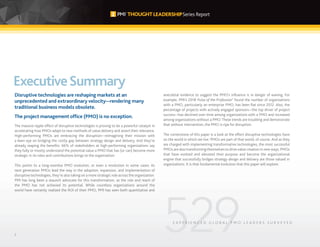
PeriscopeIQ’s online survey of 529 PMO directors across a breadth of industries and a smaller qualitative study among senior-
level functional managers who work with PMOs or equivalent project manager teams not technically referred to as PMOs.
The online survey gathered data from PMO directors around the world, including North America, Europe, the Middle East,
Africa, Asia Pacific, and Latin America.
The PMO directors also represented organizations of diverse sizes, with 51% of the respondents from organizations with
revenues under US$250 million, 17% with revenues between US$250 million and US$999 million, and 32% with revenues
above US$1 billion.
The surveys were completed in July 2018.
A B O U T C A P G E M I N I
A C K N O W L E D G E M E N T S
ABOUT
THISREPORT
1
> > F O R E W O R D
Strategy delivery is just as
important as strategy design—but too many
leaders don’t seem to realize it.
Organizations invest substantial resources, creative time, and energy into
developing and designing the right strategy, only to see it unravel in the
execution phase.On average,organizationsfailto meet 20%oftheir strategic
objectives because of poor implementation, and only 1 in 10 organizations
can deliver all of their strategic initiatives successfully, according a recent
survey by The Brightline™
Initiative.
Those shortcomings show up in bottom line results. Nearly 10 percent of
every dollar is wasted due to poor project performance, according to PMI’s
2018 PulseoftheProfession®
.Applied to the level of global capital investment
as calculated by the World Bank, that’s nearly US$1 million wasted every 20
seconds—and our society can’t afford to squander those resources.
The next generation project management office (PMO) can help solve this
execution problem. By partneringwiththeC-suite, it can helpto closethe gap
between strategy design and implementation, and work to align employees
who are skeptical of change.
The time is now. As you will see in this report, disruptive technologies such
as artificial intelligence and the cloud are shifting how PMOs work, with
whom they work, and even how they measure the project success. PMOs in
high-performing organizations see this digital transformation as an oppor-
tunity to evolve their role and reach. They are aligning strategically, leading
change management efforts, and building new capabilities.
As waves of disruption reshape the world, turning strategy into reality will
become a more complicated process—more circuitous than linear.The PMO
must become mission control.
RicardoVargas
Executive Director,
Brightline Initiative
2
ExecutiveSummary
Disruptive technologies are reshaping markets at an
unprecedented and extraordinary velocity—rendering many
traditional business models obsolete.
The project management office (PMO) is no exception.
The massive ripple effect of disruptive technologies is proving to be a powerful catalyst in
accelerating how PMOs adapt to new methods of value delivery and assert their relevance.
High-performing PMOs are embracing the disruption—reimagining their mission with
a keen eye on bridging the costly gap between strategy design and delivery. And they’re
already reaping the benefits: 66% of stakeholders at high-performing organizations say
they fully or mostly understand the potential value a PMO that has (or can) become more
strategic in its roles and contributions brings to the organization.
This points to a long-overdue PMO evolution, or even a revolution in some cases: As
next generation PMOs lead the way in the adoption, expansion, and implementation of
disruptive technologies, they’re also taking on a more strategic role across the organization.
PMI has long been a staunch advocate for this transformation, as the role and reach of
the PMO has not achieved its potential. While countless organizations around the
world have certainly realized the ROI of their PMO, PMI has seen both quantitative and
anecdotal evidence to suggest the PMO’s influence is in danger of waning. For
example, PMI’s 2018 Pulse of the Profession®
found the number of organizations
with a PMO, particularly an enterprise PMO, has been flat since 2012. Also, the
percentage of projects with actively engaged sponsors—the top driver of project
success—has declined over time among organizations with a PMO and increased
among organizations without a PMO.These trends are troubling and demonstrate
that without intervention, the PMO is ripe for disruption.
The cornerstone of this paper is a look at the effect disruptive technologies have
on the world in which we live. PMOs are part of that world, of course. And as they
are charged with implementing transformative technologies, the most successful
PMOs are also transforming themselves to drivevalue creation in new ways. PMOs
that have evolved and elevated their purpose and become the organizational
engine that successfully bridges strategy design and delivery are those valued in
organizations. It is that fundamental evolution that this paper will explore.
E X P E R I E N C E D G L O B A L P M O L E A D E R S S U R V E Y E D
THE NEXT GENERATION PMO
3
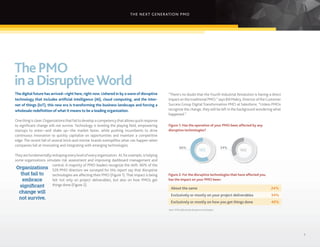
“There’s no doubt that the Fourth Industrial Revolution is having a direct
impactonthetraditional PMO,” says Bill Mabry, DirectoroftheCustomer
Success Group Digital Transformation PMO at Salesforce. “Unless PMOs
recognize the change, they will be left in the background wondering what
happened.”
Figure 1: Has the operation of your PMO been affected by any
disruptive technologies?
Figure 2: For the disruptive technologies that have affected you,
has the impact on your PMO been:
YES NO
66% 34%
ThePMO
inaDisruptiveWorld
The digital future has arrived—right here, right now. Ushered in by a wave of disruptive
technology that includes artificial intelligence (AI), cloud computing, and the inter-
net of things (IoT), this new era is transforming the business landscape and forcing a
wholesale redefinition of what it means to be a leading organization.
Onething is clear:Organizationsthatfailtodevelop a competencythat allowsquick response
to significant change will not survive. Technology is leveling the playing field, empowering
startups to enter—and shake up—the market faster, while pushing incumbents to drive
continuous innovation to quickly capitalize on opportunities and maintain a competitive
edge. The recent fall of several brick-and-mortar brands exemplifies what can happen when
companies fail at innovating and integrating with emerging technologies.
Theyarefundamentallyreshapingeverylevelofeveryorganization. AI,forexample,ishelping
some organizations simulate risk assessment and improving dashboard management and
control. A majority of PMO leaders recognize the shift: 66% of the
529 PMO directors we surveyed for this report say that disruptive
technologies are affecting their PMO (Figure 1).That impact is being
felt not only on project deliverables, but also on how PMOs get
things done (Figure 2).
About the same
Exclusively or mostly on your project deliverables
Exclusively or mostly on how you get things done
24%
34%
40%
Organizations
that fail to
embrace
significant
change will
not survive.
Base: PMOs affected by disruptive technologies.
4
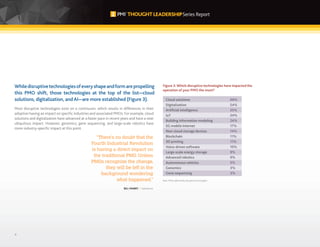
Whiledisruptivetechnologiesofeveryshapeandformarepropelling
this PMO shift, those technologies at the top of the list—cloud
solutions, digitalization, and AI—are more established (Figure 3).
Most disruptive technologies exist on a continuum, which results in differences in their
adoption having an impact on specific industries and associated PMOs. For example, cloud
solutions and digitalization have advanced at a faster pace in recent years and have a near
ubiquitous impact. However, genomics, gene sequencing, and large-scale robotics have
more industry-specific impact at this point.
Cloud solutions
Digitalization
Artificial intelligence
IoT
Building information modeling
5G mobile internet
Non-cloud storage devices
Blockchain
3D printing
Voice-driven software
Large-scale energy storage
Advanced robotics
Autonomous vehicles
Genomics
Gene sequencing
66%
54%
25%
24%
24%
17%
14%
11%
11%
10%
9%
9%
5%
3%
3%
Figure 3: Which disruptive technologies have impacted the
operation of your PMO the most?
Base: PMOs affected by disruptive technologies.
“There’s no doubt that the
Fourth Industrial Revolution
is having a direct impact on
the traditional PMO. Unless
PMOs recognize the change,
they will be left in the
background wondering
what happened.”
BILL MABRY // Salesforce
THE NEXT GENERATION PMO
5
Redesigning some of your PMO work processes
Collaborating more with other functions
Requiring new measures of progress, success, and risk
Using more advanced technologies for project management
Joining strategic projects at earlier stages
Responsible for more projects of high importance
Acquiring a more enterprise-wide scope of activity
Responsible for a greater number of projects
Having a bigger role securing project resources
Use of tools and innovative products and services
Specific project management or other skills required
within the PMO
Modified scope and/or methodologies of traditional
project management
Relationship with any other internal office or group
Relationship with an office of strategy management
(or equivalent unit) created or strengthened
Project manager engagement/morale increase
Headcount decrease
Outsourcing (entire PMO or components)
Headcount increase
Project manager engagement/morale decrease
59%
54%
50%
46%
44%
36%
35%
35%
25%
62%
51%
48%
43%
35%
35%
21%
20%
19%
14%
Base: PMOs affected by disruptive technologies.
Base: PMOs that have been formally reconfigured in response to one or more disruptive technologies.
The rapid emergence of disruptive technologies combined with short times to
market will certainly continue to reorder the rankings of top disruptors. But what
remains constant is the need for PMOs to:
> Adapt swiftly to the changes brought by these technologies
> Support initiatives grounded in disruptive technologies
> Learn how to apply these technologies to PMO functions themselves
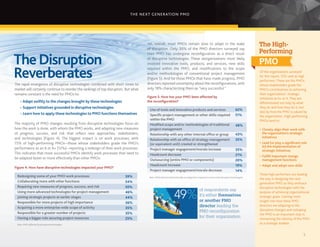
The majority of PMO changes resulting from disruptive technologies focus on
how the work is done, with whom the PMO works, and adapting new measures
of progress, success, and risk that reflect new approaches, stakeholders,
and technologies (Figure 4). The biggest impact is on work processes, with
75% of high-performing PMOs—those whose stakeholders grade the PMO’s
performance as an A or A+ (12%)—reporting a redesign of their work processes.
This indicates that more successful PMOs identify work processes that need to
be adapted faster or more effectively than other PMOs.
Figure 4: How have disruptive technologies impacted your PMO?
Figure 5: How has your PMO been affected by
the reconfiguration?
Yet, overall, most PMOs remain slow to adapt in the wake
of disruption. Only 30% of the PMO directors surveyed say
their PMO has undergone reconfiguration as a direct result
of disruptive technologies. These reorganizations most likely
involved innovative tools, products, and services, new skills
required within the PMO, and modifications to the scope
and/or methodologies of conventional project management
(Figure 5). And for those PMOs that have made progress, PMO
directors reported uncertainty about the reconfigurations, with
only 18% characterizing them as “very successful.”
TheDisruption
Reverberates
of respondents say
it’s either themselves
or another PMO
director leading the
PMO reconfiguration
for their organization.
49%
The High-
Performing
Of the organizations surveyed
for this report, 12% rank as high
performers. These are the PMOs
whose stakeholders grade the
PMO’s contributions to achieving
their organizations’ strategic
initiatives as A+ or A. They are
differentiated not only by what
they do and how they do it, but
also by how the PMO is valued by
the organization. High-performing
PMOs tend to:
• Closely align their work with
the organization’s strategic
initiatives
• Lead (or play a significant role
in) the implementation of
strategic initiatives
• Fulfill important change
management functions
• Adapt and adopt new skills
These high performers are leading
the way in designing the next
generation PMO as they embrace
disruptive technologies with the
purpose of achieving organizational
strategic goals. Gaining more
insight into how these PMO
directors are adapting to the
disruptive changes and reshaping
the PMO is an important step in
reinventing the identity of the PMO
as a strategic enabler.
PMO
5
6
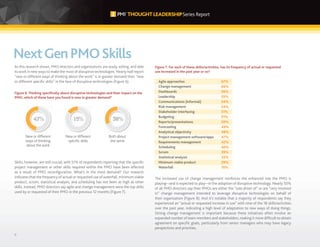
Figure 7: For each of these skills/activities, has its frequency of actual or requested
use increased in the past year or so?
The increased use of change management reinforces the enhanced role the PMO is
playing—and is expected to play—in the adoption of disruptive technology. Nearly 50%
of all PMO directors say their PMOs are either the “sole driver of” or are “very involved
in” change management intended to leverage disruptive technologies on behalf of
their organization (Figure 8). And it’s notable that a majority of respondents say they
experienced an “actual or requested increase in use” with nine of the 18 skills/activities
over the past year, indicating a high level of adaptation to new ways of doing things.
Strong change management is important because these initiatives often involve an
expanded number of team members and stakeholders, making it more difficult to obtain
agreement on specific goals, particularly from senior managers who may have legacy
perspectives and priorities.
Agile approaches
Change management
Dashboards
Leadership
Communications (informal)
Risk management
Stakeholder interfacing
Budgeting
Reports/presentations
Forecasting
Analytical objectivity
Project management software/apps
Requirements management
Scheduling
Scrum
Statistical analysis
Minimum viable product
Waterfall
67%
66%
56%
55%
54%
54%
51%
51%
50%
49%
48%
47%
42%
40%
39%
33%
29%
10%
NextGenPMOSkills
As this research shows, PMO directors and organizations are ready, willing, and able
to work in new ways to make the most of disruptive technologies. Nearly half report
“new or different ways of thinking about the work” is in greater demand than “new
or different specific skills” in the face of disruptive technologies (Figure 6).
Skills, however, are still crucial, with 51% of respondents reporting that the specific
project management or other skills required within the PMO have been affected
as a result of PMO reconfiguration. What’s in the most demand? Our research
indicates that the frequency of actual or requested use of waterfall, minimum viable
product, scrum, statistical analysis, and scheduling has not been as high as other
skills. Instead, PMO directors say agile and change management were the top skills
used by or requested of their PMO in the previous 12 months (Figure 7).
New or different
ways of thinking
about the work
New or different
specific skills
Both about
the same
Figure 6: Thinking specifically about disruptive technologies and their impact on the
PMO, which of these have you found is now in greater demand?
15%
47% 38%
THE NEXT GENERATION PMO
7
PMOs have notoriously been slow to change even in the wake of sweeping
economic or industry transformation. But the rise of disruptive technologies,
against the backdrop of shifting global market priorities and the drive for con-
tinuous innovation, may finally be spurring a true transformation of the PMO.
More than half (55%) of PMO directors say the charter for their PMO changed in the past five years,
with the majority saying they expect to have closer alignment with strategic initiatives in the future.
And 63% indicated their PMO had already shifted toward this important alignment (Figure 9). These
PMOs understand that in today’s disruptive landscape, an organization’s success depends on both
an effective and dynamic strategy as well as a creative and resilient execution of that strategy by an
empowered PMO.
And while strategy development largely remains a C-suite function for high-priority initiatives,
nearly 60% of respondents indicated the PMO is responsible for implementation of those initiatives
(Figure 10). Already, 37% of PMO directors say strategic initiatives within their organization are being
managed by the PMO, while 36% say that strategic initiatives are being managed with significant
PMO involvement as well as other leadership.
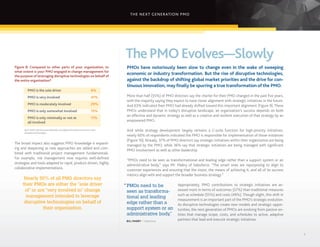
“PMOs need to be seen as transformational and leading edge rather than a support system or an
administrative body,” says Mr. Mabry of Salesforce. “The smart ones are repurposing to align to
customer experiences and ensuring that the vision, the means of achieving it, and all of its success
metrics align with and support the broader business strategy.”
Appropriately, PMO contributions to strategic initiatives are as-
sessed more in terms of outcomes (57%) than traditional measures
such as schedule (55%) and costs (49%). Though slight, this shift in
measurement is an important part of the PMO’s strategic evolution.
As disruptive technologies create new models and strategic oppor-
tunities, the next generation of PMOs are evolving from passive en-
tities that manage scope, costs, and schedules to active, adaptive
partners that lead and execute strategic initiatives.
Figure 8: Compared to other parts of your organization, to
what extent is your PMO engaged in change management for
the purpose of leveraging disruptive technologies on behalf of
the entire organization?
The broad impact also suggests PMO knowledge is expand-
ing and deepening as new approaches are added and com-
bined with traditional project management fundamentals.
For example, risk management now requires well-defined
strategies and tools adapted to rapid, product-driven, highly
collaborative implementations.
PMO is the sole driver
PMO is very involved
PMO is moderately involved
PMO is only somewhat involved
PMO is only minimally or not at
all involved
6%
41%
29%
13%
11%
Base: PMOs that have been formally reconfigured in response to one or more
disruptive technologies.
ThePMOEvolves—Slowly
“
BILL MABRY // Salesforce
PMOs need to be
seen as transforma-
tional and leading
edge rather than a
support system or an
administrative body.”
Nearly 50% of all PMO directors say
their PMOs are either the “sole driver
of”or are “very involved in”change
management intended to leverage
disruptive technologies on behalf of
their organization.
8
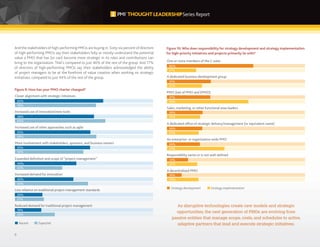
And the stakeholders of high-performing PMOs are buying in. Sixty-six percent of directors
of high-performing PMOs say their stakeholders fully or mostly understand the potential
value a PMO that has (or can) become more strategic in its roles and contributions can
bring to the organization. That’s compared to just 46% of the rest of the group. And 77%
of directors of high-performing PMOs say their stakeholders acknowledged the ability
of project managers to be at the forefront of value creation when working on strategic
initiatives, compared to just 44% of the rest of the group.
Figure 9: How has your PMO charter changed?
Figure 10: Who does responsibility for strategy development and strategy implementation
for high-priority initiatives and projects primarily lie with?
One or more members of the C-suite
A dedicated business development group
PMO (net of PMO and EPMO)
Sales, marketing, or other functional area leaders
A dedicated office of strategic delivery/management (or equivalent name)
An enterprise- or organization-wide PMO
Responsibility varies or is not well-defined
A decentralized PMO
Strategy development Strategy implementation
60%
21%
31%
25%
31%
59%
26%
24%
26%
23%
24%
41%
14%
22%
10%
23%
Closer alignment with strategic initiatives
Increased use of innovation/new tools
Increased use of other approaches such as agile
More involvement with stakeholders, sponsors, and business owners
Expanded definition and scope of “project management”
Increased demand for innovation
Less reliance on traditional project management standards
Reduced demand for traditional project management
Recent Expected
63%
59%
58%
64%
55%
59%
55%
50%
44%
34%
43%
54%
20%
21%
19%
29%
As disruptive technologies create new models and strategic
opportunities, the next generation of PMOs are evolving from
passive entities that manage scope, costs, and schedules to active,
adaptive partners that lead and execute strategic initiatives.
THE NEXT GENERATION PMO
9
ACallforAction
It’s a brutal business reality:The PMO must evolve.
No longer inextricably tied to traditional success measures like schedule and budget, this next generation PMO
must be a strategic enabler—bridging the gap between a company’s vision and how that vision comes to life.
Not only will this evolution ensure the organization is ready to make the most of disruptive technologies, but
that it can withstand future challenges and capitalize on future opportunities.
Higher-performing PMOs are leading the way—changing their charters, adjusting approaches, and reinventing
processes in ways that allow their organization to thrive in the new age of disruption.
9
10

pmohhhhhhhhhhhhhhhhhhhhhhhhhhhhhhhhhhhhhhhhhhhhhh

  • 1.
  • 2.
    A global leaderin consulting, technology services, and digital transformation, Capgemini is at the forefront of innovation to address the entire breadth of clients’ opportunities in the evolving world of cloud, digital, and platforms. Building on its strong 50-year heritage and deep industry-specific expertise, Capgemini enables organizations to realize their business ambitions through an array of services from strategy to operations. Capgemini is driven by the conviction that the business value of technology comes from and through people. It is a multicultural company of 200,000 team members in over 40 countries. The Group reported 2016 global revenues of €12.5 billion. Learn more about us at www.capgemini.com. PMIwould like to thank Carolyn Eichler, PMP,COO,CapgeminiGovernment Solutions, and her entire team, including co-author Attiya Salik, Program Manager,CapgeminiGovernment Solutions, for their time andwork put forth on this project aswell their expertise in this field of study. Capgemini Government Solutions has partnered with PMI to explore the impact of disruptive technologies on the next generation project management office (PMO). The Next Generation PMO report highlights and analyzes key findings from PeriscopeIQ’s online survey of 529 PMO directors across a breadth of industries and a smaller qualitative study among senior- level functional managers who work with PMOs or equivalent project manager teams not technically referred to as PMOs. The online survey gathered data from PMO directors around the world, including North America, Europe, the Middle East, Africa, Asia Pacific, and Latin America. The PMO directors also represented organizations of diverse sizes, with 51% of the respondents from organizations with revenues under US$250 million, 17% with revenues between US$250 million and US$999 million, and 32% with revenues above US$1 billion. The surveys were completed in July 2018. A B O U T C A P G E M I N I A C K N O W L E D G E M E N T S ABOUT THISREPORT
  • 3.
    1 > > FO R E W O R D Strategy delivery is just as important as strategy design—but too many leaders don’t seem to realize it. Organizations invest substantial resources, creative time, and energy into developing and designing the right strategy, only to see it unravel in the execution phase.On average,organizationsfailto meet 20%oftheir strategic objectives because of poor implementation, and only 1 in 10 organizations can deliver all of their strategic initiatives successfully, according a recent survey by The Brightline™ Initiative. Those shortcomings show up in bottom line results. Nearly 10 percent of every dollar is wasted due to poor project performance, according to PMI’s 2018 PulseoftheProfession® .Applied to the level of global capital investment as calculated by the World Bank, that’s nearly US$1 million wasted every 20 seconds—and our society can’t afford to squander those resources. The next generation project management office (PMO) can help solve this execution problem. By partneringwiththeC-suite, it can helpto closethe gap between strategy design and implementation, and work to align employees who are skeptical of change. The time is now. As you will see in this report, disruptive technologies such as artificial intelligence and the cloud are shifting how PMOs work, with whom they work, and even how they measure the project success. PMOs in high-performing organizations see this digital transformation as an oppor- tunity to evolve their role and reach. They are aligning strategically, leading change management efforts, and building new capabilities. As waves of disruption reshape the world, turning strategy into reality will become a more complicated process—more circuitous than linear.The PMO must become mission control. RicardoVargas Executive Director, Brightline Initiative
  • 4.
    2 ExecutiveSummary Disruptive technologies arereshaping markets at an unprecedented and extraordinary velocity—rendering many traditional business models obsolete. The project management office (PMO) is no exception. The massive ripple effect of disruptive technologies is proving to be a powerful catalyst in accelerating how PMOs adapt to new methods of value delivery and assert their relevance. High-performing PMOs are embracing the disruption—reimagining their mission with a keen eye on bridging the costly gap between strategy design and delivery. And they’re already reaping the benefits: 66% of stakeholders at high-performing organizations say they fully or mostly understand the potential value a PMO that has (or can) become more strategic in its roles and contributions brings to the organization. This points to a long-overdue PMO evolution, or even a revolution in some cases: As next generation PMOs lead the way in the adoption, expansion, and implementation of disruptive technologies, they’re also taking on a more strategic role across the organization. PMI has long been a staunch advocate for this transformation, as the role and reach of the PMO has not achieved its potential. While countless organizations around the world have certainly realized the ROI of their PMO, PMI has seen both quantitative and anecdotal evidence to suggest the PMO’s influence is in danger of waning. For example, PMI’s 2018 Pulse of the Profession® found the number of organizations with a PMO, particularly an enterprise PMO, has been flat since 2012. Also, the percentage of projects with actively engaged sponsors—the top driver of project success—has declined over time among organizations with a PMO and increased among organizations without a PMO.These trends are troubling and demonstrate that without intervention, the PMO is ripe for disruption. The cornerstone of this paper is a look at the effect disruptive technologies have on the world in which we live. PMOs are part of that world, of course. And as they are charged with implementing transformative technologies, the most successful PMOs are also transforming themselves to drivevalue creation in new ways. PMOs that have evolved and elevated their purpose and become the organizational engine that successfully bridges strategy design and delivery are those valued in organizations. It is that fundamental evolution that this paper will explore. E X P E R I E N C E D G L O B A L P M O L E A D E R S S U R V E Y E D
  • 5.
    THE NEXT GENERATIONPMO 3 “There’s no doubt that the Fourth Industrial Revolution is having a direct impactonthetraditional PMO,” says Bill Mabry, DirectoroftheCustomer Success Group Digital Transformation PMO at Salesforce. “Unless PMOs recognize the change, they will be left in the background wondering what happened.” Figure 1: Has the operation of your PMO been affected by any disruptive technologies? Figure 2: For the disruptive technologies that have affected you, has the impact on your PMO been: YES NO 66% 34% ThePMO inaDisruptiveWorld The digital future has arrived—right here, right now. Ushered in by a wave of disruptive technology that includes artificial intelligence (AI), cloud computing, and the inter- net of things (IoT), this new era is transforming the business landscape and forcing a wholesale redefinition of what it means to be a leading organization. Onething is clear:Organizationsthatfailtodevelop a competencythat allowsquick response to significant change will not survive. Technology is leveling the playing field, empowering startups to enter—and shake up—the market faster, while pushing incumbents to drive continuous innovation to quickly capitalize on opportunities and maintain a competitive edge. The recent fall of several brick-and-mortar brands exemplifies what can happen when companies fail at innovating and integrating with emerging technologies. Theyarefundamentallyreshapingeverylevelofeveryorganization. AI,forexample,ishelping some organizations simulate risk assessment and improving dashboard management and control. A majority of PMO leaders recognize the shift: 66% of the 529 PMO directors we surveyed for this report say that disruptive technologies are affecting their PMO (Figure 1).That impact is being felt not only on project deliverables, but also on how PMOs get things done (Figure 2). About the same Exclusively or mostly on your project deliverables Exclusively or mostly on how you get things done 24% 34% 40% Organizations that fail to embrace significant change will not survive. Base: PMOs affected by disruptive technologies.
  • 6.
    4 Whiledisruptivetechnologiesofeveryshapeandformarepropelling this PMO shift,those technologies at the top of the list—cloud solutions, digitalization, and AI—are more established (Figure 3). Most disruptive technologies exist on a continuum, which results in differences in their adoption having an impact on specific industries and associated PMOs. For example, cloud solutions and digitalization have advanced at a faster pace in recent years and have a near ubiquitous impact. However, genomics, gene sequencing, and large-scale robotics have more industry-specific impact at this point. Cloud solutions Digitalization Artificial intelligence IoT Building information modeling 5G mobile internet Non-cloud storage devices Blockchain 3D printing Voice-driven software Large-scale energy storage Advanced robotics Autonomous vehicles Genomics Gene sequencing 66% 54% 25% 24% 24% 17% 14% 11% 11% 10% 9% 9% 5% 3% 3% Figure 3: Which disruptive technologies have impacted the operation of your PMO the most? Base: PMOs affected by disruptive technologies. “There’s no doubt that the Fourth Industrial Revolution is having a direct impact on the traditional PMO. Unless PMOs recognize the change, they will be left in the background wondering what happened.” BILL MABRY // Salesforce
  • 7.
    THE NEXT GENERATIONPMO 5 Redesigning some of your PMO work processes Collaborating more with other functions Requiring new measures of progress, success, and risk Using more advanced technologies for project management Joining strategic projects at earlier stages Responsible for more projects of high importance Acquiring a more enterprise-wide scope of activity Responsible for a greater number of projects Having a bigger role securing project resources Use of tools and innovative products and services Specific project management or other skills required within the PMO Modified scope and/or methodologies of traditional project management Relationship with any other internal office or group Relationship with an office of strategy management (or equivalent unit) created or strengthened Project manager engagement/morale increase Headcount decrease Outsourcing (entire PMO or components) Headcount increase Project manager engagement/morale decrease 59% 54% 50% 46% 44% 36% 35% 35% 25% 62% 51% 48% 43% 35% 35% 21% 20% 19% 14% Base: PMOs affected by disruptive technologies. Base: PMOs that have been formally reconfigured in response to one or more disruptive technologies. The rapid emergence of disruptive technologies combined with short times to market will certainly continue to reorder the rankings of top disruptors. But what remains constant is the need for PMOs to: > Adapt swiftly to the changes brought by these technologies > Support initiatives grounded in disruptive technologies > Learn how to apply these technologies to PMO functions themselves The majority of PMO changes resulting from disruptive technologies focus on how the work is done, with whom the PMO works, and adapting new measures of progress, success, and risk that reflect new approaches, stakeholders, and technologies (Figure 4). The biggest impact is on work processes, with 75% of high-performing PMOs—those whose stakeholders grade the PMO’s performance as an A or A+ (12%)—reporting a redesign of their work processes. This indicates that more successful PMOs identify work processes that need to be adapted faster or more effectively than other PMOs. Figure 4: How have disruptive technologies impacted your PMO? Figure 5: How has your PMO been affected by the reconfiguration? Yet, overall, most PMOs remain slow to adapt in the wake of disruption. Only 30% of the PMO directors surveyed say their PMO has undergone reconfiguration as a direct result of disruptive technologies. These reorganizations most likely involved innovative tools, products, and services, new skills required within the PMO, and modifications to the scope and/or methodologies of conventional project management (Figure 5). And for those PMOs that have made progress, PMO directors reported uncertainty about the reconfigurations, with only 18% characterizing them as “very successful.” TheDisruption Reverberates of respondents say it’s either themselves or another PMO director leading the PMO reconfiguration for their organization. 49% The High- Performing Of the organizations surveyed for this report, 12% rank as high performers. These are the PMOs whose stakeholders grade the PMO’s contributions to achieving their organizations’ strategic initiatives as A+ or A. They are differentiated not only by what they do and how they do it, but also by how the PMO is valued by the organization. High-performing PMOs tend to: • Closely align their work with the organization’s strategic initiatives • Lead (or play a significant role in) the implementation of strategic initiatives • Fulfill important change management functions • Adapt and adopt new skills These high performers are leading the way in designing the next generation PMO as they embrace disruptive technologies with the purpose of achieving organizational strategic goals. Gaining more insight into how these PMO directors are adapting to the disruptive changes and reshaping the PMO is an important step in reinventing the identity of the PMO as a strategic enabler. PMO 5
  • 8.
    6 Figure 7: Foreach of these skills/activities, has its frequency of actual or requested use increased in the past year or so? The increased use of change management reinforces the enhanced role the PMO is playing—and is expected to play—in the adoption of disruptive technology. Nearly 50% of all PMO directors say their PMOs are either the “sole driver of” or are “very involved in” change management intended to leverage disruptive technologies on behalf of their organization (Figure 8). And it’s notable that a majority of respondents say they experienced an “actual or requested increase in use” with nine of the 18 skills/activities over the past year, indicating a high level of adaptation to new ways of doing things. Strong change management is important because these initiatives often involve an expanded number of team members and stakeholders, making it more difficult to obtain agreement on specific goals, particularly from senior managers who may have legacy perspectives and priorities. Agile approaches Change management Dashboards Leadership Communications (informal) Risk management Stakeholder interfacing Budgeting Reports/presentations Forecasting Analytical objectivity Project management software/apps Requirements management Scheduling Scrum Statistical analysis Minimum viable product Waterfall 67% 66% 56% 55% 54% 54% 51% 51% 50% 49% 48% 47% 42% 40% 39% 33% 29% 10% NextGenPMOSkills As this research shows, PMO directors and organizations are ready, willing, and able to work in new ways to make the most of disruptive technologies. Nearly half report “new or different ways of thinking about the work” is in greater demand than “new or different specific skills” in the face of disruptive technologies (Figure 6). Skills, however, are still crucial, with 51% of respondents reporting that the specific project management or other skills required within the PMO have been affected as a result of PMO reconfiguration. What’s in the most demand? Our research indicates that the frequency of actual or requested use of waterfall, minimum viable product, scrum, statistical analysis, and scheduling has not been as high as other skills. Instead, PMO directors say agile and change management were the top skills used by or requested of their PMO in the previous 12 months (Figure 7). New or different ways of thinking about the work New or different specific skills Both about the same Figure 6: Thinking specifically about disruptive technologies and their impact on the PMO, which of these have you found is now in greater demand? 15% 47% 38%
  • 9.
    THE NEXT GENERATIONPMO 7 PMOs have notoriously been slow to change even in the wake of sweeping economic or industry transformation. But the rise of disruptive technologies, against the backdrop of shifting global market priorities and the drive for con- tinuous innovation, may finally be spurring a true transformation of the PMO. More than half (55%) of PMO directors say the charter for their PMO changed in the past five years, with the majority saying they expect to have closer alignment with strategic initiatives in the future. And 63% indicated their PMO had already shifted toward this important alignment (Figure 9). These PMOs understand that in today’s disruptive landscape, an organization’s success depends on both an effective and dynamic strategy as well as a creative and resilient execution of that strategy by an empowered PMO. And while strategy development largely remains a C-suite function for high-priority initiatives, nearly 60% of respondents indicated the PMO is responsible for implementation of those initiatives (Figure 10). Already, 37% of PMO directors say strategic initiatives within their organization are being managed by the PMO, while 36% say that strategic initiatives are being managed with significant PMO involvement as well as other leadership. “PMOs need to be seen as transformational and leading edge rather than a support system or an administrative body,” says Mr. Mabry of Salesforce. “The smart ones are repurposing to align to customer experiences and ensuring that the vision, the means of achieving it, and all of its success metrics align with and support the broader business strategy.” Appropriately, PMO contributions to strategic initiatives are as- sessed more in terms of outcomes (57%) than traditional measures such as schedule (55%) and costs (49%). Though slight, this shift in measurement is an important part of the PMO’s strategic evolution. As disruptive technologies create new models and strategic oppor- tunities, the next generation of PMOs are evolving from passive en- tities that manage scope, costs, and schedules to active, adaptive partners that lead and execute strategic initiatives. Figure 8: Compared to other parts of your organization, to what extent is your PMO engaged in change management for the purpose of leveraging disruptive technologies on behalf of the entire organization? The broad impact also suggests PMO knowledge is expand- ing and deepening as new approaches are added and com- bined with traditional project management fundamentals. For example, risk management now requires well-defined strategies and tools adapted to rapid, product-driven, highly collaborative implementations. PMO is the sole driver PMO is very involved PMO is moderately involved PMO is only somewhat involved PMO is only minimally or not at all involved 6% 41% 29% 13% 11% Base: PMOs that have been formally reconfigured in response to one or more disruptive technologies. ThePMOEvolves—Slowly “ BILL MABRY // Salesforce PMOs need to be seen as transforma- tional and leading edge rather than a support system or an administrative body.” Nearly 50% of all PMO directors say their PMOs are either the “sole driver of”or are “very involved in”change management intended to leverage disruptive technologies on behalf of their organization.
  • 10.
    8 And the stakeholdersof high-performing PMOs are buying in. Sixty-six percent of directors of high-performing PMOs say their stakeholders fully or mostly understand the potential value a PMO that has (or can) become more strategic in its roles and contributions can bring to the organization. That’s compared to just 46% of the rest of the group. And 77% of directors of high-performing PMOs say their stakeholders acknowledged the ability of project managers to be at the forefront of value creation when working on strategic initiatives, compared to just 44% of the rest of the group. Figure 9: How has your PMO charter changed? Figure 10: Who does responsibility for strategy development and strategy implementation for high-priority initiatives and projects primarily lie with? One or more members of the C-suite A dedicated business development group PMO (net of PMO and EPMO) Sales, marketing, or other functional area leaders A dedicated office of strategic delivery/management (or equivalent name) An enterprise- or organization-wide PMO Responsibility varies or is not well-defined A decentralized PMO Strategy development Strategy implementation 60% 21% 31% 25% 31% 59% 26% 24% 26% 23% 24% 41% 14% 22% 10% 23% Closer alignment with strategic initiatives Increased use of innovation/new tools Increased use of other approaches such as agile More involvement with stakeholders, sponsors, and business owners Expanded definition and scope of “project management” Increased demand for innovation Less reliance on traditional project management standards Reduced demand for traditional project management Recent Expected 63% 59% 58% 64% 55% 59% 55% 50% 44% 34% 43% 54% 20% 21% 19% 29% As disruptive technologies create new models and strategic opportunities, the next generation of PMOs are evolving from passive entities that manage scope, costs, and schedules to active, adaptive partners that lead and execute strategic initiatives.
  • 11.
    THE NEXT GENERATIONPMO 9 ACallforAction It’s a brutal business reality:The PMO must evolve. No longer inextricably tied to traditional success measures like schedule and budget, this next generation PMO must be a strategic enabler—bridging the gap between a company’s vision and how that vision comes to life. Not only will this evolution ensure the organization is ready to make the most of disruptive technologies, but that it can withstand future challenges and capitalize on future opportunities. Higher-performing PMOs are leading the way—changing their charters, adjusting approaches, and reinventing processes in ways that allow their organization to thrive in the new age of disruption. 9
  • 12.