Preference
Learning:
A
Tutorial
Introduc5on
Eyke
Hüllermeier
Knowledge
Engineering
&
Bioinforma2cs
Lab
Dept.
of
Mathema2cs
and
Computer
Science
Marburg
University,
Germany
DS
2011,
Espoo,
Finland,
Oct
2011
Johannes
Fürnkranz
Knowledge
Engineering
Dept.
of
Computer
Science
Technical
University
Darmstadt,
Germany
2.
DS
2011
Tutorial
on
Preference
Learning
|
Part
1
|
J.
Fürnkranz
&
E.
Hüllermeier
What
is
Preference
Learning
?
§ Preference
learning
is
an
emerging
subfield
of
machine
learning
§ Roughly
speaking,
it
deals
with
the
learning
of
(predic5ve)
preference
models
from
observed
(or
extracted)
preference
informa2on
MACHINE
LEARNING
PREFERENCE
MODELING
and
DECISION
ANALYSIS
Preference
Learning
computer
science
ar2ficial
intelligence
opera2ons
research
social
sciences
(vo2ng
and
choice
theory)
economics
and
decision
theory
2
3.
DS
2011
Tutorial
on
Preference
Learning
|
Part
1
|
J.
Fürnkranz
&
E.
Hüllermeier
Workshops
and
Related
Events
§ NIPS–01:
New
Methods
for
Preference
Elicita2on
§ NIPS–02:
Beyond
Classifica2on
and
Regression:
Learning
Rankings,
Preferences,
Equality
Predicates,
and
Other
Structures
§ KI–03:
Preference
Learning:
Models,
Methods,
Applica2ons
§ NIPS–04:
Learning
With
Structured
Outputs
§ NIPS–05:
Workshop
on
Learning
to
Rank
§ IJCAI–05:
Advances
in
Preference
Handling
§ SIGIR
07–10:
Workshop
on
Learning
to
Rank
for
Informa2on
Retrieval
§ ECML/PDKK
08–10:
Workshop
on
Preference
Learning
§ NIPS–09:
Workshop
on
Advances
in
Ranking
§ American
Ins2tute
of
Mathema2cs
Workshop
in
Summer
2010:
The
Mathema2cs
of
Ranking
§ NIPS-‐11:
Workshop
on
Choice
Models
and
Preference
Learning
3
4.
DS
2011
Tutorial
on
Preference
Learning
|
Part
1
|
J.
Fürnkranz
&
E.
Hüllermeier
Preferences
in
Ar5ficial
Intelligence
User
preferences
play
a
key
role
in
various
fields
of
applica2on:
- recommender
systems,
- adap2ve
user
interfaces,
- adap2ve
retrieval
systems,
- autonomous
agents
(electronic
commerce),
- games,
…
Preferences
in
AI
research:
- preference
representa5on
(CP
nets,
GAU
networks,
logical
representa2ons,
fuzzy
constraints,
…)
- reasoning
with
preferences
(decision
theory,
constraint
sa2sfac2on,
non-‐monotonic
reasoning,
…)
- preference
acquisi5on
(preference
elicita2on,
preference
learning,
...)
More
generally,
„preferences“
is
a
key
topic
in
current
AI
research
4
5.
DS
2011
Tutorial
on
Preference
Learning
|
Part
1
|
J.
Fürnkranz
&
E.
Hüllermeier
AGENDA
1. Preference
Learning
Tasks
2. Performance
Assessment
and
Loss
Func2ons
3. Preference
Learning
Techniques
4. Conclusions
5
6.
DS
2011
Tutorial
on
Preference
Learning
|
Part
1
|
J.
Fürnkranz
&
E.
Hüllermeier
Preference
Learning
Preference
learning
problems
can
be
dis2nguished
along
several
problem
dimensions,
including
§ representa5on
of
preferences,
type
of
preference
model:
- u2lity
func2on
(ordinal,
numeric),
- preference
rela2on
(par2al
order,
ranking,
…),
- logical
representa2on,
…
§ descrip5on
of
individuals/users
and
alterna5ves/items:
- iden2fier,
feature
vector,
structured
object,
…
§ type
of
training
input:
- direct
or
indirect
feedback,
- complete
or
incomplete
rela2ons,
- u2li2es,
…
§ …
6
7.
DS
2011
Tutorial
on
Preference
Learning
|
Part
1
|
J.
Fürnkranz
&
E.
Hüllermeier
Preference
Learning
7
Preferences
absolute
rela5ve
A B
C
D
1
1
0
0
A
B
C
D
.9
.8
.1
.3
binary
gradual
total
order
par5al
order
Â
A Â Â
B C D Â
A
B
C
D
Â
ordinal
numeric
A
B
C
D
+
+
-‐
0
à
(ordinal)
regression
à
classifica2on/ranking
assessing
comparing
8.
DS
2011
Tutorial
on
Preference
Learning
|
Part
1
|
J.
Fürnkranz
&
E.
Hüllermeier
Structure
of
this
Overview
(1) Preference
learning
as
an
extension
of
conven5onal
supervised
learning:
Learn
a
mapping
that
maps
instances
to
preference
models
(à
structured/complex
output
predic2on).
(2) Other
selngs
(object
ranking,
instance
ranking,
CF,
…)
8
9.
DS
2011
Tutorial
on
Preference
Learning
|
Part
1
|
J.
Fürnkranz
&
E.
Hüllermeier
Structure
of
this
Overview
(1) Preference
learning
as
an
extension
of
conven5onal
supervised
learning:
Learn
a
mapping
that
maps
instances
to
preference
models
(à
structured/complex
output
predic2on).
Instances
are
typically
(though
not
necessarily)
characterized
in
terms
of
a
feature
vector.
The
output
space
consists
of
preference
models
over
a
fixed
set
of
alterna2ves
(classes,
labels,
…)
represented
in
terms
of
an
iden2fier
à
extensions
of
mul--‐class
classifica-on
9
10.
DS
2011
Tutorial
on
Preference
Learning
|
Part
1
|
J.
Fürnkranz
&
E.
Hüllermeier
Mul5label
Classifica5on
[Tsoumakas
&
Katakis
2007]
10
X1
X2
X3
X4
A
B
C
D
0.34
0
10
174
0
1
1
0
1.45
0
32
277
0
1
0
1
1.22
1
46
421
0
0
0
1
0.74
1
25
165
0
1
1
1
0.95
1
72
273
1
0
1
0
1.04
0
33
158
1
1
1
0
0.92
1
81
382
0
1
0
1
Training
0.92
1
81
382
1
1
0
1
Binary
preferences
on
a
fixed
set
of
items:
liked
or
disliked
Predic5on
Ground
truth
LOSS
11.
DS
2011
Tutorial
on
Preference
Learning
|
Part
1
|
J.
Fürnkranz
&
E.
Hüllermeier
Mul5label
Ranking
11
X1
X2
X3
X4
A
B
C
D
0.34
0
10
174
0
1
1
0
1.45
0
32
277
0
1
0
1
1.22
1
46
421
0
0
0
1
0.74
1
25
165
0
1
1
1
0.95
1
72
273
1
0
1
0
1.04
0
33
158
1
1
1
0
0.92
1
81
382
4
1
3
2
Training
Predic5on
0.92
1
81
382
1
1
0
1
Ground
truth
Â
B Â Â
D C A
Binary
preferences
on
a
fixed
set
of
items:
liked
or
disliked
A
ranking
of
all
items
LOSS
12.
DS
2011
Tutorial
on
Preference
Learning
|
Part
1
|
J.
Fürnkranz
&
E.
Hüllermeier
Graded
Mul5label
Classifica5on
[Cheng
et
al.
2010]
12
X1
X2
X3
X4
A
B
C
D
0.34
0
10
174
-‐-‐
+
++
0
1.45
0
32
277
0
++
-‐-‐
+
1.22
1
46
421
-‐-‐
-‐-‐
0
+
0.74
1
25
165
0
+
+
++
0.95
1
72
273
+
0
++
-‐-‐
1.04
0
33
158
+
+
++
-‐-‐
0.92
1
81
382
-‐-‐
+
0
++
Training
Predic5on
0.92
1
81
382
0
++
-‐-‐
+
Ground
truth
Ordinal
preferences
on
a
fixed
set
of
items:
liked,
disliked,
or
something
in-‐
between
LOSS
13.
DS
2011
Tutorial
on
Preference
Learning
|
Part
1
|
J.
Fürnkranz
&
E.
Hüllermeier
Graded
Mul5label
Ranking
13
X1
X2
X3
X4
A
B
C
D
0.34
0
10
174
-‐-‐
+
++
0
1.45
0
32
277
0
++
-‐-‐
+
1.22
1
46
421
-‐-‐
-‐-‐
0
+
0.74
1
25
165
0
+
+
++
0.95
1
72
273
+
0
++
-‐-‐
1.04
0
33
158
+
+
++
-‐-‐
0.92
1
81
382
4
1
3
2
Training
Predic5on
0.92
1
81
382
0
++
-‐-‐
+
Ground
truth
Â
B Â Â
D C A
A
ranking
of
all
items
LOSS
Ordinal
preferences
on
a
fixed
set
of
items:
liked,
disliked,
or
something
in-‐
between
14.
DS
2011
Tutorial
on
Preference
Learning
|
Part
1
|
J.
Fürnkranz
&
E.
Hüllermeier
Label
Ranking
[Hüllermeier
et
al.
2008]
14
X1
X2
X3
X4
Preferences
0.34
0
10
174
A
Â
B,
B
Â
C,
C
Â
D
1.45
0
32
277
B
Â
C
1.22
1
46
421
B
Â
D,
A
Â
D,
C
Â
D,
A
Â
C
0.74
1
25
165
C
Â
A,
C
Â
D,
A
Â
B
0.95
1
72
273
B
Â
D,
A
Â
D
1.04
0
33
158
D
Â
A,
A
Â
B,
C
Â
B,
A
Â
C
0.92
1
81
382
4
1
3
2
Training
Predic5on
0.92
1
81
382
2
1
3
4
Ground
truth
Â
B Â Â
D C A
A
ranking
of
all
labels
Instances
are
associated
with
pairwise
preferences
between
labels.
LOSS
15.
DS
2011
Tutorial
on
Preference
Learning
|
Part
1
|
J.
Fürnkranz
&
E.
Hüllermeier
Calibrated
Label
Ranking
[Fürnkranz
et
al.
2008]
15
Combining
absolute
and
rela2ve
evalua2on:
Â
a Â
b c
d   Â
e f
g
relevant
posi2ve
liked
irrelevant
nega2ve
disliked
Preferences
absolute
rela5ve
16.
DS
2011
Tutorial
on
Preference
Learning
|
Part
1
|
J.
Fürnkranz
&
E.
Hüllermeier
Structure
of
this
Overview
(1) Preference
Learning
as
an
extension
of
conven2onal
supervised
learning:
Learn
a
mapping
that
maps
instances
to
preference
models
(à
structured
output
predic2on).
(2) Other
sedngs
(no
clear
dis2nc2on
between
input/output
space)
object
ranking,
instance
ranking,
collabora2ve
filtering
16
17.
DS
2011
Tutorial
on
Preference
Learning
|
Part
1
|
J.
Fürnkranz
&
E.
Hüllermeier
Object
Ranking
[Cohen
et
al.
99]
17
Training
Pairwise
preferences
between
objects
(instances).
Predic5on
(ranking
a
new
set
of
objects)
Ground
truth
(ranking
or
top-‐ranking
or
subset
of
relevant
objects)
18.
DS
2011
Tutorial
on
Preference
Learning
|
Part
1
|
J.
Fürnkranz
&
E.
Hüllermeier
Instance
Ranking
[Fürnkranz
et
al.
2009]
18
Training
X1
X2
X3
X4
class
0.34
0
10
174
-‐-‐
1.45
0
32
277
0
0.74
1
25
165
++
…
…
…
…
…
0.95
1
72
273
+
Predic5on
(ranking
a
new
set
of
objects)
+
0
++
++
-‐-‐
+
0
+
-‐-‐
0
0
-‐-‐
-‐-‐
Ground
truth
(ordinal
classes)
Absolute
preferences
on
an
ordinal
scale.
19.
DS
2011
Tutorial
on
Preference
Learning
|
Part
1
|
J.
Fürnkranz
&
E.
Hüllermeier
Instance
Ranking
[Fürnkranz
et
al.
2009]
19
predicted
ranking,
e.g.,
through
sor2ng
by
es2mated
score
most
likely
good
most
likely
bad
ranking
error
Extension
of
AUC
maximiza2on
to
the
polytomous
case,
in
which
instances
are
rated
on
an
ordinal
scale
such
as
{
bad, medium, good}
Query
set
of
instances
to
be
ranked
(true
labels
are
unknown).
20.
DS
2011
Tutorial
on
Preference
Learning
|
Part
1
|
J.
Fürnkranz
&
E.
Hüllermeier
Collabora5ve
Filtering
[Goldberg
et
al.
1992]
20
P1
P2
P3
…
P38
…
P88
P89
P90
U1
1
4
…
…
3
U2
2
2
…
…
1
…
…
…
U46
?
2
?
…
?
…
?
?
4
…
…
…
U98
5
…
…
4
U99
1
…
…
2
1:
very
bad,
2:
bad,
3:
fair,
4:
good,
5:
excellent
U
S
E
R
S
P
R
O
D
U
C
T
S
Inputs
and
outputs
as
iden2fiers,
absolute
preferences
in
terms
of
ordinal
degrees.
DS
2011
Tutorial
on
Preference
Learning
|
Part
1
|
J.
Fürnkranz
&
E.
Hüllermeier
Preference
Learning
Tasks
22
task
input
output
training
predic5on
ground
truth
collabora2ve
filtering
iden2fier
iden5fier
absolute
ordinal
absolute
ordinal
absolute
ordinal
mul2label
classifica2on
feature
iden5fier
absolute
binary
absolute
binary
absolute
binary
mul2label
ranking
feature
iden5fier
absolute
binary
ranking
absolute
binary
graded
mul2label
classifica2on
feature
iden5fier
absolute
ordinal
absolute
ordinal
absolute
ordinal
label
ranking
feature
iden5fier
rela2ve
binary
ranking
ranking
object
ranking
feature
-‐-‐
rela2ve
binary
ranking
ranking
or
subset
instance
ranking
feature
iden2fier
absolute
ordinal
ranking
absolute
ordinal
generalized
c
lassifica2on
ranking
Two
main
direc2ons:
(1)
ranking
and
variants
(2)
generaliza2ons
of
classifica2on.
representa2on
type
of
preference
informa2on
23.
DS
2011
Tutorial
on
Preference
Learning
|
Part
1
|
J.
Fürnkranz
&
E.
Hüllermeier
Loss
Func5ons
23
absolute
u2lity
degree
absolute
u2lity
degree
subset
of
preferred
items
subset
of
preferred
items
subset
of
preferred
items
ranking
of
items
fuzzy
subset
of
preferred
items
fuzzy
subset
of
preferred
items
ranking
of
items
ranking
of
items
ranking
of
items
ordered
par22on
of
items
Things
to
be
compared:
standard
comparison
of
scalar
predic2ons
non-‐standard
c
omparisons
predic5on
ground
truth
24.
DS
2011
Tutorial
on
Preference
Learning
|
Part
1
|
J.
Fürnkranz
&
E.
Hüllermeier
24
References
§ W.
Cheng,
K.
Dembczynski
and
E.
Hüllermeier.
Graded
Mul-label
Classifica-on:
The
Ordinal
Case.
ICML-‐2010,
Haifa,
Israel,
2010.
§ W.
Cheng
and
E.
Hüllermeier.
Predic-ng
par-al
orders:
Ranking
with
absten-on.
ECML/PKDD-‐2010,
Barcelona,
2010.
§ Y.
Chevaleyre,
F.
Koriche,
J.
Lang,
J.
Mengin,
B.
Zanulni.
Learning
ordinal
preferences
on
mul-aCribute
domains:
The
case
of
CP-‐nets.
In:
J.
Fürnkranz
and
E.
Hüllermeier
(eds.)
Preference
Learning,
Springer-‐Verlag,
2010.
§ W.W.
Cohen,
R.E.
Schapire
and
Y.
Singer.
Learning
to
order
things.
Journal
of
Ar2ficial
Intelligence
Research,
10:243–270,
1999.
§ J.
Fürnkranz,
E.
Hüllermeier,
E.
Mencia,
and
K.
Brinker.
Mul-label
Classifica-on
via
Calibrated
Label
Ranking.
Machine
Learning
73(2):133-‐153,
2008.
§ J.
Fürnkranz,
E.
Hüllermeier
and
S.
Vanderlooy.
Binary
decomposi-on
methods
for
mul-par-te
ranking.
Proc.
ECML-‐2009,
Bled,
Slovenia,
2009.
§ D.
Goldberg,
D.
Nichols,
B.M.
Oki
and
D.
Terry.
Using
collabora-ve
filtering
to
weave
and
informa-on
tapestry.
Communica2ons
of
the
ACM,
35(12):61–70,
1992.
§ E.
Hüllermeier,
J.
Fürnkranz,
W.
Cheng
and
K.
Brinker.
Label
ranking
by
learning
pairwise
preferences.
Ar2ficial
Intelligence,
172:1897–1916,
2008.
§ G.
Tsoumakas
and
I.
Katakis.
Mul--‐label
classifica-on:
An
overview.
Int.
J.
Data
Warehouse
and
Mining,
3:1–13,
2007.
§ A.K.
Menon
and
C.
Elkan.
Predic-ng
labels
for
dyadic
data.
Data
Mining
and
Knowledge
Discovery,
21(2),
2010
25.
DS-2011 Tutorial onPreference Learning | Part 2 | E. Hüllermeier & J. Fürnkranz
1
AGENDA
1. Preference Learning Tasks
2. Loss Functions
a. Evaluation of Rankings
b. Weighted Measures
c. Evaluation of Bipartite Rankings
d. Evaluation of Partial Rankings
3. Preference Learning Techniques
4. Conclusions
26.
DS-2011 Tutorial onPreference Learning | Part 2 | E. Hüllermeier & J. Fürnkranz
2
Rank Evaluation Measures
In the following, we do not discriminate between different ranking
scenarios
we use the term items for both, objects and labels
All measures are applicable to both scenarii
sometimes have different names according to context
Label Ranking
measure is applied to the ranking of the labels of each examples
averaged over all examples
Object Ranking
measure is applied to the ranking of a set of objects
we may need to average over different sets of objects which have disjoint
preference graphs
e.g. different sets of query / answer set pairs in information retrieval
27.
DS-2011 Tutorial onPreference Learning | Part 2 | E. Hüllermeier & J. Fürnkranz
3
Given:
a set of items X = {x1, …, xc} to rank
Example:
X = {A, B, C, D, E}
D
C
E
B
A
Ranking Errors
items can be
objects or labels
28.
DS-2011 Tutorial onPreference Learning | Part 2 | E. Hüllermeier & J. Fürnkranz
4
Ranking Errors
Given:
a set of items X = {x1, …, xc} to rank
Example:
X = {A, B, C, D, E}
a target ranking
Example:
E B C A D
r
D
C
A
B
E
r
29.
DS-2011 Tutorial onPreference Learning | Part 2 | E. Hüllermeier & J. Fürnkranz
5
Ranking Errors
Given:
a set of items X = {x1, …, xc} to rank
Example:
X = {A, B, C, D, E}
a target ranking
Example:
E B C A D
a predicted ranking
Example:
A B E C D
Compute:
a value that measures the
distance between the two rankings
r
D
E
C
B
A
r
r
D
C
A
B
E
r
d r ,
r
d
r ,r
30.
DS-2011 Tutorial onPreference Learning | Part 2 | E. Hüllermeier & J. Fürnkranz
6
Notation
and are functions from X → ℕ
returning the rank of an item x
the inverse functions r-1
: ℕ → X
return the item at a certain position
as a short-hand for , we also define
function R: ℕ → ℕ
R(i) returns the true rank of the i-th item
in the predicted ranking
r
D
E
C
B
A
r
r
D
C
A
B
E
r
r A=4
r A=1
r
−1
1=A r
−1
4=A
R1=r
r−1
1=4
r °
r−1
31.
DS-2011 Tutorial onPreference Learning | Part 2 | E. Hüllermeier & J. Fürnkranz
7
Spearman's Footrule
Key idea:
Measure the sum of absolute differences
between ranks
DSF r ,
r=∑
i=1
c
∣r xi −
rxi ∣=∑
i=1
c
∣i−Ri∣
D
E
C
B
A
r
D
C
A
B
E
r
=∑
i=1
c
d xi
r ,
r
dA=∣1−4∣=3
d B=0
dc=1
d D=0
dE=2
∑xi
d xi
=30102=6
32.
DS-2011 Tutorial onPreference Learning | Part 2 | E. Hüllermeier & J. Fürnkranz
8
Spearman Distance
Key idea:
Measure the sum of absolute differences
between ranks
Value range:
→ Spearman Rank Correlation Coefficient
DS r ,
r=∑
i=1
c
rxi −
rxi2
=∑
i=1
c
i−Ri2
D
E
C
B
A
r
D
C
A
B
E
r
=∑
i=1
c
d xi
r ,
r2
dA=∣1−4∣=3
d B=0
dc=1
d D=0
dE=2
∑xi
d xi
2
=32
012
022
=14
squared
min DS r ,
r=0
max DS r ,
r=∑
i=1
c
c−i−i
2
=
c⋅c
2
−1
3
1−
6⋅DS r ,
r
c⋅c2
−1
∈[−1,1]
33.
DS-2011 Tutorial onPreference Learning | Part 2 | E. Hüllermeier & J. Fürnkranz
9
Kendall's Distance
Key idea:
number of item pairs that are inverted in the
predicted ranking
Value range:
→ Kendall's tau
D
E
C
B
A
r
D
C
A
B
E
r
1−
4⋅D r ,
r
c⋅c−1
∈[−1,1]
D r ,
r =∣ {i , j∣rxirx j ∧
rxi
r x j}∣
D r ,
r = 4
min D r ,
r=0
max D r ,
r=
c⋅c−1
2
34.
DS-2011 Tutorial onPreference Learning | Part 2 | E. Hüllermeier & J. Fürnkranz
10
AGENDA
1. Preference Learning Tasks
2. Loss Functions
a. Evaluation of Rankings
b. Weighted Measures
c. Evaluation of Bipartite Rankings
d. Evaluation of Partial Rankings
3. Preference Learning Techniques
4. Conclusions
35.
DS-2011 Tutorial onPreference Learning | Part 2 | E. Hüllermeier & J. Fürnkranz
11
Weighted Ranking Errors
The previous ranking functions give equal weight to all ranking positions
i.e., differences in the first ranking positions have the same effect as differences
in the last ranking positions
In many applications this is not desirable
ranking of search results
ranking of product recommendations
ranking of labels for classification
...
D
C
E
B
A
E
C
D
B
A
E
C
D
B
A
E
C
D
A
B
D , = D ,
Higher ranking
positions should
be given more
weight
⇒
36.
DS-2011 Tutorial onPreference Learning | Part 2 | E. Hüllermeier & J. Fürnkranz
12
Position Error
Key idea:
in many applications we are interested in
providing a ranking where the target item
appears a high as possible in the
predicted ranking
e.g. ranking a set of actions for the next step
in a plan
Error is the number of wrong items that
are predicted before the target item
Note:
equivalent to Spearman's footrule with all
non-target weights set to 0
D
E
C
B
A
r
D
C
A
B
E
r
DPE r ,
r=
rarg minx∈X r x−1
DPE r ,
r=2
DPE r ,
r=∑
i=1
c
wi⋅d xi
r ,
r
wi = 〚xi=arg minx∈X r x〛
with
37.
DS-2011 Tutorial onPreference Learning | Part 2 | E. Hüllermeier & J. Fürnkranz
13
Discounted Error
Higher ranks in the target position get
a higher weight than lower ranks
D
E
C
B
A
r r
D
A
C
B
E
DDRr ,
r=∑
i=1
c
wi⋅d xi
r ,
r
wi =
1
logrxi1
with
DDR r ,
r= 3
log 2
0
1
log 4
0
2
log6
38.
DS-2011 Tutorial onPreference Learning | Part 2 | E. Hüllermeier & J. Fürnkranz
14
(Normalized) Discounted Cumulative Gain
a “positive” version of discounted error:
Discounted Cumulative Gain (DCG)
Maximum possible value:
the predicted ranking is correct,
i.e.
Ideal Discounted Cumulative Gain (IDCG)
Normalized DCG (NDCG)
D
E
C
B
A
r r
D
A
C
B
E
DCGr ,
r=∑
i=1
c
c−Ri
logi1
∀ i:i=Ri
IDCG=∑
i=1
c
c−i
logi1
NDCGr ,
r=
DCGr ,
r
IDCG
NDCGr ,
r=
1
log 2
3
log 3
4
log 4
2
log5
0
log6
4
log 2
3
log 3
2
log 4
1
log5
0
log6
39.
DS-2011 Tutorial onPreference Learning | Part 2 | E. Hüllermeier & J. Fürnkranz
15
AGENDA
1. Preference Learning Tasks
2. Loss Functions
a. Evaluation of Rankings
b. Weighted Measures
c. Evaluation of Bipartite Rankings
d. Evaluation of Partial Rankings
3. Preference Learning Techniques
4. Conclusions
40.
DS-2011 Tutorial onPreference Learning | Part 2 | E. Hüllermeier & J. Fürnkranz
16
Bipartite Rankings
The target ranking is not totally ordered
but a bipartite graph
The two partitions may be viewed as
preference levels L = {0, 1}
all c1 items of level 1 are preferred over all
c0 items of level 0
We now have fewer preferences
for a total order:
for a bipartite graph:
Bipartite Rankings
D
E
C
B
A
r
D
C
A
B
E
r
c
2
⋅c−1
c1⋅c−c1
41.
DS-2011 Tutorial onPreference Learning | Part 2 | E. Hüllermeier & J. Fürnkranz
17
Evaluating Partial Target Rankings
Many Measures can be directly adapted from
total target rankings to partial target rankings
Recall: Kendall's distance
number of item pairs that are inverted
in the target ranking
can be directly used
in case of normalization, we have to
consider that fewer items satisfy r(xi) < r(xj)
Area under the ROC curve (AUC)
the AUC is the fraction of pairs of (p,n) for
which the predicted score s(p) > s(n)
Mann Whitney statistic is the absolute number
This is 1 - normalized Kendall's distance
for a bipartite preference graph with L = {p,n}
D r ,
r =∣ {i , j∣r xirx j ∧
rxi
rx j}∣
D
E
C
B
A
r
D
C
A
B
E
r
D r ,
r = 2
AUCr ,
r = 4
6
42.
DS-2011 Tutorial onPreference Learning | Part 2 | E. Hüllermeier & J. Fürnkranz
18
Evaluating Multipartite Rankings
Multipartite rankings:
like Bipartite rankings
but the target ranking r consists of
multiple relevance levels L = {1 … l},
where l < c
total ranking is a special case where each
level has exactly one item
# of preferences
ci is the number of items in level I
C-Index [Gnen & Heller, 2005]
straight-forward generalization of AUC
fraction of pairs (xi ,xj) for which
D
E
C
B
A
r
D
C
A
B
E
r
=∑
i , j
ci⋅c j ≤
c2
2
⋅1−
1
l
l il j ∧
rxi
rx j
D r ,
r = 3
C-Indexr ,
r = 5
8
43.
DS-2011 Tutorial onPreference Learning | Part 2 | E. Hüllermeier & J. Fürnkranz
19
Evaluating Multipartite Rankings
C-Index
the C-index can be rewritten as a weighted sum of pairwise AUCs:
where and are the rankings and restricted to levels i and j.
Jonckheere-Terpstra statistic
is an unweighted sum of pairwise AUCs:
equivalent to well-known multi-class extension of AUC
[Hand & Till, MLJ 2001]
C-Indexr ,
r=
1
∑i , ji
ci⋅c j
∑i , ji
ci⋅c j
⋅AUCri , j ,
ri , j
m-AUC=
2
l⋅l−1
∑i , ji
AUCri , j ,
ri , j
Note:
C-Index and m-AUC
can be optimized by
optimization of
pairwise AUCs
Note:
C-Index and m-AUC
can be optimized by
optimization of
pairwise AUCs
ri , j
ri , j r
r
44.
DS-2011 Tutorial onPreference Learning | Part 2 | E. Hüllermeier & J. Fürnkranz
20
Normalized Discounted Cumulative Gain
[Jarvelin & Kekalainen, 2002]
D
E
C
B
A
r
D
C
A
B
E
r
The original formulation of (normalized)
discounted cumulative gain refers to
this setting
the sum of the true (relevance)
levels of the items
each item weighted by its rank
in the predicted ranking
Examples:
retrieval of relevant or irrelevant pages
2 relevance levels
movie recommendation
5 relevance levels
DCGr ,
r=∑
i=1
c
li
logi1
45.
DS-2011 Tutorial onPreference Learning | Part 2 | E. Hüllermeier & J. Fürnkranz
21
AGENDA
1. Preference Learning Tasks
2. Loss Functions
a. Evaluation of Rankings
b. Weighted Measures
c. Evaluation of Bipartite Rankings
d. Evaluation of Partial Rankings
3. Preference Learning Techniques
4. Conclusions
46.
DS-2011 Tutorial onPreference Learning | Part 2 | E. Hüllermeier & J. Fürnkranz
22
Evaluating Partial Structures in the Predicted
Ranking
For fixed types of partial structures, we have conventional measures
bipartite graphs → binary classification
accuracy, recall, precision, F1, etc.
can also be used when the items are labels!
e.g., accuracy on the set of labels for multilabel classification
multipartite graphs → ordinal classification
multiclass classification measures (accuracy, error, etc.)
regression measures (sum of squared errors, etc.)
For general partial structures
some measures can be directly used on the reduced set of target preferences
Kendall's distance, Gamma coefficient
we can also use set measures on the set of binary preferences
both, the source and the target ranking consist of a set of binary preferences
e.g. Jaccard Coefficient
size of interesection over size of union of the binary preferences in both sets
¿
¿
47.
DS-2011 Tutorial onPreference Learning | Part 2 | E. Hüllermeier & J. Fürnkranz
23
Gamma Coefficient
Key idea: normalized difference between
number of correctly ranked pairs
(Kendall's distance)
number of incorrectly ranked pairs
Gamma Coefficient
[Goodman & Kruskal, 1979]
Identical to Kendall's tau
if both rankings are total
i.e., if
D
E
C
B
A
r
D
C
A
B
E
r
d=Dr ,
r
d =∣ {i , j∣ rxirx j ∧
rxi
rx j}∣
r ,
r=
d−
d
d
d
∈[−1,1]
r ,
r=2−1
21
=
1
3
d
d =
c⋅c−1
2
48.
DS-2011 Tutorial onPreference Learning | Part 2 | E. Hüllermeier & J. Fürnkranz
24
References
Cheng W., Rademaker M., De Baets B., Hüllermeier E.: Predicting Partial Orders: Ranking with Abstention. Proceedings ECML/PKDD-10(1): 215-230
(2010)
Fürnkranz J., Hüllermeier E., Vanderlooy S.: Binary Decomposition Methods for Multipartite Ranking. Proceedings ECML/PKDD-09(1): 359-374 (2009)
Gnen M., Heller G.: Concordance probability and discriminatory power in proportional hazards regression. Biometrika 92(4):965–970 (2005)
Goodman, L., Kruskal, W.: Measures of Association for Cross Classifications. Springer-Verlag, New York (1979)
Hand D.J., Till R.J.: A Simple Generalisation of the Area Under the ROC Curve for Multiple Class Classification Problems. Machine Learning 45(2):171-
186 (2001)
Jarvelin K., Kekalainen J.: Cumulated gain-based evaluation of IR techniques. ACM Transactions on Information Systems 20(4): 422–446 (2002)
Jonckheere, A. R.: A distribution-free k-sample test against ordered alternatives. Biometrika: 133–145 (1954)
Kendall, M. A New Measure of Rank Correlation. Biometrika 30 (1-2): 81–89 (1938)
Mann H. B.,Whitney D. R. On a test of whether one of two random variables is stochastically larger than the other. Annals of Mathematical Statistics,
18:50–60 (1947)
Spearman C. The proof and measurement of association between two things. American Journal of Psychology, 15:72–101 (1904)
49.
DS
2011
Tutorial
on
Preference
Learning
|
Part
3
|
J.
Fürnkranz
&
E.
Hüllermeier
AGENDA
1. Preference
Learning
Tasks
2. Performance
Assessment
and
Loss
FuncEons
3. Preference
Learning
Techniques
a. Learning
UElity
FuncEons
b. Learning
Preference
RelaEons
c. Structured
Output
PredicEon
d. Model-‐Based
Preference
Learning
e. Local
Preference
AggregaEon
4. Conclusions
1
50.
DS
2011
Tutorial
on
Preference
Learning
|
Part
3
|
J.
Fürnkranz
&
E.
Hüllermeier
Two
Ways
of
Represen>ng
Preferences
2
§ U>lity-‐based
approach:
EvaluaEng
single
alternaEves
§ Rela>onal
approach:
Comparing
pairs
of
alternaEves
weak
preference
strict
preference
indifference
incomparability
51.
DS
2011
Tutorial
on
Preference
Learning
|
Part
3
|
J.
Fürnkranz
&
E.
Hüllermeier
U>lity
Func>ons
3
§ A
u>lity
func>on
assigns
a
uElity
degree
(typically
a
real
number
or
an
ordinal
degree)
to
each
alternaEve.
§ Learning
such
a
funcEon
essenEally
comes
down
to
solving
an
(ordinal)
regression
problem.
§ OWen
addi>onal
condi>ons,
e.g.,
due
to
bounded
uElity
ranges
or
monotonicity
properEes
(à
learning
monotone
models)
§ A
u>lity
func>on
induces
a
ranking
(total
order),
but
not
the
other
way
around!
§ But
it
can
not
represent
more
general
relaEons,
e.g.,
a
par>al
order!
§ The
feedback
can
be
direct
(exemplary
uElity
degrees
given)
or
indirect
(inequality
induced
by
order
relaEon):
absolute
feedback
relaEve
feedback
52.
DS
2011
Tutorial
on
Preference
Learning
|
Part
3
|
J.
Fürnkranz
&
E.
Hüllermeier
Predic>ng
U>li>es
on
Ordinal
Scales
4
(Graded)
mulElabel
classificaEon
CollaboraEve
filtering
ExploiEng
dependencies
(correlaEons)
between
items
(labels,
products,
…)
à
see
work
in
MLC
and
RecSys
communiEes
53.
DS
2011
Tutorial
on
Preference
Learning
|
Part
3
|
J.
Fürnkranz
&
E.
Hüllermeier
Learning
U>lity
Func>ons
from
Indirect
Feedback
5
§ A
(latent)
uElity
funcEon
can
also
be
used
to
solve
ranking
problems,
such
as
instance,
object
or
label
ranking
à
ranking
by
(es>mated)
u>lity
degrees
(scores)
Instance
ranking
Absolute
preferences
given,
so
in
principle
an
ordinal
regression
problem.
However,
the
goal
is
to
maximize
ranking
instead
of
classificaEon
performance.
Object
ranking
Find
a
uElity
funcEon
that
agrees
as
much
as
possible
with
the
preference
informaEon
in
the
sense
that,
for
most
examples,
54.
DS
2011
Tutorial
on
Preference
Learning
|
Part
3
|
J.
Fürnkranz
&
E.
Hüllermeier
Ranking
versus
Classifica>on
6
posiEve
negaEve
A
ranker
can
be
turned
into
a
classifier
via
thresholding:
A
good
classifier
is
not
necessarily
a
good
ranker:
2
classificaEon
but
10
ranking
errors
à
learning
AUC-‐op'mizing
scoring
classifiers
!
55.
DS
2011
Tutorial
on
Preference
Learning
|
Part
3
|
J.
Fürnkranz
&
E.
Hüllermeier
RankSVM
and
Related
Methods
(Bipar>te
Case)
§ The
idea
is
to
minimize
a
convex
upper
bound
on
the
empirical
ranking
error
over
a
class
of
(kernelized)
ranking
funcEons:
7
convex
upper
bound
on
regularizer
check
for
all
posiEve/
negaEve
pairs
56.
DS
2011
Tutorial
on
Preference
Learning
|
Part
3
|
J.
Fürnkranz
&
E.
Hüllermeier
RankSVM
and
Related
Methods
(Bipar>te
Case)
§ The
biparEte
RankSVM
algorithm
[Herbrich
et
al.
2000,
Joachimes
2002]:
8
hinge
loss
regularizer
reproducing
kernel
Hilbert
space
(RKHS)
with
kernel
K
à
learning
comes
down
to
solving
a
QP
problem
57.
DS
2011
Tutorial
on
Preference
Learning
|
Part
3
|
J.
Fürnkranz
&
E.
Hüllermeier
RankSVM
and
Related
Methods
(Bipar>te
Case)
§ The
biparEte
RankBoost
algorithm
[Freund
et
al.
2003]:
9
class
of
linear
combinaEons
of
base
funcEons
à
learning
by
means
of
boosEng
techniques
58.
DS
2011
Tutorial
on
Preference
Learning
|
Part
3
|
J.
Fürnkranz
&
E.
Hüllermeier
Learning
U>lity
Func>ons
for
Label
Ranking
10
59.
DS
2011
Tutorial
on
Preference
Learning
|
Part
3
|
J.
Fürnkranz
&
E.
Hüllermeier
Label
Ranking:
Reduc>on
to
Binary
Classifica>on
[Har-‐Peled
et
al.
2002]
11
Each
pairwise
comparison
is
turned
into
a
binary
classifica>on
example
in
a
high-‐dimensional
space!
posiEve
example
in
the
new
instance
space
(m
x
k)-‐dimensional
weight
vector
60.
DS
2011
Tutorial
on
Preference
Learning
|
Part
3
|
J.
Fürnkranz
&
E.
Hüllermeier
AGENDA
1. Preference
Learning
Tasks
2. Performance
Assessment
and
Loss
FuncEons
3. Preference
Learning
Techniques
a. Learning
UElity
FuncEons
b. Learning
Preference
Rela>ons
c. Structured
Output
PredicEon
d. Model-‐Based
Preference
Learning
e. Local
Preference
AggregaEon
4. Conclusions
12
61.
DS
2011
Tutorial
on
Preference
Learning
|
Part
3
|
J.
Fürnkranz
&
E.
Hüllermeier
Learning
Binary
Preference
Rela>ons
§ Learning
binary
preferences
(in
the
form
of
predicates
P(x,y))
is
oWen
simpler,
especially
if
the
training
informaEon
is
given
in
this
form,
too.
§ However,
it
implies
an
addiEonal
step,
namely
extrac>ng
a
ranking
from
a
(predicted)
preference
relaEon.
§ This
step
is
not
always
trivial,
since
a
predicted
preference
relaEon
may
exhibit
inconsistencies
and
may
not
suggest
a
unique
ranking
in
an
unequivocal
way.
13
1
1
0
0
0
0
1
0
0
1
0
0
1
0
1
1
1
1
1
0
inference
62.
DS
2011
Tutorial
on
Preference
Learning
|
Part
3
|
J.
Fürnkranz
&
E.
Hüllermeier
Object
Ranking:
Learning
to
Order
Things
[Cohen
et
al.
99]
§ In
a
first
step,
a
binary
preference
func>on
PREF
is
constructed;
PREF
(x,y) 2
[0,1]
is
a
measure
of
the
certainty
that
x
should
be
ranked
before
y,
and
PREF(x,y)=1- PREF(y,x).
§ This
funcEon
is
expressed
as
a
linear
combinaEon
of
base
preference
funcEons:
§ The
weights
can
be
learned,
e.g.,
by
means
of
the
weighted
majority
algorithm
[Lijlestone
&
Warmuth
94].
§ In
a
second
step,
a
total
order
is
derived,
which
is
as
much
as
possible
in
agreement
with
the
binary
preference
relaEon.
14
63.
DS
2011
Tutorial
on
Preference
Learning
|
Part
3
|
J.
Fürnkranz
&
E.
Hüllermeier
Object
Ranking:
Learning
to
Order
Things
[Cohen
et
al.
99]
§ The
weighted
feedback
arc
set
problem:
Find
a
permutaEon
¼
such
that
becomes
minimal.
15
0.7
0.9
0.6
0.6
0.8
0.5
0.3
0.1
0.6
0.4
0.5
0.8
cost
=
0.1+0.6+0.8+0.5+0.3+0.4
=
2.7
0.1
64.
DS
2011
Tutorial
on
Preference
Learning
|
Part
3
|
J.
Fürnkranz
&
E.
Hüllermeier
Object
Ranking:
Learning
to
Order
Things
[Cohen
et
al.
99]
§ Since
this
is
an
NP-‐hard
problem,
it
is
solved
heurisEcally.
16
Input:
Output:
let
for
do
while
do
let
let
for
do
endwhile
§ The
algorithm
successively
chooses
nodes
having
maximal
„net-‐flow“
within
the
remaining
subgraph.
§
It
can
be
shown
to
provide
a
2-‐approxima>on
to
the
opEmal
soluEon.
65.
DS
2011
Tutorial
on
Preference
Learning
|
Part
3
|
J.
Fürnkranz
&
E.
Hüllermeier
Label
Ranking:
Learning
by
Pairwise
Comparison
(LPC)
[Hüllermeier
et
al.
2008]
1
66.
DS
2011
Tutorial
on
Preference
Learning
|
Part
3
|
J.
Fürnkranz
&
E.
Hüllermeier
2
X1
X2
X3
X4
preferences
class
0.34
0
10
174
A
Â
B,
B
Â
C,
C
Â
D
1
1.45
0
32
277
B
Â
C
1.22
1
46
421
B
Â
D,
B
Â
A,
C
Â
D,
A
Â
C
0
0.74
1
25
165
C
Â
A,
C
Â
D,
A
Â
B
1
0.95
1
72
273
B
Â
D,
A
Â
D,
1.04
0
33
158
D
Â
A,
A
Â
B,
C
Â
B,
A
Â
C
1
Label
Ranking:
Learning
by
Pairwise
Comparison
(LPC)
[Hüllermeier
et
al.
2008]
Training
data
(for
the
label
pair
A
and
B):
X1
X2
X3
X4
class
0.34
0
10
174
1
1.22
1
46
421
0
0.74
1
25
165
1
1.04
0
33
158
1
67.
DS
2011
Tutorial
on
Preference
Learning
|
Part
3
|
J.
Fürnkranz
&
E.
Hüllermeier
3
At
predicUon
Ume,
a
query
instance
is
submiYed
to
all
models,
and
the
predicUons
are
combined
into
a
binary
preference
relaUon:
A
B
C
D
A
0.3
0.8
0.4
B
0.7
0.7
0.9
C
0.2
0.3
0.3
D
0.6
0.1
0.7
Label
Ranking:
Learning
by
Pairwise
Comparison
(LPC)
[Hüllermeier
et
al.
2008]
68.
DS
2011
Tutorial
on
Preference
Learning
|
Part
3
|
J.
Fürnkranz
&
E.
Hüllermeier
4
At
predicUon
Ume,
a
query
instance
is
submiYed
to
all
models,
and
the
predicUons
are
combined
into
a
binary
preference
relaUon:
A
B
C
D
A
0.3
0.8
0.4
1.5
B
0.7
0.7
0.9
2.3
C
0.2
0.3
0.3
0.8
D
0.6
0.1
0.7
1.4
From
this
relaUon,
a
ranking
is
derived
by
means
of
a
ranking
procedure.
In
the
simplest
case,
this
is
done
by
sorUng
the
labels
according
to
their
sum
of
weighted
votes.
B Â A
 D
 C
Label
Ranking:
Learning
by
Pairwise
Comparison
(LPC)
[Hüllermeier
et
al.
2008]
69.
DS
2011
Tutorial
on
Preference
Learning
|
Part
3
|
J.
Fürnkranz
&
E.
Hüllermeier
AGENDA
1. Preference
Learning
Tasks
2. Performance
Assessment
and
Loss
FuncUons
3. Preference
Learning
Techniques
a. Learning
UUlity
FuncUons
b. Learning
Preference
RelaUons
c. Structured
Output
PredicMon
d. Model-‐Based
Preference
Learning
e. Local
Preference
AggregaUon
4. Conclusions
5
70.
DS
2011
Tutorial
on
Preference
Learning
|
Part
3
|
J.
Fürnkranz
&
E.
Hüllermeier
Structured
Output
PredicMon
[Bakir
et
al.
2007]
§ Rankings,
mulUlabel
classificaUons,
etc.
can
be
seen
as
specific
types
of
structured
(as
opposed
to
scalar)
outputs.
§ DiscriminaUve
structured
predicUon
algorithms
infer
a
joint
scoring
funcMon
on
input-‐output
pairs
and,
for
a
given
input,
predict
the
output
that
maximises
this
scoring
funcUon.
§ Joint
feature
map
and
scoring
funcUon
§ The
learning
problem
consists
of
esUmaUng
the
weight
vector,
e.g.,
using
structural
risk
minimizaUon.
§ PredicUon
requires
solving
a
decoding
problem:
6
71.
DS
2011
Tutorial
on
Preference
Learning
|
Part
3
|
J.
Fürnkranz
&
E.
Hüllermeier
§ Preferences
are
expressed
through
inequaliMes
on
inner
products:
§ The
potenUally
huge
number
of
constraints
cannot
be
handled
explicitly
and
calls
for
specific
techniques
(such
as
cucng
plane
opUmizaUon)
7
loss
funcUon
Structured
Output
PredicMon
[Bakir
et
al.
2007]
72.
DS
2011
Tutorial
on
Preference
Learning
|
Part
3
|
J.
Fürnkranz
&
E.
Hüllermeier
AGENDA
1. Preference
Learning
Tasks
2. Performance
Assessment
and
Loss
FuncUons
3. Preference
Learning
Techniques
a. Learning
UUlity
FuncUons
b. Learning
Preference
RelaUons
c. Structured
Output
PredicUon
d. Model-‐Based
Preference
Learning
e. Local
Preference
AggregaUon
4. Conclusions
8
73.
DS
2011
Tutorial
on
Preference
Learning
|
Part
3
|
J.
Fürnkranz
&
E.
Hüllermeier
Model-‐Based
Methods
for
Ranking
§ Model-‐based
approaches
to
ranking
proceed
from
specific
assumpUons
about
the
possible
rankings
(representaMon
bias)
or
make
use
of
probabilisMc
models
for
rankings
(parametrized
probability
distribuUons
on
the
set
of
rankings).
§ In
the
following,
we
shall
see
examples
of
both
type:
- RestricUon
to
lexicographic
preferences
- CondiUonal
preference
networks
(CP-‐nets)
- Label
ranking
using
the
PlackeY-‐Luce
model
see
our
talk
tomorrow
9
74.
DS
2011
Tutorial
on
Preference
Learning
|
Part
3
|
J.
Fürnkranz
&
E.
Hüllermeier
Learning
Lexicographic
Preference
Models
[Yaman
et
al.
2008]
§ Suppose
that
objects
are
represented
as
feature
vectors
of
length
m,
and
that
each
aYribute
has
k
values.
§ For
n=km
objects,
there
are
n!
permutaUons
(rankings).
§ A
lexicographic
order
is
uniquely
determined
by
- a
total
order
of
the
aYributes
- a
total
order
of
each
aYribute
domain
§ Example:
Four
binary
aYributes
(m=4,
k=2)
- there
are
16! ¼
2
·
1013
rankings
- but
only
(24)
·
4!
=
384
of
them
can
be
expressed
in
terms
of
a
lexicographic
order
§ [Yaman
et
al.
2008]
present
a
learning
algorithm
that
explictly
maintains
the
version
space,
i.e.,
the
aYribute-‐orders
compaUble
with
all
pairwise
preferences
seen
so
far
(assuming
binary
aYributes
with
1
preferred
to
0).
PredicUons
are
derived
based
on
the
„votes“
of
the
consistent
models.
10
75.
DS
2011
Tutorial
on
Preference
Learning
|
Part
3
|
J.
Fürnkranz
&
E.
Hüllermeier
Learning
CondiMonal
Preference
(CP)
Networks
[Chevaleyre
et
al.
2010]
11
main
dish
drink
restaurant
meat > veggie > fish
meat: red wine > white wine
veggie: red wine > white wine
fish: white wine > red wine
meat: Italian > Chinese
veggie: Chinese > Italian
fish: Chinese > Italian
Compact
representaUon
of
a
parUal
order
relaUon,
exploiUng
condiUonal
independence
of
preferences
on
aYribute
values.
Induces
parUal
order
relaUon,
e.g.,
(meat, red wine, Italian) > (meat, white wine, Chinese)
(fish, white wine, Chinese) > (fish, red wine, Chinese)
(meat, white wine, Italian) ? (meat, red wine, Chinese)
76.
DS
2011
Tutorial
on
Preference
Learning
|
Part
3
|
J.
Fürnkranz
&
E.
Hüllermeier
Learning
CondiMonal
Preference
(CP)
Networks
[Chevaleyre
et
al.
2010]
12
main
dish
drink
restaurant
meat > veggie > fish
meat: red wine > white wine
veggie: red wine > white wine
fish: white wine > red wine
meat: Italian > Chinese
veggie: Chinese > Italian
fish: Chinese > Italian
Compact
representaUon
of
a
parUal
order
relaUon,
exploiUng
condiUonal
independence
of
preferences
on
aYribute
values.
(meat, red wine, Italian) > (veggie, red wine, Italian)
(fish, whited wine, Chinease) > (veggie, red wine, Chinease)
(veggie, whited wine, Chinease) > (veggie, red wine, Italian)
… … …
Training
data
(possibly
noisy):
77.
DS
2011
Tutorial
on
Preference
Learning
|
Part
3
|
J.
Fürnkranz
&
E.
Hüllermeier
AGENDA
1. Preference
Learning
Tasks
2. Performance
Assessment
and
Loss
FuncUons
3. Preference
Learning
Techniques
a. Learning
UUlity
FuncUons
b. Learning
Preference
RelaUons
c. Structured
Output
PredicUon
d. Model-‐Based
Preference
Learning
e. Local
Preference
AggregaUon
see
our
talk
tomorrow
4. Conclusions
13
78.
DS
2011
Tutorial
on
Preference
Learning
|
Part
3
|
J.
Fürnkranz
&
E.
Hüllermeier
Summary
of
Main
Algorithmic
Principles
§ ReducMon
of
ranking
to
(binary)
classificaUon
(e.g.,
constraint
classificaUon,
LPC)
§ Direct
opMmizaMon
of
(regularized)
smooth
approximaUon
of
ranking
losses
(RankSVM,
RankBoost,
…)
§ Structured
output
predicMon,
learning
joint
scoring
(„matching“)
funcUon
§ Learning
parametrized
probabilisMc
ranking
models
(e.g.,
PlackeY-‐Luce)
§ Restricted
model
classes,
ficng
(parametrized)
determinisUc
models
(e.g.,
lexicographic
orders)
§ Lazy
learning,
local
preference
aggregaUon
(lazy
learning)
14
79.
DS
2011
Tutorial
on
Preference
Learning
|
Part
3
|
J.
Fürnkranz
&
E.
Hüllermeier
References
15
§ G.
Bakir,
T.
Hofmann,
B.
Schölkopf,
A.
Smola,
B.
Taskar
and
S.
Vishwanathan.
Predic'ng
structured
data.
MIT
Press,
2007.
§ W.
Cheng,
K.
Dembczynski
and
E.
Hüllermeier.
Graded
Mul'label
Classifica'on:
The
Ordinal
Case.
ICML-‐2010,
Haifa,
Israel,
2010.
§ W.
Cheng,
K.
Dembczynski
and
E.
Hüllermeier.
Label
ranking
using
the
Placke=-‐Luce
model.
ICML-‐2010,
Haifa,
Israel,
2010.
§ W.
Cheng
and
E.
Hüllermeier.
Predic'ng
par'al
orders:
Ranking
with
absten'on.
ECML/PKDD-‐2010,
Barcelona,
2010.
§ W.
Cheng,
C.
Hühn
and
E.
Hüllermeier.
Decision
tree
and
instance-‐based
learning
for
label
ranking.
ICML-‐2009.
§ Y.
Chevaleyre,
F.
Koriche,
J.
Lang,
J.
Mengin,
B.
Zanucni.
Learning
ordinal
preferences
on
mul'a=ribute
domains:
The
case
of
CP-‐nets.
In:
J.
Fürnkranz
and
E.
Hüllermeier
(eds.)
Preference
Learning,
Springer-‐Verlag,
2010.
§ W.W.
Cohen,
R.E.
Schapire
and
Y.
Singer.
Learning
to
order
things.
Journal
of
ArUficial
Intelligence
Research,
10:243–270,
1999.
§ Y.
Freund,
R.
Iyer,
R.
E.
Schapire
and
Y.
Singer.
An
efficient
boos'ng
algorithm
for
combining
preferences.
Journal
of
Machine
Learning
Research,
4:933–969,
2003.
§ J.
Fürnkranz,
E.
Hüllermeier,
E.
Mencia,
and
K.
Brinker.
Mul'label
Classifica'on
via
Calibrated
Label
Ranking.
Machine
Learning
73(2):133-‐153,
2008.
§ J.
Fürnkranz,
E.
Hüllermeier
and
S.
Vanderlooy.
Binary
decomposi'on
methods
for
mul'par'te
ranking.
Proc.
ECML-‐2009,
Bled,
Slovenia,
2009.
§ D.
Goldberg,
D.
Nichols,
B.M.
Oki
and
D.
Terry.
Using
collabora've
filtering
to
weave
and
informa'on
tapestry.
CommunicaUons
of
the
ACM,
35
(12):61–70,
1992.
§ S.
Har-‐Peled,
D.
Roth
and
D.
Zimak.
Constraint
classifica'on:
A
new
approach
to
mul'class
classifica'on.
Proc.
ALT-‐2002.
§ R.
Herbrich,
T.
Graepel
and
K.
Obermayer.
Large
margin
rank
boundaries
for
ordinal
regression.
Advances
in
Large
Margin
Classifiers,
2000.
§ E.
Hüllermeier,
J.
Fürnkranz,
W.
Cheng
and
K.
Brinker.
Label
ranking
by
learning
pairwise
preferences.
ArUficial
Intelligence,
172:1897–1916,
2008.
§ T.
Joachims.
Op'mizing
search
engines
using
clickthrough
data.
Proc.
KDD
2002.
§
N.
LiYlestone
and
M.K.
Warmuth.
The
weighted
majority
algorithm.
InformaUon
and
ComputaUon,
108(2):
212–261,
1994.
§ G.
Tsoumakas
and
I.
Katakis.
Mul'label
classifica'on:
An
overview.
Int.
J.
Data
Warehouse
and
Mining,
3:1–13,
2007.
§ F.
Yaman,
T.
Walsh,
M.
LiYman
and
M.
desJardins.
Democra'c
Approxima'on
of
Lexicographic
Preference
Models.
ICML-‐2008.
80.
DS
2011
Tutorial
on
Preference
Learning
|
Part
5
|
J.
Fürnkranz
&
E.
Hüllermeier
AGENDA
1. Preference
Learning
Tasks
2. Performance
Assessment
and
Loss
FuncEons
3. Preference
Learning
Techniques
4. Conclusions
1
81.
DS
2011
Tutorial
on
Preference
Learning
|
Part
5
|
J.
Fürnkranz
&
E.
Hüllermeier
Conclusions
§ Preference
learning
is
an
emerging
subfield
of
machine
learning,
with
many
applica:ons
and
theore:cal
challenges.
§ PredicEon
of
preference
models
instead
of
scalar
outputs
(like
in
classificaEon
and
regression),
hitherto
with
a
focus
on
rankings.
§ Many
exisEng
machine
learning
problems
can
be
cast
in
the
framework
of
preference
learning
(à
preference
learning
„in
a
broad
sense“)
§ „Qualita:ve“
alterna:ve
to
convenEonal
numerical
approaches
- pairwise
comparison
instead
of
numerical
evaluaEon,
- order
relaEons
instead
of
individual
assessment.
§ SEll
many
open
problems
(unified
framework,
predicEons
more
general
than
rankings,
incorporaEng
numerical
informaEon,
etc.)
§ Interdisciplinary
field,
connecEons
to
many
other
areas.
2
82.
DS
2011
Tutorial
on
Preference
Learning
|
Part
5
|
J.
Fürnkranz
&
E.
Hüllermeier
Connec:ons
to
Other
Fields
3
Preference
Learning
Recommender
Systems
MulElabel
ClassificaEon
Learning
Monotone
Models
Structured
Output
PredicEon
Ranking
in
InformaEon
Retrieval
Ordinal
ClassificaEon
OperaEons
Research
MulEple
Criteria
Decision
Making
Social
Choice
Economics
&
Decison
Theory
83.
DS
2011
Tutorial
on
Preference
Learning
|
Part
5
|
J.
Fürnkranz
&
E.
Hüllermeier
Edited
Book
on
Preference
Learning
4
Preference
Learning:
An
IntroducEon
A
Preference
OpEmizaEon
based
Unifying
Framework
for
Supervised
Learning
Problems
Part
I
–
Label
Ranking
Label
Ranking
Algorithms:
A
Survey
Preference
Learning
and
Ranking
by
Pairwise
Comparison
Decision
Tree
Modeling
for
Ranking
Data
Co-‐regularized
Least-‐Squares
for
Label
Ranking
Part
II
–
Instance
Ranking
A
Survey
on
ROC-‐Based
Ordinal
Regression
Ranking
Cases
with
ClassificaEon
Rules
Part
III
–
Object
Ranking
A
Survey
and
Empirical
Comparison
of
Object
Ranking
Methods
Dimension
ReducEon
for
Object
Ranking
Learning
of
Rule
Ensembles
for
MulEple
A_ribute
Ranking
Problems
Part
IV
–
Preferences
in
Mul:aOribute
Domains
Learning
Lexicographic
Preference
Models
Learning
Ordinal
Preferences
on
MulEa_ribute
Domains:
the
Case
of
CP-‐nets
Choice-‐Based
Conjoint
Analysis:
ClassificaEon
vs.
Discrete
Choice
Models
Learning
AggregaEon
Operators
for
Preference
Modeling
Part
V
–
Preferences
in
Informa:on
Retrieval
EvaluaEng
Search
Engine
Relevance
with
Click-‐Based
Metrics
Learning
SVM
Ranking
FuncEon
from
User
Feedback
Using
Document
Metadata
and
AcEve
Learning
in
the
Biomedical
Domain
Part
VI
–
Preferences
in
Recommender
Systems
Learning
Preference
Models
in
Recommender
Systems
CollaboraEve
Preference
Learning
Discerning
Relevant
Model
Features
in
a
Content-‐Based
CollaboraEve
Recommender
System
J.
Fürnkranz
&
E.
Hüllermeier
(eds.)
Preference
Learning
Springer-‐Verlag
2010
84.
DS
2011
Tutorial
on
Preference
Learning
|
Part
5
|
J.
Fürnkranz
&
E.
Hüllermeier
Edited
Book
on
Preference
Learning
5
Preference
Learning:
An
Introduc:on
A
Preference
OpEmizaEon
based
Unifying
Framework
for
Supervised
Learning
Problems
Part
I
–
Label
Ranking
Label
Ranking
Algorithms:
A
Survey
Preference
Learning
and
Ranking
by
Pairwise
Comparison
Decision
Tree
Modeling
for
Ranking
Data
Co-‐regularized
Least-‐Squares
for
Label
Ranking
Part
II
–
Instance
Ranking
A
Survey
on
ROC-‐Based
Ordinal
Regression
Ranking
Cases
with
ClassificaEon
Rules
Part
III
–
Object
Ranking
A
Survey
and
Empirical
Comparison
of
Object
Ranking
Methods
Dimension
ReducEon
for
Object
Ranking
Learning
of
Rule
Ensembles
for
MulEple
A_ribute
Ranking
Problems
Part
IV
–
Preferences
in
Mul:aOribute
Domains
Learning
Lexicographic
Preference
Models
Learning
Ordinal
Preferences
on
MulEa_ribute
Domains:
the
Case
of
CP-‐nets
Choice-‐Based
Conjoint
Analysis:
ClassificaEon
vs.
Discrete
Choice
Models
Learning
AggregaEon
Operators
for
Preference
Modeling
Part
V
–
Preferences
in
Informa:on
Retrieval
EvaluaEng
Search
Engine
Relevance
with
Click-‐Based
Metrics
Learning
SVM
Ranking
FuncEon
from
User
Feedback
Using
Document
Metadata
and
AcEve
Learning
in
the
Biomedical
Domain
Part
VI
–
Preferences
in
Recommender
Systems
Learning
Preference
Models
in
Recommender
Systems
CollaboraEve
Preference
Learning
Discerning
Relevant
Model
Features
in
a
Content-‐Based
CollaboraEve
Recommender
System
J.
Fürnkranz
&
E.
Hüllermeier
(eds.)
Preference
Learning
Springer-‐Verlag
2010
includes
several
introduc:ons
and
survey
ar:cles
85.
DS
2011
Tutorial
on
Preference
Learning
|
Part
5
|
J.
Fürnkranz
&
E.
Hüllermeier
Preference
Learning
Website
§ Working
groups
§ Sobware
§ Data
Sets
§ Workshops
§ Tutorials
§ Books
§ ...
6
http://www.preference-learning.org/


![DS
2011
Tutorial
on
Preference
Learning
|
Part
1
|
J.
Fürnkranz
&
E.
Hüllermeier
Mul5label
Classifica5on
[Tsoumakas
&
Katakis
2007]
10
X1
X2
X3
X4
A
B
C
D
0.34
0
10
174
0
1
1
0
1.45
0
32
277
0
1
0
1
1.22
1
46
421
0
0
0
1
0.74
1
25
165
0
1
1
1
0.95
1
72
273
1
0
1
0
1.04
0
33
158
1
1
1
0
0.92
1
81
382
0
1
0
1
Training
0.92
1
81
382
1
1
0
1
Binary
preferences
on
a
fixed
set
of
items:
liked
or
disliked
Predic5on
Ground
truth
LOSS](https://image.slidesharecdn.com/pl-tutorial-ds-11machinelearning-230420193422-9b31a211/85/PL-Tutorial-DS-11_machine-learning-pdf-10-320.jpg)

![DS
2011
Tutorial
on
Preference
Learning
|
Part
1
|
J.
Fürnkranz
&
E.
Hüllermeier
Graded
Mul5label
Classifica5on
[Cheng
et
al.
2010]
12
X1
X2
X3
X4
A
B
C
D
0.34
0
10
174
-‐-‐
+
++
0
1.45
0
32
277
0
++
-‐-‐
+
1.22
1
46
421
-‐-‐
-‐-‐
0
+
0.74
1
25
165
0
+
+
++
0.95
1
72
273
+
0
++
-‐-‐
1.04
0
33
158
+
+
++
-‐-‐
0.92
1
81
382
-‐-‐
+
0
++
Training
Predic5on
0.92
1
81
382
0
++
-‐-‐
+
Ground
truth
Ordinal
preferences
on
a
fixed
set
of
items:
liked,
disliked,
or
something
in-‐
between
LOSS](https://image.slidesharecdn.com/pl-tutorial-ds-11machinelearning-230420193422-9b31a211/85/PL-Tutorial-DS-11_machine-learning-pdf-12-320.jpg)

![DS
2011
Tutorial
on
Preference
Learning
|
Part
1
|
J.
Fürnkranz
&
E.
Hüllermeier
Label
Ranking
[Hüllermeier
et
al.
2008]
14
X1
X2
X3
X4
Preferences
0.34
0
10
174
A
Â
B,
B
Â
C,
C
Â
D
1.45
0
32
277
B
Â
C
1.22
1
46
421
B
Â
D,
A
Â
D,
C
Â
D,
A
Â
C
0.74
1
25
165
C
Â
A,
C
Â
D,
A
Â
B
0.95
1
72
273
B
Â
D,
A
Â
D
1.04
0
33
158
D
Â
A,
A
Â
B,
C
Â
B,
A
Â
C
0.92
1
81
382
4
1
3
2
Training
Predic5on
0.92
1
81
382
2
1
3
4
Ground
truth
Â
B Â Â
D C A
A
ranking
of
all
labels
Instances
are
associated
with
pairwise
preferences
between
labels.
LOSS](https://image.slidesharecdn.com/pl-tutorial-ds-11machinelearning-230420193422-9b31a211/85/PL-Tutorial-DS-11_machine-learning-pdf-14-320.jpg)
![DS
2011
Tutorial
on
Preference
Learning
|
Part
1
|
J.
Fürnkranz
&
E.
Hüllermeier
Calibrated
Label
Ranking
[Fürnkranz
et
al.
2008]
15
Combining
absolute
and
rela2ve
evalua2on:
Â
a Â
b c
d   Â
e f
g
relevant
posi2ve
liked
irrelevant
nega2ve
disliked
Preferences
absolute
rela5ve](https://image.slidesharecdn.com/pl-tutorial-ds-11machinelearning-230420193422-9b31a211/85/PL-Tutorial-DS-11_machine-learning-pdf-15-320.jpg)

![DS
2011
Tutorial
on
Preference
Learning
|
Part
1
|
J.
Fürnkranz
&
E.
Hüllermeier
Object
Ranking
[Cohen
et
al.
99]
17
Training
Pairwise
preferences
between
objects
(instances).
Predic5on
(ranking
a
new
set
of
objects)
Ground
truth
(ranking
or
top-‐ranking
or
subset
of
relevant
objects)](https://image.slidesharecdn.com/pl-tutorial-ds-11machinelearning-230420193422-9b31a211/85/PL-Tutorial-DS-11_machine-learning-pdf-17-320.jpg)
![DS
2011
Tutorial
on
Preference
Learning
|
Part
1
|
J.
Fürnkranz
&
E.
Hüllermeier
Instance
Ranking
[Fürnkranz
et
al.
2009]
18
Training
X1
X2
X3
X4
class
0.34
0
10
174
-‐-‐
1.45
0
32
277
0
0.74
1
25
165
++
…
…
…
…
…
0.95
1
72
273
+
Predic5on
(ranking
a
new
set
of
objects)
+
0
++
++
-‐-‐
+
0
+
-‐-‐
0
0
-‐-‐
-‐-‐
Ground
truth
(ordinal
classes)
Absolute
preferences
on
an
ordinal
scale.](https://image.slidesharecdn.com/pl-tutorial-ds-11machinelearning-230420193422-9b31a211/85/PL-Tutorial-DS-11_machine-learning-pdf-18-320.jpg)
![DS
2011
Tutorial
on
Preference
Learning
|
Part
1
|
J.
Fürnkranz
&
E.
Hüllermeier
Instance
Ranking
[Fürnkranz
et
al.
2009]
19
predicted
ranking,
e.g.,
through
sor2ng
by
es2mated
score
most
likely
good
most
likely
bad
ranking
error
Extension
of
AUC
maximiza2on
to
the
polytomous
case,
in
which
instances
are
rated
on
an
ordinal
scale
such
as
{
bad, medium, good}
Query
set
of
instances
to
be
ranked
(true
labels
are
unknown).](https://image.slidesharecdn.com/pl-tutorial-ds-11machinelearning-230420193422-9b31a211/85/PL-Tutorial-DS-11_machine-learning-pdf-19-320.jpg)
![DS
2011
Tutorial
on
Preference
Learning
|
Part
1
|
J.
Fürnkranz
&
E.
Hüllermeier
Collabora5ve
Filtering
[Goldberg
et
al.
1992]
20
P1
P2
P3
…
P38
…
P88
P89
P90
U1
1
4
…
…
3
U2
2
2
…
…
1
…
…
…
U46
?
2
?
…
?
…
?
?
4
…
…
…
U98
5
…
…
4
U99
1
…
…
2
1:
very
bad,
2:
bad,
3:
fair,
4:
good,
5:
excellent
U
S
E
R
S
P
R
O
D
U
C
T
S
Inputs
and
outputs
as
iden2fiers,
absolute
preferences
in
terms
of
ordinal
degrees.](https://image.slidesharecdn.com/pl-tutorial-ds-11machinelearning-230420193422-9b31a211/85/PL-Tutorial-DS-11_machine-learning-pdf-20-320.jpg)
![DS
2011
Tutorial
on
Preference
Learning
|
Part
1
|
J.
Fürnkranz
&
E.
Hüllermeier
Dyadic
Predic5on
[Menon
&
Elkan
2010]
21
P1
P2
P3
…
P38
…
P88
P89
P90
U1
1
4
…
…
3
U2
2
2
…
…
1
…
…
…
U46
?
2
?
…
?
…
?
?
4
…
…
…
U98
5
…
…
4
U99
1
…
…
2
?
?
1
5
?
?
0
4
?
?
0
6
?
?
1
5
?
?
1
7
?
?
0
6
?
?
1
6
?
?
?
?
?
?
?
?
?
10
14
45
32
52
61
16
33
53
Addi2onal
side-‐informa2on:
observed
features
+
latent
features
of
users
and
items](https://image.slidesharecdn.com/pl-tutorial-ds-11machinelearning-230420193422-9b31a211/85/PL-Tutorial-DS-11_machine-learning-pdf-21-320.jpg)


![DS-2011 Tutorial on Preference Learning | Part 2 | E. Hüllermeier & J. Fürnkranz
8
Spearman Distance
Key idea:
Measure the sum of absolute differences
between ranks
Value range:
→ Spearman Rank Correlation Coefficient
DS r ,
r=∑
i=1
c
rxi −
rxi2
=∑
i=1
c
i−Ri2
D
E
C
B
A
r
D
C
A
B
E
r
=∑
i=1
c
d xi
r ,
r2
dA=∣1−4∣=3
d B=0
dc=1
d D=0
dE=2
∑xi
d xi
2
=32
012
022
=14
squared
min DS r ,
r=0
max DS r ,
r=∑
i=1
c
c−i−i
2
=
c⋅c
2
−1
3
1−
6⋅DS r ,
r
c⋅c2
−1
∈[−1,1]](https://image.slidesharecdn.com/pl-tutorial-ds-11machinelearning-230420193422-9b31a211/85/PL-Tutorial-DS-11_machine-learning-pdf-32-320.jpg)
![DS-2011 Tutorial on Preference Learning | Part 2 | E. Hüllermeier & J. Fürnkranz
9
Kendall's Distance
Key idea:
number of item pairs that are inverted in the
predicted ranking
Value range:
→ Kendall's tau
D
E
C
B
A
r
D
C
A
B
E
r
1−
4⋅D r ,
r
c⋅c−1
∈[−1,1]
D r ,
r =∣ {i , j∣rxirx j ∧
rxi
r x j}∣
D r ,
r = 4
min D r ,
r=0
max D r ,
r=
c⋅c−1
2](https://image.slidesharecdn.com/pl-tutorial-ds-11machinelearning-230420193422-9b31a211/85/PL-Tutorial-DS-11_machine-learning-pdf-33-320.jpg)

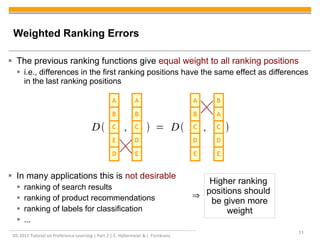


![DS-2011 Tutorial on Preference Learning | Part 2 | E. Hüllermeier & J. Fürnkranz
18
Evaluating Multipartite Rankings
Multipartite rankings:
like Bipartite rankings
but the target ranking r consists of
multiple relevance levels L = {1 … l},
where l < c
total ranking is a special case where each
level has exactly one item
# of preferences
ci is the number of items in level I
C-Index [Gnen & Heller, 2005]
straight-forward generalization of AUC
fraction of pairs (xi ,xj) for which
D
E
C
B
A
r
D
C
A
B
E
r
=∑
i , j
ci⋅c j ≤
c2
2
⋅1−
1
l
l il j ∧
rxi
rx j
D r ,
r = 3
C-Indexr ,
r = 5
8](https://image.slidesharecdn.com/pl-tutorial-ds-11machinelearning-230420193422-9b31a211/85/PL-Tutorial-DS-11_machine-learning-pdf-42-320.jpg)
![DS-2011 Tutorial on Preference Learning | Part 2 | E. Hüllermeier & J. Fürnkranz
19
Evaluating Multipartite Rankings
C-Index
the C-index can be rewritten as a weighted sum of pairwise AUCs:
where and are the rankings and restricted to levels i and j.
Jonckheere-Terpstra statistic
is an unweighted sum of pairwise AUCs:
equivalent to well-known multi-class extension of AUC
[Hand & Till, MLJ 2001]
C-Indexr ,
r=
1
∑i , ji
ci⋅c j
∑i , ji
ci⋅c j
⋅AUCri , j ,
ri , j
m-AUC=
2
l⋅l−1
∑i , ji
AUCri , j ,
ri , j
Note:
C-Index and m-AUC
can be optimized by
optimization of
pairwise AUCs
Note:
C-Index and m-AUC
can be optimized by
optimization of
pairwise AUCs
ri , j
ri , j r
r](https://image.slidesharecdn.com/pl-tutorial-ds-11machinelearning-230420193422-9b31a211/85/PL-Tutorial-DS-11_machine-learning-pdf-43-320.jpg)
![DS-2011 Tutorial on Preference Learning | Part 2 | E. Hüllermeier & J. Fürnkranz
20
Normalized Discounted Cumulative Gain
[Jarvelin & Kekalainen, 2002]
D
E
C
B
A
r
D
C
A
B
E
r
The original formulation of (normalized)
discounted cumulative gain refers to
this setting
the sum of the true (relevance)
levels of the items
each item weighted by its rank
in the predicted ranking
Examples:
retrieval of relevant or irrelevant pages
2 relevance levels
movie recommendation
5 relevance levels
DCGr ,
r=∑
i=1
c
li
logi1](https://image.slidesharecdn.com/pl-tutorial-ds-11machinelearning-230420193422-9b31a211/85/PL-Tutorial-DS-11_machine-learning-pdf-44-320.jpg)


![DS-2011 Tutorial on Preference Learning | Part 2 | E. Hüllermeier & J. Fürnkranz
23
Gamma Coefficient
Key idea: normalized difference between
number of correctly ranked pairs
(Kendall's distance)
number of incorrectly ranked pairs
Gamma Coefficient
[Goodman & Kruskal, 1979]
Identical to Kendall's tau
if both rankings are total
i.e., if
D
E
C
B
A
r
D
C
A
B
E
r
d=Dr ,
r
d =∣ {i , j∣ rxirx j ∧
rxi
rx j}∣
r ,
r=
d−
d
d
d
∈[−1,1]
r ,
r=2−1
21
=
1
3
d
d =
c⋅c−1
2](https://image.slidesharecdn.com/pl-tutorial-ds-11machinelearning-230420193422-9b31a211/85/PL-Tutorial-DS-11_machine-learning-pdf-47-320.jpg)


![DS
2011
Tutorial
on
Preference
Learning
|
Part
3
|
J.
Fürnkranz
&
E.
Hüllermeier
RankSVM
and
Related
Methods
(Bipar>te
Case)
§ The
biparEte
RankSVM
algorithm
[Herbrich
et
al.
2000,
Joachimes
2002]:
8
hinge
loss
regularizer
reproducing
kernel
Hilbert
space
(RKHS)
with
kernel
K
à
learning
comes
down
to
solving
a
QP
problem](https://image.slidesharecdn.com/pl-tutorial-ds-11machinelearning-230420193422-9b31a211/85/PL-Tutorial-DS-11_machine-learning-pdf-56-320.jpg)
![DS
2011
Tutorial
on
Preference
Learning
|
Part
3
|
J.
Fürnkranz
&
E.
Hüllermeier
RankSVM
and
Related
Methods
(Bipar>te
Case)
§ The
biparEte
RankBoost
algorithm
[Freund
et
al.
2003]:
9
class
of
linear
combinaEons
of
base
funcEons
à
learning
by
means
of
boosEng
techniques](https://image.slidesharecdn.com/pl-tutorial-ds-11machinelearning-230420193422-9b31a211/85/PL-Tutorial-DS-11_machine-learning-pdf-57-320.jpg)

![DS
2011
Tutorial
on
Preference
Learning
|
Part
3
|
J.
Fürnkranz
&
E.
Hüllermeier
Label
Ranking:
Reduc>on
to
Binary
Classifica>on
[Har-‐Peled
et
al.
2002]
11
Each
pairwise
comparison
is
turned
into
a
binary
classifica>on
example
in
a
high-‐dimensional
space!
posiEve
example
in
the
new
instance
space
(m
x
k)-‐dimensional
weight
vector](https://image.slidesharecdn.com/pl-tutorial-ds-11machinelearning-230420193422-9b31a211/85/PL-Tutorial-DS-11_machine-learning-pdf-59-320.jpg)


![DS
2011
Tutorial
on
Preference
Learning
|
Part
3
|
J.
Fürnkranz
&
E.
Hüllermeier
Object
Ranking:
Learning
to
Order
Things
[Cohen
et
al.
99]
§ In
a
first
step,
a
binary
preference
func>on
PREF
is
constructed;
PREF
(x,y) 2
[0,1]
is
a
measure
of
the
certainty
that
x
should
be
ranked
before
y,
and
PREF(x,y)=1- PREF(y,x).
§ This
funcEon
is
expressed
as
a
linear
combinaEon
of
base
preference
funcEons:
§ The
weights
can
be
learned,
e.g.,
by
means
of
the
weighted
majority
algorithm
[Lijlestone
&
Warmuth
94].
§ In
a
second
step,
a
total
order
is
derived,
which
is
as
much
as
possible
in
agreement
with
the
binary
preference
relaEon.
14](https://image.slidesharecdn.com/pl-tutorial-ds-11machinelearning-230420193422-9b31a211/85/PL-Tutorial-DS-11_machine-learning-pdf-62-320.jpg)
![DS
2011
Tutorial
on
Preference
Learning
|
Part
3
|
J.
Fürnkranz
&
E.
Hüllermeier
Object
Ranking:
Learning
to
Order
Things
[Cohen
et
al.
99]
§ The
weighted
feedback
arc
set
problem:
Find
a
permutaEon
¼
such
that
becomes
minimal.
15
0.7
0.9
0.6
0.6
0.8
0.5
0.3
0.1
0.6
0.4
0.5
0.8
cost
=
0.1+0.6+0.8+0.5+0.3+0.4
=
2.7
0.1](https://image.slidesharecdn.com/pl-tutorial-ds-11machinelearning-230420193422-9b31a211/85/PL-Tutorial-DS-11_machine-learning-pdf-63-320.jpg)
![DS
2011
Tutorial
on
Preference
Learning
|
Part
3
|
J.
Fürnkranz
&
E.
Hüllermeier
Object
Ranking:
Learning
to
Order
Things
[Cohen
et
al.
99]
§ Since
this
is
an
NP-‐hard
problem,
it
is
solved
heurisEcally.
16
Input:
Output:
let
for
do
while
do
let
let
for
do
endwhile
§ The
algorithm
successively
chooses
nodes
having
maximal
„net-‐flow“
within
the
remaining
subgraph.
§
It
can
be
shown
to
provide
a
2-‐approxima>on
to
the
opEmal
soluEon.](https://image.slidesharecdn.com/pl-tutorial-ds-11machinelearning-230420193422-9b31a211/85/PL-Tutorial-DS-11_machine-learning-pdf-64-320.jpg)
![DS
2011
Tutorial
on
Preference
Learning
|
Part
3
|
J.
Fürnkranz
&
E.
Hüllermeier
Label
Ranking:
Learning
by
Pairwise
Comparison
(LPC)
[Hüllermeier
et
al.
2008]
1](https://image.slidesharecdn.com/pl-tutorial-ds-11machinelearning-230420193422-9b31a211/85/PL-Tutorial-DS-11_machine-learning-pdf-65-320.jpg)
![DS
2011
Tutorial
on
Preference
Learning
|
Part
3
|
J.
Fürnkranz
&
E.
Hüllermeier
2
X1
X2
X3
X4
preferences
class
0.34
0
10
174
A
Â
B,
B
Â
C,
C
Â
D
1
1.45
0
32
277
B
Â
C
1.22
1
46
421
B
Â
D,
B
Â
A,
C
Â
D,
A
Â
C
0
0.74
1
25
165
C
Â
A,
C
Â
D,
A
Â
B
1
0.95
1
72
273
B
Â
D,
A
Â
D,
1.04
0
33
158
D
Â
A,
A
Â
B,
C
Â
B,
A
Â
C
1
Label
Ranking:
Learning
by
Pairwise
Comparison
(LPC)
[Hüllermeier
et
al.
2008]
Training
data
(for
the
label
pair
A
and
B):
X1
X2
X3
X4
class
0.34
0
10
174
1
1.22
1
46
421
0
0.74
1
25
165
1
1.04
0
33
158
1](https://image.slidesharecdn.com/pl-tutorial-ds-11machinelearning-230420193422-9b31a211/85/PL-Tutorial-DS-11_machine-learning-pdf-66-320.jpg)
![DS
2011
Tutorial
on
Preference
Learning
|
Part
3
|
J.
Fürnkranz
&
E.
Hüllermeier
3
At
predicUon
Ume,
a
query
instance
is
submiYed
to
all
models,
and
the
predicUons
are
combined
into
a
binary
preference
relaUon:
A
B
C
D
A
0.3
0.8
0.4
B
0.7
0.7
0.9
C
0.2
0.3
0.3
D
0.6
0.1
0.7
Label
Ranking:
Learning
by
Pairwise
Comparison
(LPC)
[Hüllermeier
et
al.
2008]](https://image.slidesharecdn.com/pl-tutorial-ds-11machinelearning-230420193422-9b31a211/85/PL-Tutorial-DS-11_machine-learning-pdf-67-320.jpg)
![DS
2011
Tutorial
on
Preference
Learning
|
Part
3
|
J.
Fürnkranz
&
E.
Hüllermeier
4
At
predicUon
Ume,
a
query
instance
is
submiYed
to
all
models,
and
the
predicUons
are
combined
into
a
binary
preference
relaUon:
A
B
C
D
A
0.3
0.8
0.4
1.5
B
0.7
0.7
0.9
2.3
C
0.2
0.3
0.3
0.8
D
0.6
0.1
0.7
1.4
From
this
relaUon,
a
ranking
is
derived
by
means
of
a
ranking
procedure.
In
the
simplest
case,
this
is
done
by
sorUng
the
labels
according
to
their
sum
of
weighted
votes.
B Â A
 D
 C
Label
Ranking:
Learning
by
Pairwise
Comparison
(LPC)
[Hüllermeier
et
al.
2008]](https://image.slidesharecdn.com/pl-tutorial-ds-11machinelearning-230420193422-9b31a211/85/PL-Tutorial-DS-11_machine-learning-pdf-68-320.jpg)

![DS
2011
Tutorial
on
Preference
Learning
|
Part
3
|
J.
Fürnkranz
&
E.
Hüllermeier
Structured
Output
PredicMon
[Bakir
et
al.
2007]
§ Rankings,
mulUlabel
classificaUons,
etc.
can
be
seen
as
specific
types
of
structured
(as
opposed
to
scalar)
outputs.
§ DiscriminaUve
structured
predicUon
algorithms
infer
a
joint
scoring
funcMon
on
input-‐output
pairs
and,
for
a
given
input,
predict
the
output
that
maximises
this
scoring
funcUon.
§ Joint
feature
map
and
scoring
funcUon
§ The
learning
problem
consists
of
esUmaUng
the
weight
vector,
e.g.,
using
structural
risk
minimizaUon.
§ PredicUon
requires
solving
a
decoding
problem:
6](https://image.slidesharecdn.com/pl-tutorial-ds-11machinelearning-230420193422-9b31a211/85/PL-Tutorial-DS-11_machine-learning-pdf-70-320.jpg)
![DS
2011
Tutorial
on
Preference
Learning
|
Part
3
|
J.
Fürnkranz
&
E.
Hüllermeier
§ Preferences
are
expressed
through
inequaliMes
on
inner
products:
§ The
potenUally
huge
number
of
constraints
cannot
be
handled
explicitly
and
calls
for
specific
techniques
(such
as
cucng
plane
opUmizaUon)
7
loss
funcUon
Structured
Output
PredicMon
[Bakir
et
al.
2007]](https://image.slidesharecdn.com/pl-tutorial-ds-11machinelearning-230420193422-9b31a211/85/PL-Tutorial-DS-11_machine-learning-pdf-71-320.jpg)


![DS
2011
Tutorial
on
Preference
Learning
|
Part
3
|
J.
Fürnkranz
&
E.
Hüllermeier
Learning
Lexicographic
Preference
Models
[Yaman
et
al.
2008]
§ Suppose
that
objects
are
represented
as
feature
vectors
of
length
m,
and
that
each
aYribute
has
k
values.
§ For
n=km
objects,
there
are
n!
permutaUons
(rankings).
§ A
lexicographic
order
is
uniquely
determined
by
- a
total
order
of
the
aYributes
- a
total
order
of
each
aYribute
domain
§ Example:
Four
binary
aYributes
(m=4,
k=2)
- there
are
16! ¼
2
·
1013
rankings
- but
only
(24)
·
4!
=
384
of
them
can
be
expressed
in
terms
of
a
lexicographic
order
§ [Yaman
et
al.
2008]
present
a
learning
algorithm
that
explictly
maintains
the
version
space,
i.e.,
the
aYribute-‐orders
compaUble
with
all
pairwise
preferences
seen
so
far
(assuming
binary
aYributes
with
1
preferred
to
0).
PredicUons
are
derived
based
on
the
„votes“
of
the
consistent
models.
10](https://image.slidesharecdn.com/pl-tutorial-ds-11machinelearning-230420193422-9b31a211/85/PL-Tutorial-DS-11_machine-learning-pdf-74-320.jpg)
![DS
2011
Tutorial
on
Preference
Learning
|
Part
3
|
J.
Fürnkranz
&
E.
Hüllermeier
Learning
CondiMonal
Preference
(CP)
Networks
[Chevaleyre
et
al.
2010]
11
main
dish
drink
restaurant
meat > veggie > fish
meat: red wine > white wine
veggie: red wine > white wine
fish: white wine > red wine
meat: Italian > Chinese
veggie: Chinese > Italian
fish: Chinese > Italian
Compact
representaUon
of
a
parUal
order
relaUon,
exploiUng
condiUonal
independence
of
preferences
on
aYribute
values.
Induces
parUal
order
relaUon,
e.g.,
(meat, red wine, Italian) > (meat, white wine, Chinese)
(fish, white wine, Chinese) > (fish, red wine, Chinese)
(meat, white wine, Italian) ? (meat, red wine, Chinese)](https://image.slidesharecdn.com/pl-tutorial-ds-11machinelearning-230420193422-9b31a211/85/PL-Tutorial-DS-11_machine-learning-pdf-75-320.jpg)
![DS
2011
Tutorial
on
Preference
Learning
|
Part
3
|
J.
Fürnkranz
&
E.
Hüllermeier
Learning
CondiMonal
Preference
(CP)
Networks
[Chevaleyre
et
al.
2010]
12
main
dish
drink
restaurant
meat > veggie > fish
meat: red wine > white wine
veggie: red wine > white wine
fish: white wine > red wine
meat: Italian > Chinese
veggie: Chinese > Italian
fish: Chinese > Italian
Compact
representaUon
of
a
parUal
order
relaUon,
exploiUng
condiUonal
independence
of
preferences
on
aYribute
values.
(meat, red wine, Italian) > (veggie, red wine, Italian)
(fish, whited wine, Chinease) > (veggie, red wine, Chinease)
(veggie, whited wine, Chinease) > (veggie, red wine, Italian)
… … …
Training
data
(possibly
noisy):](https://image.slidesharecdn.com/pl-tutorial-ds-11machinelearning-230420193422-9b31a211/85/PL-Tutorial-DS-11_machine-learning-pdf-76-320.jpg)


