New product funding through the lens of Product Lifecycle Management.
November 2016 | Contributing Author: Dr. Todd Hostager
The primary reason most startups and new products fail?
Money issues.
There’s no denying it. Technology is continuing to change our lives in fundamental ways. The impact on consumer expectations is profound,
putting increased pressure on manufacturers to find new ways to drive and manage the product development process. Fighting fire with fire,
savvy manufacturers are turning to data-driven solutions for tackling this design challenge, where a premium is placed on shorter, faster, and
more cost-effective development cycles for new product rollouts.
Agile product development requires more tightly coupled actions and outcomes, tracked with
greater precision and accuracy, reducing time-to-market in an increasingly fast and furious
competitive environment. This is where Product Lifecycle Management (PLM) really shines,
providing a holistic and integrated framework for mapping and tracking activities throughout
the entire lifecycle of products.
PLM’s value skyrockets when we consider how this framework helps us plan for and acquire
the funding that’s necessary to successfully support a new product throughout the entire
lifecycle Running out of cash at the wrong time is a primary factor contributing to our failures
to launch a product and reach subsequent milestones in the life of the product.¹
Product Funding Through the Lens of PLM | November 2016
Most product launches and business
startups fail because they run out
of cash at the wrong times, forcing
promising products to an untimely
death.
1) After analyzing 200 founders’ postmortems, researchers say these are the reasons startups fail, Quartz: http://qz.com/682517/after-analyzing-200-founders-postmortems-researchers-say-these-are-the-reasons-startups-fail/
What does PLM have to do with new product funding?
The root cause of funding failures is reliance on incomplete knowledge in two key areas: (1) what the funding needs are, at different stages in the
life of a product; and (2) who the potential funding sources are at each stage, including their expectations and motivations to ‘green light’ your
request. PLM provides a solid foundation for filling these knowledge gaps, relying on a more complete framework for anticipating and acquiring
the funding you’ll need to support your product along the entire journey.
Intel, Autodesk, and other industry leaders are blazing a trail to agile development, leveraging the data-
driven power of PLM to achieve substantial reductions in costs and time-to-market for new product
rollouts.² The results to date are impressive, with firms reaping a range of PLM benefits including:
•	 30-60% reduction in implementation timelines³
•	 30-50% savings in implementation costs⁴
•	 10-20% increase in engineering efficiency⁴
From birth as a concept to full market launch, from growth and maturity to end of life harvest: PLM is a
proven framework for streamlined development and fulfillment across the entire product lifecycle. While
firms will naturally vary in how they break this lifecycle down into discrete phases, the bottom-line results
are the same: Data-driven reductions in costs, delays, errors, and time-to-market for new product rollouts,
with substantial gains in post-launch revenue and profitability:
•	 13.4% growth in Sales Revenue⁴
•	 13.2% increase in Profit Margin⁴
Product Funding Through the Lens of PLM | November 2016
2) Semiconductor product lifecycle management, Kalypso: http://www.product-lifecycle-management.info/white-papers/kalypso/PLM-White-Paper-Kalypso-Semiconductor-Product-Lifecycle-Management.pdf
3) Deloitte DPLM Pre-Configured Solution, Deloitte: http://www2.deloitte.com/content/dam/Deloitte/global/Documents/Technology/gx-cons-tech-dsc-deloitte-product-lifecycle-management-dplm.pdf
4) Transforming PLM for the economic recovery, Kalypso: http://www.product-lifecycle-management.info/white-papers/Kalypso/PLM-White-Paper-Kalypso-Transforming-PLM-for-the-Economic-Recovery.pdf
PLM and new product funding
Evolving from software to strategy, PLM now plays an integral role in guiding forward-thinking firms as they optimize their operations for
agile development. To increase your odds of success when launching a new product— effectively anticipating and addressing funding
requirements across the entire lifecycle, while maximizing your bottom-line returns in post-launch phases— we strongly recommend that you
work with an experienced PLM provider to properly assess your development and fulfillment needs across the entire product lifecycle.
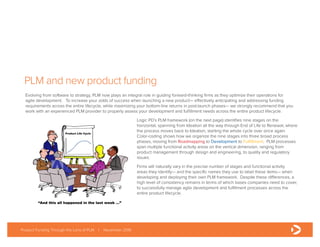
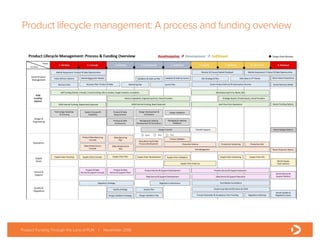
Logic PD’s PLM framework (on the next page) identifies nine stages on the
horizontal, spanning from Ideation all the way through End of Life to Renewal, where
the process moves back to Ideation, starting the whole cycle over once again.
Color-coding shows how we organize the nine stages into three broad process
phases, moving from Roadmapping to Development to Fulfillment. PLM processes
span multiple functional activity areas on the vertical dimension, ranging from
product management through design and engineering, to quality and regulatory
issues.
Firms will naturally vary in the precise number of stages and functional activity
areas they identify— and the specific names they use to label these items— when
developing and deploying their own PLM framework. Despite these differences, a
high level of consistency remains in terms of which bases companies need to cover,
to successfully manage agile development and fulfillment processes across the
entire product lifecycle.
Product Funding Through the Lens of PLM | November 2016
Product lifecycle management: A process and funding overview
Product Funding Through the Lens of PLM | November 2016
How do we pay for the PLM services we need? Here the right answer begins to emerge from a basic understanding that available funding
options will depend on two key factors:
1. Where your PLM service needs are located along the product lifecycle map, and
2. Whether the product is developed in an entrepreneurial mode as a new startup, or in an intrapreneurial mode within a corporate context.
While options will vary for new business startups and OEM intrapreneurs, the same basic questions remain at the core of the funding dilemma:
What bases have you already covered? What gaps in coverage remain? Which of these gaps are next in line, blocking you from making forward
progress? These are the gaps that entrepreneurs and intrapreneurs need to bridge in order to keep their product moving full steam ahead, from
one stage to the next, along the lifecycle roadmap.
Product Funding Through the Lens of PLM | November 2016
Funding all three phases of product development.
While our clients are quick to grasp the importance of covering these bases, their main concern is determining how to pay for the coverage
they need. This concern is genuine and well-founded.
The bottom line is that finding solutions for funding the full range of necessary product lifecycle activities is critical to the ultimate success of your
primary mission: Launching a new product and managing it for maximum growth, profitability, and Return on Investment.
What are some of the common flaws that torpedo new product launches?
In their sobering Harvard Business Review article “Why Most Product Launches Fail,” an instructive piece on the destructive impacts of
funding problems before, during, and after launch, Schneider and Hall outline “40 Ways to Crash a Product Launch”:
Item #2: “Most of the budget was used to create the product; little is left for launching, marketing, and selling it.”⁵
Item # 23: “The launch budget is insufficient to ‘pull’ the product off the shelf.”⁵
Item #32, a funding allocation problem: “All marketing dollars go to advertising and public relations, none to social media.”⁵
5) Why most product launches fail, Harvard Business Review: https://hbr.org/2011/04/why-most-product-launches-fail
Funding options for Roadmapping services
A product lifecycle gap analysis will highlight your most pressing PLM service needs and help
you identify the available funding options for covering these needs. Startup firms facing gaps
in the Ideation and Concept stages of Roadmapping often rely on bootstrapping (self-funding)
and crowd-funding.
This is not surprising since many concepts fail to materialize as workable prototypes with
viable business case support. Roadmapping a new product is an inherently risky proposition,
with no guarantee that your concept will make the cut to move forward from Roadmapping to
Development.
Research confirms that bootstrapping— including self-funding and help from family and
friends— is the most likely source of initial funding for the vast majority of tech-based firms;
VCs are rarely able to fund small startups “due to the high risk involved in this stage of
investment.” ⁶
Product Funding Through the Lens of PLM | November 2016
New product development funding sources
for entrepreneurial startups:
•	 82% rely on self-funding
•	 41% use loans
•	 41% use a line of credit
•	 24% rely on friends and family
•	 3% use crowdfunding for capital
•	 ~1% accept venture capital money⁷
6) Capital opportunities for small businesses, Small Business and Technology Development Center: http://www.sbtdc.org/pdf/capopps.pdf
7) The Year in Startup Funding. Entrepreneur: https://www.entrepreneur.com/article/241331
Funding options for Roadmapping (cont.)
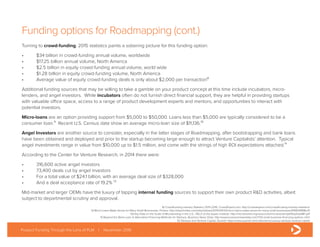
Turning to crowd-funding, 2015 statistics paints a sobering picture for this funding option:
•	 $34 billion in crowd-funding annual volume, worldwide
•	 $17.25 billion annual volume, North America
•	 $2.5 billion in equity crowd-funding annual volume, world wide
•	 $1.28 billion in equity crowd-funding volume, North America
•	 Average value of equity crowd-funding deals is only about $2,000 per transaction⁸
Additional funding sources that may be willing to take a gamble on your product concept at this time include incubators, micro-
lenders, and angel investors. While incubators often do not furnish direct financial support, they are helpful in providing startups
with valuable office space, access to a range of product development experts and mentors, and opportunities to interact with
potential investors.
Micro-loans are an option providing support from $5,000 to $50,000. Loans less than $5,000 are typically considered to be a
consumer loan.⁹ Recent U.S. Census data show an average micro-loan size of $11,136.¹⁰
Angel Investors are another source to consider, especially in the latter stages of Roadmapping, after bootstrapping and bank loans
have been obtained and deployed and prior to the startup becoming large enough to attract Venture Capitalists’ attention. Typical
angel investments range in value from $10,000 up to $1.5 million, and come with the strings of high ROI expectations attached.¹¹
According to the Center for Venture Research, in 2014 there were:
•	 316,600 active angel investors
•	 73,400 deals cut by angel investors
•	 For a total value of $24.1 billion, with an average deal size of $328,000
•	 And a deal acceptance rate of 19.2% ¹²
Mid-market and larger OEMs have the luxury of tapping internal funding sources to support their own product R&D activities, albeit
subject to departmental scrutiny and approval.
Product Funding Through the Lens of PLM | November 2016
8) Crowdfunding Industry Statistics 2015-2016, CrowdExpert.com: http://crowdexpert.com/crowdfunding-industry-statistics/
9) Micro-Loans Make Sense for Many Small Businesses, Forbes: http://www.forbes.com/sites/tykiisel/2015/09/23/micro-loans-make-sense-for-many-small-businesses/#495098ff8c01
10) Key Data on the Scale of Microlending in the U.S., FIELD at the Aspen Institute: http://microtracker.org/resources/microtracker/pdf/KeyDataMF.pdf
11) Beyond the Bank Loan: 6 Alternative Financing Methods for Startups, Business News Daily: http://www.businessnewsdaily.com/1733-small-business-financing-options-.html
12) Startups and Venture Capital, Quandl: https://www.quandl.com/collections/usa/usa-startups-venture-capital
Funding source profiles for Roadmapping services
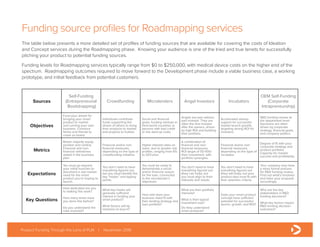
The table below presents a more detailed set of profiles of funding sources that are available for covering the costs of Ideation
and Concept services during the Roadmapping phase. Knowing your audience is one of the tried and true tenets for successfully
pitching your product to potential funding sources.
Funding levels for Roadmapping services typically range from $0 to $250,000, with medical device costs on the higher end of the
spectrum. Roadmapping outcomes required to move forward to the Development phase include a viable business case, a working
prototype, and initial feedback from potential customers.
Product Funding Through the Lens of PLM | November 2016
Sources
Self-Funding
(Entrepreneurial
Bootstrapping)
Crowdfunding Microlenders Angel Investors Incubators
OEM Self-Funding
(Corporate
Intrapreneurship)
Objectives
Fund your dream for
bringing your smart
product to market
and running your own
business. Convince
family and friends to
come on board.
Individuals contribute
funds supporting the
dream of others to bring
their products to market
and projects to fruition.
Social and financial
goals, funding startups in
third-world countries or
persons with bad credit
or low start-up costs.
Angels are part advisor,
part investor. They are
often the first investor
after the owners, driven
by high ROI and building
their portfolio.
Accelerated startup
support for successful
market launch growth,
targeting strong ROI for
investors.
R&D funding review at
the department level.
Decisions are often
driven by corporate
strategy, financial goals,
and company politics.
Metrics
Retain majority equity
position and control.
Financial and non-
financial milestones
stated in the business
plan.
Financial and/or non-
financial measures,
depending on the type of
crowdfunding initiative.
Higher interest rates on
loans, due to greater risk
profiles, ranging from 6%
to 32%-plus.
A combination of
financial and non-
financial measures.
ROI target of 50-100x
their investment, with
portfolio synergies.
Financial and/or non-
financial measures,
depending on the type of
incubator.
Degree of fit with your
corporate strategy and
product portfolio.
Capacity for market
success and profitability.
Expectations
You must go beyond
your initial hunches to
document a real market
need for the smart
product you’re hoping to
launch.
You don’t need to have
everything figured out,
but you must identify the
key “hooks” and tipping
points.
You must be ready to
demonstrate a social
and/or financial reason
for the loan, connected
to the microlender’s
objectives.
You don’t need to have
everything figured out
(they can help), but
you must align to their
interests and needs.
You don’t need to have
everything figured out
(they will help), but your
product idea must fit with
their selection criteria.
Your company may have
a more formal process
for R&D funding review.
Find out what’s involved
and tailor your proposal
accordingly.
Key Questions
How dedicated are you
to making this work?
How many times have
you done this before?
Do you understand the
risks involved?
What key hooks will
generate sufficient
interest in funding your
smart product?
What factors will tip
investors to buy-in?
How well does your
business need fit with
their lending strategy and
loan portfolio?
What are their portfolio
interests?
What is their typical
investment size?
Do they understand
smart products?
Does your smart product
concept have sufficient
potential for successful
launch, growth, and ROI?
Who are the key
stakeholders in R&D
funding decisions?
What key factors impact
R&D funding decision
outcomes?
Product Funding Through the Lens of PLM | November 2016
Funding options for Development services
In the early stages of the Development phase, we see that self-funding, crowd-funding, micro-lenders, angel investors, and
incubators remain relevant as funding sources. But here is where their pockets may not be deep enough to cover the PLM activities
requiring larger dollar amounts, often ranging from $500,000 to $5,000,000 or more, depending on the type of product.
Now your primary funding option is Venture Capitalists (VCs), investors who will often expect to earn a 33% Internal Rate of Return
within a three-year timeframe. Here the consensus is that young startups should seek this type of support once they are beyond the
early stages and already have some revenue coming in.
VC investments in startups usually “have a short leash when it comes to company loyalty and often look to recover their investment
within a 3-to-5-year time window.” Usually, VCs need a startup to have a plan for “taking in and using a large amount of capital,
because investors are giving you growth capital,” especially for Series A investments. ¹³
13) Getting Working Capital to Fund Your Product and Your Businessl, Femgineer: http://femgineer.com/2014/10/getting-working-capital-to-fund-your-product-and-your-business/
Funding options for Development (cont.)
Nomenclature dissonance notwithstanding, early stage VC funding corresponds to the Development stages in the PLM framework,
accounting for 2,297 deals in 2015, valued at $20.3 billion, comprising 51% of all 2015 VC deals, and 35% of 2015 VC dollars
invested. Development stages in PLM are where the majority of first-time VC
financing occurs, with 71% first-time deals and 62% of dollars invested in first-time
recipients involving firms in the Development phase. ¹⁴
Engineering firms are another option for funding support during the Development
phase in the product lifecycle, exploring potential reductions in their rates in
exchange for promotional concessions and deferred revenue. Working the data
side of your product development activities, now’s the time to talk to cloud data
platform providers may be willing to cover some cloud customization expenses in
exchange for receiving a two to five-year contract as your cloud provider.
Mid-market and larger OEMs will often find that here is where they need to reach out to partners for help in covering engineering
expenses to refine and finalize their product designs. Large OEMs may be able to fund most or all of their costs for product
Development services, but this will typically require approval from the firm’s Board of Directors or an internal review board.
Product Funding Through the Lens of PLM | November 2016
Venture Capital funding in the U.S., 2015:
•	 $58.8 billion in venture capital deployed
across the U.S.
•	 1,500 companies raised venture capital for
the first time
•	 71% of first-time VC financing recipients
involved companies in the Development
stages ¹⁴
14) Historical trend data, PwC Money Tree: https://www.pwcmoneytree.com/HistoricTrends/CustomQueryHistoricTrend
Funding source profiles for Development services
Development outcomes required to move forward to the Fulfillment phase include a viable business plan, marketing plan, and
product launch plan, based on a field-validated product design. Risk is still high even when products have progressed through all of
the stages in the Development phase, with a failure to launch rate of 75%. ¹⁵
Product Funding Through the Lens of PLM | November 2016
Sources Venture Capitalists Engineering FIrms
Cloud Data Platform
Providers
OEM Self-Funding
(Corporate
Intrapreneurship)
Objectives
VCs are often next in line after
angel investors, looking for high
growth firms with large upside
potential.
Revenue from product design
services for new and existing
businesses. May provide
discounted rates and advice to
secure new clients.
Generate revenue by providing
data services to new and
existing businesses. May provide
discounts and advice to secure
new clients.
Internal Product or Investment
Review Boards. Decisions
are often driven by corporate
strategy, financial goals, and
company politics.
Metrics
Portfolio building (in the VC’s
area of focus)
33% IRR within 3 years (almost
exclusively financial metrics)
Establish a growing and
sustainable base of clients for
their engineering services.
Enhance reputation and brand
identity.
2-5 year contracts, in exchange
for help in covering engineering
expenses to customize the cloud
platform.
Degree of fit with your corporate
strategy and product portfolio.
Capacity for market success and
profitability.
Expectations
You must be ready to show
fast growth potential and large
market opportunity.
Unwise to approach them first
unless they know your pedigree.
You need to identify which firms
have the right engineering
capabilities and are willing to
work with you to reduce their
rates for services.
The data side of your smart
product business must show
enough scalability and data
monetization potential to secure
their interest.
Your company may have a very
formal process (easier to prepare
for) or an informal one (more
difficult to prepare for). Find out
which your company uses.
Key Questions
What is their portfolio strategy?
Talk to other portfolio companies
(past and present) for help.
Which firms have the right
engineering skills?
Will they reduce their rates for
promotional considerations or
deferred revenue?
What data volume and storage
requirements are you projecting
for your smart product, from
rollout through growth, to
maturity?
Who is involved in making
board-level product development
funding decisions?
How does it benefit them and the
OEM?
15) The Venture Capital Secret: 3 Out of 4 Start-Ups Fail, Wall Street Journal: http://www.wsj.com/articles/SB10000872396390443720204578004980476429190
Funding options for Fulfillment services
Cash flow from operations finally emerges as a source of funding support during the PLM Fulfillment phases, particularly when
growth and maturity follows a successful market launch of a new product. This is true for new business startups and established
OEMs. Here is where startups and OEMs can also exploit opportunities with manufacturing partners to amortize some of their
initial expenses by entering into a long-term contract (2-5 years) with these partners.
Bridge financing in the form of loans and lines of credit from banks may be available for covering equipment purchases, initial stocks
of inventory, and early marketing and sales expenses. Don’t overlook banks as a viable source for funding assistance when you
scale your business up for growth.
Recent statistics show that big banks— with more than $10 billion in assets— approved 23% of small business funding requests in
March, 2016. Institutional lenders— savings banks and life insurance companies— have a much higher loan approval rate at 63%,
with the approval rate of 49% for small
banks, and 42% for credit unions. ¹⁶
And don’t forget about the digital side of
your product. Data you obtain via product
use and subscription services sets the
table for generating additional revenue
through data sales to third parties. Here
is where cloud providers reappear on
your funding radar, focused on data
monetization opportunities while helping
reduce your expenses through long-term
contracts (2-5 years) for cloud support
services.
Product Funding Through the Lens of PLM | November 2016
16) Small Business Lending Index, March 2016, Biz2Credit: http://www.biz2credit.com/small-business-lending-index/march-2016
Funding options for Fulfillment services: The SBA
While the Small Business Administration (SBA) is not in the business of lending money to companies directly, it does provide
partial loan guarantees, making it easier to secure a loan from your local bank. The 7(a) is the SBA’s most popular business loan
program. You can apply for up to $750,000 in funds from a 7(a)-affiliated lender. But make sure you’re fully prepared for the
approach to this audience, demonstrating solid growth potential with detailed marketing and financial projections, grounded in
relevant real-world precedents. These loans are most often used for working capital, asset and equipment purchases and real estate
or new construction. ¹⁷
The 504 program is a second form of business loan available in conjunction with the SBA. Usually, 504 funds are used for
purchasing real estate or equipment. From Entrepreneur:
“Typically, the asset purchase is funded by a loan from a bank or other lender in your
area, along with a second loan from a certified development company (CDC) that’s
funded with an SBA guarantee for up to 40 percent of the value of the asset--which is
generally a loan of up to $1 million--and a contribution of 10 percent from the equity of
the borrower. This financing structure helps the primary lender--the bank--reduce its
exposure by relying on the CDC and the SBA to shoulder much of the risk.” ¹⁸
The 504 is exclusively an option for small businesses; firms with a tangible net worth over $15 million or a net income of more than
$5 million after taxes for the preceding two years are not eligible.
Product Funding Through the Lens of PLM | November 2016
The SBA’s 504 loans cannot be used for:
•	 Working capital
•	 Inventory
•	 Consolidating or repaying debt
•	 Refinancing
17) Use of 7(a) Loan Proceeds, U.S. SBA: https://www.sba.gov/loans-grants/see-what-sba-offers/sba-loan-programs/general-small-business-loans-7a/use-7a-loan-proceeds
18) SBA Loans for Your Startup, Entrepreneur: https://www.entrepreneur.com/article/79254
Funding options for Maturity, Harvesting, and End of Life
Strategic Buyers and Private Equity (Financial Buyers) enter the scene as funding options for your consideration during later stages
of growth and maturity. While it’s true that both of these types of buyer-based funding options can lead to profound uncertainty
and turmoil— unleashed as a result of well-documented responses to being acquired by an external party— this is by no means a
certainty or the only possible outcome. ¹⁹
Less traumatic acquisitions can help ease the transition from product maturity to
end of life, serving as an alternate form of harvesting the business. Acquisitions
can also provide the necessary influx of cash and resources to resuscitate a
dying product line back to life through Renewal, moving the product along the
PLM pathway to reincarnation as a “next generation” product.
Figures for 2016 show an 18% drop in global merger and acquisition (M&A)
activity based on value, declining from a level of $209 billion in the first half of
2015 to $171 billion in the first half of 2016. M&A value for U.S. deals declined
at the exact same 18% rate during the same time period, decreasing from $884
billion in the first half of 2015 to $748.5 billion in the first half of 2016. Despite
this decline, that’s still a lot of M&A activity, keeping this on the table as a
funding option open for your consideration. ²⁰
Product Funding Through the Lens of PLM | November 2016
19) Corporate Judo: Exploiting the Dark Side of Change when Competitors Merge, Acquire, Downsize, or Restructure, Journal of Management Inquiry: http://jmi.sagepub.com/content/5/3/261.short
20) Global M&A value in 1H 2016 hits $1.71 trillion, Financier Worldwide: http://www.financierworldwide.com/fw-news/2016/7/5/global-ma-value-in-1h-2016-hits-171-trillion
Product Funding Through the Lens of PLM | November 2016
Funding source profiles for Fulfillment services
Fulfillment peaks with Growth, then declines to market Maturity, culminating in an End of Life for your product and datasets. While
an endgame ‘harvest and exit’ is one option for your consideration, our PLM framework bakes a second option into the process: A
cyclical iteration where End of Life regenerates into a phase of Renewal, setting the stage for further Ideation and Concept activities
in a Roadmapping mode. Rinse and repeat, developing your next generation of new products for launch, growth, maturity, and
eventual harvest.
Sources Manufacturing Firms Banks / SBA Strategic Buyers Private Equity
OEM Self-Funding
(Cash Flow from
Operations)
Objectives
Revenue from product
manufacturing and fulfillment
services. Goals include long-
term (2-5 year) manufacturing
agreements and a sustainable
client base.
Bridge financing for early stage
startup costs (equipment,
beginning inventories, initial
marketing and sales)
Acquisitions creating operating
synergies, through vertical or
horizontal integration. Increased
value for their corporate
portfolio or related businesses.
Large-scale investors looking
for stable growth. Increasing
your valuation multiple improves
their bottom-line ROI.
Generate sufficient cash flow to
cover expenses.
Breakeven analysis to identify
when cash flow from ops will be
sufficient to fund the business.
Metrics
Success in securing long-term
manufacturing contracts
Establishing a growing and
sustainable base of clients
Mid-tier interest rate on loans
(8-15%).
SBA support for scalable smart
product businesses, with
favorable loan rates
Degree of fit with the buyer’s
corporate strategy and business
portfolio. Cost reductions and
market growth opportunities
from operating synergies.
Capacity for earnings growth
and long-term company value.
Cash flow capacity, helping
them finance the debt they
incurred.
Realistic revenue and cash flow
projections, as well as fixed &
variable expense projections.
Breakeven analysis.
Expectations
Conducting informed go-no
go partnering analysis is the
key. Which manufacturers are
willing to work with you to
amortize some of your product
development costs?
Be ready to demonstrate solid
growth potential and market
opportunity, with detailed
market and financial projections
as typically found in business
plans.
You must be ready to show
fast growth potential and large
market opportunity. Unwise to
approach them first unless they
know your pedigree.
Be ready to demonstrate your
capacity for earnings growth
and cash flow, translating to
increased value and ability to
help service PE debt.
Make sure that your financial
projections are realistic
in relation to real-world
benchmarks and corporate
(OEM) expectations.
Key Questions
Do the numbers add up?
Does it make sense to work
with a manufacturing partner
to amortize some of your
development costs into a long-
term agreement?
What types of firms do they
typically fund?
Do they understand smart
products and digital business
models?
How does your smart product fit
with their corporate strategy?
What synergies exist between
your product and their current
portfolio of businesses?
How does your smart product fit
with their corporate strategy?
What synergies exist between
your product and their current
portfolio of businesses?
How realistic are your financial
projections?
When will your smart product
launch be self-sustaining from a
cash flow standpoint?
Conclusion
Agile development and fulfillment requires a brave new approach to planning and managing your product portfolio along the entire
lifecycle. Logic PD’s PLM framework outlines the key bases you’ll need to cover to increase your odds of success in launching
a viable product and managing its growth for maximum profit, ROI, and customer satisfaction in this fast and furious competitive
environment.
Appreciating the value of a framework is one thing; figuring out how to pay for the services you need is another thing altogether.
Our roadmap for PLM funding sources is your bridge to a bright new future where you avoid predictable funding failures while
launching and growing your new product offering. We look forward to talking with you further about how we can work together to
make this a reality.
Product Funding Through the Lens of PLM | November 2016
Let us know if we can help you navigate any stage of your product’s lifecycle.
©2016 Logic PD All Rights Reserved. Rev 0216-01
Minneapolis Eden Prairie Montevideo
Product Funding Through the Lens of PLM | November 2016
About Logic PD: Logic PD collaborates with clients to help them throughout the complete product lifecycle to accelerate their
growth and capture value. Logic PD provides services at any stage in the product lifecycle by helping customers understand their
business, user and technology needs and specializing in helping them meet digital business requirements. With services in analytics
and research; design, engineering and manufacturing; and product support services, Logic PD helps its clients identify opportunities,
reduce risk, and control costs to deliver innovative products to market faster. The company is headquartered in Minneapolis.
Contact Logic PD today to learn more.
solutions@logicpd.com
www.logicpd.com
Tel: 855.461.3802
Contributor: Dr. Todd Hostager
Director of Digital Strategy Curriculum
Logic PD

PLM_Funding_Options_White_Paper_PDF

  • 1.
    New product fundingthrough the lens of Product Lifecycle Management. November 2016 | Contributing Author: Dr. Todd Hostager
  • 2.
    The primary reasonmost startups and new products fail? Money issues. There’s no denying it. Technology is continuing to change our lives in fundamental ways. The impact on consumer expectations is profound, putting increased pressure on manufacturers to find new ways to drive and manage the product development process. Fighting fire with fire, savvy manufacturers are turning to data-driven solutions for tackling this design challenge, where a premium is placed on shorter, faster, and more cost-effective development cycles for new product rollouts. Agile product development requires more tightly coupled actions and outcomes, tracked with greater precision and accuracy, reducing time-to-market in an increasingly fast and furious competitive environment. This is where Product Lifecycle Management (PLM) really shines, providing a holistic and integrated framework for mapping and tracking activities throughout the entire lifecycle of products. PLM’s value skyrockets when we consider how this framework helps us plan for and acquire the funding that’s necessary to successfully support a new product throughout the entire lifecycle Running out of cash at the wrong time is a primary factor contributing to our failures to launch a product and reach subsequent milestones in the life of the product.¹ Product Funding Through the Lens of PLM | November 2016 Most product launches and business startups fail because they run out of cash at the wrong times, forcing promising products to an untimely death. 1) After analyzing 200 founders’ postmortems, researchers say these are the reasons startups fail, Quartz: http://qz.com/682517/after-analyzing-200-founders-postmortems-researchers-say-these-are-the-reasons-startups-fail/
  • 3.
    What does PLMhave to do with new product funding? The root cause of funding failures is reliance on incomplete knowledge in two key areas: (1) what the funding needs are, at different stages in the life of a product; and (2) who the potential funding sources are at each stage, including their expectations and motivations to ‘green light’ your request. PLM provides a solid foundation for filling these knowledge gaps, relying on a more complete framework for anticipating and acquiring the funding you’ll need to support your product along the entire journey. Intel, Autodesk, and other industry leaders are blazing a trail to agile development, leveraging the data- driven power of PLM to achieve substantial reductions in costs and time-to-market for new product rollouts.² The results to date are impressive, with firms reaping a range of PLM benefits including: • 30-60% reduction in implementation timelines³ • 30-50% savings in implementation costs⁴ • 10-20% increase in engineering efficiency⁴ From birth as a concept to full market launch, from growth and maturity to end of life harvest: PLM is a proven framework for streamlined development and fulfillment across the entire product lifecycle. While firms will naturally vary in how they break this lifecycle down into discrete phases, the bottom-line results are the same: Data-driven reductions in costs, delays, errors, and time-to-market for new product rollouts, with substantial gains in post-launch revenue and profitability: • 13.4% growth in Sales Revenue⁴ • 13.2% increase in Profit Margin⁴ Product Funding Through the Lens of PLM | November 2016 2) Semiconductor product lifecycle management, Kalypso: http://www.product-lifecycle-management.info/white-papers/kalypso/PLM-White-Paper-Kalypso-Semiconductor-Product-Lifecycle-Management.pdf 3) Deloitte DPLM Pre-Configured Solution, Deloitte: http://www2.deloitte.com/content/dam/Deloitte/global/Documents/Technology/gx-cons-tech-dsc-deloitte-product-lifecycle-management-dplm.pdf 4) Transforming PLM for the economic recovery, Kalypso: http://www.product-lifecycle-management.info/white-papers/Kalypso/PLM-White-Paper-Kalypso-Transforming-PLM-for-the-Economic-Recovery.pdf
  • 4.
    PLM and newproduct funding Evolving from software to strategy, PLM now plays an integral role in guiding forward-thinking firms as they optimize their operations for agile development. To increase your odds of success when launching a new product— effectively anticipating and addressing funding requirements across the entire lifecycle, while maximizing your bottom-line returns in post-launch phases— we strongly recommend that you work with an experienced PLM provider to properly assess your development and fulfillment needs across the entire product lifecycle. Logic PD’s PLM framework (on the next page) identifies nine stages on the horizontal, spanning from Ideation all the way through End of Life to Renewal, where the process moves back to Ideation, starting the whole cycle over once again. Color-coding shows how we organize the nine stages into three broad process phases, moving from Roadmapping to Development to Fulfillment. PLM processes span multiple functional activity areas on the vertical dimension, ranging from product management through design and engineering, to quality and regulatory issues. Firms will naturally vary in the precise number of stages and functional activity areas they identify— and the specific names they use to label these items— when developing and deploying their own PLM framework. Despite these differences, a high level of consistency remains in terms of which bases companies need to cover, to successfully manage agile development and fulfillment processes across the entire product lifecycle. Product Funding Through the Lens of PLM | November 2016
  • 5.
    Product lifecycle management:A process and funding overview Product Funding Through the Lens of PLM | November 2016
  • 6.
    How do wepay for the PLM services we need? Here the right answer begins to emerge from a basic understanding that available funding options will depend on two key factors: 1. Where your PLM service needs are located along the product lifecycle map, and 2. Whether the product is developed in an entrepreneurial mode as a new startup, or in an intrapreneurial mode within a corporate context. While options will vary for new business startups and OEM intrapreneurs, the same basic questions remain at the core of the funding dilemma: What bases have you already covered? What gaps in coverage remain? Which of these gaps are next in line, blocking you from making forward progress? These are the gaps that entrepreneurs and intrapreneurs need to bridge in order to keep their product moving full steam ahead, from one stage to the next, along the lifecycle roadmap. Product Funding Through the Lens of PLM | November 2016 Funding all three phases of product development. While our clients are quick to grasp the importance of covering these bases, their main concern is determining how to pay for the coverage they need. This concern is genuine and well-founded. The bottom line is that finding solutions for funding the full range of necessary product lifecycle activities is critical to the ultimate success of your primary mission: Launching a new product and managing it for maximum growth, profitability, and Return on Investment. What are some of the common flaws that torpedo new product launches? In their sobering Harvard Business Review article “Why Most Product Launches Fail,” an instructive piece on the destructive impacts of funding problems before, during, and after launch, Schneider and Hall outline “40 Ways to Crash a Product Launch”: Item #2: “Most of the budget was used to create the product; little is left for launching, marketing, and selling it.”⁵ Item # 23: “The launch budget is insufficient to ‘pull’ the product off the shelf.”⁵ Item #32, a funding allocation problem: “All marketing dollars go to advertising and public relations, none to social media.”⁵ 5) Why most product launches fail, Harvard Business Review: https://hbr.org/2011/04/why-most-product-launches-fail
  • 7.
    Funding options forRoadmapping services A product lifecycle gap analysis will highlight your most pressing PLM service needs and help you identify the available funding options for covering these needs. Startup firms facing gaps in the Ideation and Concept stages of Roadmapping often rely on bootstrapping (self-funding) and crowd-funding. This is not surprising since many concepts fail to materialize as workable prototypes with viable business case support. Roadmapping a new product is an inherently risky proposition, with no guarantee that your concept will make the cut to move forward from Roadmapping to Development. Research confirms that bootstrapping— including self-funding and help from family and friends— is the most likely source of initial funding for the vast majority of tech-based firms; VCs are rarely able to fund small startups “due to the high risk involved in this stage of investment.” ⁶ Product Funding Through the Lens of PLM | November 2016 New product development funding sources for entrepreneurial startups: • 82% rely on self-funding • 41% use loans • 41% use a line of credit • 24% rely on friends and family • 3% use crowdfunding for capital • ~1% accept venture capital money⁷ 6) Capital opportunities for small businesses, Small Business and Technology Development Center: http://www.sbtdc.org/pdf/capopps.pdf 7) The Year in Startup Funding. Entrepreneur: https://www.entrepreneur.com/article/241331
  • 8.
    Funding options forRoadmapping (cont.) Turning to crowd-funding, 2015 statistics paints a sobering picture for this funding option: • $34 billion in crowd-funding annual volume, worldwide • $17.25 billion annual volume, North America • $2.5 billion in equity crowd-funding annual volume, world wide • $1.28 billion in equity crowd-funding volume, North America • Average value of equity crowd-funding deals is only about $2,000 per transaction⁸ Additional funding sources that may be willing to take a gamble on your product concept at this time include incubators, micro- lenders, and angel investors. While incubators often do not furnish direct financial support, they are helpful in providing startups with valuable office space, access to a range of product development experts and mentors, and opportunities to interact with potential investors. Micro-loans are an option providing support from $5,000 to $50,000. Loans less than $5,000 are typically considered to be a consumer loan.⁹ Recent U.S. Census data show an average micro-loan size of $11,136.¹⁰ Angel Investors are another source to consider, especially in the latter stages of Roadmapping, after bootstrapping and bank loans have been obtained and deployed and prior to the startup becoming large enough to attract Venture Capitalists’ attention. Typical angel investments range in value from $10,000 up to $1.5 million, and come with the strings of high ROI expectations attached.¹¹ According to the Center for Venture Research, in 2014 there were: • 316,600 active angel investors • 73,400 deals cut by angel investors • For a total value of $24.1 billion, with an average deal size of $328,000 • And a deal acceptance rate of 19.2% ¹² Mid-market and larger OEMs have the luxury of tapping internal funding sources to support their own product R&D activities, albeit subject to departmental scrutiny and approval. Product Funding Through the Lens of PLM | November 2016 8) Crowdfunding Industry Statistics 2015-2016, CrowdExpert.com: http://crowdexpert.com/crowdfunding-industry-statistics/ 9) Micro-Loans Make Sense for Many Small Businesses, Forbes: http://www.forbes.com/sites/tykiisel/2015/09/23/micro-loans-make-sense-for-many-small-businesses/#495098ff8c01 10) Key Data on the Scale of Microlending in the U.S., FIELD at the Aspen Institute: http://microtracker.org/resources/microtracker/pdf/KeyDataMF.pdf 11) Beyond the Bank Loan: 6 Alternative Financing Methods for Startups, Business News Daily: http://www.businessnewsdaily.com/1733-small-business-financing-options-.html 12) Startups and Venture Capital, Quandl: https://www.quandl.com/collections/usa/usa-startups-venture-capital
  • 9.
    Funding source profilesfor Roadmapping services The table below presents a more detailed set of profiles of funding sources that are available for covering the costs of Ideation and Concept services during the Roadmapping phase. Knowing your audience is one of the tried and true tenets for successfully pitching your product to potential funding sources. Funding levels for Roadmapping services typically range from $0 to $250,000, with medical device costs on the higher end of the spectrum. Roadmapping outcomes required to move forward to the Development phase include a viable business case, a working prototype, and initial feedback from potential customers. Product Funding Through the Lens of PLM | November 2016 Sources Self-Funding (Entrepreneurial Bootstrapping) Crowdfunding Microlenders Angel Investors Incubators OEM Self-Funding (Corporate Intrapreneurship) Objectives Fund your dream for bringing your smart product to market and running your own business. Convince family and friends to come on board. Individuals contribute funds supporting the dream of others to bring their products to market and projects to fruition. Social and financial goals, funding startups in third-world countries or persons with bad credit or low start-up costs. Angels are part advisor, part investor. They are often the first investor after the owners, driven by high ROI and building their portfolio. Accelerated startup support for successful market launch growth, targeting strong ROI for investors. R&D funding review at the department level. Decisions are often driven by corporate strategy, financial goals, and company politics. Metrics Retain majority equity position and control. Financial and non- financial milestones stated in the business plan. Financial and/or non- financial measures, depending on the type of crowdfunding initiative. Higher interest rates on loans, due to greater risk profiles, ranging from 6% to 32%-plus. A combination of financial and non- financial measures. ROI target of 50-100x their investment, with portfolio synergies. Financial and/or non- financial measures, depending on the type of incubator. Degree of fit with your corporate strategy and product portfolio. Capacity for market success and profitability. Expectations You must go beyond your initial hunches to document a real market need for the smart product you’re hoping to launch. You don’t need to have everything figured out, but you must identify the key “hooks” and tipping points. You must be ready to demonstrate a social and/or financial reason for the loan, connected to the microlender’s objectives. You don’t need to have everything figured out (they can help), but you must align to their interests and needs. You don’t need to have everything figured out (they will help), but your product idea must fit with their selection criteria. Your company may have a more formal process for R&D funding review. Find out what’s involved and tailor your proposal accordingly. Key Questions How dedicated are you to making this work? How many times have you done this before? Do you understand the risks involved? What key hooks will generate sufficient interest in funding your smart product? What factors will tip investors to buy-in? How well does your business need fit with their lending strategy and loan portfolio? What are their portfolio interests? What is their typical investment size? Do they understand smart products? Does your smart product concept have sufficient potential for successful launch, growth, and ROI? Who are the key stakeholders in R&D funding decisions? What key factors impact R&D funding decision outcomes?
  • 10.
    Product Funding Throughthe Lens of PLM | November 2016 Funding options for Development services In the early stages of the Development phase, we see that self-funding, crowd-funding, micro-lenders, angel investors, and incubators remain relevant as funding sources. But here is where their pockets may not be deep enough to cover the PLM activities requiring larger dollar amounts, often ranging from $500,000 to $5,000,000 or more, depending on the type of product. Now your primary funding option is Venture Capitalists (VCs), investors who will often expect to earn a 33% Internal Rate of Return within a three-year timeframe. Here the consensus is that young startups should seek this type of support once they are beyond the early stages and already have some revenue coming in. VC investments in startups usually “have a short leash when it comes to company loyalty and often look to recover their investment within a 3-to-5-year time window.” Usually, VCs need a startup to have a plan for “taking in and using a large amount of capital, because investors are giving you growth capital,” especially for Series A investments. ¹³ 13) Getting Working Capital to Fund Your Product and Your Businessl, Femgineer: http://femgineer.com/2014/10/getting-working-capital-to-fund-your-product-and-your-business/
  • 11.
    Funding options forDevelopment (cont.) Nomenclature dissonance notwithstanding, early stage VC funding corresponds to the Development stages in the PLM framework, accounting for 2,297 deals in 2015, valued at $20.3 billion, comprising 51% of all 2015 VC deals, and 35% of 2015 VC dollars invested. Development stages in PLM are where the majority of first-time VC financing occurs, with 71% first-time deals and 62% of dollars invested in first-time recipients involving firms in the Development phase. ¹⁴ Engineering firms are another option for funding support during the Development phase in the product lifecycle, exploring potential reductions in their rates in exchange for promotional concessions and deferred revenue. Working the data side of your product development activities, now’s the time to talk to cloud data platform providers may be willing to cover some cloud customization expenses in exchange for receiving a two to five-year contract as your cloud provider. Mid-market and larger OEMs will often find that here is where they need to reach out to partners for help in covering engineering expenses to refine and finalize their product designs. Large OEMs may be able to fund most or all of their costs for product Development services, but this will typically require approval from the firm’s Board of Directors or an internal review board. Product Funding Through the Lens of PLM | November 2016 Venture Capital funding in the U.S., 2015: • $58.8 billion in venture capital deployed across the U.S. • 1,500 companies raised venture capital for the first time • 71% of first-time VC financing recipients involved companies in the Development stages ¹⁴ 14) Historical trend data, PwC Money Tree: https://www.pwcmoneytree.com/HistoricTrends/CustomQueryHistoricTrend
  • 12.
    Funding source profilesfor Development services Development outcomes required to move forward to the Fulfillment phase include a viable business plan, marketing plan, and product launch plan, based on a field-validated product design. Risk is still high even when products have progressed through all of the stages in the Development phase, with a failure to launch rate of 75%. ¹⁵ Product Funding Through the Lens of PLM | November 2016 Sources Venture Capitalists Engineering FIrms Cloud Data Platform Providers OEM Self-Funding (Corporate Intrapreneurship) Objectives VCs are often next in line after angel investors, looking for high growth firms with large upside potential. Revenue from product design services for new and existing businesses. May provide discounted rates and advice to secure new clients. Generate revenue by providing data services to new and existing businesses. May provide discounts and advice to secure new clients. Internal Product or Investment Review Boards. Decisions are often driven by corporate strategy, financial goals, and company politics. Metrics Portfolio building (in the VC’s area of focus) 33% IRR within 3 years (almost exclusively financial metrics) Establish a growing and sustainable base of clients for their engineering services. Enhance reputation and brand identity. 2-5 year contracts, in exchange for help in covering engineering expenses to customize the cloud platform. Degree of fit with your corporate strategy and product portfolio. Capacity for market success and profitability. Expectations You must be ready to show fast growth potential and large market opportunity. Unwise to approach them first unless they know your pedigree. You need to identify which firms have the right engineering capabilities and are willing to work with you to reduce their rates for services. The data side of your smart product business must show enough scalability and data monetization potential to secure their interest. Your company may have a very formal process (easier to prepare for) or an informal one (more difficult to prepare for). Find out which your company uses. Key Questions What is their portfolio strategy? Talk to other portfolio companies (past and present) for help. Which firms have the right engineering skills? Will they reduce their rates for promotional considerations or deferred revenue? What data volume and storage requirements are you projecting for your smart product, from rollout through growth, to maturity? Who is involved in making board-level product development funding decisions? How does it benefit them and the OEM? 15) The Venture Capital Secret: 3 Out of 4 Start-Ups Fail, Wall Street Journal: http://www.wsj.com/articles/SB10000872396390443720204578004980476429190
  • 13.
    Funding options forFulfillment services Cash flow from operations finally emerges as a source of funding support during the PLM Fulfillment phases, particularly when growth and maturity follows a successful market launch of a new product. This is true for new business startups and established OEMs. Here is where startups and OEMs can also exploit opportunities with manufacturing partners to amortize some of their initial expenses by entering into a long-term contract (2-5 years) with these partners. Bridge financing in the form of loans and lines of credit from banks may be available for covering equipment purchases, initial stocks of inventory, and early marketing and sales expenses. Don’t overlook banks as a viable source for funding assistance when you scale your business up for growth. Recent statistics show that big banks— with more than $10 billion in assets— approved 23% of small business funding requests in March, 2016. Institutional lenders— savings banks and life insurance companies— have a much higher loan approval rate at 63%, with the approval rate of 49% for small banks, and 42% for credit unions. ¹⁶ And don’t forget about the digital side of your product. Data you obtain via product use and subscription services sets the table for generating additional revenue through data sales to third parties. Here is where cloud providers reappear on your funding radar, focused on data monetization opportunities while helping reduce your expenses through long-term contracts (2-5 years) for cloud support services. Product Funding Through the Lens of PLM | November 2016 16) Small Business Lending Index, March 2016, Biz2Credit: http://www.biz2credit.com/small-business-lending-index/march-2016
  • 14.
    Funding options forFulfillment services: The SBA While the Small Business Administration (SBA) is not in the business of lending money to companies directly, it does provide partial loan guarantees, making it easier to secure a loan from your local bank. The 7(a) is the SBA’s most popular business loan program. You can apply for up to $750,000 in funds from a 7(a)-affiliated lender. But make sure you’re fully prepared for the approach to this audience, demonstrating solid growth potential with detailed marketing and financial projections, grounded in relevant real-world precedents. These loans are most often used for working capital, asset and equipment purchases and real estate or new construction. ¹⁷ The 504 program is a second form of business loan available in conjunction with the SBA. Usually, 504 funds are used for purchasing real estate or equipment. From Entrepreneur: “Typically, the asset purchase is funded by a loan from a bank or other lender in your area, along with a second loan from a certified development company (CDC) that’s funded with an SBA guarantee for up to 40 percent of the value of the asset--which is generally a loan of up to $1 million--and a contribution of 10 percent from the equity of the borrower. This financing structure helps the primary lender--the bank--reduce its exposure by relying on the CDC and the SBA to shoulder much of the risk.” ¹⁸ The 504 is exclusively an option for small businesses; firms with a tangible net worth over $15 million or a net income of more than $5 million after taxes for the preceding two years are not eligible. Product Funding Through the Lens of PLM | November 2016 The SBA’s 504 loans cannot be used for: • Working capital • Inventory • Consolidating or repaying debt • Refinancing 17) Use of 7(a) Loan Proceeds, U.S. SBA: https://www.sba.gov/loans-grants/see-what-sba-offers/sba-loan-programs/general-small-business-loans-7a/use-7a-loan-proceeds 18) SBA Loans for Your Startup, Entrepreneur: https://www.entrepreneur.com/article/79254
  • 15.
    Funding options forMaturity, Harvesting, and End of Life Strategic Buyers and Private Equity (Financial Buyers) enter the scene as funding options for your consideration during later stages of growth and maturity. While it’s true that both of these types of buyer-based funding options can lead to profound uncertainty and turmoil— unleashed as a result of well-documented responses to being acquired by an external party— this is by no means a certainty or the only possible outcome. ¹⁹ Less traumatic acquisitions can help ease the transition from product maturity to end of life, serving as an alternate form of harvesting the business. Acquisitions can also provide the necessary influx of cash and resources to resuscitate a dying product line back to life through Renewal, moving the product along the PLM pathway to reincarnation as a “next generation” product. Figures for 2016 show an 18% drop in global merger and acquisition (M&A) activity based on value, declining from a level of $209 billion in the first half of 2015 to $171 billion in the first half of 2016. M&A value for U.S. deals declined at the exact same 18% rate during the same time period, decreasing from $884 billion in the first half of 2015 to $748.5 billion in the first half of 2016. Despite this decline, that’s still a lot of M&A activity, keeping this on the table as a funding option open for your consideration. ²⁰ Product Funding Through the Lens of PLM | November 2016 19) Corporate Judo: Exploiting the Dark Side of Change when Competitors Merge, Acquire, Downsize, or Restructure, Journal of Management Inquiry: http://jmi.sagepub.com/content/5/3/261.short 20) Global M&A value in 1H 2016 hits $1.71 trillion, Financier Worldwide: http://www.financierworldwide.com/fw-news/2016/7/5/global-ma-value-in-1h-2016-hits-171-trillion
  • 16.
    Product Funding Throughthe Lens of PLM | November 2016 Funding source profiles for Fulfillment services Fulfillment peaks with Growth, then declines to market Maturity, culminating in an End of Life for your product and datasets. While an endgame ‘harvest and exit’ is one option for your consideration, our PLM framework bakes a second option into the process: A cyclical iteration where End of Life regenerates into a phase of Renewal, setting the stage for further Ideation and Concept activities in a Roadmapping mode. Rinse and repeat, developing your next generation of new products for launch, growth, maturity, and eventual harvest. Sources Manufacturing Firms Banks / SBA Strategic Buyers Private Equity OEM Self-Funding (Cash Flow from Operations) Objectives Revenue from product manufacturing and fulfillment services. Goals include long- term (2-5 year) manufacturing agreements and a sustainable client base. Bridge financing for early stage startup costs (equipment, beginning inventories, initial marketing and sales) Acquisitions creating operating synergies, through vertical or horizontal integration. Increased value for their corporate portfolio or related businesses. Large-scale investors looking for stable growth. Increasing your valuation multiple improves their bottom-line ROI. Generate sufficient cash flow to cover expenses. Breakeven analysis to identify when cash flow from ops will be sufficient to fund the business. Metrics Success in securing long-term manufacturing contracts Establishing a growing and sustainable base of clients Mid-tier interest rate on loans (8-15%). SBA support for scalable smart product businesses, with favorable loan rates Degree of fit with the buyer’s corporate strategy and business portfolio. Cost reductions and market growth opportunities from operating synergies. Capacity for earnings growth and long-term company value. Cash flow capacity, helping them finance the debt they incurred. Realistic revenue and cash flow projections, as well as fixed & variable expense projections. Breakeven analysis. Expectations Conducting informed go-no go partnering analysis is the key. Which manufacturers are willing to work with you to amortize some of your product development costs? Be ready to demonstrate solid growth potential and market opportunity, with detailed market and financial projections as typically found in business plans. You must be ready to show fast growth potential and large market opportunity. Unwise to approach them first unless they know your pedigree. Be ready to demonstrate your capacity for earnings growth and cash flow, translating to increased value and ability to help service PE debt. Make sure that your financial projections are realistic in relation to real-world benchmarks and corporate (OEM) expectations. Key Questions Do the numbers add up? Does it make sense to work with a manufacturing partner to amortize some of your development costs into a long- term agreement? What types of firms do they typically fund? Do they understand smart products and digital business models? How does your smart product fit with their corporate strategy? What synergies exist between your product and their current portfolio of businesses? How does your smart product fit with their corporate strategy? What synergies exist between your product and their current portfolio of businesses? How realistic are your financial projections? When will your smart product launch be self-sustaining from a cash flow standpoint?
  • 17.
    Conclusion Agile development andfulfillment requires a brave new approach to planning and managing your product portfolio along the entire lifecycle. Logic PD’s PLM framework outlines the key bases you’ll need to cover to increase your odds of success in launching a viable product and managing its growth for maximum profit, ROI, and customer satisfaction in this fast and furious competitive environment. Appreciating the value of a framework is one thing; figuring out how to pay for the services you need is another thing altogether. Our roadmap for PLM funding sources is your bridge to a bright new future where you avoid predictable funding failures while launching and growing your new product offering. We look forward to talking with you further about how we can work together to make this a reality. Product Funding Through the Lens of PLM | November 2016
  • 18.
    Let us knowif we can help you navigate any stage of your product’s lifecycle. ©2016 Logic PD All Rights Reserved. Rev 0216-01 Minneapolis Eden Prairie Montevideo Product Funding Through the Lens of PLM | November 2016 About Logic PD: Logic PD collaborates with clients to help them throughout the complete product lifecycle to accelerate their growth and capture value. Logic PD provides services at any stage in the product lifecycle by helping customers understand their business, user and technology needs and specializing in helping them meet digital business requirements. With services in analytics and research; design, engineering and manufacturing; and product support services, Logic PD helps its clients identify opportunities, reduce risk, and control costs to deliver innovative products to market faster. The company is headquartered in Minneapolis. Contact Logic PD today to learn more. solutions@logicpd.com www.logicpd.com Tel: 855.461.3802 Contributor: Dr. Todd Hostager Director of Digital Strategy Curriculum Logic PD