+
Imparare  il  Cambiamento  
  @ProgettoRENA,  Milano  
  
Commoditized  Workers    
Taking digital unionizing seriously
Antonio  Aloisi  –  Bocconi  University,  Milan  |  @_Aloisi  
+
All  we  need  is  sharing. Really?  
2
Global  trend  towards:  
    
1. casualization of work
1.b  decentralization  of  structures    
1.c.  creation  of  dispersed  production  
networks  
Opportunities for people
willing to find a job or to
top up their salaries
[flexibility]
Circumvent employment
regulation, by operating
informally in traditionally
regulated markets
[informalisation]
Companies benefit thanks
to technologies that allow
cutting transaction costs
by outsourcing
[computerization]
+
Why  #platformcoop?  
n  Facing a digital version of Taylorism, i.e.the efficient exploitation
(or expropriation) of work at the detriment of education and skill
development of workers à invisible workers
n  Websites like TaskRabbit,Elance,Lift,Handy (“commodities market” vs
“knowledge economy”) threaten to dismantle traditional labour markets
as they do not seem to ensure a fair protection of workers’ rights
n  This new configuration implies wages fixed by
a dynamic calculation of supply and demand, and every
worker’s act constantly traced, appraised and
“subject to the sometimes harsh light of customer satisfaction”
3
+
“Employing  humans-­as-­a-­service”  
Jeff  Bezos  said  
n  A preliminary definition of “crowd-working”:
n  “the act of taking a job traditionally performed by a designated agent
(usually an employee) and outsourcing it to an undefined,
generally large group of people in the form of an open call”
n  These tools have the potential to “chop up” a broad array
of traditional jobs into detached tasks that can be allocated to workers
just when they are needed à on-demand economy / workers on tap
n  Rating system à monitor and discourage
n  This new configuration implies wages fixed by a dynamic calculation of
supply and demand, and every worker’s act constantly traced, appraised
and “subject to the sometimes harsh light of customer satisfaction”
4
+
?
5
Legal issue: do workers in the on-
demand economy continue to be
independent contractors (according
to participation agreements: not
employees, in a word) even though
many indicators reveal a
disguised employment relationship
(disproportionate presence of
vulnerable players)?
+
n  Whether a worker is an employee
or a contractor depends on a
“multifactorial” test based on
the facts emerging from the
employment relationship.
n  the possibility of having free
personal judgement and control
over one’s own work,
n  the way in which tasks are
performed,
n  the power of termination,
n  the “economic realities” and
the concrete dependency in
relation with the employer,
n  the permanency of the
relationship,
n  the number of working hours,
n  the power of direction exercised
by the employee,
n  the freedom of managing its own
time schedule,
n  the ownership of equipment,
n  the method of payment (hours vs
project),
n  the degree of flexibility and
protections,
n  the disparity of relative
bargaining power.
6
The  multifactorial  test    
  
+
Class  actions
n A federal judge granted class-action status to a lawsuit
that examine the employment classification of Uber
drivers, this could be the beginning of a slow legal
challenge: the ride-hailing company’s business model
could be “disrupted” (does this set a precedent?)
n  Lyft, a competitor to Uber that has also raised venture capital, faces a
similar class action.
n The California Labor Commissioner’s Office (administrative organ)
ruled that Barbara Ann Berwick, a former Uber driver,
should  have  been  considered  an  employee.  
7
+
n “Rather than forcing workers to litigate the issue of
employee status on a case-by-case basis, policymakers
could provide for direct, automatic coverage
of on-demand workers under core labor laws”
(Rebecca Smith and Sarah Leberstein)
n Provide a social  safety  net:
n Health coverage, insurance against workplace injuries,
paid vacations and maternity leave: these have long
been universal entitlements in many economies.
(Arun Sundararajan)
8
A  social  safety  net    
  
+
From  ownership  to  membership  
  
n Nothing new: companies such as term agencies have
long made workers “bid for jobs on a daily basis, work
for piece rate, or contract for short-term jobs”.
What changes here is scale and speed.
n “Use the past to inform the fight to revive the labor
movement today”
n Organizations: Freelancers Union, the NYC Taxi Alliance,
CADA, TurkerNation, the Domestic Workers Alliance
9
+
n  Rubeny and Wilkinson: considerations at the basis of the
contemporary use of home-based outsourcing:
(1) technology;
(2) work organization;
(3) avoidance of collective action;
(4) product market;
(5) labor cost.
n Outsourcing stops workers entering into contact and
the rise of “sodality” by fragmenting the labor force
n Competition could prevent from cooperating, so that
opportunistic behaviours may be easily incentivised
10
Collective  action  
+
n  The importance of social  media  in  creating  a  “sense of community”
(or a “fantasy of community in an atomized population”):
n  all these platforms use gadgets, instant marketing, and partnerships in order to
engage people and get them involved towards these challenges between
“old/boring/institutionalized” and “new/amazing/entrepreneurial”
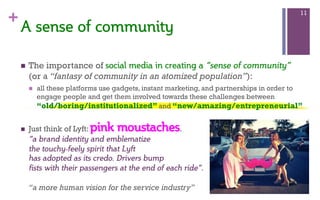
n  Just think of Lyft: pink moustaches.
“a brand identity and emblematize
the touchy-feely spirit that Lyft
has adopted as its credo. Drivers bump
fists with their passengers at the end of each ride”.
“a more human vision for the service industry”
11
A  sense  of  community  
+ 12
+
n  The company added a “de Blasio’s Uber” widget, available for over
2 million NYC users, that will either always show no cars available or
wait  times  of  25  minutes.
n The feature prompts users to take  action    
and  send  an  email  to  Mayor  Bill  de  Blasio    
and the city council opposing  the  new  bill. 
n Uber told that the new feature will
“demonstrate what life for NYC riders would be like if de
Blasio’s plan to limit Uber is passed into law”.
13
The  Uber-­ization  of  activism    
+
n  “Most models focus either on leveraging networks of existing
resources, capital and volunteers then charging rents for platform
use or on forging platform monopolies that lock-in users so that
their data can then be monetised”.
Izabella Kaminska
n  Technology  may  be  neutral,  but  grass  roots  should  be  built  
bottom  up,  not  top  down.    
n  We  should  be  able  to  recognize  the  profound  difference  between  
Uber’s  capitalistic  populism  and  “authentic”  organizing  for  action.  
Edward T. Walker
14
Avoid  the  Uber-­ization  of  activism    
+
The  ‘Fight-­For-­15’  campaign’s  legacy  
n  Nearly 3 years ago, about 200 NYC fast-food workers interrupted
their jobs, demanding higher pay.
n  The protest was not small.
It is debateable whether it has obtained what it asked for:
wage  gains  for  low-­wage  workers.  
n  The major “big chain” employers - retailers Wal-Mart, McDonald’s
stores – not exceeding the hourly rate of $9 today
n  The  #FF15’s most significant mission accomplished - the approval
of modest minimum-wage hikes in more than ten states – is still on-
going (gradually).We cannot say “they won the war”.  
15
+
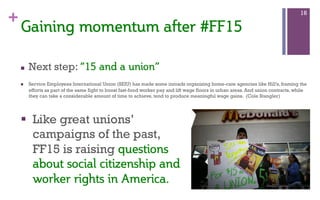
n  Next step: “15  and  a  union”  
n  Service Employees International Union (SEIU) has made some inroads organizing home-care agencies like Hill’s, framing the
efforts as part of the same fight to boost fast-food worker pay and lift wage floors in urban areas. And union contracts, while
they can take a considerable amount of time to achieve, tend to produce meaningful wage gains. (Cole Stangler)
16
Gaining  momentum  after  #FF15  
§  Like great unions’
campaigns of the past,
FF15 is raising questions  
about  social  citizenship  and  
worker  rights  in  America.    
+
o Turkopticona potential source of worker organizing in virtue of
class-consciousness “an activist system that allows workers to
publicize and evaluate their relationships with employers”.
o  The website permits Turkers “to engage one another in mutual aid”.
n  Researchers put a provocative task on the platform, asking workers
to define an ideal “Workers’ Bill of Rights” from their point of view.
o Dynamo a community founded by scholars, which could be seen
as the first step toward granting Turkers a collective voice.
17
Amazon  Mechanical  Turk  
An  attempt  to  organize    
+
n  The website (actually a browser extension for Firefox and Chrome,
see turkopticon.ucsd.edu) also permits Turkers “to engage one
another in mutual aid”.
n  Launched in late 2008,Turkopticon is a browser plug-in application
that offers a way for workers to rate MTurk employers and avoid
those with bad reputations.
n  Irani and Silberman, during a survey, received 67 responses and found out that “35
workers felt that their work was regularly rejected unfairly or arbitrarily,26 workers
demanded faster payment (Amazon allows employers 30-days to evaluate and pay for
work),7 explicitly mentioned a ‘minimum wage’ or ‘minimum payment’ per HIT,14
mentioned ‘fair’ compensation generally,8 expressed dissatisfaction with employers’
and Amazon’s lack of response to their concerns”
18
Amazon  Mechanical  Turk  
Turkoptikon  
+
n  It is a community designed, founded, adapted by scholars
n “Dynamo is more like a virtual union hall, a worker-
only safe space where workers can post ideas about
activist actions anonymously,” Irani said.
n  “A platform to gather, gain critical mass, and mobilize” + “it generates
change, whether that take the form of pixels, profit, or progress”.
n  This trend deserves attention, Providers are a platform’s best
economic inputs, they should be protected, though AMT can
tolerate the loss of accounts that do not accept the system’s terms
19
Amazon  Mechanical  Turk  
Dynamo  
+
n  In August 2014, a group of drivers established the California App-
based Drivers Association, a sort of Uber drivers union.
n  The same happened in Seattle and NewYork City...
n  Threats of work stoppage are the order of the day.
n  People want to join forces.
n A  feeling  of  dissatisfaction  and  outrage  towards  Uber  
employment  –  and  price,  too  –  models  and  unilateral  
changes  in  T&C.  
20
Uber    
Strikes  and  protests  
+ 21
https://www.fb.com/uberfreedom  
+
Organizing  or  unionizing?  
ü  Workers will gather in communities where it is feasible to exchange
knowledge and tricks.
ü  The blog “Ride share guy” provides guidance and instructions to
drivers on maximizing incomes from the diverse car sharing apps.
ü “Peers.org” could be considered a “power-organizer”;
o  a system of pooling many accounts into one, organizing, caring,
supporting participants in the sharing economy, both its freelance
population
ü  Guilds like “Peers.org” and “Freelancers Union” are starting to
engage in a struggle aimed at pooling bargaining power, also
in order to let contractors access promotional health insurance
22
+
A  new  model  is  possible  #1  
n BlueCrew provides on-demand labor but pays
workers as employees.
n  The company prefers this model since it can avoid potential tax liability
and other problems arising from an incorrect classification, while workers
get stable and secure work.
n InstaCart, grocery delivery service, allows its
personal shoppers the possibility to switch from
contractor to employee status.
n  The decision follows a change to Instacart’s business model.
23
+
n The food preparation and delivery service Munchery,
the personal assistant company Alfred,
and the office cleaning service Managed by Qii
hire workers as employees, not independent contractors
à tales  of  Responsible  Business  Practices  in  the  On-­Demand  Economy    
n  In addition to avoiding lawsuits, companies consider increased
efficiency, strong commitment and worker retention
as reasons to (re)classify their workers as employees.
24
A  new  model  is  possible  #2  
+
Platform  “cooperativism”  
According  to  Scholz  and  Schneider’s  manifesto
n New  forms  of  solidarity  aimed  at  fighting  for  better  
conditions  for  “cloud  workers”  and  vulnerable  workforce.  
n  Cooperatives are facing copious amounts of challenges on the
level of competition from players like Uber, in terms of public
awareness, allocation of work, as well as wage levels.
n  An app with the basic functionality of UberX can be duplicated and
improved upon by independent developers who are working in
tandem with cooperatives.
n  Taxi drivers and technologists can coalesce to build an app that
equals or is able to compete with their corporate equivalent.
25
+
A  movement  of  interests?  
n  Those who profess to favor freedom and yet deprecate agitation are men who want crops
without plowing up the ground; they want rain without thunder and lightning. They want
the ocean without the awful roar of its many waters.
—  Frederick  Douglass,  1857  
n  Facilitate organizing by on-demand workers.
n  The opportunity to join forces in unions and bargain collectively is pivotal in the
on-demand economy. In the light of the fact that work is distributed on a piece-rate
basis, competition for getting job is inhumane, and the conditions of work are by
definition isolating for citizens.
n A considerable mass of workers can define its sectoral
priorities, a  sector-­specific  approach  may  be  an  effective  
way  to  set  standards.    
26
+
ü Infrastructures are just a shell / packaging
ü We need to build constituencies
ü People matter
ü Act on the side of the demand, rather than on the side
of the offer à generate advocacy
ü Genuine bottom up workers movements +
government intervention and – if needed – law making
27
Not  to  reinvent  the  wheel    
+ 28
“Sharing” = “an equitable split in
wealth and responsibility”
§  tighten  up  international  
codes  of  good practice  and  
make  worldwide  firms  
respect  them;;  
§  reduce  up  to  eliminate  
discrimination  based  on  
geographical  preferences  or  
rating  charts;;  
§  avoid  and  hinder  child
labour or forced labour;;  
§  prevent  “labor brokerage”  
from  shifting  into  “social  
arbitrage”  (Hill,  2015);;  
§  make  ratings “portable”
across  platforms,  leading  to  
a  unique  “digital  identity”;;  
§  overcome  the exclusivity
clause that ties workers to a
special platform;;  
§  ensure better protection to  
whom  is  behind  the  scene  
of  the  sharing  economy.  
Workers’  goals  (in  my  opinion)  
+
  
Thank  you!  
(Q&A  time)  
@_Aloisi    
  aloisi.antonio@phd.unibocconi.it  

Platform Cooperativism

  • 1.
    + Imparare  il  Cambiamento   @ProgettoRENA,  Milano     Commoditized  Workers     Taking digital unionizing seriously Antonio  Aloisi  –  Bocconi  University,  Milan  |  @_Aloisi  
  • 2.
    + All  we  need is  sharing. Really?   2 Global  trend  towards:       1. casualization of work 1.b  decentralization  of  structures     1.c.  creation  of  dispersed  production   networks   Opportunities for people willing to find a job or to top up their salaries [flexibility] Circumvent employment regulation, by operating informally in traditionally regulated markets [informalisation] Companies benefit thanks to technologies that allow cutting transaction costs by outsourcing [computerization]
  • 3.
    + Why  #platformcoop?   n Facing a digital version of Taylorism, i.e.the efficient exploitation (or expropriation) of work at the detriment of education and skill development of workers à invisible workers n  Websites like TaskRabbit,Elance,Lift,Handy (“commodities market” vs “knowledge economy”) threaten to dismantle traditional labour markets as they do not seem to ensure a fair protection of workers’ rights n  This new configuration implies wages fixed by a dynamic calculation of supply and demand, and every worker’s act constantly traced, appraised and “subject to the sometimes harsh light of customer satisfaction” 3
  • 4.
    + “Employing  humans-­as-­a-­service”   Jeff Bezos  said   n  A preliminary definition of “crowd-working”: n  “the act of taking a job traditionally performed by a designated agent (usually an employee) and outsourcing it to an undefined, generally large group of people in the form of an open call” n  These tools have the potential to “chop up” a broad array of traditional jobs into detached tasks that can be allocated to workers just when they are needed à on-demand economy / workers on tap n  Rating system à monitor and discourage n  This new configuration implies wages fixed by a dynamic calculation of supply and demand, and every worker’s act constantly traced, appraised and “subject to the sometimes harsh light of customer satisfaction” 4
  • 5.
    + ? 5 Legal issue: doworkers in the on- demand economy continue to be independent contractors (according to participation agreements: not employees, in a word) even though many indicators reveal a disguised employment relationship (disproportionate presence of vulnerable players)?
  • 6.
    + n  Whether aworker is an employee or a contractor depends on a “multifactorial” test based on the facts emerging from the employment relationship. n  the possibility of having free personal judgement and control over one’s own work, n  the way in which tasks are performed, n  the power of termination, n  the “economic realities” and the concrete dependency in relation with the employer, n  the permanency of the relationship, n  the number of working hours, n  the power of direction exercised by the employee, n  the freedom of managing its own time schedule, n  the ownership of equipment, n  the method of payment (hours vs project), n  the degree of flexibility and protections, n  the disparity of relative bargaining power. 6 The  multifactorial  test      
  • 7.
    + Class  actions n A federaljudge granted class-action status to a lawsuit that examine the employment classification of Uber drivers, this could be the beginning of a slow legal challenge: the ride-hailing company’s business model could be “disrupted” (does this set a precedent?) n  Lyft, a competitor to Uber that has also raised venture capital, faces a similar class action. n The California Labor Commissioner’s Office (administrative organ) ruled that Barbara Ann Berwick, a former Uber driver, should  have  been  considered  an  employee.   7
  • 8.
    + n “Rather than forcingworkers to litigate the issue of employee status on a case-by-case basis, policymakers could provide for direct, automatic coverage of on-demand workers under core labor laws” (Rebecca Smith and Sarah Leberstein) n Provide a social  safety  net: n Health coverage, insurance against workplace injuries, paid vacations and maternity leave: these have long been universal entitlements in many economies. (Arun Sundararajan) 8 A  social  safety  net      
  • 9.
    + From  ownership  to membership     n Nothing new: companies such as term agencies have long made workers “bid for jobs on a daily basis, work for piece rate, or contract for short-term jobs”. What changes here is scale and speed. n “Use the past to inform the fight to revive the labor movement today” n Organizations: Freelancers Union, the NYC Taxi Alliance, CADA, TurkerNation, the Domestic Workers Alliance 9
  • 10.
    + n  Rubeny andWilkinson: considerations at the basis of the contemporary use of home-based outsourcing: (1) technology; (2) work organization; (3) avoidance of collective action; (4) product market; (5) labor cost. n Outsourcing stops workers entering into contact and the rise of “sodality” by fragmenting the labor force n Competition could prevent from cooperating, so that opportunistic behaviours may be easily incentivised 10 Collective  action  
  • 11.
    + n  The importanceof social  media  in  creating  a  “sense of community” (or a “fantasy of community in an atomized population”): n  all these platforms use gadgets, instant marketing, and partnerships in order to engage people and get them involved towards these challenges between “old/boring/institutionalized” and “new/amazing/entrepreneurial” n  Just think of Lyft: pink moustaches. “a brand identity and emblematize the touchy-feely spirit that Lyft has adopted as its credo. Drivers bump fists with their passengers at the end of each ride”. “a more human vision for the service industry” 11 A  sense  of  community  
  • 12.
  • 13.
    + n  The companyadded a “de Blasio’s Uber” widget, available for over 2 million NYC users, that will either always show no cars available or wait  times  of  25  minutes. n The feature prompts users to take  action     and  send  an  email  to  Mayor  Bill  de  Blasio     and the city council opposing  the  new  bill.  n Uber told that the new feature will “demonstrate what life for NYC riders would be like if de Blasio’s plan to limit Uber is passed into law”. 13 The  Uber-­ization  of  activism    
  • 14.
    + n  “Most modelsfocus either on leveraging networks of existing resources, capital and volunteers then charging rents for platform use or on forging platform monopolies that lock-in users so that their data can then be monetised”. Izabella Kaminska n  Technology  may  be  neutral,  but  grass  roots  should  be  built   bottom  up,  not  top  down.     n  We  should  be  able  to  recognize  the  profound  difference  between   Uber’s  capitalistic  populism  and  “authentic”  organizing  for  action.   Edward T. Walker 14 Avoid  the  Uber-­ization  of  activism    
  • 15.
    + The  ‘Fight-­For-­15’  campaign’s legacy   n  Nearly 3 years ago, about 200 NYC fast-food workers interrupted their jobs, demanding higher pay. n  The protest was not small. It is debateable whether it has obtained what it asked for: wage  gains  for  low-­wage  workers.   n  The major “big chain” employers - retailers Wal-Mart, McDonald’s stores – not exceeding the hourly rate of $9 today n  The  #FF15’s most significant mission accomplished - the approval of modest minimum-wage hikes in more than ten states – is still on- going (gradually).We cannot say “they won the war”.   15
  • 16.
    + n  Next step:“15  and  a  union”   n  Service Employees International Union (SEIU) has made some inroads organizing home-care agencies like Hill’s, framing the efforts as part of the same fight to boost fast-food worker pay and lift wage floors in urban areas. And union contracts, while they can take a considerable amount of time to achieve, tend to produce meaningful wage gains. (Cole Stangler) 16 Gaining  momentum  after  #FF15   §  Like great unions’ campaigns of the past, FF15 is raising questions   about  social  citizenship  and   worker  rights  in  America.    
  • 17.
    + o Turkopticona potential sourceof worker organizing in virtue of class-consciousness “an activist system that allows workers to publicize and evaluate their relationships with employers”. o  The website permits Turkers “to engage one another in mutual aid”. n  Researchers put a provocative task on the platform, asking workers to define an ideal “Workers’ Bill of Rights” from their point of view. o Dynamo a community founded by scholars, which could be seen as the first step toward granting Turkers a collective voice. 17 Amazon  Mechanical  Turk   An  attempt  to  organize    
  • 18.
    + n  The website(actually a browser extension for Firefox and Chrome, see turkopticon.ucsd.edu) also permits Turkers “to engage one another in mutual aid”. n  Launched in late 2008,Turkopticon is a browser plug-in application that offers a way for workers to rate MTurk employers and avoid those with bad reputations. n  Irani and Silberman, during a survey, received 67 responses and found out that “35 workers felt that their work was regularly rejected unfairly or arbitrarily,26 workers demanded faster payment (Amazon allows employers 30-days to evaluate and pay for work),7 explicitly mentioned a ‘minimum wage’ or ‘minimum payment’ per HIT,14 mentioned ‘fair’ compensation generally,8 expressed dissatisfaction with employers’ and Amazon’s lack of response to their concerns” 18 Amazon  Mechanical  Turk   Turkoptikon  
  • 19.
    + n  It isa community designed, founded, adapted by scholars n “Dynamo is more like a virtual union hall, a worker- only safe space where workers can post ideas about activist actions anonymously,” Irani said. n  “A platform to gather, gain critical mass, and mobilize” + “it generates change, whether that take the form of pixels, profit, or progress”. n  This trend deserves attention, Providers are a platform’s best economic inputs, they should be protected, though AMT can tolerate the loss of accounts that do not accept the system’s terms 19 Amazon  Mechanical  Turk   Dynamo  
  • 20.
    + n  In August2014, a group of drivers established the California App- based Drivers Association, a sort of Uber drivers union. n  The same happened in Seattle and NewYork City... n  Threats of work stoppage are the order of the day. n  People want to join forces. n A  feeling  of  dissatisfaction  and  outrage  towards  Uber   employment  –  and  price,  too  –  models  and  unilateral   changes  in  T&C.   20 Uber     Strikes  and  protests  
  • 21.
  • 22.
    + Organizing  or  unionizing?  ü  Workers will gather in communities where it is feasible to exchange knowledge and tricks. ü  The blog “Ride share guy” provides guidance and instructions to drivers on maximizing incomes from the diverse car sharing apps. ü “Peers.org” could be considered a “power-organizer”; o  a system of pooling many accounts into one, organizing, caring, supporting participants in the sharing economy, both its freelance population ü  Guilds like “Peers.org” and “Freelancers Union” are starting to engage in a struggle aimed at pooling bargaining power, also in order to let contractors access promotional health insurance 22
  • 23.
    + A  new  model is  possible  #1   n BlueCrew provides on-demand labor but pays workers as employees. n  The company prefers this model since it can avoid potential tax liability and other problems arising from an incorrect classification, while workers get stable and secure work. n InstaCart, grocery delivery service, allows its personal shoppers the possibility to switch from contractor to employee status. n  The decision follows a change to Instacart’s business model. 23
  • 24.
    + n The food preparationand delivery service Munchery, the personal assistant company Alfred, and the office cleaning service Managed by Qii hire workers as employees, not independent contractors à tales  of  Responsible  Business  Practices  in  the  On-­Demand  Economy     n  In addition to avoiding lawsuits, companies consider increased efficiency, strong commitment and worker retention as reasons to (re)classify their workers as employees. 24 A  new  model  is  possible  #2  
  • 25.
    + Platform  “cooperativism”   According to  Scholz  and  Schneider’s  manifesto n New  forms  of  solidarity  aimed  at  fighting  for  better   conditions  for  “cloud  workers”  and  vulnerable  workforce.   n  Cooperatives are facing copious amounts of challenges on the level of competition from players like Uber, in terms of public awareness, allocation of work, as well as wage levels. n  An app with the basic functionality of UberX can be duplicated and improved upon by independent developers who are working in tandem with cooperatives. n  Taxi drivers and technologists can coalesce to build an app that equals or is able to compete with their corporate equivalent. 25
  • 26.
    + A  movement  of interests?   n  Those who profess to favor freedom and yet deprecate agitation are men who want crops without plowing up the ground; they want rain without thunder and lightning. They want the ocean without the awful roar of its many waters. —  Frederick  Douglass,  1857   n  Facilitate organizing by on-demand workers. n  The opportunity to join forces in unions and bargain collectively is pivotal in the on-demand economy. In the light of the fact that work is distributed on a piece-rate basis, competition for getting job is inhumane, and the conditions of work are by definition isolating for citizens. n A considerable mass of workers can define its sectoral priorities, a  sector-­specific  approach  may  be  an  effective   way  to  set  standards.     26
  • 27.
    + ü Infrastructures are justa shell / packaging ü We need to build constituencies ü People matter ü Act on the side of the demand, rather than on the side of the offer à generate advocacy ü Genuine bottom up workers movements + government intervention and – if needed – law making 27 Not  to  reinvent  the  wheel    
  • 28.
    + 28 “Sharing” =“an equitable split in wealth and responsibility” §  tighten  up  international   codes  of  good practice  and   make  worldwide  firms   respect  them;;   §  reduce  up  to  eliminate   discrimination  based  on   geographical  preferences  or   rating  charts;;   §  avoid  and  hinder  child labour or forced labour;;   §  prevent  “labor brokerage”   from  shifting  into  “social   arbitrage”  (Hill,  2015);;   §  make  ratings “portable” across  platforms,  leading  to   a  unique  “digital  identity”;;   §  overcome  the exclusivity clause that ties workers to a special platform;;   §  ensure better protection to   whom  is  behind  the  scene   of  the  sharing  economy.   Workers’  goals  (in  my  opinion)  
  • 29.
    +   Thank  you!  (Q&A  time)   @_Aloisi      aloisi.antonio@phd.unibocconi.it