1
Plastics – the Facts 2015
An analysis of European plastics
production, demand and waste data
3
Plastics – the Facts is an analysis of the data related to the production, demand and waste
management of plastics materials. It provides the latest business information on production and
demand, trade, recovery as well as employment and turnover in the plastics industry. In short, this
report gives an insight into the industry’s contribution to European economic growth and prosperity
throughout the life cycle of the material.
The data presented in this report was collected by PlasticsEurope (the Association of Plastics
Manufacturers in Europe) and EPRO (the European Association of Plastics Recycling and Recovery
Organisations). PlasticsEurope’s Market Research and Statistics Group (PEMRG) provided input on the
production of and demand for plastics raw materials. Consultic Marketing & Industrieberatung GmbH
helped assess waste generation and recovery data. Official statistics from European or national
authorities and waste management organisations have been used for recovery and trade data, where
available. Research or expertise from consultants completed gaps.
Figures cannot always be directly compared with those of previous years due to changes in estimates.
Some estimates from previous years have been revised in order to track progress, e.g. for use and
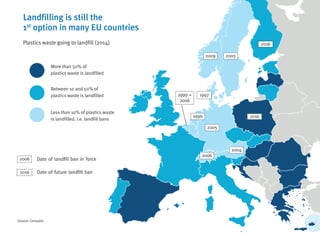
recovery of plastics across Europe over the past decade.
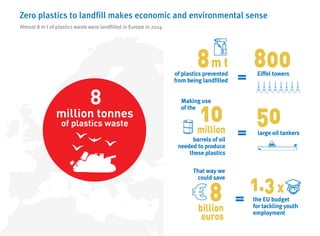
All figures and graphs in this report show data for EU-28 plus Norway and Switzerland, which is referred
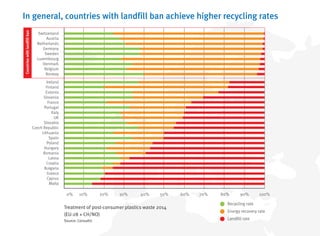
to as Europe for the purposes of abbreviation – other country groups are explicitly listed.
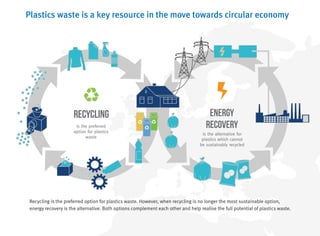
4
Plastics:
the material
for the
21st
century
For the past 150 years,
plastics materials have been
key enablers for innovation
and have contributed to
the development and
progress of society.
p
Plastics have revolutionised society to meet the
challenges the world faces in the 21th
century
www.plasticseurope.org www.plastics-themag.com
6
Plastics: contribution
to European society
and economy
The European
plastics industry
directly employs more
than 1.4 million people.
2014 key figures of the European plastics industry
62,000
Recycling
CompaniesEmployees
~ 27 bn €
350 bn € 2.4in GDP
Almost 3in jobs
Turnover Multiplier effect**
Trade balance* Contribution
Source: Eurostat
Most of them SMEs
Over
to public financesof positive trade balance of plastic waste recycled
18 bn €
The European plastics industry includes plastics raw material producers, plastics converters
and plastics machinery manufacturers in the EU-28 Member States.
1.45 million
7.7m t
**Source: Ambrosetti study 2013 – data for Italy*Data including only plastics raw material producers and plastics converters
8
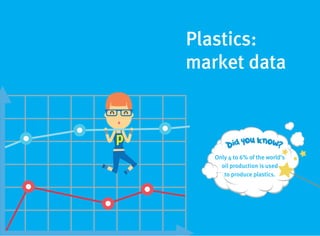
Plastics:
market data
Only 4 to 6% of the world’s
oil production is used
to produce plastics.
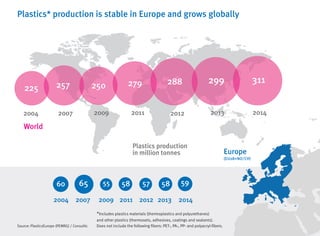
225 250 279 299
2004
Plastics production
in million tonnes
World
2009
257
2007 2011
288
2012 2013
311
2014
2013201120092004
60
2007
65 58 5855
2014
59
2012
57
Plastics* production is stable in Europe and grows globally
Source: PlasticsEurope (PEMRG) / Consultic
*Includes plastics materials (thermoplastics and polyurethanes)
and other plastics (thermosets, adhesives, coatings and sealants).
Does not include the following fibers: PET-, PA-, PP- and polyacryl-fibers.
Europe
(EU28+NO/CH)
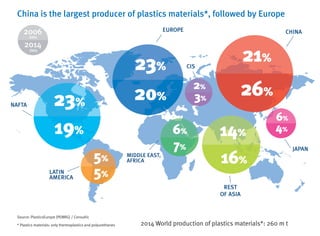
China is the largest producer of plastics materials*, followed by Europe
NAFTA
2006
2014
23%
23%
20%
21%
26%
19%
EUROPE CHINA
CIS
2%
3%
JAPAN
6%
4%
MIDDLE EAST,
AFRICA
6%
7%
LATIN
AMERICA
5%
5%
REST
OF ASIA
14%
16%
Source: PlasticsEurope (PEMRG) / Consultic
* Plastics materials: only thermoplastics and polyurethanes 2014 World production of plastics materials*: 260 m t
data
data
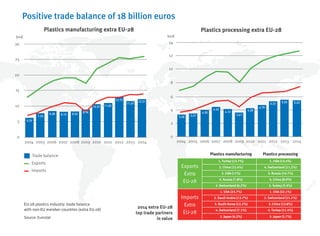
Positive trade balance of 18 billion euros
5
10
15
20
25
30
2004
0
2005 2006 2007 2008 2009 2010 2011 2012 2013 2014
Trade balance
Exports
Imports
bn€
Plastics manufacturing Plastics processing
Exports
Extra
EU-28
1. Turkey (13.7%) 1. USA (13.4%)
2. China (12.4%) 4. Switzerland (11.2%)
3. USA (11%) 3. Russia (10.7%)
4. Russia (7.8%) 4. China (8.9%)
5. Switzerland (6.2%) 5. Turkey (5.9%)
Imports
Extra
EU-28
1. USA (23.7%) 1. USA (22.1%)
2. Saudi Arabia (13.7%) 2. Switzerland (15.1%)
3. South Korea (12.2%) 3. China (13.8%)
4. Switzerland (7.1%) 4. Turkey (11.4%)
5. Japan (6.2%) 5. Japan (5.7%)
2004
0
2
4
6
8
10
12
14
2005 2006 2007 2008 2009 2010 2011 2012 2013 2014
bn€
Plastics manufacturing extra EU-28 Plastics processing extra EU-28
2014 extra EU-28
top trade partners
in value
6.24
7.79
8.38 8.15 8.32
10.57 11.02
12.73
11.67
12.21
3.28 3.47
4.05
4.42
4.12
3.61
4.28
4.70
5.32 5.55 5.43
Source: Eurostat
EU-28 plastics industry: trade balance
with non-EU member countries (extra EU-28)
8.94
Cyprus / Malta
Belgium & Lux.
Bulgaria
Czech Republic
Denmark
Finland
France
Germany
Greece
Hungary
Ireland
Italy
Latvia
Lithuania
Netherlands
Poland
Portugal
Romania
Slovakia
Slovenia
Spain
Sweden
United Kingdom
Norway
Switzerland
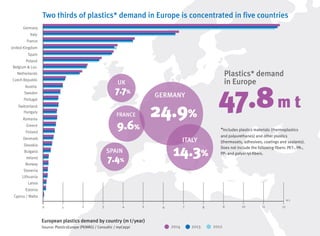
European plastics demand by country (m t/year)
Source: PlasticsEurope (PEMRG) / Consultic / myCeppi
0 1 2 3 4 5 6 7 8 9 10 11 12
Two thirds of plastics* demand in Europe is concentrated in five countries
2013 20122014
m t
Austria
Estonia
Plastics* demand
in Europe
GERMANY
ITALY
24.9%
UK
FRANCE
7.7%
SPAIN
7.4%
9.6%
14.3%
47.8m t
*Includes plastics materials (thermoplastics
and polyurethanes) and other plastics
(thermosets, adhesives, coatings and sealants).
Does not include the following fibers: PET-, PA-,
PP- and polyacryl-fibers.
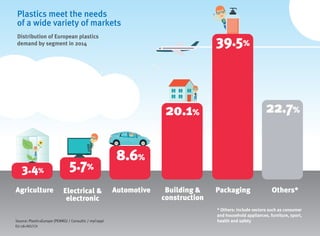
Plastics meet the needs
of a wide variety of markets
Electrical &
electronic
AutomotiveAgriculture Building &
construction
Packaging Others*
5.7%3.4%
8.6%
22.7%20.1%
39.5%
* Others: include sectors such as consumer
and household appliances, furniture, sport,
health and safetySource: PlasticsEurope (PEMRG) / Consultic / myCeppi
EU-28+NO/CH
Distribution of European plastics
demand by segment in 2014
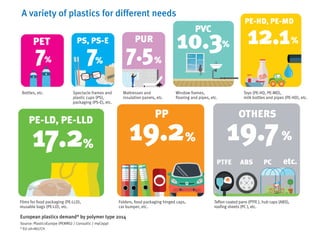
A variety of plastics for different needs
PET
7%
PS, PS-E
7%
PUR
7.5 %
10.3%
PE-HD, PE-MD
12.1%
PE-LD, PE-LLD
17.2%
PP
19.2%
OTHERS
19.7%
Bottles, etc. Spectacle frames and
plastic cups (PS),
packaging (PS-E), etc.
Mattresses and
insulation panels, etc.
Films for food packaging (PE-LLD),
reusable bags (PE-LD), etc.
Folders, food packaging hinged caps,
car bumper, etc.
Teflon coated pans (PTFE ), hub caps (ABS),
roofing sheets (PC ), etc.
Window frames,
flooring and pipes, etc.
Toys (PE-HD, PE-MD),
milk bottles and pipes (PE-HD), etc.
%
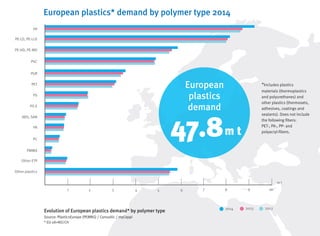
European plastics demand* by polymer type 2014
Source: PlasticsEurope (PEMRG) / Consultic / myCeppi
* EU-28+NO/CH
PVC
PTFE ABS PC etc.
Evolution of European plastics demand* by polymer type
Source: PlasticsEurope (PEMRG) / Consultic / myCeppi
* EU-28+NO/CH
PE-LD, PE-LLD
PE-HD, PE-MD
PS
PS-E
PVC
ABS, SAN
PMMA
PA
PC
Other ETP
PUR
Other plastics
PET
1 2 3 4 6 7 8 95 10
m t
2014 20122013
PP
European
plastics
demand
47.8m t
European plastics* demand by polymer type 2014
*Includes plastics
materials (thermoplastics
and polyurethanes) and
other plastics (thermosets,
adhesives, coatings and
sealants). Does not include
the following fibers:
PET-, PA-, PP- and
polyacryl-fibers.
39.5%
20.1%
8.6%
5.7%
26.1%
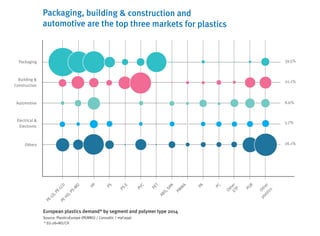
European plastics demand* by segment and polymer type 2014
Source: PlasticsEurope (PEMRG) / Consultic / myCeppi
* EU-28+NO/CH
Packaging, building & construction and
automotive are the top three markets for plastics
PE-LD,PE-LLDPE-HD,PS-M
D
PP
PS
PS-E
PVC
ABS,SAN
PM
M
A
PA
PET
OtherETP
PUR
Other
plastics
PC
Electrical &
Electronic
Others
Automotive
Packaging
Building &
Construction
17
Plastics: waste
management data
Europe is losing economically
valuable resources by landfilling
almost 8 million tonnes
of plastics waste per year.
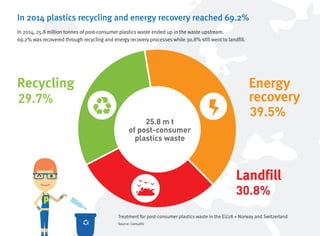
Treatment for post-consumer plastics waste in the EU28 + Norway and Switzerland
Source: Consultic
In 2014 plastics recycling and energy recovery reached 69.2%
In 2014, 25.8 million tonnes of post-consumer plastics waste ended up in the waste upstream.
69.2% was recovered through recycling and energy recovery processes while 30.8% still went to landfill.
25.8 m t
of post-consumer
plastics waste
30.8%
29.7%
Landfill
Recycling Energy
recovery
39.5%
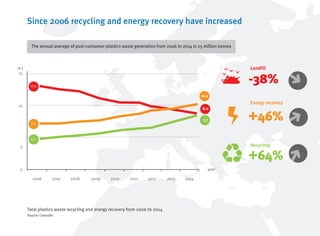
Total plastics waste recycling and energy recovery from 2006 to 2014
Source: Consultic
m t
year
15
10
5
0
2006
Landfill
Energy recovery
2007 2008 2009 2010 2011 2012 2013 2014
Since 2006 recycling and energy recovery have increased
The annual average of post-consumer plastics waste generation from 2006 to 2014 is 25 million tonnes
-38%
+46%
Recycling
+64%
8.0
10.2
7.7
4.7
7.0
12.9
Plastics waste going to landfill (2014)
Date of future landfill ban
Landfilling is still the
1st
option in many EU countries
More than 50% of
plastics waste is landfilled
Between 10 and 50% of
plastics waste is landfilled
Less than 10% of plastics waste
is landfilled. i.e. landfill bans
1999 +
2006
1997
1996
2005
2009 2005
2006
2004
2016
Date of landfill ban in force
20162016
2006
Source: Consultic
2016
Zero plastics to landfill makes economic and environmental sense
Almost 8 m t of plastics waste were landfilled in Europe in 2014
of plastics prevented
from being landfilled
Eiffel towers
=
8 800m t
barrels of oil
needed to produce
these plastics
Making use
of the
That way we
could save
large oil tankers=
10 50million
billion
euros
the EU budget
for tackling youth
employment
=8 1.3x
million tonnes
of plastics waste
8
Treatment of post-consumer plastics waste 2014
(EU-28 + CH/NO)
Source: Consultic
Switzerland
Austria
Netherlands
Germany
Sweden
Luxembourg
Denmark
Belgium
Norway
Ireland
Finland
Estonia
Slovenia
France
Portugal
Italy
UK
Slovakia
Czech Republic
Lithuania
Spain
Poland
Hungary
Romania
Latvia
Croatia
Bulgaria
Greece
Cyprus
Malta
0% 10% 20% 30% 40% 50% 60% 70% 100%80% 90%
Energy recovery rate
Landfill rate
Recycling rate
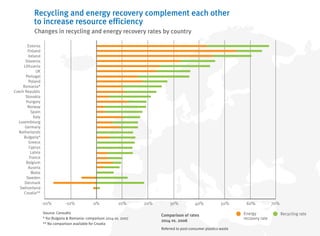
In general, countries with landfill ban achieve higher recycling rates
Countrieswithlandfillban
Plastics waste is a key resource in the move towards circular economy
energy
recovery
recycling
is the preferred
option for plastics
waste
is the alternative for
plastics which cannot
be sustainably recycled
Recycling is the preferred option for plastics waste. However, when recycling is no longer the most sustainable option,
energy recovery is the alternative. Both options complement each other and help realise the full potential of plastics waste.
Source: Consultic
* For Bulgaria & Romania: comparison 2014 vs. 2007
** No comparison available for Croatia
Estonia
Finland
Ireland
Slovenia
Lithuania
UK
Portugal
Poland
Romania*
Czech Republic
Slovakia
Hungary
Norway
Spain
Italy
Luxembourg
Germany
Netherlands
Bulgaria*
Greece
Cyprus
Latvia
France
Belgium
Austria
Malta
Sweden
Denmark
Switzerland
Croatia**
-10%-20% 0% 10% 30%20% 40% 50% 60% 70%
Recycling rateEnergy
recovery rate
Comparison of rates
2014 vs. 2006
Recycling and energy recovery complement each other
to increase resource efficiency
Changes in recycling and energy recovery rates by country
Referred to post-consumer plastics waste
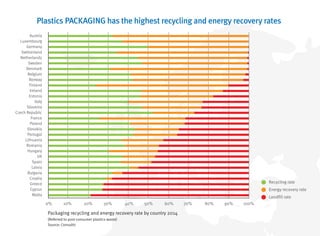
Packaging recycling and energy recovery rate by country 2014
(Referred to post-consumer plastics waste)
Source: Consultic
0% 10% 20% 30% 40% 50% 60% 70% 100%80% 90%
Austria
Luxembourg
Germany
Switzerland
Netherlands
Sweden
Denmark
Belgium
Norway
Finland
Ireland
Estonia
Italy
Slovenia
Czech Republic
France
Poland
Slovakia
Portugal
Lithuania
Romania
Hungary
UK
Spain
Latvia
Bulgaria
Croatia
Greece
Cyprus
Malta
Plastics PACKAGING has the highest recycling and energy recovery rates
Energy recovery rate
Landfill rate
Recycling rate
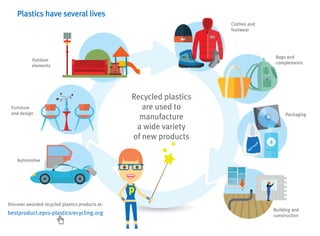
Plastics have several lives
Recycled plastics
are used to
manufacture
a wide variety
of new products
Clothes and
footwear
Bags and
complements
Packaging
Building and
constructionbestproduct.epro-plasticsrecycling.org
Automotive
Discover awarded recycled plastics products at:
Furniture
and design
Outdoor
elements
27
Snapshot
The European plastics
industry can contribute
to increase EU industry
GDP from 15% to
20% by 2020.
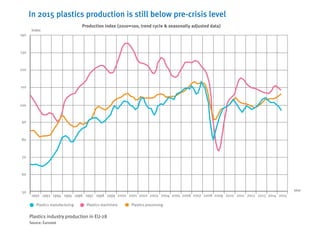
Plastics industry production in EU-28
Source: Eurostat
60
50
70
80
90
100
110
120
130
140
1992 1993 1994 1995 1996 1997 1998 1999 2000 2001 2002 2003 2004 2005 2006 2007 2008 2009 2010 2011 2012 2013 2014 2015
Plastics manufacturing Plastics machinery Plastics processing
Production index (2010=100, trend cycle & seasonally adjusted data)
year
In 2015 plastics production is still below pre-crisis level
Index
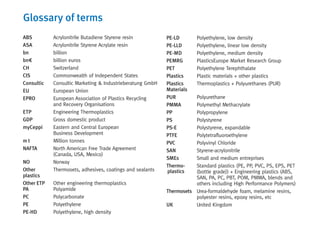
ABS Acrylonitrile Butadiene Styrene resin
ASA Acrylonitrile Styrene Acrylate resin
bn billion
bn€ billion euros
CH Switzerland
CIS Commonwealth of Independent States
Consultic Consultic Marketing & Industrieberatung GmbH
EU European Union
EPRO European Association of Plastics Recycling
and Recovery Organisations
ETP Engineering Thermoplastics
GDP Gross domestic product
myCeppi Eastern and Central European
Business Development
m t Million tonnes
NAFTA North American Free Trade Agreement
(Canada, USA, Mexico)
NO Norway
Other Thermosets, adhesives, coatings and sealants
plastics
Other ETP Other engineering thermoplastics
PA Polyamide
PC Polycarbonate
PE Polyethylene
PE-HD Polyethylene, high density
PE-LD Polyethylene, low density
PE-LLD Polyethylene, linear low density
PE-MD Polyethylene, medium density
PEMRG PlasticsEurope Market Research Group
PET Polyethylene Terephthalate
Plastics Plastic materials + other plastics
Plastics Thermoplastics + Polyurethanes (PUR)
Materials
PUR Polyurethane
PMMA Polymethyl Methacrylate
PP Polypropylene
PS Polystyrene
PS-E Polystyrene, expandable
PTFE Polytetrafluoroethylene
PVC Polyvinyl Chloride
SAN Styrene-acrylonitrile
SMEs Small and medium entreprises
Thermo- Standard plastics (PE, PP, PVC, PS, EPS, PET
(bottle grade)) + Engineering plastics (ABS,
SAN, PA, PC, PBT, POM, PMMA, blends and
others including High Performance Polymers)
Thermosets Urea-formaldehyde foam, melamine resins,
polyester resins, epoxy resins, etc
UK United Kingdom
Glossary of terms
plastics
30
3
PlasticsEurope
PlasticsEurope is one of the leading European trade associations with centres in Brussels, Frankfurt, London, Madrid, Milan
and Paris. We are networking with European and national plastics associations and have more than 100 member companies,
producing over 90% of all polymers across the EU28 member states plus Norway, Switzerland and Turkey. The European
plastics industry makes a significant contribution to the welfare in Europe by enabling innovation, creating quality of life
to citizens and facilitating resource efficiency and climate protection. More than 1.45 million people are working in more
than 60,000 companies (mainly small and medium sized companies in the converting sector) to create a turnover around
350 bn EUR per year.
www.plasticseurope.org
EPRO (European Association of Plastics Recycling and Recovery Organisations)
EPRO is a pan-European partnership of specialist organisations that are able to develop and deliver efficient solutions for
the sustainable management of plastics waste, now and for the future. EPRO members are working to optimise national
effectiveness through international co-operation: by studying successful approaches, evaluating different solutions and
examining obstacles to progress. By working together EPRO members can achieve synergies that will increase efficient plastics
recycling and recovery. Currently 19 organisations in 14 European countries, South Africa and Canada are represented in EPRO.
www.epro-plasticsrecycling.org
31
11-2015
© 2015 PlasticsEurope. All rights reserved.
Konigin Astridlaan 59
1780 Wemmel – Belgium
Phone +32 (0)2 456 84 49
info@epro-plasticsrecycling.org
www.epro-plasticsrecycling.org
Avenue E. van Nieuwenhuyse 4/3
1160 Brussels – Belgium
Phone +32 (0)2 675 32 97
info@plasticseurope.org
www.plasticseurope.org

Plastic - The year 2015

  • 1.
    1 Plastics – theFacts 2015 An analysis of European plastics production, demand and waste data
  • 2.
    3 Plastics – theFacts is an analysis of the data related to the production, demand and waste management of plastics materials. It provides the latest business information on production and demand, trade, recovery as well as employment and turnover in the plastics industry. In short, this report gives an insight into the industry’s contribution to European economic growth and prosperity throughout the life cycle of the material. The data presented in this report was collected by PlasticsEurope (the Association of Plastics Manufacturers in Europe) and EPRO (the European Association of Plastics Recycling and Recovery Organisations). PlasticsEurope’s Market Research and Statistics Group (PEMRG) provided input on the production of and demand for plastics raw materials. Consultic Marketing & Industrieberatung GmbH helped assess waste generation and recovery data. Official statistics from European or national authorities and waste management organisations have been used for recovery and trade data, where available. Research or expertise from consultants completed gaps. Figures cannot always be directly compared with those of previous years due to changes in estimates. Some estimates from previous years have been revised in order to track progress, e.g. for use and recovery of plastics across Europe over the past decade. All figures and graphs in this report show data for EU-28 plus Norway and Switzerland, which is referred to as Europe for the purposes of abbreviation – other country groups are explicitly listed.
  • 3.
    4 Plastics: the material for the 21st century Forthe past 150 years, plastics materials have been key enablers for innovation and have contributed to the development and progress of society. p
  • 4.
    Plastics have revolutionisedsociety to meet the challenges the world faces in the 21th century www.plasticseurope.org www.plastics-themag.com
  • 5.
    6 Plastics: contribution to Europeansociety and economy The European plastics industry directly employs more than 1.4 million people.
  • 6.
    2014 key figuresof the European plastics industry 62,000 Recycling CompaniesEmployees ~ 27 bn € 350 bn € 2.4in GDP Almost 3in jobs Turnover Multiplier effect** Trade balance* Contribution Source: Eurostat Most of them SMEs Over to public financesof positive trade balance of plastic waste recycled 18 bn € The European plastics industry includes plastics raw material producers, plastics converters and plastics machinery manufacturers in the EU-28 Member States. 1.45 million 7.7m t **Source: Ambrosetti study 2013 – data for Italy*Data including only plastics raw material producers and plastics converters
  • 7.
    8 Plastics: market data Only 4to 6% of the world’s oil production is used to produce plastics.
  • 8.
    225 250 279299 2004 Plastics production in million tonnes World 2009 257 2007 2011 288 2012 2013 311 2014 2013201120092004 60 2007 65 58 5855 2014 59 2012 57 Plastics* production is stable in Europe and grows globally Source: PlasticsEurope (PEMRG) / Consultic *Includes plastics materials (thermoplastics and polyurethanes) and other plastics (thermosets, adhesives, coatings and sealants). Does not include the following fibers: PET-, PA-, PP- and polyacryl-fibers. Europe (EU28+NO/CH)
  • 9.
    China is thelargest producer of plastics materials*, followed by Europe NAFTA 2006 2014 23% 23% 20% 21% 26% 19% EUROPE CHINA CIS 2% 3% JAPAN 6% 4% MIDDLE EAST, AFRICA 6% 7% LATIN AMERICA 5% 5% REST OF ASIA 14% 16% Source: PlasticsEurope (PEMRG) / Consultic * Plastics materials: only thermoplastics and polyurethanes 2014 World production of plastics materials*: 260 m t data data
  • 10.
    Positive trade balanceof 18 billion euros 5 10 15 20 25 30 2004 0 2005 2006 2007 2008 2009 2010 2011 2012 2013 2014 Trade balance Exports Imports bn€ Plastics manufacturing Plastics processing Exports Extra EU-28 1. Turkey (13.7%) 1. USA (13.4%) 2. China (12.4%) 4. Switzerland (11.2%) 3. USA (11%) 3. Russia (10.7%) 4. Russia (7.8%) 4. China (8.9%) 5. Switzerland (6.2%) 5. Turkey (5.9%) Imports Extra EU-28 1. USA (23.7%) 1. USA (22.1%) 2. Saudi Arabia (13.7%) 2. Switzerland (15.1%) 3. South Korea (12.2%) 3. China (13.8%) 4. Switzerland (7.1%) 4. Turkey (11.4%) 5. Japan (6.2%) 5. Japan (5.7%) 2004 0 2 4 6 8 10 12 14 2005 2006 2007 2008 2009 2010 2011 2012 2013 2014 bn€ Plastics manufacturing extra EU-28 Plastics processing extra EU-28 2014 extra EU-28 top trade partners in value 6.24 7.79 8.38 8.15 8.32 10.57 11.02 12.73 11.67 12.21 3.28 3.47 4.05 4.42 4.12 3.61 4.28 4.70 5.32 5.55 5.43 Source: Eurostat EU-28 plastics industry: trade balance with non-EU member countries (extra EU-28) 8.94
  • 11.
    Cyprus / Malta Belgium& Lux. Bulgaria Czech Republic Denmark Finland France Germany Greece Hungary Ireland Italy Latvia Lithuania Netherlands Poland Portugal Romania Slovakia Slovenia Spain Sweden United Kingdom Norway Switzerland European plastics demand by country (m t/year) Source: PlasticsEurope (PEMRG) / Consultic / myCeppi 0 1 2 3 4 5 6 7 8 9 10 11 12 Two thirds of plastics* demand in Europe is concentrated in five countries 2013 20122014 m t Austria Estonia Plastics* demand in Europe GERMANY ITALY 24.9% UK FRANCE 7.7% SPAIN 7.4% 9.6% 14.3% 47.8m t *Includes plastics materials (thermoplastics and polyurethanes) and other plastics (thermosets, adhesives, coatings and sealants). Does not include the following fibers: PET-, PA-, PP- and polyacryl-fibers.
  • 12.
    Plastics meet theneeds of a wide variety of markets Electrical & electronic AutomotiveAgriculture Building & construction Packaging Others* 5.7%3.4% 8.6% 22.7%20.1% 39.5% * Others: include sectors such as consumer and household appliances, furniture, sport, health and safetySource: PlasticsEurope (PEMRG) / Consultic / myCeppi EU-28+NO/CH Distribution of European plastics demand by segment in 2014
  • 13.
    A variety ofplastics for different needs PET 7% PS, PS-E 7% PUR 7.5 % 10.3% PE-HD, PE-MD 12.1% PE-LD, PE-LLD 17.2% PP 19.2% OTHERS 19.7% Bottles, etc. Spectacle frames and plastic cups (PS), packaging (PS-E), etc. Mattresses and insulation panels, etc. Films for food packaging (PE-LLD), reusable bags (PE-LD), etc. Folders, food packaging hinged caps, car bumper, etc. Teflon coated pans (PTFE ), hub caps (ABS), roofing sheets (PC ), etc. Window frames, flooring and pipes, etc. Toys (PE-HD, PE-MD), milk bottles and pipes (PE-HD), etc. % European plastics demand* by polymer type 2014 Source: PlasticsEurope (PEMRG) / Consultic / myCeppi * EU-28+NO/CH PVC PTFE ABS PC etc.
  • 14.
    Evolution of Europeanplastics demand* by polymer type Source: PlasticsEurope (PEMRG) / Consultic / myCeppi * EU-28+NO/CH PE-LD, PE-LLD PE-HD, PE-MD PS PS-E PVC ABS, SAN PMMA PA PC Other ETP PUR Other plastics PET 1 2 3 4 6 7 8 95 10 m t 2014 20122013 PP European plastics demand 47.8m t European plastics* demand by polymer type 2014 *Includes plastics materials (thermoplastics and polyurethanes) and other plastics (thermosets, adhesives, coatings and sealants). Does not include the following fibers: PET-, PA-, PP- and polyacryl-fibers.
  • 15.
    39.5% 20.1% 8.6% 5.7% 26.1% European plastics demand*by segment and polymer type 2014 Source: PlasticsEurope (PEMRG) / Consultic / myCeppi * EU-28+NO/CH Packaging, building & construction and automotive are the top three markets for plastics PE-LD,PE-LLDPE-HD,PS-M D PP PS PS-E PVC ABS,SAN PM M A PA PET OtherETP PUR Other plastics PC Electrical & Electronic Others Automotive Packaging Building & Construction
  • 16.
    17 Plastics: waste management data Europeis losing economically valuable resources by landfilling almost 8 million tonnes of plastics waste per year.
  • 17.
    Treatment for post-consumerplastics waste in the EU28 + Norway and Switzerland Source: Consultic In 2014 plastics recycling and energy recovery reached 69.2% In 2014, 25.8 million tonnes of post-consumer plastics waste ended up in the waste upstream. 69.2% was recovered through recycling and energy recovery processes while 30.8% still went to landfill. 25.8 m t of post-consumer plastics waste 30.8% 29.7% Landfill Recycling Energy recovery 39.5%
  • 18.
    Total plastics wasterecycling and energy recovery from 2006 to 2014 Source: Consultic m t year 15 10 5 0 2006 Landfill Energy recovery 2007 2008 2009 2010 2011 2012 2013 2014 Since 2006 recycling and energy recovery have increased The annual average of post-consumer plastics waste generation from 2006 to 2014 is 25 million tonnes -38% +46% Recycling +64% 8.0 10.2 7.7 4.7 7.0 12.9
  • 19.
    Plastics waste goingto landfill (2014) Date of future landfill ban Landfilling is still the 1st option in many EU countries More than 50% of plastics waste is landfilled Between 10 and 50% of plastics waste is landfilled Less than 10% of plastics waste is landfilled. i.e. landfill bans 1999 + 2006 1997 1996 2005 2009 2005 2006 2004 2016 Date of landfill ban in force 20162016 2006 Source: Consultic 2016
  • 20.
    Zero plastics tolandfill makes economic and environmental sense Almost 8 m t of plastics waste were landfilled in Europe in 2014 of plastics prevented from being landfilled Eiffel towers = 8 800m t barrels of oil needed to produce these plastics Making use of the That way we could save large oil tankers= 10 50million billion euros the EU budget for tackling youth employment =8 1.3x million tonnes of plastics waste 8
  • 21.
    Treatment of post-consumerplastics waste 2014 (EU-28 + CH/NO) Source: Consultic Switzerland Austria Netherlands Germany Sweden Luxembourg Denmark Belgium Norway Ireland Finland Estonia Slovenia France Portugal Italy UK Slovakia Czech Republic Lithuania Spain Poland Hungary Romania Latvia Croatia Bulgaria Greece Cyprus Malta 0% 10% 20% 30% 40% 50% 60% 70% 100%80% 90% Energy recovery rate Landfill rate Recycling rate In general, countries with landfill ban achieve higher recycling rates Countrieswithlandfillban
  • 22.
    Plastics waste isa key resource in the move towards circular economy energy recovery recycling is the preferred option for plastics waste is the alternative for plastics which cannot be sustainably recycled Recycling is the preferred option for plastics waste. However, when recycling is no longer the most sustainable option, energy recovery is the alternative. Both options complement each other and help realise the full potential of plastics waste.
  • 23.
    Source: Consultic * ForBulgaria & Romania: comparison 2014 vs. 2007 ** No comparison available for Croatia Estonia Finland Ireland Slovenia Lithuania UK Portugal Poland Romania* Czech Republic Slovakia Hungary Norway Spain Italy Luxembourg Germany Netherlands Bulgaria* Greece Cyprus Latvia France Belgium Austria Malta Sweden Denmark Switzerland Croatia** -10%-20% 0% 10% 30%20% 40% 50% 60% 70% Recycling rateEnergy recovery rate Comparison of rates 2014 vs. 2006 Recycling and energy recovery complement each other to increase resource efficiency Changes in recycling and energy recovery rates by country Referred to post-consumer plastics waste
  • 24.
    Packaging recycling andenergy recovery rate by country 2014 (Referred to post-consumer plastics waste) Source: Consultic 0% 10% 20% 30% 40% 50% 60% 70% 100%80% 90% Austria Luxembourg Germany Switzerland Netherlands Sweden Denmark Belgium Norway Finland Ireland Estonia Italy Slovenia Czech Republic France Poland Slovakia Portugal Lithuania Romania Hungary UK Spain Latvia Bulgaria Croatia Greece Cyprus Malta Plastics PACKAGING has the highest recycling and energy recovery rates Energy recovery rate Landfill rate Recycling rate
  • 25.
    Plastics have severallives Recycled plastics are used to manufacture a wide variety of new products Clothes and footwear Bags and complements Packaging Building and constructionbestproduct.epro-plasticsrecycling.org Automotive Discover awarded recycled plastics products at: Furniture and design Outdoor elements
  • 26.
    27 Snapshot The European plastics industrycan contribute to increase EU industry GDP from 15% to 20% by 2020.
  • 27.
    Plastics industry productionin EU-28 Source: Eurostat 60 50 70 80 90 100 110 120 130 140 1992 1993 1994 1995 1996 1997 1998 1999 2000 2001 2002 2003 2004 2005 2006 2007 2008 2009 2010 2011 2012 2013 2014 2015 Plastics manufacturing Plastics machinery Plastics processing Production index (2010=100, trend cycle & seasonally adjusted data) year In 2015 plastics production is still below pre-crisis level Index
  • 28.
    ABS Acrylonitrile ButadieneStyrene resin ASA Acrylonitrile Styrene Acrylate resin bn billion bn€ billion euros CH Switzerland CIS Commonwealth of Independent States Consultic Consultic Marketing & Industrieberatung GmbH EU European Union EPRO European Association of Plastics Recycling and Recovery Organisations ETP Engineering Thermoplastics GDP Gross domestic product myCeppi Eastern and Central European Business Development m t Million tonnes NAFTA North American Free Trade Agreement (Canada, USA, Mexico) NO Norway Other Thermosets, adhesives, coatings and sealants plastics Other ETP Other engineering thermoplastics PA Polyamide PC Polycarbonate PE Polyethylene PE-HD Polyethylene, high density PE-LD Polyethylene, low density PE-LLD Polyethylene, linear low density PE-MD Polyethylene, medium density PEMRG PlasticsEurope Market Research Group PET Polyethylene Terephthalate Plastics Plastic materials + other plastics Plastics Thermoplastics + Polyurethanes (PUR) Materials PUR Polyurethane PMMA Polymethyl Methacrylate PP Polypropylene PS Polystyrene PS-E Polystyrene, expandable PTFE Polytetrafluoroethylene PVC Polyvinyl Chloride SAN Styrene-acrylonitrile SMEs Small and medium entreprises Thermo- Standard plastics (PE, PP, PVC, PS, EPS, PET (bottle grade)) + Engineering plastics (ABS, SAN, PA, PC, PBT, POM, PMMA, blends and others including High Performance Polymers) Thermosets Urea-formaldehyde foam, melamine resins, polyester resins, epoxy resins, etc UK United Kingdom Glossary of terms plastics
  • 29.
    30 3 PlasticsEurope PlasticsEurope is oneof the leading European trade associations with centres in Brussels, Frankfurt, London, Madrid, Milan and Paris. We are networking with European and national plastics associations and have more than 100 member companies, producing over 90% of all polymers across the EU28 member states plus Norway, Switzerland and Turkey. The European plastics industry makes a significant contribution to the welfare in Europe by enabling innovation, creating quality of life to citizens and facilitating resource efficiency and climate protection. More than 1.45 million people are working in more than 60,000 companies (mainly small and medium sized companies in the converting sector) to create a turnover around 350 bn EUR per year. www.plasticseurope.org EPRO (European Association of Plastics Recycling and Recovery Organisations) EPRO is a pan-European partnership of specialist organisations that are able to develop and deliver efficient solutions for the sustainable management of plastics waste, now and for the future. EPRO members are working to optimise national effectiveness through international co-operation: by studying successful approaches, evaluating different solutions and examining obstacles to progress. By working together EPRO members can achieve synergies that will increase efficient plastics recycling and recovery. Currently 19 organisations in 14 European countries, South Africa and Canada are represented in EPRO. www.epro-plasticsrecycling.org
  • 30.
    31 11-2015 © 2015 PlasticsEurope.All rights reserved. Konigin Astridlaan 59 1780 Wemmel – Belgium Phone +32 (0)2 456 84 49 info@epro-plasticsrecycling.org www.epro-plasticsrecycling.org Avenue E. van Nieuwenhuyse 4/3 1160 Brussels – Belgium Phone +32 (0)2 675 32 97 info@plasticseurope.org www.plasticseurope.org