Our plastic consumption on campuswww.rsm.nl/greeningEvery year, students and staff on Woudestein Campus buy ca. 340,000 plastic bottles filled with water or soft drinks. Furthermore, we consume ca. 540,000 plastic cups of milk, buttermilk, chocolate milk cups, yogurt, salad, fruit salad, and juice.
The oil consumed for the production and shipping of the plastic packaging we only buy on campus totals around 100,000 litres per year. That is enough oil to heat 142 average family homes for a whole year.
The water consumed for the production of the same amount of plastic is nearly 1,000,000 litres. That’s enough drinking water for 1,400 people to survive a whole year.What should go into the new plastic recycling bins?Plastic bags and wrappers, including candy wrappers

Plastic Consumption on Woudestein Campus

  • 1.
    Our plastic consumptionon campuswww.rsm.nl/greeningEvery year, students and staff on Woudestein Campus buy ca. 340,000 plastic bottles filled with water or soft drinks. Furthermore, we consume ca. 540,000 plastic cups of milk, buttermilk, chocolate milk cups, yogurt, salad, fruit salad, and juice.
  • 2.
    The oil consumedfor the production and shipping of the plastic packaging we only buy on campus totals around 100,000 litres per year. That is enough oil to heat 142 average family homes for a whole year.
  • 3.
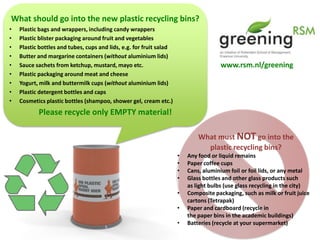
    The water consumedfor the production of the same amount of plastic is nearly 1,000,000 litres. That’s enough drinking water for 1,400 people to survive a whole year.What should go into the new plastic recycling bins?Plastic bags and wrappers, including candy wrappers
  • 4.
    Plastic blister packagingaround fruit and vegetables
  • 5.
    Plastic bottles andtubes, cups and lids, e.g. for fruit salad
  • 6.
    Butter and margarinecontainers (without aluminium lids)
  • 7.
    Sauce sachets fromketchup, mustard, mayo etc.
  • 8.
  • 9.
    Yogurt, milk andbuttermilk cups (without aluminium lids)
  • 10.
  • 11.
    Cosmetics plastic bottles(shampoo, shower gel, cream etc.)Please recycle only EMPTY material!www.rsm.nl/greeningWhat must NOTgo into the plastic recycling bins?Any food or liquid remains
  • 12.
  • 13.
    Cans, aluminium foilor foil lids, or any metal
  • 14.
    Glass bottles andother glass products such as light bulbs (use glass recycling in the city)
  • 15.
    Composite packaging, suchas milk or fruit juice cartons (Tetrapak)
  • 16.
    Paper and cardboard(recycle in the paper bins in the academic buildings)
  • 17.
    Batteries (recycle atyour supermarket)Plastic Recycling – Did You Know?Recycling one tonne of plastic saves 7.4 cubic metres of landfill space.*
  • 18.
    The decomposition processof plastic in a landfill takes around 700 years to begin.**
  • 19.
    If you filla disposable plastic bottle 1/4 with oil, this is the amount of oil needed for producing and transportation of this bottle.*
  • 20.
    By recycling onlyone plastic bottle, you save enough energy to power a 60-watt light bulb for six hours.**
  • 21.
    Items manufactured fromrecycled plastic include pipes, motor oil bottles, detergent containers, garment bags, grocery and garbage bags, lids and squeezable bottles, toys, fiberfill, carpeting, clothing, greenhouse panels, non-food containers, and plastic components and shells used in electronics.**
  • 22.
    Manufacturing 1 tonneof PET produces around 3 tonnes of carbon dioxide.*
  • 23.
    It takes 3litres of water to produce one litre of bottled water.*
  • 24.
    Bottled water isca. 2,000 times as expensive as tap water.**
  • 25.
    If you bringa reusable glass bottle or aluminium bottle from home and fill it with tap water (or homemade lemonade/ ice tea), the environmental impact is close to zero – and you save a lot of money, too.***** Source: The Pacific Institute, 2007, www.pacinst.org** Source: www.wisegeek.com*** Source: The Story of Bottled Water, 2010, www.youtube.com/watch?v=Se12y9hSOM0**** Source: GreeningRSM, www.rsm.nl/greening