
Plant more trees - please.
Woodworking would be impossible without wood
HARDWOODS · SOFTWOODS · WOODWORK
David Johnston
10/5/2021 · 5 min read
Wood is the only building raw material that aids in the fight against climate change.
Both removing carbon from the atmosphere and reducing new carbon emissions into the atmosphere are crucial. Both of these
objectives are met by wood.
Trees naturally absorb CO2, assisting in the promotion of clean and healthy air for all of us. But that's not all. Trees that can
store CO2 reduce CO2 levels in the atmosphere while utilising it in the photosynthetic process to generate sugar, give energy,
and release oxygen.
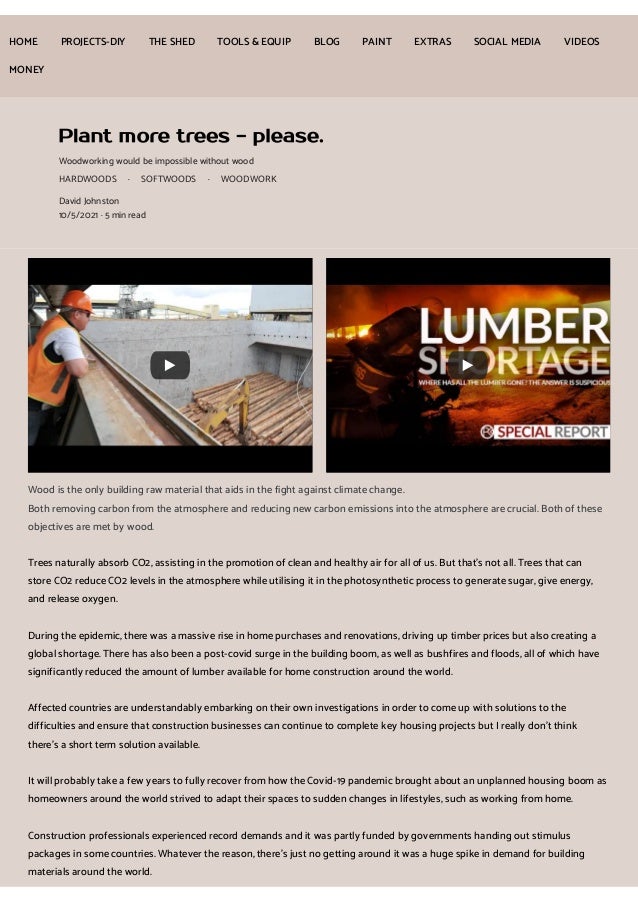
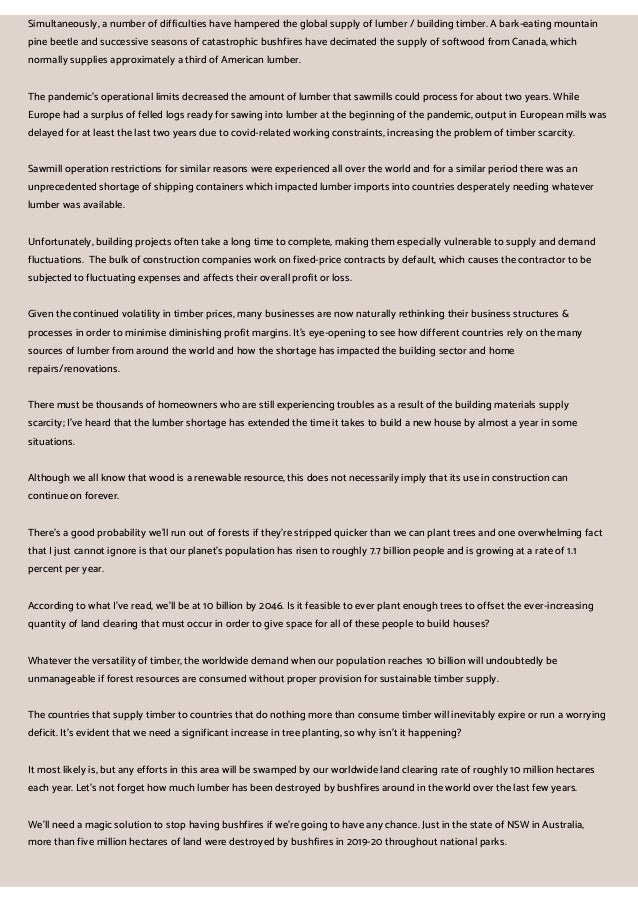
During the epidemic, there was a massive rise in home purchases and renovations, driving up timber prices but also creating a
global shortage. There has also been a post-covid surge in the building boom, as well as bushfires and floods, all of which have
significantly reduced the amount of lumber available for home construction around the world.
Affected countries are understandably embarking on their own investigations in order to come up with solutions to the
difficulties and ensure that construction businesses can continue to complete key housing projects but I really don’t think
there’s a short term solution available.
It will probably take a few years to fully recover from how the Covid-19 pandemic brought about an unplanned housing boom as
homeowners around the world strived to adapt their spaces to sudden changes in lifestyles, such as working from home.
Construction professionals experienced record demands and it was partly funded by governments handing out stimulus
packages in some countries. Whatever the reason, there’s just no getting around it was a huge spike in demand for building
materials around the world.
HOME PROJECTS-DIY THE SHED TOOLS& EQUIP BLOG PAINT EXTRAS SOCIAL MEDIA VIDEOS
MONEY
Simultaneously, a number of difficulties have hampered the global supply of lumber / building timber. A bark-eating mountain
pine beetle and successive seasons of catastrophic bushfires have decimated the supply of softwood from Canada, which
normally supplies approximately a third of American lumber.
The pandemic's operational limits decreased the amount of lumber that sawmills could process for about two years. While
Europe had a surplus of felled logs ready for sawing into lumber at the beginning of the pandemic, output in European mills was
delayed for at least the last two years due to covid-related working constraints, increasing the problem of timber scarcity.
Sawmill operation restrictions for similar reasons were experienced all over the world and for a similar period there was an
unprecedented shortage of shipping containers which impacted lumber imports into countries desperately needing whatever
lumber was available.
Unfortunately, building projects often take a long time to complete, making them especially vulnerable to supply and demand
fluctuations. The bulk of construction companies work on fixed-price contracts by default, which causes the contractor to be
subjected to fluctuating expenses and affects their overall profit or loss.
Given the continued volatility in timber prices, many businesses are now naturally rethinking their business structures &
processes in order to minimise diminishing profit margins. It's eye-opening to see how different countries rely on the many
sources of lumber from around the world and how the shortage has impacted the building sector and home
repairs/renovations.
There must be thousands of homeowners who are still experiencing troubles as a result of the building materials supply
scarcity; I've heard that the lumber shortage has extended the time it takes to build a new house by almost a year in some
situations.
Although we all know that wood is a renewable resource, this does not necessarily imply that its use in construction can
continue on forever.
There's a good probability we'll run out of forests if they're stripped quicker than we can plant trees and one overwhelming fact
that I just cannot ignore is that our planet's population has risen to roughly 7.7 billion people and is growing at a rate of 1.1
percent per year.
According to what I've read, we'll be at 10 billion by 2046. Is it feasible to ever plant enough trees to offset the ever-increasing
quantity of land clearing that must occur in order to give space for all of these people to build houses?
Whatever the versatility of timber, the worldwide demand when our population reaches 10 billion will undoubtedly be
unmanageable if forest resources are consumed without proper provision for sustainable timber supply.
The countries that supply timber to countries that do nothing more than consume timber will inevitably expire or run a worrying
deficit. It's evident that we need a significant increase in tree planting, so why isn't it happening?
It most likely is, but any efforts in this area will be swamped by our worldwide land clearing rate of roughly 10 million hectares
each year. Let’s not forget how much lumber has been destroyed by bushfires around in the world over the last few years.
We'll need a magic solution to stop having bushfires if we're going to have any chance. Just in the state of NSW in Australia,
more than five million hectares of land were destroyed by bushfires in 2019-20 throughout national parks.
Our planet now has approximately 3 trillion trees left, which is half of what existed before the earliest form of people began
chopping them down.
Trees provide environmental benefits such as carbon storage, soil conservation, and water cycle regulation and unfortunately,
trees are too frequently treated as disposable; it's difficult to comprehend how ignorant we all are; we evidently believe it's
acceptable to continue harvesting trees for commercial benefit or as an annoyance to human advancement.
Since our species began farming 12,000 years ago, we have destroyed more than half of the world's estimated 5.8 to 6 trillion
trees. So I just don't see how we'll ever be smart enough to modify the way we use this planet and its resources enough to avoid
the tree problem we'll have in a couple of decades.
Could you imagine what would happen if governments around the world tried to slow down population growth by limiting the
amount children a family could have? I remember thinking how horrible I thought the one child policy in China was, when they
restricted most Chinese families to having only one child. The Chinese government deployed it on a national scale in 1980, and it
was phased down in 2016.
If you tried population control or slow down it in practically any country today, the uproar would be deafening; even on our best
days, we humans do not appreciate being told what to do.
So I guess the FAA in the US should quit impeding Elon and his rocket building mates as soon as possible because there's a
better chance of us figuring out an effective means of living on another planet than of us all coming together and fixing this
planet's environmental problems.
As a result of irresponsibility in the timber supply chain, which begins with forest management, I believe our timber supplies will
continue to be in danger of 'running low' to 'running out.' Poorly maintained forests will continue, as will massive commercial
harvesting and land clearing destruction.
Perhaps we'll always have a wood supply shortfall due to a lack of trees being planted or replanted, and we'll just have to deal
with an ever-increasing cost of timber.
At the very least, we should be asking enterprises that sell timber or wood products to avoid purchasing their wood from non-
sustainable forests; let us stop encouraging bad behaviour. It would be fantastic if we could force irresponsible forest managers
to stop or change their business operations to meet the demands of the globe.
We need a totally sustainable timber industry NOW, we need a net deforestation level of zero NOW.
We probably need to build steel & composite frame houses a lot more too, lowering the demand will help.
We also need to stop living with the dream of everyone having a nice big yard space with their home. We also think we need to
build upwards, not outwards and modify out expectation of what a home should look like and lessen the demand for land
clearing.
So come on folks, hop up off the lounge, get out there, plant some trees and start a conversation today about what you think
the answer is.
Get in
touch
Name*
Your name
Last name
Your last name
Your email*
Your email address
Message*
Enter your message
Submit
Address
Po Box 784
Muswellbrook, NSW, Australia, 2333 
Contacts
0448-687-451
glwwoz1@gmail.com
© glzwoodworking 2021 > 2022 - All Rights Reserved
Disclaimer
This site contains affiliate links to products. I may receive a commission for purchases made through these links. However, this
does not impact any review, comment or comparison I might make. I try my best to keep things fair and balanced, in order to
help you make the best choice for you.
GLZWoodworking is a participant in the Amazon Services LLC Associates Program, an affiliate advertising program designed to
provide a means for sites to earn advertising fees by advertising and linking to amazon.com

Plant more trees - please_.pdf

  • 1.
    Plant more trees- please. Woodworking would be impossible without wood HARDWOODS · SOFTWOODS · WOODWORK David Johnston 10/5/2021 · 5 min read Wood is the only building raw material that aids in the fight against climate change. Both removing carbon from the atmosphere and reducing new carbon emissions into the atmosphere are crucial. Both of these objectives are met by wood. Trees naturally absorb CO2, assisting in the promotion of clean and healthy air for all of us. But that's not all. Trees that can store CO2 reduce CO2 levels in the atmosphere while utilising it in the photosynthetic process to generate sugar, give energy, and release oxygen. During the epidemic, there was a massive rise in home purchases and renovations, driving up timber prices but also creating a global shortage. There has also been a post-covid surge in the building boom, as well as bushfires and floods, all of which have significantly reduced the amount of lumber available for home construction around the world. Affected countries are understandably embarking on their own investigations in order to come up with solutions to the difficulties and ensure that construction businesses can continue to complete key housing projects but I really don’t think there’s a short term solution available. It will probably take a few years to fully recover from how the Covid-19 pandemic brought about an unplanned housing boom as homeowners around the world strived to adapt their spaces to sudden changes in lifestyles, such as working from home. Construction professionals experienced record demands and it was partly funded by governments handing out stimulus packages in some countries. Whatever the reason, there’s just no getting around it was a huge spike in demand for building materials around the world. HOME PROJECTS-DIY THE SHED TOOLS& EQUIP BLOG PAINT EXTRAS SOCIAL MEDIA VIDEOS MONEY
  • 2.
    Simultaneously, a numberof difficulties have hampered the global supply of lumber / building timber. A bark-eating mountain pine beetle and successive seasons of catastrophic bushfires have decimated the supply of softwood from Canada, which normally supplies approximately a third of American lumber. The pandemic's operational limits decreased the amount of lumber that sawmills could process for about two years. While Europe had a surplus of felled logs ready for sawing into lumber at the beginning of the pandemic, output in European mills was delayed for at least the last two years due to covid-related working constraints, increasing the problem of timber scarcity. Sawmill operation restrictions for similar reasons were experienced all over the world and for a similar period there was an unprecedented shortage of shipping containers which impacted lumber imports into countries desperately needing whatever lumber was available. Unfortunately, building projects often take a long time to complete, making them especially vulnerable to supply and demand fluctuations. The bulk of construction companies work on fixed-price contracts by default, which causes the contractor to be subjected to fluctuating expenses and affects their overall profit or loss. Given the continued volatility in timber prices, many businesses are now naturally rethinking their business structures & processes in order to minimise diminishing profit margins. It's eye-opening to see how different countries rely on the many sources of lumber from around the world and how the shortage has impacted the building sector and home repairs/renovations. There must be thousands of homeowners who are still experiencing troubles as a result of the building materials supply scarcity; I've heard that the lumber shortage has extended the time it takes to build a new house by almost a year in some situations. Although we all know that wood is a renewable resource, this does not necessarily imply that its use in construction can continue on forever. There's a good probability we'll run out of forests if they're stripped quicker than we can plant trees and one overwhelming fact that I just cannot ignore is that our planet's population has risen to roughly 7.7 billion people and is growing at a rate of 1.1 percent per year. According to what I've read, we'll be at 10 billion by 2046. Is it feasible to ever plant enough trees to offset the ever-increasing quantity of land clearing that must occur in order to give space for all of these people to build houses? Whatever the versatility of timber, the worldwide demand when our population reaches 10 billion will undoubtedly be unmanageable if forest resources are consumed without proper provision for sustainable timber supply. The countries that supply timber to countries that do nothing more than consume timber will inevitably expire or run a worrying deficit. It's evident that we need a significant increase in tree planting, so why isn't it happening? It most likely is, but any efforts in this area will be swamped by our worldwide land clearing rate of roughly 10 million hectares each year. Let’s not forget how much lumber has been destroyed by bushfires around in the world over the last few years. We'll need a magic solution to stop having bushfires if we're going to have any chance. Just in the state of NSW in Australia, more than five million hectares of land were destroyed by bushfires in 2019-20 throughout national parks.
  • 3.
    Our planet nowhas approximately 3 trillion trees left, which is half of what existed before the earliest form of people began chopping them down. Trees provide environmental benefits such as carbon storage, soil conservation, and water cycle regulation and unfortunately, trees are too frequently treated as disposable; it's difficult to comprehend how ignorant we all are; we evidently believe it's acceptable to continue harvesting trees for commercial benefit or as an annoyance to human advancement. Since our species began farming 12,000 years ago, we have destroyed more than half of the world's estimated 5.8 to 6 trillion trees. So I just don't see how we'll ever be smart enough to modify the way we use this planet and its resources enough to avoid the tree problem we'll have in a couple of decades. Could you imagine what would happen if governments around the world tried to slow down population growth by limiting the amount children a family could have? I remember thinking how horrible I thought the one child policy in China was, when they restricted most Chinese families to having only one child. The Chinese government deployed it on a national scale in 1980, and it was phased down in 2016. If you tried population control or slow down it in practically any country today, the uproar would be deafening; even on our best days, we humans do not appreciate being told what to do. So I guess the FAA in the US should quit impeding Elon and his rocket building mates as soon as possible because there's a better chance of us figuring out an effective means of living on another planet than of us all coming together and fixing this planet's environmental problems. As a result of irresponsibility in the timber supply chain, which begins with forest management, I believe our timber supplies will continue to be in danger of 'running low' to 'running out.' Poorly maintained forests will continue, as will massive commercial harvesting and land clearing destruction. Perhaps we'll always have a wood supply shortfall due to a lack of trees being planted or replanted, and we'll just have to deal with an ever-increasing cost of timber. At the very least, we should be asking enterprises that sell timber or wood products to avoid purchasing their wood from non- sustainable forests; let us stop encouraging bad behaviour. It would be fantastic if we could force irresponsible forest managers to stop or change their business operations to meet the demands of the globe. We need a totally sustainable timber industry NOW, we need a net deforestation level of zero NOW. We probably need to build steel & composite frame houses a lot more too, lowering the demand will help. We also need to stop living with the dream of everyone having a nice big yard space with their home. We also think we need to build upwards, not outwards and modify out expectation of what a home should look like and lessen the demand for land clearing. So come on folks, hop up off the lounge, get out there, plant some trees and start a conversation today about what you think the answer is.
  • 4.
    Get in touch Name* Your name Lastname Your last name Your email* Your email address Message* Enter your message Submit Address Po Box 784 Muswellbrook, NSW, Australia, 2333  Contacts 0448-687-451 glwwoz1@gmail.com © glzwoodworking 2021 > 2022 - All Rights Reserved Disclaimer This site contains affiliate links to products. I may receive a commission for purchases made through these links. However, this does not impact any review, comment or comparison I might make. I try my best to keep things fair and balanced, in order to help you make the best choice for you. GLZWoodworking is a participant in the Amazon Services LLC Associates Program, an affiliate advertising program designed to provide a means for sites to earn advertising fees by advertising and linking to amazon.com