The views expressed in this presentation are the views of the author/s and do not necessarily reflect the views or policies of the Asian
Development Bank, or its Board of Governors, or the governments they represent. ADB does not guarantee the accuracy of the data included
in this presentation and accepts no responsibility for any consequence of their use. The countries listed in this presentation do not imply any
view on ADB's part as to sovereignty or independent status or necessarily conform to ADB's terminology.
Planning and Driving a
Digital Strategy
Olivier Serrat
2015
Organizational Performance in the
Digital Age
Digital—content or communication that is delivered through
the internet whether the user is on a desktop, laptop, or tablet
computer; a mobile phone; or another device not yet invented.
• Digital is no longer optional: pending actualization of the
Internet of Things, organizations must embrace the digital
world if they are to survive and, preferably, thrive. To
boost efficiency and productivity, reduce transaction
costs, and (above all) transform service delivery, they
must seek to be digital by default. Irrespective of the
"arena" an organization finds itself in, digitization enables
fundamentally different ways in which to think about
clients, audiences, and partners and, vitally, to engage
them.
The Questions Digitization Helps
Answer
• What are the expressed and latent needs
of clients, audiences, and partners (not
forgetting relationships and behaviors)?
• How does one build products and services
to better meet these needs?
• How does one integrate products and
services into a digital strategy? (And, how
might a digital strategy conduce new,
value-adding products and services?)
• What are the organizational, directional,
process-based, and information
technology-related changes required to
make the transition happen?
Questions
Planning and Driving a Digital
Strategy
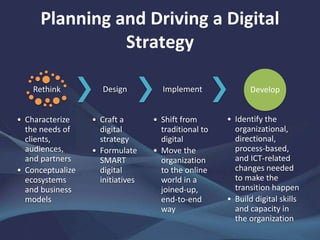
Rethink
• Characterize
the needs of
clients,
audiences,
and partners
• Conceptualize
ecosystems
and business
models
Design
• Craft a
digital
strategy
• Formulate
SMART
digital
initiatives
Implement
• Shift from
traditional to
digital
• Move the
organization
to the online
world in a
joined-up,
end-to-end
way
Develop
• Identify the
organizational,
directional,
process-based,
and ICT-related
changes needed
to make the
transition happen
• Build digital skills
and capacity in
the organization
The Ambit of Digital Strategies
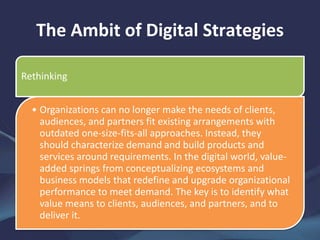
Rethinking
• Organizations can no longer make the needs of clients,
audiences, and partners fit existing arrangements with
outdated one-size-fits-all approaches. Instead, they
should characterize demand and build products and
services around requirements. In the digital world, value-
added springs from conceptualizing ecosystems and
business models that redefine and upgrade organizational
performance to meet demand. The key is to identify what
value means to clients, audiences, and partners, and to
deliver it.
The Ambit of Digital Strategies
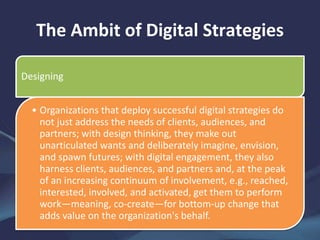
Designing
• Organizations that deploy successful digital strategies do
not just address the needs of clients, audiences, and
partners; with design thinking, they make out
unarticulated wants and deliberately imagine, envision,
and spawn futures; with digital engagement, they also
harness clients, audiences, and partners and, at the peak
of an increasing continuum of involvement, e.g., reached,
interested, involved, and activated, get them to perform
work—meaning, co-create—for bottom-up change that
adds value on the organization's behalf.
The Ambit of Digital Strategies
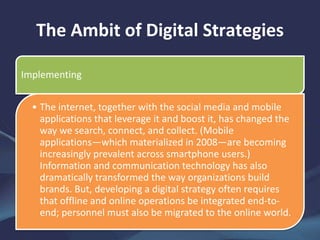
Implementing
• The internet, together with the social media and mobile
applications that leverage it and boost it, has changed the
way we search, connect, and collect. (Mobile
applications—which materialized in 2008—are becoming
increasingly prevalent across smartphone users.)
Information and communication technology has also
dramatically transformed the way organizations build
brands. But, developing a digital strategy often requires
that offline and online operations be integrated end-to-
end; personnel must also be migrated to the online world.
The Ambit of Digital Strategies
Developing
• In organizations, new digital skills and capacity are
needed to successfully make the transition to the digital
world. Organizational, directional, process-based, and
information and communication technology-related
changes must be effected to make the transition happen.
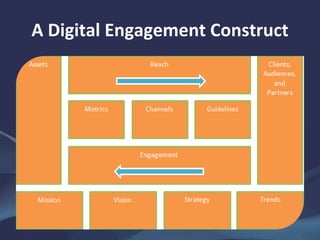
A Digital Engagement Construct
Effective Questions for Digital
Engagement
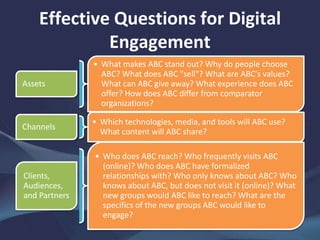
Assets
• What makes ABC stand out? Why do people choose
ABC? What does ABC "sell"? What are ABC's values?
What can ABC give away? What experience does ABC
offer? How does ABC differ from comparator
organizations?
Channels
• Which technologies, media, and tools will ABC use?
What content will ABC share?
Clients,
Audiences,
and Partners
• Who does ABC reach? Who frequently visits ABC
(online)? Who does ABC have formalized
relationships with? Who only knows about ABC? Who
knows about ABC, but does not visit it (online)? What
new groups would ABC like to reach? What are the
specifics of the new groups ABC would like to
engage?
Effective Questions for Digital
Engagement
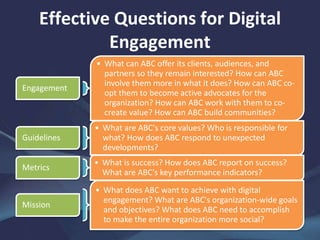
Engagement
• What can ABC offer its clients, audiences, and
partners so they remain interested? How can ABC
involve them more in what it does? How can ABC co-
opt them to become active advocates for the
organization? How can ABC work with them to co-
create value? How can ABC build communities?
Guidelines
• What are ABC's core values? Who is responsible for
what? How does ABC respond to unexpected
developments?
Metrics
• What is success? How does ABC report on success?
What are ABC's key performance indicators?
Mission
• What does ABC want to achieve with digital
engagement? What are ABC's organization-wide goals
and objectives? What does ABC need to accomplish
to make the entire organization more social?
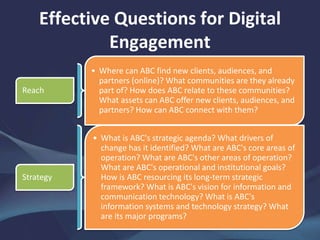
Effective Questions for Digital
Engagement
Reach
• Where can ABC find new clients, audiences, and
partners (online)? What communities are they already
part of? How does ABC relate to these communities?
What assets can ABC offer new clients, audiences, and
partners? How can ABC connect with them?
Strategy
• What is ABC's strategic agenda? What drivers of
change has it identified? What are ABC's core areas of
operation? What are ABC's other areas of operation?
What are ABC's operational and institutional goals?
How is ABC resourcing its long-term strategic
framework? What is ABC's vision for information and
communication technology? What is ABC's
information systems and technology strategy? What
are its major programs?
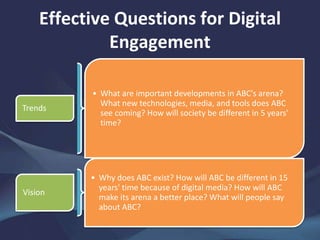
Effective Questions for Digital
Engagement
Trends
• What are important developments in ABC's arena?
What new technologies, media, and tools does ABC
see coming? How will society be different in 5 years'
time?
Vision
• Why does ABC exist? How will ABC be different in 15
years' time because of digital media? How will ABC
make its arena a better place? What will people say
about ABC?
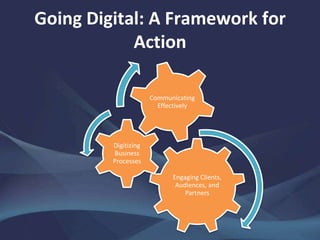
Going Digital: A Framework for
Action
Engaging Clients,
Audiences, and
Partners
Digitizing
Business
Processes
Communicating
Effectively
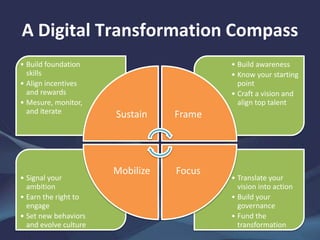
A Digital Transformation Compass
• Translate your
vision into action
• Build your
governance
• Fund the
transformation
• Signal your
ambition
• Earn the right to
engage
• Set new behaviors
and evolve culture
• Build awareness
• Know your starting
point
• Craft a vision and
align top talent
• Build foundation
skills
• Align incentives
and rewards
• Mesure, monitor,
and iterate Sustain Frame
FocusMobilize
Further Reading
• ADB. 2008. Auditing Knowledge. Manila.
www.adb.org/publications/auditing-knowledge
• ——. 2009. Social Network Analysis. Manila.
www.adb.org/publications/social-network-analysis
• ——. 2009. Learning Lessons with Knowledge Audits. Manila.
www.adb.org/publications/learning-lessons-knowledge-
audits
• ——. 2010. New-Age Branding and the Public Sector. Manila.
www.adb.org/publications/new-age-branding-and-public-
sector
Further Reading
• ADB. 2010. Crafting a Knowledge Management Results
Framework. Manila. www.adb.org/publications/crafting-
knowledge-management-results-framework
• ——. 2010. Social Media and the Public Sector. Manila.
www.adb.org/publications/social-media-and-public-sector
• ——. 2012. Business Model Innovation. Manila.
www.adb.org/publications/business-model-innovation
• ——. 2012. Innovation in the Public Sector. Manila.
www.adb.org/publications/innovation-public-sector
• George Westerman, Didier Bonnet, and Andrew McAfee.
2014. Leading Digital: Turning Technology into Business
Transformation. Harvard Business Review Press.
Videos
• ADB. 2014. The Evolution of Information and Communications
Technology in ADB. Manila. vimeo.com/123063686
• ——. 2014. Increasing Access to Information in ADB. Manila.
vimeo.com/123063689
• ——. 2014. Milestones in ADB's Information Systems and
Technology. Manila. vimeo.com/123073445
• ——. 2014. The Use of New Technologies in ADB. Manila.
vimeo.com/123073450
• ——. 2014. ADB's Information Systems and Technology
Strategy, 2013–2018. Manila. vimeo.com/123079790
Videos
• ADB. 2014. "Digital ADB": Adopting New Technologies in the
Digital Era. Manila. vimeo.com/123080137
• ——. 2014. Expanding and Integrating Technology in ADB's
Operations. Manila. vimeo.com/123080140
• ——. 2014. Digital Interaction with Partners. Manila.
vimeo.com/124399624
Quick Response Codes
@ADB
@ADB Sustainable
Development Timeline
@Academia.edu
@LinkedIn
@ResearchGate
@Scholar
@SlideShare
@Twitter

Planning and Driving a Digital Strategy

  • 1.
    The views expressedin this presentation are the views of the author/s and do not necessarily reflect the views or policies of the Asian Development Bank, or its Board of Governors, or the governments they represent. ADB does not guarantee the accuracy of the data included in this presentation and accepts no responsibility for any consequence of their use. The countries listed in this presentation do not imply any view on ADB's part as to sovereignty or independent status or necessarily conform to ADB's terminology. Planning and Driving a Digital Strategy Olivier Serrat 2015
  • 2.
    Organizational Performance inthe Digital Age Digital—content or communication that is delivered through the internet whether the user is on a desktop, laptop, or tablet computer; a mobile phone; or another device not yet invented. • Digital is no longer optional: pending actualization of the Internet of Things, organizations must embrace the digital world if they are to survive and, preferably, thrive. To boost efficiency and productivity, reduce transaction costs, and (above all) transform service delivery, they must seek to be digital by default. Irrespective of the "arena" an organization finds itself in, digitization enables fundamentally different ways in which to think about clients, audiences, and partners and, vitally, to engage them.
  • 3.
    The Questions DigitizationHelps Answer • What are the expressed and latent needs of clients, audiences, and partners (not forgetting relationships and behaviors)? • How does one build products and services to better meet these needs? • How does one integrate products and services into a digital strategy? (And, how might a digital strategy conduce new, value-adding products and services?) • What are the organizational, directional, process-based, and information technology-related changes required to make the transition happen? Questions
  • 4.
    Planning and Drivinga Digital Strategy Rethink • Characterize the needs of clients, audiences, and partners • Conceptualize ecosystems and business models Design • Craft a digital strategy • Formulate SMART digital initiatives Implement • Shift from traditional to digital • Move the organization to the online world in a joined-up, end-to-end way Develop • Identify the organizational, directional, process-based, and ICT-related changes needed to make the transition happen • Build digital skills and capacity in the organization
  • 5.
    The Ambit ofDigital Strategies Rethinking • Organizations can no longer make the needs of clients, audiences, and partners fit existing arrangements with outdated one-size-fits-all approaches. Instead, they should characterize demand and build products and services around requirements. In the digital world, value- added springs from conceptualizing ecosystems and business models that redefine and upgrade organizational performance to meet demand. The key is to identify what value means to clients, audiences, and partners, and to deliver it.
  • 6.
    The Ambit ofDigital Strategies Designing • Organizations that deploy successful digital strategies do not just address the needs of clients, audiences, and partners; with design thinking, they make out unarticulated wants and deliberately imagine, envision, and spawn futures; with digital engagement, they also harness clients, audiences, and partners and, at the peak of an increasing continuum of involvement, e.g., reached, interested, involved, and activated, get them to perform work—meaning, co-create—for bottom-up change that adds value on the organization's behalf.
  • 7.
    The Ambit ofDigital Strategies Implementing • The internet, together with the social media and mobile applications that leverage it and boost it, has changed the way we search, connect, and collect. (Mobile applications—which materialized in 2008—are becoming increasingly prevalent across smartphone users.) Information and communication technology has also dramatically transformed the way organizations build brands. But, developing a digital strategy often requires that offline and online operations be integrated end-to- end; personnel must also be migrated to the online world.
  • 8.
    The Ambit ofDigital Strategies Developing • In organizations, new digital skills and capacity are needed to successfully make the transition to the digital world. Organizational, directional, process-based, and information and communication technology-related changes must be effected to make the transition happen.
  • 9.
  • 10.
    Effective Questions forDigital Engagement Assets • What makes ABC stand out? Why do people choose ABC? What does ABC "sell"? What are ABC's values? What can ABC give away? What experience does ABC offer? How does ABC differ from comparator organizations? Channels • Which technologies, media, and tools will ABC use? What content will ABC share? Clients, Audiences, and Partners • Who does ABC reach? Who frequently visits ABC (online)? Who does ABC have formalized relationships with? Who only knows about ABC? Who knows about ABC, but does not visit it (online)? What new groups would ABC like to reach? What are the specifics of the new groups ABC would like to engage?
  • 11.
    Effective Questions forDigital Engagement Engagement • What can ABC offer its clients, audiences, and partners so they remain interested? How can ABC involve them more in what it does? How can ABC co- opt them to become active advocates for the organization? How can ABC work with them to co- create value? How can ABC build communities? Guidelines • What are ABC's core values? Who is responsible for what? How does ABC respond to unexpected developments? Metrics • What is success? How does ABC report on success? What are ABC's key performance indicators? Mission • What does ABC want to achieve with digital engagement? What are ABC's organization-wide goals and objectives? What does ABC need to accomplish to make the entire organization more social?
  • 12.
    Effective Questions forDigital Engagement Reach • Where can ABC find new clients, audiences, and partners (online)? What communities are they already part of? How does ABC relate to these communities? What assets can ABC offer new clients, audiences, and partners? How can ABC connect with them? Strategy • What is ABC's strategic agenda? What drivers of change has it identified? What are ABC's core areas of operation? What are ABC's other areas of operation? What are ABC's operational and institutional goals? How is ABC resourcing its long-term strategic framework? What is ABC's vision for information and communication technology? What is ABC's information systems and technology strategy? What are its major programs?
  • 13.
    Effective Questions forDigital Engagement Trends • What are important developments in ABC's arena? What new technologies, media, and tools does ABC see coming? How will society be different in 5 years' time? Vision • Why does ABC exist? How will ABC be different in 15 years' time because of digital media? How will ABC make its arena a better place? What will people say about ABC?
  • 14.
    Going Digital: AFramework for Action Engaging Clients, Audiences, and Partners Digitizing Business Processes Communicating Effectively
  • 15.
    A Digital TransformationCompass • Translate your vision into action • Build your governance • Fund the transformation • Signal your ambition • Earn the right to engage • Set new behaviors and evolve culture • Build awareness • Know your starting point • Craft a vision and align top talent • Build foundation skills • Align incentives and rewards • Mesure, monitor, and iterate Sustain Frame FocusMobilize
  • 16.
    Further Reading • ADB.2008. Auditing Knowledge. Manila. www.adb.org/publications/auditing-knowledge • ——. 2009. Social Network Analysis. Manila. www.adb.org/publications/social-network-analysis • ——. 2009. Learning Lessons with Knowledge Audits. Manila. www.adb.org/publications/learning-lessons-knowledge- audits • ——. 2010. New-Age Branding and the Public Sector. Manila. www.adb.org/publications/new-age-branding-and-public- sector
  • 17.
    Further Reading • ADB.2010. Crafting a Knowledge Management Results Framework. Manila. www.adb.org/publications/crafting- knowledge-management-results-framework • ——. 2010. Social Media and the Public Sector. Manila. www.adb.org/publications/social-media-and-public-sector • ——. 2012. Business Model Innovation. Manila. www.adb.org/publications/business-model-innovation • ——. 2012. Innovation in the Public Sector. Manila. www.adb.org/publications/innovation-public-sector • George Westerman, Didier Bonnet, and Andrew McAfee. 2014. Leading Digital: Turning Technology into Business Transformation. Harvard Business Review Press.
  • 18.
    Videos • ADB. 2014.The Evolution of Information and Communications Technology in ADB. Manila. vimeo.com/123063686 • ——. 2014. Increasing Access to Information in ADB. Manila. vimeo.com/123063689 • ——. 2014. Milestones in ADB's Information Systems and Technology. Manila. vimeo.com/123073445 • ——. 2014. The Use of New Technologies in ADB. Manila. vimeo.com/123073450 • ——. 2014. ADB's Information Systems and Technology Strategy, 2013–2018. Manila. vimeo.com/123079790
  • 19.
    Videos • ADB. 2014."Digital ADB": Adopting New Technologies in the Digital Era. Manila. vimeo.com/123080137 • ——. 2014. Expanding and Integrating Technology in ADB's Operations. Manila. vimeo.com/123080140 • ——. 2014. Digital Interaction with Partners. Manila. vimeo.com/124399624
  • 20.
    Quick Response Codes @ADB @ADBSustainable Development Timeline @Academia.edu @LinkedIn @ResearchGate @Scholar @SlideShare @Twitter