Planet Canoe  1
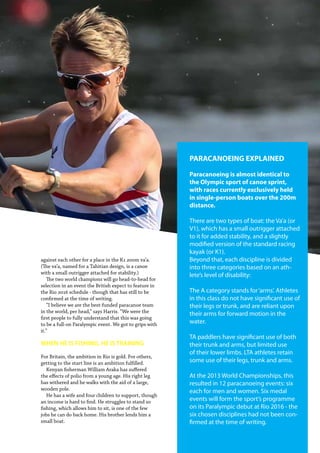
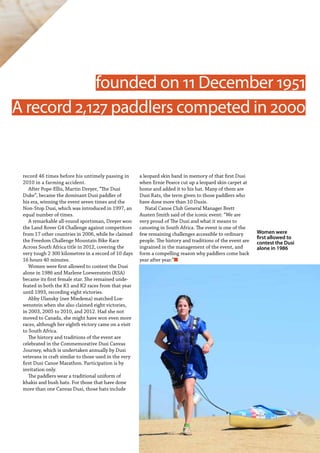
PLANETCANOE
2014
2  Planet Canoe
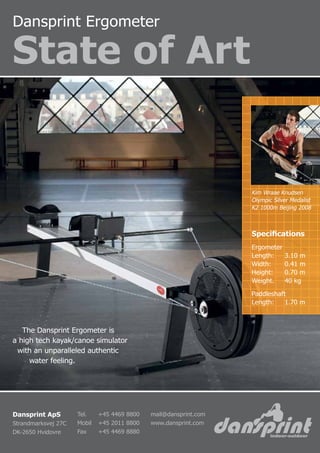
Dansprint Ergometer
State of Art
indoor-outdoor
Specifications
Ergometer
Length: 3.10 m
Width: 0.41 m
Height: 0.70 m
Weight. 40 kg
Paddleshaft
Length: 1.70 m
The Dansprint Ergometer is
a high tech kayak/canoe simulator
with an unparalleled authentic
water feeling.
Kim Wraae Knudsen
Olympic Silver Medalist
K2 1000m Beijing 2008
Dansprint ApS
Strandmarksvej 27C
DK-2650 Hvidovre
Tel. +45 4469 8800
Mobil +45 2011 8800
Fax +45 4469 8880
mail@dansprint.com
www.dansprint.com
  Planet Canoe  1
The momentum provided by the London 2012 Olympic Games
continued throughout the 2013 season with the very best in our
sport delivering time and time again on the international stage.
With World Championships held in nine countries spanning six dis-
ciplines, including the inaugural ICF Ocean Racing World Champion-
ships, 2013 provided a truly memorable year of competition.
The season also provided the opportunity for our non-Olympic
disciplines to shine within the multi-sport arena, with Canoe
Polo and Canoe Marathon both in action at the World Games in
Cali, Columbia and the World Masters Games in Turin, Italy.
As an invitational sport, Canoe Marathon was contested
for the first time, whilst the established and exceptionally
popular discipline of Canoe Polo made its third appearance at
the World Games.
Their participation in the World Games is exciting for our sport;
offering a significant boost to global visibility and the opportunity for
us to demonstrate how each of these disciplines can enhance and oper-
ate within multi-sport competitions.
Canoe Polo, alongside Ocean Racing and Va’a, are also being consid-
ered for inclusion into the Sport Accord 2015 World Beach Games.
It is clear that a proven ability to operate within the various
multi-sport Games environments is likely to be a consideration
when, later this year, the International Olympic Committee (IOC)
review their sport selection criteria for the 2020 Olympic Pro-
gramme and beyond.
Despite all of the exceptional on-the-water activity, perhaps the
biggest achievement in 2013 for the ICF has been to ensure the future
construction of the canoe slalom course for the 2016 Rio Olympic
Games, which was brought into question due to financial concerns.
Canoe slalom has been a permanent fixture in the Olympic
Games since Barcelona 1992 and over this period the ICF has
developed considerable expertise in ensuring successful delivery
of an Olympic venue that not only delivers a spectacular event but
can also provide a true legacy; the Lee Valley White Water Centre is
a clear example.
I would like to take this opportunity to thank all those that
contributed to this successful outcome. I look forward to a superb
venue being built that will provide the very best in our sport with
the Olympic experience they deserve and inspire a new wave of
talent from across South America to pick up a paddle.
I take a moment to reflect on the passing of UIrich Feldhoff
(GER) who was our Honorary President and former President of
the ICF who sadly passed away in 2013. Mr Feldhoff contributed
greatly to our sport and was a true ambassador for canoeing on the
world scene. We will remember him fondly.
I also look forward to the events in 2014 with a full canoeing cal-
endar again covered worldwide on TV and online at canoeicf.com.
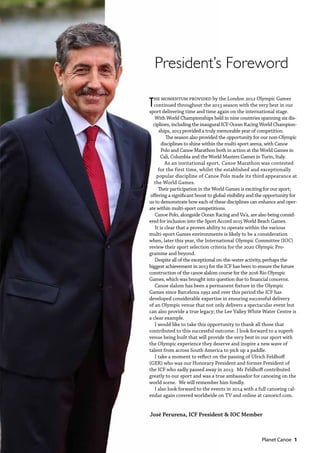
José Perurena, ICF President & IOC Member
President’s Foreword
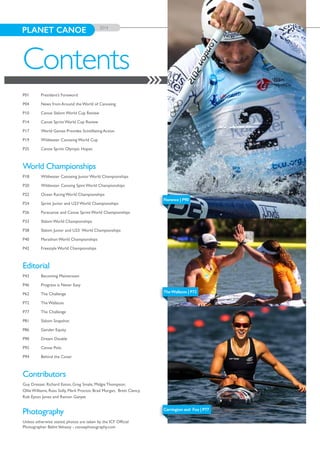
TheWallaces | P72
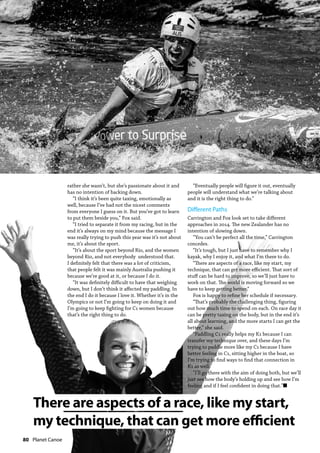
Carrington and Fox | P77
PLANET CANOE 2014
P01	 President’s Foreword
P04	 News from Around the World of Canoeing
P10	 Canoe Slalom World Cup Review
P14	 Canoe Sprint World Cup Review
P17	 World Games Provides Scintillating Action
P19	 Wildwater Canoeing World Cup
P25	 Canoe Sprint Olympic Hopes
World Championships
P18	 Wildwater Canoeing Junior World Championships
P20	 Wildwater Canoing Spint World Championships
P22	 Ocean Racing World Championships
P24	 Sprint Junior and U23 World Championships
P26	 Paracanoe and Canoe Sprint World Championships
P33	 Slalom World Championships
P38	 Slalom Junior and U23 World Championships
P40	 Marathon World Championships
P42	 Freestyle World Championships
Editorial
P43	 Becoming Mainstream
P46 	 Progress is Never Easy
P62 	 The Challenge
P72 	 The Wallaces
P77	 The Challenge
P81	 Slalom Snapshot
P86	 Gender Equity
P90 	 Dream Double
P92	 Canoe Polo
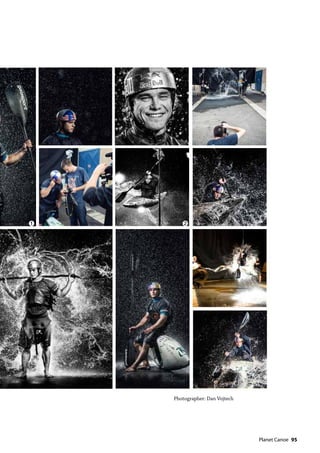
P94	 Behind the Cover
Contributors
Guy Dresser, Richard Eaton, Greg Smale, Midgie Thompson,
Ollie Williams, Ross Solly, Mark Proctor, Brad Morgan, Brett Clancy,
Rob Eyton Jones and Ramon Ganyet
Photography
Unless otherwise stated, photos are taken by the ICF Official
Photographer BalintVekassy - canoephotography.com
Contents
Florence | P90
HELLO
Planet Canoe
featured articles from this edition
ESTANGUET– CHANGING THE RULES
Canoeing legend talks about the changes needed
to improve the sport’s future
WINNING STRATEGIES
What is the difference between gold medal
winners and the rest?
PADDLING INTO THE FUTURE
A look at the challenges ahead for canoe slalom
and the ICF’s view on the discipline’s future
FEELING FREEDOM
Interviews with the stars of Paracanoe and their
ambitions for the sport’s Rio 2016 debut
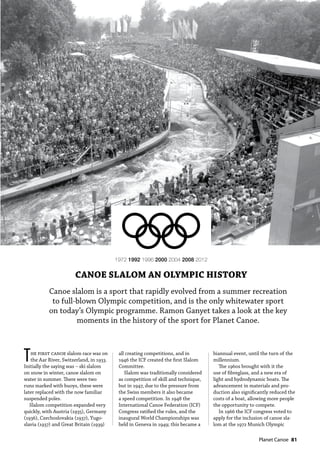
CANOE SLALOM OLYMPIC HISTORY
Ramon Ganyet takes a look at the key moments in
the history of the sport
THE DUSI
Brad Morgan explores the history of Africa’s epic
four-day canoe marathon
P68
P54
P48
P58
P81
P64
Ushered in by the closing ceremony of the
Olympic Games, the 2013 international
canoe calendar had a crisp look, ready to
unleash a new era of paddling superstars.
It didn’t disappoint with many defining
moments across all disciplines.
Seeing the Czech duo of Vavrinec
Hradílek and Jirí Prskavec cross the finish
line first and second at the ICF Canoe
Slalom World Championships in Prague
was certainly one of these moments. The
pair, competing on their home course, dealt
with the weight of expectation and media
scrutiny admirably, delivering gold and
silver in front of a capacity crowd at the
famous Troja course, just months after the
devastating floods that hit the region (p6).
2013 also boasted an entirely new event,
the ICF Ocean RacingWorld Championships;
as well as seeing the return of the spectacular
Canoe FreestyleWorld Championships.
These events add an extra dimension
to the world of canoeing, providing fresh
ways to innovate and experiment with
broadcasting and presentation.
To get this right is exceptionally
important, not just because of the emphasis
placed on audience reach by the IOC, but it
also affects how our sport is perceived by the
outside world.
However, perhaps the most poignant
moment of the season came after
Fernando Fernandes’ (BRA) victory in the
K1 Men A Paracanoe World Championships,
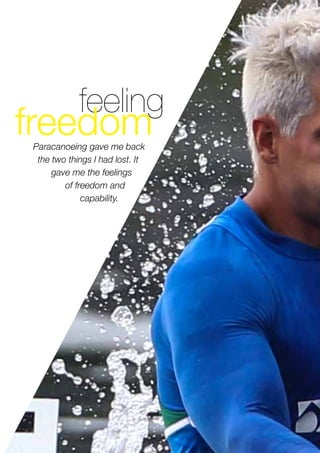
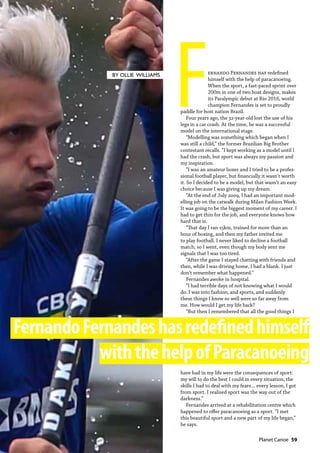
when he said,“I met this beautiful sport
and a new part of my life began.” This is
something every paddler has experienced,
I’m sure you’ll agree.
Editor’s
words
Planet Canoe is the official magazine of the International Canoe Federation
Avenue De Rhodanie 54, 1007 Lausanne, Switzerland
Phone: +41 (0) 21 612 0290
President: José Perurena / Secretary General: Simon Toulson
˘
˘
Richard Pettit, Editor & Designer
richard.pettit@canoeicf.com
4  Planet Canoe
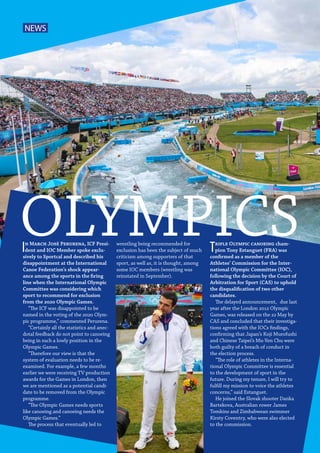
OLYMPICSIn March José Perurena, ICF Presi-
dent and IOC Member spoke exclu-
sively to Sportcal and described his
disappointment at the International
Canoe Federation’s shock appear-
ance among the sports in the firing
line when the International Olympic
Committee was considering which
sport to recommend for exclusion
from the 2020 Olympic Games.
“The ICF was disappointed to be
named in the voting of the 2020 Olym-
pic programme,” commented Perurena.
“Certainly all the statistics and anec-
dotal feedback do not point to canoeing
being in such a lowly position in the
Olympic Games.
“Therefore our view is that the
system of evaluation needs to be re-
examined. For example, a few months
earlier we were receiving TV production
awards for the Games in London, then
we are mentioned as a potential candi-
date to be removed from the Olympic
programme.
“The Olympic Games needs sports
like canoeing and canoeing needs the
Olympic Games.”
The process that eventually led to
wrestling being recommended for
exclusion has been the subject of much
criticism among supporters of that
sport, as well as, it is thought, among
some IOC members (wrestling was
reinstated in September).
Triple Olympic canoeing cham-
pion Tony Estanguet (FRA) was
confirmed as a member of the
Athletes’ Commission for the Inter-
national Olympic Committee (IOC),
following the decision by the Court of
Arbitration for Sport (CAS) to uphold
the disqualification of two other
candidates.
The delayed announcement, due last
year after the London 2012 Olympic
Games, was released on the 22 May by
CAS and concluded that their investiga-
tions agreed with the IOCs findings,
confirming that Japan’s Koji Murofushi
and Chinese Taipei’s Mu-Yen Chu were
both guilty of a breach of conduct in
the election process.
“The role of athletes in the Interna-
tional Olympic Committee is essential
to the development of sport in the
future. During my tenure, I will try to
fulfill my mission to voice the athletes
concerns,” said Estanguet.
He joined the Slovak shooter Danka
Bartekova, Australian rower James
Tomkins and Zimbabwean swimmer
Kirsty Coventry, who were also elected
to the commission.
NEWS
  Planet Canoe  5
Inspiring Future Champions
In 2012, national anthems echoed around the
Lee Valley White Water Centre, champions were
created and dreams realised. One year on since
its impressive introduction to the world, the
centre now plays host to the next generation
of aspiring Olympians through GB Canoeing’s
London Legacy Project.
The three-tiered project aims to capture
the enthusiasm generated by the Games and
increase involvement at every level of canoeing
activity from participation to podium.
Targeting those who have previously been
involved in paddle sport, but not specifically
canoe slalom, the project starts with twice-a-
week under 18 ‘come and try it’ sessions.
For many, the sessions provide a once in
a lifetime opportunity to gain world-class
coaching expertise from GB Canoeing’s top
level instructors.
UAE Course
The newly constructed canoe slalom course
in the United Arab Emirates became the
destination of choice for many of the Euro-
pean teams, winter training. The course is
part of Wadi Adventure Park in Al Ain, the
fourth largest city in UAE, located approxi-
mately 130 kilometres south of Dubai.
DoubleWorldChampion,PeterKauzer(SLO),
was one of the many athletes to take advantage
of the exceptional facilities, he said, “I watched
some videos before arriving here, because David
[Florence], Michal [Martikán] and the Hoch-
schorners [Pavol and Peter] were here before.
“While you’re paddling it seems the curves
just won’t end. I think this might become a
very popular destination for Europeans.”
Pan-Am Games Extra Events
Following its Extraordinary Assembly, the
Pan-American Sports Organisation (PASO)
announced the addition of canoe slalom to
the programme of the 2015 Pan-American
Games. Previously, only canoe sprint events
were included.
 In addition, women’s canoe
events will be part of the sprint and slalom
programmes.

“This is fantastic news for canoeing”, said José
Perurena, ICF President and IOC Member. “The
decision of PASO acknowledges the continuous
efforts of the International Canoe Federation
and the Pan-American Canoe Federation to
increase the exposure of canoeing universally
and fits naturally in the ICF strategic plan of
development.”
Britain’s premier canoeing venue,
the Lee Valley White Water Centre,
further enhanced its Olympic Legacy
credentials by announcing plans that
it will increase its impressive facili-
ties and become the headquarters for
Team GB’s Canoe Slalom Performance
Centre. 

A spokesman for Lee Valley Regional
Park Authority said, “Since opening to
the public in April 2011, the centre’s
popularity has been phenomenal, with
double the number of visitors that we
had expected.
“The GB Canoe Slalom team has been
with us since the centre opened and the
new development will provide the ath-
letes, coaches and their support services
with even better facilities.”
In addition to the headquarters there
will be a new cafe and an additional 250
car parking spaces.
The development plans will see the
centre better placed to cope with large
visitor numbers and will enable extra
community programmes to take place,
giving thousands more people the
chance to take part in activities.
The International Olympic
Committee confirmed that
canoeing is one of the core
25 sports for the Olympic
Programme 2020.
Double European Canoe Slalom
Champion, Jiri Prskavec (CZE),
rushed back from his triumphs
in Poland to help ensure that the
Prague slalom course would ready
for the 2013 ICF Canoe Slalom World
Championship.
Following the devastating floods,
which swept through the world-class
venue the local organising committee,
with a band of willing volunteers,
tried everything in their power to get
the venue ready to host the World
Championships from 11–15 September.
Only a day after his success in Poland,
the 21-year-old champion joined the
volunteers and got stuck in with a shovel
to help clear the surrounding areas of
devastation, as water levels began to
subside.
“Right after the teams’ medal
ceremony I underwent doping control
and then I jumped into the car with
Vavřinec [HradÍlek] and Vit [Prindis]
towards Prague,” described the double
European champion. “We arrived back
from Poland at around 3 am. We were
very tired from the long journey and also
the celebrations in the car.”
The kayaker, who shocked the canoe
world two years ago by winning bronze
at the senior European Championship,
last year added the U23 World Title to his
achievements.
Slalom Superstar Picks Up a Shovel
to HelpWorld Championships
NEWS
A 37-year-old Greek canoe
champion, after being in a
coma for over week, passed
away following a sudden
illness.
Andreas Kiligaridis, a
Greek C1 paddler who suf-
fered a stroke in Poland was
announced ‘clinically dead’
following a week-long battle
with a sudden illness. The
decision was taken to switch
off the life support machine
on the 12 June after the med-
ical board convened. Accord-
ing to reports, the athlete
had fallen into a coma in his
hotel room in Poland, when
preparing to competeinthe
BydgoszczCup.
The international com-
petitor, who had complained
about a mild temperature,
was found unconscious in
his hotel room by team-
mate Michalis Papasavvas.
Medical tests indicate that
Kiligaridis had been suffering
from an aggressive form of
leukaemia.
Kiligaridis was a suc-
cessful paddler with World
and European honours to
his name; he also qualified
for the Sydney, Athens and
Beijing Olympic Games. The
newsofhissuddendeathhas
sent shockwaves through
the whole of the canoeing
fraternity.
Sudden Death Shocks Canoeing Fraternity
6  Planet Canoe
olypics.co.uk
High drop-out rate in Britain’s
toughest canoe race
April showers caused almost 30 percent of the 450
entries in the 200km-long Devizes to Westminster
Canoe Race to fail to complete the course. Severe
cold, strong head winds and extremely high levels
of flow on the River Thames combined to give the
competitors an even more difficult experience
than usual in the race dubbed by many as ‘the
canoeist’s Everest’.
The race, believed to be the longest non-stop canoe
race in the world, begins in Devizes, a small market
town in the English county of Wiltshire, and heads
along the narrow Kennet & Avon Canal to Read-
ing where the course joins the Thames and heads to
central London.
Helen Brownlee, ICF Board Member,
Oceania Canoe Association President
and Australian Olympic Committee
(AOC) Vice President, was awarded the
prestigious Special Commemorative
Medal.

Presented by the International
Pierre de Coubertin Committee on the
occasion of the Pierre de Coubertin’s
150th Anniversary. The award recog-
nises contributions made by indi-
viduals to sport and culture. Brownlee
founded and has been organising the
secondary school Pierre de Coubertin
award program in Australia for the past 20
years.
“I am very humbled to receive the
award,” Brownlee said. “It was always
intended that my work in Olympic educa-
tion was for the benefit of school students
and the difference they could make in the
world by adopting the Olympic values as a
footprint for life.
“My greatest joy has been to see past
recipients of the AOC Pierre de Coubertin
Award go on to represent Australia, with
distinction, in their chosen sport at the
Olympic or Paralympic Games,” she added.
Brownlee is looking forward to the
challenges and opportunities the role will
present. She will continue to promote
Olympic education and create a positive
environment for women in sport. She also
wants to advocate the importance of values
and culture at the AOC from the Board to
the Team.
New Timing Agreement
The ICF signed a new agreement with
timing and scoring service providers
SIWIDATA; the season long agree-
ment includes the senior ICF Canoe
Slalom World Championships, World
Cups (5) and the Junior/U23 World
Championships.
The agreement started at the
seasons inaugural ICF Canoe Slalom
World Cup, Cardiff.
Paddle for the Planet
The ICF endorsed Paddle for the
Planet (P4P) as its primary environ-
mental initiative for 2013. Held on 1
June the one day global relay event
gathered canoeists from all over the
world to help raise awareness of ways
to improve marine and environmental
conditions.
South Africa Starts
Season
The South African Open Canoe
Slalom Championships took the
honour of launching the 2013
season. The event also made history
by becoming the first International
Canoe Slalom Open to be staged in
Africa.
Carole Bouzidi (FRA) was the star
of the event, recording blistering
times in the K1 Women’s event that
would have placed her fifth in the
K1 Men’s overall standings.
The local municipality now plans
to make the championships an
annual event, and to encourage
athletes from all over the world to
take advantage of the favourable
early season climate for training and
competition.
EstanguetAutobiography
Treble Olympic champion, Tony
Estanguet (FRA) launched his
autobiography titled ‘Une Histoire
D’Équilibre’ (A story of balance).
It is an account of his life in ca-
noeing, how he got to the top and
how he survived there.
  Planet Canoe  7
8  Planet Canoe
Ulrich Feldhoff, the former
long-time President of the
German and the International
Canoe Federation, passed
away on Saturday 19 October
after a long and serious illness
at the age of 75.
Feldhoff was considered a
“master of sports diplomacy”
and was an honorary member
of the German Olympic Sports
Confederation (DOSB).
From 1981 to 2005 Feldhoff
was President of the German
Canoe Federation and was then
unanimously elected Honorary
President.
In 1988 Feldhoff became an
ICF Board Member; 10 years on
he was elected as ICF President,
a position he held from 1998 to
2008.
His most recent appearance
on the international scene was
at the 2013 ICF Canoe Sprint
World Championship in Duis-
burg, where he was a passionate
supporter of the hugely success-
ful German team.
Feldhoff was also Chair-
man of the Federal Sports
Performance Committee of
the former German Sports
Federation (DSB), and at the
Olympic Games in 1992 in Bar-
celona and 1996 in Atlanta he
was Chef de Mission for the
German Olympic team.
He received several awards,
including the Order of Merit
1st Class and the Olympic
Order from the International
Olympic Committee. He was
also named “Citizen of the
Ruhr” in 2002.
Feldhoff will be remembered
as one of the most influential
leadersofmoderndaycanoeing.
This has been an incredibly difficult
decision to make, but reluctantly I
realise I have reached the point where
I need to retire from the sport
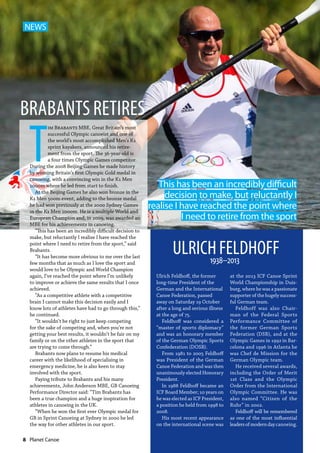
T
im Brabants MBE, Great Britain’s most
successful Olympic canoeist and one of
the world’s most accomplished Men’s K1
sprint kayakers, announced his retire-
ment from the sport. The 36-year-old is
a four times Olympic Games competitor.
During the 2008 Beijing Games he made history
by winning Britain’s first Olympic Gold medal in
canoeing, with a convincing win in the K1 Men
1000m where he led from start to finish.
At the Beijing Games he also won bronze in the
K1 Men 500m event, adding to the bronze medal
he had won previously at the 2000 Sydney Games
in the K1 Men 1000m. He is a multiple World and
European Champion and, in 2009, was awarded an
MBE for his achievements in canoeing.
“This has been an incredibly difficult decision to
make, but reluctantly I realise I have reached the
point where I need to retire from the sport,” said
Brabants.
“It has become more obvious to me over the last
few months that as much as I love the sport and
would love to be Olympic and World Champion
again, I’ve reached the point where I’m unlikely
to improve or achieve the same results that I once
achieved.
“As a competitive athlete with a competitive
brain I cannot make this decision easily and I
know lots of athletes have had to go through this,”
he continued.
“It wouldn’t be right to just keep competing
for the sake of competing and, when you’re not
getting your best results, it wouldn’t be fair on my
family or on the other athletes in the sport that
are trying to come through.”
Brabants now plans to resume his medical
career with the likelihood of specialising in
emergency medicine, he is also keen to stay
involved with the sport.
Paying tribute to Brabants and his many
achievements, John Anderson MBE, GB Canoeing
Performance Director said: “Tim Brabants has
been a true champion and a huge inspiration for
athletes in canoeing in the UK.
“When he won the first ever Olympic medal for
GB in Sprint Canoeing at Sydney in 2000 he led
the way for other athletes in our sport.
ULRICHFELDHOFF1938–2013
NEWS
BRABANTSRETIRES
  Planet Canoe  9
Contact us for a quote
t: +44 (0)1629 732611 e: info@peakuk.com
Baillie/Stott.Cardiff.ImagePeteAstles
Clubs
Teams
Individuals
Flags
logos
photos
anything is possible...
10  Planet Canoe
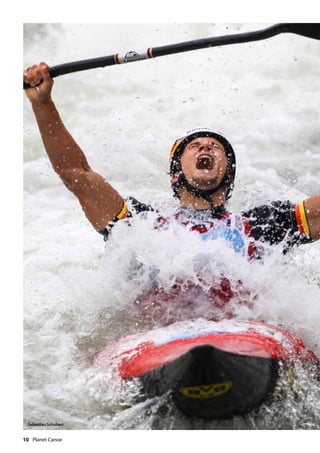
Sebastian Schubert
  Planet Canoe  11
T
alent and tenacity was
evident throughout 2013,
as the post-Olympic year
delivered another spectacu-
lar season of competition
with the world’s best slalom
athletes going head-to-head over a
series of five ICF World Cups.
Following her London 2012 Olym-
pic Silver medal, Australia’s Jes-
sica Fox continued to impress. The
19-year-old competed in both the C1
and K1 disciplines across all five of
the season headliners, asking serious
questions of her opponents which
often went unanswered.
Once again, the ever strong con-
tingent of German paddlers excelled,
with Sideris Tasiadis (C1 Men) and
Sebastian Schubert (K1 Men) leading
the line.
French duo, Matthieu Péché
and Gauthier Klauss put the disap-
pointment of finishing fourth at the
London 2012 Olympic Games behind
them, and in doing so prevented
Peter and Pavol Hochschorner (SVK)
adding an unprecedented eleventh
series title to their overwhelming
collection of world honours.
This was the 26th edition of the
ICF World Cup, and for the second
year in a row the season opened
in Cardiff and closed in Bratislava.
Augsburg, La Seu d’Urgell and Tacen
were the other three destinations. 

Cardiff
The tricky Olympic-standard course
in Cardiff, Wales, presented the first
challenge and to the delight of the
home crowd Great Britain’s paddlers
won four medals, including both
golds in the women’s events.
The talented 17-year-old, Kimber-
ley Woods (GBR) announced herself
on the international scene with her
first senior victory as she stepped
ahead of a world-class field to take
gold in the C1 Women. This was fol-
lowed by a superb run by Elizabeth
Neave (GBR) to reach the top step on
the podium in the K1 Women. 

The Czech Republic’s Stanislav
Ježek won the C1 Men, with Fabien
Dörfler (GER) victorious in the K1
Men. 

Treble-Olympic Champions,
Pavol & Peter Hochschorner, won
the C2 Men. “The race was really
hard because the weather was really
cold, it’s hard to paddle when your
muscles are cold,” said Pavol.

He continued, “We tried to not
make any mistakes. It was important
to go good, fast and clean.”
It certainly was, because close on
their heels were the London 2012
Olympic silver medal duo of Richard
Hounslow and David Florence (GBR),
they laid down the second quickest
time to secure silver.

It was also a positive start for
Fabien Lefèvre (USA) who won
bronze in the K1 Men, his first medal
for his adopted nation since making
the switch from France.
Augsburg
Just one week later Augsburg pre-
sented a different challenge for the
competitors as the famous German
venue, known as the ice channel,
showed no mercy to the 265 compet-
ing athletes.

Surprisingly only one of the five
competitions was won by the host
nation, with Paul Boeckelmann
(GER) winning the K1 Men.

Olympic gold medalist, Émilie
Fer (FRA) put in a clean run to add
another gold to her increasing collec-
tion in the K1 Women’s discipline.

The C1 Men’s event was exception-
ally tight with all top five paddlers
putting in a clear run, but it was
Alexander Slafkovský (SVK) who was
quickest. 

Likewise, the top three in the C1
Women’s event were also close, but it
CANOE
SLALOM
WORLD
CUPS
12  Planet Canoe
was the Australian, Jessica Fox, who outmanoeu-
vred two Brits to secure gold.
France collected their second gold of the
weekend, as the C2 Men’s duo of Gauthier Klauss
and Matthieu Péché edged out the London 2012
Olympic Champions, Timothy Baillie (GBR) and
Etienne Stott (GBR).
It was the 20th time the ICF has run an event
in Augsburg, the venue famous for hosting the
1972 Olympic Games.
La Seu d’Urgell
The iconic Parc Olímpic del Segre venue in La
Seu d’Urgell, Spain, hosted the third ICF Canoe
Slalom World Cup. The tough course proved to
be a true test of skill and strength and saw many
of the favourites, including K1 Women’s Olympic
Champion, Émilie Fer (FRA), eliminated early as
the 1992 Barcelona Olympic run showed no mercy.
The course also showed no mercy to London
2012 Olympic C2 gold medallist Etienne Stott
(GBR) who dislocated his shoulder on his first run
with companion Tim Baillie (GBR).
“Our first run was a little bit sketchy already”,
explained Baillie. “It was not as good as we would
have hoped. Underneath the bridge we caught
a bit too much edge. We managed to return to
upright but in the process Etienne’s shoulder
popped.”
Stott was sidelined for the remainder of the
2013 season.
The French duo of Gauthier Klauss and Mat-
thieu Peche eventually won the C2 competition
putting down a clean run to take top prize. “ We
did not expect to do so well early in the sea-
son”, commented Klauss after their victory.
Equally impressive was Eva Terčelj (SLO,
K1 Women), Jessica Fox (AUS, C1 Women),
Anže Berčič (SLO, C1 Men) and Vavřinec
Hradílek (CZE, K1 Men ) who each left Spain
with a gold medal.
For Terčelj and Berčič it was their first
World Cup victory.
Hradílek commented after his victory, “I
think the course was really long and very
demanding. Physically it was absolutely
crazy. My arms were hurting but I man-
aged to keep the pace till the end. Fortu-
nately I succeeded in avoiding penalties,
unlike many of the other paddlers, I’ve
been lucky this time.”
Tacen
The Canoe Slalom World Cup Series
moved to Tacen, Slovenia, for the fourth
round of competition.
Star of the show was undoubtably
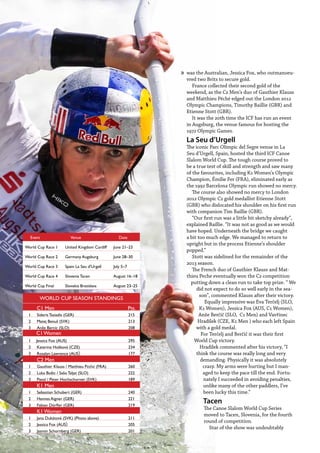
Event Venue Date
World Cup Race 1 United Kingdom Cardiff June 21–23
World Cup Race 2 Germany Augsburg June 28–30
World Cup Race 3 Spain La Seu d'Urgell July 5–7
World Cup Race 4 Slovenia Tacen August 16–18
World Cup Final Slovakia Bratislava August 23–25
WORLD CUP SEASON STANDINGS
C1 Men Pts.
1 Sideris Tasiadis (GER) 215
2 Matej Benuš (SVK) 213
3 Anže Bercic (SLO) 208
C1 Women
1 Jessica Fox (AUS) 295
2 Katerina Hošková (CZE) 234
3 Rosalyn Lawrence (AUS) 177
C2 Men
1 Gauthier Klauss / Matthieu Péché (FRA) 260
2 Luka Božic / Sašo Taljat (SLO) 222
3 Pavol / Peter Hochschorner (SVK) 189
K1 Men
1 Sebastian Schubert (GER) 240
2 Hannes Aigner (GER) 221
3 Fabian Dörfler (GER) 219
K1 Women
1 Jana Dukátová (SVK) (Photo above) 211
2 Jessica Fox (AUS) 205
3 Jasmin Schornberg (GER) 201
»
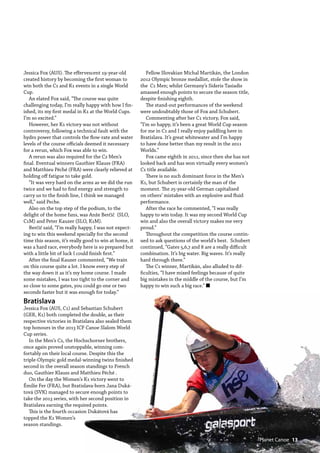
Jessica Fox (AUS). The effervescent 19-year-old
created history by becoming the first woman to
win both the C1 and K1 events in a single World
Cup.
An elated Fox said, “The course was quite
challenging today, I’m really happy with how I fin-
ished, its my first medal in K1 at the World Cups.
I’m so excited.”
However, her K1 victory was not without
controversy, following a technical fault with the
hydro power that controls the flow-rate and water
levels of the course officials deemed it necessary
for a rerun, which Fox was able to win.
A rerun was also required for the C2 Men’s
final. Eventual winners Gauthier Klauss (FRA)
and Matthieu Péché (FRA) were clearly relieved at
holding off fatigue to take gold.
“It was very hard on the arms as we did the run
twice and we had to find energy and strength to
carry us to the finish line, I think we managed
well,” said Peche.
Also on the top step of the podium, to the
delight of the home fans, was Anže Berčič (SLO,
C1M) and Peter Kauzer (SLO, K1M).
Berčič said, “I’m really happy, I was not expect-
ing to win this weekend specially for the second
time this season, it’s really good to win at home, it
was a hard race, everybody here is so prepared but
with a little bit of luck I could finish first.”
After the final Kauzer commented, “We train
on this course quite a lot. I know every step of
the way down it as it’s my home course. I made
some mistakes, I was too tight to the corner and
so close to some gates, you could go one or two
seconds faster but it was enough for today.”
Bratislava
Jessica Fox (AUS, C1) and Sebastian Schubert
(GER, K1) both completed the double, as their
respective victories in Bratislava also sealed them
top honours in the 2013 ICF Canoe Slalom World
Cup series.
In the Men’s C2, the Hochschorner brothers,
once again proved unstoppable, winning com-
fortably on their local course. Despite this the
triple-Olympic gold medal-winning twins finished
second in the overall season standings to French
duo, Gauthier Klauss and Matthieu Péché .
On the day the Women’s K1 victory went to
Émilie Fer (FRA), but Bratislava-born Jana Duká-
tová (SVK) managed to secure enough points to
take the 2013 series, with her second position in
Bratislava earning the required points.
This is the fourth occasion Dukátová has
topped the K1 Women’s
season standings.
Fellow Slovakian Michal Martikán, the London
2012 Olympic bronze medallist, stole the show in
the C1 Men; whilst Germany’s Sideris Tasiadis
amassed enough points to secure the season title,
despite finishing eighth.
The stand-out performances of the weekend
were undoubtably those of Fox and Schubert.
Commenting after her C1 victory, Fox said,
“I’m so happy, it’s been a great World Cup season
for me in C1 and I really enjoy paddling here in
Bratislava. It’s great whitewater and I’m happy
to have done better than my result in the 2011
Worlds.”
Fox came eighth in 2011, since then she has not
looked back and has won virtually every women’s
C1 title available.
There is no such dominant force in the Men’s
K1, but Schubert is certainly the man of the
moment. The 25-year-old German capitalised
on others’ mistakes with an explosive and fluid
performance.
After the race he commented, “I was really
happy to win today. It was my second World Cup
win and also the overall victory makes me very
proud.”
Throughout the competition the course contin-
ued to ask questions of the world’s best. Schubert
continued, “Gates 5,6,7 and 8 are a really difficult
combination. It’s big water. Big waves. It’s really
hard through there.”
The C1 winner, Martikán, also alluded to dif-
ficulties, “I have mixed feelings because of quite
big mistakes in the middle of the course, but I’m
happy to win such a big race.” n
  Planet Canoe  13
14  Planet Canoe
Isaquias Dos Santos
  Planet Canoe  15
C
anoe Sprint fever started
in May with all three 2013
ICF Canoe Sprint World
Cups being contested
within a four week period.
The cameras captured all
the fast and furious action, with
the sport continuing to increase
its global appeal both on TV and to
online streaming audiences.
Stars of the show were Max Hoff
(GER, K1 Men 1000m), Sebastian
Brendel (GER, C1 Men 1000m), Lisa
Carrington (NZL, K1 Women 200m)
and Laurence Vincent-Lapointe
(CAN, C1 Women 200m), who each
dominated their favoured events.
Szeged
The season kicked off in Szeged,
Hungary, with over 5,000 specta-
tors lining the banks eager to see
their heroes compete at the highest
level. The Hungarian President
János Áder was also present, and
had the joy of hearing his national
anthem six times over the weekend,
following Hungary’s superb
haul of 19 medals (6
gold, 9 silver, 4 bronze).
However, it was Max
Hoff (GER) who put
in the most impressive
performance of the weekend,
dominating the K1 Men 1000m
from start to finish. “Well, for the
first race of the season, that was a
good race.” Hoff commented after
his victory.
He continued, “I felt very good in
my semi-final yesterday and I knew
I could achieve something nice
today. I am satisfied to have won by
such a margin because the last 200
metres were painful. It means I am
in good shape, despite the fact that
I have not trained too hard yet. I
guess I benefit from the discipline I
kept after the Olympic Games last
year.”
Račice
Račice in the Czech Republic was
the second port of call for the
world’s fastest. The 18-year-old
Serbian Marko Dragosavljević stole
the show with an explosive perfor-
mance, and celebration, in the K1
Men 200m.
In a world-class field, which
included Olympic gold and bronze
medallists Ed McKeever (GBR) and
Mark De Jonge (CAN), the young
European showed his strength
and stopped the clock fractionally
ahead of César De Cesare (ECU),
the winner at the first World Cup in
Szeged.
Dragosavljević’s joy at taking his
first major senior title was evident
as he jumped in the air in celebra-
tion, screaming up and down the
pontoon.
Other notable performances
came from Lisa Carrington (NZL)
who managed her first win over the
longer K1 Women 500m distance,
and René Holten Poulsen (DEN)
who put in an exceptionally power-
ful display in K1 Men 1000m to take
gold.
“TobehonestI’msurprisedIwon,”
saidPoulsen.ThisresultthrewtheK1
Men1000mthirdandfinalWorldCup
raceinPoznańwideopenandleftmany
supportersasking;whathappenedto
MaxHoff?
TheGerman,whohasbeenin
irresistibleformatthefirstmeet,
waspushedintofourthplace,asAleh
Yurenia(BLR)andKenWallace(AUS)
claimedsilverandbronzerespectively.
Poznań
The final Canoe Sprint World Cup
of 2013 headed to Poznań, Poland
where the nation of Brazil marked
their rapid rise to prominence with
two gold medals.
CANOE
SPRINT
WORLD
CUPS
16  Planet Canoe
Laurence Vincent-Lapointe
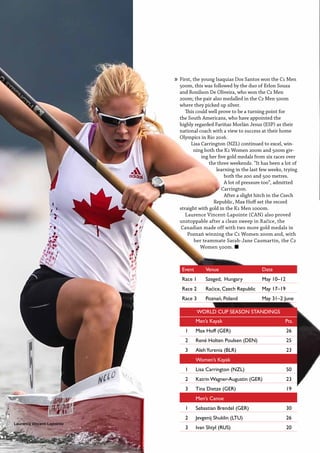
WORLD CUP SEASON STANDINGS
Men’s Kayak Pts.
1 Max Hoff (GER) 26
2 René Holten Poulsen (DEN) 25
3 AlehYurenia (BLR) 23
Women’s Kayak
1 Lisa Carrington (NZL) 50
2 Katrin Wagner-Augustin (GER) 23
3 Tina Dietze (GER) 19
Men’s Canoe
1 Sebastian Brendel (GER) 30
2 Jevgenij Shuklin (LTU) 26
3 Ivan Shtyl (RUS) 20
Event Venue Date
Race 1 Szeged, Hungary May 10–12
Race 2 Raćice, Czech Republic May 17–19
Race 3 Poznań, Poland May 31–2 June
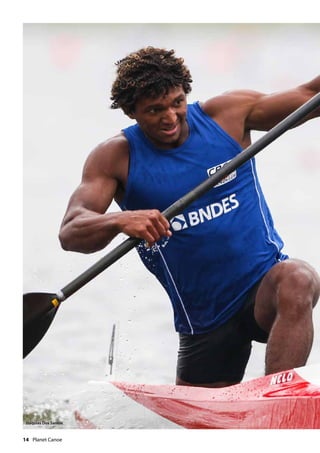
First, the young Isaquias Dos Santos won the C1 Men
500m, this was followed by the duo of Erlon Souza
and Ronilson De Oliveira, who won the C2 Men
200m; the pair also medalled in the C2 Men 500m
where they picked up silver.
This could well prove to be a turning point for
the South Americans, who have appointed the
highly regarded Fariñas Morlán Jesus (ESP) as their
national coach with a view to success at their home
Olympics in Rio 2016.
Lisa Carrington (NZL) continued to excel, win-
ning both the K1 Women 200m and 500m giv-
ing her five gold medals from six races over
the three weekends. “It has been a lot of
learning in the last few weeks, trying
both the 200 and 500 metres.
A lot of pressure too”, admitted
Carrington.
After a slight hitch in the Czech
Republic, Max Hoff set the record
straight with gold in the K1 Men 1000m.
Laurence Vincent-Lapointe (CAN) also proved
unstoppable after a clean sweep in Račice, the
Canadian made off with two more gold medals in
Poznań winning the C1 Women 200m and, with
her teammate Sarah-Jane Caumartin, the C2
Women 500m. n
»
  Planet Canoe  17
THE
WORLD
GAMES
Cali, Colombia
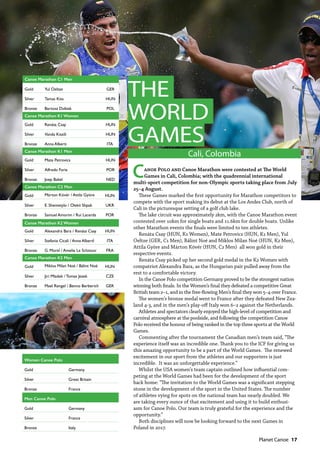
Canoe Polo and Canoe Marathon were contested at The World
Games in Cali, Colombia; with the quadrennial international
multi-sport competition for non-Olympic sports taking place from July
25–4 August.
These Games marked the first opportunity for Marathon competitors to
compete with the sport making its debut at the Los Andes Club, north of
Cali in the picturesque setting of a golf club lake.
The lake circuit was approximately 2km, with the Canoe Marathon event
contested over 10km for single boats and 11.6km for double boats. Unlike
other Marathon events the finals were limited to ten athletes.
Renáta Csay (HUN, K1 Women), Mate Petrovics (HUN, K1 Men), Yul
Oeltze (GER, C1 Men), Bálint Noé and Miklos Milan Noé (HUN, K2 Men),
Attila Györe and Márton Kövér (HUN, C2 Men) all won gold in their
respective events.
Renáta Csay picked up her second gold medal in the K2 Women with
compatriot Alexandra Bara, as the Hungarian pair pulled away from the
rest to a comfortable victory.
In the Canoe Polo competition Germany proved to be the strongest nation
winning both finals. In the Women’s final they defeated a competitive Great
British team 2–1, and in the free-flowing Men’s final they won 5–4 over France.
The women’s bronze medal went to France after they defeated New Zea-
land 4-3, and in the men’s play-off Italy won 6–2 against the Netherlands.
Athletes and spectators clearly enjoyed the high-level of competition and
carnival atmosphere at the poolside, and following the competition Canoe
Polo received the honour of being ranked in the top three sports at the World
Games.
Commenting after the tournament the Canadian men’s team said, “The
experience itself was an incredible one. Thank you to the ICF for giving us
this amazing opportunity to be a part of the World Games. The renewed
excitement in our sport from the athletes and our supporters is just
incredible. It was an unforgettable experience.”
Whilst the USA women’s team captain outlined how influential com-
peting at the World Games had been for the development of the sport
back home: “The invitation to the World Games was a significant stepping
stone in the development of the sport in the United States. The number
of athletes vying for spots on the national team has nearly doubled. We
are taking every ounce of that excitement and using it to build enthusi-
asm for Canoe Polo. Our team is truly grateful for the experience and the
opportunity.”
Both disciplines will now be looking forward to the next Games in
Poland in 2017.
Women Canoe Polo
Gold Germany
Silver Great Britain
Bronze France
Men Canoe Polo
Gold Germany
Silver France
Bronze Italy
Canoe Marathon C1 Men
Gold Yul Oeltze GER
Silver Tamas Kiss HUN
Bronze Bartosz Dubiak POL
Canoe Marathon K1 Women
Gold Renáta Csay HUN
Silver Vanda Kiszili HUN
Bronze Anna Alberti ITA
Canoe Marathon K1 Men
Gold Mate Petrovics HUN
Silver Alfredo Faria POR
Bronze Joep Bakel NED
Canoe Marathon C2 Men
Gold Márton Kövér / Attila Györe HUN
Silver E. Shemetylo / Olekii Shpak UKR
Bronze Samuel Amorim / Rui Lacerda POR
Canoe Marathon K2 Women
Gold Alexandra Bara / Renáta Csay HUN
Silver Stefania Cicali / Anna Alberti ITA
Bronze G. Morel / Amelie Le Sclotour FRA
Canoe Marathon K2 Men
Gold Miklos Milan Noé / Bálint Noé HUN
Silver Jiri Mladek / Tomas Jezek CZE
Bronze Mael Rengel / Benno Berberich GER
18  Planet Canoe
WILDWATER CANOEING
JUNIORWORLD CHAMPIONSHIPS
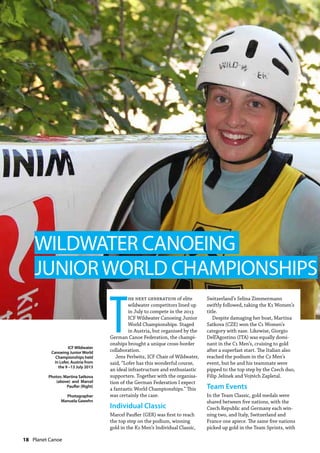
ICF Wildwater
Canoeing Junior World
Championships held
in Lofer, Austria from
the 9 –13 July 2013
Photos: Martina Satkova
(above) and Marcel
Paufler (Right)
Photographer
Manuela Gawehn
T
he next generation of elite
wildwater competitors lined up
in July to compete in the 2013
ICF Wildwater Canoeing Junior
World Championships. Staged
in Austria, but organised by the
German Canoe Federation, the champi-
onships brought a unique cross-border
collaboration.
Jens Perlwitz, ICF Chair of Wildwater,
said, “Lofer has this wonderful course,
an ideal infrastructure and enthusiastic
supporters. Together with the organisa-
tion of the German Federation I expect
a fantastic World Championships.” This
was certainly the case.
Individual Classic
Marcel Paufler (GER) was first to reach
the top step on the podium, winning
gold in the K1 Men’s Individual Classic,
Switzerland’s Selina Zimmermann
swiftly followed, taking the K1 Women’s
title.
Despite damaging her boat, Martina
Satkova (CZE) won the C1 Women’s
category with ease. Likewise, Giorgio
Dell’Agostino (ITA) was equally domi-
nant in the C1 Men’s, cruising to gold
after a superfast start. The Italian also
reached the podium in the C2 Men’s
event, but he and his teammate were
pipped to the top step by the Czech duo,
Filip Jelinek and Vojtěch Zapletal.
Team Events
In the Team Classic, gold medals were
shared between five nations, with the
Czech Republic and Germany each win-
ning two, and Italy, Switzerland and
France one apiece. The same five nations
picked up gold in the Team Sprints, with
Changes to the Wildwater
Rules?
Jens Perlwitz (GER), Chair ICF
Wildwater Canoeing, was interviewed
by canoeworlds.com, and hinted at
changes in the rules to increase par-
ticipation in the discipline:
“Yes of course, we would like to
simplify the rules. This might be an
easier part to develop Wildwater
Canoeing, but there are a lot of ideas,
like head-to-head-races, we have
to discuss. I see these kind of races
differentiated. On the one hand it is
a chance to have an attractive sport
with spectacular duels. But on the
other, you need a jury to judge con-
tact. We would create a contact sport,
in which fouls are possible.”
Wildwater Canoeing
World Cup
Two weekends in June provided four
ICF Wildwater Canoeing World Cup
competitions. The first double-header
took place in Bosnia and Herzegovina,
with the second taking place at the
venue for the 2014 ICF Wildwater
Canoeing World Championships,
Valtellina in Italy.
Paul Gratin (FRA, K1 Men), Manu-
ela Stöberl (GER, K1 Women), Nor-
men Webber (GER, C1 Men), Marlene
Riccardi (ITA, C1 Women) and the duo
of Peter Žnidaršič and Luka Žganjar
(SLO, C2 Men) took the overall series
titles in their respective events.
Germany on three, France and Czech
Republic on two and Switzerland and
Italy each winning a single event.
Sprint Events
On the final day of the champion-
ships Martina Satkova, a 14-year-old
from the Czech Republic, stole the
show, winning both the K1 and C1
Women’s events.
Ronan Cordier (FRA) became a
triple gold-medallist, adding the C1
Men’s Sprint title to his tally of two
golds from the team events. This
honour was also afforded to Finn
Hartstein (GER) who won the K1
Men’s title, to add to his double from
the team events.
Remarkably, the final event of
the championships was a dead heat,
as the Czech and German C2 Men’s
crews both stopped the clock at 1h
19.90.
The Czech Republic were certainly
the dominant nation of the cham-
pionships, winning a total of thirty
medals (eleven gold, nine silver, and
ten bronze). n
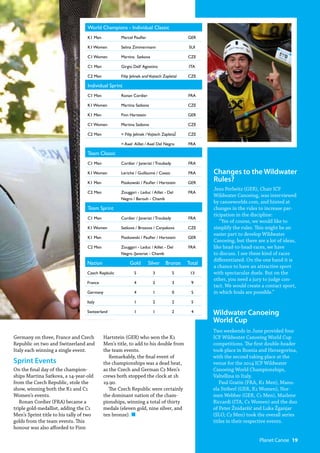
World Champions - Individual Classic
K1 Men Marcel Paufler GER
K1 Women Selina Zimmermann SUI
C1 Women Martina Satkova CZE
C1 Men Girgio Dell’ Agostino ITA
C2 Men Filip Jelinek andVojtech Zapletal CZE
Individual Sprint
C1 Men Ronan Cordier FRA
K1 Women Martina Satkova CZE
K1 Men Finn Hartstein GER
C1 Women Martina Satkova CZE
C2 Men = Filip Jelinek /Vojtech Zapletal CZE
= Axel Aillet / Axel Del Negro FRA
Team Classic
C1 Men Cordier / Janeriat / Troubady FRA
K1 Women Leriche / Guillaume / Cossic FRA
K1 Men Piaskowski / Paufler / Hartstein GER
C2 Men Zouggari - Leduc / Aillet - Del
Negro / Barouh - Chamb
FRA
Team Sprint
C1 Men Cordier / Janeriat / Troubady FRA
K1 Women Satkova / Brozova / Carpakova CZE
K1 Men Piaskowski / Paufler / Hartstein GER
C2 Men Zouggari - Leduc / Aillet - Del
Negro /Janeriat - Chamb
FRA
Nation Gold Silver Bronze Total
Czech Repbulic 5 3 5 13
France 4 2 3 9
Germany 4 1 0 5
Italy 1 2 2 5
Switzerland 1 1 2 4
  Planet Canoe  19
20  Planet Canoe
F
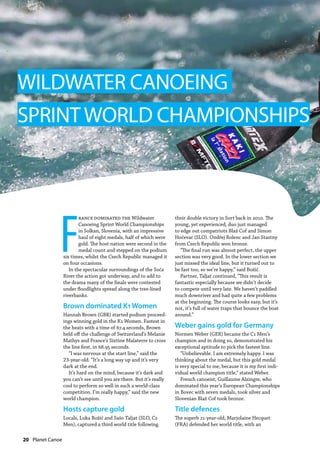
rance dominated the Wildwater
Canoeing Sprint World Championships
in Solkan, Slovenia, with an impressive
haul of eight medals, half of which were
gold. The host nation were second in the
medal count and stepped on the podium
six times, whilst the Czech Republic managed it
on four occasions.
In the spectacular surroundings of the Soča
River the action got underway, and to add to
the drama many of the finals were contested
under floodlights spread along the tree-lined
riverbanks.
Brown dominated K1 Women
Hannah Brown (GBR) started podium proceed-
ings winning gold in the K1 Women. Fastest in
the heats with a time of 67.4 seconds, Brown
held off the challenge of Switzerland’s Melanie
Mathys and France’s Sixtine Malaterre to cross
the line first, in 68.95 seconds.
“I was nervous at the start line,” said the
23-year-old. “It’s a long way up and it’s very
dark at the end.
It’s hard on the mind, because it’s dark and
you can’t see until you are there. But it’s really
cool to perform so well in such a world-class
competition. I’m really happy,” said the new
world champion.
Hosts capture gold
Locals, Luka Božič and Sašo Taljat (SLO, C2
Men), captured a third world title following
their double victory in Sort back in 2010. The
young, yet experienced, duo just managed
to edge out compatriots Blaž Cof and Simon
Hočevar (SLO). Ondřej Rolenc and Jan Stastny
from Czech Republic won bronze.
“The final run was almost perfect, the upper
section was very good. In the lower section we
just missed the ideal line, but it turned out to
be fast too, so we’re happy,” said Božič.
Partner, Taljat continued, “This result is
fantastic especially because we didn’t decide
to compete until very late. We haven’t paddled
much downriver and had quite a few problems
at the beginning. The course looks easy, but it’s
not, it’s full of water traps that bounce the boat
around.”
Weber gains gold for Germany
Normen Weber (GER) became the C1 Men’s
champion and in doing so, demonstrated his
exceptional aptitude to pick the fastest line.
“Unbelievable. I am extremely happy. I was
thinking about the medal, but this gold medal
is very special to me, because it is my first indi-
vidual world champion title,” stated Weber.
French canoeist, Guillaume Alzingre, who
dominated this year’s European Championships
in Bovec with seven medals, took silver and
Slovenian Blaž Cof took bronze.
Title defences
The superb 21-year-old, Marjolaine Hecquet
(FRA) defended her world title, with an
WILDWATER CANOEING
SPRINTWORLD CHAMPIONSHIPS
  Planet Canoe  21
World Champions
C1 Men Normen Weber (GER)
C1 Women Marjolene Hecquet (FRA)
C2 Men Luka Božic and Sašo Taljat (SLO)
K1 Men Maxime Richard (BEL)
K1 Women Hannah Brown (GBR)
C1 Men Team Alzingre/ Marquer/Santamaria (FRA)
K1 Women Team Bren / Malaterre / Hostens (FRA)
K1 Men Team Slovak / Hala / Slepica (CZE)
Nation Gold Silver Bronze Total
France 4 3 1 8
Slovenia 1 3 2 6
Czech Republic 1 1 3 5
Germany 1 1 1 3
Switzerland 0 1 1 2
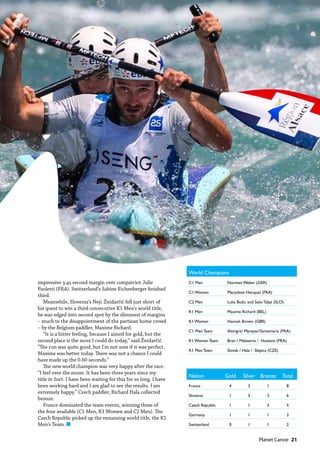
impressive 3:45 second margin over compatriot Julie
Paoletti (FRA). Switzerland’s Sabine Eichenberger finished
third.
Meanwhile, Slovenia’s Nejc Žnidarčič fell just short of
his quest to win a third consecutive K1 Men’s world title;
he was edged into second spot by the slimmest of margins
– much to the disappointment of the partisan home crowd
– by the Belgium paddler, Maxime Richard.
“It is a bitter feeling, because I aimed for gold, but the
second place is the most I could do today,” said Žnidarčič.
“The run was quite good, but I’m not sure if it was perfect.
Maxime was better today. There was not a chance I could
have made up the 0.60 seconds.”
The new world champion was very happy after the race.
“I feel over the moon. It has been three years since my
title in Sort. I have been waiting for this for so long. I have
been working hard and I am glad to see the results. I am
extremely happy.” Czech paddler, Richard Hala collected
bronze.
France dominated the team events, winning three of
the four available (C1 Men, K1 Women and C2 Men). The
Czech Republic picked up the remaining world title, the K1
Men’s Team. n
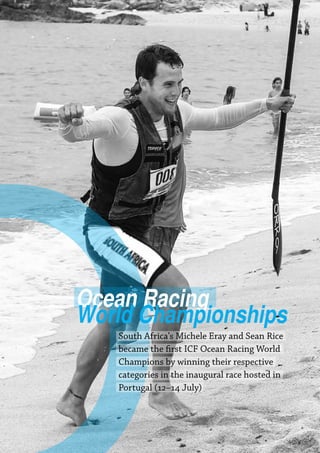
22  Planet Canoe
Ocean Racing
World Championships
South Africa’s Michele Eray and Sean Rice
became the first ICF Ocean Racing World
Champions by winning their respective
categories in the inaugural race hosted in
Portugal (12–14 July)
  Planet Canoe  23
That was my
best race I
ever raced.
I cannot
explain. It’s
a fantastic
feeling.
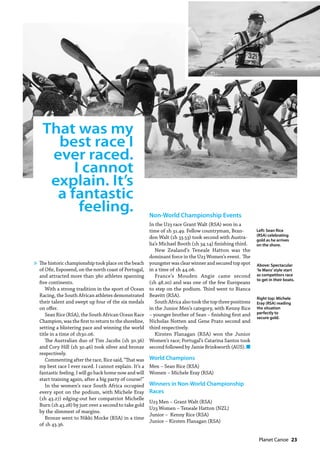
Above: Spectacular
‘le Mans’style start
as competitors race
to get in their boats.
Left: Sean Rice
(RSA) celebrating
gold as he arrives
on the shore.
Right top: Michele
Eray (RSA) reading
the situation
perfectly to
secure gold.
The historic championship took place on the beach
of Ofir, Esposend, on the north coast of Portugal,
and attracted more than 380 athletes spanning
five continents.
With a strong tradition in the sport of Ocean
Racing, the South African athletes demonstrated
their talent and swept up four of the six medals
on offer.
Sean Rice (RSA), the South African Ocean Race
Champion, was the first to return to the shoreline,
setting a blistering pace and winning the world
title in a time of 1h30.06.
The Australian duo of Tim Jacobs (1h 30.36)
and Cory Hill (1h 30.46) took silver and bronze
respectively.
Commenting after the race, Rice said, “That was
my best race I ever raced. I cannot explain. It’s a
fantastic feeling. I will go back home now and will
start training again, after a big party of course!”
In the women’s race South Africa occupied
every spot on the podium, with Michele Eray
(1h 43.27) edging-out her compatriot Michelle
Burn (1h 43.28) by just over a second to take gold
by the slimmest of margins.
Bronze went to Nikki Mocke (RSA) in a time
of 1h 43.36.
Non-World Championship Events
In the U23 race Grant Walt (RSA) won in a
time of 1h 31.49. Fellow countryman, Bran-
don Walt (1h 33.53) took second with Austra-
lia’s Michael Booth (1h 34.14) finishing third.
New Zealand’s Teneale Hatton was the
dominant force in the U23 Women’s event. The
youngster was clear winner and secured top spot
in a time of 1h 44.06.
France’s Mouden Angie came second
(1h 48.20) and was one of the few Europeans
to step on the podium. Third went to Bianca
Beavitt (RSA).
South Africa also took the top three positions
in the Junior Men’s category, with Kenny Rice
– younger brother of Sean – finishing first and
Nicholas Notten and Gene Prato second and
third respectively.
Kirsten Flanagan (RSA) won the Junior
Women’s race; Portugal’s Catarina Santos took
second followed by Jamie Brinkworth (AUS). n
World Champions
Men – Sean Rice (RSA)
Women – Michele Eray (RSA)
Winners in Non-World Championship
Races
U23 Men – Grant Walt (RSA)
U23 Women – Teneale Hatton (NZL)
Junior – Kenny Rice (RSA)
Junior – Kirsten Flanagan (RSA)
»
24  Planet Canoe
R
ussia and Hungary domi-
nated proceedings at the
inaugural ICF Junior and
U23 World Championships
in Welland, Canada from 1-4
August. The event provided
the first opportunity for the under 23
age category to contest their own canoe
sprint world titles, adding a competi-
tive stepping-stone for young athletes,
as they make the difficult transition
from junior to senior competitors.
It was, however, the dominant canoe
sprint nations who claimed the most
world titles. Hungary stepped onto the
top step of the podium an impressive
eight times, and Russia five; the hosts,
Canada, were third in the medal tally,
collecting two gold medals.
Individually, the most impres-
sive performance came from Emma
Jørgensen (DEN) who won the Junior
K1 Women 200m and 500m. Bulgaria’s
Daryna Kastsiuchenka and Hungary’s
Jonatán Hajdú also stepped on the top
step of the podium twice in the junior
category. Kastsiuchenka won the C1
Women 200m and then teamed up with
Kamila Bobr to cross the line first in
the C2 Women 500m; Hajdú won the
C1 200m and then conquered the long
C2 Men 1000m haul with compatriot
Kristóf Khaut.
A New Era
As the first championships of its kind,
István Vaskuti (HUN), ICF 1st Vice-
President, talked about why it was
an important introduction to the ICF
calendar, “By creating this age category,
we bring the paddlers closer to their
elders. It is a good step forward. They
also carry on their direct competition
with the athletes they used to compete
against as juniors and measure their
progress. They get a clearer vision of
what they could become as seniors. I
think that 18 is a critical age. From 18
to 21, they can assess their chances to
make a career in canoeing and decide
what they want to do. This is why this
championships is crucial for tomor-
row’s champions.”
The event also served as a qualifier
for the 2014 Youth Olympic Games in
Nanjing, China.
Superb New Venue
With an uninterrupted, almost 8km,
stretch of water, the Welland Inter-
national Flatwater Centre provided a
superb setting for the event. The course
is just over 100m wide and, as the city’s
source of drinking water, boasts some
of the cleanest conditions of any water-
sports venue in the world.
“I like this venue very much, it has
been very cleverly thought out and
designed,” commented Vaskuti, “All the
facilities are simple but very effective
and functional, like the finish tower,
the wave blocking system and the
traffic channel. It is a great example of
human creativity put at the service of
efficiency.”
Vaskuti also spoke openly about
the need for canoeing to look beyond
Europe. “We need to organise big
events outside Europe at least once
out of three years, between Olympic
Games. We have strong federations in
America and Asia, I am convinced that
the world is full of great venues, which
could provide many opportunities for
our athletes to compete. We can orga-
nise great canoe sprint events outside
of Europe. The TV coverage is the best
I have seen, and this is a Junior World
Championship. It is a good thing for
the universality of canoeing.”
The 2014 Junior & U23 Champi-
onship will be contested in Szeged,
Hungary. n
Nation Gold Silver Bronze Total
Russia 5 9 4 18
Hungary 8 4 5 17
Canada 2 1 3 6
Germany 2 2 1 5
Spain 0 3 2 5
Canoe Sprint Junior & U23
World Championships
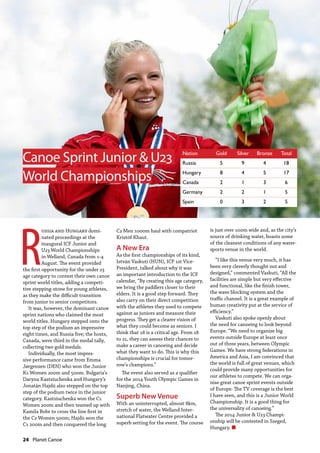
PHOTO: Emma JØRGENSEN (DEN)
Photographer: Madison Smith
Hungary completely domi-
nated proceedings winning
events across the board in
canoe and kayak and at the
end of the second day of com-
petition actually had ten times
as many gold medals (21)
as the next placed country,
Poland.
Such was the depth of talent
and numbers in the Hungarian
team that in some events both
its boats won medals.
The Olympic Hopes regatta
was an idea conceived during
the Cold War between the
sports ministries of Poland,
Hungary and the former
Czechoslovakia as a way of
promoting sport between
paddlers who were too young
for their Junior World Cham-
pionships but who craved
competition.
From the original three the
event grew to seven countries
by 2002 and has since grown
to more than 25.This year’s
event saw South Africa,Austra-
lia, the US and a host of Euro-
pean countries taking part. For
anyone looking for pointers to
stars of the future, there were
plenty of youngsters to keep
an eye on.
There were three principal
age categories, those born in
1996 (U17), 1997 (U16) and
1998 (U15).And there were
impressive performances in all
of them.
Belgium’s Artuur Peters
won the U17 K1 Men 1000m
event in an impressive 3.40,
almost two seconds clear
of second placed Christoph
Kornfeind of Austria with the
Czech TomasVesely a mere 0.2
seconds behind him.
In the U17 women’s event,
Emma Aastrand of Denmark
took the win in 4.03, ahead of
Hungarian Tamara Takacs and
Anna Pulawska of Poland.
And in C1 it was Jonatan
Hajdu who won the U17
1000m race, followed by Alek-
sander Kitewski of Poland and
another Hungarian, Levente
Balla, in third place.
Margins were tight at the
top with youngsters fighting all
the way to the line. Nowhere
was this more so than in the
200m events. In one of the
most spectacular events of
the regatta, the men’s U17
K2 200m, Rokas Puzonas and
Gytis Macevicius of Lithuania
took gold in 35.557 seconds,
ahead of two Hungarian crews,
Balint Hajos and Zsolt Czuffer
in second and Katyas Koleszar
andViktor Nemeth in third.
The top five boats in the race
all finished within 0.55 seconds
of each other, making even the
photo finish a very close call.
Australia, which boasted
a 30-strong team, vied with
Denmark and Hungary for
the loudest supporters, the
team having clearly brought a
large number of friends and
relatives a vast distance for
the event, which formed the
climax of a long European
training camp for its talented
juniors.
Ian Wynne, a bronze medal-
ist in K1 500m at Athens and
now a coach with the British
team, said all the competitors
who took part would leave
with valuable lessons:“It’s a
great event, the paddlers have
learned a lot and it’s great
experience for them.”
Junior World Champions
K1W 200 Emma JØRGENSEN (DEN)
K1M 200 Balázs BIRKÁS (HUN)
C1W 200 Daryna KASTSIUCHENKA (BLR)
C1M 200 Jonatán HAJDÚ (HUN)
K2M 200 Artem KUZAKHMETOV /Vladislav
BLINTCOV (RUS)
K1W 500 Emma JØRGENSEN (DEN)
K2W 500 Florida CIUTA / Elena MERONIAC
(ROU)
C2W 500 Daryna KASTSIUCHENKA / Kamila
BOBR (BLR)
K4W 500 PILLER / KATRINECZ / MALCSINER /
SZABÓ (HUN)
K1M 1000 Marius RADOW (GER)
C1M 1000 SergeyYEMELYANOV (KAZ)
K2M 1000 Zsombor NOÉ / PéterVASS (HUN)
C2M 1000 Kristóf KHAUT / Jonatán HAJDÚ (HUN)
K4M 1000 JANZA /VASS / NOÉ / FEKETE (HUN)
Olympic Hopes
U23 World Champions
K1W 200 Michelle RUSSELL (CAN)
K1M 200 Aleksandr NIKOLAEV (RUS)
C1W 200 LaurenceVINCENT-LAPOINT (CAN)
C1M 200 Andrey KRAITOR (RUS)
K2M 200 Aleksandr NIKOLAEV / Mikhail
TAMONOV (RUS)
K1W 500 Sarah GUYOT (FRA)
C2W 500 Zsanett LAKATOS / Kincsö TAKÁCS
(HUN)
K2W 500 Vera SOBETOVA / Natalia PODOLS-
KAYA (RUS)
K4W 500 ZEHE / HERING / NICHE / KNORR
(GER)
K1M 1000 Josef DOSTAL (CZE)
C1M 1000 Maksim PIATROU (BLR)
K2M 1000 Tibor HUFNÁGEL / Benjámin CEINER
(HUN)
C2M 1000 Mateusz KAMINSKI /Vincent SLOMIN-
SKI (POL)
K4M 1000 KRAJCOVIC / JAKUBIK / MICHALEK /
DEMIN (SVK)
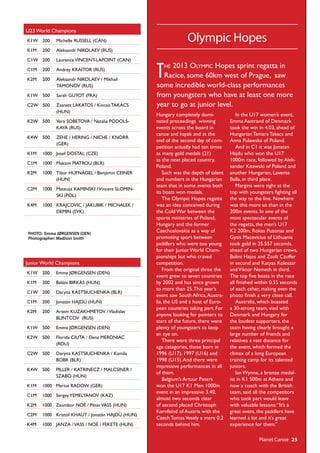
The 2013 Olympic Hopes sprint regatta in
Racice, some 60km west of Prague, saw
some incredible world-class performances
from youngsters who have at least one more
year to go at junior level.
  Planet Canoe  25
26  Planet Canoe
Max Hoff
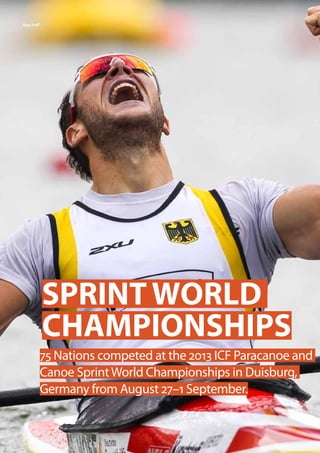
SPRINT WORLD
CHAMPIONSHIPS
75 Nations competed at the 2013 ICF Paracanoe and
Canoe SprintWorld Championships in Duisburg,
Germany from August 27–1 September.
  Planet Canoe  27
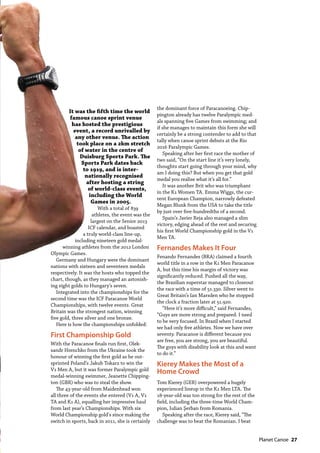
It was the fifth time the world
famous canoe sprint venue
has hosted the prestigious
event, a record unrivalled by
any other venue. The action
took place on a 2km stretch
of water in the centre of
Duisburg Sports Park. The
Sports Park dates back
to 1919, and is inter-
nationally recognised
after hosting a string
of world-class events,
including the World
Games in 2005.
With a total of 839
athletes, the event was the
largest on the Senior 2013
ICF calendar, and boasted
a truly world-class line-up,
including nineteen gold medal-
winning athletes from the 2012 London
Olympic Games.
Germany and Hungary were the dominant
nations with sixteen and seventeen medals
respectively. It was the hosts who topped the
chart, though, as they managed an astonish-
ing eight golds to Hungary’s seven.
Integrated into the championships for the
second time was the ICF Paracanoe World
Championships, with twelve events. Great
Britain was the strongest nation, winning
five gold, three silver and one bronze.
Here is how the championships unfolded:
First Championship Gold
With the Paracanoe finals run first, Olek-
sandr Hrenchko from the Ukraine took the
honour of winning the first gold as he out-
sprinted Poland’s Jakub Tokarz to win the
V1 Men A, but it was former Paralympic gold
medal-winning swimmer, Jeanette Chipping-
ton (GBR) who was to steal the show.
The 43-year-old from Maidenhead won
all three of the events she entered (V1 A, V1
TA and K1 A), equalling her impressive haul
from last year’s Championships. With six
World Championship gold's since making the
switch in sports, back in 2011, she is certainly
the dominant force of Paracanoeing. Chip-
pington already has twelve Paralympic med-
als spanning five Games from swimming; and
if she manages to maintain this form she will
certainly be a strong contender to add to that
tally when canoe sprint debuts at the Rio
2016 Paralympic Games.
Speaking after her first race the mother of
two said, “On the start line it’s very lonely,
thoughts start going through your mind, why
am I doing this? But when you get that gold
medal you realise what it’s all for.”
It was another Brit who was triumphant
in the K1 Women TA. Emma Wiggs, the cur-
rent European Champion, narrowly defeated
Megan Blunk from the USA to take the title
by just over five-hundredths of a second.
Spain’s Javier Reja also managed a slim
victory, edging ahead of the rest and securing
his first World Championship gold in the V1
Men TA.
Fernandes Makes It Four
Fenando Fernandes (BRA) claimed a fourth
world title in a row in the K1 Men Paracanoe
A, but this time his margin of victory was
significantly reduced. Pushed all the way,
the Brazilian superstar managed to closeout
the race with a time of 51.330. Silver went to
Great Britain’s Ian Marsden who he stopped
the clock a fraction later at 51.920.
“Here it’s more difficult,” said Fernandes,
“Guys are more strong and prepared. I need
to be very focused. In Brazil when I started
we had only five athletes. Now we have over
seventy. Paracanoe is different because you
are free, you are strong, you are beautiful.
The guys with disability look at this and want
to do it.”
Kierey Makes the Most of a
Home Crowd
Tom Kierey (GER) overpowered a hugely
experienced lineup in the K1 Men LTA. The
18-year-old was too strong for the rest of the
field, including the three-time World Cham-
pion, Iulian Şerban from Romania.
Speaking after the race, Kierey said, “The
challenge was to beat the Romanian. I beat
28  Planet Canoe
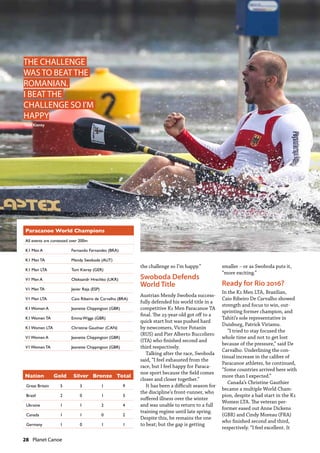
Tom Kierey
Paracanoe World Champions
All events are contested over 200m
K1 Men A Fernando Fernandes (BRA)
K1 Men TA Mendy Swoboda (AUT)
K1 Men LTA Tom Kierey (GER)
V1 Men A Oleksandr Hrechko (UKR)
V1 Men TA Javier Reja (ESP)
V1 Men LTA Caio Ribeiro de Carvalho (BRA)
K1 Women A Jeanette Chippington (GBR)
K1 Women TA Emma Wiggs (GBR)
K1 Women LTA Christine Gauthier (CAN)
V1 Women A Jeanette Chippington (GBR)
V1 Women TA Jeanette Chippington (GBR)
Nation Gold Silver Bronze Total
Great Britain 5 3 1 9
Brazil 2 0 1 3
Ukraine 1 1 2 4
Canada 1 1 0 2
Germany 1 0 1 1
the challenge so I’m happy.”
Swoboda Defends
World Title
Austrian Mendy Swoboda success-
fully defended his world title in a
competitive K1 Men Paracanoe TA
final. The 23-year-old got off to a
quick start but was pushed hard
by newcomers, Victor Potanin
(RUS) and Pier Alberto Buccoliero
(ITA) who finished second and
third respectively.
Talking after the race, Swoboda
said, “I feel exhausted from the
race, but I feel happy for Paraca-
noe sport because the field comes
closer and closer together.”
It has been a difficult season for
the discipline’s front-runner, who
suffered illness over the winter
and was unable to return to a full
training regime until late spring.
Despite this, he remains the one
to beat; but the gap is getting
smaller – or as Swoboda puts it,
“more exciting.”
Ready for Rio 2016?
In the K1 Men LTA, Brazilian,
Caio Ribeiro De Carvalho showed
strength and focus to win, out-
sprinting former champion, and
Tahiti’s sole representative in
Duisburg, Patrick Viriamu.
“I tried to stay focused the
whole time and not to get lost
because of the pressure,” said De
Carvalho. Underlining the con-
tinual increase in the calibre of
Paracanoe athletes, he continued,
“Some countries arrived here with
more than I expected.”
Canada’s Christine Gauthier
became a multiple World Cham-
pion, despite a bad start in the K1
Women LTA. The veteran per-
former eased out Anne Dickens
(GBR) and Cindy Moreau (FRA)
who finished second and third,
respectively. “I feel excellent. It
THE CHALLENGE
WAS TO BEAT THE
ROMANIAN.
I BEAT THE
CHALLENGE SO I’M
HAPPY
  Planet Canoe  29
Mendy Swoboda
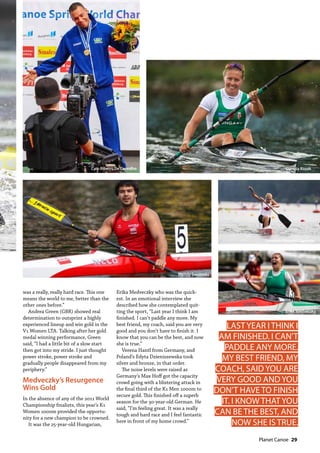
Erika Medveczky
Laurence Vincent-Lapointe
Danuta KozákCaio Ribeiro De Carvalho
was a really, really hard race. This one
means the world to me, better than the
other ones before.”
Andrea Green (GBR) showed real
determination to outsprint a highly
experienced lineup and win gold in the
V1 Women LTA. Talking after her gold
medal winning performance, Green
said, “I had a little bit of a slow start
then got into my stride. I just thought
power stroke, power stroke and
gradually people disappeared from my
periphery.”
Medveczky’s Resurgence
Wins Gold
In the absence of any of the 2011 World
Championship finalists, this year’s K1
Women 1000m provided the opportu-
nity for a new champion to be crowned.
It was the 25-year-old Hungarian,
Erika Medveczky who was the quick-
est. In an emotional interview she
described how she contemplated quit-
ting the sport, “Last year I think I am
finished. I can’t paddle any more. My
best friend, my coach, said you are very
good and you don’t have to finish it. I
know that you can be the best, and now
she is true.”
Verena Hantl from Germany, and
Poland’s Edyta Dzieniszewska took
silver and bronze, in that order.
The noise levels were raised as
Germany’s Max Hoff got the capacity
crowd going with a blistering attack in
the final third of the K1 Men 1000m to
secure gold. This finished off a superb
season for the 30-year-old German. He
said, “I’m feeling great. It was a really
tough and hard race and I feel fantastic
here in front of my home crowd.”
LAST YEAR I THINK I
AM FINISHED. I CAN’T
PADDLE ANY MORE.
MY BEST FRIEND, MY
COACH, SAID YOU ARE
VERY GOOD AND YOU
DON’T HAVE TO FINISH
IT. I KNOW THAT YOU
CAN BE THE BEST, AND
NOW SHE IS TRUE.
30  Planet Canoe
Kenny Wallace, the charismatic Australian,
finished second, and Hungarian Bence Dombvári
completed the podium.
National hero and 2012 Olympic Champion,
Sebastian Brendel (GER) followed Hoff’s crowd-
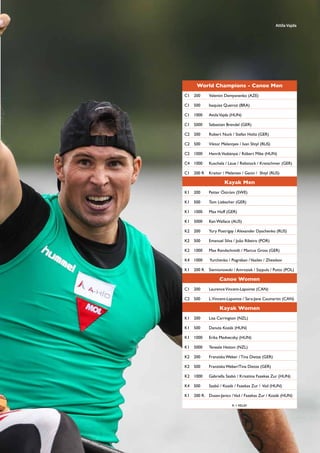
warming victory, but it was Attila Vajda (HUN)
who managed to take the spoils in the C1 Men
1000m final. The Hungarian showed strength-in-
depth as he sliced through a tough headwind to
take the title.
“I tired. I’m so tired, it was a really hard race,”
said the new World Champion. “It was a huge
headwind and this race is the hardest in canoe-
ing. I raced against lots of really good athletes
and I’m so happy that I did what I did.”
Brendel held on to silver, and the up-and-com-
ing young Brazilian, Isaquias Queroz Dos Santos,
won bronze.
Powerful Displays from Kozák
and Vincent-Lapointe
Hungary’s 26-year-old, Danuta Kozák, took
the victory in the K1 Women 500m. The double
Olympic Champion showed her class against
high-calibre opposition. She said, “I am very
happy, I didn’t have this medal in K1 and now I
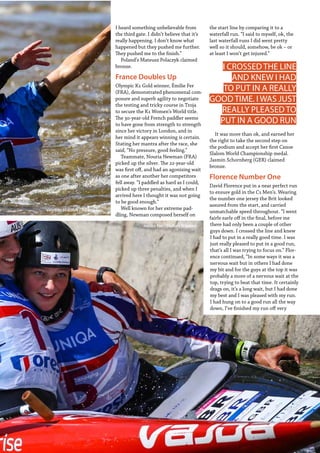
have.”
Silver went to the seasoned professional,
Katrin Wagner-Augustin (GER), and bronze to
Lisa Carrington (NZL).
Once again, the power of Laurence Vincent-
Lapointe was evident as the 6ft (1.83m) Canadian
controlled the race from the off. At just 21-years-
old, she has already won two World Champion-
ship gold medals and has not lost a race this
season on the ICF circuit.
Silver went to Staniliya Stamenova (BUL) and
bronze to Zsanett Lakatos (HUN).
Brendel Delivers Gold
Sebastian Brendel (GER) was dominant
throughout the lung-busting C1 Men 5000m
race, as the German reversed the C1 1000m
result by pulling away from his adversary Attila
Vajda (HUN) to claim gold.
Canada’s Mark Oldershaw (CAN) came
through in third.
After the race Brendel said, “I feel great,
this is my first World Championship title
and I’m happy that I managed it here in
Duisburg. The crowd was amazing and they
pushed me all the way.”
At one point the top two contenders’ boats
touched as they each looked to get the best line
out of the top bend. “It did [touch] but it was
no problem. I know that it was not the idea of
Attila. I think I have a different turn and so
that’s ok, it’s 5000.”
Explosive Surprise from Sweden
Sweden’s Petter Östrom impressed, winning
the prestigious K1 Men 200m World Champion-
ship title. He left a world-class field in his wake,
which included all three Olympic medalists from
London (gold, silver, bronze) and the 2011 World
Champion.
Equally impressive was Tom Liebscher (GER),
who stormed to victory in the K1 Men 500m; as
did the 19-year-old from Brazil, Isaquias Queroz
Dos Santos in the C1 Men 500m. The Brazilian
youngster made high-calibre opposition look
slow, as he coasted across the line to collect gold
to add to his bronze in the C1 Men 1000m.
Australia’s Kenny Wallace managed to
control the proceedings in the K1 Men 5000m,
and Valentin Demyanenko won the C1 Men
200m for Azerbaijan.
New Zealand’s Top Two
New Zealand’s Lisa Carrington and
Teneale Hatton each won gold, as they
impressed in two diametrically opposed
events. Carrington sped to victory in the K1
Women 200m, whilst Hatton stole the show in
the K1 Women 5000m.
Quick off the start, Hatton (NZL) settled
into the lead in the K1 Women 5000m, but
never took her significant advantage for
granted. “I was real surprised at my start.
I had a really good start. I just thought
»
  Planet Canoe  31
Attila Vajda
World Champions - Canoe Men
C1 200 Valentin Demyanenko (AZE)
C1 500 Isaquias Queiroz (BRA)
C1 1000 AttilaVajda (HUN)
C1 5000 Sebastian Brendel (GER)
C2 200 Robert Nuck / Stefan Holtz (GER)
C2 500 Viktor Melantyev / Ivan Shtyl (RUS)
C2 1000 HenrikVasbányai / Róbert Mike (HUN)
C4 1000 Kuschela / Leue / Rebstock / Kretschmer (GER)
C1 200 R Kraitor / Melantev / Ganin / Shtyl (RUS)
Kayak Men
K1 200 Petter Öström (SWE)
K1 500 Tom Liebscher (GER)
K1 1000 Max Hoff (GER)
K1 5000 Ken Wallace (AUS)
K2 200 Yury Postrigay / Alexander Dyachenko (RUS)
K2 500 Emanuel Silva / João Ribeiro (POR)
K2 1000 Max Rendschmidt / Marcus Gross (GER)
K4 1000 Yurchenko / Pogreban /Vasilev / Zhestkov
K1 200 R. Siemionowski / Amroziak / Szypula / Putto (POL)
Canoe Women
C1 200 LaurenceVincent-Lapointe (CAN)
C2 500 L.Vincent-Lapointe / Sara-Jane Caumartin (CAN)
Kayak Women
K1 200 Lisa Carrington (NZL)
K1 500 Danuta Kozák (HUN)
K1 1000 Erika Medveczky (HUN)
K1 5000 Teneale Hatton (NZL)
K2 200 Franziska Weber / Tina Dietze (GER)
K2 500 Franziska Weber/Tina Dietze (GER)
K2 1000 Gabriella Szabó / Krisztina Fazekas Zur (HUN)
K4 500 Szabó / Kozák / Fazekas Zur / Vad (HUN)
K1 200 R. Dusev-Janics /Vad / Fazekas Zur / Kozák (HUN)
R. = RELAY
32  Planet Canoe
Nation Gold Silver Bronze Total
Germany 8 6 2 16
Hungary 7 5 5 17
Russia 4 4 1 9
Canada 2 1 2 5
New Zealand 2 0 1 3
there is a target on my back now and everyone
is going to be chasing me the whole way.”
Hatton continued, “I only kind of relaxed a bit,
maybe, in the last two turns when I had a quick
peek to see how much leeway I had because I
was getting a bit tired by that stage.” However,
with nearly a 23 second margin at the finish line
she didn’t need to worry too much.
Renata Csay (HUN) took silver and Anne
Rikala (FIN) secured bronze.
Compatriot, Lisa Carrington, bettered her
bronze in the K1 Women 500m with gold in
the K1 Women 200m. Following a slow start
the controlled and powerful New Zealander
quickly took to the front and edged out Marta
Walczykiewicz (POL), who took silver, and Špela
Ponomarenko Janić (SLO) who finished with a
bronze. When asked what made the difference,
Carrington said, “I’m not sure, I just tried to
extract the most I could out of myself and today
that was enough.” The 23-year-old has been
dominant over the K1 Women 200m distance
for sometime, reaching superstar status at
home following her victory in the London 2012
Olympic Games over the same distance.
Duos, Quartets and Relays
In the battle of the duos, Germany won the
K2 Women and C2 Men 200m races. Meanwhile,
Russia managed to outmuscle Great Britain in
the K2 Men 200m.
In the 500m pairs, the strong Canadian
double won the C2 Women; Portugal took top
honours in the K2 Men, with the C2 Men going
to Russia.
The 1000m saw Hungary and Germany win-
ning more gold, with the German crew winning
the K2 and the Hungarian pair the C2. Hungary
were also dominant in the K4 Women 500m, as
their quartet pulled away in the latter stages.
Russia secured the K4 Men 1000m with an
explosive performance.
In the relays, Poland won their first gold of
the championships in the K1 Men 200m relay;
whilst Hungary added a seventh in the final
race of the championships, the K1 Women
200m relay. n
»
  Planet Canoe  33
Canoe Slalom
WORLD CHAMPIONSHIPS
The main event on the 2013 Canoe Slalom calendar has
attracted a world-class field, with more than 360 athletes set to
commence battle on the famous course situated to the north
of Prague on the Vltava River.
David Florence / Richard Hounslow
34  Planet Canoe
ollowing the devastating floods that hit
Prague earlier in the year, leaving the
championships in jeopardy, the Organ-
ising Committee, after several months
of back-breaking work, were certainly
pleased to see the action commence.
This was the second time the World
Championships have been hosted at
the Czech Republic’s premier Canoe
Slalom course, and the theme of two
was to continue throughout.
First, local heroes Vavrinec Hradí-
lek and Jiří Prskavec (CZE) clinched
gold and silver in the K1 Men’s; then,
a French one–two, as Émilie Fer and
Nouria Newman took the top two steps
on the podium for the K1 Women’s.
Next, Britain’s David Florence joined
forces with his reliable teammate, Rich-
ard Hounslow, to win gold in a thrilling
C2 Men’s final; adding to his earlier
victory in the C1 Men’s event. Finally,
Jessica Fox (AUS) doubled up when she
claimed top Honours in the individual
and team C1 Women’s events. Here’s
how it all unfolded:
Superstar Status Earned in
Prague
Vavrinec Hradílek and Jiří Prskavec
(CZE) were undoubtedly the stars of
the show as they clinched gold and
silver in the K1 Men’s final, in front
of a packed grandstand in Prague.
United, the Czech’s top two K1 paddlers
celebrated their victory in style as Prs-
kavec leapt from the back side – where
he had been with TV crews following
his run – to join his compatriot and
lifelong friend in the water. The duo
were greeted with a huge roar from
the capacity crowd as they celebrated
together.
“I’m really happy that it ended up
like this with me and Jiří [Prskavec],”
said Hradílek, “First and second place
is great.”
“This is more than the gold from
Krakow Europeans,” said Prskavec.
“This, what happened here, is really an
incredible experience. I owe to all spec-
tators that came. They made an atmo-
sphere bigger than I ever experienced.
FI’M REALLY HAPPY
THAT IT ENDED UP LIKE
THIS WITH ME AND JIRI,
FIRST AND SECOND
PLACE IS GREAT
  Planet Canoe  35
Proofed
Jessica Fox / Mallory Franklin
I heard something unbelievable from
the third gate. I didn’t believe that it’s
really happening. I don’t know what
happened but they pushed me further.
They pushed me to the finish.”
Poland’s Mateusz Polaczyk claimed
bronze.
France Doubles Up
Olympic K1 Gold winner, Émilie Fer
(FRA), demonstrated phenomenal com-
posure and superb agility to negotiate
the testing and tricky course in Troja
to secure the K1 Women’s World title.
The 30-year-old French paddler seems
to have gone from strength to strength
since her victory in London, and in
her mind it appears winning is certain.
Stating her mantra after the race, she
said, “No pressure, good feeling.”
Teammate, Nouria Newman (FRA)
picked up the silver. The 22-year-old
was first off, and had an agonising wait
as one after another her competitors
fell away. “I paddled as hard as I could,
picked up three penalties, and when I
arrived here I thought it was not going
to be good enough.”
Well known for her extreme pad-
dling, Newman composed herself on
the start line by comparing it to a
waterfall run. “I said to myself, ok, the
last waterfall runs I did went pretty
well so it should, somehow, be ok – or
at least I won’t get injured.”
It was more than ok, and earned her
the right to take the second step on
the podium and accept her first Canoe
Slalom World Championship medal.
Jasmin Schornberg (GER) claimed
bronze.
Florence Number One
David Florence put in a near perfect run
to ensure gold in the C1 Men’s. Wearing
the number one jersey the Brit looked
assured from the start, and carried
unmatchable speed throughout. “I went
fairly early off in the final, before me
there had only been a couple of other
guys down. I crossed the line and knew
I had to put in a really good time. I was
just really pleased to put in a good run,
that’s all I was trying to focus on.” Flor-
ence continued, “In some ways it was a
nervous wait but in others I had done
my bit and for the guys at the top it was
probably a more of a nervous wait at the
top, trying to beat that time. It certainly
drags on, it’s a long wait, but I had done
my best and I was pleased with my run.
I had hung on to a good run all the way
down, I’ve finished my run off very
I CROSSED THE LINE
AND KNEW I HAD
TO PUT IN A REALLY
GOOD TIME. I WAS JUST
REALLY PLEASED TO
PUT IN A GOOD RUN
Vavrinec Hradílek / Jiří Prskavec
36  Planet Canoe
Silver went to an emotional Alex-
ander Slavkovský (SVK), “My eyes are
watering. It’s indescribable. I waited
fourteen years for my first senior
medal; it’s something fantastic. I heard
the fans from start line to the end of
the course. They didn’t cheer just for
Czechs, but for everyone. They were
fantastic. I wish that everyone could
feel this.”
Completing the podium, Benjamin
Savsek (SLO) said, “It is an incredible
feeling. I really like to race here, last
year I even won a World Cup here.
Fox in a Class of Her Own
Jessica Fox (AUS) added a C1 World
Championship gold to her ever-swell-
ing collection. The 19-year-old from
Australia showed exactly why she is the
leading light in the world of women’s
C1 paddling. From the off she was in
control of the competition, gaining
time on her rivals with each paddle
stroke and crossing the line just shy of
13 seconds, in front of silver medallist,
Mallory Franklin (GBR).
“I felt the upper section of the course
was fast. Then I made some mistakes at
the bottom. I had no idea that I could
win with such a big difference,” said
Fox.
Franklin commented, “I’m very
happy with my second place. I thought
I could win, but Jessica did a really
good run. The atmosphere here is very
good, lots of people cheering really
made a difference.”
Bronze went to Caroline Loir (FRA).
Florence Doubles Up
In the C2 Men’s, David Florence, who
had waited 15 years to win a World
Championship medal, collected his
second in 24 hours, as he crossed the
line with teammate Richard Hounslow
in top spot.
Hounslow said, “It’s not the gold
medal, it’s the World Title that matters,
no one can take that way from us.”
The duo executed a perfect and fault-
less run to win. Hounslow continued,
“There may have been some slightly
faster options, but much riskier.”
The British duo only just bettered
the local boat, with Jaroslav Volf
and Ondrej Stepanek (CZE), who
had the partisan crowd on their feet
strongly which is what has perhaps cost
me a couple of races in the last year.”
It has been a sparse season by the
Brit’s high standards; despite being
competitive he has rarely medalled.
“It’s an incredible end to the year. To
have put in a lot of fast runs down this
season and not quite got the results for
them, then the World Cup final to be in
second place, just missing out on gold,
then to go one better here at the end of
the season, it’s absolutely spot on.”
IT’S NOT THE GOLD
MEDAL, IT’S THE
WORLD TITLE THAT
MATTERS
»
Vavrinec Hradílek
Émilie Fer
  Planet Canoe  37
throughout their run.
“I thought the Czech boys had beaten
us actually,” said Florence. “It was so
close, point-zero-four of a second is
nothing. Obviously we were on the
wrong side of a small margin last year
in London [Olympics] and it’s just nice
to be on the right side this time.”
Bronze went to the Slovakian cous-
ins Ladislav and Peter Škantár.
Locals Earn Their Stripes
The Czech Republic, as hosts, finished
their World Championships off with
a flourish, collecting gold in the K1
Women’s and C2 Men’s Team finals.
First, their K1 Women’s team got the
crowd going with a super fast 130.54.
They were trailed by Germany and Slo-
venia, who finished second and third
respectively.
In the C2 Men Team finals, Slovakia
claimed silver and Great Britain the
bronze.
Then came the C1 Men’s Team final,
where Michal Martikán (SVK) helped
his compatriots, Alexander Slafkovský
and Matej Benus to gold. For Martikán
it provided some consolation following
an earlier than expected semifinal exit
in the C1 individual event.
Also making the most of a second
chance was the Olympic Champion,
Daniele Molmenti (ITA). Andrea Romeo
and Giovanni De Gennaro joined him,
and together they won the K1 Men
Team title.
Brothers, Grzegorz and Mateusz
Polaczyk were joined by Dariusz Popiela
to claim silver, and in doing so allowed
Mateusz a second occasion to enjoy
stepping onto the podium.
Jessica Fox, Rosalyn Lawrence and
Alison Borrows (AUS) just edged out
the local Czech team in a close C1
Women’s Team final, while Germany
claimed bronze. n
World Champions
K1W Émilie Fer (FRA)
K1M Vavřinec Hradilek (CZE)
C1W Jessica Fox (AUS)
C1M David Florence (GBR)
C2M David Florence / Richard Hounslow (GBR)
Team
K1W Štěpánka Hilgertová / Kateřina Kudějová / Eva Ornstová (CZE)
K1M Daniele Molmenti / Andrea Romeo / Giovanni De Gennaro (ITA)
C1W Jessica Fox / Rosalyn Lawrence / Alison Borrows (AUS)
C1W Michal Martikán / Alexander Slafkovský / Matej Beňuš (SVK)
C2M Ondřej Karlovský & Jakub Jáně / Jonáš Kašpar & Marek Šindler /
JaroslavVolf & Ondřej Štěpánek (CZE)
I FELT THE UPPER
SECTION OF THE
COURSE WAS FAST.
THEN I MADE SOME
MISTAKES AT THE
BOTTOM. I HAD NO
IDEA THAT I COULD
WIN WITH SUCH A BIG
DIFFERENCE
Caroline Loir
38  Planet Canoe
Slovakia’s Ondrej Cibak Whitewater Stadium hosted five
days of scintillating canoe slalom action, as tomorrow’s
superstars emerged on to the world stage at the 2013 ICF Canoe
Slalom Junior and U23 World Championships (17–21 July).
Young Frenchman, Mathieu Biazizzo stole the show with a
powerful run in the K1 U23 Men’s event to take gold, ahead of
the current senior European Champion and last year’s winner,
Jiří Prskavec (CZE).
The ever-improving Kateřina Kudějová (CZE) managed to
edge out Italy’s Stefanie Horn by just two hundredths of a
second to claim her first individual career gold at international
level, winning the K1 U23 Women’s event.
Surprisingly, favourite Jessica Fox (AUS) didn’t make the K1
U23 Women’s final, due to an uncharacteristic mistake in her
semi-final run. However, the determined Australian put the dis-
appointment behind her with a ferocious C1 display to win gold.
“It was a challenging course from the top to the bottom. I had
a couple of gate touches. It was a battle for me. Then I missed
gate 13, but I just had to go back for it. I never stopped fighting.
I had to keep going,” said Fox, “I think in that run I realised it
was not over and that I could come back, and I did not want to
finish like I did in K1. I really wanted to do a strong finish. I was
relieved with my time at the end.”
Viktoria Wolffhardt picked up Austria’s only medal of the
Championships, with a clean run that earned the 19-year-old
silver.
Patrik Gajarsky and Jergus Badura gave the impressive local
crowd something to get excited about. The young Slovakians
took gold and bronze respectively, each showing extreme con-
trol of their boats in the U23 C1 Men’s event. Martin Riha (GER)
separated the pair on the podium, collecting silver.
Slovakia also dominated the K1 Junior Men’s event, winning
the top two medals; Jakub Grigar and Andrej Malek took full
advantage of their local knowledge and partisan home support.
U23 WORLD CHAMPIONS
C1M Patrik Gajarsky (SVK)
K1W Kateřina Kudějová (CZE)
C2M Lukas Rohan / Adam Svoboda (CZE)
C1W Karolin Wagner(GER)
K1M Mathieu Biazizzo (FRA)
JUNIOR WORLD CHAMPIONS
C1M Cédric Joly (FRA)
K1W Amálie Hilgertová (SVK)
C1W Jessica Fox (AUS)
C2M Matus Gewissler / Juraj Skákala (SVK)
K1M Jakub Grigar (SVK)
CANOE SLALOMJunior & U23 World Championships
Grigar was the quickest of the pair.
Matus Gewissler and Juraj Skákala
picked up the host nation’s third gold
in the C2 Junior event. They posted
the only clean run in the final on the
technical and challenging course.
In the C1 Junior Women, Ger-
many’s Karolin Wagner topped Anna
Koblenclova (CZE) to claim gold.
The Brazilian Ana Satila won bronze,
demonstrating again the emergence
of young talent from the South
American nation.
Cédric Joly (FRA), tipped by
some as the new Tony Estanguet,
enhanced his résumé further with
a clean run in the C1 Junior Men’s
final which earned him gold.
Great Britain’s 17-year-old Kim-
berley Woods – the hot favourite in
the K1 Junior Women’s event, after
her impressive senior gold at the
recent ICF Canoe Slalom World Cup
in Cardiff – had to settle for silver
following a brilliant run from Amalie
Hilgertova (CZE), with Camille Pri-
gent (FRA) taking third.
Czech Republic duos dominated
the top two positions of the C2 U23
Men’s event, with a boat from Poland
finishing third. Unfortunately, due
to some last minute withdrawals, the
event did not meet the minimum cri-
teria of three continental entries in
order to qualify as a World Champi-
onship event, despite the twenty-one
boats on the starting list. n
  Planet Canoe  39
Kateřina Kudějová
40  Planet Canoe
Topping Hungary’s long list of
medallists was the 36-year-old
mother of two, Renáta Csay.
  Planet Canoe  41
MARATHON WORLD
CHAMPIONSHIPS
The Crown Prince Frederik of
Denmark was one of the thousands
of spectators to witness the Hungar-
ian domination at the 2013 ICF Canoe
Marathon World Championships, as
the central European canoeing power-
house outmuscled many of their rivals
on the famous Lake Bagsvaerd Regatta
Course, just 15 km north of Copenha-
gen, Denmark.
Proving their prowess over the long dis-
tance, the paddlers from Hungary picked
up an impressive haul of 15 medals, seven
of which were gold. In addition to their tally
of gold’s, they picked up three silver and
five bronze medals; meaning the podium
featured the red, white and green tracksuits
of Hungarian athletes 11 out of a possible 15
times.
Topping Hungary’s long list of medallists
was the 36-year-old mother of two, Renáta
Csay. She crossed the line first to become
a World Champion for an incredible 13th
time, with five K1 and eight K2 titles to her
name. Astonishingly, she also managed to
sum up the strength to take silver in the K2
Women’s event with partner Alexandra Bara
(HUN).
Locals Henriette Engel Hansen and Jea-
nette Løvborg (DEN) snatched gold.
No problems for McGregor
Hank McGregor (RSA) captured the presti-
gious K1 Men’s title to become a three-time
World Champion. The South African, who
was disqualified in the 2012 Championships
in Rome for a collision with fellow competi-
tors on the portage, said, “I came here with
a lot of motivation, I trained hard all year. I
didn’t touch anyone. I didn’t bump anyone.
I was pretty happy with my race.”
In the Men’s C1 race, first time World
Champion, Márton Kövér (HUN) impressed
as he distanced the 2012 Champion, Manuel
Antonio Campos (ESP), towards the end of
the gruelling course.
New Zealand’s Teneale Hatton won the
K1 Women U23 title finishing just two sec-
onds ahead of her nearest rival at the end of
the 21.5 km event. This was the 23-year-old’s
second World Title this year, following her
gold in the Women’s K1 5000m at the 2013
ICF Canoe Sprint World Championships in
Germany at the start of the month.
Spain and Denmark impress
The second strongest nation was Spain with
two gold, four silver and a bronze.
The host nation, Denmark, managed a
further crowd-pleasing victory in the K2
Junior Men to add to their K2 Women’s
title. They also picked up bronze in the K2
Junior Women.
Despite a promising start, Danish sprint
superstar, René Holten Poulsen, was unable
to medal in the K1 Men’s event, eventually
finishing sixth.
The 2013 K1 500m World Championship
silver medalist commented after the lung-
busting event, “It was extremely hard, but
I just didn’t have more to give at the end. I
gave all I had and tried to break free from
the others on the last two rounds.”
Also stepping up from the sprint events
was C1 Men 1000m London 2012 Olympic
bronze medalist, Mark Oldershaw (CAN),
he came seventh in the C1 Men. n
Men Women
K1 Senior Hank McGregor (RSA) C1 U23 Samuel Amorim (POR) K1 Senior Renáta Csay (HUN)
C1 Senior Márton Kövér (HUN) K1 Junior Ádám Petró (HUN) K2 Senior Hansen/Løvborg (DEN)
K2 Senior Alonso/Merchan (ESP) C1 Junior Kristof Khaut (HUN) K1 U23 Teneale Hatton (NZL)
C2 Senior Dios/Grana (ESP) K2 Junior Pretzmann/Graversen (DEN) K1 Junior Tamara Takács (HUN)
K1 U23 Andrew Birkett (RSA) C2 Junior Schmidt/Dúró (HUN) K2 Junior Takács/Czéllai-Vörös (HUN)
42  Planet Canoe
K1 Women Pts.
Gold Claire O’Hara (GBR) 708
Silver Hitomi Takatu (JPN) 650
Bronze Adriene Levknecht (USA) 326 
Squirt Boat Women
Gold Claire O’Hara (GBR) 1,153
Silver Motoko Ishida (JPN) 603
Bronze Yoshiko Suematsu (JPN) 286
OC1 Men
Gold Jordan Poffenberger (USA) 283
Silver Dane Jackson (USA) 103
Bronze Jez Jezz (AUS) 100
C1 Men 
Gold Jordan Poffenberger (USA) 1,068
Silver Tad Dennis (USA) 843
Bronze Dane Jackson (USA) 840
K1 Men
Gold Dane Jackson (USA) 1,240
Silver Peter Csonka (SVK) 1,233
Bronze Tomasz Czaplicki (POL) 1,208
Squirt Boat Men
Gold Clay Wright (USA) 1,340
Silver Dane Jackson (USA) 1,160
Bronze Max Karlsson (SWE) 860
K1 Junior Women
Gold Rowan Stuart (USA) 423
Silver Nuria Fontane (ESP) 380
Bronze Kimberlee Aldred (GBR) 200
K1 Junior Men
Gold Hunter Katich (USA) 1,200
Silver Richard Thomas (FRA) 1,006
Bronze AlecVoorhees (USA) 953
Claire O’Hara (GBR) and Jordan
Poffenberger (USA) each became
double World Champions as the finals
of the 2013 ICF Canoe Freestyle World
Championships in Nantahala Gorge,
USA, reached an exciting conclusion.
The host nation’s athletes were
exceptionally successful, winning six
from a possible eight gold medals on
the specially constructed wave in the
Nantahala Gorge near Bryson City,
North Carolina, USA.
The Brit, O’Hara, was the only pad-
dler capable of breaking their domi-
nance. The multiple World Champion
confirmed her status at the top of the
sport with wins in the K1 and Squirt
boat events.
Commenting after her one of her
two victories, the 31-year-old said, “I’m
really relieved to put down a good run
and get some new moves that I’ve been
working on for ages, just really happy.
That was a great final with really good
performances from everybody.”
Poffenberger’s two World Champi-
onship gold medals came in the OC1
and C1 Men’s events. The 19-year-old
managed to outscore his compatriots
on each occasion.
“I just kind of knew what I needed
to do for the last ride. I knew what I
needed to do to beat a certain score.
I just kind of went all out for the last
ride and it worked out for the best”,
said Poffenberger after his winning
tally of 1068 in the Men’s C1.
Leading light in the sport, Dane
Jackson (USA), secured a full comple-
ment of medals with a gold in the K1
Men, silver in the Squirt boat and
bronze in the C1 Men’s event.
Clay Wright (USA) won the Men’s
Squirt boat, edging out Jackson by just
160 points.
“It feels great. It feels awesome,” said
Wright.
“I’m really happy with that score.
I tried to not focus too much on how
I compare to other people. I wanted
that 1300 bad, I knew I could do it. I
knew Dane [Jackson] could do it too,
but I wanted it for me and I got it and I
guess I was the only one today.”
The two Junior (U18) events were
exceptionally tight, with four differ-
ent nations making the podium: USA,
France, Spain and Great Britain.
Top honours, again, went to the
host nation with Rowan Stuart (USA)
winning the K1 Junior Women’s gold,
and Hunter Katich (USA) the K1 Junior
Men’s title.
Japan showed signs of a growing
potential in the sport, winning three
of the six senior women’s medals
available. n
CANOE FREESTYLE
WORLD CHAMPIONSHIPS
  Planet Canoe  43
How does canoeing develop into a more mainstream
sport with better media coverage?
MAINSTREAM
By Guy Dresser
44  Planet Canoe
It’s a familiar gripe for canoe-kayak
aficionados. There’s a flurry of media cover-
age around the sprint and slalom events of
the Olympic Games but in the four years
between them the sport doesn’t enjoy any-
thing like this level of exposure.
If canoeing feels hard done by, it is not alone.
Getting exposure for minority sports is an age-
old challenge. Olympic status is no guarantee
of coverage outside Games time. Media experts
believe sports can secure coverage but it can take
some reinventing, rethinking – and a willingness
to experiment with and exploit new technology.
There is no single, simple solution.
Digital technology means more consumer
choice and this has transformed the media
landscape, fragmenting the worlds of sport and
entertainment. More niche sports are gaining
exposure on a variety of platforms and channels
as this broadcasting technology becomes ever
more widely available.
Broadcast consultant Deborah Poulton, former
Project Leader London 2012’s Paralympic Games
coverage at host broadcaster Channel 4 (UK), was
credited with transforming the televisual appeal
of the event. She believes sports like canoeing
have to think beyond just competition.
“It’s about creating something that can last
longer than the racing itself,” Poulton says. “Look
at the sports at the Olympic Winter Games in
Sochi, you can see how presentation and innova-
tion have increased visual appeal.
Despite the success of the Paralympic Games
as a televisual event in 2012, Poulton admits
most Paralympians will still spend the four years
between Games well out of the limelight.
“It’s difficult,” she says. “There’s no magic for-
mula. Creating a perception takes clever thinking.
Much depends on packaging aspects of the sport
to interest broadcasters away from Games time.”
Adam Mason, Director of Summer Sports at
Swiss-based Infront Sports & Media, one of the
world’s leading international sports marketing
companies, agrees.
“There’s no question it’s hard to keep momen-
tum going outside Games time. Sports need to
think visually because that’s the only way you sell
a sport to broadcasters. That means at the very
least ensuring your federation has good video
content on its site all year round.”
Magazine format programmes, which highlight
aspects of a sport besides just the competition
can work well. InFront produced a package of
14 magazine format programmes for the World
Triathlon Corporation, the company behind the
Ironman brand. The packages were snapped up by
broadcasters in 130 countries and this substan-
tially increased broadcast coverage of Ironman in
2013.
“Ironman is an incredible sport but it’s not a
televisual event,” says Mason. “The elite com-
petitors take eight hours to complete one but
the average is 16 hours and you can’t make a
programme that long. We didn’t just focus on
the competition, we looked at the equipment,
the lifestyle, the training and of course the event
highlights. It was very popular.”
With high production values, the WTC series
would have cost around 500,000 euros but it can
be done for less.
“The coverage was huge, Ironman made great
strides as a result,” says Mason. “It pays for sports
to look at all options - from a professionally put-
together series or their own channels, such as
their website, Youtube channel or social media.”
Some minority sports have banded together
into larger groups. Typically these are semi-
connected sports with relevant synergies, letting
broadcasters tap into more content, attracting
multiple niche audiences.
Canoeing has enough formats - slalom, sprint,
freestyle, ocean racing and downriver racing -
to be able to consider this approach, suggests
media consultant Jeremy Edwards, founder of
sports sponsorship and marketing consultancy
Activative.
Alternatively it could tie one aspect of its sport
with music or even fashion, as surfing and snow-
boarding have done.
“We are seeing entertainment and cultural
strands blending more,” Edwards says. “We are
also witnessing fresh alliances between sports,
music, arts, culture and fashion to offer more
compelling content and experiences.
“Merging, mixing and aligning minority sports
in this direction can offer a more attractive pack-
age to broadcasters. I see no reason why this
couldn’t work for canoeing.”
Technology, of course, is not just in the hands
of the broadcasters. Sports can themselves exploit
social media, either going down an independent
route by live streaming their events, or setting up
working partnerships with video sharing plat-
forms - particularly YouTube - which is gradually
  Planet Canoe  45
becoming a genuine competitor to traditional
sports broadcasting heavyweights, or new
companies like Aertv in Ireland.
The potential is huge, as a glance at the
viewing statistics for Red Bull Stratos’ 2012
space diving project with Austrian skydiver
Felix Baumgartner confirms. This one-off
adrenaline-themed event achieved more than
8 million livestreams on the Red Bull Youtube
channel - a record for the platform and valu-
able exposure for the Red Bull brand.
“It is not surprising that we are seeing
more and more smaller sports looking to You-
Tube,” says Edwards. “Some of these are even
taking a fairly aggressive, income-generating
route.”
An example of this is Ultimate Fighting
Championship (UFC), one of several sports to
have launched a pay-subscription and pay-
per-fight channel on YouTube.
Another sport to successfully reinvent
itself is sailing, according to Edwards.
“If you consider the live streaming YouTube
strategy for the last America’s Cup, it’s a good
example of how a sport can remake itself for
a digital audience,” he says.
The America’s Cup used GPS tracking, boat
and wind speed meters, on-board cameras
and microphones, live streaming and live
weather prediction to bring alive sport that
has traditionally been seen as ‘too offshore’
and disconnected from spectators.
“Canoeing is a minority sport,” agrees
Infront’s Adam Mason. But like all minority
sports it has access to digital channels and
could make more of them, even on a limited
budget.
“The sport should use them and work
out which of its sports formats really lend
themselves to broadcast and package the
content accordingly. The die-hard fans will
always find this content wherever the sport
puts it. The trick is to come up with a prod-
uct that appeals to a broader audience.” n
Sports need to think visually
because that’s the only
way you sell a sport to
broadcasters.
46  Planet Canoe
It was an abrupt ending to my season, ending a
run earlier than I hoped, as I was eliminated at
the semi-final stage at the World Championships
in Prague. Crossing the line I remember a feeling
of emptiness, not frustration or denial, just com-
plete emptiness.
This feeling wasn’t sudden; it had been pro-
gressively building over the space of a season,
something that is understandable looking back.
Missing the once in a lifetime experience of
competing at my home Olympic Games was a
crushing blow that dominated my 2012 season.
I decided 2013 was going to be different – better. I
had the buzz again. 2013 was going to be my year.
Over the winter I got my head down ensuring
every detail was right; it worked, I was in the best
pre-season shape I’d ever managed. I felt good
and was ready for GB selection races, the opener
to my season.
GB Selection
Selection for the GB team was different to most
years, contested over four races, instead of the
normal three, and on two sites – Holme Pier-
repont, Nottingham and Lee Valley, London. I
won the second race of the four race series and
couldn’t be happier as this was at Nottingham, a
site very similar to Prague.
All year I had the World Championships in the
back of my mind.
European Championships
With the boost of an early season win and
encouraging data from the GB Performance Team
testing both on and off the water, I couldn’t have
been in a better place going into the European
Championships.
Then the rain started, continuous rain, and
along with the downpour came the inevitable
downsizing of the competition to two days rather
than four. It was now to go straight to the semi-
final stage.
Perhaps trying too hard, I made a mistake,
cutting an upstream too tight and hitting the
next three-gate stagger, this resulted in penalties
that relegated me from a promising fifth to a
disappointing sixteenth.
It took me a good week to pick myself back up,
I’d failed to deliver what I was capable of, and it
hurt. But the good thing about canoe slalom is
everyone is in it together, and two weeks after
the Europeans I could switch my focus to the ICF
World Cup race in Cardiff.
ICF World Cups
I raced at Cardiff like I’ve never done before, I
was on it all weekend, I felt I could find the time
needed to get a top result, never doubting my
ability. This event proved the perfect cure to my
European heartache.
In the end I finished seventh, again making
an annoying mistake towards the bottom of the
course that cost me a top finish.
After Cardiff the team moved onto La Seu
d’Urgell, Spain, to compete in the third ICF World
Cup of the season. I put down what can only be
considered as disappointing runs. The confidence,
perhaps overconfidence, I had felt in Cardiff had
gone to my head. The course in Spain brought
me back to earth with a bump and taught me a
lesson about the fine line between success and
failure within our sport.
This was to be my final race until the World
Championships, as I’d opted for training on the
World Championship course rather than racing
elsewhere in my bid for World Championship
success.
ICF World Championships
Despite the earlier season race setbacks I still felt
in good shape; boarding the plane to Prague I
remember thinking to myself, “I’ve never felt so
prepared and ready for a major championship.”
Competition day arrived and I was at the start
Progress is never easy
Britain’s Mark Proctor tells Planet Canoe about his 2013 season,
its  highs and lows, and his hopes for the future
  Planet Canoe  47
gate ready. In the heats I attacked the technical
course like there was no tomorrow, ending in
a familiar seventh spot after my first run. I
later bettered this to a second place as I rushed
through to the semi-finals with my first-ever top
three ranking at a senior international.
Unfortunately I couldn’t match these runs in
my semi-final. I don’t put this down to anything
mental or physical. It was just one of those runs, I
was fighting with the water the whole way down.
And that was that, as soon as I’d started I was
finished. Looking back 2013, was a season of
progress, but I just feel I’d left something behind,
when it really mattered I was just off the pace.
However, next season is just around the corner
and I now know I have the pace to challenge for
the podium and leave that feeling of emptiness
well behind. n
Mark’s 2013 Season
13 April Holme Pierrepont GB Canoeing Selection 1 3rd
14 April Holme Pierrepont GB Canoeing Selection 2 1st
27 April Lee Valley GB Canoeing Selection 3 2nd
28 April Lee Valley GB Canoeing Selection 4 6th
27 May –9 June Senior European Championships, Krakow 16th
14-23 June ICF Canoe Slalom World Cup 1, Cardiff 7th
1–7 July ICF Canoe Slalom World Cup 3, La Seu d’Urgell 22nd
21–26 July Training Camp, Prague
12–23 August Training Camp, Prague
4–15 September ICF Canoe Slalom World Championships 24th
22 October Performance review with GB Canoeing.
4 November Official start to winter training
48  Planet Canoe
PADDLING
INTO THE FUTURE
  Planet Canoe  49
Solving the Rio crisis has without doubt been one good step
forward for canoeing. But it has probably been more than that. It has
provided a growing impetus to make bigger strides.
Not only did the sport avoid being shunted 700 miles to the margins
of the 2016 Olympics, it is better placed to create high profile
locations at future Games too.
BY RICHARD EATON
50  Planet Canoe
It has underlined there is a developing template
for successful slalom courses, offering a clearer
vision of how to spread canoeing to new areas
of the planet.
Fears that costs would scupper the hoped-for
Rio venue have changed into a growing belief
that event facilities can now regularly become
superb attractions for any city in the world.
It is all about legacies. Not every sport can
supply those. No-one is dissing those which
can’t. But canoeing spectacularly can, and it
is rapidly learning how better to achieve this
crucially important goal.
“We are one of those very few disciplines
in the Olympics which really offer a legacy
operation for the community and benefit of the
sport,” says Jean-Michel Prono, chairman of the
ICF’s canoe slalom committee.
“Athletics stadia, swimming pools, and velo-
dromes are huge Olympic facilities - but also in
their cost,” he added. “The benefits they give to
a community may be less accessible than those
of canoeing, rafting, or recreational activities.
“These give citizens the opportunity to enjoy
a piece of land and its landscape and any activ-
ity related to this.”
Canoeing thus chimes with Olympic agen-
das, environmental agendas, and the social and
economic agendas of big cities. It has a capacity
to make itself attractive to the IOC for a long
time - although there can be difficulties to over-
come. Triple Olympic medallist Tony Estanguet
explains why.
“It’s a complex situation because legacy is
crucial but on the other hand we have people
who think it’s too expensive to build such
structures from only five days of competition,”
he says.
Prono agrees. “It’s very delicate because every
situation is different, and in the past we have
had Olympic venues which were extremely
expensive, especially where no-one was involved
in looking at operational cost.”
Now though the numbers are carefully
defined by the ICF technical committee. So
are the principles involved in choosing a
venue. ICF President Jose Perurena out-
lined them for Planet Canoe.
“The ICF considers that too much investment
money is not directly related directly to legacy
success,” he says. “The recommended venue
should be austere and functionally efficient.”
For that there are four criteria, Perurena
asserts. The sport’s and the competition’s legacy
should be negotiated at start, the best legacy
will have permanent activities which facilitate
the development of canoeing, the venue should
be suitable for broadcasting, and the total cost
should not exceed $20 million.
This quartet of concepts highlight some of
the complexities involved in solving the Rio
problem, and also hint at the importance of the
current dialogue about the site at Tokyo for the
2020 Olympics. More of this in a moment.
Meanwhile rescuing the Rio venue and keep-
ing it within the requisite budget was, according
to Prono, “a very tough, hard target, but one
which fulfilled the Olympic requirement,” he
said. “And we really want to stick to it.”
So the canoe slalom venue will indeed be situ-
ated, as originally outlined, in the Deodoro zone
of the city, surrounded by pleasant greenery
and nicely connected by trains to the Olympic
zone, the city centre, and the rest of Rio.
“It’s a long story why Rio was willing to get
rid of these buildings,” Prono explained. “At one
time the authority was not sure what it could
do with this venue, so we had a lot to do to
explain that. Now we are (moving) in the right
direction.
“The suggestion to move 700 miles south was
to use the facility for the world championships
- which we could have had free. But if we want
an operational venue as a legacy we need to bal-
ance the cost of construction with the number
of users in the legacy.
“That’s what was done for London, and this is
what we are doing now in Rio.”
Tokyo 2020
Meanwhile the Tokyo difficulty, like the Rio
problem, may also be overcome without major
disruption but this time without the direct
involvement of the ICF.
A petition containing signatures of about
15,000 people, opposing the proposed location
for a course at Kasai Rinkai Park, was given to
the Tokyo metropolitan government.
Afterwards a spokesman for Tokyo 2020 said:
“Our commitment to creating a venue plan in
sync with the environment remains as strong
as ever. We will continuously implement envi-
ronmental impact assessment, and hold regular
discussions with the local Edogawa ward and
CANOEINGTHUSCHIMESWITH
OLYMPICAGENDAS,ENVIRONMENTAL
AGENDAS,ANDTHESOCIALAND
ECONOMICAGENDASOFBIGCITIES
»
  Planet Canoe  51
the Wild Bird Society of Japan.
“We are not involved with it yet,” confirmed
Simon Toulson, the Federation’s Secretary-
General. “A site has been identified, but we have
not investigated it or done work on it. We are
involved in friendly support. We are watching
the IOC and Japan.”
It underlines the point that the ICF’s evolv-
ing template for slalom venues has to take into
account that every venue is different, and that
the lessons from each can be different. The
ICF, having added so much to its knowledge in
recent times, is also different.
Changed Thinking
Failed legacies over the past ten years have
changed the Federation’s thinking, even though
there was little more it could have done to
prevent them. They occurred at the Athens and
Beijing Olympics in 2004 and 2008.
“We told these organisation committees
about some of the risks,” emphasises Toulson.
“At Beijing we said please don’t build the venue
where they did because it is not going to attract
people to use it.
“In that society they have no spare time,
and leisure time is not as frequent. Secondly,
training teams won’t go there because it is too
expensive. It’s now a wasted venue - and we
told them.
“We were really, really unlucky with Athens,
which has suffered from a crisis. People may be
willing to use that venue but there is no govern-
ment money to adapt it. For the time being it’s
closed and we don’t know when it will open.
But we are still hopeful.”
The high profile wastage of the Chinese
venue has however already spawned a signifi-
cant positive, making people much more aware
of the value of a legacy.
London Legacy
There could hardly be a greater contrast be-
tween that and the London legacy - which is
impressive. It is unusual in that, despite the
rural environs 30 miles from Greater London,
the catchment area has fully seven and a half
million people, which means it still has much to
pass on to prospective urban venues.
The breakthrough in thinking about templates
came after the Atlanta Olympics of 1996, which
used a natural river for its course. Though this
reduced costs it made it impossible to get the
right water control. There was no legacy.
By contrast London has a considerable legacy,
improved by post-Olympic embellishments, and
created with a business model which caters for
day-trippers and holidaymakers.
Atlanta’s was the last natural water Olympic
venue. A sight of a more modern era for slalom
venues had already been offered four years
previously at the Barcelona Olympics.
Its white water course, though two and a half
hours away at Le Seu d’Urgell in the Pyrenees,
included two important innovations which
made changes to the water possible in only half
an hour.
The venue had a closing circulation concept,
with boat lifts incorporated into the circle, and
with a reversible pumping turbine hydroelectric
station. These were then included in plans for
the Olympic venues at Sydney, Athens, Beijing
and London.
Happily Sydney moved Olympic canoeing
forward again in 2000, delivering a very suc-
cessful venue at Penrith, to which the London
team took the trouble to travel.
They appreciated the vibrancy of the Australian
course, but at the same time grasped the impor-
tance of extending their own venue to include
as wide a range of activities as possible.
Crucially this meant creating a second
course - a warm-up course which was also a
‘legacy course’ because it could easily be used
by visitors. And so from the outset the London
venue had the essential facility for developing a
sophisticated business plan.
The 300-metre competition course with
a drop of 5.5 metres was supplemented by a
160-metre warm-up course with a drop of 1.6
metres. Both are supplied by pumps from a
10,000-square-metre lake, and it is all sited
inside a landscaped parkland with path and
London 2012 Olympic Course
52  Planet Canoe
2 Brazil
4 Canada
6 U.S.A
International Calibre Canoe SlalomVenues
bridge networks.
What also made the venue special was its
careful placing at Lee Valley. The land was
given free by the local authority, no exten-
sions were needed for the legacy (although
improvements have been made), and it
was evident that plenty of visitors were
likely. This has made it possible to charge
a good price for entry.
“For us the business plan shaped
the design,” Shaun Dawson, the chief
executive of the Lee Valley regional park
authority said."The venue catered for five
days of competition, rather than the other
way round,” he added, meaning the design
was not circumscribed by the require-
ments of a five-day Olympic event.
Lee Valley caters not only for canoe
slalom, but kayaking, and rafting, help-
ing to create a continuity of activities and
events. The need for the facility to become
a customer attraction influenced the qual-
ity of the venue - in particular its shorter
run, its changing rooms, the cafe, the
terraces, and the IT, as well as clean water
and emergency services.
London learnt not only from Sydney,
but from the Dutch course, White Water
Dreams. It remains to be seen to what
extent the social and economic trends
identified by the Lee Valley management
have relevance for venues elsewhere, but
they are worth identifying.
The X-Factor
Leisure time is increasingly precious and
squeezed, and many people are looking for
something different, something exciting. So
seeking an X factor is significant, as an anti-
dote when life is hum-drum.
Some customers come for a day out, such
as a family visit, or an anniversary, or a
birthday. Others might come for a hen or stag
party. The venue provides groups who have
the money with something exciting to do. It is
also an attraction for corporate customers,
who comprise 30 percent of the total.
“We feel confident - as long as we
respond to customers and to change,”
says Dawson. “We will keep ahead and on
top of trends. We must not lose sight of
the legacy, which should also develop the
sport and have a community focus.
“Our mantra is community focus, com-
mercially driven. There is pressure on the
purse, but the venue has to be cost neutral
- no cost to the public.”
These ideas may be of value even though
designs of courses is tending to become
smaller, so that they can be placed in conur-
bations. Toulson points to the facilities in
Vienna and Glasgow.
“We are starting now in big cities,” he
says. “You only need a four percent drop in
ground height and around 350 metres of
water, which can move in a created pattern.”
The city venue at Rio will be used to
encourage locals to the canoe slalom facility,
as there is a high population of young peo-
ple living in that area. The aim is to make it
a viable by working with the community so
that the local population can benefit. This
reinforces the need both for a template and
flexible use of it, and the significance can
hardly be over-estimated.
White-water slalom is the most dra-
matic form of canoeing, for competitors,
THEVENUECATEREDFORFIVEDAYS
OFCOMPETITION,RATHERTHANTHE
OTHERWAYROUND
»
  Planet Canoe  53
1 Australia
7 China
5 Czech Republic
14 France
2 Germany
3 Greece2 Italy
1 Netherlands
1 Poland1 Austria
2 Slovakia
2 Slovenia
3 Spain
1 U.A.E
7 U.K
spectators, and viewers. Get the vision right
and its planning accurate and venues such
as these offer the best chance for canoeing
to spread beyond its European strongholds
to the tiger markets of Asia and even to
areas of the globe which are still developing.
Which ones precisely? Middle East coun-
tries, in particular Qatar, are looking for new
venues. A course has already been built in the
United Arab Emirates.
Throughout Asia there are many poten-
tial natural water venues, and despite the
Atlanta experience the sport may need to
take advantage of these resources. Natural
water can provide knowledge of how to stay
on a course. It can provide good practice.
China, Taiwan, and the Philippines
reportedly have the capacity to create
courses, and the ICF is also looking at South
America and Mexico. Brazil will have two.
Important is keeping the cost down, and
allowing children the possibility to get on
water and to experience nature and the
well-being of canoeing. The sport needs to
develop a larger base of paddlers as well as
competitive elites.
As Tony Estanguet says: “If we can build
the kind of venue which can be used by
everyone - starting with children in school
and then students, for rafting or for canoe-
ing, it’s a very good product.
“The environmental advantages of our
product are not well-known. I am sure the IOC
will more and more be looking at what kind of
legacy Olympic sports give. They have to work
on it a lot - and we do too.” n
Fun at Lee Valley
54  Planet Canoe
  Planet Canoe  55
Have you ever wondered what makes
a winner? What it takes to get to an
international stage of competition?
What the difference is between gold
medal winners and the rest?
The difference is their mind; their
mindset and mental approach towards what they do.
The physical and technical skills are unquestionably
important, yet so are the mental skills.
This article will explore the mindset and men-
tal approach of Kimberley Woods a rising star in
Women’s C1, and London 2012 Olympic K1 Men’s
200m Gold medallist Ed McKeever.
Getting the foundation solid
A clear vision of your goals and having a plan to
achieve it is the first step to have a winner’s mindset.
Athletes articulate what they are aiming for and
what is required to achieve that end. They under-
stand the importance of focusing on the variables
they can control, rather than outcomes. Both
Kimberley and Ed have clearly defined process goals,
rather than performance goals and have many sub-
goals for an overall ultimate goal.
Motivation is another key foundation element of
a winner’s mindset, and these are the reasons WHY
they are doing what they are doing. Kimberley and
Ed are both motivated by enjoyment. They enjoy
the focus, the discipline and the dedication it takes
to be the best they can be. They also both enjoy the
feelings they get when they race. Even during the
London 2012 Olympics, Ed’s overall aim was to enjoy
the experience. Kimberley, having won the 2013 ICF
Canoe Slalom World Cup, Cardiff, wants to continue
enjoying herself while remaining competitive on the
water.
Another aspect of a winner’s mindset is their con-
fidence and self-belief. Kimberley’s attitude of “I can
do this, and I know I will do the best that I can” helps
her to remain positive regardless of the outcomes,
much like Ed’s approach to his races. Whether an
athlete wins or loses, knowing that they have given
it their all, that they did everything they possibly
could do and that has to be ok on the day. With the
‘just go for it’ kind of attitude, Kimberley used this
same approach to take her driving test. She passed
her driving test on her first attempt!
Strong confidence and self-belief is another
important element of a winner’s mindset. Ed’s
confidence and self-belief grows with each training
session and each event. He is confident because he
knows he has done all the necessary preparation
and training to be at his best. He has worked on
strengthening any weak areas and is ready to go
on race day. Ed used this same approach when he
recently prepared for his accountancy exams. He has
completed the exams and knows that he did the best
he can. He is still waiting to hear about the results!
Having recently moved into the senior category,
Kimberley’s confidence grew as she grew. With more
experience and more exposure in international
events, Kimberley’s confidence levels have gone
from strength to strength. Ed believes that by put-
ting yourself in as many start lines as possible will
help to build confidence levels. His view is that with
the increased exposure and experience to actual race
situations, the more confident you will become and
the better you will perform.
WINNING
STRATEGIES
BY MIDGIE THOMPSON
56  Planet Canoe
Performing like a winner
Moving onto the actual performance arenas, there
are many more mindset elements that come into
play. Dealing with the environment is one of those
elements and plays a part in how a winner succeeds.
Kimberley notes that there was a difference
between competing in national events and inter-
national events. She said the pressure felt dif-
ferent and Ed agreed that the environment does
influence performance. He has learned to use the
bigger crowds and the nervous anticipation to his
advantage. Rather than label what he experiences
as something negative, like pre-race nerves; he
sees it as excitement and adrenalin that he can
use in a positive way to fuel his performance.
Every performance – be that in training or in
racing – requires some sort of pre-event rou-
tine to help the athletes get into ‘the zone’ and
perform at their best. For Kimberley, part of her
routine after walking the course is to minimize
distractions by isolating herself from others. This
gives her the space to focus on herself and her
race. Once the gun goes off, she just does what
feels natural to her. She is alert yet relaxed. She
reacts to the course rather than trying to think it
through.
Ed does have his routine to prepare for a race,
yet remains flexible to modify what he does and
when he does it depending on the venue and the
race. Routines are indeed a very individual thing
for each athlete and the key is to determine what
works for you and what helps you to get into ‘the
zone’ and be at your best.
Where to place your focus is another ele-
ment that winners know the secret to! Winners
like Kimberley and Ed focus on their own race.
They focus on what helps them perform well for
their race and avoid dwelling on any negative or
unhelpful thoughts. Ed maintains a tunnel-like
vision on what he needs to do and simply does it.
Although he is aware of what is going on around
him, he maintains focus on himself, his own
efforts and on his own performance. Kimberley
also focuses on herself and lets go of any mis-
takes along the way so she can just concentrate
on what to do next.
A part of the pre-event routine is using mental
rehearsal, or imagery, to enhance the body’s
knowledge of what you are about to do. Using all
your senses and imaging actually doing the event
is a powerful tool in a winner’s mind. Kimberley
imagines herself going down the course, and she
even tenses her arm muscles and body as if she
really is doing the course.
On a final note
Whether you aspire to be an Olympic medal winner,
compete at international and national events or
simply want to push yourself in your club, using the
same strategies as gold medal winners will help.
Getting clear on your goal and your reasons
why will help maintain your motivation, your
self-discipline and your dedication to put those
hours in and do whatever is necessary to be
the best you can be. This clear focus can help to
ensure everything that you do helps, rather than
hinders, you being at your best.
Even if you experience disappointments and
setback, it is important to learn from them.
Simply reassuring yourself that you have done
everything necessary to get you to that race
in the best possible physical, technical and
mental form will make the difference and help
strengthen your confidence and the belief that
you can do it!
Finally, managing those race nerves and
using that energy to fuel the performance
makes a big difference, as does having rou-
tines. Routines help athletes have a sense
of familiarity even when the environment
is different. This in turn helps keep those
nerves down. Additionally, doing some
mental rehearsal and visualising how you
are going to do what you want to do helps
provide some ‘muscle memory’ for when
the gun goes off.
To sum up, according to Ed, his top tip
is to go out and enjoy your experience.
You will be a winner regardless of the
outcome! Plus, when you put things into
perspective with the rest of your life; you
can remind yourself that it is just a race!
For more information
To find out more about how you
can develop your own winning
mindset, Midgie Thompson has
recently published Winning Strat-
egies for Sports and Life, avail-
able at amazon, including kindle
formats. She is also available
for individual coaching sessions
via Skype and can be contacted
through her website,
brightfuturescoaching.com n
Photos: Kimberley
Woods with an
attacking run in the
C1Women’s event
at the 2013 ICF
Canoe SlalomWorld
Championships in
Prague
Ed McKeever
celebrating his win
in the Canoe Sprint
K1 Men 200m at
the London 2012
Olympic Games
DEVELOP A WINNING MINDSET
GOALS – Get clear on your overall big goal and then
break it into smaller, more manageable chunks. This way,
you get a sense of achievement, progression and satisfac-
tion that you are indeed making progress towards that big
one!
FOCUS – By being clear on the reasons WHY you are
going after your goal, you can help yourself stay on track
and maintain the focus required to do what is necessary.
You might ask yourself 'does what I am doing help me or
hinder me towards achieving my goal?'
RESILIENCE – Take a bigger picture perspective to help
you gain a healthier and more positive attitude towards
your results. Understanding the wider perspective of
what else is going on in your life and appreciating that
other factors may have impacted on preparation and your
performance helps you to understsand results and bounce
back after setbacks.
  Planet Canoe  57
58  Planet Canoe
Paracanoeing gave me back
the two things I had lost. It
gave me the feelings
of freedom and
capability.
feeling
freedom
  Planet Canoe  59
Fernando Fernandes has redefined
himself with the help of paracanoeing.
When the sport, a fast-paced sprint over
200m in one of two boat designs, makes
its Paralympic debut at Rio 2016, world
champion Fernandes is set to proudly
paddle for host nation Brazil.
Four years ago, the 32-year-old lost the use of his
legs in a car crash. At the time, he was a successful
model on the international stage.
“Modelling was something which began when I
was still a child,” the former Brazilian Big Brother
contestant recalls. “I kept working as a model until I
had the crash, but sport was always my passion and
my inspiration.
“I was an amateur boxer and I tried to be a profes-
sional football player, but financially it wasn’t worth
it. So I decided to be a model, but that wasn’t an easy
choice because I was giving up my dream.
“At the end of July 2009, I had an important mod-
elling job on the catwalk during Milan Fashion Week.
It was going to be the biggest moment of my career. I
had to get thin for the job, and everyone knows how
hard that is.
“That day I ran 15km, trained for more than an
hour of boxing, and then my father invited me
to play football. I never liked to decline a football
match, so I went, even though my body sent me
signals that I was too tired.
“After the game I stayed chatting with friends and
then, while I was driving home, I had a blank. I just
don’t remember what happened.”
Fernandes awoke in hospital.
“I had terrible days of not knowing what I would
do. I was into fashion, and sports, and suddenly
these things I knew so well were so far away from
me. How would I get my life back?
“But then I remembered that all the good things I
have had in my life were the consequences of sport:
my will to do the best I could in every situation, the
skills I had to deal with my fears… every lesson, I got
from sport. I realised sport was the way out of the
darkness.”
Fernandes arrived at a rehabilitation centre which
happened to offer paracanoeing as a sport. “I met
this beautiful sport and a new part of my life began,”
he says.
FernandoFernandeshasredefinedhimself
withthehelpofParacanoeing
BY OLLIE WILLIAMS
60  Planet Canoe
A SPORT I’VE FALLEN IN LOVE WITH
Across the globe in Great Britain, another paraca-
noe world champion – Emma Wiggs – is struggling.
“There is only so much chicken you can eat,” she
says.
Wiggs is trying to get through 3,000 calories per
day as part of a “winter bulking” dietary regime,
designed by her coaches to make sure she races and
trains at the ideal weight.
“It’s actually really hard to do that and eat a good
diet. Most evenings, I’m sitting there thinking:
‘What on earth can I eat to finish these calories off?’
“The science behind it is mind-blowing. I’ll be big-
ger and stronger next year. My plan is to outgrow all
my clothes.
“But I’m genuinely trying to eat a five-egg
omelette before bed. It’s a big learning curve for me.”
From the moment paracanoeing gained Para-
lympic recognition in 2010 - the year the sport was
included in the programme for Rio 2016 - Great
Britain has worked hard to find a competitive edge.
Extra-large omelettes are just a tiny part of that.
“To find a sport that is so professional, so perfor-
mance-driven, is far, far above anything I could have
dreamed of,” says Wiggs, who only joined the British
squad in March but went on to win 2013’s K1 200m
TA world title.
“I’ve found a sport I’ve fallen in love with, and it
has everything I need to make it as far as I possibly
can.”
Wiggs already has Paralympic experience. She
competed for Team GB in sitting volleyball at
London 2012, having contracted a mystery virus
when she was 18 which left her arms and legs para-
lysed. “My arms recovered, but my legs didn’t,” she
explains.
The 33-year-old and her British colleagues are now
the early favourites to top the medal table in Rio.
Despite winning world gold, Wiggs still paddles
in the shadow of team-mate Jeanette Chippington,
who raced to not one but three world titles in Ger-
many this summer - all in the space of one hour.
“I felt absolutely exhausted,” laughs Chippington,
reflecting on her achievement. “You have such an
adrenaline rush that you just drop, you want to go to
bed, you’re emotionally shattered from it.
“It’s not until weeks, months later that you look
back and think, ‘Wow.’ I can’t believe I did it.”
The 43-year-old is also no stranger to the Paralym-
pic Games - she won 12 medals over the space of five
consecutive Games as a swimmer from 1988 to 2004.
She then left elite sport, promising herself a “kind-of
normal life”, but tried paracanoeing in 2011 and was
hooked.
“Jeanette is an exceptional athlete,” says Steve
Harris, who oversees the British paracanoe squad.
“But it is the programme’s responsibility to find
somebody faster than Jeanette.”
As part of this approach, Wiggs and Chippington
- previously in separate disciplines - will now race
Thesciencebehinditismind-blowing.I’ll
bebiggerandstrongernextyear.Myplan
istooutgrowallmyclothes
»
  Planet Canoe  61
against each other for a place in the K1 200m va’a.
(The va’a, named for a Tahitian design, is a canoe
with a small outrigger attached for stability.)
The two world champions will go head-to-head for
selection in an event the British expect to feature in
the Rio 2016 schedule - though that has still to be
confirmed at the time of writing.
“I believe we are the best-funded paracanoe team
in the world, per head,” says Harris. “We were the
first people to fully understand that this was going
to be a full-on Paralympic event. We got to grips with
it.”
WHEN HE IS FISHING, HE IS TRAINING
For Britain, the ambition in Rio is gold. For others,
getting to the start line is an ambition fulfilled.
Kenyan fisherman William Araka has suffered
the effects of polio from a young age. His right leg
has withered and he walks with the aid of a large,
wooden pole.
He has a wife and four children to support, though
an income is hard to find. He struggles to stand so
fishing, which allows him to sit, is one of the few
jobs he can do back home. His brother lends him a
small boat.
PARACANOEING EXPLAINED
Paracanoeing is almost identical to
the Olympic sport of canoe sprint,
with races currently exclusively held
in single-person boats over the 200m
distance.
There are two types of boat: the Va’a (or
V1), which has a small outrigger attached
to it for added stability, and a slightly
modified version of the standard racing
kayak (or K1).
Beyond that, each discipline is divided
into three categories based on an ath-
lete’s level of disability:
The A category stands for‘arms’. Athletes
in this class do not have significant use of
their legs or trunk, and are reliant upon
their arms for forward motion in the
water.
TA paddlers have significant use of both
their trunk and arms, but limited use
of their lower limbs. LTA athletes retain
some use of their legs, trunk and arms.
At the 2013 World Championships, this
resulted in 12 paracanoeing events: six
each for men and women. Six medal
events will form the sport’s programme
on its Paralympic debut at Rio 2016 - the
six chosen disciplines had not been con-
firmed at the time of writing.
62  Planet Canoe
Photos: P54 Fernando Fernandes (BRA), P56 Emma Wiggs (GBR),
P58 Jeanette Chippington (GBR) and William Araka (KEN)
There are not many fish, and hence there is not much
money. But working on the water has helped Araka
to discover a hidden talent.
“When he is fishing, we say he is training. He is
using the techniques! However badly,” says Margaret
Mukami.
Against the odds, Araka’s paddling ability was rec-
ognised several years ago by Mukami, who had just
trained as a classifier in disability sport - she helps
to ensure athletes are competing at the right level,
against others of similar ability.
Araka did enough to qualify for this year’s World
Championships in Duisburg and, with the help of
the International Canoe Federation in securing flight
tickets and accommodation, he and Mukami made
the day-long trip from the shores of Lake Victoria to
Germany.
“We have never seen such an organised place. So
many boats, so many people,” Mukami told the BBC
as they arrived at the venue. Araka, beside her, wore
traditional Kenyan clothing, a colourful contrast to
the tracksuited athletes around him.
In his two races, he finished seventh and ninth.
The results were not important. After the first race
he paddled towards Mukami, a broad smile on his
face.
“The race was good. I was not defeated,” he
announced, laughing.
Mukami said: “I’m just happy that he’s done it
- and I think there will be many more. He can get
others to do it. When he takes all that information
across [to Kenya], they will embrace the sport.”
THIS WILL EXPLODE AS A SPORT
Fernandes is used to being a poster boy. Now, he
serves that purpose for his country and his sport
ahead of Brazil’s home Paralympic Games in Rio de
Janeiro.
He has established the Fernando Fernandes Life
Institute in his home town of Sao Paulo, “to promote
paracanoeing and inclusion for people with and
without disability”. He wants to lead his sport into a
bright future.
“In Brazil, we still have a long way to go to match
other developed countries in this sport. But we are
growing fast, and the Paralympics will increase para-
canoeing’s importance in this country,” he says.
Fernandes beat Britain’s Ian Marsden by 0.590
seconds to win the men’s K1 200m A class at this
year’s World Championships, but he insists his
ambition is not simply beating Britain’s paracanoe-
ing powerhouse come Rio.
“Brazil has to be more concerned about devel-
oping the sport than beating the UK, or any
other country,” he says.
“In Britain they are already getting results
from the beautiful work they have done for
years. In Brazil we are doing a good job, but
we are just beginning. We have a very good
team but we still have a lot to do.”
Steve Harris, the British coach, knows
it is a matter of time before the world
catches up.
“Very, very much so,” he agrees.
“There were more athletes than ever
before at the 2013 World Champion-
ships, and the times are much closer
to the able-bodied athletes’ times
than ever before.”
Wiggs adds: “I think this will
explode as a sport. In the next 10
years we’ll see a huge develop-
ment in paracanoeing. People
will see the value in it.
“It has already come such
a long way in the short time
I’ve been involved in it. It’s
a massively exciting sport
- it’s the equivalent of the
100m in athletics.
“Rio is the big goal, but
I’ll be 40 by the time of
Tokyo 2020 and I don’t
think that’s too old as
long as you love what
you’re doing. And it
sounds dead cheesy,
but I’m living the
dream.” n
»
  Planet Canoe  63
“I think there is every
chance it could happen,”
says the British coach,
who formerly worked
on the GB able-bodied
programme.“Some of
our athletes already
paddle in Olympic boats
for their training.
“It may be a stretch for
Rio 2016 - maybe one or
two could - but certainly
at the Paralympics
after that. The world’s
best paracanoeists are
absolutely so good that
they can be competitive in
the Olympics as well.”
Harris points to results
at this year’s World
Championships - held
on the same Duisburg
course for both able-
bodied paddlers and
paracanoeists - as
evidence for the narrow
margins between the two
disciplines.
As an example, he uses
Germany’s Tom Kierey in
the K1 men’s 200m LTA
category (LTA athletes
have some use of their
legs, trunk and arms).
Kierey completed his
final in a time of 38.891
seconds to win gold.
“If you look at that time,
Kierey is using a boat that
has been proven to be
four seconds slower over
that distance than the
boats used in the Olympic
programme,”says Harris.
“So that would reduce
his time to just over 34
seconds [if Kierey used
the same boat as an
able-bodied paddler], and
34 seconds puts you in
contention in the Olympic
programme.”
Sweden’s Petter Ostrom
won the able-bodied
world title over the
same distance in a time
of 34.644 seconds. The
slowest time in the able-
bodied final was 35.733
seconds.“It’s not a stretch
of the imagination,”
concludes Harris.
CanweexpectParacanoeiststotake
ontheirable-bodiedrivalsforgoldin
future?SteveHarrisbelievesso.
William Araka
64  Planet Canoe
Brad Morgan explores the history
of Africa’s epic four-day canoe
marathon from Pietermaritzburg
to Durban, one of the toughest
races on the planet.
  Planet Canoe  65
T
he Dusi Canoe Marathon, raced
between the cities of Pietermaritzburg
and Durban in KwaZulu-Natal Province,
is South Africa’s biggest canoe event.
With a record entry of 2 127 paddlers in
2000, the race can claim to be one of the
biggest canoe marathons in the world. Alternat-
ing annually between K1 and K2 races, it offers
up a unique challenge and is an event steeped in
tradition.
World renowned conservationist Doctor Ian
Player, the brother of golf legend Gary Player, first
proposed the race, which would cover approxi-
mately 120 kilometres. It would be a non-stop
event and traverse valleys where transport by road
did not exist.
Player was one of five men present when the
Natal Canoe Club, the hosts of the Dusi, was
founded on 11 December 1951. The minutes of
that first meeting noted: “The objects of the club
would be to foster the sport of canoeing, pro-
mote self-teaching in the art of bush craft, map
reading and compass reading and veld lore. Also
to encourage young Natalians to gain knowledge
about the outbacks of their province, by canoeing
down rivers and meeting the native peoples in
their natural habitat.”
A reminder of the Second World War, which
had finished just six years earlier, came in the next
sentence, which read: “Mr Player explained that
by doing this they would do South Africa a service;
because in the event of a war all their knowledge
would be put to immediate and useful purposes.”
At the same meeting, discussions were held
about a canoe race between Pietermaritzburg and
Durban.
Only eight men entered the first Dusi in 1951,
but just Ian Player finished. It took him six days to
reach the coast and his journey included suffering
a bite from a night adder. The carrier pigeons,
66  Planet Canoe
which were intended to carry
news of the paddlers’ progress,
instead became food!
The first paddlers made their own
canoes from wood and canvas, and in the
early days, they were all single (K1) canoes.
Contrary to international custom, the craft are
called “canoes” where the rest of the world would
actually call them kayaks. Today, paddlers use state
of the art equipment and "canoes" made from Kevlar
and glass fibre. The modern designs are more suited
to flatwater marathon racing, as opposed to rough
white water river paddling.
In 1956, the race was changed to its present
three-stage format, bringing an end to non-stop
racing, through-the-night paddling and sleeping
out in the open.
The Dusi places a higher premium on portaging
than other canoe marathons and it’s not of the flat
road variety; the challenge of carrying a boat on
one’s shoulders is compounded by vicious ascents
and descents, with the aptly named “Burma Road”
the best known of these.
Due to the toughness of the test the Dusi asked
of competitors, it was not until 1967 that the race
passed the 100-entry mark. By 1970 it was being
billed “the toughest canoe race in the world”.
It was in the 1960s that the greatest of all Dusi
paddlers first entered the race. Known as “the
Dusi King”, Graeme Pope-Ellis first participated in
the event in 1965. His first victory was achieved
in 1972 and his last in 1990, making him a winner
in three different decades. In total, he won the
race an incredible 15 times, and he contested it a
It was in the 1960s that the greatest
of all Dusi paddlers first made his
mark. Known as“the Dusi King”,
Graeme Pope-Ellis first participated
in the event in 1965
  Planet Canoe  67
record 46 times before his untimely passing in
2010 in a farming accident.
After Pope-Ellis, Martin Dreyer, “The Dusi
Duke”, became the dominant Dusi paddler of
his era, winning the event seven times and the
Non-Stop Dusi, which was introduced in 1997, an
equal number of times.
A remarkable all-round sportsman, Dreyer won
the Land Rover G4 Challenge against competitors
from 17 other countries in 2006, while he claimed
the Freedom Challenge Mountain Bike Race
Across South Africa title in 2012, covering the
very tough 2 300 kilometres in a record of 10 days
16 hours 40 minutes.
Women were first allowed to contest the Dusi
alone in 1986 and Marlene Loewenstein (RSA)
became its first female star. She remained unde-
feated in both the K1 and K2 races from that year
until 1993, recording eight victories.
Abby Ulansky (nee Miedema) matched Loe-
wenstein when she also claimed eight victories,
in 2003, 2005 to 2010, and 2012. Had she not
moved to Canada, she might have won even more
races, although her eighth victory came on a visit
to South Africa.
The history and traditions of the event are
celebrated in the Commemorative Dusi Canvas
Journey, which is undertaken annually by Dusi
veterans in craft similar to those used in the very
first Dusi Canoe Marathon. Participation is by
invitation only.
The paddlers wear a traditional uniform of
khakis and bush hats. For those that have done
more than one Canvas Dusi, those hats include
a leopard skin band in memory of that first Dusi
when Ernie Pearce cut up a leopard skin carpet at
home and added it to his hat. Many of them are
Dusi Rats, the term given to those paddlers who
have done more than 10 Dusis.
Natal Canoe Club General Manager Brett
Austen Smith said of the iconic event: “We are
very proud of The Dusi and what it means to
canoeing in South Africa. The event is one of the
few remaining challenges accessible to ordinary
people. The history and traditions of the event are
ingrained in the management of the event, and
form a compelling reason why paddlers come back
year after year.”n
A record 2,127 paddlers competed in 2000
founded on 11 December 1951
Women were
first allowed to
contest the Dusi
alone in 1986
68  Planet Canoe
Canoeing must “change the rules a little bit” if it is to
guarantee its Olympic future, Tony Estanguet says. New
ways forward need to be found to create equal access for all,
according to the sport’s biggest name.
Most people know about the Frenchman’s startling
achievements in winning a third Olympic gold medal shortly
before retirement. Fewer realise how he is now working to
influence the future of canoeing in an even deeper way.
As a newly elected member of the International Olympic
Committee, Estanguet is potentially well placed to do this.
The emphasis however is on the potentially. For a while
reality may dictate otherwise.
“After 20 years competing it’s not so easy to stop,” he
admitted. “It’s a big difference in my life. It’s quite tough to
manage because I was used to focussing on just one thing -
and now so many things arrive from different directions.”
So it may take time for Estanguet to be effective. But he
has no doubt about what has to be tackled - the widening
gap between elite performance and the sport’s grass roots,
and countries which have less access to facilities.
“We definitely have to find a way to get to all countries
better involved,” he insists. “Not all of them have the same
expertise and facilities.
“If we want to help those countries which are not at the
best level we must change the rules a little bit, to make sure
they have equal access. We have to create an easier route to
excellence, especially for countries without great facilities.”
He apologises for his English, very competent though it is,
his modesty and self-deprecation sitting curiously alongside
his ambition and focus. It is an unusual combination which
has been evidenced before during Estanguet’s celebrated
career, and it is engaging and charismatic.
But what did he mean by changing the rules?
“I don’t know yet,” he replied, though this sounded as
though he might be easing himself into arts of diplomacy
which are now crucial for his IOC effectiveness. In fact he
did know, and in outline he knew a great deal, as became
apparent.
“We are very focussed on high level performance but at
the same time we have a distance between top level and low
level which is increasing,” he warned.
CHANGINGTHE RULES
ESTANGUET
By Richard Eaton
  Planet Canoe  69
Estanguet prepares for gold medal run at the London 2012 Olympic Games
70  Planet Canoe
  Planet Canoe  71
“That’s not the development of our sport we need. All
continents will build at the higher levels. So we have to change
something.”
He followed this with a little more clarity. The sport’s strengths
are evident, but insufficient advantage has been taken of this,
Estanguet reckoned. Too many people are unaware of them.
“We need to use its diversity better,” he emphasised. “We
should maybe use this to create and make a product which is
different.
“It’s time to offer a product with different goals, to respond to
different sensibilities. People like sports where other people are
playing at the same time,” he said, hinting at the development of
venues for both leisure and performance.
“At the moment there is a line between special paddlers and
others who think it’s something more aesthetic - so we have to
find out how to cross that line,” Estanguet asserted, then becom-
ing mindful of conflicting opinions on this vital topic.
“It is an open debate,” he added. “We have to see how canoeing
and kayaking can appear as part of the same family. If we are able
to work together, we will win. But I don’t think one discipline will
survive without the other.”
As he warmed to these themes, Estanguet’s ideas poured out
more freely. “It could be that we need another discipline in the
Olympic programme,” he went on.
“For now we are not in danger (of losing Olympic status) but
we need to reinforce our product. That’s why it’s time to work
together, and work in the interests of our sport. And that’s why
I’m saying it’s time to change the rules of the product.”
Estanguet also wants to communicate more - especially within
the Olympic family - what canoeing is really about, how its struc-
tures operate, and how special is its relationship to the environ-
ment. Canoeing has to learn to advertise itself better.
“I am convinced we haven’t used our assets properly”, he said.
“A sport like canoeing has to add something to the Olympic fam-
ily. But because it’s a sport in which you can participate both for
leisure and for competition, it is good news for us.”
By now he had become eloquent. It left you wishing there
were more time to talk. But wishing too that the issues he
raised will be taken up. They had been well identified.
“When you compete you don’t think about all these things,
but now I realise better that our sport is very great and that
we have the possibility to improve it,” he said.
“I am sure that the IOC will more and more look at what the
legacy of an Olympic sport will be,” he concluded. “They have
to work on that a lot - and we do too.”
And with that Estanguet offered his au revoir. In fact we
may see less of him, but we could well hear a lot more. n
72  Planet Canoe
SERIOUS FUN
THE
WALLACES
There is a cheeky tradition in the Wallace household
that shines a light on the family’s attitude to sporting
success. Oldest sibling Frances, a former Australian swimmer,
dishes out ‘points’ depending on how Ken and Bernadette
have gone in recent competition.
The winner gets to sit at the head of the table for family
dinners, beaming with mischievous pride; a rite of passage
borne of close family ties and healthy sibling rivalry.
“The Wallace family upstaging is handled by our older sister,
who is the point scorer, because back in her day she would have
been winning always when she was a swimmer,” Bernadette said.
“I remember at selections (nationals) I was probably more
concerned about Ken beating me than the girl next door.”
For Ken, there’s a different take on the theme.
“At home, I (normally) sit at the head of the table, I never
realised it, I just sat there and when I go away overseas they’ll
send a photo of Bernadette sitting at the head of the table or
my older sister,’ Ken said.
“It’s a bit of joke and it’s a joke about who is the favorite child,
but we are all loved just as much by our parents.”
One doubts there’s ever a dull moment at the family home
of Trevor and Margaret Wallace. Their children have all made
their mark on the sporting landscape.
Not that Bernadette feels any pressure trying to live up to
the achievements of her gold-medal winning brother.
“By winning an Olympic gold medal its probably made it a
bit more believable for me to do it, it’s a bit more tangible ..
he’s my brother, if he can do it why can’t I?
“I don’t feel pressure from it. If he can do it, he looked like
he had a heap of fun, I just want to have that kind of adventure
too,” the 24-year-old said.
The Wallace paddling adventure began in Currumbin, on the
Gold Coast after the family moved up from Gosford in NSW. Ken
was 16 when he started kayaking in 2000 to help get stronger
in the ski leg for ironman.
Bernadette, six years younger than Ken, tried paddling as
a 13-year-old.
“At the time I was doing figure skating, swimming and surf
and all sorts and I was never really, I guess, excelling at either
of them.
“I went down one Saturday morning when Ken was paddling
and had a go on one of his own boats, it was fun and I could do
 Planet Canoe  73
By Brett Clancy
74  Planet Canoe
it, so I just went down saturday morning for the
next few years,” Bernadette said.
Ken recalls the first time his little sister had
a go on his surf ski.
“I remember that day, down at Currumbin
Alley, it was the first surf ski I ever had, she was
straddled on the front as we were coming down
some small waves, and you could see the grin on
her face, she loved it,” he said.
“I guess that’s where it all started just having
fun and a good time and eventually going ‘there’s
a racing side to it as well’.
Since then the pair has put in countless hours
of training, but they also take ‘having fun’ very
seriously.
“I’ve got to make sure I am enjoying myself or
else I don’t go anywhere near as good as what I
want to be,” Ken said.
And same same goes for Bernadette.
“Going fast is fun so you put the hard work
in until you get there, and then you enjoy the
benefits of the speed you can get in your boat.
“When you are having fun you are not dead
with nerves, you are excited about racing, you
let your paddling do the talking,” she said.
Bernadette took time out of the sport in
2011. A year off gave her a chance to recharge
the batteries mentally and physically. The break
proved just the tonic, and she reunited with
Naomi Flood in the K2, after the pair briefly
teamed up to win at the nationals in 2010.
It was a breakout 2013 for the pair, winning
World Cup gold in the K2 1000.
“It’s all about what happens in the water, not
necessarily out, so we might look like an odd
couple but me being the tall one, her being the
grunt .. I’ve got the leverage, she’s got the push,
it works in the water,” Bernadette said.
It was also a momentous year for Ken, on
all fronts.
“I had a baby boy Nixon, I bought a new house
and I got engaged so everything seemed to line
up. I really enjoyed myself and the results seemed
to follow.”
Ken and Bernadette both train out of the
AIS base on the Gold Coast. Occasionally they’ll
paddle together.
“There are a lot of things that a coach in a
motor boat may not be able to see, but someone
sitting on wash next to them actually can.
“It might be one word or phrase that is a bit
different from what the coach is saying and she
will understand it completely,’ Ken said.
The pair will continue working hard on the
water, and off it, and making sure they have fun
along the journey, looking out for each other and
loving it when they get their chance to sit at the
head of the table.
‘I think now that I am a little bit more
competitive, we try to push each other, to get
up there on the podium for our family.
“It would be a dream having us both winning
medals at the same time, it would be fun, and
I guess that would be the larrikin part of it,
breaking those expectations, like who would
expect the brother sister combo to both be on the
podium at the same time?,” Bernadette said. n
Abig2013forKennyandBernadette
»
  Planet Canoe  75
KENNY’S ADVICE
The surf life saver turned kayaker
turned up to his first serious race
wearing a sombrero, so it’s pretty clear
Kenny knows how to have
fun. And that’s a trait he likes seeing in
the younger emerging Aussie paddlers.
“We do take it (training) seriously,
but having fun, we take that quite seri-
ously as well.
“I’ve got to make sure I am enjoying
myself or else I don’t go anywhere near
as good as what I want to be.
“This year was probably the perfect
example, I was actually enjoying myself
overseas, we had a good time, we had a
small group of guys, training together
and I had a baby boy Nixon, I bought a
new house and I got engaged so every-
thing seemed to line up.
“I really enjoyed myself and the
results seemed to follow. It doesn’t
mean we’re not taking it seriously, but
we are taking having fun seriously.’
BERNADETTE’S ADVICE
“Try and have fun... I know people say
‘just try and have fun’... but once you
let go of all expectations and focus
on yourself and try to be the fastest
person you can be I think that is how
I’ve found the most fun – pushing my
own limits.
“Don’t expect anything of yourself,
I mean I have really blown out what I
thought I was going to max out on, so
just keep pushing and don’t give up on
you beliefs, just back yourself.”
Advicetoyoungpaddlers
KenandBernadetteWallaceareasfiercelycompetitiveasanyone,but
theyknowithelpstheirperformancetomakesuretheyhavefun.
Kenny’s Top 2013 Results Bernadette’s Top 2013 Results
Gold K1 5000m ICF World Championships, Duisburg, GER 7th K4 500m ICF World Championships, Duisburg, GER
Silver K1 1000m ICF World Championships, Duisburg, GER 10th K2 500m ICF World Championships Duisburg, GER
Gold K1 500m ICF World Cup 1 Szeged, HUN Gold K1 5000m ICF World Cup 2 Racice, CZE
Gold K1 500m ICF World Cup 2 Racice, CZE 
 Gold K2 1000m ICF World Cup 2 Racice, CZE
Gold K1 5000m ICF World Cup 3 Poznan, POL 1st 
BF K1 1000m ICF World Cup 1 Szeged, HUN
Silver K1 5000m ICF World Cup 2 Racice, CZE
 8th K2 200m ICF World Cup 2 Racice, CZE
Silver K1 5000m ICF World Cup 2 Racice, CZE
 9th K2 500m ICF World Cup 1 Szeged, HUN
Bronze K1 1000m ICF World Cup 2, Racice, CZE Gold K2 500m Australian National Championships
Gold K1 1000m Oceania Championships, NZL 
 Gold K4 500m Australian National Championships
Gold K2 1000m + 200m Oceania Championships, NZL
 Gold K1 1000m Australian National Championships
76  Planet Canoe
  Planet Canoe  77
Lisa Carrington and Jessica Fox spent 2013 flat
out, setting themselves new goals and punishing
schedules that would break many.
BY ROSS SOLLY
THE
CHALLENGE
78  Planet Canoe
For many Olympians, the year straight
after an Olympics is the one where you
kick back, take it easy, and prepare for
the next big challenge.
But not for two of biggest young
guns in World Canoeing. Lisa Car-
rington and Jessica Fox spent 2013 flat out, setting
themselves new goals and punishing schedules that
would break many.
“I just wanted to have a new challenge,” said New
Zealand’s Carrington.
“This year the goal was to do a lot of races and
really get that experience in racing,” said Australia’s
Fox.
So what did they do? Well Carrington, the Lon-
don Olympic gold medalist in the K1 200 sprint,
decided to add the K1 500 to her repertoire.
And Fox, the K1 slalom silver medalist in Lon-
don, decided she’d compete in both the K1 and C1
events at every slalom World Cup, and the World
Championships.
Of course, both have youthful exuberance on
their side. Carrington is still just 24, while incred-
ibly Fox is still in her final teenage year.
Punishing Schedule
There’s method to their madness, and Carrington
certainly believes she can pull off both races.
“Obviously the 200 was going well, and I still
wanted to get better. Doing the K1 500 was the
next step,” she said.
“I really wanted it to work, and I deep down
believed it could, but I was quite afraid of getting
out there and doing it. I was the fastest K1 paddler
in New Zealand, and I’d done some good times pre-
viously, so I knew I had the goods, but whether or
not I could race well repeatedly was the question.
“Obviously if I went really bad this year I would
have to sit down and reassess. But it seemed to go
well.”
Indeed. Gold in the 200 and bronze in the 500 at
the Duisburg World Championships confirms Car-
rington’s faith is well placed.
And what of Fox and her ambitious schedule?
For the first part of the season, it went well.
“This year I definitely felt more confident in my
paddling because I knew I had the potential to get
those results and the speed,” she said.
“I was often in the top five in all the heats and
the semis, but obviously in the finals it didn’t
always come together for me.
“I was confident in my race approach, which was
to put it all on the line and obviously that resulted
in risks in the final. Sometimes you have to take
those risks, and sometimes you win sometimes you
lose.”
Creating History
In Slovenia 19-year-old Fox created history, becom-
ing the first woman to win gold in the both the K1
and C1 at the same World Cup.
But in the World Championships in Prague the
punishing schedule seemed to catch up with her.
After winning the C1 world title, she found herself
well below her best in the K1.
“It was really draining and taxing, and I didn’t
realise that until I look back on it now,” Fox admits.
“At first I thought, yes I’m ready for the K1, but
it was really quite difficult to back up. Emotionally I
was drained I think, and I wasn’t able to switch off.
It was a long, heavy day.
“That’s definitely something I’ll look at next year,
finding the strategies to manage that.”
And what of the fame and pressure that goes
with the Olympic glory and becoming a legend in
your own sports-mad country? Lisa Carrington
found it challenging.
“It’s been really full on. It’s like I’ve added
another aspect of my life, the ‘Professional Lisa
Carrington,” she reflects.
“It’s been really busy, but I’ve had really good
people around me so I can cope with that. I’ve
been able to put kayaking first and everything else
second.
“It has been tough and there’s been a lot more
going on. I don’t like the spotlight so much, I’m
quite a private person. It’s quite cool being out
there and meeting new people, but it also can be
pretty tough.”
For Jessica Fox there’s been the added pressure
of being the public face of the campaign to have
women’s C1 added to the Olympic program. She’d
  Planet Canoe  79
This year the goal was to do a
lot of races and really get that
experience in racing
80  Planet Canoe
rather she wasn’t, but she’s passionate about it and
has no intention of backing down.
“I think it’s been quite taxing, emotionally as
well, because I’ve had not the nicest comments
from everyone I guess on it. But you’ve got to learn
to put them beside you,” Fox said.
“I tried to separate it from my racing, but in the
end it’s always on my mind because the message I
was really trying to push this year was it’s not about
me, it’s about the sport.
“It’s about the sport beyond Rio, and the women
beyond Rio, and not everybody understood that.
I definitely felt that there was a lot of criticism,
that people felt it was mainly Australia pushing it
because we’re good at it, or because I do it.
“It was definitely difficult to have that weighing
down, but I don’t think it affected my paddling. In
the end I do it because I love it. Whether it’s in the
Olympics or not I’m going to keep on doing it and
I’m going to keep fighting for C1 women because
that’s the right thing to do.
“Eventually people will figure it out, eventually
people will understand what we’re talking about
and it is the right thing to do.”
Different Paths
Carrington and Fox look set to take different
approaches in 2014. The new Zealander has no
intention of slowing down.
“You can’t be perfect all the time,” Carrington
concedes.
“It’s tough, but I just have to remember why I
kayak, why I enjoy it, and what I’m there to do.
“There are aspects of a race, like my start, my
technique, that can get more efficient. That sort of
stuff can be hard to improve, so we’ll just have to
work on that. The world is moving forward so we
have to keep getting better.”
Fox is happy to refine her schedule if necessary.
“That’s probably the challenging thing, figuring
out how much time to spend on each. On race day it
can be pretty taxing on the body, but in the end it’s
all about learning, and the more starts I can get the
better,” she said.
“Paddling C1 really helps my K1 because I can
transfer my technique over, and these days I’m
trying to paddle more like my C1 because I have
better feeling in C1, sitting higher in the boat, so
I’m trying to find ways to find that connection in
K1 as well.
“I’ll go there with the aim of doing both, but we’ll
just see how the body’s holding up and see how I’m
feeling and if I feel confident in doing that.”n
There are aspects of a race, like my start,
my technique, that can get more efficient
  Planet Canoe  81
Canoe slalom is a sport that rapidly evolved from a summer recreation
to full-blown Olympic competition, and is the only whitewater sport
on today’s Olympic programme. Ramon Ganyet takes a look at the key
moments in the history of the sport for Planet Canoe.
1972 1992 1996 2000 2004 2008 2012
CANOE SLALOM AN OLYMPIC HISTORY
The first canoe slalom race was on
the Aar River, Switzerland, in 1933.
Initially the saying was – ski slalom
on snow in winter, canoe slalom on
water in summer. There were two
runs marked with buoys, these were
later replaced with the now familiar
suspended poles.
Slalom competition expanded very
quickly, with Austria (1935), Germany
(1936), Czechoslovakia (1937), Yugo-
slavia (1937) and Great Britain (1939)
all creating competitions, and in
1946 the ICF created the first Slalom
Committee.
Slalom was traditionally considered
as competition of skill and technique,
but in 1947, due to the pressure from
the Swiss members it also became
a speed competition. In 1948 the
International Canoe Federation (ICF)
Congress ratified the rules, and the
inaugural World Championships was
held in Geneva in 1949; this became a
biannual event, until the turn of the
millennium.
The 1960s brought with it the
use of fibreglass, and a new era of
light and hydrodynamic boats. The
advancement in materials and pro-
duction also significantly reduced the
costs of a boat, allowing more people
the opportunity to compete.
In 1966 the ICF congress voted to
apply for the inclusion of canoe sla-
lom at the 1972 Munich Olympic
82  Planet Canoe
Games and in 1970, at a meeting held
in Amsterdam, the IOC approved its
inclusion as an exhibition sport. The
artificial course at Eiskanal in Augs-
burg was to be the venue.
1972 Munich Olympics
The first Olympic slalom competition
was on 28 and 30 August 1972, with four
categories. Sixteen federations partici-
pated, with 119 athletes. Each day, over
30,000 spectators witnessed a thrilling
start to the sport’s Olympic history. To
this day the course is still used for top-
level international competition.
Despite its huge success, canoe sla-
lom was not included in the 1976 Mon-
treal Olympic Games, and this marked
the start of a twenty year absence
from the Games. Nevertheless, canoe
slalom continued to grow in popularity,
and progressed under the umbrella of
the ICF. A framework of international
competition was established and the
disciplines’ rules refined.
Continental and World Champion-
ships continued to revolutionise the
sport’s professionalism, and it was
reintroduced at the 1992 Barcelona
Olympic Games, a recognition of the
true globalisation of the sport.
1992 Barcelona Olympics
A small historic town in the Catalan
Pyrénées range, north of Barcelona, was
the selected destination for the sport’s
return. The La Seu d’Urgell course had
already hosted two European Cups
(1980 and 1986) and the Junior World
Championships in 1988, and following
the approval of Pasqual Maragall,
Barcelona’s mayor, and Juan Antonio
Samaranch, IOC President, canoe sla-
lom was ready to return to the Olympic
programme.
The five events (K1, C1 and C2 Men,
and K1 Women) were contested by
135 athletes, representing twenty-five
National Olympic Committees.
The Parc Olímpic del Segre was a
pioneer in innovation, with significant
enhancements, such as the boat trans-
portation conveyor belts. The pumped
circular course successfully addressed
any environmental and economic sus-
tainability concerns and provided a clear
template for future course design. In
addition, the competition was reduced
in length and the course design adapted
to ensure each athlete’s run would take
less than two minutes – conducive for
television broadcast.
This decision was more than justi-
fied, with excellent TV viewing figures
and the IOC TV Broadcast Silver Rings
award.
With a focus on legacy for the sport
within the organising city, and effec-
tive volunteers’ participation, the 1992
Barcelona Olympic Games was certainly a
highlight in the Olympic history of canoe
slalom. The success was further recog-
nised with the International Association
for Sports and Leisure Facilities bronze
award for combining sport and the
environment.
1996 Atlanta Olympics
When it was known that Atlanta would
»
Photos: P89 Augsburg,
P90 (Top-bottom) La Seu
d’Urgell, Atlanta, Penrith
  Planet Canoe  83
bid for the 1996 Olympic Games, several
members of the Atlanta Whitewater Club
formed the Atlanta Centre of Excellence
(ACE). This group worked to persuade offi-
cials within the Atlanta Committee for the
Olympic Games (ACOG) to include slalom
in their bid.
ACE organised races and training camps
on the Ocoee River to garner popularity
for the sport among the local community,
and prove that the venue was a viable
proposition for the Games. These actions
ensured that canoe slalom continued its
inclusion in the Games.
Following Atlanta’s successful bid to
host the Games, US Team Trials and other
high-profile events were held on the lower
section of the Ocoee River. However, for
the Games itself a decision was taken to
develop the Olympic course on a sec-
tion above the Ocoee River Dam, with a
vision to use this section as an addition
to the lower section in order to increase
the opportunity for recreation after the
Games.
The development of the course was sup-
ported through, and with agreement by,
the Tennessee Valley Authority (TVA) and
the State of Tennessee. With plans and
financing set, the course was created, and
delivered an extremely successful show-
case for the sport in an iconic venue. The
natural river, lined with spectators, pro-
vided a spectacular backdrop for images
broadcast all over the world. Combined
with a first class group of volunteers, it
created an unforgettable event that was
truly embedded in the local community.
Despite the significant success, the
C1 Men
1972 Munich Reinhard Eiben (GDR)
1992 Barcelona Lukáš Pollert (TCH)
1996 Atlanta Michal Martikán (SVK)
2000 Sydney Tony Estanguet (FRA)
2004 Athens Tony Estanguet (FRA)
2008 Beijing Michal Martikán (SVK)
2012 London Tony Estanguet (FRA)
C2 Men
1972 Munich Hans-Otto Schumacher & Rolf-Dieter Amend (GDR)
1992 Barcelona Joe Jacobi & Scott Strausbaugh (USA)
1996 Atlanta Frank Adisson & Wilfrid Forgues (FRA)
2000 Sydney Pavol Hochschorner & Peter Hochschorner (SVK)
2004 Athens Pavol Hochschorner & Peter Hochschorner (SVK)
2008 Beijing Pavol Hochschorner & Peter Hochschorner (SVK)
2012 London Timothy Baillie & Etienne Stott (GBR)
K1 Men
1972 Munich Siegbert Horn (GDR)
1992 Barcelona Pierpaolo Ferrazzi (ITA)
1996 Atlanta Oliver Fix (GER)
2000 Sydney Thomas Schmidt (GER)
2004 Athens Benoît Peschier (FRA)
2008 Beijing Alexander Grimm (GER)
2012 London Daniele Molmenti (ITA)
K1 Women
1972 Munich Angelika Bahmann (GDR)
1992 Barcelona Elisabeth Micheler (GER)
1996 Atlanta Štepánka Hilgertová (CZE)
2000 Sydney Štepánka Hilgertová (CZE)
2004 Athens Elena Kaliská (SVK)
2008 Beijing Elena Kaliská (SVK)
2012 London Émilie Fer (FRA)
1976–1988 Not included in the Olympic programme
OLYMPIC CHAMPIONS
84  Planet Canoe
post-Games legacy tells a different
story to the one that was envisaged,
with the upper course, on average,
being used just a single week a year in
the time since the Games. This is pri-
marily due to the dual-purpose nature
of the venue, where recreation pales
into insignificance compared to the
sites primary use, to generate hydro-
electric power. Despite this negative,
the Atlanta experience added to a
shaping template for future Olympic
venues, and truly embedded canoe
slalom into the fabric of the Olympic
Games.
Interestingly Atlanta was the last
Olympic Slalom event to have unre-
stricted entry, and also saw the rise
of two athletes who would go on to
become legends – Štěpánka Hilgertová
(K1W), and Michal Martikán (C1M).
2000 Sydney Olympics
Since 1995, the ICF Slalom Commit-
tee had been preparing to ensure the
continuity of canoe slalom in the
Olympic Games programme. The bid-
ding offer of Sydney, and the success
of two Olympic slalom events favored
the sport’s third consecutive inclusion.
But, with the election of a new state
Government and a subsequent new
Olympic Minister, there was a drive to
significantly reduce the cost-burden of
the Games.
The desired reduction in costs was to
the tune of 12 million AUD (8 million
USD) – the estimated cost of the canoe
slalom venue. Being sidelined, for what
had now become the pinnacle of the
event in the sport, was not an option.
The ICF and National Federations,
through their National Olympic Com-
mittees, united to apply pressure and
try to ensure a reversal of decision,
by the Sydney Organising Committee
for the Olympic Games (SOCOG), to
remove canoe slalom from the Games.
Furthermore, the group raised an
incredible 3 million AUD – 1.5 million
from the National Federations associ-
ated with the ICF, and a 1.5 million
investment from Penrith City Council.
Plus, Pacific Power International, the
company contracted to build the venue,
agreed to reduce the construction costs
by 2 million AUD.
The considerable injection of cash and
the reduction in overheads was enough
to ensure canoe slalom remained at the
Sydney Olympic Games, but on the con-
dition that both canoe disciplines were
forced to share a total athlete quota of
320 (75 slalom, 245 sprint). This was
eventually amended to allow eighty-two
slalom competitors.
The stadium concept at the Penrith
Whitewater Centre was exceptionally
successful, and added further to the
continual improvement of Olympic
canoe slalom courses. Once again
canoe slalom was a broadcasting suc-
cess story, and the events organisation
built further on past success.
The Sydney Olympics also marked
the arrival of the Slovakian twins
Peter and Pavol Hochschorner (C2M),
and Tony Estanguet (FRA, C1M) who
each won their first of many Olympic
golds.
2004 Athens Olympics
In non-Olympic years the ICF contin-
ued to hold World Championships,
with the 2003 World Championship
in Augsburg scaling new heights –
recording 340 athletes from seventy-
four nations, spanning five conti-
nents, and underlining the truly global
appeal of the sport.
The slalom facility for the XXVIII
Olympiad was situated in a former
airport within a metropolitan city
of 4 million inhabitants. The venue
construction broke new ground –
designed to look like an amphithe-
ater, the stadia impressed. Uniquely,
the course used seawater, an option
that can now be considered by future
Olympic candidate cities.
The athletes’ participation was
again restricted to eighty-two, with
the organisation and TV figures
considered highly successful. How-
ever, the economic downturn has not
allowed the venue to succeed as far as
legacy is concerned. High operation
costs and lack of funds to promote
sports tourism have factored in the
decline of the venue.
2008 Beijing Olympics
The build-up to the Beijing Games pro-
vided another opportunity for canoe
slalom to increase its global appeal,
and to use the impetus provided by
the Games to grow the sport in the
world’s most populous nation (1.3
billion).
In 2002, China hosted an ICF
World Cup for the first time and the
sport was also added to the Chinese
National Games. Several new courses
were developed across the country,
quickly enhancing the presence of the
sport in China.
»
Photos: (Top-Bottom)
Athens, Beijing
and London
  Planet Canoe  85
In the intervening years between
Sydney and Beijing the ICFs desire to
ensure global rotation of the Canoe
Slalom World Championships also
continued to build pace. A fixed date
for the championships at the begin-
ning of September was established,
ensuring nations from both hemi-
spheres could bid for the champion-
ships when climates would be most
favourable for competition. The shift
in strategy worked, with Australia’s
Penrith hosting the championships
in 2005 and Brazil’s Foz do Iguaçu in
2007. This marked a deliberate move
away from the sport’s traditional
European roots.
The Beijing venue, like Sydney,
brought together both disciplines,
with canoe sprint and slalom in the
same complex, in Shunyi. However,
for the first time, a separate training
course with an independent pump-
ing station was built specifically for
canoe slalom. Video judging was also
implemented to help penalty deci-
sions, and technical video services
were distributed to participant
teams.
The slalom course, with a high
water flow rate, caused issues for
many paddlers who trained in tra-
ditional whitewater. Post-Olympic
use of the course has not taken
advantage of this extra power, which
appears to have been specifically
designed to increase the intensity of
the Olympic competition.
Beijing demonstrated further
that the model to create specific
canoe slalom venues within large
cities worked. The 2008 Games also
underlined the sport’s universal cre-
dentials and growing global appeal,
with Benjamin Boukpeti from Togo
making history by becoming the first
African to win a canoe slalom Olym-
pic medal – the K1 Men bronze.
2012 London Olympics
The experience and expertise of the
British Canoe Union and Lee Valley
Park achieved the best whitewater
canoeing facility to date. With a
local catchment area of 20 million
inhabitants, the site design focused
on legacy, without compromising the
quality of the competition.
Movable hydraulic obstacles
presented a significant evolution.
Water treatment levels also met
swimming pool standards. The
venue marked the way of the future
and further enhanced all that had
gone before.
In addition, the competition
rules were amended, with two
runs permitted for qualification
and a single run in the subsequent
semi-final and final. The sport also
added start intervals to allow TV
to profile athletes prior to the each
run.
The success in organisation,
volunteer and professional event
support created an incredible pro-
motion for the sport. TV produc-
tion reached new levels, and a sig-
nificant growth in interest in the
sport was established both on and
offline. For the second time Canoe
Slalom Olympic TV was awarded
the IOC Silver Rings.
The Future
Canoe slalom rules have been well
adapted to benefit the sport from an
audience and athlete perspective and
increase the sport’s global appeal.
In the future, slalom facilities
should be economically sustain-
able and able to combine sport
and recreation. The experience
of London, together with La Seu
d’Urgell and Penrith, demonstrates
this and provides clear examples
of how urban whitewater courses
can deliver Olympic legacy and
continue to drive elite and grass-
roots growth of the sport
and other recreational
activities.
The progress of canoe slalom
in urban societies has endless
possibilities. In the last twenty
years, the Olympic Games have
inspired the best athletes to take
up the sport and improve their
skills, creating a continual evolu-
tion and progress of slalom all over
the world.
There now needs to be a bal-
ance of female to male compet-
itors, and greater cooperation
between whitewater canoe
disciplines – slalom, wildwa-
ter racing and freestyle. All of
these different canoeing disci-
plines not only share the same
interests but they complement
each other.
Finally, TV and internet
streaming of the sport needs
to continue to enhance
the global visibility. n
86  Planet Canoe
T
rue gender equity will be achieved in
canoe and kayak competitions by the
Olympic Games in 2024 under plans agreed
by the International Canoe Federation.
The Federation’s board voted at its meet-
ing in Lima, Peru in November to include
women’s canoe events both the slalom and sprint
programmes at Tokyo in 2020. A further reshuf-
fling of events after those Games will result in a
balanced number of medal events between the
sexes by 2024. The ICF believes achieving gender
parity is important for the sport’s development.
ICF President José Perurena described the vote
to introduce women’s canoe events as ‘exception-
ally positive.’
Mr Perurena said the vote underlined the federa-
tion’s determination to ensure equity at every level
of competition: “Women’s C1 in both sprint and
slalom has improved dramatically and the proposal
to include it in the Olympic programme will further
support its future development.”
At the 2012 Olympic Games in London there
were 11 men’s medal events in canoe-kayak and
just 5 women’s. The imbalance was seen by critics
as evidence that the sport was not moving with
the times and had not taken the issue seriously
enough. The board vote in November came three
years after women’s C1 in sprint and slalom were
introduced as medal events at the World Champi-
onships and World Cup competitions.
The ICF move reflects efforts by the Interna-
tional Olympic Committee to move towards gender
equity. At the inaugural Youth Olympic Games in
2010, all participating National Olympic Com-
mittees sent female competitors.
And although there
were still
gender disparities in 2012, London was acclaimed
as the most gender equal Games of the Modern
Olympiad, with every National Olympic Committee
fielding at least one female competitor.
Two men’s events will disappear from the
Olympic programme in 2020 to make way for the
new women’s canoe events: men’s C2 slalom and
K2 200m sprint. The exit of the 200m event, which
debuted in London, will concern those who saw it
as an important innovation in the Olympic canoe-
kayak programme.
It’s a view understood by the ICF board as the
200m disciplines have a sizeable fan base.
But, according to Helen Brownlee, chair of the
ICF Women’s Commission, the introduction of
more female classes will encourage more women
into the sport. “The inclusion of C1 women’s
events in 2020 is a great opportunity. It provides
increased global competition and media coverage
of women’s events. The inclusion of women’s C1
events for 2020 will provide the impetus for those
young paddlers entering the sport, as well as junior
looking for opportunities to qualify for the Olympic
Games.”
The ICF is working to develop canoe sports. It
backed a women’s canoe summit in 2013 and sees
more competitions for female canoe racers taking
place. In September, with ICF support, Boulogne
Canoe Club in France ran a 7 day programme of
training and competition, attracting 27 partici-
pants from 11 national federations.
Some critics argue that the ICF’s measures are
late in the day. And the federation’s own Women’s
Commission continues to press for more change. In
its report to the ICF board in Lima, it called for the
inequality of opportunities for women athletes to
be addressed as it was an ongoing priority for the
International Olympic Committee.
The Commission is now actively looking at
ways to make canoeing a friendly sport for
By Guy Dresser
Gender equity
in canoe sport comes
a step closer
  Planet Canoe  87
88  Planet Canoe
This may help our efforts
to make the sport more
attractive as a televisual
product
girls and women. Amongst the initi-
atives will be a development project
for national federations who have no
female athletes at all.
“Over the next couple of years, the
ICF envisages a significant increase
of participation by women in C1, as
well as continuing the credible perfor-
mances currently seen on the water,”
Brownlee added.
The case for women’s canoe is
compelling and the sport is growing.
In 2013, 29 countries had women com-
peting in sprint canoe and 25 countries
in slalom canoe at World, Continental,
and other international level competi-
tions. In all, 37-39 countries across all
five continents include women train-
ing or racing in sprint and slalom
Canoes at various stages of develop-
ment – from international elite, to
national or local/club level.
Some gender equity campaign-
ers, however, question the speed
with which women’s canoe
events are to be introduced to
the Olympic programme.
Richard Fox, National Per-
formance Director of Australia
Canoeing, a leading force in the
campaign for gender equity,
welcomed the ICF vote but said:
“2024 is still a long way off. I do
see it as a missed opportunity
not to have done something by
2016. And the ICF could have
used this opportunity to address
some of the important issues around
broadcasting, sponsorship and youth
policy in our sport. Other sports,
particularly in the Winter Olympic
programme where you had 12
new disciplines, have managed to effect
change more quickly.”
“Obviously it’s good news that
eventually there will be more women’s
medal events in the Olympic canoeing
programme but by delaying till 2020
means there will not be much if any
innovation in our sport by Rio in 2016.
When I look at how other sports are
innovating, I become concerned for
canoeing’s status as an Olympic sport.”
Dr Jens Kahl, sports director of the
German Canoe Federation (DKV) said
gender equity was one of several chal-
lenges on the ICF’s plate. He said: “I
think innovation is important. Rather
than just push for gender equity and
bring in women’s versions of what we
do now, is that more attractive? We
should think about what’s a good fit for
women and create appropriate events.”
“This may help our efforts to make
the sport more attractive as a televisual
product.”
Canoe sprinter Pam Botteler of
Washington Canoe Club in the US and
president of the women’s canoeing
lobby group WomenCan International
said she looked forward to the ICF
going further.
“I’d like to see the ICF offering a
full and equal programme at world
championships and world cups and all
continental championships. Without
this there national federations will still
lack the incentive to do everything
they can. It’s important as a sport that
we demonstrate gender equality and
universality, these are principles which
every Olympic sport has to demon-
strate.” n
We should think about
what’s a good fit for
women and create
appropriate events
»
90  Planet Canoe
It’s been described as
miraculous, and even David
Florence did not think it
possible any paddler could win
two world titles in one year.
But in September’s World
Championships in Prague the
Edinburgh 31 year old became the
first slalom paddler in the modern
era to win the C1 and then, with
Richard Hounslow, the C2.
“To come to the World Cham-
pionships and win both races is
just amazing, something I thought
would never be done by anyone,”
said Florence following the pair’s
win over Czech pair Jaroslav Volf
and Ondrej Stepaneck and Slova-
kians Ladislav and Peter Skantar.
The previous day the Scot had
addedtheC1Worldstitletoanout-
standingresume,beatingSlovakia’s
AlexanderSlafkovskyandSlovenia’s
Benjamin Savsek. Any disappoint-
ments at not medalling in the C1
at the London Games were swiftly
erased.
The2013WorldCupseasonbegan
with its C1 annoyances for twice
Olympic silver medallist, Florence.
He put down the fastest run in
the Cardiff semis, a time which
wouldhavewonhimthefinalwhere
he came fifth. In Seu his semi-final
time was again the fastest of the
day and, minus its penalty, quick
enough to win him the final. But
the slightest of touches in the final
put him out of the medals. Then in
Augsburghefinishedfourth,having
beensecondinthesemi-final.Ithad
allbeenherecalls“atadfrustrating”.
Butwithperfecttimingitallcame
togetherinAugust’sWorldCupfinal
in Bratislava where he won the
Men’sC1silvermedal. Slovakiatook
gold, bronze and fourth place, with
Michal Martikan the man ahead of
Florence by 0.33 of a second. This
success proved the perfect spring
board to the Worlds in Prague.
“To finally get it right in
Bratislava stood me in really good
stead going in to the World Cham-
pionships, especially against the
three Slovaks who are three of
the top guys in the world,” said
Florence.
“So by the time the Worlds came
round I was ready and knew I had
been going well all season. It’s still
canoeslalomandinsomesenseany-
thing can happen but I managed to
getitrightandjustattherighttime,
and it ended up as an absolutely
unbelievable season.
“Andobviouslyamassivethanks
toRich. I’mverypleasedforhimto
have joined me only 24 hours later
as the World Champion.”
It was in 2008, post the Beijing
Games, that Florence took what
many in the sport considered a
surprising, even foolish, decision
to take on the two separate classes.
He joined forces in C2 with the
skilful London paddler, Hounslow,
who would himself make the com-
mitmenttodoubleupbyaddingthe
tough K1 class to his own schedule,
both working with Florence’s long
term coach, GB Canoeing’s Mark
Delaney.
“It’s hard to think of another
sport where the disciplines are as
different as the canoe slalom dis-
ciplines,” explains Delaney. “So to
take on that challenge you have to
be incredibly mentally strong to
make it happen. “To train for both
disciplines where your rivals are
training full-time in each of those
disciplines, you have to be really
focussed and the quality of every
session has got to be very high.”
Doubling up is obviously more
physically demanding and master-
ing the technicalities of two vastly
differing events takes its toll. But
training for both has its upsides.
On race days the pair has the
advantage of racing the course
in one boat, gaining valuable
insights, before competing in the
other. Florence also feels that
having twin focuses allows him
to step back and keeps things
fresh and interesting, which as
he approaches what would be his
third straight Olympics can only
be a good strategy.
Winter training has already
begun in earnest for the 2014
season, Florence applying himself
with characteristic intensity to his
programme at Lee Valley.
“The competition gets a bit
harder every year with so many
good guys out there all training
hard over the winter to try and
make gains, so it never really takes
a step back,” he says.
“I’m always looking for better
ways of training and for differ-
ent ways of improving. I’m mak-
ing improvements all the time,
whether it’s in strength or fitness
or in technical improvements. I
feel I’m getting better every year.”
He believes he can keep making
small margins of improvement all
the way to Rio 2014 where he is
planning on doubling up. It all
begs the question, could he win
the one medal which so far eluded
him, crowning an incredible career
with a gold in Brazil?
He has the hunger, he’s moti-
vated and up for the challenge.
And of course he has already
proved he can make the impos-
sible possible. n
DREAM DOUBLE
DAVIDFLORENCEBy: Rob Eyton-Jones
  Planet Canoe  91
I’m always looking for better
ways of training and for
different ways of improving
PHOTO: 	 (Above) Florence celebrates victory with his C2 Partner Richard Hounslow
	 (Left) Florence celebrates C1 World Title
92  Planet Canoe
C
anoe Polo has seen a rise to prominence
in recent times; with its inclusion in three
successive World Games and increasing
participation at World Championships,
the discipline is swiftly becoming a global
success story.
As the only team discipline within canoe, the sport
stands apart, offering many paddlers the oppor-
tunity to combine their love of canoeing with the
competitive nature of team sports. It’s an exciting
contact team game, where tactics and positional
play are as important as the speed and fitness of
the individual athletes.
This philosophy also rings true away from the
waterside with a committed and innovative group
of Canoe Polo enthusiasts driving the sport for-
ward at international level.
This group has instigated many changes that
have seen the sport quickly move from a predomi-
nantely recreational pursuit taking place in the
local swimming pool, to a highly competitive global
sport that is contested at specially constructed
playing areas within canoe sprint venues attracting
large crowds.
One recent innovation is the introduction of the
60-second shot clock, a similar concept to that
used in basketball where each team has to shoot
within a time limit after receiving the ball.
“The shot clock has resulted in faster games,
higher scores and more entertainment for specta-
tors,” said Greg Smale, ICF Canoe Polo Chairman.
Clearly demonstrating the committee’s desire to
further innovate, he continued,“We are looking to
make games even faster with the introduction of
quicker re-starts after a goal is scored using rules
similar to handball.”
Continual progression of the rules and the
introduction of professional referees in 2010 has
taken the sport to the next level, underlined by its
placing in the top three sports at the recent World
Games in Cali, Colombia.
There has also been a strategic approach to
the competition structure, with World and Con-
tinental Championships being run biannually on
alternate years.This is a deliberate strategy to
maximise the growth of the sport and to allow
the Continental Championships to also act as
second tier World Cham-
pionship qualification.
Following each
World Champion-
ships a number of
teams gain direct
qualification into the
next Championship; to
confirm their entry they
are required to participate in their Continental
Championship the following year.This ensures a
continued high-level of competition at world and
continental level.
In addition to the direct qualifiers, teams who
are yet to earn a place have the opportunity to
qualify through their Continental Championships.
This two-tiered system has proved extremely suc-
cessful and played a significant part in the sport’s
global growth.
2013 saw Continental Championships held
across the world in Namibia, Brazil, India, Poland
and New Zealand.
The next World Championships will take place
in Thury Harcourt, France, later this year, and the
2016 Championships is set for London. In addi-
tion there are already bids on the table to host
the 2018 World Championships. Smale said,“We
have two bids, from Australia and Canada. It will be
good for the sport to again move out of Europe to
develop further.”
The discipline is certainly progressing at an impres-
sive rate;expect to hear many more success stories
from the world of Canoe Polo in the near future.n
Inspired by Innovation
Canoe Polo
  Planet Canoe  93
BEHINDTHE COVER
Dan Vojtěch, the photographer behind the stunning
front cover image of the 2013 ICF Canoe Slalom K1
Men’s World Champion, Vavřinec Hradílek (CZE),
talks to Planet Canoe.
The photo shoot took place 100 km from Prague in a town
called Hradec Králové. This is the base for my camera flash
sponsor who agreed to help with production of the shoot.
The biggest challenge was suspending Vavřinec and kayak in
the air. After long discussions we eventually decided to use
climbing gear. This allowed for minimal visual disruption in
the photo, but was very tough for Vavřinec because he had
to hold thekayak in the air with his legs for long periods of
time. To prevent the kayak from spinning in the air we fixed
its position with fishing line.
For the shoot I used a Nikon D800, Nikkor 70-200/2.8 lens
and six strobes, Fomei digitalis pro 400. They have super-
shot duration flash providing the perfect freeze frame of
water. We also introduced additional light with multiple
light stands and a contrasting black backdrop. To prevent
other light pollution we shot at night.
We started the session with portraits, adding the water to
each shot with four sprayers from different angles. Working
with water is very difficult but rewarding.
For the action shots we filled four buckets and threw them at
the same time from different angles. To be kind to Vavřinec
we opted to use warm water.
My personal favourite shot is the portrait of Vavřinec stand-
ing still with the water powerfully pouring around him (1).
I’m also pleased with the action shot that utilises the light
stand as an improvised slalom pole, you can see the added
dimension of the base of the kayak, something that is miss-
ing when shot in normal conditions (2).
The shoot went really well and Vavřinec was a true profes-
sional who I really enjoyed working with.
  Planet Canoe  95
Photographer: Dan Vojtech
➊ ➋
96  Planet Canoe
2014 ICF World Championships
23–27 April Junior & U23 World Canoe Slalom Championships Penrith, Australia
10–15 June Wildwater Canoeing World Championships Valtellina, Italy
17–20 July Junior & U23 Canoe Sprint World Championships Szeged, Hungary
6–10 August Canoe Sprint & Paracanoe World Championships Moscow, Russia
28 –31August Dragon Boat World Championships Poznan, Poland
17–21September Canoe Slalom Senior World Championships Deep Creek, USA
24–28 September Canoe Polo World Championships Thury-Harcourt, France
26–28 September Canoe Marathon World Cup Oklahoma, USA
2014 ICF World Cups
2–4 May Canoe Sprint & Paracanoe World Cup 1 Milan, Italy
16–18 May Canoe Sprint World Cup 2 Racice, Czech Republic
23–25 May Canoe Sprint & Paracanoe World Cup 3 Szeged, Hungary
6–8 June Canoe Slalom World Cup 1 LeeValley, United Kingdom
13–15 June Canoe Slalom World Cup 2 Tacen, Slovenia
20–22 June Canoe Slalom World Cup 3 Prague, Czech Republic
1–3 August Canoe Slalom World Cup 4 La Seu D’Urgell, Spain
15–17 August Canoe Slalom World Cup Final Augsburg, Germany
7–8 June Canoe Marathon World Cup Bohinj, Slovenia
24–25 September Canoe Marathon Masters World Cup Oklahoma, USA
19–June Wildwater Canoeing World Cup 1 - Classic Lofer, Austria
21–22 June Wildwater Canoeing World Cup 2&3 - Classic/Sprint Lofer, Austria
28–29 June Wildwater Canoeing World Cup Final - Sprint Vienna, Austria
25–29 June Canoe Freestyle World Cup Millau, France
1–6 July Canoe Freestyle World Cup Salt, Spain
8–12 July Canoe Freestyle World Cup Sort, Spain
3–9 November ICF Ordinary Congress Warsaw, Poland
ICF CALENDAR
  Planet Canoe  97
www.jantex.sk
MAX HOFF (GER)
MULTIPLE WORLD CHAMPION
OLYMPIC BRONZE MEDALIST
LIAM HEATH / JOHN SCHOFIELD (GBR)
EU CHAMPIONS
OLYMPIC BRONZE MEDALISTLISA CARRINGTON (NZ)
MULTIPLE WORLD CHAMPION
OLYMPIC CHAMPION
FERNANDOPIMENTA/EMANUELSILVA(POR)
EU CHAMPIONS
OLYMPIC SILVER MEDALIST
RENE POULSEN (DEN)
WORLD MEDALIST
OLYMPIC SILVER MEDALIST
NEJC ŽNIDARČIČ (SLO)
MULTIPLE WORLD CHAMPION
THE RIGHT
VICTORY
TOOL
ON YOUR WAY TO
H
AND MADE
IN SLOVAK
IA
QUALITY
NEW RIO LINE
* IMPROVED BETA and GAMMA DESIGN
* 9 SIZES FOR EACH RIO MODEL
* MORE SHAFT STIFFNESSES AVAILABLE
98  Planet Canoe

Planet Canoe 2014

  • 1.
      Planet Canoe 1 PLANETCANOE 2014
  • 2.
    2  Planet Canoe DansprintErgometer State of Art indoor-outdoor Specifications Ergometer Length: 3.10 m Width: 0.41 m Height: 0.70 m Weight. 40 kg Paddleshaft Length: 1.70 m The Dansprint Ergometer is a high tech kayak/canoe simulator with an unparalleled authentic water feeling. Kim Wraae Knudsen Olympic Silver Medalist K2 1000m Beijing 2008 Dansprint ApS Strandmarksvej 27C DK-2650 Hvidovre Tel. +45 4469 8800 Mobil +45 2011 8800 Fax +45 4469 8880 mail@dansprint.com www.dansprint.com
  • 3.
      Planet Canoe 1 The momentum provided by the London 2012 Olympic Games continued throughout the 2013 season with the very best in our sport delivering time and time again on the international stage. With World Championships held in nine countries spanning six dis- ciplines, including the inaugural ICF Ocean Racing World Champion- ships, 2013 provided a truly memorable year of competition. The season also provided the opportunity for our non-Olympic disciplines to shine within the multi-sport arena, with Canoe Polo and Canoe Marathon both in action at the World Games in Cali, Columbia and the World Masters Games in Turin, Italy. As an invitational sport, Canoe Marathon was contested for the first time, whilst the established and exceptionally popular discipline of Canoe Polo made its third appearance at the World Games. Their participation in the World Games is exciting for our sport; offering a significant boost to global visibility and the opportunity for us to demonstrate how each of these disciplines can enhance and oper- ate within multi-sport competitions. Canoe Polo, alongside Ocean Racing and Va’a, are also being consid- ered for inclusion into the Sport Accord 2015 World Beach Games. It is clear that a proven ability to operate within the various multi-sport Games environments is likely to be a consideration when, later this year, the International Olympic Committee (IOC) review their sport selection criteria for the 2020 Olympic Pro- gramme and beyond. Despite all of the exceptional on-the-water activity, perhaps the biggest achievement in 2013 for the ICF has been to ensure the future construction of the canoe slalom course for the 2016 Rio Olympic Games, which was brought into question due to financial concerns. Canoe slalom has been a permanent fixture in the Olympic Games since Barcelona 1992 and over this period the ICF has developed considerable expertise in ensuring successful delivery of an Olympic venue that not only delivers a spectacular event but can also provide a true legacy; the Lee Valley White Water Centre is a clear example. I would like to take this opportunity to thank all those that contributed to this successful outcome. I look forward to a superb venue being built that will provide the very best in our sport with the Olympic experience they deserve and inspire a new wave of talent from across South America to pick up a paddle. I take a moment to reflect on the passing of UIrich Feldhoff (GER) who was our Honorary President and former President of the ICF who sadly passed away in 2013. Mr Feldhoff contributed greatly to our sport and was a true ambassador for canoeing on the world scene. We will remember him fondly. I also look forward to the events in 2014 with a full canoeing cal- endar again covered worldwide on TV and online at canoeicf.com. José Perurena, ICF President & IOC Member President’s Foreword
  • 4.
    TheWallaces | P72 Carringtonand Fox | P77 PLANET CANOE 2014 P01 President’s Foreword P04 News from Around the World of Canoeing P10 Canoe Slalom World Cup Review P14 Canoe Sprint World Cup Review P17 World Games Provides Scintillating Action P19 Wildwater Canoeing World Cup P25 Canoe Sprint Olympic Hopes World Championships P18 Wildwater Canoeing Junior World Championships P20 Wildwater Canoing Spint World Championships P22 Ocean Racing World Championships P24 Sprint Junior and U23 World Championships P26 Paracanoe and Canoe Sprint World Championships P33 Slalom World Championships P38 Slalom Junior and U23 World Championships P40 Marathon World Championships P42 Freestyle World Championships Editorial P43 Becoming Mainstream P46 Progress is Never Easy P62 The Challenge P72 The Wallaces P77 The Challenge P81 Slalom Snapshot P86 Gender Equity P90 Dream Double P92 Canoe Polo P94 Behind the Cover Contributors Guy Dresser, Richard Eaton, Greg Smale, Midgie Thompson, Ollie Williams, Ross Solly, Mark Proctor, Brad Morgan, Brett Clancy, Rob Eyton Jones and Ramon Ganyet Photography Unless otherwise stated, photos are taken by the ICF Official Photographer BalintVekassy - canoephotography.com Contents Florence | P90
  • 5.
    HELLO Planet Canoe featured articlesfrom this edition ESTANGUET– CHANGING THE RULES Canoeing legend talks about the changes needed to improve the sport’s future WINNING STRATEGIES What is the difference between gold medal winners and the rest? PADDLING INTO THE FUTURE A look at the challenges ahead for canoe slalom and the ICF’s view on the discipline’s future FEELING FREEDOM Interviews with the stars of Paracanoe and their ambitions for the sport’s Rio 2016 debut CANOE SLALOM OLYMPIC HISTORY Ramon Ganyet takes a look at the key moments in the history of the sport THE DUSI Brad Morgan explores the history of Africa’s epic four-day canoe marathon P68 P54 P48 P58 P81 P64 Ushered in by the closing ceremony of the Olympic Games, the 2013 international canoe calendar had a crisp look, ready to unleash a new era of paddling superstars. It didn’t disappoint with many defining moments across all disciplines. Seeing the Czech duo of Vavrinec Hradílek and Jirí Prskavec cross the finish line first and second at the ICF Canoe Slalom World Championships in Prague was certainly one of these moments. The pair, competing on their home course, dealt with the weight of expectation and media scrutiny admirably, delivering gold and silver in front of a capacity crowd at the famous Troja course, just months after the devastating floods that hit the region (p6). 2013 also boasted an entirely new event, the ICF Ocean RacingWorld Championships; as well as seeing the return of the spectacular Canoe FreestyleWorld Championships. These events add an extra dimension to the world of canoeing, providing fresh ways to innovate and experiment with broadcasting and presentation. To get this right is exceptionally important, not just because of the emphasis placed on audience reach by the IOC, but it also affects how our sport is perceived by the outside world. However, perhaps the most poignant moment of the season came after Fernando Fernandes’ (BRA) victory in the K1 Men A Paracanoe World Championships, when he said,“I met this beautiful sport and a new part of my life began.” This is something every paddler has experienced, I’m sure you’ll agree. Editor’s words Planet Canoe is the official magazine of the International Canoe Federation Avenue De Rhodanie 54, 1007 Lausanne, Switzerland Phone: +41 (0) 21 612 0290 President: José Perurena / Secretary General: Simon Toulson ˘ ˘ Richard Pettit, Editor & Designer richard.pettit@canoeicf.com
  • 6.
    4  Planet Canoe OLYMPICSInMarch José Perurena, ICF Presi- dent and IOC Member spoke exclu- sively to Sportcal and described his disappointment at the International Canoe Federation’s shock appear- ance among the sports in the firing line when the International Olympic Committee was considering which sport to recommend for exclusion from the 2020 Olympic Games. “The ICF was disappointed to be named in the voting of the 2020 Olym- pic programme,” commented Perurena. “Certainly all the statistics and anec- dotal feedback do not point to canoeing being in such a lowly position in the Olympic Games. “Therefore our view is that the system of evaluation needs to be re- examined. For example, a few months earlier we were receiving TV production awards for the Games in London, then we are mentioned as a potential candi- date to be removed from the Olympic programme. “The Olympic Games needs sports like canoeing and canoeing needs the Olympic Games.” The process that eventually led to wrestling being recommended for exclusion has been the subject of much criticism among supporters of that sport, as well as, it is thought, among some IOC members (wrestling was reinstated in September). Triple Olympic canoeing cham- pion Tony Estanguet (FRA) was confirmed as a member of the Athletes’ Commission for the Inter- national Olympic Committee (IOC), following the decision by the Court of Arbitration for Sport (CAS) to uphold the disqualification of two other candidates. The delayed announcement, due last year after the London 2012 Olympic Games, was released on the 22 May by CAS and concluded that their investiga- tions agreed with the IOCs findings, confirming that Japan’s Koji Murofushi and Chinese Taipei’s Mu-Yen Chu were both guilty of a breach of conduct in the election process. “The role of athletes in the Interna- tional Olympic Committee is essential to the development of sport in the future. During my tenure, I will try to fulfill my mission to voice the athletes concerns,” said Estanguet. He joined the Slovak shooter Danka Bartekova, Australian rower James Tomkins and Zimbabwean swimmer Kirsty Coventry, who were also elected to the commission. NEWS
  • 7.
      Planet Canoe 5 Inspiring Future Champions In 2012, national anthems echoed around the Lee Valley White Water Centre, champions were created and dreams realised. One year on since its impressive introduction to the world, the centre now plays host to the next generation of aspiring Olympians through GB Canoeing’s London Legacy Project. The three-tiered project aims to capture the enthusiasm generated by the Games and increase involvement at every level of canoeing activity from participation to podium. Targeting those who have previously been involved in paddle sport, but not specifically canoe slalom, the project starts with twice-a- week under 18 ‘come and try it’ sessions. For many, the sessions provide a once in a lifetime opportunity to gain world-class coaching expertise from GB Canoeing’s top level instructors. UAE Course The newly constructed canoe slalom course in the United Arab Emirates became the destination of choice for many of the Euro- pean teams, winter training. The course is part of Wadi Adventure Park in Al Ain, the fourth largest city in UAE, located approxi- mately 130 kilometres south of Dubai. DoubleWorldChampion,PeterKauzer(SLO), was one of the many athletes to take advantage of the exceptional facilities, he said, “I watched some videos before arriving here, because David [Florence], Michal [Martikán] and the Hoch- schorners [Pavol and Peter] were here before. “While you’re paddling it seems the curves just won’t end. I think this might become a very popular destination for Europeans.” Pan-Am Games Extra Events Following its Extraordinary Assembly, the Pan-American Sports Organisation (PASO) announced the addition of canoe slalom to the programme of the 2015 Pan-American Games. Previously, only canoe sprint events were included.
 In addition, women’s canoe events will be part of the sprint and slalom programmes. 
“This is fantastic news for canoeing”, said José Perurena, ICF President and IOC Member. “The decision of PASO acknowledges the continuous efforts of the International Canoe Federation and the Pan-American Canoe Federation to increase the exposure of canoeing universally and fits naturally in the ICF strategic plan of development.” Britain’s premier canoeing venue, the Lee Valley White Water Centre, further enhanced its Olympic Legacy credentials by announcing plans that it will increase its impressive facili- ties and become the headquarters for Team GB’s Canoe Slalom Performance Centre. 
 A spokesman for Lee Valley Regional Park Authority said, “Since opening to the public in April 2011, the centre’s popularity has been phenomenal, with double the number of visitors that we had expected. “The GB Canoe Slalom team has been with us since the centre opened and the new development will provide the ath- letes, coaches and their support services with even better facilities.” In addition to the headquarters there will be a new cafe and an additional 250 car parking spaces. The development plans will see the centre better placed to cope with large visitor numbers and will enable extra community programmes to take place, giving thousands more people the chance to take part in activities. The International Olympic Committee confirmed that canoeing is one of the core 25 sports for the Olympic Programme 2020.
  • 8.
    Double European CanoeSlalom Champion, Jiri Prskavec (CZE), rushed back from his triumphs in Poland to help ensure that the Prague slalom course would ready for the 2013 ICF Canoe Slalom World Championship. Following the devastating floods, which swept through the world-class venue the local organising committee, with a band of willing volunteers, tried everything in their power to get the venue ready to host the World Championships from 11–15 September. Only a day after his success in Poland, the 21-year-old champion joined the volunteers and got stuck in with a shovel to help clear the surrounding areas of devastation, as water levels began to subside. “Right after the teams’ medal ceremony I underwent doping control and then I jumped into the car with Vavřinec [HradÍlek] and Vit [Prindis] towards Prague,” described the double European champion. “We arrived back from Poland at around 3 am. We were very tired from the long journey and also the celebrations in the car.” The kayaker, who shocked the canoe world two years ago by winning bronze at the senior European Championship, last year added the U23 World Title to his achievements. Slalom Superstar Picks Up a Shovel to HelpWorld Championships NEWS A 37-year-old Greek canoe champion, after being in a coma for over week, passed away following a sudden illness. Andreas Kiligaridis, a Greek C1 paddler who suf- fered a stroke in Poland was announced ‘clinically dead’ following a week-long battle with a sudden illness. The decision was taken to switch off the life support machine on the 12 June after the med- ical board convened. Accord- ing to reports, the athlete had fallen into a coma in his hotel room in Poland, when preparing to competeinthe BydgoszczCup. The international com- petitor, who had complained about a mild temperature, was found unconscious in his hotel room by team- mate Michalis Papasavvas. Medical tests indicate that Kiligaridis had been suffering from an aggressive form of leukaemia. Kiligaridis was a suc- cessful paddler with World and European honours to his name; he also qualified for the Sydney, Athens and Beijing Olympic Games. The newsofhissuddendeathhas sent shockwaves through the whole of the canoeing fraternity. Sudden Death Shocks Canoeing Fraternity 6  Planet Canoe
  • 9.
    olypics.co.uk High drop-out ratein Britain’s toughest canoe race April showers caused almost 30 percent of the 450 entries in the 200km-long Devizes to Westminster Canoe Race to fail to complete the course. Severe cold, strong head winds and extremely high levels of flow on the River Thames combined to give the competitors an even more difficult experience than usual in the race dubbed by many as ‘the canoeist’s Everest’. The race, believed to be the longest non-stop canoe race in the world, begins in Devizes, a small market town in the English county of Wiltshire, and heads along the narrow Kennet & Avon Canal to Read- ing where the course joins the Thames and heads to central London. Helen Brownlee, ICF Board Member, Oceania Canoe Association President and Australian Olympic Committee (AOC) Vice President, was awarded the prestigious Special Commemorative Medal.
 Presented by the International Pierre de Coubertin Committee on the occasion of the Pierre de Coubertin’s 150th Anniversary. The award recog- nises contributions made by indi- viduals to sport and culture. Brownlee founded and has been organising the secondary school Pierre de Coubertin award program in Australia for the past 20 years. “I am very humbled to receive the award,” Brownlee said. “It was always intended that my work in Olympic educa- tion was for the benefit of school students and the difference they could make in the world by adopting the Olympic values as a footprint for life. “My greatest joy has been to see past recipients of the AOC Pierre de Coubertin Award go on to represent Australia, with distinction, in their chosen sport at the Olympic or Paralympic Games,” she added. Brownlee is looking forward to the challenges and opportunities the role will present. She will continue to promote Olympic education and create a positive environment for women in sport. She also wants to advocate the importance of values and culture at the AOC from the Board to the Team. New Timing Agreement The ICF signed a new agreement with timing and scoring service providers SIWIDATA; the season long agree- ment includes the senior ICF Canoe Slalom World Championships, World Cups (5) and the Junior/U23 World Championships. The agreement started at the seasons inaugural ICF Canoe Slalom World Cup, Cardiff. Paddle for the Planet The ICF endorsed Paddle for the Planet (P4P) as its primary environ- mental initiative for 2013. Held on 1 June the one day global relay event gathered canoeists from all over the world to help raise awareness of ways to improve marine and environmental conditions. South Africa Starts Season The South African Open Canoe Slalom Championships took the honour of launching the 2013 season. The event also made history by becoming the first International Canoe Slalom Open to be staged in Africa. Carole Bouzidi (FRA) was the star of the event, recording blistering times in the K1 Women’s event that would have placed her fifth in the K1 Men’s overall standings. The local municipality now plans to make the championships an annual event, and to encourage athletes from all over the world to take advantage of the favourable early season climate for training and competition. EstanguetAutobiography Treble Olympic champion, Tony Estanguet (FRA) launched his autobiography titled ‘Une Histoire D’Équilibre’ (A story of balance). It is an account of his life in ca- noeing, how he got to the top and how he survived there.   Planet Canoe  7
  • 10.
    8  Planet Canoe UlrichFeldhoff, the former long-time President of the German and the International Canoe Federation, passed away on Saturday 19 October after a long and serious illness at the age of 75. Feldhoff was considered a “master of sports diplomacy” and was an honorary member of the German Olympic Sports Confederation (DOSB). From 1981 to 2005 Feldhoff was President of the German Canoe Federation and was then unanimously elected Honorary President. In 1988 Feldhoff became an ICF Board Member; 10 years on he was elected as ICF President, a position he held from 1998 to 2008. His most recent appearance on the international scene was at the 2013 ICF Canoe Sprint World Championship in Duis- burg, where he was a passionate supporter of the hugely success- ful German team. Feldhoff was also Chair- man of the Federal Sports Performance Committee of the former German Sports Federation (DSB), and at the Olympic Games in 1992 in Bar- celona and 1996 in Atlanta he was Chef de Mission for the German Olympic team. He received several awards, including the Order of Merit 1st Class and the Olympic Order from the International Olympic Committee. He was also named “Citizen of the Ruhr” in 2002. Feldhoff will be remembered as one of the most influential leadersofmoderndaycanoeing. This has been an incredibly difficult decision to make, but reluctantly I realise I have reached the point where I need to retire from the sport T im Brabants MBE, Great Britain’s most successful Olympic canoeist and one of the world’s most accomplished Men’s K1 sprint kayakers, announced his retire- ment from the sport. The 36-year-old is a four times Olympic Games competitor. During the 2008 Beijing Games he made history by winning Britain’s first Olympic Gold medal in canoeing, with a convincing win in the K1 Men 1000m where he led from start to finish. At the Beijing Games he also won bronze in the K1 Men 500m event, adding to the bronze medal he had won previously at the 2000 Sydney Games in the K1 Men 1000m. He is a multiple World and European Champion and, in 2009, was awarded an MBE for his achievements in canoeing. “This has been an incredibly difficult decision to make, but reluctantly I realise I have reached the point where I need to retire from the sport,” said Brabants. “It has become more obvious to me over the last few months that as much as I love the sport and would love to be Olympic and World Champion again, I’ve reached the point where I’m unlikely to improve or achieve the same results that I once achieved. “As a competitive athlete with a competitive brain I cannot make this decision easily and I know lots of athletes have had to go through this,” he continued. “It wouldn’t be right to just keep competing for the sake of competing and, when you’re not getting your best results, it wouldn’t be fair on my family or on the other athletes in the sport that are trying to come through.” Brabants now plans to resume his medical career with the likelihood of specialising in emergency medicine, he is also keen to stay involved with the sport. Paying tribute to Brabants and his many achievements, John Anderson MBE, GB Canoeing Performance Director said: “Tim Brabants has been a true champion and a huge inspiration for athletes in canoeing in the UK. “When he won the first ever Olympic medal for GB in Sprint Canoeing at Sydney in 2000 he led the way for other athletes in our sport. ULRICHFELDHOFF1938–2013 NEWS BRABANTSRETIRES
  • 11.
      Planet Canoe 9 Contact us for a quote t: +44 (0)1629 732611 e: info@peakuk.com Baillie/Stott.Cardiff.ImagePeteAstles Clubs Teams Individuals Flags logos photos anything is possible...
  • 12.
  • 13.
      Planet Canoe 11 T alent and tenacity was evident throughout 2013, as the post-Olympic year delivered another spectacu- lar season of competition with the world’s best slalom athletes going head-to-head over a series of five ICF World Cups. Following her London 2012 Olym- pic Silver medal, Australia’s Jes- sica Fox continued to impress. The 19-year-old competed in both the C1 and K1 disciplines across all five of the season headliners, asking serious questions of her opponents which often went unanswered. Once again, the ever strong con- tingent of German paddlers excelled, with Sideris Tasiadis (C1 Men) and Sebastian Schubert (K1 Men) leading the line. French duo, Matthieu Péché and Gauthier Klauss put the disap- pointment of finishing fourth at the London 2012 Olympic Games behind them, and in doing so prevented Peter and Pavol Hochschorner (SVK) adding an unprecedented eleventh series title to their overwhelming collection of world honours. This was the 26th edition of the ICF World Cup, and for the second year in a row the season opened in Cardiff and closed in Bratislava. Augsburg, La Seu d’Urgell and Tacen were the other three destinations. 
 Cardiff The tricky Olympic-standard course in Cardiff, Wales, presented the first challenge and to the delight of the home crowd Great Britain’s paddlers won four medals, including both golds in the women’s events. The talented 17-year-old, Kimber- ley Woods (GBR) announced herself on the international scene with her first senior victory as she stepped ahead of a world-class field to take gold in the C1 Women. This was fol- lowed by a superb run by Elizabeth Neave (GBR) to reach the top step on the podium in the K1 Women. 
 The Czech Republic’s Stanislav Ježek won the C1 Men, with Fabien Dörfler (GER) victorious in the K1 Men. 

Treble-Olympic Champions, Pavol & Peter Hochschorner, won the C2 Men. “The race was really hard because the weather was really cold, it’s hard to paddle when your muscles are cold,” said Pavol. 
He continued, “We tried to not make any mistakes. It was important to go good, fast and clean.” It certainly was, because close on their heels were the London 2012 Olympic silver medal duo of Richard Hounslow and David Florence (GBR), they laid down the second quickest time to secure silver. 
It was also a positive start for Fabien Lefèvre (USA) who won bronze in the K1 Men, his first medal for his adopted nation since making the switch from France. Augsburg Just one week later Augsburg pre- sented a different challenge for the competitors as the famous German venue, known as the ice channel, showed no mercy to the 265 compet- ing athletes.
 Surprisingly only one of the five competitions was won by the host nation, with Paul Boeckelmann (GER) winning the K1 Men. 
Olympic gold medalist, Émilie Fer (FRA) put in a clean run to add another gold to her increasing collec- tion in the K1 Women’s discipline.
 The C1 Men’s event was exception- ally tight with all top five paddlers putting in a clear run, but it was Alexander Slafkovský (SVK) who was quickest. 
 Likewise, the top three in the C1 Women’s event were also close, but it CANOE SLALOM WORLD CUPS
  • 14.
    12  Planet Canoe wasthe Australian, Jessica Fox, who outmanoeu- vred two Brits to secure gold. France collected their second gold of the weekend, as the C2 Men’s duo of Gauthier Klauss and Matthieu Péché edged out the London 2012 Olympic Champions, Timothy Baillie (GBR) and Etienne Stott (GBR). It was the 20th time the ICF has run an event in Augsburg, the venue famous for hosting the 1972 Olympic Games. La Seu d’Urgell The iconic Parc Olímpic del Segre venue in La Seu d’Urgell, Spain, hosted the third ICF Canoe Slalom World Cup. The tough course proved to be a true test of skill and strength and saw many of the favourites, including K1 Women’s Olympic Champion, Émilie Fer (FRA), eliminated early as the 1992 Barcelona Olympic run showed no mercy. The course also showed no mercy to London 2012 Olympic C2 gold medallist Etienne Stott (GBR) who dislocated his shoulder on his first run with companion Tim Baillie (GBR). “Our first run was a little bit sketchy already”, explained Baillie. “It was not as good as we would have hoped. Underneath the bridge we caught a bit too much edge. We managed to return to upright but in the process Etienne’s shoulder popped.” Stott was sidelined for the remainder of the 2013 season. The French duo of Gauthier Klauss and Mat- thieu Peche eventually won the C2 competition putting down a clean run to take top prize. “ We did not expect to do so well early in the sea- son”, commented Klauss after their victory. Equally impressive was Eva Terčelj (SLO, K1 Women), Jessica Fox (AUS, C1 Women), Anže Berčič (SLO, C1 Men) and Vavřinec Hradílek (CZE, K1 Men ) who each left Spain with a gold medal. For Terčelj and Berčič it was their first World Cup victory. Hradílek commented after his victory, “I think the course was really long and very demanding. Physically it was absolutely crazy. My arms were hurting but I man- aged to keep the pace till the end. Fortu- nately I succeeded in avoiding penalties, unlike many of the other paddlers, I’ve been lucky this time.” Tacen The Canoe Slalom World Cup Series moved to Tacen, Slovenia, for the fourth round of competition. Star of the show was undoubtably Event Venue Date World Cup Race 1 United Kingdom Cardiff June 21–23 World Cup Race 2 Germany Augsburg June 28–30 World Cup Race 3 Spain La Seu d'Urgell July 5–7 World Cup Race 4 Slovenia Tacen August 16–18 World Cup Final Slovakia Bratislava August 23–25 WORLD CUP SEASON STANDINGS C1 Men Pts. 1 Sideris Tasiadis (GER) 215 2 Matej Benuš (SVK) 213 3 Anže Bercic (SLO) 208 C1 Women 1 Jessica Fox (AUS) 295 2 Katerina Hošková (CZE) 234 3 Rosalyn Lawrence (AUS) 177 C2 Men 1 Gauthier Klauss / Matthieu Péché (FRA) 260 2 Luka Božic / Sašo Taljat (SLO) 222 3 Pavol / Peter Hochschorner (SVK) 189 K1 Men 1 Sebastian Schubert (GER) 240 2 Hannes Aigner (GER) 221 3 Fabian Dörfler (GER) 219 K1 Women 1 Jana Dukátová (SVK) (Photo above) 211 2 Jessica Fox (AUS) 205 3 Jasmin Schornberg (GER) 201 »
  • 15.
    Jessica Fox (AUS).The effervescent 19-year-old created history by becoming the first woman to win both the C1 and K1 events in a single World Cup. An elated Fox said, “The course was quite challenging today, I’m really happy with how I fin- ished, its my first medal in K1 at the World Cups. I’m so excited.” However, her K1 victory was not without controversy, following a technical fault with the hydro power that controls the flow-rate and water levels of the course officials deemed it necessary for a rerun, which Fox was able to win. A rerun was also required for the C2 Men’s final. Eventual winners Gauthier Klauss (FRA) and Matthieu Péché (FRA) were clearly relieved at holding off fatigue to take gold. “It was very hard on the arms as we did the run twice and we had to find energy and strength to carry us to the finish line, I think we managed well,” said Peche. Also on the top step of the podium, to the delight of the home fans, was Anže Berčič (SLO, C1M) and Peter Kauzer (SLO, K1M). Berčič said, “I’m really happy, I was not expect- ing to win this weekend specially for the second time this season, it’s really good to win at home, it was a hard race, everybody here is so prepared but with a little bit of luck I could finish first.” After the final Kauzer commented, “We train on this course quite a lot. I know every step of the way down it as it’s my home course. I made some mistakes, I was too tight to the corner and so close to some gates, you could go one or two seconds faster but it was enough for today.” Bratislava Jessica Fox (AUS, C1) and Sebastian Schubert (GER, K1) both completed the double, as their respective victories in Bratislava also sealed them top honours in the 2013 ICF Canoe Slalom World Cup series. In the Men’s C2, the Hochschorner brothers, once again proved unstoppable, winning com- fortably on their local course. Despite this the triple-Olympic gold medal-winning twins finished second in the overall season standings to French duo, Gauthier Klauss and Matthieu Péché . On the day the Women’s K1 victory went to Émilie Fer (FRA), but Bratislava-born Jana Duká- tová (SVK) managed to secure enough points to take the 2013 series, with her second position in Bratislava earning the required points. This is the fourth occasion Dukátová has topped the K1 Women’s season standings. Fellow Slovakian Michal Martikán, the London 2012 Olympic bronze medallist, stole the show in the C1 Men; whilst Germany’s Sideris Tasiadis amassed enough points to secure the season title, despite finishing eighth. The stand-out performances of the weekend were undoubtably those of Fox and Schubert. Commenting after her C1 victory, Fox said, “I’m so happy, it’s been a great World Cup season for me in C1 and I really enjoy paddling here in Bratislava. It’s great whitewater and I’m happy to have done better than my result in the 2011 Worlds.” Fox came eighth in 2011, since then she has not looked back and has won virtually every women’s C1 title available. There is no such dominant force in the Men’s K1, but Schubert is certainly the man of the moment. The 25-year-old German capitalised on others’ mistakes with an explosive and fluid performance. After the race he commented, “I was really happy to win today. It was my second World Cup win and also the overall victory makes me very proud.” Throughout the competition the course contin- ued to ask questions of the world’s best. Schubert continued, “Gates 5,6,7 and 8 are a really difficult combination. It’s big water. Big waves. It’s really hard through there.” The C1 winner, Martikán, also alluded to dif- ficulties, “I have mixed feelings because of quite big mistakes in the middle of the course, but I’m happy to win such a big race.” n   Planet Canoe  13
  • 16.
  • 17.
      Planet Canoe 15 C anoe Sprint fever started in May with all three 2013 ICF Canoe Sprint World Cups being contested within a four week period. The cameras captured all the fast and furious action, with the sport continuing to increase its global appeal both on TV and to online streaming audiences. Stars of the show were Max Hoff (GER, K1 Men 1000m), Sebastian Brendel (GER, C1 Men 1000m), Lisa Carrington (NZL, K1 Women 200m) and Laurence Vincent-Lapointe (CAN, C1 Women 200m), who each dominated their favoured events. Szeged The season kicked off in Szeged, Hungary, with over 5,000 specta- tors lining the banks eager to see their heroes compete at the highest level. The Hungarian President János Áder was also present, and had the joy of hearing his national anthem six times over the weekend, following Hungary’s superb haul of 19 medals (6 gold, 9 silver, 4 bronze). However, it was Max Hoff (GER) who put in the most impressive performance of the weekend, dominating the K1 Men 1000m from start to finish. “Well, for the first race of the season, that was a good race.” Hoff commented after his victory. He continued, “I felt very good in my semi-final yesterday and I knew I could achieve something nice today. I am satisfied to have won by such a margin because the last 200 metres were painful. It means I am in good shape, despite the fact that I have not trained too hard yet. I guess I benefit from the discipline I kept after the Olympic Games last year.” Račice Račice in the Czech Republic was the second port of call for the world’s fastest. The 18-year-old Serbian Marko Dragosavljević stole the show with an explosive perfor- mance, and celebration, in the K1 Men 200m. In a world-class field, which included Olympic gold and bronze medallists Ed McKeever (GBR) and Mark De Jonge (CAN), the young European showed his strength and stopped the clock fractionally ahead of César De Cesare (ECU), the winner at the first World Cup in Szeged. Dragosavljević’s joy at taking his first major senior title was evident as he jumped in the air in celebra- tion, screaming up and down the pontoon. Other notable performances came from Lisa Carrington (NZL) who managed her first win over the longer K1 Women 500m distance, and René Holten Poulsen (DEN) who put in an exceptionally power- ful display in K1 Men 1000m to take gold. “TobehonestI’msurprisedIwon,” saidPoulsen.ThisresultthrewtheK1 Men1000mthirdandfinalWorldCup raceinPoznańwideopenandleftmany supportersasking;whathappenedto MaxHoff? TheGerman,whohasbeenin irresistibleformatthefirstmeet, waspushedintofourthplace,asAleh Yurenia(BLR)andKenWallace(AUS) claimedsilverandbronzerespectively. Poznań The final Canoe Sprint World Cup of 2013 headed to Poznań, Poland where the nation of Brazil marked their rapid rise to prominence with two gold medals. CANOE SPRINT WORLD CUPS
  • 18.
    16  Planet Canoe LaurenceVincent-Lapointe WORLD CUP SEASON STANDINGS Men’s Kayak Pts. 1 Max Hoff (GER) 26 2 René Holten Poulsen (DEN) 25 3 AlehYurenia (BLR) 23 Women’s Kayak 1 Lisa Carrington (NZL) 50 2 Katrin Wagner-Augustin (GER) 23 3 Tina Dietze (GER) 19 Men’s Canoe 1 Sebastian Brendel (GER) 30 2 Jevgenij Shuklin (LTU) 26 3 Ivan Shtyl (RUS) 20 Event Venue Date Race 1 Szeged, Hungary May 10–12 Race 2 Raćice, Czech Republic May 17–19 Race 3 Poznań, Poland May 31–2 June First, the young Isaquias Dos Santos won the C1 Men 500m, this was followed by the duo of Erlon Souza and Ronilson De Oliveira, who won the C2 Men 200m; the pair also medalled in the C2 Men 500m where they picked up silver. This could well prove to be a turning point for the South Americans, who have appointed the highly regarded Fariñas Morlán Jesus (ESP) as their national coach with a view to success at their home Olympics in Rio 2016. Lisa Carrington (NZL) continued to excel, win- ning both the K1 Women 200m and 500m giv- ing her five gold medals from six races over the three weekends. “It has been a lot of learning in the last few weeks, trying both the 200 and 500 metres. A lot of pressure too”, admitted Carrington. After a slight hitch in the Czech Republic, Max Hoff set the record straight with gold in the K1 Men 1000m. Laurence Vincent-Lapointe (CAN) also proved unstoppable after a clean sweep in Račice, the Canadian made off with two more gold medals in Poznań winning the C1 Women 200m and, with her teammate Sarah-Jane Caumartin, the C2 Women 500m. n »
  • 19.
      Planet Canoe 17 THE WORLD GAMES Cali, Colombia Canoe Polo and Canoe Marathon were contested at The World Games in Cali, Colombia; with the quadrennial international multi-sport competition for non-Olympic sports taking place from July 25–4 August. These Games marked the first opportunity for Marathon competitors to compete with the sport making its debut at the Los Andes Club, north of Cali in the picturesque setting of a golf club lake. The lake circuit was approximately 2km, with the Canoe Marathon event contested over 10km for single boats and 11.6km for double boats. Unlike other Marathon events the finals were limited to ten athletes. Renáta Csay (HUN, K1 Women), Mate Petrovics (HUN, K1 Men), Yul Oeltze (GER, C1 Men), Bálint Noé and Miklos Milan Noé (HUN, K2 Men), Attila Györe and Márton Kövér (HUN, C2 Men) all won gold in their respective events. Renáta Csay picked up her second gold medal in the K2 Women with compatriot Alexandra Bara, as the Hungarian pair pulled away from the rest to a comfortable victory. In the Canoe Polo competition Germany proved to be the strongest nation winning both finals. In the Women’s final they defeated a competitive Great British team 2–1, and in the free-flowing Men’s final they won 5–4 over France. The women’s bronze medal went to France after they defeated New Zea- land 4-3, and in the men’s play-off Italy won 6–2 against the Netherlands. Athletes and spectators clearly enjoyed the high-level of competition and carnival atmosphere at the poolside, and following the competition Canoe Polo received the honour of being ranked in the top three sports at the World Games. Commenting after the tournament the Canadian men’s team said, “The experience itself was an incredible one. Thank you to the ICF for giving us this amazing opportunity to be a part of the World Games. The renewed excitement in our sport from the athletes and our supporters is just incredible. It was an unforgettable experience.” Whilst the USA women’s team captain outlined how influential com- peting at the World Games had been for the development of the sport back home: “The invitation to the World Games was a significant stepping stone in the development of the sport in the United States. The number of athletes vying for spots on the national team has nearly doubled. We are taking every ounce of that excitement and using it to build enthusi- asm for Canoe Polo. Our team is truly grateful for the experience and the opportunity.” Both disciplines will now be looking forward to the next Games in Poland in 2017. Women Canoe Polo Gold Germany Silver Great Britain Bronze France Men Canoe Polo Gold Germany Silver France Bronze Italy Canoe Marathon C1 Men Gold Yul Oeltze GER Silver Tamas Kiss HUN Bronze Bartosz Dubiak POL Canoe Marathon K1 Women Gold Renáta Csay HUN Silver Vanda Kiszili HUN Bronze Anna Alberti ITA Canoe Marathon K1 Men Gold Mate Petrovics HUN Silver Alfredo Faria POR Bronze Joep Bakel NED Canoe Marathon C2 Men Gold Márton Kövér / Attila Györe HUN Silver E. Shemetylo / Olekii Shpak UKR Bronze Samuel Amorim / Rui Lacerda POR Canoe Marathon K2 Women Gold Alexandra Bara / Renáta Csay HUN Silver Stefania Cicali / Anna Alberti ITA Bronze G. Morel / Amelie Le Sclotour FRA Canoe Marathon K2 Men Gold Miklos Milan Noé / Bálint Noé HUN Silver Jiri Mladek / Tomas Jezek CZE Bronze Mael Rengel / Benno Berberich GER
  • 20.
    18  Planet Canoe WILDWATERCANOEING JUNIORWORLD CHAMPIONSHIPS ICF Wildwater Canoeing Junior World Championships held in Lofer, Austria from the 9 –13 July 2013 Photos: Martina Satkova (above) and Marcel Paufler (Right) Photographer Manuela Gawehn T he next generation of elite wildwater competitors lined up in July to compete in the 2013 ICF Wildwater Canoeing Junior World Championships. Staged in Austria, but organised by the German Canoe Federation, the champi- onships brought a unique cross-border collaboration. Jens Perlwitz, ICF Chair of Wildwater, said, “Lofer has this wonderful course, an ideal infrastructure and enthusiastic supporters. Together with the organisa- tion of the German Federation I expect a fantastic World Championships.” This was certainly the case. Individual Classic Marcel Paufler (GER) was first to reach the top step on the podium, winning gold in the K1 Men’s Individual Classic, Switzerland’s Selina Zimmermann swiftly followed, taking the K1 Women’s title. Despite damaging her boat, Martina Satkova (CZE) won the C1 Women’s category with ease. Likewise, Giorgio Dell’Agostino (ITA) was equally domi- nant in the C1 Men’s, cruising to gold after a superfast start. The Italian also reached the podium in the C2 Men’s event, but he and his teammate were pipped to the top step by the Czech duo, Filip Jelinek and Vojtěch Zapletal. Team Events In the Team Classic, gold medals were shared between five nations, with the Czech Republic and Germany each win- ning two, and Italy, Switzerland and France one apiece. The same five nations picked up gold in the Team Sprints, with
  • 21.
    Changes to theWildwater Rules? Jens Perlwitz (GER), Chair ICF Wildwater Canoeing, was interviewed by canoeworlds.com, and hinted at changes in the rules to increase par- ticipation in the discipline: “Yes of course, we would like to simplify the rules. This might be an easier part to develop Wildwater Canoeing, but there are a lot of ideas, like head-to-head-races, we have to discuss. I see these kind of races differentiated. On the one hand it is a chance to have an attractive sport with spectacular duels. But on the other, you need a jury to judge con- tact. We would create a contact sport, in which fouls are possible.” Wildwater Canoeing World Cup Two weekends in June provided four ICF Wildwater Canoeing World Cup competitions. The first double-header took place in Bosnia and Herzegovina, with the second taking place at the venue for the 2014 ICF Wildwater Canoeing World Championships, Valtellina in Italy. Paul Gratin (FRA, K1 Men), Manu- ela Stöberl (GER, K1 Women), Nor- men Webber (GER, C1 Men), Marlene Riccardi (ITA, C1 Women) and the duo of Peter Žnidaršič and Luka Žganjar (SLO, C2 Men) took the overall series titles in their respective events. Germany on three, France and Czech Republic on two and Switzerland and Italy each winning a single event. Sprint Events On the final day of the champion- ships Martina Satkova, a 14-year-old from the Czech Republic, stole the show, winning both the K1 and C1 Women’s events. Ronan Cordier (FRA) became a triple gold-medallist, adding the C1 Men’s Sprint title to his tally of two golds from the team events. This honour was also afforded to Finn Hartstein (GER) who won the K1 Men’s title, to add to his double from the team events. Remarkably, the final event of the championships was a dead heat, as the Czech and German C2 Men’s crews both stopped the clock at 1h 19.90. The Czech Republic were certainly the dominant nation of the cham- pionships, winning a total of thirty medals (eleven gold, nine silver, and ten bronze). n World Champions - Individual Classic K1 Men Marcel Paufler GER K1 Women Selina Zimmermann SUI C1 Women Martina Satkova CZE C1 Men Girgio Dell’ Agostino ITA C2 Men Filip Jelinek andVojtech Zapletal CZE Individual Sprint C1 Men Ronan Cordier FRA K1 Women Martina Satkova CZE K1 Men Finn Hartstein GER C1 Women Martina Satkova CZE C2 Men = Filip Jelinek /Vojtech Zapletal CZE = Axel Aillet / Axel Del Negro FRA Team Classic C1 Men Cordier / Janeriat / Troubady FRA K1 Women Leriche / Guillaume / Cossic FRA K1 Men Piaskowski / Paufler / Hartstein GER C2 Men Zouggari - Leduc / Aillet - Del Negro / Barouh - Chamb FRA Team Sprint C1 Men Cordier / Janeriat / Troubady FRA K1 Women Satkova / Brozova / Carpakova CZE K1 Men Piaskowski / Paufler / Hartstein GER C2 Men Zouggari - Leduc / Aillet - Del Negro /Janeriat - Chamb FRA Nation Gold Silver Bronze Total Czech Repbulic 5 3 5 13 France 4 2 3 9 Germany 4 1 0 5 Italy 1 2 2 5 Switzerland 1 1 2 4   Planet Canoe  19
  • 22.
    20  Planet Canoe F rancedominated the Wildwater Canoeing Sprint World Championships in Solkan, Slovenia, with an impressive haul of eight medals, half of which were gold. The host nation were second in the medal count and stepped on the podium six times, whilst the Czech Republic managed it on four occasions. In the spectacular surroundings of the Soča River the action got underway, and to add to the drama many of the finals were contested under floodlights spread along the tree-lined riverbanks. Brown dominated K1 Women Hannah Brown (GBR) started podium proceed- ings winning gold in the K1 Women. Fastest in the heats with a time of 67.4 seconds, Brown held off the challenge of Switzerland’s Melanie Mathys and France’s Sixtine Malaterre to cross the line first, in 68.95 seconds. “I was nervous at the start line,” said the 23-year-old. “It’s a long way up and it’s very dark at the end. It’s hard on the mind, because it’s dark and you can’t see until you are there. But it’s really cool to perform so well in such a world-class competition. I’m really happy,” said the new world champion. Hosts capture gold Locals, Luka Božič and Sašo Taljat (SLO, C2 Men), captured a third world title following their double victory in Sort back in 2010. The young, yet experienced, duo just managed to edge out compatriots Blaž Cof and Simon Hočevar (SLO). Ondřej Rolenc and Jan Stastny from Czech Republic won bronze. “The final run was almost perfect, the upper section was very good. In the lower section we just missed the ideal line, but it turned out to be fast too, so we’re happy,” said Božič. Partner, Taljat continued, “This result is fantastic especially because we didn’t decide to compete until very late. We haven’t paddled much downriver and had quite a few problems at the beginning. The course looks easy, but it’s not, it’s full of water traps that bounce the boat around.” Weber gains gold for Germany Normen Weber (GER) became the C1 Men’s champion and in doing so, demonstrated his exceptional aptitude to pick the fastest line. “Unbelievable. I am extremely happy. I was thinking about the medal, but this gold medal is very special to me, because it is my first indi- vidual world champion title,” stated Weber. French canoeist, Guillaume Alzingre, who dominated this year’s European Championships in Bovec with seven medals, took silver and Slovenian Blaž Cof took bronze. Title defences The superb 21-year-old, Marjolaine Hecquet (FRA) defended her world title, with an WILDWATER CANOEING SPRINTWORLD CHAMPIONSHIPS
  • 23.
      Planet Canoe 21 World Champions C1 Men Normen Weber (GER) C1 Women Marjolene Hecquet (FRA) C2 Men Luka Božic and Sašo Taljat (SLO) K1 Men Maxime Richard (BEL) K1 Women Hannah Brown (GBR) C1 Men Team Alzingre/ Marquer/Santamaria (FRA) K1 Women Team Bren / Malaterre / Hostens (FRA) K1 Men Team Slovak / Hala / Slepica (CZE) Nation Gold Silver Bronze Total France 4 3 1 8 Slovenia 1 3 2 6 Czech Republic 1 1 3 5 Germany 1 1 1 3 Switzerland 0 1 1 2 impressive 3:45 second margin over compatriot Julie Paoletti (FRA). Switzerland’s Sabine Eichenberger finished third. Meanwhile, Slovenia’s Nejc Žnidarčič fell just short of his quest to win a third consecutive K1 Men’s world title; he was edged into second spot by the slimmest of margins – much to the disappointment of the partisan home crowd – by the Belgium paddler, Maxime Richard. “It is a bitter feeling, because I aimed for gold, but the second place is the most I could do today,” said Žnidarčič. “The run was quite good, but I’m not sure if it was perfect. Maxime was better today. There was not a chance I could have made up the 0.60 seconds.” The new world champion was very happy after the race. “I feel over the moon. It has been three years since my title in Sort. I have been waiting for this for so long. I have been working hard and I am glad to see the results. I am extremely happy.” Czech paddler, Richard Hala collected bronze. France dominated the team events, winning three of the four available (C1 Men, K1 Women and C2 Men). The Czech Republic picked up the remaining world title, the K1 Men’s Team. n
  • 24.
    22  Planet Canoe OceanRacing World Championships South Africa’s Michele Eray and Sean Rice became the first ICF Ocean Racing World Champions by winning their respective categories in the inaugural race hosted in Portugal (12–14 July)
  • 25.
      Planet Canoe 23 That was my best race I ever raced. I cannot explain. It’s a fantastic feeling. Above: Spectacular ‘le Mans’style start as competitors race to get in their boats. Left: Sean Rice (RSA) celebrating gold as he arrives on the shore. Right top: Michele Eray (RSA) reading the situation perfectly to secure gold. The historic championship took place on the beach of Ofir, Esposend, on the north coast of Portugal, and attracted more than 380 athletes spanning five continents. With a strong tradition in the sport of Ocean Racing, the South African athletes demonstrated their talent and swept up four of the six medals on offer. Sean Rice (RSA), the South African Ocean Race Champion, was the first to return to the shoreline, setting a blistering pace and winning the world title in a time of 1h30.06. The Australian duo of Tim Jacobs (1h 30.36) and Cory Hill (1h 30.46) took silver and bronze respectively. Commenting after the race, Rice said, “That was my best race I ever raced. I cannot explain. It’s a fantastic feeling. I will go back home now and will start training again, after a big party of course!” In the women’s race South Africa occupied every spot on the podium, with Michele Eray (1h 43.27) edging-out her compatriot Michelle Burn (1h 43.28) by just over a second to take gold by the slimmest of margins. Bronze went to Nikki Mocke (RSA) in a time of 1h 43.36. Non-World Championship Events In the U23 race Grant Walt (RSA) won in a time of 1h 31.49. Fellow countryman, Bran- don Walt (1h 33.53) took second with Austra- lia’s Michael Booth (1h 34.14) finishing third. New Zealand’s Teneale Hatton was the dominant force in the U23 Women’s event. The youngster was clear winner and secured top spot in a time of 1h 44.06. France’s Mouden Angie came second (1h 48.20) and was one of the few Europeans to step on the podium. Third went to Bianca Beavitt (RSA). South Africa also took the top three positions in the Junior Men’s category, with Kenny Rice – younger brother of Sean – finishing first and Nicholas Notten and Gene Prato second and third respectively. Kirsten Flanagan (RSA) won the Junior Women’s race; Portugal’s Catarina Santos took second followed by Jamie Brinkworth (AUS). n World Champions Men – Sean Rice (RSA) Women – Michele Eray (RSA) Winners in Non-World Championship Races U23 Men – Grant Walt (RSA) U23 Women – Teneale Hatton (NZL) Junior – Kenny Rice (RSA) Junior – Kirsten Flanagan (RSA) »
  • 26.
    24  Planet Canoe R ussiaand Hungary domi- nated proceedings at the inaugural ICF Junior and U23 World Championships in Welland, Canada from 1-4 August. The event provided the first opportunity for the under 23 age category to contest their own canoe sprint world titles, adding a competi- tive stepping-stone for young athletes, as they make the difficult transition from junior to senior competitors. It was, however, the dominant canoe sprint nations who claimed the most world titles. Hungary stepped onto the top step of the podium an impressive eight times, and Russia five; the hosts, Canada, were third in the medal tally, collecting two gold medals. Individually, the most impres- sive performance came from Emma Jørgensen (DEN) who won the Junior K1 Women 200m and 500m. Bulgaria’s Daryna Kastsiuchenka and Hungary’s Jonatán Hajdú also stepped on the top step of the podium twice in the junior category. Kastsiuchenka won the C1 Women 200m and then teamed up with Kamila Bobr to cross the line first in the C2 Women 500m; Hajdú won the C1 200m and then conquered the long C2 Men 1000m haul with compatriot Kristóf Khaut. A New Era As the first championships of its kind, István Vaskuti (HUN), ICF 1st Vice- President, talked about why it was an important introduction to the ICF calendar, “By creating this age category, we bring the paddlers closer to their elders. It is a good step forward. They also carry on their direct competition with the athletes they used to compete against as juniors and measure their progress. They get a clearer vision of what they could become as seniors. I think that 18 is a critical age. From 18 to 21, they can assess their chances to make a career in canoeing and decide what they want to do. This is why this championships is crucial for tomor- row’s champions.” The event also served as a qualifier for the 2014 Youth Olympic Games in Nanjing, China. Superb New Venue With an uninterrupted, almost 8km, stretch of water, the Welland Inter- national Flatwater Centre provided a superb setting for the event. The course is just over 100m wide and, as the city’s source of drinking water, boasts some of the cleanest conditions of any water- sports venue in the world. “I like this venue very much, it has been very cleverly thought out and designed,” commented Vaskuti, “All the facilities are simple but very effective and functional, like the finish tower, the wave blocking system and the traffic channel. It is a great example of human creativity put at the service of efficiency.” Vaskuti also spoke openly about the need for canoeing to look beyond Europe. “We need to organise big events outside Europe at least once out of three years, between Olympic Games. We have strong federations in America and Asia, I am convinced that the world is full of great venues, which could provide many opportunities for our athletes to compete. We can orga- nise great canoe sprint events outside of Europe. The TV coverage is the best I have seen, and this is a Junior World Championship. It is a good thing for the universality of canoeing.” The 2014 Junior & U23 Champi- onship will be contested in Szeged, Hungary. n Nation Gold Silver Bronze Total Russia 5 9 4 18 Hungary 8 4 5 17 Canada 2 1 3 6 Germany 2 2 1 5 Spain 0 3 2 5 Canoe Sprint Junior & U23 World Championships
  • 27.
    PHOTO: Emma JØRGENSEN(DEN) Photographer: Madison Smith Hungary completely domi- nated proceedings winning events across the board in canoe and kayak and at the end of the second day of com- petition actually had ten times as many gold medals (21) as the next placed country, Poland. Such was the depth of talent and numbers in the Hungarian team that in some events both its boats won medals. The Olympic Hopes regatta was an idea conceived during the Cold War between the sports ministries of Poland, Hungary and the former Czechoslovakia as a way of promoting sport between paddlers who were too young for their Junior World Cham- pionships but who craved competition. From the original three the event grew to seven countries by 2002 and has since grown to more than 25.This year’s event saw South Africa,Austra- lia, the US and a host of Euro- pean countries taking part. For anyone looking for pointers to stars of the future, there were plenty of youngsters to keep an eye on. There were three principal age categories, those born in 1996 (U17), 1997 (U16) and 1998 (U15).And there were impressive performances in all of them. Belgium’s Artuur Peters won the U17 K1 Men 1000m event in an impressive 3.40, almost two seconds clear of second placed Christoph Kornfeind of Austria with the Czech TomasVesely a mere 0.2 seconds behind him. In the U17 women’s event, Emma Aastrand of Denmark took the win in 4.03, ahead of Hungarian Tamara Takacs and Anna Pulawska of Poland. And in C1 it was Jonatan Hajdu who won the U17 1000m race, followed by Alek- sander Kitewski of Poland and another Hungarian, Levente Balla, in third place. Margins were tight at the top with youngsters fighting all the way to the line. Nowhere was this more so than in the 200m events. In one of the most spectacular events of the regatta, the men’s U17 K2 200m, Rokas Puzonas and Gytis Macevicius of Lithuania took gold in 35.557 seconds, ahead of two Hungarian crews, Balint Hajos and Zsolt Czuffer in second and Katyas Koleszar andViktor Nemeth in third. The top five boats in the race all finished within 0.55 seconds of each other, making even the photo finish a very close call. Australia, which boasted a 30-strong team, vied with Denmark and Hungary for the loudest supporters, the team having clearly brought a large number of friends and relatives a vast distance for the event, which formed the climax of a long European training camp for its talented juniors. Ian Wynne, a bronze medal- ist in K1 500m at Athens and now a coach with the British team, said all the competitors who took part would leave with valuable lessons:“It’s a great event, the paddlers have learned a lot and it’s great experience for them.” Junior World Champions K1W 200 Emma JØRGENSEN (DEN) K1M 200 Balázs BIRKÁS (HUN) C1W 200 Daryna KASTSIUCHENKA (BLR) C1M 200 Jonatán HAJDÚ (HUN) K2M 200 Artem KUZAKHMETOV /Vladislav BLINTCOV (RUS) K1W 500 Emma JØRGENSEN (DEN) K2W 500 Florida CIUTA / Elena MERONIAC (ROU) C2W 500 Daryna KASTSIUCHENKA / Kamila BOBR (BLR) K4W 500 PILLER / KATRINECZ / MALCSINER / SZABÓ (HUN) K1M 1000 Marius RADOW (GER) C1M 1000 SergeyYEMELYANOV (KAZ) K2M 1000 Zsombor NOÉ / PéterVASS (HUN) C2M 1000 Kristóf KHAUT / Jonatán HAJDÚ (HUN) K4M 1000 JANZA /VASS / NOÉ / FEKETE (HUN) Olympic Hopes U23 World Champions K1W 200 Michelle RUSSELL (CAN) K1M 200 Aleksandr NIKOLAEV (RUS) C1W 200 LaurenceVINCENT-LAPOINT (CAN) C1M 200 Andrey KRAITOR (RUS) K2M 200 Aleksandr NIKOLAEV / Mikhail TAMONOV (RUS) K1W 500 Sarah GUYOT (FRA) C2W 500 Zsanett LAKATOS / Kincsö TAKÁCS (HUN) K2W 500 Vera SOBETOVA / Natalia PODOLS- KAYA (RUS) K4W 500 ZEHE / HERING / NICHE / KNORR (GER) K1M 1000 Josef DOSTAL (CZE) C1M 1000 Maksim PIATROU (BLR) K2M 1000 Tibor HUFNÁGEL / Benjámin CEINER (HUN) C2M 1000 Mateusz KAMINSKI /Vincent SLOMIN- SKI (POL) K4M 1000 KRAJCOVIC / JAKUBIK / MICHALEK / DEMIN (SVK) The 2013 Olympic Hopes sprint regatta in Racice, some 60km west of Prague, saw some incredible world-class performances from youngsters who have at least one more year to go at junior level.   Planet Canoe  25
  • 28.
    26  Planet Canoe MaxHoff SPRINT WORLD CHAMPIONSHIPS 75 Nations competed at the 2013 ICF Paracanoe and Canoe SprintWorld Championships in Duisburg, Germany from August 27–1 September.
  • 29.
      Planet Canoe 27 It was the fifth time the world famous canoe sprint venue has hosted the prestigious event, a record unrivalled by any other venue. The action took place on a 2km stretch of water in the centre of Duisburg Sports Park. The Sports Park dates back to 1919, and is inter- nationally recognised after hosting a string of world-class events, including the World Games in 2005. With a total of 839 athletes, the event was the largest on the Senior 2013 ICF calendar, and boasted a truly world-class line-up, including nineteen gold medal- winning athletes from the 2012 London Olympic Games. Germany and Hungary were the dominant nations with sixteen and seventeen medals respectively. It was the hosts who topped the chart, though, as they managed an astonish- ing eight golds to Hungary’s seven. Integrated into the championships for the second time was the ICF Paracanoe World Championships, with twelve events. Great Britain was the strongest nation, winning five gold, three silver and one bronze. Here is how the championships unfolded: First Championship Gold With the Paracanoe finals run first, Olek- sandr Hrenchko from the Ukraine took the honour of winning the first gold as he out- sprinted Poland’s Jakub Tokarz to win the V1 Men A, but it was former Paralympic gold medal-winning swimmer, Jeanette Chipping- ton (GBR) who was to steal the show. The 43-year-old from Maidenhead won all three of the events she entered (V1 A, V1 TA and K1 A), equalling her impressive haul from last year’s Championships. With six World Championship gold's since making the switch in sports, back in 2011, she is certainly the dominant force of Paracanoeing. Chip- pington already has twelve Paralympic med- als spanning five Games from swimming; and if she manages to maintain this form she will certainly be a strong contender to add to that tally when canoe sprint debuts at the Rio 2016 Paralympic Games. Speaking after her first race the mother of two said, “On the start line it’s very lonely, thoughts start going through your mind, why am I doing this? But when you get that gold medal you realise what it’s all for.” It was another Brit who was triumphant in the K1 Women TA. Emma Wiggs, the cur- rent European Champion, narrowly defeated Megan Blunk from the USA to take the title by just over five-hundredths of a second. Spain’s Javier Reja also managed a slim victory, edging ahead of the rest and securing his first World Championship gold in the V1 Men TA. Fernandes Makes It Four Fenando Fernandes (BRA) claimed a fourth world title in a row in the K1 Men Paracanoe A, but this time his margin of victory was significantly reduced. Pushed all the way, the Brazilian superstar managed to closeout the race with a time of 51.330. Silver went to Great Britain’s Ian Marsden who he stopped the clock a fraction later at 51.920. “Here it’s more difficult,” said Fernandes, “Guys are more strong and prepared. I need to be very focused. In Brazil when I started we had only five athletes. Now we have over seventy. Paracanoe is different because you are free, you are strong, you are beautiful. The guys with disability look at this and want to do it.” Kierey Makes the Most of a Home Crowd Tom Kierey (GER) overpowered a hugely experienced lineup in the K1 Men LTA. The 18-year-old was too strong for the rest of the field, including the three-time World Cham- pion, Iulian Şerban from Romania. Speaking after the race, Kierey said, “The challenge was to beat the Romanian. I beat
  • 30.
    28  Planet Canoe TomKierey Paracanoe World Champions All events are contested over 200m K1 Men A Fernando Fernandes (BRA) K1 Men TA Mendy Swoboda (AUT) K1 Men LTA Tom Kierey (GER) V1 Men A Oleksandr Hrechko (UKR) V1 Men TA Javier Reja (ESP) V1 Men LTA Caio Ribeiro de Carvalho (BRA) K1 Women A Jeanette Chippington (GBR) K1 Women TA Emma Wiggs (GBR) K1 Women LTA Christine Gauthier (CAN) V1 Women A Jeanette Chippington (GBR) V1 Women TA Jeanette Chippington (GBR) Nation Gold Silver Bronze Total Great Britain 5 3 1 9 Brazil 2 0 1 3 Ukraine 1 1 2 4 Canada 1 1 0 2 Germany 1 0 1 1 the challenge so I’m happy.” Swoboda Defends World Title Austrian Mendy Swoboda success- fully defended his world title in a competitive K1 Men Paracanoe TA final. The 23-year-old got off to a quick start but was pushed hard by newcomers, Victor Potanin (RUS) and Pier Alberto Buccoliero (ITA) who finished second and third respectively. Talking after the race, Swoboda said, “I feel exhausted from the race, but I feel happy for Paraca- noe sport because the field comes closer and closer together.” It has been a difficult season for the discipline’s front-runner, who suffered illness over the winter and was unable to return to a full training regime until late spring. Despite this, he remains the one to beat; but the gap is getting smaller – or as Swoboda puts it, “more exciting.” Ready for Rio 2016? In the K1 Men LTA, Brazilian, Caio Ribeiro De Carvalho showed strength and focus to win, out- sprinting former champion, and Tahiti’s sole representative in Duisburg, Patrick Viriamu. “I tried to stay focused the whole time and not to get lost because of the pressure,” said De Carvalho. Underlining the con- tinual increase in the calibre of Paracanoe athletes, he continued, “Some countries arrived here with more than I expected.” Canada’s Christine Gauthier became a multiple World Cham- pion, despite a bad start in the K1 Women LTA. The veteran per- former eased out Anne Dickens (GBR) and Cindy Moreau (FRA) who finished second and third, respectively. “I feel excellent. It THE CHALLENGE WAS TO BEAT THE ROMANIAN. I BEAT THE CHALLENGE SO I’M HAPPY
  • 31.
      Planet Canoe 29 Mendy Swoboda Erika Medveczky Laurence Vincent-Lapointe Danuta KozákCaio Ribeiro De Carvalho was a really, really hard race. This one means the world to me, better than the other ones before.” Andrea Green (GBR) showed real determination to outsprint a highly experienced lineup and win gold in the V1 Women LTA. Talking after her gold medal winning performance, Green said, “I had a little bit of a slow start then got into my stride. I just thought power stroke, power stroke and gradually people disappeared from my periphery.” Medveczky’s Resurgence Wins Gold In the absence of any of the 2011 World Championship finalists, this year’s K1 Women 1000m provided the opportu- nity for a new champion to be crowned. It was the 25-year-old Hungarian, Erika Medveczky who was the quick- est. In an emotional interview she described how she contemplated quit- ting the sport, “Last year I think I am finished. I can’t paddle any more. My best friend, my coach, said you are very good and you don’t have to finish it. I know that you can be the best, and now she is true.” Verena Hantl from Germany, and Poland’s Edyta Dzieniszewska took silver and bronze, in that order. The noise levels were raised as Germany’s Max Hoff got the capacity crowd going with a blistering attack in the final third of the K1 Men 1000m to secure gold. This finished off a superb season for the 30-year-old German. He said, “I’m feeling great. It was a really tough and hard race and I feel fantastic here in front of my home crowd.” LAST YEAR I THINK I AM FINISHED. I CAN’T PADDLE ANY MORE. MY BEST FRIEND, MY COACH, SAID YOU ARE VERY GOOD AND YOU DON’T HAVE TO FINISH IT. I KNOW THAT YOU CAN BE THE BEST, AND NOW SHE IS TRUE.
  • 32.
    30  Planet Canoe KennyWallace, the charismatic Australian, finished second, and Hungarian Bence Dombvári completed the podium. National hero and 2012 Olympic Champion, Sebastian Brendel (GER) followed Hoff’s crowd- warming victory, but it was Attila Vajda (HUN) who managed to take the spoils in the C1 Men 1000m final. The Hungarian showed strength-in- depth as he sliced through a tough headwind to take the title. “I tired. I’m so tired, it was a really hard race,” said the new World Champion. “It was a huge headwind and this race is the hardest in canoe- ing. I raced against lots of really good athletes and I’m so happy that I did what I did.” Brendel held on to silver, and the up-and-com- ing young Brazilian, Isaquias Queroz Dos Santos, won bronze. Powerful Displays from Kozák and Vincent-Lapointe Hungary’s 26-year-old, Danuta Kozák, took the victory in the K1 Women 500m. The double Olympic Champion showed her class against high-calibre opposition. She said, “I am very happy, I didn’t have this medal in K1 and now I have.” Silver went to the seasoned professional, Katrin Wagner-Augustin (GER), and bronze to Lisa Carrington (NZL). Once again, the power of Laurence Vincent- Lapointe was evident as the 6ft (1.83m) Canadian controlled the race from the off. At just 21-years- old, she has already won two World Champion- ship gold medals and has not lost a race this season on the ICF circuit. Silver went to Staniliya Stamenova (BUL) and bronze to Zsanett Lakatos (HUN). Brendel Delivers Gold Sebastian Brendel (GER) was dominant throughout the lung-busting C1 Men 5000m race, as the German reversed the C1 1000m result by pulling away from his adversary Attila Vajda (HUN) to claim gold. Canada’s Mark Oldershaw (CAN) came through in third. After the race Brendel said, “I feel great, this is my first World Championship title and I’m happy that I managed it here in Duisburg. The crowd was amazing and they pushed me all the way.” At one point the top two contenders’ boats touched as they each looked to get the best line out of the top bend. “It did [touch] but it was no problem. I know that it was not the idea of Attila. I think I have a different turn and so that’s ok, it’s 5000.” Explosive Surprise from Sweden Sweden’s Petter Östrom impressed, winning the prestigious K1 Men 200m World Champion- ship title. He left a world-class field in his wake, which included all three Olympic medalists from London (gold, silver, bronze) and the 2011 World Champion. Equally impressive was Tom Liebscher (GER), who stormed to victory in the K1 Men 500m; as did the 19-year-old from Brazil, Isaquias Queroz Dos Santos in the C1 Men 500m. The Brazilian youngster made high-calibre opposition look slow, as he coasted across the line to collect gold to add to his bronze in the C1 Men 1000m. Australia’s Kenny Wallace managed to control the proceedings in the K1 Men 5000m, and Valentin Demyanenko won the C1 Men 200m for Azerbaijan. New Zealand’s Top Two New Zealand’s Lisa Carrington and Teneale Hatton each won gold, as they impressed in two diametrically opposed events. Carrington sped to victory in the K1 Women 200m, whilst Hatton stole the show in the K1 Women 5000m. Quick off the start, Hatton (NZL) settled into the lead in the K1 Women 5000m, but never took her significant advantage for granted. “I was real surprised at my start. I had a really good start. I just thought »
  • 33.
      Planet Canoe 31 Attila Vajda World Champions - Canoe Men C1 200 Valentin Demyanenko (AZE) C1 500 Isaquias Queiroz (BRA) C1 1000 AttilaVajda (HUN) C1 5000 Sebastian Brendel (GER) C2 200 Robert Nuck / Stefan Holtz (GER) C2 500 Viktor Melantyev / Ivan Shtyl (RUS) C2 1000 HenrikVasbányai / Róbert Mike (HUN) C4 1000 Kuschela / Leue / Rebstock / Kretschmer (GER) C1 200 R Kraitor / Melantev / Ganin / Shtyl (RUS) Kayak Men K1 200 Petter Öström (SWE) K1 500 Tom Liebscher (GER) K1 1000 Max Hoff (GER) K1 5000 Ken Wallace (AUS) K2 200 Yury Postrigay / Alexander Dyachenko (RUS) K2 500 Emanuel Silva / João Ribeiro (POR) K2 1000 Max Rendschmidt / Marcus Gross (GER) K4 1000 Yurchenko / Pogreban /Vasilev / Zhestkov K1 200 R. Siemionowski / Amroziak / Szypula / Putto (POL) Canoe Women C1 200 LaurenceVincent-Lapointe (CAN) C2 500 L.Vincent-Lapointe / Sara-Jane Caumartin (CAN) Kayak Women K1 200 Lisa Carrington (NZL) K1 500 Danuta Kozák (HUN) K1 1000 Erika Medveczky (HUN) K1 5000 Teneale Hatton (NZL) K2 200 Franziska Weber / Tina Dietze (GER) K2 500 Franziska Weber/Tina Dietze (GER) K2 1000 Gabriella Szabó / Krisztina Fazekas Zur (HUN) K4 500 Szabó / Kozák / Fazekas Zur / Vad (HUN) K1 200 R. Dusev-Janics /Vad / Fazekas Zur / Kozák (HUN) R. = RELAY
  • 34.
    32  Planet Canoe NationGold Silver Bronze Total Germany 8 6 2 16 Hungary 7 5 5 17 Russia 4 4 1 9 Canada 2 1 2 5 New Zealand 2 0 1 3 there is a target on my back now and everyone is going to be chasing me the whole way.” Hatton continued, “I only kind of relaxed a bit, maybe, in the last two turns when I had a quick peek to see how much leeway I had because I was getting a bit tired by that stage.” However, with nearly a 23 second margin at the finish line she didn’t need to worry too much. Renata Csay (HUN) took silver and Anne Rikala (FIN) secured bronze. Compatriot, Lisa Carrington, bettered her bronze in the K1 Women 500m with gold in the K1 Women 200m. Following a slow start the controlled and powerful New Zealander quickly took to the front and edged out Marta Walczykiewicz (POL), who took silver, and Špela Ponomarenko Janić (SLO) who finished with a bronze. When asked what made the difference, Carrington said, “I’m not sure, I just tried to extract the most I could out of myself and today that was enough.” The 23-year-old has been dominant over the K1 Women 200m distance for sometime, reaching superstar status at home following her victory in the London 2012 Olympic Games over the same distance. Duos, Quartets and Relays In the battle of the duos, Germany won the K2 Women and C2 Men 200m races. Meanwhile, Russia managed to outmuscle Great Britain in the K2 Men 200m. In the 500m pairs, the strong Canadian double won the C2 Women; Portugal took top honours in the K2 Men, with the C2 Men going to Russia. The 1000m saw Hungary and Germany win- ning more gold, with the German crew winning the K2 and the Hungarian pair the C2. Hungary were also dominant in the K4 Women 500m, as their quartet pulled away in the latter stages. Russia secured the K4 Men 1000m with an explosive performance. In the relays, Poland won their first gold of the championships in the K1 Men 200m relay; whilst Hungary added a seventh in the final race of the championships, the K1 Women 200m relay. n »
  • 35.
      Planet Canoe 33 Canoe Slalom WORLD CHAMPIONSHIPS The main event on the 2013 Canoe Slalom calendar has attracted a world-class field, with more than 360 athletes set to commence battle on the famous course situated to the north of Prague on the Vltava River. David Florence / Richard Hounslow
  • 36.
    34  Planet Canoe ollowingthe devastating floods that hit Prague earlier in the year, leaving the championships in jeopardy, the Organ- ising Committee, after several months of back-breaking work, were certainly pleased to see the action commence. This was the second time the World Championships have been hosted at the Czech Republic’s premier Canoe Slalom course, and the theme of two was to continue throughout. First, local heroes Vavrinec Hradí- lek and Jiří Prskavec (CZE) clinched gold and silver in the K1 Men’s; then, a French one–two, as Émilie Fer and Nouria Newman took the top two steps on the podium for the K1 Women’s. Next, Britain’s David Florence joined forces with his reliable teammate, Rich- ard Hounslow, to win gold in a thrilling C2 Men’s final; adding to his earlier victory in the C1 Men’s event. Finally, Jessica Fox (AUS) doubled up when she claimed top Honours in the individual and team C1 Women’s events. Here’s how it all unfolded: Superstar Status Earned in Prague Vavrinec Hradílek and Jiří Prskavec (CZE) were undoubtedly the stars of the show as they clinched gold and silver in the K1 Men’s final, in front of a packed grandstand in Prague. United, the Czech’s top two K1 paddlers celebrated their victory in style as Prs- kavec leapt from the back side – where he had been with TV crews following his run – to join his compatriot and lifelong friend in the water. The duo were greeted with a huge roar from the capacity crowd as they celebrated together. “I’m really happy that it ended up like this with me and Jiří [Prskavec],” said Hradílek, “First and second place is great.” “This is more than the gold from Krakow Europeans,” said Prskavec. “This, what happened here, is really an incredible experience. I owe to all spec- tators that came. They made an atmo- sphere bigger than I ever experienced. FI’M REALLY HAPPY THAT IT ENDED UP LIKE THIS WITH ME AND JIRI, FIRST AND SECOND PLACE IS GREAT
  • 37.
      Planet Canoe 35 Proofed Jessica Fox / Mallory Franklin I heard something unbelievable from the third gate. I didn’t believe that it’s really happening. I don’t know what happened but they pushed me further. They pushed me to the finish.” Poland’s Mateusz Polaczyk claimed bronze. France Doubles Up Olympic K1 Gold winner, Émilie Fer (FRA), demonstrated phenomenal com- posure and superb agility to negotiate the testing and tricky course in Troja to secure the K1 Women’s World title. The 30-year-old French paddler seems to have gone from strength to strength since her victory in London, and in her mind it appears winning is certain. Stating her mantra after the race, she said, “No pressure, good feeling.” Teammate, Nouria Newman (FRA) picked up the silver. The 22-year-old was first off, and had an agonising wait as one after another her competitors fell away. “I paddled as hard as I could, picked up three penalties, and when I arrived here I thought it was not going to be good enough.” Well known for her extreme pad- dling, Newman composed herself on the start line by comparing it to a waterfall run. “I said to myself, ok, the last waterfall runs I did went pretty well so it should, somehow, be ok – or at least I won’t get injured.” It was more than ok, and earned her the right to take the second step on the podium and accept her first Canoe Slalom World Championship medal. Jasmin Schornberg (GER) claimed bronze. Florence Number One David Florence put in a near perfect run to ensure gold in the C1 Men’s. Wearing the number one jersey the Brit looked assured from the start, and carried unmatchable speed throughout. “I went fairly early off in the final, before me there had only been a couple of other guys down. I crossed the line and knew I had to put in a really good time. I was just really pleased to put in a good run, that’s all I was trying to focus on.” Flor- ence continued, “In some ways it was a nervous wait but in others I had done my bit and for the guys at the top it was probably a more of a nervous wait at the top, trying to beat that time. It certainly drags on, it’s a long wait, but I had done my best and I was pleased with my run. I had hung on to a good run all the way down, I’ve finished my run off very I CROSSED THE LINE AND KNEW I HAD TO PUT IN A REALLY GOOD TIME. I WAS JUST REALLY PLEASED TO PUT IN A GOOD RUN Vavrinec Hradílek / Jiří Prskavec
  • 38.
    36  Planet Canoe Silverwent to an emotional Alex- ander Slavkovský (SVK), “My eyes are watering. It’s indescribable. I waited fourteen years for my first senior medal; it’s something fantastic. I heard the fans from start line to the end of the course. They didn’t cheer just for Czechs, but for everyone. They were fantastic. I wish that everyone could feel this.” Completing the podium, Benjamin Savsek (SLO) said, “It is an incredible feeling. I really like to race here, last year I even won a World Cup here. Fox in a Class of Her Own Jessica Fox (AUS) added a C1 World Championship gold to her ever-swell- ing collection. The 19-year-old from Australia showed exactly why she is the leading light in the world of women’s C1 paddling. From the off she was in control of the competition, gaining time on her rivals with each paddle stroke and crossing the line just shy of 13 seconds, in front of silver medallist, Mallory Franklin (GBR). “I felt the upper section of the course was fast. Then I made some mistakes at the bottom. I had no idea that I could win with such a big difference,” said Fox. Franklin commented, “I’m very happy with my second place. I thought I could win, but Jessica did a really good run. The atmosphere here is very good, lots of people cheering really made a difference.” Bronze went to Caroline Loir (FRA). Florence Doubles Up In the C2 Men’s, David Florence, who had waited 15 years to win a World Championship medal, collected his second in 24 hours, as he crossed the line with teammate Richard Hounslow in top spot. Hounslow said, “It’s not the gold medal, it’s the World Title that matters, no one can take that way from us.” The duo executed a perfect and fault- less run to win. Hounslow continued, “There may have been some slightly faster options, but much riskier.” The British duo only just bettered the local boat, with Jaroslav Volf and Ondrej Stepanek (CZE), who had the partisan crowd on their feet strongly which is what has perhaps cost me a couple of races in the last year.” It has been a sparse season by the Brit’s high standards; despite being competitive he has rarely medalled. “It’s an incredible end to the year. To have put in a lot of fast runs down this season and not quite got the results for them, then the World Cup final to be in second place, just missing out on gold, then to go one better here at the end of the season, it’s absolutely spot on.” IT’S NOT THE GOLD MEDAL, IT’S THE WORLD TITLE THAT MATTERS » Vavrinec Hradílek Émilie Fer
  • 39.
      Planet Canoe 37 throughout their run. “I thought the Czech boys had beaten us actually,” said Florence. “It was so close, point-zero-four of a second is nothing. Obviously we were on the wrong side of a small margin last year in London [Olympics] and it’s just nice to be on the right side this time.” Bronze went to the Slovakian cous- ins Ladislav and Peter Škantár. Locals Earn Their Stripes The Czech Republic, as hosts, finished their World Championships off with a flourish, collecting gold in the K1 Women’s and C2 Men’s Team finals. First, their K1 Women’s team got the crowd going with a super fast 130.54. They were trailed by Germany and Slo- venia, who finished second and third respectively. In the C2 Men Team finals, Slovakia claimed silver and Great Britain the bronze. Then came the C1 Men’s Team final, where Michal Martikán (SVK) helped his compatriots, Alexander Slafkovský and Matej Benus to gold. For Martikán it provided some consolation following an earlier than expected semifinal exit in the C1 individual event. Also making the most of a second chance was the Olympic Champion, Daniele Molmenti (ITA). Andrea Romeo and Giovanni De Gennaro joined him, and together they won the K1 Men Team title. Brothers, Grzegorz and Mateusz Polaczyk were joined by Dariusz Popiela to claim silver, and in doing so allowed Mateusz a second occasion to enjoy stepping onto the podium. Jessica Fox, Rosalyn Lawrence and Alison Borrows (AUS) just edged out the local Czech team in a close C1 Women’s Team final, while Germany claimed bronze. n World Champions K1W Émilie Fer (FRA) K1M Vavřinec Hradilek (CZE) C1W Jessica Fox (AUS) C1M David Florence (GBR) C2M David Florence / Richard Hounslow (GBR) Team K1W Štěpánka Hilgertová / Kateřina Kudějová / Eva Ornstová (CZE) K1M Daniele Molmenti / Andrea Romeo / Giovanni De Gennaro (ITA) C1W Jessica Fox / Rosalyn Lawrence / Alison Borrows (AUS) C1W Michal Martikán / Alexander Slafkovský / Matej Beňuš (SVK) C2M Ondřej Karlovský & Jakub Jáně / Jonáš Kašpar & Marek Šindler / JaroslavVolf & Ondřej Štěpánek (CZE) I FELT THE UPPER SECTION OF THE COURSE WAS FAST. THEN I MADE SOME MISTAKES AT THE BOTTOM. I HAD NO IDEA THAT I COULD WIN WITH SUCH A BIG DIFFERENCE Caroline Loir
  • 40.
    38  Planet Canoe Slovakia’sOndrej Cibak Whitewater Stadium hosted five days of scintillating canoe slalom action, as tomorrow’s superstars emerged on to the world stage at the 2013 ICF Canoe Slalom Junior and U23 World Championships (17–21 July). Young Frenchman, Mathieu Biazizzo stole the show with a powerful run in the K1 U23 Men’s event to take gold, ahead of the current senior European Champion and last year’s winner, Jiří Prskavec (CZE). The ever-improving Kateřina Kudějová (CZE) managed to edge out Italy’s Stefanie Horn by just two hundredths of a second to claim her first individual career gold at international level, winning the K1 U23 Women’s event. Surprisingly, favourite Jessica Fox (AUS) didn’t make the K1 U23 Women’s final, due to an uncharacteristic mistake in her semi-final run. However, the determined Australian put the dis- appointment behind her with a ferocious C1 display to win gold. “It was a challenging course from the top to the bottom. I had a couple of gate touches. It was a battle for me. Then I missed gate 13, but I just had to go back for it. I never stopped fighting. I had to keep going,” said Fox, “I think in that run I realised it was not over and that I could come back, and I did not want to finish like I did in K1. I really wanted to do a strong finish. I was relieved with my time at the end.” Viktoria Wolffhardt picked up Austria’s only medal of the Championships, with a clean run that earned the 19-year-old silver. Patrik Gajarsky and Jergus Badura gave the impressive local crowd something to get excited about. The young Slovakians took gold and bronze respectively, each showing extreme con- trol of their boats in the U23 C1 Men’s event. Martin Riha (GER) separated the pair on the podium, collecting silver. Slovakia also dominated the K1 Junior Men’s event, winning the top two medals; Jakub Grigar and Andrej Malek took full advantage of their local knowledge and partisan home support. U23 WORLD CHAMPIONS C1M Patrik Gajarsky (SVK) K1W Kateřina Kudějová (CZE) C2M Lukas Rohan / Adam Svoboda (CZE) C1W Karolin Wagner(GER) K1M Mathieu Biazizzo (FRA) JUNIOR WORLD CHAMPIONS C1M Cédric Joly (FRA) K1W Amálie Hilgertová (SVK) C1W Jessica Fox (AUS) C2M Matus Gewissler / Juraj Skákala (SVK) K1M Jakub Grigar (SVK) CANOE SLALOMJunior & U23 World Championships Grigar was the quickest of the pair. Matus Gewissler and Juraj Skákala picked up the host nation’s third gold in the C2 Junior event. They posted the only clean run in the final on the technical and challenging course. In the C1 Junior Women, Ger- many’s Karolin Wagner topped Anna Koblenclova (CZE) to claim gold. The Brazilian Ana Satila won bronze, demonstrating again the emergence of young talent from the South American nation. Cédric Joly (FRA), tipped by some as the new Tony Estanguet, enhanced his résumé further with a clean run in the C1 Junior Men’s final which earned him gold. Great Britain’s 17-year-old Kim- berley Woods – the hot favourite in the K1 Junior Women’s event, after her impressive senior gold at the recent ICF Canoe Slalom World Cup in Cardiff – had to settle for silver following a brilliant run from Amalie Hilgertova (CZE), with Camille Pri- gent (FRA) taking third. Czech Republic duos dominated the top two positions of the C2 U23 Men’s event, with a boat from Poland finishing third. Unfortunately, due to some last minute withdrawals, the event did not meet the minimum cri- teria of three continental entries in order to qualify as a World Champi- onship event, despite the twenty-one boats on the starting list. n
  • 41.
      Planet Canoe 39 Kateřina Kudějová
  • 42.
    40  Planet Canoe ToppingHungary’s long list of medallists was the 36-year-old mother of two, Renáta Csay.
  • 43.
      Planet Canoe 41 MARATHON WORLD CHAMPIONSHIPS The Crown Prince Frederik of Denmark was one of the thousands of spectators to witness the Hungar- ian domination at the 2013 ICF Canoe Marathon World Championships, as the central European canoeing power- house outmuscled many of their rivals on the famous Lake Bagsvaerd Regatta Course, just 15 km north of Copenha- gen, Denmark. Proving their prowess over the long dis- tance, the paddlers from Hungary picked up an impressive haul of 15 medals, seven of which were gold. In addition to their tally of gold’s, they picked up three silver and five bronze medals; meaning the podium featured the red, white and green tracksuits of Hungarian athletes 11 out of a possible 15 times. Topping Hungary’s long list of medallists was the 36-year-old mother of two, Renáta Csay. She crossed the line first to become a World Champion for an incredible 13th time, with five K1 and eight K2 titles to her name. Astonishingly, she also managed to sum up the strength to take silver in the K2 Women’s event with partner Alexandra Bara (HUN). Locals Henriette Engel Hansen and Jea- nette Løvborg (DEN) snatched gold. No problems for McGregor Hank McGregor (RSA) captured the presti- gious K1 Men’s title to become a three-time World Champion. The South African, who was disqualified in the 2012 Championships in Rome for a collision with fellow competi- tors on the portage, said, “I came here with a lot of motivation, I trained hard all year. I didn’t touch anyone. I didn’t bump anyone. I was pretty happy with my race.” In the Men’s C1 race, first time World Champion, Márton Kövér (HUN) impressed as he distanced the 2012 Champion, Manuel Antonio Campos (ESP), towards the end of the gruelling course. New Zealand’s Teneale Hatton won the K1 Women U23 title finishing just two sec- onds ahead of her nearest rival at the end of the 21.5 km event. This was the 23-year-old’s second World Title this year, following her gold in the Women’s K1 5000m at the 2013 ICF Canoe Sprint World Championships in Germany at the start of the month. Spain and Denmark impress The second strongest nation was Spain with two gold, four silver and a bronze. The host nation, Denmark, managed a further crowd-pleasing victory in the K2 Junior Men to add to their K2 Women’s title. They also picked up bronze in the K2 Junior Women. Despite a promising start, Danish sprint superstar, René Holten Poulsen, was unable to medal in the K1 Men’s event, eventually finishing sixth. The 2013 K1 500m World Championship silver medalist commented after the lung- busting event, “It was extremely hard, but I just didn’t have more to give at the end. I gave all I had and tried to break free from the others on the last two rounds.” Also stepping up from the sprint events was C1 Men 1000m London 2012 Olympic bronze medalist, Mark Oldershaw (CAN), he came seventh in the C1 Men. n Men Women K1 Senior Hank McGregor (RSA) C1 U23 Samuel Amorim (POR) K1 Senior Renáta Csay (HUN) C1 Senior Márton Kövér (HUN) K1 Junior Ádám Petró (HUN) K2 Senior Hansen/Løvborg (DEN) K2 Senior Alonso/Merchan (ESP) C1 Junior Kristof Khaut (HUN) K1 U23 Teneale Hatton (NZL) C2 Senior Dios/Grana (ESP) K2 Junior Pretzmann/Graversen (DEN) K1 Junior Tamara Takács (HUN) K1 U23 Andrew Birkett (RSA) C2 Junior Schmidt/Dúró (HUN) K2 Junior Takács/Czéllai-Vörös (HUN)
  • 44.
    42  Planet Canoe K1Women Pts. Gold Claire O’Hara (GBR) 708 Silver Hitomi Takatu (JPN) 650 Bronze Adriene Levknecht (USA) 326  Squirt Boat Women Gold Claire O’Hara (GBR) 1,153 Silver Motoko Ishida (JPN) 603 Bronze Yoshiko Suematsu (JPN) 286 OC1 Men Gold Jordan Poffenberger (USA) 283 Silver Dane Jackson (USA) 103 Bronze Jez Jezz (AUS) 100 C1 Men  Gold Jordan Poffenberger (USA) 1,068 Silver Tad Dennis (USA) 843 Bronze Dane Jackson (USA) 840 K1 Men Gold Dane Jackson (USA) 1,240 Silver Peter Csonka (SVK) 1,233 Bronze Tomasz Czaplicki (POL) 1,208 Squirt Boat Men Gold Clay Wright (USA) 1,340 Silver Dane Jackson (USA) 1,160 Bronze Max Karlsson (SWE) 860 K1 Junior Women Gold Rowan Stuart (USA) 423 Silver Nuria Fontane (ESP) 380 Bronze Kimberlee Aldred (GBR) 200 K1 Junior Men Gold Hunter Katich (USA) 1,200 Silver Richard Thomas (FRA) 1,006 Bronze AlecVoorhees (USA) 953 Claire O’Hara (GBR) and Jordan Poffenberger (USA) each became double World Champions as the finals of the 2013 ICF Canoe Freestyle World Championships in Nantahala Gorge, USA, reached an exciting conclusion. The host nation’s athletes were exceptionally successful, winning six from a possible eight gold medals on the specially constructed wave in the Nantahala Gorge near Bryson City, North Carolina, USA. The Brit, O’Hara, was the only pad- dler capable of breaking their domi- nance. The multiple World Champion confirmed her status at the top of the sport with wins in the K1 and Squirt boat events. Commenting after her one of her two victories, the 31-year-old said, “I’m really relieved to put down a good run and get some new moves that I’ve been working on for ages, just really happy. That was a great final with really good performances from everybody.” Poffenberger’s two World Champi- onship gold medals came in the OC1 and C1 Men’s events. The 19-year-old managed to outscore his compatriots on each occasion. “I just kind of knew what I needed to do for the last ride. I knew what I needed to do to beat a certain score. I just kind of went all out for the last ride and it worked out for the best”, said Poffenberger after his winning tally of 1068 in the Men’s C1. Leading light in the sport, Dane Jackson (USA), secured a full comple- ment of medals with a gold in the K1 Men, silver in the Squirt boat and bronze in the C1 Men’s event. Clay Wright (USA) won the Men’s Squirt boat, edging out Jackson by just 160 points. “It feels great. It feels awesome,” said Wright. “I’m really happy with that score. I tried to not focus too much on how I compare to other people. I wanted that 1300 bad, I knew I could do it. I knew Dane [Jackson] could do it too, but I wanted it for me and I got it and I guess I was the only one today.” The two Junior (U18) events were exceptionally tight, with four differ- ent nations making the podium: USA, France, Spain and Great Britain. Top honours, again, went to the host nation with Rowan Stuart (USA) winning the K1 Junior Women’s gold, and Hunter Katich (USA) the K1 Junior Men’s title. Japan showed signs of a growing potential in the sport, winning three of the six senior women’s medals available. n CANOE FREESTYLE WORLD CHAMPIONSHIPS
  • 45.
      Planet Canoe 43 How does canoeing develop into a more mainstream sport with better media coverage? MAINSTREAM By Guy Dresser
  • 46.
    44  Planet Canoe It’sa familiar gripe for canoe-kayak aficionados. There’s a flurry of media cover- age around the sprint and slalom events of the Olympic Games but in the four years between them the sport doesn’t enjoy any- thing like this level of exposure. If canoeing feels hard done by, it is not alone. Getting exposure for minority sports is an age- old challenge. Olympic status is no guarantee of coverage outside Games time. Media experts believe sports can secure coverage but it can take some reinventing, rethinking – and a willingness to experiment with and exploit new technology. There is no single, simple solution. Digital technology means more consumer choice and this has transformed the media landscape, fragmenting the worlds of sport and entertainment. More niche sports are gaining exposure on a variety of platforms and channels as this broadcasting technology becomes ever more widely available. Broadcast consultant Deborah Poulton, former Project Leader London 2012’s Paralympic Games coverage at host broadcaster Channel 4 (UK), was credited with transforming the televisual appeal of the event. She believes sports like canoeing have to think beyond just competition. “It’s about creating something that can last longer than the racing itself,” Poulton says. “Look at the sports at the Olympic Winter Games in Sochi, you can see how presentation and innova- tion have increased visual appeal. Despite the success of the Paralympic Games as a televisual event in 2012, Poulton admits most Paralympians will still spend the four years between Games well out of the limelight. “It’s difficult,” she says. “There’s no magic for- mula. Creating a perception takes clever thinking. Much depends on packaging aspects of the sport to interest broadcasters away from Games time.” Adam Mason, Director of Summer Sports at Swiss-based Infront Sports & Media, one of the world’s leading international sports marketing companies, agrees. “There’s no question it’s hard to keep momen- tum going outside Games time. Sports need to think visually because that’s the only way you sell a sport to broadcasters. That means at the very least ensuring your federation has good video content on its site all year round.” Magazine format programmes, which highlight aspects of a sport besides just the competition can work well. InFront produced a package of 14 magazine format programmes for the World Triathlon Corporation, the company behind the Ironman brand. The packages were snapped up by broadcasters in 130 countries and this substan- tially increased broadcast coverage of Ironman in 2013. “Ironman is an incredible sport but it’s not a televisual event,” says Mason. “The elite com- petitors take eight hours to complete one but the average is 16 hours and you can’t make a programme that long. We didn’t just focus on the competition, we looked at the equipment, the lifestyle, the training and of course the event highlights. It was very popular.” With high production values, the WTC series would have cost around 500,000 euros but it can be done for less. “The coverage was huge, Ironman made great strides as a result,” says Mason. “It pays for sports to look at all options - from a professionally put- together series or their own channels, such as their website, Youtube channel or social media.” Some minority sports have banded together into larger groups. Typically these are semi- connected sports with relevant synergies, letting broadcasters tap into more content, attracting multiple niche audiences. Canoeing has enough formats - slalom, sprint, freestyle, ocean racing and downriver racing - to be able to consider this approach, suggests media consultant Jeremy Edwards, founder of sports sponsorship and marketing consultancy Activative. Alternatively it could tie one aspect of its sport with music or even fashion, as surfing and snow- boarding have done. “We are seeing entertainment and cultural strands blending more,” Edwards says. “We are also witnessing fresh alliances between sports, music, arts, culture and fashion to offer more compelling content and experiences. “Merging, mixing and aligning minority sports in this direction can offer a more attractive pack- age to broadcasters. I see no reason why this couldn’t work for canoeing.” Technology, of course, is not just in the hands of the broadcasters. Sports can themselves exploit social media, either going down an independent route by live streaming their events, or setting up working partnerships with video sharing plat- forms - particularly YouTube - which is gradually
  • 47.
      Planet Canoe 45 becoming a genuine competitor to traditional sports broadcasting heavyweights, or new companies like Aertv in Ireland. The potential is huge, as a glance at the viewing statistics for Red Bull Stratos’ 2012 space diving project with Austrian skydiver Felix Baumgartner confirms. This one-off adrenaline-themed event achieved more than 8 million livestreams on the Red Bull Youtube channel - a record for the platform and valu- able exposure for the Red Bull brand. “It is not surprising that we are seeing more and more smaller sports looking to You- Tube,” says Edwards. “Some of these are even taking a fairly aggressive, income-generating route.” An example of this is Ultimate Fighting Championship (UFC), one of several sports to have launched a pay-subscription and pay- per-fight channel on YouTube. Another sport to successfully reinvent itself is sailing, according to Edwards. “If you consider the live streaming YouTube strategy for the last America’s Cup, it’s a good example of how a sport can remake itself for a digital audience,” he says. The America’s Cup used GPS tracking, boat and wind speed meters, on-board cameras and microphones, live streaming and live weather prediction to bring alive sport that has traditionally been seen as ‘too offshore’ and disconnected from spectators. “Canoeing is a minority sport,” agrees Infront’s Adam Mason. But like all minority sports it has access to digital channels and could make more of them, even on a limited budget. “The sport should use them and work out which of its sports formats really lend themselves to broadcast and package the content accordingly. The die-hard fans will always find this content wherever the sport puts it. The trick is to come up with a prod- uct that appeals to a broader audience.” n Sports need to think visually because that’s the only way you sell a sport to broadcasters.
  • 48.
    46  Planet Canoe Itwas an abrupt ending to my season, ending a run earlier than I hoped, as I was eliminated at the semi-final stage at the World Championships in Prague. Crossing the line I remember a feeling of emptiness, not frustration or denial, just com- plete emptiness. This feeling wasn’t sudden; it had been pro- gressively building over the space of a season, something that is understandable looking back. Missing the once in a lifetime experience of competing at my home Olympic Games was a crushing blow that dominated my 2012 season. I decided 2013 was going to be different – better. I had the buzz again. 2013 was going to be my year. Over the winter I got my head down ensuring every detail was right; it worked, I was in the best pre-season shape I’d ever managed. I felt good and was ready for GB selection races, the opener to my season. GB Selection Selection for the GB team was different to most years, contested over four races, instead of the normal three, and on two sites – Holme Pier- repont, Nottingham and Lee Valley, London. I won the second race of the four race series and couldn’t be happier as this was at Nottingham, a site very similar to Prague. All year I had the World Championships in the back of my mind. European Championships With the boost of an early season win and encouraging data from the GB Performance Team testing both on and off the water, I couldn’t have been in a better place going into the European Championships. Then the rain started, continuous rain, and along with the downpour came the inevitable downsizing of the competition to two days rather than four. It was now to go straight to the semi- final stage. Perhaps trying too hard, I made a mistake, cutting an upstream too tight and hitting the next three-gate stagger, this resulted in penalties that relegated me from a promising fifth to a disappointing sixteenth. It took me a good week to pick myself back up, I’d failed to deliver what I was capable of, and it hurt. But the good thing about canoe slalom is everyone is in it together, and two weeks after the Europeans I could switch my focus to the ICF World Cup race in Cardiff. ICF World Cups I raced at Cardiff like I’ve never done before, I was on it all weekend, I felt I could find the time needed to get a top result, never doubting my ability. This event proved the perfect cure to my European heartache. In the end I finished seventh, again making an annoying mistake towards the bottom of the course that cost me a top finish. After Cardiff the team moved onto La Seu d’Urgell, Spain, to compete in the third ICF World Cup of the season. I put down what can only be considered as disappointing runs. The confidence, perhaps overconfidence, I had felt in Cardiff had gone to my head. The course in Spain brought me back to earth with a bump and taught me a lesson about the fine line between success and failure within our sport. This was to be my final race until the World Championships, as I’d opted for training on the World Championship course rather than racing elsewhere in my bid for World Championship success. ICF World Championships Despite the earlier season race setbacks I still felt in good shape; boarding the plane to Prague I remember thinking to myself, “I’ve never felt so prepared and ready for a major championship.” Competition day arrived and I was at the start Progress is never easy Britain’s Mark Proctor tells Planet Canoe about his 2013 season, its  highs and lows, and his hopes for the future
  • 49.
      Planet Canoe 47 gate ready. In the heats I attacked the technical course like there was no tomorrow, ending in a familiar seventh spot after my first run. I later bettered this to a second place as I rushed through to the semi-finals with my first-ever top three ranking at a senior international. Unfortunately I couldn’t match these runs in my semi-final. I don’t put this down to anything mental or physical. It was just one of those runs, I was fighting with the water the whole way down. And that was that, as soon as I’d started I was finished. Looking back 2013, was a season of progress, but I just feel I’d left something behind, when it really mattered I was just off the pace. However, next season is just around the corner and I now know I have the pace to challenge for the podium and leave that feeling of emptiness well behind. n Mark’s 2013 Season 13 April Holme Pierrepont GB Canoeing Selection 1 3rd 14 April Holme Pierrepont GB Canoeing Selection 2 1st 27 April Lee Valley GB Canoeing Selection 3 2nd 28 April Lee Valley GB Canoeing Selection 4 6th 27 May –9 June Senior European Championships, Krakow 16th 14-23 June ICF Canoe Slalom World Cup 1, Cardiff 7th 1–7 July ICF Canoe Slalom World Cup 3, La Seu d’Urgell 22nd 21–26 July Training Camp, Prague 12–23 August Training Camp, Prague 4–15 September ICF Canoe Slalom World Championships 24th 22 October Performance review with GB Canoeing. 4 November Official start to winter training
  • 50.
  • 51.
      Planet Canoe 49 Solving the Rio crisis has without doubt been one good step forward for canoeing. But it has probably been more than that. It has provided a growing impetus to make bigger strides. Not only did the sport avoid being shunted 700 miles to the margins of the 2016 Olympics, it is better placed to create high profile locations at future Games too. BY RICHARD EATON
  • 52.
    50  Planet Canoe Ithas underlined there is a developing template for successful slalom courses, offering a clearer vision of how to spread canoeing to new areas of the planet. Fears that costs would scupper the hoped-for Rio venue have changed into a growing belief that event facilities can now regularly become superb attractions for any city in the world. It is all about legacies. Not every sport can supply those. No-one is dissing those which can’t. But canoeing spectacularly can, and it is rapidly learning how better to achieve this crucially important goal. “We are one of those very few disciplines in the Olympics which really offer a legacy operation for the community and benefit of the sport,” says Jean-Michel Prono, chairman of the ICF’s canoe slalom committee. “Athletics stadia, swimming pools, and velo- dromes are huge Olympic facilities - but also in their cost,” he added. “The benefits they give to a community may be less accessible than those of canoeing, rafting, or recreational activities. “These give citizens the opportunity to enjoy a piece of land and its landscape and any activ- ity related to this.” Canoeing thus chimes with Olympic agen- das, environmental agendas, and the social and economic agendas of big cities. It has a capacity to make itself attractive to the IOC for a long time - although there can be difficulties to over- come. Triple Olympic medallist Tony Estanguet explains why. “It’s a complex situation because legacy is crucial but on the other hand we have people who think it’s too expensive to build such structures from only five days of competition,” he says. Prono agrees. “It’s very delicate because every situation is different, and in the past we have had Olympic venues which were extremely expensive, especially where no-one was involved in looking at operational cost.” Now though the numbers are carefully defined by the ICF technical committee. So are the principles involved in choosing a venue. ICF President Jose Perurena out- lined them for Planet Canoe. “The ICF considers that too much investment money is not directly related directly to legacy success,” he says. “The recommended venue should be austere and functionally efficient.” For that there are four criteria, Perurena asserts. The sport’s and the competition’s legacy should be negotiated at start, the best legacy will have permanent activities which facilitate the development of canoeing, the venue should be suitable for broadcasting, and the total cost should not exceed $20 million. This quartet of concepts highlight some of the complexities involved in solving the Rio problem, and also hint at the importance of the current dialogue about the site at Tokyo for the 2020 Olympics. More of this in a moment. Meanwhile rescuing the Rio venue and keep- ing it within the requisite budget was, according to Prono, “a very tough, hard target, but one which fulfilled the Olympic requirement,” he said. “And we really want to stick to it.” So the canoe slalom venue will indeed be situ- ated, as originally outlined, in the Deodoro zone of the city, surrounded by pleasant greenery and nicely connected by trains to the Olympic zone, the city centre, and the rest of Rio. “It’s a long story why Rio was willing to get rid of these buildings,” Prono explained. “At one time the authority was not sure what it could do with this venue, so we had a lot to do to explain that. Now we are (moving) in the right direction. “The suggestion to move 700 miles south was to use the facility for the world championships - which we could have had free. But if we want an operational venue as a legacy we need to bal- ance the cost of construction with the number of users in the legacy. “That’s what was done for London, and this is what we are doing now in Rio.” Tokyo 2020 Meanwhile the Tokyo difficulty, like the Rio problem, may also be overcome without major disruption but this time without the direct involvement of the ICF. A petition containing signatures of about 15,000 people, opposing the proposed location for a course at Kasai Rinkai Park, was given to the Tokyo metropolitan government. Afterwards a spokesman for Tokyo 2020 said: “Our commitment to creating a venue plan in sync with the environment remains as strong as ever. We will continuously implement envi- ronmental impact assessment, and hold regular discussions with the local Edogawa ward and CANOEINGTHUSCHIMESWITH OLYMPICAGENDAS,ENVIRONMENTAL AGENDAS,ANDTHESOCIALAND ECONOMICAGENDASOFBIGCITIES »
  • 53.
      Planet Canoe 51 the Wild Bird Society of Japan. “We are not involved with it yet,” confirmed Simon Toulson, the Federation’s Secretary- General. “A site has been identified, but we have not investigated it or done work on it. We are involved in friendly support. We are watching the IOC and Japan.” It underlines the point that the ICF’s evolv- ing template for slalom venues has to take into account that every venue is different, and that the lessons from each can be different. The ICF, having added so much to its knowledge in recent times, is also different. Changed Thinking Failed legacies over the past ten years have changed the Federation’s thinking, even though there was little more it could have done to prevent them. They occurred at the Athens and Beijing Olympics in 2004 and 2008. “We told these organisation committees about some of the risks,” emphasises Toulson. “At Beijing we said please don’t build the venue where they did because it is not going to attract people to use it. “In that society they have no spare time, and leisure time is not as frequent. Secondly, training teams won’t go there because it is too expensive. It’s now a wasted venue - and we told them. “We were really, really unlucky with Athens, which has suffered from a crisis. People may be willing to use that venue but there is no govern- ment money to adapt it. For the time being it’s closed and we don’t know when it will open. But we are still hopeful.” The high profile wastage of the Chinese venue has however already spawned a signifi- cant positive, making people much more aware of the value of a legacy. London Legacy There could hardly be a greater contrast be- tween that and the London legacy - which is impressive. It is unusual in that, despite the rural environs 30 miles from Greater London, the catchment area has fully seven and a half million people, which means it still has much to pass on to prospective urban venues. The breakthrough in thinking about templates came after the Atlanta Olympics of 1996, which used a natural river for its course. Though this reduced costs it made it impossible to get the right water control. There was no legacy. By contrast London has a considerable legacy, improved by post-Olympic embellishments, and created with a business model which caters for day-trippers and holidaymakers. Atlanta’s was the last natural water Olympic venue. A sight of a more modern era for slalom venues had already been offered four years previously at the Barcelona Olympics. Its white water course, though two and a half hours away at Le Seu d’Urgell in the Pyrenees, included two important innovations which made changes to the water possible in only half an hour. The venue had a closing circulation concept, with boat lifts incorporated into the circle, and with a reversible pumping turbine hydroelectric station. These were then included in plans for the Olympic venues at Sydney, Athens, Beijing and London. Happily Sydney moved Olympic canoeing forward again in 2000, delivering a very suc- cessful venue at Penrith, to which the London team took the trouble to travel. They appreciated the vibrancy of the Australian course, but at the same time grasped the impor- tance of extending their own venue to include as wide a range of activities as possible. Crucially this meant creating a second course - a warm-up course which was also a ‘legacy course’ because it could easily be used by visitors. And so from the outset the London venue had the essential facility for developing a sophisticated business plan. The 300-metre competition course with a drop of 5.5 metres was supplemented by a 160-metre warm-up course with a drop of 1.6 metres. Both are supplied by pumps from a 10,000-square-metre lake, and it is all sited inside a landscaped parkland with path and London 2012 Olympic Course
  • 54.
    52  Planet Canoe 2Brazil 4 Canada 6 U.S.A International Calibre Canoe SlalomVenues bridge networks. What also made the venue special was its careful placing at Lee Valley. The land was given free by the local authority, no exten- sions were needed for the legacy (although improvements have been made), and it was evident that plenty of visitors were likely. This has made it possible to charge a good price for entry. “For us the business plan shaped the design,” Shaun Dawson, the chief executive of the Lee Valley regional park authority said."The venue catered for five days of competition, rather than the other way round,” he added, meaning the design was not circumscribed by the require- ments of a five-day Olympic event. Lee Valley caters not only for canoe slalom, but kayaking, and rafting, help- ing to create a continuity of activities and events. The need for the facility to become a customer attraction influenced the qual- ity of the venue - in particular its shorter run, its changing rooms, the cafe, the terraces, and the IT, as well as clean water and emergency services. London learnt not only from Sydney, but from the Dutch course, White Water Dreams. It remains to be seen to what extent the social and economic trends identified by the Lee Valley management have relevance for venues elsewhere, but they are worth identifying. The X-Factor Leisure time is increasingly precious and squeezed, and many people are looking for something different, something exciting. So seeking an X factor is significant, as an anti- dote when life is hum-drum. Some customers come for a day out, such as a family visit, or an anniversary, or a birthday. Others might come for a hen or stag party. The venue provides groups who have the money with something exciting to do. It is also an attraction for corporate customers, who comprise 30 percent of the total. “We feel confident - as long as we respond to customers and to change,” says Dawson. “We will keep ahead and on top of trends. We must not lose sight of the legacy, which should also develop the sport and have a community focus. “Our mantra is community focus, com- mercially driven. There is pressure on the purse, but the venue has to be cost neutral - no cost to the public.” These ideas may be of value even though designs of courses is tending to become smaller, so that they can be placed in conur- bations. Toulson points to the facilities in Vienna and Glasgow. “We are starting now in big cities,” he says. “You only need a four percent drop in ground height and around 350 metres of water, which can move in a created pattern.” The city venue at Rio will be used to encourage locals to the canoe slalom facility, as there is a high population of young peo- ple living in that area. The aim is to make it a viable by working with the community so that the local population can benefit. This reinforces the need both for a template and flexible use of it, and the significance can hardly be over-estimated. White-water slalom is the most dra- matic form of canoeing, for competitors, THEVENUECATEREDFORFIVEDAYS OFCOMPETITION,RATHERTHANTHE OTHERWAYROUND »
  • 55.
      Planet Canoe 53 1 Australia 7 China 5 Czech Republic 14 France 2 Germany 3 Greece2 Italy 1 Netherlands 1 Poland1 Austria 2 Slovakia 2 Slovenia 3 Spain 1 U.A.E 7 U.K spectators, and viewers. Get the vision right and its planning accurate and venues such as these offer the best chance for canoeing to spread beyond its European strongholds to the tiger markets of Asia and even to areas of the globe which are still developing. Which ones precisely? Middle East coun- tries, in particular Qatar, are looking for new venues. A course has already been built in the United Arab Emirates. Throughout Asia there are many poten- tial natural water venues, and despite the Atlanta experience the sport may need to take advantage of these resources. Natural water can provide knowledge of how to stay on a course. It can provide good practice. China, Taiwan, and the Philippines reportedly have the capacity to create courses, and the ICF is also looking at South America and Mexico. Brazil will have two. Important is keeping the cost down, and allowing children the possibility to get on water and to experience nature and the well-being of canoeing. The sport needs to develop a larger base of paddlers as well as competitive elites. As Tony Estanguet says: “If we can build the kind of venue which can be used by everyone - starting with children in school and then students, for rafting or for canoe- ing, it’s a very good product. “The environmental advantages of our product are not well-known. I am sure the IOC will more and more be looking at what kind of legacy Olympic sports give. They have to work on it a lot - and we do too.” n Fun at Lee Valley
  • 56.
  • 57.
      Planet Canoe 55 Have you ever wondered what makes a winner? What it takes to get to an international stage of competition? What the difference is between gold medal winners and the rest? The difference is their mind; their mindset and mental approach towards what they do. The physical and technical skills are unquestionably important, yet so are the mental skills. This article will explore the mindset and men- tal approach of Kimberley Woods a rising star in Women’s C1, and London 2012 Olympic K1 Men’s 200m Gold medallist Ed McKeever. Getting the foundation solid A clear vision of your goals and having a plan to achieve it is the first step to have a winner’s mindset. Athletes articulate what they are aiming for and what is required to achieve that end. They under- stand the importance of focusing on the variables they can control, rather than outcomes. Both Kimberley and Ed have clearly defined process goals, rather than performance goals and have many sub- goals for an overall ultimate goal. Motivation is another key foundation element of a winner’s mindset, and these are the reasons WHY they are doing what they are doing. Kimberley and Ed are both motivated by enjoyment. They enjoy the focus, the discipline and the dedication it takes to be the best they can be. They also both enjoy the feelings they get when they race. Even during the London 2012 Olympics, Ed’s overall aim was to enjoy the experience. Kimberley, having won the 2013 ICF Canoe Slalom World Cup, Cardiff, wants to continue enjoying herself while remaining competitive on the water. Another aspect of a winner’s mindset is their con- fidence and self-belief. Kimberley’s attitude of “I can do this, and I know I will do the best that I can” helps her to remain positive regardless of the outcomes, much like Ed’s approach to his races. Whether an athlete wins or loses, knowing that they have given it their all, that they did everything they possibly could do and that has to be ok on the day. With the ‘just go for it’ kind of attitude, Kimberley used this same approach to take her driving test. She passed her driving test on her first attempt! Strong confidence and self-belief is another important element of a winner’s mindset. Ed’s confidence and self-belief grows with each training session and each event. He is confident because he knows he has done all the necessary preparation and training to be at his best. He has worked on strengthening any weak areas and is ready to go on race day. Ed used this same approach when he recently prepared for his accountancy exams. He has completed the exams and knows that he did the best he can. He is still waiting to hear about the results! Having recently moved into the senior category, Kimberley’s confidence grew as she grew. With more experience and more exposure in international events, Kimberley’s confidence levels have gone from strength to strength. Ed believes that by put- ting yourself in as many start lines as possible will help to build confidence levels. His view is that with the increased exposure and experience to actual race situations, the more confident you will become and the better you will perform. WINNING STRATEGIES BY MIDGIE THOMPSON
  • 58.
    56  Planet Canoe Performinglike a winner Moving onto the actual performance arenas, there are many more mindset elements that come into play. Dealing with the environment is one of those elements and plays a part in how a winner succeeds. Kimberley notes that there was a difference between competing in national events and inter- national events. She said the pressure felt dif- ferent and Ed agreed that the environment does influence performance. He has learned to use the bigger crowds and the nervous anticipation to his advantage. Rather than label what he experiences as something negative, like pre-race nerves; he sees it as excitement and adrenalin that he can use in a positive way to fuel his performance. Every performance – be that in training or in racing – requires some sort of pre-event rou- tine to help the athletes get into ‘the zone’ and perform at their best. For Kimberley, part of her routine after walking the course is to minimize distractions by isolating herself from others. This gives her the space to focus on herself and her race. Once the gun goes off, she just does what feels natural to her. She is alert yet relaxed. She reacts to the course rather than trying to think it through. Ed does have his routine to prepare for a race, yet remains flexible to modify what he does and when he does it depending on the venue and the race. Routines are indeed a very individual thing for each athlete and the key is to determine what works for you and what helps you to get into ‘the zone’ and be at your best. Where to place your focus is another ele- ment that winners know the secret to! Winners like Kimberley and Ed focus on their own race. They focus on what helps them perform well for their race and avoid dwelling on any negative or unhelpful thoughts. Ed maintains a tunnel-like vision on what he needs to do and simply does it. Although he is aware of what is going on around him, he maintains focus on himself, his own efforts and on his own performance. Kimberley also focuses on herself and lets go of any mis- takes along the way so she can just concentrate on what to do next. A part of the pre-event routine is using mental rehearsal, or imagery, to enhance the body’s knowledge of what you are about to do. Using all your senses and imaging actually doing the event is a powerful tool in a winner’s mind. Kimberley imagines herself going down the course, and she even tenses her arm muscles and body as if she really is doing the course. On a final note Whether you aspire to be an Olympic medal winner, compete at international and national events or simply want to push yourself in your club, using the same strategies as gold medal winners will help. Getting clear on your goal and your reasons why will help maintain your motivation, your self-discipline and your dedication to put those hours in and do whatever is necessary to be the best you can be. This clear focus can help to ensure everything that you do helps, rather than hinders, you being at your best. Even if you experience disappointments and setback, it is important to learn from them. Simply reassuring yourself that you have done everything necessary to get you to that race in the best possible physical, technical and mental form will make the difference and help strengthen your confidence and the belief that you can do it! Finally, managing those race nerves and using that energy to fuel the performance makes a big difference, as does having rou- tines. Routines help athletes have a sense of familiarity even when the environment is different. This in turn helps keep those nerves down. Additionally, doing some mental rehearsal and visualising how you are going to do what you want to do helps provide some ‘muscle memory’ for when the gun goes off. To sum up, according to Ed, his top tip is to go out and enjoy your experience. You will be a winner regardless of the outcome! Plus, when you put things into perspective with the rest of your life; you can remind yourself that it is just a race! For more information To find out more about how you can develop your own winning mindset, Midgie Thompson has recently published Winning Strat- egies for Sports and Life, avail- able at amazon, including kindle formats. She is also available for individual coaching sessions via Skype and can be contacted through her website, brightfuturescoaching.com n Photos: Kimberley Woods with an attacking run in the C1Women’s event at the 2013 ICF Canoe SlalomWorld Championships in Prague Ed McKeever celebrating his win in the Canoe Sprint K1 Men 200m at the London 2012 Olympic Games
  • 59.
    DEVELOP A WINNINGMINDSET GOALS – Get clear on your overall big goal and then break it into smaller, more manageable chunks. This way, you get a sense of achievement, progression and satisfac- tion that you are indeed making progress towards that big one! FOCUS – By being clear on the reasons WHY you are going after your goal, you can help yourself stay on track and maintain the focus required to do what is necessary. You might ask yourself 'does what I am doing help me or hinder me towards achieving my goal?' RESILIENCE – Take a bigger picture perspective to help you gain a healthier and more positive attitude towards your results. Understanding the wider perspective of what else is going on in your life and appreciating that other factors may have impacted on preparation and your performance helps you to understsand results and bounce back after setbacks.   Planet Canoe  57
  • 60.
    58  Planet Canoe Paracanoeinggave me back the two things I had lost. It gave me the feelings of freedom and capability. feeling freedom
  • 61.
      Planet Canoe 59 Fernando Fernandes has redefined himself with the help of paracanoeing. When the sport, a fast-paced sprint over 200m in one of two boat designs, makes its Paralympic debut at Rio 2016, world champion Fernandes is set to proudly paddle for host nation Brazil. Four years ago, the 32-year-old lost the use of his legs in a car crash. At the time, he was a successful model on the international stage. “Modelling was something which began when I was still a child,” the former Brazilian Big Brother contestant recalls. “I kept working as a model until I had the crash, but sport was always my passion and my inspiration. “I was an amateur boxer and I tried to be a profes- sional football player, but financially it wasn’t worth it. So I decided to be a model, but that wasn’t an easy choice because I was giving up my dream. “At the end of July 2009, I had an important mod- elling job on the catwalk during Milan Fashion Week. It was going to be the biggest moment of my career. I had to get thin for the job, and everyone knows how hard that is. “That day I ran 15km, trained for more than an hour of boxing, and then my father invited me to play football. I never liked to decline a football match, so I went, even though my body sent me signals that I was too tired. “After the game I stayed chatting with friends and then, while I was driving home, I had a blank. I just don’t remember what happened.” Fernandes awoke in hospital. “I had terrible days of not knowing what I would do. I was into fashion, and sports, and suddenly these things I knew so well were so far away from me. How would I get my life back? “But then I remembered that all the good things I have had in my life were the consequences of sport: my will to do the best I could in every situation, the skills I had to deal with my fears… every lesson, I got from sport. I realised sport was the way out of the darkness.” Fernandes arrived at a rehabilitation centre which happened to offer paracanoeing as a sport. “I met this beautiful sport and a new part of my life began,” he says. FernandoFernandeshasredefinedhimself withthehelpofParacanoeing BY OLLIE WILLIAMS
  • 62.
    60  Planet Canoe ASPORT I’VE FALLEN IN LOVE WITH Across the globe in Great Britain, another paraca- noe world champion – Emma Wiggs – is struggling. “There is only so much chicken you can eat,” she says. Wiggs is trying to get through 3,000 calories per day as part of a “winter bulking” dietary regime, designed by her coaches to make sure she races and trains at the ideal weight. “It’s actually really hard to do that and eat a good diet. Most evenings, I’m sitting there thinking: ‘What on earth can I eat to finish these calories off?’ “The science behind it is mind-blowing. I’ll be big- ger and stronger next year. My plan is to outgrow all my clothes. “But I’m genuinely trying to eat a five-egg omelette before bed. It’s a big learning curve for me.” From the moment paracanoeing gained Para- lympic recognition in 2010 - the year the sport was included in the programme for Rio 2016 - Great Britain has worked hard to find a competitive edge. Extra-large omelettes are just a tiny part of that. “To find a sport that is so professional, so perfor- mance-driven, is far, far above anything I could have dreamed of,” says Wiggs, who only joined the British squad in March but went on to win 2013’s K1 200m TA world title. “I’ve found a sport I’ve fallen in love with, and it has everything I need to make it as far as I possibly can.” Wiggs already has Paralympic experience. She competed for Team GB in sitting volleyball at London 2012, having contracted a mystery virus when she was 18 which left her arms and legs para- lysed. “My arms recovered, but my legs didn’t,” she explains. The 33-year-old and her British colleagues are now the early favourites to top the medal table in Rio. Despite winning world gold, Wiggs still paddles in the shadow of team-mate Jeanette Chippington, who raced to not one but three world titles in Ger- many this summer - all in the space of one hour. “I felt absolutely exhausted,” laughs Chippington, reflecting on her achievement. “You have such an adrenaline rush that you just drop, you want to go to bed, you’re emotionally shattered from it. “It’s not until weeks, months later that you look back and think, ‘Wow.’ I can’t believe I did it.” The 43-year-old is also no stranger to the Paralym- pic Games - she won 12 medals over the space of five consecutive Games as a swimmer from 1988 to 2004. She then left elite sport, promising herself a “kind-of normal life”, but tried paracanoeing in 2011 and was hooked. “Jeanette is an exceptional athlete,” says Steve Harris, who oversees the British paracanoe squad. “But it is the programme’s responsibility to find somebody faster than Jeanette.” As part of this approach, Wiggs and Chippington - previously in separate disciplines - will now race Thesciencebehinditismind-blowing.I’ll bebiggerandstrongernextyear.Myplan istooutgrowallmyclothes »
  • 63.
      Planet Canoe 61 against each other for a place in the K1 200m va’a. (The va’a, named for a Tahitian design, is a canoe with a small outrigger attached for stability.) The two world champions will go head-to-head for selection in an event the British expect to feature in the Rio 2016 schedule - though that has still to be confirmed at the time of writing. “I believe we are the best-funded paracanoe team in the world, per head,” says Harris. “We were the first people to fully understand that this was going to be a full-on Paralympic event. We got to grips with it.” WHEN HE IS FISHING, HE IS TRAINING For Britain, the ambition in Rio is gold. For others, getting to the start line is an ambition fulfilled. Kenyan fisherman William Araka has suffered the effects of polio from a young age. His right leg has withered and he walks with the aid of a large, wooden pole. He has a wife and four children to support, though an income is hard to find. He struggles to stand so fishing, which allows him to sit, is one of the few jobs he can do back home. His brother lends him a small boat. PARACANOEING EXPLAINED Paracanoeing is almost identical to the Olympic sport of canoe sprint, with races currently exclusively held in single-person boats over the 200m distance. There are two types of boat: the Va’a (or V1), which has a small outrigger attached to it for added stability, and a slightly modified version of the standard racing kayak (or K1). Beyond that, each discipline is divided into three categories based on an ath- lete’s level of disability: The A category stands for‘arms’. Athletes in this class do not have significant use of their legs or trunk, and are reliant upon their arms for forward motion in the water. TA paddlers have significant use of both their trunk and arms, but limited use of their lower limbs. LTA athletes retain some use of their legs, trunk and arms. At the 2013 World Championships, this resulted in 12 paracanoeing events: six each for men and women. Six medal events will form the sport’s programme on its Paralympic debut at Rio 2016 - the six chosen disciplines had not been con- firmed at the time of writing.
  • 64.
    62  Planet Canoe Photos:P54 Fernando Fernandes (BRA), P56 Emma Wiggs (GBR), P58 Jeanette Chippington (GBR) and William Araka (KEN) There are not many fish, and hence there is not much money. But working on the water has helped Araka to discover a hidden talent. “When he is fishing, we say he is training. He is using the techniques! However badly,” says Margaret Mukami. Against the odds, Araka’s paddling ability was rec- ognised several years ago by Mukami, who had just trained as a classifier in disability sport - she helps to ensure athletes are competing at the right level, against others of similar ability. Araka did enough to qualify for this year’s World Championships in Duisburg and, with the help of the International Canoe Federation in securing flight tickets and accommodation, he and Mukami made the day-long trip from the shores of Lake Victoria to Germany. “We have never seen such an organised place. So many boats, so many people,” Mukami told the BBC as they arrived at the venue. Araka, beside her, wore traditional Kenyan clothing, a colourful contrast to the tracksuited athletes around him. In his two races, he finished seventh and ninth. The results were not important. After the first race he paddled towards Mukami, a broad smile on his face. “The race was good. I was not defeated,” he announced, laughing. Mukami said: “I’m just happy that he’s done it - and I think there will be many more. He can get others to do it. When he takes all that information across [to Kenya], they will embrace the sport.” THIS WILL EXPLODE AS A SPORT Fernandes is used to being a poster boy. Now, he serves that purpose for his country and his sport ahead of Brazil’s home Paralympic Games in Rio de Janeiro. He has established the Fernando Fernandes Life Institute in his home town of Sao Paulo, “to promote paracanoeing and inclusion for people with and without disability”. He wants to lead his sport into a bright future. “In Brazil, we still have a long way to go to match other developed countries in this sport. But we are growing fast, and the Paralympics will increase para- canoeing’s importance in this country,” he says. Fernandes beat Britain’s Ian Marsden by 0.590 seconds to win the men’s K1 200m A class at this year’s World Championships, but he insists his ambition is not simply beating Britain’s paracanoe- ing powerhouse come Rio. “Brazil has to be more concerned about devel- oping the sport than beating the UK, or any other country,” he says. “In Britain they are already getting results from the beautiful work they have done for years. In Brazil we are doing a good job, but we are just beginning. We have a very good team but we still have a lot to do.” Steve Harris, the British coach, knows it is a matter of time before the world catches up. “Very, very much so,” he agrees. “There were more athletes than ever before at the 2013 World Champion- ships, and the times are much closer to the able-bodied athletes’ times than ever before.” Wiggs adds: “I think this will explode as a sport. In the next 10 years we’ll see a huge develop- ment in paracanoeing. People will see the value in it. “It has already come such a long way in the short time I’ve been involved in it. It’s a massively exciting sport - it’s the equivalent of the 100m in athletics. “Rio is the big goal, but I’ll be 40 by the time of Tokyo 2020 and I don’t think that’s too old as long as you love what you’re doing. And it sounds dead cheesy, but I’m living the dream.” n »
  • 65.
      Planet Canoe 63 “I think there is every chance it could happen,” says the British coach, who formerly worked on the GB able-bodied programme.“Some of our athletes already paddle in Olympic boats for their training. “It may be a stretch for Rio 2016 - maybe one or two could - but certainly at the Paralympics after that. The world’s best paracanoeists are absolutely so good that they can be competitive in the Olympics as well.” Harris points to results at this year’s World Championships - held on the same Duisburg course for both able- bodied paddlers and paracanoeists - as evidence for the narrow margins between the two disciplines. As an example, he uses Germany’s Tom Kierey in the K1 men’s 200m LTA category (LTA athletes have some use of their legs, trunk and arms). Kierey completed his final in a time of 38.891 seconds to win gold. “If you look at that time, Kierey is using a boat that has been proven to be four seconds slower over that distance than the boats used in the Olympic programme,”says Harris. “So that would reduce his time to just over 34 seconds [if Kierey used the same boat as an able-bodied paddler], and 34 seconds puts you in contention in the Olympic programme.” Sweden’s Petter Ostrom won the able-bodied world title over the same distance in a time of 34.644 seconds. The slowest time in the able- bodied final was 35.733 seconds.“It’s not a stretch of the imagination,” concludes Harris. CanweexpectParacanoeiststotake ontheirable-bodiedrivalsforgoldin future?SteveHarrisbelievesso. William Araka
  • 66.
    64  Planet Canoe BradMorgan explores the history of Africa’s epic four-day canoe marathon from Pietermaritzburg to Durban, one of the toughest races on the planet.
  • 67.
      Planet Canoe 65 T he Dusi Canoe Marathon, raced between the cities of Pietermaritzburg and Durban in KwaZulu-Natal Province, is South Africa’s biggest canoe event. With a record entry of 2 127 paddlers in 2000, the race can claim to be one of the biggest canoe marathons in the world. Alternat- ing annually between K1 and K2 races, it offers up a unique challenge and is an event steeped in tradition. World renowned conservationist Doctor Ian Player, the brother of golf legend Gary Player, first proposed the race, which would cover approxi- mately 120 kilometres. It would be a non-stop event and traverse valleys where transport by road did not exist. Player was one of five men present when the Natal Canoe Club, the hosts of the Dusi, was founded on 11 December 1951. The minutes of that first meeting noted: “The objects of the club would be to foster the sport of canoeing, pro- mote self-teaching in the art of bush craft, map reading and compass reading and veld lore. Also to encourage young Natalians to gain knowledge about the outbacks of their province, by canoeing down rivers and meeting the native peoples in their natural habitat.” A reminder of the Second World War, which had finished just six years earlier, came in the next sentence, which read: “Mr Player explained that by doing this they would do South Africa a service; because in the event of a war all their knowledge would be put to immediate and useful purposes.” At the same meeting, discussions were held about a canoe race between Pietermaritzburg and Durban. Only eight men entered the first Dusi in 1951, but just Ian Player finished. It took him six days to reach the coast and his journey included suffering a bite from a night adder. The carrier pigeons,
  • 68.
    66  Planet Canoe whichwere intended to carry news of the paddlers’ progress, instead became food! The first paddlers made their own canoes from wood and canvas, and in the early days, they were all single (K1) canoes. Contrary to international custom, the craft are called “canoes” where the rest of the world would actually call them kayaks. Today, paddlers use state of the art equipment and "canoes" made from Kevlar and glass fibre. The modern designs are more suited to flatwater marathon racing, as opposed to rough white water river paddling. In 1956, the race was changed to its present three-stage format, bringing an end to non-stop racing, through-the-night paddling and sleeping out in the open. The Dusi places a higher premium on portaging than other canoe marathons and it’s not of the flat road variety; the challenge of carrying a boat on one’s shoulders is compounded by vicious ascents and descents, with the aptly named “Burma Road” the best known of these. Due to the toughness of the test the Dusi asked of competitors, it was not until 1967 that the race passed the 100-entry mark. By 1970 it was being billed “the toughest canoe race in the world”. It was in the 1960s that the greatest of all Dusi paddlers first entered the race. Known as “the Dusi King”, Graeme Pope-Ellis first participated in the event in 1965. His first victory was achieved in 1972 and his last in 1990, making him a winner in three different decades. In total, he won the race an incredible 15 times, and he contested it a It was in the 1960s that the greatest of all Dusi paddlers first made his mark. Known as“the Dusi King”, Graeme Pope-Ellis first participated in the event in 1965
  • 69.
      Planet Canoe 67 record 46 times before his untimely passing in 2010 in a farming accident. After Pope-Ellis, Martin Dreyer, “The Dusi Duke”, became the dominant Dusi paddler of his era, winning the event seven times and the Non-Stop Dusi, which was introduced in 1997, an equal number of times. A remarkable all-round sportsman, Dreyer won the Land Rover G4 Challenge against competitors from 17 other countries in 2006, while he claimed the Freedom Challenge Mountain Bike Race Across South Africa title in 2012, covering the very tough 2 300 kilometres in a record of 10 days 16 hours 40 minutes. Women were first allowed to contest the Dusi alone in 1986 and Marlene Loewenstein (RSA) became its first female star. She remained unde- feated in both the K1 and K2 races from that year until 1993, recording eight victories. Abby Ulansky (nee Miedema) matched Loe- wenstein when she also claimed eight victories, in 2003, 2005 to 2010, and 2012. Had she not moved to Canada, she might have won even more races, although her eighth victory came on a visit to South Africa. The history and traditions of the event are celebrated in the Commemorative Dusi Canvas Journey, which is undertaken annually by Dusi veterans in craft similar to those used in the very first Dusi Canoe Marathon. Participation is by invitation only. The paddlers wear a traditional uniform of khakis and bush hats. For those that have done more than one Canvas Dusi, those hats include a leopard skin band in memory of that first Dusi when Ernie Pearce cut up a leopard skin carpet at home and added it to his hat. Many of them are Dusi Rats, the term given to those paddlers who have done more than 10 Dusis. Natal Canoe Club General Manager Brett Austen Smith said of the iconic event: “We are very proud of The Dusi and what it means to canoeing in South Africa. The event is one of the few remaining challenges accessible to ordinary people. The history and traditions of the event are ingrained in the management of the event, and form a compelling reason why paddlers come back year after year.”n A record 2,127 paddlers competed in 2000 founded on 11 December 1951 Women were first allowed to contest the Dusi alone in 1986
  • 70.
    68  Planet Canoe Canoeingmust “change the rules a little bit” if it is to guarantee its Olympic future, Tony Estanguet says. New ways forward need to be found to create equal access for all, according to the sport’s biggest name. Most people know about the Frenchman’s startling achievements in winning a third Olympic gold medal shortly before retirement. Fewer realise how he is now working to influence the future of canoeing in an even deeper way. As a newly elected member of the International Olympic Committee, Estanguet is potentially well placed to do this. The emphasis however is on the potentially. For a while reality may dictate otherwise. “After 20 years competing it’s not so easy to stop,” he admitted. “It’s a big difference in my life. It’s quite tough to manage because I was used to focussing on just one thing - and now so many things arrive from different directions.” So it may take time for Estanguet to be effective. But he has no doubt about what has to be tackled - the widening gap between elite performance and the sport’s grass roots, and countries which have less access to facilities. “We definitely have to find a way to get to all countries better involved,” he insists. “Not all of them have the same expertise and facilities. “If we want to help those countries which are not at the best level we must change the rules a little bit, to make sure they have equal access. We have to create an easier route to excellence, especially for countries without great facilities.” He apologises for his English, very competent though it is, his modesty and self-deprecation sitting curiously alongside his ambition and focus. It is an unusual combination which has been evidenced before during Estanguet’s celebrated career, and it is engaging and charismatic. But what did he mean by changing the rules? “I don’t know yet,” he replied, though this sounded as though he might be easing himself into arts of diplomacy which are now crucial for his IOC effectiveness. In fact he did know, and in outline he knew a great deal, as became apparent. “We are very focussed on high level performance but at the same time we have a distance between top level and low level which is increasing,” he warned. CHANGINGTHE RULES ESTANGUET By Richard Eaton
  • 71.
      Planet Canoe 69 Estanguet prepares for gold medal run at the London 2012 Olympic Games
  • 72.
  • 73.
      Planet Canoe 71 “That’s not the development of our sport we need. All continents will build at the higher levels. So we have to change something.” He followed this with a little more clarity. The sport’s strengths are evident, but insufficient advantage has been taken of this, Estanguet reckoned. Too many people are unaware of them. “We need to use its diversity better,” he emphasised. “We should maybe use this to create and make a product which is different. “It’s time to offer a product with different goals, to respond to different sensibilities. People like sports where other people are playing at the same time,” he said, hinting at the development of venues for both leisure and performance. “At the moment there is a line between special paddlers and others who think it’s something more aesthetic - so we have to find out how to cross that line,” Estanguet asserted, then becom- ing mindful of conflicting opinions on this vital topic. “It is an open debate,” he added. “We have to see how canoeing and kayaking can appear as part of the same family. If we are able to work together, we will win. But I don’t think one discipline will survive without the other.” As he warmed to these themes, Estanguet’s ideas poured out more freely. “It could be that we need another discipline in the Olympic programme,” he went on. “For now we are not in danger (of losing Olympic status) but we need to reinforce our product. That’s why it’s time to work together, and work in the interests of our sport. And that’s why I’m saying it’s time to change the rules of the product.” Estanguet also wants to communicate more - especially within the Olympic family - what canoeing is really about, how its struc- tures operate, and how special is its relationship to the environ- ment. Canoeing has to learn to advertise itself better. “I am convinced we haven’t used our assets properly”, he said. “A sport like canoeing has to add something to the Olympic fam- ily. But because it’s a sport in which you can participate both for leisure and for competition, it is good news for us.” By now he had become eloquent. It left you wishing there were more time to talk. But wishing too that the issues he raised will be taken up. They had been well identified. “When you compete you don’t think about all these things, but now I realise better that our sport is very great and that we have the possibility to improve it,” he said. “I am sure that the IOC will more and more look at what the legacy of an Olympic sport will be,” he concluded. “They have to work on that a lot - and we do too.” And with that Estanguet offered his au revoir. In fact we may see less of him, but we could well hear a lot more. n
  • 74.
  • 75.
    SERIOUS FUN THE WALLACES There isa cheeky tradition in the Wallace household that shines a light on the family’s attitude to sporting success. Oldest sibling Frances, a former Australian swimmer, dishes out ‘points’ depending on how Ken and Bernadette have gone in recent competition. The winner gets to sit at the head of the table for family dinners, beaming with mischievous pride; a rite of passage borne of close family ties and healthy sibling rivalry. “The Wallace family upstaging is handled by our older sister, who is the point scorer, because back in her day she would have been winning always when she was a swimmer,” Bernadette said. “I remember at selections (nationals) I was probably more concerned about Ken beating me than the girl next door.” For Ken, there’s a different take on the theme. “At home, I (normally) sit at the head of the table, I never realised it, I just sat there and when I go away overseas they’ll send a photo of Bernadette sitting at the head of the table or my older sister,’ Ken said. “It’s a bit of joke and it’s a joke about who is the favorite child, but we are all loved just as much by our parents.” One doubts there’s ever a dull moment at the family home of Trevor and Margaret Wallace. Their children have all made their mark on the sporting landscape. Not that Bernadette feels any pressure trying to live up to the achievements of her gold-medal winning brother. “By winning an Olympic gold medal its probably made it a bit more believable for me to do it, it’s a bit more tangible .. he’s my brother, if he can do it why can’t I? “I don’t feel pressure from it. If he can do it, he looked like he had a heap of fun, I just want to have that kind of adventure too,” the 24-year-old said. The Wallace paddling adventure began in Currumbin, on the Gold Coast after the family moved up from Gosford in NSW. Ken was 16 when he started kayaking in 2000 to help get stronger in the ski leg for ironman. Bernadette, six years younger than Ken, tried paddling as a 13-year-old. “At the time I was doing figure skating, swimming and surf and all sorts and I was never really, I guess, excelling at either of them. “I went down one Saturday morning when Ken was paddling and had a go on one of his own boats, it was fun and I could do  Planet Canoe  73 By Brett Clancy
  • 76.
    74  Planet Canoe it,so I just went down saturday morning for the next few years,” Bernadette said. Ken recalls the first time his little sister had a go on his surf ski. “I remember that day, down at Currumbin Alley, it was the first surf ski I ever had, she was straddled on the front as we were coming down some small waves, and you could see the grin on her face, she loved it,” he said. “I guess that’s where it all started just having fun and a good time and eventually going ‘there’s a racing side to it as well’. Since then the pair has put in countless hours of training, but they also take ‘having fun’ very seriously. “I’ve got to make sure I am enjoying myself or else I don’t go anywhere near as good as what I want to be,” Ken said. And same same goes for Bernadette. “Going fast is fun so you put the hard work in until you get there, and then you enjoy the benefits of the speed you can get in your boat. “When you are having fun you are not dead with nerves, you are excited about racing, you let your paddling do the talking,” she said. Bernadette took time out of the sport in 2011. A year off gave her a chance to recharge the batteries mentally and physically. The break proved just the tonic, and she reunited with Naomi Flood in the K2, after the pair briefly teamed up to win at the nationals in 2010. It was a breakout 2013 for the pair, winning World Cup gold in the K2 1000. “It’s all about what happens in the water, not necessarily out, so we might look like an odd couple but me being the tall one, her being the grunt .. I’ve got the leverage, she’s got the push, it works in the water,” Bernadette said. It was also a momentous year for Ken, on all fronts. “I had a baby boy Nixon, I bought a new house and I got engaged so everything seemed to line up. I really enjoyed myself and the results seemed to follow.” Ken and Bernadette both train out of the AIS base on the Gold Coast. Occasionally they’ll paddle together. “There are a lot of things that a coach in a motor boat may not be able to see, but someone sitting on wash next to them actually can. “It might be one word or phrase that is a bit different from what the coach is saying and she will understand it completely,’ Ken said. The pair will continue working hard on the water, and off it, and making sure they have fun along the journey, looking out for each other and loving it when they get their chance to sit at the head of the table. ‘I think now that I am a little bit more competitive, we try to push each other, to get up there on the podium for our family. “It would be a dream having us both winning medals at the same time, it would be fun, and I guess that would be the larrikin part of it, breaking those expectations, like who would expect the brother sister combo to both be on the podium at the same time?,” Bernadette said. n Abig2013forKennyandBernadette »
  • 77.
      Planet Canoe 75 KENNY’S ADVICE The surf life saver turned kayaker turned up to his first serious race wearing a sombrero, so it’s pretty clear Kenny knows how to have fun. And that’s a trait he likes seeing in the younger emerging Aussie paddlers. “We do take it (training) seriously, but having fun, we take that quite seri- ously as well. “I’ve got to make sure I am enjoying myself or else I don’t go anywhere near as good as what I want to be. “This year was probably the perfect example, I was actually enjoying myself overseas, we had a good time, we had a small group of guys, training together and I had a baby boy Nixon, I bought a new house and I got engaged so every- thing seemed to line up. “I really enjoyed myself and the results seemed to follow. It doesn’t mean we’re not taking it seriously, but we are taking having fun seriously.’ BERNADETTE’S ADVICE “Try and have fun... I know people say ‘just try and have fun’... but once you let go of all expectations and focus on yourself and try to be the fastest person you can be I think that is how I’ve found the most fun – pushing my own limits. “Don’t expect anything of yourself, I mean I have really blown out what I thought I was going to max out on, so just keep pushing and don’t give up on you beliefs, just back yourself.” Advicetoyoungpaddlers KenandBernadetteWallaceareasfiercelycompetitiveasanyone,but theyknowithelpstheirperformancetomakesuretheyhavefun. Kenny’s Top 2013 Results Bernadette’s Top 2013 Results Gold K1 5000m ICF World Championships, Duisburg, GER 7th K4 500m ICF World Championships, Duisburg, GER Silver K1 1000m ICF World Championships, Duisburg, GER 10th K2 500m ICF World Championships Duisburg, GER Gold K1 500m ICF World Cup 1 Szeged, HUN Gold K1 5000m ICF World Cup 2 Racice, CZE Gold K1 500m ICF World Cup 2 Racice, CZE 
 Gold K2 1000m ICF World Cup 2 Racice, CZE Gold K1 5000m ICF World Cup 3 Poznan, POL 1st 
BF K1 1000m ICF World Cup 1 Szeged, HUN Silver K1 5000m ICF World Cup 2 Racice, CZE
 8th K2 200m ICF World Cup 2 Racice, CZE Silver K1 5000m ICF World Cup 2 Racice, CZE
 9th K2 500m ICF World Cup 1 Szeged, HUN Bronze K1 1000m ICF World Cup 2, Racice, CZE Gold K2 500m Australian National Championships Gold K1 1000m Oceania Championships, NZL 
 Gold K4 500m Australian National Championships Gold K2 1000m + 200m Oceania Championships, NZL
 Gold K1 1000m Australian National Championships
  • 78.
  • 79.
      Planet Canoe 77 Lisa Carrington and Jessica Fox spent 2013 flat out, setting themselves new goals and punishing schedules that would break many. BY ROSS SOLLY THE CHALLENGE
  • 80.
    78  Planet Canoe Formany Olympians, the year straight after an Olympics is the one where you kick back, take it easy, and prepare for the next big challenge. But not for two of biggest young guns in World Canoeing. Lisa Car- rington and Jessica Fox spent 2013 flat out, setting themselves new goals and punishing schedules that would break many. “I just wanted to have a new challenge,” said New Zealand’s Carrington. “This year the goal was to do a lot of races and really get that experience in racing,” said Australia’s Fox. So what did they do? Well Carrington, the Lon- don Olympic gold medalist in the K1 200 sprint, decided to add the K1 500 to her repertoire. And Fox, the K1 slalom silver medalist in Lon- don, decided she’d compete in both the K1 and C1 events at every slalom World Cup, and the World Championships. Of course, both have youthful exuberance on their side. Carrington is still just 24, while incred- ibly Fox is still in her final teenage year. Punishing Schedule There’s method to their madness, and Carrington certainly believes she can pull off both races. “Obviously the 200 was going well, and I still wanted to get better. Doing the K1 500 was the next step,” she said. “I really wanted it to work, and I deep down believed it could, but I was quite afraid of getting out there and doing it. I was the fastest K1 paddler in New Zealand, and I’d done some good times pre- viously, so I knew I had the goods, but whether or not I could race well repeatedly was the question. “Obviously if I went really bad this year I would have to sit down and reassess. But it seemed to go well.” Indeed. Gold in the 200 and bronze in the 500 at the Duisburg World Championships confirms Car- rington’s faith is well placed. And what of Fox and her ambitious schedule? For the first part of the season, it went well. “This year I definitely felt more confident in my paddling because I knew I had the potential to get those results and the speed,” she said. “I was often in the top five in all the heats and the semis, but obviously in the finals it didn’t always come together for me. “I was confident in my race approach, which was to put it all on the line and obviously that resulted in risks in the final. Sometimes you have to take those risks, and sometimes you win sometimes you lose.” Creating History In Slovenia 19-year-old Fox created history, becom- ing the first woman to win gold in the both the K1 and C1 at the same World Cup. But in the World Championships in Prague the punishing schedule seemed to catch up with her. After winning the C1 world title, she found herself well below her best in the K1. “It was really draining and taxing, and I didn’t realise that until I look back on it now,” Fox admits. “At first I thought, yes I’m ready for the K1, but it was really quite difficult to back up. Emotionally I was drained I think, and I wasn’t able to switch off. It was a long, heavy day. “That’s definitely something I’ll look at next year, finding the strategies to manage that.” And what of the fame and pressure that goes with the Olympic glory and becoming a legend in your own sports-mad country? Lisa Carrington found it challenging. “It’s been really full on. It’s like I’ve added another aspect of my life, the ‘Professional Lisa Carrington,” she reflects. “It’s been really busy, but I’ve had really good people around me so I can cope with that. I’ve been able to put kayaking first and everything else second. “It has been tough and there’s been a lot more going on. I don’t like the spotlight so much, I’m quite a private person. It’s quite cool being out there and meeting new people, but it also can be pretty tough.” For Jessica Fox there’s been the added pressure of being the public face of the campaign to have women’s C1 added to the Olympic program. She’d
  • 81.
      Planet Canoe 79 This year the goal was to do a lot of races and really get that experience in racing
  • 82.
    80  Planet Canoe rathershe wasn’t, but she’s passionate about it and has no intention of backing down. “I think it’s been quite taxing, emotionally as well, because I’ve had not the nicest comments from everyone I guess on it. But you’ve got to learn to put them beside you,” Fox said. “I tried to separate it from my racing, but in the end it’s always on my mind because the message I was really trying to push this year was it’s not about me, it’s about the sport. “It’s about the sport beyond Rio, and the women beyond Rio, and not everybody understood that. I definitely felt that there was a lot of criticism, that people felt it was mainly Australia pushing it because we’re good at it, or because I do it. “It was definitely difficult to have that weighing down, but I don’t think it affected my paddling. In the end I do it because I love it. Whether it’s in the Olympics or not I’m going to keep on doing it and I’m going to keep fighting for C1 women because that’s the right thing to do. “Eventually people will figure it out, eventually people will understand what we’re talking about and it is the right thing to do.” Different Paths Carrington and Fox look set to take different approaches in 2014. The new Zealander has no intention of slowing down. “You can’t be perfect all the time,” Carrington concedes. “It’s tough, but I just have to remember why I kayak, why I enjoy it, and what I’m there to do. “There are aspects of a race, like my start, my technique, that can get more efficient. That sort of stuff can be hard to improve, so we’ll just have to work on that. The world is moving forward so we have to keep getting better.” Fox is happy to refine her schedule if necessary. “That’s probably the challenging thing, figuring out how much time to spend on each. On race day it can be pretty taxing on the body, but in the end it’s all about learning, and the more starts I can get the better,” she said. “Paddling C1 really helps my K1 because I can transfer my technique over, and these days I’m trying to paddle more like my C1 because I have better feeling in C1, sitting higher in the boat, so I’m trying to find ways to find that connection in K1 as well. “I’ll go there with the aim of doing both, but we’ll just see how the body’s holding up and see how I’m feeling and if I feel confident in doing that.”n There are aspects of a race, like my start, my technique, that can get more efficient
  • 83.
      Planet Canoe 81 Canoe slalom is a sport that rapidly evolved from a summer recreation to full-blown Olympic competition, and is the only whitewater sport on today’s Olympic programme. Ramon Ganyet takes a look at the key moments in the history of the sport for Planet Canoe. 1972 1992 1996 2000 2004 2008 2012 CANOE SLALOM AN OLYMPIC HISTORY The first canoe slalom race was on the Aar River, Switzerland, in 1933. Initially the saying was – ski slalom on snow in winter, canoe slalom on water in summer. There were two runs marked with buoys, these were later replaced with the now familiar suspended poles. Slalom competition expanded very quickly, with Austria (1935), Germany (1936), Czechoslovakia (1937), Yugo- slavia (1937) and Great Britain (1939) all creating competitions, and in 1946 the ICF created the first Slalom Committee. Slalom was traditionally considered as competition of skill and technique, but in 1947, due to the pressure from the Swiss members it also became a speed competition. In 1948 the International Canoe Federation (ICF) Congress ratified the rules, and the inaugural World Championships was held in Geneva in 1949; this became a biannual event, until the turn of the millennium. The 1960s brought with it the use of fibreglass, and a new era of light and hydrodynamic boats. The advancement in materials and pro- duction also significantly reduced the costs of a boat, allowing more people the opportunity to compete. In 1966 the ICF congress voted to apply for the inclusion of canoe sla- lom at the 1972 Munich Olympic
  • 84.
    82  Planet Canoe Gamesand in 1970, at a meeting held in Amsterdam, the IOC approved its inclusion as an exhibition sport. The artificial course at Eiskanal in Augs- burg was to be the venue. 1972 Munich Olympics The first Olympic slalom competition was on 28 and 30 August 1972, with four categories. Sixteen federations partici- pated, with 119 athletes. Each day, over 30,000 spectators witnessed a thrilling start to the sport’s Olympic history. To this day the course is still used for top- level international competition. Despite its huge success, canoe sla- lom was not included in the 1976 Mon- treal Olympic Games, and this marked the start of a twenty year absence from the Games. Nevertheless, canoe slalom continued to grow in popularity, and progressed under the umbrella of the ICF. A framework of international competition was established and the disciplines’ rules refined. Continental and World Champion- ships continued to revolutionise the sport’s professionalism, and it was reintroduced at the 1992 Barcelona Olympic Games, a recognition of the true globalisation of the sport. 1992 Barcelona Olympics A small historic town in the Catalan Pyrénées range, north of Barcelona, was the selected destination for the sport’s return. The La Seu d’Urgell course had already hosted two European Cups (1980 and 1986) and the Junior World Championships in 1988, and following the approval of Pasqual Maragall, Barcelona’s mayor, and Juan Antonio Samaranch, IOC President, canoe sla- lom was ready to return to the Olympic programme. The five events (K1, C1 and C2 Men, and K1 Women) were contested by 135 athletes, representing twenty-five National Olympic Committees. The Parc Olímpic del Segre was a pioneer in innovation, with significant enhancements, such as the boat trans- portation conveyor belts. The pumped circular course successfully addressed any environmental and economic sus- tainability concerns and provided a clear template for future course design. In addition, the competition was reduced in length and the course design adapted to ensure each athlete’s run would take less than two minutes – conducive for television broadcast. This decision was more than justi- fied, with excellent TV viewing figures and the IOC TV Broadcast Silver Rings award. With a focus on legacy for the sport within the organising city, and effec- tive volunteers’ participation, the 1992 Barcelona Olympic Games was certainly a highlight in the Olympic history of canoe slalom. The success was further recog- nised with the International Association for Sports and Leisure Facilities bronze award for combining sport and the environment. 1996 Atlanta Olympics When it was known that Atlanta would » Photos: P89 Augsburg, P90 (Top-bottom) La Seu d’Urgell, Atlanta, Penrith
  • 85.
      Planet Canoe 83 bid for the 1996 Olympic Games, several members of the Atlanta Whitewater Club formed the Atlanta Centre of Excellence (ACE). This group worked to persuade offi- cials within the Atlanta Committee for the Olympic Games (ACOG) to include slalom in their bid. ACE organised races and training camps on the Ocoee River to garner popularity for the sport among the local community, and prove that the venue was a viable proposition for the Games. These actions ensured that canoe slalom continued its inclusion in the Games. Following Atlanta’s successful bid to host the Games, US Team Trials and other high-profile events were held on the lower section of the Ocoee River. However, for the Games itself a decision was taken to develop the Olympic course on a sec- tion above the Ocoee River Dam, with a vision to use this section as an addition to the lower section in order to increase the opportunity for recreation after the Games. The development of the course was sup- ported through, and with agreement by, the Tennessee Valley Authority (TVA) and the State of Tennessee. With plans and financing set, the course was created, and delivered an extremely successful show- case for the sport in an iconic venue. The natural river, lined with spectators, pro- vided a spectacular backdrop for images broadcast all over the world. Combined with a first class group of volunteers, it created an unforgettable event that was truly embedded in the local community. Despite the significant success, the C1 Men 1972 Munich Reinhard Eiben (GDR) 1992 Barcelona Lukáš Pollert (TCH) 1996 Atlanta Michal Martikán (SVK) 2000 Sydney Tony Estanguet (FRA) 2004 Athens Tony Estanguet (FRA) 2008 Beijing Michal Martikán (SVK) 2012 London Tony Estanguet (FRA) C2 Men 1972 Munich Hans-Otto Schumacher & Rolf-Dieter Amend (GDR) 1992 Barcelona Joe Jacobi & Scott Strausbaugh (USA) 1996 Atlanta Frank Adisson & Wilfrid Forgues (FRA) 2000 Sydney Pavol Hochschorner & Peter Hochschorner (SVK) 2004 Athens Pavol Hochschorner & Peter Hochschorner (SVK) 2008 Beijing Pavol Hochschorner & Peter Hochschorner (SVK) 2012 London Timothy Baillie & Etienne Stott (GBR) K1 Men 1972 Munich Siegbert Horn (GDR) 1992 Barcelona Pierpaolo Ferrazzi (ITA) 1996 Atlanta Oliver Fix (GER) 2000 Sydney Thomas Schmidt (GER) 2004 Athens Benoît Peschier (FRA) 2008 Beijing Alexander Grimm (GER) 2012 London Daniele Molmenti (ITA) K1 Women 1972 Munich Angelika Bahmann (GDR) 1992 Barcelona Elisabeth Micheler (GER) 1996 Atlanta Štepánka Hilgertová (CZE) 2000 Sydney Štepánka Hilgertová (CZE) 2004 Athens Elena Kaliská (SVK) 2008 Beijing Elena Kaliská (SVK) 2012 London Émilie Fer (FRA) 1976–1988 Not included in the Olympic programme OLYMPIC CHAMPIONS
  • 86.
    84  Planet Canoe post-Gameslegacy tells a different story to the one that was envisaged, with the upper course, on average, being used just a single week a year in the time since the Games. This is pri- marily due to the dual-purpose nature of the venue, where recreation pales into insignificance compared to the sites primary use, to generate hydro- electric power. Despite this negative, the Atlanta experience added to a shaping template for future Olympic venues, and truly embedded canoe slalom into the fabric of the Olympic Games. Interestingly Atlanta was the last Olympic Slalom event to have unre- stricted entry, and also saw the rise of two athletes who would go on to become legends – Štěpánka Hilgertová (K1W), and Michal Martikán (C1M). 2000 Sydney Olympics Since 1995, the ICF Slalom Commit- tee had been preparing to ensure the continuity of canoe slalom in the Olympic Games programme. The bid- ding offer of Sydney, and the success of two Olympic slalom events favored the sport’s third consecutive inclusion. But, with the election of a new state Government and a subsequent new Olympic Minister, there was a drive to significantly reduce the cost-burden of the Games. The desired reduction in costs was to the tune of 12 million AUD (8 million USD) – the estimated cost of the canoe slalom venue. Being sidelined, for what had now become the pinnacle of the event in the sport, was not an option. The ICF and National Federations, through their National Olympic Com- mittees, united to apply pressure and try to ensure a reversal of decision, by the Sydney Organising Committee for the Olympic Games (SOCOG), to remove canoe slalom from the Games. Furthermore, the group raised an incredible 3 million AUD – 1.5 million from the National Federations associ- ated with the ICF, and a 1.5 million investment from Penrith City Council. Plus, Pacific Power International, the company contracted to build the venue, agreed to reduce the construction costs by 2 million AUD. The considerable injection of cash and the reduction in overheads was enough to ensure canoe slalom remained at the Sydney Olympic Games, but on the con- dition that both canoe disciplines were forced to share a total athlete quota of 320 (75 slalom, 245 sprint). This was eventually amended to allow eighty-two slalom competitors. The stadium concept at the Penrith Whitewater Centre was exceptionally successful, and added further to the continual improvement of Olympic canoe slalom courses. Once again canoe slalom was a broadcasting suc- cess story, and the events organisation built further on past success. The Sydney Olympics also marked the arrival of the Slovakian twins Peter and Pavol Hochschorner (C2M), and Tony Estanguet (FRA, C1M) who each won their first of many Olympic golds. 2004 Athens Olympics In non-Olympic years the ICF contin- ued to hold World Championships, with the 2003 World Championship in Augsburg scaling new heights – recording 340 athletes from seventy- four nations, spanning five conti- nents, and underlining the truly global appeal of the sport. The slalom facility for the XXVIII Olympiad was situated in a former airport within a metropolitan city of 4 million inhabitants. The venue construction broke new ground – designed to look like an amphithe- ater, the stadia impressed. Uniquely, the course used seawater, an option that can now be considered by future Olympic candidate cities. The athletes’ participation was again restricted to eighty-two, with the organisation and TV figures considered highly successful. How- ever, the economic downturn has not allowed the venue to succeed as far as legacy is concerned. High operation costs and lack of funds to promote sports tourism have factored in the decline of the venue. 2008 Beijing Olympics The build-up to the Beijing Games pro- vided another opportunity for canoe slalom to increase its global appeal, and to use the impetus provided by the Games to grow the sport in the world’s most populous nation (1.3 billion). In 2002, China hosted an ICF World Cup for the first time and the sport was also added to the Chinese National Games. Several new courses were developed across the country, quickly enhancing the presence of the sport in China. » Photos: (Top-Bottom) Athens, Beijing and London
  • 87.
      Planet Canoe 85 In the intervening years between Sydney and Beijing the ICFs desire to ensure global rotation of the Canoe Slalom World Championships also continued to build pace. A fixed date for the championships at the begin- ning of September was established, ensuring nations from both hemi- spheres could bid for the champion- ships when climates would be most favourable for competition. The shift in strategy worked, with Australia’s Penrith hosting the championships in 2005 and Brazil’s Foz do Iguaçu in 2007. This marked a deliberate move away from the sport’s traditional European roots. The Beijing venue, like Sydney, brought together both disciplines, with canoe sprint and slalom in the same complex, in Shunyi. However, for the first time, a separate training course with an independent pump- ing station was built specifically for canoe slalom. Video judging was also implemented to help penalty deci- sions, and technical video services were distributed to participant teams. The slalom course, with a high water flow rate, caused issues for many paddlers who trained in tra- ditional whitewater. Post-Olympic use of the course has not taken advantage of this extra power, which appears to have been specifically designed to increase the intensity of the Olympic competition. Beijing demonstrated further that the model to create specific canoe slalom venues within large cities worked. The 2008 Games also underlined the sport’s universal cre- dentials and growing global appeal, with Benjamin Boukpeti from Togo making history by becoming the first African to win a canoe slalom Olym- pic medal – the K1 Men bronze. 2012 London Olympics The experience and expertise of the British Canoe Union and Lee Valley Park achieved the best whitewater canoeing facility to date. With a local catchment area of 20 million inhabitants, the site design focused on legacy, without compromising the quality of the competition. Movable hydraulic obstacles presented a significant evolution. Water treatment levels also met swimming pool standards. The venue marked the way of the future and further enhanced all that had gone before. In addition, the competition rules were amended, with two runs permitted for qualification and a single run in the subsequent semi-final and final. The sport also added start intervals to allow TV to profile athletes prior to the each run. The success in organisation, volunteer and professional event support created an incredible pro- motion for the sport. TV produc- tion reached new levels, and a sig- nificant growth in interest in the sport was established both on and offline. For the second time Canoe Slalom Olympic TV was awarded the IOC Silver Rings. The Future Canoe slalom rules have been well adapted to benefit the sport from an audience and athlete perspective and increase the sport’s global appeal. In the future, slalom facilities should be economically sustain- able and able to combine sport and recreation. The experience of London, together with La Seu d’Urgell and Penrith, demonstrates this and provides clear examples of how urban whitewater courses can deliver Olympic legacy and continue to drive elite and grass- roots growth of the sport and other recreational activities. The progress of canoe slalom in urban societies has endless possibilities. In the last twenty years, the Olympic Games have inspired the best athletes to take up the sport and improve their skills, creating a continual evolu- tion and progress of slalom all over the world. There now needs to be a bal- ance of female to male compet- itors, and greater cooperation between whitewater canoe disciplines – slalom, wildwa- ter racing and freestyle. All of these different canoeing disci- plines not only share the same interests but they complement each other. Finally, TV and internet streaming of the sport needs to continue to enhance the global visibility. n
  • 88.
    86  Planet Canoe T ruegender equity will be achieved in canoe and kayak competitions by the Olympic Games in 2024 under plans agreed by the International Canoe Federation. The Federation’s board voted at its meet- ing in Lima, Peru in November to include women’s canoe events both the slalom and sprint programmes at Tokyo in 2020. A further reshuf- fling of events after those Games will result in a balanced number of medal events between the sexes by 2024. The ICF believes achieving gender parity is important for the sport’s development. ICF President José Perurena described the vote to introduce women’s canoe events as ‘exception- ally positive.’ Mr Perurena said the vote underlined the federa- tion’s determination to ensure equity at every level of competition: “Women’s C1 in both sprint and slalom has improved dramatically and the proposal to include it in the Olympic programme will further support its future development.” At the 2012 Olympic Games in London there were 11 men’s medal events in canoe-kayak and just 5 women’s. The imbalance was seen by critics as evidence that the sport was not moving with the times and had not taken the issue seriously enough. The board vote in November came three years after women’s C1 in sprint and slalom were introduced as medal events at the World Champi- onships and World Cup competitions. The ICF move reflects efforts by the Interna- tional Olympic Committee to move towards gender equity. At the inaugural Youth Olympic Games in 2010, all participating National Olympic Com- mittees sent female competitors. And although there were still gender disparities in 2012, London was acclaimed as the most gender equal Games of the Modern Olympiad, with every National Olympic Committee fielding at least one female competitor. Two men’s events will disappear from the Olympic programme in 2020 to make way for the new women’s canoe events: men’s C2 slalom and K2 200m sprint. The exit of the 200m event, which debuted in London, will concern those who saw it as an important innovation in the Olympic canoe- kayak programme. It’s a view understood by the ICF board as the 200m disciplines have a sizeable fan base. But, according to Helen Brownlee, chair of the ICF Women’s Commission, the introduction of more female classes will encourage more women into the sport. “The inclusion of C1 women’s events in 2020 is a great opportunity. It provides increased global competition and media coverage of women’s events. The inclusion of women’s C1 events for 2020 will provide the impetus for those young paddlers entering the sport, as well as junior looking for opportunities to qualify for the Olympic Games.” The ICF is working to develop canoe sports. It backed a women’s canoe summit in 2013 and sees more competitions for female canoe racers taking place. In September, with ICF support, Boulogne Canoe Club in France ran a 7 day programme of training and competition, attracting 27 partici- pants from 11 national federations. Some critics argue that the ICF’s measures are late in the day. And the federation’s own Women’s Commission continues to press for more change. In its report to the ICF board in Lima, it called for the inequality of opportunities for women athletes to be addressed as it was an ongoing priority for the International Olympic Committee. The Commission is now actively looking at ways to make canoeing a friendly sport for
  • 89.
    By Guy Dresser Genderequity in canoe sport comes a step closer   Planet Canoe  87
  • 90.
    88  Planet Canoe Thismay help our efforts to make the sport more attractive as a televisual product girls and women. Amongst the initi- atives will be a development project for national federations who have no female athletes at all. “Over the next couple of years, the ICF envisages a significant increase of participation by women in C1, as well as continuing the credible perfor- mances currently seen on the water,” Brownlee added. The case for women’s canoe is compelling and the sport is growing. In 2013, 29 countries had women com- peting in sprint canoe and 25 countries in slalom canoe at World, Continental, and other international level competi- tions. In all, 37-39 countries across all five continents include women train- ing or racing in sprint and slalom Canoes at various stages of develop- ment – from international elite, to national or local/club level. Some gender equity campaign- ers, however, question the speed with which women’s canoe events are to be introduced to the Olympic programme. Richard Fox, National Per- formance Director of Australia Canoeing, a leading force in the campaign for gender equity, welcomed the ICF vote but said: “2024 is still a long way off. I do see it as a missed opportunity not to have done something by 2016. And the ICF could have used this opportunity to address some of the important issues around broadcasting, sponsorship and youth policy in our sport. Other sports, particularly in the Winter Olympic programme where you had 12 new disciplines, have managed to effect change more quickly.” “Obviously it’s good news that eventually there will be more women’s medal events in the Olympic canoeing programme but by delaying till 2020 means there will not be much if any innovation in our sport by Rio in 2016. When I look at how other sports are innovating, I become concerned for canoeing’s status as an Olympic sport.” Dr Jens Kahl, sports director of the German Canoe Federation (DKV) said gender equity was one of several chal- lenges on the ICF’s plate. He said: “I think innovation is important. Rather than just push for gender equity and bring in women’s versions of what we do now, is that more attractive? We should think about what’s a good fit for women and create appropriate events.” “This may help our efforts to make the sport more attractive as a televisual product.” Canoe sprinter Pam Botteler of Washington Canoe Club in the US and president of the women’s canoeing lobby group WomenCan International said she looked forward to the ICF going further. “I’d like to see the ICF offering a full and equal programme at world championships and world cups and all continental championships. Without this there national federations will still lack the incentive to do everything they can. It’s important as a sport that we demonstrate gender equality and universality, these are principles which every Olympic sport has to demon- strate.” n We should think about what’s a good fit for women and create appropriate events »
  • 92.
    90  Planet Canoe It’sbeen described as miraculous, and even David Florence did not think it possible any paddler could win two world titles in one year. But in September’s World Championships in Prague the Edinburgh 31 year old became the first slalom paddler in the modern era to win the C1 and then, with Richard Hounslow, the C2. “To come to the World Cham- pionships and win both races is just amazing, something I thought would never be done by anyone,” said Florence following the pair’s win over Czech pair Jaroslav Volf and Ondrej Stepaneck and Slova- kians Ladislav and Peter Skantar. The previous day the Scot had addedtheC1Worldstitletoanout- standingresume,beatingSlovakia’s AlexanderSlafkovskyandSlovenia’s Benjamin Savsek. Any disappoint- ments at not medalling in the C1 at the London Games were swiftly erased. The2013WorldCupseasonbegan with its C1 annoyances for twice Olympic silver medallist, Florence. He put down the fastest run in the Cardiff semis, a time which wouldhavewonhimthefinalwhere he came fifth. In Seu his semi-final time was again the fastest of the day and, minus its penalty, quick enough to win him the final. But the slightest of touches in the final put him out of the medals. Then in Augsburghefinishedfourth,having beensecondinthesemi-final.Ithad allbeenherecalls“atadfrustrating”. Butwithperfecttimingitallcame togetherinAugust’sWorldCupfinal in Bratislava where he won the Men’sC1silvermedal. Slovakiatook gold, bronze and fourth place, with Michal Martikan the man ahead of Florence by 0.33 of a second. This success proved the perfect spring board to the Worlds in Prague. “To finally get it right in Bratislava stood me in really good stead going in to the World Cham- pionships, especially against the three Slovaks who are three of the top guys in the world,” said Florence. “So by the time the Worlds came round I was ready and knew I had been going well all season. It’s still canoeslalomandinsomesenseany- thing can happen but I managed to getitrightandjustattherighttime, and it ended up as an absolutely unbelievable season. “Andobviouslyamassivethanks toRich. I’mverypleasedforhimto have joined me only 24 hours later as the World Champion.” It was in 2008, post the Beijing Games, that Florence took what many in the sport considered a surprising, even foolish, decision to take on the two separate classes. He joined forces in C2 with the skilful London paddler, Hounslow, who would himself make the com- mitmenttodoubleupbyaddingthe tough K1 class to his own schedule, both working with Florence’s long term coach, GB Canoeing’s Mark Delaney. “It’s hard to think of another sport where the disciplines are as different as the canoe slalom dis- ciplines,” explains Delaney. “So to take on that challenge you have to be incredibly mentally strong to make it happen. “To train for both disciplines where your rivals are training full-time in each of those disciplines, you have to be really focussed and the quality of every session has got to be very high.” Doubling up is obviously more physically demanding and master- ing the technicalities of two vastly differing events takes its toll. But training for both has its upsides. On race days the pair has the advantage of racing the course in one boat, gaining valuable insights, before competing in the other. Florence also feels that having twin focuses allows him to step back and keeps things fresh and interesting, which as he approaches what would be his third straight Olympics can only be a good strategy. Winter training has already begun in earnest for the 2014 season, Florence applying himself with characteristic intensity to his programme at Lee Valley. “The competition gets a bit harder every year with so many good guys out there all training hard over the winter to try and make gains, so it never really takes a step back,” he says. “I’m always looking for better ways of training and for differ- ent ways of improving. I’m mak- ing improvements all the time, whether it’s in strength or fitness or in technical improvements. I feel I’m getting better every year.” He believes he can keep making small margins of improvement all the way to Rio 2014 where he is planning on doubling up. It all begs the question, could he win the one medal which so far eluded him, crowning an incredible career with a gold in Brazil? He has the hunger, he’s moti- vated and up for the challenge. And of course he has already proved he can make the impos- sible possible. n DREAM DOUBLE DAVIDFLORENCEBy: Rob Eyton-Jones
  • 93.
      Planet Canoe 91 I’m always looking for better ways of training and for different ways of improving PHOTO: (Above) Florence celebrates victory with his C2 Partner Richard Hounslow (Left) Florence celebrates C1 World Title
  • 94.
    92  Planet Canoe C anoePolo has seen a rise to prominence in recent times; with its inclusion in three successive World Games and increasing participation at World Championships, the discipline is swiftly becoming a global success story. As the only team discipline within canoe, the sport stands apart, offering many paddlers the oppor- tunity to combine their love of canoeing with the competitive nature of team sports. It’s an exciting contact team game, where tactics and positional play are as important as the speed and fitness of the individual athletes. This philosophy also rings true away from the waterside with a committed and innovative group of Canoe Polo enthusiasts driving the sport for- ward at international level. This group has instigated many changes that have seen the sport quickly move from a predomi- nantely recreational pursuit taking place in the local swimming pool, to a highly competitive global sport that is contested at specially constructed playing areas within canoe sprint venues attracting large crowds. One recent innovation is the introduction of the 60-second shot clock, a similar concept to that used in basketball where each team has to shoot within a time limit after receiving the ball. “The shot clock has resulted in faster games, higher scores and more entertainment for specta- tors,” said Greg Smale, ICF Canoe Polo Chairman. Clearly demonstrating the committee’s desire to further innovate, he continued,“We are looking to make games even faster with the introduction of quicker re-starts after a goal is scored using rules similar to handball.” Continual progression of the rules and the introduction of professional referees in 2010 has taken the sport to the next level, underlined by its placing in the top three sports at the recent World Games in Cali, Colombia. There has also been a strategic approach to the competition structure, with World and Con- tinental Championships being run biannually on alternate years.This is a deliberate strategy to maximise the growth of the sport and to allow the Continental Championships to also act as second tier World Cham- pionship qualification. Following each World Champion- ships a number of teams gain direct qualification into the next Championship; to confirm their entry they are required to participate in their Continental Championship the following year.This ensures a continued high-level of competition at world and continental level. In addition to the direct qualifiers, teams who are yet to earn a place have the opportunity to qualify through their Continental Championships. This two-tiered system has proved extremely suc- cessful and played a significant part in the sport’s global growth. 2013 saw Continental Championships held across the world in Namibia, Brazil, India, Poland and New Zealand. The next World Championships will take place in Thury Harcourt, France, later this year, and the 2016 Championships is set for London. In addi- tion there are already bids on the table to host the 2018 World Championships. Smale said,“We have two bids, from Australia and Canada. It will be good for the sport to again move out of Europe to develop further.” The discipline is certainly progressing at an impres- sive rate;expect to hear many more success stories from the world of Canoe Polo in the near future.n Inspired by Innovation Canoe Polo
  • 95.
  • 96.
    BEHINDTHE COVER Dan Vojtěch,the photographer behind the stunning front cover image of the 2013 ICF Canoe Slalom K1 Men’s World Champion, Vavřinec Hradílek (CZE), talks to Planet Canoe. The photo shoot took place 100 km from Prague in a town called Hradec Králové. This is the base for my camera flash sponsor who agreed to help with production of the shoot. The biggest challenge was suspending Vavřinec and kayak in the air. After long discussions we eventually decided to use climbing gear. This allowed for minimal visual disruption in the photo, but was very tough for Vavřinec because he had to hold thekayak in the air with his legs for long periods of time. To prevent the kayak from spinning in the air we fixed its position with fishing line. For the shoot I used a Nikon D800, Nikkor 70-200/2.8 lens and six strobes, Fomei digitalis pro 400. They have super- shot duration flash providing the perfect freeze frame of water. We also introduced additional light with multiple light stands and a contrasting black backdrop. To prevent other light pollution we shot at night. We started the session with portraits, adding the water to each shot with four sprayers from different angles. Working with water is very difficult but rewarding. For the action shots we filled four buckets and threw them at the same time from different angles. To be kind to Vavřinec we opted to use warm water. My personal favourite shot is the portrait of Vavřinec stand- ing still with the water powerfully pouring around him (1). I’m also pleased with the action shot that utilises the light stand as an improvised slalom pole, you can see the added dimension of the base of the kayak, something that is miss- ing when shot in normal conditions (2). The shoot went really well and Vavřinec was a true profes- sional who I really enjoyed working with.
  • 97.
      Planet Canoe 95 Photographer: Dan Vojtech ➊ ➋
  • 98.
    96  Planet Canoe 2014ICF World Championships 23–27 April Junior & U23 World Canoe Slalom Championships Penrith, Australia 10–15 June Wildwater Canoeing World Championships Valtellina, Italy 17–20 July Junior & U23 Canoe Sprint World Championships Szeged, Hungary 6–10 August Canoe Sprint & Paracanoe World Championships Moscow, Russia 28 –31August Dragon Boat World Championships Poznan, Poland 17–21September Canoe Slalom Senior World Championships Deep Creek, USA 24–28 September Canoe Polo World Championships Thury-Harcourt, France 26–28 September Canoe Marathon World Cup Oklahoma, USA 2014 ICF World Cups 2–4 May Canoe Sprint & Paracanoe World Cup 1 Milan, Italy 16–18 May Canoe Sprint World Cup 2 Racice, Czech Republic 23–25 May Canoe Sprint & Paracanoe World Cup 3 Szeged, Hungary 6–8 June Canoe Slalom World Cup 1 LeeValley, United Kingdom 13–15 June Canoe Slalom World Cup 2 Tacen, Slovenia 20–22 June Canoe Slalom World Cup 3 Prague, Czech Republic 1–3 August Canoe Slalom World Cup 4 La Seu D’Urgell, Spain 15–17 August Canoe Slalom World Cup Final Augsburg, Germany 7–8 June Canoe Marathon World Cup Bohinj, Slovenia 24–25 September Canoe Marathon Masters World Cup Oklahoma, USA 19–June Wildwater Canoeing World Cup 1 - Classic Lofer, Austria 21–22 June Wildwater Canoeing World Cup 2&3 - Classic/Sprint Lofer, Austria 28–29 June Wildwater Canoeing World Cup Final - Sprint Vienna, Austria 25–29 June Canoe Freestyle World Cup Millau, France 1–6 July Canoe Freestyle World Cup Salt, Spain 8–12 July Canoe Freestyle World Cup Sort, Spain 3–9 November ICF Ordinary Congress Warsaw, Poland ICF CALENDAR
  • 99.
      Planet Canoe 97 www.jantex.sk MAX HOFF (GER) MULTIPLE WORLD CHAMPION OLYMPIC BRONZE MEDALIST LIAM HEATH / JOHN SCHOFIELD (GBR) EU CHAMPIONS OLYMPIC BRONZE MEDALISTLISA CARRINGTON (NZ) MULTIPLE WORLD CHAMPION OLYMPIC CHAMPION FERNANDOPIMENTA/EMANUELSILVA(POR) EU CHAMPIONS OLYMPIC SILVER MEDALIST RENE POULSEN (DEN) WORLD MEDALIST OLYMPIC SILVER MEDALIST NEJC ŽNIDARČIČ (SLO) MULTIPLE WORLD CHAMPION THE RIGHT VICTORY TOOL ON YOUR WAY TO H AND MADE IN SLOVAK IA QUALITY NEW RIO LINE * IMPROVED BETA and GAMMA DESIGN * 9 SIZES FOR EACH RIO MODEL * MORE SHAFT STIFFNESSES AVAILABLE
  • 100.