Praise for Plan B
“Lester Brown tells us how to build a more just world and save the plan-
et . . . in a practical, straightforward way. We should all heed his advice.”
                                                         —President Bill Clinton
“. . . a far-reaching thinker.”
                                                    —U.S. News & World Report
“It’s exciting . . . a masterpiece!”
                                                                  —Ted Turner

“[Brown’s] ability to make a complicated subject accessible to the general
reader is remarkable. . . ”
                                             —Katherine Salant, Washington Post

“If the 2007 Nobel Peace Prize had been extended to a third recipient, the
logical candidate would have been Lester Brown.”
                                                            —Edward O. Wilson

“Brown is impassioned and convincing when talking about the world’s
ills and what he considers the four great goals to restoring civilization’s
equilibrium. . . ”
                                                —April Streeter, TreeHugger.com

“In this impressively researched manifesto for change, Brown bluntly
sets out the challenges and offers an achievable road map for solving the
climate change crisis.”
                                                                —The Guardian

“In tackling a host of pressing issues in a single book, Plan B 2.0 makes for
an eye-opening read.”
                                          —Times Higher Education Supplement

“The best big-picture summary of our environmental situation—both the
problems and the solutions—I’ve ever read.”
                                                                        —Grist
“A great book which should wake up humankind!”
                                         —Klaus Schwab, World Economic Forum

“Lester R. Brown, one of the world’s preeminent eco-economists . . . has a
solution for dealing with the threat . . . Plans must be periodically revised
and refined, which Brown has done with insight and foresight in this vol-
ume.”
                                                                         —Ode


                                  continued . . .
“. . . a highly readable and authoritative account of the problems we face
from global warming to shrinking water resources, fisheries, forests, etc.
The picture is very frightening. But the book also provides a way forward.”
                                 —Clare Short, British Member of Parliament

“Lester R. Brown gives concise, but very informative, summaries of what
he regards as the key issues facing civilization as a consequence of the
stress we put on our environment. . . . a valuable contribution to the ongo-
ing debate.”
                                                             —The Ecologist
                                                                               PLAN B 4.0
“An enormous achievement—a comprehensive guide to what’s going
wrong with earth’s life support system and how to fix it.”
                                                          —Grinning Planet

“Plan B has three parts: restructuring the global economy, working to erad-
icate poverty and reversing environmental destruction. Tall orders, to be
sure: but Plan B is here thoughtfully laid out to achieve the seeming impos-
sible—and with an understanding of world trends and cultures too.”
                                                —The Midwest Book Review

“Lester R. Brown . . . offers an attractive 21st-century alternative to the
unacceptable business-as-usual path that we have been following with
regard to the environment (Plan A), which is leading us to ‘economic
decline and collapse.’”
                                     — Thomas F. Malone, American Scientist

“Brown’s overall action plan is both comprehensive and compelling.”

                                                —Caroline Lucas, Resurgence

“A great book about ways to improve the environment and sustain
economic progress.”
                                                      —St. Petersburg Times

“Plan B 3.0 is a great wealth of information on the environment unequaled
in any other source of which I am aware.”
                                 —Walter Youngquist, author of GeoDestinies

“Beautifully written and unimpeachably well-informed.”
                                  —Ross Gelbspan, author of The Heat Is On

“The best single volume on saving the earth, period.”
                             —Geoffrey Holland, author of The Hydrogen Age
O THER N ORTON B OOKS
                    BY L ESTER R. B ROWN


Plan B 3.0: Mobilizing to Save          Beyond Malthus
   Civilization                           with Gary Gardner
Plan B 2.0: Rescuing a Planet
                                          and Brian Halweil                             PLAN B 4.0
   Under Stress and a                   The World Watch Reader 1998
   Civilization in Trouble                editor with Ed Ayres
Outgrowing the Earth: The Food          Tough Choices                           Mobilizing to Save Civilization
  Security Challenge in an Age
                                        Who Will Feed China?
  of Falling Water Tables and
  Rising Temperatures                   Full House
                                           with Hal Kane
Plan B: Rescuing a Planet
   Under Stress and a                   Saving the Planet
   Civilization in Trouble                 with Christopher Flavin
                                           and Sandra Postel
The Earth Policy Reader
  with Janet Larsen and                 Building a Sustainable Society                  Lester R. Brown
  Bernie Fischlowitz-Roberts
                                        Running on Empty
Eco-Economy: Building an                  with Colin Norman
  Economy for the Earth                   and Christopher Flavin

State of the World 1984                 The Twenty-Ninth Day
   through 2001                         In the Human Interest
   annual, with others
Vital Signs 1992 through 2001
   annual, with others
                                                                                      EARTH POLICY INSTITUTE
Earth Policy Institute® is a nonprofit environmental research organization
providing a plan for building a sustainable future. In addition to the Plan B
series, the Institute issues four-page Plan B Updates that assess progress in
implementing Plan B. All of these plus additional data and graphs can be
downloaded at no charge from the EPI Web site.
                                                                                   W • W • NORTON & COMPANY
                      Web site: www.earthpolicy.org
                                                                                       NEW YORK    LONDON
Contents

                                                                                          Preface                                                 xi

                                                                                          1. Selling Our Future                                   3
                                                                                               Food: The Weak Link                                4
                                                                                               The Emerging Politics of Food Scarcity             9
                                                                                               Our Global Ponzi Economy                          14
                                                                                               Mounting Stresses, Failing States                 18
Copyright © 2009 by Earth Policy Institute                                                     Plan B—A Plan to Save Civilization                23
All rights reserved
Printed in the United States of America
First Edition
                                                                                                              I. THE CHALLENGES

The EARTH POLICY INSTITUTE trademark is registered in the U.S. Patent and                 2. Population Pressure: Land and Water                 31
Trademark Office.                                                                              Civilization’s Foundation Eroding                 32
                                                                                               Water Tables Falling                              38
The views expressed are those of the author and do not necessarily represent those             Farmers Losing Water to Cities                    41
of the Earth Policy Institute; of its directors, officers, or staff; or of any funders.        Land and Water Conflicts                          44
                                                                                               Cars and People Compete for Grain                 48
The text of this book is composed in Sabon. Composition by Elizabeth Doherty;
manufacturing by Courier Westford.
                                                                                               The Rising Tide of Environmental Refugees         51

                                                                                          3. Climate Change and the Energy Transition            55
ISBN 978-0-393-07103-0 (cloth) 978-0-393-33719-8 (pbk)                                         Rising Temperature and Its Effects                56
                                                                                               Melting Ice, Rising Seas                          61
W. W. Norton & Company, Inc., 500 Fifth Avenue,                                                Melting Glaciers, Shrinking Harvests              66
New York, N.Y. 10110                                                                           Rising Temperatures, Falling Yields               69
www.wwnorton.com
                                                                                               The Decline of Oil and Coal                       71
W. W. Norton & Company, Ltd., Castle House, 75/76 Wells Street,
                                                                                               A Challenge Without Precedent                     75
London W1T 3QT
                                                                                                                II. THE RESPONSE
1234567890
                                                                                          4. Stabilizing Climate: An Energy Efficiency Revolution 79
                                                                                               A Revolution in Lighting Technology               81
                                                                                               Energy-Efficient Appliances                       84
   This book is printed on recycled paper.                                                     Zero-Carbon Buildings                             87
viii                                                Contents   Contents                                    ix
       Electrifying the Transport System                  91       The Localization of Agriculture        230
       A New Materials Economy                            96       Strategic Reductions in Demand         233
       Smarter Grids, Appliances, and Consumers          103       Action on Many Fronts                  236
       The Energy Savings Potential                      106
                                                                            III. THE GREAT MOBILIZATION
5. Stabilizing Climate: Shifting to Renewable Energy     109
       Turning to the Wind                               113   10. Can We Mobilize Fast Enough?           241
       Solar Cells and Thermal Collectors                117       Shifting Taxes and Subsidies           244
       Energy from the Earth                             125       Coal: The Beginning of the End         249
       Plant-Based Sources of Energy                     128       Stabilizing Climate                    253
       Hydropower: Rivers, Tides, and Waves              132       Three Models of Social Change          256
       The World Energy Economy of 2020                  135       A Wartime Mobilization                 259
                                                                   Mobilizing to Save Civilization        261
6. Designing Cities for People                           143       What You and I Can Do                  266
       The Ecology of Cities                             145
       Redesigning Urban Transport                       147   Notes                                      269
       The Return of Bicycles                            151   Index                                      341
       Reducing Urban Water Use                          154
       Farming in the City                               158   Acknowledgments                            363
       Upgrading Squatter Settlements                    160   About the Author                           369
       Cities for People                                 162

7. Eradicating Poverty and Stabilizing Population        168
       Educating Everyone                                171
       Toward a Healthy Future                           174
       Stabilizing Population                            181
       Rescuing Failing States                           185
       A Poverty Eradication Agenda and Budget           188

8. Restoring the Earth                                   192
       Protecting and Restoring Forests                  193
       Planting Trees to Sequester Carbon                198
       Conserving and Rebuilding Soils                   202
       Regenerating Fisheries                            206
       Protecting Plant and Animal Diversity             209
       The Earth Restoration Budget                      211

9. Feeding Eight Billion People Well                     216
       Raising Land Productivity                         217
       Raising Water Productivity                        222
       Producing Protein More Efficiently                226
Preface


Several months ago I was reading an article in Newsweek on cli-
mate and energy when a line jumped off the page: “Business as
usual has started to read like the end of the world.”
   Although this conclusion may surprise many, it will not sur-
prise the scientists who track global environmental trends such
as deforestation, soil erosion, falling water tables, and rising
temperature. For some time they have been saying that if these
trends continue we will be in trouble. What was not clear was
what form the trouble would take.
   It looks now as though food is the weak link, just as it was
for many earlier civilizations. We are entering a new food era,
one marked by higher food prices, rapidly growing numbers of
hungry people, and an intensifying competition for land and
water resources that has now crossed national boundaries as
food-importing countries try to buy or lease vast tracts of land
in other countries.
   Unlike earlier grain price hikes that were caused by singular
events—a drought in the Soviet Union or a monsoon failure in
India—and were typically remedied by the next harvest, this
recent rise is trend-driven. Among the trends responsible are
population growth, falling water tables, rising temperature, ice
melting, and the use of grain to produce fuel for cars.
   In decades past, when grain prices climbed, the U.S. Depart-
ment of Agriculture simply returned some cropland idled under
farm programs to production, but now that land is all in use.
Suddenly, food security has become a highly complex issue.
xii                                                         Preface    Preface                                                         xiii
Energy policy may affect future food security more than agri-          Asia during the dry season? Can we stabilize population by
cultural policy. Eradicating hunger may depend more on the             reducing fertility before nature takes over and stabilizes our
success of family planners than that of farmers. Raising water         numbers by raising mortality?
productivity may contribute more to future food security than              On the climate front, everything seems to be moving faster.
expanding the irrigation water supply would.                           Only a few years ago summer sea ice in the Arctic Sea was
   In his book The Collapse of Complex Societies, Joseph               shrinking, but it was projected to last for several decades. The
Tainter observes that civilizations become progressively more          most recent reports indicate that it could disappear in a matter
complex as they evolve until eventually they cannot manage the         of years.
complexity. I was reminded of this as I watched Congress                   Only a few years have passed since the most recent report by
wrestling with the climate bill, whittling away at its goals as this   the Intergovernmental Panel on Climate Change (IPCC), but
book was going to press.                                               already the rise in carbon dioxide emissions, the rise in temper-
   International institutions are also wrestling with complexity.      ature, and the rise in sea level are all moving faster than even the
At this writing, all eyes are on the upcoming Copenhagen cli-          IPCC’s worst-case scenario.
mate conference in early December. From my vantage point,                  The good news is that the shift to renewable energy is occur-
internationally negotiated climate agreements are fast becom-          ring at a rate and on a scale that we could not imagine even two
ing obsolete for two reasons. First, since no government wants         years ago. Consider what is happening in Texas. The 8,000
to concede too much compared with other governments, the               megawatts of wind generating capacity in operation, the 1,000
negotiated goals for cutting carbon emissions will almost cer-         megawatts under construction, and a huge amount in develop-
tainly be minimalist, not remotely approaching the bold cuts           ment will give it over 50,000 megawatts of wind generating
that are needed.                                                       capacity (think 50 coal-fired power plants). This will more than
   And second, since it takes years to negotiate and ratify these      satisfy the residential needs of the state’s 24 million people.
agreements, we may simply run out of time. This is not to say              China, with its Wind Base program, is working on six wind
that we should not participate in the negotiations and work            farm mega-complexes with a total generating capacity of
hard to get the best possible result. But we should not rely on        105,000 megawatts. And this is in addition to the many smaller
these agreements to save civilization.                                 wind farms already in operation and under construction.
   Some of the most impressive climate stabilization advances,             Most recently, a consortium of European corporations and
such as the powerful U.S. grassroots movement that has led to a        investment banks has announced a proposal to develop a mas-
de facto moratorium on new coal-fired power plants, had little         sive amount of solar thermal generating capacity in North
to do with international negotiations. At no point did the lead-       Africa, much of it for export to Europe. In total, it could easily
ers of this movement say that they wanted to ban new coal-fired        exceed 300,000 megawatts—roughly three times the electrical
power plants only if Europe does, if China does, or if the rest of     generating capacity of France.
the world does. They moved ahead unilaterally knowing that if              And we could cite many more examples. The energy transi-
the United States does not quickly cut carbon emissions, the           tion from fossil fuels to renewable sources of energy is moving
world will be in trouble.                                              much faster than most people realize. In the United States, for
   We are in a race between political tipping points and natural       example, generating capacity for wind increased by 8,400
tipping points. Can we cut carbon emissions fast enough to save        megawatts in 2008, while that from coal increased by only 1,400
the Greenland ice sheet and avoid the resulting rise in sea level?     megawatts.
Can we close coal-fired power plants fast enough to save the gla-          The question we face is not what we need to do, because that
ciers in the Himalayas and on the Tibetan Plateau, the ice melt        seems rather clear to those who are analyzing the global situa-
of which sustains the major rivers and irrigation systems of           tion. The challenge is how to do it in the time available. Unfor-
xiv                                                       Preface
tunately we don’t know how much time remains. Nature is the
timekeeper but we cannot see the clock.
   Plan B is ambitious simply because this is what it is going to
take to turn things around. Will it be difficult? No question. Are
the stakes high? No question.
   The thinking that got us into this mess is not likely to get us
out. We need a new mindset. Let me paraphrase a comment by
environmentalist Paul Hawken in a 2009 college commence-
ment address. In recognizing the enormity of the challenge fac-
ing us, he said: First we need to decide what needs to be done.
Then we do it. And then we ask if it is possible.
                                                                     PLAN B 4.0
                                                Lester R. Brown
                                                       July 2009

Earth Policy Institute
1350 Connecticut Ave. NW
Suite 403
Washington, DC 20036

Phone: (202) 496-9290
Fax: (202) 496-9325
E-mail: epi@earthpolicy.org
Web site: www.earthpolicy.org

This book can be downloaded without charge from our Web
site. Permission for reprinting or excerpting portions of the
manuscript can be obtained from Reah Janise Kauffman at
Earth Policy Institute. For additional information on the topics
discussed in this book, see www.earthpolicy.org.
1
            Selling Our Future


From time to time I go back and read about earlier civilizations
that declined and collapsed, trying to understand the reasons
for their demise. More often than not shrinking food supplies
were responsible. For the Sumerians, rising salt levels in the
soil—the result of a flaw in their irrigation system—brought
down wheat and barley yields and eventually the civilization
itself.1
    For the Mayans, soil erosion exacerbated by a series of
intense droughts apparently undermined their food supply and
their civilization. For other early civilizations that collapsed, it
was often soil erosion and the resulting shrinkage in harvests
that led to their decline.2
    Does our civilization face a similar fate? Until recently it did
not seem possible. I resisted the idea that food shortages could
also bring down our early twenty-first century global civiliza-
tion. But our continuing failure to reverse the environmental
trends that are undermining the world food economy forces me
to conclude that if we continue with business as usual such a
collapse is not only possible but likely.
    The historic grain price climb in the last few years underlines
4                                                       PLAN B 4.0     Selling Our Future                                               5
the gravity of the situation. From mid-2006 to mid-2008, world              On the supply side, several environmental and resource
prices of wheat, rice, corn, and soybeans roughly tripled, reach-      trends are making it more difficult to expand food production
ing historic highs. It was not until the global economic crisis        fast enough. Among the ongoing ones are soil erosion, aquifer
beginning in 2008 that grain prices receded somewhat. But even         depletion, crop-shrinking heat waves, melting ice sheets and ris-
then they were still well above the historical level.3                 ing sea level, and the melting of the mountain glaciers that feed
    The world has experienced several grain price surges over the      major rivers and irrigation systems. In addition, three resource
last half-century, but none like this. These earlier trends were       trends are affecting our food supply: the loss of cropland to
event-driven—a monsoon failure in India, a severe drought in the       non-farm uses, the diversion of irrigation water to cities, and
Soviet Union, or a crop-shrinking heat wave in the U.S. Midwest.       the coming reduction in oil supplies.
The price surges were temporary, caused by weather-related                  The first trend of concern is population growth. Each year
events that were usually remedied by the next harvest. The record      there are 79 million more people at the dinner table. Unfortunate-
2006–08 surge in grain prices is different. It is trend-driven. This   ly, the overwhelming majority of these individuals are being added
means that working our way out of this tightening food situation       in countries where soils are eroding, water tables are falling, and
depends on reversing the trends that are causing it, such as soil      irrigation wells are going dry If we cannot get the brakes on pop-
                                                                                                     .
erosion, falling water tables, and rising carbon emissions.            ulation growth, we may not be able to eradicate hunger.5
    As a result of persistently high food prices, hunger is spread-         Even as our numbers are multiplying, some 3 billion people
ing. One of the United Nations Millennium Development Goals            are trying to move up the food chain, consuming more grain-
is to reduce hunger and malnutrition. In the mid-1990s, the num-       intensive livestock products. At the top of the food chain rank-
ber of people in this category had fallen to 825 million. But          ing are the United States and Canada, where people consume on
instead of continuing to decline, the number of hungry started         average 800 kilograms of grain per year, most of it indirectly as
to edge upward, reaching 915 million at the end of 2008. It then       beef, pork, poultry, milk, and eggs. Near the bottom of this
jumped to over 1 billion in 2009. With business as usual, I see a      ranking is India, where people have less than 200 kilograms of
combination of the projected growth in population, the planned         grain each, and thus must consume nearly all of it directly, leav-
diversion of grain to produce fuel for cars, spreading shortages       ing little for conversion into animal protein.6
of irrigation water, and other trends combining to push the                 Beyond this, the owners of the world’s 910 million automo-
number of hungry people to 1.2 billion or more by 2015.4               biles want to maintain their mobility, and most are not particu-
    Rising food prices and the swelling ranks of the hungry are        larly concerned about whether their fuel comes from an oil well
among the early signs of a tightening world food situation. At a       or a corn field. The orgy of investment in ethanol fuel distiller-
time when progress is seen as almost inevitable, this recent           ies that followed the 2005 surge in U.S. gas prices to $3 a gallon
reversal on the food front is a disturbing setback. More and           after Hurricane Katrina raised the annual growth in world grain
more, food is looking like the weak link in our civilization,          consumption from roughly 20 million tons per year to more
much as it was for the earlier ones whose archeological sites we       than 40 million tons in both 2007 and 2008, creating an epic
now study.                                                             competition between cars and people for grain.7
                                                                            Turning to the supply-side constraints, soil erosion is cur-
Food: The Weak Link                                                    rently lowering the inherent productivity of some 30 percent of
As the world struggles to feed all its people, farmers are facing      the world’s cropland. In some countries, such as Lesotho and
several trying trends. On the demand side of the food equation         Mongolia, it has reduced grain production by half or more over
are three consumption-boosting trends: population growth, the          the last three decades. Kazakhstan, the site of the Soviet Virgin
growing consumption of grain-based animal protein, and, most           Lands project a half-century ago, has abandoned 40 percent of
recently, the massive use of grain to fuel cars.                       its grainland since 1980. Vast dust storms coming out of sub-
6                                                      PLAN B 4.0     Selling Our Future                                               7
Saharan Africa, northern China, western Mongolia, and Cen-            combined with thermal expansion of the oceans could raise sea
tral Asia remind us that the loss of topsoil is not only continu-     level by up to 6 feet during this century. Every rice-growing river
ing but expanding.8                                                   delta in Asia is threatened by the melting of these ice sheets.
    In contrast to the loss of topsoil that began with the first      Even a 3-foot rise would devastate the rice harvest in the
wheat and barley plantings, falling water tables are historically     Mekong Delta, which produces more than half the rice in Viet
quite recent, simply because the pumping capacity to deplete          Nam, the world’s number two rice exporter. A World Bank map
aquifers has evolved only in recent decades. As a result, water       shows that a 3-foot rise in sea level would inundate half the rice-
tables are now falling in countries that together contain half the    land in Bangladesh, home to 160 million people. The fate of the
world’s people. As overpumping spreads and as aquifer deple-          hundreds of millions who depend on the harvests in the rice-
tion continues, the wells are starting to go dry. Saudi Arabia has    growing river deltas and floodplains of Asia is inextricably
announced that because its major aquifer, a fossil (non-replen-       linked to the fate of these major ice sheets.12
ishable) aquifer, is largely depleted, it will be phasing out wheat       As pressures on land-based food sources mounted after
production entirely by 2016. A World Bank study shows that            World War II, the world turned to the oceans for animal pro-
175 million people in India are being fed by overpumping              tein. From 1950 to 1996 the world fish catch climbed from 19
aquifers. In China, this problem affects 130 million people.9         million to 94 million tons. But then growth came to a halt. We
    Climate change also threatens food security. After a certain      had reached the limits of the oceans before those of the land.
point, rising temperatures reduce crop yields. For each 1 degree      Since 1996, growth in the world seafood supply has come almost
Celsius rise in temperature above the norm during the growing         entirely from fish farms. The spiraling demand for fish feed,
season, farmers can expect a 10-percent decline in wheat, rice,       most of it in the form of grain and soybean meal, is further
and corn yields. Since 1970, the earth’s average surface temper-      intensifying pressure on the earth’s land and water resources.13
ature has increased by 0.6 degrees Celsius, or roughly 1 degree           Advancing deserts—the result of overgrazing, overplowing,
Fahrenheit. And the Intergovernmental Panel on Climate                and deforestation—are encroaching on cropland in Saharan
Change projects that the temperature will rise by up to 6 degrees     Africa, the Middle East, Central Asia, and China. Advancing
Celsius (11 degrees Fahrenheit) during this century.10                deserts in northern and western China have forced the complete
    As the earth’s temperature continues to rise, mountain gla-       or partial abandonment of some 24,000 villages and the crop-
ciers are melting throughout the world. Nowhere is this of more       land surrounding them. In Africa, the Sahara is moving south-
concern than in Asia. It is the ice melt from glaciers in the         ward, engulfing cropland in Nigeria. It is also moving
Himalayas and on the Tibetan Plateau that sustain the major           northward, invading wheat fields in Algeria and Morocco.14
rivers of India and China, and the irrigation systems that                Farmers are losing cropland and irrigation water to non-
depend on them, during the dry season. In Asia, both wheat and        farm uses. The conversion of cropland to other uses looms large
rice fields depend on this water. China is the world’s leading        in China, India, and the United States. China, with its massive
wheat producer. India is number two. (The United States is            industrial and residential construction and its paving of roads,
third.) These two countries also dominate the world rice har-         highways, and parking lots for a fast-growing automobile fleet,
vest. Whatever happens to the wheat and rice harvests in these        may be the world leader in cropland loss. In the United States,
two population giants will affect food prices everywhere.             suburban sprawl is consuming large tracts of farmland.
Indeed, the projected melting of the glaciers on which these two          With additional water no longer available in many countries,
countries depend presents the most massive threat to food secu-       growing urban thirst can be satisfied only by taking irrigation
rity humanity has ever faced.11                                       water from farmers. Thousands of farmers in thirsty California
    According to the latest information on the accelerating melt-     find it more profitable to sell their irrigation water to Los Ange-
ing of the Greenland and West Antarctic ice sheets, ice melt          les and San Diego and leave their land idle. In India, villages are
8                                                        PLAN B 4.0     Selling Our Future                                               9
selling the water from their irrigation wells to nearby cities.         trends that negatively affect production are partly offsetting
China’s farmers are also losing irrigation water to the country’s       advances in technology. The question now is, Could the envi-
fast-growing cities.15                                                  ronmental damage to world agriculture at some point entirely
    Lingering in the background is the prospect of declining oil        offset the gains from advancing technology, as it has already in
use as a result of either declining production or efforts to cut car-   Saudi Arabia and Yemen, where water shortages are shrinking
bon emissions—or, more likely, some combination of the two.             grain harvests, or in Lesotho and Mongolia, where soil erosion
The tripling of the world grain harvest over the last half-century      is reducing harvests?20
is closely tied to oil. Today oil figures prominently in the farm           The question—at least for now—is not will the world grain
economy, used in tillage, irrigation, and harvesting. Once oil pro-     harvest continue to expand, but will it expand fast enough to
duction turns downward, countries will compete for a shrinking          keep pace with steadily growing demand.
supply as they try to keep their agriculture producing at a high            Business as usual is no longer a viable option. Food security
level. It was relatively easy to expand world food production           will deteriorate further unless leading countries collectively
when oil was cheap and abundant. It will be far more difficult          mobilize to stabilize population, stabilize climate, stabilize
when the price of oil is rising and the supply is declining.16          aquifers, conserve soils, protect cropland, and restrict the use of
    Despite the growing need for new techniques to expand pro-          grain to produce fuel for cars.
duction, the backlog of unused agricultural technology is
shrinking. In the more agriculturally advanced countries, farm-         The Emerging Politics of Food Scarcity
ers are using virtually all the available technology to raise land      As world food security deteriorates, a dangerous geopolitics of
productivity. And agricultural scientists are not finding many          food scarcity is emerging in which individual countries, acting
new ways to raise yields. In Japan, the first country to launch a       in their narrowly defined self-interest, reinforce the negative
sustained rise in grain yield per hectare, rice yield increases have    trends. This began in late 2007 when wheat-exporting countries
stalled, with little gain over the last 14 years. In China, the rapid   such as Russia and Argentina limited or banned exports in an
rise in rice yields is now history. In both France and Egypt,           attempt to counter domestic food price rises. Viet Nam banned
wheat yields, which are among the world’s highest, have been            rice exports for several months for the same reason. Several
flat for roughly a decade. For the world as a whole, the rise in        other minor exporters also banned or restricted exports. While
grainland productivity dropped from 2.1 percent a year from             these moves reassured those living in the exporting countries,
1950 to 1990 to 1.3 percent from 1990 to 2008.17                        they created panic in the scores of countries that import grain.21
    Some commentators point to genetically modified crops as a              At that point, as grain and soybean prices were tripling, gov-
way out of this predicament. Unfortunately, no genetically              ernments in grain-importing countries suddenly realized that
modified grains have dramatically raised yields. Nor are they           they could no longer rely on the market for supplies. In
likely to do so. Scientists using conventional plant breeding           response, some countries tried to nail down long-term bilateral
techniques have already exploited most of the genetic potential         trade agreements that would lock up future grain supplies. The
for raising crop yields.18                                              Philippines, a leading rice importer, negotiated a three-year deal
    The bottom line is that harvest-expanding scientific                with Viet Nam for a guaranteed 1.5 million tons of rice each
advances are ever more difficult to come by as crop yields move         year. A delegation from Yemen, which now imports most of its
closer to the inherent limits of photosynthetic efficiency. This        wheat, traveled to Australia with the hope of negotiating a long-
limit in turn establishes the upper bounds of the earth’s biolog-       term wheat import deal. Egypt has reached a long-term agree-
ical productivity, which ultimately will determine its human car-       ment with Russia for more than 3 million tons of wheat each
rying capacity.19                                                       year. Other importers sought similar arrangements. But in a
    As the world’s farmers attempt to expand the harvest, the           seller’s market, few were successful.22
10                                                    PLAN B 4.0     Selling Our Future                                              11
    The inability to negotiate long-term trade agreements was        the Saudis celebrated the arrival of the first shipment of rice
accompanied by an entirely new genre of responses among the          produced on land they had acquired in Ethiopia, a country
more affluent food-importing countries as they sought to buy or      where the WFP is currently working to feed 4.6 million people.
lease for the long term large blocks of land to farm in other        Another major acquisition site for the Saudis and several other
countries. As food supplies tighten, we are witnessing an            grain-importing countries is the Sudan—ironically the site of
unprecedented scramble for land that crosses national bound-         the WFP’s largest famine relief effort.26
aries. Libya, importing 90 percent of its grain and worried              Indonesia has agreed to give Saudi investors access to 2 mil-
about access to supplies, was one of the first to look abroad for    lion hectares (4.9 million acres) of land, much of it to grow rice.
land. After more than a year of negotiations it reached an agree-    The Saudi Binladin Group was negotiating to develop 500,000
ment to farm 100,000 hectares (250,000 acres) of land in the         hectares of land for rice production in Indonesia’s Papua
Ukraine to grow wheat for its own people. This land acquisition      province, but this has apparently been put on hold because of
is typical of the many that have introduced a new chapter in the     financial constraints.27
geopolitics of food.23                                                   For sheer size of investment, China stands out. The Chinese
    What is so surprising is the sheer number of land acquisition    firm ZTE International has secured rights to 2.8 million
agreements that have been negotiated or are under considera-         hectares (6.9 million acres) in the Democratic Republic of the
tion. The International Food Policy Research Institute (IFPRI)       Congo on which to produce palm oil, which can be used either
has compiled a list of nearly 50 agreements, based largely on a      for cooking or to produce biodiesel fuel—indicating that the
worldwide review of press reports. Since there is no official        competition between food and fuel is also showing up in land
point of registry of such transactions, no one knows for sure        acquisitions. This compares with the 1.9 million hectares used
how many such agreements there are. Nor does anyone know             by the Congo’s 66 million people to produce corn, their food
how many there will eventually be. This massive acquisition of       staple. Like Ethiopia and Sudan, the Congo also depends on a
land to grow food in other countries is one of the largest geopo-    WFP lifeline. China is also negotiating for 2 million hectares in
litical experiments ever conducted.24                                Zambia on which to produce jatropha, an oilseed-bearing
    The role of government in land acquisition varies. In some       perennial. Among the other countries in which China has
cases, government-owned corporations are acquiring the land.         acquired land or has plans to do so are Australia, Russia, Brazil,
In others, private entities are the buyers, with the government of   Kazakhstan, Myanmar, and Mozambique.28
the investing country using its diplomatic resources to achieve          South Korea, a leading world corn importer, is a major
an agreement favorable to the investors.                             investor in several countries. With deals signed for some 690,000
    The land-buying countries are mostly those whose popula-         hectares (1.7 million acres) in the Sudan for growing wheat,
tions have outrun their own land and water resources. Among          South Korea is one of the leaders in this food security push. For
them are Saudi Arabia, South Korea, China, Kuwait, Libya,            perspective, this land acquisition is nearly three fourths the size
India, Egypt, Jordan, the United Arab Emirates, and Qatar.           of the 930,000 hectares South Korea now uses at home to pro-
Saudi Arabia is looking to buy or lease land in at least 11 coun-    duce rice, its staple food. The Koreans are also looking at the
tries, including Ethiopia, Turkey, Ukraine, Sudan, Kazakhstan,       Russian Far East, where they plan to grow corn and soybeans.29
the Philippines, Viet Nam, and Brazil.25                                 One of the little noticed characteristics of land acquisitions
    In contrast, countries selling or leasing their land are often   is that they are also water acquisitions. Whether the land is rain-
low-income countries and, more often than not, those where           fed or irrigated, it represents a claim on the water resources in
chronic hunger and malnutrition are commonplace. Some                the host country. Land acquisitions in the Sudan that tap water
depend on the World Food Programme (WFP) for part of their           from the Nile, which is already fully utilized, may simply mean
food supply. The Financial Times reported in March 2009 that         that Egypt will get less water from the river—making it even
12                                                       PLAN B 4.0     Selling Our Future                                                13
more dependent on imported grain.30                                     Will it be hungry Pakistanis? Or perhaps farmers whose land
    These bilateral land acquisitions raise many questions. To          was confiscated to make the massive land sale to the investors?33
begin with, these negotiations and the agreements they lead to              Another disturbing dimension of many land investments is
lack transparency. Typically only a few high-ranking officials          that they are taking place in countries like Indonesia, Brazil,
are involved and the terms are confidential. Not only are many          and the Democratic Republic of the Congo where expanding
stakeholders such as farmers not at the table when the agree-           cropland typically means clearing tropical rainforests that
ments are negotiated, they do not even learn about the deals            sequester large quantities of carbon. This could measurably
until after they have been signed. And since there is rarely idle       raise global carbon emissions, increasing the climate threat to
productive land in the countries where the land is being pur-           world food security.
chased or leased, the agreements suggest that many local farm-              The Japanese government, IFPRI, and others have suggested
ers will simply be displaced. Their land may be confiscated or it       the need for an investment code that would govern these land
may be bought from them at a price over which they have little          acquisition agreements, a code that would respect the rights of
say. This helps explain the public hostility that often arises with-    those living in the countries of land acquisition as well as the
in host countries.                                                      rights of investors. The World Bank, the U.N. Food and Agri-
    China, for example, signed an agreement with the Philippine         culture Organization, and the African Union are apparently
government to lease over a million hectares of land on which to         each drafting codes of conduct.34
produce crops that would be shipped home. Once word leaked                  Growing world food insecurity is thus ushering in a new
out, the public outcry—much of it from Filipino farmers—                geopolitics of food scarcity, one where the competition for land
forced the government to suspend the agreement. A similar sit-          and water resources is crossing national boundaries. Many of
uation developed in Madagascar, where South Korea’s Daewoo              the land acquisitions are in hunger-ridden, land-scarce coun-
Logistics had pursued rights to more than 1 million hectares of         tries, leaving less land to produce food for the people who live
land, an area half the size of Belgium. This helped stoke the           there. The risk is that this will increase hunger and political
political furor that led to a change in government and cancella-        instability, leading to even more failing states.
tion of the agreement. China is also running into on-the-ground             No country is immune to the effects of tightening world food
opposition over its quest for 2 million hectares in Zambia.31           supplies, not even the United States, the world’s breadbasket.
    This new approach to achieving food security also raises            For example, if China turns to the world market for massive
questions about the effects on employment. At least two coun-           quantities of grain, as it recently has done for soybeans, it will
tries, China and South Korea, are planning in some cases to             necessarily look to the United States, which dominates world
bring in their own farm workers. Beyond this, is the introduc-          grain exports. For U.S. consumers, the prospect of competing
tion of large-scale commercial, heavily mechanized farming              for the U.S. grain harvest with 1.3 billion Chinese consumers
operations what is needed by the recipient countries, where             with fast-rising incomes is a nightmare scenario.35
unemployment is widespread?32                                               In such a situation, it would be tempting for the United States
    If food prices are rising in the host country, will the investing   to restrict exports—as it did, for example, with grain and soy-
country actually be able to remove the grain it has produced on         beans in the 1970s when domestic food prices soared. But this is
acquired land? Or will it have to hire security forces to ensure        not an option with China, which now holds well over $1 trillion in
that the harvests can be brought home? Aware of this potential          U.S. debt. It is often the leading international buyer at the month-
problem, the government of Pakistan, which is trying to sell or         ly auctions of U.S. Treasury securities that finance the growing
lease 400,000 hectares, is offering to provide a security force of      U.S. fiscal deficit. In effect, China has become banker to the Unit-
100,000 men to protect the land and assets of investors. Who            ed States. Like it or not, U.S. consumers will share their grain with
will these security forces be protecting the invested assets from?      Chinese consumers, regardless of how high food prices rise.36
14                                                       PLAN B 4.0     Selling Our Future                                                 15
Our Global Ponzi Economy                                                started. But after a point, as smaller glaciers disappear and larg-
Our mismanaged world economy today has many of the char-                er ones shrink, the amount of ice melt declines and the river
acteristics of a Ponzi scheme. A Ponzi scheme takes payments            flow diminishes. Thus we have two water-based Ponzi schemes
from a broad base of investors and uses these to pay off returns.       running in parallel in agriculture.
It creates the illusion that it is providing a highly attractive rate       And there are more such schemes. As human and livestock
of return on investment as a result of savvy investment decisions       populations grow more or less apace, the rising demand for for-
when in fact these irresistibly high earnings are in part the result    age eventually exceeds the sustainable yield of grasslands. As a
of consuming the asset base itself. A Ponzi scheme investment           result, the grass deteriorates, leaving the land bare, allowing it
fund can last only as long as the flow of new investments is suf-       to turn to desert. At some point the herds of ultimately emaci-
ficient to sustain the high rates of return paid out to previous        ated cattle also collapse. In this Ponzi scheme, herders are forced
investors. When this is no longer possible, the scheme collaps-         to rely on food aid or they migrate to cities.
es—just as Bernard Madoff’s $65-billion investment fund did in              Three fourths of oceanic fisheries are now being fished at or
December 2008.37                                                        beyond capacity or are recovering from overexploitation. If we
    Although the functioning of the global economy and a Ponzi          continue with business as usual, many of these fisheries will col-
investment scheme are not entirely analogous, there are some            lapse. Overfishing, simply defined, means we are taking fish
disturbing parallels. As recently as 1950 or so, the world econo-       from the oceans faster than they can reproduce. The cod fishery
my was living more or less within its means, consuming only the         off the coast of Newfoundland in Canada is a prime example of
sustainable yield, the interest of the natural systems that sup-        what can happen. Long one of the world’s most productive fish-
port it. But then as the economy doubled, and doubled again,            eries, it collapsed in the early 1990s and may never recover.40
and yet again, multiplying eightfold, it began to outrun sustain-           Paul Hawken, author of Blessed Unrest, puts it well: “At pres-
able yields and to consume the asset base itself. In a 2002 study       ent we are stealing the future, selling it in the present, and calling
published by the U.S. National Academy of Sciences, a team of           it gross domestic product. We can just as easily have an economy
scientists led by Mathis Wackernagel concluded that humanity’s          that is based on healing the future instead of stealing it. We can
collective demands first surpassed the earth’s regenerative             either create assets for the future or take the assets of the future.
capacity around 1980. As of 2009 global demands on natural              One is called restoration and the other exploitation.”41
systems exceed their sustainable yield capacity by nearly 30 per-           The larger question is, If we continue with business as usual—
cent. This means we are meeting current demands in part by              with overpumping, overgrazing, overplowing, overfishing, and
consuming the earth’s natural assets, setting the stage for an          overloading the atmosphere with carbon dioxide—how long will
eventual Ponzi-type collapse when these assets are depleted.38          it be before the Ponzi economy unravels and collapses? No one
    As of mid-2009, nearly all the world’s major aquifers were          knows. Our industrial civilization has not been here before.
being overpumped. We have more irrigation water than before                 Unlike Bernard Madoff’s Ponzi scheme, which was set up
the overpumping began, in true Ponzi fashion. We get the feel-          with the knowledge that it would eventually fall apart, our
ing that we’re doing very well in agriculture—but the reality is        global Ponzi economy was not intended to collapse. It is on a
that an estimated 400 million people are today being fed by             collision path because of market forces, perverse incentives, and
overpumping, a process that is by definition short-term. With           poorly chosen measures of progress. We rely heavily on the mar-
aquifers being depleted, this water-based food bubble is about          ket because it is in so many ways such an incredible institution.
to burst.39                                                             It allocates resources with an efficiency that no central planning
    A similar situation exists with the melting of mountain gla-        body can match, and it easily balances supply and demand.
ciers. When glaciers first start to melt, flows in the rivers and the       The market does, however, have some fundamental, poten-
irrigation canals they feed are larger than before the melting          tially fatal, weaknesses. It does not respect the sustainable yield
16                                                     PLAN B 4.0     Selling Our Future                                               17
thresholds of natural systems. It also favors the near term over      the oil industry (such as the U.S. oil depletion allowance), the
the long term, showing little concern for future generations. It      burgeoning military costs of protecting access to oil in the polit-
does not incorporate into the prices of goods the indirect costs      ically unstable Middle East, and the health care costs of treat-
of producing them. As a result, it cannot provide the signals         ing respiratory illnesses from breathing polluted air.44
telling us that we are caught up in a Ponzi scheme.                       Based on a study by the International Center for Technology
    In addition to consuming our asset base, we have also             Assessment, these costs now total nearly $12 per gallon ($3.17
devised some clever techniques for leaving costs off the books—       per liter) of gasoline burned in the United States. If these were
much like the disgraced and bankrupt Texas-based energy com-          added to the $3 direct cost of the gasoline, motorists would pay
pany Enron did some years ago. For example, when we use               $15 a gallon for gas at the pump. In reality, burning gasoline is
electricity from a coal-fired power plant we get a monthly bill       very costly, but the market tells us it is cheap, thus grossly dis-
from the local utility. It includes the cost of mining coal, trans-   torting the structure of the economy.45
porting it to the power plant, burning it, generating the elec-           A similar situation exists with food. If we paid the full cost
tricity, and delivering electricity to our homes. It does not,        of producing it—including the true cost of the oil used in pro-
however, include any costs of the climate change caused by            ducing it, the future costs of overpumping aquifers, the destruc-
burning coal. That bill will come later—and it will likely be         tion of land through erosion, and the carbon dioxide emissions
delivered to our children. Unfortunately for them, their bill for     from land clearing—food would cost far more than we now pay
our coal use will be even larger than ours.42                         for it in the supermarket.
    When Sir Nicholas Stern, former chief economist at the                In addition to ignoring indirect costs, the market does not
World Bank, released his groundbreaking 2006 study on the             value nature’s services. This became abundantly clear in the
future costs of climate change, he talked about a massive mar-        summer of 1998 when China’s Yangtze River valley, home to
ket failure. He was referring to the failure of the market to         nearly 400 million people, was wracked by some of the worst
incorporate the costs of climate change in the price of fossil        flooding in history. The resulting damages of $30 billion
fuels. According to Stern, the costs are measured in the trillions    equaled the value of the country’s annual rice harvest.46
of dollars. The difference between the market prices for fossil           After several weeks of flooding, Beijing announced a ban on
fuels and an honest price that also incorporates their environ-       tree cutting in the Yangtze River basin. It justified this by noting
mental costs to society is huge.43                                    that trees standing are worth three times as much as trees cut—
    As economic decisionmakers—whether consumers, corpo-              the flood control services provided by forests were far more
rate planners, government policymakers, or investment                 valuable than the lumber they contained. In effect, the market
bankers—we all depend on the market for information to guide          price had been off by a factor of three.47
us. In order for markets to work over the long term and for eco-          The market does not respect the carrying capacity of natural
nomic actors to make sound decisions, the markets must pro-           systems. For example, if a fishery is being continuously over-
vide reliable information, including the full cost of products.       fished, the catch eventually will begin to shrink and prices will
But the market is giving us incomplete information, and as a          rise, encouraging even more investment in fishing trawlers. The
result we are making bad decisions.                                   inevitable result is a precipitous decline in the catch and the col-
    One of the best examples of this massive market failure can       lapse of the fishery.
be seen in the United States, where the gasoline pump price was           Today we need a realistic view about the relationship
around $3 per gallon in mid-2009. This reflects only the cost of      between the economy and the environment. We also need, more
finding the oil, pumping it to the surface, refining it into gaso-    than ever before, political leaders who can see the big picture.
line, and delivering the gas to service stations. It overlooks the    And since the principal advisors to government are economists,
costs of climate change as well as the costs of tax subsidies to      we need either economists who can think like ecologists—Sir
18                                                     PLAN B 4.0     Selling Our Future                                              19
Nicholas Stern and Herman Daly, a pioneer in ecological eco-          flict has claimed more than 5 million lives since 1998. The vast
nomics, are rare examples of this—or more ecological advisors.        majority of these deaths in the Congo are nonviolent, most of
    Market behavior—including its failure to include the indi-        them due to hunger, respiratory illnesses, diarrhea, and other
rect costs of goods and services, to value nature’s services, and     diseases as millions have been driven from their homes. Within
to respect sustainable-yield thresholds—is leading to the             the Sudan, the killings in Darfur quickly spread into Chad. As
destruction of the economy’s natural support systems, our own         The Economist observes, “like a severely disturbed individual, a
version of a Ponzi scheme. At some point the deteriorating rela-      failed state is a danger not just to itself, but to those around it
tionship between the economy and its natural supports begins          and beyond.”50
to take a political toll, contributing to state failure.                  Failing states can also provide possible training grounds for
                                                                      international terrorist groups, as in Afghanistan, Iraq, and Pak-
Mounting Stresses, Failing States                                     istan, or as a base for pirates, as in Somalia. They may become
After a half-century of forming new states from former colonies       sources of drugs, as in Myanmar (formerly Burma) or
and from the breakup of the Soviet Union, the international           Afghanistan, which accounted for 92 percent of the world’s
community is today focusing on the disintegration of states.          opium supply in 2008, much of which is made into heroin.
The term “failing state” has entered our working vocabulary           Because they lack functioning health care services, weakened
only during the last decade or so, but these countries are now an     states can become a source of infectious disease, as Nigeria and
integral part of the international political landscape. As an arti-   Pakistan have for polio, derailing efforts to eradicate this dread-
cle in Foreign Policy observes, “Failed states have made a            ed disease.51
remarkable odyssey from the periphery to the very center of               Among the most conspicuous indications of state failure is a
global politics.”48                                                   breakdown in law and order and a related loss of personal secu-
    In the past, governments have been concerned by the con-          rity. In Haiti, armed gangs ruled the streets until a U.N. peace-
centration of too much power in one state, as in Nazi Germany,        keeping force arrived in 2004. While the security situation has
Imperial Japan, and the Soviet Union. But today it is failing         improved somewhat since then, kidnappings for ransom of local
states that provide the greatest threat to global order and sta-      people who are lucky enough to be among the 30 percent of the
bility. As Foreign Policy notes, “World leaders once worried          labor force that is employed are commonplace. In Afghanistan
about who was amassing power; now they worry about the                the local warlords, not the central government, control the
absence of it.”49                                                     country outside of Kabul. Somalia, which now exists only on
    States fail when national governments lose control of part or     maps, is ruled by tribal leaders, each claiming a piece of what
all of their territory and can no longer ensure the personal secu-    was once a country. In Mexico, drug cartels are taking over, sig-
rity of their people. When governments lose their monopoly on         naling the prospect of a failed state on the U.S. border.52
power, the rule of law begins to disintegrate. When they can no           Various national and international organizations maintain
longer provide basic services such as education, health care, and     their own lists of failing, weak, or failed states. The most sys-
food security, they lose their legitimacy. A government in this       tematic ongoing effort to analyze failed and failing states is one
position may no longer be able to collect enough revenue to           undertaken jointly by the Fund for Peace and Foreign Policy
finance effective governance. Societies can become so fragment-       magazine, in an index that is updated annually and published in
ed that they lack the cohesion to make decisions.                     each July/August issue of Foreign Policy. This invaluable serv-
    Failing states often degenerate into civil war as opposing        ice, which draws on thousands of information sources world-
groups vie for power. Conflicts can easily spread to neighboring      wide, is rich with insights into the changes that are under way
countries, as when the genocide in Rwanda spilled over into the       in the world and, in a broad sense, where the world is heading.53
Democratic Republic of the Congo, where an ongoing civil con-             This analysis identifies 60 countries, ranking them according
20                                                      PLAN B 4.0     Selling Our Future                                               21
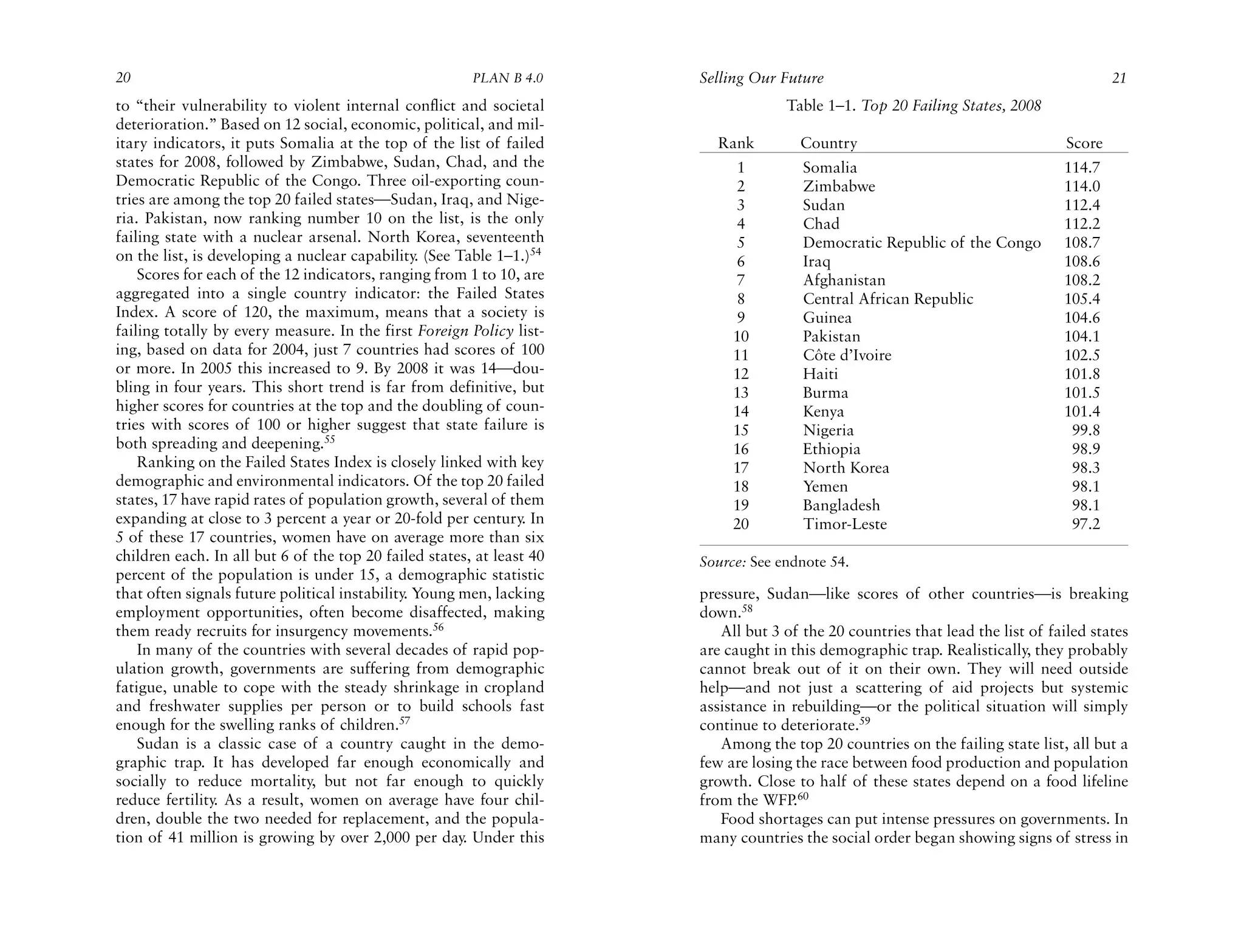
to “their vulnerability to violent internal conflict and societal                   Table 1–1. Top 20 Failing States, 2008
deterioration.” Based on 12 social, economic, political, and mil-
itary indicators, it puts Somalia at the top of the list of failed       Rank         Country                                   Score
states for 2008, followed by Zimbabwe, Sudan, Chad, and the                 1         Somalia                                   114.7
Democratic Republic of the Congo. Three oil-exporting coun-                 2         Zimbabwe                                  114.0
tries are among the top 20 failed states—Sudan, Iraq, and Nige-             3         Sudan                                     112.4
ria. Pakistan, now ranking number 10 on the list, is the only               4         Chad                                      112.2
failing state with a nuclear arsenal. North Korea, seventeenth              5         Democratic Republic of the Congo          108.7
on the list, is developing a nuclear capability. (See Table 1–1.)54         6         Iraq                                      108.6
    Scores for each of the 12 indicators, ranging from 1 to 10, are         7         Afghanistan                               108.2
aggregated into a single country indicator: the Failed States               8         Central African Republic                  105.4
Index. A score of 120, the maximum, means that a society is                 9         Guinea                                    104.6
failing totally by every measure. In the first Foreign Policy list-        10         Pakistan                                  104.1
ing, based on data for 2004, just 7 countries had scores of 100            11         Côte d’Ivoire                             102.5
or more. In 2005 this increased to 9. By 2008 it was 14—dou-               12         Haiti                                     101.8
bling in four years. This short trend is far from definitive, but          13         Burma                                     101.5
higher scores for countries at the top and the doubling of coun-           14         Kenya                                     101.4
tries with scores of 100 or higher suggest that state failure is           15         Nigeria                                    99.8
both spreading and deepening.55                                            16         Ethiopia                                   98.9
    Ranking on the Failed States Index is closely linked with key          17         North Korea                                98.3
demographic and environmental indicators. Of the top 20 failed             18         Yemen                                      98.1
states, 17 have rapid rates of population growth, several of them          19         Bangladesh                                 98.1
expanding at close to 3 percent a year or 20-fold per century. In          20         Timor-Leste                                97.2
5 of these 17 countries, women have on average more than six
children each. In all but 6 of the top 20 failed states, at least 40   Source: See endnote 54.
percent of the population is under 15, a demographic statistic
that often signals future political instability. Young men, lacking    pressure, Sudan—like scores of other countries—is breaking
employment opportunities, often become disaffected, making             down.58
them ready recruits for insurgency movements.56                           All but 3 of the 20 countries that lead the list of failed states
    In many of the countries with several decades of rapid pop-        are caught in this demographic trap. Realistically, they probably
ulation growth, governments are suffering from demographic             cannot break out of it on their own. They will need outside
fatigue, unable to cope with the steady shrinkage in cropland          help—and not just a scattering of aid projects but systemic
and freshwater supplies per person or to build schools fast            assistance in rebuilding—or the political situation will simply
enough for the swelling ranks of children.57                           continue to deteriorate.59
    Sudan is a classic case of a country caught in the demo-              Among the top 20 countries on the failing state list, all but a
graphic trap. It has developed far enough economically and             few are losing the race between food production and population
socially to reduce mortality, but not far enough to quickly            growth. Close to half of these states depend on a food lifeline
reduce fertility. As a result, women on average have four chil-        from the WFP.60
dren, double the two needed for replacement, and the popula-              Food shortages can put intense pressures on governments. In
tion of 41 million is growing by over 2,000 per day. Under this        many countries the social order began showing signs of stress in
22                                                      PLAN B 4.0     Selling Our Future                                              23
2007 in the face of soaring food prices and spreading hunger.          nation states. When governments lose their capacity to govern,
Food riots and unrest continued in 2008 in dozens of coun-             they can no longer collect taxes, much less be responsible for
tries—from the tortilla riots in Mexico to breadline fights in         their international debts. More failing states means more bad
Egypt and tempeh protests in Indonesia—and signaled the des-           debt. Efforts to control international terrorism depend on coop-
peration of consumers trapped between low incomes and rising           eration among functioning nation states, and these efforts
food prices. In Haiti, soaring food prices helped bring down the       weaken as more states fail.
government.61                                                             In addition, protecting endangered species almost always
    In Pakistan, where wheat flour prices had doubled, an armed        requires close international cooperation. In countries such as
soldier escorted each grain truck lest it be stolen or used to ille-   the Democratic Republic of the Congo, where government
gally haul scarce wheat across the border into Afghanistan. In         agencies have collapsed, hunger is widespread, and chaos
Kandahar, Afghanistan, market vendors were robbed at gun-              reigns, the population of mountain gorillas has dropped precip-
point by thieves who made off with sacks of grain. In Sudan,           itously. This story is being repeated over and over again in
110 grain-laden trucks delivering food for the World Food Pro-         Africa, where so many of the world’s remaining large mammal
gramme were hijacked during 2008 before reaching the Darfur            species are concentrated.65
relief camps.62                                                           As the number of failing states grows, dealing with various
     Another characteristic of failing states is a deterioration of    international crises becomes more difficult. Actions that may be
the physical infrastructure—roads and power, water, and                relatively simple in a healthy world order, such as maintaining
sewage systems. Care for natural systems is also neglected as          monetary stability or controlling an infectious disease out-
people struggle to survive. Forests, grasslands, and croplands         break, could become difficult or impossible in a world with
deteriorate, generating a downward economic spiral. A drying           numerous disintegrating states. Even maintaining international
up of foreign investment and a resultant rise in unemployment          flows of raw materials could become a challenge. At some
are also part of the decline syndrome.                                 point, spreading political instability could disrupt global eco-
    In many countries, the United Nations or other internation-        nomic progress, suggesting that we need to address the causes of
al bodies are trying to keep the peace, often unsuccessfully.          state failure with a heightened sense of urgency.
Among the countries where U.N. peacekeeping forces are
deployed are Chad, the Democratic Republic of the Congo, and           Plan B—A Plan to Save Civilization
Côte d’Ivoire. Other countries supplied with multinational             Plan B is the alternative to business as usual. Its goal is to move
peacekeeping forces include Afghanistan, Haiti, and Sudan. All         the world from the current decline and collapse path onto a new
too often these are token forces, large enough to avoid immedi-        path where food security can be restored and civilization can be
ate collapse but not large enough to ensure the stability needed       sustained. Just as the trends that are behind the current deterio-
for long-term development.63                                           ration in the food situation go far beyond agriculture itself, so
    Countries like Haiti and Afghanistan are surviving because         too must the response. In times past it was the Ministry of Agri-
they are on international life-support systems. Economic assis-        culture that held the key to expanding agricultural research,
tance, including food lifelines, is helping to sustain them. But       expanding credit to farmers, and all the other obvious things
there is not enough assistance to overcome the reinforcing             that fall within its province, but securing future food supplies
trends of deterioration they are experiencing and replace them         now depends on the mobilization of our entire society.
with the demographic and political stability need to sustain eco-         For these reasons Plan B is far more ambitious than anything
nomic progress.64                                                      the world has ever undertaken, an initiative that has no prece-
    In an age of increasing globalization, the functioning of the      dent in either scale or urgency. It has four components: cutting
global system depends on a cooperative network of functioning          net carbon dioxide emissions 80 percent by 2020, stabilizing
24                                                      PLAN B 4.0     Selling Our Future                                              25
population at 8 billion or lower, eradicating poverty, and restor-     to protect aquifers by raising water productivity. Unless we can
ing the earth’s natural systems, including its soils, aquifers,        reverse the deterioration of these systems we are unlikely to
forests, grasslands, and fisheries. The ambitiousness of this plan     reverse the rise in hunger.
is not driven by perceived political feasibility but by scientific        Plan B is an integrated program with four interdependent
reality.                                                               goals. We are not, for example, likely to stabilize population
    The plan to cut carbon emissions involves dramatically rais-       unless we can also eradicate poverty. Conversely, we cannot
ing energy efficiency worldwide, investing in the massive devel-       restore the earth’s natural systems without stabilizing popula-
opment of the earth’s renewable energy resources, banning              tion and climate, and we are not likely to stabilize climate unless
deforestation, and planting trees by the billion. Plan B essen-        we also stabilize population. Nor can we eradicate poverty
tially outlines a transition from an economy powered mainly by         without restoring the earth’s natural systems.
oil, coal, and natural gas to one powered largely by wind, solar,         The ambitiousness of this save-our-civilization plan is
and geothermal energy.                                                 matched by the urgency with which it must be implemented.
    The Plan B goal of stabilizing population is set at 8 billion or   Success depends on moving at wartime speed, restructuring the
lower simply because I do not think world population will ever         world energy economy at a pace reminiscent of the restructur-
reach the 9.2 billion projected by U.N. demographers for 2050.         ing of the U.S. industrial economy in 1942 following the attack
To begin with, the vast majority of the 2.4 billion people pro-        on Pearl Harbor. The United States shifted from producing cars
jected to be added by 2050 will be born in developing coun-            to turning out planes, tanks, and ships within a matter of
tries—countries where the land and water resource base is              months. The current restructuring cannot be achieved without
deteriorating and hunger is spreading. Simply put, many sup-           a fundamental reordering of priorities. And it will not be
port systems in these countries are already in decline, and some       accomplished without sacrifice. For example, the key to the
are collapsing. The question is not whether population growth          1942 industrial restructuring was a ban on the sale of new cars,
will come to a halt before reaching 9.2 billion but whether it will    a ban that lasted nearly three years.67
do so because the world shifts quickly to smaller families or             We face an extraordinary challenge, but there is much to be
because it fails to do so—and population growth is checked by          upbeat about. All the problems we face can be dealt with using
rising mortality. Plan B embraces the reduced fertility option.66      existing technologies. And almost everything we need to do to
    Eradicating poverty is a priority goal for three reasons. One,     move the world economy off the collapse path and back onto an
in combination with giving women everywhere access to repro-           environmentally sustainable path has already been done in one
ductive health care and family planning services, it is the key to     or more countries. For example, more than 30 countries have
accelerating the global shift to smaller families. It also helps       essentially stabilized their population size.68
bring impoverished nations into the international community,              We see the components of Plan B in technologies already on
giving them a stake in such matters as stabilizing climate. When       the market. On the energy front, for example, we can get more
people are not sure where their next meal is coming from, it is        energy from an advanced-design wind turbine than from an
difficult for them to get excited about trying to stabilize the        aging oil well. The new plug-in gas-electric hybrids coming to
earth’s climate. And third, eradicating poverty is the humane          market, like the Chevrolet Volt, can get up to 150 miles per gal-
thing to do. One of the hallmarks of a civilized society is the        lon. In the Plan B energy economy of 2020, most of the U.S. fleet
capacity to care about others.                                         will be plug-in hybrids and all-electric cars, and they will be
    The fourth component of Plan B involves repairing and pro-         running largely on wind-generated electricity for the equivalent
tecting the natural systems that support humankind. This               of less than $1 a gallon of gasoline.69
includes conserving soil, banning deforestation, promoting                The world is in the early stages of a revolution in lighting
reforestation, restoring fisheries, and making a worldwide effort      technology. Some time ago we learned that a compact fluores-
26                                                    PLAN B 4.0     Selling Our Future                                            27
cent could provide the same lighting as the century-old incan-           The challenge is not only to build a new economy but to do
descent bulb but would use only one fourth as much electricity.      it at wartime speed before we miss so many of nature’s dead-
This was exciting news. Now we are looking at a still more-          lines that the economic system begins to unravel. Participating
advanced lighting technology—the light-emitting diode                in the construction of this enduring new economy is exhilarat-
(LED)—which uses 15 percent of the electricity used by an            ing. So is the quality of life it will bring. A world where popu-
incandescent bulb. In addition, motion sensors can turn off          lation has stabilized, forests are expanding, and carbon
lights in unoccupied spaces, and other sensors can adjust light-     emissions are falling is within our grasp.
ing intensity in response to the daylight available. Shifting from
incandescent bulbs to LEDs and installing motion sensors and
dimmers can reduce electricity used for lighting by more than 90
percent.70
    As for Plan B models at the national level, Denmark today
gets more than 20 percent of its electricity from wind and has
plans to push this to 50 percent. Seventy-five million Europeans
get their residential electricity from wind farms. Some 27 mil-
lion Chinese homes get their hot water from rooftop solar water
heaters. Iceland, which heats 90 percent of its homes with geo-
thermal energy, has virtually eliminated the use of coal for
home heating. The Philippines gets 26 percent of its electricity
from geothermal power plants.71
    We see what a Plan B world could look like in the reforested
mountains of South Korea. Once a barren, almost treeless coun-
try, the 65 percent of South Korea now covered by forests has
checked flooding and soil erosion, returning environmental
health and stability to the Korean countryside. The United
States—which over the last quarter-century retired one tenth of
its cropland, most of it highly erodible, and shifted to conser-
vation tillage practices on part of the remainder—has reduced
soil erosion by 40 percent. Meanwhile, the grain harvest
expanded by one fifth.72
    Some of the most innovative leadership has come from cities.
Curitiba, Brazil, began restructuring its transport system in
1974, and in the two decades that followed the city cut car traf-
fic by 30 percent while its population doubled. Amsterdam has
a diverse urban transport system where some 40 percent of all
trips within the city are taken by bicycle. And the transport
diversification plan in Paris that includes a prominent role for
the bicycle is intended to reduce car traffic by 40 percent. Lon-
don is taxing cars entering the city center and investing the rev-
enue in upgrading public transit.73
I
THE CHALLENGES
2
          Population Pressure:
            Land and Water


The French use a riddle to teach schoolchildren the nature of
exponential growth. A lily pond, so the riddle goes, contains a
single leaf. Each day the number of leaves doubles—two leaves
the second day, four the third, eight the fourth, and so on. “If
the pond is full on the thirtieth day, at what point is it half full?”
Answer: “On the twenty-ninth day.”1
    Trends in world cropland area and irrigation water supplies
suggest that we are living in the thirty-first day. After expanding
modestly from 1950 to 1981, world grain area stopped growing
and the area declined somewhat as land losses from erosion
and conversion to nonfarm uses offset new land brought
under the plow. On close to one third of the world’s cropland,
topsoil is eroding faster than new soil is being formed by
geological processes, slowly reducing the land’s inherent
productivity.2
    The world’s irrigated area tripled from 1950 to 2000 but has
expanded little since then. It could soon begin to decline—as it
is already doing in some countries—as aquifers are depleted by
overpumping and as the mountain glaciers that sustain so many
of the world’s rivers and irrigation systems melt and disappear.
32                                                      PLAN B 4.0     Population Pressure: Land and Water                                33
Many irrigation systems, whether dependent on underground              over long stretches of history, and were thriving. Others had
water or on river water, are at risk.3                                 failed to do so and left only remnants of their illustrious pasts.6
    We cannot escape the water intensity of food production.               In a section of his report entitled “The Hundred Dead
Worldwide, we drink on average close to 4 liters of water per          Cities,” he described a site in northern Syria, near Aleppo, where
day, either directly or in coffee, juice, soda, wine, and other bev-   ancient buildings were still standing in stark isolated relief, but
erages. But it takes 2,000 liters of water to produce the food we      they were on bare rock. During the seventh century, the thriving
consume each day—500 times as much as we drink. In effect, we          region had been invaded, initially by a Persian army and later by
“eat” 2,000 liters of water each day.4                                 nomads out of the Arabian Desert. In the process, soil and water
    Soil erosion initially reduces the inherent productivity of the    conservation practices used for centuries were abandoned. Low-
land and then, after a point, leads to cropland abandonment.           dermilk noted, “Here erosion had done its worst....if the soils
Both effects of erosion are undermining world food security. A         had remained, even though the cities were destroyed and the
combination of population growth and soil erosion has caused           populations dispersed, the area might be re-peopled again and
a number of countries that were once self-sufficient in grain to       the cities rebuilt, but now that the soils are gone, all is gone.”7
become heavily dependent on imports.                                       Now fast-forward to a trip in 2002 by a U.N. team to assess
    With water tables now falling in almost every country that         the food situation in Lesotho, a small country of 2 million peo-
irrigates with underground water, many of these countries are          ple embedded within South Africa. Their finding was straight-
facing hunger-inducing losses of irrigation water as aquifers are      forward: “Agriculture in Lesotho faces a catastrophic future;
depleted and wells go dry. Overpumping—the pumping of                  crop production is declining and could cease altogether over
aquifers that exceeds the natural recharge—presents a classic          large tracts of the country if steps are not taken to reverse soil
case of ecological overshoot and collapse. It is a way of satisfy-     erosion, degradation, and the decline in soil fertility.” Michael
ing current food needs that virtually guarantees a future drop in      Grunwald reported in the Washington Post that nearly half of
food production when aquifers are depleted. In effect, we have         the children under five in Lesotho are stunted physically.
created a “food bubble economy.” Both soil erosion and aquifer         “Many,” he wrote, “are too weak to walk to school.”8
depletion reflect an emphasis on current consumption at the                The U.N. team report was on the mark. During the last 10
expense of the next generation.5                                       years, Lesotho’s grain harvest dropped by 40 percent as its soil
                                                                       fertility fell. Its collapsing agriculture leaves Lesotho heavily
Civilization’s Foundation Eroding                                      dependent on food supplied by the U.N. World Food Pro-
The thin layer of topsoil that covers the planet’s land surface is     gramme (WFP), its lifeline for survival.9
the foundation of civilization. This soil, typically 6 inches or so        In the western hemisphere, Haiti, one of the early failing
deep, was formed over long stretches of geological time as new         states, was largely self-sufficient in grain 40 years ago. Since
soil formation exceeded the natural rate of erosion. But some-         then it has lost nearly all its forests and much of its topsoil, forc-
time within the last century, as human and livestock popula-           ing it to import over half of its grain. Like Lesotho, Haiti is also
tions expanded, soil erosion began to exceed new soil formation        dependent on a WFP lifeline.10
over large areas.                                                          A similar situation exists in Mongolia, where over the last 20
   This is not new. In 1938, Walter Lowdermilk, a senior offi-         years three fourths of the wheatland has been abandoned and
cial in the Soil Conservation Service of the U.S. Department of        wheat yields have fallen by one fourth, shrinking the harvest by
Agriculture (USDA), traveled abroad to look at lands that had          four fifths. Mongolia—a country almost three times the size of
been cultivated for thousands of years, seeking to learn how           France with a population of 2.6 million—is now forced to
these older civilizations had coped with soil erosion. He found        import nearly 70 percent of its wheat.11
that some had managed their land well, maintaining its fertility           Whether the land is in Lesotho, Mongolia, Haiti, or any of
34                                                     PLAN B 4.0     Population Pressure: Land and Water                              35
the many other countries losing their soil, the health of the peo-    in Seoul literally gasping for breath. Schools were closed, airline
ple living on it cannot be separated from the health of the land      flights were cancelled, and clinics were overrun with patients
itself. A large share of the world’s 1 billion hungry people live     having difficulty breathing. Retail sales fell. Koreans have come
on soils worn thin by erosion.12                                      to dread the arrival of what they now call “the fifth season,” the
    You do not need to visit soil-devastated countries to see the     dust storms of late winter and early spring.17
evidence of severe erosion. Dust storms originating in the new            These two dust storms, among the 10 or so major dust
dust bowls are now faithfully recorded in satellite images. On        storms that now occur each year in China, offer visual evidence
January 9, 2005, the National Aeronautics and Space Adminis-          of the ecological catastrophe unfolding in northern and western
tration released images of a vast dust storm moving westward          China. Overgrazing is the principal culprit.18
out of central Africa. This huge cloud of tan-colored dust                A U.S. Embassy report entitled “Desert Mergers and Acqui-
stretched over 5,300 kilometers (some 3,300 miles), enough to         sitions” describes satellite images showing two deserts in north-
cover the United States from coast to coast.13                        central China expanding and merging to form a single, larger
    Andrew Goudie, professor of geography at Oxford Universi-         desert overlapping Inner Mongolia (Nei Monggol) and Gansu
ty, reports that the number of Saharan dust storms—once               Provinces. To the west in Xinjiang Province, two even larger
rare—has increased 10-fold during the last half-century. Among        deserts—the Taklimakan and Kumtag—are also heading for a
the African countries most affected by soil loss from wind ero-       merger. Highways running through the shrinking region
sion are Niger, Chad, Mauritania, northern Nigeria, and Burk-         between them are regularly inundated by sand dunes.19
ina Faso. In Mauritania, in Africa’s far west, the number of dust         Water erosion also takes a toll on soils. This can be seen in
storms jumped from 2 a year in the early 1960s to 80 a year           the silting of reservoirs and in satellite photographs of muddy,
recently.14                                                           silt-laden rivers flowing into the sea. Pakistan’s two large reser-
    The Bodélé Depression in Chad is the source of an estimat-        voirs, Mangla and Tarbela, which store Indus River water for
ed 1.3 billion tons of wind-borne soil a year, up 10-fold since       the country’s vast irrigation network, are losing roughly 1 per-
measurements began in 1947. The nearly 3 billion tons of fine         cent of their storage capacity each year as they fill with silt from
soil particles that leave Africa each year in dust storms are slow-   deforested watersheds.20
ly draining the continent of its fertility and biological produc-         Ethiopia, a mountainous country with highly erodible soils,
tivity. In addition, dust storms leaving Africa travel westward       is losing close to 2 billion tons of topsoil a year, washed away by
across the Atlantic, depositing so much dust in the Caribbean         rain. This is one reason Ethiopia always seems to be on the
that they cloud the water and damage coral reefs.15                   verge of famine, never able to accumulate enough grain reserves
    People in China are all too familiar with dust storms that        to provide a meaningful measure of food security.21
originate in the country’s northwest and western Mongolia, but            Soil erosion from the deterioration of grasslands is wide-
the rest of the world typically learns about this fast-growing        spread. The world’s steadily growing herds of cattle and flocks
ecological catastrophe when the massive soil-laden storms leave       of sheep and goats forage on the two fifths of the earth’s land
the region. On April 18, 2001, the western United States—from         surface that is too dry, too steeply sloping, or not fertile enough
the Arizona border north to Canada—was blanketed with dust.           to sustain crop production. This area supports most of the
It came from a huge dust storm that originated in northwestern        world’s 3.3 billion cattle, sheep, and goats, all ruminants with
China and Mongolia on April 5. Measuring 1,200 miles across           complex digestive systems that enable them to digest roughage,
when it left China, the storm carried millions of tons of topsoil,    converting it into beef, mutton, and milk.22
a resource that will take nature centuries to replace.16                  An estimated 200 million people make their living as pas-
    Almost exactly one year later, on April 12, 2002, South Korea     toralists, tending cattle, sheep, and goats. Since most land is
was engulfed by a huge dust storm from China that left people         held in common in pastoral societies, overgrazing is difficult to
36                                                    PLAN B 4.0     Population Pressure: Land and Water                             37
control. As a result, half of the world’s grasslands are degraded.   large state-organized production teams to farm families, China’s
The problem is highly visible throughout Africa, the Middle          cattle, sheep, and goat populations spiraled upward. While the
East, Central Asia, and northwest China, where the growth in         United States, a country with comparable grazing capacity, has
livestock numbers tracks that in human numbers. In 1950,             97 million cattle, China has a slightly smaller herd of 82 million.
Africa was home to 227 million people and 273 million live-          But while the United States has only 9 million sheep and goats,
stock. By 2007, there were 965 million people and 824 million        China has 284 million. Concentrated in China’s western and
livestock. With livestock demands now often exceeding grass-         northern provinces, sheep and goats are destroying the land’s
land carrying capacity by half or more, grassland is turning into    protective vegetation. The wind then does the rest, removing the
desert.23                                                            soil and converting productive rangeland into desert.27
    Nigeria, Africa’s most populous country, is losing 351,000          China’s desertification may be the worst in the world. Wang
hectares (867,000 acres) of rangeland and cropland to desertifi-     Tao, one of the world’s leading desert scholars, reports that
cation each year. While Nigeria’s human population was grow-         from 1950 to 1975 an average of 600 square miles turned to
ing from 37 million in 1950 to 148 million in 2007, a fourfold       desert each year. By century’s end, nearly 1,400 square miles
expansion, its livestock population grew from roughly 6 million      (3,600 square kilometers) were going to desert annually.28
to 102 million, a 17-fold jump. With the forage needs of Nige-          China is now at war. It is not invading armies that are claim-
ria’s 16 million cattle and 86 million sheep and goats exceeding     ing its territory, but expanding deserts. Old deserts are advanc-
the sustainable yield of grasslands, the northern part of the        ing and new ones are forming like guerrilla forces striking
country is slowly turning to desert. If Nigeria continues toward     unexpectedly, forcing Beijing to fight on several fronts. Wang
its projected 289 million people by 2050, the deterioration will     Tao reports that over the last half-century, some 24,000 villages
only accelerate.24                                                   in northern and western China have been entirely or partly
    Iran, with 73 million people, illustrates the pressures facing   abandoned as a result of being overrun by drifting sand.29
the Middle East. With 8 million cattle and 79 million sheep and         Soil erosion often results from the demand-driven expansion of
goats—the source of wool for its fabled rug-making industry—         cultivation onto marginal land. Over the last century or so there
Iran’s rangelands are deteriorating from overstocking. In the        were massive cropland expansions in two countries—the United
southeastern province of Sistan-Balochistan, sand storms have        States and the Soviet Union—and both ended in disaster.30
buried 124 villages, forcing their abandonment. Drifting sands          During the late nineteenth century, millions of Americans
have covered grazing areas—starving livestock and depriving          pushed westward, homesteading on the Great Plains, plowing
villagers of their livelihood.25                                     vast areas of grassland to produce wheat. Much of this land—
    Neighboring Afghanistan is faced with a similar situation.       highly erodible when plowed—should have remained in grass.
The Registan Desert is migrating westward, encroaching on            This overexpansion culminated in the 1930s Dust Bowl, a trau-
agricultural areas. A U.N. Environment Programme (UNEP)              matic period chronicled in John Steinbeck’s novel The Grapes of
team reports that “up to 100 villages have been submerged by         Wrath. In a crash program to save its soils, the United States
windblown dust and sand.” In the country’s northwest, sand           returned large areas of eroded cropland to grass, adopted strip-
dunes are moving onto agricultural land in the upper reaches of      cropping, and planted thousands of miles of tree shelterbelts.31
the Amu Darya basin, their path cleared by the loss of stabiliz-        The second major expansion came in the Soviet Union
ing vegetation from firewood gathering and overgrazing. The          beginning in the mid-1950s. In an all-out effort to expand grain
UNEP team observed sand dunes 15 meters high blocking                production, the Soviets plowed an area of grassland larger than
roads, forcing residents to establish new routes.26                  the wheat area of Australia and Canada combined. The result,
    China faces similarly difficult challenges. After the economic   as Soviet agronomists had predicted, was an ecological disas-
reforms in 1978 that shifted the responsibility for farming from     ter—another Dust Bowl. Kazakhstan, where the plowing was
38                                                      PLAN B 4.0     Population Pressure: Land and Water                              39
concentrated, has abandoned 40 percent of its grainland since          under the North China Plain, depletion brings pumping to an
1980. On the remaining cultivated land, the wheat yield per acre       end. Farmers who lose their irrigation water have the option of
is one sixth of that in France, Western Europe’s leading wheat         returning to lower-yield dryland farming if rainfall permits. But
producer.32                                                            in more arid regions, such as in the southwestern United States
    A third massive cropland expansion is now taking place in          and parts of the Middle East, the loss of irrigation water means
the Brazilian Amazon Basin and in the cerrado, a savannah-like         the end of agriculture.36
region bordering the basin on its south side. Land in the cerra-           In Yemen, a nation of 23 million people neighboring Saudi
do, like that in the U.S. and Soviet expansion, is vulnerable to       Arabia, the water table is falling by roughly 6 feet a year as water
soil erosion. This cropland expansion is pushing cattle ranchers       use outstrips aquifer recharge. With one of the world’s fastest-
into the Amazon forests, where ecologists are convinced that           growing populations and with water tables falling everywhere,
continuing to clear the area of trees will end in disaster.            Yemen is quickly becoming a hydrological basket case. Grain
Reporter Geoffrey Lean, summarizing the findings of a 2007             production has fallen by half over the last 35 years. By 2015, irri-
Brazilian scientific symposium in London’s Independent, notes          gated fields will be a rarity and the country will be importing
that the alternative to a rainforest in the Amazon would be “dry       virtually all of its grain. Living on borrowed water and borrowed
savannah at best, desert at worst.”33                                  time, Yemen ranks high on the list of failing states.37
                                                                           Falling water tables are already adversely affecting harvests
Water Tables Falling                                                   in some larger countries, including China, which rivals the Unit-
Nowhere are falling water tables and the shrinkage of irrigated        ed States as the world’s largest grain producer. A groundwater
agriculture more dramatic than in Saudi Arabia, a country as           survey released in Beijing in August 2001 revealed that the water
water-poor as it is oil-rich. After the Arab oil export embargo in     table under the North China Plain, an area that produces over
the 1970s, the Saudis realized they were vulnerable to a counter       half of the country’s wheat and a third of its corn, was falling
embargo on grain. To become self-sufficient in wheat, they             fast. Overpumping has largely depleted the shallow aquifer,
developed a heavily subsidized irrigated agriculture based large-      forcing well drillers to turn to the region’s deep aquifer, which is
ly on pumping water from a deep fossil aquifer.34                      not replenishable.38
    After being self-sufficient in wheat for over 20 years, in early       The survey reported that under Hebei Province in the heart
2008 the Saudis announced that, with their aquifer largely             of the North China Plain, the average level of the deep aquifer
depleted, they would reduce their wheat planting by one eighth         was dropping nearly 3 meters (10 feet) per year. Around some
each year until 2016, when production will end. By then Saudi          cities in the province, it was falling twice as fast. He Qingcheng,
Arabia will be importing roughly 15 million tons of wheat, rice,       head of the groundwater monitoring team, notes that as the
corn, and barley for its population of 30 million. It is the first     deep aquifer is depleted, the region is losing its last water
country to publicly project how aquifer depletion will shrink its      reserve—its only safety cushion.39
grain harvest.35                                                           A World Bank study indicates that China is mining under-
    The Saudis are not alone. Scores of countries are overpump-        ground water in three adjacent river basins in the north—those
ing aquifers as they struggle to satisfy their growing water           of the Hai, which flows through Beijing and Tianjin; the Yellow;
needs. Most aquifers are replenishable but some are not. For           and the Huai, the southern most of the three. Since it takes
example, when aquifers in India and the shallow aquifer under          1,000 tons of water to produce 1 ton of grain, the shortfall in
the North China Plain are depleted, the maximum rate of                the Hai basin of nearly 40 billion tons of water per year (1 ton
pumping will be automatically reduced to the rate of recharge.         equals 1 cubic meter) means that when the aquifer is depleted,
    But for fossil aquifers, like the Saudi aquifer, the vast Ogal-    the grain harvest will drop by 40 million tons and China will
lala aquifer under the U.S. Great Plains, or the deep aquifer          lose the food supply for 130 million of its people.40
40                                                         PLAN B 4.0     Population Pressure: Land and Water                             41
    As serious as water shortages are in China, they are even             the water table between 1982 and 2000 that ranges from 1 to
more serious in India, where the margin between food con-                 nearly 2 meters a year.45
sumption and survival is so precarious. To date, India’s 100 mil-             In the province of Balochistan, which borders Afghanistan,
lion farmers have drilled more than 21 million wells, investing           water tables around the capital, Quetta, are falling by 3.5 meters
some $12 billion in wells and pumps. In August 2004 Fred Pearce           per year—pointing to the day when the city will run out of
reported in New Scientist that “half of India’s traditional hand-         water. Sardar Riaz A. Khan, former director of Pakistan’s Arid
dug wells and millions of shallower tube wells have already               Zone Research Institute in Quetta, reports that six of Balochis-
dried up, bringing a spate of suicides among those who rely on            tan’s basins have exhausted their groundwater supplies, leaving
them. Electricity blackouts are reaching epidemic proportions             their irrigated lands barren.46
in states where half of the electricity is used to pump water from            Iran is overpumping its aquifers by an average of 5 billion
depths of up to a kilometer.”41                                           tons of water per year, the water equivalent of one fourth of its
    As water tables fall, well drillers are using modified oil-drilling   annual grain harvest. It too faces a day of reckoning.47
technology to reach water, going down a half mile or more in                  Israel, even though it is a pioneer in raising irrigation water
some locations. In communities where underground water                    productivity, is depleting both of its principal aquifers—the
sources have dried up entirely, all agriculture is now rain-fed and       coastal aquifer and the mountain aquifer that it shares with
drinking water must be trucked in. Tushaar Shah, who heads the            Palestinians. In response, Israel has banned the irrigation of
International Water Management Institute’s groundwater station            wheat, its staple food, and is now importing nearly all the wheat
in Gujarat, says of India’s water situation, “When the balloon            it consumes. Conflicts between Israelis and Palestinians over the
bursts, untold anarchy will be the lot of rural India.”42                 allocation of water are ongoing.48
    Growth in India’s grain harvest, squeezed both by water                   In Mexico—home to a population of 109 million that is pro-
scarcity and the loss of cropland to non-farm uses, has slowed            jected to reach 129 million by 2050—the demand for water is
since 2000. A 2005 World Bank study reports that 15 percent of            outstripping supply. Mexico City’s water problems are well
India’s food supply is produced by mining groundwater. Stated             known. Rural areas are also suffering. In the agricultural state
otherwise, 175 million Indians are fed with grain produced by             of Guanajuato, the water table is falling by 2 meters or more a
water mining.43                                                           year. In the northwestern state of Sonora, farmers once pumped
    In the United States, the USDA reports that in parts of Texas,        water from the Hermosillo aquifer at a depth of 10 meters (35
Oklahoma, and Kansas—three leading grain-producing                        feet). Today they pump from more than 120 meters. At the
states—the underground water table has dropped by more than               national level, 51 percent of all water extraction is from aquifers
30 meters (100 feet). As a result, wells have gone dry on thou-           that are being overpumped.49
sands of farms in the southern Great Plains, forcing farmers to               Since the overpumping of aquifers is occurring in many
return to lower-yielding dryland farming. Although the deple-             countries more or less simultaneously, the depletion of aquifers
tion of underground water is taking a toll on U.S. grain produc-          and the resulting harvest cutbacks could come at roughly the
tion, irrigated land accounts for only one fifth of the U.S. grain        same time. And the accelerating depletion of aquifers means
harvest, compared with close to three fifths of the harvest in            this day may come soon, creating potentially unmanageable
India and four fifths in China.44                                         food scarcity.
    Pakistan, a country with 177 million people that is growing
by 4 million per year, is also mining its underground water. In           Farmers Losing Water to Cities
the Pakistani part of the fertile Punjab plain, the drop in water         The world’s freshwater supplies are shrinking, and the world’s
tables appears to be similar to that in India. Observation wells          farmers are getting a shrinking share of this shrinking supply.
near the twin cities of Islamabad and Rawalpindi show a fall in           While water tensions among countries are more likely to make
42                                                    PLAN B 4.0     Population Pressure: Land and Water                             43
news headlines, it is the jousting for water between cities and          Colorado has one of the world’s most active water markets.
farms within countries that preoccupies local political leaders.     Fast-growing cities and towns in a state with high immigration
The economics of water use do not favor farmers in this com-         are buying irrigation water rights from farmers and ranchers. In
petition, simply because it takes so much water to produce food.     the upper Arkansas River basin, which occupies the southeast-
For example, while it takes only 14 tons of water to make a ton      ern quarter of the state, Colorado Springs and Aurora (a suburb
of steel, it takes 1,000 tons of water to grow a ton of wheat. In    of Denver) have already bought water rights to one third of the
countries preoccupied with expanding the economy and creat-          basin’s farmland.55
ing jobs, agriculture becomes the residual claimant.50                   Far larger purchases are being made by cities in California.
    Many of the world’s largest cities, such as Los Angeles,         In 2003, San Diego bought annual rights to 247 million tons
Cairo, and New Delhi, can increase their water consumption           (200,000 acre-feet) of water from farmers in the nearby Imperi-
only by taking it from agriculture. This rural-urban competi-        al Valley—the largest farm-to-city water transfer in U.S. history.
tion for underground water resources is intensifying throughout      This agreement covers the next 75 years. And in 2004, the Met-
India. Nowhere is this more evident than in Chennai (formerly        ropolitan Water District, which supplies water to 18 million
Madras), a city of 7 million in southern India. As a result of the   southern Californians in several cities, negotiated the purchase
city government’s inability to supply water for some of the city’s   of 137 million tons of water per year from farmers for the next
residents, a thriving tank-truck industry has emerged that buys      35 years. Without irrigation water, and with sparse rainfall, the
water from farmers and hauls it to the city’s thirsty residents.51   highly productive land owned by these farmers is wasteland.
    For farmers surrounding the city, the price of water far         The farmers who are selling their water rights would like to con-
exceeds the value of the crops they can produce with it. Unfor-      tinue farming, but city officials are offering far more for the
tunately, the 13,000 tankers hauling the water to Chennai are        water than the farmers could possibly earn by irrigating crops.
mining the region’s underground water resources. Water tables        Irrigated area in California shrank 10 percent between 1997 and
are falling and shallow wells have gone dry. Eventually even the     2007 as farmers sold their irrigation water to cities.56
deeper wells will go dry, depriving these communities of both            Whether it is outright government expropriation, farmers
their food supply and their livelihood.52                            being outbid by cities, or cities simply drilling deeper wells than
    Chinese farmers along the Juma River downstream from Bei-        farmers can afford, tillers of the land are losing the water war.
jing discovered in 2004 that the river had suddenly stopped flow-        Historically, water scarcity was a local issue. It was up to
ing. A diversion dam had been built near the capital to take river   national governments to balance water supply and demand. Now
water for Yanshan Petrochemical, a state-owned industry.             this is changing as scarcity crosses national boundaries via the
Although the farmers protested bitterly, it was a losing battle.     international grain trade. Since it takes so much water to produce
For the 120,000 villagers downstream from the diversion dam,         grain, importing grain is the most efficient way to import water.
the loss of water could cripple their ability to make a living       Countries are, in effect, using grain to balance their water
from farming.53                                                      books. Similarly, trading in grain futures is in a sense trading in
    In the U.S. southern Great Plains and the Southwest, where       water futures. To the extent there is a world water market, it is
there is little unclaimed water, the growing water needs of cities   embodied in the grain market.57
and thousands of small towns can be satisfied only by taking             The Middle East and North Africa—from Morocco in the
water from agriculture. A monthly publication from California,       west through Iran in the east—has become the world’s fastest-
The Water Strategist, devotes several pages each issue to a list-    growing grain import market. With virtually every country in
ing of water sales that took place in the western United States      the region pressing against its water limits, the growing urban
during the preceding month. Scarcely a working day goes by           demand for water can be satisfied only by taking irrigation
without another sale.54                                              water from agriculture. Egypt has become the leading importer
44                                                     PLAN B 4.0     Population Pressure: Land and Water                              45
of wheat in recent years. It now imports close to 40 percent of       lion people have died and over 4 million have been displaced in
its total grain supply, a dependence that reflects a population       the long-standing conflict between the Muslim north and the
that is outgrowing the grain harvest that can be produced with        Christian south. The more recent conflict in the Darfur region
the Nile’s water. Algeria, with 34 million people, imports more       in western Sudan that began in 2003 illustrates the mounting
than 70 percent of its grain.58                                       tensions between two Muslim groups—camel herders and sub-
    Overall, the water required to produce the grain and other        sistence farmers. Government troops are backing the Arab
farm products imported into the Middle East and North Africa          herder militias, who are engaging in the wholesale slaughter of
last year exceeded the annual flow of the Nile River at Aswan.        black Sudanese farmers in an effort to drive them off their land,
In effect, the region’s water deficit can be thought of as another    sending them into refugee camps in neighboring Chad. An esti-
Nile flowing into the region in the form of imported food.59          mated 300,000 people have been killed in the conflict or died of
    It is often said that future wars in the Middle East will more    hunger and disease in the refugee camps.62
likely be fought over water than oil, but in reality the competi-         Overgrazing and declining rainfall are combining to destroy
tion for water is taking place in world grain markets. Beyond         the grasslands in this region. But well before the rainfall decline,
this, several countries in the region are now attempting to           the seeds of the conflict were being sown as Sudan’s population
acquire land in other countries and, what is more important,          climbed from 9 million in 1950 to 40 million in 2007, a fourfold
the water that comes with it.                                         rise. Meanwhile, the cattle population increased from 7 million
    Knowing where water deficits are developing today tells us        to 41 million, an increase of nearly sixfold. The number of
where grain deficits will be concentrated tomorrow. Thus far,         sheep and goats increased from 14 million to 94 million, a near
the countries importing much of their grain have been smaller         sevenfold increase. No grassland can survive such rapid contin-
ones. Now we are looking at the growing water deficits in both        uous growth in livestock populations.63
China and India, each with more than a billion people. At what            In Nigeria, where 151 million people are crammed into an
point does water scarcity translate into food scarcity?60             area not much larger than Texas, overgrazing and overplowing
                                                                      are converting grassland and cropland into desert, putting
Land and Water Conflicts                                              farmers and herders in a war for survival. As Somini Sengupta
As land and water become scarce, competition for these vital          reported in the New York Times in June 2004, “in recent years,
resources intensifies within societies, particularly between the      as the desert has spread, trees have been felled and the popula-
wealthy and those who are poor and dispossessed. The shrink-          tions of both herders and farmers have soared, the competition
age of life-supporting resources per person that comes with           for land has only intensified.”64
population growth is threatening to drop the living standards of          Unfortunately, the division between herders and farmers is
millions of people below the survival level, leading to potential-    also often the division between Muslims and Christians. The
ly unmanageable social tensions.                                      competition for land, amplified by religious differences and
    Access to land is a prime source of social tension. Expand-       combined with a large number of frustrated young men with
ing world population has cut the grainland per person in half         guns, has created what the New York Times described as a
since 1950 to a mere quarter-acre, equal to half of a building lot    “combustible mix” that has “fueled a recent orgy of violence
in a U.S. suburb. The shrinkage in cropland per person not only       across this fertile central Nigerian state [Plateau]. Churches and
threatens livelihoods; in largely subsistence societies, it threat-   mosques were razed. Neighbor turned against neighbor.
ens survival itself. Tensions within communities begin to build       Reprisal attacks spread until finally…the government imposed
as landholdings shrink below that needed for survival.61              emergency rule.”65
    The Sahelian zone of Africa, with its fast-growing popula-            Similar divisions exist between herders and farmers in north-
tions, is an area of spreading conflict. In troubled Sudan, 2 mil-    ern Mali, the New York Times noted, where “swords and sticks
46                                                     PLAN B 4.0     Population Pressure: Land and Water                             47
have been chucked for Kalashnikovs, as desertification and pop-       organized attack by Hutus, leading to an estimated 800,000
ulation growth have stiffened the competition between the             deaths of Tutsis and moderate Hutus in 100 days. In some vil-
largely black African farmers and the ethnic Tuareg and Fulani        lages, whole families were slaughtered lest there be survivors to
herders. Tempers are raw on both sides. The dispute, after all, is    claim the family plot of land.70
over livelihood and even more, about a way of life.”66                   Africa is not alone. In India, tension between Hindus and
    Rwanda is a classic case study in how mounting population         Muslims is never far below the surface. As each successive gen-
pressure can translate into political tension, conflict, and social   eration further subdivides already small plots, pressure on the
tragedy. James Gasana, who was Rwanda’s Minister of Agricul-          land is intense. The pressure on water resources is even greater.
ture and Environment in 1990–92, offers some insights. As the            With India’s population projected to grow from 1.2 billion in
chair of a national agricultural commission in 1990, he had           2008 to 1.6 billion in 2050, a collision between rising human
warned that without “profound transformations in its agricul-         numbers and shrinking water supplies seems inevitable. The
ture, [Rwanda] will not be capable of feeding adequately its          risk is that India could face social conflicts that would dwarf
population under the present growth rate.” Although the coun-         those in Rwanda. As James Gasana notes, the relationship
try’s demographers projected major future gains in population,        between population and natural systems is a national security
Gasana said in 1990 that he did not see how Rwanda would              issue, one that can spawn conflicts along geographic, tribal, eth-
reach 10 million inhabitants without social disorder “unless          nic, or religious lines.71
important progress in agriculture, as well as other sectors of the       Disagreements over the allocation of water among countries
economy, were achieved.”67                                            that share river systems is a common source of international
    Gasana’s warning of possible social disorder was prophetic.       political conflict, especially where populations are outgrowing
He further described how siblings inherited land from their par-      the flow of the river. Nowhere is this potential conflict more
ents and how, with an average of seven children per family, plots     stark than among Egypt, Sudan, and Ethiopia in the Nile River
that were already small were fragmented further. Many farmers         valley. Agriculture in Egypt, where it rarely rains, is wholly
tried to find new land, moving onto steeply sloping mountains.        dependent on water from the Nile. Egypt now gets the lion’s
By 1989, almost half of Rwanda’s cultivated land was on slopes        share of the Nile’s water, but its current population of 82 mil-
of 10 to 35 degrees, land that is universally considered uncul-       lion is projected to reach 130 million by 2050, thus greatly
tivable.68                                                            expanding the demand for grain and water. Sudan, whose 41
    In 1950, Rwanda’s population was 2.4 million. By 1993, it         million people also depend heavily on food produced with Nile
had tripled to 7.5 million, making it the most densely populat-       water, is expected to have 76 million by 2050. And the number
ed country in Africa. As population grew, so did the demand for       of people in Ethiopia, the country that controls 85 percent of
firewood. By 1991, the demand was more than double the sus-           the river’s headwaters, is projected to expand from 81 million to
tainable yield of local forests. As trees disappeared, straw and      174 million. Beyond this, recent acquisitions of vast tracts of
other crop residues were used for cooking fuel. With less organ-      land in Sudan by other countries for farming will further boost
ic matter in the soil, land fertility declined.69                     demands on the Nile.72
    As the health of the land deteriorated, so did that of the peo-      Since there is little water left in the Nile when it reaches the
ple dependent on it. Eventually there was simply not enough           Mediterranean, if either Sudan or Ethiopia takes more water,
food to go around. A quiet desperation developed. Like a              Egypt will get less, making it increasingly difficult to feed an
drought-afflicted countryside, it could be ignited with a single      additional 48 million people. Although there is an existing
match. That ignition came with the crash of a plane on April 6,       water rights agreement among the three countries, Ethiopia
1994, shot down as it approached the capital Kigali, killing Pres-    receives only a minuscule share of water. Given its aspirations
ident Juvenal Habyarimana, a Hutu. The crash unleashed an             for a better life, and with the headwaters of the Nile being one
48                                                    PLAN B 4.0     Population Pressure: Land and Water                             49
of its few natural resources, Ethiopia will undoubtedly be tak-      the world’s leading ethanol producer. In Europe, where the
ing more.73                                                          emphasis is on producing biodiesel, mostly from rapeseed, some
   To the north, Turkey, Syria, and Iraq share the waters of the     2.1 billion gallons were set to be produced in 2009. To meet its
Tigris and Euphrates river system. Turkey, controlling the head-     biodiesel goal, the European Union, under cropland con-
waters, is developing a massive project on the Tigris to increase    straints, is increasingly turning to palm oil imported from
the water used for irrigation and power. Both Syria, which is        Indonesia and Malaysia, a trend that depends on clearing rain-
expected to grow from 21 million people to 37 million by mid-        forests for oil palm plantations.77
century, and Iraq, which is projected to more than double its            The price of grain is now tied to the price of oil. Historical-
population of 30 million, are worried because they too will need     ly the food and energy economies were separate, but now with
more water.74                                                        the massive U.S. capacity to convert grain into ethanol, that is
   In the Aral Sea basin in Central Asia, there is an uneasy         changing. In this new situation, when the price of oil climbs, the
arrangement among five countries to share two rivers, the Amu        world price of grain moves up toward its oil-equivalent value. If
Darya and the Syr Darya, that drain into the sea. The demand         the fuel value of grain exceeds its food value, the market will
for water in Kazakhstan, Kyrgyzstan, Tajikistan, Turkmenistan,       simply move the commodity into the energy economy. If the
and Uzbekistan already exceeds the flow of the two rivers by 25      price of oil jumps to $100 a barrel, the price of grain will follow
percent. Turkmenistan, which is upstream on the Amu Darya, is        it upward. If oil goes to $200, grain will follow.
planning to develop still further its irrigated area. Racked by          From 1990 to 2005, world grain consumption, driven largely
insurgencies, the region lacks the cooperation needed to man-        by population growth and rising consumption of grain-based
age its scarce water resources. On top of this, Afghanistan,         animal products, climbed by an average of 21 million tons per
which controls the headwaters of the Amu Darya, plans to use         year. Then came the explosion in grain used in U.S. ethanol dis-
some of the water for its development. Geographer Sarah              tilleries, which jumped from 54 million tons in 2006 to 95 mil-
O’Hara of the University of Nottingham, who studies the              lion tons in 2008. This 41-million-ton jump doubled the annual
region’s water problems, says, “We talk about the developing         growth in world demand for grain almost overnight, helping to
world and the developed world, but this is the deteriorating         triple world prices for wheat, rice, corn, and soybeans from
world.”75                                                            mid-2006 to mid-2008. A World Bank analyst attributes 70 per-
                                                                     cent of the food price rise to this diversion of food to produce
Cars and People Compete for Grain                                    fuel for cars. Since then prices have subsided somewhat as a
At a time when excessive pressures on the earth’s land and water     result of the global economic downturn, but as of mid-2009
resources are of growing concern, there is a massive new             they are still well above historical levels.78
demand emerging for cropland to produce fuel for cars—one                From an agricultural vantage point, the world’s appetite for
that threatens world food security. Although this situation had      crop-based fuels is insatiable. The grain required to fill an SUV’s
been developing for a few decades, it was not until Hurricane        25-gallon tank with ethanol just once will feed one person for a
Katrina in 2005, when oil prices jumped above $60 a barrel and       whole year. If the entire U.S. grain harvest were to be converted
U.S. gasoline prices climbed to $3 a gallon, that the situation      to ethanol, it would satisfy at most 18 percent of U.S. automo-
came into focus. Suddenly investments in U.S. corn-based             tive fuel needs.79
ethanol distilleries became hugely profitable, unleashing an             Projections by Professors C. Ford Runge and Benjamin
investment frenzy that will convert one fourth of the 2009 U.S.      Senauer of the University of Minnesota in 2003 showed the
grain harvest into fuel for cars.76                                  number of hungry and malnourished people decreasing steadi-
   The United States quickly came to dominate the crop-based         ly to 2025. But their early 2007 update of these projections,
production of fuel for cars. In 2005, it eclipsed Brazil, formerly   which took into account the biofuel effect on world food prices,
50                                                      PLAN B 4.0     Population Pressure: Land and Water                           51
showed the number climbing rapidly in the years ahead. Mil-            hybrid cars that can be recharged at night, allowing most short-
lions of people living on the lower rungs of the global econom-        distance driving—daily commuting and grocery shopping, for
ic ladder, who are barely hanging on, are losing their grip and        example—to be done with electricity.84
beginning to fall off.80                                                  As the leading grain exporter and ethanol producer, the
    Since the budgets of international food aid agencies are set       United States is in the driver’s seat. It needs to make sure that
well in advance, a rise in food prices shrinks food assistance.        efforts to reduce its heavy dependence on imported oil do not
The WFP, which is now supplying emergency food aid to more             create a far more serious problem: chaos in the world food econ-
than 30 countries, cut shipments as prices soared. Hunger is on        omy. The choice is between a future of rising world food prices,
the rise, with 18,000 children dying each day from hunger and          spreading hunger, and growing political instability and one of
related illnesses.81                                                   more stable food prices, sharply reduced dependence on oil, and
    The emerging competition between the owners of the                 much lower carbon emissions.85
world’s 910 million automobiles and the 2 billion poorest peo-
ple is taking the world into uncharted territory. Suddenly the         The Rising Tide of Environmental Refugees
world is facing an epic moral and political issue: Should grain        Our early twenty-first century civilization is being squeezed
be used to fuel cars or feed people? The average income of the         between advancing deserts and rising seas. Measured by the bio-
world’s automobile owners is roughly $30,000 a year; the 2 bil-        logically productive land area that can support human habita-
lion poorest people earn on average less than $3,000 a year. The       tion, the earth is shrinking. Mounting population densities,
market says, let’s fuel the cars.82                                    once generated solely by population growth, are now also
    For every additional acre planted to corn to produce fuel, an      fueled by the relentless advance of deserts and may soon be
acre of land must be cleared for cropping elsewhere. But there is      affected by the projected rise in sea level. As overpumping
little new land to be brought under the plow unless it comes           depletes aquifers, millions more are forced to relocate in search
from clearing tropical rainforests in the Amazon and Congo             of water.
basins and in Indonesia or from clearing land in the Brazilian            Desert expansion in sub-Saharan Africa, principally in the
cerrado. Unfortunately, this has heavy environmental costs: a          Sahelian countries, is displacing millions of people—forcing
massive release of sequestered carbon, the loss of plant and ani-      them to either move southward or migrate to North Africa. A
mal species, and increased rainfall runoff and soil erosion.           2006 U.N. conference on desertification in Tunisia projected
    While it makes little sense to use food crops to fuel cars if it   that by 2020 up to 60 million people could migrate from sub-
drives up food prices, there is the option of producing automo-        Saharan Africa to North Africa and Europe. This flow of
tive fuel from fast-growing trees, switchgrass, prairie grass mix-     migrants has been under way for many years.86
tures, or other cellulosic materials, which can be grown on               In mid-October 2003, Italian authorities discovered a boat
wasteland. The technologies to convert these cellulosic materi-        bound for Italy carrying refugees from Africa. After being adrift
als into ethanol exist, but the cost of producing cellulosic           for more than two weeks and having run out of fuel, food, and
ethanol is close to double that of grain-based ethanol. Whether        water, many of the passengers had died. At first the dead were
it will ever be cost-competitive with ethanol from grain is            tossed overboard. But after a point, the remaining survivors
unclear.83                                                             lacked the strength to hoist the bodies over the side. The dead
    There are alternatives to this grim scenario. The decision in      and the living shared the boat, resembling what a rescuer
May 2009 to raise U.S. auto fuel efficiency standards 40 percent       described as “a scene from Dante’s Inferno.”87
by 2016 will reduce U.S. dependence on oil far more than con-             The refugees were believed to be Somalis who had embarked
verting the country’s entire grain harvest into ethanol could.         from Libya, but the survivors would not reveal their country of
The next step is a comprehensive shift to gas-electric plug-in         origin, lest they be sent home. We do not know whether they
52                                                    PLAN B 4.0     Population Pressure: Land and Water                            53
were political, economic, or environmental refugees. Failed states       Today, bodies washing ashore in Italy, Spain, and Turkey are
like Somalia produce all three. We do know that Somalia is an        a daily occurrence, the result of desperate acts by desperate peo-
ecological disaster, with overpopulation, overgrazing, and the       ple. And each day Mexicans risk their lives in the Arizona desert
resulting desertification destroying its pastoral economy.88         trying to reach jobs in the United States. On average, some
    Perhaps the largest flow of Somali migrants is into Yemen,       100,000 or more Mexicans leave rural areas every year, aban-
another failing state. In 2008 an estimated 50,000 migrants and      doning plots of land too small or too eroded to make a living.
asylum seekers reached Yemen, 70 percent more than in 2007.          They either head for Mexican cities or try to cross illegally into
And during the first three months of 2009 the migrant flow was       the United States. Many of those who try to cross the Arizona
up 30 percent over the same period in 2008. These numbers sim-       desert perish in its punishing heat. Since 2001, some 200 bodies
ply add to the already unsustainable pressures on Yemen’s land       have been found along the Arizona border each year.93
and water resources, hastening its decline.89                            With the vast majority of the 2.4 billion people to be added
    On April 30, 2006, a man fishing off the coast of Barbados       to the world by 2050 coming in countries where water tables are
discovered a 20-foot boat adrift with the bodies of 11 young         already falling, water refugees are likely to become common-
men on board, bodies that were “virtually mummified” by the          place. They will be most common in arid and semiarid regions
sun and salty ocean spray. As the end drew near, one passenger       where populations are outgrowing the water supply and sinking
left a note tucked between two bodies: “I would like to send my      into hydrological poverty. Villages in northwestern India are
family in Basada [Senegal] a sum of money. Please excuse me          being abandoned as aquifers are depleted and people can no
and goodbye.” The author of the note was apparently one of a         longer find water. Millions of villagers in northern and western
group of 52 who had left Senegal on Christmas Eve aboard a           China and in parts of Mexico may have to move because of a
boat destined for the Canary Islands, a jumping off point for        lack of water.94
Europe. They must have drifted for some 2,000 miles, ending              Advancing deserts are squeezing expanding populations into
their trip in the Caribbean. This boat was not unique. During        an ever smaller geographic area. Whereas the U.S. Dust Bowl
the first weekend of September 2006, police intercepted boats        displaced 3 million people, the advancing desert in China’s Dust
from Mauritania with a record total of nearly 1,200 people on        Bowl provinces could displace tens of millions.95
board.90                                                                 Africa, too, is facing this problem. The Sahara Desert is
    For those living in Central American countries, including        pushing the populations of Morocco, Tunisia, and Algeria
Honduras, Guatemala, Nicaragua, and El Salvador, Mexico is           northward toward the Mediterranean. In a desperate effort to
often the gateway to the United States. In 2008, Mexican immi-       deal with drought and desertification, Morocco is geographi-
gration authorities reported some 39,000 detentions and 89,000       cally restructuring its agriculture, replacing grain with less
deportations.91                                                      thirsty orchards and vineyards.96
    In the city of Tapachula on the Guatemala-Mexico border,             In Iran, villages abandoned because of spreading deserts or
young men in search of jobs wait along the tracks for a slow-        a lack of water already number in the thousands. In the vicini-
moving freight train passing through the city en route to the        ty of Damavand, a small town within an hour’s drive of Tehran,
north. Some make it onto the train. Others do not. The Jesús el      88 villages have been abandoned. And as the desert takes over in
Buen Pastor refuge is home to 25 amputees who lost their grip        Nigeria, farmers and herders are forced to move, squeezed into
and fell under a train while trying to board. For these young        a shrinking area of productive land. Desertification refugees
men, says Olga Sánchez Martínez, the director of the refuge,         typically end up in cities, many in squatter settlements. Others
this is the “end of their American dream.” A local priest, Flor      migrate abroad.97
María Rigoni, calls the migrants attempting to board the trains          In Latin America, deserts are expanding and forcing people
“the kamikazes of poverty.”92                                        to move in both Brazil and Mexico. In Brazil, some 66 million
54                                                    PLAN B 4.0

hectares of land are affected, much of it concentrated in the
country’s northeast. In Mexico, with a much larger share of
arid and semiarid land, the degradation of cropland now
extends over 59 million hectares.98
    While desert expansion and water shortages are now dis-
placing millions of people, rising seas promise to displace far
greater numbers in the future, given the concentration of the
world’s population in low-lying coastal cities and rice-growing
river deltas. The numbers could eventually reach the hundreds
of millions, offering yet another powerful reason for stabilizing
both climate and population.99
    In the end, the issue with rising seas is whether governments
are strong enough to withstand the political and economic
stress of relocating large numbers of people while suffering
heavy coastal losses of housing and industrial facilities.
    During this century we must deal with the effects of trends—
rapid population growth, advancing deserts, and rising seas—
that we set in motion during the last century. Our choice is a
simple one: reverse these trends or risk being overwhelmed by
them.
3
          Climate Change and
         the Energy Transition


Ever since civilization began, each generation has left the next a
planet similar to the one it inherited. Our generation may be the
first to abandon that tradition.
    The earth’s temperature is rising. It has gone up 0.6 degrees
Celsius (1 degree Fahrenheit) since 1970, and it is projected to
rise by up to 6 degrees Celsius (11 degrees Fahrenheit) by the
end of this century. This rise will be uneven. It will be much
greater at the higher latitudes than in the equatorial regions,
greater over land than over oceans, and greater in continental
interiors than in coastal regions.1
    Sea level is rising too, as a result of the thermal expansion
that takes place as ocean water warms and as ice sheets melt.
Recent studies project a rise of 3–6 feet by the end of the centu-
ry. During the entire twentieth century, sea level rose by 7 inch-
es, but if it rises 6 feet by 2100, it will have risen an average of 7
inches per decade.2
    Geographically, the oceans will expand and the continents
will shrink. Low-lying island countries will disappear beneath
the waves. Rising seas will inundate low-lying cities and rice-
growing river deltas, generating hundreds of millions of
refugees.
56                                                      PLAN B 4.0     Climate Change and the Energy Transition                       57
    The rapidly rising temperature that is projected for this centu-   ping “greenhouse” gases and other pollutants in the atmos-
ry with business as usual will alter every ecosystem on earth. Up      phere. Of the greenhouse gases, CO2 accounts for 63 percent of
to one third of all plant and animal species could be lost. Despite    the recent warming trend, methane 18 percent, and nitrous
the fences we have built around parks and wildlife preserves, the      oxide 6 percent, with several lesser gases accounting for the
ecosystems within them will not survive the thermal stress.3           remaining 13 percent. Carbon dioxide comes mostly from elec-
    Agriculture as we know it today evolved in a climate that was      tricity generation, heating, transportation, and industry. In con-
remarkably stable during its 11,000-year experience. As climate        trast, human-caused methane and nitrous oxide emissions come
changes, agriculture will be increasingly out of sync with it.         largely from agriculture—methane from rice paddies and cattle
    At the same time that rising temperatures are reshaping the        and nitrous oxide from the use of nitrogenous fertilizer.8
earth’s ecology and geography, declining oil production will be            Atmospheric concentrations of CO2, the principal driver of
reshaping the global economy. The twentieth century was the            climate change, have climbed from nearly 280 parts per million
oil century. In 1900, the world produced 150 million barrels of        (ppm) when the Industrial Revolution began around 1760 to 386
oil. In 2000, it produced 28 billion barrels—a 185-fold jump.          ppm in 2008. The annual rise in atmospheric CO2 level, now
This was the century in which oil overtook coal to become the          one of the world’s most predictable environmental trends,
world’s leading source of energy. It was also the century in           results from emissions on a scale that is overwhelming nature’s
which oil totally reshaped life for much of humanity.4                 capacity to absorb carbon. In 2008, some 7.9 billion tons of car-
    The rapidly expanding supply of cheap oil led to an explo-         bon were emitted from the burning of fossil fuels and 1.5 billion
sive worldwide growth in food production, population, urban-           tons were emitted from deforestation, for a total of 9.4 billion
ization, and human mobility. But today’s oil-based civilization is     tons. But since nature has been absorbing only about 5 billion
heavily dependent on a resource whose production will soon be          tons per year in oceans, soils, and vegetation, the remainder
falling. Since 1981, oil extraction has exceeded new discoveries       stays in the atmosphere, pushing up CO2 levels.9
by an ever-widening margin. In 2008, the world pumped nearly               Methane, a potent greenhouse gas, is produced when organ-
31 billion barrels of oil but discovered only 7 billion barrels.       ic matter is broken down under anaerobic conditions, including
World oil reserves are now in decline, dropping every year.5           the decomposition of plant material in bogs, organic materials
    As we look at the future of oil in a Plan B context, it is not     in landfills, or forage in a cow’s stomach. Methane can also be
only geological constraints but also escalating climate concerns       released with the thawing of permafrost, the frozen ground
that will reduce its use. Today roughly 43 percent of carbon           underlying the tundra that covers nearly 9 million square miles
dioxide (CO2) emissions from burning fossil fuels comes from           in the northern latitudes. All together, Arctic soils contain more
coal and 38 percent from oil. The remaining 19 percent comes           carbon than currently resides in the atmosphere, which is a
from natural gas. Because coal is the most carbon-intensive fos-       worry considering that permafrost is now melting in Alaska,
sil fuel, any effort to quickly cut CO2 emissions means quickly        northern Canada, and Siberia, creating lakes and releasing
cutting coal use6                                                      methane. Once they get under way, permafrost melting, the
                                                                       release of methane and CO2, and a rising temperature create a
Rising Temperature and Its Effects                                     self-reinforcing trend, what scientists call a “positive feedback
We are entering a new era, one of rapid and often unpredictable        loop.” The risk is that the release of a massive amount of
climate change. In fact, the new climate norm is change. The 25        methane into the atmosphere from melting permafrost could
warmest years on record have come since 1980. And the 10               simply overwhelm efforts to stabilize climate.10
warmest years since global recordkeeping began in 1880 have                Another unsettling development is the effect on climate of
come since 1996.7                                                      atmospheric brown clouds (ABCs) consisting of soot particles
   The warming is caused by the accumulation of heat-trap-             from burning coal, diesel fuel, or wood. These particles affect
58                                                      PLAN B 4.0     Climate Change and the Energy Transition                       59
climate in three ways. First, by intercepting sunlight, they heat      ground document for the December 2009 international climate
the upper atmosphere. Second, because they also reflect sun-           negotiations in Copenhagen, indicated that every effort should
light, they have a dimming effect, lowering the earth’s surface        be made to hold the temperature rise to 2 degrees Celsius above
temperature. And third, if particles from these brown clouds are       pre-industrial levels. Beyond this, dangerous climate change is
deposited on snow and ice, they darken the surface and acceler-        considered inevitable. To hold the temperature rise to 2 degrees,
ate melting.11                                                         the scientists note that CO2 emissions should be reduced by
    These effects are of particular concern in India and China,        60–80 percent immediately, but since this is not possible, they
where a large ABC over the Tibetan Plateau is contributing to          note that, “To limit the extent of the overshoot, emissions
the melting of high-altitude glaciers that supply the major rivers     should peak in the near future.”16
of Asia. Soot deposition causes earlier seasonal melting of                The effects of rising temperature are pervasive. Higher tem-
mountain snow in ranges as different as the Himalayas of Asia          peratures diminish crop yields, melt the mountain glaciers that
and the Sierra Nevada of California, and it is also believed to be     feed rivers, generate more-destructive storms, increase the sever-
accelerating the melting of Arctic sea ice. Soot particles have        ity of flooding, intensify drought, cause more-frequent and
even been found in snow in Antarctica, a region once thought to        destructive wildfires, and alter ecosystems everywhere.
be pristine and untouched by pollution.12                                  What we can anticipate with a warmer climate is more
    In contrast to CO2, which may remain in the atmosphere for         extreme weather events. The insurance industry is painfully
a century or more, soot particles in these clouds are typically air-   aware of the relationship between higher temperatures and
borne for only a matter of weeks. Thus, once coal-fired power          storm intensity. Soaring weather-related damage claims have
plants are closed or wood cooking stoves in villages are replaced      brought a drop in earnings and a flurry of lowered credit ratings
with solar cookers, atmospheric soot disappears rapidly.13             for insurance companies as well as the reinsurance companies
    If we continue with business as usual, the projected rise          that back them up.17
in the earth’s average temperature of 1.1–6.4 degrees Celsius              Companies using historical records as a basis for calculating
(2–11 degrees Fahrenheit) during this century seems all too pos-       insurance rates for future storm damage are realizing that the
sible. These projections are the latest from the Intergovernmen-       past is no longer a reliable guide to the future. This is a chal-
tal Panel on Climate Change (IPCC), the world body of more             lenge not only for the insurance industry but for all of us. We
than 2,500 leading climate scientists that in 2007 released a con-     are altering the earth’s climate, setting in motion trends we do
sensus report affirming humanity’s role in climate change.             not always understand with consequences we cannot anticipate.
Unfortunately, during the several years since the study was com-           Crop-withering heat waves have lowered grain harvests in
pleted, both global CO2 emissions and atmospheric CO2                  key food-producing regions in recent years. In 2002, record-high
concentrations have exceeded those in the IPCC’s worst-case            temperatures and drought-reduced grain harvests in India, the
scenario.14                                                            United States, and Canada dropped the world harvest 90 million
    With each passing year the chorus of urgency from the sci-         tons, or 5 percent below consumption. The record-setting 2003
entific community intensifies. Each new report indicates that we       European heat wave contributed to a world harvest that again
are running out of time. For instance, a landmark 2009 study by        fell short of consumption by 90 million tons. Intense heat and
a team of scientists from the Massachusetts Institute of Tech-         drought in the U.S. Corn Belt in 2005 contributed to a world
nology concluded that the effects of climate change will be            grain shortfall of 34 million tons.18
twice as severe as those they projected as recently as six years           Such intense heat waves also take a direct human toll. In
ago. Instead of a likely global temperature rise of 2.4 degrees        2003, the searing heat wave that broke temperature records
Celsius, they now see a rise of 5.2 degrees.15                         across Europe claimed more than 52,000 lives in nine countries.
    Another report, this one prepared independently as a back-         Italy alone lost more than 18,000 people, while 14,800 died in
60                                                      PLAN B 4.0     Climate Change and the Energy Transition                       61
France. More than 18 times as many people died in Europe in               Douglas Inkley, NWF senior science advisor and senior
this 2003 heat wave as died during the terrorist attacks on the        author of a report to The Wildlife Society, notes, “We face the
World Trade Center in 2001.19                                          prospect that the world of wildlife that we now know—and
    There has also been a dramatic increase in the land area           many of the places we have invested decades of work in con-
affected by drought in recent decades. A team of scientists at the     serving as refuges and habitats for wildlife—will cease to exist
National Center for Atmospheric Research (NCAR) reports that           as we know them, unless we change this forecast.”25
the area experiencing very dry conditions expanded from less
than 15 percent in the 1970s to roughly 30 percent by 2002. The        Melting Ice, Rising Seas
scientists attribute part of the change to a rise in temperature and   Ice is melting so fast that even climate scientists are scrambling
part to reduced precipitation, with high temperatures becoming         to keep up with the shrinkage of ice sheets and glaciers. The
progressively more important during the latter part of the peri-       melting of the earth’s largest ice sheets—Greenland and West
od. Most of the drying was concentrated in Europe, Asia, Cana-         Antarctica—would raise sea level dramatically. If the Greenland
da, western and southern Africa, and eastern Australia.20              ice sheet were to melt entirely, it would raise sea level 23 feet.
    A 2009 report published by the U.S. National Academy of            Melting of the West Antarctic ice sheet, the most vulnerable
Sciences and led by Susan Solomon of the National Oceanic              portion of the Antarctic ice because of its exposure to both
and Atmospheric Administration reinforces these findings. It           warming air and warming ocean water, would eventually raise
concludes that if atmospheric CO2 climbs from 385 ppm to               sea level 16 feet. Many of the world’s coastal cities would be
450–600 ppm, the world will face irreversible dry-season rainfall      under water; over 600 million coastal dwellers would be forced
reductions in several regions of the world. The study likened the      to move.26
conditions to those of the U.S. Dust Bowl era of the 1930s.21              Assessing the prospects for the Greenland ice sheet begins
    Researchers with the U.S. Department of Agriculture’s For-         with looking at the warming of the Arctic region. A 2005 study,
est Service, drawing on 85 years of fire and temperature records,      Impacts of a Warming Arctic, concluded that the Arctic is
projected that a 1.6-degree-Celsius rise in summer temperature         warming almost twice as fast as the rest of the planet. Con-
could double the area of wildfires in the 11 western states.22         ducted by the Arctic Climate Impact Assessment (ACIA) team,
    The Pew Center on Global Climate Change sponsored an               an international group of 300 scientists, the study found that in
analysis of some 40 scientific studies that link rising tempera-       the regions surrounding the Arctic, including Alaska, western
ture with changes in ecosystems. Among the many changes                Canada, and eastern Russia, winter temperatures have climbed
reported are spring arriving nearly two weeks earlier in the           by 3–4 degrees Celsius (5–7 degrees Fahrenheit) over the last
United States, tree swallows nesting nine days earlier than they       half-century. Robert Corell, the ACIA chairman, says this region
did 40 years ago, and a northward shift of red fox habitat that        “is experiencing some of the most rapid and severe climate
has it encroaching on the Arctic fox’s range. Inuits have been         change on Earth.”27
surprised by the appearance of robins, a bird they have never              In testimony before the U.S. Senate Commerce Committee,
seen before. Indeed, there is no word in Inuit for “robin.”23          Sheila Watt-Cloutier, speaking on behalf of the 155,000 Inuits
    The National Wildlife Federation (NWF) reports that if tem-        who live in Alaska, Canada, Greenland, and the Russian Feder-
peratures continue to rise, by 2040 one out of five of the Pacific     ation, described their struggle to survive in the rapidly changing
Northwest’s rivers will be too hot for salmon, steelhead, and          Arctic climate as “a snapshot of what is happening to the plan-
trout. Paula Del Giudice, Director of NWF’s Northwest Natur-           et.” For example, as the sea ice shrinks it threatens the ice-
al Resource Center, notes that “global warming will add an             dwelling seals, a basic food source for the Inuit. She called the
enormous amount of pressure onto what’s left of the region’s           warming of the Arctic “a defining event in the history of this
prime cold-water fish habitat.”24                                      planet.”28
62                                                      PLAN B 4.0     Climate Change and the Energy Transition                         63
    The ACIA report noted that the retreat of the sea ice has          Arctic Circle, its ice sheet—up to 1.6 kilometers (1 mile) thick in
devastating consequences for polar bears, whose very survival          places—is beginning to show the effects.33
may be at stake. A subsequent report indicated that polar bears,           Several recent studies report accelerated melting of the
desperate for food, are turning to cannibalism. Two thirds of          Greenland ice sheet. In September 2006, a University of Col-
the polar bear population could be gone by 2050.29                     orado team study published in Nature indicated that between
    There is new evidence that Arctic sea ice is melting faster        April 2004 and April 2006 Greenland lost ice 2.5 times faster
than previously thought. Scientists from the National Snow and         than during the preceding two years. In October 2006, a team of
Ice Data Center and NCAR examining data on Arctic Ocean                NASA scientists reported that the flow of glaciers into the sea
summer ice since 1953 concluded that the ice is melting much           was accelerating. Eric Rignot, a glaciologist at NASA’s Jet
faster than climate models had predicted. They found that from         Propulsion Laboratory, said that “none of this has been predict-
1979 to 2006 the summer sea ice shrinkage accelerated to 9.1           ed by numerical models, and therefore all projections of the con-
percent a decade. In the summer of 2007, a record melt year,           tribution of Greenland to sea level [rise] are way below reality.”34
Arctic sea ice shrank to an area some 20 percent smaller than              In late summer 2007 scientists at a symposium in Ilulissat,
the previous record set in 2005. Recent evidence that the multi-       Greenland, said that the Greenland icecap is melting so fast that
year sea ice is not recovering in winter and therefore thinning        it is triggering minor earthquakes as pieces of ice weighing mil-
overall only adds to concern about the ice cap’s future.30             lions of tons break off and slide into the sea. ACIA chairman
    Walt Meier, a researcher at the U.S. National Snow and Ice         Corell reported that “we have seen a massive acceleration of the
Data Center, views the winter shrinkage with alarm. He                 speed with which these glaciers are moving into the sea.” The
believes there is “a good chance” that the Arctic tipping point        Ilulissat (Jakobshavn Isbrae) glacier, a large outlet glacier on
has been reached. Some scientists now think that the Arctic            Greenland’s southwest coast, is moving at 2 meters per hour on
Ocean could be ice-free in summer as early as 2015, but in early       a front 8 kilometers (5 miles) wide and 900 meters deep.35
2009 Warwick Vincent, director of the Center for Northern                  Data gathered by NASA satellites indicated that Greenland’s
Studies at Laval University in Quebec, reported that this could        floating ice shelves shrank by 24 square miles in 2007. In the
happen by 2013. Arctic scientist Julienne Stroeve observed that        summer of 2008 this loss jumped to 71 square miles, nearly
the shrinking Arctic sea ice may have reached “a tipping point         tripling. Part of this loss was observed directly by an Ohio State
that could trigger a cascade of climate change reaching into           University research team, which saw a massive 11-square-mile
Earth’s temperate regions.”31                                          chunk of ice break off from the Petermann Glacier in northern
    Scientists have long been concerned that a self-reinforcing        Greenland. An upstream crack in the glacier suggested an even
trend may be starting to kick in as the sea ice shrinks. When          larger chunk would be breaking off soon.36
incoming sunlight strikes the ice in the Arctic Ocean, up to 70            What scientists once thought was a simple linear process—
percent of it is reflected back into space. Only 30 percent is         that at the surface an ice sheet melts a fixed amount each year,
absorbed. As the Arctic sea ice melts, however, and the incom-         depending on the temperature—is now seen to be much more
ing sunlight hits the much darker open water, only 6 percent is        complex. As the surface ice begins to melt, some of the water
reflected back into space and 94 percent is converted into heat.       filters down through cracks in the glacier, lubricating the sur-
This albedo effect helps explain the accelerating shrinkage of         face between the glacier and the rock beneath it. This acceler-
the Arctic sea ice and the rapidly rising regional temperature.32      ates the glacial flow and the calving of icebergs into the
    If all the ice in the Arctic Ocean melts, it will not affect sea   surrounding ocean. The relatively warm water flowing through
level because the ice is already in the water. But it will lead to a   the moulins (deep holes) and cracks in the ice sheet also carries
much warmer Arctic region as more of the incoming sunlight is          surface heat deep inside it far faster than it would otherwise
converted to heat. And since Greenland lies largely within the         penetrate by simple conduction.37
64                                                    PLAN B 4.0     Climate Change and the Energy Transition                         65
    At the other end of the earth, the 2-kilometer-thick Antarc-     the 5,000-square-mile ice shelf lost 160 square miles of ice.43
tic ice sheet, which covers an area one and a half times the size        Just over a year later, a NASA satellite image showed the col-
of the United States and contains 70 percent of the world’s fresh    lapse of an ice bridge that signaled the final demise of the
water, is also beginning to melt. Ice shelves formed by the flow     Wilkins ice shelf. Yet another chunk of the West Antarctic ice
of glaciers from the continent into the surrounding seas are         sheet is disappearing. NASA reports that the Wilkins breakup is
breaking up at an alarming rate.38                                   the tenth major Antarctic ice sheet to collapse in recent times.44
    The flow of ice, fed by the continuous formation of new ice          When ice shelves already largely in the water break off from
on land and culminating in the breakup of the shelves on the         the continental ice mass, this does not have much direct effect
outer fringe and the calving of icebergs, is not new. What is new    on sea level per se. But without the ice shelves to impede the
is the pace of this process. Even veteran ice watchers are amazed    flow of glacial ice, typically moving 400–900 meters a year, the
at how quickly the disintegration is occurring. “The speed of it     flow of ice from the continent can accelerate, leading to a thin-
is staggering,” said David Vaughan, a glaciologist at the British    ning of the ice sheet on the edges of the Antarctic continent,
Antarctic Survey, which has been monitoring the Larsen ice shelf     thus contributing to sea level rise.45
closely. Along the Antarctic Peninsula, in the vicinity of Larsen,       The accelerated melting of both the Greenland and West
the average temperature has risen 2.5 degrees Celsius over the       Antarctic ice sheets is leading to much higher projected rises in
last five decades.39                                                 sea level for this century. The IPCC projections of 18–59 cen-
    When Larsen A, a huge ice shelf on the eastern side of the       timeters during this century do not fully include the dynamic
Antarctic Peninsula, broke up in 1995, it was a signal that all      processes accelerating ice melt on the Greenland and West
was not well in the region. Then in 2000, a huge iceberg nearly      Antarctic ice sheets. As scientists take these into account, they
the size of Connecticut—11,000 square kilometers (4,250              are revising their projections. In 2008, a report by the U.S. Cli-
square miles)—broke off the Ross Ice Shelf on the south side of      mate Change Science Program indicated that the IPCC sea level
the continent.40                                                     rise is likely an underestimate. A team led by W. Tad Pfeffer of
    After Larsen A broke up, it was only a matter of time, given     the Institute of Arctic and Alpine Research at the University of
the rise in temperature in the region, before neighboring Larsen     Colorado concluded in September 2008 that with melting con-
B would do the same. So when the northern part of the Larsen         tinuing to accelerate, the world could see a sea level rise of 0.8–2
B Ice Shelf collapsed into the sea in March 2002, it was not a       meters (3–6 feet) by 2100.46
total surprise. At about the same time, a Rhode Island–sized             The International Institute for Environment and Develop-
chunk of ice broke off the Thwaites Glacier.41                       ment (IIED) has analyzed the effect of a 10-meter rise in sea
    In May 2007, a team of scientists from NASA and the Uni-         level, providing a sense of how humanity would be affected if
versity of Colorado reported satellite data showing widespread       the two ice sheets started to disappear. The IIED study begins
snow-melt on the interior of the Antarctic ice sheet over an area    by pointing out that 634 million people currently live along
the size of California. This melting in 2005 was 900 kilometers      coasts at or below 10 meters above sea level, most of them in
inland, only about 500 kilometers from the South Pole. Team          cities and rice-growing river deltas.47
member Konrad Steffen observed, “Antarctica has shown little             One of the most vulnerable countries is China, with 144 mil-
to no warming in the recent past with the exception of the           lion potential climate refugees. India and Bangladesh are next,
Antarctic Peninsula, but now large regions are showing the first     with 63 million and 62 million respectively. Viet Nam has 43
signs of the impacts of warming.”42                                  million vulnerable people, and Indonesia 42 million. Others in
    Ice sheets are now breaking up at a remarkable rate. At the      the top 10 include Japan with 30 million, Egypt with 26 million,
end of February 2008, a NASA satellite caught a Manhattan-           and the United States with 23 million.48
sized piece of the Wilkins ice shelf breaking up. Within 10 days,        It is difficult to imagine the displacement of so many people.
66                                                     PLAN B 4.0     Climate Change and the Energy Transition                          67
Some of the refugees could simply retreat to higher ground            idly and that many could melt entirely by 2035. If the giant Gan-
within their own country. Others—facing extreme crowding in           gotri Glacier—whose ice melt supplies 70 percent of the Ganges
the interior regions of their homeland or a total inundation of       flow during the dry season—disappears, the Ganges could
their low-lying island countries—would seek refuge elsewhere.         become a seasonal river, flowing during the rainy season but not
Rising-sea refugees in already crowded Bangladesh would likely        during the dry season when irrigation needs are greatest.52
try to do this, which helps explain why neighboring India has             In China, which is even more dependent than India on river
built a fence along its border.                                       water for irrigation, the situation is particularly challenging. Chi-
    Not only would some of the world’s largest cities, such as        nese government data show that the glaciers on the Tibet-Qing-
Shanghai, Kolkata, London, and New York, be partly or entire-         hai Plateau that feed the Yellow and Yangtze Rivers are melting at
ly inundated, but vast areas of productive farmland would also        a torrid pace. The Yellow River, whose basin is home to 147 mil-
be lost. The rice-growing river deltas and floodplains of Asia,       lion people, could experience a large dry-season flow reduction.
including the Gangetic and Mekong deltas, would be covered            The Yangtze River, by far the larger of the two, is threatened by
with salt water, depriving Asia of part of its food supply.           the disappearance of glaciers as well. The basin’s 369 million peo-
                                                                      ple rely heavily on rice from fields irrigated with its water.53
Melting Glaciers, Shrinking Harvests                                      Yao Tandong, one of China’s leading glaciologists, predicts
If all the earth’s mountain glaciers melted, they would raise sea     that two thirds of China’s glaciers could be gone by 2050. “The
level only a matter of inches. But it is the summer ice melt from     full-scale glacier shrinkage in the plateau region,” Yao says,
these glaciers that sustains so many of the world’s rivers during     “will eventually lead to an ecological catastrophe.”54
the dry season. Thus, as temperature rises there will be a shrink-        Agriculture in the Central Asian countries of Afghanistan,
age of river-based irrigation water supplies. In early 2009 the       Kazakhstan, Kyrgyzstan, Tajikistan, Turkmenistan, and Uzbek-
University of Zurich’s World Glacier Monitoring Service               istan depends heavily on snowmelt from the Hindu Kush,
reported that 2007 marked the eighteenth consecutive year of          Pamir, and Tien Shan mountain ranges for irrigation water.
glacier retreat. And glaciers are melting at double the rate of a     Nearby Iran gets much of its water from the snowmelt in the
decade ago.49                                                         5,700-meter-high Alborz Mountains between Tehran and the
    Mountain glaciers are melting in the Andes, the Rocky             Caspian Sea.55
Mountains, the Alps, and elsewhere, but nowhere does this                 In Africa, Tanzania’s snow-capped Kilimanjaro may soon be
melting threaten world food security more than in the                 snow- and ice-free. Ohio State University glaciologist Lonnie
Himalayas and on the Tibet-Qinghai Plateau, where the melting         Thompson’s studies of Kilimanjaro show that Africa’s tallest
of glaciers could soon deprive the major rivers of India and          mountain lost 84 percent of its ice field between 1912 and 2007.
China of the ice melt needed to sustain them during the dry sea-      He projects that its snowcap could disappear entirely by 2015.
son. In the Indus, Ganges, Yellow, and Yangtze River basins,          Nearby Mount Kenya has lost 7 of its 18 glaciers. Local rivers
where irrigated agriculture depends heavily on rivers, this loss of   fed by these glaciers are becoming seasonal rivers, generating
dry-season flow will shrink harvests and could create unman-          conflict among the 2 million people who depend on them for
ageable food shortages.50                                             water supplies during the dry season.56
    The world has never faced such a predictably massive threat           Bernard Francou, research director for the French govern-
to food production as that posed by the melting mountain gla-         ment’s Institute of Research and Development, believes that 80
ciers of Asia. As noted in Chapter 1, China and India are the         percent of South American glaciers could disappear within the
world’s leading wheat producers, and they totally dominate the        next decade. For countries like Bolivia, Ecuador, and Peru,
rice harvest.51                                                       which rely on glacial melt for household and irrigation use, this
    The IPCC reports that Himalayan glaciers are receding rap-        is not good news.57
68                                                       PLAN B 4.0     Climate Change and the Energy Transition                         69
    Peru, which stretches some 1,600 kilometers along the vast          els project a 70-percent reduction in the amount of snow pack
Andean mountain range and is the site of 70 percent of the              for the western United States by mid-century. A detailed study
earth’s tropical glaciers, is in trouble. Some 22 percent of its gla-   of the Yakima River Valley, a vast fruit-growing region in Wash-
cial endowment, which feeds the many Peruvian rivers that sup-          ington State, conducted by the Pacific Northwest National Lab-
ply water to the cities in the semi-arid coastal regions, has           oratory of the U.S. Department of Energy shows progressively
disappeared. Lonnie Thompson reported in 2007 that the Quelc-           heavier harvest losses as the snow pack shrinks, reducing irriga-
caya Glacier in southern Peru, which was retreating by 6 meters         tion water flows.64
per year in the 1960s, was then retreating by 60 meters annually    .       The snow and ice masses in the world’s leading mountain
In an interview with Science News in early 2009, he said, “It’s         ranges and the water they store are taken for granted simply
now retreating up the mountainside by about 18 inches a day,            because they have been there since agriculture began. As the
which means you can almost sit there and watch it lose ground.”58       earth gets hotter, we risk losing these “reservoirs in the sky” on
    Many of Peru’s farmers irrigate their wheat and potatoes            which both farmers and cities depend.
with the river water from these disappearing glaciers. During
the dry season, farmers are totally dependent on irrigation             Rising Temperatures, Falling Yields
water. For Peru’s 29 million people, shrinking glaciers will even-      Since farming began thousands of years ago, crops have been
tually mean a shrinking food supply.59                                  developed to maximize yields in a relatively stable climatic
    Lima’s 8 million residents get most of their water from three       regime. Now that regime is changing.
rivers high in the Andes, rivers that are fed partly by glacial             Since crops typically are grown at or near their thermal opti-
melt. While the glaciers are melting, the rivers swell, but once        mum, even a relatively minor increase during the growing sea-
they are gone, the river flows will drop sharply, leaving Lima          son of 1 or 2 degrees Celsius can shrink the grain harvest in
with a swelling population and a shrinking water supply.60              major food-producing regions, such as the North China Plain,
    In early 2009 Wilfried Haeberli, head of the World Glacier          the Gangetic Plain of India, or the U.S. Corn Belt.65
Monitoring Service, reported that some 90 percent of the glacial            Higher temperatures can halt photosynthesis, prevent polli-
ice in Spain’s Pyrenees Mountains has disappeared over the last         nation, and lead to crop dehydration. Although the elevated
century. These glaciers feed the Gállego, Cinca, and Garona             concentrations of atmospheric CO2 that raise temperature can
Rivers that flow southward, supplying summertime water in the           also raise crop yields, after a certain point the detrimental effect
region’s foothills and plains.61                                        of higher temperatures on yields overrides the CO2 fertilization
    The story is the same everywhere. Daniel Fagre, U.S Geolog-         effect for the major crops.
ical Survey ecologist at Glacier National Park, reported in 2009            Two scientists in India, K. S. Kavi Kumar and Jyoti Parikh,
that the park’s glaciers, which had been projected to disappear         assessed the effect of higher temperatures on wheat and rice
by 2030, may in fact be gone by 2020.62                                 yields. Basing their model on data from 10 sites, they concluded
    In the southwestern United States, the Colorado River—the           that in north India a 1-degree Celsius rise in mean temperature
region’s primary source of irrigation water—depends on snow-            did not meaningfully reduce wheat yields, but a 2-degree rise
fields in the Rockies for much of its flow. California, in addition     lowered yields at almost all sites. When they looked at temper-
to depending heavily on the Colorado, also relies on snowmelt           ature change alone, a 2-degree Celsius rise led to a decline in
from the Sierra Nevada range in the eastern part of the state.          irrigated wheat yields ranging from 37 percent to 58 percent.
Both the Sierra Nevada and the coastal range supply irrigation          When they combined the negative effects of higher temperature
water to California’s Central Valley, the country’s fruit and veg-      with the positive effects of CO2 fertilization, the decline in
etable basket.63                                                        yields among the various sites ranged from 8 percent to 38 per-
    With a business-as-usual energy policy, global climate mod-         cent. For a country projected to add 400 million people by mid-
70                                                      PLAN B 4.0     Climate Change and the Energy Transition                        71
century, rising temperatures are a troubling prospect.66               thereby restricting photosynthesis. At elevated temperatures,
   In a study of local ecosystem sustainability, Mohan Wali and        the corn plant, which under ideal conditions is so extraordinar-
his colleagues at Ohio State University noted that as tempera-         ily productive, goes into thermal shock.
ture rises, photosynthetic activity in plants increases until the          Countless global climate models show that as temperature
temperature reaches 20 degrees Celsius (68 degrees Fahrenheit).        rises, some parts of the world will become more vulnerable to
The rate of photosynthesis then plateaus as the temperature            drought. Among these are the southwestern United States and
climbs until it hits 35 degrees Celsius (95 degrees Fahrenheit),       the Sahelian region of Africa, where heat plus drought can be
whereupon it begins to decline, until at 40 degrees Celsius (104       deadly. The Sahel, a wide savannah-like region that stretches
degrees Fahrenheit), photosynthesis ceases entirely.67                 across Africa from Mauritania and Senegal in the west to
   Within the last few years, crop ecologists in several countries     Sudan, Ethiopia, and Somalia in the east, already suffers devas-
have been focusing on the precise relationship between temper-         tating periodic droughts and high temperatures. Now the low
ature and crop yields. One of the most comprehensive of these          rainfall in this region is becoming even more sparse.70
studies was conducted at the International Rice Research Insti-            For tens of millions in this region across Africa, lower rain-
tute (IRRI) in the Philippines. A team of eminent crop scientists      fall and higher temperatures threaten their survival. For them
using crop yield data from experimental field plots of irrigated       time is running out. Cary Fowler, head of the Global Crop
rice confirmed the rule of thumb emerging among crop ecolo-            Diversity Trust, says, “If we wait until it’s too hot to grow maize
gists—that a 1-degree Celsius rise in temperature above the            in Chad and Mali, then it will be too late to avoid a disaster that
norm lowers wheat, rice, and corn yields by 10 percent. The            could easily destabilize an entire region and beyond.”71
IRRI finding was consistent with those of other recent research
projects. The scientists concluded that “temperature increases         The Decline of Oil and Coal
due to global warming will make it increasingly difficult to feed      Climate change poses a threat to our civilization that has no
Earth’s growing population.”68                                         precedent. A business-as-usual energy policy is no longer an
   The most vulnerable part of a plant’s life cycle is the polli-      option. At issue is whether we can quickly transition from fos-
nation period. Of the world’s three food staples—rice, wheat,          sil fuels to renewables. If we wait until massive climate change
and corn—corn is particularly vulnerable. In order for corn to         forces us to make the shift, it may be too late.
reproduce, pollen must fall from the tassel to the strands of silk         For oil, geological constraints are leading to production
that emerge from the end of each ear of corn. Each of these silk       declines in many oil-producing countries. Paralleling the oil
strands is attached to a kernel site on the cob. If the kernel is to   field depletions are security concerns in oil-importing countries,
develop, a grain of pollen must fall on the silk strand and then       since so much oil comes from the politically volatile Persian
journey to the kernel site. When temperatures are uncommonly           Gulf region. For the United States, which imports 60 percent of
high, the silk strands quickly dry out and turn brown, unable to       its oil and where 88 percent of the labor force travels to work by
play their role in the fertilization process.                          car, this is not a trivial matter.72
   The effects of temperature on rice pollination have been                Reducing oil use is not at all farfetched. For several reasons,
studied in detail in the Philippines. Scientists there report that     including record high gasoline prices, consumption of oil in the
the pollination of rice falls from 100 percent at 34 degrees Cel-      United States—the world’s leading oil consumer—dropped 6
sius to near zero at 40 degrees Celsius, leading to crop failure.69    percent in 2008. This decline appears to be continuing in 2009
   High temperatures can also dehydrate plants. When a corn            as motorists turn to public transit, bicycles, and more fuel-effi-
plant curls its leaves to reduce exposure to the sun, photosyn-        cient cars.73
thesis is reduced. And when the stomata on the underside of the            With oil supply, the geological handwriting on the wall is
leaves close to reduce moisture loss, CO2 intake is also reduced,      clearly visible. Discoveries of conventional oil total roughly 2
72                                                       PLAN B 4.0     Climate Change and the Energy Transition                        73
trillion barrels, of which 1 trillion have been extracted so far. By    technologies is increasingly difficult.77
themselves, however, these numbers miss a central point. As                 The big news in 2008 was the announcement by Russia, the
security analyst Michael Klare notes, the first trillion barrels        world’s leading oil producer in recent years, that its oil output
was easy oil: “oil that’s found on shore or near to shore; oil close    had peaked in the late 2007 and would henceforth be declining.
to the surface and concentrated in large reservoirs; oil produced       Data through mid-2009 confirm the decline, supporting those
in friendly, safe, and welcoming places.” The other half, Klare         who think world oil production has already peaked.78
notes, is tough oil: “oil that’s buried far offshore or deep under-         Aside from conventional petroleum, which can easily be
ground; oil scattered in small, hard-to-find reservoirs; oil that       pumped to the surface, vast amounts of oil are stored in tar
must be obtained from unfriendly, politically dangerous, or haz-        sands and in oil shale. The Athabasca tar sand deposits in
ardous places.”74                                                       Alberta, Canada, total an estimated 1.8 trillion barrels, but only
    Another clue to the oil production prospect is the actions of       about 300 billion barrels of this may be recoverable. Venezuela
the major oil companies themselves. To begin with, the collec-          also has a large deposit of extra heavy oil, estimated at 1.2 tril-
tive production of the eight leading independents has peaked            lion barrels. Perhaps a third of it could be recovered.79
and is declining. This decline notwithstanding, there have not              Oil shale concentrated in Colorado, Wyoming, and Utah in
been any dramatic increases in exploration and development,             the United States holds large quantities of kerogen, an organic
suggesting that the companies agree with the petroleum geolo-           material that can be converted into oil and gas. In the late 1970s
gists who say that 95 percent of all the oil in the earth has           the United States launched a major effort to develop the oil
already been discovered. “The whole world has now been seis-            shale on the western slope of the Rocky Mountains in Col-
mically searched and picked over,” says independent geologist           orado. When oil prices dropped in 1982, the oil shale industry
Colin Campbell. “Geological knowledge has improved enor-                collapsed. Exxon quickly pulled out of its $5-billion Colorado
mously in the past 30 years and it is almost inconceivable now          project, and the remaining companies soon followed suit.80
that major fields remain to be found.”75                                    The one large-scale project that is moving ahead is the tar
    Matt Simmons, a prominent oil investment banker, says in            sands project in Canada. Launched in the early 1980s, it was
reference to new oil fields: “We’ve run out of good projects.           producing 1.3 million barrels of oil a day in 2008, an amount
This is not a money issue...if these oil companies had fantastic        equivalent to nearly 7 percent of current U.S. oil consumption.
projects, they’d be out there [developing new fields].” Both Wal-       This tar sand oil is not cheap, becoming economical only when
ter Youngquist, author of GeoDestinies, and the late A.M. Sam-          oil is priced at $70 per barrel. Some think it may take $90 oil to
sam Bakhtiari of the Iranian National Oil Company projected             spur new investments.81
that oil production would peak in 2007.76                                   There is growing doubt as to whether oil in tar sands and
    Yet another way of gauging the oil prospect is simply to look       shale should be tapped at all because of the many damaging
at the age of the major oil fields. Of the 20 largest oil fields ever   effects, including climate disruption. Since getting oil out of tar
found, 18 were discovered between 1917 (Bolivar in Venezuela)           sands requires “cooking” the sands to separate the oil, the car-
and 1968 (Shaybah in Saudi Arabia). The two most recent large           bon emissions from producing a barrel of tar sands oil are at
ones, Cantarell in Mexico and East Baghdad Field in Iraq, were          least three times those from pumping a barrel of conventional
discovered during the 1970s, but none have been found since             oil. As oil analyst Richard Heinberg notes, “Currently, two tons
then. Neither Kazakhstan’s discovery of the Kashagan oil field          of sand must be mined in order to yield one barrel of oil.”
in the Caspian Sea in 2000 nor Brazil’s discovery of the Tupi oil       Beyond this, the quantity of water needed to extract oil from
field in 2006—both good-sized finds—make the all-time top 20.           shale or tar sands can be prohibitive, particularly in the western
With so many of the largest oil fields aging and in decline, off-       United States, where virtually all water is spoken for. Consider-
setting this with new discoveries or more-advanced extraction           ing carbon emissions, water requirements, local water pollu-
74                                                    PLAN B 4.0     Climate Change and the Energy Transition                         75
tion, and the overall environmental devastation from processing      approval at the highest level.88
billions of tons of tar sands or oil shale, civilization would be        In addition to coal’s disproportionate contribution to cli-
better off if this oil were simply left in the ground.82             mate disruption and damage to human health, it also is the
    With coal, worldwide supply depletion is not imminent, but       most easily replaced of the three fossil fuels. Electricity is elec-
any strategy to stabilize climate must have the phaseout of coal     tricity, whether it comes from coal-fired power plants or wind
as its centerpiece. Coal is carbon-intensive, with CO2 emissions     farms, solar thermal power plants, and geothermal power
per unit of energy produced double those from natural gas and        plants. In contrast, replacing oil is more complicated because it
half again those from oil.83                                         is so pervasive in the economy.
    Coal is also the most damaging to human health. Black lung           The third fossil fuel, natural gas, accounts for only 19 per-
disease among coal miners is all too common. Beyond this, an         cent of CO2 emissions from fossil fuels. Because it is so much
estimated 3 million people die each year, more than 8,000 a day,     less carbon-intensive than coal and cleaner-burning than oil, it
from breathing polluted air—much of it from burning coal. Coal       is emerging as the transition fuel as the world shifts from fossil
burning is also the leading source of mercury pollution, a potent    fuels to renewable sources of energy. Its use, too, will be
neurotoxin, one that is particularly dangerous to children.84        reduced, although not nearly as fast as that of coal.89
    Mercury emitted from coal smokestacks literally blankets
the earth’s land and water surfaces. In the United States, virtu-    A Challenge Without Precedent
ally every state warns against eating too much fish taken from       Given the need to simultaneously stabilize climate, stabilize
fresh water, lakes, and streams because of dangerously high          population, eradicate poverty, and restore the earth’s natural
mercury content.85                                                   systems, our early twenty-first-century civilization is facing
    In China, where cancer is now the leading source of death,       challenges that have no precedent. Rising to any one of these
coal pollution is a growing concern. A Ministry of Health sur-       challenges would be taxing, but we have gotten ourselves into a
vey of 30 cities and 78 counties that was released in 2007 reveals   situation where we have to effectively respond to each of them
a rising tide of cancer. Populations of some “cancer villages”       at the same time, given their mutual interdependence. And food
are being decimated by the disease.86                                security depends on reaching all four goals. There is no middle
    Coal is only part of the problem, but in a country that was      ground with Plan B.
building a new coal-fired power plant every week, it is a large          As political stresses from oil shortages, food shortages, and
part. The new reality is that each year China grows richer and       climate change intensify, the number of failing states is growing.
sicker. The Chinese leadership is becoming increasingly con-         Beyond this, there are dangerous signs that the strong system of
cerned not only with the cancer epidemic but with the sharp rise     international cooperation that evolved after World War II, and
in birth defects. Concern about the health effects of coal burn-     on which global economic progress is based, is weakening. For
ing may help explain why China is making a massive push with         example, concern about access to oil led the United States to
wind and solar energy, planning to soon be the world leader in       convert part of its grain harvest to fuel for cars regardless of its
both.87                                                              effect on world food prices and low-income consumers.
    A sign of the emerging changes in China came when the                More recently, we have seen how grain-exporting countries
New York Times reported in July 2009 that the Ministry of            faced with soaring food prices restricted or banned exports in
Environmental Protection has temporarily prohibited three of         order to control internal food price rises, thereby creating a
the country’s five biggest power companies from building coal-       growing sense of insecurity in food-importing countries. As
fired power plants because they had not complied with environ-       importing countries lost confidence in the market to supply
mental regulations on their existing plants. This is a major step    their needs, the more affluent among them began buying or
for China, and one that would not have been made without             leasing massive tracts of land in other countries, many of them
76                                                     PLAN B 4.0

land-scarce, hunger-ridden countries. How do we reverse this
trend toward each country fending for itself rather than work-
ing together for the common good?
   Plan B is shaped by the urgent need to halt the rise in atmos-
pheric CO2 concentrations, to reverse the decline in world food
security, and to shorten the list of failing states. In setting the
climate goal of cutting net carbon emissions 80 percent by 2020,
we did not ask what sort of cut was politically feasible. Instead
                                                                           II
we asked how much and how fast do we have to cut carbon
emissions if we want to have a decent chance of saving the
Greenland ice sheet and avoiding a politically destabilizing sea
                                                                      THE RESPONSE
level rise. How fast do we have to cut carbon emissions if we
want to save at least the larger glaciers in the Himalayas and on
the Tibetan Plateau, the glaciers whose ice melt irrigates wheat
and rice fields in China and India?
   With energy, our goal is to close all coal-fired power plants
by 2020, replacing them largely with wind farms. In the Plan B
economy the transportation system will be electrified with a
broad-based shift to plug-in hybrids, all-electric cars, and high-
speed intercity rail. And in the Plan B world, cities are designed
for people, not for cars.
   Plan B is shaped not by what we have done in the past but by
what we need to do for the future. We are offering a vision of
what that future might look like, a road map of how to get from
here to there, and a timetable for doing so. Plan B is not based
on conventional thinking. That is what got us into this mess. It
takes a different kind of thinking, a new mindset, to get us out.
   Plan B is obviously ambitious and, to some, impossibly so.
Recognizing the enormity of the challenge the world faces, Paul
Hawken, corporate entrepreneur and environmentalist, coun-
seled the graduates at the University of Portland in May 2009:
“Don’t be put off by people who know what is not possible. Do
what needs to be done, and check to see if it was impossible
only after you are done.”90
4
  Stabilizing Climate: An
Energy Efficiency Revolution


The world is in the early stages of two energy revolutions. The
first is a shift to new energy-efficient technologies across the
board. The larger energy savings potentials include shifting
from century-old technologies such as incandescent light bulbs
and internal combustion engines to far more efficient technolo-
gies. Incandescents are being replaced by compact fluorescent
bulbs that use one fourth as much electricity. This in turn will
be cut in half by the light-emitting diodes (LEDs) coming on the
market. And the most advanced plug-in hybrid car prototypes
use only one fifth as much gasoline per mile as the average U.S.
car on the road today.
    The second energy revolution—the shift from an economy
powered by oil, coal, and natural gas to one powered by wind,
solar, and geothermal energy—is under way and moving fast. In
Europe, new electrical generating capacity from wind, solar,
and other renewables now exceeds that from fossil fuels by a
wide margin. In the United States, new wind-generating capac-
ity of 8,400 megawatts in 2008 dwarfed the 1,400 megawatts
from coal. Nuclear power is fading, too. Worldwide, nuclear
power generation actually declined in 2008 while wind electric
80                                                       PLAN B 4.0     Stabilizing Climate: An Energy Efficiency Revolution             81
generating capacity increased by 27,000 megawatts, enough to                Stephen Pacala and Robert Socolow at Princeton University
supply 8 million American homes. The world is changing fast.1           set the stage for Plan B in 2004 when they published an article in
    This chapter begins with a brief description of Plan B’s            Science that showed how annual carbon emissions from burning
goal of cutting net carbon emissions and then describes in              fossil fuels could be held at 7 billion tons instead of rising to 14
detail the components of the first revolution—the push to               billion tons over the next 50 years, as would occur with business
raise energy efficiency worldwide. Chapter 5 describes the              as usual. Their goal was to prevent atmospheric CO2 concen-
transition to an economy powered largely by wind, solar, and            trations, then near 375 ppm, from rising above 500 ppm.5
geothermal energy.                                                          Pacala and Socolow described 15 proven technologies,
    Implementing Plan B entails cutting net carbon dioxide              including efficiency gains and new energy from various renew-
(CO2) emissions 80 percent by 2020. This would keep atmos-              ables, that could each cut carbon emissions 1 billion tons per
pheric CO2 levels from exceeding 400 parts per million (ppm),           year by 2054. Any 7 of these options could be combined to pre-
up only modestly from 386 ppm in 2008.2                                 vent an increase in carbon emissions from now through 2054.
    This sets the stage for reducing CO2 concentrations to the          They further theorized that advancing technology would allow
350 ppm that James Hansen and other climate scientists think            annual carbon emissions to be cut to 2 billion tons by 2104, a
is needed to avoid runaway climate change. It will also help keep       level that could likely be absorbed by natural carbon sinks on
future temperature rise to a minimum. Such a basic economic             land and in the oceans.6
restructuring in time to avoid catastrophic climate disruption              The Pacala/Socolow exercise was neither a plan nor a pro-
will be challenging, but how can we face the next generation if         jection but a conceptualization, one that has been extraordinar-
we do not try?3                                                         ily useful in helping analysts think about the future relationship
    This restructuring of the world energy economy is being             between energy and climate. Now it is time to select the most
driven by some traditional concerns and some newer ones.                promising energy technologies and structure an actual plan to
Among the former are mounting concerns over climate change,             cut carbon emissions. And since climate is changing much faster
a growing sense of oil insecurity, the rising level and volatility of   than anticipated even a few years ago, we believe the world
fossil fuel prices, and financial outlays for importing oil.            needs to halt the rise in CO2 levels not at 500 ppm in 2054 but
    The recent global economic downturn and the record num-             at 400 ppm in 2020. First we look at the enormous potential for
ber of young people entering job markets in developing coun-            raising energy efficiency in the lighting sector.7
tries has also made labor intensity a goal of energy
policymaking. Improving energy efficiency and developing                A Revolution in Lighting Technology
renewable sources of energy are both much more labor-intensive          Since the lighting sector is on the edge of a spectacular revolu-
than burning fossil fuels. Closely associated with this is the real-    tion based on new technologies, perhaps the quickest, most
ization that the countries and companies that are at the fore-          profitable way to reduce electricity use worldwide is simply to
front of developing new energy technologies will have a strong          change light bulbs.
competitive advantage in world markets.4                                   The first advance in this field came with compact fluorescent
    The energy component of Plan B is straightforward. We raise         lamps (CFLs), which use 75 percent less electricity than old-
world energy efficiency enough to at least offset all projected         fashioned incandescents. Replacing inefficient incandescent
growth in energy use from now until 2020. We also turn to               bulbs that are still widely used today with new CFLs can reduce
wind, solar, geothermal, and other renewable sources to largely         the electricity used for lighting by three fourths. Over its life-
replace oil, coal, and natural gas. In effect, Plan B outlines the      time, each standard (13 watt) CFL will reduce electricity bills by
transition from fossil fuels to renewable sources of energy by          roughly $30. And though a CFL may cost twice as much as an
2020. Difficult? Yes. Impossible? No!                                   incandescent, it lasts 10 times as long. Each one reduces energy
82                                                      PLAN B 4.0     Stabilizing Climate: An Energy Efficiency Revolution              83
use compared with an incandescent by the equivalent of 200             taking over several niche markets, however, such as traffic lights,
pounds of coal over its lifetime. For perspective, the energy          where they now have 52 percent of the U.S. market, and exit
saved by replacing a 100-watt incandescent bulb with an equiv-         signs in buildings, where they hold 88 percent of U.S. sales. New
alent CFL over its lifetime is sufficient to drive a Toyota Prius      York City has replaced traditional bulbs with LEDs in many of
hybrid car from New York to San Francisco.8                            its traffic lights, cutting its annual bill for maintenance and elec-
    CFL production in China, which accounts for 85 percent of          tricity by $6 million. In early 2009, Los Angeles Mayor Antonio
the world total, climbed from 750 million units in 2001 to 2.4         Villaraigosa said the city would replace its 140,000 street lights
billion units in 2006. Sales in the United States climbed from 21      with LEDs, saving taxpayers $48 million over the next seven
million CFLs in 2000 to 397 million in 2007. Of the estimated          years. The resulting reduction in carbon emissions would be like
4.7 billion light sockets in the United States, close to 1 billion     taking 7,000 cars off the road.13
now have CFLs.9                                                            Universities are also getting involved. In California, the Uni-
    The world may be moving toward a political tipping point to        versity of California-Davis has a Smart Lighting Initiative. One
replace inefficient light bulbs across the board. In February 2007     of its first projects was to replace all the light bulbs in a campus
Australia announced it would phase out the sale of incandes-           parking garage with LEDs, dramatically reducing electricity
cents by 2010, replacing them with CFLs. Canada soon followed          use. This success has evolved into LED University, a project to
with a 2012 phaseout goal. In early 2009, the European Union           disseminate this technology. Early adopters include the Univer-
(EU) approved a phaseout of incandescent bulbs, one that will          sity of California-Santa Barbara, Tianjin Polytechnic Universi-
save the average EU consumer 25–50 euros each year.10                  ty in China, and the University of Arkansas.14
    Brazil, hit by a nationwide electricity shortage in 2000–02,           LEDs offer another strong economic advantage. While CFLs
responded with an ambitious program to replace incandescents           last 10 times as long as incandescents, LEDs last 50 times as
with CFLs. As a result, an estimated half of the light sockets there   long. Indeed, a typical LED installed at the time of a child’s
now contain these efficient bulbs. In 2007, China—working with         birth will still be working when the youngster graduates from
the Global Environment Facility—announced a plan to replace            college. The savings in commercial situations from both lower
all its incandescents with more-efficient lighting within a decade.    electricity costs and the virtual elimination of replacement
And India is planning to phase out incandescent bulbs by 2012.11       maintenance often more than offsets the higher initial cost.15
    Retailers are joining the switch too. Wal-Mart, the world’s            In addition to switching bulbs, energy can be saved just by
largest retailer, began an ambitious marketing campaign in 2007        turning lights off when they are not in use. There are numerous
to boost its cumulative U.S. sales of compact fluorescents to over     technologies for doing this, including motion sensors that turn
260 million. Currys, Britain’s largest electrical retail chain, went   lights off in unoccupied offices, living rooms, washrooms, hall-
further—discontinuing sales of incandescent light bulbs in 2007.12     ways, and stairwells. Sensors and dimmers can also be used to
    For office buildings, commercial outlets, and factories,           take advantage of daylighting to reduce the intensity of interior
where linear (tubular) fluorescents are widely used, the key to        lighting when sunlight is bright. In cities, dimmers can be used
cutting electricity use is shifting to the most advanced models,       to reduce streetlight intensity. In fact, these smart lighting tech-
which are even more efficient than CFLs. However, since linear         nologies can cut the electricity use of LEDs to less than 10 per-
fluorescents are long-lasting, many of those now in use rely on        cent of that with incandescents.16
an earlier, less energy-efficient technology.                              In summary, shifting to CFLs in homes, to the most advanced
    The second major advance in lighting technology is the light-      linear fluorescents in office buildings, commercial outlets, and
emitting diode, which uses up to 85 percent less electricity than      factories, and to LEDs in traffic lights would cut the world share
incandescents. Although LEDs are the ultimate in lighting effi-        of electricity used for lighting from 19 percent to 7 percent. This
ciency, they are still too costly for most uses. They are rapidly      would save enough electricity to close 705 of the world’s 2,670
84                                                     PLAN B 4.0     Stabilizing Climate: An Energy Efficiency Revolution             85
coal-fired plants. If the high cost of LEDs drops faster than we          Market penetration of these modern appliances in urban
have assumed, making widespread use feasible, lighting effi-          China today is already similar to that in industrial countries.
ciency gains will come even faster than we have projected.17          For every 100 urban households there are 138 color TV sets, 97
   In a world facing almost daily new evidence of climate             washing machines, and 88 room air conditioners. Even in rural
change and its consequences, a quick and decisive victory is          areas there are 95 color TVs and 46 washing machines for every
needed in the battle to cut carbon emissions and stabilize cli-       100 households. This phenomenal growth in household appli-
mate. A rapid shift to the most energy-efficient lighting tech-       ance use in China, along with the extraordinary growth of
nologies would provide just such a victory—generating                 industry, raised China’s electricity use 11-fold from 1980 to
momentum for even greater advances in climate stabilization.          2007. Although China established standards for most appli-
                                                                      ances by 2005, these are not strictly enforced.21
Energy-Efficient Appliances                                               The other major concentration of home appliances is in the
Just as CFLs offer great electricity savings over incandescent        European Union, home to 495 million people. Greenpeace notes
light bulbs, a similar range of efficiencies is available for many    that even though Europeans on average use half as much elec-
household appliances, such as refrigerators. The U.S. Energy          tricity as Americans do, they still have a large potential for
Policy Act of 2005 was designed to exploit some of these poten-       reducing their usage. A refrigerator in Europe uses scarcely half
tial savings by raising appliance efficiency standards enough to      as much electricity as one in the United States, for example, but
close 29 coal-fired power plants. Other provisions in the act—        the most efficient refrigerators on the market today use only one
such as tax incentives that encourage the adoption of energy-         fourth as much electricity as the average refrigerator in Europe,
efficient technologies, a shift to more combined heat and power       suggesting a huge potential for cutting electricity use.22
generation, and the adoption of real-time pricing of electricity          But this is not the end of the efficiency trail, since advancing
(a measure to discourage optional electricity use during peak         technology keeps raising the potential. Japan’s Top Runner Pro-
demand periods)—would cut electricity demand enough to                gram is the world’s most dynamic system for upgrading appli-
close an additional 37 coal-fired power plants. Appliance effi-       ance efficiency standards. In this system, the most efficient
ciency standards and other measures in the bill would also            appliances marketed today set the standard for those sold tomor-
reduce natural gas consumption substantially. Altogether, these       row. Using this program, between the late 1990s and the end of
measures are projected to reduce consumer electricity and gas         2007 Japan raised efficiency standards for individual appliances
bills in 2020 by more than $20 billion.18                             by anywhere from 15 to 83 percent, depending on the appliance.
    Although the U.S. Congress passed legislation raising efficien-   This is an ongoing process that continually exploits advances in
cy for some 30 categories of household and industrial appli-          efficiency technologies. A 2008 report indicates that the Top
ances—from refrigerators to industrial-scale electric motors—the      Runner Program for all appliances is running ahead of the ambi-
U.S. Department of Energy (DOE) has for many years failed to          tious initial expectations—and often by a wide margin.23
write the standards needed to actually implement the legislation.         In an analysis of potential energy savings by 2030 by type of
To remedy this, just days after taking office President Barack        appliance, the Organisation for Economic Co-operation and
Obama ordered the DOE to write regulations to translate law           Development (OECD) put the potential savings from reducing
into policy 19
            .                                                         electricity for standby use—the power consumed when an appli-
    With appliances, the big challenge is China. In 1980 its appli-   ance is not being used—at the top of the list. The electricity
ance manufacturers produced only 50,000 refrigerators, virtual-       used by appliances in standby mode worldwide accounts for up
ly all for domestic use. In 2008 they produced 48 million             to 10 percent of total electricity consumption. In OECD coun-
refrigerators, 90 million color TVs, and 42 million clothes           tries, individual household standby power ranged from a low of
washers, many of which were for export.20                             perhaps 30 watts to a high of over 100 watts in both U.S. and
86                                                      PLAN B 4.0     Stabilizing Climate: An Energy Efficiency Revolution             87
New Zealand households. Since this power is used around the            Zero-Carbon Buildings
clock, even though the wattage is relatively low, the cumulative       The building sector is responsible for a large share of world
use is substantial.24                                                  electricity consumption and raw materials use. In the United
    Some governments are capping standby power use by TV               States, buildings—commercial and residential—account for 72
sets, computers, microwaves, DVD players, and so on at 1 watt          percent of electricity use and 38 percent of CO2 emissions.
per appliance. South Korea, for example, is mandating a 1-watt         Worldwide, building construction accounts for 40 percent of
limit on standby for many appliances by 2010. Australia is doing       materials use.29
the same for nearly all appliances by 2012.25                              Because buildings last for 50–100 years or longer, it is often
    A U.S. study estimates that roughly 5 percent of U.S. resi-        assumed that cutting carbon emissions in the building sector is
dential electricity use is from appliances in standby mode. If         a long-term process. But that is not the case. An energy retrofit
this figure dropped to 1 percent, which could be done easily, 17       of an older inefficient building can cut energy use and energy
coal-fired power plants could be closed. If China were to lower        bills by 20–50 percent. The next step, shifting entirely to carbon-
its standby losses to 1 percent, it could close a far larger number    free electricity, either generated onsite or purchased, to heat,
of power plants.26                                                     cool, and light the building completes the job. Presto! A zero-
    A more recent efficiency challenge has come with the market        carbon operating building.30
invasion of large, flat-screen televisions. The screens now on the         The building construction and real estate industries are rec-
market use easily twice as much electricity as a traditional cath-     ognizing what an Australian firm, Davis Langdon, calls “the
ode ray tube television. If the flat screen is a large-screen plasma   looming obsolescence of non-green buildings”—one that is
model, it can use four times as much electricity. In the United        driving a wave of reform in both construction and real estate.
Kingdom, some Cabinet members are proposing to ban the ener-           Further, Davis Langdon says, “going green is future-proofing
gy-guzzling flat-screen plasma televisions. California is propos-      your asset.”31
ing that all new televisions draw one third less electricity than          Some countries are taking bold steps. Notable among them
current sets by 2011 and 49 percent less by 2013.27                    is Germany, which as of January 2009 requires that all new
    Consumers often do not buy the most energy-efficient appli-        buildings either get at least 15 percent of space and water heat-
ances because the initial purchase price is higher, even though        ing from renewable energy or dramatically improve energy effi-
this is more than offset by lower appliance lifetime operating         ciency. Government financial support is available for owners of
costs. If, however, societies adopt a carbon tax reflecting the        both new and existing buildings for installing renewable energy
costs of climate change, the more efficient appliances would be        systems or making efficiency improvements. In reality, once
economically much more attractive. Energy use labeling                 builders or home owners start to plan these installations, they
requirements would help consumers choose more wisely.                  will quickly see that in most cases it makes economic sense to
    A worldwide set of appliance efficiency standards keyed to         go far beyond the minimal requirements.32
the most efficient models on the market would lead to energy               There are already signs of progress in the United States. In
savings in the appliance sector approaching or exceeding the 12        February 2009, the U.S. Congress passed—and the President
percent of world electricity savings from more-efficient lighting.     signed—the American Recovery and Reinvestment Act, legisla-
Thus the combined gains in lighting and appliance efficiencies         tion designed to stimulate the U.S. economy. Among other
alone would enable the world to avoid building 1,410 coal-fired        items, it provides for the weatherization of more than a million
power plants—more than the 1,283 new coal-fired power plants           homes, beginning with an energy audit to identify the measures
that the International Energy Agency (IEA) projects will be            that would quickly reduce energy use. A second part calls for
built by 2020.28                                                       the weatherization and retrofitting of a large share of the
                                                                       nation’s stock of public housing. A third component is the
88                                                      PLAN B 4.0     Stabilizing Climate: An Energy Efficiency Revolution            89
greening of government buildings by making them more energy-           ed States, with some 11,600 planned or under construction that
efficient and, wherever possible, installing devices such as           have applied for certification. The commercial building space
rooftop solar water and space heaters and rooftop solar electric       that has been certified or registered for certification approval
arrays. The combination of these initiatives is intended to help       totals 5 billion square feet of floor space, or some 115,000 acres
build a vigorous new industry that would play an active role in        (the equivalent of 115,000 football fields).38
raising U.S. energy efficiency and cutting carbon emissions.33             The Chesapeake Bay Foundation’s office building for its 100
    In the private sector, the U.S. Green Building Council             staff members near Annapolis, Maryland, was the first to earn
(USGBC)—well known for its Leadership in Energy and Envi-              a LEED platinum rating. Among its features are a ground-
ronmental Design (LEED) certification and rating program—              source heat pump for heating and cooling, a rooftop solar water
heads the field. This voluntary program, which sets standards          heater, and sleekly designed composting toilets that produce a
well above those of the U.S. government Energy Star building           rich humus used to fertilize the landscape surrounding the
certification program, has four certification levels—certified,        building.39
silver, gold, and platinum. A LEED-certified building must meet            Toyota’s North American headquarters in Torrance, Califor-
minimal standards in environmental quality, materials use,             nia, which houses 2,000 employees, has a LEED gold rating and
energy efficiency, and water efficiency. LEED-certified buildings      is distinguished by a large solar-electric generating facility that
are attractive to buyers because they have lower operating costs,      provides much of its electricity. Waterless urinals and rainwater
higher lease rates, and typically happier, healthier occupants         recycling enable it to operate with 94 percent less water than a
than traditional buildings do.34                                       conventionally designed building of the same size. Less water
    The LEED certification standards for construction of new           use also means less energy use.40
buildings were issued in 2000. Any builder who wants a structure           The 54-story Bank of America tower in New York is the first
to be rated must request and pay for certification. In 2004 the        large skyscraper expected to earn a platinum rating. It has its
USGBC also began certifying the interiors of commercial build-         own co-generation power plant and collects rainwater, reuses
ings and tenant improvements of existing buildings. And in 2007        waste water, and used recycled materials in construction.41
it began issuing certification standards for home builders.35              A 60-story office building with a gold rating being built in
    Looking at the LEED criteria provides insight into the many        Chicago will use river water to cool the building in summer, and
ways buildings can become more energy-efficient. The certifica-        the rooftop will be covered with plants to reduce runoff and heat
tion process for new buildings begins with site selection, and then    loss. Energy-conserving measures will save the owner $800,000 a
moves on to energy efficiency, water efficiency, materials use, and    year in energy bills. The principal tenant, Kirkland and Ellis LLP,
indoor environmental quality In site selection, points are award-
                               .                                       a Chicago-based law firm, insisted that the building be gold-cer-
ed for proximity to public transport, such as subway, light rail, or   tified and that this be incorporated into the lease.42
bus lines. Beyond this, a higher rating depends on provision of            The state of California commissioned Capital E, a green
bicycle racks and shower facilities for employees. New buildings       building consulting firm, to analyze the economics of 33 LEED-
must also maximize the exposure to daylight, with minimum              certified buildings in the state. The study concluded that certi-
daylight illumination for 75 percent of the occupied space.36          fication raised construction costs by $4 per square foot but that
    With energy, exceeding the high level of efficiency required       because operating costs as well as employee absenteeism and
for basic certification earns additional points. Further points        turnover were lower and productivity was higher than in other
are awarded for the use of renewable energy, including rooftop         buildings, the standard- and silver-certified buildings earned a
solar cells to generate electricity, rooftop solar water and space     profit over the first 20 years of $49 per square foot, and the
heaters, and the purchase of green power.37                            gold- and platinum-certified buildings earned $67 per square
    Thus far LEED has certified 1,600 new buildings in the Unit-       foot.43
90                                                       PLAN B 4.0     Stabilizing Climate: An Energy Efficiency Revolution            91
    In 2002 a global version of the USGBC, the World Green              building codes, which set minimal standards for building ener-
Building Council, was formed. As of spring 2009 it included             gy efficiency, are highly effective. In the United States this has
Green Building Councils in 14 countries, including Brazil, India,       been dramatically demonstrated in differences between Califor-
and the United Arab Emirates. Eight other countries—ranging             nia and the country as a whole in housing energy efficiency.
from Spain to Viet Nam—are working to meet the prerequisites            Between 1975 and 2002, residential energy use per person
for membership. Among the current members, India ranks sec-             dropped 16 percent in the country as a whole. But in California,
ond in certification after the United States, with 292 million          which has stringent building codes, it dropped by 40 percent.
square feet of LEED-certified floor space, followed by China            The bottom line is that there is an enormous potential for
(287 million) and Canada (257 million).44                               reducing energy use in buildings in the United States and,
    Beyond greening new buildings, there are numerous efforts to        indeed, the world.48
make older structures more efficient. In 2007, the Clinton Foun-            One firm believer in that potential is Edward Mazria, a cli-
dation announced an Energy Efficiency Building Retrofit Pro-            mate-conscious architect from New Mexico. He has launched
gram, a project of the Clinton Climate Initiative. In cooperation       the 2030 Challenge. Its principal goal is for U.S. architects to be
with C40, a large-cities climate leadership group, this program         designing buildings in 2030 that use no fossil fuels. Mazria
brings together five of the world’s largest banks and four leading      observes that the buildings sector is the leading source of carbon
energy service companies to work with an initial group of 16            emissions, easily eclipsing transportation. Therefore, he says,
cities to retrofit buildings, reducing their energy use by 20–50 per-   “it’s the architects who hold the key to turning down the global
cent. Among the cities are some of the world’s largest: Bangkok,        thermostat.” To reach his goal, Mazria has organized a coalition
Berlin, Karachi, London, Mexico City, Mumbai, New York,                 of several organizations, including the American Institute of
Rome, and Tokyo. Each of the banks involved—ABN AMRO,                   Architects, the USGBC, and the U.S. Conference of Mayors.49
Citi, Deutsche Bank, JP Morgan Chase, and UBS—is committed                  Mazria also recognizes the need for faculty retraining in the
to investing up to $1 billion in this effort, enough to easily double   country’s 124 architectural schools to “transform architecture
the current worldwide level of energy saving retrofits.45               from its mindless and passive reliance on fossil fuels to an archi-
    The energy service companies—Honeywell, Johnson Con-                tecture intimately linked to the natural world in which we
trols, Siemens, and Trane—committed not only to do the actu-            live.”50
al retrofitting but also to provide “performance guarantees,”               Today’s architectural concepts and construction technolo-
thus ensuring that all the retrofits will be profitable. At the         gies enable architects to easily design new buildings with half
launch of this program, former President Bill Clinton pointed           the energy requirements of existing ones. Among the design
out that banks and energy service companies would make                  technologies they can use are natural daylighting, rooftop solar-
money, building owners would save money, and carbon emis-               electric cells, rooftop solar water and space heaters, ultra insu-
sions would fall. As of February 2009, the Clinton Climate Ini-         lation, natural ventilation, ground source heat pumps, glazed
tiative had been involved with 250 retrofit projects and over 500       windows, waterless urinals, more-efficient lighting technolo-
million square feet of floor space.46                                   gies, and motion sensors for lighting. Designing and construct-
    In April 2009, the owners of New York’s Empire State Build-         ing energy-efficient buildings, combined with a massive
ing announced plans to retrofit the 2.6 million square feet of          harnessing of renewable energy, makes it not only possible but
office space in the nearly 80-year-old 102-story building, there-       also profitable for buildings to operate without fossil fuels.51
by reducing its energy use by nearly 40 percent. The resulting
energy savings of $4.4 million a year is expected to recover the        Electrifying the Transport System
retrofitting costs in three years.47                                    Among the keys to cutting carbon emissions are redesigning
    Beyond these voluntary measures, the government-designed            urban transport (see Chapter 6) and the overall electrification
92                                                     PLAN B 4.0     Stabilizing Climate: An Energy Efficiency Revolution                93
of transportation. The last century witnessed the evolution of        this prospect of triple-digit gasoline mileage that is selling cus-
an oil-powered transport system: gasoline for cars and diesel         tomers on plug-in hybrids.55
fuel for trucks and trains. Now that is changing. With both cars          Nissan has been emphasizing the development of an all-elec-
and rail systems, oil will be replaced by electricity. And the        tric car, which it plans to market in 2010. Chrysler plans to pro-
power will come increasingly from wind farms and from solar           duce an electric version of several of its models, effectively
and geothermal power plants.                                          offering customers a choice between gasoline and electrically
    With peak oil on our doorstep, the world desperately needs        powered vehicles. Think, an entrepreneurial Norwegian firm,
a new automotive energy economy. Fortunately, the foundation          already producing an all-electric car in Norway, is planning an
for this has been laid with two new technologies: gas-electric        assembly plant in the United States in 2010 to produce up to
hybrid plug-in cars and all-electric cars.                            60,000 electric cars per year.56
    The Toyota Prius—the world’s top-selling hybrid car—gets              Shifting to plug-in electric hybrids and all-electric cars does
an impressive 50 miles per gallon (mpg) in combined city/high-        not require a costly new infrastructure, since the network of
way driving, nearly double that of the average new U.S. passen-       gasoline service stations and the electricity grid are already in
ger vehicle. The United States could easily cut its gasoline use in   place. A 2006 study by the U.S. Pacific Northwest National Lab-
half simply by converting the entire American automobile fleet        oratory estimated that over 80 percent of the electricity needs of
to highly efficient hybrid cars. But this is only the beginning.52    a national fleet of all plug-in cars could be satisfied with the exist-
    Now that hybrid cars are well established, it is a relatively     ing electrical infrastructure since the recharging would take place
small additional step to manufacture plug-in hybrids that run         largely at night, when there is an excess of generating capacity.
largely on electricity. By shifting to lithium ion batteries to       What will be needed is the installation of electrical outlets in
boost electricity storage capacity and by adding an extension         parking garages, parking lots, and street-side parking meters,
cord so the battery can be recharged from the grid, drivers can       along with a credit card access device to identify the user for
do their commuting, grocery shopping, and other short-dis-            billing purposes.57
tance travel almost entirely with electricity, using gasoline only        Silicon Valley entrepreneur Shai Agassi is working with Nis-
for the occasional long trip. Even more exciting, recharging bat-     san and the governments of Israel, Denmark, Australia, and
teries with off-peak wind-generated electricity costs the equiva-     Canada’s Ontario Province, as well as the San Francisco Bay
lent of less than $1 per gallon of gasoline.53                        area of California and Hawaii in the United States, to set up net-
    As of mid-2009, nearly all major car makers have announced        works of electric-car service stations. These stations would
plans to bring either plug-in hybrids or all-electric cars to mar-    replace depleted batteries with freshly charged ones, thus elim-
ket. The world’s first commercially available plug-in hybrid car      inating the need for time-consuming recharges. Whether the
reached the market in December 2008 in China. While the world         typical daily driving distance will warrant investment in battery
was focusing on the race between Toyota and GM, China’s BYD           replacement on this scale remains to be seen.58
(Build Your Dreams) had quietly forged ahead, bringing its                While the future of transportation in cities lies with a mix of
plug-in hybrid car to market. Already in mass production and          light rail, buses, bicycles, some cars, and walking, the future of
selling for a highly competitive $22,000, it is scheduled to          intercity travel belongs to high-speed trains. Japan, with its bul-
appear in U.S. and European markets in 2010.54                        let trains, pioneered this mode of travel. Operating at speeds up
    Meanwhile, Toyota apparently has gotten the jump on GM            to 190 miles per hour, Japan’s bullet trains carry almost a mil-
by announcing it would start to market a limited number of            lion passengers a day. On some of the heavily used intercity
plug-in hybrids for selected use by the end of 2009. The Chevro-      high-speed lines, trains depart every three minutes.59
let Volt, GM’s entry, is expected to average 150 mpg, largely             Beginning in 1964 with the 322-mile line from Tokyo to
because of a stronger battery and greater all-electric range. It is   Osaka, Japan’s high-speed rail network now stretches for 1,360
94                                                       PLAN B 4.0     Stabilizing Climate: An Energy Efficiency Revolution             95
miles, linking nearly all its major cities. One of the most heavi-      almost entirely by renewable electricity. In addition to being
ly traveled links is the original line, where the bullet trains carry   comfortable and convenient, these rail links reduce air pollu-
413,000 passengers a day. The transit time of two-and-a-half            tion, congestion, noise, and accidents. They also free travelers
hours between Tokyo and Osaka compares with a driving time              from the frustrations of traffic congestion and long airport
of eight hours. High-speed trains save time as well as energy.60        security check lines.66
    Although Japan’s bullet trains have carried billions of pas-            There is a huge gap in high-speed rail between Japan and
sengers in great comfort over 40 years at high speeds, there has        Europe on the one hand and the rest of the world on the other.
not been a single casualty. Late arrivals average 6 seconds. If we      But China is beginning to develop high-speed trains linking
were selecting seven wonders of the modern world, Japan’s               some of its major cities. A high-speed link between Beijing and
high-speed rail system surely would be among them.61                    Shanghai scheduled for completion by 2013 will slice train trav-
    Although the first European high-speed line, from Paris to          el time in half, from 10 to 5 hours. China now has 3,890 miles
Lyon, did not begin operation until 1981, Europe has made               of track that can handle train speeds of up to 125 miles per
enormous strides since then. As of 2009 there were 3,100 miles          hour. The plan is to triple the length of high-speed track by
(5,000 kilometers) of high-speed rail operating in Europe. The          2020.67
goal is to triple this track length by 2020 and eventually to inte-         The United States has a “high-speed” Acela Express that
grate the eastern countries, including Poland, the Czech Repub-         links Washington, New York, and Boston, but unfortunately
lic, and Hungary, into a continental network.62                         neither its rail bed and speed nor its reliability come close to the
    While France and Germany were the early European leaders            trains in Japan and Europe. The good news is that the U.S. eco-
in intercity rail, Spain is fast building a high-speed intercity rail   nomic stimulus plan signed into law in February 2009 contained
network as well. Within a year of opening the Barcelona-to-             some $8 billion to help launch a new era of high-speed rail con-
Madrid connection, domestic airlines lost roughly a fifth of            struction in the United States.68
their passengers to these high-speed intercity trains. Spain plans          In the United States, the need to cut carbon emissions and
to link with high-speed systems in France to become firmly inte-        prepare for shrinking oil supplies calls for this shift in invest-
grated into the European network.63                                     ment from roads and highways to railways. In 1956 U.S. Presi-
    Existing international links, such as the one between Paris         dent Dwight Eisenhower launched the interstate highway
and Brussels, are being joined by connections between Paris and         system, justifying it on national security grounds. Today the
Stuttgart, Frankfurt and Paris, and London and Paris (the latter        threat of climate change and the insecurity of oil supplies argue
via the Channel Tunnel). On the newer lines, trains are operat-         for the construction of a high-speed electrified rail system, for
ing at up to 200 miles per hour. As The Economist notes,                both passenger and freight traffic. The additional electricity
“Europe is in the grip of a high speed rail revolution.”64              needed could easily be supplied from renewable sources, main-
    High-speed links between cities dramatically raise rail travel.     ly wind energy.69
For example, when the Paris-to-Brussels link opened—the 194                 The passenger rail system would be modeled after those of
miles is covered by train in just 85 minutes—the share of those         Japan and Europe. A high-speed transcontinental line that aver-
traveling between the two cities by train rose from 24 percent to       aged 170 miles per hour would mean traveling coast-to-coast in
50 percent. The car share dropped from 61 to 43 percent, and            15 hours, even with stops in major cities along the way. There is
plane travel virtually disappeared.65                                   a parallel need to develop an electrified national rail freight net-
    Carbon dioxide emissions per passenger mile on electric             work that would greatly reduce the need for long-haul trucks.
high-speed trains are roughly one third those of cars and one               Voters in California approved a bond referendum in Novem-
fourth those of planes. In the Plan B economy, carbon emissions         ber 2008 of nearly $10 billion to build a high-speed rail system
from trains will essentially be zero, since they will be powered        to link northern and southern California. This would reduce
96                                                      PLAN B 4.0     Stabilizing Climate: An Energy Efficiency Revolution             97
the use of cars and eliminate many of the fuel-guzzling short-             In their book Cradle to Cradle: Remaking the Way We Make
distance flights linking California’s major cities.70                  Things, American architect William McDonough and German
   Any meaningful global effort to cut transport carbon emis-          chemist Michael Braungart conclude that waste and pollution
sions begins with the United States, which consumes more gaso-         are to be avoided entirely. “Pollution,” says McDonough, “is a
line than the next 20 countries combined (including Japan,             symbol of design failure.”74
China, Russia, Germany, and Brazil). The United States—with                Beyond reducing materials use, the energy savings from recy-
249 million passenger vehicles out of the global 912 million—          cling are huge. Steel made from recycled scrap takes only 26 per-
not only has the largest fleet but it is near the top in miles driv-   cent as much energy as that from iron ore. For aluminum, the
en per car and near the bottom in fuel efficiency.71                   figure is just 4 percent. Recycled plastic uses only 20 percent as
   The first step to reduce this massive U.S. consumption of           much energy. Recycled paper uses 64 percent as much—and
gasoline is to raise fuel efficiency standards. The 40-percent         with far fewer chemicals during processing. If the world recy-
increase in these standards by 2016 announced by the Obama             cling rates of these basic materials were raised to those already
administration in May 2009 will greatly reduce U.S. gasoline use       attained in the most efficient economies, carbon emissions
and bring the country closer to the fuel economy levels prevail-       would drop precipitously.75
ing in Europe and China. A crash program to shift the U.S. fleet           Industry, including the production of plastics, fertilizers,
to plug-in hybrids and all-electric cars would make an even            steel, cement, and paper, accounts for more than 30 percent of
greater contribution. And shifting public funds from highway           world energy consumption. The petrochemical industry, which
construction to public transit would reduce the number of cars         produces such things as plastics, fertilizer, and detergents, is the
needed, bringing us close to our goal of cutting carbon emis-          biggest consumer of energy in the manufacturing sector,
sions 80 percent by 2020.72                                            accounting for about a third of worldwide industrial energy use.
                                                                       Since a large part of industry fossil fuel use is for feedstock to
A New Materials Economy                                                manufacture plastics and other materials, increased recycling
The production, processing, and disposal of materials in our           can reduce feedstock needs. Worldwide, increasing recycling
modern throwaway economy wastes not only materials but                 rates and moving to the most efficient manufacturing systems in
energy as well. In nature, one-way linear flows do not survive         use today could easily reduce energy use in the petrochemical
long. Nor, by extension, can they survive long in the expanding        industry by 32 percent.76
global economy. The throwaway economy that has evolved over                The global steel industry, producing over 1.3 billion tons in
the last half-century is an aberration, now itself headed for the      2008, accounts for 19 percent of industrial energy use. Efficien-
junk heap of history.                                                  cy measures, such as adopting the most efficient blast furnace
   The potential for sharply reducing materials use was first          systems in use today and the complete recovery of used steel,
identified in Germany, initially by Friedrich Schmidt-Bleek in         could reduce energy use in the steel industry by 23 percent.77
the early 1990s and then by Ernst von Weizsäcker, an environ-              Reducing materials use begins with recycling steel, the use of
mental leader in the German Bundestag. They argued that mod-           which dwarfs that of all other metals combined. Steel use is
ern industrial economies could function very effectively using         dominated by three industries—automobile, household appli-
only one fourth the virgin raw materials prevailing at the time.       ances, and construction. In the United States, virtually all cars
A few years later, Schmidt-Bleek, who founded the Factor Ten           are recycled. They are simply too valuable to be left to rust in
Institute in France, showed that raising resource productivity         out-of-the-way junkyards. The U.S. recycling rate for household
even more—by a factor of 10—was well within the reach of               appliances is estimated at 90 percent. For steel cans it is 63 per-
existing technology and management, given the right policy             cent, and for construction steel the figures are 98 percent for
incentives.73                                                          steel beams and girders but only 65 percent for reinforcement
98                                                    PLAN B 4.0    Stabilizing Climate: An Energy Efficiency Revolution            99
steel. Still, the steel discarded each year in various forms is     burned, and 64 percent goes to landfills. Recycling rates among
enough to meet the needs of the U.S. automobile industry.78         U.S. cities vary from less than 30 percent in some cities to more
   Steel recycling started climbing more than a generation ago      than 70 percent in San Francisco, the highest in the country.
with the advent of the electric arc furnace, a technology that      When San Francisco hit 70 percent in 2008, Mayor Gavin New-
produces steel from scrap using only one fourth the energy          som immediately announced a plan to reach 75 percent. Among
required to produce it from virgin ore. Electric arc furnaces       the largest U.S. cities, recycling rates vary from 34 percent in
using scrap now account for half or more of steel production in     New York to 55 percent in Chicago and 60 percent in Los Ange-
more than 20 countries. A few countries, including Venezuela        les. At the state level, Florida has boldly set a goal of recycling
and Saudi Arabia, use electric arc furnaces exclusively. If three   75 percent of waste by 2020.83
fourths of steel production were to switch to electric arc fur-         One of the most effective ways to encourage recycling is to
naces using scrap, energy use in the steel industry could be cut    adopt a landfill tax. For example, when the state of New Hamp-
by almost 40 percent.79                                             shire adopted a “pay-as-you-throw” program that encourages
   The cement industry, turning out 2.9 billion tons in 2008, is    municipalities to charge residents for each bag of garbage, it
another major energy consumer. China, accounting for half of        dramatically reduced the flow of materials to landfills. In the
world production, manufactures more cement than the next 20         small town of Lyme, with nearly 2,000 people, adoption of a
countries combined, yet it does so with extraordinary ineffi-       landfill tax raised the share of garbage recycled from 13 to 52
ciency. If China used the same kiln technologies as Japan, it       percent in one year.84
could reduce its cement production energy use by 45 percent.            The recycled material in Lyme, which jumped from 89 tons
Worldwide, if all cement producers used the most efficient dry      in 2005 to 334 tons in 2006, included corrugated cardboard,
kiln process, energy use in the industry could drop 42 percent.80   which sold for $90 a ton, mixed paper at $45 a ton, and alu-
   Restructuring the transportation system also has a huge          minum at $1,500 a ton. This program simultaneously reduced
potential for reducing materials use as light rail and buses        the town’s landfill fees while generating a cash flow from the
replace cars. For example, improving urban transit means that       sale of recycled material.85
one 12-ton bus can easily replace 60 cars weighing 1.5 tons each,       In addition to measures that encourage recycling, there are
or a total of 90 tons, reducing material use 87 percent. And        those that encourage or mandate the reuse of products such as
every time someone replaces a car with a bike, material use is      beverage containers. Finland, for example, has banned the use
reduced 99 percent.81                                               of one-way soft drink containers. Canada’s east coast province,
   The big challenge for cities in saving energy is to recycle as   Prince Edward Island, has adopted a similar ban on all nonre-
many components of the urban waste flow as possible. Virtual-       fillable beverage containers. The result in both cases is a sharply
ly all paper products can now be recycled, including cereal         reduced flow of garbage to landfills. A refillable glass bottle
boxes, junk mail, and paper bags in addition to newspapers and      used over and over requires about 10 percent as much energy per
magazines. So too can metals, glass, and most plastics. Kitchen     use as an aluminum can that is recycled. Cleaning, sterilizing,
and yard waste can be composted to recycle plant nutrients.         and relabeling a used bottle requires little energy compared with
   Advanced industrial economies with stable populations,           recycling cans made from aluminum, which has a melting point
such as those in Europe and Japan, can rely primarily on the        of 1,220 degrees Fahrenheit. Banning nonrefillables is a quintu-
stock of materials already in the economy rather than using vir-    ple win option—cutting material use, carbon emissions, air pol-
gin raw materials. Metals such as steel and aluminum can be         lution, water pollution, and landfill costs simultaneously. There
used and reused indefinitely.82                                     are also substantial transport fuel savings, since the refillable
   In the United States, the latest State of Garbage in America     containers are simply back-hauled by delivery trucks to the
report shows that 29 percent of garbage is recycled, 7 percent is   original bottling plants or breweries for refilling.86
100                                                     PLAN B 4.0     Stabilizing Climate: An Energy Efficiency Revolution           101
    San José, California, already diverting 62 percent of its              On the clothing front, Patagonia, an outdoor gear retailer,
municipal waste from landfills for reuse and recycling, is now         has launched a garment recycling program beginning with its
focusing on the large flow of trash from construction and dem-         polyester fiber garments. Working with Teijin, a Japanese firm,
olition sites. This material is trucked to one of two dozen spe-       Patagonia is taking back and recycling not only the polyester
cialist recycling firms in the city. For example, at Premier Recycle   garments it sells but also those sold by its competitors. Patago-
up to 300 tons of building debris are delivered each day. This is      nia estimates that making a garment from recycled polyester,
skillfully separated into recyclable piles of concrete, scrap          which is indistinguishable from the initial polyester made from
metal, wood, and plastics. Some materials the company sells,           petroleum, uses less than one fourth as much energy. With this
some it gives away, and some it just pays someone to take.87           success behind it, Patagonia has broadened the program to recy-
    Before the program began, only about 100,000 tons per year         cle its cotton tee shirts as well as nylon and wool clothing.91
of San José’s mixed construction and demolition materials were             Remanufacturing is even more efficient. Within the heavy
reused or recycled. Now it is nearly 500,000 tons. The scrap           industry sector, Caterpillar has emerged as a leader. At a plant
metal that is salvaged goes to recycling plants, wood can be con-      in Corinth, Mississippi, the company recycles some 17 truck-
verted into gardening mulch or into wood chips for fueling             loads of diesel engines a day. These engines, retrieved from
power plants, and concrete can be recycled to build road banks.        Caterpillar’s clients, are disassembled by hand by workers who
By deconstructing a building instead of simply demolishing it,         do not throw away a single component, not even a bolt or screw.
most of the material in it can be reused or recycled, thus dra-        Once the engine is disassembled, it is reassembled with all worn
matically reducing energy use and carbon emissions. San José is        parts repaired or replaced. The resulting engine is as good as
becoming a model for cities everywhere.88                              new. In 2006, Caterpillar’s remanufacturing division was rack-
    Germany and, more recently, Japan are requiring that prod-         ing up $1 billion a year in sales and growing at 15 percent annu-
ucts such as automobiles, household appliances, and office             ally, contributing impressively to the company’s bottom line.92
equipment be designed for easy disassembly and recycling. In               Another emerging industry is airliner recycling. Daniel
May 1998, the Japanese Diet enacted a tough appliance recy-            Michaels writes in the Wall Street Journal that Boeing and Air-
cling law, one that prohibits discarding household appliances,         bus, which have been building jetliners in competition for near-
such as washing machines, TV sets, or air conditioners. With           ly 40 years, are now vying to see who can dismantle planes most
consumers bearing the cost of disassembling appliances in the          efficiently. The first step is to strip the plane of its marketable
form of a disposal fee to recycling firms, which can come to $60       components, such as engines, landing gear, galley ovens, and
for a refrigerator or $35 for a washing machine, there is strong       hundreds of other items. For a jumbo jet, these key components
pressure to design appliances so they can be more easily and           can collectively sell for up to $4 million. Then comes the final
cheaply disassembled.89                                                dismantling and recycling of aluminum, copper, plastic, and
    With computers becoming obsolete every few years as tech-          other materials. The next time around the aluminum may show
nology advances, the need to quickly disassemble and recycle           up in cars, bicycles, or another jetliner.93
them is another paramount challenge in building an eco-econo-              The goal is to recycle 90 percent of the plane, and perhaps
my. In Europe, information technology (IT) firms are exploring         one day 95 percent or more. With more than 3,000 airliners
the reuse of computer components. Because European law                 already put out to pasture and many more to come, this retired
requires manufacturers to pay for the collection, disassembly,         fleet has become the equivalent of an aluminum mine.94
and recycling of toxic materials in IT equipment, they have                Another increasingly attractive option for cutting carbon
begun to focus on how to disassemble everything from comput-           emissions is to discourage energy-intensive but nonessential
ers to cell phones. Finland-based Nokia, for example, has              industries. The gold jewelry, bottled water, and plastic bag indus-
designed a cell phone that will virtually disassemble itself.90        tries are prime examples. The annual world production of 2,380
102                                                        PLAN B 4.0      Stabilizing Climate: An Energy Efficiency Revolution           103
tons of gold, the bulk of it used for jewelry, requires the process-       strategy include Los Angeles, Salt Lake City, and St. Louis. New
ing of 500 million tons of ore. For comparison, while 1 ton of             York City has launched a $5-million ad campaign to promote its
steel requires the processing of 2 tons of ore, 1 ton of gold              tap water and thus to rid the city of bottled water and the fleets
involves processing an almost incomprehensible 200,000 tons of             of delivery trucks that tie up traffic. In response to initiatives
ore. Processing ore for gold consumes a vast amount of energy—             such as these, U.S. sales of bottled water began to decline in
and emits as much CO2 as 5.5 million cars.95                               2008.99
    In a world trying to stabilize climate, it is very difficult to jus-       Like plastic water bottles, throwaway plastic shopping bags
tify bottling water (often tap water to begin with), hauling it            are also made from fossil fuels, can take centuries to decom-
over long distances, and then selling it for 1,000 times the price         pose, and are almost always unnecessary. In addition to local
of tap water. Although clever marketing, designed to undermine             initiatives, several national governments are moving to ban or
public confidence in the safety and quality of municipal water             severely restrict the use of plastic shopping bags, including
supplies, has convinced many consumers that bottled water is               China, Ireland, Eritrea, Tanzania, and the United Kingdom.100
safer and healthier than water from faucets, a detailed study by               In summary, there is a vast worldwide potential for cutting
the World Wide Fund for Nature could not find any support for              carbon emissions by reducing materials use. This begins with
this claim. It notes that in the United States and Europe there            the major metals—steel, aluminum, and copper—where recy-
are more standards regulating the quality of tap water than bot-           cling requires only a fraction of the energy needed to produce
tled water. For people in developing countries where water is              these metals from virgin ore. It continues with the design of
unsafe, it is far cheaper to boil or filter water than to buy it in        cars, household appliances, and electronic products so they are
bottles.96                                                                 easily disassembled into their component parts for reuse or
    Manufacturing the nearly 28 billion plastic bottles used each          recycling. And it includes avoiding unnecessary products.
year to package water in the United States alone requires the
equivalent of 17 million barrels of oil. And whereas tap water is          Smarter Grids, Appliances, and Consumers
delivered through a highly energy-efficient infrastructure, bot-           More and more utilities are beginning to realize that building
tled water is hauled by trucks, sometimes over hundreds of                 large power plants just to handle peak daily and seasonal
miles. Including the energy for hauling water from bottling                demand is a very costly way of managing an electricity system.
plants to sales outlets and the energy needed for refrigeration,           Existing electricity grids are typically a patchwork of local grids
the U.S. bottled water industry consumes roughly 50 million                that are simultaneously inefficient, wasteful, and dysfunctional
barrels of oil per year, enough oil to fuel 3 million cars for one         in that they often are unable, for example, to move electricity
year.97                                                                    surpluses to areas of shortages. The U.S. electricity grid today
    The good news is that people are beginning to see how                  resembles the roads and highways of the mid-twentieth century
wasteful and climate-disruptive this industry is. Mayors of U.S.           before the interstate highway system was built. What is needed
cities are refusing to spend taxpayer dollars to buy bottled water         today is the electricity equivalent of the interstate highway sys-
for their employees at exorbitant prices when high-quality tap             tem.101
water is readily available. Mayor Rocky Anderson of Salt Lake                 The inability to move low-cost electricity to consumers
City noted the “total absurdity and irresponsibility, both eco-            because of congestion on transmission lines brings with it costs
nomic and environmental, of purchasing and using bottled                   similar to those associated with traffic congestion. The lack of
water when we have perfectly good and safe sources of tap                  transmission capacity in the eastern United States is estimated
water.”98                                                                  to cost consumers $16 billion a year in this region alone.102
     San Francisco Mayor Newsom has banned the use of city                    In the United States, a strong national grid would permit
funds to purchase bottled water. Other cities following a similar          power to be moved continuously from surplus to deficit regions,
104                                                   PLAN B 4.0     Stabilizing Climate: An Energy Efficiency Revolution           105
thus reducing the total generating capacity needed. Most             signals from the grid allow electricity use to be shifted away
important, the new grid would link regions rich in wind, solar,      from peak demand. Higher electricity prices during high
and geothermal energy with consumption centers. A national           demand periods also prod consumers to change their behavior,
grid, drawing on a full range of renewable energy sources,           thus improving market efficiency. For example, a dishwasher
would itself be a stabilizing factor.                                can be programmed to run not at 8 p.m. but at 3 a.m., when
    Establishing strong national grids that can move electricity     electricity demand is much lower, or air conditioners can be
as needed and that link new energy sources with consumers is         turned off for a brief period to lighten the demand load.105
only half the battle, however. The grids and appliances need to         Another approach being pioneered in Europe achieves the
become “smarter” as well. In the simplest terms, a smart grid is     same goal but uses a different technology. In any grid, there is a
one that takes advantage of advances in information technolo-        narrow range of fluctuation in the power being carried. An Ital-
gy, integrating this technology into the electrical generating,      ian research team is testing refrigerators that can monitor the
delivery, and user system, enabling utilities to communicate         grid flow and, when demand rises or supply drops, simply turn
directly with customers and, if the latter agree, with their         themselves off for as long as it is safe to do so. New Scientist
household appliances.                                                reports that if this technology were used in the 30 million refrig-
    Smart grid technologies can reduce power disruption and          erators in the United Kingdom, it would reduce national peak
fluctuation that cost the U.S. economy close to $100 billion a       demand by 2,000 megawatts of generating capacity, allowing
year, according to the Electric Power Research Institute. In an      the country to close four coal-fired power plants.106
excellent 2009 Center for American Progress study, Wired for            A similar approach could be used for air conditioning sys-
Progress 2.0: Building a National Clean-Energy Smart Grid,           tems in both residential and commercial buildings. Karl Lewis,
Bracken Hendricks notes the vast potential for raising grid effi-    COO of GridPoint, a U.S. company that designs smart grids,
ciency with several information technologies: “A case in point       says “we can turn off a compressor in somebody’s air condi-
would be encouraging the widespread use of synchrophasors to         tioning system for 15 minutes and the temperature really won’t
monitor voltage and current in real time over the grid network.      change in the house.” The bottom line with a smart grid is that
It has been estimated that better use of this sort of real-time      a modest investment in information technology can reduce peak
information across the entire electrical grid could allow at least   power, yielding both savings in electricity and an accompanying
a 20 percent improvement in energy efficiency in the United          reduction in carbon emissions.107
States.” This and many other examples give us a sense of the            Some utilities are pioneers in using time-based pricing of
potential for increasing grid efficiency.103                         electricity, when electricity used during off-peak hours is priced
    A smart grid not only moves electricity more efficiently in      much lower than that used during peak hours. Similarly, in
geographic terms; it also enables electricity use to be shifted      regions with high summer temperatures, there is often a costly
over time—for example, from periods of peak demand to those          seasonal peak demand. Baltimore Gas and Electric (BGE), for
of off-peak demand. Achieving this goal means working with           example, conducted a pilot program in 2008 in which partici-
consumers who have “smart meters” to see exactly how much            pating customers who permitted the utility to turn off their air
electricity is being used at any particular time. This facilitates   conditioners for selected intervals during the hottest days were
two-way communication between utility and consumer so they           credited generously for the electricity they saved. The going rate
can cooperate in reducing peak demand in a way that is advan-        in the region is roughly 14¢ per kilowatt-hour. But for a kilo-
tageous to both. And it allows the use of two-way metering so        watt-hour saved during peak hours on peak days, customers
that customers who have a rooftop solar electric panel or their      were paid up to $1.75—more than 12 times as much. Thus if
own windmill can sell surplus electricity back to the utility.104    they saved 4 kilowatt-hours of electricity in one afternoon, they
    Smart meters coupled with smart appliances that can receive      got a $7 credit on their electricity bill. Customers reduced their
106                                                   PLAN B 4.0     Stabilizing Climate: An Energy Efficiency Revolution             107
peak electricity consumption by as much as one third, encour-        in effect be the global version of Japan’s Top Runner program
aging BGE to design a similar program with even more “smart”         to raise appliance efficiency.
technology for summer 2009.108                                           Given the potential for raising appliance efficiency, the ener-
    Within the United States the shift to smart meters is moving     gy saved by 2020 should at least match the savings in the light-
fast, with some 28 utilities planning to deploy smart meters in      ing sector. Combining more-efficient lights and appliances with
the years ahead. Among the leaders are California’s two major        a smart grid that uses time-of-day pricing, peak demand sen-
utilities, Pacific Gas and Electric and Southern California Edi-     sors, and the many other technologies described in this chapter
son, which are planning on full deployment to their 5.1 million      shows a huge potential for reducing both overall electricity use
and 5.3 million customers by 2012. Both will offer variable rates    and peak demand.113
to reduce peak electricity use. Among the many other utilities           It is easy to underestimate the potential for reducing elec-
aiming for full deployment are American Electric Power in the        tricity use. Within the United States, the Rocky Mountain Insti-
Midwest (5 million customers) and Florida Power and Light (4.4       tute calculates that if the 40 least efficient states were to achieve
million customers).109                                               the electrical efficiency of the 10 most efficient ones, national
    Europe, too, is installing smart meters, with Finland setting    electricity use would be cut by one third. This would allow the
the pace. A Swedish research firm, Berg Insight, projects that       equivalent of 62 percent of all U.S. coal-fired power plants to be
Europe will have 80 million smart meters installed by 2013.110       closed down. But even the most efficient states have a substan-
    Unfortunately, the term “smart meters” describes a wide          tial potential for further reducing electricity use and, indeed, are
variety of meters, ranging from those that simply provide con-       planning to keep cutting carbon emissions and saving money.114
sumers with real-time data on electricity use to those that facil-       In terms of transportation, the short-term keys to reducing
itate two-way communication between the utility and customer         oil use and carbon emissions involve shifting to highly fuel-effi-
or even between the utility and individual household appliances.     cient cars (including electric vehicles), diversifying urban trans-
The bottom line: the smarter the meter, the greater the sav-         port systems, and building intercity rapid rail systems modeled
ings.111                                                             on those in Japan and Europe. This shift from car-dominated
    Taking advantage of information technology to increase the       transport systems to diversified systems is evident in the actions
efficiency of the grid, the delivery system, and the use of elec-    of hundreds of mayors worldwide who struggle daily with traf-
tricity at the same time is itself a smart move. Simply put, a       fic congestion and air pollution. They are devising ingenious
smart grid combined with smart meters enables both electrical        ways of limiting not only the use of cars but also the very need
utilities and consumers to be much more efficient.                   for them. As the urban car presence diminishes, the nature of
                                                                     the city itself will change.
The Energy Savings Potential                                             Within the industrial sector, there is a hefty potential for
The goal for this chapter was to identify energy-saving measures     reducing energy use. In the petrochemical industry, moving to
that will offset the nearly 30 percent growth in global energy       the most efficient production technologies now available and
demand projected by the IEA between 2006 and 2020. My col-           recycling more plastic can cut energy use by 32 percent. Gains in
leagues and I are confident that the measures proposed will          manufacturing efficiency in steel can cut energy use by 23 per-
more than offset the projected growth in energy use.112              cent. Even larger gains are within reach for cement, where sim-
   Shifting to more energy-efficient lighting alone lowers world     ply shifting to the most efficient dry kiln technologies can
electricity use by 12 percent. With appliances, the key to raising   reduce energy use by 42 percent.115
energy efficiency is to establish international efficiency stan-         With buildings—even older buildings, where retrofitting can
dards that reflect the most efficient models on the market today,    reduce energy use by 20–50 percent—there is a profitable poten-
regularly raising this level as technologies advance. This would     tial for saving energy. As noted earlier, such a reduction in ener-
108                                                     PLAN B 4.0

gy use, combined with the use of renewable electricity to heat,
cool, and light the building, means that it will be easier to cre-
ate carbon-neutral buildings than we may have thought.
    One simple way to achieve all these gains is to adopt a car-
bon tax that would help reflect the full cost of burning fossil
fuels. We recommend increasing this carbon tax by $20 per ton
each year over the next 10 years, for a total of $200 ($55 per ton
of CO2), offsetting it with a reduction in income taxes. High
though this may seem, it does not come close to covering all the
indirect costs of burning fossil fuels. It does, however, encour-
age investment in both efficiency and carbon-free sources of
energy.
    In seeking to raise energy efficiency as described in this chap-
ter, there have been some exciting surprises in the vast potential
for doing so. We now turn to developing the earth’s renewable
sources of energy, where there are equally exciting possibilities.
5
 Stabilizing Climate: Shifting
    to Renewable Energy


As fossil fuel prices rise, as oil insecurity deepens, and as con-
cerns about climate change cast a shadow over the future of
coal, a new energy economy is emerging. The old energy econ-
omy, fueled by oil, coal, and natural gas, is being replaced by
one powered by wind, solar, and geothermal energy. Despite the
global economic crisis, this energy transition is moving at a pace
and on a scale that we could not have imagined even two years
ago. And it is a worldwide phenomenon.
    Consider Texas. Long the leading U.S. oil-producing state, it
is now also the leading generator of electricity from wind, hav-
ing overtaken California three years ago. Texas now has 7,900
megawatts of wind generating capacity online, 1,100 more in
the construction stage, and a huge amount in the development
stage. When all of these wind farms are completed, Texas will
have 53,000 megawatts of wind generating capacity—the equiv-
alent of 53 coal-fired power plants. This will more than satisfy
the residential needs of the state’s 24 million people, enabling
Texas to export electricity, just as it has long exported oil.1
    Texas is not alone. In South Dakota, a wind-rich, sparsely
populated state, development has begun on a vast 5,050-
110                                                    PLAN B 4.0     Stabilizing Climate: Shifting to Renewable Energy               111
megawatt wind farm (1 megawatt of wind capacity supplies 300              These are only a few of the visionary initiatives to tap the
U.S. homes) that when completed will produce nearly five times        earth’s renewable energy. The resources are vast. In the United
as much electricity as the 796,000 people living in the state need.   States, three states—North Dakota, Kansas, and Texas—have
Altogether, some 10 states in the United States, most of them in      enough harnessable wind energy to run the entire economy. In
the Great Plains, and several Canadian provinces are planning         China, wind will likely become the dominant power source.
to export wind energy.2                                               Indonesia could one day get all its power from geothermal ener-
    Across the Atlantic, the government of Scotland is negotiat-      gy alone. Europe will be powered largely by wind farms in the
ing with two sovereign wealth funds in the Middle East to invest      North Sea and solar thermal power plants in the North African
$7 billion in a grid in the North Sea off its eastern coast. This     desert.7
grid will enable Scotland to develop nearly 60,000 megawatts of           The Plan B goals for developing renewable sources of energy
off-shore wind generating capacity, close to the 79,000               by 2020 that are laid out in this chapter are based not on what
megawatts of current electrical generating capacity for the Unit-     is conventionally believed to be politically feasible but on what
ed Kingdom.3                                                          we think is needed. This is not Plan A, business as usual. This is
    We are witnessing an embrace of renewable energy on a scale       Plan B—a wartime mobilization, an all-out response that is
we’ve never seen for fossil fuels or nuclear power. And not only      designed to avoid destabilizing economic and political stresses
in industrial countries. Algeria, which knows it will not be          that will come with unmanageable climate change.
exporting oil forever, is planning to build 6,000 megawatts of            To reduce worldwide net carbon dioxide (CO2) emissions by
solar thermal generating capacity for export to Europe via            80 percent by 2020, the first priority is to replace all coal- and
undersea cable. The Algerians note that they have enough har-         oil-fired electricity generation with renewable sources. Whereas
nessable solar energy in their vast desert to power the entire        the twentieth century was marked by the globalization of the
world economy. This is not a mathematical error. A similarly          world energy economy as countries everywhere turned to oil,
striking fact is that the sunlight striking the earth in just one     much of it coming from the Middle East, this century will see
hour is enough to power the world economy for one year.4              the localization of energy production as the world turns to
    Turkey, which now has 39,000 megawatts of total electrical        wind, solar, and geothermal energy.
generating capacity, issued a request for proposals in 2007 to            This century will also see the electrification of the economy.
build wind farms. It received bids from both domestic and inter-      The transport sector will shift from gasoline-powered automo-
national wind development firms to build a staggering 78,000          biles to plug-in gas-electric hybrids, all-electric cars, light rail
megawatts of wind generating capacity. Having selected 15,000         transit, and high-speed intercity rail. And for long-distance
megawatts of the most promising proposals, the government is          freight, the shift will be from diesel-powered trucks to electri-
now issuing construction permits.5                                    cally powered rail freight systems. The movement of people and
    In mid-2008, Indonesia—a country with 128 active volca-           goods will be powered largely by electricity. In this new energy
noes and therefore rich in geothermal energy—announced that           economy, buildings will rely on renewable electricity almost
it would develop 6,900 megawatts of geothermal generating             exclusively for heating, cooling, and lighting.
capacity, with Pertamina, the state oil company, responsible for          In the electrification of the economy, we do not count on a
developing the lion’s share. Indonesia’s oil production has been      buildup in nuclear power. Our assumption is that the limited
declining for the last decade, and in each of the last four years     number of nuclear power plants now under construction world-
the country has been an oil importer. As Pertamina shifts             wide will simply offset the closing of aging plants, with no over-
resources from oil into the development of geothermal energy,         all growth in capacity by 2020. If we use full-cost
it could become the first oil company—state-owned or inde-            pricing—requiring utilities to absorb the costs of disposing of
pendent—to make the transition from oil to renewable energy.6         nuclear waste, of decommissioning a plant when it wears out,
112                                                   PLAN B 4.0     Stabilizing Climate: Shifting to Renewable Energy              113
and of insuring reactors against possible accidents and terrorist    Turning to the Wind
attacks—building nuclear plants in a competitive electricity         Wind is the centerpiece of the Plan B energy economy. It is
market is simply not economical.8                                    abundant, low cost, and widely distributed; it scales up easily
    Beyond the costs of nuclear power are the political questions.   and can be developed quickly. Oil wells go dry and coal seams
If we say that expanding nuclear power is an important part of       run out, but the earth’s wind resources cannot be depleted.
our energy future, do we mean for all countries or only for some         A worldwide survey of wind energy by the Stanford Universi-
countries? If the latter, who makes the A-list and the B-list of     ty team of Cristina Archer and Mark Jacobson concluded that
countries? And who enforces the listings?                            harnessing one fifth of the earth’s available wind energy would
    In laying out the climate component of Plan B, we also           provide seven times as much electricity as the world currently
exclude the oft-discussed option of carbon sequestration at          uses. For example, China—with vast wind-swept plains in the
coal-fired power plants. Given the costs and the lack of investor    north and west, countless mountain ridges, and a long coastline,
interest within the coal community itself, this technology is not    all rich with wind—has enough readily harnessable wind energy
likely to be economically viable on a meaningful scale by 2020.      to easily double its current electrical generating capacity.11
    Can we expand renewable energy use fast enough? We think             The United States is also richly endowed. In addition to hav-
so. Recent trends in the adoption of mobile phones and person-       ing enough land-based wind energy to satisfy national electric-
al computers give a sense of how quickly new technologies can        ity needs several times over, the National Renewable Energy Lab
spread. Once cumulative mobile phone sales reached 1 million         has identified 1,000 gigawatts (1 gigawatt equals 1,000
units in 1986, the stage was set for explosive growth, and the       megawatts) of wind energy waiting to be tapped off the East
number of cell phone subscribers doubled in each of the next         Coast and 900 gigawatts off the West Coast. This offshore
three years. Over the next 12 years the number doubled every         capacity alone is sufficient to power the U.S. economy.12
two years. By 2001 there were 961 million cell phones—nearly a            Europe is already tapping its off-shore wind. An assessment
1,000-fold increase in just 15 years. And now there are more         by the Garrad Hassan wind energy consulting group concluded
than 4 billion cell phone subscribers worldwide.9                    that if governments aggressively develop their vast off-shore
    Sales of personal computers followed a similar trajectory. In    resources, wind could supply all of Europe’s residential electric-
1980 roughly a million were sold, but by 2008 the figure was an      ity by 2020.13
estimated 270 million—a 270-fold jump in 28 years. We are now            For many years, a small handful of countries dominated
seeing similar growth figures for renewable energy technologies.     growth in the industry, but this is changing as the industry goes
Installations of solar cells are doubling every two years, and the   global, with some 70 countries now harnessing wind resources.
annual growth in wind generating capacity is not far behind.         World wind electric generation is growing at a frenetic pace.
Just as the communications and information economies have            From 2000 to 2008, generating capacity increased from 17,000
changed beyond recognition over the past two decades, so too         megawatts to an estimated 121,000 megawatts. The world
will the energy economy over the next decade.10                      leader in total capacity is now the United States, followed by
    There is one outstanding difference. Whereas the restructur-     Germany (until recently the leader), Spain, China, and India.
ing of the information economy was shaped only by advancing          But with China’s wind generation doubling each year, the U.S.
technology and market forces, the restructuring of the energy        lead may be short-lived.14
economy will be driven also by the realization that the fate of          Measured by share of national electricity supplied by wind,
civilization may depend not only on doing so, but on doing it at     Denmark is the leader, at 21 percent. Four north German states
wartime speed.                                                       now get one third or more of their electricity from wind. For
                                                                     Germany as a whole, the figure is 8 percent—and climbing.15
                                                                         Denmark is now looking to push the wind share of its elec-
114                                                  PLAN B 4.0    Stabilizing Climate: Shifting to Renewable Energy                115
tricity to 50 percent, with most of the additional power coming    up to 600 megawatts, an installation that could satisfy half the
from off-shore. In contemplating this prospect, Danish planners    state’s residential electricity needs.21
have turned energy policy upside down. They are looking at             East Coast off-shore wind is attractive for three reasons.
using wind as the mainstay of their electrical generating system   One, it is strong and reliable. The off-shore region stretching
and fossil-fuel-generated power to fill in when the wind ebbs.16   from Massachusetts southward to North Carolina has a poten-
    In Spain, which already has nearly 17,000 megawatts of         tial wind generating capacity that exceeds the requirement of
capacity, the government is shooting for 20,000 megawatts by       the states in the region. Two, the East Coast has an extensive,
2010. France, a relative newcomer to wind energy, is looking to    rather shallow off-shore area, which makes off-shore wind con-
develop 25,000 megawatts of wind by 2020; out of this, 6,000       struction less costly. And three, this electricity source is close to
megawatts would be off-shore.17                                    consumers.22
    As of early 2009 the United States had just over 28,000            To the north, Canada, with its vast area and only 33 million
megawatts of wind generating capacity, with an additional 38       people, has one of the highest wind-to-population ratios of any
wind farms under construction. Beyond this, proposed wind          country. Ontario, Quebec, and Alberta are far and away the
farms that can generate some 300,000 megawatts are on hold,        leaders in installed capacity at this point. But in recent months
awaiting grid construction.18                                      three of Canada’s four Atlantic provinces—New Brunswick,
    In addition to Texas and California, which is planning a       Prince Edward Island, and Nova Scotia—have begun discus-
4,500-megawatt wind farm complex in the southern end of the        sions to jointly develop and export some of their wealth of
state, several other states are emerging as wind superpowers. As   wind energy to the densely populated U.S. Northeast.23
noted earlier, Clipper Windpower and BP are teaming up to              Impressive though the U.S. growth is, the expansion now
build the 5,050-megawatt Titan wind farm in eastern South          under way in China is even more so. China has some 12,000
Dakota. Colorado billionaire Philip Anschutz is developing a       megawatts of wind generating capacity, mostly in the 50- to
2,000-megawatt wind farm in south central Wyoming to gener-        100-megawatt wind farm category, with many more medium-
ate electricity for transmission to California, Arizona, and       size wind farms coming. Beyond this, its Wind Base program is
Nevada.19                                                          creating six mega-complexes of wind farms of at least 10
    In the east, Maine—a wind energy newcomer—is planning          gigawatts each. These are located in Gansu Province (15
to develop 3,000 megawatts of wind generating capacity, far        gigawatts), Western Inner Mongolia (20 gigawatts), Eastern
more than the state’s 1.3 million residents need. New York         Inner Mongolia (30 gigawatts), Hebei Province (10 gigawatts),
State, which has 1,300 megawatts of wind generating capacity,      Xinjiang Hami (20 gigawatts), and along the coast north of
plans to add another 8,000 megawatts, with most of the power       Shanghai in Jiangsu Province (10 gigawatts). When completed,
being generated by winds coming off Lake Erie and Lake             these complexes will have a generating capacity of 105
Ontario. And soon Oregon will nearly double its wind generat-      gigawatts—as much wind power as the entire world had in early
ing capacity with the 900-megawatt wind farm planned for the       2008.24
windy Columbia River Gorge.20                                          In considering the land requirements to produce energy,
    While U.S. attention has focused on the wind-rich Great        wind turbines are extraordinarily efficient. For example, an acre
Plains, and rightly so, another area is now gathering attention.   of corn land in northern Iowa used to site a wind turbine can
For years, the only off-shore wind project in the east that was    produce $300,000 worth of electricity per year. This same acre
moving through the permitting stage was a 400-megawatt proj-       of land planted in corn would yield 480 gallons of ethanol
ect off the coast of Cape Cod, Massachusetts. Now Massachu-        worth $960. This extraordinary energy yield of land used for
setts has been joined by Rhode Island, New York, New Jersey,       wind turbines helps explain why investors find wind farms so
and Delaware. Delaware is planning an off-shore wind farm of       attractive.25
116                                                    PLAN B 4.0     Stabilizing Climate: Shifting to Renewable Energy               117
   And since wind turbines occupy only 1 percent of the land              Wind turbines can be mass-produced on assembly lines,
covered by a wind farm, farmers and ranchers continue to grow         much as B-24 bombers were in World War II at Ford’s massive
grain and graze cattle. In effect, they can double crop their land,   Willow Run assembly plant in Michigan. Indeed, the idled
simultaneously harvesting a food crop—wheat, corn, or cattle—         capacity in the U.S. automobile industry is sufficient to produce
and energy. With no investment on their part, farmers and ranch-      all the wind turbines the world needs to reach the Plan B global
ers typically receive $3,000–10,000 a year in royalties for each      goal. Not only do the idle plants exist, but there are skilled
wind turbine erected on their land. For thousands of ranchers in      workers in these communities eager to return to work. The state
the U.S. Great Plains, the value of electricity produced on their     of Michigan, for example, in the heart of the wind-rich Great
land in the years ahead will dwarf their cattle sales.26              Lakes region, has more than its share of idled auto assembly
   One of the early concerns with wind energy was the risk it         plants.30
posed to birds, but this can be managed by careful siting to              Wind has many attractions. For utilities, being able to sign
avoid risky migration and breeding areas. The most recent             long-term fixed-price contracts is a godsend for them and their
research indicates that bird fatalities from wind farms are           customers. When they look at natural gas, they look at a fuel
minuscule compared with the number of birds that die flying           source with a volatile price. When they look at coal-fired power,
into skyscrapers, colliding with cars, or being captured by           they face the uncertainty of future carbon costs.
cats.27                                                                   The appeal of wind energy can be seen in its growth relative
   Other critics are concerned about the visual effect. When          to other energy sources. In 2008, for example, wind accounted
some people see a wind farm they see a blight on the landscape.       for 36 percent of new generating capacity in the European
Others see a civilization-saving source of energy. Although there     Union compared with 29 percent for natural gas, 18 percent for
are NIMBY problems (“not in my backyard”), the PIMBY                  photovoltaics, 10 percent for oil, and only 3 percent for coal. In
response (“put it in my backyard”) is much more pervasive.            the United States, new wind generating capacity has exceeded
Within rural communities, competition for wind farms—                 coal by a wide margin each year since 2005. Worldwide, no new
whether in ranch country in Colorado or dairy country in              nuclear-generating capacity came online in 2008, while new
upstate New York—is intense. This is not surprising, since the        wind generating capacity totaled 27,000 megawatts. The struc-
jobs, the royalties from wind turbines, and the additional tax        ture of the world energy economy is not just changing, it is
revenue are welcomed by local communities.                            changing fast.31
   At the heart of Plan B is a crash program to develop 3,000
gigawatts (3 million megawatts) of wind generating capacity by        Solar Cells and Thermal Collectors
2020, enough to satisfy 40 percent of world electricity needs.        Energy from the sun can be harnessed with solar photovoltaics
This will require a near doubling of capacity every two years, up     (PV) and solar thermal collectors. Solar PV cells—both often
from a doubling every three years over the last decade.28             silicon-based semiconductors and thin films—convert sunlight
   This climate-stabilizing initiative would require the installa-    directly into electricity. Solar thermal collectors convert sunlight
tion of 1.5 million wind turbines of 2 megawatts each. Manu-          into heat that can be used, for example, to warm water, as in
facturing such a huge number of wind turbines over the next 11        rooftop solar water heaters. Alternatively, collectors can be used
years sounds intimidating until it is compared with the 70 mil-       to concentrate sunlight on a vessel containing water to produce
lion automobiles the world produces each year. At $3 million          steam and generate electricity.
per installed turbine, this would mean investing $4.5 trillion by         Worldwide, photovoltaic installations jumped by some 5,600
2020, or $409 billion per year. This compares with world oil and      megawatts in 2008, pushing total installations to nearly 15,000
gas capital expenditures that are projected to reach $1 trillion      megawatts. One of the world’s fastest-growing energy sources,
per year by 2016.29                                                   solar PV production is growing by 45 percent annually, doubling
118                                                    PLAN B 4.0     Stabilizing Climate: Shifting to Renewable Energy                 119
every two years. In 2006, when Germany installed 1,100                in fighting climate change. Although the estimated 1.5 billion
megawatts of solar cell generating capacity, it became the first      kerosene lamps used worldwide provide less than 1 percent of
country to add over 1 gigawatt (1,000 megawatts) in a year.32         all residential lighting, they account for 29 percent of that sec-
    Until recently PV production was concentrated in Japan,           tor’s CO2 emissions. They use the equivalent of 1.3 million bar-
Germany, and the United States. But several energetic new play-       rels of oil per day, equal to roughly half the oil production of
ers have entered the field, with companies in China, Taiwan, the      Kuwait.37
Philippines, South Korea, and the United Arab Emirates. China              The cost of solar energy is falling fast in industrial countries.
overtook the United States in PV production in 2006. Taiwan           Michael Rogol and his PHOTON consulting firm estimate that
did so in 2007. Today there are scores of firms competing in the      by 2010 fully integrated companies that encompass all phases of
world market, driving investments in both research and manu-          solar PV manufacturing will be installing systems that produce
facturing.33                                                          electricity for 12¢ a kilowatt-hour in sun-drenched Spain and
    For the nearly 1.6 billion people living in communities not       18¢ a kilowatt-hour in southern Germany. Although these costs
yet connected to an electrical grid, it is now often cheaper to       will be dropping below those of conventional electricity in
install PV panels rooftop-by-rooftop than to build a central          many locations, this will not automatically translate into a
power plant and a grid to reach potential consumers. For              wholesale conversion to solar PV But as one energy industry
                                                                                                             .
Andean villagers, for example, who have depended on tallow-           analyst observes, the “big bang” is under way.38
based candles for their lighting, the monthly payment for a solar          After starting with relatively small residential rooftop instal-
cell installation over 30 months is less than the monthly outlay      lations, investors are now turning to utility-scale solar cell com-
for candles.34                                                        plexes. A 20-megawatt facility completed in Spain in 2007 was
    When a villager buys a solar PV system, that person is in         the largest ever built—but not for long. A 60-megawatt facility,
effect buying a 25-year supply of electricity. With no fuel cost      also in Spain, came online in 2008 and tripled the ante. Even
and very little maintenance, it is the upfront outlay that requires   larger solar cell installations are being planned, including 80-
financing. Recognizing this, the World Bank and the U.N. Envi-        megawatt facilities in California and Israel.39
ronment Programme have stepped in with programs to help                    In mid-2008, Pacific Gas and Electric (PG&E), one of two
local lenders set up credit systems to finance this cheap source      large utilities in California, announced a contract with two
of electricity. An initial World Bank loan has helped 50,000          firms to build solar PV installations with a combined generat-
homeowners in Bangladesh obtain solar cell systems. A second,         ing capacity of 800 megawatts. Covering 12 square miles, this
much larger round of funding will enable 200,000 more families        complex will generate as much electricity at peak power as a
to do the same.35                                                     nuclear power plant. The bar has been raised yet again.40
    Villagers in India who lack electricity and who depend on              And in early 2009, China Technology Development Group
kerosene lamps face a similar cost calculation. Installing a home     Corporation and Qinghai New Energy Group announced they
solar electric system in India, including batteries, costs roughly    were joining forces to build a 30-megawatt solar PV power facili-
$400. Such systems will power two, three, or four small appli-        ty in remote Qinghai Province. This is the first stage in what is
ances or lights and are widely used in homes and shops in lieu        eventually expected to become a 1,000-megawatt generating facil-
of polluting and increasingly costly kerosene lamps. In one year      ity For a country that ended 2008 with only 145 megawatts of
                                                                         .
a kerosene lamp burns nearly 20 gallons of kerosene, which at         installed solar cell capacity, this is a huge leap into the future.41
$3 a gallon means $60 per lamp. A solar PV lighting system that            More and more countries, states, and provinces are setting
replaces two lamps would pay for itself within four years and         solar installation goals. Italy’s solar industry group is projecting
then become essentially a free source of electricity.36               16,000 megawatts of installed capacity by 2020. Japan is plan-
    Switching from kerosene to solar cells is particularly helpful    ning 14,000 megawatts by 2020. The state of California has set
120                                                    PLAN B 4.0     Stabilizing Climate: Shifting to Renewable Energy             121
a goal of 3,000 megawatts by 2017. New Jersey has a goal of               The first plant under construction in Algeria is a solar/natu-
2,300 megawatts of solar installations by 2021, and Maryland is       ral-gas hybrid, with the natural gas taking over power genera-
aiming for 1,500 megawatts by 2022.42                                 tion entirely after the sun goes down. Although the first few
    With installations of solar PV now doubling every two years       plants in this massive new project will be hybrids, New Energy
and likely to continue doing so at least until 2020, annual instal-   Algeria, the government firm specifically created to encourage
lations, at nearly 5,600 megawatts in 2008, will climb to 500,000     renewable energy development, plans soon to switch exclusively
megawatts in 2020. By this time the cumulative installed capac-       to solar thermal power. These plants will likely use molten salt
ity would exceed 1.5 million megawatts (1,500 gigawatts).             or some other medium for storing heat in order to extend gen-
Although this may seem overly ambitious, it could in fact turn        eration several hours beyond sundown and through the high-
out to be a conservative goal. For one thing, if most of the near-    demand evening hours.47
ly 1.6 billion people who lack electricity today get it by 2020, it       The U.S. plants under development and this announcement
will likely be because they have installed home solar systems.43      by the Algerians were the early indications that the world is
    A second, very promising way to harness solar energy on a         entering the utility-scale solar thermal power era. By the end of
massive scale is simply to use reflectors to concentrate sunlight     2008, there were some 60 commercial-scale solar thermal power
on a closed vessel containing water or some other liquid, heat-       plants in the pipeline, most of them in the United States and
ing the liquid to produce steam that drives a turbine. This solar     Spain. Among the 10 largest proposed plants, 8 are to be built
thermal technology, often referred to as concentrating solar          in the United States. Ranging in size from 250 to 900 megawatts,
power (CSP), first came on the scene with the construction of a       most of them will be in California. The early months of 2009
350-megawatt solar thermal power plant complex in California.         brought many more announcements. BrightSource Energy
Completed in 1991, it remained the world’s only utility-scale         announced a blockbuster package with Southern California
solar thermal generating facility until the completion of a 64-       Edison of seven projects with a collective total of 1,300
megawatt power plant in Nevada in 2007. As of early 2009, the         megawatts of generating capacity. Shortly thereafter, it
United States has 6,100 megawatts of solar thermal power              announced an identical package with PG&E’s. NRG, a New
plants under development, all with signed long-term power pur-        Jersey–based firm, and eSolar announced that together
chase agreements.44                                                   they would develop 500 megawatts of CSP at sites in the south-
    In mid-2009 Lockheed Martin, an aerospace defense and             western United States.48
information technology contractor, announced that it was                  Spain, another solar superpower, has 50 or so plants, each
building a 290-megawatt CSP plant in Arizona. This plant, like        close to 50 megawatts in size, in various phases of development.
many other CSP plants, will have six hours of storage, enabling       There are a scattering of proposed CSP plants in other coun-
it to generate electricity until midnight or beyond. The entry        tries, including Israel, Australia, South Africa, the United Arab
into the solar field of a company with annual sales of $43 bil-       Emirates, and Egypt. At least a dozen other sun-drenched coun-
lion and vast engineering skills signals a major new commit-          tries now recognize the potential of this inexhaustible, low-cost
ment to harnessing the earth’s abundance of solar energy.45           source of electricity and are mobilizing to tap it.49
    As noted earlier, the government of Algeria plans to produce          One of the countries for which CSP plants are ideally suited
6,000 megawatts of solar thermal electrical capacity for trans-       is India. Although this nation is not nearly as richly endowed
mission to Europe via undersea cable. The German government           with wind energy as, say, China or the United States, the Great
was quick to respond to the Algerian initiative. The plan is to       Indian Desert in the northwest offers a huge opportunity for
build a 1,900-mile high-voltage transmission line from Adrar          building solar thermal power plants. Hundreds of plants in the
deep in the Algerian desert to Aachen, a town on Germany’s            desert could satisfy most of India’s electricity needs. And
border with the Netherlands.46                                        because it is such a compact country, the distance for building
122                                                     PLAN B 4.0     Stabilizing Climate: Shifting to Renewable Energy             123
transmission lines to connect with major population centers is         ditional fixed-line grid, providing services to millions of people
relatively short.                                                      who would still be on waiting lists if they had relied on tradi-
    Solar thermal electricity costs are falling fast. Today it costs   tional phone lines. Once the initial installment cost of rooftop
roughly 12–18¢ per kilowatt-hour. The U.S. Department of               solar water heaters is paid, the hot water is essentially free.54
Energy goal is to invest in research that will lower the cost to           In Europe, where energy costs are relatively high, rooftop
5–7¢ per kilowatt-hour by 2020.50                                      solar water heaters are also spreading fast. In Austria, 15 per-
    We know solar energy is abundant. The American Solar               cent of all households now rely on them for hot water. And, as
Energy Society notes there are enough solar thermal resources          in China, in some Austrian villages nearly all homes have
in the U.S. Southwest to satisfy current U.S. electricity needs        rooftop collectors. Germany is also forging ahead. Janet Sawin
nearly four times over. The U.S. Bureau of Land Management,            of the Worldwatch Institute notes that some 2 million Germans
the agency that manages public lands, has received requests for        are now living in homes where water and space are both heated
the land rights to develop solar thermal power plants or photo-        by rooftop solar systems.55
voltaic complexes with a total of 23,000 megawatts of generat-             Inspired by the rapid adoption of rooftop water and space
ing capacity in Nevada, 40,000 megawatts in Arizona, and over          heaters in Europe in recent years, the European Solar Thermal
54,000 megawatts in the desert region of southern California.51        Industry Federation (ESTIF) has established an ambitious goal
    At the global level, Greenpeace, the European Solar Thermal        of 500 million square meters, or 1 square meter of rooftop col-
Electricity Association, and the International Energy Agency’s         lector for every European by 2020—a goal slightly greater than
SolarPACES program have outlined a plan to develop 1.5 mil-            the 0.93 square meters per person found today in Cyprus, the
lion megawatts of solar thermal power plant capacity by 2050.          world leader. Most installations are projected to be Solar-
For Plan B we suggest a more immediate world goal of 200,000           Combi systems that are engineered to heat both water and
megawatts by 2020, a goal that may well be exceeded as the eco-        space.56
nomic potential becomes clearer.52                                         Europe’s solar collectors are concentrated in Germany, Aus-
    The pace of solar energy development is accelerating as solar      tria, and Greece, with France and Spain also beginning to mobi-
water heaters—the other use of solar collectors—take off.              lize. Spain’s initiative was boosted by a March 2006 mandate
China, for example, is now home to 27 million rooftop solar            requiring installation of collectors on all new or renovated
water heaters. With nearly 4,000 Chinese companies manufac-            buildings. Portugal followed quickly with its own mandate.
turing these devices, this relatively simple low-cost technology       ESTIF estimates that the European Union has a long-term
has leapfrogged into villages that do not yet have electricity. For    potential of developing 1,200 thermal gigawatts of solar water
as little as $200, villagers can have a rooftop solar collector        and space heating, which means that the sun could meet most
installed and take their first hot shower. This technology is          of Europe’s low-temperature heating needs.57
sweeping China like wildfire, already approaching market satu-             The U.S. rooftop solar water heating industry has historical-
ration in some communities. Beijing plans to boost the current         ly concentrated on a niche market—selling and marketing 10
114 million square meters of rooftop solar collectors for heat-        million square meters of solar water heaters for swimming
ing water to 300 million by 2020.53                                    pools between 1995 and 2005. Given this base, however, the
    The energy harnessed by these installations in China is equal      industry was poised to mass-market residential solar water and
to the electricity generated by 49 coal-fired power plants. Other      space heating systems when federal tax credits were introduced
developing countries such as India and Brazil may also soon see        in 2006. Led by Hawaii, California, and Florida, U.S. installa-
millions of households turning to this inexpensive water heat-         tion of these systems tripled in 2006 and has continued at a
ing technology. This leapfrogging into rural areas without an          rapid pace since then.58
electricity grid is similar to the way cell phones bypassed the tra-       We now have the data to make some global projections. With
124                                                     PLAN B 4.0     Stabilizing Climate: Shifting to Renewable Energy             125
China setting a goal of 300 million square meters of solar water       Energy from the Earth
heating capacity by 2020, and ESTIF’s goal of 500 million              The heat in the upper six miles of the earth’s crust contains
square meters for Europe by 2020, a U.S. installation of 300 mil-      50,000 times as much energy as found in all the world’s oil and
lion square meters by 2020 is certainly within reach given the         gas reserves combined—a startling statistic that few people are
recently adopted tax incentives. Japan, which now has 7 million        aware of. Despite this abundance, only 10,500 megawatts of geo-
square meters of rooftop solar collectors heating water but            thermal generating capacity have been harnessed worldwide.64
which imports virtually all its fossil fuels, could easily reach 80        Partly because of the dominance of the oil, gas, and coal
million square meters by 2020.59                                       industries, which have been providing cheap fuel by omitting the
    If China and the European Union achieve their goals and            costs of climate change and air pollution from fuel prices, rela-
Japan and the United States reach the projected adoptions, they        tively little has been invested in developing the earth’s geother-
will have a combined total of 1,180 million square meters of           mal heat resources. Over the last decade, geothermal energy has
water and space heating capacity by 2020. With appropriate             been growing at scarcely 3 percent a year.65
assumptions for developing countries other than China, the                 Half the world’s existing generating capacity is in the United
global total in 2020 could exceed 1.5 billion square meters. This      States and the Philippines. Mexico, Indonesia, Italy, and Japan
would give the world a solar thermal capacity by 2020 of 1,100         account for most of the remainder. Altogether some 24 coun-
thermal gigawatts, the equivalent of 690 coal-fired power              tries now convert geothermal energy into electricity. Iceland, the
plants.60                                                              Philippines, and El Salvador respectively get 27, 26, and 23 per-
    The huge projected expansion in solar water and space heat-        cent of their electricity from geothermal power plants.66
ing in industrial countries could close some existing coal-fired           The potential of geothermal energy to provide electricity, to
power plants and reduce natural gas use, as solar water heaters        heat homes, and to supply process heat for industry is vast.
replace electric and gas water heaters. In countries such as           Among the countries rich in geothermal energy are those bor-
China and India, however, solar water heaters will simply              dering the Pacific in the so-called Ring of Fire, including Chile,
reduce the need for new coal-fired power plants.                       Peru, Colombia, Mexico, the United States, Canada, Russia,
    Solar water and space heaters in Europe and China have a           China, Japan, the Philippines, Indonesia, and Australia. Other
strong economic appeal. On average, in industrial countries            geothermally rich countries include those along the Great Rift
these systems pay for themselves from electricity savings in           Valley of Africa, such as Kenya and Ethiopia, and those around
fewer than 10 years. They are also responsive to energy security       the Eastern Mediterranean.67
and climate change concerns.61                                             Beyond geothermal electrical generation, an estimated
    With the cost of rooftop heating systems declining, particu-       100,000 thermal megawatts of geothermal energy are used
larly in China, many other countries will likely join Israel,          directly—without conversion into electricity—to heat homes
Spain, and Portugal in mandating that all new buildings incor-         and greenhouses and as process heat in industry. This includes,
porate rooftop solar water heaters. No longer a passing fad,           for example, the energy used in hot baths in Japan and to heat
these rooftop appliances are fast entering the mainstream.62           homes in Iceland and greenhouses in Russia.68
    Thus the harnessing of solar energy is expanding on every              An interdisciplinary team of 13 scientists and engineers
front as concerns about climate change and energy security             assembled by the Massachusetts Institute of Technology (MIT)
escalate, as government incentives for harnessing solar energy         in 2006 assessed U.S. geothermal electrical generating potential.
expand, and as these costs decline while those of fossil fuels rise.   Drawing on the latest technologies, including those used by oil
In 2009, new U.S. generating capacity from solar sources could         and gas companies in drilling and in enhanced oil recovery, the
exceed that from coal for the first time.63                            team estimated that enhanced geothermal systems could be
                                                                       used to massively develop geothermal energy. This technology
126                                                    PLAN B 4.0     Stabilizing Climate: Shifting to Renewable Energy            127
involves drilling down to the hot rock layer, fracturing the rock     baths—is again beginning to build geothermal power plants.74
and pumping water into the cracked rock, then extracting the              In Europe, Germany has 4 small geothermal power plants in
superheated water to drive a steam turbine. The MIT team              operation and some 180 plants in the pipeline. Werner Buss-
notes that with this technology the United States has enough          mann, head of the German Geothermal Association, says,
geothermal energy to meet its energy needs 2,000 times over.69        “Geothermal sources could supply Germany’s electricity needs
    Though it is still costly, this technology can be used almost     600 times over.” Monique Barbut, head of the Global Environ-
anywhere to convert geothermal heat into electricity. Australia       ment Facility, expects the number of countries tapping geother-
is currently the leader in developing pilot plants using this tech-   mal energy for electricity to rise from roughly 20 when the
nology, followed by Germany and France. To fully realize this         century began to close to 50 by 2010.75
potential for the United States, the MIT team estimated that the          Beyond geothermal power plants, geothermal (ground
government would need to invest $1 billion in geothermal              source) heat pumps are now being widely used for both heating
research and development in the years immediately ahead,              and cooling. These take advantage of the remarkable stability of
roughly the cost of one coal-fired power plant.70                     the earth’s temperature near the surface and then use that as a
    Even before this exciting new technology is widely deployed,      source of heat in the winter when the air temperature is low and
investors are moving ahead with existing technologies. For many       a source of cooling in the summer when the temperature is high.
years, U.S. geothermal energy was confined largely to the Gey-        The great attraction of this technology is that it can provide
sers project north of San Francisco, easily the world’s largest       both heating and cooling and do so with 25–50 percent less elec-
geothermal generating complex, with 850 megawatts of generat-         tricity than would be needed with conventional systems. In Ger-
ing capacity. Now the United States, which has more than 3,000        many, for example, there are now 130,000 geothermal heat
megawatts of geothermal generation, is experiencing a geother-        pumps operating in residential or commercial buildings. This
mal renaissance. Some 126 power plants under development in           base is growing steadily, as at least 25,000 new pumps are
12 states are expected to nearly triple U.S. geothermal generating    installed each year.76
capacity. With California, Nevada, Oregon, Idaho, and Utah                In the direct use of geothermal heat, Iceland and France are
leading the way, and with many new companies in the field, the        among the leaders. Iceland’s use of geothermal energy to heat
stage is set for massive U.S. geothermal development.71               almost 90 percent of its homes has largely eliminated coal for
    Indonesia, richly endowed with geothermal energy, stole the       this use. Geothermal energy accounts for more than one third of
spotlight in 2008 when it announced a plan to develop 6,900           Iceland’s total energy use. Following the two oil price hikes in
megawatts of geothermal generating capacity. The Philippines,         the 1970s, some 70 geothermal heating facilities were construct-
currently the world’s number two generator of electricity from        ed in France, providing both heat and hot water for an estimat-
geothermal sources, is planning a number of new projects.72           ed 200,000 residences. In the United States, individual homes are
    Among the Great Rift countries in Africa—including Tanza-         supplied directly with geothermal heat in Reno, Nevada, and in
nia, Kenya, Uganda, Eritrea, Ethiopia, and Djibouti—Kenya is          Klamath Falls, Oregon. Other countries that have extensive
the early leader. It now has over 100 megawatts of geothermal         geothermally based district-heating systems include China,
generating capacity and is planning 1,200 more megawatts by           Japan, and Turkey.77
2015. This would double its current electrical generating capac-          Geothermal heat is ideal for greenhouses in northern coun-
ity of 1,200 megawatts from all sources.73                            tries. Russia, Hungary, Iceland, and the United States are among
    Japan, which has 18 geothermal power plants with a total of       the many countries that use it to produce fresh vegetables in the
535 megawatts of generating capacity, was an early leader in this     winter. With rising oil prices boosting fresh produce transport
field. Now, following nearly two decades of inactivity, this geo-     costs, this practice will likely become far more common in the
thermally rich country—long known for its thousands of hot            years ahead.78
128                                                     PLAN B 4.0     Stabilizing Climate: Shifting to Renewable Energy              129
    Among the 16 countries using geothermal energy for aqua-           land–scarce world, energy crops cannot compete with solar elec-
culture are China, Israel, and the United States. In California,       tricity, much less with the far more land-efficient wind power.83
for example, 15 fish farms annually produce some 10 million                In the forest products industry, including both sawmills and
pounds of tilapia, striped bass, and catfish using warm water          paper mills, waste has long been used to generate electricity. U.S.
from underground.79                                                    companies burn forest wastes both to produce process heat for
    The number of countries turning to geothermal energy for           their own use and to generate electricity for sale to local utili-
both electricity and heat is rising fast. So, too, is the range of     ties. The nearly 11,000 megawatts in U.S. plant-based electrical
uses. Romania, for instance, uses geothermal energy for district       generation comes primarily from burning forest waste.84
heating, for greenhouses, and to supply hot water for homes                Wood waste is also widely used in urban areas for combined
and factories.80                                                       heat and power production, with the heat typically used in dis-
    Hot underground water is widely used for both bathing and          trict heating systems. In Sweden, nearly half of all residential
swimming. Japan has 2,800 spas, 5,500 public bathhouses, and           and commercial buildings are served with district heating sys-
15,600 hotels and inns that use geothermal hot water. Iceland          tems. As recently as 1980, imported oil supplied over 90 percent
uses geothermal energy to heat some 100 public swimming                of the heat for these systems, but by 2007 oil had been largely
pools, most of them year-round open-air pools. Hungary heats           replaced by wood chips and urban waste.85
1,200 swimming pools with geothermal energy.81                             In the United States, St. Paul, Minnesota—a city of 275,000
    If the four most populous countries located on the Pacific         people—began to develop district heating more than 20 years
Ring of Fire—the United States, Japan, China, and Indonesia—           ago. It built a combined heat and power plant to use tree waste
were to seriously invest in developing their geothermal                from the city’s parks, industrial wood waste, and wood from
resources, they could easily make this a leading world energy          other sources. The plant, using 250,000 tons or more of waste
source. With a conservatively estimated potential in the United        wood per year, now supplies district heating to some 80 percent
States and Japan alone of 240,000 megawatts of generation, it          of the downtown area, or more than 1 square mile of residen-
is easy to envisage a world with thousands of geothermal power         tial and commercial floor space. This shift to wood waste large-
plants generating some 200,000 megawatts of electricity, the           ly replaced coal, thus simultaneously cutting carbon emissions
Plan B goal, by 2020.82                                                by 76,000 tons per year, disposing of waste wood, and providing
                                                                       a sustainable source of heat and electricity.86
Plant-Based Sources of Energy                                              Oglethorpe Power, a large group of utilities in the state of
As oil and natural gas reserves are being depleted, the world’s        Georgia, has announced plans to build up to three 100-
attention is also turning to plant-based energy sources. In addi-      megawatt biomass-fueled power plants. The principal feed-
tion to the energy crops discussed in Chapter 2, these include         stocks will be wood chips, sawmill wood waste, forest harvest
forest industry byproducts, sugar industry byproducts, urban           residue, and, when available, pecan hulls and peanut shells.87
waste, livestock waste, plantations of fast-growing trees, crop            The sugar industry recently has begun to burn cane waste to
residues, and urban tree and yard wastes—all of which can be           cogenerate heat and power. This received a big boost in Brazil,
used for electrical generation, heating, or the production of          when companies with cane-based ethanol distilleries realized
automotive fuels.                                                      that burning bagasse, the fibrous material left after the sugar
   The potential use of plant-based sources of energy is limited       syrup is extracted, could simultaneously produce heat for their
because even corn—the most efficient of the grain crops—can            fermentation process and generate electricity that they could
convert just 0.5 percent of solar energy into a usable form. In con-   sell to the local utility. This system, now well established, is
trast, solar PV or solar thermal power plants convert roughly 15       spreading to sugar mills in other countries that produce the
percent of sunlight into a usable form, namely electricity In a
                                                              .        remaining four fifths of the world’s sugar harvest.88
130                                                    PLAN B 4.0     Stabilizing Climate: Shifting to Renewable Energy             131
   Within cities, garbage is also burned to produce heat and          surged ahead of Brazil in ethanol production in 2005, the near
power after, it is hoped, any recyclable materials have been          doubling of output during 2007 and 2008 helped to drive world
removed. In Europe, waste-to-energy plants supply 20 million          food prices to all-time highs. In Europe, with its high goals for
consumers with heat. France, with 128 plants, and Germany,            biodiesel use and low potential for expanding oilseed produc-
with 67 plants, are the European leaders. In the United States,       tion, biodiesel refiners are turning to palm oil from Malaysia
some 89 waste-to-energy plants convert 20 million tons of waste       and Indonesia, driving the clearing of rainforests for palm plan-
into power for 6 million consumers. It would, however, be             tations.93
preferable to work toward a zero-garbage economy where the                In a world that no longer has excess cropland capacity, every
energy invested in the paper, cardboard, plastic, and other com-      acre planted in corn for ethanol means another acre must be
bustible materials could largely be recovered by recycling. Burn-     cleared somewhere for crop production. An early 2008 study led
ing garbage is not a smart way to deal with the waste problem.89      by Tim Searchinger of Princeton University that was published
   Until we get zero waste, however, the methane (natural gas)        in Science used a global agricultural model to show that when
produced in existing landfills as organic materials in buried         including the land clearing in the tropics, expanding U.S. biofu-
garbage decompose can also be tapped to produce industrial            el production increased annual greenhouse gas emissions dra-
process heat or to generate electricity in combined heat and          matically instead of reducing them, as more narrowly based
power plants. The 35-megawatt landfill-gas power plant                studies claimed.94
planned by Puget Sound Energy and slated to draw methane                  Another study published in Science, this one by a team from
from Seattle’s landfill will join more than 100 other such power      the University of Minnesota, reached a similar conclusion.
plants in operation in the United States.90                           Focusing on the carbon emissions associated with tropical
   Near Atlanta, Interface—the world’s largest manufacturer of        deforestation, it showed that converting rainforests or grass-
industrial carpet—convinced the city to invest $3 million in cap-     lands to corn, soybean, or palm oil biofuel production led to a
turing methane from the municipal landfill and to build a nine-       carbon emissions increase—a “biofuel carbon debt”—that was
mile pipeline to an Interface factory. The natural gas in this        at least 37 times greater than the annual reduction in green-
pipeline, priced 30 percent below the world market price, meets       house gases resulting from the shift from fossil fuels to biofu-
20 percent of the factory’s needs. The landfill is projected to       els.95
supply methane for 40 years, earning the city $35 million on its          The case for crop-based biofuels was further undermined
original $3 million investment while reducing operating costs         when a team led by Paul Crutzen, a Nobel Prize–winning
for Interface.91                                                      chemist at the Max Planck Institute for Chemistry in Germany,
   As discussed in Chapter 2, crops are also used to produce          concluded that emissions of nitrous oxide, a potent greenhouse
automotive fuels, including both ethanol and biodiesel. In 2009       gas, from the synthetic nitrogen fertilizer used to grow crops
the world was on track to produce 19 billion gallons of fuel          such as corn and rapeseed for biofuel production can negate any
ethanol and nearly 4 billion gallons of biodiesel. Half of the        net reductions of CO2 emissions from replacing fossil fuels with
ethanol will come from the United States, a third from Brazil,        biofuels, thus making biofuels a threat to climate stability.
and the remainder from a dozen or so other countries, led by          Although the U.S. ethanol industry rejected these findings, the
China and Canada. Germany and France are each responsible             results were confirmed in a 2009 report from the International
for 15 percent of the world’s biodiesel output; the other major       Council for Science, a worldwide federation of scientific associ-
producers are the United States, Brazil, and Italy.92                 ations.96
   Once widely heralded as the alternative to oil, crop-based             The more research is done on liquid biofuels, the less attrac-
fuels have come under closer scrutiny in recent years, raising        tive they become. Fuel ethanol production today relies almost
serious doubts about their feasibility. In the United States, which   entirely on sugar and starch feedstocks, but work is now under
132                                                    PLAN B 4.0     Stabilizing Climate: Shifting to Renewable Energy              133
way to develop efficient technologies to convert cellulosic mate-     the economics of generation increasingly favor renewable
rials into ethanol. Several studies indicate that switchgrass and     sources over fossil fuels. And there is growing interest in in-
hybrid poplars could produce relatively high ethanol yields on        stream turbines that do not need a dam and are less environ-
marginal lands, but there is no low-cost technology for convert-      mentally intrusive.101
ing cellulose into ethanol available today or in immediate                Tidal power (actually, lunar power) holds a certain fascina-
prospect.97                                                           tion because of its sheer potential scale. Canada’s Bay of Fundy,
    A third report published in Science indicates that burning        for example, has a potential generating capacity of more than
cellulosic crops directly to generate electricity to power electric   4,000 megawatts. Other countries are looking at possible proj-
cars yields 81 percent more transport miles than converting the       ects in the 7,000- to 15,000-megawatt range.102
crops into liquid fuel. The question is how much could plant              The first large tidal generating facility—La Rance barrage,
materials contribute to the world’s energy supply. Based on a         with a maximum generating capacity of 240 megawatts—was
study from the U.S. Departments of Energy and Agriculture, we         built 40 years ago in France and is still operating today. Within
estimate that using forest and urban wood waste, as well as           the last few years interest in tidal power has spread rapidly.
some perennial crops such as switchgrass and fast-growing trees       South Korea, for example, is building a 254-megawatt project
on nonagricultural land, the United States could develop more         on its west coast. Scheduled for completion in 2009, this facility
than 40 gigawatts of electrical generating capacity by 2020,          will provide enough electricity for the half-million people living
roughly four times the current level. For Plan B, we estimate that    in the nearby city of Ansan. At another site 30 miles to the
the worldwide use of plant materials to generate electricity          north, engineers are planning an 812-megawatt tidal facility
could contribute 200 gigawatts of capacity by 2020.98                 near Incheon. In March 2008, Lunar Energy of the United King-
                                                                      dom reached agreement with Korea Midland Power to develop
Hydropower: Rivers, Tides, and Waves                                  a turbine field off the coast of South Korea that would generate
The term hydropower has traditionally referred to dams that           300 megawatts of power. China is planning a 300-megawatt
harnessed the energy in river flows, but today it also includes       tidal facility at the mouth of the Yalu River near North Korea.
harnessing the energy in tides and waves as well as using small-      Far to the south, New Zealand is planning a 200-megawatt proj-
er “in-stream” turbines to capture the energy in rivers and tides     ect in the Kaipara Harbour on the country’s northwest coast.103
without building dams.99                                                  Giant projects are under consideration in several countries,
    Roughly 16 percent of the world’s electricity comes from          including India, Russia, and the United Kingdom. India is plan-
hydropower, most of it from large dams. Some countries such as        ning to build a 39-mile barrage across the Gulf of Khambhat on
Brazil and the Democratic Republic of the Congo get the bulk          the country’s northwest coast with a 7,000-megawatt generating
of their electricity from river power. Large dam building flour-      capacity. In the United Kingdom, several political leaders are
ished during the third quarter of the last century, but then          pushing for an 8,600-megawatt tidal facility in the Severn Estu-
slowed as the remaining good sites for dam building dwindled          ary on the country’s southwest coast. This is equal to 11 percent
and as the costs of displacing people, ecological damage, and         of U.K. electrical generating capacity. Russian planners are talk-
land inundation became more visible.100                               ing in terms of a 15,000-megawatt tidal barrage in the White Sea
    Small-scale projects, which are not nearly as disruptive, are     in northwestern Russia, near Finland. Part of this power would
still in favor. In 2006, small dams with a combined 6,000             likely be exported to Europe. A facility under discussion for
megawatts of generating capacity were built in rural areas of         Tugurski Bay on the country’s Far Eastern coast would provide
China. For many rural communities these are currently the only        8,000 megawatts to power local industry.104
source of electricity. Though China leads in new construction,            In the United States, the focus is on smaller tidal facilities.
many other countries are also building small-scale structures, as     Since 2007 the Federal Energy Regulatory Commission has
134                                                    PLAN B 4.0     Stabilizing Climate: Shifting to Renewable Energy               135
issued more than 30 preliminary permits, including those for          tinues to escalate, the additional capacity from hydro, tidal, and
projects in Puget Sound, San Francisco Bay, and New York’s East       wave power by 2020 could easily exceed the 400 gigawatts need-
River. The San Francisco Bay project by Oceana Energy Compa-          ed to reach the Plan B goal.109
ny will have at least 20 megawatts of generating capacity.105
    Wave power, though it is a few years behind tidal power, is       The World Energy Economy of 2020
now attracting the attention of both engineers and investors. In      As this chapter has described, the transition from coal, oil, and
the United States, the northern Californian utility PG&E has          gas to wind, solar, and geothermal energy is well under way. In
filed a plan to develop a 40-megawatt wave farm off the state’s       the old economy, energy was produced by burning something—
north coast. GreenWave Energy Solutions has been issued pre-          oil, coal, or natural gas—leading to the carbon emissions that
liminary permits for two projects of up to 100 megawatts each         have come to define our economy. The new energy economy
off California’s coast, one in the north and one in the south.        harnesses the energy in wind, the energy coming from the sun,
And San Francisco is seeking a permit to develop a 10–30              and heat from within the earth itself. It will be largely electri-
megawatt wave power project off its coast.106                         cally driven. In addition to its use for lighting and for household
    The world’s first wave farm, a 2-megawatt facility built by       appliances, electricity will be widely used in the new economy
Pelamis Wave Power of the United Kingdom, is operating off            both in transport and to heat and cool buildings. Climate-dis-
the coast of Portugal. The project’s second phase would expand        rupting fossil fuels will fade into the past as countries turn to
this to 22 megawatts. Scottish firms Aquamarine Power and Air-        clean, climate-stabilizing, nondepletable sources of energy.
tricity are teaming up to build 1,000 megawatts of wave and               Backing away from fossil fuels begins with the electricity sec-
tidal power off the coast of Ireland and the United Kingdom.          tor, where the development of 5,300 gigawatts of new renewable
Ireland as a whole has the most ambitious wave power develop-         generating capacity worldwide by 2020—over half of it from
ment goal, planning 500 megawatts of wave generating capaci-          wind—would be more than enough to replace all the coal and
ty by 2020, enough to supply 7 percent of its electricity.            oil and 70 percent of the natural gas now used to generate elec-
Worldwide, the harnessing of wave power could generate a stag-        tricity. The addition of close to 1,500 gigawatts of thermal heat-
gering 10,000 gigawatts of electricity, more than double current      ing capacity by 2020, roughly two thirds of it from rooftop solar
world electricity generation of 4,000 gigawatts from all              water and space heaters, will sharply reduce the use of both oil
sources.107                                                           and gas for heating buildings and water. (See Table 5–1.)110
    We project that the 945 gigawatts (945,000 megawatts) of              In looking at the broad shifts from 2008 to the Plan B energy
hydroelectric power in operation worldwide in 2008 will expand        economy of 2020, fossil-fuel-generated electricity drops by 90
to 1,350 gigawatts by 2020. According to China’s official pro-        percent worldwide. This is more than offset by the fivefold
jections, 270 gigawatts will be added there, mostly from large        growth in renewably generated electricity In the transportation
                                                                                                                   .
dams in the country’s southwest. The remaining 135 gigawatts          sector, energy use from fossil fuels drops by some 70 percent. This
in our projected growth of hydropower would come from a               comes first from shifting to all-electric and highly efficient plug-
scattering of large dams still being built in countries like Brazil   in hybrids cars that will run almost entirely on electricity, nearly
and Turkey, a large number of small hydro facilities, a fast-         all of it from renewable sources. And it also comes from shifting
growing number of tidal projects, and numerous smaller wave           to electric trains, which are much more efficient than diesel-pow-
power projects.108                                                    ered ones. Many buildings will be all-electric—heated, cooled,
    Within the United States, where there is little interest in new   and illuminated entirely with carbon-free renewable electricity  .
dams, there is a resurgence of interest in installing generating          At the country and regional level, each energy profile will be
facilities in non-powered dams and in expanding existing hydro        shaped by the locally unique endowment of renewable sources
facilities. If the worldwide interest in tidal and wave energy con-   of energy. Some countries, such as the United States, Turkey,
136                                                   PLAN B 4.0    Stabilizing Climate: Shifting to Renewable Energy             137
      Table 5–1. World Renewable Energy Capacity in 2008                Other countries, including Spain, Algeria, Egypt, India, and
                  and Plan B Goals for 2020                         Mexico, will turn primarily to solar thermal power plants and
                                                                    solar PV arrays to power their economies. For Iceland, Indone-
Source                             2008           Goal for 2020     sia, Japan, and the Philippines, geothermal energy will likely be
                                                                    their mother lode. Still others will likely rely heavily on hydro,
Electricity Generating Capacity      (electrical gigawatts)
                                                                    including Norway, the Democratic Republic of the Congo, and
  Wind                              121               3,000         Nepal. Some technologies, such as rooftop solar water heaters,
  Rooftop solar electric systems     13               1,400         will be used virtually everywhere.
  Solar electric power plants         2                 100             With the Plan B energy economy of 2020, the United States
  Solar thermal power plants          0                 200         will get 44 percent of its electricity from wind farms. Geother-
  Geothermal                         10                 200         mal power plants will supply another 11 percent. Photovoltaic
  Biomass                            52                 200         cells, most of them on rooftops, will supply 8 percent of elec-
  Hydropower                        945               1,350         tricity, with solar thermal power plants providing 5 percent.
  Total                            1,143              6,450         Roughly 7 percent will come from hydropower. The remaining
                                                                    25 percent comes from nuclear power, biomass, and natural gas,
Thermal Energy Capacity               (thermal gigawatts)           in that order. (See capacity figures in Table 5–2.)112
                                                                        As the energy transition progresses, the system for trans-
 Solar rooftop water and            120             1,100           porting energy from source to consumers will change beyond
    space heaters                                                   recognition. In the old energy economy, pipelines carried oil
 Geothermal                         100                 500         from fields to consumers or to ports, where it was loaded on
 Biomass                            250                 350         tankers. A huge fleet of tankers moved oil from the Persian Gulf
  Total                             470               1,950         to markets on every continent.
                                                                        Texas offers a model of how to build a grid to harness
Source: See endnote 110.                                            renewable energy. After a survey showed that the state had two
                                                                    strong concentrations of wind energy, one in West Texas and
and China, will likely rely on the broad base of renewables—        the other in the Panhandle, the Public Utility Commission coor-
wind, solar, and geothermal power—for their energy. But wind,       dinated the design of a network of high-voltage transmission
including both onshore and offshore, is likely to emerge as the     lines to link these regions with consumption centers such as
leading energy source in each of these countries.                   Dallas/Ft. Worth and San Antonio. With a $5-billion investment
   In June 2009, Xiao Ziniu, director of China’s National Cli-      and up to 2,900 miles of transmission lines, the stage has been
mate Center, said that China had up to 1,200 gigawatts of wind      set to harness 18,500 megawatts of wind generating capacity
generating potential. This compares with the country’s current      from these two regions alone, enough to supply half of the
total electricity generating capacity of 790 gigawatts. Xiao said   state’s 24 million residents.113
the new assessment he was citing “assures us that the country’s         Already, major utilities and private investors are proposing
entire electricity demand can be met by wind power alone.” In       to build highly efficient high-voltage direct-current (HVDC)
addition, the study identified 250 gigawatts of offshore wind       lines to link wind-rich regions with consumption centers. For
power potential. A senior Chinese official had earlier              example, TransCanada is proposing to develop two high-volt-
announced that wind generating capacity would reach 100             age lines: the Zephyr Line, which will link wind-rich Wyoming
megawatts by 2020, which means it would overtake nuclear            with the California market, and the Chinook Line, which will
power well before then.111                                          do the same for wind-rich Montana. These lines of roughly
138                                                    PLAN B 4.0   Stabilizing Climate: Shifting to Renewable Energy              139
      Table 5–2. U.S. Electricity Generating Capacity in 2008       sions. Since no two wind farms have identical wind profiles,
                   and Plan B Goals for 2020                        each one added to the grid makes wind a more stable source of
                                                                    electricity. With thousands of wind farms spread from coast to
Source                              2008         Goal for 2020      coast, wind becomes a stable source of energy, part of baseload
                                                                    power. This, coupled with the capacity to forecast wind speeds
                                   (electrical gigawatts)
                                                                    and solar intensity throughout the country at least a day in
Fossil Fuels and Nuclear
                                                                    advance, makes it possible to manage the diversity of renewable
  Coal                              337                   0
                                                                    energy resources efficiently.116
  Oil                                62                   0
                                                                        For India, a national grid would enable it to harness the vast
  Natural Gas                       459                 140
                                                                    solar resources of the Great Indian Desert. Europe, too, is
  Nuclear                           106                 106
                                                                    beginning to think seriously of investing in a continental super-
  Total                             965                 246         grid. Stretching from Norway to Egypt and from Morocco to
                                                                    western Siberia, it would enable the region to harness vast
Renewables                                                          amounts of wind energy, particularly in offshore Western
  Wind                               25                 710         Europe, and the almost unlimited solar energy in the northern
  Rooftop solar electric systems      1                 190         Sahara and on Europe’s southern coast. Like the proposed U.S.
  Solar electric power plants         0                  30         national grid, the Europe-wide grid would use high-voltage
  Solar thermal power plants          0                 120         direct-current lines that transmit electricity far more efficiently
  Geothermal                          3                  70         than existing lines do.117
  Biomass                            11                  40             An Irish firm, Mainstream Renewable Power, is proposing to
  Hydropower                         78                 100         use HVDC undersea cables to build the European supergrid off-
                                                                    shore. The grid would stretch from the Baltic Sea to the North
  Total                             119                1,260        Sea then south through the English Channel to southern
                                                                    Europe. The company notes that this could avoid the time-con-
Note: Columns may not add to totals due to rounding.                suming acquisition of land to build a continental land-based
Source: See endnote 112.                                            system. The Swedish firm ABB Group, which has just complet-
                                                                    ed a 400-mile HVDC undersea cable linking Norway and the
1,000 miles each are both designed to accommodate 3,000             Netherlands, is partnering with Mainstream Renewable Power
megawatts of wind-generated electricity.114                         in proposing to build the first stages of the supergrid.118
   In the Northern Plains and the Midwest, ITC Holdings Cor-            A long-standing proposal by the Club of Rome, called
poration is proposing what it calls the Green Power Express.        DESERTEC, goes further, with plans to connect Europe to the
This investment in 3,000 miles of high-voltage transmission         abundant solar energy of North Africa and the Middle East. In
lines is intended to link 12,000 megawatts of wind capacity         July 2009, 11 leading European firms—including Munich Re,
from North Dakota, South Dakota, Iowa, and Minnesota with           Deutsche Bank, ABB, and Siemens—and an Algerian company,
the more densely populated industrial Midwest. These initial        Cevital, announced a plan to create the DESERTEC Industrial
heavy-duty transmission lines can eventually become part of the     Initiative. This firm’s goal will be to craft a concrete plan and
national grid that U.S. Energy Secretary Steven Chu wants to        funding proposal to develop enough solar thermal generating
build.115                                                           capacity in North Africa and the Middle East to export elec-
   A strong, efficient national grid will reduce generating         tricity to Europe and to meet the needs of producer countries.
capacity needs, lower consumer costs, and cut carbon emis-          This energy proposal, which could exceed 300,000 megawatts of
140                                                     PLAN B 4.0     Stabilizing Climate: Shifting to Renewable Energy               141
solar thermal generating capacity, is huge by any standard. It is          The deserts of the U.S. Southwest will feature clusters of
being driven by concerns about disruptive climate change and           solar thermal power plants, with vast arrays of mirrors, cover-
by the depletion of oil and gas reserves. Caio Koch-Weser,             ing several square miles each. Wind farms and solar thermal
Deutsche Bank vice chairman, said, “The Initiative shows in            power plants will be among the more visible features of the new
what dimensions and on what scale we must think if we are to           energy economy. The roofs of millions of homes and commer-
master the challenges from climate change.”119                         cial buildings will sport solar cell arrays as rooftops become a
    The twentieth century witnessed the globalization of the           source of electricity. How much more local can you get? There
world energy economy as the entire world came to depend heav-          will also be millions of rooftops with solar water and space
ily on a handful of countries for oil, many of them in one region      heaters.
of the world. This century will witness the localization of the            Governments are using a variety of policy instruments to
world energy economy as countries begin to tap their indige-           help drive this energy restructuring. These include tax restruc-
nous resources of renewable energy.                                    turing—raising the tax on carbon emissions and lowering the
    The localization of the energy economy will lead to the            tax on income—and carbon cap-and-trade systems. The former
localization of the food economy. For example, as the cost of          approach is more transparent and easily administered and not
shipping fresh produce from distant markets rises with the price       so readily manipulated as the latter.120
of oil, there will be more local farmers’ markets. Diets will be           For restructuring the electricity sector, feed-in tariffs, in
more locally based and seasonally sensitive than they are today.       which utilities are required to pay more for electricity generated
The combination of moving down the food chain and reducing             from renewable sources, have been remarkably successful. Ger-
the food miles in our diets will dramatically reduce energy use        many’s impressive early success with this measure has led to its
in the food economy.                                                   adoption by more than 40 other countries, including most of
    As agriculture localizes, livestock production will likely start   those in the European Union. In the United States, at least 33
to shift from mega-sized cattle, hog, and poultry feeding opera-       states have adopted renewable portfolio standards requiring
tions. There will be fewer specialized farms and more mixed            utilities to get a certain share of their electricity from renewable
crop-livestock operations. Feeding operations will become              sources. The United States has also used tax credits for wind,
smaller as the pressure to recycle nutrients mounts with the           geothermal, solar photovoltaics, solar water and space heating,
depletion of the world’s finite phosphate reserves and as fertil-      and geothermal heat pumps.121
izer prices rise. The recent growth in the number of small farms           To achieve some goals, governments are simply using man-
in the United States will likely continue. As world food insecu-       dates, such as those requiring rooftop solar water heaters on all
rity mounts, more and more people will be looking to produce           new buildings, higher efficiency standards for cars and appli-
some of their own food in backyards, in front yards, on                ances, or a ban on the sale of incandescent light bulbs. Each
rooftops, in community gardens, and elsewhere, further con-            government has to select the policy instruments that work best
tributing to the localization of agriculture.                          in its particular economic and cultural settings.
    The new energy economy will be highly visible from the air.            In the new energy economy, our cities will be unlike any we
A few years ago on a flight from Helsinki to London I counted          have known during our lifetime. The air will be clean and the
22 wind farms when crossing Denmark, long a wind power                 streets will be quiet, with only the scarcely audible hum of elec-
leader. Is this a glimpse of the future, I wondered? One day U.S.      tric motors. Air pollution alerts will be a thing of the past as
air travelers will see thousands of wind farms in the Great            coal-fired power plants are dismantled and recycled and as
Plains, stretching from the Gulf Coast of Texas to the Canadi-         gasoline- and-diesel-burning engines largely disappear.
an border, where ranchers and farmers will be double cropping              This transition is now building its own momentum, driven
wind with cattle, corn, and wheat.                                     by an intense excitement from the realization that we are tap-
142                                                   PLAN B 4.0

ping energy sources that can last as long as the earth itself. Oil
wells go dry and coal seams run out, but for the first time since
the Industrial Revolution began we are investing in energy
sources that can last forever.
6
  Designing Cities for People


As I was being driven through Tel Aviv from my hotel to a con-
ference center in 1998, I could not help but note the overwhelm-
ing presence of cars and parking lots. It was obvious that Tel
Aviv, expanding from a small settlement a half-century ago to a
city of some 3 million today, had evolved during the automobile
era. It occurred to me that the ratio of parks to parking lots may
be the best single indicator of the livability of a city—an indi-
cation of whether the city is designed for people or for cars.1
    Tel Aviv is not the world’s only fast-growing city. Urbaniza-
tion is the second dominant demographic trend of our time,
after population growth itself. In 1900, some 150 million people
lived in cities. By 2000, it was 2.8 billion people, a 19-fold
increase. As of 2008, more than half of us live in cities—mak-
ing humans, for the first time, an urban species.2
    In 1900 only a handful of cities had a million people. Today
431 cities have at least that many inhabitants. And there are 19
megacities with 10 million or more residents. Greater Tokyo,
with 36 million residents, has more people than all of Canada.
The New York metropolitan area’s population of 19 million is
nearly equal to that of Australia. Mexico City, Mumbai (for-
144                                                      PLAN B 4.0     Designing Cities for People                                   145
merly Bombay), São Paulo, Delhi, Shanghai, Kolkata (Calcut-             water supply.” He notes this is not obvious from most city budg-
ta), and Dhaka follow close behind.3                                    ets, where parks are deemed a luxury. By contrast, “roads, the
    The world’s cities are facing unprecedented challenges. In          public space for cars, receive infinitely more resources and less
Mexico City, Tehran, Kolkata, Bangkok, Beijing, and hundreds            budget cuts than parks, the public space for children. Why,” he
of other cities, the air is no longer safe to breathe. In some cities   asks, “are the public spaces for cars deemed more important
the air is so polluted that breathing is equivalent to smoking two      than the public spaces for children?”7
packs of cigarettes a day. Respiratory illnesses are rampant. In            In espousing this new urban philosophy, Peñalosa is not
many places, the number of hours commuters spend sitting in             alone. Some cities in industrial and developing countries alike
traffic-congested streets and highways climbs higher each year,         are dramatically increasing urban mobility by moving away
raising frustration levels.4                                            from the car. Jaime Lerner, when he was mayor of Curitiba,
    In response to these conditions, we are seeing the emergence        Brazil, pioneered the design and adoption of an alternative
of a new urbanism, a planning philosophy that environmental-            transportation system that is inexpensive and commuter-friend-
ist Francesca Lyman says “seeks to revive the traditional city          ly. Since 1974 Curitiba’s transportation system has been totally
planning of an era when cities were designed around human               restructured. Although 60 percent of the people own cars, bus-
beings instead of automobiles.” One of the most remarkable              ing, biking, and walking totally dominate, accounting for 80
modern urban transformations has occurred in Bogotá, Colom-             percent of all trips in the city.8
bia, where Enrique Peñalosa served as mayor for three years.                Now planners everywhere are experimenting, seeking ways
When he took office in 1998 he did not ask how life could be            to design cities for people, not cars. Cars promise mobility, and
improved for the 30 percent who owned cars; he wanted to                in a largely rural setting they provide it. But in an urbanizing
know what could be done for the 70 percent—the majority—                world there is an inherent conflict between the automobile and
who did not own cars.5                                                  the city. After a point, as their numbers multiply, automobiles
    Peñalosa realized that a city with a pleasant environment for       provide not mobility but immobility.9
children and the elderly would work for everyone. In just a few
years, he transformed the quality of urban life with his vision of      The Ecology of Cities
a city designed for people. Under his leadership, the city banned       The evolution of modern cities was tied to advances in trans-
the parking of cars on sidewalks, created or renovated 1,200            port, initially for ships and trains. But it was the internal com-
parks, introduced a highly successful bus-based rapid transit           bustion engine combined with cheap oil that provided mobility
(BRT) system, built hundreds of kilometers of bicycle paths and         for people and freight that fueled the phenomenal urban growth
pedestrian streets, reduced rush hour traffic by 40 percent,            of the twentieth century.
planted 100,000 trees, and involved local citizens directly in the         Cities require a concentration of food, water, energy, and
improvement of their neighborhoods. In doing this, he created           materials that nature cannot provide. Collecting these masses of
a sense of civic pride among the city’s 8 million residents, mak-       materials and later dispersing them in the form of garbage,
ing the streets of Bogotá in this strife-torn country safer than        sewage, and pollutants in air and water is challenging city man-
those in Washington, D.C.6                                              agers everywhere.
    Peñalosa observes that “high quality public pedestrian space           Early cities relied on food and water from the surrounding
in general and parks in particular are evidence of a true democ-        countryside, but today cities often depend on distant sources for
racy at work.” He further observes: “Parks and public space are         basic amenities. Los Angeles, for example, draws much of its
also important to a democratic society because they are the only        water from the Colorado River, some 600 miles away. Mexico
places where people meet as equals. . . . In a city, parks are as       City’s burgeoning population, living at an altitude of over 9,000
essential to the physical and emotional health of a city as the         feet, depends on the costly pumping of water from 100 miles
146                                                     PLAN B 4.0     Designing Cities for People                                   147
away that must be lifted over 3,000 feet to augment inadequate            For Register, the design of the city and its buildings become
water supplies. Beijing is planning to draw water from the             a part of the local landscape, capitalizing on the local ecology.
Yangtze River basin some 800 miles away.10                             For example, buildings can be designed to be heated and cooled
    Food comes from even greater distances, as illustrated by          partly by nature. As oil prices rise, urban fruit and vegetable
Tokyo. While the city still gets its rice from the highly produc-      production will expand into vacant lots and onto rooftops.
tive farmers in Japan, with their land carefully protected by gov-     Cities can largely live on recycled water that is cleaned and used
ernment policy, its wheat comes largely from the Great Plains of       again and again. The “flush and forget” water system will
North America and from Australia. Its corn supply comes large-         become too costly for many water-short cities after oil produc-
ly from the U.S. Midwest. Soybeans come from the U.S. Midwest          tion peaks.14
and the Brazilian cerrado.11
    The oil used to move resources into and out of cities often        Redesigning Urban Transport
comes from distant oil fields. Rising oil prices will affect cities,   Urban transport systems based on a combination of rail lines,
but they will affect even more the suburbs that surround them.         bus lines, bicycle pathways, and pedestrian walkways offer the
The growing scarcity of water and the high energy cost of trans-       best of all possible worlds in providing mobility, low-cost trans-
porting it over long distances may begin to constrain the growth       portation, and a healthy urban environment.
of some cities.                                                            A rail system provides the foundation for a city’s transporta-
    Against this backdrop, Richard Register, author of Ecocities:      tion. Rails are geographically fixed, providing a permanent
Rebuilding Cities in Balance with Nature, says it is time to fun-      means of transport that people can count on. Once in place, the
damentally rethink the design of cities. He agrees with Peñalosa       nodes on such a system become the obvious places to concen-
that cities should be designed for people, not for cars. He goes       trate office buildings, high-rise apartment buildings, and shops.
even further, talking about pedestrian cities—communities                  Whether the best fit is underground rail, light-rail surface
designed so that people do not need cars because they can walk         systems, or both depends in part on city size and geography.
or take public transportation wherever they need to go. Register       Berlin, for example, has both. Megacities regularly turn to
says that a city should be seen as a functioning system not in         underground rail systems to provide mobility. For cities of inter-
terms of its parts but in terms of its whole. He also makes a          mediate size, light rail is often an attractive option.15
convincing case that cities should be integrated into local                As noted earlier, some of the most innovative public trans-
ecosystems rather than imposed on them.12                              portation systems, those that shift huge numbers of people
    He describes with pride an after-the-fact integration into the     from cars into buses, have been developed in Curitiba and
local ecosystem of San Luis Obispo, a California town of               Bogotá. The success of Bogotá’s BRT system, TransMilenio,
43,000 residents north of Los Angeles: “[It] has a beautiful           which uses special express lanes to move people quickly through
creek restoration project with several streets and through-build-      the city, is being replicated not only in six other Colombian
ing passageways lined with shops that connect to the town’s            cities but in scores elsewhere too, including Mexico City, São
main commercial street, and people love it. Before closing a           Paulo, Hanoi, Seoul, Istanbul, and Quito. In China, Beijing is
street, turning a small parking lot into a park, restoring the         one of eight cities with BRT systems in operation.16
creek and making the main street easily accessible to the                  In Mexico City, the latest extension of the Insurgentes
‘nature’ corridor, that is, the creek, the downtown had a 40 per-      Avenue BRT corridor from 13 miles to 19 miles and the addition
cent vacancy rate in the storefronts, and now it has zero. Of          of 26 new articulated buses enables this line to carry 260,000
course it’s popular. You sit at your restaurant by the                 passengers daily. By 2012, the city plans to have 10 BRT lines in
creek...where fresh breezes rustle the trees in a world undis-         operation. And in southern China, by the end of 2009
turbed by car noise and blasting exhaust.”13                           Guangzhou will put into operation its BRT, which is designed to
148                                                    PLAN B 4.0     Designing Cities for People                                     149
carry more than 600,000 passengers each day. In addition to               In January 2008, Milan adopted a “pollution charge” of $14
linking with the city’s underground Metro in three places, it will    on vehicles entering its historic center in daytime hours during
be paralleled throughout its entirety with a bike lane.               the week. Other cities now considering similar measures include
Guangzhou will also have 5,500 bike parking spaces for those          San Francisco, Turin, Genoa, Kiev, Dublin, and Auckland.22
using a bike-BRT travel combination.17                                    Paris Mayor Bertrand Delanoë, who was elected in 2001,
   In Iran, Tehran launched its first BRT line in early 2008. Sev-    inherited some of Europe’s worst traffic congestion and air pol-
eral more lines are in the development stage, and all will be inte-   lution. He decided traffic would have to be cut 40 percent by
grated with the city’s new subway lines. Several cities in Africa     2020. The first step was to invest in better transit in outlying
are also planning BRT systems. Even industrial-country cities         regions to ensure that everyone in the greater Paris area had
such as Ottawa, Toronto, New York, Minneapolis, Chicago, Las          access to high-quality public transit. The next step was to create
Vegas, and—much to everyone’s delight—Los Angeles have                express lanes on main thoroughfares for buses and bicycles, thus
launched or are now considering BRT systems.18                        reducing the number of lanes for cars. As the speed of buses
   Some cities are reducing traffic congestion and air pollution      increased, more people used them.23
by charging cars to enter the city. Singapore, long a leader in           A third innovative initiative in Paris was the establishment of
urban transport innovation, was one of the first to tax vehicles      a city bicycle rental program that has 20,600 bikes available at
entering the city center. Electronic sensors identify each car and    1,450 docking stations throughout the city. Access to the bikes is
then debit the owner’s credit card. This system has reduced the       by credit card, with a choice of daily, weekly, or annual rates
number of automobiles in Singapore, providing its residents           ranging from just over $1 per day to $40 per year. If the bike is
with both more mobility and cleaner air.19                            used for fewer than 30 minutes, the ride is free. Based on the
   Singapore has been joined by three Norwegian cities—Oslo,          first two years, the bicycles are proving to be immensely popu-
Bergen, and Trondheim—as well as London and Stockholm. In             lar—with 48 million trips taken. Patrick Allin, a Parisian and an
London—where until recently the average speed of an automo-           enthusiastic user of the bikes, says they are great for conversa-
bile was comparable to that of a horse-drawn carriage a centu-        tion: “We are no longer all alone in our cars—we are sharing.
ry ago—a congestion fee was adopted in early 2003. The initial        It’s really changed the atmosphere here; people chat at the sta-
£5 (about $8 at the time) charge on all motorists driving into the    tions and even at traffic lights.”24
center city between 7 a.m. and 6:30 p.m. immediately reduced              In writing about the program in the New York Times, Serge
the number of vehicles, permitting traffic to flow more freely        Schmemann draws a “lesson for all big cities: this is an idea
while cutting pollution and noise.20                                  whose time has come.” At this point Mayor Delanoë is working
   In the first year after the new tax was introduced, the num-       hard to realize his goal of cutting car traffic by 40 percent and
ber of people using buses to travel into central London climbed       carbon emissions by a similar amount by 2020. The popularity
by 38 percent and vehicle speeds on key thoroughfares increased       of this bike sharing program has led to its extension into 30 of
by 21 percent. In July 2005, the congestion fee was raised to £8.     the city’s suburbs and has inspired cities such as London to also
Then in February 2007, the charging zone was extended west-           introduce bike sharing.25
ward. With the revenue from the congestion fee being used to              The United States, which has lagged far behind Europe in
upgrade and expand public transit, Londoners are steadily             developing diversified urban transport systems, is being swept
shifting from cars to buses, the subway, and bicycles. Since the      by a “complete streets” movement, an effort to ensure that
congestion charge was adopted, the daily flow of cars and mini-       streets are friendly to pedestrians and bicycles as well as to cars.
cabs into central London during peak hours has dropped by 36          Many American communities lack sidewalks and bike lanes,
percent while the number of bicycles has increased by 66 per-         making it difficult for pedestrians and cyclists to get around
cent.21                                                               safely, particularly where streets are heavily traveled. In Char-
150                                                    PLAN B 4.0     Designing Cities for People                                     151
lotte, North Carolina, transportation planning manager Norm           withstand the stresses of a downturn in world oil production
Steinman says: “We didn’t build sidewalks here for 50 years.          than those that depend heavily on cars. With a full array of
Streets designed by traffic engineers in the ‘60s, ‘70s, ‘80s, and    walking and biking options, the number of trips by car can eas-
‘90s were mostly for autos.”26                                        ily be cut by 10–20 percent.30
    This cars-only model is being challenged by the National
Complete Streets Coalition, a powerful assemblage of citizen          The Return of Bicycles
groups, including the Natural Resources Defense Council,              The bicycle has many attractions as a form of personal trans-
AARP (an organization of 40 million older Americans), and             portation. It alleviates congestion, lowers air pollution, reduces
numerous local and national cycling organizations. The com-           obesity, increases physical fitness, does not emit climate-dis-
plete streets movement is the product of a “perfect storm of          rupting carbon dioxide, and is priced within the reach of bil-
issues coming together,” says Randy Neufeld, Chief Strategy           lions of people who cannot afford a car. Bicycles increase
Officer for the Active Transportation Alliance. Among these           mobility while reducing congestion and the area of land paved
issues are the obesity epidemic, rising gasoline prices, the urgent   over. Six bicycles can typically fit into the road space used by
need to cut carbon emissions, air pollution, and mobility con-        one car. For parking, the advantage is even greater, with 20 bicy-
straints on aging baby boomers. The elderly who live in urban         cles occupying the space required to park a car.31
areas without sidewalks and who no longer drive are effectively           World bicycle production, averaging 94 million per year from
imprisoned in their own homes.27                                      1990 to 2002, climbed to 130 million in 2007, far outstripping
    The National Complete Streets Coalition, headed by Bar-           automobile production of 70 million. Bicycle sales in some mar-
bara McCann, reports that as of July 2009, complete streets           kets are surging as governments devise a myriad of incentives to
policies are in place in 18 states, including California and Illi-    encourage bicycle use in order to reduce air pollution and traf-
nois, and in 46 cities. One reason states have become interested      fic congestion. For example, in 2009 the Italian government
in passing such legislation is that integrating bike paths and        began a hefty incentive program to encourage the purchase of
sidewalks into a project from the beginning is much less costly       bicycles or electric bikes in order to improve urban air quality
than adding them later. As McCann notes, it is “cheaper to do         and reduce the number of cars on the road. The direct payments
it right the first time.” A national complete streets bill was        will cover up to 30 percent of the cost of the bicycle.32
introduced in both houses of Congress in early 2009.28                    China, with 430 million bikes, has the largest fleet, but own-
    Closely related to this approach is a movement that encour-       ership rates are higher in Europe. The Netherlands has more
ages and facilitates walking to school. Beginning in the United       than one bike per person, while Denmark and Germany have
Kingdom in 1994, it has now spread to some 40 countries,              just under one bike per person.33
including the United States. Forty years ago, more than 40 per-           The bicycle is not only a flexible means of transportation; it
cent of all U.S. children walked or biked to school, but now the      is an ideal way of restoring a balance between caloric intake and
figure is under 15 percent. Today 60 percent are driven or drive      expenditure. Regular exercise of the sort provided by cycling to
to school. Not only does this contribute to childhood obesity,        work reduces cardiovascular disease, osteoporosis, and arthri-
but the American Academy of Pediatrics reports fatalities and         tis, and it strengthens the immune system.
injuries are much higher among children going to school in cars           Few methods of reducing carbon emissions are as effective as
than among those who walk or ride in school buses. Among the          substituting a bicycle for a car on short trips. A bicycle is a mar-
potential benefits of the Walk to School movement is a reduc-         vel of engineering efficiency, one where an investment in 22
tion in obesity and early onset diabetes.29                           pounds of metal and rubber boosts the efficiency of individual
    Countries with well-developed urban transit systems and a         mobility by a factor of three. On my bike I estimate that I get
mature bicycle infrastructure are much better positioned to           easily 7 miles per potato. An automobile, which requires at least
152                                                     PLAN B 4.0     Designing Cities for People                                     153
a ton of material to transport one person, is extraordinarily          than cars can and at a lower cost. As e-commerce expands, the
inefficient by comparison.                                             need for quick, reliable, urban delivery services is escalating. For
    The capacity of the bicycle to provide mobility for low-           companies that market over the Internet, quick delivery wins
income populations was dramatically demonstrated in China. In          more customers.38
1976, this country produced 6 million bicycles. After the reforms         The key to realizing the potential of the bicycle is to create a
in 1978 that led to an open market economy and rapidly rising          bicycle-friendly transport system. This means providing both
incomes, bicycle production started climbing, reaching nearly 90       bicycle trails and designated street lanes for bicycles. Among the
million in 2007. The surge to 430 million bicycle owners in China      industrial-country leaders in designing bicycle-friendly trans-
since 1978 has provided the greatest increase in mobility in his-      port systems are the Netherlands, where 27 percent of all trips
tory. Bicycles took over rural roads and city streets. Although        are by bike, Denmark with 18 percent, and Germany, 10 per-
China’s 14 million passenger cars and the urban congestion they        cent. By contrast, the United States and the United Kingdom are
cause get a lot of attention, it is bicycles that provide personal     each at 1 percent.39
mobility for hundreds of millions of Chinese.34                           An excellent study by John Pucher and Ralph Buehler at Rut-
    In the United States, nearly 75 percent of police departments      gers University analyzed the reasons for these wide disparities
serving populations of 50,000 or more now have routine patrols         among countries. They note that “extensive cycling rights-of-
by bicycle. Officers on bikes are more productive in cities part-      way in the Netherlands, Denmark, and Germany are comple-
ly because they are more mobile and can reach the scene of an          mented by ample bike parking, full integration with public
accident or crime more quickly and more quietly than officers          transport, comprehensive traffic education and training of both
in cars. They typically make 50 percent more arrests per day           cyclists and motorists.” These countries, they point out, “make
than officers in squad cars. Fiscally, the cost of operating a bicy-   driving expensive as well as inconvenient in central cities
cle is trivial compared with that of a police car.35                   through a host of taxes and restrictions on car ownership, use
    Colleges and universities are also turning to bicycles. As         and parking.… It is the coordinated implementation of this
campuses are overwhelmed by cars, traffic congestion, and the          multi-faceted, mutually reinforcing set of policies that best
need to build more residential facilities, they are being forced to    explains the success of these three countries in promoting
take innovative measures to discourage cars. Chicago’s St.             cycling.” And it is the lack of these policies, they note, that
Xavier University launched a bike-sharing program in the fall of       explains “the marginal status of cycling in the UK and USA.”40
2008. This program is patterned after the one in Paris, except            Fortunately, many Americans are working to change this.
that students use their ID cards instead of credit cards. Emory        Prominent among them is Congressman Earl Blumenauer of
University in Atlanta, Georgia, has introduced a free bike-shar-       Oregon. An avid cyclist, he is the founder and coordinator of
ing system, also based on ID cards. Jamie Smith, who manages           the 180-member Congressional Bicycle Caucus.41
the program, says, “We like the idea of bolstering the cycling            The Netherlands, the unquestioned leader among industrial
culture here.”36                                                       countries in encouraging bicycle use, has incorporated a vision
    Ripon College in Wisconsin and the University of New Eng-          of the role of bicycles into a Bicycle Master Plan. In addition to
land in Maine have gone even further. They find it cheaper to          creating bike lanes and trails in all its cities, the system also
give each incoming freshman a bike if they agree to leave their        often gives cyclists the advantage over motorists in right-of-way
cars at home. Replacing cars with bikes on campus is not only          and at traffic lights. Some traffic signals permit cyclists to move
reducing air pollution and traffic congestion, it is also creating     out before cars. By 2007, Amsterdam had become the first west-
a sense of community.37                                                ern industrial city where the number of trips taken by bicycle
    Bicycle messenger services are common in the world’s larger        exceeded those taken by car.42
cities simply because they deliver small parcels more quickly             Within the Netherlands, a nongovernmental group called
154                                                      PLAN B 4.0     Designing Cities for People                                    155
Interface for Cycling Expertise (I-ce) has been formed to share         nologies and water shortages. Water enters a city, becomes con-
the Dutch experience in designing a modern transport system             taminated with human and industrial wastes, and leaves the city
that prominently features bicycles. It is working with groups in        dangerously polluted. Toxic industrial wastes discharged into
Botswana, Brazil, Chile, Colombia, Ecuador, Ghana, India,               rivers and lakes or into wells also permeate aquifers, making
Kenya, Peru, South Africa, and Uganda to facilitate bicycle use.        water—both surface and underground—unsafe for drinking.
Roelof Wittink, head of I-ce, observes: “If you plan only for cars          The current engineering concept for dealing with human
then drivers will feel like the King of the Road. This reinforces the   waste is to use vast quantities of water to wash it away, prefer-
attitude that the bicycle is backward and used only by the poor.        ably into a sewer system, where it may or may not be treated
But if you plan for bicycles it changes the public attitude.”43         before being discharged into the local river. The “flush and for-
    Both the Netherlands and Japan have made a concerted                get” system takes nutrients originating in the soil and typically
effort to integrate bicycles and rail commuter services by pro-         dumps them into the nearest body of water. Not only are the
viding bicycle parking at rail stations, making it easier for           nutrients lost from agriculture, but the nutrient overload has
cyclists to commute by train. In Japan, the use of bicycles for         contributed to the death of many rivers and to the formation of
commuting to rail transportation has reached the point where            some 405 “dead zones” in ocean coastal regions. This outdated
some stations have invested in vertical, multi-level parking            system is expensive and water-intensive, disrupts the nutrient
garages for bicycles, much as is often done for automobiles.44          cycle, and can be a major source of disease and death. World-
    Sales of electric bicycles, a relatively new genre of transport     wide, poor sanitation and personal hygiene claim the lives of
vehicles, have taken off. They are similar to plug-in hybrid cars       some 2 million children per year, a toll that is one third the size
in that they are powered by two sources—in this case muscle             of the 6 million lives claimed by hunger and malnutrition.46
and battery power—and can be plugged into the grid for                      Sunita Narain of the Centre for Science and Environment in
recharging as needed. Sales in China, where this technology             India argues convincingly that a water-based disposal system
came into its own, climbed from 40,000 e-bikes in 1998 to 21            with sewage treatment facilities is neither environmentally nor
million in 2008. China now has close to 100 million electric            economically viable for India. She notes that an Indian family of
bicycles on the road, compared with 14 million cars. These e-           five, producing 250 liters of excrement in a year and using a
bikes are now attracting attention in other Asian countries sim-        water flush toilet, contaminates 150,000 liters of water when
ilarly plagued with air pollution and in the United States and          washing away its wastes.47
Europe, where combined sales now exceed 300,000 per year.45                 As currently designed, India’s sewer system is actually a
    In contrast to plug-in hybrid cars, electric bikes do not           pathogen-dispersal system. It takes a small quantity of contam-
directly use any fossil fuel. If we can make the transition from        inated material and uses it to make vast quantities of water
coal-fired power plants to wind, solar, and geothermal power,           unfit for human use. With this system, Narain says, both “our
then electrically powered bicycles can also be fossil-fuel-free.        rivers and our children are dying.” India’s government, like that
    The integration of walkways and bikeways into urban trans-          of many developing countries, is hopelessly chasing the goal of
port systems makes a city eminently more livable than one that          universal water-based sewage systems and sewage treatment
relies almost exclusively on private automobiles. Noise, pollu-         facilities—unable to close the huge gap between services needed
tion, congestion, and frustration are all lessened. And we and          and provided, but unwilling to admit that it is not an economi-
the earth are both healthier.                                           cally viable option.48
                                                                            Fortunately, there is a low-cost alternative: the composting
Reducing Urban Water Use                                                toilet. This is a simple, waterless, odorless toilet linked to a
The one-time use of water to disperse human and industrial              small compost facility and sometimes a separate urine collect-
wastes is an outmoded practice, made obsolete by new tech-              ing facility. Collected urine can be trucked to nearby farms,
156                                                      PLAN B 4.0     Designing Cities for People                                    157
much as fertilizer is. The dry composting converts human fecal          to adopt a comprehensive water treatment/recycling system,
material into a soil-like humus, which is essentially odorless and      reusing the same water continuously. With this system, which is
is scarcely 10 percent of the original volume. These compost            much simpler if sewage is not included in the waste water, only
facilities need to be emptied every year or so, depending on            a small percentage of water is lost to evaporation each time it
design and size. Vendors periodically collect the humus and             cycles through. Given the technologies that are available today, it
market it as a soil supplement, thus ensuring that the nutrients        is quite possible to recycle the urban water supply indefinitely,
and organic matter return to the soil, reducing the need for            largely removing cities as a claimant on scarce water resources.
energy-intensive fertilizer.49                                              Some cities faced with shrinking water supplies and rising
    This technology sharply reduces residential water use com-          water costs are beginning to recycle their water. Singapore, for
pared with flush toilets, thus cutting water bills and lowering         example, which buys water from Malaysia at a high price, is
the energy needed to pump and purify water. As a bonus, it also         already recycling water, reducing the amount it imports. Wind-
reduces garbage flow if table wastes are incorporated, elimi-           hoek, capital of Namibia and one of the most arid locations in
nates the sewage water disposal problem, and restores the nutri-        Africa, recycles waste water for drinking water. In water-
ent cycle. The U.S. Environmental Protection Agency now lists           stressed California, Orange County invested in a $481-million
several brands of dry compost toilets approved for use. Pio-            treatment facility that opened in early 2008 to convert sewage
neered in Sweden, these toilets work well under the widely vary-        into safe clean water, which is used to replenish the local
ing conditions in which they are now used, including Swedish            aquifer. Los Angeles is planning to do the same. South Florida
apartment buildings, U.S. private residences, and Chinese vil-          approved a plan in late 2007 to recycle waste water as drinking
lages. For many of the 2.5 billion people who lack improved             water. For more and more cities, water recycling is becoming a
sanitation facilities, composting toilets may be the answer.50          condition of survival.52
    As Rose George, author of The Big Necessity: The Unmen-                 Individual industries facing water shortages are also moving
tionable World of Human Waste and Why It Matters, reminds               away from the use of water to disperse waste. Some companies
us, the “flush and forget” system is an energy guzzler. There are       segregate effluent streams, treating each individually with the
two reasons for this. One, it takes energy to deliver large quan-       appropriate chemicals and membrane filtration, preparing the
tities of drinking-quality water (up to 30 percent of household         water for reuse. Peter Gleick, lead author of the biennial report
water usage is for flushing). Two, it takes energy—and lots of          The World’s Water, writes: “Some industries, such as paper and
it—to operate a sewage treatment facility. Many years ago U.S.          pulp, industrial laundries, and metal finishing, are beginning to
President Theodore Roosevelt noted, “civilized people ought to          develop ‘closed-loop’ systems where all the wastewater is reused
know how to dispose of the sewage in some other way than put-           internally, with only small amounts of fresh water needed to
ting it into the drinking water.”51                                     make up for water incorporated into the product or lost in evap-
    In summary, there are several reasons why the advanced              oration.” Industries are moving faster than cities, but the tech-
design composting toilets deserve top priority: spreading water         nologies they are developing can also be used in urban water
shortages, rising energy prices, rising carbon emissions, shrink-       recycling.53
ing phosphate reserves, a growing number of sewage-fed ocean-               At the household level, water can also be saved by using
ic dead zones, the rising health care costs of sewage-dispersed         more water-efficient showerheads, flush toilets, dishwashers,
intestinal diseases, and the rising capital costs of “flush and for-    and clothes washers. Some countries are adopting water effi-
get” sewage disposal systems.                                           ciency standards and labeling for appliances, much as has been
    Once a toilet is separated from the water use system, recy-         done for energy efficiency. When water costs rise, as they
cling household water becomes a much simpler process. For               inevitably will, investments in composting toilets and more
cities, the most effective single step to raise water productivity is   water-efficient household appliances will become increasingly
158                                                        PLAN B 4.0     Designing Cities for People                                  159
attractive to individual homeowners.                                      continuous cropping in rooftop gardens.56
    Two household appliances—toilets and showers—together                     In Hanoi, Viet Nam, 80 percent of the fresh vegetables come
account for over half of indoor water use. Whereas traditional            from farms in or immediately adjacent to the city. Farms in the
flush toilets used 6 gallons (or 22.7 liters) per flush, the legal U.S.   city or its shadow also produce 50 percent of the pork and the
maximum for new toilets is 1.6 gallons (6 liters). New toilets            poultry consumed there. Half of the city’s freshwater fish are
with a dual-flush technology use only 1 gallon for a liquid waste         produced by enterprising urban fish farmers. Forty percent of
flush and 1.6 gallons for a solid waste flush. Shifting from a            the egg supply is produced within the city or nearby. Urban
showerhead flowing at 5 gallons per minute to a 2.5 gallons-per-          farmers ingeniously recycle human and animal waste to nourish
minute model cuts water use in half. With washing machines, a             plants and to fertilize fish ponds.57
horizontal axis design developed in Europe uses 40 percent less               Fish farmers near Kolkata in India manage wastewater fish
water than the traditional top-loading models.54                          ponds that cover nearly 4,000 hectares and produce 18,000 tons
    The existing water-based waste disposal economy is not                of fish each year. Bacteria in the ponds break down the organic
viable. There are too many households, factories, and feedlots            waste in the city’s sewage. This, in turn, supports the rapid
to simply try and wash waste away on our crowded planet. To               growth of algae that feed the local strains of herbivorous fish.
do so is ecologically mindless and outdated—an approach that              This system provides the city with a steady supply of fresh fish
belongs to a time when there were far fewer people and far less           that are consistently of better quality than any others entering
economic activity.                                                        the Kolkata market.58
                                                                              The magazine Urban Agriculture describes how Shanghai
Farming in the City                                                       has in effect created a nutrient recycling zone around the city.
While attending a conference on the outskirts of Stockholm in             The municipal government manages 300,000 hectares of farm-
the fall of 1974, I walked past a community garden near a high-           land to recycle the city’s “night soil”—human wastes collected
rise apartment building. It was an idyllic Indian summer after-           in areas without modern sanitation facilities. Half of Shang-
noon, with many people tending gardens a short walk from                  hai’s pork and poultry, 60 percent of its vegetables, and 90 per-
their residences. Some 35 years later I can still recall the setting      cent of its milk and eggs come from the city and the
because of the aura of contentment surrounding those working              immediately surrounding region.59
in their gardens. They were absorbed in producing not only veg-               In Caracas, Venezuela, a government-sponsored, FAO-assist-
etables, but in some cases flowers as well. I remember thinking,          ed project has created 8,000 microgardens of 1 square meter
“This is the mark of a civilized society.”                                each in the city’s barrios, many of them within a few steps of
    In 2005, the U.N. Food and Agriculture Organization (FAO)             family kitchens. As soon as one crop is mature, it is harvested
reported that urban and peri-urban farms—those within or                  and immediately replaced with new seedlings. Each square
immediately adjacent to a city—supply food to some 700 mil-               meter, continuously cropped, can produce 330 heads of lettuce,
lion urban residents worldwide. These are mostly small plots—             18 kilograms of tomatoes, or 16 kilograms of cabbage per year.
vacant lots, yards, even rooftops.55                                      Venezuela’s goal is to have 100,000 microgardens in the coun-
    Within and near the city of Dar es Salaam, the capital of             try’s urban areas and 1,000 hectares of urban compost-based
Tanzania, some 650 hectares of land produce vegetables. This              gardens nationwide.60
land supplies not only the city’s fresh produce but a livelihood              There is a long tradition of community gardens in European
for 4,000 farmers who intensively farm their small plots year-            cities. As a visitor flies into Paris, numerous community gardens
round. On the far side of the continent, an FAO project has               can be seen on its outskirts. The Community Food Security
urban residents in Dakar, Senegal, producing up to 30 kilo-               Coalition (CFSC) reports that 14 percent of London’s residents
grams (66 pounds) of tomatoes per square meter each year with             produce some of their own food. For Vancouver, Canada’s
160                                                     PLAN B 4.0     Designing Cities for People                                    161
largest West Coast city, the comparable figure is an impressive        quate housing and a lack of access to urban services. As Hari
44 percent.61                                                          Srinivas, coordinator of the Global Development Research Cen-
    In some countries, such as the United States, there is a huge      ter, writes, these rural-urban migrants undertake the “drastic
unrealized potential for urban gardening. A survey indicated           option of illegally occupying a vacant piece of land to build a
that Chicago has 70,000 vacant lots, and Philadelphia, 31,000.         rudimentary shelter” simply because it is their only option.
Nationwide, vacant lots in cities would total in the hundreds of       They are often treated either with apathy or with outright
thousands. The CFSC report summarizes why urban gardening              antipathy by government agencies, who view them as invaders
is so desirable. It has “a regenerative effect...when vacant lots      and trouble. Some see squatter settlements as a social “evil,”
are transformed from eyesores—weedy, trash-ridden dangerous            something that needs to be eradicated.66
gathering places—into bountiful, beautiful, and safe gardens               One of the best ways to make rural/urban migration man-
that feed people’s bodies and souls.”62                                ageable is to improve conditions in the countryside. This means
    In Philadelphia, community gardeners were asked why they           not only providing basic social services, such as health care and
gardened. Some 20 percent did it for recreational reasons, 19          education for children, as outlined in Chapter 7, but also
percent said it improved their mental health, and 17 percent           encouraging industrial investment in small towns throughout
their physical health. Another 14 percent did it because they          the country rather than just in prime cities, such as Mexico City
wanted the higher-quality fresh produce that a garden could            or Bangkok. Such policies will slow the flow into cities to a more
provide. Others said it was mostly cost and convenience.63             orderly pace.
    A parallel trend to urban gardening is the growing number              The evolution of cities in developing countries is often
of local farmers’ markets, where farmers near a city produce           shaped by the unplanned nature of squatter settlements. Letting
fresh fruits and vegetables, pork, poultry, eggs, and cheese for       squatters settle wherever they can—on steep slopes, on river
direct marketing to consumers in urban markets.                        floodplains, or in other high-risk areas—makes it difficult to
    Given the near inevitable rise in long-term oil prices, the eco-   provide basic services such as transport, water, and sanitation.
nomic benefits of expanding both urban agriculture and local           Curitiba, on the cutting edge of the new urbanism, has desig-
farmers’ markets will become more obvious. Aside from sup-             nated tracts of land for squatter settlements. By setting aside
plying more fresh produce, this will help millions discover the        these planned tracts, the process can at least be structured in a
social benefits and the psychological well-being that urban gar-       way that is consistent with the development plan of the city.67
dening and locally produced food can bring.                                Among the simplest services that can be provided in a squat-
                                                                       ter settlement are taps that provide safe running water and com-
Upgrading Squatter Settlements                                         munity composting toilets. This combination can go a long way
Between 2000 and 2050, world population is projected to grow           toward controlling disease in overcrowded settlements. And reg-
by 3 billion, but little of this growth is projected for industrial    ular bus service enables workers living in the settlements to trav-
countries or for the rural developing world. Nearly all of it will     el to their place of work. If the Curitiba approach is widely
take place in cities in developing countries, with much of the         followed, parks and other commons areas can be incorporated
urban growth taking place in squatter settlements.64                   into the community from the beginning.
   Squatter settlements—whether the favelas in Brazil, barri-              Some political elites simply want to bulldoze squatter settle-
adas in Peru, or gecekondu in Turkey—typically consist of an           ments out of existence, but this treats the symptoms of urban
urban residential area inhabited by very poor people who do not        poverty, not the cause. People who lose what little they have
own any land. They simply “squat” on vacant land, either pri-          been able to invest in housing are not richer as a result of the
vate or public.65                                                      demolition, but poorer, as is the city itself. The preferred option
   Life in these settlements is characterized by grossly inade-        by far is in situ upgrading of housing. The key to this is provid-
162                                                    PLAN B 4.0     Designing Cities for People                                      163
ing security of tenure and small loans to squatters, enabling             Mayors and city planners the world over are beginning to
them to make incremental improvements over time.68                    rethink the role of the car in urban transport systems. A group
   Upgrading squatter settlements depends on local govern-            of eminent scientists in China challenged Beijing’s decision to
ments that respond to the problems in these areas rather than         promote an automobile-centered transport system. They noted
ignore them. Progress in eradicating poverty and creating stable,     a simple fact: China does not have enough land to accommo-
progressive communities depends on establishing constructive          date the automobile and to feed its people. This is also true for
links with governments. Government-supported micro-credit             India and dozens of other densely populated developing coun-
lending facilities, for example, can help not only establish a link   tries.73
between the city government and the squatter communities but              When 95 percent of a city’s workers depend on cars for com-
also offer hope to the residents.69                                   muting, as in Atlanta, Georgia, the city is in trouble. By con-
   Although political leaders might hope that these settlements       trast, in Amsterdam 35 percent of all residents bike or walk to
will one day be abandoned, the reality is that they will continue     work, while one fourth use public transit and 40 percent drive.
expanding. The challenge is to integrate them into urban life in      In Paris, fewer than half of commuters rely on cars, and even
a humane and organized way that provides hope through the             this share is shrinking thanks to the efforts of Mayor Delanoë.
potential for upgrading. The alternative is mounting resent-          Even though these European cities are older, often with narrow
ment, social friction, and violence.                                  streets, they have far less congestion than Atlanta.74
                                                                          There are many ways to restructure the transportation sys-
Cities for People                                                     tem so that it satisfies the needs of all people, not just the afflu-
A growing body of evidence indicates there is an innate human         ent, it provides mobility, not immobility, and it improves health
need for contact with nature. Ecologists and psychologists have       rather than running up health care costs. One way is to elimi-
both been aware of this for some time. Ecologists, led by Har-        nate the subsidies, often indirect, that many employers provide
vard University biologist E. O. Wilson, have formulated the           for parking. In his book The High Cost of Free Parking, Donald
“biophilia hypothesis,” which argues that those who are               Shoup estimates that off-street parking subsidies in the United
deprived of contact with nature suffer psychologically and that       States are worth at least $127 billion a year, obviously encour-
this deprivation leads to a measurable decline in well-being.70       aging people to drive.75
    Meanwhile, psychologists have coined their own term—                  In 1992, California mandated that employers match parking
ecopsychology—in which they make the same argument.                   subsidies with cash that can be used by the recipient either to
Theodore Roszak, a leader in this field, cites a study of varying     pay public transport fares or to buy a bicycle. In firms where
rates of patient recovery in a hospital in Pennsylvania. Those        data were collected, this shift in policy reduced automobile use
whose rooms overlooked gardens with grass, trees, flowers, and        by some 17 percent. At the national level, a provision was incor-
birds recovered from illnesses more quickly than those who were       porated into the 1998 Transportation Equity Act for the 21st
in rooms overlooking the parking lot.71                               Century to change the tax code so that those who used public
    Creating more livable cities thus involves getting people out     transit or vanpools would enjoy the same tax-exempt subsidies
of their cars and more in touch with nature. The exciting news        as those who received free parking. What societies should be
is that there are signs of change, daily indications of an interest   striving for is not parking subsidies, but parking fees—fees that
in redesigning cities for people. That U.S. public transit rider-     reflect the costs of traffic congestion and the deteriorating qual-
ship nationwide has risen by 2.5 percent a year since 1996 indi-      ity of life as cities are taken over by cars and parking lots.76
cates that people are gradually abandoning their cars for buses,          Scores of cities are declaring car-free areas, among them
subways, and light rail. Higher gasoline prices encourage com-        New York, Stockholm, Vienna, Prague, and Rome. Paris enjoys
muters to take the bus or subway or get on their bicycles.72          a total ban on cars along stretches of the Seine River on Sundays
164                                                    PLAN B 4.0     Designing Cities for People                                   165
and holidays and is looking to make much of the central city              There are two ways of dealing with the environmental chal-
traffic-free starting in 2012.77                                      lenges facing cities. One is to modify existing cities. On Earth
    In addition to ensuring that subways are functional and           Day 2007, New York mayor Michael Bloomberg announced
affordable, the idea of making them attractive, even cultural         PlaNYC, a comprehensive plan to improve the city’s environ-
centers, is gaining support. In Moscow, with works of art in the      ment, strengthen its economy, and make it a better place to live.
stations, the subway system is justifiably referred to as Russia’s    At the heart of the plan is a 30-percent reduction in the city’s
crown jewel. In Washington, D.C., Union Station, which links          greenhouse gas emissions by 2030. By 2009, PlaNYC—with
the city’s subway system with intercity rail lines, is an architec-   nearly 130 initiatives—was showing some progress. For exam-
tural delight. Since its restoration was completed in 1988, it has    ple, 15 percent of the taxicab fleet had been converted to fuel-
become a social gathering place, with shops, conference rooms,        efficient gas-electric hybrids. Nearly 200,000 trees had been
and a rich array of restaurants.                                      planted. Raising the energy efficiency of buildings, a central
    There is much more happening with cities and the reshaping        goal, was under way in dozens of city buildings and many more
of urban transport than meets the eye. Initial efforts to reverse     in the private sector, including the iconic Empire State Build-
the growth of urban car populations were based on specific            ing.80
measures, such as charging fees for cars entering the city during         The other way is to build new cities from scratch. For exam-
rush hour (Singapore, London, and Milan), investing in BRT            ple, developer Sydney Kitson has acquired the 91,000-acre Bab-
lines (Curitiba, Bogotá, and Guangzhou), or fostering the bicy-       cock Ranch in southern Florida on which to build a new city.
cle alternative (Amsterdam and Copenhagen). One of the con-           The first step was to help sell more than 73,000 acres of the land
sequences of these and many other measures is that car sales          to the state government to maintain as a permanent preserve,
have peaked and are declining in several countries in Europe and      thus ensuring an abundance of public green space. The heart of
in Japan. Total vehicle sales in Japan peaked at 7.8 million in       the city, intended to be home to 45,000 people, will include a
1990, an economic boom year, and may drop below 5 million in          business and commercial center and a high-density residential
2009. Similar sales declines have occurred in several European        development. Several satellite communities, part of the overall
countries and may be starting in the United States. For example,      development plan, will be linked to the downtown by public
in mid-2008, U.S. automobile scrappage rates exceeded new car         transportation.81
sales, a trend that promises to continue through 2009. Adverse            The purpose of the city is to both be a model green commu-
economic conditions are a recent factor, but there is a more fun-     nity and a center, a national focal point, for renewable energy
damental set of forces at work.78                                     research and development firms. Among the distinguishing fea-
    Owning a car, once an almost universal status symbol, is          tures of this new community are that it will be powered entire-
beginning to lose its appeal. An early 2009 article in The Japan      ly by solar electricity, all residential and commercial buildings
Times reports that many young Japanese no longer want to own          will meet standards set by the Florida Green Buildings Coali-
a car. They see them as wasteful and, particularly in cities like     tion, and it will have more than 40 miles of greenways, allowing
Tokyo, far more trouble than they are worth.79                        residents to walk or cycle to work.82
    The attitude of young people in Japan appears to be mir-              Half a world away, in oil-rich Abu Dhabi, construction has
rored by growing numbers in other countries, where interest in        begun on another new development, Masdar City, designed for
digital devices may be eclipsing that in cars. Young people are       50,000 people. The government’s goal here is to create an inter-
often more interested in their computers, Blackberries, and           national renewable energy research and development center, a
iPods and in electronic socialization than in “going for a spin”      sort of Silicon Valley East, that would house up to 1,500 firms,
in a car. They have less interest in the latest model cars than       including start-ups and the research arms of major corpora-
their parents’ generation had.                                        tions.83
166                                                    PLAN B 4.0     Designing Cities for People                              167
    Masdar City has several important features. In addition to        fields. We can design an urban lifestyle that systematically
being powered largely by solar energy, this town of well-insulat-     restores health by incorporating exercise into daily routines
ed buildings plans to be carless, relying on a rail-based, electri-   while reducing carbon emissions and eliminating health-dam-
cally powered, computer-controlled network of individual              aging air pollution.
passenger vehicles. Resembling an enclosed golf cart, these vehi-
cles will be clustered at stations throughout the city to provide
direct delivery to each destination. In this water-scarce part of
the world, the plan is to continuously recycle water used in the
city. And nothing will go to a landfill; everything will be recy-
cled, composted, or gasified to provide energy. How well these
pre-engineered cities will perform and whether they will be
attractive places to live and work in remains to be seen.84
    We are only beginning to glimpse where we want to end up.
Until now, changes in urban transport systems have been the
result of a negative reaction to the growing number of cars in
cities. But thinking is starting to change. In 2006, the History
Channel sponsored a City of the Future Competition in which
architectural firms were given one week to outline a vision of
New York in 2106. Terreform, a design studio headed by archi-
tect Michael Sorkin, proposed gradually eliminating automo-
biles and converting half the city’s street space into parks,
farms, and gardens. The designers envisioned that by 2038,
some 60 percent of New Yorkers would walk to work and that
the city would eventually be transformed into a “paradise for
people on foot.”85
    At this point, Terreform’s proposal may seem a little far-
fetched, but Manhattan’s daily gridlock must be addressed sim-
ply because it has become both a financial burden and a public
health threat. The Partnership for New York City, representing
New York’s leading corporate and investment firms, estimates
conservatively that traffic congestion in and around the city
costs the region more than $13 billion a year in lost time and
productivity, wasted fuel, and lost business revenue.86
    As the new century advances, the world is reconsidering the
urban role of automobiles in one of the most fundamental
shifts in transportation thinking in a century. The challenge is to
redesign communities so that public transportation is the cen-
terpiece of urban transport and streets are pedestrian- and bicy-
cle-friendly. This also means planting trees and gardens and
replacing parking lots with parks, playgrounds, and playing
Eradicating Poverty and Stabilizing Population                169
                                                                        with its Bolsa Familia program, an effort strongly supported by
                                                                        President Luiz Inácio Lula da Silva. This program is a condi-
                                                                        tional assistance program that offers poor mothers up to $35 a
                                                                        month if they keep their children in school, have them vaccinat-
                                                                        ed, and make sure they get regular physical checkups. Between
                                7                                       1990 and 2007, the share of the population living in extreme
                                                                        poverty dropped from 15 to 5 percent. Serving 11 million fami-
                                                                        lies, nearly one fourth of the country’s population, it has in the
                                                                        last five years raised incomes among the poor by 22 percent. By
      Eradicating Poverty and                                           comparison, incomes among the rich rose by only 5 percent.
                                                                        Rosani Cunha, the program’s director in Brasilia, observes,
       Stabilizing Population                                           “There are very few countries that reduce inequality and pover-
                                                                        ty at the same time.”4
                                                                            Several countries in Southeast Asia have made impressive
                                                                        gains as well, including Thailand, Viet Nam, and Indonesia.
                                                                        Barring any major economic setbacks, these gains in Asia
                                                                        seemed to ensure that the U.N. Millennium Development Goal
                                                                        (MDG) of halving poverty by 2015 would be reached. Indeed, in
                                                                        a 2008 assessment of progress in reaching the MDGs, the World
                                                                        Bank reported that all regions of the developing world with the
The new century began on an inspiring note: the United
                                                                        notable exception of sub-Saharan Africa were on track to cut
Nations set a goal of reducing the share of the world’s popula-
                                                                        the proportion of people living in extreme poverty in half by
tion living in extreme poverty by half by 2015. By early 2007 the
                                                                        2015.5
world looked to be on track to meet this goal, but as the eco-
                                                                            This upbeat assessment was soon modified, however. At the
nomic crisis unfolds and the outlook darkens, the world will
                                                                        beginning of 2009, the World Bank reported that between 2005
have to intensify its poverty reduction effort.1
                                                                        and 2008 the incidence of poverty increased in East Asia, the
    Among countries, China is the big success story in reducing
                                                                        Middle East, South Asia, and sub-Saharan Africa largely because
poverty. The number of Chinese living in extreme poverty
                                                                        of higher food prices, which hit the poor hard. This was com-
dropped from 685 million in 1990 to 213 million in 2007. With
                                                                        pounded by the global economic crisis that dramatically expand-
little growth in its population, the share of people living in
                                                                        ed the ranks of the unemployed at home and reduced the flow of
poverty in China dropped from 60 percent to 16 percent, an
                                                                        remittances from family members working abroad. The number
amazing achievement by any standard.2
                                                                        the Bank classifies as extremely poor—people living on less than
    India’s progress is mixed. Between 1990 and 2007, the num-
                                                                        $1.25 a day—increased by at least 130 million. The Bank
ber of Indians living in poverty actually increased slightly from
                                                                        observed that “higher food prices during 2008 may have increased
466 million to 489 million while the share living in poverty
                                                                        the number of children suffering permanent cognitive and physi-
dropped from 51 percent to 42 percent. Despite its economic
                                                                        cal injury caused by malnutrition by 44 million.”6
growth, averaging 9 percent a year for the last four years, and
                                                                            Sub-Saharan Africa, with 820 million people, is sliding deep-
strong support by Prime Minister Manmohan Singh of a grass-
                                                                        er into poverty. Hunger, illiteracy, and disease are on the march,
roots effort to eradicate poverty, India still has a long way to go.3
                                                                        partly offsetting the gains in countries like China and Brazil.
    Brazil, on the other hand, has succeeded in reducing poverty
                                                                        The failing states as a group are also backsliding; an interre-
170                                                     PLAN B 4.0     Eradicating Poverty and Stabilizing Population                171
gional tally of the Bank’s fragile states is not encouraging since     failing states, eradicating poverty and stabilizing population
extreme poverty in these countries is over 50 percent—higher           have become national security issues. Slowing population
than in 1990.7                                                         growth helps eradicate poverty and its distressing symptoms,
    In addition to attacking poverty, other MDGs adopted in            and, conversely, eradicating poverty helps slow population
2000 include reducing the share of those who are hungry by             growth. With little time left to arrest the deterioration of the
half, achieving universal primary school education, halving the        economy’s natural support systems, the urgency of moving
share of people without access to safe drinking water, and             simultaneously on both fronts is clear.
reversing the spread of infectious diseases, especially HIV and
malaria. Closely related to these are the goals of reducing            Educating Everyone
maternal mortality by three fourths and under-five child mor-          One way of narrowing the gap between rich and poor segments
tality by two thirds.8                                                 of society is through universal education. This means making
    On the food front, the number of hungry is climbing. The           sure that the 75 million children currently not enrolled in school
long-term decline in the number of hungry and malnourished             are able to attend. Children without any formal education start
that characterized the last half of the twentieth century was          life with a severe handicap, one that almost ensures they will
reversed in the mid-1990s—rising from 825 million to roughly           remain in abject poverty and that the gap between the poor and
850 million in 2000 and to over 1 billion in 2009. A number of         the rich will continue to widen. In an increasingly integrated
factors contributed to this, but none more important than the          world, this widening gap itself becomes a source of instability.
massive diversion of grain to fuel ethanol distilleries in the Unit-   As Nobel Prize–winning economist Amartya Sen points out:
ed States. The U.S. grain used to produce fuel for cars in 2009        “Illiteracy and innumeracy are a greater threat to humanity
would feed 340 million people for one year.9                           than terrorism.”12
    The goal of halving the share of hungry by 2015 is not with-           In seeking universal primary education, the World Bank has
in reach if we continue with business as usual. In contrast, the       taken the lead with its Education for All plan, where any coun-
number of children with a primary school education does                try with a well-designed plan to achieve universal primary edu-
appear to be on the rise, but with much of the progress concen-        cation is eligible for Bank financial support. The three principal
trated in a handful of larger countries, including India,              requirements are that the country submit a sensible plan to
Bangladesh, and Brazil.10                                              reach universal basic education, commit a meaningful share of
    When the United Nations set the MDGs, it unaccountably             its own resources to the plan, and have transparent budgeting
omitted any population or family planning goals, even though           and accounting practices. If fully implemented, all children in
as a January 2007 report from a U.K. All Party Parliamentary           poor countries would get a primary school education by 2015,
Group pointed out, “the MDGs are difficult or impossible to            helping them to break out of poverty.13
achieve with current levels of population growth in the least              Some progress toward this goal has been made. In 2000,
developed countries and regions.” Although it came belatedly,          some 78 percent of children in developing countries were com-
the United Nations has since approved a new target that calls          pleting primary school; by 2006, this figure reached 85 percent.
for universal access to reproductive health care by 2015.11            Gains have been strong but uneven, leaving the World Bank to
    Countries everywhere have little choice but to strive for an       conclude that only 58 of the 128 developing countries for which
average of two children per couple. There is no feasible alterna-      data are available will reach the goal of universal primary
tive. Any population that increases indefinitely will eventually       school education by 2015.14
outgrow its natural life support systems. Any that decreases               The overwhelming majority of those living in poverty today
continually over the long term will eventually disappear.              are the children of people who lived in poverty. In effect, pover-
    In an increasingly integrated world with a lengthening list of     ty is largely inherited. The key to breaking out of the culture of
172                                                    PLAN B 4.0     Eradicating Poverty and Stabilizing Population                173
poverty is education—particularly of girls. As female educa-          primary education. Having children who never go to school is
tional levels rise, fertility falls. And mothers with at least five   no longer acceptable.17
years of school lose fewer infants during childbirth or to early          As the world becomes ever more integrated economically, its
illnesses than their less well educated peers do. Economist Gene      nearly 800 million illiterate adults are severely handicapped.
Sperling concluded in a study of 72 countries that “the expan-        This deficit can best be overcome by launching adult literacy
sion of female secondary education may be the single best lever       programs, relying heavily on volunteers. The international com-
for achieving substantial reductions in fertility.”15                 munity could support this by offering seed money to provide
    Basic education tends to increase agricultural productivity.      educational materials and outside advisors where needed.
Agricultural extension services that can use printed materials to     Bangladesh and Iran, both of which have successful adult liter-
disseminate information have an obvious advantage. So too do          acy programs, can serve as models. An adult literacy program
farmers who can read the instructions on a bag of fertilizer. The     would add $4 billion per year.18
ability to read instructions on a pesticide container can be life-        Few incentives to get children in school are as effective as a
saving.                                                               school lunch program, especially in the poorest countries. Since
    At a time when HIV is spreading, schools provide the insti-       1946, every American child in public school has had access to a
tutional means to educate young people about the risks of infec-      school lunch program, ensuring at least one good meal each day.
tion. The time to inform and educate children about how the           There is no denying the benefits of this national program.19
virus is spread is when they are young, not after they are infect-        Children who are ill or hungry miss many days of school.
ed. Young people can also be mobilized to conduct educational         And even when they can attend, they do not learn as well. Jef-
campaigns among their peers.                                          frey Sachs at Columbia University’s Earth Institute notes, “Sick
    One great need in developing countries, particularly those        children often face a lifetime of diminished productivity
where the ranks of teachers are being decimated by AIDS, is           because of interruptions in schooling together with cognitive
more teacher training. Providing scholarships for promising stu-      and physical impairment.” But when school lunch programs are
dents from poor families to attend training institutes in             launched in low-income countries, school enrollment jumps, the
exchange for a commitment to teach for, say, five years could be      children’s academic performance goes up, and children spend
a highly profitable investment. It would help ensure that the         more years in school.20
teaching resources are available to reach universal primary edu-          Girls benefit especially. Drawn to school by the lunch, they
cation, and it would also foster an upwelling of talent from the      stay in school longer, marry later, and have fewer children. This
poorest segments of society.                                          is a win-win-win situation. Launching school lunch programs in
    Gene Sperling believes that every plan should provide a way       the 44 lowest-income countries would cost an estimated $6 bil-
to get to the hardest-to-reach segments of society, especially        lion per year beyond what the United Nations is now spending
poor girls in rural areas. He notes that Ethiopia has pioneered       to reduce hunger.21
this with Girls Advisory Committees. Representatives of these             Greater efforts are also needed to improve nutrition before
groups go to the parents who are seeking early marriage for           children even get to school age, so they can benefit from school
their daughters and encourage them to keep their girls in school.     lunches later. Former Senator George McGovern notes that “a
Some countries, Brazil and Bangladesh among them, actually            women, infants and children (WIC) program, which offers
provide small scholarships for girls or stipends to their parents     nutritious food supplements to needy pregnant and nursing
where needed, thus helping those from poor families get a basic       mothers,” should also be available in the poor countries. Based
education.16                                                          on 33 years of experience, it is clear that the U.S. WIC program
    An estimated $10 billion in external funding, beyond what is      has been enormously successful in improving nutrition, health,
being spent today, is needed for the world to achieve universal       and the development of preschool children from low-income
174                                                    PLAN B 4.0     Eradicating Poverty and Stabilizing Population               175
families. If this were expanded to reach pregnant women, nurs-        in Bangladesh, BRAC, that taught every mother in the country
ing mothers, and small children in the 44 poorest countries, it       how to prepare oral rehydration solution to treat diarrhea at
would help eradicate hunger among millions of small children          home by simply adding a measured amount of salt and sugar to
at a time when it could make a huge difference.22                     water. Founded by Fazle Hasan Abed, BRAC succeeded in dra-
   These efforts, though costly, are not expensive compared           matically reducing infant and child deaths from diarrhea in a
with the annual losses in productivity from hunger. McGovern          country that was densely populated, poverty-stricken, and
thinks that this initiative can help “dry up the swamplands of        poorly educated.26
hunger and despair that serve as potential recruiting grounds            Seeing this great success, UNICEF used BRAC’s model for its
for terrorists.” In a world where vast wealth is accumulating         worldwide diarrheal disease treatment program. This global use
among the rich, it makes little sense for children anywhere to go     of a remarkably simple oral rehydration technique has been
to school hungry.23                                                   extremely effective—reducing deaths from diarrhea among chil-
                                                                      dren from 4.6 million in 1980 to 1.6 million in 2006. Egypt alone
Toward a Healthy Future                                               used oral rehydration therapy to cut infant deaths from diarrhea
While heart disease, cancer, obesity, and smoking dominate            by 82 percent between 1982 and 1989. Few investments have
health concerns in industrial countries, in developing countries      saved so many lives at such a low cost.27
infectious diseases are the overriding health threat. The princi-        Perhaps the leading privately funded life-saving activity in
pal diseases of concern are diarrhea, respiratory illnesses, tuber-   the world today is the childhood immunization program. In an
culosis, malaria, measles, and AIDS. Child mortality is high          effort to fill a gap in this global program, the Bill and Melinda
because childhood diseases such as measles, easily prevented by       Gates Foundation has invested more than $1.5 billion to protect
vaccination, take such a heavy toll.                                  children from infectious diseases like measles.28
    Progress in reaching the MDG of reducing child mortality by          Additional investments can help the many countries that
two thirds between 1990 and 2015 is lagging badly. As of 2007         cannot afford vaccines for childhood diseases and are falling
only 33 of 142 developing countries were on track to reach this       behind in their vaccination programs. Lacking the funds to
goal. No country in sub-Saharan Africa was on that list; in fact,     invest today, these countries pay a far higher price tomorrow.
child mortality rates in seven sub-Saharan African countries          There are not many situations where just a few pennies spent
have actually increased since 1990. And only 1 of the World           per youngster can make as much difference as vaccination pro-
Bank’s 34 fragile states is likely to meet this goal by 2015.24       grams can.29
    Along with the eradication of hunger, ensuring access to a           Similarly with AIDS, an ounce of prevention is worth a
safe and reliable supply of water for the estimated 1.1 billion       pound of cure. More than 25 million people have died from
people who lack it is essential to better health for all. The real-   HIV-related causes thus far. Although progress is being made in
istic option in many cities may be to bypass efforts to build cost-   curbing the spread of HIV 2.7 million people were newly infect-
                                                                                                   ,
ly water-based sewage removal and treatment systems and to            ed in 2007 and 2 million died of AIDS during that year. Two
opt instead for water-free waste disposal systems that do not         thirds of those living with HIV are in sub-Saharan Africa.30
disperse disease pathogens. (See the description of dry compost          The key to curbing the AIDS epidemic, which has so disrupt-
toilets in Chapter 6.) This switch would simultaneously help          ed economic and social progress in Africa, is education about
alleviate water scarcity, reduce the dissemination of disease         prevention. We know how the disease is transmitted; it is not a
agents in water systems, and help close the nutrient cycle—           medical mystery. Where once there was a stigma associated with
another win-win-win situation.25                                      even mentioning the disease, governments are beginning to
    One of the most impressive health gains has come from a           design effective prevention education programs. The first goal is
campaign initiated by a little-heralded nongovernmental group         to reduce quickly the number of new infections, dropping it
176                                                   PLAN B 4.0    Eradicating Poverty and Stabilizing Population               177
below the number of deaths from the disease and thereby shrink-     Although the number getting treatment was only one third of
ing the number of those who are capable of infecting others.        those who need it, it was still nearly double the number treated
    Concentrating on the groups that are most likely to spread      during the preceding year.35
the disease is particularly effective. In Africa, infected truck        Treating HIV-infected individuals is costly, but ignoring the
drivers who travel far from home for extended periods often         need for treatment is a strategic mistake simply because treat-
engage in commercial sex, spreading HIV from one country to         ment strengthens prevention efforts by giving people a reason to
another. Sex workers are also centrally involved in spreading the   be tested. Africa is paying a heavy cost for its delayed response
disease. In India, for example, educating the country’s 2 million   to the epidemic. It is a window on the future of other countries,
female sex workers, who have an average of two encounters per       such as India and China, if they do not move quickly to contain
day, about HIV risks and the life-saving value of using a con-      the virus, already well established within their borders.36
dom pays huge dividends.31                                              One of the United Nations’ finest hours came with the erad-
    Another target group is the military. After soldiers become     ication of smallpox, an effort led by the World Health Organi-
infected, usually from engaging in commercial sex, they return      zation (WHO). This successful elimination of a feared disease,
to their home communities and spread the virus further. In          which required a worldwide immunization program, saves not
Nigeria, where the adult HIV infection rate is 3 percent, Presi-    only millions of lives each year but also hundreds of millions of
dent Olusegun Obasanjo introduced free distribution of con-         dollars in smallpox vaccination programs and billions of dol-
doms to all military personnel. A fourth target group,              lars in health care expenditures.37
intravenous drug users who share needles, figures prominently           In an initiative patterned after the smallpox eradication, a
in the spread of the virus in the former Soviet republics.32        WHO-led international coalition—including Rotary Interna-
    At the most fundamental level, dealing with the HIV threat      tional, UNICEF, the U.S. Centers for Disease Control and Pre-
requires roughly 13.5 billion condoms a year in the developing      vention (CDC), Ted Turner’s U.N. Foundation, and, more
world and Eastern Europe. Including those needed for contra-        recently, the Bill and Melinda Gates Foundation—has waged a
ception adds another 4.4 billion. But of the 17.9 billion con-      worldwide campaign to wipe out polio, a disease that has crip-
doms needed, only 3.2 billion are being distributed, leaving a      pled millions of children. Since 1988, Rotary International has
shortfall of 14.7 billion. At only 3¢ each, or $441 million, the    contributed an extraordinary $800 million to this effort. Under
cost of saved lives by supplying condoms is minuscule.33            this coalition-sponsored Global Polio Eradication Initiative, the
    In the excellent study Condoms Count: Meeting the Need in       number of polio cases worldwide dropped from some 350,000
the Era of HIV/AIDS, Population Action International notes          per year in 1988 to fewer than 700 in 2003.38
that “the costs of getting condoms into the hands of users—             By 2003, pockets of polio remained largely in Nigeria, India,
which involves improving access, logistics and distribution         Pakistan, Niger, Chad, and Burkina Faso, but then some of the
capacity, raising awareness, and promoting use—is many times        predominantly Muslim states of northern Nigeria stopped
that of the supplies themselves.” If we assume that these costs     vaccination because of a rumor that the vaccine would render
are six times the price of the condoms, filling this gap would      people sterile or cause AIDS. By the end of 2004, after the mis-
still cost less than $3 billion.34                                  information was corrected, polio vaccinations were resumed in
    The financial resources and medical personnel currently         northern Nigeria. But during the interim, polio had become
available to treat people who are already HIV-positive are          reestablished in several countries, apparently aided by the annu-
severely limited compared with the need. For example, of the 7      al pilgrimage of Nigerian Muslims to Mecca. New infections
million people who needed anti-retroviral therapy in sub-Saha-      appeared in the Central African Republic, Côte d’Ivoire,
ran Africa at the end of 2007, just over 2 million were receiving   Indonesia, Mali, Saudi Arabia, Somalia, Sudan, and Yemen,
the treatment that is widely available in industrial countries.     which by 2006 allowed the global total of infections to rebound
178                                                   PLAN B 4.0     Eradicating Poverty and Stabilizing Population               179
to nearly 2,000.39                                                   ed, such as smoking. WHO estimates that 5.4 million people
    By 2007, the number of reported new cases of polio was           died in 2005 of tobacco-related illnesses, more than from any
again shrinking when another roadblock emerged. In early 2007        infectious disease including AIDS. Today there are some 25
violent opposition to vaccinations arose in Pakistan’s North         known health threats that are linked to tobacco use, including
West Frontier Province, where a doctor and a health worker in        heart disease, stroke, respiratory illness, many forms of cancer,
the polio eradication program were killed. More recently, the        and male impotence. Cigarette smoke kills more people each
Taliban have refused to let health officials administer polio vac-   year than all other air pollutants combined—more than 5 mil-
cinations in the province’s Swat Valley, further delaying the        lion versus 3 million.44
campaign.40                                                              Impressive progress is being made in reducing cigarette
    Despite these setbacks, in early 2009 the international com-     smoking. After a century-long buildup of the tobacco habit, the
munity launched another major push to eradicate polio. This          world is turning away from cigarettes, led by WHO’s Tobacco
$630-million effort is being underwritten by the Gates Founda-       Free Initiative. This gained further momentum when the Frame-
tion, Rotary International, and the U.K. and German govern-          work Convention on Tobacco Control, the first international
ments. But this was not all. In June 2009, President Obama           accord to deal entirely with a health issue, was adopted unani-
announced in Cairo a new global effort working with the              mously in Geneva in May 2003. Among other things, the treaty
Organisation of the Islamic Conference to eradicate polio.           calls for raising taxes on cigarettes, limiting smoking in public
Since so many of the remaining pockets of polio are in Muslim        places, and strong health warnings on cigarette packages. In
countries, this enhances the prospect of finally eradicating this    addition to WHO’s initiative, the Bloomberg Global Initiative
disease.41                                                           to Reduce Tobacco Use, funded by New York City Mayor
    One of the more remarkable health success stories is the near    Michael Bloomberg, is working to reduce smoking in lower- and
eradication of guinea worm disease (dracunculiasis), a cam-          middle-income countries, including China.45
paign led by former U.S. President Jimmy Carter and the Carter           Ironically, the country where tobacco originated is now the
Center. These worms, whose larvae are ingested by drinking           leader in moving away from cigarettes. In the United States, the
unfiltered water from lakes and rivers, mature in a person’s         average number of cigarettes smoked per person has dropped
body, sometimes reaching more than two feet in length. They          from its peak of 2,814 in 1976 to 1,225 in 2006—a decline of 56
then exit slowly through the skin in a very painful and debili-      percent. Worldwide, where the downturn lags that of the Unit-
tating ordeal that can last several weeks.42                         ed States by roughly a dozen years, usage has dropped from the
    With no vaccine to prevent infection and no drug for treat-      historical high of 1,027 cigarettes smoked per person in 1988 to
ment, eradication depends on filtering drinking water to prevent     859 in 2004, a fall of 16 percent. Media coverage of the health
larvae ingestion, thus eradicating the worm, which can survive       effects of smoking, mandatory health warnings on cigarette
only in a human host. Six years after the CDC launched a global      packs, and sharp increases in cigarette sales taxes have all con-
campaign in 1980, the Carter Center took the reins and has since     tributed to this encouraging development.46
led the effort with additional support from partners like WHO,           The prospect of further reducing smoking in the United
UNICEF, and the Gates Foundation. The number of people               States got a major boost in April 2009 when the federal tax per
infected by the worm has been reduced from 3.5 million in 1986       pack of cigarettes was increased from 39¢ to $1.01 to reduce the
to under 5,000 cases in 2008—an astounding drop of 99 percent.       fiscal deficit. Many states were contemplating a raise in state
In the three countries where the worm existed outside Africa—        cigarette taxes for the same reason.47
India, Pakistan, and Yemen—eradication is complete. The                  Indeed, smoking is on the decline in nearly all the major
remaining cases are found mainly in Sudan, Ghana, and Mali.43        countries where it is found, including such strongholds as
    Some leading sources of premature death are lifestyle-relat-     France, China, and Japan. By 2007, the number of cigarettes
180                                                     PLAN B 4.0     Eradicating Poverty and Stabilizing Population                  181
smoked per person had dropped 20 percent in France after peak-         average $33 billion a year through 2015. In addition to basic
ing in 1991, 5 percent in China since its peak in 1990, and 20         services, this figure includes funding for the Global Fund to
percent in Japan since 1992.48                                         Fight AIDS, Tuberculosis and Malaria and for universal child-
    Following approval of the Framework Convention, a number           hood vaccinations.53
of countries took strong steps in 2004 to reduce smoking. Ire-
land imposed a nationwide ban on smoking in workplaces,                Stabilizing Population
bars, and restaurants; India banned smoking in public places;          There are now two groups of countries where populations are
Norway and New Zealand banned smoking in bars and restau-              projected to shrink, one because of falling fertility and the other
rants; and Scotland banned smoking in public buildings.                because of rising mortality. In the first group, some 33 countries
Bhutan, a small Himalayan country, has prohibited tobacco              with roughly 674 million people have populations that are either
sales entirely.49                                                      essentially stable or declining slowly as a result of declining fer-
    In 2005, smoking was banned in public places in Bangladesh,        tility. In countries with the lowest fertility rates—including
and Italy banned it in all enclosed public spaces, including bars      Japan, Russia, and Germany—populations will likely decline
and restaurants. More recently, England has forbidden it in            measurably over the next half-century.54
workplaces and enclosed public spaces, and France imposed a                The second group—countries with population declining due
similar ban in 2008. Both Bulgaria and Croatia have since fol-         to a rising death rate—is a new one. Projections by the Wash-
lowed.50                                                               ington-based Population Reference Bureau in 2008 show two
    Another disease that is often lifestyle-related, diabetes, is on   countries in this group—Lesotho and Swaziland—both with
the rise, reaching near epidemic levels in, for example, the Unit-     high HIV infection rates and widespread hunger. Unfortunate-
ed States and cities in India. Reversing the rising incidence of       ly, the number of countries in this group could expand in the
diabetes, an illness that appears to enhance the likelihood of         years ahead as populations in low-income countries outgrow
Alzheimer’s disease, depends heavily on lifestyle adjustments—         their land and water resources.55
fewer calories and more exercise.51                                        In addition to 33 countries with essentially stable or declin-
    Effective responses to many emerging health problems often         ing populations, another group of countries, including China
lie outside the purview of the Ministry of Health. For example,        and the United States, have reduced fertility to replacement level
in China deaths from cancer have reached epidemic levels. Birth        or just below. But because of inordinately large numbers of
defects jumped by 40 percent between 2001 and 2006, with the           young people moving into their reproductive years, their popu-
biggest jumps coming in coal-producing provinces such as               lations are still expanding. Once this group of young people
Shanxi and Inner Mongolia. The ability to reverse these trends         moves through their high-fertility years, however, these coun-
lies not in the Ministry of Health but in altering the country’s       tries too will be reaching population stability. The 29 countries
energy and environmental policies. On their own, doctors can-          in this category contain some 2.5 billion people.56
not halt the fast-rising number of deaths from cancer, now the             In stark contrast to these situations, a large group of coun-
leading cause of death in China.52                                     tries are projected to continue expanding their populations in
    More broadly, a 2001 WHO study analyzing the economics             the years ahead—with some of them, including Ethiopia, the
of health care in developing countries concluded that providing        Democratic Republic of the Congo, and Uganda, projected to
the most basic health care services, the sort that could be sup-       more than double in size by 2050.57
plied by a village-level clinic, would yield enormous economic             U.N. projections show world population growth under three
benefits for developing countries and for the world as a whole.        different assumptions about fertility levels. The medium projec-
The authors estimate that providing basic universal health care        tion, the one most commonly used, has world population reach-
in developing countries will require donor grants totaling on          ing 9.2 billion by 2050. The high one reaches 10.5 billion. The
182                                                   PLAN B 4.0     Eradicating Poverty and Stabilizing Population                 183
low projection, which assumes that the world will quickly move       with health and family planning services.62
below replacement-level fertility, reaching 1.5 children per cou-         Religious leaders were directly involved in what amounted to
ple by 2050, has population peaking at just over 8 billion in 2042   a crusade for smaller families. Iran introduced a full panoply of
and then declining. If the goal is to eradicate poverty, hunger,     contraceptive measures, including the option of male steriliza-
and illiteracy, then we have little choice but to strive for the     tion—a first among Muslim countries. All forms of birth con-
lower projection.58                                                  trol, including contraceptives such as the pill and sterilization,
    Slowing world population growth means that all women             were free of charge. In fact, Iran became a pioneer—the only
who want to plan their families should have access to the fami-      country to require couples to take a class on modern contracep-
ly planning services they need to do so. Unfortunately, this is      tion before receiving a marriage license.63
currently not the case for 201 million women. Former U.S.                 In addition to the direct health care interventions, a broad-
Agency for International Development official J. Joseph Speidel      based effort was launched to raise female literacy, boosting it
notes that “if you ask anthropologists who live and work with        from 25 percent in 1970 to more than 70 percent in 2000. Female
poor people at the village level...they often say that women live    school enrollment increased from 60 to 90 percent. Television
in fear of their next pregnancy. They just do not want to get        was used to disseminate information on family planning
pregnant.”59                                                         throughout the country, taking advantage of the 70 percent of
    The good news is that countries that want to help couples        rural households with TV sets. As a result of this initiative, fam-
reduce family size can do so quickly. My colleague Janet Larsen      ily size in Iran dropped from seven children to fewer than three.
writes that in just one decade Iran dropped its near-record pop-     From 1987 to 1994, Iran cut its population growth rate by half—
ulation growth rate to one of the lowest in the developing world.    an impressive achievement.64
When Ayatollah Khomeini assumed leadership in Iran in 1979,               While the attention of researchers has focused on the role of
he immediately dismantled the well-established family planning       formal education in reducing fertility, soap operas on radio and
programs and instead advocated large families. At war with Iraq      television can even more quickly change people’s attitudes
between 1980 and 1988, Khomeini wanted large families to             about reproductive health, gender equity, family size, and envi-
increase the ranks of soldiers for Islam. His goal was an army       ronmental protection. A well-written soap opera can have a
of 20 million.60                                                     profound near-term effect on population growth. It costs rela-
    In response to his pleas, fertility levels climbed, pushing      tively little and can proceed even while formal educational sys-
Iran’s annual population growth to a peak of 4.2 percent in the      tems are being expanded.
early 1980s, a level approaching the biological maximum. As               The power of this approach was pioneered by Miguel
this enormous growth began to burden the economy and the             Sabido, a vice president of Televisa, Mexico’s national televi-
environment, the country’s leaders realized that overcrowding,       sion network, when he did a series of soap opera segments on
environmental degradation, and unemployment were under-              illiteracy. The day after one of the characters in his soap opera
mining Iran’s future.61                                              visited a literacy office wanting to learn how to read and write,
    In 1989 the government did an about-face and restored its        a quarter-million people showed up at these offices in Mexico
family planning program. In May 1993, a national family plan-        City. Eventually 840,000 Mexicans enrolled in literacy courses
ning law was passed. The resources of several government min-        after watching the series.65
istries, including education, culture, and health, were mobilized         Sabido dealt with contraception in a soap opera entitled
to encourage smaller families. Iran Broadcasting was given           Acompáñame, which translates as Come With Me. Over the
responsibility for raising awareness of population issues and of     span of a decade this drama series helped reduce Mexico’s birth
the availability of family planning services. Some 15,000 “health    rate by 34 percent.66
houses” or clinics were established to provide rural populations          Other groups outside Mexico quickly picked up this
184                                                    PLAN B 4.0     Eradicating Poverty and Stabilizing Population                 185
approach. The U.S.-based Population Media Center (PMC),                  Helping countries that want to slow their population growth
headed by William Ryerson, has initiated projects in some 15          brings with it what economists call the demographic bonus.
countries and is planning launches in several others. The PMC’s       When countries move quickly to smaller families, growth in the
work in Ethiopia over the last several years provides a telling       number of young dependents—those who need nurturing and
example. Their radio serial dramas broadcast in Amharic and           educating—declines relative to the number of working adults.
Oromiffa have addressed issues of reproductive health and gen-        In this situation, productivity surges, savings and investment
der equity, such as HIV/AIDS, family planning, and the educa-         climb, and economic growth accelerates.72
tion of girls. A survey two years after the broadcasts began in          Japan, which cut its population growth in half between 1951
2002 found that 63 percent of new clients seeking reproductive        and 1958, was one of the first countries to benefit from the
health care at Ethiopia’s 48 service centers had listened to one      demographic bonus. South Korea and Taiwan followed, and
of PMC’s dramas.67                                                    more recently China, Thailand, and Viet Nam have benefited
    Among married women in the Amhara region of Ethiopia              from earlier sharp reductions in birth rates. This effect lasts for
who listened to the dramas, there was a 55-percent increase in        only a few decades, but it is usually enough to launch a country
those using family planning. Male listeners sought HIV tests at a     into the modern era. Indeed, except for a few oil-rich countries,
rate four times that of non-listeners, while female listeners were    no developing country has successfully modernized without
tested at three times the rate of female non-listeners. The average   slowing population growth.73
number of children per woman in the region dropped from 5.4 to
4.3. And demand for contraceptives increased 157 percent.68           Rescuing Failing States
    The costs of providing reproductive health and family plan-       One of the leading challenges facing the international commu-
ning services are small compared with the benefits. Joseph Spei-      nity is how to rescue failing states. Continuing with business as
del estimates that expanding these services to reach all women        usual in international assistance programs is not working. The
in developing countries would take close to $17 billion in addi-      stakes could not be higher. If the number of failing states con-
tional funding from industrial and developing countries.69            tinues to increase, at some point this trend will translate into a
    The United Nations estimates that meeting the needs of the        failing global civilization. Somehow we must turn the tide of
201 million women who do not have access to effective contra-         state decline.
ception could each year prevent 52 million unwanted pregnan-              Thus far the process of state failure has largely been a one-
cies, 22 million induced abortions, and 1.4 million infant            way street with few countries reversing the process. Among the
deaths. Put simply, filling the family planning gap may be the        few who have turned the tide are Liberia and Colombia.
most urgent item on the global agenda. The costs to society of            Foreign Policy’s annual ranking of failing states showed
not doing so may be greater than we can afford.70                     Liberia ranking ninth on the list in 2005, with number one being
    Shifting to smaller families brings generous economic divi-       the worst case. But after 14 years of cruel civil war that took
dends. In Bangladesh, for example, analysts concluded that $62        200,000 lives, things began to turn around in 2005 with the elec-
spent by the government to prevent an unwanted birth saved            tion of Ellen Johnson-Sirleaf, a graduate of Harvard’s Kennedy
$615 in expenditures on other social services. Investing in repro-    School of Government and an official at the World Bank, as
ductive health and family planning services leaves more fiscal        president. A fierce effort to root out corruption and a multina-
resources per child for education and health care, thus acceler-      tional U.N. Peacekeeping Force of 15,000 troops who maintain
ating the escape from poverty. For donor countries, ensuring          the peace, repair roads, schools, and hospitals, and train police
that couples everywhere have access to the services they need         have brought progress to this war-torn country. In 2009, Liberia
would yield strong social returns in improved education and           had dropped to thirty-third on the list of failing states.74
health care.71                                                            In Colombia, an improving economy—partly because of
186                                                    PLAN B 4.0     Eradicating Poverty and Stabilizing Population                 187
strong coffee prices and partly because the government is steadi-     helping in the overall effort to reverse the process of state
ly gaining in legitimacy—has helped turn things around.               failure.78
Ranked fourteenth in 2005, Colombia in 2009 was forty-first on            The new Department of Global Security would be funded by
the Foreign Policy list. Neither Liberia nor Colombia are out of      shifting fiscal resources from the Department of Defense. In
the woods yet, but both are moving in the right direction.75          effect, the DGS budget would be the new defense budget. It
    Failing states are a relatively new phenomenon, and they          would focus on the central sources of state failure by helping to
require a new response. The traditional project-based assistance      stabilize population, restore environmental support systems,
program is no longer adequate. State failure is a systemic failure    eradicate poverty, provide universal primary school education,
that requires a systemic response.                                    and strengthen the rule of law through bolstering police forces,
    The United Kingdom and Norway have recognized that fail-          court systems, and, where needed, the military.
ing states need special attention and have each set up inter-             The DGS would deal with the production of and interna-
agency funds to provide a response mechanism. Whether they            tional trafficking in drugs. It would make such issues as debt
are adequately addressing systemic state failure is not yet clear,    relief and market access an integral part of U.S. policy. It would
but they do at least recognize the need to devise a specific insti-   also provide a forum to coordinate domestic and foreign policy,
tutional response.76                                                  ensuring that domestic policies, such as cotton export subsidies
    In contrast, U.S. efforts to deal with weak and failing states    or subsidies to convert grain into fuel for cars, do not contribute
are fragmented. Several U.S. government departments are               to the failure of other countries. The department would provide
involved, including State, Treasury, and Agriculture, to name a       a focus for the United States to help lead a growing internation-
few. And within the State Department, several different offices       al effort to reduce the number of failing states. This agency
are concerned with this issue. This lack of focus was recognized      would also encourage private investment in failing states by pro-
by the Hart-Rudman U.S. Commission on National Security in            viding loan guarantees to spur development.
the Twenty-first Century: “Responsibility today for crisis pre-           As part of this effort the United States could rejuvenate the
vention and response is dispersed in multiple AID [U.S. Agency        Peace Corps to assist with grassroots programs, including
for International Development] and State bureaus, and among           teaching in schools and helping to organize family planning,
State’s Under Secretaries and the AID Administrator. In prac-         tree planting, and micro-lending programs. This program
tice, therefore, no one is in charge.”77                              would involve young people while developing their sense of civic
    What is needed now is a new cabinet-level agency—a                pride and social responsibility.
Department of Global Security (DGS)—that would fashion a                  At a more senior level, the United States has a fast-growing
coherent policy toward each weak and failing state. This rec-         reservoir of retired people who are highly skilled in such fields
ommendation, initially set forth in a report of the Commission        as management, accounting, law, education, and medicine and
on Weak States and U.S. National Security, recognizes that the        who are eager to be of use. Their talents could be mobilized
threats to security are now coming less from military power and       through a voluntary Senior Service Corps. The enormous reser-
more from the trends that undermine states, such as rapid pop-        voir of management skills in this age group could be tapped to
ulation growth, poverty, deteriorating environmental support          augment the skills so lacking in failing-state governments.
systems, and spreading water shortages. The new agency would              There are already, of course, a number of volunteer organi-
incorporate AID (now part of the State Department) and all the        zations that rely on the talents, energy, and enthusiasm of both
various foreign assistance programs that are currently in other       U.S. young people and seniors, including the Peace Corps, Teach
government departments, thereby assuming responsibility for           for America, and the Senior Corps. But conditions now require
U.S. development assistance across the board. The State Depart-       a more ambitious, systematic effort to tap this talent pool.
ment would provide diplomatic support for this new agency,                The world has quietly entered a new era, one where there is
188                                                    PLAN B 4.0     Eradicating Poverty and Stabilizing Population                   189
no national security without global security. We need to recog-       States made some token efforts to comply, but the WTO again
nize this and to restructure and refocus our efforts to respond to    ruled in Brazil’s favor in December 2007, concluding that U.S.
this new reality.                                                     cotton subsidies were still depressing the world market price for
                                                                      cotton. The affluent world can no longer afford farm policies
A Poverty Eradication Agenda and Budget                               that permanently trap millions in poverty in aid-recipient coun-
As indicated earlier, eradicating poverty involves much more          tries by cutting off their main avenue of escape.83
than international aid programs. It also includes the debt relief         Whereas most U.S. farm subsidies depress prices of exports
that the poorest countries need in order to escape from poverty.      from developing countries, the subsidy for converting grain into
For many developing countries, the reform of farm subsidies in        ethanol raises the price of grain, which most low-income coun-
aid-giving industrial countries and debt relief may be equally        tries import. In effect, U.S. taxpayers are subsidizing an increase
important. A successful export-oriented farm sector often             in world hunger.84
offers a path out of poverty for a poor country. Sadly, for many          Debt forgiveness is another essential component of the
developing countries this path is blocked by the self-serving         broader effort to eradicate poverty. A few years ago, for exam-
farm subsidies of affluent countries. Overall, industrial-country     ple, when sub-Saharan Africa was spending four times as much
farm subsidies of $258 billion are roughly double the develop-        on debt servicing as it spent on health care, debt forgiveness was
ment assistance from these governments.79                             the key to boosting living standards in this last major bastion of
   These subsidies encourage overproduction of some farm              poverty.85
commodities, which then are sent abroad with another boost                In July 2005, heads of the G-8 industrial countries, meeting
from export subsidies. The result is depressed world market           in Gleneagles, Scotland, agreed to cancel the multilateral debt
prices, particularly for sugar and cotton, commodities where          that a number of the poorest countries owed to the World Bank,
developing countries have the most to lose.80                         the International Monetary Fund (IMF), and the African Devel-
   Although the European Union (EU) accounts for more than            opment Bank. Among other things, this initiative was intended
half of the $120 billion in development assistance from all           to help the poorest countries reach the Millennium Develop-
countries, much of the economic gain from this assistance in the      ment Goals. It immediately affected 18 of the poorest debt-rid-
past was offset by the EU’s annual dumping of some 6 million          den countries (14 in Africa and 4 in Latin America), offering
tons of sugar on the world market. Fortunately, in 2005 the EU        these countries a new lease on life.86
announced that it would reduce its sugar support price to farm-           The year after the Gleneagles meeting, Oxfam International
ers by 40 percent, thus reducing the amount of sugar exports to       reported that the IMF had eliminated the debts owed by 19 coun-
1.3 million tons in 2008.81                                           tries, the first major step toward the debt relief goal set at the G-
   Similarly, subsidies to U.S. farmers have historically enabled     8 meeting. For Zambia, the $6 billion of debt relief enabled
them to export cotton at low prices. And since the United States      President Levy Mwanawasa to announce that basic health care
is the world’s leading cotton exporter, its subsidies depress         would be now free. In Oxfam’s words, “the privilege of the few
prices for all cotton exporters. As a result, U.S. cotton subsidies   became the right of all.” In East Africa, Burundi announced it
have faced a spirited challenge from four cotton-producing            would cancel school fees, permitting 300,000 children from poor
countries in Central Africa: Benin, Burkina Faso, Chad, and           families to enroll in school. In Nigeria, debt relief has been used
Mali. In addition, Brazil challenged U.S. cotton subsidies with-      to set up a poverty action fund, part of which will go to training
in the framework of the World Trade Organization (WTO),               thousands of new teachers.87
convincing a WTO panel that U.S. cotton subsidies were                    Even as debt was being reduced, development aid as a per-
depressing world prices and harming their cotton producers.82         centage of gross national income from donor countries
   After the WTO ruled in Brazil’s favor in 2004, the United          decreased in 2006 and 2007. Although it rose in 2008, aid is still
190                                                   PLAN B 4.0     Eradicating Poverty and Stabilizing Population                  191
$29 billion a year short of meeting the 2010 target of $130 bil-     lion a year. (See Table 7–1.)90
lion that governments agreed on in 2005. The bad news is that             The heaviest investments in this effort center on education and
many of these same countries burdened by foreign debt were           health, which are the cornerstones of both human capital devel-
being hit hard when the global economic crisis brought falling       opment and population stabilization. Education includes univer-
prices for their mineral exports, falling remittances from           sal primary education and a global campaign to eradicate adult
abroad, and rising prices for their grain imports.88                 illiteracy. Health care includes the basic interventions to control
   As noted earlier, the Bank estimates that increases in fuel and   infectious diseases, beginning with childhood vaccinations.91
food prices have pushed 130 million people below the poverty              As Columbia University economist Jeffrey Sachs regularly
line. And the Bank projected that another 53 million would be        reminds us, for the first time in history we have the technologies
pushed below the line in 2009. In referring to the difficulty many   and financial resources to eradicate poverty. Industrial-country
developing countries were already experiencing in trying to          investments in education, health, and school lunches are in a
reach the MDGs, Bank president Robert Zoellick said in March         sense a humanitarian response to the plight of the world’s poor-
2009, “These targets now look even more distant.”89                  est countries. But more fundamentally, they are investments that
   The steps needed to eradicate poverty and accelerate the          will help reverse the demographic and environmental trends
shift to smaller families are clear. They include filling several    that are undermining civilization.92
funding gaps, including those needed to reach universal primary
education, to fight childhood and other infectious diseases, to
provide reproductive health care and family planning services,
and to contain the HIV epidemic. Collectively, the initiatives
discussed in this chapter are estimated to cost another $77 bil-

Table 7–1. Plan B Budget: Additional Annual Funding Needed
                 to Reach Basic Social Goals

Goal                                             Funding
                                             (billion dollars)

Universal primary education                          10
Eradication of adult illiteracy                       4
School lunch programs for 44 poorest countries        6
Assistance to preschool children and pregnant
   women in 44 poorest countries                      4
Reproductive health and family planning              17
Universal basic health care                          33
Closing the condom gap                                3

Total                                                77

Source: See endnote 90.
Restoring the Earth                                              193
                                                                      in a downward spiral into poverty, environmental degradation,
                                                                      social injustice, disease, and violence.” Unfortunately, the situa-
                                                                      tion Cox describes is what lies ahead for more and more coun-
                                                                      tries if we do not quickly take steps to reverse the damage we
                                                                      have caused.2
                               8                                          Restoring the earth will take an enormous international
                                                                      effort, one far larger and more demanding than the Marshall
                                                                      Plan that helped rebuild war-torn Europe and Japan. And such
                                                                      an initiative must be undertaken at wartime speed before envi-
           Restoring the Earth                                        ronmental deterioration translates into economic decline, just
                                                                      as it did for earlier civilizations that violated nature’s thresholds
                                                                      and ignored its deadlines.

                                                                      Protecting and Restoring Forests
                                                                      Since 1990, the earth’s forest cover has shrunk by more than 7
                                                                      million hectares each year, with annual losses of 13 million
                                                                      hectares in developing countries and regrowth of almost 6 mil-
                                                                      lion hectares in industrial countries. Protecting the earth’s near-
                                                                      ly 4 billion hectares of remaining forests and replanting those
                                                                      already lost are both essential for restoring the earth’s health—
We depend on the earth’s natural systems for goods, ranging
                                                                      the foundation for the new economy. Reducing rainfall runoff
from building materials to water, as well as for services—every-
                                                                      and the associated soil erosion and flooding, recycling rainfall
thing from flood control to crop pollination. Thus if croplands
                                                                      inland, and restoring aquifer recharge depend on both forest
are eroding and harvests are shrinking, if water tables are falling
                                                                      protection and reforestation.3
and wells are going dry, if grasslands are turning to desert and
                                                                          There is a vast unrealized potential in all countries to lessen
livestock are dying, we are in trouble. If civilization’s environ-
                                                                      the demands that are shrinking the earth’s forest cover. In indus-
mental support systems continue to decline, eventually civiliza-
                                                                      trial nations the greatest opportunity lies in reducing the quan-
tion itself will follow.
                                                                      tity of wood used to make paper; in developing countries, it
    The devastation caused by deforestation and the soil erosion
                                                                      depends on reducing fuelwood use.
that results is exemplified by Haiti, where more than 90 percent
                                                                          The use of paper, perhaps more than any other single prod-
of the original tree cover is gone, logged for firewood and
                                                                      uct, reflects the throwaway mentality that evolved during the
cleared for crops. When hurricanes whip through the island
                                                                      last century. There is an enormous possibility for reducing paper
shared by Haiti and the Dominican Republic, the carnage is
                                                                      use simply by replacing facial tissues, paper napkins, disposable
often more severe for Haiti simply because there are no trees
                                                                      diapers, and paper shopping bags with reusable cloth alterna-
there to stabilize the soil and prevent landslides and flooding.1
                                                                      tives.
    Reflecting on this desperate situation, Craig Cox, executive
                                                                          First we reduce paper use, then we recycle as much as possi-
director of the U.S.-based Soil and Water Conservation Society,
                                                                      ble. The rates of paper recycling in the top 10 paper-producing
wrote: “I was reminded recently that the benefits of resource
                                                                      countries range widely, from Canada and China on the low end,
conservation—at the most basic level—are still out of reach for
                                                                      recycling just over a third of the paper they use, to Japan and
many. Ecological and social collapses have reinforced each other
                                                                      Germany on the higher end, each at close to 70 percent, and
194                                                    PLAN B 4.0     Restoring the Earth                                             195
South Korea recycling an impressive 85 percent. The United            alternative is simply to cut only mature trees on a selective basis,
States, the world’s largest paper consumer, is far behind the         leaving the forest intact. This ensures that forest productivity
leaders, but it has raised the share of paper recycled from rough-    can be maintained in perpetuity. The World Bank has recently
ly one fifth in 1980 to 55 percent in 2007. If every country recy-    begun to systematically consider funding sustainable forestry
cled as much of its paper as South Korea does, the amount of          projects. In 1997 the Bank joined forces with the World Wide
wood pulp used to produce paper worldwide would drop by one           Fund for Nature to form the Alliance for Forest Conservation
third.4                                                               and Sustainable Use. By the end of 2005 they had helped desig-
    The largest single demand on trees—fuelwood—accounts              nate 56 million hectares of new forest protected areas and certi-
for just over half of all wood removed from the world’s forests.      fy 32 million hectares of forest as being harvested sustainably.
Some international aid agencies, including the U.S. Agency for        That year the Alliance also announced a goal of reducing glob-
International Development (AID), are sponsoring fuelwood              al net deforestation to zero by 2020.8
efficiency projects. One of AID’s more promising projects is the          Several forest product certification programs let environ-
distribution of 780,000 highly efficient cookstoves in Kenya that     mentally conscious consumers know about the management
not only use far less wood than a traditional stove but also pol-     practices in the forest where wood products originate. The most
lute less.5                                                           rigorous international program, certified by a group of non-
    Kenya is also the site of a project sponsored by Solar Cook-      governmental organizations, is the Forest Stewardship Council
ers International, whose inexpensive cookers, made from card-         (FSC). Some 114 million hectares of forests in 82 countries are
board and aluminum foil, cost $10 each. Requiring less than two       certified by FSC-accredited bodies as responsibly managed.
hours of sunshine to cook a complete meal, they can greatly           Among the leaders in FSC-certified forest area are Canada, with
reduce firewood use at little cost and save women valuable time       27 million hectares, followed by Russia, the United States, Swe-
by freeing them from traveling long distances to gather wood.         den, Poland, and Brazil.9
The cookers can also be used to pasteurize water, thus saving             Forest plantations can reduce pressures on the earth’s
lives.6                                                               remaining forests as long as they do not replace old-growth for-
    Over the longer term, developing alternative energy sources       est. As of 2005, the world had 205 million hectares in forest
is the key to reducing forest pressure in developing countries.       plantations, almost one third as much as the 700 million
Replacing firewood with solar thermal cookers or even with            hectares planted in grain. Tree plantations produce mostly
electric hotplates powered by wind, geothermal, or solar ther-        wood for paper mills or for wood reconstitution mills. Increas-
mal energy will lighten the load on forests.                          ingly, reconstituted wood is substituted for natural wood as the
    Despite the high ecological and economic value to society of      world lumber and construction industries adapt to a shrinking
intact forests, only about 290 million hectares of global forest      supply of large logs from natural forests.10
area are legally protected from logging. An additional 1.4 bil-           Production of roundwood (logs) on plantations is estimated
lion hectares are economically unavailable for harvesting             at 432 million cubic meters per year, accounting for 12 percent
because of geographic inaccessibility or low-value wood. Of the       of world wood production. Six countries account for 60 percent
remaining area thus far not protected, 665 million hectares are       of tree plantations. China, which has little original forest
virtually undisturbed by humans and nearly 900 million                remaining, is by far the largest, with 54 million hectares. India
hectares are semi-natural and not in plantations.7                    and the United States follow, with 17 million hectares each. Rus-
    There are two basic approaches to timber harvesting. One is       sia, Canada, and Sweden are close behind. As tree farming
clearcutting. This practice, often preferred by logging compa-        expands, it is starting to shift geographically to the moist trop-
nies, is environmentally devastating, leaving eroded soil and silt-   ics. In contrast to grain yields, which tend to rise with distance
ed streams, rivers, and irrigation reservoirs in its wake. The        from the equator and with longer summer growing days, yields
196                                                     PLAN B 4.0     Restoring the Earth                                             197
from tree plantations are higher with the year-round growing               South Korea is in many ways a reforestation model for the
conditions found closer to the equator.11                              rest of the world. When the Korean War ended, half a century
    In eastern Canada, for example, the average hectare of forest      ago, the mountainous country was largely deforested. Begin-
plantation produces 4 cubic meters of wood per year. In the            ning around 1960, under the dedicated leadership of President
southeastern United States, the yield is 10 cubic meters. But in       Park Chung Hee, the South Korean government launched a
Brazil, newer plantations may be getting close to 40 cubic             national reforestation effort. Relying on the formation of vil-
meters. While corn yields in the United States are nearly triple       lage cooperatives, hundreds of thousands of people were mobi-
those in Brazil, timber yields are the reverse, favoring Brazil by     lized to dig trenches and to create terraces for supporting trees
nearly four to one.12                                                  on barren mountains. Se-Kyung Chong, researcher at the Korea
    Plantations can sometimes be profitably established on             Forest Research Institute, writes, “The result was a seemingly
already deforested and often degraded land. But they can also          miraculous rebirth of forests from barren land.”16
come at the expense of existing forests. And there is competi-             Today forests cover 65 percent of the country, an area of
tion with agriculture, since land that is suitable for crops is also   roughly 6 million hectares. While driving across South Korea in
good for growing trees. Since fast-growing plantations require         November 2000, it was gratifying to see the luxuriant stands of
abundant moisture, water scarcity is another constraint.               trees on mountains that a generation ago were bare. We can
    Nonetheless, the U.N. Food and Agriculture Organization            reforest the earth!17
(FAO) projects that as plantation area expands and yields rise,            In Turkey, a mountainous country largely deforested over the
the harvest could more than double during the next three               millennia, a leading environmental group, TEMA (Türkiye
decades. It is entirely conceivable that plantations could one day     Erozyonla Mücadele, Agaclandirma), has made reforestation its
satisfy most of the world’s demand for industrial wood, thus           principal activity. Founded by two prominent Turkish business-
helping protect the world’s remaining forests.13                       men, Hayrettin Karaca and Nihat Gökyigit, TEMA launched in
    Historically, some highly erodible agricultural land in indus-     1998 a 10-billion-acorn campaign to restore tree cover and
trial countries was reforested by natural regrowth. Such is the        reduce runoff and soil erosion. Since then, 850 million oak
case for New England in the United States. Settled early and           acorns have been planted. The program is also raising national
cleared by Europeans, this geographically rugged region suf-           awareness of the services that forests provide.18
fered from cropland productivity losses because soils were thin            Reed Funk, professor of plant biology at Rutgers University,
and the land was rocky, sloping, and vulnerable to erosion. As         believes the vast areas of deforested land can be used to grow
highly productive farmland opened up in the Midwest and the            trillions of trees bred for food (mostly nuts), fuel, and other pur-
Great Plains during the nineteenth century, pressures on New           poses. Funk sees nuts used to supplement meat as a source of
England farmland lessened, permitting cropped land to return           high-quality protein in developing-country diets.19
to forest. New England’s forest cover has increased from a low             In Niger, farmers faced with severe drought and desertifica-
of roughly one third two centuries ago to four fifths today, slow-     tion in the 1980s began leaving some emerging acacia tree
ly regaining its original health and diversity.14                      seedlings in their fields as they prepared the land for crops. As
    A somewhat similar situation exists now in parts of the for-       the trees matured they slowed wind speeds, thus reducing soil
mer Soviet Union and in several East European countries. As            erosion. The acacia, a legume, fixes nitrogen, thereby enriching
centrally planned agriculture was replaced by market-based             the soil and helping to raise crop yields. During the dry season,
agriculture in the early 1990s, unprofitable marginal land was         the leaves and pods provide fodder for livestock. The trees also
abandoned. Precise figures are difficult to come by, but millions      supply firewood.20
of hectares of low-quality farmland there are now returning to             This approach of leaving 20–150 tree seedlings per hectare to
forest.15                                                              mature on some 3 million hectares has revitalized farming com-
198                                                    PLAN B 4.0     Restoring the Earth                                               199
munities in Niger. Assuming an average of 40 trees per hectare        Brazil, account for more than half of all deforestation and thus
reaching maturity, this comes to 120 million trees. This practice     have the highest potential for avoiding emissions from clearing
also has been central to reclaiming 250,000 hectares of aban-         forests. The Democratic Republic of the Congo, also high on
doned cropland. The key to this success story was the shift in        the list, is considered a failing state, making forest management
tree ownership from the state to individual farmers, giving them      there particularly difficult.23
the responsibility for protecting the trees.21                            The Plan B goals are to end net deforestation worldwide and
    Shifting subsidies from building logging roads to planting        to sequester carbon through a variety of tree planting initiatives
trees would help protect forest cover worldwide. The World            and the adoption of improved agricultural land management
Bank has the administrative capacity to lead an international         practices. Today, because the earth’s forests are shrinking, they
program that would emulate South Korea’s success in blanket-          are a major source of carbon dioxide (CO2). The goal is to
ing mountains and hills with trees.                                   expand the earth’s tree cover, growing more trees to soak up
    In addition, FAO and the bilateral aid agencies can work          CO2.
with individual farmers in national agroforestry programs to              Although banning deforestation may seem farfetched, envi-
integrate trees wherever possible into agricultural operations.       ronmental reasons have pushed three countries—Thailand, the
Well-chosen, well-placed trees provide shade, serve as wind-          Philippines, and China—to implement complete or partial bans
breaks to check soil erosion, and can fix nitrogen, which reduces     on logging. All three bans were imposed following devastating
the need for fertilizer.                                              floods and mudslides resulting from the loss of forest cover. The
    Reducing wood use by developing more-efficient wood               Philippines, for example, has banned logging in most remaining
stoves and alternative cooking fuels, systematically recycling        old-growth and virgin forests largely because the country has
paper, and banning the use of throwaway paper products all            become so vulnerable to flooding, erosion, and landslides. The
lighten pressure on the earth’s forests. But a global reforestation   country was once covered by rich stands of tropical hardwood
effort is unlikely to succeed unless it is accompanied by the sta-    forests, but after years of massive clearcutting, it lost the forest’s
bilization of population. With such an integrated plan, coordi-       products as well as its services and became a net importer of
nated country by country, the earth’s forests can be restored.        forest products.24
                                                                          In China, after suffering record losses from several weeks of
Planting Trees to Sequester Carbon                                    nonstop flooding in the Yangtze River basin in 1998, the gov-
In recent years the shrinkage of forests in tropical regions has      ernment noted that when forest policy was viewed not through
released 2.2 billion tons of carbon into the atmosphere annual-       the eyes of the individual logger but through those of society as
ly. Meanwhile, expanding forests in the temperate regions are         a whole, it simply did not make economic sense to continue
absorbing close to 700 million tons of carbon. On balance,            deforesting. The flood control service of trees standing, they
therefore, some 1.5 billion tons of carbon are being released         said, was three times as valuable as the timber from trees cut.
into the atmosphere each year from forest loss, contributing to       With this in mind, Beijing then took the unusual step of paying
climate change.22                                                     the loggers to become tree planters—to reforest instead of
    Tropical deforestation in Asia is driven primarily by the fast-   deforest.25
growing demand for timber and, increasingly, by the soaring use           Other countries cutting down large areas of trees will also
of palm oil for fuel. In Latin America, by contrast, the growing      face the environmental effects of deforestation, including flood-
market for soybeans, beef, and sugarcane ethanol is deforesting       ing. If Brazil’s Amazon rainforest continues to shrink, it may
the Amazon. In Africa, it is mostly the gathering of fuelwood         also continue to dry out, becoming vulnerable to fire. If the
and the clearing of new land for agriculture as existing cropland     Amazon rainforest were to disappear, it would be replaced
is degraded and abandoned. Two countries, Indonesia and               largely by desert and scrub forestland. The capacity of the rain-
200                                                   PLAN B 4.0     Restoring the Earth                                            201
forest to cycle water to the interior of the continent, including    timeline, cuts the IPCC sequestration figure in half, to get 860
to the agricultural areas in the west and to the south, would be     million tons of carbon sequestered per year by 2020 at a carbon
lost. At this point, a fast-unfolding local environmental calami-    price below $200 per ton.28
ty would become a global economic disaster, and, because the             To achieve this goal, billions of trees would need to be plant-
burning Amazon would release billions of tons of carbon into         ed on millions of hectares of degraded lands that had lost their
the atmosphere, it would become a global climate disaster.26         tree cover and on marginal cropland and pastureland that was
    Just as national concerns about the effects of continuing        no longer productive. Spread over a decade, to reach annual
deforestation eventually eclipsed local interests, deforestation     sequestration rates of 860 million tons of carbon by 2020, this
has become a global challenge. It is no longer just a matter of      would mean investing $17 billion a year to give climate stabi-
local flooding. Because it drives climate change, deforestation is   lization a large and potentially decisive boost.
a matter of melting mountain glaciers, crop-shrinking heat               This global forestation plan to remove atmospheric CO2,
waves, rising seas, and the many other effects of climate change     most of it put there by industrial countries, would need to be
worldwide. Nature has just raised the ante on protecting forests.    funded by them. In comparison with other mitigation strate-
    Reaching a goal of zero net deforestation will require reduc-    gies, stopping deforestation and planting trees are relatively
ing the pressures that come from population growth, rising           inexpensive. They pay for themselves many times over. An inde-
affluence, growing biofuel consumption, and the fast-growing         pendent body could be set up to administer and monitor the
use of paper and wood products. Protecting the earth’s forests       vast tree planting initiative. The key is moving quickly to stabi-
means halting population growth as soon as possible. And for         lize climate before temperature rises too high, thus giving these
the earth’s affluent residents who are responsible for the grow-     trees the best possible chance of survival.29
ing demand for beef and soybeans that is deforesting the Ama-            There are already many tree planting initiatives proposed or
zon basin, it means moving down the food chain and eating less       under way that are driven by a range of concerns, from climate
meat. Ending deforestation may require a ban on the construc-        change and desert expansion to soil conservation and making
tion of additional biodiesel refineries and ethanol distilleries.    cities more habitable.
    Because of the importance of forests in modulating climate,          Kenyan Nobel laureate Wangari Maathai, who years ago
the Intergovernmental Panel on Climate Change (IPCC) has             organized women in Kenya and several nearby countries to
examined the potential for tree planting and improved forest         plant 30 million trees, inspired the Billion Tree Campaign that
management to sequester CO2. Since every newly planted tree          is managed by the United Nations Environment Programme
seedling in the tropics removes an average of 50 kilograms of        (UNEP). The initial goal was to plant 1 billion trees in 2007. If
CO2 from the atmosphere each year during its growth period of        half of those survive, they will sequester 5.6 million tons of car-
20–50 years, compared with 13 kilograms of CO2 per year for a        bon per year. As soon as this goal was reached, UNEP set a new
tree in the temperate regions, much of the afforestation and         goal of planting 7 billion trees by the end of 2009—which
reforestation opportunity is found in tropical countries.27          would mean planting a tree for every person on earth in three
    Estimates vary widely on the full potential for tree planting    years. As of July 2009, pledges toward the 7 billion plantings
to sequester carbon. Looking at global models, the IPCC notes        had passed 6.2 billion, with 4.1 billion trees already in the
that on the high end, tree planting and improved forest man-         ground.30
agement could sequester some 2.7 billion tons of carbon (9.8             Among the leaders in this initiative are Ethiopia and Turkey,
billion tons CO2) per year by 2030 at a carbon price of less than    each with over 700 million trees planted. Mexico is a strong
$367 per ton ($100 per ton of CO2). Nearly two thirds of that        third, with some 537 million trees. Kenya, Cuba, and Indonesia
potential—or roughly 1.7 billion tons per year—is thought to         have each planted 100 million or more seedlings. Some state and
be achievable at half that carbon price. Plan B, with its 2020       provincial governments have also joined in. In Brazil, the state
202                                                    PLAN B 4.0     Restoring the Earth                                           203
of Paraná, which launched an effort to plant 90 million trees in      beside fields to slow wind and thus reduce wind erosion) and
2003 to restore its riparian zones, committed to planting 20 mil-     strip cropping (the planting of wheat on alternate strips with
lion trees in 2007. Uttar Pradesh, India’s most populous state,       fallowed land each year). Strip cropping permits soil moisture to
mobilized 600,000 people to plant 10.5 million trees in a single      accumulate on the fallowed strips, while the alternating planted
day in July 2007, putting the trees on farmland, in state forests,    strips reduce wind speed and hence erosion on the idled land.34
and on school grounds.31                                                  In 1985, the U.S. Congress, with strong support from the
    Many of the world’s cities are also planting trees. Tokyo, for    environmental community, created the Conservation Reserve
example, has been planting trees and shrubs on the rooftops of        Program (CRP) to reduce soil erosion and control overproduc-
buildings to help offset the urban heat island effect and cool the    tion of basic commodities. By 1990 there were some 14 million
city. Washington, D.C., is in the early stages of an ambitious        hectares (35 million acres) of highly erodible land with perma-
campaign to restore its tree canopy.32                                nent vegetative cover under 10-year contracts. Under this pro-
    An analysis of the value of planting trees on the streets and     gram, farmers were paid to plant fragile cropland to grass or
in the parks of five western U.S. cities—from Cheyenne in             trees. The retirement of those 14 million hectares under the
Wyoming to Berkeley in California—concluded that for every            CRP, together with the use of conservation practices on 37 per-
$1 spent on planting and caring for trees, the benefits to the        cent of all cropland, reduced U.S. soil erosion from 3.1 billion
community exceeded $2. A mature tree canopy in a city shades          tons to 1.9 billion tons between 1982 and 1997. The U.S.
buildings and can reduce air temperatures by 5–10 degrees             approach offers a model for the rest of the world.35
Fahrenheit, thus reducing the energy needed for air condition-            Another tool in the soil conservation toolkit—and a rela-
ing. In cities with severe winters like Cheyenne, the reduction of    tively new one—is conservation tillage, which includes both no-
winter wind speed by evergreen trees cuts heating costs. Real         till and minimum tillage. Instead of the traditional cultural
estate values on tree-lined streets are typically 3–6 percent high-   practices of plowing land and discing or harrowing it to prepare
er than where there are few or no trees.33                            the seedbed, and then using a mechanical cultivator to control
    Planting trees is just one of many activities that will remove    weeds in row crops, farmers simply drill seeds directly through
meaningful quantities of carbon from the atmosphere. Improved         crop residues into undisturbed soil, controlling weeds with her-
grazing practices and land management practices that increase         bicides. The only soil disturbance is the narrow slit in the soil
the organic matter content in soil also sequester carbon.             surface where the seeds are inserted, leaving the remainder of
                                                                      the soil undisturbed, covered by crop residues and thus resistant
Conserving and Rebuilding Soils                                       to both water and wind erosion. In addition to reducing ero-
The literature on soil erosion contains countless references to       sion, this practice retains water, raises soil carbon content, and
the “loss of protective vegetation.” Over the last half-century,      greatly reduces energy use for tillage.36
people have removed so much of that protective cover by                   In the United States, where farmers during the 1990s were
clearcutting, overgrazing, and overplowing that the world is          required to implement a soil conservation plan on erodible
quickly losing soil accumulated over long stretches of geologi-       cropland in order to be eligible for commodity price supports,
cal time. Preserving the biological productivity of highly erodi-     the no-till area went from 7 million hectares in 1990 to 27 mil-
ble cropland depends on planting it in grass or trees before it       lion hectares (67 million acres) in 2007. Now widely used in the
becomes wasteland.                                                    production of corn and soybeans, no-till has spread rapidly in
   The 1930s Dust Bowl that threatened to turn the U.S. Great         the western hemisphere, covering 26 million hectares in Brazil,
Plains into a vast desert was a traumatic experience that led to      20 million hectares in Argentina, and 13 million in Canada.
revolutionary changes in American agricultural practices,             Australia, with 12 million hectares, rounds out the five leading
including the planting of tree shelterbelts (rows of trees planted    no-till countries.37
204                                                    PLAN B 4.0     Restoring the Earth                                              205
    Once farmers master the practice of no-till, its use can          (2,800 miles), stretching from outer Beijing through Inner Mon-
spread rapidly, particularly if governments provide economic          golia (Nei Monggol). In addition to its Great Green Wall, China
incentives or require farm soil conservation plans for farmers to     is paying farmers in the threatened provinces to plant their crop-
be eligible for crop subsidies. Recent FAO reports describe the       land in trees. The goal is to plant trees on 10 million hectares of
growth in no-till farming over the last few years in Europe,          grainland, easily one tenth of China’s current grainland area.
Africa, and Asia.38                                                   Unfortunately, recent pressures to expand food production
    A number of these agricultural practices can have the added       appear to have slowed this tree planting initiative.41
benefit of increasing the carbon stored as organic matter in              In Inner Mongolia, efforts to halt the advancing desert and
soils. Farming practices that reduce soil erosion and raise crop-     to reclaim the land for productive uses rely on planting desert
land productivity usually also lead to higher carbon content in       shrubs to stabilize the sand dunes. And in many situations,
the soil. Among these are the shift to minimum-till and no-till       sheep and goats have been banned entirely. In Helin County,
farming, the more extensive use of cover crops, the return of all     south of the provincial capital of Hohhot, the planting of desert
livestock and poultry manure to the land, expansion of irrigat-       shrubs on abandoned cropland has now stabilized the soil on
ed area, a return to more mixed crop-livestock farming, and the       the county’s first 7,000-hectare reclamation plot. Based on this
forestation of marginal farmlands.                                    success, the reclamation effort is being expanded.42
    Other approaches are being used to halt soil erosion and              The Helin County strategy centers on replacing the large
desert encroachment on cropland. In July 2005, the Moroccan           number of sheep and goats with dairy cattle. The dairy herds
government, responding to severe drought, announced that it           are kept within restricted areas, feeding on cornstalks, wheat
was allocating $778 million to canceling farmers’ debts and           straw, and the harvest from a drought-tolerant forage crop
converting cereal-planted areas into less vulnerable olive and        resembling alfalfa, which is used to reclaim land from the
fruit orchards.39                                                     desert. Local officials estimate that this program will double
    Sub-Saharan Africa faces a similar situation, with the desert     incomes within the county during this decade.43
moving southward all across the Sahel, from Mauritania and                To relieve pressure on China’s rangelands as a whole, Beijing
Senegal in the west to the Sudan in the east. Countries are con-      is asking herders to reduce their flocks of sheep and goats by 40
cerned about the growing displacement of people as grasslands         percent. But in communities where wealth is measured in live-
and croplands turn to desert. As a result, the African Union has      stock numbers and where most families are living in poverty,
launched the Green Wall Sahara Initiative. This plan, originally      such cuts are not easy or, indeed, likely, unless alternative liveli-
proposed by Olusegun Obasanjo when he was president of                hoods are offered to pastoralists along the lines proposed in
Nigeria, calls for planting 300 million trees on 3 million hectares   Helin County.44
in a long band stretching across Africa. Senegal, which is cur-           In the end, the only viable way to eliminate overgrazing on
rently losing 50,000 hectares of productive land each year,           the two fifths of the earth’s land surface classified as rangelands
would anchor the green wall on the western end. Senegal’s Envi-       is to reduce the size of flocks and herds. Not only do the exces-
ronment Minister Modou Fada Diagne says, “Instead of wait-            sive numbers of cattle, and particularly sheep and goats, remove
ing for the desert to come to us, we need to attack it.” Since the    the vegetation, but their hoofs pulverize the protective crust of
initiative was launched, its scope has broadened to include           soil that is formed by rainfall and that naturally checks wind
improved land management practices such as rotational graz-           erosion. In some situations, the preferred option is to keep the
ing.40                                                                animals in restricted areas, bringing the forage to them. India,
    China is likewise planting a belt of trees to protect land from   which has successfully adopted this practice for its thriving
the expanding Gobi Desert. This green wall, a modern version          dairy industry, is the model for other countries.45
of the Great Wall, is projected to extend some 4,480 kilometers           Protecting the earth’s soil also warrants a worldwide ban on
206                                                   PLAN B 4.0     Restoring the Earth                                           207
the clearcutting of forests in favor of selective harvesting, sim-   marine reserves where fishing is banned. And a survey of 255
ply because with each successive clearcut there are heavy soil       marine reserves reported that only 12 were routinely patrolled
losses until the forest regenerates. And with each subsequent        to enforce the ban.48
cutting, more soil is lost and productivity declines further.            Marine biologists are learning that there are biological
Restoring the earth’s tree and grass cover, as well as practicing    hotspots that contain an unusual diversity of species in the
conservation agriculture, protects soil from erosion, reduces        oceans as well as on land. The challenge in marine conservation
flooding, and sequesters carbon.                                     is first to identify these marine hotspots and breeding grounds
   Rattan Lal, a senior agronomist with the Carbon Manage-           and then to incorporate them into marine reserves.49
ment and Sequestration Center at Ohio State University, has cal-         Among the more ambitious initiatives to create marine parks
culated the range of potential carbon sequestration for many         thus far are one by the United States and another by Kiribati. In
practices. For example, expanding the use of cover crops to pro-     2006, President George W. Bush designated 140,000 square
tect soil during the off-season can store from 68 million to 338     miles in the northwestern Hawaiian Islands as a marine park.
million tons of carbon worldwide each year. Calculating the          Named the Papah¯ naumoku¯ kea Marine National Monument,
                                                                                         a         a
total carbon sequestration potential from this broad scope of        this one park is larger than all the U.S. land-based parks com-
practices, using the low end of the range for each, shows that       bined. It is home to over 7,000 marine species, one fourth of
400 million tons of carbon could be sequestered each year.           them found only in the Hawaiian archipelago. In early 2009,
Aggregating the numbers from the more optimistic high end of         President Bush declared three more ecologically rich regions
the range for each practice yields a total of 1.2 billion tons of    nearby also as national monuments, bringing the total protect-
carbon per year. For our carbon budget we are assuming, per-         ed area to 195,000 square miles, an area larger than the states of
haps conservatively, that 600 million tons of carbon can be          Washington and Oregon combined. Fishing is limited within
sequestered as a result of adopting these carbon-sensitive farm-     these monument areas, and mining and oil drilling are prohibit-
ing and land management practices.46                                 ed.50
                                                                         In early 2008, Kiribati, an island country of 98,000 people
Regenerating Fisheries                                               located in the South Pacific midway between Hawaii and New
For decades governments have tried to save specific fisheries by     Zealand, announced what was at the time the world’s largest
restricting the catch of individual species. Sometimes this          marine protected area, covering some 158,000 square miles.
worked; sometimes it failed and fisheries collapsed. In recent       Comparable in size to the state of California, it encompasses
years, support for another approach—the creation of marine           eight coral atolls, two submerged reefs, and a deep-sea tuna
reserves or marine parks—has been gaining momentum. These            spawning ground.51
reserves, where fishing is banned, serve as natural hatcheries,          A U.K. team of scientists led by Dr. Andrew Balmford of the
helping to repopulate the surrounding area.47                        Conservation Science Group at Cambridge University has ana-
   In 2002, at the World Summit on Sustainable Development in        lyzed the costs of operating marine reserves on a large scale
Johannesburg, coastal nations pledged to create national net-        based on data from 83 relatively small, well-managed reserves.
works of marine reserves or parks that would cover 10 percent        They concluded that managing reserves that covered 30 percent
of the world’s oceans by 2012. Together these could constitute a     of the world’s oceans would cost $12–14 billion a year. This did
global network of such parks.                                        not take into account the likely additional income from recov-
   Progress is slow. By 2006 there were 4,500 marine protected       ering fisheries, which would reduce the actual cost.52
area (MPAs), most of them quite small, covering 2.2 million              At stake in the creation of a global network of marine
square kilometers, or less than 1 percent of the world’s oceans.     reserves is the protection and possible increase of an annual
Of the area covered by MPAs, only 0.01 percent is covered by         oceanic fish catch worth $70–80 billion. Balmford said, “Our
208                                                      PLAN B 4.0     Restoring the Earth                                           209
study suggests that we could afford to conserve the seas and                While the creation of marine reserves is clearly the overrid-
their resources in perpetuity, and for less than we are now             ing priority in the long-standing effort to protect marine ecosys-
spending on subsidies to exploit them unsustainably.”53                 tems, other measures are also required. One is to reduce the
    Coauthor Callum Roberts of the University of York noted:            nutrient flows from fertilizer runoff and sewage that create the
“We have barely even begun the task of creating marine parks.           world’s 400 or so oceanic dead zones, in effect “deserts of the
Here in Britain a paltry one-fiftieth of one percent of our seas        deep.” Another needed measure is to reduce the discharge of
is encompassed by marine nature reserves and only one-fiftieth          toxic chemicals, heavy metals, and endocrine disrupters direct-
of their combined area is closed to fishing.” Still the seas are        ly into the water or indirectly through discharge into the atmos-
being devastated by unsustainable fishing, pollution, and min-          phere. Each of these discharges that build up in the oceanic food
eral exploitation. The creation of the global network of marine         chain threaten not only predatory marine mammals, such as
reserves—“Serengetis of the seas,” as some have dubbed them—            seals, dolphins, and whales, but also the large predatory fish,
would also create more than 1 million jobs. Roberts went on to          such as tuna and swordfish, as well as the humans who eat
say, “If you put areas off limits to fishing, there is no more effec-   them.57
tive way of allowing things to live longer, grow larger, and pro-           On a broader level, the buildup of atmospheric CO2 is lead-
duce more offspring.”54                                                 ing to acidification of the oceans, which could endanger all sea
    In 2001 Jane Lubchenco, former President of the American            life. Most immediately threatened are the coral reefs, whose car-
Association for the Advancement of Science and now head of              bonate structure makes them highly vulnerable to the acidifica-
the National Oceanic and Atmospheric Administration,                    tion that is under way and that is gaining momentum as CO2
released a statement signed by 161 leading marine scientists            emissions increase. Protecting shallow water reefs that are
calling for urgent action to create the global network of marine        invariably hotspots of plant and animal diversity may now
reserves. Drawing on the research on scores of marine parks, she        depend on quickly phasing out coal-fired power plants, as does
said: “All around the world there are different experiences, but        the attainment of so many other environmental goals.
the basic message is the same: marine reserves work, and they               In the end, governments need to eliminate fishery subsidies.
work fast. It is no longer a question of whether to set aside fully     Partly as a result of these subsidies, there are now so many fish-
protected areas in the ocean, but where to establish them.”55           ing trawlers that their catch potential is nearly double the sus-
    The signatories noted how quickly sea life improves once the        tainable fish catch. Managing a network of marine reserves
reserves are established. A case study of a snapper fishery off         governing 30 percent of the oceans would cost only $12–14 bil-
the coast of New England showed that fishers, though they vio-          lion—less than the $22 billion in harmful subsidies that govern-
lently opposed the establishment of the reserve, now champion           ments dole out today to fishers.58
it because they have seen the local population of snapper
increase 40-fold. In a study in the Gulf of Maine, all fishing          Protecting Plant and Animal Diversity
methods that put groundfish at risk were banned within three            The two steps essential to protecting the earth’s extraordinary
marine reserves totaling 17,000 square kilometers. Unexpected-          biological diversity are stabilization of the human population
ly, scallops flourished in this undisturbed environment, and            and the earth’s climate. If our numbers rise above 9 billion by
their populations increased by up to 14-fold within five years.         mid-century, as projected, countless more plant and animal
This buildup within the reserves also greatly increased the scal-       species may be crowded off the planet. If temperatures contin-
lop population outside the reserves. The 161 scientists noted           ue to rise, every ecosystem on earth will change.59
that within a year or two of establishing a marine reserve, pop-            One reason we need to stabilize population at 8 billion by
ulation densities increased 91 percent, average fish size went up       2040 is to protect this rich diversity of life. As it becomes more
31 percent, and species diversity rose 20 percent.56                    difficult to raise land productivity, continuing population growth
210                                                    PLAN B 4.0     Restoring the Earth                                            211
will force farmers to clear ever more tropical forests in the Ama-    The Earth Restoration Budget
zon and Congo basins and the outer islands of Indonesia.              We can roughly estimate how much it will cost to reforest the
    Better water management, particularly at a time of growing        earth, protect topsoil, restore rangelands and fisheries, stabilize
water shortages, is a key to protecting freshwater and marine         water tables, and protect biological diversity. The goal is not to
species. When rivers are drained dry to satisfy growing human         offer a set of precise numbers but to provide a set of reasonable
needs for irrigation and for water in cities, fish and other aquat-   estimates for an earth restoration budget. (See Table 8–1.)63
ic species cannot survive.                                                Calculating the cost of reforestation is complicated by the
    Perhaps the best known and most popular way of trying to          range of approaches used. As noted, the extraordinary refor-
protect plant and animal species is to create reserves. Millions      estation success of South Korea was based almost entirely on
of square kilometers have been set aside as parks. Indeed, some       locally mobilized labor. Other countries, including China, have
13 percent of the earth’s land area is now included in parks and      tried extensive reforestation, but mostly under more arid condi-
nature preserves. With more resources for enforced protection,        tions and with less success.64
some of these parks in developing countries that now exist only           In calculating reforestation costs, the focus is on developing
on paper could become a reality.60                                    countries since forested area is already expanding in the north-
    Some 20 years ago, Norman Myers and other scientists con-         ern hemisphere’s industrial countries. Meeting the growing fuel-
ceived the idea of biodiversity “hotspots”—areas that were            wood demand in developing countries will require an estimated
especially rich biologically and thus deserving of special protec-    55 million additional hectares of forested area. Conserving soils
tion. The 34 hotspots identified once covered nearly 16 percent       and restoring hydrological stability would require roughly
of the earth’s land surface, but largely because of habitat           another 100 million hectares located in thousands of watersheds
destruction they now cover less than 3 percent. Concentrating         in developing countries. Recognizing some overlap between these
preservation efforts in these biologically rich regions is now a
common strategy among conservation groups and govern-
ments.61                                                                               Table 8–1. Plan B Budget:
    In 1973 the United States enacted the Endangered Species             Additional Annual Funding Needed to Restore the Earth
Act. This legislation prohibited any activities, such as clearing
new land for agriculture and housing developments or draining         Activity                                             Funding
wetlands, that would threaten an endangered species. Numer-                                                            (billion dollars)
ous species in the United States, such as the bald eagle, might
now be extinct had it not been for this legislation.62                Planting trees to reduce flooding
    Another promising school of thought centers on the exten-               and conserve soil                                 6
sion of species conservation into agriculture, urban landscapes,      Planting trees to sequester carbon                     17
roadways, and other landscapes. Among other things, this pro-         Protecting topsoil on cropland                         24
tects and strengthens wildlife corridors. Wildlife action plans       Restoring rangelands                                    9
for individual states, developed by the U.S. Fish and Wildlife        Restoring fisheries                                    13
Service, could be a template for this approach.                       Protecting biological diversity                        31
    The traditional approach to protecting biological diversity       Stabilizing water tables                               10
by building a fence around an area and calling it a park or
nature preserve is no longer sufficient. If we cannot also stabi-     Total                                                 110
lize population and the climate, there is not an ecosystem on
earth that we can save.                                               Source: See endnote 63.
212                                                    PLAN B 4.0     Restoring the Earth                                             213
two, we will reduce the 155 million total to 150 million hectares.        The second initiative consists of adopting conservation prac-
Beyond this, an additional 30 million hectares will be needed to      tices on the remaining land that is subject to excessive erosion—
produce lumber, paper, and other forest products.65                   that is, erosion that exceeds the natural rate of new soil
    Only a small share of this tree planting will likely come from    formation. This initiative includes incentives to encourage farm-
plantations. Much of the planting will be on the outskirts of         ers to adopt conservation practices such as contour farming,
villages, along field boundaries and roads, on small plots of         strip cropping, and, increasingly, minimum-till or no-till farm-
marginal land, and on denuded hillsides. The labor for this will      ing. These expenditures in the United States total roughly $1 bil-
be local; some will be paid labor, some volunteer. Much of it         lion per year.70
will be rural off-season labor. In China, farmers now planting            In expanding these estimates to cover the world, it is
trees where they once planted grain are compensated with grain        assumed that roughly 10 percent of the world’s cropland is high-
from state-held stocks over a five-year period while the trees are    ly erodible and should be planted in grass or trees before the
becoming established.66                                               topsoil is lost and it becomes barren land. In both the United
    If seedlings cost $40 per thousand, as the World Bank esti-       States and China, the two leading food-producing countries
mates, and if the typical planting rate is roughly 2,000 per          that together account for over a third of the world grain harvest,
hectare, then seedlings cost $80 per hectare. Labor costs for         the official goal is to retire one tenth of all cropland. In Europe,
planting trees are high, but since much of the labor would con-       it likely would be much less than 10 percent, but in Africa and
sist of locally mobilized volunteers, we are assuming a total of      the Andean countries it could be substantially higher. For the
$400 per hectare, including both seedlings and labor. With a          world as a whole, converting 10 percent of cropland that is
total of 150 million hectares to be planted over the next decade,     highly erodible to grass or trees seems like a reasonable goal.
this will come to roughly 15 million hectares per year at $400        Since this costs roughly $2 billion in the United States, which
each for an annual expenditure of $6 billion.67                       represents one eighth of the world cropland area, the total for
    Planting trees to conserve soil, reduce flooding, and provide     the world would be roughly $16 billion annually.71
firewood sequesters carbon. But because climate stabilization is          Assuming that the need for erosion control practices for the
essential, we tally the cost of planting trees for carbon seques-     rest of the world is similar to that in the United States, we again
tration separately. Doing so would reforest or afforest hundreds      multiply the U.S. expenditure by eight to get a total of $8 billion
of millions of hectares of marginal lands over 10 years. Because      for the world as a whole. The two components together—$16
it would be a more commercialized undertaking focused exclu-          billion for retiring highly erodible land and $8 billion for adopt-
sively on wasteland reclamation and carbon sequestration, it          ing conservation practices—give an annual total for the world
would be more costly. Using the value of sequestered carbon of        of $24 billion.72
$200 per ton, it would cost close to $17 billion per year.68              For cost data on rangeland protection and restoration, we
    Conserving the earth’s topsoil by reducing erosion to the rate    turn to the United Nations Plan of Action to Combat Desertifi-
of new soil formation or below involves two principal steps.          cation. This plan, which focuses on the world’s dryland regions,
One is to retire the highly erodible land that cannot sustain cul-    containing nearly 90 percent of all rangeland, estimates that it
tivation—the estimated one tenth of the world’s cropland that         would cost roughly $183 billion over a 20-year restoration peri-
accounts for perhaps half of all excess erosion. For the United       od—or $9 billion per year. The key restoration measures include
States, that has meant retiring 14 million hectares (nearly 35        improved rangeland management, financial incentives to elimi-
million acres). The cost of keeping this land out of production       nate overstocking, and revegetation with appropriate rest peri-
is close to $50 per acre or $125 per hectare. In total, annual pay-   ods, during which grazing would be banned.73
ments to farmers to plant this land in grass or trees under 10-           This is a costly undertaking, but every $1 invested in range-
year contracts approached $2 billion.69                               land restoration yields a return of $2.50 in income from the
214                                                     PLAN B 4.0     Restoring the Earth                                            215
increased productivity of the rangeland ecosystem. From a soci-           Effectively managing underground water supplies requires
etal point of view, countries with large pastoral populations          knowledge of the amount of water pumped and aquifer
where the rangeland deterioration is concentrated are invariably       recharge rates. In most countries this information is simply not
among the world’s poorest. The alternative to action—ignoring          available. Finding out how much is pumped may mean installing
the deterioration—brings a loss not only of land productivity          meters on irrigation well pumps, as has been done in Jordan
but also of livelihood, and ultimately leads to millions of            and Mexico.78
refugees. Though not quantified here, restoring this vulnerable           In some countries, the capital needed to fund a program to
land will also have carbon sequestration benefits.74                   raise water productivity can come from eliminating subsidies
    The restoration of oceanic fisheries centers primarily on the      that often encourage the wasteful use of irrigation water. Some-
establishment of a worldwide network of marine reserves that           times these are energy subsidies, as in India; other times they are
would cover roughly 30 percent of the ocean’s surface. For this        subsidies that provide water at prices well below costs, as in the
exercise we use the detailed calculations by the U.K. team cited       United States. Removing these subsidies will effectively raise the
earlier in the chapter. Their estimated range of expenditures          price of water, thus encouraging its more efficient use. In terms
centers on $13 billion per year.75                                     of additional resources needed worldwide, including research
    For wildlife protection, the bill is somewhat higher. The          needs and the economic incentives for farmers to use more
World Parks Congress estimates that the annual shortfall in            water-efficient practices and technologies, we assume it will
funding needed to manage and protect existing areas designat-          take an annual expenditure of $10 billion.79
ed as parks comes to roughly $25 billion a year. Additional areas         Altogether, then, restoring the earth will require additional
needed, including those encompassing the biologically diverse          expenditures of just $110 billion per year. Many will ask, Can
hotspots not yet included in designated parks, would cost per-         the world afford these investments? But the only appropriate
haps another $6 billion a year, yielding a total of $31 billion.76     question is, Can the world afford the cost of not making these
    For stabilizing water tables, we have only a guess. The key to     investments?
stabilizing water tables is raising water productivity, and for this
we have the experience gained when the world started to sys-
tematically raise land productivity beginning a half-century ago.
The elements needed in a comparable water model are research
to develop more water-efficient irrigation practices and tech-
nologies, the dissemination of these research findings to farmers,
and economic incentives that encourage farmers to adopt and
use these improved irrigation practices and technologies.
    The area to focus on for raising irrigation water productivi-
ty is much smaller than that for land productivity. Indeed, only
about one fifth of the world’s cropland is irrigated. In dissemi-
nating the results of irrigation research, there are actually two
options today. One is to work through agricultural extension
services, which were created to funnel new information to farm-
ers on a broad range of issues, including irrigation. Another
possibility is to work through the water users associations that
have been formed in many countries. The advantage of the lat-
ter is that they are focused exclusively on water.77
Feeding Eight Billion People Well                              217
                                                                      tions are also water acquisitions. As Sudan sells or leases land
                                                                      to other countries, for example, the water to irrigate this land
                                                                      will likely come from the Nile, leaving less for Egypt.
                                                                          Attention has focused on oil insecurity, and rightly so, but it
                                                                      is not the same as food insecurity. An empty gas tank is one
                               9                                      thing, an empty stomach another. And while there are substi-
                                                                      tutes for oil, there are none for food.
                                                                          In the world food economy, as in the energy economy, achiev-
                                                                      ing an acceptable balance between supply and demand now
         Feeding Eight Billion                                        includes reducing demand as well as expanding supply. It means
                                                                      accelerating the shift to smaller families to reduce future popu-
             People Well                                              lation size. For those in affluent countries, it means moving
                                                                      down the food chain. And for oil-insecure countries, it means
                                                                      finding substitutes for oil other than fuel from food crops.
                                                                          As noted early on, securing future food supplies now goes far
                                                                      beyond agriculture. In our crowded, warming world, policies
                                                                      dealing with energy, population, water, climate, and transport
                                                                      all directly affect food security. That said, there are many things
                                                                      that can be done in agriculture to raise land and water produc-
                                                                      tivity.
As we prepare to feed a world population of 8 billion within the
next two decades, we are entering a new food era. Early signs of      Raising Land Productivity
this are the record-high grain prices of the last few years, the
                                                                      Investment in agriculture by international development agencies
restriction on grain exports by exporting countries, and the
                                                                      has lagged badly over the last two decades. Some of the stronger
acquisition of vast tracts of land abroad by grain-importing
                                                                      developing countries, such as China and Brazil, moved ahead on
countries. And because some of the countries where land is
                                                                      their own, but many suffered.2
being acquired do not have enough land to adequately feed their
                                                                         Prior to 1950, expansion of the food supply came almost
own people, the stage is being set for future conflicts between
                                                                      entirely from expanding cropland area. Then as frontiers disap-
the so-called land grabbers and hungry local people.
                                                                      peared and population growth accelerated after World War II,
    The leaders in this land acquisition movement—Saudi Ara-
                                                                      the world quickly shifted to raising land productivity. Between
bia, South Korea, and China—are all facing growing food inse-
                                                                      1950 and 2008 grain yields nearly tripled, climbing from 1.1 to
curity. Saudi Arabia’s wheat harvest is shrinking as it loses
                                                                      3.2 tons per hectare. In one of the most spectacular achieve-
irrigation water to aquifer depletion. South Korea, heavily
                                                                      ments in world agricultural history, farmers doubled the grain
dependent on corn imports to sustain its livestock and poultry
                                                                      harvest between 1950 and 1973. Stated otherwise, during this
production, sees its principal supplier—the United States—
                                                                      23-year-span, growth in the grain harvest equaled that of the
diverting more corn to fuel production for cars than to exports.
                                                                      preceding 11,000 years.3
China is losing irrigation water as its aquifers are depleted and
                                                                         After several decades of rapid rise, however, it is now becom-
its mountain glaciers disappear.1
                                                                      ing more difficult to raise land productivity From 1950 to 1990,
                                                                                                                   .
    The growing competition for land across national bound-
                                                                      world grainland productivity increased by 2.1 percent per year,
aries is indirectly competition for water. In effect, land acquisi-
                                                                      but from 1990 until 2008 it went up by only 1.3 percent annually.4
218                                                   PLAN B 4.0     Feeding Eight Billion People Well                               219
    Gains in land productivity have come primarily from three        hectare, but moving above 5 tons is difficult. Japan reached 4 tons
sources—the growing use of fertilizer, the spread of irrigation,     per hectare in 1967 but has yet to reach 5 tons. In China, rice
and the development of higher-yielding varieties. As farmers         yields appear to be plateauing as they approach the Japanese
attempted to remove nutrient constraints on crop yields, fertil-     level. South Korea has leveled off right around 5 tons.11
izer use climbed from 14 million tons in 1950 to 175 million tons        Among the three grains, corn is the only one where the yield
in 2008. In some countries, such as the United States, several in    is continuing to rise in high-yield countries. In the United States,
Western Europe, and Japan, fertilizer use has leveled off. It may    which accounts for 40 percent of the world corn harvest, yields
do so soon in China and India as well, for each of them now          are now approaching an astonishing 10 tons per hectare. Even
uses more fertilizer than the United States does.5                   though fertilizer use has not increased since 1980, corn yields
    Farmers remove soil moisture limits on crop yields by irri-      continue to edge upward as seed companies invest huge sums in
gating, using both surface water from rivers and underground         corn breeding. Iowa, with corn yields among the world’s high-
water. World irrigated area increased from 94 million hectares       est, now produces more grain than Canada does.12
in 1950 to 278 million hectares in 2000. Since then, it has              Despite dramatic past leaps in grain yields, it is becoming
increased very little. Future gains from irrigation will likely      more difficult to expand world food output. There is little pro-
come more from raising irrigation efficiency than from expand-       ductive new land to bring under the plow. Expanding the irri-
ing irrigation water supplies.6                                      gated area is difficult. Returns on the use of additional fertilizer
    The third source of higher land productivity is higher-yield-    are diminishing in many countries.
ing varieties. The initial breakthrough came when Japanese sci-          Agricultural endowments vary widely by country. Achieving
entists succeeded in dwarfing both wheat and rice plants in the      high grain yields means having an abundance of soil moisture,
late nineteenth century. This decreased the share of photosyn-       either from rainfall, as in the corn-growing U.S. Midwest and
thate going into straw and increased that going into grain, often    wheat-growing Western Europe, or from irrigation, as in Egypt,
doubling yields.7                                                    China, and Japan. Countries with chronically low soil moisture,
    With corn, now the world’s largest grain crop, the early         as in Australia, much of Africa, and the Great Plains in North
breakthrough came with hybridization in the United States. As        America, have not experienced dramatic grain yield advances.
a result of the dramatic advances associated with hybrid corn,       U.S. corn yields today are nearly four times wheat yields, partly
and the recent, much more modest gains associated with genet-        because wheat is grown under low rainfall conditions. India’s
ic modification, corn yields are still edging upward.8               wheat yields are now close to double those of Australia not
    Most recently, Chinese scientists have developed commer-         because India’s farmers are better but because they have more
cially viable hybrid rice strains. While they have raised yields,    water to work with.13
the gains have been small compared with the earlier gains from           Some developing countries have dramatically boosted farm
dwarfing the rice plant.9                                            output. In India, after the monsoon failure of 1965 that required
    There are distinct signs of yields leveling off in the higher-   the import of a fifth of the U.S. wheat crop to avoid famine, a
yield countries that are using all available technologies. With      highly successful new agricultural strategy was adopted. It includ-
wheat, the first of the big three grains to be cultivated, it        ed replacing grain ceiling prices that catered to the cities with
appears that once the yield reaches 7 tons per hectare it becomes    grain support prices to encourage farmers to invest in raising land
difficult to go much higher. This is borne out by the plateauing     productivity The construction of fertilizer plants was moved from
                                                                                 .
of wheat yields at that level in France, Europe’s largest wheat      the government sector into the private sector, where the plants
producer, and in Egypt, Africa’s largest producer.10                 could be built quickly The high-yielding wheats that were devel-
                                                                                            .
    In the Asian rice economy, the highest yields are in Japan,      oped in Mexico and that had already been tested in India were
China, and South Korea. All three have moved above 4 tons per        introduced by the shipload. This combination of positive devel-
220                                                   PLAN B 4.0    Feeding Eight Billion People Well                             221
opments enabled India to double its wheat harvest in seven years.       Another way to raise land productivity, where soil moisture
No major country before or since has managed to double the har-     permits, is to expand the area of land that produces more than
vest of a staple food in such a short period of time.14             one crop per year. Indeed, the tripling in the world grain harvest
    A similar situation developed in Malawi, a country of 15        from 1950 to 2000 was due in part to widespread increases in
million people, after the drought of 2005 that left many hungry     multiple cropping in Asia. Some of the more common combi-
and some starving. In response, the government issued coupons       nations are wheat and corn in northern China, wheat and rice
to small farmers, entitling them to 200 pounds of fertilizer at a   in northern India, and the double or triple cropping of rice in
greatly reduced price, and free packets of improved seed corn,      southern China and southern India.18
the national food staple. Costing some $70 million per year and         The spread of double cropping of winter wheat and corn on
funded partly by outside donors, this fertilizer and seed subsidy   the North China Plain helped boost China’s grain production to
program helped nearly double Malawi’s corn harvest within           where it now rivals that of the United States. Winter wheat
two years, leading to an excess of grain. Fortunately this grain    grown there yields 5 tons per hectare. Corn also averages 5 tons.
could be profitably exported to nearby Zimbabwe, which was          Together these two crops, grown in rotation, can yield 10 tons
experiencing acute grain shortages.15                               per hectare per year. China’s double-cropped rice yields over 8
    Some years earlier, a similar initiative had been undertaken    tons per hectare.19
in Ethiopia. It too led to a dramatic growth in production. But         Forty or so years ago, grain production in northern India
because there was no way either to distribute the harvest to        was confined largely to wheat, but with the advent of the earli-
remote areas or to export the surplus, this led to a crash in       er maturing high-yielding wheats and rices, wheat could be har-
prices—a major setback to the country’s farmers and to              vested in time to plant rice. This combination is now widely
Ethiopia’s food security. This experience also underlines a major   used throughout the Punjab, Haryana, and parts of Uttar
challenge to agricultural development in much of Africa, name-      Pradesh. The wheat yield of 3 tons and rice yield of 2 tons com-
ly the lack of infrastructure, such as roads to get fertilizer to   bine for 5 tons of grain per hectare, helping to feed India’s 1.2
farmers and their products to market.16                             billion people.20
    In the more arid countries of Africa, such as Chad, Mali,           In North America and Western Europe, which in the past
Mauritania, and Namibia, there is not enough rainfall to raise      have restricted cropped area to control surpluses, there may be
yields dramatically. Modest yields are possible with improved       some potential for double cropping that has not been fully
agricultural practices, but in many of these countries there has    exploited. In the United States, the end of idling cropland to
not been a green revolution for the same reason there has not       control production in 1996 opened new opportunities for mul-
been one in Australia—namely, low soil moisture and the asso-       tiple cropping. The most common U.S. double cropping combi-
ciated limit on fertilizer use.                                     nation is winter wheat with soybeans in the summer. Since
    The shrinking backlog of unused agricultural technology and     soybeans fix nitrogen in the soil, making it available to plants,
the associated loss of momentum in raising yields is worldwide,     this reduces the amount of fertilizer applied to wheat.21
signaling a need for fresh thinking on how to raise cropland pro-       A concerted U.S. effort to both breed earlier-maturing vari-
ductivity. One way is to breed crops that are more tolerant of      eties and develop cultural practices that would facilitate multi-
drought and cold. U.S. corn breeders have developed corn vari-      ple cropping could boost crop output. If China’s farmers can
eties that are more drought-tolerant, enabling corn production      extensively double crop wheat and corn, then U.S. farmers—at
to move westward into Kansas, Nebraska, and South Dakota.           a similar latitude and with similar climate patterns—could do
For example, Kansas, the leading U.S. wheat-producing state,        more if agricultural research and farm policy were reoriented to
now produces more corn than wheat. Similarly, corn production       support it.
is moving northward in North Dakota and Minnesota.17                    Western Europe, with its mild winters and high-yielding
222                                                     PLAN B 4.0     Feeding Eight Billion People Well                              223
winter wheat, might also be able to double crop more with a            one that nearly tripled land productivity over the last half-cen-
summer grain, such as corn, or an oilseed crop. Elsewhere,             tury. Since it takes 1,000 tons of water to produce 1 ton of grain,
Brazil and Argentina, which have extensive frost-free growing          it is not surprising that 70 percent of world water use is devot-
seasons, commonly multicrop wheat or corn with soybeans.22             ed to irrigation. Thus, raising irrigation efficiency is central to
    One encouraging effort to raise cropland productivity in           raising water productivity overall.25
Africa is the simultaneous planting of grain and leguminous                Data on the efficiency of surface of water projects—that is,
trees. At first the trees grow slowly, permitting the grain crop to    dams that deliver water to farmers through a network of
mature and be harvested; then the saplings grow quickly to sev-        canals—show that crop usage of irrigation water never reaches
eral feet in height, dropping leaves that provide nitrogen and         100 percent simply because some irrigation water evaporates,
organic matter, both sorely needed in African soils. The wood is       some percolates downward, and some runs off. Water policy
then cut and used for fuel. This simple, locally adapted tech-         analysts Sandra Postel and Amy Vickers found that “surface
nology, developed by scientists at the International Centre for        water irrigation efficiency ranges between 25 and 40 percent in
Research in Agroforestry in Nairobi, has enabled farmers to            India, Mexico, Pakistan, the Philippines, and Thailand;
double their grain yields within a matter of years as soil fertili-    between 40 and 45 percent in Malaysia and Morocco; and
ty builds.23                                                           between 50 and 60 percent in Israel, Japan, and Taiwan.”26
    Another often overlooked issue is the effect of land tenure on         Irrigation water efficiency is affected not only by the type
productivity. In China, this issue was addressed in March 2007         and condition of irrigation systems but also by soil type, tem-
when the National People’s Congress passed legislation protect-        perature, and humidity. In hot arid regions, the evaporation of
ing property rights. Farmers who had previously occupied their         irrigation water is far higher than in cooler humid regions.
land under 30-year leases would gain additional protection                 In a May 2004 meeting, China’s Minister of Water Resources
from land confiscation by local officials who, over the years,         Wang Shucheng outlined for me in some detail the plans to raise
had seized land from some 40 million farmers, often for con-           China’s irrigation efficiency from 43 percent in 2000 to 51 percent
struction. Secure land ownership encourages farmers to invest          in 2010 and then to 55 percent in 2030. The steps he described
in and improve their land. A survey by the Rural Development           included raising the price of water, providing incentives for
Institute revealed that farmers in China with documented land          adopting more irrigation-efficient technologies, and developing
rights were twice as likely to make long-term investments in           the local institutions to manage this process. Reaching these
their land, such as adding greenhouses, orchards, or fish-             goals, he felt, would assure China’s future food security.27
ponds.24                                                                   Raising irrigation efficiency typically means shifting
    In summary, while grain production is falling in some coun-        from the less efficient flood or furrow systems to overhead
tries, either because of unfolding water shortages or spreading        sprinklers or drip irrigation, the gold standard of irrigation
soil erosion, the overwhelming majority still have a substantial       efficiency. Switching from flood or furrow to low-pressure
unrealized production potential. The challenge is for each coun-       sprinkler systems reduces water use by an estimated 30 percent,
try to fashion agricultural and economic policies in order to          while switching to drip irrigation typically cuts water use
realize its unique potential. Countries like India in the late 1960s   in half.28
or Malawi in the last few years give a sense of how to exploit the         As an alternative to furrow irrigation, a drip system also
possibilities for expanding food supplies.                             raises yields because it provides a steady supply of water with
                                                                       minimal losses to evaporation. Since drip systems are both
Raising Water Productivity                                             labor-intensive and water-efficient, they are well suited to coun-
With water shortages constraining food production growth, the          tries with a surplus of labor and a shortage of water. A few
world needs an effort to raise water productivity similar to the       small countries—Cyprus, Israel, and Jordan—rely heavily on
224                                                     PLAN B 4.0     Feeding Eight Billion People Well                             225
drip irrigation. Among the big three agricultural producers, this      taining the irrigation system is assumed locally, reducing the
more-efficient technology is used on 1–3 percent of irrigated          drain on the treasury. This means that associations often need
land in India and China and on roughly 4 percent in the United         to charge more for irrigation water, but for farmers the produc-
States.29                                                              tion gains from managing their water supply themselves more
    In recent years, small-scale drip-irrigation systems—literally     than outweigh this additional outlay.33
a bucket with flexible plastic tubing to distribute the water—            In Tunisia, where water users associations manage both irri-
have been developed to irrigate small vegetable gardens with           gation and residential water, the number of associations
roughly 100 plants (covering 25 square meters). Somewhat larg-         increased from 340 in 1987 to 2,575 in 1999, covering much of
er systems using drums irrigate 125 square meters. In both             the country. As of 2009, China has more than 40,000 water users
cases, the containers are elevated slightly, so that gravity dis-      associations to locally manage water resources and to maximize
tributes the water. Large-scale drip systems using plastic lines       water use efficiency. Many other countries now have similar
that can be moved easily are also becoming popular. These sim-         bodies. Although the first groups were organized to deal with
ple systems can pay for themselves in one year. By simultane-          large publicly developed irrigation systems, some recent ones
ously reducing water costs and raising yields, they can                have been formed to manage local groundwater irrigation as
dramatically raise incomes of smallholders.30                          well. Their goal is to stabilize the water table to avoid aquifer
    Sandra Postel estimates that drip technology has the poten-        depletion and the economic disruption that it brings to the com-
tial to profitably irrigate 10 million hectares of India’s cropland,   munity.34
nearly one tenth of the total. She sees a similar potential for           Low water productivity is often the result of low water
China, which is now also expanding its drip irrigated area to          prices. In many countries, subsidies lead to irrationally low
save scarce water.31                                                   water prices, creating the impression that water is abundant
    In the Punjab, with its extensive double cropping of wheat         when in fact it is scarce. As water becomes scarce, it needs to be
and rice, fast-falling water tables led the state farmers’ commis-     priced accordingly.
sion in 2007 to recommend a delay in transplanting rice from              A new mindset is needed, a new way of thinking about water
May to late June or early July. This would reduce irrigation           use. For example, shifting to more water-efficient crops wherev-
water use by roughly one third, since transplanting would coin-        er possible boosts water productivity. Rice production is being
cide with the arrival of the monsoon. The resulting reduction in       phased out around Beijing because rice is such a thirsty crop.
groundwater use would help stabilize the water table, which has        Similarly, Egypt restricts rice production in favor of wheat.35
fallen from 5 meters below the surface down to 30 meters in               Any measures that raise crop yields on irrigated land also
parts of the state.32                                                  raise the productivity of irrigation water. For people consuming
    Institutional shifts—specifically, moving the responsibility       unhealthy amounts of livestock products, moving down the
for managing irrigation systems from government agencies to            food chain reduces water use. In the United States, where the
local water users associations—can facilitate the more efficient       annual consumption of grain as food and feed averages some
use of water. In many countries farmers are organizing locally         800 kilograms (four fifths of a ton) per person, a modest reduc-
so they can assume this responsibility, and since they have an         tion in the consumption of meat, milk, and eggs could easily cut
economic stake in good water management, they tend to do a             grain use per person by 100 kilograms. For 300 million Ameri-
better job than a distant government agency.                           cans, such a reduction would cut grain use by 30 million tons
    Mexico is a leader in developing water users associations. As      and the need for irrigation water by 30 billion tons.36
of 2008, farmers associations managed more than 99 percent of             Bringing water use down to the sustainable yield of aquifers
the irrigated area held in public irrigation districts. One advan-     and rivers worldwide involves a wide range of measures not
tage of this shift for the government is that the cost of main-        only in agriculture but throughout the economy. The more obvi-
226                                                   PLAN B 4.0     Feeding Eight Billion People Well                               227
ous steps, in addition to more water-efficient irrigation prac-      cent. World pork production, nearly half of it now in China,
tices and water-efficient crops, include adopting more water-        overtook beef production in 1979 and has continued to widen
efficient industrial processes and using both more                   the lead since then. The growth in poultry production from 41
water-efficient household appliances and those such as the new       million tons in 1990 to 88 million tons in 2007 enabled poultry
odorless dry-compost toilets that use no water at all. Recycling     to eclipse beef in 1995, moving into second place behind pork.40
urban water supplies is another obvious step in countries facing         Fast-growing, highly grain-efficient world fish farm output
acute water shortages.                                               may also overtake world beef production in the next few years.
                                                                     In fact, aquaculture has been the fastest-growing source of ani-
Producing Protein More Efficiently                                   mal protein since 1990, largely because herbivorous fish convert
Another way to raise both land and water productivity is to pro-     feed into protein so efficiently. Aquacultural output expanded
duce animal protein more efficiently. With some 36 percent (750      from 13 million tons in 1990 to 50 million tons in 2007, growing
million tons) of the world grain harvest used to produce animal      by more than 8 percent a year.41
protein, even a modest gain in efficiency can save a large quan-         Public attention has focused on aquacultural operations that
tity of grain.37                                                     are environmentally inefficient or disruptive, such as the farm-
    World meat consumption increased from 44 million tons in         ing of salmon, a carnivorous species, and shrimp. These opera-
1950 to 260 million tons in 2007, more than doubling annual          tions account for slightly more than 10 percent of the world’s
consumption per person from 17 kilograms to 39 kilograms (86         farmed fish output. Salmon are inefficient in that they are fed
pounds). Consumption of milk and eggs has also risen. In every       other fish, usually as fishmeal, which comes either from fish
society where incomes have risen, so has meat consumption,           processing wastes or from low-value fish caught specifically for
reflecting a taste that evolved over 4 million years of hunting      this purpose. Shrimp farming often involves the destruction of
and gathering.38                                                     coastal mangrove forests to create areas for the shrimp. Farming
    As both the oceanic fish catch and the production of beef on     salmon and shrimp in offshore ponds concentrates waste, con-
rangelands have leveled off, the world has shifted to grain-based    tributing to eutrophication and dead zone creation.42
production of animal protein to expand output. Within the                Worldwide, however, aquaculture is dominated by herbivo-
meat economy, both health concerns and price differences are         rous species—mainly carp in China and India, but also catfish
shifting consumer demand from beef and pork to poultry and           in the United States and tilapia in several countries—and shell-
fish, sources that convert grain into protein most efficiently.      fish. This is where the great growth potential for efficient ani-
    The efficiency with which various animals convert grain into     mal protein production lies.
protein varies widely. With cattle in feedlots, it takes roughly 7       China accounts for 62 percent of global fish farm produc-
kilograms of grain to produce a 1-kilogram gain in live weight.      tion. Its output is dominated by finfish (mostly carp), which are
For pork, the figure is over 3 kilograms of grain per kilogram of    grown in inland freshwater ponds, lakes, reservoirs, and rice
weight gain, for poultry it is just over 2, and for herbivorous      paddies, and by shellfish (mostly oysters, clams, and mussels),
species of farmed fish (such as carp, tilapia, and catfish), it is   which are produced mostly in coastal regions.43
less than 2. As the market shifts production to the more grain-          Over time, China has developed a fish polyculture using four
efficient products, it raises the productivity of both land and      types of carp that feed at different levels of the food chain, in
water.39                                                             effect emulating natural aquatic ecosystems. Silver and bighead
    Global beef production, most of which comes from range-          carp are filter feeders, eating phytoplankton and zooplankton
lands, grew less than 1 percent a year from 1990 to 2007.            respectively The grass carp, as its name implies, feeds largely on
                                                                                 .
Growth in the number of cattle feedlots was minimal. Pork pro-       vegetation, while the common carp is a bottom feeder, living on
duction grew by 2 percent annually, and poultry by nearly 5 per-     detritus. These four species thus form a small ecosystem, each fill-
228                                                   PLAN B 4.0     Feeding Eight Billion People Well                               229
ing a particular niche. This multi-species system, which converts    remain after the oil is extracted are fed to cattle, pigs, chickens,
feed into high-quality protein with remarkable efficiency, allowed   and fish. Combining soybean meal with grain in roughly one
China to produce some 14 million tons of carp in 2007.44             part meal to four parts grain dramatically boosts the efficiency
    While poultry production has grown rapidly in China, as in       with which grain is converted into animal protein, sometimes
other developing countries, it has been dwarfed by the phenom-       nearly doubling it. The world’s three largest meat producers—
enal growth of aquaculture. Today aquacultural output in             China, the United States, and Brazil—now all rely heavily on
China—at 31 million tons—is double that of poultry, making it        soybean meal as a protein supplement in feed rations.50
the first large country where fish farming has eclipsed poultry          The heavy use of soybean meal to boost the efficiency of feed
farming.45                                                           use helps explain why the share of the world grain harvest used
    China’s aquaculture is often integrated with agriculture,        for feed has not increased over the last 20 years even though pro-
enabling farmers to use agricultural wastes, such as pig or duck     duction of meat, milk, eggs, and farmed fish has climbed. It also
manure, to fertilize ponds, thus stimulating the growth of           explains why world soybean production has increased 13-fold
plankton on which the fish feed. Fish polyculture, which com-        since 1950.51
monly boosts pond productivity over that of monocultures by              Mounting pressures on land and water resources have led to
at least half, is widely practiced in both China and India.46        the evolution of some promising new animal protein produc-
    With incomes now rising in densely populated Asia, other         tion systems that are based on roughage rather than grain, such
countries are following China’s aquacultural lead. Among them        as milk production in India. Since 1970, India’s milk production
are Thailand and Viet Nam. Viet Nam, for example, devised a          has increased fivefold, jumping from 21 million to 106 million
plan in 2001 of developing 700,000 hectares of land in the           tons. In 1997 India overtook the United States to become the
Mekong Delta for aquaculture, which now produces more than           world’s leading producer of milk and other dairy products.52
1 million tons of fish and shrimp.47                                     The spark for this explosive growth came in 1965 when an
    In the United States, catfish are the leading aquacultural       enterprising young Indian, Verghese Kurien, organized the
product. U.S. annual catfish production of 515 million pounds        National Dairy Development Board, an umbrella organization
(1.6 pounds per person) is concentrated in the South. Mississip-     of dairy cooperatives. The dairy co-op’s principal purpose was
pi, with half the country’s output, is the U.S. catfish capital.48   to market the milk from tiny herds that typically averaged two
    When we want high-quality protein, we typically look to          to three cows each, thus providing the link between the growing
soybeans, as either tofu, veggie burgers, or other meat substi-      market for dairy products and the millions of village families
tutes. But most of the world’s fast-growing soybean harvest is       who each had only a small marketable surplus.53
consumed indirectly in the beef, pork, poultry, milk, eggs, and          Creating the market for milk spurred the fivefold growth in
farmed fish that we eat. Although not a visible part of our diets,   output. In a country where protein shortages stunt the growth
the incorporation of soybean meal into feed rations has revolu-      of so many children, expanding the milk supply from less than
tionized the world feed industry.                                    half a cup per person a day 30 years ago to nearly one cup today
    In 2008, the world’s farmers produced 213 million tons of        represents a major advance.54
soybeans—1 ton for every 10 tons of grain produced. Of this,             What is so remarkable is that India has built the world’s
some 20 million tons were consumed directly as tofu or meat          largest dairy industry almost entirely on crop residues—wheat
substitutes. The bulk of the remaining 193 million tons, after       straw, rice straw, and corn stalks—and grass gathered from the
some was saved for seed, was crushed in order to extract 36 mil-     roadside. Even so, the value of the milk produced each year now
lion tons of soybean oil, separating it from the highly valued,      exceeds that of the rice harvest.55
high-protein meal.49                                                     A second new protein production model, one that also relies
    The 150 million or so tons of protein-rich soybean meal that     on ruminants and roughage, has evolved in four provinces in
230                                                   PLAN B 4.0     Feeding Eight Billion People Well                                231
eastern China—Hebei, Shangdong, Henan, and Anhui—where               becoming more locally shaped and more seasonal. In a typical
double cropping of winter wheat and corn is common.                  supermarket in an industrial country today it is often difficult to
Although wheat straw and cornstalks are often used as fuel for       tell what season it is because the store tries to make everything
cooking, villagers are shifting to other sources of energy for       available on a year-round basis. As oil prices rise, this will
this, which lets them feed the straw and cornstalks to cattle.56     become less common. In essence, a reduction in the use of oil to
    These four crop-producing provinces in China, dubbed the         transport food over long distances—whether by plane, truck, or
Beef Belt by officials, use crop residues to produce much more       ship—will also localize the food economy.
beef than the vast grazing provinces in the northwest do. The            This trend toward localization is reflected in the recent rise in
use of crop residues to produce milk in India and beef in China      the number of farms in the United States, which may be the
lets farmers reap a second harvest from the original grain crop,     reversal of a century-long trend of farm consolidation. Between
thus boosting both land and water productivity. Similar systems      the agricultural census of 2002 and that of 2007, the number of
can be adopted in other countries as population pressures inten-     farms in the United States increased by 4 percent to roughly 2.2
sify, as demand for meat and milk increases, and as farmers seek     million. The new farms were mostly small, many of them oper-
new ways to convert plant products into animal protein.57            ated by women, whose numbers in farming jumped from
    The world desperately needs new more-efficient protein pro-      238,000 in 2002 to 306,000 in 2007, a rise of nearly 30 percent.61
duction techniques such as these. Meat consumption is growing            Many of the new farms cater to local markets. Some produce
almost twice as fast as population, egg consumption is growing       fresh fruits and vegetables exclusively for farmers’ markets or
more than twice as fast, and growth in the demand for fish—          for their own roadside stands. Others produce specialized prod-
both from the oceans and from fish farms—is also outpacing           ucts, such as the goat farms that produce milk, cheese, and meat
that of population.58                                                or the farms that grow flowers or wood for fireplaces. Others
    While the world has had decades of experience in feeding an      specialize in organic food. The number of organic farms in the
additional 70 million people each year, it has no experience with    United States jumped from 12,000 in 2002 to 18,200 in 2007,
some 3 billion people striving to move up the food chain. For a      increasing by half in five years.62
sense of what this translates into, consider what has happened           Gardening was given a big boost in the spring of 2009 when
in China, where record economic growth has in effect tele-           U.S. First Lady Michelle Obama worked with children from a
scoped history, showing how rapidly diets change when incomes        local school to dig up a piece of lawn by the White House to
rise. As recently as 1978, meat consumption in China consisted       start a vegetable garden. There was a precedent. Eleanor Roo-
mostly of modest amounts of pork. Since then, consumption of         sevelt planted a White House victory garden during World War
meat, including pork, beef, poultry, and mutton, has climbed         II. Her initiative encouraged millions of victory gardens that
severalfold, pushing China’s total meat consumption far above        eventually grew 40 percent of the nation’s fresh produce.63
that of the United States.59                                             Although it was much easier to expand home gardening dur-
                                                                     ing World War II, when the United States was largely a rural
The Localization of Agriculture                                      society, there is still a huge gardening potential—given that the
In the United States, there has been a surge of interest in eating   grass lawns surrounding U.S. residences collectively cover some
fresh local foods, corresponding with mounting concerns about        18 million acres. Converting even a small share of this to fresh
the climate effects of consuming food from distant places and        vegetables and fruit trees could make an important contribution
about the obesity and other health problems associated with          to improving nutrition.64
junk food diets. This is reflected in the rise in urban gardening,       Many cities and small towns in the United States and Eng-
school gardening, and farmers’ markets.60                            land are creating community gardens that can be used by those
    With the fast-growing local foods movement, diets are            who would otherwise not have access to land for gardening.
232                                                    PLAN B 4.0     Feeding Eight Billion People Well                               233
Providing space for community gardens is seen by many local           security in a long-distance food economy. This trend has led to
governments as an essential service, like providing playgrounds       a new term: locavore, complementing the better known terms
for children or tennis courts and other sport facilities.65           herbivore, carnivore, and omnivore.69
   Many market outlets are opening up for local produce. Per-             Concerns about the climate effects of consuming food trans-
haps the best known of these are the farmers’ markets where           ported from distant locations has also led Tesco, the leading
local farmers bring their produce for sale. In the United States,     U.K. supermarket chain, to label products with their carbon
the number of these markets increased from 1,755 in 1994 to           footprint—indicating the greenhouse gas contribution of food
more than 4,700 in mid-2009, nearly tripling over 15 years.           items from the farm to supermarket shelf.70
Farmers’ markets reestablish personal ties between producers              The shift from factory farm production of milk, meat, and
and consumers that do not exist in the impersonal confines of         eggs by returning to mixed crop-livestock operations also facil-
the supermarket. Many farmers’ markets also now take food             itates nutrient recycling as local farmers return livestock manure
stamps, giving low-income consumers access to fresh produce           to the land. The combination of high prices of natural gas,
that they might not otherwise be able to afford. With so many         which is used to make nitrogen fertilizer, and of phosphate, as
trends now boosting interest in these markets, their numbers          reserves are depleted, suggests a much greater future emphasis
may grow even faster in the future.66                                 on nutrient recycling—an area where small farmers producing
   In school gardens, children learn how food is produced, a          for local markets have a distinct advantage over massive feeding
skill often lacking in urban settings, and they may get their first   operations.71
taste of freshly picked peas or vine-ripened tomatoes. School
gardens also provide fresh produce for school lunches. Califor-       Strategic Reductions in Demand
nia, a leader in this area, has 6,000 school gardens.67               Despite impressive local advances, the global loss of momentum
   Many schools and universities are now making a point of            in expanding food production is forcing us to think more seri-
buying local food because it is fresher, tastier, and more nutri-     ously about reducing demand by stabilizing population, moving
tious and it fits into new campus greening programs. Some uni-        down the food chain, and reducing the use of grain to fuel cars.
versities compost kitchen and cafeteria food waste and make the           The Plan B goal is to halt world population growth at no
compost available to the farmers who supply them with fresh           more than 8 billion by 2040. This will require an all-out popu-
produce.                                                              lation education effort to help people everywhere understand
   Supermarkets are increasingly contracting with local farmers       how fast the relationship between us and our natural support
during the season when locally grown produce is available.            systems is deteriorating. It also means that we need a crash pro-
Upscale restaurants emphasize locally grown food on their menus.      gram to get reproductive health care and birth control services
In some cases, year-round food markets are evolving that market       to the 201 million women today who want to plan their families
just locally produced foods, including not only fruit and vegeta-     but lack access to the means to do so.72
bles but also meat, milk, cheese, eggs, and other farm products.68        While the effect of population growth on the demand for
   Food from more distant locations boosts carbon emissions           grain is rather clear, that of rising affluence is much less so. One
while losing flavor and nutrition. A survey of food consumed in       of the questions I am often asked is, “How many people can the
Iowa showed conventional produce traveled on average 1,500            earth support?” I answer with another question: “At what level
miles, not including food imported from other countries. In           of food consumption?” Using round numbers, at the U.S. level
contrast, locally grown produce traveled on average 56 miles—         of 800 kilograms of grain per person annually for food and
a huge difference in fuel investment. And a study in Ontario,         feed, the 2-billion-ton annual world harvest of grain would sup-
Canada, found that 58 imported foods traveled an average of           port 2.5 billion people. At the Italian level of consumption of
2,800 miles. Simply put, consumers are worried about food             close to 400 kilograms, the current harvest would support 5 bil-
234                                                    PLAN B 4.0     Feeding Eight Billion People Well                              235
lion people. At the 200 kilograms of grain consumed by the            grain-fed beef that requires roughly 7 pounds of grain concen-
average Indian, it would support 10 billion.73                        trate for each additional pound of live weight to poultry or cat-
    Of the roughly 800 kilograms of grain consumed per person         fish, which require roughly 2 pounds of grain per pound of live
each year in the United States, about 100 kilograms is eaten          weight, substantially reduces grain use.77
directly as bread, pasta, and breakfast cereals, while the bulk of        When considering how much animal protein to consume, it
the grain is consumed indirectly in the form of livestock and         is useful to distinguish between grass-fed and grain-fed prod-
poultry products. By contrast, in India, where people consume         ucts. For example, most of the world’s beef is produced with
just under 200 kilograms of grain per year, or roughly a pound        grass. Even in the United States, with an abundance of feedlots,
per day, nearly all grain is eaten directly to satisfy basic food     over half of all beef cattle weight gain comes from grass rather
energy needs. Little is available for conversion into livestock       than grain. The global area of grasslands, which is easily dou-
products.74                                                           ble the world cropland area and which is usually too steeply
    Among the United States, Italy, and India, life expectancy is     sloping or too arid to plow, can contribute to the food supply
highest in Italy even though U.S. medical expenditures per per-       only if it is used for grazing to produce meat, milk, and cheese.78
son are much higher. People who live very low or very high on             Beyond the role of grass in providing high-quality protein in
the food chain do not live as long as those at an intermediate        our diets, it is sometimes assumed that we can increase the effi-
level. People consuming a Mediterranean-type diet that includes       ciency of land and water use by shifting from animal protein to
meat, cheese, and seafood, but all in moderation, are healthier       high-quality plant protein, such as that from soybeans. It turns
and live longer. People living high on the food chain can improve     out, however, that since corn yields in the U.S. Midwest are three
their health by moving down the food chain. For those who live        to four times those of soybeans, it may be more resource-effi-
in low-income countries like India, where a starchy staple such       cient to produce corn and convert it into poultry or catfish at a
as rice can supply 60 percent or more of total caloric intake, eat-   ratio of two to one than to have everyone heavily reliant on
ing more protein-rich foods can improve health and raise life         soy.79
expectancy.75                                                             Although population growth has been a source of growing
    Although we seldom consider the climate effect of various         demand ever since agriculture began, the large-scale conversion
dietary options, they are substantial, to say the least. Gidon        of grain into animal protein emerged only after World War II.
Eshel and Pamela A. Martin of the University of Chicago have          The massive conversion of grain into fuel for cars began just a
studied this issue. They begin by noting that for Americans the       few years ago. If we are to reverse the spread of hunger, we will
energy used to provide the typical diet and that used for per-        almost certainly have to reduce the latter use of grain. Remem-
sonal transportation are roughly the same. They calculate that        ber, the estimated 104 million tons of grain used to produce
the range between the more and less carbon-intensive trans-           ethanol in 2009 in the United States is the food supply for 340
portation options and dietary options is each about four to one.      million people at average world grain consumption levels.80
The Toyota Prius, for instance, uses roughly one fourth as much           Quickly shifting to smaller families, moving down the food
fuel as a Chevrolet Suburban SUV Similarly with diets, a plant-
                                    .                                 chain either by consuming less animal protein or by turning to
based diet requires roughly one fourth as much energy as a diet       more grain-efficient animal protein sources, and removing the
rich in red meat. Shifting from the latter to a plant-based diet      incentives for converting food into fuel will help ensure that
cuts greenhouse gas emissions almost as much as shifting from         everyone has enough to eat. It will also lessen the pressures that
a Suburban to a Prius would.76                                        lead to overpumping of groundwater and the clearing of tropi-
    Shifting from the more grain-intensive to the less grain-         cal rainforests, helping us to reach the Plan B goals.
intensive forms of animal protein can also reduce pressure on
the earth’s land and water resources. For example, shifting from
236                                                    PLAN B 4.0     Feeding Eight Billion People Well                              237
Action on Many Fronts                                                 ties now are in increasing efficiency on the demand side, not in
In this new food era, ensuring future food security depends on        expanding the supply side.
elevating responsibility for it from the minister of agriculture’s        In a world where cropland is scarce and becoming more so,
office to that of the head of state. The minister of agriculture,     decisions made in ministries of transportation on whether to
no matter how competent, can no longer be expected to secure          develop land-consuming, auto-centered transport systems or
food supplies. Policies in the ministry of energy may affect food     more-diversified systems, including light rail, buses, and bicy-
security more than those in the ministry of agriculture do.           cles that are much less land-intensive, will directly affect world
Efforts by the minister of health and family planning to accel-       food security.
erate the shift to smaller families may have a greater effect on          Now in our overpopulated, climate-changing, water-scarce
food security than efforts in the ministry of agriculture to raise    world, food security is a matter for the entire society and for all
crop yields.                                                          government ministries. Since hunger is almost always the result
    If ministries of energy cannot quickly cut carbon emissions,      of poverty, eradicating hunger depends on eradicating poverty.
as outlined earlier, the world will face crop-shrinking heat waves    And where populations are outrunning their land and water
that can massively and unpredictably reduce harvests. A hotter        resources, this depends on stabilizing population.
world will mean melting ice sheets, rising sea level, and the             And finally, if ministries of finance cannot reallocate
inundation of the highly productive rice-growing river deltas of      resources in a way that recognizes the new threats to security
Asia. Saving the mountain glaciers whose ice melt irrigates           posed by agriculture’s deteriorating natural support systems,
much of the world’s cropland is the responsibility of the min-        continuing population growth, human-driven climate change,
istry of energy, not the ministry of agriculture.                     and spreading water shortages, then food shortages could
    If the world’s ministers of energy cannot collectively formu-     indeed bring down civilization.
late policies to cut carbon emissions quickly, the loss of glaciers       Given that a handful of the more affluent grain-importing
in the Himalayas and on the Tibetan Plateau will shrink wheat         countries are reportedly investing some $20–30 billion in land
and rice harvests in both India and China. If ministries of water     acquisition, there is no shortage of capital to invest in agricul-
resources cannot quickly raise water productivity and arrest the      tural development. Why not invest it across the board in helping
depletion of aquifers, grain harvests will shrink not only in         low-income countries develop their unrealized potential for
smaller countries like Saudi Arabia and Yemen but also in larg-       expanding food production, enabling them to export more
er countries, such as India and China. If we continue with busi-      grain?81
ness as usual, these two countries, the world’s most populous,            One way to quickly reverse this deteriorating political situa-
will face water shortages driven by both aquifer depletion and        tion is for the United States to restrict the use of grain to pro-
melting glaciers.                                                     duce fuel for cars. Given the turmoil in world grain markets over
    If the ministries of forestry and agriculture cannot work         the last three years, it is time for the U.S. government to abolish
together to restore tree cover and reduce floods and soil erosion,    the subsidies and mandates that are driving the conversion of
then we face a situation where grain harvests will shrink not         grain into fuel. That would help stabilize grain prices and set
only in smaller countries like Haiti and Mongolia, but also in        the stage for relaxing the political tensions that have emerged
larger countries, such as Russia and Argentina—both wheat             within importing countries.
exporters.                                                                And finally, we have a role to play as individuals. Whether we
    And where water is a more serious constraint on expanding         bike, bus, or drive to work will affect carbon emissions, climate
food output than land, it will be up to ministries of water           change, and food security. The size of the car we drive to the
resources to do everything possible to raise the efficiency of        supermarket and its effect on climate may indirectly affect the
water use. With water, as with energy, the principal opportuni-       size of the bill at the supermarket checkout counter. If we are
238                                                   PLAN B 4.0

living high on the food chain, we can move down, improving our
health while helping to stabilize climate. Food security is some-
thing in which we all have a stake—and a responsibility.
III
THE GREAT MOBILIZATION
10
             Can We Mobilize
              Fast Enough?


There is much that we do not know about the future. But one
thing we do know is that business as usual will not continue for
much longer. Massive change is inevitable. “The death of our
civilization is no longer a theory or an academic possibility; it is
the road we’re on,” says Peter Goldmark, former Rockefeller
Foundation president and current director of the climate pro-
gram at the Environmental Defense Fund (EDF). Can we find
another road before time runs out?1
   The notion that our civilization is approaching its demise is
not an easy concept to grasp or accept. It is difficult to imagine
something we have not previously experienced. We hardly have
the vocabulary, much less the experience, to discuss this
prospect. We know which economic indicators to watch for
signs of an economic recession, such as declining industrial out-
put, rising unemployment, or falling consumer confidence, but
we do not follow a similar set of indicators that signal civiliza-
tional collapse.
   Given the role of food shortages in earlier civilizational
declines, we obviously should watch food price and hunger
trends closely. The growing number of hungry people, the pro-
242                                                       PLAN B 4.0     Can We Mobilize Fast Enough?                                  243
jected continuation of this trend, and the lack of a plan to             a finite planet, where we are pushing the earth beyond its limits,
reverse it should be a matter of concern to political leaders            every country should have a population stabilization policy.
everywhere.2                                                                 As noted in Chapter 7, international assistance programs
    Neither spreading hunger nor the threat of it unfolds in a           require a special initiative, a unique component, to rescue fail-
political vacuum. Affluent grain-importing countries are buying          ing states. Just as hospitals have intensive care units that give
large tracts of land in poorer countries in the emerging cross-          special attention to the most seriously ill, so too international
border competition for control of land and water resources.              assistance programs need a special facility to deal with serious-
This opens a new chapter in the geopolitics of food scarcity.            ly ill nation states.
Where ultimately does this lead? We do not know. We have not                 We know from our analysis of climate change, from the
been here before.                                                        accelerating deterioration of the economy’s ecological sup-
    In many ways, the most basic indicator of our plight is the          ports, and from our projections of future resource use that the
number of failing states. Each year this list grows longer. How          western economic model—the fossil-fuel-based, automobile-
many states must fail before our global civilization begins to           centered, throwaway economy—will not last much longer. We
unravel? Again, we do not know the answer because we have not            need to build a new economy, one that will be powered by
been here before.                                                        renewable sources of energy, that will have a diversified trans-
    Our future depends on reversing both the spread of hunger            port system, and that will reuse and recycle everything.
and the growing number of failing states, but this will not hap-             We can describe this new economy in some detail. The ques-
pen if we continue with business as usual. Turning this situation        tion is, How do we get from here to there before time runs out?
around will take a worldwide, wartime-like mobilization. We              In effect, we are in a race between political tipping points and
call it Plan B. This plan, or something similar to it, is our only       natural tipping points. Can we reach the political tipping point
way out.                                                                 that will enable us to cut carbon emissions before we reach the
    Plan B embraces a massive mobilization to restructure the            point where the melting of the Himalayan glaciers becomes irre-
world economy—and at wartime speed. The closest analogy is               versible? Will we be able to halt the deforestation of the Ama-
the belated U.S. mobilization during World War II. But unlike            zon before it dries out, becomes vulnerable to fire from natural
that chapter in history, in which one country totally restructured       causes, and turns into wasteland?
its industrial economy in a matter of months, the Plan B mobi-               The key to building a global economy that can sustain eco-
lization requires decisive action on a global scale.                     nomic progress is the creation of an honest market, one that
    The four mutually dependent Plan B goals—stabilizing cli-            tells the ecological truth. To create an honest market, we need
mate, stabilizing population, eradicating poverty, and restoring         to restructure the tax system by reducing taxes on work and
the economy’s natural support systems—are all essential to               raising those on carbon emissions and other environmentally
restoring food security. It’s unlikely that we can reach any one         destructive activities, thus incorporating indirect costs into the
without reaching the others.                                             market price.
    Eradicating poverty is not only the key to population stabi-             If we can get the market to tell the truth, then we can avoid
lization, political stabilization, and a better life, it also provides   being blindsided by a faulty accounting system that leads to
hope. As Nobel laureate Mohammed Yunus, founder of the                   bankruptcy. As Øystein Dahle, former Vice President of Exxon
Grameen Bank for micro-credit in Bangladesh, has pointed out,            for Norway and the North Sea, has observed: “Socialism col-
“Poverty leads to hopelessness, which provokes people to des-            lapsed because it did not allow the market to tell the economic
perate acts.”3                                                           truth. Capitalism may collapse because it does not allow the
    Stabilizing population not only helps eradicate poverty, it          market to tell the ecological truth.”4
makes it easier to reach almost every other goal that we seek. On            Some countries are recognizing the need for bold dramatic
244                                                    PLAN B 4.0     Can We Mobilize Fast Enough?                                    245
change. Several governments have announced that they plan to          $3.66 per pack. Among states, Rhode Island has the highest tax
become carbon-neutral, including Norway, Costa Rica, and the          at $3.46 per pack. Since a 10-percent price rise typically reduces
Maldives. They have formally joined the Climate Neutral Net-          smoking by 4 percent, the health benefits of tax increases are
work launched by the U.N. Environment Programme (UNEP) in             substantial.9
2008. The Maldives, a low-lying island country of 385,000 peo-            For a gasoline tax, the most detailed analysis available of
ple that is threatened by rising seas, is on a fast track, planning   indirect costs is found in The Real Price of Gasoline by the Inter-
to systematically develop its wind and solar resources to replace     national Center for Technology Assessment. The many indirect
fossil fuels and reach carbon neutrality by 2019. Costa Rica is       costs to society—including climate change, oil industry tax
shooting for 2021. The Maldives and Costa Rica are the first           breaks, oil supply protection, oil industry subsidies, and treat-
countries to adopt a carbon reduction goal more ambitious             ment of auto exhaust-related respiratory illnesses—total around
than that of Plan B.5                                                 $12 per gallon ($3.17 per liter), marginally more than the cost to
    Achim Steiner, Executive Director of UNEP, describes cli-         society of smoking a pack of cigarettes. If this external or social
mate neutrality as “an idea whose time has come, driven by the        cost is added to the roughly $3 per gallon average price of gaso-
urgent need to address climate change but also the abundant           line in the United States, a gallon would cost $15. These are real
economic opportunities emerging for those willing to embrace          costs. Someone bears them. If not us, our children.10
a transition to a Green Economy.” By far the most effective pol-          Gasoline’s indirect cost of $12 a gallon provides a reference
icy tool in striving for carbon neutrality is restructuring taxes     point for raising taxes to where the price reflects the environ-
and subsidies.6                                                       mental truth. Gasoline taxes in Italy, France, Germany, and the
                                                                      United Kingdom—averaging $4 per gallon—are a good start.
Shifting Taxes and Subsidies                                          The average U.S. gas tax of 46¢ per gallon, scarcely one tenth
The need for tax shifting—lowering taxes on income while rais-        that in Europe, helps explain why the United States uses more
ing those on environmentally destructive activities—has been          gasoline than the next 20 countries combined. The high gaso-
widely endorsed by economists. For example, a tax on coal that        line taxes in Europe have contributed to an oil-efficient econo-
incorporates the increased health care costs associated with          my and to far greater investment in high-quality public
mining it and breathing the air it pollutes, the costs of damage      transportation over the decades, making it less vulnerable to oil
from acid rain, and the costs of climate disruption would             supply disruptions.11
encourage investment in clean renewable sources of energy such            Phasing in an incremental gasoline tax rising by 40¢ per gal-
as wind and solar.7                                                   lon per year for the next 10 years and offsetting it with a reduc-
    A market that is allowed to ignore the indirect costs in pric-    tion in income taxes would raise the U.S. gas tax to the $4 per
ing goods and services is irrational, wasteful, and self-destruc-     gallon tax prevailing today in Europe. This will still fall short of
tive The first step in creating an honest market is to calculate       the $12 of indirect costs currently associated with burning a gal-
indirect costs. Perhaps the best model for this is a U.S. govern-     lon of gasoline, but combined with the rising price of produc-
ment study on smoking from the Centers for Disease Control            ing gasoline and the far smaller carbon tax discussed earlier, it
and Prevention (CDC). In 2006 the CDC calculated the cost to          should be enough to encourage motorists to use improved pub-
society of smoking cigarettes—including both the cost of treat-       lic transport and to buy the plug-in hybrid and all-electric cars
ing smoking-related illnesses and the lost worker productivity        as they come to market, starting in 2010.
from these illnesses—at $10.47 per pack.8                                 These carbon and gasoline taxes may seem high, but again
    This calculation provides a framework for raising taxes on        we look to smoking for at least one dramatic precedent. A series
cigarettes. In New York City, smokers now pay $4.25 per pack          of lawsuits led the U.S. tobacco industry in November of 1998
in state and local cigarette taxes. Chicago is not far behind at      to agree to reimburse state governments with a cumulative sum
246                                                   PLAN B 4.0     Can We Mobilize Fast Enough?                                  247
of $251 billion for the Medicare costs of treating smoking-relat-    cent. A new car that sells for $20,000 costs the buyer $56,000. In
ed illnesses—nearly $1,000 for every person in the United States.    Singapore, the tax on a $14,200 Ford Focus, for example, more
This landmark agreement was, in effect, a retroactive tax on cig-    than triples the price, pushing it to $45,500. Other governments
arettes smoked in the past, one designed to cover indirect costs.    are moving in this direction. In Shanghai, the registration fee in
To pay this enormous bill, companies raised cigarette prices,        2009 averaged $4,500 per car.16
bringing them closer to their true costs and further discourag-          Cap-and-trade systems using tradable permits are sometimes
ing smoking.12                                                       an alternative to environmental tax restructuring. The principal
    Tax shifting is not new in Europe. A four-year plan adopted      difference between them is that with permits, governments set
in Germany in 1999 systematically shifted taxes from labor to        the amount of a given activity that is allowed, such as the har-
energy. By 2003, this plan had reduced annual carbon dioxide         vest from a fishery, and let the market set the price of the per-
(CO2) emissions by 20 million tons and helped to create approx-      mits as they are auctioned off. With environmental taxes, in
imately 250,000 additional jobs. It also accelerated growth in       contrast, the price of the environmentally destructive activity is
the renewable energy sector; by 2006 there were 82,100 jobs in       incorporated in the tax rate, and the market determines the
the wind industry alone, a number that is projected to rise by       amount of the activity that will occur at that price. Both eco-
another 60,000 jobs by 2010.13                                       nomic instruments can be used to discourage environmentally
    Between 2001 and 2006, Sweden shifted an estimated $2 bil-       irresponsible behavior.
lion of taxes from income to environmentally destructive activ-          The use of cap-and-trade systems with marketable permits
ities. Much of this shift of $500 or so per household was levied     has been effective at the national level, ranging from restricting
on road transport, including hikes in vehicle and fuel taxes.        the catch in an Australian fishery to reducing sulfur emissions in
France, Italy, Norway, Spain, and the United Kingdom are             the United States. For example, the government of Australia,
among the countries also using this policy instrument. In            concerned about lobster overharvesting, estimated the sustain-
Europe and the United States, polls indicate that at least 70 per-   able yield of lobsters and issued catch permits totaling that
cent of voters support environmental tax shifting once it is         amount. Fishers could then bid for these permits. In effect, the
explained to them.14                                                 government decided how many lobsters could be taken each year
    Some 2,500 economists, including nine Nobel Prize winners        and let the market decide what the permits were worth. Since the
in economics, have endorsed the concept of tax shifts. Harvard       permit trading system was adopted in 1992, the fishery has sta-
economics professor and former chairman of George W. Bush’s          bilized and appears to be operating on a sustainable basis.17
Council of Economic Advisors N. Gregory Mankiw wrote in                  Although tradable permits are popular in the business com-
Fortune magazine: “Cutting income taxes while increasing             munity, permits are administratively more complicated and not
gasoline taxes would lead to more rapid economic growth, less        as well understood as taxes. Edwin Clark, former senior econo-
traffic congestion, safer roads, and reduced risk of global          mist with the White House Council on Environmental Quality,
warming—all without jeopardizing long-term fiscal solvency.           observes that tradable permits “require establishing complex
This may be the closest thing to a free lunch that economics has     regulatory frameworks, defining the permits, establishing the
to offer.”15                                                         rules for trades, and preventing people from acting without per-
    Environmental taxes are now being used for several purpos-       mits.” In contrast to paying taxes, something with which there
es. Landfill taxes that discourage waste and encourage recycling      is wide familiarity, tradable permits are a concept not widely
are becoming more common. A number of cities are now taxing          understood by the public, making it more difficult to generate
cars that enter the city. Others are simply imposing a tax on        broad public support.18
automobile ownership. In Denmark, the registration tax on the            The other side of the tax shifting coin is subsidy shifting.
purchase of a new car exceeds the price of the car by 180 per-       Each year the world’s taxpayers provide an estimated $700 bil-
248                                                     PLAN B 4.0     Can We Mobilize Fast Enough?                                    249
lion of subsidies for environmentally destructive activities, such     rupting of all fuels—the United States has increased its support
as fossil fuel burning, overpumping aquifers, clearcutting             for the fossil fuel and nuclear industries. Doug Koplow, founder
forests, and overfishing. An Earth Council study, Subsidizing           of Earth Track, calculated in a 2006 study that annual U.S. fed-
Unsustainable Development, observes that “there is something           eral energy subsidies have a total value to the industry of $74
unbelievable about the world spending hundreds of billions of          billion. Of this, the oil and gas industry gets $39 billion, coal $8
dollars annually to subsidize its own destruction.”19                  billion, and nuclear $9 billion. He notes that since 2006 these
    Carbon emissions could be cut in scores of countries by sim-       numbers “would likely be a good deal higher.” At a time when
ply eliminating fossil fuel subsidies. Iran provides a classic exam-   there is a need to conserve oil resources, U.S. taxpayers are sub-
ple of extreme subsidies when it prices oil for internal use at one    sidizing their depletion.23
tenth the world price, strongly encouraging car ownership and              A world facing economically disruptive climate change can
gas consumption. If its $37-billion annual subsidy were phased         no longer justify subsidies to expand the burning of coal and
out, the World Bank reports, Iran’s carbon emissions would drop        oil. Shifting these subsidies to the development of climate-
by a staggering 49 percent. This move would also strengthen the        benign energy sources such as wind, solar, biomass, and geot-
economy by freeing up public revenues for investment in the            hermal power will help stabilize the earth’s climate. Shifting
country’s economic development. Iran is not alone. The Bank            subsidies from road construction to rail construction could
reports that removing energy subsidies would reduce carbon             increase mobility in many situations while reducing carbon
emissions in India by 14 percent, in Indonesia by 11 percent, in       emissions. And shifting the $22 billion in annual fishing indus-
Russia by 17 percent, and in Venezuela by 26 percent.20                try subsidies, which encourage destructive overfishing, to the
    Some countries are already doing this. Belgium, France, and        creation of marine parks to regenerate fisheries would be a giant
Japan have phased out all subsidies for coal. Germany reduced          step in restoring oceanic fisheries.24
its coal subsidy from a high of 6.7 billion euros in 1996 to 2.5           In a troubled world economy, where many governments are
billion euros in 2007. Coal use dropped by 34 percent between          facing fiscal deficits, these proposed tax and subsidy shifts can
1991 and 2006. Germany plans to phase out this support entire-         help balance the books, create additional jobs, and save the
ly by 2018. As oil prices have climbed, a number of countries          economy’s eco-supports. Tax and subsidy shifting promises
have greatly reduced or eliminated subsidies that held fuel            greater energy efficiency, cuts in carbon emissions, and reduc-
prices well below world market prices because of the heavy fis-         tions in environmental destruction—a win-win-win situation.
cal cost. Among these are China, Indonesia, and Nigeria.21             A carbon tax on coal, for example, that fully incorporated the
    A study by the U.K. Green Party, Aviation’s Economic               climate and health costs of burning it would lead to a quick
Downside, describes subsidies to the U.K. airline industry. The        phaseout.
giveaway begins with $18 billion in tax breaks, including a total
exemption from the national tax. External or indirect costs that       Coal: The Beginning of the End
are not paid, such as treating illness from breathing the air pol-     The past two years have witnessed the emergence of a powerful
luted by planes, the costs of climate change, and so forth, add        movement opposing the construction of new coal-fired power
nearly $7.5 billion to the tab. The subsidy in the United King-        plants in the United States. Initially led by environmental
dom totals $426 per resident. This is also an inherently regres-       groups, both national and local, it has since been joined by
sive tax policy simply because a part of the U.K. population           prominent national political leaders and many state governors.
cannot afford to fly, yet they help subsidize this high-cost travel     The principal reason for opposing coal plants is that they are
for their more affluent compatriots.22                                 changing the earth’s climate. There is also the effect of mercury
    While some leading industrial countries have been reducing         emissions on health and the 23,600 U.S. deaths each year from
subsidies to fossil fuels—notably coal, the most climate-dis-          power plant air pollution.25
250                                                    PLAN B 4.0     Can We Mobilize Fast Enough?                                   251
    Over the last few years the coal industry has suffered one set-   expressed public opposition to any more coal-fired power plants
back after another. The Sierra Club, which has kept a tally of        in Florida, led to the quiet withdrawal of four other coal plant
proposed coal-fired power plants and their fates since 2000,           proposals in the state.29
reports that 101 plants have been defeated, with another 59 fac-         Coal’s future is also suffering as Wall Street turns its back on
ing opposition in the courts. Of the 229 plants being tracked,        the industry. In July 2007, Citigroup downgraded coal company
only 23 currently have a chance at gaining the permits necessary      stocks across the board and recommended that its clients switch
to begin construction and eventually come online. Building a          to other energy stocks. In January 2008, Merrill Lynch also
coal plant may soon be impossible.26                                  downgraded coal stocks. In early February 2008, investment
    What began as a few local ripples of resistance to coal-fired      banks Morgan Stanley, Citi, and J.P. Morgan Chase announced
power quickly evolved into a national tidal wave of grassroots        that any future lending for coal-fired power would be contin-
opposition from environmental, health, farm, and community            gent on the utilities demonstrating that the plants would be eco-
organizations. In a national poll by the Opinion Research Cor-        nomically viable with the higher costs associated with future
poration that asked which electricity source people would prefer,     federal restrictions on carbon emissions. Later that month,
only 3 percent chose coal. Despite a heavily funded ad campaign       Bank of America announced it would follow suit.30
to promote so-called clean coal (one reminiscent of the tobacco          In August 2007, coal took a heavy political hit when U.S. Sen-
industry’s earlier efforts to convince people that cigarettes were    ate Majority Leader Harry Reid of Nevada, who had been
not unhealthy), the American public is turning against coal.27        opposing three coal-fired power plants in his own state,
    One of the first major industry setbacks came in early 2007        announced that he was now against building coal-fired power
when a grassroots movement took on Texas-based utility TXU.           plants anywhere in the world. Former Vice President Al Gore
A coalition headed by the Environmental Defense Fund led a            has also voiced strong opposition to building any coal-fired
damaging public campaign against plans for 11 new coal-fired           power plants. So too have many state governors, including those
power plants. A quick drop in the utility’s stock price caused by     in California, Florida, Michigan, Washington, and Wisconsin.31
the media storm prompted a $45-billion buyout offer from the             In her 2009 State of the State address, Governor Jennifer
private equity firms Kohlberg Kravis Roberts and Company and           Granholm of Michigan argued that the state should not be
Texas Pacific Group. Only after negotiating a ceasefire with            importing coal from Montana and Wyoming but instead should
EDF and the Natural Resources Defense Council and reducing            be investing in technologies to improve energy efficiency and to
the number of proposed plants from 11 to 3, thus preserving the       tap the renewable resources within Michigan, including wind
value of the company, did the firms proceed with purchasing the        and solar. This, she said, would create thousands of jobs in the
utility. It was a major win for the environmental community,          state, helping offset those lost in the automobile industry.32
which mustered the public support necessary to stop 8 plants             December 2008 brought another major coal industry set-
outright and impose stricter regulations on the remaining 3.          back. One of the unresolved burdens haunting this sector, in
Meanwhile, the energy focus in Texas has shifted to developing        addition to the emissions of CO2, is what to do with the coal
its vast resources of wind energy, pushing it ahead of California     ash—the remnant of burning coal—that is accumulating in 194
in wind-generated electricity.28                                      landfills and 161 holding ponds in 47 states. This ash is not an
    In May 2007, Florida’s Public Service Commission refused to       easy material to dispose of since it is laced with arsenic, lead,
license a huge $5.7 billion, 1,960-megawatt coal plant because        mercury, and many other toxic materials. The industry’s dirty
the utility could not prove that building the plant would be          secret came into full public view just before Christmas 2008
cheaper than investing in conservation, efficiency, and renew-        when the containment wall of a coal ash pond in eastern Ten-
able energy sources. This point, made by Earthjustice, a non-         nessee released a billion gallons of toxic brew.33
profit environmental legal group, combined with widely                   Unfortunately, the industry does not have a plan for safely
252                                                      PLAN B 4.0     Can We Mobilize Fast Enough?                                   253
disposing of the 130 million tons of ash produced each year,            thermal power plants, solar cell rooftop arrays, and geothermal
enough to fill 1 million railroad cars. The dangers are such that        power and heat.38
the Department of Homeland Security tried to put 44 of the most             The handwriting is on the wall. In 2008, only five small coal-
vulnerable storage facilities on a classified list lest they fall into   fired power plants that were in the planning stage for years were
the hands of terrorists. The spill of toxic coal ash in Tennessee       completed, adding 1,400 megawatts of generating capacity to
drove another nail into the lid of the coal industry coffin.34          the grid. Meanwhile, nearly 100 new wind farms came online,
    In April 2009, the chairman of the powerful U.S. Federal            adding 8,400 megawatts of generating capacity to the grid.39
Energy Regulatory Commission, Jon Wellinghoff, observed that                With the likelihood that few, if any, new coal-fired power
the United States may no longer need any additional coal or             plants will be approved in the United States, this de facto mora-
nuclear power plants. Regulators, investment banks, and politi-         torium will send a message to the world. Denmark and New
cal leaders are now beginning to see what has been obvious for          Zealand have already banned new coal-fired power plants.
some time to climate scientists such as NASA’s James Hansen,            Other countries are likely to join this effort to cut carbon emis-
who says that it makes no sense to build coal-fired power plants         sions. Even China, which was building one new coal plant a
when we will have to bulldoze them in a few years.35                    week, is surging ahead with harnessing renewable energy devel-
    In April 2007, the U.S. Supreme Court ruled that the Envi-          opment and will soon overtake the United States in wind elec-
ronmental Protection Agency (EPA) is both authorized and                tric generation. These and other developments suggest that the
obligated to regulate CO2 emissions under the Clean Air Act.            goal of cutting carbon emissions 80 percent by 2020 may be
This watershed decision prompted the Environmental Appeals              much more attainable than many would have thought.40
Board of the EPA in November 2008 to conclude that a region-
al EPA office must address CO2 emissions before issuing air pol-        Stabilizing Climate
lution permits for a new coal-fired power plant. This not only           Earlier we outlined the need to cut net carbon dioxide emissions
put the brakes on the plant in question but also set a precedent,       80 percent by 2020 to minimize the future rise in temperature.
stalling permits for all other proposed coal plants across the          Here we summarize the Plan B measures for doing so, including
United States. Acting on the same Supreme Court decision, in            both reducing fossil fuel use and increasing biological seques-
March 2009 the EPA submitted an endangerment finding to the              tration.
White House Office of Management and Budget. It confirmed                    After energy demand is stabilized by dramatically improving
that CO2 emissions threaten human health and welfare and                efficiency, replacing fossil fuels with renewable sources of ener-
must be regulated, jeopardizing new coal plants everywhere.36           gy for generating electricity and heat will reduce carbon emis-
    The bottom line is that the United States now has, in effect,       sions in 2020 by more than 3.2 billion tons. (See Table 10–1.)
a de facto moratorium on the building of new coal-fired power            The biggest single cut in carbon emissions comes from phasing
plants. This has led the Sierra Club, the national leader on this       out the use of coal to generate electricity. Other cuts come from
issue, to expand its campaign to reduce carbon emissions to             eliminating all the oil and 70 percent of the natural gas used to
include the closing of existing plants.37                               generate electricity.41
    Given the huge potential for reducing electricity use in the            In the transport sector, the greatly reduced use of oil will
United States, as noted in Chapter 4, this may be much easier           eliminate 1.4 billion tons of carbon emissions. This reduction
than it appears. If the efficiency level of the other 49 states were    relies heavily on the shift to plug-in hybrid and all-electric cars
raised to that of New York, the most energy-efficient state, the        that will run on carbon-free sources of electricity such as wind.
energy saved would be sufficient to close 80 percent of the coun-       The remainder comes largely from shifting long-haul freight
try’s coal-fired power plants. The few remaining plants could be         from trucks to trains, electrifying freight and passenger trains,
shut down by turning to renewable energy—wind farms, solar              and using green electricity to power them.42
254                                                   PLAN B 4.0    Can We Mobilize Fast Enough?                                    255
Table 10–1. Plan B Carbon Dioxide Emissions Reductions and          for example, using less corn and more switchgrass to produce
                    Sequestration in 2020                           fuel ethanol. These practices can sequester an estimated 600
                                                                    million tons of carbon per year.44
Action                                            Amount                Together, replacing fossil fuels in electricity generation with
                                           (million tons carbon)    renewable sources of energy, switching to plug-in hybrid and
                                                                    all-electric cars, shifting to all-electric railways, banning defor-
Energy Restructuring
                                                                    estation, and sequestering carbon by planting trees and improv-
  Replacing fossil fuels with renewables
                                                                    ing soil management will drop net carbon dioxide emissions in
    for electricity and heat                       3,210
                                                                    2020 more than 80 percent below today’s levels. This reduction
  Restructuring the transport system               1,400
                                                                    gives us the best chance of keeping atmospheric CO2 concen-
  Reducing coal and oil use in industry              100
                                                                    trations from topping 400 parts per million, limiting the future
                                                                    rise in temperature.45
Biological Carbon Sequestration
                                                                        The most efficient means of restructuring the energy econo-
  Ending net deforestation                         1,500
                                                                    my to stabilize atmospheric CO2 levels is a carbon tax. As noted
  Planting trees to sequester carbon                 860
                                                                    in Chapter 4, we propose a worldwide carbon tax of $200 per
  Managing soils to sequester carbon                 600
                                                                    ton to be phased in at the rate of $20 per year between 2010 and
                                                                    2020.
Total Carbon Dioxide Reductions in 2020            7,670
                                                                        Paid by the primary producers—the oil and coal compa-
Carbon Dioxide Emissions in 2006                   9,350
                                                                    nies—this tax would permeate the entire fossil fuel energy econ-
                                                                    omy. The tax on coal would be almost double that on natural
Percent Reduction from 2006 Baseline                82.0
                                                                    gas simply because coal has a much higher carbon content.
                                                                    Once a schedule for phasing in the carbon tax and reducing the
Source: See endnote 41.
                                                                    tax on income is in place, the new prices can be used by all eco-
                                                                    nomic decisionmakers to make more intelligent decisions. In
   At present, net deforestation of the earth is responsible for    contrast to a cap-and-trade approach, in which the price of car-
an estimated 1.5 billion tons of carbon emissions per year. The     bon fluctuates, the price of carbon with tax restructuring is pre-
Plan B goal is to bring deforestation to a halt by 2020, thus       dictable. For investors, this reduction in risk is invaluable.
totally eliminating this source of carbon emissions. But we are         For countries everywhere, particularly developing ones, the
not content with just halting deforestation. We want to increase    economic good news is that the Plan B energy economy is much
the number of trees in order to sequester carbon. Planting trees    more labor-intensive than the fossil-fuel-based economy it is
on deforested areas and marginal lands will sequester more than     replacing. In Germany, for example, which is a leader in the
860 million tons of carbon each year. The similarly ambitious       energy transition, renewable energy industries already employ
planting of trees to control flooding, reduce rainfall runoff to     more workers than the long-standing fossil fuel and nuclear
recharge aquifers, and protect soils from erosion will take addi-   industries do. In a world where expanding employment is a uni-
tional carbon out of the atmosphere.43                              versal goal, this is welcome news indeed.46
   The other initiative to sequester carbon biologically is             The restructuring of the energy economy outlined here will
achieved through land use management. This includes expand-         not only dramatically drop CO2 emissions, helping to stabilize
ing the area of minimum- or no-till cropland, planting more         climate, it will also eliminate much of the air pollution that we
cover crops during the off-season, and using more perennials        know today. The idea of a pollution-free environment is difficult
instead of annuals in cropping patterns. The latter would mean,     for us even to imagine, simply because none of us has ever
256                                                   PLAN B 4.0     Can We Mobilize Fast Enough?                                  257
known an energy economy that was not highly polluting. Work-         than a decade now, but huge parts of the sheet could break off,
ing in coal mines will be history. Black lung disease will eventu-   sliding into the ocean.
ally disappear. So too will “code red” alerts warning us to avoid        It is conceivable that this breakup could raise sea level a
strenuous exercise because of dangerous levels of air pollution.     frightening two or three feet within a matter of years. Unfortu-
    And, finally, in contrast to investments in oil fields and coal    nately, if we reach this point it may be too late to cut carbon
mines, where depletion and abandonment are inevitable, the           emissions fast enough to save the remainder of the West Antarc-
new energy sources are inexhaustible. While wind turbines,           tic ice sheet or the Greenland ice sheet, whose melting is also
solar cells, and solar thermal systems will all need repair and      accelerating. This is not the model we want to follow for social
occasional replacement, to invest in these new energy sources is     change on climate.
to invest in energy systems that can last forever. This well will        The Berlin Wall model is of interest because the wall’s dis-
not go dry.                                                          mantling in November 1989 was a visual manifestation of a
                                                                     much more fundamental social change. At some point, the peo-
Three Models of Social Change                                        ple living in Eastern Europe, buoyed by changes in Moscow, had
Can we change fast enough? When thinking about the enor-             rejected the great “socialist experiment” with its one-party
mous need for social change as we attempt to move the world          political system and centrally planned economy. Although it
economy onto a sustainable path, I find it useful to look at var-     was not anticipated, Eastern Europe experienced a political rev-
ious models of change. Three stand out. One is the catastroph-       olution, an essentially bloodless revolution, that changed the
ic event model, which I call the Pearl Harbor model, where a         form of government in every country in the region. It had
dramatic event fundamentally changes how we think and                reached a tipping point, but it was not expected. You can search
behave. The second model is one where a society reaches a tip-       the political science journals of the 1980s in vain for an article
ping point on a particular issue often after an extended period      warning that Eastern Europe was on the verge of a political rev-
of gradual change in thinking and attitudes. This I call the         olution. In Washington the Central Intelligence Agency (CIA)
Berlin Wall model. The third is the sandwich model of social         “had no idea in January 1989 that a tidal wave of history was
change, where there is a strong grassroots movement pushing          about to break upon us,” reflected Robert Gates, formerly with
for change on a particular issue that is fully supported by strong   the CIA and now U.S. Secretary of Defense, in a 1996 inter-
political leadership at the top.                                     view.47
    The surprise Japanese attack on Pearl Harbor on December             Many social changes occur when societies reach tipping
7, 1941, was a dramatic wakeup call. It totally changed how          points or cross key thresholds. Once that happens, change
Americans thought about the war. If the American people had          comes rapidly and often unpredictably. One of the best known
been asked on December 6th whether the country should enter          U.S. tipping points is the growing opposition to smoking that
World War II, probably 95 percent would have said no. By Mon-        took place during the last half of the twentieth century. This
day morning, December 8th, perhaps 95 percent would have             anti-smoking movement was fueled by a steady flow of infor-
said yes.                                                            mation on the health-damaging effects of smoking, a process
    The weakness of the Pearl Harbor model is that if we have        that began with the Surgeon General’s first report in 1964 on
to wait for a catastrophic event to change our behavior, it might    smoking and health. The tipping point came when this infor-
be too late. It could lead to stresses that would themselves lead    mation flow finally overcame the heavily funded disinformation
to social collapse. When scientists are asked to identify a possi-   campaign funded by the tobacco industry.48
ble “Pearl Harbor” scenario on the climate front, they frequent-         Published almost every year, the Surgeon General’s report
ly point to the possible breakup of the West Antarctic ice sheet.    both drew attention to what was being learned about the effect
Relatively small blocks of it have been breaking off for more        of smoking on health and spawned countless new research proj-
258                                                   PLAN B 4.0     Can We Mobilize Fast Enough?                                    259
ects on this relationship. There were times in the 1980s and         improve fuel efficiency. Shifts within the energy sector, with
1990s when it seemed every few weeks another study was being         rapid growth in wind and solar energy while coal and oil are
released that had analyzed and documented one health effect or       declining, also signal a basic shift in values, one that could even-
another associated with smoking. Eventually smoking was              tually alter every sector of the economy. If so, this combined
linked to more than 15 forms of cancer and to heart disease and      with a national leadership that shares these emerging values,
strokes. As public awareness of the damaging effects of smok-        could lead to social and economic change on a scale and at a
ing on health accumulated, various measures were adopted that        pace we cannot now easily imagine.52
banned smoking on planes and in offices, restaurants, and other          It is quite possible that U.S. oil consumption, for example,
public places. As a result of these collective changes, cigarette    has peaked. The combination of much more demanding auto-
smoking per person peaked around 1970 and began a long-term          mobile efficiency standards, a dramatic restoration of funding
decline that continues today.49                                      for public transit, and an encouraging shift not only to more
    One of the defining events in this social shift came when the     fuel-efficient gas-electric hybrid cars but to both plug-in hybrids
tobacco industry agreed to compensate state governments for          and electric cars could dramatically reduce gasoline sales. The
past Medicare costs of treating smoking victims. More recently,      U.S. Department of Energy in past years had projected substan-
in June 2009 Congress passed by an overwhelming margin and           tial growth in U.S. oil consumption, but it has recently revised
President Obama signed a bill that gave the Food and Drug            this downward. The question now is not will oil use decline, but
Administration the authority to regulate tobacco products,           how fast will it do so. Carbon emissions may also have
including advertising. It opened a new chapter in the effort to      peaked.53
reduce the health toll from smoking.50                                   Of the three models of social change, relying on the Pearl
    The sandwich model of social change is in many ways the          Harbor model is by far the riskiest, because by the time a socie-
most attractive one, partly because it brings a potential for        ty-changing catastrophic event occurs, it may be too late. The
rapid change. As of mid-2009, the strong grassroots interest in      Berlin Wall model works, despite the lack of government sup-
cutting carbon emissions and developing renewable sources of         port, but it does take time. Some 40 years elapsed after the com-
energy is merging with the interests of President Obama and his      munist takeover of the governments of Eastern Europe before
administration. One result, as noted earlier, is the de facto        the spreading opposition became strong enough to overcome
moratorium on building new coal plants.                              repressive regimes and switch to democratically elected govern-
    There are many signs that the United States may be moving        ments. The ideal situation for rapid, historic progress occurs
toward a tipping point on climate, much as it did on civil rights    when mounting grassroots pressure for change merges with a
in the 1960s. Though some of the indicators also reflect the eco-     national leadership committed to the same change. This may
nomic downturn, it now seems likely that carbon emissions in         help explain why the world has such high hopes for the new U.S.
the United States peaked in 2007 and have begun what will be a       leadership as it faces the challenges described in earlier chapters.
long-term decline. The burning of coal and oil, the principal
sources of carbon emissions, may both now be declining. And          A Wartime Mobilization
the automobile fleet may be shrinking. With the cars to be            The U.S. entry into World War II offers an inspiring case study
scrapped in 2009 likely to exceed sales, the U.S. automobile fleet    in rapid mobilization. Mobilizing to save civilization both par-
may have peaked and also begun to decline.51                         allels and contrasts with this earlier mobilization. For the war,
    The shift to more fuel-efficient cars over the last two years,   the United States underwent a massive economic restructuring,
spurred in part by higher gasoline prices, was strongly rein-        but it was only intended to be temporary. Mobilizing to save civ-
forced by the new automobile fuel efficiency standards and by        ilization, in contrast, requires an economic restructuring that
rescue package pressures on the automobile companies to              will endure.
260                                                   PLAN B 4.0     Can We Mobilize Fast Enough?                                   261
    Initially, the United States resisted involvement in the war     visualize it. Equally impressive, by the end of the war more than
and responded only after it was directly attacked at Pearl Har-      5,000 ships were added to the 1,000 or so that made up the
bor on December 7, 1941. But respond it did. After an all-out        American Merchant Fleet in 1939.58
commitment, the U.S. engagement helped turn the tide of war,             In her book No Ordinary Time, Doris Kearns Goodwin
leading the Allied Forces to victory within three-and-a-half         describes how various firms converted. A sparkplug factory was
years.54                                                             among the first to switch to the production of machine guns.
    In his State of the Union address on January 6, 1942, one        Soon a manufacturer of stoves was producing lifeboats. A
month after the bombing of Pearl Harbor, President Franklin D.       merry-go-round factory was making gun mounts; a toy compa-
Roosevelt announced the country’s arms production goals. The         ny was turning out compasses; a corset manufacturer was pro-
United States, he said, was planning to produce 45,000 tanks,        ducing grenade belts; and a pinball machine plant began to
60,000 planes, 20,000 anti-aircraft guns, and several thousand       make armor-piercing shells.59
ships. He added, “Let no man say it cannot be done.”55                   In retrospect, the speed of this conversion from a peacetime
    No one had ever seen such huge arms production numbers.          to a wartime economy is stunning. The harnessing of U.S.
Public skepticism was widespread. But Roosevelt and his col-         industrial power tipped the scales decisively toward the Allied
leagues realized that the world’s largest concentration of indus-    Forces, reversing the tide of war. Germany and Japan, already
trial power at that time was in the U.S. automobile industry.        fully extended, could not counter this effort. British Prime Min-
Even during the Depression, the United States was producing 3        ister Winston Churchill often quoted his foreign secretary, Sir
million or more cars a year. After his State of the Union address,   Edward Grey: “The United States is like a giant boiler. Once the
Roosevelt met with auto industry leaders and told them that the      fire is lighted under it, there is no limit to the power it can gen-
country would rely heavily on them to reach these arms pro-          erate.”60
duction goals. Initially they wanted to continue making cars             This mobilization of resources within a matter of months
and simply add on the production of armaments. What they did         demonstrates that a country and, indeed, the world can restruc-
not yet know was that the sale of new cars would soon be             ture the economy quickly if convinced of the need to do so.
banned. From early February 1942 through the end of 1944,            Many people—although not yet the majority—are already con-
nearly three years, essentially no cars were produced in the Unit-   vinced of the need for a wholesale economic restructuring. The
ed States.56                                                         purpose of this book is to convince more people of this need,
    In addition to a ban on the production and sale of cars for      helping to tip the balance toward the forces of change and hope.
private use, residential and highway construction was halted,
and driving for pleasure was banned. Strategic goods—includ-         Mobilizing to Save Civilization
ing tires, gasoline, fuel oil, and sugar—were rationed beginning     Mobilizing to save civilization means fundamentally restructur-
in 1942. Cutting back on private consumption of these goods          ing the global economy in order to stabilize climate, eradicate
freed up material resources that were vital to the war effort.57     poverty, stabilize population, restore the economy’s natural sup-
    The year 1942 witnessed the greatest expansion of industri-      port systems, and, above all, restore hope. We have the tech-
al output in the nation’s history—all for military use. Wartime      nologies, economic instruments, and financial resources to do
aircraft needs were enormous. They included not only fighters,        this. The United States, the wealthiest society that has ever
bombers, and reconnaissance planes, but also the troop and           existed, has the resources to lead this effort.
cargo transports needed to fight a war on distant fronts. From           On the eradication of poverty, Jeffrey Sachs of Columbia
the beginning of 1942 through 1944, the United States far            University’s Earth Institute sums it up well: “The tragic irony of
exceeded the initial goal of 60,000 planes, turning out a stag-      this moment is that the rich countries are so rich and the poor
gering 229,600 aircraft, a fleet so vast it is hard today to even     so poor that a few added tenths of one percent of GNP from the
262                                                    PLAN B 4.0     Can We Mobilize Fast Enough?                                     263
rich ones ramped up over the coming decades could do what             $187 billion, roughly one third of the current U.S. military
was never before possible in human history: ensure that the           budget or 13 percent of the global military budget. (See Tables
basic needs of health and education are met for all impoverished      10–2 and 10–3.) In a sense this is the new defense budget, the
children in this world.”61                                            one that addresses the most serious threats to our security.65
    We can calculate roughly the costs of the changes needed to           Unfortunately, the United States continues to focus on build-
move our twenty-first century civilization off the decline-and-        ing an ever-stronger military, largely ignoring the threats posed
collapse path and onto a path that will sustain civilization.         by continuing environmental deterioration, poverty, and popu-
What we cannot calculate is the cost of not adopting Plan B.          lation growth. Its 2008 military expenditures totaled $607 bil-
How do you put a price tag on civilizational collapse and the
massive suffering and death that typically accompanies it?
                                                                       Table 10–2. Plan B Budget: Additional Annual Expenditures
    As noted in Chapter 7, the additional external funding need-
                                                                         Needed to Meet Social Goals and to Restore the Earth
ed to achieve universal primary education in developing coun-
tries that require help, for instance, is conservatively estimated
                                                                      Goal                                             Funding
at $10 billion per year. Funding for adult literacy programs
based largely on volunteers will take an estimated additional $4                                                   (billion dollars)
billion annually. Providing for the most basic health care in         Basic Social Goals
developing countries is estimated at $33 billion by the World           Universal primary education                         10
Health Organization. The additional funding needed to provide           Eradication of adult illiteracy                      4
reproductive health care and family planning services to all            School lunch programs for 44 poorest countries       6
women in developing countries amounts to $17 billion a year.62          Assistance to preschool children and
    Closing the condom gap by providing the additional 14.7 bil-          pregnant women in 44 poorest countries             4
lion condoms needed each year to control the spread of HIV in           Reproductive health and family planning             17
the developing world and Eastern Europe requires roughly $3             Universal basic health care                         33
billion—$440 million for condoms and $2.2 billion for AIDS              Closing the condom gap                               3
prevention education and condom distribution. The cost of               Total                                               77
extending school lunch programs to the 44 poorest countries is
$6 billion. An estimated $4 billion per year would cover the cost     Earth Restoration Goals
of assistance to preschool children and pregnant women in               Planting trees to reduce flooding
these countries. Altogether, the cost of reaching basic social             and conserve soil                                 6
goals comes to $77 billion a year.63                                    Planting trees to sequester carbon                  17
    As noted in Chapter 8, a poverty eradication effort that is         Protecting topsoil on cropland                      24
not accompanied by an earth restoration effort is doomed to             Restoring rangelands                                 9
fail. Protecting topsoil, reforesting the earth, restoring oceanic      Restoring fisheries                                  13
fisheries, and other needed measures will cost an estimated $110         Protecting biological diversity                     31
billion in additional expenditures per year. The most costly            Stabilizing water tables                            10
activities, protecting biological diversity at $31 billion and con-     Total                                              110
serving soil on cropland at $24 billion, account for almost half
of the earth restoration annual outlay.64                             Grand Total                                          187
    Combining social goals and earth restoration components
into a Plan B budget yields an additional annual expenditure of       Source: See endnotes 63 and 64.
264                                                     PLAN B 4.0     Can We Mobilize Fast Enough?                                    265
 Table 10–3. Military Budgets by Country and for the World             collapse, or we can consciously move onto a new path, one that
                 in 2008 and Plan B Budget                             will sustain economic progress. In this situation, the failure to
                                                                       act is a de facto decision to stay on the decline-and-collapse
Country                                             Budget             path.
                                               (billion dollars)           No one can argue today that we do not have the resources to
                                                                       do the job. We can stabilize world population. We can get rid of
United States                                         607
                                                                       hunger, illiteracy, disease, and poverty, and we can restore the
China                                                  85
                                                                       earth’s soils, forests, and fisheries. Shifting 13 percent of the
France                                                 66
                                                                       world military budget to the Plan B budget would be more than
United Kingdom                                         65
                                                                       adequate to move the world onto a path that would sustain
Russia                                                 59
                                                                       progress. We can build a global community where the basic
Germany                                                47
                                                                       needs of all people are satisfied—a world that will allow us to
Japan                                                  46
                                                                       think of ourselves as civilized.
Italy                                                  41
                                                                           This economic restructuring depends on tax restructuring,
Saudi Arabia                                           38
                                                                       on getting the market to be ecologically honest, as described
India                                                  30
                                                                       earlier. The benchmark of political leadership will be whether
All other                                             380
                                                                       leaders succeed in shifting taxes from work to environmentally
                                                                       destructive activities. It is tax shifting, not additional appropri-
World Military Expenditure                         1,464
                                                                       ations, that is the key to restructuring the energy economy in
                                                                       order to stabilize climate.
Plan B Budget                                        187
                                                                           It is easy to spend hundreds of billions in response to terror-
                                                                       ist threats, but the reality is that the resources needed to disrupt
Source: See endnote 65.
                                                                       a modern economy are small, and a U.S. Department of Home-
                                                                       land Security, however heavily funded, provides only minimal
lion, 41 percent of the global total of $1,464 billion. Other lead-    protection from suicidal terrorists. The challenge is not to pro-
ing spenders included China ($85 billion), France ($66 billion),       vide a high-tech military response to terrorism but to build a
the United Kingdom ($65 billion), and Russia ($59 billion).66          global society that is environmentally sustainable and equi-
    As of mid-2009, direct U.S. appropriations for the Iraq war,       table—one that restores hope for everyone. Such an effort
which has lasted longer than World War II, total some $642 bil-        would do more to combat terrorism than any increase in mili-
lion. Economists Joseph Stiglitz and Linda Bilmes calculate that       tary expenditures or any new weapons systems, however
if all the costs are included, such as the lifetime of care required   advanced.
for returning troops who are brain-injured or psychologically              Just as the forces of decline can reinforce each other, so can
shattered, the cost of war will in the end approach $3 trillion.       the forces of progress. For example, efficiency gains that lower
Yet the Iraq war may prove to be one of history’s most costly          oil dependence also reduce carbon emissions and air pollution.
mistakes not so much because of fiscal outlay but because it has        Steps to eradicate poverty help stabilize population. Reforesta-
diverted the world’s attention from climate change and the             tion sequesters carbon, increases aquifer recharge, and reduces
other threats to civilization itself.67                                soil erosion. Once we get enough trends headed in the right
    It is decision time. Like earlier civilizations that got into      direction, they will reinforce each other.
environmental trouble, we can decide to stay with business as              The world needs a major success story in reducing carbon
usual and watch our modern economy decline and eventually              emissions and dependence on oil in order to bolster hope in the
266                                                   PLAN B 4.0     Can We Mobilize Fast Enough?                                   267
future. If the United States, for instance, were to launch a crash   want to organize a group of like-minded individuals. You might
program to shift to plug-in and all-electric hybrid cars while       begin by talking with others to help select an issue or issues to
simultaneously investing in thousands of wind farms, Ameri-          work on.
cans could do most of their driving with wind energy, dramati-           And communicate with your elected representatives on the
cally reducing the need for oil.                                     city council or the national legislature. Aside from the particu-
    With many U.S. automobile assembly lines currently idled, it     lar issue that you choose to work on, there are two overriding
would be a relatively simple matter to retool some of them to        policy challenges: restructuring taxes and reordering fiscal pri-
produce wind turbines, enabling the country to quickly harness       orities. Write or e-mail your elected representative about the
its vast wind energy potential. This would be a rather modest        need to restructure taxes by reducing income taxes and raising
initiative compared with the restructuring during World War II,      environmental taxes. Remind him or her that leaving costs off
but it would help the world to see that restructuring an econo-      the books may offer a Ponzi sense of prosperity in the short run
my is achievable and that it can be done quickly, profitably, and     but that it leads to collapse in the long run.
in a way that enhances national security both by reducing                Let your political representatives know that a world spend-
dependence on vulnerable oil supplies and by avoiding disrup-        ing more than $1 trillion a year for military purposes is simply
tive climate change.                                                 out of sync with reality, not responding to the most serious
                                                                     threats to our future. Ask them if $187 billion a year, the Plan B
What You and I Can Do                                                budget, is an unreasonable expenditure to save civilization. Ask
One of the questions I hear most frequently is, What can I do?       them if diverting one eighth of the global military budget to
People often expect me to talk about lifestyle changes, recycling    saving civilization is too costly. Remind them of how the United
newspapers, or changing light bulbs. These are essential, but        States mobilized during World War II.69
they are not nearly enough. We now need to restructure the               And above all, don’t underestimate what you can do.
global economy, and quickly. It means becoming politically           Anthropologist Margaret Mead once said, “Never doubt that a
active, working for the needed changes. Saving civilization is not   small group of concerned citizens can change the world. Indeed,
a spectator sport.                                                   it is the only thing that ever has.”70
    Inform yourself, read about the issues. If you want to know          In addition, it doesn’t hurt to underpin your political efforts
what happened to earlier civilizations that found themselves in      with lifestyle changes. But remember they supplement your
environmental trouble, read Collapse by Jared Diamond or A           political action; they are not a substitute for it. Urban planner
Short History of Progress by Ronald Wright or The Collapse of        Richard Register recounts meeting a bicycle activist friend wear-
Complex Societies by Joseph Tainter. If you found this book          ing a t-shirt that said “I just lost 3,500 pounds. Ask me how.”
useful in helping you think about what to do, share it with oth-     When queried he said he had sold his car. Replacing a 3,500-
ers. It can be downloaded free of charge from the Institute’s        pound car with a 22-pound bicycle obviously reduces energy use
Web site, earthpolicy.org.68                                         dramatically, but it also reduces materials use by 99 percent,
    Pick an issue that’s meaningful to you, such as tax restruc-     indirectly saving still more energy.71
turing, banning inefficient light bulbs, phasing out coal-fired           Dietary changes can also make a difference. We learned that
power plants, or working for streets in your community that are      the climate footprint differences between a diet rich in red meat
pedestrian- and bicycle-friendly, or join a group that is working    and a plant-based diet is roughly the same as the climate foot-
to stabilize world population. What could be more exciting and       print difference between driving a large fuel-guzzling SUV and
rewarding than getting personally involved in trying to save civ-    a highly efficient gas-electric hybrid. Those of us with diets
ilization?                                                           heavy in fat-rich livestock products can do both ourselves and
    You may want to proceed on your own, but you might also          civilization a favor by moving down the food chain.72
268                                                    PLAN B 4.0

    Beyond these rather painless often healthily beneficial
lifestyle changes, we can also think about sacrifice. During
World War II the military draft asked millions of young men to
risk the ultimate sacrifice. But we do not need to sacrifice lives
as we battle to save civilization. We are called on only to be
politically active and to make lifestyle changes. During the early
part of World War II President Roosevelt frequently asked
Americans to adjust their lifestyles. What contributions can we
make today, in time, money, or reduced consumption, to help
save civilization?
    The choice is ours—yours and mine. We can stay with busi-
ness as usual and preside over an economy that continues to
destroy its natural support systems until it destroys itself, or we
can adopt Plan B and be the generation that changes direction,
moving the world onto a path of sustained progress. The choice
will be made by our generation, but it will affect life on earth
for all generations to come.
Notes


Chapter 1. Selling Our Future
 1. Sandra Postel, Pillar of Sand (New York: W. W. Norton & Company,
    1999), pp. 13–21.
 2. Guy Gugliotta, “The Maya: Glory and Ruin,” National Geographic,
    August 2007; Jared Diamond, Collapse: How Societies Choose to Fail or
    Succeed (New York: Penguin Group, 2005); Postel, op. cit. note 1, pp.
    13–21; Joseph Tainter, The Collapse of Complex Societies (Cambridge,
    U.K.: Cambridge University Press, 1998).
 3. U.N. Food and Agriculture Organization (FAO), “Soaring Food Prices:
    Facts, Perspectives, Impacts, and Actions Required,” paper presented at
    the High-Level Conference on World Food Security: the Challenges of
    Climate Change and Bioenergy, Rome, 3–5 June 2008; historical wheat,
    corn, and soybean prices are Chicago Board of Trade futures data from
    TFC Commodity Charts, “Grain & Oilseed Commodities Futures,” at
    futures.tradingcharts.com/grains_oilseeds.html, viewed 16 January 2009;
    current wheat, corn, and soybean prices are Chicago Board of Trade
    futures data from CME Group, “Commodity Products,” various dates, at
    www.cmegroup.com; rice prices from Nathan Childs and Katherine Bald-
    win, Rice Outlook (Washington, DC: U.S. Department of Agriculture
    (USDA), Economic Research Service (ERS), 11 June 2009), p. 26.
 4. U.N. General Assembly, “United Nations Millennium Declaration,” reso-
    lution adopted by the General Assembly, 8 September 2000; FAO, “1.02
    Billion People Hungry,” press release (Rome: 19 June 2009).
 5. U.N. Population Division, World Population Prospects: The 2008 Revision
    Population Database, at esa.un.org/unpp, updated 11 March 2009.
 6. USDA, Production, Supply and Distribution, electronic database, at
270                                                       Notes: chapter 1        Notes: chapter 1                                                           271
      www.fas.usda.gov/psdonline, updated 12 May 2009; U.N. Population                  Desertification in Northern China,” CAREERI, Chinese Academy of Sci-
      Division, op. cit. note 5.                                                        ences, seminar on desertification, held in Lanzhou, China, May 2002;
 7.   Ward’s Automotive Group, World Motor Vehicle Data 2008 (Southfield,               “Scientists Meeting in Tunis Called for Priority Activities to Curb Deser-
      MI: 2008), pp. 239–42; USDA, op. cit. note 6; F.O. Licht, “Too Much Too           tification,” UN News Service, 21 June 2006.
      Soon? World Ethanol Production to Break Another Record in 2005,”            15.   Noel Gollehon and William Quinby, “Irrigation in the American West:
      World Ethanol and Biofuels Report, vol. 3, no. 20 (21 June 2005), pp.             Area, Water and Economic Activity,” Water Resources Development, vol.
      429–35; U.S. Department of Energy (DOE), Energy Information Admin-                16, no. 2 (2000), pp. 187–95; Sandra Postel, Last Oasis (New York: W. W.
      istration (EIA), “World Crude Oil Prices,” and “U.S. All Grades All For-          Norton & Company, 1997), p. 137; R. Srinivasan, “The Politics of Water,”
      mulations Retail Gasoline Prices,” at tonto.eia.doe.gov, viewed 31 July           Info Change Agenda, issue 3 (October 2005); Water Strategist, various
      2007.                                                                             issues, at www.waterstrategist.com; “China Politics: Growing Tensions
 8.   Cropland losing topsoil is author’s estimate; USDA, op. cit. note 6; FAO,         Over Scarce Water,” The Economist, 21 June 2004.
      The State of Food and Agriculture 1995 (Rome: 1995), p. 175.                16.   USDA, op. cit. note 6; pre-1960 data from USDA, in Worldwatch Institute,
 9.   Lester R. Brown, Outgrowing the Earth (New York: W. W. Norton &                   Signposts 2001, CD-ROM (Washington, DC: 2001).
      Company, 2004), pp. 101–02; Peter H. Gleick et al., The World’s Water       17.   USDA, op. cit. note 6; pre-1960 data from USDA, op. cit. note 16.
      2004–2005 (Washington, DC: Island Press, 2004), p. 88; U.N. Population      18.   USDA, op. cit. note 6; Kenneth G. Cassman et al., “Meeting Cereal
      Division, op. cit. note 5; Andrew England, “Saudis to Phase Out Wheat             Demand While Protecting Natural Resources and Improving Environ-
      Production,” Financial Times, 10 April 2008; John Briscoe, India’s Water          mental Quality,” Annual Review of Environment and Resources, Novem-
      Economy: Bracing for a Turbulent Future (New Delhi: World Bank,                   ber 2003, pp. 322, 350; Thomas R. Sinclair, “Limits to Crop Yield?” in
      2005); World Bank, China: Agenda for Water Sector Strategy for North              American Society of Agronomy, Crop Science Society of America, and
      China (Washington, DC: April 2001), pp. vii, xi.                                  Soil Science Society of America, Physiology and Determination of Crop
10.   Shaobing Peng et al., “Rice Yields Decline with Higher Night Tempera-             Yield (Madison, WI: 1994), pp. 509–32.
      ture from Global Warming,” Proceedings of the National Academy of           19.   Peter M. Vitousek et al., “Human Appropriation of the Products of Pho-
      Sciences, 6 July 2004, pp. 9,971–75; J. Hansen, NASA’s Goddard Institute          tosynthesis,” BioScience, vol. 36, no. 6 (June 1986), pp. 368–73.
      for Space Studies, “Global Temperature Anomalies in 0.1 C,” at              20.   USDA, op. cit. note 6; U.N. Population Division, op. cit. note 5.
      data.giss.nasa.gov/gistemp/tabledata/GLB.Ts.txt, updated April 2009;        21.   Financial Times, “In Depth: The Global Food Crisis,” at www.ft.com/
      “Summary for Policymakers,” in Intergovernmental Panel on Climate                 foodprices, updated 6 May 2008; USDA, op. cit. note 6.
      Change, Climate Change 2007: The Physical Science Basis. Contribution       22.   Office of the President, Republic of the Philippines, “RP Assured of 1.5
      of Working Group I to the Fourth Assessment Report of the Intergovern-            Million Metric Tons of Rice Supply from Vietnam Annually,” press
      mental Panel on Climate Change (Cambridge, U.K.: Cambridge Universi-              release (Manila: 26 March 2008); “Yemen to Seek Australian Food Coop-
      ty Press, 2007), p. 13.                                                           eration,” WorldGrain.com, 19 May 2008; “Indonesia Set to Become
11.   U.N. Environment Programme, Global Outlook for Ice and Snow (Nairo-               Major Rice Exporter Next Year,” WorldGrain.com, 1 July 2008; “Bahrain
      bi: 2007); Lester R. Brown, “Melting Mountain Glaciers Will Shrink                to Own Rice Farms in Thailand,” TradeArabia, online business newswire,
      Grain Harvests in China and India,” Plan B Update (Washington, DC:                30 May 2008; Javier Blas, “Nations Make Secret Deals Over Grain,”
      Earth Policy Institute, 20 March 2008); USDA, op. cit. note 6.                    Financial Times, 10 April 2008; Maria Kolesnikova and Alaa Shahine,
12.   W. T. Pfeffer, J. T. Harper, and S. O’Neel, “Kinematic Constraints on             “Russia, Egypt Agree on Wheat Deals to Boost Shipments,” Bloomberg,
      Glacier Contributions to 21st-Century Sea-Level Rise,” Science, vol. 321          23 June 2009.
      (5 September 2008) pp. 1,340–43; James Hansen, “Scientific Reticence and    23.   GRAIN, Seized! The 2008 Land Grab for Food and Financial Security
      Sea Level Rise,” Environmental Research Letters, vol. 2 (24 May 2007);            (Barcelona: October 2008); USDA, op. cit. note 6; “Libya Agrees Deal to
      Environmental Change and Forced Scenarios Project, “Preliminary Finds             Grow Wheat in Ukraine,” Reuters, 27 May 2009.
      from the EACH-FOR Project on Environmentally Induced Migration”             24.   Joachim von Braun and Ruth Meinzen-Dick, “Land Grabbing” by Foreign
      (September 2008), p. 16; U.N. Development Programme, Human Devel-                 Investors in Developing Countries, Policy Brief No. 13 (Washington, DC:
      opment Report 2007/2008 (New York: 2007), p. 100; World Bank, World               International Food Policy Research Institute, April 2009).
      Development Report 1999/2000 (New York: Oxford University Press, Sep-       25.   GRAIN, op. cit. note 23; von Braun and Meinzen-Dick, op. cit. note 24;
      tember 1999); USDA, op. cit. note 6; U.N. Population Division, op. cit.           “Buying Farmland Abroad: Outsourcing’s Third Wave,” The Economist,
      note 5.                                                                           21 May 2009.
13.   FAO, FISHSTAT Plus, electronic database, at www.fao.org, updated Feb-       26.   GRAIN, op. cit. note 23; “Land Deals in Africa and Asia: Cornering For-
      ruary 2009.                                                                       eign Fields,” The Economist, 21 May 2009; Javier Blas, “Saudis Get First
14.   Wang Tao, Cold and Arid Regions Environmental and Engineering                     Taste of Foreign Harvest,” Financial Times, 4 March 2009; “Saudi’s
      Research Institute (CAREERI), Chinese Academy of Sciences, e-mail to              Hadco Eyes Sudan, Turkey in Food Security Push,” Reuters, 17 February
      author, 4 April 2004; Wang Tao, “The Process and Its Control of Sandy             2009; U.N. World Food Programme, “Countries,” at www.wfp.org/
272                                                      Notes: chapter 1        Notes: chapter 1                                                           273
    countries, viewed 4 June 2009.                                                     vol. 99, no. 14 (9 July 2002), pp. 9,266–71; Global Footprint Network,
27. “Saudis Invest $1.3 Billion in Indonesian Agriculture,” Reuters, 24 March          WWF, and Zoological Society of London, Living Planet Report 2008
    2009; von Braun and Meinzen-Dick, op. cit. note 24.                                (Gland, Switzerland: WWF, October 2008), p. 2.
28. Von Braun and Meinzen-Dick, op. cit. note 24; USDA, op. cit. note 6; U.N.    39.   Author’s estimate based on previously cited figures for China and India,
    Population Division, op. cit. note 5; “China ‘May Lease Foreign Fields’,”          as well as other countries such as Saudi Arabia and Pakistan where water
    BBC News, 29 April 2008; Gurbir Singh, “China is Buying Farm Lands                 tables are falling due to overpumping.
    Abroad to Ensure Food Supplies at Home,” Business World (New Delhi),         40.   FAO, The State of World Fisheries and Aquaculture 2008 (Rome: 2009), p.
    16 May 2008; “China Eyes Russian Farmlands in Food Push,” Russia                   7; Ransom A. Myers and Boris Worm, “Rapid Worldwide Depletion of
    Today (Moscow), 11 May 2008; GRAIN, op. cit. note 23, p. 3; “Govt to               Predatory Fish Communities,” Nature, vol. 432 (15 May 2003), pp.
    Lease Land for FDI in Agriculture,” Myanmar Times, 11–17 September                 280–83.
    2006; U.N. World Food Programme, op. cit. note 26.                           41.   Paul Hawken, “Commencement Address to the Class of 2009,” speech at
29. USDA, op. cit. note 6; GRAIN, op. cit. note 23, pp. 4, 5; “Buying Farm-            University of Portland, Portland, OR, 3 May 2009.
    land Abroad,” op. cit. note 25; Javier Blas, “Hyundai Plants Seoul’s Flag    42.   Eric Pfanner, “Failure Brings Call for Tougher Standards: Accounting for
    on 50,000ha of Russia,” Financial Times, 15 April 2009.                            Enron: Global Ripple Effects,” International Herald Tribune, 17 January
30. Erik Ansink and Arjan Ruijs, “Climate Change and the Stability of Water            2002.
    Allocation Agreements,” Fondazione Ene Enrico Mattei, Working Paper          43.   Nicholas Stern, The Stern Review on the Economics of Climate Change
    No. 16.2007 (February 2007), pp. 21–23.                                            (London: HM Treasury, 2006).
31. “Memorandum of Understanding on Construction of Agriculture Tech-            44.   DOE, EIA, “Weekly Retail Gasoline and Diesel Prices,” at tonto.eia.
    nology Transfer Center and Grain Production and Processing Base in the             doe.gov/dnav/pet/pet_pri_gnd_dcus_nus_w.htm, viewed 5 June 2009.
    Philippines,” available at www.newsbreak.com.ph/dmdocuments/                 45.   International Center for Technology Assessment (ICTA), The Real Cost
    special%20coverages/China%20Agri/Fuhua%20MOU.pdf, signed 15                        of Gasoline: An Analysis of the Hidden External Costs Consumers Pay to
    January 2007; “China: ‘Going Outward’ for Food Security,” Stratfor, 30             Fuel Their Automobiles (Washington, DC: 1998); ICTA, Gasoline Cost
    April 2008; Luzi Ann Javier, “China’s Appetite for Filipino Paddies Breeds         Externalities Associated with Global Climate Change (Washington, DC:
    Farmer Opposition,” Bloomberg, 21 February 2008; Tom Burgis and                    September 2004); ICTA, Gasoline Cost Externalities: Security and Pro-
    Javier Blas, “Madagascar Scraps Daewoo Farm Deal,” Financial Times,                tection Services (Washington, DC: January 2005); Terry Tamminen, Lives
    18 March 2009; “Zambia’s Opposition Condemns Reported Chinese Bio-                 Per Gallon: The True Cost of Our Oil Addiction (Washington, DC: Island
    fuels Project,” Earth Times, 2 April 2009.                                         Press, 2006), p. 60, adjusted to 2007 prices with Bureau of Economic
32. GRAIN, op. cit. note 23, p. 10; “Buying Farmland Abroad,” op. cit. note            Analysis, “Table 3—Price Indices for Gross Domestic Product and Gross
    25.                                                                                Domestic Purchases,” GDP and Other Major Series, 1929–2007 (Wash-
33. Amena Bakr, “Pakistan Offers Farmland to Foreign Investors,” Reuters,              ington, DC: August 2007); DOE, op. cit. note 44.
    20 April 2009.                                                               46.   Munich Re, Topics Annual Review: Natural Catastrophes 2001 (Munich,
34. Michiyo Nakamoto and Javier Blas, “G8 Move to Halt ‘Farmland Grab-                 Germany: 2002), pp. 16–17; value of China’s wheat and rice harvests from
    bing’,” Financial Times, 26 May 2009; von Braun and Meinzen-Dick, op.              USDA, op. cit. note 6, updated 12 July 2007, using prices from Interna-
    cit. note 24.                                                                      tional Monetary Fund, International Financial Statistics, electronic data-
35. USDA, op. cit. note 6; U.N. Population Division, op. cit. note 5.                  base, at ifs.apdi.net/imf.
36. “Cereal Offenders,” The Economist, 27 May 2008; “Commodities Boom            47.   “Forestry Cuts Down on Logging,” China Daily, 26 May 1998; Erik Eck-
    Recalls 70s Surge; Prices Not There Yet,” Dow Jones Newswires, 27 June             holm, “China Admits Ecological Sins Played Role in Flood Disaster,”
    2008; Fred H. Sanderson, “The Great Food Fumble,” Science, vol. 188 (9             New York Times, 26 August 1998.
    May 1975), pp. 503–09; U.S. Department of the Treasury, “Report on For-      48.   Fund for Peace and Foreign Policy, “The Failed States Index,” Foreign Pol-
    eign Holdings of U.S. Securities at End-June 2008,” press release (Wash-           icy, July/August 2005, pp. 56–65.
    ington, DC: 30 April 2009); U.S. Department of the Treasury, “Major          49.   Ibid.
    Foreign Holders of Treasury Securities,” current and historical data         50.   Lydia Polgreen, “In Congo, Hunger and Disease Erode Democracy,” New
    tables, at www.treasury.gov/tic, updated 16 January 2009.                          York Times, 23 June 2006; International Rescue Committee, Mortality in
37. James Bandler and Nicholas Varchaver, “How Bernie Did It,” Fortune,                the Democratic Republic of Congo: An Ongoing Crisis (New York: Jan-
    vol. 159, no. 10 (11 May 2009); “The Madoff Affair: Going Down Quiet-              uary 2008), p. ii; Lydia Polgreen, “Hundreds Killed Near Chad’s Border
    ly,” The Economist, 12 May 2009.                                                   With Sudan,” New York Times, 14 November 2006; “A Failing State: The
38. Angus Maddison, “Statistics on World Population, GDP and Per Capita                Himalayan Kingdom Is a Gathering Menace,” The Economist, 4 Decem-
    GDP, 1–2006 AD,” at www.ggdc.net/maddison, updated March 2009;                     ber 2004.
    Mathis Wackernagel et al., “Tracking the Ecological Overshoot of the         51.   “The Indian Ocean: The Most Dangerous Seas in the World,” The Econ-
    Human Economy,” Proceedings of the National Academy of Sciences,                   omist, 17 July 2008; U.N. Office on Drugs and Crime, World Drug Report
274                                                         Notes: chapter 1        Notes: chapter 1                                                          275
      2009 (Vienna: June 2009), p. 34; Ania Lichtarowica, “Conquering Polio’s       64. U.N. World Food Programme, op. cit. note 26.
      Last Frontier,” BBC News, 2 August 2007.                                      65. Stephanie McCrummen, “In an Eastern Congo Oasis, Blood amid the
52.   Neil MacFarquhar, “Haiti’s Woes Are Top Test for Aid Effort,” New York            Greenery,” Washington Post, 22 July 2007.
      Times, 31 March 2009; U.S. Central Intelligence Agency, The World Fact-       66. U.N. Population Division, op. cit. note 5.
      book, at www.cia.gov/library/publications/the-world-factbook, updated         67. Harold G. Vatter, The US Economy in World War II (New York: Colum-
      26 June 2009; Madeleine K. Albright and Robin Cook, “The World Needs              bia University Press, 1985), p. 13; Alan L. Gropman, Mobilizing U.S.
      to Step It Up in Afghanistan,” International Herald Tribune, 5 October            Industry in World War II (Washington, DC: National Defense University
      2004; Desmond Butler, “5-Year Hunt Fails to Net Qaeda Suspect in                  Press, August 1996); Doris Kearns Goodwin, No Ordinary Time—
      Africa,” New York Times, 14 June 2003; Emilio San Pedro, “U.S. Ready to           Franklin and Eleanor Roosevelt: The Home Front in World War II (New
      Aid Mexico Drug Fight,” BBC News, 2 March 2009.                                   York: Simon & Schuster, 1994), p. 316.
53.   Fund for Peace and Foreign Policy, “The Failed States Index,” Foreign Pol-    68. U.N. Population Division, World Population Prospects: The 2008 Revi-
      icy, July/August issues, 2005–09.                                                 sion, Extended Dataset, CD-ROM (New York: 9 April 2009).
54.   Fund for Peace and Foreign Policy, “The Failed States Index,” Foreign Pol-    69. CalCars, “All About Plug-In Hybrids,” at www.calcars.org, viewed 9 June
      icy, July/August 2007, pp. 54–63; Table 1–1 from Fund for Peace and For-          2009; General Motors, “Imagine: A Daily Commute Without Using a
      eign Policy, “The Failed States Index,” Foreign Policy, July/August 2009,         Drop of Gas,” at www.chevrolet.com/electriccar, viewed 8 August 2008.
      pp. 80–93.                                                                    70. Larry Kinney, Lighting Systems in Southwestern Homes: Problems and
55.   Fund for Peace and Foreign Policy, op. cit. note 53.                              Opportunities, prepared for DOE, Building America Program through the
56.   U.N. Population Division, op. cit. note 5; Fund for Peace and Foreign Pol-        Midwest Research Institute, National Renewable Energy Laboratory
      icy, July/August 2009, op. cit. note 54; Richard Cincotta and Elizabeth           Division (Boulder, CO: Southwest Energy Efficiency Project, June 2005),
      Leahy, “Population Age Structure and Its Relation to Civil Conflict: A            pp. 4–5; CREE LED Lighting, “Ultra-Efficient Lighting,” at www.cree
      Graphic Metric,” Woodrow Wilson International Center for Scholars                 lighting.com/efficiency.htm, viewed 17 April 2009.
      Environmental Change and Security Program Report, vol. 12 (2006–07),          71. Denmark from Global Wind Energy Council (GWEC), “Interactive World
      pp. 55–58.                                                                        Map,” at www.gwec.net/index.php?id=126, viewed 29 May 2009, and
57.   Fund for Peace and Foreign Policy, July/August 2009, op. cit. note 54.            from Flemming Hansen, “Denmark to Increase Wind Power to 50% by
58.   Ibid.; U.N. Population Division op. cit. note 5.                                  2025, Mostly Offshore,” Renewable Energy Access, 5 December 2006;
59.   Fund for Peace and Foreign Policy, July/August 2009, op. cit. note 54; U.N.       GWEC, Global Wind 2008 Report (Brussels: 2009), p. 13, with European
      Population Division, op. cit. note 5.                                             per person consumption from European Wind Energy Association, “Wind
60.   Fund for Peace and Foreign Policy, July/August 2009, op. cit. note 54; U.N.       Power on Course to Become Major European Energy Source by the End
      World Food Programme, op. cit. note 26.                                           of the Decade,” press release (Brussels: 22 November 2004); China’s solar
61.   Financial Times, op. cit. note 21; Carolyn Said, “Nothing Flat about Tor-         water heaters from Werner Weiss, Irene Bergmann, and Roman Stelzer,
      tilla Prices: Some in Mexico Cost 60 Percent More, Leading to a Serious           Solar Heat Worldwide: Markets and Contribution to the Energy Supply
      Struggle for Low-Income People,” San Francisco Chronicle, 13 January              2007 (Gleisdorf, Austria: International Energy Agency, Solar Heating &
      2007; Adam Morrow and Khaled Moussa al-Omrani, “Egypt: Rising                     Cooling Programme, May 2009), p. 20; Iceland National Energy Authori-
      Food Costs Provoke Fights Over Subsidised Bread,” Inter Press Service, 26         ty and Ministries of Industry and Commerce, Geothermal Development
      March 2008; Raphael Minder, John Aglionby, and Jung-a Song, “Soaring              and Research in Iceland (Reykjavik: April 2006), p. 16; share of electrici-
      Soybean Price Stirs Anger Among Poor,” Financial Times, 18 January                ty calculated by Earth Policy Institute using installed capacity from Rug-
      2008; Joseph Delva and Jim Loney, “Haiti’s Government Falls after Food            gero Bertani, “World Geothermal Generation in 2007,” GHC Bulletin,
      Riots,” Reuters, 12 April 2008.                                                   September 2007, p. 9; capacity factor from Ingvar B. Fridleifsson et al.,
62.   Keith Bradsher, “High Rice Cost Creating Fears of Asian Unrest,” New              “The Possible Role and Contribution of Geothermal Energy to the Miti-
      York Times, 29 March 2008; Kamran Haider, “Pakistani Troops Escort                gation of Climate Change,” in O. Hohmeyer and T. Trittin, eds., IPCC
      Wheat Trucks to Stop Theft,” Reuters, 13 January 2008; Nadeem Sarwar,             Scoping Meeting on Renewable Energy Sources, Proceedings (Luebeck,
      “Pakistan’s Poor, Musharraf Reeling Under Wheat Crisis,” Deutsche                 Germany: 20–25 January 2008), p. 5; total electricity generation from
      Presse-Agentur, 14 January 2008; Carlotta Gall, “Hunger and Food Prices           “World Total Net Electricity Generation, 1980–2005,” in DOE, EIA,
      Push Afghanistan to Brink,” New York Times, 16 May 2008; U.N. World               International Energy Annual 2005 (Washington, DC: 13 September 2007).
      Food Programme, “Almost 6 Million Sudanese Await WFP Support in               72. Se-Kyung Chong, “Anmyeon-do Recreation Forest: A Millennium of
      2009,” at www.wfp.org, 5 March 2009.                                              Management,” in Patrick B. Durst et al., In Search of Excellence: Exem-
63.   United Nations, “United Nations Peacekeeping Operations,” background              plary Forest Management in Asia and the Pacific, Asia-Pacific Forestry
      note, at www.un.org/Depts/dpko/dpko/bnote.htm, viewed 8 June 2009;                Commission (Bangkok: FAO Regional Office for Asia and the Pacific,
      North Atlantic Treaty Organization, “NATO in Afghanistan,” at                     2005), pp. 251–59; Daniel Hellerstein, “USDA Land Retirement Pro-
      www.nato.int/issues/Afghanistan/index.html, updated 27 March 2009.                grams,” in USDA, Agricultural Resources and Environmental Indicators
276                                              Notes: chapters 1 and 2          Notes: chapter 2                                                         277
    2006 (Washington, DC: July 2006); USDA, ERS, Agri-Environmental Pol-              (Rome: June 2009).
    icy at the Crossroads: Guideposts on a Changing Landscape, Agricultur-        13. National Aeronautics and Space Administration Earth Observatory,
    al Economic Report No. 794 (Washington, DC: January 2001); USDA, op.              “Dust Storm off Western Sahara Coast,” at earthobservatory. nasa.gov,
    cit. note 6.                                                                      viewed 9 January 2005.
73. Molly O’Meara, Reinventing Cities for People and the Planet, World-           14. Paul Brown, “4x4s Replace the Desert Camel and Whip Up a Worldwide
    watch Paper 147 (Washington, DC: Worldwatch Institute, June 1999),                Dust Storm,” Guardian (London), 20 August 2004.
    p. 47; City of Amsterdam, “Bike Capital of Europe,” at www.toam               15. Ibid.
    sterdam.nl, viewed 2 July 2009; Serge Schmemann, “I Love Paris on a Bus,      16. Ann Schrader, “Latest Import from China: Haze,” Denver Post, 18 April
    a Bike, a Train and in Anything but a Car,” New York Times, 26 July               2001; Brown, op. cit. note 14.
    2007; Transport for London, Central London Congestion Charging:               17. Howard W. French, “China’s Growing Deserts Are Suffocating Korea,”
    Impacts Monitoring (London: various years).                                       New York Times, 14 April 2002.
                                                                                  18. For number of dust storms in China, see Table 1–1 in Lester R. Brown,
Chapter 2. Population Pressure: Land and Water                                        Janet Larsen, and Bernie Fischlowitz Roberts, The Earth Policy Reader
 1. Lester R. Brown, The Twenty-Ninth Day (New York: W. W. Norton &                   (New York: W. W. Norton & Company, 2002), p. 13.
    Company, 1978).                                                               19. U.S. Embassy, “Desert Mergers and Acquisitions,” Beijing Environment,
 2. Grain area from U.S. Department of Agriculture (USDA), Production,                Science, and Technology Update (Beijing: 19 July 2002), p. 2.
    Supply and Distribution, electronic database, at www.fas.usda                 20. Asif Farrukh, Pakistan Grain and Feed Annual Report 2002 (Islamabad,
    .gov/psdonline, updated 9 April 2009; cropland losing topsoil is author’s         Pakistan: USDA Foreign Agricultural Service, 2003).
    estimate based on Mohan K. Wali et al., “Assessing Terrestrial Ecosystem      21. UNEP, Africa Environment Outlook: Past, Present, and Future Perspec-
    Sustainability,” Nature & Resources, October-December 1999, pp. 21–33,            tives (Nairobi: 2002).
    and on World Resources Institute (WRI), World Resources 2000–01               22. Land area estimate from Stanley Wood, Kate Sebastian, and Sara J.
    (Washington, DC: 2000).                                                           Scherr, Pilot Analysis of Global Ecosystems: Agroecosystems
 3. U.N. Food and Agriculture Organization (FAO), ResourceSTAT, electron-             (Washington, DC: International Food Policy Research Institute and WRI,
    ic database, at faostat.fao.org, updated April 2009; Lester R. Brown,             2000), p. 3; FAO, ProdSTAT, electronic database, at faostat.fao.org,
    “Melting Mountain Glaciers Will Shrink Grain Harvests in China and                updated June 2009.
    India,” Plan B Update (Washington, DC: Earth Policy Institute, 20 March       23. Number of pastoralists from FAO, The State of Food Insecurity in the
    2008).                                                                            World 2003 (Rome: 2003), p. 15; Robin P. White, Siobhan Murray, and
 4. Jacob W. Kijne, Unlocking the Water Potential of Agriculture (Rome:               Mark Rohweder, Pilot Analysis of Global Ecosystems: Grassland Ecosys-
    FAO, 2003), p. 26.                                                                tems (Washington, DC: WRI, 2000); U.N. Population Division, op. cit.
 5. Lester R. Brown, Outgrowing the Earth (New York: W. W. Norton &                   note 8; FAO, op. cit. note 22; Southern African Development Coordina-
    Company, 2004), pp. 101–02.                                                       tion Conference, SADCC Agriculture: Toward 2000 (Rome: FAO, 1984).
 6. Walter C. Lowdermilk, Conquest of the Land Through 7,000 Years,               24. Government of Nigeria, Combating Desertification and Mitigating the
    USDA Bulletin No. 99 (Washington, DC: USDA, Natural Resources Con-                Effects of Drought in Nigeria, Revised National Report on the Imple-
    servation Service, 1939).                                                         mentation of the United Nations Convention to Combat Desertification
 7. Ibid., p. 10.                                                                     (Nigeria: April 2002); U.N. Population Division, op. cit. note 8; FAO, op.
 8. FAO, “FAO/WFP Crop and Food Assessment Mission to Lesotho Special                 cit. note 22.
    Report,” at www.fao.org, viewed 29 May 2002; U.N. Population Division,        25. U.N. Population Division, op. cit. note 8; FAO, op. cit. note 22; Iranian
    World Population Prospects: The 2008 Revision Population Database, at             News Agency, “Official Warns of Impending Desertification Catastrophe
    esa.un.org/unpp, updated 11 March 2009; Michael Grunwald, “Bizarre                in Southeast Iran,” BBC International Reports, 29 September 2002.
    Weather Ravages Africans’ Crops,” Washington Post, 7 January 2003.            26. UNEP, Afghanistan: Post-Conflict Environmental Assessment (Geneva:
 9. USDA, op. cit. note 2; U.N. World Food Programme (WFP), “Lesotho,” at             2003), p. 52.
    www.wfp.org/countries/lesotho, viewed 5 May 2009.                             27. FAO, op. cit. note 22.
10. USDA, op. cit. note 2; FAO, Global Forest Resources Assessment 2005           28. Wang Tao et al., “A Study on Spatial-temporal Changes of Sandy Deser-
    (Rome: 2006), p. 193; WFP, “Haiti,” at www.wfp.org/countries/haiti,               tified Land During Last 5 Decades in North China,” Acta Geographica
    viewed 5 May 2009.                                                                Sinica, vol. 59 (2004), pp. 203–12.
11. U.N. Environment Programme (UNEP), Mongolia: State of the Environ-            29. Wang Tao, Cold and Arid Regions Environmental and Engineering
    ment 2002 (Pathumthani, Thailand: Regional Resource Centre for Asia               Research Institute (CAREERI), Chinese Academy of Sciences, e-mail to
    and the Pacific, 2001), pp. 3–7; U.N. Population Division, op. cit. note 8;       author, 4 April 2004; Wang Tao, “The Process and Its Control of Sandy
    USDA, op. cit. note 2.                                                            Desertification in Northern China,” CAREERI, Chinese Academy of Sci-
12. FAO, “More People Than Ever are Victims of Hunger,” background note               ences, seminar on desertification, Lanzhou, China, May 2002.
278                                                       Notes: chapter 2        Notes: chapter 2                                                            279
30. FAO, The State of Food and Agriculture 1995 (Rome: 1995), p. 175; Rosa-       42. Pearce, op. cit. note 41.
    mond Naylor et al., “Losing the Links between Livestock and Land,” Sci-       43. USDA, op. cit. note 2; John Briscoe, India’s Water Economy: Bracing for a
    ence, vol. 310 (9 December 2005), pp. 1,621–22.                                   Turbulent Future (New Delhi: World Bank, 2005); U.N. Population Divi-
31. “The Great North American Dust Bowl: A Cautionary Tale,” in Secre-                sion, op. cit. note 8.
    tariat of the U.N. Convention to Combat Desertification, Global Alarm:        44. USDA, Agricultural Resources and Environmental Indicators 2000 (Wash-
    Dust and Sandstorms from the World’s Drylands (Bangkok: 2002), pp.                ington, DC: February 2000), Chapter 2.1, p. 6; irrigated share calculated
    77–121; John Steinbeck, The Grapes of Wrath (New York: Viking Pen-                from FAO, op. cit. note 3; harvest from USDA, op. cit. note 2; Sandra Pos-
    guin, Inc., 1939).                                                                tel, Pillar of Sand (New York: W. W. Norton & Company, 1999), p. 77.
32. FAO, op. cit. note 30, p. 175; David Christian, Imperial and Soviet Russia:   45. U.N. Population Division, op. cit. note 8; fall in water table from “Pak-
    Power, Privilege, and the Challenge of Modernity (New York: Palgrave              istan: Focus on Water Crisis,” U.N. Integrated Regional Information Net-
    Macmillan, 1997) p. 366; USDA, op. cit. note 2; France from USDA, For-            works News, 17 May 2002.
    eign Agricultural Service, World Agricultural Production (Washington,         46. “Pakistan: Focus on Water Crisis,” op. cit. note 45; Sardar Riaz A. Khan,
    DC: April 2009), p. 7.                                                            “Declining Land Resource Base,” Dawn (Pakistan), 27 September 2004.
33. David Kaimowitz et al., Hamburger Connection Fuels Amazon Destruc-            47. Chenaran Agricultural Center, Ministry of Agriculture, according to
    tion (Jakarta, Indonesia: Center for International Forestry Research,             Hamid Taravati, publisher, Iran, e-mail to author, 25 June 2002; USDA,
    2004); Carlos R. Spehar, “Production Systems in the Savannahs of Brazil:          op. cit. note 2.
    Key Factors to Sustainability,” in Rattan Lal, ed., Soil Quality and Agri-    48. Deborah Camiel, “Israel, Palestinian Water Resources Down the Drain,”
    cultural Sustainability (Chelsea, MI: Ann Arbor Press, 1998), pp. 301–18;         Reuters, 12 July 2000; USDA, op. cit. note 2; “Palestinian Water Crisis
    Daniel Nepstad, “Climate Change and the Forest,” Tomorrow’s Amazo-                Deepens,” BBC News, 20 April 2009.
    nia: Using and Abusing the World’s Last Great Forests (Washington, DC:        49. U.N. Population Division, op. cit. note 8; Tushaar Shah et al., The Global
    The American Prospect, September 2007); Geoffrey Lean, “A Disaster to             Groundwater Situation: Overview of Opportunities and Challenges
    Take Everyone’s Breath Away,” Independent (London), 24 July 2006.                 (Colombo, Sri Lanka: International Water Management Institute, 2000);
34. Craig S. Smith, “Saudis Worry as They Waste Their Scarce Water,” New              Karin Kemper, “Groundwater Management in Mexico: Legal and Institu-
    York Times, 26 January 2003.                                                      tional Issues,” in Salman M. A. Salman, ed., Groundwater: Legal and Pol-
35. Andrew England, “Saudis to Phase Out Wheat Production,” Financial                 icy Perspectives, Proceedings of a World Bank Seminar (Washington, DC:
    Times, 10 April 2008; USDA, op. cit. note 2; U.N. Population Division, op.        World Bank, 1999), p. 117; U.N. Development Programme, Human Devel-
    cit. note 8.                                                                      opment Report 2006 (Gordonsville, VA: Palgrave Macmillan, 2006), p.
36. Michael Ma, “Northern Cities Sinking as Water Table Falls,” South                 146.
    China Morning Post, 11 August 2001; Smith, op. cit. note 34; John Opie,       50. Water to make steel from Sandra Postel, Last Oasis (New York: W. W.
    Ogallala: Water for a Dry Land, 2nd ed. (Lincoln, NB: University of               Norton & Company, 1997), pp. 38–39; 1,000 tons of water for 1 ton of
    Nebraska Press, 2000), p. 3.                                                      grain from FAO, Yield Response to Water (Rome: 1979).
37. U.N. Population Division, op. cit. note 8; USDA, op. cit. note 2; Christo-    51. Noel Gollehon and William Quinby, “Irrigation in the American West:
    pher Ward, “Yemen’s Water Crisis,” based on a lecture to the British              Area, Water and Economic Activity,” Water Resources Development, vol.
    Yemeni Society in September 2000, July 2001; Fund for Peace and Foreign           16, no. 2 (2000), pp. 187–95; Postel, op. cit. note 50, p. 137; Pramit Mitra,
    Policy, “The Failed States Index,” Foreign Policy, July/August 2009, pp.          “Running on Empty: India’s Water Crisis Could Threaten Prosperity,”
    80–93.                                                                            South Asia Monitor, no. 103 (Washington, DC: Center for Strategic and
38. Ma, op. cit. note 36; share of China’s grain harvest from the North China         International Studies, 8 February 2007); R. Srinivasan, “The Politics of
    Plain based on Hong Yang and Alexander Zehnder, “China’s Regional                 Water,” Info Change Agenda, issue 3 (October 2005); U.N. Population
    Water Scarcity and Implications for Grain Supply and Trade,” Environ-             Division, World Urbanization Prospects: The 2007 Revision Population
    ment and Planning A, vol. 33 (2001), and on National Bureau of Statistics         Database, at esa.un.org/unup, updated 2008.
    of China, China Statistical Yearbook 2008, electronic database, at            52. Srinivasan, op. cit. note 51; Pearce, op. cit. note 41.
    www.stats.gov.cn/tjsj/ndsj/2008/indexeh.htm, viewed 9 June 2009.              53. “China Politics: Growing Tensions Over Scarce Water,” The Economist,
39. Ma, op. cit. note 36.                                                             21 June 2004.
40. World Bank, China: Agenda for Water Sector Strategy for North China           54. Gollehon and Quinby, op. cit. note 51; Water Strategist, various issues, at
    (Washington, DC: April 2001), pp. vii, xi; U.N. Population Division, op.          www.waterstrategist.com.
    cit. note 8; USDA, op. cit. note 2.                                           55. Joey Bunch, “Water Projects Forecast to Fall Short of Needs: Study Pre-
41. Number of farmers and well investment from Peter H. Gleick et al., The            dicts 10% Deficit in State,” Denver Post, 22 July 2004.
    World’s Water 2006–2007 (Washington, DC: Island Press, 2006), p. 148;         56. Dean Murphy, “Pact in West Will Send Farms’ Water to Cities,” New York
    number of wells and rate of aquifer depletion from Fred Pearce, “Asian            Times, 17 October 2003; Tim Molloy, “California Water District
    Farmers Sucking the Continent Dry,” New Scientist, 28 August 2004.                Approves Plan to Pay Farmers for Irrigation Water,” Associated Press, 13
280                                                       Notes: chapter 2        Notes: chapter 2                                                        281
      May 2004; USDA, National Agricultural Statistics Service (NASS), “Table     76. F.O. Licht, “Too Much Too Soon? World Ethanol Production to Break
      10. Irrigation 2002 and 1997,” 2002 Census of Agriculture, vol. 1 (Wash-        Another Record in 2005,” World Ethanol and Biofuels Report, vol. 3, no.
      ington, DC: June 2004), pp. 318–26; USDA, NASS, “Table 10. Irrigation:          20 (21 June 2005), pp. 429–35; U.S. Department of Energy (DOE), “World
      2007 and 2002,” 2007 Census of Agriculture, vol. 1 (Washington, DC:             Crude Oil Prices,” and “U.S. All Grades All Formulations Retail Gasoline
      February 2009), pp. 372–80.                                                     Prices,” at tonto.eia.doe.gov, viewed 31 July 2007; USDA, Production,
57.   FAO, op. cit. note 50.                                                          Supply and Distribution, electronic database, at www.fas.usda.
58.   Grain from USDA, Foreign Agricultural Service, Grain: World Markets             gov/psdonline, updated 12 May 2009; USDA, Feedgrains Database, elec-
      and Trade (Washington, DC: various years); USDA, op. cit. note 2.               tronic database at www.ers.usda.gov/Data/feedgrains, updated 19 May
59.   Nile River flow from Postel, op. cit. note 44, p. 71; grain imports from        2009.
      USDA, op. cit. note 2; calculation based on 1,000 tons of water for 1 ton   77. F.O. Licht, “World Fuel Ethanol Production,” World Ethanol and Biofu-
      of grain from FAO, op. cit. note 50.                                            els Report, vol. 7, no. 18 (26 May 2009), p. 365; “Biodiesel: World Pro-
60.   U.N. Population Division, op. cit. note 8; USDA, op. cit. note 2.               duction, by Country,” table in F.O. Licht, World Ethanol and Biofuels
61.   USDA, Production, Supply and Distribution Country Reports (Washing-             Report, vol. 7, no. 14 (26 March 2009), p. 288; “EU Ministers Agree Bio-
      ton, DC: October 1990); USDA, op. cit. note 2; U.N. Population Division,        fuel Target,” BBC News, 15 February 2007.
      op. cit. note 8.                                                            78. USDA, Production, Supply and Distribution, op. cit. note 76; corn for
62.   “Time for Action on Sudan” (editorial), New York Times, 18 June 2004;           ethanol from USDA, Feedgrains Database, op. cit. note 76; historical
      “A First Step to Save Darfur” (editorial), New York Times, 3 August 2007;       wheat, corn, and soybean prices are Chicago Board of Trade futures data
      “Hearings to Identify Causes of Conflict Kick Off in Darfur, Reports UN-        from TFC Commodity Charts, “Grain & Oilseed Commodities Futures,”
      AU Mission,” UN News Service, 22 June 2009.                                     at futures.tradingcharts.com/grains_oilseeds.html, viewed 16 January
63.   U.N. Population Division, op. cit. note 8; FAO, op. cit. note 22.               2009; current wheat, corn, and soybean prices are Chicago Board of Trade
64.   U.N. Population Division, op. cit. note 8; Government of Nigeria, Com-          futures data from CME Group, “Commodity Products,” various dates, at
      bating Desertification and Mitigating the Effects of Drought in Nigeria,        www.cmegroup.com; rice prices from Nathan Childs and Katherine Bald-
      National Report on the Implementation of the United Nations Conven-             win, Rice Outlook (Washington, DC: USDA, Economic Research Service,
      tion to Combat Desertification (Nigeria: November 1999); Somini Sen-            11 June 2009), p. 26; Donald Mitchell, A Note on Rising Food Prices, Pol-
      gupta, “Where the Land is a Tinderbox, the Killing Is a Frenzy,” New            icy Research Working Paper 4682 (Washington, DC: World Bank Devel-
      York Times, 16 June 2004.                                                       opment Prospects Group, July 2008), pp. 16–17.
65.   Sengupta, op. cit. note 64.                                                 79. Lester R. Brown, “Distillery Demand for Grain to Fuel Cars Vastly
66.   Ibid.                                                                           Understated: World May be Facing Highest Grain Prices in History,” Eco-
67.   James Gasana, “Remember Rwanda?” World Watch, September/ October                Economy Update (Washington, DC: Earth Policy Institute, 4 January
      2002, pp. 24–32.                                                                2007); corn ethanol conversion is author’s estimate, based on Keith
68.   Ibid.                                                                           Collins, chief economist, USDA, statement before the U.S. Senate Com-
69.   U.S. Census Bureau, Population Division, International Programs Center,         mittee on Environment and Public Works, 6 September 2006, p. 8; energy
      International Database, at www.census.gov/ipc/www/idb, updated 15               content of ethanol relative to gasoline from Oak Ridge National Labora-
      December 2008; Gasana, op. cit. note 67.                                        tory (ORNL), “Bioenergy Conversion Factors,” at bioenergy
70.   Gasana, op. cit. note 67; Emily Wax, “At the Heart of Rwanda’s Horror:          .ornl.gov/papers/misc/energy_conv.html, viewed 3 August 2007; U.S. gaso-
      General’s History Offers Clues to the Roots of Genocide,” Washington            line consumption from “Table 10. Energy Consumption by Sector and
      Post, 21 September 2002.                                                        Source: Total United States,” in DOE, Energy Information Administra-
71.   U.N. Population Division, op. cit. note 8; Gasana, op. cit. note 67.            tion, “Supplemental Tables to the Annual Energy Outlook 2009,” at
72.   U.N. Population Division, op. cit. note 8; Postel, op. cit. note 44, pp.        www.eia.doe.gov/oiaf/aeo/supplement/supref.html, updated March 2009;
      141–49.                                                                         USDA, op. cit. note 2.
73.   U.N. Population Division, op. cit. note 8; Postel, op. cit. note 44, pp.    80. C. Ford Runge and Benjamin Senauer, “How Biofuels Could Starve the
      141–49.                                                                         Poor,” Foreign Affairs, May/June 2007.
74.   U.N. Population Division, op. cit. note 8; Postel, op. cit. note 44, pp.    81. Celia W. Dugger, “As Prices Soar, U.S. Food Aid Buys Less,” New York
      141–49; Southeastern Anatolia Project Regional Development Adminis-             Times, 29 September 2007; WFP, “Our Work: Operations List,” at
      tration, Latest Situation on Southeastern Anatolia Project (Ankara:             www.wfp.org/operations, viewed 9 June 2009; Edith M. Lederer, “U.N.:
      Republic of Turkey, Prime Ministry, June 2006), pp. 3–5.                        Hunger Kills 18,000 Kids Each Day,” Associated Press, 17 February 2007.
75.   O’Hara quoted in Michael Wines, “Grand Soviet Scheme for Sharing            82. Ward’s Automotive Group, World Motor Vehicle Data 2008 (Southfield,
      Water in Central Asia is Foundering,” New York Times, 9 December                MI: 2008), pp. 239–42; income calculations from “Gross National Income
      2002; Ivan Stanchin and Zvi Lerman, Water in Turkmenistan (Rehovot,             Per Capita 2007, Atlas Method and PPP,” table in World Bank, “Data—
      Israel: Hebrew University of Jerusalem, 2007), p. 1.                            Quick Reference Tables,” at siteresources.worldbank.org, updated 24
282                                                        Notes: chapter 2        Notes: chapters 2 and 3                                                  283
    April 2009, and from U.N. Population Division, op. cit. note 8.                    trol of Sandy Desertification in Northern China,” op. cit. note 29.
83. Patrick Barta, “Jatropha Plant Gains Steam in Global Race for Biofuels,”       96. Souhail Karam, “Drought-Hit North Africa Seen Hunting for Grains,”
    Wall Street Journal, 24 August 2007; “Shell Boosts Stake in Iogen Cellu-           Reuters, 15 July 2005; African Development Bank and Organisation for
    losic Ethanol,” Reuters, 15 July 2008; FAO, State of Food and Agriculture          Economic Co-operation and Development, African Economic Outlook
    2008 (Rome: 2008), p. 47.                                                          2007 (Tunis and Paris: 2007), p. 386.
84. The White House, “Remarks by the President on National Fuel Efficien-          97. Iranian News Agency, op. cit. note 25; Government of Nigeria, op. cit.
    cy Standards,” transcript (Washington, DC: Office of the Press Secretary,          note 64.
    19 May 2009); John M. Broder, “Obama to Toughen Rules on Emissions             98. Brazil and Mexico from Heitor Matallo, “General Approach to the Costs
    and Mileage,” New York Times, 19 May 2009; corn ethanol conversion is              of Desertification,” presentation at International Workshop on the Cost
    author’s estimate, based on Collins, op. cit. note 79, p. 8; energy content        of Inaction and Opportunities for Investment in Arid, Semi-Arid and Dry
    of ethanol relative to gasoline from ORNL, op. cit. note 79; U.S. gasoline         Sub-Humid Areas,” Rome, 4–5 December 2006; see also Table 5–2 in
    consumption from “Table 10. Energy Consumption by Sector and Source:               Brown, op. cit. note 5, pp. 86–87.
    Total United States,” op. cit. note 79; USDA, op. cit. note 2; CalCars, “All   99. Gordon McGranahan, Deborah Balk, and Bridget Anderson, “The Rising
    About Plug-In Hybrids,” at www.calcars.org, viewed 9 June 2009.                    Tide: Assessing the Risks of Climate Change and Human Settlements in
85. USDA, op. cit. note 2; F.O. Licht, “World Fuel Ethanol Production,” op.            Low Elevation Coastal Zones,” Environment and Urbanization, vol. 18,
    cit. note 77, p. 365.                                                              no. 1 (April 2007), pp. 17–37; International Institute for Environment and
86. “Scientists Meeting in Tunis Called for Priority Activities to Curb Deser-         Development (IIED), “Climate Change: Study Maps Those at Greatest
    tification,” UN News Service, 21 June 2006.                                        Risk from Cyclones and Rising Seas,” press release (London: 28 March
87. Alan Cowell, “Migrants Found off Italy Boat Piled with Dead,” Interna-             2007).
    tional Herald Tribune, 21 October 2003.
88. Ibid.                                                                          Chapter 3. Climate Change and the Energy Transition
89. Roberta Russo, “UNHCR Steps up Efforts to Stem Gulf of Aden Cross-              1. J. Hansen, NASA’s Goddard Institute for Space Studies, “Global Temper-
    ings As Numbers Mount,” News Stories (Geneva: U.N. High Commis-                    ature Anomalies in 0.1 C,” at data.giss.nasa.gov/gistemp/tabledata/
    sioner for Refugees (UNHCR), 22 May 2009); Hélène Caux and William                 GLB.Ts.txt, updated June 2009; Intergovernmental Panel on Climate
    Spindler, “Dozens Dead or Missing in Gulf of Aden; Boat People Figures             Change (IPCC), Climate Change 2007: The Physical Science Basis. Con-
    Rise,” News Stories (Geneva: UNHCR, 4 November 2008).                              tribution of Working Group I to the Fourth Assessment Report of the
90. Miranda Leitsinger, “African Migrants Die an Ocean Away,” Washington               Intergovernmental Panel on Climate Change (Cambridge, U.K.: Cam-
    Post, 2 June 2006; Mar Roman, “A New Record for Africans Risking Boat              bridge University Press, 2007), pp. 13, 15.
    Route to Europe,” Washington Post, 4 September 2006.                            2. IPCC, op. cit. note 1, pp. 5–7; U.N. Environment Programme (UNEP),
91. Ginger Thompson, “Mexico Worries About Its Own Southern Border,”                   Global Outlook for Ice and Snow (Nairobi: 2007), p. 103; W. T. Pfeffer,
    New York Times, 18 June 2006; Instituto Nacional de Migración, Estadís-            J. T. Harper, and S. O’Neel, “Kinematic Constraints on Glacier Contri-
    ticas Migratorias, electronic database, at www.inami.gob.mx, updated 30            butions to 21st-Century Sea-Level Rise,” Science, vol. 321 (5 September
    April 2009.                                                                        2008), pp. 1340–43; “Sea Levels Will Rise 1.5 Metres by 2100,” NewSci-
92. “Mexico’s Immigration Problem: The Kamikazes of Poverty,” The Econ-                entist.com, 16 April 2008; Stefan Rahmstorf, “A Semi-Empirical
    omist, 31 January 2004.                                                            Approach to Projecting Future Sea-level Rise,” Science, vol. 315 (19 Janu-
93. Frank Bruni, “Off Sicily, Tide of Bodies Roils Immigrant Debate,” New              ary 2007), pp. 368–70.
    York Times, 23 September 2002; Flora Botsford, “Spain Recovers                  3. IPCC, Climate Change 2007: Impact, Adaptation and Vulnerability. Con-
    Drowned Migrants,” BBC News, 25 April 2002; “Boat Sinks Off Coast of               tribution of Working Group II to the Fourth Assessment Report of the
    Turkey: One Survivor and 7 Bodies Found,” Agence France-Presse, 22                 Intergovernmental Panel on Climate Change (Cambridge, U.K.: Cam-
    December 2003; Mary Jordan and Kevin Sullivan, “Trade Brings Riches,               bridge University Press, 2007), pp. 241–45.
    But Not to Mexico’s Poor,” Washington Post, 22 March 2003; Robert               4. International Energy Agency (IEA), Oil Market Report (Paris: August
    McLeman and Barry Smit, “Climate Change, Migration and Security,”                  2001), includes oil, natural gas liquids, and processing gains; historical
    Commentary No. 86 (Ottawa: Canadian Security Intelligence Service, 2               data from U.S. Department of Defense, Twentieth Century Petroleum Sta-
    March 2004); number leaving rural areas from FAO, PopSTAT, electronic              tistics (Washington, DC: 1945), cited in Christopher Flavin and Seth
    database, at faostat.fao.org/site/550/default.aspx, updated February 2009;         Dunn, “Reinventing the Energy System,” in Lester R. Brown, Christopher
    Coalición de Derechos Humanos, “Arizona Recovered Bodies,” at                      Flavin, and Hilary French, State of the World 1999 (New York: W. W.
    www.derechoshumanosaz.net, updated 15 June 2009.                                   Norton & Company, 1999), p. 25; coal from Seth Dunn, “Coal Use Con-
94. Abandoned villages in India from Shah et al., op. cit. note 49; U.N. Popu-         tinues Rebound,” in Lester R. Brown et al., Vital Signs 1998 (New York:
    lation Division, op. cit. note 8.                                                  W. W. Norton & Company, 1998), pp. 52–53.
95. Wang, e-mail to author, op. cit. note 29; Wang, “The Process and Its Con-       5. IEA, Oil Market Report (Paris: June 2009); Colin J. Campbell, e-mail to
284                                                       Notes: chapter 3        Notes: chapter 3                                                              285
      Jignasha Rana, Earth Policy Institute, 18 June 2009.                              Died from Heat in Summer 2003,” Eco-Economy Update (Washington,
 6.   IEA, World Energy Outlook 2008 (Paris: 2008), p. 507.                             DC: Earth Policy Institute, 26 July 2006); National Commission on Ter-
 7.   Hansen, op. cit. note 1.                                                          rorist Attacks Upon the United States, The 9/11 Commission Report
 8.   IPCC, op. cit. note 1, pp. 27, 135, 141, 542.                                     (Washington, DC: U.S. Government Printing Office, 2004).
 9.   Concentration in 2008 from Pieter Tans, “Trends in Atmospheric Carbon       20.   National Center for Atmospheric Research and UCAR Office of Pro-
      Dioxide—Mauna Loa,” NOAA/ESRL, at www.esrl.noaa.gov/gmd/                          grams, “Drought’s Growing Reach: NCAR Study Points to Global Warm-
      ccgg/trends, viewed 7 April 2009; R. A. Houghton, “Carbon Flux to the             ing as Key Factor,” press release (Boulder, CO: 10 January 2005); Aiguo
      Atmosphere from Land-Use Changes: 1850–2005,” in Carbon Dioxide                   Dai, Kevin E. Trenberth, and Taotao Qian, “A Global Dataset of Palmer
      Information Analysis Center, TRENDS: A Compendium of Data on                      Drought Severity Index for 1870–2002: Relationship with Soil Moisture
      Global Change (Oak Ridge, TN: Oak Ridge National Laboratory, 2008);               and Effects of Surface Warming,” Journal of Hydrometeorology, vol. 5
      Josep G. Canadell et al., “Contributions to Accelerating Atmospheric              (December 2004), pp. 1,117–30.
      CO2 Growth from Economic Activity, Carbon Intensity, and Efficiency of      21.   Susan Solomon et al., “Irreversible Climate Change Due to Carbon Diox-
      Natural Sinks,” Proceedings of the National Academy of Sciences, vol.             ide Emissions,” Proceedings of the National Academy of Sciences, vol.
      104, no. 47 (20 November 2007), pp. 18,866–70.                                    106, no. 6 (10 February 2009), pp. 1,704–09.
10.   Sarah Simpson, “The Arctic Thaw Could Make Global Warming Worse,”           22.   Donald McKenzie et al., “Climatic Change, Wildfire, and Conservation,”
      Scientific American: Earth 3.0, June 2009; Global Carbon Project, “Super-         Conservation Biology, vol. 18, no. 4 (August 2004), pp. 890–902.
      size Deposits of Frozen Carbon Threat to Climate Change,” press release     23.   Camille Parmesan and Hector Galbraith, Observed Impacts of Global
      (Canberra, Australia: 1 July 2009).                                               Climate Change in the U.S. (Arlington, VA: Pew Center on Global Climate
11.   Veerabhadran Ramanathan et al., Atmospheric Brown Clouds: Regional                Change, 2004); DeNeen L. Brown, “Signs of Thaw in a Desert of Snow,”
      Assessment Report with Focus on Asia (Nairobi: UNEP, 2008), pp. 2, 10.            Washington Post, 28 May 2002.
12.   Ibid., pp. 393–96; Yun Qian et al., “Effects of Soot-Induced Snow Albedo    24.   Patty Glick, Fish Out of Water: A Guide to Global Warming and Pacific
      Change on Snowpack and Hydrological Cycle in Western United States                Northwest Rivers (Seattle, WA: National Wildlife Federation, March
      Based on Weather Research and Forecasting Chemistry and Regional Cli-             2005); Elizabeth Gillespie, “Global Warming May Be Making Rivers Too
      mate Simulations,” Journal of Geophysical Research, vol. 114, issue D3            Hot: Cold-Water Fish Will Struggle, Report Says,” Seattle Post-Intelli-
      (14 February 2009); Jane Qiu, “The Third Pole,” Nature, vol. 454 (24 July         gencer, 24 March 2005.
      2008, pp. 393–96); Frances C. Moore, “Climate Change and Air Pollution:     25.   Douglas B. Inkley et al., Global Climate Change and Wildlife in North
      Exploring the Synergies and Potential for Mitigation in Industrializing           America (Bethesda, MD: The Wildlife Society, December 2004); J. R.
      Countries,” Sustainability, vol. 1, no. 1 (24 March 2009), pp. 43–54.             Pegg, “Global Warming Disrupting North American Wildlife,” Environ-
13.   Elisabeth Rosenthal, “Third-World Soot Stove is Target in Climate Fight,”         ment News Service, 16 December 2004.
      New York Times, 16 April 2009.                                              26.   UNEP, op. cit. note 2; Gordon McGranahan et al., “The Rising Tide:
14.   IPCC, op. cit. note 1, pp. 13, 15; Thomas R. Karl, Jerry M. Melillo, and          Assessing the Risks of Climate Change and Human Settlements in Low
      Thomas C. Peterson, eds., Global Climate Change Impacts in the United             Elevation Coastal Zones,” Environment and Urbanization, vol. 18, no. 1
      States (New York: Cambridge University Press, 2009), pp. 22–23.                   (April 2007), pp. 17–37.
15.   A. P. Sokolov et al., “Probabilistic Forecast for 21st Century Climate      27.   Arctic Climate Impact Assessment (ACIA), Impacts of a Warming Arctic
      Based on Uncertainties in Emissions (Without Policy) and Climate Para-            (Cambridge, U.K.: Cambridge University Press, 2004); “Rapid Arctic
      meters,” Journal of Climate, in press.                                            Warming Brings Sea Level Rise, Extinctions,” Environment News Service,
16.   International Alliance of Research Universities, Climate Change: Global           8 November 2004.
      Risks, Challenges & Decisions, Synthesis Report from International          28.   J. R. Pegg, “The Earth is Melting, Arctic Native Leader Warns,” Environ-
      Scientific Congress (Copenhagen: University of Copenhagen, 2009), pp.             ment News Service, 16 September 2004; ACIA, op. cit. note 27, p. 8.
      18–19.                                                                      29.   ACIA, op. cit. note 27; Steven C. Amstrup, Bruce G. Marcot, and David
17.   “Awful Weather We’re Having,” The Economist, 2 October 2004; Richard              C. Douglas, Forecasting the Range-wide Status of Polar Bears at Selected
      Milne, “Hurricanes Cost Munich Re Reinsurance,” Financial Times, 6                Times in the 21st Century (Reston, VA: U.S. Geological Survey (USGS),
      November 2004.                                                                    2007), p. 2.
18.   U.S. Department of Agriculture (USDA), Production, Supply and Distrib-      30.   Julienne Stroeve et al., “Arctic Sea Ice Decline: Faster than Forecast,” Geo-
      ution, electronic database, at www.fas.usda.gov/psdonline, updated 11             physical Research Letters, vol. 34 (May 2007); National Snow and Ice
      June 2007; Janet Larsen, “Record Heat Wave in Europe Takes 35,000                 Data Center (NSIDC), “Arctic Sea Ice Shatters All Previous Record
      Lives,” Eco-Economy Update (Washington, DC: Earth Policy Institute, 9             Lows,” press release (Boulder, CO: 1 October 2007); R. Kwok et al.,
      October 2003); USDA, National Agricultural Statistics Service, “Crop              “Thinning and Volume Loss of the Arctic Ocean Sea Ice Cover:
      Production,” news release (Washington, DC: 12 August 2005).                       2003–2008,” Journal of Geophysical Research, vol. 114 (7 July 2009).
19.   Janet Larsen, “Setting the Record Straight: More than 52,000 Europeans      31.   David Adam, “Meltdown Fear as Arctic Ice Cover Falls to Record Winter
286                                                        Notes: chapter 3        Notes: chapter 3                                                           287
      Low,” Guardian (London), 15 May 2006; Kevin Rollason, “Arctic to See               p. 13; Pfeffer, Harper, and O’Neel, op. cit. note 2; USGS, Synthesis and
      First Ice-Free Summer in 2015,” Canwest News Service (Canada), 6                   Assessment Product 3.4: Abrupt Climate Change (Washington, DC:
      December 2008; Vincent cited in David Ljunggren, “Arctic Summer Ice                2009), p. 9.
      Could Vanish by 2013: Expert,” Reuters, 5 March 2009; Stroeve quoted in      47.   McGranahan et al., op. cit. note 26.
      “Arctic Ice Retreating 30 Years Ahead of Projections,” Environment News      48.   Ibid.
      Service, 30 April 2007.                                                      49.   World Glacier Monitoring Service, University of Zurich, “Glacier Mass
32.   NSIDC, “Processes: Thermodynamics: Albedo,” at nsidc.org/                          Balance Data 2006 and 2007,” at www.geo.uzh.ch/wgms/mbb/
      seaice/processes/albedo.html, viewed 26 July 2007.                                 mbb10/sum07.html, updated 30 January 2009.
33.   UNEP, op. cit. note 2.                                                       50.   Lester R. Brown, “Melting Mountain Glaciers Will Shrink Grain Harvests
34.   J. L. Chen, C. R. Wilson, and B. D. Tapley, “Satellite Gravity Measure-            in China and India,” Plan B Update (Washington, DC: Earth Policy Insti-
      ments Confirm Accelerated Melting of Greenland Ice Sheet,” Science, vol.           tute, 20 March 2008).
      313 (29 September 2006), pp. 1,958–60; Isabella Velicogna and John Wahr,     51.   USDA, Production, Supply and Distribution, electronic database, at
      “Acceleration of Greenland Ice Mass Loss in Spring 2004,” Nature, vol.             www.fas.usda.gov/psdonline, updated 12 May 2009.
      443 (21 September 2006), pp. 329–31; S. B. Luthke et al., “Recent Green-     52.   IPCC, op. cit. note 3, pp. 493–94; Emily Wax, “A Sacred River Endangered
      land Ice Mass Loss from Drainage System from Satellite Gravity Obser-              by Global Warming,” Washington Post, 17 June 2007.
      vations,” Science, vol. 314 (24 November 2006), pp. 1,286–89; “Gravity       53.   Clifford Coonan, “China’s Water Supply Could be Cut Off as Tibet’s
      Measurements Confirm Greenland’s Glaciers Precipitous Meltdown,”                   Glaciers Melt,” The Independent (London), 31 May 2007; UNEP, op. cit.
      Scientific American, 19 October 2006.                                              note 2, p. 131; rice irrigation from “Yangtze River–Agriculture,” Encyclo-
35.   Paul Brown, “Melting Ice Cap Triggering Earthquakes,” Guardian (Lon-               pedia Britannica, online encyclopedia, viewed 25 July 2007.
      don), 8 September 2007; Robert W. Corell, discussion with Jignasha           54.   Qiu, op. cit. note 12.
      Rana, Earth Policy Institute, 15 July 2009.                                  55.   UNEP, op. cit. note 2, p. 131; Mehrdad Khalili, “The Climate of Iran:
36.   Ohio State University, “Greenland’s Glaciers Losing Ice Faster This Year           North, South, Kavir (Desert), Mountains,” San’ate Hamlo Naql, March
      than Last Year, Which Was Record-Setting Itself,” news release (Colum-             1997, pp. 48–53.
      bus, OH: 13 December 2008).                                                  56.   Lonnie Thompson, “Disappearing Glaciers Evidence of a Rapidly Chang-
37.   H. Jay Zwally et al., “Surface Melt-Induced Acceleration of Greenland              ing Earth,” American Association for the Advancement of Science Annu-
      Ice-Sheet Flow,” Science, vol. 297 (12 July 2002), pp. 218–22.                     al Meeting, San Francisco, February 2001; Lonnie Thompson, “Receding
38.   U.S. Department of Energy (DOE), Energy Information Administration                 Glaciers Erase Records of Climate History,” Science News, 14 February
      (EIA), “Antarctica: Fact Sheet,” at www.eia.doe.gov, September 2000.               2009; “The Peak of Mt Kilimanjaro As It Has Not Been Seen for 11,000
39.   “Giant Antarctic Ice Shelves Shatter and Break Away,” Environment                  Years,” Guardian (London), 14 March 2005; Bancy Wangui, “Crisis
      News Service, 19 March 2002; Vaughan quoted in Andrew Revkin, “Large               Looms as Rivers Around Mt. Kenya Dry Up,” East Africa Standard, 1 July
      Ice Shelf in Antarctica Disintegrates at Great Speed,” New York Times,             2007.
      20 March 2002.                                                               57.   Eric Hansen, “Hot Peaks,” OnEarth, fall 2002, p. 8.
40.   “Breakaway Bergs Disrupt Antarctic Ecosystem,” Environment News Ser-         58.   Leslie Josephus, “Global Warming Threatens Double-Trouble for Peru:
      vice, 9 May 2002; “Giant Antarctic Ice Shelves Shatter and Break Away,”            Shrinking Glaciers and a Water Shortage,” Associated Press, 12 February
      op. cit. note 39.                                                                  2007; Citation World Atlas (Union, NJ: Hammond World Atlas Corpora-
41.   NSIDC, “Larsen B Ice Shelf Collapses in Antarctica,” at                            tion, 2004); Thompson, “Receding Glaciers,” op. cit. note 56.
      nsidc.org/news/press/larsen_B/2002.html, 21 March 2002; “Breakaway           59.   Josephus, op. cit. note 58; U.N. Population Division, World Population
      Bergs Disrupt Antarctic Ecosystem,” op. cit. note 40; “Giant Antarctic Ice         Prospects: The 2008 Revision Population Database, at esa.un.org/unpp,
      Shelves Shatter and Break Away,” op. cit. note 39.                                 updated 11 March 2009.
42.   University of Colorado at Boulder, “NASA, CU-Boulder Study Shows             60.   U.N. Population Division, Urban Agglomerations 2007 Wall Chart, at
      Vast Regions of West Antarctica Melted in Recent Past,” press release              www.un.org/esa/population, updated June 2008; James Painter, “Peru’s
      (Boulder: 15 May 2007).                                                            Alarming Water Truth,” BBC News, 12 March 2007.
43.   Peter Brown, “NASA Satellites Watch Polar Ice Shelf Break into Crushed       61.   Giles Tremlett, “Climate Change Lays Waste to Spain’s Glaciers,”
      Ice,” Scientific American, July 2008.                                              Guardian (London), 23 February 2009.
44.   NASA Earth Observatory, “Wilkins Ice Bridge Collapse,” at earth              62.   Anne Minard, “No More Glaciers in Glacier National Park by 2020?”
      observatory.nasa.gov/IOTD/view.php?id=37806, posted 8 April 2009.                  National Geographic News, 2 March 2009.
45.   Michael Byrnes, “New Antarctic Iceberg Split No Threat,” Reuters, 20         63.   Michael Kiparsky and Peter Gleick, Climate Change and California
      May 2002.                                                                          Water Resources: A Survey and Summary of the Literature (Oakland, CA:
46.   Robin McKie, “Scientists to Issue Stark Warning Over Dramatic New Sea              Pacific Institute, 2003); Timothy Cavagnaro et al., Climate Change: Chal-
      Level Figures,” Guardian (London), 8 March 2009; IPCC, op. cit. note 1,            lenges and Solutions for California Agricultural Landscapes (Sacramento,
288                                                       Notes: chapter 3        Notes: chapter 3                                                           289
    CA: California Climate Change Center, 2006).                                      Than You Think,” Guardian (London), 21 April 2005.
64. Michael J. Scott et al., “Climate Change and Adaptation in Irrigated          76. James Picerno, “If We Really Have the Oil,” Bloomberg Wealth Manager,
    Agriculture—A Case Study of the Yakima River,” in UCOWR/NIWR                      September 2002, p. 45; Klare, op. cit. note 75; Richard C. Duncan and
    Conference, Water Allocation: Economics and the Environment (Carbon-              Walter Youngquist, “Encircling the Peak of World Oil Production,” Nat-
    dale, IL: Universities Council on Water Resources, 2004); Pacific North-          ural Resource Research, vol. 12, no. 4 (December 2003), p. 222; Walter
    west National Laboratory, “Global Warming to Squeeze Western                      Youngquist, GeoDestinies: The Inevitable Control of Earth Resources
    Mountains Dry by 2050,” press release (Richland, WA: 16 February 2004).           over Nations and Individuals (Portland: National Book Company, 1997);
65. John E. Sheehy, International Rice Research Institute, e-mail to Janet            A. M. Samsam Bakhtiari, “World Oil Production Capacity Model Sug-
    Larsen, Earth Policy Institute, 1 October 2002; Pedro Sanchez, “The Cli-          gests Output Peak by 2006–07,” Oil and Gas Journal, 26 April 2004, pp.
    mate Change–Soil Fertility–Food Security Nexus,” speech, Sustainable              18–20.
    Food Security for All by 2020, Bonn, Germany, 4–6 September 2002.             77. Fredrik Robelius, Giant Oil Fields—The Highway to Oil (Uppsala, Swe-
66. K. S. Kavi Kumar and Jyoti Parikh, “Socio-Economic Impacts of Climate             den: Uppsala University Press, 9 March 2007), pp. 81–84; Petrobras Brazil,
    Change on Indian Agriculture,” International Review for Environmental             “Production Goes on Stream in Tupi: Year I of a New Era,” at
    Strategies, vol. 2, no. 2 (2001), pp. 277–93; U.N. Population Division, op.       www2.petrobras.com.br/Petrobras/ingles/area_tupi.asp, viewed 17 June
    cit. note 59.                                                                     2009.
67. Mohan K. Wali et al., “Assessing Terrestrial Ecosystem Sustainability,”       78. Guy Chazan and Neil King Jr., “Russian Oil Slump Stirs Supply Jitters,”
    Nature & Resources, October–December 1999, pp. 21–33.                             Wall Street Journal, 15 April 2008; data on declining Russian oil produc-
68. Shaobing Peng et al., “Rice Yields Decline with Higher Night Tempera-             tion in IEA, Oil Market Report (Paris: May 2009).
    ture from Global Warming,” Proceedings of the National Academy of             79. Vidal, op. cit. note 75.
    Sciences, 6 July 2004, pp. 9,971–75; Proceedings of the National Academy      80. Gargi Chakrabarty, “Shale’s New Hope,” Rocky Mountain News, 18
    of Sciences, “Warmer Evening Temperatures Lower Rice Yields,” press               October 2004; Walter Youngquist, “Alternative Energy Sources,” in Lee C.
    release (Washington, DC: 29 June 2004).                                           Gerhard, Patrick Leahy, and Victor Yannacone, eds., Sustainability of
69. Sheehy, op. cit. note 65; Sanchez, op. cit. note 65.                              Energy and Water through the 21st Century, Proceedings of the Arbor
70. Tim P. Barnett et al., “Human-Induced Changes in the Hydrology of the             Day Farm Conference, 8–11 October 2000 (Lawrence, KS: Kansas Geo-
    Western United States,” Science, vol. 319 (22 February 2008); T. M.               logical Survey, 2002), p. 65.
    Shanahan et al., “Atlantic Forcing of Persistent Drought in West Africa,”     81. Robert Collier, “Canadian Oil Sands: Vast Reserves Second to Saudi Ara-
    Science, vol. 324 (17 April 2009); Marshall B. Burke, David B. Lobell, and        bia Will Keep America Moving, But at a Steep Environmental Cost,” San
    Luigi Guarino, “Shifts in African Crop Climates by 2050, and the Impli-           Francisco Chronicle, 22 May 2005; Alberta Department of Energy, Alber-
    cations for Crop Improvement and Genetic Resources Conservation,”                 ta’s Oil Sands, 2008 (Edmonton, Alberta: June 2009); BP, BP Statistical
    Global Environmental Change, in press.                                            Review of World Energy 2009 (London: June 2009), p. 11; Robin Pagna-
71. U.N. Population Division, op. cit. note 59; Burke, Lobell, and Guarino, op.       menta, “Canadian Oil-Sand Mines Stuck as Crude Price Plummets,” The
    cit. note 70; Marlowe Hood, “Warming May Outstrip Africa’s Ability to             Times (London), 5 January 2009; Jad Mouawad, “Big Oil Projects Put in
    Feed Itself: Study,” Agence France-Presse, 17 June 2009.                          Jeopardy by Fall in Prices,” New York Times, 16 December 2008.
72. IEA, op. cit. note 6, pp. 221, 225; DOE, EIA, “How Dependent Are We           82. Sheila McNulty, “Tar Sands Refinery Projects Face a Sticky Future,”
    on Foreign Oil?” at tonto.eia.doe.gov/energy_in_brief/foreign_oil_                Financial Times, 5 January 2009; Collier, op. cit. note 81; Alfred J. Caval-
    dependence.cfm, updated 23 April 2009; U.S. Bureau of the Census,                 lo, “Oil: Caveat Empty,” Bulletin of the Atomic Scientists, vol. 61, no. 3
    “Most of Us Still Drive to Work Alone—Public Transportation Com-                  (May/June 2005), pp. 16–18; Richard Heinberg, “The End of the Oil
    muters Concentrated in a Handful of Large Cities,” press release (Wash-           Age,” Earth Island Journal, vol. 18, no. 3 (fall 2003).
    ington, DC: 13 June 2007); Peter Whoriskey, “GM to Build Small Car in         83. IEA, op. cit. note 6, p. 507.
    U.S.,” Washington Post, 29 May 2009.                                          84. World Health Organization, “Air Pollution,” Fact Sheet 187 (Geneva:
73. Ayesha Rascoe, “U.S. Oil Demand in 2008 Hit a 10-year Low: Govern-                revised September 2000); Janet Larsen, “Coal Takes Heavy Human Toll:
    ment,” Reuters, 27 February 2009; DOE, EIA, Short-Term Energy Out-                Some 25,100 U.S. Deaths from Coal Use Largely Preventable,” Eco-Econ-
    look (Washington, DC: 7 July 2009), pp. 22; Ayesha Rascoe, “U.S. Public           omy Update (Washington DC: Earth Policy Institute, 24 August 2004).
    Transit 2008 Ridership Highest in 52 years,” Reuters, 9 March 2009.           85. U.S. Environmental Protection Agency, Office of Science and Technology,
74. Campbell, op. cit. note 5; Michael T. Klare, “Entering the Tough Oil Era,”        “National Listing of Fish Advisories: 2005–06 National Listing,” fact
    TomDispatch.com, 16 August 2007.                                                  sheet (Washington, DC: July 2007).
75. Michael T. Klare, “The Energy Crunch to Come,” TomDispatch.com, 22            86. Jonathan Watts, “Beijing Blames Pollutants for Rise in Killer Cancers,”
    March 2005; Jad Mouawad, “Big Oil’s Burden of Too Much Cash,” New                 Guardian (London), 22 May 2007.
    York Times, 12 February 2005; Mark Williams, “The End of Oil?” Tech-          87. Barbara Demick, “China Blames Pollution for Surge in Birth Defects,”
    nology Review, February 2005; John Vidal, “The End of Oil Is Closer               Los Angeles Times, 2 February 2009; Steven Mufson, “Asian Nations
290                                              Notes: chapters 3 and 4         Notes: chapter 4                                                          291
    Could Outpace U.S. in Developing Clean Energy,” Washington Post, 16           7. International Alliance of Research Universities, Climate Change: Global
    July 2009.                                                                       Risks, Challenges & Decisions, Synthesis Report from International Sci-
88. Keith Bradsher, “Green Power Takes Root in the Chinese Desert,” New              entific Congress (Copenhagen: University of Copenhagen, 2009).
    York Times, 2 July 2009.                                                      8. U.S. Environmental Protection Agency (EPA) and DOE, “Energy Star
89. IEA, op. cit. note 6, p. 507.                                                    Change a Light, Change the World,” fact sheet (Washington, DC: 23
90. Paul Hawken, Commencement Address to the Class of 2009, University               April 2007); Larry Kinney, Lighting Systems in Southwestern Homes:
    of Portland, Portland, OR, 3 May 2009.                                           Problems and Opportunities, prepared for DOE, Building America Pro-
                                                                                     gram through the Midwest Research Institute, National Renewable Ener-
Chapter 4. Stabilizing Climate: An Energy Efficiency Revolution                      gy Laboratory (NREL) (Boulder, CO: Southwest Energy Efficiency
                                                                                     Project, June 2005), pp. 4–5.
 1. Global Wind Energy Council, Global Wind 2008 Report (Brussels: 2009),         9. Alice McKeown, “Strong Growth in Compact Fluorescent Bulbs Reduces
    pp. 3, 56; Erik Shuster, Tracking New Coal-Fired Power Plants (Pitts-            Electricity Demand,” Vital Signs Online (Washington, DC: Worldwatch
    burgh, PA: U.S. Department of Energy (DOE), National Energy Technol-             Institute, 27 October 2008); “Alliance Calls for Only Energy-Efficient
    ogy Laboratory, January 2009); “Nuclear Dips in 2008,” World Nuclear             Lighting in U.S. Market by 2016, Joins Coalition Dedicated to Achieving
    News, 29 May 2009; 1 megawatt of installed wind capacity produces                Goal,” press release (Washington, DC: Alliance to Save Energy, 14 March
    enough electricity to supply 300 homes from American Wind Energy                 2007); DOE, Big Results, Bigger Potential: CFL Market Profile (Washing-
    Association, “U.S. Wind Energy Installations Reach New Milestone,”               ton, DC: Energy Star, March 2009).
    press release (Washington, DC: 14 August 2006); number of homes calcu-       10. Ministry for the Environment and Natural Resources, “World First! Aus-
    lated using average U.S. household size from U.S. Census Bureau,                 tralia Slashes Greenhouse Gases from Inefficient Lighting,” press release
    “2005–2007 American Community Survey 3-Year Estimates—Data Pro-                  (Canberra, Australia: 20 February 2007); Rob Gillies, “Canada
    file Highlights,” at factfinder.census.gov/servlet/ACSSAFFFacts, viewed 9        Announces Greenhouse Gas Targets,” Associated Press, 25 April 2007;
    April 2009, and population from U.S. Census Bureau, State & Country              European Parliament, “Incandescent Light Bulbs: Environment Commit-
    QuickFacts, electronic database, at quickfacts.census.gov, updated 20 Feb-       tee Backs Phase-Out Plan,” press release (Brussels: 17 February 2009).
    ruary 2009.                                                                  11. International Energy Agency (IEA), Light’s Labour’s Lost: Policies for
 2. Carbon dioxide pathway modeled using fossil fuel emissions from Tom              Energy-efficient Lighting (Paris: 2006), p. 375; Deborah Zabarenko,
    Boden and Gregg Marland, “Global CO2 Emissions from Fossil-Fuel                  “China to Switch to Energy-Efficient Lightbulbs,” Reuters, 3 October
    Burning, Cement Manufacture, and Gas Flaring: 1751–2006” and “Pre-               2007; Greenpeace India, “India’s Light Bulb Phase Out: Setting a Smart
    liminary 2006-07 Global & National Estimates by Extrapolation,” both             Example,” press release (New Delhi: 25 February 2009).
    in Carbon Dioxide Information and Analysis Center (CDIAC), Fossil Fuel       12. Retailer rankings from Deloitte, Feeling the Squeeze, Global Powers of
    CO2 Emissions (Oak Ridge, TN: Oak Ridge National Laboratory                      Retailing 2009 (London: 2009); Walmart Stores Inc., “Greenhouse Gas
    (ORNL), 2009), and from land use change emissions from R. A.                     Emissions Fact Sheet” (Bentonville, AR: 2009); Hillary Osborne, “Currys
    Houghton, “Carbon Flux to the Atmosphere from Land-Use Changes,” in              to Stop Selling Incandescent Bulbs,” Guardian (London), 13 March 2007.
    CDIAC, Trends: A Compendium of Data on Global Change (Oak Ridge,             13. CREE LED Lighting, “Ultra-Efficient Lighting,” at www.creelighting
    TN: ORNL, 2008), with decay curve cited in J. Hansen et al., “Dangerous          .com/efficiency.htm, viewed 17 April 2009; Navigant Consulting Inc.,
    Human-Made Interference with Climate: A GISS ModelE Study,” Atmos-               Energy Savings Estimates of Light Emitting Diodes in Niche Lighting
    pheric Chemistry and Physics, vol. 7 (2007), pp. 2,287–312; current con-         Applications (Washington, DC: DOE, rev. October 2008); Anthony
    centration from Pieter Tans, “Trends in Atmospheric Carbon                       DePalma, “It Never Sleeps, But It’s Learned to Douse the Lights,” New
    Dioxide–Mauna Loa,” National Oceanic and Atmospheric Administra-                 York Times, 11 December 2005; “Mayor Villaraigosa, President Clinton
    tion, Earth System Research Laboratory, at www.esrl.noaa.gov/                    Light the Way to a Greener LA,” press release (Los Angeles, CA: Office of
    gmd/ccgg/trends, viewed 7 April 2009.                                            the Mayor, 16 February 2009).
 3. James Hansen et al., “Target Atmospheric CO2: Where Should Humani-           14. “Smart LED Lighting Makes Parking Garages Greener, Safer,” Environ-
    ty Aim?” Open Atmospheric Science Journal, vol. 2 (15 October 2008),             ment News Service, 13 January 2009.
    pp. 217–31.                                                                  15. LED life calculated from EPA and DOE, op. cit. note 8, and from “Com-
 4. Lester R. Brown, “Creating New Jobs, Cutting Carbon Emissions, and               pany Profile: Expanding LED Possibilities at Samsung Electromechanics,”
    Reducing Oil Imports by Investing in Renewable Energy and Energy Effi-           LEDs Magazine, April 2007.
    ciency,” Plan B Update (Washington, DC: Earth Policy Institute, 11           16. IEA, op. cit. note 11, pp. 25, 29, 38; CREE LED Lighting, op. cit. note 13.
    December 2008).                                                              17. Energy savings from lighting efficiency calculated using IEA, op. cit. note
 5. S. Pacala and R. Socolow, “Stabilization Wedges: Solving the Climate             11, pp. 25, 29, and IEA, World Energy Outlook 2008 (Paris: 2008), p. 507;
    Problem for the Next 50 Years with Current Technologies,” Science, vol.          coal-fired power plant equivalents calculated by assuming that an average
    305 (13 August 2004), pp. 968–72.                                                plant has a 500-megawatt capacity and operates 72 percent of the time,
 6. Ibid.
292                                                         Notes: chapter 4         Notes: chapter 4                                                          293
    generating 3.15 billion kilowatt-hours of electricity per year.                        Families Weatherize Their Homes,” press release (Washington, DC: 27
18. Steven Nadel, The Federal Energy Policy Act of 2005 and Its Implications               February 2009).
    for Energy Efficiency Program Efforts (Washington, DC: American Coun-            34.   USGBC, “About LEED,” fact sheet (Washington, DC: 2007).
    cil for an Energy-Efficient Economy, 2005).                                      35.   USGBC, op. cit. note 29; USGBC, “LEED for New Construction” (Wash-
19. John M. Broder, “Obama Orders New Rules to Raise Energy Efficiency,”                   ington, DC: 2007).
    New York Times, 6 February 2009.                                                 36.   USGBC, LEED 2009 for New Construction and Major Renovations, Ver-
20. National Bureau of Statistics of China (NBS), China Statistical Yearbook               sion 3.0 (Washington, DC: April 2009).
    (Beijing: various years), in e-mail to Jessie Robbins, Earth Policy Institute,   37.   Ibid.
    from David Fridley, Lawrence Berkeley National Laboratory (LBNL),                38.   USGBC, op. cit. note 29.
    DOE, 4 June 2009.                                                                39.   NREL, The Philip Merrill Environmental Center, Chesapeake Bay Foun-
21. “Final Energy Consumption,” in LBNL, China Energy Databook, v. 7.0                     dation: Highlighting High Performance (Golden, CO: April 2002).
    (Berkeley, CA: October 2008); NBS, “Electricity Balance Sheet,” in China         40.   “Toyota Seeks Gold for New Green Buildings,” GreenBiz.com, 23 April
    Statistical Yearbook 2008, at www.stats.gov.cn/english, viewed 21 July                 2003; “The Green Stamp of Approval,” Business Week, 11 September
    2009.                                                                                  2006.
22. U.N. Population Division, World Population Prospects: The 2008 Revision          41.   Nick Carey and Ilaina Jonas, “Green Buildings Need More Incentives in
    Population Database, at esa.un.org/unpp, updated 11 March 2009; Green-                 US,” Reuters, 15 February 2007; Alexander Durst, The Durst Organiza-
    peace, “Your Energy Savings,” at www.greenpeace.org/international/                     tion, discussion with Jignasha Rana, Earth Policy Institute, 2 July 2009.
    campaigns/climate-change/take_action/your-energy, viewed 28 May 2009.            42.   Carey and Jonas, op. cit. note 41.
23. Marianne Haug et al., Cool Appliances: Policy Strategies for Energy Effi-        43.   Barnaby J. Feder, “Environmentally Conscious Development,” New York
    cient Homes (Paris: IEA, 2003); Ministry of Economy, Trade and Indus-                  Times, 25 August 2004.
    try, Top Runner Program: Developing the World’s Best Energy-Efficient            44.   World Green Business Council, “Established Green Building Councils”
    Appliances (Tokyo: 2008).                                                              and “Emerging Green Business Councils,” at www.worldgbc.org/green-
24. Haug et al., op. cit. note 23; Alan K. Meier, A Worldwide Review of                    building-councils, viewed 10 April 2009; LEED-certified floor space from
    Standby Power Use in Homes (Berkeley, CA: LBNL, 2002).                                 Marie Coleman, USGBC, e-mail to Jignasha Rana, Earth Policy Institute,
25. Lloyd Harrington et al., Standby Energy: Building a Coherent Interna-                  1 June 2009.
    tional Policy Framework—Moving to the Next Level (Stockholm: Euro-               45.   USGBC, op. cit. note 34; “Clinton Unveils $5 Billion Green Makeover for
    pean Council for an Energy Efficient Economy, 2007).                                   Cities,” Environment News Service, 16 May 2007.
26. Meier, op. cit. note 24.                                                         46.   USGBC, op. cit. note 34; “Clinton Unveils $5 Billion Green Makeover for
27. Geoffrey Lean and Jonathan Owen, “Giant Plasma TVs Face Ban in                         Cities,” op. cit. note 45; USGBC, “The Clinton Climate Initiative and the
    Battle to Green Britain,” The Independent (London), 11 January 2009;                   U.S. Green Building Council Expand Global Partnership,” press release
    California Energy Commission, “Frequently Asked Questions—FAQs                         (Washington, DC: 10 February 2009).
    Energy Efficiency Standards for Televisions,” at www.energy.ca.gov/              47.   Clinton Foundation, “CCI Helps Retrofit Empire State Building,” press
    appliances/tv_faqs.html, viewed 29 April 2009.                                         release (New York: 6 April 2009); Molly Miller, “Leading Example for
28. IEA, op. cit. note 17, p. 507.                                                         Energy Efficiency,” press release (Boulder, CO: Rocky Mountain Institute,
29. U.S. Green Building Council (USGBC), “Green Building Facts” (Washing-                  April 2009).
    ton, DC: April 2009).                                                            48.   Brad Heavner, Environment Maryland, Testimony before the Subcom-
30. Edward Mazria, “It’s the Architecture, Stupid! Who Really Holds the Key                mittee on Energy and Air Quality, Energy and Commerce Committee,
    to the Global Thermostat? The Answer Might Surprise You,” World and                    U.S. House of Representatives, Washington, DC, 17 July 2008.
    I, May/June 2003; Clinton Foundation, “Energy Efficiency Building                49.   Mazria, op. cit. note 30; information on the 2030 Challenge at
    Retrofit Program,” fact sheet (New York: May 2007).                                    www.architecture2030.org.
31. Davis Langdon, The Cost & Benefit of Achieving Green Buildings (Syd-             50.   Mazria, op. cit. note 30.
    ney: 2007).                                                                      51.   Ibid.
32. German Federal Ministry for the Environment, Nature Conservation and             52.   Yuri Kageyama, “Toyota US Hybrid Sales Surpass Million Units,” Asso-
    Nuclear Safety (BMU), Heat from Renewable Energies: What Will the                      ciated Press, 12 March 2009; National Highway Traffic Safety Adminis-
    New Heat Act Achieve? (Berlin: July 2008); BMU, Consolidated Version                   tration, Summary of Fuel Economy Performance (Washington, DC: U.S.
    of the Reasoning Behind the Act on the Promotion of Renewable Ener-                    Department of Transportation, 30 March 2009).
    gies in the Heat Sector (Berlin: August 2008).                                   53.   Cost of electricity equivalent to a gallon of gas from Roger Duncan,
33. DOE, “Transforming the Way Americans Use Energy” at                                    “Plug-In Hybrids: Pollution-Free Transport on the Horizon,” Solar
    energy.gov/recovery/energy_efficiency.htm, viewed 9 April 2009; DOE,                   Today, May/June 2007, p. 46.
    “Secretaries Donovan and Chu Announce Partnership to Help Working                54.   Chris Gaylord, “Electric Cars Around the Corner,” Christian Science
294                                                        Notes: chapter 4        Notes: chapter 4                                                          295
      Monitor, 16 March 2009; Micheline Maynard, “Toyota Plans to Leapfrog         71. Gerhard Metschies, “Pain at the Pump,” Foreign Policy, July/August 2007;
      G.M. with a Plug-In,” New York Times, 12 January 2009; Norihiko Shi-             Ward’s Automotive Group, World Motor Vehicle Data 2008 (Southfield,
      rouzu, “Technology Levels Playing Field in Race to Market Electric Car,”         MI: 2008).
      Wall Street Journal, 12 January 2009.                                        72. Office of the Press Secretary, “President Obama Announces National Fuel
55.   Maynard, op. cit. note 54; General Motors, “Imagine: A Daily Commute             Efficiency Policy,” press release (Washington, DC: 19 May 2009); Keith
      Without Using a Drop of Gas,” at www.chevrolet.com/electriccar, viewed           Bradsher, “China Is Said to Plan Strict Gas Mileage Rules,” New York
      8 August 2008.                                                                   Times, 27 May 2009; Andrew C. Revkin, “Fuel Efficiency Standards: Not
56.   Matthew Dolan and Joan Murphy, “Nissan, Ford Plan Electric Push                  So Efficient?” New York Times, 19 May 2009.
      Aided by U.S.; Demand is Uncertain,” Wall Street Journal, 24 June 2009;      73. Ernst Ulrich von Weizsäcker, Amory B. Lovins, and L. Hunter Lovins,
      Think, “Think Announces U.S. Factory Plans,” press release (Snarøya,             Factor Four: Doubling Wealth, Halving Resource Use (London: Earth-
      Norway: 12 March 2009); CalCars, “How Carmakers are Responding to                scan, 1997); Friedrich Schmidt-Bleek et al., Factor 10: Making Sustain-
      the Plug-In Hybrid Opportunity,” at www.calcars.org/carmakers.html,              ability Accountable, Putting Resource Productivity into Praxis
      viewed 3 June 2009.                                                              (Carnoules, France: Factor 10 Club, 1998), p. 5.
57.   Michael Kintner-Meyer et al., Impacts Assessment of Plug-in Hybrid           74. William McDonough and Michael Braungart, Cradle to Cradle: Remak-
      Vehicles on Electric Utilities and Regional U.S. Power Grids—Part 1: Tech-       ing the Way We Make Things (New York: North Point Press, 2002);
      nical Analysis (Richland, WA: DOE, Pacific Northwest National Labora-            Rebecca Smith, “Beyond Recycling: Manufacturers Embrace ‘C2C’
      tory, 2006).                                                                     Design,” Wall Street Journal, 3 March 2005.
58.   Steve Hamm, “The Electric Car Acid Test,” Business Week, 4 February          75. Rona Fried, “Recycling Industry Offers Recession-Proof Investing,” Solar
      2008, pp. 42–46; Better Place, “Global Progress,” at www.betterplace             Today, July/August 2008, pp. 22–23.
      .com/global-progress, viewed 14 April 2009.                                  76. Claude Mandil et al., Tracking Industrial Energy Efficiency and CO2
59.   Hiroki Matsumoto, “The Shinkansen: Japan’s High Speed Railway,” tes-             Emissions (Paris: IEA, 2007), pp. 39, 59–61.
      timony before the Subcommittee on Railroads, Pipelines and Materials         77. World Steel Association, World Steel in Figures 2009 (Brussels: 2009);
      (Washington, DC: Committee on Transportation and Infrastructure, 19              Mandil et al., op. cit. note 76, pp. 39, 59–61.
      April 2007); Central Japan Railway Company, Annual Report 2008, at           78. “Iron and Steel Scrap,” in U.S. Geological Survey (USGS), Mineral Com-
      english.jr-central.co.jp/company/ir/annualreport/index.html, viewed 29           modity Summaries (Reston, VA: U.S. Department of the Interior, 2009),
      May 2009.                                                                        pp. 84–85; “Steel Recycling Rates at a Glance,” fact sheet (Pittsburgh, PA:
60.   Matsumoto, op. cit. note 59.                                                     Steel Recycling Institute, 2007); Mississippi Department of Environmen-
61.   Ibid.                                                                            tal Quality, “Recycling Trivia,” at www.deq.state.ms.us, viewed 17 Octo-
62.   Inaki Barron, “High Speed Rail: The Big Picture,” testimony before the           ber 2007.
      Subcommittee on Railroads, Pipelines and Materials (Washington, DC:          79. One fourth the energy from Mandil et al., op. cit. note 76, p. 106; cut in
      Committee on Transportation and Infrastructure, 19 April 2007); Rail-            energy use calculated from International Iron and Steel Institute (IISI),
      team, “European High Speed Rail Operators Launch Railteam,” press                “Crude Steel Production by Process,” World Steel in Figures 2007, at
      release (Brussels: 2 July 2007); Bruce Crumley, “European Train Travel:          www.worldsteel.org, viewed 16 October 2007; McKinsey Global Institute,
      Working on the Railroad,” Time, 28 May 2009.                                     Curbing Global Energy Demand Growth: The Energy Productivity
63.   “Ave Madrid,” The Economist, 5 February 2009.                                    Opportunity (Washington, DC: May 2007).
64.   “A High-Speed Revolution,” The Economist, 5 July 2007.                       80. “Cement,” in USGS, op. cit. note 78, pp. 40–41; energy savings by adopt-
65.   Barron, op. cit. note 62.                                                        ing Japanese technologies from U.N. Environment Programme, Buildings
66.   Jack Kinstlinger, Magnetic Levitation High Speed Rail Service Along the          and Climate Change: Status, Challenges and Opportunities (Paris: 2007),
      Eastern Seaboard (Hunt Valley, MD: KCI Technologies, Inc., 2007).                p. 19; energy saving from adopting dry-kiln process calculated from
67.   Huang Xin, “China Starts Work on Beijing-Shanghai Express Railway,”              Mandil et al., op. cit. note 76.
      Xinhua, 18 April 2008.                                                       81. Bus weight from John Shonsey et al., RTD Bus Transit Facility Design
68.   John L. Mica, “Opening Statement: Rep. Shuster from Today’s Hearing              Guidelines and Criteria (Denver, CO: Regional Transportation District,
      on High Speed Rail,” press release (Washington, DC: Committee on                 February 2006); car weight from Stacy C. Davis and Susan W. Diegel,
      Transportation and Infrastructure, 19 April 2007); American Recovery             Transportation Energy Data Book: Edition 26 (Oak Ridge, TN: ORNL,
      and Reinvestment Act of 2009, Public Law 111–5, 111th Congress, 1st ses-         DOE, 2007), p. 415; car-to-bus ratio from American Public Transporta-
      sion (6 January 2009).                                                           tion Association, The Benefits of Public Transportation—An Overview
69.   National Interstate and Defense Highways Act (1956), Public Law 627,             (Washington, DC: September 2002).
      Chapter 462, 84th Congress, 2nd session (27 June 1956).                      82. Mandil et al., op. cit. note 76, pp. 265–68.
70.   “Californians Approve High-Speed Rail, Nix Fake Clean Energy Props,”         83. Ljupka Arsova et al., “The State of Garbage in America,” BioCycle, vol.
      Environment News Service, 5 November 2008.                                       49, no. 12 (December 2008); Malia Wollan, “San Francisco to Toughen a
296                                                         Notes: chapter 4        Notes: chapter 4                                                           297
      Strict Recycling Law,” New York Times, 11 June 2009; Felicity Barringer,      97. Oil consumption calculated using number of plastic water bottles from
      “A City Committed to Recycling is Ready for More,” New York Times, 7               Jennifer Gitlitz et al., Water, Water Everywhere: The Growth of Non-car-
      May 2008.                                                                          bonated Beverages in the United States (Washington, DC: Container
84.   “New Hampshire Town Boosts Recycling with Pay-As-You-Throw,” Envi-                 Recycling Institute, February 2007); I. Boustead, Eco-profiles of the Euro-
      ronment News Service, 21 March 2007; population data from Town of                  pean Plastics Industry: PET Bottles (Brussels: PlasticsEurope, Association
      Lyme Web site, at www.lymenh.gov, viewed 3 June 2009.                              of Plastics Manufacturers, March 2005), pp. 4–9; DOE, Energy Informa-
85.   “New Hampshire Town Boosts Recycling,” op. cit. note 84.                           tion Administration, “Oil Market Basics: Demand,” at www.eia.doe
86.   Finland in Brenda Platt and Neil Seldman, Wasting and Recycling in the             .gov/pub/oil_gas/petroleum/analysis_publications/oil_market_basics/de
      United States 2000 (Athens, GA: GrassRoots Recycling Network, 2000);               mand_text.htm, viewed 23 January 2006; Ward’s Automotive Group,
      Prince Edward Island Government, “PEI Bans the Can,” at                            Ward’s World Motor Vehicle Data 2006 (Southfield, MI: 2006), p. 242;
      www.gov.pe.ca, viewed 15 August 2005; Brenda Platt and Doug Rowe,                  Pacific Institute, “Bottled Water and Energy,” fact sheet (Oakland, CA:
      Reduce, Reuse, Refill! (Washington, DC: Institute for Local Self-Reliance,         2007).
      2002); David Saphire, Case Reopened: Reassessing Refillable Bottles           98. “S.F. Mayor Bans Bottled Water at City Offices,” Associated Press, 25
      (New York: INFORM, Inc., 1994).                                                    June 2007; Ross C. Anderson, Salt Lake City Mayor, national press tele-
87.   Sue McAllister, “Commercial Recycling Centers: Turning Debris into                 phone conference, Think Outside the Bottle Campaign, 9 October 2007.
      Treasure,” San Jose Mercury News, 10 April 2007.                              99. Janet Larsen, “Bottled Water Boycotts: Back-to-the-Tap Movement Gains
88.   Brian Hindo, “Everything Old is New Again,” BusinessWeek Online, 25                Momentum,” Plan B Update (Washington, DC: Earth Policy Institute, 7
      September 2006.                                                                    December 2007); John G. Rodwan, Jr., Confronting Challenges: U.S. and
89.   Junko Edahiro, Japan for Sustainability, e-mail to Janet Larsen, Earth Pol-        International Bottled Water Developments and Statistics for 2008 (New
      icy Institute, 16 October 2007; Tim Burt, “VW is Set for $500m Recycling           York: Beverage Marketing Corporation, April/May 2009).
      Provision,” Financial Times, 12 February 2001; Mark Magnier, “Disas-          100. John Roach, “Plastic-Bag Bans Gaining Momentum around the World,”
      sembly Lines Hum in Japan’s New Industry,” Los Angeles Times, 13 May               National Geographic News, 4 April 2008.
      2001.                                                                         101. Michael Goggin, “Curtailment, Negative Prices Symptomatic of Inade-
90.   “FT Report–Waste and the Environment: EU Tackles Gadget Mountain,”                 quate Transmission,” Wind Energy Weekly, vol. 27, no. 1305 (5 September
      Financial Times, 18 April 2007; Jeremy Faludi, “Pop Goes the Cell                  2008).
      Phone,” Worldchanging, 4 April 2006.                                          102. Joint Coordinated System Plan, Joint Coordinated System Plan ’08
91.   Rick Ridgeway, Environmental Initiatives and Special Media Projects,               Report Volume 1: Economic Assessment, at www.jcspstudy.org, 2008.
      Patagonia, Inc., discussion with author, 22 August 2006; Patagonia,           103. S. Massoud Amin and Clark W. Gellings, “The North American Power
      “Patagonia Announces Major Expansion of Garment Recycling Pro-                     Delivery System: Balancing Market Restructuring and Environmental
      gram,” press release (Ventura, CA: 28 January 2008); Jen Rapp, Patago-             Economics with Infrastructure Security,” Energy, vol. 31, issues 6–7
      nia, e-mail to Jignasha Rana, Earth Policy Institute, 28 April 2009.               (May–June 2006), pp. 967–99; Bracken Hendricks, Wired for Progress 2.0:
92.   Hindo, op. cit. note 88.                                                           Building a National Clean-Energy Smart Grid (Washington, DC: Center
93.   Daniel Michaels, “Boeing and Airbus Compete to Destroy What They                   for American Progress, April 2009), p. 31.
      Built,” Wall Street Journal, 1 June 2007.                                     104. Helen Knight, “Renewable Energy: Will the Lights Stay On?” New Scien-
94.   Ibid.                                                                              tist, 11 October 2008, pp. 30–31; Repower America, “Unified National
95.   “Gold Statistics,” in T.D. Kelly and G.R. Matos, comps., Historical Sta-           Smart Grid,” at www.repoweramerica.org, viewed 30 June 2009.
      tistics for Mineral and Material Commodities in the United States: U.S.       105. Ashlea Ebeling, “What Would You Pay to Stay Cool?” Forbes, 15 August
      Geological Survey Data Series 140 (Reston, VA: USGS, U.S. Department               2007.
      of the Interior, 2008); World Steel Association, op. cit. note 77; gold ore   106. Knight, op. cit. note 104.
      calculated from New Jersey Mining Company Reserves & Resources,               107. Ibid.
      “Estimated Ore Reserves,” at www.newjerseymining.com, updated 31              108. Rebecca Smith, “Consumers: A Little Knowledge...,” Wall Street Journal,
      December 2006; steel ore from Mandil et al., op. cit. note 76, p. 115; car-        30 June 2008; U.S. Department of Labor, Bureau of Labor Statistics, Mid-
      bon dioxide emissions calculated using Gavin M. Mudd, “Resource Con-               Atlantic Information Office, Average Energy Prices in the Washington-
      sumption Intensity and the Sustainability of Gold Mining,” 2nd                     Baltimore Area: April 2009 (Philadelphia, PA: 1 June 2009); Ahmad
      International Conference on Sustainability Engineering and Science,                Faruqui and Sanem Sergici, BGE’s Smart Energy Pricing Pilot Summer
      Auckland, New Zealand, 20–23 February 2007; EPA, Emission Facts:                   2008 Impact Evaluation (Cambridge, MA: The Brattle Group, 28 April
      Average Annual Emissions and Fuel Consumption for Passenger Cars and               2009), pp. 1–2; Baltimore Gas and Electric Company, “Re: Supplement
      Light Trucks (Washington, DC: April 2000).                                         437 to P.S.C. Md E-6 - Rider 26 - Peak Time Rebate,” electronic filings to
96.   Catherine Ferrier, Bottled Water: Understanding a Social Phenomenon                Public Service Commission of Maryland, 15 April and 22 June 2009.
      (Surrey, U.K.: WWF, 2001).                                                    109. The Edison Foundation, “Utility-Scale Smart Meter Deployments, Plans
298                                               Notes: chapters 4 and 5          Notes: chapter 5                                                           299
     & Proposals (IOUs),” issue brief (Washington, DC: May 2009).                        pendent (London), 10 August 2008; currency conversion from
110. Smart Meters, “Finland Leads Europe in Smart Grid Development,” news                www.bloomberg.com/invest/calculators/currency.html, 9 April 2009;
     release (Isle of Benbecula, Scotland: 16 January 2009).                             “World Electricity Installed Capacity by Type (Million Kilowatts), Janu-
111. Erik Olsen, “Smart Meters Open Market for Smart Apps,” Green, Inc., at              ary 1, 2006,” in DOE, EIA, “International Energy Annual 2006—World
     Nytimes.com, 7 October 2008.                                                        Electricity Data,” at www.eia.doe.gov/iea/elec.html, updated 8 December
112. IEA, op. cit. note 17, p. 506.                                                      2008.
113. IEA, World Energy Outlook 2006 (Paris: 2006), p. 492; IEA, op. cit. note       4.   “Algeria Aims to Export Power—Solar Power,” Associated Press, 11
     11, pp. 25, 29.                                                                     August 2007; William Maclean, “Algeria Plans Solar Power Cable to Ger-
114. Natalie Mims, Mathias Bell, and Stephen Doig, Assessing the Electric                many—Paper,” Reuters, 15 November 2007.
     Productivity Gap and the U.S. Efficiency Opportunity (Snowmass, CO:            5.   “World Electricity Installed Capacity by Type (Million Kilowatts),” in
     Rocky Mountain Institute, January 2009), pp. 6, 16–17.                              DOE, op. cit. note 3; David O’Byrne, “Electricity Generation: Fair Winds
115. Mandil et al., op. cit. note 76, pp. 39, 59–61, 95–96, 139–42.                      Blow for a Clean Alternative,” Financial Times, 10 June 2008; Jan Dodd,
                                                                                         “Strong Winds and High Prices in Turkey,” Windpower Monthly, Sep-
Chapter 5. Stabilizing Climate: Shifting to Renewable Energy                             tember 2008; project selection and permitting from Dr. Hilmi Güler,
 1. U.S. Department of Energy (DOE), Energy Information Administration                   Turkish Minister of Energy and Natural Resources, discussion with
    (EIA), Crude Oil Production, electronic database, at tonto.eia.doe.gov,              author, 20 June 2008.
    updated 28 July 2008; American Wind Energy Association (AWEA),                  6.   Peter Janssen, “The Too Slow Flow: Why Indonesia Could Get All Its
    “Installed U.S. Wind Power Capacity Surged 45% in 2007: American Wind                Power from Volcanoes—But Doesn’t,” Newsweek, 20 September 2004;
    Energy Association Market Report,” press release (Washington, DC: 17                 “Geothermal Power Projects to Cost $US19.8 Bln, Official Says,”
    January 2008); AWEA, U.S. Wind Energy Projects, electronic database, at              ANTARA News (Jakarta), 9 July 2008; Gita Wirjawan, “The Oil Cycle:
    www.awea.org/projects, updated 31 March 2009; future capacity calculat-              The Wheels are Turning Again,” Jakarta Post, 12 March 2009.
    ed from Emerging Energy Research (EER), “US Wind Markets Surge to               7.   D. L. Elliott, L. L. Wendell, and G. L. Gower, An Assessment of the Avail-
    New Heights,” press release (Cambridge, MA: 14 August 2008); coal-fired              able Windy Land Area and Wind Energy Potential in the Contiguous Unit-
    power plant equivalents calculated by assuming that an average plant has             ed States (Richland, WA: Pacific Northwest National Laboratory, 1991);
    a 500-megawatt capacity and operates 72 percent of the time, generating              Cristina L. Archer and Mark Z. Jacobson, “The Spatial and Temporal
    3.15 billion kilowatt-hours of electricity per year; residential consumption         Distributions of U.S. Winds and Wind Power at 80 m Derived from Mea-
    calculated using “Residential Sector Energy Consumption Estimates,                   surements,” Journal of Geophysical Research, vol. 108 (13 May 2003);
    2005,” in DOE, EIA, Residential Energy Consumption Survey 2005 Status                China from C. L. Archer and M. Z. Jacobson, “Evaluation of Global
    Report (Washington, DC: 2007), with capacity factor from DOE, Nation-                Windpower,” Journal of Geophysical Research, vol. 110 (30 June 2005),
    al Renewable Energy Laboratory (NREL), Power Technologies Energy                     and from Jean Hu et al., “Wind: The Future is Now,” Renewable Energy
    Data Book (Golden, CO: August 2006); population from U.S. Census                     World, July–August 2005, p. 212; Indonesia based on 27,000 MW poten-
    Bureau, State & County QuickFacts, electronic database, at                           tial from Alimin Ginting, Indonesia Geothermal Association, “Geother-
    quickfacts.census.gov, updated 20 February 2009.                                     mal Energy: Global Status, Market and Challenge for Developing in
 2. “Clipper and BP to JV on 5,050-MW South Dakota Wind Project,” Wind                   Indonesia,” presentation to the Thematic Panel Discussion of LEAD
    Energy Weekly, vol. 27, no. 1300 (1 August 2008); 1 megawatt (MW) of                 International Training Session on Leadership and Climate Change, 26
    installed wind capacity produces enough electricity to supply 300 homes              November–1 December 2007, Jakarta-Bandung, Indonesia, and on Inter-
    from AWEA, “U.S. Wind Energy Installations Reach New Milestone,”                     national Energy Agency (IEA), IEA Statistics, electronic database, at
    press release (Washington, DC: 14 August 2006); average U.S. household               www.iea.org/Textbase/stats/ index.asp, viewed 1 May 2009.
    size from U.S. Census Bureau, “2005–2007 American Community Survey              8.   Lester R. Brown, “The Flawed Economics of Nuclear Power,” Plan B
    3-Year Estimates—Data Profile Highlights,” at factfinder.census.gov/                 Update (Washington, DC: Earth Policy Institute, 28 October 2008).
    servlet/ACSSAFFFacts, viewed 9 April 2009, with population from Census          9.   International Telecommunication Union, “Key Global Telecom Indica-
    Bureau, op. cit. note 1; electricity export from EER, op. cit. note 1; ITC           tors for the World Telecommunication Service Sector,” at www.itu.int/
    Holdings Corp., “ITC Holdings Corp. Unveils Green Power Express,”                    ITU-D/ict/statistics/at_glance/KeyTelecom99.html, updated 10 March
    press release (Novi, MI: 9 February 2009); TransCanada, “TransCanada’s               2009; Molly O. Sheehan, “Mobile Phone Use Booms,” in Worldwatch
    Zephyr and Chinook Power Transmission Line,” project brochure (Cal-                  Institute, Vital Signs 2002 (New York: W. W. Norton & Company, 2002),
    gary, Alberta: April 2009); Quanta Technology, LLC, Final Report on the              p. 85.
    Southwest Power Pool (SPP) Updated EHV Overlay Study (Raleigh, NC:             10.   “Historical USA PC Sales” and “Historical Worldwide PC Sales,” tables
    3 March 2008), pp. 11–17; “A Window of North Atlantic Opportunity,”                  in Computer Industry Almanac Inc., Worldwide PC Market (Arlington
    Windpower Monthly, October 2008, pp. 21–22.                                          Heights, IL: September 2008); European Photovoltaic Industry Associa-
 3. Mark Leftly, “Middle East to Fund Scotland’s £5bn Power Grid,” Inde-                 tion (EPIA), Global Market Outlook for Photovoltaics Until 2013 (Brus-
300                                                         Notes: chapter 5        Notes: chapter 5                                                            301
      sels: April 2009), pp. 3–4; Global Wind Energy Council (GWEC), Global               Offshore Wind Riches,” MarketWatch, 8 October 2008; Walt Musial,
      Wind 2008 Report (Brussels: 2009), p. 10.                                           “Deepwater Offshore Wind Technology Research Requirements,” poster
11.   Archer and Jacobson, “Evaluation of Global Windpower,” op. cit. note 7;             prepared for AWEA WindPower 2005 Conference, Denver, CO, 12–18
      Hu et al., op. cit. note 7.                                                         May 2005.
12.   Elliott, Wendell, and Gower, op. cit. note 7; Archer and Jacobson, “The       23.   U.N. Population Division, World Population Prospects: The 2008 Revision
      Spatial and Temporal Distributions of U.S. Winds,” op. cit. note 7; off-            Population Database, at esa.un.org/unpp, updated 11 March 2009; Archer
      shore potential from NREL data cited in U.S. Minerals Management Ser-               and Jacobson, “Evaluation of Global Windpower,” op. cit. note 7;
      vice, Survey of Available Data on OCS Resources and Identification of               GWEC, op. cit. note 10, p. 22; “A Window of North Atlantic Opportuni-
      Data Gaps, Report to the Secretary, U.S. Department of the Interior                 ty,” op. cit. note 2.
      (Washington, DC: April 2009), pp. I–11 to I–14.                               24.   GWEC, op. cit. note 10, pp. 3, 24–27; Liming Qiao, Policy Director,
13.   European Wind Energy Association (EWEA), “Seas of Change: Offshore                  GWEC, e-mail to J. Matthew Roney, Earth Policy Institute, 29 April 2009.
      Wind Energy,” fact sheet (Brussels: February 2009); Garrad Hassan and         25.   A 2-megawatt wind turbine operating 36 percent of the time generates 6.3
      Partners, Sea Wind Europe (London: Greenpeace, March 2004).                         million kilowatt-hours of electricity per year; capacity factor from DOE,
14.   GWEC, op. cit. note 10, pp. 3, 10, 24.                                              NREL, op. cit. note 1; wholesale electricity price from DOE, Wholesale
15.   Denmark from GWEC, “Interactive World Map,” at www.gwec.net/                        Market Data, electronic database at www.eia.doe.gov/cneaf/electricity,
      index.php?id=126, viewed 29 May 2009; Germany from GWEC, op. cit.                   updated 22 April 2009; Renewable Fuels Association, Homegrown for the
      note 10, pp. 34–35.                                                                 Homeland: Ethanol Industry Outlook 2005 (Washington, DC: 2005);
16.   Flemming Hansen, “Denmark to Increase Wind Power to 50% by 2025,                    corn per acre and ethanol per bushel approximated from Allen Baker et
      Mostly Offshore,” Renewable Energy Access, 5 December 2006.                         al., “Ethanol Reshapes the Corn Market,” Amber Waves, vol. 4, no. 2
17.   GWEC, op. cit. note 10, pp. 33, 48–49.                                              (April 2006), pp. 32, 34; conservative ethanol price of $2 per gallon based
18.   AWEA, “U.S. Wind Energy Industry Installs Over 2,800 MW in First                    on F.O. Licht, “Biofuels,” World Ethanol and Biofuels Report, vol. 7, no.
      Quarter,” press release (28 April 2009); AWEA, U.S. Wind Energy Projects,           15 (14 April 2009), p. 318.
      op. cit. note 1; AWEA and Solar Energy Industries Association, Green          26.   Wind royalties are author’s estimates based on Union of Concerned Sci-
      Power Superhighways: Building a Path to America’s Clean Energy Future               entists (UCS), “Farming the Wind: Wind Power and Agriculture,” fact
      (Washington, DC: February 2009).                                                    sheet (Cambridge, MA: 2003).
19.   Southern California Edison, The Tehachapi Renewable Transmission Pro-         27.   Laurie Jodziewicz, AWEA, e-mail to author, 16 October 2007; GWEC and
      ject: Greening the Grid (Los Angeles: March 2008); Paul Klein, Media                Greenpeace, Global Wind Energy Outlook 2006 (Brussels: 2006).
      Relations Group, Southern California Edison, discussion with Jonathan         28.   GWEC, op. cit. note 10, pp. 9–10.
      G. Dorn, Earth Policy Institute, 22 October 2007; “Clipper and BP to JV  ,”   29.   Ward’s Automotive Group, World Motor Vehicle Data 2008 (Southfield,
      op. cit. note 2; Carl Levesque, “Super-Size It: Mega-Wind Farm Proposals            MI: 2008), pp. 239–42; “Trillions in Spending Needed to Meet Global Oil
      Proliferate,” Wind Energy Weekly, vol. 27, no. 1303 (22 August 2008).               and Gas Demand, Analysis Shows,” International Herald Tribune, 15
20.   “Maine Legislature Unanimously Approves Wind Recommendations,”                      October 2007.
      Wind Energy Weekly, vol. 27, no. 1286 (1 August 2008); population from        30.   David L. Lewis, “They May Save Our Honor, Our Hopes—and Our
      Census Bureau, op. cit. note 1; installed capacities from AWEA, U.S. Wind           Necks,” Michigan History, September/October 1993; Harry Braun, The
      Energy Projects, op. cit. note 1; New York from Matthew L. Wald, “Wind              Phoenix Project: Shifting from Oil to Hydrogen with Wartime Speed, pre-
      Energy Bumps Into Power Grid’s Limits,” New York Times, 27 August                   pared for the Renewable Hydrogen Roundtable, World Resources Insti-
      2008; “Oregon Siting Council Green-Lights 909-MW Wind Farm,” Wind                   tute, Washington, DC, 10–11 April 2003, pp. 3–4; Kathy Barks Hoffman,
      Energy Weekly, vol. 27, no. 1300 (1 August 2008).                                   “GM Plant Shutdowns Further Hurt Michigan Budget,” Associated Press,
21.   Cape Wind, “Project at a Glance,” at www.capewind.org/article24.htm,                23 April 2009.
      viewed 14 April 2009; Rhode Island from “Deepwater to Start Building          31.   EWEA, “Wind Now Leads EU Power Sector,” press release (Brussels: 2
      R.I. Wind Farm in 2010,” Reuters, 8 January 2009; “LIPA & Con Edison                February 2009); Erik Shuster, Tracking New Coal-Fired Power Plants
      Eye Offshore Wind Power,” Renewable Energy World, 25 March 2009;                    (Pittsburgh, PA: DOE, National Energy Technology Laboratory, January
      “Garden State Offshore Energy Wins Bid for Offshore Wind Farm,”                     2009); “Nuclear Dips in 2008,” World Nuclear News, 29 May 2009;
      Renewable Energy World, 6 October 2008; “Bluewater Wind Signs Con-                  GWEC, op. cit. note 10, pp. 10, 56–57.
      tract for Sale of Offshore Wind Power,” Renewable Energy World, 24 June       32.   EPIA, op. cit. note 10, pp. 3–4.
      2008; 1 MW of installed wind capacity produces enough electricity to          33.   Prometheus Institute and Greentech Media, “25th Annual Data Collec-
      supply 300 homes from sources cited in note 2.                                      tion Results: PV Production Explodes in 2008,” PVNews, vol. 28, no. 4
22.   Willett Kempton et al., “Large CO2 Reductions Via Offshore Wind Power               (April 2009), pp. 15–18.
      Matched to Inherent Storage in Energy End-Uses,” Geophysical Research         34.   IEA, World Energy Outlook 2006 (Paris: 2006); “Power to the Poor,” The
      Letters, vol. 34 (24 January 2007); Steve Gelsi, “Green-Collar Pioneers Eye         Economist, 10 February 2001, pp. 21–23.
302                                                         Notes: chapter 5         Notes: chapter 5                                                           303
35. Sybille de La Hamaide, “Bangladesh Seeks World Bank Loan for Solar               47. “Algeria Aims to Export Power,” op. cit. note 4; Maclean, op. cit. note 4;
    Power,” Reuters, 26 April 2007.                                                      Oak Ridge National Laboratory, “New Energy Algeria (NEAL),” at
36. “Solar Loans Light Up Rural India,” BBC News, 29 April 2007.                         www.ornl.gov/sci/eere/international/neal_index.htm, viewed 17 April
37. Emissions include kerosene and other fuel lamps, from IEA, Light’s                   2009.
    Labour’s Lost: Policies for Energy-Efficient Lighting (Paris: 2006),             48. Douglas Fischer, “Solar Thermal Comes Out of the Shadows,” The Daily
    pp. 201–02; DOE, EIA, International Petroleum Monthly, at www.eia                    Climate, 20 November 2008; Jonathan G. Dorn, “Solar Thermal Power
    .doe.gov/ipm/supply.html, updated 13 April 2009.                                     Coming to a Boil,” Plan B Update (Washington, DC: Earth Policy Insti-
38. “PV Costs Set to Plunge for 2009/10,” Renewable Energy World, 23                     tute, 22 July 2008); “NRG Energy to Develop 500 MW of Solar Thermal,”
    December 2008; “PV Costs Down Significantly from 1998–2007,” Renew-                  Renewable Energy World, 25 February 2009; Vanessa Lindlaw, Bright-
    able Energy World, 23 February 2009; Christoph Podewils, “As Cheap as                Source Energy, e-mail to J. Matthew Roney, Earth Policy Institute, 3 June
    Brown Coal: By 2010, a kWh of PV Electricity in Spain Will Cost Around               2009.
    9¢ to Produce,” PHOTON International, April 2007.                                49. Alok Jha, “Power in the Desert: Solar Towers Will Harness Sunshine of
39. Ines Rutschmann, “A Country of Megawatt Parks,” PHOTON Interna-                      Southern Spain,” Guardian (London), 24 November 2008; proposed
    tional (September 2008), pp. 32–39; Cleantech America, Inc., “KRCD                   plants from Dorn, op. cit. note 48; EER, “Global Concentrated Solar
    Enters Long Term, Zero Emission Solar Power Plan,” press release (San                Power Markets & Strategies, 2009–2020,” study announcement (Cam-
    Francisco, CA: 6 July 2007); Ehud Zion Waldoks, “IEC Approves Arava                  bridge, MA: April 2009).
    Company’s Proposal for World’s Largest Photovoltaic Field,” The                  50. Renewable Energy Policy Network for the 21st Century (REN21), Renew-
    Jerusalem Post, 15 February 2009.                                                    ables 2007 Global Status Report (Paris and Washington, DC: REN21 Sec-
40. Matthew L. Wald, “Two Large Solar Plants Planned in California,” New                 retariat and Worldwatch Institute, 2008), p. 14; DOE, Office of Energy
    York Times, 15 August 2008.                                                          Efficiency and Renewable Energy (EERE), “Concentrating Solar Power
41. China Technology Development Group Corporation, “CTDC to Build                       Funding Opportunity Announcement,” news release (Washington, DC:
    30MW On-Grid Solar Power Station in Qaidam Basin,” press release                     25 May 2007).
    (Hong Kong: 2 January 2009); EPIA, op. cit. note 10, p. 10.                      51. Mark S. Mehos and David W. Kearney, “Potential Carbon Emissions
42. Svetlana Kovalyova, “Italy’s Solar Power Flourishes with State Help,”                Reductions from Concentrating Solar Power by 2030,” in Charles F.
    Reuters, 12 March 2009; EPIA, op. cit. note 10, p. 8; “Chapter 8.8: Cali-            Kutscher, ed., Tackling Climate Change in the U.S.—Potential Carbon
    fornia Solar Initiative,” in California State Legislature, Statutes 2006, SB1,       Emissions Reductions from Energy Efficiency and Renewable Energy by
    Chapter 132 (Sacramento, CA: 21 August 2006); California Public Utili-               2030 (Boulder, CO: American Solar Energy Society, 2007), pp. 79–90; U.S.
    ties Commission, California Solar Initiative Program Handbook (San                   electricity consumption from DOE, EIA, Electric Power Annual 2007
    Francisco, CA: January 2009), p. 91; Sara Parker, “Maryland Expands                  (Washington, DC: January 2009), p. 1; U.S. Department of the Interior,
    RPS: 1,500 MW Solar by 2022,” Renewable Energy Access, 12 April 2007;                Bureau of Land Management, Nevada State Office, “Energy,” Arizona
    New Jersey’s Clean Energy Program, “FAQ: NJ Solar Financing Pro-                     State Office, “Arizona, the New Frontier!” and California Desert District,
    gram,” fact sheet (Newark, NJ: New Jersey Board of Public Utilities, 12              “Solar Energy Projects,” all at www.blm.gov, updated 19 March 2009.
    September 2007).                                                                 52. Christoph Richter, Sven Teske, and Rebecca Short, Concentrating Solar
43. Calculated from EPIA, op. cit. note 10, pp. 3–4; people who lack electric-           Power Global Outlook 2009 (Amsterdam, Tabernas, and Brussels: Green-
    ity from IEA, op. cit. note 34.                                                      peace International, SolarPACES, and ESTIF, May 2009), pp. 53–59.
44. Rainer Aringhoff et al., Concentrated Solar Thermal Power—Now!                   53. Werner Weiss, Irene Bergmann, and Roman Stelzer, Solar Heat World-
    (Brussels, Almeria, and Amsterdam: European Solar Thermal Industry                   wide: Markets and Contribution to the Energy Supply 2007 (Gleisdorf,
    Association (ESTIF), IEA SolarPACES, and Greenpeace International,                   Austria: IEA, Solar Heating & Cooling Programme, May 2009), p. 21;
    September 2005), p. 4; NREL, U.S. Parabolic Trough Power Plant Data,                 “Sunrise or Sunset?” China Daily, 25 August 2008; Ryan Hodum, “Kun-
    electronic database, at www.nrel.gov/csp/troughnet/power_plant                       ming Heats Up as China’s ‘Solar City’,” China Watch (Washington, DC:
    _data.html, updated 25 July 2008; “Largest Solar Thermal Plant in 16                 Worldwatch Institute and Global Environmental Institute, 5 June 2007);
    Years Now Online,” EERE Network News, 13 June 2007; Solar Energy                     Emma Graham-Harrison, “China Solar Power Firm Sees 25 Percent
    Industries Association, US Solar Industry Year in Review 2008 (Washing-              Growth,” Reuters, 4 October 2007.
    ton, DC: March 2009), pp. 1, 7.                                                  54. Rooftop solar water heaters have a capacity of 0.7 kilowatts per square
45. Lockheed Martin Corporation, “Lockheed Martin to Support Utility-                    meter and a capacity factor similar to rooftop photovoltaics (22 percent);
    Scale Solar Power Plant in Arizona,” press release (Moorestown, NJ: 22               nominal capacity from Weiss, Bergmann, and Stelzer, op. cit. note 53, p.
    May 2009); Arizona Public Service, “APS, Starwood Energy to Collabo-                 4; capacity factor from DOE, NREL, op. cit. note 1.
    rate on Major Concentrating Solar Plant,” press release (Phoenix: 22 May         55. Ole Pilgaard, Solar Thermal Action Plan for Europe (Brussels, Belgium:
    2009).                                                                               ESTIF, 2007); Weiss, Bergmann, and Stelzer, op. cit. note 53, p. 21; U.N.
46. “Algeria Aims to Export Power,” op. cit. note 4; Maclean, op. cit. note 4.           Population Division, op. cit. note 23; Janet L. Sawin, “Solar Industry Stays
304                                                           Notes: chapter 5         Notes: chapter 5                                                           305
      Hot,” in Worldwatch Institute, Vital Signs 2006–2007 (New York: W. W.                  Century (Cambridge, MA: Massachusetts Institute of Technology, 2006);
      Norton & Company, 2006).                                                               John W. Lund and Derek H. Freeston, “World-Wide Direct Uses of Geot-
56.   Pilgaard, op. cit. note 55; Weiss, Bergmann, and Stelzer, op. cit. note 53,            hermal Energy 2000,” Geothermics, vol. 30 (2001), pp. 34, 46, 51, 53.
      p. 21; U.N. Population Division, op. cit. note 23.                               69.   Tester et al., op. cit. note 68, pp. 1–4; Julian Smith, “Renewable Energy:
57.   Uwe Brechlin, “Study on Italian Solar Thermal Reveals a Surprisingly                   Power Beneath Our Feet,” New Scientist, 8 October 2008.
      High Contribution to EU Market: 130 MWth in 2006,” press release                 70.   Rachel Nowak, “Who Needs Coal When You Can Mine Earth’s Deep
      (Brussels: ESTIF, 24 April 2007); Sawin, op. cit. note 55, p. 38; Les Nelson,          Heat?” New Scientist, 19 July 2008; Tester et al., op. cit. note 68.
      “Solar-Water Heating Resurgence Ahead?” Solar Today, May/June 2007,              71.   UCS, “How Geothermal Energy Works,” at www.ucsusa.org/clean_
      p. 28; Pilgaard, op. cit. note 55; Ambiente Italia, STO Database, ProSTO               energy/renewable_energy_basics/offmen-how-geothermal-energy-works
      Project Web site, at www.solarordinances.eu, viewed 3 June 2009.                       .html, viewed 22 April 2009; Slack, op. cit. note 66.
58.   Nelson, op. cit. note 57, p. 27; Larry Sherwood, U.S. Solar Trends 2007          72.   “Geothermal Power Projects to Cost $US19.8 Bln, Official Says,” op. cit.
      (Latham, NY: Interstate Renewable Energy Council, August 2008), p. 9;                  note 6; Ed Davies and Karen Lema, “Geothermal-Rich SE Asia Struggles
      Jackie Jones, “Such an Obvious Solution,” Renewable Energy World, 2                    to Tap Earth’s Power,” Reuters, 30 June 2008; Bertani, op. cit. note 65,
      September 2008.                                                                        pp. 8–9; “Energy Dev Corp.: Bid to Become Top Geothermal Producer,”
59.   Weiss, Bergmann, and Stelzer, op. cit. note 53, p. 21; incentives from                 Agence France-Presse, 14 January 2009; Geysir Green Energy, “Philip-
      Jones, op. cit. note 58.                                                               pines,” at www.geysirgreen energy.com/Operations-and-Development/
60.   If in 2020 the 5 billion people in developing countries outside of China               asia/philippines, viewed 22 April 2009.
      match China’s 0.08 square meters of rooftop water and space heating              73.   German Federal Institute for Geosciences and Natural Resources (BGR),
      capacity per person, this would add 400 million square meters to the                   “African Rift Geothermal Facility (ARGeo),” at www.bgr.de/
      world total. Assumptions based on Weiss, Bergmann, and Stelzer, op. cit.               geotherm/projects/argeo.html, viewed 22 April 2009; U.N. Environment
      note 53, p. 21, and on U.N. Population Division, op. cit. note 23.                     Programme (UNEP), “Hot Prospect—Geothermal Electricity Set for Rift
61.   Nelson, op. cit. note 57, p. 26.                                                       Valley Lift-Off in 2009,” press release (Nairobi: 9 December 2008);
62.   Ibid., p. 28; Ambiente Italia, op. cit. note 57.                                       Bertani, op. cit. note 65, pp. 8–9; DOE, op. cit. note 3.
63.   EPIA, op. cit. note 10, p. 6; Richter, Teske, and Short, op. cit. note 52, p.    74.   Yoko Nishikawa, “Japan Geothermal Projects Pick Up After 20 Years:
      83; Shuster, op. cit. note 31.                                                         Report,” Reuters, 4 January 2009; Bertani, op. cit. note 65, pp. 8–9; Lund
64.   Karl Gawell et al., International Geothermal Development Directory and                 and Freeston, op. cit. note 68, p. 46.
      Resource Guide (Washington, DC: Geothermal Energy Association                    75.   Werner Bussmann, “Germany: The Geothermal Market is Expanding,”
      (GEA), 2003); EER, Global Geothermal Markets and Strategies                            presentation to the Renewable Energy Exhibition, Lyon, Paris, 25–28 Feb-
      2009–2020 (Cambridge, MA: May 2009).                                                   ruary 2009; Jane Burgermeister, “Geothermal Electricity Booming in Ger-
65.   Geothermal growth rate calculated using Ruggero Bertani, “World Geo-                   many,” Renewable Energy World, 2 June 2008; UNEP, op. cit. note 73.
      thermal Generation in 2007,” GHC Bulletin, September 2007, pp. 8–9,              76.   DOE, EERE, “Energy Savers: Geothermal Heat Pumps,” updated 24 Feb-
      and EER, op. cit. note 64.                                                             ruary 2009, and “Energy Savers: Benefits of Geothermal Heat Pump Sys-
66.   Bertani, op. cit. note 65, pp. 8–9; Kara Slack, U.S. Geothermal Power Pro-             tems,” updated 30 December 2008, both at www.energysavers.gov;
      duction and Development Update (Washington, DC: GEA, March 2009);                      Burgermeister, op. cit. note 75.
      EER, op. cit. note 64; number of countries with geothermal power from            77.   Iceland National Energy Authority and Ministries of Industry and Com-
      Karl Gawell et al., 2007 Interim Report: Update on World Geothermal                    merce, Geothermal Development and Research in Iceland (Reykjavik, Ice-
      Development (Washington, DC: GEA, 1 May 2007), p. 1; share of elec-                    land: April 2006), p. 16; World Bank, op. cit. note 67.
      tricity calculated using installed capacity from Bertani, op. cit. note 65, p.   78.   Lund and Freeston, op. cit. note 68, pp. 34, 51, 53.
      9; capacity factor from Ingvar B. Fridleifsson et al., “The Possible Role        79.   World Bank, op. cit. note 67.
      and Contribution of Geothermal Energy to the Mitigation of Climate               80.   Ibid.
      Change,” in O. Hohmeyer and T. Trittin, eds., IPCC Scoping Meeting on            81.   Lund and Freeston, op. cit. note 68, pp. 46, 53.
      Renewable Energy Sources, Proceedings (Luebeck, Germany: 20–25 Janu-             82.   United States from Tester et al., op. cit. note 68; Japan based on assump-
      ary 2008), p. 5, and from “World Total Net Electricity Generation,                     tion that Enhanced Geothermal Systems could double 72,000 MW poten-
      1980–2005,” in DOE, EIA, “International Energy Annual 2005—World                       tial, from Hirofumi Muraoka et al., “Assessment of Hydrothermal
      Electricity Data,” at www.eia.doe.gov/iea/elec.html, updated 13 Septem-                Resource Potentials in Japan 2008,” Abstract of Annual Meeting of Geo-
      ber 2007.                                                                              thermal Research Society of Japan (Kanazawa, Japan: 2008); Hirofumi
67.   World Bank, “Geothermal Energy,” prepared under the PB Power and                       Muraoka, National Institute of Advanced Industrial Science and Tech-
      World Bank partnership program, www.worldbank.org, viewed 23 Janu-                     nology, e-mail to J. Matthew Roney, Earth Policy Institute, 13 July 2009.
      ary 2003.                                                                        83.   Stephen R. Gliessman, Agroecology: The Ecology of Sustainable Food
68.   Jefferson Tester et al., The Future of Geothermal Energy: Impact of                    Systems, 2nd ed. (Boca Raton, FL: CRC Press, 2006), p. 256; Pew Center
      Enhanced Geothermal Systems (EGS) on the United States in the 21st
306                                                         Notes: chapter 5        Notes: chapter 5                                                            307
      on Global Climate Change, “Climate TechBook: Solar Power,” fact sheet              ceedings of the Scientific Committee on Problems of the Environment
      (Arlington, VA: May 2009); Richter, Teske, and Short, op. cit. note 52, pp.        (SCOPE) International Biofuels Project Rapid Assessment, 22–25 Sep-
      18–19.                                                                             tember 2008 (Ithaca, NY: Cornell University, 2009), pp. 1–13.
84.   Ralph P. Overend and Anelia Milbrandt, “Potential Carbon Emissions            97. DOE, EERE, “Starch- and Sugar-Based Ethanol Feedstocks,” at
      Reductions from Biomass by 2030,” in Kutscher, op. cit. note 51, pp.               www.afdc.energy.gov/afdc/ethanol/feedstocks_starch_sugar.html, updat-
      112–30; DOE, op. cit. note 51, p. 24.                                              ed 4 February 2009; DOE and USDA, Biomass as Feedstock for a Bioen-
85.   Swedish Energy Agency, Energy in Sweden 2008 (Eskilstuna, Sweden:                  ergy and Bioproducts Industry: The Technical Feasibility of a Billion-Ton
      December 2008), pp. 96, 111.                                                       Annual Supply (Washington, DC: April 2005); Jason Hill et al., “Envi-
86.   Population data from Census Bureau, op. cit. note 1; Anders Rydaker,               ronmental, Economic, and Energetic Costs and Benefits of Biodiesel and
      “Biomass for Electricity & Heat Production,” presentation at Bioenergy             Ethanol Biofuels,” Proceedings of the National Academy of Sciences, vol.
      North America 2007, Chicago, IL, 16 April 2007.                                    103, no. 30 (25 July 2006), pp. 11,206–10; M. R. Schmer et al., “Net Ener-
87.   Oglethorpe Power Corporation, “Oglethorpe Power Announces Plans to                 gy of Cellulosic Ethanol from Switchgrass,” Proceedings of the National
      Build Biomass Electric Generating Facilities,” press release (Tucker, GA:          Academy of Sciences, vol. 105, no. 2 (15 January 2008), pp. 464–69; Pur-
      18 September 2008).                                                                due University, Department of Agricultural Communication, “Fast-
88.   World Alliance for Decentralized Energy, Bagasse Cogeneration—Global               Growing Trees Could Take Root as Future Energy Source,” press release
      Review and Potential (Washington, DC: June 2004), p. 32; sugar produc-             (West Lafayette, IN: 23 August 2006).
      tion from U.S. Department of Agriculture (USDA), Production, Supply           98. J. E. Campbell, D. B. Lobell, and C. B. Field, “Greater Transportation
      and Distribution, electronic database, at www.fas.usda.gov/psdonline,              Energy and GHG Offsets from Bioelectricity than Ethanol,” Science, vol.
      updated 9 April 2009.                                                              324 (22 May 2009), pp. 1,055–57; DOE and USDA, op. cit. note 97, pp.
89.   Waste to Energy Conference, “Power and Heat for Millions of Euro-                  i–ii.
      peans,” press release (Bremen, Germany: 20 April 2007); Confederation of      99. Nic Lane, Issues Affecting Tidal, Wave, and In-Stream Generation Pro-
      European Waste-to-Energy Plants, “2008 Country Reports on Waste                    jects (Washington, DC: Congressional Research Service, 26 November
      Management,” at www.cewep.eu, viewed 23 July 2009; Jeffrey Morris,                 2008).
      “Comparative LCAs for Curbside Recycling Versus Either Landfilling or         100. IEA, World Energy Outlook 2008 (Paris: 2008), p. 165; IEA, Member
      Incineration with Energy Recovery,” International Journal of Life Cycle            Countries and Countries Beyond the OECD, electronic database, at
      Assessment, vol. 10, no. 4 (July 2005), pp. 273–84.                                www.iea.org/Textbase/country/index.asp, viewed 23 April 2009; Interna-
90.   Puget Sound Energy, “King County, PSE, and Bio Energy-Washington                   tional Rivers Network, “Frequently Asked Questions about Dams,” fact
      Teaming Up to Generate Green Energy from Landfill Gas,” press release              sheet (Berkeley, CA: 2004).
      (Seattle, WA: 6 April 2009).                                                  101. “Rural Areas Get Increased Hydro Power Capacity,” Xinhua, 7 May 2007.
91.   Ray C. Anderson, presentation at Chicago Climate Exchange, Chicago,           102. Jason Palmer, “Renewable Energy: The Tide is Turning,” New Scientist,
      IL, 14 June 2006.                                                                  11 October 2008; European Commission, “Tidal Energy—Promising
92.   F.O. Licht, “World Fuel Ethanol Production,” World Ethanol and Biofu-              Sites Worldwide,” ATLAS project Web site, at ec.europa.eu/energy/
      els Report, vol. 7, no. 18 (26 May 2009), p. 365; F.O. Licht, “Biodiesel:          atlas/html/tidalsites.html, viewed 24 June 2009; ABS Energy Research,
      World Production, by Country,” World Ethanol and Biofuels Report, vol.             The Ocean Energy Report (London: 2009), pp. 13–23.
      7, no. 14 (26 March 2009), p. 288.                                            103. Choe Sang-Hun, “South Korea Seeks Cleaner Energy Sources,” Interna-
93.   F.O. Licht, “World Fuel Ethanol Production,” op. cit. note 92, p. 365; Bill        tional Herald Tribune, 9 May 2007; Choe Sang-Hun, “As Tides Ebb and
      Guerin, “European Blowback for Asian Biofuels,” Asia Times, 8 February             Rise, South Korea Prepares to Snare Them,” International Herald Tri-
      2007.                                                                              bune, 31 May 2007; ABS Energy Research, op. cit. note 102, pp. 13–23;
94.   Timothy Searchinger et al., “Use of U.S. Croplands for Biofuels Increases          Lunar Energy, “British Firm Announces World’s Largest Tidal Power
      Greenhouse Gases through Emissions from Land-Use Change,” Science,                 Development,” press release (East Yorkshire, U.K.: 11 March 2008); IEA,
      vol. 319 (29 February 2008), pp. 1,238–40.                                         Implementing Agreement on Ocean Energy Systems (IEA-OES), 2008
95.   Joseph Fargione et al., “Land Clearing and the Biofuel Carbon Debt,” Sci-          Annual Report (Lisbon, Portugal: February 2009), p. 83.
      ence, vol. 319 (29 February 2008), pp. 1,235–38.                              104. Palmer, op. cit. note 102; Choe, “As Tides Ebb and Rise,” op. cit. note 103;
96.   “Biofools,” The Economist, 11 April 2009; P. J. Crutzen et al., “N2O               ABS Energy Research, op. cit. note 102, pp. 13–23; “World Electricity
      Release from Agro-biofuel Production Negates Global Warming Reduc-                 Installed Capacity by Type (Million Kilowatts), January 1, 2006,” in
      tion by Replacing Fossil Fuels,” Atmospheric Chemistry and Physics, vol.           DOE, op. cit. note 3.
      8 (29 January 2008), pp. 389–95; industry reaction from Lauren Etter,         105. “Issued Hydrokinetic Projects Preliminary Permits,” table in Federal Ener-
      “Ethanol Craze Cools As Doubts Multiply,” Wall Street Journal, 28                  gy Regulatory Commission, “Hydropower-Industry Activities,” at
      November 2007; R. W. Howarth and Stefan Bringezu, eds., Biofuels: Envi-            www.ferc.gov/industries/hydropower/indus-act/hydrokinetics.asp, updat-
      ronmental Consequences and Interactions with Changing Land Use, Pro-               ed 2 July 2009; Mike Hoover, Oceana Energy Company, e-mail to J.
308                                                        Notes: chapter 5        Notes: chapters 5 and 6                                                   309
     Matthew Roney, 30 June 2009.                                                  113. “Texas to Spend Billions on Wind Power Transmission Lines,” Environ-
106. Robert Silgardo et al., Finavera Renewables Inc.: Where There is Wind              ment News Service, 18 July 2008; Eileen O’ Grady, “Texas Finalizes Plan
     There is a Wave (Toronto, ON: Dundee Securities Corporation, 18 June               to Expand Wind Lines,” Reuters, 29 January 2009; residential supply cal-
     2007); “Issued Hydrokinetic Projects Preliminary Permits,” op. cit. note           culated as described in note 2.
     105; San Francisco from Tom Zeller, Jr., “Wave Power for San Francisco?”      114. TransCanada, op. cit. note 2.
     Green Inc., at Nytimes.com, 27 February 2009.                                 115. Scott DiSavino, “ITC Proposes Project to Move Wind Power to Chicago,”
107. Pelamis Wave Power, “Aguçadoura,” at www.pelamiswave.com, viewed 23                Reuters, 9 February 2009; ITC Holdings Corp., op. cit. note 2; DOE,
     April 2009; Mario de Queiroz, “Portugal: Waves of Energy Come                      “Locke, Chu Announce Significant Steps in Smart Grid Development,”
     Ashore,” Inter Press Service, 24 September 2008; “Wave Hub Names                   press release (Washington, DC: 18 May 2009).
     Fourth Developer for Wave Energy Farm,” Renewable Energy Access, 15           116. Cristina L. Archer and Mark Z. Jacobson, “Supplying Baseload Power
     May 2007; European Commission, Report on the Workshop on                           and Reducing Transmission Requirements by Interconnecting Wind
     Hydropower and Ocean Energy—Part I: Ocean Energy (Brussels: 13 June                Farms,” Journal of Applied Meteorology and Climatology, vol. 46
     2007), pp. 1, 3; IEA, op. cit. note 7; “Aquamarine to Develop 1 GW of              (November 2007), pp. 1,701–17.
     Ocean Energy,” Renewable Energy World, 24 February 2009; wave poten-          117. Janice Massy, “Grand Vision on Paper: Blueprint for a European Super-
     tial from World Energy Council, 2007 Survey of Energy Resources (Lon-              grid,” Windpower Monthly, December 2008, p. 37; Alok Jha, “Solar
     don: 2007), p. 544; “World Electricity Installed Capacity by Type (Million         Power from Saharan Sun Could Provide Europe’s Electricity, Says EU,”
     Kilowatts), January 1, 2006,” in DOE, op. cit. note 3.                             Guardian (London), 23 July 2008; David Strahan, “From AC to DC:
108. REN21, Renewables Global Status Report: 2009 Update (Paris and Wash-               Going Green with Supergrids,” New Scientist, 14–20 March 2009; Paul
     ington, DC: REN21 Secretariat and Worldwatch Institute, 2009), p. 23;              Rodgers, “Wind-fuelled ‘Supergrid’ Offers Clean Power to Europe,” Inde-
     Lila Buckley, “Hydropower in China: Participation and Energy Diversity             pendent (London), 25 November 2007.
     Are Key,” China Watch (Washington, DC: Worldwatch Institute and               118. Strahan, op. cit. note 117; Emmet Curley, Mainstream Renewable Power,
     Global Environmental Institute, 24 April 2007); “Rural Areas Get                   discussion with J. Matthew Roney, Earth Policy Institute, 2 July 2009; The
     Increased Hydro Power Capacity,” op. cit. note 101; Pallavi Aiyar, “China:         ABB Group, “The NorNed HVDC Link,” at www.abb.com, updated 28
     Another Dammed Gorge,” Asia Times, 3 June 2006; Gary Duffy, “Brazil                May 2009.
     Gives Amazon Dams Go-Ahead,” BBC News, 10 July 2007; Patrick                  119. DESERTEC Foundation, “12 Companies Plan Establishment of a
     McCully, Before the Deluge: Coping with Floods in a Changing Climate               Desertec Industrial Initiative,” press release (Munich: 13 July 2009);
     (Berkeley, CA: International Rivers Network, 2007), pp. 22–23.                     potential generating capacity estimated by author, based on Initiative’s
109. DOE, EIA, Annual Energy Outlook 2009 (Washington, DC: March 2009),                 stated goal of meeting a substantial portion of the producer countries’
     p. 74; National Hydropower Association, “NHA Applauds President                    electricity needs and 15 percent of Europe’s electricity needs by 2050,
     Obama and Congress for Turning to Hydro in the Stimulus,” press release            using IEA, op. cit. note 100, pp. 506-07, with capacity factor from DOE,
     (Washington, DC: 19 February 2009).                                                NREL, op. cit. note 1.
110. Table 5–1 by Earth Policy Institute, with 2020 goals cited throughout         120. Edwin Clark, former senior economist, White House Council on Envi-
     chapter and with 2008 figures calculated using the following sources:              ronmental Quality, letter to author, 25 July 2001; Joseph E. Aldy and
     wind from GWEC, op. cit. note 10, p. 10; rooftop solar electric systems            Robert N. Stavins, Harvard Project on International Climate Agreements,
     and solar electric power plants from EPIA, op. cit. note 10, p. 3, and from        “Economic Incentives in a New Climate Agreement,” prepared for The
     Rutschmann, op. cit. note 39; geothermal electricity from EER, op. cit.            Climate Dialogue, Copenhagen, Denmark, 7–8 May 2008.
     note 64; biomass electricity and heat and hydropower, including tidal and     121. Kate Galbraith, “Europe’s Way of Encouraging Solar Power Arrives in the
     wave power, from REN21, op. cit. note 108, p. 23; rooftop solar water and          U.S.,” New York Times, 12 March 2009; Karlynn Cory, Toby Couture,
     space heaters from Weiss, Bergmann, and Stelzer, op. cit. note 53, p. 21;          and Claire Kreycik, Feed-in Tariff Policy: Design, Implementation, and
     geothermal heat from Tester et al., op. cit. note 68, p. 9.                        RPS Policy Interactions (Golden, CO: NREL, March 2009), p. 1; REN21,
111. “‘Wind Can Power Up Entire Nation’,” China Daily, 18 June 2009; Rujun              op. cit. note 50, p. 23; Database of State Incentives for Renewables &
     Shen and Tom Miles, “China’s Wind-power Boom to Outpace Nuclear by                 Efficiency, “Rules, Regulations, & Policies for Renewable Energy,”
     2020,” China Daily, 20 April 2009.                                                 updated April 2009, and “Federal Incentives for Renewables and Efficien-
112. Table 5–2 by Earth Policy Institute with existing fossil fuel and nuclear          cy,” updated 19 February 2009, electronic databases, both at
     capacity from “Existing Capacity by Energy Source, 2007,” and “Planned             www.dsireusa.org.
     Nameplate Capacity Additions from New Generators, by Energy Source,
     2008 through 2012,” in DOE, op. cit. note 51, p. 25, and from Shuster, op.    Chapter 6. Designing Cities for People
     cit. note 31; renewables based on data and growth rates from AWEA,             1. U.N. Population Division, World Urbanization Prospects: The 2007 Revi-
     EPIA, GEA, DOE, Navigant Consulting, NREL, USDA, and Electric                     sion Population Database, electronic database, at esa.un.org/unup, updat-
     Power Research Institute.                                                         ed 2008.
310                                                       Notes: chapter 6        Notes: chapter 6                                                          311
 2. Urban population in 1900 from Mario Poläse, “Urbanization and Develop-            www.bvg.de, viewed 11 May 2009.
    ment,” Development Express, no. 4, 1997; U.N. Population Division, World      16. Jay Walljasper, “Unjamming the Future,” Ode, October 2005, pp. 36–41;
    Urbanization Prospects: The 2007 Revision (New York: February 2008).              Breakthrough Technologies Institute, Transport Innovator newsletter
 3. Molly O’Meara, Reinventing Cities for People and the Planet, World-               (various issues); Victoria Transport Policy Institute, “Bus Rapid Transit,”
    watch Paper 147 (Washington, DC: Worldwatch Institute, June 1999), pp.            Online TDM Encyclopedia, updated 22 July 2008; Institute for Trans-
    14–15; U.N. Population Division, op. cit. note 2, pp. 8–10; U.N. Population       portation & Development Policy (ITDP), “China Bus Rapid Transit,” at
    Division, World Population Prospects: The 2008 Revision Population                www.chinaBRT.org, updated 1 May 2009.
    Database, electronic database, at esa.un.org/unpp, updated 11 March           17. Bernardo Baranda, “Insurgentes Sur BRT Line Opens in Mexico City,”
    2009.                                                                             ITDP, at www.itdp.org, 24 June 2008; Bernardo Baranda, “Mexico City
 4. Christopher Flavin, “Hearing on Asia’s Environmental Challenges: Testi-           Opens Second BRT Corridor,” ITDP, at www.itdp.org, 21 December 2008;
    mony of Christopher Flavin,” Committee on International Relations, U.S.           Karl Fjellstrom, “Guangzhou BRT Construction Begins,” ITDP, at
    House of Representatives, Washington, DC, 22 September 2004; Subir                www.itdp.org, 17 December 2008; Karl Fjellstrom, ITDP, e-mail to J.
    Bhaumik, “Air Pollution Suffocates Calcutta,” BBC News, 3 May 2007;               Matthew Roney, Earth Policy Institute, 25 May 2009.
    David Schrank and Tim Lomax, 2007 Urban Mobility Report (College              18. Tehran Public & International Relations Department, “Tehran Mayor
    Station, TX: Texas Transportation Institute, September 2007), p. 1.               Inaugurates 1st BRT Line,” at www.tehran.ir, viewed 17 May 2009; Victo-
 5. Francesca Lyman, “Twelve Gates to the City: A Dozen Ways to Build                 ria Transport Policy Institute, op. cit. note 16; Breakthrough Technologies
    Strong, Livable, and Sustainable Cities,” Words and Pictures Magazine,            Institute, op. cit. note 16.
    Issue 5, 2007; Lisa Jones, “A Tale of Two Mayors: The Improbable Story        19. Molly O’Meara Sheehan, “Making Better Transportation Choices,” in
    of How Bogota, Colombia, Became Somewhere You Might Actually                      Lester R. Brown et al., State of the World 2001 (New York: W. W. Norton
    Want To Live,” Grist Magazine, 4 April 2002.                                      & Company, 2001), p. 116.
 6. Claudia Nanninga, “Energy Efficient Transport—A Solution for China,”          20. William D. Eggers, Peter Samuel, and Rune Munk, Combating Gridlock:
    Voices of Grassroots, November 2004; Enrique Peñalosa, “Parks for Liv-            How Pricing Road Use Can Ease Congestion (New York: Deloitte,
    able Cities: Lessons from a Radical Mayor,” keynote address at the Urban          November 2003); Tom Miles, “London Drivers to Pay UK’s First Conges-
    Parks Institute’s Great Parks/Great Cities Conference, Chicago, 30 July           tion Tax,” Reuters, 28 February 2002; Randy Kennedy, “The Day the Traf-
    2001; Susan Ives, “The Politics of Happiness,” Trust for Public Land, 9           fic Disappeared,” New York Times Magazine, 20 April 2003, pp. 42–45;
    August 2002; Jones, op. cit. note 5.                                              James Savage, “Congestion Charge Returns to Stockholm,” The Local, 1
 7. Peñalosa, op. cit. note 6.                                                        August 2007; currency conversion from www.oanda.com/convert/classic.
 8. Lara de Lacerda Santos Rodrigues, Curitiba City Government, e-mail to         21. Transport for London, Central London Congestion Charging: Impacts
    J. Matthew Roney, Earth Policy Institute, 24 July 2009.                           Monitoring (London: various years).
 9. O’Meara, op. cit. note 3.                                                     22. “Milan to Impose ‘Pollution Charge’ on Cars,” Reuters, 23 July 2007;
10. Los Angeles from Sandra Postel, Last Oasis, rev. ed. (New York: W. W.             “Milan Introduces Traffic Charge,” BBC News, 2 January 2008; Malia
    Norton & Company, 1997), p. 20; Joel Simon, Endangered Mexico (San                Wollan, “San Francisco Studies Fees to Ease Traffic,” New York Times, 3
    Francisco: Sierra Club Books, 1997); Chinese Ministry of Water                    January 2009; “Thousands Demonstrate Against Kyiv Mayor’s Policies,”
    Resources, Country Report of the People’s Republic of China (Marseilles,          Radio Free Europe/Radio Liberty, 12 February 2009; Paul Melia, “Drivers
    France: World Water Council, 2003), pp. 60–61.                                    Facing Congestion Charge within Three Years,” Independent (Dublin), 27
11. U.S. Department of Agriculture, Foreign Agricultural Service, Grain:              January 2009; Mathew Dearnaley, “Road Tolls a Hot Potato Since the
    World Markets and Trade and Oilseeds: World Markets and Trade (Wash-              Harbour Bridge,” New Zealand Herald, 26 August 2008.
    ington, DC: various issues).                                                  23. Serge Schmemann, “I Love Paris on a Bus, a Bike, a Train and in Anything
12. Richard Register, “Losing the World, One Environmental Victory at a               but a Car,” New York Times, 26 July 2007; Katrin Bennhold, “A New
    Time—And a Way to Solve That Problem,” essay (Oakland, CA: Ecocity                French Revolution’s Creed: Let Them Ride Bikes,” New York Times, 16
    Builders, Inc., 31 August 2005); Richard Register, Ecocities: Rebuilding          July 2007.
    Cities in Balance with Nature: Revised Edition (Gabriola Island, BC: New      24. Steven Erlanger, “A New Fashion Catches on in Paris: Cheap Bicycle
    Society Publishers, 2006).                                                        Rentals,” New York Times, 13 July 2008; City of Paris, “Vélib: Subscrip-
13. Register, “Losing the World, One Environmental Victory at a Time,” op.            tions and Prices,” at www.en.velib.paris.fr, viewed 12 May 2009; Alexan-
    cit. note 12; population estimate from U.S. Census Bureau, State & Coun-          dra Topping, “Free Wheeling: Paris’s New Bike System,” Washington
    ty Quickfacts, electronic database, at quickfacts.census.gov, updated 5           Post, 23 September 2007; number of trips as of May 2009 from JCDecaux
    May 2009.                                                                         press officer, discussion with J. Matthew Roney, 14 May 2009.
14. Register, “Losing the World, One Environmental Victory at a Time,” op.        25. Schmemann, op. cit. note 23; La Fédération de Paris du Parti Socialiste,
    cit. note 12.                                                                     ed., Ce Que Nous Avons Fait Ensemble (Paris: Office of Mayor Bertrand
15. Berliner Verkehrsbetriebe (BVG), “Means of Transport & Routes,” at                Delanoë, 2007), pp. 20–25; program expansion from JCDecaux press offi-
312                                                         Notes: chapter 6         Notes: chapter 6                                                             313
      cer, op. cit. note 24; Alok Jha, “Boris Johnson Unveils Blueprint for Lon-     35. Percent of police forces calculated from Matthew Hickman and Brian A.
      don’s ‘Cycling Revolution’,” Guardian (London), 27 April 2009.                     Reaves, Local Police Departments, 2003 (Washington, DC: U.S. Depart-
26.   John Ritter, “Narrowed Roads Gain Acceptance in Colo., Elsewhere,”                 ment of Justice, Bureau of Justice Statistics, May 2006), pp. 3, 13; arrest
      USA Today, 29 July 2007; John Ritter, “‘Complete Streets’ Program Gives            rate from a member of the Washington, DC, police force, discussion with
      More Room for Pedestrians, Cyclists,” USA Today, 29 July 2007.                     author.
27.   National Complete Streets Coalition, “Complete the Streets: Who We             36. Katie Zezima, “With Free Bikes, Challenging Car Culture on Campus,”
      Are,” at www.completestreets.org/whoweare.html, viewed 16 August                   New York Times, 20 October 2008.
      2007; AARP, “About AARP,” at www.aarp.org/aarp/About_AARP, viewed              37. Ibid.
      12 May 2009; Ritter, “Narrowed Roads,” op. cit. note 26.                       38. Glenn Collins, “Old Form of Delivery Thrives in New World of E-Com-
28.   National Complete Streets Coalition, “Illinois Passes Complete Streets             merce,” New York Times, 24 December 1999.
      Law,” press release (Washington, DC: 16 October 2007); Stefanie Seskin,        39. O’Meara, op. cit. note 3, pp. 47–48; John Pucher and Ralph Buehler,
      National Complete Streets Coalition, e-mail to J. Matthew Roney, Earth             “Making Cycling Irresistible: Lessons from the Netherlands, Denmark,
      Policy Institute, 28 May 2009; Office of Congresswoman Doris Matsui,               and Germany,” Transport Reviews, vol. 28, issue 4 (July 2008), pp.
      “Congresswoman Matsui and Senator Harkin Introduce Bill to Make                    495–528.
      Streets Safer and Encourage Healthier America,” press release (Washing-        40. Pucher and Buehler, op. cit. note 39.
      ton, DC: 12 March 2009).                                                       41. Cornelia Dean, “Bicycle Evangelist with the Wind Now at His Back,”
29.   U.S. Department of Transportation, Federal Highway Administration,                 New York Times, 13 January 2009.
      Nationwide Personal Transportation Study: Transportation Characteris-          42. O’Meara, op. cit. note 3, pp. 47–48; Fietsberaad, “Amsterdam: for the
      tics of School Children (Washington, DC: July 1972), p. 3; American                First Time More Transfers by Bike than by Car,” at www.fietsberaad.nl,
      Academy of Pediatrics, Committee on Injury, Violence, and Poison                   22 January 2009.
      Prevention and Council on School Health, “Policy Statement: School             43. Walljasper, op. cit. note 16; Interface for Cycling Expertise (I-ce), “Bicycle
      Transportation Safety,” Pediatrics, vol. 120, no. 1 (July 2007), pp. 213–20;       Partnership Program,” at www.bikepartners.nl, viewed 12 May 2009.
      International Walk to School, “About the Walk,” at www.iwalkto                 44. O’Meara, op. cit. note 3, pp. 47–48; Japan from author’s personal obser-
      school.org/about.htm, viewed 12 May 2009.                                          vation.
30.   Car trip reduction is author’s estimate.                                       45. Jonathan Weinert, Chaktan Ma, and Chris Cherry, “Transition to Electric
31.   O’Meara, op. cit. note 3, p. 45.                                                   Bikes in China: History and Key Reasons for Rapid Growth,” Trans-
32.   J. Matthew Roney, “Bicycles Pedaling into the Spotlight,” Eco-Economy              portation, vol. 34, no. 3 (May 2007), pp. 301–18; Austin Ramzy, “On the
      Indicator (Washington, DC: Earth Policy Institute, 12 May 2008); Ward’s            Streets of China, Electric Bikes Are Swarming,” Time, 14 June 2009;
      Automotive Group, World Motor Vehicle Data 2008 (Southfield, MI:                   “India 2007: LEVs to Grow to 70,000 Units,” Bike Europe, at www.bike-
      2008), pp. 239–42; German Eslava, “1st in EU: Italian Government Spurs             eu.com, 15 May 2008; Vietnam News Agency, “Helmet Aversion, Petrol
      Bike Sales with Incentives,” Bike Europe, at www.bike-eu.com, 28 April             Boost Bicycle Sales,” Viet Nam News, 8 October 2007; Elliot Gluskin,
      2009; Jack Oortwijn and Jan-Willem van Schaik, “European Bike Season               Gluskin Townley Group, discussion with J. Matthew Roney, Earth Policy
      Kicks Off with Record Highs,” Bike Europe, at www.bike-eu.com, 12                  Institute, 16 June 2009; Jack Oortwijn, “E-Bikes Beat the Crisis,” Bike
      May 2009; Jan-Willem van Schaik, “Giant Targets 10% Growth in 2009,”               Europe, 8 April 2009.
      Bike Europe, at www.bike-eu.com, 21 April 2009.                                46. Sunita Narain, “The Flush Toilet is Ecologically Mindless,” Down to
33.   Calculated by Earth Policy Institute from U.N. Population Division, op.            Earth, 28 February 2002, pp. 28–32; dead zones from Robert J. Diaz and
      cit. note 3, from 3.44 persons per Chinese household in Bingham Kennedy,           Rutger Rosenberg, “Spreading Dead Zones and Consequences for Marine
      Jr., Dissecting China’s 2000 Census (Washington, DC: Population Refer-             Ecosystems,” Science, vol. 321 (15 August 2008), pp. 926–29; World
      ence Bureau, June 2001), and from National Bureau of Statistics of China           Health Organization (WHO), World Health Report 2007 (Geneva: 2007),
      data cited in Jme McLean, “Backpedal to the Future: China’s Strength is            p. 4; U.N. Food and Agriculture Organization (FAO), The State of Food
      in Its Bicycles,” E Magazine, at www.emagazine.com/view/?3729, viewed              Insecurity in the World 2005 (Rome: 2005).
      15 January 2008; ownership from Netherlands Ministry of Transport,             47. Narain, op. cit. note 46.
      Public Works and Water Management and Fietsberaad, Cycling in the              48. Ibid.
      Netherlands (The Hague and Utrecht: 2009), p. 14.                              49. U.S. Environmental Protection Agency (EPA), “Water Efficiency Technol-
34.   Chinese bicycle production compiled from United Nations, Yearbook of               ogy Factsheet—Composting Toilets” (Washington, DC: September 1999);
      Industrial Statistics (New York: various years) and from Industrial Com-           Jack Kieffer, Appalachia—Science in the Public Interest, Humanure:
      modity Statistics Yearbook (New York: various years); “World Players in            Preparation of Compost from the Toilet for Use in the Garden (Mount
      the Bicycle Market 2000–2007,” in John Crenshaw, Bicycle Retailer and              Vernon, KY: ASPI Publications, 1998).
      Industry News, e-mail to J. Matthew Roney, Earth Policy Institute, 9 May       50. EPA, op. cit. note 49; EPA, “Wastewater Virtual Tradeshow Technolo-
      2008; cars in China from Ward’s Automotive Group, op. cit. note 32.                gies,” at www.epa.gov/region1/assistance/ceitts/wastewater/techs.html,
314                                                         Notes: chapter 6         Notes: chapter 6                                                             315
      updated 14 April 2009; people lacking sanitation from WHO and                        1984); S. R. Kellert and E. O. Wilson, eds., The Biophilia Hypothesis
      UNICEF Joint Monitoring Programme for Water Supply and Sanitation,                   (Washington, DC: Island Press, 1993).
      Progress on Drinking Water and Sanitation: Special Focus on Sanitation         71.   Theodore Roszak, Mary Gomes, and Allen Kanner, eds., Restoring the
      (Geneva and New York: 2008), p. 2.                                                   Earth, Healing the Mind (San Francisco: Sierra Club Books, 1995).
51.   Rose George, “Yellow is the New Green,” (editorial), New York Times, 27        72.   American Public Transportation Association (APTA), “Unlinked Passen-
      February 2009.                                                                       ger Trips by Mode (Millions),” in 2009 Public Transportation Fact Book,
52.   Tony Sitathan, “Bridge Over Troubled Waters,” Asia Times, 23 August                  Part 2: Historical Tables (Washington, DC: April 2009), pp. 1–2; APTA,
      2002; “Singapore Opens Fourth Recycling Plant to Turn Sewage into                    Public Transportation Ridership Report: Fourth Quarter 2008 (Washing-
      Water,” Associated Press, 12 July 2005; Randal C. Archibold, “From                   ton, DC: 5 March 2009).
      Sewage, Added Water for Drinking,” New York Times, 27 November                 73.   Ding Guangwei and Li Shishun, “Analysis of Impetuses to Change of
      2007; Randal C. Archibold, “Los Angeles Eyes Sewage as a Source of                   Agricultural Land Resources in China,” Bulletin of the Chinese Academy
      Water,” New York Times, 16 May 2008.                                                 of Sciences, vol. 13, no. 1 (1999).
53.   Peter H. Gleick, The World’s Water 2004–2005: The Biennial Report on           74.   Ayres, McHenry & Associates, “Survey of Metro Atlanta Registered Vot-
      Freshwater Resources (Washington, DC: Island Press, 2004), p. 149.                   ers Regarding Transportation Issues,” conducted on behalf of Transit
54.   Ibid.                                                                                Planning Board (Alexandria, VA: March 2008); Molly O’Meara Sheehan,
55.   “Farming in Urban Areas Can Boost Food Security,” FAO Newsroom, 3                    City Limits: Putting the Breaks on Sprawl, Worldwatch Paper 156 (Wash-
      June 2005.                                                                           ington, DC: Worldwatch Institute, June 2001), p. 11; David Schrank and
56.   Ibid.                                                                                Tim Lomax, 2005 Urban Mobility Study (College Station, TX: Texas
57.   Jac Smit, “Urban Agriculture’s Contribution to Sustainable Urbanisa-                 Transportation Institute, May 2005); Luc Nadal, “Bike Sharing Sweeps
      tion,” Urban Agriculture, August 2002, p. 13; Hubert de Bon, “Dry and                Paris Off Its Feet,” Sustainable Transport, fall 2007, pp. 8–13.
      Aquatic Peri-urban and Urban Horticulture in Hanoi, Vietnam,” in René          75.   Jim Motavalli, “The High Cost of Free Parking,” E: The Environmental
      van Veenhuizen, ed., Cities Farming for the Future—Urban Agriculture                 Magazine, March–April 2005; Donald Shoup, The High Cost of Free
      for Green and Productive Cities (Philippines: ETC-Urban Agriculture,                 Parking (Chicago: American Planning Association Planners Press, 2005),
      2006), pp. 338–39.                                                                   p. 591; Daniel B. Klein, “Free Parking Versus Free Markets,” The Inde-
58.   Smit, op. cit. note 57, p. 13; pond coverage from Nitai Kundu et al., “Plan-         pendent Review, vol. XI, no. 2 (fall 2006), pp. 289–97.
      ning for Aquatic Production in East Kolkata Wetlands,” in van Veen-            76.   O’Meara, op. cit. note 3, p. 49; Donald C. Shoup, “Congress Okays Cash
      huizen, op. cit. note 57, pp. 408–09; fish production from Stuart Bunting            Out,” Access, fall 1998, pp. 2–8.
      et al., “Urban Aquatic Production,” in van Veenhuizen, op. cit. note 57, p.    77.   Libby Nelson, “Broadway’s Car-free Zones: This Space for Rent,” New
      386.                                                                                 York Times, 9 July 2009; “Paris to Cut City Centre Traffic,” BBC News,
59.   Smit, op. cit. note 57, p. 12.                                                       15 March 2005; J. H. Crawford, “Carfree Places,” at www.carfree.com,
60.   “Gardening for the Poor,” FAO Newsroom, 2004; P. Bradley and C. Maru-                viewed 17 August 2007; see also J. H. Crawford, Carfree Cities (Utrecht,
      landa, “A Study on Microgardens That Help Reduce Global Poverty and                  Netherlands: International Books, July 2000).
      Hunger,” Acta Horticulturae (ISHS), vol. 742 (2007), pp. 115–23.               78.   Yuri Kageyama, “Cars No Longer Coveted by Young,” Japan Times, 4
61.   Katherine H. Brown and Anne Carter, Urban Agriculture and Communi-                   January 2009; Japan Automobile Manufacturers Association, Inc.,
      ty Food Security in the United States: Farming from the City Center to the           Motor Vehicle Statistics of Japan 2008 (Tokyo: 2008), p. 8; Japan Auto-
      Urban Fringe (Venice, CA: Community Food Security Coalition, October                 mobile Manufacturers Association, Inc., “Forecast for Vehicle Demand
      2003), p. 10.                                                                        2009,” at www.jama-english.jp/statistics/forecast/2009/081218.html,
62.   Ibid., p. 7.                                                                         18 December 2008; European Automobile Manufacturers’ Association,
63.   Ibid.                                                                                “Passenger Cars: European Market at –4.9% in May,” press release
64.   U.N. Population Division, op. cit. note 3; U.N. Population Division, op.             (Brussels: 16 June 2009); Bill Heenan, Steel Recycling Institute, discussion
      cit. note 2, p. 1.                                                                   with J. Matthew Roney, Earth Policy Institute, 20 July 2009.
65.   Hari Srinivas, “Defining Squatter Settlements,” Global Development             79.   Kageyama, op. cit. note 78.
      Research Center Web site, at www.gdrc.org/uem/define-squatter.html,            80.   City of New York, PlaNYC Progress Report 2009 (New York: Mayor’s
      viewed 9 August 2005.                                                                Office of Long-Term Planning & Sustainability, 2009), pp. 3–4, 30, 35, 38;
66.   Ibid.                                                                                City of New York, Mayor’s Office of Operations, “PlaNYC/Sustainabili-
67.   O’Meara, op. cit. note 3, p. 39.                                                     ty Reports,” at www.nyc.gov/html/ops/planyc/html/home/home.shtml,
68.   Rasna Warah, The Challenge of Slums: Global Report on Human Settle-                  viewed 16 June 2009.
      ments 2003 (New York: U.N. Human Settlements Programme, 2003).                 81.   Kitson & Partners, “Babcock Ranch Florida—Embracing Nature,” at
69.   Srinivas, op. cit. note 65.                                                          www.babcockranchflorida.com/nature.asp, viewed 16 June 2009; Michael
70.   E. O. Wilson, Biophilia (Cambridge, MA: Harvard University Press,                    Grunwald, “A Solar-Powered Solution to Florida Sprawl,” Time, 9 April
316                                             Notes: chapters 6 and 7         Notes: chapter 7                                                          317
    2009; Sydney Kitson, discussion with author, 14 May 2009.                         release (Rome: 19 June 2009); U.S. Department of Agriculture (USDA),
82. Glover Park Group, “First Solar-Powered City to Fuel Clean Industry, Eco-         Production, Supply and Distribution, electronic database, at www.fas
    nomic Recovery,” press release (Washington, DC: 9 April 2009); Kitson &           .usda.gov/psdonline, updated 12 May 2009; USDA, Feedgrains Database,
    Partners, op. cit. note 81.                                                       electronic database at www.ers.usda.gov/Data/feedgrains, updated 19
83. Kevin Bullis, “A Zero-Emissions City in the Desert,” Technology Review            May 2009; U.N. Population Division, op. cit. note 2.
    (March/April 2009), pp. 56–63.                                              10.   UNESCO, op. cit. note 4, p. 65.
84. Ibid.                                                                       11.   Martha Campbell et al., “Return of the Population Growth Factor,” Sci-
85. Adam Federman, “Roadkill: How NYC’s Congestion Pricing Plan                       ence, vol. 315 (16 March 2007), pp. 1501–02; Martha Campbell, discus-
    Crashed,” Earth Island Journal, summer 2008, pp. 25–30; Robin Pogrebin,           sion with Janet Larsen, Earth Policy Institute, 8 October 2007; All Party
    “Visions of Manhattan: For the City, 100-Year Makeovers,” New York                Parliamentary Group on Population Development and Reproductive
    Times, 4 November 2006.                                                           Health, Return of the Population Growth Factor: Its Impact on the Mil-
86. Federman, op. cit. note 85; Partnership for New York City, Growth or              lennium Development Goals (London: Her Majesty’s Stationery Office,
    Gridlock? The Economic Case for Traffic Relief and Transit Improvement            January 2007), pp. 1–9.
    for a Greater New York (New York: December 2006), pp. 2–4.                  12.   World Bank, Global Monitoring Report 2009, op. cit. note 1, p. 19;
                                                                                      Hilaire A. Mputu, Literacy and Non-Formal Education in the E-9 Coun-
Chapter 7. Eradicating Poverty and Stabilizing Population                             tries (Paris: UNESCO, 2001), p. 5; Polly Curtis, “Lack of Education ‘a
 1. U.N. General Assembly, “United Nations Millennium Declaration,” reso-             Greater Threat than Terrorism’: Sen,” Guardian (London), 28 October
    lution adopted by the General Assembly, 8 September 2000; World Bank,             2003.
    Global Monitoring Report 2007: Millennium Development Goals (Wash-          13.   Paul Blustein, “Global Education Plan Gains Backing,” Washington Post,
    ington, DC: 2007), p. 39; World Bank, Global Monitoring Report 2009: A            22 April 2002; World Bank, “World Bank Announces First Group of
    Development Emergency (Washington, DC: 2009), p. 17.                              Countries for ‘Education For All’ Fast Track,” press release (Washington,
 2. World Bank,“Millennium Development Goals—Country Tables,” at                      DC: 12 June 2002); Gene Sperling, “The G-8—Send 104 Million Friends
    www.developmentgoals.org, updated April 2009; U.N. Population Divi-               to School,” Bloomberg News, 20 June 2005.
    sion, World Population Prospects: The 2008 Revision Population Data-        14.   United Nations, Millennium Development Goals Report 2008 (New
    base, at esa.un.org/unpp, updated 11 March 2009.                                  York: 2008), p. 14; World Bank, Global Monitoring Report 2009, op. cit.
 3. World Bank, op. cit. note 2; U.N. Population Division, op. cit. note 2;           note 1, Annex.
    Jeffrey D. Sachs, “India Takes the Lead,” Korea Herald, 4 August 2004;      15.   Gene Sperling, “Toward Universal Education,” Foreign Affairs, Septem-
    International Monetary Fund (IMF), World Economic Outlook, electron-              ber/October 2001, pp. 7–13.
    ic database, www.imf.org, updated April 2009.                               16.   Gene Sperling, “Educate Them All,” Washington Post, 20 April 2002.
 4. UNESCO, Overcoming Inequality: Why Governance Matters, Education            17.   U.K. Treasury, From Commitment to Action: Education (London:
    for All Global Monitoring Report 2009 (Paris: 2008), p. 195; Sara Miller          Department for International Development, September 2005).
    Llana, “Brazil Becomes Antipoverty Showcase,” Christian Science Moni-       18.   UNESCO, EFA Global Monitoring Report 2007: Strong Foundations
    tor, 13 November 2008; World Bank, op. cit. note 2; U.N. Population Divi-         (Paris: 2006), p. 2; U.N. Commission on Population and Development,
    sion, op. cit. note 2.                                                            Thirty-sixth Session, Population, Education, and Development, press
 5. U.N. Statistics Division, Millennium Development Goals Indicators, elec-          releases, 31 March–4 April 2003; UNESCO, “Winners of UNESCO Liter-
    tronic database, at mdgs.un.org/unsd/mdg/Data.aspx, updated 14 July               acy Prizes 2003,” press release, 27 May 2003.
    2009; World Bank, Global Monitoring Report 2008: MDGs and the Envi-         19.   George McGovern, The Third Freedom: Ending Hunger in Our Time
    ronment (Washington, DC: 2008), p. 2.                                             (New York: Simon & Schuster: 2001), chapter 1.
 6. World Bank, Global Economic Prospects: Commodities at a Crossroads          20.   Jeffrey Sachs, “A New Map of the World,” The Economist, 22 June 2000;
    2009 (Washington, DC: 2009), pp. 11–12; World Bank, Poverty Data: A               George McGovern, “Yes We CAN Feed the World’s Hungry,” Parade, 16
    Supplement to World Development Indicators 2008 (Washington, DC:                  December 2001.
    2008), p. 1.                                                                21.   McGovern, op. cit. note 20.
 7. U.N. Population Division, op. cit. note 2; G-8 leaders, “Gleneagles Com-    22.   Ibid.
    muniqué on Africa, Climate Change, Energy and Sustainable Develop-          23.   Ibid.
    ment,” document from G-8 Summit, Gleneagles, Scotland, July 2005;           24.   World Bank, Global Monitoring Report 2009, op. cit. note 1, Annex;
    fragile states from World Bank, Global Monitoring Report 2007, op. cit.           UNICEF, “Under-five Mortality Rate,” at www.childinfo.org/
    note 1, p. 4.                                                                     mortalityunderfive.php, updated January 2009.
 8. U.N. General Assembly, op. cit. note 1.                                     25.   World Bank, Global Monitoring Report 2009, op. cit. note 1, p. 72.
 9. World Bank, Global Monitoring Report 2009, op. cit. note 1, p. 14; U.N.     26.   Mustaque Chowdhury, Health Workforce for TB Control by DOTS: The
    Food and Agriculture Organization, “1.02 Billion People Hungry,” press            BRAC Case, Joint Learning Initiative Working Paper 5-2 (Global Health
                                                                                      Trust, 2004).
318                                                       Notes: chapter 7        Notes: chapter 7                                                         319
27. Jeffrey D. Sachs and the Commission on Macroeconomics and Health,             40. “Wild Poliovirus 2000–2009,” op. cit. note 39; “Pakistan Polio Drive is
    Macroeconomics and Health: Investing in Health for Economic Develop-              Suspended,” BBC News, 8 August 2007; Isambard Wilkinson, “Taliban
    ment (Geneva: World Health Organization (WHO), 2001); “UNICEF                     Blocks UN Polio Treatment in Pakistan,” Telegraph (London), 27 March
    Lists Top Causes of Child Deaths,” Reuters, 13 September 2007; Ruth               2009.
    Levine and the What Works Working Group, Millions Saved: Proven Suc-          41. Declan Butler, “$630-Million for Push to Eradicate Polio,” Nature News,
    cesses in Global Health (Washington, DC: Center for Global Develop-               21 January 2009; Barack H. Obama, “Remarks by the President on a New
    ment, 2004).                                                                      Beginning,” speech at Cairo University, Cairo, Egypt, 4 June 2009.
28. Bill and Melinda Gates Foundation, “Global Health Program Fact Sheet”         42. Michele Barry, “The Tail of Guinea Worm—Global Eradication Without
    (Seattle, WA: 2009).                                                              a Drug or Vaccine,” New England Journal of Medicine, vol. 356, no. 25
29. John Donnelly, “U.S. Seeks Cuts in Health Programs Abroad,” Boston                (21 June 2007), pp. 2,561–64.
    Globe, 5 February 2003.                                                       43. “Grants Push Guinea Worm to All-Time Low,” news release (Atlanta,
30. Joint United Nations Programme on HIV/AIDS (UNAIDS), Report on the                GA: The Carter Center, 20 January 2009); The Carter Center, “Distribu-
    Global AIDS Epidemic 2008 (Geneva: August 2008), pp. 15–16, 30.                   tion by Country of 4,647 Cases of Indigenous Cases of Dracunculiasis
31. Nita Bhalla, “Teaching Truck Drivers About AIDS,” BBC, 25 June 2001;              Reported During 2008,” at www.cartercenter.org/health/guinea_worm/
    C. B. S. Venkataramana and P. V Sarada, “Extent and Speed of Spread of
                                     .                                                index.html, viewed 13 May 2009.
    HIV Infection in India Through the Commercial Sex Networks: A Per-            44. Tobacco deaths from WHO, “Chronic Obstructive Pulmonary Disease
    spective,” Tropical Medicine and International Health, vol. 6, no. 12             (COPD),” fact sheet (Geneva: November 2006); “The Tobacco Epidemic:
    (December 2001), pp. 1,040–61, cited in “HIV Spread Via Female Sex                A Crisis of Startling Dimensions,” in Message from the Director-General
    Workers in India Set to Increase Significantly by 2005,” Reuters Health, 26       of the World Health Organization for World No-Tobacco Day 1998, at
    December 2001.                                                                    www.who.int; air pollution from WHO, “Air Pollution,” fact sheet 187
32. Mark Covey, “Target Soldiers in Fight Against AIDS Says New Report,”              (Geneva: rev. September 2000).
    press release (London: Panos Institute, 8 July 2002); “Free Condoms for       45. Alison Langley, “Anti-Smoking Treaty Is Adopted by 192 Nations,” New
    Soldiers,” South Africa Press Association, 5 August 2001; HIV prevalence          York Times, 22 May 2003; information on WHO Tobacco Free Initiative
    rate from UNAIDS, op. cit. note 30, p. 215.                                       at www.who.int/tobacco/index.cfm; treaty goals and Bloomberg from
33. Condoms needed from Population Action International, “Why Condoms                 Alexi A. Wright and Ingrid T. Katz, “Tobacco Tightrope—Balancing Dis-
    Count in the Era of HIV/AIDS,” fact sheet (Washington, DC: 2008); cost            ease Prevention and Economic Development in China,” New England
    per condom and condom distribution from United Nations Population                 Journal of Medicine, vol. 356, no. 15 (12 April 2007), pp. 1,493–96.
    Fund (UNFPA), Donor Support for Contraceptives and Condoms for                46. Cigarette consumption from USDA, Production, Supply and Distribution,
    STI/HIV Prevention 2007 (New York: 2008).                                         op. cit. note 9, and from Tom Capehart, Tobacco Outlook (Washington,
34. Nada Chaya and Kai-Ahset Amen, with Michael Fox, Condoms Count:                   DC: USDA, Economic Research Service (ERS), 24 April 2007); per capita
    Meeting the Need in the Era of HIV/AIDS (Washington, DC: Population               estimates made with population from U.N. Population Division, op. cit.
    Action International, 2002); cost per condom from UNFPA, op. cit. note            note 2; Daniel Yee, “Smoking Declines in U.S.—Barely,” CBS News, 10
    33.                                                                               November 2004.
35. UNAIDS, “Global Facts and Figures,” fact sheet (Geneva: August 2008);         47. Betsy McKay, “Cigarette Tax Clouds Boosts Among States,” Wall Street
    UNAIDS, op. cit. note 30, p. 135.                                                 Journal, 8 February 2009.
36. “AIDS Summit: The Economics of Letting People Die,” Star Tribune, 16          48. Cigarette consumption from USDA, Production, Supply and Distribution,
    July 2003.                                                                        op. cit. note 9, and from Capehart, op. cit. note 46; per capita estimates
37. Sachs and Commission on Macroeconomics and Health, op. cit. note 27;              made using population from U.N. Population Division, op. cit. note 2.
    WHO, “Smallpox,” fact sheet at www.who.int, viewed 10 October 2005.           49. “Smoking Bans Around the World,” Reuters, 10 January 2005; “New
38. WHO, “Polio Eradication: Now More Than Ever, Stop Polio Forever,” at              Zealand Stubs Out Smoking in Bars, Restaurants,” Reuters, 13 December
    www.who.int/features/2004/polio/en, viewed 11 June 2009; Petina Dixon,            2004.
    Rotary International, discussion with Jignasha Rana, Earth Policy Insti-      50. “Bangladesh Bans Smoking in Many Public Places,” Reuters, 15 March
    tute, 6 July 2009; Bill and Melinda Gates Foundation, “Financial Innova-          2005; Italy from “Europeans Back Public Smoking Ban,” BBC News, 31
    tion Will Buy Vaccine to Help Eradicate Polio Worldwide,” press release           May 2006; “England Smoking Ban Takes Effect,” BBC News, 1 July 2007;
    (Seattle, WA: 29 April 2003).                                                     France from Howard K. Koh et al., “Making Smoking History World-
39. “Wild Poliovirus 2000–2009,” in WHO Global Polio Eradication Initia-              wide,” New England Journal of Medicine, vol. 356, no. 15 (12 April
    tive, “Wild Poliovirus Weekly Update,” at www.polioeradication.org,               2007), pp. 1,496–98; “French Cafes Set to Ban Smoking,” BBC News, 28
    updated 3 June 2009; Donald G. McNeil, Jr., “Mecca Pilgrims May Be                December 2007; “Bulgaria Votes for Smoking Ban in Public Places,”
    Spreading Polio, Experts Say,” New York Times, 11 February 2005; Nige-            Reuters, 15 May 2009; Ivana Sekularac, “Smoking Ban Angers Cafes,
    ria from WHO, Global Polio Eradication Initiative: Annual Report 2006             Smokers in Croatia,” Reuters, 6 May 2009.
    (Geneva: 2007), p. 6.
320                                                       Notes: chapter 7        Notes: chapter 7                                                         321
51. “Connections between Diabetes and Alzheimer’s Disease Explored,”              74. Fund for Peace and Foreign Policy, “The Failed States Index,” Foreign
    Science Daily, 11 May 2009.                                                       Policy, July/August issues, 2005–09; U.S. Department of State, “Back-
52. “Cancer Most Lethal Illness in China Last Year,” China Daily, 8 May               ground Note: Liberia,” at www.state.gov/r/pa/ei/bgn/6618.htm, updated
    2007; Barbara Demick, “China Blames Pollution for Surge in Birth                  June 2009; María Cristina Caballero, “‘Ma Ellen,’ African Symbol of
    Defects,” Los Angeles Times, 2 February 2009.                                     Hope, Returns to Harvard,” Harvard University Gazette, 16 September
53. Sachs and Commission on Macroeconomics and Health, op. cit. note 27.              2006; “UN’s Ban to Visit Liberia as Blue Helmets Prepare Pullout,”
54. Countries with more than 1 million people and natural rate of increase of         Agence France-Presse, 20 April 2008.
    0.4 percent or less retrieved from U.N. Population Division, World Popu-      75. Fund for Peace and Foreign Policy, op. cit. note 74; Fund for Peace,
    lation Prospects: The 2008 Revision, Extended Dataset, CD-ROM (New                “Country Profile: Colombia,” at www.fundforpeace.org, viewed 8 July
    York: 9 April 2009).                                                              2009.
55. Lesotho and Swaziland population data from Population Reference               76. Commission on Weak States and U.S. National Security, On the Brink:
    Bureau (PRB), Datafinder, electronic database, at www.prb.org.                    Weak States and U.S. National Security (Washington, DC: Center for
56. U.N. Population Division, op. cit. note 54.                                       Global Development, 2004), p. 27.
57. Ibid.                                                                         77. The U.S. Commission on National Security in the 21st Century, Road
58. Ibid.                                                                             Map for National Security: Imperative for Change (Washington, DC: Feb-
59. Program for Appropriate Technology in Health (PATH) and UNFPA,                    ruary 2001), p. 53.
    Meeting the Need: Strengthening Family Planning Programs (Seattle, WA:        78. Commission on Weak States and U.S. National Security, op. cit. note 76,
    2006), pp. 5–11; quote from All Party Parliamentary Group, op. cit. note          pp. 30–32.
    11, p. 22.                                                                    79. Organisation for Economic Co-operation and Development (OECD),
60. Janet Larsen, “Iran’s Birth Rate Plummeting at Record Pace,” in Lester R.         Agricultural Policies in OECD Countries 2008: At a Glance (Paris: 2008),
    Brown, Janet Larsen, and Bernie Fischlowitz-Roberts, The Earth Policy             p. 9; OECD, “Development Aid at its Highest Level Ever in 2008,” press
    Reader (New York: W. W. Norton & Company, 2002), pp. 190–94.                      release (Paris: 30 March 2009); “The Hypocrisy of Farm Subsidies,” New
61. Ibid.; see also Homa Hoodfar and Samad Assadpour, “The Politics of                York Times, 1 December 2002.
    Population Policy in the Islamic Republic of Iran,” Studies in Family Plan-   80. “The Hypocrisy of Farm Subsidies,” op. cit. note 79.
    ning, March 2000, pp. 19–34, and Farzaneh Roudi, “Iran’s Family Plan-         81. OECD, “Development Aid,” op. cit. note 79; OECD, OECD Statistics,
    ning Program: Responding to a Nation’s Needs,” MENA Policy Brief,                 electronic database, at stats.oecd.org/wbos, updated 2009; “South Africa:
    June 2002; Iran population growth rate from United Nations, World Pop-            Weaning States Off Subsidies,” Africa News, 19 August 2005.
    ulation Prospects: The 2004 Revision (New York: 2005).                        82. Julian Alston et al., Impacts of Reductions in US Cotton Subsidies on
62. Larsen, op. cit. note 60.                                                         West African Cotton Producers (Boston: Oxfam America, 2007); OECD,
63. Ibid.                                                                             op. cit. note 81; Elizabeth Becker, “U.S. Will Cut Farm Subsidies in Trade
64. Ibid.; population growth rates from PRB, 2005 World Population Data               Deal,” New York Times, 31 July 2004; Randy Schnepf, U.S. Agricultural
    Sheet, wall chart (Washington, DC: August 2005); U.N. Population Divi-            Policy Response to WTO Cotton Decision (Washington, DC: Congres-
    sion, op. cit. note 2.                                                            sional Research Service, updated 8 September 2006).
65. Pamela Polston, “Lowering the Boom: Population Activist Bill Ryerson is       83. Schnepf, op. cit. note 82; Randy Schnepf, Brazil’s WTO Case Against the
    Saving the World—One ‘Soap’ at a Time,” Seven Days, 21 August 2005.               U.S. Cotton Program: A Brief Overview (Washington, DC: Congression-
66. Ibid.                                                                             al Research Service, 17 March 2009).
67. Ibid.                                                                         84. World Bank, Global Economic Prospects, op. cit. note 6, pp. 11–12.
68. Ibid.                                                                         85. “Ending the Cycle of Debt,” New York Times, 1 October 2004; debt serv-
69. Additional spending from J. Joseph Speidel et al., Family Planning and            icing from World Bank, Little Data Book on External Debt in Global
    Reproductive Health: The Link to Environmental Preservation (San Fran-            Development Finance 2007 (Washington, DC: 2007), p. 8; health care
    cisco: Bixby Center for Reproductive Health and Research Policy, Univer-          spending calculated from IMF, World Economic and Financial Surveys:
    sity of California, 2007), p. 10, and from J. Joseph Speidel, discussion          Regional Economic Outlook—Sub-Saharan Africa (Washington, DC:
    with J. Matthew Roney, Earth Policy Institute, 16 October 2007.                   September 2006), pp. 36, 43, from David Goldsbrough, “IMF Programs
70. PATH and UNFPA, op. cit. note 59, p. 18.                                          and Health Spending,” presented at Global Conference on Gearing
71. “Bangladesh: National Family Planning Program,” Family Planning Pro-              Macroeconomic Policies to Reverse the HIV/AIDS Epidemic, Brasília, 20
    grams: Diverse Solutions for a Global Challenge (Washington, DC: PRB,             November 2006, and from U.N. Population Division, World Population
    1994); Speidel et al., op. cit. note 69, p. 10.                                   Prospects: The 2006 Revision Population Database, at esa.un.org/unpp,
72. UNFPA, The State of World Population 2004 (New York: 2004),                       updated 2007.
    pp. 14–15.                                                                    86. “G8 Finance Ministers’ Conclusions on Development,” Pre Summit State-
73. United Nations, op. cit. note 61; UNFPA, op. cit. note 72, p. 39.                 ment by G-8 Finance Ministers, London, 10–11 June 2005; Oxfam Inter-
322                                                  Notes: chapters 7 and 8            Notes: chapter 8                                                            323
      national, “Gleneagles: What Really Happened at the G8 Summit?”                          Bank Forest Alliance Launches Ambitious Program to Reduce Deforesta-
      Oxfam Briefing Note (London: 29 July 2005).                                             tion and Curb Illegal Logging,” press release (New York: World
87.   Oxfam International, “The View from the Summit—Gleneagles G8 One                        Bank/WWF, 25 May 2005); WWF/World Bank Global Forest Alliance,
      Year On,” briefing note (Oxford, U.K.: June 2006).                                      Annual Report 2005 (Gland, Switzerland, and Washington, DC: Decem-
88.   World Bank, Global Monitoring Report 2009, op. cit. note 1, p. 8; U.N.                  ber 2006), p. 31.
      World Food Programme, “Financial Crisis and High Food Prices,” fact                9.   Forest Stewardship Council (FSC), Forest Stewardship Council: News &
      sheet (Rome: updated 11 June 2009).                                                     Notes, vol. 7, issue 6 (July 2009); FSC, “Global FSC Certificates: Type and
89.   World Bank, “Financial Crisis Could Trap 53 Million More People in                      Distribution (March 2009),” PowerPoint Presentation, at www.fsc.org,
      Poverty,” news release (Washington, DC: 12 February 2009); World Bank,                  June 2009.
      Global Economic Prospects, op. cit. note 6, pp. 11–12; Robert Zoellick,           10.   A. Del Lungo, J. Ball, and J. Carle, Global Planted Forests Thematic
      “Seizing Opportunity from Crisis: Making Multilateralism Work,”                         Study: Results and Analysis (Rome: FAO Forestry Department, December
      speech delivered at the Thomas Reuters Building, Canary Wharf, London,                  2006), p. 13; U.S. Department of Agriculture (USDA), Production, Supply
      31 March 2009.                                                                          and Distribution, electronic database, at www.fas.usda.gov/psdonline,
90.   Costs of meeting social goals in Table 7–1 based on the following sources:              updated 9 April 2009.
      universal primary education from U.K. Treasury, op. cit. note 17; adult lit-      11.   R. James and A. Del Lungo, “Comparisons of Estimates of ‘High Value’
      eracy campaign is author’s estimate; school lunch program from McGov-                   Wood With Estimates of Total Forest Plantation Production,” in FAO,
      ern, op. cit. note 20; assistance to preschool children and pregnant women              The Potential for Fast-Growing Commercial Forest Plantations to Supply
      is author’s estimate of extending the U.S.’s Women, Infants, and Children               High Value Roundwood (Rome: Forestry Department, February 2005), p.
      program, based on ibid.; reproductive health and family planning from                   24; plantation area in “Table 4. Total Planted Forest Area: Productive and
      Speidel et al., op. cit. note 69, and from Speidel, op. cit. note 69; universal         Protective—61 Sampled Countries,” in Del Lungo, Ball, and Carle, op. cit.
      basic health care from Sachs and Commission on Macroeconomics and                       note 10, pp. 66–70.
      Health, op. cit. note 27; closing the condom gap estimated from UNFPA,            12.   Ashley T. Mattoon, “Paper Forests,” World Watch, March/April 1998, pp.
      op. cit. note 33, and from Population Action International, op. cit. note               20–28; USDA, op. cit. note 10.
      33.                                                                               13.   FAO, op. cit. note 7, p. 185; Chris Brown and D. J. Mead, eds., “Future
91.   Sachs and Commission on Macroeconomics and Health, op. cit. note 27.                    Production from Forest Plantations,” Forest Plantation Thematic Paper
92.   Jeffrey D. Sachs, The End of Poverty: Economic Possibilities for Our Time               (Rome: FAO, 2001), p. 9.
      (New York: Penguin Group, 2005).                                                  14.   M. Davis et al., “New England—Acadian Forests,” in Taylor H. Ricketts
                                                                                              et al., eds., Terrestrial Ecoregions of North America: A Conservation
Chapter 8. Restoring the Earth                                                                Assessment (Washington, DC: Island Press, 1999); David R. Foster, “Har-
 1. Craig A. Cox, “Conservation Can Mean Life or Death,” Journal of Soil                      vard Forest: Addressing Major Issues in Policy Debates and in the Under-
    and Water Conservation, November/December 2004.                                           standing of Ecosystem Process and Pattern,” LTER Network News: The
 2. Ibid.                                                                                     Newsletter of the Long Term Ecological Network, spring/summer 1996;
 3. U.N. Food and Agriculture Organization (FAO), The State of the World’s                    U.S. Forest Service, “2006 Forest Health Highlights,” various state sheets,
    Forests 2009 (Rome: 2009), pp. 109–15.                                                    at fhm.fs.fed.us, viewed 2 August 2007.
 4. FAO, ForesSTAT, electronic database, at faostat.fao.org, updated 12 Jan-            15.   C. Csaki, “Agricultural Reforms in Central and Eastern Europe and the
    uary 2009, using five-year averages; U.S. Environmental Protection                        Former Soviet Union: Status and Perspectives,” Agricultural Economics,
    Agency (EPA), Municipal Solid Waste in the United States: 2007 Facts and                  vol. 22 (2000), pp. 37–54; Igor Shvytov, Agriculturally Induced Environ-
    Figures (Washington, DC: 2008), p. 102.                                                   mental Problems in Russia, Discussion Paper No. 17 (Halle, Germany:
 5. FAO, op. cit. note 3, p. 129; Daniel M. Kammen, “From Energy Efficiency                   Institute of Agricultural Development in Central and Eastern Europe,
    to Social Utility: Lessons from Cookstove Design, Dissemination, and                      1998), p. 13.
    Use,” in José Goldemberg and Thomas B. Johansson, Energy as an Instru-              16.   Se-Kyung Chong, “Anmyeon-do Recreation Forest: A Millennium of
    ment for Socio-Economic Development (New York: U.N. Development                           Management,” in Patrick B. Durst et al., In Search of Excellence: Exem-
    Programme, 1995).                                                                         plary Forest Management in Asia and the Pacific, Asia-Pacific Forestry
 6. Kevin Porter, “Final Kakuma Evaluation: Solar Cookers Filled a Critical                   Commission (Bangkok: FAO Regional Office for Asia and the Pacific,
    Gap,” in Solar Cookers International, Solar Cooker Review, vol. 10, no.                   2005), pp. 251–59.
    2 (November 2004); “Breakthrough in Kenyan Refugee Camps,” at solar                 17.   Ibid.
    cooking.org/kakuma-m.htm, viewed 30 July 2007.                                      18.   Turkish Foundation for Combating Soil Erosion, at english.tema.org.tr,
 7. FAO, Agriculture: Towards 2015/30, Technical Interim Report (Geneva:                      viewed 31 July 2007.
    Economic and Social Department, 2000), pp. 156–57.                                  19.   Reed Funk, letter to author, 9 August 2005.
 8. Alliance for Forest Conservation and Sustainable Use, “WWF/World                    20.   U.S. Embassy, Niamey, Niger, “Niger: Greener Now Than 30 Years Ago,”
                                                                                              reporting cable circulated following national FRAME workshop, October
324                                                         Notes: chapter 8        Notes: chapter 8                                                            325
      2006; Chris Reij, “More Success Stories in Africa’s Drylands Than Often             tration rates in Vattenfall, op. cit. note 22, p. 16; UNEP, “Tree Planting
      Assumed,” presentation at Network of Farmers’ and Agricultural Pro-                 Campaign Hits Four Billion Mark,” press release (Nairobi: 10 June 2009).
      ducers’ Organisations of West Africa Forum on Food Sovereignty, 7–10          31.   UNEP, “The State of Paraná in Brazil Undertakes a Major Reforestation
      November 2006.                                                                      Project,” at www.unep.org/billiontreecampaign/CampaignNews, viewed
21.   U.S. Embassy, op. cit. note 20; Reij, op. cit. note 20.                             12 October 2007; UNEP, “31 July—The Greenest Day of the Calendar in
22.   Vattenfall, Global Mapping of Greenhouse Gas Abatement Opportuni-                   India and a Tree Planting Record by 600,000 Volunteers,” at
      ties up to 2030: Forestry Sector Deep-Dive (Stockholm: June 2007), p. 1.            www.unep.org/Documents.Multilingual, viewed 12 October 2007.
23.   “Forest Area and Area Change,” in FAO, op. cit. note 3, pp. 109–15.           32.   Chang-Ran Kim, “Tokyo Turns to Rooftop Gardens to Beat the Heat,”
24.   Johanna Son, “Philippines: Row Rages Over Lifting of Ban on Lumber                  Reuters, 7 August 2002; Washington, D.C., program from Casey Trees, at
      Exports,” InterPress Service, 17 April 1998; John Aglionby, “Philippines            www.caseytrees.org, viewed 17 June 2009.
      Bans Logging After Fatal Floods,” Guardian (London), 6 December 2004;         33.   Kathy Wolf, “Urban Forest Values: Economic Benefits of Trees in Cities,”
      Republic of the Philippines, “President Okays Selective Lifting of Log              fact sheet (Seattle, WA: Center for Urban Horticulture, November 1998);
      Ban,” press release (Manila: 7 March 2005).                                         Greg McPherson et al., “Municipal Forest Benefits and Costs in Five US
25.   “Forestry Cuts Down on Logging,” China Daily, 26 May 1998; Erik Eck-                Cities,” Journal of Forestry, December 2005, pp. 411–16.
      holm, “China Admits Ecological Sins Played Role in Flood Disaster,”           34.   “The Great North American Dust Bowl: A Cautionary Tale,” in Secre-
      New York Times, 26 August 1998; Erik Eckholm, “Stunned by Floods,                   tariat of the U.N. Convention to Combat Desertification, Global Alarm:
      China Hastens Logging Curbs,” New York Times, 27 September 1998;                    Dust and Sandstorms from the World’s Drylands (Bangkok: 2002), pp.
      Chris Brown, Patrick B. Durst, and Thomas Enters, Forests Out of                    77–121.
      Bounds: Impacts and Effectiveness of Logging Bans in Natural Forests in       35.   Jeffrey Zinn, Conservation Reserve Program: Status and Current Issues
      Asia-Pacific (Bangkok, Thailand: FAO Regional Office for Asia Pacific,              (Washington, DC: Congressional Research Service, 8 May 2001); USDA,
      2001); John Aglionby, “Philippines Bans Logging After Fatal Floods,”                Economic Research Service, Agri-Environmental Policy at the Crossroads:
      Guardian (London), 6 December 2004.                                                 Guideposts on a Changing Landscape (Washington, DC: 2001).
26.   Geoffrey Lean, “A Disaster to Take Everyone’s Breath Away,” The Inde-         36.   USDA, Natural Resources Conservation Service, CORE4 Conservation
      pendent (London), 24 July 2006; Daniel Nepstad, “Climate Change and                 Practices Training Guide: The Common Sense Approach to Natural
      the Forest,” Tomorrow’s Amazonia: Using and Abusing the World’s Last                Resource Conservation (Washington, DC: August 1999); Rolf Derpsch,
      Great Forests (Washington, DC: The American Prospect, September                     “Frontiers in Conservation Tillage and Advances in Conservation Prac-
      2007); S. S. Saatchi et al., “Distribution of Aboveground Live Biomass in           tice,” in D. E. Stott, R. H. Mohtar, and G. C. Steinhardt, eds., Sustaining
      the Amazon Rainforest,” Global Change Biology, vol. 13, no. 4 (April                the Global Farm, selected papers from the 10th International Soil Con-
      2007), pp. 816–37.                                                                  servation Organization Meeting, at Purdue University and USDA-ARS
27.   Intergovernmental Panel on Climate Change (IPCC), Climate Change                    National Soil Erosion Research Laboratory, 24–29 May 1999 (Washing-
      2007: Mitigation of Climate Change. Contribution of Working Group III               ton, DC: 2001), pp. 248–54.
      to the Fourth Assessment Report of the Intergovernmental Panel on             37.   Rolf Derpsch and Theodor Friedrich, “Development and Current Status
      Climate Change (Cambridge, U.K.: Cambridge University Press, 2007),                 of No-till Adoption in the World,” presentation for International Soil
      pp. 541–84; Vattenfall, op. cit. note 22, p. 16; sequestration per tree             Tillage Research Conference, Izmir, Turkey, 16 June 2009; Conservation
      calculated assuming 500 trees per hectare, from U.N. Environment                    Technology Information Center, Purdue University, “National Tillage
      Programme (UNEP), Billion Tree Campaign, “Fast Facts,” at                           Trends (1990–2004),” from the 2004 National Crop Residue Management
      www.unep.org/billiontreecampaign, viewed 10 October 2007; growing                   Survey Data; FAO, Intensifying Crop Production with Conservation Agri-
      period from Robert N. Stavins and Kenneth R. Richards, The Cost of U.S.             culture, at www.fao.org/ag, viewed 20 May 2003.
      Forest Based Carbon Sequestration (Arlington, VA: Pew Center on Glob-         38.   FAO, op. cit. note 37.
      al Climate Change, January 2005), p. 10.                                      39.   Souhail Karam, “Drought-Hit North Africa Seen Hunting for Grains,”
28.   Carbon sequestration potential based on IPCC, op. cit. note 27, pp. 543,            Reuters, 15 July 2005.
      559.                                                                          40.   Godwin Nnanna, “Africa’s Message for China,” China Dialogue, 18 April
29.   Johan Eliasch, Climate Change: Financing Global Forests (London: The                2007; International Institute for Sustainable Development, “African
      Stationary Office Limited for Her Majesty’s Stationery Office, 2008), pp.           Regional Coverage Project,” Eighth African Union Summit—Briefing
      xvi–xvii, 69–80; McKinsey & Company, Pathways to a Low Carbon                       Note, vol. 7, issue 2 (7 February 2007), p. 8; Federal Republic of Nigeria,
      Economy: Version 2 of the Global Greenhouse Gas Abatement Cost                      Ministry of Environment, “Green Wall Sahara Programme,” at
      Curve (London: 2009).                                                               www.greenwallsahara.org, viewed 17 October 2007; Anne Woodfine and
30.   UNEP, Billion Tree Campaign, at www.unep.org/billiontreecampaign,                   Sandrine Jauffret, Scope and Pre-Feasibility Study on the Great Green
      viewed 13 July 2009; carbon sequestration assuming that three fourths of            Wall for the Sahara and Sahel Initiative (Hemel Hempstead, U.K.: HTPSE
      trees will be in tropics and one fourth in temperate regions, using seques-         Ltd., June 2009).
326                                                       Notes: chapter 8        Notes: chapter 8                                                              327
41. Evan Ratliff, “The Green Wall of China,” Wired, April 2003; Wang Yan,               Effects of Eutrophication and Hypoxia on Aquatic Biota,” in G. L. Rupp
    “China’s Forest Shelter Project Dubbed ‘Green Great Wall’,” Xinhua                  and M. D. White, eds., Proceedings of the 7th Annual Symposium on Fish
    News Agency, 9 July 2006; Sun Xiufang and Ralph Bean, China Solid                   Physiology, Toxicology and Water Quality, Estonia, 12–15 May 2003
    Wood Products Annual Report 2002 (Beijing: USDA, 2002); Jonathan                    (Athens, GA: EPA, Ecosystems Research Division, 2004); UNEP, GEO
    Watts, “China Suspends Reforestation Project over Food Shortage Fears,”             Yearbook 2003 (Nairobi: 2004); R. J. Diaz and R. Rosenberg, “Spreading
    Guardian (London), 23 June 2009.                                                    Dead Zones and Consequences for Marine Ecosystems,” Science, vol. 321
42. Author’s discussion with officials of Helin County, Inner Mongolia (Nei             (15 August 2008), pp. 926–29.
    Monggol), 17 May 2002.                                                        58.   WWF, Hard Facts, Hidden Problems: A Review of Current Data on Fish-
43. Ibid.                                                                               ing Subsidies (Washington, DC: 2001), pp. ii; Balmford et al., op. cit. note
44. U.S. Embassy, Grapes of Wrath in Inner Mongolia (Beijing: May 2001).                52; Radford, op. cit. note 52; fishery subsidy value includes “bad” subsi-
45. A. Banerjee, “Dairying Systems in India,” World Animal Review, vol. 79/2            dies and fuel subsidies as estimated in Fisheries Center, University of
    (Rome: FAO, 1994).                                                                  British Columbia, Catching More Bait: A Bottom-Up Re-Estimation of
46. Rattan Lal, “Soil Carbon Sequestration Impacts on Global Climate                    Global Fisheries Subsidies (2nd Version) (Vancouver, BC: 2006), p. 21.
    Change and Food Security,” Science, vol. 304 (11 June 2004), pp. 1,623–27.    59.   U.N. Population Division, World Population Prospects: The 2008 Revision
47. Partnership for Interdisciplinary Studies of Coastal Oceans, The Science            Population Database, at esa.un.org/unpp, updated 11 March 2009.
    of Marine Reserves, 2nd ed., International Version (Oregon and Califor-       60.   World Wide Fund for Nature (WWF), “Problems: Inadequate Protec-
    nia: 2007).                                                                         tion,” at www.panda.org, viewed 8 May 2009.
48. Ibid.                                                                         61.   Conservation International, “Biodiversity Hotspots,” at www.biodiversity
49. W. Renema et al., “Hopping Hotspots: Global Shifts in Marine Biodiver-              hotspots.org, viewed 8 May 2009.
    sity,” Science, vol. 321, no. 5889 (1 August 2008), pp. 654–57.               62.   U.S. Fish and Wildlife Service, “The Endangered Species Act of 1973,” at
50. “About the Papah¯ naumoku¯ kea Marine National Monument,” at hawaii
                       a           a                                                    www.fws.gov/endangered, viewed 31 July 2007.
    reef.noaa.gov/about/welcome.html, viewed 8 May 2009; John M. Broder,          63.   Table 8–1 from the following: planting trees to reduce flooding and con-
    “Bush to Protect Vast New Pacific Tracts,” New York Times, 6 January                serve soil and protecting topsoil on cropland from Lester R. Brown and
    2009; “Establishment of the Marianas Trench Marine National Monu-                   Edward C. Wolf, “Reclaiming the Future,” in Lester R. Brown et al., State
    ment,” Proclamation 8335, “Establishment of the Pacific Remote Islands              of the World 1988 (New York: W. W. Norton & Company, 1988), p. 174,
    Marine National Monument,” Proclamation 8336, and “Establishment of                 using data from FAO, Fuelwood Supplies in the Developing Countries,
    the Rose Atoll Marine National Monument,” Proclamation 8337, Federal                Forestry Paper 42 (Rome: 1983); planting trees to sequester carbon based on
    Register, Vol. 74, No. 7 (12 January 2009); U.S. Fish and Wildlife                  IPCC, op. cit. note 27, pp. 543, 559; restoring rangelands from UNEP, Sta-
    Service, “Establishment of the Northwestern Hawaiian Islands Marine                 tus of Desertification and Implementation of the United Nations Plan of
    National Monument,” at www.fws.gov/midway/presidential%20                           Action to Combat Desertification (Nairobi: 1991), pp. 73–92; restoring fish-
    proclamation.pdf, viewed 11 May 2009.                                               eries from Balmford et al., op. cit. note 52; protecting biological diversity
51. Population Reference Bureau, Datafinder, electronic database, at                    from World Parks Congress, Recommendations of the Vth IUCN World
    www.prb.org/DataFinder.aspx, updated 2008; Emma Young, “Ocean Bio-                  Parks Congress (Durban, South Africa: 2003), pp. 17–19, and from World
    diversity: Depths of Ignorance,” New Scientist, 12 April 2008.                      Parks Congress, “The Durban Accord,” at www.iucn.org/themes/wcpa,
52. Andrew Balmford et al., “The Worldwide Costs of Marine Protected                    viewed 19 October 2007; stabilizing water tables is author’s estimate.
    Areas,” Proceedings of the National Academy of Sciences, vol. 101, no.        64.   Chong, op. cit. note 16.
    26 (29 June 2004), pp. 9,694–97; Tim Radford, “Marine Parks Can Solve         65.   Brown and Wolf, op. cit. note 63, p. 175.
    Global Fish Crisis, Experts Say,” Guardian (London), 15 June 2004.            66.   Runsheng Yin et al., “China’s Ecological Rehabilitation: The Unprece-
53. Balmford et al., op. cit. note 52; Radford, op. cit. note 52.                       dented Efforts and Dramatic Impacts of Reforestation and Slope Protec-
54. Radford, op. cit. note 52; Richard Black, “Protection Needed for ‘Marine            tion in Western China,” in Woodrow Wilson International Center for
    Serengetis’,” BBC News, 4 August 2003; Balmford et al., op. cit. note 52.           Scholars, China Environment Forum, China Environment Series, Issue 7
55. American Association for the Advancement of Science (AAAS), “Leading                (Washington, DC: 2005), pp. 17–32.
    Marine Scientists Release New Evidence that Marine Reserves Produce           67.   Brown and Wolf, op. cit. note 63, p. 176.
    Enormous Benefits within Their Boundaries and Beyond,” press release          68.   IPCC, op. cit. note 27, pp. 543, 559.
    (Washington, DC: 12 March 2001); “Scientific Consensus Statement on           69.   Brown and Wolf, op. cit. note 63, p. 173–74.
    Marine Reserves and Marine Protected Areas,” presented at the AAAS            70.   Ibid., p. 174.
    annual meeting, 15–20 February 2001.                                          71.   Ibid.
56. AAAS, op. cit. note 55; “Scientific Consensus Statement,” op. cit. note 55,   72.   Ibid.
    p. 2.                                                                         73.   Restoring rangelands from UNEP, op. cit. note 63, pp. 73–92, with figures
57. R. J. Diaz, J. Nestlerode, and M. L. Diaz, “A Global Perspective on the             converted from 1990 to 2004 dollars using implicit price deflators from
328                                              Notes: chapters 8 and 9         Notes: chapter 9                                                           329
      U.S. Department of Commerce, Bureau of Economic Analysis, “Table                 Evolution, Adaptation and Yield (Cambridge, U.K.: Cambridge Universi-
      C.1. GDP and Other Major NIPA Aggregates,” in Survey of Current                  ty Press, 1993), pp. 242–44.
      Business, September 2005, p. D–48.                                          8.   USDA, PS&D, op. cit. note 1; Margriet F. Caswell et al., Agricultural
74.   H. E. Dregne and Nan-Ting Chou, “Global Desertification Dimensions               Biotechnology: An Economic Perspective (Washington, DC: USDA, ERS,
      and Costs,” in H. E. Dregne, ed., Degradation and Restoration of Arid            1998), p. 19; Kenneth G. Cassman and Adam J. Liska, “Food and Fuel for
      Lands (Lubbock, TX: Texas Tech. University, 1992); restoring rangelands          All: Realistic or Foolish?” Biofuels, Bioproducts and Biorefining, vol. 1,
      from UNEP, op. cit. note 63, pp. 73–92.                                          no. 1 (2007), pp. 18–23.
75.   Balmford et al., op. cit. note 52.                                          9.   World Food Prize Foundation, “A World-Brand Name: Yuan Longping,
76.   World Parks Congress, Recommendations, op. cit. note 63, pp. 17–19;              The Father of Hybrid Rice,” at www.worldfoodprize.org/laureates/yuan-
      World Parks Congress, “The Durban Accord,” op. cit. note 63.                     spotlight.htm, viewed 15 July 2009.
77.   Irrigated cropland from FAO, ResourceSTAT, electronic database, at         10.   USDA, PS&D, op. cit. note 1; FAO, FAOSTAT, electronic database, at
      faostat.fao.org, updated April 2009.                                             faostat.fao.org, updated June 2009.
78.   Jordan from Tom Gardner-Outlaw and Robert Engelman, Sustaining             11.   USDA, PS&D, op. cit. note 1.
      Water, Easing Scarcity: A Second Update (Washington, DC: Population        12.   IFA, IFADATA, op. cit. note 5; IFA, Country Reports, op. cit. note 5, pp.
      Action International, 1997); Mexico from Sandra Postel, Last Oasis (New          8, 19, 21; USDA, PS&D, op. cit. note 1; USDA, National Agricultural Sta-
      York: W. W. Norton & Company, 1997), pp. 150–51.                                 tistics Service (NASS), Crop Production 2008 Summary (Washington,
79.   Sandra Postel, Pillar of Sand (New York: W. W. Norton & Company,                 DC: January 2009), p. 5.
      1999), pp. 230–35; Mexico from Postel, op. cit. note 78, pp. 167–68.       13.   USDA, PS&D, op. cit. note 1.
                                                                                 14.   Lester R. Brown, Eco-Economy (New York: W. W. Norton & Company,
Chapter 9. Feeding Eight Billion People Well                                           2001), pp. 145–46; Thomas R. Sinclair, “Limits to Crop Yield?” in Amer-
                                                                                       ican Society of Agronomy, Crop Science Society of America, and Soil Sci-
 1. U.S. Department of Agriculture (USDA), Production, Supply and Distrib-             ence Society of America, Physiology and Determination of Crop Yield
    ution (PS&D), electronic database, at www.fas.usda.gov/psdonline,                  (Madison, WI: 1994), pp. 509–32; USDA, PS&D, op. cit. note 1.
    updated 12 May 2009; USDA, Feedgrains Database, electronic database at       15.   U.N. Population Division, op. cit. note 3; World Bank, “Malawi, Fertiliz-
    www.ers.usda.gov/Data/feedgrains, updated 19 May 2009.                             er Subsidies and the World Bank,” at web.worldbank.org, viewed 14 July
 2. U.N. Food and Agriculture Organization (FAO), “FAO-OECD to Weigh                   2008; Celia W. Dugger, “Ending Famine, Simply by Ignoring the Experts,”
    Investments Against Hunger,” press release (Rome: 4 May 2009);                     New York Times, 2 December 2007; USDA, PS&D, op. cit. note 1.
    Shenggen Fan and Mark W. Rosegrant, Investing in Agriculture to Over-        16.   Ben Block, “African Leaders Pursue ‘Malawi Miracle’,” Eye on Earth, at
    come the World Food Crisis and Reduce Poverty and Hunger (Washing-                 www.worldwatch.org, 26 May 2009.
    ton, DC: International Food Policy Research Institute (IFPRI), June 2008).   17.   USDA, op. cit. note 12, pp. 5, 13.
 3. USDA, PS&D, op. cit. note 1; U.N. Population Division, World Population      18.   USDA, PS&D, op. cit. note 1; 1950 data from USDA, in Worldwatch Insti-
    Prospects, The 2008 Revision Population Database, electronic database,             tute, Signposts 2001, CD-ROM (Washington, DC: 2001).
    at esa.un.org/unpp, updated 11 March 2009.                                   19.   Jorge Sanchez and Jiang Junyang, China Grain and Feed Annual 2009
 4. USDA, PS&D, op. cit. note 1.                                                       (Beijing: USDA, March 2009); USDA, PS&D, op. cit. note 1.
 5. Historical data compiled by Worldwatch Institute from FAO, Fertilizer        20.   A. Govindian, India Grain and Feed Annual 2009 (New Delhi: USDA, Feb-
    Yearbook (Rome: various years), and by Earth Policy Institute from Inter-          ruary 2009); USDA, PS&D, op. cit. note 1; U.N. Population Division, op.
    national Fertilizer Industry Association (IFA), IFADATA, electronic data-          cit. note 3.
    base at www.fertilizer.org/ifa/ifadata/search, retrieved 3 February 2009;    21.   Richard Magleby, “Soil Management and Conservation,” in USDA, Agri-
    current data from Patrick Heffer, Medium-Term Outlook for World Agri-              cultural Resources and Environmental Indicators 2003 (Washington, DC:
    culture and Fertilizer Demand 2007/08 – 2012/13 (Paris: IFA, June 2008),           February 2003), Chapter 4.2, p. 14.
    p. 34, and from IFA, Fertilizer Consumption 2007/08 – 2012/13 Country        22.   USDA, PS&D, op. cit. note 1; Randall D. Schnepf et al., Agriculture in
    Reports (Paris: June 2008), pp. 8, 19, 21.                                         Brazil and Argentina (Washington, DC: USDA ERS, 2001), pp. 8–10.
 6. Irrigation data for 1950–60 compiled from Lester R. Brown, “Eradicating      23.   Pedro Sanchez, “The Climate Change–Soil Fertility–Food Security
    Hunger: A Growing Challenge,” in Lester R. Brown et al., State of the              Nexus,” summary note (Bonn: IFPRI, 4 September 2001).
    World 2001 (New York: W. W. Norton & Company, 2001), pp. 52–53; data         24.   Edward Cody, “Chinese Lawmakers Approve Measure to Protect Private
    for 1961–2007 from FAO, ResourceSTAT, electronic database at                       Property Rights,” Washington Post, 17 March 2007; Jim Yardley, “China
    faostat.fao.org, updated April 2009.                                               Nears Passage of Landmark Property Law,” New York Times, 9 March
 7. Lester R. Brown, Increasing World Food Output: Problems and Prospects,             2007; Zhu Keliang and Roy Prosterman, “From Land Rights to Econom-
    Foreign Agricultural Economic Report No. 25 (Washington, DC: USDA,                 ic Boom,” China Business Review, July–August 2006.
    Economic Research Service (ERS), 1965), pp. 13–14; L. T. Evans, Crop         25.   Land productivity from USDA, PS&D, op. cit. note 1, with pre-1961 data
330                                                         Notes: chapter 9        Notes: chapter 9                                                           331
      from USDA, in Worldwatch Institute, op. cit. note 18; water requirements      40. FAO, op. cit. note 10.
      for grain production from FAO, Yield Response to Water (Rome: 1979).          41. FAO, FISHSTAT Plus, electronic database, at www.fao.org, updated Feb-
26.   Water use from I. A. Shiklomanov, “Assessment of Water Resources and              ruary 2009; Naylor et al., op. cit. note 39.
      Water Availability in the World,” Report for the Comprehensive Assess-        42. FAO, op. cit. note 41; Taija-Riitta Tuominen and Maren Esmark, Food for
      ment of the Freshwater Resources of the World (St. Petersburg, Russia:            Thought: The Use of Marine Resources in Fish Feed (Oslo: WWF-Nor-
      State Hydrological Institute, 1998), cited in Peter H. Gleick, The World’s        way, 2003); Rosamond Naylor and Marshall Burke, “Aquaculture and
      Water 2000–2001 (Washington, DC: Island Press, 2000), p. 53; Sandra Pos-          Ocean Resources: Raising Tigers of the Sea,” Annual Review of Envi-
      tel and Amy Vickers, “Boosting Water Productivity,” in Worldwatch Insti-          ronmental Resources, vol. 30 (November 2005), pp. 185–218.
      tute, State of the World 2004 (New York: W. W. Norton & Company,              43. FAO, op. cit. note 41.
      2004), pp. 51–52.                                                             44. S. F. Li, “Aquaculture Research and Its Relation to Development in
27.   Wang Shucheng, discussion with author, Beijing, May 2004.                         China,” in World Fish Center, Agricultural Development and the Oppor-
28.   FAO, Crops and Drops (Rome: 2002), p. 17; Alain Vidal, Aline Comeau,              tunities for Aquatic Resources Research in China (Penang, Malaysia:
      and Hervé Plusquellec, Case Studies on Water Conservation in the                  2001), p. 26; FAO, op. cit. note 41.
      Mediterranean Region (Rome: FAO, 2001), p. vii.                               45. FAO, op. cit. note 10; FAO, op. cit. note 41.
29.   Postel and Vickers, op. cit. note 26, p. 53.                                  46. Naylor et al., op. cit. note 39; W. C. Nandeesha et al., “Breeding of Carp
30.   Sandra Postel et al., “Drip Irrigation for Small Farmers: A New Initiative        with Oviprim,” in Indian Branch, Asian Fisheries Society, India, Special
      to Alleviate Hunger and Poverty,” Water International, March 2001, pp.            Publication No. 4 (Mangalore, India: 1990), p. 1.
      3–13.                                                                         47. “Mekong Delta to Become Biggest Aquatic Producer in Vietnam,” Viet-
31.   Ibid.                                                                             nam News Agency, 3 August 2004; “The Mekong Delta Goes Ahead with
32.   “Punjab’s Depleting Groundwater Stagnates Agricultural Growth,”                   the WTO,” Vietnam Economic News Online, 8 June 2007; FAO, op. cit.
      Down to Earth, vol. 16, no. 5 (30 July 2007).                                     note 41.
33.   R. Maria Saleth and Arial Dinar, Water Challenge and Institutional            48. Naylor et al., op. cit. note 39; FAO, op. cit. note 41; USDA, NASS, Catfish
      Response: A Cross-Country Perspective (Washington, DC: World Bank,                Production (Washington, DC: 30 January 2009), pp. 17–20; U.N. Popula-
      1999), p. 6; Comisión Nacional del Agua (CONAGUA), National Water                 tion Division, op. cit. note 3.
      Program 2007–2012 (Coyoacán, Mexico: February 2008), p. 71.                   49. USDA, Foreign Agricultural Service, Oilseeds: World Markets and Trade
34.   World Bank and Swiss Agency for Development and Cooperation, Sum-                 (Washington, DC: May 2009).
      mary Report, Middle East and North Africa Regional Water Initiative           50. USDA, PS&D, op. cit. note 1.
      Workshop on Sustainable Groundwater Management, Sana’a, Yemen,                51. Historical data from USDA, in Worldwatch Institute, op. cit. note 18;
      25–28 June 2000, p. 19; Mei Xie, senior water resources specialist, World         USDA, PS&D, op. cit. note 1.
      Bank Institute, e-mail to J. Matthew Roney, Earth Policy Institute, 10 July   52. FAO, op. cit. note 10.
      2009.                                                                         53. S. C. Dhall and Meena Dhall, “Dairy Industry—India’s Strength in Its
35.   USDA, PS&D, op. cit. note 1; Cynthia Guven and Sherif Ibrahim, Egypt              Livestock,” Business Line, Internet Edition of Financial Daily, Hindu
      Grain and Feed Annual 2009 (Cairo: USDA, March 2009); “Rice Cropped               group of publications, 7 November 1997; see also Surinder Sud, “India Is
      for Water,” China Daily, 9 January 2002; National Bureau of Statistics            Now World’s Largest Milk Producer,” India Perspectives, May 1999, pp.
      of China, Statistical Data, electronic database, at www.stats.gov.cn/             25–26; A. Banerjee, “Dairying Systems in India,” World Animal Review,
      english/statisticaldata/yearlydata, viewed 9 June 2009.                           vol. 79, no. 2 (1994).
36.   U.N. Population Division, op. cit. note 3; USDA, PS&D, op. cit. note 1;       54. FAO, op. cit. note 10; U.N. Population Division, op. cit. note 3.
      water calculation based on 1,000 tons of water for 1 ton of grain from        55. Dhall and Dhall, op. cit. note 53; Banerjee, op. cit. note 53; FAO, op. cit.
      FAO, op. cit. note 25.                                                            note 10.
37.   USDA, PS&D, op. cit. note 1.                                                  56. John Wade, Adam Branson, and Xiang Qing, China Grain and Feed
38.   FAO, 1948–1985 World Crop and Livestock Statistics (Rome: 1987); FAO,             Annual Report 2002 (Beijing: USDA, 2002); Gao Tengyun, “Treatment
      op. cit. note 10; U.N. Population Division, op. cit. note 3.                      and Utilization of Crop Straw and Stover in China,” Livestock Research
39.   Conversion ratio for feed-to-poultry derived from data in Robert V Bish-
                                                                          .             for Rural Development, February 2000.
      op et al., The World Poultry Market—Government Intervention and Mul-          57. USDA, ERS, “China’s Beef Economy: Production, Marketing, Consump-
      tilateral Policy Reform (Washington, DC: USDA, 1990); beef based on               tion, and Foreign Trade,” International Agriculture and Trade Reports:
      Allen Baker, Feed Situation and Outlook staff, ERS, USDA, discussion              China (Washington, DC: July 1998), p. 28.
      with author, 27 April 1992; pork from Leland Southard, Livestock and          58. FAO, op. cit. note 10; FAO, op. cit. note 41; U.N. Population Division,
      Poultry Situation and Outlook staff, ERS, USDA, discussion with author,           op. cit. note 3.
      27 April 1992; fish from Rosamond Naylor et al., “Effect of Aquaculture       59. U.N. Population Division, op. cit. note 3; China’s economic growth from
      on World Fish Supplies,” Nature, vol. 405 (29 June 2000), pp. 1,017–24.           International Monetary Fund (IMF), World Economic Outlook Data-
332                                                        Notes: chapter 9        Notes: chapters 9 and 10                                                 333
      base, at www.imf.org/external/pubs/ft/weo, updated April 2009; FAO,              Crisis,” Scientific American, June 2009, pp. 54–59.
      FAOSTAT, electronic database at faostat.fao.org, updated 30 June 2007.       72. Program for Appropriate Technology in Health and U.N. Population
60.   Lisa McLaughlin, “Inner-City Farms,” Time, 4 August 2008; Caryn                  Fund, Meeting the Need: Strengthening Family Planning Programs (Seat-
      Rousseau, “More Schools Cultivate Learning in Student Gardens,” Asso-            tle, WA: 2006), pp. 5–11.
      ciated Press, 17 November 2008; USDA, Agricultural Marketing Service,        73. Author’s calculations from USDA, PS&D, op. cit. note 1; U.N. Population
      “Farmers Market Growth: 1994–2008,” at www.ams.usda.gov, updated 22              Division, op. cit. note 3.
      September 2008.                                                              74. USDA, PS&D, op. cit. note 1; U.N. Population Division, op. cit. note 3;
61.   Historical trend from Carolyn Dimitri, Anne Effland, and Neilson Con-            FAO, FAOSTAT, electronic database at faostat.fao.org, updated May
      klin, The 20th Century Transformation of U.S. Agriculture and Farm Pol-          2008.
      icy (Washington, DC: USDA, ERS, June 2005), p. 5; USDA, NASS, 2007           75. Organisation for Economic Co-operation and Development, “Total
      Census of Agriculture (Washington, DC: February 2009), pp. 7, 64,                Health Expenditure per Capita, US$ PPP,” in OECD Health Data 2008 –
      110–11; Andrew Martin, “Farm Living (Subsidized by a Job Elsewhere),”            Frequently Requested Data, at www.oecd.org, December 2008; FAO, op.
      New York Times, 8 February 2009.                                                 cit. note 59.
62.   Martin, op. cit. note 61; USDA, op. cit. note 61, pp. 52, 66–67.             76. Gidon Eshel and Pamela A. Martin, “Diet, Energy, and Global Warming,”
63.   Marian Burros, “Obamas to Plant Vegetable Garden at White House,”                Earth Interactions, vol. 10, no. 9 (April 2006), pp. 1–17.
      New York Times, 20 March 2009; Michael Pollan, “Farmer in Chief,”            77. Poultry from data in Bishop et al., op. cit. note 39; beef from Baker, op.
      New York Times Magazine, 12 October 2008.                                        cit. note 39; fish from Naylor et al., op. cit. note 39.
64.   Cristina Milesi et al., “Mapping and Modeling the Biogeochemical             78. Land area estimate from Stanley Wood, Kate Sebastian, and Sara J.
      Cycling of Turf Grasses in the United States,” Environmental Manage-             Scherr, Pilot Analysis of Global Ecosystems: Agroecosystems (Washing-
      ment, vol. 36, no. 3 (19 July 2005), pp. 426–38.                                 ton, DC: IFPRI and World Resources Institute, 2000), p. 3.
65.   McLaughlin, op. cit. note 60; “Digging Their Way Out of Recession,” The      79. Yields from USDA, NASS, Agricultural Statistics 2008 (Washington, DC:
      Economist, 26 February 2009; Adrian Higgins, “Community Gardens                  2008), pp. I-21, III-16.
      Need Room to Grow,” Washington Post, 14 February 2008.                       80. USDA, PS&D, op. cit. note 1; USDA, Feedgrains Database, op. cit. note 1;
66.   USDA, op. cit. note 60; current total from Joan Shaffer, USDA, Agricul-          U.N. Population Division, op. cit. note 3.
      tural Marketing Service, discussion with J. Matthew Roney, Earth Policy      81. Money going to land acquisitions from Joachim von Braun, IFPRI, cited
      Institute, 13 May 2009; Valerie Bauman, “More Farmers Markets to                 in Joe DeCapua, “Food Crisis Triggers Land Grab in Developing Coun-
      Accept Food Stamps,” Associated Press, 26 August 2008.                           tries,” Voice of America News, 29 April 2009.
67.   Rousseau, op. cit. note 60; Mary MacVean, “Maria Shriver Says Edible
      Garden Will Be Planted in Capitol Park Flower Bed,” Los Angeles Times,       Chapter 10. Can We Mobilize Fast Enough?
      27 March 2009.                                                                1. Peter Goldmark, Environmental Defense Fund, e-mail to author, 28 June
68.   Marian Burros, “Supermarket Chains Narrow Their Sights,” New York                2009.
      Times, 6 August 2008; “Digging Their Way Out of Recession,” op. cit.          2. Lester R. Brown, “Could Food Shortages Bring Down Civilization?” Sci-
      note 65.                                                                         entific American, May 2009, pp. 50–57.
69.   Rich Pirog and Andrew Benjamin, Checking the Food Odometer: Com-              3. Mohammad Yunus and Karl Weber, Creating a World Without Poverty
      paring Food Miles for Local Versus Conventional Produce Sales to Iowa            (New York: PublicAffairs, 2008), p. 105.
      Institutions (Ames, IA: Leopold Center for Sustainable Agriculture, Iowa      4. Øystein Dahle, discussion with author, State of the World Conference,
      State University, July 2003); Michael Pollan, In Defense of Food (New            Aspen, CO, 22 July 2001.
      York: The Penguin Group, 2008), pp. 157–58; Marc Xuereb, Food Miles:          5. Norway, Costa Rica, and the Maldives from U.N. Environment Pro-
      Environmental Implications of Food Imports to Waterloo Region (Water-            gramme (UNEP), Climate Neutral Network, “Countries,” at
      loo, ON: Region of Waterloo Public Health, November 2005); Erika                 www.unep.org/climateneutral, viewed 24 June 2009; Olivia Lang, “Mal-
      Engelhaupt, “Do Food Miles Matter?” Environmental Science and Tech-              dives Vows to be First Carbon-neutral Nation,” Reuters, 15 March 2009.
      nology Online, at pubs.acs.org, 16 April 2008.                                6. UNEP, “UNEP Unveils the Climate Neutral Network to Catalyze a Tran-
70.   “The Environment: Not on the Label,” The Economist, 19 May 2007;                 sition to a Low Carbon World” press release (Nairobi: Climate Neutral
      John Waples, “Tesco Turns Itself into a Green Giant,” Sunday Times               Network, 21 February 2008).
      (London), 31 May 2009; Tesco PLC, “Tesco Wins Green ‘Gold Standard’           7. Redefining Progress, “The Economists’ Statement on Climate Change,”
      Award,” press release (Hertfordshire, U.K.: 5 June 2009); Miles Costello,        at www.rprogress.org/publications/1997/econstatement.htm, viewed 26
      “Tesco Reports Record £3 Billion Profit,” The Times (London), 21 April           June 2008.
      2009.                                                                         8. Centers for Disease Control and Prevention, Sustaining State Programs
71.   Lauren Etter, “Lofty Prices for Fertilizer Put Farmers in a Squeeze,” Wall       for Tobacco Control: Data Highlights 2006 (Atlanta, GA: 2006).
      Street Journal, 27 May 2008; David A. Vaccari, “Phosphorus: A Looming         9. Campaign for Tobacco-Free Kids, “State Cigarette Excise Tax Rank and
334                                                        Notes: chapter 10         Notes: chapter 10                                                            335
      Ratings,” fact sheet (Washington, DC: 28 May 2009); Campaign for                     ments in Tools for Integration, Environmental Issues Series No. 18
      Tobacco-Free Kids, “Raising Cigarette Taxes Reduces Smoking, Especial-               (Copenhagen: 2000); polls from David Malin Roodman, The Natural
      ly Among Kids (And the Cigarette Companies Know It),” fact sheet                     Wealth of Nations (New York: W. W. Norton & Company, 1998), p. 243.
      (Washington, DC: 9 January 2009); Campaign for Tobacco-Free Kids,              15.   Redefining Progress, op. cit. note 7; N. Gregory Mankiw, “Gas Tax
      “Cigarette Tax Increases by State per Year 2000–2009,” fact sheet (Wash-             Now!” Fortune, 24 May 1999, pp. 60–64.
      ington, DC: 28 May 2009).                                                      16.   Confederation of European Waste-to-Energy Plants, Landfill Taxes and
10.   Gasoline indirect cost calculated based on International Center for Tech-            Bans (Brussels: April 2007); Tom Miles, “London Drivers to Pay UK’s
      nology Assessment (ICTA), The Real Price of Gasoline, Report No. 3                   First Congestion Tax,” Reuters, 28 February 2002; Energy Council, Ener-
      (Washington, DC: 1998), p. 34, updated using the following: ICTA, Gaso-              gy Efficiency Policies and Indicators (London: 2001), Annex 1; “DONG
      line Cost Externalities Associated with Global Climate Change: An                    Satisfied with Electric Car Tax Relief,” Copenhagen Post, 22 May 2009;
      Update to CTA’s Real Price of Gasoline Report (Washington, DC: Sep-                  Nick Kurczewski, “Scariest Place in the World to Buy a Car,” New York
      tember 2004), ICTA, Gasoline Cost Externalities: Security and Protection             Times Wheels Blog, 7 May 2008; Office of the Mayor, “Car Plate Prices
      Services: An Update to CTA’s Real Price of Gasoline Report (Washington,              Climb” (Shanghai: 21 June 2009).
      DC: January 2005), Terry Tamminen, Lives Per Gallon: The True Cost of          17.   South Australian Fisheries Management Series, Management Plan for the
      Our Oil Addiction (Washington, DC: Island Press, 2006), p. 60, and                   South Australian Southern Zone Rock Lobster Fishery (Adelaide, South
      Bureau for Economic Analysis, “Table 3—Price Indices for Gross Domes-                Australia: 2007); South Australian Research and Development Institute,
      tic Product and Gross Domestic Purchases,” GDP and Other Major                       Southern Zone Rock Lobster (Jasus edwardsii) Fishery, assessment report
      Series, 1929–2007 (Washington, DC: August 2007); U.S. Department of                  to PIRSA (Adelaide, South Australia: 2008).
      Energy (DOE), Energy Information Administration (EIA), This Week in            18.   Edwin Clark, letter to author, 25 July 2001.
      Petroleum (Washington, DC: various issues); EIA, “US Weekly Retail,”           19.   André de Moor and Peter Calamai, Subsidizing Unsustainable Develop-
      Retail Gasoline Historical Prices (Washington, DC: 15 June 2009).                    ment (San José, Costa Rica: Earth Council, 1997).
11.   American Petroleum Institute, State Gasoline Tax Report (Washington            20.   World Bank, World Development Report 2003 (New York: Oxford Uni-
      DC: 1 April 2009); DOE, EIA, “Weekly (Monday) Retail Premium Gaso-                   versity Press, 2003), pp. 30, 142; IEA, World Energy Outlook 2006 (Paris:
      line Prices, Selected Countries,” at www.eia.doe.gov/emeu, updated 16                2006), p. 279.
      June 2009; gasoline consumption from International Energy Agency               21.   Belgium, France, and Japan from Seth Dunn, “King Coal’s Weakening
      (IEA), in World Resources Institute, “Energy and Resources: Energy Con-              Grip on Power,” World Watch, September/October 1999, pp. 10–19; Ger-
      sumption by Source: Oil and Petroleum Products (2005),” EarthTrends                  many from UNEP, Reforming Energy Subsides: Opportunities to Con-
      electronic database, at www.earthtrends.wri.org, updated 2007.                       tribute to the Climate Change Agenda (Nairobi: 2008), and from DOE,
12.   U.S. Department of Agriculture, Economic Research Service, “Cigarette                EIA, International Energy Annual 2006 (Washington, DC: October 2008),
      Price Increase Follows Tobacco Pact,” Agricultural Outlook,                          Table 1.4; China, Indonesia, and Nigeria subsidy cuts from GTZ Trans-
      January–February 1999.                                                               port Policy Advisory Service, International Fuel Prices 2007 (Eschborn,
13.   Markus Knigge and Benjamin Görlach, Effects of Germany’s Ecological                  Germany: April 2007), p. 3.
      Tax Reforms on the Environment, Employment and Technological Inno-             22.   John Whitelegg and Spencer Fitz-Gibbon, Aviation’s Economic Down-
      vation: Summary of the Final Report of the Project (Berlin: Ecologic                 side, 3rd ed. (London: Green Party of England & Wales, 2003); dollar
      Institute for International and European Environmental Policy, August                conversion based on August 2007 exchange rate in International Mone-
      2005); Michael Renner, Sean Sweeney, and Jill Kubit, Green Jobs: Towards             tary Fund, “Representative Exchange Rates for Selected Currencies in
      Decent Work in a Sustainable, Low Carbon World (Nairobi: UNEP, 2008),                August 2007,” Exchange Rate Archives by Month, at www.imf.org/
      p. 97.                                                                               external, viewed 16 August 2007; U.N. Population Division, op. cit. note 14.
14.   Estimate of Swedish tax shifting based on Paul Ekins and Stefan Speck,         23.   Doug Koplow, Subsidies in the U.S. Energy Sector: Magnitude, Causes,
      “Environmental Tax Reform in Europe: Energy Tax Rates and Competi-                   and Options for Reform (Cambridge, MA: Earth Track, November 2006);
      tiveness,” in Nathalie J. Chalifour et al., Critical Issues in Environmental         Doug Koplow, Earth Track, e-mail to Jessie Robbins, Earth Policy Insti-
      Taxation (Oxford: Oxford University Press, 2008), pp. 77–105; Ministry               tute, 2 July 2009.
      of Finance, Sweden, “Taxation and the Environment,” press release              24.   Fishery subsidy value includes “bad” subsidies and fuel subsidies as esti-
      (Stockholm: 25 May 2005); household size from Target Group Index,                    mated in Fisheries Center, Catching More Bait: A Bottom-Up Re-Estima-
      “Household Size,” Global TGI Barometer (Miami: 2005) and from U.N.                   tion of Global Fisheries Subsidies (2nd Version) (Vancouver, BC:
      Population Division, World Population Prospects: The 2008 Revision Pop-              University of British Columbia, 2006), p. 21.
      ulation Database, at esa.un.org/unpp, updated 11 March 2009; Andrew            25.   Coal Moratorium NOW!, “Progress Towards a Coal Moratorium: 59
      Hoerner and Benoît Bosquet, Environmental Tax Reform: The European                   Coal Plants Cancelled or Shelved in 2007,” press release (San Francisco:
      Experience (Washington, DC: Center for a Sustainable Economy, 2001);                 17 January 2008); Mark Clayton, “Rising Construction Costs and Poten-
      European Environment Agency, Environmental Taxes: Recent Develop-                    tial Climate Legislation in Congress Halt at Least 18 Proposed Power
336                                                        Notes: chapter 10         Notes: chapter 10                                                          337
      Plants in the Past Nine Months,” Christian Science Monitor, 25 October               entific American, 14 November 2008; Deborah Zabarenko, “EPA Finds
      2007; Janet Larsen, “Coal Takes Heavy Human Toll,” Eco-Economy                       Greenhouse Gases Endanger Health,” Reuters, 23 March 2009.
      Update (Washington, DC: Earth Policy Institute, 24 August 2004).               37.   Sierra Club, “Beyond Coal,” at www.sierraclub.org/coal, viewed 25 June
26.   Sierra Club, “Stopping the Coal Rush,” online database, accessed 23 July             2009.
      2009, at www.sierraclub.org/environmentallaw/coal/plantlist.asp; Kath-         38.   Mathias Bell, Rocky Mountain Institute, e-mail to Jessie Robbins, Earth
      leen Krust, Sierra Club, discussion with Jessie Robbins, Earth Policy Insti-         Policy Institute, 30 June 2009; Natalie Mims, Mathias Bell, and Stephen
      tute, 23 July 2009.                                                                  Doig, Assessing the Electric Productivity Gap and the U.S. Efficiency
27.   Opinion Research Corporation, A Post Fossil-Fuel America: Are Ameri-                 Opportunity (Snowmass, CO: Rocky Mountain Institute, January 2009).
      cans Ready to Make the Shift? (Princeton, NJ: October 2007).                   39.   Erik Shuster, Tracking New Coal-Fired Power Plants (Pittsburgh, PA:
28.   Andrew Ross Sorkin, “A Buyout Deal That Has Many Shades of Green,”                   DOE, National Energy Technology Laboratory, January 2009); Julie
      New York Times, 26 February 2007; “Texas Decision Could Double Wind                  Clendenin and Shawna Seldon, “Wind Energy Grows by Record 8,300
      Power Capacity in the U.S.,” Renewable Energy Access, 4 October 2007.                MW in 2008,” press release (Washington, DC: American Wind Energy
29.   Timothy Gardner, “Florida Gov. Might Allow New Coal Power Plants,”                   Association (AWEA), 27 January 2009); AWEA, U.S. Wind Energy Pro-
      Reuters, 4 October 2007; Buck Parker, Earthjustice, letter to author, Octo-          jects, electronic database, at www.awea.org/projects, updated 31 Decem-
      ber 2007; Coal Moratorium NOW! op. cit. note 25.                                     ber 2008.
30.   Jim Jelter, “Coal Stocks Tumble on Citigroup Downgrade,” Market-               40.   Henry Manczyk and Michael D. Leach, “Combined Heat and Power Gen-
      Watch, 18 July 2007; Steve James, “Coal Shares Fall After Merrill Down-              eration and District Heating in Denmark: History, Goals, and Technolo-
      grade,” Reuters, 3 January 2008; Citigroup, “Leading Wall Street Banks               gy,” at www.energy.rochester.edu/dk/manczyk/denmark.pdf, viewed 13
      Establish the Carbon Principles,” press release (New York: 4 February                February 2008; “New Zealand Issues Ten-Year Ban on New Thermal
      2008); Jeffrey Ball, “Wall Street Shows Skepticism Over Coal,” Wall Street           Power Plants,” Power Engineering, 11 October 2007; Global Wind Energy
      Journal, 4 February 2008; Jeffrey Ball, “Bank of America Puts a Price on             Council, Global Wind 2008 Report (Brussels: 2009); Jad Mouawad, “Chi-
      Carbon,” Wall Street Journal, 13 February 2008.                                      nese Clean Coal Will Be Critical, a Report Says,” Green Inc. at
31.   Martin Griffith, “Reid Fights New Coal-Fired Plants,” (Salt Lake City)               Nytimes.com, 20 April 2009.
      Deseret News, 26 August 2007; Nicholas D. Kristof, “The Big Melt,” New         41.   Table 10–1 calculated with the following: fossil fuel and transport carbon
      York Times, 16 August 2007; Governor Jennifer M. Granholm, “Priorities               reductions using IEA, World Energy Outlook 2008 (Paris: 2008), p. 507,
      for Michigan’s Economic Future: Jobs, Education and Protecting Fami-                 industry reductions using IEA, Tracking Industrial Energy Efficiency and
      lies,” State of the State Address, 3 February 2009; State of Washington              CO2 Emissions (Paris: 2007), avoided deforestation and planting trees
      60th Legislature, Climate Change—Mitigating Impacts, Engrossed Sub-                  from Intergovernmental Panel on Climate Change (IPCC), Climate
      stitute Senate Bill 6001, Chapter 307, Laws of 2007, 22 July 2007; Carla             Change 2007: Mitigation of Climate Change. Contribution of Working
      Vigue, “Governor Says No to Coal for State Heating Plants in Madison,”               Group III to the Fourth Assessment Report of the Intergovernmental
      press release (Madison, WI: Office of the Governor, 1 August 2008);                  Panel on Climate Change (Cambridge, U.K.: Cambridge University Press,
      Audrey Chang, “California Takes on Power Plant Emissions: SB 1368 Sets               2007), pp. 543, 559, and soil carbon sequestration based on conservative
      Groundbreaking Greenhouse Gas Performance Standard,” fact sheet                      estimates in Rattan Lal, “Soil Carbon Sequestration Impacts on Global
      (New York: Natural Resources Defense Council, August 2007); Gardner,                 Climate Change and Food Security,” Science, vol. 304 (11 June 2004), pp.
      op. cit. note 29.                                                                    1,623–27.
32.   Granholm, op. cit. note 31.                                                    42.   IEA, World Energy Outlook 2008, op. cit. note 41, p. 507.
33.   Kristen Lombardi, Coal Ash: The Hidden Story: How Industry and the             43.   R. A. Houghton, “Carbon Flux to the Atmosphere from Land-Use
      EPA Failed to Stop a Growing Environmental Disaster (Washington, DC:                 Changes: 1850–2005,” in Carbon Dioxide Information Analysis Center
      Center for Public Integrity, 19 February 2009).                                      (CDIAC), TRENDS: A Compendium of Data on Global Change (Oak
34.   Ibid.; “Enviros Demand Locations of 44 ‘High Hazard’ Coal Ash Sites,”                Ridge, TN: Oak Ridge National Laboratory (ORNL), 2008); carbon
      Environmental News Service, 19 June 2009.                                            sequestration based on IPCC, op. cit. note 41.
35.   James Hansen, “Why We Can’t Wait,” The Nation, 7 May 2007; Noelle              44.   Lal, op. cit. note 41.
      Straub and Peter Behr, “Energy Regulatory Chief Says New Coal, Nuclear         45.   Carbon dioxide pathway modeled using fossil fuel emissions from Tom
      Plants May Be Unnecessary,” Greenwire, 22 April 2009.                                Boden and Gregg Marland, “Global CO2 Emissions from Fossil-Fuel
36.   Supreme Court of the United States, Massachusetts et al. v. Environmen-              Burning, Cement Manufacture, and Gas Flaring: 1751–2006” and “Pre-
      tal Protection Agency et al., No. 05–1120, 549 U.S. 497, decided 2 April             liminary 2006–07 Global & National Estimates by Extrapolation,” both
      2007, Washington, DC; Environmental Appeals Board, U.S. Environmen-                  in CDIAC, Fossil Fuel CO2 Emissions (Oak Ridge, TN: ORNL, 2009),
      tal Protection Agency, “In Re: Deseret Power Electric Cooperative, PSD               and from land use change emissions from Houghton, op. cit. note 43, with
      Permit No. PSD-OU-0002-04.00” (Washington, DC: 13 November 2008);                    decay curve cited in J. Hansen et al., “Dangerous Human-Made Interfer-
      David Biello, “EPA Ruling Halts All New Coal-Fired Power Plants,” Sci-               ence with Climate: A GISS ModelE Study,” Atmospheric Chemistry and
338                                                     Notes: chapter 10        Notes: chapter 10                                                         339
    Physics, vol. 7 (2007), pp. 2,287–312.                                       61. Jeffrey Sachs, “One Tenth of 1 Percent to Make the World Safer,” Wash-
46. Federal Ministry for the Environment, Nature Conservation and Nuclear            ington Post, 21 November 2001.
    Safety, Renewable Energy-Employment Effects: Impact of the Expansion         62. Universal primary education from U.K. Treasury, From Commitment to
    of Renewable Energy on the German Labor Market (Berlin: June 2006);              Action: Education (London: Department for International Development,
    “German Plan to Close Coal Mines,” BBC News, 29 January 2007;                    September 2005); adult literacy campaign is author’s estimate; universal
    Michael Levitin, “Germany Says Auf Wiedersehen to Nuclear Power,                 basic health care from Jeffrey D. Sachs and the Commission on Macro-
    Guten Tag to Renewables,” Grist, 12 August 2005.                                 economics and Health, Macroeconomics and Health: Investing in Health
47. Tim Weiner, Legacy of Ashes: The History of the CIA (New York: Dou-              for Economic Development (Geneva: World Health Organization, 2001);
    bleday, 2009), p. 429.                                                           reproductive health and family planning from J. Joseph Speidel et al.,
48. Surgeon General’s Advisory Committee on Smoking and Health, Smok-                Family Planning and Reproductive Health: The Link to Environmental
    ing and Health (Washington, DC: Office of the Surgeon General, 1964).            Preservation (San Francisco: Bixby Center for Reproductive Health and
49. Cigarette consumption from U.S. Department of Agriculture (USDA),                Research Policy, University of California, 2007), p. 10, and from J. Joseph
    Production, Supply and Distribution, electronic database, at                     Speidel, discussion with J. Matthew Roney, Earth Policy Institute, 16
    www.fas.usda.gov/psdonline, updated 31 August 2006, and from Tom                 October 2007.
    Capehart, Tobacco Outlook (Washington, DC: USDA, Economic                    63. In Table 10–2, closing the condom gap estimated from Population Action
    Research Service (ERS), 24 April 2007); American Cancer Society, “Guide          International, “Why Condoms Count in the Era of HIV/AIDS,” fact sheet
    to Quitting Smoking: Tobacco and Cancer,” at www.cancer.org, updated             (Washington, DC: 2008); cost per condom and condom distribution from
    21 May 2009.                                                                     United Nations Population Fund (UNFPA), Donor Support for Contra-
50. Duff Wilson, “Congress Passes Measure on Tobacco Regulation,” New                ceptives and Condoms for STI/HIV Prevention 2007 (New York: 2008);
    York Times, 13 June 2009; USDA, ERS, “Cigarette Price Increase Follows           school lunch program from George McGovern, “Yes We CAN Feed the
    Tobacco Pact,” Agricultural Outlook, January–February 1999.                      World’s Hungry,” Parade, 16 December 2001; assistance to preschool chil-
51. DOE, EIA, Annual Energy Outlook 2009 with Projections for 2030                   dren and pregnant women is author’s estimate of extending the U.S.’s
    (Washington, DC: March 2009); BP, BP Statistical Review of World Ener-           Women, Infants, and Children program, based on United Nations, World
    gy 2009 (London: British Petroleum, June 2009); Sharon Silke Carty, “This        Population Prospects: The 2004 Revision (New York: 2005); UNFPA, The
    Year’s Auto Sales Forecast Falls to 10 Million,” USA Today, 22 May 2009;         State of World Population 2004 (New York: 2004), p. 39.
    cars scrapped from R. L. Polk & Co., “U.S. Vehicle Median Age Increased      64. In Table 10–2, restoring the earth budget compiled from the following:
    in 2008, According to Polk,” press release (Southfield, MI: 3 March 2009).       planting trees to reduce flooding and conserve soil and protecting topsoil
52. U.S. Department of Transportation, Summary of Fuel Economy Perfor-               on cropland from Lester R. Brown and Edward C. Wolf, “Reclaiming the
    mance (Washington, DC: 30 March 2009).                                           Future,” in Lester R. Brown et al., State of the World 1988 (New York:
53. DOE, EIA, Annual Energy Outlook 2007 with Projections for 2030                   W. W. Norton & Company, 1988), p. 174, using data from U.N. Food and
    (Washington, DC:, February 2006); DOE, op. cit. note 51.                         Agriculture Organization, Fuelwood Supplies in the Developing Coun-
54. For information on mobilization, see Francis Walton, Miracle of World            tries, Forestry Paper 42 (Rome: 1983); planting trees to sequester carbon
    War II: How American Industry Made Victory Possible (New York:                   from IPCC, op. cit. note 41, pp. 543, 559; restoring rangelands from
    Macmillan, 1956).                                                                UNEP, Status of Desertification and Implementation of the United
55. Franklin Roosevelt, “State of the Union Address,” 6 January 1942, at             Nations Plan of Action to Combat Desertification (Nairobi: 1991), pp.
    www.ibiblio.org/pha/7-2-188/188-35.html.                                         73–92; restoring fisheries from Andrew Balmford et al., “The Worldwide
56. Harold G. Vatter, The US Economy in World War II (New York: Colum-               Costs of Marine Protected Areas,” Proceedings of the National Academy
    bia University Press, 1985), p. 13; Alan L. Gropman, Mobilizing U.S.             of Sciences, vol. 101, no. 26 (29 June 2004), pp. 9,694–97; protecting bio-
    Industry in World War II (Washington, DC: National Defense University            logical diversity from World Parks Congress, Recommendations of the
    Press, August 1996).                                                             Vth IUCN World Parks Congress (Durban, South Africa: 2003), pp.
57. Doris Kearns Goodwin, No Ordinary Time—Franklin and Eleanor Roo-                 17–19, and from World Parks Congress, “The Durban Accord,” at
    sevelt: The Home Front in World War II (New York: Simon & Schuster,              www.iucn.org/themes/wcpa, viewed 19 October 2007; stabilizing water
    1994), p. 316; “Point Rationing Comes of Age,” Business Week, 19 Febru-          tables is author’s estimate.
    ary 1944.                                                                    65. Table 10–3 compiled from Stockholm International Peace Research Insti-
58. “War Production—The Job ‘That Couldn’t Be Done’,” Business Week, 5               tute (SIPRI), Military Expenditure Database, electronic database at
    May 1945; Donald M. Nelsen, Arsenal of Democracy: The Story of                   www.sipri.org, updated 2009.
    American War Production (New York: Harcourt, Brace and Co., 1946),           66. SIPRI, op. cit. note 65.
    p. 243.                                                                      67. Amy Belasco, The Cost of Iraq, Afghanistan and Other Global War on
59. Goodwin, op. cit. note 57, p. 316.                                               Terror Operations Since 9/11 (Washington, DC: Congressional Research
60. Grey quoted in Walton, op. cit. note 54.                                         Service, 15 May 2009); Linda Bilmes and Joseph Stiglitz, The Economic
340                                                      Notes: chapter 10
      Costs of the Iraq War: An Appraisal Three Years After the Beginning of
      the Conflict (Cambridge, MA: National Bureau of Economic Research,
      February 2006); Linda Bilmes and Joseph Stiglitz, “The $10 Trillion
      Hangover,” Harper’s, January 2009.
68.   Jared Diamond, Collapse: How Societies Choose to Fail or Succeed (New
      York: Penguin Group, 2005); Ronald Wright, A Short History of Progress
      (New York: Carroll and Graf Publishers, 2005); Joseph A. Tainter, The
      Collapse of Complex Societies (Cambridge, U.K.: Cambridge University
      Press, 1988).
69.   SIPRI, op. cit. note 65.
70.   The Institute for Intercultural Studies, at www.interculturalstudies.org,
      viewed 8 July 2009.
71.   Richard Register, e-mail to author, 16 October 2007.
72.   Gidon Eshel and Pamela A. Martin, “Diet, Energy, and Global Warming,”
      Earth Interactions, vol. 10, no. 9 (2006).
Index


ABB Group, 139                               agriculture. See also fertilizer; food
Abed, Fazle Hasan, 175                             security; irrigation water; livestock;
ABN AMRO, 90                                       soil erosion and conservation
Abu Dhabi, 165–66                              biofuels and food supply, 5, 48–51, 115
Acela Express, 95                              climate change affecting food security
acidification of marine environment, 209           and, 6–7, 56, 59, 68, 69–71, 234,
Active Transportation Alliance, 150                236–37
adult literacy programs, 173, 183              development, cropland and irrigation
Afghanistan, 19, 22, 36, 41, 48, 67                water diverted for, 7
Africa. See also Middle East and North         double cropping, 221–22, 230
     Africa, and specific countries            education and, 172
  bus-based rapid transit systems in,          expansion of grazing and croplands,
     148                                           35–38
  child mortality rates in, 174                fertilizer runoff, 209
  debt forgiveness for, 189–90                 genetically modified crops, 8, 218, 219,
  drought in, 60                                   220
  food security issues, 218                    land acquisition agreements, 10–13,
  forestry, deforestation, and                     216–17
     reforestation in, 198                     leguminous trees and grain, simul-
  Great Rift Valley, geothermal energy in,         taneous planting of, 197–98, 222
     125, 126                                  localization of energy and food
  HIV/AIDS in, 175, 176                            economies, 140, 230–33
  poverty and poverty eradication in,          Ponzi scheme approach to, 14–15
     169–70                                    population pressures on agricultural
  refugees, environmental, 51–52                   land. See under population growth
  Sahelian region, 44–45, 51, 71, 204          productivity measures, 8, 217–20
  social conflict over land and water          retirement of cropland, 213
     access in, 44–46                          subsidies, 188–89
  soil erosion and conservation in, 7, 34,     tillage practices, 203–4
     36, 51, 204, 213                          in urban environments, 158–60
African Development Bank, 189                  water intensivity of food production,
African Union, 13, 204                             32, 42, 223
Agassi, Shai, 93                             AIDS. See HIV/AIDS
342                                                                               Index      Index                                                                                343
airliner recycling, 101                        soil erosion and desertification in, 36       Berg Insight, 106                                poverty and poverty eradication in,
Airtricity, 134                              Athabasca tar sand deposits (Canada), 73        Berlin (Germany), 90, 147, 256, 257, 259             168–70, 172, 188–89
Alaska, 57, 61                               Atlanta, GA, 130, 152, 163                      Berlin Wall model of change, 257–58, 259         renewable energy in, 122, 129, 130–32,
Algeria, 7, 44, 53, 110, 120–21, 137, 139    atmospheric brown clouds, 57–58                 Bhutan, 180                                          134
Alliance for Forest Conservation and         atmospheric carbon dioxide. See carbon          Bicycle Master Plan (Netherlands), 153–54        São Paulo, 144, 147
      Sustainable Use, 195                        emissions                                  bicycles, encouraging use of, 26, 148–54,        soil conservation in, 203
Allin, Patrick, 149                          Auckland (New Zealand), 149                           163                                        urban environments in, 26, 144–46,
Amazon basin and rainforest, 38, 50,         Australia                                       Bill and Melinda Gates Foundation, 175,              154, 160
      198–200, 210, 243                        cap-and-trade system for lobster                    177, 178                                 BrightSource Energy, 121
American Association for the                      fisheries, 247                             Billion Tree Campaign, 201                     British Petroleum, 114
      Advancement of Science, 208              drought in, 60                                Bilmes, Linda, 264                             Brussels (Belgium), 94
American Electric Power, 106                   energy-efficient technology in, 82, 86,       biodiesel, 11, 49, 130–31, 200                 Buehler, Ralph, 153
American Institute of Architects, 91              87, 93                                     biodiversity, protecting, 209–11, 214          Build Your Dreams, 92
American Recovery and Reinvestment             food security issues in, 9, 11, 219, 220      biofuels, 128–32. See also ethanol             buildings, zero-carbon, 87–91, 107–8,
      Act, 87–88                               Japanese wheat coming from, 146                 cellulosic, 50, 132, 254                           165–66
Amsterdam (Netherlands), 26, 153, 163,         renewable energy in, 121, 125, 126              deforestation and reforestation, 200         bullet trains, 93–96
      164                                      soil erosion and conservation in, 37, 203       food security affected by demand for, 5,     Burkina Faso, 34, 177, 188
Amu Darya River (Central Asia), 48           Austria, 123, 163                                     48–51, 115, 131, 170, 216, 235, 255      Burundi, 189
Anderson, Rocky, 102                         automobiles. See motor vehicles                   palm oil, 49, 131, 198                       bus-based rapid transit systems, 144,
Andes and Andean countries, 66, 68, 118,                                                       in Plan B, 137                                     147–48, 164
      213                                    Babcock Ranch (Florida), 165                      rapeseed, 49, 131                            Bush, George W., 207, 246
Anschutz, Philip, 114                        Bakhtiari, A. M. Samsam, 72                       subsidy shifting to support, 249             Bussmann, Werner, 127
Antarctic, effects of climate change on,     Balmford, Andrew, 207–8                           switchgrass and other waste grasses
      6–7, 57, 58, 61–65, 76, 256–57         Baltic Sea, 139                                       and plants, 50, 132, 254                 Cairo (Egypt), 42, 178
appliances                                   Baltimore Gas and Electric, 105–6               birth control, 182–84                          California
   energy-efficient, 84–86, 104–5, 106–7     Bangkok (Thailand), 90, 144, 161                black lung disease, 74, 256                      Berkeley, 202
   water-efficient, 157–58                   Bangladesh                                      Bloomberg Global Initiative to Reduce            climate change in, 64, 68
aquaculture. See fisheries and marine          Dhaka, 144                                          Tobacco Use, 179                           coal-fired power plants in, 251
      ecosystem                                micro-credit in, 242                          Bloomberg, Michael, 165, 179                     energy-efficient technology in, 83, 86,
Aquamarine Power, 134                          poverty and poverty eradication in,           Blumenauer, Earl, 153                               89, 91, 93, 95, 96, 100, 106
aquifers, overpumping of, 6, 9, 14, 32,           170, 172, 173, 175, 180, 184               Boeing, 101                                      localization of agriculture in, 232
      38–41                                    renewable energy in, 118                      Bogotá (Colombia), 144, 164                      Los Angeles, 7, 42, 83, 99, 103, 145,
Aral Sea Basin (Central Asia), 48              rising sea levels, vulnerability to, 7, 65,   Bolivia, 67                                         148, 157
Archer, Cristina, 113                             66                                         Bolsa Familia program (Brazil), 169              population pressures on land and water
architecture, zero-carbon, 87–91, 107–8,     Barbados, 52                                    Botswana, 154                                       in, 7, 42, 43
      165–66                                 Barbut, Monique, 127                            bottled water and other drinks, 99, 101–3        renewable energy in, 109, 114, 120–23,
Arctic Climate Impact Assessment, 61–63      Barcelona (Spain), 94                           BRAC (Bangladesh), 175                              126, 128, 134, 137, 250
Arctic, effects of climate change on, 6–7,   Bay of Fundy (Canada), 133                      Braungart, Michael, 97                           San Diego, 7, 43
      58, 61–65, 76                          beef production. See livestock                  Brazil                                           San Francisco, 93, 99, 102, 126, 134, 149
Argentina, 9, 203, 222, 236                  Beijing (China)                                   carbon emissions from, 96                      San José, 100
Arid Zone Research Institute, 41               air pollution in, 144                           cerrado, 38, 50, 146                           San Luis Obispo, 146
Arizona, 34, 53, 114, 120, 122                 high-speed trains in, 95                        Curitiba, 26, 145, 147, 161, 164               urban environments in, 146, 150, 157,
Asia. See also specific countries              population pressures on land and water          energy-efficient technology in, 82, 90            163
   climate change in, 6–7, 60                     in, 39, 42                                   as ethanol producer, 48–49                   Campbell, Colin, 72
   electric bicycles in, 154                   rice production in area of, 225                 food security issues, 217, 222, 229          Canada
   forestry, deforestation, and                transportation in, 147, 163                     forestry, deforestation, and                   climate change in, 57, 59, 60, 61
      reforestation in, 198–199                tree planting in, 199                               reforestation in, 195, 196, 199, 201–2     cod fisheries, collapse of, 15
   poverty and poverty eradication in, 169     water supply in, 146, 147                       land acquisition agreements, 10, 11, 13        energy-efficient technology in, 82, 90,
   rising sea levels in, 65–66               Belgium, 94, 248                                  population pressure on land and water             93, 99
   soil conservation in, 204                 Benin, 188                                            in, 50, 53–54                              food security issues, 5, 219
344                                                                              Index      Index                                                                                 345
Canada (continued)                           catastrophic or Pearl Harbor model of             land acquisition agreements, 10, 11, 12,     Club of Rome, 139
  forestry, deforestation, and                    change, 256, 259                                216                                       coal
     reforestation in, 193, 195, 196         Caterpillar, 101                                  paper recycling in, 193                        atmospheric soot and, 58
  localization of agriculture in, 232        cellulosic biofuels, 50, 132, 254                 poverty and poverty eradication in,            carbon sequestration, 112
  renewable energy in, 110, 115, 125, 130,   cement production, 98, 107                           168, 169, 177, 179–81, 185                  climate change and use of, 56–58
     133, 137, 140                           Center for American Progress, 104                 Shanghai, 66, 95, 115, 144, 159, 247           energy efficiency as means of reducing
  soil conservation in, 203                  Central America. See Latin America and            soil erosion and conservation in, 6, 7,           use of, 105, 107
  soil erosion in China affecting, 34             Caribbean, and specific countries               34–37, 204, 205, 213                        reducing dependence on, 71–75
  tar sands project, 73                      Centre for Science and Environment, 155           solar power in, 26, 118, 119, 121–24           subsidy shifting, 248–49
  urban environments in, 143, 148,           Cevital, 139                                      urban environments in, 147, 151, 152,          U.S. de facto moratorium on new coal-
     159–60                                  Chad                                                 154, 163                                       fired power plants, 249–53
cancer                                         climate change in, 71                           wind power in, 111, 113, 115, 136, 253       coal ash, 251–52
  from coal pollution, 74, 180                 failing states, problem of, 19–22            China Technology Development Group              Colombia, 125, 144, 147, 154, 185–86
  from smoking, 178                            food security issues, 220                          Corporation, 119                          Colorado, 43, 73, 116
cap-and-trade systems, 141, 247                population pressures on land and water       Chrysler, 93                                    Colorado River, 68, 145
car industry capacity to produce wind             in, 34, 45                                Chu, Steven, 138                                Commission on Weak States and U.S.
     turbines, 117, 266                        poverty and poverty eradication in,          Churchill, Winston, 261                              National Security, 186
Caracas (Venezuela), 159                          177, 188                                  cigarette smoking, 179–80, 244–45, 246,         community gardens, 231–32
carbon emissions                             Chennai (India), 42                                  257–58                                    compact fluorescent bulbs, 25–26, 79,
  bicycles’ role in reducing, 151–52         Chesapeake Bay Foundation, 89                  Citi/Citigroup, 90, 251                              81–83
  from biofuels, 131                         Chevrolet, 25, 92–93, 234                      cities. See urban environments                  complete streets movement, 150–51
  cap-and-trade systems, 141, 247            Chicago, IL, 89, 99, 148, 152, 160, 234, 244   civilization                                    compossting toilets, 155–56
  climate change caused by, 57–60            children                                          decline of past civilizations, 3–4, 14–18,   computers, 100, 112
  from coal, 74                                education of, 170, 171–74                          32–33, 191, 237, 241–42                   concentrating solar power, 120–21
  energy-intensive but nonessential            mortality rates and health care for,            mobilizing to save, 261–66                   condoms, 176, 262
     industries, discouraging, 101                174–81                                    Clark, Edwin, 247                               Congo basin, 50, 210
  food security affected by, 236               U.S. women, infants and children             Clean Air Act (U.S.), 252                       Congo, Democratic Republic of
  from high-speed trains, 94–95                   program, 173–74                           clean coal technology, 112, 250                   deforestation in, 199
  from kerosene lamps, 119                   Chile, 125, 154                                climate change, 55–76                             failed states, problem of, 18–23, 199
  marine environment, acidification of,      China. See also Beijing                           agriculture and food security affected         land acquisition agreements, 11, 13
     209                                       atmospheric brown clouds, 58                       by, 6–7, 56, 59, 68, 69–71, 234,            population growth in, 181
  from motor vehicles, 96                      bicycles in, 151, 152, 154                         236–37                                      renewable energy in, 132, 137
  from natural gas, 75                         biofuels in, 130                                drivers and effects of, 56–61                Conservation Reserve Program, 203
  Plan B goal of cutting, 24, 76, 80–81,       carbon emissions from, 96                       energy efficiency as means of. See           contraception, 182–84
     111                                       climate change in, 65–67, 69                       energy efficiency                         Corell, Robert, 61
  PlaNYC plan to reduce, 165                   coal and coal pollution in, 74–75, 253          food security affected by, 234, 236–37       corn
  subsidy shifting, 248–49                     conversion of cropland to other uses in,        glacial melt, 6–7, 14–15, 66–69, 76            climate change affecting, 59, 69–71
  urban transportation issues, 150                7                                            kerosene lamps, carbon emissions               ethanol fuel from, 5, 48–51, 115, 216,
  zero-carbon buildings, 87–91, 107–8,         energy-efficient technology in, 82–86,             from, 119                                      255
     165–66                                       90, 92, 95, 98, 103                          oil and coal, effects of use of, 56–58         food security issues related to, 4–6, 11,
Carbon Neutral Network, 244                    energy subsidies, 248                           Plan B goal of stabilizing, 24–25,                216, 218–22, 229, 230, 235, 255
carbon sequestration                           falling water tables in, 6, 39–40                  253–56                                      population pressures on land and
  clean coal technology, 112, 250              food security issues, 216–19, 221–25,           reducing dependence on traditional                water, 38, 39, 48, 49, 50
  climate change, stabilizing, 254–55             227–30, 236                                     energy sources to stabilize, 71–75          renewable energy and, 115, 116, 128,
  soil conservation and, 206                   forestry, deforestation, and                    renewable energy as means of. See                 131, 140
  via tree planting, 198–202                      reforestation in, 195, 199, 211, 212            renewable energy                            soil conservation and, 203, 205
carbon tax, 108, 141, 245, 249, 255            geopolitics of food security in, 13             rising sea levels, 7, 51–54, 55, 61–66,        urban environments, food supply in, 146
Caribbean. See Latin America and               geothermal power in, 125, 127, 128                 244                                       Corn Belt (U.S.), 59, 69
     Caribbean, and specific countries         hydropower in, 132, 133, 134                 Clinton, Bill, Clinton Foundation, and          Costa Rica, 244
cars. See motor vehicles                       irrigation water diverted to other uses            Clinton Climate Initiative, 90            Côte d’Ivoire, 22, 177
Carter, Jimmy, and Carter Center, 178             8, 42                                     Clipper Windpower, 114                          Council of Economic Advisors (U.S.), 246
346                                                                                Index     Index                                                                              347
Cox, Craig, 192–93                                forestry, deforestation, and                    energy sources for, 25, 50–51, 92–93    Eshel, Gidon, 234
Crutzen, Paul, 131                                   reforestation in, 196                     renewable sources of. See renewable        ethanol, 255
Cunha, Rosani, 169                                HIV/AIDS in, 176, 262                           energy                                    agricultural subsidies for, 189
Curitiba (Brazil), 26, 145, 147, 161, 164      economy and environment                         smart grids, meters, and appliances,         cane-based, 129, 131, 198
Currys, 82                                        coal stocks, downgrading of, 251                103–6                                     cellulosic, 50, 132, 254
Cyprus, 123, 223                                  energy economy, restructuring,               transport systems, electrification of,       from corn, 5, 48–51, 115, 216, 255
Czech Republic, 94, 163                              79–81, 109–12, 135–42, 253–56                91–96, 107, 111                           deforestation and reforestation, 200
                                                  failing states, 18–23                      Endangered Species Act (U.S.), 210             food security affected by, 5, 48–51,
Daewoo Logistics, 12                              localization of energy and food            energy economy, restructuring, 79–81,             115, 131, 170, 216, 235, 255
Dahle, Øystein, 243                                  economies, 140, 230–33                       109–12, 135–42, 253–56                    problems associated with, 130–32
Daly, Herman, 18                                  materials economy, changing, 96–103,       energy efficiency, 79–108                    Ethiopia
dams, hydropower from, 132–33, 135                   107                                       fuel efficiency standards, improving,        climate change affecting, 71
Darfur, 19, 22, 45                                Ponzi scheme treatment of, 14–18                50, 96, 107, 258                          food security issues, 220
Davis Langdon, 87                              ecopsychology, 162–63                           household appliances, 84–86, 104–5,          land acquisition agreements, 10, 11
dead zones, oceanic, 155                       Ecuador, 67, 147, 154                              106–7                                     population pressure on land and water
debt forgiveness, 189–90, 204                  education and educational institutions          lighting technology, advances in, 25–26,        in, 35, 47–48
Del Giudice, Paula, 60                            adult literacy programs, 173, 183               79, 81–84, 106                            poverty and poverty eradication in,
Delanoë, Bertrand, 149, 163                       bicycle use, encouraging, 152                materials economy, changing, 96–103,            172, 181, 184
Delaware, 114–15                                  debt forgiveness, 189                           107                                       reforestation efforts in, 201
Democratic Republic of Congo. See                 girls, importance of educating, 172, 173     nonessential but energy-intensive            renewable energy in, 125–26
     Congo, Democratic Republic of                poverty eradication and universal               industries, discouraging, 101           Europe/European Union. See also Eastern
Denmark                                              education, 170, 171–74, 190–91            savings potential, 106–8                        Europe, and specific countries
  bicycle use in, 151, 153                        school gardens, 132                          smart electrical grids and meters, 103–6     agricultural subsidies in, 188
  electric-car service stations in, 93            school lunch programs, 173–74                transport systems, electrification of,       bicycle use in, 151, 154
  environmental taxes in, 246                     walk to school movement, 150                    91–96, 107, 111                           biodiesel goals, 49, 131
  new coal-fired power plants banned in        Education for All (World Bank plan), 171        zero-carbon buildings, 87–91, 107–8,         climate change in, 60
     253                                       Egypt                                              165–66                                    energy-efficient technology in, 82, 85,
  renewable energy in, 26, 113–14, 140            agriculture productivity measures,         Energy Efficiency Building Retrofit               96, 100, 105, 106
DESERTEC, 139–40                                     decline in, 8                                Program, 90                               environmental taxes in, 245, 246
desertification, 7, 35, 51, 53–54, 204–5,         bilateral grain import agreement with      Energy Policy Act of 2005 (U.S.), 84           food security issues, 218, 219, 221–22
     213                                             Russia, 9                               energy, renewable. See renewable energy        high-speed trains in, 94–95
Deutsche Bank, 90, 139, 140                       Cairo, 42, 178                             energy sources, traditional. See coal;         motor vehicle sales in, 164
diabetes, 180                                     failing states, problem of, 22                  natural gas; nuclear power; oil, gas,     recycling in, 98
Diagne, Modou Fada, 204                           food security issues, 217, 218, 219, 225        and petroleum                             refugees, environmental, 51
Diamond, Jared, 266                               land acquisition agreements, 10, 11        energy subsidies, 248–49                       renewable energy in, 79, 111, 113,
diarrhea, 19, 174, 175                            oral rehydration therapy for children      Enron, 16                                         117, 122, 123, 124, 130, 139, 141
diversity of plants and animals, protecting,         in,175                                  Environmental Defense Fund, 241, 250           soil conservation in, 204, 213
     209–11, 214                                  population pressures on land and water     environmental refugees, 51–54, 65–66           urban environments in, 151, 154, 159
double cropping, 221–22, 230                         in, 43, 47                              environmental taxes                          European Solar Thermal Electricity
drip irrigation systems, 223–24                   renewable energy in, 121, 137, 139           carbon tax, 108, 141, 245, 249, 255             Association, 122
drought, 60, 71, 204                              rising sea levels, vulnerability to, 65      cigarette sales tax, 179, 244–45, 246      European Solar Thermal Industry
dry composting toilets, 155–56                 Eisenhower, Dwight, 95                          gasoline tax, 245–46                            Federation, 123
Dublin (Ireland), 149                          electric arc furnaces, 98                       landfill tax, 99, 246                      exponential growth, problem of, 31
Dust Bowls, 34, 37, 53, 60, 202. See also      electric bicycles, 154                          on purchase of motor vehicles, 246–47
     soil erosion and conservation             Electric Power Research Institute, 104          renewable energy, encouraging              Factor Ten Institute (France), 96
                                               electrical power                                   transition to, 141                      Fagre, Daniel, 68
Earth Council, 248                                economy, electrification of, 111, 135        subsidies for parking/mass transit use,    failing states
Earth Day, 165                                    grid, renewable energy, 137–40                  tax-exempt, 163                            land and water shortages, social con-
EarthJustice, 250                                 lighting technology, 25–26, 79, 81–84        tax shifting, 244–47                             flicts resulting from, 44–48
Eastern Europe. See also specific countries       motor vehicles, electric and hybrid          urban use of motor vehicles, charges          Plan B and problem of, 18–23, 242
                                                                                                  for, 26, 148–49                            poverty and poverty eradication, 185–88
348                                                                              Index     Index                                                                                 349
failing states (continued)                     civilizations, decline of, 3–4                leguminous trees and grain, simul-             geothermal energy, 125–28
   refugees, environmental, 52                 climate change affecting agriculture              taneous planting of, 197–98, 222              climate change, stabilizing, 75, 79, 92
family planning and reproductive health,          and, 6–7, 56, 59, 68, 69–71, 234,          logging practices, 194–96                         cookstoves powered by, 194
      182–84                                      236–37                                     paper use and recycling, 97–99, 193–94            for hot water, 128
farms and farming. See agriculture; food       demand, reducing, 233–35                      Plan B for, 24–26                                 in Plan B, 24, 26
      security; livestock                      failing states, problem of, 21–22             plantations, 195–96                               restructuring energy economy with,
fertilizer                                     forestry, deforestation, and                  soil erosion and conservation, 192,                  110–11, 135–42
   nitrous oxide from synthetic nitrogen,         reforestation, 236                             204–6                                         subsidy shifting to support, 249
      131                                      genetically modified crops, 8, 218, 219,    fossil fuels. See coal; natural gas; oil, gas,   German Geothermal Association, 127
   runoff from, 209                               220                                            and petroleum                              Germany
   use of, 218, 219                            geopolitics of import and land              Fowler, Cary, 71                                    Berlin, 90, 147, 256, 257, 259
Finland, 99, 100, 106, 133                        acquisition agreements, 9–13             Framework Convention on Tobacco                     bicycle use in, 151, 153
fisheries and marine ecosystem                 geothermal energy used in winter                  Control, 179, 180                             carbon emissions from, 96
   biodiversity, protecting, 210                  vegetable production, 127                France                                              coal subsidies, 248
   cap-and-trade system for lobster, 247       interrelationship with other issues,          agriculture productivity measures,                energy-efficient technology in, 87, 94,
   carbon emissions and acidification of,         236–38                                         decline in, 8                                    97, 100
      209                                      land acquisition agreements, 10–13,           climate change in, 60                             environmental taxes in, 245, 246
   climate change, effects of, 60                 216–17                                     energy subsidies, 248                             fertility rates, decline in, 181
   cost of restoring, 214                      localization of energy and food               environmental taxes in, 245, 246                  food security issues, 217
   dead zones, 155                                economies, 140, 230–33                     Factor Ten Institute, 96                          paper recycling in, 193
   food-based needs, pressure from, 7          Plan B goals contributing to, 242             food security issues, 218                         polio eradication initiative, 178
   geothermal energy in aquaculture, 128       population growth and, 233–34                 high-speed trains, 94                             renewable energy in, 113, 118–20, 123,
   hydropower from waves and tides,            poverty eradication and, 170                  Paris, 26, 94, 149, 152, 159, 163–64                 126, 130, 131, 142, 255
      132–35                                   productivity of land, 217–22                  renewable energy in, 114, 123, 126, 127,       Ghana, 154, 178
   marine reserves, 206–9                      productivity of water supply, 214–15,             130, 133                                   girls, education of, 172, 173
   Newfoundland cod fisheries, failure of,        222–26, 236–37                             smoking, decline in, 179–80                    glacial melt, 6–7, 14–15, 66–69, 76
      15                                       rising sea levels affecting, 66               urban transportation in, 26                    Gleick, Peter, 157
   Plan B for, 24–25                           school lunch programs, 173–74               Francou, Bernard, 67                             Gleneagles meeting of G-8 (2005), 189
   Ponzi scheme approach to, 15                soil erosion affecting, 5–6, 9, 236         fuel efficiency standards, improving, 50,        Global Crop Diversity Trust, 71
   productivity of aquaculture, 228–29         trend-driven problems with, 4–9                   96, 107, 258                               Global Development Research Center, 161
   rising sea levels, 7, 51–54, 55, 61–66,     true cost of food production, 17            Fund for Peace, 19–20                            global economy. See economy and
      244                                      in urban environments, 145–47,              Funk, Robert, 197                                      environment
   sewage and fertilizer runoff, 209              158–60                                                                                    Global Environment Facility, 82, 127
   subsidies, 209                              water intensivity of food production,       G-8, 189                                         Global Fund to Fight AIDS, Tuberculosis
   urban environments, aquaculture in, 159        32, 42, 223                              Ganges River basin and delta (India),                  and Malaria, 181
flooding                                     Foreign Policy (magazine), 18–20, 185–86           66–67, 69                                   Global Polio Eradication Initiative, 177
   deforestation, due to, 17, 199            Forest Service, U.S., 60                      Gangotri Glacier (Himalayas), 67                 global warming. See climate change
   from rising sea levels, 7, 51–54, 55,     Forest Stewardship Council, 195               garbage. See waste                               Gökyigit, Nihat, 197
      61–66, 244                             forestry, deforestation, and reforestation,   Garrad Hassan, 113                               Goldmark, Peter, 241
Florida, 99, 123, 157, 165, 250–51                193–202                                  gas and gasoline. See oil, gas, and              Goodwin, Doris Kearns, 261
Florida Power and Light, 106                   biofuel, forest products used as, 129,           petroleum                                   Gore, Al, 251
flush and forget sewage systems, 147,             194, 198                                 Gasana, James, 46, 47                            Goudie, Andrew, 34
      154–58                                   carbon sequestration via tree planting,     Gates (Bill and Melinda) Foundation,             Grameen Bank, 242
food chain, eating lower on, 5, 226,              198–202                                       175, 177, 178                               Granholm, Jennifer, 251
      233–35, 238                              certification programs, 195                 Gates, Robert, 257                               Great Indian Desert, 121, 139
food security, 3–13, 216–38. See also          costs associated with, 211–12               General Motors. See Chevrolet                    Great Plains (U.S.)
      agriculture; fisheries and marine        cropland expansion affecting, 38            genetically modified crops, 8, 218, 219, 220        Dust Bowl, 37, 53, 60, 202
      ecosystem; livestock                     devastation caused by deforestation, 192    Genoa (Italy), 149                                  food security issues, 219
   biofuel demand affecting, 5, 48–51,         food security and, 236                      geopolitics. See politics and the                   New England forest, relation to, 196
      115, 131, 170, 216, 235, 255             land acquisition agreements, 13                  environment                                    population pressures on land and water
                                                                                           Georgia (U.S. state), 129, 130, 152, 163               of, 38, 40, 42, 47
350                                                                                 Index      Index                                                                               351
Great Plains (U.S.) (continued)               Huai River basin (China), 39                        renewable energy in, 110–11, 125–26,            222–26, 236–37
  renewable energy from, 110, 114, 116,       Hungary, 94, 127, 128                                  128, 131, 137                             supply issues, 14–15
     140                                      hunger. See food security                           rising sea levels, vulnerability to, 65   Israel, 43, 91, 119, 121, 124, 128, 143, 223
  urban environments supplied by, 146         hurricanes, 5, 48, 192                           Indus River basin, 35, 66                    Italy
green buildings, 87–91, 107–8, 165–66         hybrid vehicles, 25, 50–51, 76, 80, 92–93,       infectious diseases, 174–81. See also           bicycles, encouraging use of, 151
Green Party (U.K.), 248                            96, 135, 245, 253, 259, 266                       specific illnesses                        climate change affecting, 59
Green Power Express (U.S.), 138               hydropower, 132–35, 137                          Inkley, Douglas, 61                             environmental taxes in, 245, 246
Green Wall (China), 204–5                                                                      Institute of Arctic and Alpine Research         food insecurity issues, 233, 234
Green Wall Sahara Initiative, 204             Iceland, 26, 125, 127, 128, 137                        (U.S.), 65                                Milan, 149, 164
greenhouse gases, 57                          immunization programs, 175, 181                  Institute of Research and Development           refugees, environmental, 51–53
Greenland ice sheet, 6–7, 57, 58, 61–65, 76   incandescent bulbs, replacing, 25–26, 79,              (France), 67                              renewable energy in, 119, 125, 130
Greenpeace, 85, 122                                 81–84                                      Interface, 130                                  smart appliances, 105
GreenWave Energy Solutions, 134               India                                            Interface for Cycling Expertise, 154            smoking ban in, 180
Grey, Sir Edward, 261                            atmospheric brown clouds, 58                  Intergovernmental Panel on Climate           ITC Holdings Corporation, 138
grid (electrical power), 103–6, 137–40           bicycle use in, 154                                 Change, 6, 58, 65, 66, 200–1
GridPoint, 105                                   climate change in, 59, 66–67, 69–70           International Center for Technology          Jacobson, Mark, 113
Grunwald, Michael, 33                            conversion of cropland to other uses in,            Assessment, 17, 245                    Japan
Guangzhou (China), 147–48, 164                      7                                          International Centre for Research in           agriculture productivity measures,
guinea worm disease, 178                         energy subsidies, 248                               Agroforestry, 222                           decline in, 8
                                                 falling water tables in, 6, 40                International Council for Science, 131         bicycle use in, 154
Habyarimana, Juvenal, 46                         food security issues, 5, 218–24, 227–30,      International Energy Agency, 86, 106, 122      carbon emissions from, 96
Haeberli, Wilfried, 68                              234, 236                                   International Food Policy Research             cement production in, 98
Haiti, 19, 22, 33, 192, 236                      forestry, deforestation, and                        Institute, 10, 13                        energy-efficient technology in, 85,
Hanoi (Viet Nam), 147, 159                          reforestation in, 195, 202                 International Institute for Environment           93–96, 98, 100, 101, 107
Hansen, James, 80, 252                           Kolkata (Calcutta), 66, 144, 159                    and Development, 65                      energy subsidies, 248
Hart-Rudman U.S. Commission on                   land acquisition agreements, 10               International Monetary Fund, 189               food security issues, 218–19, 223
     National Security in the Twenty-first       milk and dairy products, 229                  International Rice Research Institute, 70      land acquisition agreements, regulation
     Century, 186                                Mumbai (Bombay), 90, 143–44                   International Water Management                    of, 13
Hawaii, 93, 123, 207                             New Delhi, 42, 144                                  Institute, 40                            motor vehicle sales in, 164
Hawken, Paul, 15, 76                             poverty and poverty eradication in,           Iowa, 115, 136, 219, 232                       Osaka, 93–94
He Qingcheng, 39                                    168, 170, 176–78, 180                      Iran                                           paper recycling in, 193
health care and poverty eradication,             renewable energy in, 113, 118, 121, 122,         climate change in, 67                       population growth, decline in, 181, 185
     174–81, 190–91                                 124, 133, 137, 139                            oil subsidies, 248                          renewable energy in, 118, 119, 124–28,
Heinberg, Richard, 73                            rising sea levels, vulnerability to, 65, 66      population pressure on land and water          137
high-speed trains, 93–96                         social conflict resulting from land and             in, 36, 41, 43, 53                       rising sea levels, vulnerability to, 65
high-voltage direct-current lines, 137–39           water shortages in, 47                        poverty and poverty eradication in,         smoking, decline in, 179–80
Himalayas, 6, 58, 66–67, 76, 236, 243            soil conservation in, 205                           173, 182–83                              Tokyo, 90, 93, 94, 143, 146, 164, 202
HIV/AIDS                                         urban environments in, 154, 158, 159,            Tehran, 144, 148                            urban environments in, 146, 154, 164
  curbing epidemic of, 174–77, 190, 262             163                                        Iraq, 19, 20, 48, 72, 182, 264               Johnson Controls, 90
  education and, 172                             water supply in, 7–8, 42, 215                 Iraq War, 264                                Johnson-Sirleaf, Ellen, 185
  population decline related to, 181             zero-carbon building in, 90                   Ireland, 103, 134, 149, 180                  Jordan, 10, 215, 223
  Population Media Center dramas on,          Indonesia                                        irrigation water                             JP Morgan Chase, 90
     184                                         biofuel demands and food security, 49,           diverted to other uses, 7–8, 41–44
  smoking deaths compared to, 179                   50                                            food production, water intensivity of,    Kansas, 40, 111, 220
  U.N. Millennium Development Goals              energy subsidies, 248                               32, 42, 223                            Karaca, Hayrettin, 197
     aimed at, 170                               failing states, problem of, 22                   glacial melt affecting, 68                Kazakhstan, 5, 10, 11, 37–38, 48, 67, 72
home gardening, 231                              forestry, deforestation, and                     land productivity and, 218                Kenya, 67, 125–26, 154, 194, 201
Honeywell, 90                                       reforestation, 198, 201, 210                  population pressure on. See under         kerosene, 118–19
household appliances                             land acquisition agreements, 11, 13                 population growth                      Khan, Sardar Riaz A., 41
  energy-efficient, 84–86, 104–5, 106–7          poverty and poverty eradication in,              productivity of, increasing, 214–15,      Khomeini, Ayatollah, 182
  water-efficient, 157–58                           169, 177
352                                                                              Index   Index                                                                                 353
Kilimanjaro (Africa), 67                          soil erosion and conservation          Mazria, Edward, 91                              fuel efficiency standards, improving,
Kiribati, 207                                  crop residues used for, 230               McCann, Barbara, 150                               50, 96, 107, 258
Kitson, Sydney, 165                            food chain, eating lower on, 5, 226,      McDonough, William, 97                          reducing use of, 26, 107, 144–45,
Klare, Michael, 72                                233–35, 238                            McGovern, George, 173–74                           148–51, 162–64
Koch-Weser, Caio, 140                          grasslands, use of, 235                   Mead, Margaret, 267                             sales, decline in, 164, 258
Kohlberg Kravis Roberts and Company            overgrazing, 7, 14, 35–37, 45, 52, 202,   measles, 174, 175                               service stations for electric vehicles, 93
     (U.S.), 250                                  204–5                                  Meier, Walt, 62                                 wind turbines, automotive industry
Kolkata (Calcutta), India, 66, 144, 159        productivity of, 226–30                   Mekong Delta (southeast Asia), 7, 66, 228          capacity to produce, 117, 266
Koplow, Doug, 249                              rotational grazing and other sustain-     Merrill Lynch, 251                             Mount Kenya, 67
Korea Forest Research Institute, 197              able practices, 202, 204, 213–14       meters, electrical, 104–6                      Munich Re, 139
Korea Midland Power, 133                       wind farming combined with, 116           methane, 57, 130                               Myanmar (formerly Burma), 11, 19
Kumar, K. S. Kavi, 69                        localization of energy and food             Mexico                                         Myers, Norman, 210
Kumtag Desert (China), 35                         economies, 140, 230–33                   Cantarell oil field, 72
Kurien, Verghese, 229                        Lockheed Martin, 120                          energy-efficient technology in, 90, 91       Narain, Sunita, 155
                                             logging practices, 194–96. See also           failing states, problem of, 19, 22           National Aeronautics and Space
Lake Erie, 114                                    forestry, deforestation, and             food security issues, 219                         Administration, 34, 63–65, 252
Lake Ontario, 114                                 reforestation                            population pressures on land and water       National Center for Atmospheric
Lal, Rattan, 206                             Lowdermilk, Walter, 32–33                        in, 41, 52–54                                  Research, 60, 62
land acquisition agreements, 10–13, 216–17   Lubchenco, Jane, 208                          reforestation efforts in, 201                National Climate Center, 136
land tenure and productivity, 222            Lula da Silva, Luiz Inácio, 169               renewable energy in, 125, 137                National Complete Streets Coalition, 150
landfill tax, 99, 246                        Lunar Energy (U.K. company), 133              televised public service dramas, 183         National Dairy Development Board, 229
landfills, 57, 99–100, 130, 166, 246, 251    Lyman, Francesca, 144                         urban environments in, 143–45, 147,          National Oceanic and Atmospheric
Larsen ice shelf (Antarctica), 64            Lyme, New Hampshire, 99                          161, 183                                       Administration, 60, 208
Larsen, Janet, 182                                                                         water supply in, 215, 224–25                 National Renewable Energy Lab, 113
Las Vegas, NV 148
                ,                            Maathai, Wangari, 201                       Mexico City, 41, 90, 143–45, 147, 161, 183     National Snow and Ice Data Center, 62
Latin America and Caribbean. See also        Madagascar, 12                              Michaels, Daniel, 101                          National Wildlife Federation, 60–61
      specific countries                     Madoff, Bernard, 14, 15                     Michigan, 116, 117, 251                        natural gas
   Andes and Andean countries, 66, 68,       Maine, 114, 152                             micro-credit, 242                                carbon emissions from, 56, 255
      118, 213                               Maine, Gulf of, 208                         Middle East and North Africa. See also           electricity generated by, 253
   climate change in, 67–68                  Mainstream Renewable Power, 139                  specific countries                          energy efficiency and, 79, 80, 84
   forestry, deforestation, and              maize. See corn                               oil supply from, 17                            food security and, 233
      reforestation in, 192, 198             malaria, 170, 174, 181                        refugees, environmental, 51–52                 Plan B on transitioning from, 24
   refugees, environmental, 52–54            Malawi, 220, 222                              soil erosion and desertification in, 7, 36     reducing dependence on, 74, 75
Leadership in Energy and Environmental       Malaysia, 49, 131, 157, 223                   solar energy in, 111, 139–40                   renewable energy and, 109, 117, 121,
      Design, 88–90                          Maldives, 244                                 water deficit in, 39, 43–44                       124, 128, 130, 135, 137
Lean, Geoffrey, 38                           Mali, 45–46, 71, 177, 178, 188, 220         Milan (Italy), 149, 164                        Natural Resources Defense Council, 250
leguminous trees and grain, planting of,     Mankiw, N. Gregory, 246                     military budgets, squandering of               Netherlands, 26, 139, 151, 153–54, 163,
      197–98, 222                            marine environment. See fisheries and            resources on, 263–65                           164
Lerner, Jaime, 145                               marine ecosystem                        Minnesota, 129, 138, 148, 220                  Neufeld, Randy, 150
Lesotho, 5, 9, 33, 181                       markets and market failure. See economy     Mongolia, 5–6, 9, 33–35, 115, 180, 205,        Nevada, 114, 120, 122, 126, 127, 251
Lewis, Karl, 105                                 and environment                              236                                       New Energy Algeria, 121
Liberia, 185–86                              Marshall Plan, 193                          Morocco, 7, 43, 53, 139, 204, 223              New England, 196, 208
Libya, 10, 51                                Martin, Pamela A., 234                      Moscow (Russia), 164, 257                      New Hampshire, 99
light-emitting diodes, 26, 79, 83–84         Maryland, 89, 105–6, 120                    motor vehicles                                 New Jersey, 114, 120, 121
light rail systems, 147, 162                 Masdar City (Abu Dhabi), 165–66               biofuels and food supply, 5, 48–51           New York City
lighting technology, 25–26, 79, 81–84,       mass transit. See transportation              carbon emissions from, 96                      cigarette taxes in, 244
      106, 118–19                            Massachusetts, 114–15                         conversion to electric and hybrid              climate change affecting, 66
Lima, Peru, 68                               materials economy, changing, 96–103, 107      energy sources for, 25, 50–51, 92–93, 165      energy-efficient technologies in, 83, 89,
literacy programs, 173, 183                  Mauritania, 34, 52, 71, 204, 220              environmental taxes on. See under                 90, 95, 99, 103
livestock. See also agriculture; fisheries   Max Planck Institute for Chemistry, 131          environmental taxes                         growth of, 143
      and marine ecosystem; food security;   Mayans, 3                                     free parking for, 163                          renewable energy used in, 134
354                                                                             Index      Index                                                                              355
New York City (continued)                  oil, gas, and petroleum. See also natural       Pearl Harbor, 25, 256, 259, 260              plastic bags, 101, 103
  transportation in, 148, 163, 166               gas                                       pedestrian access in urban environments,     plastic bottles, 99, 101–3
New York State, 114, 116, 252                 agricultural production and short                 149–51                                  plug-in hybrids and all-electric motor
New Zealand, 86, 133, 180, 207, 253              supply of, 8                              Pelamis Wave Power, 134                           vehicles, 25, 50–51, 92–93
Newsom, Gavin, 99, 102                        biofuels and food supply, 5, 48–51           Peñalosa, Enrique, 144                       polar bears, 62
Niger, 34, 197–98                             climate change and use of, 56–58             Pennsylvania, 160                            polio, 19, 177–78
Nigeria                                       declining oil production, 56, 71–73          permafrost, 57                               politics and the environment. See also
  energy subsidies, 248                       fuel efficiency standards, improving,        permits, tradable, 247                            failing states
  failing states, problem of, 19, 20             50, 96, 107, 258                          Pertaminaan, 110                               environmental refugees, 51–54
  population pressures on land and water      gasoline tax, 245–46                         Peru, 67–68, 125, 154, 160                     food security, geopolitics of, 9–13
     in, 34, 36, 45, 53                       prices, rise in, 5, 16–17, 48–49             Petermann Glacier (Greenland), 63              incandescent bulbs, banning, 82
  poverty and poverty eradication in,         reducing dependence on, 71–75                petroleum products. See oil, gas, and          land acquisition agreements, 10–13,
     176, 177, 189                            subsidies, shifting, 248–49                       petroleum                                    216–17
  soil erosion and conservation in, 7,        in urban environments, 146                   Pew Center on Global Climate Change, 60        land and water shortages, social
     204                                   Opinion Research Corporation, 250               Pfeffer, W. Tad, 65                               conflicts resulting from, 44–48
Nile River Valley, 44, 47, 217             Oregon, 114, 126, 127, 153                      Philadelphia, PA, 160                          nuclear power as political issue, 112
Nissan, 93                                 Organisation for Economic Co-operation          Philippines                                  Ponzi scheme, global economy
no-till farming, 203–4                           and Development, 85–86                      bilateral grain import agreements, 9            resembling, 14–18
Nokia, 100                                 Organisation of the Islamic Conference,           climate change affecting, 70               population growth, 31–54
North Africa. See Middle East and North          178                                         forestry, deforestation, and                 biodiversity, protecting, 209–10
     Africa, and also specific countries   overgrazing, 7, 14, 35–37, 45, 52, 202,              reforestation in, 199                     diversion of irrigation water for other
North China Plain                                204–5                                       irrigation water efficiency in, 223             uses and, 41–44
  aquifer, 38, 39                          overpumping of aquifers, 6, 9, 14, 32,            land acquisition agreements, 10, 12          environmental refugees, 51–54
  grain harvest in, 69, 221                      38–41                                       renewable energy in, 26, 118, 125–26,        exponential growth, problem of, 31
North Dakota, 111, 138, 220                Oxfam International, 189                             137                                       in failing states, 20–21
North Korea, 20, 133                                                                       PHOTON (consulting company), 119               falling water tables due to, 38–41
North Sea, 110, 111, 139                   Pacala, Stephen, 81                             photovoltaics. See solar energy                food security affected by, 5
Norway                                     Pacific Gas and Electric, 106, 119, 121, 134    Plan B, 23–27, 241–68. See also specific       food security issues, 233–34
  all-electric car production in, 93       Pacific Rim, geothermal energy in, 125, 128          facets, such as renewable energy          Plan B goal of stabilizing, 24–25, 233,
  carbon-neutrality goal, 244              Pakistan                                          budgeting for, 261–66, 263–64                   242–43
  congestion fee in cities, 148              failed states, problem of, 19–22                carbon emissions, cutting, 24, 76, 80–81     poverty eradication and, 170–71, 181–85
  failing states, dealing with, 186          health issues in, 177–78                        climate change, stabilizing, 24–25,          social conflicts resulting from, 44–48
  poverty eradication, involvement in,       land acquisition agreements, 12–13                 253–56                                    soil erosion and, 32–38
     189                                     population pressure on land and water           failing states, problem of, 18–23, 242     Population Media Center, 184
  renewable energy in, 137, 139                 in, 35, 40–41                                food security issues, 242                  Population Reference Bureau, 181
  tax shifting in, 246                       water irrigation efficiency in, 223             individual contributions to, 266–68        Portugal, 123, 124, 134
  urban transportation in, 148             Palestinian Authority, 41                         mutual independence of goals of,           Postel, Sandra, 223, 224
nuclear power, 79–80, 111–12, 249, 252     palm oil, production of biofuel from, 49,            242–43                                  poverty and poverty eradication, 168–91
                                                131, 198                                     population, stabilizing, 24–25, 233,         agricultural subsidies, effects of, 188–89
Obama, Barack, 84, 96, 178, 258            Papah¯ naumoku¯ kea Marine National
                                                  a          a                                  242–43                                    debt forgiveness, 189–90
Obama, Michelle, 231                            Monument (Hawaii), 207                       poverty eradication, 24–25, 188–91           education and, 170, 171–74, 190–91
Obasanjo, Olusegun, 176, 204               paper, recycling, 97–99, 193–94                   for renewable energy, 24–26, 111,            failing states, problem of, 185–88
obesity epidemic                           Parikh, Jyoti, 69                                    116–17, 135–42                            food security issues, 170
  bicycle use and, 151                     Paris (France), 26, 94, 149, 152, 159, 163–64     shifting taxes and subsidies, 244–49         health care and, 174–81, 190–91
  complete streets movement and, 150       Park Chung Hee, 197                               social change required by, 256–59            Plan B for, 24–25, 188–91
  diabetes and, 180                        parks                                             World War II style mobilization              population growth and, 170–71, 181–85
Oceana Energy Company, 134                   biodiversity, protecting, 210, 214                 needed, 117, 242, 259–61, 268             refugees, environmental, 52–54
oceans. See fisheries and marine             marine reserves, 206–9                        plant-based energy sources. See biodiesel;     squatter settlements, upgrading, 160–62
     ecosystem                             Partnership for New York City, 166                   biofuels; ethanol                         U.N. Millennium Development Goals
Oglethorpe Power, 129                      Patagonia (clothing company), 101               plant diversity, protecting, 209–11, 214          on, 4, 168–70, 174, 189–90
O’Hara, Sarah, 48                          Pearce, Fred, 40                                PlaNYC, 165                                    universal education and, 170, 171–74
356                                                                               Index     Index                                                                                357
power grid, 103–6, 137–40                        marine reserves, 206–9                     Ryerson, William, 184                          Soil and Water Conservation Society, 192
Premier Recycle (California company), 100     restoring the earth, Plan B for, 192–215                                                     soil erosion and conservation, 202–6
Prius (Toyota), 82, 92, 234                      biodiversity, protecting, 209–11, 214      Sabido, Miguel, 183                              costs associated with, 211–14
productivity                                     budget requirements, 211–15                Sachs, Jeffrey, 173, 191, 261                    deforestation and reforestation
  of agricultural land, 217–22                rice harvest                                  Sahara (desert), 7, 34, 53, 139                      affecting, 192, 204–6
  of animal protein production, 226–30           climate change affecting, 55, 57,          Sahelian region (Africa), 44–45, 51, 71, 204     desertification, 7, 35, 51, 53–54, 204–5,
  of livestock management and                       65–67, 69, 70, 76                       San Diego, CA, 7, 43                                 213
  production of animal protein, 226–30           food security issues, 4, 6–9, 11, 17,      San Francisco, CA, 93, 99, 102, 126, 134,        devastation caused by, 192
  of water supply, 214–15, 222–26, 236–37           218–19, 221, 224, 225, 227, 229, 234          149                                        Dust Bowls, 34, 37, 53, 60, 202
public transit. See transportation               population pressure on land and water      San José, CA, 100                                food supply affected by, 5–6, 9, 236
Pucher, John, 153                                   affecting, 38, 49, 54                   San Luis Obispo, CA, 146                         Plan B for, 24–26
Puget Sound (Washington State), 134              urban environments and, 146                Sánchez Martínez, Olga, 52                       population pressures on, 32–38
Puget Sound Energy, 130                       Rignot, Eric, 63                              sandwich model of change, 258–59                 retirement of cropland, 213
Punjab Plain (India/Pakistan), 40, 221, 224   Rigoni, Flor María, 52                        sanitation systems, 154–58, 208                  tillage practices, 203–4
                                              Ring of Fire (Pacific Rim), geothermal        Saudi Arabia                                   Solar Cookers International, 194
Qinghai New Energy Group, 119                       energy in, 125, 128                        falling water tables in, 6, 9, 38–39        solar energy, 117–24
Quelccaya Glacier (Peru), 68                  rising sea levels, 7, 51–54, 55, 61–66, 244      food security issues, 216, 236                climate change, stabilizing, 75, 79, 92
                                              rivers, hydropower from, 132–35                  land acquisition agreements, 10, 11, 216      cookstoves powered by, 194
railways                                      Roberts, Callum, 208                             oil production in, 72                         in Plan B, 24, 26
   high-speed, 93–96                          Rockefeller Foundation, 241                      polio in, 177                                 restructuring energy economy with,
   urban rail systems, 147–48, 162, 164       Rocky Mountain Institute, 107                    poverty and poverty eradication, 177              111, 135–42
rapeseed, production of biofuel from, 49,     Rogol, Michael, 119                              steel production in, 98                       subsidy shifting to support, 249
      131                                     Rome, 90, 139, 163                            Sawin, Janet, 123                                water heaters, 122–24, 135, 137
recycling                                     Roosevelt, Eleanor, 231                       Schmeman, Serge, 149                           Solomon, Susan, 60
   waste and materials use, 96–103, 107,      Roosevelt, Franklin D., 260, 268              Schmidt-Bleek, Friedrich, 96                   Somalia, 19, 20, 52, 71, 177
      193–94                                  Rose, George, 156                             schools and schooling. See education and       Sorkin, Michael, 166
   water, 156–57                              Roszak, Theodore, 162                               educational institutions                 South Africa, 121, 154
refugees, environmental, 51–54, 65–66         Rotary International, 177, 178                Scotland, 110, 134, 180, 189                   South America. See Latin America and
Registan Desert (Afghanistan), 36             rotational grazing and other sustainable      Se-Kyung Chong, 197                                  Caribbean, and specific countries
Register, Richard, 146–47, 267                      practices, 202, 204                     seas. See fisheries and marine ecosystem       South Dakota, 109–10, 114, 138, 220
Reid, Harry, 251                              Runge, C. Ford, 49                            Sen, Amartya, 171                              South Korea
renewable energy, 109–42                      rural-urban migration, 160–62                 Senauer, Benjamin, 49                            energy-efficient technology in, 86
   biofuels. See biodiesel; biofuels;         Russia                                        Senegal, 52, 71, 158, 204                        food security issues, 216, 218–19
      ethanol                                    bilateral grain supply agreements, 9       Sengupta, Somini, 45                             forestry, deforestation, and
   cookstoves powered by, 194                    breakup of Soviet Union, 18                Seoul (South Korea), 35, 147                         reforestation in, 197–98
   employment gains from implementing,           carbon emissions from, 96                  sewage, 154–58, 209                              land acquisition agreements, 10, 11, 12,
      255                                        climate change in, 57, 61                  Shah, Tushaar, 40                                    216
   geothermal. See geothermal energy             energy subsidies, 248                      Shanghai (China), 66, 95, 115, 144, 159, 247     paper recycling in, 194
   grid, 137–40                                  fertility rates, decline in, 181           Siberia, 57, 139                                 population growth, decline in, 185
   hydropower, 132–35, 137                       food security issues, 236                  Siemens, 90, 139                                 reforestation in, 26, 211
   Plan B goal of transitioning to, 24–26,       forestry, deforestation, and               Sierra Club, 250, 252                            renewable energy in, 118, 133
      111, 116–17, 135–42                           reforestation in, 195, 196              Sierra Nevada (mountain range), 58, 68           soil erosion in China affecting, 34–35
   restructuring energy economy with,            HIV/AIDS in former Soviet republics,       Simmons, Matt, 72                              Southern California Edison, 106, 121
      109–12, 135–42                                176                                     Singapore, 148, 157, 164, 247                  Soviet Union. See Russia
   solar. See solar energy                       land acquisition agreements, 11            Singh, Manmohan, 168                           soybeans
   subsidy shifting to support, 249              Moscow, 164, 257                           smallpox, eradication of, 177                    deforestation and soil erosion,
   wind. See wind energy                         oil production, decline in, 73             smart grids, meters, and appliances, 103–6           combating, 198, 200, 203
reproductive health and family planning,         renewable energy in, 125, 127, 133         Smith, Jamie, 152                                food security issues, 4, 7, 9, 11, 13,
      182–84                                     soil erosion and desertification in, 37    smoking, 179–80, 244–45, 246, 257–58                 221–22, 228–29, 235
reserves                                         Virgin Lands Project, 5                    social change required by Plan B, 256–59         population pressure on land and water,
   biodiversity, protecting, 210, 214         Rwanda, 18, 46–47                             Socolow, Robert, 81                                  49
358                                                                              Index     Index                                                                               359
soybeans (continued)                           forestry, deforestation, and                tillage practices, 203–4                      UBS, 90
   renewable energy and, 141                      reforestation in, 195                    timber. See forestry, deforestation, and      Uganda, 126, 154, 181
   urban environments, food supply in,         renewable energy in, 139                          reforestation                           U.N. Environment Programme, 36, 118,
      146                                      Stockholm, 148, 158, 163                    Tobacco Free Initiative, 179                       201, 244
Spain                                          tax shifting in, 246                        tobacco use, 179–80, 244–45, 246, 257–58      U.N. Food and Agriculture Organization,
   climate change affecting, 68                urban environments in, 148, 156, 158,       Tokyo (Japan), 90, 93, 94, 143, 146, 164,          13, 158–59, 196, 198, 204
   energy-efficient technology in, 90, 94         163                                            202                                     U.N. Foundation, 177
   environmental taxes in, 246               switchgrass, 50, 132, 254                     Top Runner Program (Japan), 85, 107           U.N. Millennium Development Goals, 4,
   refugees, environmental, 53               Syria, 33, 48                                 Toyota, 82, 89, 92, 234                            168–70, 174, 189–90
   renewable energy in, 113–14, 119, 121,                                                  tradable permits, 247                         U.N. Plan of Action to Combat
      123, 124, 137                          Tainter, Joseph, 266                          trains                                             Desertification, 213
Speidel, J. Joseph, 182, 184                 Taiwan, 118, 185                                 high-speed, 93–96                          U.N. World Food Programme, 10–11,
Sperling, Gene, 172                          Tanzania, 67, 103, 126, 158                      urban rail systems, 147–48, 162, 164            21–22, 33, 50
squatter settlements, 160–62                 Tapachula (Mexico), 52                        Trane, 90                                     underground rail systems, 147, 148, 162,
Srinivas, Hari, 161                          tar sand deposits, 73–74                      TransCanada, 137                                   164
St. Paul, MN, 129                            taxes and tax shifting. See environmental     TransMilenio (Bogotá transport system),       UNICEF, 175, 177, 178
steel, manufacturing and recycling, 97–98,         taxes                                         144, 147–48                             United Arab Emirates, 10, 90, 118, 121
      107                                    Tehran (Iran), 144, 148                       transportation. See also motor vehicles       United Kingdom
Steffen, Konrad, 64                          Teijin, 101                                      airline industry subsidies, 248              airline industry subsidies, 248
Steinbeck, John, 37                          telephones, cellular and mobile, 112             bicycles, 26, 148–54, 163                    energy-efficient technology in, 82, 86,
Steiner, Achim, 244                          Televisa (Mexican TV station), 183               bus-based rapid transit systems, 144,           103, 105
Steinman, Norm, 150                          Tennessee, 251–52                                   147–48, 164                               environmental taxes in, 245, 246
Stern, Sir Nicholas, 16, 18                  Terreform, 166                                   climate change, reforms stabilizing, 253     failing states, dealing with, 186
Stiglitz, Joseph, 264                        terrorism                                        electrification and energy efficiency,       food security issues, 231–32, 233, 234
Stockholm (Sweden), 148, 158, 163               coal ash, vulnerability to, 252                  91–96, 107, 111                           London, 26, 66, 90, 94, 148, 149, 159,
Stroeve, Julienne, 62                           failing states, problem of, 19, 23            localization of energy and food                 164
sub-Saharan Africa. See Africa                  military versus Plan B budget to                 economies, 140, 230–33                    marine reserves in, 207–8
subsidies                                          combat, 265                                pedestrian access, 149–51                    polio eradication initiative, 178
   agricultural, 188–89                         nuclear power, dangers of, 112                Plan B for, 25, 26                           renewable energy in, 110, 133, 134
   fisheries, 209                               poverty and poverty eradication, 171,         recycled materials, using, 98                rising sea levels, vulnerability to, 66
   irrigation water productivity and,              174                                        subsidy shifting, 248, 249                   Scotland, 110, 134, 180, 189
      215                                    Tesco (U.K. grocery store), 233                  trains, 93–96, 147–48, 162, 164              smoking ban in, 180
   for parking/mass transit use, 163         Texas                                            in urban environments, 147–51, 162–67        urban environments in, 26, 150, 153
shifting, 247–49                                population pressures on land and water     Transportation Equity Act for the 21st        United Nations. See also entries at U.N.
subways, 147, 148, 162, 164                        in, 40, 45                                    Century (U.S.), 163                       peacekeeping forces, deployment of,
Sudan                                           renewable energy in, 109, 111, 114, 137,   trees. See forestry, deforestation, and            22, 185
   climate change affecting, 71                    140, 250                                      reforestation                             population control issues, 181–82,
   Darfur, 19, 22, 45                        Texas Pacific Group, 250                      Tunisia, 51, 53, 225                               184
   failing states, problem of, 19–22         Thailand                                      Turkey                                        United States. See also entries at U.S.
   food security issues, 217                    Bangkok, 90, 144, 161                         forestry, deforestation, and                 agricultural subsidies in, 188–89
   health issues in, 177, 178                   food security in, 223, 228                       reforestation in, 197, 201                bicycle use in, 152, 153, 154
   land acquisition agreements, 10, 11          poverty and poverty eradication, 169,         land acquisition agreements, 10              biodiversity, protecting, 210
   population pressures on land and water          185, 199                                   population pressures on land and water       biofuels, 48–51, 129–32
      in, 44–45, 47                          thermal collectors. See solar energy                in, 48, 53                                carbon emissions from, 96
   soil erosion and conservation in, 204     Think, 93                                        renewable energy in, 110, 127, 134, 135      climate change in, 59, 60, 65, 66, 68–69,
   sugar industry, use of cane waste as      Thompson, Lonnie, 67, 68                         squatter settlements in, 160                    71
      biofuel by, 129                        Tibet-Qinghai Plateau (Central Asia), 6,      Türkiye Erozyonla Mücadele,                     coal-fired power plants, de facto
   sustainable forestry, 195–96                    58, 66–67, 76, 236                            Agaclandirma, 197                            moratorium on new, 249–53
Sweden                                       tidal power, 132–35                           Turner, Ted, 177                                conversion of cropland to other uses in,
   energy efficiency in, 106                 Tigris-Euphrates river system, 48                2030 Challenge, 91                              7
                                                                                           TXU, 250                                        diabetes in, 180
360                                                                            Index    Index                                                                                 361
United States (continued)                       motor vehicles, reducing use of, 26,    vaccination programs, 175, 181                    Plan B for, 24–25
  electrical grid in, 103–4, 137–39                107, 144–45, 148–51, 162–64          Vaughan, David, 64                                population pressures on. See under
  energy subsidies, 249                         nature, psychological need to be in     Venezuela, 72, 73, 98, 159, 248                      population growth
  environmental taxes in, 244–46                   touch with, 162–63                   Vickers, Amy, 223                                 productivity of, increasing, 214–15,
  ethanol demand and global food                pedestrian access, 149–51               Vienna (Austria), 163                                222–26, 236–37
     security, 48–51                            population pressure on land and water   Viet Nam                                          recycling, 156–57
  failing states, dealing with, 186–87             from, 7–8, 41–44                       climate change affecting, 7                     refugees, environmental, 51–54
  falling water tables in, 38–40                recycling in, 98                          food security issues, 9, 10, 228                sanitation systems, 154–58, 208
  food security issues, 5, 216, 218, 219,       sanitation systems, 154–58                green building efforts in, 90                   stabilization of water tables, 214
     221, 224, 226, 228–35                      squatter settlements, 160–62              Hanoi, 147, 159                                 in urban environments, 41–44, 145–47,
  forestry, deforestation, and                  transportation in, 147–51, 162–67         poverty and poverty eradication in,                154–58
     reforestation in, 195, 196, 202            tree planting campaigns, 202                 169, 185                                   water users associations, 224–25
  geopolitics of food security in, 13           water supply, 41–44, 145–47, 154–58       rising sea levels, vulnerability to, 65, 66   Watt-Cloutier, Sheila, 61
  geothermal power in, 125–28                 U.S. Agency for International               urban farming in, 159                         wave power, 132–35
  green buildings in, 87–91, 165                   Development, 182, 185, 194           Villaraigosa, Antonio, 83                       Wellinghoff, Jon, 252
  high-speed rail, need for, 95–96            U.S. Bureau of Land Management, 122       Vincent, Warwick, 62                            West Antarctic ice sheet, effects of
  household appliances, energy-efficient,     U.S. Centers for Disease Control and      Volt (Chevrolet), 25, 92–93                          climate change on, 6–7, 57, 58,
     84–86                                         Prevention, 177, 178, 244            von Weizsäcker, Ernst, 96                            61–65, 256–57
  hydropower in, 133–34                       U.S. Climate Change Science Program, 65                                                   wheat harvest
  lighting technology in, 82–84               U.S. Conference of Mayors, 91             Wackernagel, Mathis, 14                           climate change affecting, 66, 68–70, 76
  marine reserves in, 207                     U.S. Department of Agriculture, 32–33,    Wal-Mart, 82                                      food security issues, 3–4, 6–11, 22, 216,
  military budget, squandering of                  40, 60, 132, 185                     Wali, Mohan, 70                                      218–22, 224, 225, 229, 230, 236
     resources on, 263–65                     U.S. Department of Defense, 187           Wang Shucheng, 223                                population pressures on land and
  motor vehicle sales in, 164, 258            U.S. Department of Energy, 69, 84, 122,   Wang Tao, 37                                         water, 33, 37–39, 41, 42, 44, 49
  oil and gas dependence in, 71                    132, 259                             Washington, D.C., 95, 144, 164, 202               renewable energy and, 116, 140
  oil prices in, 5, 16–17, 48–49              U.S. Department of Global Security,       waste                                             soil conservation and, 203, 205
  oil shale industry in, 73                        proposal for, 186–87                   coal ash, 251–52                                urban environments, food supply in,
  paper recycling in, 194                     U.S. Department of Homeland Security,       as fuel, 130                                       146
  population growth in, 181                        252, 265                               landfill tax, 99, 246                         White House Council on Environmental
  recycling and efficient materials use in,   U.S. Department of State, 186               landfills, 57, 99–100, 130, 166, 246, 251          Quality, 247
     97–99                                    U.S. economic stimulus plan, 95             recycling, 96–103, 107                        White House vegetable garden, 231
  refugees, environmental, 52–53              U.S. Environmental Protection Agency,       sanitation systems, 154–58                    wildlife
  smoking in, 179, 244–45, 246                     156, 252                             water-efficient household appliances,             climate change affecting, 60–62
  soil erosion and conservation in, 26, 37,   U.S. Federal Energy Regulatory                 157–58                                       diversity, protecting, 209–11, 214
     202–3, 213                                    Commission, 133–34, 252              water heaters, solar, 122–24, 135, 137            marine. See fisheries and marine
  soil erosion in China affecting, 34         U.S. Fish and Wildlife Service, 210       water heating, geothermal energy used                ecosystem
  solar power in, 118–24                      U.S. Food and Drug Administration, 258         for, 128                                   wind turbines and birds, 116
  urban environments in, 149–50,              U.S. Geological Survey, 68                water supply. See also irrigation water         Wilkins ice shelf, 64–65
     152–54, 156, 160, 162                    U.S. Green Building Council, 88–91          biodiversity, protecting, 210                 Wilson, E. O., 162
  use of, 79, 135, 137, 140–41                U.S. National Academy of Sciences, 14,      bottled water and other drinks, 99,           wind energy, 113–17
  water supply in, 7, 42–43, 215                   60                                        101–3                                        climate change, stabilizing, 75, 79, 92
  wind power in, 113–15                       U.S. Office of Management and Budget,       falling water tables and depleted               cookstoves powered by, 194
urban environments, 143–67. See also               252                                       aquifers, 6, 9, 14, 32, 38–41                motor vehicle industry capacity to
     specific towns and cities                U.S. Pacific Northwest National             food production, water intensivity of,             produce wind turbines, 117, 266
  agriculture in, 158–60                           Laboratory, 69, 93                        32, 42, 223                                  in Plan B, 24–26
  bicycles, encouraging use of, 26,           U.S. Surgeon General’s report on            glacial melt, 6–7, 14–15                        restructuring energy economy with,
     148–54, 163                                   smoking, 257–58                        health gains related to, 174                       109–11, 135–42
  ecology of, 145–47                          U.S. women, infants and children            hydropower from, 132–35                         subsidy shifting to support, 249
  food security issues in, 145–47,                 program, 173–74                        land acquisition agreements affecting,          visual pollution from wind farms, 116
     158–60                                   Utah, 73, 102, 103, 126                        11–12, 216–17                              Windhoek (Namibia), 157
362                                                                          Index
Wittink, Roelof, 154                       World Summit on Sustainable
women                                          Development (Johannesburg, 2002),
 in agriculture, 231                           206
 education of girls, 172, 173              World Trade Organization, 188–89
 family planning, access to, 182–84        World Wide Fund for Nature, 102, 195
 female literacy programs, 183
 U.S. women, infants and children
                                           Worldwatch Institute, 123
                                           Wright, Ronald, 266
                                                                                                  Acknowledgments
     program, 173–74                       Wyoming, 73, 114, 137, 202, 251
wood. See forestry, deforestation, and
     reforestation                         Xiao Ziniu, 136
World Bank
 on climate change, 7, 16                  Yakima River Valley (Washington State),
 on forestry, deforestation, and                69
     reforestation, 195, 198, 212          Yangtze River basin (China), 17, 66–67,
 on land acquisition agreements, 13             146, 199
 on overpumping aquifers, 6                Yanshan Petrochemical, 42
 on population pressures on land and       Yao Tandong, 67
     water, 39, 40, 49                     Yellow River basin (China), 39, 66–67
 on poverty and poverty eradication,       Yemen, 9, 39, 52, 177, 178, 236
                                                                                     If it takes a village to raise a child, then it takes the entire world
     169, 171, 174, 185, 189–90            Youngquist, Walter, 72                    to do a broad-based book on global issues. It begins with the
 on renewable energy, 118                  Yunus, Mohammed, 242                      work of thousands of scientists and research teams in many
 on subsidies, 248                                                                   fields whose analyses we draw on. The process ends with the
world economy. See economy and             Zambia, 11, 12, 189
     environment                           zero-carbon buildings, 87–91, 107–8,      teams who translate the book into other languages. We are
World Glacier Monitoring Service, 66, 68        165–66                               indebted to the thousands of researchers, to the 20 or so trans-
World Green Building Council, 90           Zimbabwe, 20, 220                         lation teams, and to countless others.
World Health Organization, 177–80, 262     Zoellick, Robert, 190
                                                                                         The research team at the Earth Policy Institute (EPI) is led by
World Parks Congress, 214                  ZTE International, 11
                                                                                     Janet Larsen, our Director of Research. They went through lit-
                                                                                     erally thousands of research reports, articles, and books—gath-
                                                                                     ering, organizing, and analyzing information. In research and
                                                                                     writing, Janet is my alter ego, my best critic, and a sounding
                                                                                     board for new ideas.
                                                                                         J. Matthew Roney and Jignasha Rana anchored a heroic
                                                                                     research effort, uncovering new and valuable data that raised
                                                                                     this edition to a new level. Before moving to North Carolina
                                                                                     with his family, Jonathan G. Dorn provided invaluable assis-
                                                                                     tance in fleshing out the energy plan in both the previous edition
                                                                                     and this one. Interns Jessie Robbins and Jessica Clarke con-
                                                                                     tributed handily with data gathering, fact checking, and review
                                                                                     comments. The unflagging enthusiasm and dedication of the
                                                                                     research team allowed us to complete this book on time. I am
                                                                                     deeply grateful to each of them.
                                                                                         Some authors write, but this one dictates. My thanks go to
                                                                                     Consuela (Sway) Headrick who transcribed the many drafts and
                                                                                     who, in the midst of preparation for this book, brought forth
                                                                                     her own creation—a beautiful daughter, Rinay Steward.
364                                             Acknowledgments     Acknowledgments                                              365
    Reah Janise Kauffman, our Vice President, not only manages      Also helping to shape the book near the end were Bridget
the Institute, thus enabling me to concentrate on research, she     Collins of the Patuxent Wildlife Research Center and Amy
also directs EPI’s outreach effort. This includes, among other      Heinzerling, our new colleague.
things, coordinating our worldwide network of publishers,               My thanks also to individuals who were particularly helpful
organizing book tours, and working with the media. Reah             in providing specific information for this edition: Mathias Bell,
Janise’s productivity and versatility are keys to the Institute’s   Euan Blauvelt, Colin J. Campbell, Martha M. Campbell, Marie
success. Her value to me is evidenced in our 23 years of work-      Coleman, Robert W. Corell, Ken Creighton, John Crenshaw,
ing together as a team.                                             Emmet Curley, Sandra Curtin, Rolf Derpsch, Junko Edahiro,
    Millicent Johnson, our Manager of Publications Sales, han-      Mark Ellis, David Fridley, Reed Funk, Nathan Glasgow, Bill
dles our publications department and serves as our office quar-     Heenan, Michael Hoover, Ryde James, Egil Juliussen, Doug
termaster and librarian. Millicent, who cheerfully handles the      Koplow, Felix Kramer, Kathleen Krust, Rattan Lal, Alberto Del
thousands of book orders, takes pride in her one-day turn-          Lungo, Eric Martinot, Heitor Matallo, Hirofumi Muraoka,
around policy.                                                      Jack Oortwijn, Richard Register, Lara de Lacerda Santos
    A number of reviewers helped shape the final product. My        Rodrigues, William Ryerson, Adam Schafer, Richard Schimpf,
colleagues at EPI reviewed several drafts and provided insightful   Stefanie Seskin, John E. Sheehy, Kara Slack, J. Joseph Speidel,
comments and suggestions. Peter Goldmark, for many years            Jeff Tester, Jasna Tomic, Martin Vorum, Brian P. Wallace,
publisher of the International Herald Tribune and now head of       Wang Tao, Sarah Williams, Walter Youngquist, and Paul Zajac.
the climate program at the Environmental Defense Fund, used             As always, we are in debt to our editor, Linda Starke, who
his rich experience to help us identify the strengths and weak-     brings over 30 years of international experience in editing envi-
nesses of the manuscript. Peter is simultaneously one of the        ronmental books and reports to the table. She has brought her
book’s strongest supporters and one of its most able critics.       sure hand to the editing of not only this book, but all my books
    Edwin (Toby) Clark, an engineer and economist by training,      during this period.
brought his decades of environmental experience as an environ-          The book was produced in record time thanks to the consci-
mental analyst at the Council on Environmental Quality and as       entious efforts of Elizabeth Doherty, who prepared the page
an administrator at the U.S. Environmental Protection Agency        proofs under a very tight deadline. The index was ably prepared
to bear on the manuscript, providing both broad structural sug-     by Kate Mertes.
gestions and detailed page-by-page commentary.                          We are supported by a network of dedicated translators and
    William Mansfield, a member of the EPI board who has a          publishers for Plan B in 22 languages in addition to English—
wealth of environmental experience, including several years as      Arabic, Bulgarian, Chinese, Farsi, French, German, Hindi,
Deputy Director of the United Nations Environment Pro-              Hungarian, Italian, Japanese, Korean, Marathi, Norwegian,
gramme, provided many useful suggestions.                           Polish, Portuguese, Romanian, Russian, Slovenian, Spanish,
    Doug and Debra Baker contributed their wide-ranging sci-        Swedish, Thai, and Turkish. There are three publishers in Eng-
entific knowledge, from physics to meteorology, to chapter-by-      lish (U.S.A./Canada, U.K./Commonwealth, and India/South
chapter critiques that were both constructive and encouraging.      Asia), two in Spanish (Spain and Latin America), and two in
Maureen Kuwano Hinkle drew on 26 years of experience work-          Chinese (mainland and Taiwan).
ing on agricultural issues with the Environmental Defense Fund          These translations are often the work of environmentally
and the Audubon Society to provide valuable comments and            committed individuals. In Iran, the husband and wife team of
encouragement along the way. Frances Moore, a former EPI            Hamid Taravati and Farzaneh Bahar, both medical doctors,
researcher now in graduate school, lent her expertise with          head an environmental nongovernmental organization (NGO)
salient comments in the final weeks of the book’s completion.       and translate EPI’s publications into Farsi. Their translation of
366                                              Acknowledgments     Acknowledgments                                                367
Plan B earned them a national book award. The ministries of          tion for free downloading at www.planb3.se.
environment and agriculture regularly purchase copies in bulk            Olav Randen, our Norwegian publisher, contacted us two
for distribution to staff.                                           months before I was scheduled to launch the Swedish edition of
    In China, Lin Zixin has arranged the publication of my           Plan B 3.0. With a Herculean effort, he translated and published
books in Chinese for more than 20 years. Premier Wen Jiabao          the book so that I could launch his edition the day after the
and Pan Yue, Deputy Minister of the State Environmental Pro-         Swedish edition came out.
tection Administration, have quoted Plan B 2.0 in public                 Pierre-Yves Longaretti and Philippe Vieille in France literally
addresses and articles. The Chinese edition of Plan B received a     accepted the call to action in Plan B 2.0 and not only translated
coveted national book award in 2005 from the National Library        the book but engaged a world-class publisher, Calman-Lévy.
of China.                                                            They further established an NGO, Alternative Planetaire, and
    In Japan, Soki Oda, who started Worldwatch Japan some 20         a Web site to promote Plan B for France (www.alternative
years ago, leads our publication efforts and arranges book pro-      planetaire.com).
motional tours. He is indefatigable in his efforts and is already        Bernd Hamm, a professor at the University of Trier, person-
planning outreach for the Japanese edition of Plan B 4.0.            ally arranged for a German publisher, Kai Homilius Verlag, to
    Gianfranco Bologna, with whom I’ve worked for over 25            publish Plan B 2.0 Kai Homilius has now published Plan B 3.0
years, arranges for publication of our books in Italy. As head of    and is preparing Plan B 4.0 for release.
WWF–Italy, he is uniquely positioned to assist in this effort. He        The Spanish editions of Plan B 2.0 and Plan B 3.0 in Latin
is joined in the translation effort by a team headed by Dario        America were spearheaded by Gilberto Rincon of the Centre of
Tamburrano of the Amici de Beppe Grillo di Roma.                     Studies for Sustainable Development in Colombia.
    In Romania, former President Ion Iliescu started publishing          The Hungarian edition of Plan B 3.0, available electronical-
our books some 20 years ago when he headed the publishing            ly on our own Web site, resulted from the tireless efforts of
house Editura Tehnica. He takes pride in publishing the Roman-       David Biro, a school teacher in Hungary. And we are pleased to
ian edition simultaneously with the English one. This is all         say that as this book was going to bed, Kossuth Publishing—
made possible by the management skills of Roman Chirila at           excited by Biro’s translation—contracted to publish Plan B 4.0.
Editura Tehnica.                                                         Samir Menon and his colleagues at Globally Managed Ser-
    In Turkey, TEMA, the leading environmental NGO, which            vices (GMS) produced the Hindi and English editions for India
works especially on reforesting the countryside, has for many        and arranged the outreach. GMS advises companies in the
years published my books. Inspired by Ted Turner, they distrib-      ASEAN region on how to balance the bottom line while con-
uted 4,250 copies of Plan B 3.0 to officials, academics, and other   serving natural resources.
decisionmakers.                                                          Those who are working to promote Plan B (see “People in
    In South Korea, Yul Choi, founder of the Korean Federation       Action” on our Web site) are gaining in both numbers and
for Environmental Movement and now head of the Korea Green           momentum.
Foundation, has published my books and oversees their launch-            I would also like to thank personally the members of our
ing through Doyosae Books Co.                                        Plan B teams—the several thousand individuals who have pur-
    Most remarkable are the individuals who step forward out of      chased five or more copies of Plan B, Plan B 2.0, and Plan B 3.0
seemingly nowhere to publish and promote Plan B. For instance,       for distribution to friends, colleagues, and opinion leaders.
Lars and Doris Almström translated Plan B 3.0 and found an           When we published the original Plan B six years ago, we noticed
excellent publisher in Sweden. Inspired by the book and want-        that about 700 individuals ordered a copy and then came back
ing to get a Plan B economy moving in Sweden, they established       to order 5, 10, or 50 copies for distribution. With each subse-
a Web site to promote EPI’s work and to post the Swedish edi-        quent edition, new buyers of multiple copies have joined in.
368                                              Acknowledgments

    Ted Turner, who distributes copies of each Plan B to heads
of state and their key cabinet members, the Fortune 500 CEOs,
and members of Congress, has become the team captain. Turn-
er distributed 5,500 copies of Plan B 3.0. National Plan B teams
have emerged in Japan, led by Toshishige and Masatsugu Kuro-
sawa, and in Turkey, led by TEMA.
                                                                                   About the Author
    We are delighted to announce that a film version of Plan B
4.0 is in progress. Hal and Marilyn Weiner of ScreenScope are
producing a two-hour film that is expected to air in the spring
of 2010.                                                              Lester R. Brown is President of Earth Policy Institute, a non-
    We are also indebted to our funders. Without their support        profit, interdisciplinary research organization based in Wash-
this book would not exist. Among these are the Foundation for         ington, D.C., which he founded in May 2001. The purpose of
the Carolinas; the Rockefeller Brothers and United Nations            the Earth Policy Institute is to provide a plan for saving civiliza-
Population funds; and the Farview, McBride Family, Laney              tion and a roadmap of how to get from here to there.
Thornton, Shenandoah, Summit, Turner, and Wallace Genetic
foundations.                                                          Brown has been described as “one of the world’s most influen-
    Earth Policy is also supported by individual donors. I would      tial thinkers” by the Washington Post. The Telegraph of Cal-
like in particular to thank Ray Anderson, Charles Babbs, Junko        cutta called him “the guru of the environmental movement.” In
Edahiro, John Robbins, and Jeremy Waletzky for large person-          1986, the Library of Congress requested his papers for its
al gifts. Other personal donors include Doug and Debra Baker,         archives.
Peter Carter, Judith Gradwohl, Maureen Hinkle, Elaine
Marszalek, Peter Seidel, and many others.                             Some 30 years ago, Brown helped pioneer the concept of envi-
    Finally, my thanks to the team at W. W. Norton & Compa-           ronmentally sustainable development, a concept he uses in his
ny: Amy Cherry, our book manager; Devon Zahn, who put the             design of an eco-economy. He was the Founder and President of
book on a fast-track production schedule; Ingsu Liu, Art Direc-       the Worldwatch Institute during its first 26 years. During a
tor for the book jacket; Bill Rusin, Marketing Director; and          career that started with tomato farming, Brown has authored or
Drake McFeely, President, with special thanks for his support. It     coauthored many books and been awarded 24 honorary
is a delight to work with such a talented team and to have been       degrees. His books have appeared in more than 40 languages.
published by W. W. Norton for more than 30 years.
    And thanks to you, our readers. In the end, the success of this   Brown is a MacArthur Fellow and the recipient of countless
book depends on you and your help in implementing Plan B.             prizes and awards, including the 1987 United Nations Environ-
                                                                      ment Prize, the 1989 World Wide Fund for Nature Gold Medal,
                                       Lester R. Brown                and Japan’s 1994 Blue Planet Prize for his “exceptional contri-
                                                                      butions to solving global environmental problems.” In 1995,
                                                                      Marquis Who’s Who, on the occasion of its fiftieth edition,
                                                                      selected Lester Brown as one of 50 Great Americans. Most
                                                                      recently he was awarded the Presidential Medal of Italy and the
                                                                      Borgström Prize by the Royal Swedish Academy of Agriculture
                                                                      and Forestry. He holds three honorary professorships in China,
                                                                      including one at the Chinese Academy of Sciences. He lives in
                                                                      Washington, D.C.
If you have found this book useful and would like to share
            it with others, consider joining our
                    Plan B Team.

 To do so, order five or more copies at our bulk discount
               rate at www.earthpolicy.org


   This book is not the final word. We will continue to
    unfold new issues and update the analysis in our
                   Plan B Updates.
     Follow this progress by subscribing to our free,
              low-volume electronic listserv.
          Please sign up at www.earthpolicy.org
        to get these four-page Updates by e-mail
                    as they are released.


            Past Plan B Updates and all of the
             Earth Policy Institute’s research,
     including this book, are posted on our Web site
       www.earthpolicy.org for free downloading.


           www.earthpolicy.org

Plan b 4.0 - Mobilizing to Save Civilization

  • 1.
    Praise for PlanB “Lester Brown tells us how to build a more just world and save the plan- et . . . in a practical, straightforward way. We should all heed his advice.” —President Bill Clinton “. . . a far-reaching thinker.” —U.S. News & World Report “It’s exciting . . . a masterpiece!” —Ted Turner “[Brown’s] ability to make a complicated subject accessible to the general reader is remarkable. . . ” —Katherine Salant, Washington Post “If the 2007 Nobel Peace Prize had been extended to a third recipient, the logical candidate would have been Lester Brown.” —Edward O. Wilson “Brown is impassioned and convincing when talking about the world’s ills and what he considers the four great goals to restoring civilization’s equilibrium. . . ” —April Streeter, TreeHugger.com “In this impressively researched manifesto for change, Brown bluntly sets out the challenges and offers an achievable road map for solving the climate change crisis.” —The Guardian “In tackling a host of pressing issues in a single book, Plan B 2.0 makes for an eye-opening read.” —Times Higher Education Supplement “The best big-picture summary of our environmental situation—both the problems and the solutions—I’ve ever read.” —Grist “A great book which should wake up humankind!” —Klaus Schwab, World Economic Forum “Lester R. Brown, one of the world’s preeminent eco-economists . . . has a solution for dealing with the threat . . . Plans must be periodically revised and refined, which Brown has done with insight and foresight in this vol- ume.” —Ode continued . . .
  • 2.
    “. . .a highly readable and authoritative account of the problems we face from global warming to shrinking water resources, fisheries, forests, etc. The picture is very frightening. But the book also provides a way forward.” —Clare Short, British Member of Parliament “Lester R. Brown gives concise, but very informative, summaries of what he regards as the key issues facing civilization as a consequence of the stress we put on our environment. . . . a valuable contribution to the ongo- ing debate.” —The Ecologist PLAN B 4.0 “An enormous achievement—a comprehensive guide to what’s going wrong with earth’s life support system and how to fix it.” —Grinning Planet “Plan B has three parts: restructuring the global economy, working to erad- icate poverty and reversing environmental destruction. Tall orders, to be sure: but Plan B is here thoughtfully laid out to achieve the seeming impos- sible—and with an understanding of world trends and cultures too.” —The Midwest Book Review “Lester R. Brown . . . offers an attractive 21st-century alternative to the unacceptable business-as-usual path that we have been following with regard to the environment (Plan A), which is leading us to ‘economic decline and collapse.’” — Thomas F. Malone, American Scientist “Brown’s overall action plan is both comprehensive and compelling.” —Caroline Lucas, Resurgence “A great book about ways to improve the environment and sustain economic progress.” —St. Petersburg Times “Plan B 3.0 is a great wealth of information on the environment unequaled in any other source of which I am aware.” —Walter Youngquist, author of GeoDestinies “Beautifully written and unimpeachably well-informed.” —Ross Gelbspan, author of The Heat Is On “The best single volume on saving the earth, period.” —Geoffrey Holland, author of The Hydrogen Age
  • 3.
    O THER NORTON B OOKS BY L ESTER R. B ROWN Plan B 3.0: Mobilizing to Save Beyond Malthus Civilization with Gary Gardner Plan B 2.0: Rescuing a Planet and Brian Halweil PLAN B 4.0 Under Stress and a The World Watch Reader 1998 Civilization in Trouble editor with Ed Ayres Outgrowing the Earth: The Food Tough Choices Mobilizing to Save Civilization Security Challenge in an Age Who Will Feed China? of Falling Water Tables and Rising Temperatures Full House with Hal Kane Plan B: Rescuing a Planet Under Stress and a Saving the Planet Civilization in Trouble with Christopher Flavin and Sandra Postel The Earth Policy Reader with Janet Larsen and Building a Sustainable Society Lester R. Brown Bernie Fischlowitz-Roberts Running on Empty Eco-Economy: Building an with Colin Norman Economy for the Earth and Christopher Flavin State of the World 1984 The Twenty-Ninth Day through 2001 In the Human Interest annual, with others Vital Signs 1992 through 2001 annual, with others EARTH POLICY INSTITUTE Earth Policy Institute® is a nonprofit environmental research organization providing a plan for building a sustainable future. In addition to the Plan B series, the Institute issues four-page Plan B Updates that assess progress in implementing Plan B. All of these plus additional data and graphs can be downloaded at no charge from the EPI Web site. W • W • NORTON & COMPANY Web site: www.earthpolicy.org NEW YORK LONDON
  • 4.
    Contents Preface xi 1. Selling Our Future 3 Food: The Weak Link 4 The Emerging Politics of Food Scarcity 9 Our Global Ponzi Economy 14 Mounting Stresses, Failing States 18 Copyright © 2009 by Earth Policy Institute Plan B—A Plan to Save Civilization 23 All rights reserved Printed in the United States of America First Edition I. THE CHALLENGES The EARTH POLICY INSTITUTE trademark is registered in the U.S. Patent and 2. Population Pressure: Land and Water 31 Trademark Office. Civilization’s Foundation Eroding 32 Water Tables Falling 38 The views expressed are those of the author and do not necessarily represent those Farmers Losing Water to Cities 41 of the Earth Policy Institute; of its directors, officers, or staff; or of any funders. Land and Water Conflicts 44 Cars and People Compete for Grain 48 The text of this book is composed in Sabon. Composition by Elizabeth Doherty; manufacturing by Courier Westford. The Rising Tide of Environmental Refugees 51 3. Climate Change and the Energy Transition 55 ISBN 978-0-393-07103-0 (cloth) 978-0-393-33719-8 (pbk) Rising Temperature and Its Effects 56 Melting Ice, Rising Seas 61 W. W. Norton & Company, Inc., 500 Fifth Avenue, Melting Glaciers, Shrinking Harvests 66 New York, N.Y. 10110 Rising Temperatures, Falling Yields 69 www.wwnorton.com The Decline of Oil and Coal 71 W. W. Norton & Company, Ltd., Castle House, 75/76 Wells Street, A Challenge Without Precedent 75 London W1T 3QT II. THE RESPONSE 1234567890 4. Stabilizing Climate: An Energy Efficiency Revolution 79 A Revolution in Lighting Technology 81 Energy-Efficient Appliances 84 This book is printed on recycled paper. Zero-Carbon Buildings 87
  • 5.
    viii Contents Contents ix Electrifying the Transport System 91 The Localization of Agriculture 230 A New Materials Economy 96 Strategic Reductions in Demand 233 Smarter Grids, Appliances, and Consumers 103 Action on Many Fronts 236 The Energy Savings Potential 106 III. THE GREAT MOBILIZATION 5. Stabilizing Climate: Shifting to Renewable Energy 109 Turning to the Wind 113 10. Can We Mobilize Fast Enough? 241 Solar Cells and Thermal Collectors 117 Shifting Taxes and Subsidies 244 Energy from the Earth 125 Coal: The Beginning of the End 249 Plant-Based Sources of Energy 128 Stabilizing Climate 253 Hydropower: Rivers, Tides, and Waves 132 Three Models of Social Change 256 The World Energy Economy of 2020 135 A Wartime Mobilization 259 Mobilizing to Save Civilization 261 6. Designing Cities for People 143 What You and I Can Do 266 The Ecology of Cities 145 Redesigning Urban Transport 147 Notes 269 The Return of Bicycles 151 Index 341 Reducing Urban Water Use 154 Farming in the City 158 Acknowledgments 363 Upgrading Squatter Settlements 160 About the Author 369 Cities for People 162 7. Eradicating Poverty and Stabilizing Population 168 Educating Everyone 171 Toward a Healthy Future 174 Stabilizing Population 181 Rescuing Failing States 185 A Poverty Eradication Agenda and Budget 188 8. Restoring the Earth 192 Protecting and Restoring Forests 193 Planting Trees to Sequester Carbon 198 Conserving and Rebuilding Soils 202 Regenerating Fisheries 206 Protecting Plant and Animal Diversity 209 The Earth Restoration Budget 211 9. Feeding Eight Billion People Well 216 Raising Land Productivity 217 Raising Water Productivity 222 Producing Protein More Efficiently 226
  • 6.
    Preface Several months agoI was reading an article in Newsweek on cli- mate and energy when a line jumped off the page: “Business as usual has started to read like the end of the world.” Although this conclusion may surprise many, it will not sur- prise the scientists who track global environmental trends such as deforestation, soil erosion, falling water tables, and rising temperature. For some time they have been saying that if these trends continue we will be in trouble. What was not clear was what form the trouble would take. It looks now as though food is the weak link, just as it was for many earlier civilizations. We are entering a new food era, one marked by higher food prices, rapidly growing numbers of hungry people, and an intensifying competition for land and water resources that has now crossed national boundaries as food-importing countries try to buy or lease vast tracts of land in other countries. Unlike earlier grain price hikes that were caused by singular events—a drought in the Soviet Union or a monsoon failure in India—and were typically remedied by the next harvest, this recent rise is trend-driven. Among the trends responsible are population growth, falling water tables, rising temperature, ice melting, and the use of grain to produce fuel for cars. In decades past, when grain prices climbed, the U.S. Depart- ment of Agriculture simply returned some cropland idled under farm programs to production, but now that land is all in use. Suddenly, food security has become a highly complex issue.
  • 7.
    xii Preface Preface xiii Energy policy may affect future food security more than agri- Asia during the dry season? Can we stabilize population by cultural policy. Eradicating hunger may depend more on the reducing fertility before nature takes over and stabilizes our success of family planners than that of farmers. Raising water numbers by raising mortality? productivity may contribute more to future food security than On the climate front, everything seems to be moving faster. expanding the irrigation water supply would. Only a few years ago summer sea ice in the Arctic Sea was In his book The Collapse of Complex Societies, Joseph shrinking, but it was projected to last for several decades. The Tainter observes that civilizations become progressively more most recent reports indicate that it could disappear in a matter complex as they evolve until eventually they cannot manage the of years. complexity. I was reminded of this as I watched Congress Only a few years have passed since the most recent report by wrestling with the climate bill, whittling away at its goals as this the Intergovernmental Panel on Climate Change (IPCC), but book was going to press. already the rise in carbon dioxide emissions, the rise in temper- International institutions are also wrestling with complexity. ature, and the rise in sea level are all moving faster than even the At this writing, all eyes are on the upcoming Copenhagen cli- IPCC’s worst-case scenario. mate conference in early December. From my vantage point, The good news is that the shift to renewable energy is occur- internationally negotiated climate agreements are fast becom- ring at a rate and on a scale that we could not imagine even two ing obsolete for two reasons. First, since no government wants years ago. Consider what is happening in Texas. The 8,000 to concede too much compared with other governments, the megawatts of wind generating capacity in operation, the 1,000 negotiated goals for cutting carbon emissions will almost cer- megawatts under construction, and a huge amount in develop- tainly be minimalist, not remotely approaching the bold cuts ment will give it over 50,000 megawatts of wind generating that are needed. capacity (think 50 coal-fired power plants). This will more than And second, since it takes years to negotiate and ratify these satisfy the residential needs of the state’s 24 million people. agreements, we may simply run out of time. This is not to say China, with its Wind Base program, is working on six wind that we should not participate in the negotiations and work farm mega-complexes with a total generating capacity of hard to get the best possible result. But we should not rely on 105,000 megawatts. And this is in addition to the many smaller these agreements to save civilization. wind farms already in operation and under construction. Some of the most impressive climate stabilization advances, Most recently, a consortium of European corporations and such as the powerful U.S. grassroots movement that has led to a investment banks has announced a proposal to develop a mas- de facto moratorium on new coal-fired power plants, had little sive amount of solar thermal generating capacity in North to do with international negotiations. At no point did the lead- Africa, much of it for export to Europe. In total, it could easily ers of this movement say that they wanted to ban new coal-fired exceed 300,000 megawatts—roughly three times the electrical power plants only if Europe does, if China does, or if the rest of generating capacity of France. the world does. They moved ahead unilaterally knowing that if And we could cite many more examples. The energy transi- the United States does not quickly cut carbon emissions, the tion from fossil fuels to renewable sources of energy is moving world will be in trouble. much faster than most people realize. In the United States, for We are in a race between political tipping points and natural example, generating capacity for wind increased by 8,400 tipping points. Can we cut carbon emissions fast enough to save megawatts in 2008, while that from coal increased by only 1,400 the Greenland ice sheet and avoid the resulting rise in sea level? megawatts. Can we close coal-fired power plants fast enough to save the gla- The question we face is not what we need to do, because that ciers in the Himalayas and on the Tibetan Plateau, the ice melt seems rather clear to those who are analyzing the global situa- of which sustains the major rivers and irrigation systems of tion. The challenge is how to do it in the time available. Unfor-
  • 8.
    xiv Preface tunately we don’t know how much time remains. Nature is the timekeeper but we cannot see the clock. Plan B is ambitious simply because this is what it is going to take to turn things around. Will it be difficult? No question. Are the stakes high? No question. The thinking that got us into this mess is not likely to get us out. We need a new mindset. Let me paraphrase a comment by environmentalist Paul Hawken in a 2009 college commence- ment address. In recognizing the enormity of the challenge fac- ing us, he said: First we need to decide what needs to be done. Then we do it. And then we ask if it is possible. PLAN B 4.0 Lester R. Brown July 2009 Earth Policy Institute 1350 Connecticut Ave. NW Suite 403 Washington, DC 20036 Phone: (202) 496-9290 Fax: (202) 496-9325 E-mail: epi@earthpolicy.org Web site: www.earthpolicy.org This book can be downloaded without charge from our Web site. Permission for reprinting or excerpting portions of the manuscript can be obtained from Reah Janise Kauffman at Earth Policy Institute. For additional information on the topics discussed in this book, see www.earthpolicy.org.
  • 9.
    1 Selling Our Future From time to time I go back and read about earlier civilizations that declined and collapsed, trying to understand the reasons for their demise. More often than not shrinking food supplies were responsible. For the Sumerians, rising salt levels in the soil—the result of a flaw in their irrigation system—brought down wheat and barley yields and eventually the civilization itself.1 For the Mayans, soil erosion exacerbated by a series of intense droughts apparently undermined their food supply and their civilization. For other early civilizations that collapsed, it was often soil erosion and the resulting shrinkage in harvests that led to their decline.2 Does our civilization face a similar fate? Until recently it did not seem possible. I resisted the idea that food shortages could also bring down our early twenty-first century global civiliza- tion. But our continuing failure to reverse the environmental trends that are undermining the world food economy forces me to conclude that if we continue with business as usual such a collapse is not only possible but likely. The historic grain price climb in the last few years underlines
  • 10.
    4 PLAN B 4.0 Selling Our Future 5 the gravity of the situation. From mid-2006 to mid-2008, world On the supply side, several environmental and resource prices of wheat, rice, corn, and soybeans roughly tripled, reach- trends are making it more difficult to expand food production ing historic highs. It was not until the global economic crisis fast enough. Among the ongoing ones are soil erosion, aquifer beginning in 2008 that grain prices receded somewhat. But even depletion, crop-shrinking heat waves, melting ice sheets and ris- then they were still well above the historical level.3 ing sea level, and the melting of the mountain glaciers that feed The world has experienced several grain price surges over the major rivers and irrigation systems. In addition, three resource last half-century, but none like this. These earlier trends were trends are affecting our food supply: the loss of cropland to event-driven—a monsoon failure in India, a severe drought in the non-farm uses, the diversion of irrigation water to cities, and Soviet Union, or a crop-shrinking heat wave in the U.S. Midwest. the coming reduction in oil supplies. The price surges were temporary, caused by weather-related The first trend of concern is population growth. Each year events that were usually remedied by the next harvest. The record there are 79 million more people at the dinner table. Unfortunate- 2006–08 surge in grain prices is different. It is trend-driven. This ly, the overwhelming majority of these individuals are being added means that working our way out of this tightening food situation in countries where soils are eroding, water tables are falling, and depends on reversing the trends that are causing it, such as soil irrigation wells are going dry If we cannot get the brakes on pop- . erosion, falling water tables, and rising carbon emissions. ulation growth, we may not be able to eradicate hunger.5 As a result of persistently high food prices, hunger is spread- Even as our numbers are multiplying, some 3 billion people ing. One of the United Nations Millennium Development Goals are trying to move up the food chain, consuming more grain- is to reduce hunger and malnutrition. In the mid-1990s, the num- intensive livestock products. At the top of the food chain rank- ber of people in this category had fallen to 825 million. But ing are the United States and Canada, where people consume on instead of continuing to decline, the number of hungry started average 800 kilograms of grain per year, most of it indirectly as to edge upward, reaching 915 million at the end of 2008. It then beef, pork, poultry, milk, and eggs. Near the bottom of this jumped to over 1 billion in 2009. With business as usual, I see a ranking is India, where people have less than 200 kilograms of combination of the projected growth in population, the planned grain each, and thus must consume nearly all of it directly, leav- diversion of grain to produce fuel for cars, spreading shortages ing little for conversion into animal protein.6 of irrigation water, and other trends combining to push the Beyond this, the owners of the world’s 910 million automo- number of hungry people to 1.2 billion or more by 2015.4 biles want to maintain their mobility, and most are not particu- Rising food prices and the swelling ranks of the hungry are larly concerned about whether their fuel comes from an oil well among the early signs of a tightening world food situation. At a or a corn field. The orgy of investment in ethanol fuel distiller- time when progress is seen as almost inevitable, this recent ies that followed the 2005 surge in U.S. gas prices to $3 a gallon reversal on the food front is a disturbing setback. More and after Hurricane Katrina raised the annual growth in world grain more, food is looking like the weak link in our civilization, consumption from roughly 20 million tons per year to more much as it was for the earlier ones whose archeological sites we than 40 million tons in both 2007 and 2008, creating an epic now study. competition between cars and people for grain.7 Turning to the supply-side constraints, soil erosion is cur- Food: The Weak Link rently lowering the inherent productivity of some 30 percent of As the world struggles to feed all its people, farmers are facing the world’s cropland. In some countries, such as Lesotho and several trying trends. On the demand side of the food equation Mongolia, it has reduced grain production by half or more over are three consumption-boosting trends: population growth, the the last three decades. Kazakhstan, the site of the Soviet Virgin growing consumption of grain-based animal protein, and, most Lands project a half-century ago, has abandoned 40 percent of recently, the massive use of grain to fuel cars. its grainland since 1980. Vast dust storms coming out of sub-
  • 11.
    6 PLAN B 4.0 Selling Our Future 7 Saharan Africa, northern China, western Mongolia, and Cen- combined with thermal expansion of the oceans could raise sea tral Asia remind us that the loss of topsoil is not only continu- level by up to 6 feet during this century. Every rice-growing river ing but expanding.8 delta in Asia is threatened by the melting of these ice sheets. In contrast to the loss of topsoil that began with the first Even a 3-foot rise would devastate the rice harvest in the wheat and barley plantings, falling water tables are historically Mekong Delta, which produces more than half the rice in Viet quite recent, simply because the pumping capacity to deplete Nam, the world’s number two rice exporter. A World Bank map aquifers has evolved only in recent decades. As a result, water shows that a 3-foot rise in sea level would inundate half the rice- tables are now falling in countries that together contain half the land in Bangladesh, home to 160 million people. The fate of the world’s people. As overpumping spreads and as aquifer deple- hundreds of millions who depend on the harvests in the rice- tion continues, the wells are starting to go dry. Saudi Arabia has growing river deltas and floodplains of Asia is inextricably announced that because its major aquifer, a fossil (non-replen- linked to the fate of these major ice sheets.12 ishable) aquifer, is largely depleted, it will be phasing out wheat As pressures on land-based food sources mounted after production entirely by 2016. A World Bank study shows that World War II, the world turned to the oceans for animal pro- 175 million people in India are being fed by overpumping tein. From 1950 to 1996 the world fish catch climbed from 19 aquifers. In China, this problem affects 130 million people.9 million to 94 million tons. But then growth came to a halt. We Climate change also threatens food security. After a certain had reached the limits of the oceans before those of the land. point, rising temperatures reduce crop yields. For each 1 degree Since 1996, growth in the world seafood supply has come almost Celsius rise in temperature above the norm during the growing entirely from fish farms. The spiraling demand for fish feed, season, farmers can expect a 10-percent decline in wheat, rice, most of it in the form of grain and soybean meal, is further and corn yields. Since 1970, the earth’s average surface temper- intensifying pressure on the earth’s land and water resources.13 ature has increased by 0.6 degrees Celsius, or roughly 1 degree Advancing deserts—the result of overgrazing, overplowing, Fahrenheit. And the Intergovernmental Panel on Climate and deforestation—are encroaching on cropland in Saharan Change projects that the temperature will rise by up to 6 degrees Africa, the Middle East, Central Asia, and China. Advancing Celsius (11 degrees Fahrenheit) during this century.10 deserts in northern and western China have forced the complete As the earth’s temperature continues to rise, mountain gla- or partial abandonment of some 24,000 villages and the crop- ciers are melting throughout the world. Nowhere is this of more land surrounding them. In Africa, the Sahara is moving south- concern than in Asia. It is the ice melt from glaciers in the ward, engulfing cropland in Nigeria. It is also moving Himalayas and on the Tibetan Plateau that sustain the major northward, invading wheat fields in Algeria and Morocco.14 rivers of India and China, and the irrigation systems that Farmers are losing cropland and irrigation water to non- depend on them, during the dry season. In Asia, both wheat and farm uses. The conversion of cropland to other uses looms large rice fields depend on this water. China is the world’s leading in China, India, and the United States. China, with its massive wheat producer. India is number two. (The United States is industrial and residential construction and its paving of roads, third.) These two countries also dominate the world rice har- highways, and parking lots for a fast-growing automobile fleet, vest. Whatever happens to the wheat and rice harvests in these may be the world leader in cropland loss. In the United States, two population giants will affect food prices everywhere. suburban sprawl is consuming large tracts of farmland. Indeed, the projected melting of the glaciers on which these two With additional water no longer available in many countries, countries depend presents the most massive threat to food secu- growing urban thirst can be satisfied only by taking irrigation rity humanity has ever faced.11 water from farmers. Thousands of farmers in thirsty California According to the latest information on the accelerating melt- find it more profitable to sell their irrigation water to Los Ange- ing of the Greenland and West Antarctic ice sheets, ice melt les and San Diego and leave their land idle. In India, villages are
  • 12.
    8 PLAN B 4.0 Selling Our Future 9 selling the water from their irrigation wells to nearby cities. trends that negatively affect production are partly offsetting China’s farmers are also losing irrigation water to the country’s advances in technology. The question now is, Could the envi- fast-growing cities.15 ronmental damage to world agriculture at some point entirely Lingering in the background is the prospect of declining oil offset the gains from advancing technology, as it has already in use as a result of either declining production or efforts to cut car- Saudi Arabia and Yemen, where water shortages are shrinking bon emissions—or, more likely, some combination of the two. grain harvests, or in Lesotho and Mongolia, where soil erosion The tripling of the world grain harvest over the last half-century is reducing harvests?20 is closely tied to oil. Today oil figures prominently in the farm The question—at least for now—is not will the world grain economy, used in tillage, irrigation, and harvesting. Once oil pro- harvest continue to expand, but will it expand fast enough to duction turns downward, countries will compete for a shrinking keep pace with steadily growing demand. supply as they try to keep their agriculture producing at a high Business as usual is no longer a viable option. Food security level. It was relatively easy to expand world food production will deteriorate further unless leading countries collectively when oil was cheap and abundant. It will be far more difficult mobilize to stabilize population, stabilize climate, stabilize when the price of oil is rising and the supply is declining.16 aquifers, conserve soils, protect cropland, and restrict the use of Despite the growing need for new techniques to expand pro- grain to produce fuel for cars. duction, the backlog of unused agricultural technology is shrinking. In the more agriculturally advanced countries, farm- The Emerging Politics of Food Scarcity ers are using virtually all the available technology to raise land As world food security deteriorates, a dangerous geopolitics of productivity. And agricultural scientists are not finding many food scarcity is emerging in which individual countries, acting new ways to raise yields. In Japan, the first country to launch a in their narrowly defined self-interest, reinforce the negative sustained rise in grain yield per hectare, rice yield increases have trends. This began in late 2007 when wheat-exporting countries stalled, with little gain over the last 14 years. In China, the rapid such as Russia and Argentina limited or banned exports in an rise in rice yields is now history. In both France and Egypt, attempt to counter domestic food price rises. Viet Nam banned wheat yields, which are among the world’s highest, have been rice exports for several months for the same reason. Several flat for roughly a decade. For the world as a whole, the rise in other minor exporters also banned or restricted exports. While grainland productivity dropped from 2.1 percent a year from these moves reassured those living in the exporting countries, 1950 to 1990 to 1.3 percent from 1990 to 2008.17 they created panic in the scores of countries that import grain.21 Some commentators point to genetically modified crops as a At that point, as grain and soybean prices were tripling, gov- way out of this predicament. Unfortunately, no genetically ernments in grain-importing countries suddenly realized that modified grains have dramatically raised yields. Nor are they they could no longer rely on the market for supplies. In likely to do so. Scientists using conventional plant breeding response, some countries tried to nail down long-term bilateral techniques have already exploited most of the genetic potential trade agreements that would lock up future grain supplies. The for raising crop yields.18 Philippines, a leading rice importer, negotiated a three-year deal The bottom line is that harvest-expanding scientific with Viet Nam for a guaranteed 1.5 million tons of rice each advances are ever more difficult to come by as crop yields move year. A delegation from Yemen, which now imports most of its closer to the inherent limits of photosynthetic efficiency. This wheat, traveled to Australia with the hope of negotiating a long- limit in turn establishes the upper bounds of the earth’s biolog- term wheat import deal. Egypt has reached a long-term agree- ical productivity, which ultimately will determine its human car- ment with Russia for more than 3 million tons of wheat each rying capacity.19 year. Other importers sought similar arrangements. But in a As the world’s farmers attempt to expand the harvest, the seller’s market, few were successful.22
  • 13.
    10 PLAN B 4.0 Selling Our Future 11 The inability to negotiate long-term trade agreements was the Saudis celebrated the arrival of the first shipment of rice accompanied by an entirely new genre of responses among the produced on land they had acquired in Ethiopia, a country more affluent food-importing countries as they sought to buy or where the WFP is currently working to feed 4.6 million people. lease for the long term large blocks of land to farm in other Another major acquisition site for the Saudis and several other countries. As food supplies tighten, we are witnessing an grain-importing countries is the Sudan—ironically the site of unprecedented scramble for land that crosses national bound- the WFP’s largest famine relief effort.26 aries. Libya, importing 90 percent of its grain and worried Indonesia has agreed to give Saudi investors access to 2 mil- about access to supplies, was one of the first to look abroad for lion hectares (4.9 million acres) of land, much of it to grow rice. land. After more than a year of negotiations it reached an agree- The Saudi Binladin Group was negotiating to develop 500,000 ment to farm 100,000 hectares (250,000 acres) of land in the hectares of land for rice production in Indonesia’s Papua Ukraine to grow wheat for its own people. This land acquisition province, but this has apparently been put on hold because of is typical of the many that have introduced a new chapter in the financial constraints.27 geopolitics of food.23 For sheer size of investment, China stands out. The Chinese What is so surprising is the sheer number of land acquisition firm ZTE International has secured rights to 2.8 million agreements that have been negotiated or are under considera- hectares (6.9 million acres) in the Democratic Republic of the tion. The International Food Policy Research Institute (IFPRI) Congo on which to produce palm oil, which can be used either has compiled a list of nearly 50 agreements, based largely on a for cooking or to produce biodiesel fuel—indicating that the worldwide review of press reports. Since there is no official competition between food and fuel is also showing up in land point of registry of such transactions, no one knows for sure acquisitions. This compares with the 1.9 million hectares used how many such agreements there are. Nor does anyone know by the Congo’s 66 million people to produce corn, their food how many there will eventually be. This massive acquisition of staple. Like Ethiopia and Sudan, the Congo also depends on a land to grow food in other countries is one of the largest geopo- WFP lifeline. China is also negotiating for 2 million hectares in litical experiments ever conducted.24 Zambia on which to produce jatropha, an oilseed-bearing The role of government in land acquisition varies. In some perennial. Among the other countries in which China has cases, government-owned corporations are acquiring the land. acquired land or has plans to do so are Australia, Russia, Brazil, In others, private entities are the buyers, with the government of Kazakhstan, Myanmar, and Mozambique.28 the investing country using its diplomatic resources to achieve South Korea, a leading world corn importer, is a major an agreement favorable to the investors. investor in several countries. With deals signed for some 690,000 The land-buying countries are mostly those whose popula- hectares (1.7 million acres) in the Sudan for growing wheat, tions have outrun their own land and water resources. Among South Korea is one of the leaders in this food security push. For them are Saudi Arabia, South Korea, China, Kuwait, Libya, perspective, this land acquisition is nearly three fourths the size India, Egypt, Jordan, the United Arab Emirates, and Qatar. of the 930,000 hectares South Korea now uses at home to pro- Saudi Arabia is looking to buy or lease land in at least 11 coun- duce rice, its staple food. The Koreans are also looking at the tries, including Ethiopia, Turkey, Ukraine, Sudan, Kazakhstan, Russian Far East, where they plan to grow corn and soybeans.29 the Philippines, Viet Nam, and Brazil.25 One of the little noticed characteristics of land acquisitions In contrast, countries selling or leasing their land are often is that they are also water acquisitions. Whether the land is rain- low-income countries and, more often than not, those where fed or irrigated, it represents a claim on the water resources in chronic hunger and malnutrition are commonplace. Some the host country. Land acquisitions in the Sudan that tap water depend on the World Food Programme (WFP) for part of their from the Nile, which is already fully utilized, may simply mean food supply. The Financial Times reported in March 2009 that that Egypt will get less water from the river—making it even
  • 14.
    12 PLAN B 4.0 Selling Our Future 13 more dependent on imported grain.30 Will it be hungry Pakistanis? Or perhaps farmers whose land These bilateral land acquisitions raise many questions. To was confiscated to make the massive land sale to the investors?33 begin with, these negotiations and the agreements they lead to Another disturbing dimension of many land investments is lack transparency. Typically only a few high-ranking officials that they are taking place in countries like Indonesia, Brazil, are involved and the terms are confidential. Not only are many and the Democratic Republic of the Congo where expanding stakeholders such as farmers not at the table when the agree- cropland typically means clearing tropical rainforests that ments are negotiated, they do not even learn about the deals sequester large quantities of carbon. This could measurably until after they have been signed. And since there is rarely idle raise global carbon emissions, increasing the climate threat to productive land in the countries where the land is being pur- world food security. chased or leased, the agreements suggest that many local farm- The Japanese government, IFPRI, and others have suggested ers will simply be displaced. Their land may be confiscated or it the need for an investment code that would govern these land may be bought from them at a price over which they have little acquisition agreements, a code that would respect the rights of say. This helps explain the public hostility that often arises with- those living in the countries of land acquisition as well as the in host countries. rights of investors. The World Bank, the U.N. Food and Agri- China, for example, signed an agreement with the Philippine culture Organization, and the African Union are apparently government to lease over a million hectares of land on which to each drafting codes of conduct.34 produce crops that would be shipped home. Once word leaked Growing world food insecurity is thus ushering in a new out, the public outcry—much of it from Filipino farmers— geopolitics of food scarcity, one where the competition for land forced the government to suspend the agreement. A similar sit- and water resources is crossing national boundaries. Many of uation developed in Madagascar, where South Korea’s Daewoo the land acquisitions are in hunger-ridden, land-scarce coun- Logistics had pursued rights to more than 1 million hectares of tries, leaving less land to produce food for the people who live land, an area half the size of Belgium. This helped stoke the there. The risk is that this will increase hunger and political political furor that led to a change in government and cancella- instability, leading to even more failing states. tion of the agreement. China is also running into on-the-ground No country is immune to the effects of tightening world food opposition over its quest for 2 million hectares in Zambia.31 supplies, not even the United States, the world’s breadbasket. This new approach to achieving food security also raises For example, if China turns to the world market for massive questions about the effects on employment. At least two coun- quantities of grain, as it recently has done for soybeans, it will tries, China and South Korea, are planning in some cases to necessarily look to the United States, which dominates world bring in their own farm workers. Beyond this, is the introduc- grain exports. For U.S. consumers, the prospect of competing tion of large-scale commercial, heavily mechanized farming for the U.S. grain harvest with 1.3 billion Chinese consumers operations what is needed by the recipient countries, where with fast-rising incomes is a nightmare scenario.35 unemployment is widespread?32 In such a situation, it would be tempting for the United States If food prices are rising in the host country, will the investing to restrict exports—as it did, for example, with grain and soy- country actually be able to remove the grain it has produced on beans in the 1970s when domestic food prices soared. But this is acquired land? Or will it have to hire security forces to ensure not an option with China, which now holds well over $1 trillion in that the harvests can be brought home? Aware of this potential U.S. debt. It is often the leading international buyer at the month- problem, the government of Pakistan, which is trying to sell or ly auctions of U.S. Treasury securities that finance the growing lease 400,000 hectares, is offering to provide a security force of U.S. fiscal deficit. In effect, China has become banker to the Unit- 100,000 men to protect the land and assets of investors. Who ed States. Like it or not, U.S. consumers will share their grain with will these security forces be protecting the invested assets from? Chinese consumers, regardless of how high food prices rise.36
  • 15.
    14 PLAN B 4.0 Selling Our Future 15 Our Global Ponzi Economy started. But after a point, as smaller glaciers disappear and larg- Our mismanaged world economy today has many of the char- er ones shrink, the amount of ice melt declines and the river acteristics of a Ponzi scheme. A Ponzi scheme takes payments flow diminishes. Thus we have two water-based Ponzi schemes from a broad base of investors and uses these to pay off returns. running in parallel in agriculture. It creates the illusion that it is providing a highly attractive rate And there are more such schemes. As human and livestock of return on investment as a result of savvy investment decisions populations grow more or less apace, the rising demand for for- when in fact these irresistibly high earnings are in part the result age eventually exceeds the sustainable yield of grasslands. As a of consuming the asset base itself. A Ponzi scheme investment result, the grass deteriorates, leaving the land bare, allowing it fund can last only as long as the flow of new investments is suf- to turn to desert. At some point the herds of ultimately emaci- ficient to sustain the high rates of return paid out to previous ated cattle also collapse. In this Ponzi scheme, herders are forced investors. When this is no longer possible, the scheme collaps- to rely on food aid or they migrate to cities. es—just as Bernard Madoff’s $65-billion investment fund did in Three fourths of oceanic fisheries are now being fished at or December 2008.37 beyond capacity or are recovering from overexploitation. If we Although the functioning of the global economy and a Ponzi continue with business as usual, many of these fisheries will col- investment scheme are not entirely analogous, there are some lapse. Overfishing, simply defined, means we are taking fish disturbing parallels. As recently as 1950 or so, the world econo- from the oceans faster than they can reproduce. The cod fishery my was living more or less within its means, consuming only the off the coast of Newfoundland in Canada is a prime example of sustainable yield, the interest of the natural systems that sup- what can happen. Long one of the world’s most productive fish- port it. But then as the economy doubled, and doubled again, eries, it collapsed in the early 1990s and may never recover.40 and yet again, multiplying eightfold, it began to outrun sustain- Paul Hawken, author of Blessed Unrest, puts it well: “At pres- able yields and to consume the asset base itself. In a 2002 study ent we are stealing the future, selling it in the present, and calling published by the U.S. National Academy of Sciences, a team of it gross domestic product. We can just as easily have an economy scientists led by Mathis Wackernagel concluded that humanity’s that is based on healing the future instead of stealing it. We can collective demands first surpassed the earth’s regenerative either create assets for the future or take the assets of the future. capacity around 1980. As of 2009 global demands on natural One is called restoration and the other exploitation.”41 systems exceed their sustainable yield capacity by nearly 30 per- The larger question is, If we continue with business as usual— cent. This means we are meeting current demands in part by with overpumping, overgrazing, overplowing, overfishing, and consuming the earth’s natural assets, setting the stage for an overloading the atmosphere with carbon dioxide—how long will eventual Ponzi-type collapse when these assets are depleted.38 it be before the Ponzi economy unravels and collapses? No one As of mid-2009, nearly all the world’s major aquifers were knows. Our industrial civilization has not been here before. being overpumped. We have more irrigation water than before Unlike Bernard Madoff’s Ponzi scheme, which was set up the overpumping began, in true Ponzi fashion. We get the feel- with the knowledge that it would eventually fall apart, our ing that we’re doing very well in agriculture—but the reality is global Ponzi economy was not intended to collapse. It is on a that an estimated 400 million people are today being fed by collision path because of market forces, perverse incentives, and overpumping, a process that is by definition short-term. With poorly chosen measures of progress. We rely heavily on the mar- aquifers being depleted, this water-based food bubble is about ket because it is in so many ways such an incredible institution. to burst.39 It allocates resources with an efficiency that no central planning A similar situation exists with the melting of mountain gla- body can match, and it easily balances supply and demand. ciers. When glaciers first start to melt, flows in the rivers and the The market does, however, have some fundamental, poten- irrigation canals they feed are larger than before the melting tially fatal, weaknesses. It does not respect the sustainable yield
  • 16.
    16 PLAN B 4.0 Selling Our Future 17 thresholds of natural systems. It also favors the near term over the oil industry (such as the U.S. oil depletion allowance), the the long term, showing little concern for future generations. It burgeoning military costs of protecting access to oil in the polit- does not incorporate into the prices of goods the indirect costs ically unstable Middle East, and the health care costs of treat- of producing them. As a result, it cannot provide the signals ing respiratory illnesses from breathing polluted air.44 telling us that we are caught up in a Ponzi scheme. Based on a study by the International Center for Technology In addition to consuming our asset base, we have also Assessment, these costs now total nearly $12 per gallon ($3.17 devised some clever techniques for leaving costs off the books— per liter) of gasoline burned in the United States. If these were much like the disgraced and bankrupt Texas-based energy com- added to the $3 direct cost of the gasoline, motorists would pay pany Enron did some years ago. For example, when we use $15 a gallon for gas at the pump. In reality, burning gasoline is electricity from a coal-fired power plant we get a monthly bill very costly, but the market tells us it is cheap, thus grossly dis- from the local utility. It includes the cost of mining coal, trans- torting the structure of the economy.45 porting it to the power plant, burning it, generating the elec- A similar situation exists with food. If we paid the full cost tricity, and delivering electricity to our homes. It does not, of producing it—including the true cost of the oil used in pro- however, include any costs of the climate change caused by ducing it, the future costs of overpumping aquifers, the destruc- burning coal. That bill will come later—and it will likely be tion of land through erosion, and the carbon dioxide emissions delivered to our children. Unfortunately for them, their bill for from land clearing—food would cost far more than we now pay our coal use will be even larger than ours.42 for it in the supermarket. When Sir Nicholas Stern, former chief economist at the In addition to ignoring indirect costs, the market does not World Bank, released his groundbreaking 2006 study on the value nature’s services. This became abundantly clear in the future costs of climate change, he talked about a massive mar- summer of 1998 when China’s Yangtze River valley, home to ket failure. He was referring to the failure of the market to nearly 400 million people, was wracked by some of the worst incorporate the costs of climate change in the price of fossil flooding in history. The resulting damages of $30 billion fuels. According to Stern, the costs are measured in the trillions equaled the value of the country’s annual rice harvest.46 of dollars. The difference between the market prices for fossil After several weeks of flooding, Beijing announced a ban on fuels and an honest price that also incorporates their environ- tree cutting in the Yangtze River basin. It justified this by noting mental costs to society is huge.43 that trees standing are worth three times as much as trees cut— As economic decisionmakers—whether consumers, corpo- the flood control services provided by forests were far more rate planners, government policymakers, or investment valuable than the lumber they contained. In effect, the market bankers—we all depend on the market for information to guide price had been off by a factor of three.47 us. In order for markets to work over the long term and for eco- The market does not respect the carrying capacity of natural nomic actors to make sound decisions, the markets must pro- systems. For example, if a fishery is being continuously over- vide reliable information, including the full cost of products. fished, the catch eventually will begin to shrink and prices will But the market is giving us incomplete information, and as a rise, encouraging even more investment in fishing trawlers. The result we are making bad decisions. inevitable result is a precipitous decline in the catch and the col- One of the best examples of this massive market failure can lapse of the fishery. be seen in the United States, where the gasoline pump price was Today we need a realistic view about the relationship around $3 per gallon in mid-2009. This reflects only the cost of between the economy and the environment. We also need, more finding the oil, pumping it to the surface, refining it into gaso- than ever before, political leaders who can see the big picture. line, and delivering the gas to service stations. It overlooks the And since the principal advisors to government are economists, costs of climate change as well as the costs of tax subsidies to we need either economists who can think like ecologists—Sir
  • 17.
    18 PLAN B 4.0 Selling Our Future 19 Nicholas Stern and Herman Daly, a pioneer in ecological eco- flict has claimed more than 5 million lives since 1998. The vast nomics, are rare examples of this—or more ecological advisors. majority of these deaths in the Congo are nonviolent, most of Market behavior—including its failure to include the indi- them due to hunger, respiratory illnesses, diarrhea, and other rect costs of goods and services, to value nature’s services, and diseases as millions have been driven from their homes. Within to respect sustainable-yield thresholds—is leading to the the Sudan, the killings in Darfur quickly spread into Chad. As destruction of the economy’s natural support systems, our own The Economist observes, “like a severely disturbed individual, a version of a Ponzi scheme. At some point the deteriorating rela- failed state is a danger not just to itself, but to those around it tionship between the economy and its natural supports begins and beyond.”50 to take a political toll, contributing to state failure. Failing states can also provide possible training grounds for international terrorist groups, as in Afghanistan, Iraq, and Pak- Mounting Stresses, Failing States istan, or as a base for pirates, as in Somalia. They may become After a half-century of forming new states from former colonies sources of drugs, as in Myanmar (formerly Burma) or and from the breakup of the Soviet Union, the international Afghanistan, which accounted for 92 percent of the world’s community is today focusing on the disintegration of states. opium supply in 2008, much of which is made into heroin. The term “failing state” has entered our working vocabulary Because they lack functioning health care services, weakened only during the last decade or so, but these countries are now an states can become a source of infectious disease, as Nigeria and integral part of the international political landscape. As an arti- Pakistan have for polio, derailing efforts to eradicate this dread- cle in Foreign Policy observes, “Failed states have made a ed disease.51 remarkable odyssey from the periphery to the very center of Among the most conspicuous indications of state failure is a global politics.”48 breakdown in law and order and a related loss of personal secu- In the past, governments have been concerned by the con- rity. In Haiti, armed gangs ruled the streets until a U.N. peace- centration of too much power in one state, as in Nazi Germany, keeping force arrived in 2004. While the security situation has Imperial Japan, and the Soviet Union. But today it is failing improved somewhat since then, kidnappings for ransom of local states that provide the greatest threat to global order and sta- people who are lucky enough to be among the 30 percent of the bility. As Foreign Policy notes, “World leaders once worried labor force that is employed are commonplace. In Afghanistan about who was amassing power; now they worry about the the local warlords, not the central government, control the absence of it.”49 country outside of Kabul. Somalia, which now exists only on States fail when national governments lose control of part or maps, is ruled by tribal leaders, each claiming a piece of what all of their territory and can no longer ensure the personal secu- was once a country. In Mexico, drug cartels are taking over, sig- rity of their people. When governments lose their monopoly on naling the prospect of a failed state on the U.S. border.52 power, the rule of law begins to disintegrate. When they can no Various national and international organizations maintain longer provide basic services such as education, health care, and their own lists of failing, weak, or failed states. The most sys- food security, they lose their legitimacy. A government in this tematic ongoing effort to analyze failed and failing states is one position may no longer be able to collect enough revenue to undertaken jointly by the Fund for Peace and Foreign Policy finance effective governance. Societies can become so fragment- magazine, in an index that is updated annually and published in ed that they lack the cohesion to make decisions. each July/August issue of Foreign Policy. This invaluable serv- Failing states often degenerate into civil war as opposing ice, which draws on thousands of information sources world- groups vie for power. Conflicts can easily spread to neighboring wide, is rich with insights into the changes that are under way countries, as when the genocide in Rwanda spilled over into the in the world and, in a broad sense, where the world is heading.53 Democratic Republic of the Congo, where an ongoing civil con- This analysis identifies 60 countries, ranking them according
  • 18.
    20 PLAN B 4.0 Selling Our Future 21 to “their vulnerability to violent internal conflict and societal Table 1–1. Top 20 Failing States, 2008 deterioration.” Based on 12 social, economic, political, and mil- itary indicators, it puts Somalia at the top of the list of failed Rank Country Score states for 2008, followed by Zimbabwe, Sudan, Chad, and the 1 Somalia 114.7 Democratic Republic of the Congo. Three oil-exporting coun- 2 Zimbabwe 114.0 tries are among the top 20 failed states—Sudan, Iraq, and Nige- 3 Sudan 112.4 ria. Pakistan, now ranking number 10 on the list, is the only 4 Chad 112.2 failing state with a nuclear arsenal. North Korea, seventeenth 5 Democratic Republic of the Congo 108.7 on the list, is developing a nuclear capability. (See Table 1–1.)54 6 Iraq 108.6 Scores for each of the 12 indicators, ranging from 1 to 10, are 7 Afghanistan 108.2 aggregated into a single country indicator: the Failed States 8 Central African Republic 105.4 Index. A score of 120, the maximum, means that a society is 9 Guinea 104.6 failing totally by every measure. In the first Foreign Policy list- 10 Pakistan 104.1 ing, based on data for 2004, just 7 countries had scores of 100 11 Côte d’Ivoire 102.5 or more. In 2005 this increased to 9. By 2008 it was 14—dou- 12 Haiti 101.8 bling in four years. This short trend is far from definitive, but 13 Burma 101.5 higher scores for countries at the top and the doubling of coun- 14 Kenya 101.4 tries with scores of 100 or higher suggest that state failure is 15 Nigeria 99.8 both spreading and deepening.55 16 Ethiopia 98.9 Ranking on the Failed States Index is closely linked with key 17 North Korea 98.3 demographic and environmental indicators. Of the top 20 failed 18 Yemen 98.1 states, 17 have rapid rates of population growth, several of them 19 Bangladesh 98.1 expanding at close to 3 percent a year or 20-fold per century. In 20 Timor-Leste 97.2 5 of these 17 countries, women have on average more than six children each. In all but 6 of the top 20 failed states, at least 40 Source: See endnote 54. percent of the population is under 15, a demographic statistic that often signals future political instability. Young men, lacking pressure, Sudan—like scores of other countries—is breaking employment opportunities, often become disaffected, making down.58 them ready recruits for insurgency movements.56 All but 3 of the 20 countries that lead the list of failed states In many of the countries with several decades of rapid pop- are caught in this demographic trap. Realistically, they probably ulation growth, governments are suffering from demographic cannot break out of it on their own. They will need outside fatigue, unable to cope with the steady shrinkage in cropland help—and not just a scattering of aid projects but systemic and freshwater supplies per person or to build schools fast assistance in rebuilding—or the political situation will simply enough for the swelling ranks of children.57 continue to deteriorate.59 Sudan is a classic case of a country caught in the demo- Among the top 20 countries on the failing state list, all but a graphic trap. It has developed far enough economically and few are losing the race between food production and population socially to reduce mortality, but not far enough to quickly growth. Close to half of these states depend on a food lifeline reduce fertility. As a result, women on average have four chil- from the WFP.60 dren, double the two needed for replacement, and the popula- Food shortages can put intense pressures on governments. In tion of 41 million is growing by over 2,000 per day. Under this many countries the social order began showing signs of stress in
  • 19.
    22 PLAN B 4.0 Selling Our Future 23 2007 in the face of soaring food prices and spreading hunger. nation states. When governments lose their capacity to govern, Food riots and unrest continued in 2008 in dozens of coun- they can no longer collect taxes, much less be responsible for tries—from the tortilla riots in Mexico to breadline fights in their international debts. More failing states means more bad Egypt and tempeh protests in Indonesia—and signaled the des- debt. Efforts to control international terrorism depend on coop- peration of consumers trapped between low incomes and rising eration among functioning nation states, and these efforts food prices. In Haiti, soaring food prices helped bring down the weaken as more states fail. government.61 In addition, protecting endangered species almost always In Pakistan, where wheat flour prices had doubled, an armed requires close international cooperation. In countries such as soldier escorted each grain truck lest it be stolen or used to ille- the Democratic Republic of the Congo, where government gally haul scarce wheat across the border into Afghanistan. In agencies have collapsed, hunger is widespread, and chaos Kandahar, Afghanistan, market vendors were robbed at gun- reigns, the population of mountain gorillas has dropped precip- point by thieves who made off with sacks of grain. In Sudan, itously. This story is being repeated over and over again in 110 grain-laden trucks delivering food for the World Food Pro- Africa, where so many of the world’s remaining large mammal gramme were hijacked during 2008 before reaching the Darfur species are concentrated.65 relief camps.62 As the number of failing states grows, dealing with various Another characteristic of failing states is a deterioration of international crises becomes more difficult. Actions that may be the physical infrastructure—roads and power, water, and relatively simple in a healthy world order, such as maintaining sewage systems. Care for natural systems is also neglected as monetary stability or controlling an infectious disease out- people struggle to survive. Forests, grasslands, and croplands break, could become difficult or impossible in a world with deteriorate, generating a downward economic spiral. A drying numerous disintegrating states. Even maintaining international up of foreign investment and a resultant rise in unemployment flows of raw materials could become a challenge. At some are also part of the decline syndrome. point, spreading political instability could disrupt global eco- In many countries, the United Nations or other internation- nomic progress, suggesting that we need to address the causes of al bodies are trying to keep the peace, often unsuccessfully. state failure with a heightened sense of urgency. Among the countries where U.N. peacekeeping forces are deployed are Chad, the Democratic Republic of the Congo, and Plan B—A Plan to Save Civilization Côte d’Ivoire. Other countries supplied with multinational Plan B is the alternative to business as usual. Its goal is to move peacekeeping forces include Afghanistan, Haiti, and Sudan. All the world from the current decline and collapse path onto a new too often these are token forces, large enough to avoid immedi- path where food security can be restored and civilization can be ate collapse but not large enough to ensure the stability needed sustained. Just as the trends that are behind the current deterio- for long-term development.63 ration in the food situation go far beyond agriculture itself, so Countries like Haiti and Afghanistan are surviving because too must the response. In times past it was the Ministry of Agri- they are on international life-support systems. Economic assis- culture that held the key to expanding agricultural research, tance, including food lifelines, is helping to sustain them. But expanding credit to farmers, and all the other obvious things there is not enough assistance to overcome the reinforcing that fall within its province, but securing future food supplies trends of deterioration they are experiencing and replace them now depends on the mobilization of our entire society. with the demographic and political stability need to sustain eco- For these reasons Plan B is far more ambitious than anything nomic progress.64 the world has ever undertaken, an initiative that has no prece- In an age of increasing globalization, the functioning of the dent in either scale or urgency. It has four components: cutting global system depends on a cooperative network of functioning net carbon dioxide emissions 80 percent by 2020, stabilizing
  • 20.
    24 PLAN B 4.0 Selling Our Future 25 population at 8 billion or lower, eradicating poverty, and restor- to protect aquifers by raising water productivity. Unless we can ing the earth’s natural systems, including its soils, aquifers, reverse the deterioration of these systems we are unlikely to forests, grasslands, and fisheries. The ambitiousness of this plan reverse the rise in hunger. is not driven by perceived political feasibility but by scientific Plan B is an integrated program with four interdependent reality. goals. We are not, for example, likely to stabilize population The plan to cut carbon emissions involves dramatically rais- unless we can also eradicate poverty. Conversely, we cannot ing energy efficiency worldwide, investing in the massive devel- restore the earth’s natural systems without stabilizing popula- opment of the earth’s renewable energy resources, banning tion and climate, and we are not likely to stabilize climate unless deforestation, and planting trees by the billion. Plan B essen- we also stabilize population. Nor can we eradicate poverty tially outlines a transition from an economy powered mainly by without restoring the earth’s natural systems. oil, coal, and natural gas to one powered largely by wind, solar, The ambitiousness of this save-our-civilization plan is and geothermal energy. matched by the urgency with which it must be implemented. The Plan B goal of stabilizing population is set at 8 billion or Success depends on moving at wartime speed, restructuring the lower simply because I do not think world population will ever world energy economy at a pace reminiscent of the restructur- reach the 9.2 billion projected by U.N. demographers for 2050. ing of the U.S. industrial economy in 1942 following the attack To begin with, the vast majority of the 2.4 billion people pro- on Pearl Harbor. The United States shifted from producing cars jected to be added by 2050 will be born in developing coun- to turning out planes, tanks, and ships within a matter of tries—countries where the land and water resource base is months. The current restructuring cannot be achieved without deteriorating and hunger is spreading. Simply put, many sup- a fundamental reordering of priorities. And it will not be port systems in these countries are already in decline, and some accomplished without sacrifice. For example, the key to the are collapsing. The question is not whether population growth 1942 industrial restructuring was a ban on the sale of new cars, will come to a halt before reaching 9.2 billion but whether it will a ban that lasted nearly three years.67 do so because the world shifts quickly to smaller families or We face an extraordinary challenge, but there is much to be because it fails to do so—and population growth is checked by upbeat about. All the problems we face can be dealt with using rising mortality. Plan B embraces the reduced fertility option.66 existing technologies. And almost everything we need to do to Eradicating poverty is a priority goal for three reasons. One, move the world economy off the collapse path and back onto an in combination with giving women everywhere access to repro- environmentally sustainable path has already been done in one ductive health care and family planning services, it is the key to or more countries. For example, more than 30 countries have accelerating the global shift to smaller families. It also helps essentially stabilized their population size.68 bring impoverished nations into the international community, We see the components of Plan B in technologies already on giving them a stake in such matters as stabilizing climate. When the market. On the energy front, for example, we can get more people are not sure where their next meal is coming from, it is energy from an advanced-design wind turbine than from an difficult for them to get excited about trying to stabilize the aging oil well. The new plug-in gas-electric hybrids coming to earth’s climate. And third, eradicating poverty is the humane market, like the Chevrolet Volt, can get up to 150 miles per gal- thing to do. One of the hallmarks of a civilized society is the lon. In the Plan B energy economy of 2020, most of the U.S. fleet capacity to care about others. will be plug-in hybrids and all-electric cars, and they will be The fourth component of Plan B involves repairing and pro- running largely on wind-generated electricity for the equivalent tecting the natural systems that support humankind. This of less than $1 a gallon of gasoline.69 includes conserving soil, banning deforestation, promoting The world is in the early stages of a revolution in lighting reforestation, restoring fisheries, and making a worldwide effort technology. Some time ago we learned that a compact fluores-
  • 21.
    26 PLAN B 4.0 Selling Our Future 27 cent could provide the same lighting as the century-old incan- The challenge is not only to build a new economy but to do descent bulb but would use only one fourth as much electricity. it at wartime speed before we miss so many of nature’s dead- This was exciting news. Now we are looking at a still more- lines that the economic system begins to unravel. Participating advanced lighting technology—the light-emitting diode in the construction of this enduring new economy is exhilarat- (LED)—which uses 15 percent of the electricity used by an ing. So is the quality of life it will bring. A world where popu- incandescent bulb. In addition, motion sensors can turn off lation has stabilized, forests are expanding, and carbon lights in unoccupied spaces, and other sensors can adjust light- emissions are falling is within our grasp. ing intensity in response to the daylight available. Shifting from incandescent bulbs to LEDs and installing motion sensors and dimmers can reduce electricity used for lighting by more than 90 percent.70 As for Plan B models at the national level, Denmark today gets more than 20 percent of its electricity from wind and has plans to push this to 50 percent. Seventy-five million Europeans get their residential electricity from wind farms. Some 27 mil- lion Chinese homes get their hot water from rooftop solar water heaters. Iceland, which heats 90 percent of its homes with geo- thermal energy, has virtually eliminated the use of coal for home heating. The Philippines gets 26 percent of its electricity from geothermal power plants.71 We see what a Plan B world could look like in the reforested mountains of South Korea. Once a barren, almost treeless coun- try, the 65 percent of South Korea now covered by forests has checked flooding and soil erosion, returning environmental health and stability to the Korean countryside. The United States—which over the last quarter-century retired one tenth of its cropland, most of it highly erodible, and shifted to conser- vation tillage practices on part of the remainder—has reduced soil erosion by 40 percent. Meanwhile, the grain harvest expanded by one fifth.72 Some of the most innovative leadership has come from cities. Curitiba, Brazil, began restructuring its transport system in 1974, and in the two decades that followed the city cut car traf- fic by 30 percent while its population doubled. Amsterdam has a diverse urban transport system where some 40 percent of all trips within the city are taken by bicycle. And the transport diversification plan in Paris that includes a prominent role for the bicycle is intended to reduce car traffic by 40 percent. Lon- don is taxing cars entering the city center and investing the rev- enue in upgrading public transit.73
  • 22.
  • 23.
    2 Population Pressure: Land and Water The French use a riddle to teach schoolchildren the nature of exponential growth. A lily pond, so the riddle goes, contains a single leaf. Each day the number of leaves doubles—two leaves the second day, four the third, eight the fourth, and so on. “If the pond is full on the thirtieth day, at what point is it half full?” Answer: “On the twenty-ninth day.”1 Trends in world cropland area and irrigation water supplies suggest that we are living in the thirty-first day. After expanding modestly from 1950 to 1981, world grain area stopped growing and the area declined somewhat as land losses from erosion and conversion to nonfarm uses offset new land brought under the plow. On close to one third of the world’s cropland, topsoil is eroding faster than new soil is being formed by geological processes, slowly reducing the land’s inherent productivity.2 The world’s irrigated area tripled from 1950 to 2000 but has expanded little since then. It could soon begin to decline—as it is already doing in some countries—as aquifers are depleted by overpumping and as the mountain glaciers that sustain so many of the world’s rivers and irrigation systems melt and disappear.
  • 24.
    32 PLAN B 4.0 Population Pressure: Land and Water 33 Many irrigation systems, whether dependent on underground over long stretches of history, and were thriving. Others had water or on river water, are at risk.3 failed to do so and left only remnants of their illustrious pasts.6 We cannot escape the water intensity of food production. In a section of his report entitled “The Hundred Dead Worldwide, we drink on average close to 4 liters of water per Cities,” he described a site in northern Syria, near Aleppo, where day, either directly or in coffee, juice, soda, wine, and other bev- ancient buildings were still standing in stark isolated relief, but erages. But it takes 2,000 liters of water to produce the food we they were on bare rock. During the seventh century, the thriving consume each day—500 times as much as we drink. In effect, we region had been invaded, initially by a Persian army and later by “eat” 2,000 liters of water each day.4 nomads out of the Arabian Desert. In the process, soil and water Soil erosion initially reduces the inherent productivity of the conservation practices used for centuries were abandoned. Low- land and then, after a point, leads to cropland abandonment. dermilk noted, “Here erosion had done its worst....if the soils Both effects of erosion are undermining world food security. A had remained, even though the cities were destroyed and the combination of population growth and soil erosion has caused populations dispersed, the area might be re-peopled again and a number of countries that were once self-sufficient in grain to the cities rebuilt, but now that the soils are gone, all is gone.”7 become heavily dependent on imports. Now fast-forward to a trip in 2002 by a U.N. team to assess With water tables now falling in almost every country that the food situation in Lesotho, a small country of 2 million peo- irrigates with underground water, many of these countries are ple embedded within South Africa. Their finding was straight- facing hunger-inducing losses of irrigation water as aquifers are forward: “Agriculture in Lesotho faces a catastrophic future; depleted and wells go dry. Overpumping—the pumping of crop production is declining and could cease altogether over aquifers that exceeds the natural recharge—presents a classic large tracts of the country if steps are not taken to reverse soil case of ecological overshoot and collapse. It is a way of satisfy- erosion, degradation, and the decline in soil fertility.” Michael ing current food needs that virtually guarantees a future drop in Grunwald reported in the Washington Post that nearly half of food production when aquifers are depleted. In effect, we have the children under five in Lesotho are stunted physically. created a “food bubble economy.” Both soil erosion and aquifer “Many,” he wrote, “are too weak to walk to school.”8 depletion reflect an emphasis on current consumption at the The U.N. team report was on the mark. During the last 10 expense of the next generation.5 years, Lesotho’s grain harvest dropped by 40 percent as its soil fertility fell. Its collapsing agriculture leaves Lesotho heavily Civilization’s Foundation Eroding dependent on food supplied by the U.N. World Food Pro- The thin layer of topsoil that covers the planet’s land surface is gramme (WFP), its lifeline for survival.9 the foundation of civilization. This soil, typically 6 inches or so In the western hemisphere, Haiti, one of the early failing deep, was formed over long stretches of geological time as new states, was largely self-sufficient in grain 40 years ago. Since soil formation exceeded the natural rate of erosion. But some- then it has lost nearly all its forests and much of its topsoil, forc- time within the last century, as human and livestock popula- ing it to import over half of its grain. Like Lesotho, Haiti is also tions expanded, soil erosion began to exceed new soil formation dependent on a WFP lifeline.10 over large areas. A similar situation exists in Mongolia, where over the last 20 This is not new. In 1938, Walter Lowdermilk, a senior offi- years three fourths of the wheatland has been abandoned and cial in the Soil Conservation Service of the U.S. Department of wheat yields have fallen by one fourth, shrinking the harvest by Agriculture (USDA), traveled abroad to look at lands that had four fifths. Mongolia—a country almost three times the size of been cultivated for thousands of years, seeking to learn how France with a population of 2.6 million—is now forced to these older civilizations had coped with soil erosion. He found import nearly 70 percent of its wheat.11 that some had managed their land well, maintaining its fertility Whether the land is in Lesotho, Mongolia, Haiti, or any of
  • 25.
    34 PLAN B 4.0 Population Pressure: Land and Water 35 the many other countries losing their soil, the health of the peo- in Seoul literally gasping for breath. Schools were closed, airline ple living on it cannot be separated from the health of the land flights were cancelled, and clinics were overrun with patients itself. A large share of the world’s 1 billion hungry people live having difficulty breathing. Retail sales fell. Koreans have come on soils worn thin by erosion.12 to dread the arrival of what they now call “the fifth season,” the You do not need to visit soil-devastated countries to see the dust storms of late winter and early spring.17 evidence of severe erosion. Dust storms originating in the new These two dust storms, among the 10 or so major dust dust bowls are now faithfully recorded in satellite images. On storms that now occur each year in China, offer visual evidence January 9, 2005, the National Aeronautics and Space Adminis- of the ecological catastrophe unfolding in northern and western tration released images of a vast dust storm moving westward China. Overgrazing is the principal culprit.18 out of central Africa. This huge cloud of tan-colored dust A U.S. Embassy report entitled “Desert Mergers and Acqui- stretched over 5,300 kilometers (some 3,300 miles), enough to sitions” describes satellite images showing two deserts in north- cover the United States from coast to coast.13 central China expanding and merging to form a single, larger Andrew Goudie, professor of geography at Oxford Universi- desert overlapping Inner Mongolia (Nei Monggol) and Gansu ty, reports that the number of Saharan dust storms—once Provinces. To the west in Xinjiang Province, two even larger rare—has increased 10-fold during the last half-century. Among deserts—the Taklimakan and Kumtag—are also heading for a the African countries most affected by soil loss from wind ero- merger. Highways running through the shrinking region sion are Niger, Chad, Mauritania, northern Nigeria, and Burk- between them are regularly inundated by sand dunes.19 ina Faso. In Mauritania, in Africa’s far west, the number of dust Water erosion also takes a toll on soils. This can be seen in storms jumped from 2 a year in the early 1960s to 80 a year the silting of reservoirs and in satellite photographs of muddy, recently.14 silt-laden rivers flowing into the sea. Pakistan’s two large reser- The Bodélé Depression in Chad is the source of an estimat- voirs, Mangla and Tarbela, which store Indus River water for ed 1.3 billion tons of wind-borne soil a year, up 10-fold since the country’s vast irrigation network, are losing roughly 1 per- measurements began in 1947. The nearly 3 billion tons of fine cent of their storage capacity each year as they fill with silt from soil particles that leave Africa each year in dust storms are slow- deforested watersheds.20 ly draining the continent of its fertility and biological produc- Ethiopia, a mountainous country with highly erodible soils, tivity. In addition, dust storms leaving Africa travel westward is losing close to 2 billion tons of topsoil a year, washed away by across the Atlantic, depositing so much dust in the Caribbean rain. This is one reason Ethiopia always seems to be on the that they cloud the water and damage coral reefs.15 verge of famine, never able to accumulate enough grain reserves People in China are all too familiar with dust storms that to provide a meaningful measure of food security.21 originate in the country’s northwest and western Mongolia, but Soil erosion from the deterioration of grasslands is wide- the rest of the world typically learns about this fast-growing spread. The world’s steadily growing herds of cattle and flocks ecological catastrophe when the massive soil-laden storms leave of sheep and goats forage on the two fifths of the earth’s land the region. On April 18, 2001, the western United States—from surface that is too dry, too steeply sloping, or not fertile enough the Arizona border north to Canada—was blanketed with dust. to sustain crop production. This area supports most of the It came from a huge dust storm that originated in northwestern world’s 3.3 billion cattle, sheep, and goats, all ruminants with China and Mongolia on April 5. Measuring 1,200 miles across complex digestive systems that enable them to digest roughage, when it left China, the storm carried millions of tons of topsoil, converting it into beef, mutton, and milk.22 a resource that will take nature centuries to replace.16 An estimated 200 million people make their living as pas- Almost exactly one year later, on April 12, 2002, South Korea toralists, tending cattle, sheep, and goats. Since most land is was engulfed by a huge dust storm from China that left people held in common in pastoral societies, overgrazing is difficult to
  • 26.
    36 PLAN B 4.0 Population Pressure: Land and Water 37 control. As a result, half of the world’s grasslands are degraded. large state-organized production teams to farm families, China’s The problem is highly visible throughout Africa, the Middle cattle, sheep, and goat populations spiraled upward. While the East, Central Asia, and northwest China, where the growth in United States, a country with comparable grazing capacity, has livestock numbers tracks that in human numbers. In 1950, 97 million cattle, China has a slightly smaller herd of 82 million. Africa was home to 227 million people and 273 million live- But while the United States has only 9 million sheep and goats, stock. By 2007, there were 965 million people and 824 million China has 284 million. Concentrated in China’s western and livestock. With livestock demands now often exceeding grass- northern provinces, sheep and goats are destroying the land’s land carrying capacity by half or more, grassland is turning into protective vegetation. The wind then does the rest, removing the desert.23 soil and converting productive rangeland into desert.27 Nigeria, Africa’s most populous country, is losing 351,000 China’s desertification may be the worst in the world. Wang hectares (867,000 acres) of rangeland and cropland to desertifi- Tao, one of the world’s leading desert scholars, reports that cation each year. While Nigeria’s human population was grow- from 1950 to 1975 an average of 600 square miles turned to ing from 37 million in 1950 to 148 million in 2007, a fourfold desert each year. By century’s end, nearly 1,400 square miles expansion, its livestock population grew from roughly 6 million (3,600 square kilometers) were going to desert annually.28 to 102 million, a 17-fold jump. With the forage needs of Nige- China is now at war. It is not invading armies that are claim- ria’s 16 million cattle and 86 million sheep and goats exceeding ing its territory, but expanding deserts. Old deserts are advanc- the sustainable yield of grasslands, the northern part of the ing and new ones are forming like guerrilla forces striking country is slowly turning to desert. If Nigeria continues toward unexpectedly, forcing Beijing to fight on several fronts. Wang its projected 289 million people by 2050, the deterioration will Tao reports that over the last half-century, some 24,000 villages only accelerate.24 in northern and western China have been entirely or partly Iran, with 73 million people, illustrates the pressures facing abandoned as a result of being overrun by drifting sand.29 the Middle East. With 8 million cattle and 79 million sheep and Soil erosion often results from the demand-driven expansion of goats—the source of wool for its fabled rug-making industry— cultivation onto marginal land. Over the last century or so there Iran’s rangelands are deteriorating from overstocking. In the were massive cropland expansions in two countries—the United southeastern province of Sistan-Balochistan, sand storms have States and the Soviet Union—and both ended in disaster.30 buried 124 villages, forcing their abandonment. Drifting sands During the late nineteenth century, millions of Americans have covered grazing areas—starving livestock and depriving pushed westward, homesteading on the Great Plains, plowing villagers of their livelihood.25 vast areas of grassland to produce wheat. Much of this land— Neighboring Afghanistan is faced with a similar situation. highly erodible when plowed—should have remained in grass. The Registan Desert is migrating westward, encroaching on This overexpansion culminated in the 1930s Dust Bowl, a trau- agricultural areas. A U.N. Environment Programme (UNEP) matic period chronicled in John Steinbeck’s novel The Grapes of team reports that “up to 100 villages have been submerged by Wrath. In a crash program to save its soils, the United States windblown dust and sand.” In the country’s northwest, sand returned large areas of eroded cropland to grass, adopted strip- dunes are moving onto agricultural land in the upper reaches of cropping, and planted thousands of miles of tree shelterbelts.31 the Amu Darya basin, their path cleared by the loss of stabiliz- The second major expansion came in the Soviet Union ing vegetation from firewood gathering and overgrazing. The beginning in the mid-1950s. In an all-out effort to expand grain UNEP team observed sand dunes 15 meters high blocking production, the Soviets plowed an area of grassland larger than roads, forcing residents to establish new routes.26 the wheat area of Australia and Canada combined. The result, China faces similarly difficult challenges. After the economic as Soviet agronomists had predicted, was an ecological disas- reforms in 1978 that shifted the responsibility for farming from ter—another Dust Bowl. Kazakhstan, where the plowing was
  • 27.
    38 PLAN B 4.0 Population Pressure: Land and Water 39 concentrated, has abandoned 40 percent of its grainland since under the North China Plain, depletion brings pumping to an 1980. On the remaining cultivated land, the wheat yield per acre end. Farmers who lose their irrigation water have the option of is one sixth of that in France, Western Europe’s leading wheat returning to lower-yield dryland farming if rainfall permits. But producer.32 in more arid regions, such as in the southwestern United States A third massive cropland expansion is now taking place in and parts of the Middle East, the loss of irrigation water means the Brazilian Amazon Basin and in the cerrado, a savannah-like the end of agriculture.36 region bordering the basin on its south side. Land in the cerra- In Yemen, a nation of 23 million people neighboring Saudi do, like that in the U.S. and Soviet expansion, is vulnerable to Arabia, the water table is falling by roughly 6 feet a year as water soil erosion. This cropland expansion is pushing cattle ranchers use outstrips aquifer recharge. With one of the world’s fastest- into the Amazon forests, where ecologists are convinced that growing populations and with water tables falling everywhere, continuing to clear the area of trees will end in disaster. Yemen is quickly becoming a hydrological basket case. Grain Reporter Geoffrey Lean, summarizing the findings of a 2007 production has fallen by half over the last 35 years. By 2015, irri- Brazilian scientific symposium in London’s Independent, notes gated fields will be a rarity and the country will be importing that the alternative to a rainforest in the Amazon would be “dry virtually all of its grain. Living on borrowed water and borrowed savannah at best, desert at worst.”33 time, Yemen ranks high on the list of failing states.37 Falling water tables are already adversely affecting harvests Water Tables Falling in some larger countries, including China, which rivals the Unit- Nowhere are falling water tables and the shrinkage of irrigated ed States as the world’s largest grain producer. A groundwater agriculture more dramatic than in Saudi Arabia, a country as survey released in Beijing in August 2001 revealed that the water water-poor as it is oil-rich. After the Arab oil export embargo in table under the North China Plain, an area that produces over the 1970s, the Saudis realized they were vulnerable to a counter half of the country’s wheat and a third of its corn, was falling embargo on grain. To become self-sufficient in wheat, they fast. Overpumping has largely depleted the shallow aquifer, developed a heavily subsidized irrigated agriculture based large- forcing well drillers to turn to the region’s deep aquifer, which is ly on pumping water from a deep fossil aquifer.34 not replenishable.38 After being self-sufficient in wheat for over 20 years, in early The survey reported that under Hebei Province in the heart 2008 the Saudis announced that, with their aquifer largely of the North China Plain, the average level of the deep aquifer depleted, they would reduce their wheat planting by one eighth was dropping nearly 3 meters (10 feet) per year. Around some each year until 2016, when production will end. By then Saudi cities in the province, it was falling twice as fast. He Qingcheng, Arabia will be importing roughly 15 million tons of wheat, rice, head of the groundwater monitoring team, notes that as the corn, and barley for its population of 30 million. It is the first deep aquifer is depleted, the region is losing its last water country to publicly project how aquifer depletion will shrink its reserve—its only safety cushion.39 grain harvest.35 A World Bank study indicates that China is mining under- The Saudis are not alone. Scores of countries are overpump- ground water in three adjacent river basins in the north—those ing aquifers as they struggle to satisfy their growing water of the Hai, which flows through Beijing and Tianjin; the Yellow; needs. Most aquifers are replenishable but some are not. For and the Huai, the southern most of the three. Since it takes example, when aquifers in India and the shallow aquifer under 1,000 tons of water to produce 1 ton of grain, the shortfall in the North China Plain are depleted, the maximum rate of the Hai basin of nearly 40 billion tons of water per year (1 ton pumping will be automatically reduced to the rate of recharge. equals 1 cubic meter) means that when the aquifer is depleted, But for fossil aquifers, like the Saudi aquifer, the vast Ogal- the grain harvest will drop by 40 million tons and China will lala aquifer under the U.S. Great Plains, or the deep aquifer lose the food supply for 130 million of its people.40
  • 28.
    40 PLAN B 4.0 Population Pressure: Land and Water 41 As serious as water shortages are in China, they are even the water table between 1982 and 2000 that ranges from 1 to more serious in India, where the margin between food con- nearly 2 meters a year.45 sumption and survival is so precarious. To date, India’s 100 mil- In the province of Balochistan, which borders Afghanistan, lion farmers have drilled more than 21 million wells, investing water tables around the capital, Quetta, are falling by 3.5 meters some $12 billion in wells and pumps. In August 2004 Fred Pearce per year—pointing to the day when the city will run out of reported in New Scientist that “half of India’s traditional hand- water. Sardar Riaz A. Khan, former director of Pakistan’s Arid dug wells and millions of shallower tube wells have already Zone Research Institute in Quetta, reports that six of Balochis- dried up, bringing a spate of suicides among those who rely on tan’s basins have exhausted their groundwater supplies, leaving them. Electricity blackouts are reaching epidemic proportions their irrigated lands barren.46 in states where half of the electricity is used to pump water from Iran is overpumping its aquifers by an average of 5 billion depths of up to a kilometer.”41 tons of water per year, the water equivalent of one fourth of its As water tables fall, well drillers are using modified oil-drilling annual grain harvest. It too faces a day of reckoning.47 technology to reach water, going down a half mile or more in Israel, even though it is a pioneer in raising irrigation water some locations. In communities where underground water productivity, is depleting both of its principal aquifers—the sources have dried up entirely, all agriculture is now rain-fed and coastal aquifer and the mountain aquifer that it shares with drinking water must be trucked in. Tushaar Shah, who heads the Palestinians. In response, Israel has banned the irrigation of International Water Management Institute’s groundwater station wheat, its staple food, and is now importing nearly all the wheat in Gujarat, says of India’s water situation, “When the balloon it consumes. Conflicts between Israelis and Palestinians over the bursts, untold anarchy will be the lot of rural India.”42 allocation of water are ongoing.48 Growth in India’s grain harvest, squeezed both by water In Mexico—home to a population of 109 million that is pro- scarcity and the loss of cropland to non-farm uses, has slowed jected to reach 129 million by 2050—the demand for water is since 2000. A 2005 World Bank study reports that 15 percent of outstripping supply. Mexico City’s water problems are well India’s food supply is produced by mining groundwater. Stated known. Rural areas are also suffering. In the agricultural state otherwise, 175 million Indians are fed with grain produced by of Guanajuato, the water table is falling by 2 meters or more a water mining.43 year. In the northwestern state of Sonora, farmers once pumped In the United States, the USDA reports that in parts of Texas, water from the Hermosillo aquifer at a depth of 10 meters (35 Oklahoma, and Kansas—three leading grain-producing feet). Today they pump from more than 120 meters. At the states—the underground water table has dropped by more than national level, 51 percent of all water extraction is from aquifers 30 meters (100 feet). As a result, wells have gone dry on thou- that are being overpumped.49 sands of farms in the southern Great Plains, forcing farmers to Since the overpumping of aquifers is occurring in many return to lower-yielding dryland farming. Although the deple- countries more or less simultaneously, the depletion of aquifers tion of underground water is taking a toll on U.S. grain produc- and the resulting harvest cutbacks could come at roughly the tion, irrigated land accounts for only one fifth of the U.S. grain same time. And the accelerating depletion of aquifers means harvest, compared with close to three fifths of the harvest in this day may come soon, creating potentially unmanageable India and four fifths in China.44 food scarcity. Pakistan, a country with 177 million people that is growing by 4 million per year, is also mining its underground water. In Farmers Losing Water to Cities the Pakistani part of the fertile Punjab plain, the drop in water The world’s freshwater supplies are shrinking, and the world’s tables appears to be similar to that in India. Observation wells farmers are getting a shrinking share of this shrinking supply. near the twin cities of Islamabad and Rawalpindi show a fall in While water tensions among countries are more likely to make
  • 29.
    42 PLAN B 4.0 Population Pressure: Land and Water 43 news headlines, it is the jousting for water between cities and Colorado has one of the world’s most active water markets. farms within countries that preoccupies local political leaders. Fast-growing cities and towns in a state with high immigration The economics of water use do not favor farmers in this com- are buying irrigation water rights from farmers and ranchers. In petition, simply because it takes so much water to produce food. the upper Arkansas River basin, which occupies the southeast- For example, while it takes only 14 tons of water to make a ton ern quarter of the state, Colorado Springs and Aurora (a suburb of steel, it takes 1,000 tons of water to grow a ton of wheat. In of Denver) have already bought water rights to one third of the countries preoccupied with expanding the economy and creat- basin’s farmland.55 ing jobs, agriculture becomes the residual claimant.50 Far larger purchases are being made by cities in California. Many of the world’s largest cities, such as Los Angeles, In 2003, San Diego bought annual rights to 247 million tons Cairo, and New Delhi, can increase their water consumption (200,000 acre-feet) of water from farmers in the nearby Imperi- only by taking it from agriculture. This rural-urban competi- al Valley—the largest farm-to-city water transfer in U.S. history. tion for underground water resources is intensifying throughout This agreement covers the next 75 years. And in 2004, the Met- India. Nowhere is this more evident than in Chennai (formerly ropolitan Water District, which supplies water to 18 million Madras), a city of 7 million in southern India. As a result of the southern Californians in several cities, negotiated the purchase city government’s inability to supply water for some of the city’s of 137 million tons of water per year from farmers for the next residents, a thriving tank-truck industry has emerged that buys 35 years. Without irrigation water, and with sparse rainfall, the water from farmers and hauls it to the city’s thirsty residents.51 highly productive land owned by these farmers is wasteland. For farmers surrounding the city, the price of water far The farmers who are selling their water rights would like to con- exceeds the value of the crops they can produce with it. Unfor- tinue farming, but city officials are offering far more for the tunately, the 13,000 tankers hauling the water to Chennai are water than the farmers could possibly earn by irrigating crops. mining the region’s underground water resources. Water tables Irrigated area in California shrank 10 percent between 1997 and are falling and shallow wells have gone dry. Eventually even the 2007 as farmers sold their irrigation water to cities.56 deeper wells will go dry, depriving these communities of both Whether it is outright government expropriation, farmers their food supply and their livelihood.52 being outbid by cities, or cities simply drilling deeper wells than Chinese farmers along the Juma River downstream from Bei- farmers can afford, tillers of the land are losing the water war. jing discovered in 2004 that the river had suddenly stopped flow- Historically, water scarcity was a local issue. It was up to ing. A diversion dam had been built near the capital to take river national governments to balance water supply and demand. Now water for Yanshan Petrochemical, a state-owned industry. this is changing as scarcity crosses national boundaries via the Although the farmers protested bitterly, it was a losing battle. international grain trade. Since it takes so much water to produce For the 120,000 villagers downstream from the diversion dam, grain, importing grain is the most efficient way to import water. the loss of water could cripple their ability to make a living Countries are, in effect, using grain to balance their water from farming.53 books. Similarly, trading in grain futures is in a sense trading in In the U.S. southern Great Plains and the Southwest, where water futures. To the extent there is a world water market, it is there is little unclaimed water, the growing water needs of cities embodied in the grain market.57 and thousands of small towns can be satisfied only by taking The Middle East and North Africa—from Morocco in the water from agriculture. A monthly publication from California, west through Iran in the east—has become the world’s fastest- The Water Strategist, devotes several pages each issue to a list- growing grain import market. With virtually every country in ing of water sales that took place in the western United States the region pressing against its water limits, the growing urban during the preceding month. Scarcely a working day goes by demand for water can be satisfied only by taking irrigation without another sale.54 water from agriculture. Egypt has become the leading importer
  • 30.
    44 PLAN B 4.0 Population Pressure: Land and Water 45 of wheat in recent years. It now imports close to 40 percent of lion people have died and over 4 million have been displaced in its total grain supply, a dependence that reflects a population the long-standing conflict between the Muslim north and the that is outgrowing the grain harvest that can be produced with Christian south. The more recent conflict in the Darfur region the Nile’s water. Algeria, with 34 million people, imports more in western Sudan that began in 2003 illustrates the mounting than 70 percent of its grain.58 tensions between two Muslim groups—camel herders and sub- Overall, the water required to produce the grain and other sistence farmers. Government troops are backing the Arab farm products imported into the Middle East and North Africa herder militias, who are engaging in the wholesale slaughter of last year exceeded the annual flow of the Nile River at Aswan. black Sudanese farmers in an effort to drive them off their land, In effect, the region’s water deficit can be thought of as another sending them into refugee camps in neighboring Chad. An esti- Nile flowing into the region in the form of imported food.59 mated 300,000 people have been killed in the conflict or died of It is often said that future wars in the Middle East will more hunger and disease in the refugee camps.62 likely be fought over water than oil, but in reality the competi- Overgrazing and declining rainfall are combining to destroy tion for water is taking place in world grain markets. Beyond the grasslands in this region. But well before the rainfall decline, this, several countries in the region are now attempting to the seeds of the conflict were being sown as Sudan’s population acquire land in other countries and, what is more important, climbed from 9 million in 1950 to 40 million in 2007, a fourfold the water that comes with it. rise. Meanwhile, the cattle population increased from 7 million Knowing where water deficits are developing today tells us to 41 million, an increase of nearly sixfold. The number of where grain deficits will be concentrated tomorrow. Thus far, sheep and goats increased from 14 million to 94 million, a near the countries importing much of their grain have been smaller sevenfold increase. No grassland can survive such rapid contin- ones. Now we are looking at the growing water deficits in both uous growth in livestock populations.63 China and India, each with more than a billion people. At what In Nigeria, where 151 million people are crammed into an point does water scarcity translate into food scarcity?60 area not much larger than Texas, overgrazing and overplowing are converting grassland and cropland into desert, putting Land and Water Conflicts farmers and herders in a war for survival. As Somini Sengupta As land and water become scarce, competition for these vital reported in the New York Times in June 2004, “in recent years, resources intensifies within societies, particularly between the as the desert has spread, trees have been felled and the popula- wealthy and those who are poor and dispossessed. The shrink- tions of both herders and farmers have soared, the competition age of life-supporting resources per person that comes with for land has only intensified.”64 population growth is threatening to drop the living standards of Unfortunately, the division between herders and farmers is millions of people below the survival level, leading to potential- also often the division between Muslims and Christians. The ly unmanageable social tensions. competition for land, amplified by religious differences and Access to land is a prime source of social tension. Expand- combined with a large number of frustrated young men with ing world population has cut the grainland per person in half guns, has created what the New York Times described as a since 1950 to a mere quarter-acre, equal to half of a building lot “combustible mix” that has “fueled a recent orgy of violence in a U.S. suburb. The shrinkage in cropland per person not only across this fertile central Nigerian state [Plateau]. Churches and threatens livelihoods; in largely subsistence societies, it threat- mosques were razed. Neighbor turned against neighbor. ens survival itself. Tensions within communities begin to build Reprisal attacks spread until finally…the government imposed as landholdings shrink below that needed for survival.61 emergency rule.”65 The Sahelian zone of Africa, with its fast-growing popula- Similar divisions exist between herders and farmers in north- tions, is an area of spreading conflict. In troubled Sudan, 2 mil- ern Mali, the New York Times noted, where “swords and sticks
  • 31.
    46 PLAN B 4.0 Population Pressure: Land and Water 47 have been chucked for Kalashnikovs, as desertification and pop- organized attack by Hutus, leading to an estimated 800,000 ulation growth have stiffened the competition between the deaths of Tutsis and moderate Hutus in 100 days. In some vil- largely black African farmers and the ethnic Tuareg and Fulani lages, whole families were slaughtered lest there be survivors to herders. Tempers are raw on both sides. The dispute, after all, is claim the family plot of land.70 over livelihood and even more, about a way of life.”66 Africa is not alone. In India, tension between Hindus and Rwanda is a classic case study in how mounting population Muslims is never far below the surface. As each successive gen- pressure can translate into political tension, conflict, and social eration further subdivides already small plots, pressure on the tragedy. James Gasana, who was Rwanda’s Minister of Agricul- land is intense. The pressure on water resources is even greater. ture and Environment in 1990–92, offers some insights. As the With India’s population projected to grow from 1.2 billion in chair of a national agricultural commission in 1990, he had 2008 to 1.6 billion in 2050, a collision between rising human warned that without “profound transformations in its agricul- numbers and shrinking water supplies seems inevitable. The ture, [Rwanda] will not be capable of feeding adequately its risk is that India could face social conflicts that would dwarf population under the present growth rate.” Although the coun- those in Rwanda. As James Gasana notes, the relationship try’s demographers projected major future gains in population, between population and natural systems is a national security Gasana said in 1990 that he did not see how Rwanda would issue, one that can spawn conflicts along geographic, tribal, eth- reach 10 million inhabitants without social disorder “unless nic, or religious lines.71 important progress in agriculture, as well as other sectors of the Disagreements over the allocation of water among countries economy, were achieved.”67 that share river systems is a common source of international Gasana’s warning of possible social disorder was prophetic. political conflict, especially where populations are outgrowing He further described how siblings inherited land from their par- the flow of the river. Nowhere is this potential conflict more ents and how, with an average of seven children per family, plots stark than among Egypt, Sudan, and Ethiopia in the Nile River that were already small were fragmented further. Many farmers valley. Agriculture in Egypt, where it rarely rains, is wholly tried to find new land, moving onto steeply sloping mountains. dependent on water from the Nile. Egypt now gets the lion’s By 1989, almost half of Rwanda’s cultivated land was on slopes share of the Nile’s water, but its current population of 82 mil- of 10 to 35 degrees, land that is universally considered uncul- lion is projected to reach 130 million by 2050, thus greatly tivable.68 expanding the demand for grain and water. Sudan, whose 41 In 1950, Rwanda’s population was 2.4 million. By 1993, it million people also depend heavily on food produced with Nile had tripled to 7.5 million, making it the most densely populat- water, is expected to have 76 million by 2050. And the number ed country in Africa. As population grew, so did the demand for of people in Ethiopia, the country that controls 85 percent of firewood. By 1991, the demand was more than double the sus- the river’s headwaters, is projected to expand from 81 million to tainable yield of local forests. As trees disappeared, straw and 174 million. Beyond this, recent acquisitions of vast tracts of other crop residues were used for cooking fuel. With less organ- land in Sudan by other countries for farming will further boost ic matter in the soil, land fertility declined.69 demands on the Nile.72 As the health of the land deteriorated, so did that of the peo- Since there is little water left in the Nile when it reaches the ple dependent on it. Eventually there was simply not enough Mediterranean, if either Sudan or Ethiopia takes more water, food to go around. A quiet desperation developed. Like a Egypt will get less, making it increasingly difficult to feed an drought-afflicted countryside, it could be ignited with a single additional 48 million people. Although there is an existing match. That ignition came with the crash of a plane on April 6, water rights agreement among the three countries, Ethiopia 1994, shot down as it approached the capital Kigali, killing Pres- receives only a minuscule share of water. Given its aspirations ident Juvenal Habyarimana, a Hutu. The crash unleashed an for a better life, and with the headwaters of the Nile being one
  • 32.
    48 PLAN B 4.0 Population Pressure: Land and Water 49 of its few natural resources, Ethiopia will undoubtedly be tak- the world’s leading ethanol producer. In Europe, where the ing more.73 emphasis is on producing biodiesel, mostly from rapeseed, some To the north, Turkey, Syria, and Iraq share the waters of the 2.1 billion gallons were set to be produced in 2009. To meet its Tigris and Euphrates river system. Turkey, controlling the head- biodiesel goal, the European Union, under cropland con- waters, is developing a massive project on the Tigris to increase straints, is increasingly turning to palm oil imported from the water used for irrigation and power. Both Syria, which is Indonesia and Malaysia, a trend that depends on clearing rain- expected to grow from 21 million people to 37 million by mid- forests for oil palm plantations.77 century, and Iraq, which is projected to more than double its The price of grain is now tied to the price of oil. Historical- population of 30 million, are worried because they too will need ly the food and energy economies were separate, but now with more water.74 the massive U.S. capacity to convert grain into ethanol, that is In the Aral Sea basin in Central Asia, there is an uneasy changing. In this new situation, when the price of oil climbs, the arrangement among five countries to share two rivers, the Amu world price of grain moves up toward its oil-equivalent value. If Darya and the Syr Darya, that drain into the sea. The demand the fuel value of grain exceeds its food value, the market will for water in Kazakhstan, Kyrgyzstan, Tajikistan, Turkmenistan, simply move the commodity into the energy economy. If the and Uzbekistan already exceeds the flow of the two rivers by 25 price of oil jumps to $100 a barrel, the price of grain will follow percent. Turkmenistan, which is upstream on the Amu Darya, is it upward. If oil goes to $200, grain will follow. planning to develop still further its irrigated area. Racked by From 1990 to 2005, world grain consumption, driven largely insurgencies, the region lacks the cooperation needed to man- by population growth and rising consumption of grain-based age its scarce water resources. On top of this, Afghanistan, animal products, climbed by an average of 21 million tons per which controls the headwaters of the Amu Darya, plans to use year. Then came the explosion in grain used in U.S. ethanol dis- some of the water for its development. Geographer Sarah tilleries, which jumped from 54 million tons in 2006 to 95 mil- O’Hara of the University of Nottingham, who studies the lion tons in 2008. This 41-million-ton jump doubled the annual region’s water problems, says, “We talk about the developing growth in world demand for grain almost overnight, helping to world and the developed world, but this is the deteriorating triple world prices for wheat, rice, corn, and soybeans from world.”75 mid-2006 to mid-2008. A World Bank analyst attributes 70 per- cent of the food price rise to this diversion of food to produce Cars and People Compete for Grain fuel for cars. Since then prices have subsided somewhat as a At a time when excessive pressures on the earth’s land and water result of the global economic downturn, but as of mid-2009 resources are of growing concern, there is a massive new they are still well above historical levels.78 demand emerging for cropland to produce fuel for cars—one From an agricultural vantage point, the world’s appetite for that threatens world food security. Although this situation had crop-based fuels is insatiable. The grain required to fill an SUV’s been developing for a few decades, it was not until Hurricane 25-gallon tank with ethanol just once will feed one person for a Katrina in 2005, when oil prices jumped above $60 a barrel and whole year. If the entire U.S. grain harvest were to be converted U.S. gasoline prices climbed to $3 a gallon, that the situation to ethanol, it would satisfy at most 18 percent of U.S. automo- came into focus. Suddenly investments in U.S. corn-based tive fuel needs.79 ethanol distilleries became hugely profitable, unleashing an Projections by Professors C. Ford Runge and Benjamin investment frenzy that will convert one fourth of the 2009 U.S. Senauer of the University of Minnesota in 2003 showed the grain harvest into fuel for cars.76 number of hungry and malnourished people decreasing steadi- The United States quickly came to dominate the crop-based ly to 2025. But their early 2007 update of these projections, production of fuel for cars. In 2005, it eclipsed Brazil, formerly which took into account the biofuel effect on world food prices,
  • 33.
    50 PLAN B 4.0 Population Pressure: Land and Water 51 showed the number climbing rapidly in the years ahead. Mil- hybrid cars that can be recharged at night, allowing most short- lions of people living on the lower rungs of the global econom- distance driving—daily commuting and grocery shopping, for ic ladder, who are barely hanging on, are losing their grip and example—to be done with electricity.84 beginning to fall off.80 As the leading grain exporter and ethanol producer, the Since the budgets of international food aid agencies are set United States is in the driver’s seat. It needs to make sure that well in advance, a rise in food prices shrinks food assistance. efforts to reduce its heavy dependence on imported oil do not The WFP, which is now supplying emergency food aid to more create a far more serious problem: chaos in the world food econ- than 30 countries, cut shipments as prices soared. Hunger is on omy. The choice is between a future of rising world food prices, the rise, with 18,000 children dying each day from hunger and spreading hunger, and growing political instability and one of related illnesses.81 more stable food prices, sharply reduced dependence on oil, and The emerging competition between the owners of the much lower carbon emissions.85 world’s 910 million automobiles and the 2 billion poorest peo- ple is taking the world into uncharted territory. Suddenly the The Rising Tide of Environmental Refugees world is facing an epic moral and political issue: Should grain Our early twenty-first century civilization is being squeezed be used to fuel cars or feed people? The average income of the between advancing deserts and rising seas. Measured by the bio- world’s automobile owners is roughly $30,000 a year; the 2 bil- logically productive land area that can support human habita- lion poorest people earn on average less than $3,000 a year. The tion, the earth is shrinking. Mounting population densities, market says, let’s fuel the cars.82 once generated solely by population growth, are now also For every additional acre planted to corn to produce fuel, an fueled by the relentless advance of deserts and may soon be acre of land must be cleared for cropping elsewhere. But there is affected by the projected rise in sea level. As overpumping little new land to be brought under the plow unless it comes depletes aquifers, millions more are forced to relocate in search from clearing tropical rainforests in the Amazon and Congo of water. basins and in Indonesia or from clearing land in the Brazilian Desert expansion in sub-Saharan Africa, principally in the cerrado. Unfortunately, this has heavy environmental costs: a Sahelian countries, is displacing millions of people—forcing massive release of sequestered carbon, the loss of plant and ani- them to either move southward or migrate to North Africa. A mal species, and increased rainfall runoff and soil erosion. 2006 U.N. conference on desertification in Tunisia projected While it makes little sense to use food crops to fuel cars if it that by 2020 up to 60 million people could migrate from sub- drives up food prices, there is the option of producing automo- Saharan Africa to North Africa and Europe. This flow of tive fuel from fast-growing trees, switchgrass, prairie grass mix- migrants has been under way for many years.86 tures, or other cellulosic materials, which can be grown on In mid-October 2003, Italian authorities discovered a boat wasteland. The technologies to convert these cellulosic materi- bound for Italy carrying refugees from Africa. After being adrift als into ethanol exist, but the cost of producing cellulosic for more than two weeks and having run out of fuel, food, and ethanol is close to double that of grain-based ethanol. Whether water, many of the passengers had died. At first the dead were it will ever be cost-competitive with ethanol from grain is tossed overboard. But after a point, the remaining survivors unclear.83 lacked the strength to hoist the bodies over the side. The dead There are alternatives to this grim scenario. The decision in and the living shared the boat, resembling what a rescuer May 2009 to raise U.S. auto fuel efficiency standards 40 percent described as “a scene from Dante’s Inferno.”87 by 2016 will reduce U.S. dependence on oil far more than con- The refugees were believed to be Somalis who had embarked verting the country’s entire grain harvest into ethanol could. from Libya, but the survivors would not reveal their country of The next step is a comprehensive shift to gas-electric plug-in origin, lest they be sent home. We do not know whether they
  • 34.
    52 PLAN B 4.0 Population Pressure: Land and Water 53 were political, economic, or environmental refugees. Failed states Today, bodies washing ashore in Italy, Spain, and Turkey are like Somalia produce all three. We do know that Somalia is an a daily occurrence, the result of desperate acts by desperate peo- ecological disaster, with overpopulation, overgrazing, and the ple. And each day Mexicans risk their lives in the Arizona desert resulting desertification destroying its pastoral economy.88 trying to reach jobs in the United States. On average, some Perhaps the largest flow of Somali migrants is into Yemen, 100,000 or more Mexicans leave rural areas every year, aban- another failing state. In 2008 an estimated 50,000 migrants and doning plots of land too small or too eroded to make a living. asylum seekers reached Yemen, 70 percent more than in 2007. They either head for Mexican cities or try to cross illegally into And during the first three months of 2009 the migrant flow was the United States. Many of those who try to cross the Arizona up 30 percent over the same period in 2008. These numbers sim- desert perish in its punishing heat. Since 2001, some 200 bodies ply add to the already unsustainable pressures on Yemen’s land have been found along the Arizona border each year.93 and water resources, hastening its decline.89 With the vast majority of the 2.4 billion people to be added On April 30, 2006, a man fishing off the coast of Barbados to the world by 2050 coming in countries where water tables are discovered a 20-foot boat adrift with the bodies of 11 young already falling, water refugees are likely to become common- men on board, bodies that were “virtually mummified” by the place. They will be most common in arid and semiarid regions sun and salty ocean spray. As the end drew near, one passenger where populations are outgrowing the water supply and sinking left a note tucked between two bodies: “I would like to send my into hydrological poverty. Villages in northwestern India are family in Basada [Senegal] a sum of money. Please excuse me being abandoned as aquifers are depleted and people can no and goodbye.” The author of the note was apparently one of a longer find water. Millions of villagers in northern and western group of 52 who had left Senegal on Christmas Eve aboard a China and in parts of Mexico may have to move because of a boat destined for the Canary Islands, a jumping off point for lack of water.94 Europe. They must have drifted for some 2,000 miles, ending Advancing deserts are squeezing expanding populations into their trip in the Caribbean. This boat was not unique. During an ever smaller geographic area. Whereas the U.S. Dust Bowl the first weekend of September 2006, police intercepted boats displaced 3 million people, the advancing desert in China’s Dust from Mauritania with a record total of nearly 1,200 people on Bowl provinces could displace tens of millions.95 board.90 Africa, too, is facing this problem. The Sahara Desert is For those living in Central American countries, including pushing the populations of Morocco, Tunisia, and Algeria Honduras, Guatemala, Nicaragua, and El Salvador, Mexico is northward toward the Mediterranean. In a desperate effort to often the gateway to the United States. In 2008, Mexican immi- deal with drought and desertification, Morocco is geographi- gration authorities reported some 39,000 detentions and 89,000 cally restructuring its agriculture, replacing grain with less deportations.91 thirsty orchards and vineyards.96 In the city of Tapachula on the Guatemala-Mexico border, In Iran, villages abandoned because of spreading deserts or young men in search of jobs wait along the tracks for a slow- a lack of water already number in the thousands. In the vicini- moving freight train passing through the city en route to the ty of Damavand, a small town within an hour’s drive of Tehran, north. Some make it onto the train. Others do not. The Jesús el 88 villages have been abandoned. And as the desert takes over in Buen Pastor refuge is home to 25 amputees who lost their grip Nigeria, farmers and herders are forced to move, squeezed into and fell under a train while trying to board. For these young a shrinking area of productive land. Desertification refugees men, says Olga Sánchez Martínez, the director of the refuge, typically end up in cities, many in squatter settlements. Others this is the “end of their American dream.” A local priest, Flor migrate abroad.97 María Rigoni, calls the migrants attempting to board the trains In Latin America, deserts are expanding and forcing people “the kamikazes of poverty.”92 to move in both Brazil and Mexico. In Brazil, some 66 million
  • 35.
    54 PLAN B 4.0 hectares of land are affected, much of it concentrated in the country’s northeast. In Mexico, with a much larger share of arid and semiarid land, the degradation of cropland now extends over 59 million hectares.98 While desert expansion and water shortages are now dis- placing millions of people, rising seas promise to displace far greater numbers in the future, given the concentration of the world’s population in low-lying coastal cities and rice-growing river deltas. The numbers could eventually reach the hundreds of millions, offering yet another powerful reason for stabilizing both climate and population.99 In the end, the issue with rising seas is whether governments are strong enough to withstand the political and economic stress of relocating large numbers of people while suffering heavy coastal losses of housing and industrial facilities. During this century we must deal with the effects of trends— rapid population growth, advancing deserts, and rising seas— that we set in motion during the last century. Our choice is a simple one: reverse these trends or risk being overwhelmed by them.
  • 36.
    3 Climate Change and the Energy Transition Ever since civilization began, each generation has left the next a planet similar to the one it inherited. Our generation may be the first to abandon that tradition. The earth’s temperature is rising. It has gone up 0.6 degrees Celsius (1 degree Fahrenheit) since 1970, and it is projected to rise by up to 6 degrees Celsius (11 degrees Fahrenheit) by the end of this century. This rise will be uneven. It will be much greater at the higher latitudes than in the equatorial regions, greater over land than over oceans, and greater in continental interiors than in coastal regions.1 Sea level is rising too, as a result of the thermal expansion that takes place as ocean water warms and as ice sheets melt. Recent studies project a rise of 3–6 feet by the end of the centu- ry. During the entire twentieth century, sea level rose by 7 inch- es, but if it rises 6 feet by 2100, it will have risen an average of 7 inches per decade.2 Geographically, the oceans will expand and the continents will shrink. Low-lying island countries will disappear beneath the waves. Rising seas will inundate low-lying cities and rice- growing river deltas, generating hundreds of millions of refugees.
  • 37.
    56 PLAN B 4.0 Climate Change and the Energy Transition 57 The rapidly rising temperature that is projected for this centu- ping “greenhouse” gases and other pollutants in the atmos- ry with business as usual will alter every ecosystem on earth. Up phere. Of the greenhouse gases, CO2 accounts for 63 percent of to one third of all plant and animal species could be lost. Despite the recent warming trend, methane 18 percent, and nitrous the fences we have built around parks and wildlife preserves, the oxide 6 percent, with several lesser gases accounting for the ecosystems within them will not survive the thermal stress.3 remaining 13 percent. Carbon dioxide comes mostly from elec- Agriculture as we know it today evolved in a climate that was tricity generation, heating, transportation, and industry. In con- remarkably stable during its 11,000-year experience. As climate trast, human-caused methane and nitrous oxide emissions come changes, agriculture will be increasingly out of sync with it. largely from agriculture—methane from rice paddies and cattle At the same time that rising temperatures are reshaping the and nitrous oxide from the use of nitrogenous fertilizer.8 earth’s ecology and geography, declining oil production will be Atmospheric concentrations of CO2, the principal driver of reshaping the global economy. The twentieth century was the climate change, have climbed from nearly 280 parts per million oil century. In 1900, the world produced 150 million barrels of (ppm) when the Industrial Revolution began around 1760 to 386 oil. In 2000, it produced 28 billion barrels—a 185-fold jump. ppm in 2008. The annual rise in atmospheric CO2 level, now This was the century in which oil overtook coal to become the one of the world’s most predictable environmental trends, world’s leading source of energy. It was also the century in results from emissions on a scale that is overwhelming nature’s which oil totally reshaped life for much of humanity.4 capacity to absorb carbon. In 2008, some 7.9 billion tons of car- The rapidly expanding supply of cheap oil led to an explo- bon were emitted from the burning of fossil fuels and 1.5 billion sive worldwide growth in food production, population, urban- tons were emitted from deforestation, for a total of 9.4 billion ization, and human mobility. But today’s oil-based civilization is tons. But since nature has been absorbing only about 5 billion heavily dependent on a resource whose production will soon be tons per year in oceans, soils, and vegetation, the remainder falling. Since 1981, oil extraction has exceeded new discoveries stays in the atmosphere, pushing up CO2 levels.9 by an ever-widening margin. In 2008, the world pumped nearly Methane, a potent greenhouse gas, is produced when organ- 31 billion barrels of oil but discovered only 7 billion barrels. ic matter is broken down under anaerobic conditions, including World oil reserves are now in decline, dropping every year.5 the decomposition of plant material in bogs, organic materials As we look at the future of oil in a Plan B context, it is not in landfills, or forage in a cow’s stomach. Methane can also be only geological constraints but also escalating climate concerns released with the thawing of permafrost, the frozen ground that will reduce its use. Today roughly 43 percent of carbon underlying the tundra that covers nearly 9 million square miles dioxide (CO2) emissions from burning fossil fuels comes from in the northern latitudes. All together, Arctic soils contain more coal and 38 percent from oil. The remaining 19 percent comes carbon than currently resides in the atmosphere, which is a from natural gas. Because coal is the most carbon-intensive fos- worry considering that permafrost is now melting in Alaska, sil fuel, any effort to quickly cut CO2 emissions means quickly northern Canada, and Siberia, creating lakes and releasing cutting coal use6 methane. Once they get under way, permafrost melting, the release of methane and CO2, and a rising temperature create a Rising Temperature and Its Effects self-reinforcing trend, what scientists call a “positive feedback We are entering a new era, one of rapid and often unpredictable loop.” The risk is that the release of a massive amount of climate change. In fact, the new climate norm is change. The 25 methane into the atmosphere from melting permafrost could warmest years on record have come since 1980. And the 10 simply overwhelm efforts to stabilize climate.10 warmest years since global recordkeeping began in 1880 have Another unsettling development is the effect on climate of come since 1996.7 atmospheric brown clouds (ABCs) consisting of soot particles The warming is caused by the accumulation of heat-trap- from burning coal, diesel fuel, or wood. These particles affect
  • 38.
    58 PLAN B 4.0 Climate Change and the Energy Transition 59 climate in three ways. First, by intercepting sunlight, they heat ground document for the December 2009 international climate the upper atmosphere. Second, because they also reflect sun- negotiations in Copenhagen, indicated that every effort should light, they have a dimming effect, lowering the earth’s surface be made to hold the temperature rise to 2 degrees Celsius above temperature. And third, if particles from these brown clouds are pre-industrial levels. Beyond this, dangerous climate change is deposited on snow and ice, they darken the surface and acceler- considered inevitable. To hold the temperature rise to 2 degrees, ate melting.11 the scientists note that CO2 emissions should be reduced by These effects are of particular concern in India and China, 60–80 percent immediately, but since this is not possible, they where a large ABC over the Tibetan Plateau is contributing to note that, “To limit the extent of the overshoot, emissions the melting of high-altitude glaciers that supply the major rivers should peak in the near future.”16 of Asia. Soot deposition causes earlier seasonal melting of The effects of rising temperature are pervasive. Higher tem- mountain snow in ranges as different as the Himalayas of Asia peratures diminish crop yields, melt the mountain glaciers that and the Sierra Nevada of California, and it is also believed to be feed rivers, generate more-destructive storms, increase the sever- accelerating the melting of Arctic sea ice. Soot particles have ity of flooding, intensify drought, cause more-frequent and even been found in snow in Antarctica, a region once thought to destructive wildfires, and alter ecosystems everywhere. be pristine and untouched by pollution.12 What we can anticipate with a warmer climate is more In contrast to CO2, which may remain in the atmosphere for extreme weather events. The insurance industry is painfully a century or more, soot particles in these clouds are typically air- aware of the relationship between higher temperatures and borne for only a matter of weeks. Thus, once coal-fired power storm intensity. Soaring weather-related damage claims have plants are closed or wood cooking stoves in villages are replaced brought a drop in earnings and a flurry of lowered credit ratings with solar cookers, atmospheric soot disappears rapidly.13 for insurance companies as well as the reinsurance companies If we continue with business as usual, the projected rise that back them up.17 in the earth’s average temperature of 1.1–6.4 degrees Celsius Companies using historical records as a basis for calculating (2–11 degrees Fahrenheit) during this century seems all too pos- insurance rates for future storm damage are realizing that the sible. These projections are the latest from the Intergovernmen- past is no longer a reliable guide to the future. This is a chal- tal Panel on Climate Change (IPCC), the world body of more lenge not only for the insurance industry but for all of us. We than 2,500 leading climate scientists that in 2007 released a con- are altering the earth’s climate, setting in motion trends we do sensus report affirming humanity’s role in climate change. not always understand with consequences we cannot anticipate. Unfortunately, during the several years since the study was com- Crop-withering heat waves have lowered grain harvests in pleted, both global CO2 emissions and atmospheric CO2 key food-producing regions in recent years. In 2002, record-high concentrations have exceeded those in the IPCC’s worst-case temperatures and drought-reduced grain harvests in India, the scenario.14 United States, and Canada dropped the world harvest 90 million With each passing year the chorus of urgency from the sci- tons, or 5 percent below consumption. The record-setting 2003 entific community intensifies. Each new report indicates that we European heat wave contributed to a world harvest that again are running out of time. For instance, a landmark 2009 study by fell short of consumption by 90 million tons. Intense heat and a team of scientists from the Massachusetts Institute of Tech- drought in the U.S. Corn Belt in 2005 contributed to a world nology concluded that the effects of climate change will be grain shortfall of 34 million tons.18 twice as severe as those they projected as recently as six years Such intense heat waves also take a direct human toll. In ago. Instead of a likely global temperature rise of 2.4 degrees 2003, the searing heat wave that broke temperature records Celsius, they now see a rise of 5.2 degrees.15 across Europe claimed more than 52,000 lives in nine countries. Another report, this one prepared independently as a back- Italy alone lost more than 18,000 people, while 14,800 died in
  • 39.
    60 PLAN B 4.0 Climate Change and the Energy Transition 61 France. More than 18 times as many people died in Europe in Douglas Inkley, NWF senior science advisor and senior this 2003 heat wave as died during the terrorist attacks on the author of a report to The Wildlife Society, notes, “We face the World Trade Center in 2001.19 prospect that the world of wildlife that we now know—and There has also been a dramatic increase in the land area many of the places we have invested decades of work in con- affected by drought in recent decades. A team of scientists at the serving as refuges and habitats for wildlife—will cease to exist National Center for Atmospheric Research (NCAR) reports that as we know them, unless we change this forecast.”25 the area experiencing very dry conditions expanded from less than 15 percent in the 1970s to roughly 30 percent by 2002. The Melting Ice, Rising Seas scientists attribute part of the change to a rise in temperature and Ice is melting so fast that even climate scientists are scrambling part to reduced precipitation, with high temperatures becoming to keep up with the shrinkage of ice sheets and glaciers. The progressively more important during the latter part of the peri- melting of the earth’s largest ice sheets—Greenland and West od. Most of the drying was concentrated in Europe, Asia, Cana- Antarctica—would raise sea level dramatically. If the Greenland da, western and southern Africa, and eastern Australia.20 ice sheet were to melt entirely, it would raise sea level 23 feet. A 2009 report published by the U.S. National Academy of Melting of the West Antarctic ice sheet, the most vulnerable Sciences and led by Susan Solomon of the National Oceanic portion of the Antarctic ice because of its exposure to both and Atmospheric Administration reinforces these findings. It warming air and warming ocean water, would eventually raise concludes that if atmospheric CO2 climbs from 385 ppm to sea level 16 feet. Many of the world’s coastal cities would be 450–600 ppm, the world will face irreversible dry-season rainfall under water; over 600 million coastal dwellers would be forced reductions in several regions of the world. The study likened the to move.26 conditions to those of the U.S. Dust Bowl era of the 1930s.21 Assessing the prospects for the Greenland ice sheet begins Researchers with the U.S. Department of Agriculture’s For- with looking at the warming of the Arctic region. A 2005 study, est Service, drawing on 85 years of fire and temperature records, Impacts of a Warming Arctic, concluded that the Arctic is projected that a 1.6-degree-Celsius rise in summer temperature warming almost twice as fast as the rest of the planet. Con- could double the area of wildfires in the 11 western states.22 ducted by the Arctic Climate Impact Assessment (ACIA) team, The Pew Center on Global Climate Change sponsored an an international group of 300 scientists, the study found that in analysis of some 40 scientific studies that link rising tempera- the regions surrounding the Arctic, including Alaska, western ture with changes in ecosystems. Among the many changes Canada, and eastern Russia, winter temperatures have climbed reported are spring arriving nearly two weeks earlier in the by 3–4 degrees Celsius (5–7 degrees Fahrenheit) over the last United States, tree swallows nesting nine days earlier than they half-century. Robert Corell, the ACIA chairman, says this region did 40 years ago, and a northward shift of red fox habitat that “is experiencing some of the most rapid and severe climate has it encroaching on the Arctic fox’s range. Inuits have been change on Earth.”27 surprised by the appearance of robins, a bird they have never In testimony before the U.S. Senate Commerce Committee, seen before. Indeed, there is no word in Inuit for “robin.”23 Sheila Watt-Cloutier, speaking on behalf of the 155,000 Inuits The National Wildlife Federation (NWF) reports that if tem- who live in Alaska, Canada, Greenland, and the Russian Feder- peratures continue to rise, by 2040 one out of five of the Pacific ation, described their struggle to survive in the rapidly changing Northwest’s rivers will be too hot for salmon, steelhead, and Arctic climate as “a snapshot of what is happening to the plan- trout. Paula Del Giudice, Director of NWF’s Northwest Natur- et.” For example, as the sea ice shrinks it threatens the ice- al Resource Center, notes that “global warming will add an dwelling seals, a basic food source for the Inuit. She called the enormous amount of pressure onto what’s left of the region’s warming of the Arctic “a defining event in the history of this prime cold-water fish habitat.”24 planet.”28
  • 40.
    62 PLAN B 4.0 Climate Change and the Energy Transition 63 The ACIA report noted that the retreat of the sea ice has Arctic Circle, its ice sheet—up to 1.6 kilometers (1 mile) thick in devastating consequences for polar bears, whose very survival places—is beginning to show the effects.33 may be at stake. A subsequent report indicated that polar bears, Several recent studies report accelerated melting of the desperate for food, are turning to cannibalism. Two thirds of Greenland ice sheet. In September 2006, a University of Col- the polar bear population could be gone by 2050.29 orado team study published in Nature indicated that between There is new evidence that Arctic sea ice is melting faster April 2004 and April 2006 Greenland lost ice 2.5 times faster than previously thought. Scientists from the National Snow and than during the preceding two years. In October 2006, a team of Ice Data Center and NCAR examining data on Arctic Ocean NASA scientists reported that the flow of glaciers into the sea summer ice since 1953 concluded that the ice is melting much was accelerating. Eric Rignot, a glaciologist at NASA’s Jet faster than climate models had predicted. They found that from Propulsion Laboratory, said that “none of this has been predict- 1979 to 2006 the summer sea ice shrinkage accelerated to 9.1 ed by numerical models, and therefore all projections of the con- percent a decade. In the summer of 2007, a record melt year, tribution of Greenland to sea level [rise] are way below reality.”34 Arctic sea ice shrank to an area some 20 percent smaller than In late summer 2007 scientists at a symposium in Ilulissat, the previous record set in 2005. Recent evidence that the multi- Greenland, said that the Greenland icecap is melting so fast that year sea ice is not recovering in winter and therefore thinning it is triggering minor earthquakes as pieces of ice weighing mil- overall only adds to concern about the ice cap’s future.30 lions of tons break off and slide into the sea. ACIA chairman Walt Meier, a researcher at the U.S. National Snow and Ice Corell reported that “we have seen a massive acceleration of the Data Center, views the winter shrinkage with alarm. He speed with which these glaciers are moving into the sea.” The believes there is “a good chance” that the Arctic tipping point Ilulissat (Jakobshavn Isbrae) glacier, a large outlet glacier on has been reached. Some scientists now think that the Arctic Greenland’s southwest coast, is moving at 2 meters per hour on Ocean could be ice-free in summer as early as 2015, but in early a front 8 kilometers (5 miles) wide and 900 meters deep.35 2009 Warwick Vincent, director of the Center for Northern Data gathered by NASA satellites indicated that Greenland’s Studies at Laval University in Quebec, reported that this could floating ice shelves shrank by 24 square miles in 2007. In the happen by 2013. Arctic scientist Julienne Stroeve observed that summer of 2008 this loss jumped to 71 square miles, nearly the shrinking Arctic sea ice may have reached “a tipping point tripling. Part of this loss was observed directly by an Ohio State that could trigger a cascade of climate change reaching into University research team, which saw a massive 11-square-mile Earth’s temperate regions.”31 chunk of ice break off from the Petermann Glacier in northern Scientists have long been concerned that a self-reinforcing Greenland. An upstream crack in the glacier suggested an even trend may be starting to kick in as the sea ice shrinks. When larger chunk would be breaking off soon.36 incoming sunlight strikes the ice in the Arctic Ocean, up to 70 What scientists once thought was a simple linear process— percent of it is reflected back into space. Only 30 percent is that at the surface an ice sheet melts a fixed amount each year, absorbed. As the Arctic sea ice melts, however, and the incom- depending on the temperature—is now seen to be much more ing sunlight hits the much darker open water, only 6 percent is complex. As the surface ice begins to melt, some of the water reflected back into space and 94 percent is converted into heat. filters down through cracks in the glacier, lubricating the sur- This albedo effect helps explain the accelerating shrinkage of face between the glacier and the rock beneath it. This acceler- the Arctic sea ice and the rapidly rising regional temperature.32 ates the glacial flow and the calving of icebergs into the If all the ice in the Arctic Ocean melts, it will not affect sea surrounding ocean. The relatively warm water flowing through level because the ice is already in the water. But it will lead to a the moulins (deep holes) and cracks in the ice sheet also carries much warmer Arctic region as more of the incoming sunlight is surface heat deep inside it far faster than it would otherwise converted to heat. And since Greenland lies largely within the penetrate by simple conduction.37
  • 41.
    64 PLAN B 4.0 Climate Change and the Energy Transition 65 At the other end of the earth, the 2-kilometer-thick Antarc- the 5,000-square-mile ice shelf lost 160 square miles of ice.43 tic ice sheet, which covers an area one and a half times the size Just over a year later, a NASA satellite image showed the col- of the United States and contains 70 percent of the world’s fresh lapse of an ice bridge that signaled the final demise of the water, is also beginning to melt. Ice shelves formed by the flow Wilkins ice shelf. Yet another chunk of the West Antarctic ice of glaciers from the continent into the surrounding seas are sheet is disappearing. NASA reports that the Wilkins breakup is breaking up at an alarming rate.38 the tenth major Antarctic ice sheet to collapse in recent times.44 The flow of ice, fed by the continuous formation of new ice When ice shelves already largely in the water break off from on land and culminating in the breakup of the shelves on the the continental ice mass, this does not have much direct effect outer fringe and the calving of icebergs, is not new. What is new on sea level per se. But without the ice shelves to impede the is the pace of this process. Even veteran ice watchers are amazed flow of glacial ice, typically moving 400–900 meters a year, the at how quickly the disintegration is occurring. “The speed of it flow of ice from the continent can accelerate, leading to a thin- is staggering,” said David Vaughan, a glaciologist at the British ning of the ice sheet on the edges of the Antarctic continent, Antarctic Survey, which has been monitoring the Larsen ice shelf thus contributing to sea level rise.45 closely. Along the Antarctic Peninsula, in the vicinity of Larsen, The accelerated melting of both the Greenland and West the average temperature has risen 2.5 degrees Celsius over the Antarctic ice sheets is leading to much higher projected rises in last five decades.39 sea level for this century. The IPCC projections of 18–59 cen- When Larsen A, a huge ice shelf on the eastern side of the timeters during this century do not fully include the dynamic Antarctic Peninsula, broke up in 1995, it was a signal that all processes accelerating ice melt on the Greenland and West was not well in the region. Then in 2000, a huge iceberg nearly Antarctic ice sheets. As scientists take these into account, they the size of Connecticut—11,000 square kilometers (4,250 are revising their projections. In 2008, a report by the U.S. Cli- square miles)—broke off the Ross Ice Shelf on the south side of mate Change Science Program indicated that the IPCC sea level the continent.40 rise is likely an underestimate. A team led by W. Tad Pfeffer of After Larsen A broke up, it was only a matter of time, given the Institute of Arctic and Alpine Research at the University of the rise in temperature in the region, before neighboring Larsen Colorado concluded in September 2008 that with melting con- B would do the same. So when the northern part of the Larsen tinuing to accelerate, the world could see a sea level rise of 0.8–2 B Ice Shelf collapsed into the sea in March 2002, it was not a meters (3–6 feet) by 2100.46 total surprise. At about the same time, a Rhode Island–sized The International Institute for Environment and Develop- chunk of ice broke off the Thwaites Glacier.41 ment (IIED) has analyzed the effect of a 10-meter rise in sea In May 2007, a team of scientists from NASA and the Uni- level, providing a sense of how humanity would be affected if versity of Colorado reported satellite data showing widespread the two ice sheets started to disappear. The IIED study begins snow-melt on the interior of the Antarctic ice sheet over an area by pointing out that 634 million people currently live along the size of California. This melting in 2005 was 900 kilometers coasts at or below 10 meters above sea level, most of them in inland, only about 500 kilometers from the South Pole. Team cities and rice-growing river deltas.47 member Konrad Steffen observed, “Antarctica has shown little One of the most vulnerable countries is China, with 144 mil- to no warming in the recent past with the exception of the lion potential climate refugees. India and Bangladesh are next, Antarctic Peninsula, but now large regions are showing the first with 63 million and 62 million respectively. Viet Nam has 43 signs of the impacts of warming.”42 million vulnerable people, and Indonesia 42 million. Others in Ice sheets are now breaking up at a remarkable rate. At the the top 10 include Japan with 30 million, Egypt with 26 million, end of February 2008, a NASA satellite caught a Manhattan- and the United States with 23 million.48 sized piece of the Wilkins ice shelf breaking up. Within 10 days, It is difficult to imagine the displacement of so many people.
  • 42.
    66 PLAN B 4.0 Climate Change and the Energy Transition 67 Some of the refugees could simply retreat to higher ground idly and that many could melt entirely by 2035. If the giant Gan- within their own country. Others—facing extreme crowding in gotri Glacier—whose ice melt supplies 70 percent of the Ganges the interior regions of their homeland or a total inundation of flow during the dry season—disappears, the Ganges could their low-lying island countries—would seek refuge elsewhere. become a seasonal river, flowing during the rainy season but not Rising-sea refugees in already crowded Bangladesh would likely during the dry season when irrigation needs are greatest.52 try to do this, which helps explain why neighboring India has In China, which is even more dependent than India on river built a fence along its border. water for irrigation, the situation is particularly challenging. Chi- Not only would some of the world’s largest cities, such as nese government data show that the glaciers on the Tibet-Qing- Shanghai, Kolkata, London, and New York, be partly or entire- hai Plateau that feed the Yellow and Yangtze Rivers are melting at ly inundated, but vast areas of productive farmland would also a torrid pace. The Yellow River, whose basin is home to 147 mil- be lost. The rice-growing river deltas and floodplains of Asia, lion people, could experience a large dry-season flow reduction. including the Gangetic and Mekong deltas, would be covered The Yangtze River, by far the larger of the two, is threatened by with salt water, depriving Asia of part of its food supply. the disappearance of glaciers as well. The basin’s 369 million peo- ple rely heavily on rice from fields irrigated with its water.53 Melting Glaciers, Shrinking Harvests Yao Tandong, one of China’s leading glaciologists, predicts If all the earth’s mountain glaciers melted, they would raise sea that two thirds of China’s glaciers could be gone by 2050. “The level only a matter of inches. But it is the summer ice melt from full-scale glacier shrinkage in the plateau region,” Yao says, these glaciers that sustains so many of the world’s rivers during “will eventually lead to an ecological catastrophe.”54 the dry season. Thus, as temperature rises there will be a shrink- Agriculture in the Central Asian countries of Afghanistan, age of river-based irrigation water supplies. In early 2009 the Kazakhstan, Kyrgyzstan, Tajikistan, Turkmenistan, and Uzbek- University of Zurich’s World Glacier Monitoring Service istan depends heavily on snowmelt from the Hindu Kush, reported that 2007 marked the eighteenth consecutive year of Pamir, and Tien Shan mountain ranges for irrigation water. glacier retreat. And glaciers are melting at double the rate of a Nearby Iran gets much of its water from the snowmelt in the decade ago.49 5,700-meter-high Alborz Mountains between Tehran and the Mountain glaciers are melting in the Andes, the Rocky Caspian Sea.55 Mountains, the Alps, and elsewhere, but nowhere does this In Africa, Tanzania’s snow-capped Kilimanjaro may soon be melting threaten world food security more than in the snow- and ice-free. Ohio State University glaciologist Lonnie Himalayas and on the Tibet-Qinghai Plateau, where the melting Thompson’s studies of Kilimanjaro show that Africa’s tallest of glaciers could soon deprive the major rivers of India and mountain lost 84 percent of its ice field between 1912 and 2007. China of the ice melt needed to sustain them during the dry sea- He projects that its snowcap could disappear entirely by 2015. son. In the Indus, Ganges, Yellow, and Yangtze River basins, Nearby Mount Kenya has lost 7 of its 18 glaciers. Local rivers where irrigated agriculture depends heavily on rivers, this loss of fed by these glaciers are becoming seasonal rivers, generating dry-season flow will shrink harvests and could create unman- conflict among the 2 million people who depend on them for ageable food shortages.50 water supplies during the dry season.56 The world has never faced such a predictably massive threat Bernard Francou, research director for the French govern- to food production as that posed by the melting mountain gla- ment’s Institute of Research and Development, believes that 80 ciers of Asia. As noted in Chapter 1, China and India are the percent of South American glaciers could disappear within the world’s leading wheat producers, and they totally dominate the next decade. For countries like Bolivia, Ecuador, and Peru, rice harvest.51 which rely on glacial melt for household and irrigation use, this The IPCC reports that Himalayan glaciers are receding rap- is not good news.57
  • 43.
    68 PLAN B 4.0 Climate Change and the Energy Transition 69 Peru, which stretches some 1,600 kilometers along the vast els project a 70-percent reduction in the amount of snow pack Andean mountain range and is the site of 70 percent of the for the western United States by mid-century. A detailed study earth’s tropical glaciers, is in trouble. Some 22 percent of its gla- of the Yakima River Valley, a vast fruit-growing region in Wash- cial endowment, which feeds the many Peruvian rivers that sup- ington State, conducted by the Pacific Northwest National Lab- ply water to the cities in the semi-arid coastal regions, has oratory of the U.S. Department of Energy shows progressively disappeared. Lonnie Thompson reported in 2007 that the Quelc- heavier harvest losses as the snow pack shrinks, reducing irriga- caya Glacier in southern Peru, which was retreating by 6 meters tion water flows.64 per year in the 1960s, was then retreating by 60 meters annually . The snow and ice masses in the world’s leading mountain In an interview with Science News in early 2009, he said, “It’s ranges and the water they store are taken for granted simply now retreating up the mountainside by about 18 inches a day, because they have been there since agriculture began. As the which means you can almost sit there and watch it lose ground.”58 earth gets hotter, we risk losing these “reservoirs in the sky” on Many of Peru’s farmers irrigate their wheat and potatoes which both farmers and cities depend. with the river water from these disappearing glaciers. During the dry season, farmers are totally dependent on irrigation Rising Temperatures, Falling Yields water. For Peru’s 29 million people, shrinking glaciers will even- Since farming began thousands of years ago, crops have been tually mean a shrinking food supply.59 developed to maximize yields in a relatively stable climatic Lima’s 8 million residents get most of their water from three regime. Now that regime is changing. rivers high in the Andes, rivers that are fed partly by glacial Since crops typically are grown at or near their thermal opti- melt. While the glaciers are melting, the rivers swell, but once mum, even a relatively minor increase during the growing sea- they are gone, the river flows will drop sharply, leaving Lima son of 1 or 2 degrees Celsius can shrink the grain harvest in with a swelling population and a shrinking water supply.60 major food-producing regions, such as the North China Plain, In early 2009 Wilfried Haeberli, head of the World Glacier the Gangetic Plain of India, or the U.S. Corn Belt.65 Monitoring Service, reported that some 90 percent of the glacial Higher temperatures can halt photosynthesis, prevent polli- ice in Spain’s Pyrenees Mountains has disappeared over the last nation, and lead to crop dehydration. Although the elevated century. These glaciers feed the Gállego, Cinca, and Garona concentrations of atmospheric CO2 that raise temperature can Rivers that flow southward, supplying summertime water in the also raise crop yields, after a certain point the detrimental effect region’s foothills and plains.61 of higher temperatures on yields overrides the CO2 fertilization The story is the same everywhere. Daniel Fagre, U.S Geolog- effect for the major crops. ical Survey ecologist at Glacier National Park, reported in 2009 Two scientists in India, K. S. Kavi Kumar and Jyoti Parikh, that the park’s glaciers, which had been projected to disappear assessed the effect of higher temperatures on wheat and rice by 2030, may in fact be gone by 2020.62 yields. Basing their model on data from 10 sites, they concluded In the southwestern United States, the Colorado River—the that in north India a 1-degree Celsius rise in mean temperature region’s primary source of irrigation water—depends on snow- did not meaningfully reduce wheat yields, but a 2-degree rise fields in the Rockies for much of its flow. California, in addition lowered yields at almost all sites. When they looked at temper- to depending heavily on the Colorado, also relies on snowmelt ature change alone, a 2-degree Celsius rise led to a decline in from the Sierra Nevada range in the eastern part of the state. irrigated wheat yields ranging from 37 percent to 58 percent. Both the Sierra Nevada and the coastal range supply irrigation When they combined the negative effects of higher temperature water to California’s Central Valley, the country’s fruit and veg- with the positive effects of CO2 fertilization, the decline in etable basket.63 yields among the various sites ranged from 8 percent to 38 per- With a business-as-usual energy policy, global climate mod- cent. For a country projected to add 400 million people by mid-
  • 44.
    70 PLAN B 4.0 Climate Change and the Energy Transition 71 century, rising temperatures are a troubling prospect.66 thereby restricting photosynthesis. At elevated temperatures, In a study of local ecosystem sustainability, Mohan Wali and the corn plant, which under ideal conditions is so extraordinar- his colleagues at Ohio State University noted that as tempera- ily productive, goes into thermal shock. ture rises, photosynthetic activity in plants increases until the Countless global climate models show that as temperature temperature reaches 20 degrees Celsius (68 degrees Fahrenheit). rises, some parts of the world will become more vulnerable to The rate of photosynthesis then plateaus as the temperature drought. Among these are the southwestern United States and climbs until it hits 35 degrees Celsius (95 degrees Fahrenheit), the Sahelian region of Africa, where heat plus drought can be whereupon it begins to decline, until at 40 degrees Celsius (104 deadly. The Sahel, a wide savannah-like region that stretches degrees Fahrenheit), photosynthesis ceases entirely.67 across Africa from Mauritania and Senegal in the west to Within the last few years, crop ecologists in several countries Sudan, Ethiopia, and Somalia in the east, already suffers devas- have been focusing on the precise relationship between temper- tating periodic droughts and high temperatures. Now the low ature and crop yields. One of the most comprehensive of these rainfall in this region is becoming even more sparse.70 studies was conducted at the International Rice Research Insti- For tens of millions in this region across Africa, lower rain- tute (IRRI) in the Philippines. A team of eminent crop scientists fall and higher temperatures threaten their survival. For them using crop yield data from experimental field plots of irrigated time is running out. Cary Fowler, head of the Global Crop rice confirmed the rule of thumb emerging among crop ecolo- Diversity Trust, says, “If we wait until it’s too hot to grow maize gists—that a 1-degree Celsius rise in temperature above the in Chad and Mali, then it will be too late to avoid a disaster that norm lowers wheat, rice, and corn yields by 10 percent. The could easily destabilize an entire region and beyond.”71 IRRI finding was consistent with those of other recent research projects. The scientists concluded that “temperature increases The Decline of Oil and Coal due to global warming will make it increasingly difficult to feed Climate change poses a threat to our civilization that has no Earth’s growing population.”68 precedent. A business-as-usual energy policy is no longer an The most vulnerable part of a plant’s life cycle is the polli- option. At issue is whether we can quickly transition from fos- nation period. Of the world’s three food staples—rice, wheat, sil fuels to renewables. If we wait until massive climate change and corn—corn is particularly vulnerable. In order for corn to forces us to make the shift, it may be too late. reproduce, pollen must fall from the tassel to the strands of silk For oil, geological constraints are leading to production that emerge from the end of each ear of corn. Each of these silk declines in many oil-producing countries. Paralleling the oil strands is attached to a kernel site on the cob. If the kernel is to field depletions are security concerns in oil-importing countries, develop, a grain of pollen must fall on the silk strand and then since so much oil comes from the politically volatile Persian journey to the kernel site. When temperatures are uncommonly Gulf region. For the United States, which imports 60 percent of high, the silk strands quickly dry out and turn brown, unable to its oil and where 88 percent of the labor force travels to work by play their role in the fertilization process. car, this is not a trivial matter.72 The effects of temperature on rice pollination have been Reducing oil use is not at all farfetched. For several reasons, studied in detail in the Philippines. Scientists there report that including record high gasoline prices, consumption of oil in the the pollination of rice falls from 100 percent at 34 degrees Cel- United States—the world’s leading oil consumer—dropped 6 sius to near zero at 40 degrees Celsius, leading to crop failure.69 percent in 2008. This decline appears to be continuing in 2009 High temperatures can also dehydrate plants. When a corn as motorists turn to public transit, bicycles, and more fuel-effi- plant curls its leaves to reduce exposure to the sun, photosyn- cient cars.73 thesis is reduced. And when the stomata on the underside of the With oil supply, the geological handwriting on the wall is leaves close to reduce moisture loss, CO2 intake is also reduced, clearly visible. Discoveries of conventional oil total roughly 2
  • 45.
    72 PLAN B 4.0 Climate Change and the Energy Transition 73 trillion barrels, of which 1 trillion have been extracted so far. By technologies is increasingly difficult.77 themselves, however, these numbers miss a central point. As The big news in 2008 was the announcement by Russia, the security analyst Michael Klare notes, the first trillion barrels world’s leading oil producer in recent years, that its oil output was easy oil: “oil that’s found on shore or near to shore; oil close had peaked in the late 2007 and would henceforth be declining. to the surface and concentrated in large reservoirs; oil produced Data through mid-2009 confirm the decline, supporting those in friendly, safe, and welcoming places.” The other half, Klare who think world oil production has already peaked.78 notes, is tough oil: “oil that’s buried far offshore or deep under- Aside from conventional petroleum, which can easily be ground; oil scattered in small, hard-to-find reservoirs; oil that pumped to the surface, vast amounts of oil are stored in tar must be obtained from unfriendly, politically dangerous, or haz- sands and in oil shale. The Athabasca tar sand deposits in ardous places.”74 Alberta, Canada, total an estimated 1.8 trillion barrels, but only Another clue to the oil production prospect is the actions of about 300 billion barrels of this may be recoverable. Venezuela the major oil companies themselves. To begin with, the collec- also has a large deposit of extra heavy oil, estimated at 1.2 tril- tive production of the eight leading independents has peaked lion barrels. Perhaps a third of it could be recovered.79 and is declining. This decline notwithstanding, there have not Oil shale concentrated in Colorado, Wyoming, and Utah in been any dramatic increases in exploration and development, the United States holds large quantities of kerogen, an organic suggesting that the companies agree with the petroleum geolo- material that can be converted into oil and gas. In the late 1970s gists who say that 95 percent of all the oil in the earth has the United States launched a major effort to develop the oil already been discovered. “The whole world has now been seis- shale on the western slope of the Rocky Mountains in Col- mically searched and picked over,” says independent geologist orado. When oil prices dropped in 1982, the oil shale industry Colin Campbell. “Geological knowledge has improved enor- collapsed. Exxon quickly pulled out of its $5-billion Colorado mously in the past 30 years and it is almost inconceivable now project, and the remaining companies soon followed suit.80 that major fields remain to be found.”75 The one large-scale project that is moving ahead is the tar Matt Simmons, a prominent oil investment banker, says in sands project in Canada. Launched in the early 1980s, it was reference to new oil fields: “We’ve run out of good projects. producing 1.3 million barrels of oil a day in 2008, an amount This is not a money issue...if these oil companies had fantastic equivalent to nearly 7 percent of current U.S. oil consumption. projects, they’d be out there [developing new fields].” Both Wal- This tar sand oil is not cheap, becoming economical only when ter Youngquist, author of GeoDestinies, and the late A.M. Sam- oil is priced at $70 per barrel. Some think it may take $90 oil to sam Bakhtiari of the Iranian National Oil Company projected spur new investments.81 that oil production would peak in 2007.76 There is growing doubt as to whether oil in tar sands and Yet another way of gauging the oil prospect is simply to look shale should be tapped at all because of the many damaging at the age of the major oil fields. Of the 20 largest oil fields ever effects, including climate disruption. Since getting oil out of tar found, 18 were discovered between 1917 (Bolivar in Venezuela) sands requires “cooking” the sands to separate the oil, the car- and 1968 (Shaybah in Saudi Arabia). The two most recent large bon emissions from producing a barrel of tar sands oil are at ones, Cantarell in Mexico and East Baghdad Field in Iraq, were least three times those from pumping a barrel of conventional discovered during the 1970s, but none have been found since oil. As oil analyst Richard Heinberg notes, “Currently, two tons then. Neither Kazakhstan’s discovery of the Kashagan oil field of sand must be mined in order to yield one barrel of oil.” in the Caspian Sea in 2000 nor Brazil’s discovery of the Tupi oil Beyond this, the quantity of water needed to extract oil from field in 2006—both good-sized finds—make the all-time top 20. shale or tar sands can be prohibitive, particularly in the western With so many of the largest oil fields aging and in decline, off- United States, where virtually all water is spoken for. Consider- setting this with new discoveries or more-advanced extraction ing carbon emissions, water requirements, local water pollu-
  • 46.
    74 PLAN B 4.0 Climate Change and the Energy Transition 75 tion, and the overall environmental devastation from processing approval at the highest level.88 billions of tons of tar sands or oil shale, civilization would be In addition to coal’s disproportionate contribution to cli- better off if this oil were simply left in the ground.82 mate disruption and damage to human health, it also is the With coal, worldwide supply depletion is not imminent, but most easily replaced of the three fossil fuels. Electricity is elec- any strategy to stabilize climate must have the phaseout of coal tricity, whether it comes from coal-fired power plants or wind as its centerpiece. Coal is carbon-intensive, with CO2 emissions farms, solar thermal power plants, and geothermal power per unit of energy produced double those from natural gas and plants. In contrast, replacing oil is more complicated because it half again those from oil.83 is so pervasive in the economy. Coal is also the most damaging to human health. Black lung The third fossil fuel, natural gas, accounts for only 19 per- disease among coal miners is all too common. Beyond this, an cent of CO2 emissions from fossil fuels. Because it is so much estimated 3 million people die each year, more than 8,000 a day, less carbon-intensive than coal and cleaner-burning than oil, it from breathing polluted air—much of it from burning coal. Coal is emerging as the transition fuel as the world shifts from fossil burning is also the leading source of mercury pollution, a potent fuels to renewable sources of energy. Its use, too, will be neurotoxin, one that is particularly dangerous to children.84 reduced, although not nearly as fast as that of coal.89 Mercury emitted from coal smokestacks literally blankets the earth’s land and water surfaces. In the United States, virtu- A Challenge Without Precedent ally every state warns against eating too much fish taken from Given the need to simultaneously stabilize climate, stabilize fresh water, lakes, and streams because of dangerously high population, eradicate poverty, and restore the earth’s natural mercury content.85 systems, our early twenty-first-century civilization is facing In China, where cancer is now the leading source of death, challenges that have no precedent. Rising to any one of these coal pollution is a growing concern. A Ministry of Health sur- challenges would be taxing, but we have gotten ourselves into a vey of 30 cities and 78 counties that was released in 2007 reveals situation where we have to effectively respond to each of them a rising tide of cancer. Populations of some “cancer villages” at the same time, given their mutual interdependence. And food are being decimated by the disease.86 security depends on reaching all four goals. There is no middle Coal is only part of the problem, but in a country that was ground with Plan B. building a new coal-fired power plant every week, it is a large As political stresses from oil shortages, food shortages, and part. The new reality is that each year China grows richer and climate change intensify, the number of failing states is growing. sicker. The Chinese leadership is becoming increasingly con- Beyond this, there are dangerous signs that the strong system of cerned not only with the cancer epidemic but with the sharp rise international cooperation that evolved after World War II, and in birth defects. Concern about the health effects of coal burn- on which global economic progress is based, is weakening. For ing may help explain why China is making a massive push with example, concern about access to oil led the United States to wind and solar energy, planning to soon be the world leader in convert part of its grain harvest to fuel for cars regardless of its both.87 effect on world food prices and low-income consumers. A sign of the emerging changes in China came when the More recently, we have seen how grain-exporting countries New York Times reported in July 2009 that the Ministry of faced with soaring food prices restricted or banned exports in Environmental Protection has temporarily prohibited three of order to control internal food price rises, thereby creating a the country’s five biggest power companies from building coal- growing sense of insecurity in food-importing countries. As fired power plants because they had not complied with environ- importing countries lost confidence in the market to supply mental regulations on their existing plants. This is a major step their needs, the more affluent among them began buying or for China, and one that would not have been made without leasing massive tracts of land in other countries, many of them
  • 47.
    76 PLAN B 4.0 land-scarce, hunger-ridden countries. How do we reverse this trend toward each country fending for itself rather than work- ing together for the common good? Plan B is shaped by the urgent need to halt the rise in atmos- pheric CO2 concentrations, to reverse the decline in world food security, and to shorten the list of failing states. In setting the climate goal of cutting net carbon emissions 80 percent by 2020, we did not ask what sort of cut was politically feasible. Instead II we asked how much and how fast do we have to cut carbon emissions if we want to have a decent chance of saving the Greenland ice sheet and avoiding a politically destabilizing sea THE RESPONSE level rise. How fast do we have to cut carbon emissions if we want to save at least the larger glaciers in the Himalayas and on the Tibetan Plateau, the glaciers whose ice melt irrigates wheat and rice fields in China and India? With energy, our goal is to close all coal-fired power plants by 2020, replacing them largely with wind farms. In the Plan B economy the transportation system will be electrified with a broad-based shift to plug-in hybrids, all-electric cars, and high- speed intercity rail. And in the Plan B world, cities are designed for people, not for cars. Plan B is shaped not by what we have done in the past but by what we need to do for the future. We are offering a vision of what that future might look like, a road map of how to get from here to there, and a timetable for doing so. Plan B is not based on conventional thinking. That is what got us into this mess. It takes a different kind of thinking, a new mindset, to get us out. Plan B is obviously ambitious and, to some, impossibly so. Recognizing the enormity of the challenge the world faces, Paul Hawken, corporate entrepreneur and environmentalist, coun- seled the graduates at the University of Portland in May 2009: “Don’t be put off by people who know what is not possible. Do what needs to be done, and check to see if it was impossible only after you are done.”90
  • 48.
    4 StabilizingClimate: An Energy Efficiency Revolution The world is in the early stages of two energy revolutions. The first is a shift to new energy-efficient technologies across the board. The larger energy savings potentials include shifting from century-old technologies such as incandescent light bulbs and internal combustion engines to far more efficient technolo- gies. Incandescents are being replaced by compact fluorescent bulbs that use one fourth as much electricity. This in turn will be cut in half by the light-emitting diodes (LEDs) coming on the market. And the most advanced plug-in hybrid car prototypes use only one fifth as much gasoline per mile as the average U.S. car on the road today. The second energy revolution—the shift from an economy powered by oil, coal, and natural gas to one powered by wind, solar, and geothermal energy—is under way and moving fast. In Europe, new electrical generating capacity from wind, solar, and other renewables now exceeds that from fossil fuels by a wide margin. In the United States, new wind-generating capac- ity of 8,400 megawatts in 2008 dwarfed the 1,400 megawatts from coal. Nuclear power is fading, too. Worldwide, nuclear power generation actually declined in 2008 while wind electric
  • 49.
    80 PLAN B 4.0 Stabilizing Climate: An Energy Efficiency Revolution 81 generating capacity increased by 27,000 megawatts, enough to Stephen Pacala and Robert Socolow at Princeton University supply 8 million American homes. The world is changing fast.1 set the stage for Plan B in 2004 when they published an article in This chapter begins with a brief description of Plan B’s Science that showed how annual carbon emissions from burning goal of cutting net carbon emissions and then describes in fossil fuels could be held at 7 billion tons instead of rising to 14 detail the components of the first revolution—the push to billion tons over the next 50 years, as would occur with business raise energy efficiency worldwide. Chapter 5 describes the as usual. Their goal was to prevent atmospheric CO2 concen- transition to an economy powered largely by wind, solar, and trations, then near 375 ppm, from rising above 500 ppm.5 geothermal energy. Pacala and Socolow described 15 proven technologies, Implementing Plan B entails cutting net carbon dioxide including efficiency gains and new energy from various renew- (CO2) emissions 80 percent by 2020. This would keep atmos- ables, that could each cut carbon emissions 1 billion tons per pheric CO2 levels from exceeding 400 parts per million (ppm), year by 2054. Any 7 of these options could be combined to pre- up only modestly from 386 ppm in 2008.2 vent an increase in carbon emissions from now through 2054. This sets the stage for reducing CO2 concentrations to the They further theorized that advancing technology would allow 350 ppm that James Hansen and other climate scientists think annual carbon emissions to be cut to 2 billion tons by 2104, a is needed to avoid runaway climate change. It will also help keep level that could likely be absorbed by natural carbon sinks on future temperature rise to a minimum. Such a basic economic land and in the oceans.6 restructuring in time to avoid catastrophic climate disruption The Pacala/Socolow exercise was neither a plan nor a pro- will be challenging, but how can we face the next generation if jection but a conceptualization, one that has been extraordinar- we do not try?3 ily useful in helping analysts think about the future relationship This restructuring of the world energy economy is being between energy and climate. Now it is time to select the most driven by some traditional concerns and some newer ones. promising energy technologies and structure an actual plan to Among the former are mounting concerns over climate change, cut carbon emissions. And since climate is changing much faster a growing sense of oil insecurity, the rising level and volatility of than anticipated even a few years ago, we believe the world fossil fuel prices, and financial outlays for importing oil. needs to halt the rise in CO2 levels not at 500 ppm in 2054 but The recent global economic downturn and the record num- at 400 ppm in 2020. First we look at the enormous potential for ber of young people entering job markets in developing coun- raising energy efficiency in the lighting sector.7 tries has also made labor intensity a goal of energy policymaking. Improving energy efficiency and developing A Revolution in Lighting Technology renewable sources of energy are both much more labor-intensive Since the lighting sector is on the edge of a spectacular revolu- than burning fossil fuels. Closely associated with this is the real- tion based on new technologies, perhaps the quickest, most ization that the countries and companies that are at the fore- profitable way to reduce electricity use worldwide is simply to front of developing new energy technologies will have a strong change light bulbs. competitive advantage in world markets.4 The first advance in this field came with compact fluorescent The energy component of Plan B is straightforward. We raise lamps (CFLs), which use 75 percent less electricity than old- world energy efficiency enough to at least offset all projected fashioned incandescents. Replacing inefficient incandescent growth in energy use from now until 2020. We also turn to bulbs that are still widely used today with new CFLs can reduce wind, solar, geothermal, and other renewable sources to largely the electricity used for lighting by three fourths. Over its life- replace oil, coal, and natural gas. In effect, Plan B outlines the time, each standard (13 watt) CFL will reduce electricity bills by transition from fossil fuels to renewable sources of energy by roughly $30. And though a CFL may cost twice as much as an 2020. Difficult? Yes. Impossible? No! incandescent, it lasts 10 times as long. Each one reduces energy
  • 50.
    82 PLAN B 4.0 Stabilizing Climate: An Energy Efficiency Revolution 83 use compared with an incandescent by the equivalent of 200 taking over several niche markets, however, such as traffic lights, pounds of coal over its lifetime. For perspective, the energy where they now have 52 percent of the U.S. market, and exit saved by replacing a 100-watt incandescent bulb with an equiv- signs in buildings, where they hold 88 percent of U.S. sales. New alent CFL over its lifetime is sufficient to drive a Toyota Prius York City has replaced traditional bulbs with LEDs in many of hybrid car from New York to San Francisco.8 its traffic lights, cutting its annual bill for maintenance and elec- CFL production in China, which accounts for 85 percent of tricity by $6 million. In early 2009, Los Angeles Mayor Antonio the world total, climbed from 750 million units in 2001 to 2.4 Villaraigosa said the city would replace its 140,000 street lights billion units in 2006. Sales in the United States climbed from 21 with LEDs, saving taxpayers $48 million over the next seven million CFLs in 2000 to 397 million in 2007. Of the estimated years. The resulting reduction in carbon emissions would be like 4.7 billion light sockets in the United States, close to 1 billion taking 7,000 cars off the road.13 now have CFLs.9 Universities are also getting involved. In California, the Uni- The world may be moving toward a political tipping point to versity of California-Davis has a Smart Lighting Initiative. One replace inefficient light bulbs across the board. In February 2007 of its first projects was to replace all the light bulbs in a campus Australia announced it would phase out the sale of incandes- parking garage with LEDs, dramatically reducing electricity cents by 2010, replacing them with CFLs. Canada soon followed use. This success has evolved into LED University, a project to with a 2012 phaseout goal. In early 2009, the European Union disseminate this technology. Early adopters include the Univer- (EU) approved a phaseout of incandescent bulbs, one that will sity of California-Santa Barbara, Tianjin Polytechnic Universi- save the average EU consumer 25–50 euros each year.10 ty in China, and the University of Arkansas.14 Brazil, hit by a nationwide electricity shortage in 2000–02, LEDs offer another strong economic advantage. While CFLs responded with an ambitious program to replace incandescents last 10 times as long as incandescents, LEDs last 50 times as with CFLs. As a result, an estimated half of the light sockets there long. Indeed, a typical LED installed at the time of a child’s now contain these efficient bulbs. In 2007, China—working with birth will still be working when the youngster graduates from the Global Environment Facility—announced a plan to replace college. The savings in commercial situations from both lower all its incandescents with more-efficient lighting within a decade. electricity costs and the virtual elimination of replacement And India is planning to phase out incandescent bulbs by 2012.11 maintenance often more than offsets the higher initial cost.15 Retailers are joining the switch too. Wal-Mart, the world’s In addition to switching bulbs, energy can be saved just by largest retailer, began an ambitious marketing campaign in 2007 turning lights off when they are not in use. There are numerous to boost its cumulative U.S. sales of compact fluorescents to over technologies for doing this, including motion sensors that turn 260 million. Currys, Britain’s largest electrical retail chain, went lights off in unoccupied offices, living rooms, washrooms, hall- further—discontinuing sales of incandescent light bulbs in 2007.12 ways, and stairwells. Sensors and dimmers can also be used to For office buildings, commercial outlets, and factories, take advantage of daylighting to reduce the intensity of interior where linear (tubular) fluorescents are widely used, the key to lighting when sunlight is bright. In cities, dimmers can be used cutting electricity use is shifting to the most advanced models, to reduce streetlight intensity. In fact, these smart lighting tech- which are even more efficient than CFLs. However, since linear nologies can cut the electricity use of LEDs to less than 10 per- fluorescents are long-lasting, many of those now in use rely on cent of that with incandescents.16 an earlier, less energy-efficient technology. In summary, shifting to CFLs in homes, to the most advanced The second major advance in lighting technology is the light- linear fluorescents in office buildings, commercial outlets, and emitting diode, which uses up to 85 percent less electricity than factories, and to LEDs in traffic lights would cut the world share incandescents. Although LEDs are the ultimate in lighting effi- of electricity used for lighting from 19 percent to 7 percent. This ciency, they are still too costly for most uses. They are rapidly would save enough electricity to close 705 of the world’s 2,670
  • 51.
    84 PLAN B 4.0 Stabilizing Climate: An Energy Efficiency Revolution 85 coal-fired plants. If the high cost of LEDs drops faster than we Market penetration of these modern appliances in urban have assumed, making widespread use feasible, lighting effi- China today is already similar to that in industrial countries. ciency gains will come even faster than we have projected.17 For every 100 urban households there are 138 color TV sets, 97 In a world facing almost daily new evidence of climate washing machines, and 88 room air conditioners. Even in rural change and its consequences, a quick and decisive victory is areas there are 95 color TVs and 46 washing machines for every needed in the battle to cut carbon emissions and stabilize cli- 100 households. This phenomenal growth in household appli- mate. A rapid shift to the most energy-efficient lighting tech- ance use in China, along with the extraordinary growth of nologies would provide just such a victory—generating industry, raised China’s electricity use 11-fold from 1980 to momentum for even greater advances in climate stabilization. 2007. Although China established standards for most appli- ances by 2005, these are not strictly enforced.21 Energy-Efficient Appliances The other major concentration of home appliances is in the Just as CFLs offer great electricity savings over incandescent European Union, home to 495 million people. Greenpeace notes light bulbs, a similar range of efficiencies is available for many that even though Europeans on average use half as much elec- household appliances, such as refrigerators. The U.S. Energy tricity as Americans do, they still have a large potential for Policy Act of 2005 was designed to exploit some of these poten- reducing their usage. A refrigerator in Europe uses scarcely half tial savings by raising appliance efficiency standards enough to as much electricity as one in the United States, for example, but close 29 coal-fired power plants. Other provisions in the act— the most efficient refrigerators on the market today use only one such as tax incentives that encourage the adoption of energy- fourth as much electricity as the average refrigerator in Europe, efficient technologies, a shift to more combined heat and power suggesting a huge potential for cutting electricity use.22 generation, and the adoption of real-time pricing of electricity But this is not the end of the efficiency trail, since advancing (a measure to discourage optional electricity use during peak technology keeps raising the potential. Japan’s Top Runner Pro- demand periods)—would cut electricity demand enough to gram is the world’s most dynamic system for upgrading appli- close an additional 37 coal-fired power plants. Appliance effi- ance efficiency standards. In this system, the most efficient ciency standards and other measures in the bill would also appliances marketed today set the standard for those sold tomor- reduce natural gas consumption substantially. Altogether, these row. Using this program, between the late 1990s and the end of measures are projected to reduce consumer electricity and gas 2007 Japan raised efficiency standards for individual appliances bills in 2020 by more than $20 billion.18 by anywhere from 15 to 83 percent, depending on the appliance. Although the U.S. Congress passed legislation raising efficien- This is an ongoing process that continually exploits advances in cy for some 30 categories of household and industrial appli- efficiency technologies. A 2008 report indicates that the Top ances—from refrigerators to industrial-scale electric motors—the Runner Program for all appliances is running ahead of the ambi- U.S. Department of Energy (DOE) has for many years failed to tious initial expectations—and often by a wide margin.23 write the standards needed to actually implement the legislation. In an analysis of potential energy savings by 2030 by type of To remedy this, just days after taking office President Barack appliance, the Organisation for Economic Co-operation and Obama ordered the DOE to write regulations to translate law Development (OECD) put the potential savings from reducing into policy 19 . electricity for standby use—the power consumed when an appli- With appliances, the big challenge is China. In 1980 its appli- ance is not being used—at the top of the list. The electricity ance manufacturers produced only 50,000 refrigerators, virtual- used by appliances in standby mode worldwide accounts for up ly all for domestic use. In 2008 they produced 48 million to 10 percent of total electricity consumption. In OECD coun- refrigerators, 90 million color TVs, and 42 million clothes tries, individual household standby power ranged from a low of washers, many of which were for export.20 perhaps 30 watts to a high of over 100 watts in both U.S. and
  • 52.
    86 PLAN B 4.0 Stabilizing Climate: An Energy Efficiency Revolution 87 New Zealand households. Since this power is used around the Zero-Carbon Buildings clock, even though the wattage is relatively low, the cumulative The building sector is responsible for a large share of world use is substantial.24 electricity consumption and raw materials use. In the United Some governments are capping standby power use by TV States, buildings—commercial and residential—account for 72 sets, computers, microwaves, DVD players, and so on at 1 watt percent of electricity use and 38 percent of CO2 emissions. per appliance. South Korea, for example, is mandating a 1-watt Worldwide, building construction accounts for 40 percent of limit on standby for many appliances by 2010. Australia is doing materials use.29 the same for nearly all appliances by 2012.25 Because buildings last for 50–100 years or longer, it is often A U.S. study estimates that roughly 5 percent of U.S. resi- assumed that cutting carbon emissions in the building sector is dential electricity use is from appliances in standby mode. If a long-term process. But that is not the case. An energy retrofit this figure dropped to 1 percent, which could be done easily, 17 of an older inefficient building can cut energy use and energy coal-fired power plants could be closed. If China were to lower bills by 20–50 percent. The next step, shifting entirely to carbon- its standby losses to 1 percent, it could close a far larger number free electricity, either generated onsite or purchased, to heat, of power plants.26 cool, and light the building completes the job. Presto! A zero- A more recent efficiency challenge has come with the market carbon operating building.30 invasion of large, flat-screen televisions. The screens now on the The building construction and real estate industries are rec- market use easily twice as much electricity as a traditional cath- ognizing what an Australian firm, Davis Langdon, calls “the ode ray tube television. If the flat screen is a large-screen plasma looming obsolescence of non-green buildings”—one that is model, it can use four times as much electricity. In the United driving a wave of reform in both construction and real estate. Kingdom, some Cabinet members are proposing to ban the ener- Further, Davis Langdon says, “going green is future-proofing gy-guzzling flat-screen plasma televisions. California is propos- your asset.”31 ing that all new televisions draw one third less electricity than Some countries are taking bold steps. Notable among them current sets by 2011 and 49 percent less by 2013.27 is Germany, which as of January 2009 requires that all new Consumers often do not buy the most energy-efficient appli- buildings either get at least 15 percent of space and water heat- ances because the initial purchase price is higher, even though ing from renewable energy or dramatically improve energy effi- this is more than offset by lower appliance lifetime operating ciency. Government financial support is available for owners of costs. If, however, societies adopt a carbon tax reflecting the both new and existing buildings for installing renewable energy costs of climate change, the more efficient appliances would be systems or making efficiency improvements. In reality, once economically much more attractive. Energy use labeling builders or home owners start to plan these installations, they requirements would help consumers choose more wisely. will quickly see that in most cases it makes economic sense to A worldwide set of appliance efficiency standards keyed to go far beyond the minimal requirements.32 the most efficient models on the market would lead to energy There are already signs of progress in the United States. In savings in the appliance sector approaching or exceeding the 12 February 2009, the U.S. Congress passed—and the President percent of world electricity savings from more-efficient lighting. signed—the American Recovery and Reinvestment Act, legisla- Thus the combined gains in lighting and appliance efficiencies tion designed to stimulate the U.S. economy. Among other alone would enable the world to avoid building 1,410 coal-fired items, it provides for the weatherization of more than a million power plants—more than the 1,283 new coal-fired power plants homes, beginning with an energy audit to identify the measures that the International Energy Agency (IEA) projects will be that would quickly reduce energy use. A second part calls for built by 2020.28 the weatherization and retrofitting of a large share of the nation’s stock of public housing. A third component is the
  • 53.
    88 PLAN B 4.0 Stabilizing Climate: An Energy Efficiency Revolution 89 greening of government buildings by making them more energy- ed States, with some 11,600 planned or under construction that efficient and, wherever possible, installing devices such as have applied for certification. The commercial building space rooftop solar water and space heaters and rooftop solar electric that has been certified or registered for certification approval arrays. The combination of these initiatives is intended to help totals 5 billion square feet of floor space, or some 115,000 acres build a vigorous new industry that would play an active role in (the equivalent of 115,000 football fields).38 raising U.S. energy efficiency and cutting carbon emissions.33 The Chesapeake Bay Foundation’s office building for its 100 In the private sector, the U.S. Green Building Council staff members near Annapolis, Maryland, was the first to earn (USGBC)—well known for its Leadership in Energy and Envi- a LEED platinum rating. Among its features are a ground- ronmental Design (LEED) certification and rating program— source heat pump for heating and cooling, a rooftop solar water heads the field. This voluntary program, which sets standards heater, and sleekly designed composting toilets that produce a well above those of the U.S. government Energy Star building rich humus used to fertilize the landscape surrounding the certification program, has four certification levels—certified, building.39 silver, gold, and platinum. A LEED-certified building must meet Toyota’s North American headquarters in Torrance, Califor- minimal standards in environmental quality, materials use, nia, which houses 2,000 employees, has a LEED gold rating and energy efficiency, and water efficiency. LEED-certified buildings is distinguished by a large solar-electric generating facility that are attractive to buyers because they have lower operating costs, provides much of its electricity. Waterless urinals and rainwater higher lease rates, and typically happier, healthier occupants recycling enable it to operate with 94 percent less water than a than traditional buildings do.34 conventionally designed building of the same size. Less water The LEED certification standards for construction of new use also means less energy use.40 buildings were issued in 2000. Any builder who wants a structure The 54-story Bank of America tower in New York is the first to be rated must request and pay for certification. In 2004 the large skyscraper expected to earn a platinum rating. It has its USGBC also began certifying the interiors of commercial build- own co-generation power plant and collects rainwater, reuses ings and tenant improvements of existing buildings. And in 2007 waste water, and used recycled materials in construction.41 it began issuing certification standards for home builders.35 A 60-story office building with a gold rating being built in Looking at the LEED criteria provides insight into the many Chicago will use river water to cool the building in summer, and ways buildings can become more energy-efficient. The certifica- the rooftop will be covered with plants to reduce runoff and heat tion process for new buildings begins with site selection, and then loss. Energy-conserving measures will save the owner $800,000 a moves on to energy efficiency, water efficiency, materials use, and year in energy bills. The principal tenant, Kirkland and Ellis LLP, indoor environmental quality In site selection, points are award- . a Chicago-based law firm, insisted that the building be gold-cer- ed for proximity to public transport, such as subway, light rail, or tified and that this be incorporated into the lease.42 bus lines. Beyond this, a higher rating depends on provision of The state of California commissioned Capital E, a green bicycle racks and shower facilities for employees. New buildings building consulting firm, to analyze the economics of 33 LEED- must also maximize the exposure to daylight, with minimum certified buildings in the state. The study concluded that certi- daylight illumination for 75 percent of the occupied space.36 fication raised construction costs by $4 per square foot but that With energy, exceeding the high level of efficiency required because operating costs as well as employee absenteeism and for basic certification earns additional points. Further points turnover were lower and productivity was higher than in other are awarded for the use of renewable energy, including rooftop buildings, the standard- and silver-certified buildings earned a solar cells to generate electricity, rooftop solar water and space profit over the first 20 years of $49 per square foot, and the heaters, and the purchase of green power.37 gold- and platinum-certified buildings earned $67 per square Thus far LEED has certified 1,600 new buildings in the Unit- foot.43
  • 54.
    90 PLAN B 4.0 Stabilizing Climate: An Energy Efficiency Revolution 91 In 2002 a global version of the USGBC, the World Green building codes, which set minimal standards for building ener- Building Council, was formed. As of spring 2009 it included gy efficiency, are highly effective. In the United States this has Green Building Councils in 14 countries, including Brazil, India, been dramatically demonstrated in differences between Califor- and the United Arab Emirates. Eight other countries—ranging nia and the country as a whole in housing energy efficiency. from Spain to Viet Nam—are working to meet the prerequisites Between 1975 and 2002, residential energy use per person for membership. Among the current members, India ranks sec- dropped 16 percent in the country as a whole. But in California, ond in certification after the United States, with 292 million which has stringent building codes, it dropped by 40 percent. square feet of LEED-certified floor space, followed by China The bottom line is that there is an enormous potential for (287 million) and Canada (257 million).44 reducing energy use in buildings in the United States and, Beyond greening new buildings, there are numerous efforts to indeed, the world.48 make older structures more efficient. In 2007, the Clinton Foun- One firm believer in that potential is Edward Mazria, a cli- dation announced an Energy Efficiency Building Retrofit Pro- mate-conscious architect from New Mexico. He has launched gram, a project of the Clinton Climate Initiative. In cooperation the 2030 Challenge. Its principal goal is for U.S. architects to be with C40, a large-cities climate leadership group, this program designing buildings in 2030 that use no fossil fuels. Mazria brings together five of the world’s largest banks and four leading observes that the buildings sector is the leading source of carbon energy service companies to work with an initial group of 16 emissions, easily eclipsing transportation. Therefore, he says, cities to retrofit buildings, reducing their energy use by 20–50 per- “it’s the architects who hold the key to turning down the global cent. Among the cities are some of the world’s largest: Bangkok, thermostat.” To reach his goal, Mazria has organized a coalition Berlin, Karachi, London, Mexico City, Mumbai, New York, of several organizations, including the American Institute of Rome, and Tokyo. Each of the banks involved—ABN AMRO, Architects, the USGBC, and the U.S. Conference of Mayors.49 Citi, Deutsche Bank, JP Morgan Chase, and UBS—is committed Mazria also recognizes the need for faculty retraining in the to investing up to $1 billion in this effort, enough to easily double country’s 124 architectural schools to “transform architecture the current worldwide level of energy saving retrofits.45 from its mindless and passive reliance on fossil fuels to an archi- The energy service companies—Honeywell, Johnson Con- tecture intimately linked to the natural world in which we trols, Siemens, and Trane—committed not only to do the actu- live.”50 al retrofitting but also to provide “performance guarantees,” Today’s architectural concepts and construction technolo- thus ensuring that all the retrofits will be profitable. At the gies enable architects to easily design new buildings with half launch of this program, former President Bill Clinton pointed the energy requirements of existing ones. Among the design out that banks and energy service companies would make technologies they can use are natural daylighting, rooftop solar- money, building owners would save money, and carbon emis- electric cells, rooftop solar water and space heaters, ultra insu- sions would fall. As of February 2009, the Clinton Climate Ini- lation, natural ventilation, ground source heat pumps, glazed tiative had been involved with 250 retrofit projects and over 500 windows, waterless urinals, more-efficient lighting technolo- million square feet of floor space.46 gies, and motion sensors for lighting. Designing and construct- In April 2009, the owners of New York’s Empire State Build- ing energy-efficient buildings, combined with a massive ing announced plans to retrofit the 2.6 million square feet of harnessing of renewable energy, makes it not only possible but office space in the nearly 80-year-old 102-story building, there- also profitable for buildings to operate without fossil fuels.51 by reducing its energy use by nearly 40 percent. The resulting energy savings of $4.4 million a year is expected to recover the Electrifying the Transport System retrofitting costs in three years.47 Among the keys to cutting carbon emissions are redesigning Beyond these voluntary measures, the government-designed urban transport (see Chapter 6) and the overall electrification
  • 55.
    92 PLAN B 4.0 Stabilizing Climate: An Energy Efficiency Revolution 93 of transportation. The last century witnessed the evolution of this prospect of triple-digit gasoline mileage that is selling cus- an oil-powered transport system: gasoline for cars and diesel tomers on plug-in hybrids.55 fuel for trucks and trains. Now that is changing. With both cars Nissan has been emphasizing the development of an all-elec- and rail systems, oil will be replaced by electricity. And the tric car, which it plans to market in 2010. Chrysler plans to pro- power will come increasingly from wind farms and from solar duce an electric version of several of its models, effectively and geothermal power plants. offering customers a choice between gasoline and electrically With peak oil on our doorstep, the world desperately needs powered vehicles. Think, an entrepreneurial Norwegian firm, a new automotive energy economy. Fortunately, the foundation already producing an all-electric car in Norway, is planning an for this has been laid with two new technologies: gas-electric assembly plant in the United States in 2010 to produce up to hybrid plug-in cars and all-electric cars. 60,000 electric cars per year.56 The Toyota Prius—the world’s top-selling hybrid car—gets Shifting to plug-in electric hybrids and all-electric cars does an impressive 50 miles per gallon (mpg) in combined city/high- not require a costly new infrastructure, since the network of way driving, nearly double that of the average new U.S. passen- gasoline service stations and the electricity grid are already in ger vehicle. The United States could easily cut its gasoline use in place. A 2006 study by the U.S. Pacific Northwest National Lab- half simply by converting the entire American automobile fleet oratory estimated that over 80 percent of the electricity needs of to highly efficient hybrid cars. But this is only the beginning.52 a national fleet of all plug-in cars could be satisfied with the exist- Now that hybrid cars are well established, it is a relatively ing electrical infrastructure since the recharging would take place small additional step to manufacture plug-in hybrids that run largely at night, when there is an excess of generating capacity. largely on electricity. By shifting to lithium ion batteries to What will be needed is the installation of electrical outlets in boost electricity storage capacity and by adding an extension parking garages, parking lots, and street-side parking meters, cord so the battery can be recharged from the grid, drivers can along with a credit card access device to identify the user for do their commuting, grocery shopping, and other short-dis- billing purposes.57 tance travel almost entirely with electricity, using gasoline only Silicon Valley entrepreneur Shai Agassi is working with Nis- for the occasional long trip. Even more exciting, recharging bat- san and the governments of Israel, Denmark, Australia, and teries with off-peak wind-generated electricity costs the equiva- Canada’s Ontario Province, as well as the San Francisco Bay lent of less than $1 per gallon of gasoline.53 area of California and Hawaii in the United States, to set up net- As of mid-2009, nearly all major car makers have announced works of electric-car service stations. These stations would plans to bring either plug-in hybrids or all-electric cars to mar- replace depleted batteries with freshly charged ones, thus elim- ket. The world’s first commercially available plug-in hybrid car inating the need for time-consuming recharges. Whether the reached the market in December 2008 in China. While the world typical daily driving distance will warrant investment in battery was focusing on the race between Toyota and GM, China’s BYD replacement on this scale remains to be seen.58 (Build Your Dreams) had quietly forged ahead, bringing its While the future of transportation in cities lies with a mix of plug-in hybrid car to market. Already in mass production and light rail, buses, bicycles, some cars, and walking, the future of selling for a highly competitive $22,000, it is scheduled to intercity travel belongs to high-speed trains. Japan, with its bul- appear in U.S. and European markets in 2010.54 let trains, pioneered this mode of travel. Operating at speeds up Meanwhile, Toyota apparently has gotten the jump on GM to 190 miles per hour, Japan’s bullet trains carry almost a mil- by announcing it would start to market a limited number of lion passengers a day. On some of the heavily used intercity plug-in hybrids for selected use by the end of 2009. The Chevro- high-speed lines, trains depart every three minutes.59 let Volt, GM’s entry, is expected to average 150 mpg, largely Beginning in 1964 with the 322-mile line from Tokyo to because of a stronger battery and greater all-electric range. It is Osaka, Japan’s high-speed rail network now stretches for 1,360
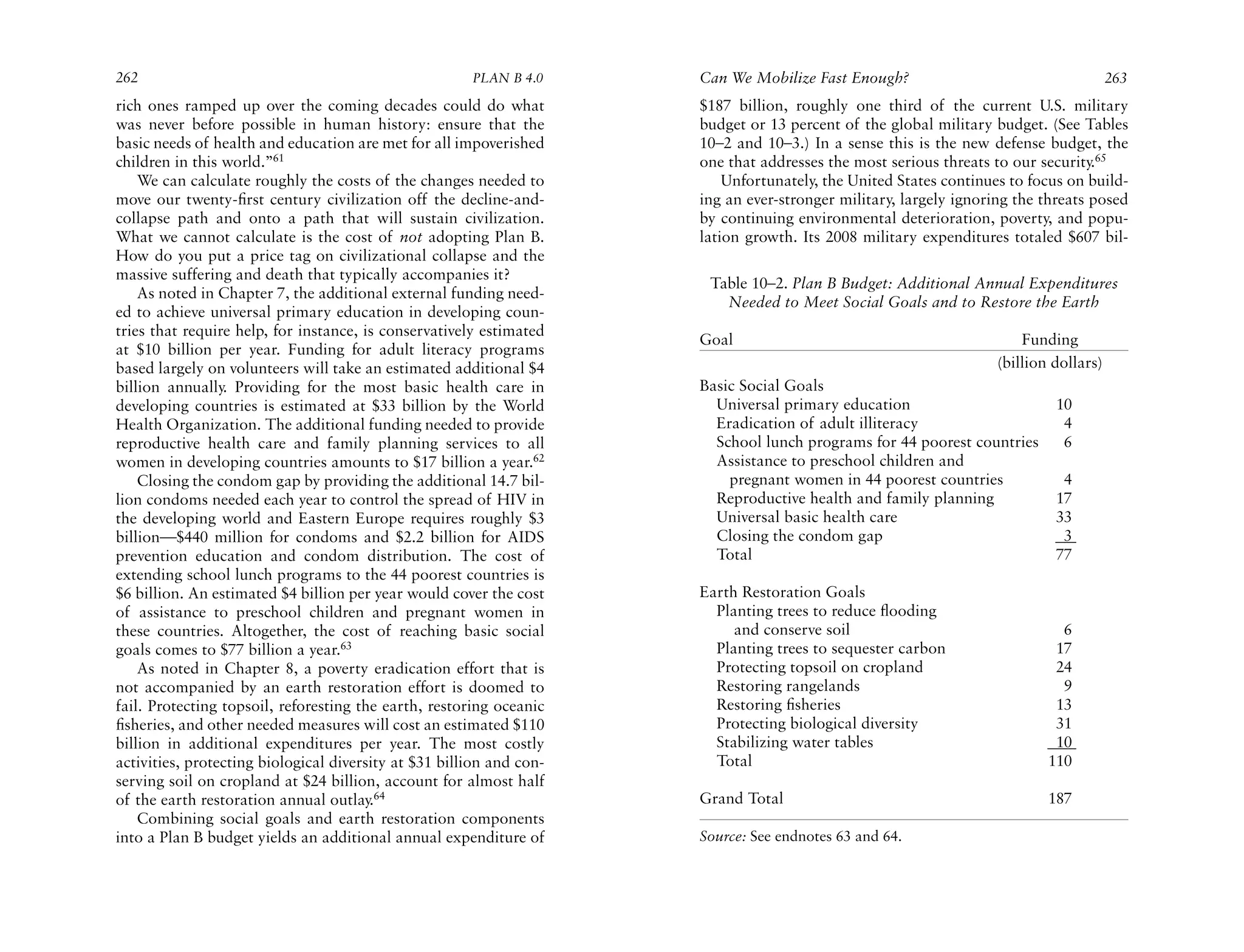
  • 56.
    94 PLAN B 4.0 Stabilizing Climate: An Energy Efficiency Revolution 95 miles, linking nearly all its major cities. One of the most heavi- almost entirely by renewable electricity. In addition to being ly traveled links is the original line, where the bullet trains carry comfortable and convenient, these rail links reduce air pollu- 413,000 passengers a day. The transit time of two-and-a-half tion, congestion, noise, and accidents. They also free travelers hours between Tokyo and Osaka compares with a driving time from the frustrations of traffic congestion and long airport of eight hours. High-speed trains save time as well as energy.60 security check lines.66 Although Japan’s bullet trains have carried billions of pas- There is a huge gap in high-speed rail between Japan and sengers in great comfort over 40 years at high speeds, there has Europe on the one hand and the rest of the world on the other. not been a single casualty. Late arrivals average 6 seconds. If we But China is beginning to develop high-speed trains linking were selecting seven wonders of the modern world, Japan’s some of its major cities. A high-speed link between Beijing and high-speed rail system surely would be among them.61 Shanghai scheduled for completion by 2013 will slice train trav- Although the first European high-speed line, from Paris to el time in half, from 10 to 5 hours. China now has 3,890 miles Lyon, did not begin operation until 1981, Europe has made of track that can handle train speeds of up to 125 miles per enormous strides since then. As of 2009 there were 3,100 miles hour. The plan is to triple the length of high-speed track by (5,000 kilometers) of high-speed rail operating in Europe. The 2020.67 goal is to triple this track length by 2020 and eventually to inte- The United States has a “high-speed” Acela Express that grate the eastern countries, including Poland, the Czech Repub- links Washington, New York, and Boston, but unfortunately lic, and Hungary, into a continental network.62 neither its rail bed and speed nor its reliability come close to the While France and Germany were the early European leaders trains in Japan and Europe. The good news is that the U.S. eco- in intercity rail, Spain is fast building a high-speed intercity rail nomic stimulus plan signed into law in February 2009 contained network as well. Within a year of opening the Barcelona-to- some $8 billion to help launch a new era of high-speed rail con- Madrid connection, domestic airlines lost roughly a fifth of struction in the United States.68 their passengers to these high-speed intercity trains. Spain plans In the United States, the need to cut carbon emissions and to link with high-speed systems in France to become firmly inte- prepare for shrinking oil supplies calls for this shift in invest- grated into the European network.63 ment from roads and highways to railways. In 1956 U.S. Presi- Existing international links, such as the one between Paris dent Dwight Eisenhower launched the interstate highway and Brussels, are being joined by connections between Paris and system, justifying it on national security grounds. Today the Stuttgart, Frankfurt and Paris, and London and Paris (the latter threat of climate change and the insecurity of oil supplies argue via the Channel Tunnel). On the newer lines, trains are operat- for the construction of a high-speed electrified rail system, for ing at up to 200 miles per hour. As The Economist notes, both passenger and freight traffic. The additional electricity “Europe is in the grip of a high speed rail revolution.”64 needed could easily be supplied from renewable sources, main- High-speed links between cities dramatically raise rail travel. ly wind energy.69 For example, when the Paris-to-Brussels link opened—the 194 The passenger rail system would be modeled after those of miles is covered by train in just 85 minutes—the share of those Japan and Europe. A high-speed transcontinental line that aver- traveling between the two cities by train rose from 24 percent to aged 170 miles per hour would mean traveling coast-to-coast in 50 percent. The car share dropped from 61 to 43 percent, and 15 hours, even with stops in major cities along the way. There is plane travel virtually disappeared.65 a parallel need to develop an electrified national rail freight net- Carbon dioxide emissions per passenger mile on electric work that would greatly reduce the need for long-haul trucks. high-speed trains are roughly one third those of cars and one Voters in California approved a bond referendum in Novem- fourth those of planes. In the Plan B economy, carbon emissions ber 2008 of nearly $10 billion to build a high-speed rail system from trains will essentially be zero, since they will be powered to link northern and southern California. This would reduce
  • 57.
    96 PLAN B 4.0 Stabilizing Climate: An Energy Efficiency Revolution 97 the use of cars and eliminate many of the fuel-guzzling short- In their book Cradle to Cradle: Remaking the Way We Make distance flights linking California’s major cities.70 Things, American architect William McDonough and German Any meaningful global effort to cut transport carbon emis- chemist Michael Braungart conclude that waste and pollution sions begins with the United States, which consumes more gaso- are to be avoided entirely. “Pollution,” says McDonough, “is a line than the next 20 countries combined (including Japan, symbol of design failure.”74 China, Russia, Germany, and Brazil). The United States—with Beyond reducing materials use, the energy savings from recy- 249 million passenger vehicles out of the global 912 million— cling are huge. Steel made from recycled scrap takes only 26 per- not only has the largest fleet but it is near the top in miles driv- cent as much energy as that from iron ore. For aluminum, the en per car and near the bottom in fuel efficiency.71 figure is just 4 percent. Recycled plastic uses only 20 percent as The first step to reduce this massive U.S. consumption of much energy. Recycled paper uses 64 percent as much—and gasoline is to raise fuel efficiency standards. The 40-percent with far fewer chemicals during processing. If the world recy- increase in these standards by 2016 announced by the Obama cling rates of these basic materials were raised to those already administration in May 2009 will greatly reduce U.S. gasoline use attained in the most efficient economies, carbon emissions and bring the country closer to the fuel economy levels prevail- would drop precipitously.75 ing in Europe and China. A crash program to shift the U.S. fleet Industry, including the production of plastics, fertilizers, to plug-in hybrids and all-electric cars would make an even steel, cement, and paper, accounts for more than 30 percent of greater contribution. And shifting public funds from highway world energy consumption. The petrochemical industry, which construction to public transit would reduce the number of cars produces such things as plastics, fertilizer, and detergents, is the needed, bringing us close to our goal of cutting carbon emis- biggest consumer of energy in the manufacturing sector, sions 80 percent by 2020.72 accounting for about a third of worldwide industrial energy use. Since a large part of industry fossil fuel use is for feedstock to A New Materials Economy manufacture plastics and other materials, increased recycling The production, processing, and disposal of materials in our can reduce feedstock needs. Worldwide, increasing recycling modern throwaway economy wastes not only materials but rates and moving to the most efficient manufacturing systems in energy as well. In nature, one-way linear flows do not survive use today could easily reduce energy use in the petrochemical long. Nor, by extension, can they survive long in the expanding industry by 32 percent.76 global economy. The throwaway economy that has evolved over The global steel industry, producing over 1.3 billion tons in the last half-century is an aberration, now itself headed for the 2008, accounts for 19 percent of industrial energy use. Efficien- junk heap of history. cy measures, such as adopting the most efficient blast furnace The potential for sharply reducing materials use was first systems in use today and the complete recovery of used steel, identified in Germany, initially by Friedrich Schmidt-Bleek in could reduce energy use in the steel industry by 23 percent.77 the early 1990s and then by Ernst von Weizsäcker, an environ- Reducing materials use begins with recycling steel, the use of mental leader in the German Bundestag. They argued that mod- which dwarfs that of all other metals combined. Steel use is ern industrial economies could function very effectively using dominated by three industries—automobile, household appli- only one fourth the virgin raw materials prevailing at the time. ances, and construction. In the United States, virtually all cars A few years later, Schmidt-Bleek, who founded the Factor Ten are recycled. They are simply too valuable to be left to rust in Institute in France, showed that raising resource productivity out-of-the-way junkyards. The U.S. recycling rate for household even more—by a factor of 10—was well within the reach of appliances is estimated at 90 percent. For steel cans it is 63 per- existing technology and management, given the right policy cent, and for construction steel the figures are 98 percent for incentives.73 steel beams and girders but only 65 percent for reinforcement
  • 58.
    98 PLAN B 4.0 Stabilizing Climate: An Energy Efficiency Revolution 99 steel. Still, the steel discarded each year in various forms is burned, and 64 percent goes to landfills. Recycling rates among enough to meet the needs of the U.S. automobile industry.78 U.S. cities vary from less than 30 percent in some cities to more Steel recycling started climbing more than a generation ago than 70 percent in San Francisco, the highest in the country. with the advent of the electric arc furnace, a technology that When San Francisco hit 70 percent in 2008, Mayor Gavin New- produces steel from scrap using only one fourth the energy som immediately announced a plan to reach 75 percent. Among required to produce it from virgin ore. Electric arc furnaces the largest U.S. cities, recycling rates vary from 34 percent in using scrap now account for half or more of steel production in New York to 55 percent in Chicago and 60 percent in Los Ange- more than 20 countries. A few countries, including Venezuela les. At the state level, Florida has boldly set a goal of recycling and Saudi Arabia, use electric arc furnaces exclusively. If three 75 percent of waste by 2020.83 fourths of steel production were to switch to electric arc fur- One of the most effective ways to encourage recycling is to naces using scrap, energy use in the steel industry could be cut adopt a landfill tax. For example, when the state of New Hamp- by almost 40 percent.79 shire adopted a “pay-as-you-throw” program that encourages The cement industry, turning out 2.9 billion tons in 2008, is municipalities to charge residents for each bag of garbage, it another major energy consumer. China, accounting for half of dramatically reduced the flow of materials to landfills. In the world production, manufactures more cement than the next 20 small town of Lyme, with nearly 2,000 people, adoption of a countries combined, yet it does so with extraordinary ineffi- landfill tax raised the share of garbage recycled from 13 to 52 ciency. If China used the same kiln technologies as Japan, it percent in one year.84 could reduce its cement production energy use by 45 percent. The recycled material in Lyme, which jumped from 89 tons Worldwide, if all cement producers used the most efficient dry in 2005 to 334 tons in 2006, included corrugated cardboard, kiln process, energy use in the industry could drop 42 percent.80 which sold for $90 a ton, mixed paper at $45 a ton, and alu- Restructuring the transportation system also has a huge minum at $1,500 a ton. This program simultaneously reduced potential for reducing materials use as light rail and buses the town’s landfill fees while generating a cash flow from the replace cars. For example, improving urban transit means that sale of recycled material.85 one 12-ton bus can easily replace 60 cars weighing 1.5 tons each, In addition to measures that encourage recycling, there are or a total of 90 tons, reducing material use 87 percent. And those that encourage or mandate the reuse of products such as every time someone replaces a car with a bike, material use is beverage containers. Finland, for example, has banned the use reduced 99 percent.81 of one-way soft drink containers. Canada’s east coast province, The big challenge for cities in saving energy is to recycle as Prince Edward Island, has adopted a similar ban on all nonre- many components of the urban waste flow as possible. Virtual- fillable beverage containers. The result in both cases is a sharply ly all paper products can now be recycled, including cereal reduced flow of garbage to landfills. A refillable glass bottle boxes, junk mail, and paper bags in addition to newspapers and used over and over requires about 10 percent as much energy per magazines. So too can metals, glass, and most plastics. Kitchen use as an aluminum can that is recycled. Cleaning, sterilizing, and yard waste can be composted to recycle plant nutrients. and relabeling a used bottle requires little energy compared with Advanced industrial economies with stable populations, recycling cans made from aluminum, which has a melting point such as those in Europe and Japan, can rely primarily on the of 1,220 degrees Fahrenheit. Banning nonrefillables is a quintu- stock of materials already in the economy rather than using vir- ple win option—cutting material use, carbon emissions, air pol- gin raw materials. Metals such as steel and aluminum can be lution, water pollution, and landfill costs simultaneously. There used and reused indefinitely.82 are also substantial transport fuel savings, since the refillable In the United States, the latest State of Garbage in America containers are simply back-hauled by delivery trucks to the report shows that 29 percent of garbage is recycled, 7 percent is original bottling plants or breweries for refilling.86
  • 59.
    100 PLAN B 4.0 Stabilizing Climate: An Energy Efficiency Revolution 101 San José, California, already diverting 62 percent of its On the clothing front, Patagonia, an outdoor gear retailer, municipal waste from landfills for reuse and recycling, is now has launched a garment recycling program beginning with its focusing on the large flow of trash from construction and dem- polyester fiber garments. Working with Teijin, a Japanese firm, olition sites. This material is trucked to one of two dozen spe- Patagonia is taking back and recycling not only the polyester cialist recycling firms in the city. For example, at Premier Recycle garments it sells but also those sold by its competitors. Patago- up to 300 tons of building debris are delivered each day. This is nia estimates that making a garment from recycled polyester, skillfully separated into recyclable piles of concrete, scrap which is indistinguishable from the initial polyester made from metal, wood, and plastics. Some materials the company sells, petroleum, uses less than one fourth as much energy. With this some it gives away, and some it just pays someone to take.87 success behind it, Patagonia has broadened the program to recy- Before the program began, only about 100,000 tons per year cle its cotton tee shirts as well as nylon and wool clothing.91 of San José’s mixed construction and demolition materials were Remanufacturing is even more efficient. Within the heavy reused or recycled. Now it is nearly 500,000 tons. The scrap industry sector, Caterpillar has emerged as a leader. At a plant metal that is salvaged goes to recycling plants, wood can be con- in Corinth, Mississippi, the company recycles some 17 truck- verted into gardening mulch or into wood chips for fueling loads of diesel engines a day. These engines, retrieved from power plants, and concrete can be recycled to build road banks. Caterpillar’s clients, are disassembled by hand by workers who By deconstructing a building instead of simply demolishing it, do not throw away a single component, not even a bolt or screw. most of the material in it can be reused or recycled, thus dra- Once the engine is disassembled, it is reassembled with all worn matically reducing energy use and carbon emissions. San José is parts repaired or replaced. The resulting engine is as good as becoming a model for cities everywhere.88 new. In 2006, Caterpillar’s remanufacturing division was rack- Germany and, more recently, Japan are requiring that prod- ing up $1 billion a year in sales and growing at 15 percent annu- ucts such as automobiles, household appliances, and office ally, contributing impressively to the company’s bottom line.92 equipment be designed for easy disassembly and recycling. In Another emerging industry is airliner recycling. Daniel May 1998, the Japanese Diet enacted a tough appliance recy- Michaels writes in the Wall Street Journal that Boeing and Air- cling law, one that prohibits discarding household appliances, bus, which have been building jetliners in competition for near- such as washing machines, TV sets, or air conditioners. With ly 40 years, are now vying to see who can dismantle planes most consumers bearing the cost of disassembling appliances in the efficiently. The first step is to strip the plane of its marketable form of a disposal fee to recycling firms, which can come to $60 components, such as engines, landing gear, galley ovens, and for a refrigerator or $35 for a washing machine, there is strong hundreds of other items. For a jumbo jet, these key components pressure to design appliances so they can be more easily and can collectively sell for up to $4 million. Then comes the final cheaply disassembled.89 dismantling and recycling of aluminum, copper, plastic, and With computers becoming obsolete every few years as tech- other materials. The next time around the aluminum may show nology advances, the need to quickly disassemble and recycle up in cars, bicycles, or another jetliner.93 them is another paramount challenge in building an eco-econo- The goal is to recycle 90 percent of the plane, and perhaps my. In Europe, information technology (IT) firms are exploring one day 95 percent or more. With more than 3,000 airliners the reuse of computer components. Because European law already put out to pasture and many more to come, this retired requires manufacturers to pay for the collection, disassembly, fleet has become the equivalent of an aluminum mine.94 and recycling of toxic materials in IT equipment, they have Another increasingly attractive option for cutting carbon begun to focus on how to disassemble everything from comput- emissions is to discourage energy-intensive but nonessential ers to cell phones. Finland-based Nokia, for example, has industries. The gold jewelry, bottled water, and plastic bag indus- designed a cell phone that will virtually disassemble itself.90 tries are prime examples. The annual world production of 2,380
  • 60.
    102 PLAN B 4.0 Stabilizing Climate: An Energy Efficiency Revolution 103 tons of gold, the bulk of it used for jewelry, requires the process- strategy include Los Angeles, Salt Lake City, and St. Louis. New ing of 500 million tons of ore. For comparison, while 1 ton of York City has launched a $5-million ad campaign to promote its steel requires the processing of 2 tons of ore, 1 ton of gold tap water and thus to rid the city of bottled water and the fleets involves processing an almost incomprehensible 200,000 tons of of delivery trucks that tie up traffic. In response to initiatives ore. Processing ore for gold consumes a vast amount of energy— such as these, U.S. sales of bottled water began to decline in and emits as much CO2 as 5.5 million cars.95 2008.99 In a world trying to stabilize climate, it is very difficult to jus- Like plastic water bottles, throwaway plastic shopping bags tify bottling water (often tap water to begin with), hauling it are also made from fossil fuels, can take centuries to decom- over long distances, and then selling it for 1,000 times the price pose, and are almost always unnecessary. In addition to local of tap water. Although clever marketing, designed to undermine initiatives, several national governments are moving to ban or public confidence in the safety and quality of municipal water severely restrict the use of plastic shopping bags, including supplies, has convinced many consumers that bottled water is China, Ireland, Eritrea, Tanzania, and the United Kingdom.100 safer and healthier than water from faucets, a detailed study by In summary, there is a vast worldwide potential for cutting the World Wide Fund for Nature could not find any support for carbon emissions by reducing materials use. This begins with this claim. It notes that in the United States and Europe there the major metals—steel, aluminum, and copper—where recy- are more standards regulating the quality of tap water than bot- cling requires only a fraction of the energy needed to produce tled water. For people in developing countries where water is these metals from virgin ore. It continues with the design of unsafe, it is far cheaper to boil or filter water than to buy it in cars, household appliances, and electronic products so they are bottles.96 easily disassembled into their component parts for reuse or Manufacturing the nearly 28 billion plastic bottles used each recycling. And it includes avoiding unnecessary products. year to package water in the United States alone requires the equivalent of 17 million barrels of oil. And whereas tap water is Smarter Grids, Appliances, and Consumers delivered through a highly energy-efficient infrastructure, bot- More and more utilities are beginning to realize that building tled water is hauled by trucks, sometimes over hundreds of large power plants just to handle peak daily and seasonal miles. Including the energy for hauling water from bottling demand is a very costly way of managing an electricity system. plants to sales outlets and the energy needed for refrigeration, Existing electricity grids are typically a patchwork of local grids the U.S. bottled water industry consumes roughly 50 million that are simultaneously inefficient, wasteful, and dysfunctional barrels of oil per year, enough oil to fuel 3 million cars for one in that they often are unable, for example, to move electricity year.97 surpluses to areas of shortages. The U.S. electricity grid today The good news is that people are beginning to see how resembles the roads and highways of the mid-twentieth century wasteful and climate-disruptive this industry is. Mayors of U.S. before the interstate highway system was built. What is needed cities are refusing to spend taxpayer dollars to buy bottled water today is the electricity equivalent of the interstate highway sys- for their employees at exorbitant prices when high-quality tap tem.101 water is readily available. Mayor Rocky Anderson of Salt Lake The inability to move low-cost electricity to consumers City noted the “total absurdity and irresponsibility, both eco- because of congestion on transmission lines brings with it costs nomic and environmental, of purchasing and using bottled similar to those associated with traffic congestion. The lack of water when we have perfectly good and safe sources of tap transmission capacity in the eastern United States is estimated water.”98 to cost consumers $16 billion a year in this region alone.102 San Francisco Mayor Newsom has banned the use of city In the United States, a strong national grid would permit funds to purchase bottled water. Other cities following a similar power to be moved continuously from surplus to deficit regions,
  • 61.
    104 PLAN B 4.0 Stabilizing Climate: An Energy Efficiency Revolution 105 thus reducing the total generating capacity needed. Most signals from the grid allow electricity use to be shifted away important, the new grid would link regions rich in wind, solar, from peak demand. Higher electricity prices during high and geothermal energy with consumption centers. A national demand periods also prod consumers to change their behavior, grid, drawing on a full range of renewable energy sources, thus improving market efficiency. For example, a dishwasher would itself be a stabilizing factor. can be programmed to run not at 8 p.m. but at 3 a.m., when Establishing strong national grids that can move electricity electricity demand is much lower, or air conditioners can be as needed and that link new energy sources with consumers is turned off for a brief period to lighten the demand load.105 only half the battle, however. The grids and appliances need to Another approach being pioneered in Europe achieves the become “smarter” as well. In the simplest terms, a smart grid is same goal but uses a different technology. In any grid, there is a one that takes advantage of advances in information technolo- narrow range of fluctuation in the power being carried. An Ital- gy, integrating this technology into the electrical generating, ian research team is testing refrigerators that can monitor the delivery, and user system, enabling utilities to communicate grid flow and, when demand rises or supply drops, simply turn directly with customers and, if the latter agree, with their themselves off for as long as it is safe to do so. New Scientist household appliances. reports that if this technology were used in the 30 million refrig- Smart grid technologies can reduce power disruption and erators in the United Kingdom, it would reduce national peak fluctuation that cost the U.S. economy close to $100 billion a demand by 2,000 megawatts of generating capacity, allowing year, according to the Electric Power Research Institute. In an the country to close four coal-fired power plants.106 excellent 2009 Center for American Progress study, Wired for A similar approach could be used for air conditioning sys- Progress 2.0: Building a National Clean-Energy Smart Grid, tems in both residential and commercial buildings. Karl Lewis, Bracken Hendricks notes the vast potential for raising grid effi- COO of GridPoint, a U.S. company that designs smart grids, ciency with several information technologies: “A case in point says “we can turn off a compressor in somebody’s air condi- would be encouraging the widespread use of synchrophasors to tioning system for 15 minutes and the temperature really won’t monitor voltage and current in real time over the grid network. change in the house.” The bottom line with a smart grid is that It has been estimated that better use of this sort of real-time a modest investment in information technology can reduce peak information across the entire electrical grid could allow at least power, yielding both savings in electricity and an accompanying a 20 percent improvement in energy efficiency in the United reduction in carbon emissions.107 States.” This and many other examples give us a sense of the Some utilities are pioneers in using time-based pricing of potential for increasing grid efficiency.103 electricity, when electricity used during off-peak hours is priced A smart grid not only moves electricity more efficiently in much lower than that used during peak hours. Similarly, in geographic terms; it also enables electricity use to be shifted regions with high summer temperatures, there is often a costly over time—for example, from periods of peak demand to those seasonal peak demand. Baltimore Gas and Electric (BGE), for of off-peak demand. Achieving this goal means working with example, conducted a pilot program in 2008 in which partici- consumers who have “smart meters” to see exactly how much pating customers who permitted the utility to turn off their air electricity is being used at any particular time. This facilitates conditioners for selected intervals during the hottest days were two-way communication between utility and consumer so they credited generously for the electricity they saved. The going rate can cooperate in reducing peak demand in a way that is advan- in the region is roughly 14¢ per kilowatt-hour. But for a kilo- tageous to both. And it allows the use of two-way metering so watt-hour saved during peak hours on peak days, customers that customers who have a rooftop solar electric panel or their were paid up to $1.75—more than 12 times as much. Thus if own windmill can sell surplus electricity back to the utility.104 they saved 4 kilowatt-hours of electricity in one afternoon, they Smart meters coupled with smart appliances that can receive got a $7 credit on their electricity bill. Customers reduced their
  • 62.
    106 PLAN B 4.0 Stabilizing Climate: An Energy Efficiency Revolution 107 peak electricity consumption by as much as one third, encour- in effect be the global version of Japan’s Top Runner program aging BGE to design a similar program with even more “smart” to raise appliance efficiency. technology for summer 2009.108 Given the potential for raising appliance efficiency, the ener- Within the United States the shift to smart meters is moving gy saved by 2020 should at least match the savings in the light- fast, with some 28 utilities planning to deploy smart meters in ing sector. Combining more-efficient lights and appliances with the years ahead. Among the leaders are California’s two major a smart grid that uses time-of-day pricing, peak demand sen- utilities, Pacific Gas and Electric and Southern California Edi- sors, and the many other technologies described in this chapter son, which are planning on full deployment to their 5.1 million shows a huge potential for reducing both overall electricity use and 5.3 million customers by 2012. Both will offer variable rates and peak demand.113 to reduce peak electricity use. Among the many other utilities It is easy to underestimate the potential for reducing elec- aiming for full deployment are American Electric Power in the tricity use. Within the United States, the Rocky Mountain Insti- Midwest (5 million customers) and Florida Power and Light (4.4 tute calculates that if the 40 least efficient states were to achieve million customers).109 the electrical efficiency of the 10 most efficient ones, national Europe, too, is installing smart meters, with Finland setting electricity use would be cut by one third. This would allow the the pace. A Swedish research firm, Berg Insight, projects that equivalent of 62 percent of all U.S. coal-fired power plants to be Europe will have 80 million smart meters installed by 2013.110 closed down. But even the most efficient states have a substan- Unfortunately, the term “smart meters” describes a wide tial potential for further reducing electricity use and, indeed, are variety of meters, ranging from those that simply provide con- planning to keep cutting carbon emissions and saving money.114 sumers with real-time data on electricity use to those that facil- In terms of transportation, the short-term keys to reducing itate two-way communication between the utility and customer oil use and carbon emissions involve shifting to highly fuel-effi- or even between the utility and individual household appliances. cient cars (including electric vehicles), diversifying urban trans- The bottom line: the smarter the meter, the greater the sav- port systems, and building intercity rapid rail systems modeled ings.111 on those in Japan and Europe. This shift from car-dominated Taking advantage of information technology to increase the transport systems to diversified systems is evident in the actions efficiency of the grid, the delivery system, and the use of elec- of hundreds of mayors worldwide who struggle daily with traf- tricity at the same time is itself a smart move. Simply put, a fic congestion and air pollution. They are devising ingenious smart grid combined with smart meters enables both electrical ways of limiting not only the use of cars but also the very need utilities and consumers to be much more efficient. for them. As the urban car presence diminishes, the nature of the city itself will change. The Energy Savings Potential Within the industrial sector, there is a hefty potential for The goal for this chapter was to identify energy-saving measures reducing energy use. In the petrochemical industry, moving to that will offset the nearly 30 percent growth in global energy the most efficient production technologies now available and demand projected by the IEA between 2006 and 2020. My col- recycling more plastic can cut energy use by 32 percent. Gains in leagues and I are confident that the measures proposed will manufacturing efficiency in steel can cut energy use by 23 per- more than offset the projected growth in energy use.112 cent. Even larger gains are within reach for cement, where sim- Shifting to more energy-efficient lighting alone lowers world ply shifting to the most efficient dry kiln technologies can electricity use by 12 percent. With appliances, the key to raising reduce energy use by 42 percent.115 energy efficiency is to establish international efficiency stan- With buildings—even older buildings, where retrofitting can dards that reflect the most efficient models on the market today, reduce energy use by 20–50 percent—there is a profitable poten- regularly raising this level as technologies advance. This would tial for saving energy. As noted earlier, such a reduction in ener-
  • 63.
    108 PLAN B 4.0 gy use, combined with the use of renewable electricity to heat, cool, and light the building, means that it will be easier to cre- ate carbon-neutral buildings than we may have thought. One simple way to achieve all these gains is to adopt a car- bon tax that would help reflect the full cost of burning fossil fuels. We recommend increasing this carbon tax by $20 per ton each year over the next 10 years, for a total of $200 ($55 per ton of CO2), offsetting it with a reduction in income taxes. High though this may seem, it does not come close to covering all the indirect costs of burning fossil fuels. It does, however, encour- age investment in both efficiency and carbon-free sources of energy. In seeking to raise energy efficiency as described in this chap- ter, there have been some exciting surprises in the vast potential for doing so. We now turn to developing the earth’s renewable sources of energy, where there are equally exciting possibilities.
  • 64.
    5 Stabilizing Climate:Shifting to Renewable Energy As fossil fuel prices rise, as oil insecurity deepens, and as con- cerns about climate change cast a shadow over the future of coal, a new energy economy is emerging. The old energy econ- omy, fueled by oil, coal, and natural gas, is being replaced by one powered by wind, solar, and geothermal energy. Despite the global economic crisis, this energy transition is moving at a pace and on a scale that we could not have imagined even two years ago. And it is a worldwide phenomenon. Consider Texas. Long the leading U.S. oil-producing state, it is now also the leading generator of electricity from wind, hav- ing overtaken California three years ago. Texas now has 7,900 megawatts of wind generating capacity online, 1,100 more in the construction stage, and a huge amount in the development stage. When all of these wind farms are completed, Texas will have 53,000 megawatts of wind generating capacity—the equiv- alent of 53 coal-fired power plants. This will more than satisfy the residential needs of the state’s 24 million people, enabling Texas to export electricity, just as it has long exported oil.1 Texas is not alone. In South Dakota, a wind-rich, sparsely populated state, development has begun on a vast 5,050-
  • 65.
    110 PLAN B 4.0 Stabilizing Climate: Shifting to Renewable Energy 111 megawatt wind farm (1 megawatt of wind capacity supplies 300 These are only a few of the visionary initiatives to tap the U.S. homes) that when completed will produce nearly five times earth’s renewable energy. The resources are vast. In the United as much electricity as the 796,000 people living in the state need. States, three states—North Dakota, Kansas, and Texas—have Altogether, some 10 states in the United States, most of them in enough harnessable wind energy to run the entire economy. In the Great Plains, and several Canadian provinces are planning China, wind will likely become the dominant power source. to export wind energy.2 Indonesia could one day get all its power from geothermal ener- Across the Atlantic, the government of Scotland is negotiat- gy alone. Europe will be powered largely by wind farms in the ing with two sovereign wealth funds in the Middle East to invest North Sea and solar thermal power plants in the North African $7 billion in a grid in the North Sea off its eastern coast. This desert.7 grid will enable Scotland to develop nearly 60,000 megawatts of The Plan B goals for developing renewable sources of energy off-shore wind generating capacity, close to the 79,000 by 2020 that are laid out in this chapter are based not on what megawatts of current electrical generating capacity for the Unit- is conventionally believed to be politically feasible but on what ed Kingdom.3 we think is needed. This is not Plan A, business as usual. This is We are witnessing an embrace of renewable energy on a scale Plan B—a wartime mobilization, an all-out response that is we’ve never seen for fossil fuels or nuclear power. And not only designed to avoid destabilizing economic and political stresses in industrial countries. Algeria, which knows it will not be that will come with unmanageable climate change. exporting oil forever, is planning to build 6,000 megawatts of To reduce worldwide net carbon dioxide (CO2) emissions by solar thermal generating capacity for export to Europe via 80 percent by 2020, the first priority is to replace all coal- and undersea cable. The Algerians note that they have enough har- oil-fired electricity generation with renewable sources. Whereas nessable solar energy in their vast desert to power the entire the twentieth century was marked by the globalization of the world economy. This is not a mathematical error. A similarly world energy economy as countries everywhere turned to oil, striking fact is that the sunlight striking the earth in just one much of it coming from the Middle East, this century will see hour is enough to power the world economy for one year.4 the localization of energy production as the world turns to Turkey, which now has 39,000 megawatts of total electrical wind, solar, and geothermal energy. generating capacity, issued a request for proposals in 2007 to This century will also see the electrification of the economy. build wind farms. It received bids from both domestic and inter- The transport sector will shift from gasoline-powered automo- national wind development firms to build a staggering 78,000 biles to plug-in gas-electric hybrids, all-electric cars, light rail megawatts of wind generating capacity. Having selected 15,000 transit, and high-speed intercity rail. And for long-distance megawatts of the most promising proposals, the government is freight, the shift will be from diesel-powered trucks to electri- now issuing construction permits.5 cally powered rail freight systems. The movement of people and In mid-2008, Indonesia—a country with 128 active volca- goods will be powered largely by electricity. In this new energy noes and therefore rich in geothermal energy—announced that economy, buildings will rely on renewable electricity almost it would develop 6,900 megawatts of geothermal generating exclusively for heating, cooling, and lighting. capacity, with Pertamina, the state oil company, responsible for In the electrification of the economy, we do not count on a developing the lion’s share. Indonesia’s oil production has been buildup in nuclear power. Our assumption is that the limited declining for the last decade, and in each of the last four years number of nuclear power plants now under construction world- the country has been an oil importer. As Pertamina shifts wide will simply offset the closing of aging plants, with no over- resources from oil into the development of geothermal energy, all growth in capacity by 2020. If we use full-cost it could become the first oil company—state-owned or inde- pricing—requiring utilities to absorb the costs of disposing of pendent—to make the transition from oil to renewable energy.6 nuclear waste, of decommissioning a plant when it wears out,
  • 66.
    112 PLAN B 4.0 Stabilizing Climate: Shifting to Renewable Energy 113 and of insuring reactors against possible accidents and terrorist Turning to the Wind attacks—building nuclear plants in a competitive electricity Wind is the centerpiece of the Plan B energy economy. It is market is simply not economical.8 abundant, low cost, and widely distributed; it scales up easily Beyond the costs of nuclear power are the political questions. and can be developed quickly. Oil wells go dry and coal seams If we say that expanding nuclear power is an important part of run out, but the earth’s wind resources cannot be depleted. our energy future, do we mean for all countries or only for some A worldwide survey of wind energy by the Stanford Universi- countries? If the latter, who makes the A-list and the B-list of ty team of Cristina Archer and Mark Jacobson concluded that countries? And who enforces the listings? harnessing one fifth of the earth’s available wind energy would In laying out the climate component of Plan B, we also provide seven times as much electricity as the world currently exclude the oft-discussed option of carbon sequestration at uses. For example, China—with vast wind-swept plains in the coal-fired power plants. Given the costs and the lack of investor north and west, countless mountain ridges, and a long coastline, interest within the coal community itself, this technology is not all rich with wind—has enough readily harnessable wind energy likely to be economically viable on a meaningful scale by 2020. to easily double its current electrical generating capacity.11 Can we expand renewable energy use fast enough? We think The United States is also richly endowed. In addition to hav- so. Recent trends in the adoption of mobile phones and person- ing enough land-based wind energy to satisfy national electric- al computers give a sense of how quickly new technologies can ity needs several times over, the National Renewable Energy Lab spread. Once cumulative mobile phone sales reached 1 million has identified 1,000 gigawatts (1 gigawatt equals 1,000 units in 1986, the stage was set for explosive growth, and the megawatts) of wind energy waiting to be tapped off the East number of cell phone subscribers doubled in each of the next Coast and 900 gigawatts off the West Coast. This offshore three years. Over the next 12 years the number doubled every capacity alone is sufficient to power the U.S. economy.12 two years. By 2001 there were 961 million cell phones—nearly a Europe is already tapping its off-shore wind. An assessment 1,000-fold increase in just 15 years. And now there are more by the Garrad Hassan wind energy consulting group concluded than 4 billion cell phone subscribers worldwide.9 that if governments aggressively develop their vast off-shore Sales of personal computers followed a similar trajectory. In resources, wind could supply all of Europe’s residential electric- 1980 roughly a million were sold, but by 2008 the figure was an ity by 2020.13 estimated 270 million—a 270-fold jump in 28 years. We are now For many years, a small handful of countries dominated seeing similar growth figures for renewable energy technologies. growth in the industry, but this is changing as the industry goes Installations of solar cells are doubling every two years, and the global, with some 70 countries now harnessing wind resources. annual growth in wind generating capacity is not far behind. World wind electric generation is growing at a frenetic pace. Just as the communications and information economies have From 2000 to 2008, generating capacity increased from 17,000 changed beyond recognition over the past two decades, so too megawatts to an estimated 121,000 megawatts. The world will the energy economy over the next decade.10 leader in total capacity is now the United States, followed by There is one outstanding difference. Whereas the restructur- Germany (until recently the leader), Spain, China, and India. ing of the information economy was shaped only by advancing But with China’s wind generation doubling each year, the U.S. technology and market forces, the restructuring of the energy lead may be short-lived.14 economy will be driven also by the realization that the fate of Measured by share of national electricity supplied by wind, civilization may depend not only on doing so, but on doing it at Denmark is the leader, at 21 percent. Four north German states wartime speed. now get one third or more of their electricity from wind. For Germany as a whole, the figure is 8 percent—and climbing.15 Denmark is now looking to push the wind share of its elec-
  • 67.
    114 PLAN B 4.0 Stabilizing Climate: Shifting to Renewable Energy 115 tricity to 50 percent, with most of the additional power coming up to 600 megawatts, an installation that could satisfy half the from off-shore. In contemplating this prospect, Danish planners state’s residential electricity needs.21 have turned energy policy upside down. They are looking at East Coast off-shore wind is attractive for three reasons. using wind as the mainstay of their electrical generating system One, it is strong and reliable. The off-shore region stretching and fossil-fuel-generated power to fill in when the wind ebbs.16 from Massachusetts southward to North Carolina has a poten- In Spain, which already has nearly 17,000 megawatts of tial wind generating capacity that exceeds the requirement of capacity, the government is shooting for 20,000 megawatts by the states in the region. Two, the East Coast has an extensive, 2010. France, a relative newcomer to wind energy, is looking to rather shallow off-shore area, which makes off-shore wind con- develop 25,000 megawatts of wind by 2020; out of this, 6,000 struction less costly. And three, this electricity source is close to megawatts would be off-shore.17 consumers.22 As of early 2009 the United States had just over 28,000 To the north, Canada, with its vast area and only 33 million megawatts of wind generating capacity, with an additional 38 people, has one of the highest wind-to-population ratios of any wind farms under construction. Beyond this, proposed wind country. Ontario, Quebec, and Alberta are far and away the farms that can generate some 300,000 megawatts are on hold, leaders in installed capacity at this point. But in recent months awaiting grid construction.18 three of Canada’s four Atlantic provinces—New Brunswick, In addition to Texas and California, which is planning a Prince Edward Island, and Nova Scotia—have begun discus- 4,500-megawatt wind farm complex in the southern end of the sions to jointly develop and export some of their wealth of state, several other states are emerging as wind superpowers. As wind energy to the densely populated U.S. Northeast.23 noted earlier, Clipper Windpower and BP are teaming up to Impressive though the U.S. growth is, the expansion now build the 5,050-megawatt Titan wind farm in eastern South under way in China is even more so. China has some 12,000 Dakota. Colorado billionaire Philip Anschutz is developing a megawatts of wind generating capacity, mostly in the 50- to 2,000-megawatt wind farm in south central Wyoming to gener- 100-megawatt wind farm category, with many more medium- ate electricity for transmission to California, Arizona, and size wind farms coming. Beyond this, its Wind Base program is Nevada.19 creating six mega-complexes of wind farms of at least 10 In the east, Maine—a wind energy newcomer—is planning gigawatts each. These are located in Gansu Province (15 to develop 3,000 megawatts of wind generating capacity, far gigawatts), Western Inner Mongolia (20 gigawatts), Eastern more than the state’s 1.3 million residents need. New York Inner Mongolia (30 gigawatts), Hebei Province (10 gigawatts), State, which has 1,300 megawatts of wind generating capacity, Xinjiang Hami (20 gigawatts), and along the coast north of plans to add another 8,000 megawatts, with most of the power Shanghai in Jiangsu Province (10 gigawatts). When completed, being generated by winds coming off Lake Erie and Lake these complexes will have a generating capacity of 105 Ontario. And soon Oregon will nearly double its wind generat- gigawatts—as much wind power as the entire world had in early ing capacity with the 900-megawatt wind farm planned for the 2008.24 windy Columbia River Gorge.20 In considering the land requirements to produce energy, While U.S. attention has focused on the wind-rich Great wind turbines are extraordinarily efficient. For example, an acre Plains, and rightly so, another area is now gathering attention. of corn land in northern Iowa used to site a wind turbine can For years, the only off-shore wind project in the east that was produce $300,000 worth of electricity per year. This same acre moving through the permitting stage was a 400-megawatt proj- of land planted in corn would yield 480 gallons of ethanol ect off the coast of Cape Cod, Massachusetts. Now Massachu- worth $960. This extraordinary energy yield of land used for setts has been joined by Rhode Island, New York, New Jersey, wind turbines helps explain why investors find wind farms so and Delaware. Delaware is planning an off-shore wind farm of attractive.25
  • 68.
    116 PLAN B 4.0 Stabilizing Climate: Shifting to Renewable Energy 117 And since wind turbines occupy only 1 percent of the land Wind turbines can be mass-produced on assembly lines, covered by a wind farm, farmers and ranchers continue to grow much as B-24 bombers were in World War II at Ford’s massive grain and graze cattle. In effect, they can double crop their land, Willow Run assembly plant in Michigan. Indeed, the idled simultaneously harvesting a food crop—wheat, corn, or cattle— capacity in the U.S. automobile industry is sufficient to produce and energy. With no investment on their part, farmers and ranch- all the wind turbines the world needs to reach the Plan B global ers typically receive $3,000–10,000 a year in royalties for each goal. Not only do the idle plants exist, but there are skilled wind turbine erected on their land. For thousands of ranchers in workers in these communities eager to return to work. The state the U.S. Great Plains, the value of electricity produced on their of Michigan, for example, in the heart of the wind-rich Great land in the years ahead will dwarf their cattle sales.26 Lakes region, has more than its share of idled auto assembly One of the early concerns with wind energy was the risk it plants.30 posed to birds, but this can be managed by careful siting to Wind has many attractions. For utilities, being able to sign avoid risky migration and breeding areas. The most recent long-term fixed-price contracts is a godsend for them and their research indicates that bird fatalities from wind farms are customers. When they look at natural gas, they look at a fuel minuscule compared with the number of birds that die flying source with a volatile price. When they look at coal-fired power, into skyscrapers, colliding with cars, or being captured by they face the uncertainty of future carbon costs. cats.27 The appeal of wind energy can be seen in its growth relative Other critics are concerned about the visual effect. When to other energy sources. In 2008, for example, wind accounted some people see a wind farm they see a blight on the landscape. for 36 percent of new generating capacity in the European Others see a civilization-saving source of energy. Although there Union compared with 29 percent for natural gas, 18 percent for are NIMBY problems (“not in my backyard”), the PIMBY photovoltaics, 10 percent for oil, and only 3 percent for coal. In response (“put it in my backyard”) is much more pervasive. the United States, new wind generating capacity has exceeded Within rural communities, competition for wind farms— coal by a wide margin each year since 2005. Worldwide, no new whether in ranch country in Colorado or dairy country in nuclear-generating capacity came online in 2008, while new upstate New York—is intense. This is not surprising, since the wind generating capacity totaled 27,000 megawatts. The struc- jobs, the royalties from wind turbines, and the additional tax ture of the world energy economy is not just changing, it is revenue are welcomed by local communities. changing fast.31 At the heart of Plan B is a crash program to develop 3,000 gigawatts (3 million megawatts) of wind generating capacity by Solar Cells and Thermal Collectors 2020, enough to satisfy 40 percent of world electricity needs. Energy from the sun can be harnessed with solar photovoltaics This will require a near doubling of capacity every two years, up (PV) and solar thermal collectors. Solar PV cells—both often from a doubling every three years over the last decade.28 silicon-based semiconductors and thin films—convert sunlight This climate-stabilizing initiative would require the installa- directly into electricity. Solar thermal collectors convert sunlight tion of 1.5 million wind turbines of 2 megawatts each. Manu- into heat that can be used, for example, to warm water, as in facturing such a huge number of wind turbines over the next 11 rooftop solar water heaters. Alternatively, collectors can be used years sounds intimidating until it is compared with the 70 mil- to concentrate sunlight on a vessel containing water to produce lion automobiles the world produces each year. At $3 million steam and generate electricity. per installed turbine, this would mean investing $4.5 trillion by Worldwide, photovoltaic installations jumped by some 5,600 2020, or $409 billion per year. This compares with world oil and megawatts in 2008, pushing total installations to nearly 15,000 gas capital expenditures that are projected to reach $1 trillion megawatts. One of the world’s fastest-growing energy sources, per year by 2016.29 solar PV production is growing by 45 percent annually, doubling
  • 69.
    118 PLAN B 4.0 Stabilizing Climate: Shifting to Renewable Energy 119 every two years. In 2006, when Germany installed 1,100 in fighting climate change. Although the estimated 1.5 billion megawatts of solar cell generating capacity, it became the first kerosene lamps used worldwide provide less than 1 percent of country to add over 1 gigawatt (1,000 megawatts) in a year.32 all residential lighting, they account for 29 percent of that sec- Until recently PV production was concentrated in Japan, tor’s CO2 emissions. They use the equivalent of 1.3 million bar- Germany, and the United States. But several energetic new play- rels of oil per day, equal to roughly half the oil production of ers have entered the field, with companies in China, Taiwan, the Kuwait.37 Philippines, South Korea, and the United Arab Emirates. China The cost of solar energy is falling fast in industrial countries. overtook the United States in PV production in 2006. Taiwan Michael Rogol and his PHOTON consulting firm estimate that did so in 2007. Today there are scores of firms competing in the by 2010 fully integrated companies that encompass all phases of world market, driving investments in both research and manu- solar PV manufacturing will be installing systems that produce facturing.33 electricity for 12¢ a kilowatt-hour in sun-drenched Spain and For the nearly 1.6 billion people living in communities not 18¢ a kilowatt-hour in southern Germany. Although these costs yet connected to an electrical grid, it is now often cheaper to will be dropping below those of conventional electricity in install PV panels rooftop-by-rooftop than to build a central many locations, this will not automatically translate into a power plant and a grid to reach potential consumers. For wholesale conversion to solar PV But as one energy industry . Andean villagers, for example, who have depended on tallow- analyst observes, the “big bang” is under way.38 based candles for their lighting, the monthly payment for a solar After starting with relatively small residential rooftop instal- cell installation over 30 months is less than the monthly outlay lations, investors are now turning to utility-scale solar cell com- for candles.34 plexes. A 20-megawatt facility completed in Spain in 2007 was When a villager buys a solar PV system, that person is in the largest ever built—but not for long. A 60-megawatt facility, effect buying a 25-year supply of electricity. With no fuel cost also in Spain, came online in 2008 and tripled the ante. Even and very little maintenance, it is the upfront outlay that requires larger solar cell installations are being planned, including 80- financing. Recognizing this, the World Bank and the U.N. Envi- megawatt facilities in California and Israel.39 ronment Programme have stepped in with programs to help In mid-2008, Pacific Gas and Electric (PG&E), one of two local lenders set up credit systems to finance this cheap source large utilities in California, announced a contract with two of electricity. An initial World Bank loan has helped 50,000 firms to build solar PV installations with a combined generat- homeowners in Bangladesh obtain solar cell systems. A second, ing capacity of 800 megawatts. Covering 12 square miles, this much larger round of funding will enable 200,000 more families complex will generate as much electricity at peak power as a to do the same.35 nuclear power plant. The bar has been raised yet again.40 Villagers in India who lack electricity and who depend on And in early 2009, China Technology Development Group kerosene lamps face a similar cost calculation. Installing a home Corporation and Qinghai New Energy Group announced they solar electric system in India, including batteries, costs roughly were joining forces to build a 30-megawatt solar PV power facili- $400. Such systems will power two, three, or four small appli- ty in remote Qinghai Province. This is the first stage in what is ances or lights and are widely used in homes and shops in lieu eventually expected to become a 1,000-megawatt generating facil- of polluting and increasingly costly kerosene lamps. In one year ity For a country that ended 2008 with only 145 megawatts of . a kerosene lamp burns nearly 20 gallons of kerosene, which at installed solar cell capacity, this is a huge leap into the future.41 $3 a gallon means $60 per lamp. A solar PV lighting system that More and more countries, states, and provinces are setting replaces two lamps would pay for itself within four years and solar installation goals. Italy’s solar industry group is projecting then become essentially a free source of electricity.36 16,000 megawatts of installed capacity by 2020. Japan is plan- Switching from kerosene to solar cells is particularly helpful ning 14,000 megawatts by 2020. The state of California has set
  • 70.
    120 PLAN B 4.0 Stabilizing Climate: Shifting to Renewable Energy 121 a goal of 3,000 megawatts by 2017. New Jersey has a goal of The first plant under construction in Algeria is a solar/natu- 2,300 megawatts of solar installations by 2021, and Maryland is ral-gas hybrid, with the natural gas taking over power genera- aiming for 1,500 megawatts by 2022.42 tion entirely after the sun goes down. Although the first few With installations of solar PV now doubling every two years plants in this massive new project will be hybrids, New Energy and likely to continue doing so at least until 2020, annual instal- Algeria, the government firm specifically created to encourage lations, at nearly 5,600 megawatts in 2008, will climb to 500,000 renewable energy development, plans soon to switch exclusively megawatts in 2020. By this time the cumulative installed capac- to solar thermal power. These plants will likely use molten salt ity would exceed 1.5 million megawatts (1,500 gigawatts). or some other medium for storing heat in order to extend gen- Although this may seem overly ambitious, it could in fact turn eration several hours beyond sundown and through the high- out to be a conservative goal. For one thing, if most of the near- demand evening hours.47 ly 1.6 billion people who lack electricity today get it by 2020, it The U.S. plants under development and this announcement will likely be because they have installed home solar systems.43 by the Algerians were the early indications that the world is A second, very promising way to harness solar energy on a entering the utility-scale solar thermal power era. By the end of massive scale is simply to use reflectors to concentrate sunlight 2008, there were some 60 commercial-scale solar thermal power on a closed vessel containing water or some other liquid, heat- plants in the pipeline, most of them in the United States and ing the liquid to produce steam that drives a turbine. This solar Spain. Among the 10 largest proposed plants, 8 are to be built thermal technology, often referred to as concentrating solar in the United States. Ranging in size from 250 to 900 megawatts, power (CSP), first came on the scene with the construction of a most of them will be in California. The early months of 2009 350-megawatt solar thermal power plant complex in California. brought many more announcements. BrightSource Energy Completed in 1991, it remained the world’s only utility-scale announced a blockbuster package with Southern California solar thermal generating facility until the completion of a 64- Edison of seven projects with a collective total of 1,300 megawatt power plant in Nevada in 2007. As of early 2009, the megawatts of generating capacity. Shortly thereafter, it United States has 6,100 megawatts of solar thermal power announced an identical package with PG&E’s. NRG, a New plants under development, all with signed long-term power pur- Jersey–based firm, and eSolar announced that together chase agreements.44 they would develop 500 megawatts of CSP at sites in the south- In mid-2009 Lockheed Martin, an aerospace defense and western United States.48 information technology contractor, announced that it was Spain, another solar superpower, has 50 or so plants, each building a 290-megawatt CSP plant in Arizona. This plant, like close to 50 megawatts in size, in various phases of development. many other CSP plants, will have six hours of storage, enabling There are a scattering of proposed CSP plants in other coun- it to generate electricity until midnight or beyond. The entry tries, including Israel, Australia, South Africa, the United Arab into the solar field of a company with annual sales of $43 bil- Emirates, and Egypt. At least a dozen other sun-drenched coun- lion and vast engineering skills signals a major new commit- tries now recognize the potential of this inexhaustible, low-cost ment to harnessing the earth’s abundance of solar energy.45 source of electricity and are mobilizing to tap it.49 As noted earlier, the government of Algeria plans to produce One of the countries for which CSP plants are ideally suited 6,000 megawatts of solar thermal electrical capacity for trans- is India. Although this nation is not nearly as richly endowed mission to Europe via undersea cable. The German government with wind energy as, say, China or the United States, the Great was quick to respond to the Algerian initiative. The plan is to Indian Desert in the northwest offers a huge opportunity for build a 1,900-mile high-voltage transmission line from Adrar building solar thermal power plants. Hundreds of plants in the deep in the Algerian desert to Aachen, a town on Germany’s desert could satisfy most of India’s electricity needs. And border with the Netherlands.46 because it is such a compact country, the distance for building
  • 71.
    122 PLAN B 4.0 Stabilizing Climate: Shifting to Renewable Energy 123 transmission lines to connect with major population centers is ditional fixed-line grid, providing services to millions of people relatively short. who would still be on waiting lists if they had relied on tradi- Solar thermal electricity costs are falling fast. Today it costs tional phone lines. Once the initial installment cost of rooftop roughly 12–18¢ per kilowatt-hour. The U.S. Department of solar water heaters is paid, the hot water is essentially free.54 Energy goal is to invest in research that will lower the cost to In Europe, where energy costs are relatively high, rooftop 5–7¢ per kilowatt-hour by 2020.50 solar water heaters are also spreading fast. In Austria, 15 per- We know solar energy is abundant. The American Solar cent of all households now rely on them for hot water. And, as Energy Society notes there are enough solar thermal resources in China, in some Austrian villages nearly all homes have in the U.S. Southwest to satisfy current U.S. electricity needs rooftop collectors. Germany is also forging ahead. Janet Sawin nearly four times over. The U.S. Bureau of Land Management, of the Worldwatch Institute notes that some 2 million Germans the agency that manages public lands, has received requests for are now living in homes where water and space are both heated the land rights to develop solar thermal power plants or photo- by rooftop solar systems.55 voltaic complexes with a total of 23,000 megawatts of generat- Inspired by the rapid adoption of rooftop water and space ing capacity in Nevada, 40,000 megawatts in Arizona, and over heaters in Europe in recent years, the European Solar Thermal 54,000 megawatts in the desert region of southern California.51 Industry Federation (ESTIF) has established an ambitious goal At the global level, Greenpeace, the European Solar Thermal of 500 million square meters, or 1 square meter of rooftop col- Electricity Association, and the International Energy Agency’s lector for every European by 2020—a goal slightly greater than SolarPACES program have outlined a plan to develop 1.5 mil- the 0.93 square meters per person found today in Cyprus, the lion megawatts of solar thermal power plant capacity by 2050. world leader. Most installations are projected to be Solar- For Plan B we suggest a more immediate world goal of 200,000 Combi systems that are engineered to heat both water and megawatts by 2020, a goal that may well be exceeded as the eco- space.56 nomic potential becomes clearer.52 Europe’s solar collectors are concentrated in Germany, Aus- The pace of solar energy development is accelerating as solar tria, and Greece, with France and Spain also beginning to mobi- water heaters—the other use of solar collectors—take off. lize. Spain’s initiative was boosted by a March 2006 mandate China, for example, is now home to 27 million rooftop solar requiring installation of collectors on all new or renovated water heaters. With nearly 4,000 Chinese companies manufac- buildings. Portugal followed quickly with its own mandate. turing these devices, this relatively simple low-cost technology ESTIF estimates that the European Union has a long-term has leapfrogged into villages that do not yet have electricity. For potential of developing 1,200 thermal gigawatts of solar water as little as $200, villagers can have a rooftop solar collector and space heating, which means that the sun could meet most installed and take their first hot shower. This technology is of Europe’s low-temperature heating needs.57 sweeping China like wildfire, already approaching market satu- The U.S. rooftop solar water heating industry has historical- ration in some communities. Beijing plans to boost the current ly concentrated on a niche market—selling and marketing 10 114 million square meters of rooftop solar collectors for heat- million square meters of solar water heaters for swimming ing water to 300 million by 2020.53 pools between 1995 and 2005. Given this base, however, the The energy harnessed by these installations in China is equal industry was poised to mass-market residential solar water and to the electricity generated by 49 coal-fired power plants. Other space heating systems when federal tax credits were introduced developing countries such as India and Brazil may also soon see in 2006. Led by Hawaii, California, and Florida, U.S. installa- millions of households turning to this inexpensive water heat- tion of these systems tripled in 2006 and has continued at a ing technology. This leapfrogging into rural areas without an rapid pace since then.58 electricity grid is similar to the way cell phones bypassed the tra- We now have the data to make some global projections. With
  • 72.
    124 PLAN B 4.0 Stabilizing Climate: Shifting to Renewable Energy 125 China setting a goal of 300 million square meters of solar water Energy from the Earth heating capacity by 2020, and ESTIF’s goal of 500 million The heat in the upper six miles of the earth’s crust contains square meters for Europe by 2020, a U.S. installation of 300 mil- 50,000 times as much energy as found in all the world’s oil and lion square meters by 2020 is certainly within reach given the gas reserves combined—a startling statistic that few people are recently adopted tax incentives. Japan, which now has 7 million aware of. Despite this abundance, only 10,500 megawatts of geo- square meters of rooftop solar collectors heating water but thermal generating capacity have been harnessed worldwide.64 which imports virtually all its fossil fuels, could easily reach 80 Partly because of the dominance of the oil, gas, and coal million square meters by 2020.59 industries, which have been providing cheap fuel by omitting the If China and the European Union achieve their goals and costs of climate change and air pollution from fuel prices, rela- Japan and the United States reach the projected adoptions, they tively little has been invested in developing the earth’s geother- will have a combined total of 1,180 million square meters of mal heat resources. Over the last decade, geothermal energy has water and space heating capacity by 2020. With appropriate been growing at scarcely 3 percent a year.65 assumptions for developing countries other than China, the Half the world’s existing generating capacity is in the United global total in 2020 could exceed 1.5 billion square meters. This States and the Philippines. Mexico, Indonesia, Italy, and Japan would give the world a solar thermal capacity by 2020 of 1,100 account for most of the remainder. Altogether some 24 coun- thermal gigawatts, the equivalent of 690 coal-fired power tries now convert geothermal energy into electricity. Iceland, the plants.60 Philippines, and El Salvador respectively get 27, 26, and 23 per- The huge projected expansion in solar water and space heat- cent of their electricity from geothermal power plants.66 ing in industrial countries could close some existing coal-fired The potential of geothermal energy to provide electricity, to power plants and reduce natural gas use, as solar water heaters heat homes, and to supply process heat for industry is vast. replace electric and gas water heaters. In countries such as Among the countries rich in geothermal energy are those bor- China and India, however, solar water heaters will simply dering the Pacific in the so-called Ring of Fire, including Chile, reduce the need for new coal-fired power plants. Peru, Colombia, Mexico, the United States, Canada, Russia, Solar water and space heaters in Europe and China have a China, Japan, the Philippines, Indonesia, and Australia. Other strong economic appeal. On average, in industrial countries geothermally rich countries include those along the Great Rift these systems pay for themselves from electricity savings in Valley of Africa, such as Kenya and Ethiopia, and those around fewer than 10 years. They are also responsive to energy security the Eastern Mediterranean.67 and climate change concerns.61 Beyond geothermal electrical generation, an estimated With the cost of rooftop heating systems declining, particu- 100,000 thermal megawatts of geothermal energy are used larly in China, many other countries will likely join Israel, directly—without conversion into electricity—to heat homes Spain, and Portugal in mandating that all new buildings incor- and greenhouses and as process heat in industry. This includes, porate rooftop solar water heaters. No longer a passing fad, for example, the energy used in hot baths in Japan and to heat these rooftop appliances are fast entering the mainstream.62 homes in Iceland and greenhouses in Russia.68 Thus the harnessing of solar energy is expanding on every An interdisciplinary team of 13 scientists and engineers front as concerns about climate change and energy security assembled by the Massachusetts Institute of Technology (MIT) escalate, as government incentives for harnessing solar energy in 2006 assessed U.S. geothermal electrical generating potential. expand, and as these costs decline while those of fossil fuels rise. Drawing on the latest technologies, including those used by oil In 2009, new U.S. generating capacity from solar sources could and gas companies in drilling and in enhanced oil recovery, the exceed that from coal for the first time.63 team estimated that enhanced geothermal systems could be used to massively develop geothermal energy. This technology
  • 73.
    126 PLAN B 4.0 Stabilizing Climate: Shifting to Renewable Energy 127 involves drilling down to the hot rock layer, fracturing the rock baths—is again beginning to build geothermal power plants.74 and pumping water into the cracked rock, then extracting the In Europe, Germany has 4 small geothermal power plants in superheated water to drive a steam turbine. The MIT team operation and some 180 plants in the pipeline. Werner Buss- notes that with this technology the United States has enough mann, head of the German Geothermal Association, says, geothermal energy to meet its energy needs 2,000 times over.69 “Geothermal sources could supply Germany’s electricity needs Though it is still costly, this technology can be used almost 600 times over.” Monique Barbut, head of the Global Environ- anywhere to convert geothermal heat into electricity. Australia ment Facility, expects the number of countries tapping geother- is currently the leader in developing pilot plants using this tech- mal energy for electricity to rise from roughly 20 when the nology, followed by Germany and France. To fully realize this century began to close to 50 by 2010.75 potential for the United States, the MIT team estimated that the Beyond geothermal power plants, geothermal (ground government would need to invest $1 billion in geothermal source) heat pumps are now being widely used for both heating research and development in the years immediately ahead, and cooling. These take advantage of the remarkable stability of roughly the cost of one coal-fired power plant.70 the earth’s temperature near the surface and then use that as a Even before this exciting new technology is widely deployed, source of heat in the winter when the air temperature is low and investors are moving ahead with existing technologies. For many a source of cooling in the summer when the temperature is high. years, U.S. geothermal energy was confined largely to the Gey- The great attraction of this technology is that it can provide sers project north of San Francisco, easily the world’s largest both heating and cooling and do so with 25–50 percent less elec- geothermal generating complex, with 850 megawatts of generat- tricity than would be needed with conventional systems. In Ger- ing capacity. Now the United States, which has more than 3,000 many, for example, there are now 130,000 geothermal heat megawatts of geothermal generation, is experiencing a geother- pumps operating in residential or commercial buildings. This mal renaissance. Some 126 power plants under development in base is growing steadily, as at least 25,000 new pumps are 12 states are expected to nearly triple U.S. geothermal generating installed each year.76 capacity. With California, Nevada, Oregon, Idaho, and Utah In the direct use of geothermal heat, Iceland and France are leading the way, and with many new companies in the field, the among the leaders. Iceland’s use of geothermal energy to heat stage is set for massive U.S. geothermal development.71 almost 90 percent of its homes has largely eliminated coal for Indonesia, richly endowed with geothermal energy, stole the this use. Geothermal energy accounts for more than one third of spotlight in 2008 when it announced a plan to develop 6,900 Iceland’s total energy use. Following the two oil price hikes in megawatts of geothermal generating capacity. The Philippines, the 1970s, some 70 geothermal heating facilities were construct- currently the world’s number two generator of electricity from ed in France, providing both heat and hot water for an estimat- geothermal sources, is planning a number of new projects.72 ed 200,000 residences. In the United States, individual homes are Among the Great Rift countries in Africa—including Tanza- supplied directly with geothermal heat in Reno, Nevada, and in nia, Kenya, Uganda, Eritrea, Ethiopia, and Djibouti—Kenya is Klamath Falls, Oregon. Other countries that have extensive the early leader. It now has over 100 megawatts of geothermal geothermally based district-heating systems include China, generating capacity and is planning 1,200 more megawatts by Japan, and Turkey.77 2015. This would double its current electrical generating capac- Geothermal heat is ideal for greenhouses in northern coun- ity of 1,200 megawatts from all sources.73 tries. Russia, Hungary, Iceland, and the United States are among Japan, which has 18 geothermal power plants with a total of the many countries that use it to produce fresh vegetables in the 535 megawatts of generating capacity, was an early leader in this winter. With rising oil prices boosting fresh produce transport field. Now, following nearly two decades of inactivity, this geo- costs, this practice will likely become far more common in the thermally rich country—long known for its thousands of hot years ahead.78
  • 74.
    128 PLAN B 4.0 Stabilizing Climate: Shifting to Renewable Energy 129 Among the 16 countries using geothermal energy for aqua- land–scarce world, energy crops cannot compete with solar elec- culture are China, Israel, and the United States. In California, tricity, much less with the far more land-efficient wind power.83 for example, 15 fish farms annually produce some 10 million In the forest products industry, including both sawmills and pounds of tilapia, striped bass, and catfish using warm water paper mills, waste has long been used to generate electricity. U.S. from underground.79 companies burn forest wastes both to produce process heat for The number of countries turning to geothermal energy for their own use and to generate electricity for sale to local utili- both electricity and heat is rising fast. So, too, is the range of ties. The nearly 11,000 megawatts in U.S. plant-based electrical uses. Romania, for instance, uses geothermal energy for district generation comes primarily from burning forest waste.84 heating, for greenhouses, and to supply hot water for homes Wood waste is also widely used in urban areas for combined and factories.80 heat and power production, with the heat typically used in dis- Hot underground water is widely used for both bathing and trict heating systems. In Sweden, nearly half of all residential swimming. Japan has 2,800 spas, 5,500 public bathhouses, and and commercial buildings are served with district heating sys- 15,600 hotels and inns that use geothermal hot water. Iceland tems. As recently as 1980, imported oil supplied over 90 percent uses geothermal energy to heat some 100 public swimming of the heat for these systems, but by 2007 oil had been largely pools, most of them year-round open-air pools. Hungary heats replaced by wood chips and urban waste.85 1,200 swimming pools with geothermal energy.81 In the United States, St. Paul, Minnesota—a city of 275,000 If the four most populous countries located on the Pacific people—began to develop district heating more than 20 years Ring of Fire—the United States, Japan, China, and Indonesia— ago. It built a combined heat and power plant to use tree waste were to seriously invest in developing their geothermal from the city’s parks, industrial wood waste, and wood from resources, they could easily make this a leading world energy other sources. The plant, using 250,000 tons or more of waste source. With a conservatively estimated potential in the United wood per year, now supplies district heating to some 80 percent States and Japan alone of 240,000 megawatts of generation, it of the downtown area, or more than 1 square mile of residen- is easy to envisage a world with thousands of geothermal power tial and commercial floor space. This shift to wood waste large- plants generating some 200,000 megawatts of electricity, the ly replaced coal, thus simultaneously cutting carbon emissions Plan B goal, by 2020.82 by 76,000 tons per year, disposing of waste wood, and providing a sustainable source of heat and electricity.86 Plant-Based Sources of Energy Oglethorpe Power, a large group of utilities in the state of As oil and natural gas reserves are being depleted, the world’s Georgia, has announced plans to build up to three 100- attention is also turning to plant-based energy sources. In addi- megawatt biomass-fueled power plants. The principal feed- tion to the energy crops discussed in Chapter 2, these include stocks will be wood chips, sawmill wood waste, forest harvest forest industry byproducts, sugar industry byproducts, urban residue, and, when available, pecan hulls and peanut shells.87 waste, livestock waste, plantations of fast-growing trees, crop The sugar industry recently has begun to burn cane waste to residues, and urban tree and yard wastes—all of which can be cogenerate heat and power. This received a big boost in Brazil, used for electrical generation, heating, or the production of when companies with cane-based ethanol distilleries realized automotive fuels. that burning bagasse, the fibrous material left after the sugar The potential use of plant-based sources of energy is limited syrup is extracted, could simultaneously produce heat for their because even corn—the most efficient of the grain crops—can fermentation process and generate electricity that they could convert just 0.5 percent of solar energy into a usable form. In con- sell to the local utility. This system, now well established, is trast, solar PV or solar thermal power plants convert roughly 15 spreading to sugar mills in other countries that produce the percent of sunlight into a usable form, namely electricity In a . remaining four fifths of the world’s sugar harvest.88
  • 75.
    130 PLAN B 4.0 Stabilizing Climate: Shifting to Renewable Energy 131 Within cities, garbage is also burned to produce heat and surged ahead of Brazil in ethanol production in 2005, the near power after, it is hoped, any recyclable materials have been doubling of output during 2007 and 2008 helped to drive world removed. In Europe, waste-to-energy plants supply 20 million food prices to all-time highs. In Europe, with its high goals for consumers with heat. France, with 128 plants, and Germany, biodiesel use and low potential for expanding oilseed produc- with 67 plants, are the European leaders. In the United States, tion, biodiesel refiners are turning to palm oil from Malaysia some 89 waste-to-energy plants convert 20 million tons of waste and Indonesia, driving the clearing of rainforests for palm plan- into power for 6 million consumers. It would, however, be tations.93 preferable to work toward a zero-garbage economy where the In a world that no longer has excess cropland capacity, every energy invested in the paper, cardboard, plastic, and other com- acre planted in corn for ethanol means another acre must be bustible materials could largely be recovered by recycling. Burn- cleared somewhere for crop production. An early 2008 study led ing garbage is not a smart way to deal with the waste problem.89 by Tim Searchinger of Princeton University that was published Until we get zero waste, however, the methane (natural gas) in Science used a global agricultural model to show that when produced in existing landfills as organic materials in buried including the land clearing in the tropics, expanding U.S. biofu- garbage decompose can also be tapped to produce industrial el production increased annual greenhouse gas emissions dra- process heat or to generate electricity in combined heat and matically instead of reducing them, as more narrowly based power plants. The 35-megawatt landfill-gas power plant studies claimed.94 planned by Puget Sound Energy and slated to draw methane Another study published in Science, this one by a team from from Seattle’s landfill will join more than 100 other such power the University of Minnesota, reached a similar conclusion. plants in operation in the United States.90 Focusing on the carbon emissions associated with tropical Near Atlanta, Interface—the world’s largest manufacturer of deforestation, it showed that converting rainforests or grass- industrial carpet—convinced the city to invest $3 million in cap- lands to corn, soybean, or palm oil biofuel production led to a turing methane from the municipal landfill and to build a nine- carbon emissions increase—a “biofuel carbon debt”—that was mile pipeline to an Interface factory. The natural gas in this at least 37 times greater than the annual reduction in green- pipeline, priced 30 percent below the world market price, meets house gases resulting from the shift from fossil fuels to biofu- 20 percent of the factory’s needs. The landfill is projected to els.95 supply methane for 40 years, earning the city $35 million on its The case for crop-based biofuels was further undermined original $3 million investment while reducing operating costs when a team led by Paul Crutzen, a Nobel Prize–winning for Interface.91 chemist at the Max Planck Institute for Chemistry in Germany, As discussed in Chapter 2, crops are also used to produce concluded that emissions of nitrous oxide, a potent greenhouse automotive fuels, including both ethanol and biodiesel. In 2009 gas, from the synthetic nitrogen fertilizer used to grow crops the world was on track to produce 19 billion gallons of fuel such as corn and rapeseed for biofuel production can negate any ethanol and nearly 4 billion gallons of biodiesel. Half of the net reductions of CO2 emissions from replacing fossil fuels with ethanol will come from the United States, a third from Brazil, biofuels, thus making biofuels a threat to climate stability. and the remainder from a dozen or so other countries, led by Although the U.S. ethanol industry rejected these findings, the China and Canada. Germany and France are each responsible results were confirmed in a 2009 report from the International for 15 percent of the world’s biodiesel output; the other major Council for Science, a worldwide federation of scientific associ- producers are the United States, Brazil, and Italy.92 ations.96 Once widely heralded as the alternative to oil, crop-based The more research is done on liquid biofuels, the less attrac- fuels have come under closer scrutiny in recent years, raising tive they become. Fuel ethanol production today relies almost serious doubts about their feasibility. In the United States, which entirely on sugar and starch feedstocks, but work is now under
  • 76.
    132 PLAN B 4.0 Stabilizing Climate: Shifting to Renewable Energy 133 way to develop efficient technologies to convert cellulosic mate- the economics of generation increasingly favor renewable rials into ethanol. Several studies indicate that switchgrass and sources over fossil fuels. And there is growing interest in in- hybrid poplars could produce relatively high ethanol yields on stream turbines that do not need a dam and are less environ- marginal lands, but there is no low-cost technology for convert- mentally intrusive.101 ing cellulose into ethanol available today or in immediate Tidal power (actually, lunar power) holds a certain fascina- prospect.97 tion because of its sheer potential scale. Canada’s Bay of Fundy, A third report published in Science indicates that burning for example, has a potential generating capacity of more than cellulosic crops directly to generate electricity to power electric 4,000 megawatts. Other countries are looking at possible proj- cars yields 81 percent more transport miles than converting the ects in the 7,000- to 15,000-megawatt range.102 crops into liquid fuel. The question is how much could plant The first large tidal generating facility—La Rance barrage, materials contribute to the world’s energy supply. Based on a with a maximum generating capacity of 240 megawatts—was study from the U.S. Departments of Energy and Agriculture, we built 40 years ago in France and is still operating today. Within estimate that using forest and urban wood waste, as well as the last few years interest in tidal power has spread rapidly. some perennial crops such as switchgrass and fast-growing trees South Korea, for example, is building a 254-megawatt project on nonagricultural land, the United States could develop more on its west coast. Scheduled for completion in 2009, this facility than 40 gigawatts of electrical generating capacity by 2020, will provide enough electricity for the half-million people living roughly four times the current level. For Plan B, we estimate that in the nearby city of Ansan. At another site 30 miles to the the worldwide use of plant materials to generate electricity north, engineers are planning an 812-megawatt tidal facility could contribute 200 gigawatts of capacity by 2020.98 near Incheon. In March 2008, Lunar Energy of the United King- dom reached agreement with Korea Midland Power to develop Hydropower: Rivers, Tides, and Waves a turbine field off the coast of South Korea that would generate The term hydropower has traditionally referred to dams that 300 megawatts of power. China is planning a 300-megawatt harnessed the energy in river flows, but today it also includes tidal facility at the mouth of the Yalu River near North Korea. harnessing the energy in tides and waves as well as using small- Far to the south, New Zealand is planning a 200-megawatt proj- er “in-stream” turbines to capture the energy in rivers and tides ect in the Kaipara Harbour on the country’s northwest coast.103 without building dams.99 Giant projects are under consideration in several countries, Roughly 16 percent of the world’s electricity comes from including India, Russia, and the United Kingdom. India is plan- hydropower, most of it from large dams. Some countries such as ning to build a 39-mile barrage across the Gulf of Khambhat on Brazil and the Democratic Republic of the Congo get the bulk the country’s northwest coast with a 7,000-megawatt generating of their electricity from river power. Large dam building flour- capacity. In the United Kingdom, several political leaders are ished during the third quarter of the last century, but then pushing for an 8,600-megawatt tidal facility in the Severn Estu- slowed as the remaining good sites for dam building dwindled ary on the country’s southwest coast. This is equal to 11 percent and as the costs of displacing people, ecological damage, and of U.K. electrical generating capacity. Russian planners are talk- land inundation became more visible.100 ing in terms of a 15,000-megawatt tidal barrage in the White Sea Small-scale projects, which are not nearly as disruptive, are in northwestern Russia, near Finland. Part of this power would still in favor. In 2006, small dams with a combined 6,000 likely be exported to Europe. A facility under discussion for megawatts of generating capacity were built in rural areas of Tugurski Bay on the country’s Far Eastern coast would provide China. For many rural communities these are currently the only 8,000 megawatts to power local industry.104 source of electricity. Though China leads in new construction, In the United States, the focus is on smaller tidal facilities. many other countries are also building small-scale structures, as Since 2007 the Federal Energy Regulatory Commission has
  • 77.
    134 PLAN B 4.0 Stabilizing Climate: Shifting to Renewable Energy 135 issued more than 30 preliminary permits, including those for tinues to escalate, the additional capacity from hydro, tidal, and projects in Puget Sound, San Francisco Bay, and New York’s East wave power by 2020 could easily exceed the 400 gigawatts need- River. The San Francisco Bay project by Oceana Energy Compa- ed to reach the Plan B goal.109 ny will have at least 20 megawatts of generating capacity.105 Wave power, though it is a few years behind tidal power, is The World Energy Economy of 2020 now attracting the attention of both engineers and investors. In As this chapter has described, the transition from coal, oil, and the United States, the northern Californian utility PG&E has gas to wind, solar, and geothermal energy is well under way. In filed a plan to develop a 40-megawatt wave farm off the state’s the old economy, energy was produced by burning something— north coast. GreenWave Energy Solutions has been issued pre- oil, coal, or natural gas—leading to the carbon emissions that liminary permits for two projects of up to 100 megawatts each have come to define our economy. The new energy economy off California’s coast, one in the north and one in the south. harnesses the energy in wind, the energy coming from the sun, And San Francisco is seeking a permit to develop a 10–30 and heat from within the earth itself. It will be largely electri- megawatt wave power project off its coast.106 cally driven. In addition to its use for lighting and for household The world’s first wave farm, a 2-megawatt facility built by appliances, electricity will be widely used in the new economy Pelamis Wave Power of the United Kingdom, is operating off both in transport and to heat and cool buildings. Climate-dis- the coast of Portugal. The project’s second phase would expand rupting fossil fuels will fade into the past as countries turn to this to 22 megawatts. Scottish firms Aquamarine Power and Air- clean, climate-stabilizing, nondepletable sources of energy. tricity are teaming up to build 1,000 megawatts of wave and Backing away from fossil fuels begins with the electricity sec- tidal power off the coast of Ireland and the United Kingdom. tor, where the development of 5,300 gigawatts of new renewable Ireland as a whole has the most ambitious wave power develop- generating capacity worldwide by 2020—over half of it from ment goal, planning 500 megawatts of wave generating capaci- wind—would be more than enough to replace all the coal and ty by 2020, enough to supply 7 percent of its electricity. oil and 70 percent of the natural gas now used to generate elec- Worldwide, the harnessing of wave power could generate a stag- tricity. The addition of close to 1,500 gigawatts of thermal heat- gering 10,000 gigawatts of electricity, more than double current ing capacity by 2020, roughly two thirds of it from rooftop solar world electricity generation of 4,000 gigawatts from all water and space heaters, will sharply reduce the use of both oil sources.107 and gas for heating buildings and water. (See Table 5–1.)110 We project that the 945 gigawatts (945,000 megawatts) of In looking at the broad shifts from 2008 to the Plan B energy hydroelectric power in operation worldwide in 2008 will expand economy of 2020, fossil-fuel-generated electricity drops by 90 to 1,350 gigawatts by 2020. According to China’s official pro- percent worldwide. This is more than offset by the fivefold jections, 270 gigawatts will be added there, mostly from large growth in renewably generated electricity In the transportation . dams in the country’s southwest. The remaining 135 gigawatts sector, energy use from fossil fuels drops by some 70 percent. This in our projected growth of hydropower would come from a comes first from shifting to all-electric and highly efficient plug- scattering of large dams still being built in countries like Brazil in hybrids cars that will run almost entirely on electricity, nearly and Turkey, a large number of small hydro facilities, a fast- all of it from renewable sources. And it also comes from shifting growing number of tidal projects, and numerous smaller wave to electric trains, which are much more efficient than diesel-pow- power projects.108 ered ones. Many buildings will be all-electric—heated, cooled, Within the United States, where there is little interest in new and illuminated entirely with carbon-free renewable electricity . dams, there is a resurgence of interest in installing generating At the country and regional level, each energy profile will be facilities in non-powered dams and in expanding existing hydro shaped by the locally unique endowment of renewable sources facilities. If the worldwide interest in tidal and wave energy con- of energy. Some countries, such as the United States, Turkey,
  • 78.
    136 PLAN B 4.0 Stabilizing Climate: Shifting to Renewable Energy 137 Table 5–1. World Renewable Energy Capacity in 2008 Other countries, including Spain, Algeria, Egypt, India, and and Plan B Goals for 2020 Mexico, will turn primarily to solar thermal power plants and solar PV arrays to power their economies. For Iceland, Indone- Source 2008 Goal for 2020 sia, Japan, and the Philippines, geothermal energy will likely be their mother lode. Still others will likely rely heavily on hydro, Electricity Generating Capacity (electrical gigawatts) including Norway, the Democratic Republic of the Congo, and Wind 121 3,000 Nepal. Some technologies, such as rooftop solar water heaters, Rooftop solar electric systems 13 1,400 will be used virtually everywhere. Solar electric power plants 2 100 With the Plan B energy economy of 2020, the United States Solar thermal power plants 0 200 will get 44 percent of its electricity from wind farms. Geother- Geothermal 10 200 mal power plants will supply another 11 percent. Photovoltaic Biomass 52 200 cells, most of them on rooftops, will supply 8 percent of elec- Hydropower 945 1,350 tricity, with solar thermal power plants providing 5 percent. Total 1,143 6,450 Roughly 7 percent will come from hydropower. The remaining 25 percent comes from nuclear power, biomass, and natural gas, Thermal Energy Capacity (thermal gigawatts) in that order. (See capacity figures in Table 5–2.)112 As the energy transition progresses, the system for trans- Solar rooftop water and 120 1,100 porting energy from source to consumers will change beyond space heaters recognition. In the old energy economy, pipelines carried oil Geothermal 100 500 from fields to consumers or to ports, where it was loaded on Biomass 250 350 tankers. A huge fleet of tankers moved oil from the Persian Gulf Total 470 1,950 to markets on every continent. Texas offers a model of how to build a grid to harness Source: See endnote 110. renewable energy. After a survey showed that the state had two strong concentrations of wind energy, one in West Texas and and China, will likely rely on the broad base of renewables— the other in the Panhandle, the Public Utility Commission coor- wind, solar, and geothermal power—for their energy. But wind, dinated the design of a network of high-voltage transmission including both onshore and offshore, is likely to emerge as the lines to link these regions with consumption centers such as leading energy source in each of these countries. Dallas/Ft. Worth and San Antonio. With a $5-billion investment In June 2009, Xiao Ziniu, director of China’s National Cli- and up to 2,900 miles of transmission lines, the stage has been mate Center, said that China had up to 1,200 gigawatts of wind set to harness 18,500 megawatts of wind generating capacity generating potential. This compares with the country’s current from these two regions alone, enough to supply half of the total electricity generating capacity of 790 gigawatts. Xiao said state’s 24 million residents.113 the new assessment he was citing “assures us that the country’s Already, major utilities and private investors are proposing entire electricity demand can be met by wind power alone.” In to build highly efficient high-voltage direct-current (HVDC) addition, the study identified 250 gigawatts of offshore wind lines to link wind-rich regions with consumption centers. For power potential. A senior Chinese official had earlier example, TransCanada is proposing to develop two high-volt- announced that wind generating capacity would reach 100 age lines: the Zephyr Line, which will link wind-rich Wyoming megawatts by 2020, which means it would overtake nuclear with the California market, and the Chinook Line, which will power well before then.111 do the same for wind-rich Montana. These lines of roughly
  • 79.
    138 PLAN B 4.0 Stabilizing Climate: Shifting to Renewable Energy 139 Table 5–2. U.S. Electricity Generating Capacity in 2008 sions. Since no two wind farms have identical wind profiles, and Plan B Goals for 2020 each one added to the grid makes wind a more stable source of electricity. With thousands of wind farms spread from coast to Source 2008 Goal for 2020 coast, wind becomes a stable source of energy, part of baseload power. This, coupled with the capacity to forecast wind speeds (electrical gigawatts) and solar intensity throughout the country at least a day in Fossil Fuels and Nuclear advance, makes it possible to manage the diversity of renewable Coal 337 0 energy resources efficiently.116 Oil 62 0 For India, a national grid would enable it to harness the vast Natural Gas 459 140 solar resources of the Great Indian Desert. Europe, too, is Nuclear 106 106 beginning to think seriously of investing in a continental super- Total 965 246 grid. Stretching from Norway to Egypt and from Morocco to western Siberia, it would enable the region to harness vast Renewables amounts of wind energy, particularly in offshore Western Wind 25 710 Europe, and the almost unlimited solar energy in the northern Rooftop solar electric systems 1 190 Sahara and on Europe’s southern coast. Like the proposed U.S. Solar electric power plants 0 30 national grid, the Europe-wide grid would use high-voltage Solar thermal power plants 0 120 direct-current lines that transmit electricity far more efficiently Geothermal 3 70 than existing lines do.117 Biomass 11 40 An Irish firm, Mainstream Renewable Power, is proposing to Hydropower 78 100 use HVDC undersea cables to build the European supergrid off- shore. The grid would stretch from the Baltic Sea to the North Total 119 1,260 Sea then south through the English Channel to southern Europe. The company notes that this could avoid the time-con- Note: Columns may not add to totals due to rounding. suming acquisition of land to build a continental land-based Source: See endnote 112. system. The Swedish firm ABB Group, which has just complet- ed a 400-mile HVDC undersea cable linking Norway and the 1,000 miles each are both designed to accommodate 3,000 Netherlands, is partnering with Mainstream Renewable Power megawatts of wind-generated electricity.114 in proposing to build the first stages of the supergrid.118 In the Northern Plains and the Midwest, ITC Holdings Cor- A long-standing proposal by the Club of Rome, called poration is proposing what it calls the Green Power Express. DESERTEC, goes further, with plans to connect Europe to the This investment in 3,000 miles of high-voltage transmission abundant solar energy of North Africa and the Middle East. In lines is intended to link 12,000 megawatts of wind capacity July 2009, 11 leading European firms—including Munich Re, from North Dakota, South Dakota, Iowa, and Minnesota with Deutsche Bank, ABB, and Siemens—and an Algerian company, the more densely populated industrial Midwest. These initial Cevital, announced a plan to create the DESERTEC Industrial heavy-duty transmission lines can eventually become part of the Initiative. This firm’s goal will be to craft a concrete plan and national grid that U.S. Energy Secretary Steven Chu wants to funding proposal to develop enough solar thermal generating build.115 capacity in North Africa and the Middle East to export elec- A strong, efficient national grid will reduce generating tricity to Europe and to meet the needs of producer countries. capacity needs, lower consumer costs, and cut carbon emis- This energy proposal, which could exceed 300,000 megawatts of
  • 80.
    140 PLAN B 4.0 Stabilizing Climate: Shifting to Renewable Energy 141 solar thermal generating capacity, is huge by any standard. It is The deserts of the U.S. Southwest will feature clusters of being driven by concerns about disruptive climate change and solar thermal power plants, with vast arrays of mirrors, cover- by the depletion of oil and gas reserves. Caio Koch-Weser, ing several square miles each. Wind farms and solar thermal Deutsche Bank vice chairman, said, “The Initiative shows in power plants will be among the more visible features of the new what dimensions and on what scale we must think if we are to energy economy. The roofs of millions of homes and commer- master the challenges from climate change.”119 cial buildings will sport solar cell arrays as rooftops become a The twentieth century witnessed the globalization of the source of electricity. How much more local can you get? There world energy economy as the entire world came to depend heav- will also be millions of rooftops with solar water and space ily on a handful of countries for oil, many of them in one region heaters. of the world. This century will witness the localization of the Governments are using a variety of policy instruments to world energy economy as countries begin to tap their indige- help drive this energy restructuring. These include tax restruc- nous resources of renewable energy. turing—raising the tax on carbon emissions and lowering the The localization of the energy economy will lead to the tax on income—and carbon cap-and-trade systems. The former localization of the food economy. For example, as the cost of approach is more transparent and easily administered and not shipping fresh produce from distant markets rises with the price so readily manipulated as the latter.120 of oil, there will be more local farmers’ markets. Diets will be For restructuring the electricity sector, feed-in tariffs, in more locally based and seasonally sensitive than they are today. which utilities are required to pay more for electricity generated The combination of moving down the food chain and reducing from renewable sources, have been remarkably successful. Ger- the food miles in our diets will dramatically reduce energy use many’s impressive early success with this measure has led to its in the food economy. adoption by more than 40 other countries, including most of As agriculture localizes, livestock production will likely start those in the European Union. In the United States, at least 33 to shift from mega-sized cattle, hog, and poultry feeding opera- states have adopted renewable portfolio standards requiring tions. There will be fewer specialized farms and more mixed utilities to get a certain share of their electricity from renewable crop-livestock operations. Feeding operations will become sources. The United States has also used tax credits for wind, smaller as the pressure to recycle nutrients mounts with the geothermal, solar photovoltaics, solar water and space heating, depletion of the world’s finite phosphate reserves and as fertil- and geothermal heat pumps.121 izer prices rise. The recent growth in the number of small farms To achieve some goals, governments are simply using man- in the United States will likely continue. As world food insecu- dates, such as those requiring rooftop solar water heaters on all rity mounts, more and more people will be looking to produce new buildings, higher efficiency standards for cars and appli- some of their own food in backyards, in front yards, on ances, or a ban on the sale of incandescent light bulbs. Each rooftops, in community gardens, and elsewhere, further con- government has to select the policy instruments that work best tributing to the localization of agriculture. in its particular economic and cultural settings. The new energy economy will be highly visible from the air. In the new energy economy, our cities will be unlike any we A few years ago on a flight from Helsinki to London I counted have known during our lifetime. The air will be clean and the 22 wind farms when crossing Denmark, long a wind power streets will be quiet, with only the scarcely audible hum of elec- leader. Is this a glimpse of the future, I wondered? One day U.S. tric motors. Air pollution alerts will be a thing of the past as air travelers will see thousands of wind farms in the Great coal-fired power plants are dismantled and recycled and as Plains, stretching from the Gulf Coast of Texas to the Canadi- gasoline- and-diesel-burning engines largely disappear. an border, where ranchers and farmers will be double cropping This transition is now building its own momentum, driven wind with cattle, corn, and wheat. by an intense excitement from the realization that we are tap-
  • 81.
    142 PLAN B 4.0 ping energy sources that can last as long as the earth itself. Oil wells go dry and coal seams run out, but for the first time since the Industrial Revolution began we are investing in energy sources that can last forever.
  • 82.
    6 DesigningCities for People As I was being driven through Tel Aviv from my hotel to a con- ference center in 1998, I could not help but note the overwhelm- ing presence of cars and parking lots. It was obvious that Tel Aviv, expanding from a small settlement a half-century ago to a city of some 3 million today, had evolved during the automobile era. It occurred to me that the ratio of parks to parking lots may be the best single indicator of the livability of a city—an indi- cation of whether the city is designed for people or for cars.1 Tel Aviv is not the world’s only fast-growing city. Urbaniza- tion is the second dominant demographic trend of our time, after population growth itself. In 1900, some 150 million people lived in cities. By 2000, it was 2.8 billion people, a 19-fold increase. As of 2008, more than half of us live in cities—mak- ing humans, for the first time, an urban species.2 In 1900 only a handful of cities had a million people. Today 431 cities have at least that many inhabitants. And there are 19 megacities with 10 million or more residents. Greater Tokyo, with 36 million residents, has more people than all of Canada. The New York metropolitan area’s population of 19 million is nearly equal to that of Australia. Mexico City, Mumbai (for-
  • 83.
    144 PLAN B 4.0 Designing Cities for People 145 merly Bombay), São Paulo, Delhi, Shanghai, Kolkata (Calcut- water supply.” He notes this is not obvious from most city budg- ta), and Dhaka follow close behind.3 ets, where parks are deemed a luxury. By contrast, “roads, the The world’s cities are facing unprecedented challenges. In public space for cars, receive infinitely more resources and less Mexico City, Tehran, Kolkata, Bangkok, Beijing, and hundreds budget cuts than parks, the public space for children. Why,” he of other cities, the air is no longer safe to breathe. In some cities asks, “are the public spaces for cars deemed more important the air is so polluted that breathing is equivalent to smoking two than the public spaces for children?”7 packs of cigarettes a day. Respiratory illnesses are rampant. In In espousing this new urban philosophy, Peñalosa is not many places, the number of hours commuters spend sitting in alone. Some cities in industrial and developing countries alike traffic-congested streets and highways climbs higher each year, are dramatically increasing urban mobility by moving away raising frustration levels.4 from the car. Jaime Lerner, when he was mayor of Curitiba, In response to these conditions, we are seeing the emergence Brazil, pioneered the design and adoption of an alternative of a new urbanism, a planning philosophy that environmental- transportation system that is inexpensive and commuter-friend- ist Francesca Lyman says “seeks to revive the traditional city ly. Since 1974 Curitiba’s transportation system has been totally planning of an era when cities were designed around human restructured. Although 60 percent of the people own cars, bus- beings instead of automobiles.” One of the most remarkable ing, biking, and walking totally dominate, accounting for 80 modern urban transformations has occurred in Bogotá, Colom- percent of all trips in the city.8 bia, where Enrique Peñalosa served as mayor for three years. Now planners everywhere are experimenting, seeking ways When he took office in 1998 he did not ask how life could be to design cities for people, not cars. Cars promise mobility, and improved for the 30 percent who owned cars; he wanted to in a largely rural setting they provide it. But in an urbanizing know what could be done for the 70 percent—the majority— world there is an inherent conflict between the automobile and who did not own cars.5 the city. After a point, as their numbers multiply, automobiles Peñalosa realized that a city with a pleasant environment for provide not mobility but immobility.9 children and the elderly would work for everyone. In just a few years, he transformed the quality of urban life with his vision of The Ecology of Cities a city designed for people. Under his leadership, the city banned The evolution of modern cities was tied to advances in trans- the parking of cars on sidewalks, created or renovated 1,200 port, initially for ships and trains. But it was the internal com- parks, introduced a highly successful bus-based rapid transit bustion engine combined with cheap oil that provided mobility (BRT) system, built hundreds of kilometers of bicycle paths and for people and freight that fueled the phenomenal urban growth pedestrian streets, reduced rush hour traffic by 40 percent, of the twentieth century. planted 100,000 trees, and involved local citizens directly in the Cities require a concentration of food, water, energy, and improvement of their neighborhoods. In doing this, he created materials that nature cannot provide. Collecting these masses of a sense of civic pride among the city’s 8 million residents, mak- materials and later dispersing them in the form of garbage, ing the streets of Bogotá in this strife-torn country safer than sewage, and pollutants in air and water is challenging city man- those in Washington, D.C.6 agers everywhere. Peñalosa observes that “high quality public pedestrian space Early cities relied on food and water from the surrounding in general and parks in particular are evidence of a true democ- countryside, but today cities often depend on distant sources for racy at work.” He further observes: “Parks and public space are basic amenities. Los Angeles, for example, draws much of its also important to a democratic society because they are the only water from the Colorado River, some 600 miles away. Mexico places where people meet as equals. . . . In a city, parks are as City’s burgeoning population, living at an altitude of over 9,000 essential to the physical and emotional health of a city as the feet, depends on the costly pumping of water from 100 miles
  • 84.
    146 PLAN B 4.0 Designing Cities for People 147 away that must be lifted over 3,000 feet to augment inadequate For Register, the design of the city and its buildings become water supplies. Beijing is planning to draw water from the a part of the local landscape, capitalizing on the local ecology. Yangtze River basin some 800 miles away.10 For example, buildings can be designed to be heated and cooled Food comes from even greater distances, as illustrated by partly by nature. As oil prices rise, urban fruit and vegetable Tokyo. While the city still gets its rice from the highly produc- production will expand into vacant lots and onto rooftops. tive farmers in Japan, with their land carefully protected by gov- Cities can largely live on recycled water that is cleaned and used ernment policy, its wheat comes largely from the Great Plains of again and again. The “flush and forget” water system will North America and from Australia. Its corn supply comes large- become too costly for many water-short cities after oil produc- ly from the U.S. Midwest. Soybeans come from the U.S. Midwest tion peaks.14 and the Brazilian cerrado.11 The oil used to move resources into and out of cities often Redesigning Urban Transport comes from distant oil fields. Rising oil prices will affect cities, Urban transport systems based on a combination of rail lines, but they will affect even more the suburbs that surround them. bus lines, bicycle pathways, and pedestrian walkways offer the The growing scarcity of water and the high energy cost of trans- best of all possible worlds in providing mobility, low-cost trans- porting it over long distances may begin to constrain the growth portation, and a healthy urban environment. of some cities. A rail system provides the foundation for a city’s transporta- Against this backdrop, Richard Register, author of Ecocities: tion. Rails are geographically fixed, providing a permanent Rebuilding Cities in Balance with Nature, says it is time to fun- means of transport that people can count on. Once in place, the damentally rethink the design of cities. He agrees with Peñalosa nodes on such a system become the obvious places to concen- that cities should be designed for people, not for cars. He goes trate office buildings, high-rise apartment buildings, and shops. even further, talking about pedestrian cities—communities Whether the best fit is underground rail, light-rail surface designed so that people do not need cars because they can walk systems, or both depends in part on city size and geography. or take public transportation wherever they need to go. Register Berlin, for example, has both. Megacities regularly turn to says that a city should be seen as a functioning system not in underground rail systems to provide mobility. For cities of inter- terms of its parts but in terms of its whole. He also makes a mediate size, light rail is often an attractive option.15 convincing case that cities should be integrated into local As noted earlier, some of the most innovative public trans- ecosystems rather than imposed on them.12 portation systems, those that shift huge numbers of people He describes with pride an after-the-fact integration into the from cars into buses, have been developed in Curitiba and local ecosystem of San Luis Obispo, a California town of Bogotá. The success of Bogotá’s BRT system, TransMilenio, 43,000 residents north of Los Angeles: “[It] has a beautiful which uses special express lanes to move people quickly through creek restoration project with several streets and through-build- the city, is being replicated not only in six other Colombian ing passageways lined with shops that connect to the town’s cities but in scores elsewhere too, including Mexico City, São main commercial street, and people love it. Before closing a Paulo, Hanoi, Seoul, Istanbul, and Quito. In China, Beijing is street, turning a small parking lot into a park, restoring the one of eight cities with BRT systems in operation.16 creek and making the main street easily accessible to the In Mexico City, the latest extension of the Insurgentes ‘nature’ corridor, that is, the creek, the downtown had a 40 per- Avenue BRT corridor from 13 miles to 19 miles and the addition cent vacancy rate in the storefronts, and now it has zero. Of of 26 new articulated buses enables this line to carry 260,000 course it’s popular. You sit at your restaurant by the passengers daily. By 2012, the city plans to have 10 BRT lines in creek...where fresh breezes rustle the trees in a world undis- operation. And in southern China, by the end of 2009 turbed by car noise and blasting exhaust.”13 Guangzhou will put into operation its BRT, which is designed to
  • 85.
    148 PLAN B 4.0 Designing Cities for People 149 carry more than 600,000 passengers each day. In addition to In January 2008, Milan adopted a “pollution charge” of $14 linking with the city’s underground Metro in three places, it will on vehicles entering its historic center in daytime hours during be paralleled throughout its entirety with a bike lane. the week. Other cities now considering similar measures include Guangzhou will also have 5,500 bike parking spaces for those San Francisco, Turin, Genoa, Kiev, Dublin, and Auckland.22 using a bike-BRT travel combination.17 Paris Mayor Bertrand Delanoë, who was elected in 2001, In Iran, Tehran launched its first BRT line in early 2008. Sev- inherited some of Europe’s worst traffic congestion and air pol- eral more lines are in the development stage, and all will be inte- lution. He decided traffic would have to be cut 40 percent by grated with the city’s new subway lines. Several cities in Africa 2020. The first step was to invest in better transit in outlying are also planning BRT systems. Even industrial-country cities regions to ensure that everyone in the greater Paris area had such as Ottawa, Toronto, New York, Minneapolis, Chicago, Las access to high-quality public transit. The next step was to create Vegas, and—much to everyone’s delight—Los Angeles have express lanes on main thoroughfares for buses and bicycles, thus launched or are now considering BRT systems.18 reducing the number of lanes for cars. As the speed of buses Some cities are reducing traffic congestion and air pollution increased, more people used them.23 by charging cars to enter the city. Singapore, long a leader in A third innovative initiative in Paris was the establishment of urban transport innovation, was one of the first to tax vehicles a city bicycle rental program that has 20,600 bikes available at entering the city center. Electronic sensors identify each car and 1,450 docking stations throughout the city. Access to the bikes is then debit the owner’s credit card. This system has reduced the by credit card, with a choice of daily, weekly, or annual rates number of automobiles in Singapore, providing its residents ranging from just over $1 per day to $40 per year. If the bike is with both more mobility and cleaner air.19 used for fewer than 30 minutes, the ride is free. Based on the Singapore has been joined by three Norwegian cities—Oslo, first two years, the bicycles are proving to be immensely popu- Bergen, and Trondheim—as well as London and Stockholm. In lar—with 48 million trips taken. Patrick Allin, a Parisian and an London—where until recently the average speed of an automo- enthusiastic user of the bikes, says they are great for conversa- bile was comparable to that of a horse-drawn carriage a centu- tion: “We are no longer all alone in our cars—we are sharing. ry ago—a congestion fee was adopted in early 2003. The initial It’s really changed the atmosphere here; people chat at the sta- £5 (about $8 at the time) charge on all motorists driving into the tions and even at traffic lights.”24 center city between 7 a.m. and 6:30 p.m. immediately reduced In writing about the program in the New York Times, Serge the number of vehicles, permitting traffic to flow more freely Schmemann draws a “lesson for all big cities: this is an idea while cutting pollution and noise.20 whose time has come.” At this point Mayor Delanoë is working In the first year after the new tax was introduced, the num- hard to realize his goal of cutting car traffic by 40 percent and ber of people using buses to travel into central London climbed carbon emissions by a similar amount by 2020. The popularity by 38 percent and vehicle speeds on key thoroughfares increased of this bike sharing program has led to its extension into 30 of by 21 percent. In July 2005, the congestion fee was raised to £8. the city’s suburbs and has inspired cities such as London to also Then in February 2007, the charging zone was extended west- introduce bike sharing.25 ward. With the revenue from the congestion fee being used to The United States, which has lagged far behind Europe in upgrade and expand public transit, Londoners are steadily developing diversified urban transport systems, is being swept shifting from cars to buses, the subway, and bicycles. Since the by a “complete streets” movement, an effort to ensure that congestion charge was adopted, the daily flow of cars and mini- streets are friendly to pedestrians and bicycles as well as to cars. cabs into central London during peak hours has dropped by 36 Many American communities lack sidewalks and bike lanes, percent while the number of bicycles has increased by 66 per- making it difficult for pedestrians and cyclists to get around cent.21 safely, particularly where streets are heavily traveled. In Char-
  • 86.
    150 PLAN B 4.0 Designing Cities for People 151 lotte, North Carolina, transportation planning manager Norm withstand the stresses of a downturn in world oil production Steinman says: “We didn’t build sidewalks here for 50 years. than those that depend heavily on cars. With a full array of Streets designed by traffic engineers in the ‘60s, ‘70s, ‘80s, and walking and biking options, the number of trips by car can eas- ‘90s were mostly for autos.”26 ily be cut by 10–20 percent.30 This cars-only model is being challenged by the National Complete Streets Coalition, a powerful assemblage of citizen The Return of Bicycles groups, including the Natural Resources Defense Council, The bicycle has many attractions as a form of personal trans- AARP (an organization of 40 million older Americans), and portation. It alleviates congestion, lowers air pollution, reduces numerous local and national cycling organizations. The com- obesity, increases physical fitness, does not emit climate-dis- plete streets movement is the product of a “perfect storm of rupting carbon dioxide, and is priced within the reach of bil- issues coming together,” says Randy Neufeld, Chief Strategy lions of people who cannot afford a car. Bicycles increase Officer for the Active Transportation Alliance. Among these mobility while reducing congestion and the area of land paved issues are the obesity epidemic, rising gasoline prices, the urgent over. Six bicycles can typically fit into the road space used by need to cut carbon emissions, air pollution, and mobility con- one car. For parking, the advantage is even greater, with 20 bicy- straints on aging baby boomers. The elderly who live in urban cles occupying the space required to park a car.31 areas without sidewalks and who no longer drive are effectively World bicycle production, averaging 94 million per year from imprisoned in their own homes.27 1990 to 2002, climbed to 130 million in 2007, far outstripping The National Complete Streets Coalition, headed by Bar- automobile production of 70 million. Bicycle sales in some mar- bara McCann, reports that as of July 2009, complete streets kets are surging as governments devise a myriad of incentives to policies are in place in 18 states, including California and Illi- encourage bicycle use in order to reduce air pollution and traf- nois, and in 46 cities. One reason states have become interested fic congestion. For example, in 2009 the Italian government in passing such legislation is that integrating bike paths and began a hefty incentive program to encourage the purchase of sidewalks into a project from the beginning is much less costly bicycles or electric bikes in order to improve urban air quality than adding them later. As McCann notes, it is “cheaper to do and reduce the number of cars on the road. The direct payments it right the first time.” A national complete streets bill was will cover up to 30 percent of the cost of the bicycle.32 introduced in both houses of Congress in early 2009.28 China, with 430 million bikes, has the largest fleet, but own- Closely related to this approach is a movement that encour- ership rates are higher in Europe. The Netherlands has more ages and facilitates walking to school. Beginning in the United than one bike per person, while Denmark and Germany have Kingdom in 1994, it has now spread to some 40 countries, just under one bike per person.33 including the United States. Forty years ago, more than 40 per- The bicycle is not only a flexible means of transportation; it cent of all U.S. children walked or biked to school, but now the is an ideal way of restoring a balance between caloric intake and figure is under 15 percent. Today 60 percent are driven or drive expenditure. Regular exercise of the sort provided by cycling to to school. Not only does this contribute to childhood obesity, work reduces cardiovascular disease, osteoporosis, and arthri- but the American Academy of Pediatrics reports fatalities and tis, and it strengthens the immune system. injuries are much higher among children going to school in cars Few methods of reducing carbon emissions are as effective as than among those who walk or ride in school buses. Among the substituting a bicycle for a car on short trips. A bicycle is a mar- potential benefits of the Walk to School movement is a reduc- vel of engineering efficiency, one where an investment in 22 tion in obesity and early onset diabetes.29 pounds of metal and rubber boosts the efficiency of individual Countries with well-developed urban transit systems and a mobility by a factor of three. On my bike I estimate that I get mature bicycle infrastructure are much better positioned to easily 7 miles per potato. An automobile, which requires at least
  • 87.
    152 PLAN B 4.0 Designing Cities for People 153 a ton of material to transport one person, is extraordinarily than cars can and at a lower cost. As e-commerce expands, the inefficient by comparison. need for quick, reliable, urban delivery services is escalating. For The capacity of the bicycle to provide mobility for low- companies that market over the Internet, quick delivery wins income populations was dramatically demonstrated in China. In more customers.38 1976, this country produced 6 million bicycles. After the reforms The key to realizing the potential of the bicycle is to create a in 1978 that led to an open market economy and rapidly rising bicycle-friendly transport system. This means providing both incomes, bicycle production started climbing, reaching nearly 90 bicycle trails and designated street lanes for bicycles. Among the million in 2007. The surge to 430 million bicycle owners in China industrial-country leaders in designing bicycle-friendly trans- since 1978 has provided the greatest increase in mobility in his- port systems are the Netherlands, where 27 percent of all trips tory. Bicycles took over rural roads and city streets. Although are by bike, Denmark with 18 percent, and Germany, 10 per- China’s 14 million passenger cars and the urban congestion they cent. By contrast, the United States and the United Kingdom are cause get a lot of attention, it is bicycles that provide personal each at 1 percent.39 mobility for hundreds of millions of Chinese.34 An excellent study by John Pucher and Ralph Buehler at Rut- In the United States, nearly 75 percent of police departments gers University analyzed the reasons for these wide disparities serving populations of 50,000 or more now have routine patrols among countries. They note that “extensive cycling rights-of- by bicycle. Officers on bikes are more productive in cities part- way in the Netherlands, Denmark, and Germany are comple- ly because they are more mobile and can reach the scene of an mented by ample bike parking, full integration with public accident or crime more quickly and more quietly than officers transport, comprehensive traffic education and training of both in cars. They typically make 50 percent more arrests per day cyclists and motorists.” These countries, they point out, “make than officers in squad cars. Fiscally, the cost of operating a bicy- driving expensive as well as inconvenient in central cities cle is trivial compared with that of a police car.35 through a host of taxes and restrictions on car ownership, use Colleges and universities are also turning to bicycles. As and parking.… It is the coordinated implementation of this campuses are overwhelmed by cars, traffic congestion, and the multi-faceted, mutually reinforcing set of policies that best need to build more residential facilities, they are being forced to explains the success of these three countries in promoting take innovative measures to discourage cars. Chicago’s St. cycling.” And it is the lack of these policies, they note, that Xavier University launched a bike-sharing program in the fall of explains “the marginal status of cycling in the UK and USA.”40 2008. This program is patterned after the one in Paris, except Fortunately, many Americans are working to change this. that students use their ID cards instead of credit cards. Emory Prominent among them is Congressman Earl Blumenauer of University in Atlanta, Georgia, has introduced a free bike-shar- Oregon. An avid cyclist, he is the founder and coordinator of ing system, also based on ID cards. Jamie Smith, who manages the 180-member Congressional Bicycle Caucus.41 the program, says, “We like the idea of bolstering the cycling The Netherlands, the unquestioned leader among industrial culture here.”36 countries in encouraging bicycle use, has incorporated a vision Ripon College in Wisconsin and the University of New Eng- of the role of bicycles into a Bicycle Master Plan. In addition to land in Maine have gone even further. They find it cheaper to creating bike lanes and trails in all its cities, the system also give each incoming freshman a bike if they agree to leave their often gives cyclists the advantage over motorists in right-of-way cars at home. Replacing cars with bikes on campus is not only and at traffic lights. Some traffic signals permit cyclists to move reducing air pollution and traffic congestion, it is also creating out before cars. By 2007, Amsterdam had become the first west- a sense of community.37 ern industrial city where the number of trips taken by bicycle Bicycle messenger services are common in the world’s larger exceeded those taken by car.42 cities simply because they deliver small parcels more quickly Within the Netherlands, a nongovernmental group called
  • 88.
    154 PLAN B 4.0 Designing Cities for People 155 Interface for Cycling Expertise (I-ce) has been formed to share nologies and water shortages. Water enters a city, becomes con- the Dutch experience in designing a modern transport system taminated with human and industrial wastes, and leaves the city that prominently features bicycles. It is working with groups in dangerously polluted. Toxic industrial wastes discharged into Botswana, Brazil, Chile, Colombia, Ecuador, Ghana, India, rivers and lakes or into wells also permeate aquifers, making Kenya, Peru, South Africa, and Uganda to facilitate bicycle use. water—both surface and underground—unsafe for drinking. Roelof Wittink, head of I-ce, observes: “If you plan only for cars The current engineering concept for dealing with human then drivers will feel like the King of the Road. This reinforces the waste is to use vast quantities of water to wash it away, prefer- attitude that the bicycle is backward and used only by the poor. ably into a sewer system, where it may or may not be treated But if you plan for bicycles it changes the public attitude.”43 before being discharged into the local river. The “flush and for- Both the Netherlands and Japan have made a concerted get” system takes nutrients originating in the soil and typically effort to integrate bicycles and rail commuter services by pro- dumps them into the nearest body of water. Not only are the viding bicycle parking at rail stations, making it easier for nutrients lost from agriculture, but the nutrient overload has cyclists to commute by train. In Japan, the use of bicycles for contributed to the death of many rivers and to the formation of commuting to rail transportation has reached the point where some 405 “dead zones” in ocean coastal regions. This outdated some stations have invested in vertical, multi-level parking system is expensive and water-intensive, disrupts the nutrient garages for bicycles, much as is often done for automobiles.44 cycle, and can be a major source of disease and death. World- Sales of electric bicycles, a relatively new genre of transport wide, poor sanitation and personal hygiene claim the lives of vehicles, have taken off. They are similar to plug-in hybrid cars some 2 million children per year, a toll that is one third the size in that they are powered by two sources—in this case muscle of the 6 million lives claimed by hunger and malnutrition.46 and battery power—and can be plugged into the grid for Sunita Narain of the Centre for Science and Environment in recharging as needed. Sales in China, where this technology India argues convincingly that a water-based disposal system came into its own, climbed from 40,000 e-bikes in 1998 to 21 with sewage treatment facilities is neither environmentally nor million in 2008. China now has close to 100 million electric economically viable for India. She notes that an Indian family of bicycles on the road, compared with 14 million cars. These e- five, producing 250 liters of excrement in a year and using a bikes are now attracting attention in other Asian countries sim- water flush toilet, contaminates 150,000 liters of water when ilarly plagued with air pollution and in the United States and washing away its wastes.47 Europe, where combined sales now exceed 300,000 per year.45 As currently designed, India’s sewer system is actually a In contrast to plug-in hybrid cars, electric bikes do not pathogen-dispersal system. It takes a small quantity of contam- directly use any fossil fuel. If we can make the transition from inated material and uses it to make vast quantities of water coal-fired power plants to wind, solar, and geothermal power, unfit for human use. With this system, Narain says, both “our then electrically powered bicycles can also be fossil-fuel-free. rivers and our children are dying.” India’s government, like that The integration of walkways and bikeways into urban trans- of many developing countries, is hopelessly chasing the goal of port systems makes a city eminently more livable than one that universal water-based sewage systems and sewage treatment relies almost exclusively on private automobiles. Noise, pollu- facilities—unable to close the huge gap between services needed tion, congestion, and frustration are all lessened. And we and and provided, but unwilling to admit that it is not an economi- the earth are both healthier. cally viable option.48 Fortunately, there is a low-cost alternative: the composting Reducing Urban Water Use toilet. This is a simple, waterless, odorless toilet linked to a The one-time use of water to disperse human and industrial small compost facility and sometimes a separate urine collect- wastes is an outmoded practice, made obsolete by new tech- ing facility. Collected urine can be trucked to nearby farms,
  • 89.
    156 PLAN B 4.0 Designing Cities for People 157 much as fertilizer is. The dry composting converts human fecal to adopt a comprehensive water treatment/recycling system, material into a soil-like humus, which is essentially odorless and reusing the same water continuously. With this system, which is is scarcely 10 percent of the original volume. These compost much simpler if sewage is not included in the waste water, only facilities need to be emptied every year or so, depending on a small percentage of water is lost to evaporation each time it design and size. Vendors periodically collect the humus and cycles through. Given the technologies that are available today, it market it as a soil supplement, thus ensuring that the nutrients is quite possible to recycle the urban water supply indefinitely, and organic matter return to the soil, reducing the need for largely removing cities as a claimant on scarce water resources. energy-intensive fertilizer.49 Some cities faced with shrinking water supplies and rising This technology sharply reduces residential water use com- water costs are beginning to recycle their water. Singapore, for pared with flush toilets, thus cutting water bills and lowering example, which buys water from Malaysia at a high price, is the energy needed to pump and purify water. As a bonus, it also already recycling water, reducing the amount it imports. Wind- reduces garbage flow if table wastes are incorporated, elimi- hoek, capital of Namibia and one of the most arid locations in nates the sewage water disposal problem, and restores the nutri- Africa, recycles waste water for drinking water. In water- ent cycle. The U.S. Environmental Protection Agency now lists stressed California, Orange County invested in a $481-million several brands of dry compost toilets approved for use. Pio- treatment facility that opened in early 2008 to convert sewage neered in Sweden, these toilets work well under the widely vary- into safe clean water, which is used to replenish the local ing conditions in which they are now used, including Swedish aquifer. Los Angeles is planning to do the same. South Florida apartment buildings, U.S. private residences, and Chinese vil- approved a plan in late 2007 to recycle waste water as drinking lages. For many of the 2.5 billion people who lack improved water. For more and more cities, water recycling is becoming a sanitation facilities, composting toilets may be the answer.50 condition of survival.52 As Rose George, author of The Big Necessity: The Unmen- Individual industries facing water shortages are also moving tionable World of Human Waste and Why It Matters, reminds away from the use of water to disperse waste. Some companies us, the “flush and forget” system is an energy guzzler. There are segregate effluent streams, treating each individually with the two reasons for this. One, it takes energy to deliver large quan- appropriate chemicals and membrane filtration, preparing the tities of drinking-quality water (up to 30 percent of household water for reuse. Peter Gleick, lead author of the biennial report water usage is for flushing). Two, it takes energy—and lots of The World’s Water, writes: “Some industries, such as paper and it—to operate a sewage treatment facility. Many years ago U.S. pulp, industrial laundries, and metal finishing, are beginning to President Theodore Roosevelt noted, “civilized people ought to develop ‘closed-loop’ systems where all the wastewater is reused know how to dispose of the sewage in some other way than put- internally, with only small amounts of fresh water needed to ting it into the drinking water.”51 make up for water incorporated into the product or lost in evap- In summary, there are several reasons why the advanced oration.” Industries are moving faster than cities, but the tech- design composting toilets deserve top priority: spreading water nologies they are developing can also be used in urban water shortages, rising energy prices, rising carbon emissions, shrink- recycling.53 ing phosphate reserves, a growing number of sewage-fed ocean- At the household level, water can also be saved by using ic dead zones, the rising health care costs of sewage-dispersed more water-efficient showerheads, flush toilets, dishwashers, intestinal diseases, and the rising capital costs of “flush and for- and clothes washers. Some countries are adopting water effi- get” sewage disposal systems. ciency standards and labeling for appliances, much as has been Once a toilet is separated from the water use system, recy- done for energy efficiency. When water costs rise, as they cling household water becomes a much simpler process. For inevitably will, investments in composting toilets and more cities, the most effective single step to raise water productivity is water-efficient household appliances will become increasingly
  • 90.
    158 PLAN B 4.0 Designing Cities for People 159 attractive to individual homeowners. continuous cropping in rooftop gardens.56 Two household appliances—toilets and showers—together In Hanoi, Viet Nam, 80 percent of the fresh vegetables come account for over half of indoor water use. Whereas traditional from farms in or immediately adjacent to the city. Farms in the flush toilets used 6 gallons (or 22.7 liters) per flush, the legal U.S. city or its shadow also produce 50 percent of the pork and the maximum for new toilets is 1.6 gallons (6 liters). New toilets poultry consumed there. Half of the city’s freshwater fish are with a dual-flush technology use only 1 gallon for a liquid waste produced by enterprising urban fish farmers. Forty percent of flush and 1.6 gallons for a solid waste flush. Shifting from a the egg supply is produced within the city or nearby. Urban showerhead flowing at 5 gallons per minute to a 2.5 gallons-per- farmers ingeniously recycle human and animal waste to nourish minute model cuts water use in half. With washing machines, a plants and to fertilize fish ponds.57 horizontal axis design developed in Europe uses 40 percent less Fish farmers near Kolkata in India manage wastewater fish water than the traditional top-loading models.54 ponds that cover nearly 4,000 hectares and produce 18,000 tons The existing water-based waste disposal economy is not of fish each year. Bacteria in the ponds break down the organic viable. There are too many households, factories, and feedlots waste in the city’s sewage. This, in turn, supports the rapid to simply try and wash waste away on our crowded planet. To growth of algae that feed the local strains of herbivorous fish. do so is ecologically mindless and outdated—an approach that This system provides the city with a steady supply of fresh fish belongs to a time when there were far fewer people and far less that are consistently of better quality than any others entering economic activity. the Kolkata market.58 The magazine Urban Agriculture describes how Shanghai Farming in the City has in effect created a nutrient recycling zone around the city. While attending a conference on the outskirts of Stockholm in The municipal government manages 300,000 hectares of farm- the fall of 1974, I walked past a community garden near a high- land to recycle the city’s “night soil”—human wastes collected rise apartment building. It was an idyllic Indian summer after- in areas without modern sanitation facilities. Half of Shang- noon, with many people tending gardens a short walk from hai’s pork and poultry, 60 percent of its vegetables, and 90 per- their residences. Some 35 years later I can still recall the setting cent of its milk and eggs come from the city and the because of the aura of contentment surrounding those working immediately surrounding region.59 in their gardens. They were absorbed in producing not only veg- In Caracas, Venezuela, a government-sponsored, FAO-assist- etables, but in some cases flowers as well. I remember thinking, ed project has created 8,000 microgardens of 1 square meter “This is the mark of a civilized society.” each in the city’s barrios, many of them within a few steps of In 2005, the U.N. Food and Agriculture Organization (FAO) family kitchens. As soon as one crop is mature, it is harvested reported that urban and peri-urban farms—those within or and immediately replaced with new seedlings. Each square immediately adjacent to a city—supply food to some 700 mil- meter, continuously cropped, can produce 330 heads of lettuce, lion urban residents worldwide. These are mostly small plots— 18 kilograms of tomatoes, or 16 kilograms of cabbage per year. vacant lots, yards, even rooftops.55 Venezuela’s goal is to have 100,000 microgardens in the coun- Within and near the city of Dar es Salaam, the capital of try’s urban areas and 1,000 hectares of urban compost-based Tanzania, some 650 hectares of land produce vegetables. This gardens nationwide.60 land supplies not only the city’s fresh produce but a livelihood There is a long tradition of community gardens in European for 4,000 farmers who intensively farm their small plots year- cities. As a visitor flies into Paris, numerous community gardens round. On the far side of the continent, an FAO project has can be seen on its outskirts. The Community Food Security urban residents in Dakar, Senegal, producing up to 30 kilo- Coalition (CFSC) reports that 14 percent of London’s residents grams (66 pounds) of tomatoes per square meter each year with produce some of their own food. For Vancouver, Canada’s
  • 91.
    160 PLAN B 4.0 Designing Cities for People 161 largest West Coast city, the comparable figure is an impressive quate housing and a lack of access to urban services. As Hari 44 percent.61 Srinivas, coordinator of the Global Development Research Cen- In some countries, such as the United States, there is a huge ter, writes, these rural-urban migrants undertake the “drastic unrealized potential for urban gardening. A survey indicated option of illegally occupying a vacant piece of land to build a that Chicago has 70,000 vacant lots, and Philadelphia, 31,000. rudimentary shelter” simply because it is their only option. Nationwide, vacant lots in cities would total in the hundreds of They are often treated either with apathy or with outright thousands. The CFSC report summarizes why urban gardening antipathy by government agencies, who view them as invaders is so desirable. It has “a regenerative effect...when vacant lots and trouble. Some see squatter settlements as a social “evil,” are transformed from eyesores—weedy, trash-ridden dangerous something that needs to be eradicated.66 gathering places—into bountiful, beautiful, and safe gardens One of the best ways to make rural/urban migration man- that feed people’s bodies and souls.”62 ageable is to improve conditions in the countryside. This means In Philadelphia, community gardeners were asked why they not only providing basic social services, such as health care and gardened. Some 20 percent did it for recreational reasons, 19 education for children, as outlined in Chapter 7, but also percent said it improved their mental health, and 17 percent encouraging industrial investment in small towns throughout their physical health. Another 14 percent did it because they the country rather than just in prime cities, such as Mexico City wanted the higher-quality fresh produce that a garden could or Bangkok. Such policies will slow the flow into cities to a more provide. Others said it was mostly cost and convenience.63 orderly pace. A parallel trend to urban gardening is the growing number The evolution of cities in developing countries is often of local farmers’ markets, where farmers near a city produce shaped by the unplanned nature of squatter settlements. Letting fresh fruits and vegetables, pork, poultry, eggs, and cheese for squatters settle wherever they can—on steep slopes, on river direct marketing to consumers in urban markets. floodplains, or in other high-risk areas—makes it difficult to Given the near inevitable rise in long-term oil prices, the eco- provide basic services such as transport, water, and sanitation. nomic benefits of expanding both urban agriculture and local Curitiba, on the cutting edge of the new urbanism, has desig- farmers’ markets will become more obvious. Aside from sup- nated tracts of land for squatter settlements. By setting aside plying more fresh produce, this will help millions discover the these planned tracts, the process can at least be structured in a social benefits and the psychological well-being that urban gar- way that is consistent with the development plan of the city.67 dening and locally produced food can bring. Among the simplest services that can be provided in a squat- ter settlement are taps that provide safe running water and com- Upgrading Squatter Settlements munity composting toilets. This combination can go a long way Between 2000 and 2050, world population is projected to grow toward controlling disease in overcrowded settlements. And reg- by 3 billion, but little of this growth is projected for industrial ular bus service enables workers living in the settlements to trav- countries or for the rural developing world. Nearly all of it will el to their place of work. If the Curitiba approach is widely take place in cities in developing countries, with much of the followed, parks and other commons areas can be incorporated urban growth taking place in squatter settlements.64 into the community from the beginning. Squatter settlements—whether the favelas in Brazil, barri- Some political elites simply want to bulldoze squatter settle- adas in Peru, or gecekondu in Turkey—typically consist of an ments out of existence, but this treats the symptoms of urban urban residential area inhabited by very poor people who do not poverty, not the cause. People who lose what little they have own any land. They simply “squat” on vacant land, either pri- been able to invest in housing are not richer as a result of the vate or public.65 demolition, but poorer, as is the city itself. The preferred option Life in these settlements is characterized by grossly inade- by far is in situ upgrading of housing. The key to this is provid-
  • 92.
    162 PLAN B 4.0 Designing Cities for People 163 ing security of tenure and small loans to squatters, enabling Mayors and city planners the world over are beginning to them to make incremental improvements over time.68 rethink the role of the car in urban transport systems. A group Upgrading squatter settlements depends on local govern- of eminent scientists in China challenged Beijing’s decision to ments that respond to the problems in these areas rather than promote an automobile-centered transport system. They noted ignore them. Progress in eradicating poverty and creating stable, a simple fact: China does not have enough land to accommo- progressive communities depends on establishing constructive date the automobile and to feed its people. This is also true for links with governments. Government-supported micro-credit India and dozens of other densely populated developing coun- lending facilities, for example, can help not only establish a link tries.73 between the city government and the squatter communities but When 95 percent of a city’s workers depend on cars for com- also offer hope to the residents.69 muting, as in Atlanta, Georgia, the city is in trouble. By con- Although political leaders might hope that these settlements trast, in Amsterdam 35 percent of all residents bike or walk to will one day be abandoned, the reality is that they will continue work, while one fourth use public transit and 40 percent drive. expanding. The challenge is to integrate them into urban life in In Paris, fewer than half of commuters rely on cars, and even a humane and organized way that provides hope through the this share is shrinking thanks to the efforts of Mayor Delanoë. potential for upgrading. The alternative is mounting resent- Even though these European cities are older, often with narrow ment, social friction, and violence. streets, they have far less congestion than Atlanta.74 There are many ways to restructure the transportation sys- Cities for People tem so that it satisfies the needs of all people, not just the afflu- A growing body of evidence indicates there is an innate human ent, it provides mobility, not immobility, and it improves health need for contact with nature. Ecologists and psychologists have rather than running up health care costs. One way is to elimi- both been aware of this for some time. Ecologists, led by Har- nate the subsidies, often indirect, that many employers provide vard University biologist E. O. Wilson, have formulated the for parking. In his book The High Cost of Free Parking, Donald “biophilia hypothesis,” which argues that those who are Shoup estimates that off-street parking subsidies in the United deprived of contact with nature suffer psychologically and that States are worth at least $127 billion a year, obviously encour- this deprivation leads to a measurable decline in well-being.70 aging people to drive.75 Meanwhile, psychologists have coined their own term— In 1992, California mandated that employers match parking ecopsychology—in which they make the same argument. subsidies with cash that can be used by the recipient either to Theodore Roszak, a leader in this field, cites a study of varying pay public transport fares or to buy a bicycle. In firms where rates of patient recovery in a hospital in Pennsylvania. Those data were collected, this shift in policy reduced automobile use whose rooms overlooked gardens with grass, trees, flowers, and by some 17 percent. At the national level, a provision was incor- birds recovered from illnesses more quickly than those who were porated into the 1998 Transportation Equity Act for the 21st in rooms overlooking the parking lot.71 Century to change the tax code so that those who used public Creating more livable cities thus involves getting people out transit or vanpools would enjoy the same tax-exempt subsidies of their cars and more in touch with nature. The exciting news as those who received free parking. What societies should be is that there are signs of change, daily indications of an interest striving for is not parking subsidies, but parking fees—fees that in redesigning cities for people. That U.S. public transit rider- reflect the costs of traffic congestion and the deteriorating qual- ship nationwide has risen by 2.5 percent a year since 1996 indi- ity of life as cities are taken over by cars and parking lots.76 cates that people are gradually abandoning their cars for buses, Scores of cities are declaring car-free areas, among them subways, and light rail. Higher gasoline prices encourage com- New York, Stockholm, Vienna, Prague, and Rome. Paris enjoys muters to take the bus or subway or get on their bicycles.72 a total ban on cars along stretches of the Seine River on Sundays
  • 93.
    164 PLAN B 4.0 Designing Cities for People 165 and holidays and is looking to make much of the central city There are two ways of dealing with the environmental chal- traffic-free starting in 2012.77 lenges facing cities. One is to modify existing cities. On Earth In addition to ensuring that subways are functional and Day 2007, New York mayor Michael Bloomberg announced affordable, the idea of making them attractive, even cultural PlaNYC, a comprehensive plan to improve the city’s environ- centers, is gaining support. In Moscow, with works of art in the ment, strengthen its economy, and make it a better place to live. stations, the subway system is justifiably referred to as Russia’s At the heart of the plan is a 30-percent reduction in the city’s crown jewel. In Washington, D.C., Union Station, which links greenhouse gas emissions by 2030. By 2009, PlaNYC—with the city’s subway system with intercity rail lines, is an architec- nearly 130 initiatives—was showing some progress. For exam- tural delight. Since its restoration was completed in 1988, it has ple, 15 percent of the taxicab fleet had been converted to fuel- become a social gathering place, with shops, conference rooms, efficient gas-electric hybrids. Nearly 200,000 trees had been and a rich array of restaurants. planted. Raising the energy efficiency of buildings, a central There is much more happening with cities and the reshaping goal, was under way in dozens of city buildings and many more of urban transport than meets the eye. Initial efforts to reverse in the private sector, including the iconic Empire State Build- the growth of urban car populations were based on specific ing.80 measures, such as charging fees for cars entering the city during The other way is to build new cities from scratch. For exam- rush hour (Singapore, London, and Milan), investing in BRT ple, developer Sydney Kitson has acquired the 91,000-acre Bab- lines (Curitiba, Bogotá, and Guangzhou), or fostering the bicy- cock Ranch in southern Florida on which to build a new city. cle alternative (Amsterdam and Copenhagen). One of the con- The first step was to help sell more than 73,000 acres of the land sequences of these and many other measures is that car sales to the state government to maintain as a permanent preserve, have peaked and are declining in several countries in Europe and thus ensuring an abundance of public green space. The heart of in Japan. Total vehicle sales in Japan peaked at 7.8 million in the city, intended to be home to 45,000 people, will include a 1990, an economic boom year, and may drop below 5 million in business and commercial center and a high-density residential 2009. Similar sales declines have occurred in several European development. Several satellite communities, part of the overall countries and may be starting in the United States. For example, development plan, will be linked to the downtown by public in mid-2008, U.S. automobile scrappage rates exceeded new car transportation.81 sales, a trend that promises to continue through 2009. Adverse The purpose of the city is to both be a model green commu- economic conditions are a recent factor, but there is a more fun- nity and a center, a national focal point, for renewable energy damental set of forces at work.78 research and development firms. Among the distinguishing fea- Owning a car, once an almost universal status symbol, is tures of this new community are that it will be powered entire- beginning to lose its appeal. An early 2009 article in The Japan ly by solar electricity, all residential and commercial buildings Times reports that many young Japanese no longer want to own will meet standards set by the Florida Green Buildings Coali- a car. They see them as wasteful and, particularly in cities like tion, and it will have more than 40 miles of greenways, allowing Tokyo, far more trouble than they are worth.79 residents to walk or cycle to work.82 The attitude of young people in Japan appears to be mir- Half a world away, in oil-rich Abu Dhabi, construction has rored by growing numbers in other countries, where interest in begun on another new development, Masdar City, designed for digital devices may be eclipsing that in cars. Young people are 50,000 people. The government’s goal here is to create an inter- often more interested in their computers, Blackberries, and national renewable energy research and development center, a iPods and in electronic socialization than in “going for a spin” sort of Silicon Valley East, that would house up to 1,500 firms, in a car. They have less interest in the latest model cars than including start-ups and the research arms of major corpora- their parents’ generation had. tions.83
  • 94.
    166 PLAN B 4.0 Designing Cities for People 167 Masdar City has several important features. In addition to fields. We can design an urban lifestyle that systematically being powered largely by solar energy, this town of well-insulat- restores health by incorporating exercise into daily routines ed buildings plans to be carless, relying on a rail-based, electri- while reducing carbon emissions and eliminating health-dam- cally powered, computer-controlled network of individual aging air pollution. passenger vehicles. Resembling an enclosed golf cart, these vehi- cles will be clustered at stations throughout the city to provide direct delivery to each destination. In this water-scarce part of the world, the plan is to continuously recycle water used in the city. And nothing will go to a landfill; everything will be recy- cled, composted, or gasified to provide energy. How well these pre-engineered cities will perform and whether they will be attractive places to live and work in remains to be seen.84 We are only beginning to glimpse where we want to end up. Until now, changes in urban transport systems have been the result of a negative reaction to the growing number of cars in cities. But thinking is starting to change. In 2006, the History Channel sponsored a City of the Future Competition in which architectural firms were given one week to outline a vision of New York in 2106. Terreform, a design studio headed by archi- tect Michael Sorkin, proposed gradually eliminating automo- biles and converting half the city’s street space into parks, farms, and gardens. The designers envisioned that by 2038, some 60 percent of New Yorkers would walk to work and that the city would eventually be transformed into a “paradise for people on foot.”85 At this point, Terreform’s proposal may seem a little far- fetched, but Manhattan’s daily gridlock must be addressed sim- ply because it has become both a financial burden and a public health threat. The Partnership for New York City, representing New York’s leading corporate and investment firms, estimates conservatively that traffic congestion in and around the city costs the region more than $13 billion a year in lost time and productivity, wasted fuel, and lost business revenue.86 As the new century advances, the world is reconsidering the urban role of automobiles in one of the most fundamental shifts in transportation thinking in a century. The challenge is to redesign communities so that public transportation is the cen- terpiece of urban transport and streets are pedestrian- and bicy- cle-friendly. This also means planting trees and gardens and replacing parking lots with parks, playgrounds, and playing
  • 95.
    Eradicating Poverty andStabilizing Population 169 with its Bolsa Familia program, an effort strongly supported by President Luiz Inácio Lula da Silva. This program is a condi- tional assistance program that offers poor mothers up to $35 a month if they keep their children in school, have them vaccinat- ed, and make sure they get regular physical checkups. Between 7 1990 and 2007, the share of the population living in extreme poverty dropped from 15 to 5 percent. Serving 11 million fami- lies, nearly one fourth of the country’s population, it has in the last five years raised incomes among the poor by 22 percent. By Eradicating Poverty and comparison, incomes among the rich rose by only 5 percent. Rosani Cunha, the program’s director in Brasilia, observes, Stabilizing Population “There are very few countries that reduce inequality and pover- ty at the same time.”4 Several countries in Southeast Asia have made impressive gains as well, including Thailand, Viet Nam, and Indonesia. Barring any major economic setbacks, these gains in Asia seemed to ensure that the U.N. Millennium Development Goal (MDG) of halving poverty by 2015 would be reached. Indeed, in a 2008 assessment of progress in reaching the MDGs, the World Bank reported that all regions of the developing world with the The new century began on an inspiring note: the United notable exception of sub-Saharan Africa were on track to cut Nations set a goal of reducing the share of the world’s popula- the proportion of people living in extreme poverty in half by tion living in extreme poverty by half by 2015. By early 2007 the 2015.5 world looked to be on track to meet this goal, but as the eco- This upbeat assessment was soon modified, however. At the nomic crisis unfolds and the outlook darkens, the world will beginning of 2009, the World Bank reported that between 2005 have to intensify its poverty reduction effort.1 and 2008 the incidence of poverty increased in East Asia, the Among countries, China is the big success story in reducing Middle East, South Asia, and sub-Saharan Africa largely because poverty. The number of Chinese living in extreme poverty of higher food prices, which hit the poor hard. This was com- dropped from 685 million in 1990 to 213 million in 2007. With pounded by the global economic crisis that dramatically expand- little growth in its population, the share of people living in ed the ranks of the unemployed at home and reduced the flow of poverty in China dropped from 60 percent to 16 percent, an remittances from family members working abroad. The number amazing achievement by any standard.2 the Bank classifies as extremely poor—people living on less than India’s progress is mixed. Between 1990 and 2007, the num- $1.25 a day—increased by at least 130 million. The Bank ber of Indians living in poverty actually increased slightly from observed that “higher food prices during 2008 may have increased 466 million to 489 million while the share living in poverty the number of children suffering permanent cognitive and physi- dropped from 51 percent to 42 percent. Despite its economic cal injury caused by malnutrition by 44 million.”6 growth, averaging 9 percent a year for the last four years, and Sub-Saharan Africa, with 820 million people, is sliding deep- strong support by Prime Minister Manmohan Singh of a grass- er into poverty. Hunger, illiteracy, and disease are on the march, roots effort to eradicate poverty, India still has a long way to go.3 partly offsetting the gains in countries like China and Brazil. Brazil, on the other hand, has succeeded in reducing poverty The failing states as a group are also backsliding; an interre-
  • 96.
    170 PLAN B 4.0 Eradicating Poverty and Stabilizing Population 171 gional tally of the Bank’s fragile states is not encouraging since failing states, eradicating poverty and stabilizing population extreme poverty in these countries is over 50 percent—higher have become national security issues. Slowing population than in 1990.7 growth helps eradicate poverty and its distressing symptoms, In addition to attacking poverty, other MDGs adopted in and, conversely, eradicating poverty helps slow population 2000 include reducing the share of those who are hungry by growth. With little time left to arrest the deterioration of the half, achieving universal primary school education, halving the economy’s natural support systems, the urgency of moving share of people without access to safe drinking water, and simultaneously on both fronts is clear. reversing the spread of infectious diseases, especially HIV and malaria. Closely related to these are the goals of reducing Educating Everyone maternal mortality by three fourths and under-five child mor- One way of narrowing the gap between rich and poor segments tality by two thirds.8 of society is through universal education. This means making On the food front, the number of hungry is climbing. The sure that the 75 million children currently not enrolled in school long-term decline in the number of hungry and malnourished are able to attend. Children without any formal education start that characterized the last half of the twentieth century was life with a severe handicap, one that almost ensures they will reversed in the mid-1990s—rising from 825 million to roughly remain in abject poverty and that the gap between the poor and 850 million in 2000 and to over 1 billion in 2009. A number of the rich will continue to widen. In an increasingly integrated factors contributed to this, but none more important than the world, this widening gap itself becomes a source of instability. massive diversion of grain to fuel ethanol distilleries in the Unit- As Nobel Prize–winning economist Amartya Sen points out: ed States. The U.S. grain used to produce fuel for cars in 2009 “Illiteracy and innumeracy are a greater threat to humanity would feed 340 million people for one year.9 than terrorism.”12 The goal of halving the share of hungry by 2015 is not with- In seeking universal primary education, the World Bank has in reach if we continue with business as usual. In contrast, the taken the lead with its Education for All plan, where any coun- number of children with a primary school education does try with a well-designed plan to achieve universal primary edu- appear to be on the rise, but with much of the progress concen- cation is eligible for Bank financial support. The three principal trated in a handful of larger countries, including India, requirements are that the country submit a sensible plan to Bangladesh, and Brazil.10 reach universal basic education, commit a meaningful share of When the United Nations set the MDGs, it unaccountably its own resources to the plan, and have transparent budgeting omitted any population or family planning goals, even though and accounting practices. If fully implemented, all children in as a January 2007 report from a U.K. All Party Parliamentary poor countries would get a primary school education by 2015, Group pointed out, “the MDGs are difficult or impossible to helping them to break out of poverty.13 achieve with current levels of population growth in the least Some progress toward this goal has been made. In 2000, developed countries and regions.” Although it came belatedly, some 78 percent of children in developing countries were com- the United Nations has since approved a new target that calls pleting primary school; by 2006, this figure reached 85 percent. for universal access to reproductive health care by 2015.11 Gains have been strong but uneven, leaving the World Bank to Countries everywhere have little choice but to strive for an conclude that only 58 of the 128 developing countries for which average of two children per couple. There is no feasible alterna- data are available will reach the goal of universal primary tive. Any population that increases indefinitely will eventually school education by 2015.14 outgrow its natural life support systems. Any that decreases The overwhelming majority of those living in poverty today continually over the long term will eventually disappear. are the children of people who lived in poverty. In effect, pover- In an increasingly integrated world with a lengthening list of ty is largely inherited. The key to breaking out of the culture of
  • 97.
    172 PLAN B 4.0 Eradicating Poverty and Stabilizing Population 173 poverty is education—particularly of girls. As female educa- primary education. Having children who never go to school is tional levels rise, fertility falls. And mothers with at least five no longer acceptable.17 years of school lose fewer infants during childbirth or to early As the world becomes ever more integrated economically, its illnesses than their less well educated peers do. Economist Gene nearly 800 million illiterate adults are severely handicapped. Sperling concluded in a study of 72 countries that “the expan- This deficit can best be overcome by launching adult literacy sion of female secondary education may be the single best lever programs, relying heavily on volunteers. The international com- for achieving substantial reductions in fertility.”15 munity could support this by offering seed money to provide Basic education tends to increase agricultural productivity. educational materials and outside advisors where needed. Agricultural extension services that can use printed materials to Bangladesh and Iran, both of which have successful adult liter- disseminate information have an obvious advantage. So too do acy programs, can serve as models. An adult literacy program farmers who can read the instructions on a bag of fertilizer. The would add $4 billion per year.18 ability to read instructions on a pesticide container can be life- Few incentives to get children in school are as effective as a saving. school lunch program, especially in the poorest countries. Since At a time when HIV is spreading, schools provide the insti- 1946, every American child in public school has had access to a tutional means to educate young people about the risks of infec- school lunch program, ensuring at least one good meal each day. tion. The time to inform and educate children about how the There is no denying the benefits of this national program.19 virus is spread is when they are young, not after they are infect- Children who are ill or hungry miss many days of school. ed. Young people can also be mobilized to conduct educational And even when they can attend, they do not learn as well. Jef- campaigns among their peers. frey Sachs at Columbia University’s Earth Institute notes, “Sick One great need in developing countries, particularly those children often face a lifetime of diminished productivity where the ranks of teachers are being decimated by AIDS, is because of interruptions in schooling together with cognitive more teacher training. Providing scholarships for promising stu- and physical impairment.” But when school lunch programs are dents from poor families to attend training institutes in launched in low-income countries, school enrollment jumps, the exchange for a commitment to teach for, say, five years could be children’s academic performance goes up, and children spend a highly profitable investment. It would help ensure that the more years in school.20 teaching resources are available to reach universal primary edu- Girls benefit especially. Drawn to school by the lunch, they cation, and it would also foster an upwelling of talent from the stay in school longer, marry later, and have fewer children. This poorest segments of society. is a win-win-win situation. Launching school lunch programs in Gene Sperling believes that every plan should provide a way the 44 lowest-income countries would cost an estimated $6 bil- to get to the hardest-to-reach segments of society, especially lion per year beyond what the United Nations is now spending poor girls in rural areas. He notes that Ethiopia has pioneered to reduce hunger.21 this with Girls Advisory Committees. Representatives of these Greater efforts are also needed to improve nutrition before groups go to the parents who are seeking early marriage for children even get to school age, so they can benefit from school their daughters and encourage them to keep their girls in school. lunches later. Former Senator George McGovern notes that “a Some countries, Brazil and Bangladesh among them, actually women, infants and children (WIC) program, which offers provide small scholarships for girls or stipends to their parents nutritious food supplements to needy pregnant and nursing where needed, thus helping those from poor families get a basic mothers,” should also be available in the poor countries. Based education.16 on 33 years of experience, it is clear that the U.S. WIC program An estimated $10 billion in external funding, beyond what is has been enormously successful in improving nutrition, health, being spent today, is needed for the world to achieve universal and the development of preschool children from low-income
  • 98.
    174 PLAN B 4.0 Eradicating Poverty and Stabilizing Population 175 families. If this were expanded to reach pregnant women, nurs- in Bangladesh, BRAC, that taught every mother in the country ing mothers, and small children in the 44 poorest countries, it how to prepare oral rehydration solution to treat diarrhea at would help eradicate hunger among millions of small children home by simply adding a measured amount of salt and sugar to at a time when it could make a huge difference.22 water. Founded by Fazle Hasan Abed, BRAC succeeded in dra- These efforts, though costly, are not expensive compared matically reducing infant and child deaths from diarrhea in a with the annual losses in productivity from hunger. McGovern country that was densely populated, poverty-stricken, and thinks that this initiative can help “dry up the swamplands of poorly educated.26 hunger and despair that serve as potential recruiting grounds Seeing this great success, UNICEF used BRAC’s model for its for terrorists.” In a world where vast wealth is accumulating worldwide diarrheal disease treatment program. This global use among the rich, it makes little sense for children anywhere to go of a remarkably simple oral rehydration technique has been to school hungry.23 extremely effective—reducing deaths from diarrhea among chil- dren from 4.6 million in 1980 to 1.6 million in 2006. Egypt alone Toward a Healthy Future used oral rehydration therapy to cut infant deaths from diarrhea While heart disease, cancer, obesity, and smoking dominate by 82 percent between 1982 and 1989. Few investments have health concerns in industrial countries, in developing countries saved so many lives at such a low cost.27 infectious diseases are the overriding health threat. The princi- Perhaps the leading privately funded life-saving activity in pal diseases of concern are diarrhea, respiratory illnesses, tuber- the world today is the childhood immunization program. In an culosis, malaria, measles, and AIDS. Child mortality is high effort to fill a gap in this global program, the Bill and Melinda because childhood diseases such as measles, easily prevented by Gates Foundation has invested more than $1.5 billion to protect vaccination, take such a heavy toll. children from infectious diseases like measles.28 Progress in reaching the MDG of reducing child mortality by Additional investments can help the many countries that two thirds between 1990 and 2015 is lagging badly. As of 2007 cannot afford vaccines for childhood diseases and are falling only 33 of 142 developing countries were on track to reach this behind in their vaccination programs. Lacking the funds to goal. No country in sub-Saharan Africa was on that list; in fact, invest today, these countries pay a far higher price tomorrow. child mortality rates in seven sub-Saharan African countries There are not many situations where just a few pennies spent have actually increased since 1990. And only 1 of the World per youngster can make as much difference as vaccination pro- Bank’s 34 fragile states is likely to meet this goal by 2015.24 grams can.29 Along with the eradication of hunger, ensuring access to a Similarly with AIDS, an ounce of prevention is worth a safe and reliable supply of water for the estimated 1.1 billion pound of cure. More than 25 million people have died from people who lack it is essential to better health for all. The real- HIV-related causes thus far. Although progress is being made in istic option in many cities may be to bypass efforts to build cost- curbing the spread of HIV 2.7 million people were newly infect- , ly water-based sewage removal and treatment systems and to ed in 2007 and 2 million died of AIDS during that year. Two opt instead for water-free waste disposal systems that do not thirds of those living with HIV are in sub-Saharan Africa.30 disperse disease pathogens. (See the description of dry compost The key to curbing the AIDS epidemic, which has so disrupt- toilets in Chapter 6.) This switch would simultaneously help ed economic and social progress in Africa, is education about alleviate water scarcity, reduce the dissemination of disease prevention. We know how the disease is transmitted; it is not a agents in water systems, and help close the nutrient cycle— medical mystery. Where once there was a stigma associated with another win-win-win situation.25 even mentioning the disease, governments are beginning to One of the most impressive health gains has come from a design effective prevention education programs. The first goal is campaign initiated by a little-heralded nongovernmental group to reduce quickly the number of new infections, dropping it
  • 99.
    176 PLAN B 4.0 Eradicating Poverty and Stabilizing Population 177 below the number of deaths from the disease and thereby shrink- Although the number getting treatment was only one third of ing the number of those who are capable of infecting others. those who need it, it was still nearly double the number treated Concentrating on the groups that are most likely to spread during the preceding year.35 the disease is particularly effective. In Africa, infected truck Treating HIV-infected individuals is costly, but ignoring the drivers who travel far from home for extended periods often need for treatment is a strategic mistake simply because treat- engage in commercial sex, spreading HIV from one country to ment strengthens prevention efforts by giving people a reason to another. Sex workers are also centrally involved in spreading the be tested. Africa is paying a heavy cost for its delayed response disease. In India, for example, educating the country’s 2 million to the epidemic. It is a window on the future of other countries, female sex workers, who have an average of two encounters per such as India and China, if they do not move quickly to contain day, about HIV risks and the life-saving value of using a con- the virus, already well established within their borders.36 dom pays huge dividends.31 One of the United Nations’ finest hours came with the erad- Another target group is the military. After soldiers become ication of smallpox, an effort led by the World Health Organi- infected, usually from engaging in commercial sex, they return zation (WHO). This successful elimination of a feared disease, to their home communities and spread the virus further. In which required a worldwide immunization program, saves not Nigeria, where the adult HIV infection rate is 3 percent, Presi- only millions of lives each year but also hundreds of millions of dent Olusegun Obasanjo introduced free distribution of con- dollars in smallpox vaccination programs and billions of dol- doms to all military personnel. A fourth target group, lars in health care expenditures.37 intravenous drug users who share needles, figures prominently In an initiative patterned after the smallpox eradication, a in the spread of the virus in the former Soviet republics.32 WHO-led international coalition—including Rotary Interna- At the most fundamental level, dealing with the HIV threat tional, UNICEF, the U.S. Centers for Disease Control and Pre- requires roughly 13.5 billion condoms a year in the developing vention (CDC), Ted Turner’s U.N. Foundation, and, more world and Eastern Europe. Including those needed for contra- recently, the Bill and Melinda Gates Foundation—has waged a ception adds another 4.4 billion. But of the 17.9 billion con- worldwide campaign to wipe out polio, a disease that has crip- doms needed, only 3.2 billion are being distributed, leaving a pled millions of children. Since 1988, Rotary International has shortfall of 14.7 billion. At only 3¢ each, or $441 million, the contributed an extraordinary $800 million to this effort. Under cost of saved lives by supplying condoms is minuscule.33 this coalition-sponsored Global Polio Eradication Initiative, the In the excellent study Condoms Count: Meeting the Need in number of polio cases worldwide dropped from some 350,000 the Era of HIV/AIDS, Population Action International notes per year in 1988 to fewer than 700 in 2003.38 that “the costs of getting condoms into the hands of users— By 2003, pockets of polio remained largely in Nigeria, India, which involves improving access, logistics and distribution Pakistan, Niger, Chad, and Burkina Faso, but then some of the capacity, raising awareness, and promoting use—is many times predominantly Muslim states of northern Nigeria stopped that of the supplies themselves.” If we assume that these costs vaccination because of a rumor that the vaccine would render are six times the price of the condoms, filling this gap would people sterile or cause AIDS. By the end of 2004, after the mis- still cost less than $3 billion.34 information was corrected, polio vaccinations were resumed in The financial resources and medical personnel currently northern Nigeria. But during the interim, polio had become available to treat people who are already HIV-positive are reestablished in several countries, apparently aided by the annu- severely limited compared with the need. For example, of the 7 al pilgrimage of Nigerian Muslims to Mecca. New infections million people who needed anti-retroviral therapy in sub-Saha- appeared in the Central African Republic, Côte d’Ivoire, ran Africa at the end of 2007, just over 2 million were receiving Indonesia, Mali, Saudi Arabia, Somalia, Sudan, and Yemen, the treatment that is widely available in industrial countries. which by 2006 allowed the global total of infections to rebound
  • 100.
    178 PLAN B 4.0 Eradicating Poverty and Stabilizing Population 179 to nearly 2,000.39 ed, such as smoking. WHO estimates that 5.4 million people By 2007, the number of reported new cases of polio was died in 2005 of tobacco-related illnesses, more than from any again shrinking when another roadblock emerged. In early 2007 infectious disease including AIDS. Today there are some 25 violent opposition to vaccinations arose in Pakistan’s North known health threats that are linked to tobacco use, including West Frontier Province, where a doctor and a health worker in heart disease, stroke, respiratory illness, many forms of cancer, the polio eradication program were killed. More recently, the and male impotence. Cigarette smoke kills more people each Taliban have refused to let health officials administer polio vac- year than all other air pollutants combined—more than 5 mil- cinations in the province’s Swat Valley, further delaying the lion versus 3 million.44 campaign.40 Impressive progress is being made in reducing cigarette Despite these setbacks, in early 2009 the international com- smoking. After a century-long buildup of the tobacco habit, the munity launched another major push to eradicate polio. This world is turning away from cigarettes, led by WHO’s Tobacco $630-million effort is being underwritten by the Gates Founda- Free Initiative. This gained further momentum when the Frame- tion, Rotary International, and the U.K. and German govern- work Convention on Tobacco Control, the first international ments. But this was not all. In June 2009, President Obama accord to deal entirely with a health issue, was adopted unani- announced in Cairo a new global effort working with the mously in Geneva in May 2003. Among other things, the treaty Organisation of the Islamic Conference to eradicate polio. calls for raising taxes on cigarettes, limiting smoking in public Since so many of the remaining pockets of polio are in Muslim places, and strong health warnings on cigarette packages. In countries, this enhances the prospect of finally eradicating this addition to WHO’s initiative, the Bloomberg Global Initiative disease.41 to Reduce Tobacco Use, funded by New York City Mayor One of the more remarkable health success stories is the near Michael Bloomberg, is working to reduce smoking in lower- and eradication of guinea worm disease (dracunculiasis), a cam- middle-income countries, including China.45 paign led by former U.S. President Jimmy Carter and the Carter Ironically, the country where tobacco originated is now the Center. These worms, whose larvae are ingested by drinking leader in moving away from cigarettes. In the United States, the unfiltered water from lakes and rivers, mature in a person’s average number of cigarettes smoked per person has dropped body, sometimes reaching more than two feet in length. They from its peak of 2,814 in 1976 to 1,225 in 2006—a decline of 56 then exit slowly through the skin in a very painful and debili- percent. Worldwide, where the downturn lags that of the Unit- tating ordeal that can last several weeks.42 ed States by roughly a dozen years, usage has dropped from the With no vaccine to prevent infection and no drug for treat- historical high of 1,027 cigarettes smoked per person in 1988 to ment, eradication depends on filtering drinking water to prevent 859 in 2004, a fall of 16 percent. Media coverage of the health larvae ingestion, thus eradicating the worm, which can survive effects of smoking, mandatory health warnings on cigarette only in a human host. Six years after the CDC launched a global packs, and sharp increases in cigarette sales taxes have all con- campaign in 1980, the Carter Center took the reins and has since tributed to this encouraging development.46 led the effort with additional support from partners like WHO, The prospect of further reducing smoking in the United UNICEF, and the Gates Foundation. The number of people States got a major boost in April 2009 when the federal tax per infected by the worm has been reduced from 3.5 million in 1986 pack of cigarettes was increased from 39¢ to $1.01 to reduce the to under 5,000 cases in 2008—an astounding drop of 99 percent. fiscal deficit. Many states were contemplating a raise in state In the three countries where the worm existed outside Africa— cigarette taxes for the same reason.47 India, Pakistan, and Yemen—eradication is complete. The Indeed, smoking is on the decline in nearly all the major remaining cases are found mainly in Sudan, Ghana, and Mali.43 countries where it is found, including such strongholds as Some leading sources of premature death are lifestyle-relat- France, China, and Japan. By 2007, the number of cigarettes
  • 101.
    180 PLAN B 4.0 Eradicating Poverty and Stabilizing Population 181 smoked per person had dropped 20 percent in France after peak- average $33 billion a year through 2015. In addition to basic ing in 1991, 5 percent in China since its peak in 1990, and 20 services, this figure includes funding for the Global Fund to percent in Japan since 1992.48 Fight AIDS, Tuberculosis and Malaria and for universal child- Following approval of the Framework Convention, a number hood vaccinations.53 of countries took strong steps in 2004 to reduce smoking. Ire- land imposed a nationwide ban on smoking in workplaces, Stabilizing Population bars, and restaurants; India banned smoking in public places; There are now two groups of countries where populations are Norway and New Zealand banned smoking in bars and restau- projected to shrink, one because of falling fertility and the other rants; and Scotland banned smoking in public buildings. because of rising mortality. In the first group, some 33 countries Bhutan, a small Himalayan country, has prohibited tobacco with roughly 674 million people have populations that are either sales entirely.49 essentially stable or declining slowly as a result of declining fer- In 2005, smoking was banned in public places in Bangladesh, tility. In countries with the lowest fertility rates—including and Italy banned it in all enclosed public spaces, including bars Japan, Russia, and Germany—populations will likely decline and restaurants. More recently, England has forbidden it in measurably over the next half-century.54 workplaces and enclosed public spaces, and France imposed a The second group—countries with population declining due similar ban in 2008. Both Bulgaria and Croatia have since fol- to a rising death rate—is a new one. Projections by the Wash- lowed.50 ington-based Population Reference Bureau in 2008 show two Another disease that is often lifestyle-related, diabetes, is on countries in this group—Lesotho and Swaziland—both with the rise, reaching near epidemic levels in, for example, the Unit- high HIV infection rates and widespread hunger. Unfortunate- ed States and cities in India. Reversing the rising incidence of ly, the number of countries in this group could expand in the diabetes, an illness that appears to enhance the likelihood of years ahead as populations in low-income countries outgrow Alzheimer’s disease, depends heavily on lifestyle adjustments— their land and water resources.55 fewer calories and more exercise.51 In addition to 33 countries with essentially stable or declin- Effective responses to many emerging health problems often ing populations, another group of countries, including China lie outside the purview of the Ministry of Health. For example, and the United States, have reduced fertility to replacement level in China deaths from cancer have reached epidemic levels. Birth or just below. But because of inordinately large numbers of defects jumped by 40 percent between 2001 and 2006, with the young people moving into their reproductive years, their popu- biggest jumps coming in coal-producing provinces such as lations are still expanding. Once this group of young people Shanxi and Inner Mongolia. The ability to reverse these trends moves through their high-fertility years, however, these coun- lies not in the Ministry of Health but in altering the country’s tries too will be reaching population stability. The 29 countries energy and environmental policies. On their own, doctors can- in this category contain some 2.5 billion people.56 not halt the fast-rising number of deaths from cancer, now the In stark contrast to these situations, a large group of coun- leading cause of death in China.52 tries are projected to continue expanding their populations in More broadly, a 2001 WHO study analyzing the economics the years ahead—with some of them, including Ethiopia, the of health care in developing countries concluded that providing Democratic Republic of the Congo, and Uganda, projected to the most basic health care services, the sort that could be sup- more than double in size by 2050.57 plied by a village-level clinic, would yield enormous economic U.N. projections show world population growth under three benefits for developing countries and for the world as a whole. different assumptions about fertility levels. The medium projec- The authors estimate that providing basic universal health care tion, the one most commonly used, has world population reach- in developing countries will require donor grants totaling on ing 9.2 billion by 2050. The high one reaches 10.5 billion. The
  • 102.
    182 PLAN B 4.0 Eradicating Poverty and Stabilizing Population 183 low projection, which assumes that the world will quickly move with health and family planning services.62 below replacement-level fertility, reaching 1.5 children per cou- Religious leaders were directly involved in what amounted to ple by 2050, has population peaking at just over 8 billion in 2042 a crusade for smaller families. Iran introduced a full panoply of and then declining. If the goal is to eradicate poverty, hunger, contraceptive measures, including the option of male steriliza- and illiteracy, then we have little choice but to strive for the tion—a first among Muslim countries. All forms of birth con- lower projection.58 trol, including contraceptives such as the pill and sterilization, Slowing world population growth means that all women were free of charge. In fact, Iran became a pioneer—the only who want to plan their families should have access to the fami- country to require couples to take a class on modern contracep- ly planning services they need to do so. Unfortunately, this is tion before receiving a marriage license.63 currently not the case for 201 million women. Former U.S. In addition to the direct health care interventions, a broad- Agency for International Development official J. Joseph Speidel based effort was launched to raise female literacy, boosting it notes that “if you ask anthropologists who live and work with from 25 percent in 1970 to more than 70 percent in 2000. Female poor people at the village level...they often say that women live school enrollment increased from 60 to 90 percent. Television in fear of their next pregnancy. They just do not want to get was used to disseminate information on family planning pregnant.”59 throughout the country, taking advantage of the 70 percent of The good news is that countries that want to help couples rural households with TV sets. As a result of this initiative, fam- reduce family size can do so quickly. My colleague Janet Larsen ily size in Iran dropped from seven children to fewer than three. writes that in just one decade Iran dropped its near-record pop- From 1987 to 1994, Iran cut its population growth rate by half— ulation growth rate to one of the lowest in the developing world. an impressive achievement.64 When Ayatollah Khomeini assumed leadership in Iran in 1979, While the attention of researchers has focused on the role of he immediately dismantled the well-established family planning formal education in reducing fertility, soap operas on radio and programs and instead advocated large families. At war with Iraq television can even more quickly change people’s attitudes between 1980 and 1988, Khomeini wanted large families to about reproductive health, gender equity, family size, and envi- increase the ranks of soldiers for Islam. His goal was an army ronmental protection. A well-written soap opera can have a of 20 million.60 profound near-term effect on population growth. It costs rela- In response to his pleas, fertility levels climbed, pushing tively little and can proceed even while formal educational sys- Iran’s annual population growth to a peak of 4.2 percent in the tems are being expanded. early 1980s, a level approaching the biological maximum. As The power of this approach was pioneered by Miguel this enormous growth began to burden the economy and the Sabido, a vice president of Televisa, Mexico’s national televi- environment, the country’s leaders realized that overcrowding, sion network, when he did a series of soap opera segments on environmental degradation, and unemployment were under- illiteracy. The day after one of the characters in his soap opera mining Iran’s future.61 visited a literacy office wanting to learn how to read and write, In 1989 the government did an about-face and restored its a quarter-million people showed up at these offices in Mexico family planning program. In May 1993, a national family plan- City. Eventually 840,000 Mexicans enrolled in literacy courses ning law was passed. The resources of several government min- after watching the series.65 istries, including education, culture, and health, were mobilized Sabido dealt with contraception in a soap opera entitled to encourage smaller families. Iran Broadcasting was given Acompáñame, which translates as Come With Me. Over the responsibility for raising awareness of population issues and of span of a decade this drama series helped reduce Mexico’s birth the availability of family planning services. Some 15,000 “health rate by 34 percent.66 houses” or clinics were established to provide rural populations Other groups outside Mexico quickly picked up this
  • 103.
    184 PLAN B 4.0 Eradicating Poverty and Stabilizing Population 185 approach. The U.S.-based Population Media Center (PMC), Helping countries that want to slow their population growth headed by William Ryerson, has initiated projects in some 15 brings with it what economists call the demographic bonus. countries and is planning launches in several others. The PMC’s When countries move quickly to smaller families, growth in the work in Ethiopia over the last several years provides a telling number of young dependents—those who need nurturing and example. Their radio serial dramas broadcast in Amharic and educating—declines relative to the number of working adults. Oromiffa have addressed issues of reproductive health and gen- In this situation, productivity surges, savings and investment der equity, such as HIV/AIDS, family planning, and the educa- climb, and economic growth accelerates.72 tion of girls. A survey two years after the broadcasts began in Japan, which cut its population growth in half between 1951 2002 found that 63 percent of new clients seeking reproductive and 1958, was one of the first countries to benefit from the health care at Ethiopia’s 48 service centers had listened to one demographic bonus. South Korea and Taiwan followed, and of PMC’s dramas.67 more recently China, Thailand, and Viet Nam have benefited Among married women in the Amhara region of Ethiopia from earlier sharp reductions in birth rates. This effect lasts for who listened to the dramas, there was a 55-percent increase in only a few decades, but it is usually enough to launch a country those using family planning. Male listeners sought HIV tests at a into the modern era. Indeed, except for a few oil-rich countries, rate four times that of non-listeners, while female listeners were no developing country has successfully modernized without tested at three times the rate of female non-listeners. The average slowing population growth.73 number of children per woman in the region dropped from 5.4 to 4.3. And demand for contraceptives increased 157 percent.68 Rescuing Failing States The costs of providing reproductive health and family plan- One of the leading challenges facing the international commu- ning services are small compared with the benefits. Joseph Spei- nity is how to rescue failing states. Continuing with business as del estimates that expanding these services to reach all women usual in international assistance programs is not working. The in developing countries would take close to $17 billion in addi- stakes could not be higher. If the number of failing states con- tional funding from industrial and developing countries.69 tinues to increase, at some point this trend will translate into a The United Nations estimates that meeting the needs of the failing global civilization. Somehow we must turn the tide of 201 million women who do not have access to effective contra- state decline. ception could each year prevent 52 million unwanted pregnan- Thus far the process of state failure has largely been a one- cies, 22 million induced abortions, and 1.4 million infant way street with few countries reversing the process. Among the deaths. Put simply, filling the family planning gap may be the few who have turned the tide are Liberia and Colombia. most urgent item on the global agenda. The costs to society of Foreign Policy’s annual ranking of failing states showed not doing so may be greater than we can afford.70 Liberia ranking ninth on the list in 2005, with number one being Shifting to smaller families brings generous economic divi- the worst case. But after 14 years of cruel civil war that took dends. In Bangladesh, for example, analysts concluded that $62 200,000 lives, things began to turn around in 2005 with the elec- spent by the government to prevent an unwanted birth saved tion of Ellen Johnson-Sirleaf, a graduate of Harvard’s Kennedy $615 in expenditures on other social services. Investing in repro- School of Government and an official at the World Bank, as ductive health and family planning services leaves more fiscal president. A fierce effort to root out corruption and a multina- resources per child for education and health care, thus acceler- tional U.N. Peacekeeping Force of 15,000 troops who maintain ating the escape from poverty. For donor countries, ensuring the peace, repair roads, schools, and hospitals, and train police that couples everywhere have access to the services they need have brought progress to this war-torn country. In 2009, Liberia would yield strong social returns in improved education and had dropped to thirty-third on the list of failing states.74 health care.71 In Colombia, an improving economy—partly because of
  • 104.
    186 PLAN B 4.0 Eradicating Poverty and Stabilizing Population 187 strong coffee prices and partly because the government is steadi- helping in the overall effort to reverse the process of state ly gaining in legitimacy—has helped turn things around. failure.78 Ranked fourteenth in 2005, Colombia in 2009 was forty-first on The new Department of Global Security would be funded by the Foreign Policy list. Neither Liberia nor Colombia are out of shifting fiscal resources from the Department of Defense. In the woods yet, but both are moving in the right direction.75 effect, the DGS budget would be the new defense budget. It Failing states are a relatively new phenomenon, and they would focus on the central sources of state failure by helping to require a new response. The traditional project-based assistance stabilize population, restore environmental support systems, program is no longer adequate. State failure is a systemic failure eradicate poverty, provide universal primary school education, that requires a systemic response. and strengthen the rule of law through bolstering police forces, The United Kingdom and Norway have recognized that fail- court systems, and, where needed, the military. ing states need special attention and have each set up inter- The DGS would deal with the production of and interna- agency funds to provide a response mechanism. Whether they tional trafficking in drugs. It would make such issues as debt are adequately addressing systemic state failure is not yet clear, relief and market access an integral part of U.S. policy. It would but they do at least recognize the need to devise a specific insti- also provide a forum to coordinate domestic and foreign policy, tutional response.76 ensuring that domestic policies, such as cotton export subsidies In contrast, U.S. efforts to deal with weak and failing states or subsidies to convert grain into fuel for cars, do not contribute are fragmented. Several U.S. government departments are to the failure of other countries. The department would provide involved, including State, Treasury, and Agriculture, to name a a focus for the United States to help lead a growing internation- few. And within the State Department, several different offices al effort to reduce the number of failing states. This agency are concerned with this issue. This lack of focus was recognized would also encourage private investment in failing states by pro- by the Hart-Rudman U.S. Commission on National Security in viding loan guarantees to spur development. the Twenty-first Century: “Responsibility today for crisis pre- As part of this effort the United States could rejuvenate the vention and response is dispersed in multiple AID [U.S. Agency Peace Corps to assist with grassroots programs, including for International Development] and State bureaus, and among teaching in schools and helping to organize family planning, State’s Under Secretaries and the AID Administrator. In prac- tree planting, and micro-lending programs. This program tice, therefore, no one is in charge.”77 would involve young people while developing their sense of civic What is needed now is a new cabinet-level agency—a pride and social responsibility. Department of Global Security (DGS)—that would fashion a At a more senior level, the United States has a fast-growing coherent policy toward each weak and failing state. This rec- reservoir of retired people who are highly skilled in such fields ommendation, initially set forth in a report of the Commission as management, accounting, law, education, and medicine and on Weak States and U.S. National Security, recognizes that the who are eager to be of use. Their talents could be mobilized threats to security are now coming less from military power and through a voluntary Senior Service Corps. The enormous reser- more from the trends that undermine states, such as rapid pop- voir of management skills in this age group could be tapped to ulation growth, poverty, deteriorating environmental support augment the skills so lacking in failing-state governments. systems, and spreading water shortages. The new agency would There are already, of course, a number of volunteer organi- incorporate AID (now part of the State Department) and all the zations that rely on the talents, energy, and enthusiasm of both various foreign assistance programs that are currently in other U.S. young people and seniors, including the Peace Corps, Teach government departments, thereby assuming responsibility for for America, and the Senior Corps. But conditions now require U.S. development assistance across the board. The State Depart- a more ambitious, systematic effort to tap this talent pool. ment would provide diplomatic support for this new agency, The world has quietly entered a new era, one where there is
  • 105.
    188 PLAN B 4.0 Eradicating Poverty and Stabilizing Population 189 no national security without global security. We need to recog- States made some token efforts to comply, but the WTO again nize this and to restructure and refocus our efforts to respond to ruled in Brazil’s favor in December 2007, concluding that U.S. this new reality. cotton subsidies were still depressing the world market price for cotton. The affluent world can no longer afford farm policies A Poverty Eradication Agenda and Budget that permanently trap millions in poverty in aid-recipient coun- As indicated earlier, eradicating poverty involves much more tries by cutting off their main avenue of escape.83 than international aid programs. It also includes the debt relief Whereas most U.S. farm subsidies depress prices of exports that the poorest countries need in order to escape from poverty. from developing countries, the subsidy for converting grain into For many developing countries, the reform of farm subsidies in ethanol raises the price of grain, which most low-income coun- aid-giving industrial countries and debt relief may be equally tries import. In effect, U.S. taxpayers are subsidizing an increase important. A successful export-oriented farm sector often in world hunger.84 offers a path out of poverty for a poor country. Sadly, for many Debt forgiveness is another essential component of the developing countries this path is blocked by the self-serving broader effort to eradicate poverty. A few years ago, for exam- farm subsidies of affluent countries. Overall, industrial-country ple, when sub-Saharan Africa was spending four times as much farm subsidies of $258 billion are roughly double the develop- on debt servicing as it spent on health care, debt forgiveness was ment assistance from these governments.79 the key to boosting living standards in this last major bastion of These subsidies encourage overproduction of some farm poverty.85 commodities, which then are sent abroad with another boost In July 2005, heads of the G-8 industrial countries, meeting from export subsidies. The result is depressed world market in Gleneagles, Scotland, agreed to cancel the multilateral debt prices, particularly for sugar and cotton, commodities where that a number of the poorest countries owed to the World Bank, developing countries have the most to lose.80 the International Monetary Fund (IMF), and the African Devel- Although the European Union (EU) accounts for more than opment Bank. Among other things, this initiative was intended half of the $120 billion in development assistance from all to help the poorest countries reach the Millennium Develop- countries, much of the economic gain from this assistance in the ment Goals. It immediately affected 18 of the poorest debt-rid- past was offset by the EU’s annual dumping of some 6 million den countries (14 in Africa and 4 in Latin America), offering tons of sugar on the world market. Fortunately, in 2005 the EU these countries a new lease on life.86 announced that it would reduce its sugar support price to farm- The year after the Gleneagles meeting, Oxfam International ers by 40 percent, thus reducing the amount of sugar exports to reported that the IMF had eliminated the debts owed by 19 coun- 1.3 million tons in 2008.81 tries, the first major step toward the debt relief goal set at the G- Similarly, subsidies to U.S. farmers have historically enabled 8 meeting. For Zambia, the $6 billion of debt relief enabled them to export cotton at low prices. And since the United States President Levy Mwanawasa to announce that basic health care is the world’s leading cotton exporter, its subsidies depress would be now free. In Oxfam’s words, “the privilege of the few prices for all cotton exporters. As a result, U.S. cotton subsidies became the right of all.” In East Africa, Burundi announced it have faced a spirited challenge from four cotton-producing would cancel school fees, permitting 300,000 children from poor countries in Central Africa: Benin, Burkina Faso, Chad, and families to enroll in school. In Nigeria, debt relief has been used Mali. In addition, Brazil challenged U.S. cotton subsidies with- to set up a poverty action fund, part of which will go to training in the framework of the World Trade Organization (WTO), thousands of new teachers.87 convincing a WTO panel that U.S. cotton subsidies were Even as debt was being reduced, development aid as a per- depressing world prices and harming their cotton producers.82 centage of gross national income from donor countries After the WTO ruled in Brazil’s favor in 2004, the United decreased in 2006 and 2007. Although it rose in 2008, aid is still
  • 106.
    190 PLAN B 4.0 Eradicating Poverty and Stabilizing Population 191 $29 billion a year short of meeting the 2010 target of $130 bil- lion a year. (See Table 7–1.)90 lion that governments agreed on in 2005. The bad news is that The heaviest investments in this effort center on education and many of these same countries burdened by foreign debt were health, which are the cornerstones of both human capital devel- being hit hard when the global economic crisis brought falling opment and population stabilization. Education includes univer- prices for their mineral exports, falling remittances from sal primary education and a global campaign to eradicate adult abroad, and rising prices for their grain imports.88 illiteracy. Health care includes the basic interventions to control As noted earlier, the Bank estimates that increases in fuel and infectious diseases, beginning with childhood vaccinations.91 food prices have pushed 130 million people below the poverty As Columbia University economist Jeffrey Sachs regularly line. And the Bank projected that another 53 million would be reminds us, for the first time in history we have the technologies pushed below the line in 2009. In referring to the difficulty many and financial resources to eradicate poverty. Industrial-country developing countries were already experiencing in trying to investments in education, health, and school lunches are in a reach the MDGs, Bank president Robert Zoellick said in March sense a humanitarian response to the plight of the world’s poor- 2009, “These targets now look even more distant.”89 est countries. But more fundamentally, they are investments that The steps needed to eradicate poverty and accelerate the will help reverse the demographic and environmental trends shift to smaller families are clear. They include filling several that are undermining civilization.92 funding gaps, including those needed to reach universal primary education, to fight childhood and other infectious diseases, to provide reproductive health care and family planning services, and to contain the HIV epidemic. Collectively, the initiatives discussed in this chapter are estimated to cost another $77 bil- Table 7–1. Plan B Budget: Additional Annual Funding Needed to Reach Basic Social Goals Goal Funding (billion dollars) Universal primary education 10 Eradication of adult illiteracy 4 School lunch programs for 44 poorest countries 6 Assistance to preschool children and pregnant women in 44 poorest countries 4 Reproductive health and family planning 17 Universal basic health care 33 Closing the condom gap 3 Total 77 Source: See endnote 90.
  • 107.
    Restoring the Earth 193 in a downward spiral into poverty, environmental degradation, social injustice, disease, and violence.” Unfortunately, the situa- tion Cox describes is what lies ahead for more and more coun- tries if we do not quickly take steps to reverse the damage we have caused.2 8 Restoring the earth will take an enormous international effort, one far larger and more demanding than the Marshall Plan that helped rebuild war-torn Europe and Japan. And such an initiative must be undertaken at wartime speed before envi- Restoring the Earth ronmental deterioration translates into economic decline, just as it did for earlier civilizations that violated nature’s thresholds and ignored its deadlines. Protecting and Restoring Forests Since 1990, the earth’s forest cover has shrunk by more than 7 million hectares each year, with annual losses of 13 million hectares in developing countries and regrowth of almost 6 mil- lion hectares in industrial countries. Protecting the earth’s near- ly 4 billion hectares of remaining forests and replanting those already lost are both essential for restoring the earth’s health— We depend on the earth’s natural systems for goods, ranging the foundation for the new economy. Reducing rainfall runoff from building materials to water, as well as for services—every- and the associated soil erosion and flooding, recycling rainfall thing from flood control to crop pollination. Thus if croplands inland, and restoring aquifer recharge depend on both forest are eroding and harvests are shrinking, if water tables are falling protection and reforestation.3 and wells are going dry, if grasslands are turning to desert and There is a vast unrealized potential in all countries to lessen livestock are dying, we are in trouble. If civilization’s environ- the demands that are shrinking the earth’s forest cover. In indus- mental support systems continue to decline, eventually civiliza- trial nations the greatest opportunity lies in reducing the quan- tion itself will follow. tity of wood used to make paper; in developing countries, it The devastation caused by deforestation and the soil erosion depends on reducing fuelwood use. that results is exemplified by Haiti, where more than 90 percent The use of paper, perhaps more than any other single prod- of the original tree cover is gone, logged for firewood and uct, reflects the throwaway mentality that evolved during the cleared for crops. When hurricanes whip through the island last century. There is an enormous possibility for reducing paper shared by Haiti and the Dominican Republic, the carnage is use simply by replacing facial tissues, paper napkins, disposable often more severe for Haiti simply because there are no trees diapers, and paper shopping bags with reusable cloth alterna- there to stabilize the soil and prevent landslides and flooding.1 tives. Reflecting on this desperate situation, Craig Cox, executive First we reduce paper use, then we recycle as much as possi- director of the U.S.-based Soil and Water Conservation Society, ble. The rates of paper recycling in the top 10 paper-producing wrote: “I was reminded recently that the benefits of resource countries range widely, from Canada and China on the low end, conservation—at the most basic level—are still out of reach for recycling just over a third of the paper they use, to Japan and many. Ecological and social collapses have reinforced each other Germany on the higher end, each at close to 70 percent, and
  • 108.
    194 PLAN B 4.0 Restoring the Earth 195 South Korea recycling an impressive 85 percent. The United alternative is simply to cut only mature trees on a selective basis, States, the world’s largest paper consumer, is far behind the leaving the forest intact. This ensures that forest productivity leaders, but it has raised the share of paper recycled from rough- can be maintained in perpetuity. The World Bank has recently ly one fifth in 1980 to 55 percent in 2007. If every country recy- begun to systematically consider funding sustainable forestry cled as much of its paper as South Korea does, the amount of projects. In 1997 the Bank joined forces with the World Wide wood pulp used to produce paper worldwide would drop by one Fund for Nature to form the Alliance for Forest Conservation third.4 and Sustainable Use. By the end of 2005 they had helped desig- The largest single demand on trees—fuelwood—accounts nate 56 million hectares of new forest protected areas and certi- for just over half of all wood removed from the world’s forests. fy 32 million hectares of forest as being harvested sustainably. Some international aid agencies, including the U.S. Agency for That year the Alliance also announced a goal of reducing glob- International Development (AID), are sponsoring fuelwood al net deforestation to zero by 2020.8 efficiency projects. One of AID’s more promising projects is the Several forest product certification programs let environ- distribution of 780,000 highly efficient cookstoves in Kenya that mentally conscious consumers know about the management not only use far less wood than a traditional stove but also pol- practices in the forest where wood products originate. The most lute less.5 rigorous international program, certified by a group of non- Kenya is also the site of a project sponsored by Solar Cook- governmental organizations, is the Forest Stewardship Council ers International, whose inexpensive cookers, made from card- (FSC). Some 114 million hectares of forests in 82 countries are board and aluminum foil, cost $10 each. Requiring less than two certified by FSC-accredited bodies as responsibly managed. hours of sunshine to cook a complete meal, they can greatly Among the leaders in FSC-certified forest area are Canada, with reduce firewood use at little cost and save women valuable time 27 million hectares, followed by Russia, the United States, Swe- by freeing them from traveling long distances to gather wood. den, Poland, and Brazil.9 The cookers can also be used to pasteurize water, thus saving Forest plantations can reduce pressures on the earth’s lives.6 remaining forests as long as they do not replace old-growth for- Over the longer term, developing alternative energy sources est. As of 2005, the world had 205 million hectares in forest is the key to reducing forest pressure in developing countries. plantations, almost one third as much as the 700 million Replacing firewood with solar thermal cookers or even with hectares planted in grain. Tree plantations produce mostly electric hotplates powered by wind, geothermal, or solar ther- wood for paper mills or for wood reconstitution mills. Increas- mal energy will lighten the load on forests. ingly, reconstituted wood is substituted for natural wood as the Despite the high ecological and economic value to society of world lumber and construction industries adapt to a shrinking intact forests, only about 290 million hectares of global forest supply of large logs from natural forests.10 area are legally protected from logging. An additional 1.4 bil- Production of roundwood (logs) on plantations is estimated lion hectares are economically unavailable for harvesting at 432 million cubic meters per year, accounting for 12 percent because of geographic inaccessibility or low-value wood. Of the of world wood production. Six countries account for 60 percent remaining area thus far not protected, 665 million hectares are of tree plantations. China, which has little original forest virtually undisturbed by humans and nearly 900 million remaining, is by far the largest, with 54 million hectares. India hectares are semi-natural and not in plantations.7 and the United States follow, with 17 million hectares each. Rus- There are two basic approaches to timber harvesting. One is sia, Canada, and Sweden are close behind. As tree farming clearcutting. This practice, often preferred by logging compa- expands, it is starting to shift geographically to the moist trop- nies, is environmentally devastating, leaving eroded soil and silt- ics. In contrast to grain yields, which tend to rise with distance ed streams, rivers, and irrigation reservoirs in its wake. The from the equator and with longer summer growing days, yields
  • 109.
    196 PLAN B 4.0 Restoring the Earth 197 from tree plantations are higher with the year-round growing South Korea is in many ways a reforestation model for the conditions found closer to the equator.11 rest of the world. When the Korean War ended, half a century In eastern Canada, for example, the average hectare of forest ago, the mountainous country was largely deforested. Begin- plantation produces 4 cubic meters of wood per year. In the ning around 1960, under the dedicated leadership of President southeastern United States, the yield is 10 cubic meters. But in Park Chung Hee, the South Korean government launched a Brazil, newer plantations may be getting close to 40 cubic national reforestation effort. Relying on the formation of vil- meters. While corn yields in the United States are nearly triple lage cooperatives, hundreds of thousands of people were mobi- those in Brazil, timber yields are the reverse, favoring Brazil by lized to dig trenches and to create terraces for supporting trees nearly four to one.12 on barren mountains. Se-Kyung Chong, researcher at the Korea Plantations can sometimes be profitably established on Forest Research Institute, writes, “The result was a seemingly already deforested and often degraded land. But they can also miraculous rebirth of forests from barren land.”16 come at the expense of existing forests. And there is competi- Today forests cover 65 percent of the country, an area of tion with agriculture, since land that is suitable for crops is also roughly 6 million hectares. While driving across South Korea in good for growing trees. Since fast-growing plantations require November 2000, it was gratifying to see the luxuriant stands of abundant moisture, water scarcity is another constraint. trees on mountains that a generation ago were bare. We can Nonetheless, the U.N. Food and Agriculture Organization reforest the earth!17 (FAO) projects that as plantation area expands and yields rise, In Turkey, a mountainous country largely deforested over the the harvest could more than double during the next three millennia, a leading environmental group, TEMA (Türkiye decades. It is entirely conceivable that plantations could one day Erozyonla Mücadele, Agaclandirma), has made reforestation its satisfy most of the world’s demand for industrial wood, thus principal activity. Founded by two prominent Turkish business- helping protect the world’s remaining forests.13 men, Hayrettin Karaca and Nihat Gökyigit, TEMA launched in Historically, some highly erodible agricultural land in indus- 1998 a 10-billion-acorn campaign to restore tree cover and trial countries was reforested by natural regrowth. Such is the reduce runoff and soil erosion. Since then, 850 million oak case for New England in the United States. Settled early and acorns have been planted. The program is also raising national cleared by Europeans, this geographically rugged region suf- awareness of the services that forests provide.18 fered from cropland productivity losses because soils were thin Reed Funk, professor of plant biology at Rutgers University, and the land was rocky, sloping, and vulnerable to erosion. As believes the vast areas of deforested land can be used to grow highly productive farmland opened up in the Midwest and the trillions of trees bred for food (mostly nuts), fuel, and other pur- Great Plains during the nineteenth century, pressures on New poses. Funk sees nuts used to supplement meat as a source of England farmland lessened, permitting cropped land to return high-quality protein in developing-country diets.19 to forest. New England’s forest cover has increased from a low In Niger, farmers faced with severe drought and desertifica- of roughly one third two centuries ago to four fifths today, slow- tion in the 1980s began leaving some emerging acacia tree ly regaining its original health and diversity.14 seedlings in their fields as they prepared the land for crops. As A somewhat similar situation exists now in parts of the for- the trees matured they slowed wind speeds, thus reducing soil mer Soviet Union and in several East European countries. As erosion. The acacia, a legume, fixes nitrogen, thereby enriching centrally planned agriculture was replaced by market-based the soil and helping to raise crop yields. During the dry season, agriculture in the early 1990s, unprofitable marginal land was the leaves and pods provide fodder for livestock. The trees also abandoned. Precise figures are difficult to come by, but millions supply firewood.20 of hectares of low-quality farmland there are now returning to This approach of leaving 20–150 tree seedlings per hectare to forest.15 mature on some 3 million hectares has revitalized farming com-
  • 110.
    198 PLAN B 4.0 Restoring the Earth 199 munities in Niger. Assuming an average of 40 trees per hectare Brazil, account for more than half of all deforestation and thus reaching maturity, this comes to 120 million trees. This practice have the highest potential for avoiding emissions from clearing also has been central to reclaiming 250,000 hectares of aban- forests. The Democratic Republic of the Congo, also high on doned cropland. The key to this success story was the shift in the list, is considered a failing state, making forest management tree ownership from the state to individual farmers, giving them there particularly difficult.23 the responsibility for protecting the trees.21 The Plan B goals are to end net deforestation worldwide and Shifting subsidies from building logging roads to planting to sequester carbon through a variety of tree planting initiatives trees would help protect forest cover worldwide. The World and the adoption of improved agricultural land management Bank has the administrative capacity to lead an international practices. Today, because the earth’s forests are shrinking, they program that would emulate South Korea’s success in blanket- are a major source of carbon dioxide (CO2). The goal is to ing mountains and hills with trees. expand the earth’s tree cover, growing more trees to soak up In addition, FAO and the bilateral aid agencies can work CO2. with individual farmers in national agroforestry programs to Although banning deforestation may seem farfetched, envi- integrate trees wherever possible into agricultural operations. ronmental reasons have pushed three countries—Thailand, the Well-chosen, well-placed trees provide shade, serve as wind- Philippines, and China—to implement complete or partial bans breaks to check soil erosion, and can fix nitrogen, which reduces on logging. All three bans were imposed following devastating the need for fertilizer. floods and mudslides resulting from the loss of forest cover. The Reducing wood use by developing more-efficient wood Philippines, for example, has banned logging in most remaining stoves and alternative cooking fuels, systematically recycling old-growth and virgin forests largely because the country has paper, and banning the use of throwaway paper products all become so vulnerable to flooding, erosion, and landslides. The lighten pressure on the earth’s forests. But a global reforestation country was once covered by rich stands of tropical hardwood effort is unlikely to succeed unless it is accompanied by the sta- forests, but after years of massive clearcutting, it lost the forest’s bilization of population. With such an integrated plan, coordi- products as well as its services and became a net importer of nated country by country, the earth’s forests can be restored. forest products.24 In China, after suffering record losses from several weeks of Planting Trees to Sequester Carbon nonstop flooding in the Yangtze River basin in 1998, the gov- In recent years the shrinkage of forests in tropical regions has ernment noted that when forest policy was viewed not through released 2.2 billion tons of carbon into the atmosphere annual- the eyes of the individual logger but through those of society as ly. Meanwhile, expanding forests in the temperate regions are a whole, it simply did not make economic sense to continue absorbing close to 700 million tons of carbon. On balance, deforesting. The flood control service of trees standing, they therefore, some 1.5 billion tons of carbon are being released said, was three times as valuable as the timber from trees cut. into the atmosphere each year from forest loss, contributing to With this in mind, Beijing then took the unusual step of paying climate change.22 the loggers to become tree planters—to reforest instead of Tropical deforestation in Asia is driven primarily by the fast- deforest.25 growing demand for timber and, increasingly, by the soaring use Other countries cutting down large areas of trees will also of palm oil for fuel. In Latin America, by contrast, the growing face the environmental effects of deforestation, including flood- market for soybeans, beef, and sugarcane ethanol is deforesting ing. If Brazil’s Amazon rainforest continues to shrink, it may the Amazon. In Africa, it is mostly the gathering of fuelwood also continue to dry out, becoming vulnerable to fire. If the and the clearing of new land for agriculture as existing cropland Amazon rainforest were to disappear, it would be replaced is degraded and abandoned. Two countries, Indonesia and largely by desert and scrub forestland. The capacity of the rain-
  • 111.
    200 PLAN B 4.0 Restoring the Earth 201 forest to cycle water to the interior of the continent, including timeline, cuts the IPCC sequestration figure in half, to get 860 to the agricultural areas in the west and to the south, would be million tons of carbon sequestered per year by 2020 at a carbon lost. At this point, a fast-unfolding local environmental calami- price below $200 per ton.28 ty would become a global economic disaster, and, because the To achieve this goal, billions of trees would need to be plant- burning Amazon would release billions of tons of carbon into ed on millions of hectares of degraded lands that had lost their the atmosphere, it would become a global climate disaster.26 tree cover and on marginal cropland and pastureland that was Just as national concerns about the effects of continuing no longer productive. Spread over a decade, to reach annual deforestation eventually eclipsed local interests, deforestation sequestration rates of 860 million tons of carbon by 2020, this has become a global challenge. It is no longer just a matter of would mean investing $17 billion a year to give climate stabi- local flooding. Because it drives climate change, deforestation is lization a large and potentially decisive boost. a matter of melting mountain glaciers, crop-shrinking heat This global forestation plan to remove atmospheric CO2, waves, rising seas, and the many other effects of climate change most of it put there by industrial countries, would need to be worldwide. Nature has just raised the ante on protecting forests. funded by them. In comparison with other mitigation strate- Reaching a goal of zero net deforestation will require reduc- gies, stopping deforestation and planting trees are relatively ing the pressures that come from population growth, rising inexpensive. They pay for themselves many times over. An inde- affluence, growing biofuel consumption, and the fast-growing pendent body could be set up to administer and monitor the use of paper and wood products. Protecting the earth’s forests vast tree planting initiative. The key is moving quickly to stabi- means halting population growth as soon as possible. And for lize climate before temperature rises too high, thus giving these the earth’s affluent residents who are responsible for the grow- trees the best possible chance of survival.29 ing demand for beef and soybeans that is deforesting the Ama- There are already many tree planting initiatives proposed or zon basin, it means moving down the food chain and eating less under way that are driven by a range of concerns, from climate meat. Ending deforestation may require a ban on the construc- change and desert expansion to soil conservation and making tion of additional biodiesel refineries and ethanol distilleries. cities more habitable. Because of the importance of forests in modulating climate, Kenyan Nobel laureate Wangari Maathai, who years ago the Intergovernmental Panel on Climate Change (IPCC) has organized women in Kenya and several nearby countries to examined the potential for tree planting and improved forest plant 30 million trees, inspired the Billion Tree Campaign that management to sequester CO2. Since every newly planted tree is managed by the United Nations Environment Programme seedling in the tropics removes an average of 50 kilograms of (UNEP). The initial goal was to plant 1 billion trees in 2007. If CO2 from the atmosphere each year during its growth period of half of those survive, they will sequester 5.6 million tons of car- 20–50 years, compared with 13 kilograms of CO2 per year for a bon per year. As soon as this goal was reached, UNEP set a new tree in the temperate regions, much of the afforestation and goal of planting 7 billion trees by the end of 2009—which reforestation opportunity is found in tropical countries.27 would mean planting a tree for every person on earth in three Estimates vary widely on the full potential for tree planting years. As of July 2009, pledges toward the 7 billion plantings to sequester carbon. Looking at global models, the IPCC notes had passed 6.2 billion, with 4.1 billion trees already in the that on the high end, tree planting and improved forest man- ground.30 agement could sequester some 2.7 billion tons of carbon (9.8 Among the leaders in this initiative are Ethiopia and Turkey, billion tons CO2) per year by 2030 at a carbon price of less than each with over 700 million trees planted. Mexico is a strong $367 per ton ($100 per ton of CO2). Nearly two thirds of that third, with some 537 million trees. Kenya, Cuba, and Indonesia potential—or roughly 1.7 billion tons per year—is thought to have each planted 100 million or more seedlings. Some state and be achievable at half that carbon price. Plan B, with its 2020 provincial governments have also joined in. In Brazil, the state
  • 112.
    202 PLAN B 4.0 Restoring the Earth 203 of Paraná, which launched an effort to plant 90 million trees in beside fields to slow wind and thus reduce wind erosion) and 2003 to restore its riparian zones, committed to planting 20 mil- strip cropping (the planting of wheat on alternate strips with lion trees in 2007. Uttar Pradesh, India’s most populous state, fallowed land each year). Strip cropping permits soil moisture to mobilized 600,000 people to plant 10.5 million trees in a single accumulate on the fallowed strips, while the alternating planted day in July 2007, putting the trees on farmland, in state forests, strips reduce wind speed and hence erosion on the idled land.34 and on school grounds.31 In 1985, the U.S. Congress, with strong support from the Many of the world’s cities are also planting trees. Tokyo, for environmental community, created the Conservation Reserve example, has been planting trees and shrubs on the rooftops of Program (CRP) to reduce soil erosion and control overproduc- buildings to help offset the urban heat island effect and cool the tion of basic commodities. By 1990 there were some 14 million city. Washington, D.C., is in the early stages of an ambitious hectares (35 million acres) of highly erodible land with perma- campaign to restore its tree canopy.32 nent vegetative cover under 10-year contracts. Under this pro- An analysis of the value of planting trees on the streets and gram, farmers were paid to plant fragile cropland to grass or in the parks of five western U.S. cities—from Cheyenne in trees. The retirement of those 14 million hectares under the Wyoming to Berkeley in California—concluded that for every CRP, together with the use of conservation practices on 37 per- $1 spent on planting and caring for trees, the benefits to the cent of all cropland, reduced U.S. soil erosion from 3.1 billion community exceeded $2. A mature tree canopy in a city shades tons to 1.9 billion tons between 1982 and 1997. The U.S. buildings and can reduce air temperatures by 5–10 degrees approach offers a model for the rest of the world.35 Fahrenheit, thus reducing the energy needed for air condition- Another tool in the soil conservation toolkit—and a rela- ing. In cities with severe winters like Cheyenne, the reduction of tively new one—is conservation tillage, which includes both no- winter wind speed by evergreen trees cuts heating costs. Real till and minimum tillage. Instead of the traditional cultural estate values on tree-lined streets are typically 3–6 percent high- practices of plowing land and discing or harrowing it to prepare er than where there are few or no trees.33 the seedbed, and then using a mechanical cultivator to control Planting trees is just one of many activities that will remove weeds in row crops, farmers simply drill seeds directly through meaningful quantities of carbon from the atmosphere. Improved crop residues into undisturbed soil, controlling weeds with her- grazing practices and land management practices that increase bicides. The only soil disturbance is the narrow slit in the soil the organic matter content in soil also sequester carbon. surface where the seeds are inserted, leaving the remainder of the soil undisturbed, covered by crop residues and thus resistant Conserving and Rebuilding Soils to both water and wind erosion. In addition to reducing ero- The literature on soil erosion contains countless references to sion, this practice retains water, raises soil carbon content, and the “loss of protective vegetation.” Over the last half-century, greatly reduces energy use for tillage.36 people have removed so much of that protective cover by In the United States, where farmers during the 1990s were clearcutting, overgrazing, and overplowing that the world is required to implement a soil conservation plan on erodible quickly losing soil accumulated over long stretches of geologi- cropland in order to be eligible for commodity price supports, cal time. Preserving the biological productivity of highly erodi- the no-till area went from 7 million hectares in 1990 to 27 mil- ble cropland depends on planting it in grass or trees before it lion hectares (67 million acres) in 2007. Now widely used in the becomes wasteland. production of corn and soybeans, no-till has spread rapidly in The 1930s Dust Bowl that threatened to turn the U.S. Great the western hemisphere, covering 26 million hectares in Brazil, Plains into a vast desert was a traumatic experience that led to 20 million hectares in Argentina, and 13 million in Canada. revolutionary changes in American agricultural practices, Australia, with 12 million hectares, rounds out the five leading including the planting of tree shelterbelts (rows of trees planted no-till countries.37
  • 113.
    204 PLAN B 4.0 Restoring the Earth 205 Once farmers master the practice of no-till, its use can (2,800 miles), stretching from outer Beijing through Inner Mon- spread rapidly, particularly if governments provide economic golia (Nei Monggol). In addition to its Great Green Wall, China incentives or require farm soil conservation plans for farmers to is paying farmers in the threatened provinces to plant their crop- be eligible for crop subsidies. Recent FAO reports describe the land in trees. The goal is to plant trees on 10 million hectares of growth in no-till farming over the last few years in Europe, grainland, easily one tenth of China’s current grainland area. Africa, and Asia.38 Unfortunately, recent pressures to expand food production A number of these agricultural practices can have the added appear to have slowed this tree planting initiative.41 benefit of increasing the carbon stored as organic matter in In Inner Mongolia, efforts to halt the advancing desert and soils. Farming practices that reduce soil erosion and raise crop- to reclaim the land for productive uses rely on planting desert land productivity usually also lead to higher carbon content in shrubs to stabilize the sand dunes. And in many situations, the soil. Among these are the shift to minimum-till and no-till sheep and goats have been banned entirely. In Helin County, farming, the more extensive use of cover crops, the return of all south of the provincial capital of Hohhot, the planting of desert livestock and poultry manure to the land, expansion of irrigat- shrubs on abandoned cropland has now stabilized the soil on ed area, a return to more mixed crop-livestock farming, and the the county’s first 7,000-hectare reclamation plot. Based on this forestation of marginal farmlands. success, the reclamation effort is being expanded.42 Other approaches are being used to halt soil erosion and The Helin County strategy centers on replacing the large desert encroachment on cropland. In July 2005, the Moroccan number of sheep and goats with dairy cattle. The dairy herds government, responding to severe drought, announced that it are kept within restricted areas, feeding on cornstalks, wheat was allocating $778 million to canceling farmers’ debts and straw, and the harvest from a drought-tolerant forage crop converting cereal-planted areas into less vulnerable olive and resembling alfalfa, which is used to reclaim land from the fruit orchards.39 desert. Local officials estimate that this program will double Sub-Saharan Africa faces a similar situation, with the desert incomes within the county during this decade.43 moving southward all across the Sahel, from Mauritania and To relieve pressure on China’s rangelands as a whole, Beijing Senegal in the west to the Sudan in the east. Countries are con- is asking herders to reduce their flocks of sheep and goats by 40 cerned about the growing displacement of people as grasslands percent. But in communities where wealth is measured in live- and croplands turn to desert. As a result, the African Union has stock numbers and where most families are living in poverty, launched the Green Wall Sahara Initiative. This plan, originally such cuts are not easy or, indeed, likely, unless alternative liveli- proposed by Olusegun Obasanjo when he was president of hoods are offered to pastoralists along the lines proposed in Nigeria, calls for planting 300 million trees on 3 million hectares Helin County.44 in a long band stretching across Africa. Senegal, which is cur- In the end, the only viable way to eliminate overgrazing on rently losing 50,000 hectares of productive land each year, the two fifths of the earth’s land surface classified as rangelands would anchor the green wall on the western end. Senegal’s Envi- is to reduce the size of flocks and herds. Not only do the exces- ronment Minister Modou Fada Diagne says, “Instead of wait- sive numbers of cattle, and particularly sheep and goats, remove ing for the desert to come to us, we need to attack it.” Since the the vegetation, but their hoofs pulverize the protective crust of initiative was launched, its scope has broadened to include soil that is formed by rainfall and that naturally checks wind improved land management practices such as rotational graz- erosion. In some situations, the preferred option is to keep the ing.40 animals in restricted areas, bringing the forage to them. India, China is likewise planting a belt of trees to protect land from which has successfully adopted this practice for its thriving the expanding Gobi Desert. This green wall, a modern version dairy industry, is the model for other countries.45 of the Great Wall, is projected to extend some 4,480 kilometers Protecting the earth’s soil also warrants a worldwide ban on
  • 114.
    206 PLAN B 4.0 Restoring the Earth 207 the clearcutting of forests in favor of selective harvesting, sim- marine reserves where fishing is banned. And a survey of 255 ply because with each successive clearcut there are heavy soil marine reserves reported that only 12 were routinely patrolled losses until the forest regenerates. And with each subsequent to enforce the ban.48 cutting, more soil is lost and productivity declines further. Marine biologists are learning that there are biological Restoring the earth’s tree and grass cover, as well as practicing hotspots that contain an unusual diversity of species in the conservation agriculture, protects soil from erosion, reduces oceans as well as on land. The challenge in marine conservation flooding, and sequesters carbon. is first to identify these marine hotspots and breeding grounds Rattan Lal, a senior agronomist with the Carbon Manage- and then to incorporate them into marine reserves.49 ment and Sequestration Center at Ohio State University, has cal- Among the more ambitious initiatives to create marine parks culated the range of potential carbon sequestration for many thus far are one by the United States and another by Kiribati. In practices. For example, expanding the use of cover crops to pro- 2006, President George W. Bush designated 140,000 square tect soil during the off-season can store from 68 million to 338 miles in the northwestern Hawaiian Islands as a marine park. million tons of carbon worldwide each year. Calculating the Named the Papah¯ naumoku¯ kea Marine National Monument, a a total carbon sequestration potential from this broad scope of this one park is larger than all the U.S. land-based parks com- practices, using the low end of the range for each, shows that bined. It is home to over 7,000 marine species, one fourth of 400 million tons of carbon could be sequestered each year. them found only in the Hawaiian archipelago. In early 2009, Aggregating the numbers from the more optimistic high end of President Bush declared three more ecologically rich regions the range for each practice yields a total of 1.2 billion tons of nearby also as national monuments, bringing the total protect- carbon per year. For our carbon budget we are assuming, per- ed area to 195,000 square miles, an area larger than the states of haps conservatively, that 600 million tons of carbon can be Washington and Oregon combined. Fishing is limited within sequestered as a result of adopting these carbon-sensitive farm- these monument areas, and mining and oil drilling are prohibit- ing and land management practices.46 ed.50 In early 2008, Kiribati, an island country of 98,000 people Regenerating Fisheries located in the South Pacific midway between Hawaii and New For decades governments have tried to save specific fisheries by Zealand, announced what was at the time the world’s largest restricting the catch of individual species. Sometimes this marine protected area, covering some 158,000 square miles. worked; sometimes it failed and fisheries collapsed. In recent Comparable in size to the state of California, it encompasses years, support for another approach—the creation of marine eight coral atolls, two submerged reefs, and a deep-sea tuna reserves or marine parks—has been gaining momentum. These spawning ground.51 reserves, where fishing is banned, serve as natural hatcheries, A U.K. team of scientists led by Dr. Andrew Balmford of the helping to repopulate the surrounding area.47 Conservation Science Group at Cambridge University has ana- In 2002, at the World Summit on Sustainable Development in lyzed the costs of operating marine reserves on a large scale Johannesburg, coastal nations pledged to create national net- based on data from 83 relatively small, well-managed reserves. works of marine reserves or parks that would cover 10 percent They concluded that managing reserves that covered 30 percent of the world’s oceans by 2012. Together these could constitute a of the world’s oceans would cost $12–14 billion a year. This did global network of such parks. not take into account the likely additional income from recov- Progress is slow. By 2006 there were 4,500 marine protected ering fisheries, which would reduce the actual cost.52 area (MPAs), most of them quite small, covering 2.2 million At stake in the creation of a global network of marine square kilometers, or less than 1 percent of the world’s oceans. reserves is the protection and possible increase of an annual Of the area covered by MPAs, only 0.01 percent is covered by oceanic fish catch worth $70–80 billion. Balmford said, “Our
  • 115.
    208 PLAN B 4.0 Restoring the Earth 209 study suggests that we could afford to conserve the seas and While the creation of marine reserves is clearly the overrid- their resources in perpetuity, and for less than we are now ing priority in the long-standing effort to protect marine ecosys- spending on subsidies to exploit them unsustainably.”53 tems, other measures are also required. One is to reduce the Coauthor Callum Roberts of the University of York noted: nutrient flows from fertilizer runoff and sewage that create the “We have barely even begun the task of creating marine parks. world’s 400 or so oceanic dead zones, in effect “deserts of the Here in Britain a paltry one-fiftieth of one percent of our seas deep.” Another needed measure is to reduce the discharge of is encompassed by marine nature reserves and only one-fiftieth toxic chemicals, heavy metals, and endocrine disrupters direct- of their combined area is closed to fishing.” Still the seas are ly into the water or indirectly through discharge into the atmos- being devastated by unsustainable fishing, pollution, and min- phere. Each of these discharges that build up in the oceanic food eral exploitation. The creation of the global network of marine chain threaten not only predatory marine mammals, such as reserves—“Serengetis of the seas,” as some have dubbed them— seals, dolphins, and whales, but also the large predatory fish, would also create more than 1 million jobs. Roberts went on to such as tuna and swordfish, as well as the humans who eat say, “If you put areas off limits to fishing, there is no more effec- them.57 tive way of allowing things to live longer, grow larger, and pro- On a broader level, the buildup of atmospheric CO2 is lead- duce more offspring.”54 ing to acidification of the oceans, which could endanger all sea In 2001 Jane Lubchenco, former President of the American life. Most immediately threatened are the coral reefs, whose car- Association for the Advancement of Science and now head of bonate structure makes them highly vulnerable to the acidifica- the National Oceanic and Atmospheric Administration, tion that is under way and that is gaining momentum as CO2 released a statement signed by 161 leading marine scientists emissions increase. Protecting shallow water reefs that are calling for urgent action to create the global network of marine invariably hotspots of plant and animal diversity may now reserves. Drawing on the research on scores of marine parks, she depend on quickly phasing out coal-fired power plants, as does said: “All around the world there are different experiences, but the attainment of so many other environmental goals. the basic message is the same: marine reserves work, and they In the end, governments need to eliminate fishery subsidies. work fast. It is no longer a question of whether to set aside fully Partly as a result of these subsidies, there are now so many fish- protected areas in the ocean, but where to establish them.”55 ing trawlers that their catch potential is nearly double the sus- The signatories noted how quickly sea life improves once the tainable fish catch. Managing a network of marine reserves reserves are established. A case study of a snapper fishery off governing 30 percent of the oceans would cost only $12–14 bil- the coast of New England showed that fishers, though they vio- lion—less than the $22 billion in harmful subsidies that govern- lently opposed the establishment of the reserve, now champion ments dole out today to fishers.58 it because they have seen the local population of snapper increase 40-fold. In a study in the Gulf of Maine, all fishing Protecting Plant and Animal Diversity methods that put groundfish at risk were banned within three The two steps essential to protecting the earth’s extraordinary marine reserves totaling 17,000 square kilometers. Unexpected- biological diversity are stabilization of the human population ly, scallops flourished in this undisturbed environment, and and the earth’s climate. If our numbers rise above 9 billion by their populations increased by up to 14-fold within five years. mid-century, as projected, countless more plant and animal This buildup within the reserves also greatly increased the scal- species may be crowded off the planet. If temperatures contin- lop population outside the reserves. The 161 scientists noted ue to rise, every ecosystem on earth will change.59 that within a year or two of establishing a marine reserve, pop- One reason we need to stabilize population at 8 billion by ulation densities increased 91 percent, average fish size went up 2040 is to protect this rich diversity of life. As it becomes more 31 percent, and species diversity rose 20 percent.56 difficult to raise land productivity, continuing population growth
  • 116.
    210 PLAN B 4.0 Restoring the Earth 211 will force farmers to clear ever more tropical forests in the Ama- The Earth Restoration Budget zon and Congo basins and the outer islands of Indonesia. We can roughly estimate how much it will cost to reforest the Better water management, particularly at a time of growing earth, protect topsoil, restore rangelands and fisheries, stabilize water shortages, is a key to protecting freshwater and marine water tables, and protect biological diversity. The goal is not to species. When rivers are drained dry to satisfy growing human offer a set of precise numbers but to provide a set of reasonable needs for irrigation and for water in cities, fish and other aquat- estimates for an earth restoration budget. (See Table 8–1.)63 ic species cannot survive. Calculating the cost of reforestation is complicated by the Perhaps the best known and most popular way of trying to range of approaches used. As noted, the extraordinary refor- protect plant and animal species is to create reserves. Millions estation success of South Korea was based almost entirely on of square kilometers have been set aside as parks. Indeed, some locally mobilized labor. Other countries, including China, have 13 percent of the earth’s land area is now included in parks and tried extensive reforestation, but mostly under more arid condi- nature preserves. With more resources for enforced protection, tions and with less success.64 some of these parks in developing countries that now exist only In calculating reforestation costs, the focus is on developing on paper could become a reality.60 countries since forested area is already expanding in the north- Some 20 years ago, Norman Myers and other scientists con- ern hemisphere’s industrial countries. Meeting the growing fuel- ceived the idea of biodiversity “hotspots”—areas that were wood demand in developing countries will require an estimated especially rich biologically and thus deserving of special protec- 55 million additional hectares of forested area. Conserving soils tion. The 34 hotspots identified once covered nearly 16 percent and restoring hydrological stability would require roughly of the earth’s land surface, but largely because of habitat another 100 million hectares located in thousands of watersheds destruction they now cover less than 3 percent. Concentrating in developing countries. Recognizing some overlap between these preservation efforts in these biologically rich regions is now a common strategy among conservation groups and govern- ments.61 Table 8–1. Plan B Budget: In 1973 the United States enacted the Endangered Species Additional Annual Funding Needed to Restore the Earth Act. This legislation prohibited any activities, such as clearing new land for agriculture and housing developments or draining Activity Funding wetlands, that would threaten an endangered species. Numer- (billion dollars) ous species in the United States, such as the bald eagle, might now be extinct had it not been for this legislation.62 Planting trees to reduce flooding Another promising school of thought centers on the exten- and conserve soil 6 sion of species conservation into agriculture, urban landscapes, Planting trees to sequester carbon 17 roadways, and other landscapes. Among other things, this pro- Protecting topsoil on cropland 24 tects and strengthens wildlife corridors. Wildlife action plans Restoring rangelands 9 for individual states, developed by the U.S. Fish and Wildlife Restoring fisheries 13 Service, could be a template for this approach. Protecting biological diversity 31 The traditional approach to protecting biological diversity Stabilizing water tables 10 by building a fence around an area and calling it a park or nature preserve is no longer sufficient. If we cannot also stabi- Total 110 lize population and the climate, there is not an ecosystem on earth that we can save. Source: See endnote 63.
  • 117.
    212 PLAN B 4.0 Restoring the Earth 213 two, we will reduce the 155 million total to 150 million hectares. The second initiative consists of adopting conservation prac- Beyond this, an additional 30 million hectares will be needed to tices on the remaining land that is subject to excessive erosion— produce lumber, paper, and other forest products.65 that is, erosion that exceeds the natural rate of new soil Only a small share of this tree planting will likely come from formation. This initiative includes incentives to encourage farm- plantations. Much of the planting will be on the outskirts of ers to adopt conservation practices such as contour farming, villages, along field boundaries and roads, on small plots of strip cropping, and, increasingly, minimum-till or no-till farm- marginal land, and on denuded hillsides. The labor for this will ing. These expenditures in the United States total roughly $1 bil- be local; some will be paid labor, some volunteer. Much of it lion per year.70 will be rural off-season labor. In China, farmers now planting In expanding these estimates to cover the world, it is trees where they once planted grain are compensated with grain assumed that roughly 10 percent of the world’s cropland is high- from state-held stocks over a five-year period while the trees are ly erodible and should be planted in grass or trees before the becoming established.66 topsoil is lost and it becomes barren land. In both the United If seedlings cost $40 per thousand, as the World Bank esti- States and China, the two leading food-producing countries mates, and if the typical planting rate is roughly 2,000 per that together account for over a third of the world grain harvest, hectare, then seedlings cost $80 per hectare. Labor costs for the official goal is to retire one tenth of all cropland. In Europe, planting trees are high, but since much of the labor would con- it likely would be much less than 10 percent, but in Africa and sist of locally mobilized volunteers, we are assuming a total of the Andean countries it could be substantially higher. For the $400 per hectare, including both seedlings and labor. With a world as a whole, converting 10 percent of cropland that is total of 150 million hectares to be planted over the next decade, highly erodible to grass or trees seems like a reasonable goal. this will come to roughly 15 million hectares per year at $400 Since this costs roughly $2 billion in the United States, which each for an annual expenditure of $6 billion.67 represents one eighth of the world cropland area, the total for Planting trees to conserve soil, reduce flooding, and provide the world would be roughly $16 billion annually.71 firewood sequesters carbon. But because climate stabilization is Assuming that the need for erosion control practices for the essential, we tally the cost of planting trees for carbon seques- rest of the world is similar to that in the United States, we again tration separately. Doing so would reforest or afforest hundreds multiply the U.S. expenditure by eight to get a total of $8 billion of millions of hectares of marginal lands over 10 years. Because for the world as a whole. The two components together—$16 it would be a more commercialized undertaking focused exclu- billion for retiring highly erodible land and $8 billion for adopt- sively on wasteland reclamation and carbon sequestration, it ing conservation practices—give an annual total for the world would be more costly. Using the value of sequestered carbon of of $24 billion.72 $200 per ton, it would cost close to $17 billion per year.68 For cost data on rangeland protection and restoration, we Conserving the earth’s topsoil by reducing erosion to the rate turn to the United Nations Plan of Action to Combat Desertifi- of new soil formation or below involves two principal steps. cation. This plan, which focuses on the world’s dryland regions, One is to retire the highly erodible land that cannot sustain cul- containing nearly 90 percent of all rangeland, estimates that it tivation—the estimated one tenth of the world’s cropland that would cost roughly $183 billion over a 20-year restoration peri- accounts for perhaps half of all excess erosion. For the United od—or $9 billion per year. The key restoration measures include States, that has meant retiring 14 million hectares (nearly 35 improved rangeland management, financial incentives to elimi- million acres). The cost of keeping this land out of production nate overstocking, and revegetation with appropriate rest peri- is close to $50 per acre or $125 per hectare. In total, annual pay- ods, during which grazing would be banned.73 ments to farmers to plant this land in grass or trees under 10- This is a costly undertaking, but every $1 invested in range- year contracts approached $2 billion.69 land restoration yields a return of $2.50 in income from the
  • 118.
    214 PLAN B 4.0 Restoring the Earth 215 increased productivity of the rangeland ecosystem. From a soci- Effectively managing underground water supplies requires etal point of view, countries with large pastoral populations knowledge of the amount of water pumped and aquifer where the rangeland deterioration is concentrated are invariably recharge rates. In most countries this information is simply not among the world’s poorest. The alternative to action—ignoring available. Finding out how much is pumped may mean installing the deterioration—brings a loss not only of land productivity meters on irrigation well pumps, as has been done in Jordan but also of livelihood, and ultimately leads to millions of and Mexico.78 refugees. Though not quantified here, restoring this vulnerable In some countries, the capital needed to fund a program to land will also have carbon sequestration benefits.74 raise water productivity can come from eliminating subsidies The restoration of oceanic fisheries centers primarily on the that often encourage the wasteful use of irrigation water. Some- establishment of a worldwide network of marine reserves that times these are energy subsidies, as in India; other times they are would cover roughly 30 percent of the ocean’s surface. For this subsidies that provide water at prices well below costs, as in the exercise we use the detailed calculations by the U.K. team cited United States. Removing these subsidies will effectively raise the earlier in the chapter. Their estimated range of expenditures price of water, thus encouraging its more efficient use. In terms centers on $13 billion per year.75 of additional resources needed worldwide, including research For wildlife protection, the bill is somewhat higher. The needs and the economic incentives for farmers to use more World Parks Congress estimates that the annual shortfall in water-efficient practices and technologies, we assume it will funding needed to manage and protect existing areas designat- take an annual expenditure of $10 billion.79 ed as parks comes to roughly $25 billion a year. Additional areas Altogether, then, restoring the earth will require additional needed, including those encompassing the biologically diverse expenditures of just $110 billion per year. Many will ask, Can hotspots not yet included in designated parks, would cost per- the world afford these investments? But the only appropriate haps another $6 billion a year, yielding a total of $31 billion.76 question is, Can the world afford the cost of not making these For stabilizing water tables, we have only a guess. The key to investments? stabilizing water tables is raising water productivity, and for this we have the experience gained when the world started to sys- tematically raise land productivity beginning a half-century ago. The elements needed in a comparable water model are research to develop more water-efficient irrigation practices and tech- nologies, the dissemination of these research findings to farmers, and economic incentives that encourage farmers to adopt and use these improved irrigation practices and technologies. The area to focus on for raising irrigation water productivi- ty is much smaller than that for land productivity. Indeed, only about one fifth of the world’s cropland is irrigated. In dissemi- nating the results of irrigation research, there are actually two options today. One is to work through agricultural extension services, which were created to funnel new information to farm- ers on a broad range of issues, including irrigation. Another possibility is to work through the water users associations that have been formed in many countries. The advantage of the lat- ter is that they are focused exclusively on water.77
  • 119.
    Feeding Eight BillionPeople Well 217 tions are also water acquisitions. As Sudan sells or leases land to other countries, for example, the water to irrigate this land will likely come from the Nile, leaving less for Egypt. Attention has focused on oil insecurity, and rightly so, but it is not the same as food insecurity. An empty gas tank is one 9 thing, an empty stomach another. And while there are substi- tutes for oil, there are none for food. In the world food economy, as in the energy economy, achiev- ing an acceptable balance between supply and demand now Feeding Eight Billion includes reducing demand as well as expanding supply. It means accelerating the shift to smaller families to reduce future popu- People Well lation size. For those in affluent countries, it means moving down the food chain. And for oil-insecure countries, it means finding substitutes for oil other than fuel from food crops. As noted early on, securing future food supplies now goes far beyond agriculture. In our crowded, warming world, policies dealing with energy, population, water, climate, and transport all directly affect food security. That said, there are many things that can be done in agriculture to raise land and water produc- tivity. As we prepare to feed a world population of 8 billion within the next two decades, we are entering a new food era. Early signs of Raising Land Productivity this are the record-high grain prices of the last few years, the Investment in agriculture by international development agencies restriction on grain exports by exporting countries, and the has lagged badly over the last two decades. Some of the stronger acquisition of vast tracts of land abroad by grain-importing developing countries, such as China and Brazil, moved ahead on countries. And because some of the countries where land is their own, but many suffered.2 being acquired do not have enough land to adequately feed their Prior to 1950, expansion of the food supply came almost own people, the stage is being set for future conflicts between entirely from expanding cropland area. Then as frontiers disap- the so-called land grabbers and hungry local people. peared and population growth accelerated after World War II, The leaders in this land acquisition movement—Saudi Ara- the world quickly shifted to raising land productivity. Between bia, South Korea, and China—are all facing growing food inse- 1950 and 2008 grain yields nearly tripled, climbing from 1.1 to curity. Saudi Arabia’s wheat harvest is shrinking as it loses 3.2 tons per hectare. In one of the most spectacular achieve- irrigation water to aquifer depletion. South Korea, heavily ments in world agricultural history, farmers doubled the grain dependent on corn imports to sustain its livestock and poultry harvest between 1950 and 1973. Stated otherwise, during this production, sees its principal supplier—the United States— 23-year-span, growth in the grain harvest equaled that of the diverting more corn to fuel production for cars than to exports. preceding 11,000 years.3 China is losing irrigation water as its aquifers are depleted and After several decades of rapid rise, however, it is now becom- its mountain glaciers disappear.1 ing more difficult to raise land productivity From 1950 to 1990, . The growing competition for land across national bound- world grainland productivity increased by 2.1 percent per year, aries is indirectly competition for water. In effect, land acquisi- but from 1990 until 2008 it went up by only 1.3 percent annually.4
  • 120.
    218 PLAN B 4.0 Feeding Eight Billion People Well 219 Gains in land productivity have come primarily from three hectare, but moving above 5 tons is difficult. Japan reached 4 tons sources—the growing use of fertilizer, the spread of irrigation, per hectare in 1967 but has yet to reach 5 tons. In China, rice and the development of higher-yielding varieties. As farmers yields appear to be plateauing as they approach the Japanese attempted to remove nutrient constraints on crop yields, fertil- level. South Korea has leveled off right around 5 tons.11 izer use climbed from 14 million tons in 1950 to 175 million tons Among the three grains, corn is the only one where the yield in 2008. In some countries, such as the United States, several in is continuing to rise in high-yield countries. In the United States, Western Europe, and Japan, fertilizer use has leveled off. It may which accounts for 40 percent of the world corn harvest, yields do so soon in China and India as well, for each of them now are now approaching an astonishing 10 tons per hectare. Even uses more fertilizer than the United States does.5 though fertilizer use has not increased since 1980, corn yields Farmers remove soil moisture limits on crop yields by irri- continue to edge upward as seed companies invest huge sums in gating, using both surface water from rivers and underground corn breeding. Iowa, with corn yields among the world’s high- water. World irrigated area increased from 94 million hectares est, now produces more grain than Canada does.12 in 1950 to 278 million hectares in 2000. Since then, it has Despite dramatic past leaps in grain yields, it is becoming increased very little. Future gains from irrigation will likely more difficult to expand world food output. There is little pro- come more from raising irrigation efficiency than from expand- ductive new land to bring under the plow. Expanding the irri- ing irrigation water supplies.6 gated area is difficult. Returns on the use of additional fertilizer The third source of higher land productivity is higher-yield- are diminishing in many countries. ing varieties. The initial breakthrough came when Japanese sci- Agricultural endowments vary widely by country. Achieving entists succeeded in dwarfing both wheat and rice plants in the high grain yields means having an abundance of soil moisture, late nineteenth century. This decreased the share of photosyn- either from rainfall, as in the corn-growing U.S. Midwest and thate going into straw and increased that going into grain, often wheat-growing Western Europe, or from irrigation, as in Egypt, doubling yields.7 China, and Japan. Countries with chronically low soil moisture, With corn, now the world’s largest grain crop, the early as in Australia, much of Africa, and the Great Plains in North breakthrough came with hybridization in the United States. As America, have not experienced dramatic grain yield advances. a result of the dramatic advances associated with hybrid corn, U.S. corn yields today are nearly four times wheat yields, partly and the recent, much more modest gains associated with genet- because wheat is grown under low rainfall conditions. India’s ic modification, corn yields are still edging upward.8 wheat yields are now close to double those of Australia not Most recently, Chinese scientists have developed commer- because India’s farmers are better but because they have more cially viable hybrid rice strains. While they have raised yields, water to work with.13 the gains have been small compared with the earlier gains from Some developing countries have dramatically boosted farm dwarfing the rice plant.9 output. In India, after the monsoon failure of 1965 that required There are distinct signs of yields leveling off in the higher- the import of a fifth of the U.S. wheat crop to avoid famine, a yield countries that are using all available technologies. With highly successful new agricultural strategy was adopted. It includ- wheat, the first of the big three grains to be cultivated, it ed replacing grain ceiling prices that catered to the cities with appears that once the yield reaches 7 tons per hectare it becomes grain support prices to encourage farmers to invest in raising land difficult to go much higher. This is borne out by the plateauing productivity The construction of fertilizer plants was moved from . of wheat yields at that level in France, Europe’s largest wheat the government sector into the private sector, where the plants producer, and in Egypt, Africa’s largest producer.10 could be built quickly The high-yielding wheats that were devel- . In the Asian rice economy, the highest yields are in Japan, oped in Mexico and that had already been tested in India were China, and South Korea. All three have moved above 4 tons per introduced by the shipload. This combination of positive devel-
  • 121.
    220 PLAN B 4.0 Feeding Eight Billion People Well 221 opments enabled India to double its wheat harvest in seven years. Another way to raise land productivity, where soil moisture No major country before or since has managed to double the har- permits, is to expand the area of land that produces more than vest of a staple food in such a short period of time.14 one crop per year. Indeed, the tripling in the world grain harvest A similar situation developed in Malawi, a country of 15 from 1950 to 2000 was due in part to widespread increases in million people, after the drought of 2005 that left many hungry multiple cropping in Asia. Some of the more common combi- and some starving. In response, the government issued coupons nations are wheat and corn in northern China, wheat and rice to small farmers, entitling them to 200 pounds of fertilizer at a in northern India, and the double or triple cropping of rice in greatly reduced price, and free packets of improved seed corn, southern China and southern India.18 the national food staple. Costing some $70 million per year and The spread of double cropping of winter wheat and corn on funded partly by outside donors, this fertilizer and seed subsidy the North China Plain helped boost China’s grain production to program helped nearly double Malawi’s corn harvest within where it now rivals that of the United States. Winter wheat two years, leading to an excess of grain. Fortunately this grain grown there yields 5 tons per hectare. Corn also averages 5 tons. could be profitably exported to nearby Zimbabwe, which was Together these two crops, grown in rotation, can yield 10 tons experiencing acute grain shortages.15 per hectare per year. China’s double-cropped rice yields over 8 Some years earlier, a similar initiative had been undertaken tons per hectare.19 in Ethiopia. It too led to a dramatic growth in production. But Forty or so years ago, grain production in northern India because there was no way either to distribute the harvest to was confined largely to wheat, but with the advent of the earli- remote areas or to export the surplus, this led to a crash in er maturing high-yielding wheats and rices, wheat could be har- prices—a major setback to the country’s farmers and to vested in time to plant rice. This combination is now widely Ethiopia’s food security. This experience also underlines a major used throughout the Punjab, Haryana, and parts of Uttar challenge to agricultural development in much of Africa, name- Pradesh. The wheat yield of 3 tons and rice yield of 2 tons com- ly the lack of infrastructure, such as roads to get fertilizer to bine for 5 tons of grain per hectare, helping to feed India’s 1.2 farmers and their products to market.16 billion people.20 In the more arid countries of Africa, such as Chad, Mali, In North America and Western Europe, which in the past Mauritania, and Namibia, there is not enough rainfall to raise have restricted cropped area to control surpluses, there may be yields dramatically. Modest yields are possible with improved some potential for double cropping that has not been fully agricultural practices, but in many of these countries there has exploited. In the United States, the end of idling cropland to not been a green revolution for the same reason there has not control production in 1996 opened new opportunities for mul- been one in Australia—namely, low soil moisture and the asso- tiple cropping. The most common U.S. double cropping combi- ciated limit on fertilizer use. nation is winter wheat with soybeans in the summer. Since The shrinking backlog of unused agricultural technology and soybeans fix nitrogen in the soil, making it available to plants, the associated loss of momentum in raising yields is worldwide, this reduces the amount of fertilizer applied to wheat.21 signaling a need for fresh thinking on how to raise cropland pro- A concerted U.S. effort to both breed earlier-maturing vari- ductivity. One way is to breed crops that are more tolerant of eties and develop cultural practices that would facilitate multi- drought and cold. U.S. corn breeders have developed corn vari- ple cropping could boost crop output. If China’s farmers can eties that are more drought-tolerant, enabling corn production extensively double crop wheat and corn, then U.S. farmers—at to move westward into Kansas, Nebraska, and South Dakota. a similar latitude and with similar climate patterns—could do For example, Kansas, the leading U.S. wheat-producing state, more if agricultural research and farm policy were reoriented to now produces more corn than wheat. Similarly, corn production support it. is moving northward in North Dakota and Minnesota.17 Western Europe, with its mild winters and high-yielding
  • 122.
    222 PLAN B 4.0 Feeding Eight Billion People Well 223 winter wheat, might also be able to double crop more with a one that nearly tripled land productivity over the last half-cen- summer grain, such as corn, or an oilseed crop. Elsewhere, tury. Since it takes 1,000 tons of water to produce 1 ton of grain, Brazil and Argentina, which have extensive frost-free growing it is not surprising that 70 percent of world water use is devot- seasons, commonly multicrop wheat or corn with soybeans.22 ed to irrigation. Thus, raising irrigation efficiency is central to One encouraging effort to raise cropland productivity in raising water productivity overall.25 Africa is the simultaneous planting of grain and leguminous Data on the efficiency of surface of water projects—that is, trees. At first the trees grow slowly, permitting the grain crop to dams that deliver water to farmers through a network of mature and be harvested; then the saplings grow quickly to sev- canals—show that crop usage of irrigation water never reaches eral feet in height, dropping leaves that provide nitrogen and 100 percent simply because some irrigation water evaporates, organic matter, both sorely needed in African soils. The wood is some percolates downward, and some runs off. Water policy then cut and used for fuel. This simple, locally adapted tech- analysts Sandra Postel and Amy Vickers found that “surface nology, developed by scientists at the International Centre for water irrigation efficiency ranges between 25 and 40 percent in Research in Agroforestry in Nairobi, has enabled farmers to India, Mexico, Pakistan, the Philippines, and Thailand; double their grain yields within a matter of years as soil fertili- between 40 and 45 percent in Malaysia and Morocco; and ty builds.23 between 50 and 60 percent in Israel, Japan, and Taiwan.”26 Another often overlooked issue is the effect of land tenure on Irrigation water efficiency is affected not only by the type productivity. In China, this issue was addressed in March 2007 and condition of irrigation systems but also by soil type, tem- when the National People’s Congress passed legislation protect- perature, and humidity. In hot arid regions, the evaporation of ing property rights. Farmers who had previously occupied their irrigation water is far higher than in cooler humid regions. land under 30-year leases would gain additional protection In a May 2004 meeting, China’s Minister of Water Resources from land confiscation by local officials who, over the years, Wang Shucheng outlined for me in some detail the plans to raise had seized land from some 40 million farmers, often for con- China’s irrigation efficiency from 43 percent in 2000 to 51 percent struction. Secure land ownership encourages farmers to invest in 2010 and then to 55 percent in 2030. The steps he described in and improve their land. A survey by the Rural Development included raising the price of water, providing incentives for Institute revealed that farmers in China with documented land adopting more irrigation-efficient technologies, and developing rights were twice as likely to make long-term investments in the local institutions to manage this process. Reaching these their land, such as adding greenhouses, orchards, or fish- goals, he felt, would assure China’s future food security.27 ponds.24 Raising irrigation efficiency typically means shifting In summary, while grain production is falling in some coun- from the less efficient flood or furrow systems to overhead tries, either because of unfolding water shortages or spreading sprinklers or drip irrigation, the gold standard of irrigation soil erosion, the overwhelming majority still have a substantial efficiency. Switching from flood or furrow to low-pressure unrealized production potential. The challenge is for each coun- sprinkler systems reduces water use by an estimated 30 percent, try to fashion agricultural and economic policies in order to while switching to drip irrigation typically cuts water use realize its unique potential. Countries like India in the late 1960s in half.28 or Malawi in the last few years give a sense of how to exploit the As an alternative to furrow irrigation, a drip system also possibilities for expanding food supplies. raises yields because it provides a steady supply of water with minimal losses to evaporation. Since drip systems are both Raising Water Productivity labor-intensive and water-efficient, they are well suited to coun- With water shortages constraining food production growth, the tries with a surplus of labor and a shortage of water. A few world needs an effort to raise water productivity similar to the small countries—Cyprus, Israel, and Jordan—rely heavily on
  • 123.
    224 PLAN B 4.0 Feeding Eight Billion People Well 225 drip irrigation. Among the big three agricultural producers, this taining the irrigation system is assumed locally, reducing the more-efficient technology is used on 1–3 percent of irrigated drain on the treasury. This means that associations often need land in India and China and on roughly 4 percent in the United to charge more for irrigation water, but for farmers the produc- States.29 tion gains from managing their water supply themselves more In recent years, small-scale drip-irrigation systems—literally than outweigh this additional outlay.33 a bucket with flexible plastic tubing to distribute the water— In Tunisia, where water users associations manage both irri- have been developed to irrigate small vegetable gardens with gation and residential water, the number of associations roughly 100 plants (covering 25 square meters). Somewhat larg- increased from 340 in 1987 to 2,575 in 1999, covering much of er systems using drums irrigate 125 square meters. In both the country. As of 2009, China has more than 40,000 water users cases, the containers are elevated slightly, so that gravity dis- associations to locally manage water resources and to maximize tributes the water. Large-scale drip systems using plastic lines water use efficiency. Many other countries now have similar that can be moved easily are also becoming popular. These sim- bodies. Although the first groups were organized to deal with ple systems can pay for themselves in one year. By simultane- large publicly developed irrigation systems, some recent ones ously reducing water costs and raising yields, they can have been formed to manage local groundwater irrigation as dramatically raise incomes of smallholders.30 well. Their goal is to stabilize the water table to avoid aquifer Sandra Postel estimates that drip technology has the poten- depletion and the economic disruption that it brings to the com- tial to profitably irrigate 10 million hectares of India’s cropland, munity.34 nearly one tenth of the total. She sees a similar potential for Low water productivity is often the result of low water China, which is now also expanding its drip irrigated area to prices. In many countries, subsidies lead to irrationally low save scarce water.31 water prices, creating the impression that water is abundant In the Punjab, with its extensive double cropping of wheat when in fact it is scarce. As water becomes scarce, it needs to be and rice, fast-falling water tables led the state farmers’ commis- priced accordingly. sion in 2007 to recommend a delay in transplanting rice from A new mindset is needed, a new way of thinking about water May to late June or early July. This would reduce irrigation use. For example, shifting to more water-efficient crops wherev- water use by roughly one third, since transplanting would coin- er possible boosts water productivity. Rice production is being cide with the arrival of the monsoon. The resulting reduction in phased out around Beijing because rice is such a thirsty crop. groundwater use would help stabilize the water table, which has Similarly, Egypt restricts rice production in favor of wheat.35 fallen from 5 meters below the surface down to 30 meters in Any measures that raise crop yields on irrigated land also parts of the state.32 raise the productivity of irrigation water. For people consuming Institutional shifts—specifically, moving the responsibility unhealthy amounts of livestock products, moving down the for managing irrigation systems from government agencies to food chain reduces water use. In the United States, where the local water users associations—can facilitate the more efficient annual consumption of grain as food and feed averages some use of water. In many countries farmers are organizing locally 800 kilograms (four fifths of a ton) per person, a modest reduc- so they can assume this responsibility, and since they have an tion in the consumption of meat, milk, and eggs could easily cut economic stake in good water management, they tend to do a grain use per person by 100 kilograms. For 300 million Ameri- better job than a distant government agency. cans, such a reduction would cut grain use by 30 million tons Mexico is a leader in developing water users associations. As and the need for irrigation water by 30 billion tons.36 of 2008, farmers associations managed more than 99 percent of Bringing water use down to the sustainable yield of aquifers the irrigated area held in public irrigation districts. One advan- and rivers worldwide involves a wide range of measures not tage of this shift for the government is that the cost of main- only in agriculture but throughout the economy. The more obvi-
  • 124.
    226 PLAN B 4.0 Feeding Eight Billion People Well 227 ous steps, in addition to more water-efficient irrigation prac- cent. World pork production, nearly half of it now in China, tices and water-efficient crops, include adopting more water- overtook beef production in 1979 and has continued to widen efficient industrial processes and using both more the lead since then. The growth in poultry production from 41 water-efficient household appliances and those such as the new million tons in 1990 to 88 million tons in 2007 enabled poultry odorless dry-compost toilets that use no water at all. Recycling to eclipse beef in 1995, moving into second place behind pork.40 urban water supplies is another obvious step in countries facing Fast-growing, highly grain-efficient world fish farm output acute water shortages. may also overtake world beef production in the next few years. In fact, aquaculture has been the fastest-growing source of ani- Producing Protein More Efficiently mal protein since 1990, largely because herbivorous fish convert Another way to raise both land and water productivity is to pro- feed into protein so efficiently. Aquacultural output expanded duce animal protein more efficiently. With some 36 percent (750 from 13 million tons in 1990 to 50 million tons in 2007, growing million tons) of the world grain harvest used to produce animal by more than 8 percent a year.41 protein, even a modest gain in efficiency can save a large quan- Public attention has focused on aquacultural operations that tity of grain.37 are environmentally inefficient or disruptive, such as the farm- World meat consumption increased from 44 million tons in ing of salmon, a carnivorous species, and shrimp. These opera- 1950 to 260 million tons in 2007, more than doubling annual tions account for slightly more than 10 percent of the world’s consumption per person from 17 kilograms to 39 kilograms (86 farmed fish output. Salmon are inefficient in that they are fed pounds). Consumption of milk and eggs has also risen. In every other fish, usually as fishmeal, which comes either from fish society where incomes have risen, so has meat consumption, processing wastes or from low-value fish caught specifically for reflecting a taste that evolved over 4 million years of hunting this purpose. Shrimp farming often involves the destruction of and gathering.38 coastal mangrove forests to create areas for the shrimp. Farming As both the oceanic fish catch and the production of beef on salmon and shrimp in offshore ponds concentrates waste, con- rangelands have leveled off, the world has shifted to grain-based tributing to eutrophication and dead zone creation.42 production of animal protein to expand output. Within the Worldwide, however, aquaculture is dominated by herbivo- meat economy, both health concerns and price differences are rous species—mainly carp in China and India, but also catfish shifting consumer demand from beef and pork to poultry and in the United States and tilapia in several countries—and shell- fish, sources that convert grain into protein most efficiently. fish. This is where the great growth potential for efficient ani- The efficiency with which various animals convert grain into mal protein production lies. protein varies widely. With cattle in feedlots, it takes roughly 7 China accounts for 62 percent of global fish farm produc- kilograms of grain to produce a 1-kilogram gain in live weight. tion. Its output is dominated by finfish (mostly carp), which are For pork, the figure is over 3 kilograms of grain per kilogram of grown in inland freshwater ponds, lakes, reservoirs, and rice weight gain, for poultry it is just over 2, and for herbivorous paddies, and by shellfish (mostly oysters, clams, and mussels), species of farmed fish (such as carp, tilapia, and catfish), it is which are produced mostly in coastal regions.43 less than 2. As the market shifts production to the more grain- Over time, China has developed a fish polyculture using four efficient products, it raises the productivity of both land and types of carp that feed at different levels of the food chain, in water.39 effect emulating natural aquatic ecosystems. Silver and bighead Global beef production, most of which comes from range- carp are filter feeders, eating phytoplankton and zooplankton lands, grew less than 1 percent a year from 1990 to 2007. respectively The grass carp, as its name implies, feeds largely on . Growth in the number of cattle feedlots was minimal. Pork pro- vegetation, while the common carp is a bottom feeder, living on duction grew by 2 percent annually, and poultry by nearly 5 per- detritus. These four species thus form a small ecosystem, each fill-
  • 125.
    228 PLAN B 4.0 Feeding Eight Billion People Well 229 ing a particular niche. This multi-species system, which converts remain after the oil is extracted are fed to cattle, pigs, chickens, feed into high-quality protein with remarkable efficiency, allowed and fish. Combining soybean meal with grain in roughly one China to produce some 14 million tons of carp in 2007.44 part meal to four parts grain dramatically boosts the efficiency While poultry production has grown rapidly in China, as in with which grain is converted into animal protein, sometimes other developing countries, it has been dwarfed by the phenom- nearly doubling it. The world’s three largest meat producers— enal growth of aquaculture. Today aquacultural output in China, the United States, and Brazil—now all rely heavily on China—at 31 million tons—is double that of poultry, making it soybean meal as a protein supplement in feed rations.50 the first large country where fish farming has eclipsed poultry The heavy use of soybean meal to boost the efficiency of feed farming.45 use helps explain why the share of the world grain harvest used China’s aquaculture is often integrated with agriculture, for feed has not increased over the last 20 years even though pro- enabling farmers to use agricultural wastes, such as pig or duck duction of meat, milk, eggs, and farmed fish has climbed. It also manure, to fertilize ponds, thus stimulating the growth of explains why world soybean production has increased 13-fold plankton on which the fish feed. Fish polyculture, which com- since 1950.51 monly boosts pond productivity over that of monocultures by Mounting pressures on land and water resources have led to at least half, is widely practiced in both China and India.46 the evolution of some promising new animal protein produc- With incomes now rising in densely populated Asia, other tion systems that are based on roughage rather than grain, such countries are following China’s aquacultural lead. Among them as milk production in India. Since 1970, India’s milk production are Thailand and Viet Nam. Viet Nam, for example, devised a has increased fivefold, jumping from 21 million to 106 million plan in 2001 of developing 700,000 hectares of land in the tons. In 1997 India overtook the United States to become the Mekong Delta for aquaculture, which now produces more than world’s leading producer of milk and other dairy products.52 1 million tons of fish and shrimp.47 The spark for this explosive growth came in 1965 when an In the United States, catfish are the leading aquacultural enterprising young Indian, Verghese Kurien, organized the product. U.S. annual catfish production of 515 million pounds National Dairy Development Board, an umbrella organization (1.6 pounds per person) is concentrated in the South. Mississip- of dairy cooperatives. The dairy co-op’s principal purpose was pi, with half the country’s output, is the U.S. catfish capital.48 to market the milk from tiny herds that typically averaged two When we want high-quality protein, we typically look to to three cows each, thus providing the link between the growing soybeans, as either tofu, veggie burgers, or other meat substi- market for dairy products and the millions of village families tutes. But most of the world’s fast-growing soybean harvest is who each had only a small marketable surplus.53 consumed indirectly in the beef, pork, poultry, milk, eggs, and Creating the market for milk spurred the fivefold growth in farmed fish that we eat. Although not a visible part of our diets, output. In a country where protein shortages stunt the growth the incorporation of soybean meal into feed rations has revolu- of so many children, expanding the milk supply from less than tionized the world feed industry. half a cup per person a day 30 years ago to nearly one cup today In 2008, the world’s farmers produced 213 million tons of represents a major advance.54 soybeans—1 ton for every 10 tons of grain produced. Of this, What is so remarkable is that India has built the world’s some 20 million tons were consumed directly as tofu or meat largest dairy industry almost entirely on crop residues—wheat substitutes. The bulk of the remaining 193 million tons, after straw, rice straw, and corn stalks—and grass gathered from the some was saved for seed, was crushed in order to extract 36 mil- roadside. Even so, the value of the milk produced each year now lion tons of soybean oil, separating it from the highly valued, exceeds that of the rice harvest.55 high-protein meal.49 A second new protein production model, one that also relies The 150 million or so tons of protein-rich soybean meal that on ruminants and roughage, has evolved in four provinces in
  • 126.
    230 PLAN B 4.0 Feeding Eight Billion People Well 231 eastern China—Hebei, Shangdong, Henan, and Anhui—where becoming more locally shaped and more seasonal. In a typical double cropping of winter wheat and corn is common. supermarket in an industrial country today it is often difficult to Although wheat straw and cornstalks are often used as fuel for tell what season it is because the store tries to make everything cooking, villagers are shifting to other sources of energy for available on a year-round basis. As oil prices rise, this will this, which lets them feed the straw and cornstalks to cattle.56 become less common. In essence, a reduction in the use of oil to These four crop-producing provinces in China, dubbed the transport food over long distances—whether by plane, truck, or Beef Belt by officials, use crop residues to produce much more ship—will also localize the food economy. beef than the vast grazing provinces in the northwest do. The This trend toward localization is reflected in the recent rise in use of crop residues to produce milk in India and beef in China the number of farms in the United States, which may be the lets farmers reap a second harvest from the original grain crop, reversal of a century-long trend of farm consolidation. Between thus boosting both land and water productivity. Similar systems the agricultural census of 2002 and that of 2007, the number of can be adopted in other countries as population pressures inten- farms in the United States increased by 4 percent to roughly 2.2 sify, as demand for meat and milk increases, and as farmers seek million. The new farms were mostly small, many of them oper- new ways to convert plant products into animal protein.57 ated by women, whose numbers in farming jumped from The world desperately needs new more-efficient protein pro- 238,000 in 2002 to 306,000 in 2007, a rise of nearly 30 percent.61 duction techniques such as these. Meat consumption is growing Many of the new farms cater to local markets. Some produce almost twice as fast as population, egg consumption is growing fresh fruits and vegetables exclusively for farmers’ markets or more than twice as fast, and growth in the demand for fish— for their own roadside stands. Others produce specialized prod- both from the oceans and from fish farms—is also outpacing ucts, such as the goat farms that produce milk, cheese, and meat that of population.58 or the farms that grow flowers or wood for fireplaces. Others While the world has had decades of experience in feeding an specialize in organic food. The number of organic farms in the additional 70 million people each year, it has no experience with United States jumped from 12,000 in 2002 to 18,200 in 2007, some 3 billion people striving to move up the food chain. For a increasing by half in five years.62 sense of what this translates into, consider what has happened Gardening was given a big boost in the spring of 2009 when in China, where record economic growth has in effect tele- U.S. First Lady Michelle Obama worked with children from a scoped history, showing how rapidly diets change when incomes local school to dig up a piece of lawn by the White House to rise. As recently as 1978, meat consumption in China consisted start a vegetable garden. There was a precedent. Eleanor Roo- mostly of modest amounts of pork. Since then, consumption of sevelt planted a White House victory garden during World War meat, including pork, beef, poultry, and mutton, has climbed II. Her initiative encouraged millions of victory gardens that severalfold, pushing China’s total meat consumption far above eventually grew 40 percent of the nation’s fresh produce.63 that of the United States.59 Although it was much easier to expand home gardening dur- ing World War II, when the United States was largely a rural The Localization of Agriculture society, there is still a huge gardening potential—given that the In the United States, there has been a surge of interest in eating grass lawns surrounding U.S. residences collectively cover some fresh local foods, corresponding with mounting concerns about 18 million acres. Converting even a small share of this to fresh the climate effects of consuming food from distant places and vegetables and fruit trees could make an important contribution about the obesity and other health problems associated with to improving nutrition.64 junk food diets. This is reflected in the rise in urban gardening, Many cities and small towns in the United States and Eng- school gardening, and farmers’ markets.60 land are creating community gardens that can be used by those With the fast-growing local foods movement, diets are who would otherwise not have access to land for gardening.
  • 127.
    232 PLAN B 4.0 Feeding Eight Billion People Well 233 Providing space for community gardens is seen by many local security in a long-distance food economy. This trend has led to governments as an essential service, like providing playgrounds a new term: locavore, complementing the better known terms for children or tennis courts and other sport facilities.65 herbivore, carnivore, and omnivore.69 Many market outlets are opening up for local produce. Per- Concerns about the climate effects of consuming food trans- haps the best known of these are the farmers’ markets where ported from distant locations has also led Tesco, the leading local farmers bring their produce for sale. In the United States, U.K. supermarket chain, to label products with their carbon the number of these markets increased from 1,755 in 1994 to footprint—indicating the greenhouse gas contribution of food more than 4,700 in mid-2009, nearly tripling over 15 years. items from the farm to supermarket shelf.70 Farmers’ markets reestablish personal ties between producers The shift from factory farm production of milk, meat, and and consumers that do not exist in the impersonal confines of eggs by returning to mixed crop-livestock operations also facil- the supermarket. Many farmers’ markets also now take food itates nutrient recycling as local farmers return livestock manure stamps, giving low-income consumers access to fresh produce to the land. The combination of high prices of natural gas, that they might not otherwise be able to afford. With so many which is used to make nitrogen fertilizer, and of phosphate, as trends now boosting interest in these markets, their numbers reserves are depleted, suggests a much greater future emphasis may grow even faster in the future.66 on nutrient recycling—an area where small farmers producing In school gardens, children learn how food is produced, a for local markets have a distinct advantage over massive feeding skill often lacking in urban settings, and they may get their first operations.71 taste of freshly picked peas or vine-ripened tomatoes. School gardens also provide fresh produce for school lunches. Califor- Strategic Reductions in Demand nia, a leader in this area, has 6,000 school gardens.67 Despite impressive local advances, the global loss of momentum Many schools and universities are now making a point of in expanding food production is forcing us to think more seri- buying local food because it is fresher, tastier, and more nutri- ously about reducing demand by stabilizing population, moving tious and it fits into new campus greening programs. Some uni- down the food chain, and reducing the use of grain to fuel cars. versities compost kitchen and cafeteria food waste and make the The Plan B goal is to halt world population growth at no compost available to the farmers who supply them with fresh more than 8 billion by 2040. This will require an all-out popu- produce. lation education effort to help people everywhere understand Supermarkets are increasingly contracting with local farmers how fast the relationship between us and our natural support during the season when locally grown produce is available. systems is deteriorating. It also means that we need a crash pro- Upscale restaurants emphasize locally grown food on their menus. gram to get reproductive health care and birth control services In some cases, year-round food markets are evolving that market to the 201 million women today who want to plan their families just locally produced foods, including not only fruit and vegeta- but lack access to the means to do so.72 bles but also meat, milk, cheese, eggs, and other farm products.68 While the effect of population growth on the demand for Food from more distant locations boosts carbon emissions grain is rather clear, that of rising affluence is much less so. One while losing flavor and nutrition. A survey of food consumed in of the questions I am often asked is, “How many people can the Iowa showed conventional produce traveled on average 1,500 earth support?” I answer with another question: “At what level miles, not including food imported from other countries. In of food consumption?” Using round numbers, at the U.S. level contrast, locally grown produce traveled on average 56 miles— of 800 kilograms of grain per person annually for food and a huge difference in fuel investment. And a study in Ontario, feed, the 2-billion-ton annual world harvest of grain would sup- Canada, found that 58 imported foods traveled an average of port 2.5 billion people. At the Italian level of consumption of 2,800 miles. Simply put, consumers are worried about food close to 400 kilograms, the current harvest would support 5 bil-
  • 128.
    234 PLAN B 4.0 Feeding Eight Billion People Well 235 lion people. At the 200 kilograms of grain consumed by the grain-fed beef that requires roughly 7 pounds of grain concen- average Indian, it would support 10 billion.73 trate for each additional pound of live weight to poultry or cat- Of the roughly 800 kilograms of grain consumed per person fish, which require roughly 2 pounds of grain per pound of live each year in the United States, about 100 kilograms is eaten weight, substantially reduces grain use.77 directly as bread, pasta, and breakfast cereals, while the bulk of When considering how much animal protein to consume, it the grain is consumed indirectly in the form of livestock and is useful to distinguish between grass-fed and grain-fed prod- poultry products. By contrast, in India, where people consume ucts. For example, most of the world’s beef is produced with just under 200 kilograms of grain per year, or roughly a pound grass. Even in the United States, with an abundance of feedlots, per day, nearly all grain is eaten directly to satisfy basic food over half of all beef cattle weight gain comes from grass rather energy needs. Little is available for conversion into livestock than grain. The global area of grasslands, which is easily dou- products.74 ble the world cropland area and which is usually too steeply Among the United States, Italy, and India, life expectancy is sloping or too arid to plow, can contribute to the food supply highest in Italy even though U.S. medical expenditures per per- only if it is used for grazing to produce meat, milk, and cheese.78 son are much higher. People who live very low or very high on Beyond the role of grass in providing high-quality protein in the food chain do not live as long as those at an intermediate our diets, it is sometimes assumed that we can increase the effi- level. People consuming a Mediterranean-type diet that includes ciency of land and water use by shifting from animal protein to meat, cheese, and seafood, but all in moderation, are healthier high-quality plant protein, such as that from soybeans. It turns and live longer. People living high on the food chain can improve out, however, that since corn yields in the U.S. Midwest are three their health by moving down the food chain. For those who live to four times those of soybeans, it may be more resource-effi- in low-income countries like India, where a starchy staple such cient to produce corn and convert it into poultry or catfish at a as rice can supply 60 percent or more of total caloric intake, eat- ratio of two to one than to have everyone heavily reliant on ing more protein-rich foods can improve health and raise life soy.79 expectancy.75 Although population growth has been a source of growing Although we seldom consider the climate effect of various demand ever since agriculture began, the large-scale conversion dietary options, they are substantial, to say the least. Gidon of grain into animal protein emerged only after World War II. Eshel and Pamela A. Martin of the University of Chicago have The massive conversion of grain into fuel for cars began just a studied this issue. They begin by noting that for Americans the few years ago. If we are to reverse the spread of hunger, we will energy used to provide the typical diet and that used for per- almost certainly have to reduce the latter use of grain. Remem- sonal transportation are roughly the same. They calculate that ber, the estimated 104 million tons of grain used to produce the range between the more and less carbon-intensive trans- ethanol in 2009 in the United States is the food supply for 340 portation options and dietary options is each about four to one. million people at average world grain consumption levels.80 The Toyota Prius, for instance, uses roughly one fourth as much Quickly shifting to smaller families, moving down the food fuel as a Chevrolet Suburban SUV Similarly with diets, a plant- . chain either by consuming less animal protein or by turning to based diet requires roughly one fourth as much energy as a diet more grain-efficient animal protein sources, and removing the rich in red meat. Shifting from the latter to a plant-based diet incentives for converting food into fuel will help ensure that cuts greenhouse gas emissions almost as much as shifting from everyone has enough to eat. It will also lessen the pressures that a Suburban to a Prius would.76 lead to overpumping of groundwater and the clearing of tropi- Shifting from the more grain-intensive to the less grain- cal rainforests, helping us to reach the Plan B goals. intensive forms of animal protein can also reduce pressure on the earth’s land and water resources. For example, shifting from
  • 129.
    236 PLAN B 4.0 Feeding Eight Billion People Well 237 Action on Many Fronts ties now are in increasing efficiency on the demand side, not in In this new food era, ensuring future food security depends on expanding the supply side. elevating responsibility for it from the minister of agriculture’s In a world where cropland is scarce and becoming more so, office to that of the head of state. The minister of agriculture, decisions made in ministries of transportation on whether to no matter how competent, can no longer be expected to secure develop land-consuming, auto-centered transport systems or food supplies. Policies in the ministry of energy may affect food more-diversified systems, including light rail, buses, and bicy- security more than those in the ministry of agriculture do. cles that are much less land-intensive, will directly affect world Efforts by the minister of health and family planning to accel- food security. erate the shift to smaller families may have a greater effect on Now in our overpopulated, climate-changing, water-scarce food security than efforts in the ministry of agriculture to raise world, food security is a matter for the entire society and for all crop yields. government ministries. Since hunger is almost always the result If ministries of energy cannot quickly cut carbon emissions, of poverty, eradicating hunger depends on eradicating poverty. as outlined earlier, the world will face crop-shrinking heat waves And where populations are outrunning their land and water that can massively and unpredictably reduce harvests. A hotter resources, this depends on stabilizing population. world will mean melting ice sheets, rising sea level, and the And finally, if ministries of finance cannot reallocate inundation of the highly productive rice-growing river deltas of resources in a way that recognizes the new threats to security Asia. Saving the mountain glaciers whose ice melt irrigates posed by agriculture’s deteriorating natural support systems, much of the world’s cropland is the responsibility of the min- continuing population growth, human-driven climate change, istry of energy, not the ministry of agriculture. and spreading water shortages, then food shortages could If the world’s ministers of energy cannot collectively formu- indeed bring down civilization. late policies to cut carbon emissions quickly, the loss of glaciers Given that a handful of the more affluent grain-importing in the Himalayas and on the Tibetan Plateau will shrink wheat countries are reportedly investing some $20–30 billion in land and rice harvests in both India and China. If ministries of water acquisition, there is no shortage of capital to invest in agricul- resources cannot quickly raise water productivity and arrest the tural development. Why not invest it across the board in helping depletion of aquifers, grain harvests will shrink not only in low-income countries develop their unrealized potential for smaller countries like Saudi Arabia and Yemen but also in larg- expanding food production, enabling them to export more er countries, such as India and China. If we continue with busi- grain?81 ness as usual, these two countries, the world’s most populous, One way to quickly reverse this deteriorating political situa- will face water shortages driven by both aquifer depletion and tion is for the United States to restrict the use of grain to pro- melting glaciers. duce fuel for cars. Given the turmoil in world grain markets over If the ministries of forestry and agriculture cannot work the last three years, it is time for the U.S. government to abolish together to restore tree cover and reduce floods and soil erosion, the subsidies and mandates that are driving the conversion of then we face a situation where grain harvests will shrink not grain into fuel. That would help stabilize grain prices and set only in smaller countries like Haiti and Mongolia, but also in the stage for relaxing the political tensions that have emerged larger countries, such as Russia and Argentina—both wheat within importing countries. exporters. And finally, we have a role to play as individuals. Whether we And where water is a more serious constraint on expanding bike, bus, or drive to work will affect carbon emissions, climate food output than land, it will be up to ministries of water change, and food security. The size of the car we drive to the resources to do everything possible to raise the efficiency of supermarket and its effect on climate may indirectly affect the water use. With water, as with energy, the principal opportuni- size of the bill at the supermarket checkout counter. If we are
  • 130.
    238 PLAN B 4.0 living high on the food chain, we can move down, improving our health while helping to stabilize climate. Food security is some- thing in which we all have a stake—and a responsibility.
  • 131.
  • 132.
    10 Can We Mobilize Fast Enough? There is much that we do not know about the future. But one thing we do know is that business as usual will not continue for much longer. Massive change is inevitable. “The death of our civilization is no longer a theory or an academic possibility; it is the road we’re on,” says Peter Goldmark, former Rockefeller Foundation president and current director of the climate pro- gram at the Environmental Defense Fund (EDF). Can we find another road before time runs out?1 The notion that our civilization is approaching its demise is not an easy concept to grasp or accept. It is difficult to imagine something we have not previously experienced. We hardly have the vocabulary, much less the experience, to discuss this prospect. We know which economic indicators to watch for signs of an economic recession, such as declining industrial out- put, rising unemployment, or falling consumer confidence, but we do not follow a similar set of indicators that signal civiliza- tional collapse. Given the role of food shortages in earlier civilizational declines, we obviously should watch food price and hunger trends closely. The growing number of hungry people, the pro-
  • 133.
    242 PLAN B 4.0 Can We Mobilize Fast Enough? 243 jected continuation of this trend, and the lack of a plan to a finite planet, where we are pushing the earth beyond its limits, reverse it should be a matter of concern to political leaders every country should have a population stabilization policy. everywhere.2 As noted in Chapter 7, international assistance programs Neither spreading hunger nor the threat of it unfolds in a require a special initiative, a unique component, to rescue fail- political vacuum. Affluent grain-importing countries are buying ing states. Just as hospitals have intensive care units that give large tracts of land in poorer countries in the emerging cross- special attention to the most seriously ill, so too international border competition for control of land and water resources. assistance programs need a special facility to deal with serious- This opens a new chapter in the geopolitics of food scarcity. ly ill nation states. Where ultimately does this lead? We do not know. We have not We know from our analysis of climate change, from the been here before. accelerating deterioration of the economy’s ecological sup- In many ways, the most basic indicator of our plight is the ports, and from our projections of future resource use that the number of failing states. Each year this list grows longer. How western economic model—the fossil-fuel-based, automobile- many states must fail before our global civilization begins to centered, throwaway economy—will not last much longer. We unravel? Again, we do not know the answer because we have not need to build a new economy, one that will be powered by been here before. renewable sources of energy, that will have a diversified trans- Our future depends on reversing both the spread of hunger port system, and that will reuse and recycle everything. and the growing number of failing states, but this will not hap- We can describe this new economy in some detail. The ques- pen if we continue with business as usual. Turning this situation tion is, How do we get from here to there before time runs out? around will take a worldwide, wartime-like mobilization. We In effect, we are in a race between political tipping points and call it Plan B. This plan, or something similar to it, is our only natural tipping points. Can we reach the political tipping point way out. that will enable us to cut carbon emissions before we reach the Plan B embraces a massive mobilization to restructure the point where the melting of the Himalayan glaciers becomes irre- world economy—and at wartime speed. The closest analogy is versible? Will we be able to halt the deforestation of the Ama- the belated U.S. mobilization during World War II. But unlike zon before it dries out, becomes vulnerable to fire from natural that chapter in history, in which one country totally restructured causes, and turns into wasteland? its industrial economy in a matter of months, the Plan B mobi- The key to building a global economy that can sustain eco- lization requires decisive action on a global scale. nomic progress is the creation of an honest market, one that The four mutually dependent Plan B goals—stabilizing cli- tells the ecological truth. To create an honest market, we need mate, stabilizing population, eradicating poverty, and restoring to restructure the tax system by reducing taxes on work and the economy’s natural support systems—are all essential to raising those on carbon emissions and other environmentally restoring food security. It’s unlikely that we can reach any one destructive activities, thus incorporating indirect costs into the without reaching the others. market price. Eradicating poverty is not only the key to population stabi- If we can get the market to tell the truth, then we can avoid lization, political stabilization, and a better life, it also provides being blindsided by a faulty accounting system that leads to hope. As Nobel laureate Mohammed Yunus, founder of the bankruptcy. As Øystein Dahle, former Vice President of Exxon Grameen Bank for micro-credit in Bangladesh, has pointed out, for Norway and the North Sea, has observed: “Socialism col- “Poverty leads to hopelessness, which provokes people to des- lapsed because it did not allow the market to tell the economic perate acts.”3 truth. Capitalism may collapse because it does not allow the Stabilizing population not only helps eradicate poverty, it market to tell the ecological truth.”4 makes it easier to reach almost every other goal that we seek. On Some countries are recognizing the need for bold dramatic
  • 134.
    244 PLAN B 4.0 Can We Mobilize Fast Enough? 245 change. Several governments have announced that they plan to $3.66 per pack. Among states, Rhode Island has the highest tax become carbon-neutral, including Norway, Costa Rica, and the at $3.46 per pack. Since a 10-percent price rise typically reduces Maldives. They have formally joined the Climate Neutral Net- smoking by 4 percent, the health benefits of tax increases are work launched by the U.N. Environment Programme (UNEP) in substantial.9 2008. The Maldives, a low-lying island country of 385,000 peo- For a gasoline tax, the most detailed analysis available of ple that is threatened by rising seas, is on a fast track, planning indirect costs is found in The Real Price of Gasoline by the Inter- to systematically develop its wind and solar resources to replace national Center for Technology Assessment. The many indirect fossil fuels and reach carbon neutrality by 2019. Costa Rica is costs to society—including climate change, oil industry tax shooting for 2021. The Maldives and Costa Rica are the first breaks, oil supply protection, oil industry subsidies, and treat- countries to adopt a carbon reduction goal more ambitious ment of auto exhaust-related respiratory illnesses—total around than that of Plan B.5 $12 per gallon ($3.17 per liter), marginally more than the cost to Achim Steiner, Executive Director of UNEP, describes cli- society of smoking a pack of cigarettes. If this external or social mate neutrality as “an idea whose time has come, driven by the cost is added to the roughly $3 per gallon average price of gaso- urgent need to address climate change but also the abundant line in the United States, a gallon would cost $15. These are real economic opportunities emerging for those willing to embrace costs. Someone bears them. If not us, our children.10 a transition to a Green Economy.” By far the most effective pol- Gasoline’s indirect cost of $12 a gallon provides a reference icy tool in striving for carbon neutrality is restructuring taxes point for raising taxes to where the price reflects the environ- and subsidies.6 mental truth. Gasoline taxes in Italy, France, Germany, and the United Kingdom—averaging $4 per gallon—are a good start. Shifting Taxes and Subsidies The average U.S. gas tax of 46¢ per gallon, scarcely one tenth The need for tax shifting—lowering taxes on income while rais- that in Europe, helps explain why the United States uses more ing those on environmentally destructive activities—has been gasoline than the next 20 countries combined. The high gaso- widely endorsed by economists. For example, a tax on coal that line taxes in Europe have contributed to an oil-efficient econo- incorporates the increased health care costs associated with my and to far greater investment in high-quality public mining it and breathing the air it pollutes, the costs of damage transportation over the decades, making it less vulnerable to oil from acid rain, and the costs of climate disruption would supply disruptions.11 encourage investment in clean renewable sources of energy such Phasing in an incremental gasoline tax rising by 40¢ per gal- as wind and solar.7 lon per year for the next 10 years and offsetting it with a reduc- A market that is allowed to ignore the indirect costs in pric- tion in income taxes would raise the U.S. gas tax to the $4 per ing goods and services is irrational, wasteful, and self-destruc- gallon tax prevailing today in Europe. This will still fall short of tive The first step in creating an honest market is to calculate the $12 of indirect costs currently associated with burning a gal- indirect costs. Perhaps the best model for this is a U.S. govern- lon of gasoline, but combined with the rising price of produc- ment study on smoking from the Centers for Disease Control ing gasoline and the far smaller carbon tax discussed earlier, it and Prevention (CDC). In 2006 the CDC calculated the cost to should be enough to encourage motorists to use improved pub- society of smoking cigarettes—including both the cost of treat- lic transport and to buy the plug-in hybrid and all-electric cars ing smoking-related illnesses and the lost worker productivity as they come to market, starting in 2010. from these illnesses—at $10.47 per pack.8 These carbon and gasoline taxes may seem high, but again This calculation provides a framework for raising taxes on we look to smoking for at least one dramatic precedent. A series cigarettes. In New York City, smokers now pay $4.25 per pack of lawsuits led the U.S. tobacco industry in November of 1998 in state and local cigarette taxes. Chicago is not far behind at to agree to reimburse state governments with a cumulative sum
  • 135.
    246 PLAN B 4.0 Can We Mobilize Fast Enough? 247 of $251 billion for the Medicare costs of treating smoking-relat- cent. A new car that sells for $20,000 costs the buyer $56,000. In ed illnesses—nearly $1,000 for every person in the United States. Singapore, the tax on a $14,200 Ford Focus, for example, more This landmark agreement was, in effect, a retroactive tax on cig- than triples the price, pushing it to $45,500. Other governments arettes smoked in the past, one designed to cover indirect costs. are moving in this direction. In Shanghai, the registration fee in To pay this enormous bill, companies raised cigarette prices, 2009 averaged $4,500 per car.16 bringing them closer to their true costs and further discourag- Cap-and-trade systems using tradable permits are sometimes ing smoking.12 an alternative to environmental tax restructuring. The principal Tax shifting is not new in Europe. A four-year plan adopted difference between them is that with permits, governments set in Germany in 1999 systematically shifted taxes from labor to the amount of a given activity that is allowed, such as the har- energy. By 2003, this plan had reduced annual carbon dioxide vest from a fishery, and let the market set the price of the per- (CO2) emissions by 20 million tons and helped to create approx- mits as they are auctioned off. With environmental taxes, in imately 250,000 additional jobs. It also accelerated growth in contrast, the price of the environmentally destructive activity is the renewable energy sector; by 2006 there were 82,100 jobs in incorporated in the tax rate, and the market determines the the wind industry alone, a number that is projected to rise by amount of the activity that will occur at that price. Both eco- another 60,000 jobs by 2010.13 nomic instruments can be used to discourage environmentally Between 2001 and 2006, Sweden shifted an estimated $2 bil- irresponsible behavior. lion of taxes from income to environmentally destructive activ- The use of cap-and-trade systems with marketable permits ities. Much of this shift of $500 or so per household was levied has been effective at the national level, ranging from restricting on road transport, including hikes in vehicle and fuel taxes. the catch in an Australian fishery to reducing sulfur emissions in France, Italy, Norway, Spain, and the United Kingdom are the United States. For example, the government of Australia, among the countries also using this policy instrument. In concerned about lobster overharvesting, estimated the sustain- Europe and the United States, polls indicate that at least 70 per- able yield of lobsters and issued catch permits totaling that cent of voters support environmental tax shifting once it is amount. Fishers could then bid for these permits. In effect, the explained to them.14 government decided how many lobsters could be taken each year Some 2,500 economists, including nine Nobel Prize winners and let the market decide what the permits were worth. Since the in economics, have endorsed the concept of tax shifts. Harvard permit trading system was adopted in 1992, the fishery has sta- economics professor and former chairman of George W. Bush’s bilized and appears to be operating on a sustainable basis.17 Council of Economic Advisors N. Gregory Mankiw wrote in Although tradable permits are popular in the business com- Fortune magazine: “Cutting income taxes while increasing munity, permits are administratively more complicated and not gasoline taxes would lead to more rapid economic growth, less as well understood as taxes. Edwin Clark, former senior econo- traffic congestion, safer roads, and reduced risk of global mist with the White House Council on Environmental Quality, warming—all without jeopardizing long-term fiscal solvency. observes that tradable permits “require establishing complex This may be the closest thing to a free lunch that economics has regulatory frameworks, defining the permits, establishing the to offer.”15 rules for trades, and preventing people from acting without per- Environmental taxes are now being used for several purpos- mits.” In contrast to paying taxes, something with which there es. Landfill taxes that discourage waste and encourage recycling is wide familiarity, tradable permits are a concept not widely are becoming more common. A number of cities are now taxing understood by the public, making it more difficult to generate cars that enter the city. Others are simply imposing a tax on broad public support.18 automobile ownership. In Denmark, the registration tax on the The other side of the tax shifting coin is subsidy shifting. purchase of a new car exceeds the price of the car by 180 per- Each year the world’s taxpayers provide an estimated $700 bil-
  • 136.
    248 PLAN B 4.0 Can We Mobilize Fast Enough? 249 lion of subsidies for environmentally destructive activities, such rupting of all fuels—the United States has increased its support as fossil fuel burning, overpumping aquifers, clearcutting for the fossil fuel and nuclear industries. Doug Koplow, founder forests, and overfishing. An Earth Council study, Subsidizing of Earth Track, calculated in a 2006 study that annual U.S. fed- Unsustainable Development, observes that “there is something eral energy subsidies have a total value to the industry of $74 unbelievable about the world spending hundreds of billions of billion. Of this, the oil and gas industry gets $39 billion, coal $8 dollars annually to subsidize its own destruction.”19 billion, and nuclear $9 billion. He notes that since 2006 these Carbon emissions could be cut in scores of countries by sim- numbers “would likely be a good deal higher.” At a time when ply eliminating fossil fuel subsidies. Iran provides a classic exam- there is a need to conserve oil resources, U.S. taxpayers are sub- ple of extreme subsidies when it prices oil for internal use at one sidizing their depletion.23 tenth the world price, strongly encouraging car ownership and A world facing economically disruptive climate change can gas consumption. If its $37-billion annual subsidy were phased no longer justify subsidies to expand the burning of coal and out, the World Bank reports, Iran’s carbon emissions would drop oil. Shifting these subsidies to the development of climate- by a staggering 49 percent. This move would also strengthen the benign energy sources such as wind, solar, biomass, and geot- economy by freeing up public revenues for investment in the hermal power will help stabilize the earth’s climate. Shifting country’s economic development. Iran is not alone. The Bank subsidies from road construction to rail construction could reports that removing energy subsidies would reduce carbon increase mobility in many situations while reducing carbon emissions in India by 14 percent, in Indonesia by 11 percent, in emissions. And shifting the $22 billion in annual fishing indus- Russia by 17 percent, and in Venezuela by 26 percent.20 try subsidies, which encourage destructive overfishing, to the Some countries are already doing this. Belgium, France, and creation of marine parks to regenerate fisheries would be a giant Japan have phased out all subsidies for coal. Germany reduced step in restoring oceanic fisheries.24 its coal subsidy from a high of 6.7 billion euros in 1996 to 2.5 In a troubled world economy, where many governments are billion euros in 2007. Coal use dropped by 34 percent between facing fiscal deficits, these proposed tax and subsidy shifts can 1991 and 2006. Germany plans to phase out this support entire- help balance the books, create additional jobs, and save the ly by 2018. As oil prices have climbed, a number of countries economy’s eco-supports. Tax and subsidy shifting promises have greatly reduced or eliminated subsidies that held fuel greater energy efficiency, cuts in carbon emissions, and reduc- prices well below world market prices because of the heavy fis- tions in environmental destruction—a win-win-win situation. cal cost. Among these are China, Indonesia, and Nigeria.21 A carbon tax on coal, for example, that fully incorporated the A study by the U.K. Green Party, Aviation’s Economic climate and health costs of burning it would lead to a quick Downside, describes subsidies to the U.K. airline industry. The phaseout. giveaway begins with $18 billion in tax breaks, including a total exemption from the national tax. External or indirect costs that Coal: The Beginning of the End are not paid, such as treating illness from breathing the air pol- The past two years have witnessed the emergence of a powerful luted by planes, the costs of climate change, and so forth, add movement opposing the construction of new coal-fired power nearly $7.5 billion to the tab. The subsidy in the United King- plants in the United States. Initially led by environmental dom totals $426 per resident. This is also an inherently regres- groups, both national and local, it has since been joined by sive tax policy simply because a part of the U.K. population prominent national political leaders and many state governors. cannot afford to fly, yet they help subsidize this high-cost travel The principal reason for opposing coal plants is that they are for their more affluent compatriots.22 changing the earth’s climate. There is also the effect of mercury While some leading industrial countries have been reducing emissions on health and the 23,600 U.S. deaths each year from subsidies to fossil fuels—notably coal, the most climate-dis- power plant air pollution.25
  • 137.
    250 PLAN B 4.0 Can We Mobilize Fast Enough? 251 Over the last few years the coal industry has suffered one set- expressed public opposition to any more coal-fired power plants back after another. The Sierra Club, which has kept a tally of in Florida, led to the quiet withdrawal of four other coal plant proposed coal-fired power plants and their fates since 2000, proposals in the state.29 reports that 101 plants have been defeated, with another 59 fac- Coal’s future is also suffering as Wall Street turns its back on ing opposition in the courts. Of the 229 plants being tracked, the industry. In July 2007, Citigroup downgraded coal company only 23 currently have a chance at gaining the permits necessary stocks across the board and recommended that its clients switch to begin construction and eventually come online. Building a to other energy stocks. In January 2008, Merrill Lynch also coal plant may soon be impossible.26 downgraded coal stocks. In early February 2008, investment What began as a few local ripples of resistance to coal-fired banks Morgan Stanley, Citi, and J.P. Morgan Chase announced power quickly evolved into a national tidal wave of grassroots that any future lending for coal-fired power would be contin- opposition from environmental, health, farm, and community gent on the utilities demonstrating that the plants would be eco- organizations. In a national poll by the Opinion Research Cor- nomically viable with the higher costs associated with future poration that asked which electricity source people would prefer, federal restrictions on carbon emissions. Later that month, only 3 percent chose coal. Despite a heavily funded ad campaign Bank of America announced it would follow suit.30 to promote so-called clean coal (one reminiscent of the tobacco In August 2007, coal took a heavy political hit when U.S. Sen- industry’s earlier efforts to convince people that cigarettes were ate Majority Leader Harry Reid of Nevada, who had been not unhealthy), the American public is turning against coal.27 opposing three coal-fired power plants in his own state, One of the first major industry setbacks came in early 2007 announced that he was now against building coal-fired power when a grassroots movement took on Texas-based utility TXU. plants anywhere in the world. Former Vice President Al Gore A coalition headed by the Environmental Defense Fund led a has also voiced strong opposition to building any coal-fired damaging public campaign against plans for 11 new coal-fired power plants. So too have many state governors, including those power plants. A quick drop in the utility’s stock price caused by in California, Florida, Michigan, Washington, and Wisconsin.31 the media storm prompted a $45-billion buyout offer from the In her 2009 State of the State address, Governor Jennifer private equity firms Kohlberg Kravis Roberts and Company and Granholm of Michigan argued that the state should not be Texas Pacific Group. Only after negotiating a ceasefire with importing coal from Montana and Wyoming but instead should EDF and the Natural Resources Defense Council and reducing be investing in technologies to improve energy efficiency and to the number of proposed plants from 11 to 3, thus preserving the tap the renewable resources within Michigan, including wind value of the company, did the firms proceed with purchasing the and solar. This, she said, would create thousands of jobs in the utility. It was a major win for the environmental community, state, helping offset those lost in the automobile industry.32 which mustered the public support necessary to stop 8 plants December 2008 brought another major coal industry set- outright and impose stricter regulations on the remaining 3. back. One of the unresolved burdens haunting this sector, in Meanwhile, the energy focus in Texas has shifted to developing addition to the emissions of CO2, is what to do with the coal its vast resources of wind energy, pushing it ahead of California ash—the remnant of burning coal—that is accumulating in 194 in wind-generated electricity.28 landfills and 161 holding ponds in 47 states. This ash is not an In May 2007, Florida’s Public Service Commission refused to easy material to dispose of since it is laced with arsenic, lead, license a huge $5.7 billion, 1,960-megawatt coal plant because mercury, and many other toxic materials. The industry’s dirty the utility could not prove that building the plant would be secret came into full public view just before Christmas 2008 cheaper than investing in conservation, efficiency, and renew- when the containment wall of a coal ash pond in eastern Ten- able energy sources. This point, made by Earthjustice, a non- nessee released a billion gallons of toxic brew.33 profit environmental legal group, combined with widely Unfortunately, the industry does not have a plan for safely
  • 138.
    252 PLAN B 4.0 Can We Mobilize Fast Enough? 253 disposing of the 130 million tons of ash produced each year, thermal power plants, solar cell rooftop arrays, and geothermal enough to fill 1 million railroad cars. The dangers are such that power and heat.38 the Department of Homeland Security tried to put 44 of the most The handwriting is on the wall. In 2008, only five small coal- vulnerable storage facilities on a classified list lest they fall into fired power plants that were in the planning stage for years were the hands of terrorists. The spill of toxic coal ash in Tennessee completed, adding 1,400 megawatts of generating capacity to drove another nail into the lid of the coal industry coffin.34 the grid. Meanwhile, nearly 100 new wind farms came online, In April 2009, the chairman of the powerful U.S. Federal adding 8,400 megawatts of generating capacity to the grid.39 Energy Regulatory Commission, Jon Wellinghoff, observed that With the likelihood that few, if any, new coal-fired power the United States may no longer need any additional coal or plants will be approved in the United States, this de facto mora- nuclear power plants. Regulators, investment banks, and politi- torium will send a message to the world. Denmark and New cal leaders are now beginning to see what has been obvious for Zealand have already banned new coal-fired power plants. some time to climate scientists such as NASA’s James Hansen, Other countries are likely to join this effort to cut carbon emis- who says that it makes no sense to build coal-fired power plants sions. Even China, which was building one new coal plant a when we will have to bulldoze them in a few years.35 week, is surging ahead with harnessing renewable energy devel- In April 2007, the U.S. Supreme Court ruled that the Envi- opment and will soon overtake the United States in wind elec- ronmental Protection Agency (EPA) is both authorized and tric generation. These and other developments suggest that the obligated to regulate CO2 emissions under the Clean Air Act. goal of cutting carbon emissions 80 percent by 2020 may be This watershed decision prompted the Environmental Appeals much more attainable than many would have thought.40 Board of the EPA in November 2008 to conclude that a region- al EPA office must address CO2 emissions before issuing air pol- Stabilizing Climate lution permits for a new coal-fired power plant. This not only Earlier we outlined the need to cut net carbon dioxide emissions put the brakes on the plant in question but also set a precedent, 80 percent by 2020 to minimize the future rise in temperature. stalling permits for all other proposed coal plants across the Here we summarize the Plan B measures for doing so, including United States. Acting on the same Supreme Court decision, in both reducing fossil fuel use and increasing biological seques- March 2009 the EPA submitted an endangerment finding to the tration. White House Office of Management and Budget. It confirmed After energy demand is stabilized by dramatically improving that CO2 emissions threaten human health and welfare and efficiency, replacing fossil fuels with renewable sources of ener- must be regulated, jeopardizing new coal plants everywhere.36 gy for generating electricity and heat will reduce carbon emis- The bottom line is that the United States now has, in effect, sions in 2020 by more than 3.2 billion tons. (See Table 10–1.) a de facto moratorium on the building of new coal-fired power The biggest single cut in carbon emissions comes from phasing plants. This has led the Sierra Club, the national leader on this out the use of coal to generate electricity. Other cuts come from issue, to expand its campaign to reduce carbon emissions to eliminating all the oil and 70 percent of the natural gas used to include the closing of existing plants.37 generate electricity.41 Given the huge potential for reducing electricity use in the In the transport sector, the greatly reduced use of oil will United States, as noted in Chapter 4, this may be much easier eliminate 1.4 billion tons of carbon emissions. This reduction than it appears. If the efficiency level of the other 49 states were relies heavily on the shift to plug-in hybrid and all-electric cars raised to that of New York, the most energy-efficient state, the that will run on carbon-free sources of electricity such as wind. energy saved would be sufficient to close 80 percent of the coun- The remainder comes largely from shifting long-haul freight try’s coal-fired power plants. The few remaining plants could be from trucks to trains, electrifying freight and passenger trains, shut down by turning to renewable energy—wind farms, solar and using green electricity to power them.42
  • 139.
    254 PLAN B 4.0 Can We Mobilize Fast Enough? 255 Table 10–1. Plan B Carbon Dioxide Emissions Reductions and for example, using less corn and more switchgrass to produce Sequestration in 2020 fuel ethanol. These practices can sequester an estimated 600 million tons of carbon per year.44 Action Amount Together, replacing fossil fuels in electricity generation with (million tons carbon) renewable sources of energy, switching to plug-in hybrid and all-electric cars, shifting to all-electric railways, banning defor- Energy Restructuring estation, and sequestering carbon by planting trees and improv- Replacing fossil fuels with renewables ing soil management will drop net carbon dioxide emissions in for electricity and heat 3,210 2020 more than 80 percent below today’s levels. This reduction Restructuring the transport system 1,400 gives us the best chance of keeping atmospheric CO2 concen- Reducing coal and oil use in industry 100 trations from topping 400 parts per million, limiting the future rise in temperature.45 Biological Carbon Sequestration The most efficient means of restructuring the energy econo- Ending net deforestation 1,500 my to stabilize atmospheric CO2 levels is a carbon tax. As noted Planting trees to sequester carbon 860 in Chapter 4, we propose a worldwide carbon tax of $200 per Managing soils to sequester carbon 600 ton to be phased in at the rate of $20 per year between 2010 and 2020. Total Carbon Dioxide Reductions in 2020 7,670 Paid by the primary producers—the oil and coal compa- Carbon Dioxide Emissions in 2006 9,350 nies—this tax would permeate the entire fossil fuel energy econ- omy. The tax on coal would be almost double that on natural Percent Reduction from 2006 Baseline 82.0 gas simply because coal has a much higher carbon content. Once a schedule for phasing in the carbon tax and reducing the Source: See endnote 41. tax on income is in place, the new prices can be used by all eco- nomic decisionmakers to make more intelligent decisions. In At present, net deforestation of the earth is responsible for contrast to a cap-and-trade approach, in which the price of car- an estimated 1.5 billion tons of carbon emissions per year. The bon fluctuates, the price of carbon with tax restructuring is pre- Plan B goal is to bring deforestation to a halt by 2020, thus dictable. For investors, this reduction in risk is invaluable. totally eliminating this source of carbon emissions. But we are For countries everywhere, particularly developing ones, the not content with just halting deforestation. We want to increase economic good news is that the Plan B energy economy is much the number of trees in order to sequester carbon. Planting trees more labor-intensive than the fossil-fuel-based economy it is on deforested areas and marginal lands will sequester more than replacing. In Germany, for example, which is a leader in the 860 million tons of carbon each year. The similarly ambitious energy transition, renewable energy industries already employ planting of trees to control flooding, reduce rainfall runoff to more workers than the long-standing fossil fuel and nuclear recharge aquifers, and protect soils from erosion will take addi- industries do. In a world where expanding employment is a uni- tional carbon out of the atmosphere.43 versal goal, this is welcome news indeed.46 The other initiative to sequester carbon biologically is The restructuring of the energy economy outlined here will achieved through land use management. This includes expand- not only dramatically drop CO2 emissions, helping to stabilize ing the area of minimum- or no-till cropland, planting more climate, it will also eliminate much of the air pollution that we cover crops during the off-season, and using more perennials know today. The idea of a pollution-free environment is difficult instead of annuals in cropping patterns. The latter would mean, for us even to imagine, simply because none of us has ever
  • 140.
    256 PLAN B 4.0 Can We Mobilize Fast Enough? 257 known an energy economy that was not highly polluting. Work- than a decade now, but huge parts of the sheet could break off, ing in coal mines will be history. Black lung disease will eventu- sliding into the ocean. ally disappear. So too will “code red” alerts warning us to avoid It is conceivable that this breakup could raise sea level a strenuous exercise because of dangerous levels of air pollution. frightening two or three feet within a matter of years. Unfortu- And, finally, in contrast to investments in oil fields and coal nately, if we reach this point it may be too late to cut carbon mines, where depletion and abandonment are inevitable, the emissions fast enough to save the remainder of the West Antarc- new energy sources are inexhaustible. While wind turbines, tic ice sheet or the Greenland ice sheet, whose melting is also solar cells, and solar thermal systems will all need repair and accelerating. This is not the model we want to follow for social occasional replacement, to invest in these new energy sources is change on climate. to invest in energy systems that can last forever. This well will The Berlin Wall model is of interest because the wall’s dis- not go dry. mantling in November 1989 was a visual manifestation of a much more fundamental social change. At some point, the peo- Three Models of Social Change ple living in Eastern Europe, buoyed by changes in Moscow, had Can we change fast enough? When thinking about the enor- rejected the great “socialist experiment” with its one-party mous need for social change as we attempt to move the world political system and centrally planned economy. Although it economy onto a sustainable path, I find it useful to look at var- was not anticipated, Eastern Europe experienced a political rev- ious models of change. Three stand out. One is the catastroph- olution, an essentially bloodless revolution, that changed the ic event model, which I call the Pearl Harbor model, where a form of government in every country in the region. It had dramatic event fundamentally changes how we think and reached a tipping point, but it was not expected. You can search behave. The second model is one where a society reaches a tip- the political science journals of the 1980s in vain for an article ping point on a particular issue often after an extended period warning that Eastern Europe was on the verge of a political rev- of gradual change in thinking and attitudes. This I call the olution. In Washington the Central Intelligence Agency (CIA) Berlin Wall model. The third is the sandwich model of social “had no idea in January 1989 that a tidal wave of history was change, where there is a strong grassroots movement pushing about to break upon us,” reflected Robert Gates, formerly with for change on a particular issue that is fully supported by strong the CIA and now U.S. Secretary of Defense, in a 1996 inter- political leadership at the top. view.47 The surprise Japanese attack on Pearl Harbor on December Many social changes occur when societies reach tipping 7, 1941, was a dramatic wakeup call. It totally changed how points or cross key thresholds. Once that happens, change Americans thought about the war. If the American people had comes rapidly and often unpredictably. One of the best known been asked on December 6th whether the country should enter U.S. tipping points is the growing opposition to smoking that World War II, probably 95 percent would have said no. By Mon- took place during the last half of the twentieth century. This day morning, December 8th, perhaps 95 percent would have anti-smoking movement was fueled by a steady flow of infor- said yes. mation on the health-damaging effects of smoking, a process The weakness of the Pearl Harbor model is that if we have that began with the Surgeon General’s first report in 1964 on to wait for a catastrophic event to change our behavior, it might smoking and health. The tipping point came when this infor- be too late. It could lead to stresses that would themselves lead mation flow finally overcame the heavily funded disinformation to social collapse. When scientists are asked to identify a possi- campaign funded by the tobacco industry.48 ble “Pearl Harbor” scenario on the climate front, they frequent- Published almost every year, the Surgeon General’s report ly point to the possible breakup of the West Antarctic ice sheet. both drew attention to what was being learned about the effect Relatively small blocks of it have been breaking off for more of smoking on health and spawned countless new research proj-
  • 141.
    258 PLAN B 4.0 Can We Mobilize Fast Enough? 259 ects on this relationship. There were times in the 1980s and improve fuel efficiency. Shifts within the energy sector, with 1990s when it seemed every few weeks another study was being rapid growth in wind and solar energy while coal and oil are released that had analyzed and documented one health effect or declining, also signal a basic shift in values, one that could even- another associated with smoking. Eventually smoking was tually alter every sector of the economy. If so, this combined linked to more than 15 forms of cancer and to heart disease and with a national leadership that shares these emerging values, strokes. As public awareness of the damaging effects of smok- could lead to social and economic change on a scale and at a ing on health accumulated, various measures were adopted that pace we cannot now easily imagine.52 banned smoking on planes and in offices, restaurants, and other It is quite possible that U.S. oil consumption, for example, public places. As a result of these collective changes, cigarette has peaked. The combination of much more demanding auto- smoking per person peaked around 1970 and began a long-term mobile efficiency standards, a dramatic restoration of funding decline that continues today.49 for public transit, and an encouraging shift not only to more One of the defining events in this social shift came when the fuel-efficient gas-electric hybrid cars but to both plug-in hybrids tobacco industry agreed to compensate state governments for and electric cars could dramatically reduce gasoline sales. The past Medicare costs of treating smoking victims. More recently, U.S. Department of Energy in past years had projected substan- in June 2009 Congress passed by an overwhelming margin and tial growth in U.S. oil consumption, but it has recently revised President Obama signed a bill that gave the Food and Drug this downward. The question now is not will oil use decline, but Administration the authority to regulate tobacco products, how fast will it do so. Carbon emissions may also have including advertising. It opened a new chapter in the effort to peaked.53 reduce the health toll from smoking.50 Of the three models of social change, relying on the Pearl The sandwich model of social change is in many ways the Harbor model is by far the riskiest, because by the time a socie- most attractive one, partly because it brings a potential for ty-changing catastrophic event occurs, it may be too late. The rapid change. As of mid-2009, the strong grassroots interest in Berlin Wall model works, despite the lack of government sup- cutting carbon emissions and developing renewable sources of port, but it does take time. Some 40 years elapsed after the com- energy is merging with the interests of President Obama and his munist takeover of the governments of Eastern Europe before administration. One result, as noted earlier, is the de facto the spreading opposition became strong enough to overcome moratorium on building new coal plants. repressive regimes and switch to democratically elected govern- There are many signs that the United States may be moving ments. The ideal situation for rapid, historic progress occurs toward a tipping point on climate, much as it did on civil rights when mounting grassroots pressure for change merges with a in the 1960s. Though some of the indicators also reflect the eco- national leadership committed to the same change. This may nomic downturn, it now seems likely that carbon emissions in help explain why the world has such high hopes for the new U.S. the United States peaked in 2007 and have begun what will be a leadership as it faces the challenges described in earlier chapters. long-term decline. The burning of coal and oil, the principal sources of carbon emissions, may both now be declining. And A Wartime Mobilization the automobile fleet may be shrinking. With the cars to be The U.S. entry into World War II offers an inspiring case study scrapped in 2009 likely to exceed sales, the U.S. automobile fleet in rapid mobilization. Mobilizing to save civilization both par- may have peaked and also begun to decline.51 allels and contrasts with this earlier mobilization. For the war, The shift to more fuel-efficient cars over the last two years, the United States underwent a massive economic restructuring, spurred in part by higher gasoline prices, was strongly rein- but it was only intended to be temporary. Mobilizing to save civ- forced by the new automobile fuel efficiency standards and by ilization, in contrast, requires an economic restructuring that rescue package pressures on the automobile companies to will endure.
  • 142.
    260 PLAN B 4.0 Can We Mobilize Fast Enough? 261 Initially, the United States resisted involvement in the war visualize it. Equally impressive, by the end of the war more than and responded only after it was directly attacked at Pearl Har- 5,000 ships were added to the 1,000 or so that made up the bor on December 7, 1941. But respond it did. After an all-out American Merchant Fleet in 1939.58 commitment, the U.S. engagement helped turn the tide of war, In her book No Ordinary Time, Doris Kearns Goodwin leading the Allied Forces to victory within three-and-a-half describes how various firms converted. A sparkplug factory was years.54 among the first to switch to the production of machine guns. In his State of the Union address on January 6, 1942, one Soon a manufacturer of stoves was producing lifeboats. A month after the bombing of Pearl Harbor, President Franklin D. merry-go-round factory was making gun mounts; a toy compa- Roosevelt announced the country’s arms production goals. The ny was turning out compasses; a corset manufacturer was pro- United States, he said, was planning to produce 45,000 tanks, ducing grenade belts; and a pinball machine plant began to 60,000 planes, 20,000 anti-aircraft guns, and several thousand make armor-piercing shells.59 ships. He added, “Let no man say it cannot be done.”55 In retrospect, the speed of this conversion from a peacetime No one had ever seen such huge arms production numbers. to a wartime economy is stunning. The harnessing of U.S. Public skepticism was widespread. But Roosevelt and his col- industrial power tipped the scales decisively toward the Allied leagues realized that the world’s largest concentration of indus- Forces, reversing the tide of war. Germany and Japan, already trial power at that time was in the U.S. automobile industry. fully extended, could not counter this effort. British Prime Min- Even during the Depression, the United States was producing 3 ister Winston Churchill often quoted his foreign secretary, Sir million or more cars a year. After his State of the Union address, Edward Grey: “The United States is like a giant boiler. Once the Roosevelt met with auto industry leaders and told them that the fire is lighted under it, there is no limit to the power it can gen- country would rely heavily on them to reach these arms pro- erate.”60 duction goals. Initially they wanted to continue making cars This mobilization of resources within a matter of months and simply add on the production of armaments. What they did demonstrates that a country and, indeed, the world can restruc- not yet know was that the sale of new cars would soon be ture the economy quickly if convinced of the need to do so. banned. From early February 1942 through the end of 1944, Many people—although not yet the majority—are already con- nearly three years, essentially no cars were produced in the Unit- vinced of the need for a wholesale economic restructuring. The ed States.56 purpose of this book is to convince more people of this need, In addition to a ban on the production and sale of cars for helping to tip the balance toward the forces of change and hope. private use, residential and highway construction was halted, and driving for pleasure was banned. Strategic goods—includ- Mobilizing to Save Civilization ing tires, gasoline, fuel oil, and sugar—were rationed beginning Mobilizing to save civilization means fundamentally restructur- in 1942. Cutting back on private consumption of these goods ing the global economy in order to stabilize climate, eradicate freed up material resources that were vital to the war effort.57 poverty, stabilize population, restore the economy’s natural sup- The year 1942 witnessed the greatest expansion of industri- port systems, and, above all, restore hope. We have the tech- al output in the nation’s history—all for military use. Wartime nologies, economic instruments, and financial resources to do aircraft needs were enormous. They included not only fighters, this. The United States, the wealthiest society that has ever bombers, and reconnaissance planes, but also the troop and existed, has the resources to lead this effort. cargo transports needed to fight a war on distant fronts. From On the eradication of poverty, Jeffrey Sachs of Columbia the beginning of 1942 through 1944, the United States far University’s Earth Institute sums it up well: “The tragic irony of exceeded the initial goal of 60,000 planes, turning out a stag- this moment is that the rich countries are so rich and the poor gering 229,600 aircraft, a fleet so vast it is hard today to even so poor that a few added tenths of one percent of GNP from the
  • 143.
    262 PLAN B 4.0 Can We Mobilize Fast Enough? 263 rich ones ramped up over the coming decades could do what $187 billion, roughly one third of the current U.S. military was never before possible in human history: ensure that the budget or 13 percent of the global military budget. (See Tables basic needs of health and education are met for all impoverished 10–2 and 10–3.) In a sense this is the new defense budget, the children in this world.”61 one that addresses the most serious threats to our security.65 We can calculate roughly the costs of the changes needed to Unfortunately, the United States continues to focus on build- move our twenty-first century civilization off the decline-and- ing an ever-stronger military, largely ignoring the threats posed collapse path and onto a path that will sustain civilization. by continuing environmental deterioration, poverty, and popu- What we cannot calculate is the cost of not adopting Plan B. lation growth. Its 2008 military expenditures totaled $607 bil- How do you put a price tag on civilizational collapse and the massive suffering and death that typically accompanies it? Table 10–2. Plan B Budget: Additional Annual Expenditures As noted in Chapter 7, the additional external funding need- Needed to Meet Social Goals and to Restore the Earth ed to achieve universal primary education in developing coun- tries that require help, for instance, is conservatively estimated Goal Funding at $10 billion per year. Funding for adult literacy programs based largely on volunteers will take an estimated additional $4 (billion dollars) billion annually. Providing for the most basic health care in Basic Social Goals developing countries is estimated at $33 billion by the World Universal primary education 10 Health Organization. The additional funding needed to provide Eradication of adult illiteracy 4 reproductive health care and family planning services to all School lunch programs for 44 poorest countries 6 women in developing countries amounts to $17 billion a year.62 Assistance to preschool children and Closing the condom gap by providing the additional 14.7 bil- pregnant women in 44 poorest countries 4 lion condoms needed each year to control the spread of HIV in Reproductive health and family planning 17 the developing world and Eastern Europe requires roughly $3 Universal basic health care 33 billion—$440 million for condoms and $2.2 billion for AIDS Closing the condom gap 3 prevention education and condom distribution. The cost of Total 77 extending school lunch programs to the 44 poorest countries is $6 billion. An estimated $4 billion per year would cover the cost Earth Restoration Goals of assistance to preschool children and pregnant women in Planting trees to reduce flooding these countries. Altogether, the cost of reaching basic social and conserve soil 6 goals comes to $77 billion a year.63 Planting trees to sequester carbon 17 As noted in Chapter 8, a poverty eradication effort that is Protecting topsoil on cropland 24 not accompanied by an earth restoration effort is doomed to Restoring rangelands 9 fail. Protecting topsoil, reforesting the earth, restoring oceanic Restoring fisheries 13 fisheries, and other needed measures will cost an estimated $110 Protecting biological diversity 31 billion in additional expenditures per year. The most costly Stabilizing water tables 10 activities, protecting biological diversity at $31 billion and con- Total 110 serving soil on cropland at $24 billion, account for almost half of the earth restoration annual outlay.64 Grand Total 187 Combining social goals and earth restoration components into a Plan B budget yields an additional annual expenditure of Source: See endnotes 63 and 64.
  • 144.
    264 PLAN B 4.0 Can We Mobilize Fast Enough? 265 Table 10–3. Military Budgets by Country and for the World collapse, or we can consciously move onto a new path, one that in 2008 and Plan B Budget will sustain economic progress. In this situation, the failure to act is a de facto decision to stay on the decline-and-collapse Country Budget path. (billion dollars) No one can argue today that we do not have the resources to do the job. We can stabilize world population. We can get rid of United States 607 hunger, illiteracy, disease, and poverty, and we can restore the China 85 earth’s soils, forests, and fisheries. Shifting 13 percent of the France 66 world military budget to the Plan B budget would be more than United Kingdom 65 adequate to move the world onto a path that would sustain Russia 59 progress. We can build a global community where the basic Germany 47 needs of all people are satisfied—a world that will allow us to Japan 46 think of ourselves as civilized. Italy 41 This economic restructuring depends on tax restructuring, Saudi Arabia 38 on getting the market to be ecologically honest, as described India 30 earlier. The benchmark of political leadership will be whether All other 380 leaders succeed in shifting taxes from work to environmentally destructive activities. It is tax shifting, not additional appropri- World Military Expenditure 1,464 ations, that is the key to restructuring the energy economy in order to stabilize climate. Plan B Budget 187 It is easy to spend hundreds of billions in response to terror- ist threats, but the reality is that the resources needed to disrupt Source: See endnote 65. a modern economy are small, and a U.S. Department of Home- land Security, however heavily funded, provides only minimal lion, 41 percent of the global total of $1,464 billion. Other lead- protection from suicidal terrorists. The challenge is not to pro- ing spenders included China ($85 billion), France ($66 billion), vide a high-tech military response to terrorism but to build a the United Kingdom ($65 billion), and Russia ($59 billion).66 global society that is environmentally sustainable and equi- As of mid-2009, direct U.S. appropriations for the Iraq war, table—one that restores hope for everyone. Such an effort which has lasted longer than World War II, total some $642 bil- would do more to combat terrorism than any increase in mili- lion. Economists Joseph Stiglitz and Linda Bilmes calculate that tary expenditures or any new weapons systems, however if all the costs are included, such as the lifetime of care required advanced. for returning troops who are brain-injured or psychologically Just as the forces of decline can reinforce each other, so can shattered, the cost of war will in the end approach $3 trillion. the forces of progress. For example, efficiency gains that lower Yet the Iraq war may prove to be one of history’s most costly oil dependence also reduce carbon emissions and air pollution. mistakes not so much because of fiscal outlay but because it has Steps to eradicate poverty help stabilize population. Reforesta- diverted the world’s attention from climate change and the tion sequesters carbon, increases aquifer recharge, and reduces other threats to civilization itself.67 soil erosion. Once we get enough trends headed in the right It is decision time. Like earlier civilizations that got into direction, they will reinforce each other. environmental trouble, we can decide to stay with business as The world needs a major success story in reducing carbon usual and watch our modern economy decline and eventually emissions and dependence on oil in order to bolster hope in the
  • 145.
    266 PLAN B 4.0 Can We Mobilize Fast Enough? 267 future. If the United States, for instance, were to launch a crash want to organize a group of like-minded individuals. You might program to shift to plug-in and all-electric hybrid cars while begin by talking with others to help select an issue or issues to simultaneously investing in thousands of wind farms, Ameri- work on. cans could do most of their driving with wind energy, dramati- And communicate with your elected representatives on the cally reducing the need for oil. city council or the national legislature. Aside from the particu- With many U.S. automobile assembly lines currently idled, it lar issue that you choose to work on, there are two overriding would be a relatively simple matter to retool some of them to policy challenges: restructuring taxes and reordering fiscal pri- produce wind turbines, enabling the country to quickly harness orities. Write or e-mail your elected representative about the its vast wind energy potential. This would be a rather modest need to restructure taxes by reducing income taxes and raising initiative compared with the restructuring during World War II, environmental taxes. Remind him or her that leaving costs off but it would help the world to see that restructuring an econo- the books may offer a Ponzi sense of prosperity in the short run my is achievable and that it can be done quickly, profitably, and but that it leads to collapse in the long run. in a way that enhances national security both by reducing Let your political representatives know that a world spend- dependence on vulnerable oil supplies and by avoiding disrup- ing more than $1 trillion a year for military purposes is simply tive climate change. out of sync with reality, not responding to the most serious threats to our future. Ask them if $187 billion a year, the Plan B What You and I Can Do budget, is an unreasonable expenditure to save civilization. Ask One of the questions I hear most frequently is, What can I do? them if diverting one eighth of the global military budget to People often expect me to talk about lifestyle changes, recycling saving civilization is too costly. Remind them of how the United newspapers, or changing light bulbs. These are essential, but States mobilized during World War II.69 they are not nearly enough. We now need to restructure the And above all, don’t underestimate what you can do. global economy, and quickly. It means becoming politically Anthropologist Margaret Mead once said, “Never doubt that a active, working for the needed changes. Saving civilization is not small group of concerned citizens can change the world. Indeed, a spectator sport. it is the only thing that ever has.”70 Inform yourself, read about the issues. If you want to know In addition, it doesn’t hurt to underpin your political efforts what happened to earlier civilizations that found themselves in with lifestyle changes. But remember they supplement your environmental trouble, read Collapse by Jared Diamond or A political action; they are not a substitute for it. Urban planner Short History of Progress by Ronald Wright or The Collapse of Richard Register recounts meeting a bicycle activist friend wear- Complex Societies by Joseph Tainter. If you found this book ing a t-shirt that said “I just lost 3,500 pounds. Ask me how.” useful in helping you think about what to do, share it with oth- When queried he said he had sold his car. Replacing a 3,500- ers. It can be downloaded free of charge from the Institute’s pound car with a 22-pound bicycle obviously reduces energy use Web site, earthpolicy.org.68 dramatically, but it also reduces materials use by 99 percent, Pick an issue that’s meaningful to you, such as tax restruc- indirectly saving still more energy.71 turing, banning inefficient light bulbs, phasing out coal-fired Dietary changes can also make a difference. We learned that power plants, or working for streets in your community that are the climate footprint differences between a diet rich in red meat pedestrian- and bicycle-friendly, or join a group that is working and a plant-based diet is roughly the same as the climate foot- to stabilize world population. What could be more exciting and print difference between driving a large fuel-guzzling SUV and rewarding than getting personally involved in trying to save civ- a highly efficient gas-electric hybrid. Those of us with diets ilization? heavy in fat-rich livestock products can do both ourselves and You may want to proceed on your own, but you might also civilization a favor by moving down the food chain.72
  • 146.
    268 PLAN B 4.0 Beyond these rather painless often healthily beneficial lifestyle changes, we can also think about sacrifice. During World War II the military draft asked millions of young men to risk the ultimate sacrifice. But we do not need to sacrifice lives as we battle to save civilization. We are called on only to be politically active and to make lifestyle changes. During the early part of World War II President Roosevelt frequently asked Americans to adjust their lifestyles. What contributions can we make today, in time, money, or reduced consumption, to help save civilization? The choice is ours—yours and mine. We can stay with busi- ness as usual and preside over an economy that continues to destroy its natural support systems until it destroys itself, or we can adopt Plan B and be the generation that changes direction, moving the world onto a path of sustained progress. The choice will be made by our generation, but it will affect life on earth for all generations to come.
  • 147.
    Notes Chapter 1. SellingOur Future 1. Sandra Postel, Pillar of Sand (New York: W. W. Norton & Company, 1999), pp. 13–21. 2. Guy Gugliotta, “The Maya: Glory and Ruin,” National Geographic, August 2007; Jared Diamond, Collapse: How Societies Choose to Fail or Succeed (New York: Penguin Group, 2005); Postel, op. cit. note 1, pp. 13–21; Joseph Tainter, The Collapse of Complex Societies (Cambridge, U.K.: Cambridge University Press, 1998). 3. U.N. Food and Agriculture Organization (FAO), “Soaring Food Prices: Facts, Perspectives, Impacts, and Actions Required,” paper presented at the High-Level Conference on World Food Security: the Challenges of Climate Change and Bioenergy, Rome, 3–5 June 2008; historical wheat, corn, and soybean prices are Chicago Board of Trade futures data from TFC Commodity Charts, “Grain & Oilseed Commodities Futures,” at futures.tradingcharts.com/grains_oilseeds.html, viewed 16 January 2009; current wheat, corn, and soybean prices are Chicago Board of Trade futures data from CME Group, “Commodity Products,” various dates, at www.cmegroup.com; rice prices from Nathan Childs and Katherine Bald- win, Rice Outlook (Washington, DC: U.S. Department of Agriculture (USDA), Economic Research Service (ERS), 11 June 2009), p. 26. 4. U.N. General Assembly, “United Nations Millennium Declaration,” reso- lution adopted by the General Assembly, 8 September 2000; FAO, “1.02 Billion People Hungry,” press release (Rome: 19 June 2009). 5. U.N. Population Division, World Population Prospects: The 2008 Revision Population Database, at esa.un.org/unpp, updated 11 March 2009. 6. USDA, Production, Supply and Distribution, electronic database, at
  • 148.
    270 Notes: chapter 1 Notes: chapter 1 271 www.fas.usda.gov/psdonline, updated 12 May 2009; U.N. Population Desertification in Northern China,” CAREERI, Chinese Academy of Sci- Division, op. cit. note 5. ences, seminar on desertification, held in Lanzhou, China, May 2002; 7. Ward’s Automotive Group, World Motor Vehicle Data 2008 (Southfield, “Scientists Meeting in Tunis Called for Priority Activities to Curb Deser- MI: 2008), pp. 239–42; USDA, op. cit. note 6; F.O. Licht, “Too Much Too tification,” UN News Service, 21 June 2006. Soon? World Ethanol Production to Break Another Record in 2005,” 15. Noel Gollehon and William Quinby, “Irrigation in the American West: World Ethanol and Biofuels Report, vol. 3, no. 20 (21 June 2005), pp. Area, Water and Economic Activity,” Water Resources Development, vol. 429–35; U.S. Department of Energy (DOE), Energy Information Admin- 16, no. 2 (2000), pp. 187–95; Sandra Postel, Last Oasis (New York: W. W. istration (EIA), “World Crude Oil Prices,” and “U.S. All Grades All For- Norton & Company, 1997), p. 137; R. Srinivasan, “The Politics of Water,” mulations Retail Gasoline Prices,” at tonto.eia.doe.gov, viewed 31 July Info Change Agenda, issue 3 (October 2005); Water Strategist, various 2007. issues, at www.waterstrategist.com; “China Politics: Growing Tensions 8. Cropland losing topsoil is author’s estimate; USDA, op. cit. note 6; FAO, Over Scarce Water,” The Economist, 21 June 2004. The State of Food and Agriculture 1995 (Rome: 1995), p. 175. 16. USDA, op. cit. note 6; pre-1960 data from USDA, in Worldwatch Institute, 9. Lester R. Brown, Outgrowing the Earth (New York: W. W. Norton & Signposts 2001, CD-ROM (Washington, DC: 2001). Company, 2004), pp. 101–02; Peter H. Gleick et al., The World’s Water 17. USDA, op. cit. note 6; pre-1960 data from USDA, op. cit. note 16. 2004–2005 (Washington, DC: Island Press, 2004), p. 88; U.N. Population 18. USDA, op. cit. note 6; Kenneth G. Cassman et al., “Meeting Cereal Division, op. cit. note 5; Andrew England, “Saudis to Phase Out Wheat Demand While Protecting Natural Resources and Improving Environ- Production,” Financial Times, 10 April 2008; John Briscoe, India’s Water mental Quality,” Annual Review of Environment and Resources, Novem- Economy: Bracing for a Turbulent Future (New Delhi: World Bank, ber 2003, pp. 322, 350; Thomas R. Sinclair, “Limits to Crop Yield?” in 2005); World Bank, China: Agenda for Water Sector Strategy for North American Society of Agronomy, Crop Science Society of America, and China (Washington, DC: April 2001), pp. vii, xi. Soil Science Society of America, Physiology and Determination of Crop 10. Shaobing Peng et al., “Rice Yields Decline with Higher Night Tempera- Yield (Madison, WI: 1994), pp. 509–32. ture from Global Warming,” Proceedings of the National Academy of 19. Peter M. Vitousek et al., “Human Appropriation of the Products of Pho- Sciences, 6 July 2004, pp. 9,971–75; J. Hansen, NASA’s Goddard Institute tosynthesis,” BioScience, vol. 36, no. 6 (June 1986), pp. 368–73. for Space Studies, “Global Temperature Anomalies in 0.1 C,” at 20. USDA, op. cit. note 6; U.N. Population Division, op. cit. note 5. data.giss.nasa.gov/gistemp/tabledata/GLB.Ts.txt, updated April 2009; 21. Financial Times, “In Depth: The Global Food Crisis,” at www.ft.com/ “Summary for Policymakers,” in Intergovernmental Panel on Climate foodprices, updated 6 May 2008; USDA, op. cit. note 6. Change, Climate Change 2007: The Physical Science Basis. Contribution 22. Office of the President, Republic of the Philippines, “RP Assured of 1.5 of Working Group I to the Fourth Assessment Report of the Intergovern- Million Metric Tons of Rice Supply from Vietnam Annually,” press mental Panel on Climate Change (Cambridge, U.K.: Cambridge Universi- release (Manila: 26 March 2008); “Yemen to Seek Australian Food Coop- ty Press, 2007), p. 13. eration,” WorldGrain.com, 19 May 2008; “Indonesia Set to Become 11. U.N. Environment Programme, Global Outlook for Ice and Snow (Nairo- Major Rice Exporter Next Year,” WorldGrain.com, 1 July 2008; “Bahrain bi: 2007); Lester R. Brown, “Melting Mountain Glaciers Will Shrink to Own Rice Farms in Thailand,” TradeArabia, online business newswire, Grain Harvests in China and India,” Plan B Update (Washington, DC: 30 May 2008; Javier Blas, “Nations Make Secret Deals Over Grain,” Earth Policy Institute, 20 March 2008); USDA, op. cit. note 6. Financial Times, 10 April 2008; Maria Kolesnikova and Alaa Shahine, 12. W. T. Pfeffer, J. T. Harper, and S. O’Neel, “Kinematic Constraints on “Russia, Egypt Agree on Wheat Deals to Boost Shipments,” Bloomberg, Glacier Contributions to 21st-Century Sea-Level Rise,” Science, vol. 321 23 June 2009. (5 September 2008) pp. 1,340–43; James Hansen, “Scientific Reticence and 23. GRAIN, Seized! The 2008 Land Grab for Food and Financial Security Sea Level Rise,” Environmental Research Letters, vol. 2 (24 May 2007); (Barcelona: October 2008); USDA, op. cit. note 6; “Libya Agrees Deal to Environmental Change and Forced Scenarios Project, “Preliminary Finds Grow Wheat in Ukraine,” Reuters, 27 May 2009. from the EACH-FOR Project on Environmentally Induced Migration” 24. Joachim von Braun and Ruth Meinzen-Dick, “Land Grabbing” by Foreign (September 2008), p. 16; U.N. Development Programme, Human Devel- Investors in Developing Countries, Policy Brief No. 13 (Washington, DC: opment Report 2007/2008 (New York: 2007), p. 100; World Bank, World International Food Policy Research Institute, April 2009). Development Report 1999/2000 (New York: Oxford University Press, Sep- 25. GRAIN, op. cit. note 23; von Braun and Meinzen-Dick, op. cit. note 24; tember 1999); USDA, op. cit. note 6; U.N. Population Division, op. cit. “Buying Farmland Abroad: Outsourcing’s Third Wave,” The Economist, note 5. 21 May 2009. 13. FAO, FISHSTAT Plus, electronic database, at www.fao.org, updated Feb- 26. GRAIN, op. cit. note 23; “Land Deals in Africa and Asia: Cornering For- ruary 2009. eign Fields,” The Economist, 21 May 2009; Javier Blas, “Saudis Get First 14. Wang Tao, Cold and Arid Regions Environmental and Engineering Taste of Foreign Harvest,” Financial Times, 4 March 2009; “Saudi’s Research Institute (CAREERI), Chinese Academy of Sciences, e-mail to Hadco Eyes Sudan, Turkey in Food Security Push,” Reuters, 17 February author, 4 April 2004; Wang Tao, “The Process and Its Control of Sandy 2009; U.N. World Food Programme, “Countries,” at www.wfp.org/
  • 149.
    272 Notes: chapter 1 Notes: chapter 1 273 countries, viewed 4 June 2009. vol. 99, no. 14 (9 July 2002), pp. 9,266–71; Global Footprint Network, 27. “Saudis Invest $1.3 Billion in Indonesian Agriculture,” Reuters, 24 March WWF, and Zoological Society of London, Living Planet Report 2008 2009; von Braun and Meinzen-Dick, op. cit. note 24. (Gland, Switzerland: WWF, October 2008), p. 2. 28. Von Braun and Meinzen-Dick, op. cit. note 24; USDA, op. cit. note 6; U.N. 39. Author’s estimate based on previously cited figures for China and India, Population Division, op. cit. note 5; “China ‘May Lease Foreign Fields’,” as well as other countries such as Saudi Arabia and Pakistan where water BBC News, 29 April 2008; Gurbir Singh, “China is Buying Farm Lands tables are falling due to overpumping. Abroad to Ensure Food Supplies at Home,” Business World (New Delhi), 40. FAO, The State of World Fisheries and Aquaculture 2008 (Rome: 2009), p. 16 May 2008; “China Eyes Russian Farmlands in Food Push,” Russia 7; Ransom A. Myers and Boris Worm, “Rapid Worldwide Depletion of Today (Moscow), 11 May 2008; GRAIN, op. cit. note 23, p. 3; “Govt to Predatory Fish Communities,” Nature, vol. 432 (15 May 2003), pp. Lease Land for FDI in Agriculture,” Myanmar Times, 11–17 September 280–83. 2006; U.N. World Food Programme, op. cit. note 26. 41. Paul Hawken, “Commencement Address to the Class of 2009,” speech at 29. USDA, op. cit. note 6; GRAIN, op. cit. note 23, pp. 4, 5; “Buying Farm- University of Portland, Portland, OR, 3 May 2009. land Abroad,” op. cit. note 25; Javier Blas, “Hyundai Plants Seoul’s Flag 42. Eric Pfanner, “Failure Brings Call for Tougher Standards: Accounting for on 50,000ha of Russia,” Financial Times, 15 April 2009. Enron: Global Ripple Effects,” International Herald Tribune, 17 January 30. Erik Ansink and Arjan Ruijs, “Climate Change and the Stability of Water 2002. Allocation Agreements,” Fondazione Ene Enrico Mattei, Working Paper 43. Nicholas Stern, The Stern Review on the Economics of Climate Change No. 16.2007 (February 2007), pp. 21–23. (London: HM Treasury, 2006). 31. “Memorandum of Understanding on Construction of Agriculture Tech- 44. DOE, EIA, “Weekly Retail Gasoline and Diesel Prices,” at tonto.eia. nology Transfer Center and Grain Production and Processing Base in the doe.gov/dnav/pet/pet_pri_gnd_dcus_nus_w.htm, viewed 5 June 2009. Philippines,” available at www.newsbreak.com.ph/dmdocuments/ 45. International Center for Technology Assessment (ICTA), The Real Cost special%20coverages/China%20Agri/Fuhua%20MOU.pdf, signed 15 of Gasoline: An Analysis of the Hidden External Costs Consumers Pay to January 2007; “China: ‘Going Outward’ for Food Security,” Stratfor, 30 Fuel Their Automobiles (Washington, DC: 1998); ICTA, Gasoline Cost April 2008; Luzi Ann Javier, “China’s Appetite for Filipino Paddies Breeds Externalities Associated with Global Climate Change (Washington, DC: Farmer Opposition,” Bloomberg, 21 February 2008; Tom Burgis and September 2004); ICTA, Gasoline Cost Externalities: Security and Pro- Javier Blas, “Madagascar Scraps Daewoo Farm Deal,” Financial Times, tection Services (Washington, DC: January 2005); Terry Tamminen, Lives 18 March 2009; “Zambia’s Opposition Condemns Reported Chinese Bio- Per Gallon: The True Cost of Our Oil Addiction (Washington, DC: Island fuels Project,” Earth Times, 2 April 2009. Press, 2006), p. 60, adjusted to 2007 prices with Bureau of Economic 32. GRAIN, op. cit. note 23, p. 10; “Buying Farmland Abroad,” op. cit. note Analysis, “Table 3—Price Indices for Gross Domestic Product and Gross 25. Domestic Purchases,” GDP and Other Major Series, 1929–2007 (Wash- 33. Amena Bakr, “Pakistan Offers Farmland to Foreign Investors,” Reuters, ington, DC: August 2007); DOE, op. cit. note 44. 20 April 2009. 46. Munich Re, Topics Annual Review: Natural Catastrophes 2001 (Munich, 34. Michiyo Nakamoto and Javier Blas, “G8 Move to Halt ‘Farmland Grab- Germany: 2002), pp. 16–17; value of China’s wheat and rice harvests from bing’,” Financial Times, 26 May 2009; von Braun and Meinzen-Dick, op. USDA, op. cit. note 6, updated 12 July 2007, using prices from Interna- cit. note 24. tional Monetary Fund, International Financial Statistics, electronic data- 35. USDA, op. cit. note 6; U.N. Population Division, op. cit. note 5. base, at ifs.apdi.net/imf. 36. “Cereal Offenders,” The Economist, 27 May 2008; “Commodities Boom 47. “Forestry Cuts Down on Logging,” China Daily, 26 May 1998; Erik Eck- Recalls 70s Surge; Prices Not There Yet,” Dow Jones Newswires, 27 June holm, “China Admits Ecological Sins Played Role in Flood Disaster,” 2008; Fred H. Sanderson, “The Great Food Fumble,” Science, vol. 188 (9 New York Times, 26 August 1998. May 1975), pp. 503–09; U.S. Department of the Treasury, “Report on For- 48. Fund for Peace and Foreign Policy, “The Failed States Index,” Foreign Pol- eign Holdings of U.S. Securities at End-June 2008,” press release (Wash- icy, July/August 2005, pp. 56–65. ington, DC: 30 April 2009); U.S. Department of the Treasury, “Major 49. Ibid. Foreign Holders of Treasury Securities,” current and historical data 50. Lydia Polgreen, “In Congo, Hunger and Disease Erode Democracy,” New tables, at www.treasury.gov/tic, updated 16 January 2009. York Times, 23 June 2006; International Rescue Committee, Mortality in 37. James Bandler and Nicholas Varchaver, “How Bernie Did It,” Fortune, the Democratic Republic of Congo: An Ongoing Crisis (New York: Jan- vol. 159, no. 10 (11 May 2009); “The Madoff Affair: Going Down Quiet- uary 2008), p. ii; Lydia Polgreen, “Hundreds Killed Near Chad’s Border ly,” The Economist, 12 May 2009. With Sudan,” New York Times, 14 November 2006; “A Failing State: The 38. Angus Maddison, “Statistics on World Population, GDP and Per Capita Himalayan Kingdom Is a Gathering Menace,” The Economist, 4 Decem- GDP, 1–2006 AD,” at www.ggdc.net/maddison, updated March 2009; ber 2004. Mathis Wackernagel et al., “Tracking the Ecological Overshoot of the 51. “The Indian Ocean: The Most Dangerous Seas in the World,” The Econ- Human Economy,” Proceedings of the National Academy of Sciences, omist, 17 July 2008; U.N. Office on Drugs and Crime, World Drug Report
  • 150.
    274 Notes: chapter 1 Notes: chapter 1 275 2009 (Vienna: June 2009), p. 34; Ania Lichtarowica, “Conquering Polio’s 64. U.N. World Food Programme, op. cit. note 26. Last Frontier,” BBC News, 2 August 2007. 65. Stephanie McCrummen, “In an Eastern Congo Oasis, Blood amid the 52. Neil MacFarquhar, “Haiti’s Woes Are Top Test for Aid Effort,” New York Greenery,” Washington Post, 22 July 2007. Times, 31 March 2009; U.S. Central Intelligence Agency, The World Fact- 66. U.N. Population Division, op. cit. note 5. book, at www.cia.gov/library/publications/the-world-factbook, updated 67. Harold G. Vatter, The US Economy in World War II (New York: Colum- 26 June 2009; Madeleine K. Albright and Robin Cook, “The World Needs bia University Press, 1985), p. 13; Alan L. Gropman, Mobilizing U.S. to Step It Up in Afghanistan,” International Herald Tribune, 5 October Industry in World War II (Washington, DC: National Defense University 2004; Desmond Butler, “5-Year Hunt Fails to Net Qaeda Suspect in Press, August 1996); Doris Kearns Goodwin, No Ordinary Time— Africa,” New York Times, 14 June 2003; Emilio San Pedro, “U.S. Ready to Franklin and Eleanor Roosevelt: The Home Front in World War II (New Aid Mexico Drug Fight,” BBC News, 2 March 2009. York: Simon & Schuster, 1994), p. 316. 53. Fund for Peace and Foreign Policy, “The Failed States Index,” Foreign Pol- 68. U.N. Population Division, World Population Prospects: The 2008 Revi- icy, July/August issues, 2005–09. sion, Extended Dataset, CD-ROM (New York: 9 April 2009). 54. Fund for Peace and Foreign Policy, “The Failed States Index,” Foreign Pol- 69. CalCars, “All About Plug-In Hybrids,” at www.calcars.org, viewed 9 June icy, July/August 2007, pp. 54–63; Table 1–1 from Fund for Peace and For- 2009; General Motors, “Imagine: A Daily Commute Without Using a eign Policy, “The Failed States Index,” Foreign Policy, July/August 2009, Drop of Gas,” at www.chevrolet.com/electriccar, viewed 8 August 2008. pp. 80–93. 70. Larry Kinney, Lighting Systems in Southwestern Homes: Problems and 55. Fund for Peace and Foreign Policy, op. cit. note 53. Opportunities, prepared for DOE, Building America Program through the 56. U.N. Population Division, op. cit. note 5; Fund for Peace and Foreign Pol- Midwest Research Institute, National Renewable Energy Laboratory icy, July/August 2009, op. cit. note 54; Richard Cincotta and Elizabeth Division (Boulder, CO: Southwest Energy Efficiency Project, June 2005), Leahy, “Population Age Structure and Its Relation to Civil Conflict: A pp. 4–5; CREE LED Lighting, “Ultra-Efficient Lighting,” at www.cree Graphic Metric,” Woodrow Wilson International Center for Scholars lighting.com/efficiency.htm, viewed 17 April 2009. Environmental Change and Security Program Report, vol. 12 (2006–07), 71. Denmark from Global Wind Energy Council (GWEC), “Interactive World pp. 55–58. Map,” at www.gwec.net/index.php?id=126, viewed 29 May 2009, and 57. Fund for Peace and Foreign Policy, July/August 2009, op. cit. note 54. from Flemming Hansen, “Denmark to Increase Wind Power to 50% by 58. Ibid.; U.N. Population Division op. cit. note 5. 2025, Mostly Offshore,” Renewable Energy Access, 5 December 2006; 59. Fund for Peace and Foreign Policy, July/August 2009, op. cit. note 54; U.N. GWEC, Global Wind 2008 Report (Brussels: 2009), p. 13, with European Population Division, op. cit. note 5. per person consumption from European Wind Energy Association, “Wind 60. Fund for Peace and Foreign Policy, July/August 2009, op. cit. note 54; U.N. Power on Course to Become Major European Energy Source by the End World Food Programme, op. cit. note 26. of the Decade,” press release (Brussels: 22 November 2004); China’s solar 61. Financial Times, op. cit. note 21; Carolyn Said, “Nothing Flat about Tor- water heaters from Werner Weiss, Irene Bergmann, and Roman Stelzer, tilla Prices: Some in Mexico Cost 60 Percent More, Leading to a Serious Solar Heat Worldwide: Markets and Contribution to the Energy Supply Struggle for Low-Income People,” San Francisco Chronicle, 13 January 2007 (Gleisdorf, Austria: International Energy Agency, Solar Heating & 2007; Adam Morrow and Khaled Moussa al-Omrani, “Egypt: Rising Cooling Programme, May 2009), p. 20; Iceland National Energy Authori- Food Costs Provoke Fights Over Subsidised Bread,” Inter Press Service, 26 ty and Ministries of Industry and Commerce, Geothermal Development March 2008; Raphael Minder, John Aglionby, and Jung-a Song, “Soaring and Research in Iceland (Reykjavik: April 2006), p. 16; share of electrici- Soybean Price Stirs Anger Among Poor,” Financial Times, 18 January ty calculated by Earth Policy Institute using installed capacity from Rug- 2008; Joseph Delva and Jim Loney, “Haiti’s Government Falls after Food gero Bertani, “World Geothermal Generation in 2007,” GHC Bulletin, Riots,” Reuters, 12 April 2008. September 2007, p. 9; capacity factor from Ingvar B. Fridleifsson et al., 62. Keith Bradsher, “High Rice Cost Creating Fears of Asian Unrest,” New “The Possible Role and Contribution of Geothermal Energy to the Miti- York Times, 29 March 2008; Kamran Haider, “Pakistani Troops Escort gation of Climate Change,” in O. Hohmeyer and T. Trittin, eds., IPCC Wheat Trucks to Stop Theft,” Reuters, 13 January 2008; Nadeem Sarwar, Scoping Meeting on Renewable Energy Sources, Proceedings (Luebeck, “Pakistan’s Poor, Musharraf Reeling Under Wheat Crisis,” Deutsche Germany: 20–25 January 2008), p. 5; total electricity generation from Presse-Agentur, 14 January 2008; Carlotta Gall, “Hunger and Food Prices “World Total Net Electricity Generation, 1980–2005,” in DOE, EIA, Push Afghanistan to Brink,” New York Times, 16 May 2008; U.N. World International Energy Annual 2005 (Washington, DC: 13 September 2007). Food Programme, “Almost 6 Million Sudanese Await WFP Support in 72. Se-Kyung Chong, “Anmyeon-do Recreation Forest: A Millennium of 2009,” at www.wfp.org, 5 March 2009. Management,” in Patrick B. Durst et al., In Search of Excellence: Exem- 63. United Nations, “United Nations Peacekeeping Operations,” background plary Forest Management in Asia and the Pacific, Asia-Pacific Forestry note, at www.un.org/Depts/dpko/dpko/bnote.htm, viewed 8 June 2009; Commission (Bangkok: FAO Regional Office for Asia and the Pacific, North Atlantic Treaty Organization, “NATO in Afghanistan,” at 2005), pp. 251–59; Daniel Hellerstein, “USDA Land Retirement Pro- www.nato.int/issues/Afghanistan/index.html, updated 27 March 2009. grams,” in USDA, Agricultural Resources and Environmental Indicators
  • 151.
    276 Notes: chapters 1 and 2 Notes: chapter 2 277 2006 (Washington, DC: July 2006); USDA, ERS, Agri-Environmental Pol- (Rome: June 2009). icy at the Crossroads: Guideposts on a Changing Landscape, Agricultur- 13. National Aeronautics and Space Administration Earth Observatory, al Economic Report No. 794 (Washington, DC: January 2001); USDA, op. “Dust Storm off Western Sahara Coast,” at earthobservatory. nasa.gov, cit. note 6. viewed 9 January 2005. 73. Molly O’Meara, Reinventing Cities for People and the Planet, World- 14. Paul Brown, “4x4s Replace the Desert Camel and Whip Up a Worldwide watch Paper 147 (Washington, DC: Worldwatch Institute, June 1999), Dust Storm,” Guardian (London), 20 August 2004. p. 47; City of Amsterdam, “Bike Capital of Europe,” at www.toam 15. Ibid. sterdam.nl, viewed 2 July 2009; Serge Schmemann, “I Love Paris on a Bus, 16. Ann Schrader, “Latest Import from China: Haze,” Denver Post, 18 April a Bike, a Train and in Anything but a Car,” New York Times, 26 July 2001; Brown, op. cit. note 14. 2007; Transport for London, Central London Congestion Charging: 17. Howard W. French, “China’s Growing Deserts Are Suffocating Korea,” Impacts Monitoring (London: various years). New York Times, 14 April 2002. 18. For number of dust storms in China, see Table 1–1 in Lester R. Brown, Chapter 2. Population Pressure: Land and Water Janet Larsen, and Bernie Fischlowitz Roberts, The Earth Policy Reader 1. Lester R. Brown, The Twenty-Ninth Day (New York: W. W. Norton & (New York: W. W. Norton & Company, 2002), p. 13. Company, 1978). 19. U.S. Embassy, “Desert Mergers and Acquisitions,” Beijing Environment, 2. Grain area from U.S. Department of Agriculture (USDA), Production, Science, and Technology Update (Beijing: 19 July 2002), p. 2. Supply and Distribution, electronic database, at www.fas.usda 20. Asif Farrukh, Pakistan Grain and Feed Annual Report 2002 (Islamabad, .gov/psdonline, updated 9 April 2009; cropland losing topsoil is author’s Pakistan: USDA Foreign Agricultural Service, 2003). estimate based on Mohan K. Wali et al., “Assessing Terrestrial Ecosystem 21. UNEP, Africa Environment Outlook: Past, Present, and Future Perspec- Sustainability,” Nature & Resources, October-December 1999, pp. 21–33, tives (Nairobi: 2002). and on World Resources Institute (WRI), World Resources 2000–01 22. Land area estimate from Stanley Wood, Kate Sebastian, and Sara J. (Washington, DC: 2000). Scherr, Pilot Analysis of Global Ecosystems: Agroecosystems 3. U.N. Food and Agriculture Organization (FAO), ResourceSTAT, electron- (Washington, DC: International Food Policy Research Institute and WRI, ic database, at faostat.fao.org, updated April 2009; Lester R. Brown, 2000), p. 3; FAO, ProdSTAT, electronic database, at faostat.fao.org, “Melting Mountain Glaciers Will Shrink Grain Harvests in China and updated June 2009. India,” Plan B Update (Washington, DC: Earth Policy Institute, 20 March 23. Number of pastoralists from FAO, The State of Food Insecurity in the 2008). World 2003 (Rome: 2003), p. 15; Robin P. White, Siobhan Murray, and 4. Jacob W. Kijne, Unlocking the Water Potential of Agriculture (Rome: Mark Rohweder, Pilot Analysis of Global Ecosystems: Grassland Ecosys- FAO, 2003), p. 26. tems (Washington, DC: WRI, 2000); U.N. Population Division, op. cit. 5. Lester R. Brown, Outgrowing the Earth (New York: W. W. Norton & note 8; FAO, op. cit. note 22; Southern African Development Coordina- Company, 2004), pp. 101–02. tion Conference, SADCC Agriculture: Toward 2000 (Rome: FAO, 1984). 6. Walter C. Lowdermilk, Conquest of the Land Through 7,000 Years, 24. Government of Nigeria, Combating Desertification and Mitigating the USDA Bulletin No. 99 (Washington, DC: USDA, Natural Resources Con- Effects of Drought in Nigeria, Revised National Report on the Imple- servation Service, 1939). mentation of the United Nations Convention to Combat Desertification 7. Ibid., p. 10. (Nigeria: April 2002); U.N. Population Division, op. cit. note 8; FAO, op. 8. FAO, “FAO/WFP Crop and Food Assessment Mission to Lesotho Special cit. note 22. Report,” at www.fao.org, viewed 29 May 2002; U.N. Population Division, 25. U.N. Population Division, op. cit. note 8; FAO, op. cit. note 22; Iranian World Population Prospects: The 2008 Revision Population Database, at News Agency, “Official Warns of Impending Desertification Catastrophe esa.un.org/unpp, updated 11 March 2009; Michael Grunwald, “Bizarre in Southeast Iran,” BBC International Reports, 29 September 2002. Weather Ravages Africans’ Crops,” Washington Post, 7 January 2003. 26. UNEP, Afghanistan: Post-Conflict Environmental Assessment (Geneva: 9. USDA, op. cit. note 2; U.N. World Food Programme (WFP), “Lesotho,” at 2003), p. 52. www.wfp.org/countries/lesotho, viewed 5 May 2009. 27. FAO, op. cit. note 22. 10. USDA, op. cit. note 2; FAO, Global Forest Resources Assessment 2005 28. Wang Tao et al., “A Study on Spatial-temporal Changes of Sandy Deser- (Rome: 2006), p. 193; WFP, “Haiti,” at www.wfp.org/countries/haiti, tified Land During Last 5 Decades in North China,” Acta Geographica viewed 5 May 2009. Sinica, vol. 59 (2004), pp. 203–12. 11. U.N. Environment Programme (UNEP), Mongolia: State of the Environ- 29. Wang Tao, Cold and Arid Regions Environmental and Engineering ment 2002 (Pathumthani, Thailand: Regional Resource Centre for Asia Research Institute (CAREERI), Chinese Academy of Sciences, e-mail to and the Pacific, 2001), pp. 3–7; U.N. Population Division, op. cit. note 8; author, 4 April 2004; Wang Tao, “The Process and Its Control of Sandy USDA, op. cit. note 2. Desertification in Northern China,” CAREERI, Chinese Academy of Sci- 12. FAO, “More People Than Ever are Victims of Hunger,” background note ences, seminar on desertification, Lanzhou, China, May 2002.
  • 152.
    278 Notes: chapter 2 Notes: chapter 2 279 30. FAO, The State of Food and Agriculture 1995 (Rome: 1995), p. 175; Rosa- 42. Pearce, op. cit. note 41. mond Naylor et al., “Losing the Links between Livestock and Land,” Sci- 43. USDA, op. cit. note 2; John Briscoe, India’s Water Economy: Bracing for a ence, vol. 310 (9 December 2005), pp. 1,621–22. Turbulent Future (New Delhi: World Bank, 2005); U.N. Population Divi- 31. “The Great North American Dust Bowl: A Cautionary Tale,” in Secre- sion, op. cit. note 8. tariat of the U.N. Convention to Combat Desertification, Global Alarm: 44. USDA, Agricultural Resources and Environmental Indicators 2000 (Wash- Dust and Sandstorms from the World’s Drylands (Bangkok: 2002), pp. ington, DC: February 2000), Chapter 2.1, p. 6; irrigated share calculated 77–121; John Steinbeck, The Grapes of Wrath (New York: Viking Pen- from FAO, op. cit. note 3; harvest from USDA, op. cit. note 2; Sandra Pos- guin, Inc., 1939). tel, Pillar of Sand (New York: W. W. Norton & Company, 1999), p. 77. 32. FAO, op. cit. note 30, p. 175; David Christian, Imperial and Soviet Russia: 45. U.N. Population Division, op. cit. note 8; fall in water table from “Pak- Power, Privilege, and the Challenge of Modernity (New York: Palgrave istan: Focus on Water Crisis,” U.N. Integrated Regional Information Net- Macmillan, 1997) p. 366; USDA, op. cit. note 2; France from USDA, For- works News, 17 May 2002. eign Agricultural Service, World Agricultural Production (Washington, 46. “Pakistan: Focus on Water Crisis,” op. cit. note 45; Sardar Riaz A. Khan, DC: April 2009), p. 7. “Declining Land Resource Base,” Dawn (Pakistan), 27 September 2004. 33. David Kaimowitz et al., Hamburger Connection Fuels Amazon Destruc- 47. Chenaran Agricultural Center, Ministry of Agriculture, according to tion (Jakarta, Indonesia: Center for International Forestry Research, Hamid Taravati, publisher, Iran, e-mail to author, 25 June 2002; USDA, 2004); Carlos R. Spehar, “Production Systems in the Savannahs of Brazil: op. cit. note 2. Key Factors to Sustainability,” in Rattan Lal, ed., Soil Quality and Agri- 48. Deborah Camiel, “Israel, Palestinian Water Resources Down the Drain,” cultural Sustainability (Chelsea, MI: Ann Arbor Press, 1998), pp. 301–18; Reuters, 12 July 2000; USDA, op. cit. note 2; “Palestinian Water Crisis Daniel Nepstad, “Climate Change and the Forest,” Tomorrow’s Amazo- Deepens,” BBC News, 20 April 2009. nia: Using and Abusing the World’s Last Great Forests (Washington, DC: 49. U.N. Population Division, op. cit. note 8; Tushaar Shah et al., The Global The American Prospect, September 2007); Geoffrey Lean, “A Disaster to Groundwater Situation: Overview of Opportunities and Challenges Take Everyone’s Breath Away,” Independent (London), 24 July 2006. (Colombo, Sri Lanka: International Water Management Institute, 2000); 34. Craig S. Smith, “Saudis Worry as They Waste Their Scarce Water,” New Karin Kemper, “Groundwater Management in Mexico: Legal and Institu- York Times, 26 January 2003. tional Issues,” in Salman M. A. Salman, ed., Groundwater: Legal and Pol- 35. Andrew England, “Saudis to Phase Out Wheat Production,” Financial icy Perspectives, Proceedings of a World Bank Seminar (Washington, DC: Times, 10 April 2008; USDA, op. cit. note 2; U.N. Population Division, op. World Bank, 1999), p. 117; U.N. Development Programme, Human Devel- cit. note 8. opment Report 2006 (Gordonsville, VA: Palgrave Macmillan, 2006), p. 36. Michael Ma, “Northern Cities Sinking as Water Table Falls,” South 146. China Morning Post, 11 August 2001; Smith, op. cit. note 34; John Opie, 50. Water to make steel from Sandra Postel, Last Oasis (New York: W. W. Ogallala: Water for a Dry Land, 2nd ed. (Lincoln, NB: University of Norton & Company, 1997), pp. 38–39; 1,000 tons of water for 1 ton of Nebraska Press, 2000), p. 3. grain from FAO, Yield Response to Water (Rome: 1979). 37. U.N. Population Division, op. cit. note 8; USDA, op. cit. note 2; Christo- 51. Noel Gollehon and William Quinby, “Irrigation in the American West: pher Ward, “Yemen’s Water Crisis,” based on a lecture to the British Area, Water and Economic Activity,” Water Resources Development, vol. Yemeni Society in September 2000, July 2001; Fund for Peace and Foreign 16, no. 2 (2000), pp. 187–95; Postel, op. cit. note 50, p. 137; Pramit Mitra, Policy, “The Failed States Index,” Foreign Policy, July/August 2009, pp. “Running on Empty: India’s Water Crisis Could Threaten Prosperity,” 80–93. South Asia Monitor, no. 103 (Washington, DC: Center for Strategic and 38. Ma, op. cit. note 36; share of China’s grain harvest from the North China International Studies, 8 February 2007); R. Srinivasan, “The Politics of Plain based on Hong Yang and Alexander Zehnder, “China’s Regional Water,” Info Change Agenda, issue 3 (October 2005); U.N. Population Water Scarcity and Implications for Grain Supply and Trade,” Environ- Division, World Urbanization Prospects: The 2007 Revision Population ment and Planning A, vol. 33 (2001), and on National Bureau of Statistics Database, at esa.un.org/unup, updated 2008. of China, China Statistical Yearbook 2008, electronic database, at 52. Srinivasan, op. cit. note 51; Pearce, op. cit. note 41. www.stats.gov.cn/tjsj/ndsj/2008/indexeh.htm, viewed 9 June 2009. 53. “China Politics: Growing Tensions Over Scarce Water,” The Economist, 39. Ma, op. cit. note 36. 21 June 2004. 40. World Bank, China: Agenda for Water Sector Strategy for North China 54. Gollehon and Quinby, op. cit. note 51; Water Strategist, various issues, at (Washington, DC: April 2001), pp. vii, xi; U.N. Population Division, op. www.waterstrategist.com. cit. note 8; USDA, op. cit. note 2. 55. Joey Bunch, “Water Projects Forecast to Fall Short of Needs: Study Pre- 41. Number of farmers and well investment from Peter H. Gleick et al., The dicts 10% Deficit in State,” Denver Post, 22 July 2004. World’s Water 2006–2007 (Washington, DC: Island Press, 2006), p. 148; 56. Dean Murphy, “Pact in West Will Send Farms’ Water to Cities,” New York number of wells and rate of aquifer depletion from Fred Pearce, “Asian Times, 17 October 2003; Tim Molloy, “California Water District Farmers Sucking the Continent Dry,” New Scientist, 28 August 2004. Approves Plan to Pay Farmers for Irrigation Water,” Associated Press, 13
  • 153.
    280 Notes: chapter 2 Notes: chapter 2 281 May 2004; USDA, National Agricultural Statistics Service (NASS), “Table 76. F.O. Licht, “Too Much Too Soon? World Ethanol Production to Break 10. Irrigation 2002 and 1997,” 2002 Census of Agriculture, vol. 1 (Wash- Another Record in 2005,” World Ethanol and Biofuels Report, vol. 3, no. ington, DC: June 2004), pp. 318–26; USDA, NASS, “Table 10. Irrigation: 20 (21 June 2005), pp. 429–35; U.S. Department of Energy (DOE), “World 2007 and 2002,” 2007 Census of Agriculture, vol. 1 (Washington, DC: Crude Oil Prices,” and “U.S. All Grades All Formulations Retail Gasoline February 2009), pp. 372–80. Prices,” at tonto.eia.doe.gov, viewed 31 July 2007; USDA, Production, 57. FAO, op. cit. note 50. Supply and Distribution, electronic database, at www.fas.usda. 58. Grain from USDA, Foreign Agricultural Service, Grain: World Markets gov/psdonline, updated 12 May 2009; USDA, Feedgrains Database, elec- and Trade (Washington, DC: various years); USDA, op. cit. note 2. tronic database at www.ers.usda.gov/Data/feedgrains, updated 19 May 59. Nile River flow from Postel, op. cit. note 44, p. 71; grain imports from 2009. USDA, op. cit. note 2; calculation based on 1,000 tons of water for 1 ton 77. F.O. Licht, “World Fuel Ethanol Production,” World Ethanol and Biofu- of grain from FAO, op. cit. note 50. els Report, vol. 7, no. 18 (26 May 2009), p. 365; “Biodiesel: World Pro- 60. U.N. Population Division, op. cit. note 8; USDA, op. cit. note 2. duction, by Country,” table in F.O. Licht, World Ethanol and Biofuels 61. USDA, Production, Supply and Distribution Country Reports (Washing- Report, vol. 7, no. 14 (26 March 2009), p. 288; “EU Ministers Agree Bio- ton, DC: October 1990); USDA, op. cit. note 2; U.N. Population Division, fuel Target,” BBC News, 15 February 2007. op. cit. note 8. 78. USDA, Production, Supply and Distribution, op. cit. note 76; corn for 62. “Time for Action on Sudan” (editorial), New York Times, 18 June 2004; ethanol from USDA, Feedgrains Database, op. cit. note 76; historical “A First Step to Save Darfur” (editorial), New York Times, 3 August 2007; wheat, corn, and soybean prices are Chicago Board of Trade futures data “Hearings to Identify Causes of Conflict Kick Off in Darfur, Reports UN- from TFC Commodity Charts, “Grain & Oilseed Commodities Futures,” AU Mission,” UN News Service, 22 June 2009. at futures.tradingcharts.com/grains_oilseeds.html, viewed 16 January 63. U.N. Population Division, op. cit. note 8; FAO, op. cit. note 22. 2009; current wheat, corn, and soybean prices are Chicago Board of Trade 64. U.N. Population Division, op. cit. note 8; Government of Nigeria, Com- futures data from CME Group, “Commodity Products,” various dates, at bating Desertification and Mitigating the Effects of Drought in Nigeria, www.cmegroup.com; rice prices from Nathan Childs and Katherine Bald- National Report on the Implementation of the United Nations Conven- win, Rice Outlook (Washington, DC: USDA, Economic Research Service, tion to Combat Desertification (Nigeria: November 1999); Somini Sen- 11 June 2009), p. 26; Donald Mitchell, A Note on Rising Food Prices, Pol- gupta, “Where the Land is a Tinderbox, the Killing Is a Frenzy,” New icy Research Working Paper 4682 (Washington, DC: World Bank Devel- York Times, 16 June 2004. opment Prospects Group, July 2008), pp. 16–17. 65. Sengupta, op. cit. note 64. 79. Lester R. Brown, “Distillery Demand for Grain to Fuel Cars Vastly 66. Ibid. Understated: World May be Facing Highest Grain Prices in History,” Eco- 67. James Gasana, “Remember Rwanda?” World Watch, September/ October Economy Update (Washington, DC: Earth Policy Institute, 4 January 2002, pp. 24–32. 2007); corn ethanol conversion is author’s estimate, based on Keith 68. Ibid. Collins, chief economist, USDA, statement before the U.S. Senate Com- 69. U.S. Census Bureau, Population Division, International Programs Center, mittee on Environment and Public Works, 6 September 2006, p. 8; energy International Database, at www.census.gov/ipc/www/idb, updated 15 content of ethanol relative to gasoline from Oak Ridge National Labora- December 2008; Gasana, op. cit. note 67. tory (ORNL), “Bioenergy Conversion Factors,” at bioenergy 70. Gasana, op. cit. note 67; Emily Wax, “At the Heart of Rwanda’s Horror: .ornl.gov/papers/misc/energy_conv.html, viewed 3 August 2007; U.S. gaso- General’s History Offers Clues to the Roots of Genocide,” Washington line consumption from “Table 10. Energy Consumption by Sector and Post, 21 September 2002. Source: Total United States,” in DOE, Energy Information Administra- 71. U.N. Population Division, op. cit. note 8; Gasana, op. cit. note 67. tion, “Supplemental Tables to the Annual Energy Outlook 2009,” at 72. U.N. Population Division, op. cit. note 8; Postel, op. cit. note 44, pp. www.eia.doe.gov/oiaf/aeo/supplement/supref.html, updated March 2009; 141–49. USDA, op. cit. note 2. 73. U.N. Population Division, op. cit. note 8; Postel, op. cit. note 44, pp. 80. C. Ford Runge and Benjamin Senauer, “How Biofuels Could Starve the 141–49. Poor,” Foreign Affairs, May/June 2007. 74. U.N. Population Division, op. cit. note 8; Postel, op. cit. note 44, pp. 81. Celia W. Dugger, “As Prices Soar, U.S. Food Aid Buys Less,” New York 141–49; Southeastern Anatolia Project Regional Development Adminis- Times, 29 September 2007; WFP, “Our Work: Operations List,” at tration, Latest Situation on Southeastern Anatolia Project (Ankara: www.wfp.org/operations, viewed 9 June 2009; Edith M. Lederer, “U.N.: Republic of Turkey, Prime Ministry, June 2006), pp. 3–5. Hunger Kills 18,000 Kids Each Day,” Associated Press, 17 February 2007. 75. O’Hara quoted in Michael Wines, “Grand Soviet Scheme for Sharing 82. Ward’s Automotive Group, World Motor Vehicle Data 2008 (Southfield, Water in Central Asia is Foundering,” New York Times, 9 December MI: 2008), pp. 239–42; income calculations from “Gross National Income 2002; Ivan Stanchin and Zvi Lerman, Water in Turkmenistan (Rehovot, Per Capita 2007, Atlas Method and PPP,” table in World Bank, “Data— Israel: Hebrew University of Jerusalem, 2007), p. 1. Quick Reference Tables,” at siteresources.worldbank.org, updated 24
  • 154.
    282 Notes: chapter 2 Notes: chapters 2 and 3 283 April 2009, and from U.N. Population Division, op. cit. note 8. trol of Sandy Desertification in Northern China,” op. cit. note 29. 83. Patrick Barta, “Jatropha Plant Gains Steam in Global Race for Biofuels,” 96. Souhail Karam, “Drought-Hit North Africa Seen Hunting for Grains,” Wall Street Journal, 24 August 2007; “Shell Boosts Stake in Iogen Cellu- Reuters, 15 July 2005; African Development Bank and Organisation for losic Ethanol,” Reuters, 15 July 2008; FAO, State of Food and Agriculture Economic Co-operation and Development, African Economic Outlook 2008 (Rome: 2008), p. 47. 2007 (Tunis and Paris: 2007), p. 386. 84. The White House, “Remarks by the President on National Fuel Efficien- 97. Iranian News Agency, op. cit. note 25; Government of Nigeria, op. cit. cy Standards,” transcript (Washington, DC: Office of the Press Secretary, note 64. 19 May 2009); John M. Broder, “Obama to Toughen Rules on Emissions 98. Brazil and Mexico from Heitor Matallo, “General Approach to the Costs and Mileage,” New York Times, 19 May 2009; corn ethanol conversion is of Desertification,” presentation at International Workshop on the Cost author’s estimate, based on Collins, op. cit. note 79, p. 8; energy content of Inaction and Opportunities for Investment in Arid, Semi-Arid and Dry of ethanol relative to gasoline from ORNL, op. cit. note 79; U.S. gasoline Sub-Humid Areas,” Rome, 4–5 December 2006; see also Table 5–2 in consumption from “Table 10. Energy Consumption by Sector and Source: Brown, op. cit. note 5, pp. 86–87. Total United States,” op. cit. note 79; USDA, op. cit. note 2; CalCars, “All 99. Gordon McGranahan, Deborah Balk, and Bridget Anderson, “The Rising About Plug-In Hybrids,” at www.calcars.org, viewed 9 June 2009. Tide: Assessing the Risks of Climate Change and Human Settlements in 85. USDA, op. cit. note 2; F.O. Licht, “World Fuel Ethanol Production,” op. Low Elevation Coastal Zones,” Environment and Urbanization, vol. 18, cit. note 77, p. 365. no. 1 (April 2007), pp. 17–37; International Institute for Environment and 86. “Scientists Meeting in Tunis Called for Priority Activities to Curb Deser- Development (IIED), “Climate Change: Study Maps Those at Greatest tification,” UN News Service, 21 June 2006. Risk from Cyclones and Rising Seas,” press release (London: 28 March 87. Alan Cowell, “Migrants Found off Italy Boat Piled with Dead,” Interna- 2007). tional Herald Tribune, 21 October 2003. 88. Ibid. Chapter 3. Climate Change and the Energy Transition 89. Roberta Russo, “UNHCR Steps up Efforts to Stem Gulf of Aden Cross- 1. J. Hansen, NASA’s Goddard Institute for Space Studies, “Global Temper- ings As Numbers Mount,” News Stories (Geneva: U.N. High Commis- ature Anomalies in 0.1 C,” at data.giss.nasa.gov/gistemp/tabledata/ sioner for Refugees (UNHCR), 22 May 2009); Hélène Caux and William GLB.Ts.txt, updated June 2009; Intergovernmental Panel on Climate Spindler, “Dozens Dead or Missing in Gulf of Aden; Boat People Figures Change (IPCC), Climate Change 2007: The Physical Science Basis. Con- Rise,” News Stories (Geneva: UNHCR, 4 November 2008). tribution of Working Group I to the Fourth Assessment Report of the 90. Miranda Leitsinger, “African Migrants Die an Ocean Away,” Washington Intergovernmental Panel on Climate Change (Cambridge, U.K.: Cam- Post, 2 June 2006; Mar Roman, “A New Record for Africans Risking Boat bridge University Press, 2007), pp. 13, 15. Route to Europe,” Washington Post, 4 September 2006. 2. IPCC, op. cit. note 1, pp. 5–7; U.N. Environment Programme (UNEP), 91. Ginger Thompson, “Mexico Worries About Its Own Southern Border,” Global Outlook for Ice and Snow (Nairobi: 2007), p. 103; W. T. Pfeffer, New York Times, 18 June 2006; Instituto Nacional de Migración, Estadís- J. T. Harper, and S. O’Neel, “Kinematic Constraints on Glacier Contri- ticas Migratorias, electronic database, at www.inami.gob.mx, updated 30 butions to 21st-Century Sea-Level Rise,” Science, vol. 321 (5 September April 2009. 2008), pp. 1340–43; “Sea Levels Will Rise 1.5 Metres by 2100,” NewSci- 92. “Mexico’s Immigration Problem: The Kamikazes of Poverty,” The Econ- entist.com, 16 April 2008; Stefan Rahmstorf, “A Semi-Empirical omist, 31 January 2004. Approach to Projecting Future Sea-level Rise,” Science, vol. 315 (19 Janu- 93. Frank Bruni, “Off Sicily, Tide of Bodies Roils Immigrant Debate,” New ary 2007), pp. 368–70. York Times, 23 September 2002; Flora Botsford, “Spain Recovers 3. IPCC, Climate Change 2007: Impact, Adaptation and Vulnerability. Con- Drowned Migrants,” BBC News, 25 April 2002; “Boat Sinks Off Coast of tribution of Working Group II to the Fourth Assessment Report of the Turkey: One Survivor and 7 Bodies Found,” Agence France-Presse, 22 Intergovernmental Panel on Climate Change (Cambridge, U.K.: Cam- December 2003; Mary Jordan and Kevin Sullivan, “Trade Brings Riches, bridge University Press, 2007), pp. 241–45. But Not to Mexico’s Poor,” Washington Post, 22 March 2003; Robert 4. International Energy Agency (IEA), Oil Market Report (Paris: August McLeman and Barry Smit, “Climate Change, Migration and Security,” 2001), includes oil, natural gas liquids, and processing gains; historical Commentary No. 86 (Ottawa: Canadian Security Intelligence Service, 2 data from U.S. Department of Defense, Twentieth Century Petroleum Sta- March 2004); number leaving rural areas from FAO, PopSTAT, electronic tistics (Washington, DC: 1945), cited in Christopher Flavin and Seth database, at faostat.fao.org/site/550/default.aspx, updated February 2009; Dunn, “Reinventing the Energy System,” in Lester R. Brown, Christopher Coalición de Derechos Humanos, “Arizona Recovered Bodies,” at Flavin, and Hilary French, State of the World 1999 (New York: W. W. www.derechoshumanosaz.net, updated 15 June 2009. Norton & Company, 1999), p. 25; coal from Seth Dunn, “Coal Use Con- 94. Abandoned villages in India from Shah et al., op. cit. note 49; U.N. Popu- tinues Rebound,” in Lester R. Brown et al., Vital Signs 1998 (New York: lation Division, op. cit. note 8. W. W. Norton & Company, 1998), pp. 52–53. 95. Wang, e-mail to author, op. cit. note 29; Wang, “The Process and Its Con- 5. IEA, Oil Market Report (Paris: June 2009); Colin J. Campbell, e-mail to
  • 155.
    284 Notes: chapter 3 Notes: chapter 3 285 Jignasha Rana, Earth Policy Institute, 18 June 2009. Died from Heat in Summer 2003,” Eco-Economy Update (Washington, 6. IEA, World Energy Outlook 2008 (Paris: 2008), p. 507. DC: Earth Policy Institute, 26 July 2006); National Commission on Ter- 7. Hansen, op. cit. note 1. rorist Attacks Upon the United States, The 9/11 Commission Report 8. IPCC, op. cit. note 1, pp. 27, 135, 141, 542. (Washington, DC: U.S. Government Printing Office, 2004). 9. Concentration in 2008 from Pieter Tans, “Trends in Atmospheric Carbon 20. National Center for Atmospheric Research and UCAR Office of Pro- Dioxide—Mauna Loa,” NOAA/ESRL, at www.esrl.noaa.gov/gmd/ grams, “Drought’s Growing Reach: NCAR Study Points to Global Warm- ccgg/trends, viewed 7 April 2009; R. A. Houghton, “Carbon Flux to the ing as Key Factor,” press release (Boulder, CO: 10 January 2005); Aiguo Atmosphere from Land-Use Changes: 1850–2005,” in Carbon Dioxide Dai, Kevin E. Trenberth, and Taotao Qian, “A Global Dataset of Palmer Information Analysis Center, TRENDS: A Compendium of Data on Drought Severity Index for 1870–2002: Relationship with Soil Moisture Global Change (Oak Ridge, TN: Oak Ridge National Laboratory, 2008); and Effects of Surface Warming,” Journal of Hydrometeorology, vol. 5 Josep G. Canadell et al., “Contributions to Accelerating Atmospheric (December 2004), pp. 1,117–30. CO2 Growth from Economic Activity, Carbon Intensity, and Efficiency of 21. Susan Solomon et al., “Irreversible Climate Change Due to Carbon Diox- Natural Sinks,” Proceedings of the National Academy of Sciences, vol. ide Emissions,” Proceedings of the National Academy of Sciences, vol. 104, no. 47 (20 November 2007), pp. 18,866–70. 106, no. 6 (10 February 2009), pp. 1,704–09. 10. Sarah Simpson, “The Arctic Thaw Could Make Global Warming Worse,” 22. Donald McKenzie et al., “Climatic Change, Wildfire, and Conservation,” Scientific American: Earth 3.0, June 2009; Global Carbon Project, “Super- Conservation Biology, vol. 18, no. 4 (August 2004), pp. 890–902. size Deposits of Frozen Carbon Threat to Climate Change,” press release 23. Camille Parmesan and Hector Galbraith, Observed Impacts of Global (Canberra, Australia: 1 July 2009). Climate Change in the U.S. (Arlington, VA: Pew Center on Global Climate 11. Veerabhadran Ramanathan et al., Atmospheric Brown Clouds: Regional Change, 2004); DeNeen L. Brown, “Signs of Thaw in a Desert of Snow,” Assessment Report with Focus on Asia (Nairobi: UNEP, 2008), pp. 2, 10. Washington Post, 28 May 2002. 12. Ibid., pp. 393–96; Yun Qian et al., “Effects of Soot-Induced Snow Albedo 24. Patty Glick, Fish Out of Water: A Guide to Global Warming and Pacific Change on Snowpack and Hydrological Cycle in Western United States Northwest Rivers (Seattle, WA: National Wildlife Federation, March Based on Weather Research and Forecasting Chemistry and Regional Cli- 2005); Elizabeth Gillespie, “Global Warming May Be Making Rivers Too mate Simulations,” Journal of Geophysical Research, vol. 114, issue D3 Hot: Cold-Water Fish Will Struggle, Report Says,” Seattle Post-Intelli- (14 February 2009); Jane Qiu, “The Third Pole,” Nature, vol. 454 (24 July gencer, 24 March 2005. 2008, pp. 393–96); Frances C. Moore, “Climate Change and Air Pollution: 25. Douglas B. Inkley et al., Global Climate Change and Wildlife in North Exploring the Synergies and Potential for Mitigation in Industrializing America (Bethesda, MD: The Wildlife Society, December 2004); J. R. Countries,” Sustainability, vol. 1, no. 1 (24 March 2009), pp. 43–54. Pegg, “Global Warming Disrupting North American Wildlife,” Environ- 13. Elisabeth Rosenthal, “Third-World Soot Stove is Target in Climate Fight,” ment News Service, 16 December 2004. New York Times, 16 April 2009. 26. UNEP, op. cit. note 2; Gordon McGranahan et al., “The Rising Tide: 14. IPCC, op. cit. note 1, pp. 13, 15; Thomas R. Karl, Jerry M. Melillo, and Assessing the Risks of Climate Change and Human Settlements in Low Thomas C. Peterson, eds., Global Climate Change Impacts in the United Elevation Coastal Zones,” Environment and Urbanization, vol. 18, no. 1 States (New York: Cambridge University Press, 2009), pp. 22–23. (April 2007), pp. 17–37. 15. A. P. Sokolov et al., “Probabilistic Forecast for 21st Century Climate 27. Arctic Climate Impact Assessment (ACIA), Impacts of a Warming Arctic Based on Uncertainties in Emissions (Without Policy) and Climate Para- (Cambridge, U.K.: Cambridge University Press, 2004); “Rapid Arctic meters,” Journal of Climate, in press. Warming Brings Sea Level Rise, Extinctions,” Environment News Service, 16. International Alliance of Research Universities, Climate Change: Global 8 November 2004. Risks, Challenges & Decisions, Synthesis Report from International 28. J. R. Pegg, “The Earth is Melting, Arctic Native Leader Warns,” Environ- Scientific Congress (Copenhagen: University of Copenhagen, 2009), pp. ment News Service, 16 September 2004; ACIA, op. cit. note 27, p. 8. 18–19. 29. ACIA, op. cit. note 27; Steven C. Amstrup, Bruce G. Marcot, and David 17. “Awful Weather We’re Having,” The Economist, 2 October 2004; Richard C. Douglas, Forecasting the Range-wide Status of Polar Bears at Selected Milne, “Hurricanes Cost Munich Re Reinsurance,” Financial Times, 6 Times in the 21st Century (Reston, VA: U.S. Geological Survey (USGS), November 2004. 2007), p. 2. 18. U.S. Department of Agriculture (USDA), Production, Supply and Distrib- 30. Julienne Stroeve et al., “Arctic Sea Ice Decline: Faster than Forecast,” Geo- ution, electronic database, at www.fas.usda.gov/psdonline, updated 11 physical Research Letters, vol. 34 (May 2007); National Snow and Ice June 2007; Janet Larsen, “Record Heat Wave in Europe Takes 35,000 Data Center (NSIDC), “Arctic Sea Ice Shatters All Previous Record Lives,” Eco-Economy Update (Washington, DC: Earth Policy Institute, 9 Lows,” press release (Boulder, CO: 1 October 2007); R. Kwok et al., October 2003); USDA, National Agricultural Statistics Service, “Crop “Thinning and Volume Loss of the Arctic Ocean Sea Ice Cover: Production,” news release (Washington, DC: 12 August 2005). 2003–2008,” Journal of Geophysical Research, vol. 114 (7 July 2009). 19. Janet Larsen, “Setting the Record Straight: More than 52,000 Europeans 31. David Adam, “Meltdown Fear as Arctic Ice Cover Falls to Record Winter
  • 156.
    286 Notes: chapter 3 Notes: chapter 3 287 Low,” Guardian (London), 15 May 2006; Kevin Rollason, “Arctic to See p. 13; Pfeffer, Harper, and O’Neel, op. cit. note 2; USGS, Synthesis and First Ice-Free Summer in 2015,” Canwest News Service (Canada), 6 Assessment Product 3.4: Abrupt Climate Change (Washington, DC: December 2008; Vincent cited in David Ljunggren, “Arctic Summer Ice 2009), p. 9. Could Vanish by 2013: Expert,” Reuters, 5 March 2009; Stroeve quoted in 47. McGranahan et al., op. cit. note 26. “Arctic Ice Retreating 30 Years Ahead of Projections,” Environment News 48. Ibid. Service, 30 April 2007. 49. World Glacier Monitoring Service, University of Zurich, “Glacier Mass 32. NSIDC, “Processes: Thermodynamics: Albedo,” at nsidc.org/ Balance Data 2006 and 2007,” at www.geo.uzh.ch/wgms/mbb/ seaice/processes/albedo.html, viewed 26 July 2007. mbb10/sum07.html, updated 30 January 2009. 33. UNEP, op. cit. note 2. 50. Lester R. Brown, “Melting Mountain Glaciers Will Shrink Grain Harvests 34. J. L. Chen, C. R. Wilson, and B. D. Tapley, “Satellite Gravity Measure- in China and India,” Plan B Update (Washington, DC: Earth Policy Insti- ments Confirm Accelerated Melting of Greenland Ice Sheet,” Science, vol. tute, 20 March 2008). 313 (29 September 2006), pp. 1,958–60; Isabella Velicogna and John Wahr, 51. USDA, Production, Supply and Distribution, electronic database, at “Acceleration of Greenland Ice Mass Loss in Spring 2004,” Nature, vol. www.fas.usda.gov/psdonline, updated 12 May 2009. 443 (21 September 2006), pp. 329–31; S. B. Luthke et al., “Recent Green- 52. IPCC, op. cit. note 3, pp. 493–94; Emily Wax, “A Sacred River Endangered land Ice Mass Loss from Drainage System from Satellite Gravity Obser- by Global Warming,” Washington Post, 17 June 2007. vations,” Science, vol. 314 (24 November 2006), pp. 1,286–89; “Gravity 53. Clifford Coonan, “China’s Water Supply Could be Cut Off as Tibet’s Measurements Confirm Greenland’s Glaciers Precipitous Meltdown,” Glaciers Melt,” The Independent (London), 31 May 2007; UNEP, op. cit. Scientific American, 19 October 2006. note 2, p. 131; rice irrigation from “Yangtze River–Agriculture,” Encyclo- 35. Paul Brown, “Melting Ice Cap Triggering Earthquakes,” Guardian (Lon- pedia Britannica, online encyclopedia, viewed 25 July 2007. don), 8 September 2007; Robert W. Corell, discussion with Jignasha 54. Qiu, op. cit. note 12. Rana, Earth Policy Institute, 15 July 2009. 55. UNEP, op. cit. note 2, p. 131; Mehrdad Khalili, “The Climate of Iran: 36. Ohio State University, “Greenland’s Glaciers Losing Ice Faster This Year North, South, Kavir (Desert), Mountains,” San’ate Hamlo Naql, March than Last Year, Which Was Record-Setting Itself,” news release (Colum- 1997, pp. 48–53. bus, OH: 13 December 2008). 56. Lonnie Thompson, “Disappearing Glaciers Evidence of a Rapidly Chang- 37. H. Jay Zwally et al., “Surface Melt-Induced Acceleration of Greenland ing Earth,” American Association for the Advancement of Science Annu- Ice-Sheet Flow,” Science, vol. 297 (12 July 2002), pp. 218–22. al Meeting, San Francisco, February 2001; Lonnie Thompson, “Receding 38. U.S. Department of Energy (DOE), Energy Information Administration Glaciers Erase Records of Climate History,” Science News, 14 February (EIA), “Antarctica: Fact Sheet,” at www.eia.doe.gov, September 2000. 2009; “The Peak of Mt Kilimanjaro As It Has Not Been Seen for 11,000 39. “Giant Antarctic Ice Shelves Shatter and Break Away,” Environment Years,” Guardian (London), 14 March 2005; Bancy Wangui, “Crisis News Service, 19 March 2002; Vaughan quoted in Andrew Revkin, “Large Looms as Rivers Around Mt. Kenya Dry Up,” East Africa Standard, 1 July Ice Shelf in Antarctica Disintegrates at Great Speed,” New York Times, 2007. 20 March 2002. 57. Eric Hansen, “Hot Peaks,” OnEarth, fall 2002, p. 8. 40. “Breakaway Bergs Disrupt Antarctic Ecosystem,” Environment News Ser- 58. Leslie Josephus, “Global Warming Threatens Double-Trouble for Peru: vice, 9 May 2002; “Giant Antarctic Ice Shelves Shatter and Break Away,” Shrinking Glaciers and a Water Shortage,” Associated Press, 12 February op. cit. note 39. 2007; Citation World Atlas (Union, NJ: Hammond World Atlas Corpora- 41. NSIDC, “Larsen B Ice Shelf Collapses in Antarctica,” at tion, 2004); Thompson, “Receding Glaciers,” op. cit. note 56. nsidc.org/news/press/larsen_B/2002.html, 21 March 2002; “Breakaway 59. Josephus, op. cit. note 58; U.N. Population Division, World Population Bergs Disrupt Antarctic Ecosystem,” op. cit. note 40; “Giant Antarctic Ice Prospects: The 2008 Revision Population Database, at esa.un.org/unpp, Shelves Shatter and Break Away,” op. cit. note 39. updated 11 March 2009. 42. University of Colorado at Boulder, “NASA, CU-Boulder Study Shows 60. U.N. Population Division, Urban Agglomerations 2007 Wall Chart, at Vast Regions of West Antarctica Melted in Recent Past,” press release www.un.org/esa/population, updated June 2008; James Painter, “Peru’s (Boulder: 15 May 2007). Alarming Water Truth,” BBC News, 12 March 2007. 43. Peter Brown, “NASA Satellites Watch Polar Ice Shelf Break into Crushed 61. Giles Tremlett, “Climate Change Lays Waste to Spain’s Glaciers,” Ice,” Scientific American, July 2008. Guardian (London), 23 February 2009. 44. NASA Earth Observatory, “Wilkins Ice Bridge Collapse,” at earth 62. Anne Minard, “No More Glaciers in Glacier National Park by 2020?” observatory.nasa.gov/IOTD/view.php?id=37806, posted 8 April 2009. National Geographic News, 2 March 2009. 45. Michael Byrnes, “New Antarctic Iceberg Split No Threat,” Reuters, 20 63. Michael Kiparsky and Peter Gleick, Climate Change and California May 2002. Water Resources: A Survey and Summary of the Literature (Oakland, CA: 46. Robin McKie, “Scientists to Issue Stark Warning Over Dramatic New Sea Pacific Institute, 2003); Timothy Cavagnaro et al., Climate Change: Chal- Level Figures,” Guardian (London), 8 March 2009; IPCC, op. cit. note 1, lenges and Solutions for California Agricultural Landscapes (Sacramento,
  • 157.
    288 Notes: chapter 3 Notes: chapter 3 289 CA: California Climate Change Center, 2006). Than You Think,” Guardian (London), 21 April 2005. 64. Michael J. Scott et al., “Climate Change and Adaptation in Irrigated 76. James Picerno, “If We Really Have the Oil,” Bloomberg Wealth Manager, Agriculture—A Case Study of the Yakima River,” in UCOWR/NIWR September 2002, p. 45; Klare, op. cit. note 75; Richard C. Duncan and Conference, Water Allocation: Economics and the Environment (Carbon- Walter Youngquist, “Encircling the Peak of World Oil Production,” Nat- dale, IL: Universities Council on Water Resources, 2004); Pacific North- ural Resource Research, vol. 12, no. 4 (December 2003), p. 222; Walter west National Laboratory, “Global Warming to Squeeze Western Youngquist, GeoDestinies: The Inevitable Control of Earth Resources Mountains Dry by 2050,” press release (Richland, WA: 16 February 2004). over Nations and Individuals (Portland: National Book Company, 1997); 65. John E. Sheehy, International Rice Research Institute, e-mail to Janet A. M. Samsam Bakhtiari, “World Oil Production Capacity Model Sug- Larsen, Earth Policy Institute, 1 October 2002; Pedro Sanchez, “The Cli- gests Output Peak by 2006–07,” Oil and Gas Journal, 26 April 2004, pp. mate Change–Soil Fertility–Food Security Nexus,” speech, Sustainable 18–20. Food Security for All by 2020, Bonn, Germany, 4–6 September 2002. 77. Fredrik Robelius, Giant Oil Fields—The Highway to Oil (Uppsala, Swe- 66. K. S. Kavi Kumar and Jyoti Parikh, “Socio-Economic Impacts of Climate den: Uppsala University Press, 9 March 2007), pp. 81–84; Petrobras Brazil, Change on Indian Agriculture,” International Review for Environmental “Production Goes on Stream in Tupi: Year I of a New Era,” at Strategies, vol. 2, no. 2 (2001), pp. 277–93; U.N. Population Division, op. www2.petrobras.com.br/Petrobras/ingles/area_tupi.asp, viewed 17 June cit. note 59. 2009. 67. Mohan K. Wali et al., “Assessing Terrestrial Ecosystem Sustainability,” 78. Guy Chazan and Neil King Jr., “Russian Oil Slump Stirs Supply Jitters,” Nature & Resources, October–December 1999, pp. 21–33. Wall Street Journal, 15 April 2008; data on declining Russian oil produc- 68. Shaobing Peng et al., “Rice Yields Decline with Higher Night Tempera- tion in IEA, Oil Market Report (Paris: May 2009). ture from Global Warming,” Proceedings of the National Academy of 79. Vidal, op. cit. note 75. Sciences, 6 July 2004, pp. 9,971–75; Proceedings of the National Academy 80. Gargi Chakrabarty, “Shale’s New Hope,” Rocky Mountain News, 18 of Sciences, “Warmer Evening Temperatures Lower Rice Yields,” press October 2004; Walter Youngquist, “Alternative Energy Sources,” in Lee C. release (Washington, DC: 29 June 2004). Gerhard, Patrick Leahy, and Victor Yannacone, eds., Sustainability of 69. Sheehy, op. cit. note 65; Sanchez, op. cit. note 65. Energy and Water through the 21st Century, Proceedings of the Arbor 70. Tim P. Barnett et al., “Human-Induced Changes in the Hydrology of the Day Farm Conference, 8–11 October 2000 (Lawrence, KS: Kansas Geo- Western United States,” Science, vol. 319 (22 February 2008); T. M. logical Survey, 2002), p. 65. Shanahan et al., “Atlantic Forcing of Persistent Drought in West Africa,” 81. Robert Collier, “Canadian Oil Sands: Vast Reserves Second to Saudi Ara- Science, vol. 324 (17 April 2009); Marshall B. Burke, David B. Lobell, and bia Will Keep America Moving, But at a Steep Environmental Cost,” San Luigi Guarino, “Shifts in African Crop Climates by 2050, and the Impli- Francisco Chronicle, 22 May 2005; Alberta Department of Energy, Alber- cations for Crop Improvement and Genetic Resources Conservation,” ta’s Oil Sands, 2008 (Edmonton, Alberta: June 2009); BP, BP Statistical Global Environmental Change, in press. Review of World Energy 2009 (London: June 2009), p. 11; Robin Pagna- 71. U.N. Population Division, op. cit. note 59; Burke, Lobell, and Guarino, op. menta, “Canadian Oil-Sand Mines Stuck as Crude Price Plummets,” The cit. note 70; Marlowe Hood, “Warming May Outstrip Africa’s Ability to Times (London), 5 January 2009; Jad Mouawad, “Big Oil Projects Put in Feed Itself: Study,” Agence France-Presse, 17 June 2009. Jeopardy by Fall in Prices,” New York Times, 16 December 2008. 72. IEA, op. cit. note 6, pp. 221, 225; DOE, EIA, “How Dependent Are We 82. Sheila McNulty, “Tar Sands Refinery Projects Face a Sticky Future,” on Foreign Oil?” at tonto.eia.doe.gov/energy_in_brief/foreign_oil_ Financial Times, 5 January 2009; Collier, op. cit. note 81; Alfred J. Caval- dependence.cfm, updated 23 April 2009; U.S. Bureau of the Census, lo, “Oil: Caveat Empty,” Bulletin of the Atomic Scientists, vol. 61, no. 3 “Most of Us Still Drive to Work Alone—Public Transportation Com- (May/June 2005), pp. 16–18; Richard Heinberg, “The End of the Oil muters Concentrated in a Handful of Large Cities,” press release (Wash- Age,” Earth Island Journal, vol. 18, no. 3 (fall 2003). ington, DC: 13 June 2007); Peter Whoriskey, “GM to Build Small Car in 83. IEA, op. cit. note 6, p. 507. U.S.,” Washington Post, 29 May 2009. 84. World Health Organization, “Air Pollution,” Fact Sheet 187 (Geneva: 73. Ayesha Rascoe, “U.S. Oil Demand in 2008 Hit a 10-year Low: Govern- revised September 2000); Janet Larsen, “Coal Takes Heavy Human Toll: ment,” Reuters, 27 February 2009; DOE, EIA, Short-Term Energy Out- Some 25,100 U.S. Deaths from Coal Use Largely Preventable,” Eco-Econ- look (Washington, DC: 7 July 2009), pp. 22; Ayesha Rascoe, “U.S. Public omy Update (Washington DC: Earth Policy Institute, 24 August 2004). Transit 2008 Ridership Highest in 52 years,” Reuters, 9 March 2009. 85. U.S. Environmental Protection Agency, Office of Science and Technology, 74. Campbell, op. cit. note 5; Michael T. Klare, “Entering the Tough Oil Era,” “National Listing of Fish Advisories: 2005–06 National Listing,” fact TomDispatch.com, 16 August 2007. sheet (Washington, DC: July 2007). 75. Michael T. Klare, “The Energy Crunch to Come,” TomDispatch.com, 22 86. Jonathan Watts, “Beijing Blames Pollutants for Rise in Killer Cancers,” March 2005; Jad Mouawad, “Big Oil’s Burden of Too Much Cash,” New Guardian (London), 22 May 2007. York Times, 12 February 2005; Mark Williams, “The End of Oil?” Tech- 87. Barbara Demick, “China Blames Pollution for Surge in Birth Defects,” nology Review, February 2005; John Vidal, “The End of Oil Is Closer Los Angeles Times, 2 February 2009; Steven Mufson, “Asian Nations
  • 158.
    290 Notes: chapters 3 and 4 Notes: chapter 4 291 Could Outpace U.S. in Developing Clean Energy,” Washington Post, 16 7. International Alliance of Research Universities, Climate Change: Global July 2009. Risks, Challenges & Decisions, Synthesis Report from International Sci- 88. Keith Bradsher, “Green Power Takes Root in the Chinese Desert,” New entific Congress (Copenhagen: University of Copenhagen, 2009). York Times, 2 July 2009. 8. U.S. Environmental Protection Agency (EPA) and DOE, “Energy Star 89. IEA, op. cit. note 6, p. 507. Change a Light, Change the World,” fact sheet (Washington, DC: 23 90. Paul Hawken, Commencement Address to the Class of 2009, University April 2007); Larry Kinney, Lighting Systems in Southwestern Homes: of Portland, Portland, OR, 3 May 2009. Problems and Opportunities, prepared for DOE, Building America Pro- gram through the Midwest Research Institute, National Renewable Ener- Chapter 4. Stabilizing Climate: An Energy Efficiency Revolution gy Laboratory (NREL) (Boulder, CO: Southwest Energy Efficiency Project, June 2005), pp. 4–5. 1. Global Wind Energy Council, Global Wind 2008 Report (Brussels: 2009), 9. Alice McKeown, “Strong Growth in Compact Fluorescent Bulbs Reduces pp. 3, 56; Erik Shuster, Tracking New Coal-Fired Power Plants (Pitts- Electricity Demand,” Vital Signs Online (Washington, DC: Worldwatch burgh, PA: U.S. Department of Energy (DOE), National Energy Technol- Institute, 27 October 2008); “Alliance Calls for Only Energy-Efficient ogy Laboratory, January 2009); “Nuclear Dips in 2008,” World Nuclear Lighting in U.S. Market by 2016, Joins Coalition Dedicated to Achieving News, 29 May 2009; 1 megawatt of installed wind capacity produces Goal,” press release (Washington, DC: Alliance to Save Energy, 14 March enough electricity to supply 300 homes from American Wind Energy 2007); DOE, Big Results, Bigger Potential: CFL Market Profile (Washing- Association, “U.S. Wind Energy Installations Reach New Milestone,” ton, DC: Energy Star, March 2009). press release (Washington, DC: 14 August 2006); number of homes calcu- 10. Ministry for the Environment and Natural Resources, “World First! Aus- lated using average U.S. household size from U.S. Census Bureau, tralia Slashes Greenhouse Gases from Inefficient Lighting,” press release “2005–2007 American Community Survey 3-Year Estimates—Data Pro- (Canberra, Australia: 20 February 2007); Rob Gillies, “Canada file Highlights,” at factfinder.census.gov/servlet/ACSSAFFFacts, viewed 9 Announces Greenhouse Gas Targets,” Associated Press, 25 April 2007; April 2009, and population from U.S. Census Bureau, State & Country European Parliament, “Incandescent Light Bulbs: Environment Commit- QuickFacts, electronic database, at quickfacts.census.gov, updated 20 Feb- tee Backs Phase-Out Plan,” press release (Brussels: 17 February 2009). ruary 2009. 11. International Energy Agency (IEA), Light’s Labour’s Lost: Policies for 2. Carbon dioxide pathway modeled using fossil fuel emissions from Tom Energy-efficient Lighting (Paris: 2006), p. 375; Deborah Zabarenko, Boden and Gregg Marland, “Global CO2 Emissions from Fossil-Fuel “China to Switch to Energy-Efficient Lightbulbs,” Reuters, 3 October Burning, Cement Manufacture, and Gas Flaring: 1751–2006” and “Pre- 2007; Greenpeace India, “India’s Light Bulb Phase Out: Setting a Smart liminary 2006-07 Global & National Estimates by Extrapolation,” both Example,” press release (New Delhi: 25 February 2009). in Carbon Dioxide Information and Analysis Center (CDIAC), Fossil Fuel 12. Retailer rankings from Deloitte, Feeling the Squeeze, Global Powers of CO2 Emissions (Oak Ridge, TN: Oak Ridge National Laboratory Retailing 2009 (London: 2009); Walmart Stores Inc., “Greenhouse Gas (ORNL), 2009), and from land use change emissions from R. A. Emissions Fact Sheet” (Bentonville, AR: 2009); Hillary Osborne, “Currys Houghton, “Carbon Flux to the Atmosphere from Land-Use Changes,” in to Stop Selling Incandescent Bulbs,” Guardian (London), 13 March 2007. CDIAC, Trends: A Compendium of Data on Global Change (Oak Ridge, 13. CREE LED Lighting, “Ultra-Efficient Lighting,” at www.creelighting TN: ORNL, 2008), with decay curve cited in J. Hansen et al., “Dangerous .com/efficiency.htm, viewed 17 April 2009; Navigant Consulting Inc., Human-Made Interference with Climate: A GISS ModelE Study,” Atmos- Energy Savings Estimates of Light Emitting Diodes in Niche Lighting pheric Chemistry and Physics, vol. 7 (2007), pp. 2,287–312; current con- Applications (Washington, DC: DOE, rev. October 2008); Anthony centration from Pieter Tans, “Trends in Atmospheric Carbon DePalma, “It Never Sleeps, But It’s Learned to Douse the Lights,” New Dioxide–Mauna Loa,” National Oceanic and Atmospheric Administra- York Times, 11 December 2005; “Mayor Villaraigosa, President Clinton tion, Earth System Research Laboratory, at www.esrl.noaa.gov/ Light the Way to a Greener LA,” press release (Los Angeles, CA: Office of gmd/ccgg/trends, viewed 7 April 2009. the Mayor, 16 February 2009). 3. James Hansen et al., “Target Atmospheric CO2: Where Should Humani- 14. “Smart LED Lighting Makes Parking Garages Greener, Safer,” Environ- ty Aim?” Open Atmospheric Science Journal, vol. 2 (15 October 2008), ment News Service, 13 January 2009. pp. 217–31. 15. LED life calculated from EPA and DOE, op. cit. note 8, and from “Com- 4. Lester R. Brown, “Creating New Jobs, Cutting Carbon Emissions, and pany Profile: Expanding LED Possibilities at Samsung Electromechanics,” Reducing Oil Imports by Investing in Renewable Energy and Energy Effi- LEDs Magazine, April 2007. ciency,” Plan B Update (Washington, DC: Earth Policy Institute, 11 16. IEA, op. cit. note 11, pp. 25, 29, 38; CREE LED Lighting, op. cit. note 13. December 2008). 17. Energy savings from lighting efficiency calculated using IEA, op. cit. note 5. S. Pacala and R. Socolow, “Stabilization Wedges: Solving the Climate 11, pp. 25, 29, and IEA, World Energy Outlook 2008 (Paris: 2008), p. 507; Problem for the Next 50 Years with Current Technologies,” Science, vol. coal-fired power plant equivalents calculated by assuming that an average 305 (13 August 2004), pp. 968–72. plant has a 500-megawatt capacity and operates 72 percent of the time, 6. Ibid.
  • 159.
    292 Notes: chapter 4 Notes: chapter 4 293 generating 3.15 billion kilowatt-hours of electricity per year. Families Weatherize Their Homes,” press release (Washington, DC: 27 18. Steven Nadel, The Federal Energy Policy Act of 2005 and Its Implications February 2009). for Energy Efficiency Program Efforts (Washington, DC: American Coun- 34. USGBC, “About LEED,” fact sheet (Washington, DC: 2007). cil for an Energy-Efficient Economy, 2005). 35. USGBC, op. cit. note 29; USGBC, “LEED for New Construction” (Wash- 19. John M. Broder, “Obama Orders New Rules to Raise Energy Efficiency,” ington, DC: 2007). New York Times, 6 February 2009. 36. USGBC, LEED 2009 for New Construction and Major Renovations, Ver- 20. National Bureau of Statistics of China (NBS), China Statistical Yearbook sion 3.0 (Washington, DC: April 2009). (Beijing: various years), in e-mail to Jessie Robbins, Earth Policy Institute, 37. Ibid. from David Fridley, Lawrence Berkeley National Laboratory (LBNL), 38. USGBC, op. cit. note 29. DOE, 4 June 2009. 39. NREL, The Philip Merrill Environmental Center, Chesapeake Bay Foun- 21. “Final Energy Consumption,” in LBNL, China Energy Databook, v. 7.0 dation: Highlighting High Performance (Golden, CO: April 2002). (Berkeley, CA: October 2008); NBS, “Electricity Balance Sheet,” in China 40. “Toyota Seeks Gold for New Green Buildings,” GreenBiz.com, 23 April Statistical Yearbook 2008, at www.stats.gov.cn/english, viewed 21 July 2003; “The Green Stamp of Approval,” Business Week, 11 September 2009. 2006. 22. U.N. Population Division, World Population Prospects: The 2008 Revision 41. Nick Carey and Ilaina Jonas, “Green Buildings Need More Incentives in Population Database, at esa.un.org/unpp, updated 11 March 2009; Green- US,” Reuters, 15 February 2007; Alexander Durst, The Durst Organiza- peace, “Your Energy Savings,” at www.greenpeace.org/international/ tion, discussion with Jignasha Rana, Earth Policy Institute, 2 July 2009. campaigns/climate-change/take_action/your-energy, viewed 28 May 2009. 42. Carey and Jonas, op. cit. note 41. 23. Marianne Haug et al., Cool Appliances: Policy Strategies for Energy Effi- 43. Barnaby J. Feder, “Environmentally Conscious Development,” New York cient Homes (Paris: IEA, 2003); Ministry of Economy, Trade and Indus- Times, 25 August 2004. try, Top Runner Program: Developing the World’s Best Energy-Efficient 44. World Green Business Council, “Established Green Building Councils” Appliances (Tokyo: 2008). and “Emerging Green Business Councils,” at www.worldgbc.org/green- 24. Haug et al., op. cit. note 23; Alan K. Meier, A Worldwide Review of building-councils, viewed 10 April 2009; LEED-certified floor space from Standby Power Use in Homes (Berkeley, CA: LBNL, 2002). Marie Coleman, USGBC, e-mail to Jignasha Rana, Earth Policy Institute, 25. Lloyd Harrington et al., Standby Energy: Building a Coherent Interna- 1 June 2009. tional Policy Framework—Moving to the Next Level (Stockholm: Euro- 45. USGBC, op. cit. note 34; “Clinton Unveils $5 Billion Green Makeover for pean Council for an Energy Efficient Economy, 2007). Cities,” Environment News Service, 16 May 2007. 26. Meier, op. cit. note 24. 46. USGBC, op. cit. note 34; “Clinton Unveils $5 Billion Green Makeover for 27. Geoffrey Lean and Jonathan Owen, “Giant Plasma TVs Face Ban in Cities,” op. cit. note 45; USGBC, “The Clinton Climate Initiative and the Battle to Green Britain,” The Independent (London), 11 January 2009; U.S. Green Building Council Expand Global Partnership,” press release California Energy Commission, “Frequently Asked Questions—FAQs (Washington, DC: 10 February 2009). Energy Efficiency Standards for Televisions,” at www.energy.ca.gov/ 47. Clinton Foundation, “CCI Helps Retrofit Empire State Building,” press appliances/tv_faqs.html, viewed 29 April 2009. release (New York: 6 April 2009); Molly Miller, “Leading Example for 28. IEA, op. cit. note 17, p. 507. Energy Efficiency,” press release (Boulder, CO: Rocky Mountain Institute, 29. U.S. Green Building Council (USGBC), “Green Building Facts” (Washing- April 2009). ton, DC: April 2009). 48. Brad Heavner, Environment Maryland, Testimony before the Subcom- 30. Edward Mazria, “It’s the Architecture, Stupid! Who Really Holds the Key mittee on Energy and Air Quality, Energy and Commerce Committee, to the Global Thermostat? The Answer Might Surprise You,” World and U.S. House of Representatives, Washington, DC, 17 July 2008. I, May/June 2003; Clinton Foundation, “Energy Efficiency Building 49. Mazria, op. cit. note 30; information on the 2030 Challenge at Retrofit Program,” fact sheet (New York: May 2007). www.architecture2030.org. 31. Davis Langdon, The Cost & Benefit of Achieving Green Buildings (Syd- 50. Mazria, op. cit. note 30. ney: 2007). 51. Ibid. 32. German Federal Ministry for the Environment, Nature Conservation and 52. Yuri Kageyama, “Toyota US Hybrid Sales Surpass Million Units,” Asso- Nuclear Safety (BMU), Heat from Renewable Energies: What Will the ciated Press, 12 March 2009; National Highway Traffic Safety Adminis- New Heat Act Achieve? (Berlin: July 2008); BMU, Consolidated Version tration, Summary of Fuel Economy Performance (Washington, DC: U.S. of the Reasoning Behind the Act on the Promotion of Renewable Ener- Department of Transportation, 30 March 2009). gies in the Heat Sector (Berlin: August 2008). 53. Cost of electricity equivalent to a gallon of gas from Roger Duncan, 33. DOE, “Transforming the Way Americans Use Energy” at “Plug-In Hybrids: Pollution-Free Transport on the Horizon,” Solar energy.gov/recovery/energy_efficiency.htm, viewed 9 April 2009; DOE, Today, May/June 2007, p. 46. “Secretaries Donovan and Chu Announce Partnership to Help Working 54. Chris Gaylord, “Electric Cars Around the Corner,” Christian Science
  • 160.
    294 Notes: chapter 4 Notes: chapter 4 295 Monitor, 16 March 2009; Micheline Maynard, “Toyota Plans to Leapfrog 71. Gerhard Metschies, “Pain at the Pump,” Foreign Policy, July/August 2007; G.M. with a Plug-In,” New York Times, 12 January 2009; Norihiko Shi- Ward’s Automotive Group, World Motor Vehicle Data 2008 (Southfield, rouzu, “Technology Levels Playing Field in Race to Market Electric Car,” MI: 2008). Wall Street Journal, 12 January 2009. 72. Office of the Press Secretary, “President Obama Announces National Fuel 55. Maynard, op. cit. note 54; General Motors, “Imagine: A Daily Commute Efficiency Policy,” press release (Washington, DC: 19 May 2009); Keith Without Using a Drop of Gas,” at www.chevrolet.com/electriccar, viewed Bradsher, “China Is Said to Plan Strict Gas Mileage Rules,” New York 8 August 2008. Times, 27 May 2009; Andrew C. Revkin, “Fuel Efficiency Standards: Not 56. Matthew Dolan and Joan Murphy, “Nissan, Ford Plan Electric Push So Efficient?” New York Times, 19 May 2009. Aided by U.S.; Demand is Uncertain,” Wall Street Journal, 24 June 2009; 73. Ernst Ulrich von Weizsäcker, Amory B. Lovins, and L. Hunter Lovins, Think, “Think Announces U.S. Factory Plans,” press release (Snarøya, Factor Four: Doubling Wealth, Halving Resource Use (London: Earth- Norway: 12 March 2009); CalCars, “How Carmakers are Responding to scan, 1997); Friedrich Schmidt-Bleek et al., Factor 10: Making Sustain- the Plug-In Hybrid Opportunity,” at www.calcars.org/carmakers.html, ability Accountable, Putting Resource Productivity into Praxis viewed 3 June 2009. (Carnoules, France: Factor 10 Club, 1998), p. 5. 57. Michael Kintner-Meyer et al., Impacts Assessment of Plug-in Hybrid 74. William McDonough and Michael Braungart, Cradle to Cradle: Remak- Vehicles on Electric Utilities and Regional U.S. Power Grids—Part 1: Tech- ing the Way We Make Things (New York: North Point Press, 2002); nical Analysis (Richland, WA: DOE, Pacific Northwest National Labora- Rebecca Smith, “Beyond Recycling: Manufacturers Embrace ‘C2C’ tory, 2006). Design,” Wall Street Journal, 3 March 2005. 58. Steve Hamm, “The Electric Car Acid Test,” Business Week, 4 February 75. Rona Fried, “Recycling Industry Offers Recession-Proof Investing,” Solar 2008, pp. 42–46; Better Place, “Global Progress,” at www.betterplace Today, July/August 2008, pp. 22–23. .com/global-progress, viewed 14 April 2009. 76. Claude Mandil et al., Tracking Industrial Energy Efficiency and CO2 59. Hiroki Matsumoto, “The Shinkansen: Japan’s High Speed Railway,” tes- Emissions (Paris: IEA, 2007), pp. 39, 59–61. timony before the Subcommittee on Railroads, Pipelines and Materials 77. World Steel Association, World Steel in Figures 2009 (Brussels: 2009); (Washington, DC: Committee on Transportation and Infrastructure, 19 Mandil et al., op. cit. note 76, pp. 39, 59–61. April 2007); Central Japan Railway Company, Annual Report 2008, at 78. “Iron and Steel Scrap,” in U.S. Geological Survey (USGS), Mineral Com- english.jr-central.co.jp/company/ir/annualreport/index.html, viewed 29 modity Summaries (Reston, VA: U.S. Department of the Interior, 2009), May 2009. pp. 84–85; “Steel Recycling Rates at a Glance,” fact sheet (Pittsburgh, PA: 60. Matsumoto, op. cit. note 59. Steel Recycling Institute, 2007); Mississippi Department of Environmen- 61. Ibid. tal Quality, “Recycling Trivia,” at www.deq.state.ms.us, viewed 17 Octo- 62. Inaki Barron, “High Speed Rail: The Big Picture,” testimony before the ber 2007. Subcommittee on Railroads, Pipelines and Materials (Washington, DC: 79. One fourth the energy from Mandil et al., op. cit. note 76, p. 106; cut in Committee on Transportation and Infrastructure, 19 April 2007); Rail- energy use calculated from International Iron and Steel Institute (IISI), team, “European High Speed Rail Operators Launch Railteam,” press “Crude Steel Production by Process,” World Steel in Figures 2007, at release (Brussels: 2 July 2007); Bruce Crumley, “European Train Travel: www.worldsteel.org, viewed 16 October 2007; McKinsey Global Institute, Working on the Railroad,” Time, 28 May 2009. Curbing Global Energy Demand Growth: The Energy Productivity 63. “Ave Madrid,” The Economist, 5 February 2009. Opportunity (Washington, DC: May 2007). 64. “A High-Speed Revolution,” The Economist, 5 July 2007. 80. “Cement,” in USGS, op. cit. note 78, pp. 40–41; energy savings by adopt- 65. Barron, op. cit. note 62. ing Japanese technologies from U.N. Environment Programme, Buildings 66. Jack Kinstlinger, Magnetic Levitation High Speed Rail Service Along the and Climate Change: Status, Challenges and Opportunities (Paris: 2007), Eastern Seaboard (Hunt Valley, MD: KCI Technologies, Inc., 2007). p. 19; energy saving from adopting dry-kiln process calculated from 67. Huang Xin, “China Starts Work on Beijing-Shanghai Express Railway,” Mandil et al., op. cit. note 76. Xinhua, 18 April 2008. 81. Bus weight from John Shonsey et al., RTD Bus Transit Facility Design 68. John L. Mica, “Opening Statement: Rep. Shuster from Today’s Hearing Guidelines and Criteria (Denver, CO: Regional Transportation District, on High Speed Rail,” press release (Washington, DC: Committee on February 2006); car weight from Stacy C. Davis and Susan W. Diegel, Transportation and Infrastructure, 19 April 2007); American Recovery Transportation Energy Data Book: Edition 26 (Oak Ridge, TN: ORNL, and Reinvestment Act of 2009, Public Law 111–5, 111th Congress, 1st ses- DOE, 2007), p. 415; car-to-bus ratio from American Public Transporta- sion (6 January 2009). tion Association, The Benefits of Public Transportation—An Overview 69. National Interstate and Defense Highways Act (1956), Public Law 627, (Washington, DC: September 2002). Chapter 462, 84th Congress, 2nd session (27 June 1956). 82. Mandil et al., op. cit. note 76, pp. 265–68. 70. “Californians Approve High-Speed Rail, Nix Fake Clean Energy Props,” 83. Ljupka Arsova et al., “The State of Garbage in America,” BioCycle, vol. Environment News Service, 5 November 2008. 49, no. 12 (December 2008); Malia Wollan, “San Francisco to Toughen a
  • 161.
    296 Notes: chapter 4 Notes: chapter 4 297 Strict Recycling Law,” New York Times, 11 June 2009; Felicity Barringer, 97. Oil consumption calculated using number of plastic water bottles from “A City Committed to Recycling is Ready for More,” New York Times, 7 Jennifer Gitlitz et al., Water, Water Everywhere: The Growth of Non-car- May 2008. bonated Beverages in the United States (Washington, DC: Container 84. “New Hampshire Town Boosts Recycling with Pay-As-You-Throw,” Envi- Recycling Institute, February 2007); I. Boustead, Eco-profiles of the Euro- ronment News Service, 21 March 2007; population data from Town of pean Plastics Industry: PET Bottles (Brussels: PlasticsEurope, Association Lyme Web site, at www.lymenh.gov, viewed 3 June 2009. of Plastics Manufacturers, March 2005), pp. 4–9; DOE, Energy Informa- 85. “New Hampshire Town Boosts Recycling,” op. cit. note 84. tion Administration, “Oil Market Basics: Demand,” at www.eia.doe 86. Finland in Brenda Platt and Neil Seldman, Wasting and Recycling in the .gov/pub/oil_gas/petroleum/analysis_publications/oil_market_basics/de United States 2000 (Athens, GA: GrassRoots Recycling Network, 2000); mand_text.htm, viewed 23 January 2006; Ward’s Automotive Group, Prince Edward Island Government, “PEI Bans the Can,” at Ward’s World Motor Vehicle Data 2006 (Southfield, MI: 2006), p. 242; www.gov.pe.ca, viewed 15 August 2005; Brenda Platt and Doug Rowe, Pacific Institute, “Bottled Water and Energy,” fact sheet (Oakland, CA: Reduce, Reuse, Refill! (Washington, DC: Institute for Local Self-Reliance, 2007). 2002); David Saphire, Case Reopened: Reassessing Refillable Bottles 98. “S.F. Mayor Bans Bottled Water at City Offices,” Associated Press, 25 (New York: INFORM, Inc., 1994). June 2007; Ross C. Anderson, Salt Lake City Mayor, national press tele- 87. Sue McAllister, “Commercial Recycling Centers: Turning Debris into phone conference, Think Outside the Bottle Campaign, 9 October 2007. Treasure,” San Jose Mercury News, 10 April 2007. 99. Janet Larsen, “Bottled Water Boycotts: Back-to-the-Tap Movement Gains 88. Brian Hindo, “Everything Old is New Again,” BusinessWeek Online, 25 Momentum,” Plan B Update (Washington, DC: Earth Policy Institute, 7 September 2006. December 2007); John G. Rodwan, Jr., Confronting Challenges: U.S. and 89. Junko Edahiro, Japan for Sustainability, e-mail to Janet Larsen, Earth Pol- International Bottled Water Developments and Statistics for 2008 (New icy Institute, 16 October 2007; Tim Burt, “VW is Set for $500m Recycling York: Beverage Marketing Corporation, April/May 2009). Provision,” Financial Times, 12 February 2001; Mark Magnier, “Disas- 100. John Roach, “Plastic-Bag Bans Gaining Momentum around the World,” sembly Lines Hum in Japan’s New Industry,” Los Angeles Times, 13 May National Geographic News, 4 April 2008. 2001. 101. Michael Goggin, “Curtailment, Negative Prices Symptomatic of Inade- 90. “FT Report–Waste and the Environment: EU Tackles Gadget Mountain,” quate Transmission,” Wind Energy Weekly, vol. 27, no. 1305 (5 September Financial Times, 18 April 2007; Jeremy Faludi, “Pop Goes the Cell 2008). Phone,” Worldchanging, 4 April 2006. 102. Joint Coordinated System Plan, Joint Coordinated System Plan ’08 91. Rick Ridgeway, Environmental Initiatives and Special Media Projects, Report Volume 1: Economic Assessment, at www.jcspstudy.org, 2008. Patagonia, Inc., discussion with author, 22 August 2006; Patagonia, 103. S. Massoud Amin and Clark W. Gellings, “The North American Power “Patagonia Announces Major Expansion of Garment Recycling Pro- Delivery System: Balancing Market Restructuring and Environmental gram,” press release (Ventura, CA: 28 January 2008); Jen Rapp, Patago- Economics with Infrastructure Security,” Energy, vol. 31, issues 6–7 nia, e-mail to Jignasha Rana, Earth Policy Institute, 28 April 2009. (May–June 2006), pp. 967–99; Bracken Hendricks, Wired for Progress 2.0: 92. Hindo, op. cit. note 88. Building a National Clean-Energy Smart Grid (Washington, DC: Center 93. Daniel Michaels, “Boeing and Airbus Compete to Destroy What They for American Progress, April 2009), p. 31. Built,” Wall Street Journal, 1 June 2007. 104. Helen Knight, “Renewable Energy: Will the Lights Stay On?” New Scien- 94. Ibid. tist, 11 October 2008, pp. 30–31; Repower America, “Unified National 95. “Gold Statistics,” in T.D. Kelly and G.R. Matos, comps., Historical Sta- Smart Grid,” at www.repoweramerica.org, viewed 30 June 2009. tistics for Mineral and Material Commodities in the United States: U.S. 105. Ashlea Ebeling, “What Would You Pay to Stay Cool?” Forbes, 15 August Geological Survey Data Series 140 (Reston, VA: USGS, U.S. Department 2007. of the Interior, 2008); World Steel Association, op. cit. note 77; gold ore 106. Knight, op. cit. note 104. calculated from New Jersey Mining Company Reserves & Resources, 107. Ibid. “Estimated Ore Reserves,” at www.newjerseymining.com, updated 31 108. Rebecca Smith, “Consumers: A Little Knowledge...,” Wall Street Journal, December 2006; steel ore from Mandil et al., op. cit. note 76, p. 115; car- 30 June 2008; U.S. Department of Labor, Bureau of Labor Statistics, Mid- bon dioxide emissions calculated using Gavin M. Mudd, “Resource Con- Atlantic Information Office, Average Energy Prices in the Washington- sumption Intensity and the Sustainability of Gold Mining,” 2nd Baltimore Area: April 2009 (Philadelphia, PA: 1 June 2009); Ahmad International Conference on Sustainability Engineering and Science, Faruqui and Sanem Sergici, BGE’s Smart Energy Pricing Pilot Summer Auckland, New Zealand, 20–23 February 2007; EPA, Emission Facts: 2008 Impact Evaluation (Cambridge, MA: The Brattle Group, 28 April Average Annual Emissions and Fuel Consumption for Passenger Cars and 2009), pp. 1–2; Baltimore Gas and Electric Company, “Re: Supplement Light Trucks (Washington, DC: April 2000). 437 to P.S.C. Md E-6 - Rider 26 - Peak Time Rebate,” electronic filings to 96. Catherine Ferrier, Bottled Water: Understanding a Social Phenomenon Public Service Commission of Maryland, 15 April and 22 June 2009. (Surrey, U.K.: WWF, 2001). 109. The Edison Foundation, “Utility-Scale Smart Meter Deployments, Plans
  • 162.
    298 Notes: chapters 4 and 5 Notes: chapter 5 299 & Proposals (IOUs),” issue brief (Washington, DC: May 2009). pendent (London), 10 August 2008; currency conversion from 110. Smart Meters, “Finland Leads Europe in Smart Grid Development,” news www.bloomberg.com/invest/calculators/currency.html, 9 April 2009; release (Isle of Benbecula, Scotland: 16 January 2009). “World Electricity Installed Capacity by Type (Million Kilowatts), Janu- 111. Erik Olsen, “Smart Meters Open Market for Smart Apps,” Green, Inc., at ary 1, 2006,” in DOE, EIA, “International Energy Annual 2006—World Nytimes.com, 7 October 2008. Electricity Data,” at www.eia.doe.gov/iea/elec.html, updated 8 December 112. IEA, op. cit. note 17, p. 506. 2008. 113. IEA, World Energy Outlook 2006 (Paris: 2006), p. 492; IEA, op. cit. note 4. “Algeria Aims to Export Power—Solar Power,” Associated Press, 11 11, pp. 25, 29. August 2007; William Maclean, “Algeria Plans Solar Power Cable to Ger- 114. Natalie Mims, Mathias Bell, and Stephen Doig, Assessing the Electric many—Paper,” Reuters, 15 November 2007. Productivity Gap and the U.S. Efficiency Opportunity (Snowmass, CO: 5. “World Electricity Installed Capacity by Type (Million Kilowatts),” in Rocky Mountain Institute, January 2009), pp. 6, 16–17. DOE, op. cit. note 3; David O’Byrne, “Electricity Generation: Fair Winds 115. Mandil et al., op. cit. note 76, pp. 39, 59–61, 95–96, 139–42. Blow for a Clean Alternative,” Financial Times, 10 June 2008; Jan Dodd, “Strong Winds and High Prices in Turkey,” Windpower Monthly, Sep- Chapter 5. Stabilizing Climate: Shifting to Renewable Energy tember 2008; project selection and permitting from Dr. Hilmi Güler, 1. U.S. Department of Energy (DOE), Energy Information Administration Turkish Minister of Energy and Natural Resources, discussion with (EIA), Crude Oil Production, electronic database, at tonto.eia.doe.gov, author, 20 June 2008. updated 28 July 2008; American Wind Energy Association (AWEA), 6. Peter Janssen, “The Too Slow Flow: Why Indonesia Could Get All Its “Installed U.S. Wind Power Capacity Surged 45% in 2007: American Wind Power from Volcanoes—But Doesn’t,” Newsweek, 20 September 2004; Energy Association Market Report,” press release (Washington, DC: 17 “Geothermal Power Projects to Cost $US19.8 Bln, Official Says,” January 2008); AWEA, U.S. Wind Energy Projects, electronic database, at ANTARA News (Jakarta), 9 July 2008; Gita Wirjawan, “The Oil Cycle: www.awea.org/projects, updated 31 March 2009; future capacity calculat- The Wheels are Turning Again,” Jakarta Post, 12 March 2009. ed from Emerging Energy Research (EER), “US Wind Markets Surge to 7. D. L. Elliott, L. L. Wendell, and G. L. Gower, An Assessment of the Avail- New Heights,” press release (Cambridge, MA: 14 August 2008); coal-fired able Windy Land Area and Wind Energy Potential in the Contiguous Unit- power plant equivalents calculated by assuming that an average plant has ed States (Richland, WA: Pacific Northwest National Laboratory, 1991); a 500-megawatt capacity and operates 72 percent of the time, generating Cristina L. Archer and Mark Z. Jacobson, “The Spatial and Temporal 3.15 billion kilowatt-hours of electricity per year; residential consumption Distributions of U.S. Winds and Wind Power at 80 m Derived from Mea- calculated using “Residential Sector Energy Consumption Estimates, surements,” Journal of Geophysical Research, vol. 108 (13 May 2003); 2005,” in DOE, EIA, Residential Energy Consumption Survey 2005 Status China from C. L. Archer and M. Z. Jacobson, “Evaluation of Global Report (Washington, DC: 2007), with capacity factor from DOE, Nation- Windpower,” Journal of Geophysical Research, vol. 110 (30 June 2005), al Renewable Energy Laboratory (NREL), Power Technologies Energy and from Jean Hu et al., “Wind: The Future is Now,” Renewable Energy Data Book (Golden, CO: August 2006); population from U.S. Census World, July–August 2005, p. 212; Indonesia based on 27,000 MW poten- Bureau, State & County QuickFacts, electronic database, at tial from Alimin Ginting, Indonesia Geothermal Association, “Geother- quickfacts.census.gov, updated 20 February 2009. mal Energy: Global Status, Market and Challenge for Developing in 2. “Clipper and BP to JV on 5,050-MW South Dakota Wind Project,” Wind Indonesia,” presentation to the Thematic Panel Discussion of LEAD Energy Weekly, vol. 27, no. 1300 (1 August 2008); 1 megawatt (MW) of International Training Session on Leadership and Climate Change, 26 installed wind capacity produces enough electricity to supply 300 homes November–1 December 2007, Jakarta-Bandung, Indonesia, and on Inter- from AWEA, “U.S. Wind Energy Installations Reach New Milestone,” national Energy Agency (IEA), IEA Statistics, electronic database, at press release (Washington, DC: 14 August 2006); average U.S. household www.iea.org/Textbase/stats/ index.asp, viewed 1 May 2009. size from U.S. Census Bureau, “2005–2007 American Community Survey 8. Lester R. Brown, “The Flawed Economics of Nuclear Power,” Plan B 3-Year Estimates—Data Profile Highlights,” at factfinder.census.gov/ Update (Washington, DC: Earth Policy Institute, 28 October 2008). servlet/ACSSAFFFacts, viewed 9 April 2009, with population from Census 9. International Telecommunication Union, “Key Global Telecom Indica- Bureau, op. cit. note 1; electricity export from EER, op. cit. note 1; ITC tors for the World Telecommunication Service Sector,” at www.itu.int/ Holdings Corp., “ITC Holdings Corp. Unveils Green Power Express,” ITU-D/ict/statistics/at_glance/KeyTelecom99.html, updated 10 March press release (Novi, MI: 9 February 2009); TransCanada, “TransCanada’s 2009; Molly O. Sheehan, “Mobile Phone Use Booms,” in Worldwatch Zephyr and Chinook Power Transmission Line,” project brochure (Cal- Institute, Vital Signs 2002 (New York: W. W. Norton & Company, 2002), gary, Alberta: April 2009); Quanta Technology, LLC, Final Report on the p. 85. Southwest Power Pool (SPP) Updated EHV Overlay Study (Raleigh, NC: 10. “Historical USA PC Sales” and “Historical Worldwide PC Sales,” tables 3 March 2008), pp. 11–17; “A Window of North Atlantic Opportunity,” in Computer Industry Almanac Inc., Worldwide PC Market (Arlington Windpower Monthly, October 2008, pp. 21–22. Heights, IL: September 2008); European Photovoltaic Industry Associa- 3. Mark Leftly, “Middle East to Fund Scotland’s £5bn Power Grid,” Inde- tion (EPIA), Global Market Outlook for Photovoltaics Until 2013 (Brus-
  • 163.
    300 Notes: chapter 5 Notes: chapter 5 301 sels: April 2009), pp. 3–4; Global Wind Energy Council (GWEC), Global Offshore Wind Riches,” MarketWatch, 8 October 2008; Walt Musial, Wind 2008 Report (Brussels: 2009), p. 10. “Deepwater Offshore Wind Technology Research Requirements,” poster 11. Archer and Jacobson, “Evaluation of Global Windpower,” op. cit. note 7; prepared for AWEA WindPower 2005 Conference, Denver, CO, 12–18 Hu et al., op. cit. note 7. May 2005. 12. Elliott, Wendell, and Gower, op. cit. note 7; Archer and Jacobson, “The 23. U.N. Population Division, World Population Prospects: The 2008 Revision Spatial and Temporal Distributions of U.S. Winds,” op. cit. note 7; off- Population Database, at esa.un.org/unpp, updated 11 March 2009; Archer shore potential from NREL data cited in U.S. Minerals Management Ser- and Jacobson, “Evaluation of Global Windpower,” op. cit. note 7; vice, Survey of Available Data on OCS Resources and Identification of GWEC, op. cit. note 10, p. 22; “A Window of North Atlantic Opportuni- Data Gaps, Report to the Secretary, U.S. Department of the Interior ty,” op. cit. note 2. (Washington, DC: April 2009), pp. I–11 to I–14. 24. GWEC, op. cit. note 10, pp. 3, 24–27; Liming Qiao, Policy Director, 13. European Wind Energy Association (EWEA), “Seas of Change: Offshore GWEC, e-mail to J. Matthew Roney, Earth Policy Institute, 29 April 2009. Wind Energy,” fact sheet (Brussels: February 2009); Garrad Hassan and 25. A 2-megawatt wind turbine operating 36 percent of the time generates 6.3 Partners, Sea Wind Europe (London: Greenpeace, March 2004). million kilowatt-hours of electricity per year; capacity factor from DOE, 14. GWEC, op. cit. note 10, pp. 3, 10, 24. NREL, op. cit. note 1; wholesale electricity price from DOE, Wholesale 15. Denmark from GWEC, “Interactive World Map,” at www.gwec.net/ Market Data, electronic database at www.eia.doe.gov/cneaf/electricity, index.php?id=126, viewed 29 May 2009; Germany from GWEC, op. cit. updated 22 April 2009; Renewable Fuels Association, Homegrown for the note 10, pp. 34–35. Homeland: Ethanol Industry Outlook 2005 (Washington, DC: 2005); 16. Flemming Hansen, “Denmark to Increase Wind Power to 50% by 2025, corn per acre and ethanol per bushel approximated from Allen Baker et Mostly Offshore,” Renewable Energy Access, 5 December 2006. al., “Ethanol Reshapes the Corn Market,” Amber Waves, vol. 4, no. 2 17. GWEC, op. cit. note 10, pp. 33, 48–49. (April 2006), pp. 32, 34; conservative ethanol price of $2 per gallon based 18. AWEA, “U.S. Wind Energy Industry Installs Over 2,800 MW in First on F.O. Licht, “Biofuels,” World Ethanol and Biofuels Report, vol. 7, no. Quarter,” press release (28 April 2009); AWEA, U.S. Wind Energy Projects, 15 (14 April 2009), p. 318. op. cit. note 1; AWEA and Solar Energy Industries Association, Green 26. Wind royalties are author’s estimates based on Union of Concerned Sci- Power Superhighways: Building a Path to America’s Clean Energy Future entists (UCS), “Farming the Wind: Wind Power and Agriculture,” fact (Washington, DC: February 2009). sheet (Cambridge, MA: 2003). 19. Southern California Edison, The Tehachapi Renewable Transmission Pro- 27. Laurie Jodziewicz, AWEA, e-mail to author, 16 October 2007; GWEC and ject: Greening the Grid (Los Angeles: March 2008); Paul Klein, Media Greenpeace, Global Wind Energy Outlook 2006 (Brussels: 2006). Relations Group, Southern California Edison, discussion with Jonathan 28. GWEC, op. cit. note 10, pp. 9–10. G. Dorn, Earth Policy Institute, 22 October 2007; “Clipper and BP to JV ,” 29. Ward’s Automotive Group, World Motor Vehicle Data 2008 (Southfield, op. cit. note 2; Carl Levesque, “Super-Size It: Mega-Wind Farm Proposals MI: 2008), pp. 239–42; “Trillions in Spending Needed to Meet Global Oil Proliferate,” Wind Energy Weekly, vol. 27, no. 1303 (22 August 2008). and Gas Demand, Analysis Shows,” International Herald Tribune, 15 20. “Maine Legislature Unanimously Approves Wind Recommendations,” October 2007. Wind Energy Weekly, vol. 27, no. 1286 (1 August 2008); population from 30. David L. Lewis, “They May Save Our Honor, Our Hopes—and Our Census Bureau, op. cit. note 1; installed capacities from AWEA, U.S. Wind Necks,” Michigan History, September/October 1993; Harry Braun, The Energy Projects, op. cit. note 1; New York from Matthew L. Wald, “Wind Phoenix Project: Shifting from Oil to Hydrogen with Wartime Speed, pre- Energy Bumps Into Power Grid’s Limits,” New York Times, 27 August pared for the Renewable Hydrogen Roundtable, World Resources Insti- 2008; “Oregon Siting Council Green-Lights 909-MW Wind Farm,” Wind tute, Washington, DC, 10–11 April 2003, pp. 3–4; Kathy Barks Hoffman, Energy Weekly, vol. 27, no. 1300 (1 August 2008). “GM Plant Shutdowns Further Hurt Michigan Budget,” Associated Press, 21. Cape Wind, “Project at a Glance,” at www.capewind.org/article24.htm, 23 April 2009. viewed 14 April 2009; Rhode Island from “Deepwater to Start Building 31. EWEA, “Wind Now Leads EU Power Sector,” press release (Brussels: 2 R.I. Wind Farm in 2010,” Reuters, 8 January 2009; “LIPA & Con Edison February 2009); Erik Shuster, Tracking New Coal-Fired Power Plants Eye Offshore Wind Power,” Renewable Energy World, 25 March 2009; (Pittsburgh, PA: DOE, National Energy Technology Laboratory, January “Garden State Offshore Energy Wins Bid for Offshore Wind Farm,” 2009); “Nuclear Dips in 2008,” World Nuclear News, 29 May 2009; Renewable Energy World, 6 October 2008; “Bluewater Wind Signs Con- GWEC, op. cit. note 10, pp. 10, 56–57. tract for Sale of Offshore Wind Power,” Renewable Energy World, 24 June 32. EPIA, op. cit. note 10, pp. 3–4. 2008; 1 MW of installed wind capacity produces enough electricity to 33. Prometheus Institute and Greentech Media, “25th Annual Data Collec- supply 300 homes from sources cited in note 2. tion Results: PV Production Explodes in 2008,” PVNews, vol. 28, no. 4 22. Willett Kempton et al., “Large CO2 Reductions Via Offshore Wind Power (April 2009), pp. 15–18. Matched to Inherent Storage in Energy End-Uses,” Geophysical Research 34. IEA, World Energy Outlook 2006 (Paris: 2006); “Power to the Poor,” The Letters, vol. 34 (24 January 2007); Steve Gelsi, “Green-Collar Pioneers Eye Economist, 10 February 2001, pp. 21–23.
  • 164.
    302 Notes: chapter 5 Notes: chapter 5 303 35. Sybille de La Hamaide, “Bangladesh Seeks World Bank Loan for Solar 47. “Algeria Aims to Export Power,” op. cit. note 4; Maclean, op. cit. note 4; Power,” Reuters, 26 April 2007. Oak Ridge National Laboratory, “New Energy Algeria (NEAL),” at 36. “Solar Loans Light Up Rural India,” BBC News, 29 April 2007. www.ornl.gov/sci/eere/international/neal_index.htm, viewed 17 April 37. Emissions include kerosene and other fuel lamps, from IEA, Light’s 2009. Labour’s Lost: Policies for Energy-Efficient Lighting (Paris: 2006), 48. Douglas Fischer, “Solar Thermal Comes Out of the Shadows,” The Daily pp. 201–02; DOE, EIA, International Petroleum Monthly, at www.eia Climate, 20 November 2008; Jonathan G. Dorn, “Solar Thermal Power .doe.gov/ipm/supply.html, updated 13 April 2009. Coming to a Boil,” Plan B Update (Washington, DC: Earth Policy Insti- 38. “PV Costs Set to Plunge for 2009/10,” Renewable Energy World, 23 tute, 22 July 2008); “NRG Energy to Develop 500 MW of Solar Thermal,” December 2008; “PV Costs Down Significantly from 1998–2007,” Renew- Renewable Energy World, 25 February 2009; Vanessa Lindlaw, Bright- able Energy World, 23 February 2009; Christoph Podewils, “As Cheap as Source Energy, e-mail to J. Matthew Roney, Earth Policy Institute, 3 June Brown Coal: By 2010, a kWh of PV Electricity in Spain Will Cost Around 2009. 9¢ to Produce,” PHOTON International, April 2007. 49. Alok Jha, “Power in the Desert: Solar Towers Will Harness Sunshine of 39. Ines Rutschmann, “A Country of Megawatt Parks,” PHOTON Interna- Southern Spain,” Guardian (London), 24 November 2008; proposed tional (September 2008), pp. 32–39; Cleantech America, Inc., “KRCD plants from Dorn, op. cit. note 48; EER, “Global Concentrated Solar Enters Long Term, Zero Emission Solar Power Plan,” press release (San Power Markets & Strategies, 2009–2020,” study announcement (Cam- Francisco, CA: 6 July 2007); Ehud Zion Waldoks, “IEC Approves Arava bridge, MA: April 2009). Company’s Proposal for World’s Largest Photovoltaic Field,” The 50. Renewable Energy Policy Network for the 21st Century (REN21), Renew- Jerusalem Post, 15 February 2009. ables 2007 Global Status Report (Paris and Washington, DC: REN21 Sec- 40. Matthew L. Wald, “Two Large Solar Plants Planned in California,” New retariat and Worldwatch Institute, 2008), p. 14; DOE, Office of Energy York Times, 15 August 2008. Efficiency and Renewable Energy (EERE), “Concentrating Solar Power 41. China Technology Development Group Corporation, “CTDC to Build Funding Opportunity Announcement,” news release (Washington, DC: 30MW On-Grid Solar Power Station in Qaidam Basin,” press release 25 May 2007). (Hong Kong: 2 January 2009); EPIA, op. cit. note 10, p. 10. 51. Mark S. Mehos and David W. Kearney, “Potential Carbon Emissions 42. Svetlana Kovalyova, “Italy’s Solar Power Flourishes with State Help,” Reductions from Concentrating Solar Power by 2030,” in Charles F. Reuters, 12 March 2009; EPIA, op. cit. note 10, p. 8; “Chapter 8.8: Cali- Kutscher, ed., Tackling Climate Change in the U.S.—Potential Carbon fornia Solar Initiative,” in California State Legislature, Statutes 2006, SB1, Emissions Reductions from Energy Efficiency and Renewable Energy by Chapter 132 (Sacramento, CA: 21 August 2006); California Public Utili- 2030 (Boulder, CO: American Solar Energy Society, 2007), pp. 79–90; U.S. ties Commission, California Solar Initiative Program Handbook (San electricity consumption from DOE, EIA, Electric Power Annual 2007 Francisco, CA: January 2009), p. 91; Sara Parker, “Maryland Expands (Washington, DC: January 2009), p. 1; U.S. Department of the Interior, RPS: 1,500 MW Solar by 2022,” Renewable Energy Access, 12 April 2007; Bureau of Land Management, Nevada State Office, “Energy,” Arizona New Jersey’s Clean Energy Program, “FAQ: NJ Solar Financing Pro- State Office, “Arizona, the New Frontier!” and California Desert District, gram,” fact sheet (Newark, NJ: New Jersey Board of Public Utilities, 12 “Solar Energy Projects,” all at www.blm.gov, updated 19 March 2009. September 2007). 52. Christoph Richter, Sven Teske, and Rebecca Short, Concentrating Solar 43. Calculated from EPIA, op. cit. note 10, pp. 3–4; people who lack electric- Power Global Outlook 2009 (Amsterdam, Tabernas, and Brussels: Green- ity from IEA, op. cit. note 34. peace International, SolarPACES, and ESTIF, May 2009), pp. 53–59. 44. Rainer Aringhoff et al., Concentrated Solar Thermal Power—Now! 53. Werner Weiss, Irene Bergmann, and Roman Stelzer, Solar Heat World- (Brussels, Almeria, and Amsterdam: European Solar Thermal Industry wide: Markets and Contribution to the Energy Supply 2007 (Gleisdorf, Association (ESTIF), IEA SolarPACES, and Greenpeace International, Austria: IEA, Solar Heating & Cooling Programme, May 2009), p. 21; September 2005), p. 4; NREL, U.S. Parabolic Trough Power Plant Data, “Sunrise or Sunset?” China Daily, 25 August 2008; Ryan Hodum, “Kun- electronic database, at www.nrel.gov/csp/troughnet/power_plant ming Heats Up as China’s ‘Solar City’,” China Watch (Washington, DC: _data.html, updated 25 July 2008; “Largest Solar Thermal Plant in 16 Worldwatch Institute and Global Environmental Institute, 5 June 2007); Years Now Online,” EERE Network News, 13 June 2007; Solar Energy Emma Graham-Harrison, “China Solar Power Firm Sees 25 Percent Industries Association, US Solar Industry Year in Review 2008 (Washing- Growth,” Reuters, 4 October 2007. ton, DC: March 2009), pp. 1, 7. 54. Rooftop solar water heaters have a capacity of 0.7 kilowatts per square 45. Lockheed Martin Corporation, “Lockheed Martin to Support Utility- meter and a capacity factor similar to rooftop photovoltaics (22 percent); Scale Solar Power Plant in Arizona,” press release (Moorestown, NJ: 22 nominal capacity from Weiss, Bergmann, and Stelzer, op. cit. note 53, p. May 2009); Arizona Public Service, “APS, Starwood Energy to Collabo- 4; capacity factor from DOE, NREL, op. cit. note 1. rate on Major Concentrating Solar Plant,” press release (Phoenix: 22 May 55. Ole Pilgaard, Solar Thermal Action Plan for Europe (Brussels, Belgium: 2009). ESTIF, 2007); Weiss, Bergmann, and Stelzer, op. cit. note 53, p. 21; U.N. 46. “Algeria Aims to Export Power,” op. cit. note 4; Maclean, op. cit. note 4. Population Division, op. cit. note 23; Janet L. Sawin, “Solar Industry Stays
  • 165.
    304 Notes: chapter 5 Notes: chapter 5 305 Hot,” in Worldwatch Institute, Vital Signs 2006–2007 (New York: W. W. Century (Cambridge, MA: Massachusetts Institute of Technology, 2006); Norton & Company, 2006). John W. Lund and Derek H. Freeston, “World-Wide Direct Uses of Geot- 56. Pilgaard, op. cit. note 55; Weiss, Bergmann, and Stelzer, op. cit. note 53, hermal Energy 2000,” Geothermics, vol. 30 (2001), pp. 34, 46, 51, 53. p. 21; U.N. Population Division, op. cit. note 23. 69. Tester et al., op. cit. note 68, pp. 1–4; Julian Smith, “Renewable Energy: 57. Uwe Brechlin, “Study on Italian Solar Thermal Reveals a Surprisingly Power Beneath Our Feet,” New Scientist, 8 October 2008. High Contribution to EU Market: 130 MWth in 2006,” press release 70. Rachel Nowak, “Who Needs Coal When You Can Mine Earth’s Deep (Brussels: ESTIF, 24 April 2007); Sawin, op. cit. note 55, p. 38; Les Nelson, Heat?” New Scientist, 19 July 2008; Tester et al., op. cit. note 68. “Solar-Water Heating Resurgence Ahead?” Solar Today, May/June 2007, 71. UCS, “How Geothermal Energy Works,” at www.ucsusa.org/clean_ p. 28; Pilgaard, op. cit. note 55; Ambiente Italia, STO Database, ProSTO energy/renewable_energy_basics/offmen-how-geothermal-energy-works Project Web site, at www.solarordinances.eu, viewed 3 June 2009. .html, viewed 22 April 2009; Slack, op. cit. note 66. 58. Nelson, op. cit. note 57, p. 27; Larry Sherwood, U.S. Solar Trends 2007 72. “Geothermal Power Projects to Cost $US19.8 Bln, Official Says,” op. cit. (Latham, NY: Interstate Renewable Energy Council, August 2008), p. 9; note 6; Ed Davies and Karen Lema, “Geothermal-Rich SE Asia Struggles Jackie Jones, “Such an Obvious Solution,” Renewable Energy World, 2 to Tap Earth’s Power,” Reuters, 30 June 2008; Bertani, op. cit. note 65, September 2008. pp. 8–9; “Energy Dev Corp.: Bid to Become Top Geothermal Producer,” 59. Weiss, Bergmann, and Stelzer, op. cit. note 53, p. 21; incentives from Agence France-Presse, 14 January 2009; Geysir Green Energy, “Philip- Jones, op. cit. note 58. pines,” at www.geysirgreen energy.com/Operations-and-Development/ 60. If in 2020 the 5 billion people in developing countries outside of China asia/philippines, viewed 22 April 2009. match China’s 0.08 square meters of rooftop water and space heating 73. German Federal Institute for Geosciences and Natural Resources (BGR), capacity per person, this would add 400 million square meters to the “African Rift Geothermal Facility (ARGeo),” at www.bgr.de/ world total. Assumptions based on Weiss, Bergmann, and Stelzer, op. cit. geotherm/projects/argeo.html, viewed 22 April 2009; U.N. Environment note 53, p. 21, and on U.N. Population Division, op. cit. note 23. Programme (UNEP), “Hot Prospect—Geothermal Electricity Set for Rift 61. Nelson, op. cit. note 57, p. 26. Valley Lift-Off in 2009,” press release (Nairobi: 9 December 2008); 62. Ibid., p. 28; Ambiente Italia, op. cit. note 57. Bertani, op. cit. note 65, pp. 8–9; DOE, op. cit. note 3. 63. EPIA, op. cit. note 10, p. 6; Richter, Teske, and Short, op. cit. note 52, p. 74. Yoko Nishikawa, “Japan Geothermal Projects Pick Up After 20 Years: 83; Shuster, op. cit. note 31. Report,” Reuters, 4 January 2009; Bertani, op. cit. note 65, pp. 8–9; Lund 64. Karl Gawell et al., International Geothermal Development Directory and and Freeston, op. cit. note 68, p. 46. Resource Guide (Washington, DC: Geothermal Energy Association 75. Werner Bussmann, “Germany: The Geothermal Market is Expanding,” (GEA), 2003); EER, Global Geothermal Markets and Strategies presentation to the Renewable Energy Exhibition, Lyon, Paris, 25–28 Feb- 2009–2020 (Cambridge, MA: May 2009). ruary 2009; Jane Burgermeister, “Geothermal Electricity Booming in Ger- 65. Geothermal growth rate calculated using Ruggero Bertani, “World Geo- many,” Renewable Energy World, 2 June 2008; UNEP, op. cit. note 73. thermal Generation in 2007,” GHC Bulletin, September 2007, pp. 8–9, 76. DOE, EERE, “Energy Savers: Geothermal Heat Pumps,” updated 24 Feb- and EER, op. cit. note 64. ruary 2009, and “Energy Savers: Benefits of Geothermal Heat Pump Sys- 66. Bertani, op. cit. note 65, pp. 8–9; Kara Slack, U.S. Geothermal Power Pro- tems,” updated 30 December 2008, both at www.energysavers.gov; duction and Development Update (Washington, DC: GEA, March 2009); Burgermeister, op. cit. note 75. EER, op. cit. note 64; number of countries with geothermal power from 77. Iceland National Energy Authority and Ministries of Industry and Com- Karl Gawell et al., 2007 Interim Report: Update on World Geothermal merce, Geothermal Development and Research in Iceland (Reykjavik, Ice- Development (Washington, DC: GEA, 1 May 2007), p. 1; share of elec- land: April 2006), p. 16; World Bank, op. cit. note 67. tricity calculated using installed capacity from Bertani, op. cit. note 65, p. 78. Lund and Freeston, op. cit. note 68, pp. 34, 51, 53. 9; capacity factor from Ingvar B. Fridleifsson et al., “The Possible Role 79. World Bank, op. cit. note 67. and Contribution of Geothermal Energy to the Mitigation of Climate 80. Ibid. Change,” in O. Hohmeyer and T. Trittin, eds., IPCC Scoping Meeting on 81. Lund and Freeston, op. cit. note 68, pp. 46, 53. Renewable Energy Sources, Proceedings (Luebeck, Germany: 20–25 Janu- 82. United States from Tester et al., op. cit. note 68; Japan based on assump- ary 2008), p. 5, and from “World Total Net Electricity Generation, tion that Enhanced Geothermal Systems could double 72,000 MW poten- 1980–2005,” in DOE, EIA, “International Energy Annual 2005—World tial, from Hirofumi Muraoka et al., “Assessment of Hydrothermal Electricity Data,” at www.eia.doe.gov/iea/elec.html, updated 13 Septem- Resource Potentials in Japan 2008,” Abstract of Annual Meeting of Geo- ber 2007. thermal Research Society of Japan (Kanazawa, Japan: 2008); Hirofumi 67. World Bank, “Geothermal Energy,” prepared under the PB Power and Muraoka, National Institute of Advanced Industrial Science and Tech- World Bank partnership program, www.worldbank.org, viewed 23 Janu- nology, e-mail to J. Matthew Roney, Earth Policy Institute, 13 July 2009. ary 2003. 83. Stephen R. Gliessman, Agroecology: The Ecology of Sustainable Food 68. Jefferson Tester et al., The Future of Geothermal Energy: Impact of Systems, 2nd ed. (Boca Raton, FL: CRC Press, 2006), p. 256; Pew Center Enhanced Geothermal Systems (EGS) on the United States in the 21st
  • 166.
    306 Notes: chapter 5 Notes: chapter 5 307 on Global Climate Change, “Climate TechBook: Solar Power,” fact sheet ceedings of the Scientific Committee on Problems of the Environment (Arlington, VA: May 2009); Richter, Teske, and Short, op. cit. note 52, pp. (SCOPE) International Biofuels Project Rapid Assessment, 22–25 Sep- 18–19. tember 2008 (Ithaca, NY: Cornell University, 2009), pp. 1–13. 84. Ralph P. Overend and Anelia Milbrandt, “Potential Carbon Emissions 97. DOE, EERE, “Starch- and Sugar-Based Ethanol Feedstocks,” at Reductions from Biomass by 2030,” in Kutscher, op. cit. note 51, pp. www.afdc.energy.gov/afdc/ethanol/feedstocks_starch_sugar.html, updat- 112–30; DOE, op. cit. note 51, p. 24. ed 4 February 2009; DOE and USDA, Biomass as Feedstock for a Bioen- 85. Swedish Energy Agency, Energy in Sweden 2008 (Eskilstuna, Sweden: ergy and Bioproducts Industry: The Technical Feasibility of a Billion-Ton December 2008), pp. 96, 111. Annual Supply (Washington, DC: April 2005); Jason Hill et al., “Envi- 86. Population data from Census Bureau, op. cit. note 1; Anders Rydaker, ronmental, Economic, and Energetic Costs and Benefits of Biodiesel and “Biomass for Electricity & Heat Production,” presentation at Bioenergy Ethanol Biofuels,” Proceedings of the National Academy of Sciences, vol. North America 2007, Chicago, IL, 16 April 2007. 103, no. 30 (25 July 2006), pp. 11,206–10; M. R. Schmer et al., “Net Ener- 87. Oglethorpe Power Corporation, “Oglethorpe Power Announces Plans to gy of Cellulosic Ethanol from Switchgrass,” Proceedings of the National Build Biomass Electric Generating Facilities,” press release (Tucker, GA: Academy of Sciences, vol. 105, no. 2 (15 January 2008), pp. 464–69; Pur- 18 September 2008). due University, Department of Agricultural Communication, “Fast- 88. World Alliance for Decentralized Energy, Bagasse Cogeneration—Global Growing Trees Could Take Root as Future Energy Source,” press release Review and Potential (Washington, DC: June 2004), p. 32; sugar produc- (West Lafayette, IN: 23 August 2006). tion from U.S. Department of Agriculture (USDA), Production, Supply 98. J. E. Campbell, D. B. Lobell, and C. B. Field, “Greater Transportation and Distribution, electronic database, at www.fas.usda.gov/psdonline, Energy and GHG Offsets from Bioelectricity than Ethanol,” Science, vol. updated 9 April 2009. 324 (22 May 2009), pp. 1,055–57; DOE and USDA, op. cit. note 97, pp. 89. Waste to Energy Conference, “Power and Heat for Millions of Euro- i–ii. peans,” press release (Bremen, Germany: 20 April 2007); Confederation of 99. Nic Lane, Issues Affecting Tidal, Wave, and In-Stream Generation Pro- European Waste-to-Energy Plants, “2008 Country Reports on Waste jects (Washington, DC: Congressional Research Service, 26 November Management,” at www.cewep.eu, viewed 23 July 2009; Jeffrey Morris, 2008). “Comparative LCAs for Curbside Recycling Versus Either Landfilling or 100. IEA, World Energy Outlook 2008 (Paris: 2008), p. 165; IEA, Member Incineration with Energy Recovery,” International Journal of Life Cycle Countries and Countries Beyond the OECD, electronic database, at Assessment, vol. 10, no. 4 (July 2005), pp. 273–84. www.iea.org/Textbase/country/index.asp, viewed 23 April 2009; Interna- 90. Puget Sound Energy, “King County, PSE, and Bio Energy-Washington tional Rivers Network, “Frequently Asked Questions about Dams,” fact Teaming Up to Generate Green Energy from Landfill Gas,” press release sheet (Berkeley, CA: 2004). (Seattle, WA: 6 April 2009). 101. “Rural Areas Get Increased Hydro Power Capacity,” Xinhua, 7 May 2007. 91. Ray C. Anderson, presentation at Chicago Climate Exchange, Chicago, 102. Jason Palmer, “Renewable Energy: The Tide is Turning,” New Scientist, IL, 14 June 2006. 11 October 2008; European Commission, “Tidal Energy—Promising 92. F.O. Licht, “World Fuel Ethanol Production,” World Ethanol and Biofu- Sites Worldwide,” ATLAS project Web site, at ec.europa.eu/energy/ els Report, vol. 7, no. 18 (26 May 2009), p. 365; F.O. Licht, “Biodiesel: atlas/html/tidalsites.html, viewed 24 June 2009; ABS Energy Research, World Production, by Country,” World Ethanol and Biofuels Report, vol. The Ocean Energy Report (London: 2009), pp. 13–23. 7, no. 14 (26 March 2009), p. 288. 103. Choe Sang-Hun, “South Korea Seeks Cleaner Energy Sources,” Interna- 93. F.O. Licht, “World Fuel Ethanol Production,” op. cit. note 92, p. 365; Bill tional Herald Tribune, 9 May 2007; Choe Sang-Hun, “As Tides Ebb and Guerin, “European Blowback for Asian Biofuels,” Asia Times, 8 February Rise, South Korea Prepares to Snare Them,” International Herald Tri- 2007. bune, 31 May 2007; ABS Energy Research, op. cit. note 102, pp. 13–23; 94. Timothy Searchinger et al., “Use of U.S. Croplands for Biofuels Increases Lunar Energy, “British Firm Announces World’s Largest Tidal Power Greenhouse Gases through Emissions from Land-Use Change,” Science, Development,” press release (East Yorkshire, U.K.: 11 March 2008); IEA, vol. 319 (29 February 2008), pp. 1,238–40. Implementing Agreement on Ocean Energy Systems (IEA-OES), 2008 95. Joseph Fargione et al., “Land Clearing and the Biofuel Carbon Debt,” Sci- Annual Report (Lisbon, Portugal: February 2009), p. 83. ence, vol. 319 (29 February 2008), pp. 1,235–38. 104. Palmer, op. cit. note 102; Choe, “As Tides Ebb and Rise,” op. cit. note 103; 96. “Biofools,” The Economist, 11 April 2009; P. J. Crutzen et al., “N2O ABS Energy Research, op. cit. note 102, pp. 13–23; “World Electricity Release from Agro-biofuel Production Negates Global Warming Reduc- Installed Capacity by Type (Million Kilowatts), January 1, 2006,” in tion by Replacing Fossil Fuels,” Atmospheric Chemistry and Physics, vol. DOE, op. cit. note 3. 8 (29 January 2008), pp. 389–95; industry reaction from Lauren Etter, 105. “Issued Hydrokinetic Projects Preliminary Permits,” table in Federal Ener- “Ethanol Craze Cools As Doubts Multiply,” Wall Street Journal, 28 gy Regulatory Commission, “Hydropower-Industry Activities,” at November 2007; R. W. Howarth and Stefan Bringezu, eds., Biofuels: Envi- www.ferc.gov/industries/hydropower/indus-act/hydrokinetics.asp, updat- ronmental Consequences and Interactions with Changing Land Use, Pro- ed 2 July 2009; Mike Hoover, Oceana Energy Company, e-mail to J.
  • 167.
    308 Notes: chapter 5 Notes: chapters 5 and 6 309 Matthew Roney, 30 June 2009. 113. “Texas to Spend Billions on Wind Power Transmission Lines,” Environ- 106. Robert Silgardo et al., Finavera Renewables Inc.: Where There is Wind ment News Service, 18 July 2008; Eileen O’ Grady, “Texas Finalizes Plan There is a Wave (Toronto, ON: Dundee Securities Corporation, 18 June to Expand Wind Lines,” Reuters, 29 January 2009; residential supply cal- 2007); “Issued Hydrokinetic Projects Preliminary Permits,” op. cit. note culated as described in note 2. 105; San Francisco from Tom Zeller, Jr., “Wave Power for San Francisco?” 114. TransCanada, op. cit. note 2. Green Inc., at Nytimes.com, 27 February 2009. 115. Scott DiSavino, “ITC Proposes Project to Move Wind Power to Chicago,” 107. Pelamis Wave Power, “Aguçadoura,” at www.pelamiswave.com, viewed 23 Reuters, 9 February 2009; ITC Holdings Corp., op. cit. note 2; DOE, April 2009; Mario de Queiroz, “Portugal: Waves of Energy Come “Locke, Chu Announce Significant Steps in Smart Grid Development,” Ashore,” Inter Press Service, 24 September 2008; “Wave Hub Names press release (Washington, DC: 18 May 2009). Fourth Developer for Wave Energy Farm,” Renewable Energy Access, 15 116. Cristina L. Archer and Mark Z. Jacobson, “Supplying Baseload Power May 2007; European Commission, Report on the Workshop on and Reducing Transmission Requirements by Interconnecting Wind Hydropower and Ocean Energy—Part I: Ocean Energy (Brussels: 13 June Farms,” Journal of Applied Meteorology and Climatology, vol. 46 2007), pp. 1, 3; IEA, op. cit. note 7; “Aquamarine to Develop 1 GW of (November 2007), pp. 1,701–17. Ocean Energy,” Renewable Energy World, 24 February 2009; wave poten- 117. Janice Massy, “Grand Vision on Paper: Blueprint for a European Super- tial from World Energy Council, 2007 Survey of Energy Resources (Lon- grid,” Windpower Monthly, December 2008, p. 37; Alok Jha, “Solar don: 2007), p. 544; “World Electricity Installed Capacity by Type (Million Power from Saharan Sun Could Provide Europe’s Electricity, Says EU,” Kilowatts), January 1, 2006,” in DOE, op. cit. note 3. Guardian (London), 23 July 2008; David Strahan, “From AC to DC: 108. REN21, Renewables Global Status Report: 2009 Update (Paris and Wash- Going Green with Supergrids,” New Scientist, 14–20 March 2009; Paul ington, DC: REN21 Secretariat and Worldwatch Institute, 2009), p. 23; Rodgers, “Wind-fuelled ‘Supergrid’ Offers Clean Power to Europe,” Inde- Lila Buckley, “Hydropower in China: Participation and Energy Diversity pendent (London), 25 November 2007. Are Key,” China Watch (Washington, DC: Worldwatch Institute and 118. Strahan, op. cit. note 117; Emmet Curley, Mainstream Renewable Power, Global Environmental Institute, 24 April 2007); “Rural Areas Get discussion with J. Matthew Roney, Earth Policy Institute, 2 July 2009; The Increased Hydro Power Capacity,” op. cit. note 101; Pallavi Aiyar, “China: ABB Group, “The NorNed HVDC Link,” at www.abb.com, updated 28 Another Dammed Gorge,” Asia Times, 3 June 2006; Gary Duffy, “Brazil May 2009. Gives Amazon Dams Go-Ahead,” BBC News, 10 July 2007; Patrick 119. DESERTEC Foundation, “12 Companies Plan Establishment of a McCully, Before the Deluge: Coping with Floods in a Changing Climate Desertec Industrial Initiative,” press release (Munich: 13 July 2009); (Berkeley, CA: International Rivers Network, 2007), pp. 22–23. potential generating capacity estimated by author, based on Initiative’s 109. DOE, EIA, Annual Energy Outlook 2009 (Washington, DC: March 2009), stated goal of meeting a substantial portion of the producer countries’ p. 74; National Hydropower Association, “NHA Applauds President electricity needs and 15 percent of Europe’s electricity needs by 2050, Obama and Congress for Turning to Hydro in the Stimulus,” press release using IEA, op. cit. note 100, pp. 506-07, with capacity factor from DOE, (Washington, DC: 19 February 2009). NREL, op. cit. note 1. 110. Table 5–1 by Earth Policy Institute, with 2020 goals cited throughout 120. Edwin Clark, former senior economist, White House Council on Envi- chapter and with 2008 figures calculated using the following sources: ronmental Quality, letter to author, 25 July 2001; Joseph E. Aldy and wind from GWEC, op. cit. note 10, p. 10; rooftop solar electric systems Robert N. Stavins, Harvard Project on International Climate Agreements, and solar electric power plants from EPIA, op. cit. note 10, p. 3, and from “Economic Incentives in a New Climate Agreement,” prepared for The Rutschmann, op. cit. note 39; geothermal electricity from EER, op. cit. Climate Dialogue, Copenhagen, Denmark, 7–8 May 2008. note 64; biomass electricity and heat and hydropower, including tidal and 121. Kate Galbraith, “Europe’s Way of Encouraging Solar Power Arrives in the wave power, from REN21, op. cit. note 108, p. 23; rooftop solar water and U.S.,” New York Times, 12 March 2009; Karlynn Cory, Toby Couture, space heaters from Weiss, Bergmann, and Stelzer, op. cit. note 53, p. 21; and Claire Kreycik, Feed-in Tariff Policy: Design, Implementation, and geothermal heat from Tester et al., op. cit. note 68, p. 9. RPS Policy Interactions (Golden, CO: NREL, March 2009), p. 1; REN21, 111. “‘Wind Can Power Up Entire Nation’,” China Daily, 18 June 2009; Rujun op. cit. note 50, p. 23; Database of State Incentives for Renewables & Shen and Tom Miles, “China’s Wind-power Boom to Outpace Nuclear by Efficiency, “Rules, Regulations, & Policies for Renewable Energy,” 2020,” China Daily, 20 April 2009. updated April 2009, and “Federal Incentives for Renewables and Efficien- 112. Table 5–2 by Earth Policy Institute with existing fossil fuel and nuclear cy,” updated 19 February 2009, electronic databases, both at capacity from “Existing Capacity by Energy Source, 2007,” and “Planned www.dsireusa.org. Nameplate Capacity Additions from New Generators, by Energy Source, 2008 through 2012,” in DOE, op. cit. note 51, p. 25, and from Shuster, op. Chapter 6. Designing Cities for People cit. note 31; renewables based on data and growth rates from AWEA, 1. U.N. Population Division, World Urbanization Prospects: The 2007 Revi- EPIA, GEA, DOE, Navigant Consulting, NREL, USDA, and Electric sion Population Database, electronic database, at esa.un.org/unup, updat- Power Research Institute. ed 2008.
  • 168.
    310 Notes: chapter 6 Notes: chapter 6 311 2. Urban population in 1900 from Mario Poläse, “Urbanization and Develop- www.bvg.de, viewed 11 May 2009. ment,” Development Express, no. 4, 1997; U.N. Population Division, World 16. Jay Walljasper, “Unjamming the Future,” Ode, October 2005, pp. 36–41; Urbanization Prospects: The 2007 Revision (New York: February 2008). Breakthrough Technologies Institute, Transport Innovator newsletter 3. Molly O’Meara, Reinventing Cities for People and the Planet, World- (various issues); Victoria Transport Policy Institute, “Bus Rapid Transit,” watch Paper 147 (Washington, DC: Worldwatch Institute, June 1999), pp. Online TDM Encyclopedia, updated 22 July 2008; Institute for Trans- 14–15; U.N. Population Division, op. cit. note 2, pp. 8–10; U.N. Population portation & Development Policy (ITDP), “China Bus Rapid Transit,” at Division, World Population Prospects: The 2008 Revision Population www.chinaBRT.org, updated 1 May 2009. Database, electronic database, at esa.un.org/unpp, updated 11 March 17. Bernardo Baranda, “Insurgentes Sur BRT Line Opens in Mexico City,” 2009. ITDP, at www.itdp.org, 24 June 2008; Bernardo Baranda, “Mexico City 4. Christopher Flavin, “Hearing on Asia’s Environmental Challenges: Testi- Opens Second BRT Corridor,” ITDP, at www.itdp.org, 21 December 2008; mony of Christopher Flavin,” Committee on International Relations, U.S. Karl Fjellstrom, “Guangzhou BRT Construction Begins,” ITDP, at House of Representatives, Washington, DC, 22 September 2004; Subir www.itdp.org, 17 December 2008; Karl Fjellstrom, ITDP, e-mail to J. Bhaumik, “Air Pollution Suffocates Calcutta,” BBC News, 3 May 2007; Matthew Roney, Earth Policy Institute, 25 May 2009. David Schrank and Tim Lomax, 2007 Urban Mobility Report (College 18. Tehran Public & International Relations Department, “Tehran Mayor Station, TX: Texas Transportation Institute, September 2007), p. 1. Inaugurates 1st BRT Line,” at www.tehran.ir, viewed 17 May 2009; Victo- 5. Francesca Lyman, “Twelve Gates to the City: A Dozen Ways to Build ria Transport Policy Institute, op. cit. note 16; Breakthrough Technologies Strong, Livable, and Sustainable Cities,” Words and Pictures Magazine, Institute, op. cit. note 16. Issue 5, 2007; Lisa Jones, “A Tale of Two Mayors: The Improbable Story 19. Molly O’Meara Sheehan, “Making Better Transportation Choices,” in of How Bogota, Colombia, Became Somewhere You Might Actually Lester R. Brown et al., State of the World 2001 (New York: W. W. Norton Want To Live,” Grist Magazine, 4 April 2002. & Company, 2001), p. 116. 6. Claudia Nanninga, “Energy Efficient Transport—A Solution for China,” 20. William D. Eggers, Peter Samuel, and Rune Munk, Combating Gridlock: Voices of Grassroots, November 2004; Enrique Peñalosa, “Parks for Liv- How Pricing Road Use Can Ease Congestion (New York: Deloitte, able Cities: Lessons from a Radical Mayor,” keynote address at the Urban November 2003); Tom Miles, “London Drivers to Pay UK’s First Conges- Parks Institute’s Great Parks/Great Cities Conference, Chicago, 30 July tion Tax,” Reuters, 28 February 2002; Randy Kennedy, “The Day the Traf- 2001; Susan Ives, “The Politics of Happiness,” Trust for Public Land, 9 fic Disappeared,” New York Times Magazine, 20 April 2003, pp. 42–45; August 2002; Jones, op. cit. note 5. James Savage, “Congestion Charge Returns to Stockholm,” The Local, 1 7. Peñalosa, op. cit. note 6. August 2007; currency conversion from www.oanda.com/convert/classic. 8. Lara de Lacerda Santos Rodrigues, Curitiba City Government, e-mail to 21. Transport for London, Central London Congestion Charging: Impacts J. Matthew Roney, Earth Policy Institute, 24 July 2009. Monitoring (London: various years). 9. O’Meara, op. cit. note 3. 22. “Milan to Impose ‘Pollution Charge’ on Cars,” Reuters, 23 July 2007; 10. Los Angeles from Sandra Postel, Last Oasis, rev. ed. (New York: W. W. “Milan Introduces Traffic Charge,” BBC News, 2 January 2008; Malia Norton & Company, 1997), p. 20; Joel Simon, Endangered Mexico (San Wollan, “San Francisco Studies Fees to Ease Traffic,” New York Times, 3 Francisco: Sierra Club Books, 1997); Chinese Ministry of Water January 2009; “Thousands Demonstrate Against Kyiv Mayor’s Policies,” Resources, Country Report of the People’s Republic of China (Marseilles, Radio Free Europe/Radio Liberty, 12 February 2009; Paul Melia, “Drivers France: World Water Council, 2003), pp. 60–61. Facing Congestion Charge within Three Years,” Independent (Dublin), 27 11. U.S. Department of Agriculture, Foreign Agricultural Service, Grain: January 2009; Mathew Dearnaley, “Road Tolls a Hot Potato Since the World Markets and Trade and Oilseeds: World Markets and Trade (Wash- Harbour Bridge,” New Zealand Herald, 26 August 2008. ington, DC: various issues). 23. Serge Schmemann, “I Love Paris on a Bus, a Bike, a Train and in Anything 12. Richard Register, “Losing the World, One Environmental Victory at a but a Car,” New York Times, 26 July 2007; Katrin Bennhold, “A New Time—And a Way to Solve That Problem,” essay (Oakland, CA: Ecocity French Revolution’s Creed: Let Them Ride Bikes,” New York Times, 16 Builders, Inc., 31 August 2005); Richard Register, Ecocities: Rebuilding July 2007. Cities in Balance with Nature: Revised Edition (Gabriola Island, BC: New 24. Steven Erlanger, “A New Fashion Catches on in Paris: Cheap Bicycle Society Publishers, 2006). Rentals,” New York Times, 13 July 2008; City of Paris, “Vélib: Subscrip- 13. Register, “Losing the World, One Environmental Victory at a Time,” op. tions and Prices,” at www.en.velib.paris.fr, viewed 12 May 2009; Alexan- cit. note 12; population estimate from U.S. Census Bureau, State & Coun- dra Topping, “Free Wheeling: Paris’s New Bike System,” Washington ty Quickfacts, electronic database, at quickfacts.census.gov, updated 5 Post, 23 September 2007; number of trips as of May 2009 from JCDecaux May 2009. press officer, discussion with J. Matthew Roney, 14 May 2009. 14. Register, “Losing the World, One Environmental Victory at a Time,” op. 25. Schmemann, op. cit. note 23; La Fédération de Paris du Parti Socialiste, cit. note 12. ed., Ce Que Nous Avons Fait Ensemble (Paris: Office of Mayor Bertrand 15. Berliner Verkehrsbetriebe (BVG), “Means of Transport & Routes,” at Delanoë, 2007), pp. 20–25; program expansion from JCDecaux press offi-
  • 169.
    312 Notes: chapter 6 Notes: chapter 6 313 cer, op. cit. note 24; Alok Jha, “Boris Johnson Unveils Blueprint for Lon- 35. Percent of police forces calculated from Matthew Hickman and Brian A. don’s ‘Cycling Revolution’,” Guardian (London), 27 April 2009. Reaves, Local Police Departments, 2003 (Washington, DC: U.S. Depart- 26. John Ritter, “Narrowed Roads Gain Acceptance in Colo., Elsewhere,” ment of Justice, Bureau of Justice Statistics, May 2006), pp. 3, 13; arrest USA Today, 29 July 2007; John Ritter, “‘Complete Streets’ Program Gives rate from a member of the Washington, DC, police force, discussion with More Room for Pedestrians, Cyclists,” USA Today, 29 July 2007. author. 27. National Complete Streets Coalition, “Complete the Streets: Who We 36. Katie Zezima, “With Free Bikes, Challenging Car Culture on Campus,” Are,” at www.completestreets.org/whoweare.html, viewed 16 August New York Times, 20 October 2008. 2007; AARP, “About AARP,” at www.aarp.org/aarp/About_AARP, viewed 37. Ibid. 12 May 2009; Ritter, “Narrowed Roads,” op. cit. note 26. 38. Glenn Collins, “Old Form of Delivery Thrives in New World of E-Com- 28. National Complete Streets Coalition, “Illinois Passes Complete Streets merce,” New York Times, 24 December 1999. Law,” press release (Washington, DC: 16 October 2007); Stefanie Seskin, 39. O’Meara, op. cit. note 3, pp. 47–48; John Pucher and Ralph Buehler, National Complete Streets Coalition, e-mail to J. Matthew Roney, Earth “Making Cycling Irresistible: Lessons from the Netherlands, Denmark, Policy Institute, 28 May 2009; Office of Congresswoman Doris Matsui, and Germany,” Transport Reviews, vol. 28, issue 4 (July 2008), pp. “Congresswoman Matsui and Senator Harkin Introduce Bill to Make 495–528. Streets Safer and Encourage Healthier America,” press release (Washing- 40. Pucher and Buehler, op. cit. note 39. ton, DC: 12 March 2009). 41. Cornelia Dean, “Bicycle Evangelist with the Wind Now at His Back,” 29. U.S. Department of Transportation, Federal Highway Administration, New York Times, 13 January 2009. Nationwide Personal Transportation Study: Transportation Characteris- 42. O’Meara, op. cit. note 3, pp. 47–48; Fietsberaad, “Amsterdam: for the tics of School Children (Washington, DC: July 1972), p. 3; American First Time More Transfers by Bike than by Car,” at www.fietsberaad.nl, Academy of Pediatrics, Committee on Injury, Violence, and Poison 22 January 2009. Prevention and Council on School Health, “Policy Statement: School 43. Walljasper, op. cit. note 16; Interface for Cycling Expertise (I-ce), “Bicycle Transportation Safety,” Pediatrics, vol. 120, no. 1 (July 2007), pp. 213–20; Partnership Program,” at www.bikepartners.nl, viewed 12 May 2009. International Walk to School, “About the Walk,” at www.iwalkto 44. O’Meara, op. cit. note 3, pp. 47–48; Japan from author’s personal obser- school.org/about.htm, viewed 12 May 2009. vation. 30. Car trip reduction is author’s estimate. 45. Jonathan Weinert, Chaktan Ma, and Chris Cherry, “Transition to Electric 31. O’Meara, op. cit. note 3, p. 45. Bikes in China: History and Key Reasons for Rapid Growth,” Trans- 32. J. Matthew Roney, “Bicycles Pedaling into the Spotlight,” Eco-Economy portation, vol. 34, no. 3 (May 2007), pp. 301–18; Austin Ramzy, “On the Indicator (Washington, DC: Earth Policy Institute, 12 May 2008); Ward’s Streets of China, Electric Bikes Are Swarming,” Time, 14 June 2009; Automotive Group, World Motor Vehicle Data 2008 (Southfield, MI: “India 2007: LEVs to Grow to 70,000 Units,” Bike Europe, at www.bike- 2008), pp. 239–42; German Eslava, “1st in EU: Italian Government Spurs eu.com, 15 May 2008; Vietnam News Agency, “Helmet Aversion, Petrol Bike Sales with Incentives,” Bike Europe, at www.bike-eu.com, 28 April Boost Bicycle Sales,” Viet Nam News, 8 October 2007; Elliot Gluskin, 2009; Jack Oortwijn and Jan-Willem van Schaik, “European Bike Season Gluskin Townley Group, discussion with J. Matthew Roney, Earth Policy Kicks Off with Record Highs,” Bike Europe, at www.bike-eu.com, 12 Institute, 16 June 2009; Jack Oortwijn, “E-Bikes Beat the Crisis,” Bike May 2009; Jan-Willem van Schaik, “Giant Targets 10% Growth in 2009,” Europe, 8 April 2009. Bike Europe, at www.bike-eu.com, 21 April 2009. 46. Sunita Narain, “The Flush Toilet is Ecologically Mindless,” Down to 33. Calculated by Earth Policy Institute from U.N. Population Division, op. Earth, 28 February 2002, pp. 28–32; dead zones from Robert J. Diaz and cit. note 3, from 3.44 persons per Chinese household in Bingham Kennedy, Rutger Rosenberg, “Spreading Dead Zones and Consequences for Marine Jr., Dissecting China’s 2000 Census (Washington, DC: Population Refer- Ecosystems,” Science, vol. 321 (15 August 2008), pp. 926–29; World ence Bureau, June 2001), and from National Bureau of Statistics of China Health Organization (WHO), World Health Report 2007 (Geneva: 2007), data cited in Jme McLean, “Backpedal to the Future: China’s Strength is p. 4; U.N. Food and Agriculture Organization (FAO), The State of Food in Its Bicycles,” E Magazine, at www.emagazine.com/view/?3729, viewed Insecurity in the World 2005 (Rome: 2005). 15 January 2008; ownership from Netherlands Ministry of Transport, 47. Narain, op. cit. note 46. Public Works and Water Management and Fietsberaad, Cycling in the 48. Ibid. Netherlands (The Hague and Utrecht: 2009), p. 14. 49. U.S. Environmental Protection Agency (EPA), “Water Efficiency Technol- 34. Chinese bicycle production compiled from United Nations, Yearbook of ogy Factsheet—Composting Toilets” (Washington, DC: September 1999); Industrial Statistics (New York: various years) and from Industrial Com- Jack Kieffer, Appalachia—Science in the Public Interest, Humanure: modity Statistics Yearbook (New York: various years); “World Players in Preparation of Compost from the Toilet for Use in the Garden (Mount the Bicycle Market 2000–2007,” in John Crenshaw, Bicycle Retailer and Vernon, KY: ASPI Publications, 1998). Industry News, e-mail to J. Matthew Roney, Earth Policy Institute, 9 May 50. EPA, op. cit. note 49; EPA, “Wastewater Virtual Tradeshow Technolo- 2008; cars in China from Ward’s Automotive Group, op. cit. note 32. gies,” at www.epa.gov/region1/assistance/ceitts/wastewater/techs.html,
  • 170.
    314 Notes: chapter 6 Notes: chapter 6 315 updated 14 April 2009; people lacking sanitation from WHO and 1984); S. R. Kellert and E. O. Wilson, eds., The Biophilia Hypothesis UNICEF Joint Monitoring Programme for Water Supply and Sanitation, (Washington, DC: Island Press, 1993). Progress on Drinking Water and Sanitation: Special Focus on Sanitation 71. Theodore Roszak, Mary Gomes, and Allen Kanner, eds., Restoring the (Geneva and New York: 2008), p. 2. Earth, Healing the Mind (San Francisco: Sierra Club Books, 1995). 51. Rose George, “Yellow is the New Green,” (editorial), New York Times, 27 72. American Public Transportation Association (APTA), “Unlinked Passen- February 2009. ger Trips by Mode (Millions),” in 2009 Public Transportation Fact Book, 52. Tony Sitathan, “Bridge Over Troubled Waters,” Asia Times, 23 August Part 2: Historical Tables (Washington, DC: April 2009), pp. 1–2; APTA, 2002; “Singapore Opens Fourth Recycling Plant to Turn Sewage into Public Transportation Ridership Report: Fourth Quarter 2008 (Washing- Water,” Associated Press, 12 July 2005; Randal C. Archibold, “From ton, DC: 5 March 2009). Sewage, Added Water for Drinking,” New York Times, 27 November 73. Ding Guangwei and Li Shishun, “Analysis of Impetuses to Change of 2007; Randal C. Archibold, “Los Angeles Eyes Sewage as a Source of Agricultural Land Resources in China,” Bulletin of the Chinese Academy Water,” New York Times, 16 May 2008. of Sciences, vol. 13, no. 1 (1999). 53. Peter H. Gleick, The World’s Water 2004–2005: The Biennial Report on 74. Ayres, McHenry & Associates, “Survey of Metro Atlanta Registered Vot- Freshwater Resources (Washington, DC: Island Press, 2004), p. 149. ers Regarding Transportation Issues,” conducted on behalf of Transit 54. Ibid. Planning Board (Alexandria, VA: March 2008); Molly O’Meara Sheehan, 55. “Farming in Urban Areas Can Boost Food Security,” FAO Newsroom, 3 City Limits: Putting the Breaks on Sprawl, Worldwatch Paper 156 (Wash- June 2005. ington, DC: Worldwatch Institute, June 2001), p. 11; David Schrank and 56. Ibid. Tim Lomax, 2005 Urban Mobility Study (College Station, TX: Texas 57. Jac Smit, “Urban Agriculture’s Contribution to Sustainable Urbanisa- Transportation Institute, May 2005); Luc Nadal, “Bike Sharing Sweeps tion,” Urban Agriculture, August 2002, p. 13; Hubert de Bon, “Dry and Paris Off Its Feet,” Sustainable Transport, fall 2007, pp. 8–13. Aquatic Peri-urban and Urban Horticulture in Hanoi, Vietnam,” in René 75. Jim Motavalli, “The High Cost of Free Parking,” E: The Environmental van Veenhuizen, ed., Cities Farming for the Future—Urban Agriculture Magazine, March–April 2005; Donald Shoup, The High Cost of Free for Green and Productive Cities (Philippines: ETC-Urban Agriculture, Parking (Chicago: American Planning Association Planners Press, 2005), 2006), pp. 338–39. p. 591; Daniel B. Klein, “Free Parking Versus Free Markets,” The Inde- 58. Smit, op. cit. note 57, p. 13; pond coverage from Nitai Kundu et al., “Plan- pendent Review, vol. XI, no. 2 (fall 2006), pp. 289–97. ning for Aquatic Production in East Kolkata Wetlands,” in van Veen- 76. O’Meara, op. cit. note 3, p. 49; Donald C. Shoup, “Congress Okays Cash huizen, op. cit. note 57, pp. 408–09; fish production from Stuart Bunting Out,” Access, fall 1998, pp. 2–8. et al., “Urban Aquatic Production,” in van Veenhuizen, op. cit. note 57, p. 77. Libby Nelson, “Broadway’s Car-free Zones: This Space for Rent,” New 386. York Times, 9 July 2009; “Paris to Cut City Centre Traffic,” BBC News, 59. Smit, op. cit. note 57, p. 12. 15 March 2005; J. H. Crawford, “Carfree Places,” at www.carfree.com, 60. “Gardening for the Poor,” FAO Newsroom, 2004; P. Bradley and C. Maru- viewed 17 August 2007; see also J. H. Crawford, Carfree Cities (Utrecht, landa, “A Study on Microgardens That Help Reduce Global Poverty and Netherlands: International Books, July 2000). Hunger,” Acta Horticulturae (ISHS), vol. 742 (2007), pp. 115–23. 78. Yuri Kageyama, “Cars No Longer Coveted by Young,” Japan Times, 4 61. Katherine H. Brown and Anne Carter, Urban Agriculture and Communi- January 2009; Japan Automobile Manufacturers Association, Inc., ty Food Security in the United States: Farming from the City Center to the Motor Vehicle Statistics of Japan 2008 (Tokyo: 2008), p. 8; Japan Auto- Urban Fringe (Venice, CA: Community Food Security Coalition, October mobile Manufacturers Association, Inc., “Forecast for Vehicle Demand 2003), p. 10. 2009,” at www.jama-english.jp/statistics/forecast/2009/081218.html, 62. Ibid., p. 7. 18 December 2008; European Automobile Manufacturers’ Association, 63. Ibid. “Passenger Cars: European Market at –4.9% in May,” press release 64. U.N. Population Division, op. cit. note 3; U.N. Population Division, op. (Brussels: 16 June 2009); Bill Heenan, Steel Recycling Institute, discussion cit. note 2, p. 1. with J. Matthew Roney, Earth Policy Institute, 20 July 2009. 65. Hari Srinivas, “Defining Squatter Settlements,” Global Development 79. Kageyama, op. cit. note 78. Research Center Web site, at www.gdrc.org/uem/define-squatter.html, 80. City of New York, PlaNYC Progress Report 2009 (New York: Mayor’s viewed 9 August 2005. Office of Long-Term Planning & Sustainability, 2009), pp. 3–4, 30, 35, 38; 66. Ibid. City of New York, Mayor’s Office of Operations, “PlaNYC/Sustainabili- 67. O’Meara, op. cit. note 3, p. 39. ty Reports,” at www.nyc.gov/html/ops/planyc/html/home/home.shtml, 68. Rasna Warah, The Challenge of Slums: Global Report on Human Settle- viewed 16 June 2009. ments 2003 (New York: U.N. Human Settlements Programme, 2003). 81. Kitson & Partners, “Babcock Ranch Florida—Embracing Nature,” at 69. Srinivas, op. cit. note 65. www.babcockranchflorida.com/nature.asp, viewed 16 June 2009; Michael 70. E. O. Wilson, Biophilia (Cambridge, MA: Harvard University Press, Grunwald, “A Solar-Powered Solution to Florida Sprawl,” Time, 9 April
  • 171.
    316 Notes: chapters 6 and 7 Notes: chapter 7 317 2009; Sydney Kitson, discussion with author, 14 May 2009. release (Rome: 19 June 2009); U.S. Department of Agriculture (USDA), 82. Glover Park Group, “First Solar-Powered City to Fuel Clean Industry, Eco- Production, Supply and Distribution, electronic database, at www.fas nomic Recovery,” press release (Washington, DC: 9 April 2009); Kitson & .usda.gov/psdonline, updated 12 May 2009; USDA, Feedgrains Database, Partners, op. cit. note 81. electronic database at www.ers.usda.gov/Data/feedgrains, updated 19 83. Kevin Bullis, “A Zero-Emissions City in the Desert,” Technology Review May 2009; U.N. Population Division, op. cit. note 2. (March/April 2009), pp. 56–63. 10. UNESCO, op. cit. note 4, p. 65. 84. Ibid. 11. Martha Campbell et al., “Return of the Population Growth Factor,” Sci- 85. Adam Federman, “Roadkill: How NYC’s Congestion Pricing Plan ence, vol. 315 (16 March 2007), pp. 1501–02; Martha Campbell, discus- Crashed,” Earth Island Journal, summer 2008, pp. 25–30; Robin Pogrebin, sion with Janet Larsen, Earth Policy Institute, 8 October 2007; All Party “Visions of Manhattan: For the City, 100-Year Makeovers,” New York Parliamentary Group on Population Development and Reproductive Times, 4 November 2006. Health, Return of the Population Growth Factor: Its Impact on the Mil- 86. Federman, op. cit. note 85; Partnership for New York City, Growth or lennium Development Goals (London: Her Majesty’s Stationery Office, Gridlock? The Economic Case for Traffic Relief and Transit Improvement January 2007), pp. 1–9. for a Greater New York (New York: December 2006), pp. 2–4. 12. World Bank, Global Monitoring Report 2009, op. cit. note 1, p. 19; Hilaire A. Mputu, Literacy and Non-Formal Education in the E-9 Coun- Chapter 7. Eradicating Poverty and Stabilizing Population tries (Paris: UNESCO, 2001), p. 5; Polly Curtis, “Lack of Education ‘a 1. U.N. General Assembly, “United Nations Millennium Declaration,” reso- Greater Threat than Terrorism’: Sen,” Guardian (London), 28 October lution adopted by the General Assembly, 8 September 2000; World Bank, 2003. Global Monitoring Report 2007: Millennium Development Goals (Wash- 13. Paul Blustein, “Global Education Plan Gains Backing,” Washington Post, ington, DC: 2007), p. 39; World Bank, Global Monitoring Report 2009: A 22 April 2002; World Bank, “World Bank Announces First Group of Development Emergency (Washington, DC: 2009), p. 17. Countries for ‘Education For All’ Fast Track,” press release (Washington, 2. World Bank,“Millennium Development Goals—Country Tables,” at DC: 12 June 2002); Gene Sperling, “The G-8—Send 104 Million Friends www.developmentgoals.org, updated April 2009; U.N. Population Divi- to School,” Bloomberg News, 20 June 2005. sion, World Population Prospects: The 2008 Revision Population Data- 14. United Nations, Millennium Development Goals Report 2008 (New base, at esa.un.org/unpp, updated 11 March 2009. York: 2008), p. 14; World Bank, Global Monitoring Report 2009, op. cit. 3. World Bank, op. cit. note 2; U.N. Population Division, op. cit. note 2; note 1, Annex. Jeffrey D. Sachs, “India Takes the Lead,” Korea Herald, 4 August 2004; 15. Gene Sperling, “Toward Universal Education,” Foreign Affairs, Septem- International Monetary Fund (IMF), World Economic Outlook, electron- ber/October 2001, pp. 7–13. ic database, www.imf.org, updated April 2009. 16. Gene Sperling, “Educate Them All,” Washington Post, 20 April 2002. 4. UNESCO, Overcoming Inequality: Why Governance Matters, Education 17. U.K. Treasury, From Commitment to Action: Education (London: for All Global Monitoring Report 2009 (Paris: 2008), p. 195; Sara Miller Department for International Development, September 2005). Llana, “Brazil Becomes Antipoverty Showcase,” Christian Science Moni- 18. UNESCO, EFA Global Monitoring Report 2007: Strong Foundations tor, 13 November 2008; World Bank, op. cit. note 2; U.N. Population Divi- (Paris: 2006), p. 2; U.N. Commission on Population and Development, sion, op. cit. note 2. Thirty-sixth Session, Population, Education, and Development, press 5. U.N. Statistics Division, Millennium Development Goals Indicators, elec- releases, 31 March–4 April 2003; UNESCO, “Winners of UNESCO Liter- tronic database, at mdgs.un.org/unsd/mdg/Data.aspx, updated 14 July acy Prizes 2003,” press release, 27 May 2003. 2009; World Bank, Global Monitoring Report 2008: MDGs and the Envi- 19. George McGovern, The Third Freedom: Ending Hunger in Our Time ronment (Washington, DC: 2008), p. 2. (New York: Simon & Schuster: 2001), chapter 1. 6. World Bank, Global Economic Prospects: Commodities at a Crossroads 20. Jeffrey Sachs, “A New Map of the World,” The Economist, 22 June 2000; 2009 (Washington, DC: 2009), pp. 11–12; World Bank, Poverty Data: A George McGovern, “Yes We CAN Feed the World’s Hungry,” Parade, 16 Supplement to World Development Indicators 2008 (Washington, DC: December 2001. 2008), p. 1. 21. McGovern, op. cit. note 20. 7. U.N. Population Division, op. cit. note 2; G-8 leaders, “Gleneagles Com- 22. Ibid. muniqué on Africa, Climate Change, Energy and Sustainable Develop- 23. Ibid. ment,” document from G-8 Summit, Gleneagles, Scotland, July 2005; 24. World Bank, Global Monitoring Report 2009, op. cit. note 1, Annex; fragile states from World Bank, Global Monitoring Report 2007, op. cit. UNICEF, “Under-five Mortality Rate,” at www.childinfo.org/ note 1, p. 4. mortalityunderfive.php, updated January 2009. 8. U.N. General Assembly, op. cit. note 1. 25. World Bank, Global Monitoring Report 2009, op. cit. note 1, p. 72. 9. World Bank, Global Monitoring Report 2009, op. cit. note 1, p. 14; U.N. 26. Mustaque Chowdhury, Health Workforce for TB Control by DOTS: The Food and Agriculture Organization, “1.02 Billion People Hungry,” press BRAC Case, Joint Learning Initiative Working Paper 5-2 (Global Health Trust, 2004).
  • 172.
    318 Notes: chapter 7 Notes: chapter 7 319 27. Jeffrey D. Sachs and the Commission on Macroeconomics and Health, 40. “Wild Poliovirus 2000–2009,” op. cit. note 39; “Pakistan Polio Drive is Macroeconomics and Health: Investing in Health for Economic Develop- Suspended,” BBC News, 8 August 2007; Isambard Wilkinson, “Taliban ment (Geneva: World Health Organization (WHO), 2001); “UNICEF Blocks UN Polio Treatment in Pakistan,” Telegraph (London), 27 March Lists Top Causes of Child Deaths,” Reuters, 13 September 2007; Ruth 2009. Levine and the What Works Working Group, Millions Saved: Proven Suc- 41. Declan Butler, “$630-Million for Push to Eradicate Polio,” Nature News, cesses in Global Health (Washington, DC: Center for Global Develop- 21 January 2009; Barack H. Obama, “Remarks by the President on a New ment, 2004). Beginning,” speech at Cairo University, Cairo, Egypt, 4 June 2009. 28. Bill and Melinda Gates Foundation, “Global Health Program Fact Sheet” 42. Michele Barry, “The Tail of Guinea Worm—Global Eradication Without (Seattle, WA: 2009). a Drug or Vaccine,” New England Journal of Medicine, vol. 356, no. 25 29. John Donnelly, “U.S. Seeks Cuts in Health Programs Abroad,” Boston (21 June 2007), pp. 2,561–64. Globe, 5 February 2003. 43. “Grants Push Guinea Worm to All-Time Low,” news release (Atlanta, 30. Joint United Nations Programme on HIV/AIDS (UNAIDS), Report on the GA: The Carter Center, 20 January 2009); The Carter Center, “Distribu- Global AIDS Epidemic 2008 (Geneva: August 2008), pp. 15–16, 30. tion by Country of 4,647 Cases of Indigenous Cases of Dracunculiasis 31. Nita Bhalla, “Teaching Truck Drivers About AIDS,” BBC, 25 June 2001; Reported During 2008,” at www.cartercenter.org/health/guinea_worm/ C. B. S. Venkataramana and P. V Sarada, “Extent and Speed of Spread of . index.html, viewed 13 May 2009. HIV Infection in India Through the Commercial Sex Networks: A Per- 44. Tobacco deaths from WHO, “Chronic Obstructive Pulmonary Disease spective,” Tropical Medicine and International Health, vol. 6, no. 12 (COPD),” fact sheet (Geneva: November 2006); “The Tobacco Epidemic: (December 2001), pp. 1,040–61, cited in “HIV Spread Via Female Sex A Crisis of Startling Dimensions,” in Message from the Director-General Workers in India Set to Increase Significantly by 2005,” Reuters Health, 26 of the World Health Organization for World No-Tobacco Day 1998, at December 2001. www.who.int; air pollution from WHO, “Air Pollution,” fact sheet 187 32. Mark Covey, “Target Soldiers in Fight Against AIDS Says New Report,” (Geneva: rev. September 2000). press release (London: Panos Institute, 8 July 2002); “Free Condoms for 45. Alison Langley, “Anti-Smoking Treaty Is Adopted by 192 Nations,” New Soldiers,” South Africa Press Association, 5 August 2001; HIV prevalence York Times, 22 May 2003; information on WHO Tobacco Free Initiative rate from UNAIDS, op. cit. note 30, p. 215. at www.who.int/tobacco/index.cfm; treaty goals and Bloomberg from 33. Condoms needed from Population Action International, “Why Condoms Alexi A. Wright and Ingrid T. Katz, “Tobacco Tightrope—Balancing Dis- Count in the Era of HIV/AIDS,” fact sheet (Washington, DC: 2008); cost ease Prevention and Economic Development in China,” New England per condom and condom distribution from United Nations Population Journal of Medicine, vol. 356, no. 15 (12 April 2007), pp. 1,493–96. Fund (UNFPA), Donor Support for Contraceptives and Condoms for 46. Cigarette consumption from USDA, Production, Supply and Distribution, STI/HIV Prevention 2007 (New York: 2008). op. cit. note 9, and from Tom Capehart, Tobacco Outlook (Washington, 34. Nada Chaya and Kai-Ahset Amen, with Michael Fox, Condoms Count: DC: USDA, Economic Research Service (ERS), 24 April 2007); per capita Meeting the Need in the Era of HIV/AIDS (Washington, DC: Population estimates made with population from U.N. Population Division, op. cit. Action International, 2002); cost per condom from UNFPA, op. cit. note note 2; Daniel Yee, “Smoking Declines in U.S.—Barely,” CBS News, 10 33. November 2004. 35. UNAIDS, “Global Facts and Figures,” fact sheet (Geneva: August 2008); 47. Betsy McKay, “Cigarette Tax Clouds Boosts Among States,” Wall Street UNAIDS, op. cit. note 30, p. 135. Journal, 8 February 2009. 36. “AIDS Summit: The Economics of Letting People Die,” Star Tribune, 16 48. Cigarette consumption from USDA, Production, Supply and Distribution, July 2003. op. cit. note 9, and from Capehart, op. cit. note 46; per capita estimates 37. Sachs and Commission on Macroeconomics and Health, op. cit. note 27; made using population from U.N. Population Division, op. cit. note 2. WHO, “Smallpox,” fact sheet at www.who.int, viewed 10 October 2005. 49. “Smoking Bans Around the World,” Reuters, 10 January 2005; “New 38. WHO, “Polio Eradication: Now More Than Ever, Stop Polio Forever,” at Zealand Stubs Out Smoking in Bars, Restaurants,” Reuters, 13 December www.who.int/features/2004/polio/en, viewed 11 June 2009; Petina Dixon, 2004. Rotary International, discussion with Jignasha Rana, Earth Policy Insti- 50. “Bangladesh Bans Smoking in Many Public Places,” Reuters, 15 March tute, 6 July 2009; Bill and Melinda Gates Foundation, “Financial Innova- 2005; Italy from “Europeans Back Public Smoking Ban,” BBC News, 31 tion Will Buy Vaccine to Help Eradicate Polio Worldwide,” press release May 2006; “England Smoking Ban Takes Effect,” BBC News, 1 July 2007; (Seattle, WA: 29 April 2003). France from Howard K. Koh et al., “Making Smoking History World- 39. “Wild Poliovirus 2000–2009,” in WHO Global Polio Eradication Initia- wide,” New England Journal of Medicine, vol. 356, no. 15 (12 April tive, “Wild Poliovirus Weekly Update,” at www.polioeradication.org, 2007), pp. 1,496–98; “French Cafes Set to Ban Smoking,” BBC News, 28 updated 3 June 2009; Donald G. McNeil, Jr., “Mecca Pilgrims May Be December 2007; “Bulgaria Votes for Smoking Ban in Public Places,” Spreading Polio, Experts Say,” New York Times, 11 February 2005; Nige- Reuters, 15 May 2009; Ivana Sekularac, “Smoking Ban Angers Cafes, ria from WHO, Global Polio Eradication Initiative: Annual Report 2006 Smokers in Croatia,” Reuters, 6 May 2009. (Geneva: 2007), p. 6.
  • 173.
    320 Notes: chapter 7 Notes: chapter 7 321 51. “Connections between Diabetes and Alzheimer’s Disease Explored,” 74. Fund for Peace and Foreign Policy, “The Failed States Index,” Foreign Science Daily, 11 May 2009. Policy, July/August issues, 2005–09; U.S. Department of State, “Back- 52. “Cancer Most Lethal Illness in China Last Year,” China Daily, 8 May ground Note: Liberia,” at www.state.gov/r/pa/ei/bgn/6618.htm, updated 2007; Barbara Demick, “China Blames Pollution for Surge in Birth June 2009; María Cristina Caballero, “‘Ma Ellen,’ African Symbol of Defects,” Los Angeles Times, 2 February 2009. Hope, Returns to Harvard,” Harvard University Gazette, 16 September 53. Sachs and Commission on Macroeconomics and Health, op. cit. note 27. 2006; “UN’s Ban to Visit Liberia as Blue Helmets Prepare Pullout,” 54. Countries with more than 1 million people and natural rate of increase of Agence France-Presse, 20 April 2008. 0.4 percent or less retrieved from U.N. Population Division, World Popu- 75. Fund for Peace and Foreign Policy, op. cit. note 74; Fund for Peace, lation Prospects: The 2008 Revision, Extended Dataset, CD-ROM (New “Country Profile: Colombia,” at www.fundforpeace.org, viewed 8 July York: 9 April 2009). 2009. 55. Lesotho and Swaziland population data from Population Reference 76. Commission on Weak States and U.S. National Security, On the Brink: Bureau (PRB), Datafinder, electronic database, at www.prb.org. Weak States and U.S. National Security (Washington, DC: Center for 56. U.N. Population Division, op. cit. note 54. Global Development, 2004), p. 27. 57. Ibid. 77. The U.S. Commission on National Security in the 21st Century, Road 58. Ibid. Map for National Security: Imperative for Change (Washington, DC: Feb- 59. Program for Appropriate Technology in Health (PATH) and UNFPA, ruary 2001), p. 53. Meeting the Need: Strengthening Family Planning Programs (Seattle, WA: 78. Commission on Weak States and U.S. National Security, op. cit. note 76, 2006), pp. 5–11; quote from All Party Parliamentary Group, op. cit. note pp. 30–32. 11, p. 22. 79. Organisation for Economic Co-operation and Development (OECD), 60. Janet Larsen, “Iran’s Birth Rate Plummeting at Record Pace,” in Lester R. Agricultural Policies in OECD Countries 2008: At a Glance (Paris: 2008), Brown, Janet Larsen, and Bernie Fischlowitz-Roberts, The Earth Policy p. 9; OECD, “Development Aid at its Highest Level Ever in 2008,” press Reader (New York: W. W. Norton & Company, 2002), pp. 190–94. release (Paris: 30 March 2009); “The Hypocrisy of Farm Subsidies,” New 61. Ibid.; see also Homa Hoodfar and Samad Assadpour, “The Politics of York Times, 1 December 2002. Population Policy in the Islamic Republic of Iran,” Studies in Family Plan- 80. “The Hypocrisy of Farm Subsidies,” op. cit. note 79. ning, March 2000, pp. 19–34, and Farzaneh Roudi, “Iran’s Family Plan- 81. OECD, “Development Aid,” op. cit. note 79; OECD, OECD Statistics, ning Program: Responding to a Nation’s Needs,” MENA Policy Brief, electronic database, at stats.oecd.org/wbos, updated 2009; “South Africa: June 2002; Iran population growth rate from United Nations, World Pop- Weaning States Off Subsidies,” Africa News, 19 August 2005. ulation Prospects: The 2004 Revision (New York: 2005). 82. Julian Alston et al., Impacts of Reductions in US Cotton Subsidies on 62. Larsen, op. cit. note 60. West African Cotton Producers (Boston: Oxfam America, 2007); OECD, 63. Ibid. op. cit. note 81; Elizabeth Becker, “U.S. Will Cut Farm Subsidies in Trade 64. Ibid.; population growth rates from PRB, 2005 World Population Data Deal,” New York Times, 31 July 2004; Randy Schnepf, U.S. Agricultural Sheet, wall chart (Washington, DC: August 2005); U.N. Population Divi- Policy Response to WTO Cotton Decision (Washington, DC: Congres- sion, op. cit. note 2. sional Research Service, updated 8 September 2006). 65. Pamela Polston, “Lowering the Boom: Population Activist Bill Ryerson is 83. Schnepf, op. cit. note 82; Randy Schnepf, Brazil’s WTO Case Against the Saving the World—One ‘Soap’ at a Time,” Seven Days, 21 August 2005. U.S. Cotton Program: A Brief Overview (Washington, DC: Congression- 66. Ibid. al Research Service, 17 March 2009). 67. Ibid. 84. World Bank, Global Economic Prospects, op. cit. note 6, pp. 11–12. 68. Ibid. 85. “Ending the Cycle of Debt,” New York Times, 1 October 2004; debt serv- 69. Additional spending from J. Joseph Speidel et al., Family Planning and icing from World Bank, Little Data Book on External Debt in Global Reproductive Health: The Link to Environmental Preservation (San Fran- Development Finance 2007 (Washington, DC: 2007), p. 8; health care cisco: Bixby Center for Reproductive Health and Research Policy, Univer- spending calculated from IMF, World Economic and Financial Surveys: sity of California, 2007), p. 10, and from J. Joseph Speidel, discussion Regional Economic Outlook—Sub-Saharan Africa (Washington, DC: with J. Matthew Roney, Earth Policy Institute, 16 October 2007. September 2006), pp. 36, 43, from David Goldsbrough, “IMF Programs 70. PATH and UNFPA, op. cit. note 59, p. 18. and Health Spending,” presented at Global Conference on Gearing 71. “Bangladesh: National Family Planning Program,” Family Planning Pro- Macroeconomic Policies to Reverse the HIV/AIDS Epidemic, Brasília, 20 grams: Diverse Solutions for a Global Challenge (Washington, DC: PRB, November 2006, and from U.N. Population Division, World Population 1994); Speidel et al., op. cit. note 69, p. 10. Prospects: The 2006 Revision Population Database, at esa.un.org/unpp, 72. UNFPA, The State of World Population 2004 (New York: 2004), updated 2007. pp. 14–15. 86. “G8 Finance Ministers’ Conclusions on Development,” Pre Summit State- 73. United Nations, op. cit. note 61; UNFPA, op. cit. note 72, p. 39. ment by G-8 Finance Ministers, London, 10–11 June 2005; Oxfam Inter-
  • 174.
    322 Notes: chapters 7 and 8 Notes: chapter 8 323 national, “Gleneagles: What Really Happened at the G8 Summit?” Bank Forest Alliance Launches Ambitious Program to Reduce Deforesta- Oxfam Briefing Note (London: 29 July 2005). tion and Curb Illegal Logging,” press release (New York: World 87. Oxfam International, “The View from the Summit—Gleneagles G8 One Bank/WWF, 25 May 2005); WWF/World Bank Global Forest Alliance, Year On,” briefing note (Oxford, U.K.: June 2006). Annual Report 2005 (Gland, Switzerland, and Washington, DC: Decem- 88. World Bank, Global Monitoring Report 2009, op. cit. note 1, p. 8; U.N. ber 2006), p. 31. World Food Programme, “Financial Crisis and High Food Prices,” fact 9. Forest Stewardship Council (FSC), Forest Stewardship Council: News & sheet (Rome: updated 11 June 2009). Notes, vol. 7, issue 6 (July 2009); FSC, “Global FSC Certificates: Type and 89. World Bank, “Financial Crisis Could Trap 53 Million More People in Distribution (March 2009),” PowerPoint Presentation, at www.fsc.org, Poverty,” news release (Washington, DC: 12 February 2009); World Bank, June 2009. Global Economic Prospects, op. cit. note 6, pp. 11–12; Robert Zoellick, 10. A. Del Lungo, J. Ball, and J. Carle, Global Planted Forests Thematic “Seizing Opportunity from Crisis: Making Multilateralism Work,” Study: Results and Analysis (Rome: FAO Forestry Department, December speech delivered at the Thomas Reuters Building, Canary Wharf, London, 2006), p. 13; U.S. Department of Agriculture (USDA), Production, Supply 31 March 2009. and Distribution, electronic database, at www.fas.usda.gov/psdonline, 90. Costs of meeting social goals in Table 7–1 based on the following sources: updated 9 April 2009. universal primary education from U.K. Treasury, op. cit. note 17; adult lit- 11. R. James and A. Del Lungo, “Comparisons of Estimates of ‘High Value’ eracy campaign is author’s estimate; school lunch program from McGov- Wood With Estimates of Total Forest Plantation Production,” in FAO, ern, op. cit. note 20; assistance to preschool children and pregnant women The Potential for Fast-Growing Commercial Forest Plantations to Supply is author’s estimate of extending the U.S.’s Women, Infants, and Children High Value Roundwood (Rome: Forestry Department, February 2005), p. program, based on ibid.; reproductive health and family planning from 24; plantation area in “Table 4. Total Planted Forest Area: Productive and Speidel et al., op. cit. note 69, and from Speidel, op. cit. note 69; universal Protective—61 Sampled Countries,” in Del Lungo, Ball, and Carle, op. cit. basic health care from Sachs and Commission on Macroeconomics and note 10, pp. 66–70. Health, op. cit. note 27; closing the condom gap estimated from UNFPA, 12. Ashley T. Mattoon, “Paper Forests,” World Watch, March/April 1998, pp. op. cit. note 33, and from Population Action International, op. cit. note 20–28; USDA, op. cit. note 10. 33. 13. FAO, op. cit. note 7, p. 185; Chris Brown and D. J. Mead, eds., “Future 91. Sachs and Commission on Macroeconomics and Health, op. cit. note 27. Production from Forest Plantations,” Forest Plantation Thematic Paper 92. Jeffrey D. Sachs, The End of Poverty: Economic Possibilities for Our Time (Rome: FAO, 2001), p. 9. (New York: Penguin Group, 2005). 14. M. Davis et al., “New England—Acadian Forests,” in Taylor H. Ricketts et al., eds., Terrestrial Ecoregions of North America: A Conservation Chapter 8. Restoring the Earth Assessment (Washington, DC: Island Press, 1999); David R. Foster, “Har- 1. Craig A. Cox, “Conservation Can Mean Life or Death,” Journal of Soil vard Forest: Addressing Major Issues in Policy Debates and in the Under- and Water Conservation, November/December 2004. standing of Ecosystem Process and Pattern,” LTER Network News: The 2. Ibid. Newsletter of the Long Term Ecological Network, spring/summer 1996; 3. U.N. Food and Agriculture Organization (FAO), The State of the World’s U.S. Forest Service, “2006 Forest Health Highlights,” various state sheets, Forests 2009 (Rome: 2009), pp. 109–15. at fhm.fs.fed.us, viewed 2 August 2007. 4. FAO, ForesSTAT, electronic database, at faostat.fao.org, updated 12 Jan- 15. C. Csaki, “Agricultural Reforms in Central and Eastern Europe and the uary 2009, using five-year averages; U.S. Environmental Protection Former Soviet Union: Status and Perspectives,” Agricultural Economics, Agency (EPA), Municipal Solid Waste in the United States: 2007 Facts and vol. 22 (2000), pp. 37–54; Igor Shvytov, Agriculturally Induced Environ- Figures (Washington, DC: 2008), p. 102. mental Problems in Russia, Discussion Paper No. 17 (Halle, Germany: 5. FAO, op. cit. note 3, p. 129; Daniel M. Kammen, “From Energy Efficiency Institute of Agricultural Development in Central and Eastern Europe, to Social Utility: Lessons from Cookstove Design, Dissemination, and 1998), p. 13. Use,” in José Goldemberg and Thomas B. Johansson, Energy as an Instru- 16. Se-Kyung Chong, “Anmyeon-do Recreation Forest: A Millennium of ment for Socio-Economic Development (New York: U.N. Development Management,” in Patrick B. Durst et al., In Search of Excellence: Exem- Programme, 1995). plary Forest Management in Asia and the Pacific, Asia-Pacific Forestry 6. Kevin Porter, “Final Kakuma Evaluation: Solar Cookers Filled a Critical Commission (Bangkok: FAO Regional Office for Asia and the Pacific, Gap,” in Solar Cookers International, Solar Cooker Review, vol. 10, no. 2005), pp. 251–59. 2 (November 2004); “Breakthrough in Kenyan Refugee Camps,” at solar 17. Ibid. cooking.org/kakuma-m.htm, viewed 30 July 2007. 18. Turkish Foundation for Combating Soil Erosion, at english.tema.org.tr, 7. FAO, Agriculture: Towards 2015/30, Technical Interim Report (Geneva: viewed 31 July 2007. Economic and Social Department, 2000), pp. 156–57. 19. Reed Funk, letter to author, 9 August 2005. 8. Alliance for Forest Conservation and Sustainable Use, “WWF/World 20. U.S. Embassy, Niamey, Niger, “Niger: Greener Now Than 30 Years Ago,” reporting cable circulated following national FRAME workshop, October
  • 175.
    324 Notes: chapter 8 Notes: chapter 8 325 2006; Chris Reij, “More Success Stories in Africa’s Drylands Than Often tration rates in Vattenfall, op. cit. note 22, p. 16; UNEP, “Tree Planting Assumed,” presentation at Network of Farmers’ and Agricultural Pro- Campaign Hits Four Billion Mark,” press release (Nairobi: 10 June 2009). ducers’ Organisations of West Africa Forum on Food Sovereignty, 7–10 31. UNEP, “The State of Paraná in Brazil Undertakes a Major Reforestation November 2006. Project,” at www.unep.org/billiontreecampaign/CampaignNews, viewed 21. U.S. Embassy, op. cit. note 20; Reij, op. cit. note 20. 12 October 2007; UNEP, “31 July—The Greenest Day of the Calendar in 22. Vattenfall, Global Mapping of Greenhouse Gas Abatement Opportuni- India and a Tree Planting Record by 600,000 Volunteers,” at ties up to 2030: Forestry Sector Deep-Dive (Stockholm: June 2007), p. 1. www.unep.org/Documents.Multilingual, viewed 12 October 2007. 23. “Forest Area and Area Change,” in FAO, op. cit. note 3, pp. 109–15. 32. Chang-Ran Kim, “Tokyo Turns to Rooftop Gardens to Beat the Heat,” 24. Johanna Son, “Philippines: Row Rages Over Lifting of Ban on Lumber Reuters, 7 August 2002; Washington, D.C., program from Casey Trees, at Exports,” InterPress Service, 17 April 1998; John Aglionby, “Philippines www.caseytrees.org, viewed 17 June 2009. Bans Logging After Fatal Floods,” Guardian (London), 6 December 2004; 33. Kathy Wolf, “Urban Forest Values: Economic Benefits of Trees in Cities,” Republic of the Philippines, “President Okays Selective Lifting of Log fact sheet (Seattle, WA: Center for Urban Horticulture, November 1998); Ban,” press release (Manila: 7 March 2005). Greg McPherson et al., “Municipal Forest Benefits and Costs in Five US 25. “Forestry Cuts Down on Logging,” China Daily, 26 May 1998; Erik Eck- Cities,” Journal of Forestry, December 2005, pp. 411–16. holm, “China Admits Ecological Sins Played Role in Flood Disaster,” 34. “The Great North American Dust Bowl: A Cautionary Tale,” in Secre- New York Times, 26 August 1998; Erik Eckholm, “Stunned by Floods, tariat of the U.N. Convention to Combat Desertification, Global Alarm: China Hastens Logging Curbs,” New York Times, 27 September 1998; Dust and Sandstorms from the World’s Drylands (Bangkok: 2002), pp. Chris Brown, Patrick B. Durst, and Thomas Enters, Forests Out of 77–121. Bounds: Impacts and Effectiveness of Logging Bans in Natural Forests in 35. Jeffrey Zinn, Conservation Reserve Program: Status and Current Issues Asia-Pacific (Bangkok, Thailand: FAO Regional Office for Asia Pacific, (Washington, DC: Congressional Research Service, 8 May 2001); USDA, 2001); John Aglionby, “Philippines Bans Logging After Fatal Floods,” Economic Research Service, Agri-Environmental Policy at the Crossroads: Guardian (London), 6 December 2004. Guideposts on a Changing Landscape (Washington, DC: 2001). 26. Geoffrey Lean, “A Disaster to Take Everyone’s Breath Away,” The Inde- 36. USDA, Natural Resources Conservation Service, CORE4 Conservation pendent (London), 24 July 2006; Daniel Nepstad, “Climate Change and Practices Training Guide: The Common Sense Approach to Natural the Forest,” Tomorrow’s Amazonia: Using and Abusing the World’s Last Resource Conservation (Washington, DC: August 1999); Rolf Derpsch, Great Forests (Washington, DC: The American Prospect, September “Frontiers in Conservation Tillage and Advances in Conservation Prac- 2007); S. S. Saatchi et al., “Distribution of Aboveground Live Biomass in tice,” in D. E. Stott, R. H. Mohtar, and G. C. Steinhardt, eds., Sustaining the Amazon Rainforest,” Global Change Biology, vol. 13, no. 4 (April the Global Farm, selected papers from the 10th International Soil Con- 2007), pp. 816–37. servation Organization Meeting, at Purdue University and USDA-ARS 27. Intergovernmental Panel on Climate Change (IPCC), Climate Change National Soil Erosion Research Laboratory, 24–29 May 1999 (Washing- 2007: Mitigation of Climate Change. Contribution of Working Group III ton, DC: 2001), pp. 248–54. to the Fourth Assessment Report of the Intergovernmental Panel on 37. Rolf Derpsch and Theodor Friedrich, “Development and Current Status Climate Change (Cambridge, U.K.: Cambridge University Press, 2007), of No-till Adoption in the World,” presentation for International Soil pp. 541–84; Vattenfall, op. cit. note 22, p. 16; sequestration per tree Tillage Research Conference, Izmir, Turkey, 16 June 2009; Conservation calculated assuming 500 trees per hectare, from U.N. Environment Technology Information Center, Purdue University, “National Tillage Programme (UNEP), Billion Tree Campaign, “Fast Facts,” at Trends (1990–2004),” from the 2004 National Crop Residue Management www.unep.org/billiontreecampaign, viewed 10 October 2007; growing Survey Data; FAO, Intensifying Crop Production with Conservation Agri- period from Robert N. Stavins and Kenneth R. Richards, The Cost of U.S. culture, at www.fao.org/ag, viewed 20 May 2003. Forest Based Carbon Sequestration (Arlington, VA: Pew Center on Glob- 38. FAO, op. cit. note 37. al Climate Change, January 2005), p. 10. 39. Souhail Karam, “Drought-Hit North Africa Seen Hunting for Grains,” 28. Carbon sequestration potential based on IPCC, op. cit. note 27, pp. 543, Reuters, 15 July 2005. 559. 40. Godwin Nnanna, “Africa’s Message for China,” China Dialogue, 18 April 29. Johan Eliasch, Climate Change: Financing Global Forests (London: The 2007; International Institute for Sustainable Development, “African Stationary Office Limited for Her Majesty’s Stationery Office, 2008), pp. Regional Coverage Project,” Eighth African Union Summit—Briefing xvi–xvii, 69–80; McKinsey & Company, Pathways to a Low Carbon Note, vol. 7, issue 2 (7 February 2007), p. 8; Federal Republic of Nigeria, Economy: Version 2 of the Global Greenhouse Gas Abatement Cost Ministry of Environment, “Green Wall Sahara Programme,” at Curve (London: 2009). www.greenwallsahara.org, viewed 17 October 2007; Anne Woodfine and 30. UNEP, Billion Tree Campaign, at www.unep.org/billiontreecampaign, Sandrine Jauffret, Scope and Pre-Feasibility Study on the Great Green viewed 13 July 2009; carbon sequestration assuming that three fourths of Wall for the Sahara and Sahel Initiative (Hemel Hempstead, U.K.: HTPSE trees will be in tropics and one fourth in temperate regions, using seques- Ltd., June 2009).
  • 176.
    326 Notes: chapter 8 Notes: chapter 8 327 41. Evan Ratliff, “The Green Wall of China,” Wired, April 2003; Wang Yan, Effects of Eutrophication and Hypoxia on Aquatic Biota,” in G. L. Rupp “China’s Forest Shelter Project Dubbed ‘Green Great Wall’,” Xinhua and M. D. White, eds., Proceedings of the 7th Annual Symposium on Fish News Agency, 9 July 2006; Sun Xiufang and Ralph Bean, China Solid Physiology, Toxicology and Water Quality, Estonia, 12–15 May 2003 Wood Products Annual Report 2002 (Beijing: USDA, 2002); Jonathan (Athens, GA: EPA, Ecosystems Research Division, 2004); UNEP, GEO Watts, “China Suspends Reforestation Project over Food Shortage Fears,” Yearbook 2003 (Nairobi: 2004); R. J. Diaz and R. Rosenberg, “Spreading Guardian (London), 23 June 2009. Dead Zones and Consequences for Marine Ecosystems,” Science, vol. 321 42. Author’s discussion with officials of Helin County, Inner Mongolia (Nei (15 August 2008), pp. 926–29. Monggol), 17 May 2002. 58. WWF, Hard Facts, Hidden Problems: A Review of Current Data on Fish- 43. Ibid. ing Subsidies (Washington, DC: 2001), pp. ii; Balmford et al., op. cit. note 44. U.S. Embassy, Grapes of Wrath in Inner Mongolia (Beijing: May 2001). 52; Radford, op. cit. note 52; fishery subsidy value includes “bad” subsi- 45. A. Banerjee, “Dairying Systems in India,” World Animal Review, vol. 79/2 dies and fuel subsidies as estimated in Fisheries Center, University of (Rome: FAO, 1994). British Columbia, Catching More Bait: A Bottom-Up Re-Estimation of 46. Rattan Lal, “Soil Carbon Sequestration Impacts on Global Climate Global Fisheries Subsidies (2nd Version) (Vancouver, BC: 2006), p. 21. Change and Food Security,” Science, vol. 304 (11 June 2004), pp. 1,623–27. 59. U.N. Population Division, World Population Prospects: The 2008 Revision 47. Partnership for Interdisciplinary Studies of Coastal Oceans, The Science Population Database, at esa.un.org/unpp, updated 11 March 2009. of Marine Reserves, 2nd ed., International Version (Oregon and Califor- 60. World Wide Fund for Nature (WWF), “Problems: Inadequate Protec- nia: 2007). tion,” at www.panda.org, viewed 8 May 2009. 48. Ibid. 61. Conservation International, “Biodiversity Hotspots,” at www.biodiversity 49. W. Renema et al., “Hopping Hotspots: Global Shifts in Marine Biodiver- hotspots.org, viewed 8 May 2009. sity,” Science, vol. 321, no. 5889 (1 August 2008), pp. 654–57. 62. U.S. Fish and Wildlife Service, “The Endangered Species Act of 1973,” at 50. “About the Papah¯ naumoku¯ kea Marine National Monument,” at hawaii a a www.fws.gov/endangered, viewed 31 July 2007. reef.noaa.gov/about/welcome.html, viewed 8 May 2009; John M. Broder, 63. Table 8–1 from the following: planting trees to reduce flooding and con- “Bush to Protect Vast New Pacific Tracts,” New York Times, 6 January serve soil and protecting topsoil on cropland from Lester R. Brown and 2009; “Establishment of the Marianas Trench Marine National Monu- Edward C. Wolf, “Reclaiming the Future,” in Lester R. Brown et al., State ment,” Proclamation 8335, “Establishment of the Pacific Remote Islands of the World 1988 (New York: W. W. Norton & Company, 1988), p. 174, Marine National Monument,” Proclamation 8336, and “Establishment of using data from FAO, Fuelwood Supplies in the Developing Countries, the Rose Atoll Marine National Monument,” Proclamation 8337, Federal Forestry Paper 42 (Rome: 1983); planting trees to sequester carbon based on Register, Vol. 74, No. 7 (12 January 2009); U.S. Fish and Wildlife IPCC, op. cit. note 27, pp. 543, 559; restoring rangelands from UNEP, Sta- Service, “Establishment of the Northwestern Hawaiian Islands Marine tus of Desertification and Implementation of the United Nations Plan of National Monument,” at www.fws.gov/midway/presidential%20 Action to Combat Desertification (Nairobi: 1991), pp. 73–92; restoring fish- proclamation.pdf, viewed 11 May 2009. eries from Balmford et al., op. cit. note 52; protecting biological diversity 51. Population Reference Bureau, Datafinder, electronic database, at from World Parks Congress, Recommendations of the Vth IUCN World www.prb.org/DataFinder.aspx, updated 2008; Emma Young, “Ocean Bio- Parks Congress (Durban, South Africa: 2003), pp. 17–19, and from World diversity: Depths of Ignorance,” New Scientist, 12 April 2008. Parks Congress, “The Durban Accord,” at www.iucn.org/themes/wcpa, 52. Andrew Balmford et al., “The Worldwide Costs of Marine Protected viewed 19 October 2007; stabilizing water tables is author’s estimate. Areas,” Proceedings of the National Academy of Sciences, vol. 101, no. 64. Chong, op. cit. note 16. 26 (29 June 2004), pp. 9,694–97; Tim Radford, “Marine Parks Can Solve 65. Brown and Wolf, op. cit. note 63, p. 175. Global Fish Crisis, Experts Say,” Guardian (London), 15 June 2004. 66. Runsheng Yin et al., “China’s Ecological Rehabilitation: The Unprece- 53. Balmford et al., op. cit. note 52; Radford, op. cit. note 52. dented Efforts and Dramatic Impacts of Reforestation and Slope Protec- 54. Radford, op. cit. note 52; Richard Black, “Protection Needed for ‘Marine tion in Western China,” in Woodrow Wilson International Center for Serengetis’,” BBC News, 4 August 2003; Balmford et al., op. cit. note 52. Scholars, China Environment Forum, China Environment Series, Issue 7 55. American Association for the Advancement of Science (AAAS), “Leading (Washington, DC: 2005), pp. 17–32. Marine Scientists Release New Evidence that Marine Reserves Produce 67. Brown and Wolf, op. cit. note 63, p. 176. Enormous Benefits within Their Boundaries and Beyond,” press release 68. IPCC, op. cit. note 27, pp. 543, 559. (Washington, DC: 12 March 2001); “Scientific Consensus Statement on 69. Brown and Wolf, op. cit. note 63, p. 173–74. Marine Reserves and Marine Protected Areas,” presented at the AAAS 70. Ibid., p. 174. annual meeting, 15–20 February 2001. 71. Ibid. 56. AAAS, op. cit. note 55; “Scientific Consensus Statement,” op. cit. note 55, 72. Ibid. p. 2. 73. Restoring rangelands from UNEP, op. cit. note 63, pp. 73–92, with figures 57. R. J. Diaz, J. Nestlerode, and M. L. Diaz, “A Global Perspective on the converted from 1990 to 2004 dollars using implicit price deflators from
  • 177.
    328 Notes: chapters 8 and 9 Notes: chapter 9 329 U.S. Department of Commerce, Bureau of Economic Analysis, “Table Evolution, Adaptation and Yield (Cambridge, U.K.: Cambridge Universi- C.1. GDP and Other Major NIPA Aggregates,” in Survey of Current ty Press, 1993), pp. 242–44. Business, September 2005, p. D–48. 8. USDA, PS&D, op. cit. note 1; Margriet F. Caswell et al., Agricultural 74. H. E. Dregne and Nan-Ting Chou, “Global Desertification Dimensions Biotechnology: An Economic Perspective (Washington, DC: USDA, ERS, and Costs,” in H. E. Dregne, ed., Degradation and Restoration of Arid 1998), p. 19; Kenneth G. Cassman and Adam J. Liska, “Food and Fuel for Lands (Lubbock, TX: Texas Tech. University, 1992); restoring rangelands All: Realistic or Foolish?” Biofuels, Bioproducts and Biorefining, vol. 1, from UNEP, op. cit. note 63, pp. 73–92. no. 1 (2007), pp. 18–23. 75. Balmford et al., op. cit. note 52. 9. World Food Prize Foundation, “A World-Brand Name: Yuan Longping, 76. World Parks Congress, Recommendations, op. cit. note 63, pp. 17–19; The Father of Hybrid Rice,” at www.worldfoodprize.org/laureates/yuan- World Parks Congress, “The Durban Accord,” op. cit. note 63. spotlight.htm, viewed 15 July 2009. 77. Irrigated cropland from FAO, ResourceSTAT, electronic database, at 10. USDA, PS&D, op. cit. note 1; FAO, FAOSTAT, electronic database, at faostat.fao.org, updated April 2009. faostat.fao.org, updated June 2009. 78. Jordan from Tom Gardner-Outlaw and Robert Engelman, Sustaining 11. USDA, PS&D, op. cit. note 1. Water, Easing Scarcity: A Second Update (Washington, DC: Population 12. IFA, IFADATA, op. cit. note 5; IFA, Country Reports, op. cit. note 5, pp. Action International, 1997); Mexico from Sandra Postel, Last Oasis (New 8, 19, 21; USDA, PS&D, op. cit. note 1; USDA, National Agricultural Sta- York: W. W. Norton & Company, 1997), pp. 150–51. tistics Service (NASS), Crop Production 2008 Summary (Washington, 79. Sandra Postel, Pillar of Sand (New York: W. W. Norton & Company, DC: January 2009), p. 5. 1999), pp. 230–35; Mexico from Postel, op. cit. note 78, pp. 167–68. 13. USDA, PS&D, op. cit. note 1. 14. Lester R. Brown, Eco-Economy (New York: W. W. Norton & Company, Chapter 9. Feeding Eight Billion People Well 2001), pp. 145–46; Thomas R. Sinclair, “Limits to Crop Yield?” in Amer- ican Society of Agronomy, Crop Science Society of America, and Soil Sci- 1. U.S. Department of Agriculture (USDA), Production, Supply and Distrib- ence Society of America, Physiology and Determination of Crop Yield ution (PS&D), electronic database, at www.fas.usda.gov/psdonline, (Madison, WI: 1994), pp. 509–32; USDA, PS&D, op. cit. note 1. updated 12 May 2009; USDA, Feedgrains Database, electronic database at 15. U.N. Population Division, op. cit. note 3; World Bank, “Malawi, Fertiliz- www.ers.usda.gov/Data/feedgrains, updated 19 May 2009. er Subsidies and the World Bank,” at web.worldbank.org, viewed 14 July 2. U.N. Food and Agriculture Organization (FAO), “FAO-OECD to Weigh 2008; Celia W. Dugger, “Ending Famine, Simply by Ignoring the Experts,” Investments Against Hunger,” press release (Rome: 4 May 2009); New York Times, 2 December 2007; USDA, PS&D, op. cit. note 1. Shenggen Fan and Mark W. Rosegrant, Investing in Agriculture to Over- 16. Ben Block, “African Leaders Pursue ‘Malawi Miracle’,” Eye on Earth, at come the World Food Crisis and Reduce Poverty and Hunger (Washing- www.worldwatch.org, 26 May 2009. ton, DC: International Food Policy Research Institute (IFPRI), June 2008). 17. USDA, op. cit. note 12, pp. 5, 13. 3. USDA, PS&D, op. cit. note 1; U.N. Population Division, World Population 18. USDA, PS&D, op. cit. note 1; 1950 data from USDA, in Worldwatch Insti- Prospects, The 2008 Revision Population Database, electronic database, tute, Signposts 2001, CD-ROM (Washington, DC: 2001). at esa.un.org/unpp, updated 11 March 2009. 19. Jorge Sanchez and Jiang Junyang, China Grain and Feed Annual 2009 4. USDA, PS&D, op. cit. note 1. (Beijing: USDA, March 2009); USDA, PS&D, op. cit. note 1. 5. Historical data compiled by Worldwatch Institute from FAO, Fertilizer 20. A. Govindian, India Grain and Feed Annual 2009 (New Delhi: USDA, Feb- Yearbook (Rome: various years), and by Earth Policy Institute from Inter- ruary 2009); USDA, PS&D, op. cit. note 1; U.N. Population Division, op. national Fertilizer Industry Association (IFA), IFADATA, electronic data- cit. note 3. base at www.fertilizer.org/ifa/ifadata/search, retrieved 3 February 2009; 21. Richard Magleby, “Soil Management and Conservation,” in USDA, Agri- current data from Patrick Heffer, Medium-Term Outlook for World Agri- cultural Resources and Environmental Indicators 2003 (Washington, DC: culture and Fertilizer Demand 2007/08 – 2012/13 (Paris: IFA, June 2008), February 2003), Chapter 4.2, p. 14. p. 34, and from IFA, Fertilizer Consumption 2007/08 – 2012/13 Country 22. USDA, PS&D, op. cit. note 1; Randall D. Schnepf et al., Agriculture in Reports (Paris: June 2008), pp. 8, 19, 21. Brazil and Argentina (Washington, DC: USDA ERS, 2001), pp. 8–10. 6. Irrigation data for 1950–60 compiled from Lester R. Brown, “Eradicating 23. Pedro Sanchez, “The Climate Change–Soil Fertility–Food Security Hunger: A Growing Challenge,” in Lester R. Brown et al., State of the Nexus,” summary note (Bonn: IFPRI, 4 September 2001). World 2001 (New York: W. W. Norton & Company, 2001), pp. 52–53; data 24. Edward Cody, “Chinese Lawmakers Approve Measure to Protect Private for 1961–2007 from FAO, ResourceSTAT, electronic database at Property Rights,” Washington Post, 17 March 2007; Jim Yardley, “China faostat.fao.org, updated April 2009. Nears Passage of Landmark Property Law,” New York Times, 9 March 7. Lester R. Brown, Increasing World Food Output: Problems and Prospects, 2007; Zhu Keliang and Roy Prosterman, “From Land Rights to Econom- Foreign Agricultural Economic Report No. 25 (Washington, DC: USDA, ic Boom,” China Business Review, July–August 2006. Economic Research Service (ERS), 1965), pp. 13–14; L. T. Evans, Crop 25. Land productivity from USDA, PS&D, op. cit. note 1, with pre-1961 data
  • 178.
    330 Notes: chapter 9 Notes: chapter 9 331 from USDA, in Worldwatch Institute, op. cit. note 18; water requirements 40. FAO, op. cit. note 10. for grain production from FAO, Yield Response to Water (Rome: 1979). 41. FAO, FISHSTAT Plus, electronic database, at www.fao.org, updated Feb- 26. Water use from I. A. Shiklomanov, “Assessment of Water Resources and ruary 2009; Naylor et al., op. cit. note 39. Water Availability in the World,” Report for the Comprehensive Assess- 42. FAO, op. cit. note 41; Taija-Riitta Tuominen and Maren Esmark, Food for ment of the Freshwater Resources of the World (St. Petersburg, Russia: Thought: The Use of Marine Resources in Fish Feed (Oslo: WWF-Nor- State Hydrological Institute, 1998), cited in Peter H. Gleick, The World’s way, 2003); Rosamond Naylor and Marshall Burke, “Aquaculture and Water 2000–2001 (Washington, DC: Island Press, 2000), p. 53; Sandra Pos- Ocean Resources: Raising Tigers of the Sea,” Annual Review of Envi- tel and Amy Vickers, “Boosting Water Productivity,” in Worldwatch Insti- ronmental Resources, vol. 30 (November 2005), pp. 185–218. tute, State of the World 2004 (New York: W. W. Norton & Company, 43. FAO, op. cit. note 41. 2004), pp. 51–52. 44. S. F. Li, “Aquaculture Research and Its Relation to Development in 27. Wang Shucheng, discussion with author, Beijing, May 2004. China,” in World Fish Center, Agricultural Development and the Oppor- 28. FAO, Crops and Drops (Rome: 2002), p. 17; Alain Vidal, Aline Comeau, tunities for Aquatic Resources Research in China (Penang, Malaysia: and Hervé Plusquellec, Case Studies on Water Conservation in the 2001), p. 26; FAO, op. cit. note 41. Mediterranean Region (Rome: FAO, 2001), p. vii. 45. FAO, op. cit. note 10; FAO, op. cit. note 41. 29. Postel and Vickers, op. cit. note 26, p. 53. 46. Naylor et al., op. cit. note 39; W. C. Nandeesha et al., “Breeding of Carp 30. Sandra Postel et al., “Drip Irrigation for Small Farmers: A New Initiative with Oviprim,” in Indian Branch, Asian Fisheries Society, India, Special to Alleviate Hunger and Poverty,” Water International, March 2001, pp. Publication No. 4 (Mangalore, India: 1990), p. 1. 3–13. 47. “Mekong Delta to Become Biggest Aquatic Producer in Vietnam,” Viet- 31. Ibid. nam News Agency, 3 August 2004; “The Mekong Delta Goes Ahead with 32. “Punjab’s Depleting Groundwater Stagnates Agricultural Growth,” the WTO,” Vietnam Economic News Online, 8 June 2007; FAO, op. cit. Down to Earth, vol. 16, no. 5 (30 July 2007). note 41. 33. R. Maria Saleth and Arial Dinar, Water Challenge and Institutional 48. Naylor et al., op. cit. note 39; FAO, op. cit. note 41; USDA, NASS, Catfish Response: A Cross-Country Perspective (Washington, DC: World Bank, Production (Washington, DC: 30 January 2009), pp. 17–20; U.N. Popula- 1999), p. 6; Comisión Nacional del Agua (CONAGUA), National Water tion Division, op. cit. note 3. Program 2007–2012 (Coyoacán, Mexico: February 2008), p. 71. 49. USDA, Foreign Agricultural Service, Oilseeds: World Markets and Trade 34. World Bank and Swiss Agency for Development and Cooperation, Sum- (Washington, DC: May 2009). mary Report, Middle East and North Africa Regional Water Initiative 50. USDA, PS&D, op. cit. note 1. Workshop on Sustainable Groundwater Management, Sana’a, Yemen, 51. Historical data from USDA, in Worldwatch Institute, op. cit. note 18; 25–28 June 2000, p. 19; Mei Xie, senior water resources specialist, World USDA, PS&D, op. cit. note 1. Bank Institute, e-mail to J. Matthew Roney, Earth Policy Institute, 10 July 52. FAO, op. cit. note 10. 2009. 53. S. C. Dhall and Meena Dhall, “Dairy Industry—India’s Strength in Its 35. USDA, PS&D, op. cit. note 1; Cynthia Guven and Sherif Ibrahim, Egypt Livestock,” Business Line, Internet Edition of Financial Daily, Hindu Grain and Feed Annual 2009 (Cairo: USDA, March 2009); “Rice Cropped group of publications, 7 November 1997; see also Surinder Sud, “India Is for Water,” China Daily, 9 January 2002; National Bureau of Statistics Now World’s Largest Milk Producer,” India Perspectives, May 1999, pp. of China, Statistical Data, electronic database, at www.stats.gov.cn/ 25–26; A. Banerjee, “Dairying Systems in India,” World Animal Review, english/statisticaldata/yearlydata, viewed 9 June 2009. vol. 79, no. 2 (1994). 36. U.N. Population Division, op. cit. note 3; USDA, PS&D, op. cit. note 1; 54. FAO, op. cit. note 10; U.N. Population Division, op. cit. note 3. water calculation based on 1,000 tons of water for 1 ton of grain from 55. Dhall and Dhall, op. cit. note 53; Banerjee, op. cit. note 53; FAO, op. cit. FAO, op. cit. note 25. note 10. 37. USDA, PS&D, op. cit. note 1. 56. John Wade, Adam Branson, and Xiang Qing, China Grain and Feed 38. FAO, 1948–1985 World Crop and Livestock Statistics (Rome: 1987); FAO, Annual Report 2002 (Beijing: USDA, 2002); Gao Tengyun, “Treatment op. cit. note 10; U.N. Population Division, op. cit. note 3. and Utilization of Crop Straw and Stover in China,” Livestock Research 39. Conversion ratio for feed-to-poultry derived from data in Robert V Bish- . for Rural Development, February 2000. op et al., The World Poultry Market—Government Intervention and Mul- 57. USDA, ERS, “China’s Beef Economy: Production, Marketing, Consump- tilateral Policy Reform (Washington, DC: USDA, 1990); beef based on tion, and Foreign Trade,” International Agriculture and Trade Reports: Allen Baker, Feed Situation and Outlook staff, ERS, USDA, discussion China (Washington, DC: July 1998), p. 28. with author, 27 April 1992; pork from Leland Southard, Livestock and 58. FAO, op. cit. note 10; FAO, op. cit. note 41; U.N. Population Division, Poultry Situation and Outlook staff, ERS, USDA, discussion with author, op. cit. note 3. 27 April 1992; fish from Rosamond Naylor et al., “Effect of Aquaculture 59. U.N. Population Division, op. cit. note 3; China’s economic growth from on World Fish Supplies,” Nature, vol. 405 (29 June 2000), pp. 1,017–24. International Monetary Fund (IMF), World Economic Outlook Data-
  • 179.
    332 Notes: chapter 9 Notes: chapters 9 and 10 333 base, at www.imf.org/external/pubs/ft/weo, updated April 2009; FAO, Crisis,” Scientific American, June 2009, pp. 54–59. FAOSTAT, electronic database at faostat.fao.org, updated 30 June 2007. 72. Program for Appropriate Technology in Health and U.N. Population 60. Lisa McLaughlin, “Inner-City Farms,” Time, 4 August 2008; Caryn Fund, Meeting the Need: Strengthening Family Planning Programs (Seat- Rousseau, “More Schools Cultivate Learning in Student Gardens,” Asso- tle, WA: 2006), pp. 5–11. ciated Press, 17 November 2008; USDA, Agricultural Marketing Service, 73. Author’s calculations from USDA, PS&D, op. cit. note 1; U.N. Population “Farmers Market Growth: 1994–2008,” at www.ams.usda.gov, updated 22 Division, op. cit. note 3. September 2008. 74. USDA, PS&D, op. cit. note 1; U.N. Population Division, op. cit. note 3; 61. Historical trend from Carolyn Dimitri, Anne Effland, and Neilson Con- FAO, FAOSTAT, electronic database at faostat.fao.org, updated May klin, The 20th Century Transformation of U.S. Agriculture and Farm Pol- 2008. icy (Washington, DC: USDA, ERS, June 2005), p. 5; USDA, NASS, 2007 75. Organisation for Economic Co-operation and Development, “Total Census of Agriculture (Washington, DC: February 2009), pp. 7, 64, Health Expenditure per Capita, US$ PPP,” in OECD Health Data 2008 – 110–11; Andrew Martin, “Farm Living (Subsidized by a Job Elsewhere),” Frequently Requested Data, at www.oecd.org, December 2008; FAO, op. New York Times, 8 February 2009. cit. note 59. 62. Martin, op. cit. note 61; USDA, op. cit. note 61, pp. 52, 66–67. 76. Gidon Eshel and Pamela A. Martin, “Diet, Energy, and Global Warming,” 63. Marian Burros, “Obamas to Plant Vegetable Garden at White House,” Earth Interactions, vol. 10, no. 9 (April 2006), pp. 1–17. New York Times, 20 March 2009; Michael Pollan, “Farmer in Chief,” 77. Poultry from data in Bishop et al., op. cit. note 39; beef from Baker, op. New York Times Magazine, 12 October 2008. cit. note 39; fish from Naylor et al., op. cit. note 39. 64. Cristina Milesi et al., “Mapping and Modeling the Biogeochemical 78. Land area estimate from Stanley Wood, Kate Sebastian, and Sara J. Cycling of Turf Grasses in the United States,” Environmental Manage- Scherr, Pilot Analysis of Global Ecosystems: Agroecosystems (Washing- ment, vol. 36, no. 3 (19 July 2005), pp. 426–38. ton, DC: IFPRI and World Resources Institute, 2000), p. 3. 65. McLaughlin, op. cit. note 60; “Digging Their Way Out of Recession,” The 79. Yields from USDA, NASS, Agricultural Statistics 2008 (Washington, DC: Economist, 26 February 2009; Adrian Higgins, “Community Gardens 2008), pp. I-21, III-16. Need Room to Grow,” Washington Post, 14 February 2008. 80. USDA, PS&D, op. cit. note 1; USDA, Feedgrains Database, op. cit. note 1; 66. USDA, op. cit. note 60; current total from Joan Shaffer, USDA, Agricul- U.N. Population Division, op. cit. note 3. tural Marketing Service, discussion with J. Matthew Roney, Earth Policy 81. Money going to land acquisitions from Joachim von Braun, IFPRI, cited Institute, 13 May 2009; Valerie Bauman, “More Farmers Markets to in Joe DeCapua, “Food Crisis Triggers Land Grab in Developing Coun- Accept Food Stamps,” Associated Press, 26 August 2008. tries,” Voice of America News, 29 April 2009. 67. Rousseau, op. cit. note 60; Mary MacVean, “Maria Shriver Says Edible Garden Will Be Planted in Capitol Park Flower Bed,” Los Angeles Times, Chapter 10. Can We Mobilize Fast Enough? 27 March 2009. 1. Peter Goldmark, Environmental Defense Fund, e-mail to author, 28 June 68. Marian Burros, “Supermarket Chains Narrow Their Sights,” New York 2009. Times, 6 August 2008; “Digging Their Way Out of Recession,” op. cit. 2. Lester R. Brown, “Could Food Shortages Bring Down Civilization?” Sci- note 65. entific American, May 2009, pp. 50–57. 69. Rich Pirog and Andrew Benjamin, Checking the Food Odometer: Com- 3. Mohammad Yunus and Karl Weber, Creating a World Without Poverty paring Food Miles for Local Versus Conventional Produce Sales to Iowa (New York: PublicAffairs, 2008), p. 105. Institutions (Ames, IA: Leopold Center for Sustainable Agriculture, Iowa 4. Øystein Dahle, discussion with author, State of the World Conference, State University, July 2003); Michael Pollan, In Defense of Food (New Aspen, CO, 22 July 2001. York: The Penguin Group, 2008), pp. 157–58; Marc Xuereb, Food Miles: 5. Norway, Costa Rica, and the Maldives from U.N. Environment Pro- Environmental Implications of Food Imports to Waterloo Region (Water- gramme (UNEP), Climate Neutral Network, “Countries,” at loo, ON: Region of Waterloo Public Health, November 2005); Erika www.unep.org/climateneutral, viewed 24 June 2009; Olivia Lang, “Mal- Engelhaupt, “Do Food Miles Matter?” Environmental Science and Tech- dives Vows to be First Carbon-neutral Nation,” Reuters, 15 March 2009. nology Online, at pubs.acs.org, 16 April 2008. 6. UNEP, “UNEP Unveils the Climate Neutral Network to Catalyze a Tran- 70. “The Environment: Not on the Label,” The Economist, 19 May 2007; sition to a Low Carbon World” press release (Nairobi: Climate Neutral John Waples, “Tesco Turns Itself into a Green Giant,” Sunday Times Network, 21 February 2008). (London), 31 May 2009; Tesco PLC, “Tesco Wins Green ‘Gold Standard’ 7. Redefining Progress, “The Economists’ Statement on Climate Change,” Award,” press release (Hertfordshire, U.K.: 5 June 2009); Miles Costello, at www.rprogress.org/publications/1997/econstatement.htm, viewed 26 “Tesco Reports Record £3 Billion Profit,” The Times (London), 21 April June 2008. 2009. 8. Centers for Disease Control and Prevention, Sustaining State Programs 71. Lauren Etter, “Lofty Prices for Fertilizer Put Farmers in a Squeeze,” Wall for Tobacco Control: Data Highlights 2006 (Atlanta, GA: 2006). Street Journal, 27 May 2008; David A. Vaccari, “Phosphorus: A Looming 9. Campaign for Tobacco-Free Kids, “State Cigarette Excise Tax Rank and
  • 180.
    334 Notes: chapter 10 Notes: chapter 10 335 Ratings,” fact sheet (Washington, DC: 28 May 2009); Campaign for ments in Tools for Integration, Environmental Issues Series No. 18 Tobacco-Free Kids, “Raising Cigarette Taxes Reduces Smoking, Especial- (Copenhagen: 2000); polls from David Malin Roodman, The Natural ly Among Kids (And the Cigarette Companies Know It),” fact sheet Wealth of Nations (New York: W. W. Norton & Company, 1998), p. 243. (Washington, DC: 9 January 2009); Campaign for Tobacco-Free Kids, 15. Redefining Progress, op. cit. note 7; N. Gregory Mankiw, “Gas Tax “Cigarette Tax Increases by State per Year 2000–2009,” fact sheet (Wash- Now!” Fortune, 24 May 1999, pp. 60–64. ington, DC: 28 May 2009). 16. Confederation of European Waste-to-Energy Plants, Landfill Taxes and 10. Gasoline indirect cost calculated based on International Center for Tech- Bans (Brussels: April 2007); Tom Miles, “London Drivers to Pay UK’s nology Assessment (ICTA), The Real Price of Gasoline, Report No. 3 First Congestion Tax,” Reuters, 28 February 2002; Energy Council, Ener- (Washington, DC: 1998), p. 34, updated using the following: ICTA, Gaso- gy Efficiency Policies and Indicators (London: 2001), Annex 1; “DONG line Cost Externalities Associated with Global Climate Change: An Satisfied with Electric Car Tax Relief,” Copenhagen Post, 22 May 2009; Update to CTA’s Real Price of Gasoline Report (Washington, DC: Sep- Nick Kurczewski, “Scariest Place in the World to Buy a Car,” New York tember 2004), ICTA, Gasoline Cost Externalities: Security and Protection Times Wheels Blog, 7 May 2008; Office of the Mayor, “Car Plate Prices Services: An Update to CTA’s Real Price of Gasoline Report (Washington, Climb” (Shanghai: 21 June 2009). DC: January 2005), Terry Tamminen, Lives Per Gallon: The True Cost of 17. South Australian Fisheries Management Series, Management Plan for the Our Oil Addiction (Washington, DC: Island Press, 2006), p. 60, and South Australian Southern Zone Rock Lobster Fishery (Adelaide, South Bureau for Economic Analysis, “Table 3—Price Indices for Gross Domes- Australia: 2007); South Australian Research and Development Institute, tic Product and Gross Domestic Purchases,” GDP and Other Major Southern Zone Rock Lobster (Jasus edwardsii) Fishery, assessment report Series, 1929–2007 (Washington, DC: August 2007); U.S. Department of to PIRSA (Adelaide, South Australia: 2008). Energy (DOE), Energy Information Administration (EIA), This Week in 18. Edwin Clark, letter to author, 25 July 2001. Petroleum (Washington, DC: various issues); EIA, “US Weekly Retail,” 19. André de Moor and Peter Calamai, Subsidizing Unsustainable Develop- Retail Gasoline Historical Prices (Washington, DC: 15 June 2009). ment (San José, Costa Rica: Earth Council, 1997). 11. American Petroleum Institute, State Gasoline Tax Report (Washington 20. World Bank, World Development Report 2003 (New York: Oxford Uni- DC: 1 April 2009); DOE, EIA, “Weekly (Monday) Retail Premium Gaso- versity Press, 2003), pp. 30, 142; IEA, World Energy Outlook 2006 (Paris: line Prices, Selected Countries,” at www.eia.doe.gov/emeu, updated 16 2006), p. 279. June 2009; gasoline consumption from International Energy Agency 21. Belgium, France, and Japan from Seth Dunn, “King Coal’s Weakening (IEA), in World Resources Institute, “Energy and Resources: Energy Con- Grip on Power,” World Watch, September/October 1999, pp. 10–19; Ger- sumption by Source: Oil and Petroleum Products (2005),” EarthTrends many from UNEP, Reforming Energy Subsides: Opportunities to Con- electronic database, at www.earthtrends.wri.org, updated 2007. tribute to the Climate Change Agenda (Nairobi: 2008), and from DOE, 12. U.S. Department of Agriculture, Economic Research Service, “Cigarette EIA, International Energy Annual 2006 (Washington, DC: October 2008), Price Increase Follows Tobacco Pact,” Agricultural Outlook, Table 1.4; China, Indonesia, and Nigeria subsidy cuts from GTZ Trans- January–February 1999. port Policy Advisory Service, International Fuel Prices 2007 (Eschborn, 13. Markus Knigge and Benjamin Görlach, Effects of Germany’s Ecological Germany: April 2007), p. 3. Tax Reforms on the Environment, Employment and Technological Inno- 22. John Whitelegg and Spencer Fitz-Gibbon, Aviation’s Economic Down- vation: Summary of the Final Report of the Project (Berlin: Ecologic side, 3rd ed. (London: Green Party of England & Wales, 2003); dollar Institute for International and European Environmental Policy, August conversion based on August 2007 exchange rate in International Mone- 2005); Michael Renner, Sean Sweeney, and Jill Kubit, Green Jobs: Towards tary Fund, “Representative Exchange Rates for Selected Currencies in Decent Work in a Sustainable, Low Carbon World (Nairobi: UNEP, 2008), August 2007,” Exchange Rate Archives by Month, at www.imf.org/ p. 97. external, viewed 16 August 2007; U.N. Population Division, op. cit. note 14. 14. Estimate of Swedish tax shifting based on Paul Ekins and Stefan Speck, 23. Doug Koplow, Subsidies in the U.S. Energy Sector: Magnitude, Causes, “Environmental Tax Reform in Europe: Energy Tax Rates and Competi- and Options for Reform (Cambridge, MA: Earth Track, November 2006); tiveness,” in Nathalie J. Chalifour et al., Critical Issues in Environmental Doug Koplow, Earth Track, e-mail to Jessie Robbins, Earth Policy Insti- Taxation (Oxford: Oxford University Press, 2008), pp. 77–105; Ministry tute, 2 July 2009. of Finance, Sweden, “Taxation and the Environment,” press release 24. Fishery subsidy value includes “bad” subsidies and fuel subsidies as esti- (Stockholm: 25 May 2005); household size from Target Group Index, mated in Fisheries Center, Catching More Bait: A Bottom-Up Re-Estima- “Household Size,” Global TGI Barometer (Miami: 2005) and from U.N. tion of Global Fisheries Subsidies (2nd Version) (Vancouver, BC: Population Division, World Population Prospects: The 2008 Revision Pop- University of British Columbia, 2006), p. 21. ulation Database, at esa.un.org/unpp, updated 11 March 2009; Andrew 25. Coal Moratorium NOW!, “Progress Towards a Coal Moratorium: 59 Hoerner and Benoît Bosquet, Environmental Tax Reform: The European Coal Plants Cancelled or Shelved in 2007,” press release (San Francisco: Experience (Washington, DC: Center for a Sustainable Economy, 2001); 17 January 2008); Mark Clayton, “Rising Construction Costs and Poten- European Environment Agency, Environmental Taxes: Recent Develop- tial Climate Legislation in Congress Halt at Least 18 Proposed Power
  • 181.
    336 Notes: chapter 10 Notes: chapter 10 337 Plants in the Past Nine Months,” Christian Science Monitor, 25 October entific American, 14 November 2008; Deborah Zabarenko, “EPA Finds 2007; Janet Larsen, “Coal Takes Heavy Human Toll,” Eco-Economy Greenhouse Gases Endanger Health,” Reuters, 23 March 2009. Update (Washington, DC: Earth Policy Institute, 24 August 2004). 37. Sierra Club, “Beyond Coal,” at www.sierraclub.org/coal, viewed 25 June 26. Sierra Club, “Stopping the Coal Rush,” online database, accessed 23 July 2009. 2009, at www.sierraclub.org/environmentallaw/coal/plantlist.asp; Kath- 38. Mathias Bell, Rocky Mountain Institute, e-mail to Jessie Robbins, Earth leen Krust, Sierra Club, discussion with Jessie Robbins, Earth Policy Insti- Policy Institute, 30 June 2009; Natalie Mims, Mathias Bell, and Stephen tute, 23 July 2009. Doig, Assessing the Electric Productivity Gap and the U.S. Efficiency 27. Opinion Research Corporation, A Post Fossil-Fuel America: Are Ameri- Opportunity (Snowmass, CO: Rocky Mountain Institute, January 2009). cans Ready to Make the Shift? (Princeton, NJ: October 2007). 39. Erik Shuster, Tracking New Coal-Fired Power Plants (Pittsburgh, PA: 28. Andrew Ross Sorkin, “A Buyout Deal That Has Many Shades of Green,” DOE, National Energy Technology Laboratory, January 2009); Julie New York Times, 26 February 2007; “Texas Decision Could Double Wind Clendenin and Shawna Seldon, “Wind Energy Grows by Record 8,300 Power Capacity in the U.S.,” Renewable Energy Access, 4 October 2007. MW in 2008,” press release (Washington, DC: American Wind Energy 29. Timothy Gardner, “Florida Gov. Might Allow New Coal Power Plants,” Association (AWEA), 27 January 2009); AWEA, U.S. Wind Energy Pro- Reuters, 4 October 2007; Buck Parker, Earthjustice, letter to author, Octo- jects, electronic database, at www.awea.org/projects, updated 31 Decem- ber 2007; Coal Moratorium NOW! op. cit. note 25. ber 2008. 30. Jim Jelter, “Coal Stocks Tumble on Citigroup Downgrade,” Market- 40. Henry Manczyk and Michael D. Leach, “Combined Heat and Power Gen- Watch, 18 July 2007; Steve James, “Coal Shares Fall After Merrill Down- eration and District Heating in Denmark: History, Goals, and Technolo- grade,” Reuters, 3 January 2008; Citigroup, “Leading Wall Street Banks gy,” at www.energy.rochester.edu/dk/manczyk/denmark.pdf, viewed 13 Establish the Carbon Principles,” press release (New York: 4 February February 2008; “New Zealand Issues Ten-Year Ban on New Thermal 2008); Jeffrey Ball, “Wall Street Shows Skepticism Over Coal,” Wall Street Power Plants,” Power Engineering, 11 October 2007; Global Wind Energy Journal, 4 February 2008; Jeffrey Ball, “Bank of America Puts a Price on Council, Global Wind 2008 Report (Brussels: 2009); Jad Mouawad, “Chi- Carbon,” Wall Street Journal, 13 February 2008. nese Clean Coal Will Be Critical, a Report Says,” Green Inc. at 31. Martin Griffith, “Reid Fights New Coal-Fired Plants,” (Salt Lake City) Nytimes.com, 20 April 2009. Deseret News, 26 August 2007; Nicholas D. Kristof, “The Big Melt,” New 41. Table 10–1 calculated with the following: fossil fuel and transport carbon York Times, 16 August 2007; Governor Jennifer M. Granholm, “Priorities reductions using IEA, World Energy Outlook 2008 (Paris: 2008), p. 507, for Michigan’s Economic Future: Jobs, Education and Protecting Fami- industry reductions using IEA, Tracking Industrial Energy Efficiency and lies,” State of the State Address, 3 February 2009; State of Washington CO2 Emissions (Paris: 2007), avoided deforestation and planting trees 60th Legislature, Climate Change—Mitigating Impacts, Engrossed Sub- from Intergovernmental Panel on Climate Change (IPCC), Climate stitute Senate Bill 6001, Chapter 307, Laws of 2007, 22 July 2007; Carla Change 2007: Mitigation of Climate Change. Contribution of Working Vigue, “Governor Says No to Coal for State Heating Plants in Madison,” Group III to the Fourth Assessment Report of the Intergovernmental press release (Madison, WI: Office of the Governor, 1 August 2008); Panel on Climate Change (Cambridge, U.K.: Cambridge University Press, Audrey Chang, “California Takes on Power Plant Emissions: SB 1368 Sets 2007), pp. 543, 559, and soil carbon sequestration based on conservative Groundbreaking Greenhouse Gas Performance Standard,” fact sheet estimates in Rattan Lal, “Soil Carbon Sequestration Impacts on Global (New York: Natural Resources Defense Council, August 2007); Gardner, Climate Change and Food Security,” Science, vol. 304 (11 June 2004), pp. op. cit. note 29. 1,623–27. 32. Granholm, op. cit. note 31. 42. IEA, World Energy Outlook 2008, op. cit. note 41, p. 507. 33. Kristen Lombardi, Coal Ash: The Hidden Story: How Industry and the 43. R. A. Houghton, “Carbon Flux to the Atmosphere from Land-Use EPA Failed to Stop a Growing Environmental Disaster (Washington, DC: Changes: 1850–2005,” in Carbon Dioxide Information Analysis Center Center for Public Integrity, 19 February 2009). (CDIAC), TRENDS: A Compendium of Data on Global Change (Oak 34. Ibid.; “Enviros Demand Locations of 44 ‘High Hazard’ Coal Ash Sites,” Ridge, TN: Oak Ridge National Laboratory (ORNL), 2008); carbon Environmental News Service, 19 June 2009. sequestration based on IPCC, op. cit. note 41. 35. James Hansen, “Why We Can’t Wait,” The Nation, 7 May 2007; Noelle 44. Lal, op. cit. note 41. Straub and Peter Behr, “Energy Regulatory Chief Says New Coal, Nuclear 45. Carbon dioxide pathway modeled using fossil fuel emissions from Tom Plants May Be Unnecessary,” Greenwire, 22 April 2009. Boden and Gregg Marland, “Global CO2 Emissions from Fossil-Fuel 36. Supreme Court of the United States, Massachusetts et al. v. Environmen- Burning, Cement Manufacture, and Gas Flaring: 1751–2006” and “Pre- tal Protection Agency et al., No. 05–1120, 549 U.S. 497, decided 2 April liminary 2006–07 Global & National Estimates by Extrapolation,” both 2007, Washington, DC; Environmental Appeals Board, U.S. Environmen- in CDIAC, Fossil Fuel CO2 Emissions (Oak Ridge, TN: ORNL, 2009), tal Protection Agency, “In Re: Deseret Power Electric Cooperative, PSD and from land use change emissions from Houghton, op. cit. note 43, with Permit No. PSD-OU-0002-04.00” (Washington, DC: 13 November 2008); decay curve cited in J. Hansen et al., “Dangerous Human-Made Interfer- David Biello, “EPA Ruling Halts All New Coal-Fired Power Plants,” Sci- ence with Climate: A GISS ModelE Study,” Atmospheric Chemistry and
  • 182.
    338 Notes: chapter 10 Notes: chapter 10 339 Physics, vol. 7 (2007), pp. 2,287–312. 61. Jeffrey Sachs, “One Tenth of 1 Percent to Make the World Safer,” Wash- 46. Federal Ministry for the Environment, Nature Conservation and Nuclear ington Post, 21 November 2001. Safety, Renewable Energy-Employment Effects: Impact of the Expansion 62. Universal primary education from U.K. Treasury, From Commitment to of Renewable Energy on the German Labor Market (Berlin: June 2006); Action: Education (London: Department for International Development, “German Plan to Close Coal Mines,” BBC News, 29 January 2007; September 2005); adult literacy campaign is author’s estimate; universal Michael Levitin, “Germany Says Auf Wiedersehen to Nuclear Power, basic health care from Jeffrey D. Sachs and the Commission on Macro- Guten Tag to Renewables,” Grist, 12 August 2005. economics and Health, Macroeconomics and Health: Investing in Health 47. Tim Weiner, Legacy of Ashes: The History of the CIA (New York: Dou- for Economic Development (Geneva: World Health Organization, 2001); bleday, 2009), p. 429. reproductive health and family planning from J. Joseph Speidel et al., 48. Surgeon General’s Advisory Committee on Smoking and Health, Smok- Family Planning and Reproductive Health: The Link to Environmental ing and Health (Washington, DC: Office of the Surgeon General, 1964). Preservation (San Francisco: Bixby Center for Reproductive Health and 49. Cigarette consumption from U.S. Department of Agriculture (USDA), Research Policy, University of California, 2007), p. 10, and from J. Joseph Production, Supply and Distribution, electronic database, at Speidel, discussion with J. Matthew Roney, Earth Policy Institute, 16 www.fas.usda.gov/psdonline, updated 31 August 2006, and from Tom October 2007. Capehart, Tobacco Outlook (Washington, DC: USDA, Economic 63. In Table 10–2, closing the condom gap estimated from Population Action Research Service (ERS), 24 April 2007); American Cancer Society, “Guide International, “Why Condoms Count in the Era of HIV/AIDS,” fact sheet to Quitting Smoking: Tobacco and Cancer,” at www.cancer.org, updated (Washington, DC: 2008); cost per condom and condom distribution from 21 May 2009. United Nations Population Fund (UNFPA), Donor Support for Contra- 50. Duff Wilson, “Congress Passes Measure on Tobacco Regulation,” New ceptives and Condoms for STI/HIV Prevention 2007 (New York: 2008); York Times, 13 June 2009; USDA, ERS, “Cigarette Price Increase Follows school lunch program from George McGovern, “Yes We CAN Feed the Tobacco Pact,” Agricultural Outlook, January–February 1999. World’s Hungry,” Parade, 16 December 2001; assistance to preschool chil- 51. DOE, EIA, Annual Energy Outlook 2009 with Projections for 2030 dren and pregnant women is author’s estimate of extending the U.S.’s (Washington, DC: March 2009); BP, BP Statistical Review of World Ener- Women, Infants, and Children program, based on United Nations, World gy 2009 (London: British Petroleum, June 2009); Sharon Silke Carty, “This Population Prospects: The 2004 Revision (New York: 2005); UNFPA, The Year’s Auto Sales Forecast Falls to 10 Million,” USA Today, 22 May 2009; State of World Population 2004 (New York: 2004), p. 39. cars scrapped from R. L. Polk & Co., “U.S. Vehicle Median Age Increased 64. In Table 10–2, restoring the earth budget compiled from the following: in 2008, According to Polk,” press release (Southfield, MI: 3 March 2009). planting trees to reduce flooding and conserve soil and protecting topsoil 52. U.S. Department of Transportation, Summary of Fuel Economy Perfor- on cropland from Lester R. Brown and Edward C. Wolf, “Reclaiming the mance (Washington, DC: 30 March 2009). Future,” in Lester R. Brown et al., State of the World 1988 (New York: 53. DOE, EIA, Annual Energy Outlook 2007 with Projections for 2030 W. W. Norton & Company, 1988), p. 174, using data from U.N. Food and (Washington, DC:, February 2006); DOE, op. cit. note 51. Agriculture Organization, Fuelwood Supplies in the Developing Coun- 54. For information on mobilization, see Francis Walton, Miracle of World tries, Forestry Paper 42 (Rome: 1983); planting trees to sequester carbon War II: How American Industry Made Victory Possible (New York: from IPCC, op. cit. note 41, pp. 543, 559; restoring rangelands from Macmillan, 1956). UNEP, Status of Desertification and Implementation of the United 55. Franklin Roosevelt, “State of the Union Address,” 6 January 1942, at Nations Plan of Action to Combat Desertification (Nairobi: 1991), pp. www.ibiblio.org/pha/7-2-188/188-35.html. 73–92; restoring fisheries from Andrew Balmford et al., “The Worldwide 56. Harold G. Vatter, The US Economy in World War II (New York: Colum- Costs of Marine Protected Areas,” Proceedings of the National Academy bia University Press, 1985), p. 13; Alan L. Gropman, Mobilizing U.S. of Sciences, vol. 101, no. 26 (29 June 2004), pp. 9,694–97; protecting bio- Industry in World War II (Washington, DC: National Defense University logical diversity from World Parks Congress, Recommendations of the Press, August 1996). Vth IUCN World Parks Congress (Durban, South Africa: 2003), pp. 57. Doris Kearns Goodwin, No Ordinary Time—Franklin and Eleanor Roo- 17–19, and from World Parks Congress, “The Durban Accord,” at sevelt: The Home Front in World War II (New York: Simon & Schuster, www.iucn.org/themes/wcpa, viewed 19 October 2007; stabilizing water 1994), p. 316; “Point Rationing Comes of Age,” Business Week, 19 Febru- tables is author’s estimate. ary 1944. 65. Table 10–3 compiled from Stockholm International Peace Research Insti- 58. “War Production—The Job ‘That Couldn’t Be Done’,” Business Week, 5 tute (SIPRI), Military Expenditure Database, electronic database at May 1945; Donald M. Nelsen, Arsenal of Democracy: The Story of www.sipri.org, updated 2009. American War Production (New York: Harcourt, Brace and Co., 1946), 66. SIPRI, op. cit. note 65. p. 243. 67. Amy Belasco, The Cost of Iraq, Afghanistan and Other Global War on 59. Goodwin, op. cit. note 57, p. 316. Terror Operations Since 9/11 (Washington, DC: Congressional Research 60. Grey quoted in Walton, op. cit. note 54. Service, 15 May 2009); Linda Bilmes and Joseph Stiglitz, The Economic
  • 183.
    340 Notes: chapter 10 Costs of the Iraq War: An Appraisal Three Years After the Beginning of the Conflict (Cambridge, MA: National Bureau of Economic Research, February 2006); Linda Bilmes and Joseph Stiglitz, “The $10 Trillion Hangover,” Harper’s, January 2009. 68. Jared Diamond, Collapse: How Societies Choose to Fail or Succeed (New York: Penguin Group, 2005); Ronald Wright, A Short History of Progress (New York: Carroll and Graf Publishers, 2005); Joseph A. Tainter, The Collapse of Complex Societies (Cambridge, U.K.: Cambridge University Press, 1988). 69. SIPRI, op. cit. note 65. 70. The Institute for Intercultural Studies, at www.interculturalstudies.org, viewed 8 July 2009. 71. Richard Register, e-mail to author, 16 October 2007. 72. Gidon Eshel and Pamela A. Martin, “Diet, Energy, and Global Warming,” Earth Interactions, vol. 10, no. 9 (2006).
  • 184.
    Index ABB Group, 139 agriculture. See also fertilizer; food Abed, Fazle Hasan, 175 security; irrigation water; livestock; ABN AMRO, 90 soil erosion and conservation Abu Dhabi, 165–66 biofuels and food supply, 5, 48–51, 115 Acela Express, 95 climate change affecting food security acidification of marine environment, 209 and, 6–7, 56, 59, 68, 69–71, 234, Active Transportation Alliance, 150 236–37 adult literacy programs, 173, 183 development, cropland and irrigation Afghanistan, 19, 22, 36, 41, 48, 67 water diverted for, 7 Africa. See also Middle East and North double cropping, 221–22, 230 Africa, and specific countries education and, 172 bus-based rapid transit systems in, expansion of grazing and croplands, 148 35–38 child mortality rates in, 174 fertilizer runoff, 209 debt forgiveness for, 189–90 genetically modified crops, 8, 218, 219, drought in, 60 220 food security issues, 218 land acquisition agreements, 10–13, forestry, deforestation, and 216–17 reforestation in, 198 leguminous trees and grain, simul- Great Rift Valley, geothermal energy in, taneous planting of, 197–98, 222 125, 126 localization of energy and food HIV/AIDS in, 175, 176 economies, 140, 230–33 poverty and poverty eradication in, Ponzi scheme approach to, 14–15 169–70 population pressures on agricultural refugees, environmental, 51–52 land. See under population growth Sahelian region, 44–45, 51, 71, 204 productivity measures, 8, 217–20 social conflict over land and water retirement of cropland, 213 access in, 44–46 subsidies, 188–89 soil erosion and conservation in, 7, 34, tillage practices, 203–4 36, 51, 204, 213 in urban environments, 158–60 African Development Bank, 189 water intensivity of food production, African Union, 13, 204 32, 42, 223 Agassi, Shai, 93 AIDS. See HIV/AIDS
  • 185.
    342 Index Index 343 airliner recycling, 101 soil erosion and desertification in, 36 Berg Insight, 106 poverty and poverty eradication in, Airtricity, 134 Athabasca tar sand deposits (Canada), 73 Berlin (Germany), 90, 147, 256, 257, 259 168–70, 172, 188–89 Alaska, 57, 61 Atlanta, GA, 130, 152, 163 Berlin Wall model of change, 257–58, 259 renewable energy in, 122, 129, 130–32, Algeria, 7, 44, 53, 110, 120–21, 137, 139 atmospheric brown clouds, 57–58 Bhutan, 180 134 Alliance for Forest Conservation and atmospheric carbon dioxide. See carbon Bicycle Master Plan (Netherlands), 153–54 São Paulo, 144, 147 Sustainable Use, 195 emissions bicycles, encouraging use of, 26, 148–54, soil conservation in, 203 Allin, Patrick, 149 Auckland (New Zealand), 149 163 urban environments in, 26, 144–46, Amazon basin and rainforest, 38, 50, Australia Bill and Melinda Gates Foundation, 175, 154, 160 198–200, 210, 243 cap-and-trade system for lobster 177, 178 BrightSource Energy, 121 American Association for the fisheries, 247 Billion Tree Campaign, 201 British Petroleum, 114 Advancement of Science, 208 drought in, 60 Bilmes, Linda, 264 Brussels (Belgium), 94 American Electric Power, 106 energy-efficient technology in, 82, 86, biodiesel, 11, 49, 130–31, 200 Buehler, Ralph, 153 American Institute of Architects, 91 87, 93 biodiversity, protecting, 209–11, 214 Build Your Dreams, 92 American Recovery and Reinvestment food security issues in, 9, 11, 219, 220 biofuels, 128–32. See also ethanol buildings, zero-carbon, 87–91, 107–8, Act, 87–88 Japanese wheat coming from, 146 cellulosic, 50, 132, 254 165–66 Amsterdam (Netherlands), 26, 153, 163, renewable energy in, 121, 125, 126 deforestation and reforestation, 200 bullet trains, 93–96 164 soil erosion and conservation in, 37, 203 food security affected by demand for, 5, Burkina Faso, 34, 177, 188 Amu Darya River (Central Asia), 48 Austria, 123, 163 48–51, 115, 131, 170, 216, 235, 255 Burundi, 189 Anderson, Rocky, 102 automobiles. See motor vehicles palm oil, 49, 131, 198 bus-based rapid transit systems, 144, Andes and Andean countries, 66, 68, 118, in Plan B, 137 147–48, 164 213 Babcock Ranch (Florida), 165 rapeseed, 49, 131 Bush, George W., 207, 246 Anschutz, Philip, 114 Bakhtiari, A. M. Samsam, 72 subsidy shifting to support, 249 Bussmann, Werner, 127 Antarctic, effects of climate change on, Balmford, Andrew, 207–8 switchgrass and other waste grasses 6–7, 57, 58, 61–65, 76, 256–57 Baltic Sea, 139 and plants, 50, 132, 254 Cairo (Egypt), 42, 178 appliances Baltimore Gas and Electric, 105–6 birth control, 182–84 California energy-efficient, 84–86, 104–5, 106–7 Bangkok (Thailand), 90, 144, 161 black lung disease, 74, 256 Berkeley, 202 water-efficient, 157–58 Bangladesh Bloomberg Global Initiative to Reduce climate change in, 64, 68 aquaculture. See fisheries and marine Dhaka, 144 Tobacco Use, 179 coal-fired power plants in, 251 ecosystem micro-credit in, 242 Bloomberg, Michael, 165, 179 energy-efficient technology in, 83, 86, Aquamarine Power, 134 poverty and poverty eradication in, Blumenauer, Earl, 153 89, 91, 93, 95, 96, 100, 106 aquifers, overpumping of, 6, 9, 14, 32, 170, 172, 173, 175, 180, 184 Boeing, 101 localization of agriculture in, 232 38–41 renewable energy in, 118 Bogotá (Colombia), 144, 164 Los Angeles, 7, 42, 83, 99, 103, 145, Aral Sea Basin (Central Asia), 48 rising sea levels, vulnerability to, 7, 65, Bolivia, 67 148, 157 Archer, Cristina, 113 66 Bolsa Familia program (Brazil), 169 population pressures on land and water architecture, zero-carbon, 87–91, 107–8, Barbados, 52 Botswana, 154 in, 7, 42, 43 165–66 Barbut, Monique, 127 bottled water and other drinks, 99, 101–3 renewable energy in, 109, 114, 120–23, Arctic Climate Impact Assessment, 61–63 Barcelona (Spain), 94 BRAC (Bangladesh), 175 126, 128, 134, 137, 250 Arctic, effects of climate change on, 6–7, Bay of Fundy (Canada), 133 Braungart, Michael, 97 San Diego, 7, 43 58, 61–65, 76 beef production. See livestock Brazil San Francisco, 93, 99, 102, 126, 134, 149 Argentina, 9, 203, 222, 236 Beijing (China) carbon emissions from, 96 San José, 100 Arid Zone Research Institute, 41 air pollution in, 144 cerrado, 38, 50, 146 San Luis Obispo, 146 Arizona, 34, 53, 114, 120, 122 high-speed trains in, 95 Curitiba, 26, 145, 147, 161, 164 urban environments in, 146, 150, 157, Asia. See also specific countries population pressures on land and water energy-efficient technology in, 82, 90 163 climate change in, 6–7, 60 in, 39, 42 as ethanol producer, 48–49 Campbell, Colin, 72 electric bicycles in, 154 rice production in area of, 225 food security issues, 217, 222, 229 Canada forestry, deforestation, and transportation in, 147, 163 forestry, deforestation, and climate change in, 57, 59, 60, 61 reforestation in, 198–199 tree planting in, 199 reforestation in, 195, 196, 199, 201–2 cod fisheries, collapse of, 15 poverty and poverty eradication in, 169 water supply in, 146, 147 land acquisition agreements, 10, 11, 13 energy-efficient technology in, 82, 90, rising sea levels in, 65–66 Belgium, 94, 248 population pressure on land and water 93, 99 soil conservation in, 204 Benin, 188 in, 50, 53–54 food security issues, 5, 219
  • 186.
    344 Index Index 345 Canada (continued) catastrophic or Pearl Harbor model of land acquisition agreements, 10, 11, 12, Club of Rome, 139 forestry, deforestation, and change, 256, 259 216 coal reforestation in, 193, 195, 196 Caterpillar, 101 paper recycling in, 193 atmospheric soot and, 58 localization of agriculture in, 232 cellulosic biofuels, 50, 132, 254 poverty and poverty eradication in, carbon sequestration, 112 renewable energy in, 110, 115, 125, 130, cement production, 98, 107 168, 169, 177, 179–81, 185 climate change and use of, 56–58 133, 137, 140 Center for American Progress, 104 Shanghai, 66, 95, 115, 144, 159, 247 energy efficiency as means of reducing soil conservation in, 203 Central America. See Latin America and soil erosion and conservation in, 6, 7, use of, 105, 107 soil erosion in China affecting, 34 Caribbean, and specific countries 34–37, 204, 205, 213 reducing dependence on, 71–75 tar sands project, 73 Centre for Science and Environment, 155 solar power in, 26, 118, 119, 121–24 subsidy shifting, 248–49 urban environments in, 143, 148, Cevital, 139 urban environments in, 147, 151, 152, U.S. de facto moratorium on new coal- 159–60 Chad 154, 163 fired power plants, 249–53 cancer climate change in, 71 wind power in, 111, 113, 115, 136, 253 coal ash, 251–52 from coal pollution, 74, 180 failing states, problem of, 19–22 China Technology Development Group Colombia, 125, 144, 147, 154, 185–86 from smoking, 178 food security issues, 220 Corporation, 119 Colorado, 43, 73, 116 cap-and-trade systems, 141, 247 population pressures on land and water Chrysler, 93 Colorado River, 68, 145 car industry capacity to produce wind in, 34, 45 Chu, Steven, 138 Commission on Weak States and U.S. turbines, 117, 266 poverty and poverty eradication in, Churchill, Winston, 261 National Security, 186 Caracas (Venezuela), 159 177, 188 cigarette smoking, 179–80, 244–45, 246, community gardens, 231–32 carbon emissions Chennai (India), 42 257–58 compact fluorescent bulbs, 25–26, 79, bicycles’ role in reducing, 151–52 Chesapeake Bay Foundation, 89 Citi/Citigroup, 90, 251 81–83 from biofuels, 131 Chevrolet, 25, 92–93, 234 cities. See urban environments complete streets movement, 150–51 cap-and-trade systems, 141, 247 Chicago, IL, 89, 99, 148, 152, 160, 234, 244 civilization compossting toilets, 155–56 climate change caused by, 57–60 children decline of past civilizations, 3–4, 14–18, computers, 100, 112 from coal, 74 education of, 170, 171–74 32–33, 191, 237, 241–42 concentrating solar power, 120–21 energy-intensive but nonessential mortality rates and health care for, mobilizing to save, 261–66 condoms, 176, 262 industries, discouraging, 101 174–81 Clark, Edwin, 247 Congo basin, 50, 210 food security affected by, 236 U.S. women, infants and children Clean Air Act (U.S.), 252 Congo, Democratic Republic of from high-speed trains, 94–95 program, 173–74 clean coal technology, 112, 250 deforestation in, 199 from kerosene lamps, 119 Chile, 125, 154 climate change, 55–76 failed states, problem of, 18–23, 199 marine environment, acidification of, China. See also Beijing agriculture and food security affected land acquisition agreements, 11, 13 209 atmospheric brown clouds, 58 by, 6–7, 56, 59, 68, 69–71, 234, population growth in, 181 from motor vehicles, 96 bicycles in, 151, 152, 154 236–37 renewable energy in, 132, 137 from natural gas, 75 biofuels in, 130 drivers and effects of, 56–61 Conservation Reserve Program, 203 Plan B goal of cutting, 24, 76, 80–81, carbon emissions from, 96 energy efficiency as means of. See contraception, 182–84 111 climate change in, 65–67, 69 energy efficiency Corell, Robert, 61 PlaNYC plan to reduce, 165 coal and coal pollution in, 74–75, 253 food security affected by, 234, 236–37 corn subsidy shifting, 248–49 conversion of cropland to other uses in, glacial melt, 6–7, 14–15, 66–69, 76 climate change affecting, 59, 69–71 urban transportation issues, 150 7 kerosene lamps, carbon emissions ethanol fuel from, 5, 48–51, 115, 216, zero-carbon buildings, 87–91, 107–8, energy-efficient technology in, 82–86, from, 119 255 165–66 90, 92, 95, 98, 103 oil and coal, effects of use of, 56–58 food security issues related to, 4–6, 11, Carbon Neutral Network, 244 energy subsidies, 248 Plan B goal of stabilizing, 24–25, 216, 218–22, 229, 230, 235, 255 carbon sequestration falling water tables in, 6, 39–40 253–56 population pressures on land and clean coal technology, 112, 250 food security issues, 216–19, 221–25, reducing dependence on traditional water, 38, 39, 48, 49, 50 climate change, stabilizing, 254–55 227–30, 236 energy sources to stabilize, 71–75 renewable energy and, 115, 116, 128, soil conservation and, 206 forestry, deforestation, and renewable energy as means of. See 131, 140 via tree planting, 198–202 reforestation in, 195, 199, 211, 212 renewable energy soil conservation and, 203, 205 carbon tax, 108, 141, 245, 249, 255 geopolitics of food security in, 13 rising sea levels, 7, 51–54, 55, 61–66, urban environments, food supply in, 146 Caribbean. See Latin America and geothermal power in, 125, 127, 128 244 Corn Belt (U.S.), 59, 69 Caribbean, and specific countries hydropower in, 132, 133, 134 Clinton, Bill, Clinton Foundation, and Costa Rica, 244 cars. See motor vehicles irrigation water diverted to other uses Clinton Climate Initiative, 90 Côte d’Ivoire, 22, 177 Carter, Jimmy, and Carter Center, 178 8, 42 Clipper Windpower, 114 Council of Economic Advisors (U.S.), 246
  • 187.
    346 Index Index 347 Cox, Craig, 192–93 forestry, deforestation, and energy sources for, 25, 50–51, 92–93 Eshel, Gidon, 234 Crutzen, Paul, 131 reforestation in, 196 renewable sources of. See renewable ethanol, 255 Cunha, Rosani, 169 HIV/AIDS in, 176, 262 energy agricultural subsidies for, 189 Curitiba (Brazil), 26, 145, 147, 161, 164 economy and environment smart grids, meters, and appliances, cane-based, 129, 131, 198 Currys, 82 coal stocks, downgrading of, 251 103–6 cellulosic, 50, 132, 254 Cyprus, 123, 223 energy economy, restructuring, transport systems, electrification of, from corn, 5, 48–51, 115, 216, 255 Czech Republic, 94, 163 79–81, 109–12, 135–42, 253–56 91–96, 107, 111 deforestation and reforestation, 200 failing states, 18–23 Endangered Species Act (U.S.), 210 food security affected by, 5, 48–51, Daewoo Logistics, 12 localization of energy and food energy economy, restructuring, 79–81, 115, 131, 170, 216, 235, 255 Dahle, Øystein, 243 economies, 140, 230–33 109–12, 135–42, 253–56 problems associated with, 130–32 Daly, Herman, 18 materials economy, changing, 96–103, energy efficiency, 79–108 Ethiopia dams, hydropower from, 132–33, 135 107 fuel efficiency standards, improving, climate change affecting, 71 Darfur, 19, 22, 45 Ponzi scheme treatment of, 14–18 50, 96, 107, 258 food security issues, 220 Davis Langdon, 87 ecopsychology, 162–63 household appliances, 84–86, 104–5, land acquisition agreements, 10, 11 dead zones, oceanic, 155 Ecuador, 67, 147, 154 106–7 population pressure on land and water debt forgiveness, 189–90, 204 education and educational institutions lighting technology, advances in, 25–26, in, 35, 47–48 Del Giudice, Paula, 60 adult literacy programs, 173, 183 79, 81–84, 106 poverty and poverty eradication in, Delanoë, Bertrand, 149, 163 bicycle use, encouraging, 152 materials economy, changing, 96–103, 172, 181, 184 Delaware, 114–15 debt forgiveness, 189 107 reforestation efforts in, 201 Democratic Republic of Congo. See girls, importance of educating, 172, 173 nonessential but energy-intensive renewable energy in, 125–26 Congo, Democratic Republic of poverty eradication and universal industries, discouraging, 101 Europe/European Union. See also Eastern Denmark education, 170, 171–74, 190–91 savings potential, 106–8 Europe, and specific countries bicycle use in, 151, 153 school gardens, 132 smart electrical grids and meters, 103–6 agricultural subsidies in, 188 electric-car service stations in, 93 school lunch programs, 173–74 transport systems, electrification of, bicycle use in, 151, 154 environmental taxes in, 246 walk to school movement, 150 91–96, 107, 111 biodiesel goals, 49, 131 new coal-fired power plants banned in Education for All (World Bank plan), 171 zero-carbon buildings, 87–91, 107–8, climate change in, 60 253 Egypt 165–66 energy-efficient technology in, 82, 85, renewable energy in, 26, 113–14, 140 agriculture productivity measures, Energy Efficiency Building Retrofit 96, 100, 105, 106 DESERTEC, 139–40 decline in, 8 Program, 90 environmental taxes in, 245, 246 desertification, 7, 35, 51, 53–54, 204–5, bilateral grain import agreement with Energy Policy Act of 2005 (U.S.), 84 food security issues, 218, 219, 221–22 213 Russia, 9 energy, renewable. See renewable energy high-speed trains in, 94–95 Deutsche Bank, 90, 139, 140 Cairo, 42, 178 energy sources, traditional. See coal; motor vehicle sales in, 164 diabetes, 180 failing states, problem of, 22 natural gas; nuclear power; oil, gas, recycling in, 98 Diagne, Modou Fada, 204 food security issues, 217, 218, 219, 225 and petroleum refugees, environmental, 51 Diamond, Jared, 266 land acquisition agreements, 10, 11 energy subsidies, 248–49 renewable energy in, 79, 111, 113, diarrhea, 19, 174, 175 oral rehydration therapy for children Enron, 16 117, 122, 123, 124, 130, 139, 141 diversity of plants and animals, protecting, in,175 Environmental Defense Fund, 241, 250 soil conservation in, 204, 213 209–11, 214 population pressures on land and water environmental refugees, 51–54, 65–66 urban environments in, 151, 154, 159 double cropping, 221–22, 230 in, 43, 47 environmental taxes European Solar Thermal Electricity drip irrigation systems, 223–24 renewable energy in, 121, 137, 139 carbon tax, 108, 141, 245, 249, 255 Association, 122 drought, 60, 71, 204 rising sea levels, vulnerability to, 65 cigarette sales tax, 179, 244–45, 246 European Solar Thermal Industry dry composting toilets, 155–56 Eisenhower, Dwight, 95 gasoline tax, 245–46 Federation, 123 Dublin (Ireland), 149 electric arc furnaces, 98 landfill tax, 99, 246 exponential growth, problem of, 31 Dust Bowls, 34, 37, 53, 60, 202. See also electric bicycles, 154 on purchase of motor vehicles, 246–47 soil erosion and conservation Electric Power Research Institute, 104 renewable energy, encouraging Factor Ten Institute (France), 96 electrical power transition to, 141 Fagre, Daniel, 68 Earth Council, 248 economy, electrification of, 111, 135 subsidies for parking/mass transit use, failing states Earth Day, 165 grid, renewable energy, 137–40 tax-exempt, 163 land and water shortages, social con- EarthJustice, 250 lighting technology, 25–26, 79, 81–84 tax shifting, 244–47 flicts resulting from, 44–48 Eastern Europe. See also specific countries motor vehicles, electric and hybrid urban use of motor vehicles, charges Plan B and problem of, 18–23, 242 for, 26, 148–49 poverty and poverty eradication, 185–88
  • 188.
    348 Index Index 349 failing states (continued) civilizations, decline of, 3–4 leguminous trees and grain, simul- geothermal energy, 125–28 refugees, environmental, 52 climate change affecting agriculture taneous planting of, 197–98, 222 climate change, stabilizing, 75, 79, 92 family planning and reproductive health, and, 6–7, 56, 59, 68, 69–71, 234, logging practices, 194–96 cookstoves powered by, 194 182–84 236–37 paper use and recycling, 97–99, 193–94 for hot water, 128 farms and farming. See agriculture; food demand, reducing, 233–35 Plan B for, 24–26 in Plan B, 24, 26 security; livestock failing states, problem of, 21–22 plantations, 195–96 restructuring energy economy with, fertilizer forestry, deforestation, and soil erosion and conservation, 192, 110–11, 135–42 nitrous oxide from synthetic nitrogen, reforestation, 236 204–6 subsidy shifting to support, 249 131 genetically modified crops, 8, 218, 219, fossil fuels. See coal; natural gas; oil, gas, German Geothermal Association, 127 runoff from, 209 220 and petroleum Germany use of, 218, 219 geopolitics of import and land Fowler, Cary, 71 Berlin, 90, 147, 256, 257, 259 Finland, 99, 100, 106, 133 acquisition agreements, 9–13 Framework Convention on Tobacco bicycle use in, 151, 153 fisheries and marine ecosystem geothermal energy used in winter Control, 179, 180 carbon emissions from, 96 biodiversity, protecting, 210 vegetable production, 127 France coal subsidies, 248 cap-and-trade system for lobster, 247 interrelationship with other issues, agriculture productivity measures, energy-efficient technology in, 87, 94, carbon emissions and acidification of, 236–38 decline in, 8 97, 100 209 land acquisition agreements, 10–13, climate change in, 60 environmental taxes in, 245, 246 climate change, effects of, 60 216–17 energy subsidies, 248 fertility rates, decline in, 181 cost of restoring, 214 localization of energy and food environmental taxes in, 245, 246 food security issues, 217 dead zones, 155 economies, 140, 230–33 Factor Ten Institute, 96 paper recycling in, 193 food-based needs, pressure from, 7 Plan B goals contributing to, 242 food security issues, 218 polio eradication initiative, 178 geothermal energy in aquaculture, 128 population growth and, 233–34 high-speed trains, 94 renewable energy in, 113, 118–20, 123, hydropower from waves and tides, poverty eradication and, 170 Paris, 26, 94, 149, 152, 159, 163–64 126, 130, 131, 142, 255 132–35 productivity of land, 217–22 renewable energy in, 114, 123, 126, 127, Ghana, 154, 178 marine reserves, 206–9 productivity of water supply, 214–15, 130, 133 girls, education of, 172, 173 Newfoundland cod fisheries, failure of, 222–26, 236–37 smoking, decline in, 179–80 glacial melt, 6–7, 14–15, 66–69, 76 15 rising sea levels affecting, 66 urban transportation in, 26 Gleick, Peter, 157 Plan B for, 24–25 school lunch programs, 173–74 Francou, Bernard, 67 Gleneagles meeting of G-8 (2005), 189 Ponzi scheme approach to, 15 soil erosion affecting, 5–6, 9, 236 fuel efficiency standards, improving, 50, Global Crop Diversity Trust, 71 productivity of aquaculture, 228–29 trend-driven problems with, 4–9 96, 107, 258 Global Development Research Center, 161 rising sea levels, 7, 51–54, 55, 61–66, true cost of food production, 17 Fund for Peace, 19–20 global economy. See economy and 244 in urban environments, 145–47, Funk, Robert, 197 environment sewage and fertilizer runoff, 209 158–60 Global Environment Facility, 82, 127 subsidies, 209 water intensivity of food production, G-8, 189 Global Fund to Fight AIDS, Tuberculosis urban environments, aquaculture in, 159 32, 42, 223 Ganges River basin and delta (India), and Malaria, 181 flooding Foreign Policy (magazine), 18–20, 185–86 66–67, 69 Global Polio Eradication Initiative, 177 deforestation, due to, 17, 199 Forest Service, U.S., 60 Gangotri Glacier (Himalayas), 67 global warming. See climate change from rising sea levels, 7, 51–54, 55, Forest Stewardship Council, 195 garbage. See waste Gökyigit, Nihat, 197 61–66, 244 forestry, deforestation, and reforestation, Garrad Hassan, 113 Goldmark, Peter, 241 Florida, 99, 123, 157, 165, 250–51 193–202 gas and gasoline. See oil, gas, and Goodwin, Doris Kearns, 261 Florida Power and Light, 106 biofuel, forest products used as, 129, petroleum Gore, Al, 251 flush and forget sewage systems, 147, 194, 198 Gasana, James, 46, 47 Goudie, Andrew, 34 154–58 carbon sequestration via tree planting, Gates (Bill and Melinda) Foundation, Grameen Bank, 242 food chain, eating lower on, 5, 226, 198–202 175, 177, 178 Granholm, Jennifer, 251 233–35, 238 certification programs, 195 Gates, Robert, 257 Great Indian Desert, 121, 139 food security, 3–13, 216–38. See also costs associated with, 211–12 General Motors. See Chevrolet Great Plains (U.S.) agriculture; fisheries and marine cropland expansion affecting, 38 genetically modified crops, 8, 218, 219, 220 Dust Bowl, 37, 53, 60, 202 ecosystem; livestock devastation caused by deforestation, 192 Genoa (Italy), 149 food security issues, 219 biofuel demand affecting, 5, 48–51, food security and, 236 geopolitics. See politics and the New England forest, relation to, 196 115, 131, 170, 216, 235, 255 land acquisition agreements, 13 environment population pressures on land and water Georgia (U.S. state), 129, 130, 152, 163 of, 38, 40, 42, 47
  • 189.
    350 Index Index 351 Great Plains (U.S.) (continued) Huai River basin (China), 39 renewable energy in, 110–11, 125–26, 222–26, 236–37 renewable energy from, 110, 114, 116, Hungary, 94, 127, 128 128, 131, 137 supply issues, 14–15 140 hunger. See food security rising sea levels, vulnerability to, 65 Israel, 43, 91, 119, 121, 124, 128, 143, 223 urban environments supplied by, 146 hurricanes, 5, 48, 192 Indus River basin, 35, 66 Italy green buildings, 87–91, 107–8, 165–66 hybrid vehicles, 25, 50–51, 76, 80, 92–93, infectious diseases, 174–81. See also bicycles, encouraging use of, 151 Green Party (U.K.), 248 96, 135, 245, 253, 259, 266 specific illnesses climate change affecting, 59 Green Power Express (U.S.), 138 hydropower, 132–35, 137 Inkley, Douglas, 61 environmental taxes in, 245, 246 Green Wall (China), 204–5 Institute of Arctic and Alpine Research food insecurity issues, 233, 234 Green Wall Sahara Initiative, 204 Iceland, 26, 125, 127, 128, 137 (U.S.), 65 Milan, 149, 164 greenhouse gases, 57 immunization programs, 175, 181 Institute of Research and Development refugees, environmental, 51–53 Greenland ice sheet, 6–7, 57, 58, 61–65, 76 incandescent bulbs, replacing, 25–26, 79, (France), 67 renewable energy in, 119, 125, 130 Greenpeace, 85, 122 81–84 Interface, 130 smart appliances, 105 GreenWave Energy Solutions, 134 India Interface for Cycling Expertise, 154 smoking ban in, 180 Grey, Sir Edward, 261 atmospheric brown clouds, 58 Intergovernmental Panel on Climate ITC Holdings Corporation, 138 grid (electrical power), 103–6, 137–40 bicycle use in, 154 Change, 6, 58, 65, 66, 200–1 GridPoint, 105 climate change in, 59, 66–67, 69–70 International Center for Technology Jacobson, Mark, 113 Grunwald, Michael, 33 conversion of cropland to other uses in, Assessment, 17, 245 Japan Guangzhou (China), 147–48, 164 7 International Centre for Research in agriculture productivity measures, guinea worm disease, 178 energy subsidies, 248 Agroforestry, 222 decline in, 8 falling water tables in, 6, 40 International Council for Science, 131 bicycle use in, 154 Habyarimana, Juvenal, 46 food security issues, 5, 218–24, 227–30, International Energy Agency, 86, 106, 122 carbon emissions from, 96 Haeberli, Wilfried, 68 234, 236 International Food Policy Research cement production in, 98 Haiti, 19, 22, 33, 192, 236 forestry, deforestation, and Institute, 10, 13 energy-efficient technology in, 85, Hanoi (Viet Nam), 147, 159 reforestation in, 195, 202 International Institute for Environment 93–96, 98, 100, 101, 107 Hansen, James, 80, 252 Kolkata (Calcutta), 66, 144, 159 and Development, 65 energy subsidies, 248 Hart-Rudman U.S. Commission on land acquisition agreements, 10 International Monetary Fund, 189 food security issues, 218–19, 223 National Security in the Twenty-first milk and dairy products, 229 International Rice Research Institute, 70 land acquisition agreements, regulation Century, 186 Mumbai (Bombay), 90, 143–44 International Water Management of, 13 Hawaii, 93, 123, 207 New Delhi, 42, 144 Institute, 40 motor vehicle sales in, 164 Hawken, Paul, 15, 76 poverty and poverty eradication in, Iowa, 115, 136, 219, 232 Osaka, 93–94 He Qingcheng, 39 168, 170, 176–78, 180 Iran paper recycling in, 193 health care and poverty eradication, renewable energy in, 113, 118, 121, 122, climate change in, 67 population growth, decline in, 181, 185 174–81, 190–91 124, 133, 137, 139 oil subsidies, 248 renewable energy in, 118, 119, 124–28, Heinberg, Richard, 73 rising sea levels, vulnerability to, 65, 66 population pressure on land and water 137 high-speed trains, 93–96 social conflict resulting from land and in, 36, 41, 43, 53 rising sea levels, vulnerability to, 65 high-voltage direct-current lines, 137–39 water shortages in, 47 poverty and poverty eradication in, smoking, decline in, 179–80 Himalayas, 6, 58, 66–67, 76, 236, 243 soil conservation in, 205 173, 182–83 Tokyo, 90, 93, 94, 143, 146, 164, 202 HIV/AIDS urban environments in, 154, 158, 159, Tehran, 144, 148 urban environments in, 146, 154, 164 curbing epidemic of, 174–77, 190, 262 163 Iraq, 19, 20, 48, 72, 182, 264 Johnson Controls, 90 education and, 172 water supply in, 7–8, 42, 215 Iraq War, 264 Johnson-Sirleaf, Ellen, 185 population decline related to, 181 zero-carbon building in, 90 Ireland, 103, 134, 149, 180 Jordan, 10, 215, 223 Population Media Center dramas on, Indonesia irrigation water JP Morgan Chase, 90 184 biofuel demands and food security, 49, diverted to other uses, 7–8, 41–44 smoking deaths compared to, 179 50 food production, water intensivity of, Kansas, 40, 111, 220 U.N. Millennium Development Goals energy subsidies, 248 32, 42, 223 Karaca, Hayrettin, 197 aimed at, 170 failing states, problem of, 22 glacial melt affecting, 68 Kazakhstan, 5, 10, 11, 37–38, 48, 67, 72 home gardening, 231 forestry, deforestation, and land productivity and, 218 Kenya, 67, 125–26, 154, 194, 201 Honeywell, 90 reforestation, 198, 201, 210 population pressure on. See under kerosene, 118–19 household appliances land acquisition agreements, 11, 13 population growth Khan, Sardar Riaz A., 41 energy-efficient, 84–86, 104–5, 106–7 poverty and poverty eradication in, productivity of, increasing, 214–15, Khomeini, Ayatollah, 182 water-efficient, 157–58 169, 177
  • 190.
    352 Index Index 353 Kilimanjaro (Africa), 67 soil erosion and conservation Mazria, Edward, 91 fuel efficiency standards, improving, Kiribati, 207 crop residues used for, 230 McCann, Barbara, 150 50, 96, 107, 258 Kitson, Sydney, 165 food chain, eating lower on, 5, 226, McDonough, William, 97 reducing use of, 26, 107, 144–45, Klare, Michael, 72 233–35, 238 McGovern, George, 173–74 148–51, 162–64 Koch-Weser, Caio, 140 grasslands, use of, 235 Mead, Margaret, 267 sales, decline in, 164, 258 Kohlberg Kravis Roberts and Company overgrazing, 7, 14, 35–37, 45, 52, 202, measles, 174, 175 service stations for electric vehicles, 93 (U.S.), 250 204–5 Meier, Walt, 62 wind turbines, automotive industry Kolkata (Calcutta), India, 66, 144, 159 productivity of, 226–30 Mekong Delta (southeast Asia), 7, 66, 228 capacity to produce, 117, 266 Koplow, Doug, 249 rotational grazing and other sustain- Merrill Lynch, 251 Mount Kenya, 67 Korea Forest Research Institute, 197 able practices, 202, 204, 213–14 meters, electrical, 104–6 Munich Re, 139 Korea Midland Power, 133 wind farming combined with, 116 methane, 57, 130 Myanmar (formerly Burma), 11, 19 Kumar, K. S. Kavi, 69 localization of energy and food Mexico Myers, Norman, 210 Kumtag Desert (China), 35 economies, 140, 230–33 Cantarell oil field, 72 Kurien, Verghese, 229 Lockheed Martin, 120 energy-efficient technology in, 90, 91 Narain, Sunita, 155 logging practices, 194–96. See also failing states, problem of, 19, 22 National Aeronautics and Space Lake Erie, 114 forestry, deforestation, and food security issues, 219 Administration, 34, 63–65, 252 Lake Ontario, 114 reforestation population pressures on land and water National Center for Atmospheric Lal, Rattan, 206 Lowdermilk, Walter, 32–33 in, 41, 52–54 Research, 60, 62 land acquisition agreements, 10–13, 216–17 Lubchenco, Jane, 208 reforestation efforts in, 201 National Climate Center, 136 land tenure and productivity, 222 Lula da Silva, Luiz Inácio, 169 renewable energy in, 125, 137 National Complete Streets Coalition, 150 landfill tax, 99, 246 Lunar Energy (U.K. company), 133 televised public service dramas, 183 National Dairy Development Board, 229 landfills, 57, 99–100, 130, 166, 246, 251 Lyman, Francesca, 144 urban environments in, 143–45, 147, National Oceanic and Atmospheric Larsen ice shelf (Antarctica), 64 Lyme, New Hampshire, 99 161, 183 Administration, 60, 208 Larsen, Janet, 182 water supply in, 215, 224–25 National Renewable Energy Lab, 113 Las Vegas, NV 148 , Maathai, Wangari, 201 Mexico City, 41, 90, 143–45, 147, 161, 183 National Snow and Ice Data Center, 62 Latin America and Caribbean. See also Madagascar, 12 Michaels, Daniel, 101 National Wildlife Federation, 60–61 specific countries Madoff, Bernard, 14, 15 Michigan, 116, 117, 251 natural gas Andes and Andean countries, 66, 68, Maine, 114, 152 micro-credit, 242 carbon emissions from, 56, 255 118, 213 Maine, Gulf of, 208 Middle East and North Africa. See also electricity generated by, 253 climate change in, 67–68 Mainstream Renewable Power, 139 specific countries energy efficiency and, 79, 80, 84 forestry, deforestation, and maize. See corn oil supply from, 17 food security and, 233 reforestation in, 192, 198 malaria, 170, 174, 181 refugees, environmental, 51–52 Plan B on transitioning from, 24 refugees, environmental, 52–54 Malawi, 220, 222 soil erosion and desertification in, 7, 36 reducing dependence on, 74, 75 Leadership in Energy and Environmental Malaysia, 49, 131, 157, 223 solar energy in, 111, 139–40 renewable energy and, 109, 117, 121, Design, 88–90 Maldives, 244 water deficit in, 39, 43–44 124, 128, 130, 135, 137 Lean, Geoffrey, 38 Mali, 45–46, 71, 177, 178, 188, 220 Milan (Italy), 149, 164 Natural Resources Defense Council, 250 leguminous trees and grain, planting of, Mankiw, N. Gregory, 246 military budgets, squandering of Netherlands, 26, 139, 151, 153–54, 163, 197–98, 222 marine environment. See fisheries and resources on, 263–65 164 Lerner, Jaime, 145 marine ecosystem Minnesota, 129, 138, 148, 220 Neufeld, Randy, 150 Lesotho, 5, 9, 33, 181 markets and market failure. See economy Mongolia, 5–6, 9, 33–35, 115, 180, 205, Nevada, 114, 120, 122, 126, 127, 251 Lewis, Karl, 105 and environment 236 New Energy Algeria, 121 Liberia, 185–86 Marshall Plan, 193 Morocco, 7, 43, 53, 139, 204, 223 New England, 196, 208 Libya, 10, 51 Martin, Pamela A., 234 Moscow (Russia), 164, 257 New Hampshire, 99 light-emitting diodes, 26, 79, 83–84 Maryland, 89, 105–6, 120 motor vehicles New Jersey, 114, 120, 121 light rail systems, 147, 162 Masdar City (Abu Dhabi), 165–66 biofuels and food supply, 5, 48–51 New York City lighting technology, 25–26, 79, 81–84, mass transit. See transportation carbon emissions from, 96 cigarette taxes in, 244 106, 118–19 Massachusetts, 114–15 conversion to electric and hybrid climate change affecting, 66 Lima, Peru, 68 materials economy, changing, 96–103, 107 energy sources for, 25, 50–51, 92–93, 165 energy-efficient technologies in, 83, 89, literacy programs, 173, 183 Mauritania, 34, 52, 71, 204, 220 environmental taxes on. See under 90, 95, 99, 103 livestock. See also agriculture; fisheries Max Planck Institute for Chemistry, 131 environmental taxes growth of, 143 and marine ecosystem; food security; Mayans, 3 free parking for, 163 renewable energy used in, 134
  • 191.
    354 Index Index 355 New York City (continued) oil, gas, and petroleum. See also natural Pearl Harbor, 25, 256, 259, 260 plastic bags, 101, 103 transportation in, 148, 163, 166 gas pedestrian access in urban environments, plastic bottles, 99, 101–3 New York State, 114, 116, 252 agricultural production and short 149–51 plug-in hybrids and all-electric motor New Zealand, 86, 133, 180, 207, 253 supply of, 8 Pelamis Wave Power, 134 vehicles, 25, 50–51, 92–93 Newsom, Gavin, 99, 102 biofuels and food supply, 5, 48–51 Peñalosa, Enrique, 144 polar bears, 62 Niger, 34, 197–98 climate change and use of, 56–58 Pennsylvania, 160 polio, 19, 177–78 Nigeria declining oil production, 56, 71–73 permafrost, 57 politics and the environment. See also energy subsidies, 248 fuel efficiency standards, improving, permits, tradable, 247 failing states failing states, problem of, 19, 20 50, 96, 107, 258 Pertaminaan, 110 environmental refugees, 51–54 population pressures on land and water gasoline tax, 245–46 Peru, 67–68, 125, 154, 160 food security, geopolitics of, 9–13 in, 34, 36, 45, 53 prices, rise in, 5, 16–17, 48–49 Petermann Glacier (Greenland), 63 incandescent bulbs, banning, 82 poverty and poverty eradication in, reducing dependence on, 71–75 petroleum products. See oil, gas, and land acquisition agreements, 10–13, 176, 177, 189 subsidies, shifting, 248–49 petroleum 216–17 soil erosion and conservation in, 7, in urban environments, 146 Pew Center on Global Climate Change, 60 land and water shortages, social 204 Opinion Research Corporation, 250 Pfeffer, W. Tad, 65 conflicts resulting from, 44–48 Nile River Valley, 44, 47, 217 Oregon, 114, 126, 127, 153 Philadelphia, PA, 160 nuclear power as political issue, 112 Nissan, 93 Organisation for Economic Co-operation Philippines Ponzi scheme, global economy no-till farming, 203–4 and Development, 85–86 bilateral grain import agreements, 9 resembling, 14–18 Nokia, 100 Organisation of the Islamic Conference, climate change affecting, 70 population growth, 31–54 North Africa. See Middle East and North 178 forestry, deforestation, and biodiversity, protecting, 209–10 Africa, and also specific countries overgrazing, 7, 14, 35–37, 45, 52, 202, reforestation in, 199 diversion of irrigation water for other North China Plain 204–5 irrigation water efficiency in, 223 uses and, 41–44 aquifer, 38, 39 overpumping of aquifers, 6, 9, 14, 32, land acquisition agreements, 10, 12 environmental refugees, 51–54 grain harvest in, 69, 221 38–41 renewable energy in, 26, 118, 125–26, exponential growth, problem of, 31 North Dakota, 111, 138, 220 Oxfam International, 189 137 in failing states, 20–21 North Korea, 20, 133 PHOTON (consulting company), 119 falling water tables due to, 38–41 North Sea, 110, 111, 139 Pacala, Stephen, 81 photovoltaics. See solar energy food security affected by, 5 Norway Pacific Gas and Electric, 106, 119, 121, 134 Plan B, 23–27, 241–68. See also specific food security issues, 233–34 all-electric car production in, 93 Pacific Rim, geothermal energy in, 125, 128 facets, such as renewable energy Plan B goal of stabilizing, 24–25, 233, carbon-neutrality goal, 244 Pakistan budgeting for, 261–66, 263–64 242–43 congestion fee in cities, 148 failed states, problem of, 19–22 carbon emissions, cutting, 24, 76, 80–81 poverty eradication and, 170–71, 181–85 failing states, dealing with, 186 health issues in, 177–78 climate change, stabilizing, 24–25, social conflicts resulting from, 44–48 poverty eradication, involvement in, land acquisition agreements, 12–13 253–56 soil erosion and, 32–38 189 population pressure on land and water failing states, problem of, 18–23, 242 Population Media Center, 184 renewable energy in, 137, 139 in, 35, 40–41 food security issues, 242 Population Reference Bureau, 181 tax shifting in, 246 water irrigation efficiency in, 223 individual contributions to, 266–68 Portugal, 123, 124, 134 urban transportation in, 148 Palestinian Authority, 41 mutual independence of goals of, Postel, Sandra, 223, 224 nuclear power, 79–80, 111–12, 249, 252 palm oil, production of biofuel from, 49, 242–43 poverty and poverty eradication, 168–91 131, 198 population, stabilizing, 24–25, 233, agricultural subsidies, effects of, 188–89 Obama, Barack, 84, 96, 178, 258 Papah¯ naumoku¯ kea Marine National a a 242–43 debt forgiveness, 189–90 Obama, Michelle, 231 Monument (Hawaii), 207 poverty eradication, 24–25, 188–91 education and, 170, 171–74, 190–91 Obasanjo, Olusegun, 176, 204 paper, recycling, 97–99, 193–94 for renewable energy, 24–26, 111, failing states, problem of, 185–88 obesity epidemic Parikh, Jyoti, 69 116–17, 135–42 food security issues, 170 bicycle use and, 151 Paris (France), 26, 94, 149, 152, 159, 163–64 shifting taxes and subsidies, 244–49 health care and, 174–81, 190–91 complete streets movement and, 150 Park Chung Hee, 197 social change required by, 256–59 Plan B for, 24–25, 188–91 diabetes and, 180 parks World War II style mobilization population growth and, 170–71, 181–85 Oceana Energy Company, 134 biodiversity, protecting, 210, 214 needed, 117, 242, 259–61, 268 refugees, environmental, 52–54 oceans. See fisheries and marine marine reserves, 206–9 plant-based energy sources. See biodiesel; squatter settlements, upgrading, 160–62 ecosystem Partnership for New York City, 166 biofuels; ethanol U.N. Millennium Development Goals Oglethorpe Power, 129 Patagonia (clothing company), 101 plant diversity, protecting, 209–11, 214 on, 4, 168–70, 174, 189–90 O’Hara, Sarah, 48 Pearce, Fred, 40 PlaNYC, 165 universal education and, 170, 171–74
  • 192.
    356 Index Index 357 power grid, 103–6, 137–40 marine reserves, 206–9 Ryerson, William, 184 Soil and Water Conservation Society, 192 Premier Recycle (California company), 100 restoring the earth, Plan B for, 192–215 soil erosion and conservation, 202–6 Prius (Toyota), 82, 92, 234 biodiversity, protecting, 209–11, 214 Sabido, Miguel, 183 costs associated with, 211–14 productivity budget requirements, 211–15 Sachs, Jeffrey, 173, 191, 261 deforestation and reforestation of agricultural land, 217–22 rice harvest Sahara (desert), 7, 34, 53, 139 affecting, 192, 204–6 of animal protein production, 226–30 climate change affecting, 55, 57, Sahelian region (Africa), 44–45, 51, 71, 204 desertification, 7, 35, 51, 53–54, 204–5, of livestock management and 65–67, 69, 70, 76 San Diego, CA, 7, 43 213 production of animal protein, 226–30 food security issues, 4, 6–9, 11, 17, San Francisco, CA, 93, 99, 102, 126, 134, devastation caused by, 192 of water supply, 214–15, 222–26, 236–37 218–19, 221, 224, 225, 227, 229, 234 149 Dust Bowls, 34, 37, 53, 60, 202 public transit. See transportation population pressure on land and water San José, CA, 100 food supply affected by, 5–6, 9, 236 Pucher, John, 153 affecting, 38, 49, 54 San Luis Obispo, CA, 146 Plan B for, 24–26 Puget Sound (Washington State), 134 urban environments and, 146 Sánchez Martínez, Olga, 52 population pressures on, 32–38 Puget Sound Energy, 130 Rignot, Eric, 63 sandwich model of change, 258–59 retirement of cropland, 213 Punjab Plain (India/Pakistan), 40, 221, 224 Rigoni, Flor María, 52 sanitation systems, 154–58, 208 tillage practices, 203–4 Ring of Fire (Pacific Rim), geothermal Saudi Arabia Solar Cookers International, 194 Qinghai New Energy Group, 119 energy in, 125, 128 falling water tables in, 6, 9, 38–39 solar energy, 117–24 Quelccaya Glacier (Peru), 68 rising sea levels, 7, 51–54, 55, 61–66, 244 food security issues, 216, 236 climate change, stabilizing, 75, 79, 92 rivers, hydropower from, 132–35 land acquisition agreements, 10, 11, 216 cookstoves powered by, 194 railways Roberts, Callum, 208 oil production in, 72 in Plan B, 24, 26 high-speed, 93–96 Rockefeller Foundation, 241 polio in, 177 restructuring energy economy with, urban rail systems, 147–48, 162, 164 Rocky Mountain Institute, 107 poverty and poverty eradication, 177 111, 135–42 rapeseed, production of biofuel from, 49, Rogol, Michael, 119 steel production in, 98 subsidy shifting to support, 249 131 Rome, 90, 139, 163 Sawin, Janet, 123 water heaters, 122–24, 135, 137 recycling Roosevelt, Eleanor, 231 Schmeman, Serge, 149 Solomon, Susan, 60 waste and materials use, 96–103, 107, Roosevelt, Franklin D., 260, 268 Schmidt-Bleek, Friedrich, 96 Somalia, 19, 20, 52, 71, 177 193–94 Rose, George, 156 schools and schooling. See education and Sorkin, Michael, 166 water, 156–57 Roszak, Theodore, 162 educational institutions South Africa, 121, 154 refugees, environmental, 51–54, 65–66 Rotary International, 177, 178 Scotland, 110, 134, 180, 189 South America. See Latin America and Registan Desert (Afghanistan), 36 rotational grazing and other sustainable Se-Kyung Chong, 197 Caribbean, and specific countries Register, Richard, 146–47, 267 practices, 202, 204 seas. See fisheries and marine ecosystem South Dakota, 109–10, 114, 138, 220 Reid, Harry, 251 Runge, C. Ford, 49 Sen, Amartya, 171 South Korea renewable energy, 109–42 rural-urban migration, 160–62 Senauer, Benjamin, 49 energy-efficient technology in, 86 biofuels. See biodiesel; biofuels; Russia Senegal, 52, 71, 158, 204 food security issues, 216, 218–19 ethanol bilateral grain supply agreements, 9 Sengupta, Somini, 45 forestry, deforestation, and cookstoves powered by, 194 breakup of Soviet Union, 18 Seoul (South Korea), 35, 147 reforestation in, 197–98 employment gains from implementing, carbon emissions from, 96 sewage, 154–58, 209 land acquisition agreements, 10, 11, 12, 255 climate change in, 57, 61 Shah, Tushaar, 40 216 geothermal. See geothermal energy energy subsidies, 248 Shanghai (China), 66, 95, 115, 144, 159, 247 paper recycling in, 194 grid, 137–40 fertility rates, decline in, 181 Siberia, 57, 139 population growth, decline in, 185 hydropower, 132–35, 137 food security issues, 236 Siemens, 90, 139 reforestation in, 26, 211 Plan B goal of transitioning to, 24–26, forestry, deforestation, and Sierra Club, 250, 252 renewable energy in, 118, 133 111, 116–17, 135–42 reforestation in, 195, 196 Sierra Nevada (mountain range), 58, 68 soil erosion in China affecting, 34–35 restructuring energy economy with, HIV/AIDS in former Soviet republics, Simmons, Matt, 72 Southern California Edison, 106, 121 109–12, 135–42 176 Singapore, 148, 157, 164, 247 Soviet Union. See Russia solar. See solar energy land acquisition agreements, 11 Singh, Manmohan, 168 soybeans subsidy shifting to support, 249 Moscow, 164, 257 smallpox, eradication of, 177 deforestation and soil erosion, wind. See wind energy oil production, decline in, 73 smart grids, meters, and appliances, 103–6 combating, 198, 200, 203 reproductive health and family planning, renewable energy in, 125, 127, 133 Smith, Jamie, 152 food security issues, 4, 7, 9, 11, 13, 182–84 soil erosion and desertification in, 37 smoking, 179–80, 244–45, 246, 257–58 221–22, 228–29, 235 reserves Virgin Lands Project, 5 social change required by Plan B, 256–59 population pressure on land and water, biodiversity, protecting, 210, 214 Rwanda, 18, 46–47 Socolow, Robert, 81 49
  • 193.
    358 Index Index 359 soybeans (continued) forestry, deforestation, and tillage practices, 203–4 UBS, 90 renewable energy and, 141 reforestation in, 195 timber. See forestry, deforestation, and Uganda, 126, 154, 181 urban environments, food supply in, renewable energy in, 139 reforestation U.N. Environment Programme, 36, 118, 146 Stockholm, 148, 158, 163 Tobacco Free Initiative, 179 201, 244 Spain tax shifting in, 246 tobacco use, 179–80, 244–45, 246, 257–58 U.N. Food and Agriculture Organization, climate change affecting, 68 urban environments in, 148, 156, 158, Tokyo (Japan), 90, 93, 94, 143, 146, 164, 13, 158–59, 196, 198, 204 energy-efficient technology in, 90, 94 163 202 U.N. Foundation, 177 environmental taxes in, 246 switchgrass, 50, 132, 254 Top Runner Program (Japan), 85, 107 U.N. Millennium Development Goals, 4, refugees, environmental, 53 Syria, 33, 48 Toyota, 82, 89, 92, 234 168–70, 174, 189–90 renewable energy in, 113–14, 119, 121, tradable permits, 247 U.N. Plan of Action to Combat 123, 124, 137 Tainter, Joseph, 266 trains Desertification, 213 Speidel, J. Joseph, 182, 184 Taiwan, 118, 185 high-speed, 93–96 U.N. World Food Programme, 10–11, Sperling, Gene, 172 Tanzania, 67, 103, 126, 158 urban rail systems, 147–48, 162, 164 21–22, 33, 50 squatter settlements, 160–62 Tapachula (Mexico), 52 Trane, 90 underground rail systems, 147, 148, 162, Srinivas, Hari, 161 tar sand deposits, 73–74 TransCanada, 137 164 St. Paul, MN, 129 taxes and tax shifting. See environmental TransMilenio (Bogotá transport system), UNICEF, 175, 177, 178 steel, manufacturing and recycling, 97–98, taxes 144, 147–48 United Arab Emirates, 10, 90, 118, 121 107 Tehran (Iran), 144, 148 transportation. See also motor vehicles United Kingdom Steffen, Konrad, 64 Teijin, 101 airline industry subsidies, 248 airline industry subsidies, 248 Steinbeck, John, 37 telephones, cellular and mobile, 112 bicycles, 26, 148–54, 163 energy-efficient technology in, 82, 86, Steiner, Achim, 244 Televisa (Mexican TV station), 183 bus-based rapid transit systems, 144, 103, 105 Steinman, Norm, 150 Tennessee, 251–52 147–48, 164 environmental taxes in, 245, 246 Stern, Sir Nicholas, 16, 18 Terreform, 166 climate change, reforms stabilizing, 253 failing states, dealing with, 186 Stiglitz, Joseph, 264 terrorism electrification and energy efficiency, food security issues, 231–32, 233, 234 Stockholm (Sweden), 148, 158, 163 coal ash, vulnerability to, 252 91–96, 107, 111 London, 26, 66, 90, 94, 148, 149, 159, Stroeve, Julienne, 62 failing states, problem of, 19, 23 localization of energy and food 164 sub-Saharan Africa. See Africa military versus Plan B budget to economies, 140, 230–33 marine reserves in, 207–8 subsidies combat, 265 pedestrian access, 149–51 polio eradication initiative, 178 agricultural, 188–89 nuclear power, dangers of, 112 Plan B for, 25, 26 renewable energy in, 110, 133, 134 fisheries, 209 poverty and poverty eradication, 171, recycled materials, using, 98 rising sea levels, vulnerability to, 66 irrigation water productivity and, 174 subsidy shifting, 248, 249 Scotland, 110, 134, 180, 189 215 Tesco (U.K. grocery store), 233 trains, 93–96, 147–48, 162, 164 smoking ban in, 180 for parking/mass transit use, 163 Texas in urban environments, 147–51, 162–67 urban environments in, 26, 150, 153 shifting, 247–49 population pressures on land and water Transportation Equity Act for the 21st United Nations. See also entries at U.N. subways, 147, 148, 162, 164 in, 40, 45 Century (U.S.), 163 peacekeeping forces, deployment of, Sudan renewable energy in, 109, 111, 114, 137, trees. See forestry, deforestation, and 22, 185 climate change affecting, 71 140, 250 reforestation population control issues, 181–82, Darfur, 19, 22, 45 Texas Pacific Group, 250 Tunisia, 51, 53, 225 184 failing states, problem of, 19–22 Thailand Turkey United States. See also entries at U.S. food security issues, 217 Bangkok, 90, 144, 161 forestry, deforestation, and agricultural subsidies in, 188–89 health issues in, 177, 178 food security in, 223, 228 reforestation in, 197, 201 bicycle use in, 152, 153, 154 land acquisition agreements, 10, 11 poverty and poverty eradication, 169, land acquisition agreements, 10 biodiversity, protecting, 210 population pressures on land and water 185, 199 population pressures on land and water biofuels, 48–51, 129–32 in, 44–45, 47 thermal collectors. See solar energy in, 48, 53 carbon emissions from, 96 soil erosion and conservation in, 204 Think, 93 renewable energy in, 110, 127, 134, 135 climate change in, 59, 60, 65, 66, 68–69, sugar industry, use of cane waste as Thompson, Lonnie, 67, 68 squatter settlements in, 160 71 biofuel by, 129 Tibet-Qinghai Plateau (Central Asia), 6, Türkiye Erozyonla Mücadele, coal-fired power plants, de facto sustainable forestry, 195–96 58, 66–67, 76, 236 Agaclandirma, 197 moratorium on new, 249–53 Sweden tidal power, 132–35 Turner, Ted, 177 conversion of cropland to other uses in, energy efficiency in, 106 Tigris-Euphrates river system, 48 2030 Challenge, 91 7 TXU, 250 diabetes in, 180
  • 194.
    360 Index Index 361 United States (continued) motor vehicles, reducing use of, 26, vaccination programs, 175, 181 Plan B for, 24–25 electrical grid in, 103–4, 137–39 107, 144–45, 148–51, 162–64 Vaughan, David, 64 population pressures on. See under energy subsidies, 249 nature, psychological need to be in Venezuela, 72, 73, 98, 159, 248 population growth environmental taxes in, 244–46 touch with, 162–63 Vickers, Amy, 223 productivity of, increasing, 214–15, ethanol demand and global food pedestrian access, 149–51 Vienna (Austria), 163 222–26, 236–37 security, 48–51 population pressure on land and water Viet Nam recycling, 156–57 failing states, dealing with, 186–87 from, 7–8, 41–44 climate change affecting, 7 refugees, environmental, 51–54 falling water tables in, 38–40 recycling in, 98 food security issues, 9, 10, 228 sanitation systems, 154–58, 208 food security issues, 5, 216, 218, 219, sanitation systems, 154–58 green building efforts in, 90 stabilization of water tables, 214 221, 224, 226, 228–35 squatter settlements, 160–62 Hanoi, 147, 159 in urban environments, 41–44, 145–47, forestry, deforestation, and transportation in, 147–51, 162–67 poverty and poverty eradication in, 154–58 reforestation in, 195, 196, 202 tree planting campaigns, 202 169, 185 water users associations, 224–25 geopolitics of food security in, 13 water supply, 41–44, 145–47, 154–58 rising sea levels, vulnerability to, 65, 66 Watt-Cloutier, Sheila, 61 geothermal power in, 125–28 U.S. Agency for International urban farming in, 159 wave power, 132–35 green buildings in, 87–91, 165 Development, 182, 185, 194 Villaraigosa, Antonio, 83 Wellinghoff, Jon, 252 high-speed rail, need for, 95–96 U.S. Bureau of Land Management, 122 Vincent, Warwick, 62 West Antarctic ice sheet, effects of household appliances, energy-efficient, U.S. Centers for Disease Control and Volt (Chevrolet), 25, 92–93 climate change on, 6–7, 57, 58, 84–86 Prevention, 177, 178, 244 von Weizsäcker, Ernst, 96 61–65, 256–57 hydropower in, 133–34 U.S. Climate Change Science Program, 65 wheat harvest lighting technology in, 82–84 U.S. Conference of Mayors, 91 Wackernagel, Mathis, 14 climate change affecting, 66, 68–70, 76 marine reserves in, 207 U.S. Department of Agriculture, 32–33, Wal-Mart, 82 food security issues, 3–4, 6–11, 22, 216, military budget, squandering of 40, 60, 132, 185 Wali, Mohan, 70 218–22, 224, 225, 229, 230, 236 resources on, 263–65 U.S. Department of Defense, 187 Wang Shucheng, 223 population pressures on land and motor vehicle sales in, 164, 258 U.S. Department of Energy, 69, 84, 122, Wang Tao, 37 water, 33, 37–39, 41, 42, 44, 49 oil and gas dependence in, 71 132, 259 Washington, D.C., 95, 144, 164, 202 renewable energy and, 116, 140 oil prices in, 5, 16–17, 48–49 U.S. Department of Global Security, waste soil conservation and, 203, 205 oil shale industry in, 73 proposal for, 186–87 coal ash, 251–52 urban environments, food supply in, paper recycling in, 194 U.S. Department of Homeland Security, as fuel, 130 146 population growth in, 181 252, 265 landfill tax, 99, 246 White House Council on Environmental recycling and efficient materials use in, U.S. Department of State, 186 landfills, 57, 99–100, 130, 166, 246, 251 Quality, 247 97–99 U.S. economic stimulus plan, 95 recycling, 96–103, 107 White House vegetable garden, 231 refugees, environmental, 52–53 U.S. Environmental Protection Agency, sanitation systems, 154–58 wildlife smoking in, 179, 244–45, 246 156, 252 water-efficient household appliances, climate change affecting, 60–62 soil erosion and conservation in, 26, 37, U.S. Federal Energy Regulatory 157–58 diversity, protecting, 209–11, 214 202–3, 213 Commission, 133–34, 252 water heaters, solar, 122–24, 135, 137 marine. See fisheries and marine soil erosion in China affecting, 34 U.S. Fish and Wildlife Service, 210 water heating, geothermal energy used ecosystem solar power in, 118–24 U.S. Food and Drug Administration, 258 for, 128 wind turbines and birds, 116 urban environments in, 149–50, U.S. Geological Survey, 68 water supply. See also irrigation water Wilkins ice shelf, 64–65 152–54, 156, 160, 162 U.S. Green Building Council, 88–91 biodiversity, protecting, 210 Wilson, E. O., 162 use of, 79, 135, 137, 140–41 U.S. National Academy of Sciences, 14, bottled water and other drinks, 99, wind energy, 113–17 water supply in, 7, 42–43, 215 60 101–3 climate change, stabilizing, 75, 79, 92 wind power in, 113–15 U.S. Office of Management and Budget, falling water tables and depleted cookstoves powered by, 194 urban environments, 143–67. See also 252 aquifers, 6, 9, 14, 32, 38–41 motor vehicle industry capacity to specific towns and cities U.S. Pacific Northwest National food production, water intensivity of, produce wind turbines, 117, 266 agriculture in, 158–60 Laboratory, 69, 93 32, 42, 223 in Plan B, 24–26 bicycles, encouraging use of, 26, U.S. Surgeon General’s report on glacial melt, 6–7, 14–15 restructuring energy economy with, 148–54, 163 smoking, 257–58 health gains related to, 174 109–11, 135–42 ecology of, 145–47 U.S. women, infants and children hydropower from, 132–35 subsidy shifting to support, 249 food security issues in, 145–47, program, 173–74 land acquisition agreements affecting, visual pollution from wind farms, 116 158–60 Utah, 73, 102, 103, 126 11–12, 216–17 Windhoek (Namibia), 157
  • 195.
    362 Index Wittink, Roelof, 154 World Summit on Sustainable women Development (Johannesburg, 2002), in agriculture, 231 206 education of girls, 172, 173 World Trade Organization, 188–89 family planning, access to, 182–84 World Wide Fund for Nature, 102, 195 female literacy programs, 183 U.S. women, infants and children Worldwatch Institute, 123 Wright, Ronald, 266 Acknowledgments program, 173–74 Wyoming, 73, 114, 137, 202, 251 wood. See forestry, deforestation, and reforestation Xiao Ziniu, 136 World Bank on climate change, 7, 16 Yakima River Valley (Washington State), on forestry, deforestation, and 69 reforestation, 195, 198, 212 Yangtze River basin (China), 17, 66–67, on land acquisition agreements, 13 146, 199 on overpumping aquifers, 6 Yanshan Petrochemical, 42 on population pressures on land and Yao Tandong, 67 water, 39, 40, 49 Yellow River basin (China), 39, 66–67 on poverty and poverty eradication, Yemen, 9, 39, 52, 177, 178, 236 If it takes a village to raise a child, then it takes the entire world 169, 171, 174, 185, 189–90 Youngquist, Walter, 72 to do a broad-based book on global issues. It begins with the on renewable energy, 118 Yunus, Mohammed, 242 work of thousands of scientists and research teams in many on subsidies, 248 fields whose analyses we draw on. The process ends with the world economy. See economy and Zambia, 11, 12, 189 environment zero-carbon buildings, 87–91, 107–8, teams who translate the book into other languages. We are World Glacier Monitoring Service, 66, 68 165–66 indebted to the thousands of researchers, to the 20 or so trans- World Green Building Council, 90 Zimbabwe, 20, 220 lation teams, and to countless others. World Health Organization, 177–80, 262 Zoellick, Robert, 190 The research team at the Earth Policy Institute (EPI) is led by World Parks Congress, 214 ZTE International, 11 Janet Larsen, our Director of Research. They went through lit- erally thousands of research reports, articles, and books—gath- ering, organizing, and analyzing information. In research and writing, Janet is my alter ego, my best critic, and a sounding board for new ideas. J. Matthew Roney and Jignasha Rana anchored a heroic research effort, uncovering new and valuable data that raised this edition to a new level. Before moving to North Carolina with his family, Jonathan G. Dorn provided invaluable assis- tance in fleshing out the energy plan in both the previous edition and this one. Interns Jessie Robbins and Jessica Clarke con- tributed handily with data gathering, fact checking, and review comments. The unflagging enthusiasm and dedication of the research team allowed us to complete this book on time. I am deeply grateful to each of them. Some authors write, but this one dictates. My thanks go to Consuela (Sway) Headrick who transcribed the many drafts and who, in the midst of preparation for this book, brought forth her own creation—a beautiful daughter, Rinay Steward.
  • 196.
    364 Acknowledgments Acknowledgments 365 Reah Janise Kauffman, our Vice President, not only manages Also helping to shape the book near the end were Bridget the Institute, thus enabling me to concentrate on research, she Collins of the Patuxent Wildlife Research Center and Amy also directs EPI’s outreach effort. This includes, among other Heinzerling, our new colleague. things, coordinating our worldwide network of publishers, My thanks also to individuals who were particularly helpful organizing book tours, and working with the media. Reah in providing specific information for this edition: Mathias Bell, Janise’s productivity and versatility are keys to the Institute’s Euan Blauvelt, Colin J. Campbell, Martha M. Campbell, Marie success. Her value to me is evidenced in our 23 years of work- Coleman, Robert W. Corell, Ken Creighton, John Crenshaw, ing together as a team. Emmet Curley, Sandra Curtin, Rolf Derpsch, Junko Edahiro, Millicent Johnson, our Manager of Publications Sales, han- Mark Ellis, David Fridley, Reed Funk, Nathan Glasgow, Bill dles our publications department and serves as our office quar- Heenan, Michael Hoover, Ryde James, Egil Juliussen, Doug termaster and librarian. Millicent, who cheerfully handles the Koplow, Felix Kramer, Kathleen Krust, Rattan Lal, Alberto Del thousands of book orders, takes pride in her one-day turn- Lungo, Eric Martinot, Heitor Matallo, Hirofumi Muraoka, around policy. Jack Oortwijn, Richard Register, Lara de Lacerda Santos A number of reviewers helped shape the final product. My Rodrigues, William Ryerson, Adam Schafer, Richard Schimpf, colleagues at EPI reviewed several drafts and provided insightful Stefanie Seskin, John E. Sheehy, Kara Slack, J. Joseph Speidel, comments and suggestions. Peter Goldmark, for many years Jeff Tester, Jasna Tomic, Martin Vorum, Brian P. Wallace, publisher of the International Herald Tribune and now head of Wang Tao, Sarah Williams, Walter Youngquist, and Paul Zajac. the climate program at the Environmental Defense Fund, used As always, we are in debt to our editor, Linda Starke, who his rich experience to help us identify the strengths and weak- brings over 30 years of international experience in editing envi- nesses of the manuscript. Peter is simultaneously one of the ronmental books and reports to the table. She has brought her book’s strongest supporters and one of its most able critics. sure hand to the editing of not only this book, but all my books Edwin (Toby) Clark, an engineer and economist by training, during this period. brought his decades of environmental experience as an environ- The book was produced in record time thanks to the consci- mental analyst at the Council on Environmental Quality and as entious efforts of Elizabeth Doherty, who prepared the page an administrator at the U.S. Environmental Protection Agency proofs under a very tight deadline. The index was ably prepared to bear on the manuscript, providing both broad structural sug- by Kate Mertes. gestions and detailed page-by-page commentary. We are supported by a network of dedicated translators and William Mansfield, a member of the EPI board who has a publishers for Plan B in 22 languages in addition to English— wealth of environmental experience, including several years as Arabic, Bulgarian, Chinese, Farsi, French, German, Hindi, Deputy Director of the United Nations Environment Pro- Hungarian, Italian, Japanese, Korean, Marathi, Norwegian, gramme, provided many useful suggestions. Polish, Portuguese, Romanian, Russian, Slovenian, Spanish, Doug and Debra Baker contributed their wide-ranging sci- Swedish, Thai, and Turkish. There are three publishers in Eng- entific knowledge, from physics to meteorology, to chapter-by- lish (U.S.A./Canada, U.K./Commonwealth, and India/South chapter critiques that were both constructive and encouraging. Asia), two in Spanish (Spain and Latin America), and two in Maureen Kuwano Hinkle drew on 26 years of experience work- Chinese (mainland and Taiwan). ing on agricultural issues with the Environmental Defense Fund These translations are often the work of environmentally and the Audubon Society to provide valuable comments and committed individuals. In Iran, the husband and wife team of encouragement along the way. Frances Moore, a former EPI Hamid Taravati and Farzaneh Bahar, both medical doctors, researcher now in graduate school, lent her expertise with head an environmental nongovernmental organization (NGO) salient comments in the final weeks of the book’s completion. and translate EPI’s publications into Farsi. Their translation of
  • 197.
    366 Acknowledgments Acknowledgments 367 Plan B earned them a national book award. The ministries of tion for free downloading at www.planb3.se. environment and agriculture regularly purchase copies in bulk Olav Randen, our Norwegian publisher, contacted us two for distribution to staff. months before I was scheduled to launch the Swedish edition of In China, Lin Zixin has arranged the publication of my Plan B 3.0. With a Herculean effort, he translated and published books in Chinese for more than 20 years. Premier Wen Jiabao the book so that I could launch his edition the day after the and Pan Yue, Deputy Minister of the State Environmental Pro- Swedish edition came out. tection Administration, have quoted Plan B 2.0 in public Pierre-Yves Longaretti and Philippe Vieille in France literally addresses and articles. The Chinese edition of Plan B received a accepted the call to action in Plan B 2.0 and not only translated coveted national book award in 2005 from the National Library the book but engaged a world-class publisher, Calman-Lévy. of China. They further established an NGO, Alternative Planetaire, and In Japan, Soki Oda, who started Worldwatch Japan some 20 a Web site to promote Plan B for France (www.alternative years ago, leads our publication efforts and arranges book pro- planetaire.com). motional tours. He is indefatigable in his efforts and is already Bernd Hamm, a professor at the University of Trier, person- planning outreach for the Japanese edition of Plan B 4.0. ally arranged for a German publisher, Kai Homilius Verlag, to Gianfranco Bologna, with whom I’ve worked for over 25 publish Plan B 2.0 Kai Homilius has now published Plan B 3.0 years, arranges for publication of our books in Italy. As head of and is preparing Plan B 4.0 for release. WWF–Italy, he is uniquely positioned to assist in this effort. He The Spanish editions of Plan B 2.0 and Plan B 3.0 in Latin is joined in the translation effort by a team headed by Dario America were spearheaded by Gilberto Rincon of the Centre of Tamburrano of the Amici de Beppe Grillo di Roma. Studies for Sustainable Development in Colombia. In Romania, former President Ion Iliescu started publishing The Hungarian edition of Plan B 3.0, available electronical- our books some 20 years ago when he headed the publishing ly on our own Web site, resulted from the tireless efforts of house Editura Tehnica. He takes pride in publishing the Roman- David Biro, a school teacher in Hungary. And we are pleased to ian edition simultaneously with the English one. This is all say that as this book was going to bed, Kossuth Publishing— made possible by the management skills of Roman Chirila at excited by Biro’s translation—contracted to publish Plan B 4.0. Editura Tehnica. Samir Menon and his colleagues at Globally Managed Ser- In Turkey, TEMA, the leading environmental NGO, which vices (GMS) produced the Hindi and English editions for India works especially on reforesting the countryside, has for many and arranged the outreach. GMS advises companies in the years published my books. Inspired by Ted Turner, they distrib- ASEAN region on how to balance the bottom line while con- uted 4,250 copies of Plan B 3.0 to officials, academics, and other serving natural resources. decisionmakers. Those who are working to promote Plan B (see “People in In South Korea, Yul Choi, founder of the Korean Federation Action” on our Web site) are gaining in both numbers and for Environmental Movement and now head of the Korea Green momentum. Foundation, has published my books and oversees their launch- I would also like to thank personally the members of our ing through Doyosae Books Co. Plan B teams—the several thousand individuals who have pur- Most remarkable are the individuals who step forward out of chased five or more copies of Plan B, Plan B 2.0, and Plan B 3.0 seemingly nowhere to publish and promote Plan B. For instance, for distribution to friends, colleagues, and opinion leaders. Lars and Doris Almström translated Plan B 3.0 and found an When we published the original Plan B six years ago, we noticed excellent publisher in Sweden. Inspired by the book and want- that about 700 individuals ordered a copy and then came back ing to get a Plan B economy moving in Sweden, they established to order 5, 10, or 50 copies for distribution. With each subse- a Web site to promote EPI’s work and to post the Swedish edi- quent edition, new buyers of multiple copies have joined in.
  • 198.
    368 Acknowledgments Ted Turner, who distributes copies of each Plan B to heads of state and their key cabinet members, the Fortune 500 CEOs, and members of Congress, has become the team captain. Turn- er distributed 5,500 copies of Plan B 3.0. National Plan B teams have emerged in Japan, led by Toshishige and Masatsugu Kuro- sawa, and in Turkey, led by TEMA. About the Author We are delighted to announce that a film version of Plan B 4.0 is in progress. Hal and Marilyn Weiner of ScreenScope are producing a two-hour film that is expected to air in the spring of 2010. Lester R. Brown is President of Earth Policy Institute, a non- We are also indebted to our funders. Without their support profit, interdisciplinary research organization based in Wash- this book would not exist. Among these are the Foundation for ington, D.C., which he founded in May 2001. The purpose of the Carolinas; the Rockefeller Brothers and United Nations the Earth Policy Institute is to provide a plan for saving civiliza- Population funds; and the Farview, McBride Family, Laney tion and a roadmap of how to get from here to there. Thornton, Shenandoah, Summit, Turner, and Wallace Genetic foundations. Brown has been described as “one of the world’s most influen- Earth Policy is also supported by individual donors. I would tial thinkers” by the Washington Post. The Telegraph of Cal- like in particular to thank Ray Anderson, Charles Babbs, Junko cutta called him “the guru of the environmental movement.” In Edahiro, John Robbins, and Jeremy Waletzky for large person- 1986, the Library of Congress requested his papers for its al gifts. Other personal donors include Doug and Debra Baker, archives. Peter Carter, Judith Gradwohl, Maureen Hinkle, Elaine Marszalek, Peter Seidel, and many others. Some 30 years ago, Brown helped pioneer the concept of envi- Finally, my thanks to the team at W. W. Norton & Compa- ronmentally sustainable development, a concept he uses in his ny: Amy Cherry, our book manager; Devon Zahn, who put the design of an eco-economy. He was the Founder and President of book on a fast-track production schedule; Ingsu Liu, Art Direc- the Worldwatch Institute during its first 26 years. During a tor for the book jacket; Bill Rusin, Marketing Director; and career that started with tomato farming, Brown has authored or Drake McFeely, President, with special thanks for his support. It coauthored many books and been awarded 24 honorary is a delight to work with such a talented team and to have been degrees. His books have appeared in more than 40 languages. published by W. W. Norton for more than 30 years. And thanks to you, our readers. In the end, the success of this Brown is a MacArthur Fellow and the recipient of countless book depends on you and your help in implementing Plan B. prizes and awards, including the 1987 United Nations Environ- ment Prize, the 1989 World Wide Fund for Nature Gold Medal, Lester R. Brown and Japan’s 1994 Blue Planet Prize for his “exceptional contri- butions to solving global environmental problems.” In 1995, Marquis Who’s Who, on the occasion of its fiftieth edition, selected Lester Brown as one of 50 Great Americans. Most recently he was awarded the Presidential Medal of Italy and the Borgström Prize by the Royal Swedish Academy of Agriculture and Forestry. He holds three honorary professorships in China, including one at the Chinese Academy of Sciences. He lives in Washington, D.C.
  • 199.
    If you havefound this book useful and would like to share it with others, consider joining our Plan B Team. To do so, order five or more copies at our bulk discount rate at www.earthpolicy.org This book is not the final word. We will continue to unfold new issues and update the analysis in our Plan B Updates. Follow this progress by subscribing to our free, low-volume electronic listserv. Please sign up at www.earthpolicy.org to get these four-page Updates by e-mail as they are released. Past Plan B Updates and all of the Earth Policy Institute’s research, including this book, are posted on our Web site www.earthpolicy.org for free downloading. www.earthpolicy.org