• Endocrine tissueis made up essentially of cells that produce
secretions which are poured
directly into blood. The secretions of endocrine cells are called
hormones
3.
• Hormones
Hormones travelthrough blood to target cells whose functioning they may infl uence
profoundly. A hormone acts on cells that bear specifi c receptors for it. Some
hormones act
only on one organ or on one type of cell, while other hormones may have widespread
eff ects.
On the basis of their chemical structure, hormones belong to four main types:
1. Amino acid derivatives, for example adrenalin, noradrenalin and thyroxine.
2. Small peptides, for example, encephalin, vasopressin and thyroid releasing
hormone.
3. Proteins, for example, insulin, parathormone and thyroid stimulating hormone.
4. Steroids, for examples, progesterone, oestrogens, testosterone and cortisol
4.
HypopHysis Cerebri
•
The hypophysiscerebri is also called the pituitary gland and is approximately the size of a
pea.
It is suspended from the floor of the third ventricle (of the brain) by a narrow funnel
shaped
stalk called the infundibulum, and lies in a depression on the upper surface of the sphenoid
bone, called sella turcica.
The hypophysis cerebri is one of the most important endocrine glands. It produces several
hormones some of which profoundly influence the activities of other endocrine tissues and
is sometimes referred as “master endocrine gland”. Its own activity is influenced by the
hypothalamus, and by the pineal body
5.
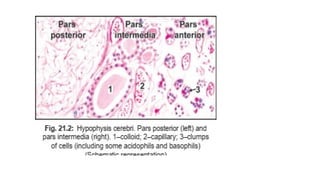
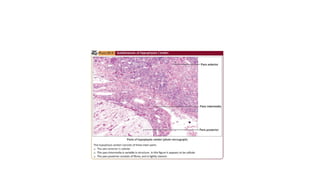
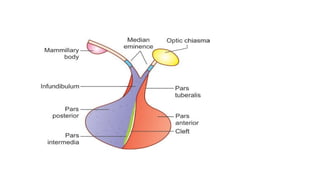
• The hypophysiscerebri has, been divided into adenohypophysis. an anterior part, the
pars anterior;
an intermediate part, the pars intermedia; and a posterior part the pars posterior (or
pars nervosa)
The pars anterior (which is also called the pars distalis), and the pars intermedia, are both
made up of cells having a direct secretory function. They are collectively referred to as the
adenohypophysis. An extension of the pars anterior surrounds the central nervous core of
the
infundibulum. Because of its tubular shape this extension is called the pars tuberalis. The
pars
tuberalis is part of the adenohypophysis.
6.
• neurohypophysis
• Thepars posterior contains numerous nerve fibres. It is directly
continuous with the central
core of the infundibular stalk which is made up of nervous tissue.
These two parts (pars
posterior and infundibular stalk) are together referred to as the
neurohypophysis.
8.
• AdenoHypopHysis
pars Anterior
Itaccounts for 75% of the mass of the hypophysis, it mainly consists
of cords of epithelial
cells (hormone-secreting cells) interspersed with fenestrated
capillaries. With few
fibroblasts producing reticular fibers that support these cords.
o These secretory cells are classified as Chromophobes and
Chromophils.
9.
• Chromophil cellsthat have brightly staining granules in their
cytoplasm
‰‰ Chromophobe cells in which granules are not prominent.
10.
•
The Chromophobesdo not effectively take a stain, so they appear clear in the
Mallory trichrome stain. These cells are undifferentiated cells but are capable of
differentiating into chromophils.
The
Chromophils include:
Basophils when the granules stain with basic dyes (like haematoxylin) (beta cells)
Acidophils when their granules stain with acid dyes
(like eosin or orange G) (alpha cells)
o Subtypes of basophilic and acidophilic cells are identified by immunohistochemical stains
•
and are named for their specific hormones or target cells
11.
Types of AcidophilCells
•
‰‰ Somatotrophs produce the somatropic hormone [also called
somatotropin (STH), or
growth hormone (GH)]. Th is hormone controls body growth, specially
before puberty.
‰‰ Mammotrophs (or lactotrophs) produce the mammotropic hormone [also
called
mammotropin, prolactin (PRL), lactogenic hormone, or LTH] which
stimulates the
growth and activity of the female mammary gland during pregnancy and
lactation.
12.
• Types ofBasophil Cells
Th e
‰‰ corticotrophs (or corticotropes) produce the corticotropic
hormone (also called
adreno-corticotropin or ACTH). Th is hormone stimulates the secretion of
some hormones
of the adrenal cortex.
• Basophilils are the gonadotropic (delta cells) FSH , luteinizing hormone
(LH )
• corticotropic, and thyrotropic cells.
13.
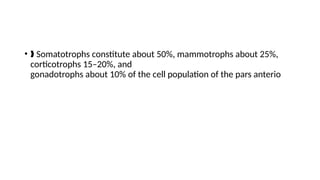
• Somatotrophs constituteabout 50%, mammotrophs about 25%,
‰
corticotrophs 15–20%, and
gonadotrophs about 10% of the cell population of the pars anterio
16.
neuroHypopHysis
pars posterior (parsnervosa)
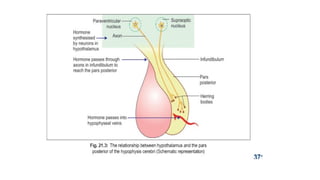
• The pars nervosa, does not contain secretory cells. It is composed of
neural tissue, containing
unmyelinated axons of secretory neurons whose cell bodies situated
in the supraoptic and
paraventricular nuclei of the hypothalamus
Also present are highly branched glial cells called pituicytes that
resemble astrocytes and are
the most abundant cell type in the posterior pituitary.
17.
The secretory neurons(in hypothalamus) have larger diameter axons and
well-developed
synthetic components related to the production of hormones vasopressin
(also called
antidiuretic hormone, ADH) and oxytocin
18.
• These hormonesare transported axonally into the pars nervosa and
accumulate in axonal
dilations called neurosecretory bodies or Herring bodies, visible in the
LM as faintly
eosinophilic structures. These bodies contain numerous membrane-
enclosed granules with
either oxytocin or vasopressin
19.
Nerve impulses alongthe axons trigger the release of the peptides
from the neurosecretory
bodies for uptake by the fenestrated capillaries of the pars nervosa and
the hormones are then
distributed to the general circulation.
Axons from the supraoptic nuclei are mainly concerned with
vasopressin secretion, whereas
most of the fibers from the paraventricular nuclei are concerned with
oxytocin secretion.
21.
• Vasopressin: (Alsocalled the antidiuretic hormone or ADH): This
hormone controls
reabsorption of water by kidney tubules.
‰‰ Oxytocin:It controls the contraction of smooth muscle of the
uterus and also of the mammary gland
23.
• pars tuberalis
Thepars tuberalis consists mainly of undifferentiated cells. Some
acidophil and basophil cells
are also present
24.
• pars intermedia
Thisis poorly developed in the human hypophysis.
• Feature is the presence of colloid filled vesicles
• These vesicles are remnants of the pouch of Rathke. Beta cells, other
secretory cells, and chromophobe
cells are present.
• Some cells of the pars intermedia produce the melanocyte stimulating
hormone (MSH) which causes increased pigmentation of the skin. Other
cells produce ACTH.
![Types of Acidophil Cells
•
‰‰ Somatotrophs produce the somatropic hormone [also called
somatotropin (STH), or
growth hormone (GH)]. Th is hormone controls body growth, specially
before puberty.
‰‰ Mammotrophs (or lactotrophs) produce the mammotropic hormone [also
called
mammotropin, prolactin (PRL), lactogenic hormone, or LTH] which
stimulates the
growth and activity of the female mammary gland during pregnancy and
lactation.](https://image.slidesharecdn.com/pituitaryglanddone4-260106140220-c0a5c7b0/85/Pituitary-Gland-presentation-presentation-pptx-11-320.jpg)