quote
 “Is it right to probe so deeply into Nature's secrets? The question must here be raised whether
it will benefit mankind, or whether the knowledge will be harmful.”
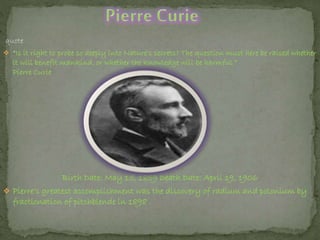
Pierre Curie
Birth Date: May 15, 1859 Death Date: April 19, 1906
 Pierre’s greatest accomplishment was the discovery of radium and polonium by
fractionation of pitchblende in 1898 .
 Pierre Curie was French
 Pierre Curie was the son of Sophie-Claire Depouilly, daughter of a manufacturer,
and of Eugène Curie, a physician. His wife was formerly Marie
Sklodowska, daughter of a secondary-school teacher at Warsaw,
Poland. One daughter, Irene, married Frederic Joliot and they were
joint recipients of the Nobel Pirzze for chemistry 1935. The younger
daughter, Eve, married the American diplomat H. R. Labouisse. They
have both taken lively interest in social problems, and as Director of
the United Nations' Children's Fund he received on its behalf the
Nobel peace Prize in Oslo in 1965. She is the author of a famous
biography of her mother, Madame Curie (Gallimard, Paris, 1938),
translated into several languages.
Pierre Curie was educated at home then Curie attended the Sorbonne in Paris, where
he became an assistant teacher in 1878. By 1880 he and his older brother,
Jacques, had earned notice for their work demonstrating the electrical potential of
quartz crystals when pressure was applied, a phenomenon called piezoelectricity.
Pierre took a post at the Paris Municipal School of Industrial Physics and
Chemistry and went on to do important work in magnetism, including the
discovery that there is a critical temperature at which the magnetic properties of a
substance disappear (called the Curie point or Curie temperature)
 Together with his brother, Pierre Curie discovered piezoelectricity, a phenomenon that
enabled the development of the piezoelectrometer. A piezoelectric is an effect in which
crystals receive a charge when compressed or twisted. Pierre Curie also discovered the
Curie point, or Curie temperature, of ferromagnetic material. The Curie point is the
temperature above which the material loses its characteristic ferromagnetic properties.
In an analogy to ferromagnetism, the Curie point is also used to describe the
temperature above which piezoelectric materials lose their spontaneous polarization and
piezoelectric properties. Pierre Curie and one of his former students discovered that
radium emits heat. His work in this era formed the basis for much of the
subsequent research in nuclear physics and chemistry
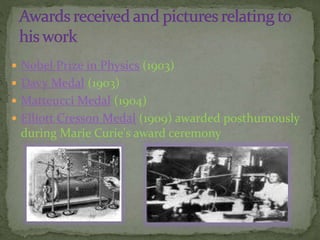
 Nobel Prize in Physics (1903)
 Davy Medal (1903)
 Matteucci Medal (1904)
 Elliott Cresson Medal (1909) awarded posthumously
during Marie Curie's award ceremony
 http://www.aip.org/history/curie/pierre.htm
 http://www.atomicarchive.com/Bios/PierreCurie.shtml
 science.discovery.com/.../inventions-04.html
 http://www.aps.org/publications/apsnews/200412/history.cf
m
 93gabher19703

Pierre Curie

  • 1.
    quote  “Is itright to probe so deeply into Nature's secrets? The question must here be raised whether it will benefit mankind, or whether the knowledge will be harmful.” Pierre Curie Birth Date: May 15, 1859 Death Date: April 19, 1906  Pierre’s greatest accomplishment was the discovery of radium and polonium by fractionation of pitchblende in 1898 .
  • 2.
     Pierre Curiewas French  Pierre Curie was the son of Sophie-Claire Depouilly, daughter of a manufacturer, and of Eugène Curie, a physician. His wife was formerly Marie Sklodowska, daughter of a secondary-school teacher at Warsaw, Poland. One daughter, Irene, married Frederic Joliot and they were joint recipients of the Nobel Pirzze for chemistry 1935. The younger daughter, Eve, married the American diplomat H. R. Labouisse. They have both taken lively interest in social problems, and as Director of the United Nations' Children's Fund he received on its behalf the Nobel peace Prize in Oslo in 1965. She is the author of a famous biography of her mother, Madame Curie (Gallimard, Paris, 1938), translated into several languages.
  • 3.
    Pierre Curie waseducated at home then Curie attended the Sorbonne in Paris, where he became an assistant teacher in 1878. By 1880 he and his older brother, Jacques, had earned notice for their work demonstrating the electrical potential of quartz crystals when pressure was applied, a phenomenon called piezoelectricity. Pierre took a post at the Paris Municipal School of Industrial Physics and Chemistry and went on to do important work in magnetism, including the discovery that there is a critical temperature at which the magnetic properties of a substance disappear (called the Curie point or Curie temperature)  Together with his brother, Pierre Curie discovered piezoelectricity, a phenomenon that enabled the development of the piezoelectrometer. A piezoelectric is an effect in which crystals receive a charge when compressed or twisted. Pierre Curie also discovered the Curie point, or Curie temperature, of ferromagnetic material. The Curie point is the temperature above which the material loses its characteristic ferromagnetic properties. In an analogy to ferromagnetism, the Curie point is also used to describe the temperature above which piezoelectric materials lose their spontaneous polarization and piezoelectric properties. Pierre Curie and one of his former students discovered that radium emits heat. His work in this era formed the basis for much of the subsequent research in nuclear physics and chemistry
  • 4.
     Nobel Prizein Physics (1903)  Davy Medal (1903)  Matteucci Medal (1904)  Elliott Cresson Medal (1909) awarded posthumously during Marie Curie's award ceremony
  • 5.
     http://www.aip.org/history/curie/pierre.htm  http://www.atomicarchive.com/Bios/PierreCurie.shtml science.discovery.com/.../inventions-04.html  http://www.aps.org/publications/apsnews/200412/history.cf m  93gabher19703