Meet 
Piattelli: 
A 
Training 
Guide 
Your guide to get to know Piattelli 
Vineyards—the people and the place 
that make our wine delicious & 
memorable.
Piattelli 
from 
Budbreak 
to 
Bottle: 
What 
You 
Need 
to 
Know 
1. Ground Work: Piattelli’s Roots 
2. Budbreak 
3. Growing Season 
4. Harvest & Winemaking 
5. Bottling 
6. Import and International Sales
Ground 
Work: 
Piattelli’s 
Roots 
The history of Piattelli and its 
people.
Rooted 
in 
Two 
Cultures 
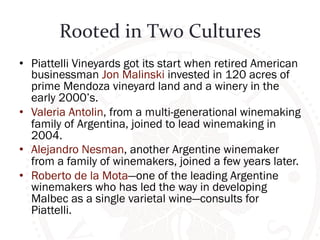
• Piattelli Vineyards got its start when retired American 
businessman Jon Malinski invested in 120 acres of 
prime Mendoza vineyard land and a winery in the 
early 2000’s. 
• Valeria Antolin, from a multi-generational winemaking 
family of Argentina, joined to lead winemaking in 
2004. 
• Alejandro Nesman, another Argentine winemaker 
from a family of winemakers, joined a few years later. 
• Roberto de la Mota—one of the leading Argentine 
winemakers who has led the way in developing 
Malbec as a single varietal wine—consults for 
Piattelli.
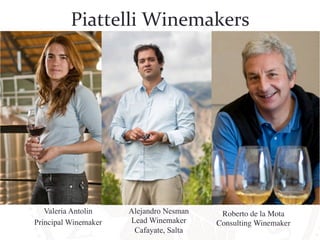
Piattelli 
Winemakers 
Valeria Antolin 
Principal Winemaker 
Alejandro Nesman 
Lead Winemaker 
Cafayate, Salta 
Roberto de la Mota 
Consulting Winemaker
Piattelli: 
The 
Name 
• The Piattelli family arrived in Argentina from Italy in 
the early 1900’s, bringing with them knowledge of 
how to work the land. They settled in Mendoza, 
known for its extraordinary characteristics for the 
cultivation of grapes. This is how the fist vines of 
what today is known as Piattelli Vineyards were first 
planted. 
• We continue to operate as a family winery, taking 
pride in our craftsmanship and creating the best 
wine we possibly can – no shortcuts.
Piattelli 
Family 
Tradition 
Continues 
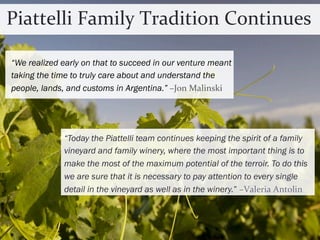
“We realized early on that to succeed in our venture meant 
taking the time to truly care about and understand the 
people, lands, and customs in Argentina.” 
–Jon 
Malinski 
“Today the Piattelli team continues keeping the spirit of a family 
vineyard and family winery, where the most important thing is to 
make the most of the maximum potential of the terroir. To do this 
we are sure that it is necessary to pay attention to every single 
detail in the vineyard as well as in the winery.” 
–Valeria 
Antolin
Piattelli 
from 
Budbreak 
to 
Bottle: 
What 
You 
Need 
to 
Know 
1. Ground Work: Piattelli’s Roots 
2. Budbreak 
3. Growing Season 
4. Harvest & Winemaking 
5. Bottling 
6. Import and International Sales
Budbreak 
The vineyards, the wineries.
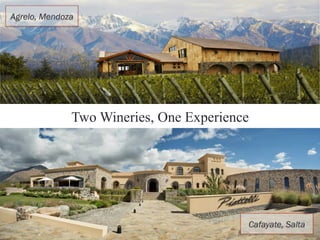
Agrelo, Mendoza 
Two Wineries, One Experience 
Cafayate, Salta
Bodega 
Piattelli: 
Mendoza 
• Location: Lujàn de Cuyo, Agrelo—the best of the best 
of Mendoza at 940 meters altitude. 
• Land: 48.7 hectares: Finca Cobos, Finca 
Cochabamba + partner vineyards in Uco Valley. 
• Weather: 300 days of sun; 8 inches of rain per year. 
Avg thermal amplitude 25°F. 
• Soil: Sandy-silt loamy soils with excellent 
drainage. Low organic matter. Deep, alluvial soil with 
small gravel appearing below one meter.
Bodega 
Piattelli: 
Salta 
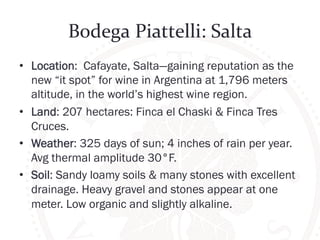
• Location: Cafayate, Salta—gaining reputation as the 
new “it spot” for wine in Argentina at 1,796 meters 
altitude, in the world’s highest wine region. 
• Land: 207 hectares: Finca el Chaski & Finca Tres 
Cruces. 
• Weather: 325 days of sun; 4 inches of rain per year. 
Avg thermal amplitude 30°F. 
• Soil: Sandy loamy soils & many stones with excellent 
drainage. Heavy gravel and stones appear at one 
meter. Low organic and slightly alkaline.
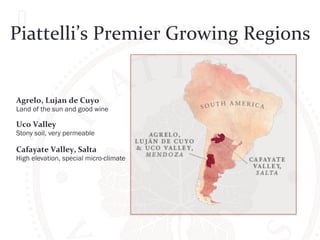
Piattelli’s 
Premier 
Growing 
Regions 
Agrelo, 
Lujan 
de 
Cuyo 
Land of the sun and good wine 
Uco 
Valley 
Stony soil, very permeable 
Cafayate 
Valley, 
Salta 
High elevation, special micro-climate
Piattelli 
from 
Budbreak 
to 
Bottle: 
What 
You 
Need 
to 
Know 
1. Ground Work: Piattelli’s Roots 
2. Budbreak 
3. Growing Season 
4. Harvest & Winemaking 
5. Bottling 
6. Import and International Sales
The 
Growing 
Season 
Unique wine from one of the world’s 
most perfect regions for wine.
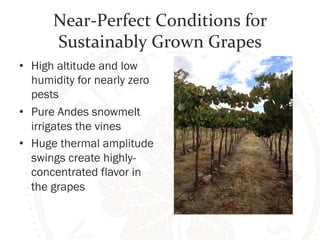
Near-­‐Perfect 
Conditions 
for 
Sustainably 
Grown 
Grapes 
• High altitude and low 
humidity for nearly zero 
pests 
• Pure Andes snowmelt 
irrigates the vines 
• Huge thermal amplitude 
swings create highly-concentrated 
flavor in 
the grapes
Natural 
& 
Organic 
Growing 
Methods 
• Piattelli’s Mendoza grapes are USDA certified organic 
• Avoid chemical fertilization by using composted 
grape byproduct to improve soil 
• Use natural alternatives to chemical pesticides 
• Conserve water through drip system and surface 
irrigation; treat water onsite
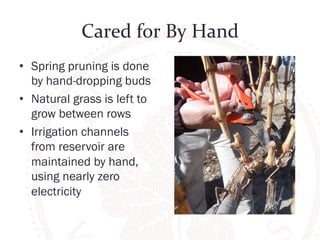
Cared 
for 
By 
Hand 
• Spring pruning is done 
by hand-dropping buds 
• Natural grass is left to 
grow between rows 
• Irrigation channels 
from reservoir are 
maintained by hand, 
using nearly zero 
electricity
Piattelli 
from 
Budbreak 
to 
Bottle: 
What 
You 
Need 
to 
Know 
1. Ground Work: Piattelli’s Roots 
2. Budbreak 
3. Growing Season 
4. Harvest & Winemaking 
5. Bottling 
6. Import and International Sales
Harvest 
& 
Winemaking 
No corners cut during the labor-intensive 
process of harvesting the 
grapes and making the wine.
Choosing 
the 
Best 
Grapes 
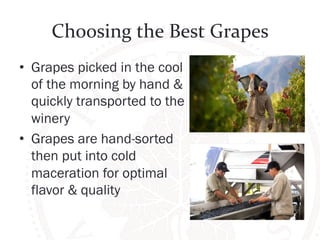
• Grapes picked in the cool 
of the morning by hand & 
quickly transported to the 
winery 
• Grapes are hand-sorted 
then put into cold 
maceration for optimal 
flavor & quality
Both 
Cutting-­‐Edge 
& 
Ultra 
Traditional 
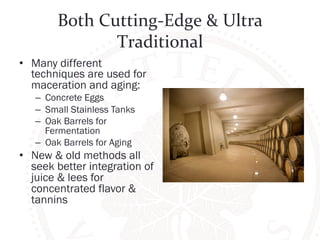
• Many different 
techniques are used for 
maceration and aging: 
– Concrete Eggs 
– Small Stainless Tanks 
– Oak Barrels for 
Fermentation 
– Oak Barrels for Aging 
• New & old methods all 
seek better integration of 
juice & lees for 
concentrated flavor & 
tannins
Piattelli 
from 
Budbreak 
to 
Bottle: 
What 
You 
Need 
to 
Know 
1. Ground Work: Piattelli’s Roots 
2. Budbreak 
3. Growing Season 
4. Harvest & Winemaking 
5. Bottling 
6. Import and International Sales
Bottling 
From the barrel and into the bottle, 
it’s a monumental annual effort 
where everyone pitches in.
Bottling 
• Bottling the previous year’s vintage to make way 
for new wine is one of the most intense 
processes at the winery each year. 
• Sanitized bottles are pre-filled with nitrogen or 
carbon dioxide to displace all oxygen. 
• The wine team samples wine every 30 min. 
• The work must be done quickly to protect the 
wine from heat, light and air – with 20 people 
working non-stop, it can take up to 15 hours to 
empty a 25,000 L tank.
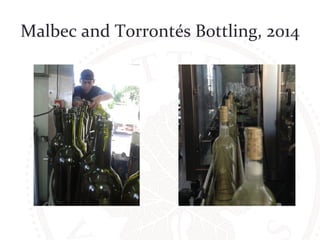
Malbec 
and 
Torrontés 
Bottling, 
2014
What’s 
Going 
into 
the 
Bottles 
• As a newer pair of wineries, Piattelli is still 
ramping up to full production capacity, which 
ultimately will be 450,000 L in Mendoza & 
960,000 L in Salta, by 2016. 
• Mendoza produces Malbec, Cabernet 
Sauvignon, Merlot and Chardonnay 
• Salta produces Malbec, Cabernet, Tannat, 
Torrontés and Chardonnay
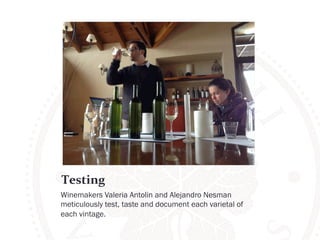
Testing 
Winemakers Valeria Antolin and Alejandro Nesman 
meticulously test, taste and document each varietal of 
each vintage.
Piattelli 
from 
Budbreak 
to 
Bottle: 
What 
You 
Need 
to 
Know 
1. Ground Work: Piattelli’s Roots 
2. Budbreak 
3. Growing Season 
4. Harvest & Winemaking 
5. Bottling 
6. Import and International Sales
Import 
& 
International 
Sales 
Taking its place among the great 
wines gaining enthusiastic fans 
around the world.
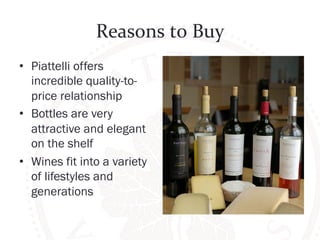
Reasons 
to 
Buy 
• Piattelli offers 
incredible quality-to-price 
relationship 
• Bottles are very 
attractive and elegant 
on the shelf 
• Wines fit into a variety 
of lifestyles and 
generations
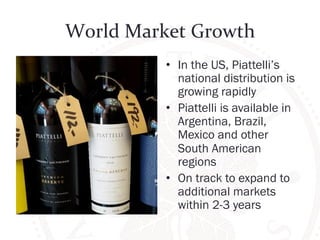
World 
Market 
Growth 
• In the US, Piattelli’s 
national distribution is 
growing rapidly 
• Piattelli is available in 
Argentina, Brazil, 
Mexico and other 
South American 
regions 
• On track to expand to 
additional markets 
within 2-3 years
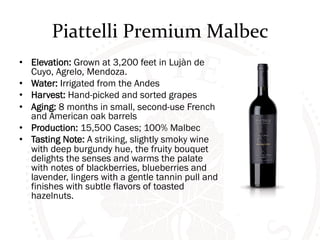
Piattelli 
Premium 
Malbec 
• Elevation: Grown at 3,200 feet in Lujàn de 
Cuyo, Agrelo, Mendoza. 
• Water: Irrigated from the Andes 
• Harvest: Hand-picked and sorted grapes 
• Aging: 8 months in small, second-use French 
and American oak barrels 
• Production: 15,500 Cases; 100% Malbec 
• Tasting Note: A striking, slightly smoky wine 
with deep burgundy hue, the fruity bouquet 
delights the senses and warms the palate 
with notes of blackberries, blueberries and 
lavender, lingers with a gentle tannin pull and 
finishes with subtle flavors of toasted 
hazelnuts.
Follow Piattelli 
Thank 
You!

Piattelli Vineyards Training Presentation

  • 2.
    Meet Piattelli: A Training Guide Your guide to get to know Piattelli Vineyards—the people and the place that make our wine delicious & memorable.
  • 3.
    Piattelli from Budbreak to Bottle: What You Need to Know 1. Ground Work: Piattelli’s Roots 2. Budbreak 3. Growing Season 4. Harvest & Winemaking 5. Bottling 6. Import and International Sales
  • 4.
    Ground Work: Piattelli’s Roots The history of Piattelli and its people.
  • 5.
    Rooted in Two Cultures • Piattelli Vineyards got its start when retired American businessman Jon Malinski invested in 120 acres of prime Mendoza vineyard land and a winery in the early 2000’s. • Valeria Antolin, from a multi-generational winemaking family of Argentina, joined to lead winemaking in 2004. • Alejandro Nesman, another Argentine winemaker from a family of winemakers, joined a few years later. • Roberto de la Mota—one of the leading Argentine winemakers who has led the way in developing Malbec as a single varietal wine—consults for Piattelli.
  • 6.
    Piattelli Winemakers ValeriaAntolin Principal Winemaker Alejandro Nesman Lead Winemaker Cafayate, Salta Roberto de la Mota Consulting Winemaker
  • 7.
    Piattelli: The Name • The Piattelli family arrived in Argentina from Italy in the early 1900’s, bringing with them knowledge of how to work the land. They settled in Mendoza, known for its extraordinary characteristics for the cultivation of grapes. This is how the fist vines of what today is known as Piattelli Vineyards were first planted. • We continue to operate as a family winery, taking pride in our craftsmanship and creating the best wine we possibly can – no shortcuts.
  • 8.
    Piattelli Family Tradition Continues “We realized early on that to succeed in our venture meant taking the time to truly care about and understand the people, lands, and customs in Argentina.” –Jon Malinski “Today the Piattelli team continues keeping the spirit of a family vineyard and family winery, where the most important thing is to make the most of the maximum potential of the terroir. To do this we are sure that it is necessary to pay attention to every single detail in the vineyard as well as in the winery.” –Valeria Antolin
  • 9.
    Piattelli from Budbreak to Bottle: What You Need to Know 1. Ground Work: Piattelli’s Roots 2. Budbreak 3. Growing Season 4. Harvest & Winemaking 5. Bottling 6. Import and International Sales
  • 10.
  • 11.
    Agrelo, Mendoza TwoWineries, One Experience Cafayate, Salta
  • 12.
    Bodega Piattelli: Mendoza • Location: Lujàn de Cuyo, Agrelo—the best of the best of Mendoza at 940 meters altitude. • Land: 48.7 hectares: Finca Cobos, Finca Cochabamba + partner vineyards in Uco Valley. • Weather: 300 days of sun; 8 inches of rain per year. Avg thermal amplitude 25°F. • Soil: Sandy-silt loamy soils with excellent drainage. Low organic matter. Deep, alluvial soil with small gravel appearing below one meter.
  • 13.
    Bodega Piattelli: Salta • Location: Cafayate, Salta—gaining reputation as the new “it spot” for wine in Argentina at 1,796 meters altitude, in the world’s highest wine region. • Land: 207 hectares: Finca el Chaski & Finca Tres Cruces. • Weather: 325 days of sun; 4 inches of rain per year. Avg thermal amplitude 30°F. • Soil: Sandy loamy soils & many stones with excellent drainage. Heavy gravel and stones appear at one meter. Low organic and slightly alkaline.
  • 14.
    Piattelli’s Premier Growing Regions Agrelo, Lujan de Cuyo Land of the sun and good wine Uco Valley Stony soil, very permeable Cafayate Valley, Salta High elevation, special micro-climate
  • 15.
    Piattelli from Budbreak to Bottle: What You Need to Know 1. Ground Work: Piattelli’s Roots 2. Budbreak 3. Growing Season 4. Harvest & Winemaking 5. Bottling 6. Import and International Sales
  • 16.
    The Growing Season Unique wine from one of the world’s most perfect regions for wine.
  • 17.
    Near-­‐Perfect Conditions for Sustainably Grown Grapes • High altitude and low humidity for nearly zero pests • Pure Andes snowmelt irrigates the vines • Huge thermal amplitude swings create highly-concentrated flavor in the grapes
  • 18.
    Natural & Organic Growing Methods • Piattelli’s Mendoza grapes are USDA certified organic • Avoid chemical fertilization by using composted grape byproduct to improve soil • Use natural alternatives to chemical pesticides • Conserve water through drip system and surface irrigation; treat water onsite
  • 19.
    Cared for By Hand • Spring pruning is done by hand-dropping buds • Natural grass is left to grow between rows • Irrigation channels from reservoir are maintained by hand, using nearly zero electricity
  • 20.
    Piattelli from Budbreak to Bottle: What You Need to Know 1. Ground Work: Piattelli’s Roots 2. Budbreak 3. Growing Season 4. Harvest & Winemaking 5. Bottling 6. Import and International Sales
  • 21.
    Harvest & Winemaking No corners cut during the labor-intensive process of harvesting the grapes and making the wine.
  • 22.
    Choosing the Best Grapes • Grapes picked in the cool of the morning by hand & quickly transported to the winery • Grapes are hand-sorted then put into cold maceration for optimal flavor & quality
  • 23.
    Both Cutting-­‐Edge & Ultra Traditional • Many different techniques are used for maceration and aging: – Concrete Eggs – Small Stainless Tanks – Oak Barrels for Fermentation – Oak Barrels for Aging • New & old methods all seek better integration of juice & lees for concentrated flavor & tannins
  • 24.
    Piattelli from Budbreak to Bottle: What You Need to Know 1. Ground Work: Piattelli’s Roots 2. Budbreak 3. Growing Season 4. Harvest & Winemaking 5. Bottling 6. Import and International Sales
  • 25.
    Bottling From thebarrel and into the bottle, it’s a monumental annual effort where everyone pitches in.
  • 26.
    Bottling • Bottlingthe previous year’s vintage to make way for new wine is one of the most intense processes at the winery each year. • Sanitized bottles are pre-filled with nitrogen or carbon dioxide to displace all oxygen. • The wine team samples wine every 30 min. • The work must be done quickly to protect the wine from heat, light and air – with 20 people working non-stop, it can take up to 15 hours to empty a 25,000 L tank.
  • 27.
    Malbec and Torrontés Bottling, 2014
  • 28.
    What’s Going into the Bottles • As a newer pair of wineries, Piattelli is still ramping up to full production capacity, which ultimately will be 450,000 L in Mendoza & 960,000 L in Salta, by 2016. • Mendoza produces Malbec, Cabernet Sauvignon, Merlot and Chardonnay • Salta produces Malbec, Cabernet, Tannat, Torrontés and Chardonnay
  • 29.
    Testing Winemakers ValeriaAntolin and Alejandro Nesman meticulously test, taste and document each varietal of each vintage.
  • 30.
    Piattelli from Budbreak to Bottle: What You Need to Know 1. Ground Work: Piattelli’s Roots 2. Budbreak 3. Growing Season 4. Harvest & Winemaking 5. Bottling 6. Import and International Sales
  • 31.
    Import & International Sales Taking its place among the great wines gaining enthusiastic fans around the world.
  • 32.
    Reasons to Buy • Piattelli offers incredible quality-to-price relationship • Bottles are very attractive and elegant on the shelf • Wines fit into a variety of lifestyles and generations
  • 33.
    World Market Growth • In the US, Piattelli’s national distribution is growing rapidly • Piattelli is available in Argentina, Brazil, Mexico and other South American regions • On track to expand to additional markets within 2-3 years
  • 34.
    Piattelli Premium Malbec • Elevation: Grown at 3,200 feet in Lujàn de Cuyo, Agrelo, Mendoza. • Water: Irrigated from the Andes • Harvest: Hand-picked and sorted grapes • Aging: 8 months in small, second-use French and American oak barrels • Production: 15,500 Cases; 100% Malbec • Tasting Note: A striking, slightly smoky wine with deep burgundy hue, the fruity bouquet delights the senses and warms the palate with notes of blackberries, blueberries and lavender, lingers with a gentle tannin pull and finishes with subtle flavors of toasted hazelnuts.
  • 35.