Physiology of the
Female Reproductive
System
Physiological Stages
• Neonatal period: birth---4 weeks
• Childhood: 4 weeks----12 years
• Puberty: 12 years---18 years
• Sexual maturation: 18 year---50 year
• Perimenopause: decline of ovarian
function (40 years)----1 year
postmenopause
• Postmenopause:
www.freelivedoctor.com
Menstruation
• Menstruation
cyclic endometrium sheds and bleeds due to
cyclic ovulation
• Mense
4. Endometrium is sloughed (progesterone
withdrawal)
5. Nonclotting menstrual blood mainly comes
from artery (75%)
6. Interval: 24-35 days (28 days). duration: 2-6
days. the first day of menstrual bleeding is
consideredy by day 1
7. Shedding: 30-50 ml
www.freelivedoctor.com
Central reproductive hormones
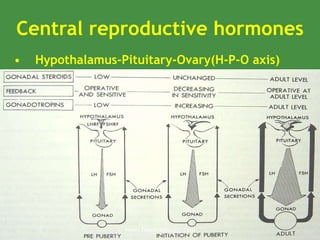
• Hypothalamus-Pituitary-Ovary(H-P-O axis)
www.freelivedoctor.com
Central reproductive hormones
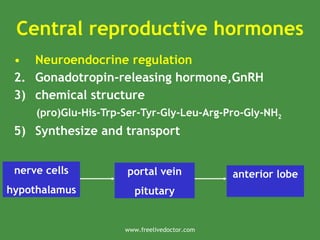
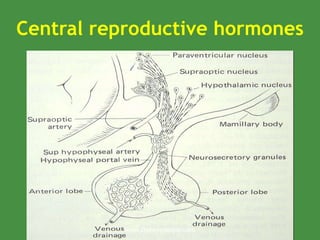
• Neuroendocrine regulation
2. Gonadotropin-releasing hormone,GnRH
3) chemical structure
(pro)Glu-His-Trp-Ser-Tyr-Gly-Leu-Arg-Pro-Gly-NH2
5) Synthesize and transport
nerve cells
hypothalamus
portal vein
pitutary
anterior lobe
www.freelivedoctor.com
Central reproductive hormones
www.freelivedoctor.com
Central reproductive hormones
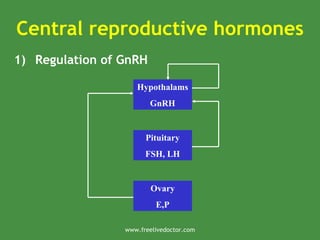
1) Regulation of GnRH
Hypothalams
GnRH
Pituitary
FSH, LH
Ovary
E,P
www.freelivedoctor.com
Central reproductive hormones
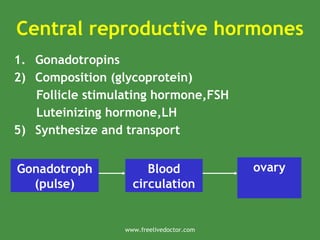
1. Gonadotropins
2) Composition (glycoprotein)
Follicle stimulating hormone,FSH
Luteinizing hormone,LH
5) Synthesize and transport
Gonadotroph
(pulse)
Blood
circulation
ovary
www.freelivedoctor.com
Central reproductive hormones
1. Prolactin (PRL)
Regulated by the prolactin inhibiting factor (PIF)
www.freelivedoctor.com
The Ovarian cycle
• Function of ovary
2. Reproduction
development and maturation of follicle;
ovulation
4. Endocrine
estrogens, progesterone, testosterone
www.freelivedoctor.com
The Ovarian cycle
• Cyclic changes of ovary
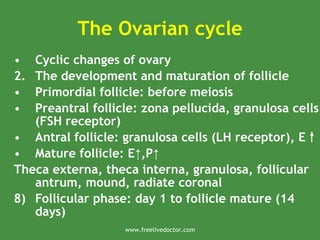
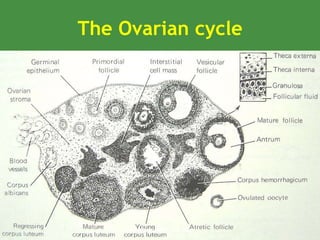
2. The development and maturation of follicle
• Primordial follicle: before meiosis
• Preantral follicle: zona pellucida, granulosa cells
(FSH receptor)
• Antral follicle: granulosa cells (LH receptor), E↑
• Mature follicle: E ,P
↑ ↑
Theca externa, theca interna, granulosa, follicular
antrum, mound, radiate coronal
8) Follicular phase: day 1 to follicle mature (14
days)
www.freelivedoctor.com
The Ovarian cycle
www.freelivedoctor.com
The Ovarian cycle
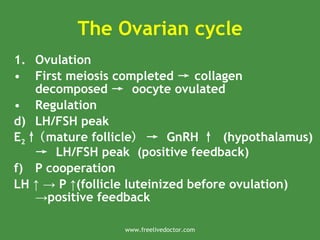
1. Ovulation
• First meiosis completed → collagen
decomposed → oocyte ovulated
• Regulation
d) LH/FSH peak
E2↑(mature follicle) → GnRH ↑ (hypothalamus)
→ LH/FSH peak (positive feedback)
f) P cooperation
LH P (follicle luteinized before ovulation)
↑ → ↑
positive feedback
→
www.freelivedoctor.com
The Ovarian cycle
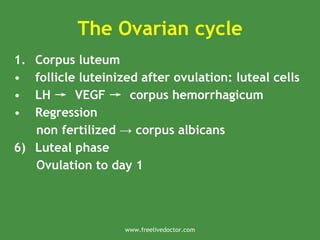
1. Corpus luteum
• follicle luteinized after ovulation: luteal cells
• LH → VEGF → corpus hemorrhagicum
• Regression
non fertilized corpus albicans
→
6) Luteal phase
Ovulation to day 1
www.freelivedoctor.com
The Ovarian cycle
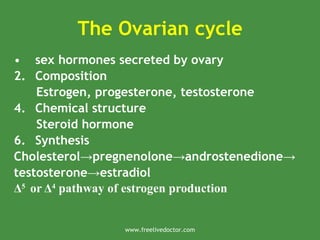
• sex hormones secreted by ovary
2. Composition
Estrogen, progesterone, testosterone
4. Chemical structure
Steroid hormone
6. Synthesis
Cholesterol pregnenolone androstenedione
→ → →
testosterone estradiol
→
Δ5
or Δ4
pathway of estrogen production
www.freelivedoctor.com
The Ovarian cycle
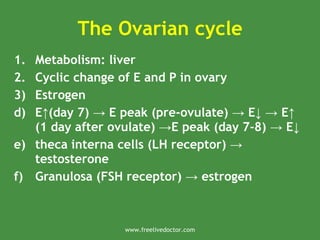
1. Metabolism: liver
2. Cyclic change of E and P in ovary
3) Estrogen
d) E (day 7) E peak (pre-ovulate) E E
↑ → → ↓ → ↑
(1 day after ovulate) E peak (day 7-8) E
→ → ↓
e) theca interna cells (LH receptor) →
testosterone
f) Granulosa (FSH receptor) estrogen
→
www.freelivedoctor.com
The Ovarian cycle
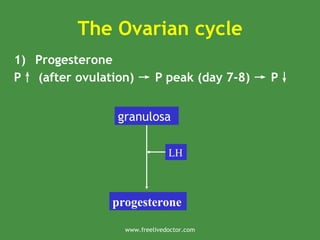
1) Progesterone
P↑ (after ovulation) → P peak (day 7-8) → P↓
granulosa
progesterone
LH
www.freelivedoctor.com
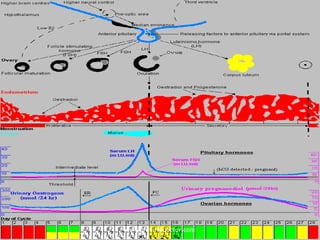
Ovarian responses
www.freelivedoctor.com
The Ovarian cycle
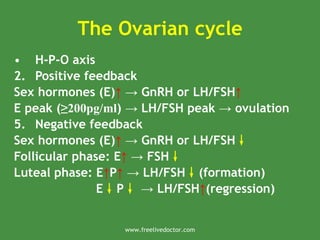
• H-P-O axis
2. Positive feedback
Sex hormones (E)↑ GnRH or LH/FSH
→ ↑
E peak (≥200pg/ml) LH/FSH peak ovulation
→ →
5. Negative feedback
Sex hormones (E)↑ GnRH or LH/FSH
→ ↓
Follicular phase: E↑ FSH
→ ↓
Luteal phase: E↑P↑ LH/FSH
→ ↓(formation)
E↓P↓ LH/FSH
→ ↑(regression)
www.freelivedoctor.com
The endometral cycle
• Proliferative phase
• E↑(mitogen)→ stroma thickens and glands
become elongated → proliferative
endometrium
• Duration: 2 weeks
• Thickness: 0.5mm → 5mm
www.freelivedoctor.com
The endometral cycle
• Secretory phase
• P↑(differentiation) → secretory endometrium
3. Features
stroma becomes loose and edematous
blood vessels entering the endometrium become
thickened and twisted
glands become tortuous and contain secretory
material within the lumina
7. Duration: 2 weeks
8. Thickness: 5-6mm
www.freelivedoctor.com
Change of Other genital organs
• Cervix
endocervical glands (E↑) mucus(thin,clear,
→
watery) maximal (ovulation)
→
endocervical glands (P↑) mucus(thick, opaque,
→
tenacious)
• Vagina
Vaginal mucosa (E↑) thickening and secretory
→
changes
Vaginal mucosa (P↑) secrete
→ ↓
www.freelivedoctor.com

physiologyofthefemalereproductivesystem-100515015545-phpapp01 (2).pdf

  • 1.
    Physiology of the FemaleReproductive System
  • 2.
    Physiological Stages • Neonatalperiod: birth---4 weeks • Childhood: 4 weeks----12 years • Puberty: 12 years---18 years • Sexual maturation: 18 year---50 year • Perimenopause: decline of ovarian function (40 years)----1 year postmenopause • Postmenopause: www.freelivedoctor.com
  • 3.
    Menstruation • Menstruation cyclic endometriumsheds and bleeds due to cyclic ovulation • Mense 4. Endometrium is sloughed (progesterone withdrawal) 5. Nonclotting menstrual blood mainly comes from artery (75%) 6. Interval: 24-35 days (28 days). duration: 2-6 days. the first day of menstrual bleeding is consideredy by day 1 7. Shedding: 30-50 ml www.freelivedoctor.com
  • 4.
    Central reproductive hormones •Hypothalamus-Pituitary-Ovary(H-P-O axis) www.freelivedoctor.com
  • 5.
    Central reproductive hormones •Neuroendocrine regulation 2. Gonadotropin-releasing hormone,GnRH 3) chemical structure (pro)Glu-His-Trp-Ser-Tyr-Gly-Leu-Arg-Pro-Gly-NH2 5) Synthesize and transport nerve cells hypothalamus portal vein pitutary anterior lobe www.freelivedoctor.com
  • 6.
  • 7.
    Central reproductive hormones 1)Regulation of GnRH Hypothalams GnRH Pituitary FSH, LH Ovary E,P www.freelivedoctor.com
  • 8.
    Central reproductive hormones 1.Gonadotropins 2) Composition (glycoprotein) Follicle stimulating hormone,FSH Luteinizing hormone,LH 5) Synthesize and transport Gonadotroph (pulse) Blood circulation ovary www.freelivedoctor.com
  • 9.
    Central reproductive hormones 1.Prolactin (PRL) Regulated by the prolactin inhibiting factor (PIF) www.freelivedoctor.com
  • 10.
    The Ovarian cycle •Function of ovary 2. Reproduction development and maturation of follicle; ovulation 4. Endocrine estrogens, progesterone, testosterone www.freelivedoctor.com
  • 11.
    The Ovarian cycle •Cyclic changes of ovary 2. The development and maturation of follicle • Primordial follicle: before meiosis • Preantral follicle: zona pellucida, granulosa cells (FSH receptor) • Antral follicle: granulosa cells (LH receptor), E↑ • Mature follicle: E ,P ↑ ↑ Theca externa, theca interna, granulosa, follicular antrum, mound, radiate coronal 8) Follicular phase: day 1 to follicle mature (14 days) www.freelivedoctor.com
  • 12.
  • 13.
    The Ovarian cycle 1.Ovulation • First meiosis completed → collagen decomposed → oocyte ovulated • Regulation d) LH/FSH peak E2↑(mature follicle) → GnRH ↑ (hypothalamus) → LH/FSH peak (positive feedback) f) P cooperation LH P (follicle luteinized before ovulation) ↑ → ↑ positive feedback → www.freelivedoctor.com
  • 14.
    The Ovarian cycle 1.Corpus luteum • follicle luteinized after ovulation: luteal cells • LH → VEGF → corpus hemorrhagicum • Regression non fertilized corpus albicans → 6) Luteal phase Ovulation to day 1 www.freelivedoctor.com
  • 15.
    The Ovarian cycle •sex hormones secreted by ovary 2. Composition Estrogen, progesterone, testosterone 4. Chemical structure Steroid hormone 6. Synthesis Cholesterol pregnenolone androstenedione → → → testosterone estradiol → Δ5 or Δ4 pathway of estrogen production www.freelivedoctor.com
  • 16.
    The Ovarian cycle 1.Metabolism: liver 2. Cyclic change of E and P in ovary 3) Estrogen d) E (day 7) E peak (pre-ovulate) E E ↑ → → ↓ → ↑ (1 day after ovulate) E peak (day 7-8) E → → ↓ e) theca interna cells (LH receptor) → testosterone f) Granulosa (FSH receptor) estrogen → www.freelivedoctor.com
  • 17.
    The Ovarian cycle 1)Progesterone P↑ (after ovulation) → P peak (day 7-8) → P↓ granulosa progesterone LH www.freelivedoctor.com
  • 18.
  • 19.
    The Ovarian cycle •H-P-O axis 2. Positive feedback Sex hormones (E)↑ GnRH or LH/FSH → ↑ E peak (≥200pg/ml) LH/FSH peak ovulation → → 5. Negative feedback Sex hormones (E)↑ GnRH or LH/FSH → ↓ Follicular phase: E↑ FSH → ↓ Luteal phase: E↑P↑ LH/FSH → ↓(formation) E↓P↓ LH/FSH → ↑(regression) www.freelivedoctor.com
  • 20.
    The endometral cycle •Proliferative phase • E↑(mitogen)→ stroma thickens and glands become elongated → proliferative endometrium • Duration: 2 weeks • Thickness: 0.5mm → 5mm www.freelivedoctor.com
  • 21.
    The endometral cycle •Secretory phase • P↑(differentiation) → secretory endometrium 3. Features stroma becomes loose and edematous blood vessels entering the endometrium become thickened and twisted glands become tortuous and contain secretory material within the lumina 7. Duration: 2 weeks 8. Thickness: 5-6mm www.freelivedoctor.com
  • 22.
    Change of Othergenital organs • Cervix endocervical glands (E↑) mucus(thin,clear, → watery) maximal (ovulation) → endocervical glands (P↑) mucus(thick, opaque, → tenacious) • Vagina Vaginal mucosa (E↑) thickening and secretory → changes Vaginal mucosa (P↑) secrete → ↓ www.freelivedoctor.com