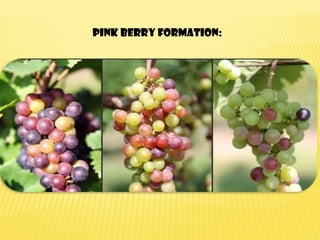
PINK BERRY FORMATION:
Disorderis common in Thompson Seedless and
its clone Tas-A-Ganesh [Maharashtra].
Pink blush develops on a few ripe berries close
to harvesting.
The pink colour turns into dull red and the
berry becomes soft and watery.
REMEDY: Spray 0.2% ascorbic acid and 0.25%
sodium dimethyl dithiocarbamate at fortnightly
intervals.
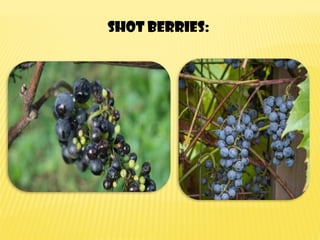
SHOT BERRY:
The berriesbecome under developed and
undesirable in the bunch.
Perlette is prone to this disorder.
This is due to the formation of number of
bunches on the wine.
REMEDY: Dipping the bunches at the berry
stage in ethephon @ 25 ppm for 1 minute will
control this disorder.
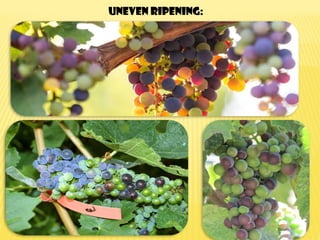
Uneven ripening:
Presence ofgreen berries in ripen bunch of
coloured grapes is called Uneven Ripening.
It is a varietal character and problem in
Bangalore Blue, Beauty Seedless and Gulabi Grapes.
Generally inadequate leaf area and non-
availability of reserves to a developing bunch is the
reason.
REMEDY: Application of Ethephon @250ppm at
colour break stage is recommended to reduce this
problem.
Post- harvest berrydrop:
This is due to weak pedicel attachment to
berries.
This disorder is common in Anab-e-Shahi,
Cheema Sahebi and Beauty Seedless.
REMEDY: Spraying of NAA @ 50 ppm, a week
prior to harvesting can minimize the post-
harvest berry drop.
9.
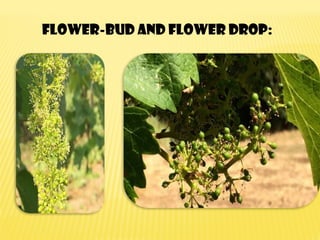
FLOWER- BUD ANDFLOWER DROP:
When panicles are fully expanded, the flower-
buds drop before the fruit set.
This is common in North India but not in
South India.
The reasons for this disorder is not known.
REMEDY: Stem girdling about 10 days prior to
full bloom can reduce this problem.
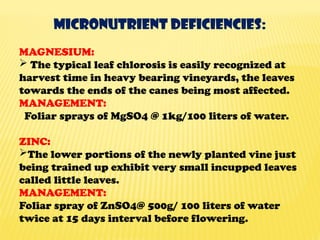
Micronutrient deficiencies:
MAGNESIUM:
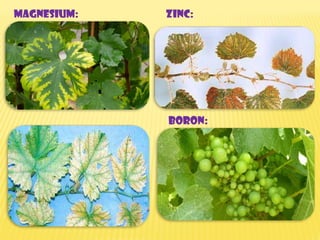
Thetypical leaf chlorosis is easily recognized at
harvest time in heavy bearing vineyards, the leaves
towards the ends of the canes being most affected.
MANAGEMENT:
Foliar sprays of MgSO4 @ 1kg/100 liters of water.
ZINC:
The lower portions of the newly planted vine just
being trained up exhibit very small incupped leaves
called little leaves.
MANAGEMENT:
Foliar spray of ZnSO4@ 500g/ 100 liters of water
twice at 15 days interval before flowering.
12.
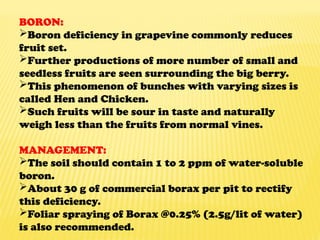
BORON:
Boron deficiency ingrapevine commonly reduces
fruit set.
Further productions of more number of small and
seedless fruits are seen surrounding the big berry.
This phenomenon of bunches with varying sizes is
called Hen and Chicken.
Such fruits will be sour in taste and naturally
weigh less than the fruits from normal vines.
MANAGEMENT:
The soil should contain 1 to 2 ppm of water-soluble
boron.
About 30 g of commercial borax per pit to rectify
this deficiency.
Foliar spraying of Borax @0.25% (2.5g/lit of water)
is also recommended.

![PINK BERRY FORMATION:
Disorder is common in Thompson Seedless and
its clone Tas-A-Ganesh [Maharashtra].
Pink blush develops on a few ripe berries close
to harvesting.
The pink colour turns into dull red and the
berry becomes soft and watery.
REMEDY: Spray 0.2% ascorbic acid and 0.25%
sodium dimethyl dithiocarbamate at fortnightly
intervals.](https://image.slidesharecdn.com/physiologicaldisordersingrapes-250227041926-7c3481d2/85/physiological-disorders-in-grapes-pptx-2-320.jpg)