Learning Object 3: Velocity of a Traveling Wave
Igor Mihajlovic 25949141
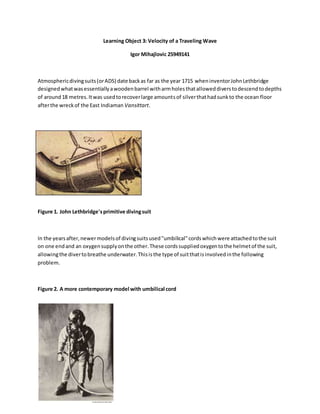
Atmosphericdivingsuits(orADS) date backas far as the year 1715 wheninventorJohnLethbridge
designedwhatwasessentiallyawoodenbarrel witharmholesthatalloweddiverstodescendtodepths
of around18 metres.Itwas usedtorecoverlarge amountsof silverthathadsunkto the ocean floor
afterthe wreckof the East Indiaman Vansittart.
Figure 1. John Lethbridge'sprimitive divingsuit
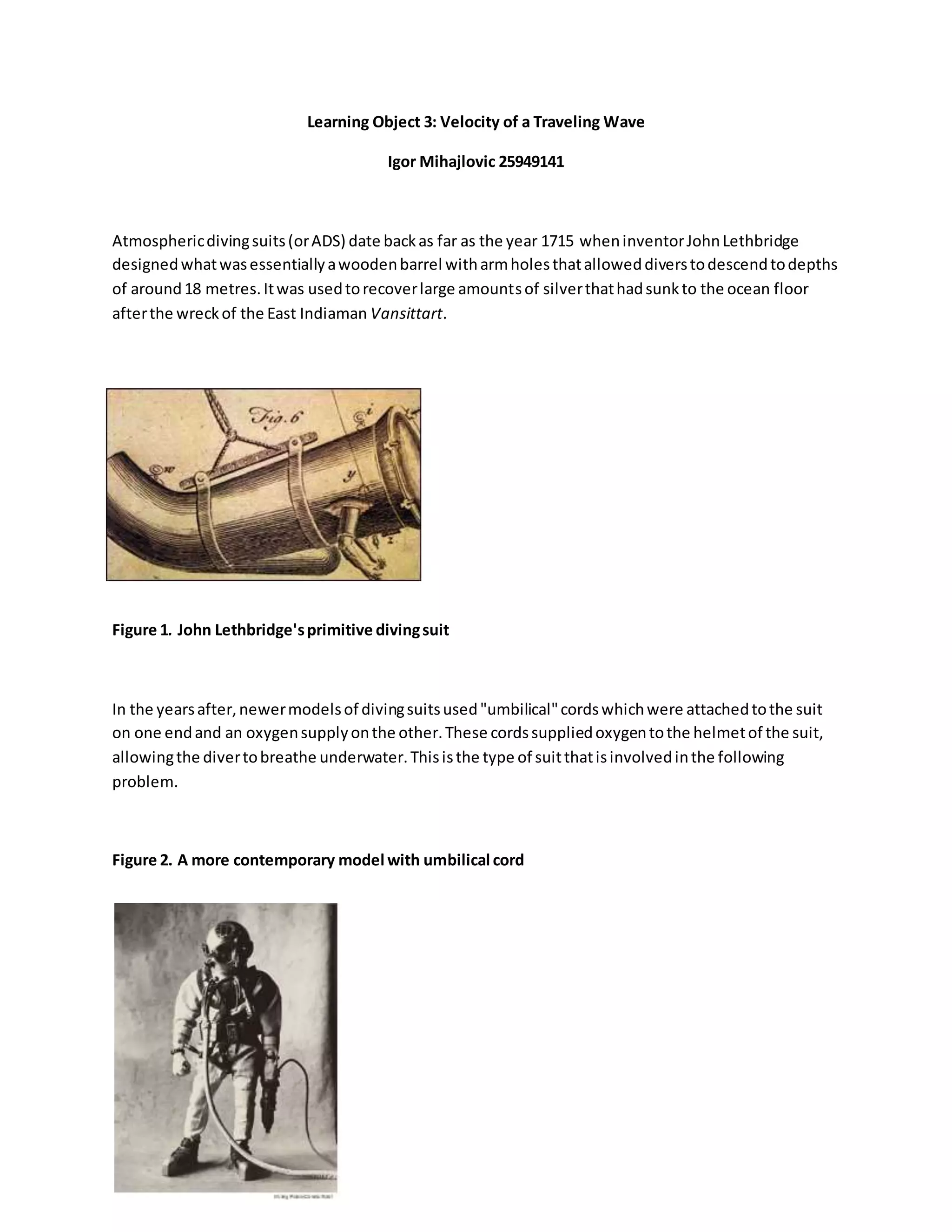
In the yearsafter,newermodelsof divingsuitsused"umbilical"cordswhichwere attachedtothe suit
on one endand an oxygensupplyonthe other.These cordssuppliedoxygentothe helmetof the suit,
allowingthe divertobreathe underwater.Thisisthe type of suitthatisinvolvedinthe following
problem.
Figure 2. A more contemporary model with umbilical cord
Problem:
A 75-kilogramdiverisexploring underwaterina 100-kilogramdivingsuit.Hersuitisattachedto a 10
metre longumbilical cord thatrunsup to a boat on the surface of the water.Suddenly,the diverspotsa
shark andfranticallyshakesthe cordto alerthercrewmates. Assumingthatthe cord weighs1 kilogram
and the average densityof the diver withsuitis7000 kilogramspercubicmetre, approximatelyhow
longwill ittake forher crewto notice the motioninthe cord? Ignore the dampingeffectof water onthe
velocityof the wave.
Solution:
We knowthatthe velocityof awave in the cord can be expressedby the formula
𝑣 = √(𝑇 + 𝜇𝑥𝑔)/𝜇
where 𝑇 isthe tensioninthe cord,µ isthe linearmassdensityof the cord, 𝑔 isthe gravitational constant
and 𝑥 is the heightfromthe divertoa pointinthe cord. Since we are askedforan approximation,we
will assume thatthe tensioninthe cordwill increase byanegligible amountwithincreasedheight,and
thuswe can approximate the velocityof the wave asconstant,
𝑣 = √𝑇/𝜇
We knowthatthe tensioninthe cordwill be equal tothe apparentweightof the diver plussuitinthe
water,whichisgivenbythe formula
𝑊𝑎 = 𝑊 − 𝐹𝑏
where 𝑊 isthe weightof the diverplussuitonlandand 𝐹𝑏 isthe buoyantforce actingon the diver.
The above formulacan be re-writtenas
𝑊 − 𝐹𝑏 = 𝑀𝑔 − 𝜌𝑉𝑔
where 𝑀 isthe mass of the diverplussuit, 𝑉 isthe volume of the diverand 𝜌 isthe densityof water.
Substitutingknownvaluesintothe equation,we arrive at
𝑊𝑎 = 𝑀𝑔 − 𝜌𝑉𝑔 = (75𝑘𝑔 + 100𝑘𝑔) (9.81
𝑚
𝑠2)− (1000
𝑘𝑔
𝑚3
)(
75𝑘𝑔 + 100𝑘𝑔
7000
𝑘𝑔
𝑚3
)(9.81
𝑚
𝑠2)
= 1471.5𝑁
We alsoknowthat the linearmassdensity of the cord is givenbythe formula
𝜇 = 𝑀𝑐/𝐿
where 𝑀𝑐 isthe mass of the cord and 𝐿 is the lengthof the cord. Substitutinginthe givenvalueswe
arrive at
𝜇 =
1𝑘𝑔
10𝑚
= 0.1
𝑘𝑔
𝑚
We can now substitute inourcalculatedvaluesfor 𝑇 and 𝜇 intothe velocityequationtofindthe speed
of the wave:
𝑣 = √𝑇/𝜇 = √
1471.5𝑁
0.1
𝑘𝑔
𝑚
= 121.3
𝑚
𝑠
Nowthat we knowthe velocityof the wave,we canfindthe time ittakesfor the wave to travel the
lengthof the cord by usingthe relationship
𝑣 =
𝑑
𝑡
where 𝑑 isthe distance travelledand 𝑡 isthe amountof time elapsed.Re-arrangingandsolvingfortime
we arrive at
𝑡 =
𝑑
𝑣
=
10𝑚
(121.3
𝑚
𝑠
)
= 0.082𝑠
Thus,it takesabout0.082 secondsforthe diver'screwmatestorealize she isindanger.
Picture Links:
http://en.wikipedia.org/wiki/Atmospheric_diving_suit
http://2.bp.blogspot.com/-AbE2EgIz060/UFvWGkk7mZI/AAAAAAAAAkc/gkSDecHSbto/s640/wpid-deep-
sea-diver-19511.jpg

Physics Learning Object 3

  • 1.
    Learning Object 3:Velocity of a Traveling Wave Igor Mihajlovic 25949141 Atmosphericdivingsuits(orADS) date backas far as the year 1715 wheninventorJohnLethbridge designedwhatwasessentiallyawoodenbarrel witharmholesthatalloweddiverstodescendtodepths of around18 metres.Itwas usedtorecoverlarge amountsof silverthathadsunkto the ocean floor afterthe wreckof the East Indiaman Vansittart. Figure 1. John Lethbridge'sprimitive divingsuit In the yearsafter,newermodelsof divingsuitsused"umbilical"cordswhichwere attachedtothe suit on one endand an oxygensupplyonthe other.These cordssuppliedoxygentothe helmetof the suit, allowingthe divertobreathe underwater.Thisisthe type of suitthatisinvolvedinthe following problem. Figure 2. A more contemporary model with umbilical cord
  • 2.
    Problem: A 75-kilogramdiverisexploring underwaterina100-kilogramdivingsuit.Hersuitisattachedto a 10 metre longumbilical cord thatrunsup to a boat on the surface of the water.Suddenly,the diverspotsa shark andfranticallyshakesthe cordto alerthercrewmates. Assumingthatthe cord weighs1 kilogram and the average densityof the diver withsuitis7000 kilogramspercubicmetre, approximatelyhow longwill ittake forher crewto notice the motioninthe cord? Ignore the dampingeffectof water onthe velocityof the wave. Solution: We knowthatthe velocityof awave in the cord can be expressedby the formula 𝑣 = √(𝑇 + 𝜇𝑥𝑔)/𝜇 where 𝑇 isthe tensioninthe cord,µ isthe linearmassdensityof the cord, 𝑔 isthe gravitational constant and 𝑥 is the heightfromthe divertoa pointinthe cord. Since we are askedforan approximation,we will assume thatthe tensioninthe cordwill increase byanegligible amountwithincreasedheight,and thuswe can approximate the velocityof the wave asconstant, 𝑣 = √𝑇/𝜇 We knowthatthe tensioninthe cordwill be equal tothe apparentweightof the diver plussuitinthe water,whichisgivenbythe formula 𝑊𝑎 = 𝑊 − 𝐹𝑏 where 𝑊 isthe weightof the diverplussuitonlandand 𝐹𝑏 isthe buoyantforce actingon the diver. The above formulacan be re-writtenas 𝑊 − 𝐹𝑏 = 𝑀𝑔 − 𝜌𝑉𝑔 where 𝑀 isthe mass of the diverplussuit, 𝑉 isthe volume of the diverand 𝜌 isthe densityof water. Substitutingknownvaluesintothe equation,we arrive at 𝑊𝑎 = 𝑀𝑔 − 𝜌𝑉𝑔 = (75𝑘𝑔 + 100𝑘𝑔) (9.81 𝑚 𝑠2)− (1000 𝑘𝑔 𝑚3 )( 75𝑘𝑔 + 100𝑘𝑔 7000 𝑘𝑔 𝑚3 )(9.81 𝑚 𝑠2) = 1471.5𝑁
  • 3.
    We alsoknowthat thelinearmassdensity of the cord is givenbythe formula 𝜇 = 𝑀𝑐/𝐿 where 𝑀𝑐 isthe mass of the cord and 𝐿 is the lengthof the cord. Substitutinginthe givenvalueswe arrive at 𝜇 = 1𝑘𝑔 10𝑚 = 0.1 𝑘𝑔 𝑚 We can now substitute inourcalculatedvaluesfor 𝑇 and 𝜇 intothe velocityequationtofindthe speed of the wave: 𝑣 = √𝑇/𝜇 = √ 1471.5𝑁 0.1 𝑘𝑔 𝑚 = 121.3 𝑚 𝑠 Nowthat we knowthe velocityof the wave,we canfindthe time ittakesfor the wave to travel the lengthof the cord by usingthe relationship 𝑣 = 𝑑 𝑡 where 𝑑 isthe distance travelledand 𝑡 isthe amountof time elapsed.Re-arrangingandsolvingfortime we arrive at 𝑡 = 𝑑 𝑣 = 10𝑚 (121.3 𝑚 𝑠 ) = 0.082𝑠 Thus,it takesabout0.082 secondsforthe diver'screwmatestorealize she isindanger. Picture Links: http://en.wikipedia.org/wiki/Atmospheric_diving_suit http://2.bp.blogspot.com/-AbE2EgIz060/UFvWGkk7mZI/AAAAAAAAAkc/gkSDecHSbto/s640/wpid-deep- sea-diver-19511.jpg