Follow us:
www.medicalbillersandcoders.com
Physicians Billing Complexity - Medicare v/s
Medicaid
Follow us:
www.medicalbillersandcoders.com
Physicians Billing Complexity - Medicare v/s
Medicaid
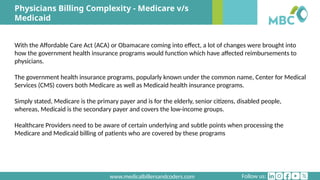
With the Affordable Care Act (ACA) or Obamacare coming into effect, a lot of changes were brought into
how the government health insurance programs would function which have affected reimbursements to
physicians.
The government health insurance programs, popularly known under the common name, Center for Medical
Services (CMS) covers both Medicare as well as Medicaid health insurance programs.
Simply stated, Medicare is the primary payer and is for the elderly, senior citizens, disabled people,
whereas, Medicaid is the secondary payer and covers the low-income groups.
Healthcare Providers need to be aware of certain underlying and subtle points when processing the
Medicare and Medicaid billing of patients who are covered by these programs
Follow us:
www.medicalbillersandcoders.com
Physicians Billing Complexity - Medicare v/s
Medicaid
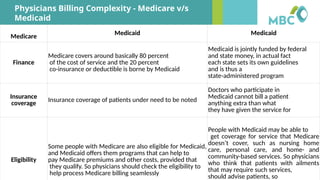
Medicare Medicaid Medicaid
Finance
Medicare covers around basically 80 percent
of the cost of service and the 20 percent
co-insurance or deductible is borne by Medicaid
Medicaid is jointly funded by federal
and state money, in actual fact
each state sets its own guidelines
and is thus a
state-administered program
Insurance
coverage Insurance coverage of patients under need to be noted
Doctors who participate in
Medicaid cannot bill a patient
anything extra than what
they have given the service for
Eligibility
Some people with Medicare are also eligible for Medicaid,
and Medicaid offers them programs that can help to
pay Medicare premiums and other costs, provided that
they qualify. So physicians should check the eligibility to
help process Medicare billing seamlessly
People with Medicaid may be able to
get coverage for service that Medicare
doesn’t cover, such as nursing home
care, personal care, and home- and
community-based services. So physicians
who think that patients with ailments
that may require such services,
should advise patients, so
Follow us:
www.medicalbillersandcoders.com
Physicians Billing Complexity - Medicare v/s
Medicaid
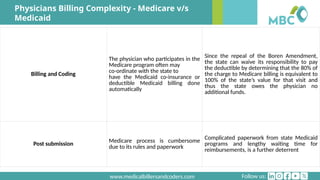
Billing and Coding
The physician who participates in the
Medicare program often may
co-ordinate with the state to
have the Medicaid co-insurance or
deductible Medicaid billing done
automatically
Since the repeal of the Boren Amendment,
the state can waive its responsibility to pay
the deductible by determining that the 80% of
the charge to Medicare billing is equivalent to
100% of the state’s value for that visit and
thus the state owes the physician no
additional funds.
Post submission
Medicare process is cumbersome
due to its rules and paperwork
Complicated paperwork from state Medicaid
programs and lengthy waiting time for
reimbursements, is a further deterrent
Follow us:
www.medicalbillersandcoders.com
Physicians Billing Complexity - Medicare v/s
Medicaid
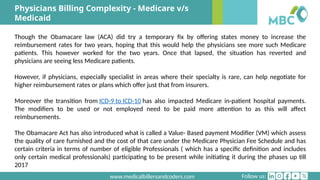
Though the Obamacare law (ACA) did try a temporary fix by offering states money to increase the
reimbursement rates for two years, hoping that this would help the physicians see more such Medicare
patients. This however worked for the two years. Once that lapsed, the situation has reverted and
physicians are seeing less Medicare patients.
However, if physicians, especially specialist in areas where their specialty is rare, can help negotiate for
higher reimbursement rates or plans which offer just that from insurers.
Moreover the transition from ICD-9 to ICD-10 has also impacted Medicare in-patient hospital payments.
The modifiers to be used or not employed need to be paid more attention to as this will affect
reimbursements.
The Obamacare Act has also introduced what is called a Value- Based payment Modifier (VM) which assess
the quality of care furnished and the cost of that care under the Medicare Physician Fee Schedule and has
certain criteria in terms of number of eligible Professionals ( which has a specific definition and includes
only certain medical professionals) participating to be present while initiating it during the phases up till
2017
Follow us:
www.medicalbillersandcoders.com
Physicians Billing Complexity - Medicare v/s
Medicaid
However, some good news, in April this year, 2015, the legislation headed off a 21 percent cut in doctors'
Medicare fees that would have taken effect when the government planned to begin processing physicians'
claims reflecting that reduction.
The bill also provides billions of extra dollars for health care programs for children and low-income families,
including additional money for community health centers.
An alternative for physicians who have enrolled under the Medicare scheme and to help concentrate on
their value based performance to help out the numerous patients who could stream in given the spurt in
insurance now available, and would likely cause a sizeable decrease in their income, if they do stop seeing
such patients, would be to outsource this administrative work.
By engaging with a credential specialist, Medicare enrollment procedures, getting into the insurance
network so that streamlining your reimbursement process becomes easier to handle, will help physicians
derive more from the Medicare & Medicaid billing and coding system increasing revenues in the long run.
Follow us:
www.medicalbillersandcoders.com
Physicians Billing Complexity - Medicare v/s
Medicaid
FAQs
1. What’s the main difference between Medicare and Medicaid billing?
Medicare is a federal program covering older adults and the disabled, while Medicaid is jointly funded by
federal/state governments and managed by each state.
2. Can a patient be covered by both Medicare and Medicaid?
Yes—some people qualify for both, where Medicare is primary and Medicaid helps pay coinsurance,
deductibles, and extra services .
3. Who covers the 20% coinsurance under Medicare?
Typically, Medicaid covers that 20% Medicare coinsurance or deductible if the patient is dually eligible .
Follow us:
www.medicalbillersandcoders.com
Physicians Billing Complexity - Medicare v/s
Medicaid
4. Why do physicians need to check eligibility carefully?
Eligibility changes billing rules: for dual-eligibles, Medicaid covers cost-sharing; otherwise billing will differ .
5. Which program covers services like nursing home care or home health?
Medicaid often covers community-based services (nursing homes, personal/home care) that Medicare
usually does not .

Physicians Billing Complexity - Medicare vs Medicaid.pptx

  • 1.
  • 2.
    Follow us: www.medicalbillersandcoders.com Physicians BillingComplexity - Medicare v/s Medicaid With the Affordable Care Act (ACA) or Obamacare coming into effect, a lot of changes were brought into how the government health insurance programs would function which have affected reimbursements to physicians. The government health insurance programs, popularly known under the common name, Center for Medical Services (CMS) covers both Medicare as well as Medicaid health insurance programs. Simply stated, Medicare is the primary payer and is for the elderly, senior citizens, disabled people, whereas, Medicaid is the secondary payer and covers the low-income groups. Healthcare Providers need to be aware of certain underlying and subtle points when processing the Medicare and Medicaid billing of patients who are covered by these programs
  • 3.
    Follow us: www.medicalbillersandcoders.com Physicians BillingComplexity - Medicare v/s Medicaid Medicare Medicaid Medicaid Finance Medicare covers around basically 80 percent of the cost of service and the 20 percent co-insurance or deductible is borne by Medicaid Medicaid is jointly funded by federal and state money, in actual fact each state sets its own guidelines and is thus a state-administered program Insurance coverage Insurance coverage of patients under need to be noted Doctors who participate in Medicaid cannot bill a patient anything extra than what they have given the service for Eligibility Some people with Medicare are also eligible for Medicaid, and Medicaid offers them programs that can help to pay Medicare premiums and other costs, provided that they qualify. So physicians should check the eligibility to help process Medicare billing seamlessly People with Medicaid may be able to get coverage for service that Medicare doesn’t cover, such as nursing home care, personal care, and home- and community-based services. So physicians who think that patients with ailments that may require such services, should advise patients, so
  • 4.
    Follow us: www.medicalbillersandcoders.com Physicians BillingComplexity - Medicare v/s Medicaid Billing and Coding The physician who participates in the Medicare program often may co-ordinate with the state to have the Medicaid co-insurance or deductible Medicaid billing done automatically Since the repeal of the Boren Amendment, the state can waive its responsibility to pay the deductible by determining that the 80% of the charge to Medicare billing is equivalent to 100% of the state’s value for that visit and thus the state owes the physician no additional funds. Post submission Medicare process is cumbersome due to its rules and paperwork Complicated paperwork from state Medicaid programs and lengthy waiting time for reimbursements, is a further deterrent
  • 5.
    Follow us: www.medicalbillersandcoders.com Physicians BillingComplexity - Medicare v/s Medicaid Though the Obamacare law (ACA) did try a temporary fix by offering states money to increase the reimbursement rates for two years, hoping that this would help the physicians see more such Medicare patients. This however worked for the two years. Once that lapsed, the situation has reverted and physicians are seeing less Medicare patients. However, if physicians, especially specialist in areas where their specialty is rare, can help negotiate for higher reimbursement rates or plans which offer just that from insurers. Moreover the transition from ICD-9 to ICD-10 has also impacted Medicare in-patient hospital payments. The modifiers to be used or not employed need to be paid more attention to as this will affect reimbursements. The Obamacare Act has also introduced what is called a Value- Based payment Modifier (VM) which assess the quality of care furnished and the cost of that care under the Medicare Physician Fee Schedule and has certain criteria in terms of number of eligible Professionals ( which has a specific definition and includes only certain medical professionals) participating to be present while initiating it during the phases up till 2017
  • 6.
    Follow us: www.medicalbillersandcoders.com Physicians BillingComplexity - Medicare v/s Medicaid However, some good news, in April this year, 2015, the legislation headed off a 21 percent cut in doctors' Medicare fees that would have taken effect when the government planned to begin processing physicians' claims reflecting that reduction. The bill also provides billions of extra dollars for health care programs for children and low-income families, including additional money for community health centers. An alternative for physicians who have enrolled under the Medicare scheme and to help concentrate on their value based performance to help out the numerous patients who could stream in given the spurt in insurance now available, and would likely cause a sizeable decrease in their income, if they do stop seeing such patients, would be to outsource this administrative work. By engaging with a credential specialist, Medicare enrollment procedures, getting into the insurance network so that streamlining your reimbursement process becomes easier to handle, will help physicians derive more from the Medicare & Medicaid billing and coding system increasing revenues in the long run.
  • 7.
    Follow us: www.medicalbillersandcoders.com Physicians BillingComplexity - Medicare v/s Medicaid FAQs 1. What’s the main difference between Medicare and Medicaid billing? Medicare is a federal program covering older adults and the disabled, while Medicaid is jointly funded by federal/state governments and managed by each state. 2. Can a patient be covered by both Medicare and Medicaid? Yes—some people qualify for both, where Medicare is primary and Medicaid helps pay coinsurance, deductibles, and extra services . 3. Who covers the 20% coinsurance under Medicare? Typically, Medicaid covers that 20% Medicare coinsurance or deductible if the patient is dually eligible .
  • 8.
    Follow us: www.medicalbillersandcoders.com Physicians BillingComplexity - Medicare v/s Medicaid 4. Why do physicians need to check eligibility carefully? Eligibility changes billing rules: for dual-eligibles, Medicaid covers cost-sharing; otherwise billing will differ . 5. Which program covers services like nursing home care or home health? Medicaid often covers community-based services (nursing homes, personal/home care) that Medicare usually does not .