Class: 9th
Subject: Physics
Chapter No.8
Measurement of Physical Quantities
 Physical Quantities
 System international of unites
 Prefixes
Time duration and resources matrial
 Time: 40 minutes/one period
 Materials: White board, Board marker, duster and
compute projector to show slides.
Learning outcomes
After this lecture Students will be able to
Define a physical quantities with example
Describe the international system of units
Apply the prefixes milli, kilo, centi and interpret the
unites
Interconvert smaller unites and bigger
Physical Quantities and their units
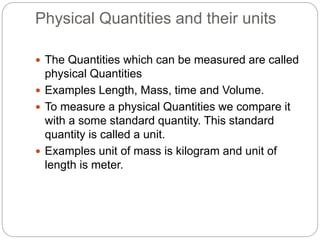
 The Quantities which can be measured are called
physical Quantities
 Examples Length, Mass, time and Volume.
 To measure a physical Quantities we compare it
with a some standard quantity. This standard
quantity is called a unit.
 Examples unit of mass is kilogram and unit of
length is meter.
International System of units
 Why international system of units?
Various standard units have been used in at
different times in different part of the world. For
example the different unit for length are
gaz,foot,yard cahin forlong etc.
 People different countries faced problem of
converting units into one an other. This leads to
the design of international system of units
International System of units
 In 1960, the conference of scientists form all over
the world held in paris.
 International committee on Weight and Measures
recommended that all countries of the world
should adopt a system of same kind of standard
units.
 The standard units decided for the physical
quantities are called system international(SI)
units.
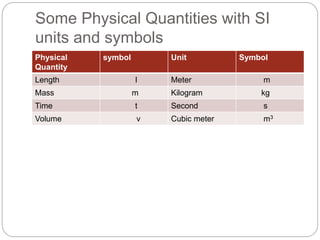
Some Physical Quantities with SI
units and symbols
Physical
Quantity
symbol Unit Symbol
Length l Meter m
Mass m Kilogram kg
Time t Second s
Volume v Cubic meter m3
Pick SI units for the following form
column A and B and Write in column
C.
Physical
Quantity
A B C
Length Gaz Meter
Time Second Minut
Volume Cubic centimeter Cubic meter
mass kilogram miligram
Prefixes
 The words or letters added before SI units are
called Prefixes. Such as milli (m), centi (c) and
kilo(k).
 Kilo means 1000 times or 103 times
 Centi means 100th part or 10-2 times
 Milli means 1000th part or 1/1000 or 10-3 times
 For little quantity we use small and for bigger we
larger units
 For example the to measure the diameter of thin
wire we use centimeter (cm) and for distance
between two cities we use kilometer (km)
Conversion rules
 Converting from larger to smaller we multiply and
from smaller to larger we divide.
 For example to convert 5m into mm
5m = 5 X 1000 mm
= 5000mm
 To convert 20000g to kg
20000 g = 20000 /1000 kg
= 20 kg
Complete the following
 1 cm = ________ m
 1 mm = _______ m
 1 mg = ________ g
 1 kg = _________g
 The mass of a bag of flour is 10 kg. What is the mass in
gram?
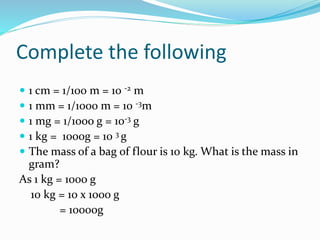
Complete the following
 1 cm = 1/100 m = 10 -2 m
 1 mm = 1/1000 m = 10 -3m
 1 mg = 1/1000 g = 10-3 g
 1 kg = 1000g = 10 3 g
 The mass of a bag of flour is 10 kg. What is the mass in
gram?
As 1 kg = 1000 g
10 kg = 10 x 1000 g
= 10000g
Summary
 The Quantities which can be measured are called
physical Quantities
 Examples Length, Mass, time and Volume.
 International committee on Weight and Measures
recommended that all countries of the world should
adopt a system of same kind of standard units. Those
units are called standard units.
 The words or letters added before SI units are called
Prefixes. Such as milli (m), centi (c) and kilo(k).
 Kilo means 1000 times or 103 times
 Centi means 100th part or 10-2 times
 Milli means 1000th part or 1/1000 or 10-3 times
Assignment /home work
 Assignment for student is to solve the following
on their note books and bring to the teacher in
next class.
 The height of a student is 150cm. What is his
height in meter?
 Convert the following in grams
i. 75.5 X 10³ g
ii. 1.58 X 10⁻² kg
iii. 440 mg
 The length of a wooden box is 25.5 cm. what is
this length in meter? In milimaters?
 Convert in minutes 3600s and 2 h
Assessment Questions
Student assessment can be check by the following
question.
 Define physical quantity?
 Give examples of physical quantity?
 What is system international of units?
 Why is system international of units?
 Define prefixes?
 What is relation between kilometer and meter?
 What is the relation between kilogram and gram?
Allah hafiz
Thank you
End of the lecture

Physical Quantities.pptx

  • 1.
  • 2.
    Chapter No.8 Measurement ofPhysical Quantities  Physical Quantities  System international of unites  Prefixes
  • 3.
    Time duration andresources matrial  Time: 40 minutes/one period  Materials: White board, Board marker, duster and compute projector to show slides.
  • 4.
    Learning outcomes After thislecture Students will be able to Define a physical quantities with example Describe the international system of units Apply the prefixes milli, kilo, centi and interpret the unites Interconvert smaller unites and bigger
  • 5.
    Physical Quantities andtheir units  The Quantities which can be measured are called physical Quantities  Examples Length, Mass, time and Volume.  To measure a physical Quantities we compare it with a some standard quantity. This standard quantity is called a unit.  Examples unit of mass is kilogram and unit of length is meter.
  • 6.
    International System ofunits  Why international system of units? Various standard units have been used in at different times in different part of the world. For example the different unit for length are gaz,foot,yard cahin forlong etc.  People different countries faced problem of converting units into one an other. This leads to the design of international system of units
  • 7.
    International System ofunits  In 1960, the conference of scientists form all over the world held in paris.  International committee on Weight and Measures recommended that all countries of the world should adopt a system of same kind of standard units.  The standard units decided for the physical quantities are called system international(SI) units.
  • 8.
    Some Physical Quantitieswith SI units and symbols Physical Quantity symbol Unit Symbol Length l Meter m Mass m Kilogram kg Time t Second s Volume v Cubic meter m3
  • 9.
    Pick SI unitsfor the following form column A and B and Write in column C. Physical Quantity A B C Length Gaz Meter Time Second Minut Volume Cubic centimeter Cubic meter mass kilogram miligram
  • 10.
    Prefixes  The wordsor letters added before SI units are called Prefixes. Such as milli (m), centi (c) and kilo(k).  Kilo means 1000 times or 103 times  Centi means 100th part or 10-2 times  Milli means 1000th part or 1/1000 or 10-3 times  For little quantity we use small and for bigger we larger units  For example the to measure the diameter of thin wire we use centimeter (cm) and for distance between two cities we use kilometer (km)
  • 11.
    Conversion rules  Convertingfrom larger to smaller we multiply and from smaller to larger we divide.  For example to convert 5m into mm 5m = 5 X 1000 mm = 5000mm  To convert 20000g to kg 20000 g = 20000 /1000 kg = 20 kg
  • 12.
    Complete the following 1 cm = ________ m  1 mm = _______ m  1 mg = ________ g  1 kg = _________g  The mass of a bag of flour is 10 kg. What is the mass in gram?
  • 13.
    Complete the following 1 cm = 1/100 m = 10 -2 m  1 mm = 1/1000 m = 10 -3m  1 mg = 1/1000 g = 10-3 g  1 kg = 1000g = 10 3 g  The mass of a bag of flour is 10 kg. What is the mass in gram? As 1 kg = 1000 g 10 kg = 10 x 1000 g = 10000g
  • 14.
    Summary  The Quantitieswhich can be measured are called physical Quantities  Examples Length, Mass, time and Volume.  International committee on Weight and Measures recommended that all countries of the world should adopt a system of same kind of standard units. Those units are called standard units.  The words or letters added before SI units are called Prefixes. Such as milli (m), centi (c) and kilo(k).  Kilo means 1000 times or 103 times  Centi means 100th part or 10-2 times  Milli means 1000th part or 1/1000 or 10-3 times
  • 15.
    Assignment /home work Assignment for student is to solve the following on their note books and bring to the teacher in next class.  The height of a student is 150cm. What is his height in meter?  Convert the following in grams i. 75.5 X 10³ g ii. 1.58 X 10⁻² kg iii. 440 mg  The length of a wooden box is 25.5 cm. what is this length in meter? In milimaters?  Convert in minutes 3600s and 2 h
  • 16.
    Assessment Questions Student assessmentcan be check by the following question.  Define physical quantity?  Give examples of physical quantity?  What is system international of units?  Why is system international of units?  Define prefixes?  What is relation between kilometer and meter?  What is the relation between kilogram and gram?
  • 17.