Principles of Lighting
B.Optom I year Internal Paper
By Samuel.M
Asst. Registrar
IOJEH
• Energy
• Radiation
What is the use of light?
• Source of heat
• Source for vision
• Source of life
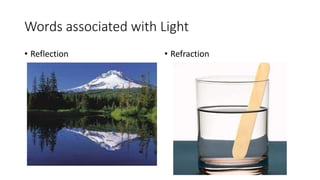
Words associated with Light
• Reflection • Refraction
Theories of light
Nature of light
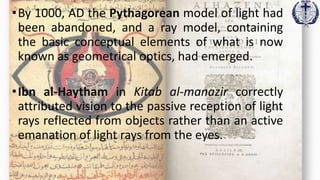
•By 1000, AD the Pythagorean model of light had
been abandoned, and a ray model, containing
the basic conceptual elements of what is now
known as geometrical optics, had emerged.
•Ibn al-Haytham in Kitab al-manazir correctly
attributed vision to the passive reception of light
rays reflected from objects rather than an active
emanation of light rays from the eyes.
Kitab al manazer
•Ibn al-Haytham’s work was translated into Latin
in the 13th century.
•It motivated and influenced Franciscan friar and
natural philosopher Roger Bacon.
•Bacon studied the propagation of light through
simple lenses and is credited as one of the first
to have described the use of lenses to correct
vision.
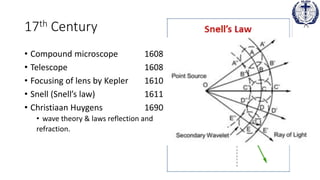
17th Century
• Compound microscope 1608
• Telescope 1608
• Focusing of lens by Kepler 1610
• Snell (Snell’s law) 1611
• Christiaan Huygens 1690
• wave theory & laws reflection and
refraction.
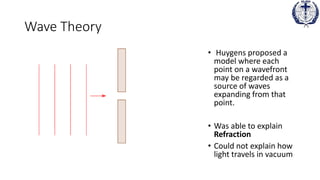
Wave Theory
• Huygens proposed a
model where each
point on a wavefront
may be regarded as a
source of waves
expanding from that
point.
• Was able to explain
Refraction
• Could not explain how
light travels in vacuum
Particle Theory
• By Isaac Newton
• Made of particles and travel in straight line
• Could not explain refraction clearly with particles.
• Medium like glasses attract light and make them bend.
• Light in a transparent medium is always greater than the
speed of light in a vacuum.
• His fame made his theory undisputed till 19th century
though there were many proofs contrary to his theory.
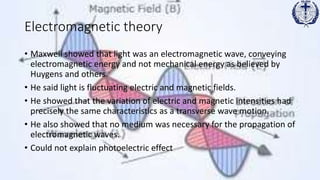
Electromagnetic theory
• Maxwell showed that light was an electromagnetic wave, conveying
electromagnetic energy and not mechanical energy as believed by
Huygens and others.
• He said light is fluctuating electric and magnetic fields.
• He showed that the variation of electric and magnetic intensities had
precisely the same characteristics as a transverse wave motion.
• He also showed that no medium was necessary for the propagation of
electromagnetic waves.
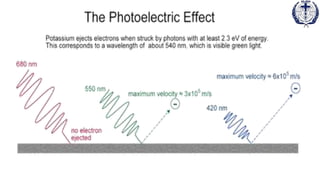
• Could not explain photoelectric effect
Quantum theory – Albert Einstein 1905
Light is a composition of small packets of energy which are called
photons and have wave-like properties.
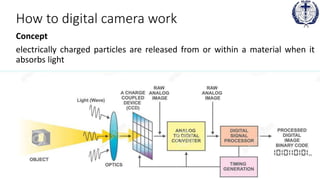
How to digital camera work
Concept
electrically charged particles are released from or within a material when it
absorbs light
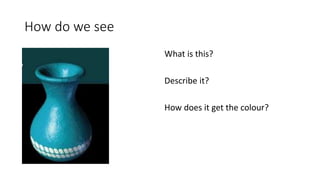
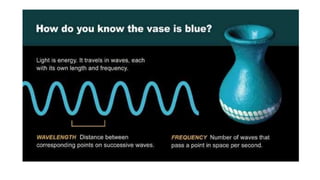
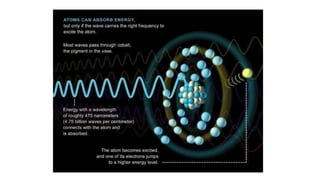
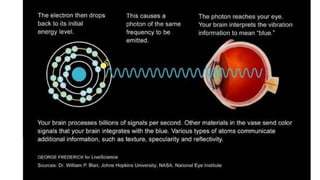
How do we see
What is this?
Describe it?
How does it get the colour?
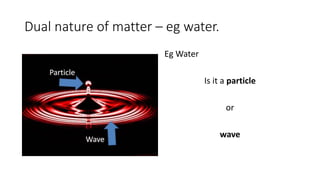
Dual nature of matter – eg water.
Eg Water
Is it a particle
or
wave
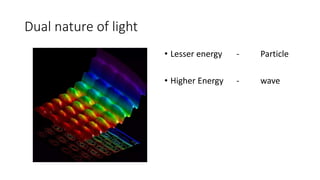
Dual nature of light
• Lesser energy - Particle
• Higher Energy - wave

Physical Optics 01 INtro.pptx

  • 1.
    Principles of Lighting B.OptomI year Internal Paper By Samuel.M Asst. Registrar IOJEH
  • 2.
  • 3.
    What is theuse of light? • Source of heat • Source for vision • Source of life
  • 4.
    Words associated withLight • Reflection • Refraction
  • 5.
  • 6.
  • 7.
    •By 1000, ADthe Pythagorean model of light had been abandoned, and a ray model, containing the basic conceptual elements of what is now known as geometrical optics, had emerged. •Ibn al-Haytham in Kitab al-manazir correctly attributed vision to the passive reception of light rays reflected from objects rather than an active emanation of light rays from the eyes.
  • 8.
    Kitab al manazer •Ibnal-Haytham’s work was translated into Latin in the 13th century. •It motivated and influenced Franciscan friar and natural philosopher Roger Bacon. •Bacon studied the propagation of light through simple lenses and is credited as one of the first to have described the use of lenses to correct vision.
  • 9.
    17th Century • Compoundmicroscope 1608 • Telescope 1608 • Focusing of lens by Kepler 1610 • Snell (Snell’s law) 1611 • Christiaan Huygens 1690 • wave theory & laws reflection and refraction.
  • 10.
    Wave Theory • Huygensproposed a model where each point on a wavefront may be regarded as a source of waves expanding from that point. • Was able to explain Refraction • Could not explain how light travels in vacuum
  • 11.
    Particle Theory • ByIsaac Newton • Made of particles and travel in straight line • Could not explain refraction clearly with particles. • Medium like glasses attract light and make them bend. • Light in a transparent medium is always greater than the speed of light in a vacuum. • His fame made his theory undisputed till 19th century though there were many proofs contrary to his theory.
  • 12.
    Electromagnetic theory • Maxwellshowed that light was an electromagnetic wave, conveying electromagnetic energy and not mechanical energy as believed by Huygens and others. • He said light is fluctuating electric and magnetic fields. • He showed that the variation of electric and magnetic intensities had precisely the same characteristics as a transverse wave motion. • He also showed that no medium was necessary for the propagation of electromagnetic waves. • Could not explain photoelectric effect
  • 13.
    Quantum theory –Albert Einstein 1905 Light is a composition of small packets of energy which are called photons and have wave-like properties.
  • 15.
    How to digitalcamera work Concept electrically charged particles are released from or within a material when it absorbs light
  • 16.
    How do wesee What is this? Describe it? How does it get the colour?
  • 20.
    Dual nature ofmatter – eg water. Eg Water Is it a particle or wave
  • 21.
    Dual nature oflight • Lesser energy - Particle • Higher Energy - wave