MAGNETIC FIELD EXAMPLES
MAGNETIC FORCE EXAMPLES
EM INDUCTION EXAMPLES
Lesson 5.4:
Magnetism:
Review &
Practice
This Lesson is primarily a review and practice Lesson.
Its intent is to tie up everything we have learned
about Magnetism thus far into a single overall
package.
We will review each of the 3 major elements of
Magnetism in the same order we encountered them
in previous Lessons: Magnetic Fields, Magnetic
Forces, Magnetic Induction.
Magnetic Field
Examples
We want to start our review of
Magnetism with some example
problems involving magnetic field
calculations.
Let’s briefly Recap the relevant
formulas from earlier Lessons.
Field near Straight Wire
𝐵 =
μ0𝐼
2𝜋𝑟
B is the magnetic field strength
μ0 is the permeability of free space: μ0 = 4𝜋 ∗ 10−7
[Tm/A]
R is the distance from the wire
Field @ Center of a
Flattened Coil
𝐵 =
μ0𝑁𝐼
2𝑅
B
I
N
R
B is the magnetic field strength
μ0 is the permeability of free space: μ0 = 4𝜋 ∗ 10−7
[Tm/A]
R is the radius of the wire coil
N is the number of loops in the coil
Field on Axis of Solenoid
𝐵 =
μ0𝑁𝐼
𝐿
B
L
N
I
B is the magnetic field strength
μ0 is the permeability of free space: μ0 = 4𝜋 ∗ 10−7
[Tm/A]
N is the number of loops in the solenoid
L is the length of the solenoid
Ok, let’s dive into the concepts we have been covering
with some more robust examples.
There are a few examples of calculating Magnetic
Fields in the following video clips.
It’s very important to understand how to work these
kind of problems yourself, so pay attention to the
problem solving process here!
Examples:
Magnetic Fields
Khan Academy: More
Info + Practice
Khan Academy has some decent worked examples
showing how to think about the Magnetic Fields.
To check out their reference material (videos + brief text
info + practice problems) click the giant icon at the left.
Again, this is NOT required nor is it worth points. That
said, it is CRUCIAL that ya guys and gals get practice
working through these kind of problems yourselves and
are able to check answers.
HW: Magnetic Fields
Concepts
Enter your FIRST & LAST NAME to get credit. It’s worth
30 pts.
You may redo the questions as many times as ya like.
I’ll take highest score.
Due date is same as the Lesson’s due date. If you
navigate away from this slide you will have to start
Here we will focus our attention
on reviewing how Magnetic
Forces work.
Let’s briefly Recap the relevant
formulas from earlier Lessons.
Magnetic Forces
Examples
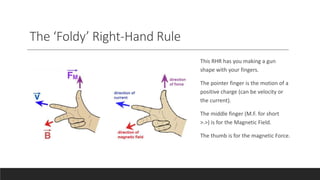
The ‘Foldy’ Right-Hand Rule
This RHR has you making a gun
shape with your fingers.
The pointer finger is the motion of a
positive charge (can be velocity or
the current).
The middle finger (M.F. for short
>.>) is for the Magnetic Field.
The thumb is for the magnetic Force.
Magnetic Force on Moving Electric Charge
As electric charges move, they act as the source of a magnetic field surrounding them. This field can interact with
external magnetic fields that the charge passes through. This interaction between the fields gives rise to a
magnetic force endured by the charge.
The strength of this magnetic force is:
𝐹𝑚 = 𝑞𝑣𝐵𝑒𝑥𝑡
q is the amount of electric charge
v is the speed of the moving charge
Bext is the strength of the magnetic field the charge moves through
Magnetic Force on Wire Carrying a Current
If a wire or segment of a wire carries a current, and the whole segment is within a magnetic field, the moving
charges that make up that current experience a magnetic force. This means the wire as a whole experiences this
force:
𝐹𝑚 = 𝐼𝐿𝐵𝑒𝑥𝑡𝑠𝑖𝑛φ …the force on a current-carrying wire segment of length, 𝐿.
I is the current in the wire segment
Bext is the external magnetic field the wire segment is placed within
Φ is the angle between the flow of the current and the direction of Bext (this is usually 90 degrees)
Ok, let’s dive into the concepts we have been covering
with some more robust examples.
There are a few examples of working with Magnetic
Forces on the slides that follow.
It’s very important to understand how to work these
kind of problems yourself, so pay attention to the
problem solving process here!
Examples:
Magnetic Force
HW: Magnetic Force
Concepts
Enter your FIRST & LAST NAME to get credit. It’s worth
30 pts.
You may redo the questions as many times as ya like.
I’ll take highest score.
Due date is same as the Lesson’s due date. If you
navigate away from this slide you will have to start
Magnetic Induction
Examples
Lastly, we need to review
Magnetic Induction. This is split
between Faraday’s Law of
Electromagnetic Induction and
Lenz’s Law.
Let’s briefly Recap the relevant
concepts from earlier Lessons.
Faraday’s Law of Electromagnetic Induction
Faraday’s Law essentially states that if you alter the magnetic flux in a region of space you will induce an electric field in that region. The
more rapidly this flux is changing, the stronger the electric field that is induced.
As with all electric fields, there will be a voltage between locations within it. If conductors are within the field, an electric current can flow
even without any external power source! The voltage that is induced is often known as an e.m.f. (electro-motive force, though it is not a
force at all!).
ε = −
ΔФ
Δ𝑡
…Faraday’s Law
…ε is the induced voltage (aka the induced emf)
…Ф is the magnetic flux that is changing
…t is the time over which this change in flux occurs
Faraday’s Law of Electromagnetic Induction
To change the flux, you need to change:
1. The area bounded by the conductor (number of coils, or physics size of coil)
2. The orientation of the conductor by rotating it
3. The strength of the magnetic field that passes through the conductor.
The faster this change occurs, the more intense the induced EMF is.
Lenz’ Law-Simple Version
Lenz’s Law is premised on how changing flux yields an induced EMF, which in turn drives an induced
current which itself sources an induced magnetic field. That can be a lot to keep track of, so let’s adopt
some notation that can help:
𝐵0 …the magnetic field present that is not induced by changing flux
𝐵′ …the magnetic field that is induced as a result of changing the flux
𝐼’ …the current induced by the EMF; also the source of the induced magnetic field 𝐵’
Lenz’ Law-Simple Version
Let’s put these into a more mathematical form:
1. ΔФ𝑚 > 0 ∶ 𝐵′ 𝑎𝑛𝑑 𝐵0 𝑎𝑟𝑒 ||
2. ΔФ𝑚 < 0 ∶ 𝐵′ 𝑎𝑛𝑑 𝐵0 𝑎𝑟𝑒 ↿⇂
Once we know the direction of 𝐵’, we simply use the Curly RHR to find the
direction of the induced current (𝐼’) which would produce 𝐵’.
Ok, let’s dive into the concepts we have been covering
with some more robust examples.
There are a few examples of working with Lenz’ Law on
the slides that follow.
It’s very important to understand how to work these
kind of problems yourself, so pay attention to the
problem solving process here!
Examples:
Lenz’ Law
Khan Academy: More
Info + Practice
Khan Academy has some decent worked examples
showing how to think about the Lenz’ Law.
To check out their reference material (videos + brief
text info + practice problems) click the giant icon at the
left.
Again, this is NOT required nor is it worth points. That
said, it is CRUCIAL that ya guys and gals get practice
working through these kind of problems yourselves
and are able to check answers.
HW: Magnetic
Induction Concepts
Enter your FIRST & LAST NAME to get credit. It’s worth
30 pts.
You may redo the questions as many times as ya like.
I’ll take highest score.
Due date is same as the Lesson’s due date. If you
navigate away from this slide you will have to start
Assignment Links (Due Wednesday 4/19 @ Midnight)
Note: These are only for anyone wanting to have all the links
in a single place. If ya already did the assignments en route to
this slide, then no need to redo them!
Quizizz: Magnetic Field
Concepts (30 pts)
Quizizz: Magnetic Force
Concepts (30 pts)
Quizizz: Magnetic Induction Concepts
(30 pts)
More Resources
Textbook Link
I. In Lesson 6.1, we will move on to Optics. Optics will be the last major topic we cover this semester.
II. We will learn about the wave nature of Light, how light is generated, and various physical properties of
light. This is known as Physical Optics.
III. In Lesson 6.2, we will cover how one bends and manipulates light waves for useful applications by using
lenses and mirrors. This is known as Geometric Optics.
Where to Next?

PHYS151_Lesson05.4.pptx

  • 1.
    MAGNETIC FIELD EXAMPLES MAGNETICFORCE EXAMPLES EM INDUCTION EXAMPLES Lesson 5.4:
  • 2.
    Magnetism: Review & Practice This Lessonis primarily a review and practice Lesson. Its intent is to tie up everything we have learned about Magnetism thus far into a single overall package. We will review each of the 3 major elements of Magnetism in the same order we encountered them in previous Lessons: Magnetic Fields, Magnetic Forces, Magnetic Induction.
  • 3.
    Magnetic Field Examples We wantto start our review of Magnetism with some example problems involving magnetic field calculations. Let’s briefly Recap the relevant formulas from earlier Lessons.
  • 4.
    Field near StraightWire 𝐵 = μ0𝐼 2𝜋𝑟 B is the magnetic field strength μ0 is the permeability of free space: μ0 = 4𝜋 ∗ 10−7 [Tm/A] R is the distance from the wire
  • 5.
    Field @ Centerof a Flattened Coil 𝐵 = μ0𝑁𝐼 2𝑅 B I N R B is the magnetic field strength μ0 is the permeability of free space: μ0 = 4𝜋 ∗ 10−7 [Tm/A] R is the radius of the wire coil N is the number of loops in the coil
  • 6.
    Field on Axisof Solenoid 𝐵 = μ0𝑁𝐼 𝐿 B L N I B is the magnetic field strength μ0 is the permeability of free space: μ0 = 4𝜋 ∗ 10−7 [Tm/A] N is the number of loops in the solenoid L is the length of the solenoid
  • 7.
    Ok, let’s diveinto the concepts we have been covering with some more robust examples. There are a few examples of calculating Magnetic Fields in the following video clips. It’s very important to understand how to work these kind of problems yourself, so pay attention to the problem solving process here! Examples: Magnetic Fields
  • 12.
    Khan Academy: More Info+ Practice Khan Academy has some decent worked examples showing how to think about the Magnetic Fields. To check out their reference material (videos + brief text info + practice problems) click the giant icon at the left. Again, this is NOT required nor is it worth points. That said, it is CRUCIAL that ya guys and gals get practice working through these kind of problems yourselves and are able to check answers.
  • 13.
    HW: Magnetic Fields Concepts Enteryour FIRST & LAST NAME to get credit. It’s worth 30 pts. You may redo the questions as many times as ya like. I’ll take highest score. Due date is same as the Lesson’s due date. If you navigate away from this slide you will have to start
  • 14.
    Here we willfocus our attention on reviewing how Magnetic Forces work. Let’s briefly Recap the relevant formulas from earlier Lessons. Magnetic Forces Examples
  • 15.
    The ‘Foldy’ Right-HandRule This RHR has you making a gun shape with your fingers. The pointer finger is the motion of a positive charge (can be velocity or the current). The middle finger (M.F. for short >.>) is for the Magnetic Field. The thumb is for the magnetic Force.
  • 16.
    Magnetic Force onMoving Electric Charge As electric charges move, they act as the source of a magnetic field surrounding them. This field can interact with external magnetic fields that the charge passes through. This interaction between the fields gives rise to a magnetic force endured by the charge. The strength of this magnetic force is: 𝐹𝑚 = 𝑞𝑣𝐵𝑒𝑥𝑡 q is the amount of electric charge v is the speed of the moving charge Bext is the strength of the magnetic field the charge moves through
  • 17.
    Magnetic Force onWire Carrying a Current If a wire or segment of a wire carries a current, and the whole segment is within a magnetic field, the moving charges that make up that current experience a magnetic force. This means the wire as a whole experiences this force: 𝐹𝑚 = 𝐼𝐿𝐵𝑒𝑥𝑡𝑠𝑖𝑛φ …the force on a current-carrying wire segment of length, 𝐿. I is the current in the wire segment Bext is the external magnetic field the wire segment is placed within Φ is the angle between the flow of the current and the direction of Bext (this is usually 90 degrees)
  • 18.
    Ok, let’s diveinto the concepts we have been covering with some more robust examples. There are a few examples of working with Magnetic Forces on the slides that follow. It’s very important to understand how to work these kind of problems yourself, so pay attention to the problem solving process here! Examples: Magnetic Force
  • 23.
    HW: Magnetic Force Concepts Enteryour FIRST & LAST NAME to get credit. It’s worth 30 pts. You may redo the questions as many times as ya like. I’ll take highest score. Due date is same as the Lesson’s due date. If you navigate away from this slide you will have to start
  • 24.
    Magnetic Induction Examples Lastly, weneed to review Magnetic Induction. This is split between Faraday’s Law of Electromagnetic Induction and Lenz’s Law. Let’s briefly Recap the relevant concepts from earlier Lessons.
  • 25.
    Faraday’s Law ofElectromagnetic Induction Faraday’s Law essentially states that if you alter the magnetic flux in a region of space you will induce an electric field in that region. The more rapidly this flux is changing, the stronger the electric field that is induced. As with all electric fields, there will be a voltage between locations within it. If conductors are within the field, an electric current can flow even without any external power source! The voltage that is induced is often known as an e.m.f. (electro-motive force, though it is not a force at all!). ε = − ΔФ Δ𝑡 …Faraday’s Law …ε is the induced voltage (aka the induced emf) …Ф is the magnetic flux that is changing …t is the time over which this change in flux occurs
  • 26.
    Faraday’s Law ofElectromagnetic Induction To change the flux, you need to change: 1. The area bounded by the conductor (number of coils, or physics size of coil) 2. The orientation of the conductor by rotating it 3. The strength of the magnetic field that passes through the conductor. The faster this change occurs, the more intense the induced EMF is.
  • 27.
    Lenz’ Law-Simple Version Lenz’sLaw is premised on how changing flux yields an induced EMF, which in turn drives an induced current which itself sources an induced magnetic field. That can be a lot to keep track of, so let’s adopt some notation that can help: 𝐵0 …the magnetic field present that is not induced by changing flux 𝐵′ …the magnetic field that is induced as a result of changing the flux 𝐼’ …the current induced by the EMF; also the source of the induced magnetic field 𝐵’
  • 28.
    Lenz’ Law-Simple Version Let’sput these into a more mathematical form: 1. ΔФ𝑚 > 0 ∶ 𝐵′ 𝑎𝑛𝑑 𝐵0 𝑎𝑟𝑒 || 2. ΔФ𝑚 < 0 ∶ 𝐵′ 𝑎𝑛𝑑 𝐵0 𝑎𝑟𝑒 ↿⇂ Once we know the direction of 𝐵’, we simply use the Curly RHR to find the direction of the induced current (𝐼’) which would produce 𝐵’.
  • 29.
    Ok, let’s diveinto the concepts we have been covering with some more robust examples. There are a few examples of working with Lenz’ Law on the slides that follow. It’s very important to understand how to work these kind of problems yourself, so pay attention to the problem solving process here! Examples: Lenz’ Law
  • 34.
    Khan Academy: More Info+ Practice Khan Academy has some decent worked examples showing how to think about the Lenz’ Law. To check out their reference material (videos + brief text info + practice problems) click the giant icon at the left. Again, this is NOT required nor is it worth points. That said, it is CRUCIAL that ya guys and gals get practice working through these kind of problems yourselves and are able to check answers.
  • 35.
    HW: Magnetic Induction Concepts Enteryour FIRST & LAST NAME to get credit. It’s worth 30 pts. You may redo the questions as many times as ya like. I’ll take highest score. Due date is same as the Lesson’s due date. If you navigate away from this slide you will have to start
  • 36.
    Assignment Links (DueWednesday 4/19 @ Midnight) Note: These are only for anyone wanting to have all the links in a single place. If ya already did the assignments en route to this slide, then no need to redo them! Quizizz: Magnetic Field Concepts (30 pts) Quizizz: Magnetic Force Concepts (30 pts) Quizizz: Magnetic Induction Concepts (30 pts)
  • 37.
  • 38.
    I. In Lesson6.1, we will move on to Optics. Optics will be the last major topic we cover this semester. II. We will learn about the wave nature of Light, how light is generated, and various physical properties of light. This is known as Physical Optics. III. In Lesson 6.2, we will cover how one bends and manipulates light waves for useful applications by using lenses and mirrors. This is known as Geometric Optics. Where to Next?