
By
N. Ajay Kumar
Contents
• Introduction
• What is PHP?
• Features
• Uses of PHP
• Where it is used?
• History of PHP
• Implementations
• Basics of PHP
• An Example
• Security Issues
• Conclusion
What is PHP?What is PHP?
• PHP
• PHP: Hypertext Preprocessor
• Originally called “Personal Home Page Tools”
• Popular server-side scripting technology
• Open-source
• Anyone may view, modify and redistribute source
code
• Supported freely by community
• Platform independent 3
• Source-code not visible by client
• ‘View Source’ in browsers does not display the PHP code
• Various built-in functions allow for fast
development
• PHP supports many databases (MySQL,
Informix, Oracle, Sybase, Solid, PostgreSQL,
Generic ODBC, etc.)
• PHP is compatible with almost all servers
used today (Apache, IIS, etc.)
PHP FeaturesPHP Features
• Easy learning
• Syntax Perl- and C-like syntax. Relatively easy to
learn.
• Large function library
• Embedded directly into HTML
• Interpreted, no need to compile
• Open Source server-side scripting language
designed specifically for the web.
PHP Features(cont.)PHP Features(cont.)
• Conceived in 1994, now used on +10 million web
sites.
• Outputs not only HTML but can output XML,
images (JPG & PNG), PDF files and even Flash
movies all generated on the fly. Can write these
files to the file system.
• PHP also has support for talking to other services
using protocols such as LDAP, IMAP, SNMP,
NNTP, POP3, HTTP.
Using PHP you..
• Can performs system functions, i.e. from files on a system
it can create, open, read, write, and close them.
• Can handle forms, i.e. gather data from files, save data to
a file, thru email you can send data, return data to the
user.
• Can add, delete, modify elements within your database
thru PHP.
• Access cookies variables and set cookies.
• Can restrict users to access some pages of website.
• Can encrypt data.
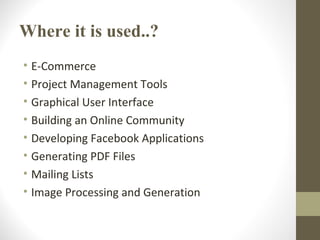
Where it is used..?
• E-Commerce
• Project Management Tools
• Graphical User Interface
• Building an Online Community
• Developing Facebook Applications
• Generating PDF Files
• Mailing Lists
• Image Processing and Generation
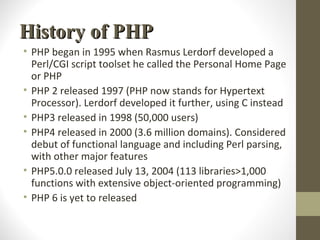
History of PHPHistory of PHP
• PHP began in 1995 when Rasmus Lerdorf developed a
Perl/CGI script toolset he called the Personal Home Page
or PHP
• PHP 2 released 1997 (PHP now stands for Hypertext
Processor). Lerdorf developed it further, using C instead
• PHP3 released in 1998 (50,000 users)
• PHP4 released in 2000 (3.6 million domains). Considered
debut of functional language and including Perl parsing,
with other major features
• PHP5.0.0 released July 13, 2004 (113 libraries>1,000
functions with extensive object-oriented programming)
• PHP 6 is yet to released
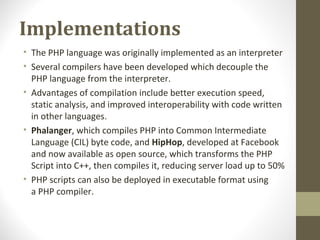
Implementations
• The PHP language was originally implemented as an interpreter
• Several compilers have been developed which decouple the
PHP language from the interpreter.
• Advantages of compilation include better execution speed,
static analysis, and improved interoperability with code written
in other languages.
• Phalanger, which compiles PHP into Common Intermediate
Language (CIL) byte code, and HipHop, developed at Facebook
and now available as open source, which transforms the PHP
Script into C++, then compiles it, reducing server load up to 50%
• PHP scripts can also be deployed in executable format using
a PHP compiler.
Basics
Basic applications
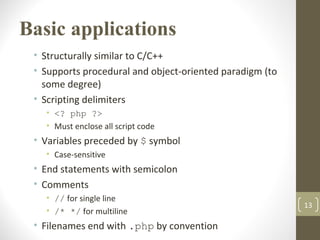
• Structurally similar to C/C++
• Supports procedural and object-oriented paradigm (to
some degree)
• Scripting delimiters
• <? php ?>
• Must enclose all script code
• Variables preceded by $ symbol
• Case-sensitive
• End statements with semicolon
• Comments
• // for single line
• /* */ for multiline
• Filenames end with .php by convention
13
PHP Operators
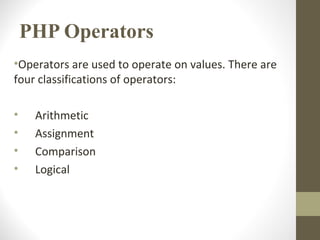
•Operators are used to operate on values. There are
four classifications of operators:
• Arithmetic
• Assignment
• Comparison
• Logical
PHP Arrays
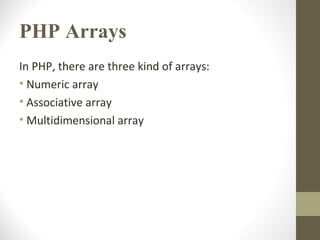
In PHP, there are three kind of arrays:
• Numeric array
• Associative array
• Multidimensional array
Control Structures
• Wide Variety available
• if, else, elseif
• while, do-while
• for, foreach
• break, continue, switch
• require, include, require_once, include_once
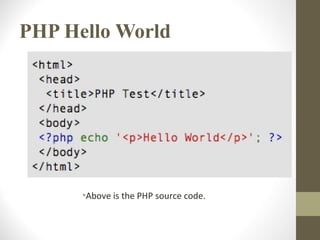
PHP Hello World
•Above is the PHP source code.
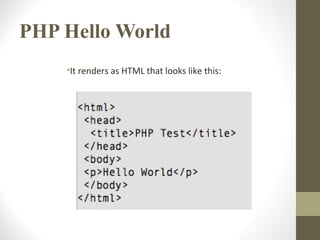
PHP Hello World
•It renders as HTML that looks like this:
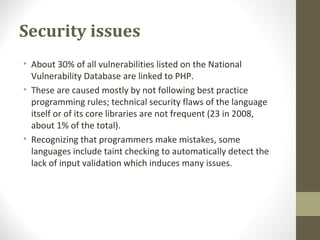
Security issues
• About 30% of all vulnerabilities listed on the National
Vulnerability Database are linked to PHP.
• These are caused mostly by not following best practice
programming rules; technical security flaws of the language
itself or of its core libraries are not frequent (23 in 2008,
about 1% of the total).
• Recognizing that programmers make mistakes, some
languages include taint checking to automatically detect the
lack of input validation which induces many issues.
Conclusion
Php

Php

  • 1.
  • 2.
    Contents • Introduction • Whatis PHP? • Features • Uses of PHP • Where it is used? • History of PHP • Implementations • Basics of PHP • An Example • Security Issues • Conclusion
  • 3.
    What is PHP?Whatis PHP? • PHP • PHP: Hypertext Preprocessor • Originally called “Personal Home Page Tools” • Popular server-side scripting technology • Open-source • Anyone may view, modify and redistribute source code • Supported freely by community • Platform independent 3
  • 4.
    • Source-code notvisible by client • ‘View Source’ in browsers does not display the PHP code • Various built-in functions allow for fast development • PHP supports many databases (MySQL, Informix, Oracle, Sybase, Solid, PostgreSQL, Generic ODBC, etc.) • PHP is compatible with almost all servers used today (Apache, IIS, etc.)
  • 5.
    PHP FeaturesPHP Features •Easy learning • Syntax Perl- and C-like syntax. Relatively easy to learn. • Large function library • Embedded directly into HTML • Interpreted, no need to compile • Open Source server-side scripting language designed specifically for the web.
  • 6.
    PHP Features(cont.)PHP Features(cont.) •Conceived in 1994, now used on +10 million web sites. • Outputs not only HTML but can output XML, images (JPG & PNG), PDF files and even Flash movies all generated on the fly. Can write these files to the file system. • PHP also has support for talking to other services using protocols such as LDAP, IMAP, SNMP, NNTP, POP3, HTTP.
  • 7.
    Using PHP you.. •Can performs system functions, i.e. from files on a system it can create, open, read, write, and close them. • Can handle forms, i.e. gather data from files, save data to a file, thru email you can send data, return data to the user. • Can add, delete, modify elements within your database thru PHP. • Access cookies variables and set cookies. • Can restrict users to access some pages of website. • Can encrypt data.
  • 8.
    Where it isused..? • E-Commerce • Project Management Tools • Graphical User Interface • Building an Online Community • Developing Facebook Applications • Generating PDF Files • Mailing Lists • Image Processing and Generation
  • 10.
    History of PHPHistoryof PHP • PHP began in 1995 when Rasmus Lerdorf developed a Perl/CGI script toolset he called the Personal Home Page or PHP • PHP 2 released 1997 (PHP now stands for Hypertext Processor). Lerdorf developed it further, using C instead • PHP3 released in 1998 (50,000 users) • PHP4 released in 2000 (3.6 million domains). Considered debut of functional language and including Perl parsing, with other major features • PHP5.0.0 released July 13, 2004 (113 libraries>1,000 functions with extensive object-oriented programming) • PHP 6 is yet to released
  • 11.
    Implementations • The PHPlanguage was originally implemented as an interpreter • Several compilers have been developed which decouple the PHP language from the interpreter. • Advantages of compilation include better execution speed, static analysis, and improved interoperability with code written in other languages. • Phalanger, which compiles PHP into Common Intermediate Language (CIL) byte code, and HipHop, developed at Facebook and now available as open source, which transforms the PHP Script into C++, then compiles it, reducing server load up to 50% • PHP scripts can also be deployed in executable format using a PHP compiler.
  • 12.
  • 13.
    Basic applications • Structurallysimilar to C/C++ • Supports procedural and object-oriented paradigm (to some degree) • Scripting delimiters • <? php ?> • Must enclose all script code • Variables preceded by $ symbol • Case-sensitive • End statements with semicolon • Comments • // for single line • /* */ for multiline • Filenames end with .php by convention 13
  • 14.
    PHP Operators •Operators areused to operate on values. There are four classifications of operators: • Arithmetic • Assignment • Comparison • Logical
  • 15.
    PHP Arrays In PHP,there are three kind of arrays: • Numeric array • Associative array • Multidimensional array
  • 16.
    Control Structures • WideVariety available • if, else, elseif • while, do-while • for, foreach • break, continue, switch • require, include, require_once, include_once
  • 17.
    PHP Hello World •Aboveis the PHP source code.
  • 18.
    PHP Hello World •Itrenders as HTML that looks like this:
  • 20.
    Security issues • About30% of all vulnerabilities listed on the National Vulnerability Database are linked to PHP. • These are caused mostly by not following best practice programming rules; technical security flaws of the language itself or of its core libraries are not frequent (23 in 2008, about 1% of the total). • Recognizing that programmers make mistakes, some languages include taint checking to automatically detect the lack of input validation which induces many issues.
  • 21.