In the latterpart of the 19th century,
several investigators noticed that light was
capable of ejecting electrons from various
metal surfaces. This is the photoelectric
effect, for many years used in electric
eyes, in the photographer’s light meter,
and, before digital, in the sound tracks of
motion pictures. An extension of the
photoelectric effect is today’s photovoltaic
electric cells and their potential for being
a major power source.
Photoelectric Effect
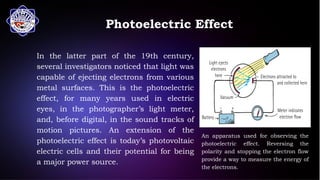
An apparatus used for observing the
photoelectric effect. Reversing the
polarity and stopping the electron flow
provide a way to measure the energy of
the electrons.
3.
Is the phenomenonwhere electrons are
ejected from a material (typically a metal)
when electromagnetic radiation (like light)
shines on it. This effect is a key
demonstration of the particle-like nature
of light, as predicted by quantum
mechanics. If the frequency of the light is
above a certain threshold, electrons are
emitted with a kinetic energy that depends
on the light's frequency, not its intensity.
Photoelectric Effect
4.
Careful examination ofthe photoelectric effect led to several
observations that were quite contrary to the classical wave
picture:
1. The time lag between turning on the light and the ejection
of the first electrons was unaffected by the brightness or
frequency of the light.
2. The effect was easy to observe with violet or ultraviolet
light but not with red light.
3. The rate at which electrons were ejected was proportional
to the brightness of the light.
4. The maximum energy of the ejected electrons was
unaffected by the bright ness of the light. However, there
were indications that the electron’s energy did depend on
the frequency of the light.
Photoelectric Effect
5.
According to thewave theory, an electron in dim light
should, after some delay, accumulate sufficient
vibrational energy to fly out, while an electron in bright
light should be ejected almost immediately.
The stronger electric fields of brighter light did not
cause electrons to be ejected at higher speeds.
More electrons were ejected in brighter light, but not at
higher speeds. A weak beam of ultraviolet light, on the
other hand, produced a smaller number of ejected
electrons but at much higher speeds.
Photoelectric Effect
6.
The photoelectric effectsuggests we conceive of light encountering
a surface or any detector as a succession of particles—photons. The
number of photons in a light beam affects the brightness of the whole
beam, whereas the frequency of the light controls the energy of each
individual photon.
Electrons are held in a metal by attractive electrical forces. A
minimum energy, called the work function, Wo , is required for an
electron to leave the surface. A low-frequency photon with energy less
than Wo won’t produce electron ejection. Only a photon with energy
greater than Wo results in the photoelectric effect. Thus, the energy of
the incoming photon will be equal to the outgoing kinetic energy of the
electron plus the energy required to get it out of the metal, Wo .
Photoelectric Effect
8.
Sample Problem
Light offrequency 6.0 × 10¹ Hz strikes a metal with a work
⁴
function of 2.5 × 10 ¹ J.
⁻ ⁹
Find the maximum kinetic energy of the emitted electron.
Solution:
E = hf - φ
ₖ
E = (6.63 × 10 ³ J*s)(6.0 × 10¹ Hz) - 2.5 × 10 ¹ J
ₖ ⁻ ⁴ ⁴ ⁻ ⁹
E = 3.978 × 10 ¹ J - 2.5 × 10 ¹ J
ₖ ⁻ ⁹ ⁻ ⁹
= 1.478 × 10 ¹ J
⁻ ⁹
9.
Sample Problem
A metalhas a work function of 3.2 × 10 ¹ J. What is the
⁻ ⁹
threshold frequency of this metal?
Solution:
Φ = hf_threshold → f = φ / h
F = (3.2 × 10 ¹ J) / (6.63 × 10 ³ J·s)
⁻ ⁹ ⁻ ⁴
≈ 4.83 × 10¹ Hz
⁴
10.
Solve the Problems
Problem1: maximum kinetic energy
Light of frequency 6.0 × 10¹ Hz strikes a metal with a
⁴
work function of 2.5 × 10 ¹ J. Find the maximum
⁻ ⁹
kinetic energy of the emitted electron.
Problem 2: will photoemission occur?
A photon of light with a wavelength of 5.5 × 10 m
⁻⁹
strikes a metal with a work function of 1.6 × 10 ¹ J
⁻ ⁹ .s .
Will photoelectrons be emitted?
Editor's Notes
#2 An arrangement for observing the photoelectric effect is shown in Figure 31.1. Light shining on the negatively charged, photosensitive metal surface liberates electrons. The liberated electrons are attracted to the positive plate and produce a measurable current. If we instead charge this plate with just enough negative charge that it repels electrons, the current can be stopped. We can then calculate the energies of the ejected electrons from the easily measured potential difference between the plates.



![Physics form 4 Photoelectric_Effect[1].pdf](https://cdn.slidesharecdn.com/ss_thumbnails/39photoelectriceffect1-250313112006-cb6a4dd7-thumbnail.jpg?width=640&height=640&fit=bounds)


