PHONE-GAP IN ANDROID TECHNOLOGY
Vikrant P. Thakare
M-Tech 1st (CSE)
Session 2013-14
A.G.P.C.E, Mohgoan, Nagpur

Guide
Prof. T. Raju
Department of MTech
A.G.P.C.E, Mohgoan, Nagpur

Abstract
PhoneGap is a mobile development framework produced by Nitobi,
purchased by Adobe Systems. It enables software programmers to build
applications for mobile devices using JavaScript, HTML5, and CSS3, instead of
device-specific languages such as Objective-C or Java. The resulting applications
are hybrid, meaning that they are neither truly native (because all layout rendering
is done via web views instead of the platform's native UI framework) nor purely
web-based (because they are not just web apps, but are packaged as apps for
distribution and have access to native device APIs). From version 1.9 onward it is
even possible to freely mix native and hybrid code snippets.
The software underlying PhoneGap is Apache Cordova. The software was
previously called just "PhoneGap", then "Apache Callback". Apache Cordova is
open source software.

1 Introduction
PhoneGap is a mobile development framework produced by Nitobi, purchased by
Adobe Systems. It enables software programmers to build applications for mobile
devices using JavaScript, HTML5, and CSS3, instead of device-specific languages
such as Objective-C or Java. The resulting applications are hybrid, meaning that
they are neither truly native (because all layout rendering is done via web views
instead of the platform's native UI framework) nor purely web-based (because they
are not just web apps, but are packaged as apps for distribution and have access to
native device APIs). From version 1.9 onward it is even possible to freely mix
native and hybrid code snippets.
The software underlying PhoneGap is Apache Cordova. The software was
previously called just "PhoneGap", then "Apache Callback". Apache Cordova is
open source software.
First developed at an iPhoneDevCamp event in San Francisco, PhoneGap went on
to win the People's Choice Award at O'Reilly Media's 2009 Web 2.0 Conference
and the framework has been used to develop many apps. Apple Inc. has confirmed
A.G.P.C.E.

Page 1
PHONE-GAP IN ANDROID TECHNOLOGY
that the framework has its approval, even with the new 4.0 developer license
agreement changes. The PhoneGap framework is used by several mobile
application platforms such as ViziApps, Worklight, Convertigo, and appMobi as
the backbone of their mobile client development engine. Adobe officially
announced the acquisition of Nitobi Software (the original developer) on October
4, 2011. Coincident with that, the PhoneGap code was contributed to the Apache
Software Foundation to start a new project called Apache Cordova. The project
original name, Apache Callback, was viewed as too generic. Then it also appears
in Adobe Systems as Adobe PhoneGap and also as Adobe Phonegap Build.
Early versions of PhoneGap required a person making iOS apps to have an Apple
computer, and a person making Windows Mobile apps to have a computer running
Windows. After September 2012, Adobe's PhoneGap Build service allows
programmers to upload HTML, CSS and JavaScript source code to a "cloud
compiler" that generates apps for every supported platform.

Design and rationale
The core of PhoneGap applications use HTML5 and CSS3 for their rendering, and
JavaScript for their logic. Although HTML5 now provides access to underlying
hardware such as the accelerometer, camera and GPS, browser support for
HTML5-based device access is not consistent across mobile browsers, particularly
older versions of Android. To overcome these limitations, the PhoneGap
framework embeds HTML5 code inside a native WebView on the device, using a
Foreign Function Interface to access the native resources of the device.
PhoneGap is also able to be extended with native plug-ins that allow for
developers to add functionality that can be called from JavaScript, allowing for
direct communication between the native layer, and the HTML5 page. PhoneGap
includes basic plugins that allow access to the device's accelerometer, camera,
microphone, compass, file system, and more.
However, the use of web-based technologies leads many PhoneGap applications to
run slower than native applications with similar functionality. Adobe Systems
warns that applications built using PhoneGap may be rejected by Apple for being
too slow or not feeling "native" enough (having appearance and functionality
consistent with what users have come to expect on the platform).
PhoneGap currently supports development for the operating systems Apple iOS,
Google Android, LG webOS, Microsoft Windows Phone, Nokia Symbian OS,
RIM BlackBerry, and Tizen (SDK 2.x). Support for recent versions, such as
BlackBerry 5 and 6 and Windows Phone 7, is being implemented now. Bada (the
A.G.P.C.E.

Page 2
PHONE-GAP IN ANDROID TECHNOLOGY
operating system used by the Samsung Wave S8500) support is "coming
soon".The table below is a list of supported features for each operating system.

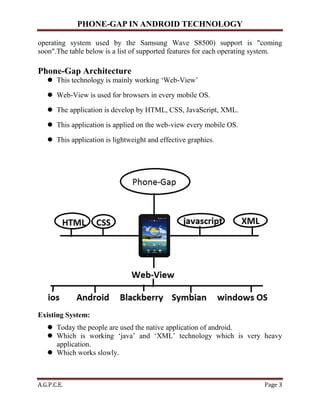
Phone-Gap Architecture
 This technology is mainly working ‘Web-View’
 Web-View is used for browsers in every mobile OS.
 The application is develop by HTML, CSS, JavaScript, XML.
 This application is applied on the web-view every mobile OS.
 This application is lightweight and effective graphics.

Existing System:
 Today the people are used the native application of android.
 Which is working ‘java’ and ‘XML’ technology which is very heavy
application.
 Which works slowly.

A.G.P.C.E.

Page 3
PHONE-GAP IN ANDROID TECHNOLOGY
Proposed System:
 The proposed system is Phone-Gap Technology which overcome on that all
the drawbacks.
 By using this technology we can create application which is lightweight and
important thing is that this application is working on multiple Mobile OS.
Conclusion
 The conclusion is that 50% of mobile application is not required database.
This application is build by using Phone-Gap so we can have lightweight
and more effective application.
 There are no of Mobile OS are available so we can provide a multi platform
applivation
References
1. "PhoneGap License". Phonegap.com. Retrieved 2013-10-09.
2. "FAQ | PhoneGap Build | Edge Tools & Services | Adobe & HTML".
Html.adobe.com. Retrieved 2013-10-09.
3. "Adobe Announces Agreement to Acquire Nitobi, Creator of PhoneGap".
Adobe.com. 2011-10-03. Retrieved 2012-04-07.
4. "Andre Charland's Answers on PhoneGap". Quora. Retrieved 2012-04-07.
5. Jose Fermoso (April 5, 2009). "PhoneGap Seeks to Bridge the Gap Between
Mobile App Platforms". GigaOM. Retrieved 2012-04-07.
6. "Apache Cordova gets a new look - The H Open Source: News and
Features". H-online.com. 2012-02-22. Retrieved 2012-04-07.
7. Apache Callback Project Incubation Status[dead link]
8. / (2013-08-15). "Apache Callback Proposal". Wiki.phonegap.com. Retrieved
2013-10-09.
9. Darryl K. Taft (2009-03-13). "PhoneGap Simplifies iPhone, Android,
BlackBerry Development". Eweek.com. Retrieved 2013-10-09.
10.Davis, Lidija (2009-04-02). "PhoneGap: People's Choice Winner at Web 2.0
Expo Launch Pad". Readwriteweb.com. Retrieved 2012-04-07.
11."PhoneGap Apps". Phonegap.com. Retrieved 2012-12-06.
12."PhoneGap and the Apple developer license agreement. « PhoneGap".
Phonegap.com. 2010-04-14. Retrieved 2012-04-07.
13."Create Mobile and Web Apps with HTML5 and JavaScript".
ViziApps.com. Retrieved 2012-04-07.
14. "Mobile Application Platform and Tools". Worklight. 2012-01-16.
Retrieved 2012-04-07.
15. "How PhoneGap plays an important part in our Enterprise offering
« PhoneGap". Phonegap.com. 2011-06-27. Retrieved 2012-04-07.
A.G.P.C.E.

Page 4

Phone gap in android technology

  • 1.
    PHONE-GAP IN ANDROIDTECHNOLOGY PHONE-GAP IN ANDROID TECHNOLOGY Vikrant P. Thakare M-Tech 1st (CSE) Session 2013-14 A.G.P.C.E, Mohgoan, Nagpur Guide Prof. T. Raju Department of MTech A.G.P.C.E, Mohgoan, Nagpur Abstract PhoneGap is a mobile development framework produced by Nitobi, purchased by Adobe Systems. It enables software programmers to build applications for mobile devices using JavaScript, HTML5, and CSS3, instead of device-specific languages such as Objective-C or Java. The resulting applications are hybrid, meaning that they are neither truly native (because all layout rendering is done via web views instead of the platform's native UI framework) nor purely web-based (because they are not just web apps, but are packaged as apps for distribution and have access to native device APIs). From version 1.9 onward it is even possible to freely mix native and hybrid code snippets. The software underlying PhoneGap is Apache Cordova. The software was previously called just "PhoneGap", then "Apache Callback". Apache Cordova is open source software. 1 Introduction PhoneGap is a mobile development framework produced by Nitobi, purchased by Adobe Systems. It enables software programmers to build applications for mobile devices using JavaScript, HTML5, and CSS3, instead of device-specific languages such as Objective-C or Java. The resulting applications are hybrid, meaning that they are neither truly native (because all layout rendering is done via web views instead of the platform's native UI framework) nor purely web-based (because they are not just web apps, but are packaged as apps for distribution and have access to native device APIs). From version 1.9 onward it is even possible to freely mix native and hybrid code snippets. The software underlying PhoneGap is Apache Cordova. The software was previously called just "PhoneGap", then "Apache Callback". Apache Cordova is open source software. First developed at an iPhoneDevCamp event in San Francisco, PhoneGap went on to win the People's Choice Award at O'Reilly Media's 2009 Web 2.0 Conference and the framework has been used to develop many apps. Apple Inc. has confirmed A.G.P.C.E. Page 1
  • 2.
    PHONE-GAP IN ANDROIDTECHNOLOGY that the framework has its approval, even with the new 4.0 developer license agreement changes. The PhoneGap framework is used by several mobile application platforms such as ViziApps, Worklight, Convertigo, and appMobi as the backbone of their mobile client development engine. Adobe officially announced the acquisition of Nitobi Software (the original developer) on October 4, 2011. Coincident with that, the PhoneGap code was contributed to the Apache Software Foundation to start a new project called Apache Cordova. The project original name, Apache Callback, was viewed as too generic. Then it also appears in Adobe Systems as Adobe PhoneGap and also as Adobe Phonegap Build. Early versions of PhoneGap required a person making iOS apps to have an Apple computer, and a person making Windows Mobile apps to have a computer running Windows. After September 2012, Adobe's PhoneGap Build service allows programmers to upload HTML, CSS and JavaScript source code to a "cloud compiler" that generates apps for every supported platform. Design and rationale The core of PhoneGap applications use HTML5 and CSS3 for their rendering, and JavaScript for their logic. Although HTML5 now provides access to underlying hardware such as the accelerometer, camera and GPS, browser support for HTML5-based device access is not consistent across mobile browsers, particularly older versions of Android. To overcome these limitations, the PhoneGap framework embeds HTML5 code inside a native WebView on the device, using a Foreign Function Interface to access the native resources of the device. PhoneGap is also able to be extended with native plug-ins that allow for developers to add functionality that can be called from JavaScript, allowing for direct communication between the native layer, and the HTML5 page. PhoneGap includes basic plugins that allow access to the device's accelerometer, camera, microphone, compass, file system, and more. However, the use of web-based technologies leads many PhoneGap applications to run slower than native applications with similar functionality. Adobe Systems warns that applications built using PhoneGap may be rejected by Apple for being too slow or not feeling "native" enough (having appearance and functionality consistent with what users have come to expect on the platform). PhoneGap currently supports development for the operating systems Apple iOS, Google Android, LG webOS, Microsoft Windows Phone, Nokia Symbian OS, RIM BlackBerry, and Tizen (SDK 2.x). Support for recent versions, such as BlackBerry 5 and 6 and Windows Phone 7, is being implemented now. Bada (the A.G.P.C.E. Page 2
  • 3.
    PHONE-GAP IN ANDROIDTECHNOLOGY operating system used by the Samsung Wave S8500) support is "coming soon".The table below is a list of supported features for each operating system. Phone-Gap Architecture  This technology is mainly working ‘Web-View’  Web-View is used for browsers in every mobile OS.  The application is develop by HTML, CSS, JavaScript, XML.  This application is applied on the web-view every mobile OS.  This application is lightweight and effective graphics. Existing System:  Today the people are used the native application of android.  Which is working ‘java’ and ‘XML’ technology which is very heavy application.  Which works slowly. A.G.P.C.E. Page 3
  • 4.
    PHONE-GAP IN ANDROIDTECHNOLOGY Proposed System:  The proposed system is Phone-Gap Technology which overcome on that all the drawbacks.  By using this technology we can create application which is lightweight and important thing is that this application is working on multiple Mobile OS. Conclusion  The conclusion is that 50% of mobile application is not required database. This application is build by using Phone-Gap so we can have lightweight and more effective application.  There are no of Mobile OS are available so we can provide a multi platform applivation References 1. "PhoneGap License". Phonegap.com. Retrieved 2013-10-09. 2. "FAQ | PhoneGap Build | Edge Tools & Services | Adobe & HTML". Html.adobe.com. Retrieved 2013-10-09. 3. "Adobe Announces Agreement to Acquire Nitobi, Creator of PhoneGap". Adobe.com. 2011-10-03. Retrieved 2012-04-07. 4. "Andre Charland's Answers on PhoneGap". Quora. Retrieved 2012-04-07. 5. Jose Fermoso (April 5, 2009). "PhoneGap Seeks to Bridge the Gap Between Mobile App Platforms". GigaOM. Retrieved 2012-04-07. 6. "Apache Cordova gets a new look - The H Open Source: News and Features". H-online.com. 2012-02-22. Retrieved 2012-04-07. 7. Apache Callback Project Incubation Status[dead link] 8. / (2013-08-15). "Apache Callback Proposal". Wiki.phonegap.com. Retrieved 2013-10-09. 9. Darryl K. Taft (2009-03-13). "PhoneGap Simplifies iPhone, Android, BlackBerry Development". Eweek.com. Retrieved 2013-10-09. 10.Davis, Lidija (2009-04-02). "PhoneGap: People's Choice Winner at Web 2.0 Expo Launch Pad". Readwriteweb.com. Retrieved 2012-04-07. 11."PhoneGap Apps". Phonegap.com. Retrieved 2012-12-06. 12."PhoneGap and the Apple developer license agreement. « PhoneGap". Phonegap.com. 2010-04-14. Retrieved 2012-04-07. 13."Create Mobile and Web Apps with HTML5 and JavaScript". ViziApps.com. Retrieved 2012-04-07. 14. "Mobile Application Platform and Tools". Worklight. 2012-01-16. Retrieved 2012-04-07. 15. "How PhoneGap plays an important part in our Enterprise offering « PhoneGap". Phonegap.com. 2011-06-27. Retrieved 2012-04-07. A.G.P.C.E. Page 4