WHAT IS PHISHINGATTACKS?
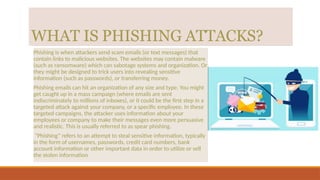
Phishing is when attackers send scam emails (or text messages) that
contain links to malicious websites. The websites may contain malware
(such as ransomware) which can sabotage systems and organization. Or
they might be designed to trick users into revealing sensitive
information (such as passwords), or transferring money.
Phishing emails can hit an organization of any size and type. You might
get caught up in a mass campaign (where emails are sent
indiscriminately to millions of inboxes), or it could be the first step in a
targeted attack against your company, or a specific employee. In these
targeted campaigns, the attacker uses information about your
employees or company to make their messages even more persuasive
and realistic. This is usually referred to as spear phishing.
“Phishing” refers to an attempt to steal sensitive information, typically
in the form of usernames, passwords, credit card numbers, bank
account information or other important data in order to utilize or sell
the stolen information.
4.
PROBLEM FACED BYPHISHING
ATTACK
The websites may contain malware (such as ransomware) which can
sabotage systems and organizations . Or they might be designed to
trick users into revealing sensitive information (such as passwords),
or transferring money . Phishing emails can hit an organization of
any size and type. You might get caught up in a mass campaign
(where emails are sent indiscriminately to millions of inboxes), or it
could be the first step in a targeted attack against your company, or
a specific employee.
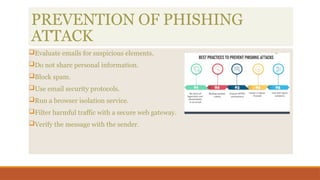
PREVENTION OF PHISHING
ATTACK
Evaluateemails for suspicious elements.
Do not share personal information.
Block spam.
Use email security protocols.
Run a browser isolation service.
Filter harmful traffic with a secure web gateway.
Verify the message with the sender.

![PHISHING ATTACKS. _. _.pptx[]](https://image.slidesharecdn.com/kumarranasingh-250727154432-a0fe5ad5/85/PHISHING-ATTACKS-_-_-pptx-7-320.jpg)


