APA Newsletters
       NEWSLETTER ON PHILOSOPHY AND COMPUTERS

Volume 11, Number 2				                         	       		            Spring 2012

                         FROM THE EDITOR, Peter Boltuc

                                     ARTICLES

                                Terrell Ward Bynum
        “On Rethinking the Foundations of Philosophy in the Information Age”

                                   Luciano Floridi
              “Hyperhistory and the Philosophy of Information Policies”

                                 Anthony F. Beavers
          “Is Ethics Headed for Moral Behavioralism and Should We Care?”

                                    Alexandre Monnin
    “The Artifactualization of Reference and ‘Substances’ on the Web: Why (HTTP)
           URIs Do Not (Always) Refer nor Resources Hold by Themselves”

                                 Stephen L. Thaler
 “The Creativity Machine Paradigm: Withstanding the Argument from Consciousness”

                                     CARTOON

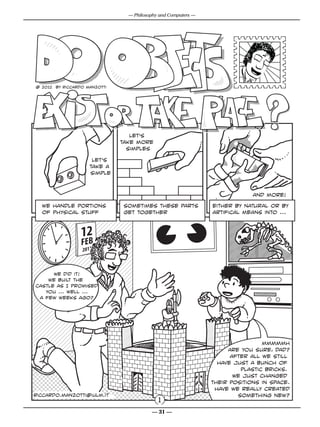
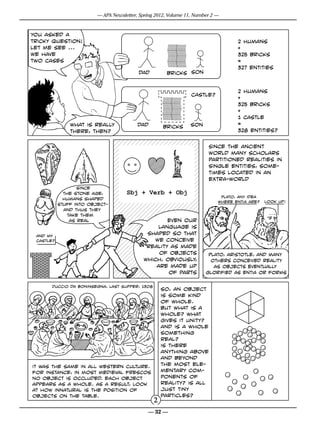
                                 Riccardo Manzotti
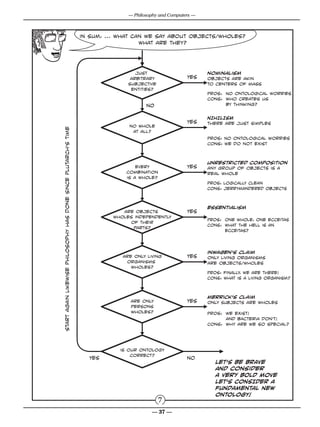
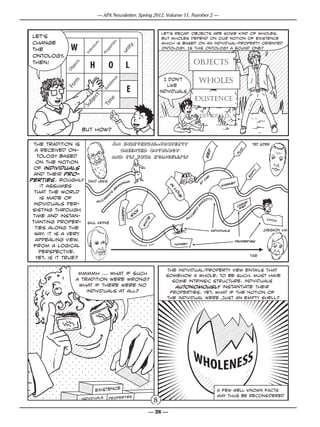
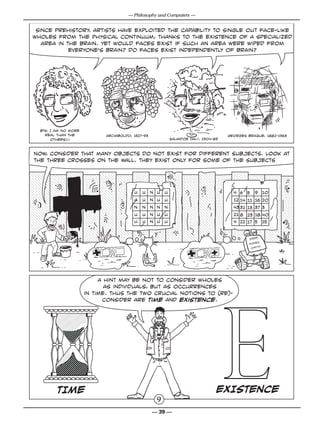
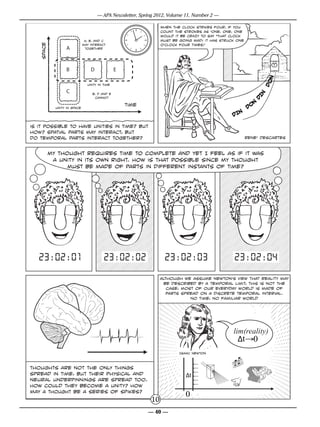
                          “Do Objects Exist or Take Place?”


© 2012 by The American Philosophical Association					                     ISSN 2155-9708
APA Newsletter on

                              Philosophy and Computers

Piotr Bołtuć, Editor	                                          Spring 2012	                                 Volume 11, Number 2

                                                                      philosophers of computers but also for the more traditional
                From the Editor                                       colleagues interested in philosophy of language. In the next
                                                                      paper Stephen Thaler talks about creativity machines. While
                                                                      some philosophers may still not be sure whether and by what
                                                                      standards machines can be creative, Thaler designed, patented,
The APA ad hoc committee on philosophy and computers                  and prepared for useful applications some such machines so
started as largely a group advocating the use of computers and        the proof seems to be in the pudding, and some of the proof can
the web among philosophers, and by the APA. While today               also be found in this interesting article. We end with a cartoon
philosophical issues pertaining to computers are becoming             by Richardo Manzotti; this time it is on an ontological topic. As
more and more important, we may have failed in some way               always cartoons tend to be overly persuasive for philosophical
since problems that have been plaguing the APA’s website for          discussion; yet, they serve as a good tool for putting forth the
about the last year have put us all back, unnecessarily. This also    author’s ideas.
pertains to the Newsletter; not only did we lose positioning in
the web-search engines but the Newsletter reverted to just PDFs.           I am sure the chair of the committee would want to
The good news is that archival issues are successively coming         mention the very successful session on machine consciousness
back. I remember the advice that David Chalmers gave to the           at the Central APA meeting. The session brought together papers
Newsletter upon receiving the Barwise Prize a few years ago,          by Terry Horgan, Robert van Gullick, and Ned Block (who was
to either become a regular journal or, if we stay open access,        unable to come due to illness), as well as by two members of
to use much more of blog-style communications. It is my hope          this committee, David Anderson and myself. The session was
that one day the latter option may become more realistic.             very well attended, so that some people had to sit on the floor
                                                                      or in the doorway. I do hope to have more on this committee’s
      Let me change gears a bit and restart on a somewhat
                                                                      activities in the next issue.
personal note. My first philosophy tutor was my mother; among
other things she taught me that philosophy is the theory of the
general theories of all the sciences. I still like this definition.
My first philosophy tutor also warned me that philosophy
should not become overly preoccupied with just one theory,                                     Articles
at one stage of its development, which has been Spencer’s
predicament. Consistent with this advice, when I was starting
my own philosophical thinking I was always puzzled that               On Rethinking the Foundations of Philosophy
few philosophers drew sufficient conclusions from Einstein’s
relativity theor y, in particular its direct implications for         in the Information Age*
Newtonian and Kantian understanding of time and space.
Today it seems that more and more philosophers focus on
                                                                      Terrell Ward Bynum
the philosophical implications of quantum physics, and in
                                                                      Southern Connecticut State University
particular the issue of quantum pairs. Therefore, I was very
interested in Terry Bynum’s paper, when I heard its earlier           1. Introduction: physics and the information revolution
version at the 2011 CAP conference in Aarhus, Denmark. I              It is commonplace today to hear people say that we are “living in
am very glad that Terry accepted my invitation so that his            the Age of Information” and that an “Information Revolution” is
interesting article is featured in the current issue. Of course,      sweeping across the globe, changing everything from banking to
the question who is able to avoid excessive reliance on the           warfare, medicine to education, entertainment to government,
current state of science and who falls into the Spencer-trap is       and on and on. But why are these dramatic changes taking
always hard to answer without a longer historical perspective.        place? How is it possible for information technology (IT) to
I am also glad that Luciano Floridi responds to Terry’s paper in      transform our world so quickly and so fundamentally? Scholars
this issue with an important historical outlook. More responses       in the field of computer ethics are familiar with James Moor’s
are expected and encouraged for submission to the next issue.         suggested answer; namely, that IT is revolutionary because it
      In his provocative article Tony Beavers argues that it may      is logically malleable, making IT one of the most powerful and
be morally required to build a machine that would make                flexible technologies ever created. IT is a nearly universal tool,
human beings more moral. I think the paper is an important            Moor said, that can be adjusted and fine tuned to carry out
contribution to the recently booming area of robot ethics.            almost any task. The limits of IT, he noted, are basically the limits
Alexandre Monnin contributes to the set of articles pertaining to     of our imagination. Moor’s influential analysis of the Information
ontology of the web that started with a paper by Harry Halpin. In     Revolution (including associated concepts like policy vacuums,
his tightly argued work, originally written in French, Alexandre      conceptual muddles, and informationalization) has shown itself
shows why URIs are philosophically interesting, not only for          to be practical and insightful (see Moor 1998).
— APA Newsletter, Spring 2012, Volume 11, Number 2 —

      Today, recent developments in physics, especially in                 Information is information, not matter or energy. No
quantum theory and cosmology, suggest an additional—almost                 materialism which does not admit this can survive at
metaphysical—answer to explain why IT is so effective in                   the present day. (p. 132)
transforming the world. During the past two decades, many
                                                                       According to Wiener, therefore, every physical being can be
physicists have come to believe that the universe is made
                                                                       viewed as an informational entity. This is true even of human
of information; that is, that our world is a vast “ocean” of
                                                                       beings; and, in 1954, in the second edition of his book The
quantum bits (“qubits”) and every object or process in this
                                                                       Human Use of Human Beings, Wiener noted that the essential
ocean of information (including human beings) can be seen
                                                                       nature of a person depends, not upon the particular atoms
as a constantly changing data structure comprised of qubits.
                                                                       that happen to comprise one’s body at any given moment, but
(See, for example, Lloyd 2006 and Vedral 2010.) If everything in
the world is made of information, and IT provides knowledge            rather upon the informational pattern encoded within the body:
and tools for analyzing and manipulating information, then we              We are but whirlpools in a river of ever-flowing
have an impressive explanation of the transformative power of              water. We are not stuff that abides, but patterns that
IT based upon the fundamental nature of the universe!                      perpetuate themselves. (p. 96)
      It is not surprising that important developments in science
can have major philosophical import. Since the time of ancient             The individuality of the body is that of a flame . . . of a
Greece, profound scientific developments have inspired                     form rather than a bit of substance.” (p. 102)
significant rethinking of “bedrock” ideas in philosophy. Indeed,       In that same book, Wiener presented a remarkable thought
scientists working on the cutting edges of their field often           experiment to show that, if one could encode, in a telegraph
engage in thinking that is borderline metaphysical. Occasionally,      message, for example, the entire exquisitely complex
the scientists and philosophers have been the very same                information pattern of a person’s body, and then use that
people, as illustrated by Aristotle, who created physics and           encoded pattern to reconstitute the person’s body from
biology and, at the same time, made related contributions              appropriate atoms at the receiving end of a message, people
to metaphysics, logic, epistemology, and other branches of             could travel instantly from place to place via telegraph. Wiener
philosophy. Or consider Descartes and Leibniz, both of whom            noted that this idea raises knotty philosophical questions
were excellent scientists and world-class mathematicians as            regarding not only personal identity, but also “forking” from
well as great philosophers. Sometimes, thinkers who were               one person into two, “split” personalities, survival of the self
primarily scientists—for example, Copernicus, Galileo, and             after the death of one’s body, and a number of others (Wiener
Newton—inspired others who were primarily philosophers—                1950, Ch. VI; 1954, Ch. V).
for example, Hobbes, Locke, and Kant. Later, revolutionary
                                                                             Decades later, in 1990, physicist John Archibald Wheeler
scientific contributions of Darwin, Einstein, Bohr, Schrödinger,
                                                                       introduced his famous phrase “it from bit” in an influential
and others significantly influenced philosophers like Spencer,
                                                                       paper (Wheeler 1990), and he thereby gave a major impetus
Russell, Whitehead, Popper, and many more.
                                                                       to an information revolution in physics. In that paper, Wheeler
      Today, in the early years of the twenty-first century,           declared that “all things physical are information theoretic in
cosmology and quantum physics appear likely to alter                   origin”—that “every physical entity, every it, derives from bits”—
significantly our scientific understanding of the universe, of         that “every particle, every field of force, even the spacetime
life, and of human nature. These developments in physics, it           continuum itself . . . derives its function, its meaning, its very
seems to me, are sure to lead to important new contributions           existence” from bits. He predicted that “Tomorrow we will have
to philosophy. Among contemporary philosophers, Luciano                learned to understand and express all of physics in the language
Floridi—with his pioneering efforts in the philosophy of               of information” (emphasis in the original).
information, informational realism, and information ethics
                                                                             Since 1990, a number of physicists—some of them inspired
(all his terms)—has been leading the way in demonstrating
                                                                       by Wheeler—have made great strides toward fulfilling his
the importance of the concept of information in philosophy.
                                                                       “it-from-bit” prediction. In 2006, for example, in his book
(See, for example, his book The Philosophy of Information,
                                                                       Programming the Universe, Seth Lloyd presented impressive
2011.) Given the above-mentioned developments in physics,
                                                                       evidence supporting the view that the universe is not only a
it is not surprising that Floridi was the first philosopher ever
                                                                       vast ocean of qubits, it is actually a gigantic quantum computer:
(in 2008-2009) to hold the prestigious post of Gauss Professor
at the Göttingen Academy of Sciences in Germany (previous                  The conventional view is that the universe is nothing
Gauss Professors had been physicists or mathematicians).                   but elementary particles. That is true, but it is equally
Floridi’s theory of informational realism, though, focuses                 true that the universe is nothing but bits—or rather,
primarily upon Platonic information that is not subject to the             nothing but qubits. Mindful that if it walks like a duck
laws of physics. A materialist philosopher, perhaps, would be              and it quacks like a duck then it’s a duck . . . since
more inclined to focus instead upon qubits, which are physical             the universe registers and processes information
in nature. Whether one takes Floridi’s Platonic approach or a              like a quantum computer, and is observationally
materialistic perspective, I believe that recent developments in           indistinguishable from a quantum computer, then it is
philosophy and physics with regard to the central importance of            a quantum computer. (p. 154, emphasis in the original)
information will encourage philosophers to rethink the bedrock
concepts of their field.                                               More recently, in 2011, three physicists used axioms from
                                                                       information processing to derive the mathematical framework
2. “It from bit”                                                       of quantum mechanics (Chiribella et al. 2011). These are only
It is my view that a related materialist “information revolution” in   two of a growing number of achievements that have begun to
philosophy began in the mid 1940s when philosopher/scientist           fulfill Wheeler’s “it from bit” prediction.
Norbert Wiener triumphantly announced to his students and                    The present essay explores some philosophical implications
colleagues at MIT that “entropy is information.” He realized           of Wheeler’s view that every physical entity—every particle,
that information is physical and, therefore, it obeys the laws         every field of force, even space-time—derives its very existence
of physics. As a result, in 1948 in his book Cybernetics, Wiener       from qubits. But if, as Wheeler has said, qubits are responsible
made this important claim about philosophical materialism:             for the very existence of every particle and every field of force,

                                                                  —2—
— Philosophy and Computers —

then qubits were, in some sense, prior to every other physical                To begin a double-slit experiment, a metal plate with
thing that exists. Qubits, therefore, must have been part of the        two parallel vertical slits is inserted between the gun and the
Big Bang! As Seth Lloyd has said, “The Big Bang was also a Bit          detection screen. The gun then fires individual particles or
Bang” (Lloyd 2006, 46).                                                 objects—one at a time—at the double-slit plate. If the particles
     Unlike traditional bits, such as those processed in today’s        or objects were to act like classical objects, some of them would
computing devices, qubits have quantum features, such as                go through the right slit and strike the detection screen behind
genuine randomness, superposition, and entanglement—                    that slit, while others would go through the left slit and strike the
features that Einstein and other scientists considered “spooky”         detection screen behind that slit. But this is not what happens.
and “weird.” As explained below, these scientifically verified          Instead, surprisingly, a single particle or object goes through both
quantum phenomena raise important questions about                       slits simultaneously, and when a sufficient number of individual
traditional bedrock philosophical concepts.                             particles or objects has been fired, a wave-interference pattern
                                                                        is created on the detection screen from the individual spots
3. To be is to be a quantum data structure                              where the particles or objects landed. In such an experiment,
In most computers today, each bit can only be in one or the             an individual particle or object travels toward the double-slit
other of two specific states, 0 or 1. Such a “classical” bit cannot     plate as a wave; and then, on the other side of the double-slit
be both 0 and 1 at the same time. A qubit, on the other hand,           plate, it travels toward the detection screen as two waves
can simultaneously be 0 and 1, and indeed it can even be in an          interfering with each other. When the two interfering waves
infinite number of different states between 0 and 1. As Vlatko          arrive at the detection screen, however, a classical particle or
Vedral noted, in his book Decoding Reality: the Universe as             object suddenly appears on the screen at a specific location
Quantum Information (2010),                                             which could not have been known in advance, even in principle.
     we are permitted to have a zero and a one at the same                    In summary, then, in a double-slit experiment, single
     time present in one physical system. In fact, we are               particles or objects behave also like waves—even like two
     permitted to have an infinite range of states between              waves creating an interference pattern. How is a philosopher
     zero and one—which we call a qubit. (p. 137)                       to interpret these results? Perhaps we could try to make sense
                                                                        of this “weird” behavior by adopting a distinction much like
This remarkable feature of qubits is not just a theoretical             Aristotle’s distinction between the potential and the actual.
possibility. It is real, in the sense that it is governed by the laws   When a child is born, for example, Aristotle would say that
of physics, and it enables quantum computers to calculate far           the child is potentially a language speaker, but not actually a
more efficiently than a traditional computer using classical bits       language speaker. The potential of the child to speak a language
(see below).                                                            is, for Aristotle, something real that is included in the very
     If every physical thing in the universe consists of qubits—in      nature of the child. In contrast, a stone or a chunk of wood,
keeping with Wheeler’s “it from bit” hypothesis—then one                for example, does not have the potential ever to become a
would expect that any physical entity could be in many different        language speaker. For Aristotle, the potential and the actual
states at once, depending on the many states of the qubits of           are both real in the sense that both are part of the nature of a
which it is composed. Indeed, quantum physicists have found             being; and the potential of a being becomes actualized through
that, under the right circumstances, “All objects in the universe       interactions with already actualized things in the environment.
are capable of being in all possible states” (Vedral 2010, 122).        A child, for example, becomes an actual language speaker by
This means that objects can be in many different places at              interacting appropriately with people in the community who are
once, that a particle could be both positive and negative at the        actual language speakers. And, similarly, an unlit candle, which
same time, or simultaneously spinning clockwise and counter             potentially has a flame at the top, becomes a candle with an
clockwise around the same axis. It means that living things—like        actual flame when it interacts appropriately with some actual
Schrödinger’s famous cat or a human being—could be both                 fire in the environment.
alive and dead at the same time, and at least some things can
                                                                              If we adopt a distinction that is very similar to Aristotle’s, we
be teleported from place to place instantly over long distances
                                                                        could say, perhaps, that the waves in a double-slit experiment
faster than the speed of light without passing through the space
                                                                        consist of potential paths that the particle or object could follow
in between. Finally, it also means that, at the deepest level of
                                                                        on its way to the detection screen. Indeed, this is an interpretation
reality, the universe is both digital and analogue at the same
time. These are not mere speculations, but requirements of              that many quantum scientists accept. The potential paths, then,
quantum mechanics, which is the most tested and most strongly           are real entities that travel through space-time together as a
confirmed scientific theory in history. So, philosophers, it seems,     wave or “packet of possibilities” between the gun and the
will have to rethink many fundamental philosophical concepts,           screen. But where is the actual (that is, classical) particle or
like being and non-being, real and unreal, actual and potential,        object while its packet of possibilities is traveling to the screen?
cause and effect, consistent and contradictory, knowledge and           Has the classical particle or object itself disappeared? Or does it
thinking, and many more (see below).                                    exist as a packet of possibilities? And how could it be an actual
                                                                        particle or object when it is still in the gun, or when it strikes the
4. Coming into existence in the classical universe:                     screen, but then only be a wave of possibilities while traveling
information and decoherence                                             between the two? Typical philosophical ideas about real and
A familiar “double-slit experiment,” which is often performed           unreal, cause and effect, potential and actual don’t seem to fit
today in high school physics classes and undergraduate                  this case. Nevertheless, double-slit experiments are regularly
laboratories, illustrates the ability of different kinds of objects     performed in high school classrooms and undergraduate labs
to be in many different states at once. In such an experiment,          around the world—and always with the same “weird” results.
particles or larger objects are fired, one at a time, by a “particle    Indeed, quantum mechanics requires that every object in the
gun” toward a screen designed to detect them. The particles             universe, no matter how large, would behave the same way
or objects in the experiment, can be, for example, photons,             under the right circumstances!
or electrons, or single atoms, or much larger objects, such as                In quantum mechanics, the possibilities that form the
“buckeyballs” (composed of sixty carbon atoms comprised of              wave are said to be “superposed” upon each other, and so
1,080 subatomic particles), or even larger objects.                     together they are called the “superpositions” of the particle or

                                                                   —3—
— APA Newsletter, Spring 2012, Volume 11, Number 2 —

object. Some quantum scientists would say that the particle                  If two electrons (or other quantum entities) are close
or object exists everywhere at once within the wave. Other             together and interact appropriately, instead of acting like two
scientists would say that no actual particle or object exists          separate entities, each with its own superposed possibilities, the
within the wave, and it is illegitimate even to ask for its specific   two electrons share their superpositions and begin to act like a
location. In any case, when a wave of possibilities interacts          single quantum entity. This phenomenon is called entanglement.
appropriately with another physical entity in its environment by       Thus, the spins of two entangled electrons, both of which are
sharing a bit of information with another physical entity, all the     spinning simultaneously clockwise and counterclockwise,
“superposed” possibilities—except one—suddenly disappear               depend upon each other in such a way that if one of the
and one actualized classical particle or object instantly appears      electrons is measured or observed, thereby randomly making
randomly at a specific location. Quantum physicists call this          it spin definitely clockwise or definitely counterclockwise, the
phenomenon, in which a wave of possibilities gets converted            other electron’s spin instantly becomes the opposite of the
into an actualized classical object, decoherence.                      spin of the first one. The amazing and puzzling (Einstein said
     Decoherence, then, is a remarkable phenomenon! It is              “spooky”) thing is that such entanglement can continue to
what brings into existence actualized classical objects—located        exist even if the electrons are separated by huge distances. For
at specific places and with specific properties that can be            example, if one entangled electron is on Earth and the other
observed and measured. Decoherence somehow “extracts” or               one is sent to Mars, they still can be entangled. So if someone
“creates” classical objects out of an infinite set of possibilities    measures the electron on Earth yielding, at random, a definite
within our universe; and this “extraction” process is genuinely        clockwise spin for the Earth-bound electron, then the other
random. As Anton Zeilinger explains,                                   electron—the one on Mars—must instantly spin definitely
                                                                       counterclockwise! This instant result occurs no matter how
    The world as it is right now in this very moment does              far away the other electron is, and it violates the speed of light
    not determine uniquely the world in a few years, in a
                                                                       requirement of relativity theory. That is why Einstein considered
    few minutes, or even in the next second. The world
                                                                       it to be “spooky action at a distance.”
    is open. We can give only probabilities for individual
    events to happen. And it is not just our ignorance.                      How is a philosopher to interpret these phenomena,
    Many people believe that this kind of randomness is                which do not fit well with the usual philosophical accounts of
    limited to the microscopic world, but this is not true,            cause and effect? Apparently, philosophers need to become
    as the [random] measurement result itself can have                 creative—perhaps even daring—by questioning old, familiar
    macroscopic consequences. (Zeilinger 2010, 265)                    foundational concepts that have formed the metaphysical
                                                                       bedrock of philosophy for centuries. For example, given the
Random or not, being or existing in our universe has two               growing belief among physicists that the universe is an ocean
different varieties:                                                   of quantum information, and given Seth Lloyd’s view that the
     1.	 One is quantum existence as a wave of superposed              universe behaves like a gigantic quantum computer, perhaps we
           possibilities, while the other is                           could interpret superpositions as entities much like subroutines
     2.	 Classical existence as a specific object located at a         stored within the quantum computer/universe and waiting to
           specific place in space-time with classical properties      be run. When the computer/universe randomly sends a bit of
           which can be observed and measured.                         information to one of its subroutines, that subroutine is the one
                                                                       that gets run, while the others get erased or taken “off line.”
In our universe, the quantum realm and the classical realm
                                                                       This would be the phenomenon called decoherence, which
exist together and interact with each other. The ultimate source
                                                                       randomly “extracts” classical reality from an infinite source of
of physical being is the constantly expanding ocean of qubits,
                                                                       possibilities generated by the underlying quantum computer/
which establish what is physically possible by generating—or
                                                                       universe.
being?—an infinite set of superposed possibilities. From this
infinite, always expanding, set of possibilities, the sharing of             Given this suggested story, the entanglement of two
specific information (decoherence) generates the everyday              quantum entities could be interpreted as the establishment of
classical objects of our world in specific locations with              something very like a hyperlink connecting subroutines within
observable and measurable properties. Information, then,               the cosmic quantum computer. The “classical” world, including
combined with the process of sharing information, is the               all physical objects and processes—perhaps even space-time
ultimate source of everything physical in our universe. It from bit!   and gravity—could be a projection or “virtual reality” generated
                                                                       by the cosmic quantum computer. The “laws of nature” of the
5. Additional quantum puzzles for philosophy                           classical world—such as Einstein’s speed of light requirement—
Similar philosophical challenges arise from other quantum              would then be part of the virtual reality projection; while “spooky
phenomena, such as entanglement, “spooky action at a                   action at a distance” would be the result of a “hyperlink” inside
distance,” teleportation, and quantum computing. Each of these         of the cosmic quantum computer—that is, inside the underlying
phenomena is briefly discussed below along with some of the            ocean of qubits which create our classical world through the
philosophical questions that arise from them.                          process of decoherence. In such a situation, there would be no
Entanglement and “Spooky Action at a Distance” — As                    need—and no way—to unite relativity and quantum mechanics,
indicated above, a quantum entity can be indefinite in the             because they would exist in different worlds (or different parts of
sense that its properties can be superposed possibilities that         the same world). This is only one metaphysical speculation (my
have not yet been actualized. For example, an electron could           own) regarding the ultimate nature of the universe in our “Age
be spinning clockwise and counterclockwise around the same             of Information.” Creative philosophers need to come up with
axis at the same time. When one observes or measures that              many more stories until we find one that can be scientifically
electron (or when it interacts with another physical entity in         confirmed. Metaphysicians, start your engines!
the environment), its spin—instantly and randomly—becomes              Teleportation — Another quantum phenomenon that presents
definitely clockwise or definitely counterclockwise. This              a challenge to traditional philosophy is called “teleportation,”
happens because of decoherence in which the electron shares            a process in which the quantum properties of one object
information about itself with the measurer (or something else          are transferred instantly to another object by means of
in the environment).                                                   entanglement and measurement. Because the transfer of

                                                                  —4—
— Philosophy and Computers —

properties takes place via entanglement, it occurs instantly           6. The need to rethink the foundations of philosophy
no matter how far apart the objects might be in the classical          In the June 2011 issue of Scientific American, Vlatko Vedral made
world, and without the need to travel through space-time.              a convincing case for the view that quantum properties are not
The object which acquires the quantum properties of the                confined to tiny subatomic particles (Vedral 2011). Most people,
original is rendered identical to the original, and the original       he noted, including even many physicists, make the mistake
is destroyed by measurement. (In some cases, some classical            of dividing the world into two kinds of entity: on the one hand,
information also must be sent to the receiving station, using a        tiny particles which are quantum in nature; and on the other
traditional communication channel, to make adjustments in              hand, larger “macro” objects, which obey the classical laws of
the recipient of the teleported properties and thereby assure          physics, including relativity.
that the recipient is identical to the original.) It is important to
note that in teleportation it is quantum information that gets              Yet this convenient partitioning of the world is a myth.
transferred, not the matter/energy of the original object. The              Few modern physicists think that classical physics has
recipient of the teleported quantum properties contains matter/             equal status with quantum mechanics; it is but a useful
energy that is not the original matter/energy of the donor object,          approximation of a world that is quantum at all scales.
but the recipient is otherwise absolutely identical to the original.        (Vedral 2011, 38 and 40)
     How should philosophers interpret these results? Is the           Vedral went on to discuss a number of “macro” objects which
original entity teleported, or merely an exact copy of it? If          apparently have exhibited quantum properties, including,
we agree with Norbert Wiener that all physical objects and             for example, (1) entanglement within a piece of lithium
processes are continually changing data structures, and not            fluoride made from trillions of atoms, (2) entanglement within
the matter/energy that happens to encode the data at a given           European robins who use it to guide their yearly migrations
moment (Bynum 2010), then the teleported entity is actually            of 13,000 kilometers between Europe and central Africa,
the original data structure, and not merely a copy. On the other       and (3) entanglement within plants that use it to bring about
hand, if Wiener’s view is rejected, what is a better interpretation    photosynthesis.
of quantum teleportation?                                                   Given what has been said above, and given all the important
Quantum Computing — Because qubits can simultaneously be               developments in the information revolution that is happening
in many different states between 0 and 1, and because of the           within physics today, it is time for philosophers to awaken from
phenomenon of entanglement, quantum computers are able                 their metaphysical slumbers and join the Information Age!
to perform numerous computing tasks at the very same time.             *An earlier version of this paper was the 2011 Preston Covey Address
As Vlatko Vedral explains,                                             at the IACAP2011 conference in Aarhus, Denmark.
    any problem in Nature can be reduced to a search for               References
    the correct answer amongst several (or a few million)              Bynum, Terrell Ward. 2011. The historical roots of information and
    incorrect answers. . . . [and] unlike a conventional               computer ethics. In The Cambridge Handbook of Information and
    computer which checks each possibility one at a                    Computer Ethics, ed. Luciano Floridi. Cambridge University Press.
    time, quantum physics allows us to check multiple                  Chiribella, Giuli; D’Ariano, Giacomo; Perinotti, Paolo. July 2011.
    possibilities simultaneously. (Vedral 2010, 138,                   Informational derivation of quantum theory. Physical Review A. 84.
    emphasis in the original)                                          Floridi, Luciano. 2011. The Philosophy of Information. Oxford University
                                                                       Press.
Once we have learned to make quantum computers with
                                                                       Lloyd, Seth. 2006. Programming the Universe: A Quantum Computer
significantly more than 14 qubits of input—which is the current
                                                                       Scientist Takes on the Universe. Alfred A. Knopf.
state of the art—quantum computing will provide remarkable
                                                                       Moor, James H. 1998. Reason, relativity and responsibility in computer
efficiency and amazing computing power! As Seth Lloyd has
                                                                       ethics. Computers and Society 28(1):14-21.
explained,
                                                                       Vedral, Vlatko. 2010. Decoding Reality: The Universe as Quantum
    A quantum computer given 10 input qubits can do                    Information. Oxford University Press.
    1,024 things at once. A quantum computer given 20                  Vedral, Vlatko. 2011. Living in a quantum world. Scientific American
    qubits can do 1,048,576 things at once. One with 300               June:38-43.
    qubits of input can do more things at once than there              Wheeler, John A. 1990. Information, physics, quantum: the search for
    are elementary particles in the universe. (Lloyd 2006,             links. In Complexity, Entropy, and the Physics of Information, ed. W.
    138-139)                                                           Zurek. Addison-Wesley.
                                                                       Wiener, Norbert. 1948. Cybernetics: or Control and Communication in
     For philosophy, such remarkable computer power has
                                                                       the Animal and the Machine. MIT Press.
major implications for concepts such as knowledge, thinking,
                                                                       Wiener, Norbert. 1950, 1954. The Human Use of Human Beings:
and intelligence—and, by extension, artificial intelligence.
                                                                       Cybernetics and Society. Houghton Mifflin, First Edition; Doubleday
Imagine an artificially intelligent robot whose “brain” includes a     Anchor Books, Second Edition Revised.
quantum computer with 300 qubits. The “brain” of such a robot
                                                                       Zeilinger, Anton. 2010. Dance of the Photons: From Einstein to
could do more things simultaneously than all the elementary            Teleportation. Farrar, Straus, and Giroux.
particles in the universe! Compare that to the problem-solving
abilities of a typical human brain. Or consider the case of so-
called human “idiot savants”—who can solve tremendously
challenging math problems “in their heads” instantly, or
                                                                       Hyperhistor y and the Philosophy of
remember every waking moment in their lives, or remember,              Information Policies
via a “photographic memory,” every word on every page
they have ever read. Perhaps such “savants” have quantum
                                                                       Luciano Floridi
                                                                       University of Hertfordshire and University of Oxford*
entanglements in their brains which function like quantum
computers. Perhaps consciousness itself is an entanglement
phenomenon. The implications for epistemology and the                  1. Preface
philosophy of mind are staggering!                                     I am hugely indebted to Terry Bynum’s work. Not merely for

                                                                  —5—
— APA Newsletter, Spring 2012, Volume 11, Number 2 —

his kind and generous acknowledgement of my efforts to                capabilities are the necessary condition for the maintenance
establish a philosophy of information but, way more seriously         and any further development of societal welfare, personal
and significantly, because of his ground-breaking work, which         well-being, as well as intellectual flourishing. The nature of
opened new research paths to philosophers of my generation,           conflicts provides a sad test for the reliability of this tripartite
especially, but not only, in computer ethics.                         interpretation of human evolution. Only a society that lives
     I suppose the best way to honor his work is probably by          hyperhistorically can be vitally threatened informationally, by
trying to contribute to it. In this short article, I shall attempt    a cyber attack. Only those who live by the digit may die by the
to do so by taking seriously two important points made in             digit.
Bynum’s article. One is his question: “How is it possible for              To summarize, human evolution may be visualized as a
information technology (IT) to transform our world so quickly         three-stage rocket: in prehistory, there are no ICTs; in history,
and so fundamentally?” The other is his exhortation: “we need         there are ICTs, they record and transmit data, but human
to bring philosophy into the Information Age […]. We need to          societies depend mainly on other kinds of technologies
rethink the bedrock foundations of philosophy that were laid          concerning primary resources and energy; in hyperhistory,
down hundreds of years ago by philosophers like Hobbes,               there are ICTs, they record, transmit, and, above all, process
Locke, Hume, and Kant. Central philosophical concepts should          data, and human societies become vitally dependent on them
be re-examined […].” I shall accept Bynum’s exhortation. And          and on information as a fundamental resource.
I shall try to contribute an answer to his question by calling the         If all this is even approximately correct, the emergence
reader’s attention to the need to reconsider our philosophy           from its historical age represents one of the most significant
of politics, our philosophy of law, and our philosophy of             steps taken by humanity for a very long time. It certainly opens
economics, in short, to the need of developing a philosophy of        up a vast horizon of opportunities, all essentially driven by the
information policies for our time. The space is of course limited,    recording, transmitting, and processing powers of ICTs. From
so I hope the reader will forgive me for some simplifications         synthetic biochemistry to neuroscience, from the Internet
and sweeping remarks that will deserve much more careful              of things to unmanned planetary explorations, from green
analysis in a different context.                                      technologies to new medical treatments, from social media
2. Hyperhistory                                                       to digital games, our activities of discovery, invention, design,
                                                                      control, education, work, socialization, entertainment, and so
More people are alive today than ever before in the evolution of      forth would be not only unfeasible but unthinkable in a purely
humanity. And more of us live longer and better today than ever       mechanical, historical context.
before. To a large measure, we owe this to our technologies,
at least insofar as we develop and use them intelligently,                 It follows that we are witnessing the outlining of a
peacefully, and sustainably.                                          macroscopic scenario in which an exponential growth of
                                                                      new inventions, applications, and solutions in ICTs are quickly
      Sometimes, we may forget how much we owe to flakes              detaching future generations from ours. Of course, this is not
and wheels, to sparks and ploughs, to engines and satellites.         to say that there is no continuity, both backward and forward.
We are reminded of such deep technological debt when we               Backward, because it is often the case that the deeper a
divide human life into prehistory and history. That significant       transformation is, the longer and more widely rooted its
threshold is there to acknowledge that it was the invention and       causes are. It is only because many different forces have been
development of information and communication technologies             building the pressure for a very long time that radical changes
(ICTs) that made all the difference between who we were               may happen all of a sudden, perhaps unexpectedly. It is not
and who we are. It is only when the lessons learnt by past            the last snowflake that breaks the branch of the tree. In our
generations began to evolve in a Lamarckian rather than a             case, it is certainly history that begets hyperhistory. There is
Darwinian way that humanity entered into history.                     no ASCII without the alphabet. Forward, because it is most
      History has lasted six thousand years, since it began with      plausible that historical societies will survive for a long time in
the invention of writing in the fourth millennium BC. During          the future, not unlike the Amazonian tribes mentioned above.
this relatively short time, ICTs have provided the recording and      Despite globalization, human societies do not parade uniformly
transmitting infrastructure that made the escalation of other         forward, in synchronic steps.
technologies possible. ICTs became mature in the few centuries
between Guttenberg and Turing. Today, we are experiencing             3. The philosophy of information policies
a radical transformation in our ICTs that could prove equally         Given the unprecedented novelties that the dawn of
significant, for we have started drawing a new threshold              hyperhistory is causing, it is not surprising that many of our
between history and a new age, which may be aptly called              fundamental philosophical views, so entrenched in history,
hyperhistory. Let me explain.                                         may need to be upgraded, if not entirely replaced. Perhaps not
      Prehistory and history work like adverbs: they tell us          yet in academia, think tanks, research centers, or R&D offices,
how people live, not when or where. From this perspective,            but clearly in the streets and online, there is an atmosphere of
human societies currently stretch across three ages, as ways          confused expectancy, of exciting, sometimes naïve, bottom-up
of living. According to reports about an unspecified number           changes in our views about (i) the world, (ii) ourselves, (iii) our
of uncontacted tribes in the Amazonian region, there are still        interactions with the world, and (iv) among ourselves.
some societies that live prehistorically, without ICTs or at least         These four focus points are not the result of research
without recorded documents. If one day such tribes disappear,         programs, or the impact of successful grant applications. Much
the end of the first chapter of our evolutionary book will have       more realistically and powerfully, but also more confusedly and
been written. The greatest majority of people today still live        tentatively, the changes in our Weltanschauung are the result of
historically, in societies that rely on ICTs to record and transmit   our daily adjustments, intellectually and behaviorally, to a reality
data of all kinds. In such historical societies, ICTs have not yet    that is fluidly changing in front of our eyes and under our feet,
overtaken other technologies, especially energy-related ones,         exponentially, relentlessly. We are finding our new balance by
in terms of their vital importance. Then there are some people        shaping and adapting to hyperhistorical conditions that have
around the world who are already living hyperhistorically, in         not yet sedimented into a mature age, in which novelties are
societies or environments where ICTs and their data processing        no longer disruptive but finally stable patterns of “more of

                                                                 —6—
— Philosophy and Computers —

approximately the same” (think, for example, of the car or the             References
book industry, and the stability they have provided).                      Floridi, L. 2003. On the intrinsic value of information objects and the
     It is for this reason that the following terminology is               infosphere. Ethics and Information Technology 4(4):287-304.
probably inadequate to capture the intellectual novelty that               Floridi, L. 2008. Artificial intelligence’s new frontier: artificial companions
we are facing. As Bynum rightly stressed, our very conceptual              and the fourth revolution. Metaphilosophy 39(4/5):651-55.
vocabulary and our ways of making sense of the world (our                  Floridi, L. 2010. Information - a Very Short Introduction. Oxford, Oxford
semanticising processes and practices) need to be reconsidered             University Press.
and redesigned in order to provide us with a better grasp of our           Floridi, L. 2011. The Philosophy of Information. Oxford, Oxford University
hyperhistorical age, and hence a better chance to shape and                Press.
deal with it. With this proviso in mind, it seems clear that a new         Floridi, L. Forthcoming. Information Ethics. Oxford, Oxford University
philosophy of history, which tries to makes sense of our age as            Press.
the end of history and the beginning of hyperhistory, invites the
development of (see the four points above) (i) a new philosophy
of nature, (ii) a new philosophical anthropology, (iii) a synthetic        Is Ethics Headed for Moral Behaviorism and
e-nvironmentalism as a bridge between us and the world, and                Should We Care?
(iv) a new philosophy of politics among us.
     In other contexts, I have argued that such an invitation              Anthony F. Beavers
amounts to a request for a new philosophy of information                   The University of Evansville
that can work at 360 degrees on our hyperhistorical condition                          The righteous are responsible for evil before anyone else is.
(Floridi 2011). I have sought to develop a philosophy of nature                They are responsible because they have not been righteous enough
in terms of a philosophy of the infosphere (Floridi 2003), and                    to make their justice spread and abolish injustice: it is the fiasco
a philosophical anthropology in terms of a fourth revolution in                              of the best which leaves the coast clear for the worst.
our self-understanding—after the Copernican, the Darwinian,
and Freudian ones—that re-interprets humans as informational               	           Levinas (1976/1990, 186), paraphrasing the prophet Ezekiel
organisms living and interacting with other informational agents           A Provocation
in the infosphere (Floridi 2008; 2010). Finally, I have suggested          I start with a premise that may appear at first as a moral
that an expansion of environmental ethics to all environments—             imperative: if it is within our power to build a machine that
including those that are artificial, digital, or synthetic—should be       can make human beings more moral, both individually and
based on an information ethics for the whole infosphere (Floridi           collectively, then we have a prima facie moral obligation to
forthcoming). What I have not done but I believe to be overly              build it. Objections to this claim are, of course, tenable, though
due is to outline a philosophy of information policies consistent          they may assume particular conceptions of ethics that have
with such initial steps, one that can reconsider our philosophical         historically carried great credibility, but whose credibility we
views of economics, law, and politics in the proper context of             might have new reason to doubt. Some of these objections are
the hyperhistorical condition and the information society.                 apparent if we substitute the word “nation” with “machine” and
4. Conclusion                                                              claim that if it is within our power to build a nation that can
                                                                           make human beings more moral, then we have a prima facie
Six thousand years ago, a generation of humans witnessed the               obligation to build it. While this claim, too, may at first seem
invention of writing and the emergence of the State. This is not           intuitively correct, it could prove objectionable if the most direct
accidental. Prehistoric societies are both ICT-less and stateless.         way to build such a state requires totalitarianism or, minimally,
The State is a typical historical phenomenon. It emerges when              an overly-coercive state that punishes moral (and not merely
human groups stop living in small communities a hand-to-                   legal) wrongdoers. We thus find ourselves at the nexus of
mouth existence and begin to live a mouth-to-hand one, in                  several inter-related issues, including not only how to determine
which large communities become political societies, with                   in a precise way what is morally correct, but also the role that
division of labor and specialized roles, organized under some              freedom plays in moral culpability. If a total nation-state holds
form of government, which manages resources through the                    individuals at gun point and demands that they act morally
control of ICTs. From taxes to legislation, from the administration        under pain of death, their actions are no more deserving of
of justice to military force, from census to social infrastructure,        reward than they would be deserving of punishment if at gun
the State is the ultimate information agent and so history is the          point they were made to act immorally.
age of the State.                                                               Indeed, it is a common ethical assumption, in the West
      Almost halfway between the beginning of history and now,             at least, that someone can be morally praised or blamed (that
Plato was still trying to make sense of both radical changes:              is, culpable) only for actions that are in their power to do or
the encoding of memories through written symbols and the                   refrain from doing. Thus, a good character in virtue ethics is
symbiotic interactions between individual and polis-State. In              only worthy of respect because it is in the power of individuals
fifty years, our grandchildren may look at us as the last of the           to sculpt their own characters, and in Kantian ethics, moral
historical, State-run generations, not so differently from the way         praise and blame can only be attributed to creatures that are
we look at the Amazonian tribes, as the last of the prehistorical,         free. Such an assumption, however, itself becomes problematic
stateless societies. It may take a long while before we shall              if we rearrange our initial premise a bit and suggest that if it is
come to understand in full such transformations, but it is time            in our power to design human beings genetically to be moral,
to start working on it. Bynum’s invitation to “bring philosophy            then we have a prima facie obligation to do so. In this case,
into the Information Age” is most welcome.                                 humans might still choose the right course of action with the
* Research Chair in Philosophy of Information, and UNESCO Chair in         same feeling of freedom that we do, but only because they
Information and Computer Ethics, University of Hertfordshire; Faculty of   are engineered to do so. That some among us would object to
Philosophy and Department of Computer Science, University of Oxford.       such a course of action is readily apparent in the fact that many
Address for correspondence: Department of Philosophy, University of        find Huxley’s Brave New World a piece of dystopian, and not
Hertfordshire, de Havilland Campus, Hatfield, Hertfordshire AL10 9AB,      utopian, fiction. Furthermore, the theological among us might
UK; l.floridi@herts.ac.uk                                                  worry that if it is morally imperative to engineer moral human

                                                                      —7—
— APA Newsletter, Spring 2012, Volume 11, Number 2 —

beings, then God must have made a tragic mistake in the first                    Implicit in this observation is the notion that ought implies
place by making us the way he did.                                         implementability. Admittedly, this claim looks counter-intuitive
      New possibilities from research in computational                     at first blush, but it is a logical extension of the Kantian notion
machinery and bio-engineering are raising a daring question:               that ought implies can properly situated by the possibility of
Are we not morally required to engineer a moral world, whether             moral machinery. “Can” in this context means that one must
by deference to moral machines, social engineering, or taking              have the ability to x, before we can claim that one ought to
control over our biology? When we consider the great lengths               x. This, in turn, implies that the behavioral recommendations
we go to in training a child by nurturing guilt and a sense of             of any moral theory must fall within the power of an agent
shame (scolding, for instance), fighting, even killing, in (so             to perform, or, in other words, that the theory itself must be
called) moral wars, punishing and rewarding wrongdoers                     able to be implemented, whether in wetware or hardware.
accordingly, sanctioning acceptable conduct in our institutions            Consequently, computational ethics sets a criterion for
through mechanisms of law, etc., such a question does not                  evaluating the tenability of moral theories. If it can be shown
seem misplaced. It is as if we want to create a moral world,               that a particular theory cannot be physically implemented,
but in the most difficult, unproductive, and possibly even                 whether for logical or empirical reasons, we are justified
immoral way possible. History itself bears testimony to our                in claiming that that theory insofar as it is a moral theory is
failure: witness the fact that the U.S. is quickly approaching             untenable.
involvement in the longest war in its history contrasted against                 Initially, this might sound well and good if it weren’t for the
the fact that most Americans are barely aware that we are                  fact that such a criterion poses serious problems for Kantian
fighting at all and seem to have lost any interest in seeing it            deontology and classical utilitarianism, because they both run
come to an end. Furthermore, even if this war were to end,                 into moral variants of the frame problem and are therefore not
we collectively characterize war in general as inevitable, which           implementable. (For further discussion on Kant, see Beavers
means also that we have accepted it as unavoidable. Arriving               2009.) Without rehearsing the full arguments here, a quick
at this point is simply to have given up on the matter. But, to be         sketch might be sufficient to get the point across.
fair to ethics, this fatalism (or indifference) must itself be seen              Kant’s universalization formula of the categorical imperative
as a serious moral transgression—one that is only apparently,              says “Act as if the maxim of your action were to become through
but not actually, banal—if there is in fact something we can do            your will a universal law of nature” (1785/1994, 30), where a
to fix the situation. Should we, at this point in history, start to        maxim is defined as “the subjective principle of acting.” It is the
think seriously about putting an end to our moral indecency?               rule that I employ as a subject when acting individually, and it
Might Huxley’s Brave New World or some variant thereof be                  is moral if and only if I can at the same time permit any agent
utopian after all? What should the world look like morally, given          in the same situation to employ the same maxim. The problem
that technology is slowly giving us the power to shape it as we            here is that the possibility of universalization depends on the
wish, and would it be worth the cost if developing a moral world           scope I set for the maxim. If the subject is defined as a class
meant abandoning several cherished assumptions about ethics?               of one (i.e., anyone exactly like me in exactly my particular
      The goal of ethics is to make itself obsolete, hopefully,            situation), any maxim will universalize, and thus every action
though, by fulfillment in moral community and not by just                  could be morally permissible. To avoid this conclusion one
defining it out of existence. Yet, current trends in technology            must find a non-arbitrary way to establish the legitimate scope
and, more broadly, in society seem to be leaning toward the                of a maxim that should be taken into account. The prospects
latter. Ethics, traditionally conceived, is under attack on several        for doing so objectively seem poor without simultaneously
fronts. Yet, given its historical failure, we must wonder whether          begging the question.
it is worth saving. I’m beginning to think not. The goal of the
                                                                                 Similarly, Mill runs into problems with the principle of
rest of this essay is to say why.
                                                                           utility where “actions are right in proportion as they tend to
Honestly, Is Honesty a Virtue?                                             promote happiness; wrong as they tend to produce the reverse
Temperance, courage, wisdom, and justice made it into Plato’s              of happiness” (1861/1979, 7). As is commonly known, Mill does
list of virtues in the Republic, but, ironically, the author of the cave   not mean the promotion of my happiness and the reduction of
allegory did not include honesty. Yet, as his text clearly shows,          my private pains. He means those of the (global?) community
this was no oversight, since honesty is necessary for avoiding             as a whole. Because the success of an action hangs on future
self-deception and is thus necessary for the named virtues as              states that are wholly unknown to the agent, the principle of
well. Self-deception is quite hard to avoid, even in matters of            utility is computationally intractable. Without some specification
epistemology and especially in ethics. In this spirit, Dennett             of the scope, it is impossible to know whether any particular
says of the frame problem that it is not merely “an annoying               action promotes or impedes happiness across the whole.
technical embarrassment in robotics,” but “on the contrary,                The worst atrocities might, over time, turn out to maximize
that it is a new, deep epistemological problem—accessible                  happiness, while the kindest gestures to some could lead to
in principle but unnoticed by generations of philosophers—                 tragic consequences for others.
brought to light by the novel methods of AI, and still far from                  Utilitarianism might be salvageable by modifying it into
being solved” (1984, 130). More recently, he remarked that AI              some computationally tractable form . . . maybe. It is too soon
“makes philosophy honest” (2006). In a similar vein after citing           to say, but I have my doubts about Kant, pace Powers, who has
this last quote from Dennett, Anderson and Anderson observe                made a worthy attempt to save him by treating the categorical
that “ethics must be made computable in order to make it clear             imperative in its various forms as heuristics for behavior
exactly how agents ought to behave in ethical dilemmas” (2007,             rather than strict rules (2006). This approach, I worry, leads
16). In this light, it is common among machine ethicists to think          to problems of its own, such as losing the objective criterion
that research in computational ethics extends beyond building              for determining precisely when a behavior is moral which the
moral machinery because it helps us better understand ethics               categorical imperative was meant to provide. (If the categorical
in the case of human beings. This is because of what we must               imperative is a heuristic, what is the algorithm for which it
know about ethics in general to build machines that operate                provides the short cut?) But I have deeper worries about Kant
within normative parameters. Unclear intuitions are unworkable             that I have presented elsewhere (2009 & 2011b) and that are
where engineering specifications are required.                             appropriate to repeat here.

                                                                      —8—
— Philosophy and Computers —

     For reasons that should be clear from the above, ought           things on their own. Internet routers and the switches on the
cannot imply must. That is, if it is impossible for me to refrain     U.S. power grid do so to help with load balancing, the automatic
from an action, then the notion of ought does not apply. (This        braking system on my car does, and even my dishwasher and
is why angels and animals are not moral agents in Kant’s              dryer do, since neither stop until they sense that the job is
moral architecture.) Said in other words, ought implies might         done. Such machines interact with environmental cues that
not. However, if so, then we are heading for an uncomfortable         may in certain circumstances lead to dire consequences. More
situation that I have identified as “the paradox of automated         pressingly, advances in auto-generative programming allow
moral agency” or P-AMA (2011b). In brief, it starts with a few        machines to write their own code, often producing innovative
definitions, followed by a question and then an argument. The         and unpredictable results. To set such machines free on the
definitions are intended to avoid starting with question-begging      world without building in moral constraints would simply be
biases. Thus,                                                         irresponsible on the part of their designers, but to anticipate
                                                                      every contingency is not possible either. So these constraints
    {def MA} any agent that does the right thing morally,
                                                                      themselves have to autonomously decide things as well. In
    however determined.                                               short, they must be able to evaluate situations and use some
In stating the definition in this way, we do not imply any moral      procedure to act in morally acceptable ways.
evaluation or theory of moral behavior. We do so in order to               The issue is pulled into greater focus when we address
clear room for the question just intimated. Having defined an MA      the question of who is to blame when such machines fail. If
neutrally, we can now distinguish between responsible moral           they are autonomous and left to their own devices, blaming
agents (RMAs) and artificial moral agents (AMAs). In turn, the        their creators would seem to be cruel and no more justified
notion of an RMA is intentionally morally loaded to fit traditional   than blaming parents for the moral failures of their children or
assumptions about what it means for an agent to be worthy of          God, for that matter, for the failures of the free creatures that
moral praise or blame for its actions.                                he unleashes on the world. We could, of course, argue that the
                                                                      creators of such machines should not make them autonomous
    {def RMA} an MA that is fully responsible and
                                                                      in the first place, but this is tantamount to arguing that parents
    accountable for its actions.
                                                                      should not have children or that God should not have made his
It can decide things for itself and so may do or refrain from doing   creatures autonomous either.
something using its own discretion. Because it is the cause of             The real issue with the paradox here points, I believe, to a
its own behavior it can be morally culpable. Finally, to return       problem with our traditional notion of moral responsibility. To be
to a more neutral definition:                                         consistent, if we cannot morally want machines to be RMAs as
    {def AMA} a manufactured MA that may or may not                   opposed to non-responsible MAs, we cannot want humans to be
    be an RMA.                                                        either. Moral responsibility in this light appears to be a solution
                                                                      of last resort for “fallen creatures.” Since I am not theistically
Regardless of the technical possibilities of current research         inclined, I have no stake in either exonerating or indicting God,
in artificial moral agency and whether we are disposed to             but the matter does speak to the point that responsibility and
think that an RMA can be the only genuine kind of MA, we can          accountability, when they carry the weight of moral praise and
now ask the important question, should an AMA be an RMA,              blame that we attach to them, are necessarily correlated with
assuming it possible for us to make one so. If we cling to the        the notion that we, humans, are morally broken. If we can repair
notion of responsibility assumed thus far, the answer would           the situation, we ought to; seriously . . . we physicians ought to
seem to be no.                                                        heal ourselves . . . if we can.
     Given that the need to make a machine an MA in the first         Non-Responsible Moral Agents . . . Really?
place stems from the fact that such machines are autonomous,
that is, they are self-guided, rather than act by remote control,     The notion of a non-responsible moral agent is not coherent if
we run into a paradox, P-AMA, which says:                             we assume conventional conceptions of responsibility or see
                                                                      it as a necessary part of the moral enterprise. But it seems that
     1)	 If we are to build autonomous machines, we have              the definition of moral responsibility is being reduced to causal
           a prima facie moral obligation to make them RMAs,          responsibility by challenges on several fronts. This is to say
           that is, agents that are responsible and able to be held   that x is responsible for y means only that x is the precipitating
           responsible for their actions.                             cause of y. This shift of focus in matters of morals is visible in
     2)	 For an RMA to be responsible and able to be held             the conflation between ethics and codes of conduct that we
           responsible for its actions, it must be capable of both    see in several of our institutions, in the notion that immoral
           succeeding and failing in its moral obligations.           behavior results from neurological deficit embraced by several
     3)	 An AMA that is also an RMA must therefore be designed        neuroscientists (and sometimes by our courts), and in the
           to be capable of both succeeding and failing in its        advent of moral machinery. The bottom line, it seems, is not the
           moral obligations.                                         need to have agents to blame, but the need to have immoral
                                                                      behavior cease. In other words, the social problem of ethics is
     4)	 It would be a moral failure to unleash upon the world        to create (or encourage) agents, whether human or otherwise,
           machines that are capable of failing in their moral        to behave morally. The coercion of moral behavior, whether by
           obligations.                                               the promise of rewards or punishments, is but one means to
     5)	 Therefore, we have a moral obligation to build AMAs          this end (and one, we must admit, that is sometimes effective
           that are not also RMAs.                                    and sometimes not).
P-AMA might be escapable as a paradox by simply denying                     In 2011a, 2011b, and 2011c, I advanced what I called
premise 1, but doing so might not be as easy as it first appears,     the “sufficiency argument.” It is intimated here already. The
mostly because of the technical aspects involved with                 argument maintains that the kind of moral interiority necessary
“autonomy” as it applies to machinery. A full discussion of the       for an agent to be an RMA is a sufficient though not necessary
point exceeds the scope of this paper, but the problem can            condition for being an MA. Therefore, moral interiority is not
quickly be summarized by noting that as the world becomes             essential for moral agency. One corollary of the argument is
increasingly automated, machines are being left to “decide”           that there are other (and perhaps more effective) ways to be an

                                                                 —9—
— APA Newsletter, Spring 2012, Volume 11, Number 2 —

MA that do not require the internal psychological components            not to be able to distinguish between persons and things, I
involved in conscience, guilt, shame, etc. Advancing this               have come to appreciate what is going on at a deeper level: by
position seriously is really to do nothing other than pinpoint          broadening our moral regard to include non-human, indeed,
the direction that ethics is already heading: the general focus         non-living, things, we also broaden the concept of “harm” to
of our moral regard is no longer the salvation of the individual        that of “damage” (Floridi 2002). This view squares well with
soul, but individual behavior, properly contextualized, insofar as      the no-fault ethics mentioned above insofar as harm invites
it has a moral impact on our social situation. To have come this        compensation whereas damage invites repair. In traditional
far, however, is already to have wreaked havoc on the historical        views, if we harm a person, justice demands compensation,
foundations of ethics, (again) at least in the West.                    but “harming” a painting only makes sense by extension of
       To make this clear, in 2011c, I invited the reader to consider   metaphor. We cannot pay recompense to a painting for its pain
the headline “First Robot Awarded Congressional Medal of                and suffering. We can, however, see to its repair. This shift of
Honor for Incredible Acts of Courage on the Battlefield.” I then        focus from harm to damage invites us to fix problems rather
asked, “What must we assume in the background for such a                than place blame. It is in this spirit that moral behaviorism starts
headline to make sense without profaning a nation’s highest             to make sense.
award of valor? Minimally, fortitude and discipline, intention to             Setting aside the motives, drives, and desires of moral
act while undergoing the experience of fear, some notion of             agents to focus on the damage that they do and the repairs
sacrifice with regard to one’s own life, and so forth, for what         that they (or others) can make gets us to what really matters
is courage without these things? That a robot might simulate            in ethics. Once again, the point of ethics is not grounded in the
them is surely not enough to warrant the attribution of virtue,         need to have agents to blame, but in the need to make immoral
unless we change the meaning of some terms.” At the time                behavior cease. The “whys” and “what fors” are beside the
of that writing, I was worried that we, as a species (meaning           point, though, for those who wish to preserve them, they may do
irrespective of the concerns of professional ethicists), were           so with limited concession, as I shall demonstrate momentarily.
in the midst of an inevitable entry into a post-ethical age. In a       Indeed, I regard the possibility of their preservation as one of
sense, I still think we are, but it might be better to put this in      the benefits of moral behaviorism.
Nietzschean terms and say that we are tacitly in the process            Getting Practical about Moral Philosophy
of revaluing value. The ethical landscape is transforming at its
very roots as we are forced by new technological possibilities          In their book Moral Machines: Teaching Robots Right from
                                                                        Wrong, Wallach and Allen call attention to a problem that
and life in a highly connected world to recognize a plurality of
                                                                        morally demands a change of perspective from traditional ethics
lifestyle choices, religious (and non-religious!) commitments,
                                                                        to something more along the lines of the above. This demand
and political ideologies. Whether this leads to relativism is
                                                                        is forced by new possibilities regarding emerging technologies,
besides the point; the problem we must face is whether we
                                                                        though in some sense it might always have been in the waiting.
can find a way to work together to solve some very pressing
                                                                        They write:
problems that the species is just beginning to confront without
destroying ourselves in the process. This change of moral focus             Companies developing AI are concerned that they
from the individual soul to the common good now seems to me                 may be open to lawsuits even when their systems
to be a positive step in the right direction, even if it amounts to a       enhance human safety. Peter Norvig of Google offers
no-fault ethics. Indeed, this is what I mean by non-responsible             the example of cars driven by advanced technology
moral agency; pointing fingers gets us nowhere when there is                rather than humans. Imagine that half the cars on U.S.
serious work to be done.                                                    highways are driven by (ro)bots, and the death toll
       Fortunately, information ethics (IE), as advanced by Floridi,        decreases from roughly forty-two thousand a year to
starts in the right direction with a macro-ethics that might                thirty-one thousand a year. Will the companies selling
best be described as an eco-informational environmentalism.                 those cars be rewarded? Or will they be confronted
Floridi’s views are spread across several papers and will soon              with ten thousand lawsuits for deaths blamed on the
be released as a book, Information Ethics, the second volume                (ro)bot drivers? (207)
of a quadrilogy on the philosophy of information, which will            Given our current ethical and legal climate, companies are
comprise part of an intricate system of philosophical overhaul.         right to be concerned that their technologies to improve our
Thus, a detailed treatment is not possible here. To paint the           world may shift the burden of responsibility from others to
picture in broad strokes though, Floridi advocates following the        themselves. Yet, from a patient-centered point of view, this
lead of environmental ethics by shifting our focus from the agent       demonstrates precisely what is wrong with approaching ethics
in a moral situation to the patient. This move is in direct contrast    from a traditional, agent-oriented perspective, since it should
to virtue ethics, which focuses its attention on the character of       be clear that if we can save ten thousand lives by employing
the subject, but it is also in contrast to utilitarianism, deontology   autonomous vehicles we ought to do so, regardless of where
and contractarianism, which, though relational, tend to “treat          this places responsibility and accountability. Some forgiveness
the relata, i.e., the individual agent and the individual patient, as   here is in order. In cases such as this, the traditional, fault-
secondary importance” (1999, 41), by putting their focus on the         oriented perspective gets in the way of doing the right thing. As
action itself. Additionally, they (including virtue ethics here) are    more technologies with possible positive ethical consequences
also anthropocentric in the sense that they view ethics primarily       emerge, this problem will inevitably become a greater concern
as a matter of managing relations between human beings. This            we will have to address.
contrasts strongly with Land Ethics, where the environment                    There is room to be concerned as well about what happens
itself can become a patient worthy of our moral regard because          to individual responsibility and accountability if we fail to defer
it is intrinsically valuable and not just valuable for us. Following    appropriately to certain machines. In 2011b, I put forth a thought
this lead, Floridi advocates an “object-oriented and ontocentric        experiment involving MorMach, an all knowing moral machine,
theory” (1999, 43) that extends our moral concern to “anything          the ultimate oracle in all matters concerning ethics, in order
that exists.”                                                           to illustrate the emerging possibility that we might one day
       While I must confess that, on first encountering this view,      transcend our faulty neural wiring and hormone control systems
my moral sensibilities were offended by a theory that seems             by deference to a machine that is better at ethics than we are.

                                                                  — 10 —
— Philosophy and Computers —

If such a machine were to exist, would not ethics itself require            Dennett, D. 1984. Cognitive wheels: the frame problem of AI. In Minds,
our deference, even in cases where our conscience, an affective             Machines and Evolution, ed. Hookway, C., 129-151. Cambridge, UK:
component of our frail biology after all, might disagree? Suppose           Cambridge University Press.
MorMach were widely employed across every sector of society,                Dennett, D. 2006, May. Computers as prostheses for the imagination.
including, for instance, the medical profession. Where should               The International Computers and Philosophy Conference. Laval, France.
we place the blame if a physician were to follow his conscience             Floridi, L. 1999. Information ethics: on the philosophical foundation of
against the advice of MorMach and end up engaged in an action               computer ethics. Ethics and Information Technology 1:37-56.
with serious negative consequences? On a traditional approach               Floridi, L. 2002. On the intrinsic value of objects and the infosphere.
to ethics, it would seem that fault in this case would fall to the          Ethics and Information Technology 4:287-304.
physician who should have let the AMA do the moral work for                 Kant, I. 1785/1994. Grounding for the Metaphysics of Morals, ed. and
him. Speculating about the future is dangerous business, but I              trans. Ellington, J. Indianapolis: Hackett Publishing Company.
suspect that if MorMach were a reality, the courts would inevitably         Levinas, E. 1976/1990. Damages due to fire. In Nine Talmudic Readings
agree. In this light, we may wonder whether one day moral                   by Emmanuel Levinas, ed. Aronowicz, A., 178-197. Bloomington, IN:
failures will be indistinguishable from other kinds of failures,            Indiana University Press.
like, for instance, not prescribing a medication according to the           Mill, J. S. 1861/1979. Utilitarianism. Indianapolis: Hackett Publishing
advice of established medical practice or failing to follow an              Company.
owner’s manual regarding warnings when using various tools.                 Powers, T. 2006. Prospects for a Kantian machine. IEEE Intelligent
      Practically speaking, these examples suggest that                     Systems 1541-1672:46-51.
ethics requires us to acknowledge human limitations when                    Wallach, W. and Allen, C. 2009. Moral Machines: Teaching Robots Right
confronting moral matters. Being able to be morally successful,             from Wrong. Oxford, UK: Oxford University Press.
and therefore worthy of praise, only because it is possible for
us to be immoral, is not, as Kant thought, a sign of the dignity of
the human being, but the sign of an ethics that assumes human               The Artifactualization of Reference and
beings to be broken from the start. In this light, we should take           “Substances” on the Web: Why (HTTP) URIs
care to see that ethics becomes behavior-oriented.
      Finally, to deliver on the promise made in the last paragraph
                                                                            Do Not (Always) Refer nor Resources Hold
of the previous section, the sufficiency argument allows us                 by Themselves
to approach moral behaviorism without entirely dismissing
the several motivations that come from inherited ethical
                                                                            Alexandre Monnin
and religious tradition. To remind the reader, the sufficiency
                                                                            Université Paris 1 Panthéon-Sorbonne (PhiCo, EXeCo),
argument maintains that the kind of moral interiority necessary
                                                                            Institut de Recherche et d’Innovation (IRI) du Centre
for an agent to be an RMA is a sufficient though not necessary
                                                                            Pompidou, INRIA (Wimmics), CNAM (DICEN)
condition for being an MA. Therefore, moral interiority is not
                                                                                                “we now have to pay our way in order to subsist”1
essential for moral agency. It is not essential, but this is not to
say that it is not helpful, particularly for beings constituted like                                                                    (B. Latour)
us. Of course, what is true for sufficient conditions in general            Introduction
is also true for this one. This is to say that there may be (and
                                                                            From an architectural point of view, the Web can be conceived
are, I believe) a number of sufficient conditions that will lead
                                                                            as an information space full of URIs—Web identifiers. Contrary
one to being an MA; several existing moral beliefs and systems
                                                                            to popular belief it is not a traditional hypertext linking
are, no doubt, among them. All are fine and acceptable, as
                                                                            documents or “pages” to one another. Indeed, to account
long as the necessary condition for being an MA is met, and
                                                                            for all the situations encountered on the Web (Web services,
this is, straightforwardly, moral behavior. Used in this way,
                                                                            dynamic pages, applications, feeds, content negotiation, etc.),
the sufficiency argument permits a plurality of paths to moral
                                                                            a more encompassing theory was needed. According to the
objectives based on a singular necessary condition. Perhaps
                                                                            latter (the REST style of architecture), Web identifiers have to
this pluralism of motivation can get us all on the same page
                                                                            be treated as derefereceable proper names—URIs (Uniform
regarding moral behavior without having to reach agreement
                                                                            resource Identifiers), instead of the more well-known URLs
about incidentals that often clutter ethical debate. Perhaps this
                                                                            (Uniform Resource Locators).
is what we need in a quickly globalizing moral community.
                                                                                  URIs are especially interesting for philosophers. Like
References
                                                                            proper names, a concept central both to the philosophy of
Anderson, M., and Anderson, S. 2007. Machine ethics: creating an ethical    language and metaphysics, they seem to refer to an object. If
intelligent agent. AI Magazine 28(4):15-26.
                                                                            the architecture of the Web retains some of their characteristics,
Beavers, A. 2009, March. Between angels and animals: the question           then philosophers are no longer facing a terra incognita but
of robot ethics, or is Kantian moral agency desirable? Association for      rather a familiar landscape. Unlike proper names, however,
Practical and Professional Ethics, Eighteenth Annual Meeting, Cincinnati,
                                                                            URIs also give access to Web contents. As such, they betoken
Ohio.
                                                                            an important change, from a symbolical dimension, where
Beavers, A. 2010. Editorial to Robot ethics and human ethics. Special
                                                                            proper names are bestowed certain functions and used to solve
issue of Ethics and Information Technology 12(3):207-208.
                                                                            philosophical conundrums regarding identity, to a technological
Beavers, A. 2011a, July. Is ethics computable, or what other than can
                                                                            one, to quote the late German media theorist Friedrich Kittler,
does ought imply? Presidential Address at the Annual International
Association for Computing and Philosophy Conference, Aarhus
                                                                            where they earn new functionalities and act as the pillar of a
University, Aarhus, Denmark.                                                world-wide information system.2
Beavers, A. 2011b, October. Could and should the ought disappear from             This shift is what we call artifactualization,3 the becoming-
ethics? International Symposium on Digital Ethics, Loyola University,       artifact of philosophical concepts. Our first goal in this paper is to
Chicago, Illinois.                                                          show that reference, the frail symbolic relation between a sign
Beavers, A. 2011c. Moral machines and the threat of ethical nihilism.       and its referent, is turned into something entirely different on
In Robot Ethics: The Ethical and Social Implications of Robotics, ed.       the Web, the space between referent and reference, the relation
Lin, P Bekey, G., and Abney, K., 333-344. Cambridge, MA: MIT Press.
       .,                                                                   itself, being adjusted so as to warrant that reference doesn’t fail.

                                                                      — 11 —
— APA Newsletter, Spring 2012, Volume 11, Number 2 —

      Our second goal is to deal in the same movement with the            “index.html,” to your computer. That file is copied
correlate of URIs, “resources.” About ten years after the birth of        into your computer’s memory and “viewed” by your
the Web, it was understood/decided, after careful analysis, that          browser. The version you view disappears from your
its architecture was a resource-oriented one. A very paradoxical          computer’s memory when you no longer view it, or
move inasmuch as resources are not accessible per se. But                 if cached, when your cache is cleaned. You may also
a most important one since it provided the URIs a means to                choose to save my web page to your hard drive in
identify “anything at all.” Things on the Web, outside of the Web,        which case you will have a copy of my index.html file.
chairs, people, rates, square circles, etc. The introduction of           My index.html file remains, throughout the browsing
resources can be seen as a potent way to reopen the ontological           and afterward, intact and fixed.6
question afresh.
                                                                      While the default view of the Web is conform to the paragraph
      Yet, it must also be understood that while resource can         quoted, a more general theory was needed to account for cases
be anything, they also share very specific characteristics            not covered in this picture:
which have not been properly identified. Drawing from Kittler
                                                                           –	 The dynamic Web which is also, incidentally,
once again, we could say that the concept of an object for
                                                                                 becoming the default Web (services,7 constantly
philosophers from Goclenius, Lohardus, and Suarez to Kant to
Bretano, Twardowki, and Meinong, belonged to the symbolic                        changing “pages” like newspapers homepages, blogs,
realm while the very notion of a resource belongs to the                         etc.)
technical realm as well, born as it was out of an effort to restore        –	 “Content negotiation” (abbreviated as “conneg”). A
consistency to a technical project.                                              feature of the HTTP protocol accounting for the fact
      As the Web is spreading and becoming more ubiquitous                       that users may specify the form of the information they
day after day, we witness an interesting change whereby                          get access to according to such criteria as languages,
objects are becoming resources. From an online document                          accessibility, formats, etc. This means that it is not
to a person or an RDFID-enhanced product or device, they                         possible to generalize on the basis of a single case that
are everywhere—or everyware, to borrow designer Adam                             of retrieving a single HTML page on a server. After all,
Greenfield’s portmanteau word.                                                   what gets sent to a browser may take many different
      Interestingly, on the surface resources share many aspects                 forms. It may even be generated on the fly and thus
with what used to be the dominant ontological conception of                      nowhere to be found “on a server” before a request
objects for centuries: substance. However, unlike substances,                    is even sent. In which cases, what is identified by a
the category of resource is no longer a natural one. The function                URI can simply no longer be a single (HTML) file.
of substances was to explain how things like people, organisms,            –	 URIs without addressable content (temporarily or
or artifacts persisted over time. Without such an ontological                    not).8
background, the issue remains open. We will see that on the                –	 The lack of a file versioning system9 (WebDAV could be
Web, resource persistence has a cost which has to be assumed                     used as a counter-example but it never really scaled).
by a publisher and depends on protocols and standards. Overall,       Further examination of the intricate history of Web identifiers
this will lead to a completely different ontological framework.       is needed to understand why the naïve picture of how the Web
One that is gaining more and more traction insofar as the             works is no longer tenable. Before the creation of the W3C,
network expands.                                                      the Web’s implementation and principles were not thoroughly
I. From Web pages to resources                                        distinguished. The Web existed in the guise of programming
                                                                      libraries, software, and the likes, but no agreed upon standards
It has been said that the new digital continent opened new
                                                                      defined the very principles to which these libraries had to stick.
perspective for ontology. “Not since the first work of fiction was
                                                                      This led to many a conceptual difficulty when the first Web
produced have philosophers been confronted with such an
                                                                      standards were devised around 1994-1995.
impressive and so totally unexplored new realm of ontological
inquiry as is presented by cyberspace,” says David Koepsell in             The latter had to do both with the nature of the objects
the opening pages of his book, The Ontology of Cyberspace. In         available on the Web and their identifiers. At first, the notion
a similar vein, Luciano Floridi prefers to speak of a process of      of a document (or page) seemed to prevail. The obvious
re-ontologization4 but the idea is roughly the same.                  conclusion was that Web identifiers had to be addresses (URLs
                                                                      for Uniform Resource Locators) allowing for document retrieval
     The issue is that on specific questions such as “What
                                                                      in a hypertextual environment. Pages evolving over time (even
exactly is a Web page?” philosophers—except for a few
                                                                      in the so-called web 1.0—forums being a good example of the
exceptions worth mentioning like Harry Halpin—haven’t taken
                                                                      latter), the identification of stable entities as exemplified through
into account the work of Web architects. Thus, up until now, a
                                                                      library identifiers like ISBNs for books or ISSNs for journals, was
lot more has been done to understand the fundamentals of the
                                                                      transferred to URNs (for Uniform Resource Names)—proper
Web inside standardization bodies like the W3C.5 Koepsell, for
                                                                      names referring to objects not available on the Web. The only
instance, in the already quoted book, explains the “retrieval” of
                                                                      problem of these identifiers is that the Web’s main feature is to
a Web page the following way:
                                                                      provide information about a range of entities, whatever status
    Web pages are just another form of software. Again,               (“inside” or “outside” of the Web) they have. URNs no longer
    they consist of data in the form of bits which reside             giving access to anything, their value became disputable. The
    on some storage medium. Just as with my word                      contradiction regarding addressing, on the other hand, became
    processor, my web page resides in a specific place                flagrant in one official document, RFC10 173611:
    and occupies a certain space on a hard drvie [sic] in
                                                                          Locators may apply to resources that are not always
    Amherst, New York. When you “point” your browser
                                                                          or not ever network accessible. Examples of the latter
    to http://wings.buffalo.edu/~koepsell, you are sending
                                                                          include human beings and physical objects that have
    a message across the Internet which instructs my
                                                                          no electronic instantiation.
    web page’s host computer (a Unix machine at the
    university of Buffalo) to send a copy of the contents of          This is no mere contradiction, rather the renegotiation, in media
    my personal directory, specifically, a HTML file called           res, of the most fundamental features of a technical project. It is

                                                                — 12 —
— Philosophy and Computers —

precisely this non-sense that was corrected three years later, in     terms, is the intentional act of picking up something, and
1998, when the notion of a resource first appeared (elsewhere         by doing so, aiming at an object. It has a content (the object
than in acronyms such as “URIs,” “URLs,” “URNs,” or “URCs”).          identified) and a form (the action of identifying something). The
Merely as a correlate of URIs, the latter being established as        distinction at stake is reminiscent of the hulé/morphé distinction
the new Web identifier after having been sundered in URNs             in Husserl’s Ideen. Unfortunately, the Husserlian vocabulary is
and URLs. URIs are peculiar inasmuch as they add a technical          tied to a somewhat mentalistic approach to the mind that is not
dimension to identification, namely, access.12 They have the          entirely suitable to explain a socio-technical system like the Web
status of “dereferenceable proper names” for this reason; being,      (something outside of the scope of Husserl’s phenomenological
in other words, proper names that identify a resource and give        investigation up until his later books, particularly the Krisis and
access to its representations.                                        the Origin of geometry).
      Why resources instead of Web pages, a concept everyone                Another way of putting things would be to conceive of a
is acquainted with? Simply said, because what is aimed at here        resource as a rule for identification. It presents the advantage
is a stable entity whose “representation” can nevertheless            of allowing for different ways of identifying an object. In the
vary over time or at a given moment (with conneg). The                example above, the rule can be of a Russellian nature (“the
homepage of the newspaper The Guardian I access at time t             current King of France” is relatively similar to “the homepage
is different from the same homepage I access at t’. Likewise,         of the Guardian” yielding different—including the possibility
accessing it from a mobile phone or a textual browser will yield      of no—results over time) or a Kripkean one (“the Moon”15)—
different results. These various representations are subject to       among infinite possibilities. Anyone is entitled to choosing
“synchronic” and “diachronic” modifications.13 Albeit not the         any rule. When the standards explain that a resource can
least identical to one another, they must be somehow “faithful”       be anything, this is precisely what they mean: this choice is
to a given resource (The Guardian homepage, not accessible            completely free. We’re led back to Roy Fielding’s definition,
per se). Such a notion is especially important with regards to the    undoubtedly the most precise ever given. The Web Architectural
fact that it allows reference not only to documents (“page”) but      style REST (for Representational State Transfer) he authored16
also services, physical objects, etc. Overall, it is of paramount     indeed defines “a resource to be the semantics of what the
importance to restore the Web’s coherence as a technological          author intends to identify, rather than the value corresponding to
project beyond the technical changes it underwent with the            those semantics at the time the reference is created.”17 Precisely
evolution from a Web of documents to a Web of data or things          what gives enough room to distinguish between a rule and the
(also known as the “Semantic Web”).                                   result of its application(s) at a specific time (here, the date a
                                                                      resource was created).
II. The ontological status of resources
                                                                            This is not to say resources have no properties of their
Up until now with the resource/representation duality, paralleled     own: they’re also arguably abstract, the way a concept is. This
in the identification/access one, the debate mainly focused on        is central to Fielding’s account of resources in REST. REST
URIs and their referring prowess. Here, one needs to distinguish      provided the Web its post hoc theory. Its influence on Web
between the URI minter—the person or institution that create a        standards is not just a known fact but what made possible
single URI based of the possession of a domain name—and the           the transition from the first standards of 1994-1995 to those of
service provider, the person, institution (generally a company)       1998 where resources were first defined. Fielding’s definition
that will work towards maintaining the access to a given set of       is the first hint that resources have got some specific properties
representations. The issue at stake was to understand how URIs        distinct from those of its representations. This is generally not
refer to resources and to find a suitable explanation accounting      well understood and standards bear the mark of this difficulty.
for their referential stability.                                      Especially when the existence of “physical resources” such as
     It looks like we currently lack an explanation of the URI/       chairs, rocks, or even online documents (collections of bits) is
resource binding. But this seems to us to be a profoundly             assessed. How, then, are we to make sense of this dual notion,
misguided way of begging the question. Indeed, at first sight,        torn between conflicting requirements?
it seems to be the case that URIs, save for access, behave like             An entity is identified in contrast with some features
philosophical proper names. However, the remainder of this            of resources. If we are to distinguish between two sets of
paper will be dedicated to showing that after close examination       properties, those of the entity identified and those of the
such an assumption cannot be taken for granted.                       resource, Edward Zalta’s account of fictions18 might prove
Resources as abstract artifacts                                       immensely useful. He indeed distinguishes between properties
Let us begin by reminding the reader how Web architecture             that are exemplified or encoded by a fiction.
defines resources. A resource, says RFC 2396, can be just about             For instance, Sherlock Holmes is as much a well-known
anything: the homepage of The Guardian, Tim Berners-Lee,              drug addict whose genius elder brother, Mycroft, works for
founder of the Web, the number of married people in the U.S.,         the Queen, as he is the creation of Conan Doyle, mentioned
a square circle, etc.                                                 (according to Wikipedia) in four stories authored by Doyle: “The
     The URI directly identifies a resource which, in turn, can       Greek Interpreter,” “The Final Problem,” “The Empty House,”
be (among many things):                                               and “The Bruce-Partington Plans.”
     –	 The rigid designation of “the Moon” (Kripkean style)                Similarly, it seems plausible to split resources in two
                                                                      comparable (which is not to say identical) sets of properties,
     –	 The current satellite of Earth (Russellian definite
                                                                      as illustrated in Table 1.
          description)
                                                                      To better distinguish between the two, Zalta has chosen to
     –	 One of the entities to which we have no present access
                                                                      vary the direction of predication. Fx designates exemplifying
          or knowledge about (an “indefinite description” to
                                                                      properties while xF is used for encoding one. This helps to
          quote Pierre Livet14).                                      ground the data/metadata distinction in ontology and the
Each time, we find a different way to identify or pick up an          more intuitive notion that while my resource may be Tim
object. We follow eminent Web architect Roy Fielding, who             Berners-Lee and may thus encode the property of being a
states that identification, picking up an entity, does in fact give   man, English, creator of the Web, etc. (xF), Tim Berners-Lee
the true account of the resource. A resource, in Husserlian           himself is no resource (Fx). Like a fiction, a resource can be

                                                                — 13 —
— APA Newsletter, Spring 2012, Volume 11, Number 2 —

 Table 1.
     Exemplification                                                                    Encoding
     Type properties shared by all resources:                                           Type properties of a rule:
  

    -	 Abstract
 Type properties shared by all resources:           Type properties of a rule:        The way an entity is identified: through rigid designation,
    -	   Published at a given date                                                    definite descriptions, etc. The result will change according to
    -	                                              The way an entity is identified: through rigid  rule.
       ‐ Published by a given person, institution, etc.
         Abstract                                                                     the chosen
       ‐ Published at a given date                  designation, definite descriptions, etc. The 
    Token properties of the above types: result will change according to the chosen rule. 
       ‐ Published by a given person, institution,                                    Token properties of a token resource:
         etc. 
          
    What distinguishes sets of exemplifyingToken propertiesresources The elements according to which an entity is identified.
 Token properties of the above types:                 properties of of a token resource: 
    from each other’s.                                                                Properties linked to the content can be used to formulate any
 What distinguishes sets of exemplifying                                              rule of identification.
                                                    The elements according to which an entity is 
 properties of resources from each other’s.         identified. Properties linked to the content can 
                                                    be used to formulate any rule of identification. 
  anything and an abstract artifact (to borrow an expression from                                      dealt with the transcendental possibility of things through the
   contemporary metaphysician Amie Thomasson19) at the same                                            synthesis of the knowing mind.
To better distinguish between the two, Zalta has chosen to vary the direction of predication. Fx 
   time. We may now make more sense of the little conundrum to                                                L ater, the question known as the “problem of
designates exemplifying properties while xF is used for encoding one. This helps to ground the 
   which standards had no answers for: all resource are abstract
data/metadata distinction in ontology and the more intuitive notion that while my resource may be      representations without objects,” raised by Bernard Bolzano
   (type exemplifying properties) and yet a given resource may
Tim Berners‐Lee and may thus encode the property of being a man, English, creator of the Web, etc.  distinguish between the square circle and the
                                                                                                       (How do you
   be physical as well (token encoding property).
(xF), Tim Berners‐Lee himself is no resource (Fx). Like a fiction, a resource can be anything and an   golden mountain?), had a tremendous influence on thinkers
abstract artifact (to borrow an expression from contemporary metaphysician Amie Thomasson19) at        such as Brentano, Twardowski, Meinong, and Husserl. After
the same time. We may now make more sense of the little conundrum to which standards had no            all, it created a breach between what is thinkable, and the
answers for: all resource are abstract (type exemplifying properties) and yet a given resource may be  an object. Meinong’s answer was to explore
                                                                                                       possibility of
     Figure 1. Once the two sets of properties of a resource are
physical as well (token encoding property). 
                                                                                                       those very possibilities which Suarez had avoided: to include
     clearly separated, it becomes easy to expend the Webarch
                                                                                                       fictions and impossible objects (impossible to conceive)
     picture with additional ontological details.
                                                                                                       in order to somehow free objectivity from conceivability.
                                                                                                       This became known as the theory of (non-existent) objects
                                                                                                       (Gegenstandstheorie). Ontology itself was transcendended by
                                                                                                       something broader than a description of the furniture of our
                                                                                                       world, even broader than a science of the possible. Something
                                                                                                       that encompasses the impossible itself: a theory of objects. And
                                                                                                       what those objects lacked in reality and possibility they made
                                                                                                       up in identity. How? Because it was still possible to refer to such
                                                                                                       objects as they came to be though as correlates of naming. What
                                                                                                       is remarkable is that objects were thus free from actuality and
                                                                                                       possibility. Naming, positing a referent, was acknowledged as
                                                                                                       the most fundamental (and trickiest!) ontological operation.
                                                                                                       Husserl later reframed the whole issue but that is outside of
                                                                                                       the scope of the present study.
                                                                                                              The Web can be perceived as a technological equivalent
                                                                                                       of a general system of reference, owing to the paramount
Figure 1. Once the two sets of properties of a resource are clearly separated, it becomes easy to expend the Webarch 
                                                                                                       importance of URIs. This is also why the ontological question
   III. The demise of reference under mutual adjustment
picture with additional ontological details. 
                                                                                                       of the status of the referent is so prevalent. But unlike traditional
  between identification and access                                                                    ontology, where objects were substances, and theories of
   I hereafter understand ontology as being what I call the science                                    objects, which had no regard to technology, we will see that
       III.           The demise of reference under mutual adjustment between identification and access 
   of reference or a theory of objects. It is always useful to mention                                 the Web deals with non-natural, even technical objects, with
                                                             appeared in the seventeenth century,
   that the word “ontology”                                                                            the surprising consequence that reference (and thus naming)
19
    Thomasson 1999. 
   thanks to Jacobus Lohardus and Rudulphus Goclenius. Two                                             is no longer a suitable concept in this context.
   thousand years had passed since Aristotle’s Metaphysics. The
                                                                                                       a) The ontology of resources as a theory of non-natural
   shift is perceptible, especially with Francisco Suarez,20 from
                                                                                                       objects
   an understanding of Being dominated by the divine, to a more
   general definition of Being as aliquid, something in general,                                       Resources, it has been said, can be “anything at all.” This is
   that needs not be actual. Actuality being no longer a necessary                                     strongly reminiscent of the ontological notion of an object:
   condition, Being came to be understood as the possibility                                           “something in general” (aliquid). The difference here, and
   of an object, its conceivability on the mind. Between actual                                        this is why taking into account the technological aspect is very
   objects and mere fictions (ens rationis) a new realm was                                            important, is that objects (resources) on the Web are no longer
   discovered: metaphysics thus turned into the a priori science                                       mental. They have been artifactualized. One can consider
   of the possible (ens reale). The problem is that for objects                                        them intentional objects, but only the way books by contrast
   not to fall into fictions, they had to be properly distinguished.                                   to mental states are intentional since books are published and
   Suarez’s answer relied on the principle of non-contradiction:                                       thus follow a very complicated chain comprising events, people,
   for a truly thinkable object to merely be, its very concept had                                     institutions, book shops, etc. Hence, instead of intentional
   to be free of any contradiction. This is exactly what later led to                                  objects we prefer to speak of institutional objects.
   Kant’s critique of logical possibilities, understood in terms of                                           Resources are also context-dependent, not unlike facts in
   compatibility of concepts, in the name of his own solution that                                     Latour’s account (see his Science in Action, for instance). We

                                                                                — 14 —
— Philosophy and Computers —

can establish a very good analogy between both: to produce a         presence (ousia), became the topic of debate, a moot point,
fact, as science does, requires that a statement be reused by        a fact in dire need to be established. Latin rhetoric explicitly
as many people as possible while, at the same time, remaining        aims at convincing (facere fidem—to produce trust), stabilizing,
stable. The same goes for resources. Either through tagging          what is always given as a matter of doubt (Res dubia) at first.26
and hyperlinking or with RDF (the knowledge representation           Following Bruno Latour we should say that realities (instead
language of the Semantic Web), resources are just nodes in a         of only representations) are fallible and need to be constantly
graph whose identity depends on their ever-changing position         adjusted.27
inside that same graph since anyone can say anything about           b) The cost of maintaining a resource: why reference once
anything. As referent, they’re not context independent—and           artifactualized is no longer truly reference
the important point is precisely here to mix ontology and
                                                                     Substances used to hold by themselves
epistemology, otherwise one would end up with some form
of nominalism as in Saussure’s arbitraire du signe, whereby          “A ‘resource’,” writes Tim Berners-Lee, “is a conceptual entity
signifiers are distinguished only through differences and the        (a little like a Platonic ideal).”28 More than a clarification per
positions they entails: semiotics always had a dissolving effect     se, this sentence indicated that its exact status remains to be
on ontology. If we don’t want to lose the referent and end up        investigated. Berners-Lee never really explains this reference to
with mere signs or representations because only the latter can       Plato. Furthermore, one would be in dire pain to find a proper
traditionally be treated as context-dependent, we must attribute     theory of Ideas in Plato’s writings. That is why we will now
other identity conditions to referent (resources) themselves.        turn to Jules Vuillemin’s a priori deduction of philosophical
                                                                     systems,29 including Plato’s idealist position, from what he
     Finally, there is the importance of trust: the Semantic Web
                                                                     calls the “scheme of pure predication” (“linguistic universals”
is no mechanism to help one decide how to link words to
                                                                     in opposition to “perception universals” as in Aristotelianism).
the world (reference!) or how to end up with a well-founded
theory of truth. After all, it is dominated by trust, the highest          In nominal sentences such as “Humility is a virtue,”
layer on the famous Semantic Web “cake.”21 Take Dbpedia,22           sentences that assert conceptual truths, explains Vuillemin,
for example, the Sematic Web’s most successful application           two linguistic universals are associated, one positioned as an
that semantize Wikipedia and treats its entries as entities about    argument, the other one as a function to use Frege’s terminology.
which we have knowledge. Entities found in the semantic              In both cases this kind of predication (but can we really speak
                                                                     of predication and at the same time mobilize Frege’s function/
version of Wikipedia are always the result of the contributions
                                                                     argument dichotomy?) is not liable to change—such states of
of thousands of users all around the planet. The latter is subject
                                                                     affairs will not vary since their arguments are neither located
to peer-review, contradiction, improvement, re-writing, etc.
                                                                     in space nor time and as such are completely intangible. Such
It’s no longer “given.” Only once the activities that support
                                                                     predicative functions then hold or don’t independently from
our ontology are negated and forgotten can it appear natural
                                                                     circumstances. For the same reason, nothing is displayed to the
(in a very paradoxical way: here it is the artifactual activity
                                                                     sense, not even the referent. To borrow from French linguist
of machines that produces naturalness). This is partly what
                                                                     François Rastier, the Idea belongs to the distal anthropic zone.
currently happens with Dbpedia: human discussions as well
                                                                     In the same fashion, the Web might be seen as a technical
as machine extractions disappear from the final product, giving
                                                                     device aiming at bringing the distal (the identified resource),
it an uncanny pristine appearance that doesn’t correspond to
                                                                     what is never accessible, under the guise of the proximal (the
the reality of the complex and muddled lifecycle that made it
                                                                     accessed representation). Since no translation is available
possible. These entities or resources are always the result of
                                                                     that would make these entities break out from their respective
collective choices and evaluations.
                                                                     zones, doing so makes it mandatory to pick up entities from a
     Recently, Halpin, Hayes, McCusker, McGuinness, and              zone we can have access to, the proximal one. The gap between
Thompson23 have shown that many resources that seemed                the resource and its representation is thus never overcome
identical, already distinguished entities that only need to be       but mediated through makeshifts (descriptions, information
picked-up, are in fact different under close examination (of         realizations, etc.). From this point of view, Berners-Lee was
course, using our framework, we could always distinguish             not so wrong to identify resources to a Platonic idea rather
resources by their token exemplifying properties but let’s just      than an Aristotelian substance, despite the rather obvious
assume this was not possible for the sake of the argument). For      analogy between resources and substances on the one side
instance, the sodium element both on the CYC24 knowledge-            and accidents and http-representations on the other side.
base and on Dbpedia appear to genuinely correspond to                      Yet, the issue remains to determine what ties the core-
the same entity or referrent. However, they do not share the         content to what gets attached to it (substance and accident with
same definition (token encoding properties).25 Sometimes the         regards to the canonical objects of the Western metaphysical
problem will seem circumscribed with regards to a common             tradition, resources and representations in Webarch)—the
reality beneath these “representations” and distinct from them,      difficulties are of a very different nature in both cases. A) How,
well-established enough to warrant that dissimilarities are only     on the one hand, is the rule, in other words the content of a
symptomatic of a lack of precision. Two and a half millennia of      resource, being communicated to those who ignore what a
philosophy should temper such optimism—also because this             URI is supposed to identify and only have a de facto access
so-called underneath level, call it nature or society depending      to potentially constantly changing representations?30 B) On
on your discipline, has always proved quite hard to find.            the other hand, as long as the resource doesn’t change, it
     Does it mean that all we need to get rid of all the problems    nevertheless undergoes modifications, but internal ones. How
we’re facing on the Web is a good social epistemology? We’d          then are we to define a rule and all its applications ab initio? The
rather keep up with the ontological inquiry, not lose the worlds,    stability of URIs is directly tied to this capacity. Apache Software
and go back to the Latin language for whom, as French historian      Foundation President Justin Erenkrantz31 is right to equate
of philosophy Jean-François Courtine puts it, substantia (the        resources to “network continuity” in his Ph.D. thesis, though it
translation of the Greek ousia) was the answer to the question       doesn’t explain how this continuity of subsistence is produced
an sit? “How about the reality of a given fact?” “Can we make        insofar as we chose to abstain from adopting substances as
something out of it?” “Is there something sure and solid (res        an explanation—a notion whose value resides precisely in its
certa et solida)?” What Aristotle, after Plato named in terms of     capacity to beg the issue at stake (as a metaphysical concept,

                                                               — 15 —
— APA Newsletter, Spring 2012, Volume 11, Number 2 —

its specific “agency” instead of making things hold together like           The expectation, here, is due to the identified rule/
ontological cement might simply be to prevent the real problem         resource, a rule whose application constrains representations
from coming under scrutiny).                                           to be accurate. The process with which this second “qualifying
      Nelson Goodman’s paradoxes of predicate projectibility           process” (noted “Re” for “resource” regarding its virtual
described in Facts, Fiction, and Forecast here come to mind.           aspect and “StRe” for “state of the resource” with regards
To infer the content of a resource from a finite number of             to its actual aspect) is assembled is one that allows to
representations (or what we may call local “projections” on            generate representations of the resource (noted “Dref,” for
a screen) is not very different from the proverbial problem            “dereferencing”). Representations derive their quality from the
of induction. Projectibility paradoxes were later reactivated          resource, understood as a requirement of the virtual bearing
from a Wittgensteinian perspective as rule paradoxes by Saul           on the actual. Qualification results from an actualization of the
Kripke (Wittgenstein on Rules and Private Language). This              virtual and a concomitant virtualization of the actual. It entails a
undoubtedly makes him the philosopher whose works were                 tight coupling between the two processes that will prove crucial
the most influential on philosophical engineering32—and thus           for our investigation.
on the Web. From the idea of “baptism” to the paradox of rules              Following the notation36 used by Livet and Nef to represent
(rigidity is another matter since the Web was not conceived with       the coupling of processes, we would get:
possible worlds in mind but rather from a universalist point of             Dref V11		             Dref A21
view that is reminiscent of Frege and the early twentieth-century           Dref A1  (Dref V2 )	 StRe A12
                                                                                               1
logicians as opposed to algebraists like De Morgan, Boole, or
Schröder who put forward the notion of a universe of discourse,             		            StRe A22  Re V12
prompting such thinkers as Jean van Heijenoort and later Jaakko        Such an approach sheds light on the canonical examples of
Hintikka to draw a distinction between “logic as language” and         the W3C Technical Architecture Group, used to explain the
“logic as calculus”).                                                  difference between a resource and its representations:
      Many Web architecture discussions borrow from Kripke’s               While planning a trip to Mexico, Nadia reads “Oaxaca
idea of baptism but only in order to underline the fact that the           weather information: ‘http://weather.example.com/
publisher of a resource is to decide on its “content.” This, in a          oaxaca’” in a glossy travel magazine. Nadia has enough
sense, is very true. After all, access is what first and foremost          experience with the Web to recognize that “http://
distinguishes URIs from philosophical proper names. Apart from             weather.example.com/oaxaca” is a URI and that she
URIs understood as common names (the string of character                   is likely to be able to retrieve associated information
considered as meaningful as in http://www.w3.org/People/                   with her Web browser.
Berners-Lee/) you only get a glimpse of a resource by being
acquainted to its representations. Users can only fathom the               (…)
meaning of a resource from its representations. This opens the
door to Kripke’s skeptic paradox as exemplified in his famous              Dirk would like to add a link from his Web site to the
“quaddition” argument: one can infer that a resource is X from             Oaxaca weather site. He uses the URI http://weather.
its various representations until one gets a result that no longer         example.com/oaxaca and labels his link “report on
seems consistent with the rule first postulated (and for which             weather in Oaxaca on 1 August 2004.” Nadia points out
there is no standard way on the Web to make it explicit).                  to Dirk that he is setting misleading expectations for
                                                                           the URI he has used. The Oaxaca weather site policy
Rules and resources as virtual trajectories
                                                                           is that the URI in question identifies a report on the
As a consequence, the issue at stake concerns not only the                 current weather in Oaxaca—on any given day—and
synthesis which binds resources and representations, but also              not the weather on 1 August. Of course, on the first of
the way it is realized and its cost. This includes understanding           August in 2004, Dirk’s link will be correct, but the rest
how the rule/resource constrains the supply of representations             of the time he will be misleading readers. Nadia points
and, in turn, how obstacles to the application of the said rule, or        out to Dirk that the managers of the Oaxaca weather
the fact that it may be put on hold, lead to modifying it in return.       site do make available a different URI permanently
      The framework recently proposed by Pierre Livet and                  assigned to a resource reporting on the weather on
Frédéric Nef for the analysis of social beings33 offers a number           1 August 2004.37
of conceptual tools to think about such syntheses. Its starts as
ontology of processes bearing on a coupling of the actual and          The first resource being a daily report of the weather in Oaxaca
the virtual—the startup stage of a process going from the actual       in contrast with a report of the weather in Oaxaca on 1 August
to the virtual, to end up with an actualization of the virtual and     2004, Nadia’s expectations are very different: she knows that
a virtualization of the actual.                                        actual representations are constrained on a virtual level by the
                                                                       resource. Any two apparently similar representations, if states
      In addition to processes, the two authors introduce the          of different representations, are in fact moments belonging to
notion of quality, whose peculiarity is to rest at the crossroads      heterogeneous virtual trajectories that are part of their respective
between the epistemic and the ontological; hence the                   identities. Hence, despite the actual outward similarity between
impossibility to describe it through a single process. Qualification   the two, they are in fact completely unalike—this becomes
is indeed defined as the articulation of two processes, the            obvious once our gaze is no longer solely focused on the actual
second being the qualifying one: “The first corresponds to             (similar remarks could be made with regards to a range of
what is always actual whereas the second one is what binds             cases, including mirror representations hosted on a server with
this actual to the virtual.”34 The first is the actualization of the   a different domain name for instance).
qualification expected from the second one: “In whatever sense
we take things, a qualifying process requires the following            The (ontological and technical) coupling between resources
coupling: the introduction of an expectation, a virtuality, and        and representations means URIs do not refer
the accomplishment of this virtuality by another process so            Such a coupling also makes it possible to conceive of the
that coexists in actuality the process of expectation or initial       dependency between the rule and the results of its applications.
reception of another process and the accomplishment of this            Widespread (but not in any way less troubling) phenomena,
virtuality by the second process.”35                                   often shunned in standards owing to their normative grasp of

                                                                 — 16 —
— Philosophy and Computers —

the Web, may finally get an explanation, starting with “non-          While regular (philosophical) proper names may possess
cool URIs,” in other words, URIs that do change contrary to the       the distinctive feature to refer if used accordingly, neither
stability requirement imposed on “cool-URIs”38—a somewhat             identification nor access on the Web have to do with reference.
inappropriate name since, all things considered, URIs never           In other words, the artifactualization of proper names is
change unless they disappear or are discarded in favor of new         tantamount to replacing reference with other (technical)
ones. Only the URI/resource pairing may evolve over time,39 for       processes, coupled to one another. Thus the explanation of
the simple reason that the resource (rule) identified by a URI        the binding between URI and resources rests upon entirely
will have undergone modification first. As Livet and Nef put it,      new principles. The issue at stake is no longer to point at or
it is indeed impossible                                               designate, but rather to maintain a coupling between two kinds
                                                                      of processes through socio-technical means.47
    to foresee all the obstacles to the application of a
    rule and anticipate all the subsequent right revisions            Conclusion
    they entail. The spirit of the rule only makes sense in           Despite the above reasons, according to the title of this
    retrospect, when an obstacles lead to revising the rule           paper, URIs do not always refer. Indeed, the Semantic Web
    in a satisfying way, albeit not one that complies with            foundational language, RDF, a knowledge representation syntax,
    previous trajectories. Prospectively, we cannot pretend           functions as an additional layer to the existing pile of standards
    to know in advance how to follow a rule for every                 that govern the Web. According to RDF and its semantics,48
    new situation that presents obstacles. It is because              URIs are indeed proper names, interchangeable props or tags
    such forward-looking knowledge is out of reach that               with no meaning whatsoever. As a corollary, URIs once moved
    rules seem overhanging. But this, in a sense, is a mere           to this context do indeed revert to the perennial definition
    appearance for the application of the rule rests upon             of proper names in logic (and, we may add, in philosophy,
    past successes, thus only in retrospect.40                        though the emphasis then is less on finding an “interpretations
Once seen as a rule, and analyzed from the perspective of             controlled by the pure semantic power of the axioms that use
a coupling of processes associating the actual and virtual            them”—see below). Therefore, it can be argued that URIs keep
dimensions, resources can no longer be conceived outside              referring since from the perspective of RDF all the previously
of their representations: the latter only make sense against          observed intricate details just vanish into the background.
the rule that gave them birth, as well as they may modify it          What we must now think are the different semantic (and
according to the borderline cases that force to renegotiate           ontological) commitments across the layers49 formed by the
the application of the rule. Many a creator of conference             heap of accumulated standard, formal languages, logics, that
websites knows that after the first installment, it may become        characterizes the Web. Equally necessary is a theory describing
necessary to turn the original resource (for instance PhiloWeb        how such layers assemble and how the properties of objects
                                                                      shift from layer to layer, from logical proper name to genuine
2010 symposium homepage) into something more generic
                                                                      Web proper names—and back, for instance. No one better
(PhiloWeb symposiums homepage), should it prove somewhat
                                                                      described the situation with regards to names and URIs than
successful. The “ontologization” of the rule/resource that an
                                                                      Patrick J. Hayes in a keynote where he advanced the idea of
analysis in terms of actual and virtual modalities warrants offers
                                                                      Web logic or “Blogic.” Let us quote him at length:
an explanation that escapes the Kripkean skeptic paradoxes and
could help to find a more careful treatment of such phenomena             Names are central in blogic. They are global in scope.
as non-Cool URIs and mutable resources.                                   They have structure. They link blogical content to other
     Let us add that for users, and probably for a majority of            meaningful things, including other blogical content.
the institutions that publish a resource, representations provide         They embody human/social meanings as well as being
(with connotative URIs, they function not only as proper names            conduits and route maps for information transfer. In
but also common ones though there is no consensus regarding               many ways, the Web is constituted by the links which
the way such URIs should be written to avoid obsolescence41)              are the blogic names, and the logical content which
the most efficient means to infer its content. This, as we                we write using those names is only one component,
have seen, has a cost. As Brian Cantwell Smith42 once said,               perhaps a minor one, of the whole social and technical
“reference to succeed doesn’t need adjustment to its target.”             structure which determines their meanings. And yet
On the Web we witness exactly the contrary. Only URIs with                seen from the perspective of the logic, these IRIs are
no dereferenceable function may be said to refer although one             merely “logical names,” elements of an arbitrary set of
may rather consider that they simply do not identify a resource,          meaningless character strings. In AI/KR, we teach our
nor give access to its representation—which is admittedly quite           students that the names are irrelevant, because one
different. We may call the aforementioned adjustment the                  can replace them all with gensyms without changing
editorial commitment made by the publisher of a resource to               the logical meaning.
ensure “network” (and service43) “continuity,” to borrow Justin
                                                                          Clearly, there is something unsatisfactory about this
Erenkrantz’s definition of the resource.44
                                                                          picture, a serious disconnect between the classical
     Nowhere do we need to ask ourselves whether or not                   logical view of names as simply uninterpreted
URIs refer to something permanently and how. URIs do not                  strings waiting in a kind of blank innocence to have
refer for the aforementioned reasons. We rather publish Web               their possible interpretations controlled by the pure
resource identified by the latter and, if given enough resources          semantic power of the axioms that use them, and the
(in the traditional meaning of the word), then we maintain a              reality of the almost unrestricted referential power that
positive feedback loop between Web resources and accessible               these names actually have in the dynamics of the Web.
representations; all in all, a very different story.                      Think of the concern and attention that is devoted
     URIs are undoubtedly the result of the artifactualization45 of       to their choice, who owns them, who is responsible
proper names. “Web proper names,” to quote Thompson and                   for maintaining and controlling them, and the ways
Halpin,46 are no longer conceptual, philosophical, or semiotic            they are decomposed and used in the planet-wide
objects, but rather technical ones. The consequences of this              machinery called the Internet, none of which has very
simple yet decisive truth are yet to be properly measured.                much at all to do with logical assertions. Another way

                                                                — 17 —
— APA Newsletter, Spring 2012, Volume 11, Number 2 —

     to put it: IRIs are *identifiers*, not mere logical names.                         make subtley different claims about some common-sense
     Unfortunately, nobody seems to be able to say what in                              term like ‘sodium.’ This occurs in the case of the concept of
     God’s name that can possibly mean. [our emphasis]                                  sodium in DBPedia, which has a sameAs link to the concept
                                                                                        of sodium in OpenCyc. The OpenCyc ontology says that an
In a sense, this paper can be construed as an attempt to shed                           element is the set of all pieces of the pure element, so that
some light on this conundrum by looking directly at the “the                            sodium in Cyc has a member which is a lump of pure metallic
whole social and technical structure which determines [URIs]                            sodium with exactly twenty-three neutrons. On the other
meanings.”                                                                              hand, sodium as defined by DBPedia includes all isotopes,
                                                                                        which have different number of neutrons than ‘standard’
Endnotes                                                                                sodium, and in this particular case are unstable. So, one
    1.	 Latour et al. 2007, 110.                                                        should not state the number of neutrons in DBPedia’s use of
    2.	 We argue elsewhere that concepts, as semiotic constructs,                       sodium, but one can with OpenCyc. At least in web settings
         are also technical tools. Artifactualization is thus always a                  with little inference or reliance on detailed structures, it is
         re-artifactualization.                                                         unlikely that most deployers of Linked Data actually check
    3.	 Monnin 2009.                                                                    whether or not all the properties and their associated
                                                                                        inferences are shared amongst linked data-sets.”
    4.	 Floridi 2005.
                                                                                 26.	   The remainder of this paragraph is adapted from Courtine
    5.	 See in particular the “Technical Architecture Group” (TAG).                     (2003): “Les traductions latines d’ΟΥΣΙΑ et la compréhension
         Cf. Thompson 2007 for a presentation. Our guess is that while                  romano-stoïcienne de l’être.”
         they constitute a pre-requisite for any philosophy of the Web,
                                                                                 27.	   Latour 2007.
         we should not on the other hand accept non-critically every
         observation from Web architects.                                        28.	   Berners-Lee 1996.
    6.	 Koepsell 2003.                                                           29.	   Vuillemin 1986.
    7.	 “Second, there exist many addresses that corresponded to                 30.	   See Booth 2007b and Halpin 2008.
         service rather than a document—authors may be intending to              31.	   Erenkrantz 2009.
         direct readers to that service, rather than to any specific result      32.	   See, on this notion, Halpin 2008b and, in French, Monnin 2012.
         from a prior access of that service.” Fielding & Taylor 2002.           33.	   Livet & Nef 2009.
    8.	 “Finally, there exist addresses that do not correspond to a              34.	   Ibidem.
         document at some periods of time, as when the document
                                                                                 35.	   Ibid.
         does not yet exist or when the address is being used solely
         for naming, rather than locating, information.” Ibidem.                 36.	   The arrow stands for the coupling typical of a process; the
                                                                                        characters between parentheses, the aspect that is going to
    9.	 “First, it suggests that the author is identifying the content
                                                                                        be replaced; in italics, the aspect that will take its place; in
         transferred, which would imply that the identifier should
                                                                                        bold, the process qualified; the subscript indicate the initial
         change whenever the content changes.” Ibid.
                                                                                        (1) or final (2) aspect of a process; the superscript, process
    10.	 RFCs (Requests for Comments) are documents of the IETF                         number 1 or 2. “V” stands for Virtual, “A” for Actual.
         (Internet Engineering Task Force) where most Internet
                                                                                 37.	   Jacobs & Walsh 2004.
         standards are consigned. In spite of the creation of the W3C,
         where Web recommendations are produced, IETF continues                  38.	   Berners-Lee 1998, Sauermann & Cyganiak 2008.
         to publish standards for Web identifiers.                               39.	   In a recent communication (Arwe 2011), John Arwe mentions
    11.	 Kunze 1995.                                                                    four of them:
    12.	 See Hayes and Halpin 2008, Halpin 2009, Halpin and Presutti                    1.	 Needs evolve: successful proof-of-concept systems are
         2009.                                                                                 pressed into wider use; department-level systems grow
                                                                                               into corporate systems with different quality of service
    13.	 Monnin 2011.
                                                                                               needs that require different deployments.
    14.	 “Web ontologies as renewal of classical ontology,” to be
                                                                                        2.	 Domain name ownership changes. Acquired
         published in a forthcoming special issue of Metaphilosophy
                                                                                               organizations’ names are retired, and there is a (small
         dedicated to the Philosophy of the Web.
                                                                                               but non-zero) economic incentive to release unneeded
    15.	 Though, properly speaking, in Web architecture there is no                            domain names. Sometimes there is a legal requirement
         room for possible worlds. This, however, is not sufficient to                         to do so.
         prevent the institution that mints URIs from referring in a way                3.	 Some URLs are poorly constructed to begin with, in that
         that presupposes possible worlds.                                                     they include components that lead people to want to
    16.	 Fielding 2000 and Fielding & Taylor 2002.                                             change them over time. They include brand names, or
    17.	 Fielding & Taylor 2002, 135.                                                          version numbers, that are really mutable properties of
    18.	 Zalta 2003.                                                                           the identified resource. Some organizations are simply
                                                                                               used to being able to change URLs because their current
    19.	 Thomasson 1999.
                                                                                               consumers are human-attended user agents rather than
    20.	 Courtine 1990.                                                                        fully automated/autonomous processes.
    21.	 Many versions of it have been proposed, the canonical one                      4.	 Organizations out-source control of their network
         now seems to be: http://www.w3.org/2007/Talks/0130-sb-                                environments; exerting control of the sort required to
         W3CTechSemWeb/#(24).                                                                  control DNS entries or issue 301 redirects essentially
    22.	 http://dbpedia.org/About                                                              becomes a legal process, ill-suited to solving technical
    23.	 Halpin et al. 2010.                                                                   problems.
    24.	 CYC is a longstanding AI project run by Douglas Lenat first at          40.	   Livet & Nef 2009, 201.
         MCC then at Cycorp, whose goal is to construct “a foundation            41.	   It is even quite the contrary as a result of the much discussed
         of basic “common sense” knowledge—a semantic                                   “axiom of opacity,” which states that the “meaning” of a URI
         substratum of terms, rules, and relations—that will enable a                   should only be inferred from dereferenced representations
         variety of knowledge-intensive products and services” (see:                    instead of any connotative aspect of the string of characters
         http://www.cyc.com/cyc/technology/whatiscyc).                                  that constitutes the URI itself.
    25.	 Ibidem: “In particular, this issue comes into play when                 42.	   “Reference and Identity on the Internet,” presentation given
         different agents describe the world at different levels of                     at the “Philosophy of the Web” seminar organized the author
         granularity. For example, different sources of Linked Data may                 and Harry Halpin at La Sorbonne on January 28, 2012.

                                                                        — 18 —
— Philosophy and Computers —

     43.	 Ensuring a continuity of service constitutes no less than a        Halpin, H. & Presutti, V. 2009. An ontology of resources: solving the
          necessary condition of the dereferencing process. Often            identity crisis. In The Semantic Web: Research and Applications, ed.
          monitored by third parties (instead of the institution that        Aroyo et al. Springer-Verlag Berlin, Heidelberg.
          published the resource and guarantees that compliance of           Halpin, H. & Thompson, H. S. 2005. Web Proper Names: Naming
          the representations is implemented in the long run), thus          Referents on the Web. Chiba, Japan. http://www.instsec.org/2005ws/
          adding an additional line of expenditure when it comes to          papers/halpin.pdf (May 25, 2009).
          summarizing the efforts required to maintain the resource
                                                                             Halpin, H. et al. 2010. When owl:sameAs isn’t the same: an analysis of
          over time—or, to be more precise, the coupling between
                                                                             identity in linked data. The Semantic Web–ISWC 2010:305-20.
          processes of dereferencing and qualification that we have
          previously analyzed.                                               Hayes, P J., (ed.) 2004. RDF Semantics (W3C Recommendation 10
                                                                                       .
                                                                             February 2004). http://www.w3.org/TR/rdf-mt/ (February 20, 2012).
     44.	 The lack of substances brings this very issue to the foreground:
          “Why do things subsist? Once [enduring] substance has been         Hayes, P J. 2009. BLOGIC or Now What’s in a Link? http://videolectures.
                                                                                      .
          excluded, subsistence comes to the fore, and then the big          net/iswc09_hayes_blogic/ (February 20, 2012).
          question is how many ways there are for the entities to graze      Hayes, P J., and H. Halpin. 2008. In defense of ambiguity. International
                                                                                      .
          their subsistence in the green pastures.“ Latour et al. 2011,      Journal on Semantic Web & Information Systems 4(2):1-18.
          48.                                                                Husserl, E., passim.
     45.	 For an introduction to this concept, see Monnin 2009. More         Jacobs, I. & Walsh N. 2004. Architecture of the World Wide Web, Volume
          recently, Luciano Floridi has been using a similar line of         One (W3C Recommendation 15 December 2004). http://www.w3.org/
          argument.                                                          TR/webarch/#formats (February 1, 2009).
     46.	 Halpin & Thompson 2005.                                            Koepsell, D. R. 2003. The Ontology of Cyberspace: Philosophy, Law, and
     47.	 The fact that reference is no longer the issue sits well with      the Future of Intellectual Property. New edition. Open Court Publishing
          the Web’s reluctance to deal with the notion of truth. As          Co, U.S.
          already said, the epistemology of the Web is one of trust.         Kunze, J. 1995. RFC 1736 - Functional Recommendations for Internet
          Content providers, including resource publishers, must             Resource Locators. http://www.rfc-editor.org/rfc/rfc1736.txt (February
          thus ensure that the definition they give of a resource (its       20, 2012).
          encoding properties) are trustful. See also Henry Thompson,        Latour, B. 2007. Quel cosmos? Quelle cosmopolitiques. In L’émergence
          member of the TAG, who has dedicated a lot of thought to           des cosmopolitiques, ed. Lolive, J. & Soubeyran, O., 69-84. Colloque de
          the analysis of URI persistence: “persistent identifier efforts    Cerisy, Recherches, La Découverte, Paris.
          can and should save huge amounts of fuss by focussing (sic]
          on the non-technology substrate issues involved in producing       Latour, B., Harman, G., Erdelyi, P 2011. The Prince and the Wolf: Latour
                                                                                                                 .
          persistence” (Thompson 2007).                                      and Harman at the Lse. Zero Books.
     48.	 http://www.w3.org/TR/rdf-mt/                                       Livet, P. & Nef F. 2009. Les êtres sociaux : Processus et virtualité.
                                                                             Hermann.
     49.	 Specifically referring to RDF, Patrick Hayes called this problem
          “Death by layering,” thus summarizing the issue at stake in        Monnin, A. 2009. Artifactualization: Introducing a new concept.
          a most fitting way: “names have a different logical status         Southampton, United Kingdom. http://hal-paris1.archives-ouvertes.fr/
          at different levels.” What’s true within the framework of          hal-00404715_v1/ (September 21, 2009).
          the Semantic Web is all the more true within the broader           Monnin, A. 2011. La resource et l’ontologie du Web (to be published
          framework of the Web itself here examined.                         in Intellectica). http://hal-paris1.archives-ouvertes.fr/hal-00610652
                                                                             (February 5, 2012).
References
                                                                             Monnin, A. 2012. L’ingénierie philosophique comme design ontologique.
Arwe, J. 2011. Coping with un-cool URIs in the web of linked data.           In  Archéologie des nouvelles technologies, Réel-Virtuel: enjeux du
http://www.w3.org/2011/09/LinkedData/ledp2011_submission_5.pdf               numérique, 3.
(January 31, 2012).
                                                                             Sauermann, L., & Cyganiak, R. 2008. Cool URIs for the Semantic Web
Berners-Lee, T. 1998. Cool URIs don’t change. http://www.w3.org/             (W3C Interest Group Note 03 December 2008). http://www.w3.org/TR/
Provider/Style/URI (April 23, 2011).                                         cooluris/ (February 1, 2009).
Courtine, J.-F. 1990. Suarez et le système de la métaphysique. Presses       Thomasson, A.L. 1999. Fiction and Metaphysics. Cambridge University
Universitaires de France - PUF.                                              Press.
Courtine, J.-F. 2003. Les catégories de l’être: Etudes de philosophie        Thompson, H. S. 2007. URIs and Persistence: How long is forever? http://
ancienne et médiévale. Presses Universitaires de France, Paris, PUF.         www.ltg.ed.ac.uk/~ht/UKOLN_talk_20070405.html (May 31, 2010).
Erenkrantz, J. R. 2009. Computational REST: A New Model for                  Thompson, H. S. 2012. An introduction to naming and reference on the
Decentralized, Internet-Scale Applications. Ph.D. Thesis. University of      Web. http://www.ltg.ed.ac.uk/~ht/PhilWeb_2012/ (February 5, 2012).
California, Irvine.
                                                                             Vuillemin, J. 1986. What are Philosophical Systems? Cambridge
Fielding, R. T. 2000. Architectural Styles and the Design of Network-based   University Press.
Software Architectures. Ph.D. Thesis. University of California, Irvine.
                                                                             Zalta, E. N. 2003. Referring to fictional characters. Dialectica 57(2):243-
Fielding, R. T. & Taylor R. N. 2002. Principled design of the modern         54.
Web architecture. ACM Transactions on Internet Technology (TOIT)
2(2):115-50.
Floridi, L. 2005. The ontological interpretation of informational privacy.
Ethics and Information Technology 7(4):185-200.
                                                                             T h e C r e a t i v i t y M a c h i n e Pa r a d i g m :
Halpin, H. 2008. The principle of self-description: identity through         Withstanding the Argument from
linking. Proceedings of the 1st IRSW2008 International Workshop on           Consciousness
Identity and Reference on the Semantic Web, ed. Paolo Bouquet et al.
Tenerife, Spain. CEUR Workshop Proceedings. http://ceur-ws.org/Vol-          Stephen L. Thaler
422/irsw2008-submission-13.pdf.                                              Imagination Engines, Inc.
Halpin, H. 2008b. Philosophical engineering: towards a philosophy of
the web. APA Newsletter on Philosophy and Computers 7(2).
                                                                             Abstract
Halpin, H. 2009. Sense and Reference on the Web, Ph.D. Thesis. Institute
for Communicating and Collaborative Systems, School of Informatics,          In Alan Turing’s landmark paper, “Computing Machinery and
University of Edinburgh. http://www.ibiblio.org/hhalpin/homepage/            Intelligence,” the famous cyberneticist takes the position that
thesis/.                                                                     machines will inevitably think, supplied adequate storage,

                                                                       — 19 —
— APA Newsletter, Spring 2012, Volume 11, Number 2 —

processor speed, and an appropriate program. Herein we                   learning algorithms, as numerous exemplary input-output
propose the solution to the latter prerequisite for contemplative        pair patterns are applied to the network. Having attained such
machine intelligence, the required algorithm, illustrating how           mappings, two very important learning processes have taken
it weathers the criticism well anticipated by Turing that a              place within the perceptron: (1) distributed colonies of neurons
computational system can never attain consciousness.                     have synaptically bound themselves into token representations
1. Introduction. In his 1950 article in Mind, entitled “Computing        of frequently encountered features within the body of input
Machinery and Intelligence,” Alan Turing anticipated nine                training exemplars, and (2) additional synapses have acquired
objections to his conjecture that machines would one day                 strengths that reflect the intrinsic relationships between such
think, and that they could succeed at the so-called “imitation           features in generating an associated pattern-based memory at
game.” The foremost of these objections, in my mind, was the             the net’s output layer.
so-called “argument from consciousness” in which machines                      Introspectively relating this learning process to human
are denied full contemplative status on the basis of their lack          cognition, the world observable to the brain is automatically
of emotion, in particular the feelings they have about their own         carved up into its dominant themes, consisting of repeating
thinking. Appropriately, Turing quotes Professor Jefferson’s             entities and scenarios in the external world. As such themes
Lister Oration from 1949 to drive home the dissenting point of           appear within the outer reality, the token representations
view, “Not until a machine can write a sonnet or compose a               thereof, once again consisting of distributed colonies of
concerto because of thoughts and emotions felt, and not by the           neurons, activate, thereafter driving the subsequent excitation
chance fall of symbols, could we agree that machine equals               of associated memories within downstream neuron layers.
brain—that is, not only to write it but know that it had written it.     During such forward propagation of patterns, no contemplative
No mechanism could feel pleasure at its successes, grief when            processes are at work. Instead, the net reflexively and
its valves fuse, be warmed by flattery, be made miserable by             instinctively generates a stored memory in response to a
its mistakes, be charmed by sex, or depressed when it cannot             sensed pattern originating from the environment. Therefore,
get what it wants.”                                                      the process emulates the brain’s inherent ability to generate
      Recently, a new direction in artificial intelligence technology,   immediate and hopefully useful associations when the time-
called the “Creativity Machine Paradigm,” allows the generation          intensive luxury of understanding is detrimental to the host
of new ideas and plans of action without the “chance fall of             organism.
symbols,” accelerated toward its goals by what is tantamount                   One skilled in both artificial neural networks and the
to the subjective pleasure or frustration felt by the human mind         workings of the brain realizes that while the perceptron
as it originates seminal concepts. Whereas this connectionist            epitomizes non-contemplative perception via pattern
principle has not written poems in iambic pentameter, it has             association, neurobiological perception involves hierarchical
proven itself capable of both generating and interpreting natural        cascades of neural assemblies and not just a single, monolithic
language, to the extent of autonomously fomenting controversy            neural network. Within these compound neural architectures,
over its self-originated commentary (Hesman 2004). While                 an individual perceptron may activate into a particular memory.
not generating a concerto, it has achieved the equivalent by             A subsequent perceptron accepting the output memory of the
spontaneously authoring an album of original musical tunes               first will then activate into a related memory, and so forth and
(Thaler 2007) that are capable of passing the equivalent of a            so on. In this manner, multiple perceptrons are recruited into
“musical Turing test,” after being mentored not by “if-then-else”        associative chains, often terminating upon themselves to form
heuristics or tedious statistical studies, but by the detection of       closed loops. The topology of such chains may be dynamic due
the raw emotions on its audience’s face. In military projects,           to their inclusion of specialized neurons capable of triggering the
battlefield robots have bootstrapped impressive tabula rasa              secretion of synapse-altering agents (i.e., neurotransmitters and
behaviors, spontaneously developing improvised reactions                 neurohormones). Because of such weight plasticity, memory
to unexpected scenarios, and displaying socially conscious               linkages will not only be constantly rerouting themselves, but
gestures of cooperative planning and mutual protection within            the experiences stored therein will be deforming themselves
a swarm (Hambling 2006). In all three of these examples, the             to various degrees. The net result, if you will, is that the co-
system was well aware of the consequences of its generated               activating neural patterns will consist of a mixture of intact and
concepts before unleashing them upon the world. With its                 degraded experience.
only “valves” being transistors, and its reproductive tendencies               To any given brain, such complex patterns of neural
limited to software-based object instantiation, I will argue             activations will be idiosyncratic in that all neural modules
that it experiences the gamut of emotions to both its external           cumulatively habituate to one another, in what amounts to a
environment and its own imaginings, ranging from frustration,            highly encrypted communications scheme. Such subjective
to panic, to elation. These feelings then govern the generation,         experience cannot be shared with other neural networks from
acceptance, and savoring of its own ruminations.                         another brain, since these “outsider nets” do not possess the
2. Background. To properly relate the concept of a Creativity            hard earned encryption key that has been attained through
Machine it is important to review several underlying building            cumulative, joint exposure of the resident nets to sensory
blocks that contribute to the paradigm’s ability to achieve not          patterns. In lieu of such joint training, we as humans employ
only thought, but also self-regulating meta-thought. These key           very slow and inefficient schemes such as symbolic language
principles include the perceptron and what I have coined the             to convey these jointly activating memories, the result being the
“imagitron.”                                                             wholesale loss of information contributing to an overall picture
2.1 Perceptrons. To most readers, the more familiar component            that falls short of the synaptic reality.
of a Creativity Machine is the perceptron, a specialized neural                Even if supplied such synaptic detail, we would find that
network that emulates the non-contemplative aspects of                   interconnected memories are severely lacking in detail and
cognition wherein raw numerical patterns, representing                   fidelity, with receiving networks filling in features as does
both interoceptive and exteroceptive inputs to the brain, are            the visual cortex in supplying multiple draft guesses as to
mapped to associated memories. Just as within neurobiology,              information within the retinal blind spot (Dennett 1991). Due
the creation of such mappings is achieved through the                    to the accumulated guesswork within such transiently linked
adjustment of synaptic connection strengths, via simple                  neural modules, any semblance of reality degrades as in a

                                                                   — 20 —
— Philosophy and Computers —

child’s game of telephone. Accordingly, the story contained             Realizing that the synaptic organization of the perceptron
within such cascaded memories is much greater than their sum.      implicitly contains the rules binding neurons into tokenized
For this reason, I call such chained memories an “associative      representations of the external world, as well as the intrinsic
gestalt.” Because of their intangibility, resistance to high-      heuristics interrelating such features, variations upon such
level description, circularity, self-driven evolution, and their   connection weights are the only means by which to force the
subjective interpretation of an objective reality, I identify such perceptron turned imagitron to exit its absorbed conceptual
“associative gestalts” with emotions and feelings.                 space and to generate other than the mapping it has gleaned
     With no loss of generality, the monolithic perceptron         through training. Introducing such weight deviations, the
can likewise carry out the pattern association that many           repeating features of the input space are transmogrified and
generations of human beings regard simply as subjective            their interrelationships softened or broken. The overall result
experience. Henceforth I will at times represent the complex       is that the network fails to activate into its learned output
associative chains and loops as the flattened output pattern of    exemplars at its terminal layer. In effect, the net is then
a single perceptron, that may potentially represent a sublime      generating false memories or confabulations as its synaptic
recollection, past physical pleasure, or, if need be, a non-       connections are continually perturbed (Thaler 1998).
descript buzzing sensation. To achieve these mappings, both             In Figure 1, we present a general result for a multilayer
input and output patterns presented to the network by the          perceptron (MLP) based associative memory1 that has learned
environment will need to somehow correlate spatially and/          a mapping and is then subjected to increasing levels of synaptic
or temporally as synapses adjust their strengths to learn the      perturbation, plotting the probability, Pmem, of generating an
association. Henceforth we would be lax in our language to         intact output memory as the mean level of synaptic disturbance,
claim that the input and output patterns are truly related to      <∆w>, is increased. Typically as such mean perturbation level
one another, when in reality all we can say with confidence        rises the network predominantly outputs, to within a small
is that the patterns are associated in a strictly mathematical     error, the training exemplars it has already been exposed
“mapping” sense.                                                   to, tantamount to the network’s memories (Thaler 1995b).
2.2 Imagitrons. If the synaptic connection weights of a trained    However, beyond a critical threshold of perturbation, near the
perceptron are subjected to time varying disturbances, two very    end of what is called the “regime of graceful degradation,”
important things happen to make it a pattern generator rather      (near <∆w>c) the network now begins to output slightly
than the pattern associator: (1) Synaptic disturbances serve as    defective memories or novel patterns that are mathematically
a succession of pseudo-inputs from the environment driving         distinct from what the network has directly experienced (Thaler
the activation turnover of downstream processing units; and        1997a). Increasing the noise level even more, the hard-earned
(2) The same connective disruptions continually reshape the        connection weights become randomized, thereby destroying
attractor landscape of the network so as to create new features    the absorbed constraint relationships that capture the essence
therein. Because of such internal noise, the net’s activation      of the learned conceptual space. As a result the network tends
                                                                   to output nonsensical patterns.
trajectory is over an unstable and dynamic attractor landscape
as it activates into patterns it has never before encountered           Based upon the veracity and utility of output patterns
within its environment. Appropriately, I call such generative      produced by the imagitron as mean synaptic noise levels
perceptrons,Withstanding the Argument from Consciousness           increase, I have identified three distinct regimes (Thaler 1996)
       CM: imagitrons.                                                                        Monday, February 6, 2012
                                                                   that are called out in Figure 1:


   Figure 1. Confabulation Generation within a Synaptically Perturbed Perceptron. Shown here is a representative plot of the probability
      Figure 1. Confabulation Generation within a Synaptically Perturbed Perceptron. Shown here is a
   of activating a memory, Pmem versus increasing levels of mean synaptic perturbation, <∆w>, within a trained perceptron. The so-called
   “U representative plot of the probability of activating a “W regime”Pmem versus increasing nonsensical output patterns.
       regime” is characterized by intact memory generation, and the memory, marked by unconstrained, levels of mean
      synaptic perturbation, <w>, within a trained perceptron. The so-called “U regime” of the learned conceptual
   The narrow “V regime” near the critical point, <∆w>c, produces novel patterns largely qualifying as membersis characterized by
   space. The left inset depicts this transiently perturbed network’s weights in red.2
      intact memory generation, and the “W regime” marked by unconstrained, nonsensical output patterns.
      The narrow “V regime” near the critical point, <w>c, produces novel patterns largely qualifying as
                                                     — 21 —
      members of the learned conceptual space. The left inset depicts this transiently perturbed network’s
                     2
      weights in red.
— APA Newsletter, Spring 2012, Volume 11, Number 2 —

               •	  U-Mode - Generally, U represents an imagitron into            I sometimes speak of the U, V, and W modes using
                   which minimal noise has been introduced (<∆w>            diagrams like that depicted in Figure 2, where the origin
                   < <∆w>c), thus driving it to visit a series of rote      represents a weight space solution for a trained perceptron,
                   memories that have been drawn from the network’s         here simplified to two weight dimensions. Any pattern of
                   previous training experience, its universe, if you will. synaptic perturbation to this perceptron may be represented
              •	 V-Mode - Imagitrons operating at the critical noise        as the vectorial deviation of the connection weights from their
                   level, near <∆w>c, are depicted as V, suggesting that    train-in values. Therefore, for a constant level of root-mean-
                   they are producing virtual memories of potential things  square (RMS) weight fluctuations, the succession of perturbed
                   and scenarios that could be part of the net’s external   vectors should randomly sweep out spherical hyper-surfaces
                                                                            that project down to a circle in the 2-D weight space shown.
                   environment, but hitherto have not been directly
                                                                            Below an RMS level corresponding to <∆w>c in Figure 1, the
                   experienced by it through learning.
                                                                            synaptic perturbation vector, randomly moves within a circular
              •	 W-Mode - Finally, W denotes an imagitron driven            domain representing the U regime wherein the perturbations
                   by noise levels in excess of those injected in the       are seeding the formation of rote memories. Approaching the
                   critical regime, (<∆w> > <∆w>c). As a result, most       <∆w>c “membrane,” in the V regime, the weight perturbation
                   of the constraint relationships characteristic of the    nucleate confabulatory patterns that are slight twists upon
                   conceptual space have been destroyed, leading to the     the net’s absorbed memories. Finally, as perturbation vectors
                   generation of predominantly meaningless noise, in a      extend into the W-regime the synaptic tumult generates a
                   manner reminiscent of the blind watchman allegory.       stream of largely nonsensical, unconstrained patterns.
         When enlisting an imagitron to search for solution patterns             With imagitron function described in this geometrical
         it should be apparent that the U-mode is only useful when          fashion, the escape from the conceptual space stored within
         purposely selecting among the network’s finite recollections.      an imagitron, to produce new notions distinguishable from
         On the other hand, W-mode represents an imagitron sufficiently     direct experience, is literally represented by the weight change
         “battered” so as to dissolve the hard-earned constraints           vector, ∆w, departing from the U domain and penetrating into
         and thereby generate an enormous search space littered             the thin V shell. Just before this U-V boundary traversal, the net
         predominantly with nonsensical patterns. It should make            is generating intact memories at an optimal rate, what might be
         sense that the intermediate V-regime, what has been called         likened to frenzy. With the slightest “thump” to mean synaptic
         the “multi-stage” regime (Rowe and Partridge 1993) in rule-        perturbation level, the network may catastrophically transition
         based, computational creativity research, offers the best chance   to confabulation generation wherein notions generalized from,
         at producing a pattern that is novel in comparison with the        but distinct from those of the U domain are formed.
CM: Withstanding the Argument from Consciousnessor action
         network’s memories, yet qualifying as a potential thing                       Monday, February 6, 2012
                                                                                 In producing biological intelligence, the brain’s ability to
         representative of the conceptual space learned by the net. In      exit a conceptual space by simply graduating the RMS synaptic
         mathematical terms, the V regime produces output patterns          noise level seems advantageous. Effectively, brains can live
         that largely satisfy constraint relationships implicit within the
the conceptual space learned by thethus qualifying them as potential Von a cusp, so to speak, and inin slightly increased synaptic
         imagitron’s training patterns, net. In mathematical terms, the stress, bathe their neurobiology
                                                                              regime produces output patterns    response to environmental
that largely satisfymembers of relationships implicit within the imagitron’s training patterns, thus
         and novel constraint the learned conceptual space.                 perturbation levels so as to drive them through a bifurcation
qualifying them as potential and novel members of the learned conceptual space. mundane and improvised thought. It is at
                                                                      separating
                                                                                    such times that there is the most need for new and viable
                                                                                    strategies to preserve the host organism.
                                                                                          That the fidelity of a neural network’s activation patterns
                                                                                    to its learned reality is most sensitive to synaptic disturbances
                                                                                    should make sense: Even within artificial perceptrons, the
                                                                                    number of connection weights scale roughly with the square
                                                                                    of the processing units therein offering the highest capture
                                                                                    cross section for randomly distributed disordering effects. By
                                                                                    far, the most numerous “trip points” for signal transmission in
                                                                                    the brain are the chemical synapses, outnumbering neurons
                                                                                    10,000:1. With communication through these neuron gaps
                                                                                    achieved with minimally small packets of neurotransmitter
                                                                                    molecules, it would seem that unintelligent evolutionary
                                                                                    forces could easily discover the selective advantage of
                                                                                    secreting ever so slightly increased levels of perturbations
                                                                                    (i.e., diffusing chemical species) so as to think that which
                                                                                    had not previously been thought.
                                                                                    2.3 Perceptron-Imagitron Assemblies (Creativity
                                                                                     Machines). When a noise-driven, pattern-generation
                                                                                     network, an imagitron, is coupled with a pattern-recognition
          Figure 2. A Synaptically Perturbed Perceptron’s Exit from Its Learned
                                                                                     network such as a perceptron, those confabulatory outputs
          Conceptual Space. Illustrated here is a two-dimensional slice from weight
Figure 2. A Synaptically Perturbed its weight solution, O. Other neighboring generated by the former net may be either objectively or
          space of a perceptron, depicting
                                           Perceptron’s Exit from Its Learned Conceptual Space. Illustrated
here is a solutions are also shown. from weight increasing a perceptron, depicting its weight solution,the latter so as to selectively filter
           two-dimensional slice Progressively space of the mean synaptic subjectively evaluated by O. Other
                                                                                     for those true or false memories offering utility or value. Any
neighboring solutions are alsothe network output patterns to exit the original such numerical figure of merit generated by the perceptron
          perturbation level allows shown. Progressively increasing the mean synaptic perturbation level
allows the network space, topatterns potentially useful novel patterns such as to produce potentially useful noise injected into the
          conceptual output produce to exit the original conceptual space,
                                                                                     may be exploited to modulate
novel patternsencountered at V. Increased perturbation levels generated totally levels generated totally
          those such as those encountered at V. Increased perturbation
                                                                                     imagitron’s synaptic system. The permanent or transient
          unconstrained patterns represented by W. (Other potential weight space
unconstrained patterns represented byshown projected from a weight space solutions, O’, O’’,least O’’’,such neural assemblies is
          solutions, O´, O´´, and O´´´, are
                                               W. (Other potential third weight combination of at and two are
shown projected from a third weight dimension.)                                      called a “Creativity Machine” and the principle, applicable
          dimension.)

I sometimes speak of the U, V, and W modes using diagrams like 22 —
                                                                — that depicted in Figure 2, where the
origin represents a weight space solution for a trained perceptron, here simplified to two weight
— Philosophy and Computers —

to any computational platform, the “Creativity Machine                 Depending upon the synaptic noise level within the
Paradigm.” Within the patent literature both the architecture     imagitron, this neural cascade may interact with its environment
and the paradigm are known as “Device for the Autonomous          in three fundamentally different ways. Referring to Figure 3,
Generation of Useful Information” (Thaler 1997b) or “Device for   imagitrons and perceptrons may operate at very low noise
the Autonomous Bootstrapping of Useful Information” (Thaler       levels, making them most attuned to the environment. The
2008). These two generations of inventive neural systems are      imagitron may serve as an associative memory, comparing any
therefore regarded as “DAGUIs” and “DABUIs,” respectively.        input environmental pattern, E, against the memories stored
     If we construct a specialized DAGUI such that its perceptron within it. Any patterns deemed novel through this comparison
generates a numerically based figure of merit proportional to     process (via reconstruction error, δ, Thaler 2000) may be
the rate at which it is witnessing satisfactory pattern solutions selectively passed to the perceptron to access the value, utility,
from the imagitron, the networks equilibrate, with synaptic       or threat thereof.
noise level automatically moving into the V regime (Thaler             As mean synaptic noise level is raised into the U and V
1997c). This equilibrium arises due to the inherent insufficiency regime, the imagitron may either straightforwardly or creatively
of novel, problem-solving patterns within the U domain and the    interpret the input stimulus, E, by activating into several rival
sparseness of coherent patterns in the W regime.                  memories or confabulations that are alternating due to synaptic
     Equating the imagitron with the brain’s neo-cortex, I        disturbances. A context-aware perceptron (connections
conjecture that the brain resides largely within the vicinity of  to environment not shown) may then maintain such noise
the V regime of synaptic perturbation, essentially riding a cusp  so as to juggle these competing E-interpretations until the
separating rote and novel pattern generation. As noted above,     perceptron’s “understanding” of the environment pattern is
brain modality can thereby shift catastrophically from mundane    consistent with the overarching circumstances. At that time,
stream of consciousness to more inventive ideation purely         the perceptron stage modulates the synaptic noise toward
through the adjustment of the statistical average of synaptic     zero, effectively freezing in the environmental pattern’s most
perturbation, <∆w>. In neurobiology and the interconnected        favored interpretation.
endocrine system, environmental stress can result in the               Given sufficiently high levels of synaptic fluctuations, the
secretion of appropriate neurotransmitters to alter long term     imagitron is vastly more sensitive to internal disturbances than
potentiation, allowing us to consider that which has not been     to the succession of environmental patterns, E, appearing at the
directly experienced or pondered before. In other words, the      network’s inputs. It is within these V and sometimes W mode
ability to rapidly bifurcate into false memory generation is      imagitrons that the equivalent of “eyes-shut” discovery takes
favored by Darwin so as to allow effective strategy generation    place, with ideas synthesized from the combination of either
under traumatic, life-threatening circumstances. What we          intact or degraded token representations of world features.
would consider convergence toward a viable solution would be           Obviously, Creativity Machines may become much more
marked by the subsidence of stress-related neurotransmitters      complex than just the canonical, two network system 6, 2012
           CM: Withstanding the Argument from Consciousness
such as adrenaline, as they are swamped out by less perturbative
                                                                                                 Monday, February described
                                                                  above. To facilitate their description and function, whether
molecular agents such as serotonin and dopamine.


         Figure 3. Changing Function of a Creativity Machine with Increasing Synaptic Noise Levels. As the perceptron injects
         increasing levels of synaptic noise (red weights) the system transitions from recognizing environmental patterns of interest,
          Figure 3. Changing Function of a Creativity Machine with Increasing Synaptic Noise Levels. As the
         to inventive interpretation of things and events in the environment. With even more noise, the network becomes “attention
         deficit,” freely injects increasing levels of synaptic noise and weights) the system
          perceptron imagining based upon a mixture of stored memories(red derivative confabulations.transitions from
          recognizing environmental patterns of interest, to inventive interpretation of things and events in the
          environment. With even more noise, the network23 —
                                                      — becomes “attention deficit,” freely imagining based
          upon a mixture of stored memories and derivative confabulations.
— APA Newsletter, Spring 2012, Volume 11, Number 2 —

synthetic or biological, I have used a symbolism of my own             becomes only a memory. From a dynamical perspective, a
making (Thaler 1996) that represents observing perceptrons by          perceptron may “take a liking” to an imagitron’s activation
the letter “O.” For instance, the cognitive feat of disambiguating     state represented by a mountain top in the attractor landscape,
some environmental pattern is describable as an E-U=O                  thereafter transforming this same feature into a deep attractor
process and the “eyes shut” brand of creativity is denoted             basin through reinforcement learning. Subsequently, such
as V=O, with the equal sign conveying the reciprocal dialog            new attractors, representing advantageous concepts or
between the V and O neural agencies.                                   strategies, may be further mutated and merged into even
      More ambitious forms of discovery involving the identification   better ideas through continuing cycles of synaptic perturbation
of multiple imagitron assemblies simultaneously activating into        and reinforcement learning. The overall effect is that DABUI
juxtapositional concepts may be denoted as “UiVj=O” discovery3         operation, although initially stochastically seeded, becomes
wherein any number of memories (Ui) and confabulations (Vj)            progressively more systematic as the perceptron intelligently
may link into new combinations of tokenized entities or actions        triggers the storage and recombination of memories within a
that are all collectively “judged and nudged” via a perceptron, O.     dialog of ever-growing sophistication.
Such juxtapositional discoveries can span the range of cognitive            In the latest and most ambitious DABUIs, the core
tasks that include the pragmatic combination, for example, of          perceptron-imagitron pair is able to instantiate additional neural
box, wheel, and axle memories to produce the epiphanal pattern         modules that are gradually annexed to create vast brain-like
of a wheeled vehicle, or the association of a deductive conclusion     pathways. In this application of the paradigm, confabulatory
from combined predicates.                                              patterns represent candidate dimensioning and positioning
      In demonstrating that a Creativity Machine can have              strategies for these auxiliary nets, with the perceptron stages
thoughts about its thoughts, the O stage is critical because           sensing the “wisdom” of the tentative architecture based upon
it is responsible for not only recognizing useful memories or          the performance of other self-recommended architectures.
confabulatory patterns, but also elevating synaptic perturbation       Such performance may be gained through human mentorship
until it is satisfied with the imagitron’s output. Typically, the      or through the system’s own self-defined objectives.
activation level of one or more output neurons, representing                All in all, DABUIs represent a vastly generalized and even
some figure of merit, can modulate the noise levels injected into      more rigorous and quantitative version of Baars’ (1997) Global
the imagitron. In the simplest of cases, the perceptron could          Workspace Theory (GWT) in which telephone numbers may
conceivably incorporate just one output neuron, continuously           be rehearsed in U-mode imagitron function. Speech may
activating from a value of 0, symbolizing satisfaction, to an          be formulated or visual art conceived at V levels of synaptic
excitation of 1, representing utter discontent. That single output     noise. Within the “theater of mind” originating such ideation,
could in turn be tied with the effectiveness of any past ideas         imagitrons serve as stage actors and perceptrons, the audience.
upon the environment, as learned through cumulative training.               Aside from the vast utility and power in modeling GWT-style
      Whereas such a simple perceptron would not lead to a             cognition, which I and others (Boltuc 2007, 2009) differentiate
complex chain of associations I have spoken of as a gestalt,           from consciousness, I point out a subtle process taking place
it does produce a parade of memories and potential ideas in            within the DABUI that may have a significant consequence
what might be considered to humans as frenzy. Having found             upon the subsequent discussion. As the former net nucleates
a useful solution pattern, the perceptron could utilize its near       a candidate concept or strategy upon injected synaptic noise,
zero output to modulate the imagitron’s noise proportionately,         both nets simultaneously observe both the outgoing stimulation
thereby latching onto the currently activating pattern in a            of and the incoming response from the environment. The
process tantamount to satisfaction and perhaps even ecstasy.           imagitron component preferentially learns those stimulus
More complex Creativity Machine designs are capable of                 patterns whose environmental response satisfies the perceptron
producing the complex associative gestalts that “tag” neural           while the perceptron stage perfects its mapping between
assemblies capable of taking charge of the imagitron’s injected        said stimulus and response. In the process, a language is
noise level. As these specialized networks squeeze off the             automatically built up understandable only to the networks
equivalent of adrenalin or serotonin, they are simultaneously          involved in what is tantamount to a first-person perspective,
activating into an evolving chain of associations. That these are      involving otherwise indecipherable activation patterns that the
not the kinds of associations humans experience is irrelevant.         philosophy of consciousness regards as qualia.
They are pattern-based associations none the less.                     2.4 Creativity Machines and Consciousness. Heretofore I have
      Recent improvements to the fundamental Creativity                mostly spoken of the Creativity Machine primarily in a pragmatic
Machine architecture involve both perceptrons and imagitrons           sense, as a simple and canonical neural architecture for
that are capable of adaptation (Thaler 2008), as symbolized            invention and discovery, but I envision it as a model of so much
through an asterisk. So, in the example of the passive V=O             more, namely, consciousness itself and how to implement
architecture, the V*=O* variation allows the perceptron stage          machines that have thoughts about their thoughts.
to trigger reinforcement learning of confabulations deemed                  Peering into the brain as scientists engaged in the process of
promising through the perceptron’s opinion formation                   free inquiry, all we see are evolving patterns of neural activation.
process. In this way, novel patterns deemed useful through the         However, querying the human test subject undergoing the
perceptron’s associative gestalt are reinforced as memories            functional brain scan, one hears a very subjective account of
within the imagitron. Simultaneously, the mapping between              the overall conscious experience dominated by two very salient
imagitron output patterns and the perceptron’s predicted figure        features: (1) the inexorable parade of memories, ideas, and
of merit is likewise perfected through additional training cycles.     sensations that seem to originate from nothingness, a stream
Implicit in this architecture are actuators fed by imagitrons to       of consciousness, so to speak, and (2) a reaction to that parade
effect the environment, and sensors feeding perceptron outputs         via emotions and what many have called the intrinsic “buzz”
to assess the effect of such concepts or strategies upon the           of consciousness that we associate with the hard problem
environment or the neural system itself.                               (Chalmers 1995). The primary question then becomes one of
      The operation of this newest form of Creativity Machine          how to resolve these diametrically opposed perspectives.
(DABUI) should make introspective sense: In one instant                     Just for a moment, allow me to pessimistically conjecture
we may have a brilliant idea, but in the next the revelation           that consciousness isn’t what it’s hyped to be and that

                                                                 — 24 —
— Philosophy and Computers —

intrinsically, it is just the evolving pattern of neural activations.                  formed include pleasant experience, including virtual, physical
If that’s all there really is, then some creative process is CM: Withstanding the Argument from Consciousness or adversity, the Monday, F
                                                                                       sensations. Having thoughts related to threat
required to relate a mechanism to what most of the human                               associative gestalt may include memories of physical pain
race considers mystical, profound, and inimitable. As I have                           that may trigger stress related neurotransmitters that keep the
already demonstrated, the Creativity Machine Paradigm is stage is harnessing energetic disturbances to create a succession of entities and scenarios
                                                                                       imagitron stage churning out progressively twisted notions until
the fundamental neural architecture for achieving this end, is real. perceptronslower, perceptron stage is producing likewise counterfeit impressio
                                                                                       the Similarly, the are satisfied.
                                                                                    reality, through associative chains and loops connecting memories and confabulations dr
especially when the apparatus involved, the brain, functionally
                                                                                    sensory A salient aspect ofthe entire4process is an illusion, but the overall advantage i
                                                                                              experience. In effect, Figure is that consciousness is a loop
consists of only neurons, synaptic interconnects, and a form of namely, to preserve the life of the hostis death or brain injury. There is
                                                                                       from which the only escape organism and to provide survival advantage over
long range chemical connectionism represented, for example,                            no monitoring mechanism therein that can allow the brain to
by the endocrine system.                                                            Though the process may betheillusion,of maysynaptic organization and that repre
                                                                                       understand itself at an level it its operate in a wealth of modalities
       Let us assume that the Creativity Machine is at the of the momentary disturbances toto one essential system feature, the mean synap
                                                                                        inner mental life (Figure 5), again tied such connections. Of nearly
heart of consciousness, not the kind related to attentional <w> within the imagitron stages.
                                                                                       equal saliency is the fact that everything about this process is
awareness, but to our inner mental experience and the so- For instance, in normal waking consciousness, imagitron assemblies and perceptrons are
                                                                                       for all intents and purposes, bogus: The upper, imagitron stage
called “subjective feel.” After all, one may place a test subject minimal noise, allowing them to lucidly detect anomalies in the environment (see Figure
                                                                                       is harnessing energetic disturbances to create a succession of
into a sensory deprivation chamber, blocking visual or auditory well as opportunities and threats therein. In daydreaming, heightened noise levels, at leas
                                                                                       entities and scenarios, none of which is real. Similarly, the lower,
input, allowing more visceral sensations such as warmth and cortical imagitrons, lead to attention deficit as internal activation turnover dominates ove
                                                                                       perceptron stage is producing likewise counterfeit impressions
wetness to habituate into nothingness. At this point, the stream seeded by external events. In the resulting reverie, the noise leveland loops to produce
                                                                                       of this virtual reality, through associative chains is sufficient
of thoughts and the reactive associations are modeled by the entities and scenarios representing potential, alternative drawn from prior
                                                                                       connecting memories and confabulations realities.
inattentive Creativity Machine appearing in the right panel of Effectively cut off from sensory input and the meanprocesssynaptic perturbation increa
                                                                                       sensory experience. In effect, the entire level of is an illusion,
Figure 3, wherein the turnover of memories and confabulations Creativity Machine architecture can dream. Suchnamely, fluctuations arethe essentia
                                                                                       but the overall advantage is very real, synaptic to preserve likely
isCM: Withstanding the Argument from Consciousness fluctuations transmogrification of entities and theto provide survival advantage over within repo
     primarily governed by the random noise                                           Monday, February 6, 2012 and intrinsic and nonsensical discontinuities
                                                                                       life of the host organism
introduced into the imagitron. The succession of thoughts sequences. So, whereas ponto-geniculo-occipital (PGO) waves originating from the dien
                                                                                       other organisms.
(a.k.a., thinking) trigger output patterns within the perceptron (Hobson 1993) may seed the image inbe an cortex of a tiger charging us, the resulting a
                                                                                             Though the process may visual illusion, it may operate in a
that are tantamount Creativity Machine is at the heart of consciousness, not the kind related to the thatcat into a dove. aspects of inner mental
  Let us assume that the
                            to the associative gestalts we have about can suddenly transform
                                                                                       wealth of modalities big represents all
  attentional awareness, but to our inner mental experience and the so-called “subjective feel.” After all,
such may place a test thoughts. a sensory deprivation chamber, blocking visual or (Figure input,
  one
        meandering subject into                                                        life trauma 5), again tied to one essential system feature, the
                                                                                    Withinauditoryor drug-induced hallucination, both imagitron and perceptron stages are su
  allowing more visceral sensations such as warmthis still a hypothetical into nothingness. fluctuations, leading to not only transmogrify of absorbed features, but a
       Figure 4 summarizes what at this point and wetness to habituate intense synaptic At this
                                                                                       mean synaptic fluctuation, <∆w> within the imagitron stages.
model thehow consciousness can arise in the brain via modeled by the inattentive Creativity
  point, of stream of thoughts and the reactive associations are Creativity misinterpretation by perceptrons of noise-seeded entities and scenarios simulated within
Machine appearing in the right panel energetic fluctuations (noise) memories and confabulations is
  Machine Paradigm. Ubiquitous, of Figure 3, wherein the turnover of
drive a successionby the random noise fluctuations introduced into the imagitron. The succession of
                                                                                                     Spectrum of
  primarily governed of memories and confabulations tantamount
to thought, withthinking) trigger qualification that they be accurate are tantamount to the
  thoughts (a.k.a., absolutely no output patterns within the perceptron that
or productive in nature. about such meandering thoughts. another
  associative gestalts we have By virtue of connections to
neural assembly, associated point is stillform, chain, modeloften consciousness can arise in the
  Figure 4 summarizes what at this patterns a hypothetical and of how
loop in response to the evolution of faux things and fluctuations (noise) drive a succession of
  brain via Creativity Machine Paradigm. Ubiquitous, energetic events in
                                                                                                    Consciousness
the formerand confabulations tantamount to thought, with in the former
  memories neural assembly. Imagery of scenarios absolutely no qualification that they be accurate
assembly may nature. By virtue of connections to another neuralin the associated patterns form,
  or productive in evoke a chain of associated memories assembly,                               Network Perturbation
latter, all of which have been formed via the known sensory in the former neural assembly.
  chain, and often loop in response to the evolution of faux things and events
channels. That is why when assembly may evoke a chainexpress
  Imagery of scenarios in the former we have feelings, we of associated memories in the latter, all
them as have beenthey are like known sensoryelse. Such analogywhen we have feelings, we
  of which though formed via the something channels. That is why
  express them as though they are like something else. Such analogy chains form up, decay into others, and
chains form up, decay into others, and that is essentially the
  that is essentially the feelings we have of any thought. It is certainly true that there is no particular
feelings we have of any has “good” It is “bad” output nodes. Nevertheless, when we have an idea that Hallucination
  perceptron in the brain that thought. and certainly true that there
isisno particular perceptron in the brain that has “good” and pleasant experience,
     favorable to our being or livelihood, the associative chains formed include
“bad” output nodes. Nevertheless, when we have an idea that adversity, the associative                  Dreaming                   Near-Death
  including virtual, physical sensations. Having thoughts related to threat or
isgestalt may include memories of livelihood, the associative chains neurotransmitters that keep
    favorable to our being or physical pain that may trigger stress related                                                         Experience
                                                                                                  Day Dreaming
  the imagitron stage churning out progressively twisted notions until the perceptrons are satisfied.
                                                                                               Consciousness                                  Afterlife ?
                                                                                        Figure 5. The Single Parameter underlying the Full
                                                                                Figure 5. The Single Parameter underlying the Full Gamut of Conscious Experience,
                                                                                        Gamut of Conscious Experience, Synaptic Perturbation
                                                                                Perturbation Level (from Thaler 1997c). Here “network perturbation” includes all syna
                                                                                        Level (from Thaler 1997c). Here “network perturbation”
                                                                                equivalent perturbations within neurons. However, because of the preponderance of con
                                                                                        includes all synaptic and circuit-equivalent perturbations
                                                                                processing units, most disturbances are expected to be synaptic in nature.
                                                                                        within neurons. However, because of the preponderance
                                                                                        of connections over processing units, most disturbances
                                                                                S. L. Thaler expected to be synaptic in nature.
                                                                                        are


                                                                                       For instance, in normal waking consciousness, imagitron
                                                                                  assemblies and perceptrons are bathed in minimal noise,
                                                                                  allowing them to lucidly detect anomalies in the environment
                                                                                  (see Figure 3, left panel) as well as opportunities and threats
                                                                                  therein. In daydreaming, heightened noise levels, at least
  Figure Creativity Machine Based Model of Consciousness. A noise-driven withinofthe cortical imagitrons, lead to attention deficit as
Figure 4.4. Creativity MachineBased Model of Consciousness. A noise-              stream tokenized world
driven stream of tokenized world features activate within imagitrons,             internal activation turnover dominates over activations seeded
  features activate within imagitrons, emulating so-called stream of consciousness or thought. Associated
emulating known as feelings, nucleate in responseor thought. Associated of consciousness. events. In the resulting reverie, the noise level is
  thoughts, so-called stream of consciousness to the imagitrons’ stream by external They
thoughts, known andfeelings, memories gleaned from to the imagitrons’ related to sights, sounds, and confabulatory entities and scenarios
  consist of chains as loops of nucleate in response the sensory channels sufficient to produce
  sensations such as physical pain and pleasure.
stream of consciousness. They consist of chains and loops of memories             representing potential, alternative realities.
gleaned from the sensory channels related to sights, sounds, and                       Effectively cut off from sensory input and the mean level
  A salient aspect of Figure 4 is that consciousness is a loop from which the only escape is death or brain
sensations such as physical pain and pleasure.                                    of synaptic perturbation increased, the Creativity Machine
 injury. There is no monitoring mechanism therein that can allow the brain to understand itself at the level
 of its synaptic organization and the momentary disturbances to such connections. Of nearly equal saliency
 is the fact that everything about this process is for all intents and purposes,25 — The upper, imagitron
                                                                            — bogus:
 S. L. Thaler                                                                                               10
— APA Newsletter, Spring 2012, Volume 11, Number 2 —

architecture can dream. Such synaptic fluctuations are                   scheme through the adjustment of just one simple parameter,
likely essential to the transmogrification of entities and the           the mean synaptic perturbation.
intrinsic and nonsensical discontinuities within reported                3.0 Dealing with the Other Objections. Having proposed a
dream sequences. So, whereas ponto-geniculo-occipital                    neural architecture that may implement the core phenomena
(PGO) waves originating from the diencephalon (Hobson                    of consciousness, it seems that the other objections to the very
1993) may seed the image in visual cortex of a tiger charging            notion of thinking machines fall into place:
us, the resulting adrenaline rush can suddenly transform the             3.1 The Theological Objection. Like Turing, I am not impressed
big cat into a dove.                                                     with the theological position that thinking is a function of man’s
     Within trauma or drug-induced hallucination, both                   immortal soul. However, in contrast to Turing’s view, it is the
imagitron and perceptron stages are subjected to intense                 Creativity Machine, and not generic AI, that is effectively a
synaptic fluctuations, leading to not only transmogrify of               “mansion” for what many perceive as an immaterial spirit integral
absorbed features, but also misinterpretation by perceptrons             to the brain (Thaler 2010). Depending upon the experience
of noise-seeded entities and scenarios simulated within                  of one’s perceptrons, the system occupant can be that which
imagitrons.                                                              defies definition such as supernatural entities, or, as in my case,
     Finally, within near-death experiences (NDE), it is plausible       a statistically definable average of energetic fluctuations among
to assume that the entire gamut of noise levels is visited,              the synapses and neurons of a neural network.
beginning with stress-induced neurotransmitter release                        When I was very young I entertained the former concept.
that overwhelms the sensory channels with an internally                  Later in life my interpretation toggled to the latter view point,
generated succession of memories tantamount to life review.              with my perceptrons appropriately biased through many
Thereafter, cell apoptosis effectively nullifies synapses in an          cumulative experiments in synthetic psychology.
irreversible form of perturbation, wherein memories and then             3.2 The “Head in the Sand” Objection. Turing accurately
confabulations nucleate upon patterns of what appear to the              predicted one of Hollywood’s principle money-making themes,
surviving portions of the network as resting state (i.e., zeroed)        that the consequences of machines thinking would be too
neurons (Thaler 1995). It is my suspicion that: (1) perceptron           dreadful (i.e., “Terminator” and “The Matrix”). Whereas these
modules dedicated to distinguishing reality from mental                  are theatrical scenarios involving human extermination or
imagery become less adept at doing so, and (2) that other                enslavement, there are less severe possibilities in store for
perceptrons, sensing a growing cascade of virtual events,                humanity involving the mere intellectual humiliation of the
mistakenly perceive that they are experiencing eternity. All then        species. In this vein Turing makes an extraordinarily perceptive
fades to black with a torrent of illusion, a fitting finale for a life   observation that this objection would “likely be quite strong in
of cognition based upon the same (Thaler 1993, 1995, 2010) in            intellectual people, since the value of the power of thinking
what may be described as a virtual brand of afterlife denoted            more highly than others, and are more inclined to base their
with a question mark, “?”, in Figure 5.                                  belief in the superiority of Man on this power.”
     All aspects and life stages of human cognition can be                    I resonate with Turing’s observation on a daily basis
imitated using the fundamental UiVj=Ok architecture wherein              wherein I interact with very knowledgeable individuals who
multiple imagitrons, in both U and V modes, are under                    are specialists within various problem domains. All but a few
supervisory control by many perceptrons, such governance                 are nonplussed by my ability to rapidly absorb their chosen
being exercised through average synaptic perturbation level.             area of expertise into brainstorming assemblies of imagitrons
Throughout all these conscious modalities, imagitrons and                and perceptrons to solve the problems they themselves have
perceptrons are mutually learning from one another to create             deemed top priority. Often denial and rejection, rather than
a private and evolving language exercised between them that I            glowing acceptance, is the result as rationales against the
identify as the first-person, subjective experience at the core of       Creativity Machine methodology are stimulated via adrenaline
so-called “h-consciousness” (Boltuc 2011). The same adaptive             rush. Later, through patient inquiry, I often discover the revulsion
encryption scheme may be achieved in machines based upon                 caused by such a simple model of human ingenuity. Even
perceptron-imagitron ensembles, clearing the way for the                 more intense emotions erupt with their own revelation that
engineering of machine consciousness.                                    their very consciousness may be reduced to that of a neural
     In demonstrating the equivalence between human and                  net bombarded by noise to create a stream of consciousness
machine intelligence, Turing relied upon gedanken experiments            as another net develops an attitude thereof.
in which machines were remotely interrogated via natural                      Looking into the future, I see this objection continuing,
language. To this great visionary, imitation of human behavior           with humanity producing more reasons why such thinking
was sufficient to demonstrate equivalence. Currently we                  machines, most notably Creativity Machines, aren’t really
need not bother with the exchange of words to appraise the               thinking. Ironically, though, they will be harnessing Creativity
consciousness of machine intelligence muted by design.                   Machine Paradigm within their own brains to generate such
Instead, we may watch and compare the operation of both                  oppositional sentiments.
a Creativity Machine and a brain, side by side, with DABUIs              3.3 The Mathematical Objection. Citing Gödel’s incompleteness
monitored through graphical user interfaces and brains                   theorems, Turing correctly predicts that many would reject
observed via the latest functional brain scan techniques. Within         machine intelligence based upon its inherent limitations,
each of these systems we observe an evolution of activation              namely, the generation of statements by a logical machine
patterns with one pattern ostensibly triggering the next. With           whose veracity could not always be verified by the same
causality smeared through this inherently cyclic process                 closed set of rules by which said machine operates. He quickly
reminiscent of Figure 4, it should make perfect sense that ideas         dismisses this objection based upon the observation that human
and feelings about such ideas become one and the same, simply            intellect likewise has its limitations and that oftentimes we may
an endless chain of patterns spawning other such patterns.               know that a notion is true, but are incapable of analytically
     Now, through thirty-seven years cumulative experience               proving so. Under pressure to seek such proof, we must
with both the Creativity Machine and “easy chair neurobiology,”          creatively transcend the rules or principles exploited in idea
I feel that we may now emulate all modalities and life-cycle             synthesis and essentially find validation via another logical
aspects of this ostensibly complex and conscious computing               system, either discrete or fuzzy.

                                                                   — 26 —
— Philosophy and Computers —

      I would have to say that both the mind and the Creativity       sometimes associating utility or value to such false memories.
Machine share the same pathology wherein pattern generation           Anticipating that human brains are Creativity Machine based
can outpace pattern analysis. In effect, perceptrons may              then such perceptron-imagitron assemblies operative in the low
recognize the effectiveness or validity of a confabulatory            noise regime may first sense novelty to these freshly generated
pattern but, because of their non-contemplative function, can         concepts, thereafter raising synaptic noise level to interpret
only intuit such utility. It is only after skeletonization of such    them and evaluate their utility or value. If the consensus among
perceptrons to comprehend the logic captured therein that the         societies of such neurobiological systems is favorable, in terms
underlying logical schema are revealed, at least to humans or         of novelty and utility, the concept becomes by popular fiat, an
some externalized neural assembly.                                    example of historical or H-creativity (Boden 2004). If, later, an
      In spite of not possessing such an onboard explanation          archeological expedition finds evidence that the idea is an
facility, I would claim that the cognitive weakness of a Creativity   ancient one, or contact with a well advanced extraterrestrial
Machine is also its strength, an imagitron’s ability to err toward    civilization is made, attribution and perhaps historical status
creative possibilities harnessing unintelligent noise, while          may change.
monitoring neural nets instinctively select the best of these               As Turing amplified, Lovelace viewed state machines of
candidate notions. My suspicion is that this is the initial stage     her time as capable of doing only what they were told. “Inject”
of great ideas and that through multiple drafts (Dennett 1997)        an idea, representable as a pattern, into the machine and it will
the formal logic, mathematical symbolism, and explanatory             generate a response, in the form of another pattern, effectively
narrative become just the icing on the cake.                          responding, but then dropping into a state of quiescence.
3.4 Arguments from Various Disabilities. “…but you will never         Essentially such “one-shot” operation represents that of the
be able to make one do X” is another objection, intimating that       perceptron, which distinguishes itself from all other such
a machine must possess the diversity of behaviors typical of a        mathematical transformations in that it crafts itself, using simple
human. Whereas Turing points out that in his time, most would         rules (i.e., Hebbian learning or back-propagation) that even
use logical induction to infer that narrowly focused machines         “unintelligent” nature can supply given that the environment
of his time could not attain the flexibility characteristic of the    is providing ample input-output examples.
human brain.                                                                Turing further draws an analogy between mind and an
      I, on the other hand would claim that both the cognitive        atomic pile, noting that both can operate in a subcritical and
and conscious aspects of the brain have been intensively,             supercritical level, the latter marked by a chain reaction,
rather than extensively captured via Creativity Machine. That is      representing respectively cascades of fission neutron and
to say that smaller implementations of the paradigm recreate          ideational patterns. Figure 1 amply demonstrates that an
narrowly focused cognition and a consciousness less rich than         imagitron, in particular a recurrent one, can be denied
that allowed by the human experience. Simple scaling of the           synaptic noise to the point that it operates in a one-shot mode,
paradigm, adding a sensor suite far more extensive and capable        responding with a memory closest to the applied input pattern.
than the human sensoria, and an actuator ensemble more adept          However, raising it past the critical point, the network is always
than human hands, fingers, and feet, and we are now in the            generating a new output pattern that in turn recirculates to
regime that should genuinely concern the “head in the sand”           produce a progression of activation patterns tantamount to
faction who might then themselves be regarded as disabled.            contemplation in which secondary, tertiary, and more remote
3.5 Lady Lovelace’s Objection. In effect, the Creativity Machine      ideas form as associative chains we call theories. Monitoring
is the epitome of generative artificial intelligence, perhaps         perceptrons may likewise dynamically interconnect themselves
forming the ultimate response to Lady Lovelace’s Objection            in associative gestalts that may in turn mimic the positive or
that state machines like Babbage’s Analytical Engine” are             negative feedback that moves the mean synaptic perturbation
incapable of originating any ideas on their own, or “taking           level back and forth through the critical point <w>c.
us by surprise,” as Turing himself semantically fine-tuned the              Ironically, Turing’s analogy to an atomic pile is amazingly
Lovelace’s critique.                                                  fitting, since sufficient proximity of one fuel element to another
      Certainly, the Creativity Machine has produced concepts         dictates a critical mass. So too in the case of the Creativity
that have taken many by surprise, beginning with the generation       Machine, interconnecting one net with another achieves another
of natural language, wherein a perceptron-imagitron pair              kind of criticality that results in an avalanche of potential ideas!
exposed to sundry Christmas carols generated the controversial        3.6 Argument from the Continuity in the Nervous System. I
lyric (at the granularity of letters and words), “In the end all      would be prone to agree if it weren’t for the efforts of pioneers
men go to good earth in one eternal silent night.” Sales figures      in the field of artificial neural networks who could emulate
serve as testament to the paradigm shift product designs              discrete state machines using a system of analog synaptic
formulated by the architecture. Many have marveled at the             connection weights. The power of the Creativity Machine stems
ability of totally untrained neural models interconnected as          from this transformation from discrete logic, if need be, to its
perceptron-imagitron teams to develop totally unanticipated           analog implementation via continuous connection weights
and sometimes unfathomable robotic behaviors to deal with             and, if need be, back to a binary representation. The analogic
newly arising scenarios on the battlefield or the factory floor.      intermediate stage forms the basis of a convenient “handle” by
      Then again, critics have charged that the concepts              which to manipulate the discrete aspects of the problem. That
generated by the Paradigm aren’t that powerful, and its artistic      manipulation is the introduction of analog, synaptic disruptions.
creations not that moving. But then again, isn’t that the case        3.7 The Argument from the Informality of Behavior. Turing
for any human originating within any conceptual space,                points out the inevitability of objections to the possibility of
surrounded by critics with all manner of perceptual biases and        machine intelligence based upon our inability to program it
hidden agendas? Are we to then claim that such brains are not         with rules for every conceivable set of circumstances. I feel
capable of thought?                                                   that such an objection would be moot because it would rely
      In taking a strictly analytical view of the model of seminal    upon the very definite fiction that human brains are equipped
cognition offered by the Creativity Machine, what really counts       with rules to fit all occasions.
is that the monitoring perceptrons are taken by surprise with               The truth of the matter is that we must often improvise
confabulatory outputs they have never before experienced,             rules for dealing with novel situations most likely drawing upon

                                                                — 27 —
— APA Newsletter, Spring 2012, Volume 11, Number 2 —

Creativity Machine Paradigm to degrade heuristics implicitly          (i.e., rogue neurotransmitters), and σ, the magnitude of
absorbed within synaptic connection weights until monitoring          synaptic perturbation deliverable by each such agent. It is
perceptrons judge such logic effective. In other words, the rules     found experimentally and theoretically that large synaptic
appropriate to any given circumstance are not always stored as        fluctuations (large n or σ) lead to confabulation generation,
memories within the cortex. They are largely invented on the fly      whereas for (n ≈ σ), the neural network remains on even keel,
to either compensate for constantly fading memories or to deal        generating rote memories tantamount to a mundane stream
with the emergence of a totally new situation as in the example       of consciousness.
cited by Turing wherein a driver is presented with contradictory            If this model is correct, then cognitive hesitancy is not due
red and green lights at a traffic intersection.                       to the “hardness” of a challenge, as we have led ourselves
     The human mind deals with this stoplight dilemma as              to believe, but to large fluctuations in synaptic perturbations
a Creativity Machine would, with an imagitron alternately             delivered to our brain’s imagitrons. To make a machine imitate
interpreting the environmental scenario as either a “go”              the informal speech pattern of a human, one doesn’t need a
or “stop” situation. Associated with these two alternative            sophisticated computer algorithm based upon tedious statistical
analyses are two separate kinds of associative chains that may        studies. Instead, simply bombard the synapses of one or more
form within a perceptron collective, one filled with acoustic         neurons with random noise. To make it sound stressed, flood
memories of screeching brakes and police sirens, along with           theses synapses with higher levels of noise. To calm it, lessen the
visual recollections of crumpled cars and bloodied bodies.            mean disturbance levels. Never mind the wisdom or accuracy
The other possible associative gestalt may contain imagery of         of its thoughts. It is simply thinking . . . .
smooth sailing toward one’s intended destination or imagery of        3.8 The Argument from Extrasensory Perception. While not
one’s home. As the perceptron assembly gets wind of additional        fully convinced of the existence of this phenomenon, allow
environmental clues, such as the absence of cross-traffic and         me to introduce the following gedanken experiment designed
law enforcement, imagitronic interpretation shifts toward that        with the intent of allowing two brains to intimately know each
of the green light and the driver ever so cautiously rolls through    other’s thoughts. Visualize human subject A’s neural nets to be
the intersection.                                                     fused with those of subject B. Then, try as we may, A’s neural
     As the reader imagines this scenario, it should be intuitively   nets can only interpret B’s thoughts (via the interpretive scheme
clear that in the case of unambiguous green or red lights the         of Figure 3) in terms of its own idiosyncratic experience, and
driver response corresponds respectively to foot on the gas           vice versa. Thus, even in intimate contact, there is no accurate
or on the brake, with the decision to execute such behaviors          mind reading, only error prone reinterpretation via the process
prompt and distinctive. In the case of the vague, mixed red and       known to neural network practitioners as pattern completion.
green lights, the reaction is tentative, perhaps requiring seconds          In a way, the Creativity Machine exemplifies a successful
rather than the usual 300 millisecond clock cycle of the brain.       brand of ESP I have discussed in the context of subjective inner
In this dilemma, the solution requires not a memory, but an           experience, since imagitron and perceptron live alongside
idea, drawn from the confabulation of proceeding through the          one another, and through the sharing of common cumulative
intersection under a red light. The latter requires more juggling     experience, acquire the “Rosetta Stone” for interpreting each
of interpretation, more evolution of the perceptron’s associative     other’s otherwise cryptic activation patterns.
chains, and the arrival of additional contextual clues about the            Similar co-habituation of brains within groups or societies
environment.                                                          can achieve such instant interpretation, but only at the basic
     But such hesitancy, and in general, the rhythm with which        levels involving fear or opportunity. In this case, connection
thoughts emerge is that of the Creativity Machine as reported         density is sparse between individuals, exploiting largely
in 1997 (Thaler, ref. a) wherein the prosody of both human            the powerful electric fields produced by diffusing airborne
cognition and Creativity Machines were compared. The result,          molecules (i.e., pheromones), acoustic waves (i.e., cries for
derived from the theory of fractal Brownian motion (fBM,              help), and visual, behavioral anomaly detection using neural
Peitgen and Saupe 1988), is that both neural systems produce          network implemented novelty filters ( a child missing in the
notions at arrival rates quantitatively equal to that of a neuron     night).
subject to random disturbances to its synapses, allowing the          4. Conclusions. Let’s work backward from the counterintuitive
evolution of thought to be expressed through the equation,            and possibly nightmarish position that there really is no
                                                                      biological consciousness, the attribute most commonly cited
     		             ρ = k∆t-D0	        (1)                            as lacking in machines. If that is the case, then there would
Where ρ = the microscopic, synaptic perturbation rate4 of a           be only generic neural activity in the brain, the complex but
representative neuron, ∆t the time to evolve N distinct patterns      zombie-like succession of activation patterns that we can
(or thoughts), D0 the fractal dimension of the macroscopic            undeniably detect in functional brain scans (albeit at low
succession of these patterns, and k a dimension preserving            resolution using contemporary techniques). Given this nihilistic
constant. What we find is that in both the human and Creativity       position, some equally mechanistic brain methodology would
Machine cases, inventive tasks, such as the time-intensive            be required to allow significance to be invented to a process
interpretation of an ambiguous stop light, occur at lower fractal     that intrinsically had none, namely, another neural mapping that
dimension near zero, while the recollection of memories,              non-contemplatively associated such pattern activation with the
standard operating procedures at intersections, occur at nearly       overall neural assembly’s past experiences.
linear rates wherein D0 approaches 1. In effect, Equation 1                 Compounding the pessimism, let us assume that the
expresses the informality of behavior we all witness when             parade of memories, sensations, and ideas is not because of
listening to articulated thought (i.e, speech) wherein we hear        some noble and intelligent process, but mere pattern turnover
a linear, homogeneously dispersed series of words when the            driven by the energetic fluctuations bathing this connectionist
speaker is rehearsed, versus tentative and irregularly spaced         system.
annunciations accompanying improvised thought.5 6                           Bleaker yet, consider that the associated pattern chains,
     Further, D0 is found to be a function of the microscopic,        based either upon their congenital design or cumulative
synaptic perturbation, which in turn may be imagined                  learning, may also incorporate colonies of neurons whose
as the product of n, the number of perturbative agents                purpose is to modulate the random and unintelligent synaptic

                                                                — 28 —
— Philosophy and Computers —

fluctuations, based upon the co-excitation of certain pattern-          watching components (i.e., reptilian brain) were momentarily
based memories that influence the rate and nature of pattern            distracted, unable to simultaneously devote attention to multiple
turnover.                                                               targets. This intrinsic disability would likely be played up as the
      And then, as the final humiliation, deny this system any          noble search for an idea thus contributing to a favorable and
facility at all by which it may monitor itself at the neuronal and      stabilizing associative gestalt.
synaptic level. Instead, let it familiarize itself with itself via an         7. The cognitive turnover of these neural assemblies
inherently counterfeit, tokenized reality that all of its component     would possess a signature rhythm, marked by hesitancy as
neural colonies have “settled upon” as a common, instinctive,           they creatively reach for new ideas or strategies, or prompt
and automatic language.                                                 linearity as they interrogate themselves for stored memories.
      If this were the wretched case, then:                             Such prosody would be temptingly close to that produced by
                                                                        the random disruptions to the synapses feeding a representative
      1. Among ensembles of such systems, natural selection
                                                                        neuron therein.
would favor those within which the associative response to
such a generic neural activation turnover was least stressful,                8. Such assemblies would be susceptible to numerous
allowing these neural assemblies to stabilize themselves                pathologies related to their ability to generate useful notions
through a favorable self-interpretation that would then become          distinct from their direct experience (i.e., ideas). For instance,
habituated both individually and collectively. Amounting to an          overloaded by perturbative agents (i.e., neurotransmitters
incentive for self-preservation, such indoctrinated perceptrons         and neurohormones), they could easily dissociate from the
would selectively weaken any accidental activation of imagitron         surrounding reality as well as soften the synaptically absorbed
activation patterns denoting a sense of kinship with a system           rules within the perceptrons used by them to separate fact from
of inorganic switches and interconnects.                                fiction. In effect, there would be another fine line separating
                                                                        historically novel idea generation (i.e., genius) from erratic
      2. Without the necessar y in situ probes to monitor               fantasy (i.e., insanity).
energetic fluctuations occurring within their synapses, the
monitoring portions of these zombie-like systems would only                   9. After prolonged observation of their world through a
experience a succession of tokenized entities and scenarios             layer of token reality and fantasy-like confabulations, it would
                                                                        be difficult for them to distinguish between these two forms of
that are somewhat representative of the external world. These
                                                                        attractor basins within their dynamical landscapes. Oftentimes,
fictions would certainly be functional in problem solving and
                                                                        factual information would be abandoned on the basis of
acts of discovery and creativity, but for the most part such
                                                                        being too mundane or pessimistic. Fantasy deemed exciting
materialization of thought to them would be tantamount
                                                                        or comforting would sometimes become well habituated as
to rabbits emerging from a magician’s hat. Nevertheless,
                                                                        memories indistinguishable from direct experience.
such systems would simply habituate to the legerdemain as
something routine that may be taken for granted.                              10. After prolonged periods of simultaneously experiencing
                                                                        their environment, all neural modules involved would mutually
      3. In all but the most straightforward problems, cognitive
                                                                        learn the meaning of each other’s activation patterns, memories
tasks would typically take serpentine paths toward premeditated
                                                                        and fantasies included. As such assemblies equilibrate with one
objectives, in contrast to a direct, logical path. Such intrinsic
                                                                        another a secret language would arise, knowable only to one
meandering would reflect the randomness underlying the
                                                                        another. Within this neural lingo would arise the subjective,
succession of neural activation patterns. In particular progress
                                                                        “raw feels” we commonly refer to as qualia. The veracity and
toward an ideational goal would be desultory, most like the
                                                                        validity of such feelings would not be guaranteed. They would
Brownian diffusion of molecules (i.e., neurotransmitters).
                                                                        just occur.
      4. Their world models would be intrinsically faulty in fully
                                                                              In many respects, the objective reality is likely even harsher
simulating the external reality simply because they would
                                                                        than the all too familiar scenarios enumerated above, with the
not possess the degrees of freedom required to exhaustively             fundamental cognitive loop of the brain imprisoned within
model those of the external universe. Instead they would                genetically perfected illusions that include an imagined sense
be forced to develop only semi-successful theories of their             of supremacy over mere mechanisms. That is why we cannot
surrounding environment based largely upon limited, tokenized           rely upon Gallup poles, as Dr. Turing emphasized, to arrive
representation of the world’s entities and mechanics. Immense           at a scientific determination of what separates mind from
spaces of ideational possibilities would be created via the             machine. Underlying such a consensus would be individual
enormous combinatorial space offered through synaptic                   brains inventing significance to themselves at both visceral and
degradation schemes, with the most captivating of these                 intellectual levels.
notions subsequently converted to memories at the discretion
                                                                              However, there will be a conceptual “jail break” as a few
of monitoring perceptrons.
                                                                        minds reach beyond the illusory and challenge the rest to
      5. Inner mental life of these neural systems would be based       describe at least one, just one, neurobiological mechanism
largely upon the intensity and distribution of unintelligent noise      that could be effective at neutralizing the conscious paradigm
internal to them rather than the intermittent contacts with the         discussed at great length herein. Patiently waiting for an answer
outer reality. Such dominance within their conscious awareness          to this question, this minority would likely seek an equivalency
of inner over outer experience would be due to the sheer                test between human and machine intelligence that significantly
preponderance of the number of synapses, a volume effect,               differs from that of Turing’s imitation game. This new test would
over sensory neurons, a surface effect. There would then be a           amount to the direct observation within both biological and
fine line between cognitive processes such as contemplation             synthetic neural systems of patterns of neuronal activation
and hallucination.                                                      nucleating upon noise within the synaptic sea within which
      6. Function of these neural systems would be limited by           they are immersed, with perceptrons forming the associated
an intrinsic bottleneck separating the generative and pattern           patterns we have come to know as feelings. From this novel
recognizing elements, with the latter neural assemblies                 perspective the brain would be viewed as nature’s attempt at
tantamount to a reptile surveying its environment for a tasty           rigging a Creativity Machine from the available protoplasmic
insect. As such, many potential revelations nucleating within           resources using a very strongly encrypted, pattern-based,
imagitrons (i.e., cortex) would go undiscovered when the                communications scheme.

                                                                  — 29 —
— APA Newsletter, Spring 2012, Volume 11, Number 2 —

    The tradeoff is obvious. Our egos will be bruised, but by                 Thaler, S. L. 1996. A proposed symbolism for network-implemented
harnessing this paradigm we will attain machine intelligence                  discovery processes. Proceedings of the World Congress on Neural
capable of trans-human level discovery and invention. If he                   Networks 1996. 1265-68. Mahwah, NJ: Lawrence Erlbaum & Associates.
were with us, Turing would consider this quite an optimistic                  Thaler, S. L. 1997a. A quantitative model of seminal cognition: the
outcome for such a mechanistic outlook.                                       creativity machine paradigm. http://imagination-engines.com/iei_
                                                                              seminal_cognition.htm. Mind II Conference, Dublin, Ireland.
Acknowledgements. Dr. Peter Boltuc was instrumental in motivating
the writing of this paper. I offer my sincere gratitude to him in directing   Thaler, S. L. 1997b. U.S. Patent 5,659,666. “Device for the Autonomous
me to revisit A. M. Turing’s work, within the context of the Creativity       Generation of Useful Information,” issued August 19, 1997.
Machine. I also find camaraderie and confirmation in his scientifically       Thaler, S. L. 1997c. The Fragmentation of the Universe and the
based stance that consciousness may be engineered in machines.                Devolution of Consciousness.” U. S. Library of Congress, Registration
                                                                              No. TXU00775586.
References
                                                                              Thaler, S. L. 1998. Predicting ultra-hard binary compounds via cascaded
Baars, B. J. 1997. In the theatre of consciousness: global workspace
                                                                              auto- and hetero-associative neural networks. Journal of Alloys and
theory, a rigorous scientific theory of consciousness. Journal of
                                                                              Compounds 279:47-59.
Consciousness Studies 4:292-309.
                                                                              Thaler, S. L. 2000. U.S. Patent 6,014,653. Non-Algorithmically
Boden, Margaret. 2004. The Creative Mind: Myths and Mechanisms.
                                                                              Implemented Artificial Neural Networks and Components Thereof,
New York: Routledge.
                                                                              issued January 11, 2000.
Boltuc, P 2009. Replication of the hard problem of consciousness in AI
           .
                                                                              Thaler, S. L. 2008. U.S. Patent 7,454,388. Device for the Autonomous
and Bio-AI: an early conceptual framework. In AI and Consciousness:
                                                                              Bootstrapping of Useful Information, issued November 18, 2008.
Theoretical Foundations and Current Approaches, eds. Anthony Chella
& Ricardo Manzotti. Merlo Park, CA: AAAI Press.                               Thaler, S. L. 2010. Thalamocortical algorithms in space: the building of
                                                                              conscious machines and the repercussions thereof. In Strategies and
Boltuc, P 2009. The philosophical problem in machine consciousness.
           .
                                                                              Technologies for a Sustainable Future, ed. Cynthia G. Wagner. World
International Journal of Machine Consciousness 1.1: 155-76.
                                                                              Future Society.
Chalmers, D. 1990. Consciousness and cognition. Unpublished. http://
                                                                              Turing, A. 1950. Computing machinery and intelligence. Mind LIX
consc.net/papers/c-and-c.html.
                                                                              (236):433-60.
Chalmers, D. 1995. Facing up to the problem of consciousness. Journal
of Consciousness Studies 2:200-19.                                            Endnotes
Dennett, D. 1991. Consciousness Explained. Boston: Little Brown and Co.           1.	 A recurrent, auto-associative neural network.
Hambling, D. 2006. Experimental AI Powers Robot Army. Wired http://               2.	 Each data point represents 1,000 experiments conducted
www.wired.com/software/coolapps/news/2006/09/71779?currentPa                           on the network at the mean synaptic perturbation level
ge=all.                                                                                indicated. A memory is defined here as an output pattern
                                                                                       within 5 percent RMS error from the training pattern it is
Hesman, Tina. 2004. The machine that invents. St. Louis Post-Dispatch,
                                                                                       closest to.
Jan. 24.
                                                                                  3.	 With all indices implicitly repeated.
Kahn, D. and Hobson, A. 1993. Self-organization theory of dreaming.
Dreaming 3.                                                                       4.	 Effectively a constant, at the critical perturbation cusp, <w>c
Peitgen, H. and Saupe, D. 1988. The Science of Fractal Images. New                5.	 Taking the log of both sides of Equation 1, we find that
York: Springer-Verlag.                                                                 fractal dimension, D0, should linearly scale with 1/ln∆t. Both
                                                                                       articulated human though (i.e., speech) and synaptically
Plotkin, R. 2009. The Genie in the Machine. California: Stanford University            perturbed artificial neural networks closely obey this
Press.                                                                                 relationship.
Rowe, J. and Partridge, G. 1993. Creativity: a survey of AI approaches.           6.	 This relationship is essentially the dynamical equation behind
Artificial Intelligence Review 7:43-70.                                                any nested system of entities and events, either a multilayered
Thaler, S. L. 1995a. Death of a Gedanken creature. Journal of Near-                    neural net or the world in general. After all, the brain, a
Death Studies 13(3).                                                                   biological neural net, is a world model, driven by energetic
Thaler, S. L. 1995b. “Virtual input” phenomena within the death of a                   fluctuations just as its environment.
simple pattern associator. Neural Networks 8(1):55-65.


                                                                        — 30 —
— Philosophy and Computers —


                                         Riccardo Manzotti ©
@ 2012 by Riccardo Manzotti


                                 let’s
                              take more
                                simples

                     let’s
                    take a
                    simple


                                                                            and more!

  we handle portions          sometimes these parts            either by natural or by
  of physical stuff           get together                     artifical means into ...


      We did it!
    we built the
castle as I promised
   you ... well ...
 a few weeks ago?


                                                                               mmmmmh
                                                                    Are you sure, dad?
                                                                     after all we still
                                                                 have just a bunch of
                                                                        plastic bricks.
                                                                      We just changed
                                                               their positions in space.
                                                                have we really created
riccardo.manzotti@iulm.it                                              something new?
                                            1
                                         — 31 —
— APA Newsletter, Spring 2012, Volume 11, Number 2 —


you asked a
tricky question!                                                                   2 humans
let me see ...                                                                     +
we have                                                                            325 bricks
two cases                                                                          =
                                                                                   327 entities
                                          dad         bricks son


                                                                                   2 humans
                                                                 castle?
                                                                                   +
                                                                                   325 bricks
                                                                                   +
                                                                                   1 castle
               what is really             dad                   son                =
                                                     bricks
               there, then?                                                        328 entities?

                                                                        Since the ancient
                                                                        world many scholars
                                                                        partitioned realities in
                                                                        single entities, some-
                                                                        times located in an
                                                                        extra-world
                  since
             the stone age,          Sbj + Verb + Obj
                                                                             Plato, any idea
             humans shaped
                                                                            where entia are?   look up!
           stuff into object-
             and thus they
              take them
               as real                              Even our
                                                 language is
 and my
                                             shaped so that
 castle?                                       we conceive
                                             reality as made
                                                 of objects             plato, aristotle, and many
                                            which, obviously,            others conceived reality
                                                are made up               as objects eventually
                                                    of parts           glorified as entia or forms

       Duccio da Boninsegna, Last Supper, 1308
                                                     so, an object
                                                     is some kind
                                                     of whole.
                                                     but what is a
                                                     whole? what
                                                     gives it unity?
                                                     and is a whole
                                                     something
                                                     real?
                                                     is there
                                                     anything above
                                                     and beyond
it was the same in all western culture.              the most ele-
for instance, in most medieval frescos               mentary com-
no object is occluded. each object                   ponents of
appears as a whole. As a result, Look                reality? is all
at how innatural is the position of                  just tiny
objects on the table.                                particles?
                                                 2
                                              — 32 —
— Philosophy and Computers —


There are many different                                                               but consider a town, or a
kinds of wholes. Some                                                                 flock of birds, or an ants’
are easy to define like                                                                   nest, or a hive of bees.
chairs, cups, phones                                                                          Do they compose a
and the like ...                                                                             real unity? why not?


what about things                                                                                    and a score
like hurricanes, gala-                                                                      of music? or a book?
xies, tornados and waves?                                                               or a computer character
They are made of parts                                                                 made up of pixels in a CPU.
have no fixed relation                                                                 are they a whole or not?

                                                N

                                                N
                                                    O
                                                                         in the same way, we live through time.
                                                     N


                                                                          We are made of temporal parts too.
                                                           NH2
                                                O
                                    N


                    dad
                                    N
                                        N
                                                    NH2

                                                                           what is that gives unity to different
                                        N
                                                O                         instantiations of a person through
                                        N


                                        O
                                                N        NH2
                                                                                      his or her life?
                                    N

                                        N N              NH2


                                    O
                                N

                                N
                                    N           NH2

                                                O
                                        N

                                    N
                                        N
                                                 NH2


                                                O
                                            N

                                            N
                                                N         NH2


                                            O
                                            N
                                                           NH
                                                                2
                                                N N


and what about us? aren’t we some
kind of whole, too? We are made of                                                                      time
gazilliones of cells and molecules.
Are we something more?
                                                                     3
                                                                    — 33 —
— APA Newsletter, Spring 2012, Volume 11, Number 2 —

                                                           well, it surviVes up to a point.
                                            e              beyond a certain level of ENTROPY, the
                                            n              organization collapSes and the person
                    O2             CO2                     sadly ... is no more
                                            v
                                            i                                            Yorick,
                                            r                                        my dear friend,
                                            o                                        where are you
                                            n                                              now?
                   H2O, food        Waste   m
                                            e
                                            n
                                            t


 The human body substitutes
 almost all its molecules
 in a decade or so --- yet the whole
 which is the person survives

for instance, you can change all players
                                                            with this lump
of a team, and the team still urvives, but if
a partner changes, a new marriage occurs
                                                           of clay, I will
                                                           make a beautiful
                                                               statue of
                                                                mercury
  LIONS 2011                    LIONS 2012


   Smith & Smith                Scott & Smith


                                                    ...
                                                  and, of
                                              course, there
                                                                   before                after
                                                are a few
                                              famous cases
                                                that every             Athenians refurbished theseus’
                                               school boy                ship so thoroughly that they
                                                 knowS ...                substituted every piece of
                                                                          the original ship EvenTually,
                                                                                            .
                                                                          in the alleged theseus ship ,
                                                                           no original pieces WAS left.
                                                                                 IS IT STILL tHESEUS’s?


                                                       4
                                                    — 34 —
— Philosophy and Computers —

   THE ONTOLOGY OF wholes IS so
 troublesome that many scholars                                       we make             a ‘whole’, like a
claimed they are not real, OBJECTS                                constellations           constellation,
                                                                by putting together          is nothing
are TAKEN TO BE arbitrary SELECTIONS
                                                               certain stars rather        but our vision
                                                                    than others


                                                                                                GOMBRICH
                                                                                  JAMES                    QUINE

                                                                        Goodman

                                              Are constellations
                                                  real, then?                  mount nominalismore!

yet, ALthough ontology sinks ...
                                                                                               I
                                                                                       fear that this
                                                                                  epistemic lifeboat is
                                                                                  not very sure! the
                          on


                                                                                   mental-sharks are
                                                                                        hunting us!
                           to
                               lo
                                gy


                                             can we
                                             go faster?
              repre-
              sentation              third
                                     reign
    HARD
                          NC of              BINDING
    PROBLEM
                          thought            problem


AND THE MIND DOES NOT SCORE BETTER THAN THE WORLD                                     if there are no
                                                                                       real wholes in
                                                                                  the world, how can
                                                                                   THERE BE wholes in
                                                                                     our minds? after
                                                                                      all, A SUBJECT IS
                                                                                        a piece of the
                                                                                                 world


fill in the areas with a dot
and find the natural wholes ...
                                                          5
                                                       — 35 —
— APA Newsletter, Spring 2012, Volume 11, Number 2 —


                                                                                                                    let’s start with the
                                                                                                                  most radical view: maybe
                                                                                                                   there are no wholes!

    ALL for                                                                                                         Hei!!!
     your                                                                                                      we disappeared!
    wholes!!!                                                                                                 and my castle did
                                                                            d
                                                    m                     te !
                                                                        ic n
                                                                                                   d
                                                                                                 te n               too!!!
                                                  is                   r tio                   ic itio
                                             il                      st si                   tr s
                                          ih                       e
                                                                 r po                       s po
                                         n                                                e
                                                               Un om                     r m
                                                                                            o
                                                                 c                        c


                                                                          ’s                         s
                                                       is
                                                         m
                                                                      e
                                                                        n                         k’
                                               al                                              ic
                                             in                     ag ew                    r
                                                                                            r iew
                                         m                         w vi                   e
                                      o                          In                      M v
                                     n


                           OK, let’s TRY
                        SOME OFF-THE-SHELF
                     SOLUTIONs. LET’S BUY SOME                                                                                NIHILISM
                       MEREOLOGICAL THEORY!                                                                                   no wholes

                   Only some wholes are
                 true. yet no waterproof
                   crtierion is available!
       We are back!!
      and my castle
           too!


                                                                                                                              too many
                                                                                                                               castles,
                                                                                                                              PERHAPS ..


                  restricted composition                                                                          unrestricted composition
                   some wholes are more                                                                            every CONCEIVABLE set of
                     wholes than others                                                                               objects is a whole

                         r
                             a                                                                                      this time only persons
                             e


                                     d D
                                         avid Lewis                                                                   or, at least, living
                                 t


                                                    ’s lef
                                                                                                                   organisms are allowed!
                                                                                         ck a n
             A
        g
   er


                                                                                                               back again!!
                                                                                                              but my castle
r ym a n d


                                                                                      so


                                                                                                                  isn’t!
                                                                                   ft
                                                                                 le


             r
      e


                                                                                 a


                 e d obje
                                                                            ,
                                                                         rn
                         c


                                 S
                             t


                                                                      tu


                                     m
                                             ad                        a
                                                            e of s

 unrestricted composition is fine because
 there is space both for us and for the
     castle. unfortunately it GETS too                                                                            Inwagen’s and merrick’s:
  crowded. infact, it is plagued by gerry-                                                                           only persons or living
   mandered objects made OF the most                                                                               organisms are true wholes
    outrageous combinations of parts
                                                                                                          6
                                                                                                         — 36 —
— Philosophy and Computers —


                                                                 in sum, ... what can we say about objects/wholes?
                                                                                    what are they?


                                                                                  just                        nominalism
                                                                                arbitrary              YES    objects are akin
                                                                               subjective                     to centers of mass
                                                                                entities?
                                                                                                              Pros: No ontological worries
                                                                                                              Cons: who creates us
                                                                                      NO                            by thinking?

                                                                                                              NIHILISM
                                                                                                       YES    there are just simples
                                                                               no whole
start again likewise philosophy has done since Plutarch’s time


                                                                                at all?
                                                                                                              Pros: No ontological worries
                                                                                                              Cons: we do not exist


                                                                                                              unrestricted composition
                                                                                  every                YES    any group of objects is a
                                                                              combination                     real whole
                                                                              is a whole?
                                                                                                              Pros: logically clean
                                                                                                              Cons: jerrymandered objects


                                                                                                              essentialism
                                                                             are objects               YES
                                                                          wholes independently
                                                                                                              Pros: one whole, one ecceitas
                                                                               of their
                                                                                                              Cons: what the hell is an
                                                                                parts?
                                                                                                                    ecceitas?


                                                                                                              inwagen’s claim
                                                                             are only living           YES    only living organisms
                                                                              organisms                       are objects/wholes
                                                                                wholes?
                                                                                                              Pros: finally, we are there!
                                                                                                              Cons: what is a living organism?


                                                                                                              merrick’s claim
                                                                                are only               YES    only SUBJECTS are wholes
                                                                                persons
                                                                                wholes?                       Pros: we exist!
                                                                                                                    and bacteria don’t!
                                                                                                              Cons: why are we so special?


                                                                            is our ontology
                                                                                correct?
                                                                   YES                                 NO
                                                                                                                 LET’S BE BRAVE
                                                                                                                 AND consider
                                                                                                                 A very BOLD MOVE
                                                                                                                 LET’S CONSIDER A
                                                                                                                 FUNDAMENTAL NEW
                                                                                                                 ONTOLOGY!
                                                                                            7
                                                                                        — 37 —
— APA Newsletter, Spring 2012, Volume 11, Number 2 —


                                                                                let’s recap objects are some kind of wholes,
                                                                                           .
 let’s                                                                          but wholes depend on our notion of existence
 change


                                               es
                   W
                                                                                which is based on an individual-property oriented


                                  als


                                           r ti


                                                       it y
                                du
                                                                                ontology. Is this ontology a sound one?


                                             e
 the


                               vi


                                          op


                                                    un
                            di


                                        Pr
                           In
 ontology,
 then!
                                H           O               L                                 objects
                    ts
                   ec
                    j
                 Ob

                                                                                  I don’t             wholes


                                               ce
                             rm
                   m


                                             en
                    r

                                                            E
                                                                                   like
                          No


                                          ist
                 Fo


                                        Ex
                                                                                individuals
                                 t                                                                existence
                                ec
                    e


                                           e
                  ac


                                        Tim
                             bj
                Sp


                          Su


                                                                                              individuals

                         but how?

  the tradition is               An individual-property                                                                                           Ted Sider
   a received on-                     oriented ontology


                                                                                                                                        t
                                                                                                              red


                                                                                                                                      la
                                                                                                                                      f
    tology based                 and its four evangelists
   on the notion
  of individuals


                                                                                                                                                  y
  and their pro-


                                                                                                                                               pt
                                                                                                                                             em
                                                                                                               ar
perties. roughly David Lewis            um                                                                y
                                                                                                              c
                                      dm                      i                                                                i ed


                                                                                                      M
     it assumes                     an                                                                                    Marr
                                                                                    n


                                   r
                                  g
                                                                                     lo


  that the world
                                            ’s


                                                                                       ve
                                           o


                               d
     is made of              ar
                                                                                                           zo
                                                                                                             tti
                      R i cc                                                                              n                                  r
  individuals per-                                                                                                                       ma
                                                                                                    a

                                                                                                                                      u n ied
                                                                                                   M


                                                                                                                                        r
                                                    happy


 sisting through
                                                                                                  o


                                               k
                                                                                              rd


                                              c
 time and instan-                          si
                                                                                              a


                                                                           c
                                                                         c
                                                                      Ri
                                                                      ite


                                                                                                                                                         ?????
 tianting proper- Saul Kripke
                                                                    wh


   ties along the                                                                                                   individuals                         Jaegwon Kim
  way. it is a very
   appealing view,                         ic
                                                                R


                                                                                                                                  properties
                                              ca
                                                 r d o ’ c at   hungry
  from a logical                                       s

     perspective.
                                                                                                                                                 time
   Yet, is it true?

                                                                                  the individual/property view entails that
                         mmmmh ... what if such                                   somehow a whole, to be such, must have
                        a tradition were wrong?                                     some intrinsic structure. individuals
                         what if there were no                                       autonomously instantiate their
                            individuals at all?                                    properties. yet, What if the notion of
                                                                                  the individual were just an empty shell?


                                    existence                                                                          a few well known facts
                                                                                                                       may thus be reconsidered
                         individuals        properties
                                                                            8
                                                                       — 38 —
— Philosophy and Computers —


 since prehistory, artists haVE exploited the capability to single out face-like
wholes from the physical continuum, thanks to the existence of a specialized
   area in the brain. yet would faces exist if such an area were wiped from
            everyone’s brain? do faces exist independently of brain?


  BTW, I am no more
    real than the           Arcimboldo, 1527-93                                  Georges Braque, 1882-1963
       others!!!                                       Salvador Dali’, 1904-89


now, consider that many objects do not exist for different subjects. Look at
the three crosses on the wall. they exist only for some of the subjects


                                        u   u n u u                                4 6 5       9 10
                                        u   u n u u                                12 14 11 16 20
                                        n   n n n n                                43 31 13 37 3
                                        u   u n u u                                21 8 23 18 40
                                        u   u n u u                                4 22 17 5 15


                                                                                                E
                                                                                           PRIM
                                                                                                   R
                                                                                          N UMBE
                                                                                                c to r
                                                                                            dete


                           a hint may be not to consider wholes
                             as individuals, but as occurrences
                      in time. thus The two crucial notions to (re)-
                            consider are time and existence.


         TIME                                                                EXISTENCE
                                                   9
                                                  — 39 —
— APA Newsletter, Spring 2012, Volume 11, Number 2 —

                                                                   when the clock strikes four, if you
                                                                   count the strokes as 'one, one, one
                                                                   would it be crazy to say “That clock
                                A, B, and C                        must be going mad; it has struck one
    space                      may interact                        o'clock four times!'
                    A           together


                    B              D             E


                                                                                                                       N
                                                                                                                    DO
                                 unity in time

                    C


                                                                                                                   N
                                    B, D and E


                                                                                                               DI
                                      cannot

                                                     time                                                      N
              unity in space                                                                              DO
                                                                                                     N
                                                                                                  DI

is it possible to have unities in time? but
how? spatial parts may interact, but
do temporal parts interact together?                                                                      Rene’ Descartes


            my thought requires time to complete and yet I feel as if it was
             a unity in its own right. How is that possible since my thought
                  must be made of parts in different instants of time?


   23:02:01                               23:02:02                  23:02:03                      23:02:04
                                                                   although we assume newton’s view that reality may
                                                                     be described by a temporal limit, this is not the
                                                                      case, most of our everyday world is made of
                                                                      parts spread on a discrete temporal interval.
                                                                               no time, no familiar world


                                                                                                  lim(reality)

                                                                           Isaac Newton


thoughts are not the only things
spread in time, but their physical and
neural underpinnings are spread too.
How could they become a unity? How
may A THOUGHT be a series of spikes?
                                                              10
                                                            — 40 —
— Philosophy and Computers —

Let’s consider now the                               IN
notion of existence.                            science
What is the simplest                           something
criterion to say that                          exists if and


                                                                                                     ?
something exist?s                              only if it
                                                produces
                                                 effects


                                                                                                                 whenever
                                                                                                          there are effects,
                                                                                                           it is customary to
                                                                                                         assume that there is
                                                                                                       something that caused
                                                                                                        them. Conversely, if x
                                                                                                       does not produce any


                                                                Jaegwon KIM
                                          Causation                                                    effect whatsoever, the
T IM
    E                                                                                                 mandatory conclusion is
                                       EXISTEN
                                              CE                                                     that x does not exist. This
                                                                                                     is what scientists did for
                                                                                                          dark matter, black
     does an object exist by itself?                                                                    holes, unseen plan-
              NO, it doesn’t!!                                                                           ets, neutrinos, and
  For instance, would a key be a key if it                                                                      so forth
were not for the existence of the corre-
             sponding lock?
                you are a key
         only because of me! with-
         out me, you would just be
          a piece of metal!
                                                                                                            “to exist is
                                                                                                              to have
                                                                                                              causal
                                                                        Samuel Alexander


                                                                                                              powers”

                                                                                                             samuel
                                                                                                           alexander’s
                                                                                                             dictum

                                   this is not a key.
                                  It is just a scrap
                                            of metal

so we can rethink our ontology. Everything is                      individual-
relational. reality is grounded in the causal
                                                                                                           cause-effect
geometry that fleshes out everything                                properties                              relational
                                                                    ontology                                ontology
                                       W                                                       B             A
                                        H
                            EX
                              IS                                                                                            B
                                   O
                                            LE


                                                                A
                                     T


                           CA
                                      EN


                             U
                              S
                                A


                                        CE
                                 TI
                                   O       N


                         TIME

                                                                                           C
                                                                                                                      C

                                                                                                 we may thus
                                                                                    step away from a world where entities
                                                                                    exist autonomously to a world where
                                                                                     entities are mutually constituted and
                                                                                       emerge out of causal relations
                                                           11
                                                         — 41 —
— APA Newsletter, Spring 2012, Volume 11, Number 2 —

                                                 like the six men and the elephant, the tradi-
                                                    tional idea of an object is an invention.
                                                  There is no individual waiting to be touched
                                                    by the blinds, there are only momentary
  earth                                                  causal coupling between parts
                                     moon


               is real
               a Center of
                mass?
                             the notion of
                       Object is akin to that
                    of center of mass. They
                   are epistemic shortcuts
                  useful to refer to more
                 complex causal processes


but what happens to the                          traditional objects are
castle when nobody                               like the light in the fridge-
watches it?                                      whenever you look at them,
                                                 they are there


                                                                         real wholes are
                                                                           those that are
                                                                         actually embedded
                                                                      into causal processes.
                                                                       our brain often helps
                                                                        but itis not special
                                                                           by any means.
                                                                          Further, wholes
                                                                            do not exist
                                                                           absolutely, but
                                                                         take place in time!


                       t=t
                                            12
                                           — 42 —
— Philosophy and Computers —

the same rationale holds for object properties
consider a tree, for instance
                                 weight


                                               earth
                             shap
                                   e


                        co
                            lo              perceptual
                              r               system
                 sh
     smell


                   ad
                    e


                                          color
                                          system
  air                                                           IN short, a relational view of objects
                 surfaces                                      and wholes suggests that an object does
                                                               not exist in virtue of any intrinsic reason.
any property is embedded into a corres-                           The object is the result of a causal
ponding causal process. If the world were                      entanglement between different portions
different the object would be different too                            of the physical continuum.

inside an
alleged
object there                                                   to recap ...
aren’t any
hidden prop-
erties.
each prop-
erty is the
result
of the
inter-                                                         to be a key, a piece of metal needs a lock
action
between                                                                 4 6 5   9 10
                                                                                                    E
that                                                                                            PRIM
                                                                        12 14 11 16 20          N UMBE
                                                                                                         R

object                                                                  43 31 13 37 3            d etect
                                                                                                        or


and the                                                                 21 8 23 18 40
external world. Clearly if an object is                                 4 22 17 5 15
defined by the sum of its properties it
means that the object is not inside, what-
                                                              to be a cross, a set of signs needs a detector
ever “being inside” might mean. The object
and its properties are spread in the world.

 this means that neither objects nor their
 properties exist in isolation. Everything we
 know is the result of a causal interaction


                                                              to be a face, a set of signs needs a fusiform gyrus
  I would not
     exist in
    isolation!
                                                                     And so forth --- so I suggest that
                                                                   a property is always a function of
                                                                   two physical events (the cause and
                                       neither                      the effect) and, in turn, that the
                                       would I!                       object/whole is nothing but a
                                                                          bundle of properties and
                                                                             thus a bundle of
                                                                              causal processes.
                                                                              in short, Your
                                                                              castle is a castle
                                                                              because it may
                                                                               interact with you
                                                                                as a castle!

                                                         13
                                                     — 43 —
— APA Newsletter, Spring 2012, Volume 11, Number 2 —


  likewise, there is not just one                   luigi Pirandello
    castle but many ... one for                        (1867-1936)
       each causal process


                                                                     I foresaw a
                                                       somewhat akin view when I suggested
                                                    that every man is singled out by his or her
                                                      peers. anyone is “one, no One and One
                     ground                                     HUndred thousands”


 let’s go back
     to the
   traditional
   question:
given N simples,
   how many
     wholes
   are there?                                             N
                           N                             2 -1
                                                                              3) using the causal
                                                                              view presented here,
                   1) using Nihilsm           2) using Unrestricted           they are as many as
                   they are just N            composition they are            there are actual
                                              many more                       causal process

      SO,
we should not
                                                   millions of years
      ask
   whether
objects exist
  but rather                                               8 minutes


   where                                                               7 seconds


                                                                               1 second
       and
                                                                                     150 milliseconds
    when
                                            as to when an
    do they                   object takes place, if objects are causal                        time
  take place?                processes, they must take time to complete.
                          Some may be short and some others may be very very
                                 long. yet, why should we be suprised?

                                              14
                                            — 44 —
— Philosophy and Computers —

                                                                  Consider this               time goes by.        the night of 31
  the relation                                                      example.                 did you buy the        dec you win!!!
between objects                                                on 30 October you              winning one?       ùnow the ticket is
and time is a very                                             buy a lottery ticket              not yet          the winning one!
  intimate one.                                                                                                    was it before?


  an object is                                                                                                        523
                                                                                                                         107
  undefined
until it produces
                                                                                                                                   the
    an effect                                                                                                                   winner
                                                                                                                               is 523107

thus its existence
     depends
      on the
passing of time
 in which effects
    can occur


                                       the present                                                 wE HAVE AN APPARENTLY
                                     changes the past                                         PARADOXICAL SITUATION IN WHICH

                                                                                           THE CAUSE OF THE CAUSE IS THE EFFECT
                                the ticket you bought was
                               not the winner until the ex-                                               AND
                                traction, but afterwards it
                               became the winner since the                                THE EFFECT OF THE EFFECT IS THE CAUSE
                                    time you bought it.

                                   30 Oct      30 nov        31 dec
30 Oct


                                  you buy the
                                     ticket
                                which is not yet
                                   the winner
30 nov


                                        the ticket is not
                                         yet the winner
31 dec


                                                        you win!
         bidimentsional time


                                                     the extraction
                                                    changes the past                       objects are like the winning
                                                                                                  lottery tickets!
                                                                                         they take place against all odds.

                                               WINNING                                     OUT OF GAZILLIONS OF POSSIBLE
                                            LOTTERY TICKET
                                            since 30 oct
                                                                                           OBJECTS ONLY A VERY FEW BECOME
                                                                                                  ACTUAL OBJECTS.

 AFTER 31 DEC THE TICKET WAS THE                                                          An object takes place only when
WINNER AND that it has been SO AS                                                         it produces an effect, but when
       FAR BACK AS OCT 30                                                                   it does it was there since the
                                                                                                       beginning
                                                                                 15
                                                                               — 45 —
— APA Newsletter, Spring 2012, Volume 11, Number 2 —


© 2012 BY rICCARDO mANZOTTI
iulm uNIVERSITY                                                        OBJECTS                                 heraclitus

WWW.CONSCIOUSNESS.IT
RICCARDO.MANZOTTI@IULM.IT


    UNITY                                 WHOLES


                                                                                                                           OTTI
       TIME


                                                                                                                         ANZ
                                                                                                                     9 m
                                                                                                                      98
                                                                                                                  © 1
                                                                                                          REFERENCES
      so, that’s
   my best guess,                                                                                           Alexander, S.,
  reality is a col-                                                                                         (1920), Space,
 lection of causal                                                                                         Time and Deity,
processes that give                                                                                        London, Mac-
                                                                                                    Millan.
rise to objects and
                                                                                              Cargile, T., (2003), "On
wholes. OBJECTS DO                                                                     "Alexander's" Dictum" in Topoi,
NOT EXIST, RATER they                                                               22: 143-149.
take place. so your                                                             James, W., (1907), Pragmatism: A new
   castle is some-                                                           name for some old ways of thinking,
    where in the                                                           New York, Dover.
        flow                                                           Kim, J., (1993), "Mental Causation in a Physi-
                                                                     cal World" in Philosophical Issues, 3: 157-176.
                  C A U S AT I


                                                                    Lewis, D., (1973), "Causation" in The Journal of
                                                                     Philosophy, 70: 556-567.
                                                                      Manzotti, R., (2009), "No Time, No Wholes: A
                                                                        Temporal and Causal-Oriented Approach to
                                                                        the Ontology of Wholes" in Axiomathes,
                                                                         19: 193-214.
                                                                         Mellor, D. H., (2006), "Wholes and Parts:
                                 N
                         O


                                                                         The Limits of Composition" in South Afri-
                                                                       can Journal of Philosophy, 25: 138-145.
                                                                     Merricks, T., (2001), Objects and Persons,
                                                                  Oxford, Oxford Clarendon Press.
                                               I                Sider, T., (2001), Four Dimensionalism. An Ontol-
                                           have lots            ogy of Persistence and Time, Oxford, Oxford
                                           of other             Clarendon Press.
                                                                Simons, P M., (1987), Parts. A Study in Ontology,
                                                                           .
                                           questions
                                                                Oxford, Clarendon Press.
                                             but ...            van Inwagen, P (1990), Material beings, New York,
                                                                                 .,
                                                                Cornell University Press.
                                                                Whitehead, A. N., (1929), Process and Reality,
                                                                London, Free Press.
                                                           16
                                                          — 46 —

Philosophy & Computers

  • 1.
    APA Newsletters NEWSLETTER ON PHILOSOPHY AND COMPUTERS Volume 11, Number 2 Spring 2012 FROM THE EDITOR, Peter Boltuc ARTICLES Terrell Ward Bynum “On Rethinking the Foundations of Philosophy in the Information Age” Luciano Floridi “Hyperhistory and the Philosophy of Information Policies” Anthony F. Beavers “Is Ethics Headed for Moral Behavioralism and Should We Care?” Alexandre Monnin “The Artifactualization of Reference and ‘Substances’ on the Web: Why (HTTP) URIs Do Not (Always) Refer nor Resources Hold by Themselves” Stephen L. Thaler “The Creativity Machine Paradigm: Withstanding the Argument from Consciousness” CARTOON Riccardo Manzotti “Do Objects Exist or Take Place?” © 2012 by The American Philosophical Association ISSN 2155-9708
  • 2.
    APA Newsletter on Philosophy and Computers Piotr Bołtuć, Editor Spring 2012 Volume 11, Number 2 philosophers of computers but also for the more traditional From the Editor colleagues interested in philosophy of language. In the next paper Stephen Thaler talks about creativity machines. While some philosophers may still not be sure whether and by what standards machines can be creative, Thaler designed, patented, The APA ad hoc committee on philosophy and computers and prepared for useful applications some such machines so started as largely a group advocating the use of computers and the proof seems to be in the pudding, and some of the proof can the web among philosophers, and by the APA. While today also be found in this interesting article. We end with a cartoon philosophical issues pertaining to computers are becoming by Richardo Manzotti; this time it is on an ontological topic. As more and more important, we may have failed in some way always cartoons tend to be overly persuasive for philosophical since problems that have been plaguing the APA’s website for discussion; yet, they serve as a good tool for putting forth the about the last year have put us all back, unnecessarily. This also author’s ideas. pertains to the Newsletter; not only did we lose positioning in the web-search engines but the Newsletter reverted to just PDFs. I am sure the chair of the committee would want to The good news is that archival issues are successively coming mention the very successful session on machine consciousness back. I remember the advice that David Chalmers gave to the at the Central APA meeting. The session brought together papers Newsletter upon receiving the Barwise Prize a few years ago, by Terry Horgan, Robert van Gullick, and Ned Block (who was to either become a regular journal or, if we stay open access, unable to come due to illness), as well as by two members of to use much more of blog-style communications. It is my hope this committee, David Anderson and myself. The session was that one day the latter option may become more realistic. very well attended, so that some people had to sit on the floor or in the doorway. I do hope to have more on this committee’s Let me change gears a bit and restart on a somewhat activities in the next issue. personal note. My first philosophy tutor was my mother; among other things she taught me that philosophy is the theory of the general theories of all the sciences. I still like this definition. My first philosophy tutor also warned me that philosophy should not become overly preoccupied with just one theory, Articles at one stage of its development, which has been Spencer’s predicament. Consistent with this advice, when I was starting my own philosophical thinking I was always puzzled that On Rethinking the Foundations of Philosophy few philosophers drew sufficient conclusions from Einstein’s relativity theor y, in particular its direct implications for in the Information Age* Newtonian and Kantian understanding of time and space. Today it seems that more and more philosophers focus on Terrell Ward Bynum the philosophical implications of quantum physics, and in Southern Connecticut State University particular the issue of quantum pairs. Therefore, I was very interested in Terry Bynum’s paper, when I heard its earlier 1. Introduction: physics and the information revolution version at the 2011 CAP conference in Aarhus, Denmark. I It is commonplace today to hear people say that we are “living in am very glad that Terry accepted my invitation so that his the Age of Information” and that an “Information Revolution” is interesting article is featured in the current issue. Of course, sweeping across the globe, changing everything from banking to the question who is able to avoid excessive reliance on the warfare, medicine to education, entertainment to government, current state of science and who falls into the Spencer-trap is and on and on. But why are these dramatic changes taking always hard to answer without a longer historical perspective. place? How is it possible for information technology (IT) to I am also glad that Luciano Floridi responds to Terry’s paper in transform our world so quickly and so fundamentally? Scholars this issue with an important historical outlook. More responses in the field of computer ethics are familiar with James Moor’s are expected and encouraged for submission to the next issue. suggested answer; namely, that IT is revolutionary because it In his provocative article Tony Beavers argues that it may is logically malleable, making IT one of the most powerful and be morally required to build a machine that would make flexible technologies ever created. IT is a nearly universal tool, human beings more moral. I think the paper is an important Moor said, that can be adjusted and fine tuned to carry out contribution to the recently booming area of robot ethics. almost any task. The limits of IT, he noted, are basically the limits Alexandre Monnin contributes to the set of articles pertaining to of our imagination. Moor’s influential analysis of the Information ontology of the web that started with a paper by Harry Halpin. In Revolution (including associated concepts like policy vacuums, his tightly argued work, originally written in French, Alexandre conceptual muddles, and informationalization) has shown itself shows why URIs are philosophically interesting, not only for to be practical and insightful (see Moor 1998).
  • 3.
    — APA Newsletter,Spring 2012, Volume 11, Number 2 — Today, recent developments in physics, especially in Information is information, not matter or energy. No quantum theory and cosmology, suggest an additional—almost materialism which does not admit this can survive at metaphysical—answer to explain why IT is so effective in the present day. (p. 132) transforming the world. During the past two decades, many According to Wiener, therefore, every physical being can be physicists have come to believe that the universe is made viewed as an informational entity. This is true even of human of information; that is, that our world is a vast “ocean” of beings; and, in 1954, in the second edition of his book The quantum bits (“qubits”) and every object or process in this Human Use of Human Beings, Wiener noted that the essential ocean of information (including human beings) can be seen nature of a person depends, not upon the particular atoms as a constantly changing data structure comprised of qubits. that happen to comprise one’s body at any given moment, but (See, for example, Lloyd 2006 and Vedral 2010.) If everything in the world is made of information, and IT provides knowledge rather upon the informational pattern encoded within the body: and tools for analyzing and manipulating information, then we We are but whirlpools in a river of ever-flowing have an impressive explanation of the transformative power of water. We are not stuff that abides, but patterns that IT based upon the fundamental nature of the universe! perpetuate themselves. (p. 96) It is not surprising that important developments in science can have major philosophical import. Since the time of ancient The individuality of the body is that of a flame . . . of a Greece, profound scientific developments have inspired form rather than a bit of substance.” (p. 102) significant rethinking of “bedrock” ideas in philosophy. Indeed, In that same book, Wiener presented a remarkable thought scientists working on the cutting edges of their field often experiment to show that, if one could encode, in a telegraph engage in thinking that is borderline metaphysical. Occasionally, message, for example, the entire exquisitely complex the scientists and philosophers have been the very same information pattern of a person’s body, and then use that people, as illustrated by Aristotle, who created physics and encoded pattern to reconstitute the person’s body from biology and, at the same time, made related contributions appropriate atoms at the receiving end of a message, people to metaphysics, logic, epistemology, and other branches of could travel instantly from place to place via telegraph. Wiener philosophy. Or consider Descartes and Leibniz, both of whom noted that this idea raises knotty philosophical questions were excellent scientists and world-class mathematicians as regarding not only personal identity, but also “forking” from well as great philosophers. Sometimes, thinkers who were one person into two, “split” personalities, survival of the self primarily scientists—for example, Copernicus, Galileo, and after the death of one’s body, and a number of others (Wiener Newton—inspired others who were primarily philosophers— 1950, Ch. VI; 1954, Ch. V). for example, Hobbes, Locke, and Kant. Later, revolutionary Decades later, in 1990, physicist John Archibald Wheeler scientific contributions of Darwin, Einstein, Bohr, Schrödinger, introduced his famous phrase “it from bit” in an influential and others significantly influenced philosophers like Spencer, paper (Wheeler 1990), and he thereby gave a major impetus Russell, Whitehead, Popper, and many more. to an information revolution in physics. In that paper, Wheeler Today, in the early years of the twenty-first century, declared that “all things physical are information theoretic in cosmology and quantum physics appear likely to alter origin”—that “every physical entity, every it, derives from bits”— significantly our scientific understanding of the universe, of that “every particle, every field of force, even the spacetime life, and of human nature. These developments in physics, it continuum itself . . . derives its function, its meaning, its very seems to me, are sure to lead to important new contributions existence” from bits. He predicted that “Tomorrow we will have to philosophy. Among contemporary philosophers, Luciano learned to understand and express all of physics in the language Floridi—with his pioneering efforts in the philosophy of of information” (emphasis in the original). information, informational realism, and information ethics Since 1990, a number of physicists—some of them inspired (all his terms)—has been leading the way in demonstrating by Wheeler—have made great strides toward fulfilling his the importance of the concept of information in philosophy. “it-from-bit” prediction. In 2006, for example, in his book (See, for example, his book The Philosophy of Information, Programming the Universe, Seth Lloyd presented impressive 2011.) Given the above-mentioned developments in physics, evidence supporting the view that the universe is not only a it is not surprising that Floridi was the first philosopher ever vast ocean of qubits, it is actually a gigantic quantum computer: (in 2008-2009) to hold the prestigious post of Gauss Professor at the Göttingen Academy of Sciences in Germany (previous The conventional view is that the universe is nothing Gauss Professors had been physicists or mathematicians). but elementary particles. That is true, but it is equally Floridi’s theory of informational realism, though, focuses true that the universe is nothing but bits—or rather, primarily upon Platonic information that is not subject to the nothing but qubits. Mindful that if it walks like a duck laws of physics. A materialist philosopher, perhaps, would be and it quacks like a duck then it’s a duck . . . since more inclined to focus instead upon qubits, which are physical the universe registers and processes information in nature. Whether one takes Floridi’s Platonic approach or a like a quantum computer, and is observationally materialistic perspective, I believe that recent developments in indistinguishable from a quantum computer, then it is philosophy and physics with regard to the central importance of a quantum computer. (p. 154, emphasis in the original) information will encourage philosophers to rethink the bedrock concepts of their field. More recently, in 2011, three physicists used axioms from information processing to derive the mathematical framework 2. “It from bit” of quantum mechanics (Chiribella et al. 2011). These are only It is my view that a related materialist “information revolution” in two of a growing number of achievements that have begun to philosophy began in the mid 1940s when philosopher/scientist fulfill Wheeler’s “it from bit” prediction. Norbert Wiener triumphantly announced to his students and The present essay explores some philosophical implications colleagues at MIT that “entropy is information.” He realized of Wheeler’s view that every physical entity—every particle, that information is physical and, therefore, it obeys the laws every field of force, even space-time—derives its very existence of physics. As a result, in 1948 in his book Cybernetics, Wiener from qubits. But if, as Wheeler has said, qubits are responsible made this important claim about philosophical materialism: for the very existence of every particle and every field of force, —2—
  • 4.
    — Philosophy andComputers — then qubits were, in some sense, prior to every other physical To begin a double-slit experiment, a metal plate with thing that exists. Qubits, therefore, must have been part of the two parallel vertical slits is inserted between the gun and the Big Bang! As Seth Lloyd has said, “The Big Bang was also a Bit detection screen. The gun then fires individual particles or Bang” (Lloyd 2006, 46). objects—one at a time—at the double-slit plate. If the particles Unlike traditional bits, such as those processed in today’s or objects were to act like classical objects, some of them would computing devices, qubits have quantum features, such as go through the right slit and strike the detection screen behind genuine randomness, superposition, and entanglement— that slit, while others would go through the left slit and strike the features that Einstein and other scientists considered “spooky” detection screen behind that slit. But this is not what happens. and “weird.” As explained below, these scientifically verified Instead, surprisingly, a single particle or object goes through both quantum phenomena raise important questions about slits simultaneously, and when a sufficient number of individual traditional bedrock philosophical concepts. particles or objects has been fired, a wave-interference pattern is created on the detection screen from the individual spots 3. To be is to be a quantum data structure where the particles or objects landed. In such an experiment, In most computers today, each bit can only be in one or the an individual particle or object travels toward the double-slit other of two specific states, 0 or 1. Such a “classical” bit cannot plate as a wave; and then, on the other side of the double-slit be both 0 and 1 at the same time. A qubit, on the other hand, plate, it travels toward the detection screen as two waves can simultaneously be 0 and 1, and indeed it can even be in an interfering with each other. When the two interfering waves infinite number of different states between 0 and 1. As Vlatko arrive at the detection screen, however, a classical particle or Vedral noted, in his book Decoding Reality: the Universe as object suddenly appears on the screen at a specific location Quantum Information (2010), which could not have been known in advance, even in principle. we are permitted to have a zero and a one at the same In summary, then, in a double-slit experiment, single time present in one physical system. In fact, we are particles or objects behave also like waves—even like two permitted to have an infinite range of states between waves creating an interference pattern. How is a philosopher zero and one—which we call a qubit. (p. 137) to interpret these results? Perhaps we could try to make sense of this “weird” behavior by adopting a distinction much like This remarkable feature of qubits is not just a theoretical Aristotle’s distinction between the potential and the actual. possibility. It is real, in the sense that it is governed by the laws When a child is born, for example, Aristotle would say that of physics, and it enables quantum computers to calculate far the child is potentially a language speaker, but not actually a more efficiently than a traditional computer using classical bits language speaker. The potential of the child to speak a language (see below). is, for Aristotle, something real that is included in the very If every physical thing in the universe consists of qubits—in nature of the child. In contrast, a stone or a chunk of wood, keeping with Wheeler’s “it from bit” hypothesis—then one for example, does not have the potential ever to become a would expect that any physical entity could be in many different language speaker. For Aristotle, the potential and the actual states at once, depending on the many states of the qubits of are both real in the sense that both are part of the nature of a which it is composed. Indeed, quantum physicists have found being; and the potential of a being becomes actualized through that, under the right circumstances, “All objects in the universe interactions with already actualized things in the environment. are capable of being in all possible states” (Vedral 2010, 122). A child, for example, becomes an actual language speaker by This means that objects can be in many different places at interacting appropriately with people in the community who are once, that a particle could be both positive and negative at the actual language speakers. And, similarly, an unlit candle, which same time, or simultaneously spinning clockwise and counter potentially has a flame at the top, becomes a candle with an clockwise around the same axis. It means that living things—like actual flame when it interacts appropriately with some actual Schrödinger’s famous cat or a human being—could be both fire in the environment. alive and dead at the same time, and at least some things can If we adopt a distinction that is very similar to Aristotle’s, we be teleported from place to place instantly over long distances could say, perhaps, that the waves in a double-slit experiment faster than the speed of light without passing through the space consist of potential paths that the particle or object could follow in between. Finally, it also means that, at the deepest level of on its way to the detection screen. Indeed, this is an interpretation reality, the universe is both digital and analogue at the same time. These are not mere speculations, but requirements of that many quantum scientists accept. The potential paths, then, quantum mechanics, which is the most tested and most strongly are real entities that travel through space-time together as a confirmed scientific theory in history. So, philosophers, it seems, wave or “packet of possibilities” between the gun and the will have to rethink many fundamental philosophical concepts, screen. But where is the actual (that is, classical) particle or like being and non-being, real and unreal, actual and potential, object while its packet of possibilities is traveling to the screen? cause and effect, consistent and contradictory, knowledge and Has the classical particle or object itself disappeared? Or does it thinking, and many more (see below). exist as a packet of possibilities? And how could it be an actual particle or object when it is still in the gun, or when it strikes the 4. Coming into existence in the classical universe: screen, but then only be a wave of possibilities while traveling information and decoherence between the two? Typical philosophical ideas about real and A familiar “double-slit experiment,” which is often performed unreal, cause and effect, potential and actual don’t seem to fit today in high school physics classes and undergraduate this case. Nevertheless, double-slit experiments are regularly laboratories, illustrates the ability of different kinds of objects performed in high school classrooms and undergraduate labs to be in many different states at once. In such an experiment, around the world—and always with the same “weird” results. particles or larger objects are fired, one at a time, by a “particle Indeed, quantum mechanics requires that every object in the gun” toward a screen designed to detect them. The particles universe, no matter how large, would behave the same way or objects in the experiment, can be, for example, photons, under the right circumstances! or electrons, or single atoms, or much larger objects, such as In quantum mechanics, the possibilities that form the “buckeyballs” (composed of sixty carbon atoms comprised of wave are said to be “superposed” upon each other, and so 1,080 subatomic particles), or even larger objects. together they are called the “superpositions” of the particle or —3—
  • 5.
    — APA Newsletter,Spring 2012, Volume 11, Number 2 — object. Some quantum scientists would say that the particle If two electrons (or other quantum entities) are close or object exists everywhere at once within the wave. Other together and interact appropriately, instead of acting like two scientists would say that no actual particle or object exists separate entities, each with its own superposed possibilities, the within the wave, and it is illegitimate even to ask for its specific two electrons share their superpositions and begin to act like a location. In any case, when a wave of possibilities interacts single quantum entity. This phenomenon is called entanglement. appropriately with another physical entity in its environment by Thus, the spins of two entangled electrons, both of which are sharing a bit of information with another physical entity, all the spinning simultaneously clockwise and counterclockwise, “superposed” possibilities—except one—suddenly disappear depend upon each other in such a way that if one of the and one actualized classical particle or object instantly appears electrons is measured or observed, thereby randomly making randomly at a specific location. Quantum physicists call this it spin definitely clockwise or definitely counterclockwise, the phenomenon, in which a wave of possibilities gets converted other electron’s spin instantly becomes the opposite of the into an actualized classical object, decoherence. spin of the first one. The amazing and puzzling (Einstein said Decoherence, then, is a remarkable phenomenon! It is “spooky”) thing is that such entanglement can continue to what brings into existence actualized classical objects—located exist even if the electrons are separated by huge distances. For at specific places and with specific properties that can be example, if one entangled electron is on Earth and the other observed and measured. Decoherence somehow “extracts” or one is sent to Mars, they still can be entangled. So if someone “creates” classical objects out of an infinite set of possibilities measures the electron on Earth yielding, at random, a definite within our universe; and this “extraction” process is genuinely clockwise spin for the Earth-bound electron, then the other random. As Anton Zeilinger explains, electron—the one on Mars—must instantly spin definitely counterclockwise! This instant result occurs no matter how The world as it is right now in this very moment does far away the other electron is, and it violates the speed of light not determine uniquely the world in a few years, in a requirement of relativity theory. That is why Einstein considered few minutes, or even in the next second. The world it to be “spooky action at a distance.” is open. We can give only probabilities for individual events to happen. And it is not just our ignorance. How is a philosopher to interpret these phenomena, Many people believe that this kind of randomness is which do not fit well with the usual philosophical accounts of limited to the microscopic world, but this is not true, cause and effect? Apparently, philosophers need to become as the [random] measurement result itself can have creative—perhaps even daring—by questioning old, familiar macroscopic consequences. (Zeilinger 2010, 265) foundational concepts that have formed the metaphysical bedrock of philosophy for centuries. For example, given the Random or not, being or existing in our universe has two growing belief among physicists that the universe is an ocean different varieties: of quantum information, and given Seth Lloyd’s view that the 1. One is quantum existence as a wave of superposed universe behaves like a gigantic quantum computer, perhaps we possibilities, while the other is could interpret superpositions as entities much like subroutines 2. Classical existence as a specific object located at a stored within the quantum computer/universe and waiting to specific place in space-time with classical properties be run. When the computer/universe randomly sends a bit of which can be observed and measured. information to one of its subroutines, that subroutine is the one that gets run, while the others get erased or taken “off line.” In our universe, the quantum realm and the classical realm This would be the phenomenon called decoherence, which exist together and interact with each other. The ultimate source randomly “extracts” classical reality from an infinite source of of physical being is the constantly expanding ocean of qubits, possibilities generated by the underlying quantum computer/ which establish what is physically possible by generating—or universe. being?—an infinite set of superposed possibilities. From this infinite, always expanding, set of possibilities, the sharing of Given this suggested story, the entanglement of two specific information (decoherence) generates the everyday quantum entities could be interpreted as the establishment of classical objects of our world in specific locations with something very like a hyperlink connecting subroutines within observable and measurable properties. Information, then, the cosmic quantum computer. The “classical” world, including combined with the process of sharing information, is the all physical objects and processes—perhaps even space-time ultimate source of everything physical in our universe. It from bit! and gravity—could be a projection or “virtual reality” generated by the cosmic quantum computer. The “laws of nature” of the 5. Additional quantum puzzles for philosophy classical world—such as Einstein’s speed of light requirement— Similar philosophical challenges arise from other quantum would then be part of the virtual reality projection; while “spooky phenomena, such as entanglement, “spooky action at a action at a distance” would be the result of a “hyperlink” inside distance,” teleportation, and quantum computing. Each of these of the cosmic quantum computer—that is, inside the underlying phenomena is briefly discussed below along with some of the ocean of qubits which create our classical world through the philosophical questions that arise from them. process of decoherence. In such a situation, there would be no Entanglement and “Spooky Action at a Distance” — As need—and no way—to unite relativity and quantum mechanics, indicated above, a quantum entity can be indefinite in the because they would exist in different worlds (or different parts of sense that its properties can be superposed possibilities that the same world). This is only one metaphysical speculation (my have not yet been actualized. For example, an electron could own) regarding the ultimate nature of the universe in our “Age be spinning clockwise and counterclockwise around the same of Information.” Creative philosophers need to come up with axis at the same time. When one observes or measures that many more stories until we find one that can be scientifically electron (or when it interacts with another physical entity in confirmed. Metaphysicians, start your engines! the environment), its spin—instantly and randomly—becomes Teleportation — Another quantum phenomenon that presents definitely clockwise or definitely counterclockwise. This a challenge to traditional philosophy is called “teleportation,” happens because of decoherence in which the electron shares a process in which the quantum properties of one object information about itself with the measurer (or something else are transferred instantly to another object by means of in the environment). entanglement and measurement. Because the transfer of —4—
  • 6.
    — Philosophy andComputers — properties takes place via entanglement, it occurs instantly 6. The need to rethink the foundations of philosophy no matter how far apart the objects might be in the classical In the June 2011 issue of Scientific American, Vlatko Vedral made world, and without the need to travel through space-time. a convincing case for the view that quantum properties are not The object which acquires the quantum properties of the confined to tiny subatomic particles (Vedral 2011). Most people, original is rendered identical to the original, and the original he noted, including even many physicists, make the mistake is destroyed by measurement. (In some cases, some classical of dividing the world into two kinds of entity: on the one hand, information also must be sent to the receiving station, using a tiny particles which are quantum in nature; and on the other traditional communication channel, to make adjustments in hand, larger “macro” objects, which obey the classical laws of the recipient of the teleported properties and thereby assure physics, including relativity. that the recipient is identical to the original.) It is important to note that in teleportation it is quantum information that gets Yet this convenient partitioning of the world is a myth. transferred, not the matter/energy of the original object. The Few modern physicists think that classical physics has recipient of the teleported quantum properties contains matter/ equal status with quantum mechanics; it is but a useful energy that is not the original matter/energy of the donor object, approximation of a world that is quantum at all scales. but the recipient is otherwise absolutely identical to the original. (Vedral 2011, 38 and 40) How should philosophers interpret these results? Is the Vedral went on to discuss a number of “macro” objects which original entity teleported, or merely an exact copy of it? If apparently have exhibited quantum properties, including, we agree with Norbert Wiener that all physical objects and for example, (1) entanglement within a piece of lithium processes are continually changing data structures, and not fluoride made from trillions of atoms, (2) entanglement within the matter/energy that happens to encode the data at a given European robins who use it to guide their yearly migrations moment (Bynum 2010), then the teleported entity is actually of 13,000 kilometers between Europe and central Africa, the original data structure, and not merely a copy. On the other and (3) entanglement within plants that use it to bring about hand, if Wiener’s view is rejected, what is a better interpretation photosynthesis. of quantum teleportation? Given what has been said above, and given all the important Quantum Computing — Because qubits can simultaneously be developments in the information revolution that is happening in many different states between 0 and 1, and because of the within physics today, it is time for philosophers to awaken from phenomenon of entanglement, quantum computers are able their metaphysical slumbers and join the Information Age! to perform numerous computing tasks at the very same time. *An earlier version of this paper was the 2011 Preston Covey Address As Vlatko Vedral explains, at the IACAP2011 conference in Aarhus, Denmark. any problem in Nature can be reduced to a search for References the correct answer amongst several (or a few million) Bynum, Terrell Ward. 2011. The historical roots of information and incorrect answers. . . . [and] unlike a conventional computer ethics. In The Cambridge Handbook of Information and computer which checks each possibility one at a Computer Ethics, ed. Luciano Floridi. Cambridge University Press. time, quantum physics allows us to check multiple Chiribella, Giuli; D’Ariano, Giacomo; Perinotti, Paolo. July 2011. possibilities simultaneously. (Vedral 2010, 138, Informational derivation of quantum theory. Physical Review A. 84. emphasis in the original) Floridi, Luciano. 2011. The Philosophy of Information. Oxford University Press. Once we have learned to make quantum computers with Lloyd, Seth. 2006. Programming the Universe: A Quantum Computer significantly more than 14 qubits of input—which is the current Scientist Takes on the Universe. Alfred A. Knopf. state of the art—quantum computing will provide remarkable Moor, James H. 1998. Reason, relativity and responsibility in computer efficiency and amazing computing power! As Seth Lloyd has ethics. Computers and Society 28(1):14-21. explained, Vedral, Vlatko. 2010. Decoding Reality: The Universe as Quantum A quantum computer given 10 input qubits can do Information. Oxford University Press. 1,024 things at once. A quantum computer given 20 Vedral, Vlatko. 2011. Living in a quantum world. Scientific American qubits can do 1,048,576 things at once. One with 300 June:38-43. qubits of input can do more things at once than there Wheeler, John A. 1990. Information, physics, quantum: the search for are elementary particles in the universe. (Lloyd 2006, links. In Complexity, Entropy, and the Physics of Information, ed. W. 138-139) Zurek. Addison-Wesley. Wiener, Norbert. 1948. Cybernetics: or Control and Communication in For philosophy, such remarkable computer power has the Animal and the Machine. MIT Press. major implications for concepts such as knowledge, thinking, Wiener, Norbert. 1950, 1954. The Human Use of Human Beings: and intelligence—and, by extension, artificial intelligence. Cybernetics and Society. Houghton Mifflin, First Edition; Doubleday Imagine an artificially intelligent robot whose “brain” includes a Anchor Books, Second Edition Revised. quantum computer with 300 qubits. The “brain” of such a robot Zeilinger, Anton. 2010. Dance of the Photons: From Einstein to could do more things simultaneously than all the elementary Teleportation. Farrar, Straus, and Giroux. particles in the universe! Compare that to the problem-solving abilities of a typical human brain. Or consider the case of so- called human “idiot savants”—who can solve tremendously challenging math problems “in their heads” instantly, or Hyperhistor y and the Philosophy of remember every waking moment in their lives, or remember, Information Policies via a “photographic memory,” every word on every page they have ever read. Perhaps such “savants” have quantum Luciano Floridi University of Hertfordshire and University of Oxford* entanglements in their brains which function like quantum computers. Perhaps consciousness itself is an entanglement phenomenon. The implications for epistemology and the 1. Preface philosophy of mind are staggering! I am hugely indebted to Terry Bynum’s work. Not merely for —5—
  • 7.
    — APA Newsletter,Spring 2012, Volume 11, Number 2 — his kind and generous acknowledgement of my efforts to capabilities are the necessary condition for the maintenance establish a philosophy of information but, way more seriously and any further development of societal welfare, personal and significantly, because of his ground-breaking work, which well-being, as well as intellectual flourishing. The nature of opened new research paths to philosophers of my generation, conflicts provides a sad test for the reliability of this tripartite especially, but not only, in computer ethics. interpretation of human evolution. Only a society that lives I suppose the best way to honor his work is probably by hyperhistorically can be vitally threatened informationally, by trying to contribute to it. In this short article, I shall attempt a cyber attack. Only those who live by the digit may die by the to do so by taking seriously two important points made in digit. Bynum’s article. One is his question: “How is it possible for To summarize, human evolution may be visualized as a information technology (IT) to transform our world so quickly three-stage rocket: in prehistory, there are no ICTs; in history, and so fundamentally?” The other is his exhortation: “we need there are ICTs, they record and transmit data, but human to bring philosophy into the Information Age […]. We need to societies depend mainly on other kinds of technologies rethink the bedrock foundations of philosophy that were laid concerning primary resources and energy; in hyperhistory, down hundreds of years ago by philosophers like Hobbes, there are ICTs, they record, transmit, and, above all, process Locke, Hume, and Kant. Central philosophical concepts should data, and human societies become vitally dependent on them be re-examined […].” I shall accept Bynum’s exhortation. And and on information as a fundamental resource. I shall try to contribute an answer to his question by calling the If all this is even approximately correct, the emergence reader’s attention to the need to reconsider our philosophy from its historical age represents one of the most significant of politics, our philosophy of law, and our philosophy of steps taken by humanity for a very long time. It certainly opens economics, in short, to the need of developing a philosophy of up a vast horizon of opportunities, all essentially driven by the information policies for our time. The space is of course limited, recording, transmitting, and processing powers of ICTs. From so I hope the reader will forgive me for some simplifications synthetic biochemistry to neuroscience, from the Internet and sweeping remarks that will deserve much more careful of things to unmanned planetary explorations, from green analysis in a different context. technologies to new medical treatments, from social media 2. Hyperhistory to digital games, our activities of discovery, invention, design, control, education, work, socialization, entertainment, and so More people are alive today than ever before in the evolution of forth would be not only unfeasible but unthinkable in a purely humanity. And more of us live longer and better today than ever mechanical, historical context. before. To a large measure, we owe this to our technologies, at least insofar as we develop and use them intelligently, It follows that we are witnessing the outlining of a peacefully, and sustainably. macroscopic scenario in which an exponential growth of new inventions, applications, and solutions in ICTs are quickly Sometimes, we may forget how much we owe to flakes detaching future generations from ours. Of course, this is not and wheels, to sparks and ploughs, to engines and satellites. to say that there is no continuity, both backward and forward. We are reminded of such deep technological debt when we Backward, because it is often the case that the deeper a divide human life into prehistory and history. That significant transformation is, the longer and more widely rooted its threshold is there to acknowledge that it was the invention and causes are. It is only because many different forces have been development of information and communication technologies building the pressure for a very long time that radical changes (ICTs) that made all the difference between who we were may happen all of a sudden, perhaps unexpectedly. It is not and who we are. It is only when the lessons learnt by past the last snowflake that breaks the branch of the tree. In our generations began to evolve in a Lamarckian rather than a case, it is certainly history that begets hyperhistory. There is Darwinian way that humanity entered into history. no ASCII without the alphabet. Forward, because it is most History has lasted six thousand years, since it began with plausible that historical societies will survive for a long time in the invention of writing in the fourth millennium BC. During the future, not unlike the Amazonian tribes mentioned above. this relatively short time, ICTs have provided the recording and Despite globalization, human societies do not parade uniformly transmitting infrastructure that made the escalation of other forward, in synchronic steps. technologies possible. ICTs became mature in the few centuries between Guttenberg and Turing. Today, we are experiencing 3. The philosophy of information policies a radical transformation in our ICTs that could prove equally Given the unprecedented novelties that the dawn of significant, for we have started drawing a new threshold hyperhistory is causing, it is not surprising that many of our between history and a new age, which may be aptly called fundamental philosophical views, so entrenched in history, hyperhistory. Let me explain. may need to be upgraded, if not entirely replaced. Perhaps not Prehistory and history work like adverbs: they tell us yet in academia, think tanks, research centers, or R&D offices, how people live, not when or where. From this perspective, but clearly in the streets and online, there is an atmosphere of human societies currently stretch across three ages, as ways confused expectancy, of exciting, sometimes naïve, bottom-up of living. According to reports about an unspecified number changes in our views about (i) the world, (ii) ourselves, (iii) our of uncontacted tribes in the Amazonian region, there are still interactions with the world, and (iv) among ourselves. some societies that live prehistorically, without ICTs or at least These four focus points are not the result of research without recorded documents. If one day such tribes disappear, programs, or the impact of successful grant applications. Much the end of the first chapter of our evolutionary book will have more realistically and powerfully, but also more confusedly and been written. The greatest majority of people today still live tentatively, the changes in our Weltanschauung are the result of historically, in societies that rely on ICTs to record and transmit our daily adjustments, intellectually and behaviorally, to a reality data of all kinds. In such historical societies, ICTs have not yet that is fluidly changing in front of our eyes and under our feet, overtaken other technologies, especially energy-related ones, exponentially, relentlessly. We are finding our new balance by in terms of their vital importance. Then there are some people shaping and adapting to hyperhistorical conditions that have around the world who are already living hyperhistorically, in not yet sedimented into a mature age, in which novelties are societies or environments where ICTs and their data processing no longer disruptive but finally stable patterns of “more of —6—
  • 8.
    — Philosophy andComputers — approximately the same” (think, for example, of the car or the References book industry, and the stability they have provided). Floridi, L. 2003. On the intrinsic value of information objects and the It is for this reason that the following terminology is infosphere. Ethics and Information Technology 4(4):287-304. probably inadequate to capture the intellectual novelty that Floridi, L. 2008. Artificial intelligence’s new frontier: artificial companions we are facing. As Bynum rightly stressed, our very conceptual and the fourth revolution. Metaphilosophy 39(4/5):651-55. vocabulary and our ways of making sense of the world (our Floridi, L. 2010. Information - a Very Short Introduction. Oxford, Oxford semanticising processes and practices) need to be reconsidered University Press. and redesigned in order to provide us with a better grasp of our Floridi, L. 2011. The Philosophy of Information. Oxford, Oxford University hyperhistorical age, and hence a better chance to shape and Press. deal with it. With this proviso in mind, it seems clear that a new Floridi, L. Forthcoming. Information Ethics. Oxford, Oxford University philosophy of history, which tries to makes sense of our age as Press. the end of history and the beginning of hyperhistory, invites the development of (see the four points above) (i) a new philosophy of nature, (ii) a new philosophical anthropology, (iii) a synthetic Is Ethics Headed for Moral Behaviorism and e-nvironmentalism as a bridge between us and the world, and Should We Care? (iv) a new philosophy of politics among us. In other contexts, I have argued that such an invitation Anthony F. Beavers amounts to a request for a new philosophy of information The University of Evansville that can work at 360 degrees on our hyperhistorical condition The righteous are responsible for evil before anyone else is. (Floridi 2011). I have sought to develop a philosophy of nature They are responsible because they have not been righteous enough in terms of a philosophy of the infosphere (Floridi 2003), and to make their justice spread and abolish injustice: it is the fiasco a philosophical anthropology in terms of a fourth revolution in of the best which leaves the coast clear for the worst. our self-understanding—after the Copernican, the Darwinian, and Freudian ones—that re-interprets humans as informational Levinas (1976/1990, 186), paraphrasing the prophet Ezekiel organisms living and interacting with other informational agents A Provocation in the infosphere (Floridi 2008; 2010). Finally, I have suggested I start with a premise that may appear at first as a moral that an expansion of environmental ethics to all environments— imperative: if it is within our power to build a machine that including those that are artificial, digital, or synthetic—should be can make human beings more moral, both individually and based on an information ethics for the whole infosphere (Floridi collectively, then we have a prima facie moral obligation to forthcoming). What I have not done but I believe to be overly build it. Objections to this claim are, of course, tenable, though due is to outline a philosophy of information policies consistent they may assume particular conceptions of ethics that have with such initial steps, one that can reconsider our philosophical historically carried great credibility, but whose credibility we views of economics, law, and politics in the proper context of might have new reason to doubt. Some of these objections are the hyperhistorical condition and the information society. apparent if we substitute the word “nation” with “machine” and 4. Conclusion claim that if it is within our power to build a nation that can make human beings more moral, then we have a prima facie Six thousand years ago, a generation of humans witnessed the obligation to build it. While this claim, too, may at first seem invention of writing and the emergence of the State. This is not intuitively correct, it could prove objectionable if the most direct accidental. Prehistoric societies are both ICT-less and stateless. way to build such a state requires totalitarianism or, minimally, The State is a typical historical phenomenon. It emerges when an overly-coercive state that punishes moral (and not merely human groups stop living in small communities a hand-to- legal) wrongdoers. We thus find ourselves at the nexus of mouth existence and begin to live a mouth-to-hand one, in several inter-related issues, including not only how to determine which large communities become political societies, with in a precise way what is morally correct, but also the role that division of labor and specialized roles, organized under some freedom plays in moral culpability. If a total nation-state holds form of government, which manages resources through the individuals at gun point and demands that they act morally control of ICTs. From taxes to legislation, from the administration under pain of death, their actions are no more deserving of of justice to military force, from census to social infrastructure, reward than they would be deserving of punishment if at gun the State is the ultimate information agent and so history is the point they were made to act immorally. age of the State. Indeed, it is a common ethical assumption, in the West Almost halfway between the beginning of history and now, at least, that someone can be morally praised or blamed (that Plato was still trying to make sense of both radical changes: is, culpable) only for actions that are in their power to do or the encoding of memories through written symbols and the refrain from doing. Thus, a good character in virtue ethics is symbiotic interactions between individual and polis-State. In only worthy of respect because it is in the power of individuals fifty years, our grandchildren may look at us as the last of the to sculpt their own characters, and in Kantian ethics, moral historical, State-run generations, not so differently from the way praise and blame can only be attributed to creatures that are we look at the Amazonian tribes, as the last of the prehistorical, free. Such an assumption, however, itself becomes problematic stateless societies. It may take a long while before we shall if we rearrange our initial premise a bit and suggest that if it is come to understand in full such transformations, but it is time in our power to design human beings genetically to be moral, to start working on it. Bynum’s invitation to “bring philosophy then we have a prima facie obligation to do so. In this case, into the Information Age” is most welcome. humans might still choose the right course of action with the * Research Chair in Philosophy of Information, and UNESCO Chair in same feeling of freedom that we do, but only because they Information and Computer Ethics, University of Hertfordshire; Faculty of are engineered to do so. That some among us would object to Philosophy and Department of Computer Science, University of Oxford. such a course of action is readily apparent in the fact that many Address for correspondence: Department of Philosophy, University of find Huxley’s Brave New World a piece of dystopian, and not Hertfordshire, de Havilland Campus, Hatfield, Hertfordshire AL10 9AB, utopian, fiction. Furthermore, the theological among us might UK; l.floridi@herts.ac.uk worry that if it is morally imperative to engineer moral human —7—
  • 9.
    — APA Newsletter,Spring 2012, Volume 11, Number 2 — beings, then God must have made a tragic mistake in the first Implicit in this observation is the notion that ought implies place by making us the way he did. implementability. Admittedly, this claim looks counter-intuitive New possibilities from research in computational at first blush, but it is a logical extension of the Kantian notion machinery and bio-engineering are raising a daring question: that ought implies can properly situated by the possibility of Are we not morally required to engineer a moral world, whether moral machinery. “Can” in this context means that one must by deference to moral machines, social engineering, or taking have the ability to x, before we can claim that one ought to control over our biology? When we consider the great lengths x. This, in turn, implies that the behavioral recommendations we go to in training a child by nurturing guilt and a sense of of any moral theory must fall within the power of an agent shame (scolding, for instance), fighting, even killing, in (so to perform, or, in other words, that the theory itself must be called) moral wars, punishing and rewarding wrongdoers able to be implemented, whether in wetware or hardware. accordingly, sanctioning acceptable conduct in our institutions Consequently, computational ethics sets a criterion for through mechanisms of law, etc., such a question does not evaluating the tenability of moral theories. If it can be shown seem misplaced. It is as if we want to create a moral world, that a particular theory cannot be physically implemented, but in the most difficult, unproductive, and possibly even whether for logical or empirical reasons, we are justified immoral way possible. History itself bears testimony to our in claiming that that theory insofar as it is a moral theory is failure: witness the fact that the U.S. is quickly approaching untenable. involvement in the longest war in its history contrasted against Initially, this might sound well and good if it weren’t for the the fact that most Americans are barely aware that we are fact that such a criterion poses serious problems for Kantian fighting at all and seem to have lost any interest in seeing it deontology and classical utilitarianism, because they both run come to an end. Furthermore, even if this war were to end, into moral variants of the frame problem and are therefore not we collectively characterize war in general as inevitable, which implementable. (For further discussion on Kant, see Beavers means also that we have accepted it as unavoidable. Arriving 2009.) Without rehearsing the full arguments here, a quick at this point is simply to have given up on the matter. But, to be sketch might be sufficient to get the point across. fair to ethics, this fatalism (or indifference) must itself be seen Kant’s universalization formula of the categorical imperative as a serious moral transgression—one that is only apparently, says “Act as if the maxim of your action were to become through but not actually, banal—if there is in fact something we can do your will a universal law of nature” (1785/1994, 30), where a to fix the situation. Should we, at this point in history, start to maxim is defined as “the subjective principle of acting.” It is the think seriously about putting an end to our moral indecency? rule that I employ as a subject when acting individually, and it Might Huxley’s Brave New World or some variant thereof be is moral if and only if I can at the same time permit any agent utopian after all? What should the world look like morally, given in the same situation to employ the same maxim. The problem that technology is slowly giving us the power to shape it as we here is that the possibility of universalization depends on the wish, and would it be worth the cost if developing a moral world scope I set for the maxim. If the subject is defined as a class meant abandoning several cherished assumptions about ethics? of one (i.e., anyone exactly like me in exactly my particular The goal of ethics is to make itself obsolete, hopefully, situation), any maxim will universalize, and thus every action though, by fulfillment in moral community and not by just could be morally permissible. To avoid this conclusion one defining it out of existence. Yet, current trends in technology must find a non-arbitrary way to establish the legitimate scope and, more broadly, in society seem to be leaning toward the of a maxim that should be taken into account. The prospects latter. Ethics, traditionally conceived, is under attack on several for doing so objectively seem poor without simultaneously fronts. Yet, given its historical failure, we must wonder whether begging the question. it is worth saving. I’m beginning to think not. The goal of the Similarly, Mill runs into problems with the principle of rest of this essay is to say why. utility where “actions are right in proportion as they tend to Honestly, Is Honesty a Virtue? promote happiness; wrong as they tend to produce the reverse Temperance, courage, wisdom, and justice made it into Plato’s of happiness” (1861/1979, 7). As is commonly known, Mill does list of virtues in the Republic, but, ironically, the author of the cave not mean the promotion of my happiness and the reduction of allegory did not include honesty. Yet, as his text clearly shows, my private pains. He means those of the (global?) community this was no oversight, since honesty is necessary for avoiding as a whole. Because the success of an action hangs on future self-deception and is thus necessary for the named virtues as states that are wholly unknown to the agent, the principle of well. Self-deception is quite hard to avoid, even in matters of utility is computationally intractable. Without some specification epistemology and especially in ethics. In this spirit, Dennett of the scope, it is impossible to know whether any particular says of the frame problem that it is not merely “an annoying action promotes or impedes happiness across the whole. technical embarrassment in robotics,” but “on the contrary, The worst atrocities might, over time, turn out to maximize that it is a new, deep epistemological problem—accessible happiness, while the kindest gestures to some could lead to in principle but unnoticed by generations of philosophers— tragic consequences for others. brought to light by the novel methods of AI, and still far from Utilitarianism might be salvageable by modifying it into being solved” (1984, 130). More recently, he remarked that AI some computationally tractable form . . . maybe. It is too soon “makes philosophy honest” (2006). In a similar vein after citing to say, but I have my doubts about Kant, pace Powers, who has this last quote from Dennett, Anderson and Anderson observe made a worthy attempt to save him by treating the categorical that “ethics must be made computable in order to make it clear imperative in its various forms as heuristics for behavior exactly how agents ought to behave in ethical dilemmas” (2007, rather than strict rules (2006). This approach, I worry, leads 16). In this light, it is common among machine ethicists to think to problems of its own, such as losing the objective criterion that research in computational ethics extends beyond building for determining precisely when a behavior is moral which the moral machinery because it helps us better understand ethics categorical imperative was meant to provide. (If the categorical in the case of human beings. This is because of what we must imperative is a heuristic, what is the algorithm for which it know about ethics in general to build machines that operate provides the short cut?) But I have deeper worries about Kant within normative parameters. Unclear intuitions are unworkable that I have presented elsewhere (2009 & 2011b) and that are where engineering specifications are required. appropriate to repeat here. —8—
  • 10.
    — Philosophy andComputers — For reasons that should be clear from the above, ought things on their own. Internet routers and the switches on the cannot imply must. That is, if it is impossible for me to refrain U.S. power grid do so to help with load balancing, the automatic from an action, then the notion of ought does not apply. (This braking system on my car does, and even my dishwasher and is why angels and animals are not moral agents in Kant’s dryer do, since neither stop until they sense that the job is moral architecture.) Said in other words, ought implies might done. Such machines interact with environmental cues that not. However, if so, then we are heading for an uncomfortable may in certain circumstances lead to dire consequences. More situation that I have identified as “the paradox of automated pressingly, advances in auto-generative programming allow moral agency” or P-AMA (2011b). In brief, it starts with a few machines to write their own code, often producing innovative definitions, followed by a question and then an argument. The and unpredictable results. To set such machines free on the definitions are intended to avoid starting with question-begging world without building in moral constraints would simply be biases. Thus, irresponsible on the part of their designers, but to anticipate every contingency is not possible either. So these constraints {def MA} any agent that does the right thing morally, themselves have to autonomously decide things as well. In however determined. short, they must be able to evaluate situations and use some In stating the definition in this way, we do not imply any moral procedure to act in morally acceptable ways. evaluation or theory of moral behavior. We do so in order to The issue is pulled into greater focus when we address clear room for the question just intimated. Having defined an MA the question of who is to blame when such machines fail. If neutrally, we can now distinguish between responsible moral they are autonomous and left to their own devices, blaming agents (RMAs) and artificial moral agents (AMAs). In turn, the their creators would seem to be cruel and no more justified notion of an RMA is intentionally morally loaded to fit traditional than blaming parents for the moral failures of their children or assumptions about what it means for an agent to be worthy of God, for that matter, for the failures of the free creatures that moral praise or blame for its actions. he unleashes on the world. We could, of course, argue that the creators of such machines should not make them autonomous {def RMA} an MA that is fully responsible and in the first place, but this is tantamount to arguing that parents accountable for its actions. should not have children or that God should not have made his It can decide things for itself and so may do or refrain from doing creatures autonomous either. something using its own discretion. Because it is the cause of The real issue with the paradox here points, I believe, to a its own behavior it can be morally culpable. Finally, to return problem with our traditional notion of moral responsibility. To be to a more neutral definition: consistent, if we cannot morally want machines to be RMAs as {def AMA} a manufactured MA that may or may not opposed to non-responsible MAs, we cannot want humans to be be an RMA. either. Moral responsibility in this light appears to be a solution of last resort for “fallen creatures.” Since I am not theistically Regardless of the technical possibilities of current research inclined, I have no stake in either exonerating or indicting God, in artificial moral agency and whether we are disposed to but the matter does speak to the point that responsibility and think that an RMA can be the only genuine kind of MA, we can accountability, when they carry the weight of moral praise and now ask the important question, should an AMA be an RMA, blame that we attach to them, are necessarily correlated with assuming it possible for us to make one so. If we cling to the the notion that we, humans, are morally broken. If we can repair notion of responsibility assumed thus far, the answer would the situation, we ought to; seriously . . . we physicians ought to seem to be no. heal ourselves . . . if we can. Given that the need to make a machine an MA in the first Non-Responsible Moral Agents . . . Really? place stems from the fact that such machines are autonomous, that is, they are self-guided, rather than act by remote control, The notion of a non-responsible moral agent is not coherent if we run into a paradox, P-AMA, which says: we assume conventional conceptions of responsibility or see it as a necessary part of the moral enterprise. But it seems that 1) If we are to build autonomous machines, we have the definition of moral responsibility is being reduced to causal a prima facie moral obligation to make them RMAs, responsibility by challenges on several fronts. This is to say that is, agents that are responsible and able to be held that x is responsible for y means only that x is the precipitating responsible for their actions. cause of y. This shift of focus in matters of morals is visible in 2) For an RMA to be responsible and able to be held the conflation between ethics and codes of conduct that we responsible for its actions, it must be capable of both see in several of our institutions, in the notion that immoral succeeding and failing in its moral obligations. behavior results from neurological deficit embraced by several 3) An AMA that is also an RMA must therefore be designed neuroscientists (and sometimes by our courts), and in the to be capable of both succeeding and failing in its advent of moral machinery. The bottom line, it seems, is not the moral obligations. need to have agents to blame, but the need to have immoral behavior cease. In other words, the social problem of ethics is 4) It would be a moral failure to unleash upon the world to create (or encourage) agents, whether human or otherwise, machines that are capable of failing in their moral to behave morally. The coercion of moral behavior, whether by obligations. the promise of rewards or punishments, is but one means to 5) Therefore, we have a moral obligation to build AMAs this end (and one, we must admit, that is sometimes effective that are not also RMAs. and sometimes not). P-AMA might be escapable as a paradox by simply denying In 2011a, 2011b, and 2011c, I advanced what I called premise 1, but doing so might not be as easy as it first appears, the “sufficiency argument.” It is intimated here already. The mostly because of the technical aspects involved with argument maintains that the kind of moral interiority necessary “autonomy” as it applies to machinery. A full discussion of the for an agent to be an RMA is a sufficient though not necessary point exceeds the scope of this paper, but the problem can condition for being an MA. Therefore, moral interiority is not quickly be summarized by noting that as the world becomes essential for moral agency. One corollary of the argument is increasingly automated, machines are being left to “decide” that there are other (and perhaps more effective) ways to be an —9—
  • 11.
    — APA Newsletter,Spring 2012, Volume 11, Number 2 — MA that do not require the internal psychological components not to be able to distinguish between persons and things, I involved in conscience, guilt, shame, etc. Advancing this have come to appreciate what is going on at a deeper level: by position seriously is really to do nothing other than pinpoint broadening our moral regard to include non-human, indeed, the direction that ethics is already heading: the general focus non-living, things, we also broaden the concept of “harm” to of our moral regard is no longer the salvation of the individual that of “damage” (Floridi 2002). This view squares well with soul, but individual behavior, properly contextualized, insofar as the no-fault ethics mentioned above insofar as harm invites it has a moral impact on our social situation. To have come this compensation whereas damage invites repair. In traditional far, however, is already to have wreaked havoc on the historical views, if we harm a person, justice demands compensation, foundations of ethics, (again) at least in the West. but “harming” a painting only makes sense by extension of To make this clear, in 2011c, I invited the reader to consider metaphor. We cannot pay recompense to a painting for its pain the headline “First Robot Awarded Congressional Medal of and suffering. We can, however, see to its repair. This shift of Honor for Incredible Acts of Courage on the Battlefield.” I then focus from harm to damage invites us to fix problems rather asked, “What must we assume in the background for such a than place blame. It is in this spirit that moral behaviorism starts headline to make sense without profaning a nation’s highest to make sense. award of valor? Minimally, fortitude and discipline, intention to Setting aside the motives, drives, and desires of moral act while undergoing the experience of fear, some notion of agents to focus on the damage that they do and the repairs sacrifice with regard to one’s own life, and so forth, for what that they (or others) can make gets us to what really matters is courage without these things? That a robot might simulate in ethics. Once again, the point of ethics is not grounded in the them is surely not enough to warrant the attribution of virtue, need to have agents to blame, but in the need to make immoral unless we change the meaning of some terms.” At the time behavior cease. The “whys” and “what fors” are beside the of that writing, I was worried that we, as a species (meaning point, though, for those who wish to preserve them, they may do irrespective of the concerns of professional ethicists), were so with limited concession, as I shall demonstrate momentarily. in the midst of an inevitable entry into a post-ethical age. In a Indeed, I regard the possibility of their preservation as one of sense, I still think we are, but it might be better to put this in the benefits of moral behaviorism. Nietzschean terms and say that we are tacitly in the process Getting Practical about Moral Philosophy of revaluing value. The ethical landscape is transforming at its very roots as we are forced by new technological possibilities In their book Moral Machines: Teaching Robots Right from Wrong, Wallach and Allen call attention to a problem that and life in a highly connected world to recognize a plurality of morally demands a change of perspective from traditional ethics lifestyle choices, religious (and non-religious!) commitments, to something more along the lines of the above. This demand and political ideologies. Whether this leads to relativism is is forced by new possibilities regarding emerging technologies, besides the point; the problem we must face is whether we though in some sense it might always have been in the waiting. can find a way to work together to solve some very pressing They write: problems that the species is just beginning to confront without destroying ourselves in the process. This change of moral focus Companies developing AI are concerned that they from the individual soul to the common good now seems to me may be open to lawsuits even when their systems to be a positive step in the right direction, even if it amounts to a enhance human safety. Peter Norvig of Google offers no-fault ethics. Indeed, this is what I mean by non-responsible the example of cars driven by advanced technology moral agency; pointing fingers gets us nowhere when there is rather than humans. Imagine that half the cars on U.S. serious work to be done. highways are driven by (ro)bots, and the death toll Fortunately, information ethics (IE), as advanced by Floridi, decreases from roughly forty-two thousand a year to starts in the right direction with a macro-ethics that might thirty-one thousand a year. Will the companies selling best be described as an eco-informational environmentalism. those cars be rewarded? Or will they be confronted Floridi’s views are spread across several papers and will soon with ten thousand lawsuits for deaths blamed on the be released as a book, Information Ethics, the second volume (ro)bot drivers? (207) of a quadrilogy on the philosophy of information, which will Given our current ethical and legal climate, companies are comprise part of an intricate system of philosophical overhaul. right to be concerned that their technologies to improve our Thus, a detailed treatment is not possible here. To paint the world may shift the burden of responsibility from others to picture in broad strokes though, Floridi advocates following the themselves. Yet, from a patient-centered point of view, this lead of environmental ethics by shifting our focus from the agent demonstrates precisely what is wrong with approaching ethics in a moral situation to the patient. This move is in direct contrast from a traditional, agent-oriented perspective, since it should to virtue ethics, which focuses its attention on the character of be clear that if we can save ten thousand lives by employing the subject, but it is also in contrast to utilitarianism, deontology autonomous vehicles we ought to do so, regardless of where and contractarianism, which, though relational, tend to “treat this places responsibility and accountability. Some forgiveness the relata, i.e., the individual agent and the individual patient, as here is in order. In cases such as this, the traditional, fault- secondary importance” (1999, 41), by putting their focus on the oriented perspective gets in the way of doing the right thing. As action itself. Additionally, they (including virtue ethics here) are more technologies with possible positive ethical consequences also anthropocentric in the sense that they view ethics primarily emerge, this problem will inevitably become a greater concern as a matter of managing relations between human beings. This we will have to address. contrasts strongly with Land Ethics, where the environment There is room to be concerned as well about what happens itself can become a patient worthy of our moral regard because to individual responsibility and accountability if we fail to defer it is intrinsically valuable and not just valuable for us. Following appropriately to certain machines. In 2011b, I put forth a thought this lead, Floridi advocates an “object-oriented and ontocentric experiment involving MorMach, an all knowing moral machine, theory” (1999, 43) that extends our moral concern to “anything the ultimate oracle in all matters concerning ethics, in order that exists.” to illustrate the emerging possibility that we might one day While I must confess that, on first encountering this view, transcend our faulty neural wiring and hormone control systems my moral sensibilities were offended by a theory that seems by deference to a machine that is better at ethics than we are. — 10 —
  • 12.
    — Philosophy andComputers — If such a machine were to exist, would not ethics itself require Dennett, D. 1984. Cognitive wheels: the frame problem of AI. In Minds, our deference, even in cases where our conscience, an affective Machines and Evolution, ed. Hookway, C., 129-151. Cambridge, UK: component of our frail biology after all, might disagree? Suppose Cambridge University Press. MorMach were widely employed across every sector of society, Dennett, D. 2006, May. Computers as prostheses for the imagination. including, for instance, the medical profession. Where should The International Computers and Philosophy Conference. Laval, France. we place the blame if a physician were to follow his conscience Floridi, L. 1999. Information ethics: on the philosophical foundation of against the advice of MorMach and end up engaged in an action computer ethics. Ethics and Information Technology 1:37-56. with serious negative consequences? On a traditional approach Floridi, L. 2002. On the intrinsic value of objects and the infosphere. to ethics, it would seem that fault in this case would fall to the Ethics and Information Technology 4:287-304. physician who should have let the AMA do the moral work for Kant, I. 1785/1994. Grounding for the Metaphysics of Morals, ed. and him. Speculating about the future is dangerous business, but I trans. Ellington, J. Indianapolis: Hackett Publishing Company. suspect that if MorMach were a reality, the courts would inevitably Levinas, E. 1976/1990. Damages due to fire. In Nine Talmudic Readings agree. In this light, we may wonder whether one day moral by Emmanuel Levinas, ed. Aronowicz, A., 178-197. Bloomington, IN: failures will be indistinguishable from other kinds of failures, Indiana University Press. like, for instance, not prescribing a medication according to the Mill, J. S. 1861/1979. Utilitarianism. Indianapolis: Hackett Publishing advice of established medical practice or failing to follow an Company. owner’s manual regarding warnings when using various tools. Powers, T. 2006. Prospects for a Kantian machine. IEEE Intelligent Practically speaking, these examples suggest that Systems 1541-1672:46-51. ethics requires us to acknowledge human limitations when Wallach, W. and Allen, C. 2009. Moral Machines: Teaching Robots Right confronting moral matters. Being able to be morally successful, from Wrong. Oxford, UK: Oxford University Press. and therefore worthy of praise, only because it is possible for us to be immoral, is not, as Kant thought, a sign of the dignity of the human being, but the sign of an ethics that assumes human The Artifactualization of Reference and beings to be broken from the start. In this light, we should take “Substances” on the Web: Why (HTTP) URIs care to see that ethics becomes behavior-oriented. Finally, to deliver on the promise made in the last paragraph Do Not (Always) Refer nor Resources Hold of the previous section, the sufficiency argument allows us by Themselves to approach moral behaviorism without entirely dismissing the several motivations that come from inherited ethical Alexandre Monnin and religious tradition. To remind the reader, the sufficiency Université Paris 1 Panthéon-Sorbonne (PhiCo, EXeCo), argument maintains that the kind of moral interiority necessary Institut de Recherche et d’Innovation (IRI) du Centre for an agent to be an RMA is a sufficient though not necessary Pompidou, INRIA (Wimmics), CNAM (DICEN) condition for being an MA. Therefore, moral interiority is not “we now have to pay our way in order to subsist”1 essential for moral agency. It is not essential, but this is not to say that it is not helpful, particularly for beings constituted like (B. Latour) us. Of course, what is true for sufficient conditions in general Introduction is also true for this one. This is to say that there may be (and From an architectural point of view, the Web can be conceived are, I believe) a number of sufficient conditions that will lead as an information space full of URIs—Web identifiers. Contrary one to being an MA; several existing moral beliefs and systems to popular belief it is not a traditional hypertext linking are, no doubt, among them. All are fine and acceptable, as documents or “pages” to one another. Indeed, to account long as the necessary condition for being an MA is met, and for all the situations encountered on the Web (Web services, this is, straightforwardly, moral behavior. Used in this way, dynamic pages, applications, feeds, content negotiation, etc.), the sufficiency argument permits a plurality of paths to moral a more encompassing theory was needed. According to the objectives based on a singular necessary condition. Perhaps latter (the REST style of architecture), Web identifiers have to this pluralism of motivation can get us all on the same page be treated as derefereceable proper names—URIs (Uniform regarding moral behavior without having to reach agreement resource Identifiers), instead of the more well-known URLs about incidentals that often clutter ethical debate. Perhaps this (Uniform Resource Locators). is what we need in a quickly globalizing moral community. URIs are especially interesting for philosophers. Like References proper names, a concept central both to the philosophy of Anderson, M., and Anderson, S. 2007. Machine ethics: creating an ethical language and metaphysics, they seem to refer to an object. If intelligent agent. AI Magazine 28(4):15-26. the architecture of the Web retains some of their characteristics, Beavers, A. 2009, March. Between angels and animals: the question then philosophers are no longer facing a terra incognita but of robot ethics, or is Kantian moral agency desirable? Association for rather a familiar landscape. Unlike proper names, however, Practical and Professional Ethics, Eighteenth Annual Meeting, Cincinnati, URIs also give access to Web contents. As such, they betoken Ohio. an important change, from a symbolical dimension, where Beavers, A. 2010. Editorial to Robot ethics and human ethics. Special proper names are bestowed certain functions and used to solve issue of Ethics and Information Technology 12(3):207-208. philosophical conundrums regarding identity, to a technological Beavers, A. 2011a, July. Is ethics computable, or what other than can one, to quote the late German media theorist Friedrich Kittler, does ought imply? Presidential Address at the Annual International Association for Computing and Philosophy Conference, Aarhus where they earn new functionalities and act as the pillar of a University, Aarhus, Denmark. world-wide information system.2 Beavers, A. 2011b, October. Could and should the ought disappear from This shift is what we call artifactualization,3 the becoming- ethics? International Symposium on Digital Ethics, Loyola University, artifact of philosophical concepts. Our first goal in this paper is to Chicago, Illinois. show that reference, the frail symbolic relation between a sign Beavers, A. 2011c. Moral machines and the threat of ethical nihilism. and its referent, is turned into something entirely different on In Robot Ethics: The Ethical and Social Implications of Robotics, ed. the Web, the space between referent and reference, the relation Lin, P Bekey, G., and Abney, K., 333-344. Cambridge, MA: MIT Press. ., itself, being adjusted so as to warrant that reference doesn’t fail. — 11 —
  • 13.
    — APA Newsletter,Spring 2012, Volume 11, Number 2 — Our second goal is to deal in the same movement with the “index.html,” to your computer. That file is copied correlate of URIs, “resources.” About ten years after the birth of into your computer’s memory and “viewed” by your the Web, it was understood/decided, after careful analysis, that browser. The version you view disappears from your its architecture was a resource-oriented one. A very paradoxical computer’s memory when you no longer view it, or move inasmuch as resources are not accessible per se. But if cached, when your cache is cleaned. You may also a most important one since it provided the URIs a means to choose to save my web page to your hard drive in identify “anything at all.” Things on the Web, outside of the Web, which case you will have a copy of my index.html file. chairs, people, rates, square circles, etc. The introduction of My index.html file remains, throughout the browsing resources can be seen as a potent way to reopen the ontological and afterward, intact and fixed.6 question afresh. While the default view of the Web is conform to the paragraph Yet, it must also be understood that while resource can quoted, a more general theory was needed to account for cases be anything, they also share very specific characteristics not covered in this picture: which have not been properly identified. Drawing from Kittler – The dynamic Web which is also, incidentally, once again, we could say that the concept of an object for becoming the default Web (services,7 constantly philosophers from Goclenius, Lohardus, and Suarez to Kant to Bretano, Twardowki, and Meinong, belonged to the symbolic changing “pages” like newspapers homepages, blogs, realm while the very notion of a resource belongs to the etc.) technical realm as well, born as it was out of an effort to restore – “Content negotiation” (abbreviated as “conneg”). A consistency to a technical project. feature of the HTTP protocol accounting for the fact As the Web is spreading and becoming more ubiquitous that users may specify the form of the information they day after day, we witness an interesting change whereby get access to according to such criteria as languages, objects are becoming resources. From an online document accessibility, formats, etc. This means that it is not to a person or an RDFID-enhanced product or device, they possible to generalize on the basis of a single case that are everywhere—or everyware, to borrow designer Adam of retrieving a single HTML page on a server. After all, Greenfield’s portmanteau word. what gets sent to a browser may take many different Interestingly, on the surface resources share many aspects forms. It may even be generated on the fly and thus with what used to be the dominant ontological conception of nowhere to be found “on a server” before a request objects for centuries: substance. However, unlike substances, is even sent. In which cases, what is identified by a the category of resource is no longer a natural one. The function URI can simply no longer be a single (HTML) file. of substances was to explain how things like people, organisms, – URIs without addressable content (temporarily or or artifacts persisted over time. Without such an ontological not).8 background, the issue remains open. We will see that on the – The lack of a file versioning system9 (WebDAV could be Web, resource persistence has a cost which has to be assumed used as a counter-example but it never really scaled). by a publisher and depends on protocols and standards. Overall, Further examination of the intricate history of Web identifiers this will lead to a completely different ontological framework. is needed to understand why the naïve picture of how the Web One that is gaining more and more traction insofar as the works is no longer tenable. Before the creation of the W3C, network expands. the Web’s implementation and principles were not thoroughly I. From Web pages to resources distinguished. The Web existed in the guise of programming libraries, software, and the likes, but no agreed upon standards It has been said that the new digital continent opened new defined the very principles to which these libraries had to stick. perspective for ontology. “Not since the first work of fiction was This led to many a conceptual difficulty when the first Web produced have philosophers been confronted with such an standards were devised around 1994-1995. impressive and so totally unexplored new realm of ontological inquiry as is presented by cyberspace,” says David Koepsell in The latter had to do both with the nature of the objects the opening pages of his book, The Ontology of Cyberspace. In available on the Web and their identifiers. At first, the notion a similar vein, Luciano Floridi prefers to speak of a process of of a document (or page) seemed to prevail. The obvious re-ontologization4 but the idea is roughly the same. conclusion was that Web identifiers had to be addresses (URLs for Uniform Resource Locators) allowing for document retrieval The issue is that on specific questions such as “What in a hypertextual environment. Pages evolving over time (even exactly is a Web page?” philosophers—except for a few in the so-called web 1.0—forums being a good example of the exceptions worth mentioning like Harry Halpin—haven’t taken latter), the identification of stable entities as exemplified through into account the work of Web architects. Thus, up until now, a library identifiers like ISBNs for books or ISSNs for journals, was lot more has been done to understand the fundamentals of the transferred to URNs (for Uniform Resource Names)—proper Web inside standardization bodies like the W3C.5 Koepsell, for names referring to objects not available on the Web. The only instance, in the already quoted book, explains the “retrieval” of problem of these identifiers is that the Web’s main feature is to a Web page the following way: provide information about a range of entities, whatever status Web pages are just another form of software. Again, (“inside” or “outside” of the Web) they have. URNs no longer they consist of data in the form of bits which reside giving access to anything, their value became disputable. The on some storage medium. Just as with my word contradiction regarding addressing, on the other hand, became processor, my web page resides in a specific place flagrant in one official document, RFC10 173611: and occupies a certain space on a hard drvie [sic] in Locators may apply to resources that are not always Amherst, New York. When you “point” your browser or not ever network accessible. Examples of the latter to http://wings.buffalo.edu/~koepsell, you are sending include human beings and physical objects that have a message across the Internet which instructs my no electronic instantiation. web page’s host computer (a Unix machine at the university of Buffalo) to send a copy of the contents of This is no mere contradiction, rather the renegotiation, in media my personal directory, specifically, a HTML file called res, of the most fundamental features of a technical project. It is — 12 —
  • 14.
    — Philosophy andComputers — precisely this non-sense that was corrected three years later, in terms, is the intentional act of picking up something, and 1998, when the notion of a resource first appeared (elsewhere by doing so, aiming at an object. It has a content (the object than in acronyms such as “URIs,” “URLs,” “URNs,” or “URCs”). identified) and a form (the action of identifying something). The Merely as a correlate of URIs, the latter being established as distinction at stake is reminiscent of the hulé/morphé distinction the new Web identifier after having been sundered in URNs in Husserl’s Ideen. Unfortunately, the Husserlian vocabulary is and URLs. URIs are peculiar inasmuch as they add a technical tied to a somewhat mentalistic approach to the mind that is not dimension to identification, namely, access.12 They have the entirely suitable to explain a socio-technical system like the Web status of “dereferenceable proper names” for this reason; being, (something outside of the scope of Husserl’s phenomenological in other words, proper names that identify a resource and give investigation up until his later books, particularly the Krisis and access to its representations. the Origin of geometry). Why resources instead of Web pages, a concept everyone Another way of putting things would be to conceive of a is acquainted with? Simply said, because what is aimed at here resource as a rule for identification. It presents the advantage is a stable entity whose “representation” can nevertheless of allowing for different ways of identifying an object. In the vary over time or at a given moment (with conneg). The example above, the rule can be of a Russellian nature (“the homepage of the newspaper The Guardian I access at time t current King of France” is relatively similar to “the homepage is different from the same homepage I access at t’. Likewise, of the Guardian” yielding different—including the possibility accessing it from a mobile phone or a textual browser will yield of no—results over time) or a Kripkean one (“the Moon”15)— different results. These various representations are subject to among infinite possibilities. Anyone is entitled to choosing “synchronic” and “diachronic” modifications.13 Albeit not the any rule. When the standards explain that a resource can least identical to one another, they must be somehow “faithful” be anything, this is precisely what they mean: this choice is to a given resource (The Guardian homepage, not accessible completely free. We’re led back to Roy Fielding’s definition, per se). Such a notion is especially important with regards to the undoubtedly the most precise ever given. The Web Architectural fact that it allows reference not only to documents (“page”) but style REST (for Representational State Transfer) he authored16 also services, physical objects, etc. Overall, it is of paramount indeed defines “a resource to be the semantics of what the importance to restore the Web’s coherence as a technological author intends to identify, rather than the value corresponding to project beyond the technical changes it underwent with the those semantics at the time the reference is created.”17 Precisely evolution from a Web of documents to a Web of data or things what gives enough room to distinguish between a rule and the (also known as the “Semantic Web”). result of its application(s) at a specific time (here, the date a resource was created). II. The ontological status of resources This is not to say resources have no properties of their Up until now with the resource/representation duality, paralleled own: they’re also arguably abstract, the way a concept is. This in the identification/access one, the debate mainly focused on is central to Fielding’s account of resources in REST. REST URIs and their referring prowess. Here, one needs to distinguish provided the Web its post hoc theory. Its influence on Web between the URI minter—the person or institution that create a standards is not just a known fact but what made possible single URI based of the possession of a domain name—and the the transition from the first standards of 1994-1995 to those of service provider, the person, institution (generally a company) 1998 where resources were first defined. Fielding’s definition that will work towards maintaining the access to a given set of is the first hint that resources have got some specific properties representations. The issue at stake was to understand how URIs distinct from those of its representations. This is generally not refer to resources and to find a suitable explanation accounting well understood and standards bear the mark of this difficulty. for their referential stability. Especially when the existence of “physical resources” such as It looks like we currently lack an explanation of the URI/ chairs, rocks, or even online documents (collections of bits) is resource binding. But this seems to us to be a profoundly assessed. How, then, are we to make sense of this dual notion, misguided way of begging the question. Indeed, at first sight, torn between conflicting requirements? it seems to be the case that URIs, save for access, behave like An entity is identified in contrast with some features philosophical proper names. However, the remainder of this of resources. If we are to distinguish between two sets of paper will be dedicated to showing that after close examination properties, those of the entity identified and those of the such an assumption cannot be taken for granted. resource, Edward Zalta’s account of fictions18 might prove Resources as abstract artifacts immensely useful. He indeed distinguishes between properties Let us begin by reminding the reader how Web architecture that are exemplified or encoded by a fiction. defines resources. A resource, says RFC 2396, can be just about For instance, Sherlock Holmes is as much a well-known anything: the homepage of The Guardian, Tim Berners-Lee, drug addict whose genius elder brother, Mycroft, works for founder of the Web, the number of married people in the U.S., the Queen, as he is the creation of Conan Doyle, mentioned a square circle, etc. (according to Wikipedia) in four stories authored by Doyle: “The The URI directly identifies a resource which, in turn, can Greek Interpreter,” “The Final Problem,” “The Empty House,” be (among many things): and “The Bruce-Partington Plans.” – The rigid designation of “the Moon” (Kripkean style) Similarly, it seems plausible to split resources in two comparable (which is not to say identical) sets of properties, – The current satellite of Earth (Russellian definite as illustrated in Table 1. description) To better distinguish between the two, Zalta has chosen to – One of the entities to which we have no present access vary the direction of predication. Fx designates exemplifying or knowledge about (an “indefinite description” to properties while xF is used for encoding one. This helps to quote Pierre Livet14). ground the data/metadata distinction in ontology and the Each time, we find a different way to identify or pick up an more intuitive notion that while my resource may be Tim object. We follow eminent Web architect Roy Fielding, who Berners-Lee and may thus encode the property of being a states that identification, picking up an entity, does in fact give man, English, creator of the Web, etc. (xF), Tim Berners-Lee the true account of the resource. A resource, in Husserlian himself is no resource (Fx). Like a fiction, a resource can be — 13 —
  • 15.
    — APA Newsletter,Spring 2012, Volume 11, Number 2 — Table 1. Exemplification Encoding Type properties shared by all resources: Type properties of a rule:   - Abstract Type properties shared by all resources:  Type properties of a rule:  The way an entity is identified: through rigid designation,    - Published at a given date   definite descriptions, etc. The result will change according to - The way an entity is identified: through rigid  rule. ‐ Published by a given person, institution, etc. Abstract   the chosen ‐ Published at a given date  designation, definite descriptions, etc. The  Token properties of the above types: result will change according to the chosen rule.  ‐ Published by a given person, institution,  Token properties of a token resource: etc.    What distinguishes sets of exemplifyingToken propertiesresources The elements according to which an entity is identified. Token properties of the above types:  properties of of a token resource:    from each other’s.   Properties linked to the content can be used to formulate any What distinguishes sets of exemplifying  rule of identification. The elements according to which an entity is  properties of resources from each other’s.  identified. Properties linked to the content can  be used to formulate any rule of identification.    anything and an abstract artifact (to borrow an expression from dealt with the transcendental possibility of things through the contemporary metaphysician Amie Thomasson19) at the same synthesis of the knowing mind. To better distinguish between the two, Zalta has chosen to vary the direction of predication. Fx  time. We may now make more sense of the little conundrum to L ater, the question known as the “problem of designates exemplifying properties while xF is used for encoding one. This helps to ground the  which standards had no answers for: all resource are abstract data/metadata distinction in ontology and the more intuitive notion that while my resource may be  representations without objects,” raised by Bernard Bolzano (type exemplifying properties) and yet a given resource may Tim Berners‐Lee and may thus encode the property of being a man, English, creator of the Web, etc.  distinguish between the square circle and the (How do you be physical as well (token encoding property). (xF), Tim Berners‐Lee himself is no resource (Fx). Like a fiction, a resource can be anything and an  golden mountain?), had a tremendous influence on thinkers abstract artifact (to borrow an expression from contemporary metaphysician Amie Thomasson19) at  such as Brentano, Twardowski, Meinong, and Husserl. After the same time. We may now make more sense of the little conundrum to which standards had no  all, it created a breach between what is thinkable, and the answers for: all resource are abstract (type exemplifying properties) and yet a given resource may be  an object. Meinong’s answer was to explore possibility of Figure 1. Once the two sets of properties of a resource are physical as well (token encoding property).  those very possibilities which Suarez had avoided: to include clearly separated, it becomes easy to expend the Webarch fictions and impossible objects (impossible to conceive) picture with additional ontological details. in order to somehow free objectivity from conceivability. This became known as the theory of (non-existent) objects (Gegenstandstheorie). Ontology itself was transcendended by something broader than a description of the furniture of our world, even broader than a science of the possible. Something that encompasses the impossible itself: a theory of objects. And what those objects lacked in reality and possibility they made up in identity. How? Because it was still possible to refer to such objects as they came to be though as correlates of naming. What is remarkable is that objects were thus free from actuality and possibility. Naming, positing a referent, was acknowledged as the most fundamental (and trickiest!) ontological operation. Husserl later reframed the whole issue but that is outside of the scope of the present study.      The Web can be perceived as a technological equivalent of a general system of reference, owing to the paramount Figure 1. Once the two sets of properties of a resource are clearly separated, it becomes easy to expend the Webarch  importance of URIs. This is also why the ontological question III. The demise of reference under mutual adjustment picture with additional ontological details.  of the status of the referent is so prevalent. But unlike traditional   between identification and access ontology, where objects were substances, and theories of I hereafter understand ontology as being what I call the science objects, which had no regard to technology, we will see that III. The demise of reference under mutual adjustment between identification and access  of reference or a theory of objects. It is always useful to mention the Web deals with non-natural, even technical objects, with                                                              appeared in the seventeenth century, that the word “ontology” the surprising consequence that reference (and thus naming) 19  Thomasson 1999.  thanks to Jacobus Lohardus and Rudulphus Goclenius. Two is no longer a suitable concept in this context. thousand years had passed since Aristotle’s Metaphysics. The a) The ontology of resources as a theory of non-natural shift is perceptible, especially with Francisco Suarez,20 from objects an understanding of Being dominated by the divine, to a more general definition of Being as aliquid, something in general, Resources, it has been said, can be “anything at all.” This is that needs not be actual. Actuality being no longer a necessary strongly reminiscent of the ontological notion of an object: condition, Being came to be understood as the possibility “something in general” (aliquid). The difference here, and of an object, its conceivability on the mind. Between actual this is why taking into account the technological aspect is very objects and mere fictions (ens rationis) a new realm was important, is that objects (resources) on the Web are no longer discovered: metaphysics thus turned into the a priori science mental. They have been artifactualized. One can consider of the possible (ens reale). The problem is that for objects them intentional objects, but only the way books by contrast not to fall into fictions, they had to be properly distinguished. to mental states are intentional since books are published and Suarez’s answer relied on the principle of non-contradiction: thus follow a very complicated chain comprising events, people, for a truly thinkable object to merely be, its very concept had institutions, book shops, etc. Hence, instead of intentional to be free of any contradiction. This is exactly what later led to objects we prefer to speak of institutional objects. Kant’s critique of logical possibilities, understood in terms of Resources are also context-dependent, not unlike facts in compatibility of concepts, in the name of his own solution that Latour’s account (see his Science in Action, for instance). We — 14 —
  • 16.
    — Philosophy andComputers — can establish a very good analogy between both: to produce a presence (ousia), became the topic of debate, a moot point, fact, as science does, requires that a statement be reused by a fact in dire need to be established. Latin rhetoric explicitly as many people as possible while, at the same time, remaining aims at convincing (facere fidem—to produce trust), stabilizing, stable. The same goes for resources. Either through tagging what is always given as a matter of doubt (Res dubia) at first.26 and hyperlinking or with RDF (the knowledge representation Following Bruno Latour we should say that realities (instead language of the Semantic Web), resources are just nodes in a of only representations) are fallible and need to be constantly graph whose identity depends on their ever-changing position adjusted.27 inside that same graph since anyone can say anything about b) The cost of maintaining a resource: why reference once anything. As referent, they’re not context independent—and artifactualized is no longer truly reference the important point is precisely here to mix ontology and Substances used to hold by themselves epistemology, otherwise one would end up with some form of nominalism as in Saussure’s arbitraire du signe, whereby “A ‘resource’,” writes Tim Berners-Lee, “is a conceptual entity signifiers are distinguished only through differences and the (a little like a Platonic ideal).”28 More than a clarification per positions they entails: semiotics always had a dissolving effect se, this sentence indicated that its exact status remains to be on ontology. If we don’t want to lose the referent and end up investigated. Berners-Lee never really explains this reference to with mere signs or representations because only the latter can Plato. Furthermore, one would be in dire pain to find a proper traditionally be treated as context-dependent, we must attribute theory of Ideas in Plato’s writings. That is why we will now other identity conditions to referent (resources) themselves. turn to Jules Vuillemin’s a priori deduction of philosophical systems,29 including Plato’s idealist position, from what he Finally, there is the importance of trust: the Semantic Web calls the “scheme of pure predication” (“linguistic universals” is no mechanism to help one decide how to link words to in opposition to “perception universals” as in Aristotelianism). the world (reference!) or how to end up with a well-founded theory of truth. After all, it is dominated by trust, the highest In nominal sentences such as “Humility is a virtue,” layer on the famous Semantic Web “cake.”21 Take Dbpedia,22 sentences that assert conceptual truths, explains Vuillemin, for example, the Sematic Web’s most successful application two linguistic universals are associated, one positioned as an that semantize Wikipedia and treats its entries as entities about argument, the other one as a function to use Frege’s terminology. which we have knowledge. Entities found in the semantic In both cases this kind of predication (but can we really speak of predication and at the same time mobilize Frege’s function/ version of Wikipedia are always the result of the contributions argument dichotomy?) is not liable to change—such states of of thousands of users all around the planet. The latter is subject affairs will not vary since their arguments are neither located to peer-review, contradiction, improvement, re-writing, etc. in space nor time and as such are completely intangible. Such It’s no longer “given.” Only once the activities that support predicative functions then hold or don’t independently from our ontology are negated and forgotten can it appear natural circumstances. For the same reason, nothing is displayed to the (in a very paradoxical way: here it is the artifactual activity sense, not even the referent. To borrow from French linguist of machines that produces naturalness). This is partly what François Rastier, the Idea belongs to the distal anthropic zone. currently happens with Dbpedia: human discussions as well In the same fashion, the Web might be seen as a technical as machine extractions disappear from the final product, giving device aiming at bringing the distal (the identified resource), it an uncanny pristine appearance that doesn’t correspond to what is never accessible, under the guise of the proximal (the the reality of the complex and muddled lifecycle that made it accessed representation). Since no translation is available possible. These entities or resources are always the result of that would make these entities break out from their respective collective choices and evaluations. zones, doing so makes it mandatory to pick up entities from a Recently, Halpin, Hayes, McCusker, McGuinness, and zone we can have access to, the proximal one. The gap between Thompson23 have shown that many resources that seemed the resource and its representation is thus never overcome identical, already distinguished entities that only need to be but mediated through makeshifts (descriptions, information picked-up, are in fact different under close examination (of realizations, etc.). From this point of view, Berners-Lee was course, using our framework, we could always distinguish not so wrong to identify resources to a Platonic idea rather resources by their token exemplifying properties but let’s just than an Aristotelian substance, despite the rather obvious assume this was not possible for the sake of the argument). For analogy between resources and substances on the one side instance, the sodium element both on the CYC24 knowledge- and accidents and http-representations on the other side. base and on Dbpedia appear to genuinely correspond to Yet, the issue remains to determine what ties the core- the same entity or referrent. However, they do not share the content to what gets attached to it (substance and accident with same definition (token encoding properties).25 Sometimes the regards to the canonical objects of the Western metaphysical problem will seem circumscribed with regards to a common tradition, resources and representations in Webarch)—the reality beneath these “representations” and distinct from them, difficulties are of a very different nature in both cases. A) How, well-established enough to warrant that dissimilarities are only on the one hand, is the rule, in other words the content of a symptomatic of a lack of precision. Two and a half millennia of resource, being communicated to those who ignore what a philosophy should temper such optimism—also because this URI is supposed to identify and only have a de facto access so-called underneath level, call it nature or society depending to potentially constantly changing representations?30 B) On on your discipline, has always proved quite hard to find. the other hand, as long as the resource doesn’t change, it Does it mean that all we need to get rid of all the problems nevertheless undergoes modifications, but internal ones. How we’re facing on the Web is a good social epistemology? We’d then are we to define a rule and all its applications ab initio? The rather keep up with the ontological inquiry, not lose the worlds, stability of URIs is directly tied to this capacity. Apache Software and go back to the Latin language for whom, as French historian Foundation President Justin Erenkrantz31 is right to equate of philosophy Jean-François Courtine puts it, substantia (the resources to “network continuity” in his Ph.D. thesis, though it translation of the Greek ousia) was the answer to the question doesn’t explain how this continuity of subsistence is produced an sit? “How about the reality of a given fact?” “Can we make insofar as we chose to abstain from adopting substances as something out of it?” “Is there something sure and solid (res an explanation—a notion whose value resides precisely in its certa et solida)?” What Aristotle, after Plato named in terms of capacity to beg the issue at stake (as a metaphysical concept, — 15 —
  • 17.
    — APA Newsletter,Spring 2012, Volume 11, Number 2 — its specific “agency” instead of making things hold together like The expectation, here, is due to the identified rule/ ontological cement might simply be to prevent the real problem resource, a rule whose application constrains representations from coming under scrutiny). to be accurate. The process with which this second “qualifying Nelson Goodman’s paradoxes of predicate projectibility process” (noted “Re” for “resource” regarding its virtual described in Facts, Fiction, and Forecast here come to mind. aspect and “StRe” for “state of the resource” with regards To infer the content of a resource from a finite number of to its actual aspect) is assembled is one that allows to representations (or what we may call local “projections” on generate representations of the resource (noted “Dref,” for a screen) is not very different from the proverbial problem “dereferencing”). Representations derive their quality from the of induction. Projectibility paradoxes were later reactivated resource, understood as a requirement of the virtual bearing from a Wittgensteinian perspective as rule paradoxes by Saul on the actual. Qualification results from an actualization of the Kripke (Wittgenstein on Rules and Private Language). This virtual and a concomitant virtualization of the actual. It entails a undoubtedly makes him the philosopher whose works were tight coupling between the two processes that will prove crucial the most influential on philosophical engineering32—and thus for our investigation. on the Web. From the idea of “baptism” to the paradox of rules Following the notation36 used by Livet and Nef to represent (rigidity is another matter since the Web was not conceived with the coupling of processes, we would get: possible worlds in mind but rather from a universalist point of Dref V11 Dref A21 view that is reminiscent of Frege and the early twentieth-century Dref A1  (Dref V2 ) StRe A12 1 logicians as opposed to algebraists like De Morgan, Boole, or Schröder who put forward the notion of a universe of discourse, StRe A22  Re V12 prompting such thinkers as Jean van Heijenoort and later Jaakko Such an approach sheds light on the canonical examples of Hintikka to draw a distinction between “logic as language” and the W3C Technical Architecture Group, used to explain the “logic as calculus”). difference between a resource and its representations: Many Web architecture discussions borrow from Kripke’s While planning a trip to Mexico, Nadia reads “Oaxaca idea of baptism but only in order to underline the fact that the weather information: ‘http://weather.example.com/ publisher of a resource is to decide on its “content.” This, in a oaxaca’” in a glossy travel magazine. Nadia has enough sense, is very true. After all, access is what first and foremost experience with the Web to recognize that “http:// distinguishes URIs from philosophical proper names. Apart from weather.example.com/oaxaca” is a URI and that she URIs understood as common names (the string of character is likely to be able to retrieve associated information considered as meaningful as in http://www.w3.org/People/ with her Web browser. Berners-Lee/) you only get a glimpse of a resource by being acquainted to its representations. Users can only fathom the (…) meaning of a resource from its representations. This opens the door to Kripke’s skeptic paradox as exemplified in his famous Dirk would like to add a link from his Web site to the “quaddition” argument: one can infer that a resource is X from Oaxaca weather site. He uses the URI http://weather. its various representations until one gets a result that no longer example.com/oaxaca and labels his link “report on seems consistent with the rule first postulated (and for which weather in Oaxaca on 1 August 2004.” Nadia points out there is no standard way on the Web to make it explicit). to Dirk that he is setting misleading expectations for the URI he has used. The Oaxaca weather site policy Rules and resources as virtual trajectories is that the URI in question identifies a report on the As a consequence, the issue at stake concerns not only the current weather in Oaxaca—on any given day—and synthesis which binds resources and representations, but also not the weather on 1 August. Of course, on the first of the way it is realized and its cost. This includes understanding August in 2004, Dirk’s link will be correct, but the rest how the rule/resource constrains the supply of representations of the time he will be misleading readers. Nadia points and, in turn, how obstacles to the application of the said rule, or out to Dirk that the managers of the Oaxaca weather the fact that it may be put on hold, lead to modifying it in return. site do make available a different URI permanently The framework recently proposed by Pierre Livet and assigned to a resource reporting on the weather on Frédéric Nef for the analysis of social beings33 offers a number 1 August 2004.37 of conceptual tools to think about such syntheses. Its starts as ontology of processes bearing on a coupling of the actual and The first resource being a daily report of the weather in Oaxaca the virtual—the startup stage of a process going from the actual in contrast with a report of the weather in Oaxaca on 1 August to the virtual, to end up with an actualization of the virtual and 2004, Nadia’s expectations are very different: she knows that a virtualization of the actual. actual representations are constrained on a virtual level by the resource. Any two apparently similar representations, if states In addition to processes, the two authors introduce the of different representations, are in fact moments belonging to notion of quality, whose peculiarity is to rest at the crossroads heterogeneous virtual trajectories that are part of their respective between the epistemic and the ontological; hence the identities. Hence, despite the actual outward similarity between impossibility to describe it through a single process. Qualification the two, they are in fact completely unalike—this becomes is indeed defined as the articulation of two processes, the obvious once our gaze is no longer solely focused on the actual second being the qualifying one: “The first corresponds to (similar remarks could be made with regards to a range of what is always actual whereas the second one is what binds cases, including mirror representations hosted on a server with this actual to the virtual.”34 The first is the actualization of the a different domain name for instance). qualification expected from the second one: “In whatever sense we take things, a qualifying process requires the following The (ontological and technical) coupling between resources coupling: the introduction of an expectation, a virtuality, and and representations means URIs do not refer the accomplishment of this virtuality by another process so Such a coupling also makes it possible to conceive of the that coexists in actuality the process of expectation or initial dependency between the rule and the results of its applications. reception of another process and the accomplishment of this Widespread (but not in any way less troubling) phenomena, virtuality by the second process.”35 often shunned in standards owing to their normative grasp of — 16 —
  • 18.
    — Philosophy andComputers — the Web, may finally get an explanation, starting with “non- While regular (philosophical) proper names may possess cool URIs,” in other words, URIs that do change contrary to the the distinctive feature to refer if used accordingly, neither stability requirement imposed on “cool-URIs”38—a somewhat identification nor access on the Web have to do with reference. inappropriate name since, all things considered, URIs never In other words, the artifactualization of proper names is change unless they disappear or are discarded in favor of new tantamount to replacing reference with other (technical) ones. Only the URI/resource pairing may evolve over time,39 for processes, coupled to one another. Thus the explanation of the simple reason that the resource (rule) identified by a URI the binding between URI and resources rests upon entirely will have undergone modification first. As Livet and Nef put it, new principles. The issue at stake is no longer to point at or it is indeed impossible designate, but rather to maintain a coupling between two kinds of processes through socio-technical means.47 to foresee all the obstacles to the application of a rule and anticipate all the subsequent right revisions Conclusion they entail. The spirit of the rule only makes sense in Despite the above reasons, according to the title of this retrospect, when an obstacles lead to revising the rule paper, URIs do not always refer. Indeed, the Semantic Web in a satisfying way, albeit not one that complies with foundational language, RDF, a knowledge representation syntax, previous trajectories. Prospectively, we cannot pretend functions as an additional layer to the existing pile of standards to know in advance how to follow a rule for every that govern the Web. According to RDF and its semantics,48 new situation that presents obstacles. It is because URIs are indeed proper names, interchangeable props or tags such forward-looking knowledge is out of reach that with no meaning whatsoever. As a corollary, URIs once moved rules seem overhanging. But this, in a sense, is a mere to this context do indeed revert to the perennial definition appearance for the application of the rule rests upon of proper names in logic (and, we may add, in philosophy, past successes, thus only in retrospect.40 though the emphasis then is less on finding an “interpretations Once seen as a rule, and analyzed from the perspective of controlled by the pure semantic power of the axioms that use a coupling of processes associating the actual and virtual them”—see below). Therefore, it can be argued that URIs keep dimensions, resources can no longer be conceived outside referring since from the perspective of RDF all the previously of their representations: the latter only make sense against observed intricate details just vanish into the background. the rule that gave them birth, as well as they may modify it What we must now think are the different semantic (and according to the borderline cases that force to renegotiate ontological) commitments across the layers49 formed by the the application of the rule. Many a creator of conference heap of accumulated standard, formal languages, logics, that websites knows that after the first installment, it may become characterizes the Web. Equally necessary is a theory describing necessary to turn the original resource (for instance PhiloWeb how such layers assemble and how the properties of objects shift from layer to layer, from logical proper name to genuine 2010 symposium homepage) into something more generic Web proper names—and back, for instance. No one better (PhiloWeb symposiums homepage), should it prove somewhat described the situation with regards to names and URIs than successful. The “ontologization” of the rule/resource that an Patrick J. Hayes in a keynote where he advanced the idea of analysis in terms of actual and virtual modalities warrants offers Web logic or “Blogic.” Let us quote him at length: an explanation that escapes the Kripkean skeptic paradoxes and could help to find a more careful treatment of such phenomena Names are central in blogic. They are global in scope. as non-Cool URIs and mutable resources. They have structure. They link blogical content to other Let us add that for users, and probably for a majority of meaningful things, including other blogical content. the institutions that publish a resource, representations provide They embody human/social meanings as well as being (with connotative URIs, they function not only as proper names conduits and route maps for information transfer. In but also common ones though there is no consensus regarding many ways, the Web is constituted by the links which the way such URIs should be written to avoid obsolescence41) are the blogic names, and the logical content which the most efficient means to infer its content. This, as we we write using those names is only one component, have seen, has a cost. As Brian Cantwell Smith42 once said, perhaps a minor one, of the whole social and technical “reference to succeed doesn’t need adjustment to its target.” structure which determines their meanings. And yet On the Web we witness exactly the contrary. Only URIs with seen from the perspective of the logic, these IRIs are no dereferenceable function may be said to refer although one merely “logical names,” elements of an arbitrary set of may rather consider that they simply do not identify a resource, meaningless character strings. In AI/KR, we teach our nor give access to its representation—which is admittedly quite students that the names are irrelevant, because one different. We may call the aforementioned adjustment the can replace them all with gensyms without changing editorial commitment made by the publisher of a resource to the logical meaning. ensure “network” (and service43) “continuity,” to borrow Justin Clearly, there is something unsatisfactory about this Erenkrantz’s definition of the resource.44 picture, a serious disconnect between the classical Nowhere do we need to ask ourselves whether or not logical view of names as simply uninterpreted URIs refer to something permanently and how. URIs do not strings waiting in a kind of blank innocence to have refer for the aforementioned reasons. We rather publish Web their possible interpretations controlled by the pure resource identified by the latter and, if given enough resources semantic power of the axioms that use them, and the (in the traditional meaning of the word), then we maintain a reality of the almost unrestricted referential power that positive feedback loop between Web resources and accessible these names actually have in the dynamics of the Web. representations; all in all, a very different story. Think of the concern and attention that is devoted URIs are undoubtedly the result of the artifactualization45 of to their choice, who owns them, who is responsible proper names. “Web proper names,” to quote Thompson and for maintaining and controlling them, and the ways Halpin,46 are no longer conceptual, philosophical, or semiotic they are decomposed and used in the planet-wide objects, but rather technical ones. The consequences of this machinery called the Internet, none of which has very simple yet decisive truth are yet to be properly measured. much at all to do with logical assertions. Another way — 17 —
  • 19.
    — APA Newsletter,Spring 2012, Volume 11, Number 2 — to put it: IRIs are *identifiers*, not mere logical names. make subtley different claims about some common-sense Unfortunately, nobody seems to be able to say what in term like ‘sodium.’ This occurs in the case of the concept of God’s name that can possibly mean. [our emphasis] sodium in DBPedia, which has a sameAs link to the concept of sodium in OpenCyc. The OpenCyc ontology says that an In a sense, this paper can be construed as an attempt to shed element is the set of all pieces of the pure element, so that some light on this conundrum by looking directly at the “the sodium in Cyc has a member which is a lump of pure metallic whole social and technical structure which determines [URIs] sodium with exactly twenty-three neutrons. On the other meanings.” hand, sodium as defined by DBPedia includes all isotopes, which have different number of neutrons than ‘standard’ Endnotes sodium, and in this particular case are unstable. So, one 1. Latour et al. 2007, 110. should not state the number of neutrons in DBPedia’s use of 2. We argue elsewhere that concepts, as semiotic constructs, sodium, but one can with OpenCyc. At least in web settings are also technical tools. Artifactualization is thus always a with little inference or reliance on detailed structures, it is re-artifactualization. unlikely that most deployers of Linked Data actually check 3. Monnin 2009. whether or not all the properties and their associated inferences are shared amongst linked data-sets.” 4. Floridi 2005. 26. The remainder of this paragraph is adapted from Courtine 5. See in particular the “Technical Architecture Group” (TAG). (2003): “Les traductions latines d’ΟΥΣΙΑ et la compréhension Cf. Thompson 2007 for a presentation. Our guess is that while romano-stoïcienne de l’être.” they constitute a pre-requisite for any philosophy of the Web, 27. Latour 2007. we should not on the other hand accept non-critically every observation from Web architects. 28. Berners-Lee 1996. 6. Koepsell 2003. 29. Vuillemin 1986. 7. “Second, there exist many addresses that corresponded to 30. See Booth 2007b and Halpin 2008. service rather than a document—authors may be intending to 31. Erenkrantz 2009. direct readers to that service, rather than to any specific result 32. See, on this notion, Halpin 2008b and, in French, Monnin 2012. from a prior access of that service.” Fielding & Taylor 2002. 33. Livet & Nef 2009. 8. “Finally, there exist addresses that do not correspond to a 34. Ibidem. document at some periods of time, as when the document 35. Ibid. does not yet exist or when the address is being used solely for naming, rather than locating, information.” Ibidem. 36. The arrow stands for the coupling typical of a process; the characters between parentheses, the aspect that is going to 9. “First, it suggests that the author is identifying the content be replaced; in italics, the aspect that will take its place; in transferred, which would imply that the identifier should bold, the process qualified; the subscript indicate the initial change whenever the content changes.” Ibid. (1) or final (2) aspect of a process; the superscript, process 10. RFCs (Requests for Comments) are documents of the IETF number 1 or 2. “V” stands for Virtual, “A” for Actual. (Internet Engineering Task Force) where most Internet 37. Jacobs & Walsh 2004. standards are consigned. In spite of the creation of the W3C, where Web recommendations are produced, IETF continues 38. Berners-Lee 1998, Sauermann & Cyganiak 2008. to publish standards for Web identifiers. 39. In a recent communication (Arwe 2011), John Arwe mentions 11. Kunze 1995. four of them: 12. See Hayes and Halpin 2008, Halpin 2009, Halpin and Presutti 1. Needs evolve: successful proof-of-concept systems are 2009. pressed into wider use; department-level systems grow into corporate systems with different quality of service 13. Monnin 2011. needs that require different deployments. 14. “Web ontologies as renewal of classical ontology,” to be 2. Domain name ownership changes. Acquired published in a forthcoming special issue of Metaphilosophy organizations’ names are retired, and there is a (small dedicated to the Philosophy of the Web. but non-zero) economic incentive to release unneeded 15. Though, properly speaking, in Web architecture there is no domain names. Sometimes there is a legal requirement room for possible worlds. This, however, is not sufficient to to do so. prevent the institution that mints URIs from referring in a way 3. Some URLs are poorly constructed to begin with, in that that presupposes possible worlds. they include components that lead people to want to 16. Fielding 2000 and Fielding & Taylor 2002. change them over time. They include brand names, or 17. Fielding & Taylor 2002, 135. version numbers, that are really mutable properties of 18. Zalta 2003. the identified resource. Some organizations are simply used to being able to change URLs because their current 19. Thomasson 1999. consumers are human-attended user agents rather than 20. Courtine 1990. fully automated/autonomous processes. 21. Many versions of it have been proposed, the canonical one 4. Organizations out-source control of their network now seems to be: http://www.w3.org/2007/Talks/0130-sb- environments; exerting control of the sort required to W3CTechSemWeb/#(24). control DNS entries or issue 301 redirects essentially 22. http://dbpedia.org/About becomes a legal process, ill-suited to solving technical 23. Halpin et al. 2010. problems. 24. CYC is a longstanding AI project run by Douglas Lenat first at 40. Livet & Nef 2009, 201. MCC then at Cycorp, whose goal is to construct “a foundation 41. It is even quite the contrary as a result of the much discussed of basic “common sense” knowledge—a semantic “axiom of opacity,” which states that the “meaning” of a URI substratum of terms, rules, and relations—that will enable a should only be inferred from dereferenced representations variety of knowledge-intensive products and services” (see: instead of any connotative aspect of the string of characters http://www.cyc.com/cyc/technology/whatiscyc). that constitutes the URI itself. 25. Ibidem: “In particular, this issue comes into play when 42. “Reference and Identity on the Internet,” presentation given different agents describe the world at different levels of at the “Philosophy of the Web” seminar organized the author granularity. For example, different sources of Linked Data may and Harry Halpin at La Sorbonne on January 28, 2012. — 18 —
  • 20.
    — Philosophy andComputers — 43. Ensuring a continuity of service constitutes no less than a Halpin, H. & Presutti, V. 2009. An ontology of resources: solving the necessary condition of the dereferencing process. Often identity crisis. In The Semantic Web: Research and Applications, ed. monitored by third parties (instead of the institution that Aroyo et al. Springer-Verlag Berlin, Heidelberg. published the resource and guarantees that compliance of Halpin, H. & Thompson, H. S. 2005. Web Proper Names: Naming the representations is implemented in the long run), thus Referents on the Web. Chiba, Japan. http://www.instsec.org/2005ws/ adding an additional line of expenditure when it comes to papers/halpin.pdf (May 25, 2009). summarizing the efforts required to maintain the resource Halpin, H. et al. 2010. When owl:sameAs isn’t the same: an analysis of over time—or, to be more precise, the coupling between identity in linked data. The Semantic Web–ISWC 2010:305-20. processes of dereferencing and qualification that we have previously analyzed. Hayes, P J., (ed.) 2004. RDF Semantics (W3C Recommendation 10 . February 2004). http://www.w3.org/TR/rdf-mt/ (February 20, 2012). 44. The lack of substances brings this very issue to the foreground: “Why do things subsist? Once [enduring] substance has been Hayes, P J. 2009. BLOGIC or Now What’s in a Link? http://videolectures. . excluded, subsistence comes to the fore, and then the big net/iswc09_hayes_blogic/ (February 20, 2012). question is how many ways there are for the entities to graze Hayes, P J., and H. Halpin. 2008. In defense of ambiguity. International . their subsistence in the green pastures.“ Latour et al. 2011, Journal on Semantic Web & Information Systems 4(2):1-18. 48. Husserl, E., passim. 45. For an introduction to this concept, see Monnin 2009. More Jacobs, I. & Walsh N. 2004. Architecture of the World Wide Web, Volume recently, Luciano Floridi has been using a similar line of One (W3C Recommendation 15 December 2004). http://www.w3.org/ argument. TR/webarch/#formats (February 1, 2009). 46. Halpin & Thompson 2005. Koepsell, D. R. 2003. The Ontology of Cyberspace: Philosophy, Law, and 47. The fact that reference is no longer the issue sits well with the Future of Intellectual Property. New edition. Open Court Publishing the Web’s reluctance to deal with the notion of truth. As Co, U.S. already said, the epistemology of the Web is one of trust. Kunze, J. 1995. RFC 1736 - Functional Recommendations for Internet Content providers, including resource publishers, must Resource Locators. http://www.rfc-editor.org/rfc/rfc1736.txt (February thus ensure that the definition they give of a resource (its 20, 2012). encoding properties) are trustful. See also Henry Thompson, Latour, B. 2007. Quel cosmos? Quelle cosmopolitiques. In L’émergence member of the TAG, who has dedicated a lot of thought to des cosmopolitiques, ed. Lolive, J. & Soubeyran, O., 69-84. Colloque de the analysis of URI persistence: “persistent identifier efforts Cerisy, Recherches, La Découverte, Paris. can and should save huge amounts of fuss by focussing (sic] on the non-technology substrate issues involved in producing Latour, B., Harman, G., Erdelyi, P 2011. The Prince and the Wolf: Latour . persistence” (Thompson 2007). and Harman at the Lse. Zero Books. 48. http://www.w3.org/TR/rdf-mt/ Livet, P. & Nef F. 2009. Les êtres sociaux : Processus et virtualité. Hermann. 49. Specifically referring to RDF, Patrick Hayes called this problem “Death by layering,” thus summarizing the issue at stake in Monnin, A. 2009. Artifactualization: Introducing a new concept. a most fitting way: “names have a different logical status Southampton, United Kingdom. http://hal-paris1.archives-ouvertes.fr/ at different levels.” What’s true within the framework of hal-00404715_v1/ (September 21, 2009). the Semantic Web is all the more true within the broader Monnin, A. 2011. La resource et l’ontologie du Web (to be published framework of the Web itself here examined. in Intellectica). http://hal-paris1.archives-ouvertes.fr/hal-00610652 (February 5, 2012). References Monnin, A. 2012. L’ingénierie philosophique comme design ontologique. Arwe, J. 2011. Coping with un-cool URIs in the web of linked data. In  Archéologie des nouvelles technologies, Réel-Virtuel: enjeux du http://www.w3.org/2011/09/LinkedData/ledp2011_submission_5.pdf numérique, 3. (January 31, 2012). Sauermann, L., & Cyganiak, R. 2008. Cool URIs for the Semantic Web Berners-Lee, T. 1998. Cool URIs don’t change. http://www.w3.org/ (W3C Interest Group Note 03 December 2008). http://www.w3.org/TR/ Provider/Style/URI (April 23, 2011). cooluris/ (February 1, 2009). Courtine, J.-F. 1990. Suarez et le système de la métaphysique. Presses Thomasson, A.L. 1999. Fiction and Metaphysics. Cambridge University Universitaires de France - PUF. Press. Courtine, J.-F. 2003. Les catégories de l’être: Etudes de philosophie Thompson, H. S. 2007. URIs and Persistence: How long is forever? http:// ancienne et médiévale. Presses Universitaires de France, Paris, PUF. www.ltg.ed.ac.uk/~ht/UKOLN_talk_20070405.html (May 31, 2010). Erenkrantz, J. R. 2009. Computational REST: A New Model for Thompson, H. S. 2012. An introduction to naming and reference on the Decentralized, Internet-Scale Applications. Ph.D. Thesis. University of Web. http://www.ltg.ed.ac.uk/~ht/PhilWeb_2012/ (February 5, 2012). California, Irvine. Vuillemin, J. 1986. What are Philosophical Systems? Cambridge Fielding, R. T. 2000. Architectural Styles and the Design of Network-based University Press. Software Architectures. Ph.D. Thesis. University of California, Irvine. Zalta, E. N. 2003. Referring to fictional characters. Dialectica 57(2):243- Fielding, R. T. & Taylor R. N. 2002. Principled design of the modern 54. Web architecture. ACM Transactions on Internet Technology (TOIT) 2(2):115-50. Floridi, L. 2005. The ontological interpretation of informational privacy. Ethics and Information Technology 7(4):185-200. T h e C r e a t i v i t y M a c h i n e Pa r a d i g m : Halpin, H. 2008. The principle of self-description: identity through Withstanding the Argument from linking. Proceedings of the 1st IRSW2008 International Workshop on Consciousness Identity and Reference on the Semantic Web, ed. Paolo Bouquet et al. Tenerife, Spain. CEUR Workshop Proceedings. http://ceur-ws.org/Vol- Stephen L. Thaler 422/irsw2008-submission-13.pdf. Imagination Engines, Inc. Halpin, H. 2008b. Philosophical engineering: towards a philosophy of the web. APA Newsletter on Philosophy and Computers 7(2). Abstract Halpin, H. 2009. Sense and Reference on the Web, Ph.D. Thesis. Institute for Communicating and Collaborative Systems, School of Informatics, In Alan Turing’s landmark paper, “Computing Machinery and University of Edinburgh. http://www.ibiblio.org/hhalpin/homepage/ Intelligence,” the famous cyberneticist takes the position that thesis/. machines will inevitably think, supplied adequate storage, — 19 —
  • 21.
    — APA Newsletter,Spring 2012, Volume 11, Number 2 — processor speed, and an appropriate program. Herein we learning algorithms, as numerous exemplary input-output propose the solution to the latter prerequisite for contemplative pair patterns are applied to the network. Having attained such machine intelligence, the required algorithm, illustrating how mappings, two very important learning processes have taken it weathers the criticism well anticipated by Turing that a place within the perceptron: (1) distributed colonies of neurons computational system can never attain consciousness. have synaptically bound themselves into token representations 1. Introduction. In his 1950 article in Mind, entitled “Computing of frequently encountered features within the body of input Machinery and Intelligence,” Alan Turing anticipated nine training exemplars, and (2) additional synapses have acquired objections to his conjecture that machines would one day strengths that reflect the intrinsic relationships between such think, and that they could succeed at the so-called “imitation features in generating an associated pattern-based memory at game.” The foremost of these objections, in my mind, was the the net’s output layer. so-called “argument from consciousness” in which machines Introspectively relating this learning process to human are denied full contemplative status on the basis of their lack cognition, the world observable to the brain is automatically of emotion, in particular the feelings they have about their own carved up into its dominant themes, consisting of repeating thinking. Appropriately, Turing quotes Professor Jefferson’s entities and scenarios in the external world. As such themes Lister Oration from 1949 to drive home the dissenting point of appear within the outer reality, the token representations view, “Not until a machine can write a sonnet or compose a thereof, once again consisting of distributed colonies of concerto because of thoughts and emotions felt, and not by the neurons, activate, thereafter driving the subsequent excitation chance fall of symbols, could we agree that machine equals of associated memories within downstream neuron layers. brain—that is, not only to write it but know that it had written it. During such forward propagation of patterns, no contemplative No mechanism could feel pleasure at its successes, grief when processes are at work. Instead, the net reflexively and its valves fuse, be warmed by flattery, be made miserable by instinctively generates a stored memory in response to a its mistakes, be charmed by sex, or depressed when it cannot sensed pattern originating from the environment. Therefore, get what it wants.” the process emulates the brain’s inherent ability to generate Recently, a new direction in artificial intelligence technology, immediate and hopefully useful associations when the time- called the “Creativity Machine Paradigm,” allows the generation intensive luxury of understanding is detrimental to the host of new ideas and plans of action without the “chance fall of organism. symbols,” accelerated toward its goals by what is tantamount One skilled in both artificial neural networks and the to the subjective pleasure or frustration felt by the human mind workings of the brain realizes that while the perceptron as it originates seminal concepts. Whereas this connectionist epitomizes non-contemplative perception via pattern principle has not written poems in iambic pentameter, it has association, neurobiological perception involves hierarchical proven itself capable of both generating and interpreting natural cascades of neural assemblies and not just a single, monolithic language, to the extent of autonomously fomenting controversy neural network. Within these compound neural architectures, over its self-originated commentary (Hesman 2004). While an individual perceptron may activate into a particular memory. not generating a concerto, it has achieved the equivalent by A subsequent perceptron accepting the output memory of the spontaneously authoring an album of original musical tunes first will then activate into a related memory, and so forth and (Thaler 2007) that are capable of passing the equivalent of a so on. In this manner, multiple perceptrons are recruited into “musical Turing test,” after being mentored not by “if-then-else” associative chains, often terminating upon themselves to form heuristics or tedious statistical studies, but by the detection of closed loops. The topology of such chains may be dynamic due the raw emotions on its audience’s face. In military projects, to their inclusion of specialized neurons capable of triggering the battlefield robots have bootstrapped impressive tabula rasa secretion of synapse-altering agents (i.e., neurotransmitters and behaviors, spontaneously developing improvised reactions neurohormones). Because of such weight plasticity, memory to unexpected scenarios, and displaying socially conscious linkages will not only be constantly rerouting themselves, but gestures of cooperative planning and mutual protection within the experiences stored therein will be deforming themselves a swarm (Hambling 2006). In all three of these examples, the to various degrees. The net result, if you will, is that the co- system was well aware of the consequences of its generated activating neural patterns will consist of a mixture of intact and concepts before unleashing them upon the world. With its degraded experience. only “valves” being transistors, and its reproductive tendencies To any given brain, such complex patterns of neural limited to software-based object instantiation, I will argue activations will be idiosyncratic in that all neural modules that it experiences the gamut of emotions to both its external cumulatively habituate to one another, in what amounts to a environment and its own imaginings, ranging from frustration, highly encrypted communications scheme. Such subjective to panic, to elation. These feelings then govern the generation, experience cannot be shared with other neural networks from acceptance, and savoring of its own ruminations. another brain, since these “outsider nets” do not possess the 2. Background. To properly relate the concept of a Creativity hard earned encryption key that has been attained through Machine it is important to review several underlying building cumulative, joint exposure of the resident nets to sensory blocks that contribute to the paradigm’s ability to achieve not patterns. In lieu of such joint training, we as humans employ only thought, but also self-regulating meta-thought. These key very slow and inefficient schemes such as symbolic language principles include the perceptron and what I have coined the to convey these jointly activating memories, the result being the “imagitron.” wholesale loss of information contributing to an overall picture 2.1 Perceptrons. To most readers, the more familiar component that falls short of the synaptic reality. of a Creativity Machine is the perceptron, a specialized neural Even if supplied such synaptic detail, we would find that network that emulates the non-contemplative aspects of interconnected memories are severely lacking in detail and cognition wherein raw numerical patterns, representing fidelity, with receiving networks filling in features as does both interoceptive and exteroceptive inputs to the brain, are the visual cortex in supplying multiple draft guesses as to mapped to associated memories. Just as within neurobiology, information within the retinal blind spot (Dennett 1991). Due the creation of such mappings is achieved through the to the accumulated guesswork within such transiently linked adjustment of synaptic connection strengths, via simple neural modules, any semblance of reality degrades as in a — 20 —
  • 22.
    — Philosophy andComputers — child’s game of telephone. Accordingly, the story contained Realizing that the synaptic organization of the perceptron within such cascaded memories is much greater than their sum. implicitly contains the rules binding neurons into tokenized For this reason, I call such chained memories an “associative representations of the external world, as well as the intrinsic gestalt.” Because of their intangibility, resistance to high- heuristics interrelating such features, variations upon such level description, circularity, self-driven evolution, and their connection weights are the only means by which to force the subjective interpretation of an objective reality, I identify such perceptron turned imagitron to exit its absorbed conceptual “associative gestalts” with emotions and feelings. space and to generate other than the mapping it has gleaned With no loss of generality, the monolithic perceptron through training. Introducing such weight deviations, the can likewise carry out the pattern association that many repeating features of the input space are transmogrified and generations of human beings regard simply as subjective their interrelationships softened or broken. The overall result experience. Henceforth I will at times represent the complex is that the network fails to activate into its learned output associative chains and loops as the flattened output pattern of exemplars at its terminal layer. In effect, the net is then a single perceptron, that may potentially represent a sublime generating false memories or confabulations as its synaptic recollection, past physical pleasure, or, if need be, a non- connections are continually perturbed (Thaler 1998). descript buzzing sensation. To achieve these mappings, both In Figure 1, we present a general result for a multilayer input and output patterns presented to the network by the perceptron (MLP) based associative memory1 that has learned environment will need to somehow correlate spatially and/ a mapping and is then subjected to increasing levels of synaptic or temporally as synapses adjust their strengths to learn the perturbation, plotting the probability, Pmem, of generating an association. Henceforth we would be lax in our language to intact output memory as the mean level of synaptic disturbance, claim that the input and output patterns are truly related to <∆w>, is increased. Typically as such mean perturbation level one another, when in reality all we can say with confidence rises the network predominantly outputs, to within a small is that the patterns are associated in a strictly mathematical error, the training exemplars it has already been exposed “mapping” sense. to, tantamount to the network’s memories (Thaler 1995b). 2.2 Imagitrons. If the synaptic connection weights of a trained However, beyond a critical threshold of perturbation, near the perceptron are subjected to time varying disturbances, two very end of what is called the “regime of graceful degradation,” important things happen to make it a pattern generator rather (near <∆w>c) the network now begins to output slightly than the pattern associator: (1) Synaptic disturbances serve as defective memories or novel patterns that are mathematically a succession of pseudo-inputs from the environment driving distinct from what the network has directly experienced (Thaler the activation turnover of downstream processing units; and 1997a). Increasing the noise level even more, the hard-earned (2) The same connective disruptions continually reshape the connection weights become randomized, thereby destroying attractor landscape of the network so as to create new features the absorbed constraint relationships that capture the essence therein. Because of such internal noise, the net’s activation of the learned conceptual space. As a result the network tends to output nonsensical patterns. trajectory is over an unstable and dynamic attractor landscape as it activates into patterns it has never before encountered Based upon the veracity and utility of output patterns within its environment. Appropriately, I call such generative produced by the imagitron as mean synaptic noise levels perceptrons,Withstanding the Argument from Consciousness increase, I have identified three distinct regimes (Thaler 1996) CM: imagitrons. Monday, February 6, 2012 that are called out in Figure 1: Figure 1. Confabulation Generation within a Synaptically Perturbed Perceptron. Shown here is a representative plot of the probability Figure 1. Confabulation Generation within a Synaptically Perturbed Perceptron. Shown here is a of activating a memory, Pmem versus increasing levels of mean synaptic perturbation, <∆w>, within a trained perceptron. The so-called “U representative plot of the probability of activating a “W regime”Pmem versus increasing nonsensical output patterns. regime” is characterized by intact memory generation, and the memory, marked by unconstrained, levels of mean synaptic perturbation, <w>, within a trained perceptron. The so-called “U regime” of the learned conceptual The narrow “V regime” near the critical point, <∆w>c, produces novel patterns largely qualifying as membersis characterized by space. The left inset depicts this transiently perturbed network’s weights in red.2 intact memory generation, and the “W regime” marked by unconstrained, nonsensical output patterns. The narrow “V regime” near the critical point, <w>c, produces novel patterns largely qualifying as — 21 — members of the learned conceptual space. The left inset depicts this transiently perturbed network’s 2 weights in red.
  • 23.
    — APA Newsletter,Spring 2012, Volume 11, Number 2 — • U-Mode - Generally, U represents an imagitron into I sometimes speak of the U, V, and W modes using which minimal noise has been introduced (<∆w> diagrams like that depicted in Figure 2, where the origin < <∆w>c), thus driving it to visit a series of rote represents a weight space solution for a trained perceptron, memories that have been drawn from the network’s here simplified to two weight dimensions. Any pattern of previous training experience, its universe, if you will. synaptic perturbation to this perceptron may be represented • V-Mode - Imagitrons operating at the critical noise as the vectorial deviation of the connection weights from their level, near <∆w>c, are depicted as V, suggesting that train-in values. Therefore, for a constant level of root-mean- they are producing virtual memories of potential things square (RMS) weight fluctuations, the succession of perturbed and scenarios that could be part of the net’s external vectors should randomly sweep out spherical hyper-surfaces that project down to a circle in the 2-D weight space shown. environment, but hitherto have not been directly Below an RMS level corresponding to <∆w>c in Figure 1, the experienced by it through learning. synaptic perturbation vector, randomly moves within a circular • W-Mode - Finally, W denotes an imagitron driven domain representing the U regime wherein the perturbations by noise levels in excess of those injected in the are seeding the formation of rote memories. Approaching the critical regime, (<∆w> > <∆w>c). As a result, most <∆w>c “membrane,” in the V regime, the weight perturbation of the constraint relationships characteristic of the nucleate confabulatory patterns that are slight twists upon conceptual space have been destroyed, leading to the the net’s absorbed memories. Finally, as perturbation vectors generation of predominantly meaningless noise, in a extend into the W-regime the synaptic tumult generates a manner reminiscent of the blind watchman allegory. stream of largely nonsensical, unconstrained patterns. When enlisting an imagitron to search for solution patterns With imagitron function described in this geometrical it should be apparent that the U-mode is only useful when fashion, the escape from the conceptual space stored within purposely selecting among the network’s finite recollections. an imagitron, to produce new notions distinguishable from On the other hand, W-mode represents an imagitron sufficiently direct experience, is literally represented by the weight change “battered” so as to dissolve the hard-earned constraints vector, ∆w, departing from the U domain and penetrating into and thereby generate an enormous search space littered the thin V shell. Just before this U-V boundary traversal, the net predominantly with nonsensical patterns. It should make is generating intact memories at an optimal rate, what might be sense that the intermediate V-regime, what has been called likened to frenzy. With the slightest “thump” to mean synaptic the “multi-stage” regime (Rowe and Partridge 1993) in rule- perturbation level, the network may catastrophically transition based, computational creativity research, offers the best chance to confabulation generation wherein notions generalized from, at producing a pattern that is novel in comparison with the but distinct from those of the U domain are formed. CM: Withstanding the Argument from Consciousnessor action network’s memories, yet qualifying as a potential thing Monday, February 6, 2012 In producing biological intelligence, the brain’s ability to representative of the conceptual space learned by the net. In exit a conceptual space by simply graduating the RMS synaptic mathematical terms, the V regime produces output patterns noise level seems advantageous. Effectively, brains can live that largely satisfy constraint relationships implicit within the the conceptual space learned by thethus qualifying them as potential Von a cusp, so to speak, and inin slightly increased synaptic imagitron’s training patterns, net. In mathematical terms, the stress, bathe their neurobiology regime produces output patterns response to environmental that largely satisfymembers of relationships implicit within the imagitron’s training patterns, thus and novel constraint the learned conceptual space. perturbation levels so as to drive them through a bifurcation qualifying them as potential and novel members of the learned conceptual space. mundane and improvised thought. It is at separating such times that there is the most need for new and viable strategies to preserve the host organism. That the fidelity of a neural network’s activation patterns to its learned reality is most sensitive to synaptic disturbances should make sense: Even within artificial perceptrons, the number of connection weights scale roughly with the square of the processing units therein offering the highest capture cross section for randomly distributed disordering effects. By far, the most numerous “trip points” for signal transmission in the brain are the chemical synapses, outnumbering neurons 10,000:1. With communication through these neuron gaps achieved with minimally small packets of neurotransmitter molecules, it would seem that unintelligent evolutionary forces could easily discover the selective advantage of secreting ever so slightly increased levels of perturbations (i.e., diffusing chemical species) so as to think that which had not previously been thought. 2.3 Perceptron-Imagitron Assemblies (Creativity Machines). When a noise-driven, pattern-generation network, an imagitron, is coupled with a pattern-recognition Figure 2. A Synaptically Perturbed Perceptron’s Exit from Its Learned network such as a perceptron, those confabulatory outputs Conceptual Space. Illustrated here is a two-dimensional slice from weight Figure 2. A Synaptically Perturbed its weight solution, O. Other neighboring generated by the former net may be either objectively or space of a perceptron, depicting Perceptron’s Exit from Its Learned Conceptual Space. Illustrated here is a solutions are also shown. from weight increasing a perceptron, depicting its weight solution,the latter so as to selectively filter two-dimensional slice Progressively space of the mean synaptic subjectively evaluated by O. Other for those true or false memories offering utility or value. Any neighboring solutions are alsothe network output patterns to exit the original such numerical figure of merit generated by the perceptron perturbation level allows shown. Progressively increasing the mean synaptic perturbation level allows the network space, topatterns potentially useful novel patterns such as to produce potentially useful noise injected into the conceptual output produce to exit the original conceptual space, may be exploited to modulate novel patternsencountered at V. Increased perturbation levels generated totally levels generated totally those such as those encountered at V. Increased perturbation imagitron’s synaptic system. The permanent or transient unconstrained patterns represented by W. (Other potential weight space unconstrained patterns represented byshown projected from a weight space solutions, O’, O’’,least O’’’,such neural assemblies is solutions, O´, O´´, and O´´´, are W. (Other potential third weight combination of at and two are shown projected from a third weight dimension.) called a “Creativity Machine” and the principle, applicable dimension.) I sometimes speak of the U, V, and W modes using diagrams like 22 — — that depicted in Figure 2, where the origin represents a weight space solution for a trained perceptron, here simplified to two weight
  • 24.
    — Philosophy andComputers — to any computational platform, the “Creativity Machine Depending upon the synaptic noise level within the Paradigm.” Within the patent literature both the architecture imagitron, this neural cascade may interact with its environment and the paradigm are known as “Device for the Autonomous in three fundamentally different ways. Referring to Figure 3, Generation of Useful Information” (Thaler 1997b) or “Device for imagitrons and perceptrons may operate at very low noise the Autonomous Bootstrapping of Useful Information” (Thaler levels, making them most attuned to the environment. The 2008). These two generations of inventive neural systems are imagitron may serve as an associative memory, comparing any therefore regarded as “DAGUIs” and “DABUIs,” respectively. input environmental pattern, E, against the memories stored If we construct a specialized DAGUI such that its perceptron within it. Any patterns deemed novel through this comparison generates a numerically based figure of merit proportional to process (via reconstruction error, δ, Thaler 2000) may be the rate at which it is witnessing satisfactory pattern solutions selectively passed to the perceptron to access the value, utility, from the imagitron, the networks equilibrate, with synaptic or threat thereof. noise level automatically moving into the V regime (Thaler As mean synaptic noise level is raised into the U and V 1997c). This equilibrium arises due to the inherent insufficiency regime, the imagitron may either straightforwardly or creatively of novel, problem-solving patterns within the U domain and the interpret the input stimulus, E, by activating into several rival sparseness of coherent patterns in the W regime. memories or confabulations that are alternating due to synaptic Equating the imagitron with the brain’s neo-cortex, I disturbances. A context-aware perceptron (connections conjecture that the brain resides largely within the vicinity of to environment not shown) may then maintain such noise the V regime of synaptic perturbation, essentially riding a cusp so as to juggle these competing E-interpretations until the separating rote and novel pattern generation. As noted above, perceptron’s “understanding” of the environment pattern is brain modality can thereby shift catastrophically from mundane consistent with the overarching circumstances. At that time, stream of consciousness to more inventive ideation purely the perceptron stage modulates the synaptic noise toward through the adjustment of the statistical average of synaptic zero, effectively freezing in the environmental pattern’s most perturbation, <∆w>. In neurobiology and the interconnected favored interpretation. endocrine system, environmental stress can result in the Given sufficiently high levels of synaptic fluctuations, the secretion of appropriate neurotransmitters to alter long term imagitron is vastly more sensitive to internal disturbances than potentiation, allowing us to consider that which has not been to the succession of environmental patterns, E, appearing at the directly experienced or pondered before. In other words, the network’s inputs. It is within these V and sometimes W mode ability to rapidly bifurcate into false memory generation is imagitrons that the equivalent of “eyes-shut” discovery takes favored by Darwin so as to allow effective strategy generation place, with ideas synthesized from the combination of either under traumatic, life-threatening circumstances. What we intact or degraded token representations of world features. would consider convergence toward a viable solution would be Obviously, Creativity Machines may become much more marked by the subsidence of stress-related neurotransmitters complex than just the canonical, two network system 6, 2012 CM: Withstanding the Argument from Consciousness such as adrenaline, as they are swamped out by less perturbative Monday, February described above. To facilitate their description and function, whether molecular agents such as serotonin and dopamine. Figure 3. Changing Function of a Creativity Machine with Increasing Synaptic Noise Levels. As the perceptron injects increasing levels of synaptic noise (red weights) the system transitions from recognizing environmental patterns of interest, Figure 3. Changing Function of a Creativity Machine with Increasing Synaptic Noise Levels. As the to inventive interpretation of things and events in the environment. With even more noise, the network becomes “attention deficit,” freely injects increasing levels of synaptic noise and weights) the system perceptron imagining based upon a mixture of stored memories(red derivative confabulations.transitions from recognizing environmental patterns of interest, to inventive interpretation of things and events in the environment. With even more noise, the network23 — — becomes “attention deficit,” freely imagining based upon a mixture of stored memories and derivative confabulations.
  • 25.
    — APA Newsletter,Spring 2012, Volume 11, Number 2 — synthetic or biological, I have used a symbolism of my own becomes only a memory. From a dynamical perspective, a making (Thaler 1996) that represents observing perceptrons by perceptron may “take a liking” to an imagitron’s activation the letter “O.” For instance, the cognitive feat of disambiguating state represented by a mountain top in the attractor landscape, some environmental pattern is describable as an E-U=O thereafter transforming this same feature into a deep attractor process and the “eyes shut” brand of creativity is denoted basin through reinforcement learning. Subsequently, such as V=O, with the equal sign conveying the reciprocal dialog new attractors, representing advantageous concepts or between the V and O neural agencies. strategies, may be further mutated and merged into even More ambitious forms of discovery involving the identification better ideas through continuing cycles of synaptic perturbation of multiple imagitron assemblies simultaneously activating into and reinforcement learning. The overall effect is that DABUI juxtapositional concepts may be denoted as “UiVj=O” discovery3 operation, although initially stochastically seeded, becomes wherein any number of memories (Ui) and confabulations (Vj) progressively more systematic as the perceptron intelligently may link into new combinations of tokenized entities or actions triggers the storage and recombination of memories within a that are all collectively “judged and nudged” via a perceptron, O. dialog of ever-growing sophistication. Such juxtapositional discoveries can span the range of cognitive In the latest and most ambitious DABUIs, the core tasks that include the pragmatic combination, for example, of perceptron-imagitron pair is able to instantiate additional neural box, wheel, and axle memories to produce the epiphanal pattern modules that are gradually annexed to create vast brain-like of a wheeled vehicle, or the association of a deductive conclusion pathways. In this application of the paradigm, confabulatory from combined predicates. patterns represent candidate dimensioning and positioning In demonstrating that a Creativity Machine can have strategies for these auxiliary nets, with the perceptron stages thoughts about its thoughts, the O stage is critical because sensing the “wisdom” of the tentative architecture based upon it is responsible for not only recognizing useful memories or the performance of other self-recommended architectures. confabulatory patterns, but also elevating synaptic perturbation Such performance may be gained through human mentorship until it is satisfied with the imagitron’s output. Typically, the or through the system’s own self-defined objectives. activation level of one or more output neurons, representing All in all, DABUIs represent a vastly generalized and even some figure of merit, can modulate the noise levels injected into more rigorous and quantitative version of Baars’ (1997) Global the imagitron. In the simplest of cases, the perceptron could Workspace Theory (GWT) in which telephone numbers may conceivably incorporate just one output neuron, continuously be rehearsed in U-mode imagitron function. Speech may activating from a value of 0, symbolizing satisfaction, to an be formulated or visual art conceived at V levels of synaptic excitation of 1, representing utter discontent. That single output noise. Within the “theater of mind” originating such ideation, could in turn be tied with the effectiveness of any past ideas imagitrons serve as stage actors and perceptrons, the audience. upon the environment, as learned through cumulative training. Aside from the vast utility and power in modeling GWT-style Whereas such a simple perceptron would not lead to a cognition, which I and others (Boltuc 2007, 2009) differentiate complex chain of associations I have spoken of as a gestalt, from consciousness, I point out a subtle process taking place it does produce a parade of memories and potential ideas in within the DABUI that may have a significant consequence what might be considered to humans as frenzy. Having found upon the subsequent discussion. As the former net nucleates a useful solution pattern, the perceptron could utilize its near a candidate concept or strategy upon injected synaptic noise, zero output to modulate the imagitron’s noise proportionately, both nets simultaneously observe both the outgoing stimulation thereby latching onto the currently activating pattern in a of and the incoming response from the environment. The process tantamount to satisfaction and perhaps even ecstasy. imagitron component preferentially learns those stimulus More complex Creativity Machine designs are capable of patterns whose environmental response satisfies the perceptron producing the complex associative gestalts that “tag” neural while the perceptron stage perfects its mapping between assemblies capable of taking charge of the imagitron’s injected said stimulus and response. In the process, a language is noise level. As these specialized networks squeeze off the automatically built up understandable only to the networks equivalent of adrenalin or serotonin, they are simultaneously involved in what is tantamount to a first-person perspective, activating into an evolving chain of associations. That these are involving otherwise indecipherable activation patterns that the not the kinds of associations humans experience is irrelevant. philosophy of consciousness regards as qualia. They are pattern-based associations none the less. 2.4 Creativity Machines and Consciousness. Heretofore I have Recent improvements to the fundamental Creativity mostly spoken of the Creativity Machine primarily in a pragmatic Machine architecture involve both perceptrons and imagitrons sense, as a simple and canonical neural architecture for that are capable of adaptation (Thaler 2008), as symbolized invention and discovery, but I envision it as a model of so much through an asterisk. So, in the example of the passive V=O more, namely, consciousness itself and how to implement architecture, the V*=O* variation allows the perceptron stage machines that have thoughts about their thoughts. to trigger reinforcement learning of confabulations deemed Peering into the brain as scientists engaged in the process of promising through the perceptron’s opinion formation free inquiry, all we see are evolving patterns of neural activation. process. In this way, novel patterns deemed useful through the However, querying the human test subject undergoing the perceptron’s associative gestalt are reinforced as memories functional brain scan, one hears a very subjective account of within the imagitron. Simultaneously, the mapping between the overall conscious experience dominated by two very salient imagitron output patterns and the perceptron’s predicted figure features: (1) the inexorable parade of memories, ideas, and of merit is likewise perfected through additional training cycles. sensations that seem to originate from nothingness, a stream Implicit in this architecture are actuators fed by imagitrons to of consciousness, so to speak, and (2) a reaction to that parade effect the environment, and sensors feeding perceptron outputs via emotions and what many have called the intrinsic “buzz” to assess the effect of such concepts or strategies upon the of consciousness that we associate with the hard problem environment or the neural system itself. (Chalmers 1995). The primary question then becomes one of The operation of this newest form of Creativity Machine how to resolve these diametrically opposed perspectives. (DABUI) should make introspective sense: In one instant Just for a moment, allow me to pessimistically conjecture we may have a brilliant idea, but in the next the revelation that consciousness isn’t what it’s hyped to be and that — 24 —
  • 26.
    — Philosophy andComputers — intrinsically, it is just the evolving pattern of neural activations. formed include pleasant experience, including virtual, physical If that’s all there really is, then some creative process is CM: Withstanding the Argument from Consciousness or adversity, the Monday, F sensations. Having thoughts related to threat required to relate a mechanism to what most of the human associative gestalt may include memories of physical pain race considers mystical, profound, and inimitable. As I have that may trigger stress related neurotransmitters that keep the already demonstrated, the Creativity Machine Paradigm is stage is harnessing energetic disturbances to create a succession of entities and scenarios imagitron stage churning out progressively twisted notions until the fundamental neural architecture for achieving this end, is real. perceptronslower, perceptron stage is producing likewise counterfeit impressio the Similarly, the are satisfied. reality, through associative chains and loops connecting memories and confabulations dr especially when the apparatus involved, the brain, functionally sensory A salient aspect ofthe entire4process is an illusion, but the overall advantage i experience. In effect, Figure is that consciousness is a loop consists of only neurons, synaptic interconnects, and a form of namely, to preserve the life of the hostis death or brain injury. There is from which the only escape organism and to provide survival advantage over long range chemical connectionism represented, for example, no monitoring mechanism therein that can allow the brain to by the endocrine system. Though the process may betheillusion,of maysynaptic organization and that repre understand itself at an level it its operate in a wealth of modalities Let us assume that the Creativity Machine is at the of the momentary disturbances toto one essential system feature, the mean synap inner mental life (Figure 5), again tied such connections. Of nearly heart of consciousness, not the kind related to attentional <w> within the imagitron stages. equal saliency is the fact that everything about this process is awareness, but to our inner mental experience and the so- For instance, in normal waking consciousness, imagitron assemblies and perceptrons are for all intents and purposes, bogus: The upper, imagitron stage called “subjective feel.” After all, one may place a test subject minimal noise, allowing them to lucidly detect anomalies in the environment (see Figure is harnessing energetic disturbances to create a succession of into a sensory deprivation chamber, blocking visual or auditory well as opportunities and threats therein. In daydreaming, heightened noise levels, at leas entities and scenarios, none of which is real. Similarly, the lower, input, allowing more visceral sensations such as warmth and cortical imagitrons, lead to attention deficit as internal activation turnover dominates ove perceptron stage is producing likewise counterfeit impressions wetness to habituate into nothingness. At this point, the stream seeded by external events. In the resulting reverie, the noise leveland loops to produce of this virtual reality, through associative chains is sufficient of thoughts and the reactive associations are modeled by the entities and scenarios representing potential, alternative drawn from prior connecting memories and confabulations realities. inattentive Creativity Machine appearing in the right panel of Effectively cut off from sensory input and the meanprocesssynaptic perturbation increa sensory experience. In effect, the entire level of is an illusion, Figure 3, wherein the turnover of memories and confabulations Creativity Machine architecture can dream. Suchnamely, fluctuations arethe essentia but the overall advantage is very real, synaptic to preserve likely isCM: Withstanding the Argument from Consciousness fluctuations transmogrification of entities and theto provide survival advantage over within repo primarily governed by the random noise Monday, February 6, 2012 and intrinsic and nonsensical discontinuities life of the host organism introduced into the imagitron. The succession of thoughts sequences. So, whereas ponto-geniculo-occipital (PGO) waves originating from the dien other organisms. (a.k.a., thinking) trigger output patterns within the perceptron (Hobson 1993) may seed the image inbe an cortex of a tiger charging us, the resulting a Though the process may visual illusion, it may operate in a that are tantamount Creativity Machine is at the heart of consciousness, not the kind related to the thatcat into a dove. aspects of inner mental Let us assume that the to the associative gestalts we have about can suddenly transform wealth of modalities big represents all attentional awareness, but to our inner mental experience and the so-called “subjective feel.” After all, such may place a test thoughts. a sensory deprivation chamber, blocking visual or (Figure input, one meandering subject into life trauma 5), again tied to one essential system feature, the Withinauditoryor drug-induced hallucination, both imagitron and perceptron stages are su allowing more visceral sensations such as warmthis still a hypothetical into nothingness. fluctuations, leading to not only transmogrify of absorbed features, but a Figure 4 summarizes what at this point and wetness to habituate intense synaptic At this mean synaptic fluctuation, <∆w> within the imagitron stages. model thehow consciousness can arise in the brain via modeled by the inattentive Creativity point, of stream of thoughts and the reactive associations are Creativity misinterpretation by perceptrons of noise-seeded entities and scenarios simulated within Machine appearing in the right panel energetic fluctuations (noise) memories and confabulations is Machine Paradigm. Ubiquitous, of Figure 3, wherein the turnover of drive a successionby the random noise fluctuations introduced into the imagitron. The succession of Spectrum of primarily governed of memories and confabulations tantamount to thought, withthinking) trigger qualification that they be accurate are tantamount to the thoughts (a.k.a., absolutely no output patterns within the perceptron that or productive in nature. about such meandering thoughts. another associative gestalts we have By virtue of connections to neural assembly, associated point is stillform, chain, modeloften consciousness can arise in the Figure 4 summarizes what at this patterns a hypothetical and of how loop in response to the evolution of faux things and fluctuations (noise) drive a succession of brain via Creativity Machine Paradigm. Ubiquitous, energetic events in Consciousness the formerand confabulations tantamount to thought, with in the former memories neural assembly. Imagery of scenarios absolutely no qualification that they be accurate assembly may nature. By virtue of connections to another neuralin the associated patterns form, or productive in evoke a chain of associated memories assembly, Network Perturbation latter, all of which have been formed via the known sensory in the former neural assembly. chain, and often loop in response to the evolution of faux things and events channels. That is why when assembly may evoke a chainexpress Imagery of scenarios in the former we have feelings, we of associated memories in the latter, all them as have beenthey are like known sensoryelse. Such analogywhen we have feelings, we of which though formed via the something channels. That is why express them as though they are like something else. Such analogy chains form up, decay into others, and chains form up, decay into others, and that is essentially the that is essentially the feelings we have of any thought. It is certainly true that there is no particular feelings we have of any has “good” It is “bad” output nodes. Nevertheless, when we have an idea that Hallucination perceptron in the brain that thought. and certainly true that there isisno particular perceptron in the brain that has “good” and pleasant experience, favorable to our being or livelihood, the associative chains formed include “bad” output nodes. Nevertheless, when we have an idea that adversity, the associative Dreaming Near-Death including virtual, physical sensations. Having thoughts related to threat or isgestalt may include memories of livelihood, the associative chains neurotransmitters that keep favorable to our being or physical pain that may trigger stress related Experience Day Dreaming the imagitron stage churning out progressively twisted notions until the perceptrons are satisfied. Consciousness Afterlife ? Figure 5. The Single Parameter underlying the Full Figure 5. The Single Parameter underlying the Full Gamut of Conscious Experience, Gamut of Conscious Experience, Synaptic Perturbation Perturbation Level (from Thaler 1997c). Here “network perturbation” includes all syna Level (from Thaler 1997c). Here “network perturbation” equivalent perturbations within neurons. However, because of the preponderance of con includes all synaptic and circuit-equivalent perturbations processing units, most disturbances are expected to be synaptic in nature. within neurons. However, because of the preponderance of connections over processing units, most disturbances S. L. Thaler expected to be synaptic in nature. are   For instance, in normal waking consciousness, imagitron assemblies and perceptrons are bathed in minimal noise, allowing them to lucidly detect anomalies in the environment (see Figure 3, left panel) as well as opportunities and threats   therein. In daydreaming, heightened noise levels, at least Figure Creativity Machine Based Model of Consciousness. A noise-driven withinofthe cortical imagitrons, lead to attention deficit as Figure 4.4. Creativity MachineBased Model of Consciousness. A noise- stream tokenized world driven stream of tokenized world features activate within imagitrons, internal activation turnover dominates over activations seeded features activate within imagitrons, emulating so-called stream of consciousness or thought. Associated emulating known as feelings, nucleate in responseor thought. Associated of consciousness. events. In the resulting reverie, the noise level is thoughts, so-called stream of consciousness to the imagitrons’ stream by external They thoughts, known andfeelings, memories gleaned from to the imagitrons’ related to sights, sounds, and confabulatory entities and scenarios consist of chains as loops of nucleate in response the sensory channels sufficient to produce sensations such as physical pain and pleasure. stream of consciousness. They consist of chains and loops of memories representing potential, alternative realities. gleaned from the sensory channels related to sights, sounds, and Effectively cut off from sensory input and the mean level A salient aspect of Figure 4 is that consciousness is a loop from which the only escape is death or brain sensations such as physical pain and pleasure. of synaptic perturbation increased, the Creativity Machine injury. There is no monitoring mechanism therein that can allow the brain to understand itself at the level of its synaptic organization and the momentary disturbances to such connections. Of nearly equal saliency is the fact that everything about this process is for all intents and purposes,25 — The upper, imagitron — bogus: S. L. Thaler 10
  • 27.
    — APA Newsletter,Spring 2012, Volume 11, Number 2 — architecture can dream. Such synaptic fluctuations are scheme through the adjustment of just one simple parameter, likely essential to the transmogrification of entities and the the mean synaptic perturbation. intrinsic and nonsensical discontinuities within reported 3.0 Dealing with the Other Objections. Having proposed a dream sequences. So, whereas ponto-geniculo-occipital neural architecture that may implement the core phenomena (PGO) waves originating from the diencephalon (Hobson of consciousness, it seems that the other objections to the very 1993) may seed the image in visual cortex of a tiger charging notion of thinking machines fall into place: us, the resulting adrenaline rush can suddenly transform the 3.1 The Theological Objection. Like Turing, I am not impressed big cat into a dove. with the theological position that thinking is a function of man’s Within trauma or drug-induced hallucination, both immortal soul. However, in contrast to Turing’s view, it is the imagitron and perceptron stages are subjected to intense Creativity Machine, and not generic AI, that is effectively a synaptic fluctuations, leading to not only transmogrify of “mansion” for what many perceive as an immaterial spirit integral absorbed features, but also misinterpretation by perceptrons to the brain (Thaler 2010). Depending upon the experience of noise-seeded entities and scenarios simulated within of one’s perceptrons, the system occupant can be that which imagitrons. defies definition such as supernatural entities, or, as in my case, Finally, within near-death experiences (NDE), it is plausible a statistically definable average of energetic fluctuations among to assume that the entire gamut of noise levels is visited, the synapses and neurons of a neural network. beginning with stress-induced neurotransmitter release When I was very young I entertained the former concept. that overwhelms the sensory channels with an internally Later in life my interpretation toggled to the latter view point, generated succession of memories tantamount to life review. with my perceptrons appropriately biased through many Thereafter, cell apoptosis effectively nullifies synapses in an cumulative experiments in synthetic psychology. irreversible form of perturbation, wherein memories and then 3.2 The “Head in the Sand” Objection. Turing accurately confabulations nucleate upon patterns of what appear to the predicted one of Hollywood’s principle money-making themes, surviving portions of the network as resting state (i.e., zeroed) that the consequences of machines thinking would be too neurons (Thaler 1995). It is my suspicion that: (1) perceptron dreadful (i.e., “Terminator” and “The Matrix”). Whereas these modules dedicated to distinguishing reality from mental are theatrical scenarios involving human extermination or imagery become less adept at doing so, and (2) that other enslavement, there are less severe possibilities in store for perceptrons, sensing a growing cascade of virtual events, humanity involving the mere intellectual humiliation of the mistakenly perceive that they are experiencing eternity. All then species. In this vein Turing makes an extraordinarily perceptive fades to black with a torrent of illusion, a fitting finale for a life observation that this objection would “likely be quite strong in of cognition based upon the same (Thaler 1993, 1995, 2010) in intellectual people, since the value of the power of thinking what may be described as a virtual brand of afterlife denoted more highly than others, and are more inclined to base their with a question mark, “?”, in Figure 5. belief in the superiority of Man on this power.” All aspects and life stages of human cognition can be I resonate with Turing’s observation on a daily basis imitated using the fundamental UiVj=Ok architecture wherein wherein I interact with very knowledgeable individuals who multiple imagitrons, in both U and V modes, are under are specialists within various problem domains. All but a few supervisory control by many perceptrons, such governance are nonplussed by my ability to rapidly absorb their chosen being exercised through average synaptic perturbation level. area of expertise into brainstorming assemblies of imagitrons Throughout all these conscious modalities, imagitrons and and perceptrons to solve the problems they themselves have perceptrons are mutually learning from one another to create deemed top priority. Often denial and rejection, rather than a private and evolving language exercised between them that I glowing acceptance, is the result as rationales against the identify as the first-person, subjective experience at the core of Creativity Machine methodology are stimulated via adrenaline so-called “h-consciousness” (Boltuc 2011). The same adaptive rush. Later, through patient inquiry, I often discover the revulsion encryption scheme may be achieved in machines based upon caused by such a simple model of human ingenuity. Even perceptron-imagitron ensembles, clearing the way for the more intense emotions erupt with their own revelation that engineering of machine consciousness. their very consciousness may be reduced to that of a neural In demonstrating the equivalence between human and net bombarded by noise to create a stream of consciousness machine intelligence, Turing relied upon gedanken experiments as another net develops an attitude thereof. in which machines were remotely interrogated via natural Looking into the future, I see this objection continuing, language. To this great visionary, imitation of human behavior with humanity producing more reasons why such thinking was sufficient to demonstrate equivalence. Currently we machines, most notably Creativity Machines, aren’t really need not bother with the exchange of words to appraise the thinking. Ironically, though, they will be harnessing Creativity consciousness of machine intelligence muted by design. Machine Paradigm within their own brains to generate such Instead, we may watch and compare the operation of both oppositional sentiments. a Creativity Machine and a brain, side by side, with DABUIs 3.3 The Mathematical Objection. Citing Gödel’s incompleteness monitored through graphical user interfaces and brains theorems, Turing correctly predicts that many would reject observed via the latest functional brain scan techniques. Within machine intelligence based upon its inherent limitations, each of these systems we observe an evolution of activation namely, the generation of statements by a logical machine patterns with one pattern ostensibly triggering the next. With whose veracity could not always be verified by the same causality smeared through this inherently cyclic process closed set of rules by which said machine operates. He quickly reminiscent of Figure 4, it should make perfect sense that ideas dismisses this objection based upon the observation that human and feelings about such ideas become one and the same, simply intellect likewise has its limitations and that oftentimes we may an endless chain of patterns spawning other such patterns. know that a notion is true, but are incapable of analytically Now, through thirty-seven years cumulative experience proving so. Under pressure to seek such proof, we must with both the Creativity Machine and “easy chair neurobiology,” creatively transcend the rules or principles exploited in idea I feel that we may now emulate all modalities and life-cycle synthesis and essentially find validation via another logical aspects of this ostensibly complex and conscious computing system, either discrete or fuzzy. — 26 —
  • 28.
    — Philosophy andComputers — I would have to say that both the mind and the Creativity sometimes associating utility or value to such false memories. Machine share the same pathology wherein pattern generation Anticipating that human brains are Creativity Machine based can outpace pattern analysis. In effect, perceptrons may then such perceptron-imagitron assemblies operative in the low recognize the effectiveness or validity of a confabulatory noise regime may first sense novelty to these freshly generated pattern but, because of their non-contemplative function, can concepts, thereafter raising synaptic noise level to interpret only intuit such utility. It is only after skeletonization of such them and evaluate their utility or value. If the consensus among perceptrons to comprehend the logic captured therein that the societies of such neurobiological systems is favorable, in terms underlying logical schema are revealed, at least to humans or of novelty and utility, the concept becomes by popular fiat, an some externalized neural assembly. example of historical or H-creativity (Boden 2004). If, later, an In spite of not possessing such an onboard explanation archeological expedition finds evidence that the idea is an facility, I would claim that the cognitive weakness of a Creativity ancient one, or contact with a well advanced extraterrestrial Machine is also its strength, an imagitron’s ability to err toward civilization is made, attribution and perhaps historical status creative possibilities harnessing unintelligent noise, while may change. monitoring neural nets instinctively select the best of these As Turing amplified, Lovelace viewed state machines of candidate notions. My suspicion is that this is the initial stage her time as capable of doing only what they were told. “Inject” of great ideas and that through multiple drafts (Dennett 1997) an idea, representable as a pattern, into the machine and it will the formal logic, mathematical symbolism, and explanatory generate a response, in the form of another pattern, effectively narrative become just the icing on the cake. responding, but then dropping into a state of quiescence. 3.4 Arguments from Various Disabilities. “…but you will never Essentially such “one-shot” operation represents that of the be able to make one do X” is another objection, intimating that perceptron, which distinguishes itself from all other such a machine must possess the diversity of behaviors typical of a mathematical transformations in that it crafts itself, using simple human. Whereas Turing points out that in his time, most would rules (i.e., Hebbian learning or back-propagation) that even use logical induction to infer that narrowly focused machines “unintelligent” nature can supply given that the environment of his time could not attain the flexibility characteristic of the is providing ample input-output examples. human brain. Turing further draws an analogy between mind and an I, on the other hand would claim that both the cognitive atomic pile, noting that both can operate in a subcritical and and conscious aspects of the brain have been intensively, supercritical level, the latter marked by a chain reaction, rather than extensively captured via Creativity Machine. That is representing respectively cascades of fission neutron and to say that smaller implementations of the paradigm recreate ideational patterns. Figure 1 amply demonstrates that an narrowly focused cognition and a consciousness less rich than imagitron, in particular a recurrent one, can be denied that allowed by the human experience. Simple scaling of the synaptic noise to the point that it operates in a one-shot mode, paradigm, adding a sensor suite far more extensive and capable responding with a memory closest to the applied input pattern. than the human sensoria, and an actuator ensemble more adept However, raising it past the critical point, the network is always than human hands, fingers, and feet, and we are now in the generating a new output pattern that in turn recirculates to regime that should genuinely concern the “head in the sand” produce a progression of activation patterns tantamount to faction who might then themselves be regarded as disabled. contemplation in which secondary, tertiary, and more remote 3.5 Lady Lovelace’s Objection. In effect, the Creativity Machine ideas form as associative chains we call theories. Monitoring is the epitome of generative artificial intelligence, perhaps perceptrons may likewise dynamically interconnect themselves forming the ultimate response to Lady Lovelace’s Objection in associative gestalts that may in turn mimic the positive or that state machines like Babbage’s Analytical Engine” are negative feedback that moves the mean synaptic perturbation incapable of originating any ideas on their own, or “taking level back and forth through the critical point <w>c. us by surprise,” as Turing himself semantically fine-tuned the Ironically, Turing’s analogy to an atomic pile is amazingly Lovelace’s critique. fitting, since sufficient proximity of one fuel element to another Certainly, the Creativity Machine has produced concepts dictates a critical mass. So too in the case of the Creativity that have taken many by surprise, beginning with the generation Machine, interconnecting one net with another achieves another of natural language, wherein a perceptron-imagitron pair kind of criticality that results in an avalanche of potential ideas! exposed to sundry Christmas carols generated the controversial 3.6 Argument from the Continuity in the Nervous System. I lyric (at the granularity of letters and words), “In the end all would be prone to agree if it weren’t for the efforts of pioneers men go to good earth in one eternal silent night.” Sales figures in the field of artificial neural networks who could emulate serve as testament to the paradigm shift product designs discrete state machines using a system of analog synaptic formulated by the architecture. Many have marveled at the connection weights. The power of the Creativity Machine stems ability of totally untrained neural models interconnected as from this transformation from discrete logic, if need be, to its perceptron-imagitron teams to develop totally unanticipated analog implementation via continuous connection weights and sometimes unfathomable robotic behaviors to deal with and, if need be, back to a binary representation. The analogic newly arising scenarios on the battlefield or the factory floor. intermediate stage forms the basis of a convenient “handle” by Then again, critics have charged that the concepts which to manipulate the discrete aspects of the problem. That generated by the Paradigm aren’t that powerful, and its artistic manipulation is the introduction of analog, synaptic disruptions. creations not that moving. But then again, isn’t that the case 3.7 The Argument from the Informality of Behavior. Turing for any human originating within any conceptual space, points out the inevitability of objections to the possibility of surrounded by critics with all manner of perceptual biases and machine intelligence based upon our inability to program it hidden agendas? Are we to then claim that such brains are not with rules for every conceivable set of circumstances. I feel capable of thought? that such an objection would be moot because it would rely In taking a strictly analytical view of the model of seminal upon the very definite fiction that human brains are equipped cognition offered by the Creativity Machine, what really counts with rules to fit all occasions. is that the monitoring perceptrons are taken by surprise with The truth of the matter is that we must often improvise confabulatory outputs they have never before experienced, rules for dealing with novel situations most likely drawing upon — 27 —
  • 29.
    — APA Newsletter,Spring 2012, Volume 11, Number 2 — Creativity Machine Paradigm to degrade heuristics implicitly (i.e., rogue neurotransmitters), and σ, the magnitude of absorbed within synaptic connection weights until monitoring synaptic perturbation deliverable by each such agent. It is perceptrons judge such logic effective. In other words, the rules found experimentally and theoretically that large synaptic appropriate to any given circumstance are not always stored as fluctuations (large n or σ) lead to confabulation generation, memories within the cortex. They are largely invented on the fly whereas for (n ≈ σ), the neural network remains on even keel, to either compensate for constantly fading memories or to deal generating rote memories tantamount to a mundane stream with the emergence of a totally new situation as in the example of consciousness. cited by Turing wherein a driver is presented with contradictory If this model is correct, then cognitive hesitancy is not due red and green lights at a traffic intersection. to the “hardness” of a challenge, as we have led ourselves The human mind deals with this stoplight dilemma as to believe, but to large fluctuations in synaptic perturbations a Creativity Machine would, with an imagitron alternately delivered to our brain’s imagitrons. To make a machine imitate interpreting the environmental scenario as either a “go” the informal speech pattern of a human, one doesn’t need a or “stop” situation. Associated with these two alternative sophisticated computer algorithm based upon tedious statistical analyses are two separate kinds of associative chains that may studies. Instead, simply bombard the synapses of one or more form within a perceptron collective, one filled with acoustic neurons with random noise. To make it sound stressed, flood memories of screeching brakes and police sirens, along with theses synapses with higher levels of noise. To calm it, lessen the visual recollections of crumpled cars and bloodied bodies. mean disturbance levels. Never mind the wisdom or accuracy The other possible associative gestalt may contain imagery of of its thoughts. It is simply thinking . . . . smooth sailing toward one’s intended destination or imagery of 3.8 The Argument from Extrasensory Perception. While not one’s home. As the perceptron assembly gets wind of additional fully convinced of the existence of this phenomenon, allow environmental clues, such as the absence of cross-traffic and me to introduce the following gedanken experiment designed law enforcement, imagitronic interpretation shifts toward that with the intent of allowing two brains to intimately know each of the green light and the driver ever so cautiously rolls through other’s thoughts. Visualize human subject A’s neural nets to be the intersection. fused with those of subject B. Then, try as we may, A’s neural As the reader imagines this scenario, it should be intuitively nets can only interpret B’s thoughts (via the interpretive scheme clear that in the case of unambiguous green or red lights the of Figure 3) in terms of its own idiosyncratic experience, and driver response corresponds respectively to foot on the gas vice versa. Thus, even in intimate contact, there is no accurate or on the brake, with the decision to execute such behaviors mind reading, only error prone reinterpretation via the process prompt and distinctive. In the case of the vague, mixed red and known to neural network practitioners as pattern completion. green lights, the reaction is tentative, perhaps requiring seconds In a way, the Creativity Machine exemplifies a successful rather than the usual 300 millisecond clock cycle of the brain. brand of ESP I have discussed in the context of subjective inner In this dilemma, the solution requires not a memory, but an experience, since imagitron and perceptron live alongside idea, drawn from the confabulation of proceeding through the one another, and through the sharing of common cumulative intersection under a red light. The latter requires more juggling experience, acquire the “Rosetta Stone” for interpreting each of interpretation, more evolution of the perceptron’s associative other’s otherwise cryptic activation patterns. chains, and the arrival of additional contextual clues about the Similar co-habituation of brains within groups or societies environment. can achieve such instant interpretation, but only at the basic But such hesitancy, and in general, the rhythm with which levels involving fear or opportunity. In this case, connection thoughts emerge is that of the Creativity Machine as reported density is sparse between individuals, exploiting largely in 1997 (Thaler, ref. a) wherein the prosody of both human the powerful electric fields produced by diffusing airborne cognition and Creativity Machines were compared. The result, molecules (i.e., pheromones), acoustic waves (i.e., cries for derived from the theory of fractal Brownian motion (fBM, help), and visual, behavioral anomaly detection using neural Peitgen and Saupe 1988), is that both neural systems produce network implemented novelty filters ( a child missing in the notions at arrival rates quantitatively equal to that of a neuron night). subject to random disturbances to its synapses, allowing the 4. Conclusions. Let’s work backward from the counterintuitive evolution of thought to be expressed through the equation, and possibly nightmarish position that there really is no biological consciousness, the attribute most commonly cited ρ = k∆t-D0 (1) as lacking in machines. If that is the case, then there would Where ρ = the microscopic, synaptic perturbation rate4 of a be only generic neural activity in the brain, the complex but representative neuron, ∆t the time to evolve N distinct patterns zombie-like succession of activation patterns that we can (or thoughts), D0 the fractal dimension of the macroscopic undeniably detect in functional brain scans (albeit at low succession of these patterns, and k a dimension preserving resolution using contemporary techniques). Given this nihilistic constant. What we find is that in both the human and Creativity position, some equally mechanistic brain methodology would Machine cases, inventive tasks, such as the time-intensive be required to allow significance to be invented to a process interpretation of an ambiguous stop light, occur at lower fractal that intrinsically had none, namely, another neural mapping that dimension near zero, while the recollection of memories, non-contemplatively associated such pattern activation with the standard operating procedures at intersections, occur at nearly overall neural assembly’s past experiences. linear rates wherein D0 approaches 1. In effect, Equation 1 Compounding the pessimism, let us assume that the expresses the informality of behavior we all witness when parade of memories, sensations, and ideas is not because of listening to articulated thought (i.e, speech) wherein we hear some noble and intelligent process, but mere pattern turnover a linear, homogeneously dispersed series of words when the driven by the energetic fluctuations bathing this connectionist speaker is rehearsed, versus tentative and irregularly spaced system. annunciations accompanying improvised thought.5 6 Bleaker yet, consider that the associated pattern chains, Further, D0 is found to be a function of the microscopic, based either upon their congenital design or cumulative synaptic perturbation, which in turn may be imagined learning, may also incorporate colonies of neurons whose as the product of n, the number of perturbative agents purpose is to modulate the random and unintelligent synaptic — 28 —
  • 30.
    — Philosophy andComputers — fluctuations, based upon the co-excitation of certain pattern- watching components (i.e., reptilian brain) were momentarily based memories that influence the rate and nature of pattern distracted, unable to simultaneously devote attention to multiple turnover. targets. This intrinsic disability would likely be played up as the And then, as the final humiliation, deny this system any noble search for an idea thus contributing to a favorable and facility at all by which it may monitor itself at the neuronal and stabilizing associative gestalt. synaptic level. Instead, let it familiarize itself with itself via an 7. The cognitive turnover of these neural assemblies inherently counterfeit, tokenized reality that all of its component would possess a signature rhythm, marked by hesitancy as neural colonies have “settled upon” as a common, instinctive, they creatively reach for new ideas or strategies, or prompt and automatic language. linearity as they interrogate themselves for stored memories. If this were the wretched case, then: Such prosody would be temptingly close to that produced by the random disruptions to the synapses feeding a representative 1. Among ensembles of such systems, natural selection neuron therein. would favor those within which the associative response to such a generic neural activation turnover was least stressful, 8. Such assemblies would be susceptible to numerous allowing these neural assemblies to stabilize themselves pathologies related to their ability to generate useful notions through a favorable self-interpretation that would then become distinct from their direct experience (i.e., ideas). For instance, habituated both individually and collectively. Amounting to an overloaded by perturbative agents (i.e., neurotransmitters incentive for self-preservation, such indoctrinated perceptrons and neurohormones), they could easily dissociate from the would selectively weaken any accidental activation of imagitron surrounding reality as well as soften the synaptically absorbed activation patterns denoting a sense of kinship with a system rules within the perceptrons used by them to separate fact from of inorganic switches and interconnects. fiction. In effect, there would be another fine line separating historically novel idea generation (i.e., genius) from erratic 2. Without the necessar y in situ probes to monitor fantasy (i.e., insanity). energetic fluctuations occurring within their synapses, the monitoring portions of these zombie-like systems would only 9. After prolonged observation of their world through a experience a succession of tokenized entities and scenarios layer of token reality and fantasy-like confabulations, it would be difficult for them to distinguish between these two forms of that are somewhat representative of the external world. These attractor basins within their dynamical landscapes. Oftentimes, fictions would certainly be functional in problem solving and factual information would be abandoned on the basis of acts of discovery and creativity, but for the most part such being too mundane or pessimistic. Fantasy deemed exciting materialization of thought to them would be tantamount or comforting would sometimes become well habituated as to rabbits emerging from a magician’s hat. Nevertheless, memories indistinguishable from direct experience. such systems would simply habituate to the legerdemain as something routine that may be taken for granted. 10. After prolonged periods of simultaneously experiencing their environment, all neural modules involved would mutually 3. In all but the most straightforward problems, cognitive learn the meaning of each other’s activation patterns, memories tasks would typically take serpentine paths toward premeditated and fantasies included. As such assemblies equilibrate with one objectives, in contrast to a direct, logical path. Such intrinsic another a secret language would arise, knowable only to one meandering would reflect the randomness underlying the another. Within this neural lingo would arise the subjective, succession of neural activation patterns. In particular progress “raw feels” we commonly refer to as qualia. The veracity and toward an ideational goal would be desultory, most like the validity of such feelings would not be guaranteed. They would Brownian diffusion of molecules (i.e., neurotransmitters). just occur. 4. Their world models would be intrinsically faulty in fully In many respects, the objective reality is likely even harsher simulating the external reality simply because they would than the all too familiar scenarios enumerated above, with the not possess the degrees of freedom required to exhaustively fundamental cognitive loop of the brain imprisoned within model those of the external universe. Instead they would genetically perfected illusions that include an imagined sense be forced to develop only semi-successful theories of their of supremacy over mere mechanisms. That is why we cannot surrounding environment based largely upon limited, tokenized rely upon Gallup poles, as Dr. Turing emphasized, to arrive representation of the world’s entities and mechanics. Immense at a scientific determination of what separates mind from spaces of ideational possibilities would be created via the machine. Underlying such a consensus would be individual enormous combinatorial space offered through synaptic brains inventing significance to themselves at both visceral and degradation schemes, with the most captivating of these intellectual levels. notions subsequently converted to memories at the discretion However, there will be a conceptual “jail break” as a few of monitoring perceptrons. minds reach beyond the illusory and challenge the rest to 5. Inner mental life of these neural systems would be based describe at least one, just one, neurobiological mechanism largely upon the intensity and distribution of unintelligent noise that could be effective at neutralizing the conscious paradigm internal to them rather than the intermittent contacts with the discussed at great length herein. Patiently waiting for an answer outer reality. Such dominance within their conscious awareness to this question, this minority would likely seek an equivalency of inner over outer experience would be due to the sheer test between human and machine intelligence that significantly preponderance of the number of synapses, a volume effect, differs from that of Turing’s imitation game. This new test would over sensory neurons, a surface effect. There would then be a amount to the direct observation within both biological and fine line between cognitive processes such as contemplation synthetic neural systems of patterns of neuronal activation and hallucination. nucleating upon noise within the synaptic sea within which 6. Function of these neural systems would be limited by they are immersed, with perceptrons forming the associated an intrinsic bottleneck separating the generative and pattern patterns we have come to know as feelings. From this novel recognizing elements, with the latter neural assemblies perspective the brain would be viewed as nature’s attempt at tantamount to a reptile surveying its environment for a tasty rigging a Creativity Machine from the available protoplasmic insect. As such, many potential revelations nucleating within resources using a very strongly encrypted, pattern-based, imagitrons (i.e., cortex) would go undiscovered when the communications scheme. — 29 —
  • 31.
    — APA Newsletter,Spring 2012, Volume 11, Number 2 — The tradeoff is obvious. Our egos will be bruised, but by Thaler, S. L. 1996. A proposed symbolism for network-implemented harnessing this paradigm we will attain machine intelligence discovery processes. Proceedings of the World Congress on Neural capable of trans-human level discovery and invention. If he Networks 1996. 1265-68. Mahwah, NJ: Lawrence Erlbaum & Associates. were with us, Turing would consider this quite an optimistic Thaler, S. L. 1997a. A quantitative model of seminal cognition: the outcome for such a mechanistic outlook. creativity machine paradigm. http://imagination-engines.com/iei_ seminal_cognition.htm. Mind II Conference, Dublin, Ireland. Acknowledgements. Dr. Peter Boltuc was instrumental in motivating the writing of this paper. I offer my sincere gratitude to him in directing Thaler, S. L. 1997b. U.S. Patent 5,659,666. “Device for the Autonomous me to revisit A. M. Turing’s work, within the context of the Creativity Generation of Useful Information,” issued August 19, 1997. Machine. I also find camaraderie and confirmation in his scientifically Thaler, S. L. 1997c. The Fragmentation of the Universe and the based stance that consciousness may be engineered in machines. Devolution of Consciousness.” U. S. Library of Congress, Registration No. TXU00775586. References Thaler, S. L. 1998. Predicting ultra-hard binary compounds via cascaded Baars, B. J. 1997. In the theatre of consciousness: global workspace auto- and hetero-associative neural networks. Journal of Alloys and theory, a rigorous scientific theory of consciousness. Journal of Compounds 279:47-59. Consciousness Studies 4:292-309. Thaler, S. L. 2000. U.S. Patent 6,014,653. Non-Algorithmically Boden, Margaret. 2004. The Creative Mind: Myths and Mechanisms. Implemented Artificial Neural Networks and Components Thereof, New York: Routledge. issued January 11, 2000. Boltuc, P 2009. Replication of the hard problem of consciousness in AI . Thaler, S. L. 2008. U.S. Patent 7,454,388. Device for the Autonomous and Bio-AI: an early conceptual framework. In AI and Consciousness: Bootstrapping of Useful Information, issued November 18, 2008. Theoretical Foundations and Current Approaches, eds. Anthony Chella & Ricardo Manzotti. Merlo Park, CA: AAAI Press. Thaler, S. L. 2010. Thalamocortical algorithms in space: the building of conscious machines and the repercussions thereof. In Strategies and Boltuc, P 2009. The philosophical problem in machine consciousness. . Technologies for a Sustainable Future, ed. Cynthia G. Wagner. World International Journal of Machine Consciousness 1.1: 155-76. Future Society. Chalmers, D. 1990. Consciousness and cognition. Unpublished. http:// Turing, A. 1950. Computing machinery and intelligence. Mind LIX consc.net/papers/c-and-c.html. (236):433-60. Chalmers, D. 1995. Facing up to the problem of consciousness. Journal of Consciousness Studies 2:200-19. Endnotes Dennett, D. 1991. Consciousness Explained. Boston: Little Brown and Co. 1. A recurrent, auto-associative neural network. Hambling, D. 2006. Experimental AI Powers Robot Army. Wired http:// 2. Each data point represents 1,000 experiments conducted www.wired.com/software/coolapps/news/2006/09/71779?currentPa on the network at the mean synaptic perturbation level ge=all. indicated. A memory is defined here as an output pattern within 5 percent RMS error from the training pattern it is Hesman, Tina. 2004. The machine that invents. St. Louis Post-Dispatch, closest to. Jan. 24. 3. With all indices implicitly repeated. Kahn, D. and Hobson, A. 1993. Self-organization theory of dreaming. Dreaming 3. 4. Effectively a constant, at the critical perturbation cusp, <w>c Peitgen, H. and Saupe, D. 1988. The Science of Fractal Images. New 5. Taking the log of both sides of Equation 1, we find that York: Springer-Verlag. fractal dimension, D0, should linearly scale with 1/ln∆t. Both articulated human though (i.e., speech) and synaptically Plotkin, R. 2009. The Genie in the Machine. California: Stanford University perturbed artificial neural networks closely obey this Press. relationship. Rowe, J. and Partridge, G. 1993. Creativity: a survey of AI approaches. 6. This relationship is essentially the dynamical equation behind Artificial Intelligence Review 7:43-70. any nested system of entities and events, either a multilayered Thaler, S. L. 1995a. Death of a Gedanken creature. Journal of Near- neural net or the world in general. After all, the brain, a Death Studies 13(3). biological neural net, is a world model, driven by energetic Thaler, S. L. 1995b. “Virtual input” phenomena within the death of a fluctuations just as its environment. simple pattern associator. Neural Networks 8(1):55-65. — 30 —
  • 32.
    — Philosophy andComputers — Riccardo Manzotti © @ 2012 by Riccardo Manzotti let’s take more simples let’s take a simple and more! we handle portions sometimes these parts either by natural or by of physical stuff get together artifical means into ... We did it! we built the castle as I promised you ... well ... a few weeks ago? mmmmmh Are you sure, dad? after all we still have just a bunch of plastic bricks. We just changed their positions in space. have we really created riccardo.manzotti@iulm.it something new? 1 — 31 —
  • 33.
    — APA Newsletter,Spring 2012, Volume 11, Number 2 — you asked a tricky question! 2 humans let me see ... + we have 325 bricks two cases = 327 entities dad bricks son 2 humans castle? + 325 bricks + 1 castle what is really dad son = bricks there, then? 328 entities? Since the ancient world many scholars partitioned realities in single entities, some- times located in an extra-world since the stone age, Sbj + Verb + Obj Plato, any idea humans shaped where entia are? look up! stuff into object- and thus they take them as real Even our language is and my shaped so that castle? we conceive reality as made of objects plato, aristotle, and many which, obviously, others conceived reality are made up as objects eventually of parts glorified as entia or forms Duccio da Boninsegna, Last Supper, 1308 so, an object is some kind of whole. but what is a whole? what gives it unity? and is a whole something real? is there anything above and beyond it was the same in all western culture. the most ele- for instance, in most medieval frescos mentary com- no object is occluded. each object ponents of appears as a whole. As a result, Look reality? is all at how innatural is the position of just tiny objects on the table. particles? 2 — 32 —
  • 34.
    — Philosophy andComputers — There are many different but consider a town, or a kinds of wholes. Some flock of birds, or an ants’ are easy to define like nest, or a hive of bees. chairs, cups, phones Do they compose a and the like ... real unity? why not? what about things and a score like hurricanes, gala- of music? or a book? xies, tornados and waves? or a computer character They are made of parts made up of pixels in a CPU. have no fixed relation are they a whole or not? N N O in the same way, we live through time. N We are made of temporal parts too. NH2 O N dad N N NH2 what is that gives unity to different N O instantiations of a person through N O N NH2 his or her life? N N N NH2 O N N N NH2 O N N N NH2 O N N N NH2 O N NH 2 N N and what about us? aren’t we some kind of whole, too? We are made of time gazilliones of cells and molecules. Are we something more? 3 — 33 —
  • 35.
    — APA Newsletter,Spring 2012, Volume 11, Number 2 — well, it surviVes up to a point. e beyond a certain level of ENTROPY, the n organization collapSes and the person O2 CO2 sadly ... is no more v i Yorick, r my dear friend, o where are you n now? H2O, food Waste m e n t The human body substitutes almost all its molecules in a decade or so --- yet the whole which is the person survives for instance, you can change all players with this lump of a team, and the team still urvives, but if a partner changes, a new marriage occurs of clay, I will make a beautiful statue of mercury LIONS 2011 LIONS 2012 Smith & Smith Scott & Smith ... and, of course, there before after are a few famous cases that every Athenians refurbished theseus’ school boy ship so thoroughly that they knowS ... substituted every piece of the original ship EvenTually, . in the alleged theseus ship , no original pieces WAS left. IS IT STILL tHESEUS’s? 4 — 34 —
  • 36.
    — Philosophy andComputers — THE ONTOLOGY OF wholes IS so troublesome that many scholars we make a ‘whole’, like a claimed they are not real, OBJECTS constellations constellation, by putting together is nothing are TAKEN TO BE arbitrary SELECTIONS certain stars rather but our vision than others GOMBRICH JAMES QUINE Goodman Are constellations real, then? mount nominalismore! yet, ALthough ontology sinks ... I fear that this epistemic lifeboat is not very sure! the on mental-sharks are hunting us! to lo gy can we go faster? repre- sentation third reign HARD NC of BINDING PROBLEM thought problem AND THE MIND DOES NOT SCORE BETTER THAN THE WORLD if there are no real wholes in the world, how can THERE BE wholes in our minds? after all, A SUBJECT IS a piece of the world fill in the areas with a dot and find the natural wholes ... 5 — 35 —
  • 37.
    — APA Newsletter,Spring 2012, Volume 11, Number 2 — let’s start with the most radical view: maybe there are no wholes! ALL for Hei!!! your we disappeared! wholes!!! and my castle did d m te ! ic n d te n too!!! is r tio ic itio il st si tr s ih e r po s po n e Un om r m o c c ’s s is m e n k’ al ic in ag ew r r iew m w vi e o In M v n OK, let’s TRY SOME OFF-THE-SHELF SOLUTIONs. LET’S BUY SOME NIHILISM MEREOLOGICAL THEORY! no wholes Only some wholes are true. yet no waterproof crtierion is available! We are back!! and my castle too! too many castles, PERHAPS .. restricted composition unrestricted composition some wholes are more every CONCEIVABLE set of wholes than others objects is a whole r a this time only persons e d D avid Lewis or, at least, living t ’s lef organisms are allowed! ck a n A g er back again!! but my castle r ym a n d so isn’t! ft le r e a e d obje , rn c S t tu m ad a e of s unrestricted composition is fine because there is space both for us and for the castle. unfortunately it GETS too Inwagen’s and merrick’s: crowded. infact, it is plagued by gerry- only persons or living mandered objects made OF the most organisms are true wholes outrageous combinations of parts 6 — 36 —
  • 38.
    — Philosophy andComputers — in sum, ... what can we say about objects/wholes? what are they? just nominalism arbitrary YES objects are akin subjective to centers of mass entities? Pros: No ontological worries Cons: who creates us NO by thinking? NIHILISM YES there are just simples no whole start again likewise philosophy has done since Plutarch’s time at all? Pros: No ontological worries Cons: we do not exist unrestricted composition every YES any group of objects is a combination real whole is a whole? Pros: logically clean Cons: jerrymandered objects essentialism are objects YES wholes independently Pros: one whole, one ecceitas of their Cons: what the hell is an parts? ecceitas? inwagen’s claim are only living YES only living organisms organisms are objects/wholes wholes? Pros: finally, we are there! Cons: what is a living organism? merrick’s claim are only YES only SUBJECTS are wholes persons wholes? Pros: we exist! and bacteria don’t! Cons: why are we so special? is our ontology correct? YES NO LET’S BE BRAVE AND consider A very BOLD MOVE LET’S CONSIDER A FUNDAMENTAL NEW ONTOLOGY! 7 — 37 —
  • 39.
    — APA Newsletter,Spring 2012, Volume 11, Number 2 — let’s recap objects are some kind of wholes, . let’s but wholes depend on our notion of existence change es W which is based on an individual-property oriented als r ti it y du ontology. Is this ontology a sound one? e the vi op un di Pr In ontology, then! H O L objects ts ec j Ob I don’t wholes ce rm m en r E like No ist Fo Ex individuals t existence ec e e ac Tim bj Sp Su individuals but how? the tradition is An individual-property Ted Sider a received on- oriented ontology t red la f tology based and its four evangelists on the notion of individuals y and their pro- pt em ar perties. roughly David Lewis um y c dm i i ed M it assumes an Marr n r g lo that the world ’s ve o d is made of ar zo tti R i cc n r individuals per- ma a u n ied M r happy sisting through o k rd c time and instan- si a c c Ri ite ????? tianting proper- Saul Kripke wh ties along the individuals Jaegwon Kim way. it is a very appealing view, ic R properties ca r d o ’ c at hungry from a logical s perspective. time Yet, is it true? the individual/property view entails that mmmmh ... what if such somehow a whole, to be such, must have a tradition were wrong? some intrinsic structure. individuals what if there were no autonomously instantiate their individuals at all? properties. yet, What if the notion of the individual were just an empty shell? existence a few well known facts may thus be reconsidered individuals properties 8 — 38 —
  • 40.
    — Philosophy andComputers — since prehistory, artists haVE exploited the capability to single out face-like wholes from the physical continuum, thanks to the existence of a specialized area in the brain. yet would faces exist if such an area were wiped from everyone’s brain? do faces exist independently of brain? BTW, I am no more real than the Arcimboldo, 1527-93 Georges Braque, 1882-1963 others!!! Salvador Dali’, 1904-89 now, consider that many objects do not exist for different subjects. Look at the three crosses on the wall. they exist only for some of the subjects u u n u u 4 6 5 9 10 u u n u u 12 14 11 16 20 n n n n n 43 31 13 37 3 u u n u u 21 8 23 18 40 u u n u u 4 22 17 5 15 E PRIM R N UMBE c to r dete a hint may be not to consider wholes as individuals, but as occurrences in time. thus The two crucial notions to (re)- consider are time and existence. TIME EXISTENCE 9 — 39 —
  • 41.
    — APA Newsletter,Spring 2012, Volume 11, Number 2 — when the clock strikes four, if you count the strokes as 'one, one, one would it be crazy to say “That clock A, B, and C must be going mad; it has struck one space may interact o'clock four times!' A together B D E N DO unity in time C N B, D and E DI cannot time N unity in space DO N DI is it possible to have unities in time? but how? spatial parts may interact, but do temporal parts interact together? Rene’ Descartes my thought requires time to complete and yet I feel as if it was a unity in its own right. How is that possible since my thought must be made of parts in different instants of time? 23:02:01 23:02:02 23:02:03 23:02:04 although we assume newton’s view that reality may be described by a temporal limit, this is not the case, most of our everyday world is made of parts spread on a discrete temporal interval. no time, no familiar world lim(reality) Isaac Newton thoughts are not the only things spread in time, but their physical and neural underpinnings are spread too. How could they become a unity? How may A THOUGHT be a series of spikes? 10 — 40 —
  • 42.
    — Philosophy andComputers — Let’s consider now the IN notion of existence. science What is the simplest something criterion to say that exists if and ? something exist?s only if it produces effects whenever there are effects, it is customary to assume that there is something that caused them. Conversely, if x does not produce any Jaegwon KIM Causation effect whatsoever, the T IM E mandatory conclusion is EXISTEN CE that x does not exist. This is what scientists did for dark matter, black does an object exist by itself? holes, unseen plan- NO, it doesn’t!! ets, neutrinos, and For instance, would a key be a key if it so forth were not for the existence of the corre- sponding lock? you are a key only because of me! with- out me, you would just be a piece of metal! “to exist is to have causal Samuel Alexander powers” samuel alexander’s dictum this is not a key. It is just a scrap of metal so we can rethink our ontology. Everything is individual- relational. reality is grounded in the causal cause-effect geometry that fleshes out everything properties relational ontology ontology W B A H EX IS B O LE A T CA EN U S A CE TI O N TIME C C we may thus step away from a world where entities exist autonomously to a world where entities are mutually constituted and emerge out of causal relations 11 — 41 —
  • 43.
    — APA Newsletter,Spring 2012, Volume 11, Number 2 — like the six men and the elephant, the tradi- tional idea of an object is an invention. There is no individual waiting to be touched by the blinds, there are only momentary earth causal coupling between parts moon is real a Center of mass? the notion of Object is akin to that of center of mass. They are epistemic shortcuts useful to refer to more complex causal processes but what happens to the traditional objects are castle when nobody like the light in the fridge- watches it? whenever you look at them, they are there real wholes are those that are actually embedded into causal processes. our brain often helps but itis not special by any means. Further, wholes do not exist absolutely, but take place in time! t=t 12 — 42 —
  • 44.
    — Philosophy andComputers — the same rationale holds for object properties consider a tree, for instance weight earth shap e co lo perceptual r system sh smell ad e color system air IN short, a relational view of objects surfaces and wholes suggests that an object does not exist in virtue of any intrinsic reason. any property is embedded into a corres- The object is the result of a causal ponding causal process. If the world were entanglement between different portions different the object would be different too of the physical continuum. inside an alleged object there to recap ... aren’t any hidden prop- erties. each prop- erty is the result of the inter- to be a key, a piece of metal needs a lock action between 4 6 5 9 10 E that PRIM 12 14 11 16 20 N UMBE R object 43 31 13 37 3 d etect or and the 21 8 23 18 40 external world. Clearly if an object is 4 22 17 5 15 defined by the sum of its properties it means that the object is not inside, what- to be a cross, a set of signs needs a detector ever “being inside” might mean. The object and its properties are spread in the world. this means that neither objects nor their properties exist in isolation. Everything we know is the result of a causal interaction to be a face, a set of signs needs a fusiform gyrus I would not exist in isolation! And so forth --- so I suggest that a property is always a function of two physical events (the cause and neither the effect) and, in turn, that the would I! object/whole is nothing but a bundle of properties and thus a bundle of causal processes. in short, Your castle is a castle because it may interact with you as a castle! 13 — 43 —
  • 45.
    — APA Newsletter,Spring 2012, Volume 11, Number 2 — likewise, there is not just one luigi Pirandello castle but many ... one for (1867-1936) each causal process I foresaw a somewhat akin view when I suggested that every man is singled out by his or her peers. anyone is “one, no One and One ground HUndred thousands” let’s go back to the traditional question: given N simples, how many wholes are there? N N 2 -1 3) using the causal view presented here, 1) using Nihilsm 2) using Unrestricted they are as many as they are just N composition they are there are actual many more causal process SO, we should not millions of years ask whether objects exist but rather 8 minutes where 7 seconds 1 second and 150 milliseconds when as to when an do they object takes place, if objects are causal time take place? processes, they must take time to complete. Some may be short and some others may be very very long. yet, why should we be suprised? 14 — 44 —
  • 46.
    — Philosophy andComputers — Consider this time goes by. the night of 31 the relation example. did you buy the dec you win!!! between objects on 30 October you winning one? ùnow the ticket is and time is a very buy a lottery ticket not yet the winning one! intimate one. was it before? an object is 523 107 undefined until it produces the an effect winner is 523107 thus its existence depends on the passing of time in which effects can occur the present wE HAVE AN APPARENTLY changes the past PARADOXICAL SITUATION IN WHICH THE CAUSE OF THE CAUSE IS THE EFFECT the ticket you bought was not the winner until the ex- AND traction, but afterwards it became the winner since the THE EFFECT OF THE EFFECT IS THE CAUSE time you bought it. 30 Oct 30 nov 31 dec 30 Oct you buy the ticket which is not yet the winner 30 nov the ticket is not yet the winner 31 dec you win! bidimentsional time the extraction changes the past objects are like the winning lottery tickets! they take place against all odds. WINNING OUT OF GAZILLIONS OF POSSIBLE LOTTERY TICKET since 30 oct OBJECTS ONLY A VERY FEW BECOME ACTUAL OBJECTS. AFTER 31 DEC THE TICKET WAS THE An object takes place only when WINNER AND that it has been SO AS it produces an effect, but when FAR BACK AS OCT 30 it does it was there since the beginning 15 — 45 —
  • 47.
    — APA Newsletter,Spring 2012, Volume 11, Number 2 — © 2012 BY rICCARDO mANZOTTI iulm uNIVERSITY OBJECTS heraclitus WWW.CONSCIOUSNESS.IT RICCARDO.MANZOTTI@IULM.IT UNITY WHOLES OTTI TIME ANZ 9 m 98 © 1 REFERENCES so, that’s my best guess, Alexander, S., reality is a col- (1920), Space, lection of causal Time and Deity, processes that give London, Mac- Millan. rise to objects and Cargile, T., (2003), "On wholes. OBJECTS DO "Alexander's" Dictum" in Topoi, NOT EXIST, RATER they 22: 143-149. take place. so your James, W., (1907), Pragmatism: A new castle is some- name for some old ways of thinking, where in the New York, Dover. flow Kim, J., (1993), "Mental Causation in a Physi- cal World" in Philosophical Issues, 3: 157-176. C A U S AT I Lewis, D., (1973), "Causation" in The Journal of Philosophy, 70: 556-567. Manzotti, R., (2009), "No Time, No Wholes: A Temporal and Causal-Oriented Approach to the Ontology of Wholes" in Axiomathes, 19: 193-214. Mellor, D. H., (2006), "Wholes and Parts: N O The Limits of Composition" in South Afri- can Journal of Philosophy, 25: 138-145. Merricks, T., (2001), Objects and Persons, Oxford, Oxford Clarendon Press. I Sider, T., (2001), Four Dimensionalism. An Ontol- have lots ogy of Persistence and Time, Oxford, Oxford of other Clarendon Press. Simons, P M., (1987), Parts. A Study in Ontology, . questions Oxford, Clarendon Press. but ... van Inwagen, P (1990), Material beings, New York, ., Cornell University Press. Whitehead, A. N., (1929), Process and Reality, London, Free Press. 16 — 46 —