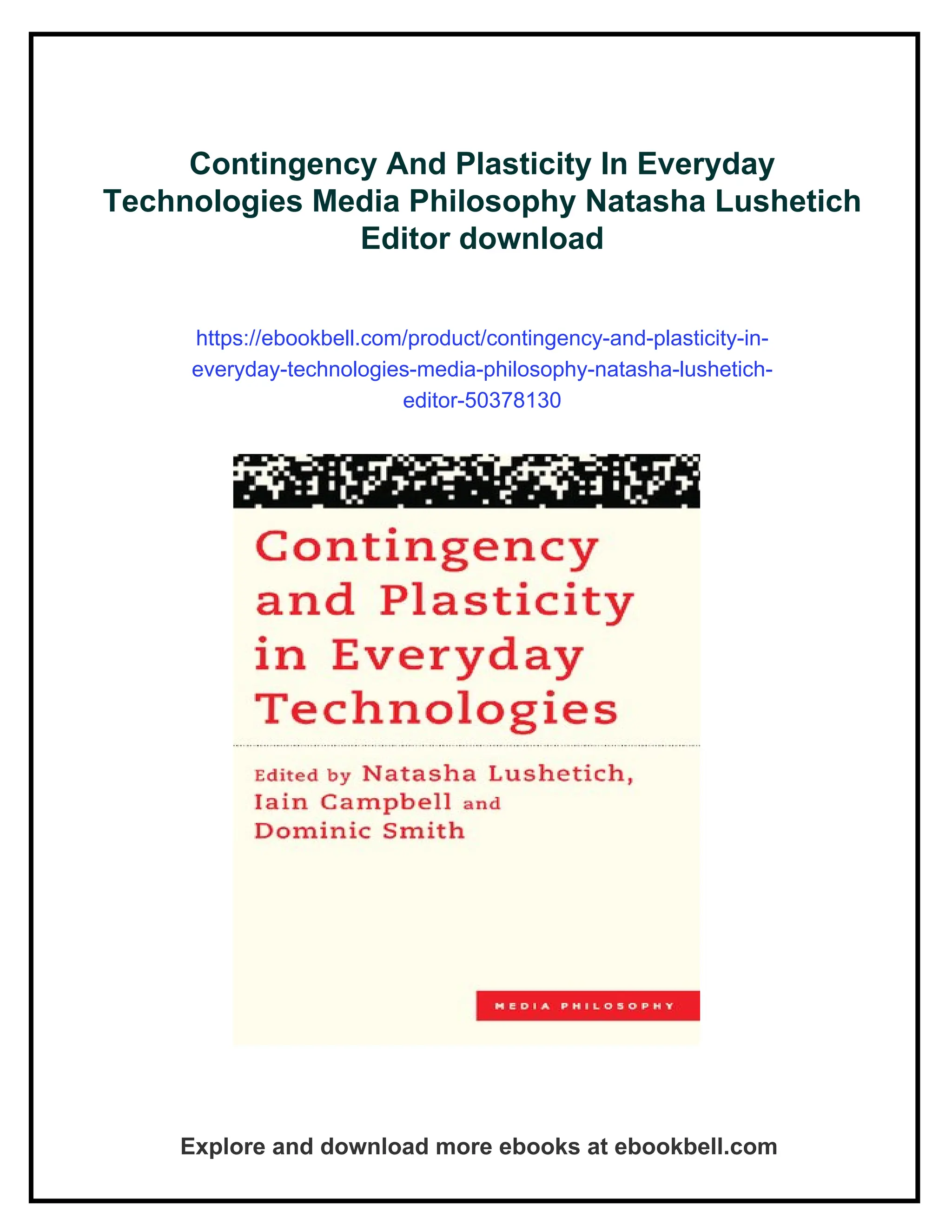
Contingency And Plasticity In Everyday
Technologies Media Philosophy Natasha Lushetich
Editor download
https://ebookbell.com/product/contingency-and-plasticity-in-
everyday-technologies-media-philosophy-natasha-lushetich-
editor-50378130
Explore and download more ebooks at ebookbell.com
Here are some recommended products that we believe you will be
interested in. You can click the link to download.
Contingency And Plasticity In Everyday Technologies Natasha
Lushetichiain Campbelldominic Smith
https://ebookbell.com/product/contingency-and-plasticity-in-everyday-
technologies-natasha-lushetichiain-campbelldominic-smith-59480088
Contingency And The Limits Of History How Touch Shapes Experience And
Meaning Liane Carlson
https://ebookbell.com/product/contingency-and-the-limits-of-history-
how-touch-shapes-experience-and-meaning-liane-carlson-51906798
Contingency And Convergence Toward A Cosmic Biology Of Body And Mind
Russell Powell
https://ebookbell.com/product/contingency-and-convergence-toward-a-
cosmic-biology-of-body-and-mind-russell-powell-38234908
Contingency And Natural Order In Early Modern Science Pietro D Omodeo
Rodolfo Garau
https://ebookbell.com/product/contingency-and-natural-order-in-early-
modern-science-pietro-d-omodeo-rodolfo-garau-10795766
Fascists And Honourable Men Contingency And Choice In French Politics
191845 Studies In Modern History 1st Edition Nimrod Amzalak
https://ebookbell.com/product/fascists-and-honourable-men-contingency-
and-choice-in-french-politics-191845-studies-in-modern-history-1st-
edition-nimrod-amzalak-2371346
Criminality And The Modern Contingency And Agency In Twentiethcentury
America Stephen Brauer
https://ebookbell.com/product/criminality-and-the-modern-contingency-
and-agency-in-twentiethcentury-america-stephen-brauer-38541866
Gambling For Profit Historical Contingency And Jagged Growth Kerry G E
Chambers
https://ebookbell.com/product/gambling-for-profit-historical-
contingency-and-jagged-growth-kerry-g-e-chambers-51918088
The Fragility Of Language And The Encounter With God On The
Contingency And Legitimacy Of Doctrine Florian Klug
https://ebookbell.com/product/the-fragility-of-language-and-the-
encounter-with-god-on-the-contingency-and-legitimacy-of-doctrine-
florian-klug-49012672
Narrating Futures Volume 5 Alternate History Playing With Contingency
And Necessity Kathleen Singles
https://ebookbell.com/product/narrating-futures-volume-5-alternate-
history-playing-with-contingency-and-necessity-kathleen-
singles-50957022
Contingency and Plasticity
in Everyday Technologies
MEDIA PHILOSOPHY
Series Editors
M. Beatrice Fazi, Reader in Digital Humanities, University of Sussex
Eleni Ikoniadou, Reader in Digital Culture and Sonic Arts, Royal
College of Art
The Media Philosophy series seeks to transform critical investigations about
technology by inciting a turn towards accounting for its autonomy, agency,
and for the new modalities of thought and speculation that it enables. The
series showcases the ‘transcontinental’ work of established and emerging
thinkers whose research engages with questions about the reshuffling of
subjectivity, of perceptions and of relations vis-à-vis computation, automation
and digitalisation, as 21st century conditions of experience. The books in this
series understand media as a vehicle for ontological and epistemological
transformation, and aim to move past their consistent characterisation as pure
matter-of-fact actuality.
For Media Philosophy, it is not simply a question of bringing philosophy
to bear on what is usually considered an object of sociological or historical
concern, but of looking at how developments in media technology pose
profound challenges for the production of knowledge and conceptions of
being, intelligence, information, temporality, reason, the body and aesthetics,
among others. At the same time, media and philosophy are not viewed as
reducible to each other's internal concerns and constraints, and thus it is
never merely a matter of formulating a philosophy of the media. Rather, the
series aims to create a space for the reciprocal contagion of ideas between
the disciplines and new mutations from their transversals. With their
affects and formalisms cutting across creative processes, ethico-aesthetic
experimentations and biotechnological assemblages, the media events of our
age provide different points of intervention for research.
The series is dedicated to pushing the thinking of media through projects
looking for uncertain, unknown and contingent rhythms that inflect and
change the world.
—The Editors, M. Beatrice Fazi and Eleni Ikoniadou
‌‌
Software Theory: A Cultural and Philosophical Study, by Federica Frabetti
Media after Kittler, edited by Eleni Ikoniadou and Scott Wilson
Chronopoetics: The Temporal Being and Operativity of Technological
Media, by Wolfgang Ernst, translated by Anthony Enns
The Changing Face of Alterity: Communication, Technology and Other
Subjects, edited by David J. Gunkel, Ciro Marcondes Filho and
Dieter Mersch
Technotopia: A Media Genealogy of Net Cultures, by Clemens Apprich,
translated by Aileen Derieg
Contingent Computation: Abstraction, Experience, and Indeterminacy in
Computational Aesthetics, by M. Beatrice Fazi
Recursivity and Contingency, by Yuk Hui
Sound Pressure: How Speaker Systems Influence, Manipulate and Torture,
by Toby Heys
Contingency and Plasticity in Everyday Technologies, edited by Natasha
Lushetich, Iain Campbell and Dominic Smith
Contingency and
Plasticity in Everyday
Technologies
Edited by Natasha Lushetich, Iain
Campbell and Dominic Smith
ROWMAN & LITTLEFIELD
Lanham • Boulder • New York • London
Published by Rowman & Littlefield
An imprint of The Rowman & Littlefield Publishing Group, Inc.
4501 Forbes Boulevard, Suite 200, Lanham, Maryland 20706
www​.rowman​.com
86-90 Paul Street, London EC2A 4NE
Copyright © 2023 by The Rowman & Littlefield Publishing Group, Inc.
All rights reserved. No part of this book may be reproduced in any form or by any elec-
tronic or mechanical means, including information storage and retrieval systems, without
written permission from the publisher, except by a reviewer who may quote passages
in a review.
British Library Cataloguing in Publication Information Available
Library of Congress Cataloging-in-Publication Data Available
ISBN 978-1-5381-7157-8 (cloth); ISBN 978-1-5381-7158-5 (paperback); ISBN 978-1-
5381-7159-2 (ebook)
The paper used in this publication meets the minimum requirements of American
National Standard for Information Sciences—Permanence of Paper for Printed Library
Materials, ANSI/NISO Z39.48-1992.
vii
Contents
List of Figures ix
Prologue: Normalising Catastrophe or Revealing Mysterious
Sur-Chaotic Micro-Worlds? xi
Natasha Lushetich, Iain Campbell, and Dominic Smith
Acknowledgments xxxi
PART I: SOCIAL-DIGITAL TECHNOLOGIES 1
Chapter 1: Information and Alterity: From Probability to Plasticity 3
Ashley Woodward
Chapter 2: Transcendental Instrumentality and Incomputable
Thinking 19
Luciana Parisi
Chapter 3: Digital Ontology and Contingency 35
Aden Evens
Chapter 4: Blockchain Owns You: From Cypherpunk to
Self-Sovereign Identity 53
Alesha Serada
Chapter 5: The Double Spiral of Chaos and Automation 71
Franco ‘Bifo’ Berardi
PART II: SPATIAL, TEMPORAL, AURAL, AND VISUAL
TECHNOLOGIES 87
Chapter 6: Allagmatics of Architecture: From Generic Structures to
Genetic Operations (and Back) 89
Andrej Radman
viii Contents
Chapter 7: Computation and Material Transformations:
Dematerialisation, Rematerialisation, and Immaterialisation in
Time-Based Media 107
Oswaldo Emiddio Vasquez Hadjilyra
Chapter 8: How the Performer Came to Be Prepared
‌‌: Three
Moments in Music’s Encounter with Everyday Technologies 125
Iain Campbell
Chapter 9: The Given and the Made: Thinking Transversal
Plasticity with Duchamp, Brecht, and Troika’s Artistic
Technologies 143
Natasha Lushetich
Chapter 10: Ananke’s Sway: Architectures of Synaptic Passages 163
Stavros Kousoulas
PART III: EPISTEMIC TECHNOLOGIES 181
Chapter 11: Outline to an Architectonics of Thermodynamics:
Life’s Entropic Indeterminacy 183
Joel White
Chapter 12: Irreversibility and Uncertainty: Revisiting Prigogine in
the Digital Age 201
Peeter Müürsepp
Chapter 13: ‘At the Crossroads . . . ’: Essence and Accidents in
Catherine Malabou’s Philosophy of Plasticity 219
Stephen Dougherty
Chapter 14: Ugly David and the Magnetism of Everyday
Technologies: On Hume, Habit, and Hindsight 235
Dominic Smith
Chapter 15: Adjacent Possibles: Indeterminacy and Ontogenesis 251
Sha Xin Wei
Epilogue: Schrodinger’s Spider in the African Bush: Coping with
Indeterminacy in the Framing of Questions to Mambila Spider
Divination 271
David Zeitlyn
Index 289
About the Authors 299
ix
List of Figures
6.1. Axes of reference and consistency based on Guattari’s
Schizoanalytic Cartographies.
7.1 and 7.2. Stills from Harun Farocki, Inextinguishable Fire (1969).
15.1. Turing machine.
15.2. State diagram (algorithm) for a Turing machine.
15.3. Tangent spaces (e.g., planes) over a manifold (e.g., sphere).
15.4. ‘Lifting.’
E.1. Stylus tablet 836, one of the most complete examples exca-
vated at Vindolanda.
E.2. Palm tree cards: positive and negative (approximately actual
size), 2022.
E.3. Divination setup, 2022.
E.4. Basic result patterns, 2022.
E.5. Two unusual results in which the cards are propped up on each
other, 2022.
xi
Prologue
Normalising Catastrophe or Revealing
Mysterious Sur-Chaotic Micro-Worlds?
Natasha Lushetich, Iain Campbell,
and Dominic Smith
Over all things stand the heaven accident, the heaven innocence, the
heaven chance, the heaven prankishness.
—Friedrich Nietzsche1
I do not understand why, when I ask for grilled lobster in a restaurant, I’m
never served a cooked telephone.
—Salvador Dalí2
Can we say that technology—understood as a host of social, epistemic,
material, and immaterial transformation techniques, tools, and methods—is
contingent and indeterminate? If so, how does this manifest? As operational
instability? As unpredictability or unknowability? As creativity and the pro-
duction of novel otherness? In 2006, the US Congress established an expert
cross-disciplinary commission consisting of anthropologists, molecular
biologists, neuroscientists, psychologists, linguists, classical scholars, and
artists. The commission’s purpose was to develop a language of warning
against the threats posed by nuclear waste in ten thousand years’ time. The
problem to be solved was not only what symbols to use to communicate with
the thirty-first-century humans (who are likely to be more different from
xii Prologue
us than the 8000 BC, prewriting humans were), but how to understand the
evolution of potential catastrophes given the accelerated proliferation of new
technologies and the rapidly changing environmental conditions, due, in part,
to the proliferation of new technologies.
Catastrophe is by definition beyond human comprehension. It is also
beyond the technologies developed to control accidents (usually perceived
as locally manageable). Since the shift in planetary interdependence induced
by globalisation and the rise of the risk society where ‘the unknown and
unintended consequences’ of complex global, technologically mediated
interactions are ‘the dominant force in history and in society,’3
crisis and the
mapping of catastrophe have become a necessary means of understanding the
future. The paradoxical twist is that the conceptualisation, visualisation, and
management of crisis and catastrophe are themselves contingent on technol-
ogy. For example, a system known as Total Information Awareness, built by
the US military in the wake of 9/11 as a counter-terrorism weapon, has been
adapted to programmes such as the Risk Assessment and Horizon Scanning
System (RAHS), which is widely used in Asia. The problem with RAHS,
however, as with many other so-called early warning systems, is that it has
high false alarm rates and creates almost as many accidents as it manages
to prevent.4
Crisis is not—or is no longer—a historical event, a state of locally observ-
able social breakdown. It is not a condition to be observed—as, say, a failure
of operationality or loss of meaning—but rather, as Janet Roitman notes, a
‘transcendental placeholder’ that signifies techno-social contingency itself.5
But how should we understand this complex phenomenon? Should it be
seen as the inevitable result of difference, observation, and/or acceleration?
For Niklas Luhmann, observation is an indication in a field of difference.
When the observing agent (human or artificial) perceives ‘something,’ the
‘something’ it perceives is the differential relation to everything else.6
This
is very similar to the Derridean play of semiosis7
; both structure the world’s
undecidables. Luhmann speaks of the ‘marked’ and ‘unmarked’ side of the
field of observation, where ‘unmarked’ defines the blind spot of observation;
he further suggests that everything becomes contingent whenever what is
observed depends on who or what is observing.8
Second-order observation—
the observation of (human or artificial) agents doing the observing—is thus
doubly contingent.9
This means that the intelligibility of accidents, crises,
and/or catastrophes is contingent on the parameters, techniques, and tech-
nologies of observation, be they material or immaterial: there is no such thing
as an event that first occurs, and is then observed and subsequently analysed;
rather, events are co-produced in and by the observation techniques, technolo-
gies, and agents.10
Prologue xiii
The early Paul Virilio saw technology as inseparable from speed and
acceleration: ‘there is no industrial revolution, only a dromocratic revolu-
tion . . . no strategy only dromology . . . “dromological progress” is that
which “ruins progress”.’11
In an Aristotelian vein, Virilio associates accident
with the revelation of substance,12
which may not manifest fully without
the accident. In other words, the accident serves the purpose of knowledge.
However, in his 2002 (post 9/11) exhibition Ce qui arrive at The Fondation
Cartier in Paris—ce qui arrive being the French translation of the Latin acci-
dens (that which happens)—Virilio is no longer concerned with the accident
as that which reveals substance. He is concerned, first, with the accident of
knowledge, and second, with the multiple arborisations of these accidents of
knowledge: ‘[t]he shipwreck is the “futurist” invention of the ship, and the air
crash the invention of the supersonic airliner, just as the Chernobyl meltdown
is the invention of the nuclear power station.’13
Importantly, Virilio consid-
ers computer science as an ‘accident of knowledge due to the very nature of
its indisputable advances but also, by the same token, due to the nature of
the incommensurable damage it does.’14
But Virilio is not talking about pro-
gramming errors or oversights, which is the impression we get from Norbert
Weiner’s writing on the subject:
A goal-seeking mechanism will not necessarily seek our goals unless we design
it for that purpose, and in that designing we must foresee all steps of the pro-
cess for which it is designed. . . . The penalties for errors of foresight, great as
they are now, will be enormously increased as automatization comes into its
full use.15
Though Weiner acknowledges the ‘penalties’ for technological complexity,
he suggests that careful and knowledgeable programming can overcome
contingency. For Virilio, by contrast, the accident is not a dysfunction of
one or more parts of the means-to-goals trajectory. It is far more similar to
structural instability. Indeed, in The Accident of Art Virilio calls the accident
‘a profane miracle.’16
A miracle is not a revelation of an object’s substance,
or an aspect of human knowledge. Rather, a miracle reveals the structuring
principles of reality. Like Bruno Latour, Virilio suggests that the operation
of the world reveals itself in moments of rupture.17
We could understand this
in two ways: accident as methodology, and accident as the manifestation
of technological normalisation. The former was first proposed by Harvey
Molotch, who, in his 1970 study of the accidental oil spill off the Californian
coast—which no amount of lobbying from the wealthy and influential Santa
Barbara community could stop or even mitigate—argues that what the oil
spill revealed was not only the underlying power dynamic but also a mode
of governance.18
In the post-1990s period, this mode of governance, which
xiv Prologue
deploys contingency, instability, and disorder as facilitators of governance
itself, became, along with disaster capitalism,19
a sine qua non of neolib-
eral governance. The second way to understand the accident is as techno-
logical normalisation, which refers to the normalisation of incompatibilities
and consists of three elements: institutional, contextual, and systemic.20
Institutions sometimes develop practices that differ from written regulations;
technologies are situated in specific, rather than generic, contexts, which are
often at odds with the contexts they were designed for—for example, most
nuclear reactors in Japan were designed in the United States, thus not with
earthquakes and tsunamis in mind21
—such and similar slippages are further
exacerbated in large-scale systems whose various (human and technological)
sub-systems, and multi-national regulatory structures make uniform opera-
tion impossible.22
Already in 1984, Charles Perrow argued that post-industrial
catastrophes were to be understood as routine outcomes of normalised—yet
utterly unmanageable—technological arrangements; his conclusion was that
complex techno-social systems should be loosely, rather than tightly, coupled,
and that systems where the consequences of accidents were on a catastrophic
scale, such as nuclear power, should be abandoned altogether.23
All these narratives view the accident as the result of human-technological
interaction and/or the non-compensable irruption of external difference.
While it is certainly true that post-industrial accidents reveal what Martha
Nussbaum has called ‘the fragility of existence,’ in addition to revealing
the inapplicability of pre-industrial technical-epistemic principles, namely
universality, commensurability, precision, and explainability,24
understanding
accidents (and contingency more generally) as the obverse of these principles
is problematic. Equally problematic is the notion of the accident as an exter-
nal occurrence, regardless of its indisputable connection to knowledge. For
Michel Foucault,
identify[ing] the accidents, the minute deviations—or conversely, the complete
reversals—the errors, the false appraisals, and the faulty calculations that gave
birth to those things which continue to exist or have value for us is to discover
that truth or being lies not at the root of what we know and what we are but the
exteriority of accidents.25
While this is certainly true, and acknowledged in other fields, such as litera-
ture, where the experimental accident of form (in, say, chance operations),
considered nonsensical in one generation, becomes a new literary genre in
the next,26
the technological accident—understood in its literal meaning, as
an event—cannot be seen as external to technology.
Prologue xv
THE INTERNALITY OF CONTINGENCY
The work of Bernard Stiegler and Cornelia Vismann as well as that of the
more contemporary authors such as Yuk Hui and Beatrice Fazi shows contin-
gency to be internal to the operation of technology, as method and material
support. As is well known, for Stiegler, the originary relation between the
human and the technical is both contingent and temporal.27
In the first volume
of Technics and Time, Stiegler relates the story of Prometheus’s lesser-known
brother, Epimetheus, who Zeus had put in charge of distributing traits and
qualities to animals and humans. However, Epimetheus (whose name means
afterthought and is related to the past) mistakenly used up all available
traits—hooves, claws, and fangs—on animals and forgot to keep any in
reserve for humans. In order to remedy this error, his brother Prometheus
(whose name means forethought and is related to the future) stole fire from
the gods and gave it to humans. As is well known, this gesture incurred the
wrath of Zeus who chained Prometheus to a rock in the Caucasus where
a vulture pecked his liver for the rest of his eternal life. Noting in passing
that Prometheus had thereby effectively become the clock of the Titans (the
measure of time’s passing), Stiegler interprets this allegory as suggesting that
the origin of technology resides in oversight and forgetting.28
More important
than Stiegler’s intriguing mythological account, however, is the fact that fire
is not a claw or a fang, that is, not a physically incorporable technology or
organology. Fire is an element. For Gaston Bachelard, fire is simultaneously
subject, object, and a ‘hormone of the imagination.’29
It is both actual and
virtual; its warmth lies at the bottom of human notions of comfort since ‘the
origin of every animism’ is ‘calorism.’30
Both intimate and universal, fire is
entwined with potentiality: it ‘hid[es] in the entrails of substance, latent and
contained.’31
As an element, fire is also imbricated in the human body in a vir-
tual manner, through the flesh, which, as Maurice Merleau-Ponty has argued,
is the ‘fifth element.’32
Like all other elements, fire changes micro-temporally
and this change is a spatial one, since the intensity of fire changes its reach.
Although it’s not our intention to theorise the origin of technology here, it’s
important to note that ‘fire as first technology’ is useful for understanding the
micro-spatio-temporal operation of all technologies, and the extent to which
this operation is contingent and/or plastic.
Vismann doesn’t make an explicit connection with fire; however, her con-
ceptualisation of the gadget or tool’s agency is profoundly spatio-temporal.
First, a tool’s features are not independent from their conditions of produc-
tion, material properties, and the spatial and temporal circumstances of their
coming into being. This is why, in Vismann’s view, we need to differenti-
ate between ‘the agency of persons, who de jure act autonomously,’ and
xvi Prologue
the ‘agency of objects and gadgets, which de facto determine the course of
action.’33
The question of tool agency is here not one of ‘feasibility, suc-
cess, chances and risks of certain innovations and inventions but one of
the auto-praxis [Eigenpraxis] of things, objects and tools.’34
In German,
Eigenpraxis has the connotation of ‘particular’ or ‘own’ and refers to the
agent-thing’s iterative (i.e., non-programmed) steering of emergent processes
in new, and, for humans, often, unfathomable directions. The fact that all
tools and gadgets engage in Eigenpraxis35
means that technological relations
are dynamic actualities-virtualities. This is similar to Gilbert Simondon’s
notion of individuation; for Simondon, all techniques and technologies are
formed through evolutionary layering and the modification of functional-
ities, much like in the case of living organisms.36
Like living organisms,
mechanical and automated objects have an internal dynamic. Space-time,
likewise, is processual and mutational. Individuation unfolds in the (organ-
ism or machine’s) field of potentiality which affords the mutational qualities
of an individual organic or machinic existent. Potentiality—the realm of the
virtual—is a futurity that is enveloped in the present.
In a recent work, Hui places contingency in dialogue with recursivity.37
Recursivity is the system’s transformational interaction with the environment,
which is often, or at least to a degree, incorporated into the system. Cutting
across the living organism-machine dichotomy through a historical analysis
of the concept of the organic via Immanuel Kant, Friedrich Wilhelm Joseph
von Schelling, and Georg Wilhelm Friedrich Hegel, where contingency
defines the impossibility of the knowledge of final ends and is supplanted by
an adaptive teleology of organisms predicated on contingency, Hui suggests
that machinic systems, like organic ones, act recursively on themselves. The
reason why recursion cannot be programmed is that systems are exposed to
contingencies they can neither mitigate nor incorporate. Instead, contingent
events interfere with the system’s recursive loops, which is what triggers new
adaptive tactics. Hui’s connection between the Hegelian sublation, cybernetic
feedback, and Kurt Gödel’s recursive algorithms suggests an onto-epistemol-
ogy similar to Gregory Bateson’s organic-machinic, human, and other-than-
human epistemology of eco-systems.38
Fazi’s book Contingent Computation
by contrast focuses on abstraction as immanently constitutive of computa-
tional processes, through an aesthetic of the indeterminate, seen as a real
function of computation. Drawing on Gilles Deleuze, Fazi conceptualises the
virtual as a continuum that can never be completely actualised.39
However,
she argues that this virtual potentiality does not pertain to the discretising
operations of computation. Turning to the philosophy of A. N. Whitehead,
Fazi theorises a form of potentiality that is not predicated on the continuum of
the virtual but is instead specific to the abstractive, quantitative character of
Prologue xvii
digital computation. Computers are determined by their formal structure and
their deductive system. However, they are also indeterminate. Indeterminacy
is both a process and a quality that arises from the system’s final openness; for
example, the Turing machine operates through finite processes of computa-
tion, but this operation is nevertheless open as the truth claim of a statement
cannot be determined before the actual operation. In other words, the infinite
(potentiality) acts on the finite process of computation (actuality).
These works of Hui and Fazi echo the long history of indeterminacy in
the arts, where indeterminate procedures have, since the beginning of the
twentieth century, been variously a response to or an elaboration of scientific
and philosophical notions of indeterminacy, or have alternatively explored
the actual-virtual indeterminacy of specific materials and processes. Many
Dadaist and Surrealist practices, such as those of Tristan Tzara, Francis
Picabia, and Marcel Duchamp, were a direct response to the prominent
mathematical and quantum-mechanical theories of the time, those of Henri
Poincaré and Niels Bohr. John Cage, Luigi Nono, and Iannis Xenakis’s com-
positional strategies likewise engaged early probability theory, stochastic
procedures, and Ilya Prigogine’s theory of non-linear dynamics, much like the
work of contemporary artists, engages systems’ and algorithmic indetermi-
nacy. For example, Pierre Huyghe’s UUmwelt (2018) and After ALife Ahead
(2017)40
stage organic-machinic interactions between complex systems, while
Tom White’s Perception Engines (2018) engage in epistemic experiments
with indeterminate neural network learning patterns.41
What such and similar
works address is radical contingency, which was recently (re)formulated by
Quentin Meillassoux as the amalgam of two notions. First, the fact that ‘any
entity, thing, or event . . . could be, or could have been, other than it is,’42
and
second, that ‘facticity’ is not ‘the index of thought’s incapacity to discover
the ultimate reason of things’ but instead ‘the index of thought’s capacity
to discover the absolute irreason of all things.’43
Meillassoux calls irreason
‘surchaos’in a gesture similar to the Surrealists’44
and the theory of non-linear
dynamics, where chaos doesn’t refer to disorder but to the (unpredictable)
emergence of order from disorder and disorder from order.45
That said, everyday technologies—those we use on a daily basis—are
often experienced as far from (auto)poietically sur-chaotic. Rather, they are
experienced as over-determined. Theoretically, over-determination can be
understood through Deleuze’s 1995 essay ‘Postscript on Control Societies.’46
For Deleuze, and for theorists following him such as Maurizio Lazzarato,
‘hypermodern’ techniques of governance, like those enacted through com-
munication technologies and finance, reciprocally enable ‘neoarchaic’
mechanisms of subjection47
—racism and class division—while enacting a
‘micropolitics of insecurity.’48
In everyday experience, over-determination
is felt in automatic account termination, automatic health insurance claim
xviii Prologue
refusals, or criminal recidivism prediction algorithms which equate poverty
and low education levels with criminality. These produce conclusions like
if you’re underprivileged, uneducated, and your family members have been
to prison; you’re bound to be a criminal; and also a criminal for life.49
Such
short-cutting practices, profoundly problematic on an ethical level, and weld-
ing acceleration to dataism on the ontological and epistemological levels,
are accompanied by all too frequent examples of unnecessary complexity in
matters that could hardly be any simpler; for example, changing the address
associated with your bank account, which results in hours of time-wasting
conversations with human and machinic agents in an effort to fathom why
the programme ‘can’t take’ an address with two numbers.
As noted in much recent scholarship, the widespread use of predatory
algorithmic procedures that automate difference control and anomaly detec-
tion perpetuates racism, sexism, and classism.50
Sequence- and logic-locked
procedures translate directly into pre-emption or ‘future from structure,’
reducing ethical questions to technical management, and continuing the
mantra of industrial rationality: progress, increased productivity, and effi-
ciency, in a far worse—because automated—way. ‘Future from structure’
manipulates possibility into probability, and probability into necessity, reduc-
ing relationships of relevance to those of causation. As Franco Berardi has
extensively argued, automation is ‘the submission of the cognitive activity to
logical and technological chains,’ a ‘form of engendered determinism,’ and,
as such, the ‘fundamental act of power.’51
While it’s important to understand
that the power of automation is, at the same time, the automation of power,
it’s equally important to acknowledge that the mid-twentieth-
century compu-
tational procedures—predecessors of what we understand computation to be
today—did not develop on their own.
A key term in neuroscience, plasticity played an important role in the
mid-twentieth-century co-development of computers and neurosciences.
Discussing the indeterminate element present in Turing’s thinking machine—
which developed amid theories such as Gödel’s undecidability theory—David
Bates and Nima Bassiri refer to Donald Hebb’s famous phrase ‘neurons that
fire together wire together’ to establish a connection between plasticity and
deviance from set routes and routines.52
Pointing to the fact that contingency
exists in human and computer synapses alike, they suggest that at the time
when the first computer was being conceptualised, the digital was not yet
fully aligned with automaticity.53
The co-development of computer software,
hardware, and infoware with experimental neuroscience meant that the
plastic brain offered an insight into unpredictable leaps in human behaviour,
related to hidden capacities that go beyond habit or norm.
In machines, this meant unpredictable leaps in functional mechanisms,
which were often treated as errors, but which were not errors, merely different
Prologue xix
developments. Neuropsychological discourses focusing on the disorders of
the injured brain and its ability to recover functioning after injury showed the
brain to be simultaneously a ‘site of openness’and a space of artificial, repeti-
tive ‘mechanisms.’54
Quoting William James, Bates and Bassiri conclude that
‘[p]lasticity means the possession of a structure weak enough to yield to an
influence, but strong enough not to yield all at once.’55
Errance—wandering
or movement away from the established or programmed path or course—is,
in other words, inherent in and to computational procedures. Or, as Simondon
put it: ‘the true perfection of machines does not correspond to an increase in
automation, but on the contrary to the fact that the functioning of a machine
harbours a certain margin of indetermination.’56
Seven decades on from Simondon we know, as Hui has argued in a devel-
opment of Simondonian concepts, and N. Katherine Hayles has noted in rela-
tion to Wiener’s cybernetic paradigm of circular feedback, that, in machinic
and algorithmic processes and operations, feedback is recursive and spiral,
rather than circular.57
Feedback does not reinforce self-same operations but
creates an internal dynamic which opens onto the novel and the ‘undecid-
able.’58
Furthermore, contemporary machine learning uses back propagation
to train multi-layer architectures, which makes feedback much less relevant
than aggregation, de-aggregation, and re-aggregation, all of which create
internal change and cue emergent behaviours. More precisely, there are at
least three reasons why computer and machinic processes could be consid-
ered contingent, plastic, and indeterminate: the essential incomputability of
all computing systems, their constant production of new temporalities or tem-
poral swarming, and neural network contagions leading to unpredictable out-
put. As this volume will show, moreover, these themes are far from remote:
they are integral to the everyday technologies that populate the lifeworlds of
the twenty-first century.
INCOMPUTABILITY, TEMPORAL
SWARMING, NETWORK CONTAGIONS
Combining, one the one hand, Turing’s question of the limit of computability,
and, on the other, Claude Shannon’s information theory where information
doesn’t apply to the individual message but to signal crafted from noise,59
Gregory Chaitin suggests that computation consists of unknowable prob-
abilities.60
Data entropy (the fact that the output always exceeds the input)
leads to algorithmic randomness resembling an infinite series of coin tosses
where the outcome of each toss is unrelated to the previous one. Chaitin’s
name for this process is Omega—an infinitely long number whose digits
have no repeatable pattern whatsoever. Related to the halting problem—the
xx Prologue
question of whether a programme will halt after a thousand, million, or bil-
lion years—Omega is ‘the concentrated distillation of all conceivable halt-
ing problems’61
—a number which can be known of, but not known through
human reason. As a sequentially ordered computational processing of zeros
and ones, it shows that there is an intrinsic dynamic at work in every compu-
tation process negating the logic- and sequence-locked view of computation
where randomness is seen as an error. In other words, incomputability is not
merely the impossibility of computability or prediction. It’s the very real pos-
sibility of an indeterminate computational coming-into-being, which does not
operate in time but is temporal in nature.
As is well known, there is a temporal gap between human and technical
perception.62
The most frequently used examples come from high frequency
trading where, as Donald MacKenzie has argued, behaviours like ‘queuing’
(where existing bids are altered on the basis of temporal advantage, according
to the first-come-first-served rule), and ‘spoofing,’ which refers to the place-
ment and cancellation of orders, based on the millisecond temporal advantage
and price drops caused by cancellations,63
are produced. High frequency trad-
ing is, of course, a specific domain of human-machinic endeavour. However,
the reason why these behaviours are relevant to a discussion of technological
contingency is that they show, in qualitative terms, that informational-algo-
rithmic ecologies do not consist of pre-formed, immutable interfaces, but of
complex ‘swarm behaviours.’64
These swarm behaviours are predicated on
temporal processes that brim under the surface of all machinic operations,
for example, accelerated pattern recognition, or syntheses of diverse inputs.
Despite expressions like ‘webpages,’ which would suggest a static object
(both an object and static), the internet is an interpenetration of multiple ‘tem-
poral latencies.’65
In asynchronous scripts, such as XML, applications ‘con-
tinually respond to input and work through interrelated scripts, style-sheets
and mark-up.’66
Their ‘geographically dispersed operations’ do not ‘resolve
into a uniform, mechanical rhythm’; on the contrary, they “propagate a fluc-
tuating momentum based on highly dispersed ‘data-pours’.”67
By definition, information is never first ‘composed’ then presented. It’s
always already operationally active, which is to say that it is changing all
the time. As Cécile Malaspina’s recent study of the epistemological con-
sequences of Shannon’s account of information has shown, distinctions
between information and noise in the transmission of a signal are external
to the process of transmission itself.68
This means that the boundary between
information and noise is shifting all the time in tandem with our knowledge
practices. Dieter and Gauthier call the medium-inherent process tertium
quid (third something), a form of subterranean interpenetration and com-
munication—in Shannon’s sense of the word—through the intersection and
binding of signals into reiterative sequences of action in the ‘milieu intérieur
Prologue xxi
of machines.’69
Micro-sensors, computational processors, and algorithmic
operations environmentally transform the very possibilities for perception.
This means that the temporal dimension of technical environments has a per-
formative effect: it triggers new behaviours through plastic connections and
transformations in and of different registers. For example, neural networks, in
which connections are modulated through a (re-)distribution of weights that
contribute to the tendency of neurons to fire through a function of the strength
of the connection, are co-constitutive.70
Neural networks create media based
on the mechanisms configured during training on input data. In supervised
training, the model of emergence is consecutively monitored and modified,
which has both empirical and significational relevance—understanding under
what circumstances the networks change. An auto-productive developmental
logic, which occurs in unsupervised learning, is fundamental to all neural
networks. As Catherine Malabou has argued, in machinic operations, any
notion of invariant repetition (automaticity) is accompanied by spontaneous
movement, given that the ‘automatic’ in auto-production comes from the
‘double valence’ of automatism: as ‘involuntary repetition and spontaneous
movement,’ as both ‘constraint and freedom.’71
Interactive algorithmic ecolo-
gies are not contingent or plastic in a consecutive, easily observable way but
as perpetual oscillations between intelligibility and unintelligibility.
In deep learning network architectures, neurons are connected through
synaptic weights to neurons in deeper layers, which are connected to other
neurons, in still deeper layers. In supervised and semi-supervised learning,
the adjustment of weights forms part of processual programming; here human
intervention alternates with the generative aspect of the networks. The differ-
ence between such operations and what may be called ‘network contagions’
is that the former are semi-knowable, the latter unknowable. ‘Unknowable’
here means that in deep learning architectures, the various activations and
weighted connections between thousands of nodes can be traced at the micro
level, but there is, at this moment in time, no macro explanation. Rather,
complex behaviours emerge from interactions between millions of cells.
These interactions are programmed, but the combination of unit-level learn-
ing algorithms and their exposure to data, which allows them to configure
themselves, are not. Algorithmic ecologies are therefore a chaotic operation
in a state of almost-equilibrium.
The levels of abstraction we have to toggle between in order to engage and
make sense of phenomena like neural networks and the media they create and
inform are considerable. As this volume both thematises and demonstrates,
however, instructive strategies for coming to terms with the structures and
processes operative here turn out to be hidden in plain sight. Take the ‘loose
resemblance’ between neural networks and the human brain we indexed ear-
lier. For all this image is hackneyed, dwelling with it turns out to be a useful
xxii Prologue
way of opening channels between the contemporary everyday and levels
of abstraction that appear more remote from it, yet that are in fact deeply
implicated as constitutive conditions: neural networks, for all the complex-
ity their imply, are deeply embedded in sculpting much of the contemporary
‘everyday’ in networked societies—they obtain in the background across
manifold interactions with digital technologies; as the cliché captures, they
are modelled, at least in part, on processes obtaining in the human brain; and,
by virtue of this relation of modelling/resemblance, they recursively feedback
into how we conceptualise of human beings and the brains, nervous systems,
and artefacts that constitute them.72
It is a feature of highly specialised work in epistemology to thematise the
key issues at stake here: recursivity, levels of abstraction, modelling, the rela-
tionship between propositionally expressed and ‘tacit’ knowledge, and links
between the general and the particular, to name but a few.73
It is something
further still, however—perhaps akin to a conjuring trick—to undertake the
task of demonstrating how these ostensibly abstract, remote, and specialised
matters are folded into our most ‘everyday’ technological artefacts and prac-
tices, in ways of which we can scarcely afford to be ignorant. If there is a
key challenge that each of the chapters assembled in this volume undertakes
it is precisely this one. The conjuring trick turns out to have to be a conjoin-
ing trick: that is, a way of shedding light on sometimes familiar phenomena
through novel forms of assemblage, exemplification, analogy, and combina-
tion. Viewed through these novel lenses, what hides in a contemporary phe-
nomenon like the ‘loose resemblance’ between a brain and a neural network
are not just further clichés, nor mere anthropomorphic or anthropocentric
projections; it is rather a margin of indeterminacy and difference that requires
the conjunction of a particularly focused set of themes and problems in order
to be explored. In this volume, we have attempted such a conjunction under
three headings: Social-Digital Technologies; Spatial, Temporal, Aural, and
Visual Technologies; and Epistemic Technologies.
THE STRUCTURE OF THIS VOLUME
Part I, ‘Social-Digital Technologies,’ juxtaposes arguments for machinic
and algorithmic indeterminacy to those of (over)determination in cognitive
automation, blockchain, and digital ideology. The section opens in an exis-
tential register, with Ashley Woodward’s historical overview of the idea of
information, traced from the metaphysical catastrophe of the death of God
to the informational simulation of God in the Leibnizian Monad. In a move
that enables both a philosophical and social reflection on the imbrication of
information technologies in the visceralities of human existence, individual
Prologue xxiii
and social, Woodward analyses the relationship of the probabilistic aspect of
information to alterity, engaging, along the way, with the work of Luciano
Floridi and Gilbert Simondon. Luciana Parisi continues the discussion of the
(algorithmic and machinic) production of alterity through a comparison of
contemporary digital brutalism with the aesthetic, functional, and architec-
tural strategies of New Brutalism. Using digital decisionism as an example
(where there is no difference between true or false, only between a faster
and slower—often equally illogical—decision), she proposes that transcen-
dental instrumentality is rooted in the materiality of indeterminate machinic
processes. For Parisi, the (social and operational) construction of technology
as ‘Man’s means-to-an-end continuum’ de-values tools under the pretext that
they have no soul. What is needed instead is a reappraisal of the ontological
implications of the actual, material machinic processes.
Aden Evens’s chapter opposes this view. Addressing Parisi’s notion of
computational indeterminacy (as well as those of Fazi and Hui), he argues
that the digital is deterministic. Digital determinism is, for Evens, rooted in
an elaborate ideology—based on positivism, rationalism, and instrumental-
ism. This ideology erodes not only all conditions for novelty but, more wor-
ryingly, has a significant social dimension. The deterministic view is further
elaborated in Alesha Serada’s analysis of blockchain technology. Here Serada
argues that despite contemporary blockchain technologies (on which emerg-
ing projects of digital governance are based) being a reaction to algorithmic
surveillance and control, they have now morphed into a form of ‘blockchain
governmentality’ where repression and invisible violence are hidden behind
the façade of democratic decision-making. Similarly to Woodward’s opening
chapter, part I closes in an existential register, with Franco ‘Bifo’ Berardi’s
analysis of cognitive automation, and, in particular, its relation to the politics
of financial indeterminism, the post-COVID-19 supply chain disruption, and
a new crisis of abstraction. Highlighting the plasticity of the general intellect,
Berardi argues that recent neuro-scientific advances in human-machinic intel-
ligence applications should be seen in the context of the re-concretisation of
biological matter, and the derailment of cognitive productivity, in cognitive
labour, however also in panic and fear. Reassessing the role of all these fac-
tors in cycles of in- and re-determination, Berardi proposes a new method-
ological approach based on the techno-political determination of governance,
and on tuning into contingent, chaotic events.
Part II, ‘Spatial, Temporal, Aural, and Visual Technologies,’ delves into
received ideas about non-digital technologies such as those used for building
spatial structures, manufacturing instruments, and constructing the aural and
visual space. Bookended by Andrej Radman’s and Stavros Kousoulas’s archi-
tectural analyses, this section studies the technical and aesthetic stakes of the
temporalities and spatialities of physical environments. Radman, to begin,
xxiv Prologue
takes as his target a perspective on the built environment where the relation
between agent and architecture is grounded in the supposed unities of space,
time, and consciousness. Through a theoretical apparatus developed from
Simondon’s notion of allagmatics and via figures including Félix Guattari
and Rem Koolhaas, Radman proposes to treat architecture as an ecological
practice that facilitates the production of collective subjectivities. Radman’s
call to reinvest discourses of digitality with a pathic dimension is echoed by
Oswaldo Emiddio Vasquez Hadjilyra, who provides a transhistorical juxtapo-
sition of some means by which material reality has been treated as an object
of measure and computation. Vasquez’s studies, stretching from Pythagoras’s
account of an aural-mathematical harmony to contemporary digital image
making, highlight how the temporalities of computation are at the same time
techniques of material transformation.
Iain Campbell and Natasha Lushetich, meanwhile, treat the diverse
modes by which twentieth- and twenty-first-century artistic technologies
and social-scientific technologies have met. Campbell explores a movement
between transparency and opaqueness that has been characteristic of how
musical instruments, understood as technologies, are conceived. Beginning
with the insertion of objects into an everyday piano that rendered John
Cage’s ‘prepared piano’ as a challenge to the aesthetic and social standing
of that instrument, Campbell follows the thread of contingent musical tech-
nologies as they come to intersect with large-scale technological research.
Lushetich, in turn, presents artistic dialogue with science as a means for
challenging socio-scientific dogma around space, time, and change. As with
Vasquez Hadjilyra’s account of computation, Lushetich treats the ‘artistic
technologies’ developed by Marcel Duchamp, George Brecht, and the artis-
tic collective Troika as attempts to challenge given orderings of the world,
evoking a plasticity and indeterminacy of space-time. Such work, Lushetich
shows, does not only perform a set of interventions into diverse fields (socio-
scientific, artistic, political), but suggests a transversal formulation of being
to come. In dialogue with Radman’s concerns with the indeterminacies of
architecture, Kousoulas closes the section and points toward the subsequent
chapters on epistemic technologies with his exploration of ‘synapses,’ a
notion through which architecture can be understood as a kind of delimita-
tion—constraint—of the possible. Sharing with many of the authors here an
explicit future-orientation, Kousoulas characterises architecture in terms of
its capacity not only to produce forms, but to enact a sensitivity to outside
information, and with this to intuit kinds of space and types of subject that
do not yet exist.
Part III is entitled ‘Epistemic Technologies.’ Joel White’s chapter
engages the work of Bernard Stiegler to develop an innovative reading of
Immanuel Kant’s architectonic approach to regulative ideas. Applying this
Prologue xxv
methodological framework to the implications of thermodynamics, White
offers a new way of unpacking the implications of the notorious ‘heat death
of the universe’ for human and non-human forms of life. Peeter Müürsepp’s
chapter takes up and develops the potential he sees in nuce in tantalising
remarks that the physicist/chemist Ilya Prigogine made toward the end of his
life, on the ‘bifurcation point’ for humanity implied in the digital revolution.
Like White, Müürsepp shows how issues relating to entropy, dissipation, and
the irreversibility of time can only remain ‘irrelevant’ or ‘abstract’ for forms
of common sense (whether pre-philosophical or philosophical) that remain
bound to anachronistic forms of Galilean/Newtonian classical physics.
Operating at a more familiar level of abstraction, Stephen Dougherty
offers an engagement with Catherine Malabou’s work. He charts two main
axes of development: the theoretical sense of plasticity in Malabou’s work,
as it develops out of her early work on Hegel (The Future of Hegel), through
engagements with neuroscience, then through ‘plastic’ close readings of
philosophers including Kant (Before Tomorrow), Heidegger (The Heidegger
Change), and Derrida (Plasticity at the Dusk of Writing); but Dougherty also
charts how another side of Malabou’s work (the engaged political work of
The New Wounded, Ontology of the Accident, and What Should We Do With
Our Brain?) relates to what, borrowing a term from Stephanie LeMenager,
he calls our ‘petromodernity,’ of which plastic is a ubiquitous material mani-
festation. Continuing in this vein, Dominic Smith’s chapter adopts a phenom-
enological technique to investigate ‘everyday technologies.’ Smith considers
everyday technologies in light of the COVID-19 pandemic, in a chapter
that develops through a critical engagement with Benjamin Bratton’s con-
troversial 2021 book, The Revenge of the Real: Politics for a Postpandemic
World. Against Bratton, Smith contests the scope and purpose of three
terms: ‘philosophy,’ ‘everyday technologies,’ and ‘the personal.’ Part III then
concludes with a chapter that dialectically relates both highly abstract and
highly concrete levels of abstraction: Sha Xin Wei’s account of mathemati-
cal, algorithmic, and social-aesthetic operations. This chapter continues the
discussion of an integrated (human-machinic) existence but re-directs it to the
conditioning occasions in which ensembles of people and machines produce
sense-making. Engaging with Agamben’s concept of ‘destituent power,’ and
distinguishing between the deterministic (as defined by algorithm and infor-
mation), the ‘unpredictable’ (chaotic), the random (as modelled by stochastic
arithmetic), and the irreducibility of life to evolutionary physics determined
by pre-statable rules, Sha argues for a third space between material causal-
ity, language (as a social technology) and experience via Deleuze’s notion of
sense and differential heterogenesis.
In the epilogue, David Zeitlyn distils many years of anthropological
fieldwork among the Mambila people of Cameroon. In contrast to naïve
xxvi Prologue
tendencies toward celebration of indeterminacy tout court, Zeitlyn’s epi-
logue offers an important example of a traditional practice—spider divina-
tion—that seeks to mitigate indeterminacy and uncertainty. Seen in light
of the concern with thermodynamics and non-classical physics offered by
White and Müürsepp, Zeitlyn’s epilogue offers a much-needed sense of both
continuity and difference: as Zeitlyn shows, concerns with indeterminacy,
death, and the (ir)reversibility of time are, on the one hand, manifest across
diverse human cultures; on the other hand, Zeitlyn offers the volume a much-
needed anthropological focus on a precise and localised non-Western prac-
tice, where the status of indeterminacy is moot. Contingency and Plasticity
in Everyday Technologies renders visible indeterminate ontologies—and
their correlates determination and over-determination—in and of historical
architectural, sonic, visual, spatio-temporal, social, epistemic,and ontogenetic
practices situating digital indeterminacy in the wider context of technological
transformation.
NOTES
1. Friedrich Nietzsche, Thus Spoke Zarathustra: A Book for All and None, trans-
lated by Alexander Tille (London: H. Henry and Co Ltd., 1896), 183.
2. Salvador Dalí quoted in Terry Riggs, ‘Salvador Dalí Lobster Telephone,’ Tate,
1998, np, public domain: https:​//​www​.tate​.org​.uk​/art​/artworks​/dali​-lobster​-telephone​
-t03257
3. Ulrich Beck, Risk Society: Towards a New Modernity (London and Los Angeles,
1992), 52.
4. See Edna Tan et al (eds.), Thinking about the Future: Strategic Anticipation and
RAHS (Singapore: National Coordination Security Secretariat, 2008).
5. Janet Roitman, Anti-Crisis (Durham: Duke University Press, 2014), 39.
6. Niklas Luhmann, Risk: A Sociological Theory (New York: De Gruyter, 1993).
7. Ferdinand de Saussure and Jacques Derrida have called semiosis ‘the play of
language’; for both meaning functions independently of its reference as language is
governed by arbitrary conventional and differential aspects of signs that define it as
a system. See Jacques Derrida, Margins of Philosophy, translated by Alan Bass (Chi-
cago: University of Chicago Press, 1982).
8. Niklas Luhmann, Observations on Modernity, translated by William Whobrey
(Stanford: Stanford Press, 1998), 48.
9. Ibid.
10. See Jonathan Crary, Techniques of the Observer: On Vision and Modernity in
the Nineteenth Century (Cambridge, MA: MIT Press, 1990).
Prologue xxvii
11. Paul Virilio, Speed and Politics: An Essay on Dromology, translated by Mark
Polizotti (New York: Semiotext(e), 1986), 46.
12. For Aristotle, non-essential properties of substances, those that manifest spo-
radically are accidents. See Aristotle, Categories and De Interpretatione, translated
by J.K. Ackrill (Oxford: Oxford University Press, 1975).
13. Paul Virilio, The Original Accident, translated by Julie Rose (London: Polity,
2007), 5.
14. Ibid, 6.
15. Norbert Weiner, God and Golem, Inc.: A Comment on Certain Points where
Cybernetics Impinges on Religion (Cambridge, MA: MIT Press, 1966), 63.
16. Sylvère Lotringer and Paul Virilio, The Accident of Art, translated by Mike
Taormina (Cambridge, MA: MIT Press, 2005).
17. See Bruno Latour, Reassembling the Social: An Introduction to Actor-Network
Theory (Oxford: Oxford University Press, 2005). Such an emphasis on rupture is, of
course, also present in Martin Heidegger’s work, and that of his contemporary inheri-
tors, such as Graham Harman (see Martin Heidegger, Being and Time, translated by
John Macquarrie and Edward Robinson [Oxford: Blackwell, 2001 (1962)]); Graham
Harman, Tool Being: Heidegger and the Metaphysics of Objects [Peru: Open Court,
2002]).
18. Harvey Molotoch, ‘Oil in Santa Barbara and Power in America,’ Sociological
Inquiry, 40, no. 1 (1970): 131–44.
19. See Naomi Klein, The Shock Doctrine: The Rise of Disaster Capitalism (Lon-
don: Picador, 2008 [2007]).
20. Brian Wynne, ‘Unruly Technology: Practical Rules, Impractical Discourses and
Public Understanding,’ Social Studies of Science, 18, no. 1 (1988): 147–67.
21. Dahr Jamail, ‘Full Meltdown. Fukushima Called the “Biggest Industrial Catas-
trophe in the History of Mankind,’ Al Jazeera, 16 June 2011, http:​//​www​.alternet​.org​
/world​/151328​/full​_meltdown​%3A​_fukushima​_called​_the​%27biggest​_industriaal​_
catastrophe​_in​_the​_history​_of​_manking​%27_/. See also Andrew Feenberg, Between
Reason and Experience: Essays in Technology and Modernity (Cambridge MA: MIT
Press, 2010).
22. Wynne, ‘Unruly Technology.’
23. Charles Perrow, Normal Accidents: Living with High-Risk Technologies (New
York: Basic Books, 1984).
24. Martha Nussbaum here refers to Aristotle’s explanation of technē, as based on
the four axioms. See Martha Nussbaum, The Fragility of Goodness: Luck and Ethics
in Greek Tragedy and Philosophy (Cambridge: Cambridge University Press, 2001).
25. Michel Foucault, ‘Nietzsche, Genealogy, History,’ in Donald Bouchard (ed.),
Language, Counter-Memory, Practice: Selected Essays and Interviews (New York:
Cornell University Press, 1977), 139–64, 146.
26. See Yuri Tynianov’s theory of literary evolution in Yuri Tynianov and Roman
Jakobson, ‘Problems in the Study of Literature and Langauge,’ in Ladislav Matejka
and Krystina Pomorska (eds.), Readings in Russian Poetics: Formalist and Structur-
alist Views (Dublin and Funks Groves, Illinois, 2002 [1971]), 79–80.
27. Bernard Stiegler, La technique et le temps (Paris: Galilée, 1994).
xxviii Prologue
28. Ibid.
29. Gaston Bachelard, La psychanalise du feu (Paris: Gallimard, 1949), 169.
30. Ibid.
31. Ibid, 19.
32. For Maurice Merleau-Ponty, flesh cannot be thought of as matter or substance
but needs the old term ‘element’ such as water, air, earth, and fire because it is an
element of Being, and, as such, both relational and transformational. See Maurice
Merleau-Ponty, The Visible and the Invisible, edited by Claude Lefort, translated by
Alfonso Lingis (Evanston: Northwestern University Press, 1968).
33. Cornelia Vissman, ‘Cultural Techniques and Sovereignty,’ translated by Ilinca
Iurascu, Theory, Culture, Society, 30, no. 6 (2013): 83.
34. Ibid., 84.
35. Ibid.
36. Gilbert Simondon, Du mode d’existence des objets techniques (Paris: Aubier,
1989 [1958]).
37. See Yuk Hui, Recursivity and Contingency (Lanham and London: Rowman &
Littlefield, 2019).
38. Gregory Bateson, Steps to an Ecology of Mind (San Francisco: Chandler Pub-
lications, 1972). See also Yoni Van Den Eede, The Beauty of Detours: A Batesonian
Philosophy of Technology (New York: SUNY, 2019).
39. M. Beatrice Fazi, Contingent Computation: Abstraction, Experience, and
Indeterminacy in Computational Aesthetics (Lanham and London: Rowman & Little-
field, 2018)
40. See https:​//​www​.serpentinegalleries​.org​/whats​-on​/pierre​-huyghe​-uumwelt​/ and
https:​//​www​.estherschipper​.com​/artists​/41​-pierre​-huyghe​/works​/15049​/.
41. See https:​//​drib​.net​/perception​-engines.
42. Quentin Meillassoux, ‘Métaphysique, spéculation, corrélation,’ in Ce peu
d’espace autour: Six essais sur la métaphysique et ses limites, edited by Bernard
Mabille (Paris: Les Éditions de la Transparence, 2010), 299.
43. Ibid.
44. Many of the automatic Surrealist practices, such as automatic writing, draw-
ing, and frottage, were methods for excavating hidden layers of reality, which when
brought to the surface, formed ‘sur-reality.’ The term implied aboven-ness through
imbrication, not elevation.
45. For a study of non-linear dynamics in the arts and science, see N. Katherine
Hayles, Chaos Unbound: Orderly Disorder in Contemporary Literature and Science
(New York: Cornell University Press, 1990).
46. Gilles Deleuze, ‘Postscript on Control Societies,’ in Negotiations, 1972–1990,
translated by Martin Joughin (New York: Columbia University Press, 1995), 177–82.
47. Maurizio Lazzarato, Experimental Politics: Work, Welfare and Creativity in the
Neoliberal Age, translated by Arianna Bove et al., edited by Jeremy Gilbert (Cam-
bridge, MA: The MIT Press, 2017), 61–62.
48. Ibid, 39–40.
49. Cathy O’Neill, Weapons of Math Destruction (New York: Crown Publishing,
2016).
Prologue xxix
50. See, for example, Virginia Eubanks, Automating Inequality: How High-Tech
Tools Profile, Police, and Punish the Poor (New York: St. Martin’s Press, 2018),
and Davide Panagia and Köseoğlu Çağlar, “#datapolitik: An Interview with Davide
Panagia,” Contrivers’ Review (2017), http:​//​www​.contrivers​.org​/articles​/40​/Davide​
-Panagia​-Caglar​-Koseoglu​-Datapolik​-Interview​-Political​-Theory​/.
51. Franco ‘Bifo’ Berardi, ‘Simulated Replicants Forever? Big Data, Engendered
Determinism and the End of Prophecy,’ in Big Data—A New Medium?, edited by
Natasha Lushetich (London and New York: Routledge, 2020), 42.
52. Donald Hebb quoted in David Bates and Nima Bassiri, Plasticity and Pathol-
ogy (New York: Fordham University Press, 2015), 195.
53. Ibid.
54. Ibid, 200.
55. William James quoted in Bates and Bassiri, Plasticity, 202.
56. Simondon, Sur la mode, 48.
57. N. Katherine Hayles, My Mother Was a Computer: Digital Subjects and Liter-
ary Texts (Chicago: Chicago University Press, 2005).
58. N. Katherine Hayles, Unthought: The Power of the Cognitive Unconscious
(Chicago: Chicago University Press, 2017), 202.
59. Claude Shannon, ‘Communication in the Presence of Noise,’ Proc IRE 37, no.
1 (1949): 10–21.
60. Gregory Chaitin, Meta Maths: The Quest for Omega (London: Atlantic Books,
2005).
61. Cristian Calude quoted in Marcus Chown, ‘God’s Number: Where Can We
Find the Secret of the Universe? In a Single Number!,’ in Randomness and Complex-
ity: from Leibniz to Chaitin, edited by Cristian Calude (Singapore: World Scientific,
2007), 328.
62. See Mark B.N. Hansen, Feed-Forward: on the Future of Twenty-First-Century
Media (Chicago: University of Chicago Press, 2015).
63. Donald MacKenzie, “How Algorithms Interact: Goffman’s ‘interaction order’
in Automated Trading,” Theory, Culture, Society, 36, no. 2 (2019): 48–49.
64. Ann-Christina Lange, ‘Organizational Ignorance: An Ethnographic Study or
High-Frequency Trading,’ Economy and Society, 45, no. 2 (2016): 230–50.
65. Michael Dieter and David Gauthier, ‘On the Politics of Chrono-Design: Cap-
ture, Time, Interface,’ Theory, Culture Society, 36, no. 2 (2019): 63.
66. Ibid.
67. Helmond quoted in Dieter and Gauthier, 63.
68. Cecile Malaspina, An Epistemology of Noise (London and New York: Blooms-
bury Academic, 2019), 61.
69. Dieter and Gauthier, ‘On the Politics,’ 66.
70.LonceWyse,‘AppreciatingMachine-GeneratedArtworkthroughDeep-Learning
Mechanisms,’ in Big Data—A New Medium?, edited by Natasha Lushetich (London
and New York: Routledge, 2020), 102.
71. Catherine Malabou, Morphing Intelligence: From IQ Measurement to Artificial
Brains, translated by Carolyn Shread (New York: Columbia Press, 2019).
xxx Prologue
72. See Lambros Malafouris, How Things Shape the Mind: A Theory of Material
Engagement (Cambridge MA: MIT Press, 2013).
73. See, for instance, Luciano Floridi, The Logic of Information: A Theory of Phi-
losophy as Conceptual Design (Oxford: Oxford University Press, 2019), and Christo-
pher Norris, Epistemology (London: Continuum, 2005).
xxxi
Acknowledgments
This publication is part of a research project entitled The Future of
Indeterminacy: Datafication, Memory, Bio-Politics, funded by the UK Arts
and Humanities Research Council (grant reference: AH/T001720/1). We are
grateful to our funders for making the project, and this publication, possible.
Our heartfelt thanks also go to our contributors for the many interesting con-
versations that have animated this venture, in verbal and written form.
We acknowledge that Luciana Parisi’s chapter, ‘Transcendental
Instrumentality and Incomputable Thinking,’ draws on previously pub-
lished work. Sections of this chapter are modifications of ‘Reprogramming
Decisionism,’ which appeared in e-flux, issue #85, in October 2017. We
would also like to thank the Media Philosophy series editors, Beatrice Fazi
and Eleni Ikoniadou, and Rowman & Littlefield’s team—Frankie Mace,
Natalie Mandziuk, and Sylvia Landis—for all their help and support.
1
PART I
Social-Digital Technologies
3
Chapter 1
Information and Alterity
From Probability to Plasticity
Ashley Woodward
In this chapter, I propose to approach questions of determinacy and inde-
terminacy in the context of technologies from a broad philosophical per-
spective, taking the technical concept of ‘information’ as my central focus.
There are competing theories of information, such as those proposed by R.A.
Fisher, Norbert Wiener, and Andrey Kolmogorov. However, the one which
has achieved dominance is that proposed by Claude Shannon in 1948.1
This
theory, known as the Mathematical Theory of Communication, or simply
Information Theory, is strictly speaking a theory of data transmission, where
data are understood as quantitative, uninterpreted symbols (such as a 1 or a
0). However, its possible implications for a semantic theory of information—
that is, what we ordinarily mean by information as ‘meaningful content’—
were quickly pointed out by Warren Weaver, and subsequently developed in
cybernetics and philosophy. As well as making the computer revolution pos-
sible, this theory has been extended to a variety of bold speculations, includ-
ing Konrad Zuse’s digital physics and John Archibald Wheeler’s ‘It from Bit’
hypothesis, which in their own ways argue that all processes in the physi-
cal universe are informational in nature.2
The perspective I explore here is
equally speculative, but is a more metaphysical one, with a dose of theology,
even: following the thought of several philosophers, we will see the relevance
of the idea of information from the metaphysical catastrophe of the death of
God, to the elevation of human beings to the status of demiurge, to the infor-
mational simulation of God in a great Monad. While these metaphysical and
theological terms might be thought fanciful, they serve the purpose of being a
way to reflect on the implications of information technologies for the deepest
concerns of human life.
4 Chapter 1
Philosophers have disagreed radically about such implications. While
some, such as Luciano Floridi and Gilbert Simondon, have seen the technical
theory of information as having the potential to powerfully renovate philo-
sophical concepts, many—from Martin Heidegger to Bernard Stiegler—have
seen it as a threat to human thought and existence. In so far as Information
Theory has been linked with meaning, such philosophers have seen it as a
radical impoverishment of meaningfulness, a technocratic reduction of the
richness of semantic quality to the abstractions of quantitative calculation.
Following Friedrich Nietzsche, this threat to meaning can be called nihil-
ism, and I will use this concept to frame the inquiry. The particular danger
for meaning I will explore here is a threat to otherness, or alterity, which has
frequently been pointed to by philosophers as an essential aspect of thought
and life. This threat to alterity is an implication of the probabilistic nature
of Information Theory: information in the technical, quantitative sense is a
matter of calculating probabilities, with the apparent result that in a system
with complete information—the equivalent of God—nothing unexpected, or
other to the system itself, could take place. In response to these issues, I will
argue here that a notion of information as indeterminate and plastic allows
the preservation of alterity. To begin, let us consider a contemporary philoso-
pher with a generally optimistic relation to information, who neverthless links
it in interesting ways with nihilism, which we will then be able to unpack:
Luciano Floridi.
NIHILISM AND INFORMATION
Since the mid-1990s, Floridi has been working tirelessly to establish a new
field in philosophy, the Philosophy of Information (PI). In the first chap-
ter of his general presentation of the topic, The Philosophy of Information
(published in 2011), he outlines two approaches to PI, the ‘Analytic’ and the
‘Metaphysical.’ The metaphysical approach proposes that PI takes its mean-
ing and relevance in the wake of a ‘metaphysical catastrophe’ which might
also be called ‘the death of God.’3
While he doesn’t use the word ‘nihilism,’
following Nietzsche, this would be another name for this catastrophe. Floridi
proposes that the context of contemporary philosophy is the death of what he
specifies is a philosophical God, the God of René Descartes, defined as ‘a
metaphysical guarantee of an objective, universal semantics that eventually
harmonizes and gives sense to nature and history, culture and science, minds
and bodies. . . . the ontic and rational foundation of any reality . . . the ulti-
mate source of semantization’needed to make the world and life ‘intrinsically
meaningful and fully intelligible.’4
Information and Alterity 5
From the perspective of PI, epistemology can be seen as a kind of infor-
mation theory, which has the task of deciphering the world, understood as
God’s message. So the presumed existence of a philosophical God in this
context means that ‘the message is guaranteed to make sense, at least in
principle.’5
In the development of modern philosophy, God dies because the
Ego (the human subject) begins to consider that it should itself be a sufficient
ground for meaning. God is replaced by the Human. Yet successfully becom-
ing that ground has proved an elusive, if not impossible, task. Floridi writes
that ‘Nietzsche was right to mourn its [God’s] disappearance. Contemporary
philosophy is founded on that loss, and on the ensuing sense of irreplaceable
absence of the great programmer of the game of Being.’6
The main philosophical trends Floridi then visits in his potted history of
modern and contemporary philosophy are German Idealism and Analytic
philosophy. He presents German Idealism as ‘a series of titanic attempts to
re-construct an absolute semantics by relying on very streamlined resources:
the mind and its dialectics. The grand project is a naturalization of the I and
an I-dealization of nature.’7
That is, German Idealism tried to give meaning to
the world after the death of God by grounding everything in the mind, and by
understanding everything as an evolution of mind. Without a God to guaran-
tee the meaningfulness of the world, an abyss seemed to open between mind
and world, subject and object, an abyss which seemed to many of Immanuel
Kant’s immediate followers to be hypostatised in his idealism, which they
sought to overcome. Johann Gottlieb Fichte, for example—to whom we will
shortly return—explicitly sought to ground all meaning in the Ego.
Floridi peremptorily judges that the project of German Idealism failed,
and with it, philosophy gave up on the task of metaphysical grounding, of
giving meaning to reality, and retreated to the defensive posture of Analytic
philosophy: all philosophy can achieve is the analysis—the dissection and
reconstruction—of the messages we already find in the world. In this way,
Floridi suggests that the twentieth century’s ‘linguistic turn’8
represents the
full acknowledgment of the untenability of the modern project of an episte-
mology that Cartesianly reads a world-message as though its meaningfull-
ness is guaranteed. Rather, meaningfullness needs to be analysed, mistrusted,
strictly adjudicated. The philosophical task becomes one of analysing ‘what-
ever semantics are left in a godless universe’: ‘The informee is left without
informer.’9
In this context, ‘[p]hilosophers are dispatched to guard frontiers
more and more distant from the capital of human interests.’10
This reaction of Analytic philosophy to the metaphysical disaster of the
death of God, Floridi suggests, is like the reaction of a jilted lover. He equates
it with an incomplete deicide, and beyond the letter of his text, I think we are
here able to reconstruct his story in quite Nietzschean terms, invoking differ-
ent types and manifestations of nihilism. Analytic philosophy then appears
6 Chapter 1
as a kind of passive nihilism: that is, a recognition of the untenability of the
‘higher values’ which previously gave the world meaning, but a continued
clinging, however unconscious, to those values as the only ones conceived
as possible. What Floridi proposes with the emergence of PI is then equiva-
lent to the completion of nihilism, an accomplished deicide, and the ensuing
freedom and power to create new values. Floridi does not present his meta-
physical story in quite these terms, but rather, in terms of the metamorphosis
of the post-Cartesian Ego, from ‘an agent subject to nature and orphan of its
god into a demiurge.’11
The demiurge, of course, is the creator of the cosmos
in Plato’s Timaeus, but also (though Floridi doesn’t mention this) the usurper
God who created our physical world in gnostic traditions. Floridi sums up
as follows:
The history of contemporary philosophy may be written in terms of the emer-
gence of humanity as the demiurgic Ego, which overcomes the death of god
by gradually accepting its metaphysical destiny of fully replacing god as the
creator and steward of reality, and hence as the ultimate source of meaning and
responsibility.12
Floridi then tells a heroic story of the Human, who has finally begun to fully
emerge from the dead God’s shadow. He calls this new image of the human
homo poeticus, the human who brings forth, or in Floridi’s terms, who con-
structs reality. He then turns this into a story about the emergence of PI as
that philosophy which is appropriate in the context of information technolo-
gies, understood as having a poetic, constructionist, semantising power, with
which we can create and give meaning to our reality in unprecedented ways.
He writes that
one of the forces that lie behind the demiurgic turn is the Baconian-Galilean
project of grasping and manipulating the alphabet of the universe. And this
ambitious project has begun to find its fulfilment in the computational revolu-
tion and the resulting informational turn.13
Concomitantly, Floridi presents PI as no longer simply an analysis of existing
meanings, but as having the task of semanticising reality, of making our world
meaningful, through conceptual engineering, construction, or design. In sum:
Seen from a demiurgic perspective, PI can then be presented as the study of the
informational activities that make possible the construction, conceptualization,
semanticization and finally the moral stewardship of reality.14
To summarise, for Floridi information technologies help us respond to nihil-
ism because they allow human beings to be constructionist demiurges, and to
Information and Alterity 7
‘resemantise’ reality, so filling the void of meaning left by the death of God.
Floridi’s story is also highly suggestive of another way in which nihilism
might be thought to manifest: one which Floridi does not seem to see, and
which is threatened by the very attempt to replace God.
Let me introduce this other threat by way of what is often identified as the
first philosophical use of the term ‘nihilism,’ in Friedrich Heinrich Jacobi’s
‘Open Letter’ to Fichte.15
Recall that Floridi construes German Idealism as
an attempt to rebuild a world of meaning after the death of God by grounding
meaning in the human mind, from which the real is thought to dialectically
unfold. Jacobi’s letter to Fichte indicates at least one reason why this project
might be thought to fail. Consequently, nihilism might be thought to result
not only from the death of God, but from the attempt to rebuild a meaningful
world in the wrong way.
Fichte, to very briefly summarise, begins his Wissenschaftslehre [Science
of Knowledge] by reasoning that while there are only two possible founda-
tions for a complete system of philosophy, the subject and the object, we
could never arrive at subjective experience by beginning with the object.
Therefore, he begins his system of Transcendental Idealism by beginning
with the subject—the I or the Ego—as the first principle, from which the
objective world can supposedly then be derived. This derivation can be made,
according to Fichte, on the basis of the mind’s necesesary operations alone,
so has no need to refer to the ‘thing in itself.’16
In short, Fichte’s Idealism is
then a reconstruction of the world in the Ego’s own image, outside of which
we can know nothing.
Jacobi’s critique of Fichte is based on the former’s conception of phi-
losophy as an excess of a certain type of reason, which he believes threatens
what has true value: existence itself as more fundamental than any rational
representation—the individual, freedom, and God. Jacobi criticises Fichte
for rationally reconstructing the entirety of existence on the basis of abstract
concepts, and he claims that the rational representation of a thing annihilates
the real existence of the thing itself that it represents. (For Jacobi, following
Kant, the thing-in-itself cannot be accessed through reason, and he suggests
that it can only be grasped through faith or belief). Jacobi writes:
For man knows only in that he comprehends, and he comprehends only in that,
by changing the real thing into mere shape, he turns the shape into the thing
and the thing into nothing.
More distinctly!
We comprehend a thing only in so far as we can construct it.17
8 Chapter 1
A philosophical system such as Fichte’s, then, annihilates existence as some-
thing conceived as really existing outside the Ego’s own self-positing and its
construction of the world on its own basis. (Note the link here with Floridi’s
constructionist view of philosophy of information, a view he cites German
Idealism as inspiring.) For Jacobi, the will to knowledge, understood in this
way, is a ‘will that wills nothing.’18
Jacobi thus accuses Fichte of a nihilistic
philosophy, which produces in him (Jacobi) a nihilistic despair.
Jacobi’s condemnation of Fichte can be read as a reactionary theologism,
which it certainly is. But in its general form, which may be secularised, it can
also be read as an early avatar of post-Enlightenment critiques of reason: the
over-extension of Reason can become nihilistic if it annihilates the Other(s)
of reason which are necessary conditions (to phrase it transcendentally) of
existential meaning. In terms of information, we can see the over-extension
of Reason and the actualisation of metaphysics in information technologies as
threatening the existence of anything outside or other to the world of its own
construction. Interestingly, in a different context Floridi himself phrases the
issue at stake here quite eloquently: ‘Hell is not the other, but the death of the
other, for that is the drying up of the main source of meaning.’19
This theme of the eradication of otherness and the danger of closing our-
selves within our own representations with information technologies was
acutely presented by Jean-François Lyotard in the 1980s. Framing the issue
through Kant’s theory of faculties, Lyotard understood the danger of techno-
logical nihilism as that of the eclipse of sensibility by reason (the sensible by
the intelligible). On Lyotard’s account, the otherness which is being impov-
erished by the information revolution is essentially aesthetic or perceptual in
nature. With the growth of science and its instantiation in technologies, we
increasingly see and understand the world through a filter composed of our
rational models. This casts doubt on the senses, and shuts us up more and
more in images of the world which are the products of our own making. What
this ‘aesthetic nihilism’ shuts us off from is the whole faculty of receptivity,
the capacity to be open to something other, something coming from outside
or elsewhere to the pre-processed environments of rationally and technologi-
cally mediated experience.
Lyotard presents this threat to otherness by information technologies most
powerfully in his image of the apparent ultimate goal of these technologies
as the construction of a great Monad, in the Leibnizian sense, which would
be the equivalent of God.20
In Leibniz’s Monadology, reality is conceived in
terms of monads, which are simple substances. Monads contain reflections
or representations of other monads that exist in the universe. They have
memories, which allow them to test perceptions against past representations,
to establish regularities, and to predict future occurences. Leibniz presents
a hierarchy of monads according to how clearly they represent, or have
Information and Alterity 9
knowledge of, the rest of the universe. He conceives God as the most perfect
monad, which perfectly represents the entire universe. God exists outside
of time and has knowledge of all times: His ‘memory’ is thus perfect, and
His ‘future predictions’ are infalible.21
In updated parlance, monads may be
perceived as storing and processing information, and God may be construed
as the depository of perfect information, the ultimate databank: ‘God is the
absolute monad to the extent that he conserves in complete retention the total-
ity of information constituting the world.’22
By following this line of thought, Lyotard suggests what we may perceive
the transformations of the world we are seeing with information technolo-
gies as heading toward the artificial construction of just such a great Monad,
which would be the simulated equivalent of God insofar as it would achieve
perfect information, including the perfect prediction of all future states and
events. He writes: “[c]omputers never stop being able to synthesize more and
more ‘times,’ so that Leibniz could have said of this process that it is on the
way to producing a monad much more ‘complete’ than humanity itself has
ever been able to be.”23
The danger that Lyotard perceives is that the tendency
to stock information is the tendency to foreclose the possibility of anything
unforeseen happening, or any alterity being received.24
The great Monad
would be perfect, complete: nothing would happen, and there would be no
new information. Or in fact, as Lyotard puts it: ‘For a monad supposed to be
perfect, like God, there are in the end no bits of information at all. God has
nothing to learn.’25
Far from being a new source of meaning, for Lyotard this informationally
simulated God appears as a threat to meaning insofar as it threatens otherness.
For Lyotard, as for many other philosophers (as we have broached previ-
ously), nihilism consists in the elimination of all true otherness. This other is
important, because it is, under its many guises, what has been presumed to
be the immanent source of meaning once the transcendent Other, God, has
been eliminated. If, as Floridi suggests, after the failure of German Idealism,
Analytic philosophy retreated to a dissection and policing of the meaning
that remained, European philosophy has continued to search out new sources
of meaning, new others, often others of reason, such as the unconscious,
the body, art, transgressive experience, and so on, thought in general as the
event, the source of the new, the condition for the genesis of meaning. And
European philosophy has continued to lament the destruction of the other, of
the immanent sources of meaning that remain, often by the very Infosphere
that Floridi celebrates as having the capacity to liberate us. To understand this
threat to otherness, and its stakes, in more detail in the context of information,
we may turn to the musings of Norbert Wiener on the metaphysical dimen-
sions and implications of cyberentics.
10 Chapter 1
TYCHE AND ANANKE26
The nature of information as perfect knowledge and predictabiity contained
in Lyotard’s ‘Leibnizian hypothesis’ raises issues of determinism and prob-
ability which were already given significant discussion by Norbert Wiener,
the founding father of cybernetics and one of the inventors of technical infor-
mation theory. In short, the issue to which the great Monad leads us is the
problem of understanding how a perfect knowledge of all states and events
is to be understood. Such pure prediction has historically often been treated
as an issue of determinism. Wiener introduces a complication insofar as he
argues that information machines are not deterministic, but probabilistic.27
He argues that this in fact makes no real difference for humanistic or reli-
gious concerns. However, we will later see, with Simondon, how conceiving
information correctly as probabilistic, rather than deterministic, will allow a
‘margin of indetermination’ to persist in information technologies which will
in fact place an internal limit on the formation of a great Monad and the eradi-
cation of all otherness, and so a response to this form of nihilistic danger.28
Let us proceed by first introducing Wiener’s argument.
For modern philosophy, Newtonian physics, known as ‘dynamics,’ pre-
sented a problem as well as an opportunity. It presents a view of a clockwork
universe, where every future condition is determined by and is predictable
from past and present conditions. Where, in this clockwork, is there room for
the qualities which we have deemed make human life meaningful, especially
qualities such as free will, responsibility, creativity, and judgment? Kant rec-
ognised dynamics as a serious philosophical problem for human dignity, and
so was driven to the solution of positing a ‘supersensible’ dimension, which
we cannot know, but must posit as a practical ideal in order to carve out a
region of indeterminacy in which freedom and autonomy can continue to live.
This is also true, in their own ways, for many other modern philosophers:
some region of indeterminacy seemed to be required as a refuge for what
makes human life worth living.
Today, of course, we no longer live with the (complete) dominance of
Newtonian mechanics. Physics has not abandoned it, but significantly com-
plicated it. In the mid-twentieth century, Wiener told this story in terms of a
shift from deterministic dynamics to statistical probability, inaugurated by
thermodynamics and confirmed by his own cybernetics, the science of com-
munication and control. He identifies Ludwig Boltzmann and J.W. Gibbs
as the most important figures in this revolution: they introduced statistical
probability into physics. The new science questions fixed causal laws as
entirely determining systems. It is concerned with the positions and velocities
of particles from which new systems start, and it recognises that the physical
Information and Alterity 11
measurements of these are never precise: what we know about the initial con-
ditions of a system is their probability distribution. In Wiener’s words, ‘phys-
ics now no longer claims to deal with what will always happen, but rather
with what will happen with an overwhelming probability.’29
What this means
is that physics cannot escape uncertainty and the contingency of events.
While cybernetics as Wiener conceived it is now in many respects outdated,
aspects of his perspective remain influential, and it is especially interesting
because he extended his ideas about science to what he saw as their philo-
sophical implications. For Wiener, while deterministic seciences have been
superceeded by probabilistic sciences since the late nineteenth century, ‘from
every point of view which has the slightest relation to morality or religion, the
new mechanics is fully as mechanistic as the old.’30
That is, as he famously
phrased this point, ‘Tyche is as relentless a mistress as Ananke.’31
Ananke
is a Greek goddess who finds her Roman equivalent in Necessitas—she is
the goddess of force, constraint, necessity, inevitability, compulsion, and, in
their most deterministic sense, fate and destiny. Tyche, on the other hand,
corresponds with the Roman Fortuna; she is the goddess of luck, fortune,
chance, and fate and destiny in their most indeterministic sense (appeal to
Tyche is made when no ‘natural’ cause for events can be discovered). Wiener
uses Ananke to exemplify deterministic Newtonian dynamics, and Tyche the
new sciences, which he characterises interchangably as involving probability,
contingency, chance, randomness, and incomplete determinism.
Wiener ‘philosophises’ the results of the new physics by suggesting that it
presents an Augustianian view, in which evil is simply a (negative) disorder in
the universe (and not a positive, opposing force, as in Manicheism). And yet,
he suggests, it does not give us Augustinian free will, and this is why ‘Tyche
is as relentless a mistress as Ananke.’ The idea, then, is one of a paradigm
shift: we have passed from the Aeon of Ananke to the Aeon of Tyche. Yet
the philosophical problems seem to have persisted, despite changing form:
the modern philosophical appeals to indeterminacy must now make appeal
to improbability. If determinacy threatens human freedom, probability, I will
argue, threatens otherness and the event, as we have already seen. Yet to
understand how, we must pass through a critcal reading of Wiener, on the way
to finding a response to the threat of probability calculations with Simondon.
For Wiener himself presents an image of cybernetics which threatens the
same kind of nihilism as that of the Monad, outlined earlier. To see what is at
stake here, we need only look to the way he draws values from the concepts
of entropy and negentropy to inform his cybernetic view of the world.
In thermodynamics, ‘entropy’ designates disorder, and ‘negentropy,’ order.
In physical systems akin to heat engines, the second law of thermodynamics
suggests an inevitable decrease in order (an increase in entropy). Translated
into statistical probability, entropy or disorder is more probable, whereas
12 Chapter 1
negentropy or order is less probable. Since shortly after the development of
thermodynamics, this appeared as an object of concern from a broad philo-
sophical perspective. Considering the universe as a whole, it suggets that life
on earth is an exceedingly improbable and rare enclave of order, and likely
a very temporary one. Moreover, the frightening idea of a ‘heat death’ of the
universe—a future event in which all formed matter will disappear—seemed
to make life meaningless, since all would come to naught.32
It deprives life
of any final goal, purpose, or lasting value (and as such, seems to threaten a
form of nihilism). From this perspective, Wiener writes:
In a very real sense we are shipwrecked passengers on a doomed planet. Yet
even in a shipwreck, human decencies and human values do not necessarily
vanish, and we must make the most of them. We shall go down, but let it be in
a manner to which we may look forward as worthy of our dignity.33
And, somewhat more philosophically:
We are swimming upstream against a great torrent of disorganisation, which
tends to reduce everything to the heat-death of equilibrium and sameness
described in the second law of thermodynamics. . . . What Maxwell, Boltzmann
and Gibbs meant by this heat-death in physics has a counterpart in the ethics of
Kierkegaard, who pointed out that we live in a chaotic moral universe. In this,
our main obligation is to establish arbitrary enclaves of order and system.34
From this perspective, then, in the Aeon of Tyche, the great threat to human
meaning and dignity is the probability of disorder and nothingness (entropy),
against which we must strive to create the value of improbable order and
meaning. Wiener seems to predate Floridi in pointing to the heroic role of
the Homo Poeticus, the creator of order after the death of God who is able
to fashion a new reality in the Infosphere. And yet a complication in this
seemingly clear-cut dichotomy of values quickly emerges. One of the main
reasons that Wiener is able to present cybernetics as belonging to the phys-
ics of probabilities is that it concerns communication, and the Information
Theory underlying this communication is probabilistic, its mathematics and
key concepts being drawn from analogies with thermodynamics. Because of
the way Wiener chooses to formulate it, he sees no complication: for him,
positive information value is understood as negentropy, or the construction
of order. This positive information value is something improbable: the less
we expect the content of a message, the more it surprises us, and the more
‘informed’ we are.
Yet Claude Shannon, who developed much of the important mathematics
of the theory, didn’t quite see it this way, and insisted on calling information
value entropy (rather than negentropy).35
Despite this difference, Wiener and
Information and Alterity 13
Shannon could agree that they were talking about the same thing, and from
a mathematical and engineering perspective, it does not really seem to make
any significant difference. Not so, however, if we follow Wiener and others
in trying to draw out some philosophical interpretations of the significance of
these sciences of probability and the values we should attach to them. Among
a great variety of philosophical interpretations, a common one is largely the
opposite of Wiener’s in the values attached to terms: as we have seen, for the
cyberneticist, positive information value, or meaning, must be understood
as negentropy. However, some philosophers have insisted that what is most
valuable in terms of ‘meaning’ is the opposite, entropy, which might equate
just as much with noise, distortion, and failure in communication, because
these contribute to unexpectedness or surprise, and the generation of the
improbable in a communicational system. As we have already broached, in
the terms of much French philosophical thought, what is at stake in mean-
ingful systems in general is their disruption and change by an event.36
This
equation—the improbable = the event = entropy—contrasts markedly with
Wiener’s equation—the improbable = the ordered system = negentropy. And
we find such contrasts among philosophers too; for example with Lyotard,
who associates the improbable with entropy, and Bernard Stiegler, who asso-
ciates it with negentropy.37
What appears then is a kind of antinomy: when the
improbable is understood as the valuable, should it be interpreted as entropy
or negentropy, disorder or order? I believe there are a number of useful ways
this antinomy might be resolved, but here I want to indicate just one.
I believe we can see a kind of inversion take place at different levels in the
Tychic world view of probabilities. As we have seen, at the cosmic level, and
with all matter in general, the most probable thing is entropic disorder, and
the least probable, negentropic order. Yet in the order of human conscious-
ness, language, sign systems, and meanings of all kinds, the opposite seems
to be true: the most probable thing is the cliché, the redundant thinking and
expression of that which has already been thought and is well-structured into
a sedimented system, while the least probable is the unthought, the event,
the genuinely new. Wiener writes: ‘the more probable the message, the less
information it gives. Cliches, for example, are less illuminating than great
poems.’38
This is very true, but can we really believe, as Wiener’s theory
seems to suggest, that cliches should be understood as entropic, as creating
disorder in a system of human meaning? Quite the contrary: from the point
of view of Information Theory, a cliché would be a redundancy, something
which acts to shore up and consolidate the order of the semantic system.
On this view, most systems of communication work with only a small
degree of improbability, and function for the most part to establish and rein-
force probabilities. We might propose that in the order of human meaning,
cosmic values are reversed: order is the most probable, disorder the least
14 Chapter 1
probable. Lyotard suggests that from the cosmic perspective the human brain
is a highly improbable aggregate of matter, and that which is capable of pro-
ducing the most complexity39
: we can well imagine then that its secretions,
too—its thoughts and semiotic systems—are, from the cosmic perspective,
highly improbable. But considered from a perspective interior to its own
semantic system, what is most probable is its own ordered structure, while
the improbable are those new thoughts which have the character of contingent
events, of disordered, entropic occurrences which, when they are extreme
enough, force the system itself to change and become something new.
It is here that we again meet Lyotard’s notion of information technologies
as complexifying memories, increasing predictabilities, toward the appar-
ent goal of realising the great Monad. If Tyche is just as harsh a mistress as
Ananke today, it is at least in part because we are in fact subjected to the
kind of regime of calculated probabilities that Lyotard envisaged, through the
combination of information technologies and capitalist economics which has
been variously theorised as algorithmic governmentality or surveillance capi-
talism. Nihilism is, it seems, beginning to take the form of the great Monad,
and it is imperative that we try to understand how it is possible to resist it.
I believe that we can find at least a partial solution, involving a limit to the
great Monad, in Simondon’s notion of the margin of indetermination.
THE MARGIN OF INDETERMINATION
Simondon introduces the notion of the ‘margin of indetermination’ in his
seminal book in philosophy of technology, On the Mode of Existence of
Technical Objects.40
What he calls a margin of indetermination operates
internally to information, as well as in machines regulated by information
flow. It is a ‘median’ concept, falling between extremes, and a variable one:
the margin of indetermination in information itself or in the machines it
regulates can be increased or decreased. Information requires a margin of
indetermination because, as Claude Shannon suggested, and we have already
noted, it is a measure of surprise: information must provide something pre-
viously unknown, something which has not been determined in advance,
or it would not be informative, and in this sense, information must involve
some degree of contingency. However, an excessive contingency would be
indistinguishable from the complete randomness of noise, and would not be
informative either.
Simondon’s identification of the margin of indetermination has a solid
basis in Information Theory, and the material problems of information trans-
fer. For such transfer to be successful, information must be reliably distin-
guishable from the noise (random fluctuations irrelevant to the signal sent as
Information and Alterity 15
message) which haunts any channel. The margin of indetermination needs to
be decreased when a noisy channel threatens to drown out the clarity of the
message. For example, a radio receiver reduces the margin of indetermination
by isolating a particular frequency as that in which the message of the radio
broadcast is to be discerned.
Information, then, lies between these extremes. Simondon explains:
This opposition represents a technical antinomy that poses a problem for
philosophical thought: information is like the chance event, but it nevertheless
distinguishes itself from it. An absolute standardisation, excluding all novelty,
also excludes all information. And yet, in order to distinguish information from
noise, one takes an aspect of the reduction of the limits of indeterminacy as
a basis.41
Simondon summarises the key point here as follows: ‘Information is thus
halfway between pure chance and absolute regularity.’42
Similarly, machines
require a margin of indetermination if they are to receive information and
be regulated by it. This mechanical margin of indetermination means that
there are contingent, variable states of the machine, which can be determined
according to the information it recieves. Simondon poses ‘open’ machines,
those with a margin of indetermination which allows them to receive infor-
mation, and to form ensembles with other machines and the human operators
who manage them, as an ideal superior to the automatism the cyberneticists
advocate. For Simondon, the automaton is in fact an impossible fantasy: it is
the idea of a fully closed, self-sufficient, determined machine which would
operate like an open machine. However, without a margin of indetermination,
the automaton could not receive information and could not regulate itself. The
margin of indetermination that Simondon identifies might be understood as
a kind of internal logical limit, which prevents the technological nightmare
of the great Monad that Lyotard envisages from ever being realised. In fact,
Simondon expresses this idea in Leibnizian terms himself:43
If the time bases were truly incorruptible like Leibniz’s monads, then one
could reduce the synchronization time of the oscillator as much as desired; the
informing role of the synchronizing pulse would entirely disappear, because
there would be nothing to synchronize: the synchronization signal would have
no aspect of unpredictability with respect to the oscillator to be synchronized;
in order for the informational nature of the signal to subsist, a certain margin of
indeterminacy must subsist.44
Simondon’s notion of the margin of indetermination indicates why the
Infosphere could not be a closed, fully deterministic system of fully calcu-
lated and predicted probabilities; it shows a necessary remainder which resists
16 Chapter 1
the kind of nihilism that we have seen earlier. The margin of indetermination
shows why information is a median concept, with two internal limits at each
end of a spectrum, neither of which can be crossed without information ceas-
ing to be information. The margin of indetermination indicates an irreducible
‘otherness’ harboured at the heart of information itself, which requires that
informational systems must be open to a degree of otherness (upredictabil-
ity, chance, surprise, event) in order to function as informational systems.
However, while the margin of indetermination indicates a remainder which
must resist technological determinism at a limit point, there are good reasons
to think that it is not sufficient to save us from much that the Monad threat-
ens. And this is why, perhaps, Tyche is ultimately as relentless a mistress as
Ananke. As post-structuralist studies of systems have made familiar, a small
margin of indetermination may be just enough to ‘lubricate’ the workings of
a system which is highly regulative and relatively unchanging (homeostatic,
in cybernetic terms).45
Such otherness might be necessary, yet it might be so
reduced that little of what we would hope indeterminism and contingency
give room for—creativity, thought, the radically unforeseen event—might
nevertheless by effectively quashed.
The upshot of this is that we cannot be complacent about the real diffi-
culties seen from this metaphysical perspective on the information society.
The margin of indetermination gives us a space, but it must be sufficiently
wedged open and widened to allow the things the great Monad threatens with
its probabilistic nihilism. The intellectual part of this task is to reconceive or
design the notion of information itself to understand its role in technologies,
societies, and the relation between them. Simondon argues that technologies
give us values and inform the relations between the human and the world.
Following the metaphysical and theological perspectives explored here, then,
we have good reasons to exploit and develop the notion of information as
involving necessary dimensions of indeterminacy, contingency, and plastic-
ity, as Simondon already realised:
One can say that form, conceived as absolute spatial as well as temporal regular-
ity, is not information but a condition of information; it is what receives infor-
mation, the a priori that receives information. Form has a function of selectivity.
But informa­
tion is not form, nor is it a collection of forms; it is the variability of
forms, the influx of variation with respect to a form. It is the unpredictability of
a variation of form, not pure unpredictability of all variation.46
It is this ‘in-between’contingency and regularity, unpredictability and predict-
ability that consitutes the ‘influx of variation with respect to a form,’ which
we can call plasticity. After the death of God, then, our task is to reconstitute
meaning in a way which avoids the reign of Tyche in her harshest aspects, and
Information and Alterity 17
the conclusion to which this peregrination in thought has led is that designing
a notion of information as plasticity is an essential part of this task.
NOTES
1. Claude Shannon and Warren Weaver, The Mathematical Theory of Communica-
tion (Urbana: University of Ilinois Press, 1964).
2. Konrad Zuse, ‘Calculating Space,’ in A Computable Universe (Singapore: World
Scientific, 2012); John Archibald Wheeler, ‘Information, Physics, Quantum: The
Search for Links,’ in Complexity, Entropy, and the Physics of Information, edited by
Wojciech H. Zurek (Redwood City: Addison-Wesley, 1990).
3. Luciano Floridi, The Philosophy of Information (Oxford: Oxford University
Press, 2011).
4. Floridi, The Philosophy of Information, 20.
5. Ibid.
6. Ibid.
7. Ibid.
8. The widespread tendency of twentieth-century philosophers to make a
metholodological focus on the analysis of language the basis for treating philosophi-
cal problems.
9. Floridi, Philosophy of Information, 21.
10. Ibid.
11. Ibid, 22.
12. Ibid, 23.
13. Ibid.
14. Ibid.
15. Friedrich Heinrich Jacobi, ‘Jacobi to Fichte,’ in The Main Philosophical
Writings and the Novel Allwill, edited and translated by G. di Giovanni (Montreal:
McGill-Queen’s University Press, 1994).
16. A reference in Kant which, like many, he sees as problematic.
17. Jacobi, ‘Jacobi to Fichte,’ 507–08.
18. Ibid, 515, 516.
19. Luciano Floridi, The Ethics of Information (Oxford: Oxford University Press,
2013), 332.
20. See in particular the chapters ‘Matter and Time’ and ‘Time Today’ in
Jean-François Lyotard, The Inhuman: Reflections on Time, translated by Geoffrey
Bennington and Rachel Bowlby (Cambridge: Polity, 1991).
21. Gottfried Wilhelm Leibniz, ‘Monadology,’ in Philosophical Papers and Let-
ters, edited and translated by Leroy E. Loemker (Chicago: University of Chicago
Press, 1956).
22. Lyotard, The Inhuman, 60.
23. Ibid, 64. Translation slightly modified to correct an apparent typographical
error.
Random documents with unrelated
content Scribd suggests to you:
hattunsa nauhoja kuuluu puoleksi hillittyjä naurun-tyrskäyksiä
lasiovelta. Lapset ovat ryntänneet katsomaan, miten isä pistää
päänsä kuvauslaitoksen viheriäisen verhon alle, seisoen siinä
liikkumattomana yksin ainoin suurin loistavin silmin, niinkuin peto
Ilmestyskirjassa. Kun he tulevat suuriksi, rupeavat hekin
valokuvaajiksi kaikki!
Viimeinkin onnistunut näytekuva, jonka valmistaja esiyttää
tilaajalle riemuiten ja hiestä valuen. Nainen tuntee selvästi tummat
kasvonsa tuolla valkoisella pohjalla, tilaa tusinan, maksaa etukäteen
ja poistuu vallan tyytyväisenä…
Hän on mennyt, ovi on sulettu. Eläköön ilo! Lapset vapautetaan ja
he hyppelevät voitonhyppyä kuvauslaitoksen ympärillä. Isä
ensimäisestä tilauksestaan aivan liikutettuna, pyhkeää
majestetillisesti otsaansa; äiti, joka huomaa ajan rientävän, kiiruhtaa
ulos hankkimaan ruokaa — sangen hieno pikku-päivällinen tämän
ensimäisen päivän kunniaksi uudessa kodissa — ja sitten, sillä
järjestys täytyy olla kaikissa; suuren vehriäniskaisen päiväkirjan,
johon kauniilla käsialalla kirjoitetaan tämän ensimäisen tilauksen
päivä, "eteläisnaisen" nimi sekä saatu tulos: 12 frankkia!
Totuuden kunniaksi täytyy tunnustaa, että — kiitos olkoon
piirakalle höysteineen, joka oli koko "muuttajais-puuro", ja kiitos
olkoon pienelle poltin-aine-varastolle, sokerille ja kynttilöille — menot
olivat täsmälleen yhtä suuret kuin tulotkin. Mutta sehän on kaikessa
kokonaisuudessaan vaan pieni asia. Kun tänään ensimäisenä ja vielä
pääasialliseksi sateisena päivänä, on saatu 12 frankkia, niin mitä
sitten huomenna saadaankaan. Ilta solui tulevaisuuden ohjelmia
laadittaissa kuin unelma. Ja te ette voi milloinkaan uskoa, mitkä
poutapilviin ulottuvat ilmalinnat voivat mahtua pieneen
kolmisuojaiseen asuntoon viisi tikkamittaa ylempänä katua!…
Seuraavana päivänä maanmainio sää, mutta ei yhtään tilaajaa. Ei
ainoatakaan kuvauttajaa koko pitkänä päivänä. Mutta mitäs sekään
juuri merkitsee! Se kuuluu asiaan. Sitä paitsi on piirakasta vielä
vähän jälellä ja lasten ei tarvitse mennä levolle tyhjin vatsoin.
Sen jälkeisenäkään päivänä ei ketään. Vartioiminen parvekkeella
kestää taukoamatta, mutta turhaan. "Nainen etelästä" noutaa
tusinansa — ja siinä kaikki.
Sinä iltana täytyi luopua yhdestä patjasta voidaksensa hankkia
leipää… Näin kului kaksi päivää. Nyt on hätä korkeimmallaan. Kova-
onninen valokuvaaja on myynyt samettinutinsa ja takkinsa; hänellä
ei ole muuta keinoa, kuin myydä kuvauslaitoksensa ja hankkia
jossakin puotipalvelian paikan. Äiti on lohduton. Lapset ovat
alakuloisia eivätkä enää voi mennä edes parvekkeelle "vakoilemaan".
Mutta sitten eräänä lauvantaina, jolloin vähimmin odotetaan,
nelistetään kelloa. Sieltä tulee hääväkeä, koko hääväki on astunut
viisi tikkamittaa ylös tilaamaan valokuvia. Sulhanen, morsian,
tellatytöt, tellapojat, kaikki kelpo-väkeä, joilla nyt ensimäisen kerran
elämässään on valkoiset sormikkaat käsissään, ja jotka nyt tahtovat
ikuisuttaa tämän hetken.
Sinä päivänä on saatu 36 frankkia. Seuraavana päivänä
toistavertaa enempi… Voitto on saatu! Valokuvaaja on tullut
tunnetuksi… Ja siten on yksi pienen parisilais-maailman tuhansista
pikku-näytelmistä loppunut.
V.
Naapurini umpikadussa.
Muutamia vuosia sitten asuin minä eräässä huvilassa Champs
Elysée'ssä, "Douze Maisons"-nimisessä umpikadussa. Kuvitelkaapas
mielissänne sellainen piilokas etukaupungin soppi supistettuna
noiden suurten puistokatujen väliin, jotka näyttävät niin jäykiltä, niin
yleviltä, niin ylimysvaltaisilta, ikäänkuin niillä ei saisi liikkua muuten
kuin vaunuissa. Minä en tiedä, mikä talonomistajaoikku,
vanhuudenaate tai itaruudenjuoni säilytti juuri uhkeimman
kaupungin-osan sydämessä noita säännöttömiä taloja, noita pieniä
homehtuvia puutarhakaistaleita, noita mataloita viistoisia huoneita
ulkopuolisine astimine, koristavine puuparvekkeine täynnä riippuvia
nuoria, kaniinihäkkejä, laihoja kissoja ja kesytettyjä korppeja. Täällä
oli huoneistoja, joissa asui työläisperheitä, ihmisiä, jotka elivät
pienillä koroillaan, sekä taiteilioita — sellaisia, joita tapaa kaikkialla,
missä vaan puu kasvaa —; sen lisäksi muutamia huonokuntoisia,
ikäänkuin sukupolvisen lian, ja kurjuuden tahraamilla huonekaluilla
sisustettuja huoneita. Ylt'ympäriinsä oli loistoa ja elua Champs
Elysée'stä, taukoamaton vaunujen jyrinä, loistavien ajokalujen
ramnia ja komean hevos-nelistämisen kopina, raskaasti sulkeutuvien
porttien pauke, kaleesien keveäin pyöräin kumina korkeissa
porttiholveissa — kaikki tämä sekoitettuna Mabillé'stä kuuluvilla
piano- ja violi-säveleillä. Näköpiiriä rajoitti suuri ääretön ravintola,
jonka nurkat olivat pyöreiksi nuivatut ja ikkunat verhotut valkoisilla
silkki-varjostimilla, joiden välitse kimalsi kullatuilla haarakynttilän-
jaloilla ja harvinaisilla kukkakasveilla ympäröidyt peilit.
Tuo pimeä Doutze Maisons'in umpikatu, jota loitompana valaisi
ainoastaan yksi ainoa lyhty, oli ikään kuin vähäinen kuliisi tuossa sitä
ympäröivässä kauniissa koriste-verhossa. Kaikki mikä muuten oli
vähäarvoisempaa kokoutui tänne: nauhoitettuja kamaripalvelioita ja
nälistyneitä ilvehtijöitä; koko joukko englantilaisia ratsastajia;
hevosteaterin tallirenkiä; kaksi Hippodromen pientä posteljoonia
ponnyhevosineen ja ilmoituslistoineen; kaikenlaatuista epäiltävää
väkeä; ja lopuksi koko ryhmä sokeita, jotka iltasin palasivat kotiin
kantaen linkkutuolejaan, säkkipeliään ja puukuppiaan. Minun siellä
asuessani oli yhden tällaisen sokean häät, joka juhlallisuus tuotti
meille koko-öisen soittokone-konsertin — laneetit, torvet, sakkipelit,
posetiivit — nämä kaikki yhdessä muodostivat tämän melun, jossa
selvästi sai nähdä pariisilaisten menon, itse kunkin omalla säveleellä.
Tavallisesti oli sopukka kuitenkin sangen hiljainen. Katuväki tuli
kotiin vasta myöhään iltasin ja silloin — väsyksissä. Ei kuulunut
mitään rähinää muulloin kuin lauvantaisin, jolloin Arthur sai
palkkansa.
Arthur oli minun naapurini. Ainoastaan matala ristikolla koroitettu
muuri eroitti minun huvilani siitä suojasta, jossa hän perheineen
asui. Vaikka vasten tahtoani tuli elämämmekin jossakin määrässä
yhteiseksi, ja joka lauvantai kuulin minä sanasta sanaan sen kamalan
ja tositeossa pariisilaisen murhenäytelmän, jota tuossa työläiskodissa
näyteltiin.
Se alkoi aina yhdellä tavalla. Vaimo toimitti päivällistä, lapset
leikittelivät hänen ympärillään; hän puheli heille hiljaa ja kiireellisesti.
Kello löi seitsemän… kahdeksan… ketään ei tullut. Mikäli aika solui,
sikäli muuttui hänen äänensä sointu, joka kävi itkusta ja
närkästyksestä vapisevaksi. Lasten tuli nälkä ja uni ja ne rupesivat
kitisemään. Mutta isää ei kuulunut vieläkään. Viimein syötiin ilman
isää. Sitten, kun vaimo oli nukuttanut kakarat ja ruokkinut kanat,
kävi hän ulos puuparvekkeelle, jossa minä kuulin hänen tukahuttavin
nyyhkytyksin valittelevan:
"Oi, nuo heittiöt! nuo heittiöt!"
Kotiin palautuvat naapurit näkivät hänen siellä ja surkuttelivat
häntä.
"Menkää maata, hyvä rouva Arthur! Tiedättehän kyllä, ettei hän
nyt tule, koska tänään on palkanmaksu-päivä." Ja sitten seurasi
hyviä neuvoja ja puheita päättymättömiin.
"Minä tiedän, mitä minä teidän sijassanne tekisin!… Miksikä Te
ette sano hänen työnantajalleen?"
Kaikki nämä surkuttelut lisäsivät vaan hänen itkuaan; mutta hän
pysyi lujana toivossaan ja odotuksessaan, ja kun ovet suljettiin,
hiljaisuus vallitsi parvekkeella, ja hän seisoi nojaten parvekkeen
käsipuuta vasten, hän luuli olevansa yksin ja näytti kokoavan kaikki
mietteensä yhteen ainoaan ajatukseen, ja päättäen tuolla tavallisella
lauseellaan: "olkoon menneeksi!" — joka on omituinen alhaiselle
aina puoleksi kaduilla eleskelevälle kansalle, — kertoi hän itsekseen
ääneensä kaikki huolensa. Niitä oli maksamaton vuokra-neljännes,
kauppias, joka tarpoi häntä, leipuri, joka epäsi häneltä leivän… Mikä
oli siis vaimo-raukan etenä, jos miehensä tänäänkin tulisi kotiin
rahatta? Viimein väsyi hän hänen tuloaan kuuhoilemasta ja hetkiä
lukemasta… Hän meni sisään; mutta kauvan senjälkeen, kun minä jo
luulin hänenkin nukkuneen, kuulin vielä jonkun yskivän ulkona
parvekkeella. Hän seisoi taas siellä, tuo raukka, levottomuuden
pakoittamana ja turmeli silmänsä vakoillen tuota pimeää kaitaa katua
pitkin, keksimättä siellä kuitenkaan mitään muuta, kuin varjon
omasta toivottomasta itsestään.
Noin kello 1-2 ajoissa, toisinaan vielä myöhempäänkin, kuultiin
jonkun laulavan kadun toisessa päässä. Se oli Arthur, joka tuli kotiin.
Useasti laahasi hän jonkun toverinsa mukanaan aina portille asti,
huutaen: "tule mukana!… tule mukana, no tule!…" Ja sitten vielä
seisoi hän siellä kauanaikaa toimetonna sisään tulematta, hyvin
tietäen mikä odotti häntä siellä kotona… Kun hän meni astimia ylös,
näytti hiljaisuus tuossa nukkuneessa hioneessa, joka kumisi hänen
askelistaan, tuntuvan hänelle joltakin nuhteelta. Tukahduttaaksensa
sitä puhui hän itsekseen kovalla äänellä ja änkytti jokaisella ovella:
"Hyvää iltaa rouva Veber! Hyvää iltaa, rouva Mathieu!…" Ja jos hän
ei saanut mitään vastausta, vaihtuivat tervehdykset herja-sanoiksi,
joita tulvi sitten siksi, kunnes kaikki ikkunat aukenivat ja hän sai
takaisin samalla mitalla. Eikä hän mitään muuta pyytänytkään.
Hänen pöhnäluonteensa vaati meteliä ja toraa. Ja täten sai hän
verensä liikkeesen, että hän sai syytä tulla kotiin vihoissaan, joka
tuntuvasti kevensi asiaa. Se oli hirveää, tuo kotiin tulo! "Avaa! Minä
se olen…"
Minä kuulin vaimon paljasten jalkain hissutuksen lattialla, tulitikun
raappauksen ja miehen äänen, joka aina kun hän tuli sisään rupesi
änkyttämään jotakin kertomusta… aina samaa: tovereista — uusista
tuttavuuksista… "hän, tuo, kuin tiedät, joka työskentelee
rautatiellä…"
Vaimo ei kuunnellut.
"Ja rahat?"
"Ei yhtään jälellä", vastasi Arthurin ääni.
"Sinä valehtelet!"
Hän valehteli todellakin. Täys'pöhnäisenäkin piiloitti hän aina
muutamia äyriä säästöön maanantaikohmelon varaksi. Tämä oli juuri
se viikkopalkan jäännös, jota vaimonsa koetti pinnistää häneltä.
Arthur vastusti.
"Minä sanoin sinulle suoraan, että minä join koko rääpin!" karjasi
hän.
Mitään vastaamatta ahdisti vaimonsa häntä katkeruutensa koko
voimalla, ravisti häntä, tutki hänen vaatteensa ja koperoi hänen
taskunsa. Kotvasen kuluttua kuulin minä muutamia lanttia putoavan
permannolle ja vaimon heittäyvän niiden päälle voitokkaalla naurulla.
"Kas nyt; tiesinhän sen hyvin!"
Sitten kirouksia ja lyöntiä — juopon kosto. Kerran päästyään
lyömisen alkuun ei hän ymmärrä edes tau'ota. Kaikki
kapakkajuomain myrkky kuohuu hänen päähänsä ja tahtoo puhkea
ulos. Vaimo parkuu, viimeiset huonekalut lyödään pirstaleiksi, lapset
heräävät ja itkevät peljästyksissään. — Parvekkeen puoleiset ikkunat
avataan ja niistä ilmoitetaan toisilleen metelin syy.
"Se on Arthur! Se on Arthur!"
Joskus tuli appi, muuan vanha luuttujen-kerääjä, joka asui
viereisessä suojassa, tyttärensä apuun. Tavallisesti lipsasi Arthur
kuitenkin oven ollakseen häiritsemättä toimituksessaan. Silloin syntyi
avaimenreijätse erityinen sananvaihto, joka valaisi olosuhteita
toiseltakin taholta.
"Etkö sinä ole kahdesta vuodestasi saanut jo kylläksesi, tuonaisen
konna?" huusi vanhus, johon juomari vastasi pöyhkeällä äänellä:
"Jo kyllä! Minä olen viettänyt kaksi vuotta vankeudessa… entäs
sitten?… Minä olen kuitenkin sovittanut yhteiskunnalle rikokseni,
minä!… Tehkääpäs tekin samoin!…"
Se näytti hänestä yksinkertaisimmalta asialta maailmassa: Minä
olen varastanut… Te olette laittaneet minun vankeuteen… Me
olemme suoralla!… Mutta kuitenkin tapahtui, että Arthur, kun tunsi
kärsivällisyyttänsä kovin ärsytettävän, avasi oven ja hyökkäsi
appensa, anoppinsa ja naapuriensa, siis kerrassaan koko lauman
kimppuun, lyöden ja läimien, kuten "kuvakaapin markkina-piru".
Ja hän ei ollut kuitenkaan mikään paha ihminen. Usein
sunnuntaisin, juuri tuollaisen mullistuksen seuraavana päivänä,
nähtiin juomarin, kun ei ollut ryyppyrahaa, aivan hiljaisesti viettävän
päivän perheensä joukossa. Silloin nostettiin tuolit ulos, asetuttiin
parvekkeelle, rouva Veber, rouva Mathieu ja koko naapuristo, ja
pidettiin ystävällistä pakinaa. Arthur haasteli miellyttävästi ja
rattoisasti; hänen olisi voinut otaksua sellaiseksi säädylliseksi
työläiseksi, jotka viettävät iltansa luennoissa Hän puhui miedostetulla
äänellä ja heitteli ympärilleen irtonaisia, sieltä täältä poimituita,
mietelmiä työläisten oikeuksista ja pääoman hirmuvallasta. Hänen
vaimo-raukkansa, eileisen päivän menosta tavallista herkeämpänä,
katsoi häneen ihmetellen — eikä hän ollutkaan ainoa.
"Tuo Arthur! Jospa hän vaan tahtoisi!…" kuiskasi rouva Veber
huokaten…
Sitten saivat naiset hänen laulamaan… Hän lauloi "Pääskyset"
herra Bèranger'ilta… Oi! mitkä kurkkuäänet täynnä teeskenneltyjä
kyyneleitä — raakuuden eläimellistä tunteellisuutta!… Tervatusta
pahvista kyhätyn, homehtuvan esikkokatoksen alle pilkoitti riippuvain
rääsyköynnösten välitse kaistale sinervää taivasta, ja sinne
kohottivat kaikki nuo raukat, ihanteen kaipauksesta tavallaan
lumoutuneena, vetiset silmänsä.
Kaikki tämä ei kuitenkaan estänyt Arthuria seuraavana lauantaina
taas juomasta viikkopalkkaansa ja lyömästä vaimoansa; ja kaikessa
tässä liassa kasvoi joukottain Arthurin luonteisia pienokaisia, jotka
vaan odottivat aikaa, jona he vuorostaan kypsyisivät — juomaan
viikkopalkkansa ja lyömään vaimojansa…
Ja tämä sitten on se rotu, joka luulee olevansa kutsuttu johtamaan
maailmaa! Oi toki! — — —
VI.
Niillä 300,000 frankilla, jotka Girardin on luvannut.
Onko teille tapahtunut koskaan niin, että olette menneet ulos
kevein sydämin ja kepein jaloin, ja että kuitenkin noin parin tunnin
kävelyltä Pariisin kaduilla olette palanneet masentuneina ja aivan
syyttä alakuloisina sekä selittämättömän vastenmielisyyden
raskauttamina? Te kysäisette itseksenne, mikähän minua vaivaa?…
Mutta te mietiskelette turhaan, ettekä keksi syytä. Kaikkialla ovat
teidän kävelynne onnistuneet, päivä oli kirkas, käytävät kuivat; ja
kuitenkin tunnette te sydämissänne tuskallisen huolen, joka painaa
sitä, ikäänkuin joku todellinen suru.
Se tulee siitä, että tässä suuressa Pariisissa, jossa väkijoukko
tuntee itsensä niin vapaaksi ja huomaamattomaksi, ei voi ottaa
askeltakaan kohtaamatta jotakin kurjuutta, joka saastuttaa ihmisen
tai painaa merkkinsä jo ohi-meneväänkin. Minä en puhu ainoastaan
sellaisista onnettomuuksista, jotka tunnetaan, ja joita säälitäänkin;
enkä noissa ystävyyssuruista, jotka ovat tavallansa meidän
omiamme, ja joiden äkkinäinen huomaaminen kuristaa sydäntämme,
kuin omantunnon pisto; enkä edes noista mitättömistä vastuksista,
joita kuunnellaan vaan yhdellä korvalla, mutta jotka kuitenkin
jäytävät meitä enemmän kuin luulemmekaan. Minä puhun siis
kokonaan vieraista tuskista, joita nähdään vaan vilaukselta,
muutamassa tuokiossa, kesken oman matkan kiposinta kiirettä
kadun sekamelskassa.
Milloin on se kappale keskustelusta, jonka vaunujen jyrinä on
katkaissut, tai päähän pöllähdyksiä, jotka korkeaäänisesti puhuvat
itsekseen; milloin pari nääntyviä olkapäitä, hupsu kuje, katsaus
kuume-loistoisista silmistä, itkusta turvonnut vaalea muoto, äskeiset
mustaan huntuun verhotut kärsimykset. Ja sitten muita eri seikkoja,
niin äkkinäisiä, niin katoavia? Hyvin harjattu, mutta kovin kulunut
takinkaulus, joka hakee siimestä; kirjava nauha sidottu kyttyrä-
hartion ympärille… Kaikki tuollaiset tuntemattomain
onnettomuuksien ilmiöt liitävät kiireesti ohitsemme, ja me
unhotamme ne kävelyllämme; mutta nämä surut ovat kuitenkin
viistäneet meitä; meidän asumme on ikäänkuin itseensä imenyt sitä
ikävyyttä, jota he laahasivat mukanaan, ja kun päivä on lopussa,
tunnemme me kaiken sen, mikä voipi liikuttaa ja katkeruuttaa meitä,
virkoavan itsessämme, ainoastaan siitä, että me jossakin kadun
kulmassa tai porttiholvissa huomaamattamme olemme koskeneet
siihen näkymättömään säikeesen, joka yhdistää kaikki onnettomat ja
luopi jokaiseen tuskaan jotakin yhteistä.
Nämä ajatukset juolahtivat mieleeni aamulla, sillä juuri aamuisin
näyttää Pariisi kurjuutensa, kun minä näin erään köyhän katalan
ahtaassa päällystakissa, joka paljasti hänen säärtensä määrättömän
pituuden ja tavattomasti jäykisti hänen ruumiinsa liikkeitä. Kovin
kumarassa ja köyryssä, kuin puu myrskyssä, meni mies kiireesti
eteenpäin. Tämän tästäkin tunkeutui hänen toinen kätensä takin
takataskuun ja niversi siellä paloja leivästä, jota hän ikäänkuin
salakähmään pureskeli häveten, muka, syödä kadulla.
Muurarinsällit kiihoittavat minun ruokahaluani, kun minä näen
heidän käytämöllä istuen haukkelevan suurta tuoretta leivän
kannikkaa. Kirjureitakin voin minä kadehtia, kun he juoksevat
leipurista työhuoneesensa takaisin kynä korvan takana ja suu täynnä
sekä nähtävästi virkistyneinä ainoastaan runsaasta ateriasta raitista
ilmaa. — Mutta tässä näkyi todellisen nälän häveliäisyys ja oli
tosiaankin kiusallista nähdä tuollaisen raukan, joka ainoastaan
murenoittain uskalsi syödä leipää, jonka hän ensin pienisti
taskussaan.
Minä olin seurannut häntä muutamia tuokioita, kunnes hän, kuten
tuollaisten rappeutuneiden ilmiöiden usein käy, yht'äkkiä muutti
aikeensa ja suuntansa ja pyörähti ympärinsä, jolloin me olimme
naama naamaa vasten.
"Ah! Tekös siinä olettekin, herraseni!" Sattumalta tunsin minä
häntä vähän. Hän oli tuollainen kaupustelia sitä lajia, joka
viljelemättäkin kasvaa Pariisin katukivien välissä; keksiä,
mahdottomien sanomalehtien perustaja, joka vähässä ajassa oli
antanut aiheen moniin oikeuden-käynteihin ja nostanut paljon melua
painoasioissa, ja joka kolmen kuukauden kuluttua oli hukkunut
suurten yritystensä hirmuisen "pyörteen" kuohuun. Muutamia päiviä
hyllyi vesi hänen hukkumisensa johdosta, vaan aalto tyyntyi ja
tasaantui jälleen, ja sitten ei kuulunut hänestä enää mitään.
Kun hän nyt näki minun, tuli hän hieman hämilleen, ja
keskeyttääksensä kaikki kysymykset sekä poistaaksensa huomion
köyhistä vaatteistaan ja murennetusta viidenpennin leivästään, alkoi
hän puhua kiireesti ja teeskennelyllä iloisuudella… Hänen asiansa
soluivat hyvin, erinomaisen hyvin… ne olivat vaan tilapäisesti
lipsahtaneet hajalle. Tässä silmänräpäyksessä oli hänellä tekeillä
pulskea yritys… suuri kuvallinen teollisuuslehti… Rahoja yllinkyllin…
ilmoitusjärjestelmä erinomainen! Ja tätä kertoessaan oikaisi hän
vartalonsa. Hänen kasvonsa loistivat. Vähitellen kohotti hän äänensä
pohattamaiseksi, ikäänkuin hän olisi jo omassa toimistossaan ja
tarjosi minulle aputoimittajan paikankin.
"Sillä tietäkääs". jatkoi hän riemullisella äänellä ja katsannolla,
"tämä on luotettava yritys… Minä alotan niillä 300,000, jotka Girardin
on luvannut!"
Girardin!
Se on se nimi, joka on kaikkien tuollaisten haaveksiain huulilla.
Kun tätä nimeä kuulee mainittavan, niin jo näkee kokonaisia
kaupungin-osia, uusia, suuria palatsia rakenteella sekä koko joukon
uutten sanomalehtien näyttönumeroita pitkine ohjelmineen ja
osakelistoineen painettuna. Kuullaankin aivan usein, kun on kysymys
ihan hupsuimmista ehdoituksista, lausuttavan: "puhu vaan
Grirardin'in kanssa."
Tämänkin hupakko-raukan päähän oli pälkähtänyt tuollainen
tuuma. Koko yön oli hän ehkä miettinyt suunnitelmaansa ja
valmistellut laskujansa; sitten oli hän lähtenyt ulos ja liikunnon sekä
raittiin ilman vaikutuksesta oli toimi-yritys ihan itsestään jo niin
kasvanut, että hän sillä hetkellä, kun me satuimme yhteen, piti sitä
mahdottomana, että Girardin voisi kieltäytyä antamasta hänelle nuo
300,000 frankkia. Sanoessaan, että ne olivat hänelle jo luvatut, ei
tuo raukka valehdellutkaan, hän vaan jatkoi unelmaansa.
Hänen minua puhutellessaan nyrväsi väkitulva meitä ja ahdisti
seinää vasten. Me olimmekin erään tuollaisen alituisesti kihisevän
kadun käytävällä, jotka vievät pörssistä pankkiin, ja missä ihmisillä
näyttää aina olevan kuumeen tapainen kiire, samalla kun he
hajanaisin katsein ajattelevat vaan raha-asioitaan; siinä on koko virta
hätäisiä pikkukauppiaita, jotka rientävät lunastamaan vekseleitään,
ja pieniä pörssikeinottelioita viekkain katsein, jotka ohimennessään
kuiskivat keskenään salaperäistä numerokieltä.
Kuunnella kaikkia ehdoituksia, joita alustellaan tässä joukossa,
tässä keinotteliain kaupungin-osassa, jossa pelisalia muistuttava
kuumeen tapainen himon ilma-ala vallitsee, tekee samallaisen
vaikutuksen, kuin juteltaisiin kertomuksia haaksirikoista myrskyävällä
merellä. Minä näin elävänä edessäni kaiken, mitä tuo rappeutunut
mies kertoi, minä näin hänen "tilapäisen" onnettomuuskohtalonsa
kuvastuvan muutamissa kasvoissa, hänen loistavat toiveensa
toisissa. Yhtä hätäisesti, kuin hän kääntyi minuun, katosikin hän nyt,
heittäytyen päistikkaa tuohon hulluuksien, haaveiden ja valheiden
pyörteesen, jota hän ja hänen kaltaisensa vakavin muodoin
nimittävät "asioitsemiseksi".
Viidessä minuutissa olin unohtanut hänen, mutta illalla, kun tulin
kotiini ja tahdoin katupölyn kanssa tomistaa pois päivän surulliset
vaikutukset, esiytyi hän taas minulle, vaaleine, kiusattuine
kasvoineen, murennettune viiden pennin leipäneen sekä
lujaluotteisine kielastuksineen, jotka antoivat erityisen painon noille
rohkeille sanoille: "Niillä 300,000 frankilla, jotka Girardin on
luvannut."
VII.
M:n herttuan kuolema.
(Historiallinen tutkimus.)
Minä en ole milloinkaan nähnyt ketään niin lujatahtoista
kuolemassa, kuin tämä hekumoitsia. Hän oli "kummallinen", arvoisa
maailman mies, aavistettamaton, pikainen ja eriaiheinen.
Vihmaisematta ainoatakaan kukkasta palatsin suuressa
astinkäytävässä, taittamatta ainoatakaan kastanjan oksaa
puutarhassa, jotka jo alkoivat luoda uusia vaalean viheriöitä
oksavesojaan, tuli sairaus äänetönnä, kohteliaana ja etsi hänen, ja
muutamassa päivässä oli kaikki mullistettu. Ei mitään enteitä, ei
tuskia. Noissa suurissa loistavissa huoneissa, jotka korkeine valoisine
ikkunoineen ja tasaisene vienone lämpöneen aina muistuttivat kasvi-
säiliöstä, kohtasi häntä eräänä kauniina kevät-aamuna äkillinen
vilunväristys. Lääkärit sanoivat: "ei se mitään ole." Herttuatar heitti
hänelle sivumennen parin keveän paperossin savukiehkuran välissä
kiireiset sanat: "vous vous écoutez trop!" ja se kuului niin kuivalta,
niin keveältä, kuin hänen silkki hameensa kohina. Mitään
vastaamatta läheni hän valkeaa tai siirtyi maaliskuuauringon säteiden
mukaan; ja jo liian heikkona mennäkseen ulos istui hän siellä
sinisessä ketunnahkavällyssään hytisten ja kuunnellen etäistä
vaunujen jytinää sekä taukoamatonta laneetin vinkumista Concorde-
sillalta, jonka naapuruus kiusasi häntä niin paljon. Viimein loppuivat
hänen voimansa ja hän vaipui vuoteesen.
Silloin vasta alettiin oivaltaa ja kammota tuota sairautta, joka
saapui niin hiljaa, niin varovaisesti. Tästä alettiin nyt puhua jo
etusalissa ja portailla. Lääkärit kävivät totisemmiksi ja neuvottelivat
syrjässä. Herttua ja herttuatar ainoastaan eivät aavistaneet vielä
mitään. Mutta eräänä päivänä herätessään huomasi hän hienon
verinoron valuvan huuliltaan parralleen ja tyynylle, joka hieman
värjäytyi siitä. Tuo hienokas sievisteliä, joka kauhistui kaikkia
ihmisellisen kurjuuden muotoja ja etunenässä sairautta, näki sen nyt
kaikkine heikkouksineen ja saastaisuuksineen lähenevän itseään
sekä myötään tuovan tämän itsensäunohtamisen, joka on ikäänkuin
ensimäinen myönnytys kuolemalle. Minä olin siellä. Minä huomasin
tämän silmäyksen, joka näytti kammottavan totuuden huomiosta
äkillisesti peljästyneeltä. Mutta vaikka hän nähtävästi tunsi nyt
olevansa auttamattomasti meno-teillä, ei hän antanut siitä muille
vielä vähintänä vihiä. Muutamia päiviä vietti hän edelleenkin noissa
valheellisissa hymyilyissä, tuossa haaveellisessa iloisuudessa, jolla
ihmisten on tapa ympäröidä sairasta, ja vastaanotti teeskennellyllä
luottamuksella lääkärien virkistysvakuutukset, Mutta eräänä iltana,
kun hän tunsi itsensä tavallista heikommaksi, kutsui hän luoksensa
varmimmat ja luotettavimmat ystävänsä.
"Sanokaa minulle totuus… Minulla ei ole enää pitkiä jälellä… eikö
niin?"
Kysytyt osoittivat surua myönnytyksen merkiksi.
Tämän kiinnittävän hetken ensimäisessä hiljaisuudessa, kun
palatsin toiselta puolelta kumisi sekava hyppysävel eräistä
herttuattaren herttaisista huveista, täytyi kaiken, mikä vielä piti tätä
miestä elämässä — vallan, arvon, rikkauden — kaiken täytyi jo
näyttää hänestä loitolle poistuneelta — hänestä, joka jo oli valmis
vaalenemaan palautumattomaan olemattomuuteen.
Mikä muutos! Omistaa kaikki ja kadottaa kaikki!
Mutta ensi tuokiossa loi hän päätöksensä. Kiinnittäen huomionsa
tuohon niin lyhyeen, niin rajoitettuun aikaan, joka hänellä enää oli
elämästä jälellä, ahkeroitsi hän käyttää sen hyvin, ajatellen
ainoastaan kaikkia niitä velvollisuuksia, jotka seuraavat
hänenmoisensa miehen kuolemaa, jonka ei saa jättää mitään
uskollisuutta palkitsematta, eikä paljastaa yhdenkään ystävää vikoja.
Tuleen tyhjättiin kaikki salaiset laatikot, tukuttain kellastuneita
käsikirjoituksia, kääreittäin kirjeitä hienoimmista papereista,
koristettuja salakirjaimilla ja vaakunoilla tummissa väreissä, ja jotka
paloivat pikaan ja helposti, kuin häähameen harsot. Siellä oli
kuherruspilettiä alkaen sanoilla: "Te kävitte minun ohitseni eilen
Boulongemetsässä, mr le Duc…"; siellä oli valituskirjoituksia
hylätyistä sekä tuoreita luottamuksia uusista tuttavuuksista.
Yks'ainoa loimuava punainen liekki — ja kaikki oli vaan keveä
nöyhtä.
Palatsissa ruvettiin jo huomaamaan tämä säännötön epäjärjestys,
joka ilmoittaa uhkaavaa mullistusta. Portit kojottivat auki. Ajokaluja
vyöryi yhtämyötään sisään ja ulos, kuten suurten vierastusten
aikana. Palvelioita seisoi joukoittain käytävissä ja saleissa nojaillen
pylväisiin ja marmorikamiineihin toimettomina ja puhe-
pakoituksissaan. Herttuan ystävät etsivät tietoja hänen voinnistaan,
viimeisimmät aina oikein uutisten tuskassa ja nälässä. Ei ketään
välinpitämätöntä koko joukossa. Ne, jotka eivät tunteneet mitään
sydämen tunnetta, olivat ehkä vielä rauhattomammat ja
kuumeenomaisemmat, kuin toiset. Kokonainen maailma
kunnianhaluisia ja itsensäpettäneitä seisoi täällä kokoontuneena
murtuneiden toiveiden ja suunnitelmain todellisen raunion edessä. Ja
mitkä hulluutukset tässä näytelmässä. Kuolinvuoteesta — jonka
luona kamaripalvelia, osaaottaen kuolevan tulevaisuuteen ja
säilyttäen kaikki salaisuudet valittaen maukui noita laatikoissa vielä
jälellä olevia rahakääreitä — aina etusaliin, jossa kaksi suurta
pankkiiria niistä, joiden omien herttua oli luonut, pelästyksestä ja
levottomuudesta masentuneina kuiskailivat keskenään, erään suuren
eläin-häkin vieressä, jonka ristikoissa apinat, kaikesta tästä melusta
kiihoittuneina, tuhansin vääntein ja virnistyksin kiipeilivät.
Lopuksi tuli viimeinen korska. Pariisin arkkipispa, jonka tuo
epäileväinen maailman mies, maailman kunnioiksi, suvaitsi
vastaanottaa; sitten kaksi korkeaa henkilöä, joille kaikki läsnäoliat
kumartavat ja poistuvat. Mies lähestyy sänkyä. Herttua ja hän
puhuvat matalalla äänellä. Nainen polvistuu ja rukoilee
espanialaisella hartaudella…
… Nyt siis on kaikki lopussa, hänen viimeiset hetkensä pyhitetyt —
hän viimeisen jäähyväisensä lausunut — nyt voipi herttua kuolla —
ja hän kuoleekin.
Seuraavana aamuna astuin minä hänen suojaansa. Tämä huone,
jossa niin moni kunnianhimo on tuntenut siipensä kasvavan, jossa
niin monet toiveet ovat liikahtaneet kohoten tai vaipuen, siinä vallitsi
nyt hiljaisuus, yksinäisyys, kuolema: Herttua vuoteellaan jäykistynein
ja vanhentunein kasvoin, tuuhein parroin, joka oli harmaantunut
yhdessä ainoassa yössä; yksi pappi, yksi nunna, ja tuollainen kuolin-
valvonnan raukeus, johon yhdistyy väsymys, joka ei enää jaksa
kärsiä, rukouskuiskauksia, ja pitkiä kummallisia varjoja… Päivä tuskin
koitti ja jo kuului puutarhan viheriöiväin lehtiholvien takaa, tuolta
alhaalta Concorde-sillan puolelta, tuon pienen huilun säveleet, jotka
kimakasti ja iloisesti voittivat vaunujen jytinät.
Minä näin tämän kuolinsuojan vieläkin synkemmässä muodossa.
Ikkunat huojuivat selkosen selällään, vesi ja tuuli tuiskui vapaasti
ulos ja sisään. Valkoinen ruumis makasi palsameerauslaitoksen
vieressä, tyhjätty pää täytetty merisienellä, aivot maljassa pöydällä.
Näiden aivojen paino oli toden teolla erinomainen. Ne painoivat… ne
painoivat… päivän sanomalehdet kertoivat asiasta sangen tarkat
tiedot… Mutta kuka muistaa sitä tänään?
VIII.
Tullimiehet.
Muutamia vuosia sitten seurasin minä Korsikan tulli-ylipäällikköä
eräällä hänen matkallaan pitkin rantoja. Sellainen pieni ranta
purjehdus on yhtä hyvä kuin pitkäkin matkustus; neljäkymmentä
päivää; siis jotenkin sama aika, mikä tarvitaan matkalla Havannaan,
ja tämä vaan puolikannellisessa purressa, jossa myrskyn, aaltojen ja
sateen suojaksi oli ainoastaan pieni tuskin niin suuri tervainen
komero, että siihen mahtui pöytä ja kaksi kaitaa rahia. Ja jospa
olisitte nähneet, miltä sitte nuo meidän tullimiehemme näyttivät
kovassa ilmassa. Vesi virtasi pitkin heidän kasvojansa, vaatteensa
olivat läpimärät ja höyrysivät kuin pesusta nostettaissa ja
keskitalvella viettivät he tällä tavalla usein päivät pääksytysten,
vieläpä yötkin perään, kyyristyneinä likotuoreille raheilleen ja
hytisten kosteasta epäterveellisestä vilusta. Ei voitu, näet sen,
milloinkaan sytyttää tulta laivalla ja rantaa oli useimmiten vaarallinen
lähestyä. Mutta, voittekohan uskoa? Minä en kuullut yhdenkään
näistä miehistä milloinkaan valittavan. Kovimmassakin ilmassa
osoittivat he aina samaa tyyneyttä ja tyytyväisyyttä. Ja ajatelkaa
kuitenkin, mitä puutteellista elämää nämä tullimiehet merellä
viettävät!
Melkein kaikilla heistä oli perhe: vaimo ja lapset maalla; mutta
kuitenkin täytyi heidän oleskella kuukausittain kotoa poissa
vakoomismatkoilla pitkin vaarallisia rannikoita. Evääksi oli heillä
sangen vähän muuta, kun homeista leipää ja raakaa sipulia; ei
milloinkaan viiniä, ei milloinkaan lihaa — ja kaikki tämä vaan siitä
yksinkertaisesta syystä, että viini ja liha on kallista ja heidän
palkkansa oli vaan 500 frankkia. Ajatelkaapa siis; kuinka pieniä ja
likaisia täytyi heidän tupansa tuolla meren-törmällä olla, kuinka
rääsyisiä ja alastomia heidän lapsensa.
Mutta… Yhden tekevä! Nuo raukat eivät näyttäneet milloinkaan
alakuloisilta. Purren perällä juuri tuon komeron edessä oli sanko
täynnä sadevettä, josta miehistö tapasi juoda, ja minä muistan niin
hyvin, kuinka nuo saakelin raukat aina viime kulauksen jälkeen
nuristivat pikaria pitkäveteisesti hengähtäen: "Ääh!" — joka kyllä oli
nähtävä hyvin voinnin osoite, tautta tuntui kuitenkin yht'aikaa niin
sekä naurettavalta että liikuttavalta.
Iloisin ja tyytyväisin heistä kaikista oli kuitenkin muuan vähäinen
päivettynyt ja tanakkavartaloinen mies, jonka nimi oli Palomba. Hän
esiytyi aina vaan laulaen ja laulaen sekä tuulessa että tyynessä,
vieläpä kovimmassakin ilmassa. Kun meri oli vastainen ja pilven
vaanit verhosivat meitä rännällä ja rakeilla — ja kaikki seisoivat
varoillaan, kuunnellen ja vainuten, miltä taholta puuskaus tulisi,
kuului silloinkin tuossa syvässä ja tuskallisessa hiljaisuudessa laivalla
vaan Palomban tyyni ääni virittäen tavallista virttänsä:
Non Monseigneur
C'est trop d'honneur.
Lisette est sa…ge
Reste au villa…ge.
Myrsky sai vinistä miten ankarasti tahansa purjeissa ja köysissä,
heitellä purtta ja loiskia aaltoja sen ylitse, kaikui tullimiehen laulu
kuitenkin taukoamatta, kelluen kuin kaija aalloilla. Toisinaan säesti
tuuli sitä lii'an kovin ja silloin ei kuulunut sanoja; mutta jokaisen
ryntäyksen välissä, jonka pursi teki hyrskyviä aaltoja vastaan, kuului
aina vaan, vaikka vesi virtasi kaikista, tuo sievä loppusointu:
Lisette est sa…ge
Reste au villa…ge…
Mutta eräänä päivänä, kun tuuli ja satoi vahvasti, kummastutti
minua kovin, kun laulua ei kuulunutkaan. Se oli niin tavatonta, että
minä pistin pääni suojasta ja huusin: "No, Palomba! Eikö laulua
tänään ollenkaan?"
Palomba ei vastannut. Hän makasi ääneti ja liikkumatta rahinsa
alla. Minä menin hänen luoksensa.; Hänen hampaansa kalisivat;
koko ruumiinsa värisi kuumeesta.
Hän on tullut pistoksiin sanoivat toverinsa. — Ei voine nähdä
mitään surullisempaa, kuin lyijynharmaa taivas, tuo veden valama
pursi ja tuo kuumesairasraukka kääreytyneenä kautsukki-
kauhtanaansa, joka leiskui kuin merileijonan nahka. Vilu, myrsky ja
purren jytkyminen pahentavat tautia. Hän alkoi houria ja häntä täytyi
koettaa saada maalle.
Suuren ajan-hukan ja monen vaikeuden perästä pääsimme me
vihdoin iltapuolella erääseen pieneen ja autioon satamaan, jossa
kajavat liitelivät avaroita piirejään. Ylt'ympäri rantoja kohoui jyrkkiä
kallioita, jylhiä louhikoita siellä täällä peitetyt synkänviheriäisellä
läpipääsemättömällä pensastolla, jonka väri ei vaihetellut vuoden
aikain mukaan. Alimpana merenreunalla oli harmaine
ikkunaluukkuineen pieni, valkoinen yksinäinen huone; — se oli
tullivartio-tupa. Keskellä tällaista erämaata teki tuo pieni valtiolaitos
numerollaan ja yhtäläistetyllä ulkomuodollaan vieraasen kanhelan
vaikutuksen.
Täällä kannettiin Palomba-raukka sisään. Se oli huolettava
turvapaikka sairaalle. Me tapasimme tullivartian juuri iltasella
takkavalkean vieressä vaimoneen ja lapsineen. Kaikki nämä olennot
kellervine ihoineen ja suurine kuumeenomaisine, tummakehäisine
silmineen näyttivät kovin kuihtuneilta ja lakastuneilta. Äiti, joka vielä
oli nuori ja piti pientä kapalovauvaa käsivarrellaan, värähteli
vilutaudin tapaan puhuessaan meille.
"Tämä on kamala asema", lausui tarkastaja minulle matalalla
äänellä.
"Me saamme asettaa uuden tullivartian tänne joka kolmas vuosi.
Hetekuumeet nielevät ne…"
Nyt olisi tarvinnut saada lääkärin. Mutta ketään sellaista ei ollut
Sartinoa lähempänä, noin kuusi tai kahdeksan lieux'ia täältä. Mitä oli
siis tehtävä? Pursimiehemme eivät jaksaneet enempää ja sinne oli
liian pitkä lähettää jonkun lapsista. Silloin kurkisti vaimo ulos ovesta
ja huusi: "Cecco! Cecco!" Sisään astui nyt nuori varteva mies, joka
ruskeassa villalakissaan ja vuohenkarvakauhtanassaan oli oikein
todellinen salametsästäjän tai rosvon malli. Jo maalle noustessamme
näin minä hänen istuvan ovella punainen piippu hampaissaan ja
pyssy polviensa välissä ja kummastuin, miksi hän meidän
lähestyessämme niin kiireesti poistui. Ehkä luuli hän meillä olevan
sandarmia mukaamme.
Hänen astuessaan sisään, punastui tullivartian vaimo hieman ja
lausui: "se on minun serkkuni… ja hänen ei tarvitse pelätä eksyvän
metsikössä."
Sitten puhui hän miehelle hiljaa osoittaen sairasta. Mies nyökkäsi
vastaamatta, meni ulos, vihelsi koiransa, heitti pyssynsä olalleen ja
läksi matkalle pitkin hypyin kiveltä kivelle.
Sillä välillä olivat lapset, jotka näyttivät tarkastajan läsnäolosta
olevan hämillään, kiireesti päättäneet ateriansa, johon kuului
kastanjia ja brucio'ta (laihaa juustoa) veden kanssa — ei milloinkaan
juotavaksi muuta kuin vettä! Ja kuitenkin, kuinka tuiki kovin olisi
pisara viiniä tarvittu vahvistamaan noiden valjujen pienokaisten
heikkoa verta!…
Äiti rupesi laittelemaan lapsia levolle. Isä sytytti varsilyhtynsä ja
läksi tarkastelemaan rannikkoa; me pysyimme tuvassa vaalimassa
sairasta, joka piehtaroi olkivuoteellaan, ikäänkuin hän olisi vielä ollut
tuolla keinuvalla laivalla. Huojentaaksemme hänen tuskiaan
lämmitimme me kattotiiliä ja asetimme hänen sivuilleen… Pari kertaa
kun minä lähenin vuodetta, tunsi mies-raukka minun ja kurotti
kätensä, suuren karkean kämmenensä, joka kuumotti kuin nuo
liedestä vedetyt tiilet…
Se oli surullinen ilta. Ulkona kiihtyi myrsky hämärän tullen, ja me
kuulimme myrskyjen pauhinasta ja kuohuvien aaltojen huminasta,
kuinka meri ja kalliot taistelivat. Silloin tällöin tunkeutui joku tuulen
puuskaus tuohon syrjäiseenkin satamaan tuhisten ympäri tupaa. Me
huomasimme sen äkillisistä liekin leimauksista, mitkä yht'äkkiä
valaisivat merimiesten tummia kasvoja, jotka tuijottivat tuleen
sellaisella järkähtämättömällä tyyneydellä, jonka avara näköpiiri ja
äkilliset vaarat vaikuttavat.
Toisinaan voivotti sairas. Silloin kääntyivät kaikkien silmät siihen
pimeään soppeen, missä toveri-raukka makasi kuolemaisillaan
kaukana omaisistaan avutonna; silloin paisuivat sydämet merimies-
takkien alla ja syviä huokauksia kuului. Se oli kaikki, mitä tunne,
heidän alituisesti uhkaavasta kovanonnen-kohtalostaan, voi noista
meren hellistä ja kärsivällisistä työläisistä ilmipakoittaa. Ei napinoita…
ei palveluksesta eroamisia! Huokaus vaan… ja kaikki on sanottu.
Ei, minä unhotin yhden asian. Yksi heistä mennessään minun
vieritseni nakkaamaan kourallisen risuja tuleen, kuiskasi sangen
hiljaa vaan sivumennen äänellä, joka ilmaisi syvintä kärsimystä:
"Niin, herra… vaivansahan on meidänkin ammatissamme."
Welcome to our website – the perfect destination for book lovers and
knowledge seekers. We believe that every book holds a new world,
offering opportunities for learning, discovery, and personal growth.
That’s why we are dedicated to bringing you a diverse collection of
books, ranging from classic literature and specialized publications to
self-development guides and children's books.
More than just a book-buying platform, we strive to be a bridge
connecting you with timeless cultural and intellectual values. With an
elegant, user-friendly interface and a smart search system, you can
quickly find the books that best suit your interests. Additionally,
our special promotions and home delivery services help you save time
and fully enjoy the joy of reading.
Join us on a journey of knowledge exploration, passion nurturing, and
personal growth every day!
ebookbell.com

Contingency And Plasticity In Everyday Technologies Media Philosophy Natasha Lushetich Editor

  • 1.
    Contingency And PlasticityIn Everyday Technologies Media Philosophy Natasha Lushetich Editor download https://ebookbell.com/product/contingency-and-plasticity-in- everyday-technologies-media-philosophy-natasha-lushetich- editor-50378130 Explore and download more ebooks at ebookbell.com
  • 2.
    Here are somerecommended products that we believe you will be interested in. You can click the link to download. Contingency And Plasticity In Everyday Technologies Natasha Lushetichiain Campbelldominic Smith https://ebookbell.com/product/contingency-and-plasticity-in-everyday- technologies-natasha-lushetichiain-campbelldominic-smith-59480088 Contingency And The Limits Of History How Touch Shapes Experience And Meaning Liane Carlson https://ebookbell.com/product/contingency-and-the-limits-of-history- how-touch-shapes-experience-and-meaning-liane-carlson-51906798 Contingency And Convergence Toward A Cosmic Biology Of Body And Mind Russell Powell https://ebookbell.com/product/contingency-and-convergence-toward-a- cosmic-biology-of-body-and-mind-russell-powell-38234908 Contingency And Natural Order In Early Modern Science Pietro D Omodeo Rodolfo Garau https://ebookbell.com/product/contingency-and-natural-order-in-early- modern-science-pietro-d-omodeo-rodolfo-garau-10795766
  • 3.
    Fascists And HonourableMen Contingency And Choice In French Politics 191845 Studies In Modern History 1st Edition Nimrod Amzalak https://ebookbell.com/product/fascists-and-honourable-men-contingency- and-choice-in-french-politics-191845-studies-in-modern-history-1st- edition-nimrod-amzalak-2371346 Criminality And The Modern Contingency And Agency In Twentiethcentury America Stephen Brauer https://ebookbell.com/product/criminality-and-the-modern-contingency- and-agency-in-twentiethcentury-america-stephen-brauer-38541866 Gambling For Profit Historical Contingency And Jagged Growth Kerry G E Chambers https://ebookbell.com/product/gambling-for-profit-historical- contingency-and-jagged-growth-kerry-g-e-chambers-51918088 The Fragility Of Language And The Encounter With God On The Contingency And Legitimacy Of Doctrine Florian Klug https://ebookbell.com/product/the-fragility-of-language-and-the- encounter-with-god-on-the-contingency-and-legitimacy-of-doctrine- florian-klug-49012672 Narrating Futures Volume 5 Alternate History Playing With Contingency And Necessity Kathleen Singles https://ebookbell.com/product/narrating-futures-volume-5-alternate- history-playing-with-contingency-and-necessity-kathleen- singles-50957022
  • 6.
    Contingency and Plasticity inEveryday Technologies
  • 7.
    MEDIA PHILOSOPHY Series Editors M.Beatrice Fazi, Reader in Digital Humanities, University of Sussex Eleni Ikoniadou, Reader in Digital Culture and Sonic Arts, Royal College of Art The Media Philosophy series seeks to transform critical investigations about technology by inciting a turn towards accounting for its autonomy, agency, and for the new modalities of thought and speculation that it enables. The series showcases the ‘transcontinental’ work of established and emerging thinkers whose research engages with questions about the reshuffling of subjectivity, of perceptions and of relations vis-à-vis computation, automation and digitalisation, as 21st century conditions of experience. The books in this series understand media as a vehicle for ontological and epistemological transformation, and aim to move past their consistent characterisation as pure matter-of-fact actuality. For Media Philosophy, it is not simply a question of bringing philosophy to bear on what is usually considered an object of sociological or historical concern, but of looking at how developments in media technology pose profound challenges for the production of knowledge and conceptions of being, intelligence, information, temporality, reason, the body and aesthetics, among others. At the same time, media and philosophy are not viewed as reducible to each other's internal concerns and constraints, and thus it is never merely a matter of formulating a philosophy of the media. Rather, the series aims to create a space for the reciprocal contagion of ideas between the disciplines and new mutations from their transversals. With their affects and formalisms cutting across creative processes, ethico-aesthetic experimentations and biotechnological assemblages, the media events of our age provide different points of intervention for research. The series is dedicated to pushing the thinking of media through projects looking for uncertain, unknown and contingent rhythms that inflect and change the world. —The Editors, M. Beatrice Fazi and Eleni Ikoniadou
  • 8.
    ‌‌ Software Theory: ACultural and Philosophical Study, by Federica Frabetti Media after Kittler, edited by Eleni Ikoniadou and Scott Wilson Chronopoetics: The Temporal Being and Operativity of Technological Media, by Wolfgang Ernst, translated by Anthony Enns The Changing Face of Alterity: Communication, Technology and Other Subjects, edited by David J. Gunkel, Ciro Marcondes Filho and Dieter Mersch Technotopia: A Media Genealogy of Net Cultures, by Clemens Apprich, translated by Aileen Derieg Contingent Computation: Abstraction, Experience, and Indeterminacy in Computational Aesthetics, by M. Beatrice Fazi Recursivity and Contingency, by Yuk Hui Sound Pressure: How Speaker Systems Influence, Manipulate and Torture, by Toby Heys Contingency and Plasticity in Everyday Technologies, edited by Natasha Lushetich, Iain Campbell and Dominic Smith
  • 10.
    Contingency and Plasticity inEveryday Technologies Edited by Natasha Lushetich, Iain Campbell and Dominic Smith ROWMAN & LITTLEFIELD Lanham • Boulder • New York • London
  • 11.
    Published by Rowman& Littlefield An imprint of The Rowman & Littlefield Publishing Group, Inc. 4501 Forbes Boulevard, Suite 200, Lanham, Maryland 20706 www​.rowman​.com 86-90 Paul Street, London EC2A 4NE Copyright © 2023 by The Rowman & Littlefield Publishing Group, Inc. All rights reserved. No part of this book may be reproduced in any form or by any elec- tronic or mechanical means, including information storage and retrieval systems, without written permission from the publisher, except by a reviewer who may quote passages in a review. British Library Cataloguing in Publication Information Available Library of Congress Cataloging-in-Publication Data Available ISBN 978-1-5381-7157-8 (cloth); ISBN 978-1-5381-7158-5 (paperback); ISBN 978-1- 5381-7159-2 (ebook) The paper used in this publication meets the minimum requirements of American National Standard for Information Sciences—Permanence of Paper for Printed Library Materials, ANSI/NISO Z39.48-1992.
  • 12.
    vii Contents List of Figuresix Prologue: Normalising Catastrophe or Revealing Mysterious Sur-Chaotic Micro-Worlds? xi Natasha Lushetich, Iain Campbell, and Dominic Smith Acknowledgments xxxi PART I: SOCIAL-DIGITAL TECHNOLOGIES 1 Chapter 1: Information and Alterity: From Probability to Plasticity 3 Ashley Woodward Chapter 2: Transcendental Instrumentality and Incomputable Thinking 19 Luciana Parisi Chapter 3: Digital Ontology and Contingency 35 Aden Evens Chapter 4: Blockchain Owns You: From Cypherpunk to Self-Sovereign Identity 53 Alesha Serada Chapter 5: The Double Spiral of Chaos and Automation 71 Franco ‘Bifo’ Berardi PART II: SPATIAL, TEMPORAL, AURAL, AND VISUAL TECHNOLOGIES 87 Chapter 6: Allagmatics of Architecture: From Generic Structures to Genetic Operations (and Back) 89 Andrej Radman
  • 13.
    viii Contents Chapter 7:Computation and Material Transformations: Dematerialisation, Rematerialisation, and Immaterialisation in Time-Based Media 107 Oswaldo Emiddio Vasquez Hadjilyra Chapter 8: How the Performer Came to Be Prepared ‌‌: Three Moments in Music’s Encounter with Everyday Technologies 125 Iain Campbell Chapter 9: The Given and the Made: Thinking Transversal Plasticity with Duchamp, Brecht, and Troika’s Artistic Technologies 143 Natasha Lushetich Chapter 10: Ananke’s Sway: Architectures of Synaptic Passages 163 Stavros Kousoulas PART III: EPISTEMIC TECHNOLOGIES 181 Chapter 11: Outline to an Architectonics of Thermodynamics: Life’s Entropic Indeterminacy 183 Joel White Chapter 12: Irreversibility and Uncertainty: Revisiting Prigogine in the Digital Age 201 Peeter Müürsepp Chapter 13: ‘At the Crossroads . . . ’: Essence and Accidents in Catherine Malabou’s Philosophy of Plasticity 219 Stephen Dougherty Chapter 14: Ugly David and the Magnetism of Everyday Technologies: On Hume, Habit, and Hindsight 235 Dominic Smith Chapter 15: Adjacent Possibles: Indeterminacy and Ontogenesis 251 Sha Xin Wei Epilogue: Schrodinger’s Spider in the African Bush: Coping with Indeterminacy in the Framing of Questions to Mambila Spider Divination 271 David Zeitlyn Index 289 About the Authors 299
  • 14.
    ix List of Figures 6.1.Axes of reference and consistency based on Guattari’s Schizoanalytic Cartographies. 7.1 and 7.2. Stills from Harun Farocki, Inextinguishable Fire (1969). 15.1. Turing machine. 15.2. State diagram (algorithm) for a Turing machine. 15.3. Tangent spaces (e.g., planes) over a manifold (e.g., sphere). 15.4. ‘Lifting.’ E.1. Stylus tablet 836, one of the most complete examples exca- vated at Vindolanda. E.2. Palm tree cards: positive and negative (approximately actual size), 2022. E.3. Divination setup, 2022. E.4. Basic result patterns, 2022. E.5. Two unusual results in which the cards are propped up on each other, 2022.
  • 16.
    xi Prologue Normalising Catastrophe orRevealing Mysterious Sur-Chaotic Micro-Worlds? Natasha Lushetich, Iain Campbell, and Dominic Smith Over all things stand the heaven accident, the heaven innocence, the heaven chance, the heaven prankishness. —Friedrich Nietzsche1 I do not understand why, when I ask for grilled lobster in a restaurant, I’m never served a cooked telephone. —Salvador Dalí2 Can we say that technology—understood as a host of social, epistemic, material, and immaterial transformation techniques, tools, and methods—is contingent and indeterminate? If so, how does this manifest? As operational instability? As unpredictability or unknowability? As creativity and the pro- duction of novel otherness? In 2006, the US Congress established an expert cross-disciplinary commission consisting of anthropologists, molecular biologists, neuroscientists, psychologists, linguists, classical scholars, and artists. The commission’s purpose was to develop a language of warning against the threats posed by nuclear waste in ten thousand years’ time. The problem to be solved was not only what symbols to use to communicate with the thirty-first-century humans (who are likely to be more different from
  • 17.
    xii Prologue us thanthe 8000 BC, prewriting humans were), but how to understand the evolution of potential catastrophes given the accelerated proliferation of new technologies and the rapidly changing environmental conditions, due, in part, to the proliferation of new technologies. Catastrophe is by definition beyond human comprehension. It is also beyond the technologies developed to control accidents (usually perceived as locally manageable). Since the shift in planetary interdependence induced by globalisation and the rise of the risk society where ‘the unknown and unintended consequences’ of complex global, technologically mediated interactions are ‘the dominant force in history and in society,’3 crisis and the mapping of catastrophe have become a necessary means of understanding the future. The paradoxical twist is that the conceptualisation, visualisation, and management of crisis and catastrophe are themselves contingent on technol- ogy. For example, a system known as Total Information Awareness, built by the US military in the wake of 9/11 as a counter-terrorism weapon, has been adapted to programmes such as the Risk Assessment and Horizon Scanning System (RAHS), which is widely used in Asia. The problem with RAHS, however, as with many other so-called early warning systems, is that it has high false alarm rates and creates almost as many accidents as it manages to prevent.4 Crisis is not—or is no longer—a historical event, a state of locally observ- able social breakdown. It is not a condition to be observed—as, say, a failure of operationality or loss of meaning—but rather, as Janet Roitman notes, a ‘transcendental placeholder’ that signifies techno-social contingency itself.5 But how should we understand this complex phenomenon? Should it be seen as the inevitable result of difference, observation, and/or acceleration? For Niklas Luhmann, observation is an indication in a field of difference. When the observing agent (human or artificial) perceives ‘something,’ the ‘something’ it perceives is the differential relation to everything else.6 This is very similar to the Derridean play of semiosis7 ; both structure the world’s undecidables. Luhmann speaks of the ‘marked’ and ‘unmarked’ side of the field of observation, where ‘unmarked’ defines the blind spot of observation; he further suggests that everything becomes contingent whenever what is observed depends on who or what is observing.8 Second-order observation— the observation of (human or artificial) agents doing the observing—is thus doubly contingent.9 This means that the intelligibility of accidents, crises, and/or catastrophes is contingent on the parameters, techniques, and tech- nologies of observation, be they material or immaterial: there is no such thing as an event that first occurs, and is then observed and subsequently analysed; rather, events are co-produced in and by the observation techniques, technolo- gies, and agents.10
  • 18.
    Prologue xiii The earlyPaul Virilio saw technology as inseparable from speed and acceleration: ‘there is no industrial revolution, only a dromocratic revolu- tion . . . no strategy only dromology . . . “dromological progress” is that which “ruins progress”.’11 In an Aristotelian vein, Virilio associates accident with the revelation of substance,12 which may not manifest fully without the accident. In other words, the accident serves the purpose of knowledge. However, in his 2002 (post 9/11) exhibition Ce qui arrive at The Fondation Cartier in Paris—ce qui arrive being the French translation of the Latin acci- dens (that which happens)—Virilio is no longer concerned with the accident as that which reveals substance. He is concerned, first, with the accident of knowledge, and second, with the multiple arborisations of these accidents of knowledge: ‘[t]he shipwreck is the “futurist” invention of the ship, and the air crash the invention of the supersonic airliner, just as the Chernobyl meltdown is the invention of the nuclear power station.’13 Importantly, Virilio consid- ers computer science as an ‘accident of knowledge due to the very nature of its indisputable advances but also, by the same token, due to the nature of the incommensurable damage it does.’14 But Virilio is not talking about pro- gramming errors or oversights, which is the impression we get from Norbert Weiner’s writing on the subject: A goal-seeking mechanism will not necessarily seek our goals unless we design it for that purpose, and in that designing we must foresee all steps of the pro- cess for which it is designed. . . . The penalties for errors of foresight, great as they are now, will be enormously increased as automatization comes into its full use.15 Though Weiner acknowledges the ‘penalties’ for technological complexity, he suggests that careful and knowledgeable programming can overcome contingency. For Virilio, by contrast, the accident is not a dysfunction of one or more parts of the means-to-goals trajectory. It is far more similar to structural instability. Indeed, in The Accident of Art Virilio calls the accident ‘a profane miracle.’16 A miracle is not a revelation of an object’s substance, or an aspect of human knowledge. Rather, a miracle reveals the structuring principles of reality. Like Bruno Latour, Virilio suggests that the operation of the world reveals itself in moments of rupture.17 We could understand this in two ways: accident as methodology, and accident as the manifestation of technological normalisation. The former was first proposed by Harvey Molotch, who, in his 1970 study of the accidental oil spill off the Californian coast—which no amount of lobbying from the wealthy and influential Santa Barbara community could stop or even mitigate—argues that what the oil spill revealed was not only the underlying power dynamic but also a mode of governance.18 In the post-1990s period, this mode of governance, which
  • 19.
    xiv Prologue deploys contingency,instability, and disorder as facilitators of governance itself, became, along with disaster capitalism,19 a sine qua non of neolib- eral governance. The second way to understand the accident is as techno- logical normalisation, which refers to the normalisation of incompatibilities and consists of three elements: institutional, contextual, and systemic.20 Institutions sometimes develop practices that differ from written regulations; technologies are situated in specific, rather than generic, contexts, which are often at odds with the contexts they were designed for—for example, most nuclear reactors in Japan were designed in the United States, thus not with earthquakes and tsunamis in mind21 —such and similar slippages are further exacerbated in large-scale systems whose various (human and technological) sub-systems, and multi-national regulatory structures make uniform opera- tion impossible.22 Already in 1984, Charles Perrow argued that post-industrial catastrophes were to be understood as routine outcomes of normalised—yet utterly unmanageable—technological arrangements; his conclusion was that complex techno-social systems should be loosely, rather than tightly, coupled, and that systems where the consequences of accidents were on a catastrophic scale, such as nuclear power, should be abandoned altogether.23 All these narratives view the accident as the result of human-technological interaction and/or the non-compensable irruption of external difference. While it is certainly true that post-industrial accidents reveal what Martha Nussbaum has called ‘the fragility of existence,’ in addition to revealing the inapplicability of pre-industrial technical-epistemic principles, namely universality, commensurability, precision, and explainability,24 understanding accidents (and contingency more generally) as the obverse of these principles is problematic. Equally problematic is the notion of the accident as an exter- nal occurrence, regardless of its indisputable connection to knowledge. For Michel Foucault, identify[ing] the accidents, the minute deviations—or conversely, the complete reversals—the errors, the false appraisals, and the faulty calculations that gave birth to those things which continue to exist or have value for us is to discover that truth or being lies not at the root of what we know and what we are but the exteriority of accidents.25 While this is certainly true, and acknowledged in other fields, such as litera- ture, where the experimental accident of form (in, say, chance operations), considered nonsensical in one generation, becomes a new literary genre in the next,26 the technological accident—understood in its literal meaning, as an event—cannot be seen as external to technology.
  • 20.
    Prologue xv THE INTERNALITYOF CONTINGENCY The work of Bernard Stiegler and Cornelia Vismann as well as that of the more contemporary authors such as Yuk Hui and Beatrice Fazi shows contin- gency to be internal to the operation of technology, as method and material support. As is well known, for Stiegler, the originary relation between the human and the technical is both contingent and temporal.27 In the first volume of Technics and Time, Stiegler relates the story of Prometheus’s lesser-known brother, Epimetheus, who Zeus had put in charge of distributing traits and qualities to animals and humans. However, Epimetheus (whose name means afterthought and is related to the past) mistakenly used up all available traits—hooves, claws, and fangs—on animals and forgot to keep any in reserve for humans. In order to remedy this error, his brother Prometheus (whose name means forethought and is related to the future) stole fire from the gods and gave it to humans. As is well known, this gesture incurred the wrath of Zeus who chained Prometheus to a rock in the Caucasus where a vulture pecked his liver for the rest of his eternal life. Noting in passing that Prometheus had thereby effectively become the clock of the Titans (the measure of time’s passing), Stiegler interprets this allegory as suggesting that the origin of technology resides in oversight and forgetting.28 More important than Stiegler’s intriguing mythological account, however, is the fact that fire is not a claw or a fang, that is, not a physically incorporable technology or organology. Fire is an element. For Gaston Bachelard, fire is simultaneously subject, object, and a ‘hormone of the imagination.’29 It is both actual and virtual; its warmth lies at the bottom of human notions of comfort since ‘the origin of every animism’ is ‘calorism.’30 Both intimate and universal, fire is entwined with potentiality: it ‘hid[es] in the entrails of substance, latent and contained.’31 As an element, fire is also imbricated in the human body in a vir- tual manner, through the flesh, which, as Maurice Merleau-Ponty has argued, is the ‘fifth element.’32 Like all other elements, fire changes micro-temporally and this change is a spatial one, since the intensity of fire changes its reach. Although it’s not our intention to theorise the origin of technology here, it’s important to note that ‘fire as first technology’ is useful for understanding the micro-spatio-temporal operation of all technologies, and the extent to which this operation is contingent and/or plastic. Vismann doesn’t make an explicit connection with fire; however, her con- ceptualisation of the gadget or tool’s agency is profoundly spatio-temporal. First, a tool’s features are not independent from their conditions of produc- tion, material properties, and the spatial and temporal circumstances of their coming into being. This is why, in Vismann’s view, we need to differenti- ate between ‘the agency of persons, who de jure act autonomously,’ and
  • 21.
    xvi Prologue the ‘agencyof objects and gadgets, which de facto determine the course of action.’33 The question of tool agency is here not one of ‘feasibility, suc- cess, chances and risks of certain innovations and inventions but one of the auto-praxis [Eigenpraxis] of things, objects and tools.’34 In German, Eigenpraxis has the connotation of ‘particular’ or ‘own’ and refers to the agent-thing’s iterative (i.e., non-programmed) steering of emergent processes in new, and, for humans, often, unfathomable directions. The fact that all tools and gadgets engage in Eigenpraxis35 means that technological relations are dynamic actualities-virtualities. This is similar to Gilbert Simondon’s notion of individuation; for Simondon, all techniques and technologies are formed through evolutionary layering and the modification of functional- ities, much like in the case of living organisms.36 Like living organisms, mechanical and automated objects have an internal dynamic. Space-time, likewise, is processual and mutational. Individuation unfolds in the (organ- ism or machine’s) field of potentiality which affords the mutational qualities of an individual organic or machinic existent. Potentiality—the realm of the virtual—is a futurity that is enveloped in the present. In a recent work, Hui places contingency in dialogue with recursivity.37 Recursivity is the system’s transformational interaction with the environment, which is often, or at least to a degree, incorporated into the system. Cutting across the living organism-machine dichotomy through a historical analysis of the concept of the organic via Immanuel Kant, Friedrich Wilhelm Joseph von Schelling, and Georg Wilhelm Friedrich Hegel, where contingency defines the impossibility of the knowledge of final ends and is supplanted by an adaptive teleology of organisms predicated on contingency, Hui suggests that machinic systems, like organic ones, act recursively on themselves. The reason why recursion cannot be programmed is that systems are exposed to contingencies they can neither mitigate nor incorporate. Instead, contingent events interfere with the system’s recursive loops, which is what triggers new adaptive tactics. Hui’s connection between the Hegelian sublation, cybernetic feedback, and Kurt Gödel’s recursive algorithms suggests an onto-epistemol- ogy similar to Gregory Bateson’s organic-machinic, human, and other-than- human epistemology of eco-systems.38 Fazi’s book Contingent Computation by contrast focuses on abstraction as immanently constitutive of computa- tional processes, through an aesthetic of the indeterminate, seen as a real function of computation. Drawing on Gilles Deleuze, Fazi conceptualises the virtual as a continuum that can never be completely actualised.39 However, she argues that this virtual potentiality does not pertain to the discretising operations of computation. Turning to the philosophy of A. N. Whitehead, Fazi theorises a form of potentiality that is not predicated on the continuum of the virtual but is instead specific to the abstractive, quantitative character of
  • 22.
    Prologue xvii digital computation.Computers are determined by their formal structure and their deductive system. However, they are also indeterminate. Indeterminacy is both a process and a quality that arises from the system’s final openness; for example, the Turing machine operates through finite processes of computa- tion, but this operation is nevertheless open as the truth claim of a statement cannot be determined before the actual operation. In other words, the infinite (potentiality) acts on the finite process of computation (actuality). These works of Hui and Fazi echo the long history of indeterminacy in the arts, where indeterminate procedures have, since the beginning of the twentieth century, been variously a response to or an elaboration of scientific and philosophical notions of indeterminacy, or have alternatively explored the actual-virtual indeterminacy of specific materials and processes. Many Dadaist and Surrealist practices, such as those of Tristan Tzara, Francis Picabia, and Marcel Duchamp, were a direct response to the prominent mathematical and quantum-mechanical theories of the time, those of Henri Poincaré and Niels Bohr. John Cage, Luigi Nono, and Iannis Xenakis’s com- positional strategies likewise engaged early probability theory, stochastic procedures, and Ilya Prigogine’s theory of non-linear dynamics, much like the work of contemporary artists, engages systems’ and algorithmic indetermi- nacy. For example, Pierre Huyghe’s UUmwelt (2018) and After ALife Ahead (2017)40 stage organic-machinic interactions between complex systems, while Tom White’s Perception Engines (2018) engage in epistemic experiments with indeterminate neural network learning patterns.41 What such and similar works address is radical contingency, which was recently (re)formulated by Quentin Meillassoux as the amalgam of two notions. First, the fact that ‘any entity, thing, or event . . . could be, or could have been, other than it is,’42 and second, that ‘facticity’ is not ‘the index of thought’s incapacity to discover the ultimate reason of things’ but instead ‘the index of thought’s capacity to discover the absolute irreason of all things.’43 Meillassoux calls irreason ‘surchaos’in a gesture similar to the Surrealists’44 and the theory of non-linear dynamics, where chaos doesn’t refer to disorder but to the (unpredictable) emergence of order from disorder and disorder from order.45 That said, everyday technologies—those we use on a daily basis—are often experienced as far from (auto)poietically sur-chaotic. Rather, they are experienced as over-determined. Theoretically, over-determination can be understood through Deleuze’s 1995 essay ‘Postscript on Control Societies.’46 For Deleuze, and for theorists following him such as Maurizio Lazzarato, ‘hypermodern’ techniques of governance, like those enacted through com- munication technologies and finance, reciprocally enable ‘neoarchaic’ mechanisms of subjection47 —racism and class division—while enacting a ‘micropolitics of insecurity.’48 In everyday experience, over-determination is felt in automatic account termination, automatic health insurance claim
  • 23.
    xviii Prologue refusals, orcriminal recidivism prediction algorithms which equate poverty and low education levels with criminality. These produce conclusions like if you’re underprivileged, uneducated, and your family members have been to prison; you’re bound to be a criminal; and also a criminal for life.49 Such short-cutting practices, profoundly problematic on an ethical level, and weld- ing acceleration to dataism on the ontological and epistemological levels, are accompanied by all too frequent examples of unnecessary complexity in matters that could hardly be any simpler; for example, changing the address associated with your bank account, which results in hours of time-wasting conversations with human and machinic agents in an effort to fathom why the programme ‘can’t take’ an address with two numbers. As noted in much recent scholarship, the widespread use of predatory algorithmic procedures that automate difference control and anomaly detec- tion perpetuates racism, sexism, and classism.50 Sequence- and logic-locked procedures translate directly into pre-emption or ‘future from structure,’ reducing ethical questions to technical management, and continuing the mantra of industrial rationality: progress, increased productivity, and effi- ciency, in a far worse—because automated—way. ‘Future from structure’ manipulates possibility into probability, and probability into necessity, reduc- ing relationships of relevance to those of causation. As Franco Berardi has extensively argued, automation is ‘the submission of the cognitive activity to logical and technological chains,’ a ‘form of engendered determinism,’ and, as such, the ‘fundamental act of power.’51 While it’s important to understand that the power of automation is, at the same time, the automation of power, it’s equally important to acknowledge that the mid-twentieth- century compu- tational procedures—predecessors of what we understand computation to be today—did not develop on their own. A key term in neuroscience, plasticity played an important role in the mid-twentieth-century co-development of computers and neurosciences. Discussing the indeterminate element present in Turing’s thinking machine— which developed amid theories such as Gödel’s undecidability theory—David Bates and Nima Bassiri refer to Donald Hebb’s famous phrase ‘neurons that fire together wire together’ to establish a connection between plasticity and deviance from set routes and routines.52 Pointing to the fact that contingency exists in human and computer synapses alike, they suggest that at the time when the first computer was being conceptualised, the digital was not yet fully aligned with automaticity.53 The co-development of computer software, hardware, and infoware with experimental neuroscience meant that the plastic brain offered an insight into unpredictable leaps in human behaviour, related to hidden capacities that go beyond habit or norm. In machines, this meant unpredictable leaps in functional mechanisms, which were often treated as errors, but which were not errors, merely different
  • 24.
    Prologue xix developments. Neuropsychologicaldiscourses focusing on the disorders of the injured brain and its ability to recover functioning after injury showed the brain to be simultaneously a ‘site of openness’and a space of artificial, repeti- tive ‘mechanisms.’54 Quoting William James, Bates and Bassiri conclude that ‘[p]lasticity means the possession of a structure weak enough to yield to an influence, but strong enough not to yield all at once.’55 Errance—wandering or movement away from the established or programmed path or course—is, in other words, inherent in and to computational procedures. Or, as Simondon put it: ‘the true perfection of machines does not correspond to an increase in automation, but on the contrary to the fact that the functioning of a machine harbours a certain margin of indetermination.’56 Seven decades on from Simondon we know, as Hui has argued in a devel- opment of Simondonian concepts, and N. Katherine Hayles has noted in rela- tion to Wiener’s cybernetic paradigm of circular feedback, that, in machinic and algorithmic processes and operations, feedback is recursive and spiral, rather than circular.57 Feedback does not reinforce self-same operations but creates an internal dynamic which opens onto the novel and the ‘undecid- able.’58 Furthermore, contemporary machine learning uses back propagation to train multi-layer architectures, which makes feedback much less relevant than aggregation, de-aggregation, and re-aggregation, all of which create internal change and cue emergent behaviours. More precisely, there are at least three reasons why computer and machinic processes could be consid- ered contingent, plastic, and indeterminate: the essential incomputability of all computing systems, their constant production of new temporalities or tem- poral swarming, and neural network contagions leading to unpredictable out- put. As this volume will show, moreover, these themes are far from remote: they are integral to the everyday technologies that populate the lifeworlds of the twenty-first century. INCOMPUTABILITY, TEMPORAL SWARMING, NETWORK CONTAGIONS Combining, one the one hand, Turing’s question of the limit of computability, and, on the other, Claude Shannon’s information theory where information doesn’t apply to the individual message but to signal crafted from noise,59 Gregory Chaitin suggests that computation consists of unknowable prob- abilities.60 Data entropy (the fact that the output always exceeds the input) leads to algorithmic randomness resembling an infinite series of coin tosses where the outcome of each toss is unrelated to the previous one. Chaitin’s name for this process is Omega—an infinitely long number whose digits have no repeatable pattern whatsoever. Related to the halting problem—the
  • 25.
    xx Prologue question ofwhether a programme will halt after a thousand, million, or bil- lion years—Omega is ‘the concentrated distillation of all conceivable halt- ing problems’61 —a number which can be known of, but not known through human reason. As a sequentially ordered computational processing of zeros and ones, it shows that there is an intrinsic dynamic at work in every compu- tation process negating the logic- and sequence-locked view of computation where randomness is seen as an error. In other words, incomputability is not merely the impossibility of computability or prediction. It’s the very real pos- sibility of an indeterminate computational coming-into-being, which does not operate in time but is temporal in nature. As is well known, there is a temporal gap between human and technical perception.62 The most frequently used examples come from high frequency trading where, as Donald MacKenzie has argued, behaviours like ‘queuing’ (where existing bids are altered on the basis of temporal advantage, according to the first-come-first-served rule), and ‘spoofing,’ which refers to the place- ment and cancellation of orders, based on the millisecond temporal advantage and price drops caused by cancellations,63 are produced. High frequency trad- ing is, of course, a specific domain of human-machinic endeavour. However, the reason why these behaviours are relevant to a discussion of technological contingency is that they show, in qualitative terms, that informational-algo- rithmic ecologies do not consist of pre-formed, immutable interfaces, but of complex ‘swarm behaviours.’64 These swarm behaviours are predicated on temporal processes that brim under the surface of all machinic operations, for example, accelerated pattern recognition, or syntheses of diverse inputs. Despite expressions like ‘webpages,’ which would suggest a static object (both an object and static), the internet is an interpenetration of multiple ‘tem- poral latencies.’65 In asynchronous scripts, such as XML, applications ‘con- tinually respond to input and work through interrelated scripts, style-sheets and mark-up.’66 Their ‘geographically dispersed operations’ do not ‘resolve into a uniform, mechanical rhythm’; on the contrary, they “propagate a fluc- tuating momentum based on highly dispersed ‘data-pours’.”67 By definition, information is never first ‘composed’ then presented. It’s always already operationally active, which is to say that it is changing all the time. As Cécile Malaspina’s recent study of the epistemological con- sequences of Shannon’s account of information has shown, distinctions between information and noise in the transmission of a signal are external to the process of transmission itself.68 This means that the boundary between information and noise is shifting all the time in tandem with our knowledge practices. Dieter and Gauthier call the medium-inherent process tertium quid (third something), a form of subterranean interpenetration and com- munication—in Shannon’s sense of the word—through the intersection and binding of signals into reiterative sequences of action in the ‘milieu intérieur
  • 26.
    Prologue xxi of machines.’69 Micro-sensors,computational processors, and algorithmic operations environmentally transform the very possibilities for perception. This means that the temporal dimension of technical environments has a per- formative effect: it triggers new behaviours through plastic connections and transformations in and of different registers. For example, neural networks, in which connections are modulated through a (re-)distribution of weights that contribute to the tendency of neurons to fire through a function of the strength of the connection, are co-constitutive.70 Neural networks create media based on the mechanisms configured during training on input data. In supervised training, the model of emergence is consecutively monitored and modified, which has both empirical and significational relevance—understanding under what circumstances the networks change. An auto-productive developmental logic, which occurs in unsupervised learning, is fundamental to all neural networks. As Catherine Malabou has argued, in machinic operations, any notion of invariant repetition (automaticity) is accompanied by spontaneous movement, given that the ‘automatic’ in auto-production comes from the ‘double valence’ of automatism: as ‘involuntary repetition and spontaneous movement,’ as both ‘constraint and freedom.’71 Interactive algorithmic ecolo- gies are not contingent or plastic in a consecutive, easily observable way but as perpetual oscillations between intelligibility and unintelligibility. In deep learning network architectures, neurons are connected through synaptic weights to neurons in deeper layers, which are connected to other neurons, in still deeper layers. In supervised and semi-supervised learning, the adjustment of weights forms part of processual programming; here human intervention alternates with the generative aspect of the networks. The differ- ence between such operations and what may be called ‘network contagions’ is that the former are semi-knowable, the latter unknowable. ‘Unknowable’ here means that in deep learning architectures, the various activations and weighted connections between thousands of nodes can be traced at the micro level, but there is, at this moment in time, no macro explanation. Rather, complex behaviours emerge from interactions between millions of cells. These interactions are programmed, but the combination of unit-level learn- ing algorithms and their exposure to data, which allows them to configure themselves, are not. Algorithmic ecologies are therefore a chaotic operation in a state of almost-equilibrium. The levels of abstraction we have to toggle between in order to engage and make sense of phenomena like neural networks and the media they create and inform are considerable. As this volume both thematises and demonstrates, however, instructive strategies for coming to terms with the structures and processes operative here turn out to be hidden in plain sight. Take the ‘loose resemblance’ between neural networks and the human brain we indexed ear- lier. For all this image is hackneyed, dwelling with it turns out to be a useful
  • 27.
    xxii Prologue way ofopening channels between the contemporary everyday and levels of abstraction that appear more remote from it, yet that are in fact deeply implicated as constitutive conditions: neural networks, for all the complex- ity their imply, are deeply embedded in sculpting much of the contemporary ‘everyday’ in networked societies—they obtain in the background across manifold interactions with digital technologies; as the cliché captures, they are modelled, at least in part, on processes obtaining in the human brain; and, by virtue of this relation of modelling/resemblance, they recursively feedback into how we conceptualise of human beings and the brains, nervous systems, and artefacts that constitute them.72 It is a feature of highly specialised work in epistemology to thematise the key issues at stake here: recursivity, levels of abstraction, modelling, the rela- tionship between propositionally expressed and ‘tacit’ knowledge, and links between the general and the particular, to name but a few.73 It is something further still, however—perhaps akin to a conjuring trick—to undertake the task of demonstrating how these ostensibly abstract, remote, and specialised matters are folded into our most ‘everyday’ technological artefacts and prac- tices, in ways of which we can scarcely afford to be ignorant. If there is a key challenge that each of the chapters assembled in this volume undertakes it is precisely this one. The conjuring trick turns out to have to be a conjoin- ing trick: that is, a way of shedding light on sometimes familiar phenomena through novel forms of assemblage, exemplification, analogy, and combina- tion. Viewed through these novel lenses, what hides in a contemporary phe- nomenon like the ‘loose resemblance’ between a brain and a neural network are not just further clichés, nor mere anthropomorphic or anthropocentric projections; it is rather a margin of indeterminacy and difference that requires the conjunction of a particularly focused set of themes and problems in order to be explored. In this volume, we have attempted such a conjunction under three headings: Social-Digital Technologies; Spatial, Temporal, Aural, and Visual Technologies; and Epistemic Technologies. THE STRUCTURE OF THIS VOLUME Part I, ‘Social-Digital Technologies,’ juxtaposes arguments for machinic and algorithmic indeterminacy to those of (over)determination in cognitive automation, blockchain, and digital ideology. The section opens in an exis- tential register, with Ashley Woodward’s historical overview of the idea of information, traced from the metaphysical catastrophe of the death of God to the informational simulation of God in the Leibnizian Monad. In a move that enables both a philosophical and social reflection on the imbrication of information technologies in the visceralities of human existence, individual
  • 28.
    Prologue xxiii and social,Woodward analyses the relationship of the probabilistic aspect of information to alterity, engaging, along the way, with the work of Luciano Floridi and Gilbert Simondon. Luciana Parisi continues the discussion of the (algorithmic and machinic) production of alterity through a comparison of contemporary digital brutalism with the aesthetic, functional, and architec- tural strategies of New Brutalism. Using digital decisionism as an example (where there is no difference between true or false, only between a faster and slower—often equally illogical—decision), she proposes that transcen- dental instrumentality is rooted in the materiality of indeterminate machinic processes. For Parisi, the (social and operational) construction of technology as ‘Man’s means-to-an-end continuum’ de-values tools under the pretext that they have no soul. What is needed instead is a reappraisal of the ontological implications of the actual, material machinic processes. Aden Evens’s chapter opposes this view. Addressing Parisi’s notion of computational indeterminacy (as well as those of Fazi and Hui), he argues that the digital is deterministic. Digital determinism is, for Evens, rooted in an elaborate ideology—based on positivism, rationalism, and instrumental- ism. This ideology erodes not only all conditions for novelty but, more wor- ryingly, has a significant social dimension. The deterministic view is further elaborated in Alesha Serada’s analysis of blockchain technology. Here Serada argues that despite contemporary blockchain technologies (on which emerg- ing projects of digital governance are based) being a reaction to algorithmic surveillance and control, they have now morphed into a form of ‘blockchain governmentality’ where repression and invisible violence are hidden behind the façade of democratic decision-making. Similarly to Woodward’s opening chapter, part I closes in an existential register, with Franco ‘Bifo’ Berardi’s analysis of cognitive automation, and, in particular, its relation to the politics of financial indeterminism, the post-COVID-19 supply chain disruption, and a new crisis of abstraction. Highlighting the plasticity of the general intellect, Berardi argues that recent neuro-scientific advances in human-machinic intel- ligence applications should be seen in the context of the re-concretisation of biological matter, and the derailment of cognitive productivity, in cognitive labour, however also in panic and fear. Reassessing the role of all these fac- tors in cycles of in- and re-determination, Berardi proposes a new method- ological approach based on the techno-political determination of governance, and on tuning into contingent, chaotic events. Part II, ‘Spatial, Temporal, Aural, and Visual Technologies,’ delves into received ideas about non-digital technologies such as those used for building spatial structures, manufacturing instruments, and constructing the aural and visual space. Bookended by Andrej Radman’s and Stavros Kousoulas’s archi- tectural analyses, this section studies the technical and aesthetic stakes of the temporalities and spatialities of physical environments. Radman, to begin,
  • 29.
    xxiv Prologue takes ashis target a perspective on the built environment where the relation between agent and architecture is grounded in the supposed unities of space, time, and consciousness. Through a theoretical apparatus developed from Simondon’s notion of allagmatics and via figures including Félix Guattari and Rem Koolhaas, Radman proposes to treat architecture as an ecological practice that facilitates the production of collective subjectivities. Radman’s call to reinvest discourses of digitality with a pathic dimension is echoed by Oswaldo Emiddio Vasquez Hadjilyra, who provides a transhistorical juxtapo- sition of some means by which material reality has been treated as an object of measure and computation. Vasquez’s studies, stretching from Pythagoras’s account of an aural-mathematical harmony to contemporary digital image making, highlight how the temporalities of computation are at the same time techniques of material transformation. Iain Campbell and Natasha Lushetich, meanwhile, treat the diverse modes by which twentieth- and twenty-first-century artistic technologies and social-scientific technologies have met. Campbell explores a movement between transparency and opaqueness that has been characteristic of how musical instruments, understood as technologies, are conceived. Beginning with the insertion of objects into an everyday piano that rendered John Cage’s ‘prepared piano’ as a challenge to the aesthetic and social standing of that instrument, Campbell follows the thread of contingent musical tech- nologies as they come to intersect with large-scale technological research. Lushetich, in turn, presents artistic dialogue with science as a means for challenging socio-scientific dogma around space, time, and change. As with Vasquez Hadjilyra’s account of computation, Lushetich treats the ‘artistic technologies’ developed by Marcel Duchamp, George Brecht, and the artis- tic collective Troika as attempts to challenge given orderings of the world, evoking a plasticity and indeterminacy of space-time. Such work, Lushetich shows, does not only perform a set of interventions into diverse fields (socio- scientific, artistic, political), but suggests a transversal formulation of being to come. In dialogue with Radman’s concerns with the indeterminacies of architecture, Kousoulas closes the section and points toward the subsequent chapters on epistemic technologies with his exploration of ‘synapses,’ a notion through which architecture can be understood as a kind of delimita- tion—constraint—of the possible. Sharing with many of the authors here an explicit future-orientation, Kousoulas characterises architecture in terms of its capacity not only to produce forms, but to enact a sensitivity to outside information, and with this to intuit kinds of space and types of subject that do not yet exist. Part III is entitled ‘Epistemic Technologies.’ Joel White’s chapter engages the work of Bernard Stiegler to develop an innovative reading of Immanuel Kant’s architectonic approach to regulative ideas. Applying this
  • 30.
    Prologue xxv methodological frameworkto the implications of thermodynamics, White offers a new way of unpacking the implications of the notorious ‘heat death of the universe’ for human and non-human forms of life. Peeter Müürsepp’s chapter takes up and develops the potential he sees in nuce in tantalising remarks that the physicist/chemist Ilya Prigogine made toward the end of his life, on the ‘bifurcation point’ for humanity implied in the digital revolution. Like White, Müürsepp shows how issues relating to entropy, dissipation, and the irreversibility of time can only remain ‘irrelevant’ or ‘abstract’ for forms of common sense (whether pre-philosophical or philosophical) that remain bound to anachronistic forms of Galilean/Newtonian classical physics. Operating at a more familiar level of abstraction, Stephen Dougherty offers an engagement with Catherine Malabou’s work. He charts two main axes of development: the theoretical sense of plasticity in Malabou’s work, as it develops out of her early work on Hegel (The Future of Hegel), through engagements with neuroscience, then through ‘plastic’ close readings of philosophers including Kant (Before Tomorrow), Heidegger (The Heidegger Change), and Derrida (Plasticity at the Dusk of Writing); but Dougherty also charts how another side of Malabou’s work (the engaged political work of The New Wounded, Ontology of the Accident, and What Should We Do With Our Brain?) relates to what, borrowing a term from Stephanie LeMenager, he calls our ‘petromodernity,’ of which plastic is a ubiquitous material mani- festation. Continuing in this vein, Dominic Smith’s chapter adopts a phenom- enological technique to investigate ‘everyday technologies.’ Smith considers everyday technologies in light of the COVID-19 pandemic, in a chapter that develops through a critical engagement with Benjamin Bratton’s con- troversial 2021 book, The Revenge of the Real: Politics for a Postpandemic World. Against Bratton, Smith contests the scope and purpose of three terms: ‘philosophy,’ ‘everyday technologies,’ and ‘the personal.’ Part III then concludes with a chapter that dialectically relates both highly abstract and highly concrete levels of abstraction: Sha Xin Wei’s account of mathemati- cal, algorithmic, and social-aesthetic operations. This chapter continues the discussion of an integrated (human-machinic) existence but re-directs it to the conditioning occasions in which ensembles of people and machines produce sense-making. Engaging with Agamben’s concept of ‘destituent power,’ and distinguishing between the deterministic (as defined by algorithm and infor- mation), the ‘unpredictable’ (chaotic), the random (as modelled by stochastic arithmetic), and the irreducibility of life to evolutionary physics determined by pre-statable rules, Sha argues for a third space between material causal- ity, language (as a social technology) and experience via Deleuze’s notion of sense and differential heterogenesis. In the epilogue, David Zeitlyn distils many years of anthropological fieldwork among the Mambila people of Cameroon. In contrast to naïve
  • 31.
    xxvi Prologue tendencies towardcelebration of indeterminacy tout court, Zeitlyn’s epi- logue offers an important example of a traditional practice—spider divina- tion—that seeks to mitigate indeterminacy and uncertainty. Seen in light of the concern with thermodynamics and non-classical physics offered by White and Müürsepp, Zeitlyn’s epilogue offers a much-needed sense of both continuity and difference: as Zeitlyn shows, concerns with indeterminacy, death, and the (ir)reversibility of time are, on the one hand, manifest across diverse human cultures; on the other hand, Zeitlyn offers the volume a much- needed anthropological focus on a precise and localised non-Western prac- tice, where the status of indeterminacy is moot. Contingency and Plasticity in Everyday Technologies renders visible indeterminate ontologies—and their correlates determination and over-determination—in and of historical architectural, sonic, visual, spatio-temporal, social, epistemic,and ontogenetic practices situating digital indeterminacy in the wider context of technological transformation. NOTES 1. Friedrich Nietzsche, Thus Spoke Zarathustra: A Book for All and None, trans- lated by Alexander Tille (London: H. Henry and Co Ltd., 1896), 183. 2. Salvador Dalí quoted in Terry Riggs, ‘Salvador Dalí Lobster Telephone,’ Tate, 1998, np, public domain: https:​//​www​.tate​.org​.uk​/art​/artworks​/dali​-lobster​-telephone​ -t03257 3. Ulrich Beck, Risk Society: Towards a New Modernity (London and Los Angeles, 1992), 52. 4. See Edna Tan et al (eds.), Thinking about the Future: Strategic Anticipation and RAHS (Singapore: National Coordination Security Secretariat, 2008). 5. Janet Roitman, Anti-Crisis (Durham: Duke University Press, 2014), 39. 6. Niklas Luhmann, Risk: A Sociological Theory (New York: De Gruyter, 1993). 7. Ferdinand de Saussure and Jacques Derrida have called semiosis ‘the play of language’; for both meaning functions independently of its reference as language is governed by arbitrary conventional and differential aspects of signs that define it as a system. See Jacques Derrida, Margins of Philosophy, translated by Alan Bass (Chi- cago: University of Chicago Press, 1982). 8. Niklas Luhmann, Observations on Modernity, translated by William Whobrey (Stanford: Stanford Press, 1998), 48. 9. Ibid. 10. See Jonathan Crary, Techniques of the Observer: On Vision and Modernity in the Nineteenth Century (Cambridge, MA: MIT Press, 1990).
  • 32.
    Prologue xxvii 11. PaulVirilio, Speed and Politics: An Essay on Dromology, translated by Mark Polizotti (New York: Semiotext(e), 1986), 46. 12. For Aristotle, non-essential properties of substances, those that manifest spo- radically are accidents. See Aristotle, Categories and De Interpretatione, translated by J.K. Ackrill (Oxford: Oxford University Press, 1975). 13. Paul Virilio, The Original Accident, translated by Julie Rose (London: Polity, 2007), 5. 14. Ibid, 6. 15. Norbert Weiner, God and Golem, Inc.: A Comment on Certain Points where Cybernetics Impinges on Religion (Cambridge, MA: MIT Press, 1966), 63. 16. Sylvère Lotringer and Paul Virilio, The Accident of Art, translated by Mike Taormina (Cambridge, MA: MIT Press, 2005). 17. See Bruno Latour, Reassembling the Social: An Introduction to Actor-Network Theory (Oxford: Oxford University Press, 2005). Such an emphasis on rupture is, of course, also present in Martin Heidegger’s work, and that of his contemporary inheri- tors, such as Graham Harman (see Martin Heidegger, Being and Time, translated by John Macquarrie and Edward Robinson [Oxford: Blackwell, 2001 (1962)]); Graham Harman, Tool Being: Heidegger and the Metaphysics of Objects [Peru: Open Court, 2002]). 18. Harvey Molotoch, ‘Oil in Santa Barbara and Power in America,’ Sociological Inquiry, 40, no. 1 (1970): 131–44. 19. See Naomi Klein, The Shock Doctrine: The Rise of Disaster Capitalism (Lon- don: Picador, 2008 [2007]). 20. Brian Wynne, ‘Unruly Technology: Practical Rules, Impractical Discourses and Public Understanding,’ Social Studies of Science, 18, no. 1 (1988): 147–67. 21. Dahr Jamail, ‘Full Meltdown. Fukushima Called the “Biggest Industrial Catas- trophe in the History of Mankind,’ Al Jazeera, 16 June 2011, http:​//​www​.alternet​.org​ /world​/151328​/full​_meltdown​%3A​_fukushima​_called​_the​%27biggest​_industriaal​_ catastrophe​_in​_the​_history​_of​_manking​%27_/. See also Andrew Feenberg, Between Reason and Experience: Essays in Technology and Modernity (Cambridge MA: MIT Press, 2010). 22. Wynne, ‘Unruly Technology.’ 23. Charles Perrow, Normal Accidents: Living with High-Risk Technologies (New York: Basic Books, 1984). 24. Martha Nussbaum here refers to Aristotle’s explanation of technē, as based on the four axioms. See Martha Nussbaum, The Fragility of Goodness: Luck and Ethics in Greek Tragedy and Philosophy (Cambridge: Cambridge University Press, 2001). 25. Michel Foucault, ‘Nietzsche, Genealogy, History,’ in Donald Bouchard (ed.), Language, Counter-Memory, Practice: Selected Essays and Interviews (New York: Cornell University Press, 1977), 139–64, 146. 26. See Yuri Tynianov’s theory of literary evolution in Yuri Tynianov and Roman Jakobson, ‘Problems in the Study of Literature and Langauge,’ in Ladislav Matejka and Krystina Pomorska (eds.), Readings in Russian Poetics: Formalist and Structur- alist Views (Dublin and Funks Groves, Illinois, 2002 [1971]), 79–80. 27. Bernard Stiegler, La technique et le temps (Paris: Galilée, 1994).
  • 33.
    xxviii Prologue 28. Ibid. 29.Gaston Bachelard, La psychanalise du feu (Paris: Gallimard, 1949), 169. 30. Ibid. 31. Ibid, 19. 32. For Maurice Merleau-Ponty, flesh cannot be thought of as matter or substance but needs the old term ‘element’ such as water, air, earth, and fire because it is an element of Being, and, as such, both relational and transformational. See Maurice Merleau-Ponty, The Visible and the Invisible, edited by Claude Lefort, translated by Alfonso Lingis (Evanston: Northwestern University Press, 1968). 33. Cornelia Vissman, ‘Cultural Techniques and Sovereignty,’ translated by Ilinca Iurascu, Theory, Culture, Society, 30, no. 6 (2013): 83. 34. Ibid., 84. 35. Ibid. 36. Gilbert Simondon, Du mode d’existence des objets techniques (Paris: Aubier, 1989 [1958]). 37. See Yuk Hui, Recursivity and Contingency (Lanham and London: Rowman & Littlefield, 2019). 38. Gregory Bateson, Steps to an Ecology of Mind (San Francisco: Chandler Pub- lications, 1972). See also Yoni Van Den Eede, The Beauty of Detours: A Batesonian Philosophy of Technology (New York: SUNY, 2019). 39. M. Beatrice Fazi, Contingent Computation: Abstraction, Experience, and Indeterminacy in Computational Aesthetics (Lanham and London: Rowman & Little- field, 2018) 40. See https:​//​www​.serpentinegalleries​.org​/whats​-on​/pierre​-huyghe​-uumwelt​/ and https:​//​www​.estherschipper​.com​/artists​/41​-pierre​-huyghe​/works​/15049​/. 41. See https:​//​drib​.net​/perception​-engines. 42. Quentin Meillassoux, ‘Métaphysique, spéculation, corrélation,’ in Ce peu d’espace autour: Six essais sur la métaphysique et ses limites, edited by Bernard Mabille (Paris: Les Éditions de la Transparence, 2010), 299. 43. Ibid. 44. Many of the automatic Surrealist practices, such as automatic writing, draw- ing, and frottage, were methods for excavating hidden layers of reality, which when brought to the surface, formed ‘sur-reality.’ The term implied aboven-ness through imbrication, not elevation. 45. For a study of non-linear dynamics in the arts and science, see N. Katherine Hayles, Chaos Unbound: Orderly Disorder in Contemporary Literature and Science (New York: Cornell University Press, 1990). 46. Gilles Deleuze, ‘Postscript on Control Societies,’ in Negotiations, 1972–1990, translated by Martin Joughin (New York: Columbia University Press, 1995), 177–82. 47. Maurizio Lazzarato, Experimental Politics: Work, Welfare and Creativity in the Neoliberal Age, translated by Arianna Bove et al., edited by Jeremy Gilbert (Cam- bridge, MA: The MIT Press, 2017), 61–62. 48. Ibid, 39–40. 49. Cathy O’Neill, Weapons of Math Destruction (New York: Crown Publishing, 2016).
  • 34.
    Prologue xxix 50. See,for example, Virginia Eubanks, Automating Inequality: How High-Tech Tools Profile, Police, and Punish the Poor (New York: St. Martin’s Press, 2018), and Davide Panagia and Köseoğlu Çağlar, “#datapolitik: An Interview with Davide Panagia,” Contrivers’ Review (2017), http:​//​www​.contrivers​.org​/articles​/40​/Davide​ -Panagia​-Caglar​-Koseoglu​-Datapolik​-Interview​-Political​-Theory​/. 51. Franco ‘Bifo’ Berardi, ‘Simulated Replicants Forever? Big Data, Engendered Determinism and the End of Prophecy,’ in Big Data—A New Medium?, edited by Natasha Lushetich (London and New York: Routledge, 2020), 42. 52. Donald Hebb quoted in David Bates and Nima Bassiri, Plasticity and Pathol- ogy (New York: Fordham University Press, 2015), 195. 53. Ibid. 54. Ibid, 200. 55. William James quoted in Bates and Bassiri, Plasticity, 202. 56. Simondon, Sur la mode, 48. 57. N. Katherine Hayles, My Mother Was a Computer: Digital Subjects and Liter- ary Texts (Chicago: Chicago University Press, 2005). 58. N. Katherine Hayles, Unthought: The Power of the Cognitive Unconscious (Chicago: Chicago University Press, 2017), 202. 59. Claude Shannon, ‘Communication in the Presence of Noise,’ Proc IRE 37, no. 1 (1949): 10–21. 60. Gregory Chaitin, Meta Maths: The Quest for Omega (London: Atlantic Books, 2005). 61. Cristian Calude quoted in Marcus Chown, ‘God’s Number: Where Can We Find the Secret of the Universe? In a Single Number!,’ in Randomness and Complex- ity: from Leibniz to Chaitin, edited by Cristian Calude (Singapore: World Scientific, 2007), 328. 62. See Mark B.N. Hansen, Feed-Forward: on the Future of Twenty-First-Century Media (Chicago: University of Chicago Press, 2015). 63. Donald MacKenzie, “How Algorithms Interact: Goffman’s ‘interaction order’ in Automated Trading,” Theory, Culture, Society, 36, no. 2 (2019): 48–49. 64. Ann-Christina Lange, ‘Organizational Ignorance: An Ethnographic Study or High-Frequency Trading,’ Economy and Society, 45, no. 2 (2016): 230–50. 65. Michael Dieter and David Gauthier, ‘On the Politics of Chrono-Design: Cap- ture, Time, Interface,’ Theory, Culture Society, 36, no. 2 (2019): 63. 66. Ibid. 67. Helmond quoted in Dieter and Gauthier, 63. 68. Cecile Malaspina, An Epistemology of Noise (London and New York: Blooms- bury Academic, 2019), 61. 69. Dieter and Gauthier, ‘On the Politics,’ 66. 70.LonceWyse,‘AppreciatingMachine-GeneratedArtworkthroughDeep-Learning Mechanisms,’ in Big Data—A New Medium?, edited by Natasha Lushetich (London and New York: Routledge, 2020), 102. 71. Catherine Malabou, Morphing Intelligence: From IQ Measurement to Artificial Brains, translated by Carolyn Shread (New York: Columbia Press, 2019).
  • 35.
    xxx Prologue 72. SeeLambros Malafouris, How Things Shape the Mind: A Theory of Material Engagement (Cambridge MA: MIT Press, 2013). 73. See, for instance, Luciano Floridi, The Logic of Information: A Theory of Phi- losophy as Conceptual Design (Oxford: Oxford University Press, 2019), and Christo- pher Norris, Epistemology (London: Continuum, 2005).
  • 36.
    xxxi Acknowledgments This publication ispart of a research project entitled The Future of Indeterminacy: Datafication, Memory, Bio-Politics, funded by the UK Arts and Humanities Research Council (grant reference: AH/T001720/1). We are grateful to our funders for making the project, and this publication, possible. Our heartfelt thanks also go to our contributors for the many interesting con- versations that have animated this venture, in verbal and written form. We acknowledge that Luciana Parisi’s chapter, ‘Transcendental Instrumentality and Incomputable Thinking,’ draws on previously pub- lished work. Sections of this chapter are modifications of ‘Reprogramming Decisionism,’ which appeared in e-flux, issue #85, in October 2017. We would also like to thank the Media Philosophy series editors, Beatrice Fazi and Eleni Ikoniadou, and Rowman & Littlefield’s team—Frankie Mace, Natalie Mandziuk, and Sylvia Landis—for all their help and support.
  • 38.
  • 40.
    3 Chapter 1 Information andAlterity From Probability to Plasticity Ashley Woodward In this chapter, I propose to approach questions of determinacy and inde- terminacy in the context of technologies from a broad philosophical per- spective, taking the technical concept of ‘information’ as my central focus. There are competing theories of information, such as those proposed by R.A. Fisher, Norbert Wiener, and Andrey Kolmogorov. However, the one which has achieved dominance is that proposed by Claude Shannon in 1948.1 This theory, known as the Mathematical Theory of Communication, or simply Information Theory, is strictly speaking a theory of data transmission, where data are understood as quantitative, uninterpreted symbols (such as a 1 or a 0). However, its possible implications for a semantic theory of information— that is, what we ordinarily mean by information as ‘meaningful content’— were quickly pointed out by Warren Weaver, and subsequently developed in cybernetics and philosophy. As well as making the computer revolution pos- sible, this theory has been extended to a variety of bold speculations, includ- ing Konrad Zuse’s digital physics and John Archibald Wheeler’s ‘It from Bit’ hypothesis, which in their own ways argue that all processes in the physi- cal universe are informational in nature.2 The perspective I explore here is equally speculative, but is a more metaphysical one, with a dose of theology, even: following the thought of several philosophers, we will see the relevance of the idea of information from the metaphysical catastrophe of the death of God, to the elevation of human beings to the status of demiurge, to the infor- mational simulation of God in a great Monad. While these metaphysical and theological terms might be thought fanciful, they serve the purpose of being a way to reflect on the implications of information technologies for the deepest concerns of human life.
  • 41.
    4 Chapter 1 Philosophershave disagreed radically about such implications. While some, such as Luciano Floridi and Gilbert Simondon, have seen the technical theory of information as having the potential to powerfully renovate philo- sophical concepts, many—from Martin Heidegger to Bernard Stiegler—have seen it as a threat to human thought and existence. In so far as Information Theory has been linked with meaning, such philosophers have seen it as a radical impoverishment of meaningfulness, a technocratic reduction of the richness of semantic quality to the abstractions of quantitative calculation. Following Friedrich Nietzsche, this threat to meaning can be called nihil- ism, and I will use this concept to frame the inquiry. The particular danger for meaning I will explore here is a threat to otherness, or alterity, which has frequently been pointed to by philosophers as an essential aspect of thought and life. This threat to alterity is an implication of the probabilistic nature of Information Theory: information in the technical, quantitative sense is a matter of calculating probabilities, with the apparent result that in a system with complete information—the equivalent of God—nothing unexpected, or other to the system itself, could take place. In response to these issues, I will argue here that a notion of information as indeterminate and plastic allows the preservation of alterity. To begin, let us consider a contemporary philoso- pher with a generally optimistic relation to information, who neverthless links it in interesting ways with nihilism, which we will then be able to unpack: Luciano Floridi. NIHILISM AND INFORMATION Since the mid-1990s, Floridi has been working tirelessly to establish a new field in philosophy, the Philosophy of Information (PI). In the first chap- ter of his general presentation of the topic, The Philosophy of Information (published in 2011), he outlines two approaches to PI, the ‘Analytic’ and the ‘Metaphysical.’ The metaphysical approach proposes that PI takes its mean- ing and relevance in the wake of a ‘metaphysical catastrophe’ which might also be called ‘the death of God.’3 While he doesn’t use the word ‘nihilism,’ following Nietzsche, this would be another name for this catastrophe. Floridi proposes that the context of contemporary philosophy is the death of what he specifies is a philosophical God, the God of René Descartes, defined as ‘a metaphysical guarantee of an objective, universal semantics that eventually harmonizes and gives sense to nature and history, culture and science, minds and bodies. . . . the ontic and rational foundation of any reality . . . the ulti- mate source of semantization’needed to make the world and life ‘intrinsically meaningful and fully intelligible.’4
  • 42.
    Information and Alterity5 From the perspective of PI, epistemology can be seen as a kind of infor- mation theory, which has the task of deciphering the world, understood as God’s message. So the presumed existence of a philosophical God in this context means that ‘the message is guaranteed to make sense, at least in principle.’5 In the development of modern philosophy, God dies because the Ego (the human subject) begins to consider that it should itself be a sufficient ground for meaning. God is replaced by the Human. Yet successfully becom- ing that ground has proved an elusive, if not impossible, task. Floridi writes that ‘Nietzsche was right to mourn its [God’s] disappearance. Contemporary philosophy is founded on that loss, and on the ensuing sense of irreplaceable absence of the great programmer of the game of Being.’6 The main philosophical trends Floridi then visits in his potted history of modern and contemporary philosophy are German Idealism and Analytic philosophy. He presents German Idealism as ‘a series of titanic attempts to re-construct an absolute semantics by relying on very streamlined resources: the mind and its dialectics. The grand project is a naturalization of the I and an I-dealization of nature.’7 That is, German Idealism tried to give meaning to the world after the death of God by grounding everything in the mind, and by understanding everything as an evolution of mind. Without a God to guaran- tee the meaningfulness of the world, an abyss seemed to open between mind and world, subject and object, an abyss which seemed to many of Immanuel Kant’s immediate followers to be hypostatised in his idealism, which they sought to overcome. Johann Gottlieb Fichte, for example—to whom we will shortly return—explicitly sought to ground all meaning in the Ego. Floridi peremptorily judges that the project of German Idealism failed, and with it, philosophy gave up on the task of metaphysical grounding, of giving meaning to reality, and retreated to the defensive posture of Analytic philosophy: all philosophy can achieve is the analysis—the dissection and reconstruction—of the messages we already find in the world. In this way, Floridi suggests that the twentieth century’s ‘linguistic turn’8 represents the full acknowledgment of the untenability of the modern project of an episte- mology that Cartesianly reads a world-message as though its meaningfull- ness is guaranteed. Rather, meaningfullness needs to be analysed, mistrusted, strictly adjudicated. The philosophical task becomes one of analysing ‘what- ever semantics are left in a godless universe’: ‘The informee is left without informer.’9 In this context, ‘[p]hilosophers are dispatched to guard frontiers more and more distant from the capital of human interests.’10 This reaction of Analytic philosophy to the metaphysical disaster of the death of God, Floridi suggests, is like the reaction of a jilted lover. He equates it with an incomplete deicide, and beyond the letter of his text, I think we are here able to reconstruct his story in quite Nietzschean terms, invoking differ- ent types and manifestations of nihilism. Analytic philosophy then appears
  • 43.
    6 Chapter 1 asa kind of passive nihilism: that is, a recognition of the untenability of the ‘higher values’ which previously gave the world meaning, but a continued clinging, however unconscious, to those values as the only ones conceived as possible. What Floridi proposes with the emergence of PI is then equiva- lent to the completion of nihilism, an accomplished deicide, and the ensuing freedom and power to create new values. Floridi does not present his meta- physical story in quite these terms, but rather, in terms of the metamorphosis of the post-Cartesian Ego, from ‘an agent subject to nature and orphan of its god into a demiurge.’11 The demiurge, of course, is the creator of the cosmos in Plato’s Timaeus, but also (though Floridi doesn’t mention this) the usurper God who created our physical world in gnostic traditions. Floridi sums up as follows: The history of contemporary philosophy may be written in terms of the emer- gence of humanity as the demiurgic Ego, which overcomes the death of god by gradually accepting its metaphysical destiny of fully replacing god as the creator and steward of reality, and hence as the ultimate source of meaning and responsibility.12 Floridi then tells a heroic story of the Human, who has finally begun to fully emerge from the dead God’s shadow. He calls this new image of the human homo poeticus, the human who brings forth, or in Floridi’s terms, who con- structs reality. He then turns this into a story about the emergence of PI as that philosophy which is appropriate in the context of information technolo- gies, understood as having a poetic, constructionist, semantising power, with which we can create and give meaning to our reality in unprecedented ways. He writes that one of the forces that lie behind the demiurgic turn is the Baconian-Galilean project of grasping and manipulating the alphabet of the universe. And this ambitious project has begun to find its fulfilment in the computational revolu- tion and the resulting informational turn.13 Concomitantly, Floridi presents PI as no longer simply an analysis of existing meanings, but as having the task of semanticising reality, of making our world meaningful, through conceptual engineering, construction, or design. In sum: Seen from a demiurgic perspective, PI can then be presented as the study of the informational activities that make possible the construction, conceptualization, semanticization and finally the moral stewardship of reality.14 To summarise, for Floridi information technologies help us respond to nihil- ism because they allow human beings to be constructionist demiurges, and to
  • 44.
    Information and Alterity7 ‘resemantise’ reality, so filling the void of meaning left by the death of God. Floridi’s story is also highly suggestive of another way in which nihilism might be thought to manifest: one which Floridi does not seem to see, and which is threatened by the very attempt to replace God. Let me introduce this other threat by way of what is often identified as the first philosophical use of the term ‘nihilism,’ in Friedrich Heinrich Jacobi’s ‘Open Letter’ to Fichte.15 Recall that Floridi construes German Idealism as an attempt to rebuild a world of meaning after the death of God by grounding meaning in the human mind, from which the real is thought to dialectically unfold. Jacobi’s letter to Fichte indicates at least one reason why this project might be thought to fail. Consequently, nihilism might be thought to result not only from the death of God, but from the attempt to rebuild a meaningful world in the wrong way. Fichte, to very briefly summarise, begins his Wissenschaftslehre [Science of Knowledge] by reasoning that while there are only two possible founda- tions for a complete system of philosophy, the subject and the object, we could never arrive at subjective experience by beginning with the object. Therefore, he begins his system of Transcendental Idealism by beginning with the subject—the I or the Ego—as the first principle, from which the objective world can supposedly then be derived. This derivation can be made, according to Fichte, on the basis of the mind’s necesesary operations alone, so has no need to refer to the ‘thing in itself.’16 In short, Fichte’s Idealism is then a reconstruction of the world in the Ego’s own image, outside of which we can know nothing. Jacobi’s critique of Fichte is based on the former’s conception of phi- losophy as an excess of a certain type of reason, which he believes threatens what has true value: existence itself as more fundamental than any rational representation—the individual, freedom, and God. Jacobi criticises Fichte for rationally reconstructing the entirety of existence on the basis of abstract concepts, and he claims that the rational representation of a thing annihilates the real existence of the thing itself that it represents. (For Jacobi, following Kant, the thing-in-itself cannot be accessed through reason, and he suggests that it can only be grasped through faith or belief). Jacobi writes: For man knows only in that he comprehends, and he comprehends only in that, by changing the real thing into mere shape, he turns the shape into the thing and the thing into nothing. More distinctly! We comprehend a thing only in so far as we can construct it.17
  • 45.
    8 Chapter 1 Aphilosophical system such as Fichte’s, then, annihilates existence as some- thing conceived as really existing outside the Ego’s own self-positing and its construction of the world on its own basis. (Note the link here with Floridi’s constructionist view of philosophy of information, a view he cites German Idealism as inspiring.) For Jacobi, the will to knowledge, understood in this way, is a ‘will that wills nothing.’18 Jacobi thus accuses Fichte of a nihilistic philosophy, which produces in him (Jacobi) a nihilistic despair. Jacobi’s condemnation of Fichte can be read as a reactionary theologism, which it certainly is. But in its general form, which may be secularised, it can also be read as an early avatar of post-Enlightenment critiques of reason: the over-extension of Reason can become nihilistic if it annihilates the Other(s) of reason which are necessary conditions (to phrase it transcendentally) of existential meaning. In terms of information, we can see the over-extension of Reason and the actualisation of metaphysics in information technologies as threatening the existence of anything outside or other to the world of its own construction. Interestingly, in a different context Floridi himself phrases the issue at stake here quite eloquently: ‘Hell is not the other, but the death of the other, for that is the drying up of the main source of meaning.’19 This theme of the eradication of otherness and the danger of closing our- selves within our own representations with information technologies was acutely presented by Jean-François Lyotard in the 1980s. Framing the issue through Kant’s theory of faculties, Lyotard understood the danger of techno- logical nihilism as that of the eclipse of sensibility by reason (the sensible by the intelligible). On Lyotard’s account, the otherness which is being impov- erished by the information revolution is essentially aesthetic or perceptual in nature. With the growth of science and its instantiation in technologies, we increasingly see and understand the world through a filter composed of our rational models. This casts doubt on the senses, and shuts us up more and more in images of the world which are the products of our own making. What this ‘aesthetic nihilism’ shuts us off from is the whole faculty of receptivity, the capacity to be open to something other, something coming from outside or elsewhere to the pre-processed environments of rationally and technologi- cally mediated experience. Lyotard presents this threat to otherness by information technologies most powerfully in his image of the apparent ultimate goal of these technologies as the construction of a great Monad, in the Leibnizian sense, which would be the equivalent of God.20 In Leibniz’s Monadology, reality is conceived in terms of monads, which are simple substances. Monads contain reflections or representations of other monads that exist in the universe. They have memories, which allow them to test perceptions against past representations, to establish regularities, and to predict future occurences. Leibniz presents a hierarchy of monads according to how clearly they represent, or have
  • 46.
    Information and Alterity9 knowledge of, the rest of the universe. He conceives God as the most perfect monad, which perfectly represents the entire universe. God exists outside of time and has knowledge of all times: His ‘memory’ is thus perfect, and His ‘future predictions’ are infalible.21 In updated parlance, monads may be perceived as storing and processing information, and God may be construed as the depository of perfect information, the ultimate databank: ‘God is the absolute monad to the extent that he conserves in complete retention the total- ity of information constituting the world.’22 By following this line of thought, Lyotard suggests what we may perceive the transformations of the world we are seeing with information technolo- gies as heading toward the artificial construction of just such a great Monad, which would be the simulated equivalent of God insofar as it would achieve perfect information, including the perfect prediction of all future states and events. He writes: “[c]omputers never stop being able to synthesize more and more ‘times,’ so that Leibniz could have said of this process that it is on the way to producing a monad much more ‘complete’ than humanity itself has ever been able to be.”23 The danger that Lyotard perceives is that the tendency to stock information is the tendency to foreclose the possibility of anything unforeseen happening, or any alterity being received.24 The great Monad would be perfect, complete: nothing would happen, and there would be no new information. Or in fact, as Lyotard puts it: ‘For a monad supposed to be perfect, like God, there are in the end no bits of information at all. God has nothing to learn.’25 Far from being a new source of meaning, for Lyotard this informationally simulated God appears as a threat to meaning insofar as it threatens otherness. For Lyotard, as for many other philosophers (as we have broached previ- ously), nihilism consists in the elimination of all true otherness. This other is important, because it is, under its many guises, what has been presumed to be the immanent source of meaning once the transcendent Other, God, has been eliminated. If, as Floridi suggests, after the failure of German Idealism, Analytic philosophy retreated to a dissection and policing of the meaning that remained, European philosophy has continued to search out new sources of meaning, new others, often others of reason, such as the unconscious, the body, art, transgressive experience, and so on, thought in general as the event, the source of the new, the condition for the genesis of meaning. And European philosophy has continued to lament the destruction of the other, of the immanent sources of meaning that remain, often by the very Infosphere that Floridi celebrates as having the capacity to liberate us. To understand this threat to otherness, and its stakes, in more detail in the context of information, we may turn to the musings of Norbert Wiener on the metaphysical dimen- sions and implications of cyberentics.
  • 47.
    10 Chapter 1 TYCHEAND ANANKE26 The nature of information as perfect knowledge and predictabiity contained in Lyotard’s ‘Leibnizian hypothesis’ raises issues of determinism and prob- ability which were already given significant discussion by Norbert Wiener, the founding father of cybernetics and one of the inventors of technical infor- mation theory. In short, the issue to which the great Monad leads us is the problem of understanding how a perfect knowledge of all states and events is to be understood. Such pure prediction has historically often been treated as an issue of determinism. Wiener introduces a complication insofar as he argues that information machines are not deterministic, but probabilistic.27 He argues that this in fact makes no real difference for humanistic or reli- gious concerns. However, we will later see, with Simondon, how conceiving information correctly as probabilistic, rather than deterministic, will allow a ‘margin of indetermination’ to persist in information technologies which will in fact place an internal limit on the formation of a great Monad and the eradi- cation of all otherness, and so a response to this form of nihilistic danger.28 Let us proceed by first introducing Wiener’s argument. For modern philosophy, Newtonian physics, known as ‘dynamics,’ pre- sented a problem as well as an opportunity. It presents a view of a clockwork universe, where every future condition is determined by and is predictable from past and present conditions. Where, in this clockwork, is there room for the qualities which we have deemed make human life meaningful, especially qualities such as free will, responsibility, creativity, and judgment? Kant rec- ognised dynamics as a serious philosophical problem for human dignity, and so was driven to the solution of positing a ‘supersensible’ dimension, which we cannot know, but must posit as a practical ideal in order to carve out a region of indeterminacy in which freedom and autonomy can continue to live. This is also true, in their own ways, for many other modern philosophers: some region of indeterminacy seemed to be required as a refuge for what makes human life worth living. Today, of course, we no longer live with the (complete) dominance of Newtonian mechanics. Physics has not abandoned it, but significantly com- plicated it. In the mid-twentieth century, Wiener told this story in terms of a shift from deterministic dynamics to statistical probability, inaugurated by thermodynamics and confirmed by his own cybernetics, the science of com- munication and control. He identifies Ludwig Boltzmann and J.W. Gibbs as the most important figures in this revolution: they introduced statistical probability into physics. The new science questions fixed causal laws as entirely determining systems. It is concerned with the positions and velocities of particles from which new systems start, and it recognises that the physical
  • 48.
    Information and Alterity11 measurements of these are never precise: what we know about the initial con- ditions of a system is their probability distribution. In Wiener’s words, ‘phys- ics now no longer claims to deal with what will always happen, but rather with what will happen with an overwhelming probability.’29 What this means is that physics cannot escape uncertainty and the contingency of events. While cybernetics as Wiener conceived it is now in many respects outdated, aspects of his perspective remain influential, and it is especially interesting because he extended his ideas about science to what he saw as their philo- sophical implications. For Wiener, while deterministic seciences have been superceeded by probabilistic sciences since the late nineteenth century, ‘from every point of view which has the slightest relation to morality or religion, the new mechanics is fully as mechanistic as the old.’30 That is, as he famously phrased this point, ‘Tyche is as relentless a mistress as Ananke.’31 Ananke is a Greek goddess who finds her Roman equivalent in Necessitas—she is the goddess of force, constraint, necessity, inevitability, compulsion, and, in their most deterministic sense, fate and destiny. Tyche, on the other hand, corresponds with the Roman Fortuna; she is the goddess of luck, fortune, chance, and fate and destiny in their most indeterministic sense (appeal to Tyche is made when no ‘natural’ cause for events can be discovered). Wiener uses Ananke to exemplify deterministic Newtonian dynamics, and Tyche the new sciences, which he characterises interchangably as involving probability, contingency, chance, randomness, and incomplete determinism. Wiener ‘philosophises’ the results of the new physics by suggesting that it presents an Augustianian view, in which evil is simply a (negative) disorder in the universe (and not a positive, opposing force, as in Manicheism). And yet, he suggests, it does not give us Augustinian free will, and this is why ‘Tyche is as relentless a mistress as Ananke.’ The idea, then, is one of a paradigm shift: we have passed from the Aeon of Ananke to the Aeon of Tyche. Yet the philosophical problems seem to have persisted, despite changing form: the modern philosophical appeals to indeterminacy must now make appeal to improbability. If determinacy threatens human freedom, probability, I will argue, threatens otherness and the event, as we have already seen. Yet to understand how, we must pass through a critcal reading of Wiener, on the way to finding a response to the threat of probability calculations with Simondon. For Wiener himself presents an image of cybernetics which threatens the same kind of nihilism as that of the Monad, outlined earlier. To see what is at stake here, we need only look to the way he draws values from the concepts of entropy and negentropy to inform his cybernetic view of the world. In thermodynamics, ‘entropy’ designates disorder, and ‘negentropy,’ order. In physical systems akin to heat engines, the second law of thermodynamics suggests an inevitable decrease in order (an increase in entropy). Translated into statistical probability, entropy or disorder is more probable, whereas
  • 49.
    12 Chapter 1 negentropyor order is less probable. Since shortly after the development of thermodynamics, this appeared as an object of concern from a broad philo- sophical perspective. Considering the universe as a whole, it suggets that life on earth is an exceedingly improbable and rare enclave of order, and likely a very temporary one. Moreover, the frightening idea of a ‘heat death’ of the universe—a future event in which all formed matter will disappear—seemed to make life meaningless, since all would come to naught.32 It deprives life of any final goal, purpose, or lasting value (and as such, seems to threaten a form of nihilism). From this perspective, Wiener writes: In a very real sense we are shipwrecked passengers on a doomed planet. Yet even in a shipwreck, human decencies and human values do not necessarily vanish, and we must make the most of them. We shall go down, but let it be in a manner to which we may look forward as worthy of our dignity.33 And, somewhat more philosophically: We are swimming upstream against a great torrent of disorganisation, which tends to reduce everything to the heat-death of equilibrium and sameness described in the second law of thermodynamics. . . . What Maxwell, Boltzmann and Gibbs meant by this heat-death in physics has a counterpart in the ethics of Kierkegaard, who pointed out that we live in a chaotic moral universe. In this, our main obligation is to establish arbitrary enclaves of order and system.34 From this perspective, then, in the Aeon of Tyche, the great threat to human meaning and dignity is the probability of disorder and nothingness (entropy), against which we must strive to create the value of improbable order and meaning. Wiener seems to predate Floridi in pointing to the heroic role of the Homo Poeticus, the creator of order after the death of God who is able to fashion a new reality in the Infosphere. And yet a complication in this seemingly clear-cut dichotomy of values quickly emerges. One of the main reasons that Wiener is able to present cybernetics as belonging to the phys- ics of probabilities is that it concerns communication, and the Information Theory underlying this communication is probabilistic, its mathematics and key concepts being drawn from analogies with thermodynamics. Because of the way Wiener chooses to formulate it, he sees no complication: for him, positive information value is understood as negentropy, or the construction of order. This positive information value is something improbable: the less we expect the content of a message, the more it surprises us, and the more ‘informed’ we are. Yet Claude Shannon, who developed much of the important mathematics of the theory, didn’t quite see it this way, and insisted on calling information value entropy (rather than negentropy).35 Despite this difference, Wiener and
  • 50.
    Information and Alterity13 Shannon could agree that they were talking about the same thing, and from a mathematical and engineering perspective, it does not really seem to make any significant difference. Not so, however, if we follow Wiener and others in trying to draw out some philosophical interpretations of the significance of these sciences of probability and the values we should attach to them. Among a great variety of philosophical interpretations, a common one is largely the opposite of Wiener’s in the values attached to terms: as we have seen, for the cyberneticist, positive information value, or meaning, must be understood as negentropy. However, some philosophers have insisted that what is most valuable in terms of ‘meaning’ is the opposite, entropy, which might equate just as much with noise, distortion, and failure in communication, because these contribute to unexpectedness or surprise, and the generation of the improbable in a communicational system. As we have already broached, in the terms of much French philosophical thought, what is at stake in mean- ingful systems in general is their disruption and change by an event.36 This equation—the improbable = the event = entropy—contrasts markedly with Wiener’s equation—the improbable = the ordered system = negentropy. And we find such contrasts among philosophers too; for example with Lyotard, who associates the improbable with entropy, and Bernard Stiegler, who asso- ciates it with negentropy.37 What appears then is a kind of antinomy: when the improbable is understood as the valuable, should it be interpreted as entropy or negentropy, disorder or order? I believe there are a number of useful ways this antinomy might be resolved, but here I want to indicate just one. I believe we can see a kind of inversion take place at different levels in the Tychic world view of probabilities. As we have seen, at the cosmic level, and with all matter in general, the most probable thing is entropic disorder, and the least probable, negentropic order. Yet in the order of human conscious- ness, language, sign systems, and meanings of all kinds, the opposite seems to be true: the most probable thing is the cliché, the redundant thinking and expression of that which has already been thought and is well-structured into a sedimented system, while the least probable is the unthought, the event, the genuinely new. Wiener writes: ‘the more probable the message, the less information it gives. Cliches, for example, are less illuminating than great poems.’38 This is very true, but can we really believe, as Wiener’s theory seems to suggest, that cliches should be understood as entropic, as creating disorder in a system of human meaning? Quite the contrary: from the point of view of Information Theory, a cliché would be a redundancy, something which acts to shore up and consolidate the order of the semantic system. On this view, most systems of communication work with only a small degree of improbability, and function for the most part to establish and rein- force probabilities. We might propose that in the order of human meaning, cosmic values are reversed: order is the most probable, disorder the least
  • 51.
    14 Chapter 1 probable.Lyotard suggests that from the cosmic perspective the human brain is a highly improbable aggregate of matter, and that which is capable of pro- ducing the most complexity39 : we can well imagine then that its secretions, too—its thoughts and semiotic systems—are, from the cosmic perspective, highly improbable. But considered from a perspective interior to its own semantic system, what is most probable is its own ordered structure, while the improbable are those new thoughts which have the character of contingent events, of disordered, entropic occurrences which, when they are extreme enough, force the system itself to change and become something new. It is here that we again meet Lyotard’s notion of information technologies as complexifying memories, increasing predictabilities, toward the appar- ent goal of realising the great Monad. If Tyche is just as harsh a mistress as Ananke today, it is at least in part because we are in fact subjected to the kind of regime of calculated probabilities that Lyotard envisaged, through the combination of information technologies and capitalist economics which has been variously theorised as algorithmic governmentality or surveillance capi- talism. Nihilism is, it seems, beginning to take the form of the great Monad, and it is imperative that we try to understand how it is possible to resist it. I believe that we can find at least a partial solution, involving a limit to the great Monad, in Simondon’s notion of the margin of indetermination. THE MARGIN OF INDETERMINATION Simondon introduces the notion of the ‘margin of indetermination’ in his seminal book in philosophy of technology, On the Mode of Existence of Technical Objects.40 What he calls a margin of indetermination operates internally to information, as well as in machines regulated by information flow. It is a ‘median’ concept, falling between extremes, and a variable one: the margin of indetermination in information itself or in the machines it regulates can be increased or decreased. Information requires a margin of indetermination because, as Claude Shannon suggested, and we have already noted, it is a measure of surprise: information must provide something pre- viously unknown, something which has not been determined in advance, or it would not be informative, and in this sense, information must involve some degree of contingency. However, an excessive contingency would be indistinguishable from the complete randomness of noise, and would not be informative either. Simondon’s identification of the margin of indetermination has a solid basis in Information Theory, and the material problems of information trans- fer. For such transfer to be successful, information must be reliably distin- guishable from the noise (random fluctuations irrelevant to the signal sent as
  • 52.
    Information and Alterity15 message) which haunts any channel. The margin of indetermination needs to be decreased when a noisy channel threatens to drown out the clarity of the message. For example, a radio receiver reduces the margin of indetermination by isolating a particular frequency as that in which the message of the radio broadcast is to be discerned. Information, then, lies between these extremes. Simondon explains: This opposition represents a technical antinomy that poses a problem for philosophical thought: information is like the chance event, but it nevertheless distinguishes itself from it. An absolute standardisation, excluding all novelty, also excludes all information. And yet, in order to distinguish information from noise, one takes an aspect of the reduction of the limits of indeterminacy as a basis.41 Simondon summarises the key point here as follows: ‘Information is thus halfway between pure chance and absolute regularity.’42 Similarly, machines require a margin of indetermination if they are to receive information and be regulated by it. This mechanical margin of indetermination means that there are contingent, variable states of the machine, which can be determined according to the information it recieves. Simondon poses ‘open’ machines, those with a margin of indetermination which allows them to receive infor- mation, and to form ensembles with other machines and the human operators who manage them, as an ideal superior to the automatism the cyberneticists advocate. For Simondon, the automaton is in fact an impossible fantasy: it is the idea of a fully closed, self-sufficient, determined machine which would operate like an open machine. However, without a margin of indetermination, the automaton could not receive information and could not regulate itself. The margin of indetermination that Simondon identifies might be understood as a kind of internal logical limit, which prevents the technological nightmare of the great Monad that Lyotard envisages from ever being realised. In fact, Simondon expresses this idea in Leibnizian terms himself:43 If the time bases were truly incorruptible like Leibniz’s monads, then one could reduce the synchronization time of the oscillator as much as desired; the informing role of the synchronizing pulse would entirely disappear, because there would be nothing to synchronize: the synchronization signal would have no aspect of unpredictability with respect to the oscillator to be synchronized; in order for the informational nature of the signal to subsist, a certain margin of indeterminacy must subsist.44 Simondon’s notion of the margin of indetermination indicates why the Infosphere could not be a closed, fully deterministic system of fully calcu- lated and predicted probabilities; it shows a necessary remainder which resists
  • 53.
    16 Chapter 1 thekind of nihilism that we have seen earlier. The margin of indetermination shows why information is a median concept, with two internal limits at each end of a spectrum, neither of which can be crossed without information ceas- ing to be information. The margin of indetermination indicates an irreducible ‘otherness’ harboured at the heart of information itself, which requires that informational systems must be open to a degree of otherness (upredictabil- ity, chance, surprise, event) in order to function as informational systems. However, while the margin of indetermination indicates a remainder which must resist technological determinism at a limit point, there are good reasons to think that it is not sufficient to save us from much that the Monad threat- ens. And this is why, perhaps, Tyche is ultimately as relentless a mistress as Ananke. As post-structuralist studies of systems have made familiar, a small margin of indetermination may be just enough to ‘lubricate’ the workings of a system which is highly regulative and relatively unchanging (homeostatic, in cybernetic terms).45 Such otherness might be necessary, yet it might be so reduced that little of what we would hope indeterminism and contingency give room for—creativity, thought, the radically unforeseen event—might nevertheless by effectively quashed. The upshot of this is that we cannot be complacent about the real diffi- culties seen from this metaphysical perspective on the information society. The margin of indetermination gives us a space, but it must be sufficiently wedged open and widened to allow the things the great Monad threatens with its probabilistic nihilism. The intellectual part of this task is to reconceive or design the notion of information itself to understand its role in technologies, societies, and the relation between them. Simondon argues that technologies give us values and inform the relations between the human and the world. Following the metaphysical and theological perspectives explored here, then, we have good reasons to exploit and develop the notion of information as involving necessary dimensions of indeterminacy, contingency, and plastic- ity, as Simondon already realised: One can say that form, conceived as absolute spatial as well as temporal regular- ity, is not information but a condition of information; it is what receives infor- mation, the a priori that receives information. Form has a function of selectivity. But informa­ tion is not form, nor is it a collection of forms; it is the variability of forms, the influx of variation with respect to a form. It is the unpredictability of a variation of form, not pure unpredictability of all variation.46 It is this ‘in-between’contingency and regularity, unpredictability and predict- ability that consitutes the ‘influx of variation with respect to a form,’ which we can call plasticity. After the death of God, then, our task is to reconstitute meaning in a way which avoids the reign of Tyche in her harshest aspects, and
  • 54.
    Information and Alterity17 the conclusion to which this peregrination in thought has led is that designing a notion of information as plasticity is an essential part of this task. NOTES 1. Claude Shannon and Warren Weaver, The Mathematical Theory of Communica- tion (Urbana: University of Ilinois Press, 1964). 2. Konrad Zuse, ‘Calculating Space,’ in A Computable Universe (Singapore: World Scientific, 2012); John Archibald Wheeler, ‘Information, Physics, Quantum: The Search for Links,’ in Complexity, Entropy, and the Physics of Information, edited by Wojciech H. Zurek (Redwood City: Addison-Wesley, 1990). 3. Luciano Floridi, The Philosophy of Information (Oxford: Oxford University Press, 2011). 4. Floridi, The Philosophy of Information, 20. 5. Ibid. 6. Ibid. 7. Ibid. 8. The widespread tendency of twentieth-century philosophers to make a metholodological focus on the analysis of language the basis for treating philosophi- cal problems. 9. Floridi, Philosophy of Information, 21. 10. Ibid. 11. Ibid, 22. 12. Ibid, 23. 13. Ibid. 14. Ibid. 15. Friedrich Heinrich Jacobi, ‘Jacobi to Fichte,’ in The Main Philosophical Writings and the Novel Allwill, edited and translated by G. di Giovanni (Montreal: McGill-Queen’s University Press, 1994). 16. A reference in Kant which, like many, he sees as problematic. 17. Jacobi, ‘Jacobi to Fichte,’ 507–08. 18. Ibid, 515, 516. 19. Luciano Floridi, The Ethics of Information (Oxford: Oxford University Press, 2013), 332. 20. See in particular the chapters ‘Matter and Time’ and ‘Time Today’ in Jean-François Lyotard, The Inhuman: Reflections on Time, translated by Geoffrey Bennington and Rachel Bowlby (Cambridge: Polity, 1991). 21. Gottfried Wilhelm Leibniz, ‘Monadology,’ in Philosophical Papers and Let- ters, edited and translated by Leroy E. Loemker (Chicago: University of Chicago Press, 1956). 22. Lyotard, The Inhuman, 60. 23. Ibid, 64. Translation slightly modified to correct an apparent typographical error.
  • 55.
    Random documents withunrelated content Scribd suggests to you:
  • 56.
    hattunsa nauhoja kuuluupuoleksi hillittyjä naurun-tyrskäyksiä lasiovelta. Lapset ovat ryntänneet katsomaan, miten isä pistää päänsä kuvauslaitoksen viheriäisen verhon alle, seisoen siinä liikkumattomana yksin ainoin suurin loistavin silmin, niinkuin peto Ilmestyskirjassa. Kun he tulevat suuriksi, rupeavat hekin valokuvaajiksi kaikki! Viimeinkin onnistunut näytekuva, jonka valmistaja esiyttää tilaajalle riemuiten ja hiestä valuen. Nainen tuntee selvästi tummat kasvonsa tuolla valkoisella pohjalla, tilaa tusinan, maksaa etukäteen ja poistuu vallan tyytyväisenä… Hän on mennyt, ovi on sulettu. Eläköön ilo! Lapset vapautetaan ja he hyppelevät voitonhyppyä kuvauslaitoksen ympärillä. Isä ensimäisestä tilauksestaan aivan liikutettuna, pyhkeää majestetillisesti otsaansa; äiti, joka huomaa ajan rientävän, kiiruhtaa ulos hankkimaan ruokaa — sangen hieno pikku-päivällinen tämän ensimäisen päivän kunniaksi uudessa kodissa — ja sitten, sillä järjestys täytyy olla kaikissa; suuren vehriäniskaisen päiväkirjan, johon kauniilla käsialalla kirjoitetaan tämän ensimäisen tilauksen päivä, "eteläisnaisen" nimi sekä saatu tulos: 12 frankkia! Totuuden kunniaksi täytyy tunnustaa, että — kiitos olkoon piirakalle höysteineen, joka oli koko "muuttajais-puuro", ja kiitos olkoon pienelle poltin-aine-varastolle, sokerille ja kynttilöille — menot olivat täsmälleen yhtä suuret kuin tulotkin. Mutta sehän on kaikessa kokonaisuudessaan vaan pieni asia. Kun tänään ensimäisenä ja vielä pääasialliseksi sateisena päivänä, on saatu 12 frankkia, niin mitä sitten huomenna saadaankaan. Ilta solui tulevaisuuden ohjelmia laadittaissa kuin unelma. Ja te ette voi milloinkaan uskoa, mitkä
  • 57.
    poutapilviin ulottuvat ilmalinnatvoivat mahtua pieneen kolmisuojaiseen asuntoon viisi tikkamittaa ylempänä katua!… Seuraavana päivänä maanmainio sää, mutta ei yhtään tilaajaa. Ei ainoatakaan kuvauttajaa koko pitkänä päivänä. Mutta mitäs sekään juuri merkitsee! Se kuuluu asiaan. Sitä paitsi on piirakasta vielä vähän jälellä ja lasten ei tarvitse mennä levolle tyhjin vatsoin. Sen jälkeisenäkään päivänä ei ketään. Vartioiminen parvekkeella kestää taukoamatta, mutta turhaan. "Nainen etelästä" noutaa tusinansa — ja siinä kaikki. Sinä iltana täytyi luopua yhdestä patjasta voidaksensa hankkia leipää… Näin kului kaksi päivää. Nyt on hätä korkeimmallaan. Kova- onninen valokuvaaja on myynyt samettinutinsa ja takkinsa; hänellä ei ole muuta keinoa, kuin myydä kuvauslaitoksensa ja hankkia jossakin puotipalvelian paikan. Äiti on lohduton. Lapset ovat alakuloisia eivätkä enää voi mennä edes parvekkeelle "vakoilemaan". Mutta sitten eräänä lauvantaina, jolloin vähimmin odotetaan, nelistetään kelloa. Sieltä tulee hääväkeä, koko hääväki on astunut viisi tikkamittaa ylös tilaamaan valokuvia. Sulhanen, morsian, tellatytöt, tellapojat, kaikki kelpo-väkeä, joilla nyt ensimäisen kerran elämässään on valkoiset sormikkaat käsissään, ja jotka nyt tahtovat ikuisuttaa tämän hetken. Sinä päivänä on saatu 36 frankkia. Seuraavana päivänä toistavertaa enempi… Voitto on saatu! Valokuvaaja on tullut tunnetuksi… Ja siten on yksi pienen parisilais-maailman tuhansista pikku-näytelmistä loppunut.
  • 58.
    V. Naapurini umpikadussa. Muutamia vuosiasitten asuin minä eräässä huvilassa Champs Elysée'ssä, "Douze Maisons"-nimisessä umpikadussa. Kuvitelkaapas mielissänne sellainen piilokas etukaupungin soppi supistettuna noiden suurten puistokatujen väliin, jotka näyttävät niin jäykiltä, niin yleviltä, niin ylimysvaltaisilta, ikäänkuin niillä ei saisi liikkua muuten kuin vaunuissa. Minä en tiedä, mikä talonomistajaoikku, vanhuudenaate tai itaruudenjuoni säilytti juuri uhkeimman kaupungin-osan sydämessä noita säännöttömiä taloja, noita pieniä homehtuvia puutarhakaistaleita, noita mataloita viistoisia huoneita ulkopuolisine astimine, koristavine puuparvekkeine täynnä riippuvia nuoria, kaniinihäkkejä, laihoja kissoja ja kesytettyjä korppeja. Täällä oli huoneistoja, joissa asui työläisperheitä, ihmisiä, jotka elivät pienillä koroillaan, sekä taiteilioita — sellaisia, joita tapaa kaikkialla, missä vaan puu kasvaa —; sen lisäksi muutamia huonokuntoisia, ikäänkuin sukupolvisen lian, ja kurjuuden tahraamilla huonekaluilla sisustettuja huoneita. Ylt'ympäriinsä oli loistoa ja elua Champs Elysée'stä, taukoamaton vaunujen jyrinä, loistavien ajokalujen ramnia ja komean hevos-nelistämisen kopina, raskaasti sulkeutuvien
  • 59.
    porttien pauke, kaleesienkeveäin pyöräin kumina korkeissa porttiholveissa — kaikki tämä sekoitettuna Mabillé'stä kuuluvilla piano- ja violi-säveleillä. Näköpiiriä rajoitti suuri ääretön ravintola, jonka nurkat olivat pyöreiksi nuivatut ja ikkunat verhotut valkoisilla silkki-varjostimilla, joiden välitse kimalsi kullatuilla haarakynttilän- jaloilla ja harvinaisilla kukkakasveilla ympäröidyt peilit. Tuo pimeä Doutze Maisons'in umpikatu, jota loitompana valaisi ainoastaan yksi ainoa lyhty, oli ikään kuin vähäinen kuliisi tuossa sitä ympäröivässä kauniissa koriste-verhossa. Kaikki mikä muuten oli vähäarvoisempaa kokoutui tänne: nauhoitettuja kamaripalvelioita ja nälistyneitä ilvehtijöitä; koko joukko englantilaisia ratsastajia; hevosteaterin tallirenkiä; kaksi Hippodromen pientä posteljoonia ponnyhevosineen ja ilmoituslistoineen; kaikenlaatuista epäiltävää väkeä; ja lopuksi koko ryhmä sokeita, jotka iltasin palasivat kotiin kantaen linkkutuolejaan, säkkipeliään ja puukuppiaan. Minun siellä asuessani oli yhden tällaisen sokean häät, joka juhlallisuus tuotti meille koko-öisen soittokone-konsertin — laneetit, torvet, sakkipelit, posetiivit — nämä kaikki yhdessä muodostivat tämän melun, jossa selvästi sai nähdä pariisilaisten menon, itse kunkin omalla säveleellä. Tavallisesti oli sopukka kuitenkin sangen hiljainen. Katuväki tuli kotiin vasta myöhään iltasin ja silloin — väsyksissä. Ei kuulunut mitään rähinää muulloin kuin lauvantaisin, jolloin Arthur sai palkkansa. Arthur oli minun naapurini. Ainoastaan matala ristikolla koroitettu muuri eroitti minun huvilani siitä suojasta, jossa hän perheineen asui. Vaikka vasten tahtoani tuli elämämmekin jossakin määrässä yhteiseksi, ja joka lauvantai kuulin minä sanasta sanaan sen kamalan
  • 60.
    ja tositeossa pariisilaisenmurhenäytelmän, jota tuossa työläiskodissa näyteltiin. Se alkoi aina yhdellä tavalla. Vaimo toimitti päivällistä, lapset leikittelivät hänen ympärillään; hän puheli heille hiljaa ja kiireellisesti. Kello löi seitsemän… kahdeksan… ketään ei tullut. Mikäli aika solui, sikäli muuttui hänen äänensä sointu, joka kävi itkusta ja närkästyksestä vapisevaksi. Lasten tuli nälkä ja uni ja ne rupesivat kitisemään. Mutta isää ei kuulunut vieläkään. Viimein syötiin ilman isää. Sitten, kun vaimo oli nukuttanut kakarat ja ruokkinut kanat, kävi hän ulos puuparvekkeelle, jossa minä kuulin hänen tukahuttavin nyyhkytyksin valittelevan: "Oi, nuo heittiöt! nuo heittiöt!" Kotiin palautuvat naapurit näkivät hänen siellä ja surkuttelivat häntä. "Menkää maata, hyvä rouva Arthur! Tiedättehän kyllä, ettei hän nyt tule, koska tänään on palkanmaksu-päivä." Ja sitten seurasi hyviä neuvoja ja puheita päättymättömiin. "Minä tiedän, mitä minä teidän sijassanne tekisin!… Miksikä Te ette sano hänen työnantajalleen?" Kaikki nämä surkuttelut lisäsivät vaan hänen itkuaan; mutta hän pysyi lujana toivossaan ja odotuksessaan, ja kun ovet suljettiin, hiljaisuus vallitsi parvekkeella, ja hän seisoi nojaten parvekkeen käsipuuta vasten, hän luuli olevansa yksin ja näytti kokoavan kaikki mietteensä yhteen ainoaan ajatukseen, ja päättäen tuolla tavallisella lauseellaan: "olkoon menneeksi!" — joka on omituinen alhaiselle aina puoleksi kaduilla eleskelevälle kansalle, — kertoi hän itsekseen
  • 61.
    ääneensä kaikki huolensa.Niitä oli maksamaton vuokra-neljännes, kauppias, joka tarpoi häntä, leipuri, joka epäsi häneltä leivän… Mikä oli siis vaimo-raukan etenä, jos miehensä tänäänkin tulisi kotiin rahatta? Viimein väsyi hän hänen tuloaan kuuhoilemasta ja hetkiä lukemasta… Hän meni sisään; mutta kauvan senjälkeen, kun minä jo luulin hänenkin nukkuneen, kuulin vielä jonkun yskivän ulkona parvekkeella. Hän seisoi taas siellä, tuo raukka, levottomuuden pakoittamana ja turmeli silmänsä vakoillen tuota pimeää kaitaa katua pitkin, keksimättä siellä kuitenkaan mitään muuta, kuin varjon omasta toivottomasta itsestään. Noin kello 1-2 ajoissa, toisinaan vielä myöhempäänkin, kuultiin jonkun laulavan kadun toisessa päässä. Se oli Arthur, joka tuli kotiin. Useasti laahasi hän jonkun toverinsa mukanaan aina portille asti, huutaen: "tule mukana!… tule mukana, no tule!…" Ja sitten vielä seisoi hän siellä kauanaikaa toimetonna sisään tulematta, hyvin tietäen mikä odotti häntä siellä kotona… Kun hän meni astimia ylös, näytti hiljaisuus tuossa nukkuneessa hioneessa, joka kumisi hänen askelistaan, tuntuvan hänelle joltakin nuhteelta. Tukahduttaaksensa sitä puhui hän itsekseen kovalla äänellä ja änkytti jokaisella ovella: "Hyvää iltaa rouva Veber! Hyvää iltaa, rouva Mathieu!…" Ja jos hän ei saanut mitään vastausta, vaihtuivat tervehdykset herja-sanoiksi, joita tulvi sitten siksi, kunnes kaikki ikkunat aukenivat ja hän sai takaisin samalla mitalla. Eikä hän mitään muuta pyytänytkään. Hänen pöhnäluonteensa vaati meteliä ja toraa. Ja täten sai hän verensä liikkeesen, että hän sai syytä tulla kotiin vihoissaan, joka tuntuvasti kevensi asiaa. Se oli hirveää, tuo kotiin tulo! "Avaa! Minä se olen…" Minä kuulin vaimon paljasten jalkain hissutuksen lattialla, tulitikun raappauksen ja miehen äänen, joka aina kun hän tuli sisään rupesi
  • 62.
    änkyttämään jotakin kertomusta…aina samaa: tovereista — uusista tuttavuuksista… "hän, tuo, kuin tiedät, joka työskentelee rautatiellä…" Vaimo ei kuunnellut. "Ja rahat?" "Ei yhtään jälellä", vastasi Arthurin ääni. "Sinä valehtelet!" Hän valehteli todellakin. Täys'pöhnäisenäkin piiloitti hän aina muutamia äyriä säästöön maanantaikohmelon varaksi. Tämä oli juuri se viikkopalkan jäännös, jota vaimonsa koetti pinnistää häneltä. Arthur vastusti. "Minä sanoin sinulle suoraan, että minä join koko rääpin!" karjasi hän. Mitään vastaamatta ahdisti vaimonsa häntä katkeruutensa koko voimalla, ravisti häntä, tutki hänen vaatteensa ja koperoi hänen taskunsa. Kotvasen kuluttua kuulin minä muutamia lanttia putoavan permannolle ja vaimon heittäyvän niiden päälle voitokkaalla naurulla. "Kas nyt; tiesinhän sen hyvin!" Sitten kirouksia ja lyöntiä — juopon kosto. Kerran päästyään lyömisen alkuun ei hän ymmärrä edes tau'ota. Kaikki kapakkajuomain myrkky kuohuu hänen päähänsä ja tahtoo puhkea ulos. Vaimo parkuu, viimeiset huonekalut lyödään pirstaleiksi, lapset heräävät ja itkevät peljästyksissään. — Parvekkeen puoleiset ikkunat avataan ja niistä ilmoitetaan toisilleen metelin syy.
  • 63.
    "Se on Arthur!Se on Arthur!" Joskus tuli appi, muuan vanha luuttujen-kerääjä, joka asui viereisessä suojassa, tyttärensä apuun. Tavallisesti lipsasi Arthur kuitenkin oven ollakseen häiritsemättä toimituksessaan. Silloin syntyi avaimenreijätse erityinen sananvaihto, joka valaisi olosuhteita toiseltakin taholta. "Etkö sinä ole kahdesta vuodestasi saanut jo kylläksesi, tuonaisen konna?" huusi vanhus, johon juomari vastasi pöyhkeällä äänellä: "Jo kyllä! Minä olen viettänyt kaksi vuotta vankeudessa… entäs sitten?… Minä olen kuitenkin sovittanut yhteiskunnalle rikokseni, minä!… Tehkääpäs tekin samoin!…" Se näytti hänestä yksinkertaisimmalta asialta maailmassa: Minä olen varastanut… Te olette laittaneet minun vankeuteen… Me olemme suoralla!… Mutta kuitenkin tapahtui, että Arthur, kun tunsi kärsivällisyyttänsä kovin ärsytettävän, avasi oven ja hyökkäsi appensa, anoppinsa ja naapuriensa, siis kerrassaan koko lauman kimppuun, lyöden ja läimien, kuten "kuvakaapin markkina-piru". Ja hän ei ollut kuitenkaan mikään paha ihminen. Usein sunnuntaisin, juuri tuollaisen mullistuksen seuraavana päivänä, nähtiin juomarin, kun ei ollut ryyppyrahaa, aivan hiljaisesti viettävän päivän perheensä joukossa. Silloin nostettiin tuolit ulos, asetuttiin parvekkeelle, rouva Veber, rouva Mathieu ja koko naapuristo, ja pidettiin ystävällistä pakinaa. Arthur haasteli miellyttävästi ja rattoisasti; hänen olisi voinut otaksua sellaiseksi säädylliseksi työläiseksi, jotka viettävät iltansa luennoissa Hän puhui miedostetulla äänellä ja heitteli ympärilleen irtonaisia, sieltä täältä poimituita, mietelmiä työläisten oikeuksista ja pääoman hirmuvallasta. Hänen
  • 64.
    vaimo-raukkansa, eileisen päivänmenosta tavallista herkeämpänä, katsoi häneen ihmetellen — eikä hän ollutkaan ainoa. "Tuo Arthur! Jospa hän vaan tahtoisi!…" kuiskasi rouva Veber huokaten… Sitten saivat naiset hänen laulamaan… Hän lauloi "Pääskyset" herra Bèranger'ilta… Oi! mitkä kurkkuäänet täynnä teeskenneltyjä kyyneleitä — raakuuden eläimellistä tunteellisuutta!… Tervatusta pahvista kyhätyn, homehtuvan esikkokatoksen alle pilkoitti riippuvain rääsyköynnösten välitse kaistale sinervää taivasta, ja sinne kohottivat kaikki nuo raukat, ihanteen kaipauksesta tavallaan lumoutuneena, vetiset silmänsä. Kaikki tämä ei kuitenkaan estänyt Arthuria seuraavana lauantaina taas juomasta viikkopalkkaansa ja lyömästä vaimoansa; ja kaikessa tässä liassa kasvoi joukottain Arthurin luonteisia pienokaisia, jotka vaan odottivat aikaa, jona he vuorostaan kypsyisivät — juomaan viikkopalkkansa ja lyömään vaimojansa… Ja tämä sitten on se rotu, joka luulee olevansa kutsuttu johtamaan maailmaa! Oi toki! — — —
  • 65.
    VI. Niillä 300,000 frankilla,jotka Girardin on luvannut. Onko teille tapahtunut koskaan niin, että olette menneet ulos kevein sydämin ja kepein jaloin, ja että kuitenkin noin parin tunnin kävelyltä Pariisin kaduilla olette palanneet masentuneina ja aivan syyttä alakuloisina sekä selittämättömän vastenmielisyyden raskauttamina? Te kysäisette itseksenne, mikähän minua vaivaa?… Mutta te mietiskelette turhaan, ettekä keksi syytä. Kaikkialla ovat teidän kävelynne onnistuneet, päivä oli kirkas, käytävät kuivat; ja kuitenkin tunnette te sydämissänne tuskallisen huolen, joka painaa sitä, ikäänkuin joku todellinen suru. Se tulee siitä, että tässä suuressa Pariisissa, jossa väkijoukko tuntee itsensä niin vapaaksi ja huomaamattomaksi, ei voi ottaa askeltakaan kohtaamatta jotakin kurjuutta, joka saastuttaa ihmisen tai painaa merkkinsä jo ohi-meneväänkin. Minä en puhu ainoastaan sellaisista onnettomuuksista, jotka tunnetaan, ja joita säälitäänkin; enkä noissa ystävyyssuruista, jotka ovat tavallansa meidän omiamme, ja joiden äkkinäinen huomaaminen kuristaa sydäntämme, kuin omantunnon pisto; enkä edes noista mitättömistä vastuksista,
  • 66.
    joita kuunnellaan vaanyhdellä korvalla, mutta jotka kuitenkin jäytävät meitä enemmän kuin luulemmekaan. Minä puhun siis kokonaan vieraista tuskista, joita nähdään vaan vilaukselta, muutamassa tuokiossa, kesken oman matkan kiposinta kiirettä kadun sekamelskassa. Milloin on se kappale keskustelusta, jonka vaunujen jyrinä on katkaissut, tai päähän pöllähdyksiä, jotka korkeaäänisesti puhuvat itsekseen; milloin pari nääntyviä olkapäitä, hupsu kuje, katsaus kuume-loistoisista silmistä, itkusta turvonnut vaalea muoto, äskeiset mustaan huntuun verhotut kärsimykset. Ja sitten muita eri seikkoja, niin äkkinäisiä, niin katoavia? Hyvin harjattu, mutta kovin kulunut takinkaulus, joka hakee siimestä; kirjava nauha sidottu kyttyrä- hartion ympärille… Kaikki tuollaiset tuntemattomain onnettomuuksien ilmiöt liitävät kiireesti ohitsemme, ja me unhotamme ne kävelyllämme; mutta nämä surut ovat kuitenkin viistäneet meitä; meidän asumme on ikäänkuin itseensä imenyt sitä ikävyyttä, jota he laahasivat mukanaan, ja kun päivä on lopussa, tunnemme me kaiken sen, mikä voipi liikuttaa ja katkeruuttaa meitä, virkoavan itsessämme, ainoastaan siitä, että me jossakin kadun kulmassa tai porttiholvissa huomaamattamme olemme koskeneet siihen näkymättömään säikeesen, joka yhdistää kaikki onnettomat ja luopi jokaiseen tuskaan jotakin yhteistä. Nämä ajatukset juolahtivat mieleeni aamulla, sillä juuri aamuisin näyttää Pariisi kurjuutensa, kun minä näin erään köyhän katalan ahtaassa päällystakissa, joka paljasti hänen säärtensä määrättömän pituuden ja tavattomasti jäykisti hänen ruumiinsa liikkeitä. Kovin kumarassa ja köyryssä, kuin puu myrskyssä, meni mies kiireesti eteenpäin. Tämän tästäkin tunkeutui hänen toinen kätensä takin
  • 67.
    takataskuun ja niversisiellä paloja leivästä, jota hän ikäänkuin salakähmään pureskeli häveten, muka, syödä kadulla. Muurarinsällit kiihoittavat minun ruokahaluani, kun minä näen heidän käytämöllä istuen haukkelevan suurta tuoretta leivän kannikkaa. Kirjureitakin voin minä kadehtia, kun he juoksevat leipurista työhuoneesensa takaisin kynä korvan takana ja suu täynnä sekä nähtävästi virkistyneinä ainoastaan runsaasta ateriasta raitista ilmaa. — Mutta tässä näkyi todellisen nälän häveliäisyys ja oli tosiaankin kiusallista nähdä tuollaisen raukan, joka ainoastaan murenoittain uskalsi syödä leipää, jonka hän ensin pienisti taskussaan. Minä olin seurannut häntä muutamia tuokioita, kunnes hän, kuten tuollaisten rappeutuneiden ilmiöiden usein käy, yht'äkkiä muutti aikeensa ja suuntansa ja pyörähti ympärinsä, jolloin me olimme naama naamaa vasten. "Ah! Tekös siinä olettekin, herraseni!" Sattumalta tunsin minä häntä vähän. Hän oli tuollainen kaupustelia sitä lajia, joka viljelemättäkin kasvaa Pariisin katukivien välissä; keksiä, mahdottomien sanomalehtien perustaja, joka vähässä ajassa oli antanut aiheen moniin oikeuden-käynteihin ja nostanut paljon melua painoasioissa, ja joka kolmen kuukauden kuluttua oli hukkunut suurten yritystensä hirmuisen "pyörteen" kuohuun. Muutamia päiviä hyllyi vesi hänen hukkumisensa johdosta, vaan aalto tyyntyi ja tasaantui jälleen, ja sitten ei kuulunut hänestä enää mitään. Kun hän nyt näki minun, tuli hän hieman hämilleen, ja keskeyttääksensä kaikki kysymykset sekä poistaaksensa huomion köyhistä vaatteistaan ja murennetusta viidenpennin leivästään, alkoi hän puhua kiireesti ja teeskennelyllä iloisuudella… Hänen asiansa
  • 68.
    soluivat hyvin, erinomaisenhyvin… ne olivat vaan tilapäisesti lipsahtaneet hajalle. Tässä silmänräpäyksessä oli hänellä tekeillä pulskea yritys… suuri kuvallinen teollisuuslehti… Rahoja yllinkyllin… ilmoitusjärjestelmä erinomainen! Ja tätä kertoessaan oikaisi hän vartalonsa. Hänen kasvonsa loistivat. Vähitellen kohotti hän äänensä pohattamaiseksi, ikäänkuin hän olisi jo omassa toimistossaan ja tarjosi minulle aputoimittajan paikankin. "Sillä tietäkääs". jatkoi hän riemullisella äänellä ja katsannolla, "tämä on luotettava yritys… Minä alotan niillä 300,000, jotka Girardin on luvannut!" Girardin! Se on se nimi, joka on kaikkien tuollaisten haaveksiain huulilla. Kun tätä nimeä kuulee mainittavan, niin jo näkee kokonaisia kaupungin-osia, uusia, suuria palatsia rakenteella sekä koko joukon uutten sanomalehtien näyttönumeroita pitkine ohjelmineen ja osakelistoineen painettuna. Kuullaankin aivan usein, kun on kysymys ihan hupsuimmista ehdoituksista, lausuttavan: "puhu vaan Grirardin'in kanssa." Tämänkin hupakko-raukan päähän oli pälkähtänyt tuollainen tuuma. Koko yön oli hän ehkä miettinyt suunnitelmaansa ja valmistellut laskujansa; sitten oli hän lähtenyt ulos ja liikunnon sekä raittiin ilman vaikutuksesta oli toimi-yritys ihan itsestään jo niin kasvanut, että hän sillä hetkellä, kun me satuimme yhteen, piti sitä mahdottomana, että Girardin voisi kieltäytyä antamasta hänelle nuo 300,000 frankkia. Sanoessaan, että ne olivat hänelle jo luvatut, ei tuo raukka valehdellutkaan, hän vaan jatkoi unelmaansa.
  • 69.
    Hänen minua puhutellessaannyrväsi väkitulva meitä ja ahdisti seinää vasten. Me olimmekin erään tuollaisen alituisesti kihisevän kadun käytävällä, jotka vievät pörssistä pankkiin, ja missä ihmisillä näyttää aina olevan kuumeen tapainen kiire, samalla kun he hajanaisin katsein ajattelevat vaan raha-asioitaan; siinä on koko virta hätäisiä pikkukauppiaita, jotka rientävät lunastamaan vekseleitään, ja pieniä pörssikeinottelioita viekkain katsein, jotka ohimennessään kuiskivat keskenään salaperäistä numerokieltä. Kuunnella kaikkia ehdoituksia, joita alustellaan tässä joukossa, tässä keinotteliain kaupungin-osassa, jossa pelisalia muistuttava kuumeen tapainen himon ilma-ala vallitsee, tekee samallaisen vaikutuksen, kuin juteltaisiin kertomuksia haaksirikoista myrskyävällä merellä. Minä näin elävänä edessäni kaiken, mitä tuo rappeutunut mies kertoi, minä näin hänen "tilapäisen" onnettomuuskohtalonsa kuvastuvan muutamissa kasvoissa, hänen loistavat toiveensa toisissa. Yhtä hätäisesti, kuin hän kääntyi minuun, katosikin hän nyt, heittäytyen päistikkaa tuohon hulluuksien, haaveiden ja valheiden pyörteesen, jota hän ja hänen kaltaisensa vakavin muodoin nimittävät "asioitsemiseksi". Viidessä minuutissa olin unohtanut hänen, mutta illalla, kun tulin kotiini ja tahdoin katupölyn kanssa tomistaa pois päivän surulliset vaikutukset, esiytyi hän taas minulle, vaaleine, kiusattuine kasvoineen, murennettune viiden pennin leipäneen sekä lujaluotteisine kielastuksineen, jotka antoivat erityisen painon noille rohkeille sanoille: "Niillä 300,000 frankilla, jotka Girardin on luvannut."
  • 70.
    VII. M:n herttuan kuolema. (Historiallinentutkimus.) Minä en ole milloinkaan nähnyt ketään niin lujatahtoista kuolemassa, kuin tämä hekumoitsia. Hän oli "kummallinen", arvoisa maailman mies, aavistettamaton, pikainen ja eriaiheinen. Vihmaisematta ainoatakaan kukkasta palatsin suuressa astinkäytävässä, taittamatta ainoatakaan kastanjan oksaa puutarhassa, jotka jo alkoivat luoda uusia vaalean viheriöitä oksavesojaan, tuli sairaus äänetönnä, kohteliaana ja etsi hänen, ja muutamassa päivässä oli kaikki mullistettu. Ei mitään enteitä, ei tuskia. Noissa suurissa loistavissa huoneissa, jotka korkeine valoisine ikkunoineen ja tasaisene vienone lämpöneen aina muistuttivat kasvi- säiliöstä, kohtasi häntä eräänä kauniina kevät-aamuna äkillinen vilunväristys. Lääkärit sanoivat: "ei se mitään ole." Herttuatar heitti hänelle sivumennen parin keveän paperossin savukiehkuran välissä kiireiset sanat: "vous vous écoutez trop!" ja se kuului niin kuivalta, niin keveältä, kuin hänen silkki hameensa kohina. Mitään vastaamatta läheni hän valkeaa tai siirtyi maaliskuuauringon säteiden
  • 71.
    mukaan; ja joliian heikkona mennäkseen ulos istui hän siellä sinisessä ketunnahkavällyssään hytisten ja kuunnellen etäistä vaunujen jytinää sekä taukoamatonta laneetin vinkumista Concorde- sillalta, jonka naapuruus kiusasi häntä niin paljon. Viimein loppuivat hänen voimansa ja hän vaipui vuoteesen. Silloin vasta alettiin oivaltaa ja kammota tuota sairautta, joka saapui niin hiljaa, niin varovaisesti. Tästä alettiin nyt puhua jo etusalissa ja portailla. Lääkärit kävivät totisemmiksi ja neuvottelivat syrjässä. Herttua ja herttuatar ainoastaan eivät aavistaneet vielä mitään. Mutta eräänä päivänä herätessään huomasi hän hienon verinoron valuvan huuliltaan parralleen ja tyynylle, joka hieman värjäytyi siitä. Tuo hienokas sievisteliä, joka kauhistui kaikkia ihmisellisen kurjuuden muotoja ja etunenässä sairautta, näki sen nyt kaikkine heikkouksineen ja saastaisuuksineen lähenevän itseään sekä myötään tuovan tämän itsensäunohtamisen, joka on ikäänkuin ensimäinen myönnytys kuolemalle. Minä olin siellä. Minä huomasin tämän silmäyksen, joka näytti kammottavan totuuden huomiosta äkillisesti peljästyneeltä. Mutta vaikka hän nähtävästi tunsi nyt olevansa auttamattomasti meno-teillä, ei hän antanut siitä muille vielä vähintänä vihiä. Muutamia päiviä vietti hän edelleenkin noissa valheellisissa hymyilyissä, tuossa haaveellisessa iloisuudessa, jolla ihmisten on tapa ympäröidä sairasta, ja vastaanotti teeskennellyllä luottamuksella lääkärien virkistysvakuutukset, Mutta eräänä iltana, kun hän tunsi itsensä tavallista heikommaksi, kutsui hän luoksensa varmimmat ja luotettavimmat ystävänsä. "Sanokaa minulle totuus… Minulla ei ole enää pitkiä jälellä… eikö niin?" Kysytyt osoittivat surua myönnytyksen merkiksi.
  • 72.
    Tämän kiinnittävän hetkenensimäisessä hiljaisuudessa, kun palatsin toiselta puolelta kumisi sekava hyppysävel eräistä herttuattaren herttaisista huveista, täytyi kaiken, mikä vielä piti tätä miestä elämässä — vallan, arvon, rikkauden — kaiken täytyi jo näyttää hänestä loitolle poistuneelta — hänestä, joka jo oli valmis vaalenemaan palautumattomaan olemattomuuteen. Mikä muutos! Omistaa kaikki ja kadottaa kaikki! Mutta ensi tuokiossa loi hän päätöksensä. Kiinnittäen huomionsa tuohon niin lyhyeen, niin rajoitettuun aikaan, joka hänellä enää oli elämästä jälellä, ahkeroitsi hän käyttää sen hyvin, ajatellen ainoastaan kaikkia niitä velvollisuuksia, jotka seuraavat hänenmoisensa miehen kuolemaa, jonka ei saa jättää mitään uskollisuutta palkitsematta, eikä paljastaa yhdenkään ystävää vikoja. Tuleen tyhjättiin kaikki salaiset laatikot, tukuttain kellastuneita käsikirjoituksia, kääreittäin kirjeitä hienoimmista papereista, koristettuja salakirjaimilla ja vaakunoilla tummissa väreissä, ja jotka paloivat pikaan ja helposti, kuin häähameen harsot. Siellä oli kuherruspilettiä alkaen sanoilla: "Te kävitte minun ohitseni eilen Boulongemetsässä, mr le Duc…"; siellä oli valituskirjoituksia hylätyistä sekä tuoreita luottamuksia uusista tuttavuuksista. Yks'ainoa loimuava punainen liekki — ja kaikki oli vaan keveä nöyhtä. Palatsissa ruvettiin jo huomaamaan tämä säännötön epäjärjestys, joka ilmoittaa uhkaavaa mullistusta. Portit kojottivat auki. Ajokaluja vyöryi yhtämyötään sisään ja ulos, kuten suurten vierastusten aikana. Palvelioita seisoi joukoittain käytävissä ja saleissa nojaillen pylväisiin ja marmorikamiineihin toimettomina ja puhe- pakoituksissaan. Herttuan ystävät etsivät tietoja hänen voinnistaan,
  • 73.
    viimeisimmät aina oikeinuutisten tuskassa ja nälässä. Ei ketään välinpitämätöntä koko joukossa. Ne, jotka eivät tunteneet mitään sydämen tunnetta, olivat ehkä vielä rauhattomammat ja kuumeenomaisemmat, kuin toiset. Kokonainen maailma kunnianhaluisia ja itsensäpettäneitä seisoi täällä kokoontuneena murtuneiden toiveiden ja suunnitelmain todellisen raunion edessä. Ja mitkä hulluutukset tässä näytelmässä. Kuolinvuoteesta — jonka luona kamaripalvelia, osaaottaen kuolevan tulevaisuuteen ja säilyttäen kaikki salaisuudet valittaen maukui noita laatikoissa vielä jälellä olevia rahakääreitä — aina etusaliin, jossa kaksi suurta pankkiiria niistä, joiden omien herttua oli luonut, pelästyksestä ja levottomuudesta masentuneina kuiskailivat keskenään, erään suuren eläin-häkin vieressä, jonka ristikoissa apinat, kaikesta tästä melusta kiihoittuneina, tuhansin vääntein ja virnistyksin kiipeilivät. Lopuksi tuli viimeinen korska. Pariisin arkkipispa, jonka tuo epäileväinen maailman mies, maailman kunnioiksi, suvaitsi vastaanottaa; sitten kaksi korkeaa henkilöä, joille kaikki läsnäoliat kumartavat ja poistuvat. Mies lähestyy sänkyä. Herttua ja hän puhuvat matalalla äänellä. Nainen polvistuu ja rukoilee espanialaisella hartaudella… … Nyt siis on kaikki lopussa, hänen viimeiset hetkensä pyhitetyt — hän viimeisen jäähyväisensä lausunut — nyt voipi herttua kuolla — ja hän kuoleekin. Seuraavana aamuna astuin minä hänen suojaansa. Tämä huone, jossa niin moni kunnianhimo on tuntenut siipensä kasvavan, jossa niin monet toiveet ovat liikahtaneet kohoten tai vaipuen, siinä vallitsi nyt hiljaisuus, yksinäisyys, kuolema: Herttua vuoteellaan jäykistynein ja vanhentunein kasvoin, tuuhein parroin, joka oli harmaantunut
  • 74.
    yhdessä ainoassa yössä;yksi pappi, yksi nunna, ja tuollainen kuolin- valvonnan raukeus, johon yhdistyy väsymys, joka ei enää jaksa kärsiä, rukouskuiskauksia, ja pitkiä kummallisia varjoja… Päivä tuskin koitti ja jo kuului puutarhan viheriöiväin lehtiholvien takaa, tuolta alhaalta Concorde-sillan puolelta, tuon pienen huilun säveleet, jotka kimakasti ja iloisesti voittivat vaunujen jytinät. Minä näin tämän kuolinsuojan vieläkin synkemmässä muodossa. Ikkunat huojuivat selkosen selällään, vesi ja tuuli tuiskui vapaasti ulos ja sisään. Valkoinen ruumis makasi palsameerauslaitoksen vieressä, tyhjätty pää täytetty merisienellä, aivot maljassa pöydällä. Näiden aivojen paino oli toden teolla erinomainen. Ne painoivat… ne painoivat… päivän sanomalehdet kertoivat asiasta sangen tarkat tiedot… Mutta kuka muistaa sitä tänään?
  • 75.
    VIII. Tullimiehet. Muutamia vuosia sittenseurasin minä Korsikan tulli-ylipäällikköä eräällä hänen matkallaan pitkin rantoja. Sellainen pieni ranta purjehdus on yhtä hyvä kuin pitkäkin matkustus; neljäkymmentä päivää; siis jotenkin sama aika, mikä tarvitaan matkalla Havannaan, ja tämä vaan puolikannellisessa purressa, jossa myrskyn, aaltojen ja sateen suojaksi oli ainoastaan pieni tuskin niin suuri tervainen komero, että siihen mahtui pöytä ja kaksi kaitaa rahia. Ja jospa olisitte nähneet, miltä sitte nuo meidän tullimiehemme näyttivät kovassa ilmassa. Vesi virtasi pitkin heidän kasvojansa, vaatteensa olivat läpimärät ja höyrysivät kuin pesusta nostettaissa ja keskitalvella viettivät he tällä tavalla usein päivät pääksytysten, vieläpä yötkin perään, kyyristyneinä likotuoreille raheilleen ja hytisten kosteasta epäterveellisestä vilusta. Ei voitu, näet sen, milloinkaan sytyttää tulta laivalla ja rantaa oli useimmiten vaarallinen lähestyä. Mutta, voittekohan uskoa? Minä en kuullut yhdenkään näistä miehistä milloinkaan valittavan. Kovimmassakin ilmassa osoittivat he aina samaa tyyneyttä ja tyytyväisyyttä. Ja ajatelkaa
  • 76.
    kuitenkin, mitä puutteellistaelämää nämä tullimiehet merellä viettävät! Melkein kaikilla heistä oli perhe: vaimo ja lapset maalla; mutta kuitenkin täytyi heidän oleskella kuukausittain kotoa poissa vakoomismatkoilla pitkin vaarallisia rannikoita. Evääksi oli heillä sangen vähän muuta, kun homeista leipää ja raakaa sipulia; ei milloinkaan viiniä, ei milloinkaan lihaa — ja kaikki tämä vaan siitä yksinkertaisesta syystä, että viini ja liha on kallista ja heidän palkkansa oli vaan 500 frankkia. Ajatelkaapa siis; kuinka pieniä ja likaisia täytyi heidän tupansa tuolla meren-törmällä olla, kuinka rääsyisiä ja alastomia heidän lapsensa. Mutta… Yhden tekevä! Nuo raukat eivät näyttäneet milloinkaan alakuloisilta. Purren perällä juuri tuon komeron edessä oli sanko täynnä sadevettä, josta miehistö tapasi juoda, ja minä muistan niin hyvin, kuinka nuo saakelin raukat aina viime kulauksen jälkeen nuristivat pikaria pitkäveteisesti hengähtäen: "Ääh!" — joka kyllä oli nähtävä hyvin voinnin osoite, tautta tuntui kuitenkin yht'aikaa niin sekä naurettavalta että liikuttavalta. Iloisin ja tyytyväisin heistä kaikista oli kuitenkin muuan vähäinen päivettynyt ja tanakkavartaloinen mies, jonka nimi oli Palomba. Hän esiytyi aina vaan laulaen ja laulaen sekä tuulessa että tyynessä, vieläpä kovimmassakin ilmassa. Kun meri oli vastainen ja pilven vaanit verhosivat meitä rännällä ja rakeilla — ja kaikki seisoivat varoillaan, kuunnellen ja vainuten, miltä taholta puuskaus tulisi, kuului silloinkin tuossa syvässä ja tuskallisessa hiljaisuudessa laivalla vaan Palomban tyyni ääni virittäen tavallista virttänsä: Non Monseigneur C'est trop d'honneur.
  • 77.
    Lisette est sa…ge Resteau villa…ge. Myrsky sai vinistä miten ankarasti tahansa purjeissa ja köysissä, heitellä purtta ja loiskia aaltoja sen ylitse, kaikui tullimiehen laulu kuitenkin taukoamatta, kelluen kuin kaija aalloilla. Toisinaan säesti tuuli sitä lii'an kovin ja silloin ei kuulunut sanoja; mutta jokaisen ryntäyksen välissä, jonka pursi teki hyrskyviä aaltoja vastaan, kuului aina vaan, vaikka vesi virtasi kaikista, tuo sievä loppusointu: Lisette est sa…ge Reste au villa…ge… Mutta eräänä päivänä, kun tuuli ja satoi vahvasti, kummastutti minua kovin, kun laulua ei kuulunutkaan. Se oli niin tavatonta, että minä pistin pääni suojasta ja huusin: "No, Palomba! Eikö laulua tänään ollenkaan?" Palomba ei vastannut. Hän makasi ääneti ja liikkumatta rahinsa alla. Minä menin hänen luoksensa.; Hänen hampaansa kalisivat; koko ruumiinsa värisi kuumeesta. Hän on tullut pistoksiin sanoivat toverinsa. — Ei voine nähdä mitään surullisempaa, kuin lyijynharmaa taivas, tuo veden valama pursi ja tuo kuumesairasraukka kääreytyneenä kautsukki- kauhtanaansa, joka leiskui kuin merileijonan nahka. Vilu, myrsky ja purren jytkyminen pahentavat tautia. Hän alkoi houria ja häntä täytyi koettaa saada maalle. Suuren ajan-hukan ja monen vaikeuden perästä pääsimme me vihdoin iltapuolella erääseen pieneen ja autioon satamaan, jossa kajavat liitelivät avaroita piirejään. Ylt'ympäri rantoja kohoui jyrkkiä
  • 78.
    kallioita, jylhiä louhikoitasiellä täällä peitetyt synkänviheriäisellä läpipääsemättömällä pensastolla, jonka väri ei vaihetellut vuoden aikain mukaan. Alimpana merenreunalla oli harmaine ikkunaluukkuineen pieni, valkoinen yksinäinen huone; — se oli tullivartio-tupa. Keskellä tällaista erämaata teki tuo pieni valtiolaitos numerollaan ja yhtäläistetyllä ulkomuodollaan vieraasen kanhelan vaikutuksen. Täällä kannettiin Palomba-raukka sisään. Se oli huolettava turvapaikka sairaalle. Me tapasimme tullivartian juuri iltasella takkavalkean vieressä vaimoneen ja lapsineen. Kaikki nämä olennot kellervine ihoineen ja suurine kuumeenomaisine, tummakehäisine silmineen näyttivät kovin kuihtuneilta ja lakastuneilta. Äiti, joka vielä oli nuori ja piti pientä kapalovauvaa käsivarrellaan, värähteli vilutaudin tapaan puhuessaan meille. "Tämä on kamala asema", lausui tarkastaja minulle matalalla äänellä. "Me saamme asettaa uuden tullivartian tänne joka kolmas vuosi. Hetekuumeet nielevät ne…" Nyt olisi tarvinnut saada lääkärin. Mutta ketään sellaista ei ollut Sartinoa lähempänä, noin kuusi tai kahdeksan lieux'ia täältä. Mitä oli siis tehtävä? Pursimiehemme eivät jaksaneet enempää ja sinne oli liian pitkä lähettää jonkun lapsista. Silloin kurkisti vaimo ulos ovesta ja huusi: "Cecco! Cecco!" Sisään astui nyt nuori varteva mies, joka ruskeassa villalakissaan ja vuohenkarvakauhtanassaan oli oikein todellinen salametsästäjän tai rosvon malli. Jo maalle noustessamme näin minä hänen istuvan ovella punainen piippu hampaissaan ja pyssy polviensa välissä ja kummastuin, miksi hän meidän
  • 79.
    lähestyessämme niin kiireestipoistui. Ehkä luuli hän meillä olevan sandarmia mukaamme. Hänen astuessaan sisään, punastui tullivartian vaimo hieman ja lausui: "se on minun serkkuni… ja hänen ei tarvitse pelätä eksyvän metsikössä." Sitten puhui hän miehelle hiljaa osoittaen sairasta. Mies nyökkäsi vastaamatta, meni ulos, vihelsi koiransa, heitti pyssynsä olalleen ja läksi matkalle pitkin hypyin kiveltä kivelle. Sillä välillä olivat lapset, jotka näyttivät tarkastajan läsnäolosta olevan hämillään, kiireesti päättäneet ateriansa, johon kuului kastanjia ja brucio'ta (laihaa juustoa) veden kanssa — ei milloinkaan juotavaksi muuta kuin vettä! Ja kuitenkin, kuinka tuiki kovin olisi pisara viiniä tarvittu vahvistamaan noiden valjujen pienokaisten heikkoa verta!… Äiti rupesi laittelemaan lapsia levolle. Isä sytytti varsilyhtynsä ja läksi tarkastelemaan rannikkoa; me pysyimme tuvassa vaalimassa sairasta, joka piehtaroi olkivuoteellaan, ikäänkuin hän olisi vielä ollut tuolla keinuvalla laivalla. Huojentaaksemme hänen tuskiaan lämmitimme me kattotiiliä ja asetimme hänen sivuilleen… Pari kertaa kun minä lähenin vuodetta, tunsi mies-raukka minun ja kurotti kätensä, suuren karkean kämmenensä, joka kuumotti kuin nuo liedestä vedetyt tiilet… Se oli surullinen ilta. Ulkona kiihtyi myrsky hämärän tullen, ja me kuulimme myrskyjen pauhinasta ja kuohuvien aaltojen huminasta, kuinka meri ja kalliot taistelivat. Silloin tällöin tunkeutui joku tuulen puuskaus tuohon syrjäiseenkin satamaan tuhisten ympäri tupaa. Me huomasimme sen äkillisistä liekin leimauksista, mitkä yht'äkkiä
  • 80.
    valaisivat merimiesten tummiakasvoja, jotka tuijottivat tuleen sellaisella järkähtämättömällä tyyneydellä, jonka avara näköpiiri ja äkilliset vaarat vaikuttavat. Toisinaan voivotti sairas. Silloin kääntyivät kaikkien silmät siihen pimeään soppeen, missä toveri-raukka makasi kuolemaisillaan kaukana omaisistaan avutonna; silloin paisuivat sydämet merimies- takkien alla ja syviä huokauksia kuului. Se oli kaikki, mitä tunne, heidän alituisesti uhkaavasta kovanonnen-kohtalostaan, voi noista meren hellistä ja kärsivällisistä työläisistä ilmipakoittaa. Ei napinoita… ei palveluksesta eroamisia! Huokaus vaan… ja kaikki on sanottu. Ei, minä unhotin yhden asian. Yksi heistä mennessään minun vieritseni nakkaamaan kourallisen risuja tuleen, kuiskasi sangen hiljaa vaan sivumennen äänellä, joka ilmaisi syvintä kärsimystä: "Niin, herra… vaivansahan on meidänkin ammatissamme."
  • 81.
    Welcome to ourwebsite – the perfect destination for book lovers and knowledge seekers. We believe that every book holds a new world, offering opportunities for learning, discovery, and personal growth. That’s why we are dedicated to bringing you a diverse collection of books, ranging from classic literature and specialized publications to self-development guides and children's books. More than just a book-buying platform, we strive to be a bridge connecting you with timeless cultural and intellectual values. With an elegant, user-friendly interface and a smart search system, you can quickly find the books that best suit your interests. Additionally, our special promotions and home delivery services help you save time and fully enjoy the joy of reading. Join us on a journey of knowledge exploration, passion nurturing, and personal growth every day! ebookbell.com