PHILOSOPHY PRESENTATION
TOPICS:1.STRUCTURE OF AN ARGUMENT 2.EVALUATION OF AN
ARGUMENT 3.TYPES OF AN ARGUMENT
STRUCTURE OF AN ARGUMENT
► 1. What is argument?
► – Basically, argument is a claim defended with reasons.
It is composed of a group of statements with one or
more statements (premises) supporting another
statement
► . What is statement?
► – A sentence declaring something that can be true or
false.
► 3. What is argument in Critical Thinking?
► – In Critical Thinking, argument is an act of presenting
reasons to support individual’s position or point of view.
It is not quarrel or dispute. Or simply, as Bassham’s
definition of an argument: A claim defended with
reasons.
– Non-arguments are descriptions, explanations &
summaries, command, etc.
4. The roles of questions as a
conclusion and premise
► Interesting form of question is leading questions which is
used when trying to guide someone’s answer in a
certain direction or trying to get them to say the things
you want. This tactic widely used by lawyers. For
instance: Instead of asking a witness on the stand:
“Where were you on the night of September 5th, 2012?”
The questioner would say: “You were driving to Kuala
Lumpur on the night of Septemeber 5th, weren’t you?”
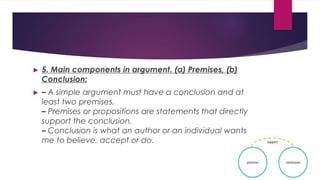
► 5. Main components in argument. (a) Premises, (b)
Conclusion:
► – A simple argument must have a conclusion and at
least two premises.
– Premises or propositions are statements that directly
support the conclusion.
– Conclusion is what an author or an individual wants
me to believe, accept or do.
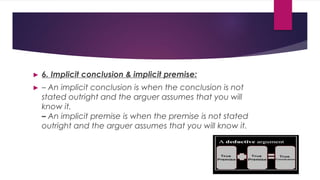
► 6. Implicit conclusion & implicit premise:
► – An implicit conclusion is when the conclusion is not
stated outright and the arguer assumes that you will
know it.
– An implicit premise is when the premise is not stated
outright and the arguer assumes that you will know it.
► An example of an argument and its analysis:
► – This is an example of argument and its conclusion is in
the first sentence: The premises given are: 1) that
speakers of more than one language have better
understanding of how languages are structured; 2) a
second language can help people to have better
understanding and appreciation of their first language.
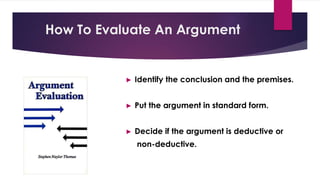
How To Evaluate An Argument
► Identify the conclusion and the premises.
► Put the argument in standard form.
► Decide if the argument is deductive or
non-deductive.
How to evaluate an argument
► Determine whether the argument succeeds
logically.
► Make a final judgment: is the argument
good or bad?
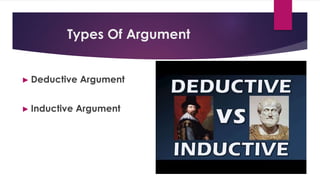
Types Of Argument
► Deductive Argument
► Inductive Argument
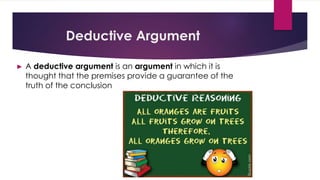
Deductive Argument
► A deductive argument is an argument in which it is
thought that the premises provide a guarantee of the
truth of the conclusion
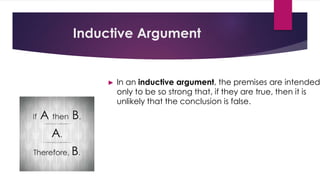
Inductive Argument
► In an inductive argument, the premises are intended
only to be so strong that, if they are true, then it is
unlikely that the conclusion is false.

Philosophical concepts regarding Arguments

  • 1.
    PHILOSOPHY PRESENTATION TOPICS:1.STRUCTURE OFAN ARGUMENT 2.EVALUATION OF AN ARGUMENT 3.TYPES OF AN ARGUMENT
  • 2.
    STRUCTURE OF ANARGUMENT ► 1. What is argument? ► – Basically, argument is a claim defended with reasons. It is composed of a group of statements with one or more statements (premises) supporting another statement ► . What is statement? ► – A sentence declaring something that can be true or false.
  • 3.
    ► 3. Whatis argument in Critical Thinking? ► – In Critical Thinking, argument is an act of presenting reasons to support individual’s position or point of view. It is not quarrel or dispute. Or simply, as Bassham’s definition of an argument: A claim defended with reasons. – Non-arguments are descriptions, explanations & summaries, command, etc.
  • 4.
    4. The rolesof questions as a conclusion and premise ► Interesting form of question is leading questions which is used when trying to guide someone’s answer in a certain direction or trying to get them to say the things you want. This tactic widely used by lawyers. For instance: Instead of asking a witness on the stand: “Where were you on the night of September 5th, 2012?” The questioner would say: “You were driving to Kuala Lumpur on the night of Septemeber 5th, weren’t you?”
  • 5.
    ► 5. Maincomponents in argument. (a) Premises, (b) Conclusion: ► – A simple argument must have a conclusion and at least two premises. – Premises or propositions are statements that directly support the conclusion. – Conclusion is what an author or an individual wants me to believe, accept or do.
  • 6.
    ► 6. Implicitconclusion & implicit premise: ► – An implicit conclusion is when the conclusion is not stated outright and the arguer assumes that you will know it. – An implicit premise is when the premise is not stated outright and the arguer assumes that you will know it.
  • 7.
    ► An exampleof an argument and its analysis: ► – This is an example of argument and its conclusion is in the first sentence: The premises given are: 1) that speakers of more than one language have better understanding of how languages are structured; 2) a second language can help people to have better understanding and appreciation of their first language.
  • 8.
    How To EvaluateAn Argument ► Identify the conclusion and the premises. ► Put the argument in standard form. ► Decide if the argument is deductive or non-deductive.
  • 9.
    How to evaluatean argument ► Determine whether the argument succeeds logically. ► Make a final judgment: is the argument good or bad?
  • 10.
    Types Of Argument ►Deductive Argument ► Inductive Argument
  • 11.
    Deductive Argument ► Adeductive argument is an argument in which it is thought that the premises provide a guarantee of the truth of the conclusion
  • 12.
    Inductive Argument ► Inan inductive argument, the premises are intended only to be so strong that, if they are true, then it is unlikely that the conclusion is false.