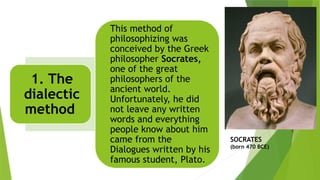
SOCRATES
(born 470 BCE)
1.The
dialectic
method
This method of
philosophizing was
conceived by the Greek
philosopher Socrates,
one of the great
philosophers of the
ancient world.
Unfortunately, he did
not leave any written
words and everything
people know about him
came from the
Dialogues written by his
famous student, Plato.
3.
“disciplined conversation”– which
Socrates compared to an intellectual
midwife. Socrates called this method
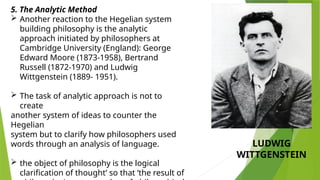
DIALECT.
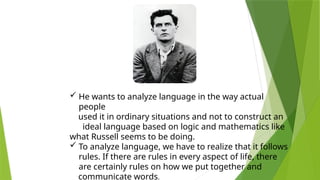
By George Wilhelm Hegel (a German
philosopher) - modernized and treated
Socratic method in a different way.
4.
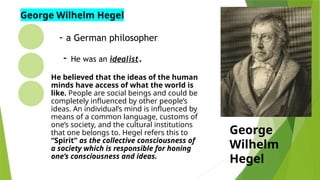
- a Germanphilosopher.
- He was an idealist.
He believed that the ideas of the human
minds have access of what the world is
like. People are social beings and could be
completely influenced by other people’s
ideas. An individual’s mind is influenced by
means of a common language, customs of
one’s society, and the cultural institutions
that one belongs to. Hegel refers this to
“Spirit” as the collective consciousness of
a society which is responsible for honing
one’s consciousness and ideas.
George
Wilhelm
Hegel
George Wilhelm Hegel
5.
Hegel also believedthat the Spirit is constantly changing and
evolving.
According to Hegel, the spirit changes through dialectic.
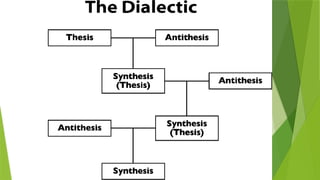
First, there is an idea about the world (much like a thesis), which
has a natural characteristic of having errors which give rise to
the antithesis.
The thesis and antithesis - can be eventually resolved by creating a
synthesis which is a new idea comprised of the essentials of both
the thesis and the antithesis.
6.
To Hegel, societyand culture
follow this design, and one
could understand all of
human history without the
use of logic or empirical data
simply by using logic (Klein,
2013).
8.
2. The Pragmatic
Method
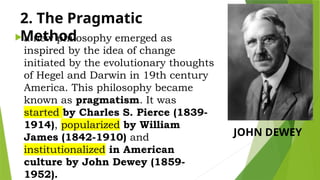
a new philosophy emerged as
inspired by the idea of change
initiated by the evolutionary thoughts
of Hegel and Darwin in 19th century
America. This philosophy became
known as pragmatism. It was
started by Charles S. Pierce (1839-
1914), popularized by William
James (1842-1910) and
institutionalized in American
culture by John Dewey (1859-
1952).
JOHN DEWEY
9.
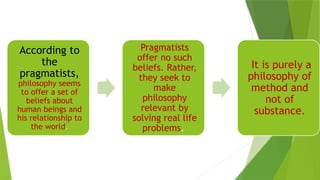
According to
the
pragmatists,
philosophy seems
tooffer a set of
beliefs about
human beings and
his relationship to
the world.
Pragmatists
offer no such
beliefs. Rather,
they seek to
make
philosophy
relevant by
solving real life
problems.
It is purely a
philosophy of
method and
not of
substance.
10.
3. The PhenomenologicalMethod
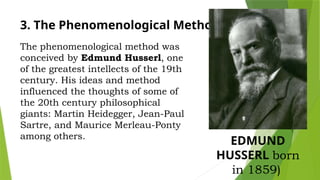
The phenomenological method was
conceived by Edmund Husserl, one
of the greatest intellects of the 19th
century. His ideas and method
influenced the thoughts of some of
the 20th century philosophical
giants: Martin Heidegger, Jean-Paul
Sartre, and Maurice Merleau-Ponty
among others.
EDMUND
HUSSERL born
in 1859)
11.
Unfortunately, accordingto Husserl, science brings a
certain attitude which is counterproductive to the human
soul: the naturalistic attitude (or simply naturalism).
Naturalism in this context is the idea that everything can
be explained in terms of matter or the physical. Since man
is not only physical (i.e. body) but also spiritual, this
naturalistic attitude brings a distorted view of man by
banishing the spiritual from the world which includes the
banishment of ideas, values, and cultures (Husserl, 1965)
12.
To counterthe naturalistic tendency, Husserl returned to the idea
of the thinking self which was given preeminence by the 17th
century French philosopher, Rene Descartes. More specifically, the
layman’s term given to the thinking self is “one’s immediate
experience.”
Husserl’s main purpose was to build a philosophy free from any
biases or preconceived ideas. One can only do this if one returns to
immediate experience. Husserl said that he was only looking to
“things and facts themselves, as these are given in actual
experience and intuition”
pure subjectivity - beliefs about human beings and the world
prevent us from seeing clearly this immediate experience which he
calls
13.
to knowthe truth, we have to put aside one by one all
our limiting
beliefs about the world which represents our biases.
Husserl calls this
process phenomenological epoche (epoche is the
Greek word for bracketing).
Bracketing is not ignoring.
It is an act of stepping back at our biases and
prejudices to make sure that they do not influence
the way we think. Only facts provided by immediate
experience must influence us.
14.
4. The Primaryand Secondary reflections
Another influential intellectual movement which had its
roots in the 19th century ideas of Søren Kierkegaard
(1813-1855) and Friedrich Nietzsche (1844-1900) was
existentialism.
reflection is not just a disinterested look at experience. It
emerged when something valuable is at stake.
15.
Kierkegaard’s ideaswere in part a reaction against the
overly ambitious system building the philosophy of Georg
Wilhelm Friedrich Hegel (1770- 1831).
Kierkegaard was religious.
Nietzsche’s ideas - were a reaction against the religious
and rational value system still prevalent in 19th century
Europe.
Nietzsche was atheistic (atheism is the denial of the
supernatural).
16.
Atheistic Existentialism- popularized in the 20th century
by Jean-Paul Sartre (1905-1980)
and his partner Simone de Beauvoir (1908-1986).
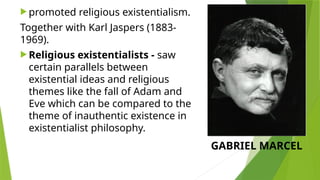
Religious Existentialism – promoted by Gabriel Marcel
(1889-1973) and Karl Jaspers (1883- 1969).
17.
promoted religiousexistentialism.
Together with Karl Jaspers (1883-
1969).
Religious existentialists - saw
certain parallels between
existential ideas and religious
themes like the fall of Adam and
Eve which can be compared to the
theme of inauthentic existence in
existentialist philosophy.
GABRIEL MARCEL
18.
2 Levels ofReflection by Gabriel
Marcel:
1.Primary Reflection
2.Secondary Reflection
19.
Gabriel Marcel appliedthese two
levels of reflection to the
most fundamental question:
WHO AM I?
20.
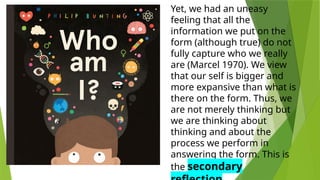
The form askedus to
write our name, age,
gender, address,
name of parents, etc.
To answer this, of
course we have to
think to distinguish
who we are (the self)
against other things
(the non-self or
objects). This is the
primary
reflection.
21.
Yet, we hadan uneasy
feeling that all the
information we put on the
form (although true) do not
fully capture who we really
are (Marcel 1970). We view
that our self is bigger and
more expansive than what is
there on the form. Thus, we
are not merely thinking but
we are thinking about
thinking and about the
process we perform in
answering the form. This is
the secondary
22.
The result ofsecondary reflection is a
more expansive view of the self until it
embraces the world. Thus, the separation
of the self and the world brought about
by primary reflection were united by the
secondary reflection.
23.
5. The AnalyticMethod
Another reaction to the Hegelian system
building philosophy is the analytic
approach initiated by philosophers at
Cambridge University (England): George
Edward Moore (1873-1958), Bertrand
Russell (1872-1970) and Ludwig
Wittgenstein (1889- 1951).
The task of analytic approach is not to
create
another system of ideas to counter the
Hegelian
system but to clarify how philosophers used
words through an analysis of language.
the object of philosophy is the logical
clarification of thought’ so that ‘the result of
LUDWIG
WITTGENSTEIN
24.
He wantsto analyze language in the way actual
people
used it in ordinary situations and not to construct an
ideal language based on logic and mathematics like
what Russell seems to be doing.
To analyze language, we have to realize that it follows
rules. If there are rules in every aspect of life, there
are certainly rules on how we put together and
communicate words.
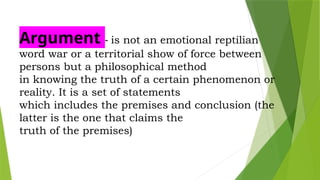
Argument - isnot an emotional reptilian
word war or a territorial show of force between
persons but a philosophical method
in knowing the truth of a certain phenomenon or
reality. It is a set of statements
which includes the premises and conclusion (the
latter is the one that claims the
truth of the premises)
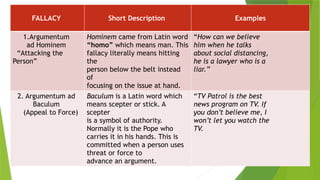
FALLACY Short DescriptionExamples
1.Argumentum
ad Hominem
“Attacking the
Person”
Hominem came from Latin word
“homo” which means man. This
fallacy literally means hitting
the
person below the belt instead
of
focusing on the issue at hand.
“How can we believe
him when he talks
about social distancing,
he is a lawyer who is a
liar.”
2. Argumentum ad
Baculum
(Appeal to Force)
Baculum is a Latin word which
means scepter or stick. A
scepter
is a symbol of authority.
Normally it is the Pope who
carries it in his hands. This is
committed when a person uses
threat or force to
advance an argument.
“TV Patrol is the best
news program on TV. If
you don’t believe me, I
won’t let you watch the
TV.
29.
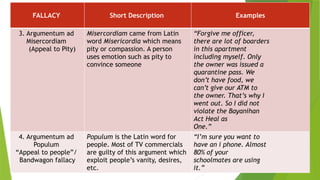
FALLACY Short DescriptionExamples
3. Argumentum ad
Misercordiam
(Appeal to Pity)
Misercordiam came from Latin
word Misericordia which means
pity or compassion. A person
uses emotion such as pity to
convince someone
“Forgive me officer,
there are lot of boarders
in this apartment
including myself. Only
the owner was issued a
quarantine pass. We
don’t have food, we
can’t give our ATM to
the owner. That’s why I
went out. So I did not
violate the Bayanihan
Act Heal as
One.”
4. Argumentum ad
Populum
“Appeal to people”/
Bandwagon fallacy
Populum is the Latin word for
people. Most of TV commercials
are guilty of this argument which
exploit people’s vanity, desires,
etc.
“I’m sure you want to
have an i phone. Almost
80% of your
schoolmates are using
it.”
30.
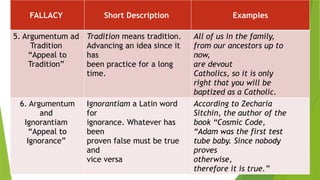
FALLACY Short DescriptionExamples
5. Argumentum ad
Tradition
“Appeal to
Tradition”
Tradition means tradition.
Advancing an idea since it
has
been practice for a long
time.
All of us in the family,
from our ancestors up to
now,
are devout
Catholics, so it is only
right that you will be
baptized as a Catholic.
6. Argumentum
and
Ignorantiam
“Appeal to
Ignorance”
Ignorantiam a Latin word
for
ignorance. Whatever has
been
proven false must be true
and
vice versa
According to Zecharia
Sitchin, the author of the
book “Cosmic Code,
“Adam was the first test
tube baby. Since nobody
proves
otherwise,
therefore it is true.”
31.
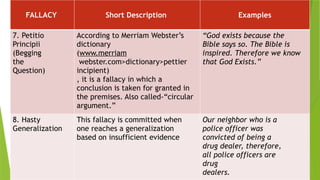
FALLACY Short DescriptionExamples
7. Petitio
Principii
(Begging
the
Question)
According to Merriam Webster’s
dictionary
(www.merriam
webster.com>dictionary>pettier
incipient)
, it is a fallacy in which a
conclusion is taken for granted in
the premises. Also called-“circular
argument.”
“God exists because the
Bible says so. The Bible is
inspired. Therefore we know
that God Exists.”
8. Hasty
Generalization
This fallacy is committed when
one reaches a generalization
based on insufficient evidence
Our neighbor who is a
police officer was
convicted of being a
drug dealer, therefore,
all police officers are
drug
dealers.
32.
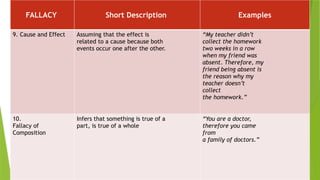
FALLACY Short DescriptionExamples
9. Cause and Effect Assuming that the effect is
related to a cause because both
events occur one after the other.
“My teacher didn’t
collect the homework
two weeks in a row
when my friend was
absent. Therefore, my
friend being absent is
the reason why my
teacher doesn’t
collect
the homework.”
10.
Fallacy of
Composition
Infers that something is true of a
part, is true of a whole
“You are a doctor,
therefore you came
from
a family of doctors.”
33.
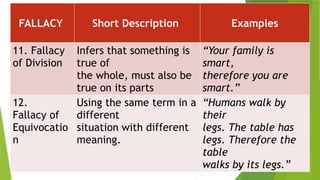
FALLACY Short DescriptionExamples
11. Fallacy
of Division
Infers that something is
true of
the whole, must also be
true on its parts
“Your family is
smart,
therefore you are
smart.”
12.
Fallacy of
Equivocatio
n
Using the same term in a
different
situation with different
meaning.
“Humans walk by
their
legs. The table has
legs. Therefore the
table
walks by its legs.”
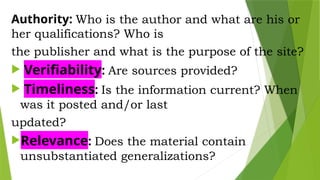
Authority: Who isthe author and what are his or
her qualifications? Who is
the publisher and what is the purpose of the site?
Verifiability: Are sources provided?
Timeliness: Is the information current? When
was it posted and/or last
updated?
Relevance: Does the material contain
unsubstantiated generalizations?
36.
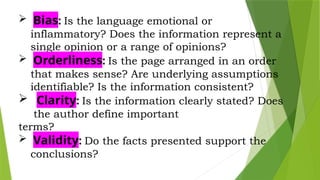
Bias: Isthe language emotional or
inflammatory? Does the information represent a
single opinion or a range of opinions?
Orderliness: Is the page arranged in an order
that makes sense? Are underlying assumptions
identifiable? Is the information consistent?
Clarity: Is the information clearly stated? Does
the author define important
terms?
Validity: Do the facts presented support the
conclusions?
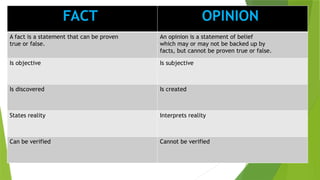
FACT OPINION
A factis a statement that can be proven
true or false.
An opinion is a statement of belief
which may or may not be backed up by
facts, but cannot be proven true or false.
Is objective Is subjective
Is discovered Is created
States reality Interprets reality
Can be verified Cannot be verified
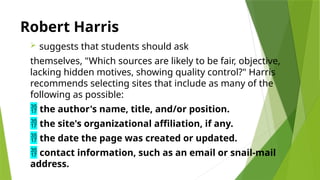
Robert Harris
suggeststhat students should ask
themselves, "Which sources are likely to be fair, objective,
lacking hidden motives, showing quality control?" Harris
recommends selecting sites that include as many of the
following as possible:
the author's name, title, and/or position.
the site's organizational affiliation, if any.
the date the page was created or updated.
contact information, such as an email or snail-mail
address.
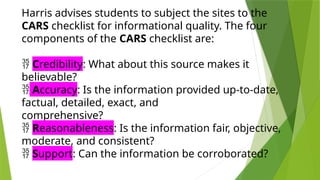
41.
Harris advises studentsto subject the sites to the
CARS checklist for informational quality. The four
components of the CARS checklist are:
Credibility: What about this source makes it
believable?
Accuracy: Is the information provided up-to-date,
factual, detailed, exact, and
comprehensive?
Reasonableness: Is the information fair, objective,
moderate, and consistent?
Support: Can the information be corroborated?
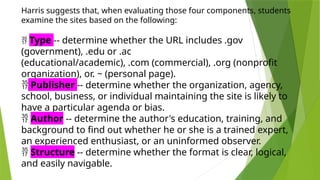
42.
Harris suggests that,when evaluating those four components, students
examine the sites based on the following:
Type -- determine whether the URL includes .gov
(government), .edu or .ac
(educational/academic), .com (commercial), .org (nonprofit
organization), or. ~ (personal page).
Publisher -- determine whether the organization, agency,
school, business, or individual maintaining the site is likely to
have a particular agenda or bias.
Author -- determine the author's education, training, and
background to find out whether he or she is a trained expert,
an experienced enthusiast, or an uninformed observer.
Structure -- determine whether the format is clear, logical,
and easily navigable.
43.
Language --determine whether the text contains emotional,
inflammatory,
profane, or confusing language. Count the number of spelling,
grammatical,
and typographical errors. Too many mistakes can indicate carelessness
and
suggest informational errors as well.
Dates -- determine when the information was published and/or
updated. If possible, check the publication dates of supporting data.
Graphics -- determine whether images and animations take up a
disproportionate amount of space in relation to their informational
value.
Decide whether the graphics convey information, add interest, provide
interactivity, or simply distract.