Intersubjectivity
Intersubjectivity- It refersto shared
meanings constructed by people in their
interactions with each other.
Intersubjectivity is the philosophical concept
of
the interaction between the “self” and the
“other”. It is the mutual recognition of each
other as persons.
It refers to the shared awareness, and
understanding among persons. It is made
possible by the awareness of the self and the
other.
14.
Jean-Paul Sartre
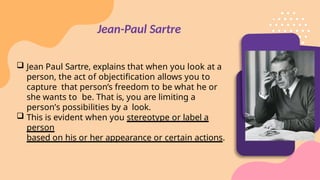
JeanPaul Sartre, explains that when you look at a
person, the act of objectification allows you to
capture that person’s freedom to be what he or
she wants to be. That is, you are limiting a
person’s possibilities by a look.
This is evident when you stereotype or label a
person
based on his or her appearance or certain actions.
15.
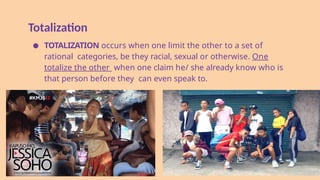
Totalization
● TOTALIZATION occurswhen one limit the other to a set of
rational categories, be they racial, sexual or otherwise. One
totalize the other when one claim he/ she already know who is
that person before they can even speak to.
16.
Edmund Husserlbelieves that
intersubjectivity is more than just shared
understanding, but it is the capability to put
oneself in the place where the other is.
Intersubjectivity occurs when people
undergo
acts
of
empath
y
because an
intersubjective
experience is highly empathic. This happens
when people put themselves in the shoes of
others.
Edmund Husserl
17.
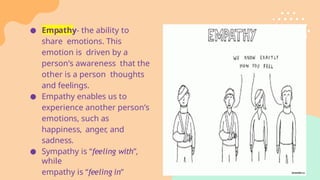
● Empathy- theability to
share emotions. This
emotion is driven by a
person’s awareness that the
other is a person thoughts
and feelings.
● Empathy enables us to
experience another person’s
emotions, such as
happiness, anger, and
sadness.
● Sympathy is “feeling with”,
while
empathy is “feeling in”
18.
● Availability- thewillingness
of a person to be present
and be at disposal of
another.
19.
The Ethics of
Care
isan
ethical
theory that emphasizes the
moral dimension of
relationship and interactions.
This moral perspective
encourages individuals to help
other people, most especially
the
vulnerable.
20.
Rene Descartes
Anadvocate of individualism.
As a proponent of the doctrine of
individualism, he resolved to doubt
absolutely everything that could
possibly be doubted--in the hope of
thereby finding something that was
beyond doubt. (“Doubt everything that
can be doubted”)
According to him there is one thing that
cannot be doubted, and that is thinking.
21.
● “Seeming”- actionswhere an individual presents himself or
herself in a certain way when dealing with others.
Persons take on “roles” or act out characters when
dealing with certain people or when in certain situations.
● There may be instances when people behave a certain
way in
order to intentionally deceive or manipulate other people.
22.
Most human interactions,however, are not
based on deception. Since our human nature
derives us to uphold dignity and goodness, our
interactions with others are also geared
towards what is good and beneficial.
These lead human to strive to achieve deeper
and more substantial interactions and relations
with other people.
This deeper and more genuine interaction is
called dialogue.
23.
● Dialogue- aninteraction between persons
that happens through speech, expressions,
and body language.
● Dialogue is not confined to words alone,
actions,
gestures and other expressions may be
used to
convey a person’s inner life.
● A dialogue occurs when two persons “open
up” to
each other and give and receive one
another in
their encounter.
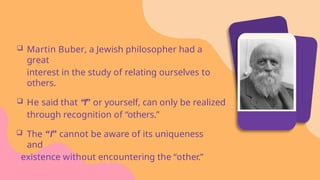
Martin Buber,a Jewish philosopher had a
great
interest in the study of relating ourselves to
others.
He said that “I” or yourself, can only be realized
through recognition of “others.”
The “I” cannot be aware of its uniqueness
and
existence without encountering the “other.”
27.
Several ways bywhich we relate to others
(according to Buber)
The “I-I” relationship
“I-I” relationship in which people make themselves the
center
of their world.
Talking to other people do not interest them and if they
talk to
others, it is the “I” who will be the center of the
conversation.
They don't really listen to what others are sharing.
28.
“I-It” relationship
“I-It”relationship is the second type of relationship.
There are people that treat the other people into the
status of
an object—an It.
Examples:
1.Researchers who have indigenous people as their
participants. They are very prone to reducing the
other into mere It, i.e. as mere objects of
investigation.
2. In the medical field when practitioners look at
their
patients as objects of investigation.
29.
“I-It” relationship
Thereare also “I-It” relations where the I clearly has bad intent on the
other,
treating the other as mere It or object.
Examples:
1.How oppressive employers treat their workers like machines or
robots who are immune to physical, verbal, psychological, and
emotional abuse
2.Any relationship which has one party reducing the other to a status
of an object:
a) bully who treats a person with disability as an object of his
amusement
b) a liquor company using body of women as their advertisement to
improve
sales,
“I-It” relationship
Thiskind of relationship results into what we
call
alienatio
n.
It happens when human relationships are inauthentic,
deceptive and
exploitativ
e.
It arises when a
person
ceases to view the other
as a
distinct or authentic person and
merely
considers the other
person
as a mere object or a means to satisfy personal interests.
Alienation is a disorientating sense of exclusion and
separation and if left unaddressed, will discount the humanity
and dignity of a person that leads to dehumanization.
32.
“I-Thou” relationship
Itis in this kind of human relations that genuine sharing of one
another takes place.
It is in this type of relationship that the other is treated as
distinctly other, the I treats the person as a Thou (You)—-as another
person who is different from the I; one has a different set of
interests, visions, beliefs, values, and characteristics.
The center of this relationship is a genuine form of conversation: a
dialogue.
33.
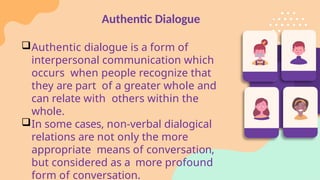
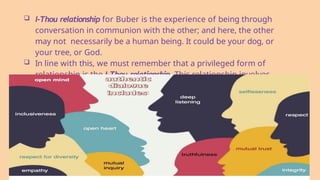
Authentic Dialogue
Authentic dialogueis a form of
interpersonal communication which
occurs when people recognize that
they are part of a greater whole and
can relate with others within the
whole.
In some cases, non-verbal dialogical
relations are not only the more
appropriate means of conversation,
but considered as a more profound
form of conversation.
34.
I-Thou relationshipfor Buber is the experience of being through
conversation in communion with the other; and here, the other
may not necessarily be a human being. It could be your dog, or
your tree, or God.
In line with this, we must remember that a privileged form of
relationship is the I-Thou relationship. This relationship involves
effort.
35.
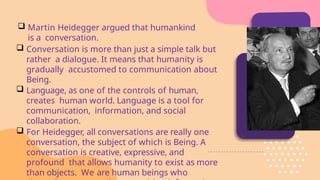
Martin Heideggerargued that humankind
is a conversation.
Conversation is more than just a simple talk but
rather a dialogue. It means that humanity is
gradually accustomed to communication about
Being.
Language, as one of the controls of human,
creates human world. Language is a tool for
communication, information, and social
collaboration.
For Heidegger, all conversations are really one
conversation, the subject of which is Being. A
conversation is creative, expressive, and
profound that allows humanity to exist as more
than objects. We are human beings who
36.
concept of thetrue
education, “
without dialogue there
is
no communication, and without communication, there
can
be no true
education
”.
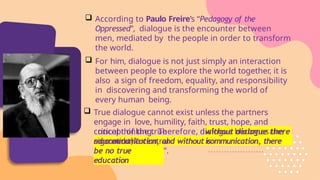
According to Paulo Freire’s “Pedagogy of the
Oppressed”, dialogue is the encounter between
men, mediated by the people in order to transform
the world.
For him, dialogue is not just simply an interaction
between people to explore the world together, it is
also a sign of freedom, equality, and responsibility
in discovering and transforming the world of
every human being.
True dialogue cannot exist unless the partners
engage in love, humility, faith, trust, hope, and
critical thinking. Therefore, dialogue becomes the
sign and the central
37.
Recap
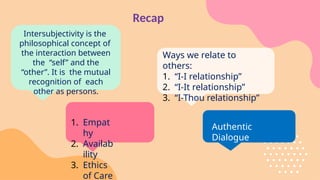
Intersubjectivity is the
philosophicalconcept of
the interaction between
the “self” and the
“other”. It is the mutual
recognition of each
other as persons.
1. Empat
hy
2. Availab
ility
3. Ethics
of Care
Authentic
Dialogue
Ways we relate to
others:
1. “I-I relationship”
2. “I-It relationship”
3. “I-Thou relationship”