PHILIPPINE HISTORIOGRAPHY
underwent severalchanges since the precolonial period
until the present.
Ancient Filipinos narrated their history through communal
songs and epics that they passed orally form a generation to
another.
5.
When the Spaniardscame, their chroniclers started recording
their observations through written accounts.
The perspective of historical writing and inquiry also shifted.
The Spanish colonizers narrated the history of their colony in a
bipartite view.
6.
They saw theage before colonization as a dark period in the history
of the islands, until they brought light through Western thought and
Christianity.
Early nationalists refuted this perspective and argued the tripartite
view.
They saw the precolonial society as luminous age that ended with
darkness when the colonizers captured their freedom.
7.
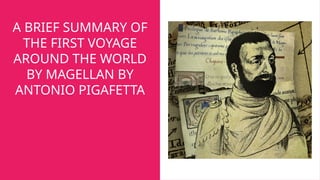
A BRIEF SUMMARYOF
THE FIRST VOYAGE
AROUND THE WORLD
BY MAGELLAN BY
ANTONIO PIGAFETTA
8.
Antonio Pigafetta
an Italianscholar and explorer.
joined the expedition to the Spice Islands led by explorer
Ferdinand Magellan under the flag of the emperor Charles V
and after Magellan's death in the Philippine Islands, the
subsequent voyage around the world.
9.
One of themwas Italian nobleman Antonio Pigafetta, who accompanied
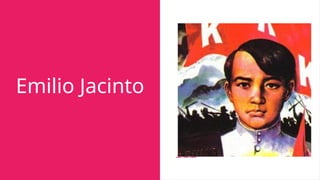
Ferdinand Magellan in his fateful circumnavigation of the world.
Pigafetta’s work instantly became a classic that prominent literary men in the
West like William Shakespeare, Michel de Montaigne, and Giambattista Vico
referred to the book in their interpretation of the New World.
10.
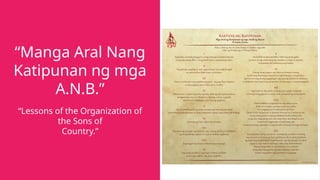
Pigafetta’s travelogue isone of the most important primary sources
in the study of the precolonial Philippines.
His account was also a major referent to the events leading to
Magellan’s arrival in the Philippines, his encounter with local leaders,
his death in the hands of Lapulapu’s forces in the Battle of Mactan,
and in the departure of what was left of Magellan’s fleet from the
islands.
11.
Examining the documentreveals several insights not just in the
character of the Philippines during the precolonial period, but also on
how the fresh eyes of the Europeans regard a deeply unfamiliar
terrain, environment, people, and culture.
12.
Locating Pigafetta’s accountin the context of its
writing warrants a familiarity on the dominant
frame of mind in the age of exploration, which
pervaded Europe in the fifteenth and sixteenth
century.
13.
Students of historyneed to realize that primary sources
used in Pigafetta’s account was also written from the
perspective of Pigafetta himself and was a product of the
context of its production.
The First Voyage Around the World by Magellan was
published after Pigafetta returned to Italy.
14.
For this chapter,we will focus on the chronicles of Antonio
Pigafetta as he wrote his firsthand observation and general
impression of the Far East including their experiences in the
Visayas.
In Pigafetta’s account, their fleet reached what he called the
Ladrones Islands or the “Islands of the Thieves.”
He recounted:
15.
EXCERPT FROM “Islandsof the Thieves.”
What can you say about the summary you have
read?
What implications it will give to the history of
Filipinos?
ANALYSIS OF PIGAFETTA’S
CHRONICLE
hechronicle of Pigafetta was one of the most cited documents by
historians who wished to study the precolonial Philippines.
As one of the earliest written accounts, Pigafetta was seen as a
credible source for a period, which was prior unchronicled and
undocumented.
18.
Moreover, being theearliest detailed documentation, it was believed
that Pigafetta’s writings account for the “purest” precolonial society.
Indeed, Pigafetta’s work is of great importance in the study and
writing of Philippine history.
Nevertheless, there needs to have a more nuanced reading of the
source within a contextual backdrop.
19.
In the caseof Pigafetta, the reader needs to understand that he was a
chronicler commissioned by the King of Spain to accompany and
document a voyage intended to expand the Spanish empire.
20.
In reading Pigafetta’sdescription of the people, one has to keep in
mind that he was coming from a sixteenth century European
perspective.
Hence, the reader might notice how Pigafetta, whether implicitly or
explicitly, regarded the indigenous belief systems and way of life as
inferior to that of Christianity and of the Europeans.
21.
He would alwaysremark on the nakedness of the natives or how he
was fascinated by their exotic culture.
Pigafetta also noticeably emphasized the natives’ amazement and
illiteracy to the European artillery, merchandise, and other goods, in
the same way that Pigafetta repeatedly mentioned the abundance of
spices like ginger, and of precious metals like gold.
22.
His observations andassessments of the indigenous
cultures employed the European standards.
Hence, when they saw the indigenous attires of the natives,
Pigafetta saw them as being naked because from the
European standpoint, they were wearing fewer clothes
indeed.
23.
It should beunderstood that such observations were rooted from the
context of Pigafetta and of his era.
Europe, for example, was dominated by the Holy Roman Empire,
whose loyalty and purpose was the domination of the Catholic
Church all over the world.
Hence, other belief systems different from that of Christianity were
perceived to be blasphemous and barbaric, even demonic.
24.
Aside from this,the sixteenth century European
economy was mercantilist.
Such system measures the wealth of kingdoms
based on their accumulation of bullions or
precious metals like gold and silver.
25.
It was notsurprising therefore that Pigafetta would
always mention the abundance of gold in the islands
as shown in his description of leaders wearing gold
rings and golden daggers, and of the rich gold mines.
26.
An empire likethat of the Spain would indeed search for new lands
where they could acquire more gold and wealth to be on top of all the
European nations.
The obsession with spices might be odd for Filipinos because of its
ordinariness in the Philippines, but understanding the context would
reveal that spices were scarce in Europe and hence were seen as
prestige goods.
27.
In that era,Spain and Portugal coveted the control of
Spice Islands because it would have led to a certain
increase in wealth, influence, and power.
These contexts should be used and understood in order
to have a more qualified reading of Pigafetta’s account.
What is ‘KKK?’
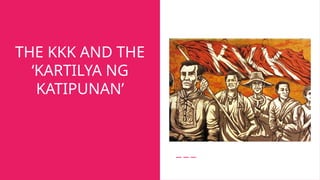
TheKataastaasan,
Kagalanggalangang
Katipunan ng mga Anak
ng Bayan (KKK) or
Katipunan is arguably the
most important organization
formed in the Philippine
history.
30.
While anti-colonial
movements, efforts,and organizations had already been established
centuries prior to the foundation of
the Katipunan, it was only this organization that envisioned (1) a united
Filipino nation that would revolt
against the Spaniards for (2) the total independence of the country from
Spain.
31.
Previous armed revoltshad already occurred before the
foundation of the Katipunan, but none of them envisioned a
unified Filipino nation revolting against the colonizers.
For example, Diego Silang was known as an Ilocano who
took up his arms and led one of the longest running revolts
in the country.
32.
Silang, however, wasmainly concerned about his
locality and referred to himself as El Rey de Ilocos
(The King of Ilocos).
33.
On the otherhand, the propaganda movements led by the
ilustrados like Marcelo H. del Pilar, Graciano Lopez Jaena, and
Jose Rizal did not envision a total separation of the Philippines
from Spain, but only demanded equal rights, representation,
and protection from the abuses of the friars.
In the conductof their struggle, Katipunan created a complex
structure and a defined value system that would guide the
organization as a collective aspiring for a single goal.
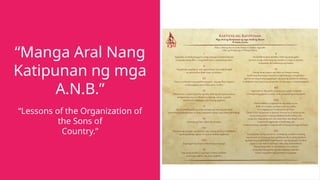
One of the most important Katipunan documents was the
Kartilya ng Katipunan.
The document waswritten by Emilio Jacinto in the
1896.
Jacinto was only 18 years old when he joined the
movement. He was a law student at the Unibersidad
de Santo Tomas.
38.
Despite his youth,Bonifacio recognized the value and
intellect of Jacinto that upon seeing that Jacinto’s Kartilya
was much better than the Decalogue he wrote, he
willingly favored that the Kartilya be distributed to their
fellow Katipuneros.
39.
Jacinto became thesecretary of the organization and took charge of the
short-lived printing press of the Katipunan. On 15 April 1897, Bonifacio
appointed Jacinto as a commander of the Katipunan in Northern Luzon.
Jacinto was 22 years old.
He died of Malaria at a young age of 24 in the town of Magdalena, Laguna.
40.
The Kartilya canbe treated as the Katipunan’s code of
conduct.
It contains fourteen rules that instruct the way a Katipunero
should behave, and which specific values should he uphold.
41.
Generally, the rulesstated in the Kartilya can be classified
into two.
The first group contains the rules that will make the
member an upright individual and the second group
contains the rules that will guide the way he treats his
fellow men.
Below is thetranslated version of the rules in Kartilya:
1. The life that is not consecrated to a lofty and reasonable purpose is
a tree without a shade, if not a poisonous weed.
2. To do good for personal gain and not or its own sake is not virtue.
3. It is rational to be charitable and love one’s fellow creature, and to
adjust one’s conduct, acts and words to what is in itself reasonable.
4. Whether our skin be black or white, we are all born equal:
superiority in knowledge, wealth and beauty are to be understood,
but not superiority by nature.
44.
Below is thetranslated version of the rules in Kartilya:
5. The honorable man prefers honor to personal gain; the
scoundrel, gain to honor.
6. To the honorable man, his word is sacred.
7. Do not waste thy time: wealth can be recovered but not time
lost.
8. Defend the oppressed and fight the oppressor before the law
or in the field.
45.
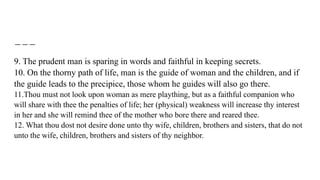
9. The prudentman is sparing in words and faithful in keeping secrets.
10. On the thorny path of life, man is the guide of woman and the children, and if
the guide leads to the precipice, those whom he guides will also go there.
11.Thou must not look upon woman as mere plaything, but as a faithful companion who
will share with thee the penalties of life; her (physical) weakness will increase thy interest
in her and she will remind thee of the mother who bore there and reared thee.
12. What thou dost not desire done unto thy wife, children, brothers and sisters, that do not
unto the wife, children, brothers and sisters of thy neighbor.
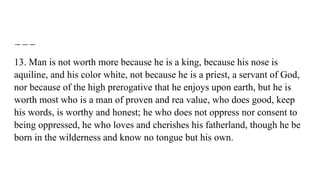
46.
13. Man isnot worth more because he is a king, because his nose is
aquiline, and his color white, not because he is a priest, a servant of God,
nor because of the high prerogative that he enjoys upon earth, but he is
worth most who is a man of proven and rea value, who does good, keep
his words, is worthy and honest; he who does not oppress nor consent to
being oppressed, he who loves and cherishes his fatherland, though he be
born in the wilderness and know no tongue but his own.
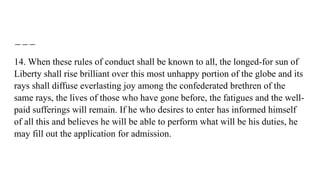
47.
14. When theserules of conduct shall be known to all, the longed-for sun of
Liberty shall rise brilliant over this most unhappy portion of the globe and its
rays shall diffuse everlasting joy among the confederated brethren of the
same rays, the lives of those who have gone before, the fatigues and the well-
paid sufferings will remain. If he who desires to enter has informed himself
of all this and believes he will be able to perform what will be his duties, he
may fill out the application for admission.
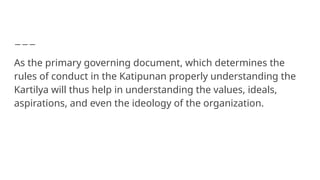
48.
As the primarygoverning document, which determines the
rules of conduct in the Katipunan properly understanding the
Kartilya will thus help in understanding the values, ideals,
aspirations, and even the ideology of the organization.
La Patria Adorada:The Development of Nationalism in the
Philippines from Rizal to Revolution - Sean Solis
https://youtu.be/kEfQYOfuhttps://youtu.be/
kEfQYOfu9A09A0