AMC ENGINEERING COLLEGE,
BANGALORE-560018
Department of Computer Science & Engineering
INSIGHT GUARD: PIONEERING EARLY
GLAUCOMA DETECTION THROUGH
MACHINE LEARNING
Presented By
Nanda Kumar V [1AM20CS124]
Neelesh S[1AM20CS127]
Nischith PM[1AM20CS129]
Saberi Younus Mushtaq[1AM20CS165]
Under the Guidance of
Ms. Indu Priya V
Assistant Professor
Dept. of CSE
AMCEC
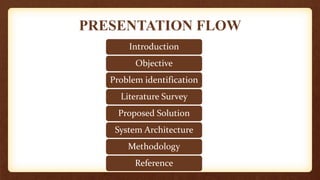
PRESENTATION FLOW
Introduction
Objective
Problem identification
Literature Survey
Proposed Solution
System Architecture
Methodology
Reference
INTRODUCTION
Vision plays a vital role in everyone’s life to visualize the things around us but
there is vision loss in many people due to few eye related diseases.
According to 2019 survey of World Health Organization, 2.2 billion people are
suffering from several eye related diseases among which 39 million people are
completely blind.
The overall percentage of the eye diseases which causes blindness are 47.8% is
due to cataract, 12.3% for glaucoma, 8.7% for age related macular degeneration,
4.8% of diabetic retinopathy, 5.1% due to corneal opacities.
Major challenging task is to detect Glaucoma in the early stages which is
the second main cause for the vision loss worldwide.
OBJECTIVE
The fundamental objective of the "Insight Guard: Pioneering Early
Glaucoma Detection through Machine Learning" project is to
revolutionize the landscape of glaucoma diagnosis by developing an
advanced machine learning model.
The primary goal is to substantially improve diagnostic accuracy,
allowing for the identification of subtle signs and indicators of glaucoma
at its onset.
Through the seamless integration of this innovative machine learning
model into routine eye examinations, the project seeks to streamline the
glaucoma screening process, providing healthcare professionals with an
efficient tool for early detection and intervention.
PROBLEM IDENTIFICATION
Glaucoma, a prevalent eye condition leading to irreversible blindness,
poses a significant challenge in current healthcare systems. The existing
diagnostic methods often struggle to detect the disease in its early stages.
This delayed identification hampers the ability to implement timely
measures, resulting in compromised vision and reduced quality of life for
affected individuals.
 Insight Guard addresses this critical issue by leveraging machine
learning to enhance early glaucoma detection, offering a solution to the
limitations of traditional diagnostic approaches.
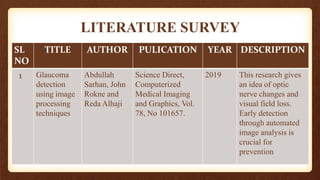
LITERATURE SURVEY
SL
NO
TITLE AUTHOR PULICATION YEAR DESCRIPTION
1 Glaucoma
detection
using image
processing
techniques
Abdullah
Sarhan, John
Rokne and
Reda Alhaji
Science Direct,
Computerized
Medical Imaging
and Graphics, Vol.
78, No 101657.
2019 This research gives
an idea of optic
nerve changes and
visual field loss.
Early detection
through automated
image analysis is
crucial for
prevention
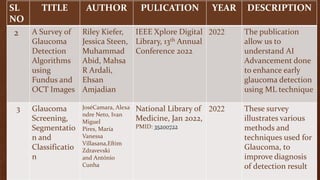
SL
NO
TITLE AUTHOR PULICATION YEAR DESCRIPTION
2 A Survey of
Glaucoma
Detection
Algorithms
using
Fundus and
OCT Images
Riley Kiefer,
Jessica Steen,
Muhammad
Abid, Mahsa
R Ardali,
Ehsan
Amjadian
IEEE Xplore Digital
Library, 13th Annual
Conference 2022
2022 The publication
allow us to
understand AI
Advancement done
to enhance early
glaucoma detection
using ML technique
3 Glaucoma
Screening,
Segmentatio
n and
Classificatio
n
JoséCamara, Alexa
ndre Neto, Ivan
Miguel
Pires, María
Vanessa
Villasana,Eftim
Zdravevski
and António
Cunha
National Library of
Medicine, Jan 2022,
PMID: 35200722
2022 These survey
illustrates various
methods and
techniques used for
Glaucoma, to
improve diagnosis
of detection result
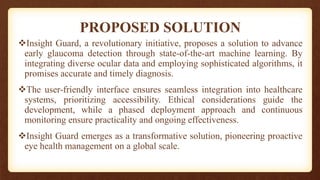
PROPOSED SOLUTION
Insight Guard, a revolutionary initiative, proposes a solution to advance
early glaucoma detection through state-of-the-art machine learning. By
integrating diverse ocular data and employing sophisticated algorithms, it
promises accurate and timely diagnosis.
The user-friendly interface ensures seamless integration into healthcare
systems, prioritizing accessibility. Ethical considerations guide the
development, while a phased deployment approach and continuous
monitoring ensure practicality and ongoing effectiveness.
Insight Guard emerges as a transformative solution, pioneering proactive
eye health management on a global scale.
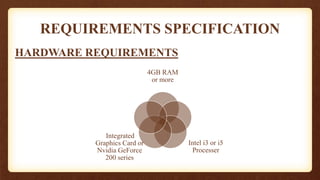
REQUIREMENTS SPECIFICATION
HARDWARE REQUIREMENTS
4GB RAM
or more
Intel i3 or i5
Processer
Integrated
Graphics Card or
Nvidia GeForce
200 series
REQUIREMENTS SPECIFICATION
SOFTWARE REQUIREMENTS
Operating System:
Windows 7/8/9/10/11
IDE: JetBrains
Programming
Language: Python,
TensorFlow
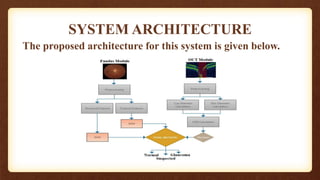
SYSTEM ARCHITECTURE
The proposed architecture for this system is given below.
METHODOLOGY
MODULES
Data Collection and Preprocessing:Gather a comprehensive dataset
including optic nerve head morphology, visual field tests, intraocular
pressure measurements, and relevant patient history. Ensure uniformity in
data format and quality through preprocessing techniques, addressing
missing values, outliers, and noise.
Algorithm Training:Utilize labeled datasets to train machine learning
algorithms, employing techniques such as convolutional neural networks
(CNNs) and support vector machines (SVMs).Identify key features
indicative of early glaucoma, allowing the algorithm to discern subtle
patterns associated with the disease.
 Cross-Validation and Model Evaluation:Validate the model's
performance across multiple folds to assess its generalizability and
robustness. Employ metrics such as accuracy, sensitivity, specificity,
and area under the receiver operating characteristic (ROC) curve to
evaluate the model's effectiveness.
 Integration with Healthcare Systems:Develop an intuitive interface
for seamless integration into existing healthcare systems, ensuring
ease of use for eye care professionals. Align the system with industry
standards for interoperability to facilitate widespread adoption.
CONCLUSION
Glaucoma is optic nerve disease caused due the increased intraocular
pressure which leads to complete vision loss if it is not detected in the
initial stages.
Thus, detection of disease in the early stages is necessary.
 Here we accomplish the detection process in the early stages using image
processing techniques considering CDR value and by automating the
detection using process using deep learning algorithms by extracting other
features of the fundus image and achieved an accuracy of 84.51%.
Later, Correlating the results of image processing and deep learning to
make the system efficient. This technique gives a best solution compared
to the currently existing technologies as they need plenty of time to detect
the disease and expensive.
REFERENCES
[1] Hina raja, etal, “Detection of glaucoma using cup to disc ratio from
spectral domain optical coherence tomography images” IEEE 2018.
[2] Aneeqa Ramzan, etal, “Clinical and Technical Perspective of
Glaucoma Detection using OCT and Fundus Images”,1st International
Conference on Next Generation Computing Applications
(NextComp),2017.
[3] Sulatha V Bhandary, etal, “Deep convolutional neural network for
accurate diagnosis of glaucoma using digital fundus images”,
Information Sciences,2018.
[4] Sandra Morales, etal, “CNNs for Automatic Glaucoma Assessment
Using Fundus Images”, BioMed Eng OnLine, 2019.

Phase_1-SAMPLE_AMCEC.pptx

  • 1.
    AMC ENGINEERING COLLEGE, BANGALORE-560018 Departmentof Computer Science & Engineering INSIGHT GUARD: PIONEERING EARLY GLAUCOMA DETECTION THROUGH MACHINE LEARNING Presented By Nanda Kumar V [1AM20CS124] Neelesh S[1AM20CS127] Nischith PM[1AM20CS129] Saberi Younus Mushtaq[1AM20CS165] Under the Guidance of Ms. Indu Priya V Assistant Professor Dept. of CSE AMCEC
  • 2.
    PRESENTATION FLOW Introduction Objective Problem identification LiteratureSurvey Proposed Solution System Architecture Methodology Reference
  • 3.
    INTRODUCTION Vision plays avital role in everyone’s life to visualize the things around us but there is vision loss in many people due to few eye related diseases. According to 2019 survey of World Health Organization, 2.2 billion people are suffering from several eye related diseases among which 39 million people are completely blind. The overall percentage of the eye diseases which causes blindness are 47.8% is due to cataract, 12.3% for glaucoma, 8.7% for age related macular degeneration, 4.8% of diabetic retinopathy, 5.1% due to corneal opacities. Major challenging task is to detect Glaucoma in the early stages which is the second main cause for the vision loss worldwide.
  • 4.
    OBJECTIVE The fundamental objectiveof the "Insight Guard: Pioneering Early Glaucoma Detection through Machine Learning" project is to revolutionize the landscape of glaucoma diagnosis by developing an advanced machine learning model. The primary goal is to substantially improve diagnostic accuracy, allowing for the identification of subtle signs and indicators of glaucoma at its onset. Through the seamless integration of this innovative machine learning model into routine eye examinations, the project seeks to streamline the glaucoma screening process, providing healthcare professionals with an efficient tool for early detection and intervention.
  • 5.
    PROBLEM IDENTIFICATION Glaucoma, aprevalent eye condition leading to irreversible blindness, poses a significant challenge in current healthcare systems. The existing diagnostic methods often struggle to detect the disease in its early stages. This delayed identification hampers the ability to implement timely measures, resulting in compromised vision and reduced quality of life for affected individuals.  Insight Guard addresses this critical issue by leveraging machine learning to enhance early glaucoma detection, offering a solution to the limitations of traditional diagnostic approaches.
  • 6.
    LITERATURE SURVEY SL NO TITLE AUTHORPULICATION YEAR DESCRIPTION 1 Glaucoma detection using image processing techniques Abdullah Sarhan, John Rokne and Reda Alhaji Science Direct, Computerized Medical Imaging and Graphics, Vol. 78, No 101657. 2019 This research gives an idea of optic nerve changes and visual field loss. Early detection through automated image analysis is crucial for prevention
  • 7.
    SL NO TITLE AUTHOR PULICATIONYEAR DESCRIPTION 2 A Survey of Glaucoma Detection Algorithms using Fundus and OCT Images Riley Kiefer, Jessica Steen, Muhammad Abid, Mahsa R Ardali, Ehsan Amjadian IEEE Xplore Digital Library, 13th Annual Conference 2022 2022 The publication allow us to understand AI Advancement done to enhance early glaucoma detection using ML technique 3 Glaucoma Screening, Segmentatio n and Classificatio n JoséCamara, Alexa ndre Neto, Ivan Miguel Pires, María Vanessa Villasana,Eftim Zdravevski and António Cunha National Library of Medicine, Jan 2022, PMID: 35200722 2022 These survey illustrates various methods and techniques used for Glaucoma, to improve diagnosis of detection result
  • 8.
    PROPOSED SOLUTION Insight Guard,a revolutionary initiative, proposes a solution to advance early glaucoma detection through state-of-the-art machine learning. By integrating diverse ocular data and employing sophisticated algorithms, it promises accurate and timely diagnosis. The user-friendly interface ensures seamless integration into healthcare systems, prioritizing accessibility. Ethical considerations guide the development, while a phased deployment approach and continuous monitoring ensure practicality and ongoing effectiveness. Insight Guard emerges as a transformative solution, pioneering proactive eye health management on a global scale.
  • 9.
    REQUIREMENTS SPECIFICATION HARDWARE REQUIREMENTS 4GBRAM or more Intel i3 or i5 Processer Integrated Graphics Card or Nvidia GeForce 200 series
  • 10.
    REQUIREMENTS SPECIFICATION SOFTWARE REQUIREMENTS OperatingSystem: Windows 7/8/9/10/11 IDE: JetBrains Programming Language: Python, TensorFlow
  • 11.
    SYSTEM ARCHITECTURE The proposedarchitecture for this system is given below.
  • 12.
    METHODOLOGY MODULES Data Collection andPreprocessing:Gather a comprehensive dataset including optic nerve head morphology, visual field tests, intraocular pressure measurements, and relevant patient history. Ensure uniformity in data format and quality through preprocessing techniques, addressing missing values, outliers, and noise. Algorithm Training:Utilize labeled datasets to train machine learning algorithms, employing techniques such as convolutional neural networks (CNNs) and support vector machines (SVMs).Identify key features indicative of early glaucoma, allowing the algorithm to discern subtle patterns associated with the disease.
  • 13.
     Cross-Validation andModel Evaluation:Validate the model's performance across multiple folds to assess its generalizability and robustness. Employ metrics such as accuracy, sensitivity, specificity, and area under the receiver operating characteristic (ROC) curve to evaluate the model's effectiveness.  Integration with Healthcare Systems:Develop an intuitive interface for seamless integration into existing healthcare systems, ensuring ease of use for eye care professionals. Align the system with industry standards for interoperability to facilitate widespread adoption.
  • 14.
    CONCLUSION Glaucoma is opticnerve disease caused due the increased intraocular pressure which leads to complete vision loss if it is not detected in the initial stages. Thus, detection of disease in the early stages is necessary.  Here we accomplish the detection process in the early stages using image processing techniques considering CDR value and by automating the detection using process using deep learning algorithms by extracting other features of the fundus image and achieved an accuracy of 84.51%. Later, Correlating the results of image processing and deep learning to make the system efficient. This technique gives a best solution compared to the currently existing technologies as they need plenty of time to detect the disease and expensive.
  • 15.
    REFERENCES [1] Hina raja,etal, “Detection of glaucoma using cup to disc ratio from spectral domain optical coherence tomography images” IEEE 2018. [2] Aneeqa Ramzan, etal, “Clinical and Technical Perspective of Glaucoma Detection using OCT and Fundus Images”,1st International Conference on Next Generation Computing Applications (NextComp),2017. [3] Sulatha V Bhandary, etal, “Deep convolutional neural network for accurate diagnosis of glaucoma using digital fundus images”, Information Sciences,2018. [4] Sandra Morales, etal, “CNNs for Automatic Glaucoma Assessment Using Fundus Images”, BioMed Eng OnLine, 2019.