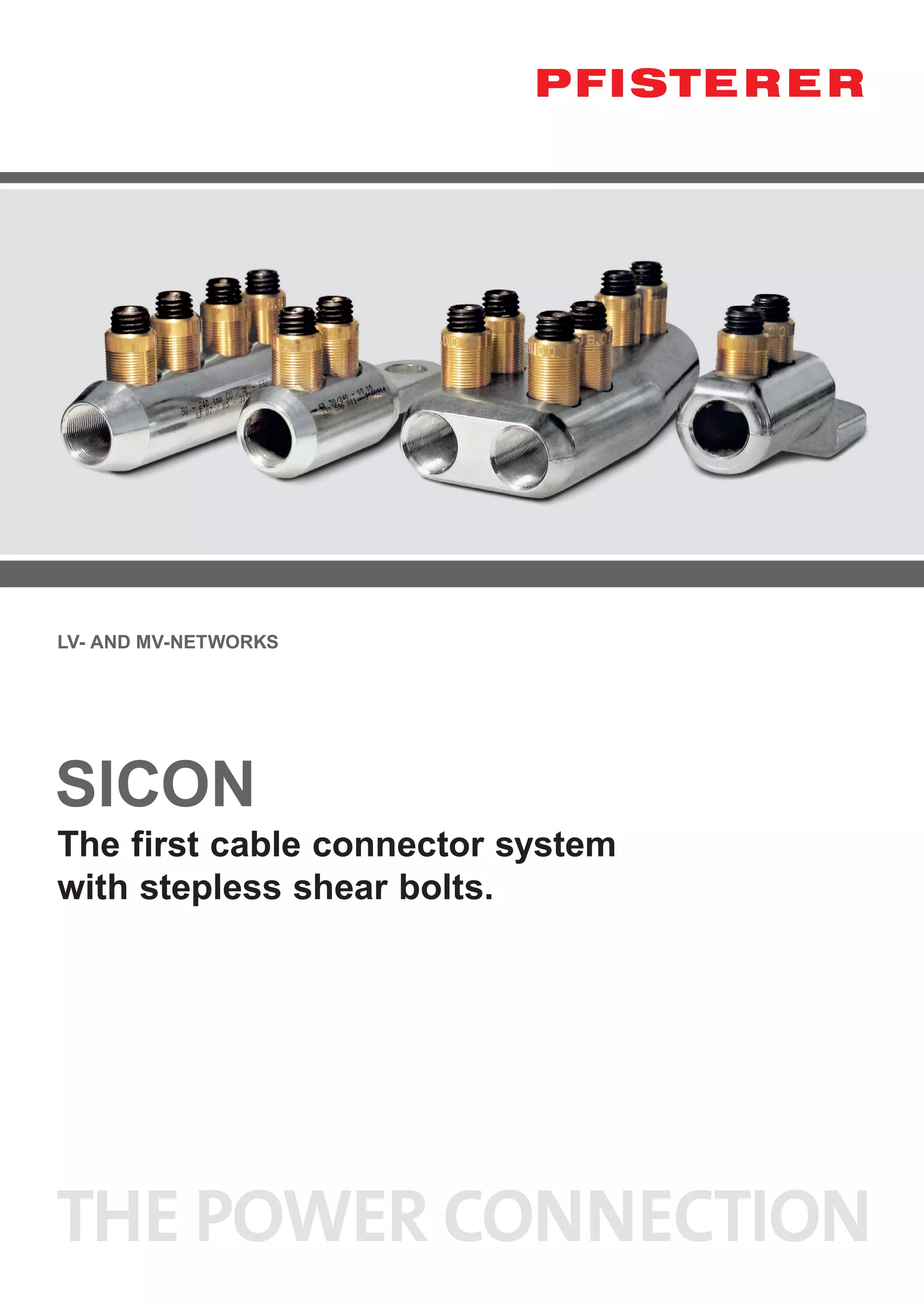
The first cable connector system
with stepless shear bolts.
SICON
LV- AND MV-NETWORKS
SICON
The Better is the Enemy of the Good.
Advantages
■■ Up to 30 % increased contact force on
Al conductors compared with conventional
type terminals
■■ Bolt base plate for uniform friction and
without damage on the conductor
■■ Full utilisation of the thread loading for any
size of conductor
■■ No special tool needed
■■ Smooth breakage of the shear bolt simplifies
tightening process
■■ The remains of the bolt stay on the tool and
can be disposed safely
■■ Technical verification is required for class
5 fine stranded conductors
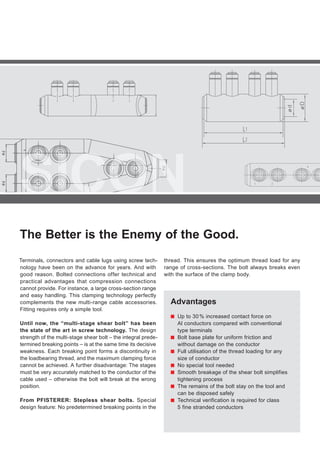
Terminals, connectors and cable lugs using screw tech-
nology have been on the advance for years. And with
good reason. Bolted connections offer technical and
practical advantages that compression connections
cannot provide. For instance, a large cross-section range
and easy handling. This clamping technology perfectly
complements the new multi-range cable accessories.
Fitting requires only a simple tool.
Until now, the “multi-stage shear bolt” has been
the state of the art in screw technology. The design
strength of the multi-stage shear bolt – the integral prede-
termined breaking points – is at the same time its decisive
weakness. Each breaking point forms a discontinuity in
the loadbearing thread, and the maximum clamping force
cannot be achieved. A further disadvantage: The stages
must be very accurately matched to the conductor of the
cable used – otherwise the bolt will break at the wrong
position.
From PFISTERER: Stepless shear bolts. Special
design feature: No predetermined breaking points in the
thread. This ensures the optimum thread load for any
range of cross-sections. The bolt always breaks even
with the surface of the clamp body.
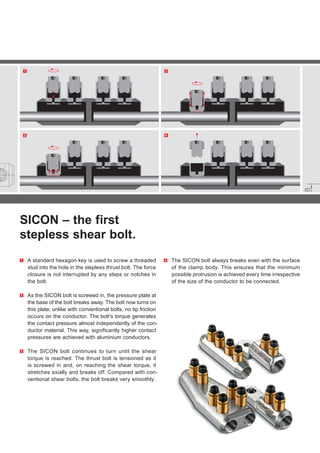
31
42
SICON – the first
stepless shear bolt.
1 	A standard hexagon key is used to screw a threaded
stud into the hole in the stepless thrust bolt. The force
closure is not interrupted by any steps or notches in
the bolt.
2 	As the SICON bolt is screwed in, the pressure plate at
the base of the bolt breaks away. The bolt now turns on
this plate; unlike with conventional bolts, no tip friction
occurs on the conductor. The bolt’s torque generates
the contact pressure almost independently of the con-
ductor material. This way, significantly higher contact
pressures are achieved with aluminium conductors.
3 	The SICON bolt continues to turn until the shear
torque is reached. The thrust bolt is tensioned as it
is screwed in and, on reaching the shear torque, it
stretches axially and breaks off. Compared with con-
ventional shear bolts, the bolt breaks very smoothly.
4 	The SICON bolt always breaks even with the surface
of the clamp body. This ensures that the minimum
possible protrusion is achieved every time irrespective
of the size of the conductor to be connected.
No predetermined breaking points,
no weak points.
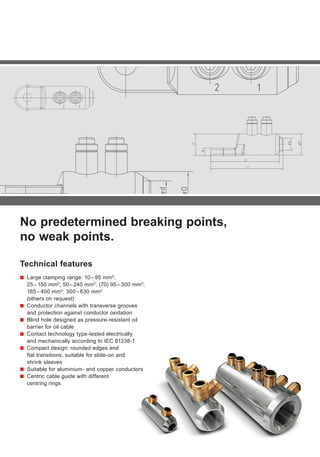
Technical features
■■ Large clamping range: 10 – 95 mm2
;
25 – 150 mm2
; 50 – 240 mm2
; (70) 95 – 300 mm2
;
185 – 400 mm2
; 300 – 630 mm2
(others on request)
■■ Conductor channels with transverse grooves
and protection against conductor oxidation
■■ Blind hole designed as pressure-resistant oil
barrier for oil cable
■■ Contact technology type-tested electrically
and mechanically according to IEC 61238-1
■■ Compact design: rounded edges and
flat transitions, suitable for slide-on and
shrink sleeves
■■ Suitable for aluminium- and copper conductors
■■ Centric cable guide with different
centring rings
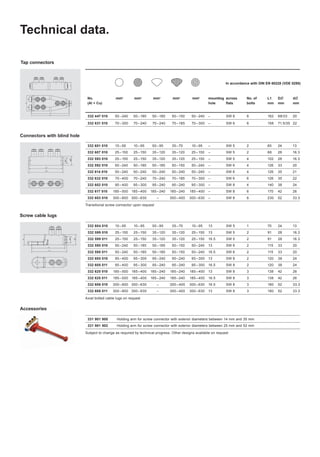
331 901 900 	 Holding arm for screw connector with exterior diameters between 14 mm and 35 mm
	 331 901 902 	 Holding arm for screw connector with exterior diameters between 25 mm and 52 mm
Accessories
	No.	 mm2
	mm2
	 mm2
	 mm2
	mm2
	 mounting	 across 	 No. of	 L1	 DØ	dØ
	 (Al + Cu)						 hole	 flats	 bolts	 mm	 mm	 mm
	 332 601 010	 10 – 95	 10 – 95	 50 – 95	 35 – 70	 10 – 95	 –	 SW 5	 2	 65	 24	 13
	 332 607 010	 25 – 150	 25 – 150	 35 – 120	 35 – 120	 25 – 150	 –	 SW 5	 2	 68	 28	 16.3
	 332 593 010	 25 – 150	 25 – 150	 35 – 120	 35 – 120	 25 – 150	 –	 SW 5	 4	 102	 28	 16.3
	 332 592 010	 50 – 240	 50 – 185	 50 – 185	 50 – 150	 50 – 240	 –	 SW 6	 4	 126	 33	 20
	 332 614 010	 50 – 240	 50 – 240	 50 – 240	 50 – 240	 50 – 240	 –	 SW 6	 4	 126	 35	 21
	 332 632 010	 70 – 400	 70 – 240	 70 – 240	 70 – 185	 70 – 300	 –	 SW 6	 6	 126	 35	 22
	 332 602 010	 95 – 400	 95 – 300	 95 – 240	 95 – 240	 95 – 300	 –	 SW 8	 4	 140	 38	 24
	 332 617 010	 185 – 500	 185 – 400	 185 – 240	 185 – 240	 185 – 400	 –	 SW 8	 6	 170	 42	 26
	 332 603 010	 300 – 800	 300 – 630	 –	 300 – 400	 300 – 630	 –	 SW 8	 6	 230	 52	 33.3
	 332 447 010	50 – 240	50 – 185	50 – 185	50 – 150	50 – 240	 –	 SW 6	 6	 162	 68/33	 20
	 332 631 010	 70 – 300 	 70 – 240	 70 – 240	 70 – 185	 70 – 300	 –	 SW 6	 6	 158	 71.5/35	 22
In accordance with DIN EN 60228 (VDE 0295)
Transitional screw connector upon request
Axial bolted cable lugs on request
Connectors with blind hole
Screw cable lugs
Tap connectors
Technical data.
	 332 604 010	 10 – 95	 10 – 95	 50 – 95	 35 – 70	 10 – 95	 13	 SW 5	 1	 70	 24	 13
	 332 599 010	 25 – 150	 25 – 150	 35 – 120	 35 – 120	 25 – 150	 13	 SW 5	 2	 91	 28	 16.3
	 332 599 011	 25 – 150	 25 – 150	 35 – 120	 35 – 120	 25 – 150	 16.5	 SW 5	 2	 91	 28	 16.3
	 332 595 010	 50 – 240	 50 – 185	 50 – 185	 50 – 150	 50 – 240	 13	 SW 6	 2	 115	 33	 20
	 332 595 011 	 50 – 240 	 50 – 185 	 50 – 185 	 50 – 150 	 50 – 240	 16.5 	 SW 6	 2 	 115	 33 	 20
	 332 605 010	 95 – 400	 95 – 300	 95 – 240	 95 – 240	 95 – 300	 13	 SW 8	 2	 120	 38	 24
	 332 605 011	 95 – 400 	 95 – 300 	 95 – 240 	 95 – 240 	 95 – 300	 16.5 	 SW 8 	 2	 120	 38	 24
	 332 625 010	 185 – 500	 185 – 400	 185 – 240	 185 – 240	 185 – 400	 13	 SW 8	 3	 138	 42	 26
	 332 625 011	 185 – 500	 185 – 400	 185 – 240	 185 – 240	 185 – 400	 16.5	 SW 8	 3	 138	 42	 26
	 332 606 010	 300 – 800	 300 – 630	 – 	 300 – 400	 300 – 630	 16.5	 SW 8	 3	 180	 52 	 33.3
	 332 606 011	 300 – 800	 300 – 630	 –	 300 – 400	 300 – 630	 13	 SW 8	 3	 180	 52	 33.3
Subject to change as required by technical progress. Other designs available on request

Pfisterer SICON Shear Bolt Screw Connector

  • 1.
    The first cableconnector system with stepless shear bolts. SICON LV- AND MV-NETWORKS
  • 2.
    SICON The Better isthe Enemy of the Good. Advantages ■■ Up to 30 % increased contact force on Al conductors compared with conventional type terminals ■■ Bolt base plate for uniform friction and without damage on the conductor ■■ Full utilisation of the thread loading for any size of conductor ■■ No special tool needed ■■ Smooth breakage of the shear bolt simplifies tightening process ■■ The remains of the bolt stay on the tool and can be disposed safely ■■ Technical verification is required for class 5 fine stranded conductors Terminals, connectors and cable lugs using screw tech- nology have been on the advance for years. And with good reason. Bolted connections offer technical and practical advantages that compression connections cannot provide. For instance, a large cross-section range and easy handling. This clamping technology perfectly complements the new multi-range cable accessories. Fitting requires only a simple tool. Until now, the “multi-stage shear bolt” has been the state of the art in screw technology. The design strength of the multi-stage shear bolt – the integral prede- termined breaking points – is at the same time its decisive weakness. Each breaking point forms a discontinuity in the loadbearing thread, and the maximum clamping force cannot be achieved. A further disadvantage: The stages must be very accurately matched to the conductor of the cable used – otherwise the bolt will break at the wrong position. From PFISTERER: Stepless shear bolts. Special design feature: No predetermined breaking points in the thread. This ensures the optimum thread load for any range of cross-sections. The bolt always breaks even with the surface of the clamp body.
  • 3.
    31 42 SICON – thefirst stepless shear bolt. 1 A standard hexagon key is used to screw a threaded stud into the hole in the stepless thrust bolt. The force closure is not interrupted by any steps or notches in the bolt. 2 As the SICON bolt is screwed in, the pressure plate at the base of the bolt breaks away. The bolt now turns on this plate; unlike with conventional bolts, no tip friction occurs on the conductor. The bolt’s torque generates the contact pressure almost independently of the con- ductor material. This way, significantly higher contact pressures are achieved with aluminium conductors. 3 The SICON bolt continues to turn until the shear torque is reached. The thrust bolt is tensioned as it is screwed in and, on reaching the shear torque, it stretches axially and breaks off. Compared with con- ventional shear bolts, the bolt breaks very smoothly. 4 The SICON bolt always breaks even with the surface of the clamp body. This ensures that the minimum possible protrusion is achieved every time irrespective of the size of the conductor to be connected.
  • 4.
    No predetermined breakingpoints, no weak points. Technical features ■■ Large clamping range: 10 – 95 mm2 ; 25 – 150 mm2 ; 50 – 240 mm2 ; (70) 95 – 300 mm2 ; 185 – 400 mm2 ; 300 – 630 mm2 (others on request) ■■ Conductor channels with transverse grooves and protection against conductor oxidation ■■ Blind hole designed as pressure-resistant oil barrier for oil cable ■■ Contact technology type-tested electrically and mechanically according to IEC 61238-1 ■■ Compact design: rounded edges and flat transitions, suitable for slide-on and shrink sleeves ■■ Suitable for aluminium- and copper conductors ■■ Centric cable guide with different centring rings
  • 5.
    331 901 900 Holding arm for screw connector with exterior diameters between 14 mm and 35 mm 331 901 902 Holding arm for screw connector with exterior diameters between 25 mm and 52 mm Accessories No. mm2 mm2 mm2 mm2 mm2 mounting across No. of L1 DØ dØ (Al + Cu) hole flats bolts mm mm mm 332 601 010 10 – 95 10 – 95 50 – 95 35 – 70 10 – 95 – SW 5 2 65 24 13 332 607 010 25 – 150 25 – 150 35 – 120 35 – 120 25 – 150 – SW 5 2 68 28 16.3 332 593 010 25 – 150 25 – 150 35 – 120 35 – 120 25 – 150 – SW 5 4 102 28 16.3 332 592 010 50 – 240 50 – 185 50 – 185 50 – 150 50 – 240 – SW 6 4 126 33 20 332 614 010 50 – 240 50 – 240 50 – 240 50 – 240 50 – 240 – SW 6 4 126 35 21 332 632 010 70 – 400 70 – 240 70 – 240 70 – 185 70 – 300 – SW 6 6 126 35 22 332 602 010 95 – 400 95 – 300 95 – 240 95 – 240 95 – 300 – SW 8 4 140 38 24 332 617 010 185 – 500 185 – 400 185 – 240 185 – 240 185 – 400 – SW 8 6 170 42 26 332 603 010 300 – 800 300 – 630 – 300 – 400 300 – 630 – SW 8 6 230 52 33.3 332 447 010 50 – 240 50 – 185 50 – 185 50 – 150 50 – 240 – SW 6 6 162 68/33 20 332 631 010 70 – 300 70 – 240 70 – 240 70 – 185 70 – 300 – SW 6 6 158 71.5/35 22 In accordance with DIN EN 60228 (VDE 0295) Transitional screw connector upon request Axial bolted cable lugs on request Connectors with blind hole Screw cable lugs Tap connectors Technical data. 332 604 010 10 – 95 10 – 95 50 – 95 35 – 70 10 – 95 13 SW 5 1 70 24 13 332 599 010 25 – 150 25 – 150 35 – 120 35 – 120 25 – 150 13 SW 5 2 91 28 16.3 332 599 011 25 – 150 25 – 150 35 – 120 35 – 120 25 – 150 16.5 SW 5 2 91 28 16.3 332 595 010 50 – 240 50 – 185 50 – 185 50 – 150 50 – 240 13 SW 6 2 115 33 20 332 595 011 50 – 240 50 – 185 50 – 185 50 – 150 50 – 240 16.5 SW 6 2 115 33 20 332 605 010 95 – 400 95 – 300 95 – 240 95 – 240 95 – 300 13 SW 8 2 120 38 24 332 605 011 95 – 400 95 – 300 95 – 240 95 – 240 95 – 300 16.5 SW 8 2 120 38 24 332 625 010 185 – 500 185 – 400 185 – 240 185 – 240 185 – 400 13 SW 8 3 138 42 26 332 625 011 185 – 500 185 – 400 185 – 240 185 – 240 185 – 400 16.5 SW 8 3 138 42 26 332 606 010 300 – 800 300 – 630 – 300 – 400 300 – 630 16.5 SW 8 3 180 52 33.3 332 606 011 300 – 800 300 – 630 – 300 – 400 300 – 630 13 SW 8 3 180 52 33.3 Subject to change as required by technical progress. Other designs available on request