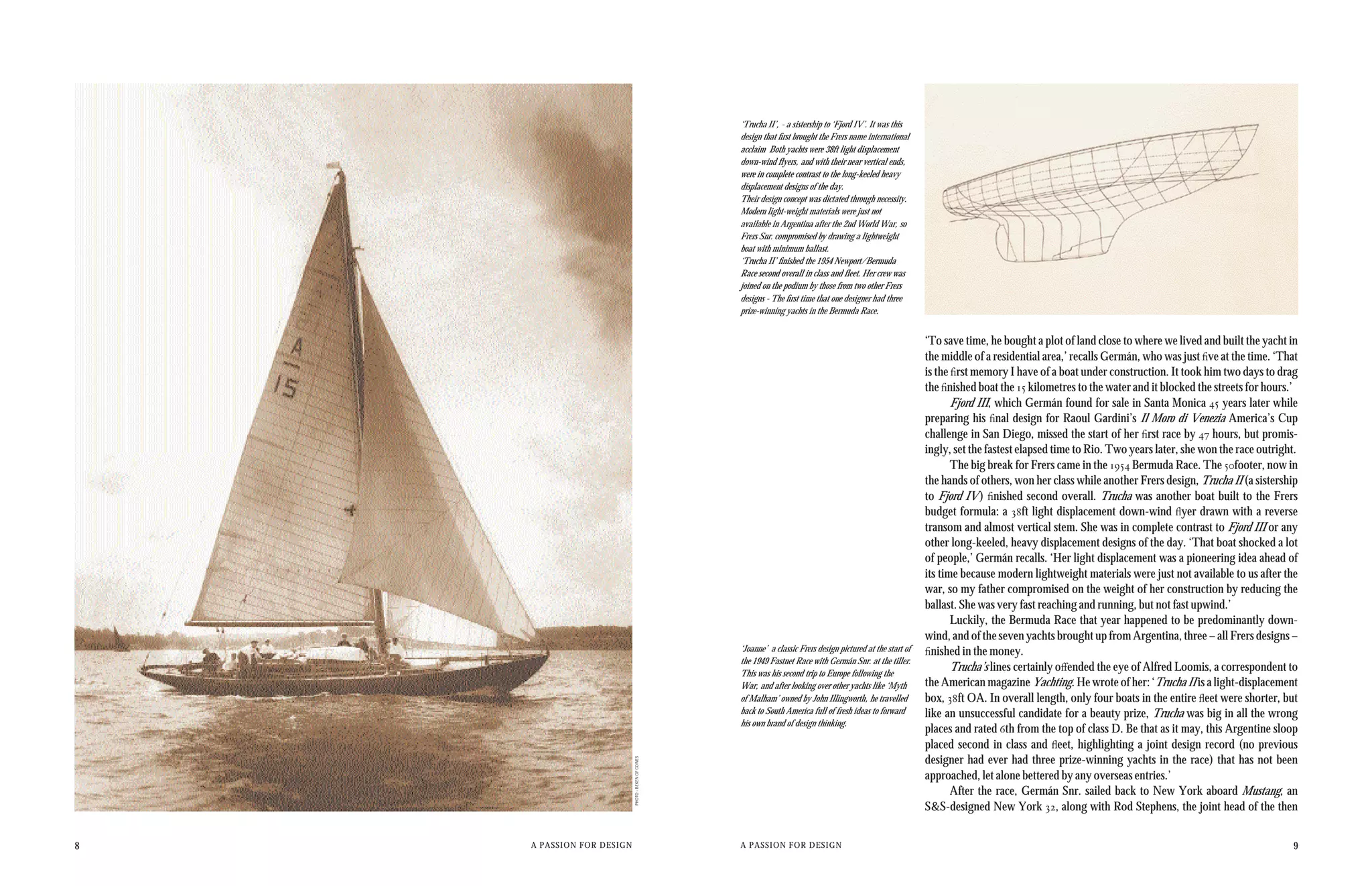
‘Trucha II’, - a sistership to ‘Fjord IV’. It was this
                                                    design that first brought the Frers name international
                                                    acclaim Both yachts were 38ft light displacement
                                                    down-wind flyers, and with their near vertical ends,
                                                    were in complete contrast to the long-keeled heavy
                                                    displacement designs of the day.
                                                    Their design concept was dictated through necessity.
                                                    Modern light-weight materials were just not
                                                    available in Argentina after the 2nd World War, so
                                                    Frers Snr. compromised by drawing a lightweight
                                                    boat with minimum ballast.
                                                    ‘Trucha II’ finished the 1954 Newport/Bermuda
                                                    Race second overall in class and fleet. Her crew was
                                                    joined on the podium by those from two other Frers
                                                    designs - The first time that one designer had three
                                                    prize-winning yachts in the Bermuda Race.


                                                                                                               ‘To save time, he bought a plot of land close to where we lived and built the yacht in
                                                                                                               the middle of a residential area,’ recalls Germán, who was just five at the time. ‘That
                                                                                                               is the first memory I have of a boat under construction. It took him two days to drag
                                                                                                               the finished boat the  kilometres to the water and it blocked the streets for hours.’
                                                                                                                      Fjord III, which Germán found for sale in Santa Monica  years later while
                                                                                                               preparing his final design for Raoul Gardini’s Il Moro di Venezia America’s Cup
                                                                                                               challenge in San Diego, missed the start of her first race by  hours, but promis-
                                                                                                               ingly, set the fastest elapsed time to Rio. Two years later, she won the race outright.
                                                                                                                      The big break for Frers came in the  Bermuda Race. The footer, now in
                                                                                                               the hands of others, won her class while another Frers design, Trucha II (a sistership
                                                                                                               to Fjord IV ) finished second overall. Trucha was another boat built to the Frers
                                                                                                               budget formula: a ft light displacement down-wind flyer drawn with a reverse
                                                                                                               transom and almost vertical stem. She was in complete contrast to Fjord III or any
                                                                                                               other long-keeled, heavy displacement designs of the day. ‘That boat shocked a lot
                                                                                                               of people,’ Germán recalls. ‘Her light displacement was a pioneering idea ahead of
                                                                                                               its time because modern lightweight materials were just not available to us after the
                                                                                                               war, so my father compromised on the weight of her construction by reducing the
                                                                                                               ballast. She was very fast reaching and running, but not fast upwind.’
                                                                                                                      Luckily, the Bermuda Race that year happened to be predominantly down-
                                                                                                               wind, and of the seven yachts brought up from Argentina, three – all Frers designs –
                                                    ‘Joanne’ a classic Frers design pictured at the start of   finished in the money.
                                                    the 1949 Fastnet Race with Germán Snr. at the tiller.
                                                    This was his second trip to Europe following the
                                                                                                                      Trucha’s lines certainly offended the eye of Alfred Loomis, a correspondent to
                                                    War, and after looking over other yachts like ‘Myth        the American magazine Yachting. He wrote of her: ‘Trucha II is a light-displacement
                                                    of Malham’ owned by John Illingworth, he travelled         box, ft OA. In overall length, only four boats in the entire fleet were shorter, but
                                                    back to South America full of fresh ideas to forward       like an unsuccessful candidate for a beauty prize, Trucha was big in all the wrong
                                                    his own brand of design thinking.
                                                                                                               places and rated th from the top of class D. Be that as it may, this Argentine sloop
                                                                                                               placed second in class and fleet, highlighting a joint design record (no previous
                                                                                                               designer had ever had three prize-winning yachts in the race) that has not been
                           PHOTO - BEKEN OF COWES


                                                                                                               approached, let alone bettered by any overseas entries.’
                                                                                                                      After the race, Germán Snr. sailed back to New York aboard Mustang, an
                                                                                                               S&S-designed New York , along with Rod Stephens, the joint head of the then


8   A PASSION FOR DESIGN                            A PASSION FOR DESIGN                                                                                                                            9

Pfd p8 9

  • 1.
    ‘Trucha II’, -a sistership to ‘Fjord IV’. It was this design that first brought the Frers name international acclaim Both yachts were 38ft light displacement down-wind flyers, and with their near vertical ends, were in complete contrast to the long-keeled heavy displacement designs of the day. Their design concept was dictated through necessity. Modern light-weight materials were just not available in Argentina after the 2nd World War, so Frers Snr. compromised by drawing a lightweight boat with minimum ballast. ‘Trucha II’ finished the 1954 Newport/Bermuda Race second overall in class and fleet. Her crew was joined on the podium by those from two other Frers designs - The first time that one designer had three prize-winning yachts in the Bermuda Race. ‘To save time, he bought a plot of land close to where we lived and built the yacht in the middle of a residential area,’ recalls Germán, who was just five at the time. ‘That is the first memory I have of a boat under construction. It took him two days to drag the finished boat the  kilometres to the water and it blocked the streets for hours.’ Fjord III, which Germán found for sale in Santa Monica  years later while preparing his final design for Raoul Gardini’s Il Moro di Venezia America’s Cup challenge in San Diego, missed the start of her first race by  hours, but promis- ingly, set the fastest elapsed time to Rio. Two years later, she won the race outright. The big break for Frers came in the  Bermuda Race. The footer, now in the hands of others, won her class while another Frers design, Trucha II (a sistership to Fjord IV ) finished second overall. Trucha was another boat built to the Frers budget formula: a ft light displacement down-wind flyer drawn with a reverse transom and almost vertical stem. She was in complete contrast to Fjord III or any other long-keeled, heavy displacement designs of the day. ‘That boat shocked a lot of people,’ Germán recalls. ‘Her light displacement was a pioneering idea ahead of its time because modern lightweight materials were just not available to us after the war, so my father compromised on the weight of her construction by reducing the ballast. She was very fast reaching and running, but not fast upwind.’ Luckily, the Bermuda Race that year happened to be predominantly down- wind, and of the seven yachts brought up from Argentina, three – all Frers designs – ‘Joanne’ a classic Frers design pictured at the start of finished in the money. the 1949 Fastnet Race with Germán Snr. at the tiller. This was his second trip to Europe following the Trucha’s lines certainly offended the eye of Alfred Loomis, a correspondent to War, and after looking over other yachts like ‘Myth the American magazine Yachting. He wrote of her: ‘Trucha II is a light-displacement of Malham’ owned by John Illingworth, he travelled box, ft OA. In overall length, only four boats in the entire fleet were shorter, but back to South America full of fresh ideas to forward like an unsuccessful candidate for a beauty prize, Trucha was big in all the wrong his own brand of design thinking. places and rated th from the top of class D. Be that as it may, this Argentine sloop placed second in class and fleet, highlighting a joint design record (no previous designer had ever had three prize-winning yachts in the race) that has not been PHOTO - BEKEN OF COWES approached, let alone bettered by any overseas entries.’ After the race, Germán Snr. sailed back to New York aboard Mustang, an S&S-designed New York , along with Rod Stephens, the joint head of the then 8 A PASSION FOR DESIGN A PASSION FOR DESIGN 9