PERSONIFICATION.
Tasmiya
Malik
Sr.II C.
PERSONIFICATION:
Personification is a part of figurative
language where human qualities like
movement, feelings, expressions etc are
given to something non-living thing.
As non-living things are not capable of
movements they give a really deadly
effect to piece of work, But to add life in
a context, writer uses human qualities for
objects non-living, It generate a lively
effect as well as helps to describe the
situation or circumstances more clearly..
EXAMPLES:
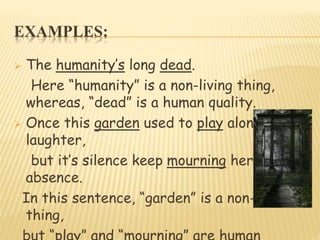
 The humanity’s long dead.
Here “humanity” is a non-living thing,
whereas, “dead” is a human quality.
 Once this garden used to play along her
laughter,
but it’s silence keep mourning her
absence.
In this sentence, “garden” is a non-living
thing,
THE DIFFERENCE BETWEEN PERSONIFIED AND
UN-PERSONIFIED SENTENCE.
 Un-personified: “I was so happy to see my results.”
This sentence does not have any life, so this type of
sentences does not attract the reader and creates a flop
piece of work.
 Personified: “The first sight of my results dropped my jaw,
I felt like chairs around me danced, the tables cheered,
the portraits threw a victorious smiles on me, and the
result sheet just gave me a friendly wink. I was raised up
from the ground as if I was flying.”
This sentence is quite brief about the feelings of the
writer and the scenario around the writer. Secondly it
attracts the reader and develop their interest.
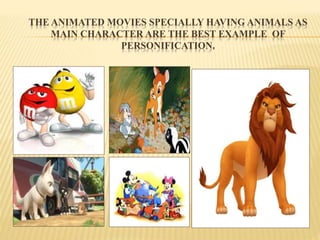
THE ANIMATED MOVIES SPECIALLY HAVING ANIMALS AS
MAIN CHARACTER ARE THE BEST EXAMPLE OF
PERSONIFICATION.
THANKS YOU!
HOPE U LIKE IT. 

Personification

  • 1.
  • 2.
    PERSONIFICATION: Personification is apart of figurative language where human qualities like movement, feelings, expressions etc are given to something non-living thing. As non-living things are not capable of movements they give a really deadly effect to piece of work, But to add life in a context, writer uses human qualities for objects non-living, It generate a lively effect as well as helps to describe the situation or circumstances more clearly..
  • 3.
    EXAMPLES:  The humanity’slong dead. Here “humanity” is a non-living thing, whereas, “dead” is a human quality.  Once this garden used to play along her laughter, but it’s silence keep mourning her absence. In this sentence, “garden” is a non-living thing,
  • 4.
    THE DIFFERENCE BETWEENPERSONIFIED AND UN-PERSONIFIED SENTENCE.  Un-personified: “I was so happy to see my results.” This sentence does not have any life, so this type of sentences does not attract the reader and creates a flop piece of work.  Personified: “The first sight of my results dropped my jaw, I felt like chairs around me danced, the tables cheered, the portraits threw a victorious smiles on me, and the result sheet just gave me a friendly wink. I was raised up from the ground as if I was flying.” This sentence is quite brief about the feelings of the writer and the scenario around the writer. Secondly it attracts the reader and develop their interest.
  • 5.
    THE ANIMATED MOVIESSPECIALLY HAVING ANIMALS AS MAIN CHARACTER ARE THE BEST EXAMPLE OF PERSONIFICATION.
  • 6.
    THANKS YOU! HOPE ULIKE IT. 