Chapter 5:
Personality Assessment I: Personality
Testing and its Consequences
The Personality Puzzle
Sixth Edition

by David C. Funder

Slides created by
Tera D. Letzring
Idaho State University
© 2013 W. W. Norton & Company, Inc.

1
Objectives
• Discuss the nature of personality assessment
• Discuss whether personality tests provide S or
B data
• Discuss projective and objective tests
• Discuss the methods of objective test
construction
• Discuss the purposes and potential problems
of personality testing
© 2013 W. W. Norton & Company, Inc.

2
The Nature of
Personality Assessment
• More than just measuring traits
• Personality definition
– Also measure motives, intentions, goals,
strategies, and how people perceive and construct
the world

© 2013 W. W. Norton & Company, Inc.

3
The Nature of
Personality Assessment
• Not restricted to psychologists
– How did you decide whom to have as a
roommate?
– How did you decide which free-time activities to
do?
– More important than those made by psychologists

© 2013 W. W. Norton & Company, Inc.

4
The Nature of
Personality Assessment
• Most important to know: degree to which the
judgment or test is right or wrong
– Professional judgments or tests: validity
– Amateur judgments: accuracy

• Two basic criteria
– Agreement
– Prediction

© 2013 W. W. Norton & Company, Inc.

5
Personality Tests
• Used by psychologists, corporations, and the
military
• Omnibus inventories vs. one trait measures
• Most tests provide S data.
• Some tests provide B data.
– Minnesota Multiphasic Personality Inventory
(MMPI)
– Implicit Association Test (IAT)
– Intelligence
– Also known as performance-based instruments
© 2013 W. W. Norton & Company, Inc.

6
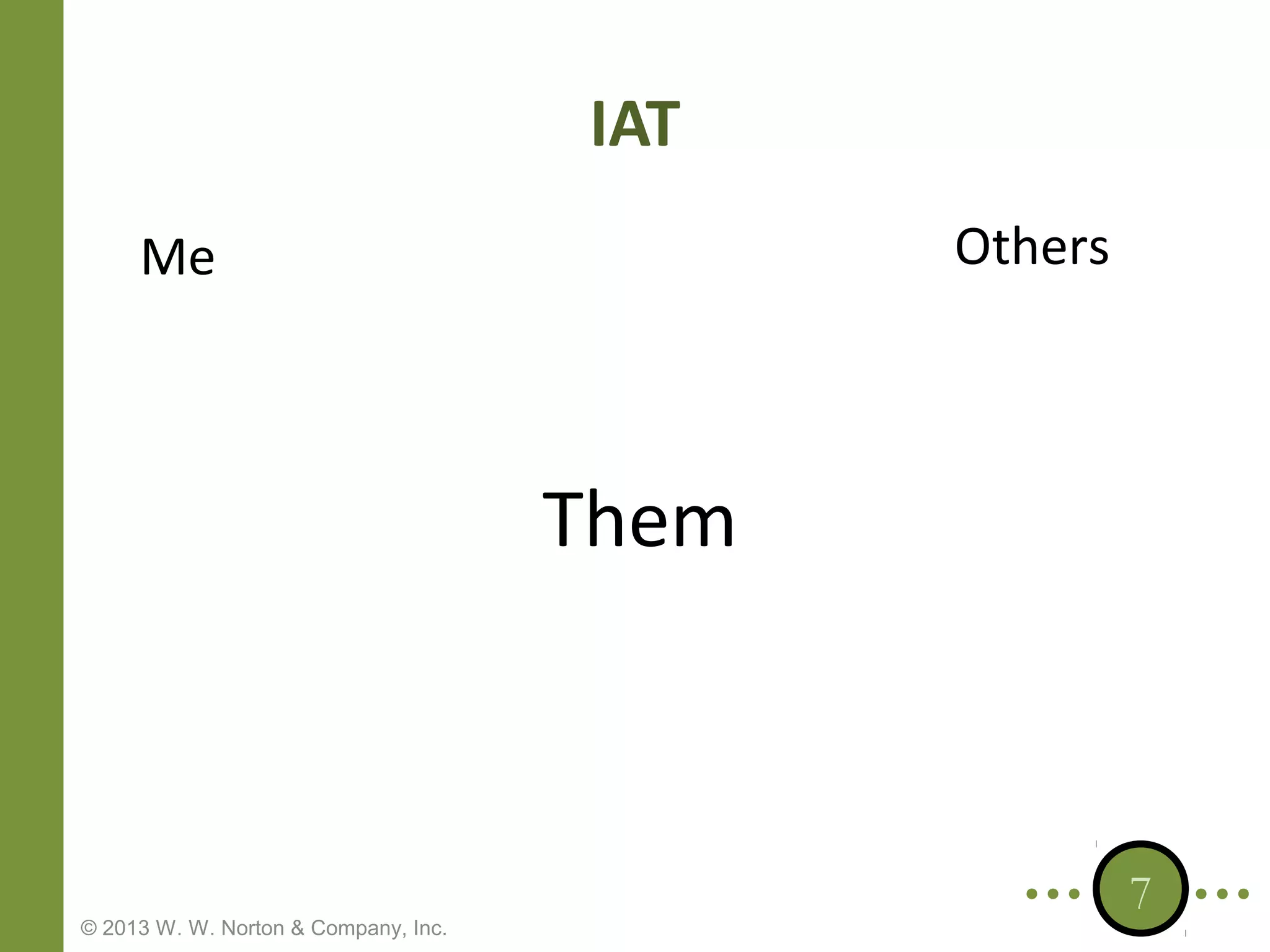
IAT
Others

Me

Them

© 2013 W. W. Norton & Company, Inc.

7
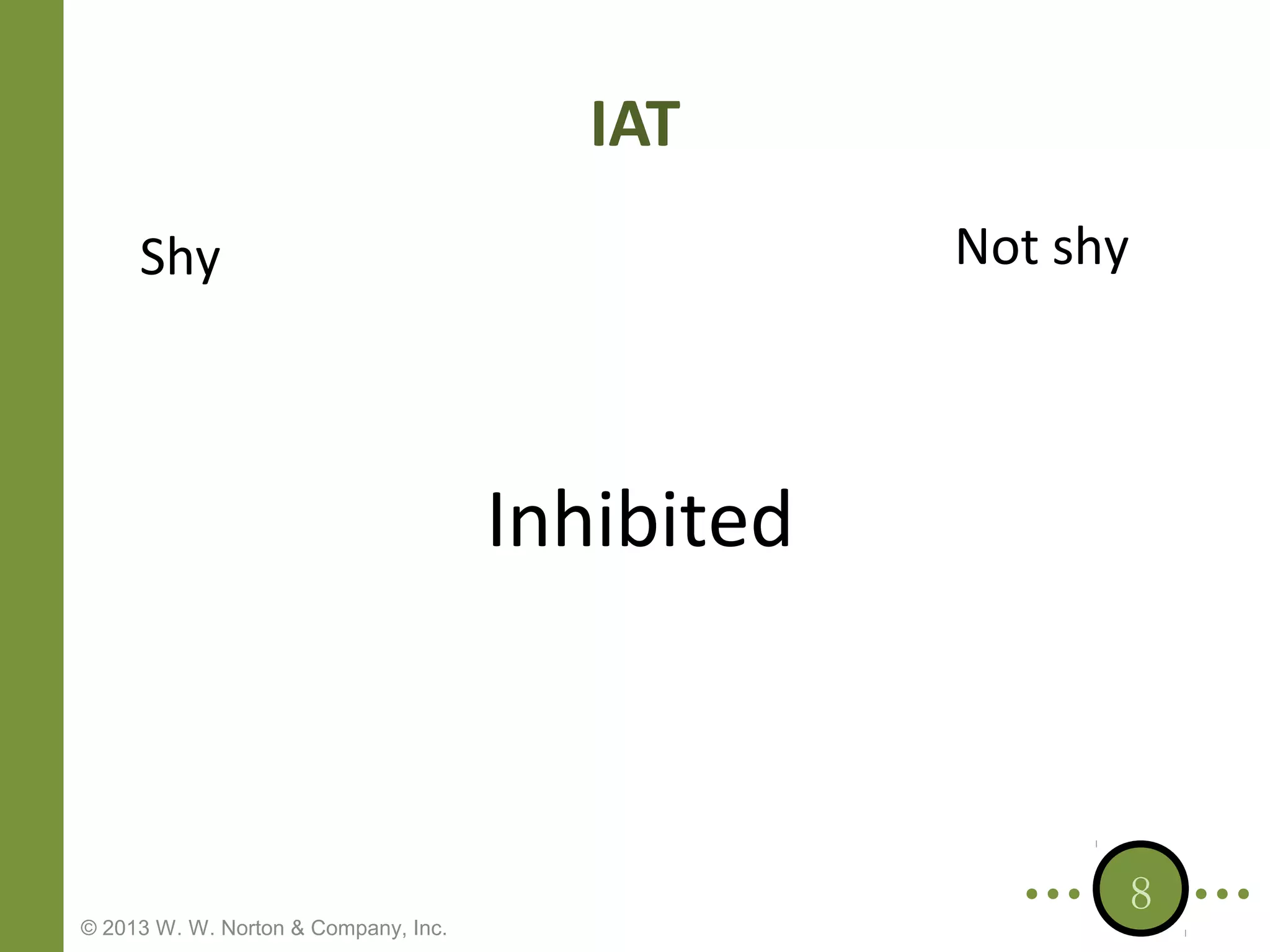
IAT
Not shy

Shy

Inhibited

© 2013 W. W. Norton & Company, Inc.

8
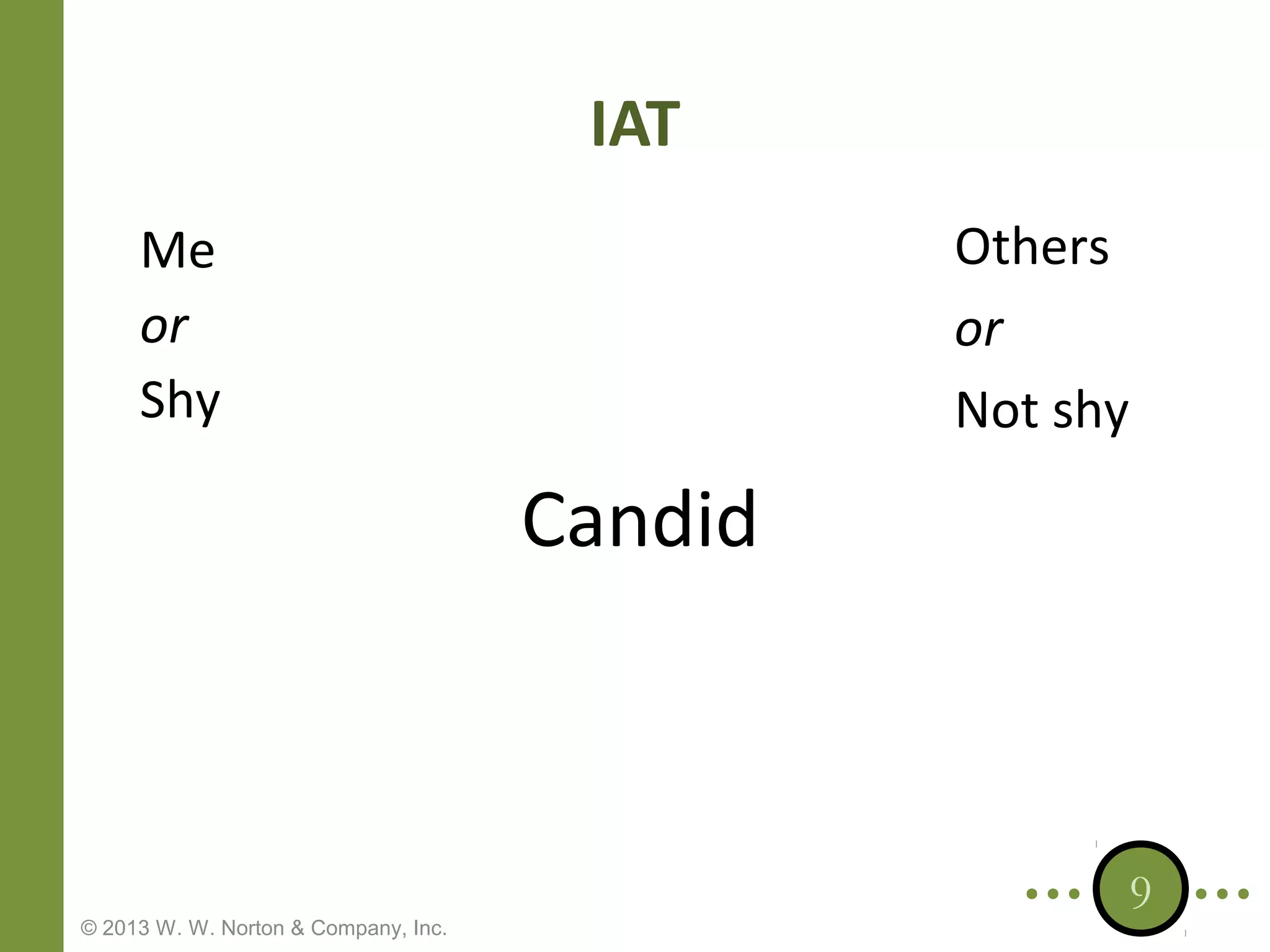
IAT
Others
or
Not shy

Me
or
Shy

Candid

© 2013 W. W. Norton & Company, Inc.

9
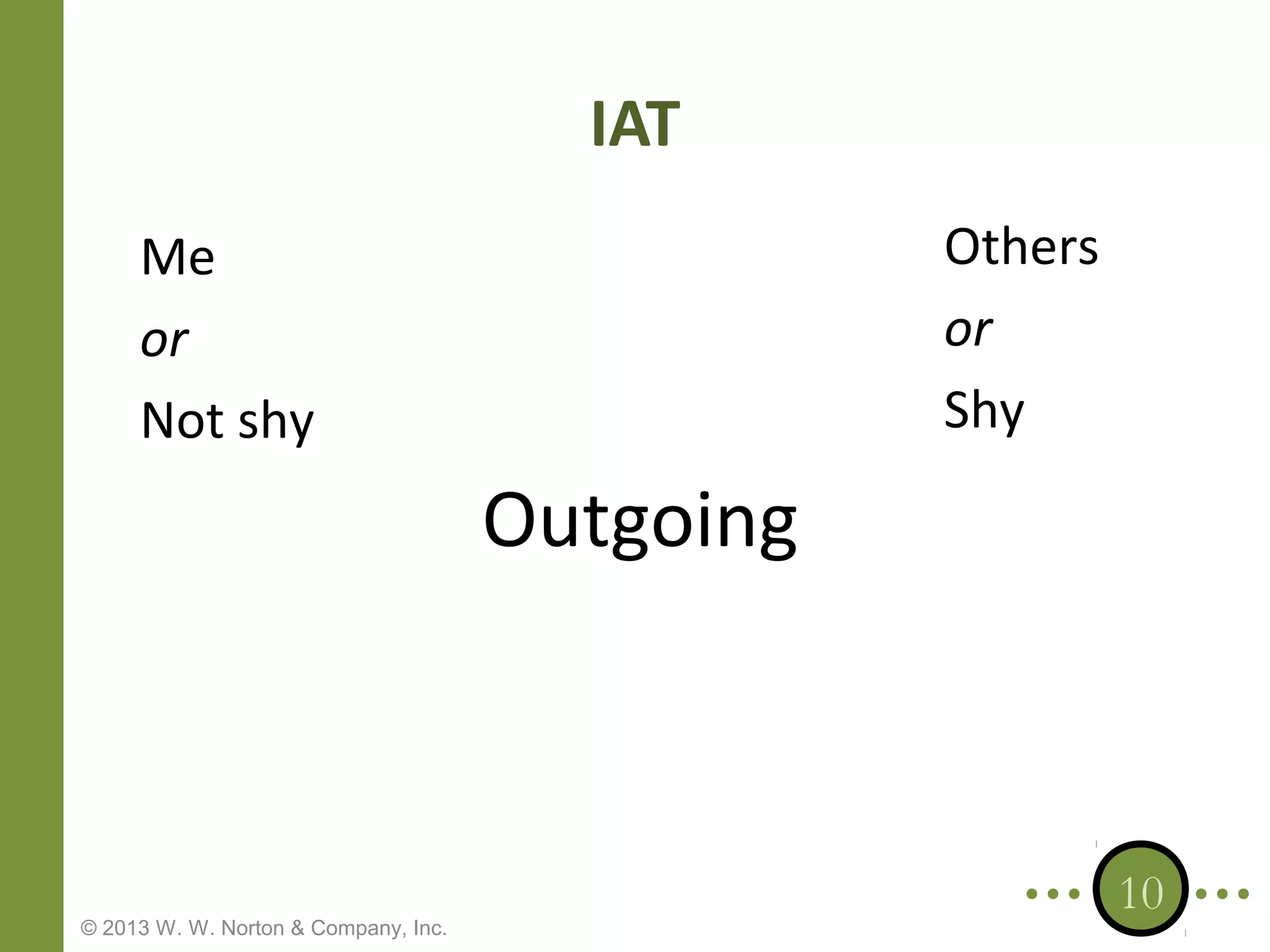
IAT
Others
or
Shy

Me
or
Not shy

Outgoing

© 2013 W. W. Norton & Company, Inc.

10
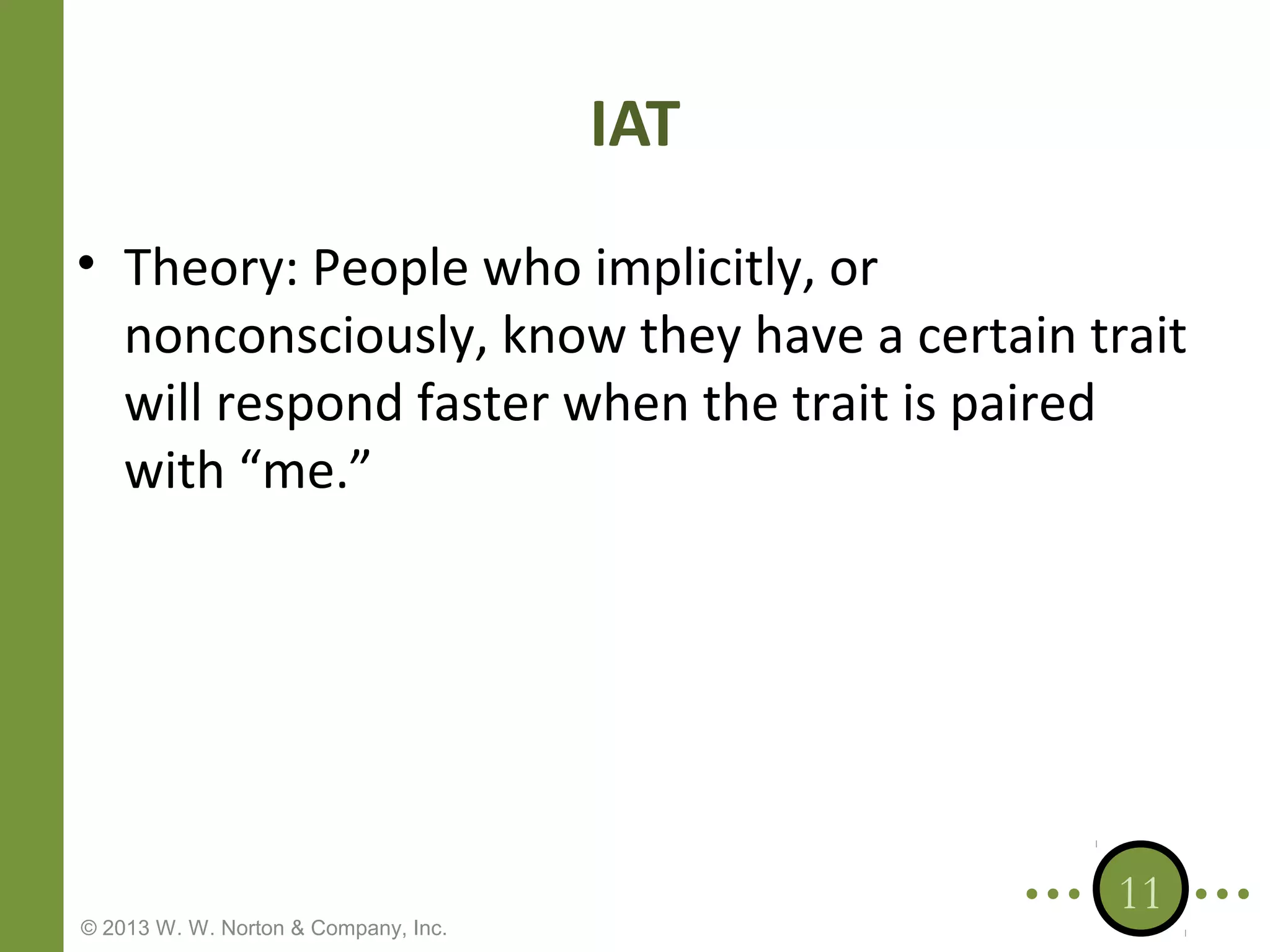
IAT
• Theory: People who implicitly, or
nonconsciously, know they have a certain trait
will respond faster when the trait is paired
with “me.”

© 2013 W. W. Norton & Company, Inc.

11
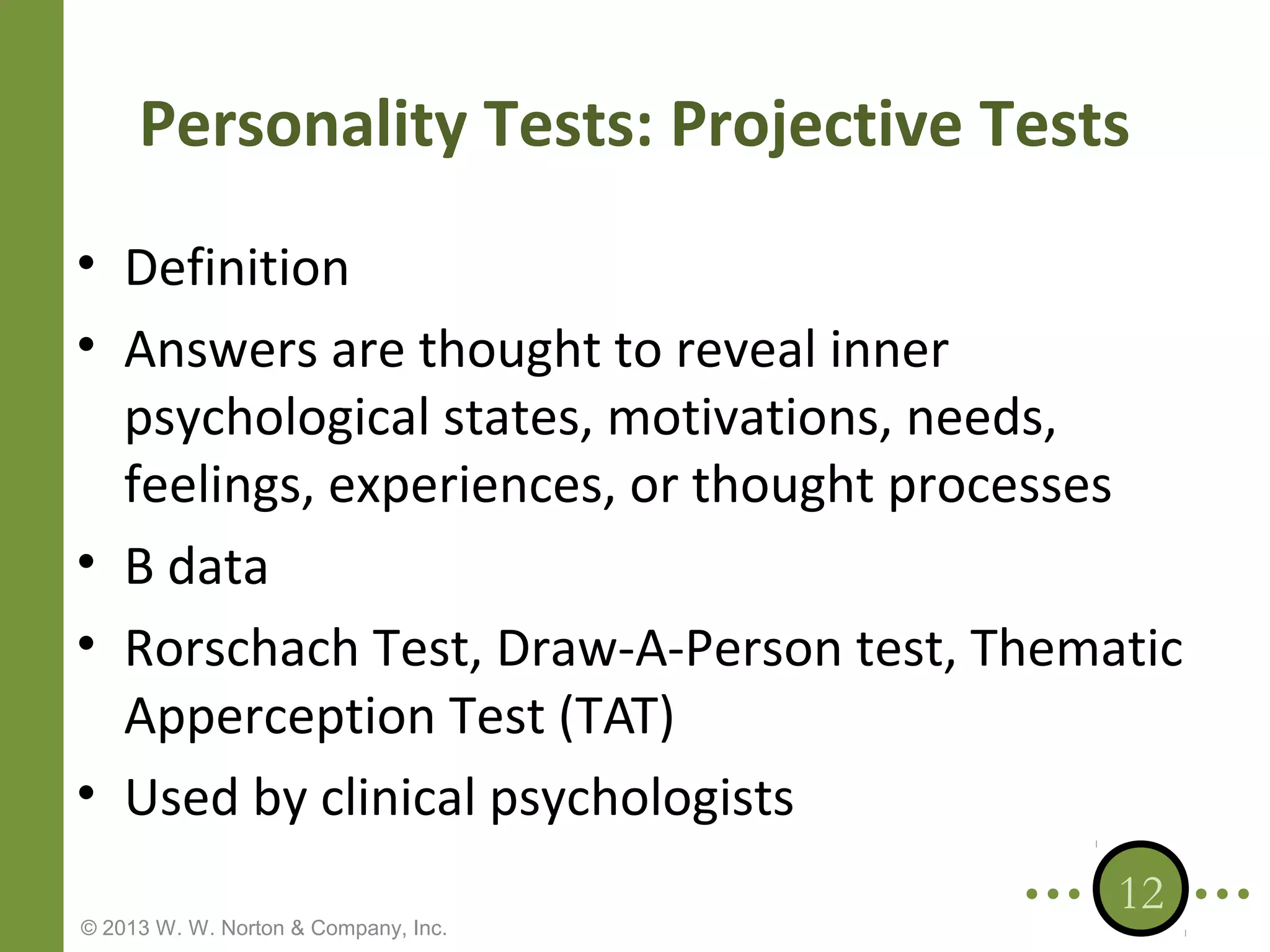
Personality Tests: Projective Tests
• Definition
• Answers are thought to reveal inner
psychological states, motivations, needs,
feelings, experiences, or thought processes
• B data
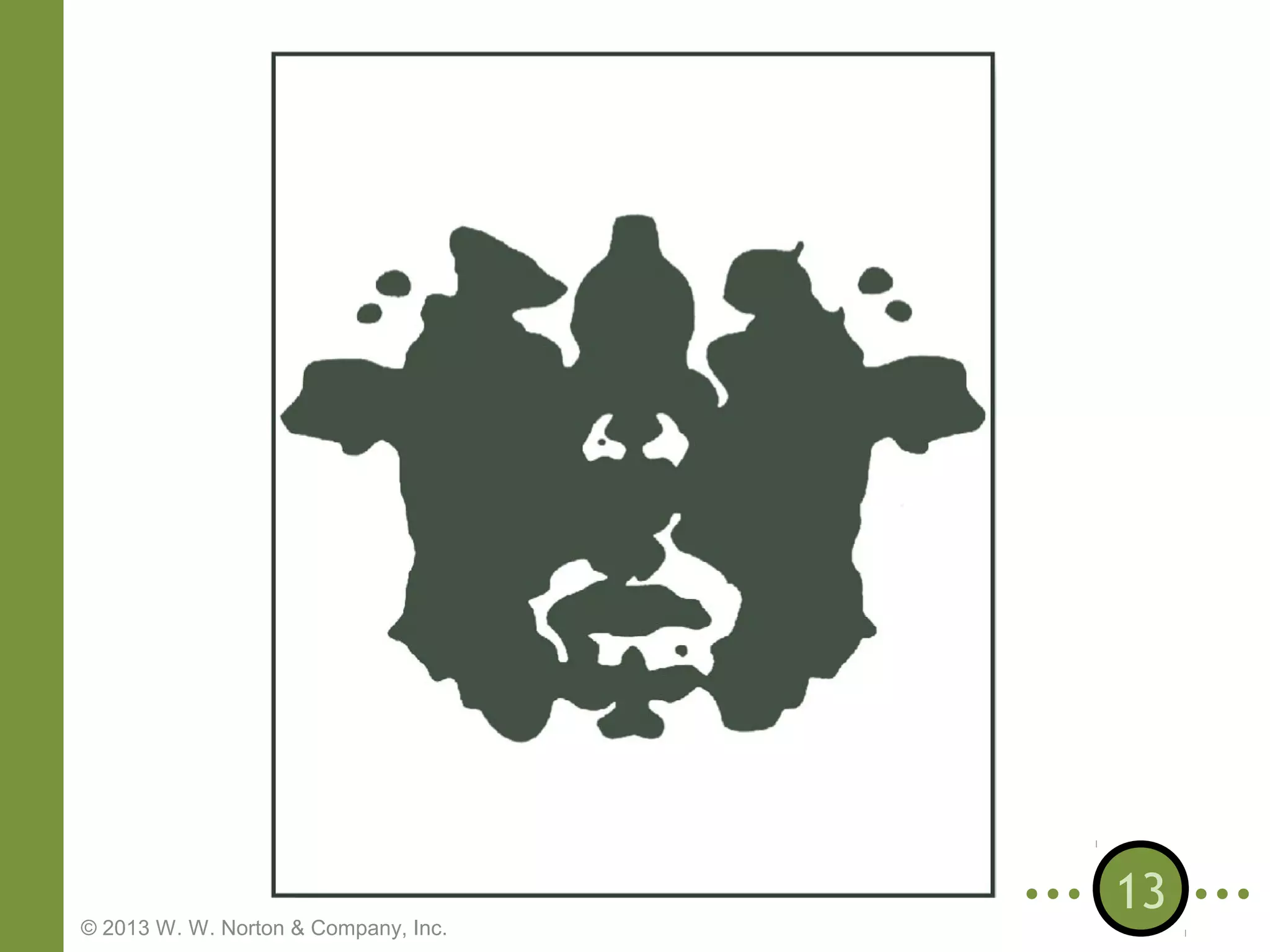
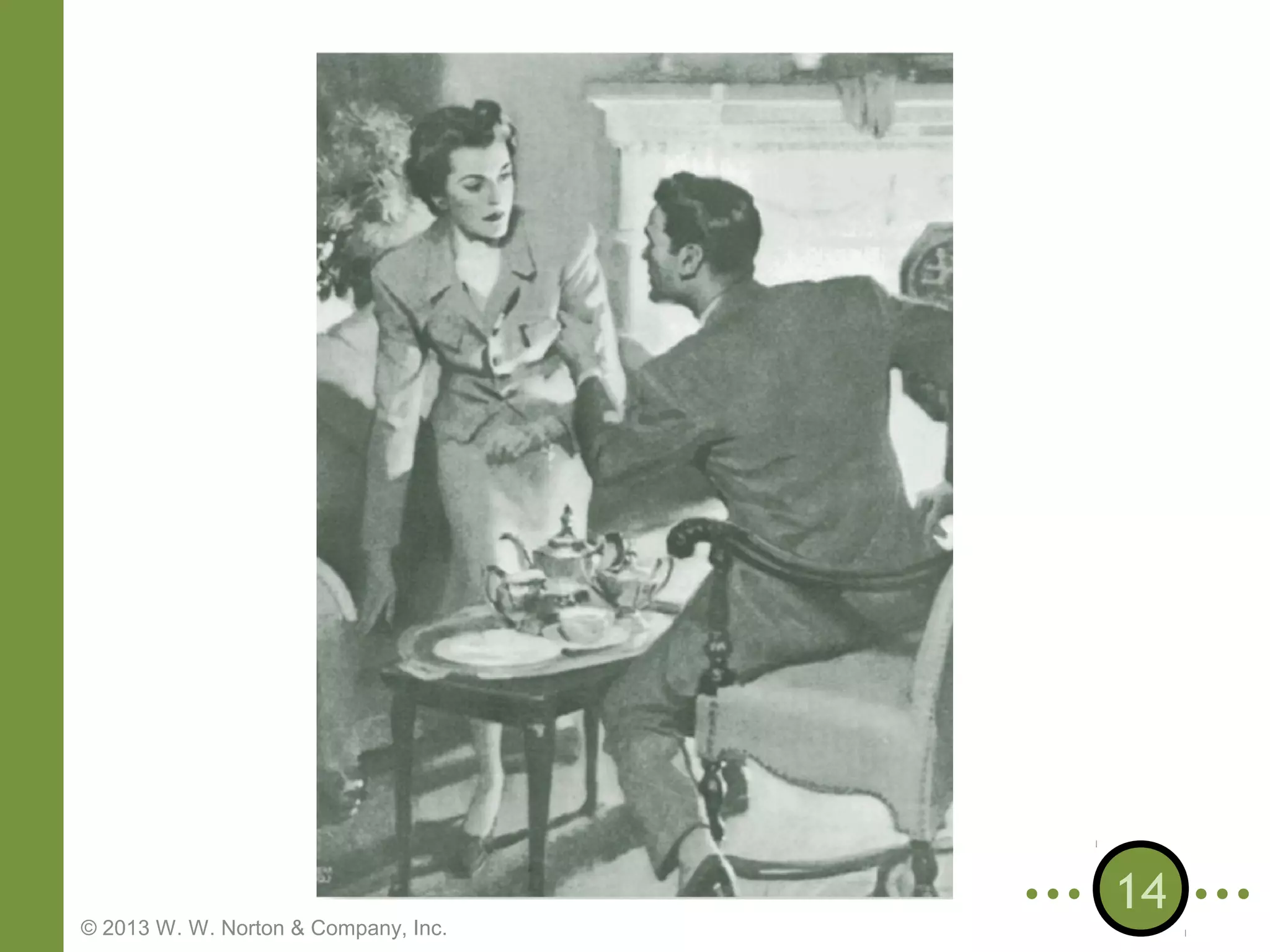
• Rorschach Test, Draw-A-Person test, Thematic
Apperception Test (TAT)
• Used by clinical psychologists
© 2013 W. W. Norton & Company, Inc.

12
© 2013 W. W. Norton & Company, Inc.

13
© 2013 W. W. Norton & Company, Inc.

14
Personality Tests: Projective Tests
• Disadvantages
– Validity evidence is scarce.
– Expensive and time-consuming
– A psychologist cannot be sure about what they
mean.
– Other less expensive tests work as well or better.

© 2013 W. W. Norton & Company, Inc.

15
Personality Tests: Projective Tests
• Advantages
– Good for breaking the ice
– Some skilled clinicians may be able to use them to
get information not captured in other types of
tests.

© 2013 W. W. Norton & Company, Inc.

16
Personality Tests: Evaluating the
Rorschach and the TAT
• Some evidence of validity
• Rorschach
– Exner’s Comprehensive System or Klopfer’s
system
– Valid for predicting certain outcomes
– Used by 82% of clinical psychologists
– Little evidence of incremental validity

• TAT
– Highly reliable scoring for new form
© 2013 W. W. Norton & Company, Inc.

17
Personality Tests: Evaluating the
Rorschach and the TAT
• People score differently on projective and
objective measures.
• Projective and objective measures predict
different outcomes.

© 2013 W. W. Norton & Company, Inc.

18
Personality Tests: Objective Tests
• Definition
• Validity and the subjectivity of test items
– Items are still not absolutely objective.

• Why so many items?
– The principle of aggregation
– Spearman-Brown formula

© 2013 W. W. Norton & Company, Inc.

19
Methods of Objective Test
Construction: Rational
• Definition
• Based on a theory or sometimes less
systematic
• Provides S data

© 2013 W. W. Norton & Company, Inc.

20
Methods of Objective Test
Construction: Rational
• Four conditions for validity
– Items mean the same thing to the test taker
and creator.
– Capability for accurate self-assessment
– Willingness to make an accurate and
undistorted report
– Items must be valid indicators of the
construct.
© 2013 W. W. Norton & Company, Inc.

21
Methods of Objective Test
Construction: Factor Analytic
• Definition
• Steps for using this method
– Generate a long list of objective items.
– Administer these items to a large number of
people.
– Analyze with a factor analysis.
– Consider what the items that group together have
in common and name the factor.

© 2013 W. W. Norton & Company, Inc.

22
Methods of Objective Test
Construction: Factor Analytic
What do these items have in common?
1.
2.
3.
4.

In most ways my life is close to my ideal.
The conditions of my life are excellent.
I am satisfied with my life.
So far I have gotten the important things I
want in my life.
5. If I could live my life over, I would change
almost nothing.
© 2013 W. W. Norton & Company, Inc.

23
Methods of Objective Test
Construction: Factor Analytic
• Limitations
– The quality of information from the factor analysis
is limited by the quality of items.
– Difficulty and subjectivity of deciding how items
are conceptually related
– Factors don’t always make sense.

• Uses
– Reduce list of traits to an essential few
– Refine personality tests
© 2013 W. W. Norton & Company, Inc.

24
Methods of Objective Test
Construction: Empirical
• Definition
• Steps for using this method
– Gather lots of items.
– Administer items to people already divided into
groups.
– Compare the answers of the different groups.
– Cross-validation

• Not based on theory; ignores item content
© 2013 W. W. Norton & Company, Inc.

25
Methods of Objective Test
Construction: Empirical
– Minnesota Multiphasic Personality Inventory
(MMPI)
– Strong Vocational Interest Blank (SVIB)

© 2013 W. W. Norton & Company, Inc.

26
Methods of Objective Test
Construction: Empirical
• Implications of ignoring item content/low face
validity
– Items can seem contrary or absurd.
– Responses are difficult to fake.
– Tests are only as good as the criteria by which
they are developed and/or cross-validated.
– Can cause problems with public relations or the
law
• Content validity
© 2013 W. W. Norton & Company, Inc.

27
Methods of Objective Test
Construction
• A combination of methods
– Generate items with rational method, analyze
responses with factor analysis, correlate factors
with independent criteria
– Jackson’s Personality Research Form (PRF)

© 2013 W. W. Norton & Company, Inc.

28
Purposes of Personality Testing
• It’s important to know how the test will be
used.
• Learning about people (researchers)
• Helping people (schools, career counselors,
clinicians)
• Assessment for selection or retention
(employers, Central Intelligence Agency)

© 2013 W. W. Norton & Company, Inc.

29
Purposes of Personality Testing:
Potential Problems
• Interest tests
– Fields may not evolve.
– Increases difficulty of women and minorities
joining nontraditional fields

• Integrity tests: different for honest vs.
dishonest people

© 2013 W. W. Norton & Company, Inc.

30
Purposes of Personality Testing:
Potential Problems
• Personality tests
– Tests are unfair mechanisms for controlling
people.
– Traits do not matter until and unless they are
tested and are social constructions.
– Being described by a set of scores is undignified
and humiliating.

© 2013 W. W. Norton & Company, Inc.

31
Purposes of Personality Testing:
Responses to Potential Problems
• Criticisms are overstated.
• Traits are not invented or constructed.
• It is naïve to view personality testing for hiring
purposes as undignified or unethical.
– A good way to assess whether a person will be a
successful employee

© 2013 W. W. Norton & Company, Inc.

32
Think About Personality Testing
• Would you prefer that a decision about
whether you should be hired for a job be
based on a personality test score or the
employer’s subjective judgment of you?
Why?
• What are some unethical uses of personality
testing?

© 2013 W. W. Norton & Company, Inc.

33
Clicker Question #1
Personality tests are used
a)only for research purposes.
b)only in clinical settings.
c)only rarely.
d)frequently and by researchers, clinicians, and
corporations.

© 2013 W. W. Norton & Company, Inc.

34
Clicker Question #2
If a person is asked to respond to a picture that
could be described in many different ways, then
a)S data are being collected.
b)a projective test is being used.
c)the respondents are likely to be aware of what
they are revealing about themselves.
d)the test is probably being given by a research
psychologist.
© 2013 W. W. Norton & Company, Inc.

35
Clicker Question #3
If what is being measured can be determined by
looking at the content of the questions, then
a)the test is a projective test.
b)the rational method of test construction has
been used.
c)factor analysis cannot be used to group items
together.
d)the items that will be used for the test are the
ones on which people from different groups
responded to in different ways.
36

© 2013 W. W. Norton & Company, Inc.

PSY 239 401 Chapter 5 SLIDES

  • 1.
    Chapter 5: Personality AssessmentI: Personality Testing and its Consequences The Personality Puzzle Sixth Edition by David C. Funder Slides created by Tera D. Letzring Idaho State University © 2013 W. W. Norton & Company, Inc. 1
  • 2.
    Objectives • Discuss thenature of personality assessment • Discuss whether personality tests provide S or B data • Discuss projective and objective tests • Discuss the methods of objective test construction • Discuss the purposes and potential problems of personality testing © 2013 W. W. Norton & Company, Inc. 2
  • 3.
    The Nature of PersonalityAssessment • More than just measuring traits • Personality definition – Also measure motives, intentions, goals, strategies, and how people perceive and construct the world © 2013 W. W. Norton & Company, Inc. 3
  • 4.
    The Nature of PersonalityAssessment • Not restricted to psychologists – How did you decide whom to have as a roommate? – How did you decide which free-time activities to do? – More important than those made by psychologists © 2013 W. W. Norton & Company, Inc. 4
  • 5.
    The Nature of PersonalityAssessment • Most important to know: degree to which the judgment or test is right or wrong – Professional judgments or tests: validity – Amateur judgments: accuracy • Two basic criteria – Agreement – Prediction © 2013 W. W. Norton & Company, Inc. 5
  • 6.
    Personality Tests • Usedby psychologists, corporations, and the military • Omnibus inventories vs. one trait measures • Most tests provide S data. • Some tests provide B data. – Minnesota Multiphasic Personality Inventory (MMPI) – Implicit Association Test (IAT) – Intelligence – Also known as performance-based instruments © 2013 W. W. Norton & Company, Inc. 6
  • 7.
    IAT Others Me Them © 2013 W.W. Norton & Company, Inc. 7
  • 8.
    IAT Not shy Shy Inhibited © 2013W. W. Norton & Company, Inc. 8
  • 9.
    IAT Others or Not shy Me or Shy Candid © 2013W. W. Norton & Company, Inc. 9
  • 10.
    IAT Others or Shy Me or Not shy Outgoing © 2013W. W. Norton & Company, Inc. 10
  • 11.
    IAT • Theory: Peoplewho implicitly, or nonconsciously, know they have a certain trait will respond faster when the trait is paired with “me.” © 2013 W. W. Norton & Company, Inc. 11
  • 12.
    Personality Tests: ProjectiveTests • Definition • Answers are thought to reveal inner psychological states, motivations, needs, feelings, experiences, or thought processes • B data • Rorschach Test, Draw-A-Person test, Thematic Apperception Test (TAT) • Used by clinical psychologists © 2013 W. W. Norton & Company, Inc. 12
  • 13.
    © 2013 W.W. Norton & Company, Inc. 13
  • 14.
    © 2013 W.W. Norton & Company, Inc. 14
  • 15.
    Personality Tests: ProjectiveTests • Disadvantages – Validity evidence is scarce. – Expensive and time-consuming – A psychologist cannot be sure about what they mean. – Other less expensive tests work as well or better. © 2013 W. W. Norton & Company, Inc. 15
  • 16.
    Personality Tests: ProjectiveTests • Advantages – Good for breaking the ice – Some skilled clinicians may be able to use them to get information not captured in other types of tests. © 2013 W. W. Norton & Company, Inc. 16
  • 17.
    Personality Tests: Evaluatingthe Rorschach and the TAT • Some evidence of validity • Rorschach – Exner’s Comprehensive System or Klopfer’s system – Valid for predicting certain outcomes – Used by 82% of clinical psychologists – Little evidence of incremental validity • TAT – Highly reliable scoring for new form © 2013 W. W. Norton & Company, Inc. 17
  • 18.
    Personality Tests: Evaluatingthe Rorschach and the TAT • People score differently on projective and objective measures. • Projective and objective measures predict different outcomes. © 2013 W. W. Norton & Company, Inc. 18
  • 19.
    Personality Tests: ObjectiveTests • Definition • Validity and the subjectivity of test items – Items are still not absolutely objective. • Why so many items? – The principle of aggregation – Spearman-Brown formula © 2013 W. W. Norton & Company, Inc. 19
  • 20.
    Methods of ObjectiveTest Construction: Rational • Definition • Based on a theory or sometimes less systematic • Provides S data © 2013 W. W. Norton & Company, Inc. 20
  • 21.
    Methods of ObjectiveTest Construction: Rational • Four conditions for validity – Items mean the same thing to the test taker and creator. – Capability for accurate self-assessment – Willingness to make an accurate and undistorted report – Items must be valid indicators of the construct. © 2013 W. W. Norton & Company, Inc. 21
  • 22.
    Methods of ObjectiveTest Construction: Factor Analytic • Definition • Steps for using this method – Generate a long list of objective items. – Administer these items to a large number of people. – Analyze with a factor analysis. – Consider what the items that group together have in common and name the factor. © 2013 W. W. Norton & Company, Inc. 22
  • 23.
    Methods of ObjectiveTest Construction: Factor Analytic What do these items have in common? 1. 2. 3. 4. In most ways my life is close to my ideal. The conditions of my life are excellent. I am satisfied with my life. So far I have gotten the important things I want in my life. 5. If I could live my life over, I would change almost nothing. © 2013 W. W. Norton & Company, Inc. 23
  • 24.
    Methods of ObjectiveTest Construction: Factor Analytic • Limitations – The quality of information from the factor analysis is limited by the quality of items. – Difficulty and subjectivity of deciding how items are conceptually related – Factors don’t always make sense. • Uses – Reduce list of traits to an essential few – Refine personality tests © 2013 W. W. Norton & Company, Inc. 24
  • 25.
    Methods of ObjectiveTest Construction: Empirical • Definition • Steps for using this method – Gather lots of items. – Administer items to people already divided into groups. – Compare the answers of the different groups. – Cross-validation • Not based on theory; ignores item content © 2013 W. W. Norton & Company, Inc. 25
  • 26.
    Methods of ObjectiveTest Construction: Empirical – Minnesota Multiphasic Personality Inventory (MMPI) – Strong Vocational Interest Blank (SVIB) © 2013 W. W. Norton & Company, Inc. 26
  • 27.
    Methods of ObjectiveTest Construction: Empirical • Implications of ignoring item content/low face validity – Items can seem contrary or absurd. – Responses are difficult to fake. – Tests are only as good as the criteria by which they are developed and/or cross-validated. – Can cause problems with public relations or the law • Content validity © 2013 W. W. Norton & Company, Inc. 27
  • 28.
    Methods of ObjectiveTest Construction • A combination of methods – Generate items with rational method, analyze responses with factor analysis, correlate factors with independent criteria – Jackson’s Personality Research Form (PRF) © 2013 W. W. Norton & Company, Inc. 28
  • 29.
    Purposes of PersonalityTesting • It’s important to know how the test will be used. • Learning about people (researchers) • Helping people (schools, career counselors, clinicians) • Assessment for selection or retention (employers, Central Intelligence Agency) © 2013 W. W. Norton & Company, Inc. 29
  • 30.
    Purposes of PersonalityTesting: Potential Problems • Interest tests – Fields may not evolve. – Increases difficulty of women and minorities joining nontraditional fields • Integrity tests: different for honest vs. dishonest people © 2013 W. W. Norton & Company, Inc. 30
  • 31.
    Purposes of PersonalityTesting: Potential Problems • Personality tests – Tests are unfair mechanisms for controlling people. – Traits do not matter until and unless they are tested and are social constructions. – Being described by a set of scores is undignified and humiliating. © 2013 W. W. Norton & Company, Inc. 31
  • 32.
    Purposes of PersonalityTesting: Responses to Potential Problems • Criticisms are overstated. • Traits are not invented or constructed. • It is naïve to view personality testing for hiring purposes as undignified or unethical. – A good way to assess whether a person will be a successful employee © 2013 W. W. Norton & Company, Inc. 32
  • 33.
    Think About PersonalityTesting • Would you prefer that a decision about whether you should be hired for a job be based on a personality test score or the employer’s subjective judgment of you? Why? • What are some unethical uses of personality testing? © 2013 W. W. Norton & Company, Inc. 33
  • 34.
    Clicker Question #1 Personalitytests are used a)only for research purposes. b)only in clinical settings. c)only rarely. d)frequently and by researchers, clinicians, and corporations. © 2013 W. W. Norton & Company, Inc. 34
  • 35.
    Clicker Question #2 Ifa person is asked to respond to a picture that could be described in many different ways, then a)S data are being collected. b)a projective test is being used. c)the respondents are likely to be aware of what they are revealing about themselves. d)the test is probably being given by a research psychologist. © 2013 W. W. Norton & Company, Inc. 35
  • 36.
    Clicker Question #3 Ifwhat is being measured can be determined by looking at the content of the questions, then a)the test is a projective test. b)the rational method of test construction has been used. c)factor analysis cannot be used to group items together. d)the items that will be used for the test are the ones on which people from different groups responded to in different ways. 36 © 2013 W. W. Norton & Company, Inc.

Editor's Notes

  • #4 Personality: Characteristic patterns of behavior, thought, or emotional experience that exhibit relative consistency across time and situations (This definition is in this chapter, but you should define personality for your students before this chapter.)
  • #5 These assessments are more important than those made by psychologists, because the consequences of them are more important.
  • #6 Agreement: Does this judgment agree with other judgments obtained through other techniques or from other judges? Prediction: Can this judgment of personality be used to predict behavior or other life outcomes?
  • #7 Omnibus inventories: measure a wide range of traits Activity 5-1: Exploration and discussion of personality tests based on the International Personality Item Pool (IPIP) Activity 5-2: Implicit Association Test
  • #12 Alternative for using good and bad instead of me and others
  • #13 Activity 5-3: Projective test taking and interpretation Activity 5-4: Online TAT with interpretation Try For Yourself 5.1 on p. 147 Definition: a test that presents a person with an ambiguous stimulus and asks him or her to describe what is seen The person may or may not be aware of the inner processes. Draw-A-Person test: nonverbal test of intelligence or emotional problems for children ages 5 to 17 TAT: tell stories about drawings of people and ambiguous events; measures implicit motives and reflects what people want
  • #14 Class activity: Projective Test Taking and Interpretation
  • #16 The most valid tests seem to be the TAT and Rorschach (with one of two scoring methods). A psychologist cannot be sure what projective tests mean: Answers may be interpreted differently.
  • #18 Rorschach: With these scoring systems, there is some evidence of validity; may be good for predicting suicide or commitment to a mental hospital; used by 82% of clinical psychologists (at least occasionally); little evidence of incremental validity beyond easier and cheaper tests such as the MMPI.
  • #19 People score differently on projective and objective measures: tests of the same attribute might assess different things (implicit, what people want, vs. explicit, how motives will be expressed) Projective and objective measures predict different outcomes: need for achievement predicts math test scores (implicit) vs. volunteer for leadership (explicit) Activity 5-5: Excerpts from “Flowers for Algernon”
  • #20 Definition of objective test: a personality test that consists of a list of questions to be answered by the subject as true or false or on a numeric scale The questions seem more objective and less open to interpretation than projective tests. Items are still not absolutely objective: they can be interpreted in different ways; And this might not be all bad because how they are interpreted might be influenced by personality Examples from the Big Five Inventory: what does the italicized item mean? I see myself as someone who is sophisticated in art, music, and literature. (openness scale) I see myself as someone who is reserved. (extraversion scale, reversed) The principle of aggregation: the average of answers to several items increases stability and reliability Use the Spearman-Brown formula to calculate reliability if items were added
  • #21 The rational method definition: write items that seem directly, obviously, and rationally related to what is to be measured The most common form of test construction Items are sometimes based on a theory of the trait and sometimes less systematic: Have students think about what items could be used for a test of relationship quality.
  • #22 Try For Yourself 5.2 on p. 156: Optimism-Pessimism Test as an example of a rationally constructed test
  • #23 The factor analytic method definition: Identify which items group together by using the statistical technique of factor analysis.
  • #24 Satisfaction with Life Scale (Diener, Emmons, Larsen, & Griffin, 1985)
  • #25 Quality: Some types of items may be overrepresented, and some may be left out or be underrepresented. Factors don’t always make sense: FA identifies traits or items that go together, but the conceptual reason for this is not always clear.
  • #26 The empirical method definition: Identify items based on how people in pre-identified groups respond. Compare the answers of the different groups: Basic assumption is that certain kinds of people have distinctive ways of answering certain questions. Cross-validation: Determine whether the test can predict behavior, diagnosis, or category membership in a new sample.
  • #27 Two commonly used empirically constructed tests
  • #28 Responses are difficult to fake: It doesn’t matter whether people answer truthfully and accurately (because these are B data). Tests are only as good as the criteria by which they are developed and/or cross-validated: The test may not work at another time, in another place, and with different people. PR: People who take the test can be skeptical about whether it really measures what it is supposed to measure. Content validity: The content of the test matches the content of what is trying to be predicted (this is low with the empirical method). Problems with the law: based on asking questions that could lead to discrimination (e.g., of religion, sexual preferences)
  • #30 Schools and career counselors use vocational interest tests. Clinicians use tests to help with diagnosis and treatment selection. Employers use integrity tests: often related to traits that predict job performance; do not discriminate against women, minorities, and other groups. CIA uses tests to select agents.
  • #31 Different for honest vs. dishonest people: Honest people have to decide whether to lie about minor offenses to get a high score; dishonest people don’t have this dilemma.
  • #32 Controlling people: by rewarding correct traits and punishing incorrect traits
  • #33 Traits are not invented or constructed, they are discovered and their nature and correlates are established empirically. Good way to assess personality: better than interviews, which are also common
  • #35 Correct answer: d
  • #36 Correct answer: b
  • #37 Correct answer: b