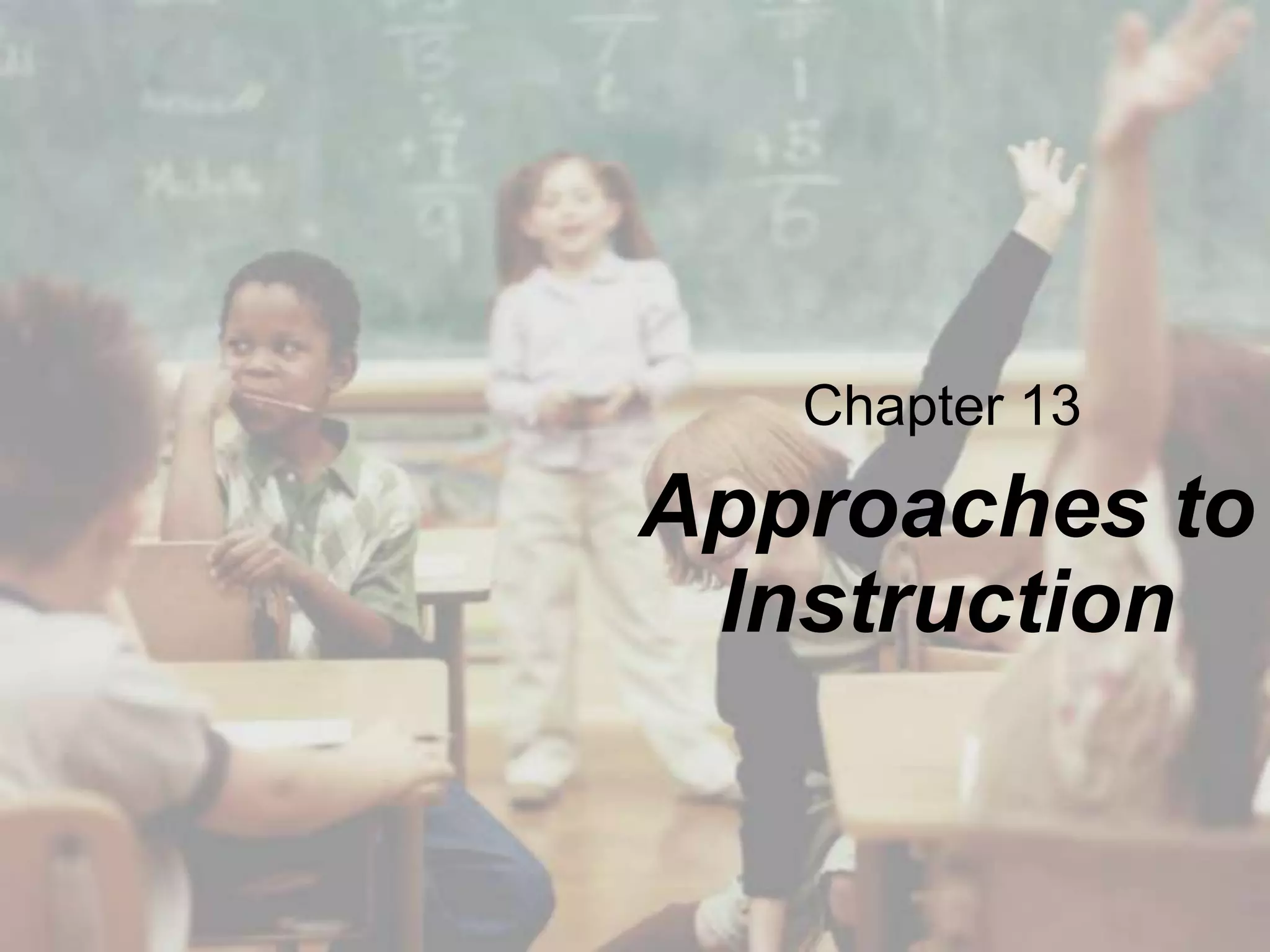
Chapter 13

Approaches to
Instruction
Overview
• Devising and Using Objectives
• The Behavioral Approach to Teaching: Direct
Instruction
• The Cognitive Approach to Teaching: Facilitating
Meaningful and Self-Regulated Learning
• The Humanistic Approach to Teaching: StudentCentered Instruction
• The Social Approach to Teaching: Teaching
Students How to Learn from Each Other

© 2013 Cengage Learning. All rights reserved.

11 | 2
Devising and Using Objectives
• Contrasting Objectives with Educational Goals
 Goals are broad, general statements of what
educators and policy makers would like to
see schools accomplish
 Objectives are specific and measurable
statements of what students should know
and be able to do after instruction
– Cognitive, affective, and psychomotor
taxonomies are popular sources of
objectives

© 2013 Cengage Learning. All rights reserved.

11 | 3
Taxonomy of Educational Objectives:
Cognitive Domain
• Taxonomy of Educational Objectives: Cognitive
Domain
 Knowledge
– Remembering previously learned information
such as facts, terms, and principles
 Comprehension
– Grasping the meaning of information by putting
it into one’s own words
 Application
– Applying knowledge to actual situations

© 2013 Cengage Learning. All rights reserved.

11 | 4
Taxonomy of Educational Objectives:
Cognitive Domain Cont.
• Taxonomy of Educational Objectives: Cognitive
Domain
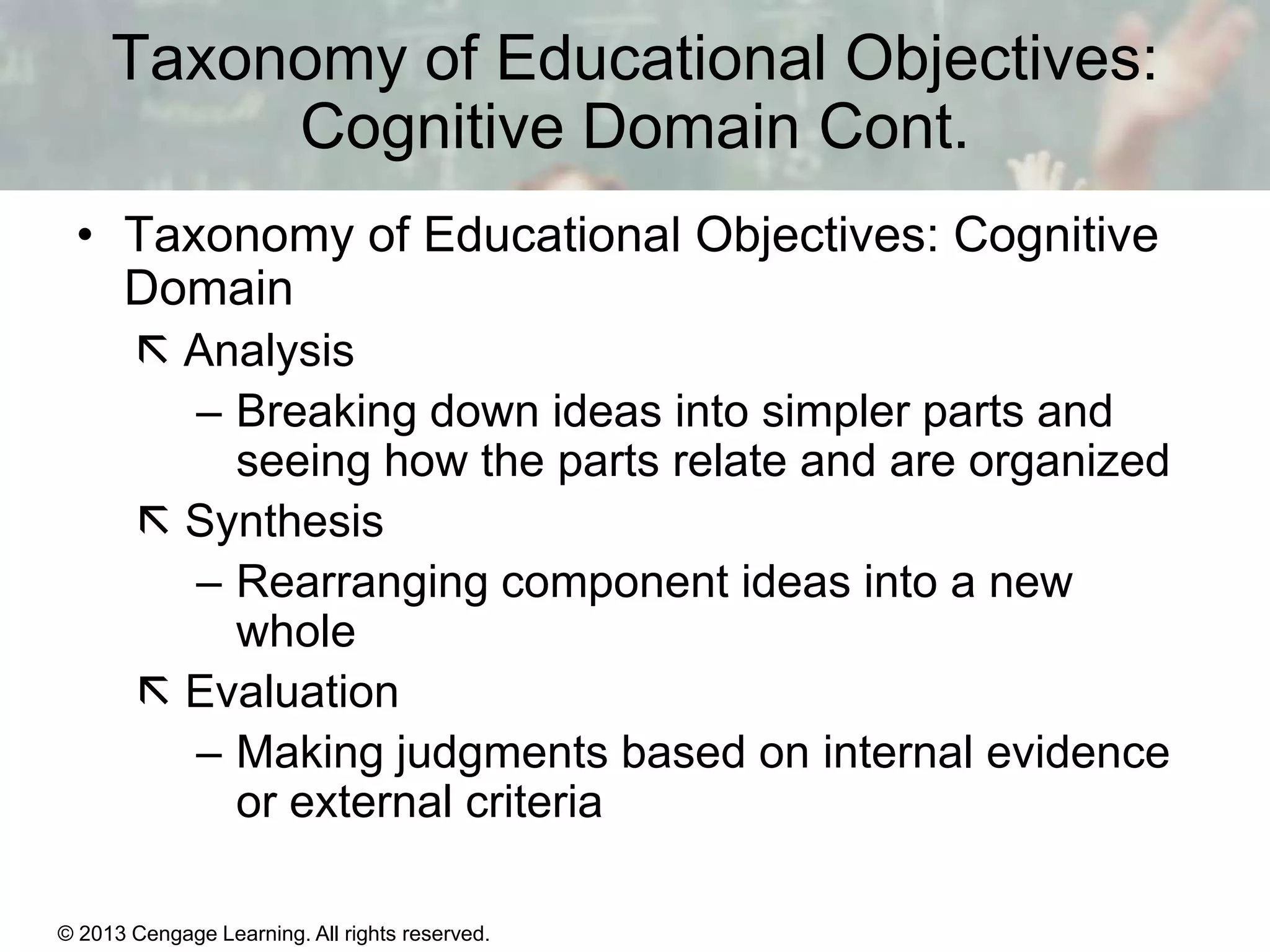
 Analysis
– Breaking down ideas into simpler parts and
seeing how the parts relate and are organized
 Synthesis
– Rearranging component ideas into a new
whole
 Evaluation
– Making judgments based on internal evidence
or external criteria
© 2013 Cengage Learning. All rights reserved.

11 | 5
Taxonomy of Educational Objectives:
Affective Domain
• Taxonomy of Educational Objectives: Affective
Domain
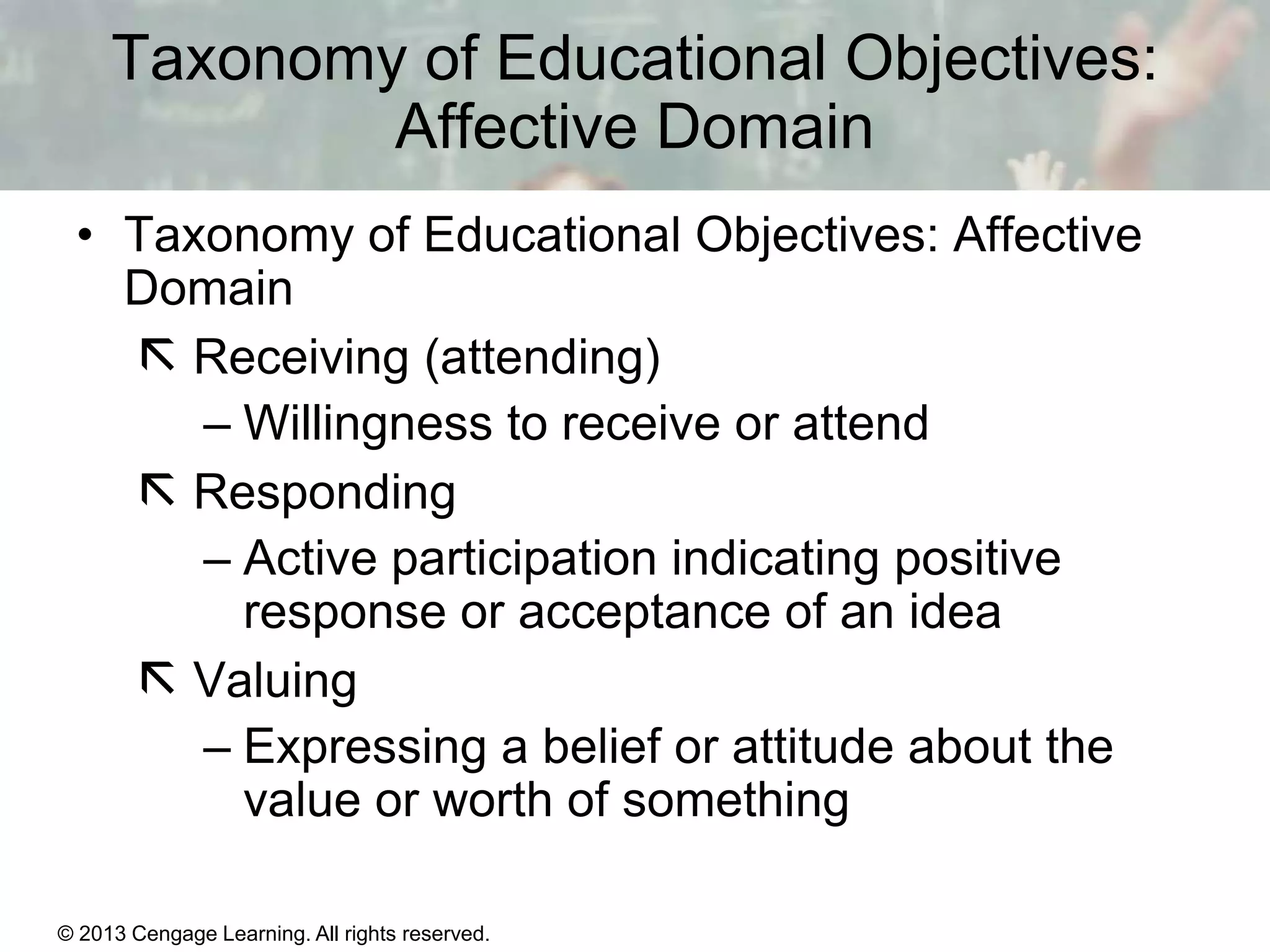
 Receiving (attending)
– Willingness to receive or attend
 Responding
– Active participation indicating positive
response or acceptance of an idea
 Valuing
– Expressing a belief or attitude about the
value or worth of something
© 2013 Cengage Learning. All rights reserved.

11 | 6
Taxonomy of Educational Objectives:
Affective Domain Cont.
• Taxonomy of Educational Objectives: Affective
Domain (cont’d)
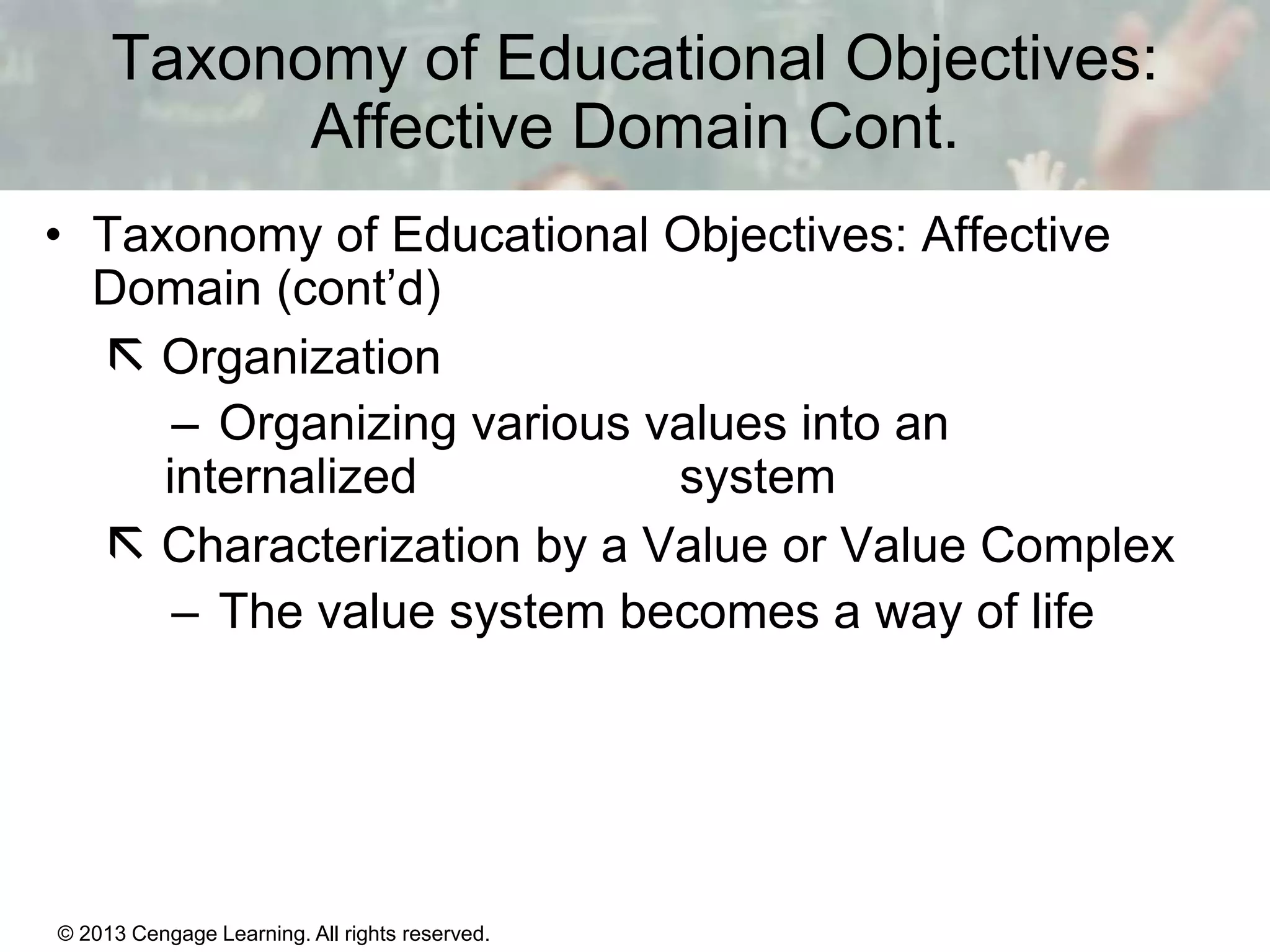
 Organization
– Organizing various values into an
internalized
system
 Characterization by a Value or Value Complex
– The value system becomes a way of life

© 2013 Cengage Learning. All rights reserved.

11 | 7
Taxonomy of Educational Objectives
Psychomotor Domain
• Taxonomy of Educational Objectives Psychomotor
Domain
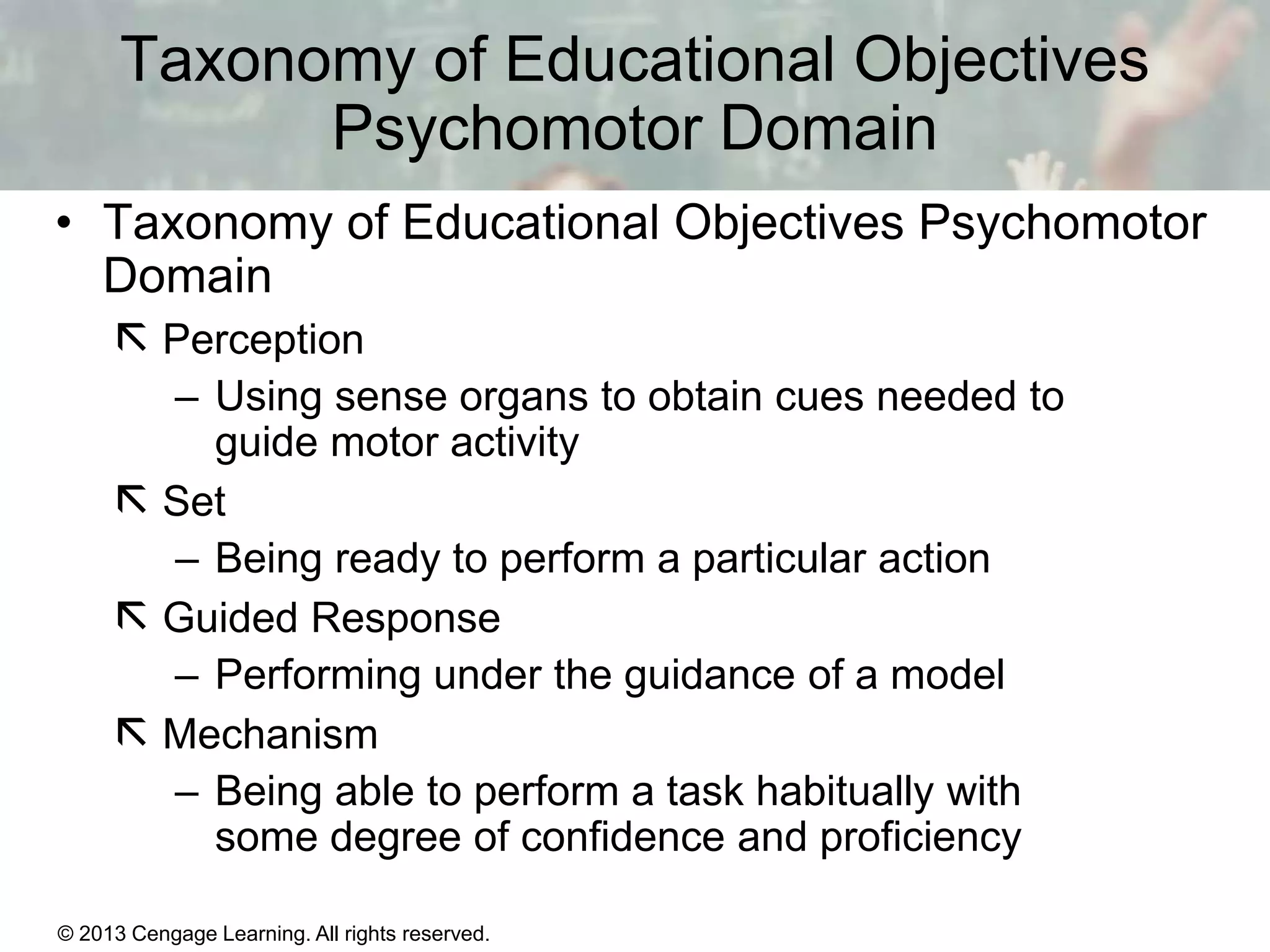
 Perception
– Using sense organs to obtain cues needed to
guide motor activity
 Set
– Being ready to perform a particular action
 Guided Response
– Performing under the guidance of a model
 Mechanism
– Being able to perform a task habitually with
some degree of confidence and proficiency
© 2013 Cengage Learning. All rights reserved.

11 | 8
Taxonomy of Educational Objectives:
Psychomotor Domain Cont.
• Taxonomy of Educational Objectives: Psychomotor
Domain (cont’d)
 Complex or Overt Response
– Performing a task with a high degree of proficiency
and skill
 Adaptation
– Using previously learned skills to perform new but
related tasks
 Origination
– Creating new performances after having developed
skills

© 2013 Cengage Learning. All rights reserved.

11 | 9
Mager’s Recommendations for Use of
Specific Objectives
• Two Ways to State Objectives
 Mager’s Recommendations for Use of Specific
Objectives
– Describe what you want learners to be doing
that indicates they have learned what you taught
– In your description, define the conditions under
which the behavior is to occur, and state the
criterion of acceptable performance
– Write a separate objective for each learning
performance

© 2013 Cengage Learning. All rights reserved.

11 | 10
Ways to State and Use Objectives
• Ways to State and Use Objectives
 Gronlund’s Recommendations for Use of
General Objectives
– Write general objectives of instruction that
describe types of behavior students should
exhibit
– Under each general instructional objective,
list up to five specific learning outcomes
that provide a representative sample of
what students should be able to do when
they have achieved the general objective
© 2013 Cengage Learning. All rights reserved.

11 | 11
Aligning Assessment with Objectives
and Instruction
• Aligning Assessment with Objectives and
Instruction
 Objectives, instruction, and assessment
should be thought of as an integral unit
– Objectives provide blueprint for the
content of a teacher’s instruction
– Classroom assessments based on
teacher’s objectives and what is actually
covered in class

© 2013 Cengage Learning. All rights reserved.

11 | 12
Evaluation of the Effectiveness of
Objectives
• Evaluation of the Effectiveness of Objectives
 Objectives seem to work best when students are
aware of them, treat them as directions to learn
specific sections of material, and feel they will aid
learning
 Objectives seem to work best when they are clearly
written and the learning task is neither too difficult
nor too easy
 Students of average ability seem to profit more from
being given objectives than do students of higher or
lower ability
 Objectives lead to an improvement in intentional
learning but to a decline in incidental learning
© 2013 Cengage Learning. All rights reserved.

11 | 13
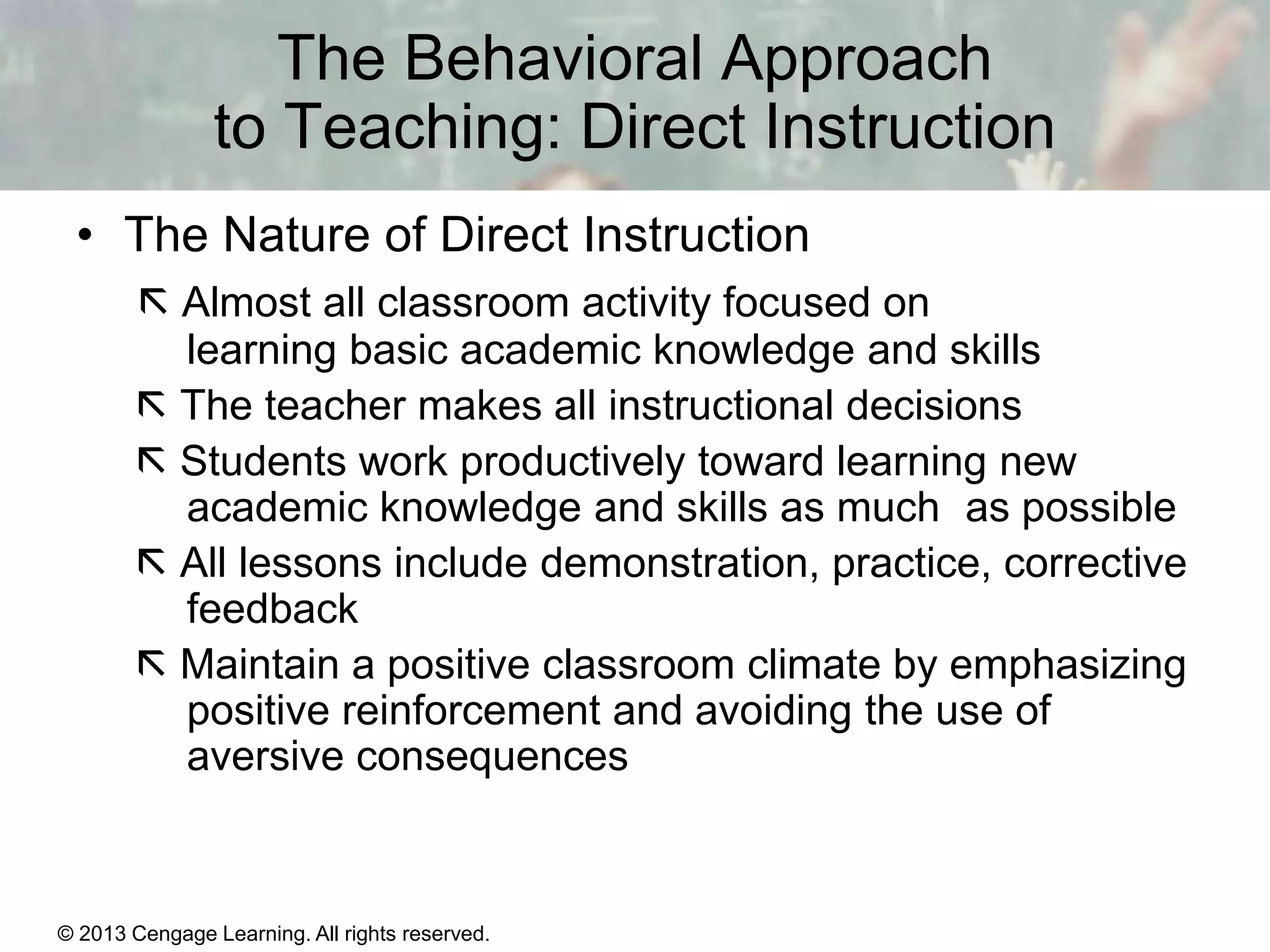
The Behavioral Approach
to Teaching: Direct Instruction
• The Nature of Direct Instruction
 Almost all classroom activity focused on
learning basic academic knowledge and skills
 The teacher makes all instructional decisions
 Students work productively toward learning new
academic knowledge and skills as much as possible
 All lessons include demonstration, practice, corrective
feedback
 Maintain a positive classroom climate by emphasizing
positive reinforcement and avoiding the use of
aversive consequences

© 2013 Cengage Learning. All rights reserved.

11 | 14
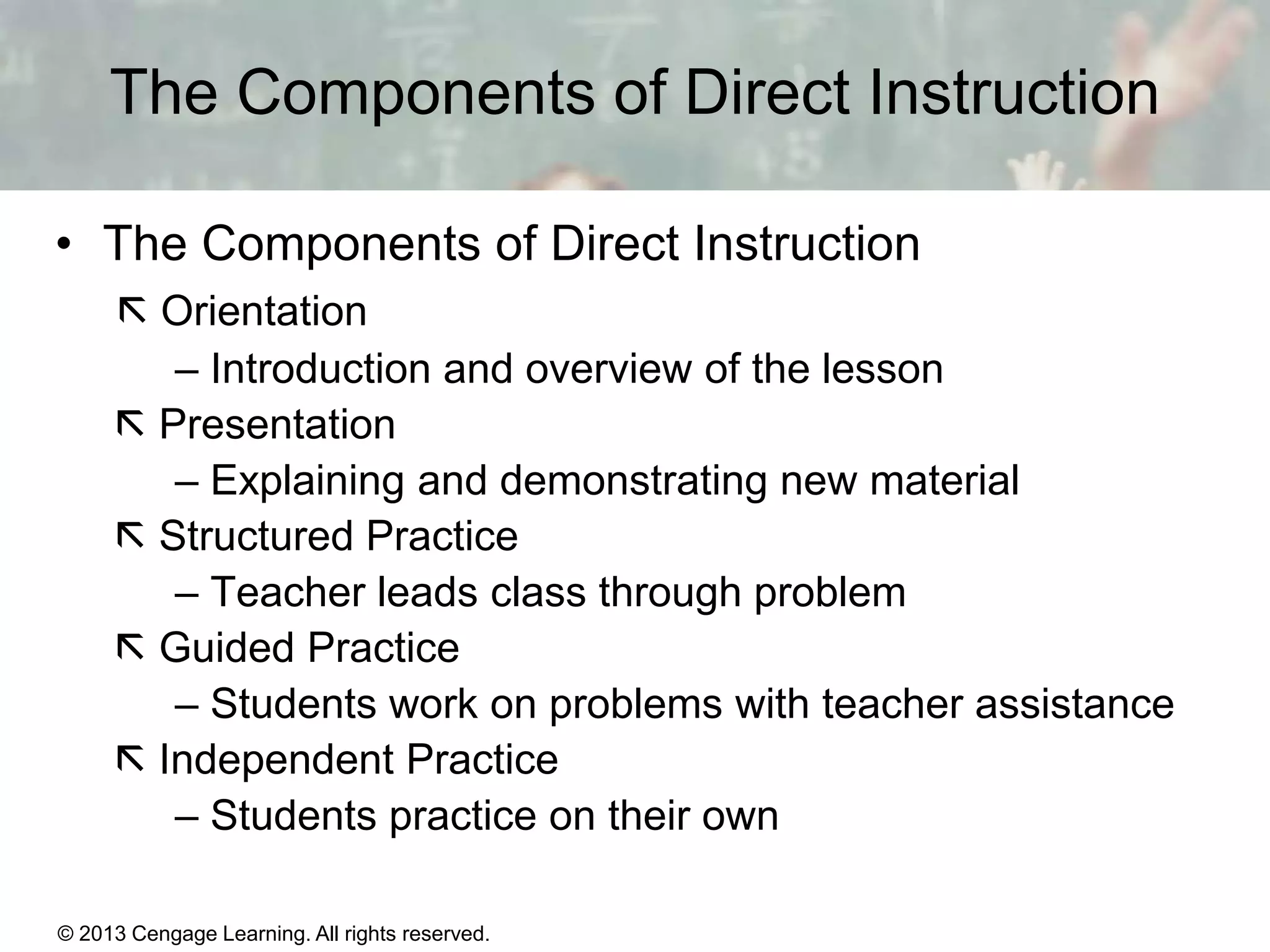
The Components of Direct Instruction
• The Components of Direct Instruction
 Orientation
– Introduction and overview of the lesson
 Presentation
– Explaining and demonstrating new material
 Structured Practice
– Teacher leads class through problem
 Guided Practice
– Students work on problems with teacher assistance
 Independent Practice
– Students practice on their own
© 2013 Cengage Learning. All rights reserved.

11 | 15
Getting the Most Out of Practice
• Getting the Most Out of Practice
 Move from structured practice to guided practice to
independent practice
 Have short but intense practice sessions
 Monitor students’ responses during structured
practice
 Require minimum performance of 85% correct
before moving to independent practice
 Spread practice sessions over several months
 Space practice sessions close together at first,
then further apart for guided and independent
practice
© 2013 Cengage Learning. All rights reserved.

11 | 16
Effectiveness of Direct Instruction
• Effectiveness of Direct Instruction
 Produced moderately positive increases in
math and reading achievement in urban
middle school
 Biggest gains made by English language
learners

© 2013 Cengage Learning. All rights reserved.

11 | 17
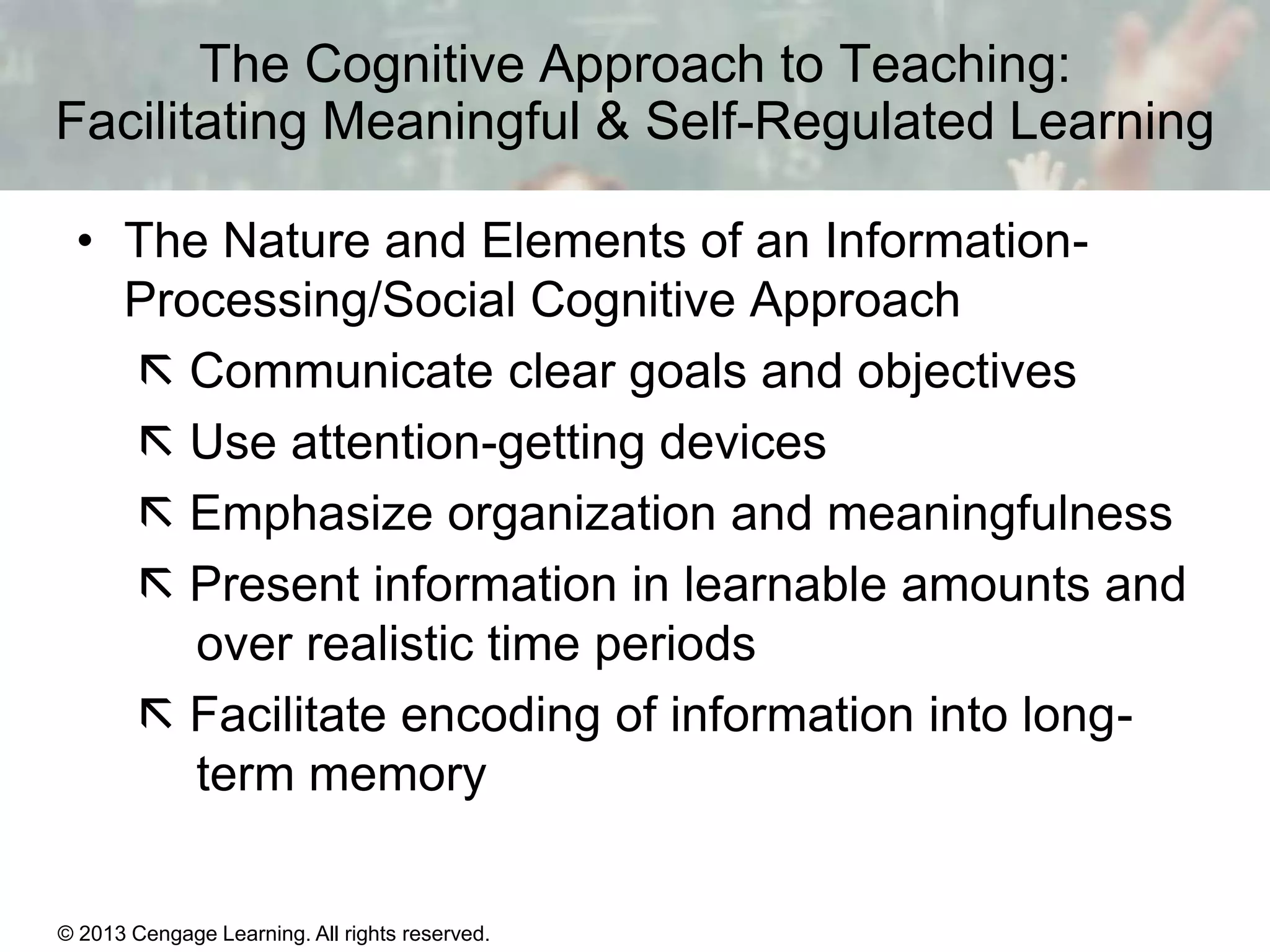
The Cognitive Approach to Teaching:
Facilitating Meaningful & Self-Regulated Learning
• The Nature and Elements of an InformationProcessing/Social Cognitive Approach
 Communicate clear goals and objectives
 Use attention-getting devices
 Emphasize organization and meaningfulness
 Present information in learnable amounts and
over realistic time periods
 Facilitate encoding of information into longterm memory

© 2013 Cengage Learning. All rights reserved.

11 | 18
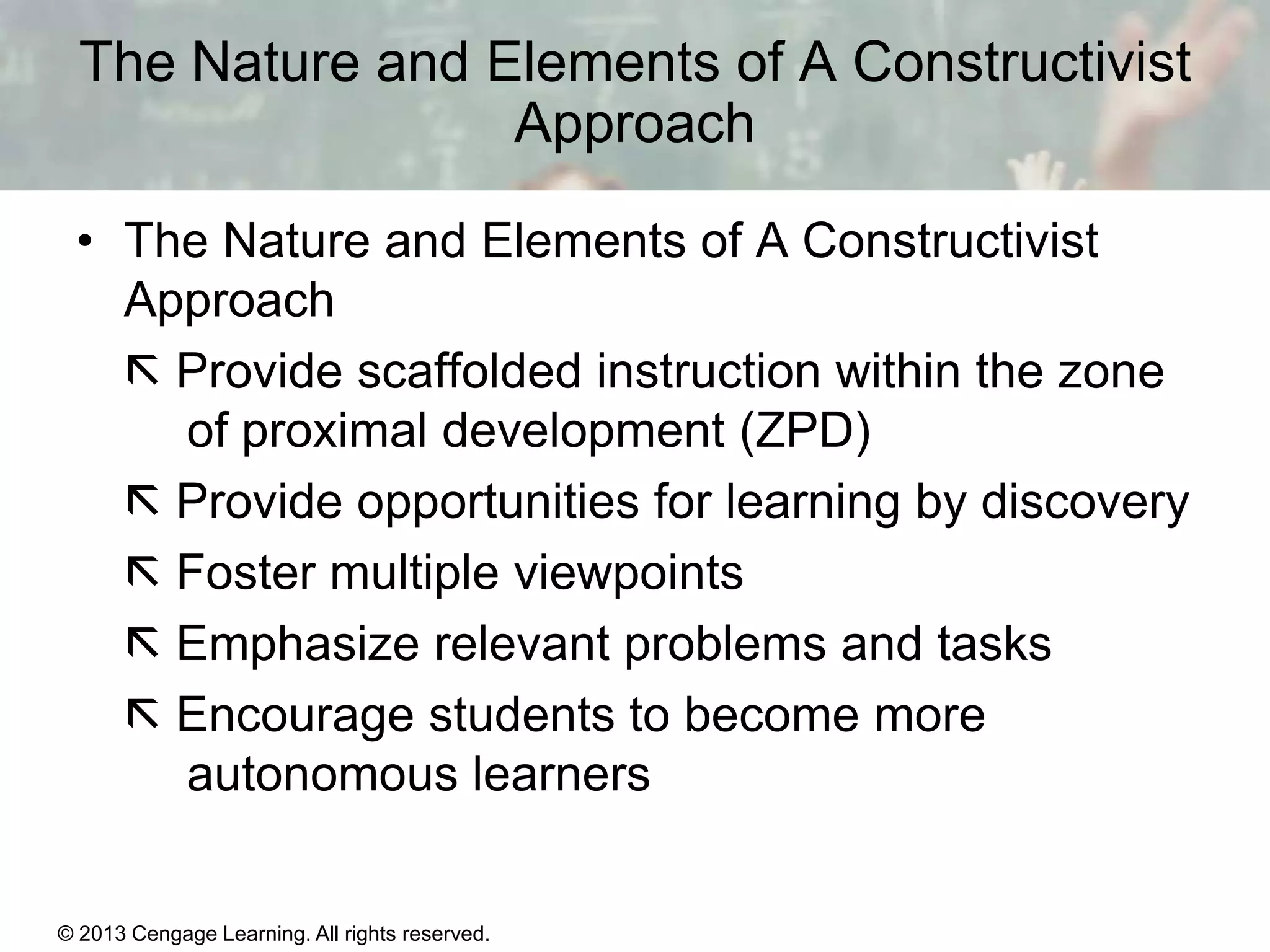
The Nature and Elements of A Constructivist
Approach
• The Nature and Elements of A Constructivist
Approach
 Provide scaffolded instruction within the zone
of proximal development (ZPD)
 Provide opportunities for learning by discovery
 Foster multiple viewpoints
 Emphasize relevant problems and tasks
 Encourage students to become more
autonomous learners

© 2013 Cengage Learning. All rights reserved.

11 | 19
Using Technology to Support Cognitive
Approaches to Instruction
• Discovery and Exploratory Environments
 Web sites that provide opportunities for
scientific exploration and problem solving

• Guided Learning
 HOTS

• Problem-Based Learning
 Tutorial and simulation programs (microworlds)

• Situated Learning
 Knowledge Forum, WISE, GLOBE

© 2013 Cengage Learning. All rights reserved.

11 | 20
The Humanistic Approach to Teaching:
Student-Centered Instruction
• The humanistic approach pays particular
attention to the role of noncognitive variables in
learning; specifically, students’ needs, emotions,
values, and self-perceptions.

© 2013 Cengage Learning. All rights reserved.

11 | 21
Pioneers of the Humanistic Approach
• Pioneers of the Humanistic Approach
 Abraham Maslow, Carl Rogers, Arthur Combs
– People have an inherent desire to make the most of
their capabilities (self-actualization)
– Basic needs must be met before self-actualization
can occur; teachers can help meet those needs
– Understand students’ behavior by first
understanding their self-perceptions
– Meaningful learning occurs when students see how
material relates to their own lives
– Learning is optimized when students believe the
teacher is there to help them succeed

© 2013 Cengage Learning. All rights reserved.

11 | 22
Teaching from a Humanistic Orientation
• Teaching from a Humanistic Orientation
 Help students learn by taking into account
their needs, values, motives, and selfperceptions
 Accept students as they are
 Guide students to the correct action

© 2013 Cengage Learning. All rights reserved.

11 | 23
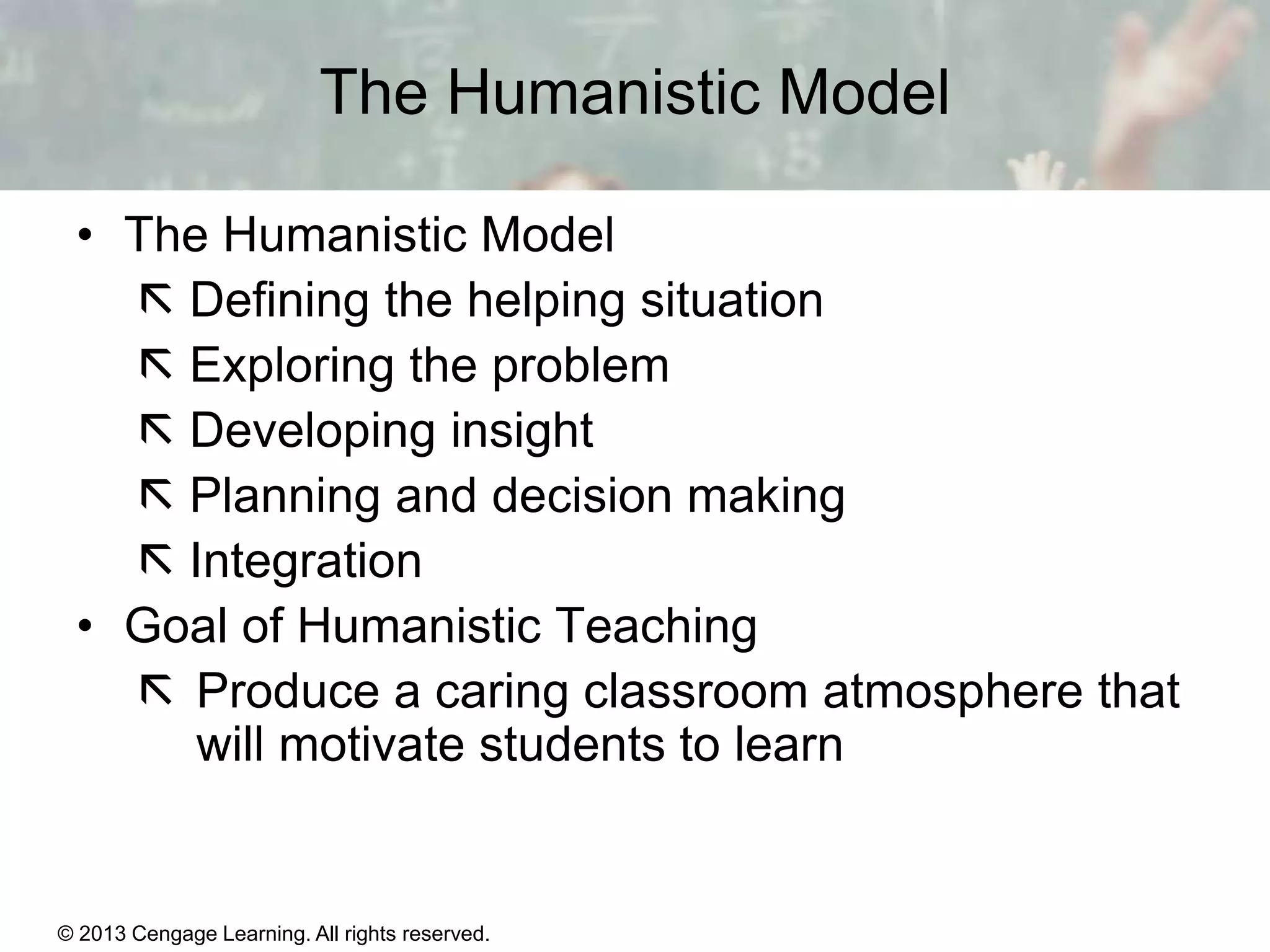
The Humanistic Model
• The Humanistic Model
 Defining the helping situation
 Exploring the problem
 Developing insight
 Planning and decision making
 Integration
• Goal of Humanistic Teaching
 Produce a caring classroom atmosphere that
will motivate students to learn

© 2013 Cengage Learning. All rights reserved.

11 | 24
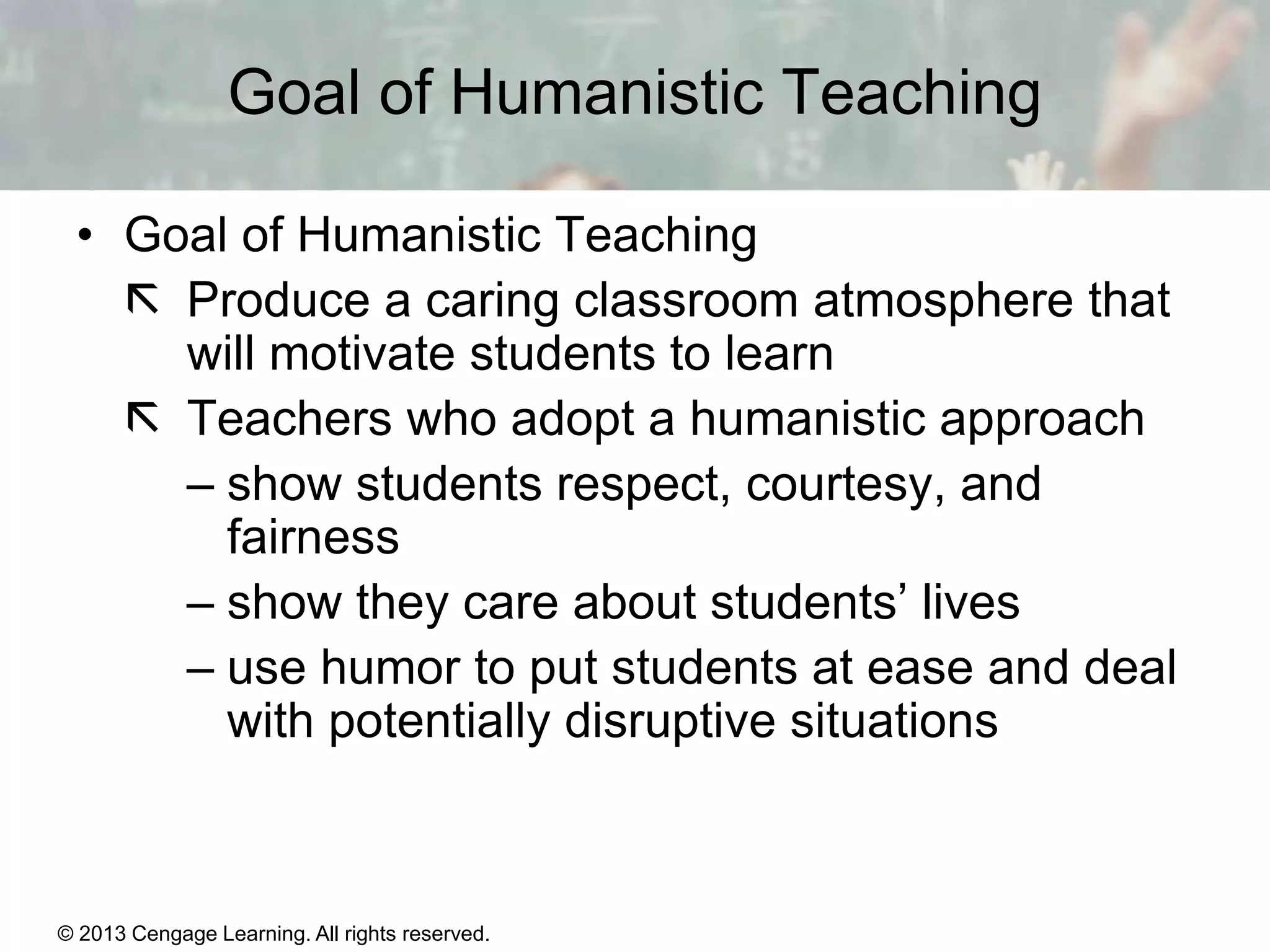
Goal of Humanistic Teaching
• Goal of Humanistic Teaching
 Produce a caring classroom atmosphere that
will motivate students to learn
 Teachers who adopt a humanistic approach
– show students respect, courtesy, and
fairness
– show they care about students’ lives
– use humor to put students at ease and deal
with potentially disruptive situations

© 2013 Cengage Learning. All rights reserved.

11 | 25
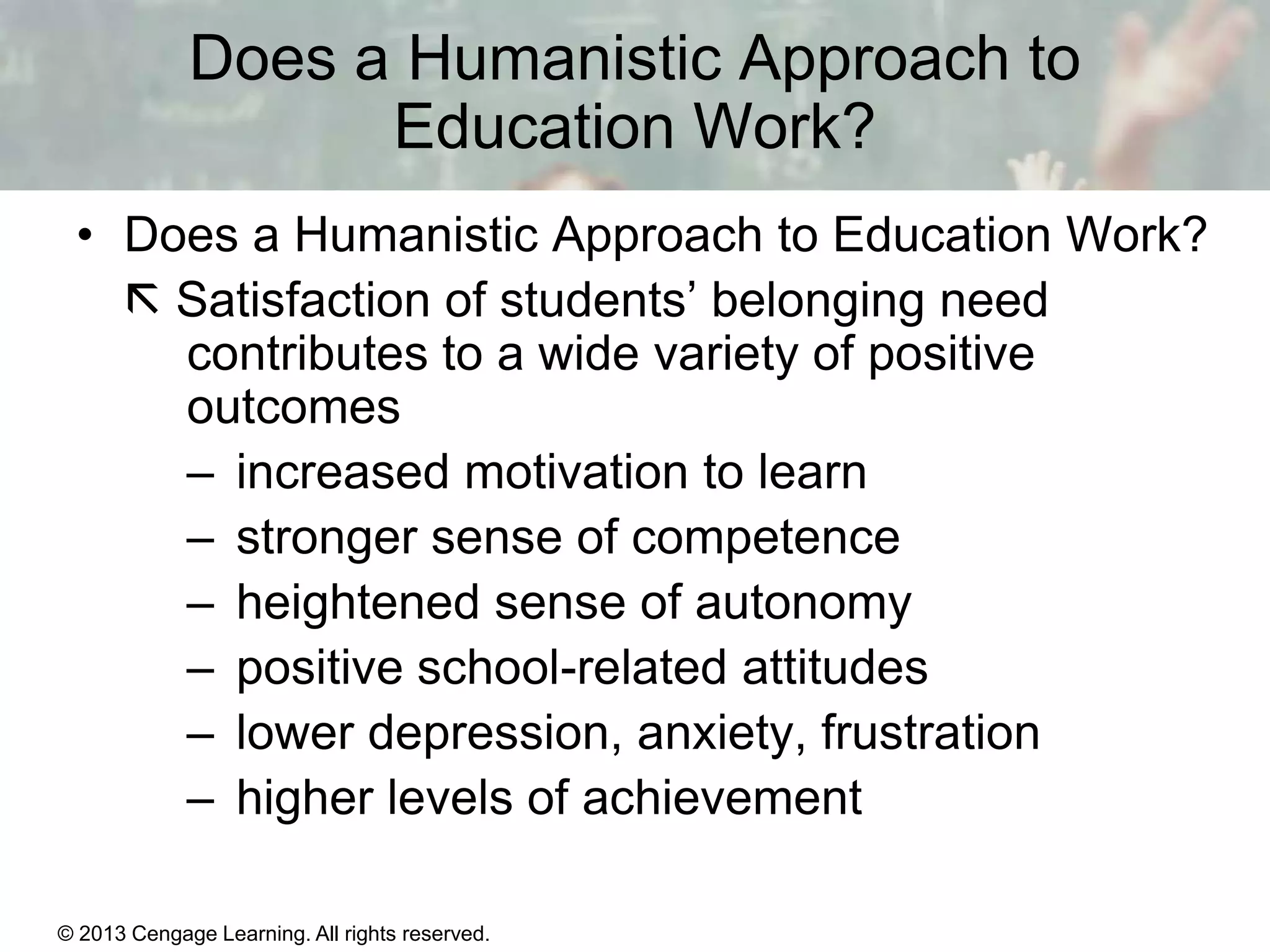
Does a Humanistic Approach to
Education Work?
• Does a Humanistic Approach to Education Work?
 Satisfaction of students’ belonging need
contributes to a wide variety of positive
outcomes
– increased motivation to learn
– stronger sense of competence
– heightened sense of autonomy
– positive school-related attitudes
– lower depression, anxiety, frustration
– higher levels of achievement
© 2013 Cengage Learning. All rights reserved.

11 | 26
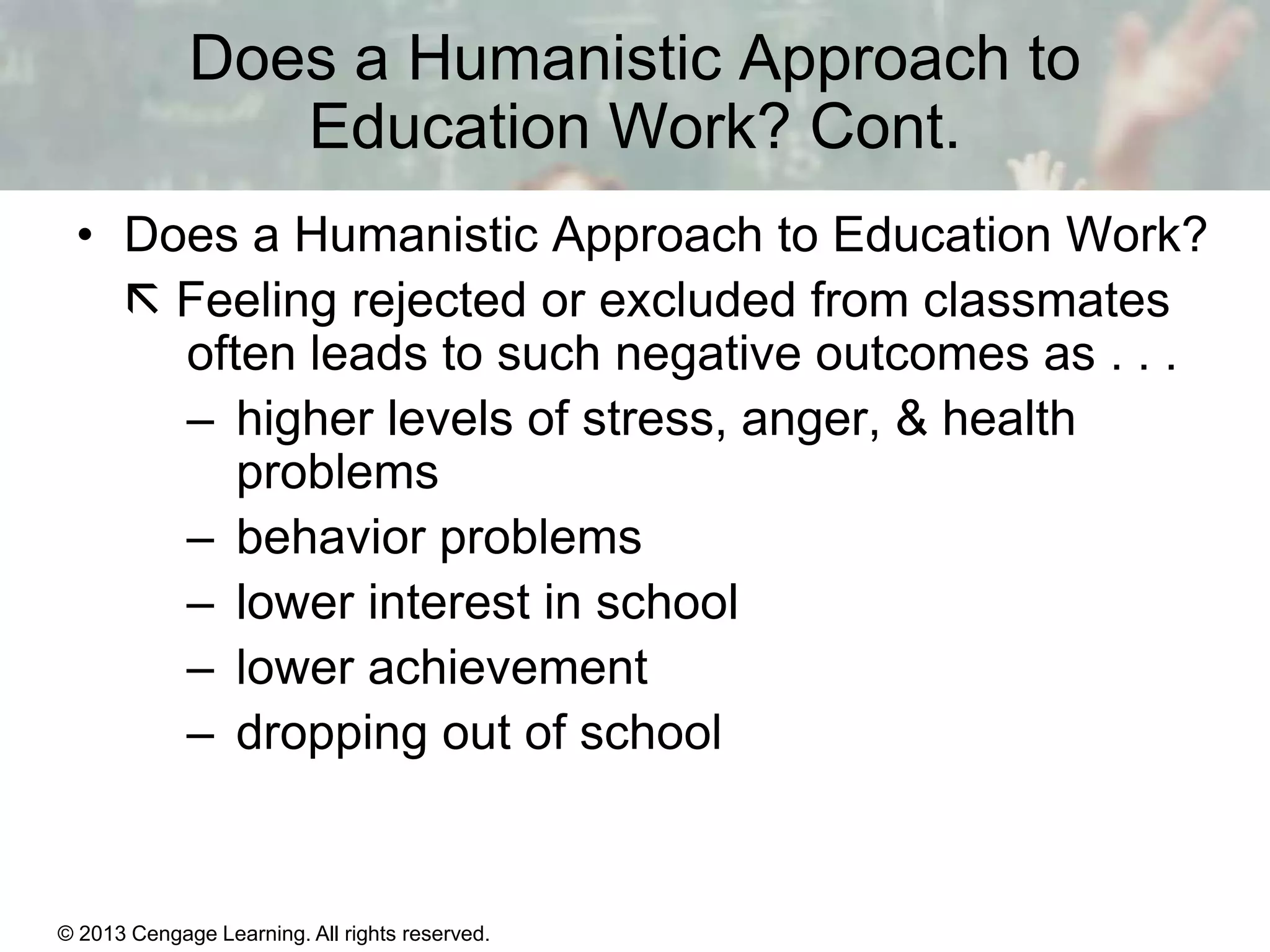
Does a Humanistic Approach to
Education Work? Cont.
• Does a Humanistic Approach to Education Work?
 Feeling rejected or excluded from classmates
often leads to such negative outcomes as . . .
– higher levels of stress, anger, & health
problems
– behavior problems
– lower interest in school
– lower achievement
– dropping out of school

© 2013 Cengage Learning. All rights reserved.

11 | 27
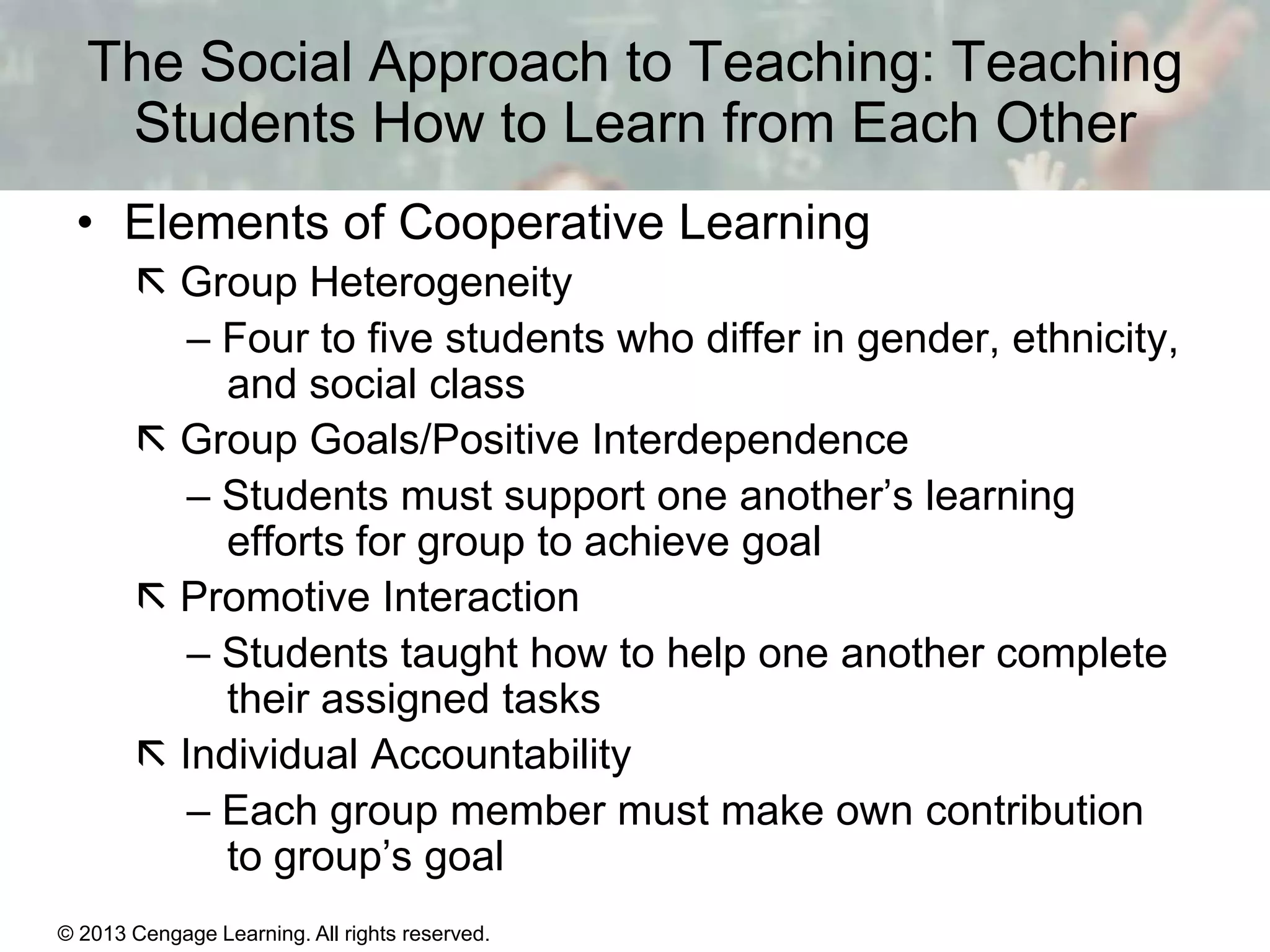
The Social Approach to Teaching: Teaching
Students How to Learn from Each Other
• Elements of Cooperative Learning
 Group Heterogeneity
– Four to five students who differ in gender, ethnicity,
and social class
 Group Goals/Positive Interdependence
– Students must support one another’s learning
efforts for group to achieve goal
 Promotive Interaction
– Students taught how to help one another complete
their assigned tasks
 Individual Accountability
– Each group member must make own contribution
to group’s goal
© 2013 Cengage Learning. All rights reserved.

11 | 28
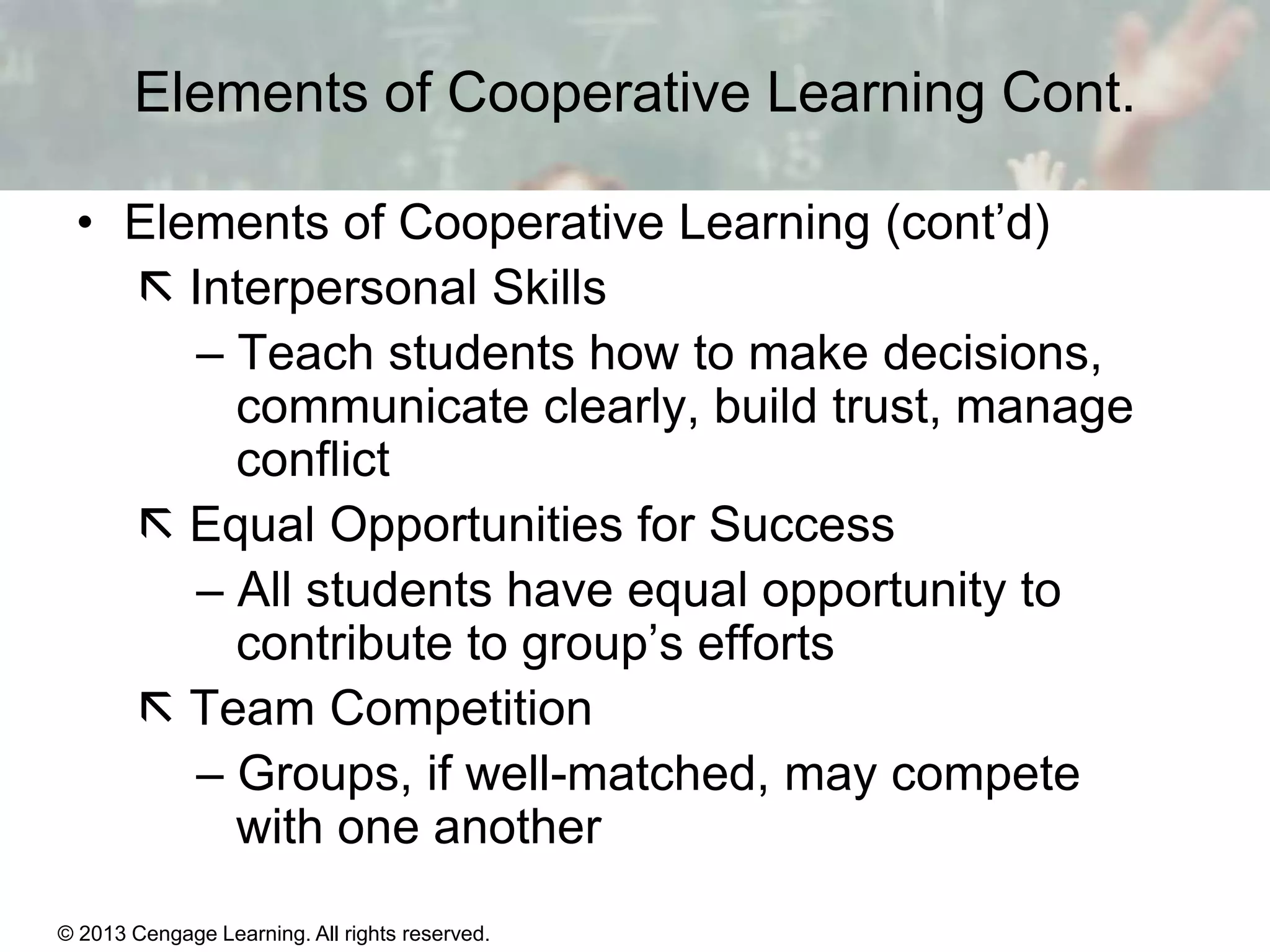
Elements of Cooperative Learning Cont.
• Elements of Cooperative Learning (cont’d)
 Interpersonal Skills
– Teach students how to make decisions,
communicate clearly, build trust, manage
conflict
 Equal Opportunities for Success
– All students have equal opportunity to
contribute to group’s efforts
 Team Competition
– Groups, if well-matched, may compete
with one another
© 2013 Cengage Learning. All rights reserved.

11 | 29
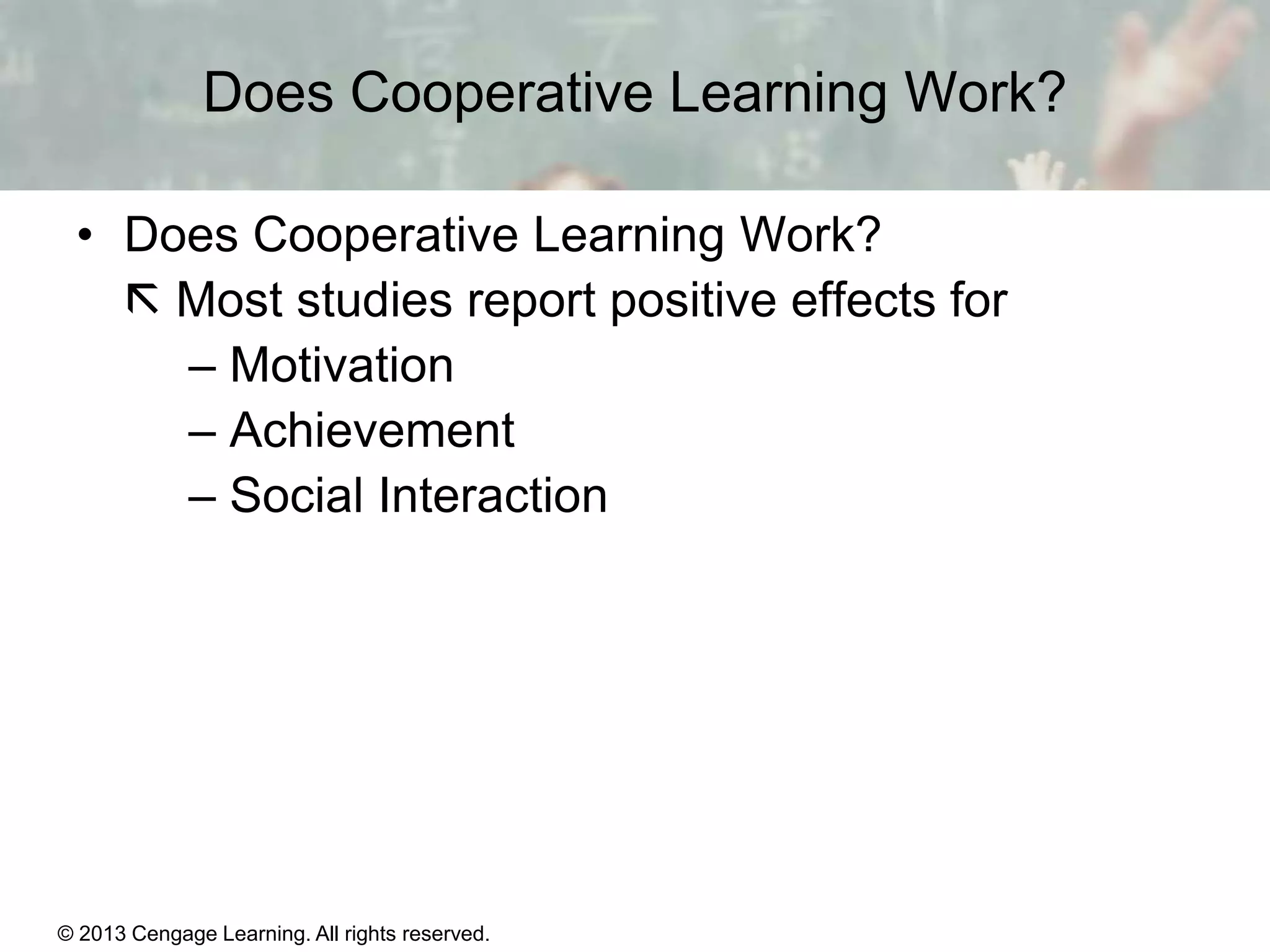
Does Cooperative Learning Work?
• Does Cooperative Learning Work?
 Most studies report positive effects for
– Motivation
– Achievement
– Social Interaction

© 2013 Cengage Learning. All rights reserved.

11 | 30
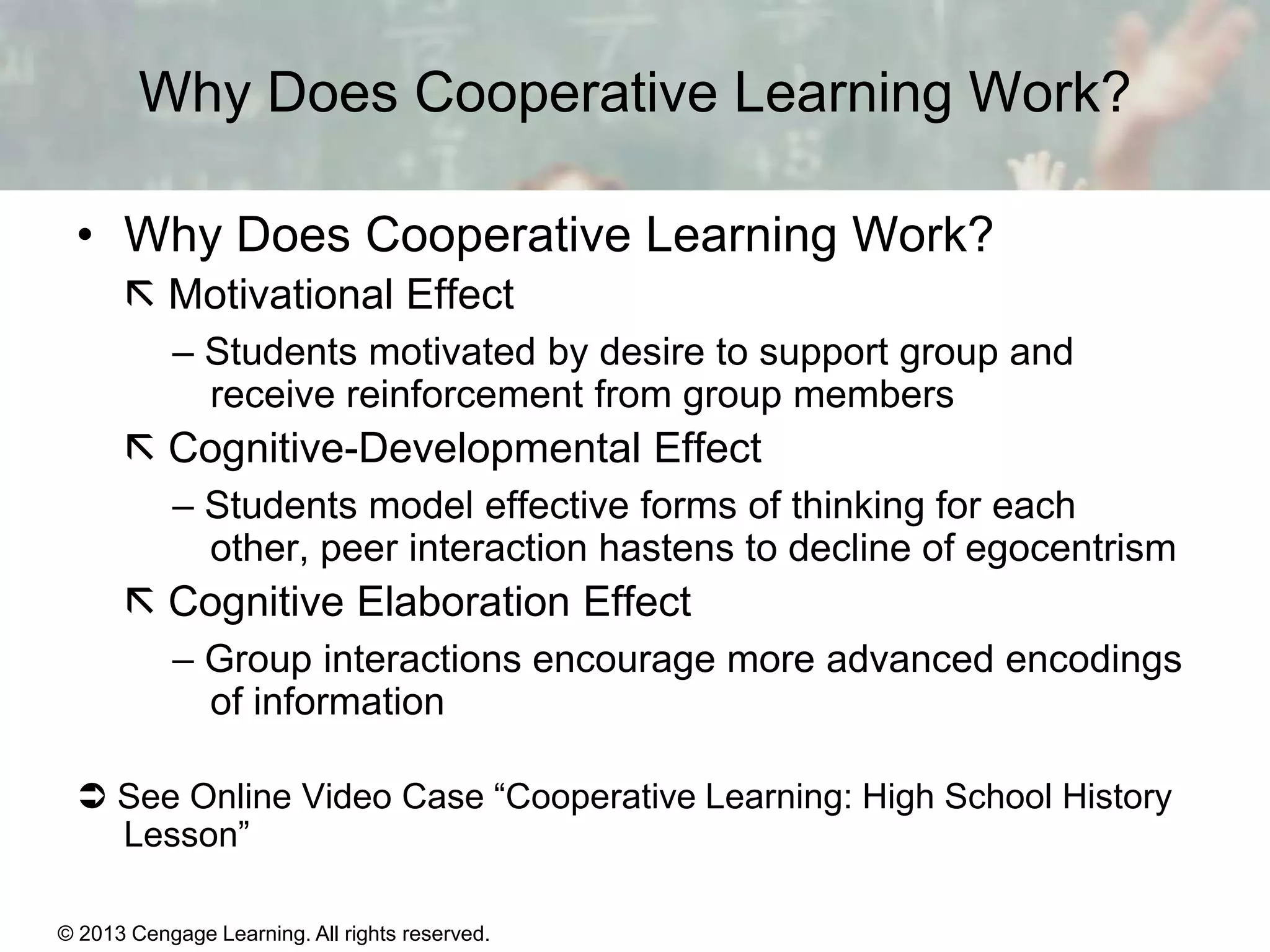
Why Does Cooperative Learning Work?
• Why Does Cooperative Learning Work?
 Motivational Effect
– Students motivated by desire to support group and
receive reinforcement from group members

 Cognitive-Developmental Effect
– Students model effective forms of thinking for each
other, peer interaction hastens to decline of egocentrism

 Cognitive Elaboration Effect
– Group interactions encourage more advanced encodings
of information
 See Online Video Case “Cooperative Learning: High School History
Lesson”
© 2013 Cengage Learning. All rights reserved.

11 | 31
Using Technology to Support Social
Approaches to Instruction
• Using Technology to Support Social Approaches to
Instruction
 Social Constructivist Learning
– Use of Web 2.0 applications (e.g., YouTube,
Twitter, Facebook, Flickr, teachertube)
 Cooperative and Collaborative Learning
– Use of weblogs (blogs, for short)
– Use of virtual communities (e.g., ThinkQuest, The
Web Project, 4Directions Project)
 See Online Video Case “Using Blogs to Enhance Student Learning:
An Interdisciplinary High School Unit”

© 2013 Cengage Learning. All rights reserved.

11 | 32

PSY 263 401 Chapter 13 SLIDES

  • 1.
  • 2.
    Overview • Devising andUsing Objectives • The Behavioral Approach to Teaching: Direct Instruction • The Cognitive Approach to Teaching: Facilitating Meaningful and Self-Regulated Learning • The Humanistic Approach to Teaching: StudentCentered Instruction • The Social Approach to Teaching: Teaching Students How to Learn from Each Other © 2013 Cengage Learning. All rights reserved. 11 | 2
  • 3.
    Devising and UsingObjectives • Contrasting Objectives with Educational Goals  Goals are broad, general statements of what educators and policy makers would like to see schools accomplish  Objectives are specific and measurable statements of what students should know and be able to do after instruction – Cognitive, affective, and psychomotor taxonomies are popular sources of objectives © 2013 Cengage Learning. All rights reserved. 11 | 3
  • 4.
    Taxonomy of EducationalObjectives: Cognitive Domain • Taxonomy of Educational Objectives: Cognitive Domain  Knowledge – Remembering previously learned information such as facts, terms, and principles  Comprehension – Grasping the meaning of information by putting it into one’s own words  Application – Applying knowledge to actual situations © 2013 Cengage Learning. All rights reserved. 11 | 4
  • 5.
    Taxonomy of EducationalObjectives: Cognitive Domain Cont. • Taxonomy of Educational Objectives: Cognitive Domain  Analysis – Breaking down ideas into simpler parts and seeing how the parts relate and are organized  Synthesis – Rearranging component ideas into a new whole  Evaluation – Making judgments based on internal evidence or external criteria © 2013 Cengage Learning. All rights reserved. 11 | 5
  • 6.
    Taxonomy of EducationalObjectives: Affective Domain • Taxonomy of Educational Objectives: Affective Domain  Receiving (attending) – Willingness to receive or attend  Responding – Active participation indicating positive response or acceptance of an idea  Valuing – Expressing a belief or attitude about the value or worth of something © 2013 Cengage Learning. All rights reserved. 11 | 6
  • 7.
    Taxonomy of EducationalObjectives: Affective Domain Cont. • Taxonomy of Educational Objectives: Affective Domain (cont’d)  Organization – Organizing various values into an internalized system  Characterization by a Value or Value Complex – The value system becomes a way of life © 2013 Cengage Learning. All rights reserved. 11 | 7
  • 8.
    Taxonomy of EducationalObjectives Psychomotor Domain • Taxonomy of Educational Objectives Psychomotor Domain  Perception – Using sense organs to obtain cues needed to guide motor activity  Set – Being ready to perform a particular action  Guided Response – Performing under the guidance of a model  Mechanism – Being able to perform a task habitually with some degree of confidence and proficiency © 2013 Cengage Learning. All rights reserved. 11 | 8
  • 9.
    Taxonomy of EducationalObjectives: Psychomotor Domain Cont. • Taxonomy of Educational Objectives: Psychomotor Domain (cont’d)  Complex or Overt Response – Performing a task with a high degree of proficiency and skill  Adaptation – Using previously learned skills to perform new but related tasks  Origination – Creating new performances after having developed skills © 2013 Cengage Learning. All rights reserved. 11 | 9
  • 10.
    Mager’s Recommendations forUse of Specific Objectives • Two Ways to State Objectives  Mager’s Recommendations for Use of Specific Objectives – Describe what you want learners to be doing that indicates they have learned what you taught – In your description, define the conditions under which the behavior is to occur, and state the criterion of acceptable performance – Write a separate objective for each learning performance © 2013 Cengage Learning. All rights reserved. 11 | 10
  • 11.
    Ways to Stateand Use Objectives • Ways to State and Use Objectives  Gronlund’s Recommendations for Use of General Objectives – Write general objectives of instruction that describe types of behavior students should exhibit – Under each general instructional objective, list up to five specific learning outcomes that provide a representative sample of what students should be able to do when they have achieved the general objective © 2013 Cengage Learning. All rights reserved. 11 | 11
  • 12.
    Aligning Assessment withObjectives and Instruction • Aligning Assessment with Objectives and Instruction  Objectives, instruction, and assessment should be thought of as an integral unit – Objectives provide blueprint for the content of a teacher’s instruction – Classroom assessments based on teacher’s objectives and what is actually covered in class © 2013 Cengage Learning. All rights reserved. 11 | 12
  • 13.
    Evaluation of theEffectiveness of Objectives • Evaluation of the Effectiveness of Objectives  Objectives seem to work best when students are aware of them, treat them as directions to learn specific sections of material, and feel they will aid learning  Objectives seem to work best when they are clearly written and the learning task is neither too difficult nor too easy  Students of average ability seem to profit more from being given objectives than do students of higher or lower ability  Objectives lead to an improvement in intentional learning but to a decline in incidental learning © 2013 Cengage Learning. All rights reserved. 11 | 13
  • 14.
    The Behavioral Approach toTeaching: Direct Instruction • The Nature of Direct Instruction  Almost all classroom activity focused on learning basic academic knowledge and skills  The teacher makes all instructional decisions  Students work productively toward learning new academic knowledge and skills as much as possible  All lessons include demonstration, practice, corrective feedback  Maintain a positive classroom climate by emphasizing positive reinforcement and avoiding the use of aversive consequences © 2013 Cengage Learning. All rights reserved. 11 | 14
  • 15.
    The Components ofDirect Instruction • The Components of Direct Instruction  Orientation – Introduction and overview of the lesson  Presentation – Explaining and demonstrating new material  Structured Practice – Teacher leads class through problem  Guided Practice – Students work on problems with teacher assistance  Independent Practice – Students practice on their own © 2013 Cengage Learning. All rights reserved. 11 | 15
  • 16.
    Getting the MostOut of Practice • Getting the Most Out of Practice  Move from structured practice to guided practice to independent practice  Have short but intense practice sessions  Monitor students’ responses during structured practice  Require minimum performance of 85% correct before moving to independent practice  Spread practice sessions over several months  Space practice sessions close together at first, then further apart for guided and independent practice © 2013 Cengage Learning. All rights reserved. 11 | 16
  • 17.
    Effectiveness of DirectInstruction • Effectiveness of Direct Instruction  Produced moderately positive increases in math and reading achievement in urban middle school  Biggest gains made by English language learners © 2013 Cengage Learning. All rights reserved. 11 | 17
  • 18.
    The Cognitive Approachto Teaching: Facilitating Meaningful & Self-Regulated Learning • The Nature and Elements of an InformationProcessing/Social Cognitive Approach  Communicate clear goals and objectives  Use attention-getting devices  Emphasize organization and meaningfulness  Present information in learnable amounts and over realistic time periods  Facilitate encoding of information into longterm memory © 2013 Cengage Learning. All rights reserved. 11 | 18
  • 19.
    The Nature andElements of A Constructivist Approach • The Nature and Elements of A Constructivist Approach  Provide scaffolded instruction within the zone of proximal development (ZPD)  Provide opportunities for learning by discovery  Foster multiple viewpoints  Emphasize relevant problems and tasks  Encourage students to become more autonomous learners © 2013 Cengage Learning. All rights reserved. 11 | 19
  • 20.
    Using Technology toSupport Cognitive Approaches to Instruction • Discovery and Exploratory Environments  Web sites that provide opportunities for scientific exploration and problem solving • Guided Learning  HOTS • Problem-Based Learning  Tutorial and simulation programs (microworlds) • Situated Learning  Knowledge Forum, WISE, GLOBE © 2013 Cengage Learning. All rights reserved. 11 | 20
  • 21.
    The Humanistic Approachto Teaching: Student-Centered Instruction • The humanistic approach pays particular attention to the role of noncognitive variables in learning; specifically, students’ needs, emotions, values, and self-perceptions. © 2013 Cengage Learning. All rights reserved. 11 | 21
  • 22.
    Pioneers of theHumanistic Approach • Pioneers of the Humanistic Approach  Abraham Maslow, Carl Rogers, Arthur Combs – People have an inherent desire to make the most of their capabilities (self-actualization) – Basic needs must be met before self-actualization can occur; teachers can help meet those needs – Understand students’ behavior by first understanding their self-perceptions – Meaningful learning occurs when students see how material relates to their own lives – Learning is optimized when students believe the teacher is there to help them succeed © 2013 Cengage Learning. All rights reserved. 11 | 22
  • 23.
    Teaching from aHumanistic Orientation • Teaching from a Humanistic Orientation  Help students learn by taking into account their needs, values, motives, and selfperceptions  Accept students as they are  Guide students to the correct action © 2013 Cengage Learning. All rights reserved. 11 | 23
  • 24.
    The Humanistic Model •The Humanistic Model  Defining the helping situation  Exploring the problem  Developing insight  Planning and decision making  Integration • Goal of Humanistic Teaching  Produce a caring classroom atmosphere that will motivate students to learn © 2013 Cengage Learning. All rights reserved. 11 | 24
  • 25.
    Goal of HumanisticTeaching • Goal of Humanistic Teaching  Produce a caring classroom atmosphere that will motivate students to learn  Teachers who adopt a humanistic approach – show students respect, courtesy, and fairness – show they care about students’ lives – use humor to put students at ease and deal with potentially disruptive situations © 2013 Cengage Learning. All rights reserved. 11 | 25
  • 26.
    Does a HumanisticApproach to Education Work? • Does a Humanistic Approach to Education Work?  Satisfaction of students’ belonging need contributes to a wide variety of positive outcomes – increased motivation to learn – stronger sense of competence – heightened sense of autonomy – positive school-related attitudes – lower depression, anxiety, frustration – higher levels of achievement © 2013 Cengage Learning. All rights reserved. 11 | 26
  • 27.
    Does a HumanisticApproach to Education Work? Cont. • Does a Humanistic Approach to Education Work?  Feeling rejected or excluded from classmates often leads to such negative outcomes as . . . – higher levels of stress, anger, & health problems – behavior problems – lower interest in school – lower achievement – dropping out of school © 2013 Cengage Learning. All rights reserved. 11 | 27
  • 28.
    The Social Approachto Teaching: Teaching Students How to Learn from Each Other • Elements of Cooperative Learning  Group Heterogeneity – Four to five students who differ in gender, ethnicity, and social class  Group Goals/Positive Interdependence – Students must support one another’s learning efforts for group to achieve goal  Promotive Interaction – Students taught how to help one another complete their assigned tasks  Individual Accountability – Each group member must make own contribution to group’s goal © 2013 Cengage Learning. All rights reserved. 11 | 28
  • 29.
    Elements of CooperativeLearning Cont. • Elements of Cooperative Learning (cont’d)  Interpersonal Skills – Teach students how to make decisions, communicate clearly, build trust, manage conflict  Equal Opportunities for Success – All students have equal opportunity to contribute to group’s efforts  Team Competition – Groups, if well-matched, may compete with one another © 2013 Cengage Learning. All rights reserved. 11 | 29
  • 30.
    Does Cooperative LearningWork? • Does Cooperative Learning Work?  Most studies report positive effects for – Motivation – Achievement – Social Interaction © 2013 Cengage Learning. All rights reserved. 11 | 30
  • 31.
    Why Does CooperativeLearning Work? • Why Does Cooperative Learning Work?  Motivational Effect – Students motivated by desire to support group and receive reinforcement from group members  Cognitive-Developmental Effect – Students model effective forms of thinking for each other, peer interaction hastens to decline of egocentrism  Cognitive Elaboration Effect – Group interactions encourage more advanced encodings of information  See Online Video Case “Cooperative Learning: High School History Lesson” © 2013 Cengage Learning. All rights reserved. 11 | 31
  • 32.
    Using Technology toSupport Social Approaches to Instruction • Using Technology to Support Social Approaches to Instruction  Social Constructivist Learning – Use of Web 2.0 applications (e.g., YouTube, Twitter, Facebook, Flickr, teachertube)  Cooperative and Collaborative Learning – Use of weblogs (blogs, for short) – Use of virtual communities (e.g., ThinkQuest, The Web Project, 4Directions Project)  See Online Video Case “Using Blogs to Enhance Student Learning: An Interdisciplinary High School Unit” © 2013 Cengage Learning. All rights reserved. 11 | 32