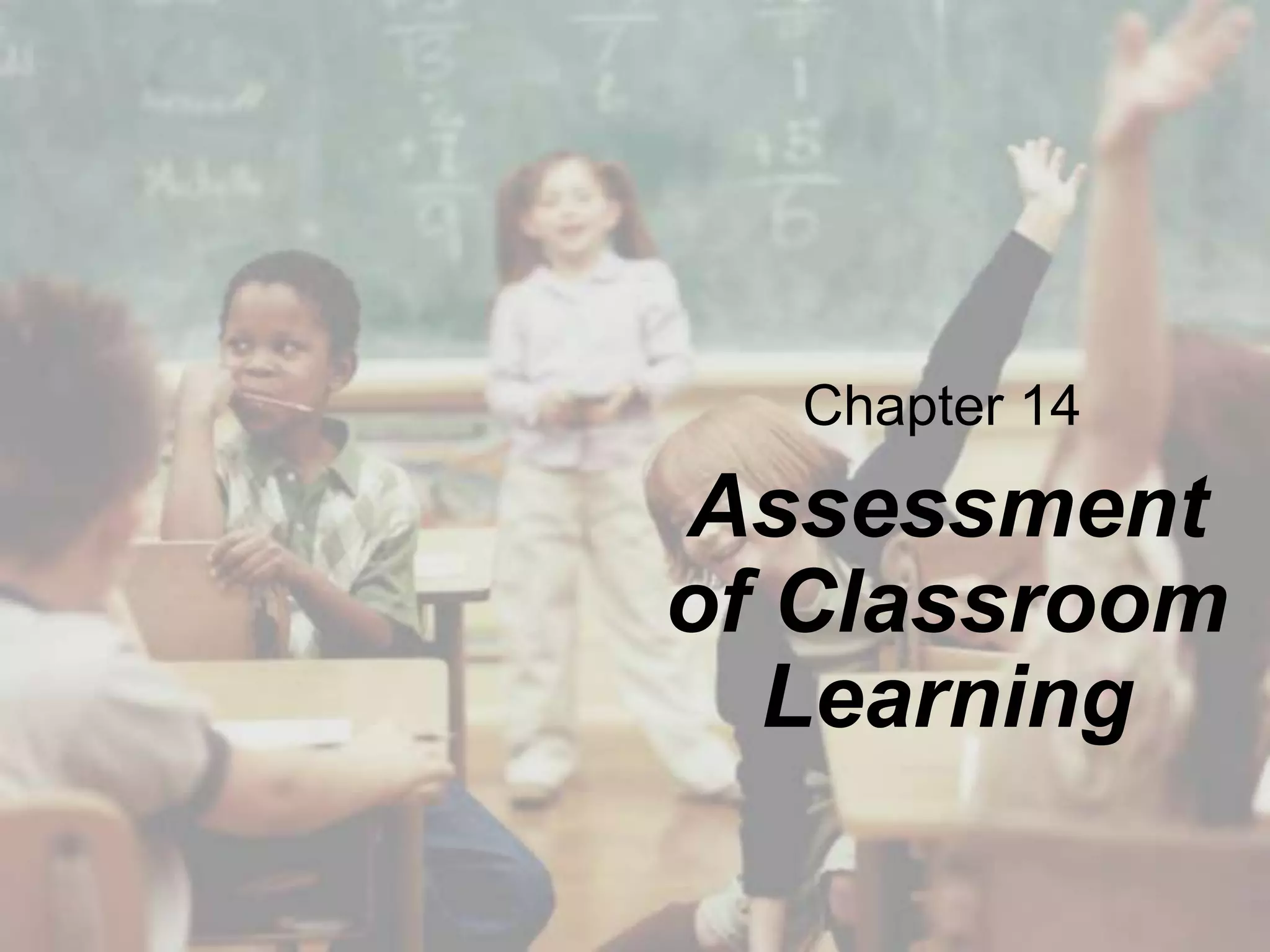
Chapter 14

Assessment
of Classroom
Learning
Overview
•
•
•
•

The Role of Assessment in Teaching
Ways to Measure Student Learning
Ways to Evaluate Student Learning
Improving Your Grading Methods: Assessment
Practices to Avoid
• Technology for Classroom Assessment

© 2013 Cengage Learning. All rights reserved.

14 | 2
The Role of Assessment in Teaching
• The primary purpose of classroom assessment
is . . .
 to provide teachers with diagnostic
information they can use to increase student
achievement and improve their instruction
(assessment for learning)

© 2013 Cengage Learning. All rights reserved.

14 | 3
What Is Assessment?
• What Is Assessment?
 Classroom assessment involves two major types of
activities:
– Measurement: Using a rule-governed system
(such as tests or ratings) to collect information
about how much knowledge and skill students
have learned
– Evaluation: Using a rule-governed system to
make judgments about the adequacy or
acceptability of each student’s level of learning

© 2013 Cengage Learning. All rights reserved.

14 | 4
Why Should We Assess Student
Learning?
• Why Should We Assess Student Learning?
 Summative Assessment (Assessment OF Learning)
– Conducted to measure how much has been learned
over time and with a variety of tasks

 Formative Assessment (Assessment FOR Learning)
– Conducted to provide periodic feedback to teachers and
students about the effectiveness of instruction and the
progress of learning

 Assessment AS Learning
– Formative assessment, properly done, helps teachers
and students learn how to become more effective

© 2013 Cengage Learning. All rights reserved.

14 | 5
Ways to Measure Student Learning
• Written Tests
 Selected-response tests
 Short-answer tests
 Essay tests
• Performance Assessments
 Direct writing assessments
 Portfolios
 Exhibitions
 Demonstrations

© 2013 Cengage Learning. All rights reserved.

14 | 6
Ways to Measure Student Learning
• Written Tests
 Constructing a Useful Test
– Significance
– Teachability
– Describability
– Reportability
– Nonintrusiveness

© 2013 Cengage Learning. All rights reserved.

14 | 7
Performance Assessments
• Performance Assessments
 What Are Performance Assessments?
– Students required to use a wide range of
knowledge and skills over an extended
period of time to complete a task or solve a
problem under more or less realistic
conditions
 See Online Video Case “Portfolio Assessment: Elementary
Classroom”

© 2013 Cengage Learning. All rights reserved.

14 | 8
Characteristics of Performance
Assessments
• Performance Assessments
 Characteristics of Performance Assessments
– Emphasis on active responding
–
–
–
–
–
–

Degree of realism
Emphasis on complex problems
Close relationship between teaching and testing
Use of scoring rubrics
Use of formative assessment
Responsiveness to cultural diversity

 See Online Video Case “Portfolio Assessment: Elementary
Classroom”
© 2013 Cengage Learning. All rights reserved.

14 | 9
Some Concerns About Performance
Assessment
• Performance Tests
 Some Concerns About Performance Assessment

– Teachers may be reluctant to use them
because of the emphasis on standardized
testing and summative assessment
– More difficult to establish reliability and
validity
 See Online Video Case “Performance Assessment: Student
Presentations in a High School English Class”

© 2013 Cengage Learning. All rights reserved.

14 | 10
Ways to Evaluate Student Learning
• Norm-referenced grading
 The Nature of Norm-Referenced Grading
– System assumes that classroom achievement will
naturally vary among a group of heterogeneous
students because of student differences and so
compares the score of each student to the scores
of the other students in order to determine grades
– Also referred to as “grading on the curve” because
under ideal circumstances distribution of grades
takes the shape of a bell-shaped curve

© 2013 Cengage Learning. All rights reserved.

14 | 11
Strengths and Weaknesses of NormReferenced Grading
• Norm-Referenced Grading
 Strengths and Weaknesses of NormReferenced Grading
– Strengths
 System is useful for evaluating advanced levels of
learning
 System is useful for selecting students for limitedenrollment programs

– Weaknesses
 There are few situations in which the typical public
school teacher can appropriately use it

© 2013 Cengage Learning. All rights reserved.

14 | 12
The Nature of Criterion-Referenced
Grading
• Criterion-Referenced Grading
 The Nature of Criterion-Referenced Grading
– System in which grades are determined on
the basis of whether each student has
attained a defined standard of achievement
or performance

 See Online Video Case “Assessment in the Middle
Grades: Measurement of Student Learning”

© 2013 Cengage Learning. All rights reserved.

14 | 13
Criterion-Referenced Grading
• Criterion-Referenced Grading
 Strengths and Weaknesses of Criterion-Referenced
Grading
– Strengths
Provides more specific and useful information about
student strengths and weaknesses
Promotes the motivation to learn because it holds out the
promise that all students can master most of a teacher’s
objectives

– Weaknesses
Performance standards are arbitrary and may be difficult
to justify
Standards may fluctuate as a result of unnoticed
variation
© 2013 Cengage Learning. All rights reserved.

14 | 14
A Mastery Approach
• Criterion-Referenced Grading
 A Mastery Approach
– A form of criterion-referenced grading in
which students are given multiple
opportunities to master a set of objectives
– Assumes all students can achieve if given
good quality instruction, sufficient time to
learn, and are motivated to learn
– Lends itself to formative assessment and is
closely aligned with the Response to
Intervention procedure

© 2013 Cengage Learning. All rights reserved.

14 | 15
Improving Your Grading Methods:
Assessment Practices to Avoid
•
•
•
•
•
•

Worshiping averages
Using zeros indiscriminately
Providing insufficient instruction before testing
Teaching for one thing but testing for another
Using pop quizzes to motivate students
Keeping the nature and content of the test a
secret
• Keeping the criteria for assignments a secret
• Shifting criteria
• Combining apples and oranges
© 2013 Cengage Learning. All rights reserved.

14 | 16
Technology for Classroom Assessment
• Electronic Gradebooks and Grading Programs
 Reduces grading errors, increases efficiency
of the grading process
• Technology-Based Performance Assessment
 Web sites like GLOBE and Quest Atlantis
can be used for performance assessment
• Digital Portfolios
 Computer-based portfolios of projects that
may include sound, audio, and video

© 2013 Cengage Learning. All rights reserved.

14 | 17

PSY 263 401 Chapter 14 SLIDES

  • 1.
  • 2.
    Overview • • • • The Role ofAssessment in Teaching Ways to Measure Student Learning Ways to Evaluate Student Learning Improving Your Grading Methods: Assessment Practices to Avoid • Technology for Classroom Assessment © 2013 Cengage Learning. All rights reserved. 14 | 2
  • 3.
    The Role ofAssessment in Teaching • The primary purpose of classroom assessment is . . .  to provide teachers with diagnostic information they can use to increase student achievement and improve their instruction (assessment for learning) © 2013 Cengage Learning. All rights reserved. 14 | 3
  • 4.
    What Is Assessment? •What Is Assessment?  Classroom assessment involves two major types of activities: – Measurement: Using a rule-governed system (such as tests or ratings) to collect information about how much knowledge and skill students have learned – Evaluation: Using a rule-governed system to make judgments about the adequacy or acceptability of each student’s level of learning © 2013 Cengage Learning. All rights reserved. 14 | 4
  • 5.
    Why Should WeAssess Student Learning? • Why Should We Assess Student Learning?  Summative Assessment (Assessment OF Learning) – Conducted to measure how much has been learned over time and with a variety of tasks  Formative Assessment (Assessment FOR Learning) – Conducted to provide periodic feedback to teachers and students about the effectiveness of instruction and the progress of learning  Assessment AS Learning – Formative assessment, properly done, helps teachers and students learn how to become more effective © 2013 Cengage Learning. All rights reserved. 14 | 5
  • 6.
    Ways to MeasureStudent Learning • Written Tests  Selected-response tests  Short-answer tests  Essay tests • Performance Assessments  Direct writing assessments  Portfolios  Exhibitions  Demonstrations © 2013 Cengage Learning. All rights reserved. 14 | 6
  • 7.
    Ways to MeasureStudent Learning • Written Tests  Constructing a Useful Test – Significance – Teachability – Describability – Reportability – Nonintrusiveness © 2013 Cengage Learning. All rights reserved. 14 | 7
  • 8.
    Performance Assessments • PerformanceAssessments  What Are Performance Assessments? – Students required to use a wide range of knowledge and skills over an extended period of time to complete a task or solve a problem under more or less realistic conditions  See Online Video Case “Portfolio Assessment: Elementary Classroom” © 2013 Cengage Learning. All rights reserved. 14 | 8
  • 9.
    Characteristics of Performance Assessments •Performance Assessments  Characteristics of Performance Assessments – Emphasis on active responding – – – – – – Degree of realism Emphasis on complex problems Close relationship between teaching and testing Use of scoring rubrics Use of formative assessment Responsiveness to cultural diversity  See Online Video Case “Portfolio Assessment: Elementary Classroom” © 2013 Cengage Learning. All rights reserved. 14 | 9
  • 10.
    Some Concerns AboutPerformance Assessment • Performance Tests  Some Concerns About Performance Assessment – Teachers may be reluctant to use them because of the emphasis on standardized testing and summative assessment – More difficult to establish reliability and validity  See Online Video Case “Performance Assessment: Student Presentations in a High School English Class” © 2013 Cengage Learning. All rights reserved. 14 | 10
  • 11.
    Ways to EvaluateStudent Learning • Norm-referenced grading  The Nature of Norm-Referenced Grading – System assumes that classroom achievement will naturally vary among a group of heterogeneous students because of student differences and so compares the score of each student to the scores of the other students in order to determine grades – Also referred to as “grading on the curve” because under ideal circumstances distribution of grades takes the shape of a bell-shaped curve © 2013 Cengage Learning. All rights reserved. 14 | 11
  • 12.
    Strengths and Weaknessesof NormReferenced Grading • Norm-Referenced Grading  Strengths and Weaknesses of NormReferenced Grading – Strengths  System is useful for evaluating advanced levels of learning  System is useful for selecting students for limitedenrollment programs – Weaknesses  There are few situations in which the typical public school teacher can appropriately use it © 2013 Cengage Learning. All rights reserved. 14 | 12
  • 13.
    The Nature ofCriterion-Referenced Grading • Criterion-Referenced Grading  The Nature of Criterion-Referenced Grading – System in which grades are determined on the basis of whether each student has attained a defined standard of achievement or performance  See Online Video Case “Assessment in the Middle Grades: Measurement of Student Learning” © 2013 Cengage Learning. All rights reserved. 14 | 13
  • 14.
    Criterion-Referenced Grading • Criterion-ReferencedGrading  Strengths and Weaknesses of Criterion-Referenced Grading – Strengths Provides more specific and useful information about student strengths and weaknesses Promotes the motivation to learn because it holds out the promise that all students can master most of a teacher’s objectives – Weaknesses Performance standards are arbitrary and may be difficult to justify Standards may fluctuate as a result of unnoticed variation © 2013 Cengage Learning. All rights reserved. 14 | 14
  • 15.
    A Mastery Approach •Criterion-Referenced Grading  A Mastery Approach – A form of criterion-referenced grading in which students are given multiple opportunities to master a set of objectives – Assumes all students can achieve if given good quality instruction, sufficient time to learn, and are motivated to learn – Lends itself to formative assessment and is closely aligned with the Response to Intervention procedure © 2013 Cengage Learning. All rights reserved. 14 | 15
  • 16.
    Improving Your GradingMethods: Assessment Practices to Avoid • • • • • • Worshiping averages Using zeros indiscriminately Providing insufficient instruction before testing Teaching for one thing but testing for another Using pop quizzes to motivate students Keeping the nature and content of the test a secret • Keeping the criteria for assignments a secret • Shifting criteria • Combining apples and oranges © 2013 Cengage Learning. All rights reserved. 14 | 16
  • 17.
    Technology for ClassroomAssessment • Electronic Gradebooks and Grading Programs  Reduces grading errors, increases efficiency of the grading process • Technology-Based Performance Assessment  Web sites like GLOBE and Quest Atlantis can be used for performance assessment • Digital Portfolios  Computer-based portfolios of projects that may include sound, audio, and video © 2013 Cengage Learning. All rights reserved. 14 | 17