MD. AL-AMIN (SAJIB)
Lecturer
Dept. of Human Resource Management
Jatiya Kabi Kazi Nazrul Islam University
Trishal, Mymensingh-2224, Bangladesh
Email: alaminsajibhrm@gmail.com
Conduct: 01309-027320
Course Name: Performance Management
Course Code: HRM-511
Chapter - 02
Performance Management Process
Chapter outline:
1. Components of Performance Management
Process.
01. Components of PM Process
Performance Management is an ongoing process.
It never ends. Once established in an organization,
it becomes part of an organization’s culture. The
performance management process includes six
closely related components.
Each of the six components of the performance
management process plays an important role. If
any of these components is implemented poorly,
then the entire performance management system
suffers.
01. Components of PM Process
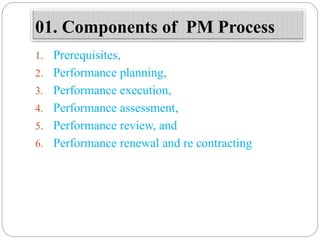
1. Prerequisites,
2. Performance planning,
3. Performance execution,
4. Performance assessment,
5. Performance review, and
6. Performance renewal and re contracting
01. Components of PM Process
1.1 Prerequisites:
The first component of the performance
management process involves two prerequisites.
First, there is a need to have good knowledge of
the organization’s mission and strategic goals.
Second, there is a need to have good knowledge of
the job in question or job analysis.
01. Components of PM Process
1.2 Performance Planning.
Performance planning includes the consideration of
results and behavior as well as a development plan. A
discussion of results needs to include key
accountabilities (i.e., broad areas for which an employee
is responsible), specific objectives for each key
accountability (i.e., goals to be reached), and
performance standards (i.e., what are acceptable and
unacceptable levels of performance). A discussion of
behaviors needs to include competencies (i.e., clusters of
KSAs). Finally, the development plan includes a
description of areas that need improvement and goals to
be achieved in each area.
01. Components of PM Process
1.3 Performance execution.
Both the employee and the manager are responsible for
performance execution. The employee has a responsibility to
be prepared for the performance review by conducting regular
and realistic self appraisals. At this stage, the following
factors must be present in the mind of employees-
 Commitment to goal achievement
 Ongoing performance feedback and coaching
 Communication with supervisor
 Collecting and sharing performance data
 Preparing for performance reviews
01. Components of PM Process
On the other hand, the supervisor also has important
responsibilities over the following issues
 Observing and documenting of performance,
 Updating the employee on any changes in the
goals of the organization,
 Provide feedback on a regular basis before the
review cycle is over, and
 Providing resources and reinforcement so that the
employee can succeed and continue to be
motivated.
01. Components of PM Process
1.4 Performance assessment:
Both the employee and the supervisor must evaluate
employee performance. Involvement of the
employee in the process increases his or her
ownership and commitment to the system. In
addition, it provides important information to be
discussed during the performance review. In the
absence of self-appraisals, it is often not clear to
supervisors if employees have a real understanding
of what is expected of them.
01. Components of PM Process
1.5 Performance review:
When the employee and manager meet to discuss
employee performance. This meeting is usually called
the appraisal meeting. This meeting emphasizes the past:
what the employee has done and how it was done. An
effective appraisal meeting also focuses on the present
and the future. The present involves the changes in
compensation that may result from the results obtained.
The future involves a discussion of goals and
development plans that the employee will be expected to
achieve during the period before the next review session.
01. Components of PM Process
1.6 Performance Renewal and Recontracting:
Although this component is identical to the
performance planning stage, this component uses
information gathered during the review period to
make adjustments as needed. For example, some
new key accountabilities and competencies may be
included. Conversely, some goals may have to be
adjusted either upward or downward.
Thank you so much
Any Question?????

Performance MGT Chapter-02.pptx

  • 1.
    MD. AL-AMIN (SAJIB) Lecturer Dept.of Human Resource Management Jatiya Kabi Kazi Nazrul Islam University Trishal, Mymensingh-2224, Bangladesh Email: alaminsajibhrm@gmail.com Conduct: 01309-027320 Course Name: Performance Management Course Code: HRM-511
  • 2.
    Chapter - 02 PerformanceManagement Process Chapter outline: 1. Components of Performance Management Process.
  • 3.
    01. Components ofPM Process Performance Management is an ongoing process. It never ends. Once established in an organization, it becomes part of an organization’s culture. The performance management process includes six closely related components. Each of the six components of the performance management process plays an important role. If any of these components is implemented poorly, then the entire performance management system suffers.
  • 4.
    01. Components ofPM Process 1. Prerequisites, 2. Performance planning, 3. Performance execution, 4. Performance assessment, 5. Performance review, and 6. Performance renewal and re contracting
  • 5.
    01. Components ofPM Process 1.1 Prerequisites: The first component of the performance management process involves two prerequisites. First, there is a need to have good knowledge of the organization’s mission and strategic goals. Second, there is a need to have good knowledge of the job in question or job analysis.
  • 6.
    01. Components ofPM Process 1.2 Performance Planning. Performance planning includes the consideration of results and behavior as well as a development plan. A discussion of results needs to include key accountabilities (i.e., broad areas for which an employee is responsible), specific objectives for each key accountability (i.e., goals to be reached), and performance standards (i.e., what are acceptable and unacceptable levels of performance). A discussion of behaviors needs to include competencies (i.e., clusters of KSAs). Finally, the development plan includes a description of areas that need improvement and goals to be achieved in each area.
  • 7.
    01. Components ofPM Process 1.3 Performance execution. Both the employee and the manager are responsible for performance execution. The employee has a responsibility to be prepared for the performance review by conducting regular and realistic self appraisals. At this stage, the following factors must be present in the mind of employees-  Commitment to goal achievement  Ongoing performance feedback and coaching  Communication with supervisor  Collecting and sharing performance data  Preparing for performance reviews
  • 8.
    01. Components ofPM Process On the other hand, the supervisor also has important responsibilities over the following issues  Observing and documenting of performance,  Updating the employee on any changes in the goals of the organization,  Provide feedback on a regular basis before the review cycle is over, and  Providing resources and reinforcement so that the employee can succeed and continue to be motivated.
  • 9.
    01. Components ofPM Process 1.4 Performance assessment: Both the employee and the supervisor must evaluate employee performance. Involvement of the employee in the process increases his or her ownership and commitment to the system. In addition, it provides important information to be discussed during the performance review. In the absence of self-appraisals, it is often not clear to supervisors if employees have a real understanding of what is expected of them.
  • 10.
    01. Components ofPM Process 1.5 Performance review: When the employee and manager meet to discuss employee performance. This meeting is usually called the appraisal meeting. This meeting emphasizes the past: what the employee has done and how it was done. An effective appraisal meeting also focuses on the present and the future. The present involves the changes in compensation that may result from the results obtained. The future involves a discussion of goals and development plans that the employee will be expected to achieve during the period before the next review session.
  • 11.
    01. Components ofPM Process 1.6 Performance Renewal and Recontracting: Although this component is identical to the performance planning stage, this component uses information gathered during the review period to make adjustments as needed. For example, some new key accountabilities and competencies may be included. Conversely, some goals may have to be adjusted either upward or downward.
  • 12.
    Thank you somuch Any Question?????