Performance
Management
and Appraisal
8
Learning Outcomes
After studying this chapter you should be able to:
8.1 Discuss the difference between performance management
and
performance appraisal
8.2 Identify the necessary characteristics of accurate
performance
management tools
8.3 List and briefly discuss the purposes for performance
appraisals
8.4 Identify and briefly discuss the options for “what” is
evaluated in a
performance appraisal
8.5 Briefly discuss the commonly used performance
measurement
methods and forms
8.6 Identify and briefly discuss available options for the
rater/evaluator
8.7 Briefly discuss the value and the drawbacks of a 360°
evaluation
8.8 Identify some of the common problems with the
performance
appraisal process
8.9 Identify the major steps we can take to avoid problems with
the
appraisal process
8.10 Briefly discuss the differences between evaluative
performance
reviews and developmental performance reviews
8.11 Define the following terms:
Performance management
Performance appraisal
Motivation
Traits
Behaviors
Results
Critical incidents method
Management by Objectives
(MBO) method
Narrative method or form
Graphic rating scale form
Behaviorally Anchored
Rating Scale (BARS)
form
Ranking method
360° evaluation
Bias
Stereotyping
Electronic Performance
Monitoring (EPM)
Performance Management Systems
Performance Management Versus Performance Appraisal
The Performance Appraisal Process
Accurate Performance Measures
Why Do We Conduct Performance Appraisals?
Communicating
Decision Making (Evaluating)
Motivating (Developing)
Evaluating and Motivating (Development)
What Do We Assess?
Trait Appraisals
Behavioral Appraisals
Results/Outcomes Appraisals
Which Option Is Best?
How Do We Use Appraisal Methods and Forms?
Critical Incidents Method
Management by Objectives (MBO) Method
Narrative Method or Form
Graphic Rating Scale Form
Behaviorally Anchored Rating Scale (BARS) Form
Ranking Method
Which Option Is Best?
Who Should Assess Performance?
Supervisor
Peers
Subordinates
Self
Customers
360º Evaluation
Who Do We Choose?
Performance Appraisal Problems to Avoid
Common Problems With the Performance Appraisal
Process
Avoiding Performance Appraisal Process Problems
Debriefing the Appraisal
The Evaluative Performance Appraisal Interview
The Developmental Performance
Appraisal Interview
Trends and Issues in HRM
Is It Time to Do Away With
Performance Appraisals?
Technology: Electronic Performance Monitoring
Competency-Based Performance Management
Aligning the Appraisal Process
C. Job Analysis/Job Design (required)
4. Performance management (performance criteria and
appraisal)
F. Performance Management (required)
1. Identifying and measuring employee performance
2. Sources of information (e.g., managers, peers, clients)
3. Rater errors in performance measurement
4. Electronic monitoring
5. Performance appraisals
6. Appraisal feedback
7. Managing performance
Case 8-1. Beauty and the Beastly Situation at Aerospace
Designs’ Marketing
Department
Case 8-2. Performance Evaluation at DHR: Building a
Foundation or
Crumbling Ruins?
Chapter 8 Outline
SHRM
HR CONTENT
See Appendix A:
SHRM 2010 Curriculum
Guidebook for the
complete list
284 PART III: DEVELOPING AND MANAGING
Section IV: Compensating and Protecting
How do you REWARD and MAINTAIN your Human Resources?
Section III: Developing and Managing
How do you MANAGE your Human Resources?
Section II: Attracting and Staffing
What HRM Functions do you NEED for sustainability?
Section I: 21st-Century HRM Strategic Planning and Legal
Issues
What HRM issues are CRITICAL to your organization’s long-
term sustainability?
Performance Management Miscue
The Practitioner’s Model for HRM
Most managers don’t look forward to performance
appraisals. As soon as Heather stuck her head in my office
and asked me to sit in on her performance appraisal, I
knew I had two employees who needed some coaching—
Heather and her supervisor, Christine. Our company bases
many employment decisions on performance appraisals,
so the results are important.
Wh e n I e n t e r e d t h e r o o m , i t b e c a m e a p p a r
e n t
that although Heather believed she had been doing a
great job, Christine did not agree. Christine recorded
Heather’s performance as needing improvement over-
all, but did not offer any reason beyond a vague charge
that Heather had a poor attitude and wasn’t a team
player.
I quickly suggested a small interruption to the meeting, and
asked Heather to step out of the room. It soon became
clear that the overall problem was Heather’s failure to
report to work on time. When Heather was late, it impacted
her entire work group as the other employees then had to
answer Heather’s phone calls.
What’s going on here? Why don’t Heather and Christine
agree on Heather’s performance? Where did Christine
go wrong? How can Christine get Heather to agree with
her performance review now? How can this problem be
avoided during the next formal performance appraisal ses-
sion? The answers to these questions are based on having
a good performance management system. By reading this
chapter, you will learn how you can avoid these problems.
Chapter 8: Performance Management and Appraisal 285
LO 8.1Performance Management Systems
At this stage of human resource management (HRM), we now
have employees in our
organization who can do the work, we’ve given them at least
some initial training, and they
are now doing their individual jobs. What’s next? The next
issue that we need to figure out
is how to manage their performance over time to ensure that
they remain productive, and
hopefully become even more capable, as they progress in their
careers. Remember our dis-
cussion from Chapter 1 that our human resources are typically
one of the few options avail-
able to create a sustainable competitive advantage for the firm.
So we need to ensure that
our human resources perform at the highest possible level. To
this end, in this section, we
discuss the difference between performance management and
performance appraisal, and
present the performance appraisal process.
Performance Management
Versus Performance Appraisal
“In a knowledge economy, organizations rely heavily on their
intangible assets to build
value. Consequently, performance management at the individual
employee level is essen-
tial and the business case for implementing a system to measure
and improve employee
performance is strong.”1 Management time and effort to
increase performance not only
meets this goal; it also decreases turnover rates.2
How do we manage performance within the organization? The
most common part of
the process, and the one with which we are most familiar, is the
process of the performance
appraisal, or evaluation. In this chapter, we will use the phrases
performance evaluation, per-
formance appraisal, and appraisal interchangeably. However,
the performance appraisal
process is not the only thing that’s done in performance
management. Performance
management is the process of identifying, measuring, managing,
and developing the perfor-
mance of the human resources in an organization. Basically we
are trying to figure out how
well employees perform and then to ultimately improve that
performance level. When used
correctly, performance management is a systematic analysis and
measurement of worker
performance (including communication of that assessment to the
individual) that we use to
improve performance over time.
Performance appraisal, on the other hand, is the ongoing
process of evaluating employee
performance. Performance appraisals are reviews of employee
performance over time3, so
appraisal is just one piece of performance management.
Although we will spend most of
this chapter discussing performance appraisal, there are several
other significant pieces of
performance management that we already covered in past
chapters and will cover in future
chapters. We discussed “strategic planning,” which provides
inputs into what we want
to evaluate in our performance management system, in Chapter
2. We also discussed the
major method of identifying performance requirements in a
particular job when we went
through “job analysis and design” in Chapter 4. In Chapter 7,
we discussed “training and
development,” which obviously play a part in performance
management. Additionally, we
will discuss motivating employees, employee relations,
compensation, and other pieces in
Chapters 9–14. Now that we understand the difference between
performance management
and performance appraisal, let’s look at the performance
appraisal process.
The Performance Appraisal Process
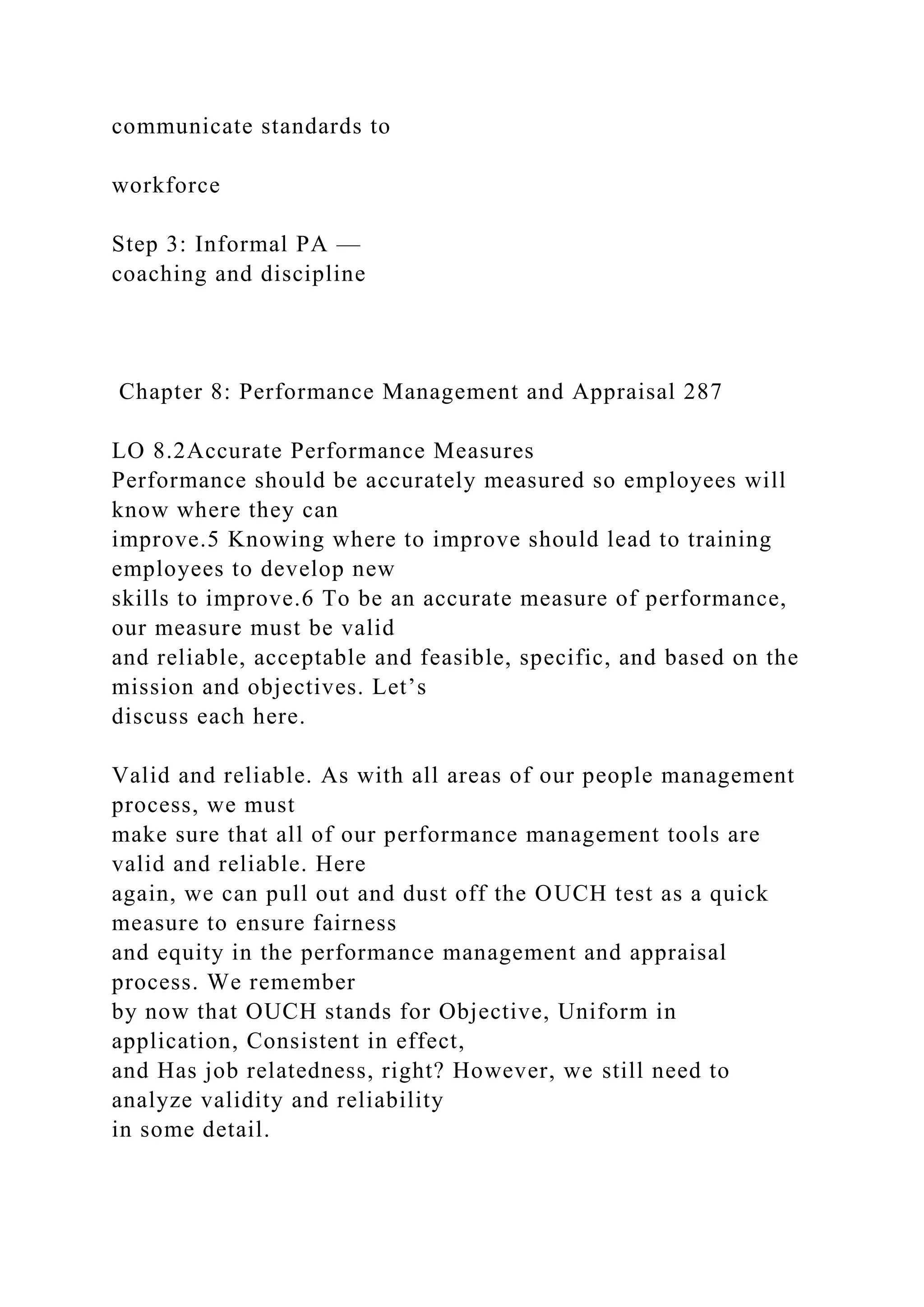
Exhibit 8-1 illustrates the performance appraisal (PA) process.
Note the connection
between the organization’s mission and objectives and the
performance appraisal process.
Here we briefly discuss each step of the process.
Discuss the difference
between performance
management and
performance appraisal.
Guide – C:4
Performance management
(performance criteria and
appraisal)
SHRM
Video Link 8.1
Performance Appraisal
Process
286 PART III: DEVELOPING AND MANAGING
Step 1. Job analysis. This is logically our first step because if
we don’t know what a
job consists of, how can we possibly evaluate an employee’s
performance? We already
learned how to do a job analysis in Chapter 4, but as shown in
Exhibit 8-1, we should
realize that the job must be based on the organizational mission
and objectives, the
department, and the job itself.
Step 2. Develop standards and measurement methods. If we
don’t have standards
of acceptable behavior and methods to measure performance,
how can we assess perfor-
mance? We will discuss performance measurement methods in
the next part of this sec-
tion, and in the major section “How Do We Use Appraisal
Methods and Forms?” we will
discuss these topics in more detail.
Step 3. Informal performance appraisal—coaching and
disciplining. Performance
appraisal should not be simply a once- or twice-yearly formal
interview. As its definition
states, performance appraisal is an ongoing process. While a
formal evaluation may only
take place once or twice a year, people need regular feedback on
their performance to know
how they are doing.4 We will briefly discuss coaching in the
“Critical Incidents Method”
subsection of “How Do We Use Appraisal Methods and Forms?”
and in more detail along
with teaching how to discipline in the next chapter.
Step 4. Prepare for and conduct the formal performance
appraisal. The common
practice is to have a formal performance review with the boss
once or sometimes twice a year
using one or more of the measurement forms we will be learning
about. Later in this chapter we
will discuss the steps of preparing for and conducting the
performance appraisal.
In the major sections to come, we discuss “why” we assess
performance, “what” we
assess, “how” we assess, and “who” conducts the performance
appraisal. Then we discuss
performance appraisal problems and how to avoid them, and we
end the performance
appraisal process with the actual formal review session. But
before we leave this section, we
need to understand a critically important part of each step in the
performance appraisal
process—accurate performance measurement.
WORK
APPLICATION 8-1
Select a job you have or
had. Did you know the
organization’s mission and
objectives? Briefly state the
mission. If you don’t know it,
find out. Did you understand
how your job fits or helps
to meet the mission and
objectives? Explain in
some detail.
Exhibit 8-1 The Performance Appraisal Process
Step 1:
Job Analysis
Organizational Mission
and Objectives
Step 4: Prepare for and
conduct the formal PA
Step 2: Develop standards
and measurement methods;
communicate standards to
workforce
Step 3: Informal PA —
coaching and discipline
Chapter 8: Performance Management and Appraisal 287
LO 8.2Accurate Performance Measures
Performance should be accurately measured so employees will
know where they can
improve.5 Knowing where to improve should lead to training
employees to develop new
skills to improve.6 To be an accurate measure of performance,
our measure must be valid
and reliable, acceptable and feasible, specific, and based on the
mission and objectives. Let’s
discuss each here.
Valid and reliable. As with all areas of our people management
process, we must
make sure that all of our performance management tools are
valid and reliable. Here
again, we can pull out and dust off the OUCH test as a quick
measure to ensure fairness
and equity in the performance management and appraisal
process. We remember
by now that OUCH stands for Objective, Uniform in
application, Consistent in effect,
and Has job relatedness, right? However, we still need to
analyze validity and reliability
in some detail.
If our method of measurement is not valid and reliable, then it
makes no sense to use it.
We discussed reliability and validity in Chapter 4. Recall that a
valid measure is “true and
correct.” When a measure has validity, it is a factual measure
that measures the process that
you wanted to measure. A reliable measure is consistent; it
works in generally the same way
each time we use it.
Acceptable and feasible. In addition to validity and reliability,
we need to look at a couple
of other characteristics of our performance measures. We need
to analyze acceptability and
feasibility. Acceptability means that the use of the measure is
satisfactory or appropriate to the
people who must use it. However, in performance appraisal, this
isn’t enough.7 Acceptability
must include whether or not the evaluation tool is feasible. Is it
possible to reasonably apply
the evaluation tool in a particular case? As an example, if the
performance evaluation form
is two or three pages long and covers the major aspects of the
job that is being evaluated, and
both managers and employees believe that the form truly
evaluates performance measures
that identify success in the job, then they are likely to feel that
the tool is acceptable and fea-
sible. If, however, the manager must fill out a 25-page form that
has very little to do with the
job being evaluated, the manager may not
feel that the form is acceptable or feasible,
at least partially due to its length, even if the
employee does.
Conversely, if managers fill out a two-
page evaluation that they feel is a true meas-
ure of performance in employees’ jobs but
the employees feel that the evaluation leaves
out large segments of what they do in their
work routine, they may not feel that the form
is acceptable and feasible. If either man-
agement or employees feel that the form is
unacceptable, it most likely will not be used
correctly. So, we always have to evaluate
acceptability and feasibility of a measure.
Specific. Next, we want any evaluation
measure to be specific enough to iden-
tify what is going well and what is not.
The word specific means that something
is explicitly identified, or defined well
Identify the necessary
characteristics of accurate
performance management
tools.
Without accurate measures of performance, the performance
appraisal
can’t be reliable or valid.
288 PART III: DEVELOPING AND MANAGING
enough that all involved understand the issue completely. In
performance appraisal, spe-
cific means that the form provides enough information for
everyone to understand what
level of performance has been achieved by a particular
employee within a well-identified
job.
Creating specific measures is the only way that we can use a
performance appraisal to
improve the performance of our employees over time. The
employees have to understand
what they are doing successfully and what they are not. Many
times, evaluation forms may
be too general in nature to be of value for modifying employee
behaviors because we want
the form to serve for a large number of different types of jobs.
This can create significant
problems in the performance appraisal process.
Based on the mission and objec tives. Finally, you want to make
sure that
your performance management system leads to accomplishment
of your organiza-
tional mission and objectives. As with everything else we do in
HR, we need to ensure
that the performance management process guides our employees
toward achieve-
ment of the company’s mission and objectives over time. As
managers in the organiza-
tion, making sure of this connection will allow us to reinforce
employee behaviors that
aim at achieving organizational goals and to identify for our
employees things that they may
be doing that actively or unintentionally harm our ability to
reach those goals.
Thus, stating specific objectives of exactly what each person in
each job should achieve
or his or her performance outcomes leads to accurate assessment
that can increase perfor-
mance. For some examples of inaccurate measures of
performance, complete Applying the
Concept 8-1.
WORK
APPLICATION 8-2
Assess the accuracy of the
measurements of your
performance on your last
performance appraisal. Be
sure to describe the measures’
validity and reliability, their
acceptability and feasibility,
if they were specific, and
if they were based on the
organization’s mission and
objectives.
APPLYING THE CONCEPT8-1 APPLYING THE CONCEPT8-1
Measurement Accuracy
Which of the following criteria for a measure to be accurate is
not met in each of the given situations?
a. valid
b. reliable
c. accepted
d. feasible
e. specific
f. based on the mission and objectives
____ 1. My boss asked me to fill out a self-evaluation of my
performance. But I refused to do it. Evaluation is
her job, so let her do it.
____ 2. My boss told me that I was not doing a very good job of
data entry. When I asked him what he meant, he
went around in circles and never gave me a good answer.
____ 3. The boss said I’m not producing as many widgets as I
used to. But it’s not my fault that the machine
jams every now and then and I have to stop working to fix it.
____ 4. My boss asked to me to evaluate my employees four
times a year instead of only once. I told her I don’t
have the time to do it that many times. It’s just not possible to
do a good review that often without cutting back
other things that are more important.
____ 5. My boss said I have a bad attitude and gave me a lower
overall rating. But I pointed out that I get all my
work done well and by the deadline or early, and I questioned
what my attitude had to do with my performance.
Chapter 8: Performance Management and Appraisal 289
LO 8.3Why Do We Conduct
Performance Appraisals?
As you can begin to see already, the appraisal process gets
extremely complicated very quickly.
And remember, anytime a process in an organization is
complicated, it costs a lot of money.
So why do we even do performance appraisals? What value
provided to the organization and
to the individual makes the process of evaluating the
performance of our workers so critical?
If performance appraisals are done in the correct manner, they
can provide us with a
series of valuable results. However, done incorrectly, the
process of evaluating employee
performance can actually lead to lower levels of job satisfaction
and pro ductivity. In
this section, let’s discuss three major reasons why organizations
complete performance
evaluations—communicating, decision making, and motivating.
Communicating
The first major reason for performance appraisal is to provide
an opportunity for formal
communication between management and the employees
concerning how the organization
believes each employee is performing. All of us know
intuitively that successful communi-
cation requires two-way interaction between people.
“Organizations can prevent or rem-
edy the majority of performance problems by ensuring that two-
way conversation occurs
between the manager and the employee, resulting in a complete
understanding of what is
required, when it is required and how the employee’s
contribution measures up.” 8
Communication always requires that employees have the
opportunity and ability to
provide feedback to their bosses in order to make sure that the
communication is under-
stood. So, in performance appraisals the communication process
requires that we as man-
agers communicate with the employees to provide them
information about how we believe
they’re doing in their job, but the process also requires that we
provide the opportunity for
the employees to speak to us concerning factors that inhibit
their ability to successfully per-
form for the organization.
Factors in a job that management may not know about can
include many things,
including lack of training, poorly maintained equipment, lack of
tools necessary to per-
form, conflict within work groups, and many other things that
management may not see
on a daily basis. If the communication component of the
performance appraisal process
does not allow for this two-way communication, managers may
not know of the obsta-
cles that the employees have to overcome. The only way that we
can resolve problems is to
know about them. So, as managers, we need to communicate
with our employees to find
out when issues within the work environment cause loss of
productivity so we can fix them.
Thus, two-way communication is a critical component of
correcting problems through the
performance appraisal process.
Decision Making (Evaluating)
The second major purpose of performance appraisals is to allow
management to make
decisions about employees within the organization. We need to
make decisions based on
information, the information we get from our communication.
Accurate information is
necessary for management decision making and is an absolutely
critical component to allow
the manager to improve organizational productivity.9 We use
information from annual per-
formance appraisals to make evaluative decisions concerning
our workforce including pay
raises, promotions, demotions, training and development, and
termination. When we have
valid and reliable information concerning each individual within
our division or depart-
ment, this gives us the ability to make decisions that can
enhance productivity for the firm.
List and briefly discuss the
purposes for performance
appraisals.
290 PART III: DEVELOPING AND MANAGING
If, for instance, through the process of coaching (the third step
of the performance
appraisal process) we find that several machine operators are
having trouble keeping their
equipment in working order, this piece of information would
quite likely lead to a needs
assessment (as discussed in Chapter 7) to determine whether or
not maintenance training
is necessary for our group of operators. Without our rigorous
evaluation process, we might
not learn of this common problem as early, and as a result could
do some significant dam-
age to very expensive equipment. This and similar types of
information frequently come to
the forefront as we go through the performance appraisal
process. Decision making based
on good communication is a very large part of why we take the
time to do annual perfor-
mance appraisals.
Motivating (Developing)
The third major purpose for performance appraisal is to provide
motivation to our
employees to improve the way they work individually for
developmental purposes, which
in turn will improve organizational productivity overall.10
What is motivation, and are per-
formance appraisals normally motivational? Well, from a
business perspective, motivation
can be defined as the willingness to achieve organizational
objectives. We want to create this
willingness to achieve the organization’s objectives, which in
turn will increase organiza-
tional productivity.
Our evaluative decisions should lead to development of
employees. Returning to
the machine operators having trouble keeping their equipment in
working order, mak-
ing the decision to train the employees leads to their
development through improving
their performance, as well as better utilizing the resources to
improve organizational
performance.
Evaluating and Motivating (Development)
An effective performance appraisal process has two parts
(evaluating and motivating), and
it does both parts well. Evaluating is about assessing past
performance, and motivating is
about developing employees to improve their future
performance. But, are both parts done
well? Have you ever been in a position of being evaluated and
debriefed as an employee?
Was the process motivational? Probably not. Think about the
appraisal process and how
it was carried out. Here we discuss problems with evaluation
and how to overcome them,
explain how to motivate, and suggest separating evaluation and
motivation.
Problems with evaluation. A common problem in appraisals is
overpowering employ-
ees during an evaluation debrief with large amounts of negative
information that they have
not heard during coaching. This tends to cause the employees to
“turn off,” or stop listen-
ing to their managers as they explain what is wrong. Employees
will just “raise their shields”
to ward off all of the negative information. This is a natural
human characteristic. We are
naturally suspicious of negative information for a variety of
psychological reasons (defense
mechanisms), so when employees are presented with a large
amount of negative informa-
tion, they tend to discount or even disbelieve it. They may
consider the process unfair or
one-sided and not an accurate measure of their performance, and
as a result the evaluation
may be useless as a motivator.
Avoiding problems with evaluation. To help overcome such
problems with evaluation,
an effective manager who is a good coach will generally never
identify a weakness that the
employee has not previously been made aware of during the
formal appraisal interview—
there are no surprises. The evaluative part of the appraisal
should only be a review of what
the employee already knows and should be willing to hear.
However, avoiding surprises is
not enough.11
Guide – F:7
Managing Performance
SHRM
Chapter 8: Performance Management and Appraisal 291
The appraisal debrief must be a well-rounded look at individual
employees; it should
identify both positive and negative factors in the employees’
behaviors and results within
their job (and remember that the communication needs to be
two-way). As managers,
we want to tell employees what they are doing right, but also
where they have room for
improvement. This more balanced approach to the debriefing
process will minimize the
potential that the employees will raise those shields and avoid
listening.
Motivating development. The important part of development is
the need for managers
to provide motivational opportunities for employees to improve
their performance over
time. In other words, we need to tell them how to fix the
problem. We need to provide them
with tools, training, or other methods that will allow them to
improve to the point where
their behavior is sufficient, and we then must continually strive
to get them to perform at
an above-average level and ultimately to be superior through
ongoing coaching between
formal reviews.
If we provide employees with tools to allow them to improve
over time, we’re focus-
ing not on the negative past results but on the positive future
potential results.12 If they are
given an honest opportunity to fix something that they know is a
problem and are given the
necessary tools or training, most will take advantage of that
opportunity. So performance
appraisals can be motivational if they are properly used and
debriefed.
Separating evaluation and development. To improve both parts
of the perfor-
mance appraisal, we suggest splitting the debriefing into two
separate interviews. The first
meeting is to evaluate the employees’ past performance,
pointing out strengths and areas
for improvement; the employees are asked to think about how
they can improve their per-
formance. At the second meeting, manager and employee jointly
come up with a develop-
mental plan that should lead to increased performance that will
result in a higher future
evaluative rating during the next formal appraisal. We will
discuss how to conduct the two
separate interviews in the “Debriefing the Appraisal” major
section of this chapter.
What Do We Assess?
Now that we know why we conduct performance appraisals, the
next step is to figure out what
needs to be evaluated. In other words, we have to decide what
aspects of the individuals and
their performance we’re going to measure. The best option for
what we evaluate would come
from analyzing the essential functions and qualifications
required for a particular job—or, in
HR terms, our job analysis. We could then use these facts to
design an appraisal instrument
with measurable and observable factors with which performance
can be evaluated.13 How-
ever, we can’t evaluate everything that is done over the course
of the year. We have to choose
what we will focus on because if we can’t measure it, we can’t
manage it, and what gets meas-
ured and evaluated gets done.14 Our three primary options are
traits, behaviors, and results.
Trait Appraisals
Traits identify the physical or psychological characteristics of a
person. We can evaluate the
traits of an individual during the performance appraisal process.
Can we accurately meas-
ure traits that affect job performance, can trait measures pass
the OUCH test, are traits
commonly used to measure performance, and should we measure
traits as part of our per-
formance appraisal process? Here we answer these questions,
and we will answer these same
questions for our behavior and results options.
Can we accurately measure traits that affect job performance?
Certainly, there’s
some evidence that particular types of traits are valuable in jobs
that require management
and leadership skills. Characteristics such as inquisitiveness,
conscientiousness, and general
Identify and briefly discuss
the options for “what” is
evaluated in a performance
appraisal.
WORK
APPLICATION 8-3
Assess the effectiveness of
an evaluative performance
appraisal you had. Did the
manager present both positive
and negative performance
areas? Did you “really” listen?
Were there any surprises?
Explain any problems and
how the evaluation could be
improved.
LO 8.4
292 PART III: DEVELOPING AND MANAGING
cognitive ability have been shown to have a reasonable “link” to
job performance.15 But just
how accurate is the link?
Many traits that most of us would be likely to focus on, such as
physical attractiveness,
height, extroversion, and others, actually have been shown to
have very little bearing on job
performance. If we’re going to use traits in performance
evaluation, we must ensure that
we focus on traits that have a direct relationship to the essential
functions of the job being
done, and they have to be accurate measures.
If we decide to use trait-based evaluations, is that a good
method for judging work per-
formance? How many of us would want to have judgments made
about our work based on
our appearance or personality? Would you consider this to be a
valid and reliable measure
of your work performance? In most cases, it’s very difficult to
show that personal traits are
valid and reliable measures of work performance.
Can trait measures pass the OUCH test? Let’s take a look at
trait-based measure-
ments using the OUCH test. Is a physical characteristic, such as
height, or a psychological
characteristic, such as attitude, cheerfulness, work ethic, or
enthusiasm, an objective meas-
ure of an individual’s work performance? We would have great
difficulty creating a quanti-
fiable and factual link between height or enthusiasm and job
performance.
So it’s difficult when measuring traits to meet the objective
requirement of the OUCH
test. If we utilized these trait-based measures in all cases in
employee evaluations, we would
be able to meet the uniform in application requirement of the
OUCH test. The third test—
consistent in effect—would likely be extremely difficult to meet
due to the fact that different
racial, ethnic, social, and gender groups tend to have different
physical and psychological
characteristics. Remember, reliability is a measure of
consistency. Could we meet the has
job relatedness test? Is a particular trait directly related to the
essential functions of the job?
In a very few cases this may be true, but in most situations
physical and personality charac-
teristics have less to do with success in the job than certain
behaviors will. So it’s very diffi-
cult to meet the has job relatedness test.
Finally, we need to ask whether or not different supervisors
would evaluate our traits
differently, based on their traits. Would their individual biases
based on their personalities
cause them to evaluate us differently? The answer is, of course,
that different people would
quite likely evaluate our traits differently.
Are traits commonly used to measure performance?
Surprisingly, if you go to the
local office supply store and look at standard evaluation forms
that are available in pre-
printed pads, you will find that they usually contain many traits
as part of the evaluation.
Why would this be the case? The simple answer is that at least
some traits, both physical and
psychological, are fairly easy to identify, and we make the
assumption that they are related to
how the individual will perform on the job. Many of us,
individually and as managers, value
certain things like enthusiasm even if enthusiasm has very little
to do with the ability to do a
particular job or the actual results of job performance.
Certainly, there are some jobs where enthusiasm is critical.
However, in most jobs,
being enthusiastic employees may have very little to do with job
success. If we evaluated
individuals based on the characteristic of enthusiasm, we might
make an error in judg-
ment concerning their performance. And if we make errors in
analyzing the performance
of our employees, the appraisal form becomes much less
acceptable to both the individual
employee and management.
Finally, if our organization happened to be sued by a former
employee who claimed
that they were fired based on an appraisal process that was
unreliable and not valid, it would
be very difficult to defend trait-based evaluation forms due to
their subjective nature.
Should we measure traits? Author Ken Blanchard says that there
are too many evalu-
ation items that can’t be objectively measured because they
attempt to measure things that
no one knows how to accurately measure, such as attitude,
initiative, and promotability. An
Chapter 8: Performance Management and Appraisal 293
important question is whether both managers and employees
will agree that the measured
rating is accurate. The bottom-line test (we will call it the
Blanchard test) is whether every-
one understands why they are assessed at a specific level
(evaluation) and what it takes to get
a higher rating (development).16 So we should only assess traits
if we meet the bottom-line
test of having a direct and obvious objective relationship
between the trait and success in
the job.
Behavioral Appraisals
Our second option in the assessment process is to evaluate
employees based on behaviors.
You will recall that behaviors are simply the actions taken by
individuals—the things that
they do and say. Behavioral appraisals measure what individuals
do at work, not their per-
sonal characteristics. Is this a good option to use in a
performance appraisal process?
Can we accurately measure behaviors that affect job
performance? As a general
rule, behaviors are a much better option to use in an appraisal
than traits. While an indi-
vidual supervisor or manager may make a mistake in judgment
of the traits of an employee,
physical actions or behaviors can be directly observed, and as a
result they are more likely to
be a valid assessment of the individual’s performance.
Can behavior measures pass the OUCH test? Let’s take a look at
a behavioral evalu-
ation using the OUCH test. Would an evaluation based on
actions taken by an employee be
objective? In general, directly observing and evaluating an
action is significantly more objec-
tive than making an attempt to judge a trait such as effort. If we
applied the same evaluation
of behaviors to all of the individuals in the same type of job, we
would have a reasonable
certainty that we were being uniform in application. The same
thing would be true here in
evaluating the concept of consistent in effect.
So, we come down to whether or not a behavioral evaluation has
job relatedness. Would
a behavioral evaluation be directly related to the essential
functions of a job? It would be if
we made sure that we chose behaviors that were necessarily a
part of successfully accom-
plishing a task. For instance, if a person acted correctly to fill
out a requisition form, putting
the proper information in the correct blocks and providing the
requisition to the appropri-
ate person who would then order the material, we would be
assessing behaviors that are
job-related. If, however, we evaluated the action of walking to
the lunchroom and back to
your workstation, would that be a valid job-related behavior?
More than likely it would not.
Of course, this is a silly example, but it should help you
understand that no matter what we
do in the evaluation process, we need to ensure that our actions
are job-related.
Would behavioral evaluations be defensible in the situation of
our fired employee
above? Would it be possible for us to show that our evaluation
process was valid and reli-
able? If we choose job-related behaviors, it becomes much
easier for the organization to
defend the validity and reliability of the appraisal process.
Observation of actions that are
directly related to a job provides at least some presumption of
validity as well as reliability
purely because the behaviors are directly job-related. Again, if
we chose behaviors that were
not able to be directly associated with the job, the validity and
reliability would be suspect.
Should we measure behavior? Are behaviors that measure
performance more acceptable
to the individual employee and the managers than personal
traits? In fact, evidence shows that
most individuals are very comfortable with the evaluation of
their performance being based
on their behaviors. In general, the most useful and therefore
acceptable feedback to employees
is considered to be in the form of specific job-related
behaviors.17 As managers, though, we still
need to be cognizant of the fact that a behavioral evaluation can
be a poor measure of work
performance unless the behaviors chosen are directly applicable
to being successful in the job.
So, like with traits, the Blanchard test is whether everyone
understands why they are assessed
at a specific level (evaluation) and what it takes to get a higher
rating (development).18
294 PART III: DEVELOPING AND MANAGING
Results/Outcomes Appraisals
Our final option concerning what we evaluate is the results, or
outcomes, of the work pro-
cess. Results are simply a measure of the goals achieved
through a work process. Using results
as an evaluation measure provides management of the
organization with an assessment of
the goals that were achieved in a particular job over time.
Can we accurately measure results that affect job performance?
Is measuring the
outcomes of a particular individual’s job a valid and reliable
measure of that person’s perfor-
mance? Well, certainly results are a concrete measure of what
has happened in the organiza-
tion. However, could results of a job have been skewed based
on factors that were outside the
control of the individual who is performing that job? The
answer is obviously that the results
could be affected by many other factors besides the individual.
For example, the goals could
be set too low and be easy to achieve, or too high and be
impossible to achieve.
Even though this is true, the measurement of results is the final
organizational measure
of success. The results produced through organizational
processes provide the company
with its return on investment—in this case its investment in the
people in the organization.
So, organizations really like to measure results.
Can results pass the OUCH test? Let’s take a look at the OUCH
test concerning
results-based evaluations. Is a result achieved in a particular job
a concrete, factual measure
that can easily be quantified? Obviously, it is a very objective
measure of what has happened
in that particular job. If we apply the same results-based
measure to each similar job, then
our measure is uniform in application. The measure of results
would almost certainly be
consistent across different groups of employees, so we would
meet the consistency in effect
requirement of the OUCH test. And of course, if we are
measuring the results of what hap-
pens in a job, we are certainly providing a measure that has job
relatedness. So, with a quick
scan we can see that a results-based performance appraisal
meets the requirements of the
OUCH test better than either of the other two options.
Should we measure results? Results-based evaluations, like
behavior, are also typically
very acceptable to both the employee and the manager.
Employees readily accept results-
based appraisals because they feel that such measures are one of
the fairest methods of ana-
lyzing their performance. After all, results are the most concrete
form of evaluation that can
be performed. Either the result was achieved, or it wasn’t. We
can also defend this type of
appraisal much easier than the other two options in court, if
necessary. It tends to be very
easy for the organization to go into a courtroom and show that
an individual’s results were
absolutely lower than the results achieved by other people in the
same or similar jobs, if
such an action becomes necessary.
But would a performance evaluation measured on results be
valid and reliable? The
results-based evaluation would most likely be highly valid and
would usually be reliable,
assuming that we were able to take into account factors outside
of individuals’ control
that nonetheless affect the performance of their job. So, like
with traits and behaviors, the
Blanchard test is whether everyone understands why they are
assessed at a specific level
(evaluation) and what it takes to get a higher rating
(development).19
Which Option Is Best?
Our three options concerning what we evaluate are traits,
behaviors, and results. But, which
option is best? The answer’s not as easy as you might think.
Certainly, results-based and
behavior-based evaluations are more defensible due to the fact
that they are more reliable
and valid than trait-based evaluations. But we have to include a
large number of factors in
order to select which option is best in a particular situation.
WORK
APPLICATION 8-4
Very briefly describe a job
you have or had. Describe
how your performance was
assessed based on traits,
behavior, and/or results.
Chapter 8: Performance Management and Appraisal 295
APPLYING THE CONCEPT8-2
For example, if we need to evaluate employees who work on the
assembly line, we may
need to evaluate behaviors such as punctuality—do they show
up to work on time? If we
have employees who, when they are there, produce at 150% of
the standard, but only show
up two or three days a week, that creates a problem for the
whole assembly line. In that case,
we may need to evaluate attendance and punctuality (behaviors)
because everyone on the
assembly line depends on everyone else.
However, if we have individuals who don’t do their actual work
where managers can
measure traits and behaviors—for example, people who work
from home (telecommuters)
and in independent outside sales positions—we need to rely on
results. Other employees
are often not affected by the hours that the telecommuters and
salespeople work. It will not
matter when they are at the office, as long as they get the job
done. The firm will be con-
cerned with how much they produced or sold. So circumstances
dictate which method we
will use; we cannot say one method will always be superior to
the other two.
How Do We Use
Appraisal Methods and Forms?
The formal performance appraisal usually involves the use of a
standard form developed by
the HR department to measure employee performance. Again,
“If you can’t measure it, you
can’t manage it.”20 But you must be careful how you measure
success,21 as the assessment
should be as objective as possible, not subjective.22 Employees
need to know the standards
and understand what good performance looks like, and they
need to be able to measure
their own performance. If you are stuck with a form that has
subjective sections, work with
your employees to develop clear accurate standards.
Exhibit 8-2 lists the commonly used performance appraisal
measurement methods and
forms and displays them on a continuum based on their use in
administrative evaluative
and developmental decisions. In the following section, we
discuss each of them, starting
with the developmental methods and working toward the
evaluative.
Guide – F:5
Performance appraisals
Assessment Options
Which of the following assessment options for measuring
performance is being described in each of the given
situations?
a. traits c. results
b. behavior
____ 6. This is the second time you got upset and yelled at
customers. This has to stop.
____ 7. You have produced 15 products again this week. You
know the standard is 20, so I’m giving you a formal
warning that if you don’t get up to standard in two weeks, you
will be fired.
____ 8. When you promote one of the women from waitress to
hostess, be sure she is attractive so customers have
a good impression of our restaurant and want to come back.
____ 9. I’m really surprised. Since you started working from
home, you have actually increased your data entry
numbers by 5 percent.
____10. On item number 5, willingness to take responsibility,
I’m giving you an average rating.
SHRM
Briefly discuss the
commonly used
performance measurement
methods and forms.
LO 8.5
296 PART III: DEVELOPING AND MANAGING
Critical Incidents Method
The critical incidents method is a performance appraisal method
in which a manager keeps
a written record of positive and negative performance of
employees throughout the performance
period. There is no standard form used, so it is a method. Here,
and for each of the other meth-
ods and forms, let’s answer two questions: Why and when is it
used, and how is it used?
Why and when do we use the critical incidents method? Most
formal reviews take
place only once or twice a year. Do you want to wait for formal
reviews to talk to employees
about what they are doing well and when they are not
performing up to expectations? Of
course you want to let them know how they are doing on an
ongoing basis. Also, let’s say we
are a manager with 12 employees. Can we remember everything
each of them did well, and
when they messed up, and on what dates, so we can evaluate
their total performance for the
past 6–12 months? Very few, if any, of us can say yes.
However, many managers don’t keep
a record of critical incidents, which leads to problems of
accurate measures during the for-
mal review meeting.
We use critical incidents to do a good assessment of the entire
review period, and
we coach when needed during the entire review period for
developmental decisions.
We need to continually conduct informal coaching and
disciplining when needed as
we make notes of critical incidents to use during the formal
review. With clear stand-
ards and coaching, you can minimize disagreements over
performance during the for-
mal performance appraisal because there are no surprises,
because employees know
what is coming.23
Although critical incidents are commonly used for
developmental decisions, they are
also used for evaluative decisions. For legal purposes, a list of
documented critical incidents
is especially important to have leading up the evaluative
decision of firing employees. We
will discuss discipline and documentation in Chapter 9.
How do we use critical incidents? Managers commonly simply
have a file folder for
each employee, which can be hard copy or electronic. Critical
incidents are important
employee actions, not minor ones, which help or hurt
performance. Every time employees
do something very well, such as beat a tough deadline or save
angry customers from termi-
nating their business relationship with the firm, a note goes in
the employees’ file. Notes
also go into the file every time the employees’ behavior hurts
performance, such as coming
to work late or the quality of work not meeting standards.
The note is usually written by the manager and/or is in the form
of documentation,
such as a warning that is given, performance reports, or a letter
from a happy customer
thanking the employee for doing a great job. Coaching is part of
this ongoing process, and
it involves helping employees succeed by monitoring
performance through giving feedback
to praise progress and to redirect inappropriate behavior as
often as needed.24 One error
managers tend to make is to focus on the negative actions of
employees. Remember that
Guide – F:1
Identifying and measuring
employee performance
SHRM
Exhibit 8-2 Performance Appraisal Measurement Methods and
Forms
Evaluative - 1-——————- 2 -——————- 3 -—————
—- 4 -——————- 5 -——————- 6 - Development
Decisions Decisions
Ranking
Method
Graphic
Rating Scales
Form
BARS
Form
Narrative
Method or
Form
MBO
Method
Critical
Incidents
Method
Chapter 8: Performance Management and Appraisal 297
a good balanced evaluation includes both positive and negative,
so look for good perfor-
mance, not just poor, and praise it when you see it.25
Management by Objectives (MBO) Method
The Management by Objectives (MBO) method is a process in
which managers and
employees jointly set objectives for the employees, periodically
evaluate performance, and
reward according to the results. Although it is a three-step
process, no standard form is used
with MBO, so it is a method. MBO is also referred to as work
planning and review, goals
management, goals and controls, and management by results.
Why and when do we use the MBO method? The MBO method
is one of the best
methods of developing employees. Like critical incidents,
employees get ongoing feed-
back on how they are doing, usually at scheduled interval
meetings. We can use the MBO
method successfully with our employees if we commit to the
process and truly involve
employees rather than trying to make them believe that our
objectives are theirs—accurate
measures.
On an organization-wide basis, MBO is not too commonly used
as the sole assessment
method. It is more commonly used based on the evaluative
assessment during the develop-
ment part of the performance appraisal. One difficult part of
MBO is that in many situa-
tions, most, if not all, employees will have different goals,
making MBO more difficult and
time-consuming than using a standard assessment form.
How do we use the MBO method? MBO is a three-step process:
Step 1. Set individual objectives and plans. The manager sets
objectives jointly with each
individual employee.26 The objectives are the heart of the MBO
process and should be accu-
rate measures of performance results. To be accurate, objectives
should be SMART.27 They
need to be Specific, Measurable, Attainable, Relevant, and
Time-based. Being specific, mea-
surable, and time-based is fairly easy to determine in a written
goal, but being attainable and
relevant is more difficult. So we developed a model based on
the work of Max E. Douglas with
two examples in Model 8-1 that we can use when setting
objectives for ourselves or with
others.
Step 2. Give feedback and evaluate performance.
Communication is the key factor in
determining MBO’s success or failure, and employees should
continually critique their
own performance.28 Thus, the manager and employee must
communicate often to review
progress.29 The frequency of evaluations depends on the
individual and the job performed.
However, most managers do not conduct enough review
sessions.
Step 3. Reward according to performance. Employees’
performance should be measured
against their objectives. Employees who meet their objectives
should be rewarded through
recognition, praise, pay raises, promotions, and so on.30
Employees who do not meet their
goals, so long as the reason is not out of their control, usually
have rewards withheld and
even punishment when necessary.
Model 8-1 Setting Objectives Model
1. To + 2. Action Verb + 3. Specific and Measureable Result +
4. Target Date
To + produce + 20 units + per day
To increase widget productivity 5% by December 31, 2014.
WORK
APPLICATION 8-5
Select a job you have or had.
Did your boss use critical
incidents? Assess how well
your boss used coaching
between formal performance
appraisal meetings to review
your performance.
298 PART III: DEVELOPING AND MANAGING
Narrative Method or Form
The narrative method or form requires a manager to write a
statement about the employee’s
performance. There often is no actual standard form used, but
there can be a form, so narra-
tive can be a method or a form.
Why and when do we use the narrative method or form? A
narrative gives managers
the opportunity to give their evaluative assessment in a written
form that can go beyond a
simple “check of a box” to describe an assessment item.
Managers can also write up a devel-
opmental plan of how the employee will improve performance
in the future. Narratives can
be used alone, but are often combined with another method or
form. Although the narra-
tive is ongoing, it is commonly used during the formal review.
How do we use the narrative method or form? The system can
vary. Managers may
be allowed to write whatever they want (method), or they may
be required to answer
questions with a written narrative about the employee’s
performance (form). Let’s dis-
cuss both here.
The no-form narrative method can be the only assessment
method used during the for-
mal review process. But the narrative method, when used alone,
is more commonly used
with professionals and executives, not operative employees.
How we write the formal nar-
rative assessment varies, as writing content and styles are
different. A narrative based on
critical incidents and MBO results is clearly the best basis for
the written assessment.
The narrative is also often used as part of a form. For example,
you have most likely seen
an assessment form (such as a recommendation) that has a list
of items to be checked off.
Following the checklist, the form may ask one or more
questions requiring a narrative writ-
ten statement.
Graphic Rating Scale Form
The graphic rating scale form is a performance appraisal
checklist on which a manager sim-
ply rates performance on a continuum such as excellent, good,
average, fair, and poor. The
continuum often includes a numerical scale, for example from 1
(lowest performance level)
to 5 (highest performance level). Self-Assessment and Skill
Builder 8-1 uses a graphic rating
scale form; it is found at the end of this chapter.
Why and when do we use the graphic rating scale form? Graphic
rating scales are
probably the most commonly used form during the formal
performance appraisal (pri-
marily for evaluative decisions), but they should lead to
development decisions as well.
Why the popularity? Because graphic rating scales can be used
for many different types
of jobs, they are a kind of “one form fits all” form that requires
minimal time, effort, cost,
and training. If we walk into an office supply store, we can find
pads of them. But on
the negative side, graphic rating scales are not very accurate
measures of performance
because the selection of one rating over another, such as an
excellent versus good rat-
ing, is very subjective. For example, think about professors and
how they measure per-
formance with grades. Some give lots of work and few As,
while others give less work and
almost all As.
How do we use the graphic rating scale form? It is very simple,
and we have most likely
all used one. For example, many colleges have student
assessments of professors at the end
of the course. All we do is check off, or usually fill in a circle
for, our rating. One problem is
Chapter 8: Performance Management and Appraisal 299
that some of us don’t bother to actually read
the questions. Based on our biases, some of us
just go down the list checking the same rating
regardless of actual performance on the item.
To be fair, this problem is not common with
managers formally evaluating their employees.
However, it does tend to occur when customers
evaluate products and services, including stu-
dent assessments of professors.
To overcome this problem, which is unfor-
tunately not commonly done, we can reverse
the scale from good to poor on different ques-
tions. Why isn’t this done all the time? Some
HR, or other, managers who make the scales
do not know they should do this. Some who
do know they should reverse the scales don’t
because they don’t want to end up with over-
all ratings being pushed to the middle because
people don’t read the questions.
Behaviorally Anchored Rating Scale (BARS) Form
The Behaviorally Anchored Rating Scale (BARS) form is a
performance appraisal that
provides a description of each assessment along a continuum.
Like with rating scales, the con-
tinuum often includes a numerical scale from low to high.
Why and when do we use the BARS form? The answer to why
and when is the same
as for graphic rating scales. So let’s focus on the differences
between graphic rating scale
and BARS forms. BARS forms overcome the problem of
subjectivity by providing an actual
description of the performance for each rating along the
continuum, rather than one sim-
ple word (excellent, good, etc.) like graphic rating scales. A
description of each level of per-
formance makes the assessment a more objective accurate
measure. So if BARS forms are
more accurate, why aren’t they more commonly used than
graphic rating scale forms?
It’s partly economics and partly expertise. Again, the graphic
rating scale can be used for
many different jobs, but BARS forms have to be customized to
every different type of job.
And developing potentially hundreds of different BARS forms
takes a lot of time (which
costs money) and expertise. Even when a firm has an HR staff,
the question becomes
whether developing BARS forms is the most effective use of
staff members’ time. Obvi-
ously, it depends on the types of jobs being evaluated and the
resources available to com-
plete the evaluation process.
How do we use BARS forms? Like graphic rating scales, we
simply select a level of per-
formance along the continuum. College accreditation
associations are requiring more
measures of student outcomes as assurance of learning, and as
part of the process they want
more BARS rubrics as evidence. So in college courses,
especially for written assignments,
professors give out rubrics that describe in some detail the
difference between excellent
(A), good (B), average (C), poor (D), and not acceptable (F)
grades for multiple criteria put
together to provide a final grade. Here is a very simple example
of making a graphic rating
scale item into the more objective BARS form.
Attendance—excellent, good, average, fair, poor
Attendance—number of days missed 1, 2, 3–4, 5, 6 or more
There shouldn’t be any surprises or lack of agreement on
performance
levels during the formal performance appraisal interview.
300 PART III: DEVELOPING AND MANAGING
Ranking Method
The ranking method is a performance appraisal method that is
used to evaluate employee
performance from best to worst. There often is no actual
standard form used, and we don’t
always have to rank all employees.
Why and when do we use the ranking method? Managers have to
make evaluative
decisions, such as who is the employee of the month, who gets a
raise or promotion, and who
gets laid off. So when we have to make evaluative decisions, we
generally have to use ranking.
However, our ranking can, and when possible should, be based
on other methods and forms.
Ranking can also be used for developmental purposes by letting
employees know where
they stand in comparison to their peers—they can be motivated
to improve performance.
For example, when one of the authors passes back exams, he
places the grade distribution
on the board. It does not in any way affect the current grades—
but it lets students know
where they stand, and he does it to motivate improvement.
How do we use the ranking method? Under the ranking method,
the manager com-
pares an employee to other similar employees, rather than to a
standard measurement.
An offshoot of ranking is the forced distribution method, which
is similar to grading on
a curve. Predetermined percentages of employees are placed in
various performance cat-
egories, for example, excellent, 5%; above average, 15%;
average, 60%; below average, 15%;
and poor, 5%. The employees ranked in the top group usually
get the rewards (raise, bonus,
promotion), those not at the top tend to have the reward
withheld, and those at the bottom
sometimes get punished. In Self-Assessment and Skill Builder
8-1, you are asked to rank the
performance of your peers.
Which Option Is Best?
While this section does not contain an exhaustive list, it
provides examples of each major
method of performance appraisal. Determining the best
appraisal method or form to use
depends on the objectives of the organization. A combination of
the methods and forms is
usually superior to any one used by itself. For developmental
objectives, the critical incidents,
MBO, and narrative methods work well. For administrative
decisions, a ranking method
based on the evaluative methods and especially graphic rating
scale or BARS forms works well.
Remember that the success of the performance appraisal process
does not just lie in the
formal method or form used once or twice a year. It depends on
the manager’s human rela-
tions skills in ongoing critical incidents coaching, and on
effective measures of performance
that are accurate so that everyone knows why they are rated at a
given level (evaluative), as
well as how to improve (develop) for the next assessment.31
PerformanceReview.com is a website that has been designed to
help managers write
complete and effective performance appraisals online. The site
offers practical advice to
guide managers through the appraisal process.32
Who Should Assess Performance?
Now that we’ve learned the why, what, and how of the
performance appraisal process, the
next thing we need to discuss is options for the rater, or
evaluator. There are a number of
different options concerning who should evaluate the individual
employee, and the deci-
sion needs to be based on a series of factors. Let’s take a look
at our options for who should
evaluate an employee.
Guide – F:2
Sources of Information (e.g.,
managers, peers, clients)
SHRM
WORK
APPLICATION 8-6
Select an organization,
preferably one you work or
have worked for. Identify and
briefly describe the assessment
methods and/or forms that
are used to assess employee
performance.
Chapter 8: Performance Management and Appraisal 301
Supervisor
When we ask who should evaluate employees, the most common
response is their immedi-
ate supervisor. Why would the supervisor be the best person to
evaluate an employee? Well,
the supervisor is supposed to know what the employee should be
doing, right? Certainly,
supervisors are frequently one of the best and most commonly
used options to choose as
evaluators for the employees under their control. However, this
is not always the case due to
problems with supervisor performance assessments.
Problems with supervisor evaluations. What if the supervisor
doesn’t see the
employee very frequently? This may not be all that uncommon
in a modern organization.
Many times today, supervisors may be in a different building or
even a different city than
the individuals they supervise. Virtual teams, Internet-linked
offices, telecommuting, and
other factors cause supervisors to not be in constant touch with
their employees, unlike the
situation 20 or 30 years ago.
There are other problems as well. What if there’s a personality
conflict? Supervisors are
human, just like their employees, and may just not relate well to
some of their employees.
This may cause a personal bias for, or against, certain
employees that may invalidate the
appraisal process if it’s significant enough.
What if the supervisor doesn’t know what employees are
supposed to be doing in their
jobs? Aren’t supervisors always supposed to know every job for
which they are responsible?
Again, 30 years ago this may have been true. However, in
today’s work environment, with the
amount of information necessary to do the complex tasks that
organizations must accomplish
in order to compete, nobody can know every job. There’s just
too much information for any
one individual to learn. So jobs have been segmented down into
smaller and smaller areas, and
the supervisor may not know each of those jobs in great detail.
So there are certainly problems
that can occur in the case of a supervisor being responsible for a
subordinate employee’s evalu-
ation process. This being the case, what other options do we
have?
APPLYING THE CONCEPT8-3
Appraisal Methods and Forms
Which of the following assessments is being described in each
of the given situations?
a. critical incidents method
b. MBO method
c. narrative method or form
d. BARS form
e. graphic rating scale form
f. ranking method
____ 11. One of your employees has applied for a better job at
another company and asked you for a letter of
recommendation.
____ 12. You are overworked, so you want to develop a
performance appraisal form you can use with all 25 of
your employees who do a variety of jobs.
____ 13. You have been promoted from a supervisory position
to a middle management position. You have been
asked to select your replacement.
____ 14. One of your employees is not performing up to
standard. You decide to talk to her in order to improve
her performance.
____ 15. You want to create a system for developing each of
your employees individually.
Identify and briefly discuss
available options for the
rater/evaluator.
LO 8.6
302 PART III: DEVELOPING AND MANAGING
Avoiding supervisor review problems. A simple answer to
overcome these problems is
to have others, in addition to the supervisor, assess
performance. Also, multiple measures can
make a performance assessment more accurate. For example,
using other evaluators can help
overcome personal bias and provide information that
supervisors don’t always know about.
Peers
As discussed, the supervisor is not always knowledgeable
enough to make a valid assess-
ment of employee performance. Another possible option is to
use coworkers or peers of
the individual employee as appraisers. When would it be
valuable to use peer evaluations
in an organization? If the supervisor is absent or has infrequent
contact with the employ-
ees, but all employees have multiple coworkers that they
interact with on a frequent basis,
peer evaluations may be valuable. Peers or coworkers also often
know the job of the indi-
vidual employee better than the supervisor does, and they are
more directly affected by the
employee’s actions, either positive or negative. In addition,
peers can evaluate the ability of
the individual to interact with others successfully in a group or
team setting. This may be
very difficult for supervisors to see unless they are intimately
involved with the group.
Problems with peer reviews. There are certainly issues that can
come up in peer evalu-
ations that can cause the process to become less objective. In
fact, research evidence regard-
ing the validity of peer evaluations is really unclear.33
Personality conflicts and personal
biases can affect how individual employees rate their peers.
Individuals within a group or
team may just have significantly different personality types, and
these differences can cause
friction within the work group that may spill over when it
comes time to evaluate those with
whom they are in conflict. Additionally, no matter how much
we try and protect against it,
personal biases can affect working relationships and may show
up in peer evaluations.
Avoiding peer review problems. Because we know that these
problems can occur
within a peer evaluation, the organization can take the issues
into account and adjust rating
values as necessary. For example, assume you are the manager
of a work group of six people
who in your opinion work very well together and provide a
quality work product, and you
review a set of peer evaluations from the work group. In your
review you notice that two of
the members of the group gave each other significantly lower-
than-average grades—one of
the two is a young male, and the other is an older female.
However, the other four members
of the group gave both of them good marks for their
contributions to the group.
This quite likely is a situation where a personality conflict has
occurred between the two
members, which caused them to lower each other’s grades.
Knowing that the other four
members of the group evaluated these two individuals as valued
members of the team, you
may want to adjust the individual ratings from the two
individuals to more closely match
the overall evaluations from the team, noting that it appears that
a personality conflict may
have lowered their individual grades of each other. Even with
the potential for personal-
ity conflicts and bias, peer evaluations can give us good insight
into the inner workings
of a group or team when the supervisor has infrequent contact
with the team. In Self-
Assessment and Skill Builder 8-1, you will do a performance
assessment of your peers.
Subordinates
Our next available option is the subordinates of an individual
supervisor in the firm. We
would typically only use subordinate evaluators for manager-
level employees. However,
who within the firm knows, and suffers the consequences of, the
actions of supervisors
more than the people who work for them? Subordinate
evaluations can give us good insight
into the managerial practices and potential missteps of people
who control other employ-
ees in our organization. As a result, subordinate evaluations
may give us valuable informa-
tion that we would be unable to find out using any other means.
Chapter 8: Performance Management and Appraisal 303
Problems with subordinate reviews. Can subordinate evaluations
cause a problem
within the department or work group? Is the potential for bias,
especially from subordi-
nates who have been disciplined by the supervisor, significant
in this type of evaluation? Of
course there is a potential for bias. Obviously, the subordinates
may try to get back at their
supervisor for giving them tasks that they did not want to
perform, or for disciplining them
for failure in their jobs.
There may be a personality conflict, or some subordinates
certainly may be biased
against their supervisor or manager. So there are certainly
negative aspects to subordinate
evaluations. On the other end of the scale, the subordinates may
inflate the capabilities of
the manager, at least partly because of a lack of understanding
of all the tasks and duties
required of the manager. In fact, in a recent survey, about two
thirds of employees rated
their managers higher than the managers’ self-ratings.34
Avoiding subordinate review problems. In all of these problem
areas, if we know that there
is a potential problem, we can most likely guard against it. In
many cases, as we go through a
group of subordinate evaluations, we will see one or two
outliers providing either very high or
very low marks for the supervisor. In such a case we should
probably throw those outliers out of
the calculation when determining overall marks for the
supervisor. It’s honestly surprising how
often these outliers are extremely easy to spot in a subordinate
evaluation process.
Another significant issue in the case of subordinate evaluations
is confidentiality. Sub-
ordinate evaluations must be confidential in nature, or it is
unlikely that the subordinates
will provide an honest evaluation of their supervisor. Why is
this the case? Obviously, if the
evaluation is not confidential, the supervisor can and may take
retribution on subordinates
who provide unflattering evaluations. So, if the evaluation is
not anonymous, many of the
subordinates will likely inflate the capabilities of the
supervisor, which minimizes the value
of the evaluation process itself. So, even though subordinate
evaluations have the potential
for biases and other problems, we can help to overcome these
problems, and they can pro-
vide us with valuable information about the supervisor’s
capabilities.
Self
Self-assessment is also an option in the performance appraisal
process, or is it? Virtually all
employees do a self-assessment whether they are actually
formally asked to do so as part of
the assessment or not. It is required with MBO. Even when not
asked to do a self-assessment,
employees will still walk into the review discussion with some
informal self-assessment that
they compare to the supervisor’s rating. But are self-evaluations
valuable, or will the employ-
ees overestimate their individual capabilities and tell us that
they’re perfect? (As you know,
every chapter of this book has one or more self-assessments,
and the one for this chapter is
Self-Assessment and Skill Builder 8-1; it is at the end of the
chapter. You will assess your per-
formance on a group project. If you want to, you can do the
self-assessment now.)
Problems with self-assessments. Most of the research evidence
shows that self-
assessments tend to overestimate the individual’s ability to do a
job.35 However, some of the
research says that employees either underestimate or accurately
estimate their job perfor-
mance over time. A significant portion of the evidence seems to
show that individuals with
lower levels of knowledge and skills within their field tend to
inflate their self-assessment of
their abilities.36 Conversely, as individuals become more
knowledgeable and more skilled,
the evidence tends to show that they will either accurately
estimate or even underestimate
their capabilities in their jobs.37,38,39
Avoiding self-assessment problems. Based on the fact that most
of the evidence shows
that employees overestimate their ability to do their job, is this
a valid performance meas-
ure? Here again, even though the measure may have validity
concerns, if we know that self-
evaluations tend to be skewed, we can most likely adjust for
this factor. In addition, receiving
304 PART III: DEVELOPING AND MANAGING
information from individuals concerning their perception of
their skill set is extremely valu-
able in a number of management processes, including plans for
training and development
opportunities, providing work assignments, and counseling and
disciplinary measures,
among others. A big step in overcoming self-assessment
problems, as well as other assessment
problems, is the Blanchard test—do the employees understand
why they are assessed at a spe-
cific level (evaluation) and what it takes to get a higher rating
(development)?40
Customers
We may also want to ask customers to evaluate individuals
within the company. We use
the word customers in a broad sense to include people outside
the organization, including
customers for our products and services and suppliers to the
firm. Customers can also be
internal including people in other departments of the firm—for
example, the print shop
that makes copies for other departments or the mail room that
receives and delivers com-
munications and products to the rest of the firm.
When and why would we want to use customers in the
evaluation process? We may
want to use customers as evaluators when the individual being
evaluated has frequent con-
tact with organizational customers, either internal or external to
the firm. If employees
interact routinely with internal or external customers, we need
to know how the customers
feel about their interactions with the employees because
obviously external customers are
the ones who ultimately pay the bills.
It does not matter what else we do successfully if our customers
are uncomfortable with
their interactions with our employees. If external customers are
upset about their interac-
tions with our employees, they have the ability to go elsewhere
with their business. Even
internal customers can create significant problems within the
firm due to conflict between
departments or divisions. So we want to ask customers to
evaluate the individuals with
whom they come into contact.
Problems with customer assessments. What do you think the
major problem is with
customer-based evaluations? One problem is that customer
assessments commonly use sim-
ple rating scales, which we discussed as being very subjective.
Also, customers are usually not
trained to do an accurate assessment. So bias is a problem. For
these and other reasons, the
popular opinion is that customer evaluations are almost always
skewed to the negative. How-
ever, research shows that this is not necessarily the case.41 In
some situations, customer evalua-
tions actually exceed evaluations of the individual that are
internal to the firm or department.
Avoiding customer assessment problems. Regardless of whether
or not customers
will tell us when we’re doing an exceptional or acceptable job,
customer evaluations pro-
vide us with valuable information concerning our employees
who have direct customer
contact. If this is the case, can we adjust the evaluation process
knowing that customer eval-
uations are frequently skewed either positively or negatively?
Obviously, we can. One of the
basic methods of adjusting the customer evaluation process is to
compare the individuals
being evaluated and identify the ratios of negative and positive
comments to allow us to
identify more successful and less successful employees.
Although this is an imperfect meas-
ure, it still provides value to the firm in the fact that customers’
perception is critical to our
relationship with them. So, we need to measure this
relationship.
360º Evaluation
As a final option, we can do “all of the above.” The 360°
evaluation, in effect, analyzes
individuals’ performance from all sides—from their
supervisor’s viewpoint, from their sub-
ordinates’ viewpoint, from customers’ viewpoint (if applicable),
from their peers’ viewpoint,
Briefly discuss the value
and the drawbacks of a
360° evaluation.
LO 8.7
WORK
APPLICATION 8-7
Select your current or a past
job. Identify who had input
into your performance
appraisal.
Chapter 8: Performance Management and Appraisal 305
and using their own self-evaluation. Obviously, the 360°
evaluation would give us the most
accurate, best possible analysis of individuals and their
performance within the company.
DuPont developed 360° reviews back in 1973, but they are still
popular today.42 With the
trend of structuring work in teams, peer evaluations are now
being used regularly.43 Those
who fill out the appraisal form usually do so confidentially. The
feedback from all these
people is used to evaluate and develop the employee.
Problems with 360º evaluations. If they are the best, then why
don’t we always use 360°
evaluations? The simple answer is “time and money.” It takes a
significant amount of time
for a group of individuals to evaluate one person if we use a
360° format. By using up so
much organizational time, it obviously also costs us a
significant amount of money. If we
multiply the numbers based on the time required to evaluate one
individual to count every-
one in the organization, the costs can quickly become massive.
Avoiding problems with 360º degree evaluations. Unfortunately,
there really is no
simple way to avoid such problems, besides what is commonly
done—not using 360° eval-
uations. When used, the 360° evaluation format tends to be most
valuable if it is used for
purposes of individual development, rather than for making
administrative evaluative deci-
sions.44 A good 360° feedback system can provide specific
suggestions about how to improve
individual competencies.45 It can also go a long way toward
minimizing some of the most
common problems with the performance appraisal process,
which we will review next.
Who Do We Choose?
Now that we know our options for who should conduct an
evaluation of each employee,
which option should we use? Again, we need to remember that
each of the options costs us
money because it takes time for the individual who must
perform the appraisal. So, we need
to determine which option or options to use. We can use any of
these methods combined
with any other, all the way up to the point of the 360°
evaluation. However, we only want
to use a 360° evaluation when it’s worth it. If it’s not necessary,
then it doesn’t make a lot of
sense due to the cost of this method.
For instance, is there any need to do a 360° evaluation of
janitorial or housekeeping staff?
Does this make sense? Obviously, in this case we probably
don’t need to do this type of evalua-
tion. In most cases, with low-level staff members, a
supervisor’s evaluation is sufficient. We also
make this statement because the evaluation is often more than
just a supervisor’s biased opinion.
Even though only the supervisor does the formal assessment, the
supervisor often does get infor-
mal feedback regarding performance from customers and peers
during conversations. Custom-
ers will often complain to the supervisor if the service is not
satisfactory, and peers will complain
about a fellow employee who is not meeting standards for some
reason. The supervisor’s critical
incident file is often written based on information received from
peers and customers.
What about the case of an outside salesperson? In this situation,
the results tend to
speak for themselves. Sales numbers are available to the
salesperson and manager. Where
the supervisor rarely sees the individual but the customer
interacts with our salesperson on
a routine basis, we can ask the customer to do an evaluation of
the salesperson as well as
asking the salesperson for a self-appraisal. With the sales
figures, a self-assessment, and cus-
tomer feedback, we can develop a plan to increase future
performance.
Finally, if we are evaluating the marketing manager for the
firm, we may want to do a
360° evaluation because this individual would affect all of the
groups—subordinates, cus-
tomers, peers, the organization, and himself or herself. So, we
evaluate the specific situation
and use the number of methods necessary to get an accurate
assessment of the individual.
Once again, we need to do a cost-benefit analysis to determine
when the benefits of increas-
ing performance outweigh the cost to give us a return on our
investment. In essence, we
attempt to maximize performance while minimizing the total
cost of the appraisal process.
WORK
APPLICATION 8-8
Select an organization,
preferably one you work or
have worked for. Identify
some of the positions
and people who should
be evaluated using 360°
evaluations. Briefly describe
your cost-versus-benefit
analysis to justify your
selection.
Identify some of the
common problems with
the performance appraisal
process.
LO 8.8
306 PART III: DEVELOPING AND MANAGING
Performance Appraisal Problems to Avoid
During the performance appraisal process, there are common
problems that we face.
However, knowing these common problems, we can take
measures to avoid them. So in
this section we discuss the problems first with simple ways to
avoid each of them as an
individual. Then we discuss what the organization can do to
overcome these problems on
an organization-wide basis. We can actually overcome multiple
problems with the same
method. See Exhibit 8-3 for a list of problems and ways to
avoid them.
Common Problems With the
Performance Appraisal Process
Let’s briefly discuss each of the common problems during the
performance appraisal
process listed in Exhibit 8-3 here.
Bias. Bias is simply a personality-based tendency, either toward
or against something. In
the case of performance assessment, bias is toward or against an
individual employee. All
human beings have biases, but supervisors especially cannot
afford to allow their biases to
enter into their evaluation of subordinates in the firm. This is
very easy to say, but very diffi-
cult to do. Biases make the evaluation process subjective rather
than objective, and certainly
provide the opportunity for a lack of consistency in effect on
different groups of employees.
So to overcome the bias problem, we need to be objective and
not let our feelings of liking
or disliking the individual influence our assessment.
Stereotyping. Stereotyping is mentally classifying a person into
an affinity group, and
then identifying the person as having the same assumed
characteristics as the group. Though
stereotyping is almost always assumed to be negative, there are
many incidents of positive
stereotypes. However, regardless of whether the stereotype is
positive or negative, making
bership in a group, rather than explicitly identifying the
characteristics of the individuals,
creates the potential for significant error in evaluations. So we
can avoid stereotyping by
getting to know each employee as an individual and objectively
evaluating individual
employees based on their actual performance.
Halo error. This error occurs when the evaluator has a generally
positive or negative (nega-
tive halo error is sometimes called “horns error”) impression of
an individual, and the
evaluator then artificially extends that general impression to
many individual categories of
performance to create an overall evaluation of the individual
that is either positive or nega-
tive.46 In other words, if employees are judged by their
supervisor to be generally “good”
employees, and the supervisor then evaluates each of the areas
of their performance as
Guide – F:3
Rater Errors in Performance
Measurement
Common Problems Avoiding Problems
Bias
Stereotyping
Halo Error
Distributional Errors
Similarity Error
Proximity Error
Recency Error
Contrast Error
Attribution Error
Develop Accurate Performance Measures
Use Multiple Criteria
Minimize the Use of Trait-Based Evaluations
Use the OUCH and Blanchard Tests
Train Your Evaluators
Use Multiple Raters
Exhibit 8-3 Performance Appraisal Problems and Avoiding
Them
SHRM
Chapter 8: Performance Management and Appraisal 307
good, regardless of any behaviors or results to the contrary, the
supervisor is guilty of halo
error. We can avoid halo error by remembering that employees
are often strong in some
areas and weaker in others, and we need to objectively evaluate
individual employees based
on their actual performance for each and every item of
assessment.
Distributional errors. These errors occur in three forms: severity
or strictness, central ten-
dency, and leniency. They are based on a standard normal
distribution, or the bell curve that
we are all so familiar with. In severity or strictness error, the
rater evaluates everyone, or nearly
everyone, as below average. Central tendency error occurs when
raters evaluate everyone under
their control as average—nobody is either really good or really
bad. Finally, leniency error occurs
when the rater evaluates all others as above average. Leniency
error, therefore, is basically a form
of grade inflation. We can avoid distributional errors by giving
a range of evaluations. The distri-
bution is often based on the ranking method of evaluation and
forced distribution.
Similarity error. This error occurs when raters evaluate
subordinates that they consider
more similar to themselves as better employees, and
subordinates that they consider dif-
ferent from themselves as poorer employees. We all have a
tendency to feel more comfort-
able with people who we feel are more similar to ourselves,47
and if we are not careful, we
can allow this feeling of comfort with similar individuals to be
reflected in the performance
appraisal process. We can avoid similarity error by embracing
diversity and objectively
evaluating individual employees based on their actual
performance, even if they are differ-
ent from us and don’t do things the same way that we do.
Proximity error. This error states that similar marks may be
given to items that are near
(proximate to) each other on the performance appraisal form,
regardless of differences in
performance on those measures. We can avoid proximity error
by objectively evaluating
employees’ actual performance on each and every item on the
assessment form.
Recency error. This error occurs when raters use only the last
few weeks or month of a
rating period as evidence of their ratings of others. For instance,
if a warehouse worker has
been a strong performer for most of the appraisal period, but
right before his annual evalu-
ation he knocks over a stack of high-cost electronic equipment
while driving a forklift, he
may be rated poorly due to recency error. We can avoid the
recency error by evaluating the
employee based on the entire assessment period, commonly 6–
12 months. Using the critical
incidents method really helps our recall and assessment of the
entire period more objectively.
Contrast error. In contrast error, the rater compares and
contrasts performance between
two employees, rather than using absolute measures of
performance to measure each
employee. For example, the rater may contrast a good performer
with an outstanding
performer, and as a result of the significant contrast, the good
performer may seem to be
“below average.” This would be a contrast error. We can avoid
contrast error by objectively
evaluating individual employees based on their actual
performance. We must use the rank-
ing method correctly; first we assess each individual based on
the items on the assessment
form—then we rank the individuals based on their assessments.
Attribution error. In simplified terms, attribution is a process
where an individual assumes
reasons or motivations (such as attitudes, values, or beliefs) for
an observed behavior. So,
attribution error in performance appraisal might occur when the
rater observes an employee
action—such as an argumentative answer to a question—and
assumes that the individual
has a negative attitude toward the job and is a poor performer.
This may not be true, and in
such a case the rater would be guilty of an attribution error. We
need to avoid attribution
error because it is based on our subjective conclusion. When in
doubt, we shouldn’t assume
we know why the employee did or didn’t do something. We
should talk to employees to find
out so that we can objectively evaluate employees based on
their actual performance.
WORK
APPLICATION 8-9
Identify the major steps
we can take to avoid
problems with the
appraisal process.
308 PART III: DEVELOPING AND MANAGING
APPLYING THE CONCEPT8-4
Avoiding Appraisal Problems
Which of the following common problems or errors is being
described in each of the given situations?
a. bias
b. stereotyping
c. halo error
d. distributional errors
e. similarity error
f. proximity error
g. recency error
h. contrast error
i. attribution error
____ 16. My year’s performance was not going very well. So I
made sure to really push and do a good job for the month of
December, and I got a good performance review.
____ 17. I did a really good job of coming to all the classes and
participating in the discussions, so the professor gave me an
A- even though my test-score average was a B+.
____ 18. I got an average rating, which is lower than I deserve,
because my boss found out I was talking about him
behind his back.
____ 19. I’m tired of hearing how much Juan is selling and
being told I don’t measure up.
____ 20. My boss gave me a good overall rating instead of an
excellent rating. I told her I thought I deserve excel-
lent, but she said everyone gets a good rating and that I’m doing
a very good job.
Avoiding Performance Appraisal Process Problems
As you can see above, there are a significant number of ways
that performance appraisals
can fail to provide an accurate assessment of the capabilities
and the behaviors of individ-
ual employees. Thus far we have only provided simple things
we can do to overcome these
problems as individuals. How can a firm avoid these problems
on an organization-wide
basis throughout the performance appraisal process?
Luckily, there are a number of fairly simple steps that we can
take within the organiza-
tion to minimize the negative issues that occur in the
performance appraisal process. All we
have to do is look at the problems noted, and we can fairly
quickly come up with some pos-
sible solutions to at least the majority of those problems using
the same methods. Let’s dis-
cuss how the firm can limit the potential for the appraisal
process to go astray by developing
accurate performance measures, training evaluators, and using
multiple raters.
Develop Accurate Performance Measures
As discussed earlier in this chapter, if the performance appraisal
methods and forms are not
accurate measures, the entire performance appraisal process will
have problems. Therefore,
the organization should have its own HR specialist or hire
consultants to develop the assess-
ment process and measures. Now, let’s discuss three things HR
specialists commonly do to
help ensure accurate measures.
Use multiple criteria. One method of overcoming some of the
problems with the
appraisal process is to ensure that we use more than one or two
criteria to evaluate an indi-
vidual’s performance over time. We should generally have at
least one evaluation criterion
for each major function within an individual job. As we noted
earlier, behaviors and results
that occur over the entire course of the evaluation period are
typically the best criteria to use
in the process of evaluating an individual’s performance, but
employees behave in many
different ways in different circumstances throughout the course
of a year, so we shouldn’t
Identify the major steps we
can take to avoid problems
with the appraisal process.
LO 8.9
Chapter 8: Performance Management and Appraisal 309
limit the appraisal process to one or two actions on the part of
that individual employee. By
evaluating multiple criteria, we have the ability to lower the
incidence of halo, recency, con-
trast, and attribution errors, and may even be able to affect bias
and stereotyping, because
many criteria, not just one or two, are being analyzed.
Minimize the use of trait-based evaluations. Our next method of
overcoming prob-
lems within the appraisal process is to minimize the evaluation
of individual traits. As we
noted in the section on what we have the ability to evaluate,
trait-based evaluations tend to
be more subjective than behavior- or results-based evaluations
and as a result should gener-
ally not be used unless there is a specific reason why the
particular trait must be exhibited in
order to be successful in a job. Only when we have specific
reason for trait-based evaluations
should those traits be measured and evaluated in the appraisal
process.
In addition, because of their subjectivity, trait-based
evaluations are much more diffi-
cult to defend in cases where the organization used the
evaluation process for later discipli-
nary action with an individual employee. By minimizing the
evaluation of traits, we lower
the incidence of bias, stereotyping, similarity error, and
potentially attribution error. So,
minimizing trait evaluations lowers the ability of the rater to
make some of the most signifi-
cant mistakes that can occur in the appraisal process.
Give the measures the OUCH and Blanchard tests. Yes. We
already stated this with
each of the three types of assessment. But these two tests are so
important to successful
accurate measures that we are repeating them again. With the
OUCH test, is the measure
objective, uniform in application, and consistent in effect, and
does it have job relatedness?
With the Blanchard test, does everyone understand why they are
assessed at a specific level
(evaluation) and what it takes to get a higher rating
(development)?48
Train Evaluators
Once we have accurate measurement methods and forms, the
next thing that we should do
to help overcome some of the issues with the appraisal process
is to train our evaluators con-
cerning the common errors and problems that occur and how to
use the methods and forms.
Train evaluators to overcome the common problems of
assessment. Simply through
the process of training, many of the common problems are
mitigated, if not eliminated. Once
evaluators become aware that the common errors occur with
some regularity, they almost
immediately begin to evaluate such errors and guard against
them. Even the bias and stereo-
typing errors may be mitigated through the rater training
process. As we’ve said several times
in this book, most of our employees want to do a good job, and
once they know that an error
is being committed, they will make attempts to correct that
error. So, rater training provides
them with knowledge of these errors and allows them the
opportunity to correct them.
Train evaluators to use the measurement methods and forms.
Evaluators should
also be trained to use the various performance assessment
methods and forms. Because the
critical incidents method is not commonly used as a formal
assessment method, evaluators
should be taught to use it to help overcome recency error.
Evaluators need training to effec-
tively use MBO and to write a good narrative. When a rating
scale is used, some training
should be given to better understand the differences between the
word descriptors along
the continuum (excellent, good, etc.). BARS and ranking forms
are fairly straightforward,
but when they are used, some training can help overcome
problems.
Use Multiple Raters
The next tool to minimize errors in the evaluation process, at
least in some cases, is to use
multiple raters to evaluate an individual. As we noted earlier,
this becomes expensive very
quickly, so we must decide whether or not the value inherent in
using multiple evaluators
Briefly discuss the
differences between
evaluative performance
reviews and developmental
performance reviews.
LO 8.10
WORK
APPLICATION 8-10
Select your current or a past job.
Identify and explain how it did
or did not use each of the three
methods organizations can use
to overcome common problems
during the performance
appraisal process. How could it
improve the process?
310 PART III: DEVELOPING AND MANAGING
overcomes the cost of the process. If it does, using multiple
evaluators can conquer some
significant problems in the appraisal process. What will the
process of using multiple evalu-
ators do to improve the appraisal process? Multiple evaluators
limit the ability of one indi-
vidual appraiser to provide a biased opinion concerning an
employee’s performance, as
well as limiting the ability for stereotyping in the appraisal
process. In addition, halo, simi-
larity, contrast, and attribution errors become less likely, and
distributional errors tend to
even out among multiple raters. It is for these reasons that 360°
evaluations have gained
favor in many organizations over the past 20 years.
Debriefing the Appraisal
The debriefing process is where we communicate the analysis of
each individual’s perfor-
mance with that person. Earlier in the chapter, we noted that
there are two major reasons
for assessing performance: for evaluative decisions and for
development. We also suggested
breaking the formal performance appraisal debriefing into two
separate interviews. In this
section, we describe how to conduct both reviews.
The Evaluative Performance Appraisal Interview
Planning ahead is critical when it comes to performance
appraisal interviews. There-
fore, this section is separated into preparing for and conducting
the evaluative interview.
Because the evaluative interview is the basis for the
developmental interview, it should be
conducted first.
Preparing for an Evaluative Interview
When preparing for an evaluative interview, follow the steps
outlined in Model 8-2. Our
evaluation should be fair (ethically and legally not based on any
of the problems dis-
cussed).49 If we have had regular coaching conversations with
our employees, they know
where they stand,50 and our preparation is mostly done except
the form. So our relationship
with an employee will directly affect the outcome.51 Employees
should also critique their
own performance through a self-assessment using the form.52
So Step 1 of Model 8-2 is to simply set up the meeting. Step 2
has employees use the
form to conduct a self-assessment of their performance, and in
Step 3 we, too, assess
employees’ performance using the form. In keeping with the
balanced evaluation, in
Step 4, we identify both strengths and areas for improvement
that serve as the basis for the
developmental interview. Last, Step 5 is to predict employee
reactions to our assessment
and plan how to handle them. Using critical incidents will help
support our assessment
when employees disagree. Don’t forget the Blanchard test states
that we should be able to
explain, and agree on, the employee’s level of performance.
Guide – F:6
Appraisal feedback
SHRM
Model 8-2 The Evaluative Performance Appraisal Interview
1. Make an
Appointment
2. Have the
employee perform a
self-assessment
3. Assess the
employee’s
performance
4. Identify strengths
and areas for
improvement
5. Predict the employee’s
reactions and plan how to
handle them
1. Open the interview
2. Go over the
assessment form
3. Agree on strengths and
areas for improvement
4. Conclude the interview
Conducting the Appraisal Interview
Preparation for the Appraisal Interview
Video Link 8.2
Prepare for the
Evaluative Interview
Chapter 8: Performance Management and Appraisal 311
Conducting an Evaluative Interview
During the interview, encourage employees to talk and listen to
the critique of their per-
formance.53 Model 8-2 lists the steps for conducting an
evaluative performance appraisal
interview. We open the meeting with some small talk to put the
person at ease in Step 1.
Then in Step 2 we go over our evaluation of the items on the
assessment form. For Step 3,
we identify the employee’s strengths and weaknesses, and
discuss and agree on them. Our
last Step 4 is to conclude the interview, which may be to make
the appointment for the
developmental interview.
When we are the employee, we should be open to negative
feedback, even if we don’t
agree with it. We shouldn’t make excuses or blame others. If we
don’t agree with the assess-
ment, we should say something like “Thanks for the feedback,
but I don’t agree with it for
the following reasons.” Then we should give our objective
reasons without being argu-
mentative and disrespectful. We may want to schedule a follow-
up meeting to have time to
gather facts that support our stance on the assessment.54
The Developmental
Performance Appraisal Interview
Again, planning ahead is critical when it comes to performance
appraisal interviews. There-
fore, this section is also separated into preparing for and
conducting the interview.
Preparing for a Developmental Interview
After the employee’s performance evaluation is completed, we
should prepare for the devel-
opmental interview based on areas for improvement. Yes—
managers are busy, and may
question the need for coaching and cost of separate formal
developmental interviews, but
spending time developing employees leads to increased
performance and lower turn over.55
To do this, follow the steps in Model 8-3, which begins with
simply setting up a time to con-
duct the review. As stated in Step 2, have employees come up
with their own objectives and
strategies for improvement,56 and then develop objectives for
them (in Step 3).
Conducting a Developmental Interview
The steps to follow when conducting a developmental
performance appraisal interview
are listed in Model 8-3. Again, we start with small talk to open
the interview. In Step 2, it
is important to agree on developmental objectives. As part of
Step 3, employees need to
know exactly what they must do to improve and increase the
rating on the next review, and
follow-up feedback on progress is essential for changing
behavior.57 So Step 4 is to set up
a follow-up meeting to review progress. When conducting Steps
3 and 4, we don’t want
the employee working on too many things at once, so keep the
number of objectives
Model 8-3 The Developmental Performance Appraisal
Interview
1. Make an appointment
2. Have the employee develop objectives
and plans for improving performance
3. Develop objectives and plans
for improving performance
1. Open the
interview
2. Agree on
objectives
3. Develop plans for meeting
the objectives
4. Make a follow-up
appointment
5. Conclude the
interview
Preparation for the Appraisal Interview
Conducting the Appraisal Interview
WORK
APPLICATION 8-11
Assess how well your present
or past boss helped develop
your knowledge, skills,
and competencies through
informal coaching and/or the
formal performance appraisal
interview. Describe how the
boss could improve.
312 PART III: DEVELOPING AND MANAGING
between 1 and 3. We can always add new objectives later. We
end in Step 5 by concluding
the interview with some positive encouragement about reaching
the objectives.
Trends and Issues in HRM
It’s time to take a look at some of the trends and issues in
performance appraisal over the
past several years. The first item in this chapter’s trends and
issues is a question: Should
we even be using performance appraisals? Second, we will take
a look at Electronic Perfor-
mance Monitoring or EPM—does it improve performance and
add value to the organi-
zation’s performance appraisal process by providing results-
based evidence of employee
productivity? Our third issue deals with the question of
competency-based performance
management, rather than the historical task-based evaluation of
performance. And finally,
we will discuss one method of aligning the organization’s
performance appraisals so that
the variability between managers does not cause one group of
employees to suffer relative
to another group, due to the fact that the managers don’t happen
to evaluate consistently.
Is It Time to Do Away With Performance Appraisals?
Samuel Culbert, a clinical psychologist at the University of
California at Los Angeles, has
written a book called Get Rid of the Performance Review!58
His premise is that performance
appraisals are one-sided analyses by the manager of what the
subordinate is doing wrong.
He notes that if the process can become a two-way
communication between the manager
and the subordinate, a performance review becomes a
“performance preview.” The boss
and the subordinate “have conversations” that allow the
manager to become a coach and
tutor for the subordinate.
However, if you take note of the purposes for performance
appraisals that we identified early
in this chapter, communication is one of the three main aims of
the process. As we discussed, we
need two-way communication between the supervisor and the
subordinate. If it’s one-way, the
process has very little chance of improving the subordinate’s
performance over time.
I n a d d i t i o n , o n e o f o u r o t h e r
purposes—motivation—also requires
a continuing conversation between
the supervisor and the subordinate—
coaching. The performance manage-
ment process does not occur one day a
year. If it is going to be successful, it has
to occur continuously throughout the
year as the supervisor and the subordi-
nate have conversations about ongoing
performance.
The most significant problem, if
organizations were to get rid of perfor-
mance reviews, is that these appraisals
are used legitimately by organizations in
order to make good decisions about their
employees and their development. If per-
formance appraisals are not completed,
the organization doesn’t have valid and
reliable information about the human
A well-designed form can help managers do a good job during
the formal
performance appraisal.
Chapter 8: Performance Management and Appraisal 313
resources in the organization and therefore has no ability to
make good decisions about things
such as training, promotions, pay raises, and other factors.
Going back to the OUCH and Blan-
chard tests, in any personnel action within the organization we
need to attempt to be as objec-
tive as possible.
An appraisal process that is done correctly (and most aren’t) is
an absolutely necessary piece
if the organization is going to be objective in management of its
human resources—one of the
most critical pieces of organizational success today. In fact,
what Culbert is really saying is if you
are not going to do it right with accurate measures and
coaching, don’t do performance reviews.
This is what good managers have been saying for the last 40
years. If we’re going to be success-
ful in improving employee performance over time, two-way
conversations have to occur that
allow employees to identify problems and issues that prevent
them from being as successful as
possible—coaching. If coaching occurs, individual performance
is almost certain to increase,
and as a result organizational performance will increase overall
over the course of time. We will
discuss how to coach in the next chapter.
Technology: Electronic Performance Monitoring
Electronic Performance Monitoring (EPM) is the process of
observing ongoing employee
actions using computers or other nonhuman methods. The
number of employees monitored
through EPM has increased drastically in the past 20 years. In
the early 1990s, about one
third of employees were being monitored electronically. By
2001, approximately 78% were
monitored electronically,59 and in 2010 that number more than
likely increased even more.
The reason for this steep increase is that EPM apparently is an
effective means of increas-
ing productivity.60 EPM allows management to know if
employees are actually working or
doing personal things during work hours. The biggest upside to
EPM seems to be that it
provides information for concrete results-based performance
evaluations.
Certainly, this is a valuable, outcome. However, some
researchers and practitioners
argue against EPM because of a number of factors including
ethical questions concerning
such monitoring, legal concerns over employee privacy, and
apparent increases in stress
due to constant monitoring of performance. So, the question is
whether or not organiza-
tions should use EPM systems.
There’s no simple answer to such a question. Again, EPM has
been shown to increase
productivity, and organizations need to maximize employee
productivity. However,
increases in stress are known to decrease productivity if the
stress level becomes too signifi-
cant. So there’s an obvious trade-off between more employee
monitoring and controlling
stress levels in our workforce. Management must understand
this trade-off in order to suc-
cessfully improve productivity in the organization overall.
In addition, the ethical and legal questions noted in the previous
paragraph may be sig-
nificant enough in some cases to cause individual employees to
leave the organization. If
these individuals are our more productive workers, and
especially if they are knowledge
workers, what does the loss of these knowledgeable individuals
do to organizational pro-
ductivity? There doesn’t appear to be any current research-
based answer to these questions.
Therefore, because these questions exist, organizations must be
very careful in how they
implement EPM processes so that they improve their chances of
reaching the stated goal of
EPM—improving organizational productivity.
Finally, as these programs are rolled out in the organization,
managers must be acutely
aware of the potential for increased levels of stress as well as
employee feelings concerning
invasion of privacy that could lead to decreases in productivity
and higher rates of turnover
as well.61 In other words, management must work to overcome
the potential problems and
costs in order to gain the benefits.
WORK
APPLICATION 8-12
Select an organization you work
or have worked for. Does it use
formal evaluations? Do you
believe the organization should
or should not conduct formal
evaluations?
Guide – F:4
Electronic monitoring
SHRM
314 PART III: DEVELOPING AND MANAGING
Competency-Based Performance Management
What is competency-based performance management?
Historically, the performance
appraisal process evaluates specific employee skills and the
employee’s success in using
those skills to produce products or services for the organization.
Competency-based per-
formance, on the other hand, evaluates large sets of capabilities
and knowledge which, if
put to good use, can significantly improve organizational
productivity to a much greater
extent than just doing a job using an existing skill set. Or, using
Chapter 7 terms, develop-
ment is more effective than simply training.
Because jobs have been changing at a rapid pace over the past
20 years, competency-
based performance management is becoming a more useful form
for performance
appraisal than the historical skill-based, transactional process.
How are jobs changing?
According to the Society for Human Resource Management
(SHRM), the nature of work
is changing from single-skilled jobs to multiskilled jobs, from
repetitive tasks to problem-
solving tasks, from individual work to teamwork, and from
functional specialization to
collaboration.62 Taking a look at the ways in which work is
changing, we can understand
why it may be necessary for the organization to move from
skill-based performance
appraisal to evaluations based on larger-scale competencies.
Because competencies are becoming so significant in
organizations, the performance
management systems need to be redesigned so that we evaluate
the skills and capabilities
that are most important to the business. However, these types of
performance manage-
ment systems can present significant design challenges to the
organization. To successfully
use competency-based performance management, the
organization has to move from
an analysis and measurement of the individual activities within
a process to a more holis-
tic evaluation of the ability to combine and improve activities to
create the most successful
organizational outcomes.
SHRM notes that one of the problems with knowledge workers
is that “performance ana-
lysts cannot directly observe much of what they do.”63 This
being the case, new competency-
based evaluation methods that measure the ability to manipulate
and manage information
and to collaborate across many dimensions must be designed
and used.
SHRM explains that because the most common type of
historical job (the individual
repetitive job) is going away, the organization has an increasing
need for competency-based
evaluations. They also note that competency-based evaluations
are necessary in order to
align performance with rewards if the organization is going to
use a competency-based
pay and incentives program.64 Competency-based pay programs
have been shown to focus
individual goals more closely to the organization’s overall
strategic goals. Because of all
these factors, competency-based performance appraisals will
likely continue to increase as a
percentage of overall performance appraisal processes.
Aligning the Appraisal Process
The last of our trends and issues for Chapter 8 deals with
problems that occur because of
harder and easier individual evaluators causing the performance
appraisal process to be
inconsistent. But, what processes can be created in the
organization that will minimize this
inconsistency? There are two approaches.
One method is to gather all of the raters, within a given
division, department, or section
of the organization, in one place where they discuss each of the
individuals being evaluated.
A process called “calibration” provides the organization with a
methodology for normal-
ization of grades across raters.65 Many organizations have done
something similar to the
process of calibration for years by gathering groups of managers
together and, through a
series of discussions, coming to an agreement on the rating of
each of their employees.
WORK
APPLICATION 8-14
Select an organization you
work or have worked for.
Does it use competency-based
performance management? Do
you believe the organization
should or should not use it?
WORK
APPLICATION 8-13
Select an organization you work
or have worked for. Does it use
EPM? If so, describe the EPM
system. Do you believe the
organization should or should
not use EPM?
Chapter 8: Performance Management and Appraisal 315
Calibration is done face-to-face with a group of managers who
are responsible for one
division or department within the organization. However, the
end result of the calibration
process is not necessarily a ranking of employees. It is designed
simply to standardize, or
even out, evaluations between multiple managers. There are
some issues with this process,
though. If one manager is a better communicator or persuader
than another, the process
can still be inconsistent. Managers who are quiet, and who
generally will not speak out in
favor of or against something, may be at a disadvantage in these
types of meetings. In order
for a calibration or ranking meeting to be successful, all of the
managers in the room must
be given a chance to speak on behalf of their employees.
In fact, a professional facilitator may help to get individual
managers the time to speak
in support of their employees. There’s no perfect method of
ensuring that performance
appraisals are consistent between different managers in the
organization. However, open
meetings where managers discuss each of their individual
ratings can help to minimize the
differences between raters.
On the other side, autocratically dictating a ranking process
based on a forced distribu-
tion also helps overcome this problem of managers being too
hard and easy in their evalu-
ations. But not allowing managers to have input into the method
of making raters more
consistent in their assessments can lead to other problems
within the performance
appraisal process. So, two important questions must be
considered in deciding on using
participation in calibration or dictating a mandatory forced
distribution.
First, what are the chances of getting the group of managers to
agree on a calibration? If
you know you have managers who very firmly disagree on
assessment, one being very hard
and another being very easy, maybe calibration will not work
and could cause problems
between managers. Second, dictating a forced distribution is
faster and thus costs less. So
do the benefits from participation in calibration outweigh the
costs of the time and effort to
use calibration? In a knowledge-based organization, the answer
is often yes, but not always.
Wrap-Up
This chapter has covered the process of managing employee
performance. What have we
learned that will allow us to become better managers? We
discussed the concept of perfor-
mance management, and noted that it is a continuous process,
not a once-a-year evaluation
of performance. We then proceeded through a discussion of the
steps in the performance
appraisal process. We answered the question of why we even do
them. Next we looked at
what we evaluate—traits, behaviors, and results—and identified
and then discussed how
the evaluation is typically done using various assessment
methods and forms. We then dis-
cussed options for who can complete the appraisal, why we
would choose one option over
others, and when a 360° evaluation is valuable.
After covering the assessment process itself, we then presented
some of the com-
mon problems that individual evaluators and organizations
encounter with the appraisal
process and how to minimize or even overcome those problems.
Then we discussed the
debriefing process, where the manager and the subordinate sit
down and discuss the
employee’s evaluation. Here, we discussed the two types of
debriefs—the evaluative and
the developmental appraisal interview.
Finally, we examined some of the trends in appraisal of
employees in the firm, including
whether or not to even complete them, the use of electronic
monitoring to evaluate perfor-
mance, the change in some organizations to a competency-based
performance evaluation
process, and, finally, how to make the process more consistent
across raters. That’s another
big dose of information, and enough for this chapter, so let’s
move on to the chapter sum-
mary and end-of-chapter material.
WORK
APPLICATION 8-15
For a change, let’s use your
college professors’ grading. Are
some professors hard graders
(they give few As) and others
easy (they give lots of As), or are
they all consistent? Assuming
there is inconsistency, should
the college administration
dictate a forced distribution or
use calibration?
Video Link 8.3
Performance Evaluation
316 PART III: DEVELOPING AND MANAGING
8.1 Discuss the difference between performance man-
agement and performance appraisal
Performance management identifies, measures, manages, and
develops the performance of people in the organization. It is
designed to improve worker performance over time.
Performance
appraisal is the part of the performance management process
that identifies, measures, and evaluates the employee’s perfor-
mance, and then discusses that performance with the employee.
8.2 Identify the necessary characteristics of accurate
performance management tools
The performance management tools that we use need to be valid
and reliable, acceptable and feasible, and specific. Valid means
that it measures the process that we wanted to measure. Reliable
means the measure works in a generally consistent way each
time
we use it. Acceptability and feasibility deal with the measure
being
a satisfactory measure with the people who use it and a reason-
able measure capable of being successfully applied in a
particular
situation. Finally, specific means the measure defines the
perfor-
mance well enough that we understand the current level of
perfor-
mance achieved and what, if anything, employees need to do to
improve their performance to comply with standards.
8.3 List and briefly discuss the purposes for perfor-
mance appraisals
Communication is the first purpose. Appraisals need to provide
an opportunity for formal two-way communication between
man-
agement and the employee concerning how the organization
feels the employee is performing. The second purpose is “infor-
mation for evaluative decisions.” We need good information on
how employees are performing so that we can take fair and
equi-
table actions with our workforce, to improve organizational pro-
ductivity. Motivation for development is the last major purpose.
Used correctly, appraisals can motivate by providing opportuni-
ties for employees to improve their performance over time.
8.4 Identify and briefly discuss the options for “what” is
evaluated in a performance appraisal
Our three primary options are traits, behaviors, and results.
There is some evidence that particular types of traits are valu-
able in jobs that require management and leadership skills, but
many traits have been shown to have very little bearing on job
performance, making them invalid measures of performance. We
can also use behaviors to evaluate our workers. Behaviors are
usually a much better appraisal option because physical actions
or behaviors can be directly observed and as a result are more
likely to be a valid assessment of the individual’s performance.
Finally, we can evaluate performance based on results. Results
are a concrete measure of what has happened in the organiza-
tion. However, results may be skewed based on factors that are
outside the control of the individual who is being evaluated.
8.5 Briefly discuss the commonly used performance
measurement methods and forms
The critical incidents method utilizes records of major
employee
actions over the course of the appraisal period in order to com-
plete the employee evaluation. The MBO method uses
objectives
jointly set by the manager and the employee to gauge employee
performance during the evaluation period. In the narrative
method, the manager writes either a structured or an unstruc-
tured paragraph about the employee’s performance. Graphic
rating scale forms provide a numerical scale so that the manager
can check off where an employee falls on the continuum. BARS
forms provide a description of the behaviors that make up
accept-
able performance at each level on the scale. Finally, the ranking
method creates a hierarchy of employees from best to worst.
8.6 Identify and briefly discuss available options for the
rater/evaluator
Supervisors are a logical choice when they have ongoing con-
tact with the subordinate and know the subordinate’s job. When
the supervisor may not spend lots of time with the individual
employee, peers may be a better choice as evaluators because
they may know the job of the individual employee better than
the
supervisor does, and are more directly affected by the employ-
ee’s actions. Subordinate evaluations can give us good insight
into the managers who control employees in our organization.
We may want to use customers as evaluators when the individ-
ual being evaluated has frequent contact with those customers
because we need to know how customers feel about their inter-
actions with our employees. Self-evaluation is valuable in a
num-
ber of management processes, from training and development to
counseling and disciplinary measures, among others.
8.7 Briefly discuss the value and the drawbacks of a
360° evaluation
The 360° evaluation gives us the best overall analysis of any
employee in the firm, because it looks at the employee’s perfor-
mance in the eyes of all others who are affected by the
individual.
Chapter Summary
Visit www.sagepub.com/lussier for helpful study resources.
Chapter 8: Performance Management and Appraisal 317
The 360° evaluation format is more useful for individual
develop-
ment than it is for administrative purposes. The biggest
downside
is that the process takes a lot of time, which means that it also
costs the company a lot of money.
8.8 Identify some of the common problems with the
performance appraisal process
Personal biases and stereotyping are two of the most significant
appraisal problems. Other problems include halo error; distri-
butional errors—the grading is either too harsh or too lenient,
or
everyone is judged to be average; similarity error; proximity
error;
recency error; contrast error; and attribution error.
8.9 Identify the major steps we can take to avoid prob-
lems with the appraisal process
The first step would be to develop accurate performance mea-
sures. Accurate performance measures use multiple criteria,
minimize trait-based evaluations, and can be analyzed using the
OUCH test and the Blanchard test. Next, train the evaluators,
because as soon as they know some of the common errors,
those errors become less pronounced. Use multiple raters to
mitigate any potentially biased evaluations and minimize other
errors such as similarity, contrast, and attribution errors.
Finally,
don’t evaluate what you don’t know. Find people in the
organiza-
tion who do know the job and have them evaluate the individual
performing that job.
8.10 Briefly discuss the differences between evaluative
performance reviews and developmental performance
reviews
The evaluative interview is a review of the individual
employee’s
performance over a certain period. The evaluation needs to be
fair and equitable, not based on bias. Employees must be given
the opportunity to talk as well as listen to the critique of their
per-
formance. The developmental interview, on the other hand, will
focus on areas for improvement over time. Managers should
have employees come up with their own objectives and strate-
gies for improvement, as well as develop their own objectives
for
employees.
360° evaluation
Behaviorally Anchored
Rating Scale
(BARS) form
Behaviors
Bias
Critical incidents method
Electronic Performance
Monitoring (EPM)
Graphic rating scale form
Management by
Objectives (MBO) method
Motivation
Narrative method or form
Performance appraisal
Performance management
Ranking method
Results
Stereotyping
Traits
Complete each of the following statements using one of this
chapter’s key terms:
________ the process of identifying, measuring, managing,
and developing the performance of the human resources in an
organization
________ the ongoing process of evaluating employee
performance
________ the willingness to achieve organizational objectives
________ identify the physical or psychological characteristics
of a person
________ the actions taken by an individual
________ a measure of the goals achieved through a work
process
________ a performance appraisal method in which a manager
keeps a written record of positive and negative performance of
employees throughout the performance period
________ a process in which managers and employees jointly
set objectives for the employees, periodically evaluate perfor-
mance, and reward according to the results
________ requires a manager to write a statement about the
employee’s performance
________ a performance appraisal checklist on which a man-
ager simply rates performance on a continuum such as excellent,
good, average, fair, and poor
Key Term Review
Key Terms
318 PART III: DEVELOPING AND MANAGING
________ a performance appraisal that provides a description
of each assessment along a continuum
________ a performance appraisal method that is used to eval-
uate employee performance from best to worst
________ analyzes individuals’ performance from all sides—
from
their supervisor’s viewpoint, from their subordinates’
viewpoint,
from customers’ viewpoint (if applicable), from their peers’
view-
point, and using their own self-evaluation
________ a personality-based tendency, either toward or
against something
________ mentally classifying a person into an affinity group,
and then identifying the person as having the same assumed
characteristics as the group
________ the process of observing ongoing employee actions
using computers or other nonhuman methods
1. The annual performance evaluation process is naturally
motivational because the company identifies each employ-
ee’s weaknesses. T F
2. In performance appraisals, the word specific means that the
form provides enough information for everyone to under-
stand what level of performance has been achieved by a
particular person within a well-identified job. T F
3. As a manager, an important part of your job is to make sure
that your employees know exactly what is expected of
them—the standards. T F
4. The basic performance appraisal is very simple to carry out.
T F
5. To meet the communication purpose of performance
appraisals, managers have to allow the employee the oppor-
tunity to speak to them concerning factors that inhibit their
ability to succeed. T F
6. Without good information on performance of individual
workers, managers cannot make reasonable decisions
about their workforce. T F
7. Traits that most people would be likely to focus on, such as
physical attractiveness, punctuality, and extroversion, have
been shown to have very little bearing on job performance. T F
8. Results-based appraisal is the most concrete, or fact-
based, form of appraisal. T F
9. The critical incidents and MBO methods tend to be the best
appraisal methods for an evaluative interview. T F
10. The immediate supervisor is always the best person to eval-
uate any employee. T F
11. Personality conflicts and personal biases can affect how
individual employees rate their peers. T F
12. Subordinate evaluations must be confidential in nature, or it
is unlikely that the subordinates will provide an honest evalu-
ation of their supervisor. T F
13. We rarely use 360° evaluations because they are so difficult
to coordinate. T F
14. If they are guilty of halo error, evaluators assume reasons
or motivations (such as attitudes, values, or beliefs) for an
observed behavior. T F
15. Using multiple evaluators will limit the ability of one indi-
vidual appraiser to provide a biased opinion concerning an
employee’s performance. T F
The following critical-thinking questions can be used for class
dis-
cussion and/or for written assignments to develop communica-
tion skills. Be sure to give complete explanations for all
answers.
1. Other than an annual evaluation, what would you do to
“manage” the performance of your employees? Explain why
you chose the items that you did.
2. What would you do as the manager in order to make sure
that your employees knew the standards that they would be
evaluated against? Explain your answer.
3. Do you really think that it is possible for a performance
appraisal to be motivational? Why or why not?
4. Can you think of a situation where a trait-based evaluation
would be necessary? Explain your answer.
5. You are in charge, and you want to evaluate a group
of assembly workers. Who would you choose as the
evaluator(s)? What about an evaluation of the director of
operation? Explain your answer.
6. How would you minimize the chance that stereotyping
could affect the evaluation process in your company?
Quick Check (True-False)
Communication Skills
Chapter 8: Performance Management and Appraisal 319
7. Which of the solutions to performance appraisal problems
would you implement first if you were in charge? Second?
Why?
8. What would you do to make the performance appraisal
debrief more comfortable and less confrontational for your
employees? How do you think this would help?
9. Do you agree that performance appraisals should be dis-
continued in companies? Defend your answer.
10. Is Electronic Performance Monitoring ethical? Would you
use it if it was your choice? Why or why not?
Cases
Please visit the student study site at www.sagepub.com/lussier
to view the video links in this chapter.
REVIEW QUESTIONS (TRUE-FALSE) Answers
1. F 2. T 3. T 4. F 5. T 6. T 7. T 8. T 9. F 10. F 11. T 12. T 13.
F 14. F 15. T
Video
Answers
Case 8-1. Beauty and the Beastly Situation at Aerospace
Designs’ Marketing Department
“Oh no! What now?” said Tom Moore, Director of Human
Resources at Aerospace Designs. “Just when I thought this
mess was over on how the Marketing Department does perfor-
mance appraisal, we’re smacked with a sexual harassment law-
suit. Well, we’ve got to do something about this predicament,
and fast.”
Aerospace Designs Background
Aerospace Designs (AD) was founded in the early 1960s. A pri-
vately held company started by two engineers, it was
deliberately
designed to feed off the blossoming U.S. military budget as the
United States fought the Cold War. It became part of the sup-
plier system to the massive Grumman contractor on Long
Island,
New York, and took on a military-like culture and structure.
Aerospace’s Marketing Department
Aerospace Designs was predominantly a population of White
males, and the hiring of minorities and women would assist in
meeting its government-imposed affirmative action goals. The
Marketing Department had never employed women. It was a
very flat structure, consisting of three internal salesmen, a sales
coordinator on-site, and one road salesman, who all reported
directly to Frank Fasting, the Vice President of Sales and
Market-
ing. (See Appendix A for an abbreviated organizational chart of
the Sales and Marketing Department.) Aerospace Designs had
hired Frank in hopes that he would be able to bring it out of its
recent trend of flat growth. He was expected to grow the exist-
ing stable aerospace electronics business, and to firmly estab-
lish both a lights product line and a land-based vehicle business
for military and commercial operations. The addition of new
staff
positions to the Marketing Department, of which the Marketing
Assistant was one, was designed to help establish a web pres-
ence and improve the capabilities for print media and trade
show
coordination.
Enter Lola
Lola Meyer was above average in height, single, blonde, and
32 years old with lingering aspirations to be a model. Having
a four-year degree, and opting out of the education field, she
came over to Marketing in an attempt to find a steady job where
she might be taken seriously. Although Frank had reservations
regarding hiring Lola for the job given her qualifications, Sue
Jones, the Human Resources Manager, eventually persuaded
him to give Lola a chance. After a few months on the job, Frank
approved arrangements for Lola to take courses related to the
work that needed to be done, as it became apparent that she
lacked some technical marketing skills necessary to be effective
in her position.
320 PART III: DEVELOPING AND MANAGING
Lola’s Performance Evaluation
The ensuing year went by without fanfare. Lola, Frank, and the
rest of the Marketing Department seemed to coexist amica-
bly. Frank proved to be an outgoing, friendly sort, as you might
expect of someone who is in Sales. His greatest weakness as a
manager seemed to be his lack of administrative follow-through.
Aerospace Designs policies dictated an annual performance
evaluation for every employee. This review unfortunately hadn’t
been done by Frank in a timely manner for Lola. By the time
January rolled around, Lola’s review was two months late.
Frank
discussed with Sue that he was not pleased with Lola’s perfor-
mance to date and would indicate such on her review. Some-
time in April Frank became ill and needed to take time off to
care for his personal health. Lola’s review was written by Frank
but not formally presented to Lola. Since it was now delayed
nearly five months and it was apparent that Frank would be out
for several more months, the decision was made to have Mark
Gurello (Senior Sales Manager overseeing Marketing in Frank’s
absence) present Lola with the poor performance evaluation.
This took place at the end of April. Lola was rated overall as
“less
than competent” and was not given a salary increase.
Lola’s Reaction
Lola was both shocked and dismayed. In the beginning of May,
she met with Sue to discuss her performance review. She
handed
Sue an 18-page, handwritten rebuttal of her evaluation. Her
reply
admitted her inability to reach designated goals, but stated that
her
performance was hindered due to items beyond her control. Dur-
ing this discussion with Sue, Lola alleged that sexual
conversations
and behavior had occurred in her work environment.
Specifically,
she cited that Frank had used highly inappropriate language,
includ-
ing nicknames for the President of Aerospace Designs. When
she
walked in on one of these conversations and was asked to
comment,
she abruptly left, and immediately filed her rebuttal report with
HR.
Sue’s Response and Lola’s Bombshell
Upon reading about these incidents, Sue conducted a prompt,
thorough internal investigation and determined that Lola’s per-
formance was marginal and upheld the performance review as
written. She also determined that inappropriate conversations
had taken place, and Frank received a written reprimand and
was required to attend sexual harassment awareness training
when he returned to the job. Lola’s supervisor was permanently
changed to Mark, and her workstation was moved to the other
side of the Marketing area, away from Frank’s office door. Lola
was agreeable to these actions taken by the company. However,
three months later Lola filed a sexual harassment lawsuit
against
the firm, stating that she could not get a fair evaluation given
the
harassing environment she was working in.
Questions
1. What evidence does this case provide for formulating and
imple-
menting a systematic approach to performance appraisal?
2. Do you believe that Lola’s performance evaluation was valid
and reliable? Do you feel that Frank had a bias or stereotypi-
cal mind when filling out the evaluation? Explain your answer.
3. What in the case indicates a problem with this supervisor’s
evaluation? Please connect examples from this case to what
the chapter discusses.
4. How did Lola, her supervisor, and human resources com-
municate with one another? Do you feel that a performance
appraisal interview should have been more formally estab-
lished and conducted? Why or why not?
5. How can Lola’s accusation of sexual harassment affect her
personal work performance and her performance evaluation?
Case created by Herbert Sherman, PhD, and Mr. Theodore
Vallas,
Department of Management Sciences, School of Business
Brooklyn
Campus, Long Island University
Abbreviated Organizational Chart Sales and Marketing
Department, Aerospace Designs, Inc., 2001
Mark Gurello
Senior Sales Manager
Al Suttmeier
Sales Manager
Paul Shane
Applications Manager
Ray Tiedermann
Sales Support
Coordinator
Frank Fasting
Vice President
Chapter 8: Performance Management and Appraisal 321
Case 8-2. Performance Evaluation at DHR: Building a
Foundation or Crumbling Ruins?
DHR Construction was managed by Richard Davis, operat-
ing manager and senior partner. Homes were built on-demand
to customer specifications. Richard Davis was in charge of the
financial management of the firm including working with
suppli-
ers, creditors, and subcontractors (obtaining bids and construc-
tion loans). Davis and Richard Hodgetts, the general partner,
met
on a weekly basis and communicated through phone calls and
e-mail. The role of project foreman was delegated to either one
of
their subcontractors or a hired employee and, in the worst-case
scenario, filled by a reluctant Hodgetts (who had a full-time job
outside of the business and had minimal free time).
DHR earned a reputation for honesty, promptness in paying
bills,
and professionalism—rare commodities for a small home
builder in
the area. However, DHR was also very demanding of
suppliers—if
you promised a job was going to be completed or supplies were
going to be delivered by a certain date and you did not meet the
deadline, you were going to hear from the firm. Repeated
miscues
would result in not being asked to bid on future projects.
Enter James Kennison
James Kennison was a successful corporate executive who was
good with his hands; his main hobby and passion was working
on his home. His mild-mannered, laid-back approach to life was
perfect for the professional environment of his former firm,
Micro-
Tech, a business that produced specialized electronic parts and
gauges. Kennison left the corporate world when he became eco-
nomically self-sufficient in order to simplify his life, reconnect
with
nature, and become, as he called it, “self-actualized.”
In order to keep busy, Kennison decided that he would put his
pas-
sion for building to good use and hire himself out as an
indepen-
dent handyman/subcontractor. His aptitude, acumen, and even-
tempered style made it very easy for Kennison to fit into any
work
crew that would hire him. After a few jobs, Kennison decided to
work on his own and hired himself out as a finisher on home
con-
struction projects. It was in that capacity that Kennison was
origi-
nally hired by Davis and Hodgetts to work as a subcontractor on
the homes in their Mountain Trails project. Kennison’s wit,
charm,
and polished demeanor sat well with Davis and Hodgetts, and he
became a fixture at their weekly business meetings.
It was not surprising, then, that Davis and Hodgetts approached
Kennison about taking over the position of contractor/foreman
when a sudden vacancy occurred. Kennison had a plethora of
experience, had a real head for business, and was respected by
the other subcontractors as a fellow artisan, one who knew the
work and was not afraid to get dirty doing it.
Although Kennison seemed open and honest in his dealings
with Davis (with Kennison consistently indicating that all was
going well), it didn’t take more than a month before Davis
realized
that all was not going as planned. Davis’s Gantt chart indicated
that several homes were falling behind schedule with one of the
homes failing inspection.
Evaluative Appraisal Interview: Cracks in the Drywall?
Davis and Hodgetts talked about the situation at some length
and
decided that both of them needed to talk with Kennison at the
next dinner meeting and find out exactly what was happening at
the job site since Kennison hadn’t commented on work delays or
problems with the inspectors. At the meeting, Davis reiterated
with
Kennison what he thought were the job responsibilities, the
impor-
tant tasks to be accomplished, and the need to have open and
candid communications between them. Kennison admitted that
getting subcontractors to show up as scheduled was starting
to become a problem and that he thought that the construction
inspections would be quickly dealt with. He apologized for the
delays
and said that he would keep in better contact with Davis and let
him
know exactly what was happening, especially if there were any
new
problems. Davis reminded Kennison that he needed to keep a
close
watch on the subcontractors since they had a tendency to work
for
multiple builders simultaneously and therefore would jump from
job to
job. Kennison assured Davis and Hodgetts that he would
manage the
situation and that things would improve.
The talk with Kennison seemed to get things back on track.
Kennison provided Davis with a list of the subcontractors to
invite
to their dinner meetings. When the issue was raised with these
subcontractors about work scheduling, the subcontractors prom-
ised to do the best they could to perform the work as required.
The
next few days saw a flurry of activity at the work site as the
subcon-
tractors, guided by Kennison, tried to catch up with the
construc-
tion schedule. The next inspection came off without a hitch.
Here’s to the New Boss, Same as the Old Boss
After a few days, the subcontractors were back to their old rou-
tine of not showing up at the work site when planned. After a
few
weeks went by, Kennison tried to cover for the work not being
done by the subcontractors but to no avail. The situation dete-
riorated when one of the home purchasers, who visited the work
site, reported to Davis that their home was way behind
schedule.
After a quick talk with Kennison, several of the subcontractors
had to be fired by Davis because they continued to not show up
when scheduled without notification. Worse, now other subcon-
tractor]s (e.g., painters) were quitting because the homes were
not ready to work on.
Questions
1. What appraisal method best describes how Davis and
Hodgetts evaluated Kennison’s work?
322 PART III: DEVELOPING AND MANAGING
2. Given your answer to Question 1, why do you believe that
this method of appraisal did not produce long-lasting results
in Kennison’s ability to manage the subcontractors?
3. Assume that you are Davis and Hodgetts. What appraisal
system would you use for Kennison? Why?
4. Evaluate how well Davis and Hodgetts prepared for and con-
ducted the appraisal interview with Kennison.
5. Discuss “who” evaluated and “who” should be evaluating
Kennison’s performance. Explain why.
Case created by Herbert Sherman, PhD, and Mr. Theodore
Vallas,
Department of Management Sciences, School of Business
Brooklyn
Campus, Long Island University
Chapter 8: Performance Management and Appraisal 323
SKILL BUILDER 8-1
Peer and Self-Assessment
This exercise actually includes the usual self-assessment for
each chapter, and an evaluation of peers, plus developing
measures of
performance.
Objective
To develop your skill at assessing your performance and that of
your peers.
To develop your skill at developing measures of performance.
Skills
The primary skills developed through this exercise are:
1. HR Management skill—Conceptual and design skills
2. HRM 2010 Curriculum Guidebook—F: Performance
management
Assignment Part 1—Self-Assessment
During your college courses, you most likely had to do some
form of group assignment. Select one group you worked with
for this
assignment. Based on your performance in your prior group, or
it could be for this course, do a self-evaluation using the rating
scale
form below.
Evaluator (you) ____________________________________
(Self-Evaluation)
This exercise can stop with just a self-assessment or continue to
also include peer evaluations.
A A–
Always
B+ B B –
Usually
C + C C–
Frequently
D+ D D–
Sometimes
F
Rarely
324 PART III: DEVELOPING AND MANAGING
Assignment Part 2—Peer Review
1. Part 2 begins by conducting a peer evaluation using the above
form for each of the other members in your group with this
heading:
Group Member ______________________________ (Peer
Evaluation)
Either copy the above form for each group member, do your
assessment on any sheet without the form, or your instructor
will
provide you with a form that includes multiple forms for you to
complete for each group member.
2. Below, rank each group member (including yourself) based
on his or her performance. The first person listed (number 1)
should
be the best performer, and the last person listed should be the
least effective performer, based on the performance appraisal
above.
If members are close or equal, you may assign them the same
rank number, but you must list the better one first.
3. To the right of each group member (including yourself)
place the letter overall grade (A–F) you would assign to this
member based
on the performance appraisal. You may give more than one
member the same grade if he or she deserves the same grade.
You may
also use plus and minus grades.
Rank Name Grade
_____________
__________________________________________________
_____________
_____________
__________________________________________________
_____________
_____________
__________________________________________________
_____________
_____________
__________________________________________________
_____________
_____________
__________________________________________________
_____________
SKILL BUILDER 8-2
Debriefing the Appraisal
Note: This exercise is designed for groups that have been
working together as part of the course requirements for some
time. It is a
continuation of Skill Builder 8-1. Based on your peer
evaluations, you will conduct performance appraisals for your
group members.
Objective
To develop a plan to improve your team performance, and to
develop your skills in conducting performance appraisals.
Skills
The primary skills developed through this exercise are:
1. HR Management skill—Conceptual and design skills
2. SHRM 2010 Curriculum Guidebook—F: Performance
management
Assignment
You will be both the evaluator and evaluatee. Get together with
group members and beginning with the letter A have each
member
select a letter. Pair off as follows: A and B, C and D, E and F,
etc. If there is an odd number in the group, each member will sit
out one
round. A, C, and E (etc.) conduct the evaluation interview using
the form in Skill Builder 8-1, directly followed by the
developmental
interview to give suggestions on improve group member’s
performance for B, D, and F (be sure to follow the evaluative
and develop-
mental interview steps in Models 8-1 and 8-2). Be an evaluator
and evaluate; do not be peers having a discussion. When you
finish, or
the instructor tells you the time is up, reverse roles of evaluator
and evaluatee—B, D, and F are the evaluators.
When the instructor tells you to, or the time is up, form new
groups of two and decide who will be the evaluator first.
Continue
changing groups of two until every group member has appraised
and been appraised by every other group member.
Apply It
What did I learn from this experience? How will I improve my
group performance in the course? How will I use this knowledge
in the future?
__________________________________
_____________________________________________________
_____________________________________________________
_____
__________________________________
_____________________________________________________
_____________________________________________________
_____
Performance Management  and Appraisal8Learning Out.docx

Performance Management and Appraisal8Learning Out.docx

  • 1.
    Performance Management and Appraisal 8 Learning Outcomes Afterstudying this chapter you should be able to: 8.1 Discuss the difference between performance management and performance appraisal 8.2 Identify the necessary characteristics of accurate performance management tools 8.3 List and briefly discuss the purposes for performance appraisals 8.4 Identify and briefly discuss the options for “what” is evaluated in a performance appraisal 8.5 Briefly discuss the commonly used performance measurement methods and forms 8.6 Identify and briefly discuss available options for the rater/evaluator 8.7 Briefly discuss the value and the drawbacks of a 360°
  • 2.
    evaluation 8.8 Identify someof the common problems with the performance appraisal process 8.9 Identify the major steps we can take to avoid problems with the appraisal process 8.10 Briefly discuss the differences between evaluative performance reviews and developmental performance reviews 8.11 Define the following terms: Performance management Performance appraisal Motivation Traits Behaviors Results Critical incidents method Management by Objectives (MBO) method Narrative method or form Graphic rating scale form Behaviorally Anchored Rating Scale (BARS) form Ranking method 360° evaluation
  • 3.
    Bias Stereotyping Electronic Performance Monitoring (EPM) PerformanceManagement Systems Performance Management Versus Performance Appraisal The Performance Appraisal Process Accurate Performance Measures Why Do We Conduct Performance Appraisals? Communicating Decision Making (Evaluating) Motivating (Developing) Evaluating and Motivating (Development) What Do We Assess? Trait Appraisals Behavioral Appraisals Results/Outcomes Appraisals Which Option Is Best? How Do We Use Appraisal Methods and Forms? Critical Incidents Method Management by Objectives (MBO) Method Narrative Method or Form Graphic Rating Scale Form Behaviorally Anchored Rating Scale (BARS) Form Ranking Method Which Option Is Best? Who Should Assess Performance? Supervisor
  • 4.
    Peers Subordinates Self Customers 360º Evaluation Who DoWe Choose? Performance Appraisal Problems to Avoid Common Problems With the Performance Appraisal Process Avoiding Performance Appraisal Process Problems Debriefing the Appraisal The Evaluative Performance Appraisal Interview The Developmental Performance Appraisal Interview Trends and Issues in HRM Is It Time to Do Away With Performance Appraisals? Technology: Electronic Performance Monitoring Competency-Based Performance Management Aligning the Appraisal Process C. Job Analysis/Job Design (required) 4. Performance management (performance criteria and appraisal) F. Performance Management (required) 1. Identifying and measuring employee performance 2. Sources of information (e.g., managers, peers, clients) 3. Rater errors in performance measurement 4. Electronic monitoring
  • 5.
    5. Performance appraisals 6.Appraisal feedback 7. Managing performance Case 8-1. Beauty and the Beastly Situation at Aerospace Designs’ Marketing Department Case 8-2. Performance Evaluation at DHR: Building a Foundation or Crumbling Ruins? Chapter 8 Outline SHRM HR CONTENT See Appendix A: SHRM 2010 Curriculum Guidebook for the complete list 284 PART III: DEVELOPING AND MANAGING Section IV: Compensating and Protecting How do you REWARD and MAINTAIN your Human Resources? Section III: Developing and Managing
  • 6.
    How do youMANAGE your Human Resources? Section II: Attracting and Staffing What HRM Functions do you NEED for sustainability? Section I: 21st-Century HRM Strategic Planning and Legal Issues What HRM issues are CRITICAL to your organization’s long- term sustainability? Performance Management Miscue The Practitioner’s Model for HRM Most managers don’t look forward to performance appraisals. As soon as Heather stuck her head in my office and asked me to sit in on her performance appraisal, I knew I had two employees who needed some coaching— Heather and her supervisor, Christine. Our company bases many employment decisions on performance appraisals, so the results are important. Wh e n I e n t e r e d t h e r o o m , i t b e c a m e a p p a r e n t that although Heather believed she had been doing a great job, Christine did not agree. Christine recorded Heather’s performance as needing improvement over- all, but did not offer any reason beyond a vague charge that Heather had a poor attitude and wasn’t a team player. I quickly suggested a small interruption to the meeting, and asked Heather to step out of the room. It soon became clear that the overall problem was Heather’s failure to report to work on time. When Heather was late, it impacted her entire work group as the other employees then had to
  • 7.
    answer Heather’s phonecalls. What’s going on here? Why don’t Heather and Christine agree on Heather’s performance? Where did Christine go wrong? How can Christine get Heather to agree with her performance review now? How can this problem be avoided during the next formal performance appraisal ses- sion? The answers to these questions are based on having a good performance management system. By reading this chapter, you will learn how you can avoid these problems. Chapter 8: Performance Management and Appraisal 285 LO 8.1Performance Management Systems At this stage of human resource management (HRM), we now have employees in our organization who can do the work, we’ve given them at least some initial training, and they are now doing their individual jobs. What’s next? The next issue that we need to figure out is how to manage their performance over time to ensure that they remain productive, and hopefully become even more capable, as they progress in their careers. Remember our dis- cussion from Chapter 1 that our human resources are typically one of the few options avail- able to create a sustainable competitive advantage for the firm. So we need to ensure that our human resources perform at the highest possible level. To this end, in this section, we discuss the difference between performance management and performance appraisal, and present the performance appraisal process.
  • 8.
    Performance Management Versus PerformanceAppraisal “In a knowledge economy, organizations rely heavily on their intangible assets to build value. Consequently, performance management at the individual employee level is essen- tial and the business case for implementing a system to measure and improve employee performance is strong.”1 Management time and effort to increase performance not only meets this goal; it also decreases turnover rates.2 How do we manage performance within the organization? The most common part of the process, and the one with which we are most familiar, is the process of the performance appraisal, or evaluation. In this chapter, we will use the phrases performance evaluation, per- formance appraisal, and appraisal interchangeably. However, the performance appraisal process is not the only thing that’s done in performance management. Performance management is the process of identifying, measuring, managing, and developing the perfor- mance of the human resources in an organization. Basically we are trying to figure out how well employees perform and then to ultimately improve that performance level. When used correctly, performance management is a systematic analysis and measurement of worker performance (including communication of that assessment to the individual) that we use to improve performance over time. Performance appraisal, on the other hand, is the ongoing process of evaluating employee
  • 9.
    performance. Performance appraisalsare reviews of employee performance over time3, so appraisal is just one piece of performance management. Although we will spend most of this chapter discussing performance appraisal, there are several other significant pieces of performance management that we already covered in past chapters and will cover in future chapters. We discussed “strategic planning,” which provides inputs into what we want to evaluate in our performance management system, in Chapter 2. We also discussed the major method of identifying performance requirements in a particular job when we went through “job analysis and design” in Chapter 4. In Chapter 7, we discussed “training and development,” which obviously play a part in performance management. Additionally, we will discuss motivating employees, employee relations, compensation, and other pieces in Chapters 9–14. Now that we understand the difference between performance management and performance appraisal, let’s look at the performance appraisal process. The Performance Appraisal Process Exhibit 8-1 illustrates the performance appraisal (PA) process. Note the connection between the organization’s mission and objectives and the performance appraisal process. Here we briefly discuss each step of the process. Discuss the difference between performance management and performance appraisal.
  • 10.
    Guide – C:4 Performancemanagement (performance criteria and appraisal) SHRM Video Link 8.1 Performance Appraisal Process 286 PART III: DEVELOPING AND MANAGING Step 1. Job analysis. This is logically our first step because if we don’t know what a job consists of, how can we possibly evaluate an employee’s performance? We already learned how to do a job analysis in Chapter 4, but as shown in Exhibit 8-1, we should realize that the job must be based on the organizational mission and objectives, the department, and the job itself. Step 2. Develop standards and measurement methods. If we don’t have standards of acceptable behavior and methods to measure performance, how can we assess perfor- mance? We will discuss performance measurement methods in the next part of this sec- tion, and in the major section “How Do We Use Appraisal Methods and Forms?” we will discuss these topics in more detail.
  • 11.
    Step 3. Informalperformance appraisal—coaching and disciplining. Performance appraisal should not be simply a once- or twice-yearly formal interview. As its definition states, performance appraisal is an ongoing process. While a formal evaluation may only take place once or twice a year, people need regular feedback on their performance to know how they are doing.4 We will briefly discuss coaching in the “Critical Incidents Method” subsection of “How Do We Use Appraisal Methods and Forms?” and in more detail along with teaching how to discipline in the next chapter. Step 4. Prepare for and conduct the formal performance appraisal. The common practice is to have a formal performance review with the boss once or sometimes twice a year using one or more of the measurement forms we will be learning about. Later in this chapter we will discuss the steps of preparing for and conducting the performance appraisal. In the major sections to come, we discuss “why” we assess performance, “what” we assess, “how” we assess, and “who” conducts the performance appraisal. Then we discuss performance appraisal problems and how to avoid them, and we end the performance appraisal process with the actual formal review session. But before we leave this section, we need to understand a critically important part of each step in the performance appraisal process—accurate performance measurement.
  • 12.
    WORK APPLICATION 8-1 Select ajob you have or had. Did you know the organization’s mission and objectives? Briefly state the mission. If you don’t know it, find out. Did you understand how your job fits or helps to meet the mission and objectives? Explain in some detail. Exhibit 8-1 The Performance Appraisal Process Step 1: Job Analysis Organizational Mission and Objectives Step 4: Prepare for and conduct the formal PA Step 2: Develop standards and measurement methods;
  • 13.
    communicate standards to workforce Step3: Informal PA — coaching and discipline Chapter 8: Performance Management and Appraisal 287 LO 8.2Accurate Performance Measures Performance should be accurately measured so employees will know where they can improve.5 Knowing where to improve should lead to training employees to develop new skills to improve.6 To be an accurate measure of performance, our measure must be valid and reliable, acceptable and feasible, specific, and based on the mission and objectives. Let’s discuss each here. Valid and reliable. As with all areas of our people management process, we must make sure that all of our performance management tools are valid and reliable. Here again, we can pull out and dust off the OUCH test as a quick measure to ensure fairness and equity in the performance management and appraisal process. We remember by now that OUCH stands for Objective, Uniform in application, Consistent in effect, and Has job relatedness, right? However, we still need to analyze validity and reliability in some detail.
  • 14.
    If our methodof measurement is not valid and reliable, then it makes no sense to use it. We discussed reliability and validity in Chapter 4. Recall that a valid measure is “true and correct.” When a measure has validity, it is a factual measure that measures the process that you wanted to measure. A reliable measure is consistent; it works in generally the same way each time we use it. Acceptable and feasible. In addition to validity and reliability, we need to look at a couple of other characteristics of our performance measures. We need to analyze acceptability and feasibility. Acceptability means that the use of the measure is satisfactory or appropriate to the people who must use it. However, in performance appraisal, this isn’t enough.7 Acceptability must include whether or not the evaluation tool is feasible. Is it possible to reasonably apply the evaluation tool in a particular case? As an example, if the performance evaluation form is two or three pages long and covers the major aspects of the job that is being evaluated, and both managers and employees believe that the form truly evaluates performance measures that identify success in the job, then they are likely to feel that the tool is acceptable and fea- sible. If, however, the manager must fill out a 25-page form that has very little to do with the job being evaluated, the manager may not feel that the form is acceptable or feasible, at least partially due to its length, even if the employee does. Conversely, if managers fill out a two-
  • 15.
    page evaluation thatthey feel is a true meas- ure of performance in employees’ jobs but the employees feel that the evaluation leaves out large segments of what they do in their work routine, they may not feel that the form is acceptable and feasible. If either man- agement or employees feel that the form is unacceptable, it most likely will not be used correctly. So, we always have to evaluate acceptability and feasibility of a measure. Specific. Next, we want any evaluation measure to be specific enough to iden- tify what is going well and what is not. The word specific means that something is explicitly identified, or defined well Identify the necessary characteristics of accurate performance management tools. Without accurate measures of performance, the performance appraisal can’t be reliable or valid. 288 PART III: DEVELOPING AND MANAGING enough that all involved understand the issue completely. In performance appraisal, spe- cific means that the form provides enough information for everyone to understand what level of performance has been achieved by a particular employee within a well-identified
  • 16.
    job. Creating specific measuresis the only way that we can use a performance appraisal to improve the performance of our employees over time. The employees have to understand what they are doing successfully and what they are not. Many times, evaluation forms may be too general in nature to be of value for modifying employee behaviors because we want the form to serve for a large number of different types of jobs. This can create significant problems in the performance appraisal process. Based on the mission and objec tives. Finally, you want to make sure that your performance management system leads to accomplishment of your organiza- tional mission and objectives. As with everything else we do in HR, we need to ensure that the performance management process guides our employees toward achieve- ment of the company’s mission and objectives over time. As managers in the organiza- tion, making sure of this connection will allow us to reinforce employee behaviors that aim at achieving organizational goals and to identify for our employees things that they may be doing that actively or unintentionally harm our ability to reach those goals. Thus, stating specific objectives of exactly what each person in each job should achieve or his or her performance outcomes leads to accurate assessment that can increase perfor- mance. For some examples of inaccurate measures of
  • 17.
    performance, complete Applyingthe Concept 8-1. WORK APPLICATION 8-2 Assess the accuracy of the measurements of your performance on your last performance appraisal. Be sure to describe the measures’ validity and reliability, their acceptability and feasibility, if they were specific, and if they were based on the organization’s mission and objectives. APPLYING THE CONCEPT8-1 APPLYING THE CONCEPT8-1 Measurement Accuracy Which of the following criteria for a measure to be accurate is not met in each of the given situations? a. valid b. reliable
  • 18.
    c. accepted d. feasible e.specific f. based on the mission and objectives ____ 1. My boss asked me to fill out a self-evaluation of my performance. But I refused to do it. Evaluation is her job, so let her do it. ____ 2. My boss told me that I was not doing a very good job of data entry. When I asked him what he meant, he went around in circles and never gave me a good answer. ____ 3. The boss said I’m not producing as many widgets as I used to. But it’s not my fault that the machine jams every now and then and I have to stop working to fix it. ____ 4. My boss asked to me to evaluate my employees four times a year instead of only once. I told her I don’t have the time to do it that many times. It’s just not possible to do a good review that often without cutting back other things that are more important. ____ 5. My boss said I have a bad attitude and gave me a lower overall rating. But I pointed out that I get all my work done well and by the deadline or early, and I questioned what my attitude had to do with my performance. Chapter 8: Performance Management and Appraisal 289 LO 8.3Why Do We Conduct Performance Appraisals? As you can begin to see already, the appraisal process gets
  • 19.
    extremely complicated veryquickly. And remember, anytime a process in an organization is complicated, it costs a lot of money. So why do we even do performance appraisals? What value provided to the organization and to the individual makes the process of evaluating the performance of our workers so critical? If performance appraisals are done in the correct manner, they can provide us with a series of valuable results. However, done incorrectly, the process of evaluating employee performance can actually lead to lower levels of job satisfaction and pro ductivity. In this section, let’s discuss three major reasons why organizations complete performance evaluations—communicating, decision making, and motivating. Communicating The first major reason for performance appraisal is to provide an opportunity for formal communication between management and the employees concerning how the organization believes each employee is performing. All of us know intuitively that successful communi- cation requires two-way interaction between people. “Organizations can prevent or rem- edy the majority of performance problems by ensuring that two- way conversation occurs between the manager and the employee, resulting in a complete understanding of what is required, when it is required and how the employee’s contribution measures up.” 8 Communication always requires that employees have the opportunity and ability to
  • 20.
    provide feedback totheir bosses in order to make sure that the communication is under- stood. So, in performance appraisals the communication process requires that we as man- agers communicate with the employees to provide them information about how we believe they’re doing in their job, but the process also requires that we provide the opportunity for the employees to speak to us concerning factors that inhibit their ability to successfully per- form for the organization. Factors in a job that management may not know about can include many things, including lack of training, poorly maintained equipment, lack of tools necessary to per- form, conflict within work groups, and many other things that management may not see on a daily basis. If the communication component of the performance appraisal process does not allow for this two-way communication, managers may not know of the obsta- cles that the employees have to overcome. The only way that we can resolve problems is to know about them. So, as managers, we need to communicate with our employees to find out when issues within the work environment cause loss of productivity so we can fix them. Thus, two-way communication is a critical component of correcting problems through the performance appraisal process. Decision Making (Evaluating) The second major purpose of performance appraisals is to allow management to make decisions about employees within the organization. We need to
  • 21.
    make decisions basedon information, the information we get from our communication. Accurate information is necessary for management decision making and is an absolutely critical component to allow the manager to improve organizational productivity.9 We use information from annual per- formance appraisals to make evaluative decisions concerning our workforce including pay raises, promotions, demotions, training and development, and termination. When we have valid and reliable information concerning each individual within our division or depart- ment, this gives us the ability to make decisions that can enhance productivity for the firm. List and briefly discuss the purposes for performance appraisals. 290 PART III: DEVELOPING AND MANAGING If, for instance, through the process of coaching (the third step of the performance appraisal process) we find that several machine operators are having trouble keeping their equipment in working order, this piece of information would quite likely lead to a needs assessment (as discussed in Chapter 7) to determine whether or not maintenance training is necessary for our group of operators. Without our rigorous evaluation process, we might not learn of this common problem as early, and as a result could do some significant dam-
  • 22.
    age to veryexpensive equipment. This and similar types of information frequently come to the forefront as we go through the performance appraisal process. Decision making based on good communication is a very large part of why we take the time to do annual perfor- mance appraisals. Motivating (Developing) The third major purpose for performance appraisal is to provide motivation to our employees to improve the way they work individually for developmental purposes, which in turn will improve organizational productivity overall.10 What is motivation, and are per- formance appraisals normally motivational? Well, from a business perspective, motivation can be defined as the willingness to achieve organizational objectives. We want to create this willingness to achieve the organization’s objectives, which in turn will increase organiza- tional productivity. Our evaluative decisions should lead to development of employees. Returning to the machine operators having trouble keeping their equipment in working order, mak- ing the decision to train the employees leads to their development through improving their performance, as well as better utilizing the resources to improve organizational performance. Evaluating and Motivating (Development) An effective performance appraisal process has two parts (evaluating and motivating), and
  • 23.
    it does bothparts well. Evaluating is about assessing past performance, and motivating is about developing employees to improve their future performance. But, are both parts done well? Have you ever been in a position of being evaluated and debriefed as an employee? Was the process motivational? Probably not. Think about the appraisal process and how it was carried out. Here we discuss problems with evaluation and how to overcome them, explain how to motivate, and suggest separating evaluation and motivation. Problems with evaluation. A common problem in appraisals is overpowering employ- ees during an evaluation debrief with large amounts of negative information that they have not heard during coaching. This tends to cause the employees to “turn off,” or stop listen- ing to their managers as they explain what is wrong. Employees will just “raise their shields” to ward off all of the negative information. This is a natural human characteristic. We are naturally suspicious of negative information for a variety of psychological reasons (defense mechanisms), so when employees are presented with a large amount of negative informa- tion, they tend to discount or even disbelieve it. They may consider the process unfair or one-sided and not an accurate measure of their performance, and as a result the evaluation may be useless as a motivator. Avoiding problems with evaluation. To help overcome such problems with evaluation, an effective manager who is a good coach will generally never
  • 24.
    identify a weaknessthat the employee has not previously been made aware of during the formal appraisal interview— there are no surprises. The evaluative part of the appraisal should only be a review of what the employee already knows and should be willing to hear. However, avoiding surprises is not enough.11 Guide – F:7 Managing Performance SHRM Chapter 8: Performance Management and Appraisal 291 The appraisal debrief must be a well-rounded look at individual employees; it should identify both positive and negative factors in the employees’ behaviors and results within their job (and remember that the communication needs to be two-way). As managers, we want to tell employees what they are doing right, but also where they have room for improvement. This more balanced approach to the debriefing process will minimize the potential that the employees will raise those shields and avoid listening. Motivating development. The important part of development is the need for managers to provide motivational opportunities for employees to improve their performance over time. In other words, we need to tell them how to fix the
  • 25.
    problem. We needto provide them with tools, training, or other methods that will allow them to improve to the point where their behavior is sufficient, and we then must continually strive to get them to perform at an above-average level and ultimately to be superior through ongoing coaching between formal reviews. If we provide employees with tools to allow them to improve over time, we’re focus- ing not on the negative past results but on the positive future potential results.12 If they are given an honest opportunity to fix something that they know is a problem and are given the necessary tools or training, most will take advantage of that opportunity. So performance appraisals can be motivational if they are properly used and debriefed. Separating evaluation and development. To improve both parts of the perfor- mance appraisal, we suggest splitting the debriefing into two separate interviews. The first meeting is to evaluate the employees’ past performance, pointing out strengths and areas for improvement; the employees are asked to think about how they can improve their per- formance. At the second meeting, manager and employee jointly come up with a develop- mental plan that should lead to increased performance that will result in a higher future evaluative rating during the next formal appraisal. We will discuss how to conduct the two separate interviews in the “Debriefing the Appraisal” major section of this chapter.
  • 26.
    What Do WeAssess? Now that we know why we conduct performance appraisals, the next step is to figure out what needs to be evaluated. In other words, we have to decide what aspects of the individuals and their performance we’re going to measure. The best option for what we evaluate would come from analyzing the essential functions and qualifications required for a particular job—or, in HR terms, our job analysis. We could then use these facts to design an appraisal instrument with measurable and observable factors with which performance can be evaluated.13 How- ever, we can’t evaluate everything that is done over the course of the year. We have to choose what we will focus on because if we can’t measure it, we can’t manage it, and what gets meas- ured and evaluated gets done.14 Our three primary options are traits, behaviors, and results. Trait Appraisals Traits identify the physical or psychological characteristics of a person. We can evaluate the traits of an individual during the performance appraisal process. Can we accurately meas- ure traits that affect job performance, can trait measures pass the OUCH test, are traits commonly used to measure performance, and should we measure traits as part of our per- formance appraisal process? Here we answer these questions, and we will answer these same questions for our behavior and results options. Can we accurately measure traits that affect job performance? Certainly, there’s
  • 27.
    some evidence thatparticular types of traits are valuable in jobs that require management and leadership skills. Characteristics such as inquisitiveness, conscientiousness, and general Identify and briefly discuss the options for “what” is evaluated in a performance appraisal. WORK APPLICATION 8-3 Assess the effectiveness of an evaluative performance appraisal you had. Did the manager present both positive and negative performance areas? Did you “really” listen? Were there any surprises? Explain any problems and how the evaluation could be improved. LO 8.4
  • 28.
    292 PART III:DEVELOPING AND MANAGING cognitive ability have been shown to have a reasonable “link” to job performance.15 But just how accurate is the link? Many traits that most of us would be likely to focus on, such as physical attractiveness, height, extroversion, and others, actually have been shown to have very little bearing on job performance. If we’re going to use traits in performance evaluation, we must ensure that we focus on traits that have a direct relationship to the essential functions of the job being done, and they have to be accurate measures. If we decide to use trait-based evaluations, is that a good method for judging work per- formance? How many of us would want to have judgments made about our work based on our appearance or personality? Would you consider this to be a valid and reliable measure of your work performance? In most cases, it’s very difficult to show that personal traits are valid and reliable measures of work performance. Can trait measures pass the OUCH test? Let’s take a look at trait-based measure- ments using the OUCH test. Is a physical characteristic, such as height, or a psychological characteristic, such as attitude, cheerfulness, work ethic, or enthusiasm, an objective meas- ure of an individual’s work performance? We would have great difficulty creating a quanti- fiable and factual link between height or enthusiasm and job
  • 29.
    performance. So it’s difficultwhen measuring traits to meet the objective requirement of the OUCH test. If we utilized these trait-based measures in all cases in employee evaluations, we would be able to meet the uniform in application requirement of the OUCH test. The third test— consistent in effect—would likely be extremely difficult to meet due to the fact that different racial, ethnic, social, and gender groups tend to have different physical and psychological characteristics. Remember, reliability is a measure of consistency. Could we meet the has job relatedness test? Is a particular trait directly related to the essential functions of the job? In a very few cases this may be true, but in most situations physical and personality charac- teristics have less to do with success in the job than certain behaviors will. So it’s very diffi- cult to meet the has job relatedness test. Finally, we need to ask whether or not different supervisors would evaluate our traits differently, based on their traits. Would their individual biases based on their personalities cause them to evaluate us differently? The answer is, of course, that different people would quite likely evaluate our traits differently. Are traits commonly used to measure performance? Surprisingly, if you go to the local office supply store and look at standard evaluation forms that are available in pre- printed pads, you will find that they usually contain many traits as part of the evaluation.
  • 30.
    Why would thisbe the case? The simple answer is that at least some traits, both physical and psychological, are fairly easy to identify, and we make the assumption that they are related to how the individual will perform on the job. Many of us, individually and as managers, value certain things like enthusiasm even if enthusiasm has very little to do with the ability to do a particular job or the actual results of job performance. Certainly, there are some jobs where enthusiasm is critical. However, in most jobs, being enthusiastic employees may have very little to do with job success. If we evaluated individuals based on the characteristic of enthusiasm, we might make an error in judg- ment concerning their performance. And if we make errors in analyzing the performance of our employees, the appraisal form becomes much less acceptable to both the individual employee and management. Finally, if our organization happened to be sued by a former employee who claimed that they were fired based on an appraisal process that was unreliable and not valid, it would be very difficult to defend trait-based evaluation forms due to their subjective nature. Should we measure traits? Author Ken Blanchard says that there are too many evalu- ation items that can’t be objectively measured because they attempt to measure things that no one knows how to accurately measure, such as attitude, initiative, and promotability. An
  • 31.
    Chapter 8: PerformanceManagement and Appraisal 293 important question is whether both managers and employees will agree that the measured rating is accurate. The bottom-line test (we will call it the Blanchard test) is whether every- one understands why they are assessed at a specific level (evaluation) and what it takes to get a higher rating (development).16 So we should only assess traits if we meet the bottom-line test of having a direct and obvious objective relationship between the trait and success in the job. Behavioral Appraisals Our second option in the assessment process is to evaluate employees based on behaviors. You will recall that behaviors are simply the actions taken by individuals—the things that they do and say. Behavioral appraisals measure what individuals do at work, not their per- sonal characteristics. Is this a good option to use in a performance appraisal process? Can we accurately measure behaviors that affect job performance? As a general rule, behaviors are a much better option to use in an appraisal than traits. While an indi- vidual supervisor or manager may make a mistake in judgment of the traits of an employee, physical actions or behaviors can be directly observed, and as a result they are more likely to be a valid assessment of the individual’s performance.
  • 32.
    Can behavior measurespass the OUCH test? Let’s take a look at a behavioral evalu- ation using the OUCH test. Would an evaluation based on actions taken by an employee be objective? In general, directly observing and evaluating an action is significantly more objec- tive than making an attempt to judge a trait such as effort. If we applied the same evaluation of behaviors to all of the individuals in the same type of job, we would have a reasonable certainty that we were being uniform in application. The same thing would be true here in evaluating the concept of consistent in effect. So, we come down to whether or not a behavioral evaluation has job relatedness. Would a behavioral evaluation be directly related to the essential functions of a job? It would be if we made sure that we chose behaviors that were necessarily a part of successfully accom- plishing a task. For instance, if a person acted correctly to fill out a requisition form, putting the proper information in the correct blocks and providing the requisition to the appropri- ate person who would then order the material, we would be assessing behaviors that are job-related. If, however, we evaluated the action of walking to the lunchroom and back to your workstation, would that be a valid job-related behavior? More than likely it would not. Of course, this is a silly example, but it should help you understand that no matter what we do in the evaluation process, we need to ensure that our actions are job-related. Would behavioral evaluations be defensible in the situation of
  • 33.
    our fired employee above?Would it be possible for us to show that our evaluation process was valid and reli- able? If we choose job-related behaviors, it becomes much easier for the organization to defend the validity and reliability of the appraisal process. Observation of actions that are directly related to a job provides at least some presumption of validity as well as reliability purely because the behaviors are directly job-related. Again, if we chose behaviors that were not able to be directly associated with the job, the validity and reliability would be suspect. Should we measure behavior? Are behaviors that measure performance more acceptable to the individual employee and the managers than personal traits? In fact, evidence shows that most individuals are very comfortable with the evaluation of their performance being based on their behaviors. In general, the most useful and therefore acceptable feedback to employees is considered to be in the form of specific job-related behaviors.17 As managers, though, we still need to be cognizant of the fact that a behavioral evaluation can be a poor measure of work performance unless the behaviors chosen are directly applicable to being successful in the job. So, like with traits, the Blanchard test is whether everyone understands why they are assessed at a specific level (evaluation) and what it takes to get a higher rating (development).18 294 PART III: DEVELOPING AND MANAGING
  • 34.
    Results/Outcomes Appraisals Our finaloption concerning what we evaluate is the results, or outcomes, of the work pro- cess. Results are simply a measure of the goals achieved through a work process. Using results as an evaluation measure provides management of the organization with an assessment of the goals that were achieved in a particular job over time. Can we accurately measure results that affect job performance? Is measuring the outcomes of a particular individual’s job a valid and reliable measure of that person’s perfor- mance? Well, certainly results are a concrete measure of what has happened in the organiza- tion. However, could results of a job have been skewed based on factors that were outside the control of the individual who is performing that job? The answer is obviously that the results could be affected by many other factors besides the individual. For example, the goals could be set too low and be easy to achieve, or too high and be impossible to achieve. Even though this is true, the measurement of results is the final organizational measure of success. The results produced through organizational processes provide the company with its return on investment—in this case its investment in the people in the organization. So, organizations really like to measure results. Can results pass the OUCH test? Let’s take a look at the OUCH test concerning results-based evaluations. Is a result achieved in a particular job
  • 35.
    a concrete, factualmeasure that can easily be quantified? Obviously, it is a very objective measure of what has happened in that particular job. If we apply the same results-based measure to each similar job, then our measure is uniform in application. The measure of results would almost certainly be consistent across different groups of employees, so we would meet the consistency in effect requirement of the OUCH test. And of course, if we are measuring the results of what hap- pens in a job, we are certainly providing a measure that has job relatedness. So, with a quick scan we can see that a results-based performance appraisal meets the requirements of the OUCH test better than either of the other two options. Should we measure results? Results-based evaluations, like behavior, are also typically very acceptable to both the employee and the manager. Employees readily accept results- based appraisals because they feel that such measures are one of the fairest methods of ana- lyzing their performance. After all, results are the most concrete form of evaluation that can be performed. Either the result was achieved, or it wasn’t. We can also defend this type of appraisal much easier than the other two options in court, if necessary. It tends to be very easy for the organization to go into a courtroom and show that an individual’s results were absolutely lower than the results achieved by other people in the same or similar jobs, if such an action becomes necessary. But would a performance evaluation measured on results be
  • 36.
    valid and reliable?The results-based evaluation would most likely be highly valid and would usually be reliable, assuming that we were able to take into account factors outside of individuals’ control that nonetheless affect the performance of their job. So, like with traits and behaviors, the Blanchard test is whether everyone understands why they are assessed at a specific level (evaluation) and what it takes to get a higher rating (development).19 Which Option Is Best? Our three options concerning what we evaluate are traits, behaviors, and results. But, which option is best? The answer’s not as easy as you might think. Certainly, results-based and behavior-based evaluations are more defensible due to the fact that they are more reliable and valid than trait-based evaluations. But we have to include a large number of factors in order to select which option is best in a particular situation. WORK APPLICATION 8-4 Very briefly describe a job you have or had. Describe how your performance was assessed based on traits, behavior, and/or results.
  • 37.
    Chapter 8: PerformanceManagement and Appraisal 295 APPLYING THE CONCEPT8-2 For example, if we need to evaluate employees who work on the assembly line, we may need to evaluate behaviors such as punctuality—do they show up to work on time? If we have employees who, when they are there, produce at 150% of the standard, but only show up two or three days a week, that creates a problem for the whole assembly line. In that case, we may need to evaluate attendance and punctuality (behaviors) because everyone on the assembly line depends on everyone else. However, if we have individuals who don’t do their actual work where managers can measure traits and behaviors—for example, people who work from home (telecommuters) and in independent outside sales positions—we need to rely on results. Other employees are often not affected by the hours that the telecommuters and salespeople work. It will not matter when they are at the office, as long as they get the job done. The firm will be con- cerned with how much they produced or sold. So circumstances dictate which method we will use; we cannot say one method will always be superior to the other two. How Do We Use Appraisal Methods and Forms? The formal performance appraisal usually involves the use of a
  • 38.
    standard form developedby the HR department to measure employee performance. Again, “If you can’t measure it, you can’t manage it.”20 But you must be careful how you measure success,21 as the assessment should be as objective as possible, not subjective.22 Employees need to know the standards and understand what good performance looks like, and they need to be able to measure their own performance. If you are stuck with a form that has subjective sections, work with your employees to develop clear accurate standards. Exhibit 8-2 lists the commonly used performance appraisal measurement methods and forms and displays them on a continuum based on their use in administrative evaluative and developmental decisions. In the following section, we discuss each of them, starting with the developmental methods and working toward the evaluative. Guide – F:5 Performance appraisals Assessment Options Which of the following assessment options for measuring performance is being described in each of the given situations? a. traits c. results b. behavior ____ 6. This is the second time you got upset and yelled at customers. This has to stop.
  • 39.
    ____ 7. Youhave produced 15 products again this week. You know the standard is 20, so I’m giving you a formal warning that if you don’t get up to standard in two weeks, you will be fired. ____ 8. When you promote one of the women from waitress to hostess, be sure she is attractive so customers have a good impression of our restaurant and want to come back. ____ 9. I’m really surprised. Since you started working from home, you have actually increased your data entry numbers by 5 percent. ____10. On item number 5, willingness to take responsibility, I’m giving you an average rating. SHRM Briefly discuss the commonly used performance measurement methods and forms. LO 8.5 296 PART III: DEVELOPING AND MANAGING Critical Incidents Method The critical incidents method is a performance appraisal method in which a manager keeps a written record of positive and negative performance of employees throughout the performance period. There is no standard form used, so it is a method. Here,
  • 40.
    and for eachof the other meth- ods and forms, let’s answer two questions: Why and when is it used, and how is it used? Why and when do we use the critical incidents method? Most formal reviews take place only once or twice a year. Do you want to wait for formal reviews to talk to employees about what they are doing well and when they are not performing up to expectations? Of course you want to let them know how they are doing on an ongoing basis. Also, let’s say we are a manager with 12 employees. Can we remember everything each of them did well, and when they messed up, and on what dates, so we can evaluate their total performance for the past 6–12 months? Very few, if any, of us can say yes. However, many managers don’t keep a record of critical incidents, which leads to problems of accurate measures during the for- mal review meeting. We use critical incidents to do a good assessment of the entire review period, and we coach when needed during the entire review period for developmental decisions. We need to continually conduct informal coaching and disciplining when needed as we make notes of critical incidents to use during the formal review. With clear stand- ards and coaching, you can minimize disagreements over performance during the for- mal performance appraisal because there are no surprises, because employees know what is coming.23
  • 41.
    Although critical incidentsare commonly used for developmental decisions, they are also used for evaluative decisions. For legal purposes, a list of documented critical incidents is especially important to have leading up the evaluative decision of firing employees. We will discuss discipline and documentation in Chapter 9. How do we use critical incidents? Managers commonly simply have a file folder for each employee, which can be hard copy or electronic. Critical incidents are important employee actions, not minor ones, which help or hurt performance. Every time employees do something very well, such as beat a tough deadline or save angry customers from termi- nating their business relationship with the firm, a note goes in the employees’ file. Notes also go into the file every time the employees’ behavior hurts performance, such as coming to work late or the quality of work not meeting standards. The note is usually written by the manager and/or is in the form of documentation, such as a warning that is given, performance reports, or a letter from a happy customer thanking the employee for doing a great job. Coaching is part of this ongoing process, and it involves helping employees succeed by monitoring performance through giving feedback to praise progress and to redirect inappropriate behavior as often as needed.24 One error managers tend to make is to focus on the negative actions of employees. Remember that Guide – F:1
  • 42.
    Identifying and measuring employeeperformance SHRM Exhibit 8-2 Performance Appraisal Measurement Methods and Forms Evaluative - 1-——————- 2 -——————- 3 -————— —- 4 -——————- 5 -——————- 6 - Development Decisions Decisions Ranking Method Graphic Rating Scales Form BARS Form Narrative Method or Form MBO Method Critical Incidents Method
  • 43.
    Chapter 8: PerformanceManagement and Appraisal 297 a good balanced evaluation includes both positive and negative, so look for good perfor- mance, not just poor, and praise it when you see it.25 Management by Objectives (MBO) Method The Management by Objectives (MBO) method is a process in which managers and employees jointly set objectives for the employees, periodically evaluate performance, and reward according to the results. Although it is a three-step process, no standard form is used with MBO, so it is a method. MBO is also referred to as work planning and review, goals management, goals and controls, and management by results. Why and when do we use the MBO method? The MBO method is one of the best methods of developing employees. Like critical incidents, employees get ongoing feed- back on how they are doing, usually at scheduled interval meetings. We can use the MBO method successfully with our employees if we commit to the process and truly involve employees rather than trying to make them believe that our objectives are theirs—accurate measures. On an organization-wide basis, MBO is not too commonly used as the sole assessment method. It is more commonly used based on the evaluative assessment during the develop- ment part of the performance appraisal. One difficult part of
  • 44.
    MBO is thatin many situa- tions, most, if not all, employees will have different goals, making MBO more difficult and time-consuming than using a standard assessment form. How do we use the MBO method? MBO is a three-step process: Step 1. Set individual objectives and plans. The manager sets objectives jointly with each individual employee.26 The objectives are the heart of the MBO process and should be accu- rate measures of performance results. To be accurate, objectives should be SMART.27 They need to be Specific, Measurable, Attainable, Relevant, and Time-based. Being specific, mea- surable, and time-based is fairly easy to determine in a written goal, but being attainable and relevant is more difficult. So we developed a model based on the work of Max E. Douglas with two examples in Model 8-1 that we can use when setting objectives for ourselves or with others. Step 2. Give feedback and evaluate performance. Communication is the key factor in determining MBO’s success or failure, and employees should continually critique their own performance.28 Thus, the manager and employee must communicate often to review progress.29 The frequency of evaluations depends on the individual and the job performed. However, most managers do not conduct enough review sessions. Step 3. Reward according to performance. Employees’ performance should be measured
  • 45.
    against their objectives.Employees who meet their objectives should be rewarded through recognition, praise, pay raises, promotions, and so on.30 Employees who do not meet their goals, so long as the reason is not out of their control, usually have rewards withheld and even punishment when necessary. Model 8-1 Setting Objectives Model 1. To + 2. Action Verb + 3. Specific and Measureable Result + 4. Target Date To + produce + 20 units + per day To increase widget productivity 5% by December 31, 2014. WORK APPLICATION 8-5 Select a job you have or had. Did your boss use critical incidents? Assess how well your boss used coaching between formal performance appraisal meetings to review your performance.
  • 46.
    298 PART III:DEVELOPING AND MANAGING Narrative Method or Form The narrative method or form requires a manager to write a statement about the employee’s performance. There often is no actual standard form used, but there can be a form, so narra- tive can be a method or a form. Why and when do we use the narrative method or form? A narrative gives managers the opportunity to give their evaluative assessment in a written form that can go beyond a simple “check of a box” to describe an assessment item. Managers can also write up a devel- opmental plan of how the employee will improve performance in the future. Narratives can be used alone, but are often combined with another method or form. Although the narra- tive is ongoing, it is commonly used during the formal review. How do we use the narrative method or form? The system can vary. Managers may be allowed to write whatever they want (method), or they may be required to answer questions with a written narrative about the employee’s performance (form). Let’s dis- cuss both here. The no-form narrative method can be the only assessment method used during the for- mal review process. But the narrative method, when used alone, is more commonly used with professionals and executives, not operative employees. How we write the formal nar- rative assessment varies, as writing content and styles are
  • 47.
    different. A narrativebased on critical incidents and MBO results is clearly the best basis for the written assessment. The narrative is also often used as part of a form. For example, you have most likely seen an assessment form (such as a recommendation) that has a list of items to be checked off. Following the checklist, the form may ask one or more questions requiring a narrative writ- ten statement. Graphic Rating Scale Form The graphic rating scale form is a performance appraisal checklist on which a manager sim- ply rates performance on a continuum such as excellent, good, average, fair, and poor. The continuum often includes a numerical scale, for example from 1 (lowest performance level) to 5 (highest performance level). Self-Assessment and Skill Builder 8-1 uses a graphic rating scale form; it is found at the end of this chapter. Why and when do we use the graphic rating scale form? Graphic rating scales are probably the most commonly used form during the formal performance appraisal (pri- marily for evaluative decisions), but they should lead to development decisions as well. Why the popularity? Because graphic rating scales can be used for many different types of jobs, they are a kind of “one form fits all” form that requires minimal time, effort, cost, and training. If we walk into an office supply store, we can find pads of them. But on the negative side, graphic rating scales are not very accurate
  • 48.
    measures of performance becausethe selection of one rating over another, such as an excellent versus good rat- ing, is very subjective. For example, think about professors and how they measure per- formance with grades. Some give lots of work and few As, while others give less work and almost all As. How do we use the graphic rating scale form? It is very simple, and we have most likely all used one. For example, many colleges have student assessments of professors at the end of the course. All we do is check off, or usually fill in a circle for, our rating. One problem is Chapter 8: Performance Management and Appraisal 299 that some of us don’t bother to actually read the questions. Based on our biases, some of us just go down the list checking the same rating regardless of actual performance on the item. To be fair, this problem is not common with managers formally evaluating their employees. However, it does tend to occur when customers evaluate products and services, including stu- dent assessments of professors. To overcome this problem, which is unfor- tunately not commonly done, we can reverse the scale from good to poor on different ques- tions. Why isn’t this done all the time? Some HR, or other, managers who make the scales do not know they should do this. Some who
  • 49.
    do know theyshould reverse the scales don’t because they don’t want to end up with over- all ratings being pushed to the middle because people don’t read the questions. Behaviorally Anchored Rating Scale (BARS) Form The Behaviorally Anchored Rating Scale (BARS) form is a performance appraisal that provides a description of each assessment along a continuum. Like with rating scales, the con- tinuum often includes a numerical scale from low to high. Why and when do we use the BARS form? The answer to why and when is the same as for graphic rating scales. So let’s focus on the differences between graphic rating scale and BARS forms. BARS forms overcome the problem of subjectivity by providing an actual description of the performance for each rating along the continuum, rather than one sim- ple word (excellent, good, etc.) like graphic rating scales. A description of each level of per- formance makes the assessment a more objective accurate measure. So if BARS forms are more accurate, why aren’t they more commonly used than graphic rating scale forms? It’s partly economics and partly expertise. Again, the graphic rating scale can be used for many different jobs, but BARS forms have to be customized to every different type of job. And developing potentially hundreds of different BARS forms takes a lot of time (which costs money) and expertise. Even when a firm has an HR staff, the question becomes whether developing BARS forms is the most effective use of
  • 50.
    staff members’ time.Obvi- ously, it depends on the types of jobs being evaluated and the resources available to com- plete the evaluation process. How do we use BARS forms? Like graphic rating scales, we simply select a level of per- formance along the continuum. College accreditation associations are requiring more measures of student outcomes as assurance of learning, and as part of the process they want more BARS rubrics as evidence. So in college courses, especially for written assignments, professors give out rubrics that describe in some detail the difference between excellent (A), good (B), average (C), poor (D), and not acceptable (F) grades for multiple criteria put together to provide a final grade. Here is a very simple example of making a graphic rating scale item into the more objective BARS form. Attendance—excellent, good, average, fair, poor Attendance—number of days missed 1, 2, 3–4, 5, 6 or more There shouldn’t be any surprises or lack of agreement on performance levels during the formal performance appraisal interview. 300 PART III: DEVELOPING AND MANAGING Ranking Method The ranking method is a performance appraisal method that is used to evaluate employee performance from best to worst. There often is no actual
  • 51.
    standard form used,and we don’t always have to rank all employees. Why and when do we use the ranking method? Managers have to make evaluative decisions, such as who is the employee of the month, who gets a raise or promotion, and who gets laid off. So when we have to make evaluative decisions, we generally have to use ranking. However, our ranking can, and when possible should, be based on other methods and forms. Ranking can also be used for developmental purposes by letting employees know where they stand in comparison to their peers—they can be motivated to improve performance. For example, when one of the authors passes back exams, he places the grade distribution on the board. It does not in any way affect the current grades— but it lets students know where they stand, and he does it to motivate improvement. How do we use the ranking method? Under the ranking method, the manager com- pares an employee to other similar employees, rather than to a standard measurement. An offshoot of ranking is the forced distribution method, which is similar to grading on a curve. Predetermined percentages of employees are placed in various performance cat- egories, for example, excellent, 5%; above average, 15%; average, 60%; below average, 15%; and poor, 5%. The employees ranked in the top group usually get the rewards (raise, bonus, promotion), those not at the top tend to have the reward withheld, and those at the bottom
  • 52.
    sometimes get punished.In Self-Assessment and Skill Builder 8-1, you are asked to rank the performance of your peers. Which Option Is Best? While this section does not contain an exhaustive list, it provides examples of each major method of performance appraisal. Determining the best appraisal method or form to use depends on the objectives of the organization. A combination of the methods and forms is usually superior to any one used by itself. For developmental objectives, the critical incidents, MBO, and narrative methods work well. For administrative decisions, a ranking method based on the evaluative methods and especially graphic rating scale or BARS forms works well. Remember that the success of the performance appraisal process does not just lie in the formal method or form used once or twice a year. It depends on the manager’s human rela- tions skills in ongoing critical incidents coaching, and on effective measures of performance that are accurate so that everyone knows why they are rated at a given level (evaluative), as well as how to improve (develop) for the next assessment.31 PerformanceReview.com is a website that has been designed to help managers write complete and effective performance appraisals online. The site offers practical advice to guide managers through the appraisal process.32 Who Should Assess Performance? Now that we’ve learned the why, what, and how of the
  • 53.
    performance appraisal process,the next thing we need to discuss is options for the rater, or evaluator. There are a number of different options concerning who should evaluate the individual employee, and the deci- sion needs to be based on a series of factors. Let’s take a look at our options for who should evaluate an employee. Guide – F:2 Sources of Information (e.g., managers, peers, clients) SHRM WORK APPLICATION 8-6 Select an organization, preferably one you work or have worked for. Identify and briefly describe the assessment methods and/or forms that are used to assess employee performance. Chapter 8: Performance Management and Appraisal 301
  • 54.
    Supervisor When we askwho should evaluate employees, the most common response is their immedi- ate supervisor. Why would the supervisor be the best person to evaluate an employee? Well, the supervisor is supposed to know what the employee should be doing, right? Certainly, supervisors are frequently one of the best and most commonly used options to choose as evaluators for the employees under their control. However, this is not always the case due to problems with supervisor performance assessments. Problems with supervisor evaluations. What if the supervisor doesn’t see the employee very frequently? This may not be all that uncommon in a modern organization. Many times today, supervisors may be in a different building or even a different city than the individuals they supervise. Virtual teams, Internet-linked offices, telecommuting, and other factors cause supervisors to not be in constant touch with their employees, unlike the situation 20 or 30 years ago. There are other problems as well. What if there’s a personality conflict? Supervisors are human, just like their employees, and may just not relate well to some of their employees. This may cause a personal bias for, or against, certain employees that may invalidate the appraisal process if it’s significant enough. What if the supervisor doesn’t know what employees are supposed to be doing in their jobs? Aren’t supervisors always supposed to know every job for
  • 55.
    which they areresponsible? Again, 30 years ago this may have been true. However, in today’s work environment, with the amount of information necessary to do the complex tasks that organizations must accomplish in order to compete, nobody can know every job. There’s just too much information for any one individual to learn. So jobs have been segmented down into smaller and smaller areas, and the supervisor may not know each of those jobs in great detail. So there are certainly problems that can occur in the case of a supervisor being responsible for a subordinate employee’s evalu- ation process. This being the case, what other options do we have? APPLYING THE CONCEPT8-3 Appraisal Methods and Forms Which of the following assessments is being described in each of the given situations? a. critical incidents method b. MBO method c. narrative method or form d. BARS form e. graphic rating scale form f. ranking method ____ 11. One of your employees has applied for a better job at another company and asked you for a letter of recommendation. ____ 12. You are overworked, so you want to develop a
  • 56.
    performance appraisal formyou can use with all 25 of your employees who do a variety of jobs. ____ 13. You have been promoted from a supervisory position to a middle management position. You have been asked to select your replacement. ____ 14. One of your employees is not performing up to standard. You decide to talk to her in order to improve her performance. ____ 15. You want to create a system for developing each of your employees individually. Identify and briefly discuss available options for the rater/evaluator. LO 8.6 302 PART III: DEVELOPING AND MANAGING Avoiding supervisor review problems. A simple answer to overcome these problems is to have others, in addition to the supervisor, assess performance. Also, multiple measures can make a performance assessment more accurate. For example, using other evaluators can help overcome personal bias and provide information that supervisors don’t always know about. Peers As discussed, the supervisor is not always knowledgeable enough to make a valid assess-
  • 57.
    ment of employeeperformance. Another possible option is to use coworkers or peers of the individual employee as appraisers. When would it be valuable to use peer evaluations in an organization? If the supervisor is absent or has infrequent contact with the employ- ees, but all employees have multiple coworkers that they interact with on a frequent basis, peer evaluations may be valuable. Peers or coworkers also often know the job of the indi- vidual employee better than the supervisor does, and they are more directly affected by the employee’s actions, either positive or negative. In addition, peers can evaluate the ability of the individual to interact with others successfully in a group or team setting. This may be very difficult for supervisors to see unless they are intimately involved with the group. Problems with peer reviews. There are certainly issues that can come up in peer evalu- ations that can cause the process to become less objective. In fact, research evidence regard- ing the validity of peer evaluations is really unclear.33 Personality conflicts and personal biases can affect how individual employees rate their peers. Individuals within a group or team may just have significantly different personality types, and these differences can cause friction within the work group that may spill over when it comes time to evaluate those with whom they are in conflict. Additionally, no matter how much we try and protect against it, personal biases can affect working relationships and may show up in peer evaluations.
  • 58.
    Avoiding peer reviewproblems. Because we know that these problems can occur within a peer evaluation, the organization can take the issues into account and adjust rating values as necessary. For example, assume you are the manager of a work group of six people who in your opinion work very well together and provide a quality work product, and you review a set of peer evaluations from the work group. In your review you notice that two of the members of the group gave each other significantly lower- than-average grades—one of the two is a young male, and the other is an older female. However, the other four members of the group gave both of them good marks for their contributions to the group. This quite likely is a situation where a personality conflict has occurred between the two members, which caused them to lower each other’s grades. Knowing that the other four members of the group evaluated these two individuals as valued members of the team, you may want to adjust the individual ratings from the two individuals to more closely match the overall evaluations from the team, noting that it appears that a personality conflict may have lowered their individual grades of each other. Even with the potential for personal- ity conflicts and bias, peer evaluations can give us good insight into the inner workings of a group or team when the supervisor has infrequent contact with the team. In Self- Assessment and Skill Builder 8-1, you will do a performance assessment of your peers.
  • 59.
    Subordinates Our next availableoption is the subordinates of an individual supervisor in the firm. We would typically only use subordinate evaluators for manager- level employees. However, who within the firm knows, and suffers the consequences of, the actions of supervisors more than the people who work for them? Subordinate evaluations can give us good insight into the managerial practices and potential missteps of people who control other employ- ees in our organization. As a result, subordinate evaluations may give us valuable informa- tion that we would be unable to find out using any other means. Chapter 8: Performance Management and Appraisal 303 Problems with subordinate reviews. Can subordinate evaluations cause a problem within the department or work group? Is the potential for bias, especially from subordi- nates who have been disciplined by the supervisor, significant in this type of evaluation? Of course there is a potential for bias. Obviously, the subordinates may try to get back at their supervisor for giving them tasks that they did not want to perform, or for disciplining them for failure in their jobs. There may be a personality conflict, or some subordinates certainly may be biased against their supervisor or manager. So there are certainly negative aspects to subordinate evaluations. On the other end of the scale, the subordinates may
  • 60.
    inflate the capabilitiesof the manager, at least partly because of a lack of understanding of all the tasks and duties required of the manager. In fact, in a recent survey, about two thirds of employees rated their managers higher than the managers’ self-ratings.34 Avoiding subordinate review problems. In all of these problem areas, if we know that there is a potential problem, we can most likely guard against it. In many cases, as we go through a group of subordinate evaluations, we will see one or two outliers providing either very high or very low marks for the supervisor. In such a case we should probably throw those outliers out of the calculation when determining overall marks for the supervisor. It’s honestly surprising how often these outliers are extremely easy to spot in a subordinate evaluation process. Another significant issue in the case of subordinate evaluations is confidentiality. Sub- ordinate evaluations must be confidential in nature, or it is unlikely that the subordinates will provide an honest evaluation of their supervisor. Why is this the case? Obviously, if the evaluation is not confidential, the supervisor can and may take retribution on subordinates who provide unflattering evaluations. So, if the evaluation is not anonymous, many of the subordinates will likely inflate the capabilities of the supervisor, which minimizes the value of the evaluation process itself. So, even though subordinate evaluations have the potential for biases and other problems, we can help to overcome these problems, and they can pro-
  • 61.
    vide us withvaluable information about the supervisor’s capabilities. Self Self-assessment is also an option in the performance appraisal process, or is it? Virtually all employees do a self-assessment whether they are actually formally asked to do so as part of the assessment or not. It is required with MBO. Even when not asked to do a self-assessment, employees will still walk into the review discussion with some informal self-assessment that they compare to the supervisor’s rating. But are self-evaluations valuable, or will the employ- ees overestimate their individual capabilities and tell us that they’re perfect? (As you know, every chapter of this book has one or more self-assessments, and the one for this chapter is Self-Assessment and Skill Builder 8-1; it is at the end of the chapter. You will assess your per- formance on a group project. If you want to, you can do the self-assessment now.) Problems with self-assessments. Most of the research evidence shows that self- assessments tend to overestimate the individual’s ability to do a job.35 However, some of the research says that employees either underestimate or accurately estimate their job perfor- mance over time. A significant portion of the evidence seems to show that individuals with lower levels of knowledge and skills within their field tend to inflate their self-assessment of their abilities.36 Conversely, as individuals become more knowledgeable and more skilled, the evidence tends to show that they will either accurately
  • 62.
    estimate or evenunderestimate their capabilities in their jobs.37,38,39 Avoiding self-assessment problems. Based on the fact that most of the evidence shows that employees overestimate their ability to do their job, is this a valid performance meas- ure? Here again, even though the measure may have validity concerns, if we know that self- evaluations tend to be skewed, we can most likely adjust for this factor. In addition, receiving 304 PART III: DEVELOPING AND MANAGING information from individuals concerning their perception of their skill set is extremely valu- able in a number of management processes, including plans for training and development opportunities, providing work assignments, and counseling and disciplinary measures, among others. A big step in overcoming self-assessment problems, as well as other assessment problems, is the Blanchard test—do the employees understand why they are assessed at a spe- cific level (evaluation) and what it takes to get a higher rating (development)?40 Customers We may also want to ask customers to evaluate individuals within the company. We use the word customers in a broad sense to include people outside the organization, including customers for our products and services and suppliers to the firm. Customers can also be
  • 63.
    internal including peoplein other departments of the firm—for example, the print shop that makes copies for other departments or the mail room that receives and delivers com- munications and products to the rest of the firm. When and why would we want to use customers in the evaluation process? We may want to use customers as evaluators when the individual being evaluated has frequent con- tact with organizational customers, either internal or external to the firm. If employees interact routinely with internal or external customers, we need to know how the customers feel about their interactions with the employees because obviously external customers are the ones who ultimately pay the bills. It does not matter what else we do successfully if our customers are uncomfortable with their interactions with our employees. If external customers are upset about their interac- tions with our employees, they have the ability to go elsewhere with their business. Even internal customers can create significant problems within the firm due to conflict between departments or divisions. So we want to ask customers to evaluate the individuals with whom they come into contact. Problems with customer assessments. What do you think the major problem is with customer-based evaluations? One problem is that customer assessments commonly use sim- ple rating scales, which we discussed as being very subjective. Also, customers are usually not
  • 64.
    trained to doan accurate assessment. So bias is a problem. For these and other reasons, the popular opinion is that customer evaluations are almost always skewed to the negative. How- ever, research shows that this is not necessarily the case.41 In some situations, customer evalua- tions actually exceed evaluations of the individual that are internal to the firm or department. Avoiding customer assessment problems. Regardless of whether or not customers will tell us when we’re doing an exceptional or acceptable job, customer evaluations pro- vide us with valuable information concerning our employees who have direct customer contact. If this is the case, can we adjust the evaluation process knowing that customer eval- uations are frequently skewed either positively or negatively? Obviously, we can. One of the basic methods of adjusting the customer evaluation process is to compare the individuals being evaluated and identify the ratios of negative and positive comments to allow us to identify more successful and less successful employees. Although this is an imperfect meas- ure, it still provides value to the firm in the fact that customers’ perception is critical to our relationship with them. So, we need to measure this relationship. 360º Evaluation As a final option, we can do “all of the above.” The 360° evaluation, in effect, analyzes individuals’ performance from all sides—from their supervisor’s viewpoint, from their sub- ordinates’ viewpoint, from customers’ viewpoint (if applicable),
  • 65.
    from their peers’viewpoint, Briefly discuss the value and the drawbacks of a 360° evaluation. LO 8.7 WORK APPLICATION 8-7 Select your current or a past job. Identify who had input into your performance appraisal. Chapter 8: Performance Management and Appraisal 305 and using their own self-evaluation. Obviously, the 360° evaluation would give us the most accurate, best possible analysis of individuals and their performance within the company. DuPont developed 360° reviews back in 1973, but they are still popular today.42 With the trend of structuring work in teams, peer evaluations are now being used regularly.43 Those who fill out the appraisal form usually do so confidentially. The feedback from all these people is used to evaluate and develop the employee. Problems with 360º evaluations. If they are the best, then why
  • 66.
    don’t we alwaysuse 360° evaluations? The simple answer is “time and money.” It takes a significant amount of time for a group of individuals to evaluate one person if we use a 360° format. By using up so much organizational time, it obviously also costs us a significant amount of money. If we multiply the numbers based on the time required to evaluate one individual to count every- one in the organization, the costs can quickly become massive. Avoiding problems with 360º degree evaluations. Unfortunately, there really is no simple way to avoid such problems, besides what is commonly done—not using 360° eval- uations. When used, the 360° evaluation format tends to be most valuable if it is used for purposes of individual development, rather than for making administrative evaluative deci- sions.44 A good 360° feedback system can provide specific suggestions about how to improve individual competencies.45 It can also go a long way toward minimizing some of the most common problems with the performance appraisal process, which we will review next. Who Do We Choose? Now that we know our options for who should conduct an evaluation of each employee, which option should we use? Again, we need to remember that each of the options costs us money because it takes time for the individual who must perform the appraisal. So, we need to determine which option or options to use. We can use any of these methods combined with any other, all the way up to the point of the 360°
  • 67.
    evaluation. However, weonly want to use a 360° evaluation when it’s worth it. If it’s not necessary, then it doesn’t make a lot of sense due to the cost of this method. For instance, is there any need to do a 360° evaluation of janitorial or housekeeping staff? Does this make sense? Obviously, in this case we probably don’t need to do this type of evalua- tion. In most cases, with low-level staff members, a supervisor’s evaluation is sufficient. We also make this statement because the evaluation is often more than just a supervisor’s biased opinion. Even though only the supervisor does the formal assessment, the supervisor often does get infor- mal feedback regarding performance from customers and peers during conversations. Custom- ers will often complain to the supervisor if the service is not satisfactory, and peers will complain about a fellow employee who is not meeting standards for some reason. The supervisor’s critical incident file is often written based on information received from peers and customers. What about the case of an outside salesperson? In this situation, the results tend to speak for themselves. Sales numbers are available to the salesperson and manager. Where the supervisor rarely sees the individual but the customer interacts with our salesperson on a routine basis, we can ask the customer to do an evaluation of the salesperson as well as asking the salesperson for a self-appraisal. With the sales figures, a self-assessment, and cus- tomer feedback, we can develop a plan to increase future performance.
  • 68.
    Finally, if weare evaluating the marketing manager for the firm, we may want to do a 360° evaluation because this individual would affect all of the groups—subordinates, cus- tomers, peers, the organization, and himself or herself. So, we evaluate the specific situation and use the number of methods necessary to get an accurate assessment of the individual. Once again, we need to do a cost-benefit analysis to determine when the benefits of increas- ing performance outweigh the cost to give us a return on our investment. In essence, we attempt to maximize performance while minimizing the total cost of the appraisal process. WORK APPLICATION 8-8 Select an organization, preferably one you work or have worked for. Identify some of the positions and people who should be evaluated using 360° evaluations. Briefly describe your cost-versus-benefit
  • 69.
    analysis to justifyyour selection. Identify some of the common problems with the performance appraisal process. LO 8.8 306 PART III: DEVELOPING AND MANAGING Performance Appraisal Problems to Avoid During the performance appraisal process, there are common problems that we face. However, knowing these common problems, we can take measures to avoid them. So in this section we discuss the problems first with simple ways to avoid each of them as an individual. Then we discuss what the organization can do to overcome these problems on an organization-wide basis. We can actually overcome multiple problems with the same method. See Exhibit 8-3 for a list of problems and ways to avoid them. Common Problems With the Performance Appraisal Process Let’s briefly discuss each of the common problems during the performance appraisal process listed in Exhibit 8-3 here. Bias. Bias is simply a personality-based tendency, either toward
  • 70.
    or against something.In the case of performance assessment, bias is toward or against an individual employee. All human beings have biases, but supervisors especially cannot afford to allow their biases to enter into their evaluation of subordinates in the firm. This is very easy to say, but very diffi- cult to do. Biases make the evaluation process subjective rather than objective, and certainly provide the opportunity for a lack of consistency in effect on different groups of employees. So to overcome the bias problem, we need to be objective and not let our feelings of liking or disliking the individual influence our assessment. Stereotyping. Stereotyping is mentally classifying a person into an affinity group, and then identifying the person as having the same assumed characteristics as the group. Though stereotyping is almost always assumed to be negative, there are many incidents of positive stereotypes. However, regardless of whether the stereotype is positive or negative, making bership in a group, rather than explicitly identifying the characteristics of the individuals, creates the potential for significant error in evaluations. So we can avoid stereotyping by getting to know each employee as an individual and objectively evaluating individual employees based on their actual performance. Halo error. This error occurs when the evaluator has a generally positive or negative (nega- tive halo error is sometimes called “horns error”) impression of an individual, and the evaluator then artificially extends that general impression to
  • 71.
    many individual categoriesof performance to create an overall evaluation of the individual that is either positive or nega- tive.46 In other words, if employees are judged by their supervisor to be generally “good” employees, and the supervisor then evaluates each of the areas of their performance as Guide – F:3 Rater Errors in Performance Measurement Common Problems Avoiding Problems Bias Stereotyping Halo Error Distributional Errors Similarity Error Proximity Error Recency Error Contrast Error Attribution Error Develop Accurate Performance Measures Use Multiple Criteria Minimize the Use of Trait-Based Evaluations Use the OUCH and Blanchard Tests Train Your Evaluators Use Multiple Raters Exhibit 8-3 Performance Appraisal Problems and Avoiding Them SHRM
  • 72.
    Chapter 8: PerformanceManagement and Appraisal 307 good, regardless of any behaviors or results to the contrary, the supervisor is guilty of halo error. We can avoid halo error by remembering that employees are often strong in some areas and weaker in others, and we need to objectively evaluate individual employees based on their actual performance for each and every item of assessment. Distributional errors. These errors occur in three forms: severity or strictness, central ten- dency, and leniency. They are based on a standard normal distribution, or the bell curve that we are all so familiar with. In severity or strictness error, the rater evaluates everyone, or nearly everyone, as below average. Central tendency error occurs when raters evaluate everyone under their control as average—nobody is either really good or really bad. Finally, leniency error occurs when the rater evaluates all others as above average. Leniency error, therefore, is basically a form of grade inflation. We can avoid distributional errors by giving a range of evaluations. The distri- bution is often based on the ranking method of evaluation and forced distribution. Similarity error. This error occurs when raters evaluate subordinates that they consider more similar to themselves as better employees, and subordinates that they consider dif- ferent from themselves as poorer employees. We all have a
  • 73.
    tendency to feelmore comfort- able with people who we feel are more similar to ourselves,47 and if we are not careful, we can allow this feeling of comfort with similar individuals to be reflected in the performance appraisal process. We can avoid similarity error by embracing diversity and objectively evaluating individual employees based on their actual performance, even if they are differ- ent from us and don’t do things the same way that we do. Proximity error. This error states that similar marks may be given to items that are near (proximate to) each other on the performance appraisal form, regardless of differences in performance on those measures. We can avoid proximity error by objectively evaluating employees’ actual performance on each and every item on the assessment form. Recency error. This error occurs when raters use only the last few weeks or month of a rating period as evidence of their ratings of others. For instance, if a warehouse worker has been a strong performer for most of the appraisal period, but right before his annual evalu- ation he knocks over a stack of high-cost electronic equipment while driving a forklift, he may be rated poorly due to recency error. We can avoid the recency error by evaluating the employee based on the entire assessment period, commonly 6– 12 months. Using the critical incidents method really helps our recall and assessment of the entire period more objectively. Contrast error. In contrast error, the rater compares and
  • 74.
    contrasts performance between twoemployees, rather than using absolute measures of performance to measure each employee. For example, the rater may contrast a good performer with an outstanding performer, and as a result of the significant contrast, the good performer may seem to be “below average.” This would be a contrast error. We can avoid contrast error by objectively evaluating individual employees based on their actual performance. We must use the rank- ing method correctly; first we assess each individual based on the items on the assessment form—then we rank the individuals based on their assessments. Attribution error. In simplified terms, attribution is a process where an individual assumes reasons or motivations (such as attitudes, values, or beliefs) for an observed behavior. So, attribution error in performance appraisal might occur when the rater observes an employee action—such as an argumentative answer to a question—and assumes that the individual has a negative attitude toward the job and is a poor performer. This may not be true, and in such a case the rater would be guilty of an attribution error. We need to avoid attribution error because it is based on our subjective conclusion. When in doubt, we shouldn’t assume we know why the employee did or didn’t do something. We should talk to employees to find out so that we can objectively evaluate employees based on their actual performance. WORK APPLICATION 8-9
  • 75.
    Identify the majorsteps we can take to avoid problems with the appraisal process. 308 PART III: DEVELOPING AND MANAGING APPLYING THE CONCEPT8-4 Avoiding Appraisal Problems Which of the following common problems or errors is being described in each of the given situations? a. bias b. stereotyping c. halo error d. distributional errors e. similarity error f. proximity error g. recency error h. contrast error i. attribution error ____ 16. My year’s performance was not going very well. So I made sure to really push and do a good job for the month of December, and I got a good performance review. ____ 17. I did a really good job of coming to all the classes and participating in the discussions, so the professor gave me an A- even though my test-score average was a B+.
  • 76.
    ____ 18. Igot an average rating, which is lower than I deserve, because my boss found out I was talking about him behind his back. ____ 19. I’m tired of hearing how much Juan is selling and being told I don’t measure up. ____ 20. My boss gave me a good overall rating instead of an excellent rating. I told her I thought I deserve excel- lent, but she said everyone gets a good rating and that I’m doing a very good job. Avoiding Performance Appraisal Process Problems As you can see above, there are a significant number of ways that performance appraisals can fail to provide an accurate assessment of the capabilities and the behaviors of individ- ual employees. Thus far we have only provided simple things we can do to overcome these problems as individuals. How can a firm avoid these problems on an organization-wide basis throughout the performance appraisal process? Luckily, there are a number of fairly simple steps that we can take within the organiza- tion to minimize the negative issues that occur in the performance appraisal process. All we have to do is look at the problems noted, and we can fairly quickly come up with some pos- sible solutions to at least the majority of those problems using the same methods. Let’s dis- cuss how the firm can limit the potential for the appraisal process to go astray by developing accurate performance measures, training evaluators, and using multiple raters.
  • 77.
    Develop Accurate PerformanceMeasures As discussed earlier in this chapter, if the performance appraisal methods and forms are not accurate measures, the entire performance appraisal process will have problems. Therefore, the organization should have its own HR specialist or hire consultants to develop the assess- ment process and measures. Now, let’s discuss three things HR specialists commonly do to help ensure accurate measures. Use multiple criteria. One method of overcoming some of the problems with the appraisal process is to ensure that we use more than one or two criteria to evaluate an indi- vidual’s performance over time. We should generally have at least one evaluation criterion for each major function within an individual job. As we noted earlier, behaviors and results that occur over the entire course of the evaluation period are typically the best criteria to use in the process of evaluating an individual’s performance, but employees behave in many different ways in different circumstances throughout the course of a year, so we shouldn’t Identify the major steps we can take to avoid problems with the appraisal process. LO 8.9 Chapter 8: Performance Management and Appraisal 309
  • 78.
    limit the appraisalprocess to one or two actions on the part of that individual employee. By evaluating multiple criteria, we have the ability to lower the incidence of halo, recency, con- trast, and attribution errors, and may even be able to affect bias and stereotyping, because many criteria, not just one or two, are being analyzed. Minimize the use of trait-based evaluations. Our next method of overcoming prob- lems within the appraisal process is to minimize the evaluation of individual traits. As we noted in the section on what we have the ability to evaluate, trait-based evaluations tend to be more subjective than behavior- or results-based evaluations and as a result should gener- ally not be used unless there is a specific reason why the particular trait must be exhibited in order to be successful in a job. Only when we have specific reason for trait-based evaluations should those traits be measured and evaluated in the appraisal process. In addition, because of their subjectivity, trait-based evaluations are much more diffi- cult to defend in cases where the organization used the evaluation process for later discipli- nary action with an individual employee. By minimizing the evaluation of traits, we lower the incidence of bias, stereotyping, similarity error, and potentially attribution error. So, minimizing trait evaluations lowers the ability of the rater to make some of the most signifi- cant mistakes that can occur in the appraisal process.
  • 79.
    Give the measuresthe OUCH and Blanchard tests. Yes. We already stated this with each of the three types of assessment. But these two tests are so important to successful accurate measures that we are repeating them again. With the OUCH test, is the measure objective, uniform in application, and consistent in effect, and does it have job relatedness? With the Blanchard test, does everyone understand why they are assessed at a specific level (evaluation) and what it takes to get a higher rating (development)?48 Train Evaluators Once we have accurate measurement methods and forms, the next thing that we should do to help overcome some of the issues with the appraisal process is to train our evaluators con- cerning the common errors and problems that occur and how to use the methods and forms. Train evaluators to overcome the common problems of assessment. Simply through the process of training, many of the common problems are mitigated, if not eliminated. Once evaluators become aware that the common errors occur with some regularity, they almost immediately begin to evaluate such errors and guard against them. Even the bias and stereo- typing errors may be mitigated through the rater training process. As we’ve said several times in this book, most of our employees want to do a good job, and once they know that an error is being committed, they will make attempts to correct that error. So, rater training provides
  • 80.
    them with knowledgeof these errors and allows them the opportunity to correct them. Train evaluators to use the measurement methods and forms. Evaluators should also be trained to use the various performance assessment methods and forms. Because the critical incidents method is not commonly used as a formal assessment method, evaluators should be taught to use it to help overcome recency error. Evaluators need training to effec- tively use MBO and to write a good narrative. When a rating scale is used, some training should be given to better understand the differences between the word descriptors along the continuum (excellent, good, etc.). BARS and ranking forms are fairly straightforward, but when they are used, some training can help overcome problems. Use Multiple Raters The next tool to minimize errors in the evaluation process, at least in some cases, is to use multiple raters to evaluate an individual. As we noted earlier, this becomes expensive very quickly, so we must decide whether or not the value inherent in using multiple evaluators Briefly discuss the differences between evaluative performance reviews and developmental performance reviews. LO 8.10
  • 81.
    WORK APPLICATION 8-10 Select yourcurrent or a past job. Identify and explain how it did or did not use each of the three methods organizations can use to overcome common problems during the performance appraisal process. How could it improve the process? 310 PART III: DEVELOPING AND MANAGING overcomes the cost of the process. If it does, using multiple evaluators can conquer some significant problems in the appraisal process. What will the process of using multiple evalu- ators do to improve the appraisal process? Multiple evaluators limit the ability of one indi- vidual appraiser to provide a biased opinion concerning an employee’s performance, as well as limiting the ability for stereotyping in the appraisal process. In addition, halo, simi- larity, contrast, and attribution errors become less likely, and distributional errors tend to
  • 82.
    even out amongmultiple raters. It is for these reasons that 360° evaluations have gained favor in many organizations over the past 20 years. Debriefing the Appraisal The debriefing process is where we communicate the analysis of each individual’s perfor- mance with that person. Earlier in the chapter, we noted that there are two major reasons for assessing performance: for evaluative decisions and for development. We also suggested breaking the formal performance appraisal debriefing into two separate interviews. In this section, we describe how to conduct both reviews. The Evaluative Performance Appraisal Interview Planning ahead is critical when it comes to performance appraisal interviews. There- fore, this section is separated into preparing for and conducting the evaluative interview. Because the evaluative interview is the basis for the developmental interview, it should be conducted first. Preparing for an Evaluative Interview When preparing for an evaluative interview, follow the steps outlined in Model 8-2. Our evaluation should be fair (ethically and legally not based on any of the problems dis- cussed).49 If we have had regular coaching conversations with our employees, they know where they stand,50 and our preparation is mostly done except the form. So our relationship with an employee will directly affect the outcome.51 Employees should also critique their
  • 83.
    own performance througha self-assessment using the form.52 So Step 1 of Model 8-2 is to simply set up the meeting. Step 2 has employees use the form to conduct a self-assessment of their performance, and in Step 3 we, too, assess employees’ performance using the form. In keeping with the balanced evaluation, in Step 4, we identify both strengths and areas for improvement that serve as the basis for the developmental interview. Last, Step 5 is to predict employee reactions to our assessment and plan how to handle them. Using critical incidents will help support our assessment when employees disagree. Don’t forget the Blanchard test states that we should be able to explain, and agree on, the employee’s level of performance. Guide – F:6 Appraisal feedback SHRM Model 8-2 The Evaluative Performance Appraisal Interview 1. Make an Appointment 2. Have the employee perform a self-assessment 3. Assess the employee’s
  • 84.
    performance 4. Identify strengths andareas for improvement 5. Predict the employee’s reactions and plan how to handle them 1. Open the interview 2. Go over the assessment form 3. Agree on strengths and areas for improvement 4. Conclude the interview Conducting the Appraisal Interview Preparation for the Appraisal Interview Video Link 8.2 Prepare for the Evaluative Interview Chapter 8: Performance Management and Appraisal 311 Conducting an Evaluative Interview
  • 85.
    During the interview,encourage employees to talk and listen to the critique of their per- formance.53 Model 8-2 lists the steps for conducting an evaluative performance appraisal interview. We open the meeting with some small talk to put the person at ease in Step 1. Then in Step 2 we go over our evaluation of the items on the assessment form. For Step 3, we identify the employee’s strengths and weaknesses, and discuss and agree on them. Our last Step 4 is to conclude the interview, which may be to make the appointment for the developmental interview. When we are the employee, we should be open to negative feedback, even if we don’t agree with it. We shouldn’t make excuses or blame others. If we don’t agree with the assess- ment, we should say something like “Thanks for the feedback, but I don’t agree with it for the following reasons.” Then we should give our objective reasons without being argu- mentative and disrespectful. We may want to schedule a follow- up meeting to have time to gather facts that support our stance on the assessment.54 The Developmental Performance Appraisal Interview Again, planning ahead is critical when it comes to performance appraisal interviews. There- fore, this section is also separated into preparing for and conducting the interview. Preparing for a Developmental Interview After the employee’s performance evaluation is completed, we
  • 86.
    should prepare forthe devel- opmental interview based on areas for improvement. Yes— managers are busy, and may question the need for coaching and cost of separate formal developmental interviews, but spending time developing employees leads to increased performance and lower turn over.55 To do this, follow the steps in Model 8-3, which begins with simply setting up a time to con- duct the review. As stated in Step 2, have employees come up with their own objectives and strategies for improvement,56 and then develop objectives for them (in Step 3). Conducting a Developmental Interview The steps to follow when conducting a developmental performance appraisal interview are listed in Model 8-3. Again, we start with small talk to open the interview. In Step 2, it is important to agree on developmental objectives. As part of Step 3, employees need to know exactly what they must do to improve and increase the rating on the next review, and follow-up feedback on progress is essential for changing behavior.57 So Step 4 is to set up a follow-up meeting to review progress. When conducting Steps 3 and 4, we don’t want the employee working on too many things at once, so keep the number of objectives Model 8-3 The Developmental Performance Appraisal Interview 1. Make an appointment 2. Have the employee develop objectives
  • 87.
    and plans forimproving performance 3. Develop objectives and plans for improving performance 1. Open the interview 2. Agree on objectives 3. Develop plans for meeting the objectives 4. Make a follow-up appointment 5. Conclude the interview Preparation for the Appraisal Interview Conducting the Appraisal Interview WORK APPLICATION 8-11 Assess how well your present or past boss helped develop your knowledge, skills, and competencies through
  • 88.
    informal coaching and/orthe formal performance appraisal interview. Describe how the boss could improve. 312 PART III: DEVELOPING AND MANAGING between 1 and 3. We can always add new objectives later. We end in Step 5 by concluding the interview with some positive encouragement about reaching the objectives. Trends and Issues in HRM It’s time to take a look at some of the trends and issues in performance appraisal over the past several years. The first item in this chapter’s trends and issues is a question: Should we even be using performance appraisals? Second, we will take a look at Electronic Perfor- mance Monitoring or EPM—does it improve performance and add value to the organi- zation’s performance appraisal process by providing results- based evidence of employee productivity? Our third issue deals with the question of competency-based performance management, rather than the historical task-based evaluation of performance. And finally, we will discuss one method of aligning the organization’s performance appraisals so that the variability between managers does not cause one group of employees to suffer relative
  • 89.
    to another group,due to the fact that the managers don’t happen to evaluate consistently. Is It Time to Do Away With Performance Appraisals? Samuel Culbert, a clinical psychologist at the University of California at Los Angeles, has written a book called Get Rid of the Performance Review!58 His premise is that performance appraisals are one-sided analyses by the manager of what the subordinate is doing wrong. He notes that if the process can become a two-way communication between the manager and the subordinate, a performance review becomes a “performance preview.” The boss and the subordinate “have conversations” that allow the manager to become a coach and tutor for the subordinate. However, if you take note of the purposes for performance appraisals that we identified early in this chapter, communication is one of the three main aims of the process. As we discussed, we need two-way communication between the supervisor and the subordinate. If it’s one-way, the process has very little chance of improving the subordinate’s performance over time. I n a d d i t i o n , o n e o f o u r o t h e r purposes—motivation—also requires a continuing conversation between the supervisor and the subordinate— coaching. The performance manage- ment process does not occur one day a year. If it is going to be successful, it has to occur continuously throughout the year as the supervisor and the subordi-
  • 90.
    nate have conversationsabout ongoing performance. The most significant problem, if organizations were to get rid of perfor- mance reviews, is that these appraisals are used legitimately by organizations in order to make good decisions about their employees and their development. If per- formance appraisals are not completed, the organization doesn’t have valid and reliable information about the human A well-designed form can help managers do a good job during the formal performance appraisal. Chapter 8: Performance Management and Appraisal 313 resources in the organization and therefore has no ability to make good decisions about things such as training, promotions, pay raises, and other factors. Going back to the OUCH and Blan- chard tests, in any personnel action within the organization we need to attempt to be as objec- tive as possible. An appraisal process that is done correctly (and most aren’t) is an absolutely necessary piece if the organization is going to be objective in management of its human resources—one of the most critical pieces of organizational success today. In fact, what Culbert is really saying is if you are not going to do it right with accurate measures and
  • 91.
    coaching, don’t doperformance reviews. This is what good managers have been saying for the last 40 years. If we’re going to be success- ful in improving employee performance over time, two-way conversations have to occur that allow employees to identify problems and issues that prevent them from being as successful as possible—coaching. If coaching occurs, individual performance is almost certain to increase, and as a result organizational performance will increase overall over the course of time. We will discuss how to coach in the next chapter. Technology: Electronic Performance Monitoring Electronic Performance Monitoring (EPM) is the process of observing ongoing employee actions using computers or other nonhuman methods. The number of employees monitored through EPM has increased drastically in the past 20 years. In the early 1990s, about one third of employees were being monitored electronically. By 2001, approximately 78% were monitored electronically,59 and in 2010 that number more than likely increased even more. The reason for this steep increase is that EPM apparently is an effective means of increas- ing productivity.60 EPM allows management to know if employees are actually working or doing personal things during work hours. The biggest upside to EPM seems to be that it provides information for concrete results-based performance evaluations. Certainly, this is a valuable, outcome. However, some researchers and practitioners
  • 92.
    argue against EPMbecause of a number of factors including ethical questions concerning such monitoring, legal concerns over employee privacy, and apparent increases in stress due to constant monitoring of performance. So, the question is whether or not organiza- tions should use EPM systems. There’s no simple answer to such a question. Again, EPM has been shown to increase productivity, and organizations need to maximize employee productivity. However, increases in stress are known to decrease productivity if the stress level becomes too signifi- cant. So there’s an obvious trade-off between more employee monitoring and controlling stress levels in our workforce. Management must understand this trade-off in order to suc- cessfully improve productivity in the organization overall. In addition, the ethical and legal questions noted in the previous paragraph may be sig- nificant enough in some cases to cause individual employees to leave the organization. If these individuals are our more productive workers, and especially if they are knowledge workers, what does the loss of these knowledgeable individuals do to organizational pro- ductivity? There doesn’t appear to be any current research- based answer to these questions. Therefore, because these questions exist, organizations must be very careful in how they implement EPM processes so that they improve their chances of reaching the stated goal of EPM—improving organizational productivity.
  • 93.
    Finally, as theseprograms are rolled out in the organization, managers must be acutely aware of the potential for increased levels of stress as well as employee feelings concerning invasion of privacy that could lead to decreases in productivity and higher rates of turnover as well.61 In other words, management must work to overcome the potential problems and costs in order to gain the benefits. WORK APPLICATION 8-12 Select an organization you work or have worked for. Does it use formal evaluations? Do you believe the organization should or should not conduct formal evaluations? Guide – F:4 Electronic monitoring SHRM 314 PART III: DEVELOPING AND MANAGING Competency-Based Performance Management What is competency-based performance management?
  • 94.
    Historically, the performance appraisalprocess evaluates specific employee skills and the employee’s success in using those skills to produce products or services for the organization. Competency-based per- formance, on the other hand, evaluates large sets of capabilities and knowledge which, if put to good use, can significantly improve organizational productivity to a much greater extent than just doing a job using an existing skill set. Or, using Chapter 7 terms, develop- ment is more effective than simply training. Because jobs have been changing at a rapid pace over the past 20 years, competency- based performance management is becoming a more useful form for performance appraisal than the historical skill-based, transactional process. How are jobs changing? According to the Society for Human Resource Management (SHRM), the nature of work is changing from single-skilled jobs to multiskilled jobs, from repetitive tasks to problem- solving tasks, from individual work to teamwork, and from functional specialization to collaboration.62 Taking a look at the ways in which work is changing, we can understand why it may be necessary for the organization to move from skill-based performance appraisal to evaluations based on larger-scale competencies. Because competencies are becoming so significant in organizations, the performance management systems need to be redesigned so that we evaluate the skills and capabilities that are most important to the business. However, these types of
  • 95.
    performance manage- ment systemscan present significant design challenges to the organization. To successfully use competency-based performance management, the organization has to move from an analysis and measurement of the individual activities within a process to a more holis- tic evaluation of the ability to combine and improve activities to create the most successful organizational outcomes. SHRM notes that one of the problems with knowledge workers is that “performance ana- lysts cannot directly observe much of what they do.”63 This being the case, new competency- based evaluation methods that measure the ability to manipulate and manage information and to collaborate across many dimensions must be designed and used. SHRM explains that because the most common type of historical job (the individual repetitive job) is going away, the organization has an increasing need for competency-based evaluations. They also note that competency-based evaluations are necessary in order to align performance with rewards if the organization is going to use a competency-based pay and incentives program.64 Competency-based pay programs have been shown to focus individual goals more closely to the organization’s overall strategic goals. Because of all these factors, competency-based performance appraisals will likely continue to increase as a percentage of overall performance appraisal processes.
  • 96.
    Aligning the AppraisalProcess The last of our trends and issues for Chapter 8 deals with problems that occur because of harder and easier individual evaluators causing the performance appraisal process to be inconsistent. But, what processes can be created in the organization that will minimize this inconsistency? There are two approaches. One method is to gather all of the raters, within a given division, department, or section of the organization, in one place where they discuss each of the individuals being evaluated. A process called “calibration” provides the organization with a methodology for normal- ization of grades across raters.65 Many organizations have done something similar to the process of calibration for years by gathering groups of managers together and, through a series of discussions, coming to an agreement on the rating of each of their employees. WORK APPLICATION 8-14 Select an organization you work or have worked for. Does it use competency-based performance management? Do you believe the organization should or should not use it?
  • 97.
    WORK APPLICATION 8-13 Select anorganization you work or have worked for. Does it use EPM? If so, describe the EPM system. Do you believe the organization should or should not use EPM? Chapter 8: Performance Management and Appraisal 315 Calibration is done face-to-face with a group of managers who are responsible for one division or department within the organization. However, the end result of the calibration process is not necessarily a ranking of employees. It is designed simply to standardize, or even out, evaluations between multiple managers. There are some issues with this process, though. If one manager is a better communicator or persuader than another, the process can still be inconsistent. Managers who are quiet, and who generally will not speak out in favor of or against something, may be at a disadvantage in these types of meetings. In order for a calibration or ranking meeting to be successful, all of the managers in the room must
  • 98.
    be given achance to speak on behalf of their employees. In fact, a professional facilitator may help to get individual managers the time to speak in support of their employees. There’s no perfect method of ensuring that performance appraisals are consistent between different managers in the organization. However, open meetings where managers discuss each of their individual ratings can help to minimize the differences between raters. On the other side, autocratically dictating a ranking process based on a forced distribu- tion also helps overcome this problem of managers being too hard and easy in their evalu- ations. But not allowing managers to have input into the method of making raters more consistent in their assessments can lead to other problems within the performance appraisal process. So, two important questions must be considered in deciding on using participation in calibration or dictating a mandatory forced distribution. First, what are the chances of getting the group of managers to agree on a calibration? If you know you have managers who very firmly disagree on assessment, one being very hard and another being very easy, maybe calibration will not work and could cause problems between managers. Second, dictating a forced distribution is faster and thus costs less. So do the benefits from participation in calibration outweigh the costs of the time and effort to use calibration? In a knowledge-based organization, the answer
  • 99.
    is often yes,but not always. Wrap-Up This chapter has covered the process of managing employee performance. What have we learned that will allow us to become better managers? We discussed the concept of perfor- mance management, and noted that it is a continuous process, not a once-a-year evaluation of performance. We then proceeded through a discussion of the steps in the performance appraisal process. We answered the question of why we even do them. Next we looked at what we evaluate—traits, behaviors, and results—and identified and then discussed how the evaluation is typically done using various assessment methods and forms. We then dis- cussed options for who can complete the appraisal, why we would choose one option over others, and when a 360° evaluation is valuable. After covering the assessment process itself, we then presented some of the com- mon problems that individual evaluators and organizations encounter with the appraisal process and how to minimize or even overcome those problems. Then we discussed the debriefing process, where the manager and the subordinate sit down and discuss the employee’s evaluation. Here, we discussed the two types of debriefs—the evaluative and the developmental appraisal interview. Finally, we examined some of the trends in appraisal of employees in the firm, including whether or not to even complete them, the use of electronic
  • 100.
    monitoring to evaluateperfor- mance, the change in some organizations to a competency-based performance evaluation process, and, finally, how to make the process more consistent across raters. That’s another big dose of information, and enough for this chapter, so let’s move on to the chapter sum- mary and end-of-chapter material. WORK APPLICATION 8-15 For a change, let’s use your college professors’ grading. Are some professors hard graders (they give few As) and others easy (they give lots of As), or are they all consistent? Assuming there is inconsistency, should the college administration dictate a forced distribution or use calibration? Video Link 8.3 Performance Evaluation
  • 101.
    316 PART III:DEVELOPING AND MANAGING 8.1 Discuss the difference between performance man- agement and performance appraisal Performance management identifies, measures, manages, and develops the performance of people in the organization. It is designed to improve worker performance over time. Performance appraisal is the part of the performance management process that identifies, measures, and evaluates the employee’s perfor- mance, and then discusses that performance with the employee. 8.2 Identify the necessary characteristics of accurate performance management tools The performance management tools that we use need to be valid and reliable, acceptable and feasible, and specific. Valid means that it measures the process that we wanted to measure. Reliable means the measure works in a generally consistent way each time we use it. Acceptability and feasibility deal with the measure being a satisfactory measure with the people who use it and a reason- able measure capable of being successfully applied in a particular situation. Finally, specific means the measure defines the perfor- mance well enough that we understand the current level of perfor- mance achieved and what, if anything, employees need to do to improve their performance to comply with standards. 8.3 List and briefly discuss the purposes for perfor-
  • 102.
    mance appraisals Communication isthe first purpose. Appraisals need to provide an opportunity for formal two-way communication between man- agement and the employee concerning how the organization feels the employee is performing. The second purpose is “infor- mation for evaluative decisions.” We need good information on how employees are performing so that we can take fair and equi- table actions with our workforce, to improve organizational pro- ductivity. Motivation for development is the last major purpose. Used correctly, appraisals can motivate by providing opportuni- ties for employees to improve their performance over time. 8.4 Identify and briefly discuss the options for “what” is evaluated in a performance appraisal Our three primary options are traits, behaviors, and results. There is some evidence that particular types of traits are valu- able in jobs that require management and leadership skills, but many traits have been shown to have very little bearing on job performance, making them invalid measures of performance. We can also use behaviors to evaluate our workers. Behaviors are usually a much better appraisal option because physical actions or behaviors can be directly observed and as a result are more likely to be a valid assessment of the individual’s performance. Finally, we can evaluate performance based on results. Results are a concrete measure of what has happened in the organiza- tion. However, results may be skewed based on factors that are outside the control of the individual who is being evaluated. 8.5 Briefly discuss the commonly used performance measurement methods and forms
  • 103.
    The critical incidentsmethod utilizes records of major employee actions over the course of the appraisal period in order to com- plete the employee evaluation. The MBO method uses objectives jointly set by the manager and the employee to gauge employee performance during the evaluation period. In the narrative method, the manager writes either a structured or an unstruc- tured paragraph about the employee’s performance. Graphic rating scale forms provide a numerical scale so that the manager can check off where an employee falls on the continuum. BARS forms provide a description of the behaviors that make up accept- able performance at each level on the scale. Finally, the ranking method creates a hierarchy of employees from best to worst. 8.6 Identify and briefly discuss available options for the rater/evaluator Supervisors are a logical choice when they have ongoing con- tact with the subordinate and know the subordinate’s job. When the supervisor may not spend lots of time with the individual employee, peers may be a better choice as evaluators because they may know the job of the individual employee better than the supervisor does, and are more directly affected by the employ- ee’s actions. Subordinate evaluations can give us good insight into the managers who control employees in our organization. We may want to use customers as evaluators when the individ- ual being evaluated has frequent contact with those customers because we need to know how customers feel about their inter- actions with our employees. Self-evaluation is valuable in a num- ber of management processes, from training and development to counseling and disciplinary measures, among others.
  • 104.
    8.7 Briefly discussthe value and the drawbacks of a 360° evaluation The 360° evaluation gives us the best overall analysis of any employee in the firm, because it looks at the employee’s perfor- mance in the eyes of all others who are affected by the individual. Chapter Summary Visit www.sagepub.com/lussier for helpful study resources. Chapter 8: Performance Management and Appraisal 317 The 360° evaluation format is more useful for individual develop- ment than it is for administrative purposes. The biggest downside is that the process takes a lot of time, which means that it also costs the company a lot of money. 8.8 Identify some of the common problems with the performance appraisal process Personal biases and stereotyping are two of the most significant appraisal problems. Other problems include halo error; distri- butional errors—the grading is either too harsh or too lenient, or everyone is judged to be average; similarity error; proximity error; recency error; contrast error; and attribution error. 8.9 Identify the major steps we can take to avoid prob- lems with the appraisal process
  • 105.
    The first stepwould be to develop accurate performance mea- sures. Accurate performance measures use multiple criteria, minimize trait-based evaluations, and can be analyzed using the OUCH test and the Blanchard test. Next, train the evaluators, because as soon as they know some of the common errors, those errors become less pronounced. Use multiple raters to mitigate any potentially biased evaluations and minimize other errors such as similarity, contrast, and attribution errors. Finally, don’t evaluate what you don’t know. Find people in the organiza- tion who do know the job and have them evaluate the individual performing that job. 8.10 Briefly discuss the differences between evaluative performance reviews and developmental performance reviews The evaluative interview is a review of the individual employee’s performance over a certain period. The evaluation needs to be fair and equitable, not based on bias. Employees must be given the opportunity to talk as well as listen to the critique of their per- formance. The developmental interview, on the other hand, will focus on areas for improvement over time. Managers should have employees come up with their own objectives and strate- gies for improvement, as well as develop their own objectives for employees. 360° evaluation Behaviorally Anchored
  • 106.
    Rating Scale (BARS) form Behaviors Bias Criticalincidents method Electronic Performance Monitoring (EPM) Graphic rating scale form Management by Objectives (MBO) method Motivation Narrative method or form Performance appraisal Performance management Ranking method Results Stereotyping Traits Complete each of the following statements using one of this chapter’s key terms:
  • 107.
    ________ the processof identifying, measuring, managing, and developing the performance of the human resources in an organization ________ the ongoing process of evaluating employee performance ________ the willingness to achieve organizational objectives ________ identify the physical or psychological characteristics of a person ________ the actions taken by an individual ________ a measure of the goals achieved through a work process ________ a performance appraisal method in which a manager keeps a written record of positive and negative performance of employees throughout the performance period ________ a process in which managers and employees jointly set objectives for the employees, periodically evaluate perfor- mance, and reward according to the results ________ requires a manager to write a statement about the employee’s performance ________ a performance appraisal checklist on which a man- ager simply rates performance on a continuum such as excellent, good, average, fair, and poor Key Term Review Key Terms
  • 108.
    318 PART III:DEVELOPING AND MANAGING ________ a performance appraisal that provides a description of each assessment along a continuum ________ a performance appraisal method that is used to eval- uate employee performance from best to worst ________ analyzes individuals’ performance from all sides— from their supervisor’s viewpoint, from their subordinates’ viewpoint, from customers’ viewpoint (if applicable), from their peers’ view- point, and using their own self-evaluation ________ a personality-based tendency, either toward or against something ________ mentally classifying a person into an affinity group, and then identifying the person as having the same assumed characteristics as the group ________ the process of observing ongoing employee actions using computers or other nonhuman methods 1. The annual performance evaluation process is naturally motivational because the company identifies each employ- ee’s weaknesses. T F 2. In performance appraisals, the word specific means that the form provides enough information for everyone to under- stand what level of performance has been achieved by a particular person within a well-identified job. T F
  • 109.
    3. As amanager, an important part of your job is to make sure that your employees know exactly what is expected of them—the standards. T F 4. The basic performance appraisal is very simple to carry out. T F 5. To meet the communication purpose of performance appraisals, managers have to allow the employee the oppor- tunity to speak to them concerning factors that inhibit their ability to succeed. T F 6. Without good information on performance of individual workers, managers cannot make reasonable decisions about their workforce. T F 7. Traits that most people would be likely to focus on, such as physical attractiveness, punctuality, and extroversion, have been shown to have very little bearing on job performance. T F 8. Results-based appraisal is the most concrete, or fact- based, form of appraisal. T F 9. The critical incidents and MBO methods tend to be the best appraisal methods for an evaluative interview. T F 10. The immediate supervisor is always the best person to eval- uate any employee. T F 11. Personality conflicts and personal biases can affect how individual employees rate their peers. T F 12. Subordinate evaluations must be confidential in nature, or it is unlikely that the subordinates will provide an honest evalu- ation of their supervisor. T F
  • 110.
    13. We rarelyuse 360° evaluations because they are so difficult to coordinate. T F 14. If they are guilty of halo error, evaluators assume reasons or motivations (such as attitudes, values, or beliefs) for an observed behavior. T F 15. Using multiple evaluators will limit the ability of one indi- vidual appraiser to provide a biased opinion concerning an employee’s performance. T F The following critical-thinking questions can be used for class dis- cussion and/or for written assignments to develop communica- tion skills. Be sure to give complete explanations for all answers. 1. Other than an annual evaluation, what would you do to “manage” the performance of your employees? Explain why you chose the items that you did. 2. What would you do as the manager in order to make sure that your employees knew the standards that they would be evaluated against? Explain your answer. 3. Do you really think that it is possible for a performance appraisal to be motivational? Why or why not? 4. Can you think of a situation where a trait-based evaluation would be necessary? Explain your answer. 5. You are in charge, and you want to evaluate a group of assembly workers. Who would you choose as the evaluator(s)? What about an evaluation of the director of operation? Explain your answer.
  • 111.
    6. How wouldyou minimize the chance that stereotyping could affect the evaluation process in your company? Quick Check (True-False) Communication Skills Chapter 8: Performance Management and Appraisal 319 7. Which of the solutions to performance appraisal problems would you implement first if you were in charge? Second? Why? 8. What would you do to make the performance appraisal debrief more comfortable and less confrontational for your employees? How do you think this would help? 9. Do you agree that performance appraisals should be dis- continued in companies? Defend your answer. 10. Is Electronic Performance Monitoring ethical? Would you use it if it was your choice? Why or why not? Cases Please visit the student study site at www.sagepub.com/lussier to view the video links in this chapter. REVIEW QUESTIONS (TRUE-FALSE) Answers 1. F 2. T 3. T 4. F 5. T 6. T 7. T 8. T 9. F 10. F 11. T 12. T 13. F 14. F 15. T
  • 112.
    Video Answers Case 8-1. Beautyand the Beastly Situation at Aerospace Designs’ Marketing Department “Oh no! What now?” said Tom Moore, Director of Human Resources at Aerospace Designs. “Just when I thought this mess was over on how the Marketing Department does perfor- mance appraisal, we’re smacked with a sexual harassment law- suit. Well, we’ve got to do something about this predicament, and fast.” Aerospace Designs Background Aerospace Designs (AD) was founded in the early 1960s. A pri- vately held company started by two engineers, it was deliberately designed to feed off the blossoming U.S. military budget as the United States fought the Cold War. It became part of the sup- plier system to the massive Grumman contractor on Long Island, New York, and took on a military-like culture and structure. Aerospace’s Marketing Department Aerospace Designs was predominantly a population of White males, and the hiring of minorities and women would assist in meeting its government-imposed affirmative action goals. The Marketing Department had never employed women. It was a very flat structure, consisting of three internal salesmen, a sales coordinator on-site, and one road salesman, who all reported directly to Frank Fasting, the Vice President of Sales and Market- ing. (See Appendix A for an abbreviated organizational chart of
  • 113.
    the Sales andMarketing Department.) Aerospace Designs had hired Frank in hopes that he would be able to bring it out of its recent trend of flat growth. He was expected to grow the exist- ing stable aerospace electronics business, and to firmly estab- lish both a lights product line and a land-based vehicle business for military and commercial operations. The addition of new staff positions to the Marketing Department, of which the Marketing Assistant was one, was designed to help establish a web pres- ence and improve the capabilities for print media and trade show coordination. Enter Lola Lola Meyer was above average in height, single, blonde, and 32 years old with lingering aspirations to be a model. Having a four-year degree, and opting out of the education field, she came over to Marketing in an attempt to find a steady job where she might be taken seriously. Although Frank had reservations regarding hiring Lola for the job given her qualifications, Sue Jones, the Human Resources Manager, eventually persuaded him to give Lola a chance. After a few months on the job, Frank approved arrangements for Lola to take courses related to the work that needed to be done, as it became apparent that she lacked some technical marketing skills necessary to be effective in her position. 320 PART III: DEVELOPING AND MANAGING Lola’s Performance Evaluation The ensuing year went by without fanfare. Lola, Frank, and the
  • 114.
    rest of theMarketing Department seemed to coexist amica- bly. Frank proved to be an outgoing, friendly sort, as you might expect of someone who is in Sales. His greatest weakness as a manager seemed to be his lack of administrative follow-through. Aerospace Designs policies dictated an annual performance evaluation for every employee. This review unfortunately hadn’t been done by Frank in a timely manner for Lola. By the time January rolled around, Lola’s review was two months late. Frank discussed with Sue that he was not pleased with Lola’s perfor- mance to date and would indicate such on her review. Some- time in April Frank became ill and needed to take time off to care for his personal health. Lola’s review was written by Frank but not formally presented to Lola. Since it was now delayed nearly five months and it was apparent that Frank would be out for several more months, the decision was made to have Mark Gurello (Senior Sales Manager overseeing Marketing in Frank’s absence) present Lola with the poor performance evaluation. This took place at the end of April. Lola was rated overall as “less than competent” and was not given a salary increase. Lola’s Reaction Lola was both shocked and dismayed. In the beginning of May, she met with Sue to discuss her performance review. She handed Sue an 18-page, handwritten rebuttal of her evaluation. Her reply admitted her inability to reach designated goals, but stated that her performance was hindered due to items beyond her control. Dur- ing this discussion with Sue, Lola alleged that sexual conversations and behavior had occurred in her work environment.
  • 115.
    Specifically, she cited thatFrank had used highly inappropriate language, includ- ing nicknames for the President of Aerospace Designs. When she walked in on one of these conversations and was asked to comment, she abruptly left, and immediately filed her rebuttal report with HR. Sue’s Response and Lola’s Bombshell Upon reading about these incidents, Sue conducted a prompt, thorough internal investigation and determined that Lola’s per- formance was marginal and upheld the performance review as written. She also determined that inappropriate conversations had taken place, and Frank received a written reprimand and was required to attend sexual harassment awareness training when he returned to the job. Lola’s supervisor was permanently changed to Mark, and her workstation was moved to the other side of the Marketing area, away from Frank’s office door. Lola was agreeable to these actions taken by the company. However, three months later Lola filed a sexual harassment lawsuit against the firm, stating that she could not get a fair evaluation given the harassing environment she was working in. Questions 1. What evidence does this case provide for formulating and imple- menting a systematic approach to performance appraisal? 2. Do you believe that Lola’s performance evaluation was valid and reliable? Do you feel that Frank had a bias or stereotypi-
  • 116.
    cal mind whenfilling out the evaluation? Explain your answer. 3. What in the case indicates a problem with this supervisor’s evaluation? Please connect examples from this case to what the chapter discusses. 4. How did Lola, her supervisor, and human resources com- municate with one another? Do you feel that a performance appraisal interview should have been more formally estab- lished and conducted? Why or why not? 5. How can Lola’s accusation of sexual harassment affect her personal work performance and her performance evaluation? Case created by Herbert Sherman, PhD, and Mr. Theodore Vallas, Department of Management Sciences, School of Business Brooklyn Campus, Long Island University Abbreviated Organizational Chart Sales and Marketing Department, Aerospace Designs, Inc., 2001 Mark Gurello Senior Sales Manager Al Suttmeier Sales Manager Paul Shane Applications Manager Ray Tiedermann Sales Support Coordinator
  • 117.
    Frank Fasting Vice President Chapter8: Performance Management and Appraisal 321 Case 8-2. Performance Evaluation at DHR: Building a Foundation or Crumbling Ruins? DHR Construction was managed by Richard Davis, operat- ing manager and senior partner. Homes were built on-demand to customer specifications. Richard Davis was in charge of the financial management of the firm including working with suppli- ers, creditors, and subcontractors (obtaining bids and construc- tion loans). Davis and Richard Hodgetts, the general partner, met on a weekly basis and communicated through phone calls and e-mail. The role of project foreman was delegated to either one of their subcontractors or a hired employee and, in the worst-case scenario, filled by a reluctant Hodgetts (who had a full-time job outside of the business and had minimal free time). DHR earned a reputation for honesty, promptness in paying bills, and professionalism—rare commodities for a small home builder in the area. However, DHR was also very demanding of suppliers—if you promised a job was going to be completed or supplies were going to be delivered by a certain date and you did not meet the deadline, you were going to hear from the firm. Repeated miscues would result in not being asked to bid on future projects.
  • 118.
    Enter James Kennison JamesKennison was a successful corporate executive who was good with his hands; his main hobby and passion was working on his home. His mild-mannered, laid-back approach to life was perfect for the professional environment of his former firm, Micro- Tech, a business that produced specialized electronic parts and gauges. Kennison left the corporate world when he became eco- nomically self-sufficient in order to simplify his life, reconnect with nature, and become, as he called it, “self-actualized.” In order to keep busy, Kennison decided that he would put his pas- sion for building to good use and hire himself out as an indepen- dent handyman/subcontractor. His aptitude, acumen, and even- tempered style made it very easy for Kennison to fit into any work crew that would hire him. After a few jobs, Kennison decided to work on his own and hired himself out as a finisher on home con- struction projects. It was in that capacity that Kennison was origi- nally hired by Davis and Hodgetts to work as a subcontractor on the homes in their Mountain Trails project. Kennison’s wit, charm, and polished demeanor sat well with Davis and Hodgetts, and he became a fixture at their weekly business meetings. It was not surprising, then, that Davis and Hodgetts approached Kennison about taking over the position of contractor/foreman when a sudden vacancy occurred. Kennison had a plethora of experience, had a real head for business, and was respected by
  • 119.
    the other subcontractorsas a fellow artisan, one who knew the work and was not afraid to get dirty doing it. Although Kennison seemed open and honest in his dealings with Davis (with Kennison consistently indicating that all was going well), it didn’t take more than a month before Davis realized that all was not going as planned. Davis’s Gantt chart indicated that several homes were falling behind schedule with one of the homes failing inspection. Evaluative Appraisal Interview: Cracks in the Drywall? Davis and Hodgetts talked about the situation at some length and decided that both of them needed to talk with Kennison at the next dinner meeting and find out exactly what was happening at the job site since Kennison hadn’t commented on work delays or problems with the inspectors. At the meeting, Davis reiterated with Kennison what he thought were the job responsibilities, the impor- tant tasks to be accomplished, and the need to have open and candid communications between them. Kennison admitted that getting subcontractors to show up as scheduled was starting to become a problem and that he thought that the construction inspections would be quickly dealt with. He apologized for the delays and said that he would keep in better contact with Davis and let him know exactly what was happening, especially if there were any new problems. Davis reminded Kennison that he needed to keep a close watch on the subcontractors since they had a tendency to work
  • 120.
    for multiple builders simultaneouslyand therefore would jump from job to job. Kennison assured Davis and Hodgetts that he would manage the situation and that things would improve. The talk with Kennison seemed to get things back on track. Kennison provided Davis with a list of the subcontractors to invite to their dinner meetings. When the issue was raised with these subcontractors about work scheduling, the subcontractors prom- ised to do the best they could to perform the work as required. The next few days saw a flurry of activity at the work site as the subcon- tractors, guided by Kennison, tried to catch up with the construc- tion schedule. The next inspection came off without a hitch. Here’s to the New Boss, Same as the Old Boss After a few days, the subcontractors were back to their old rou- tine of not showing up at the work site when planned. After a few weeks went by, Kennison tried to cover for the work not being done by the subcontractors but to no avail. The situation dete- riorated when one of the home purchasers, who visited the work site, reported to Davis that their home was way behind schedule. After a quick talk with Kennison, several of the subcontractors had to be fired by Davis because they continued to not show up when scheduled without notification. Worse, now other subcon- tractor]s (e.g., painters) were quitting because the homes were not ready to work on.
  • 121.
    Questions 1. What appraisalmethod best describes how Davis and Hodgetts evaluated Kennison’s work? 322 PART III: DEVELOPING AND MANAGING 2. Given your answer to Question 1, why do you believe that this method of appraisal did not produce long-lasting results in Kennison’s ability to manage the subcontractors? 3. Assume that you are Davis and Hodgetts. What appraisal system would you use for Kennison? Why? 4. Evaluate how well Davis and Hodgetts prepared for and con- ducted the appraisal interview with Kennison. 5. Discuss “who” evaluated and “who” should be evaluating Kennison’s performance. Explain why. Case created by Herbert Sherman, PhD, and Mr. Theodore Vallas, Department of Management Sciences, School of Business Brooklyn Campus, Long Island University Chapter 8: Performance Management and Appraisal 323 SKILL BUILDER 8-1 Peer and Self-Assessment
  • 122.
    This exercise actuallyincludes the usual self-assessment for each chapter, and an evaluation of peers, plus developing measures of performance. Objective To develop your skill at assessing your performance and that of your peers. To develop your skill at developing measures of performance. Skills The primary skills developed through this exercise are: 1. HR Management skill—Conceptual and design skills 2. HRM 2010 Curriculum Guidebook—F: Performance management Assignment Part 1—Self-Assessment During your college courses, you most likely had to do some form of group assignment. Select one group you worked with for this assignment. Based on your performance in your prior group, or it could be for this course, do a self-evaluation using the rating scale form below. Evaluator (you) ____________________________________ (Self-Evaluation) This exercise can stop with just a self-assessment or continue to also include peer evaluations. A A–
  • 123.
    Always B+ B B– Usually C + C C– Frequently D+ D D– Sometimes F Rarely 324 PART III: DEVELOPING AND MANAGING Assignment Part 2—Peer Review 1. Part 2 begins by conducting a peer evaluation using the above form for each of the other members in your group with this heading: Group Member ______________________________ (Peer Evaluation) Either copy the above form for each group member, do your assessment on any sheet without the form, or your instructor will provide you with a form that includes multiple forms for you to complete for each group member. 2. Below, rank each group member (including yourself) based on his or her performance. The first person listed (number 1) should
  • 124.
    be the bestperformer, and the last person listed should be the least effective performer, based on the performance appraisal above. If members are close or equal, you may assign them the same rank number, but you must list the better one first. 3. To the right of each group member (including yourself) place the letter overall grade (A–F) you would assign to this member based on the performance appraisal. You may give more than one member the same grade if he or she deserves the same grade. You may also use plus and minus grades. Rank Name Grade _____________ __________________________________________________ _____________ _____________ __________________________________________________ _____________ _____________ __________________________________________________ _____________ _____________ __________________________________________________ _____________ _____________ __________________________________________________ _____________
  • 125.
    SKILL BUILDER 8-2 Debriefingthe Appraisal Note: This exercise is designed for groups that have been working together as part of the course requirements for some time. It is a continuation of Skill Builder 8-1. Based on your peer evaluations, you will conduct performance appraisals for your group members. Objective To develop a plan to improve your team performance, and to develop your skills in conducting performance appraisals. Skills The primary skills developed through this exercise are: 1. HR Management skill—Conceptual and design skills 2. SHRM 2010 Curriculum Guidebook—F: Performance management Assignment You will be both the evaluator and evaluatee. Get together with group members and beginning with the letter A have each member select a letter. Pair off as follows: A and B, C and D, E and F, etc. If there is an odd number in the group, each member will sit out one round. A, C, and E (etc.) conduct the evaluation interview using the form in Skill Builder 8-1, directly followed by the developmental interview to give suggestions on improve group member’s
  • 126.
    performance for B,D, and F (be sure to follow the evaluative and develop- mental interview steps in Models 8-1 and 8-2). Be an evaluator and evaluate; do not be peers having a discussion. When you finish, or the instructor tells you the time is up, reverse roles of evaluator and evaluatee—B, D, and F are the evaluators. When the instructor tells you to, or the time is up, form new groups of two and decide who will be the evaluator first. Continue changing groups of two until every group member has appraised and been appraised by every other group member. Apply It What did I learn from this experience? How will I improve my group performance in the course? How will I use this knowledge in the future? __________________________________ _____________________________________________________ _____________________________________________________ _____ __________________________________ _____________________________________________________ _____________________________________________________ _____