Performance appraisal answers examples
In this file, you can ref useful information about performance appraisal answers examples such
as performance appraisal answers examples methods, performance appraisal answers examples
tips, performance appraisal answers examples forms, performance appraisal answers examples
phrases … If you need more assistant for performance appraisal answers examples, please leave
your comment at the end of file.
Other useful material for you:
• performanceappraisal123.com/1125-free-performance-review-phrases
• performanceappraisal123.com/free-28-performance-appraisal-forms
• performanceappraisal123.com/free-ebook-11-methods-for-performance-appraisal
I. Contents of getting performance appraisal answers examples
==================
When preparing for an annual review, you'll want to compose a self evaluation that includes both
your strong points and areas in need of improvement. This exercise is meant to help you evaluate
your strong suits, as well as identify areas in need of improvement. To devise such a document,
you'll need to include certain key points that will help you come up with an overall performance
improvement strategy.
 My Daily Work Ethic: Ask yourself what motivates you to do a good job. What drives
you to succeed in your given field? Make a list of one-word items that describe your
work ethic. Next, come up with examples that quantify the application of these words.
Examples of the words might be: driven, hard-working, determined or highly motivated.
Examples of the results might be: signed contracts with three new customers last quarter
or oversaw implementation of a new system last year.
 My Goals: Define your workplace goals. What is it that you want to accomplish in the
next 18 months? Do you want a promotion? Are you striving to climb the corporate
ladder? Where do you see yourself in five years? Use the answers to these questions to
come up with your workplace goals.
 Next, evaluate the steps you are taking to reach these goals. Are you working daily
toward your goals? A good method for self evaluation when it comes to inching your way
toward a specific goal is to rate your job performance in relation to daily activities that
pertain to your goal. Give yourself a score based on a scale of one to 10, with 10 being
the highest score, in order to figure out if you are making strides toward your ultimate
workplace goal. In those areas where you rank low, whether industry networking or
acquiring new skills, make a plan to improve.
 My Job Performance: One of the biggest parts of a self evaluation is to measure your job
performance. Are you fulfilling all your daily job functions? Do you put all your effort
and time into a project? Do you stay late when necessary to meet deadlines? Answer
these and other introspective questions that will help you properly evaluate your job
performance. You may want to draw two columns on a page and list the strong points of
your job performance, and weigh these against your negative attributes. An example of a
pro/con of your work performance is: you work hard and go the extra mile to secure a
client, but you often arrive to work late.
 My Position: Part of a self evaluation should be seeing how you fit into your current
position. How long have you been doing the same job? Have you outgrown your current
position? Do you still enjoy it? Are there job responsibilities that can be added to your
current position that would demonstrate your enthusiasm about your job or company?
List ways you think you could do better in your current position.
 An example of a self evaluation relating to your position would be: After being in the
same position for five years, I feel I need a new challenge. I feel ready to delegate the
grunt work part of my job.
 My Ability To Be A Team Player: After you evaluate yourself in your current position as
an individual, also look at yourself as part of a team. The team could be your company as
a whole, or your individual department. Evaluate how you perform as a member of this
team. Are you vital member of this group who helps it reach its goals? Do you work well
as part of a team? Do you have the potential to be the team leader?
 If you don't think you work well in a team environment, ask yourself the following: How
can I best contribute to this group? What are my strong points that can be applied to a
group project? What is stopping me from working within the group? Make a plan to
overcome this and set a time frame.
 My Desire to Succeed. How important is it for you to do well at work? Is your job just a
job to pay the bills, or is it the career that you had long strived for when you were in
college? Evaluate your drive to be successful. Ask yourself: What makes me want to be
successful? Do I want a job promotion? How can I go about getting that promotion?
What motivates me to do a good job? How can I succeed at this job?
 Naturally, every answer to the questions raised in this self-evaluation won't find its way
into a document that you give to your boss. But as you review your past performance and
your goals, you should come up with enough positive points to make your annual
performance review shine.
==================
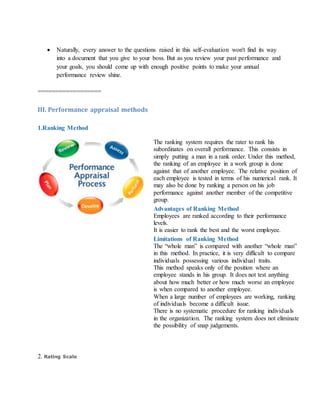
III. Performance appraisal methods
1.Ranking Method
The ranking system requires the rater to rank his
subordinates on overall performance. This consists in
simply putting a man in a rank order. Under this method,
the ranking of an employee in a work group is done
against that of another employee. The relative position of
each employee is tested in terms of his numerical rank. It
may also be done by ranking a person on his job
performance against another member of the competitive
group.
Advantages of Ranking Method
i. Employees are ranked according to their performance
levels.
ii. It is easier to rank the best and the worst employee.
Limitations of Ranking Method
i. The “whole man” is compared with another “whole man”
in this method. In practice, it is very difficult to compare
individuals possessing various individual traits.
ii. This method speaks only of the position where an
employee stands in his group. It does not test anything
about how much better or how much worse an employee
is when compared to another employee.
iii. When a large number of employees are working, ranking
of individuals become a difficult issue.
iv. There is no systematic procedure for ranking individuals
in the organization. The ranking system does not eliminate
the possibility of snap judgements.
2. Rating Scale
Rating scales consists of several numerical scales
representing job related performance criterions such as
dependability, initiative, output, attendance, attitude etc.
Each scales ranges from excellent to poor. The total
numerical scores are computed and final conclusions are
derived. Advantages – Adaptability, easy to use, low cost,
every type of job can be evaluated, large number of
employees covered, no formal training required.
Disadvantages – Rater’s biases
3. Checklist method
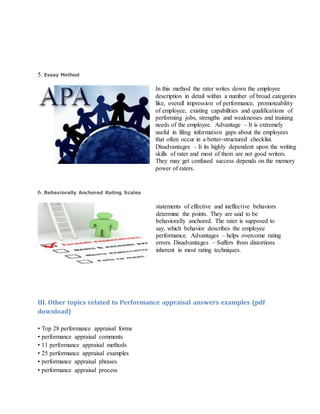
Under this method, checklist of statements of traits of
employee in the form of Yes or No based questions is
prepared. Here the rater only does the reporting or
checking and HR department does the actual evaluation.
Advantages – economy, ease of administration, limited
training required, standardization. Disadvantages – Raters
biases, use of improper weighs by HR, does not allow
rater to give relative ratings
4. Critical Incidents Method
The approach is focused on certain critical behaviors of
employee that makes all the difference in the
performance. Supervisors as and when they occur record
such incidents. Advantages – Evaluations are based on
actual job behaviors, ratings are supported by
descriptions, feedback is easy, reduces recency biases,
chances of subordinate improvement are high.
Disadvantages – Negative incidents can be prioritized,
forgetting incidents, overly close supervision; feedback
may be too much and may appear to be punishment.
5. Essay Method
In this method the rater writes down the employee
description in detail within a number of broad categories
like, overall impression of performance, promoteability
of employee, existing capabilities and qualifications of
performing jobs, strengths and weaknesses and training
needs of the employee. Advantage – It is extremely
useful in filing information gaps about the employees
that often occur in a better-structured checklist.
Disadvantages – It its highly dependent upon the writing
skills of rater and most of them are not good writers.
They may get confused success depends on the memory
power of raters.
6. Behaviorally Anchored Rating Scales
statements of effective and ineffective behaviors
determine the points. They are said to be
behaviorally anchored. The rater is supposed to
say, which behavior describes the employee
performance. Advantages – helps overcome rating
errors. Disadvantages – Suffers from distortions
inherent in most rating techniques.
III. Other topics related to Performance appraisal answers examples (pdf
download)
• Top 28 performance appraisal forms
• performance appraisal comments
• 11 performance appraisal methods
• 25 performance appraisal examples
• performance appraisal phrases
• performance appraisal process
• performance appraisal template
• performance appraisal system
• performance appraisal answers
• performance appraisal questions
• performance appraisal techniques
• performance appraisal format
• performance appraisal templates
• performance appraisal questionnaire
• performance appraisal software
• performance appraisal tools
• performance appraisal interview
• performance appraisal phrases examples
• performance appraisal objectives
• performance appraisal policy
• performance appraisal letter
• performance appraisal types
• performance appraisal quotes
• performance appraisal articles

Performance appraisal answers examples

  • 1.
    Performance appraisal answersexamples In this file, you can ref useful information about performance appraisal answers examples such as performance appraisal answers examples methods, performance appraisal answers examples tips, performance appraisal answers examples forms, performance appraisal answers examples phrases … If you need more assistant for performance appraisal answers examples, please leave your comment at the end of file. Other useful material for you: • performanceappraisal123.com/1125-free-performance-review-phrases • performanceappraisal123.com/free-28-performance-appraisal-forms • performanceappraisal123.com/free-ebook-11-methods-for-performance-appraisal I. Contents of getting performance appraisal answers examples ================== When preparing for an annual review, you'll want to compose a self evaluation that includes both your strong points and areas in need of improvement. This exercise is meant to help you evaluate your strong suits, as well as identify areas in need of improvement. To devise such a document, you'll need to include certain key points that will help you come up with an overall performance improvement strategy.  My Daily Work Ethic: Ask yourself what motivates you to do a good job. What drives you to succeed in your given field? Make a list of one-word items that describe your work ethic. Next, come up with examples that quantify the application of these words. Examples of the words might be: driven, hard-working, determined or highly motivated. Examples of the results might be: signed contracts with three new customers last quarter or oversaw implementation of a new system last year.  My Goals: Define your workplace goals. What is it that you want to accomplish in the next 18 months? Do you want a promotion? Are you striving to climb the corporate ladder? Where do you see yourself in five years? Use the answers to these questions to come up with your workplace goals.  Next, evaluate the steps you are taking to reach these goals. Are you working daily toward your goals? A good method for self evaluation when it comes to inching your way toward a specific goal is to rate your job performance in relation to daily activities that
  • 2.
    pertain to yourgoal. Give yourself a score based on a scale of one to 10, with 10 being the highest score, in order to figure out if you are making strides toward your ultimate workplace goal. In those areas where you rank low, whether industry networking or acquiring new skills, make a plan to improve.  My Job Performance: One of the biggest parts of a self evaluation is to measure your job performance. Are you fulfilling all your daily job functions? Do you put all your effort and time into a project? Do you stay late when necessary to meet deadlines? Answer these and other introspective questions that will help you properly evaluate your job performance. You may want to draw two columns on a page and list the strong points of your job performance, and weigh these against your negative attributes. An example of a pro/con of your work performance is: you work hard and go the extra mile to secure a client, but you often arrive to work late.  My Position: Part of a self evaluation should be seeing how you fit into your current position. How long have you been doing the same job? Have you outgrown your current position? Do you still enjoy it? Are there job responsibilities that can be added to your current position that would demonstrate your enthusiasm about your job or company? List ways you think you could do better in your current position.  An example of a self evaluation relating to your position would be: After being in the same position for five years, I feel I need a new challenge. I feel ready to delegate the grunt work part of my job.  My Ability To Be A Team Player: After you evaluate yourself in your current position as an individual, also look at yourself as part of a team. The team could be your company as a whole, or your individual department. Evaluate how you perform as a member of this team. Are you vital member of this group who helps it reach its goals? Do you work well as part of a team? Do you have the potential to be the team leader?  If you don't think you work well in a team environment, ask yourself the following: How can I best contribute to this group? What are my strong points that can be applied to a group project? What is stopping me from working within the group? Make a plan to overcome this and set a time frame.  My Desire to Succeed. How important is it for you to do well at work? Is your job just a job to pay the bills, or is it the career that you had long strived for when you were in college? Evaluate your drive to be successful. Ask yourself: What makes me want to be successful? Do I want a job promotion? How can I go about getting that promotion? What motivates me to do a good job? How can I succeed at this job?
  • 3.
     Naturally, everyanswer to the questions raised in this self-evaluation won't find its way into a document that you give to your boss. But as you review your past performance and your goals, you should come up with enough positive points to make your annual performance review shine. ================== III. Performance appraisal methods 1.Ranking Method The ranking system requires the rater to rank his subordinates on overall performance. This consists in simply putting a man in a rank order. Under this method, the ranking of an employee in a work group is done against that of another employee. The relative position of each employee is tested in terms of his numerical rank. It may also be done by ranking a person on his job performance against another member of the competitive group. Advantages of Ranking Method i. Employees are ranked according to their performance levels. ii. It is easier to rank the best and the worst employee. Limitations of Ranking Method i. The “whole man” is compared with another “whole man” in this method. In practice, it is very difficult to compare individuals possessing various individual traits. ii. This method speaks only of the position where an employee stands in his group. It does not test anything about how much better or how much worse an employee is when compared to another employee. iii. When a large number of employees are working, ranking of individuals become a difficult issue. iv. There is no systematic procedure for ranking individuals in the organization. The ranking system does not eliminate the possibility of snap judgements. 2. Rating Scale
  • 4.
    Rating scales consistsof several numerical scales representing job related performance criterions such as dependability, initiative, output, attendance, attitude etc. Each scales ranges from excellent to poor. The total numerical scores are computed and final conclusions are derived. Advantages – Adaptability, easy to use, low cost, every type of job can be evaluated, large number of employees covered, no formal training required. Disadvantages – Rater’s biases 3. Checklist method Under this method, checklist of statements of traits of employee in the form of Yes or No based questions is prepared. Here the rater only does the reporting or checking and HR department does the actual evaluation. Advantages – economy, ease of administration, limited training required, standardization. Disadvantages – Raters biases, use of improper weighs by HR, does not allow rater to give relative ratings 4. Critical Incidents Method The approach is focused on certain critical behaviors of employee that makes all the difference in the performance. Supervisors as and when they occur record such incidents. Advantages – Evaluations are based on actual job behaviors, ratings are supported by descriptions, feedback is easy, reduces recency biases, chances of subordinate improvement are high. Disadvantages – Negative incidents can be prioritized, forgetting incidents, overly close supervision; feedback may be too much and may appear to be punishment.
  • 5.
    5. Essay Method Inthis method the rater writes down the employee description in detail within a number of broad categories like, overall impression of performance, promoteability of employee, existing capabilities and qualifications of performing jobs, strengths and weaknesses and training needs of the employee. Advantage – It is extremely useful in filing information gaps about the employees that often occur in a better-structured checklist. Disadvantages – It its highly dependent upon the writing skills of rater and most of them are not good writers. They may get confused success depends on the memory power of raters. 6. Behaviorally Anchored Rating Scales statements of effective and ineffective behaviors determine the points. They are said to be behaviorally anchored. The rater is supposed to say, which behavior describes the employee performance. Advantages – helps overcome rating errors. Disadvantages – Suffers from distortions inherent in most rating techniques. III. Other topics related to Performance appraisal answers examples (pdf download) • Top 28 performance appraisal forms • performance appraisal comments • 11 performance appraisal methods • 25 performance appraisal examples • performance appraisal phrases • performance appraisal process
  • 6.
    • performance appraisaltemplate • performance appraisal system • performance appraisal answers • performance appraisal questions • performance appraisal techniques • performance appraisal format • performance appraisal templates • performance appraisal questionnaire • performance appraisal software • performance appraisal tools • performance appraisal interview • performance appraisal phrases examples • performance appraisal objectives • performance appraisal policy • performance appraisal letter • performance appraisal types • performance appraisal quotes • performance appraisal articles