Performance Appraisal
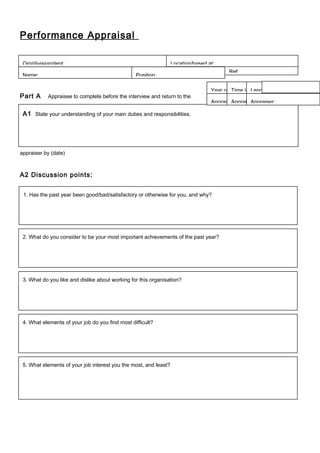
Part A Appraisee to complete before the interview and return to the
appraiser by (date)
A2 Discussion points:
Org/division/dept:
Year or period covered:
Name:
Ref:
Location/based at:
Position:
Time in present position:Length of service:
A1 State your understanding of your main duties and responsibilities.
Appraisal date & time:Appraisal venue:Appraiser:
1. Has the past year been good/bad/satisfactory or otherwise for you, and why?
2. What do you consider to be your most important achievements of the past year?
3. What do you like and dislike about working for this organisation?
4. What elements of your job do you find most difficult?
5. What elements of your job interest you the most, and least?
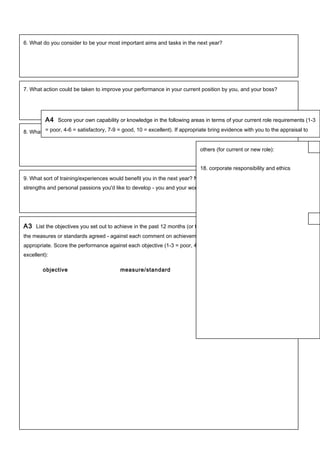
6. What do you consider to be your most important aims and tasks in the next year?
7. What action could be taken to improve your performance in your current position by you, and your boss?
8. What kind of work or job would you like to be doing in one/two/five years time?
9. What sort of training/experiences would benefit you in the next year? Not just job-skills - also your natural
strengths and personal passions you'd like to develop - you and your work can benefit from these.
A3 List the objectives you set out to achieve in the past 12 months (or the period covered by this appraisal) with
the measures or standards agreed - against each comment on achievement or otherwise, with reasons where
appropriate. Score the performance against each objective (1-3 = poor, 4-6 = satisfactory, 7-9 = good, 10 =
excellent):
objective measure/standard score comment
A4 Score your own capability or knowledge in the following areas in terms of your current role requirements (1-3
= poor, 4-6 = satisfactory, 7-9 = good, 10 = excellent). If appropriate bring evidence with you to the appraisal to
support your assessment. The second section can be used if working towards new role requirements.
1. commercial judgement
2. product/technical knowledge
3. time management
4. planning, budgeting and forecasting
5. reporting and administration
6. communication skills
7. delegation skills
8. IT/equipment/machinery skills
9. meeting deadlines/commitments
10. creativity
11. problem-solving and decision-making
12. team-working and developing others
others (for current or new role):
18. corporate responsibility and ethics
A5 In light of your current capabilities, your performance against past objectives, and your future personal
growth and/or job aspirations, what activities and tasks would you like to focus on during the next year. Again,
also think of development and experiences outside of job skills - related to personal aims, fulfilment, passions.
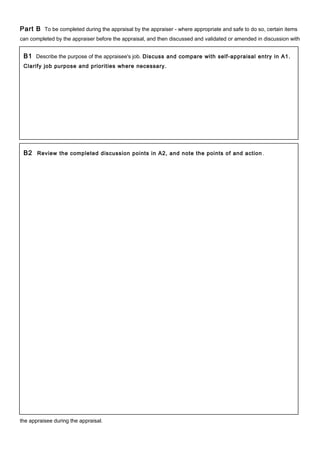
Part B To be completed during the appraisal by the appraiser - where appropriate and safe to do so, certain items
can completed by the appraiser before the appraisal, and then discussed and validated or amended in discussion with
the appraisee during the appraisal.
B1 Describe the purpose of the appraisee's job. Discuss and compare with self-appraisal entry in A1.
Clarify job purpose and priorities where necessary.
B2 Review the completed discussion points in A2, and note the points of and action .
B3 List the objectives that the appraisee set out to achieve in the past 12 months (or the period covered by this
appraisal - typically these objectives will have been carried forward from the previous appraisal record) with the
measures or standards agreed - against each comment on achievement or otherwise, with reasons where
appropriate. Score the performance against each objective (1-3 = poor, 4-6 = satisfactory, 7-9 = good, 10 =
excellent). Compare with the self-appraisal in A3. Discuss and note points of significance,
particularly training and development needs and wishes, which should be noted in B6.
objective measure/standard self-score/app'r score comment
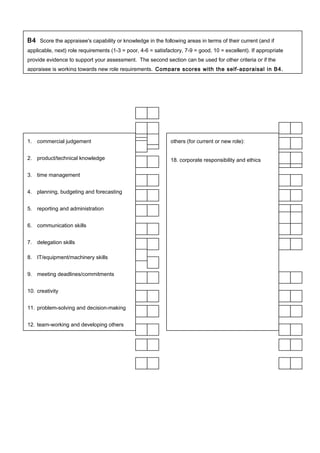
B4 Score the appraisee's capability or knowledge in the following areas in terms of their current (and if
applicable, next) role requirements (1-3 = poor, 4-6 = satisfactory, 7-9 = good, 10 = excellent). If appropriate
provide evidence to support your assessment. The second section can be used for other criteria or if the
appraisee is working towards new role requirements. Compare scores with the self-appraisal in B4.
1. commercial judgement
2. product/technical knowledge
3. time management
4. planning, budgeting and forecasting
5. reporting and administration
6. communication skills
7. delegation skills
8. IT/equipment/machinery skills
9. meeting deadlines/commitments
10. creativity
11. problem-solving and decision-making
12. team-working and developing others
others (for current or new role):
18. corporate responsibility and ethics
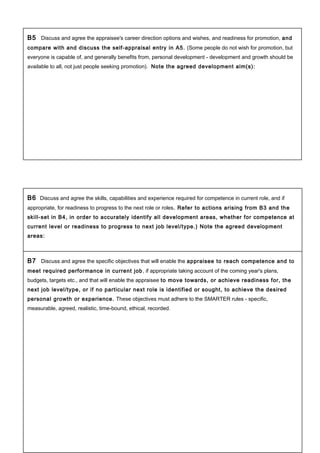
B5 Discuss and agree the appraisee's career direction options and wishes, and readiness for promotion, and
compare with and discuss the self-appraisal entry in A5. (Some people do not wish for promotion, but
everyone is capable of, and generally benefits from, personal development - development and growth should be
available to all, not just people seeking promotion). Note the agreed development aim(s):
B6 Discuss and agree the skills, capabilities and experience required for competence in current role, and if
appropriate, for readiness to progress to the next role or roles. Refer to actions arising from B3 and the
skill-set in B4, in order to accurately identify all development areas, whether for competence at
current level or readiness to progress to next job level/type.) Note the agreed development
areas:
B7 Discuss and agree the specific objectives that will enable the appraisee to reach competence and to
meet required performance in current job, if appropriate taking account of the coming year's plans,
budgets, targets etc., and that will enable the appraisee to move towards, or achieve readiness for, the
next job level/type, or if no particular next role is identified or sought, to achieve the desired
personal growth or experience. These objectives must adhere to the SMARTER rules - specific,
measurable, agreed, realistic, time-bound, ethical, recorded.
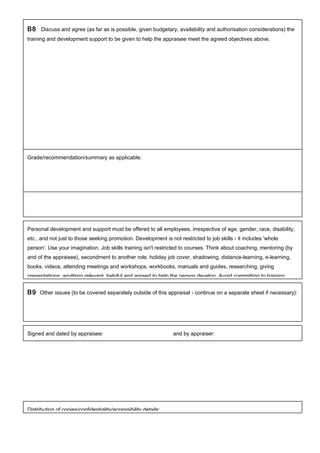
B8 Discuss and agree (as far as is possible, given budgetary, availability and authorisation considerations) the
training and development support to be given to help the appraisee meet the agreed objectives above.
Personal development and support must be offered to all employees, irrespective of age, gender, race, disability,
etc., and not just to those seeking promotion. Development is not restricted to job skills - it includes 'whole
person'. Use your imagination. Job skills training isn't restricted to courses. Think about coaching, mentoring (by
and of the appraisee), secondment to another role, holiday job cover, shadowing, distance-learning, e-learning,
books, videos, attending meetings and workshops, workbooks, manuals and guides, researching, giving
presentations; anything relevant, helpful and agreed to help the person develop. Avoid committing to training
B9 Other issues (to be covered separately outside of this appraisal - continue on a separate sheet if necessary):
Signed and dated by appraisee: and by appraiser:
Distribution of copies/confidentiality/accessibility details:
Grade/recommendation/summary as applicable:

Performance appraisal

  • 1.
    Performance Appraisal Part AAppraisee to complete before the interview and return to the appraiser by (date) A2 Discussion points: Org/division/dept: Year or period covered: Name: Ref: Location/based at: Position: Time in present position:Length of service: A1 State your understanding of your main duties and responsibilities. Appraisal date & time:Appraisal venue:Appraiser: 1. Has the past year been good/bad/satisfactory or otherwise for you, and why? 2. What do you consider to be your most important achievements of the past year? 3. What do you like and dislike about working for this organisation? 4. What elements of your job do you find most difficult? 5. What elements of your job interest you the most, and least?
  • 2.
    6. What doyou consider to be your most important aims and tasks in the next year? 7. What action could be taken to improve your performance in your current position by you, and your boss? 8. What kind of work or job would you like to be doing in one/two/five years time? 9. What sort of training/experiences would benefit you in the next year? Not just job-skills - also your natural strengths and personal passions you'd like to develop - you and your work can benefit from these. A3 List the objectives you set out to achieve in the past 12 months (or the period covered by this appraisal) with the measures or standards agreed - against each comment on achievement or otherwise, with reasons where appropriate. Score the performance against each objective (1-3 = poor, 4-6 = satisfactory, 7-9 = good, 10 = excellent): objective measure/standard score comment A4 Score your own capability or knowledge in the following areas in terms of your current role requirements (1-3 = poor, 4-6 = satisfactory, 7-9 = good, 10 = excellent). If appropriate bring evidence with you to the appraisal to support your assessment. The second section can be used if working towards new role requirements. 1. commercial judgement 2. product/technical knowledge 3. time management 4. planning, budgeting and forecasting 5. reporting and administration 6. communication skills 7. delegation skills 8. IT/equipment/machinery skills 9. meeting deadlines/commitments 10. creativity 11. problem-solving and decision-making 12. team-working and developing others others (for current or new role): 18. corporate responsibility and ethics
  • 4.
    A5 In lightof your current capabilities, your performance against past objectives, and your future personal growth and/or job aspirations, what activities and tasks would you like to focus on during the next year. Again, also think of development and experiences outside of job skills - related to personal aims, fulfilment, passions.
  • 5.
    Part B Tobe completed during the appraisal by the appraiser - where appropriate and safe to do so, certain items can completed by the appraiser before the appraisal, and then discussed and validated or amended in discussion with the appraisee during the appraisal. B1 Describe the purpose of the appraisee's job. Discuss and compare with self-appraisal entry in A1. Clarify job purpose and priorities where necessary. B2 Review the completed discussion points in A2, and note the points of and action .
  • 7.
    B3 List theobjectives that the appraisee set out to achieve in the past 12 months (or the period covered by this appraisal - typically these objectives will have been carried forward from the previous appraisal record) with the measures or standards agreed - against each comment on achievement or otherwise, with reasons where appropriate. Score the performance against each objective (1-3 = poor, 4-6 = satisfactory, 7-9 = good, 10 = excellent). Compare with the self-appraisal in A3. Discuss and note points of significance, particularly training and development needs and wishes, which should be noted in B6. objective measure/standard self-score/app'r score comment
  • 8.
    B4 Score theappraisee's capability or knowledge in the following areas in terms of their current (and if applicable, next) role requirements (1-3 = poor, 4-6 = satisfactory, 7-9 = good, 10 = excellent). If appropriate provide evidence to support your assessment. The second section can be used for other criteria or if the appraisee is working towards new role requirements. Compare scores with the self-appraisal in B4. 1. commercial judgement 2. product/technical knowledge 3. time management 4. planning, budgeting and forecasting 5. reporting and administration 6. communication skills 7. delegation skills 8. IT/equipment/machinery skills 9. meeting deadlines/commitments 10. creativity 11. problem-solving and decision-making 12. team-working and developing others others (for current or new role): 18. corporate responsibility and ethics
  • 9.
    B5 Discuss andagree the appraisee's career direction options and wishes, and readiness for promotion, and compare with and discuss the self-appraisal entry in A5. (Some people do not wish for promotion, but everyone is capable of, and generally benefits from, personal development - development and growth should be available to all, not just people seeking promotion). Note the agreed development aim(s): B6 Discuss and agree the skills, capabilities and experience required for competence in current role, and if appropriate, for readiness to progress to the next role or roles. Refer to actions arising from B3 and the skill-set in B4, in order to accurately identify all development areas, whether for competence at current level or readiness to progress to next job level/type.) Note the agreed development areas: B7 Discuss and agree the specific objectives that will enable the appraisee to reach competence and to meet required performance in current job, if appropriate taking account of the coming year's plans, budgets, targets etc., and that will enable the appraisee to move towards, or achieve readiness for, the next job level/type, or if no particular next role is identified or sought, to achieve the desired personal growth or experience. These objectives must adhere to the SMARTER rules - specific, measurable, agreed, realistic, time-bound, ethical, recorded.
  • 10.
    B8 Discuss andagree (as far as is possible, given budgetary, availability and authorisation considerations) the training and development support to be given to help the appraisee meet the agreed objectives above. Personal development and support must be offered to all employees, irrespective of age, gender, race, disability, etc., and not just to those seeking promotion. Development is not restricted to job skills - it includes 'whole person'. Use your imagination. Job skills training isn't restricted to courses. Think about coaching, mentoring (by and of the appraisee), secondment to another role, holiday job cover, shadowing, distance-learning, e-learning, books, videos, attending meetings and workshops, workbooks, manuals and guides, researching, giving presentations; anything relevant, helpful and agreed to help the person develop. Avoid committing to training B9 Other issues (to be covered separately outside of this appraisal - continue on a separate sheet if necessary): Signed and dated by appraisee: and by appraiser: Distribution of copies/confidentiality/accessibility details: Grade/recommendation/summary as applicable: